One Minute Reflection – 28 April – The Memorial of St Paul of the Cross CP (1604-1775) and St Louis Marie Grignion de Montfort (1673-1716 – 1 Corinthians 1:17-25, Luke 10:1-9
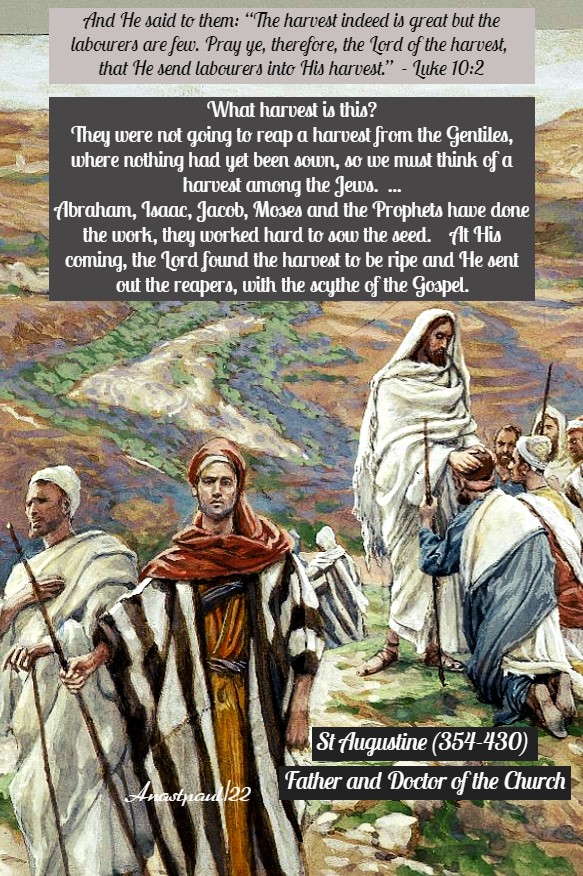
And He said to them: “The harvest indeed is great but the labourers are few. Pray ye, therefore, the Lord of the harvest, that He send labourers into His harvest.” – Luke 10:2
REFLECTION – “The Gospel that has just been read to us, invites us to seek out what this harvest might be, of which the Lord says to us, that: “The harvest is great, the labourers are few, so pray the Lord of the harvest to send out labourers into His harvest.” So it was that, in addition to those twelve disciples whom He called Apostles, (those who have been sent), He sent out seventy-two others. All of them, as His own words reveal, were sent to work at a harvest that had already been prepared. What harvest is this? They were not going to reap a harvest from the Gentiles, where nothing had yet been sown, so we must think of a harvest among the Jews. It was in order to reap this harvest that the Lord of the harvest came. But to the other peoples He sent, not reapers but sowers. Among the Jews, then, there was a harvest but elsewhere, the sowing. And it was particularly while reaping among the Jews, that He chose the Apostles. Harvest time had come, the harvest was ripe, for the prophets had done their sowing among them…
Did not the Lord declare to His disciples: “You say the harvest will be a long time. I tell you, look up and see, the fields ripe for harvest,” (Jn 4,35)? And again, He said: “Others have done the work and you are sharing the fruits of their work,” (ibid v.38). Abraham, Isaac, Jacob, Moses and the prophets have done the work, they worked hard to sow the seed. At His coming, the Lord found the harvest to be ripe and He sent out the reapers, with the scythe of the Gospel.” – St Augustine (354-430) Bishop of Hippo, Father and Doctor of the Church (Sermon 101).
PRAYER – Lord Jesus Christ, Who didst gift Thine holy servant Paul, with great love that he might preach the Mystery of Thy Cross and hast been pleased, that through him, a new family should grow up in Thy Church, grant unto us at his prayers, that upon earth we may so call Thy sufferings to mind, as worthily to gain the fruit thereof in Heaven. Who lives and reigns with God the Father, in the unity of the Holy Spirit, God, world without end. Amen (Collect).
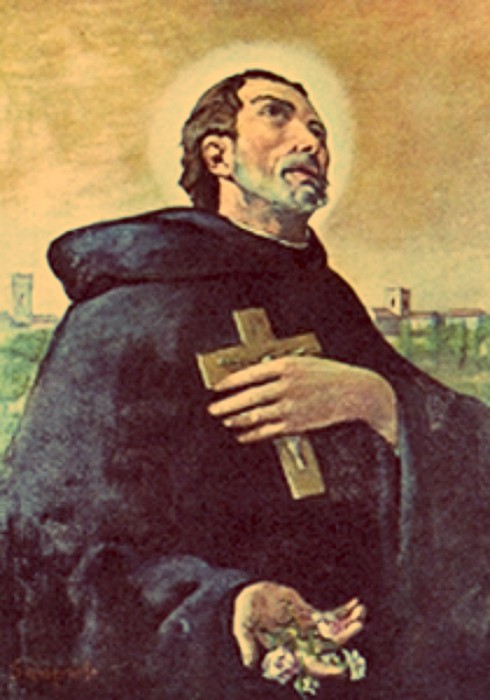
Saint of the Day – 12 April – Blessed Andrew of Montereale OSA (c 1403-1479) Priest of the Hermits of St Augustine, renowned Scholar, Preacher, Teacher, Reformer. Confessor and Spiritual Director to the Royal Court of France, Miracle-worker. His life was devoted to teaching, preaching and leading the Augustinians from several positions of leadership. He was hailed, even during his lifetime, as a pious Miracle worker. Born in c 1403 in Mascioni, Campotosto, Italy as Antonio Artesi and died on 18 April 1479 at the Augustinian Monastery of Montereale, Italy of natural causes. Additional Memorial – 18 April (The Augustinians). Patronage – Montereale, Italy.
The Roman Martyrology reads: “In Montereale in Abruzzo, Blessed Andrea, Priest of the Order of the Hermits of St Augustine, who devoted himself to preaching in Italy and France.”
The birthplace of Blessed Andrew is certain – Mascioni, on the shores of Lake Campotosto into a modest household; no less certain is the place of his death: the Augustinian Monastery in Montereale, a short distance from Mascioni, to which the Blessed retired, a few years before his death. His earthly sojourn ended on 18 April 1479.
The sad events of the Avignon Schism had negative effects on the Church and the Augustinian Order, well beyond 1417, the year in which Martin V was elected to the Supreme Pontificate. The quest for unity in the Order, which had been split by the schism and the path of reform, were the most urgent concerns of the General Chapters and the Priors General of the time. Those same events were inevitably echoed in the first part of Blessed Andrew’s life. According to tradition, he had, from childhood, worked as a shepherd. A meeting with Augustinian Father Augustine of Terni, Prior of the Monastery in Montereale, decided Andrew’s entrance into that same Monastery and the beginning of his Novitiate. He was Ordained a Priest at the age of twenty-five and then, in light of his bent for studies, was destined for teaching. To that end he acquired the various academic Degrees of Bachelor, Reader and Master of Theology while attending the general house of studies of the Order in Rimini and in Siena; he appears as Director of studies in the latter place, in 1459.
During these same years, enjoying, as he did, the trust of his superiors and fellow religious, he held Offices in Government. He was Vicar General and visitor of some Monasteries; he was elected Prior Provincial of the Province of the Valley of Spoleto and in that capacity, took part in the General Chapters of Avignon in 1455 and Pamiers (France) in 1465.
In 1459, for reasons we do not know, he resigned from the Priorate and his position as Director of studies in Siena and in 1461, by order of the Prior General, Father William Becchi, a Florentine, he was sent away from the Monastery of Norcia, along with the local Prior, Father Jerome of Cittaducale. This was “at the request of various religious of the Province, in order to avoid scandal and begin the reform of that Monastery.”
In 1468, when William Becchi was still the Prior General, he appointed Blessed Andrew as his Vicar for visiting the Monastery of Amatrice. In 1471, Andrew was again elected Prior Provincial of the Province of the Valley of Spoleto.
Thus far we have the cold facts of his “external” life as a religious. Other sources help us to know more about his interior life.
A few months after the Blessed’s death, his contemporary, Ambrose of Cori, who had been Provincial of the Roman Province and was now Prior General of the Order (1476-1482) listed 36 Blesseds of the Order, in the Chronicle of the Order, which he published in 1481. At the time when Blessed Andrew had been expelled from the Monastery of Norcia, Ambrose was Director of studies in Perugia and, therefore, knew Andrew personally. In the 36th place in his list he put Blessed Andrew of Montereale, “who lived in our time and is made glorious by many signs and miracles. He was very learned in Canon Law, Philosophy and Theology and showed the greatest example of holiness in preaching, helping the poor and enduring abuse and in every kind of patience.”
In a few words Ambrose exalts Blessed Andrew well above even fervent religious, tells us of his reputation for miracles and of his teaching and calls him Blessed, thereby, in all likelihood, expressing the sentiments of the people. In the epitaph engraved beneath the image of the Blessed on the wall of the Choir in the Church of Saint Augustine in Montereale—an epitaph that is now gone but was cited by Riccitelli in 1581 and went back to the end of the fourteenth or the beginning of the fifteenth century—people could read the following:
Here lies the body of Blessed Andrew of the Order of Hermits of Saint Augustine, who worked countless great miracles. Due to his holiness of life, the austerity of his ways and his Catholic teaching, due also to his honeyed preaching and great miracles, he was famous throughout Italy and France.
He is dear to God and humanity and is an honour to the Order, an adornment of his native land and of great advantage to his neighbour. He was and is, a great benefit to the world, having preached the Word of God for fifty years.
His works have not come down to us. At that time an inventory of goods had to be made by Masters of Theology. A copy of the one which the Blessed compiled on the day of his death has survived and therein, is a list of the books he had loaned to brother Friars. Among these was the Decretals, a Gloss on the subject and a “little book,” a term suggesting a work of his own. The other objects listed give a glimpse of the simplicity of his life, for among them are “a little brass jar, four table forks, a little bell and some other little things.”
Augustinians and the Rule
Among the many writers who have spoken of him, mention may be made of Blessed Alonso de Orozco, who, in his Chronicle of the Glorious Saint Augustine, Father and Doctor of the Church (1551), lists Andrew among the blessed and describes him as “a very gifted man and a great preacher; very patient and charitable; – he performed many miracles.”
Although Andrew had the reputation of being a saint, it was only in the years 1756-1757, during the Pontificate of Benedict XIV, that the cause of his Beatification was taken up by the Diocese of Rieti, of which Montereale was a part. During the process, witnesses bore unanimous testimony to Andrew’s commitment to the struggle against schism and heresy, his exercise of the preaching office over several decades, his journeys to France and the role he played at the Court of the King of France, where he was the Queen’s Confessor and Spiritual Director. They also attested that his name was Antonio Artesi. Blessed Andrew was Beatified on 18 February 1764 by Pope Clement XIII (By the Augustinian Friends).
Monday of Holy Week – 11 April – Our Lenten Journey with the Great Fathers – Isaias 50:5-10, John 12:1-9
“Help us, O God, our saviour and for the glory of thy name, O Lord, deliver us and forgive us our sins, for Thy name’s sake” – Psalm 78:9
“He (Judas Iscariot) said this, not because he cared about the poor but because, he was a thief and held the money bag and used to steal the contributions.”
John 12:6
“LOOK NOW AND LEARN that this Judas did not become perverted, only at the time when he yielded to the bribery of the Jews and betrayed his Lord. For not a few, inattentive to the Gospel, suppose, that Judas only perished, when he accepted money from the Jews, to betray the Lord. It was not then that he perished but he was already a thief and a reprobate, when following the Lord;,for it was with his body and not with his heart, that he followed. He made up the apostolic number of twelve but had no part in the apostolic blessedness. He had been made the twelfth in semblance and on his departure and the succession of another, the apostolic reality was completed and the entirety of the number conserved.
WHAT LESSON THEN, my brethren, did our Lord Jesus Christ wish to impress on His Church, when it pleased Him, to have one castaway among the twelve – but this – that we should bear with the wicked and refrain from dividing the body of Christ? Here you have Judas among the saints,- that Judas, mark you! who was a thief, yes – do not overlook it – not a thief of any ordinary type but a thief and a sacrilegis – a robber of money bags,but of such as were the Lord’s; of money bags but of such as were sacred! . … How much more severe ought to be, the sentence on the sacrilegious thief, who has dared to steal, not from places of any ordinary kind but, to steal from the Church!?
HE WHO THIEVES from the Church, stands side by side with the castaway Judas. Such was this man Judas and yet, he went in and out with the eleven holy disciples. With them, he came even to the table of the Lord, he was permitted to have intercourse with them but he could not contaminate them.
OF ONE BREAD did both Peter and Judas partake and yet, what communion had the believer with the infidel? Peter’s partaking was unto life but that of Judas unto death. For that good bread was just like the sweet savour. For as the sweet savour, so also does the good bread give life to the good and bring death to the wicked. “For he that eateth unworthily, eateth and drinketh judgement to himself:” – “judgment to himself,” not to thee. If, then, it is judgement to himself, not to thee, bear as one that is good, with him that is evil, that you may attain the rewards of the good,and be not hurled into the punishment of the wicked.” – St Augustine (354-430) Bishop of Hippo, Great Western Father and Doctor of the Church (On John 12:1-9 Monday of Holy Week).
Quote/s of the Day – 11 April – Monday of Holy Week – Isaias 50:5-10, John 12:1-9
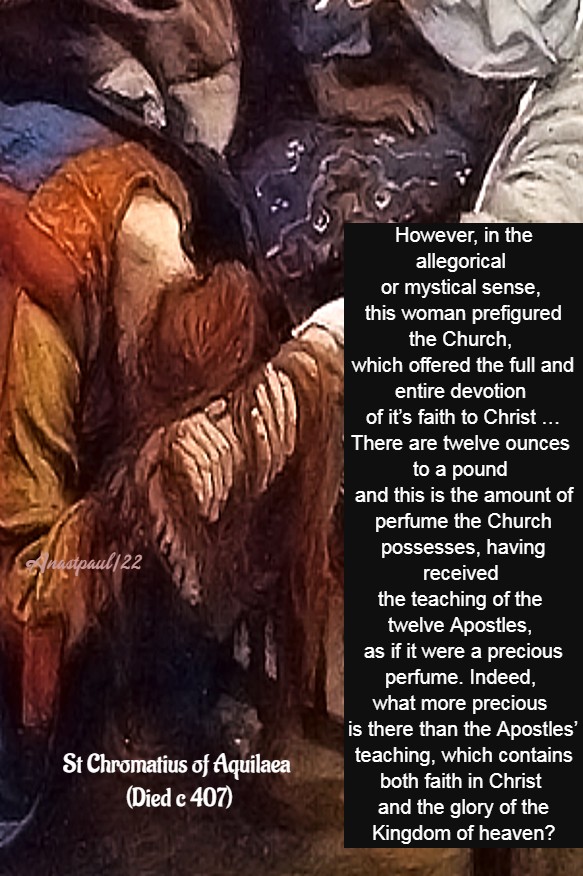
“However, in the allegorical or mystical sense, this woman prefigured the Church, which offered the full and entire devotion of it’s faith to Christ … There are twelve ounces to a pound and this is the amount of perfume the Church possesses, having received the teaching of the twelve Apostles, as if it were a precious perfume. Indeed, what more precious is there than the Apostles’ teaching, which contains both faith in Christ and the glory of the Kingdom of heaven? ”
St Chromatius of Aquilaea (Died c 407)
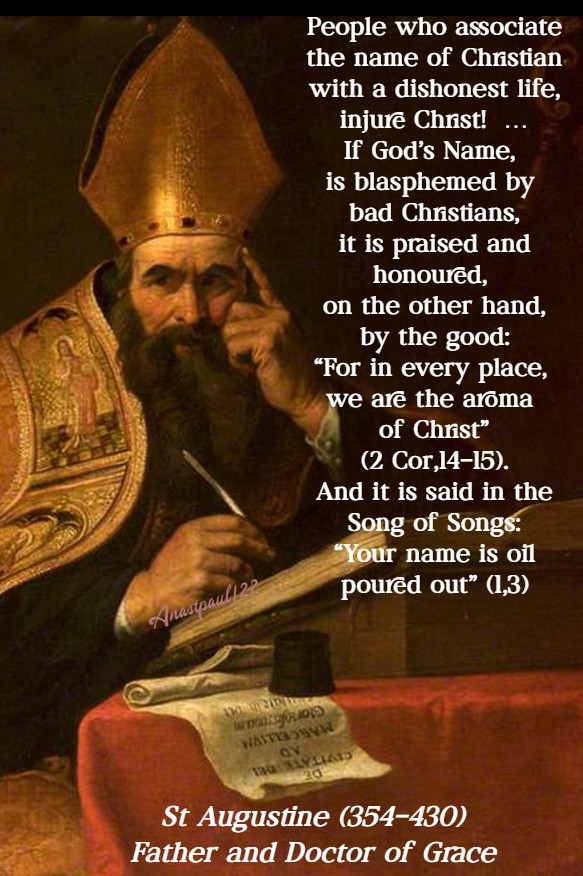
“People who associate the name of Christian with a dishonest life, injure Christ! … If God’s Name, is blasphemed by bad Christians, it is praised and honoured, on the other hand, by the good: “For in every place, we are the aroma of Christ” (2 Cor,14-15). And it is said in the Song of Songs: “Your name is oil poured out” (1,3).”
Friday of Passion Week, the Fifth Week in Lent +2022
Our Lady of the Seven Sorrows THE FEAST DAY OF THE SEVEN DOLORS IS TRADITIONALLY THE FRIDAY OF PASSION WEEK, WHICH IS THE FRIDAY BEFORE GOOD FRIDAY, OR ON 15 SEPTEMBER.
St Dionysius of Corinth Bl Domingo Iturrate Zubero Bl Gonzalo Mercador St Herodion of Patras Blessed Julian of Saint Augustine (OFM c 1550-1606) Lay Brother
Bl Libania of Busano St Phlegon of Hyrcania St Redemptus of Ferentini
Martyrs of Africa – 3 Saints: A group of African Martyrs whose name appears on ancient lists but about whom nothing is known but their names – Januarius, Macaria and Maxima.
Martyrs of Antioch – 4 Saints: A group of Christians Martyred together for their faith. We know little more than their names – Diogene, Macario, Massimo and Timothy. They died in Antioch, Syria.
Martyrs of Seoul – 5 Saints: A group laymen who were Martyred together in the apostolic vicariate of Korea. • Augustinus Jeong Yak-jong • Franciscus Xaverius Hong Gyo-man • Ioannes Choe Chang-hyeon • Lucas Hong Nak-min • Thomas Choe Pil-gong They died on 8 April 1801 at the Small West Gate, Seoul, South Korea
St Pausilippus Bl Peter Cerdan St Theodore the Martyr
Martyrs of Lesbos: 5 Saints: Five young Christian women Martyred together for their faith. We don’t even know their names. island of Lesbos, Greece.
Martyrs of North-West Africa: Large group of Christians murdered while celebrating Easter Mass during the persecutions of Genseric, the Arian king of the Vandals. They were Martyred in 459 at Arbal (in modern Algeria).
Martyrs of Seleucia: 120 Saints :One-hundred and eleven (111) men and nine (9) women who, because they were Christians, were dragged to Seleucia and Martyred for refusing to worship the sun or fire or other pagan idols during the persecutions of King Shapur II. They were burned alive in 344 in Seleucia, Persia.
Wednesday of the Fourth Week of Lent – 30 March – Our Lenten Journey with the Great Fathers – Isaias 1:16-19, John 9:1-38
“Wash yourselves, be clean, take away the evil of your devices from My eyes, cease to do perversely, Learn to do well: seek judgement, relieve the oppressed, judge for the fatherless, defend the widow.” – Isaias 1:16-17
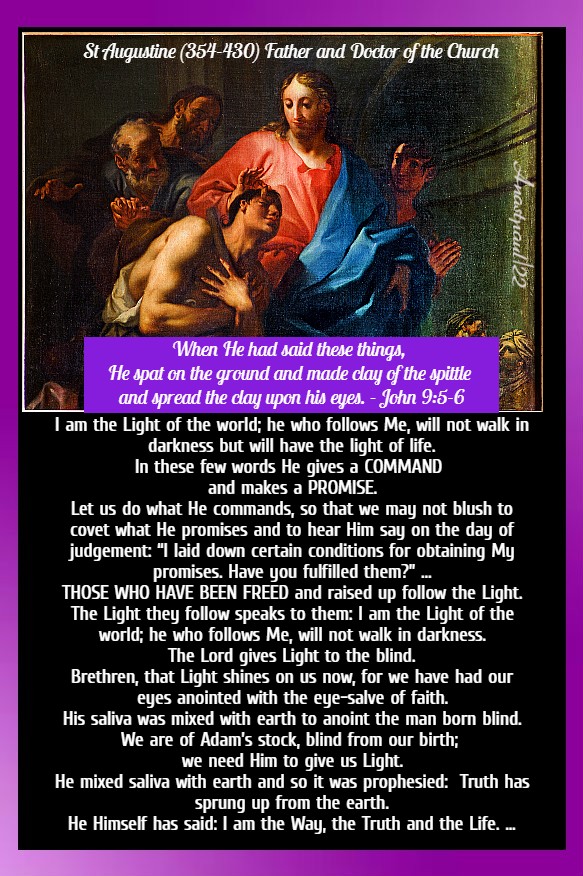
“And Jesus passing by, saw a man who was blind from his birth. … As long as I am in the world, I am the Light of the world. When He had said these things, He spat on the ground and made clay of the spittle and spread the clay upon his eyes,”
John 9:1,5-6
“THE LORD TELLS US – I am the Light of the world; he who follows Me, will not walk in darkness but will have the light of life. In these few words He gives a COMMAND and makes a PROMISE. Let us do what He commands, so that we may not blush to covet what He promises and to hear Him say on the day of judgement: “I laid down certain conditions for obtaining My promises. Have you fulfilled them?” If you say: “What did you command, Lord our God?” He will tell you: “I commanded you to follow Me. You asked for advice on how to enter into life. What life, if not the life about which it is written: With you is the fountain of life?”
LET US DO NOW what He commands. Let us follow in the footsteps of the Lord. Let us throw off the chains that prevent us from following Him. Who can throw off these shackles without the aid of the One addressed in these words: You have broken my chains? Another psalm says of Him: The Lord frees those in chains, the Lord raises up the downcast.
THOSE WHO HAVE BEEN FREEDand raised up follow the Light. The Light they follow speaks to them: I am the Light of the world; he who follows Me, will not walk in darkness. The Lord gives Light to the blind. Brethren, that Light shines on us now, for we have had our eyes anointed with the eye-salve of faith. His saliva was mixed with earth to anoint the man born blind. We are of Adam’s stock, blind from our birth; we need Him to give us Light. He mixed saliva with earth and so it was prophesied: Truth has sprung up from the earth. He Himself has said: I am the Way, the Truth and the Life. …
IF YOU LOVE ME, follow Me. “I do love you,” you protest “but how do I follow you?” If the Lord your God said to you: “I am the truth and the life,” in your desire for truth, in your love for life, you would certainly ask Him to show you the way to reach them. You would say to yourself: “Truth is a great reality, life is a great reality – if only it were possible for my soul to find them!” – St Augustine (354-430) Bishop, Great Western Father and Doctor of the Church (An excerpt from: On John [Treatise 34]).
Quote/s of the Day – 29 March – Tuesday of the Fourth Week of Lent – Exodus 32:7-14, John 7:14-31
“But of the people,many believed in him …”
John 7:31
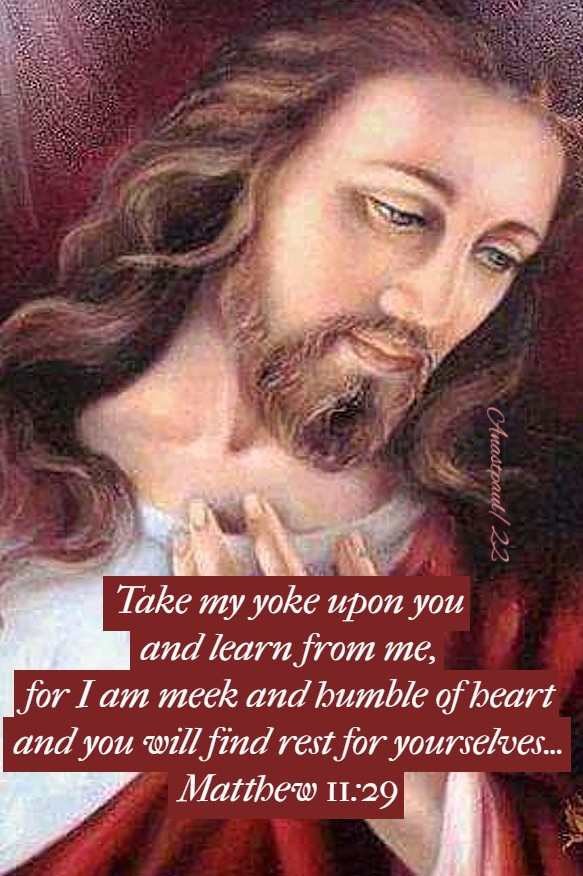
“Take my yoke upon you and learn from me, for I am meek and humble of heart and you will find rest for yourselves…”
Matthew 11:29
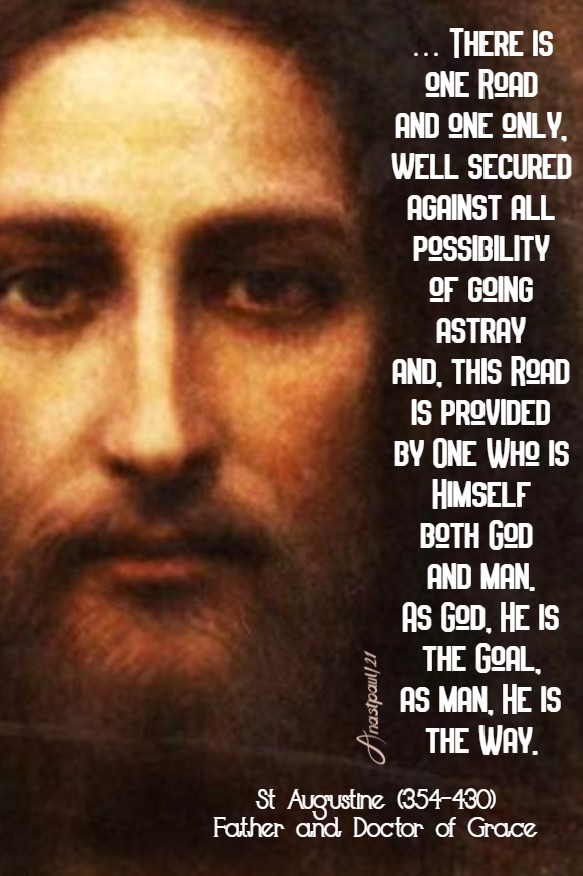
“… There is one Road and one only, well secured against all possibility of going astray and, this Road is provided by One Who is Himself both God and man. As God, He is the Goal, as man, He is the Way.”
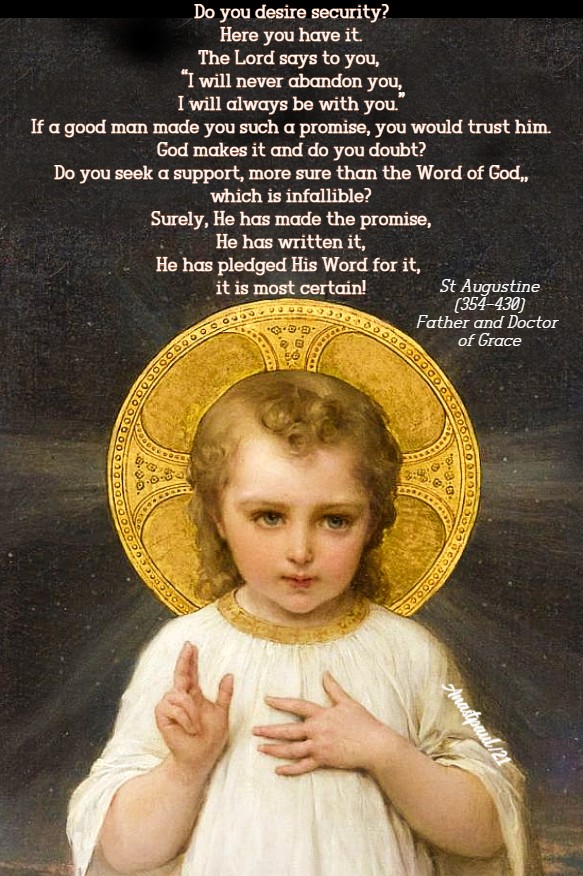
“Do you desire security? Here you have it. The Lord says to you, “I will never abandon you, I will always be with you.” If a good man made you such a promise, you would trust him. God makes it and do you doubt? Do you seek a support, more sure than the Word of God, which is infallible? Surely, He has made the promise, He has written it, He has pledged His Word for it, it is most certain!”
St Augustine (354-430) Bishop of Hippo Father and Doctor of Grace
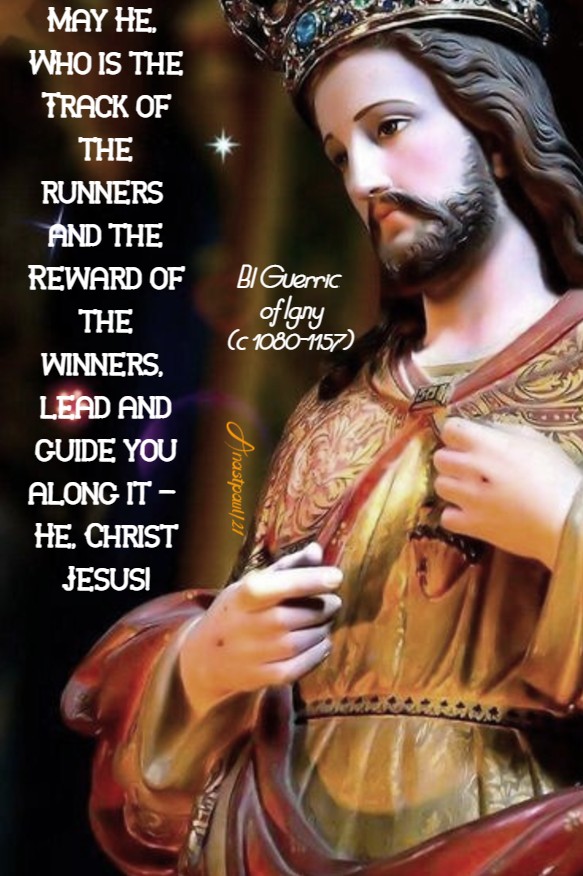
“May He, Who is the Track of the runners and the Reward of the winners, lead and guide you along it – He, Christ Jesus!”
St John of Capistrano OFM (1386-1456) Friar of the Friars Minor, Priest, Confessor and Preacher. Famous as a preacher, theologian and inquisitor, trained lawyer, he earned himself the nickname ‘the Soldier Saint’ when in 1456 at age 70 he led a crusade against the invading Ottoman Empire at the siege of Belgrade. Feast Day moved from 28 March in 1969. Biography: https://anastpaul.com/2017/10/23/saint-of-the-day-23-october-st-john-capistrano-ofm-1386-1456-the-soldier-saint/
St Cyril the Deacon Bl Dedë Maçaj St Donal O’NeylaC St Dorotheus of Tarsus St Gundelindis of Niedermünster St Guntramnus (c 532-592) King, Confessor St Hesychius of Jerusalem St Hilarion of Pelecete Bl Jean-Baptiste Malo Bl Jeanne Marie de Maille St Proterius of Alexandria Bl Renée-Marie Feillatreau épouse Dumont St Rogatus the Martyr St Successus the Martyr St Tutilo of Saint-Gall
Quote/s of the Day – 26 March – Saturday of the Third Week of Lent – Daniel 13:1-9, 15-17, 19-30, 33-62, John 8:1-11
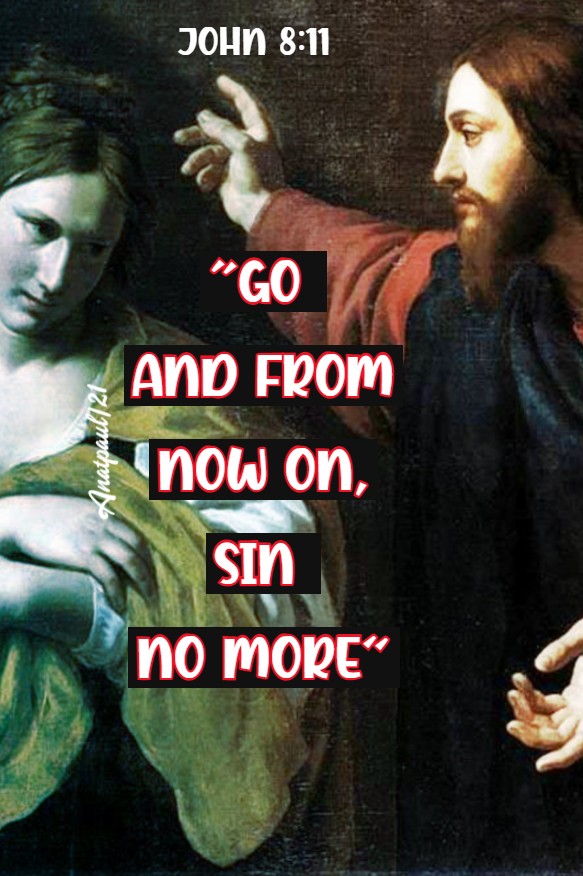
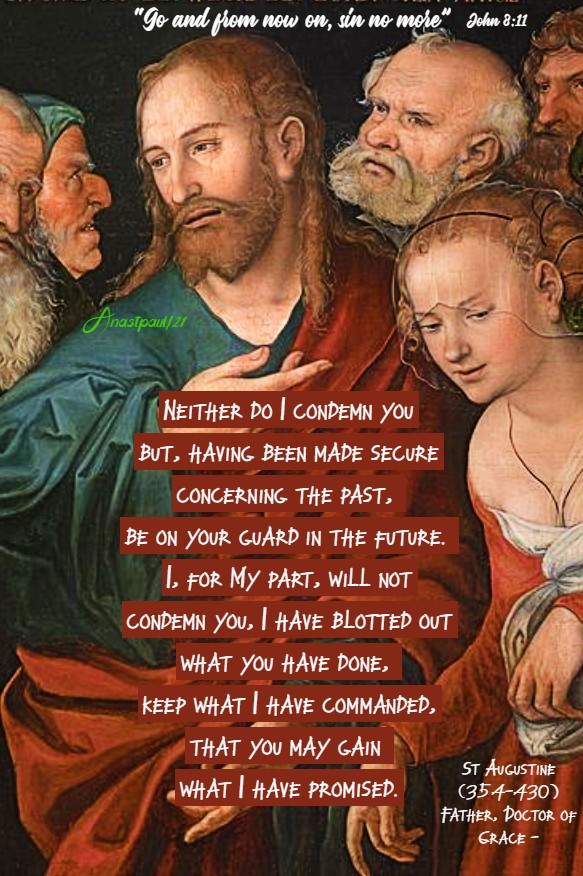
“Go and from now on, sin no more”
John 8:11
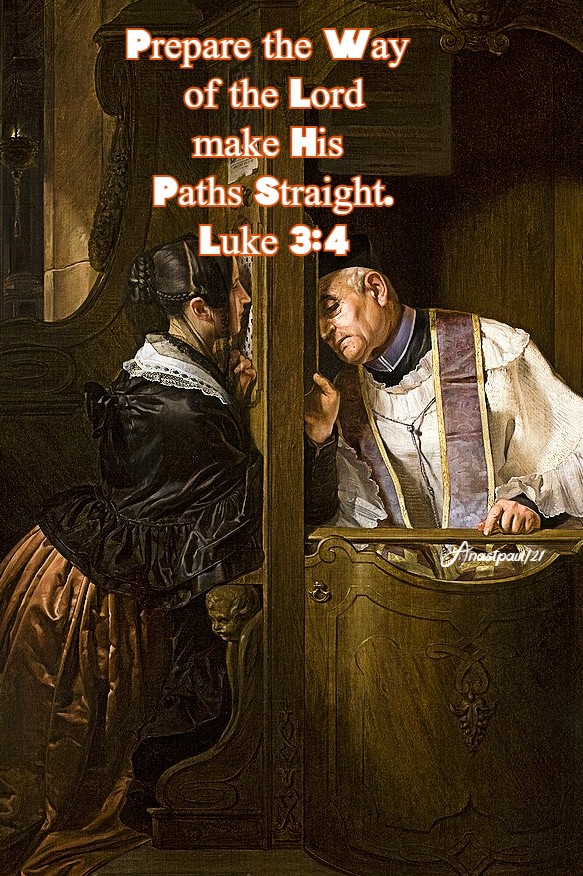
“Prepare the way of the Lord make his paths straight” …
Luke 3:4
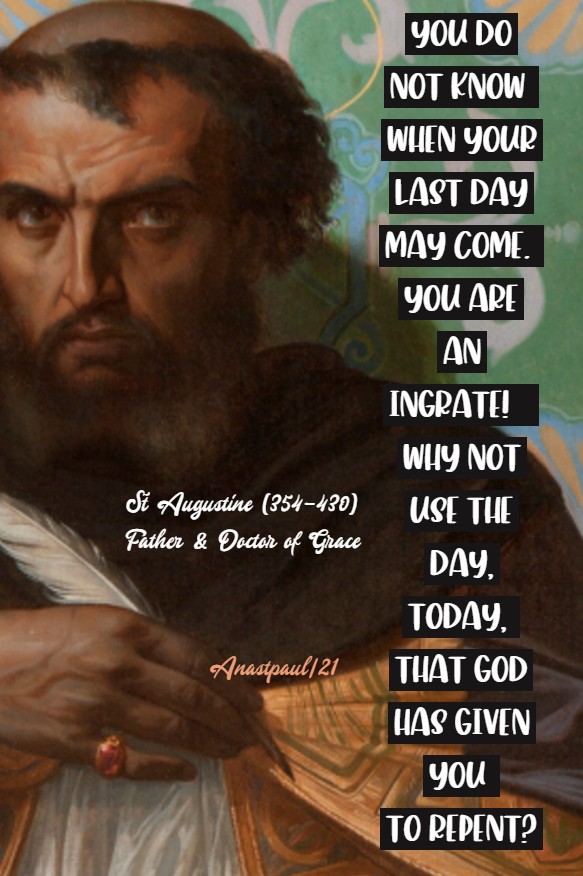
“You do not know when your last day may come. You are an ingrate! Why not use the day, today, that God has given you to repent?”
St Augustine (354-430) Father & Doctor of Grace
“What are you afraid of, you men of little faith? That He will not pardon your sins? But with His own hands He has nailed them to the cross. That you are used to soft living and your tastes are fastidious? But He knows the clay of which we are made (Gn 2:7). That a prolonged habit of sinning binds you like a chain? But the Lord loosens the shackles of prisoners. Or perhaps that angered by the enormity and frequency of your sins, He is slow to extend a helping hand? But where sin abounded, grace became superabundant (Rom 5,20). Are you worried about clothing and food and other bodily necessities so that you hesitate to give up your possessions? But He knows that you need all these things (Mt 6,32). What more can you wish? What else is there to hold you back from the way of salvation? ”
St Bernard (1091-1153) Mellifluous Doctor of the Church
One Minute Reflection – 26 March – Saturday of the Third Week of Lent – Daniel 13:1-9, 15-17, 19-30, 33-62, John 8:1-11
“Go and from now on, sin no more” – John 8:11
REFLECTION – “One after another all withdrew.” The two were left alone, the woman in need of mercy and Mercy. But the Lord, having struck them through with that dart of justice, deigned not to heed their fall but, turning His eyes away from them, “again he wrote with his finger on the ground.”
But when that woman remained alone and all had gone, He raised His eyes to her. We have heard the voice of justice; let us listen too to the voice of clemency… This woman expected to be punished by Him, in whom sin could not be found. But He, who had driven back her adversaries with the voice of justice, lifting the eyes of mercy to her, asked her: “Has no-one condemned you?” She answered, “No-one, Lord.” And He said: “Neither do I condemn you. I by Whom, perhaps, you were afraid of being condemned because you have found no sin in Me; neither do I condemn you.”
What is this, O Lord? Do you favour sins, then? Certainly not! But take note of what follows: “Go, henceforth sin no more.” The Lord did condemn, therefore but He condemned the sin, not the sinner… Let them be careful, then, those who love the goodness in the Lord but who fear His truthfulness… The Lord is gracious, the Lord is slow to anger, the Lord is merciful BUT the Lord is also just and the Lord is abounding in truth (Ps 85[86],15). He gives you time for amendment but you prefer to take advantage of the delay, rather than to reform your ways. Did you act wickedly yesterday? Be good today. Have you spent today in evil? At any rate change your behaviour tomorrow.
This, then, is the meaning of the words He addresses to this woman, “Neither do I condemn you but, having been made secure concerning the past, be on your guard in the future. I, for My part, will not condemn you, I have blotted out what you have done; keep what I have commanded, that you may gain what I have promised.” – St Augustine (354-430) Bishop, Father, Doctor of Grace –Tractate 33 on the Gospel of John, 5-8
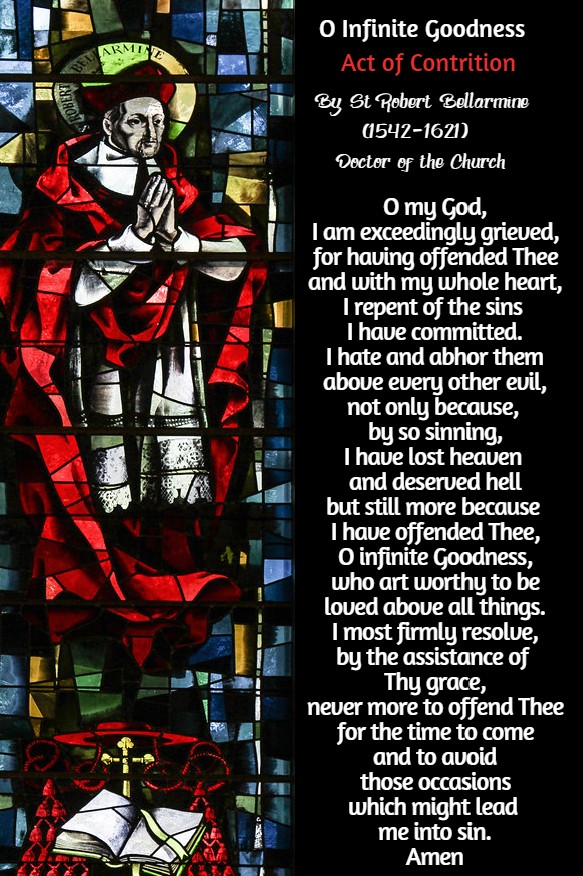
PRAYER – O Infinite Goodness – Act of Contrition By St Robert Bellarmine (1542-1621) – Doctor of the Church
O my God, I am exceedingly grieved, for having offended Thee and with my whole heart, I repent of the sins I have committed. I hate and abhor them above every other evil, not only because, by so sinning, I have lost heaven and deserved hell but still more because I have offended Thee, O infinite Goodness, who art worthy to be loved above all things. I most firmly resolve, by the assistance of Thy grace, never more to offend Thee for the time to come and to avoid those occasions which might lead me into sin. Amen
Quote/s of the Day – 23 March – Wednesday day of the Third Week of Lent – Exodus 20:12-24, Matthew 15:1-20
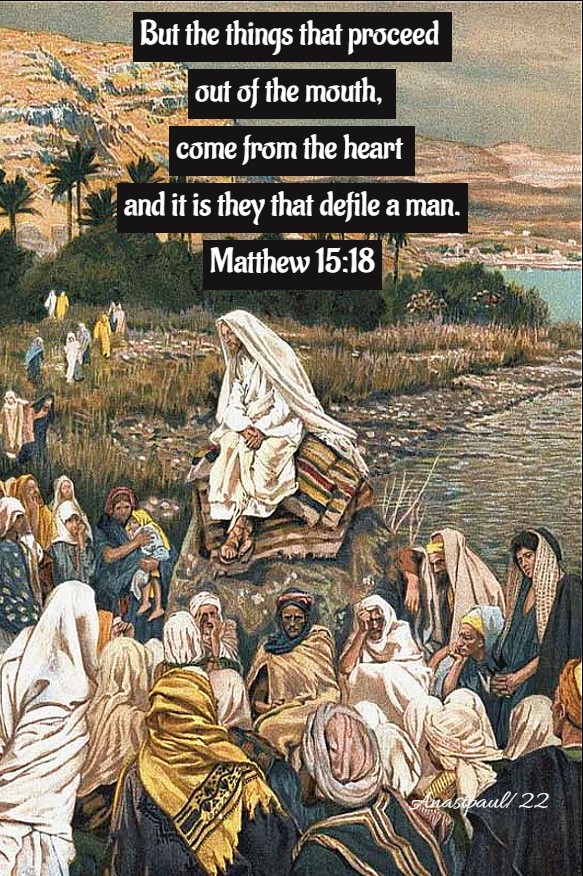
“But the things that proceed out of the mouth, come from the heart and it is they that defile a man.”
Matthew 15:18
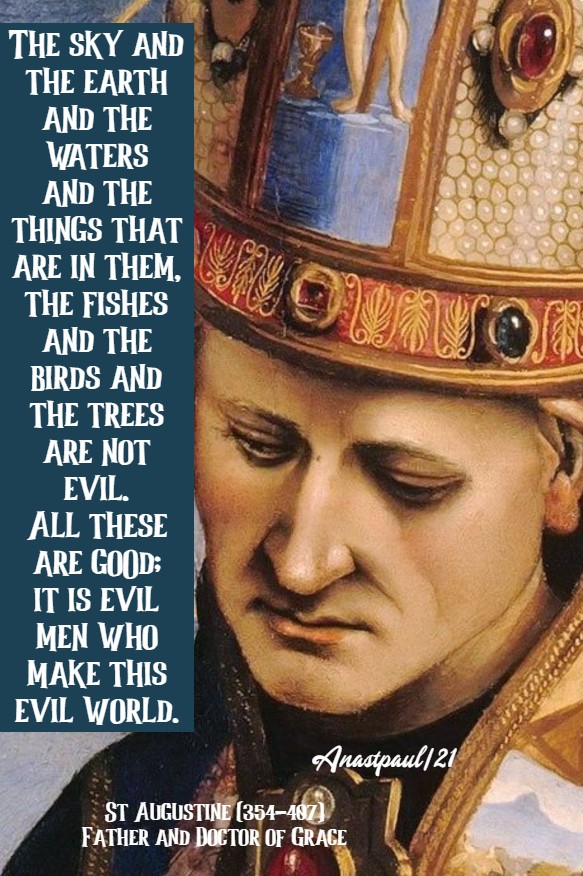
“The sky and the earth and the waters and the things that are in them, the fishes and the birds and the trees are not evil. All these are good; it is evil men who make this evil world.”
“What is reprehensible, is that while leading good lives themselves and abhorring those of wicked men, some, fearing to offend, shut their eyes to evil deeds instead of condemning them and pointing out their malice.”
One Minute Reflection – 23 March – Wednesday of the Third Week of Lent – Exodus 20:12-24, Matthew 15:1-20
“Hypocrites, well did Isaias prophesy of you, saying, ‘This people honours me with their lips but their heart is far from Me and in vain do they worship Me, teaching as doctrine, the precepts of men.’ ” – Matthew 15:7
REFLECTION – “The law of the spirit of life in Christ Jesus has freed you from the law of sin and death” (Rm 8:2) … Saint Paul says that the Law of Moses has been given to prove our weakness and not just to prove it but, to increase it and thus force us to find the Doctor. … “Where sin increased, grace overflowed all the more” (Rm 5:20; cf. 3:20) … But why did the first Law, written with the Finger of God (Ex 31:18), not give us the essential assistance of grace? Because it was written on tablets of stone, not the tablets of flesh, that are our hearts (2 Cor 3:3) ….
It is the Holy Spirit Who writes “the Law of the Spirit of life” not on stone but in the heart; this Law of the Spirit of life that is in Jesus Christ in Whom the Passover has been celebrated in truth (1 Cor 5:7-8), has delivered you from the law of sin and death. Do you want to have proof of the manifest and certain difference separating the Old Testament from the New? … Hear what the Lord spoke by the mouth of one of the prophets. … ”I will place my law within them and write it upon their hearts” (Jr 31:33). So if God’s Law is written in your heart, it does not bring forth fear [as at Sinai] but pours a secret sweetness into your soul.” – St Augustine (354-430) Bishop of Hippo, Father and Doctor of the Church (Sermon 155, 6 ).
PRAYER – Breathe in Me, O Holy Spirit By St Augustine (354-420)
Breathe in me, O Holy Spirit, that my thoughts may all be holy. Act in me, O Holy Spirit, that my work, too, may be holy. Draw my heart, O Holy Spirit, that I love but what is holy. Strengthen me, O Holy Spirit, to defend all that is holy. Guard me, then, O Holy Spirit, that I always may be holy. Amen
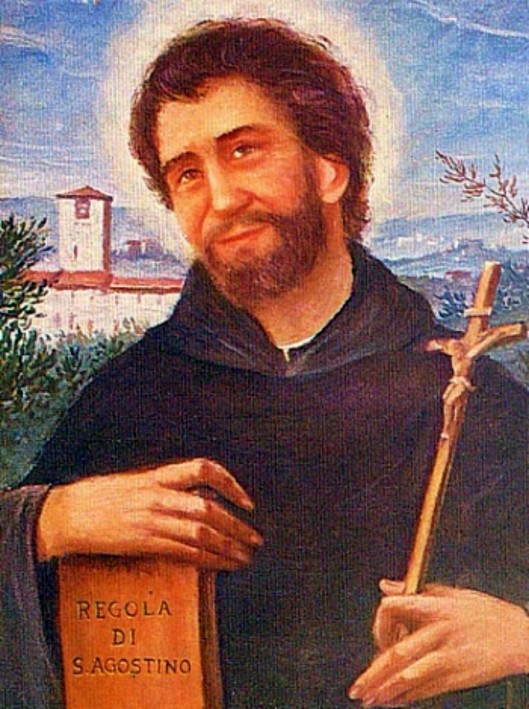
Saint of the Day – 23 March – Blessed Pietro of Gubbio OSA (Died c 1306) Priest and Friar of the Order of Hermits of St Augustine, Lawyer, noted Preacher, Envoy for the Order, Miracle-worker. Born in the early 13th century in Gubbio, Umbria, Italy and died between 1306 and 1322 in Gubbio, Umbria, Italy of natural causes. Also known as Peter of Gubbio. Additional Memorial – 29 October (The Augustinians).
Pietro of the noble Ghigenzi family, was born in the first half of the thirteenth century. He studied law first in Italy and then in Paris.
At about the age of forty, Pietro came to know the Augustinians and was drawn to them, wanting to put himself and his law practice at the disposal of the Church. He joined the Augustinians of his hometown who had come to Gubbio from the hermitage of Brettino (Fano).
As a Friar, he won the respect of his confreres and was entrusted with various duties of responsibility. He was chosen and sent by the Prior General to visit the Monasteries of France. Pietro that he travelled bare-footed and met all his brother Augustinians in that way as a sign of humility. He left a deep impression for his holiness of life, zeal for the Rule, his his patience with Augustinian brothers who had trouble living up to the Rule,and as a miracle worker.
He is described by the Anonymous Florentine, a writer of the fifteenth century, as “a man of great patience and prayer, who ended his life in the peace of the Lord and is renowned for many miracles.”
Pietro spent his later years as a prayerful Friar in the Gubbio Monastery where he had begun.
He died sometime between 1306 and 1322 and was venerated from the time of his death. His remains were buried in the common grave of Friars in the centre of the Choir area in the Augustinian Church in Gubbio.
One day, soon after his burial, the Friars were in the Choir, singing the Te Deum and they heard a voice from the tomb that responded: Te Dominum confitemur! – ‘Lord, we thank you! ‘ The frightened brothers opened the tomb and found the body of Blessed Peter on his knees, looking up and hands crossed on his chest.
Pietro’s relics are still enshrined in the Augustinian Church, where the veneration of this gentle, humble Friar were immediately and are still the subject of pilgrimages.
Quote/s of the Day –17 March – Thursday of the Second week of Lent – Jeremias 17:5-10, Luke 16:19-31
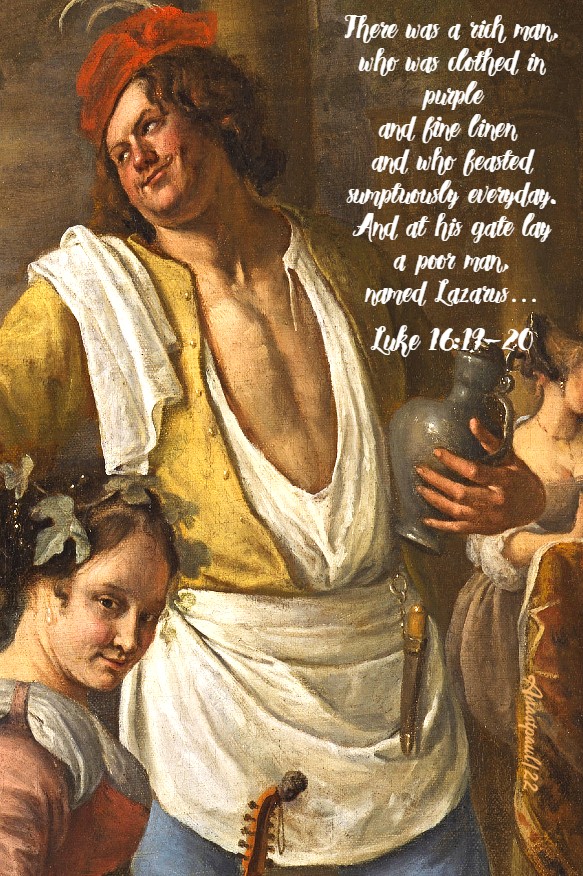
“There was a rich man, who was clothed in purple and fine linen and who feasted sumptuously everyday. And at his gate lay a poor man, named Lazarus…”
Luke 16:19–20
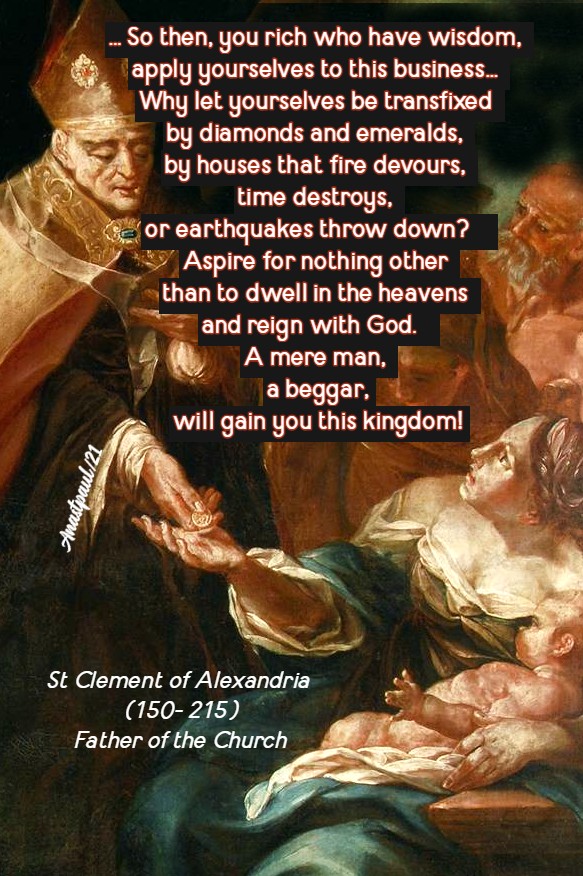
“… So then, you rich who have wisdom, apply yourselves to this business… Why let yourselves be transfixed by diamonds and emeralds, by houses that fire devours, time destroys, or earthquakes throw down? Aspire for nothing other than to dwell in the heavens and reign with God. A mere man, a beggar will gain you this kingdom!”
St Clement of Alexandria (150- 215) Father of the Church
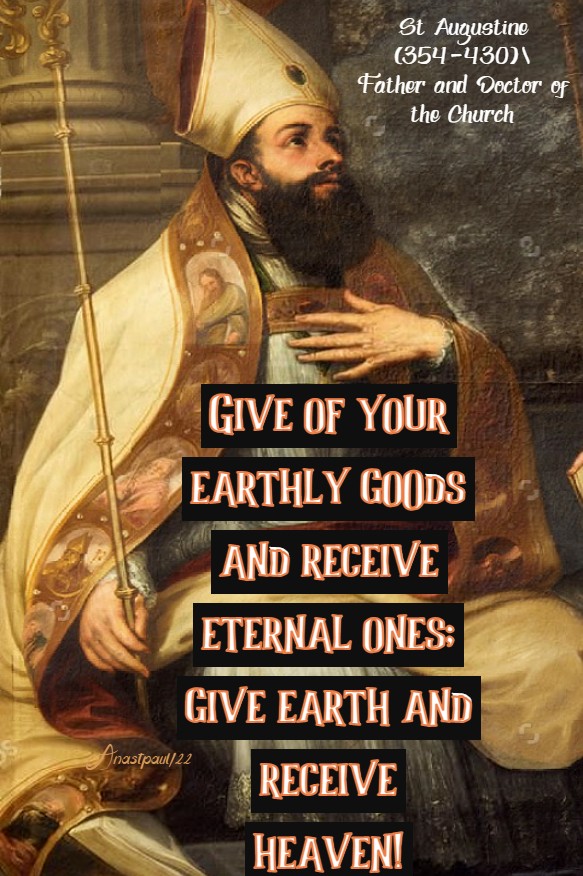
“Give of your earthly goods and receive eternal ones; give earth and receive heaven!”
St Augustine (354-430)\ Father and Doctor of the Church
“Earthly riches are like the reed. Its roots are sunk in the swamp and its exterior, is fair to behold but inside, it is hollow. If a man leans on such a reed, it will snap off and pierce his soul.”
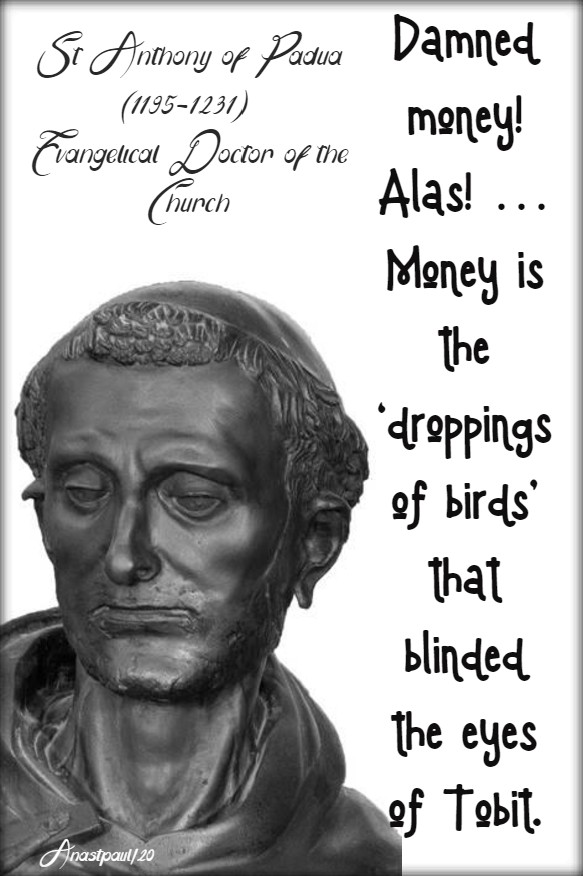
“Damned money! Alas! … Money is the ‘droppings of birds’ that blinded the eyes of Tobit.”
St Anthony of Padua (1195-1231) Evangelical Doctor
Quote/s of the Day – 16 March – Wednesday of the Second week of Lent – Esther 13:8-11; 15-17, Matthew 20:17-28
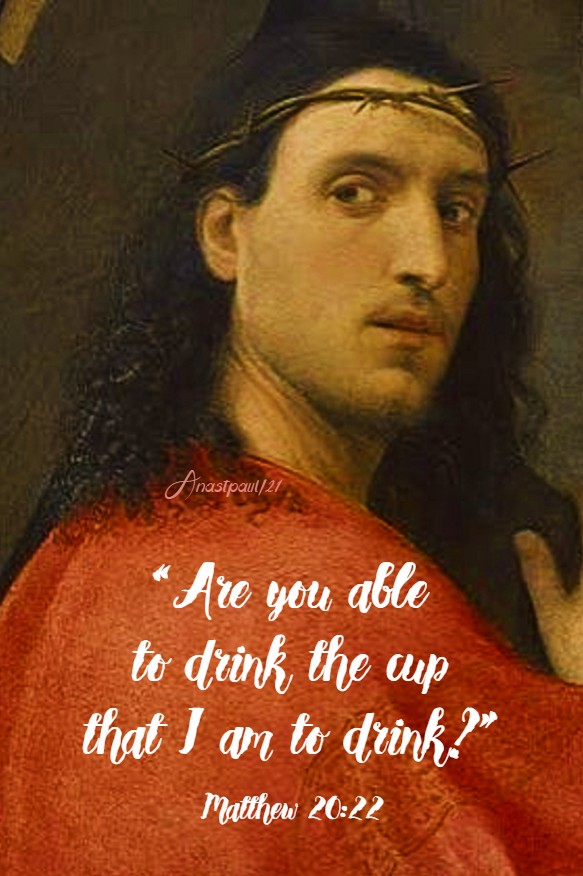
“Are you able to drink the cup that I am to drink?”
Matthew 20:22
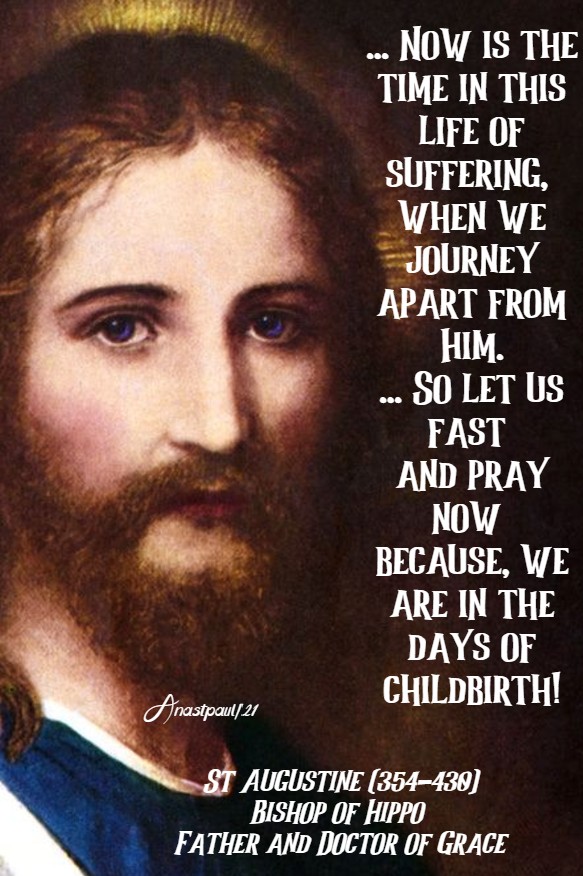
“… Now is the time in this life of suffering, when we journey apart from Him. … So let us fast and pray now because, we are in the days of childbirth!”
St Augustine (354-430) Bishop of Hippo Father and Doctor of Grace
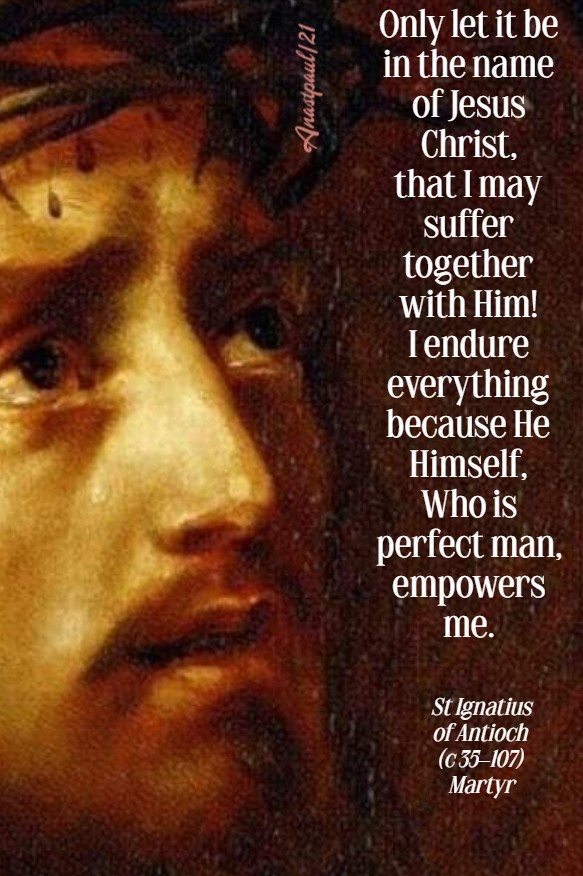
“Only let it be in the name of Jesus Christ, that I may suffer together with Him! I endure everything because He Himself, Who is perfect man, empowers me.”
St Ignatius of Antioch (c 35–107) Martyr
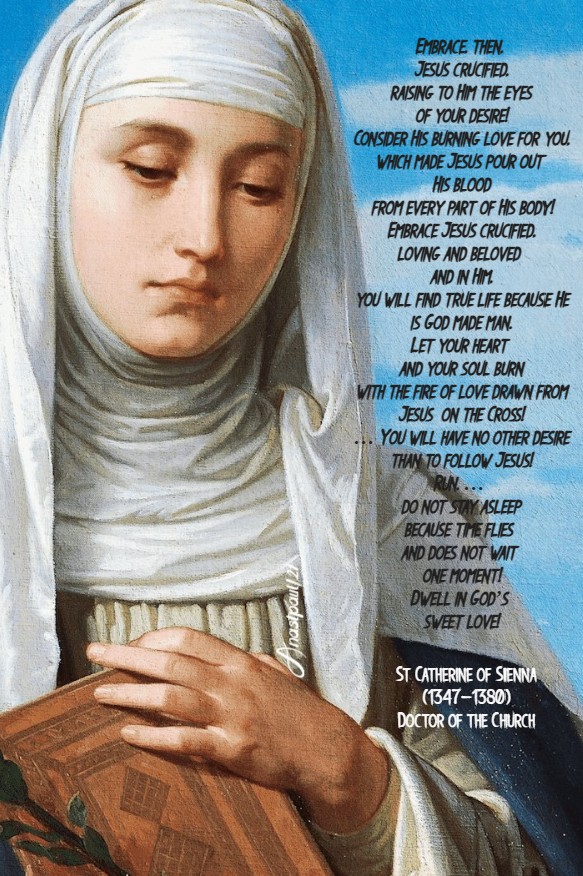
“Embrace, then, Jesus Crucified, raising to Him the eyes of your desire! Consider His burning love for you, which made Jesus pour out His Blood from every part of His body! Embrace Jesus crucified, loving and beloved and in Him, you will find true life because He is God made Man. Let your heart and your soul burn with the fire of love drawn from Jesus on the Cross! … You will have no other desire than to follow Jesus! Run, … do not stay asleep because time flies and does not wait one moment! Dwell in God’s sweet love!”
St Catherine of Sienna (1347-1380) Doctor of the Church
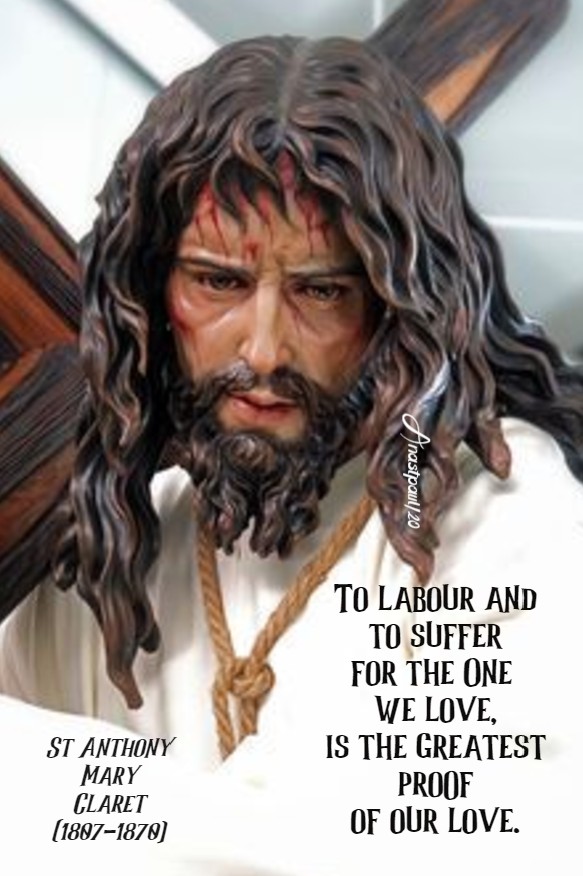
“To labour and to suffer for the One we love, is the greatest proof of our love.”
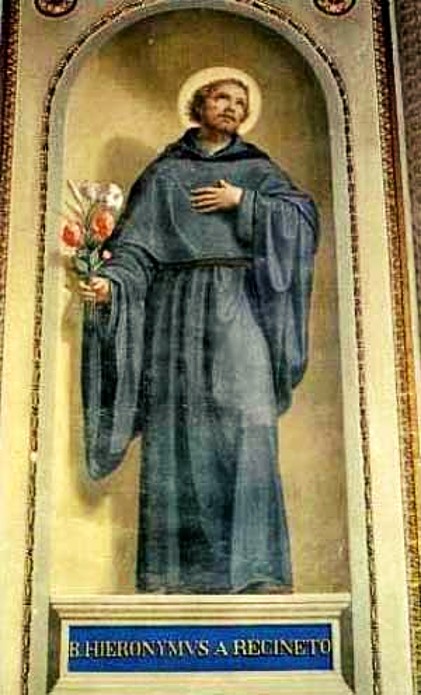
Saint of the Day – 12 March – Blessed Jerome of Recanati OSA (Died 1350) Priest, Friar of the Hermits of Saint Augustine, peacemaker. Died on 12 March 1350 in Recanati, Piceno, Italy of natural causes.
The Roman Martyrology reads : “In Recanati in the Marche, Blessed Girolamo Gherarducci, Priest of the Order of the Hermits of St Agustine, who worked for peace and harmony between peoples.”
Blessed Jerome of Recanati lived in the Augustinian Convent in his hometown, where he died on 12 March 1350. Very little is known about his life. Certainly he lived in a period of flowering of holiness in the Marches, just think of his most famous example: St Nicholas of Tolentino (1254-1305).
In addition to the life of prayer, a peculiar characteristic of his apostolate, was the fact that he was a man who devoted himself to the pacification of souls in times of fratricidal struggles. As part of his ministry, he mediated numerous disputes between families and the City. It is said that he brought peace to the Cities of Ascoli and Fermo, which had been at war with each other for many a long year.
To remember and imitate him, as early as 1369, the Town of Recanati was publicly celebrating the Feast of the blessed Jerome on the Second Sunday of Lent. On this occasion, until recent times, it choose twelve peacemakers from among the populace, six men and six women, whose responsibility it was, to settle disputes among the citizens.
Pope Pius VII confirmed the cult of Jerome in 1804. His mortal remains are venerated in the Church of St Augustine in Recanati.
Hear us, O Heavenly Father, For the Sake of Your Only Son By St Augustine (354-430) Father and Doctor of the Church
Almighty Father, come into our hearts and so fill us with Your love that forsaking all evil desires, we may embrace You, our only good. Show us, O Lord our God, what You are to us. Say to our souls, I am your salvation, speak so, that we may hear. Our hearts are before You, open our ears, let us hasten after Your Voice. Hide not Your Face from us, we beseech You, O Lord. Open our hearts, so that You may enter in. Repair the ruined mansions, that You may dwell therein. Hear us, O Heavenly Father, for the sake of Your only Son, Our Lord Jesus Christ, who lives and reigns with You and the Holy Spirit, one God, now and forever. Amen
Quote/s of the Day – 25 February – Sexagesima Weekday – 2 Corinthians 11:19-33; 12:1-9, Luke 8:4-15
“In the beginning was the Word and the Word was with God and the Word was God.”
John 1:1
“And the word became flesh and made his dwelling among us.”
John 1:14
“Let the world be in upheaval. I hold to His Promise and read His Message, that is my protecting wall and garrison. What Message? “Know that I am with you always, until the end of the world!”
St John Chrysostom (347-407) Father and Doctor of the Church
“What a happy day they spent! What a blessed night! Who can say what it was they heard from the Lord’s mouth? Let us, too, build a dwelling in our hearts, construct a house where Christ can come to teach and converse with us.”
St Augustine (354-430) Father & Doctor of the Church
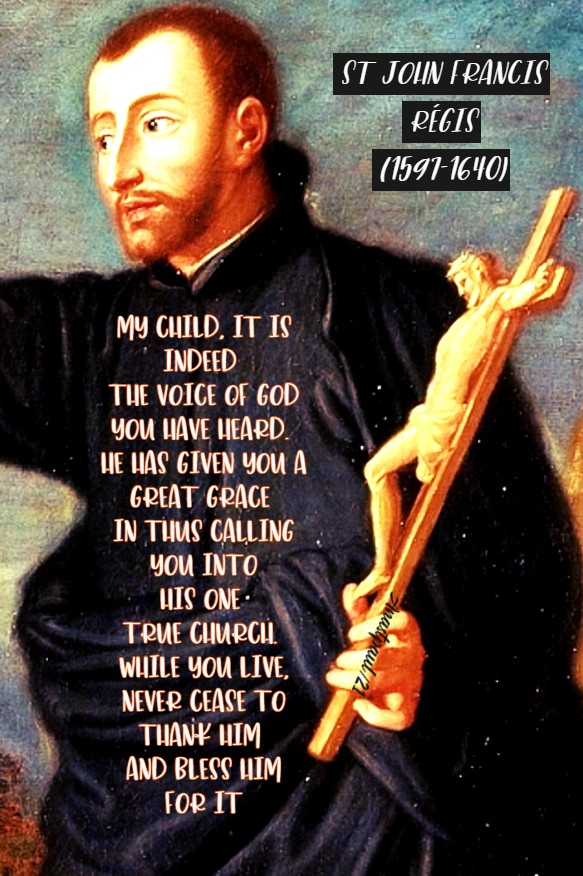
“My child, it is indeed the Voice of God you have heard. He has given you a great grace in thus calling you into His one true Church. While you live, never cease to thank Him and bless Him for it.”
St John Francis Régis (1597-1640)
Beloved and Most Holy Word of God By St James of the Marches (1391-1476)
Beloved and most holy Word of God! You enlighten the hearts of the faithful, You satisfy the hungry, console the afflicted. You make the souls of all, productive of good and cause all virtues to blossom. You snatch souls from the devil’s jaw. You make the wretched holy and men of earth, citizens of heaven! Amen
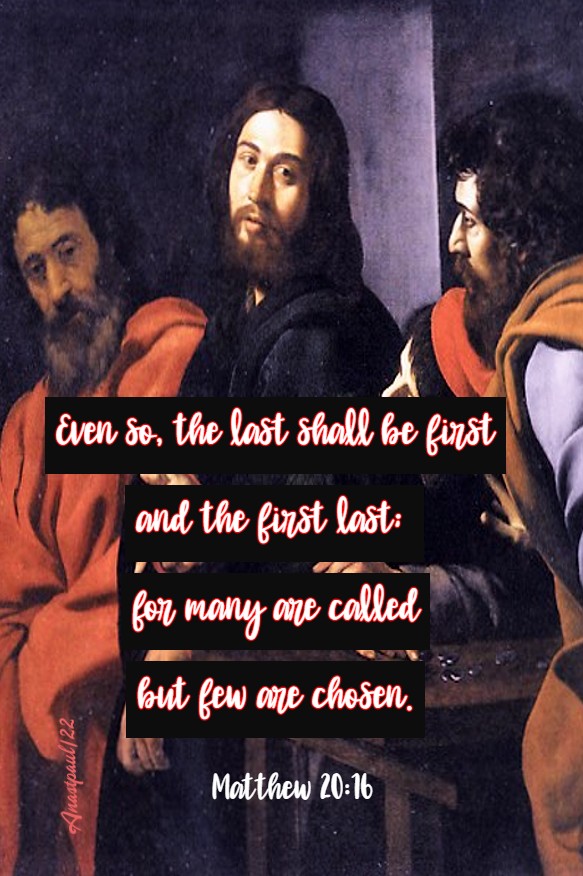
One Minute Reflection – 14 February – “Month of the Most Blessed Trinity” – Septuagesima Weekday and the Memorial of St Simeon (Died c 106) Martyr, Bishop of Jerusalem, 1 Cor. 9:24-27; 10:1-5, Matthew 20:1-16
“Even so the last shall be first, and the first last; for many are called, but few are chosen.” – Matthew 20:16
REFLECTION – “In that hiring then,we shall all be equal and the first as the last and the last as the first because that Denarius is life eternal and in the life eternal all will be equal. For although through diversity of attainments, the saints will shine, some more, some less; yet as to this respect, the gift of eternal life, it will be equal to all. For that will not be longer to one and shorter to another, which is alike everlasting – that which hath no end will have no end either for thee or me. … In respect. to the living forever, this man will not live more than that, nor that one than this one. For alike without end will they live, though each shall live in his own brightness and the Denarius in the parable is that life eternal.
Let not him then who has received after a long time murmur against him who has received after a short time. To the first, it is a payment, to the other a free gift – yet the same thing is given alike to both.” – St Augustine (354-430) Father and Doctor of Grace (Sermon on Matthew 20).
PRAYER – ALMIGHTY GOD, mercifully look upon our infirmities, that whereas we are afflicted by the burden of our sins, the glorious intercession of Thy Martyr and Bishop, blessed Simeon may be our succour and defence. Through Jesus Christ Thy Son our Lord, Who lives and reigns with Thee, in the unity of the Holy Ghost, ever one God, world without end. Amen.
Martyrs of Antioch: 5 Saints: A group of Christians murdered together. We know the names of five of them – Agapev, Baralo, Isicio, Joseph and Zosimus.
Martyrs of Passae: Castulus Lucius Magnus Saturninus
Martyrs of Prague – 14 Beati – Franciscan Friars Minor martyred together by a mob led by Lutherans – • Blessed Antonín of Prague • Blessed Bartolomeo Dalmasoni • Blessed Bedrich Bachstein • Blessed Christoffel Zelt • Blessed Didak Jan • Blessed Emmanuel of Prague • Blessed Gaspare Daverio • Blessed Giovanni Bodeo • Blessed Girolamo degli Arese • Blessed Jakob of Prague • Blessed Jan of Prague • Blessed Juan Martínez • Blessed Klemens of Prague • BlessedSimon of Prague They were martyred on • Shrove Tuesday 15 February 1611 at the Church of Our Lady of the Snows in Prague, Czech Republic • body dumped nearby but given Christian burial on 19 February 1611 in the monastery • re-interred in the side Chapel of the Church in 1616.
Martyrs of Sweden: Sigfrid Sunaman Unaman Winaman
Martyred in the Spanish Civil War: Bl Pere Vallmitjana Abarca
Quote/s of the Day – 14 February – The Memorial of St Valentine (176-273) Bishop and Martyr
LOVE!
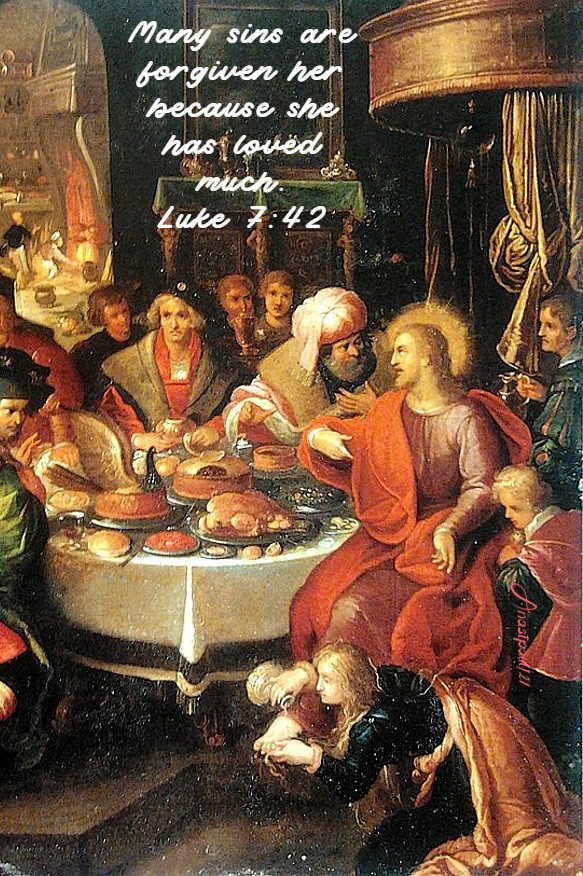
“Many sins are forgiven her because she has loved much.”
Luke 7:42
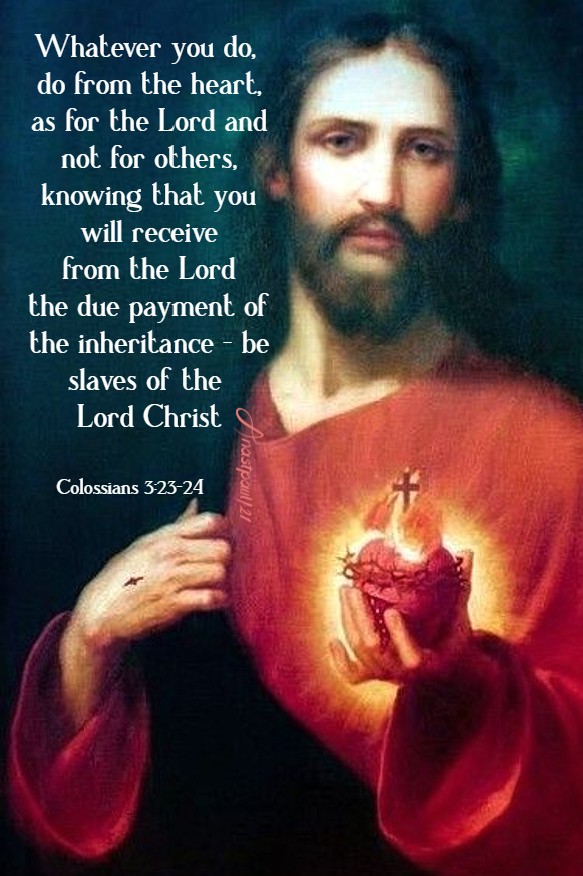
“Whatever you do, do from the heart, as for the Lord and not for others, knowing that you will receive from the Lord the due payment of the inheritance; be slaves of the Lord Christ.”
Colossians 3:23-24
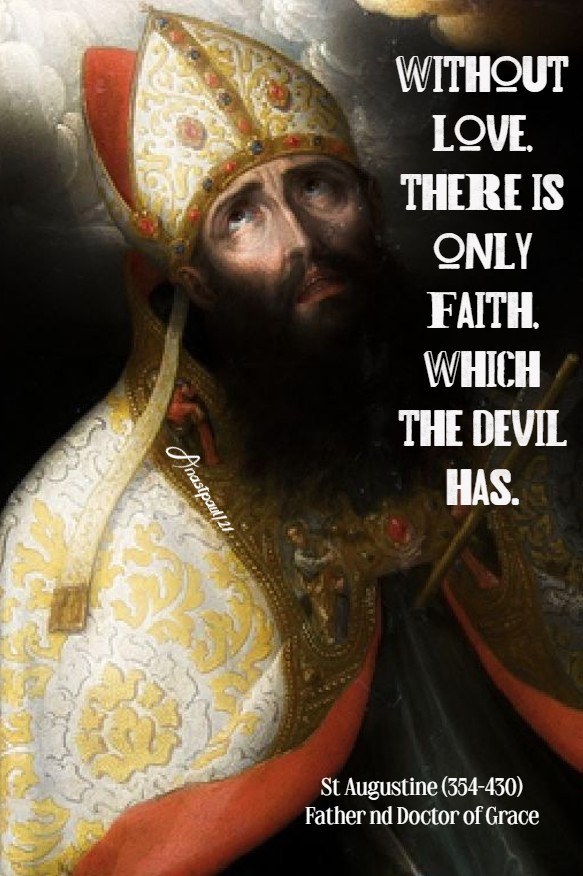
“Without love, there is only faith, which the devil has.”
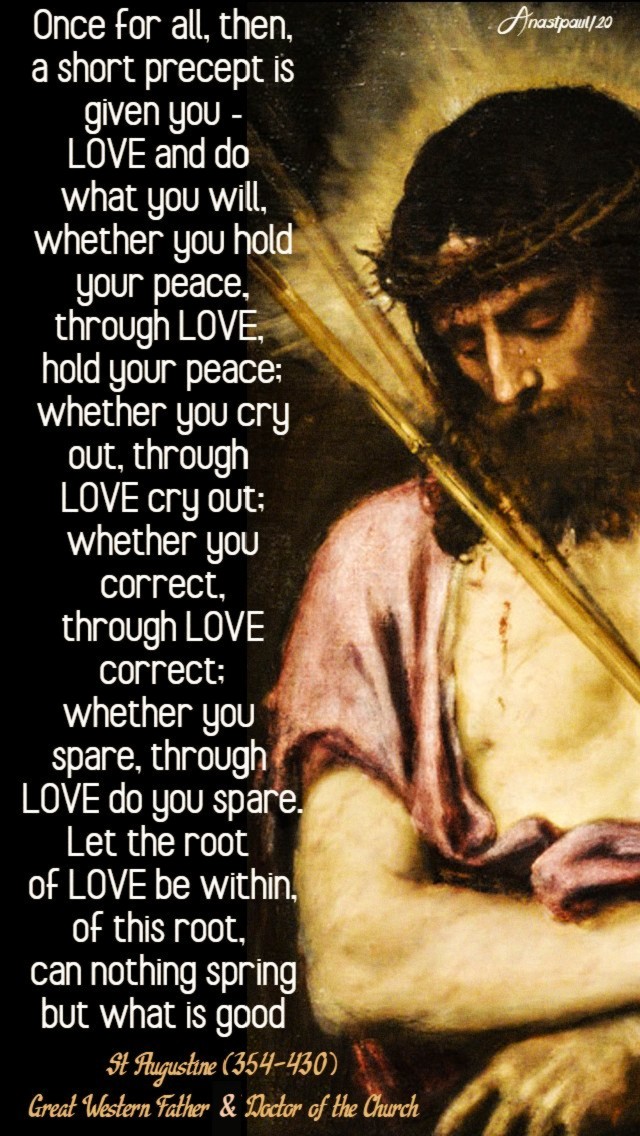
“Once for all, then, a short precept is given you – Love and do what you will, whether you hold your peace, through love, hold your peace; whether you cry out, through love cry out; whether you correct, through love correct; whether you spare, through love do you spare. Let the root of love be within, of this root, can nothing spring but what is good.”
St Augustine (354-430) Father nd Doctor of Grace
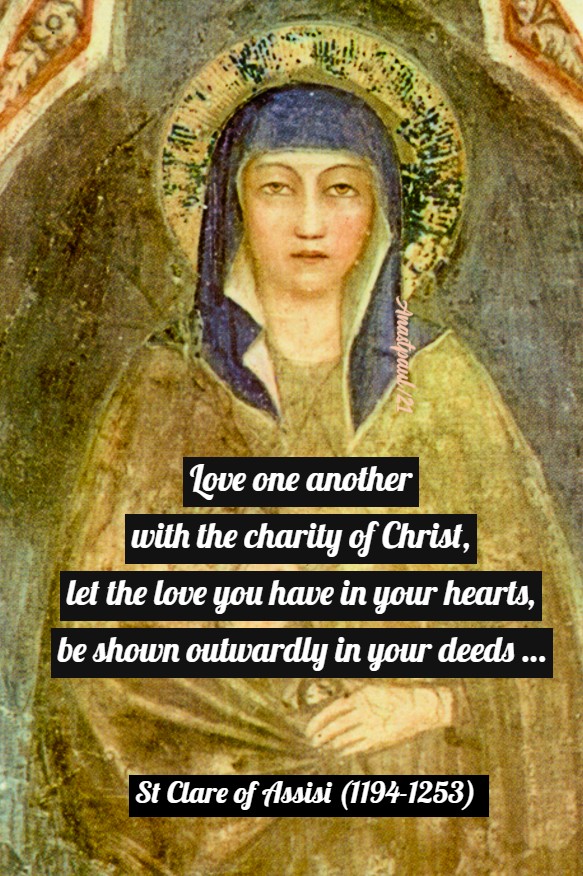
“Love[ing] one another with the charity of Christ, let the love you have in your hearts, be shown outwardly in your deeds …”
St Clare of Assisi (1194-1253)
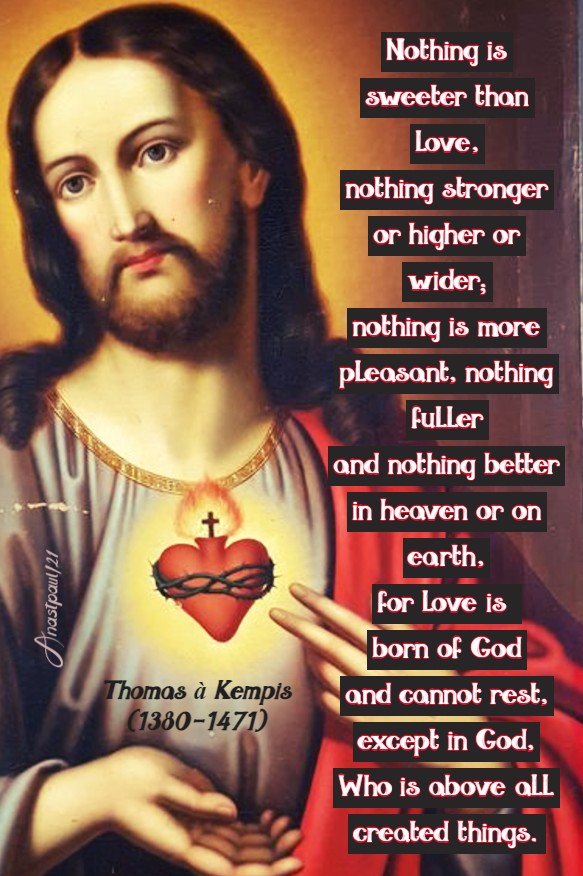
“Nothing is sweeter than love, nothing stronger or higher or wider; nothing is more pleasant, nothing fuller and nothing better in heaven or on earth, for love is born of God and cannot rest except in God, Who is above all created things.”
Thomas à Kempis (1380-1471)
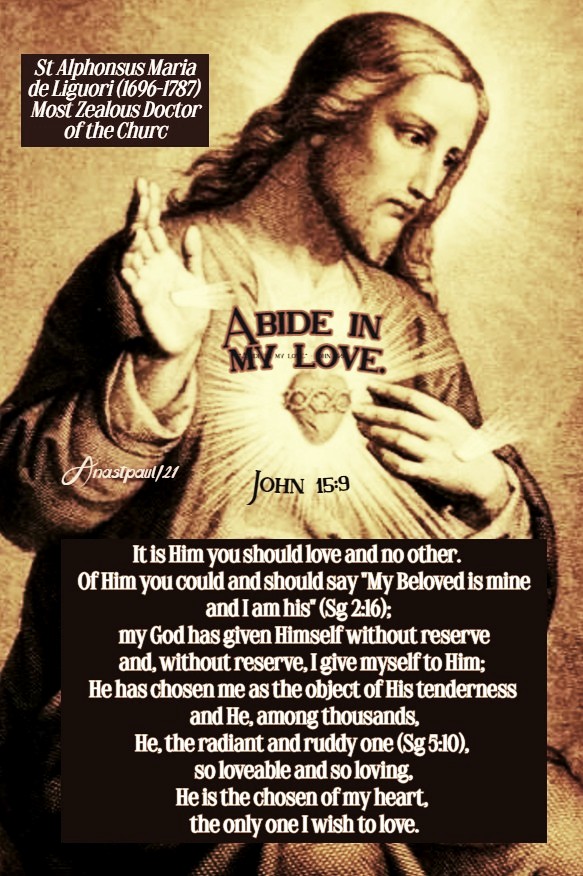
“… It is Him you should love and no other. Of Him you could and should say “My Beloved is mine and I am his” (Sg 2:16); my God has given Himself without reserve and, without reserve, I give myself to Him; He has chosen me as the object of His tenderness and He, among thousands, He, the radiant and ruddy one (Sg 5:10), so loveable and so loving, He is the chosen of my heart, the only one I wish to love.”
St Alphonsus Maria de Liguori (1696-1787)
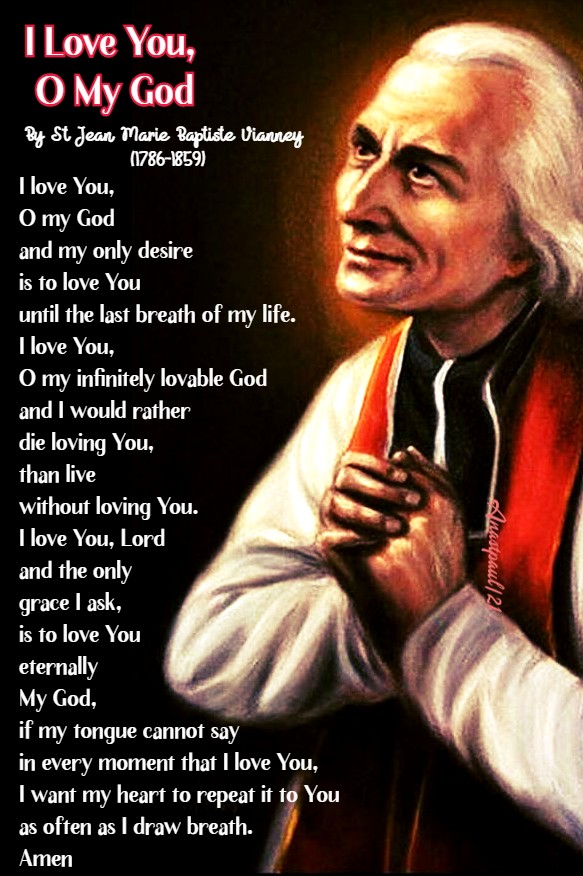
I Love You, O My God By St Jean Marie Baptiste Vianney (1786-1859)
I love You, O my God and my only desire is to love You until the last breath of my life. I love You, O my infinitely lovable God and I would rather die loving You, than live without loving You. I love You, Lord and the only grace I ask, is to love You eternally My God, if my tongue cannot say in every moment that I love You, I want my heart to repeat it to You as often as I draw breath. Amen
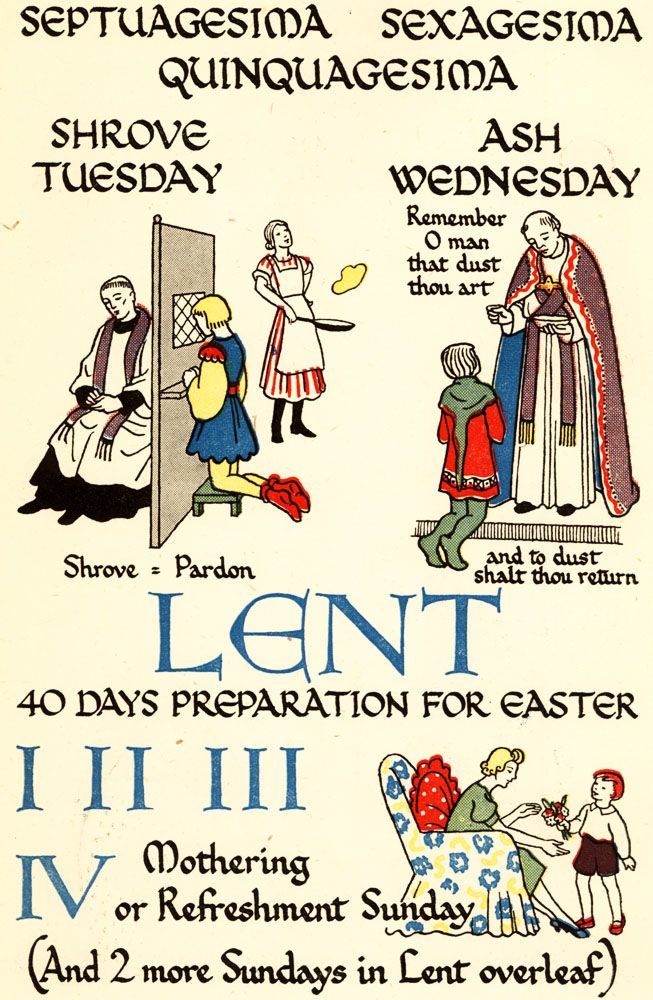
Septuagesima Sunday: The word Septuagesima is Latin for “seventieth.” It is both the name of the liturgical season and the name of the Sunday. Septuagesima Sunday marks the beginning of the shortest Liturgical season. This season is seventeen (17) days long and includes the three Sundays before Ash Wednesday. The length of the season never changes but the start date is dependent on the movable date of Easter, which can fall between 22 March-25 April. Septuagesima Sunday can be as early as 18 January. The Septuagesima season helps the faithful ease into Lent. It is a gradual preparation for the serious time of penance and sorrow; to remind the sinner of the grievousness of his errors and to exhort him to penance. Liturgically it looks very much like Lent. The Gloria and Alleluia are omitted, the tone becomes penitential with the Priest wearing purple vestments. The main difference is that there are no fasting requirements.
Bl Beatrix of Ornacieux St Benignus of Todi Bl Berengar of Assisi St Castor of Karden St Catherine de Ricci OP (1522-1590) Virgin, Tertiary of the Order of Preachers, Mystic, Stimatist. Her body is incorrupt.
St Julian of Lyon St Lucinus of Angers St Marice St Martinian the Hermit St Maura of Ravenna St Modomnoc St Paulus Lio Hanzuo St Peter I of Vercelli St Phaolô Lê Van Loc St Stephen of Lyons St Stephen of Rieti
Quote/s of the Day – 12 February – The Memorial of the Seven Holy Founders of the Servite Order (1233) – Ecclus 44:1-15, Matthew 19:27-29
“… You who have followed me …”
Matthew 19:28
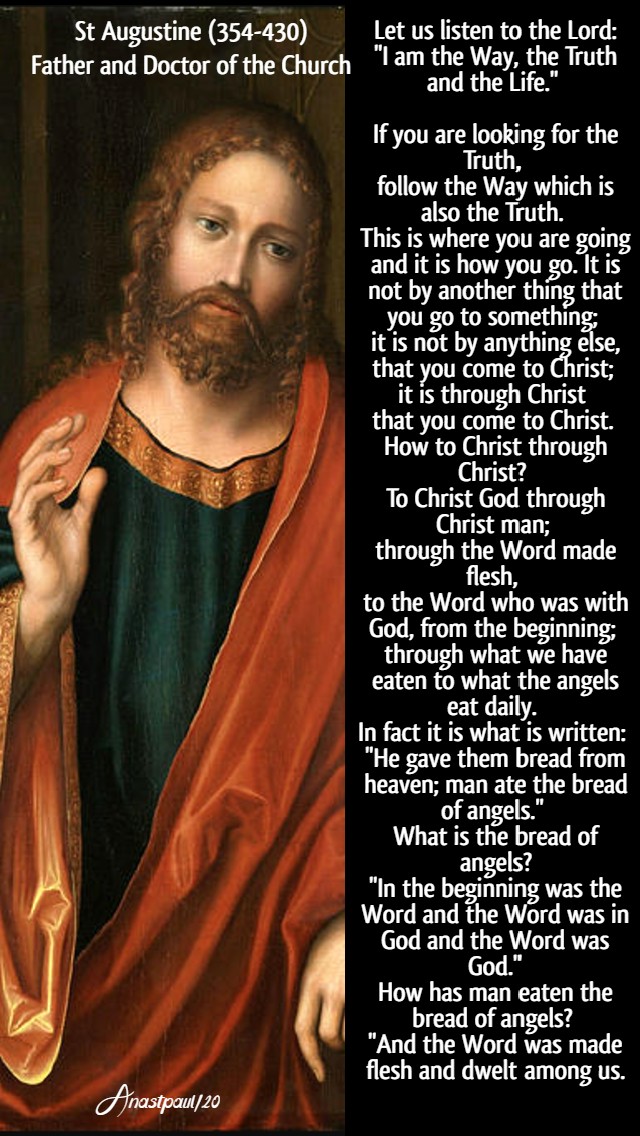
“Let us listen to the Lord: “I am the Way, the Truth and the Life” (Jn 14:6). If you are looking for the Truth, follow the Way which is also the Truth. This is where you are going and it is how you go. It is not by another thing that you go to something; it is not by anything else that you come to Christ; it is through Christ, that you come to Christ. How to Christ through Christ? To Christ God through Christ Man; through the Word made flesh, to the Word Who was with God, from the beginning; through what we have eaten, to what the angels eat daily. In fact, it is what is written: “He gave them bread from heaven; man ate the bread of angels” (Ps 77[78]:24-25). What is the bread of angels? “In the beginning was the Word and the Word was in God and the Word was God” (Jn 1:1-3). How has man eaten the bread of angels? “And the Word was made flesh and dwelt among us.”
Saint Augustine (354-430) Father and Doctor of Grace
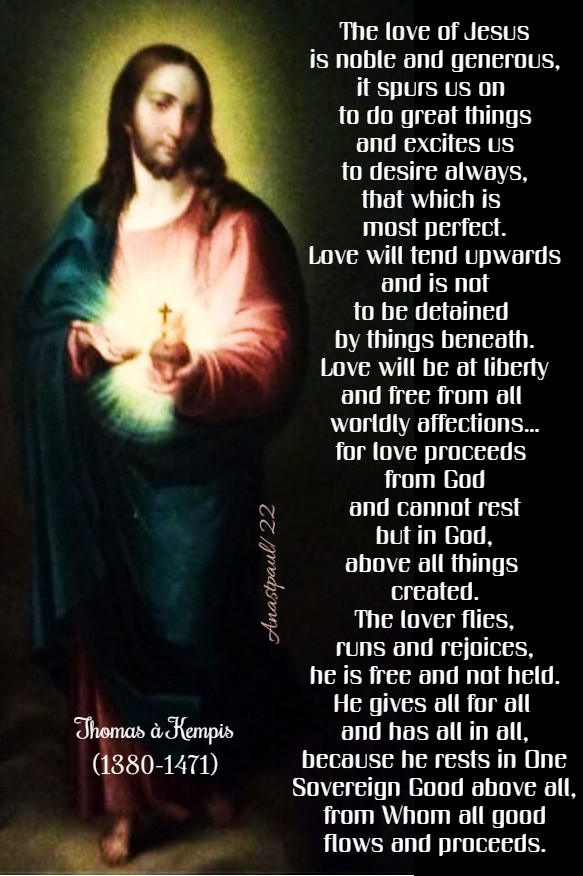
“The love of Jesus is noble and generous, it spurs us on to do great things and excites us to desire always, that which is most perfect. Love will tend upwards and is not to be detained by things beneath. Love will be at liberty and free from all worldly affections… for love proceeds from God and cannot rest but in God, above all things created. The lover flies, runs and rejoices, he is free and not held. He gives all for all and has all in all, because he rests in One Sovereign Good above all, from Whom all good flows and proceeds.”
Thomas à Kempis CRSA (1380-1471)
(Book III, Chapter V, 3-4)
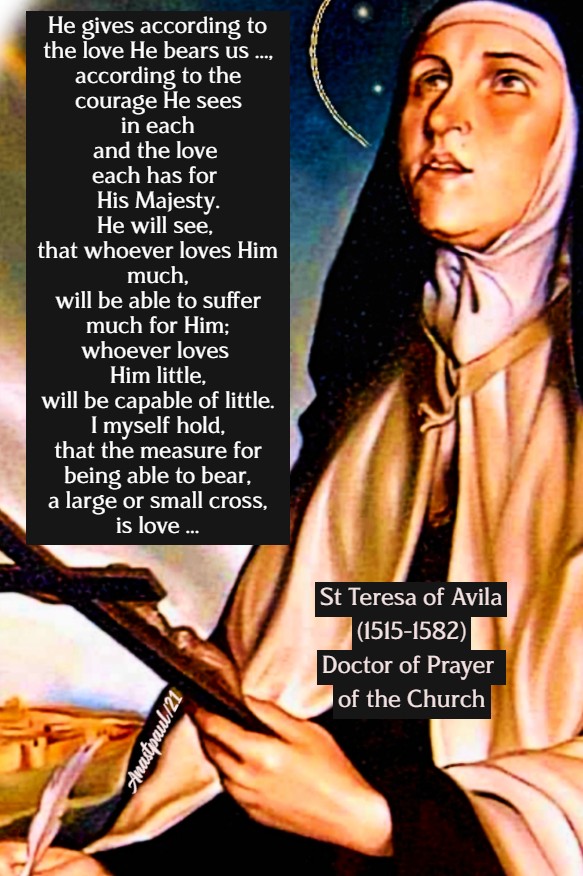
“He gives according to the love He bears us …, according to the courage He sees in each and the love each has for His Majesty. He will see, that whoever loves Him much, will be able to suffer much for Him; whoever loves Him little, will be capable of little. I myself hold, that the measure for being able to bear, a large or small cross, is love …”
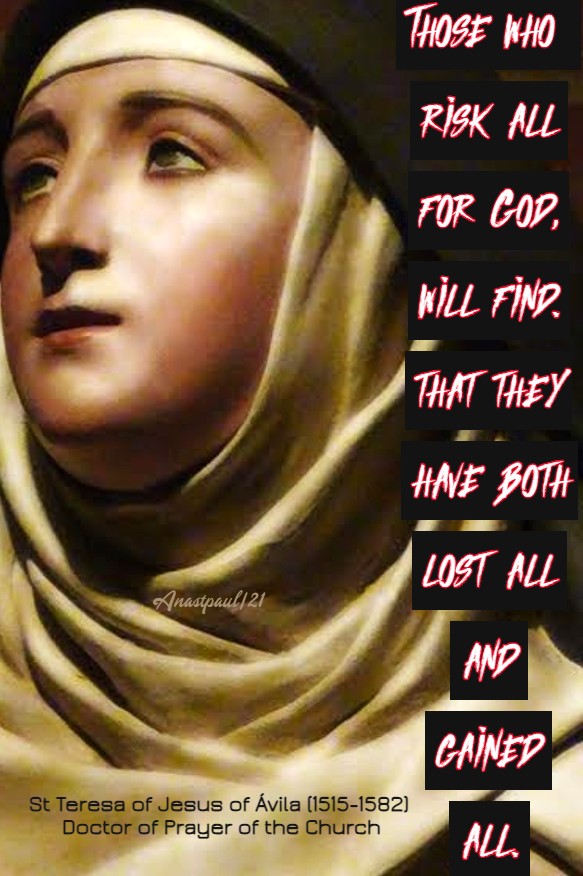
“Those who risk all for God, will find. that they have both lost all and gained all.”
St Teresa of Jesus of Ávila (1515-1582) Doctor of Prayer of the Church
Quote/s of the Day – 6 February – The Fifth Sunday after the Epiphany – Readings: Colossians 3:12-17, Matthew 13:24-30
“A sower went out to sow”
Matthew 13:30
“Sir, did you not sow good seed in your field? How then has it weeds?”
Matthew 13:27
“It is better to be cured within the Church’s community than to be cut off from its Body as incurable members. As long as a member still forms part of the Body, there is no reason to despair of its cure; once it has been cut off, it can be neither cured nor healed.”
St Augustine (354-430) Father and Doctor of Grace
“Brethren, the just man shall scarcely be saved. What, then, will become of the sinner?”
St Arsenius s the Great (c 354-c 449)
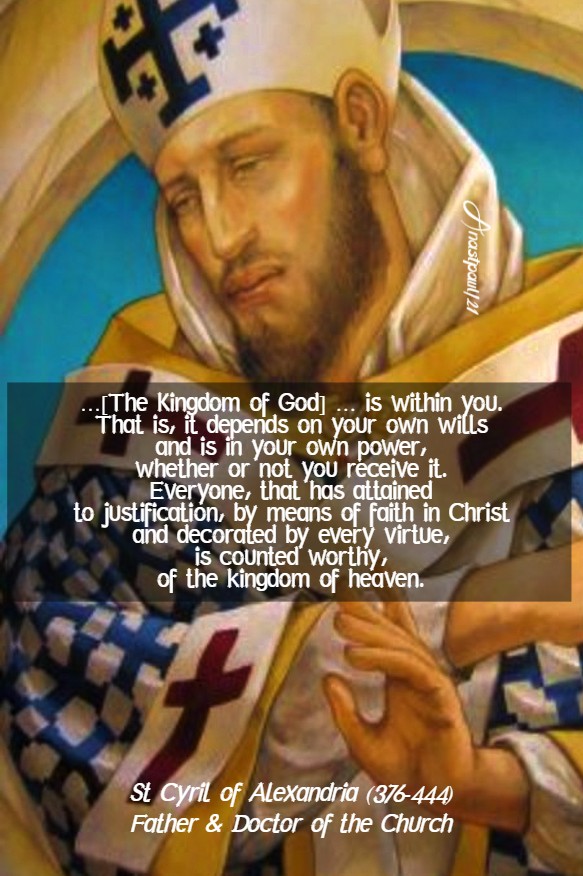
“… [The Kingdom of God] … is within you. That is, it depends on your own wills and is in your own power, whether or not you receive it. Everyone, that has attained to justification, by means of faith in Christ and decorated by every virtue, is counted worthy, of the Kingdom of Heaven.”
St Cyril of Alexandria (376-444) Father and Doctor of the Church
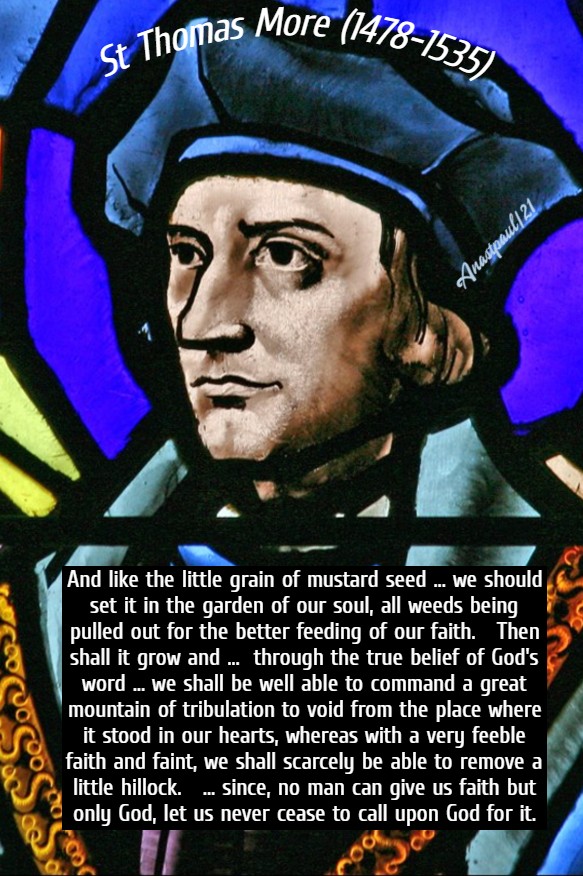
“And like the little grain of mustard seed … we should set it in the garden of our soul, all weeds being pulled out for the better feeding of our faith. Then shall it grow and … through the true belief of God’s word … we shall be well able to command a great mountain of tribulation to void from the place where it stood in our hearts, whereas with a very feeble faith and faint, we shall scarcely be able to remove a little hillock.”
St Thomas More (1478-1535)
“My child, it is indeed the Voice of God you have heard. He has given you a great grace in thus calling you into His one true Church. While you live, never cease to thank Him and bless Him for it.”
Quote/s of the Day – 5 February – St Agatha (c 231- c 251) Virgin and Martyr – 1 Corinthians 1:26-31, Matthew 19:3-12
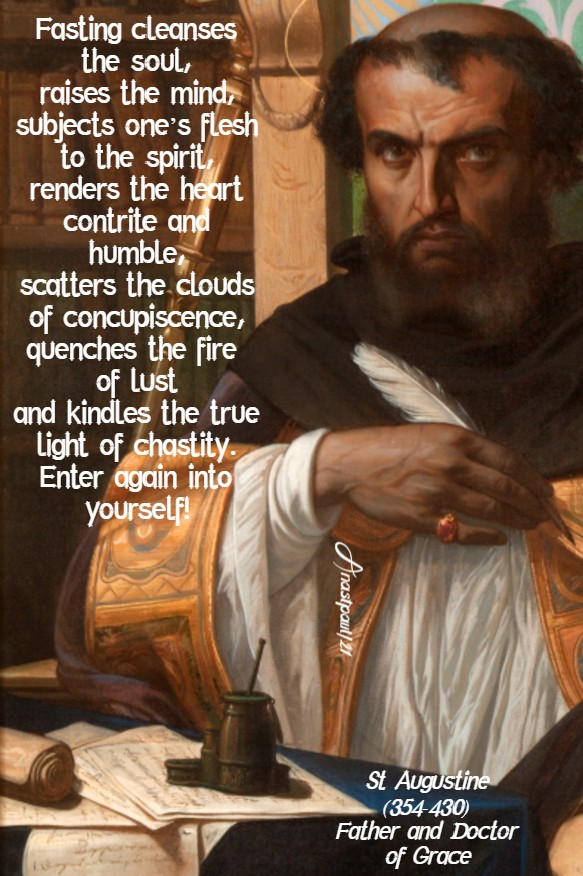
“Fasting cleanses the soul, raises the mind, subjects one’s flesh to the spirit, renders the heart contrite and humble, scatters the clouds of concupiscence, quenches the fire of lust and kindles the true light of chastity. Enter again into yourself!”
St Augustine (354-430) Bishop of Hippo Father and Doctor of Grace
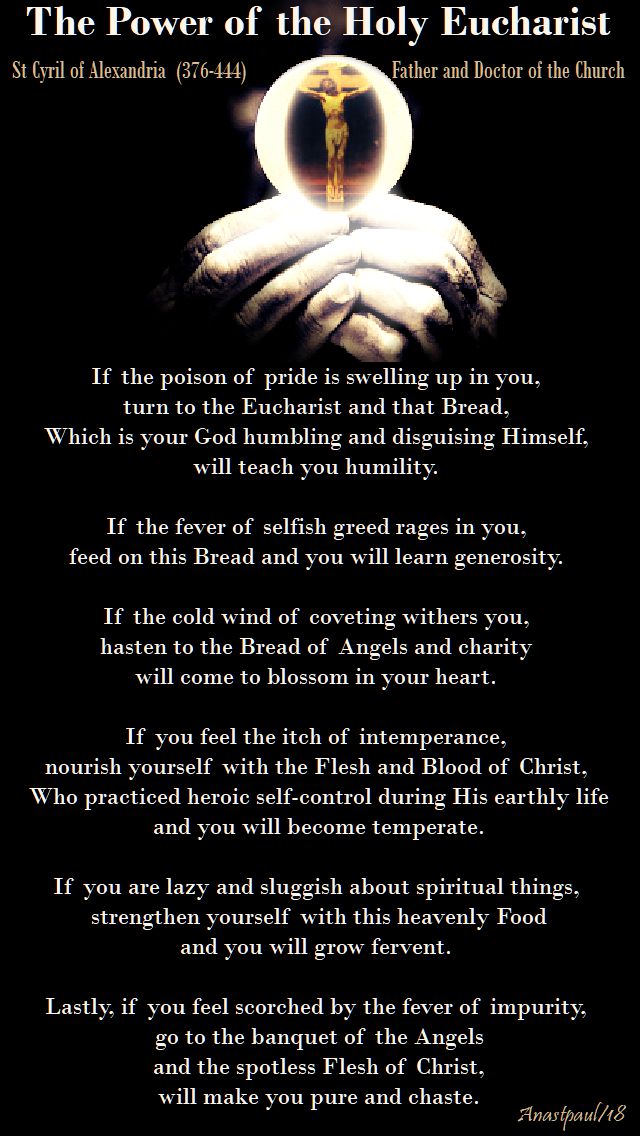
“If the poison of pride is swelling up in you, turn to the Eucharist and that Bread, Which is your God humbling and disguising Himself, will teach you humility.
If the fever of selfish greed rages in you, feed on this Bread and you will learn generosity.
If the cold wind of coveting withers you, hasten to the Bread of Angels and charity will come to blossom in your heart.
If you feel the itch of intemperance, nourish yourself with the Flesh and Blood of Christ, Who practiced heroic self-control during His earthly life and you will become temperate.
If you are lazy and sluggish about spiritual things, strengthen yourself with this heavenly Food and you will grow fervent.
Lastly, if you feel scorched by the fever of impurity, go to the banquet of the Angels and the spotless Flesh of Christ, will make you pure and chaste.”
St Cyril of Alexandria (376-444) Father and Doctor
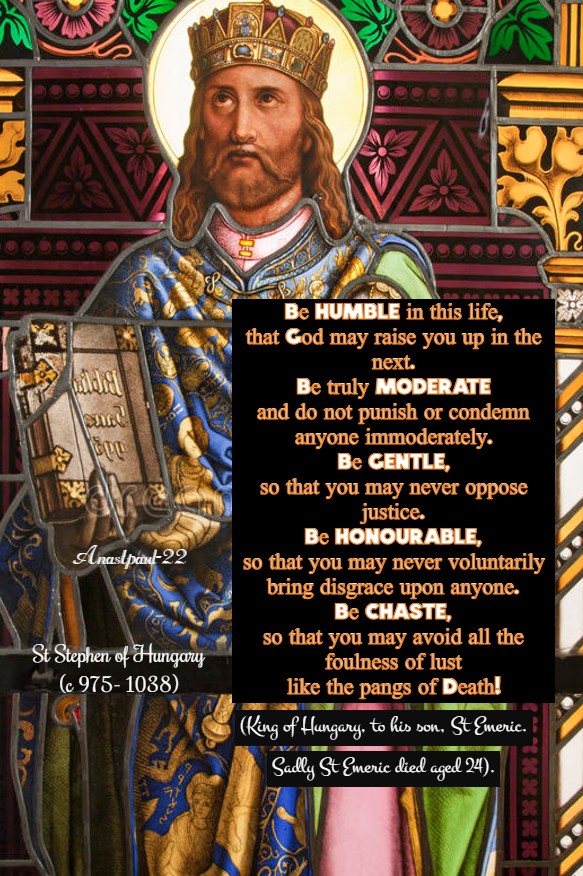
“Be HUMBLE in this life, that God may raise you up in the next. Be truly MODERATE and do not punish or condemn anyone immoderately. Be GENTLE, so that you may never oppose justice. Be HONOURABLE, so that you may never voluntarily bring disgrace upon anyone. Be CHASTE, so that you may avoid all the foulness of lust like the pangs of death.”
St Stephen of Hungary (c 975- 1038)
(King of Hungary, to his son, St Emeric. Sadly St Emeric died aged 24 but had taken a private vow of Celibacy.)
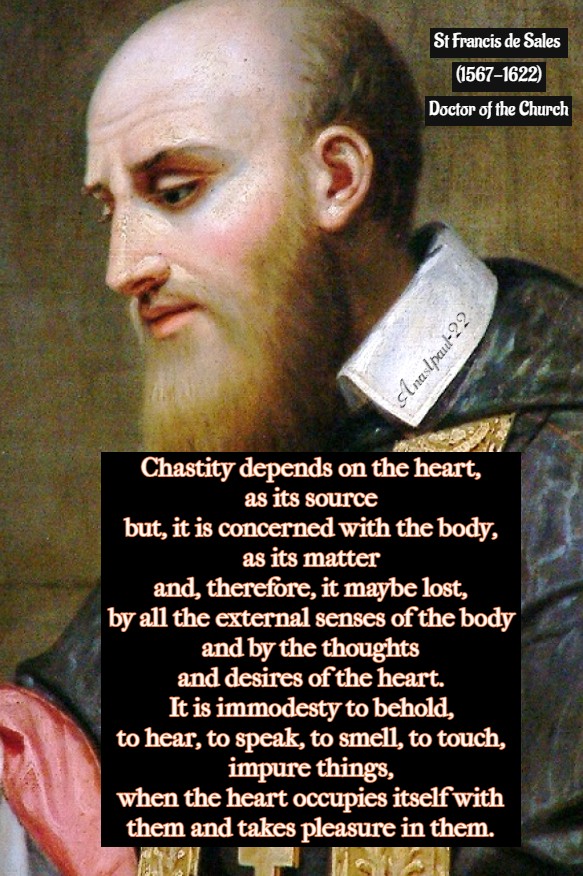
“Chastity depends on the heart, as its source but, it is concerned with the body, as its matter and, therefore, it maybe lost, by all the external senses of the body and by the thoughts and desires of the heart. It is immodesty to behold, to hear, to speak, to smell, to touch, impure things, when the heart occupies itself with them and takes pleasure in them.”
St Francis de Sales (1567-1622) Doctor of the Church
(Introduction to the Devout Life Part Three Chap 13).
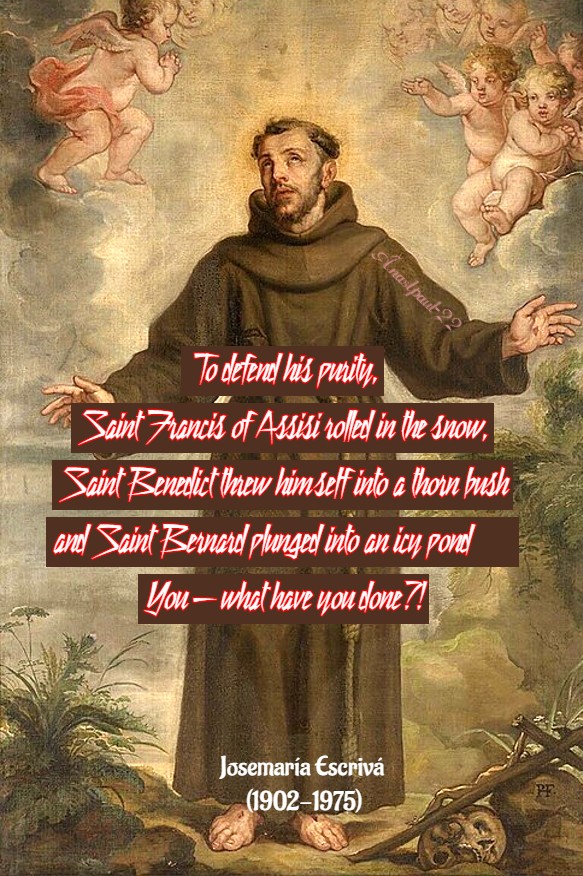
“To defend his purity, Saint Francis of Assisi rolled in the snow, Saint Benedict threw himself into a thorn bush and Saint Bernard plunged into an icy pond… You – what have you done?”
Saint of the Day – 3 February – Blessed Stephen Bellesini OSA (1774-1840) Priest and Friar of the Augustinian Hermits, Teacher and mentor of the youth, Apostle of the poor, Parish Priest. Born as Luigi Giuseppe in 1774 in Trento, Italy and died on 2 February 1840 in Genazzano, Italy of natural causes. Also known as – Stefano and Luigi Belleni.
Stephen was born of the aristocracy in Trento on 25 November 1774. In 1790, aged just 16, despite his father’s opposition, he entered the Order of Saint Augustine at the Convent of Saint Mark of Trento. He completed his novitiate in Bologna, where he took his religious vows and the name of Stefano. He was then sent to Rome for his studies of philosophy and theology whereafter he returned to Bologna.
Fidelity in challenging circumstances was something Stephen had learned early on as an Augustinian. Just three years after his religious profession, and still only twenty-two years of age, he experienced the effects of a rising revolutionary campaign that forced him to leave the Monastery in Bologna where he was studying for the priesthood and return to his native City to continue his education under the guidance of tutors
In 1797 he was Ordained Priest in Trento. His years as a young priest were spent in the trying circumstances of a Church under siege by a government desirous of limiting the Church’s influence and eventually, putting an end to the religious way of life which Stephen had professed. Finally, after several years of tension and uncertainty, Stephen and his community were expelled from their Monastery for good, forbidden to wear any longer, the habit of their religious profession. They would never return. The Monastery would never re-open.
Stephen went to live with his brother and opened a school where he devotes himself to the education of poor children, providing free education and food and clothing where needed. Seven years later, the Priest Stephen, by now a successful and respected teacher who had championed the rights of poor and underprivileged children, won the admiration and love of the people. Even the materialistic local authorities came to respect his work. Eventually he was named Inspector of Schools in Trent.
However,, he missed religious life and in 1814,when he had the chance to return to community life, Stephen resigned his important post in Trent and went to join the Augustinian community in Bologna. Political leaders in Trent begged Stephen to return to his work in the schools there, offering to increase his pay. But Stephen refused, writing to them, “You would surely not ask me (to return to Trent) if you realised the unbreakable bond between a Friar and his God, who is the King of Kings. Before his altar, I have solemnly promised to be faithful to those vows.“
Stephen spent several years as Director of Novices, mentoring and teaching young Augustinians the principles of community life in the Order.
In his later years, Stephen served as Parish priest in Genazzano. There his ministry included a special emphasis on the needs of the poor and of children. In January, 1840, while answering a call to care for a sick parishioner, he tripped and fell. A cut on his leg became infected and he developed a high fever.
He tried to remain active for the next two days but the fever never went away., it is believed he might have contracted the Typhus after attending at many of the sick in his Parish. He died ON 2 February1840 in Genazzano. His remains are at the Shrine of Our Mother of Good Counsel in Genazzano.
Stephen’s sanctity was well-known and highly respect. Champion of youth, advocate for justice, comforter of the sick, guardian of the poor, his message is timely, his life is exemplary and his love for and commitment to religious life, are signposts to all religious and to the faithful. Pope Pius X Beatified Stephen on 27 December 1904. His cause continues, seeking a second miracle at his intercession – “how will they call on him, if they have not heard of him?” Blessed Stephen pray for us!
At the entrance to the Chapel of the General Curia in Rome there is a familiar painting of the Augustinian Blessed, Stephen Bellesini. It is a copy of an original work done by G Toeschi in 1905, depicting a crowning moment and possibly one of the last, of Stephen’s life. He stands close to the bedside of an infirm man, administering perhaps Extreme Unction or simply offering him some comfort, while the man’s wife presses her head to the bed, seemingly overcome with grief or exhaustion. Two young children look on anxiously. The artist touchingly captured here an important aspect of the ministry which occupied the latter part of Stephen’s life, as he visited the homes of the townspeople, bringing them the comfort of the Sacraments and oftentimes ,material assistance as well, during the typhus epidemic which struck Genazzano in the Spring of 1839. As we know, less than a year later, Stephen, himself, would fall victim to the pestilence and would succumb – a martyr of charity – faithful to the end.
One Minute Reflection – 25 January – Feast of the Conversion of St Paul , Apostle, Acts 9:1-22, Matthew 19,27-29.
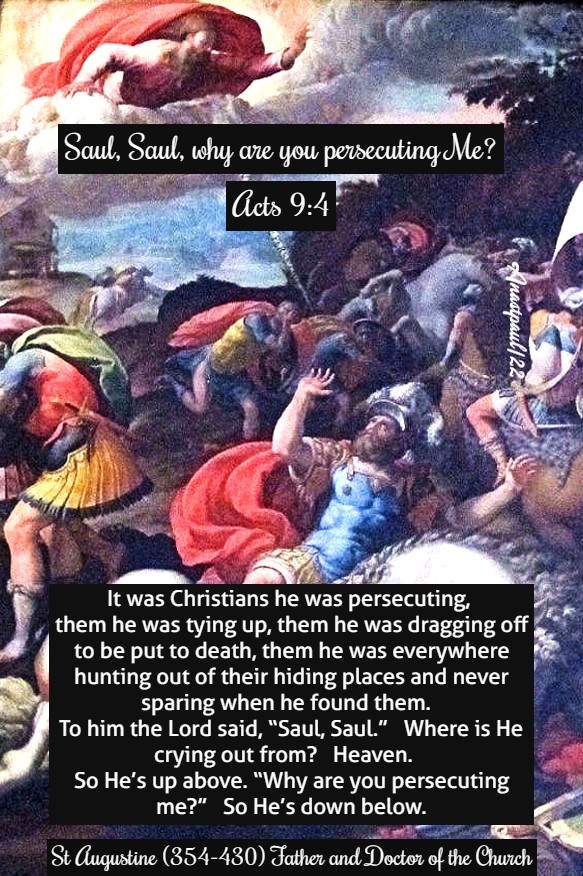
“He fell to the ground and heard a voice saying to him, “Saul, Saul, why are you persecuting Me?” – Acts 9:4.
REFLECTION – “How can we show that He is there and that He is also here? Let Paul answer for us, who was previously Saul. First of all, the Lord’s own Voice from Heaven shows this: “Saul, Saul, why are you persecuting me?” Had Paul climbed up to Heaven then? Had Paul even thrown a stone at Heaven? It was Christians he was persecuting, them he was tying up, them he was dragging off to be put to death, them he was everywhere hunting out of their hiding places and never sparing when he found them. To him the Lord said, “Saul, Saul.” Where is He crying out from? Heaven. So He’s up above. “Why are you persecuting Me?” So He’s down below.” – St Augustine (354-430) Bishop of Hippo, Father and Doctor of the Church (Sermon 122).
PRAYER – Today Lord, we celebrate the conversion of St Paul, Your chosen vessel for carrying Your Name to the whole world. Help us to make our way towards You by following in his footsteps and by being Your disciples before the men and women of our day. Grant that by the prayers of St Paul, we too may say, “Yet I live, no longer I but Christ lives in me; insofar as I now live in the flesh, I live by faith in the Son of God Who has loved me and given himself up for me.” (Galatians 2:20) Through Jesus Christ, our Lord, in union with the Holy Spirit, one God forever and ever, amen.
One Minute Reflection – 21 January – The Memorial of St Agnes (c 291- c 304) Virgin and Martyr – Ecclus 51:1-8, 12; Matthew 25:1-13
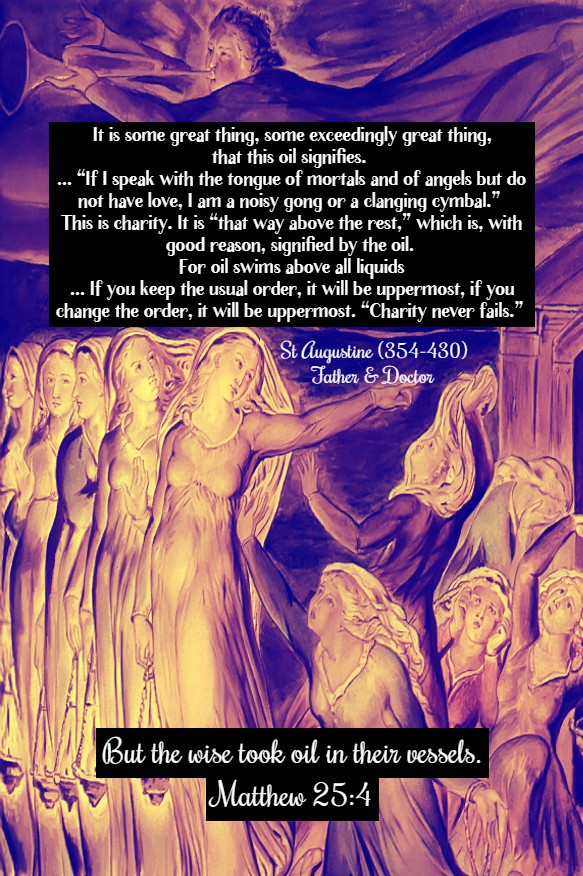
“But the wise took oil in their vessels” – Matthew 25:4
REFLECTION – “It is some great thing, some exceedingly great thing, that this oil signifies. Do you think it might be charity? If we try out this hypothesis, we hazard no precipitate judgement. I will tell you why charity seems to be signified by the oil. The Apostle says, “I will show you a still more excellent way.” “If I speak with the tongue of mortals and of angels but do not have love, I am a noisy gong or a clanging cymbal.” This is charity. It is “that way above the rest,” which is, with good reason, signified by the oil. For oil swims above all liquids. Pour in water and pour in oil upon it, the oil will swim above. If you keep the usual order, it will be uppermost, if you change the order, it will be uppermost. “Charity never fails!” … St Augustine (354-430) Father & Doctor (Sermon 93).
PRAYER – Almighty, ever-living God, You choose what is weak in the world to shame what is strong. Grant that, as we celebrate the Martyrdom of St Agnes, we may follow her example of steadfast love for You and trust in faith. We pray that through her intercession, we may grow in holiness. Through our Lord Jesus Christ, with the Holy Spirit, one God forever, amen.






































 AnaStpaul
You must be logged in to post a comment.