Bl Andrew the Catechist
St Austindus of Auch St Bartholomea Capitanio SCCG (1807-1833)
St Benigno of Malcestine
Bl Camilla Gentili
St Charus of Malcestine
Bl Edward Thwing
Bl Élisabeth-Thérèse de Consolin
St Erastus
Bl Évangéliste of Verona
St Exuperia the Martyr
Bl George Swallowell
St Gérontios
Bl Giuseppina Maria de Micheli
St Gothalm
St Hyacinth
Bl Jacques Netsetov
Bl John Ingram
St Joris
Bl Marcel-Gaucher Labiche de Reignefort
Bl Marie-Claire du Bac
Bl Marie-Madeleine Justamond
Bl Marie-Marguerite Bonnet
St Olympius the Tribune
St Parasceva of Rome
St Pastor of Rome
Bl Pérégrin of Verona
Bl Pierre-Joseph le Groing de la Romagère Blessed Robert Nutter OP (c 1557-1600) Martyr His Life: https://anastpaul.com/2019/07/26/saint-of-the-day-26-july-blessed-robert-nutter-op-c-1557-1600-martyr/
St Simeon of Padolirone
St Symphronius the Slave
St Theodulus the Martyr Blessed Titus Brandsma OCD (1881-1942) Martyr of the Faith Biography: https://anastpaul.com/2018/07/26/saint-of-the-day-27-july-blessed-titus-brandsma-o-c-d-1881-1942-martyr-of-the-faith/
Bl André de Soveral
St Andrew the Hermit
St Antiochus of Sebaste
Bl Arnold of Clairvaux
Bl Arnold of Hildesheim
St Athenogenes of Sebaste St Bartholomew of Braga OP – ArchBishop of Braga also known as Bl Bartholomew of the Martyrs (Bartolomeu Fernandez dei Martiri Fernandes) (1514-1590) St Bartholomew: https://anastpaul.com/2018/07/16/saint-of-the-day-16-july-blessed-bartholomew-of-the-martyrs-1514-1590/
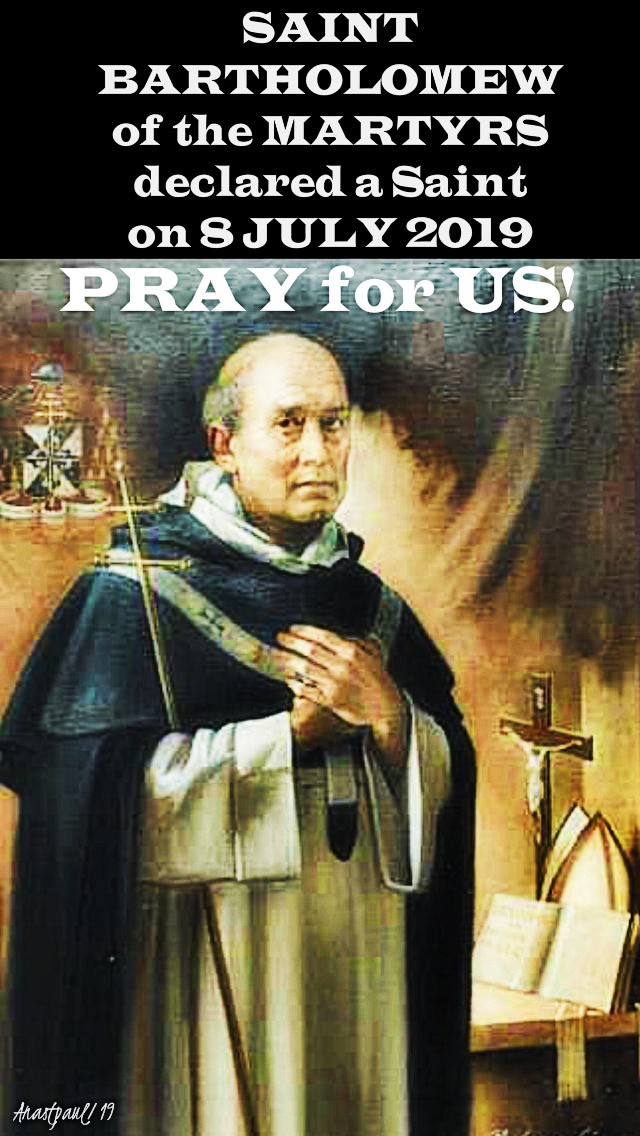
On 8 July 2019, Pope Francis approved the favourable votes cast by the Eminent and Excellent members of the Congregation and extended to the Universal Church the liturgical worship in honour of Blessed Bartholomew of the Martyrs (born Bartolomeu Fernandes), of the Order of Preachers, Archbishop of Braga, born in Lisbon, Portugal on 3 May 1514 and died in Viana do Castelo, Portugal, on 16 July 1590, inscribing him in the book of Saints (Equipollent Canonisation).
Alleluia! Saint Bartholomew of the Martyrs, Pray for Us!
St Benedict the Hermit Blessed Ceslaus Odrowaz OP (c 1184– 1242) (Brother of St Hyacinth)
Bl Claude Beguignot
Bl Domingos Carvalho
St Domnin
St Domnio of Bergamo
Bl Dorothée-Madeleine-Julie de Justamond
St Elvira of Ohren
St Eugenius of Noli
St Faustus
St Faustus of Rome and Milan
St Fulrad of Saint Denis
St Generosus of Poitou
St Gobbán Beg
St Gondolf of Saintes
St Grimoald of Saintes
St Helier of Jersey
Bl Irmengard
Bl John Sugar
St Landericus of Séez
Bl Madeleine-Françoise de Justamond
Bl Marguerite-Rose de Gordon
Bl Marguerite-Thérèse Charensol
Bl Marie-Anne Béguin-Royal
Bl Marie-Anne Doux St Marie-Madeline Postel (1756-1846)
Her Life: https://anastpaul.com/2019/07/16/saint-of-the-day-16-july-st-marie-madeline-postel-
Bl Marie-Rose Laye
Bl Milon of Thérouanne
Bl Nicolas Savouret
Bl Ornandus of Vicogne
St Paulus Lang Fu
St Reinildis of Saintes
Bl Robert Grissold
Bl Simão da Costa
St Sisenando of Cordoba
St Tenenan of Léon
St Teresia Zhang Heshi
St Valentine of Trier
St Vitalian of Capua
St Vitaliano of Osimo
St Yangzhi Lang
—
Martyrs of Antioch – 5 saints: Five Christians who were martyred together. No details about them have survived by the names – Dionysius, Eustasius, Maximus, Theodosius and Theodulus. They were Martyred in Antioch, Syria, date unknown.
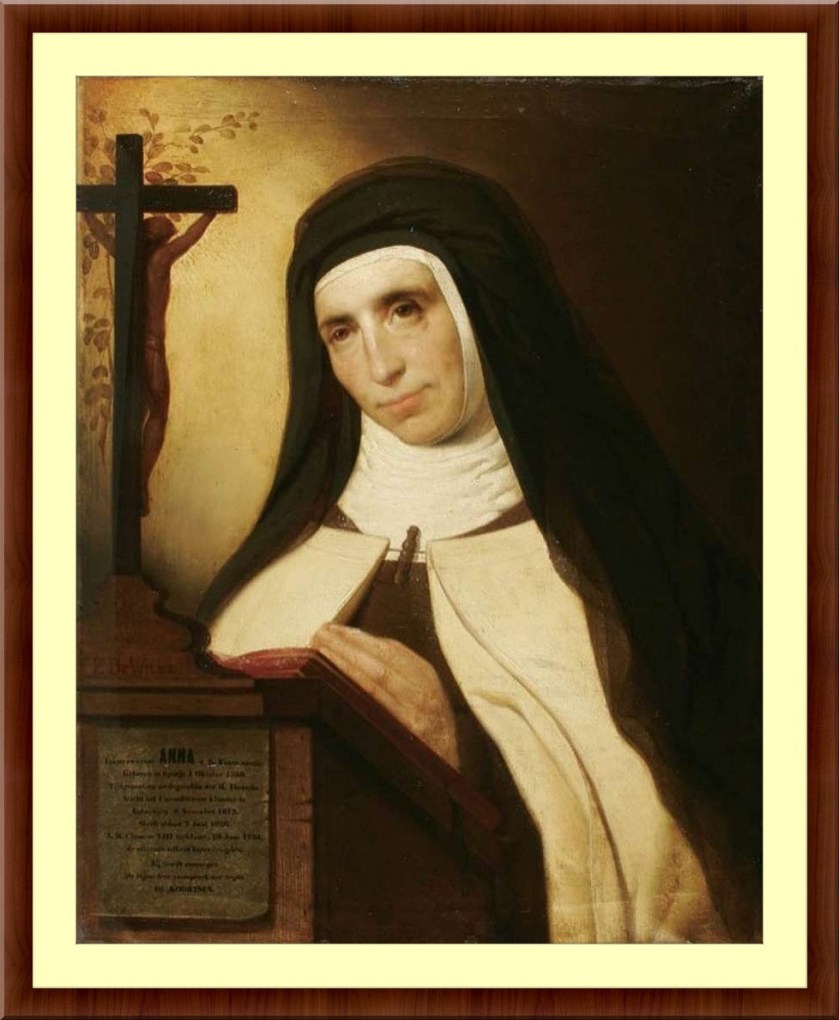
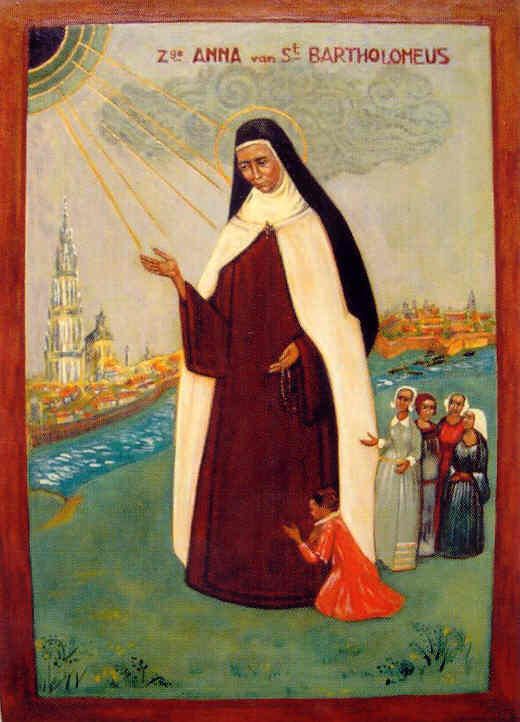
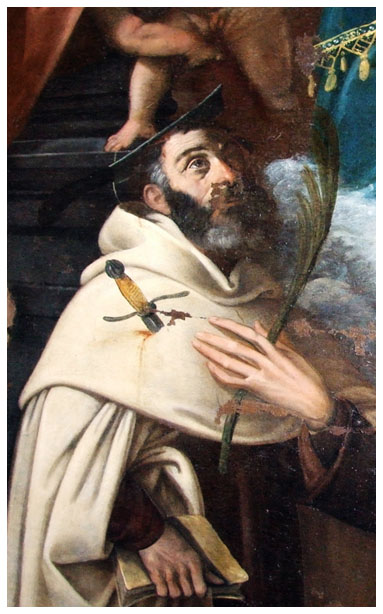
Saint of the Day – 7 June – Blessed Ana of St Bartholomew OCD (1550-1626) – Bl Ana was an early member of St Teresa of Àvila’s Discalced Carmelite Order, Mystic, Spiritual writer, apostle of the poor, Prioress – born Ana García Manzanas on 1 October 1549 at Almendral, Spain and died on 7 June 1626 at Antwerp, Belgium at the time known as the County of Flanders, Spanish Netherlands of natural causes, aged 75. Patronage – Antwerp.
Ana García Manzanas was born in Almendral de la Cañada on 1 October 1550 as the seventh child to Ferdinand García and Maria Mancanas. On the date of her birth she was also Baptised in the Parish Church of His Holiness the Saviour. Together with her three brothers and three sisters she was raised to be close to God by her pious parents. The entire household – on a frequent basis – attended Daily Mass and recited the Holy Rosary together. Her father had a Priest teach the children the doctrine of the faith, while her mother opened their home to the poor and adopted orphans to raise as her own.
In her childhood she loved the paintings that depicted the Passion of the Lord and she wanted to be associated with His suffering – even if in a minor way by giving her food to beggars. She often walked barefoot along stoney paths, in order that she could offer the pain, to her suffering Lord. She said later in this regard:
“I will say here, for the glory of our Lord, that He always gave me consolations when I did good to my neighbour, when the occasion presented itself and when I aided them in their need. I inconvenienced myself, it is true, on these occasions but I found instead of an inconvenience it was a real consolation. It is to the good Master I owe it and it has remained so with me until this day. May His holy Name be blessed!”
In 1559 her mother died and in 1560 her father died. This period turned out to be a time in her life, that she described as being flung into her “deepest affliction.” When she was of the proper age, her older siblings wanted her to enter into marriage, though in her heart she desired to become a religious. Her older brothers tried to test her will, by giving her the difficult task, of sharing the work of the labourers in the fields, in the hope that she would renounce her calling. But once her brothers did this, she refused to speak to them and to any men and thus granting them the opportunity to converse with her, so as to defend herself from marriage, since she wanted to be married to God. The brothers felt that she was too tenderhearted to withstand the austere mode of Monastic life and presumed she would soon leave the Convent life and thus burden the household with dishonour.
Ana experienced visions and apparitions that made her unwilling to give up her dream, though on one occasion had a frightful apparition of a giant demon that scared her to the point of illness. Her relatives became quite concerned for her wellbeing and so took her to a hermitage dedicated to Saint Bartholomew to make a novena. Once she arrived outside the hermitage she was at once seized with paralysis and when her relatives carried her in – and not long after entering – she found herself cured of this extreme affliction.
Finally, on 2 November 1570, Ana entered the Discalced Carmelites as a secular member. She was the first secular that the foundress Teresa of Ávila accepted. She made her religious vows on 15 August 1572. For the next decade she filled the post of a nurse in the Infirmary.
In 1577, when St Teresa broke her left arm, she chose Ana as her personal assistant, nurse and secretary and during the next 5 years Ana was her inseparable companion, travelling with her and assisting in the last four foundations. All of Teresa’s letters in the last few years of her life were dictated to Ana. Teresa died in Ana’s arms in 1582 at the monastery in Alba de Tormes.
Following the death of the Foundress, she returned to Ávila and took part in the foundation of a Convent at Ocana (1595). And she was one of the seven nuns selected for the introduction of the Order into the Kingdom of France on 15 October 1604. In 1605, the French Carmelites appointed Ana the Superior of the Convent in Pontoise. This was a highly unusual step, as Ana was a “secular Carmelite,” meaning she was not part of the choir and removed from the Convent’s life of prayer. She was thus consecrated as a religious sister and took over the Convent at Pontoise. So unusual a step met with the disapproval of her companions but – as the Foundress – had once foretold – she offered no resistance. Ana had also been forewarned that her elevation would cause her great sufferings.
Ana became the prioress of several different Convents: Tours, Flanders, and finally Antwerp, which she governed to the end of her life. Twice she was instrumental in delivering the town from the hands of Protestant forces.
Ana died on 7 June 1626. Soon after her death, miracles were attributed to her intercession and by 1632 over 150 miracles had been approved. She proved herself, like St Teresa, a daughter of the Church in her great zeal for souls. In 1735 Pope Clement XII declared the heroicity of her virtues and Pope Benedict XV Beatified Ana on 6 May 1917.
Her spiritual writings and letters are preserved in Antwerp and Paris.
Father,
rewarder of the humble,
you blessed Your servant Ana of Saint Bartholomew
with outstanding charity and patience.
May her prayers help us
and her example inspire us,
to carry our cross
and be faithful in loving You
and others for your sake.
We ask this through our Lord Jesus Christ, Your Son,
who lives and reigns with You and the Holy Spirit,
one God, forever and ever.
Amen
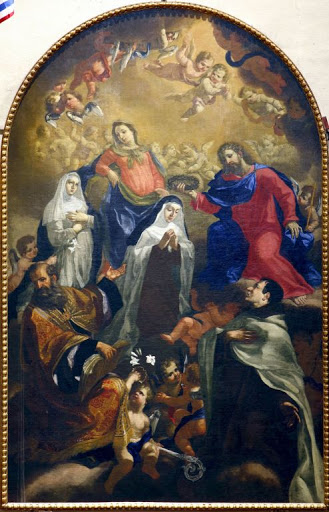
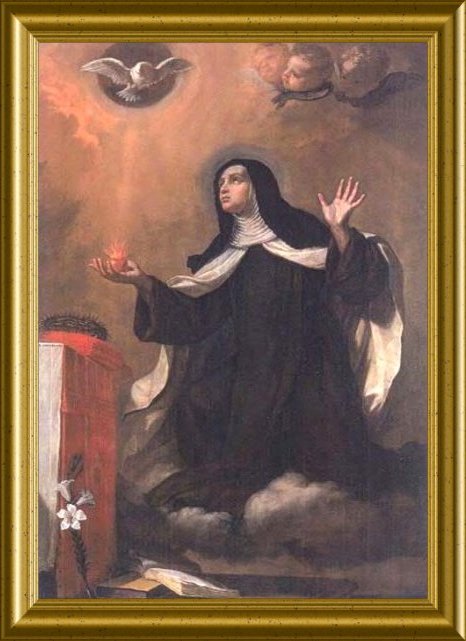
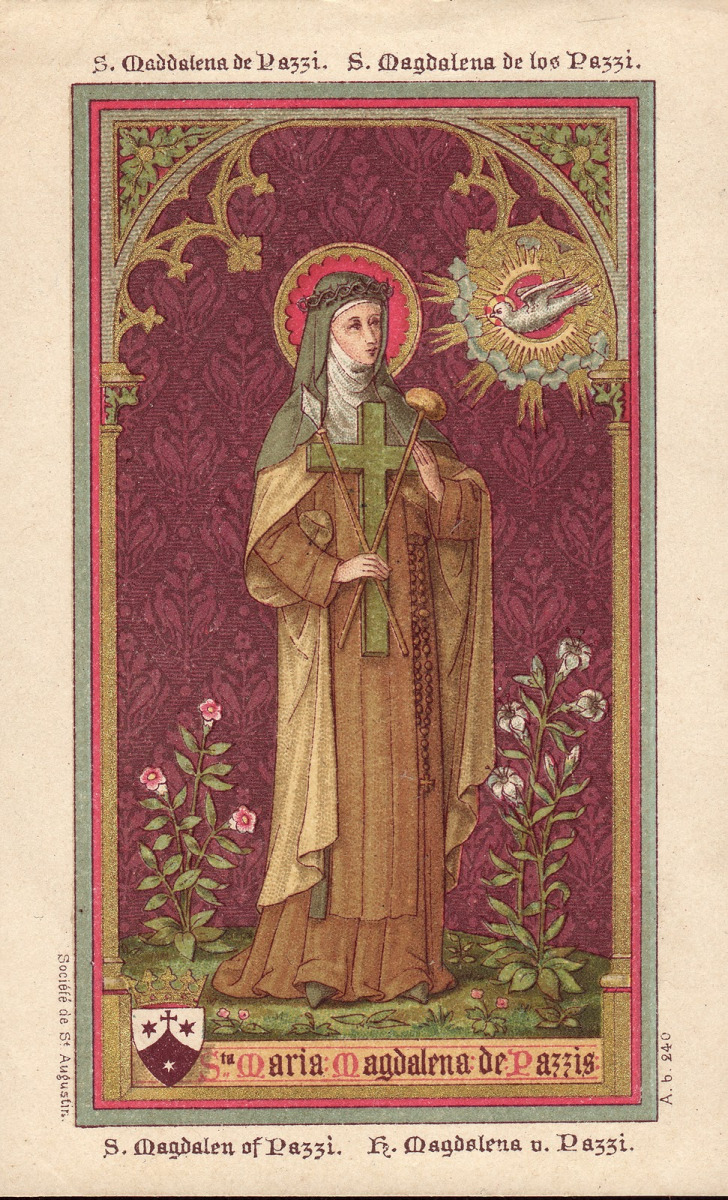
Saint of the Day – 25 May – Saint Maria Magdalena de’ Pazzi O.Carm (1566-1607) Carmelite Nun and Mystic, Ecstatic, she bi-located and was the intercessor of many miracles, Stigmatist – born as Caterina de’ Pazzi (but in the family was called Lucrezia) in 1566 at Florence, Italy and died on 25 May 1607 of natural causes. Patronages – against bodily ills, against sexual temptation, against sickness, sick people, Naples (co-patron).
The second of four children, Caterina was born in Florence on 2 April 1566, to Camilo de’ Pazzi and Maria Buondelmonti. In the comfortable setting of a noble family, that began to call her Lucrezia, after her paternal grandmother, the young girl grew up peacefully and with a certain sensitivity to the aesthetic side of her social condition. Her heart was open to God and to the promptings of the Holy Spirit, in great simplicity, which is something we can see in the way she might share her lunch pack with a needy person, out of compassion, or the way she would help the children of the poor by gently offering them the first truths of faith. Her mother’s deep piety and the visits to her home by the Jesuit Fathers, that her parents invited regularly, helped to stamp on Caterina’s soul that sense of Church, “sensus ecclesiae,” that in later life would appeal so much to her conscience.
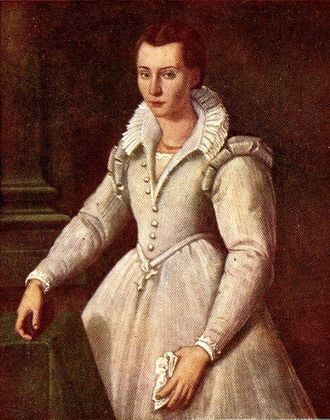
St Maria Magdalena de’ Pazzi at age 16 by Santi di Tito (1583)
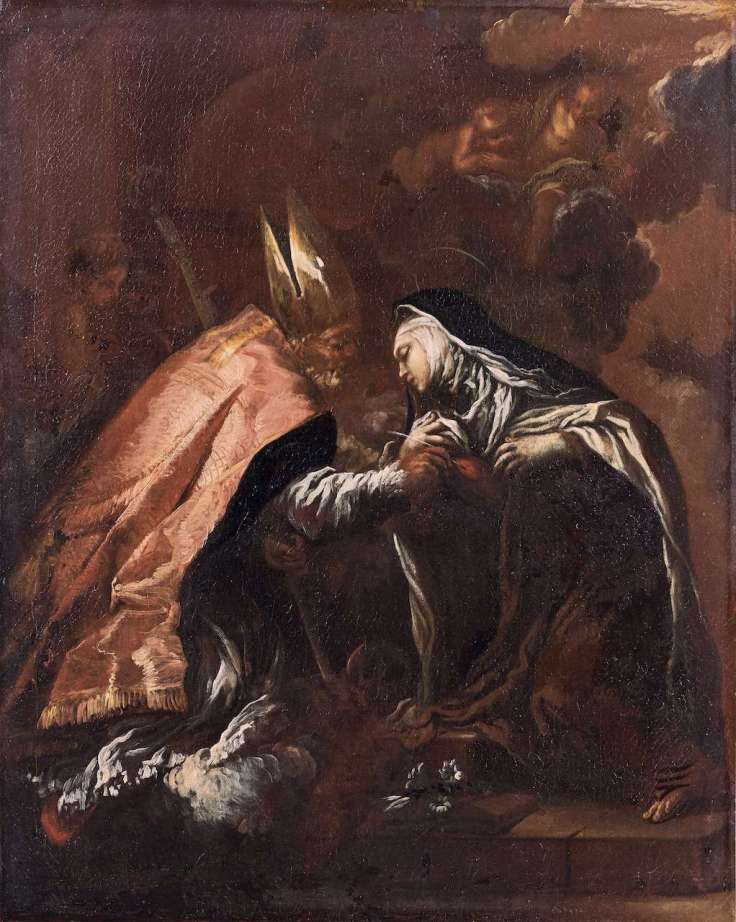
At eight years of age, she was sent as a pupil to the nuns at San Giovannino. The nuns, who noticed the contemplative nature of the child, prepared her for First Holy Communion and not many weeks later, Caterina was sufficiently mature to offer her virginity to God. She was ten years old and now she didn’t need anymore to get the scent of Jesus, by standing near her mother when she had received Holy Communion, now, she began to meditate on the humanity of Jesus. As she was learning to read, she came across the Athanasian Creed and she was very inspired by it. In the same way, she grew to be totally enamoured by the meditations of St Augustine and the Lord’s Passion by Loarte, which she read on the advice of Fr Andrea Rossi, who was her Spiritual Director. The artworks below are of St Augustine writing on her heart.
She had not yet reached the age of seventeen, when she showed her desire to be consecrated to God in religious life. Having overcome the initial opposition of her family, she entered the monastery in Borgo San Frediano, to join the Carmelite community of Santa Maria degli Angeli who were very happy to have her. They allowed her to begin as a Postulant on 8 December 1582. This community, that was well known to and highly regarded by the Bishop of Florence, was attractive to the young girl, principally because of the possibility of receiving Holy Communon everyday.
Two months after entering, on 30 January 1853, Caterina received the Carmelite habit, and with it, the name, Sr Maria Magdalena. At the end of the novitiate year, it was decided, that she would put her profession back until there were other Novices ready to join her. Maria Magdalena , however, got very sick in the following months, to the point of almost dying. With little hope of recovery – even the best doctors in the city had failed to diagnose what today we would call pneuomonia – the Prioress decided to have her make her profession in danger of death, in articulo mortis.
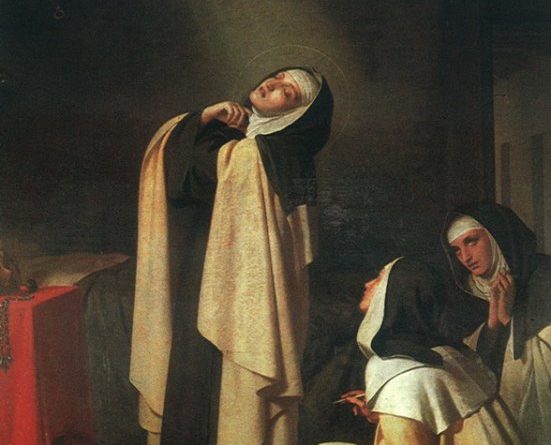
About one hour after her profession, something happened to Magdalena. It was an experience of rapture in God. The sisters tell us that when they went to visit her in the infirmary, they came upon the young eighteen year old patient, transfigured and looking very beautiful. From that day onwards, it was 27 May 1584, the feast of the Most Holy Trinity, the Lord visited her every morning, for forty days and revealed the depth of his love to her. These frequent episodes gave rise to many misgivings in the young girl whose only desire was to live in the hiddenness of her life in Carmel but, it was obvious, that this kind of grace had to be recognised and preserved. For that reason, the sisters began very soon to take notes, writing down what Magdalena. would say while in ecstasy and what she would say, out of obedience, to the Prioress and Mistress.
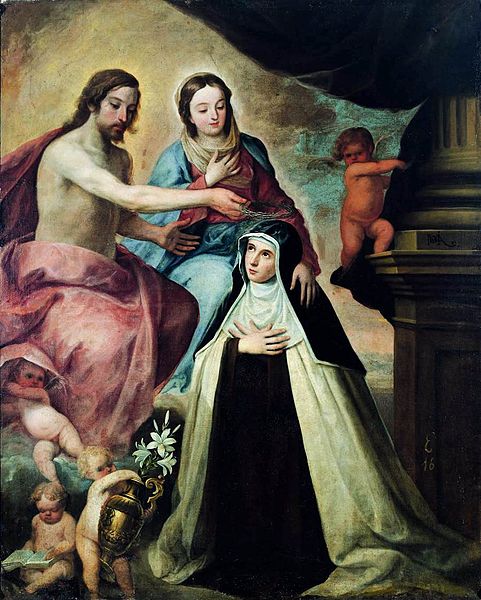
Towards the end of that same year, a new period of divine favour began for her. This time, Jesus, the divine Word, held her in intense conversation (reported in I Colloqui) that revealed increasingly, the bridal relationship that Christ had formed with her. It was in one of those ecstasies that Christ brought her into His passion and death. It was Holy Week in 1585 – her experiences included the Stigmata impresssed on her soul, the Crown of Thorns, the Crucifixion and every scene from the Gospel was displayed, as if it was happening live in that slender tormented body. Then, on the Sunday after Easter, she received from her divine Bridegroom the ring of her mystical marriage.
The manuscript titled, Revelazioni e Intelligenze, gives a faithful account of the communication of God’s grace, that in the days between the vigil of Pentecost and the Sunday of the Blessed Trinity, gave Magdalena, an entry into the revelation, of the inner dimensions of her Trinitarian life. What was communicated to her, was what goes on between the divine person, and how the human person can fulfil a supernatural vocation, by allowing this mystery dwelling within, to do its work.
The central element in this understanding, is the saving mission of the Word, Love, made flesh in the most pure womb of the Virgin Mary and the intuition of “dead love” as the highest expression of the ultimate gift of self.
On the last day of this intense octave of Pentecost, Magdalena began to see, with some clarity, that the moment had arrived when God, as He had made known to her already on a few occasions, was about to take away from her, the enjoyment of His presence. That was the beginning of five very difficulty years of torment and temptation, to the point where she felt as if she had been thrown into the “lions’ den” and reduced to “nothing.” In these interior trials, described in the Probazione, Jesus continued to support her but without lessening the radical purification that striped her bare, made her more simple and extremely receptive to His visits. In the heart of the crucible, however, Magdalena also received understanding from God concerning the condition of the Church of her time – so slow to implement the renewal sought by the Council of Trent – and she felt that she was being drawn by the Truth, to be involved in a practical way, in calling to order prelates, cardinals and even the Pope, Sixtus V. The twelve letters that she dictated in ecstasy, in the Summer of 1586 are collected in the volume titled, Rinnovamento della Chiesa. The five years of trial restored to us a Magdalena. transformed . The Lord had brought her through a divinising process, through which, today, she could well be considered a master and guide.
After Pentecost 1590, she returned to the normality of ordinary life, something she had always wanted. Apart from just a few and important, moments of ecstasy (reported in the second part of the Probazione) her days passed quietly as she went about the jobs she had to do (on account of her spiritual maturity she was put in charge of the young sisters in formation) and all the other forms of humble service that she tended to seek. Then the experience of “naked suffering” took hold of her and this would unite her once and for all to the Crucified Bridegroom.
Sr Magdalena could read the thoughts of others and predict future events. For instance, during one ecstatic event she predicted the future elevation to the Papacy of Cardinal Alessandro de’ Medici (as Pope Leo XI). During her lifetime, she appeared to several persons in distant places and cured many sick people.
The symptoms of tuberculosis began to appear in 1603. As her strength declined, she suffered the added pain of not being able to feel anything of the Lord’s presence. Just her presence in the community, in the eyes of the sisters, had become a vision of God’s work of art about to be completed. On 25 May 1607, at 3 p.m. in the afternoon, Sr Maria Magdalena, at the age of forty-one gave up her spirit.
She was buried in the choir of the Monastery chapel. She was Beatified in 1626 by Pope Urban VIII. At her Canonisation in 1668, her body was declared miraculously incorrupt. Her body is located in the Monastery of Maria Maddalena de’ Pazzi in Careggi.
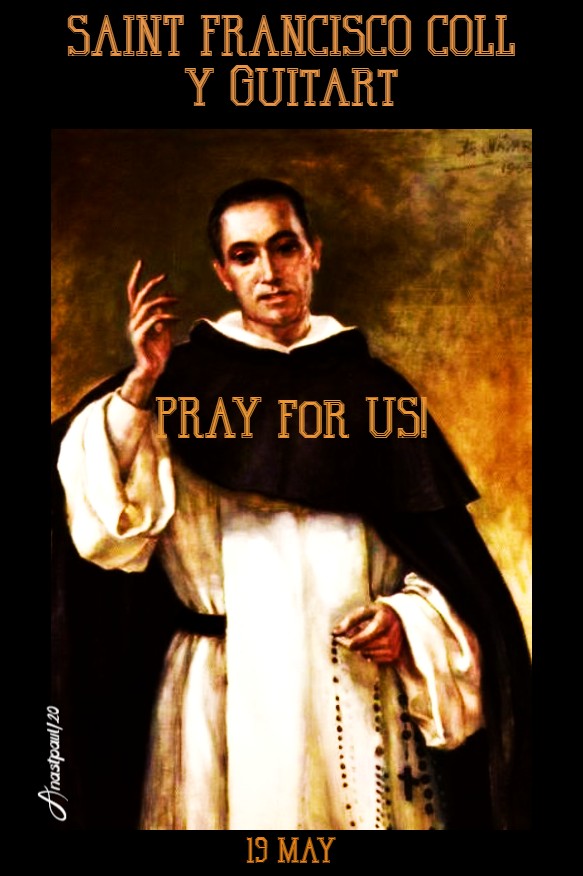
One Minute Reflection – 19 May – “Mary’s Month” – Tuesday of the Sixth Week of Easter,Readings: Acts 16: 22-34, Psalms 138: 1-2, 2-3, 7-8, John 16: 5-11 and the Memorial of St Francisco Coll y Guitart OP (1812-1875) “The Apostle of Modern Times”
“It is better for you that I go. For if I do not go, the Advocate will not come to you. But if I go, I will send him to you.” … John 16:7
REFLECTION – St Teresa Benedicta of the Cross [Edith Stein] OCD (1891-1942) Martyr, Co-Patron of Europe
“Who are You, sweet light, that fills me
and illumines the darkness of my heart? (…)
Are You the master who builds the eternal cathedral,
Which towers from the earth through the heavens?
Animated by You, the columns are raised high
And stand immovably firm.
Marked with the eternal name of God,
They stretch up to the light,
Bearing the dome
That crowns the holy cathedral,
Your work that encircles the world:
Holy Spirit, God’s moulding hand! (…)
Are You the sweet song of love
And of holy awe
That eternally resounds around the triune throne,
That weds in itself, the clear chimes of each and every being?
The harmony
That joins together, the members to the Head,
In which each one
Finds the mysterious meaning of being blessed
And joyously surges forth,
Freely dissolved in Your surging,
Holy Spirit, eternal jubilation!”
PRAYER – Almighty God and Father, Your ways are not our ways, teach us to willingly agree to them, for You know which way we should go. Help us to say “yes” always to Your plan and to render ourselves, as a sacrament of Your divine love to all we meet. Fill us with the Your grace and Your Spirit, to make us Your tools, to bring glory to Your kingdom. Our Father, who art in heaven, may Your Will be done on earth, as it is in heaven. Mary Mother of God, pray for us! St Francisco Coll, you who constantly sought to be a light of the beauty of God, pray for us! Through our Our Lord Jesus Christ with You, in the union of the Holy Spirit, one God forever, amen.
St Carantac
St Carantoc
St Diocletian of Osimo
St Felix of Uzalis
St Fidolus of Aumont
St Fiorenzo of Osimo
St Fort of Bordeaux
St Francoveus
St Gennadius of Uzalis
St Germerius of Toulouse
St Hilary of Pavia
St Honorius of Amiens
Bl Louis of Mercy St Margaret of Cortona TOSF (1247-1297) (This is a very good homily – listen if you can).
St Ubaldus Baldassini
St Victorian of Isauria
Bl Valdimir Ghika
—
Martyrs of Saint Sabas: A group of monks, whose names have not come down to us, who were massacred by Moors at the monastery of Saint Sabas in Palestine.
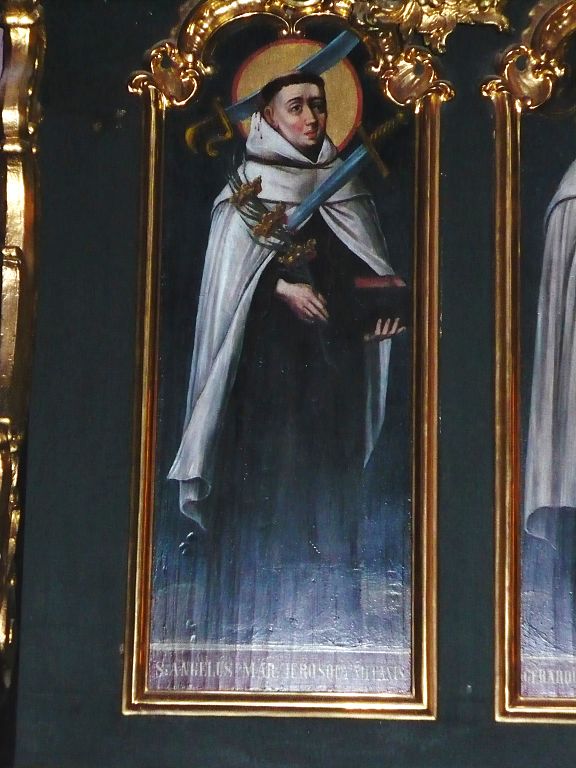
Saint of the Day – 5 May – Saint Angelus of Jerusalem O.Carm (1185-1220) Priest, Martyr, Hermit, Mystic, Reformer, Thaumaturge, Missionary, convert from Judaism and a professed Priest of the Order of the Brothers of the Blessed Virgin Mary of Mount Carmel – also known as St Angelus of Sicily and St Angelo. Born in 1145 at Jerusalem and died by being stabbed to death in 1220 at Licata, Sicily, Italy. Patronages – Palermo, Sicily, Licata and Sant’Angelo Muxaro, all in Italy. Today is the 800th Anniversary of his death.
St Angelus was born in Jerusalem to a Jewish family. His mother converted to Christianity and Angelo, along with his twin brother John, was Baptised and converted along with her. His parents died while he was in his childhood and the Patriarch Nicodemus oversaw their education until the twins turned eighteen. He and his brother John entered the Carmelites then, at the Saint Anne convent near the Golden Gate to commence their novitiate.
They were well learned and already spoke Greek, Latin and Hebrew. In 120, when he was twenty-six, Angelo was Ordained in Jerusalem and travelled throughout Palestine. Various miraculous cures were attributed to him as he travelled. His “Acta” tells us that he sought to avoid fame and when he was becoming known for his miracles, he withdrew from society to a hermitage to avoid the pilgrims who were following him. Angelus withdrew to a hermitage on Mount Carmel, until he was instructed by Christ in a vision, to leave Mount Carmel for Italy to preach against the Albigensians, Bulgars and other heresies.
He set off on a Genoese ship on 1 April 1219 and stopped first in Messina before heading off to Civitavecchia before he ended up in Rome to meet with the pope. The friar preached in the Basilica of Saint John Lateran while in Rome where he met both Saint Francis of Assisi and Saint Dominic. He foretold that Francis would receive the stigmata while Francis foretold his premature death.
From there he was a guest of the Basilians in Palermo where he was for about a month, before preaching in Agrigento for over a month before settling in Licata. He had healed seven lepers and the ailing Archbishop of Palermo Bernardo de Castanea while in Palermo. He settled on the Sicilian island though his fame as a wonderworker caused crowds to flock to him. He also had success in converting some Jews though most Jews in Palermo came to despise him for this since he himself was once Jewish.
He wanted to convert a Knight named Berenger. Catholic tradition states that Berenger was living in incest and that Angelo convinced the knight’s companion to leave him. Berenger became enraged and arranged to have him attacked and murdered, in front of the Church of Saints Filippo and Giacomo in Licata. He didn’t die from the attack until four days after the attack and during that time, he prayed for his assassin and asked the civil authorities to pardon him. He showed the ultimate in forgiveness, setting an example for all those that he preached to. He was buried at Saints Filippo and Giacomo Church. His sepulchre at Licata quickly became a site of Pilgrimage.
The Carmelites venerated him as a saint from 1456 and Pope Pius II Canonised him in 1459. His relics were translated to a new Church in Licata, Saint Maria del Carmine. It was through St Angelo’s intercession that the plague in the Kingdom of Naples was halted.
St Angelus of Jerusalem O.Carm (1185-1220) Priest, Martyr +2020 – The 800th Anniversary of his death
St Avertinus of Tours
Bl Benvenuto Mareni
St Britto of Trier Blessed Caterina Cittadini (1801-1857) Biography: https://anastpaul.com/2018/05/05/saint-of-the-day-5-may-blessed-caterina-cittadini-1801-1857/
St Crescentiana
St Echa of Crayke
St Eulogius of Edessa
St Euthymius of Alexandria
St Geruntius of Milan
St Godehard of Hildesheim
Bl Grzegorz Boleslaw Frackowiak
St Hilary of Arles
St Hydroc
St Irenaeus of Thessalonica
St Irenes of Thessalonica
Bl John Haile
St Jovinian of Auxerre
St Jutta Kulmsee
St Leo of Africo
St Maurontius of Douai
St Maximus of Jerusalem
St Nectarius of Vienne
St Nicetas of Vienne St Nunzio/Nuntius Sulprizio (1917-1836) Aged 19 St Nunzio’s very short life:
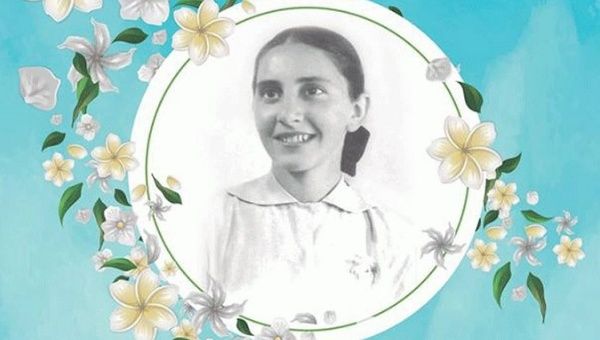
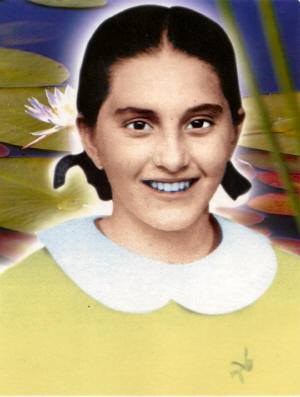
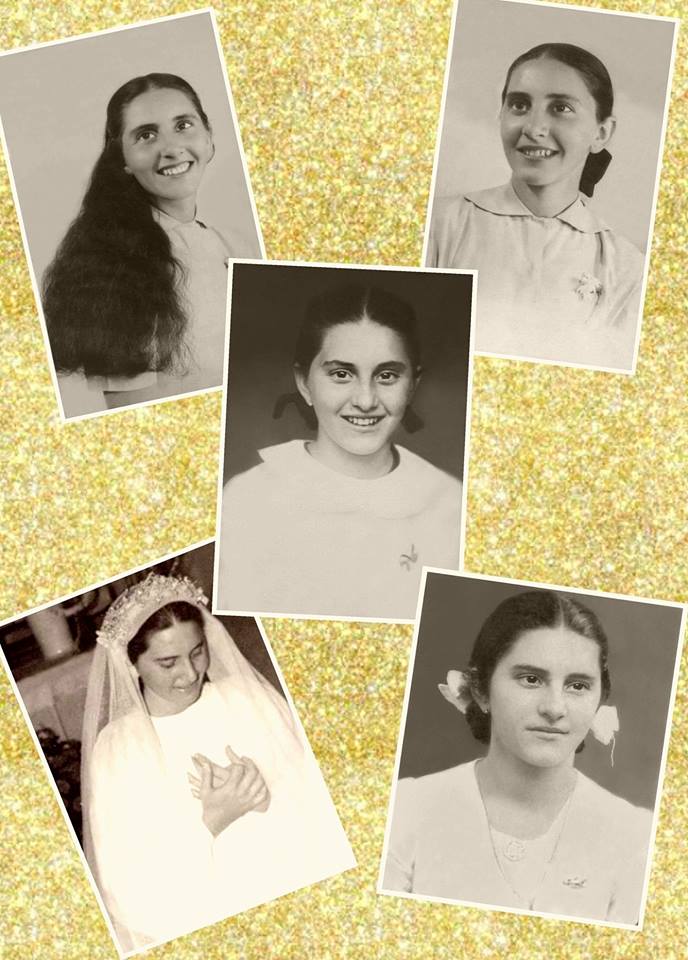
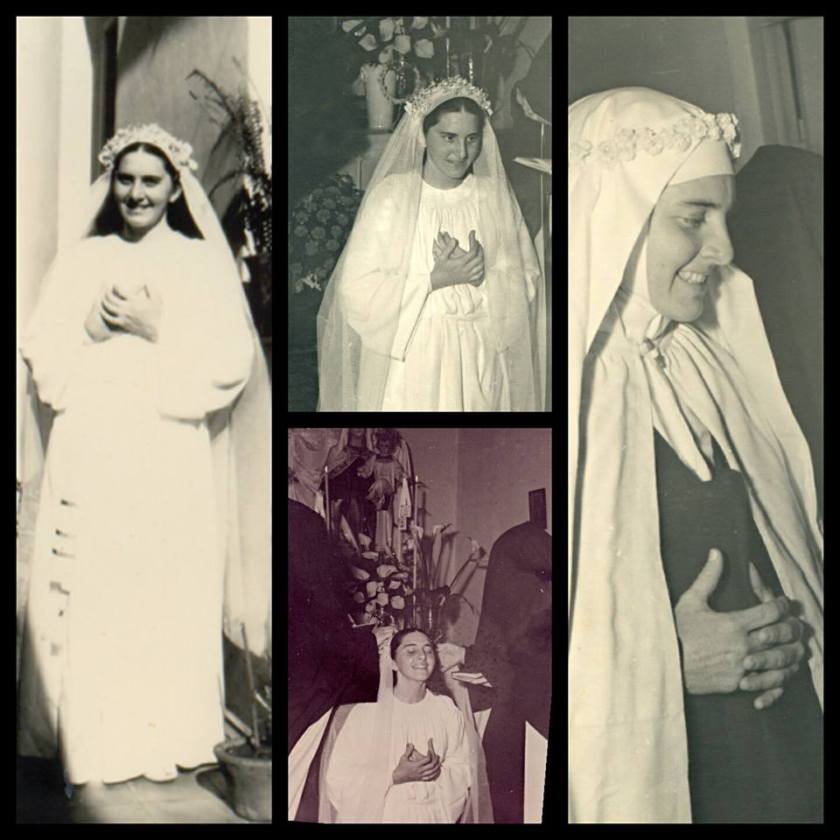
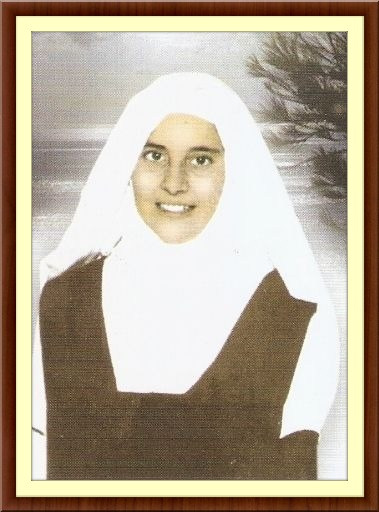
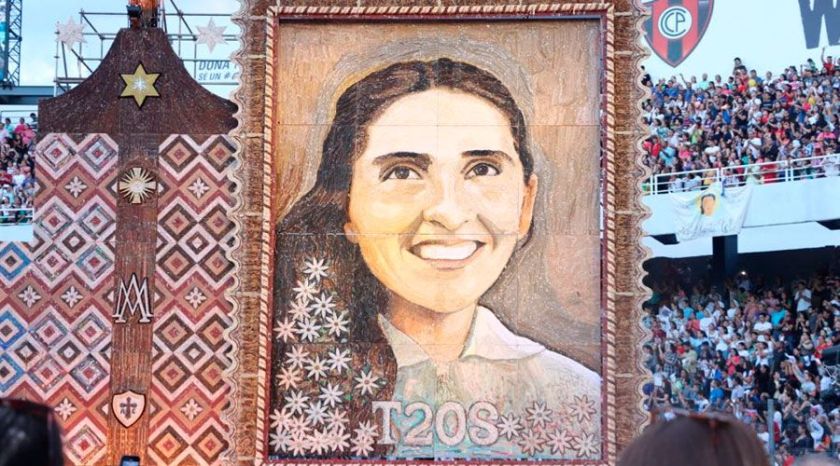
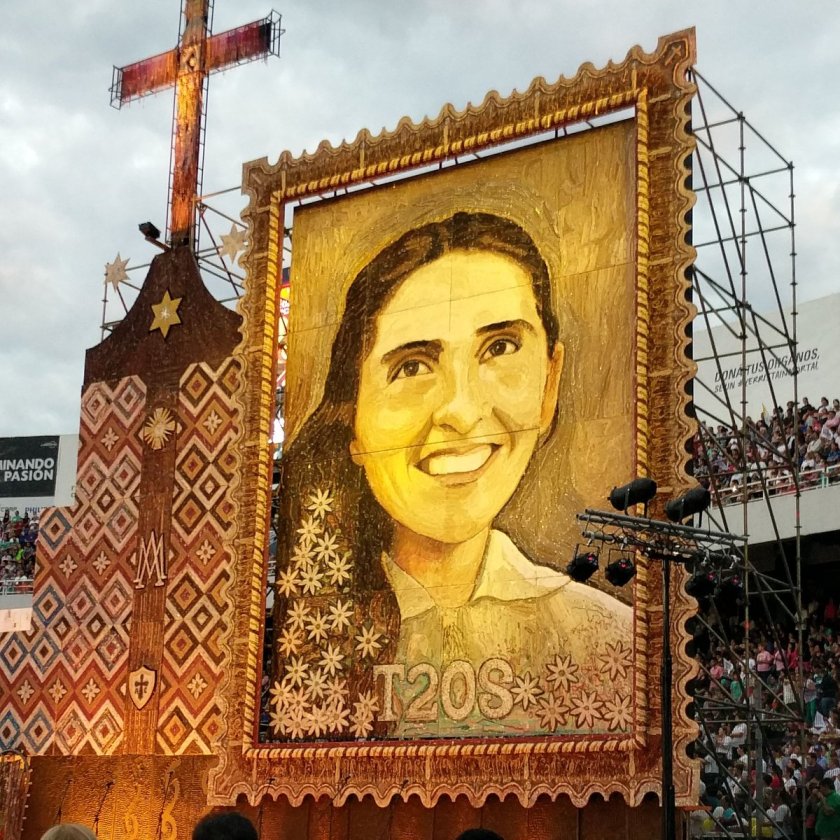
Saint of the Day – 28 April – Blessed María Felicia of Jesus in the Blessed Sacrament OCD (1925-1959) “The Lily of Paraguay,” Virgin, Discalced Carmelite Sister, Apostle of the poor and marginilised – born as María Guggiari y Echeverría on 12 January 1925 in Villarica del Espiritu Santo, Guairá, Paraguay and died early in the morning of 28 April 1959 in Asunción, Paraguay of infectious hepatitis, aged 34. Also known as María Guggiari y Echeverría, “Chiquitunga” – her father’s pet name for her as a child. Patronage – Paraguayan youth.
Maria Felicia Guggiari Echeverria was born on 12 January 1925 in Villarica del Espiritu Santo, Guairá, Paraguay. She was the first of seven children. At the age of 16 she enlisted in the ranks of Catholic Action. Despite the strong opposition she received from her family, she made the “Dedication to the Apostolate” and added the subject of virginity. She committed herself to daily Communion and a joyful and unconditional dedication to the Apostolate on behalf of children, young people and the sick, the elderly and needy. She achieved a total forgetfulness of self and a total surrender to God and neighbour. Her love for the poor and suffering was exceptional.
She soon fell in love with Saua Angel, a young leader of the Catholic Action and a medical student who was very close to becoming a doctor. Equipped with a deep faith and love for Saua at the same time, she wondered if God was calling her to marriage like the parents of St Therese of Lisieux who had, at first, chose virginity. Maria waited with confidence for the manifestation of God’s will and about a year later, Saua told Maria he felt called to the Priesthood. As soon as she heard of his vocational call, she offered to help him achieve his goal.
To avoid the opposition of his family because his father was a Muslim, Saua was sent to Madrid for specialisation in psychiatry and time to discern the call to the Priesthood. He left for Europe in April 1952 and in November decided to enter the Seminary. Maria Felicia, happy with his decision, in turn felt that God was calling her to total dedication to the religious life. During 1953 Maria Felicia suffered severe opposition to her vocation from her family but supported by her faith and a boundless hope in the Lord, did not cease her prayer life and the sacraments or her apostolic work with the young and marginalised. She never lost her peace of heart or her infectious smile. She even smiled when she cried.
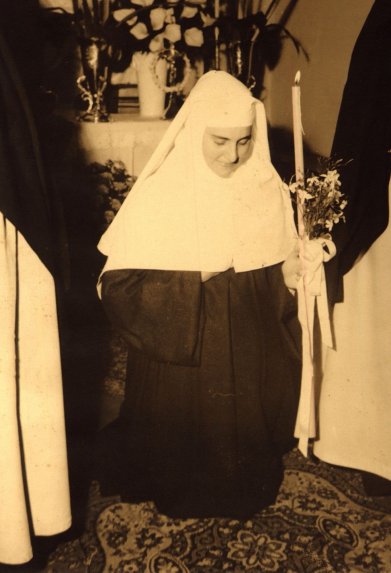
Despite the opposition of her family and almost all the Priests who saw a great loss for the pastoral care of the young and marginalised, Maria entered the Carmel of Asuncion at the age of 30 and took the Discalced Carmelite habit on 14 August 1955, the Feast of the Presentation of Jesus in the Temple.
Sister Maria Felicia, who in the last two years had written at least 48 letters to Saua, some of great length, and most of which are still preserved, ceased to write so that she could be immersed forever in a “life hidden with Christ for God.” “Goodbye to Eternity”was her last written words of farewell.
A year later, on 15 August 1956 Maria professed her temporary vows and took the name Sister Maria Felicia of Jesus in the Blessed Sacrament. She lived the next three years with fervour, in fellowship, distinguished by charity, sacrifice and joy. She sacrificed love for Saua, for the Church, her homeland and in a very special way for Priests.
In January 1959 Sr Maria took ill with infectious hepatitis and was forced to move into a sanatorium in the city. At about 4:10am on Easter Sunday, 28 March 1959, with all her family present, Sr Maria Felicia of Jesus in the Blessed Sacrament, lying on cushions, sat up with a burst of energy and spoke her last words : “Jesus, I love you! What a sweet encounter Virgin Mary!” And with her characteristic sweet smile on her face, she died at the age of 34.
Chiquitunga (pronounced Chichitunga), as she was affectionately called, had been within the walls of Carmel for a little less than four years but she left a profound impression on the Mother and sisters of her community who remember her for her great spirit of sacrifice, charity and generosity, all clothed in an outstanding gentleness and infectious happiness.
Described as their “lily’ by the Catholic Church of Paraguay, Blessed Maria Felicia of the Blessed Sacrament is the first Saint from Paraguay. Many of her writings, poems and letters still exist. Writings of spontaneity, simple yet piercing, reveal that she lived to the full her Baptismal vocation as an apostle.
Blessed Maria Felicia’s cause for sainthood commenced under St Pope John Paul II in 1997 after she received the title Servant of God, and the confirmation of her heroic virtue led to Pope Benedict XVI conferring the title of Venerable on 27 March 2010. Pope Francis confirmed her Beatification and it was celebrated on 23 June 2018. The Beatification miracle involved the healing of a newborn, Ángel Ramón, who showed no vital signs at birth but recuperated after 20 minutes, following the prayers by the obstetrician for the intercession of María Guggiari Echeverría. The Beatification recognition celebrated at the Estadio General Pablo Rojas, Barrio Obrero, Asunción, Paraguay and was presided by Cardinal Angelo Amato presiding on the pope’s behalf.
Saint of the Day – 29 March – Blessed Bertold of Mount Carmel (Died 1195) Priest, Monk, Hermit, Crusader – born in Limoges, France and died in 1195 of natural causes – also known as Bartoldus of Calabria.
Blessed Bertold was born in France, the son of a Count. He excelled at his studies and was Ordained a Priest. Berthold’s brother, Aymeric, became the Latin Patriarch of Antioch. The two joined together to participate in a Crusade to the Holy Land.
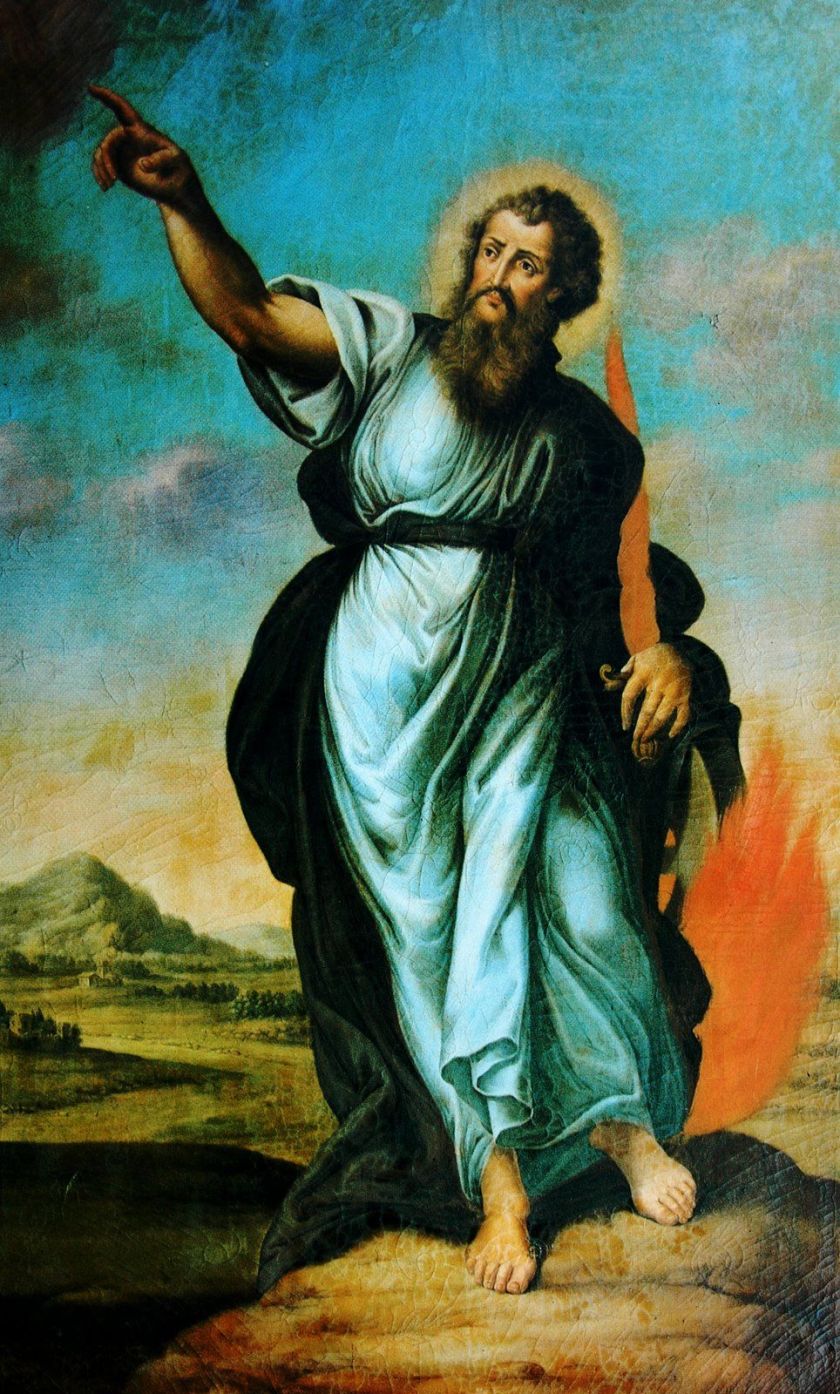
While in the Holy Land, Berthold travelled to Mount Carmel and built a Monastery and Church dedicated to the Prophet Elijah. His reputation for holiness spread, other hermits were attracted to the area, including Saint Brocard. Many hermits who were scattered throughout Palestine, followed Bl Bertold and came to live together in imitation of the life of the great prophet as recorded in the Old Testament.
St Elijah the Prophet
Aymeric appointed Berthold the first Superior and he lived with his community at Mount Carmel for 45 years until his death in 1195. Later the community became known as the Hermit Brothers of St Mary of Mount Carmel.
It was the life and work of Bl Berthold that laid the foundation for the Carmelite Order, which, in 1206 received a written rule from St Albert of Jerusalem, whose rule was approved by Pope Honorius III in 1226. In the same century, some members moved to Europe and established similar groups from Sicily to Oxford.
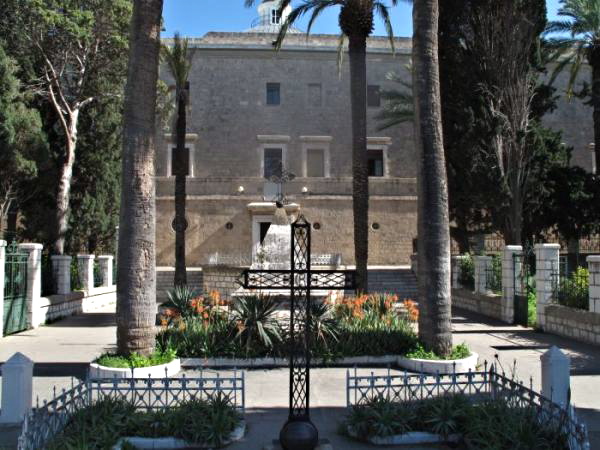
Carmelites returned to Mount Carmel in 1631 and finally completed the Stella Maris Monastery in the 18th century. Its stout walls and small openings reflect the need for defence against hostilities during its establishment.
Later a lighthouse was built, giving a further meaning to the title Stella Maris. Because of its commanding position, the lighthouse has been commandeered as a military establishment.
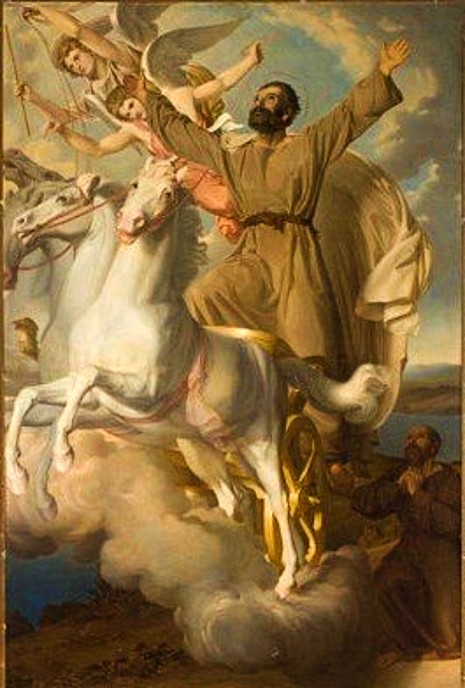
Inside the church, the décor features vividly coloured Italian marble and dramatic paintings in the dome, one depicting Elijah being swept up to heaven in a fiery chariot. A cedar and porcelain statue of Mary, Our Lady of Mount Carmel, is above the altar. Steps lead down to a grotto, with a small altar, where the Prophet Elijah is believed to have occasionally lived. People have lived in caves on Mount Carmel since prehistoric times.
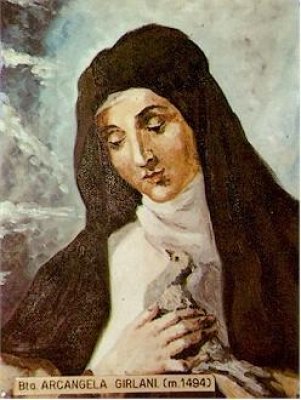
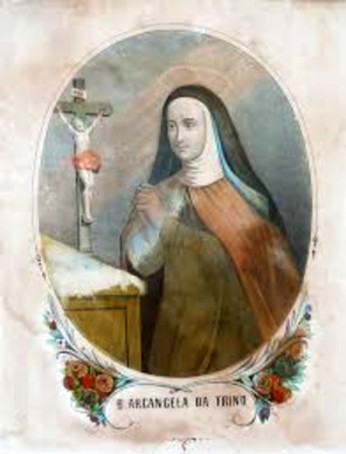
Saint of the Day – 13 February – Blessed Archangela Girlani O.Carm (1460-1494) Virgin, Carmelite Nun, Mystic with the gift of levitation – born Elanor Girliani in 1460 at Trino, on Monte Ferrato in northern Italy and died on 25 January 1494 (aged 33) in Mantua, Milan, Italy. Blessed Archangela founded a new Carmelite monastery in Mantua. Her body is incorrupt.
Eleanor Girlani was born in the small Italian town of Trino (Piedmont). She demonstrated great piety and holiness as a child. Despite her family’s noble heritage, her only ambition in life was to become a Benedictine sister and together with some friends and relatives, she prepared to travel to the monastery of Rocca delle Donne, who had agreed to accept and raise her as a member of the Order. However, this was not to occur . Upon mounting her horse to travel, the animal refused to carry her to the monastery. As this particular horse was one of gentle and obedient spirit, the animal’s refusal to move was interpreted as a sign from the Lord and Eleanor returned home. Despairing, she prayed for guidance and contented herself in her own daily practices of contemplation, penance and service to others.
Eleanor soon encountered a Carmelite monk, who introduced her to the sisters of the Carmelite Order. Understanding this as divine intervention, Eleanor sought admission, and was accepted into the Order on her seventeenth birthday. She lived and served in the convent of Maria Maddalena in Parma, along with her sisters Mary and Scholastica.
Eleanor received the veil as a Carmelite sister at age eighteen, taking the name Archangela as her own. She was made Prioress of the abbey, given her nobility (as was the custom of the time) and became a model of Christian virtue to her sisters. Especially devoted to the Holy Trinity, Archangela spent hours in the chapel praying and contemplating the divinity of the Lord.
Sister Archangela soon was requested to found an additional abbey in Mantua, which was named Santa Maria del Paradiso (The Convent of Mary in Paradise). There, under her direction, sisters of the Order lived as if already absorbed into heaven. The monastery developed a reputation for great holiness, and received many new sisters. As prioress, Archangela experienced great ecstasies, some lasting well over 24 hours and on more than one occasion was discovered by her sisters to be levitating above the ground while contemplating the Holy Trinity. She further performed many miracles.
Only three years after founding the monastery at Mantua, Blessed Archangela fell gravely ill. Strengthened with the Sacraments and with her eyes fixed on an image of the Crucified Christ, she repeated her frequently uttered words: “Jesus, my Love”and peacefully died at the young age of thirty three. In fulfilment of her desire, she was buried in the simplicity of a common grave at the monastery. Three years later, when the tomb was re-opened to commit another sister to the earth, her remains were found incorrupt and exuding the fragrance of holiness. Great miracles were reported and her relics were enclosed in a crystal tomb and placed above the alter at the monastery.
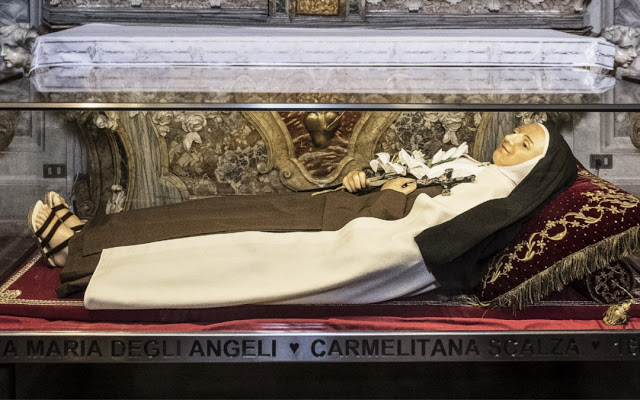
Nearly 300 years after her death, the monastery in Mantua was closed and Archangela’s relics were translated to Trino, where she had been born. Her relics, still venerated today, were placed in the church of Saint Lorenzo. There, her body rests, wearing the habit of Carmelites, in a casket of crystal. Pope Pius IX confirmed her cultus and Beatified her on 1 October 1864.
The life of Blessed Archangela is one of deep faith and commitment to the Lord. Willing to reconsider her own plans for those that the Lord placed before her, Archangela served and followed wherever the Holy Spirit led her.
Prayer
Father in heaven,
you gave the virgin Blessed Archangela Girlani
particular dedication to the mystery of the eternal Trinity.
Through her prayers
may we taste the delights of Your glory
already here on earth
and look upon You forever in heaven.
We ask this through Christ, our Lord.
St Julian of Lyon
St Lucinus of Angers
St Marice
St Martinian the Hermit
St Maura of Ravenna
St Modomnoc
St Paulus Lio Hanzuo
St Peter I of Vercelli
St Phaolô Lê Van Loc
St Stephen of Lyons
St Stephen of Rieti
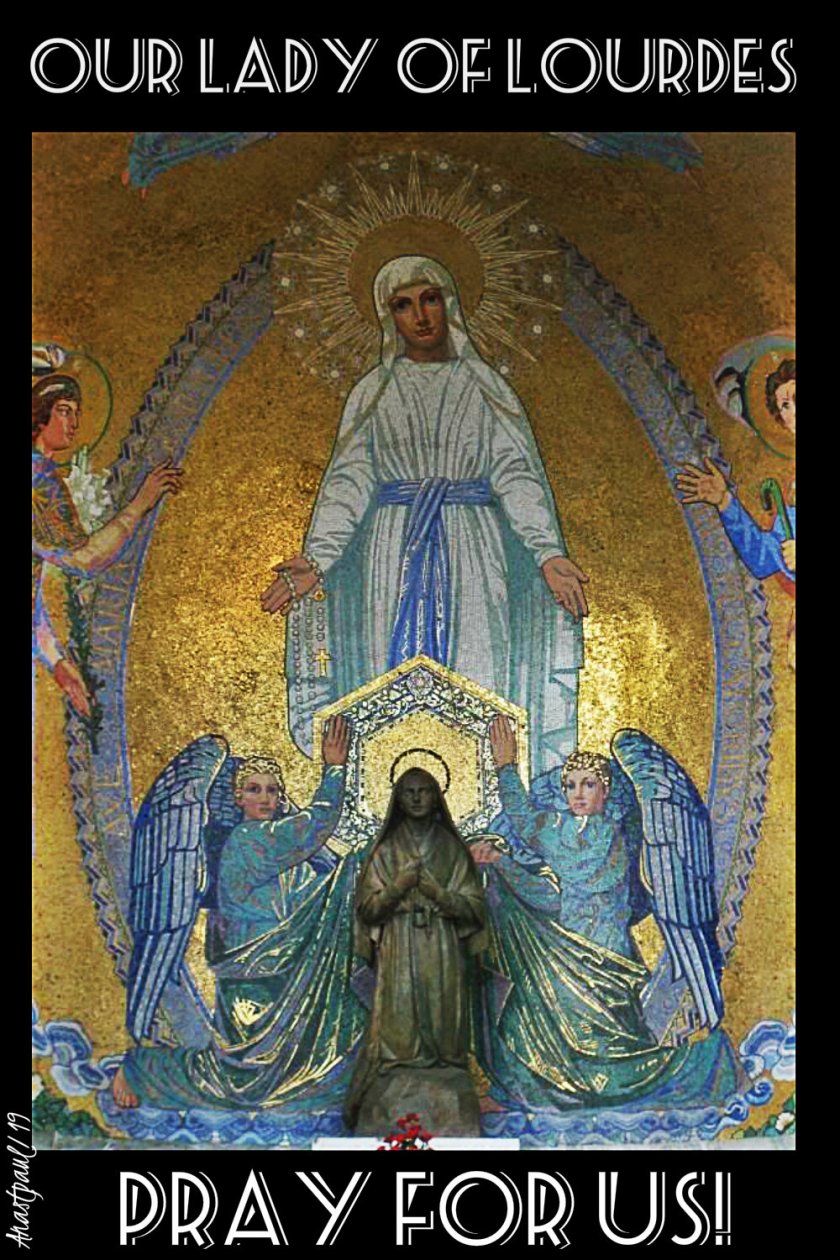
One Minute Reflection – 11 February – Tuesday of the Fifth week in Ordinary Time, Year A, Readings: 1 Kings 8:22-23, 27-30, Psalm 84:3-5, 10-11, Mark 7:1-13 and the Memorial of Our Lady of Lourdes
“This people honours me with their lips but their hearts are far from me” … Mark 7:6
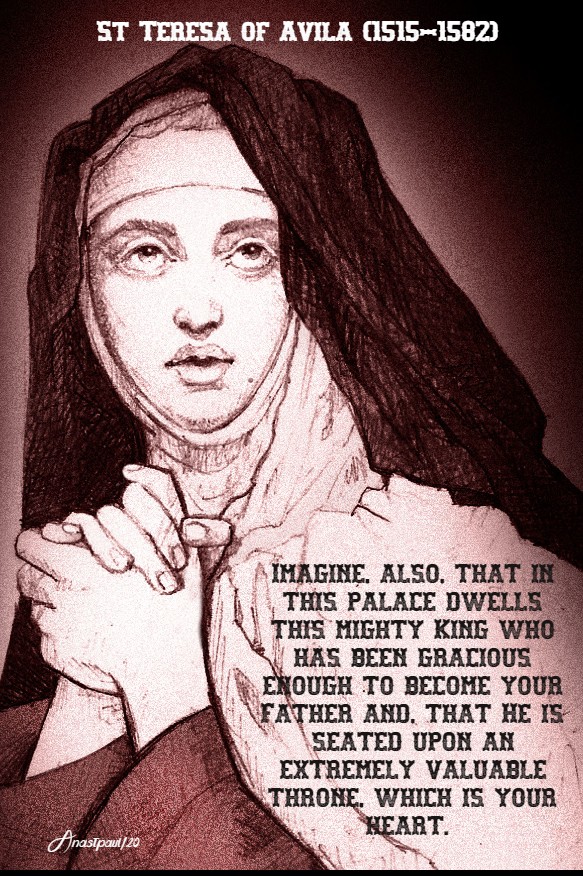
REFLECTION – “Well, let us imagine that within us is an extremely rich palace, built entirely of gold and precious stones, in sum, built for a lord such as this. Imagine, too, as is indeed so, that you have a part to play, in order for the palace to be so beautiful, for there is no edifice as beautiful as is a soul pure and full of virtues. The greater the virtues the more resplendent the jewels.
Imagine, also, that in this palace dwells this mighty King who has been gracious enough to become your Father and, that He is seated upon an extremely valuable throne, which is your heart. (…)
You will laugh at me, perhaps and say that what I’m explaining is very clear and you’ll be right, for me, though, it was obscure for some time. I understood well that I had a soul. But what this soul deserved and who dwelt within it I did not understand because I had covered my eyes with the vanities of the world. For, in my opinion, if I had understood as I do now, that, in this little palace of my soul dwelt so great a King, I would not have left Him alone so often. I would have remained with Him at times and striven more so as not to be so unclean.
But what a marvellous thing, that He who would fill a thousand worlds and many more with His grandeur, would enclose Himself in something so small!” … St Teresa of Avila (1515-1582) Doctor of the Church – The Way of Perfection, ch. 28, 9-11
PRAYER – Grant us, O merciful God, protection in our weakness, that we, who keep the Memorial of the Immaculate Mother of God, may, with the help of her intercession, rise up from our iniquities. Grant, we pray that our lives may be gifts to all those who cry out in pain. Through our Lord Jesus Christ, your Son, Who lives and reigns with you in the unity of the Holy Spirit, One God, forever and ever, amen.
Our Morning Offering – 14 January – Monday of the Second week in Ordinary Time, Year A
Before Jesus Crucified (Sweet Jesus, please, abide with me!) By Blessed Titus Brandsma OCD (1881-1942) Martyr
Dear Lord, when looking up at Thee,
I see Thy loving eyes on me,
Love overflows my humble heart,
Knowing what a faithful friend Thou are.
A cup of sorrow I foresee,
Which I accept for love of Thee,
Thy painful way I wish to go,
The only way to God I know.
My soul is full of peace and light,
Although in pain, this light shines bright.
For here, Thou keepest to Thy breast.
My longing heart to find there rest.
Leave me here freely all alone,
In cell where never sunlight shone.
Should no-one ever speak to me,
This golden silence makes me free!
For though alone, I have no fear,
Never were Thou, O Lord, so near.
Sweet Jesus, please, abide with me!
My deepest peace I find in Thee.
Amen
One Minute Reflection – 1 January – The Solemnity of Mary, Mother of God and the Octave Day of the Nativity of the Lord, Readings: Numbers 6:22-27, Psalm 67:2-3, 5-6, 8, Galatians 4:4-7, Luke 2:16-21
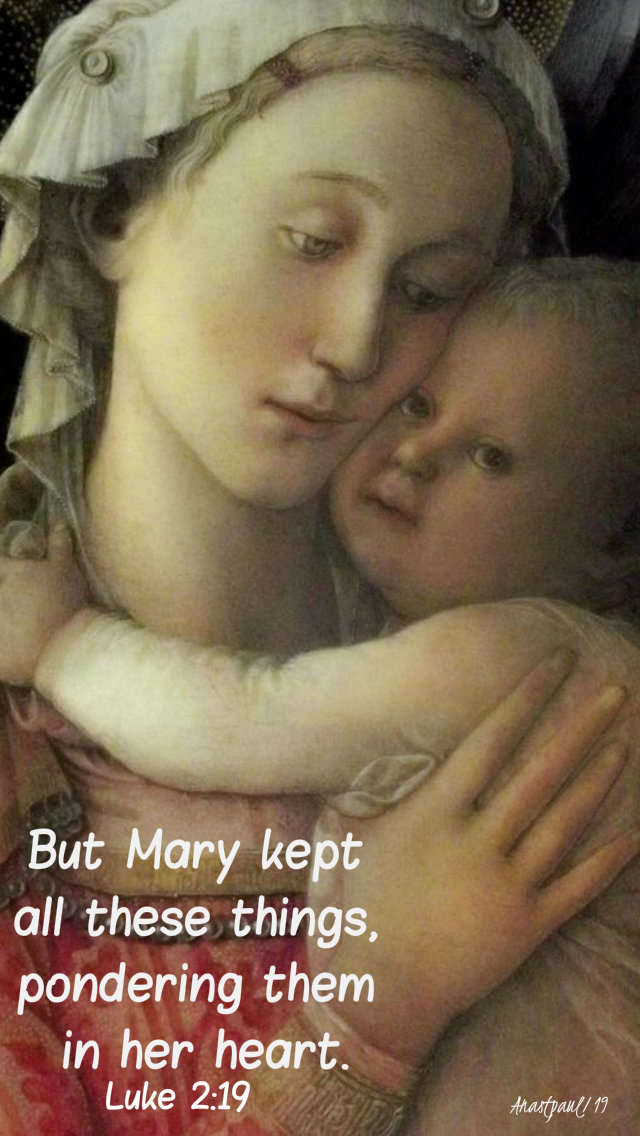
But Mary kept all these things, pondering them in her heart. … Luke 2:19
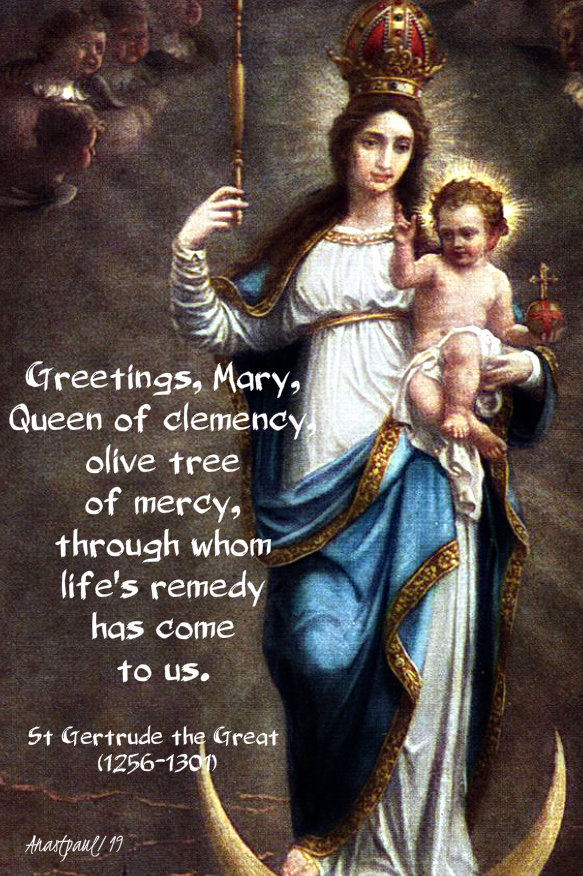
REFLECTION – “You will pray to the Virgin Mother that she obtain for you a perfect renewal of life and that, by this grace, she herself, the venerable rose, become your mother and godmother in such a way, that you may be her true daughter in conduct. And pray that this very gem of decency, may envelop your soul, in the mantle of her cleanliness, preserving you without any spot, under her most dulcet tutelage, for her Son, the Lord King. And pray that your name may be numbered among Israel, the choicest lot, so that you have share with those who walk in innocence of heart, always seeing the Lord before them in all of their ways. (cf. Ps 15:8)
Greetings, Mary, queen of clemency, olive tree of mercy, through whom life’s remedy has come to us. Queen of clemency, Virgin Mother of the divine offspring, through whom the Child of supernal light came to us, the scented offspring of Israel. Ah! Just as you became the true mother of us all, through your Son, who Himself, your one and only Son, did not scorn to become our Brother, now then, for the sake of His love take me, an unworthy woman, into your motherly care. Aid my faith, keep and instruct it and become so much the godmother of my renewal and faith now, that you may be my only mother and closest to my heart for eternity, always caring for me with loving-kindness in this life and taking me, into your full motherliness, at the hour of death. Amen.” … St Gertrude the Great of Helfta (1256-1301)
PRAYER – God, our Father, since You gave mankind a Saviour through the blessed Mary, virgin and mother, grant that we may feel the power of her intercession, when she pleads for us with Jesus Christ, Your Son, the author of life, who lives and reigns with You and the Holy Spirit, God, forever and ever, amen.
Quote/s of the Day – 28 December – The Feast of the Holy Innocents – The Fourth Day of the Christmas Octave
“These then, whom Herod’s cruelty tore as sucklings from their mothers’ bosom, are justly hailed as “infant martyr flowers”; they were the Church’s first blossoms, matured by the frost of persecution during the cold winter of unbelief.”
St Augustine (354-430)
Father & Doctor of the Church
“The star of Bethlehem shines forth in the dark night of sin. Upon the radiance that goes forth from the manger, there falls the shadow of the cross. In the dark of Good Friday, the light is extinguished but it rises more brightly, as the sun of grace. on the morning of the resurrection. The road of the incarnate Son of God, is through the cross and suffering. to the splendour of the resurrection. To arrive with the Son of Man, through suffering and death, at this splendour of the resurrection, is the road for each one of us, for all mankind.”
St Teresa Benedicta of the Cross
[Edith Stein] (1891-1942)
Quote/s of the Day – 26 December – Feast of St Stephen the ProtoMartyr and The Second Day in the Christmas Octave
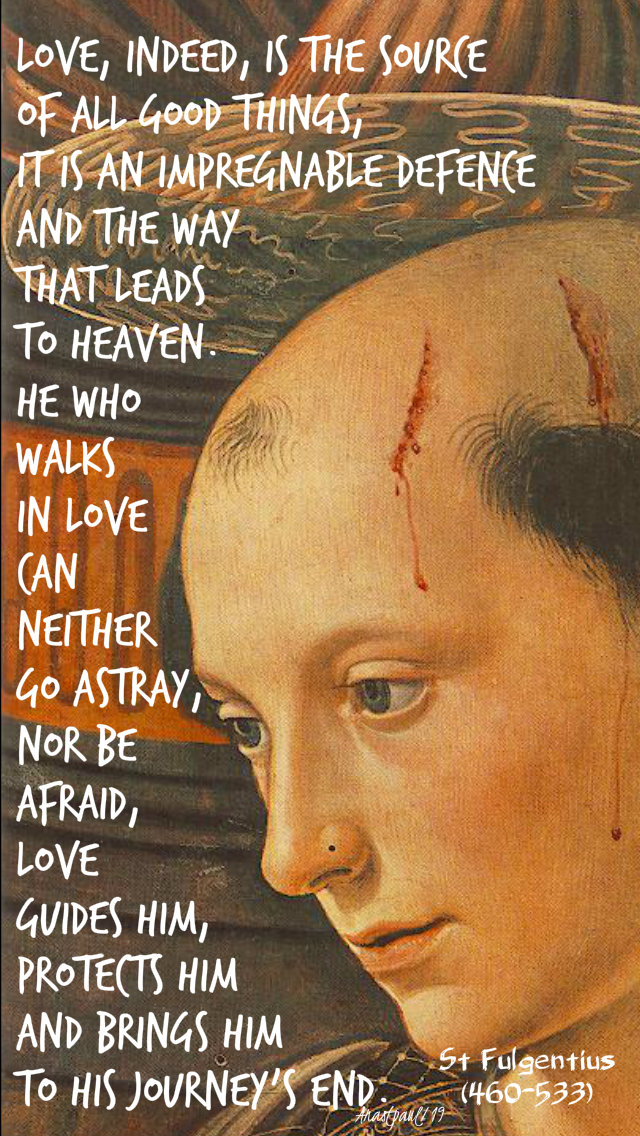
“Love, indeed, is the source of all good things, it is an impregnable defence and the way that leads to heaven. He who walks in love can neither go astray, nor be afraid, love guides him, protects him and brings him to his journey’s end.”
St Fulgentius of Ruspe (460-533)
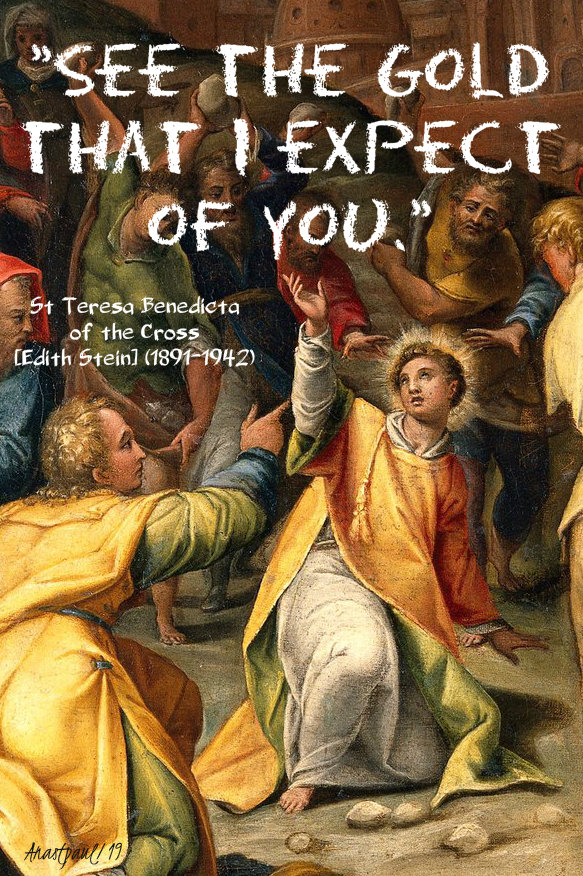
“He [St Stephen], followed the Lord in what may be, by nature, the most difficult and even, apparently, impossible for the human heart. He fulfilled the command to love one’s enemies, as did the Saviour Himself. The Child in the manger, who has come to fulfill His Father’s will, even to death on the Cross, sees before Him in spirit, all who will follow Him on this way. His heart goes out to the youth whom He will one day await with a palm as the first to reach the Father’s throne. His little hand points him out to us, as an example, as if to say, “See the gold that I expect of you.”
St Teresa Benedicta of the Cross
[Edith Stein] (1891-1942)
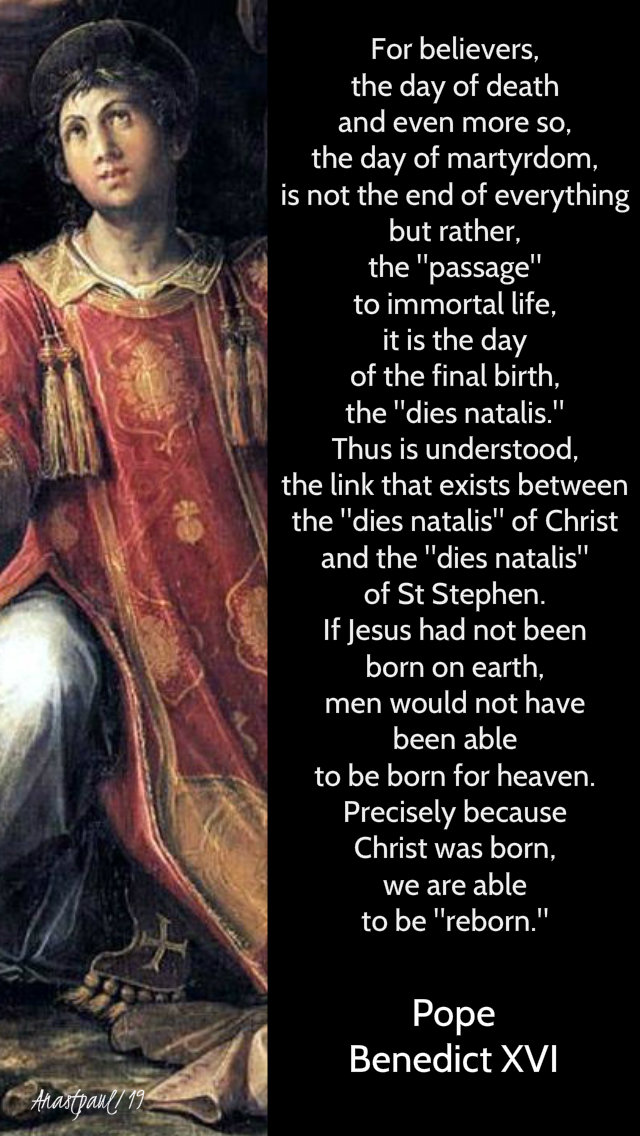
“For believers, the day of death and even more so, the day of martyrdom, is not the end of everything but rather, the “passage” to immortal life, it is the day of the final birth, the “dies natalis.” Thus is understood, the link that exists between the “dies natalis” of Christ and the “dies natalis” of St Stephen. If Jesus had not been born on earth, men would not have been able to be born for heaven. Precisely because Christ was born, we are able to be “reborn.”
Advent Reflection – Saturday of Advent 21 December, Readings: Isaiah 7:10-14, Psalm 24:1-6, Luke 1:26-38
The Lord is at hand, come let us adore Him.
“Mary set out… in haste” … Luke 1:26
REFLECTION – “Our Lady’s strength was her gaiety and joy. This is what made her God, her son’s attentive servant, because as soon as He came to her she “set out in haste.” Joy alone could have given her the strength to set out in all haste across the hill country of Judah to become the servant of her cousin. It is just the same for us. Like her, we must be true servants of the Lord and after holy communion each day we must hurry over the mountains of the difficulties we encounter, offering our service to the poor with all our heart. Give to Jesus in the poor, as a servant of the Lord.
Joy is prayer, joy is strength, joy is love. It is love’s net with which to catch souls. “God loves a cheerful giver” (2 Cor 9:7). Those who give with joy give twice over. If you meet up with difficulties and accept them with joy, with a big smile, in this, as in many other things, people will realise that your works are good and the Father will be glorified in them. The best way, of showing God and others your gratitude, is to accept everything with joy. A joyful heart comes from a heart that is burning with love.” … St Mother Teresa of Calcutta (1910-1997) – Founder of the Missionary Sisters of Charity – Jesus, the Word to Be Spoken
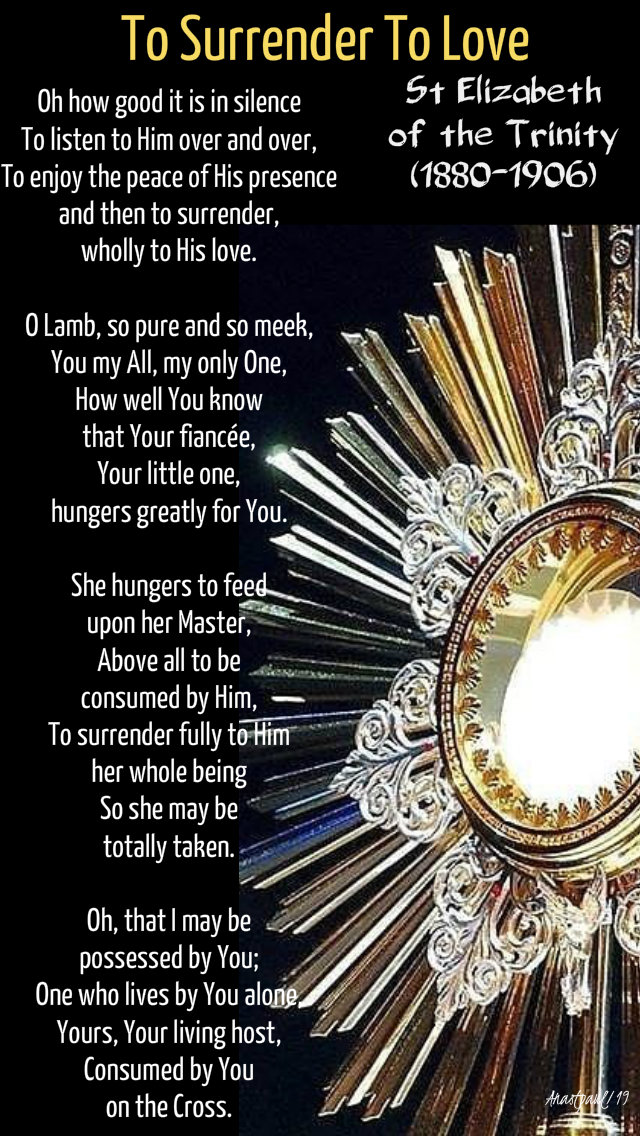
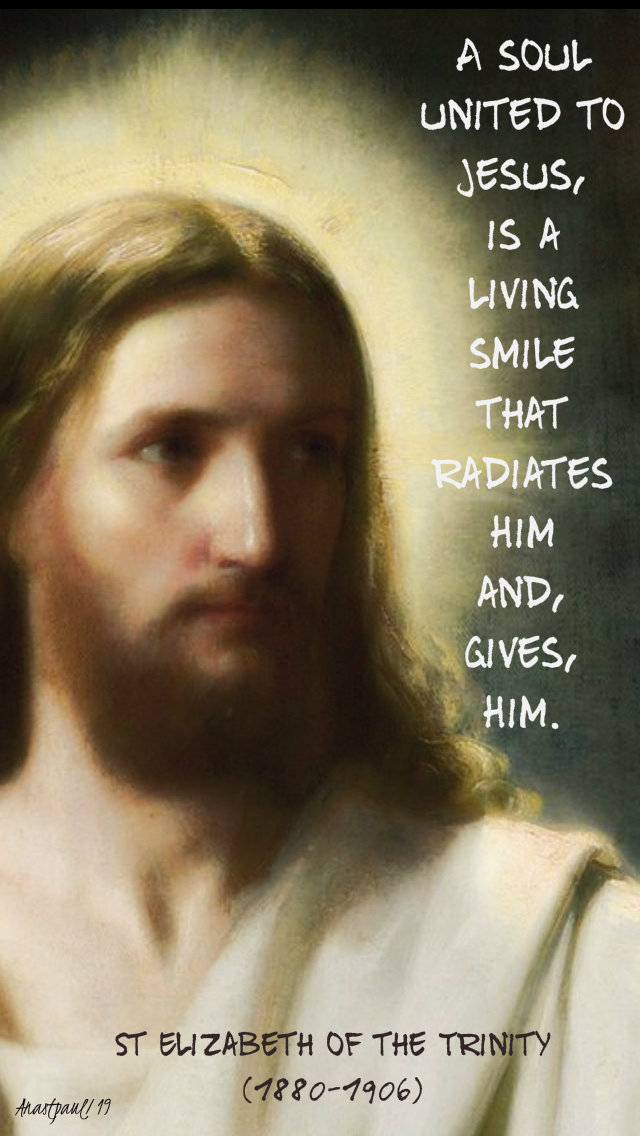
MEDITATION –“A soul united to Jesus, is a living smile that radiates Him and, gives Him.” … St Elizabeth of the Trinity (1880-1906)
ADVENT ACTION – “God is interested in even the smallest events in the lives of His creatures – in your affairs and mine — and He calls each of us by name. This certainty that the faith gives, enables us to look at everything in a new light. And everything, while remaining exactly the same, becomes different, because it is an expression of God’s love. Our life is turned into a continuous prayer, we find ourselves with good humour and a peace that never ends and everything we do is an act of thanksgiving, running through all our day. ‘My soul magnifies the Lord,’ Mary sang, ‘and my spirit rejoices in God, my Saviour.’” …St Josemaría Escrivá (1902-1975) – “To Jesus through Mary,” Christ is Passing By, 144
PRAYER
O Radiant Dawn,
splendour of eternal light, sun of justice!
Come and shine on those
who dwell in darkness and in the
shadow of death.
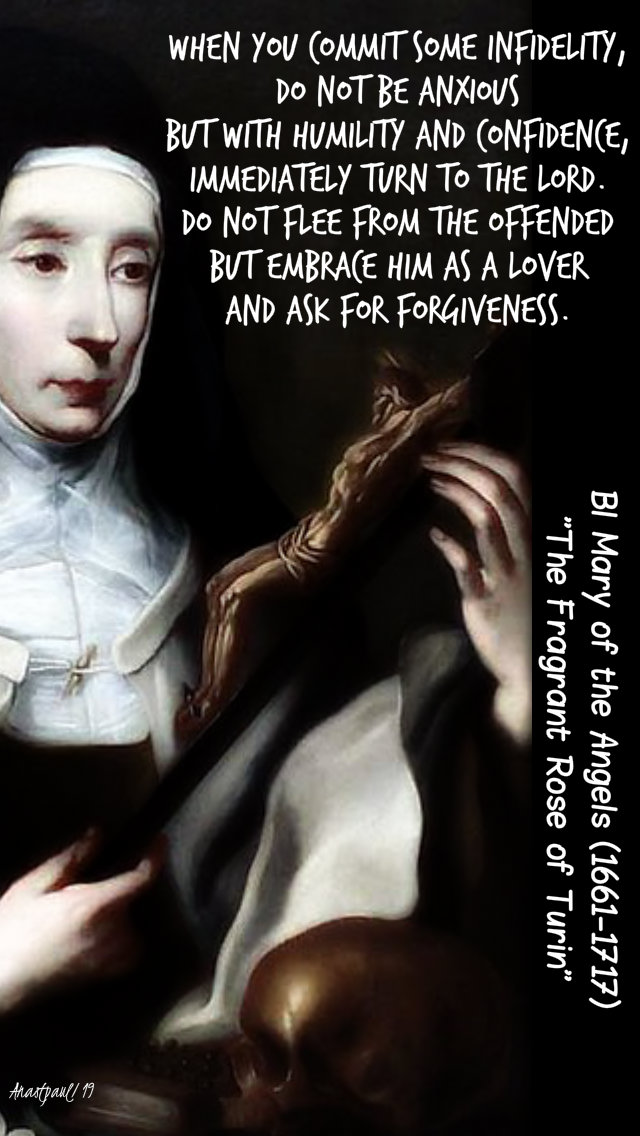
Quote of the Day – 16 December – The Memorial of Blessed Mary of the Angels Fontanella OCD (1661-1717) “The Fragrant Rose of Turin”
“When you commit some infidelity, do not be anxious but with humility and confidence, immediately turn to the Lord. Do not flee from the Offended but embrace Him as a lover and ask for forgiveness.”
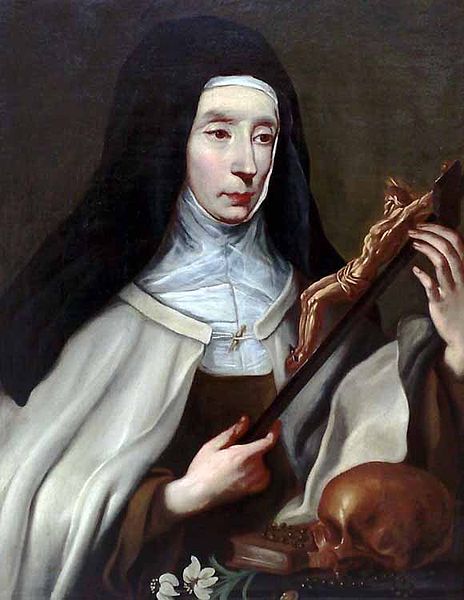
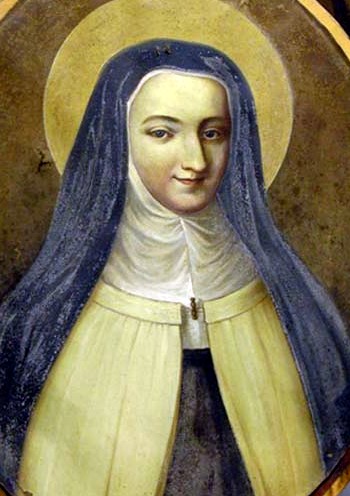
Saint of the Day – 16 December – Blessed Mary of the Angels Fontanella OCD (1661-1717) “The Fragrant Rose of Turin,” Discalced Carmelite, Mystic, Stigmatist, Marian devotee and client of St Joseph, Prioress, Spiritual director – born as Marianna Fontanella on 7 January 1661 at Balderino, Italy and died on 16 December 1717 of natural causes at Turin, Iraly. Also known as Maria degli Angeli, Maria Fontanella of the Angels. Bl Mary studied with the Cistercians as a child and entered the Discalced Carmelites despite the protests of her mother and siblings – she soon became a noted abbess and prioress and in 1703 inaugurated a new convent she herself oversaw the establishment of and later, instigated the building of a beautiful Basilica in honour of the Blessed Virgin.
Marianna Fontanella came into the world on January 7, 1661. She was the youngest of 11 children born to Count Giovanni of Turin and his wife, Lady Maria Tana. The mother had among her close relatives, the mother of St Aloysius de Gonzaga SJ (1568-1591), a youthful aristocrat who renounced a life of privilege to become a holy Jesuit. The fact that there was an official Saint counted among her kin was undoubtedly a source of pride for the family but it wasn’t enough to impress Marianna to want to become one too. It was related that this Blessed initially lived her early years in a manner typical of her high social status – she was well-educated, pampered and exposed to all sorts of social niceties and assemblies … and she enjoyed it all, especially the fancy outfits and the dances.
However, on one particular day, while still a young child, she sat in front of a mirror admiring herself when her own reflection vanished to be replaced by a vision – Christ appeared in the mirror, sadly staring back at her, battered and crowned with thorns. The experience so shocked Marianna that it had the immediate effect of a lasting conversion. From that moment on she shunned her elaborate wardrobe and jewellery and began exercising a devout mode of living despite her tender age. In 1667 she schemed with a little brother to imitate the saints and to run off to live “in the desert” though, at the time they were meant to begin this journey, the two were so fast asleep that their plan was spoiled.
Due to her familial relationship with him, she adopted Saint Luigi Gonzaga as a model for personal holiness and made an effort to imitate the late saint’s example. In 1673 as a 12-year-old, Marianna accompanied one of her sisters to the Cistercian Monastery in Saluzzo where the latter was entering into religious life. Somehow, Marianna was able to persuade her parents to allow her to board with the nuns and she remained with them for over a year until her mother recalled her home due to the unexpected death of her father. Back at the family villa, she resisted her family’s efforts to marry her off and she practised a regimen of prayer and self-mortification. Apparently, while with the Cistercians, an earlier resolve she made to become a nun had strengthened but she was undecided as to which order to join.
After providentially meeting and speaking with a venerable Carmelite priest during one of the rare public exhibitions of the Holy Shroud of Turin, Marianna applied with the local Discalced Carmelite Monastery of Santa Cristina. Lady Maria reluctantly consented when it became clear that her daughter could not be dissuaded, so Marianna made her entrance into Carmel on 19 November 1675, she was 14-years-old and took the name Maria of the Angels.
The first year in the monastery was not easy for the aspiring nun. The sweetness of spirit and the divine favours she had started to enjoy before entering, evaporated, leaving Sr Maria with a terrible dryness in her soul. She clung desperately to her faith and, guided by a meticulous novice mistress, she managed to reach profession on 26 December 1676… but the sense of separation from God – the “dark night of the soul” – continued to torment her for the next 15 years. The devil aggravated the situation, via severe temptations and diabolic assaults.
Fortunately, the beleagured nun weathered her personal storm through the consistent practice of virtue, especially humility and obedience towards her superiors. All that she suffered, served to purify her spirit, as Jesus was leading her on a singular path of extraordinary mystical union with Himself, as was proven later on.
By 1691 Sr Maria was finally free of the darkness and began experiencing supernatural lights with greater intensity. Sublime visions of Christ and heavenly inhabitants resumed, along with other mystical gifts such as Prophecy, the Stigmata and the Fragrance of Sanctity. It was reported that the beautiful scent that constantly surrounded her was so obvious, that the other nuns could track her whereabouts by following the aroma she left in her wake. The Blessed, on her part, took to carrying small bundles of flowers and spices to try to disguise the heavenly scent but to no avail – it increased on feast days and during times when she was ill and unable to take precautions, to disguise the fragrance. Even things she handled, were imbued with the delightful scent!
Noting her many virtues and fine example of Carmelite spirituality, the community elected Sr Maria to the post of novice mistress in 1691 then prioress in 1694. Word soon spread outside of the monastery about the extraordinary prioress and people began seeking her counsel and prayers, including the reigning king of the region, Vittorio Amadeo II of the royal house of Savoy and other members of the nobility. Vocations to the Carmel of St Cristina increased, which necessitated the founding of another monastery in nearby Moncalieri in 1703, with the encouragement from Blessed Sebastian Valfrè CO (1629-1710). Sr Maria had hoped to transfer there, to be away from the centre of the limelight but the king explicitly forbade her to ever leave Turin, due to his dependence on her advice and his devotion to her.
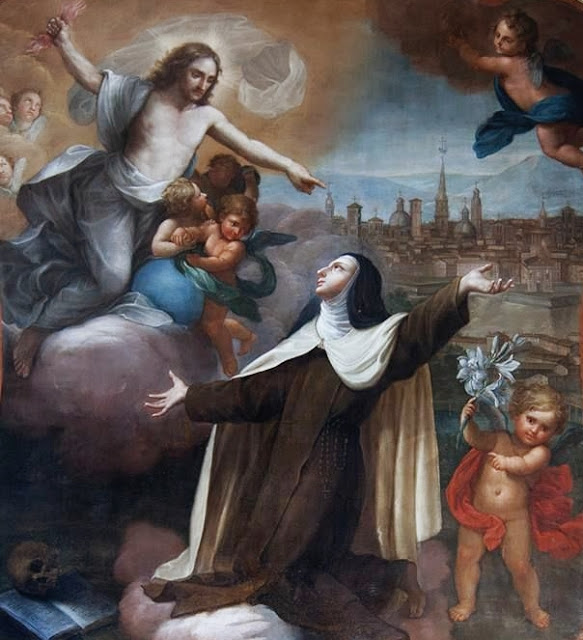
A depiction of Bl Maria of the Angels interceding with Christ to spare Turin from a chastisement of the dreaded plague.
Public esteem for the prioress reached a pinnacle in 1696 when the city was besieged by an invading army. She publicly announced that the city would be saved if people turned to St Joseph, for help, which they did. Turin was liberated and, in gratitude, St Joseph was proclaimed the Patron Saint of the city by the king. Similarly, in 1706 when the French besieged the city, the citizens and royals turned to the intercession of their resident mystic – the nun invoked the Holy Virgin’s protection and the city’s army was again victorious. At Sr Mary’s urging, a church – the great Basilica of the Superga (Superga is a Hill in Turin) – was built to commemorate the victory and to honour Our Lady.
The beautiful Basilica of the Superga in Turin, dedicated to the Blessed Virgin, and constructed under the prompting of Bl Maria of the Angels. Below is a window of Bl Maria in the Basilica.
Sr Maria of the Angels died peacefully in her monastery on 16 December 1717, after living a productive life of prayer, self-sacrifice and service to her beloved people. She was 56-years-old at the time of her death and all of Turin mourned the passing of she, who had saved them from wars and even a plague in 1714.
At the instigation of King Vittorio, the holy nun’s Cause for Canonisation was started just a few years after the death of Sr Maria. Pope Pius IX declared her a Blessed on 25 April 1865 but a second miracle has yet to be officially recognised for the prioress to reach sainthood. Let us pray for her speedy Canonisation.
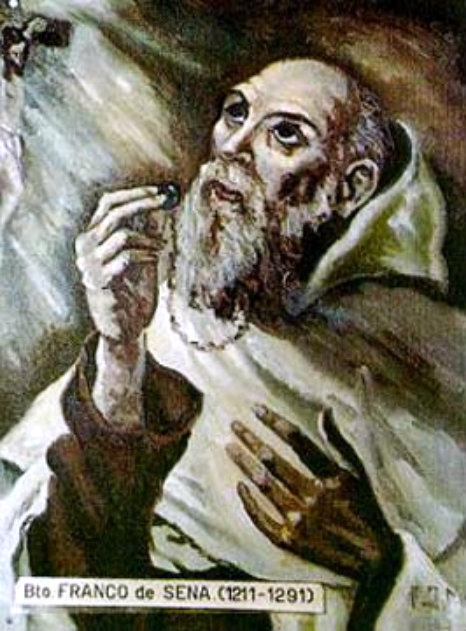
Saint of the Day – 11 December – Blessed Francesco Lippi O.Carm (1211-1291) also known as Blessed Franco of Siena – Carmelite Hermit, Mystic, Penitent, with the gift of prophesy. Born in c 1211 at Grotti-Siena, Italy and died on 11 December 1291 in Siena, Italy of natural causes, aged 80.
Blessed Francesco was born at Grotti, Italy of the noble parents, Matteo and Dorotea Lippi.
He spent his dissolute adolescence as a soldier who indulged in many vices. His military unit captured Sarteano from the Orvientani but, during the fighting, he was blinded in 1261. In his supplication in prayer, he promised to change his life if he was healed and regained his sight. After praying fervently to Saint James for his intercession, his sight was indeed restored.
He travelled on a pilgrimage to Campostella and to the Basilica di San Nicola in Bari to visit the tomb of Saint Nicholas. He also travelled to Loreto, Rome and Siena, where he heard the preaching of Blessed Ambrose Sansedoni OP, a renowned preacher whose oratory, simple rather than elegant, was most convincing and effective. Thereafter, Blessed Francesco resolved to live the remainder of his life as a hermit and to do penance for his earlier life. He shut himself in a small cell and remained there from 1261 to 1266.
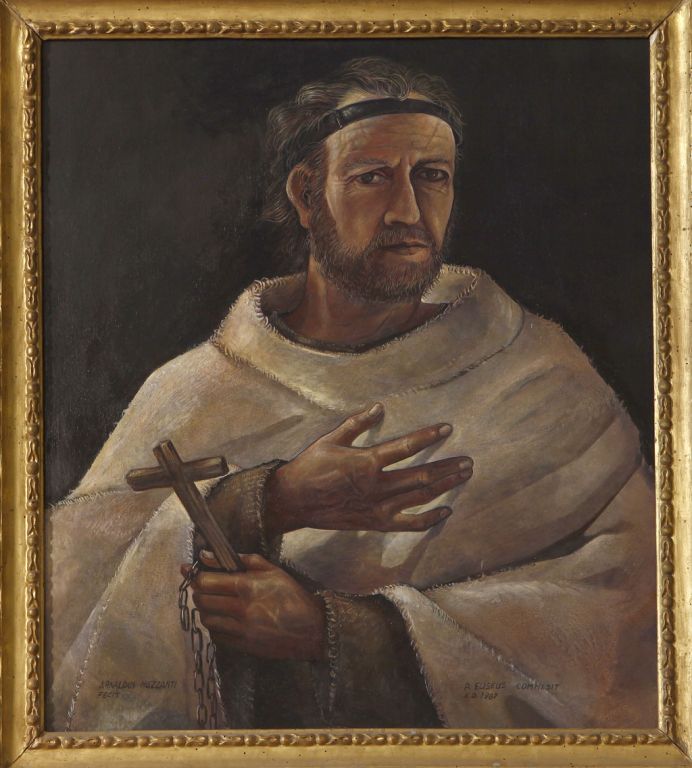
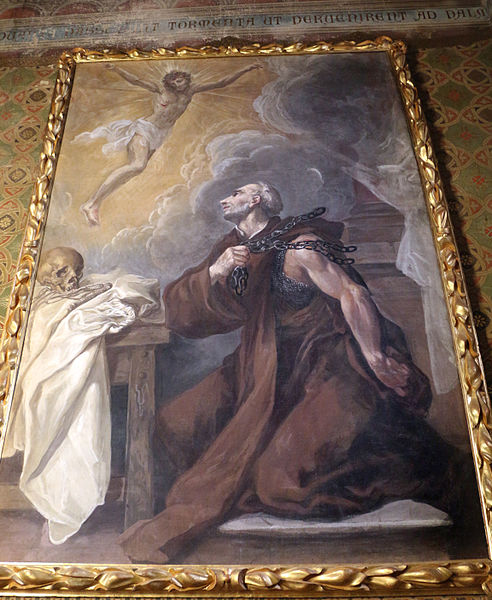
Painting in San Martino in Bologna. This depiction includes a chain and a ball indicating the penitential nature of Blessed Francesco’s life.
Then he entered the Carmelite Order and continued to live as a hermit. He experienced visions of Jesus Christ and the Madonna as well as seeing angels and experiencing the temptations of demons. He became well-known for his prophetic gifts.
He died on 11 December 1291. Part of his relics were relocated to a Carmelite convent in Cremona in 1341.
The confirmation of the late Lippi’s ‘cultus’ (or popular devotion) allowed for Pope Clement X to approve his Beatification in 1670.
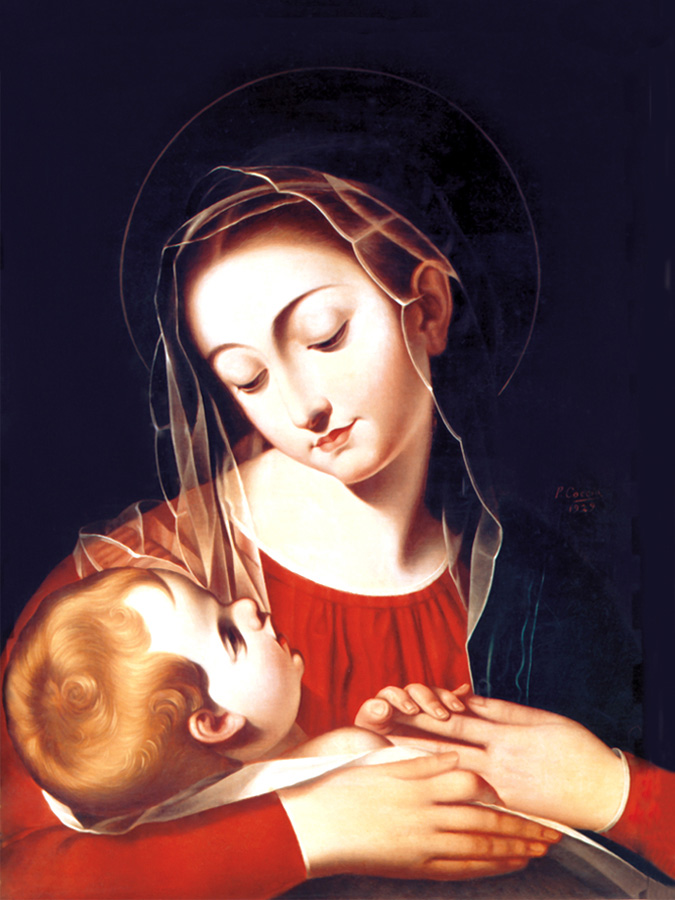
Our Lady of Divine Providence: The title of “Mary, Mother of Divine Providence” is often traced to her intervention at the wedding in Cana. Christ’s first public miracle was occasioned in part by the intercession of his mother. She helped through her foresight and concern to avoid an embarrassing situation for the newlywed couple. Our Lady of Providence is sometimes also identified as Queen of the Home.
Devotion to Our Lady of Divine Providence originated in Italy and spread to France and Spain. The devotion was brought to Puerto Rico in the early 1850s by the Servite Fathers. According to tradition, Philip Benizi (1233 – 1285) prayed to Mary for help in providing food for his friars and subsequently found several baskets of provisions left at the door of the convent. Our Lady of Providence was declared the patroness of Puerto Rico by Pope Paul VI on 19 November 1969. Her feast day is celebrated in many immigrant Puerto Rican communities.
Around 1580, the Italian painter Scipione Pulzone created a work titled “Mater Divinae Providentiae,” which depicted the Blessed Mother cradling the Infant Jesus. Devotion to Mary, Mother of Divine Providence in the first house of the Congregation of the Clerics Regular of St Paul (Barnabites) in Rome at San Carlo ai Catinari church began around year 1611, when one of the clerics travelled to Loreto to pray for assistance in finding the financial resources to complete the Church of San Carlo. Upon his return, they received the necessary assistance and the Barnabites began to promote devotion to Our Lady of Providence.
Pulzone’s painting was given to the Barnabites in 1663. It was placed on the altar of a chapel on the first floor of the Saint Charles rectory behind the main altar. In 1732, a copy of the painting was placed in a location adjacent to the main altar of the church of San Carlo ai Catinari in Rome, where it drew many faithful visitors.
In 1774, Pope Benedict XIV authorised the Confraternity of Our Lady of Providence, a lay organisation created for the purpose of promoting special works of Christian charity or piety. Pope Gregory XVI elevated it to an Archconfraternity in 1839. In 1888, Pope Leo XIII ordered the solemn crowning of the “Miraculous Lady” and approved the Mass and Office of Mary, Mother of Divine Providence. On 5 August 1896, Superior General of the Barnabites, Father Benedict Nisser decreed that every Barnabite have a copy of the painting in their home.
Patronage:
Our Lady of Providence is the patroness of the Barnabite Order.
Our Lady of Providence is the patroness of Indiana and the Roman Catholic Diocese of Providence, Rhode Island. The chapel of Saint Vincent Hospital in Worcester, Massachusetts is dedicated to Our Lady of Providence.
Our Lady of Divine Providence is the patroness of St Benedict’s Abbey in Atchison, Kansas.
Our Lady of Divine Providence is also the patroness of the Caribbean island of Puerto Rico.
Bl Alexandre Planas Saurí
St Atto of Tordino
St Azas of Isauria
St Barlaam of Antioch
St Ebbe of Minster-of-Thanet
Bl Eliseo García y García
Bl James Benefatti
St James of Sasseau
St Maximus of Caesarea
St Maximus of Rome St Matilda or Mechtilde of Hackeborn (c 1241-1298)
St Medana
St Nerses the Great
Obadiah the Prophet
St Pope Pontian St Raphael Kalinowski, OCD (1835-1907) Biography:
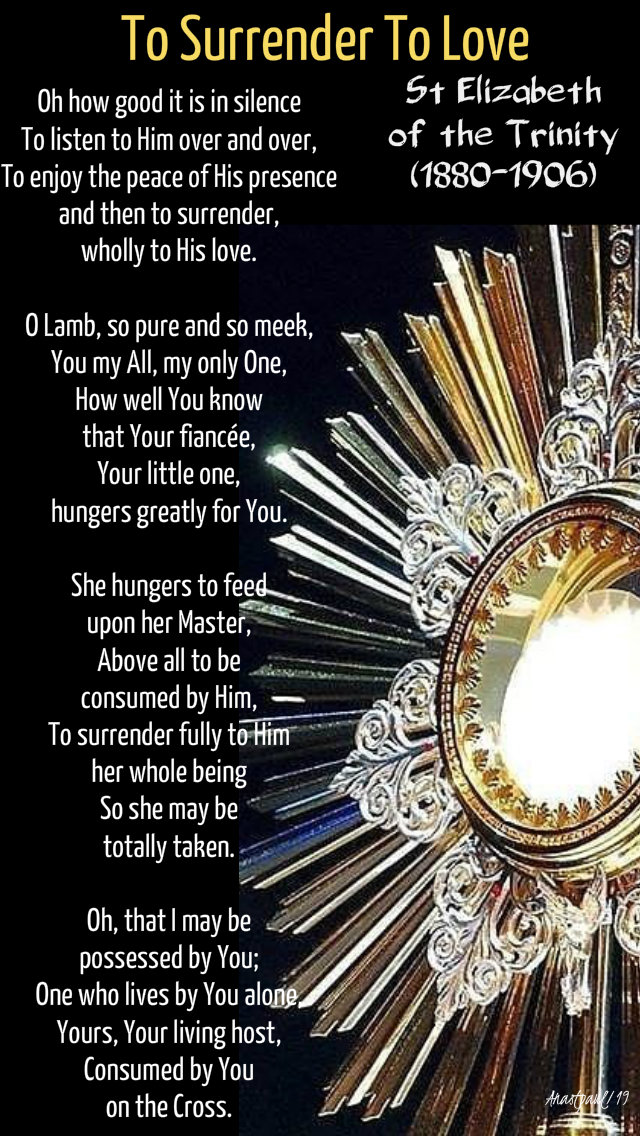
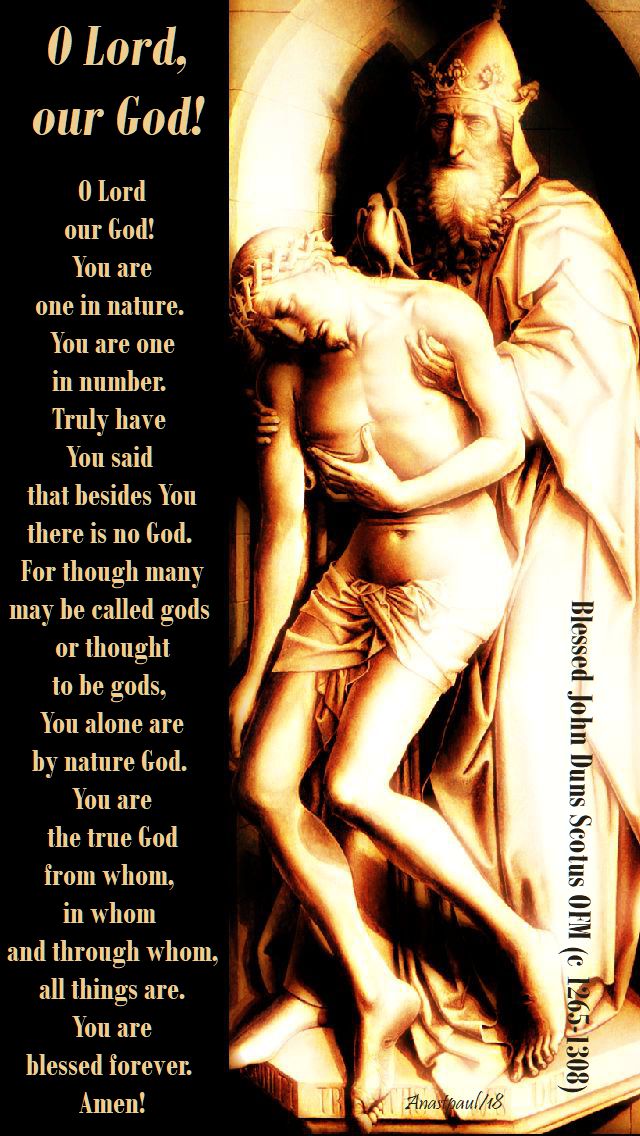
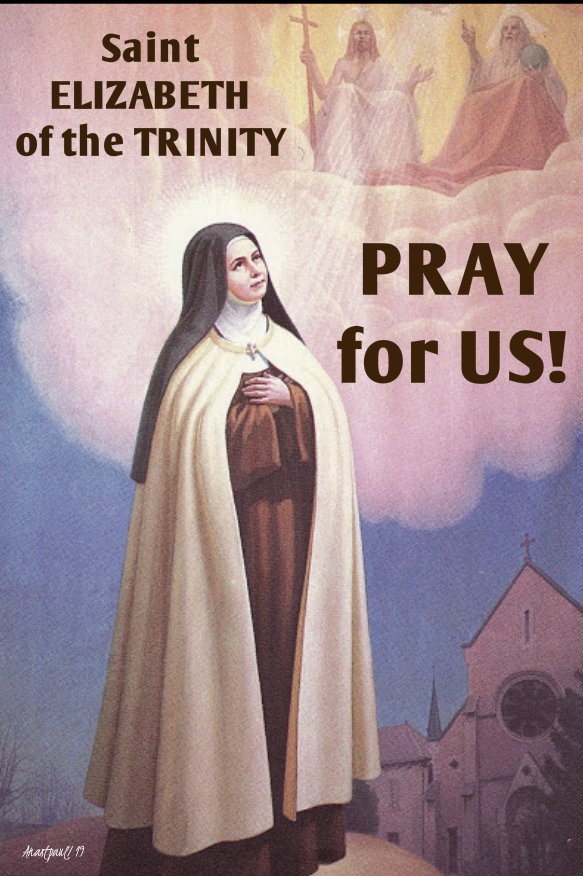
Quote/s of the Day – 8 November – The Memorial of Blessed John Duns Scotus OFM (c 1265-1308) and St Elizabeth of the Trinity O.Carm (1880-1906)
O Lord our God! You are one in nature. You are one in number. Truly have You said that besides You there is no God. For though many may be called gods or thought to be gods, You alone are by nature God. You are the true God from whom, in whom and through whom, all things are, You are blessed forever. Amen!
Blessed John Duns Scotus (c 1265-1308)
“A soul united to Jesus, is a living smile that radiates Him and, gives Him.”
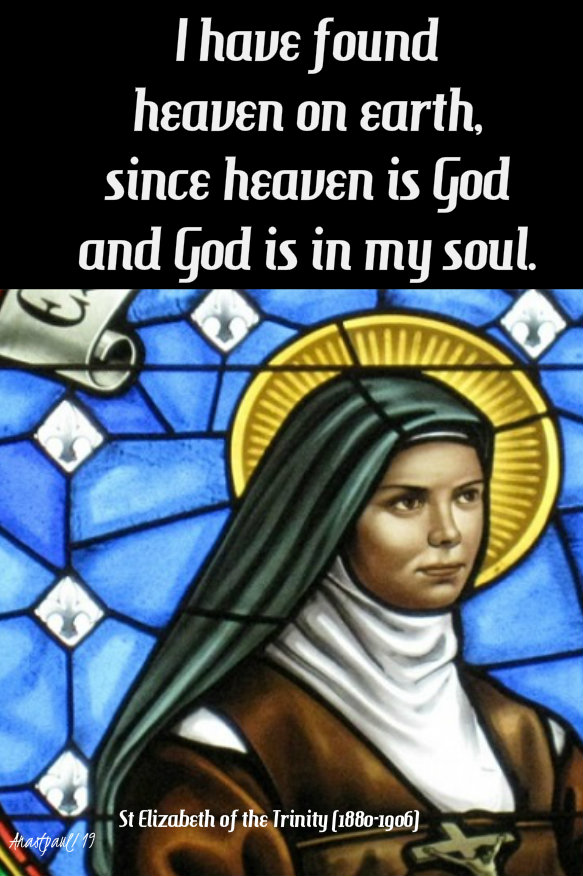
“I have found heaven on earth, since heaven is God and God is in my soul.”
One Minute Reflection – 8 November – Friday of the Thirty First week in Ordinary Time week in Ordinary Time, Year C, Gospel: Luke 16:1–8 and The Memorial of St Elizabeth of the Trinity O.Carm (1880-1906)
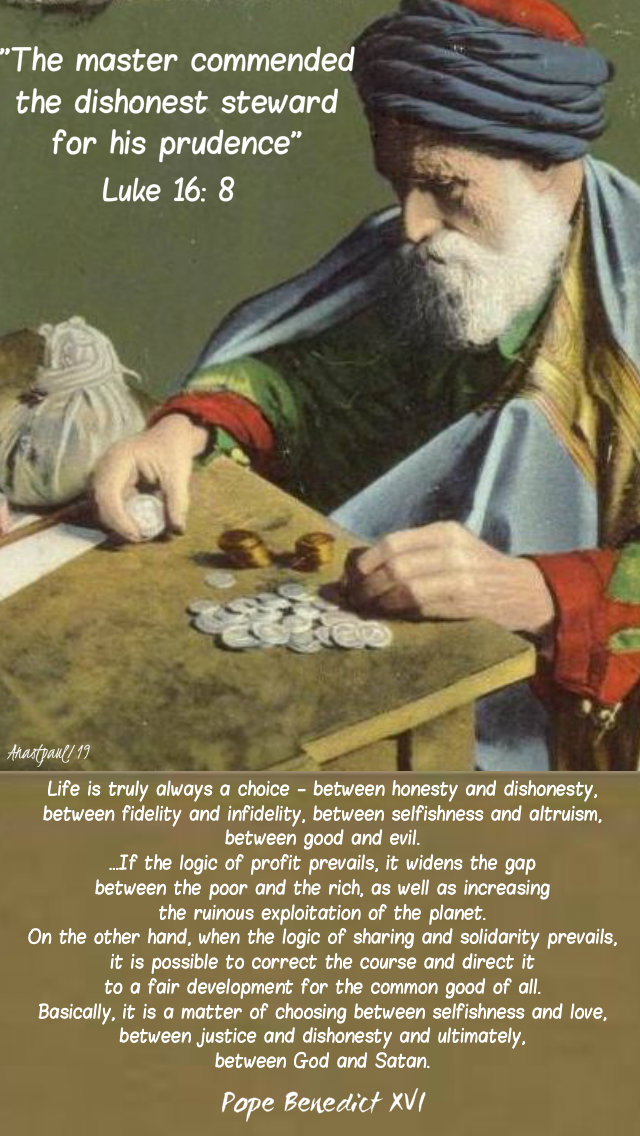
“The master commended the dishonest steward for his prudence”…Luke 16: 8
REFLECTION – “But what does Jesus wish to tell us with this parable? And with its surprising conclusion? The Evangelist follows the parable of the dishonest steward with a short series of sayings and recommendations on the relationship we must have with money and the goods of this earth. These short sentences are an invitation to a choice that presupposes a radical decision, a constant inner tension. Life is truly always a choice – between honesty and dishonesty, between fidelity and infidelity, between selfishness and altruism, between good and evil.
… As a result, it is necessary to make a fundamental decision between God and mammon, it is necessary to choose between the logic of profit as the ultimate criterion for our action and the logic of sharing and solidarity. If the logic of profit prevails, it widens the gap between the poor and the rich, as well as increasing the ruinous exploitation of the planet. On the other hand, when the logic of sharing and solidarity prevails, it is possible to correct the course and direct it to a fair development for the common good of all. Basically, it is a matter of choosing between selfishness and love, between justice and dishonesty and ultimately, between God and Satan. If loving Christ and one’s brethren is not to be considered as something incidental and superficial but, rather, the true and ultimate purpose of our whole existence, it will be necessary to know how to make basic choices, to be prepared to make radical renouncements, if necessary, even to the point of martyrdom. Today, as yesterday, Christian life demands the courage to go against the tide, to love like Jesus, who even went so far as to sacrifice Himself on the Cross.
We could then say, paraphrasing one of St Augustine’s thoughts, that through earthly riches we must procure for ourselves those true and eternal riches – indeed, if people exist who are prepared to resort to every type of dishonesty to assure themselves an always unpredictable material well-being, how much more concerned we Christians must be to provide for our eternal happiness with the goods of this earth (cf. Discourses, 359, 10). Now, the only way of bringing our personal talents and abilities and the riches we possess to fruition for eternity is to share them with our brethren, thereby showing that we are good stewards of what God entrusts to us . Jesus said: “He who is faithful in a very little is faithful also in much and he who is dishonest in a very little is dishonest also in much” (Lk 16: 10).
PRAYER – My Lord and my God, You have prayed that we may be in You and You in us. This is the guiding consolation of our life and the source of our prayer. Lead us to Yourself, guide us and teach us, that we may never stray from You and the way You set out. May we share and build the unity of Your people and the goods of the earth. Holy St Elizabeth of the Trinity, in your young life you followed the way of the Lord, the way of the Cross, doing all for God by the love of the Holy Spirit. Please pray for us, amen.
St Gervadius
St Giuse Nguyen Ðình Nghi St Godfrey of Amiens OSB (1066–1115)
St Gregory of Einsiedeln
St John Baptist Con
Bl Maria Crucified Satellico
St Martinô Tho
St Martinô Ta Ðuc Thinh
St Maurus of Verdun
St Moroc of Scotland
St Phaolô Nguyen Ngân
St Tysilio of Wales
St Willehad of Bremen
St Wiomad of Trèves
—
All Deceased Dominicans
All Saints of Wales
All Saints of the Diocese of Evry: A regional memorial of all the saints and beati of the calendar who have a connection to the Diocese of Evry-Corbeil-Essonnes, France.
• Blessed Isabella of France, founded the Longchamp monastery
• Blessed Nicolas Gaudreau, pastor of Vert-le-Petit
• Blessed Pierre Bonse, pastor of Massy
• Our Lady of Good Guard, patron saint of the diocese, venerated in Longpont-sur-Orge, France
• Saint Corbinian, born in Saint-Germain-lès-Arpajon
• Saint Denis of Paris, evangelizer of part of Essonne and revered ni Longpont-sur-Orge
• Saint Eloi, who lived in Chilly-Mazarin
• Saint Germain of Paris
• Saint William of Bourges, son of Count Baldwin IV of Corbeil
• Saint William of Aebelholt, pastor of Brunoy
• Saint Wulfran of Sens, born in Milly-la-Forêt
• Blessed Nativelle, vicar of Longjumeau
• Blessed René Le Bris, pastor of Bris-sous-Forges
• Saint Spire of Bayeux, whose relics are in Corbeil in the cathedral that bears his name
All Saints of Wales
Augustinian Martyrs of Spain
Four Crowned Martyrs: Saint Castorus, Saint Claudius, Saint Nicostratus, and Saint Simpronian. Skilled stone carvers in the 3rd century quarries. Martyred when they refused to carve an idol of Aesculapius for Diocletian. They were drowned in the River Sava in 305. Patronages – • against fever• cattle• sculptors• stone masons, stonecutters.
Martyred in the Spanish Civil War
• BlessedAntolín Pablos Villanueva
• BlessedLaureano Pérez Carrascal
• BlessedManuel Sanz Domínguez
• BlessedMaximino Serrano Sáiz
Thought for the Day – 15 October – The Memorial of St Teresa of Jesus of Avila (1515-1582) Doctor of the Church “Doctor of Prayer”
Let us Always be Mindful of Christ’s Love
Saint Teresa of Jesus of Avila Doctor of the Church
An excerpt from her On the Book of Life
If Christ Jesus dwells in a man as his friend and noble leader, that man can endure all things, for Christ helps and strengthens us and never abandons us. He is a true friend. And I clearly see, that if we expect to please Him and receive an abundance of His graces, God desires, that these graces, must come to us from the hands of Christ, through His most sacred humanity, in which God takes delight.
Many, many times I have perceived this through experience. The Lord has told it to me. I have definitely seen, that we must enter by this gate if we wish His Sovereign Majesty to reveal to us, great and hidden mysteries. A person should desire no other path, even if he is at the summit of contemplation, on this road he walks safely. All blessings come to us through our Lord. He will teach us, for in beholding His life we find that He is the best example.
What more do we desire from such a good friend at our side? Unlike our friends in the world, He will never abandon us when we are troubled or distressed. Blessed is the one who truly loves Him and always keep Him near. Let us consider the glorious Saint Paul – it seems that no other name fell from his lips than that of Jesus, because the name of Jesus was fixed and embedded in his heart. Once I had come to understand this truth, I carefully considered the lives of some of the saints, the great contemplatives and found that they took no other path – Francis, Anthony of Padua, Bernard, Catherine of Siena. A person must walk along this path in freedom, placing himself in God’s hands. If God should desire, to raise us, to the position of one who is an intimate and shares His secrets, we ought to accept this gladly.
Whenever we think of Christ, we should recall the love that led Him to bestow on us so many graces and favours and, also, the great love God showed, in giving us in Christ, a pledge of His love, for love calls for love in return. Let us strive to keep this always before our eyes and to rouse ourselves to love Him. For, if at some time, the Lord should grant us the grace, of impressing His love on our hearts, all will become easy for us and we shall accomplish great things quickly and without effort.
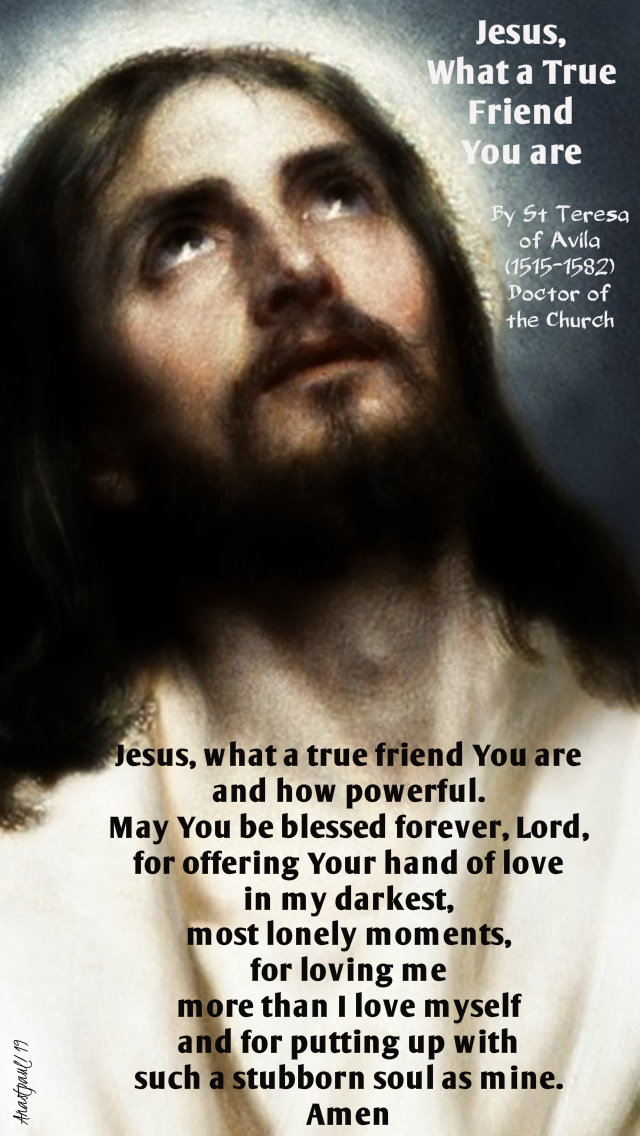
Jesus, What a True Friend You are By St Teresa of Jesus of Avila (1515-1582)
Jesus, what a true friend You are
and how powerful.
May You be blessed forever, Lord,
for offering Your hand of love
in my darkest,
most lonely moments,
for loving me
more than I love myself
and for putting up with
such a stubborn soul as mine.
Amen
Our Morning Offering – 15 October – The Memorial of St Teresa of Jesus/Avila (1515-1582) Doctor of the Church
A Love Song By St Teresa of Jesus (1515-1582) Doctor of the Church
Majestic sovereign, timeless wisdom,
Your kindness melts my hard, cold soul.
Handsome lover, selfless giver,
Your beauty fills my dull, sad eyes.
I am Yours, You made me.
I am Yours, You called me.
I am Yours, You saved me.
I am Yours, You loved me.
I will never leave Your presence.
Give me death, give me life.
Give me sickness, give me health.
Give me honour, give me shame.
Give me weakness, give me strength.
I will have whatever You give.
Amen
Saint of the Day – 15 October – Saint Teresa of Avila OCD (1515-1582) Doctor of the Church “Doctor of Prayer” Seraphic Virgin, Reverend Mother, Prioress.
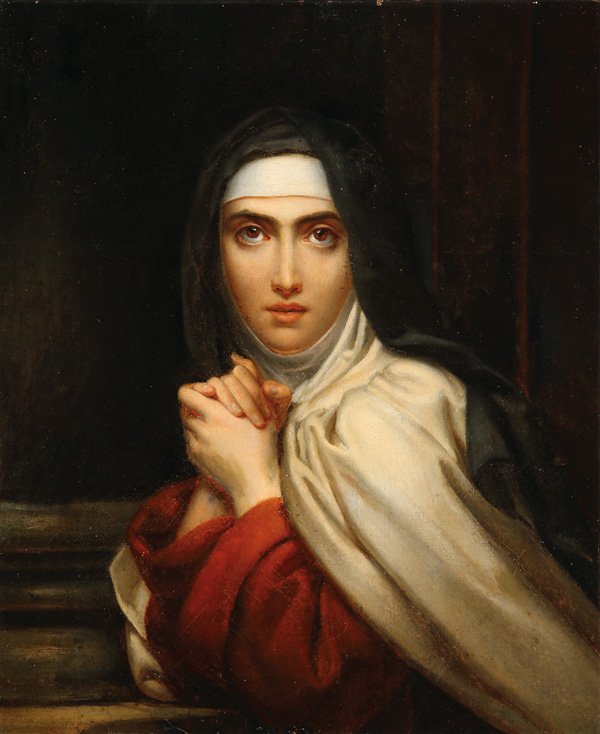
Probably one of the most famous artworks of St Teresa – by French painter François Gérard (1827)
St Teresa of Jesus, honoured by the Church as the “seraphic virgin,” virgo seraphica and reformer of the Carmelite Order, ranks first among women for wisdom and learning. She is called doctrix mystica, doctor of mystical theology; in a report to Pope Paul V the Roman Rota declared: “Teresa has been given to the Church by God as a teacher of the spiritual life. The mysteries of the inner mystical life which the holy Fathers propounded unsystematically and without orderly sequence, she has presented with unparalleled clarity.” Her writings are still the classic works on mysticism and from her, all later teachers have drawn, e.g., Francis de Sales, Alphonsus Liguori. Characteristic of her mysticism is the subjective-individualistic approach; there is little integration with the liturgy and social piety and thus, she reflects the spirit of the sixteenth and following centuries.
And this is a drawing by French painter François Gérard
Teresa was born at Avila, Spain, in the year 1515. At the age of seven she set out for Africa to die for Christ but was brought back by her uncle. When she lost her mother at twelve, she implored Mary for her maternal protection. In 1533 she entered the Carmelite Order; for eighteen years she suffered physical pain and spiritual dryness. Under divine inspiration and with the approval of Pope Pius IV, she began the work of reforming the Carmelite Order. In spite of heavy opposition and constant difficulties, she founded thirty-two reformed convents.
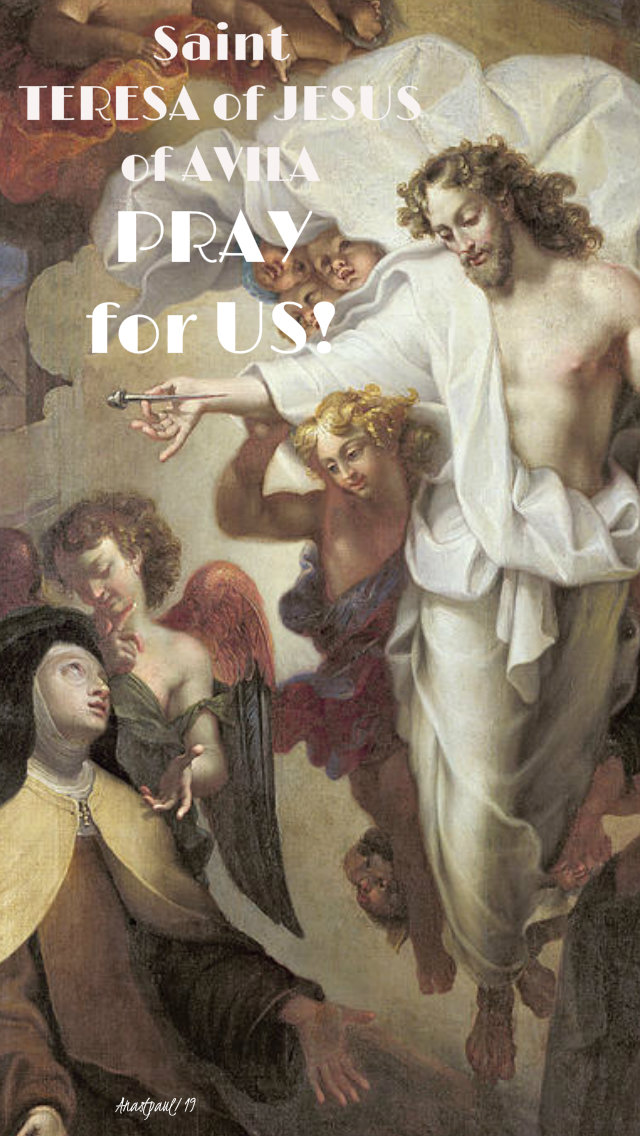
Truly wonderful were the exterior and interior manifestations of her mystical union with God, especially during the last decade of her life. These graces reached a climax when her heart was transfixed (transverberatio cordis), an event that is commemorated in the Carmelite Order by a special feast on 27 August.
The Ecstasy of Saint Teresa by Bernini, Basilica of Santa Maria della Vittoria, Rome
Indeed, Teresa was said to have been observed levitating during Mass on more than one occasion.
Teresa is regarded as one of the foremost writers on mental prayer, and her position among writers on mystical theology as unique. Her writings on this theme, stem from her personal experiences, thereby manifesting considerable insight and analytical gifts. Her definitions have been used in the Catechism of the Catholic Church. Teresa states: “Contemplative prayer, in my opinion is nothing other than a close sharing between friends. It means frequently taking time to be alone with Him whom we know loves us.” Throughout her writings, Teresa returns to the image of watering one’s garden as a metaphor for mystical prayer.
She practised great devotion to the foster-father of Jesus, whose cult was greatly furthered throughout the Church through her efforts. When dying, she often repeated the words: “Lord, I am a daughter of the Church!” Her holy body rests upon the high altar of the Carmelite church in Ala, Spain, her heart with its mysterious wound is reserved in a precious reliquary on the Epistle side of the altar.
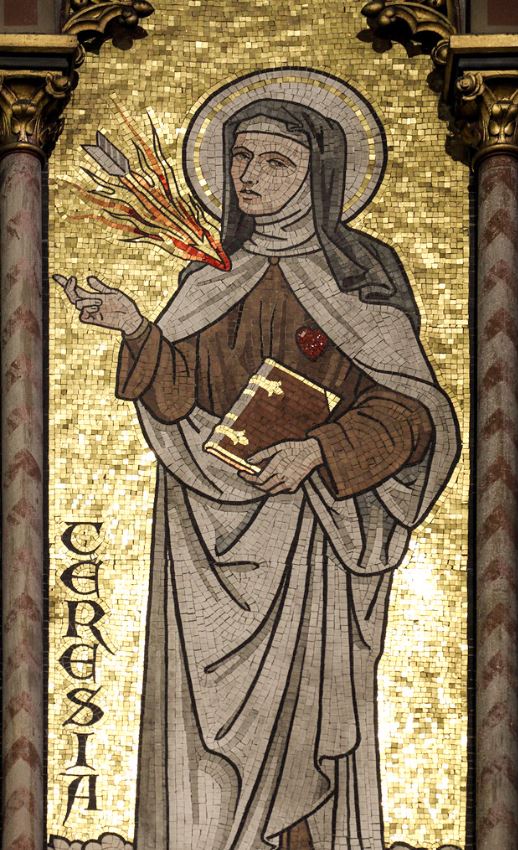
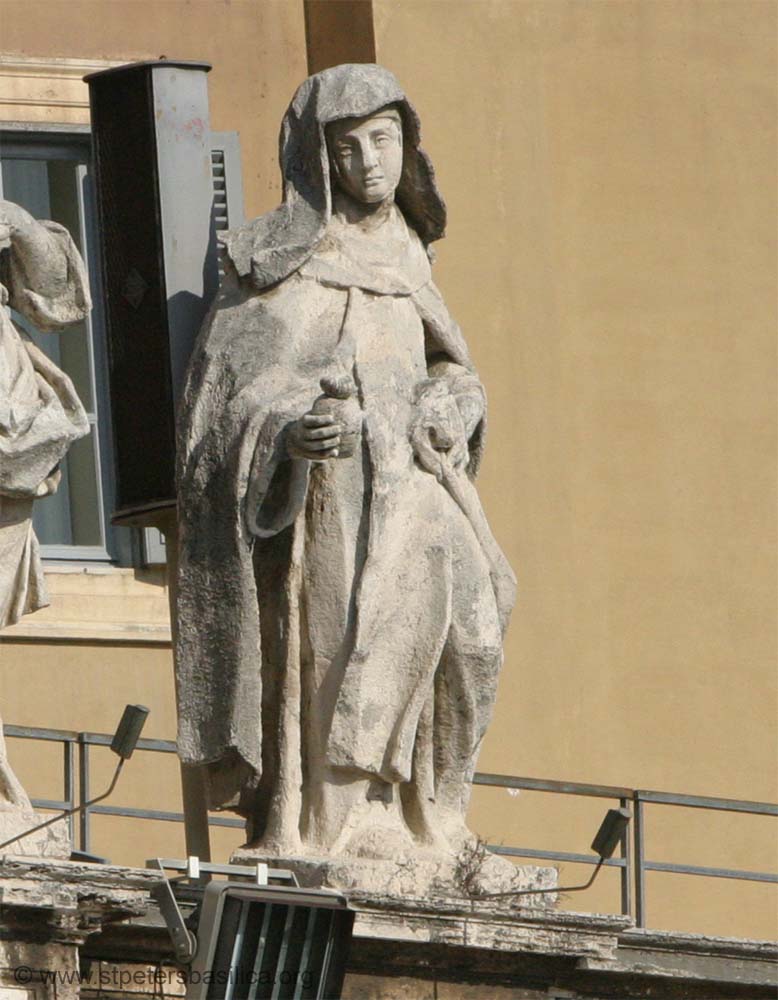
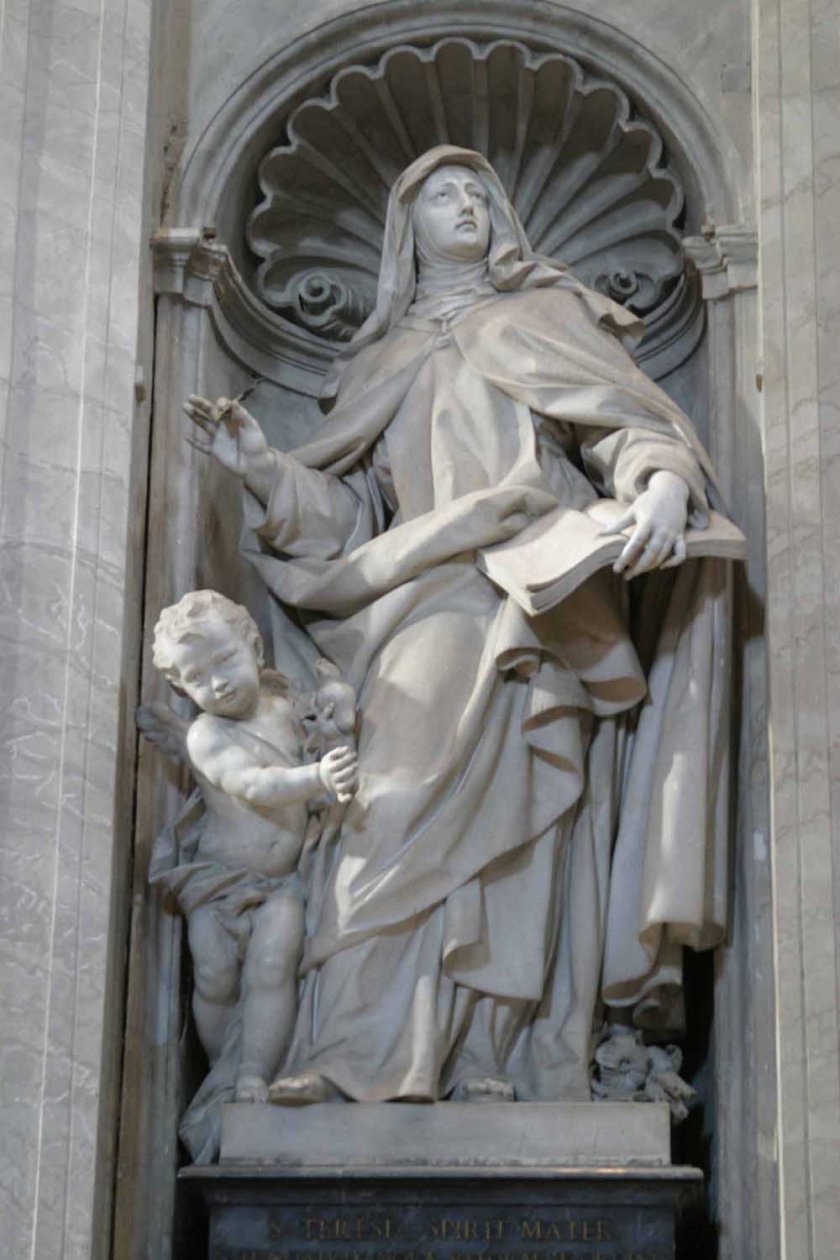
Below are the statues of St Teresa at the Vatican, the first on the Colonnade and the second inside St Peter’s.

 This was a highly unusual step, as Ana was a “secular Carmelite,” meaning she was not part of the choir and removed from the Convent’s life of prayer. She was thus consecrated as a religious sister and took over the Convent at Pontoise. So unusual a step met with the disapproval of her companions but – as the Foundress – had once foretold – she offered no resistance. Ana had also been forewarned that her elevation would cause her great sufferings.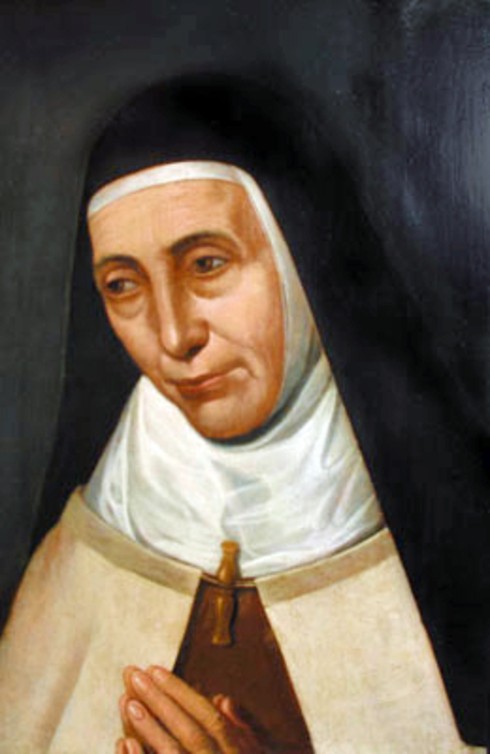












 Especially devoted to the Holy Trinity, Archangela spent hours in the chapel praying and contemplating the divinity of the Lord.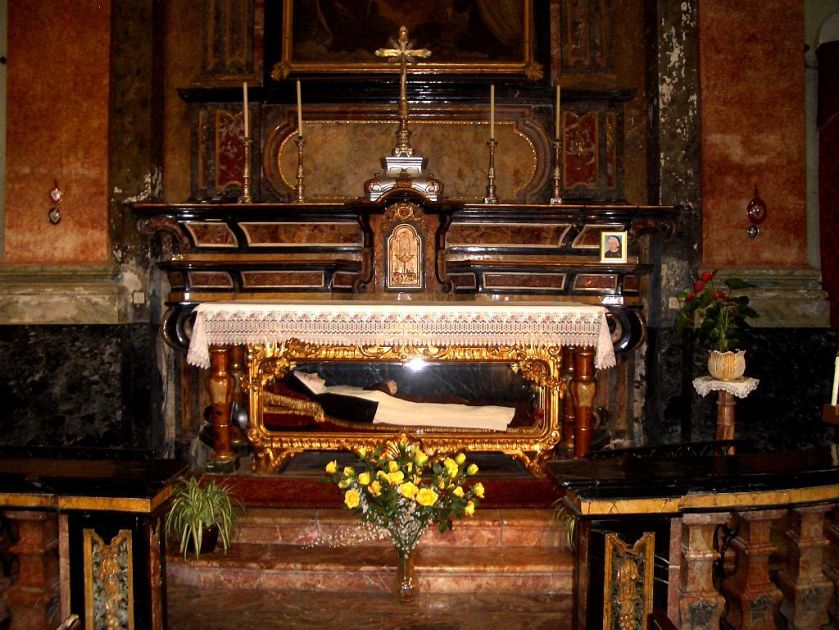






 Our life is turned into a continuous prayer, we find ourselves with good humour and a peace that never ends and everything we do is an act of thanksgiving, running through all our day. ‘My soul magnifies the Lord,’ Mary sang, ‘and my spirit rejoices in God, my Saviour.’” …St Josemaría Escrivá (1902-1975) – “To Jesus through Mary,” Christ is Passing By, 144





 AnaStpaul
You must be logged in to post a comment.