Thought for the Day – 15 October – The Memorial of St Teresa of Jesus of Avila (1515-1582) Doctor of the Church “Doctor of Prayer”
Let us Always be Mindful of Christ’s Love
Saint Teresa of Jesus of Avila Doctor of the Church
An excerpt from her On the Book of Life
If Christ Jesus dwells in a man as his friend and noble leader, that man can endure all things, for Christ helps and strengthens us and never abandons us. He is a true friend. And I clearly see, that if we expect to please Him and receive an abundance of His graces, God desires, that these graces, must come to us from the hands of Christ, through His most sacred humanity, in which God takes delight.
Many, many times I have perceived this through experience. The Lord has told it to me. I have definitely seen, that we must enter by this gate if we wish His Sovereign Majesty to reveal to us, great and hidden mysteries. A person should desire no other path, even if he is at the summit of contemplation, on this road he walks safely. All blessings come to us through our Lord. He will teach us, for in beholding His life we find that He is the best example.
What more do we desire from such a good friend at our side? Unlike our friends in the world, He will never abandon us when we are troubled or distressed. Blessed is the one who truly loves Him and always keep Him near. Let us consider the glorious Saint Paul – it seems that no other name fell from his lips than that of Jesus, because the name of Jesus was fixed and embedded in his heart. Once I had come to understand this truth, I carefully considered the lives of some of the saints, the great contemplatives and found that they took no other path – Francis, Anthony of Padua, Bernard, Catherine of Siena. A person must walk along this path in freedom, placing himself in God’s hands. If God should desire, to raise us, to the position of one who is an intimate and shares His secrets, we ought to accept this gladly.
Whenever we think of Christ, we should recall the love that led Him to bestow on us so many graces and favours and, also, the great love God showed, in giving us in Christ, a pledge of His love, for love calls for love in return. Let us strive to keep this always before our eyes and to rouse ourselves to love Him. For, if at some time, the Lord should grant us the grace, of impressing His love on our hearts, all will become easy for us and we shall accomplish great things quickly and without effort.
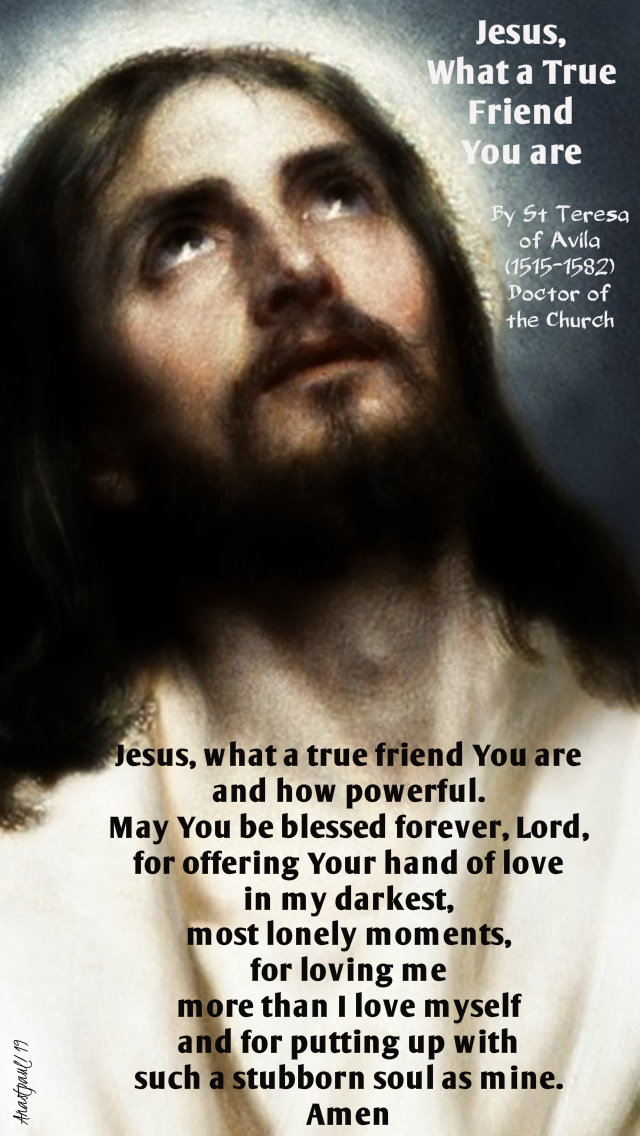
Jesus, What a True Friend You are By St Teresa of Jesus of Avila (1515-1582)
Jesus, what a true friend You are
and how powerful.
May You be blessed forever, Lord,
for offering Your hand of love
in my darkest,
most lonely moments,
for loving me
more than I love myself
and for putting up with
such a stubborn soul as mine.
Amen
Our Morning Offering – 15 October – The Memorial of St Teresa of Jesus/Avila (1515-1582) Doctor of the Church
A Love Song By St Teresa of Jesus (1515-1582) Doctor of the Church
Majestic sovereign, timeless wisdom,
Your kindness melts my hard, cold soul.
Handsome lover, selfless giver,
Your beauty fills my dull, sad eyes.
I am Yours, You made me.
I am Yours, You called me.
I am Yours, You saved me.
I am Yours, You loved me.
I will never leave Your presence.
Give me death, give me life.
Give me sickness, give me health.
Give me honour, give me shame.
Give me weakness, give me strength.
I will have whatever You give.
Amen
Saint of the Day – 15 October – Saint Teresa of Avila OCD (1515-1582) Doctor of the Church “Doctor of Prayer” Seraphic Virgin, Reverend Mother, Prioress.
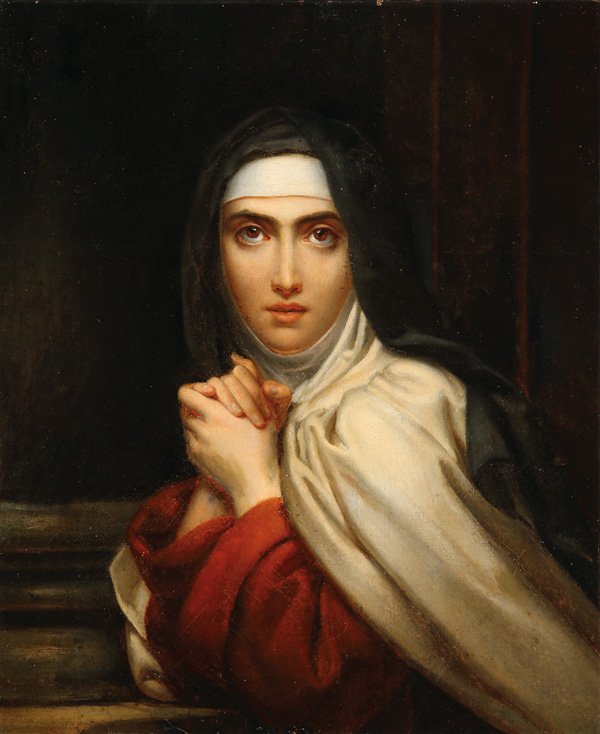
Probably one of the most famous artworks of St Teresa – by French painter François Gérard (1827)
St Teresa of Jesus, honoured by the Church as the “seraphic virgin,” virgo seraphica and reformer of the Carmelite Order, ranks first among women for wisdom and learning. She is called doctrix mystica, doctor of mystical theology; in a report to Pope Paul V the Roman Rota declared: “Teresa has been given to the Church by God as a teacher of the spiritual life. The mysteries of the inner mystical life which the holy Fathers propounded unsystematically and without orderly sequence, she has presented with unparalleled clarity.” Her writings are still the classic works on mysticism and from her, all later teachers have drawn, e.g., Francis de Sales, Alphonsus Liguori. Characteristic of her mysticism is the subjective-individualistic approach; there is little integration with the liturgy and social piety and thus, she reflects the spirit of the sixteenth and following centuries.
And this is a drawing by French painter François Gérard
Teresa was born at Avila, Spain, in the year 1515. At the age of seven she set out for Africa to die for Christ but was brought back by her uncle. When she lost her mother at twelve, she implored Mary for her maternal protection. In 1533 she entered the Carmelite Order; for eighteen years she suffered physical pain and spiritual dryness. Under divine inspiration and with the approval of Pope Pius IV, she began the work of reforming the Carmelite Order. In spite of heavy opposition and constant difficulties, she founded thirty-two reformed convents.
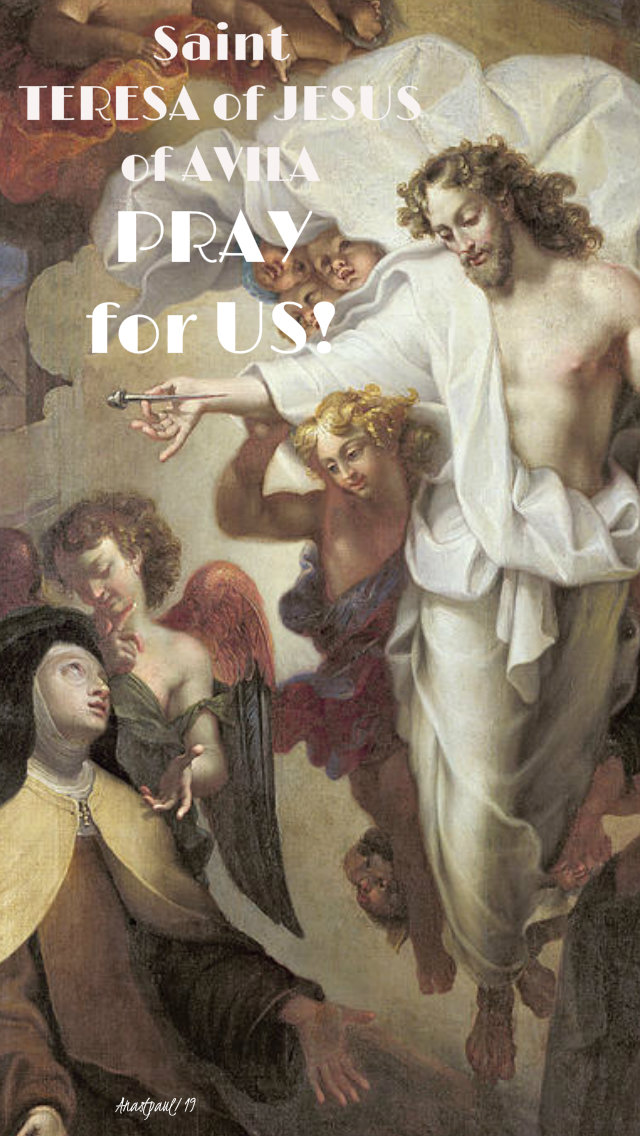
Truly wonderful were the exterior and interior manifestations of her mystical union with God, especially during the last decade of her life. These graces reached a climax when her heart was transfixed (transverberatio cordis), an event that is commemorated in the Carmelite Order by a special feast on 27 August.
The Ecstasy of Saint Teresa by Bernini, Basilica of Santa Maria della Vittoria, Rome
Indeed, Teresa was said to have been observed levitating during Mass on more than one occasion.
Teresa is regarded as one of the foremost writers on mental prayer, and her position among writers on mystical theology as unique. Her writings on this theme, stem from her personal experiences, thereby manifesting considerable insight and analytical gifts. Her definitions have been used in the Catechism of the Catholic Church. Teresa states: “Contemplative prayer, in my opinion is nothing other than a close sharing between friends. It means frequently taking time to be alone with Him whom we know loves us.” Throughout her writings, Teresa returns to the image of watering one’s garden as a metaphor for mystical prayer.
She practised great devotion to the foster-father of Jesus, whose cult was greatly furthered throughout the Church through her efforts. When dying, she often repeated the words: “Lord, I am a daughter of the Church!” Her holy body rests upon the high altar of the Carmelite church in Ala, Spain, her heart with its mysterious wound is reserved in a precious reliquary on the Epistle side of the altar.
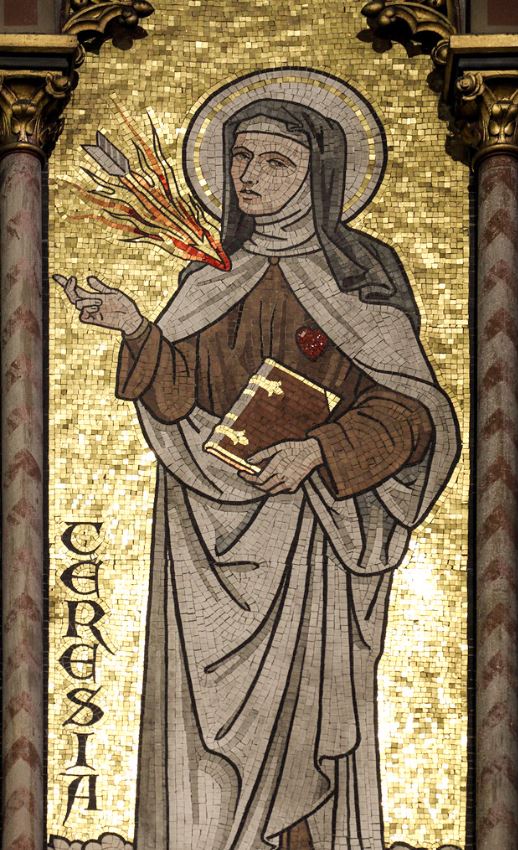
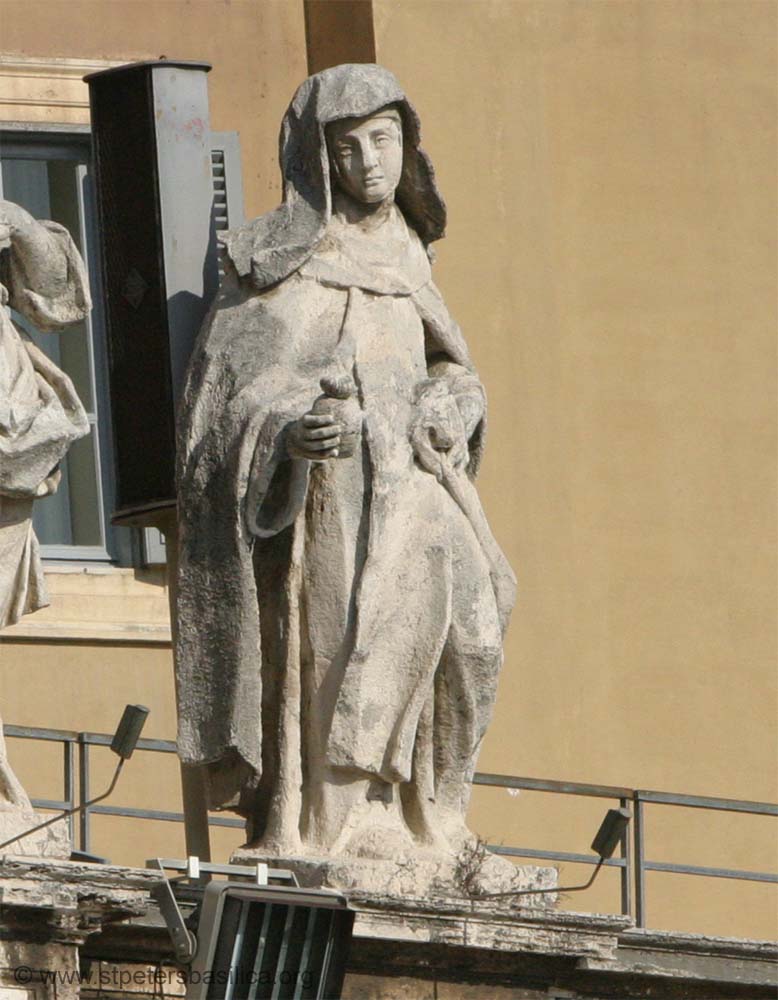
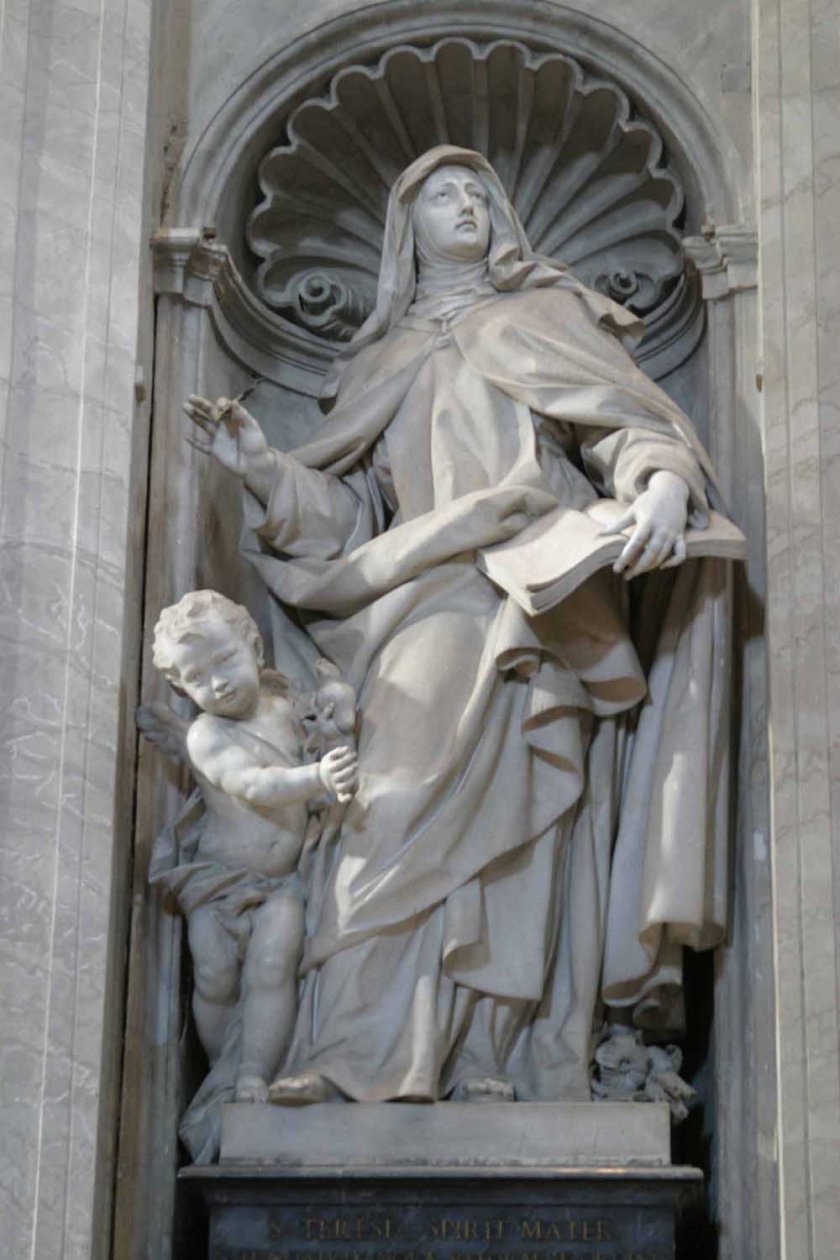
Below are the statues of St Teresa at the Vatican, the first on the Colonnade and the second inside St Peter’s.
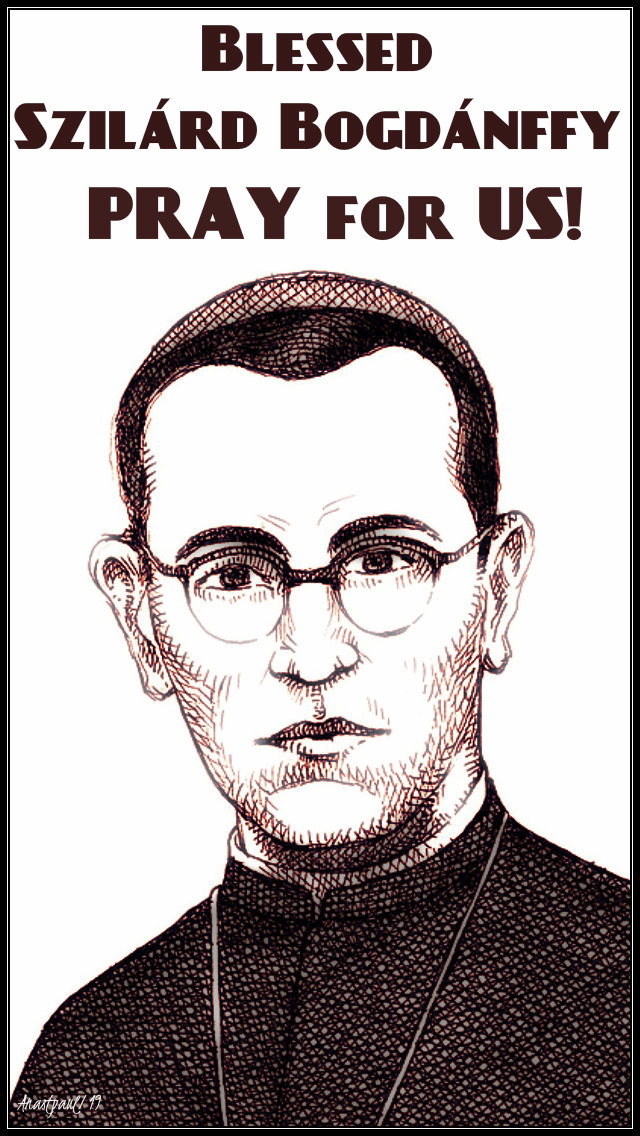
One Minute Reflection – 3 October – Thursday of the Twenty Sixth week in Ordinary Time, Year C, Gospel: Luke 10:1-12 and the Memorial of Blessed Szilárd István Bogdánffy (1911-1953) Martyr
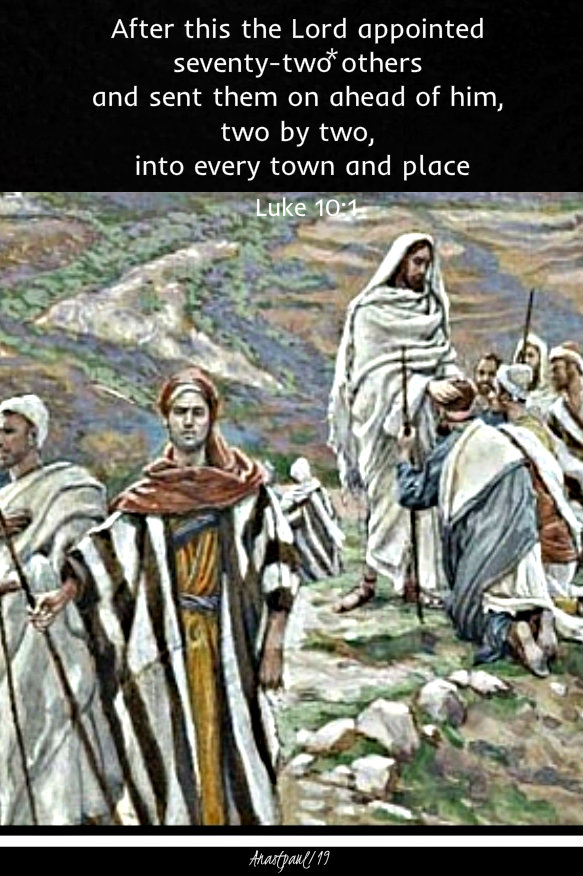
After this the Lord appointed seventy* others and sent them on ahead of him, two by two, into every town and place … Luke 10:1
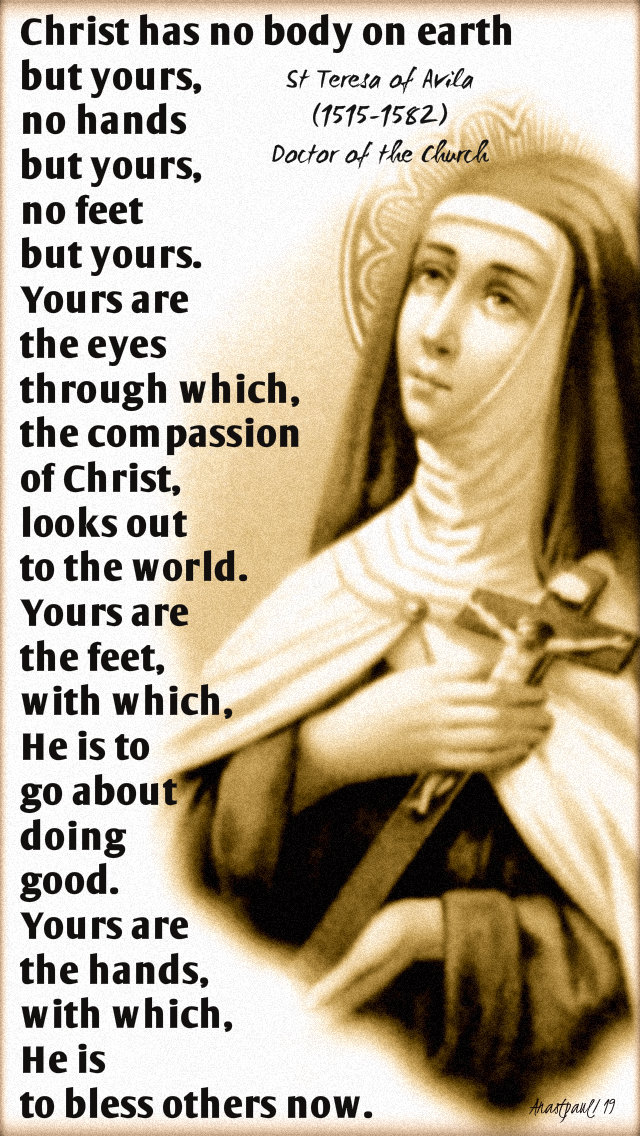
REFLECTION – “Christ has no body on earth but yours,
no hands but yours,
no feet but yours.
Yours are the eyes through which, the compassion of Christ, looks out to the world.
Yours are the feet, with which, He is to go about doing good.
Yours are the hands, with which, He is to bless others now. … St Teresa of Avila (1515-1582) Doctor of the Church
PRAYER – Heavenly Father, increase our love and trust for and in You, every day. Teach us total abandonment to Your loving providence and thus enable us to do Your will in all things. Blessed Szilárd István Bogdánffy you who suffered great persecutions and trials but always abandoned yourself to the Divine Will, please pray for us that we learn to do the same. We make our prayer through Christ our Lord, with the Holy Spirit, God forever, amen.
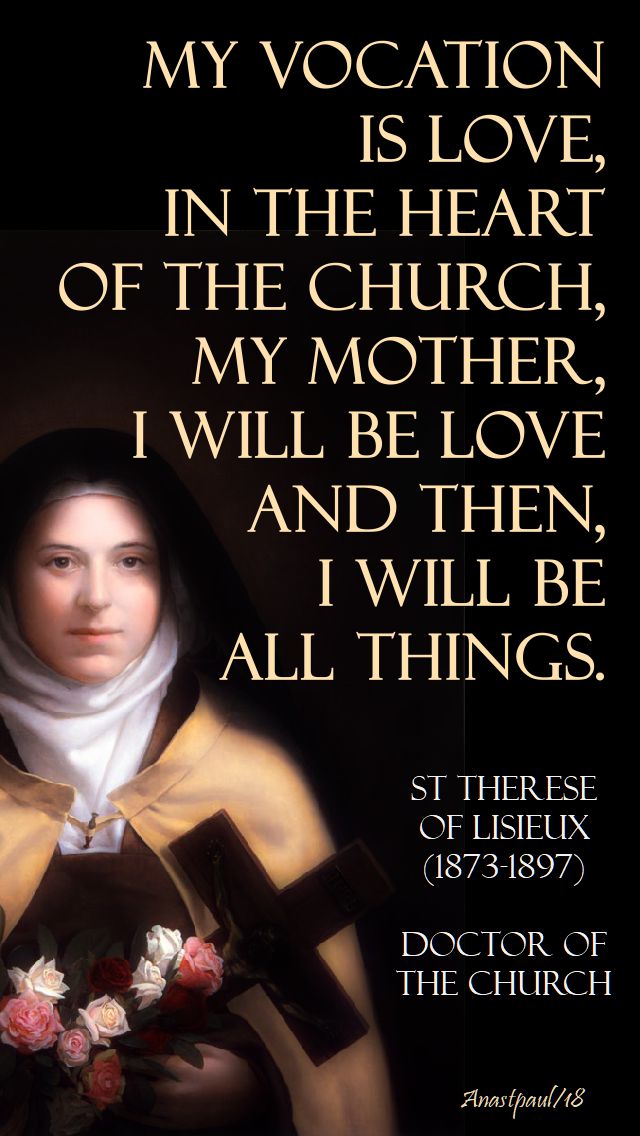
Thought for the Day – 1 October – The Memorial of Saint Thérèse of the Child Jesus, OCD (1873 – 1897) Virgin and Doctor of the Church
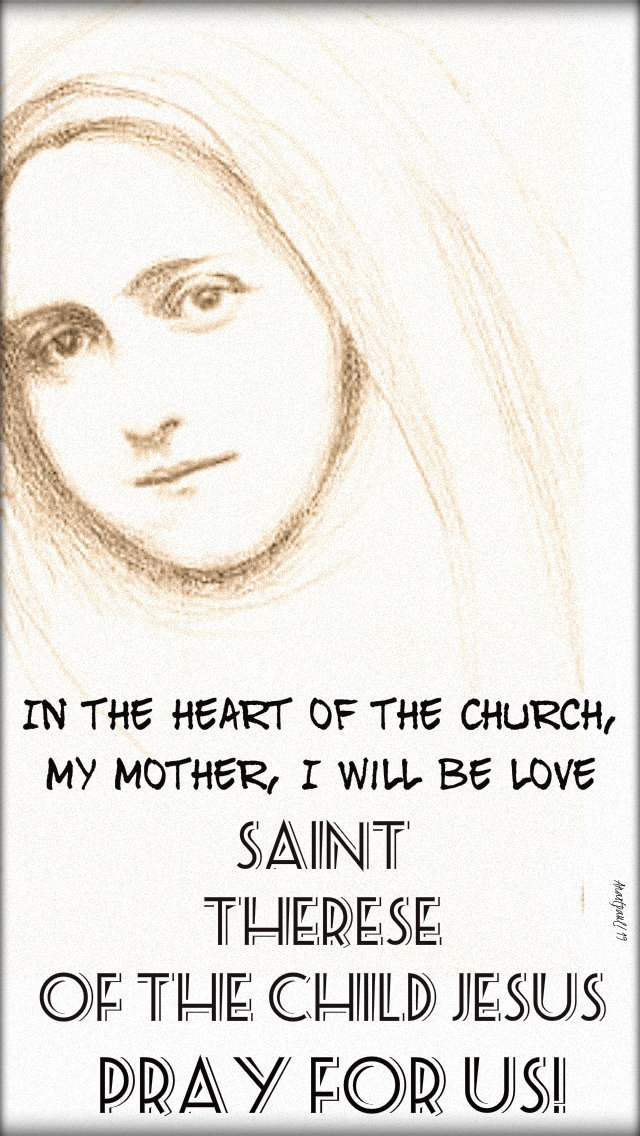
In the Heart of the Church I will be Love
Saint Thérèse of the Child Jesus
Doctor of the Church
An excerpt from her autobiography
Since my longing for martyrdom was powerful and unsettling, I turned to the epistles of Saint Paul in the hope of finally finding an answer. By chance, the twelfth and thirteenth chapters of the first epistle to the Corinthians caught my attention and, in the first section, I read that not everyone can be an apostle, prophet or teacher, that the Church is composed of a variety of members and, that the eye cannot be the hand. Even with such an answer revealed before me, I was not satisfied and did not find peace.
I persevered in the reading and did not let my mind wander, until I found this encouraging theme – Set your desires on the greater gifts. And I will show you the way which surpasses all others. For the Apostle insists that the greater gifts are nothing at all without love and that this same love is surely the best path leading directly to God. At length I had found peace of mind.
When I had looked upon the mystical body of the Church, I recognised myself in none of the members, which Saint Paul described and, what is more, I desired to distinguish myself more favourably within the whole body. Love appeared to me to be the hinge for my vocation. Indeed, I knew that the Church had a body composed of various members but in this body the necessary and more noble member was not lacking, I knew that the Church had a heart and that such a heart, appeared to be aflame with love. I knew that one love drove the members of the Church to action, that if this love were extinguished, the apostles would have proclaimed the Gospel no longer, the martyrs would have shed their blood no more. I saw and realised, that love sets off the bounds of all vocations, that love is everything, that this same love, embraces every time and every place. In one word, that love is everlasting.
Then, nearly ecstatic with the supreme joy in my soul, I proclaimed –
O Jesus, my Love, at last I have found my calling, my call is love. Certainly I have found my place in the Church and You gave me that very place, my God. In the heart of the Church, my mother, I will be love and thus, I will be all things, as my desire finds its direction.
One Minute Reflection – 1 October – Tuesday of the Twenty Sixth week in Ordinary Time, Year C, Gospel: Luke 9:51–56 and The Memorial of St Thérèse of the Child Jesus OCD (1873 – 1897) Doctor of the Church
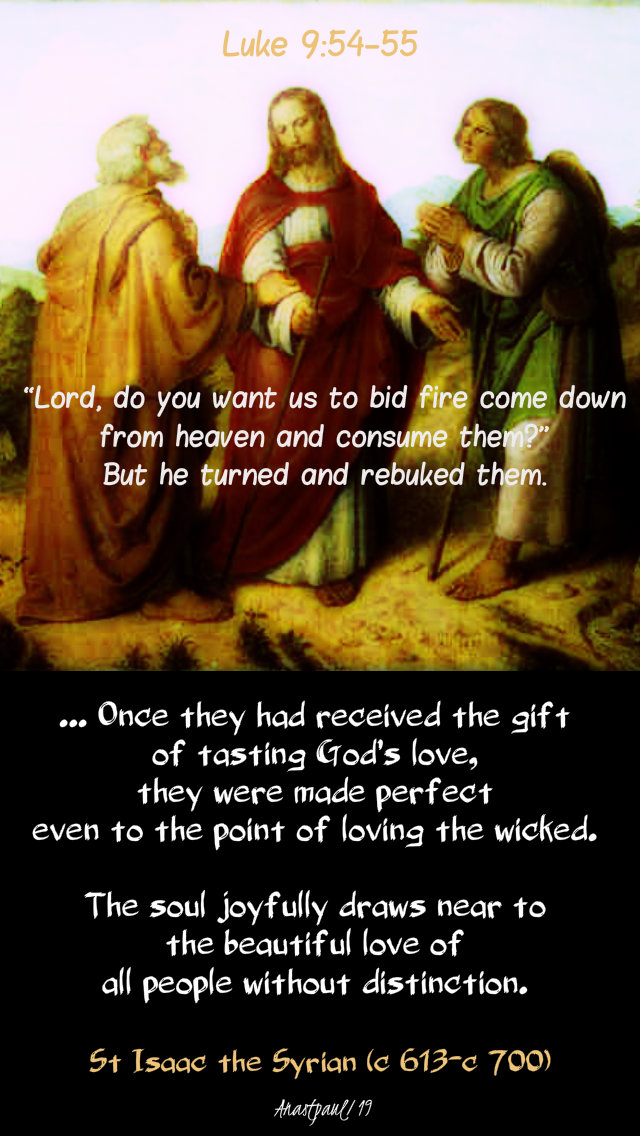
“Lord, do you want us to bid fire come down from heaven and consume them?” But he turned and rebuked them. … Luke 9:54-55
REFLECTION – “When someone has been made worthy to taste God’s love, he usually forgets everything else by reason of its sweetness. For once that person has tasted that love, anything visible seems of no interest. The soul joyfully draws near to the beautiful love of all people without distinction. It is never troubled by their weaknesses, which do not frighten it. Just like the blessed apostles who, in the midst of all the evils which they had to bear from their torturers were completely incapable of hating them and did not tire of loving them, this was shown by the fact that, in the end, they even bore death so as to meet them again one day in heaven.
And yet these were the very same people who, a little earlier, had begged Christ to make fire come down from heaven on the Samaritans, who had only refused to welcome them in their village. But once they had received the gift of tasting God’s love, they were made perfect even to the point of loving the wicked.” … St Isaac the Syrian (c 613-c 700) – Spiritual Discourses, 2nd Series, no. 10,36
PRAYER – God, our Father, Your promised Your Kingdom to the little ones and the humble of heart. May we love You and our neighbour, even those who hate us. Give us grace to walk confidently in the way of St Thérèse, so that helped by her prayers, we may see Your eternal glory. Through Christ our Lord, in the unity of the Holy Spirit, one God forever, amen
St Aizan of Abyssinia
St Albaud of Toul
Bl Andrew Sushinda
Bl Antoni Rewera
St Aretas of Rome
St Bavo of Ghent
Bl Cecilia Eusepi
Bl Christopher Buxton
St Crescens of Tomi
St Dodo
Bl Dominic of Villanova
Bl Edward James
St Evagrius of Tomi
St Fidharleus
Bl Gaspar Fisogiro
St Gregory the Illuminator
St John Kukuzelis
Bl John Robinson Bl Juan de Palafox Mendoza (1600–1659)
St Julia of Lisbon Bl Luigi Maria Monti CFIC “Sons of the Immaculate Conception” (1825-1900)
About Blessed Luigi: https://anastpaul.wordpress.com/2017/10/01/saint-of-the-day-1-october-blessed-luigi-maria-monti-1825-1900/
St Maxima of Lisbon
Bl Nikita Budka
St Piaton of Tournai
St Priscus of Tomi
Bl Ralph Crockett
Bl Robert Widmerpool
Bl Robert Wilcox
St Romanos the Melodist
St Sazan of Abyssinia
St Verissimus of Lisbon
St Virila
St Wasnulf
—
Martyred in the Spanish Civil War:
• Blessed Carmelo Juan Pérez Rodríguez
• Blessed Higinio Mata Díez
• Blessed Juan Mata Díez
• Blessed Álvaro Sanjuán Canet
• Blessed Florencia Caerols Martínez
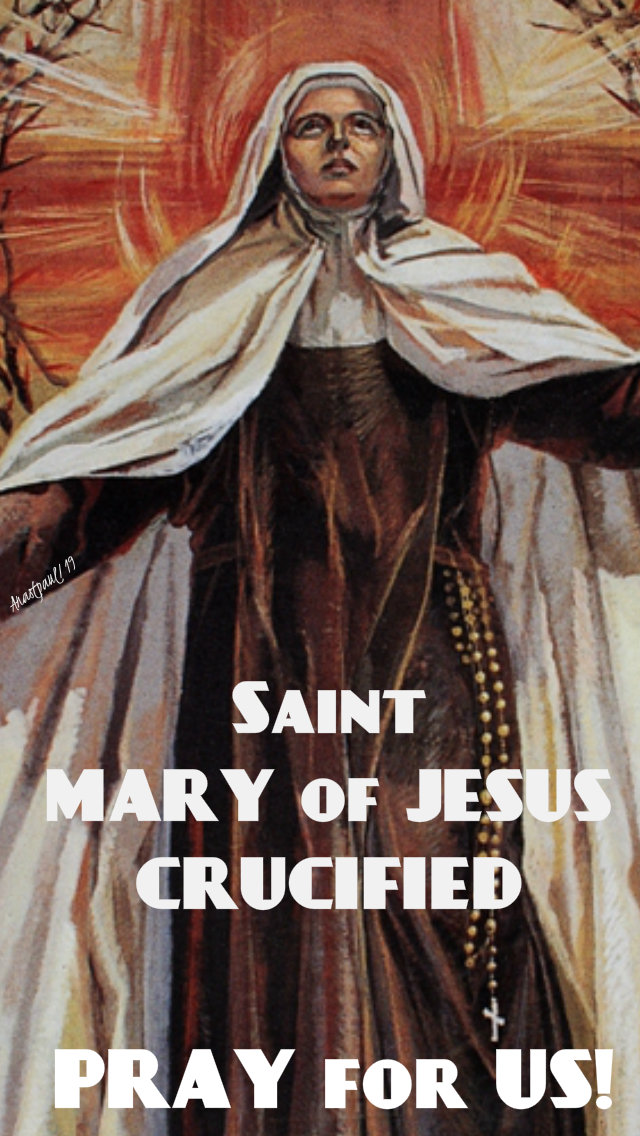
Thought for the Day – 26 August – The Memorial of St Mary of Jesus Crucified OCD (1846-1878)
From the Writings of St Mary of Jesus Crucified
Holy Spirit, inspire me. Love of God, consume me. Along the true road lead me. Mary, my mother, look upon me. With Jesus bless me. From all evil, from all illusion, from all danger, preserve me.
“Holy Spirit, enlighten me. To find Jesus, what am I to do and how am I to do it? The disciples were very ignorant, they were with Jesus yet did not understand Him. I, too, live in the same house with Jesus yet did not understand Him. The least thing troubles and upsets me. I am too sensitive, I have not generosity enough to make sacrifices for Jesus. O Holy Spirit, when You gave them a ray of light, the disciples disappeared – they were no longer what they were before. They found new strength, they found it easy to make sacrifices. They knew Jesus better than they had ever known Him when with them. Source of peace and light, come and enlighten me. I am hungry, come and feed me; thirsty, come and refresh me; blind, come and give me sight; poor, come and enrich me; ignorant, come and instruct me. Holy Spirit, I abandon myself to You!
Lord, how good You are to hold a weak reed in Your Hand! I am that reed, I am even weaker. But I shall always remain with You, like that reed. I f You dropped it, it would get broken. You carry it, it is not the reed that carries You.
My enraptured spirit contemplates all your works. Who can speak of You, O God so great! Omnipotent One, my soul is carried away! His wonderful beauty delights my soul. Who can tell what the Almighty looks upon? One look! You who gaze at me, come to me, a little nothing. I cannot remain here on earth, my soul longing. Call me close to You, awaken me. You alone, my God, my All. The heavens, the earth, the sun rejoice at your Name so great. I see You, supreme goodness, Your gaze is maternal. My Father, my Mother, it is in You, that I sleep. It is in You, that I breathe. Awaken! My soul is mad with yearning, it can do no more, take it! When will we see Him forever world without end!
What are You like , my God? The ocean? That comparison is too feeble. One single raindrop is not enough to refresh the whole earth, so. too, the love of all hearts is not enough for You, my God. The drop of water is myself, the ocean is You, I wish to have a heart greater than earth.
Lord, if You abandon me , I am like a cinder. The cinder will not produce any fruit It hinders vegetable growth. But if You Lord look down on me, I become a good earth, a fertile soil that brings forth good fruits and plants producing flowers. O Lord, look down on me always!
Thank You, My God, for making me aware of what I am. I prefer to know my weakness than to perform miracles. That is better for me, for when people see me fall I have nothing then to nourish my pride upon. It is better for me because it makes me see You are my only strength, better for me to fall a thousand times, if it makes me say to You two thousand times ” “I hope in You, O Lord. Thank You, thank You, Lord.”
Inscribed on Blessed Mary’s tombstone
“Here in the peace of the Lord reposes Sister Mary of Jesus Crucified, professed religious of the white veil. A soul of singular graces, she was conspicuous for her humility, her obedience and her charity. Jesus, the sole love of her heart called her to Himself in the 33rd year of her age and the 12th year of her religious life at Bethlehem, 26 August 1878.”
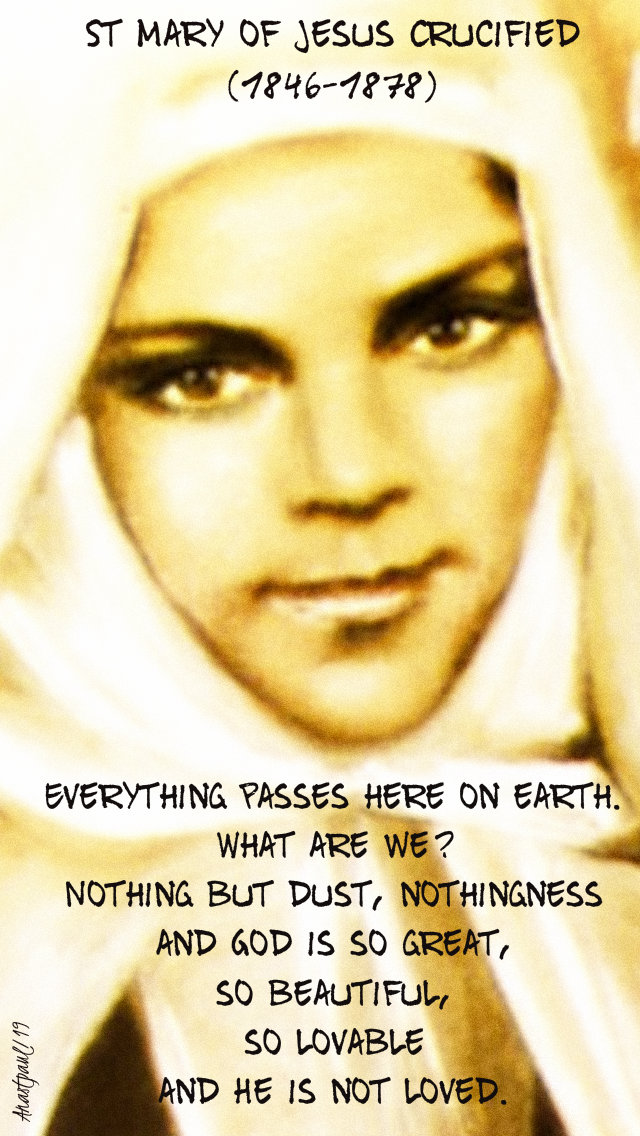
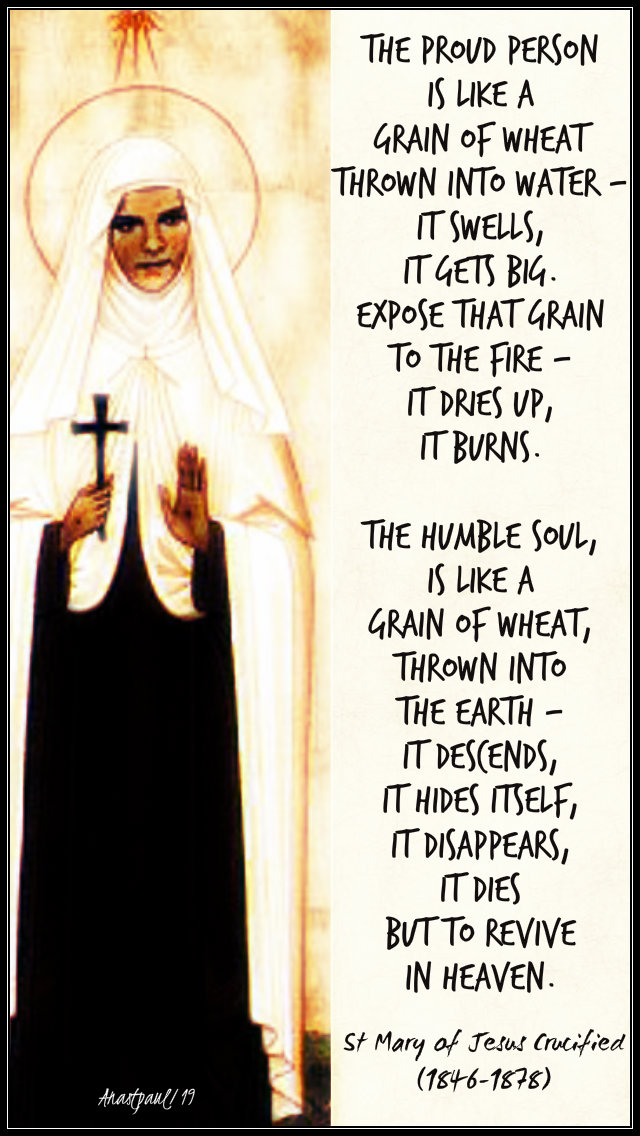
Quote/s of the Day – 26 August – The Memorial of St Mary of Jesus Crucified OCD (1846-1878)
“Everything passes here on earth. What are we? Nothing but dust, nothingness and God is so great, so beautiful, so lovable and He is not loved.”
“The proud person is like a grain of wheat thrown into water – it swells, it gets big. Expose that grain to the fire – it dries up, it burns. The humble soul, is like a grain of wheat, thrown into the earth – it descends, it hides itself, it disappears, it dies but to revive in heaven.”
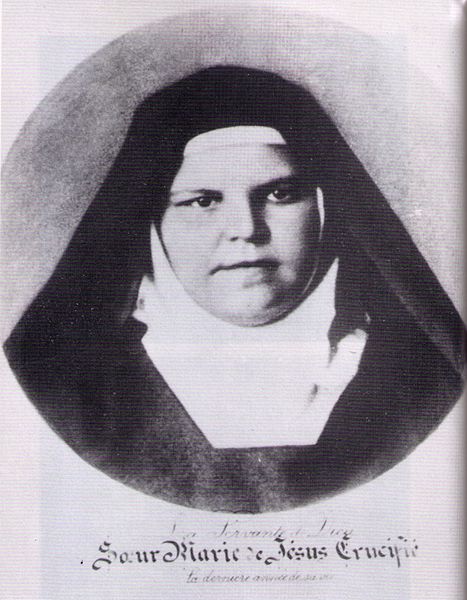
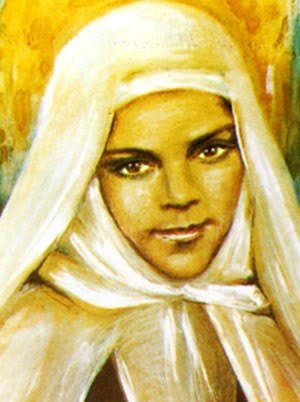
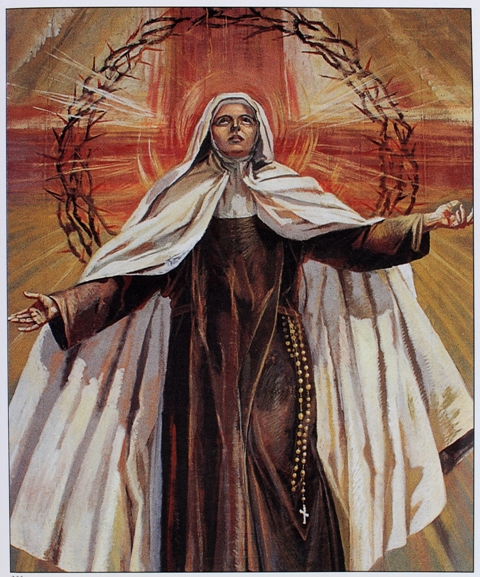
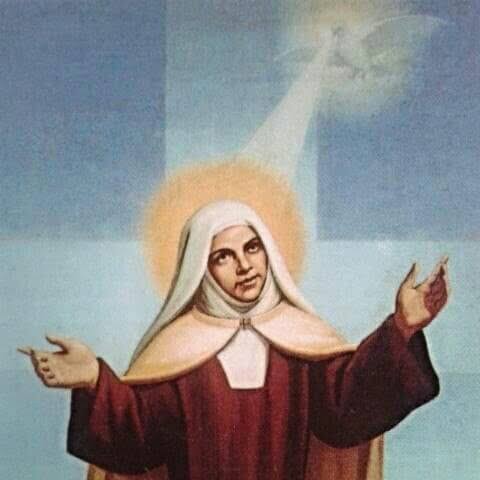
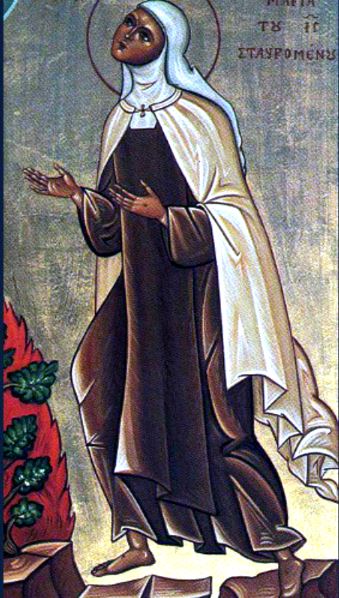
Saint of the Day – 26 August – St Mary of Jesus Crucified OCD (1846-1878) Discalced Carmelite nun of the Melkite Greek Catholic Church, Virgin, Stigmatist, Mystic, apostle of charity. Born on 5 January 1846 at Galilee, Palestine as Mariam Baouardy and died on 26 August 1878, aged 32, at Bethlehem of gangrene following an injury received at the construction site of the Bethlehem monastery.
Mariam Baouardy was born on 5 January 1846 at Ibillin, a village in the Holy Land near Nazareth. Her parents were George Baouardy and Mariam Shashyn, they were Greek Catholics in a predominantly Muslin area. They were both persecuted for their faith and George spent some time in pri son. Their first 12 children, all boys, died in infancy so they decided to go on pilgrimage to Bethlehem, to beg Our Lady for a daughter and they promised to call her Mariam. Their prayers were answered when little Mariam was born, followed two years later by her only surviving brother, Paul. Mariam was baptised and confirmed when she was ten days old according to the Greek Catholic Rite. Sadly before she was three years old both her parents died from an infectious illness, within a few days of each other. When her father was dying he commended Mariam to the care of St Joseph, looking lovingly at a picture of him, he said ‘Great saint, here is my child, the Blessed Virgin is her mother, deign to look after her also, be her father’.
The siblings were then each taken in by relatives on different sides of her family living in different villages, she being taken in by a paternal uncle who lived in the same village and her brother went to live with a maternal aunt. The brother and sister would never see one another again. She was raised in a loving home in comfortable circumstances. As a child she had a marked spirit of religious fervour and at the age of five began to fast on Saturdays in honour of the Blessed Virgin.
When Mariam was eight, her uncle and his wife moved to Alexandria, Egypt, to improve their situation. Five years later, in 1858 when she was aged 13, in keeping with tradition, she was engaged by her uncle to his wife’s brother, who lived in Cairo. The night before the wedding, she had a religious experience in which she felt called not to marry but to offer her life to God. Upon being told this the following morning, her uncle flew into a rage and beat her severely. Despite this and the subsequent ill treatment she began to experience from her uncle, she stayed firm in her decision.
Mariam felt depressed and alone. She wrote her brother, then living in Nazareth, asking him to visit her. The young male servant she asked to deliver the letter drew out of her the cause for her sadness. Upon learning of this, he attempted to woo her for himself, inviting her to convert to Islam. She rejected his proposal, which caused the young man to fly into a rage, in which he drew a knife and cut her throat. He then dumped her body in a nearby alley. And then a miracle saved her. As she related later, a “nun dressed in blue” brought her to a grotto, which she could never identify, stitched her wounds and took care of her. Her voice was affected for the rest of her life as a result of the cut, which a French doctor later measured as being 10 cm wide. After being cared for by this mysterious figure for a month, she recovered enough to leave and find work as a domestic servant in the home of an Arab Christian family in the city.
In May 1863 a generous patron made it possible for Baouardy to move to Marseille, France, where she became the cook for an Arab family. While there, she felt called to enter a religious order. Rejected by the first groups to which she sought admission, in May 1865 she was accepted as a postulant by the Congregation of the Sisters of St Joseph of the Apparition, who had communities in the Holy Land and already had several Palestinian candidates. It was at this point, that she received the stigmata of Christ.
St Mary of Jesus as a Postulant
During the last month of this period of candidacy, the Mistress of novices, Mother Honorine who had drawn Baouardy’s life story from her, was replaced by Mother Veronica of the Passion. After two years as a postulant, Baouardy was up for a vote by the community regarding her admission to the congregation. To her dismay, she was rejected by the sisters charged with making the decision. But Divine Providence came to her aid for just then, Mother Veronica had just received permission to transfer to the Discalced Carmelite monastery at Pau to prepare for her forming a new congregation of Religious Sisters serving in India, the Sisters of the Apostolic Carmel. She invited Baouardy to go with her, writing to the prioress of that community and recommending that they accept the young Arab woman. The prioress accepted Mother Veronica’s advice and, in June 1867, both women went together to Pau, where they received the Carmelite religious habit and Baourdy was given the religious name of Mary of Jesus Crucified.
In 1870, Baouardy went with the first group of Carmelite Apostolic Sisters to Mangalore, India. She served there for two years before returning to Pau. It was there she made her profession of solemn vows as a member of the Order in November 1871. In September 1875 she helped to found a new monastery in Bethlehem, the first of the Order in that region, where she lived until her death. During her whole life, she experienced periods of religious ecstasy frequently throughout the day.
St Pope John Paul II declared Sister Mary of Jesus Crucified, Blessed on 13 November 1983 and she was Canonised on 15 May 2015 by Pope Francis. She became the second Greek Catholic to be Canonised, the first being St Josaphat Kuntsevych in 1867.
St Abundius the Martyr
St Alexander of Bergamo
St Anastasius the Fuller
St Bregwin of Canterbury
St Elias of Syracuse
St Eleutherius of Auxerre
St Felix of Pistoia
Bl Herluin
Bl Ioachim Watanabe Jirozaemon
St Irenaeus of Rome
Bl Jacques Retouret
St Jeanne Elizabeth des Bichier des Anges
Bl Jean Bassano
Bl Jean of Caramola
Bl Juan Urgel
Bl Levkadia Herasymiv
Bl Margaret of Faenza St Mary of Jesus Crucified/Mariam Baouardy OCD (1846-1878)
St Maximilian of Rome
St Melchizedek the Patriarch
St Orontius of Lecce
St Pandwyna
St Rufinus of Capua
St Secundus the Theban
Bl Stanislaus Han Jeong-Heum
St Teresa de Gesu, Jornet y Ibars
St Victor of Caesarea
St Victor the Martyr
St Vyevain of York St Pope Zephyrinus (died 217) Martyr Biography:
—
Martyrs of Celano – 3 saints: Three Christians, Constantius, Simplicius and Victorinus, martyred in the same area at roughly the same time. That’s really all we know, though it didn’t stop writers in later centuries from inventing colourful histories, making them a father and sons, adding saintly family members, earthquakes, close escapes, etc.
They were martyred in c 159 in the Marsica region of Italy. At some point their relics were interred under the main altar of the San Giovanni Vecchio church in the Collegiata di Celano and were authenticated in 1057 by Pope Stephen IX. The city was depopulated in 1222; when it was re-built, the relics were re-enshrined in the church of San Vittorino on 10 June 1406. Patronage – Celano, Italy.
Martyred in the Spanish Civil War:
• Blessed Emilio Serrano Lizarralde
• Blessed Francesc Casademunt Ribas
• Blessed Josep Maria Tolaguera Oliva
• Blessed Luis Valls Matamales
• Blessed María de Los Ángeles Ginard Martí
• Blessed Pere Sisterna Torrent
Saint of the Day – 16 August – Blessed Angelo Agostini Mazzinghi O. Carm (1385-1438) was an Italian Priest and a professed member of the Carmelite order. He was a noted preacher, prior and reformer, teacher of theology and was known for his pious devotion to the Holy Eucharist, the Blessed Virgin Mary and the Carmelite Rule of Life and to the profession of the Gospel. Patronage – Preachers.
Angelo Agostini Mazzinghi was born in Florence in 1385 to Augustin Mazzinghi.
He entered the Carmelite order in 1413 and after he made his solemn profession was ordained to the priesthood. He began to teach theological studies in both Florence and Frascati (in Rome) and was also a preacher in the former. He was the first member of the reformed observance of Our Lady of the Wood and was made as the prior of several of the Carmelite houses. He launched the reform of the convent of Santa Maria delle Salve and was appointed as the convent’s Prior from 1419 until 1430 and then once again in 1437.
Mazzinghi preached a series of Lenten retreats in Florence from 1431 and was to preach his final retreat in 1436 before he retired to a Carmelite convent. On one particular occasion of preaching – according to fellow Carmelite Nicholas Calciuri – who was a witness of the miracle, roses and lilies poured from Angelo’s mouth, which two angels wove into a crown for the latter.
Angelo was known for his humble and pious demeanour as well as for his ardent devotion to both the Holy Eucharist and to the Blessed Virgin Mary.
Before his death he retired to a Carmelite house where he spent the remainder of his life in contemplation and meditation. Bl Angelo died on 17 August 1438 in Florence at the age of 53. He was buried in Santa Maria del Carmine but his relics were moved to the Banacacci Chapel in 1739 and moved to the main altar in 1930 in what was the final transferral of his remains.
Pope Clement XIII approved his cultus and Beatified Blessed Angelo on 7 March 1761.
Bl Angelo Agostini Mazzinghi O.Carm. (1385-1438)
St Armagillus of Brittany
St Arsacius of Nicomedia
St Frambaldo
Bl Iacobus Bunzo Gengoro
Bl Jean-Baptiste Menestrel
Bl John of Saint Martha
Bl Laurence Loricatus
Bl Magdalena Kiyota Bokusai
Bl Maria Gengoro
Bl Ralph de la Futaye St Roch (1295-1327) “Pilgrim”
The story of St Roch here: https://anastpaul.wordpress.com/2017/08/16/saint-of-the-day-16-august-st-roch/
St Serena
Bl Simon Kiyota Bokusai
Bl Thomas Gengoro
St Titus the Deacon
—
Martyrs of Palestine – 33 saints: Thirty-three Christians martyred in Palestine; they are commemorated in old martyrologies, but the date and exact location have been lost.
Martyred in the Spanish Civil War:
Bl Amadeu Monje Altés
Bl Antonio María Rodríguez Blanco
Bl José María Sanchís Mompó
Bl Laurentí Basil Matas
Bl Plácido García Gilabert
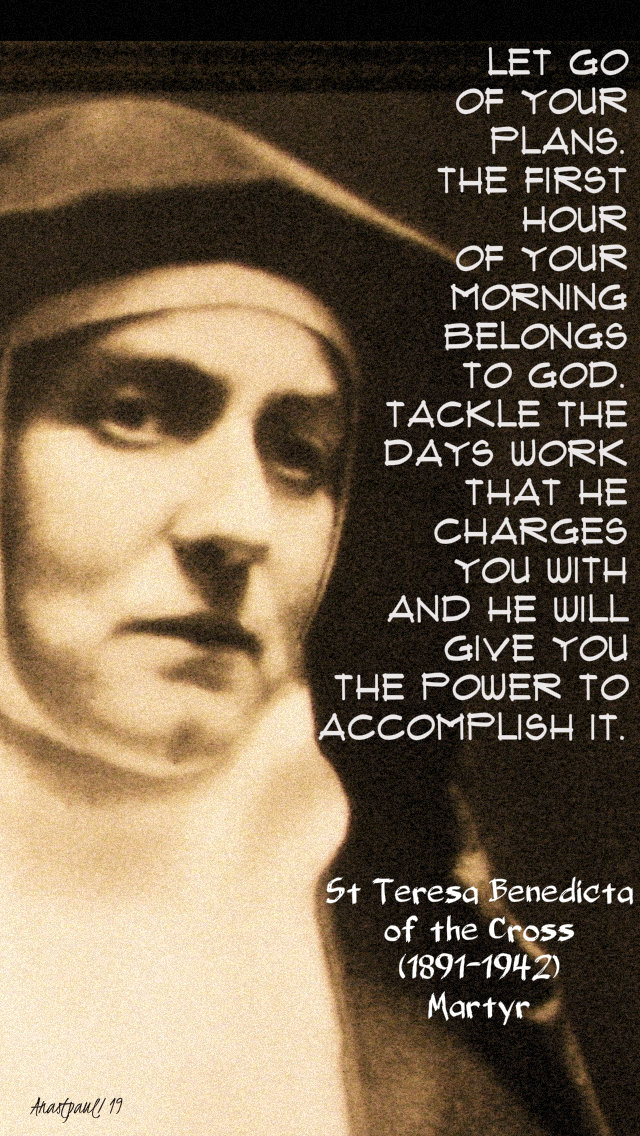
Quote of the Day – 9 August – The Memorial of St Teresa Benedicta of the Cross OCD (1891-1942) Martyr
“Let go of your plans. The first hour of your morning belongs to God. Tackle the day’s work that He charges you with and He will give you the power to accomplish it.”
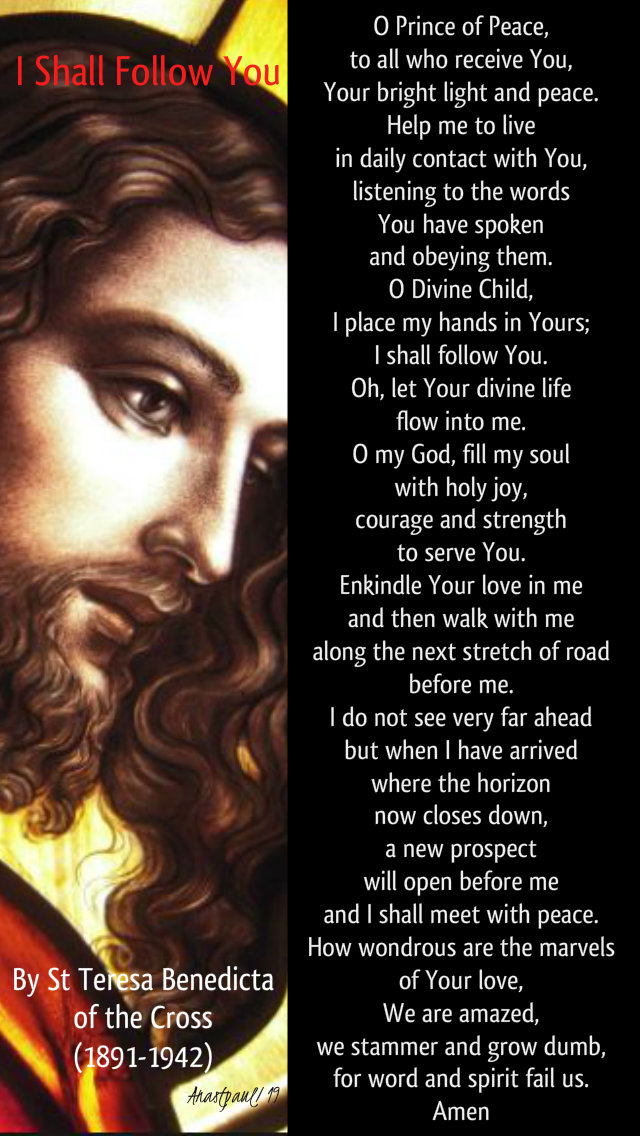
Our Morning Offering – 9 August – The Memorial of St Teresa Benedicta of the Cross OCD (1891-1942) Martyr
I Shall Follow You By St Teresa Benedicta of the Cross
O Prince of Peace,
to all who receive You,
Your bright light and peace.
Help me to live in daily contact with You,
listening to the words You have spoken
and obeying them.
O Divine Child, I place my hands in Yours;
I shall follow You.
Oh, let Your divine life flow into me.
O my God, fill my soul with holy joy,
courage and strength to serve You.
Enkindle Your love in me
and then walk with me
along the next stretch of road before me.
I do not see very far ahead
but when I have arrived
where the horizon now closes down,
a new prospect will open before me
and I shall meet with peace.
How wondrous are the marvels of Your love,
We are amazed, we stammer and grow dumb,
for word and spirit fail us.
Amen
St Amor of Franche-Comté
St Autor of Metz
St Bandaridus of Soissons
St Bonifacia Rodriguez Castro St Candida Maria de Jesus Cipitria y Barriola (1845-1912)
St Claude Richard
St Domitian of Châlons
Bl Falco the Hermit
St Firmus of Verona
Bl John Norton
Bl John of Salerno
Bl John Talbot
St Marcellian of Civitavecchia
Bl Michal Tomaszek
St Nathy
St Numidicus of Carthage
St Phelim
Bl Richard Bere
St Romanus Ostiarius
St Rusticus of Sirmium
St Rusticus of Verona
St Secundian of Civitavecchia
St Stephen of Burgos
Bl Thomas Palaser
St Verian of Civitavecchia
Bl Zbigniew Adam Strzalkowski
—
Martyrs of Civitavecchia: Three Christians martyred together in the persecutions of Decius. We know little more than the names – Marcellian, Secundian and Verian. 250 near Civitavecchia, Italy.
Martyrs of Constantinople: 10 saints: A group of ten Christians who were arrested, tortured and executed for defending an icon of Christ in defiance of orders from Emperor Leo the Isaurian. We know the names of three, but nothing else about them – Julian, Marcian and Mary. They were beheaded in Constantinople.
Martyred in the Spanish Civil War:
Bl Antonio Mateo Salamero
Bl Faustino Oteiza Segura
Bl Florentín Felipe Naya
Bl Florentino Asensio Barroso
Bl Francisco López-Gasco Fernández-Largo
Bl Guillermo Plaza Hernández
Bl Joan Vallés Anguera
Bl José María Garrigues Hernández
Bl Josep Figuera Rey
Bl Josep Maria Aragones Mateu
Bl Julián Pozo Ruiz de Samaniego
Bl Mateo Molinos Coloma
Bl Narcís Sitjà Basté
Thought for the Day – 7 August – The Memorial of St Albert of Trapani O.Carm. (c 1240-1307)
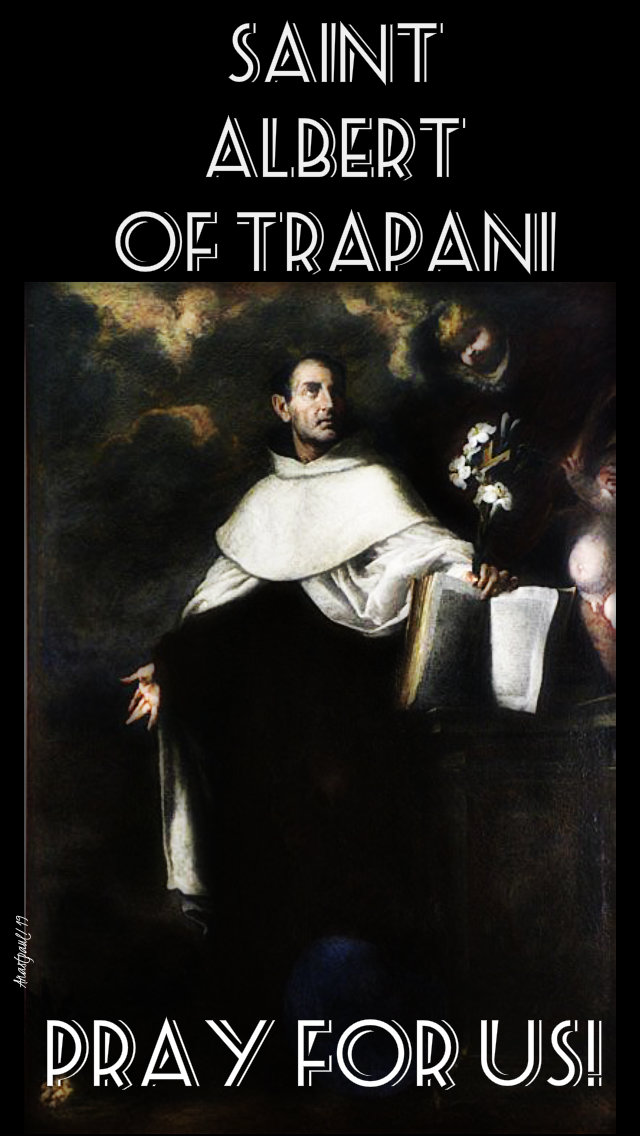
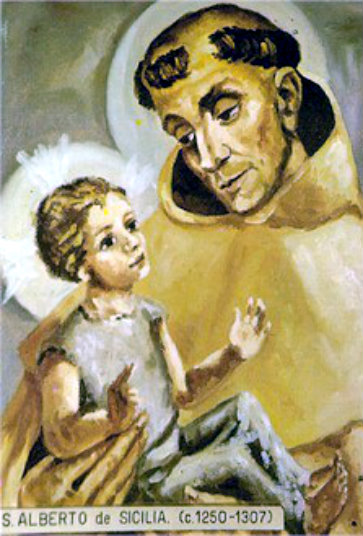
St Albert has often been portrayed with an open book in his hand, or with the Child Jesus in his arms. This is not by accident, for these are both iconographical attributes which indicate a preacher of the Gospel, which is precisely what Albert was. In order to be authentic proclaimers it is necessary to have encountered Jesus and this is possible, primarily, through the hearing of the Word. It was his familiarity with Scripture, cultivated in lectio divina with purity of heart and openness to the transforming action of the Holy Spirit, which made St Albert capable of proclaiming the Gospel. St Albert is remembered for an extraordinary ability to speak to people with conviction and immediacy. He did not distract his listeners with elegant forms of preaching but stressed the vital content of the message.
Albert’s life shines as an example of virtue and sincerity. His chastity became a radiant expression of a radical, definitive and complete choice for God. The purity practised by Albert is not simply a physical fact, but primarily a spiritual reality. Albert allowed himself to be seized by God – he placed himself totally at God’s service, gave God his life and capacities and welcomed God’s call as a gift and a commitment for life. This example is more relevant than ever in our modern world.
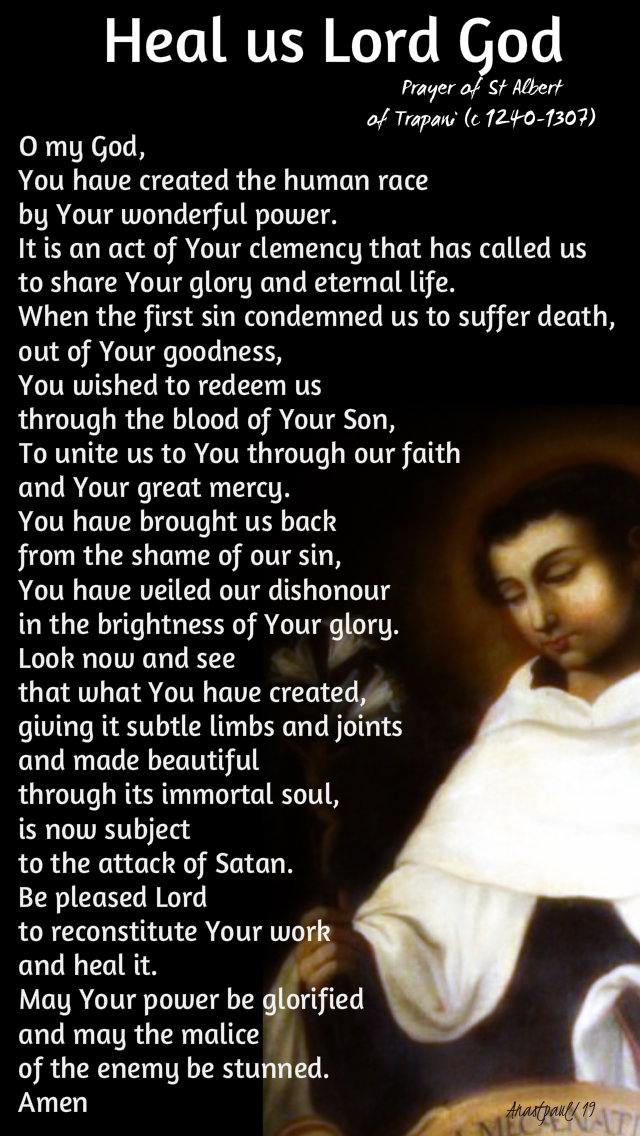
Heal us Lord God Prayer of St Albert of Trapani
O my God,
You have created the human race
by Your wonderful power.
It is an act of Your clemency that has called us
to share Your glory and eternal life.
When the first sin condemned us to suffer death,
out of Your goodness,
You wished to redeem us
through the blood of Your Son,
To unite us to You through our faith
and Your great mercy.
You have brought us back
from the shame of our sin,
You have veiled our dishonour
in the brightness of Your glory.
Look now and see that what You have created,
giving it subtle limbs and joints
and made beautiful through its immortal soul,
is now subject to the attack of Satan.
Be pleased Lord
to reconstitute Your work and heal it.
May Your power be glorified
and may the malice of the enemy be stunned.
Amen
Saint of the Day – 7 August – Saint Albert of Trapani O.Carm. (c 1240-1307) – Carmelite Priest, Confessor, Preacher, Evangeliser, apostle of prayer and a devout servant of the Blessed Virgin and the Passion of Christ. He was born as Alberto degli Abati in c 1240 at Trapani, Sicily, Italy and died on 7 August 1306 at Messina, Italy of natural causes. He practised great austerities upon himself to make himself poor in the spirit of Jesus Christ and went out preaching and evangelising, he was known for working and maintaining a positive relationship with Jews as well as for his powers of healing. The saint was likewise attributed with the 1301 lifting of the siege in Messina, that could have seen hundreds die from starvation had it not been for his intervention. Patronages – Trapani, Carmelite order, Carmelite schools, Palermo Sicily.
Alberto degli Abati was born circa 1240 in Trapani, Sicily, Italy as the sole child to the nobles (of Florentine origin) Benedetto degli Abati and Giovanna Palizi. His father served as an admiral in the fleet of Frederick II of Hohensautfen. His parents – who married in 1214 – were sterile and promised that if blessed with a son he would be consecrated to the Beata Vergine Maria del Monte Carmelo. In his childhood his father had thought of arranging a marriage for him but his mother was able to remind her husband, to adhere to the vow the couple made, that he be consecrated to the Lord.
Sicily was one of the first areas of Carmelite settlement and expansion in the west. This island was an obvious choice for the Carmelites, coming west from Palestine, in which to make a foundation. Young Albert appears to have been attracted by the newcomers and entered the Order at Trapani, on the western side of the island.
After his ordination, Albert was sent to the priory at Messina, also in Sicily and this was the main centre of his life’s work. St Albert typified the new kind of Carmelite that adaptation to the west produced, a man of prayer and penance, a lover of solitude but also a man engaged in study and in the active apostolate. There were many Jews living in Sicily at this time and Albert seems to have made them a special object and been successful in making converts. He is also said to have written books, though none survive and he is regarded as patron of Carmelite studies. The order recognised his many and outstanding abilities. He attended the General Chapter at Bruges in 1297, in the capacity as Superior. However, he spent the last years of his life before his death in 1307, living in a hermitage near Messina.
He was recognised as a wonder-worker during his lifetime, miracles and cures continued to be attributed to Albert’s intercession after his death.
His cult spread quickly through the whole of the Order. The date of a translation of his relics, said to have been made in the year 1309 or 1316, is uncertain. (This latter would seem more exact). Albert was among the first Carmelite saints venerated by the Order, of which he was later considered a patron and protector. Already in 1346 there was a chapel dedicated to him, in the convent of Palermo. At various general chapters, beginning with that of 1375, his papal canonisation was proposed. In the chapter of 1411 it was said that his Proper Office was ready.
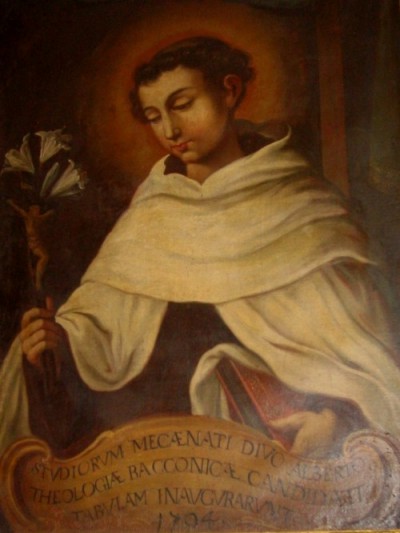
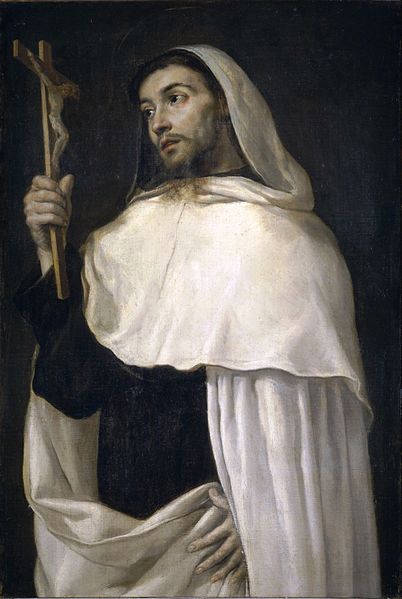
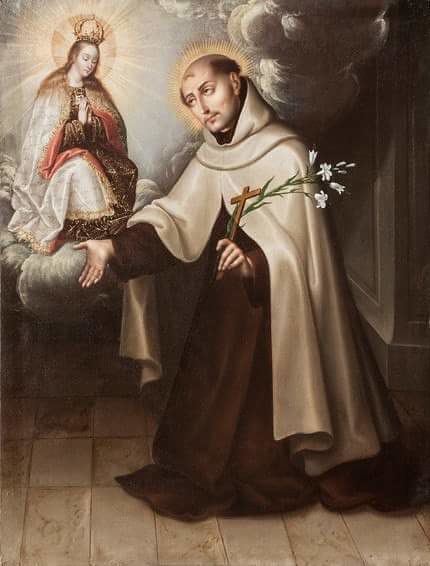
In 1457 Pope Callixtus III, by verbal consent permitted his cult, which was consequently confirmed by Pope Sixtus IV with a bull of 31 May 1476. In 1524 it was ordered that his image be found on the seal of the general chapter. Moreover, the general of the Order, Nicholas Audet, wanted an altar dedicated to him in every Carmelite church . Even earlier, the chapter of 1420 had ordered that his image with a halo should be found in all the convents of the Order. With this intense and extended cult, his abundant iconography is easily understood. In it he is represented (with or without a book), first, bearing a lily, a symbol of his victory over the senses at the beginning of his religious life or with a cruvifix and the Blessed Virgin.
In 1623 one of the gates of the city of Messina was dedicated to him. He is the patron of Trapani, of Erice, of Palermo and of Revere (Mantua). St Teresa of Jesus (1515-1582) and St Mary Magdalene de Pazzi (1566-1607) were especially devoted to him, the Bl Baptist Spagnoli (1447–1516) composed a sapphic ode in his honour. His relics are spread throughout Europe. The head of the Saint is in the Carmelite church of Trapani where he is still venerated, especially as a patron against fever. His feast day is celebrated there with great ceremony on 7 August. In the last liturgical reform the rank of feast was granted for St Albert to the Carmelites and of memorial to the Discalced of the same Order.
Let us pray.
Lord God,
you made St Albert of Trapani
a model of purity and prayer,
and a devoted servant of Our Lady.
May we practise these same virtues
and so be worthy always
to share the banquet of your grace.
We ask this through Christ our Lord.
Amen.
St Afra of Augsburg
Bl Agathangelus Nourry St Albert of Trapani O.Carm. (c 1240-1307)
Bl Cassian Vaz Lopez-Neto
St Claudia of Rome
St Donat
St Donatian of Chalons-sur-Marne
St Donatus of Arezzo
St Donatus of Besancon
Bl Edmund Bojanowski
Bl Edward Bamber
St Faustus of Milan
St Hilarinus of Ostia
St Hyperechios
Bl John Woodcock
Bl Jordan Forzatei
St Julian of Rome
St Miguel de la Mora
Bl Nicholas Postgate
St Peter of Rome
Bl Thomas Whitaker
Bl Vincent de L’Aquila
St Victricius of Rouen
—
Martyred Deacons of Rome – 6 saints: A group of deacons who were martyred with Pope Saint Sixtus II. We know nothing about them but their names and their deaths – Agapitus, Felicissimus, Januarius, Magnus, Stephen and Vincent. They were
beheaded on 6 August 258 in a cemetery on the Appian Way, Rome, Italy.
Martyrs of Como – 6 saints: A group of Christian soldiers in the imperial Roman army. Martyred in the persecutions of Maximian. We know little else but the names – Carpophorus, Cassius, Exanthus, Licinius, Secundus and Severinus. c.295 on the north side of Lake Como, near Samolaco, Italy. Their relics in the church of San Carpoforo, Como, Italy.
Martyred in the Spanish Civil War: 10 Beati
Bl Dalmacio Bellota Perez
Bl Diodorus Hernando Lopez
Bl Francisco Gargallo Gascón
Bl Luis Villanueva Montoya
Bl María del Carmen Zaragoza y Zaragoza
Bl María Rosa Adrover Martí
Bl Rafaél Severiano Rodríguez Navarro
Bl Tomás Carbonell Miquel
Bl Andrew the Catechist
St Austindus of Auch
St Bartholomea Capitanio
St Benigno of Malcestine
Bl Camilla Gentili
St Charus of Malcestine
Bl Edward Thwing
Bl Élisabeth-Thérèse de Consolin
St Erastus
Bl Évangéliste of Verona
St Exuperia the Martyr
Bl George Swallowell
St Gérontios
Bl Giuseppina Maria de Micheli
St Gothalm
St Hyacinth
Bl Jacques Netsetov
Bl John Ingram
St Joris
Bl Marcel-Gaucher Labiche de Reignefort
Bl Marie-Claire du Bac
Bl Marie-Madeleine Justamond
Bl Marie-Marguerite Bonnet
St Olympius the Tribune
St Parasceva of Rome
St Pastor of Rome
Bl Pérégrin of Verona
Bl Pierre-Joseph le Groing de la Romagère Bl Robert Nutter OP (c 1557-1600) Martyr
St Simeon of Padolirone
St Symphronius the Slave
St Theodulus the Martyr St Titus Brandsma OCD (1881-1942) Martyr of the Faith Biography: https://anastpaul.com/2018/07/26/saint-of-the-day-27-july-blessed-titus-brandsma-o-c-d-1881-1942-martyr-of-the-faith/
Quote/s of the Day – 24 July – Tuesday of the Sixteenth week in Ordinary Time, Year C, Gospel: Matthew 12:46-50 and the Memorial of St Bridget of Sweden (c 1303 – 1373)
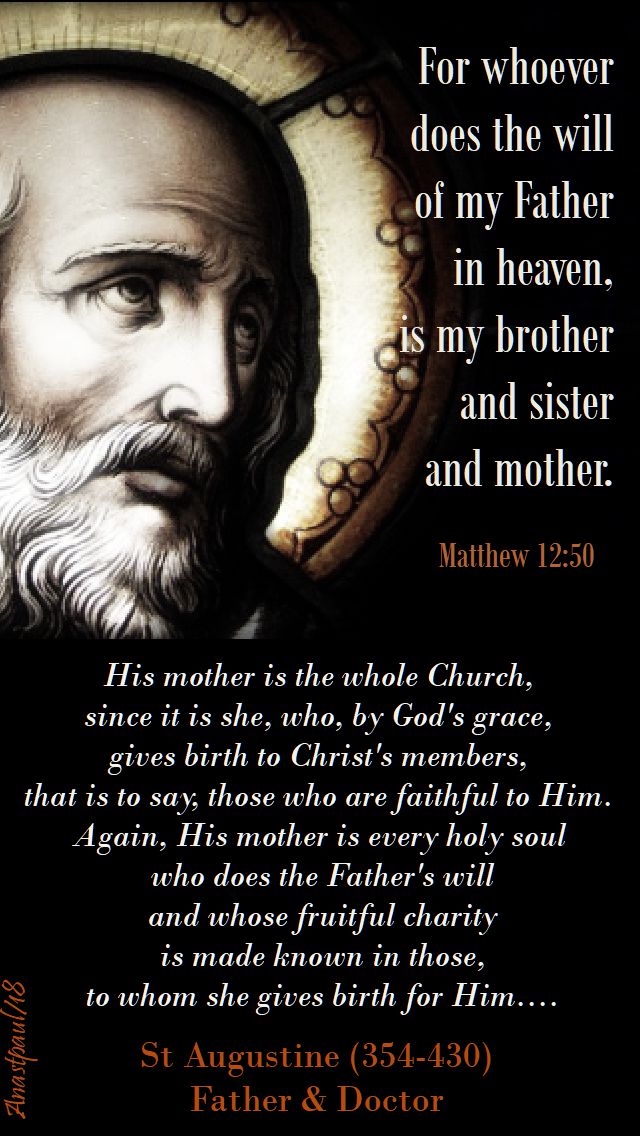
“For whoever does the will of my Father in heaven, is my brother and sister and mother.”
Matthew 12:50
“His mother is the whole Church, since it is she, who, by God’s grace, gives birth to Christ’s members, that is to say, those who are faithful to Him. Again, His mother is every holy soul, who does the Father’s will and whose fruitful charity is made known in those, to whom she gives birth for Him, “until he has been formed in them” (cf Gal 4:19).
St Augustine (354-430) Father & Doctor
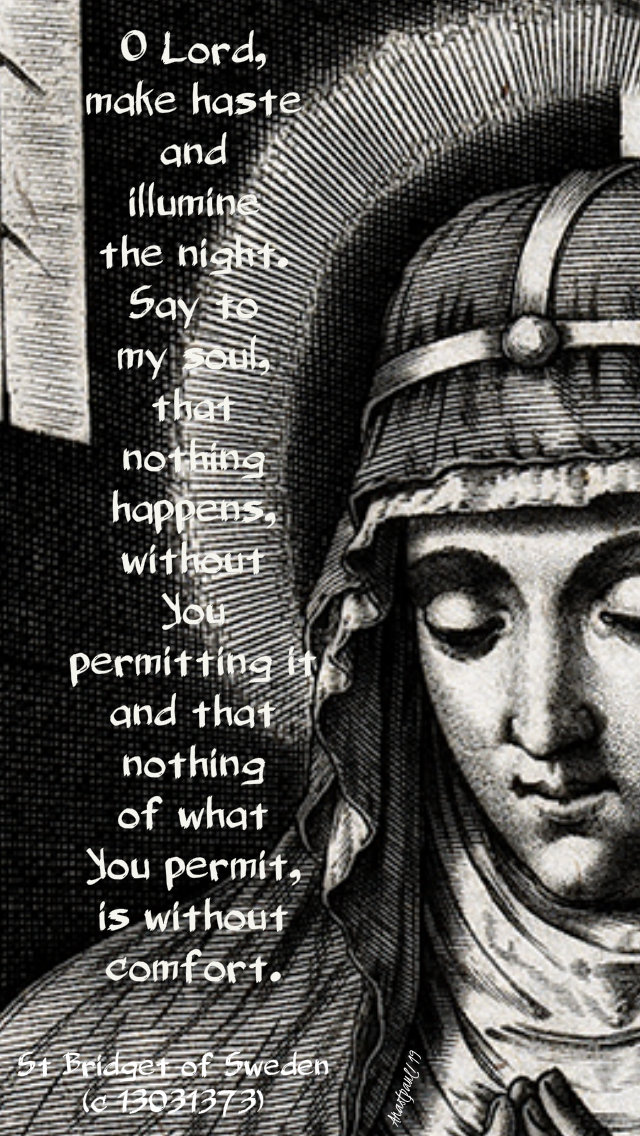
“O Lord, make haste and illumine the night. Say to my soul, that nothing happens, without You permitting it and that nothing of what You permit, is without comfort.”
St Bridget of Sweden (c 1303 – 1373)
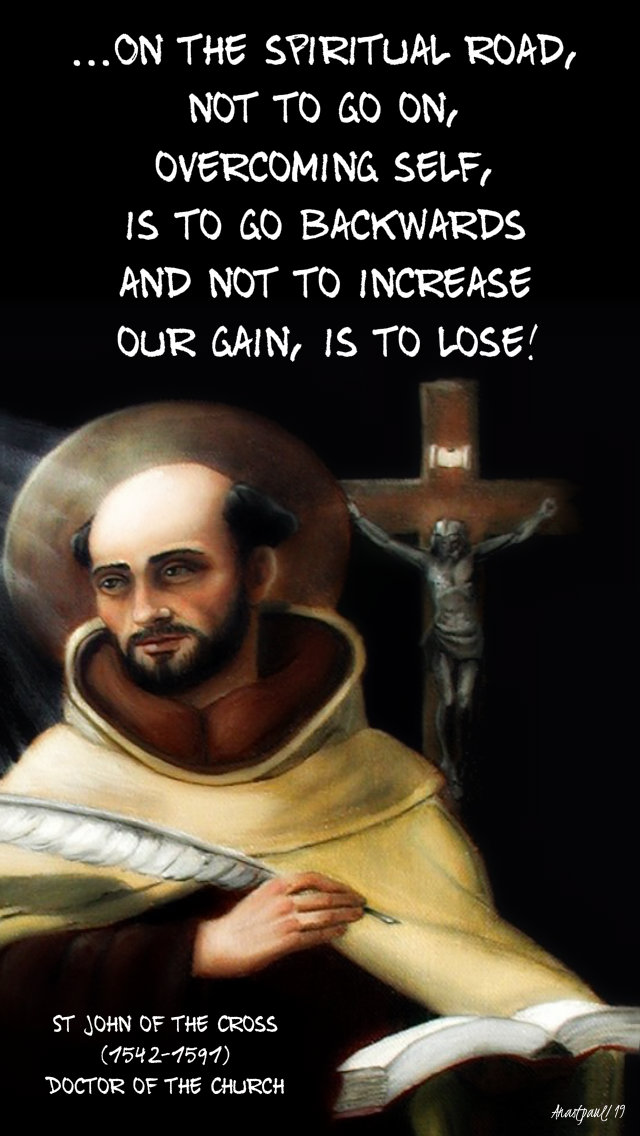
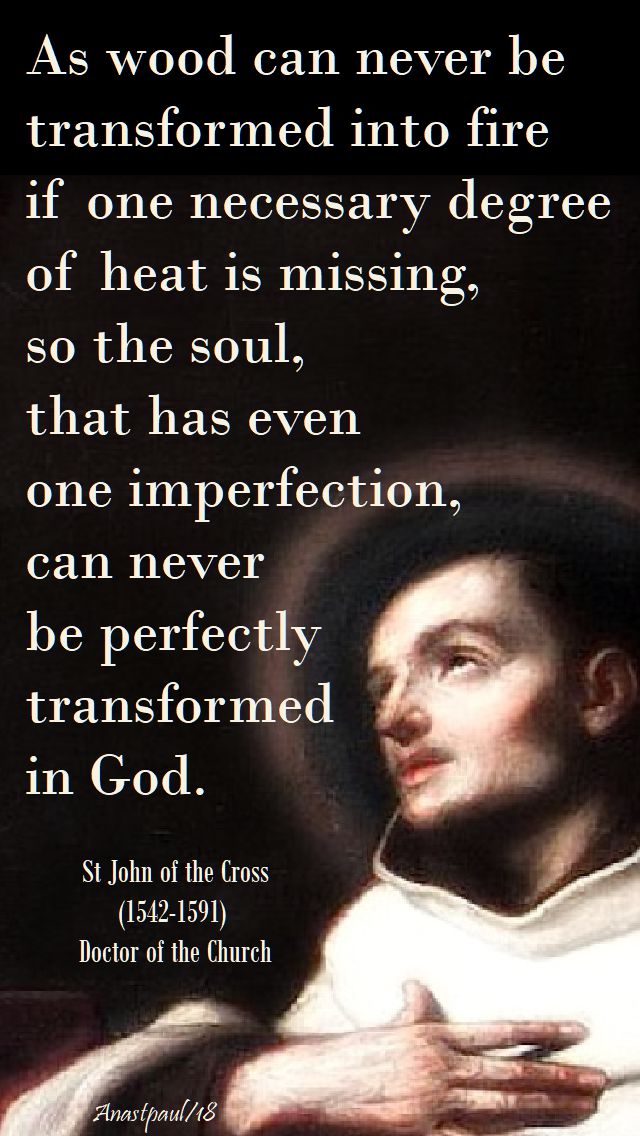
“It is a matter of real sorrow when God has given us strength to break stronger fetters, those of vanity and sin, that we neglect our own progress and the attainment of such great blessings, because we will not detach ourselves from trifles. Not only do we not advance, we fall back. For it is well known, that on the spiritual road, not to go on, overcoming self, is to go backwards and not to increase our gain, is to lose. As wood can never be transformed into fire, if one necessary degree of heat is missing, so the soul, that has even one imperfection, can never be perfectly transformed in God.”
St John of the Cross (1542-1591) Doctor of the Church
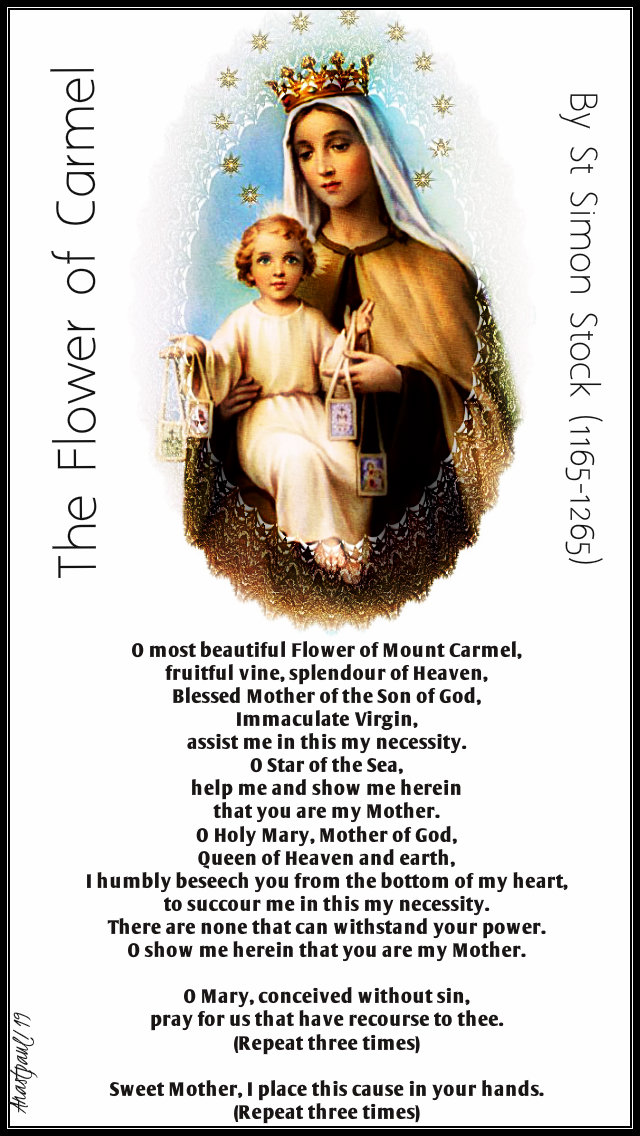
Our Morning Offering – 16 July – The Memorial of Our Lady of Mount Carmel
This prayer, also known as the “Flos Carmeli” (“The Flower of Carmel”), was composed by St Simon Stock (1165-1265), a Carmelite, so-called because he and other members of his order lived atop Mount Carmel in the Holy Land. St Simon Stock was visited by the Blessed Virgin Mary on 16 July 1251, at which time, she bestowed upon him a scapular, or habit, (commonly called “the Brown Scapular”), which became part of the liturgical clothing of the Carmelite order.
O most beautiful Flower of Mount Carmel,
fruitful vine, splendour of Heaven,
Blessed Mother of the Son of God,
Immaculate Virgin,
assist me in this my necessity.
O Star of the Sea,
help me and show me herein
that you are my Mother.
O Holy Mary, Mother of God,
Queen of Heaven and earth,
I humbly beseech you from the bottom of my heart,
to succour me in this my necessity.
There are none that can withstand your power.
O show me herein that you are my Mother.
O Mary, conceived without sin,
pray for us that have recourse to thee.
(Repeat three times)
Sweet Mother, I place this cause in your hands.
(Repeat three times)
Our Morning Offering – 12 July – The Memorial of Sts Louis & Zelie Martin – Parents of St Thérèse of the Child Jesus
Morning Offering By St Thérèse of the Child Jesus (1873-1897)
O my God!
I offer You all my actions of this day
for the intentions and for the glory
of the Sacred Heart of Jesus.
I desire to sanctify
every beat of my heart,
my every thought,
my simplest works,
by uniting them to Its infinite merits
and I wish to make reparation for my sins,
by casting them into the furnace
of Its Merciful Love.
O my God!
I ask You for myself and for those
whom I hold dear,
the grace to fulfil perfectly
Your Holy Will,
to accept for love of You
the joys and sorrows of this passing life,
so that we may one day be united together,
in Heaven for all Eternity.
Amen
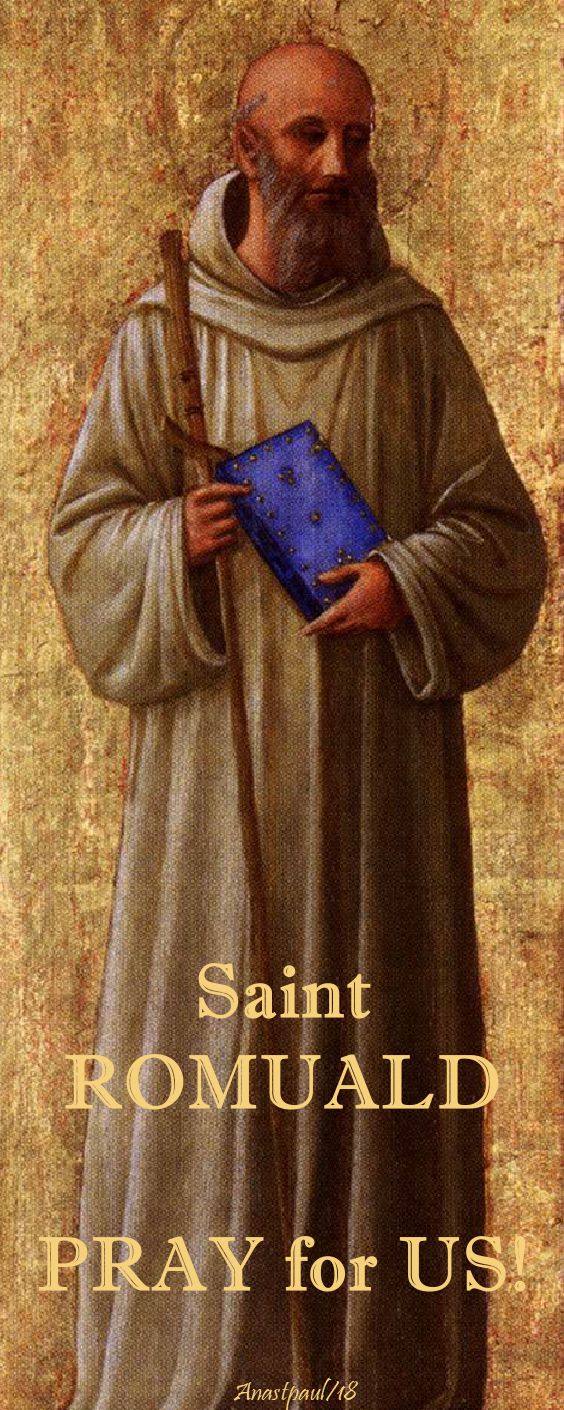
Thought for the Day – 19 June – Wednesday of the Eleventh Week in Ordinary Time, Year C, Gospel: Matthew 6:1–6 and the Memorial of St Romuald (c 951-1027)
“But when you pray, go into your room and shut the door and pray to your Father who is in secret and your Father, who sees in secret, will reward you.”...Matthew 6:6
“When you pray, go to your inner room”
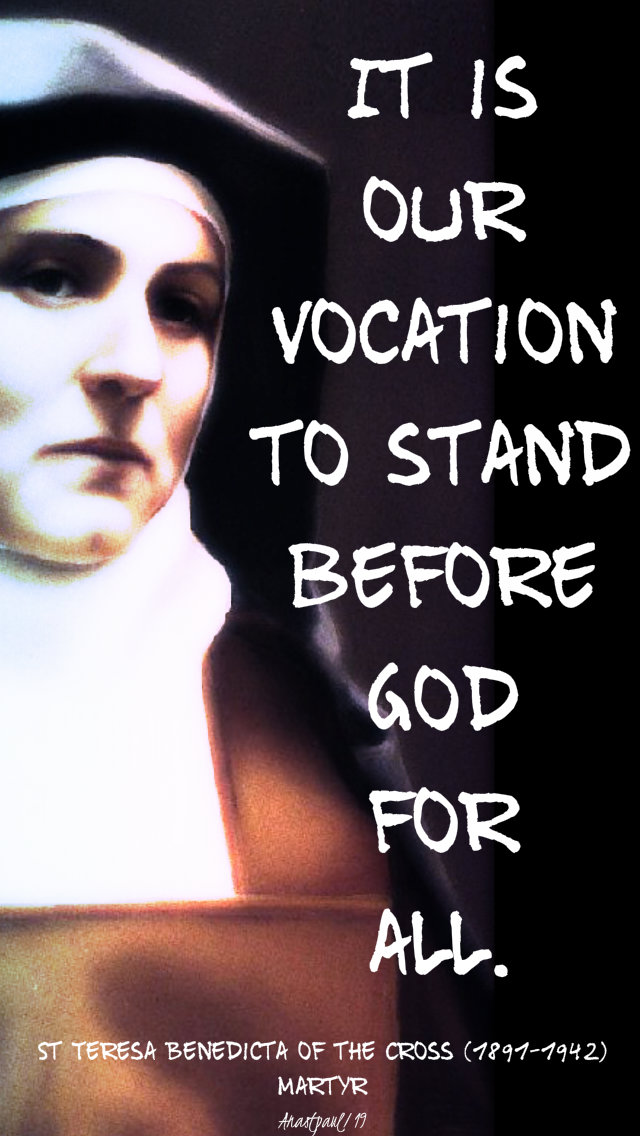
Saint Teresa Benedicta of the Cross [Edith Stein OCD (1891-1942)
Martyr, co-patron of Europe
The Prayer of the Church (trans. Darlington Carmel)
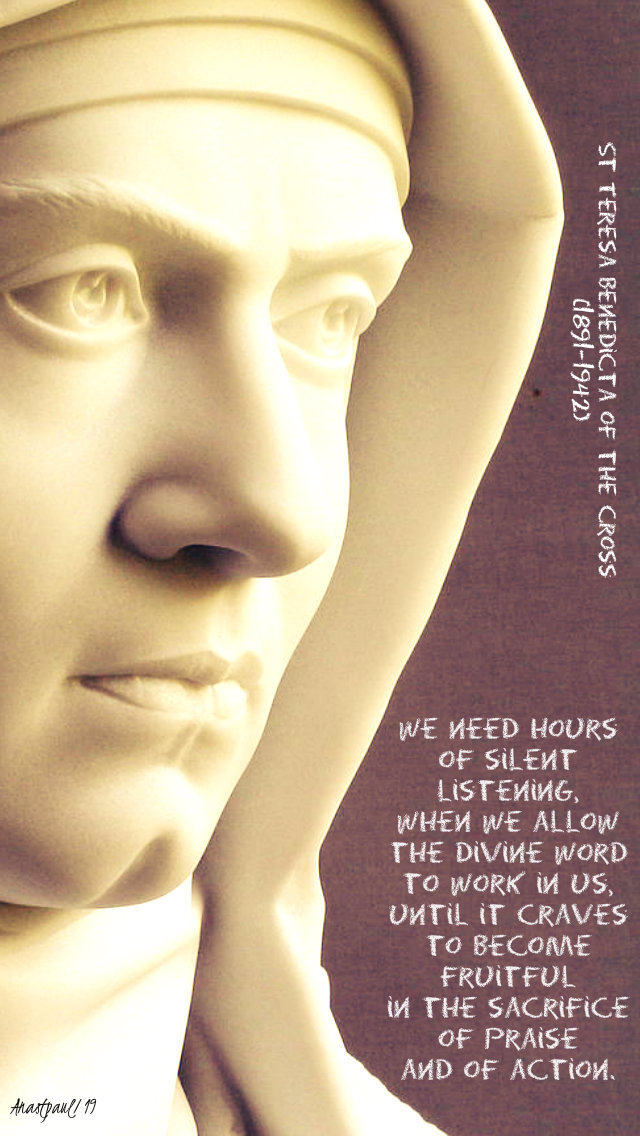
In those who have entered into the unity of the divine inner life, everything is one – rest and activity, contemplation and action, silence and speech, listening and communicating, loving receptiveness, and loving gift of self in thanksgiving and praise… We need hours of silent listening, when we allow the divine Word to work in us, until it craves to become fruitful in the sacrifice of praise and of action.
We need the traditional forms and participation in the set forms of acts of regular worship, so that the inner life can be awakened and guided and find a suitable expression. The solemn divine praise must have its homes on earth, where it is developed, to the greatest perfection possible, to human beings. From these, it ascends to heaven, for the whole Church and becomes effective in the members of the Church, quickening their interior life, inviting their participation. But, it must itself be quickened from within, even in these places, by leaving space for silence and depth. Otherwise it would degenerate into mere lip-service. Contemplative houses where souls stand in solitude and silence before the face of God, are a protection against this danger. They wish to be, in the heart of the Church, the love that vivifies all.
Sunday Reflection – 12 May – The Fourth Sunday of Easter, Year C
Saint Teresa of Avila (1515-1582)
Doctor of the Church
The Way of Perfection §34
As for ourselves, let us ask the Eternal Father, that we might merit to receive our heavenly bread in such a way, that the Lord may reveal Himself to the eyes of our soul and make Himself thereby known, since our bodily eyes cannot delight in beholding Him, because He is so hidden. Such a knowledge is another kind of satisfying and delightful sustenance that maintains life…
I know a person, to whom the Lord had given such living faith, that when she heard some persons saying, they would have liked to have lived at the time Christ our Good walked in the world, she used to laugh to herself. She wondered what more they wanted, since in the Blessed Sacrament, they had Him just as truly present as He was then… She considered she was at His feet and wept with the Magdalene, no more, nor less, than if she were seeing Him with her bodily eyes in the house of the Pharisee. And even though she didn’t feel devotion, faith told her that He was indeed there.
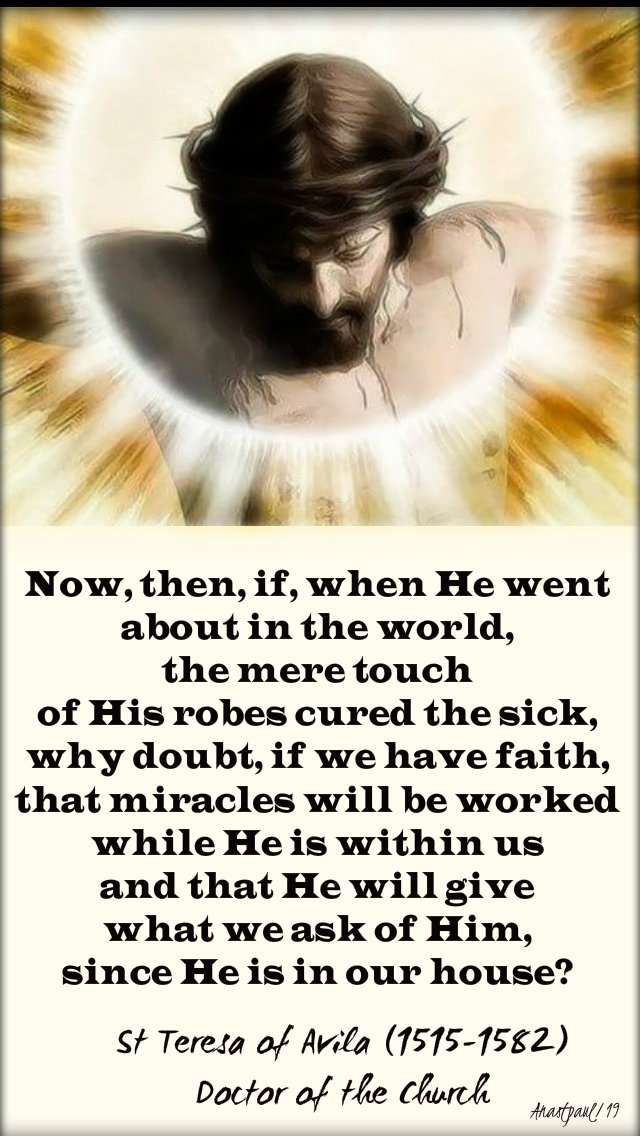
If we don’t want to be fools and blind the intellect, there’s no reason for doubt. Receiving communion is not like picturing with the imagination, as when we reflect upon the cross or in other episodes of the Passion, when we picture within ourselves how things happened to Him in the past. In communion, the event is happening now and it is entirely true. There’s no reason to go looking for Him in some other place farther away. Since we know that Jesus is with us, as long as the natural heat doesn’t consume the accidents of bread, we should approach Him. Now, then, if, when He went about in the world, the mere touch of His robes cured the sick, why doubt, if we have faith, that miracles will be worked while He is within us and that He will give what we ask of Him, since He is in our house?
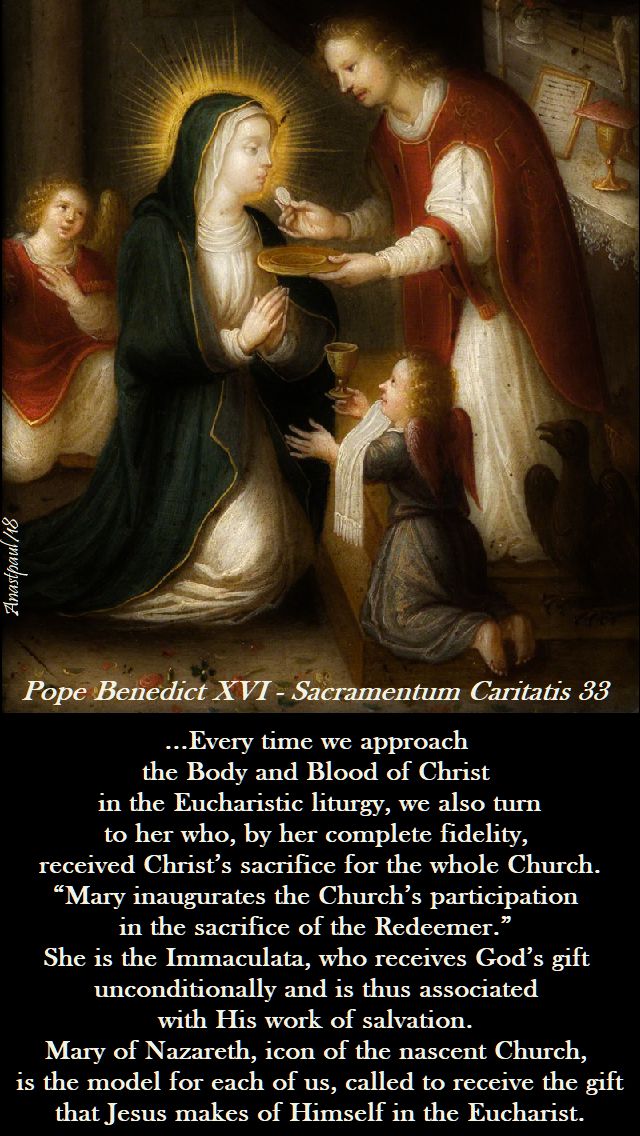
“Consequently, every time we approach the Body and Blood of Christ in the Eucharistic liturgy, we also turn to her who, by her complete fidelity, received Christ’s sacrifice for the whole Church. The Synod Fathers rightly declared that “Mary inaugurates the Church’s participation in the sacrifice of the Redeemer.” She is the Immaculata, who receives God’s gift unconditionally and is thus associated with His work of salvation. Mary of Nazareth, icon of the nascent Church, is the model for each of us, called to receive the gift that Jesus makes of Himself in the Eucharist.”
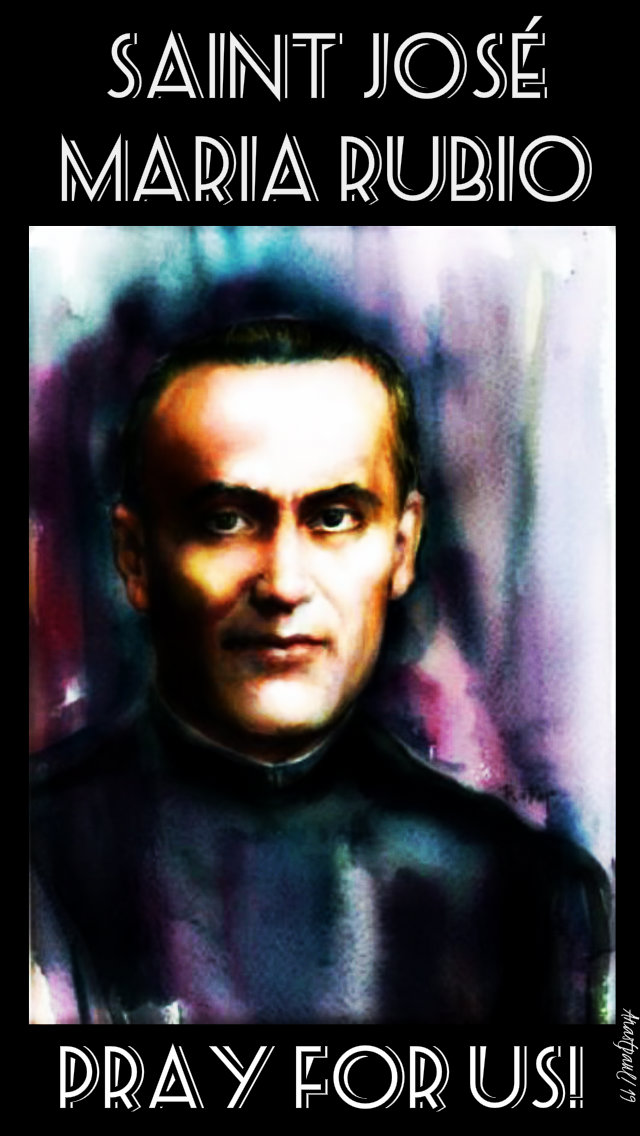
One Minute Reflection – 4 May – Mary’s Month and a Marian Saturday of the Second Week of Easter,Gospel: John 6:16–21 and the Memorial of St José Maria Rubio y Peralta SJ (1864-1929)
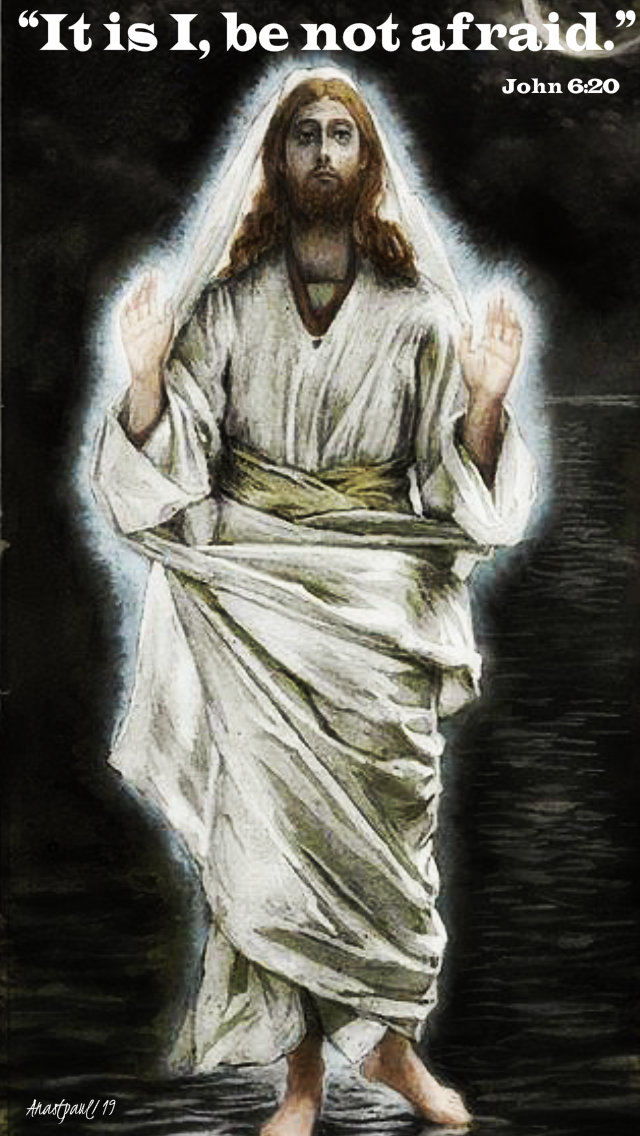
“It is I, be not afraid.”…John 6:20
REFLECTION – Saint Teresa Benedicta of the Cross [Edith Stein] (1891-1942) Carmelite, martyr, co-patron of Europe – “At the Helm”
Fierce are the waves, Lord, rough the seas,
And dark, so dark, the night.
I beg of You to grant me, please,
On lonely vigil, light.
Then steer your ship with steady arm,
Trust me and rest your soul.
Your little boat I’ll keep from harm,
I’ll guide it toward its goal.
Be firm of purpose as you keep
The compass e’er in view.
Through stormy night you’ll cross the deep,
’twill help you to steer true.
The needle trembles faintly, then
Holds steady and prevails;
It points your way and guides you when
I, God, direct your sails.
Be therefore steadfast, calm and true,
Your God is at your side.
Through storm and night He’ll see you through
With conscience as your guide.
PRAYER – Let us praise You Lord, with voice and mind and deed and since life itself is Your gift, may all we have and are, be Yours! May our Mother be with us and pray for us and listen, we pray, to the prayers of St José Maria Rubio as we ask his intercession. Through Christ our Lord, with the Holy Spirit, in union with You, one God for all eternity, amen.
One Minute Reflection – 29 April – Monday of the Second week of Easter, Year C, Gospel: John 3:1–8 and the Memorial of St Peter of Verona OP (1205–1252)
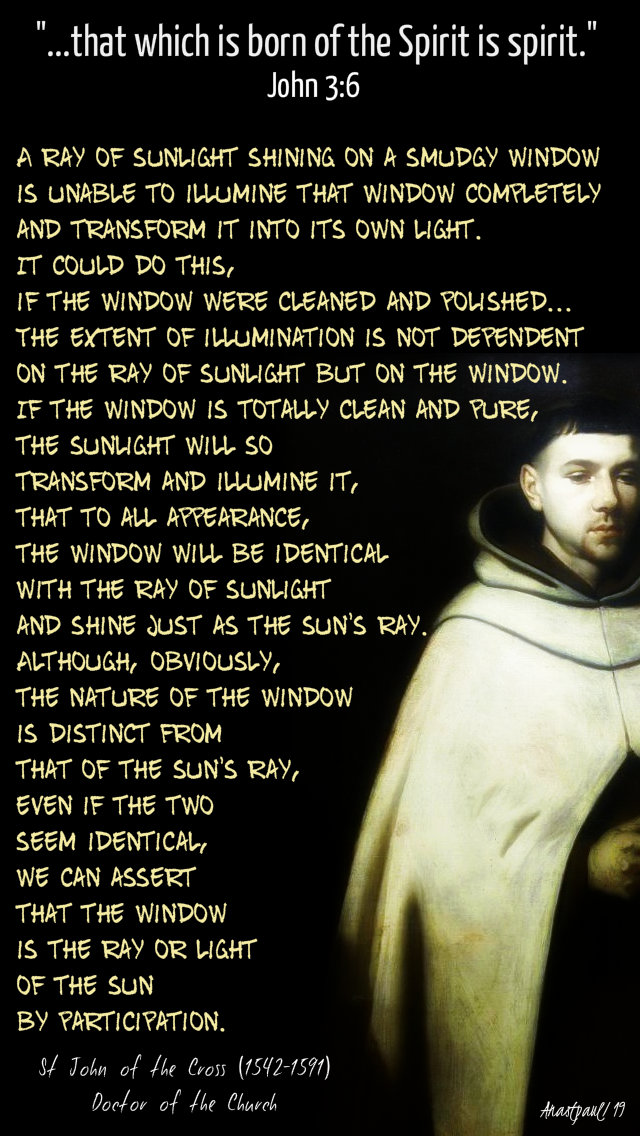
“…that which is born of the Spirit is spirit.”...John 3:6
REFLECTION – “We read in Saint John – No one can enter the Kingdom of God without being born of water and Spirit. To be reborn in the Holy Spirit during this life is to become most like God in purity, without any mixture of imperfection. Accordingly, pure transformation can be effected – although not essentially – through the participation of union.
Here is an example that will provide a better understanding of this explanation. A ray of sunlight shining on a smudgy window, is unable to illumine that window completely and transform it into its own light. It could do this, if the window were cleaned and polished… The extent of illumination is not dependent on the ray of sunlight but on the window. If the window is totally clean and pure, the sunlight will so transform and illumine it, that to all appearances the window will be identical with the ray of sunlight and shine just as the sun’s ray. Although, obviously, the nature of the window is distinct from that of the sun’s ray, even if the two seem identical, we can assert, that the window is the ray or light of the sun by participation.
The soul on which the divine light of God’s being is ever shining, or better, in which it is ever dwelling by nature, is like this window. A soul makes room for God by wiping away all the smudges and smears of creatures, by uniting its will perfectly to God’s, for to love is to labour, to divest and deprive oneself for God, of all that is not God. When this is done, the soul will be illumined by and transformed in God.”…St John of the Cross (1542-1591) Doctor of the Church
PRAYER – Almighty God and Father, grant that Your faithful people who were buried with Your Son in baptism, may by His Resurrection and intercession at Your right hand, obtain for us eternal life. Send Your Spirit upon Your adopted children and lead us in Your way. Grant that by the intercession of St Peter of Verona, our path may be straightened and glow with Your light. Through Christ our Lord, with the Holy Spirit, God forever, amen.
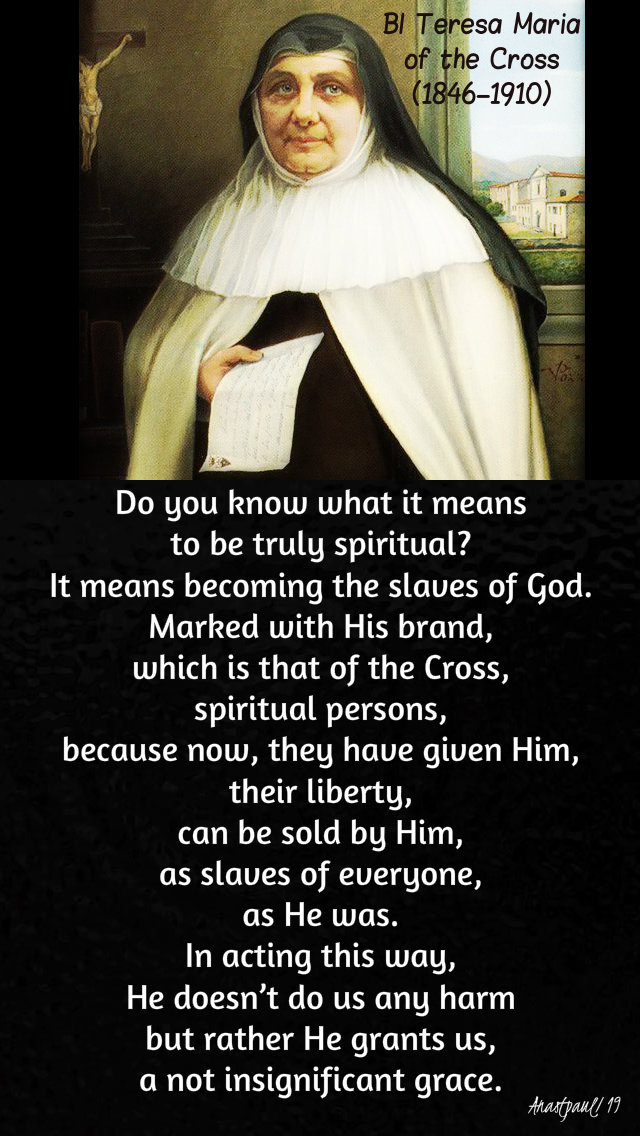
Quote/s of the Day – 23 April – the Memorial of Bl Teresa Maria of the Cross OCD (1846–1910)
Do you know what it means to be truly spiritual? It means becoming the slaves of God. Marked with His brand, which is that of the Cross, spiritual persons, because now, they have given Him, their liberty, can be sold by Him, as slaves of everyone, as He was. In acting this way, He doesn’t do us any harm but rather He grants us, a not insignificant grace.
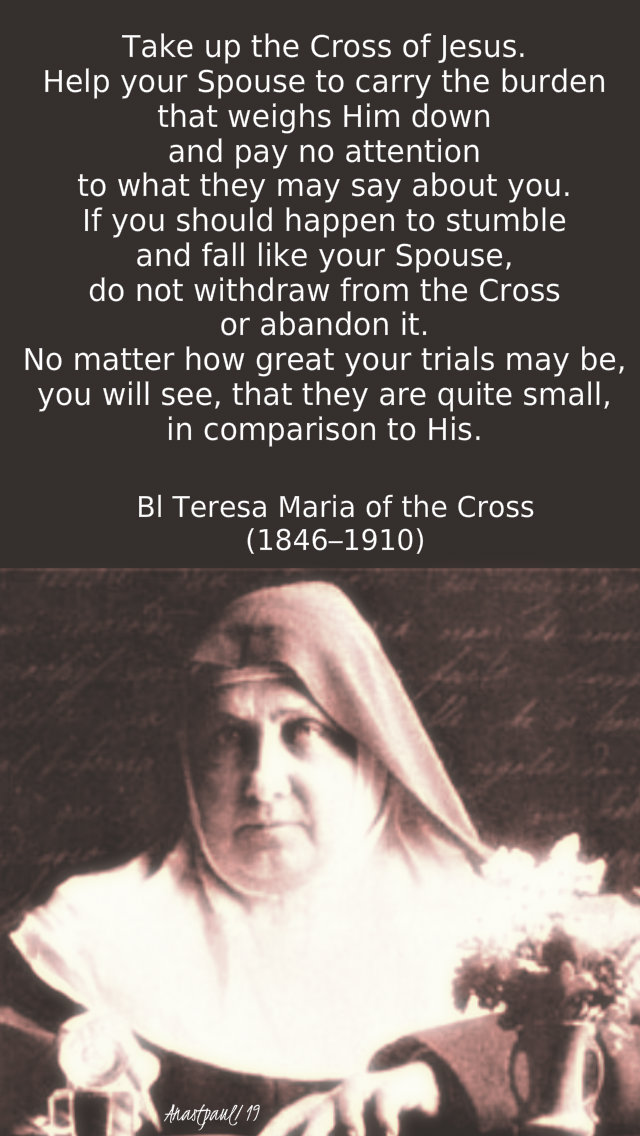
We have always seen, that those who were closest to Christ our Lord, were those with the greatest trials. Let us look at what His glorious Mother suffered and the glorious apostles. Take up the Cross of Jesus. Help your Spouse to carry the burden that weighs Him down and pay no attention to what they may say about you. If you should happen to stumble and fall like your Spouse, do not withdraw from the Cross or abandon it. No matter how great your trials may be, you will see, that they are quite small, in comparison to His.
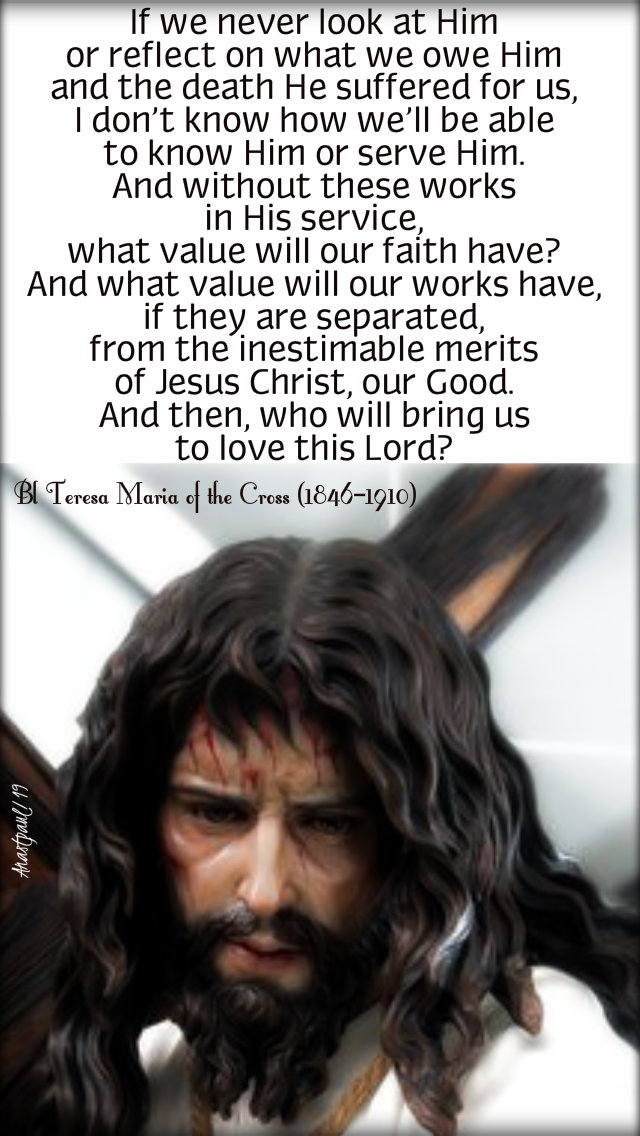
If we never look at Him or reflect on what we owe Him and the death He suffered for us, I don’t know how we’ll be able to know Him or serve Him. And without these works in His service, what value will our faith have? And what value will our works have, if they are separated, from the inestimable merits of Jesus Christ, our Good. And then, who will bring us to love this Lord?”
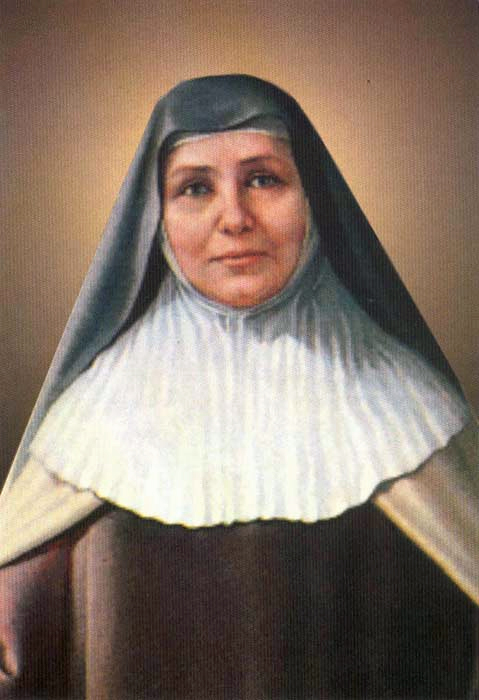
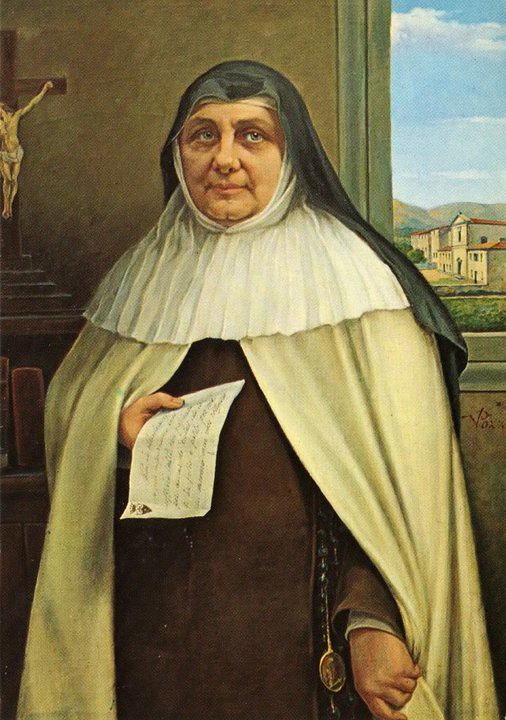
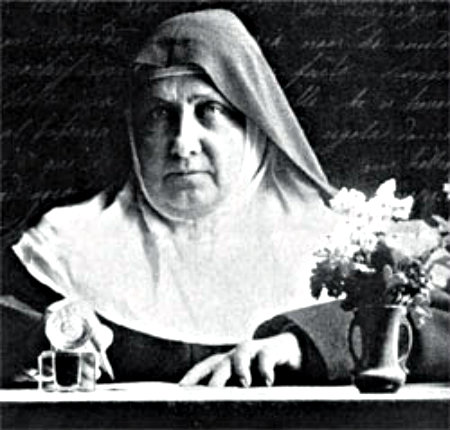
Saint of the Day – 23 April – Blessed Teresa Maria of the Cross OCD (1846–1910) Religious Nun of the Carmelite Order, Foundress of the Carmelite Sisters of Saint Teresa, Mystic, Adorer of the Holy Eucharist, Marian devotee, spiritaul advisor, teacher. Born on 2 March 1846 at Campi Bisenzio, Florence, Italy as Teresa Adelaide Cesina Manetti and died on 3 April 1910 at Campi Bisenzio, Florence, Italy of natural causes. Patronages – Carmelite Sisters of Saint Teresa, People ridiculed for their piety, Campi Bisenzio, Italy her birthplace.
Teresa Manetti, familiarly called Bettina, was born in the Tuscan countryside and raised among a simple family. She was the daughter of Salvatore Manetti and Rosa Bigagli, and had one brother, Adamo Raffaello. She lived her entire life in her small village.
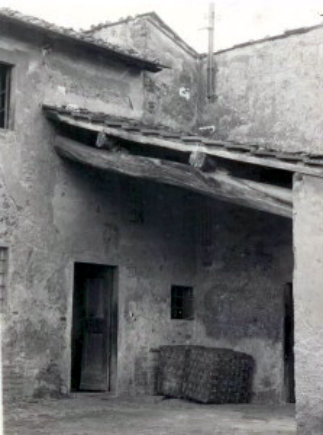
Birthplace of Blessed Teresa Maria
Bettina had a cheerful, energetic disposition and a talent for organisation and all the qualities which make for a good leader. At the age of 21, she rented a home with two other women who dedicated themselves to a life of prayer, penance and charity. They cared for the sick and the poor and taught catechism to children. They were inspired by the writings of Saint Teresa of Avila and had a special devotion to her. Many other women joined the small group. The women were admitted to the Teresian Third Order and Bettina took the new name of Teresa Maria of the Cross.
Two years later, she joined the Discalced Carmelites as a nun. Over the next few years she started schools in several Italian cities, each with it’s little group of Carmelite teachers. Her Institute of teaching nuns received approval from Pope Saint Pius X on 27 February 1904 as the Carmelite Sisters of Saint Teresa of Florence with a mission to teach and care for children, especially orphans. Like her inspiration, Saint Teresa of Avila, Teresa of the Cross met with much resistance to her work with the poor, much slander about her personal life and a long period of spiritual dryness but all who met her, commented on the air of joy and peace she brought to her work.
Under the wise guidance of Mother Teresa, the new congregation, animated by a true Carmelite spirit, went on expanding. In realisation of an old prophetic dream, with twelve houses opened in Tuscany, Teresa was able to add two on the Carmelite missions in Syria and one on the slopes Of Carmel, at Haifa. She gave individual attention to the foundations and to the religious, with the strength of a mother who wished her daughters to be poor and detached from everything, truly tending towards God alone as they served His orphans and little ones. She herself was the servant of all. Despite her own precarious health, she was forgetful of self as she sought to pour out joy and her smile upon all who approached her. The witnesses at the process of beatification are unanimous in declaring that everyone who met her was impressed by her trust in God and by her serene abandonment to Providence and felt himself the better person for it.
And as the years passed, Teresa was more and more besieged by crowds of people, especially on Sundays. Lines of persons of every class and condition awaited their turn to be heard and consoled by her. She was able to unite them to the Lord, give counsels of heavenly wisdom, heal ills which resisted the efforts of science, read hearts, see into the future, cut down distances, multiply goods and money. These are the «little flowers» that are in evidence on every page of the canonical processes, little flowers that, while they reveal charismatic facts, also show her exceptional availability for her neighbours, even at times of greatest pain. Bishop Andrew Cassullo, who had known her intimately, affirmed in her regard: “She undid herself doing good.”
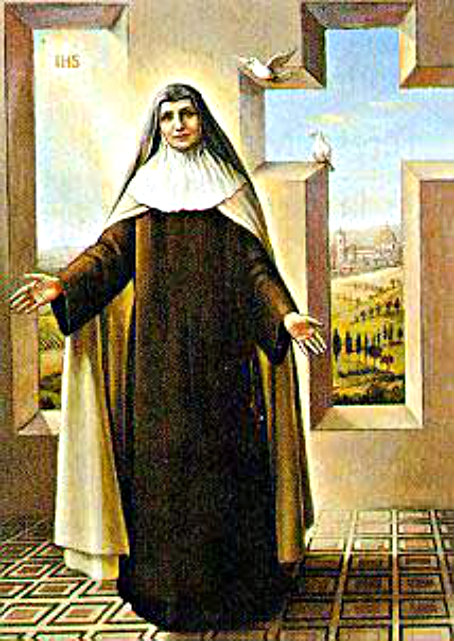
She lived joyfully, body and soul the mystery of the Cross in full conformity to the will of God. Teresa Maria was outstanding for her love for the Eucharist and her maternal care for children and for the poor. Her life was motivated by a consuming love for Christ and a desire to save souls. She endeavoured to live according to God’s holy will and took delight in all the crosses which came through this purpose. In a prayer she wrote:
“To suffer, to suffer, always suffer. Do what you want with me, it’s enough that I save souls for you.”
The source of such a dedication was her life of faith and of theological charity, the great virtues of her life which nourished her Eucharistic fervour and gave her the strength to live out her religious name, of the Cross, in its deepest significance. She lived on prayer and she had the gift of a continual communion with the Lord, so that, as one witness recalls in regard to a personal affirmation of the servant of God, “for her it was the same to be enclosed in a convent or to deal with people, because everywhere she felt herself united to God.” This habitual union found its nourishment in Eucharistic piety. She had great devotion for the Eucharist even as a child. During the institute’s first years she went into ecstasy almost every day after Communion, later, too, in the Eucharistic presence she felt something that drew her out of herself.
One of her great hopes was a house entirely dedicated to the perpetual adoration of the Eucharist. She was able to realise this in Florence, where on 11 January 1902, in the church of Corpus Domini, which she had built, the Blessed Sacrament was solemnly exposed. It was in contact with Christ that her apostolic desires increased, hence she exclaimed: “I should like to make all hearts into one and plunge it into the heart of Jesus.” Moreover, the love of Jesus bound her more intimately to Our Lady, whose tenderness and care for Jesus she herself wished to have. Happy to be a Carmelite, she saw in her Carmelite vocation a commitment to belong to Our Lady more deeply and to spread devotion to her.
She died at Campi Bisenzio on 23 April 1910 and was beatified on October 1986 by St Pope John Paul II after the approval of the required miracle.






 He is also said to have written books, though none survive and he is regarded as patron of Carmelite studies. The order recognised his many and outstanding abilities. He attended the General Chapter at Bruges in 1297, in the capacity as Superior. However, he spent the last years of his life before his death in 1307, living in a hermitage near Messina.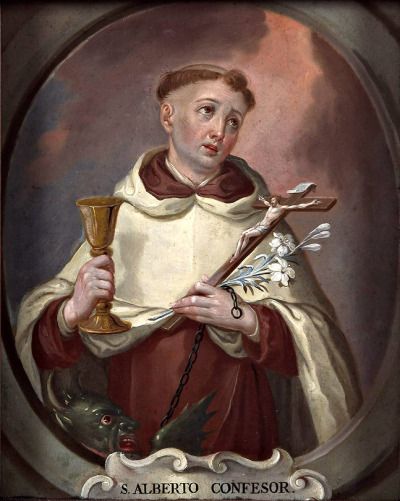






You must be logged in to post a comment.