Posted in CATECHESIS, DOCTORS of the Church, ON the SAINTS, PAPAL SERMONS, QUOTES of the SAINTS, SAINT of the DAY

Thought for the Day – 28 January – The Memorial of St Thomas Aquinas (1225-1274) Doctor angelicus (Angelic Doctor) and Doctor communis (Common Doctor)

Thought for the Day – 28 January – The Memorial of St Thomas Aquinas (1225-1274) Doctor angelicus (Angelic Doctor) and Doctor communis (Common Doctor)

Pope John Paul II, recalled that “the Church has been justified in consistently proposing St Thomas as a master of thought and a model of the right way to do theology” (n. 43).   It is not surprising that, after St Augustine, among the ecclesiastical writers mentioned in the Catechism of the Catholic Church, St Thomas is cited more than any other, at least 61 times!   He was also called the Doctor Angelicus, perhaps because of his virtues and, in particular, the sublimity of his thought and the purity of his life.

The last months of Thomas’ earthly life remain surrounded by a particular, I would say, mysterious atmosphere.   In December 1273, he summoned his friend and secretary Reginald to inform him of his decision to discontinue all work because he had realised, during the celebration of Mass subsequent to a supernatural revelation, that everything he had written until then “was worthless”.   This is a mysterious episode that helps us to understand not only Thomas’ personal humility but also the fact that, however lofty and pure it may be, all we manage to think and say about the faith is infinitely exceeded by God’s greatness and beauty which will be fully revealed to us in Heaven.

The life and teaching of St Thomas Aquinas could be summed up in an episode passed down by his ancient biographers.   While, as was his wont, the Saint was praying before the Crucifix in the early morning in the chapel of St Nicholas in Naples, Domenico da Caserta, the church sacristan, overheard a conversation.   Thomas was anxiously asking whether what he had written on the mysteries of the Christian faith was correct.   And the Crucified One answered him:  “You have spoken well of me, Thomas. What is your reward to be?”.   And the answer Thomas gave him was what we too, friends and disciples of Jesus, always want to tell him:  “Nothing but Yourself, Lord!”…Pope Benedict XVI – First in the series of Catechesis on St Thomas Aquinas – 2 June 2010

 “Nothing but Yourself, Lord!”

St Thomas Aquinas, pray for us!st thomas aquinas - pray for us - 28 jan 2018


Posted in ADVENT, CATECHESIS, DOCTORS of the Church, EUCHARISTIC Adoration, FATHERS of the Church, MORNING Prayers, QUOTES of the SAINTS, QUOTES on CHARITY, The HOLY EUCHARIST / The HOLY MASS

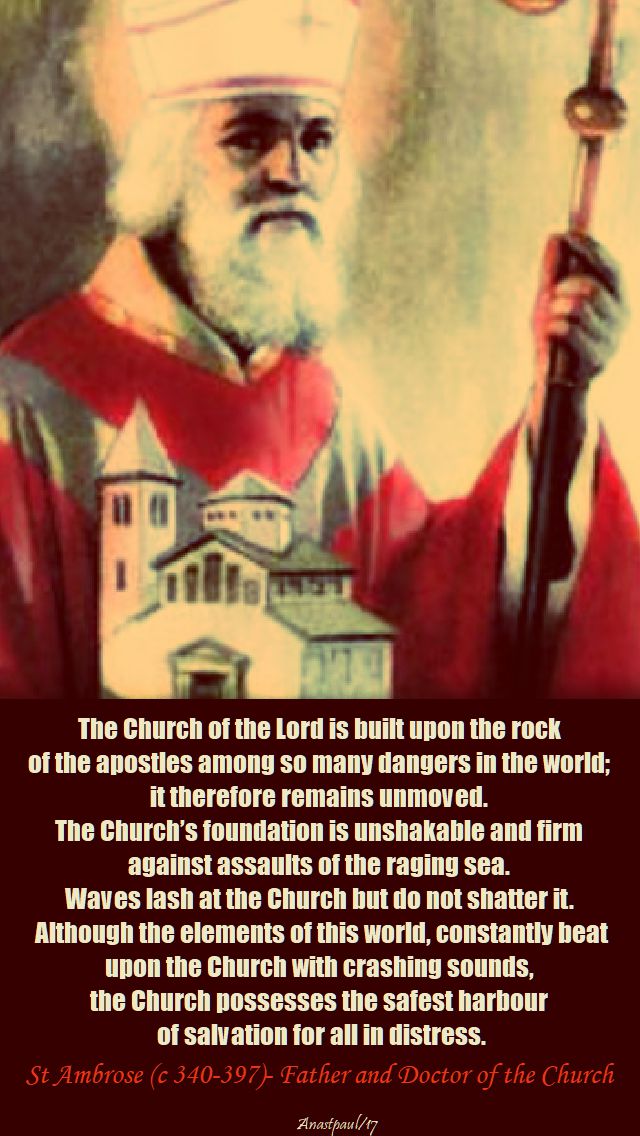
Quote/s of the Day – 7 December – The Memorial of St Ambrose (c 340-397)- Father and Doctor of the Church

Quote/s of the Day – 7 December – The Memorial of St Ambrose (c 340-397)- Father and Doctor of the Church

“The Church of the Lord is built upon the rock
of the apostles among so many dangers in the world;
it therefore remains unmoved.
The Church’s foundation is unshakable and firm
against assaults of the raging sea.
Waves lash at the Church but do not shatter it.
Although the elements of this world, constantly beat
upon the Church with crashing sounds,
the Church possesses the safest harbour
of salvation for all in distress.”

the church of the lord - st ambrose - 7 dec 2017

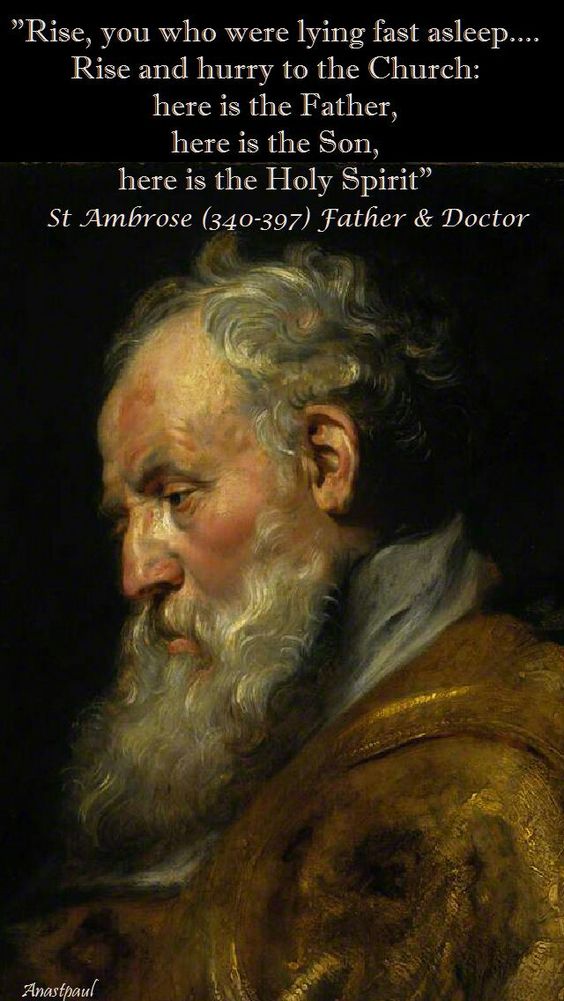
“Rise, you who were lying fast asleep…
Rise and hurry to the Church:
here is the Father,
here is the Son,
here is the Holy Spirit.”

rise you who were lying fast asleep - st ambrose - my pic 2017

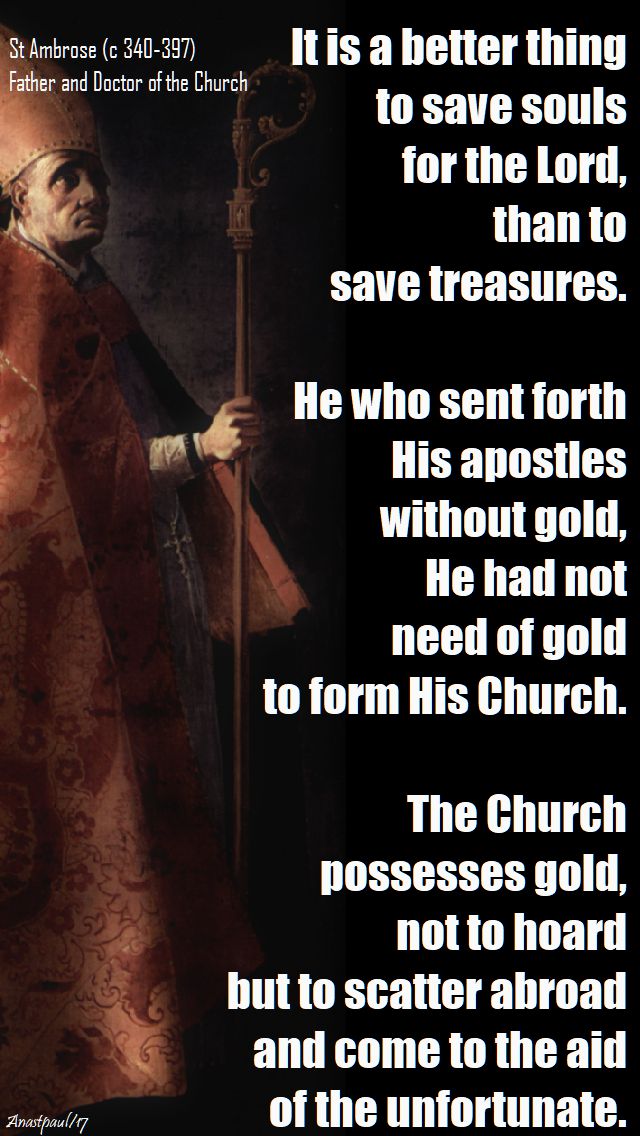
“It is a better thing
to save souls for the Lord,
than to save treasures.
He who sent forth
His apostles without gold,
He had not need of gold
to form His Church.
The Church possesses gold,
not to hoard
but to scatter abroad
and come to the aid
of the unfortunate.”

it is a better thing - st ambrose - 7 dec 2017

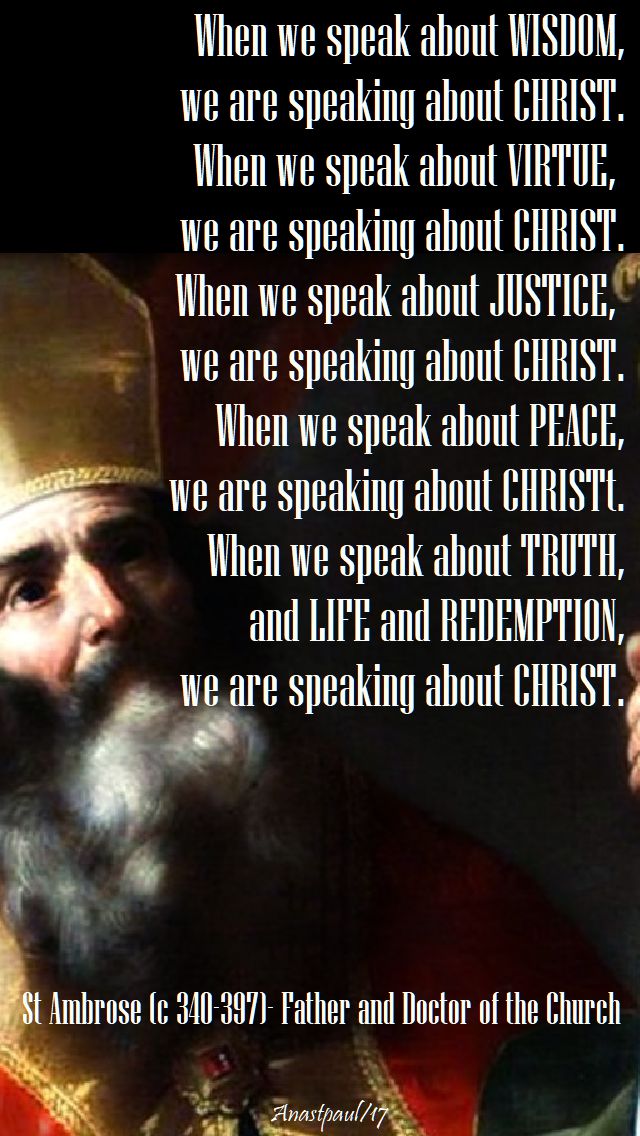
“When we speak about WISDOM,
we are speaking about CHRIST.
When we speak about VIRTUE,
we are speaking about CHRIST.
When we speak about JUSTICE,
we are speaking about CHRIST.
When we speak about PEACE,
we are speaking about CHRISTt.
When we speak about TRUTH,
and LIFE and REDEMPTION,
we are speaking about CHRIST.”

when we speak - st ambrose - 7 dec 2017

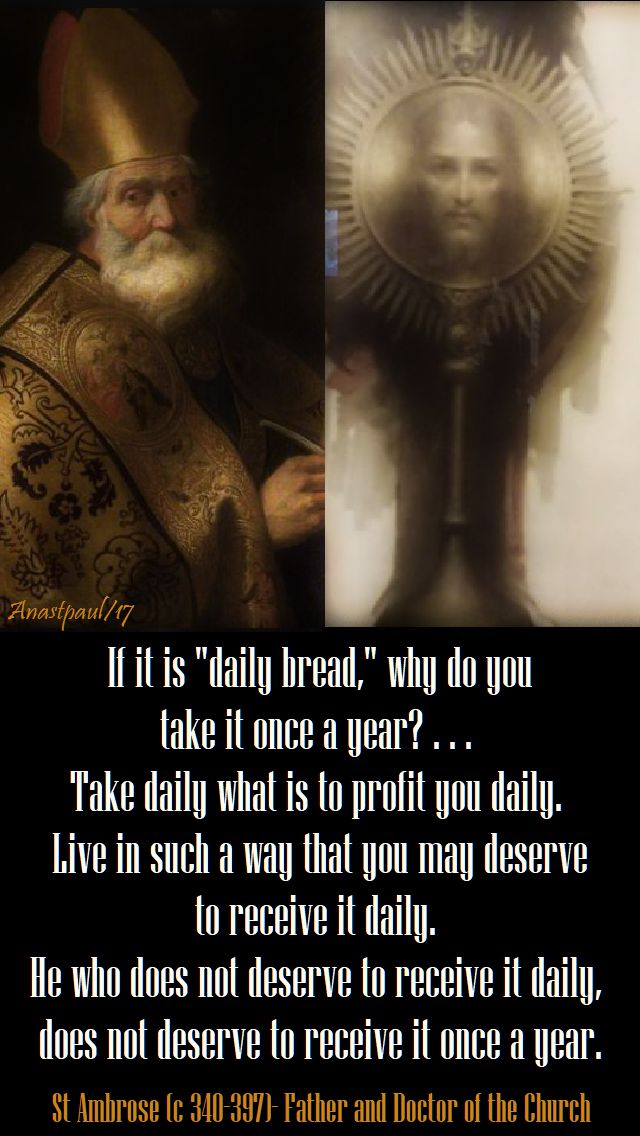
“If it is “daily bread,” why do you take it once a year? . . .
Take daily what is to profit you daily.
Live in such a way that you may deserve
to receive it daily.
He who does not deserve to receive it daily,
does not deserve to receive it once a year.”

if it ias daily - st ambrose - 7 dec 2017

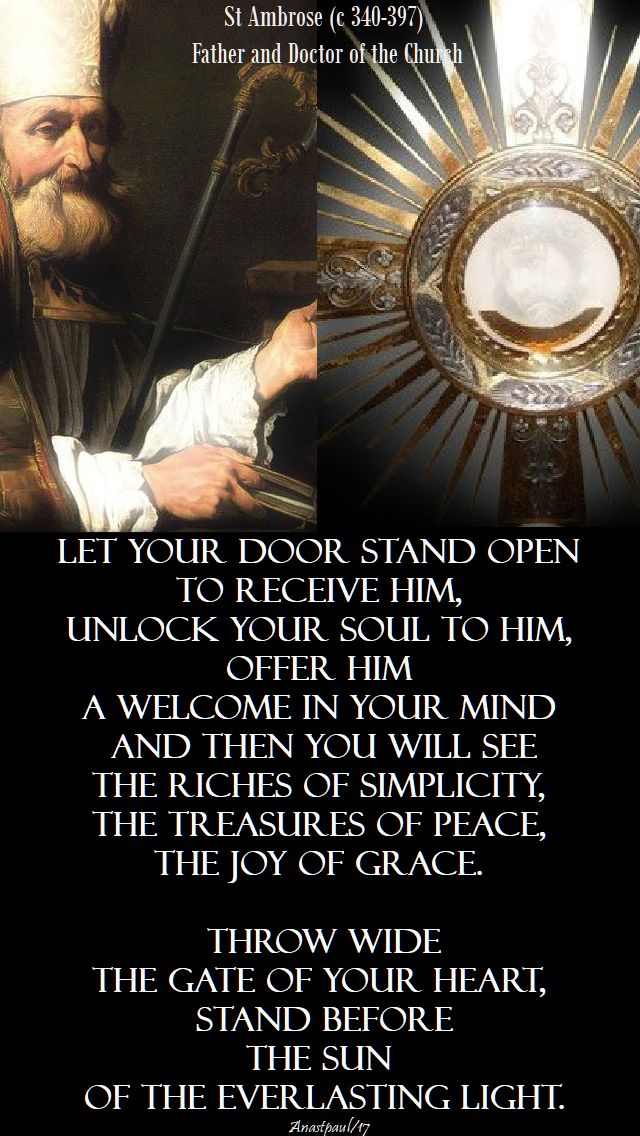
“Let your door stand open
to receive Him,
unlock your soul to Him,
offer Him a welcome in your mind
and then you will see
the riches of simplicity,
the treasures of peace,
the joy of grace.
Throw wide the gate of your heart,
stand before the sun of the everlasting light.”

let your door stand open - st ambrose - 7 dec 2017

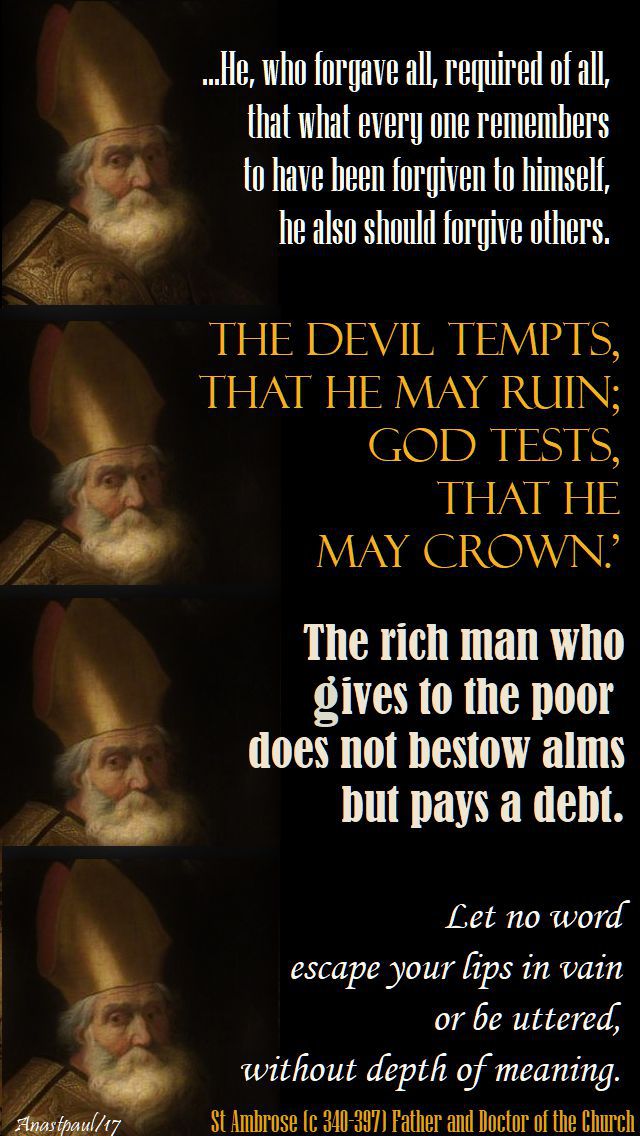
“…He, who forgave all, required of all,
that what every one remembers
to have been forgiven to himself,
he also should forgive others.”

“The devil tempts, that he may ruin;
God tests, that He may crown.”

“The rich man who gives to the poor
does not bestow alms but pays a debt.”

“Therefore, let your words be rivers, clean and limpid,
so that you may charm the ears of people.
And by the grace of your words win them over
to follow your leadership.
…. That is, let the meaning of your words shine forth,
let understanding blaze out.
Let no word escape your lips in vain or be uttered,
without depth of meaning.”  from a letter by Saint Ambrose

St Ambrose (c 340-397)- Father and Doctor of the Church

he, who forgave all - st ambrose - 7 dec 2017

Posted in CATECHESIS, CATHOLIC Quotes, DOCTORS of the Church, MORNING Prayers, QUOTES of the SAINTS, SAINT of the DAY, The HOLY CROSS, The HOLY EUCHARIST / The HOLY MASS

Quote/s of the Day – 10 November – The Memorial of St Pope Leo the Great (c400-461) Doctor of the Church

Quote/s of the Day – 10 November – The Memorial of St Pope Leo the Great (c400-461) Doctor of the Church

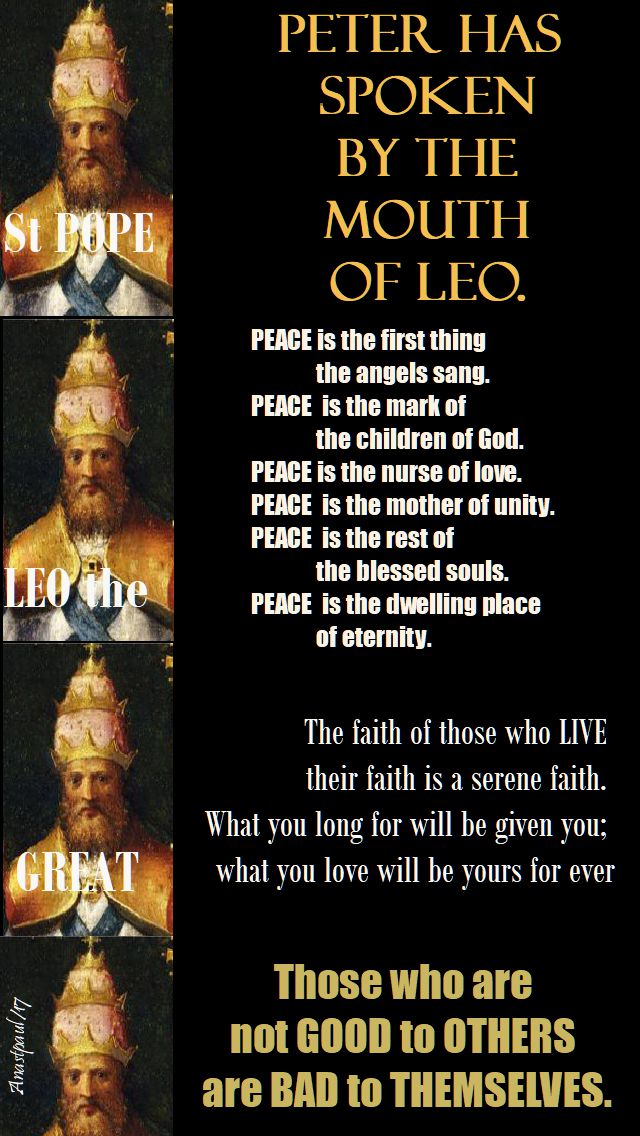
“Peter has spoken by the mouth of Leo.”

“Those who are not good to others
are bad to themselves.”

“PEACE is the first thing the angels sang.
PEACE is the mark of the children of God.
PEACE is the nurse of love.
PEACE is the mother of unity.
PEACE is the rest of the blessed souls.
PEACE is the dwelling place of eternity.”

“The faith of those who LIVE
their faith is a serene faith.
What you long for will be given you;
what you love will be yours for ever.”quotes of st pope leo the great - peter has spoken - 10 nov 2017

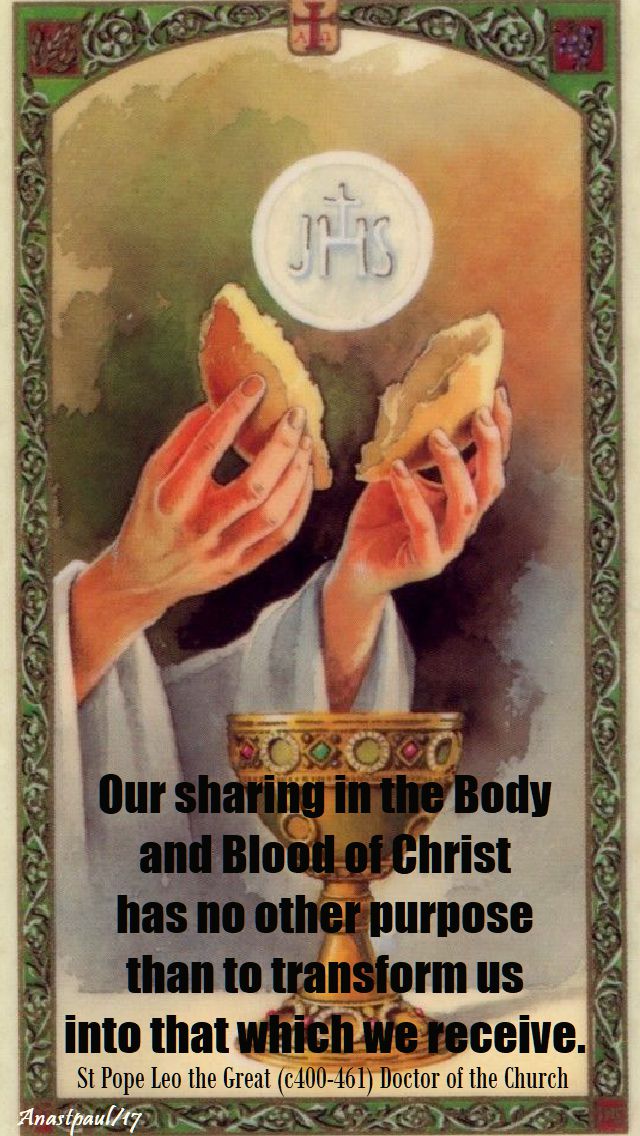
“Our sharing in the Body and Blood of Christ
has no other purpose than to transform us
into that which we receive.”our sharing in the body - st leo - 10 nov 2017

“God decreed that all nations should be saved in Christ.
Dear friends, now that we have received instruction
in this revelation of God’s grace, let us celebrate
with spiritual joy the day of our first harvesting,
of the first calling of the Gentiles.
Let us give thanks to the merciful God,
“who has made us worthy,” in the words of the Apostle,
“to share the position of the saints in light;
who has rescued us from the power of darkness
and brought us into the kingdom of this beloved Son.”
This came to be fulfilled, as we know, from the time
when the star beckoned the three wise men
out of their distant country and led them to recognise
and adore the King of heaven and earth.
The obedience of the star calls us
to imitate its humble service:
to be servants, as best we can,
of the grace that invites all men to find Christ.”god decreed - st leo the great - 10 nov 2017

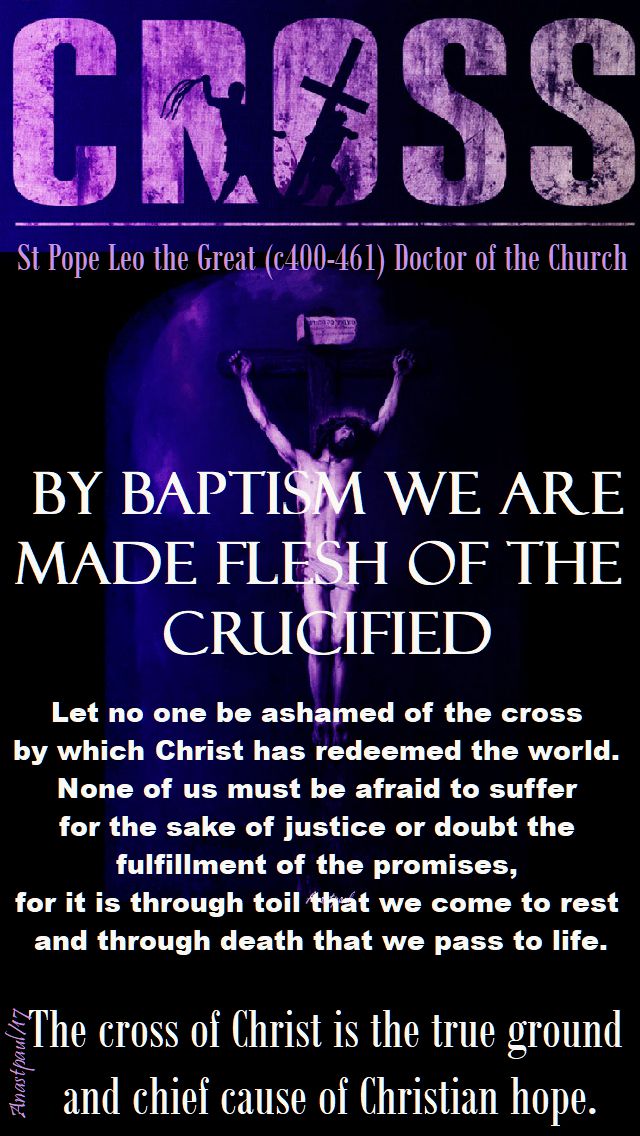
“The cross of Christ is the true ground
and chief cause of Christian hope.”

“Let no one be ashamed of the cross
by which Christ has redeemed the world.
None of us must be afraid to suffer
for the sake of justice or doubt the
fulfillment of the promises,
for it is through toil that we come to rest
and through death that we pass to life.”

“By Baptism we are made flesh of the Crucified.”by baptism - st leo the great - quotes on the cross - 10 nov 2017

“No-one, however weak, is denied
a share in the victory of the cross.
No-one is beyond the help
of the prayer of Christ.”no-one however weak - st pope leo - 10 nov 2017

St Pope Leo the Great (c400-461) Doctor of the Church

Posted in ArchAngels and Angels, CATECHESIS, DOCTORS of the Church, FEASTS and SOLEMNITIES, MORNING Prayers, SAINT of the DAY, The WORD, Uncategorized

Thought for the Day – 29 September – The Feast of Sts Michael, Gabriel and Raphael

Thought for the Day – 29 September – The Feast of Sts Michael, Gabriel and Raphael

We are celebrating the Feast of the three Archangels who are mentioned by name in Scripture: Michael, Gabriel and Raphael.   But what is an Angel?   Sacred Scripture and the Church’s tradition enable us to discern two aspects.

On the one hand, the Angel is a creature who stands before God, oriented to God with his whole being.   All three names of the Archangels end with the word “El”, which means “God”.   God is inscribed in their names, in their nature.
Their true nature is existing in His sight and for Him.   In this very way the second aspect that characterizes Angels is also explained:  they are God’s messengers.   They bring God to men, they open heaven and thus open earth.  Precisely because they are with God, they can also be very close to man.

Like an angel to others
Indeed, God is closer to each one of us than we ourselves are.   The Angels speak to man of what constitutes his true being, of what in his life is so often concealed and buried. They bring him back to himself, touching him on God’s behalf.   In this sense, we human beings must also always return to being angels to one another – angels who turn people away from erroneous ways and direct them always, ever anew, to God.
If the ancient Church called Bishops “Angels” of their Church, she meant precisely this: Bishops themselves must be men of God, they must live oriented to God. “Multum orat pro populo” – “Let them say many prayers for the people”, the Breviary of the Church says of holy Bishops.   The Bishop must be a man of prayer, one who intercedes with God for human beings.   The more he does so, the more he also understands the people who are entrusted to him and can become an angel for them – a messenger of God who helps them to find their true nature by themselves, and to live the idea that God has of them.

St Michael:  making a space for God in the world
All this becomes even clearer if we now look at the figures of the three Archangels whose Feast the Church is celebrating today.  First of all there is Michael.   We find him in Sacred Scripture above all in the Book of Daniel, in the Letter of the Apostle St Jude Thaddeus and in the Book of Revelation.

Two of this Archangel’s roles become obvious in these texts.   He defends the cause of God’s oneness against the presumption of the dragon, the “ancient serpent”, as John calls it.   The serpent’s continuous effort is to make men believe that God must disappear so that they themselves may become important;   that God impedes our freedom and, therefore, that we must rid ourselves of him.

However, the dragon does not only accuse God.   The Book of Revelation also calls it “the accuser of our brethren…, who accuses them day and night before our God” (12: 10). Those who cast God aside do not make man great but divest him of his dignity.   Man then becomes a failed product of evolution.   Those who accuse God also accuse man. Faith in God defends man in all his frailty and short-comings:  God’s brightness shines on every individual.   It is the duty of the Bishop and of every christian, as a man of God, to make room in the world for God, to counter the denials of Him and thus to defend man’s greatness.   And what more could one say and think about man than the fact that God Himself was made man?   Michael’s other role, according to Scripture, is that of protector of the People of God (cf. Dn 10: 21; 12: 1).
Dear friends, be true “guardian angels” of the Church which will be entrusted to you! Help the People of God whom you must lead in its pilgrimage to find the joy of faith and to learn to discern the spirits: to accept good and reject evil, to remain and increasingly to become, by virtue of the hope of faith, people who love in communion with God-Love.

St Gabriel: God who calls
We meet the Archangel Gabriel especially in the precious account of the annunciation to Mary of the Incarnation of God, as Luke tells it to us (1: 26-38).   Gabriel is the messenger of God’s Incarnation.   He knocks at Mary’s door and, through him, God himself asks Mary for her “yes” to the proposal to become the Mother of the Redeemer, of giving her human flesh to the eternal Word of God, to the Son of God.   The Lord knocks again and again at the door of the human heart.   In the Book of Revelation He says to the “angel” of the Church of Laodicea and, through him, to the people of all times:  “Behold, I stand at the door and knock; if any one hears my voice and opens the door, I will come in to him and eat with him, and he with me” (3: 20).   The Lord is at the door – at the door of the world and at the door of every individual heart.   He knocks to be let in, the Incarnation of God, His taking flesh, must continue until the end of time.  All must be reunited in Christ in one body –  the great hymns on Christ in the Letters to the Ephesians and to the Colossians tell us this. Christ knocks.   Today too He needs people who, so to speak, make their own flesh available to Him, give Him the matter of the world and of their lives, thus serving the unification between God and the world, until the reconciliation of the universe.   Dear friends, it is your task to knock at people’s hearts in Christ’s Name.   By entering into union with Christ yourselves, you will also be able to assume Gabriel’s role: to bring Christ’s call to men.

St Raphael: recovering sight
St Raphael is presented to us, above all in the Book of Tobit, as the Angel to whom is entrusted the task of healing.   When Jesus sends His disciples out on a mission, the task of proclaiming the Gospel is always linked with that of healing.   The Good Samaritan, in accepting and healing the injured person lying by the wayside, becomes without words a witness of God’s love.   We are all this injured man, in need of being healed.   Proclaiming the Gospel itself already means healing in itself, because man is in need of truth and love above all things.

The Book of Tobit refers to two of the Archangel Raphael’s emblematic tasks of healing. He heals the disturbed communion between a man and a woman.  He heals their love. He drives out the demons who over and over again exhaust and destroy their love.   He purifies the atmosphere between the two and gives them the ability to accept each other for ever.   In Tobit’s account, this healing is recounted with legendary images.

In the New Testament, the order of marriage established in creation and threatened in many ways by sin, is healed through Christ’s acceptance of it in His redeeming love.   He makes marriage a sacrament:  His love, put on a cross for us, is the healing power which in all forms of chaos offers the capacity for reconciliation, purifies the atmosphere and mends the wounds.   The priest is entrusted with the task of leading men and women ever anew to the reconciling power of Christ’s love.  He must be the healing “angel” who helps them to anchor their love to the sacrament and to live it with an ever renewed commitment based upon it.

Secondly, the Book of Tobit speaks of the healing of sightless eyes. We all know how threatened we are today by blindness to God.   How great is the danger that with all we know of material things and can do with them, we become blind to God’s light.   Healing this blindness through the message of faith and the witness of love is Raphael’s service, entrusted day after day to the priest and in a special way to the Bishop.   Thus, we are prompted spontaneously also to think of the Sacrament of Reconciliation, the Sacrament of Penance which in the deepest sense of the word is a sacrament of healing.   The real wound in the soul, in fact, the reason for all our other injuries, is sin.   And only if forgiveness exists, by virtue of God’s power, by virtue of Christ’s love, can we be healed, can we be redeemed.

“Abide in my love”, the Lord says to us today in the Gospel (Jn 15: 9).   At the moment of your Episcopal Ordination he says so particularly to you, dear friends.   Abide in His love!   Abide in that friendship with Him, full of love, which He is giving you anew at this moment!   Then your lives will bear fruit, fruit that abides (cf. Jn 15: 16).   Let us all pray for you at this time, dear Brothers, so that this may be granted to you. Amen.

Benedict XVI, fragments of a homily (to Bishops) given on September 29, 2007

Sts Michael, Gabriel and Raphael, pray for us!

holy archangels - pray for us.2

Posted in CATECHESIS, Re-BLOGS, The WORD

15th Sunday of O.T. (A): THE NECESSITY OF HAVING THE PROPER DISPOSITIONS TO RECEIVE GOD AND HIS WORD. Summary vid + full text.

Thank you Fr Rolly!

Posted in CATECHESIS, CATHOLIC DEVOTIONS of the Month, CATHOLIC Quotes, EUCHARISTIC Adoration, JESUIT SJ, MORNING Prayers, QUOTES of the SAINTS

Thought for the Day – 15 June

Thought for the Day – 15 June

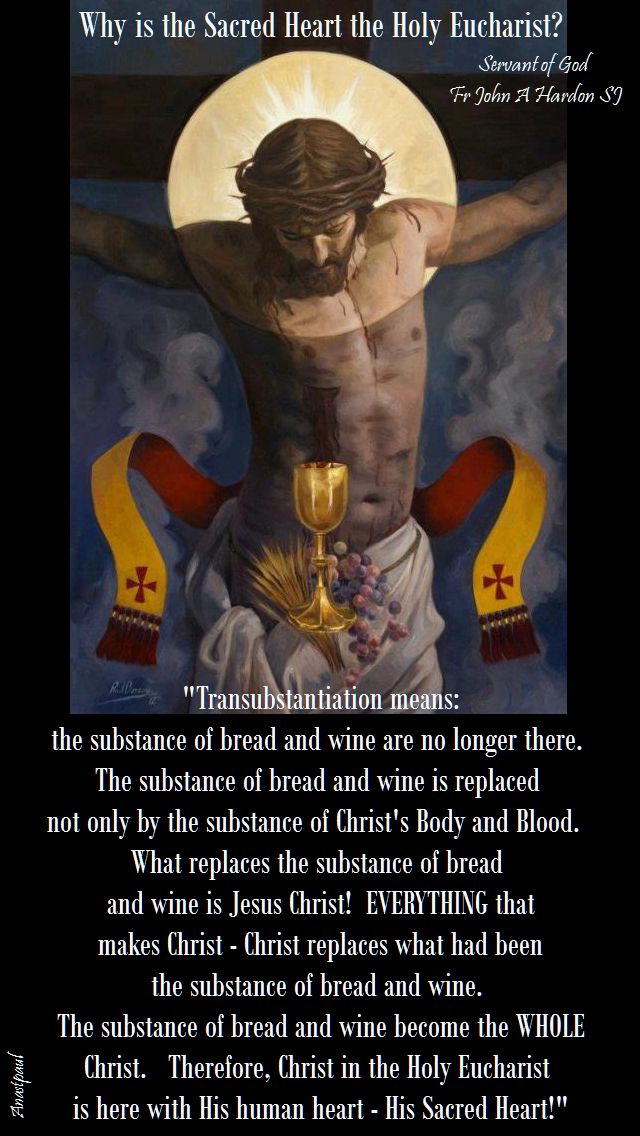
Why is the Sacred Heart the Holy Eucharist?

It is impossible to identify the Holy Eucharist too closely with Jesus Christ.   We should remember He is in the Holy Eucharist not merely with His substance.   I have corrected many of my students over the years who tell me “Transubstantiation means that the substance of bread and wine become the substance of Jesus Christ.” I reply, “No, transubstantiation means the substance of bread and wine are no longer there. The substance of bread and wine is replaced not only by the substance of Christ’s Body and Blood. What replaces the substance of bread and wine is Jesus Christ!” Everything that makes Christ, Christ replaces what had been the substance of bread and wine.   The substance of bread and wine become the whole Christ.

Therefore, Christ in the Holy Eucharist is here with His human heart.   Is it a living heart?   Yes! That is why the revelations our Lord made to St. Margaret Mary about promoting devotion to the Sacred Heart were all made from the Holy Eucharist.

Why do we equate the Sacred Heart with the Holy Eucharist?   Because the Holy Eucharist is the whole Christ with His human heart.   According to St. Margaret Mary, the Sacred Heart is the Holy Eucharist.   So it follows that devotion to the Sacred Heart is devotion to the Holy Eucharist.   It is infinite Love Incarnate living in our midst in the Blessed Sacrament.

Servant of God Fr John A Hardon SJ

why is the sacred heart the Holy Eucharist - fr john a hardon

Posted in CATECHESIS, FEASTS and SOLEMNITIES, MORNING Prayers, QUOTES of the SAINTS, The HOLY GHOST

Thought for the Day – 4 June

Thought for the Day – 4 June

“If the damned were asked: Why are you in Hell? they would answer: ‘For having resisted the Holy Spirit.’
And if the saints were asked: Why are you in Heaven? they would answer: ‘For having listened to the Holy Spirit.’
When good thoughts come into our minds, it is the Holy Spirit who is visiting us.
The Holy Spirit is a power.
The Holy Spirit …. sustained the martyrs.  Without the Holy Spirit, the martyrs would have fallen like the leaves from the trees.  When the fires were lighted under them, the Holy Spirit extinguished the heat of the fire by the heat of divine love.
The good God, in sending us the Holy Spirit, has treated us like a great king who should send his minister to guide one of his subjects, saying,  “You will accompany this man everywhere and you will bring him back to me safe and sound.”
How beautiful it is, my children, to be accompanied by the Holy Spirit!
He is indeed a good Guide; and to think that there are some who will not follow Him!
The Holy Spirit is like a man with a carriage and horse, who should want to take us to Pans. We should only have to say “yes,” and to get into it.  It is indeed an easy matter to say “yes”!… Well, the Holy Spirit wants to take us to Heaven; we have only to say “yes,” and to let Him take us there.“…St John Vianney

“O Divine Spirit, draw us to the highest heaven where Jesus lives forever, interceding for us.   Come, fill our hearts with Your fire, show us the way to the Lord that we may find Him shining with beauty and love. Amen”

o divine spirit

Posted in CATECHESIS, MORNING Prayers, QUOTES of the SAINTS, SAINT of the DAY

Thought for the Day – 1 May

Thought for the Day – 1 May

The Foreshadowing of Saint Joseph

As the Church of Christ is prefigured in the rites and ceremonies of the Old Law, so the chief personages who centre round Our Lord in the redemption of the world are foreshadowed in the Old Testament.    We trace the outlines of Our Lady’s graces in Esther, Jahel, Bethsabee, Judith.    So, too, Saint Joseph’s place in the new dispensation is anticipated in the place of the patriarch Joseph at the court of Pharao.    Thus it is that God in His love for His chosen ones paves the way for them centuries before.    From the beginning He has prepared their work, and the throne they are to earn in heaven by their labors and sufferings for Him.

In the life of the patriarch Joseph there was throughout a correspondence to the life of the foster-father of Jesus Christ.    The troubles and persecutions of his early life; his long time of servitude and obscurity; his wondrous purity, his time of patient expectation; his glorious exaltation; his omnipotence with the king; his power to save all who came to him – all these were repeated, or rather were fulfilled, in Saint Joseph.    Reflect on each of these, and consider how Saint Joseph is a model to us.

We read of the patriarch, Joseph, that the king of Egypt made him lord of his house.    So God made Saint Joseph lord of that earthly tabernacle of flesh in which He dwelt on earth.    Joseph ruled Our Lord in His sacred humanity.    He made him lord, too, of another house in which He sojourned, of the sacred house that Wisdom built for Himself in the form of His holy Mother.    If Saint Joseph was thus lord of Jesus and Mary, what may we not expect from Him?   In our lives on the ‘narrow road’, on our way home, in our difficulties, in our labour and our toil!?

To capture the devotion to Saint Joseph within the Catholic liturgy, in 1870, Pope Pius IX declared Saint Joseph the patron of the universal Church. In 1955, Pope Pius XII added the feast of Saint Joseph the Worker.    This silent saint, who was given the noble task of caring and watching over the Virgin Mary and Jesus, now cares for and watches over the Church and models for all the dignity of human work.

“What emanates from the figure of Saint Joseph is faith.    Joseph of Nazareth is a “just man” because he totally “lives by faith.”     He is holy because his faith is truly heroic. Sacred Scripture says little of him.    It does not record even one word spoken by Joseph, the carpenter of Nazareth.    And yet, even without words, he shows the depth of his faith, his greatness.    Saint Joseph is a man of great spirit.    He is great in faith, not because he speaks his own words but above all because he listens to the words of the Living God.    He listens in silence.    And his heart ceaselessly perseveres in the readiness to accept the Truth contained in the word of the Living God.    We see how the word of the Living God penetrates deeply into the soul of that man, that just man.    And we, do we know how to listen to the word of God?    Do we know how to absorb it into the depths of our human personalities? Do we open our conscience in the presence of this word?”

– Pope John Paul II from Daily Meditations

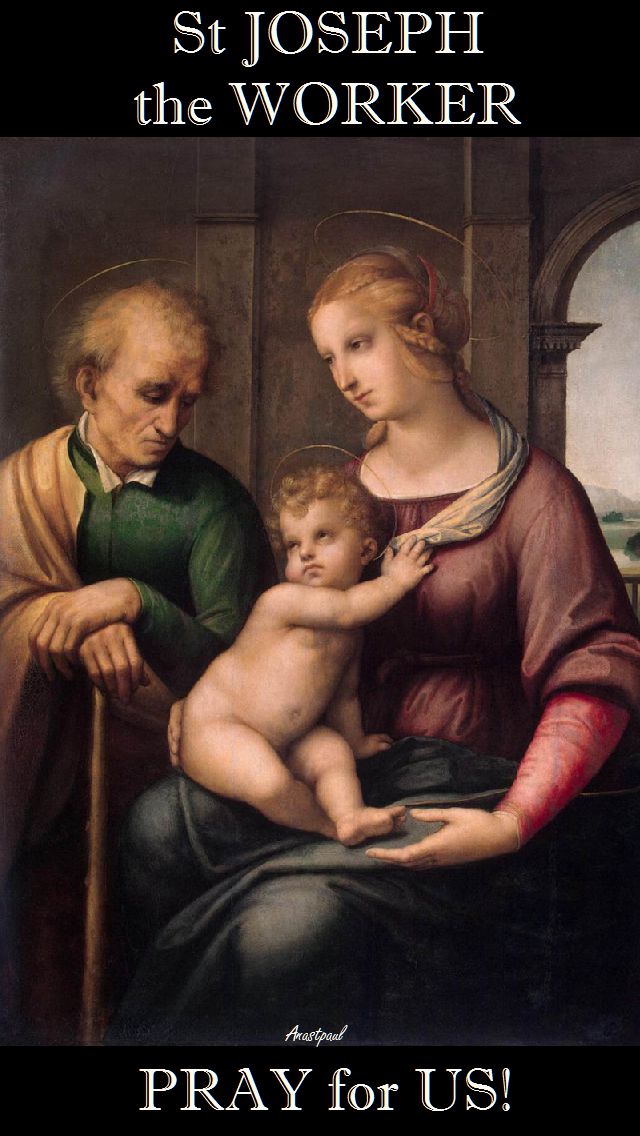
St Joseph the Worker, Pray for us!ST JOSEPHTHEWORKER - PRAY FOR US

Posted in CATECHESIS, DOCTORS of the Church, EASTER, FATHERS of the Church, QUOTES of the SAINTS, SAINT of the DAY, The WORD

One Minute Reflection – 17 April – Easter Monday 2nd Day of the Octave

One Minute Reflection – 17 April – Easter Monday 2nd Day of the Octave

Meditation for the Day:   Help us put our baptism into action.

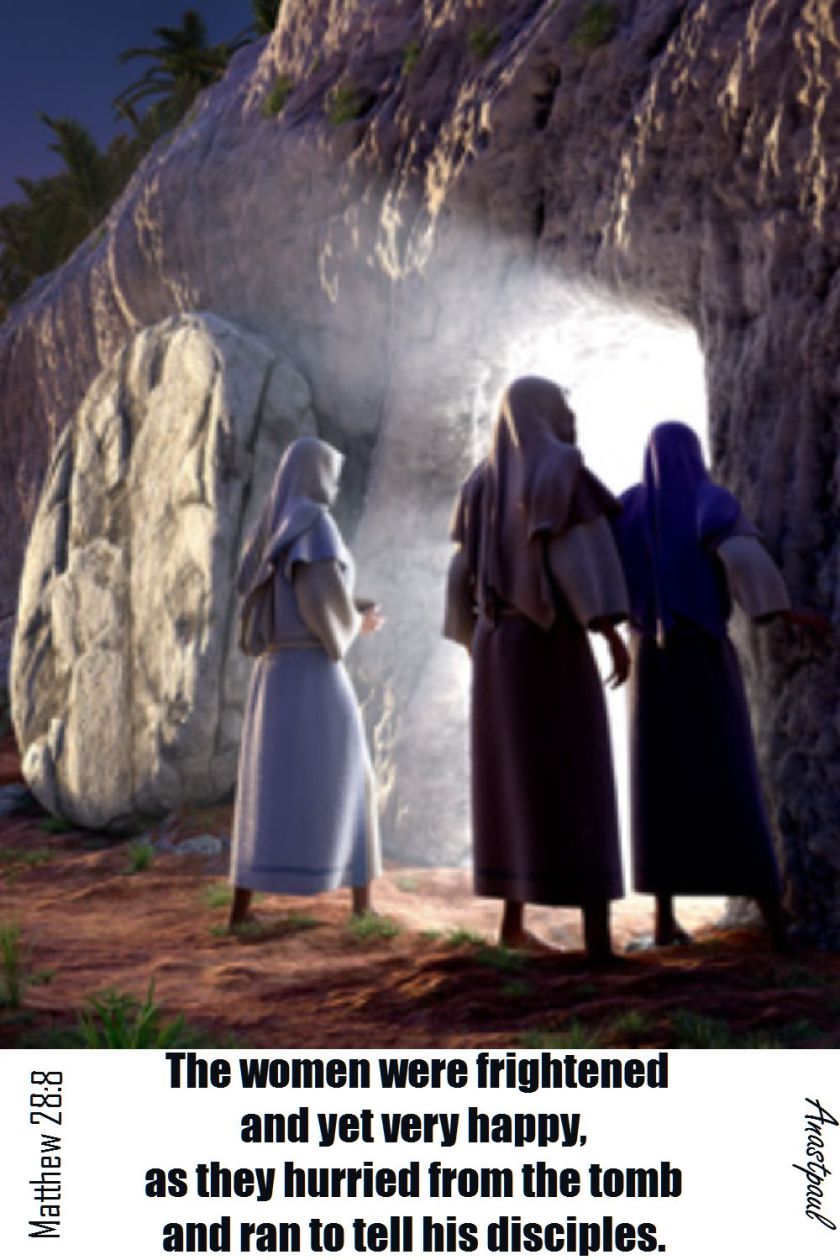
The women were frightened and yet very happy,
as they hurried from the tomb and ran to tell his disciples.
— Matthew 28:8

REFLECTION – “We imitate Christ’s death by being buried with him in baptism.   If we ask what this kind of burial means and what benefit we may hope to derive from it, it means first of all making a complete break with our former way of life and our Lord Himself said that this cannot be done unless a man is born again.    In other words, we have to begin a new life and we cannot do so until our previous life has been brought to an end. When runners reach the turning point on a racecourse, they have to pause briefly before they can go back in the opposite direction.    So also when we wish to reverse the direction of our lives there must be a pause, or a death, to mark the end of one life and the beginning of another…….Baptism cleanses the soul from the pollution of worldly thoughts and inclinations:   You will wash me, says the psalmist and I shall be whiter than snow.    We receive this saving baptism only once because there was only one death and one resurrection for the salvation of the world and baptism is its symbol.”………St Basil the Great

Prayer – Loving Father, How do I live the baptismal promises I made again over the weekend? I want to live my life in service of You.
Help me to carry the gift of faith I received from You. Help me to welcome those who joined the church in baptism.
Guide me and give me the courage to live my faith, to accept Your love. Amen

MATTHEW 28-8ST BASIL THE GREAT-BAPTISM

Posted in CATECHESIS, HOLY WEEK, MORNING Prayers, PURGATORY

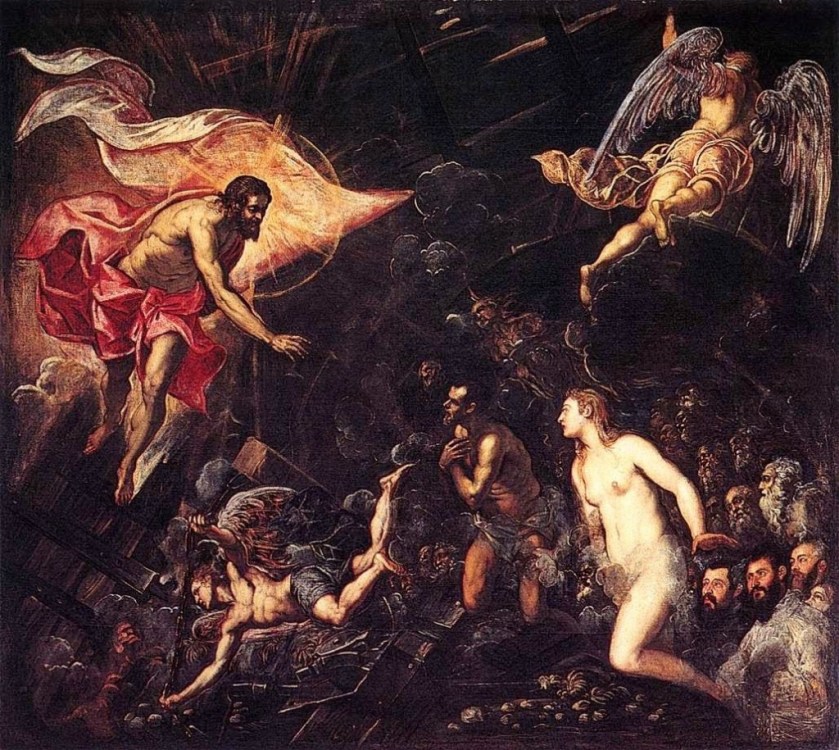
Holy Saturday – 15 April – The Lord’s descent into hell

Holy Saturday – 15 April – The Lord’s descent into hell