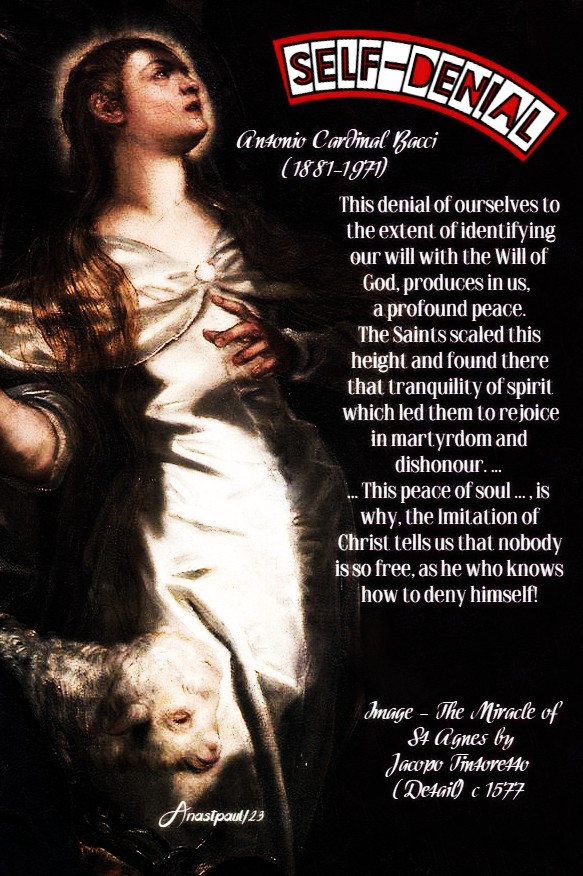
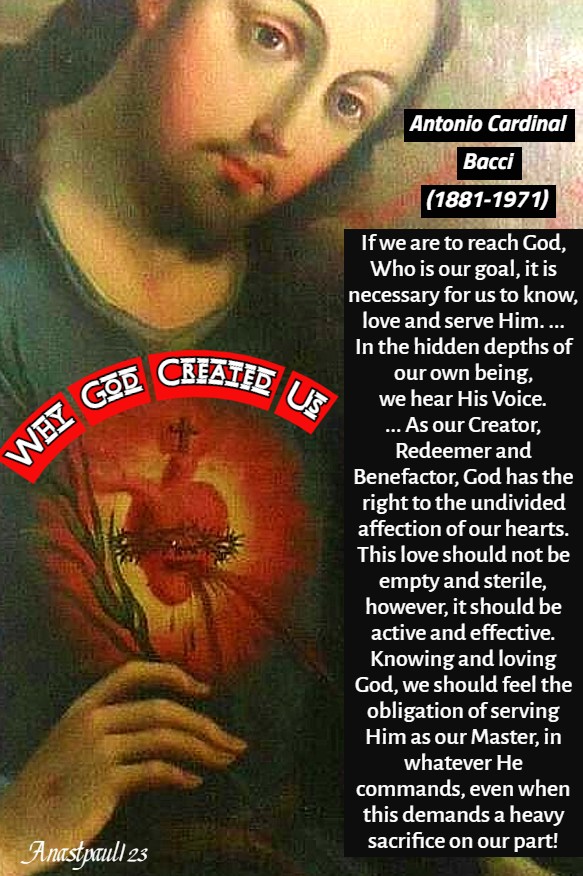
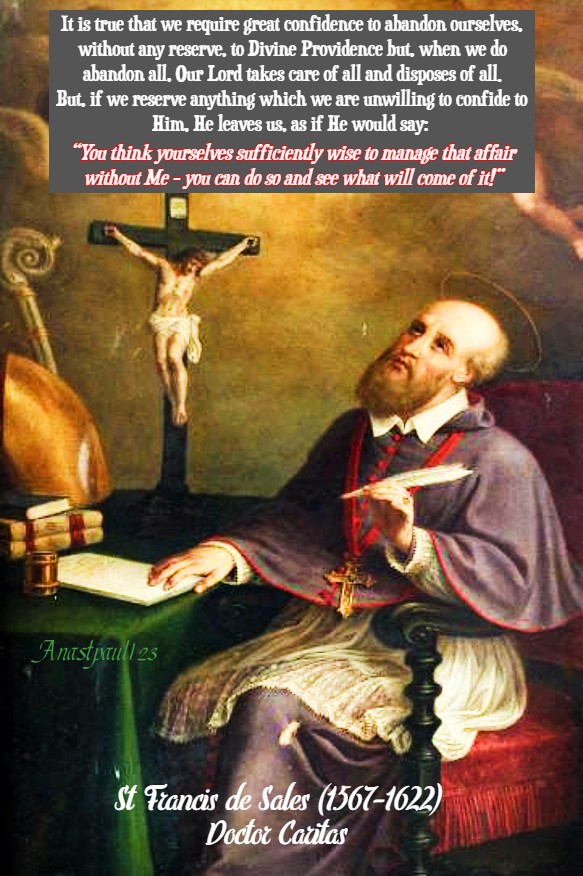
Thought for the Day – 3 March – Meditations with Antonio Cardinal Bacci (1881-1971)
The Shortness of Time
“Another vision will confront us also in that final hour. Our frightened minds will see again all those hours which we have misused in sin. The devil will try by every means in his power, to repaint them in our troubled imagination. He will do his best to lead us into despair, even as he tempted Judas and many other sinners before us.
We know well that the mercy of God is infinite and that it remains infinite at the hour of death. But, we know too that His justice, is no less infinite. Since God has granted us so much time in which He called us to repentance and to a life of virtue, it could happen that at the point of death, He will put an end to the mercy and to the favours which He has shown us and which we have disregarded. What will become of us then? Remember that only one of the two thieves was converted. The other died unrepentant on his cross, even though he was hanging by the side of Jesus!
Reflect and make provision while there is still time. While we have time.,let us do good (Gal 6:10). We shall be unable to do anything about it afterwards.”
Quote/s of the Day – 3 March – Ember Friday, First Week of Lent – Ezekiel 18:20-28, John 5:1-15 – Scripture search here: https://www.drbo.org/
“Do you wish to be made whole?”
John 5:6
“”
“O Heavenly Father, have compassion for my cry as Thou did for the prodigal son, for I, too, am throwing myself at Thy feet and crying aloud as he cried: “Father, I have sinned!” Do not reject me, Thy unworthy child, O my Saviour but cause Thy Angels to rejoice too, on my behalf, O God of goodness Thou, Who desires that all should be saved.”
St Romanos Melodios (c 490-c 556) Monk, Composer of hymns, Poet
“Each day then, we ought to renew our resolutions and arouse ourselves to fervour, as though it were the first day of our turning back to God. We ought to say: “Help me, O Lord God, in my good resolution and in Your holy service. Grant me now, this very day, to begin perfectly, for thus far I have done nothing.” … Just men depend on the grace of God rather than on their own wisdom in keeping their resolutions. In Him they confide every undertaking …”
Our Lenten Journey with St Francis de Sales – 3 March – Ember Friday of the First Week in Lent – Ezekiel 18:20-28, John 5:1-15 – Scripture search here: https://www.drbo.org/
“Give ear, O Lord, to my prayer and attend to the voice of my petition.” Psalm 85:6
“Do you wish to be made whole?” John 5:6
THE GOAL OF PRAYER St Francis de Sales (1567-1622) Doctor Caritas
“ … IN OUR PRIVATE PRAYERS what reverence ought we to have? In private prayer, we are before God, as in public prayer, although in public prayer we ought to be particularly attentive on account of the edification of our neighbour; exterior reverence is a great aid to the interior. We have many examples which witness to the great exterior reverence which we ought to have when praying, even though it be private prayer. Listen to St. Paul: “I kneel, ” he says, “before the Father of Our Lord Jesus Christ, for you all”(cf Eph 3:14). And do you not see that the Saviour Himself, while praying to His Father, is prostrate on the ground? (cf. Mt 26:39 and Mk 14:35). ” (Sermon for the Palm Sunday, given on 12 April 1615).
“We must now speak of the final cause [that is, the goal] of prayer. We ought to know, in the first place that all things have been created for prayer and that, when God created angels and men, He did so that they might praise Him eternally in Heaven above, even though this is the last thing that we shall do – if that can be called “last” which is eternal.
To understand this better we will say this – when we wish to make something, we always look first to the end [or purpose], rather than to the work itself. For example, if we are to build a Church and we are asked why we are building it, we will respond that it is so that we can retire there and sing the praises of God; nevertheless, this will be the last thing that we shall do. …
Now prayer, according to most of the Fathers, is nothing other than a raising of the mind to heavenly things; others say, it is a petition but the two opinions are not at all opposed, for while raising our mind to God, we can ask Him for what seems necessary.
The principal petition which we ought to make to God is that of union of our wills with His and the final cause [goal] of prayer lies in desiring only God. Accordingly,, all perfection is contained therein, as Brother Giles, the companion of St Francis [of Assisi] said, when a certain person asked him what he could do in order to be perfect very soon. “Give,” he replied, “one to One.” That is to say, you have only one soul and there is only God – give your soul to Him and He will give Himself to you. The final cause [goal] of prayer, then, ought not to be to desire those tendernesses and consolations which our Lord sometimes gives, since union does not consist in that but rather, in conforming to the will of God.” (Sermon for the Third Sunday of Lent, given on 22 March 1615).
One Minute Reflection – 3 March – “The Month of the St Joseph” – Ember Friday, First Week of Lent – Ezekiel 18:20-28, John 5:1-15 – Scripture search here: https://www.drbo.org/
“Now a certain man was there who had been thirty-eight years under his infirmity. When Jesus saw him lying there and knew that he had been in this state a long time, He said to him: Do you wish to be made whole?” – John 5:5-6
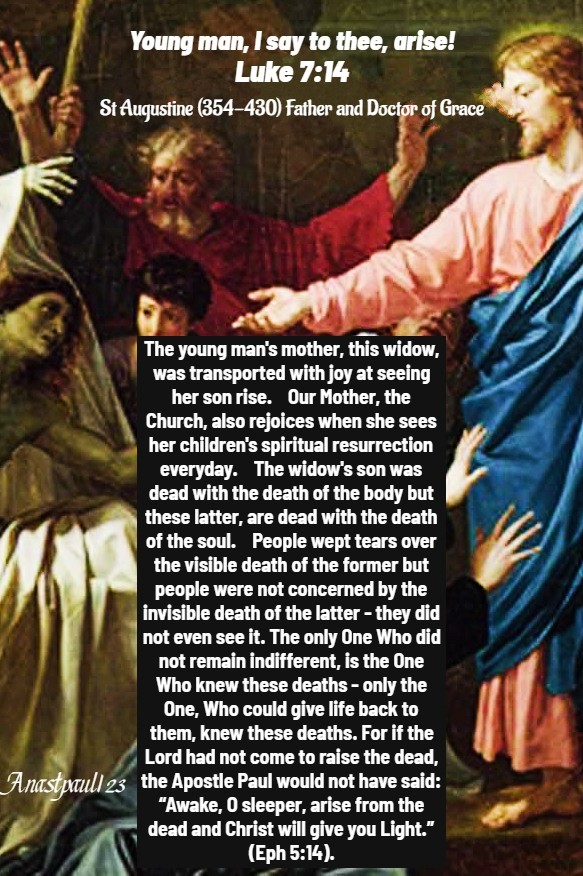
REFLECTION – “Christ’s Miracles are symbols of the different events of our eternal salvation, … this pool is the symbol of the precious gift the Lord’s Word gives us. To explain – this water is the Jewish people; the five porticos are the Law which Moses wrote in five books. And so, this pool was surrounded by five porticos, like the people enclosed by the Law. The water which was stirred and troubled, is the Saviour’s Passion in this people’s midst. Whoever went down into this water was healed – but only one person so as to express unity. Those, who were unable to bear anyone speaking to them about the Passion, are the proud – they do not wish to go down and are not healed. “What!” says that arrogant man: “Believe a God to be Incarnate! that a God was Born of a woman that a God has been Crucified, Scourged, covered with Wounds ,that He Died and has been Buried?! No, I would never believe in these Humiliations of a God, they are unworthy of Him.”
Let your heart speak here, rather than your head. The Humiliations of a God seem unworthy to the arrogant and that is why they are very far from a cure. So protect yourself from this pride. If you desire your healing, accept to go down. There would be something to be worried about, if someone said to you that Christ had undergone some sort of change, in becoming Incarnate. But no, … your God remains what He Is, have no fear; He does not perish and He prevents you yourselves from perishing. Yes, He remains what He Is; He Is born of a woman but according to the flesh … it is as Man that He has been Seized, Bound, Scourged, Mocked and finally Crucified and put to Death. Why be afraid? The Word of the Lord remains forever. Anyone who refuses these humiliations of a God, does not wish to be cured of the mortal swelling of his pride.
By His Incarnation, our Lord Jesus Christ has, therefore, restored hope to our flesh. He assumed the fruits of this earth which are only too well known and common – Birth and Death. Birth and death – here indeed are goods that the earth possesses in abundance! But in them were found, neither resurrection nor eternal life. He found here the unfortunate fruits of this unfruitful earth and gave us, in exchange, the possessions of His Heavenly Kingdom!” – St Augustine (354-430) Father and Doctor of Grace (Sermon 124).
PRAYER – From all perils of soul and body defend us, O Lord, we beseech Thee and by the intercession of blessed and gloriosus ever Virgin Mary, Mother of God, of blessed Joseph, of Thy blessed apostles Peter and Paul and all the Saints, graciously grant us safety and peace that all adversities and errors, being overcome, Thy Church may serve Thee in security and freedom. Through Jesus Christ, Thy Son our Lord, Who lives and reigns with Thee, in the unity of the Holy Ghost, God, world without end. Amen (Collect).Through the same Jesus Christ, Thy Son our Lord, Who lives and reigns with Thee, in the unity of the Holy Ghost, God, world without end. Amen (Collect).
Our Morning Offering – 3 March – Ember Friday in the First Week of Lent
Rescue Me, Most Merciful God By Father Martin von Cochem OSFC (c 1630-1712)
Most merciful God, remember at how great a price Thou didst purchase me and how much Thou didst suffer for me. For the sake of that inestimable price, do not permit me to be lost, rescue me, number me amongst the sheep of Thy fold. With them, I will then praise and magnify Thy loving kindness, to all eternity. Amen
Fr Martin von Cochem was a German Capuchin theologian, preacher and prolific ascetic writer. Father Martin’s works embrace a great variety of subjects: a huge volume of apologetics against Protestantism, the life of Christ, lives of the Saints, edifying narratives, the setting forth of certain points in Christian asceticism, forms of prayer, methods to be followed for the worthy reception of the sacraments, etc. The prayer above is from the renowned “The Four Last Things.”
Thought for the Day – 2 March – Meditations with Antonio Cardinal Bacci (1881-1971)
Prayer as a Necessary Means of Salvation
“We should appreciate how necessary it is to pray with special fervour and perseverance, in times of great temptation and suffering. If we neglect to do so when temptation assails us, we shall be on our own and shall certainly fall. When we encounter suffering and everything seems to be crumbling around us, let us remember that God sees us and pities us. Let us turn to Him. Who alone is able and eager to help us in our misfortunes. When we pray, our tears are precious in His sight. God’s love for us is infinite. If we have recourse to Him, He will certainly answer us in the manner which He knows is best for us. He has promised this, “If he cries out to me, I will hear him, for I am compassionate” (Ex 22:26).”
Quote/s of the Day – 2 March – Thursday of the First Week in Lent – Ezechiel 18:1-9, Matthew 15:21-28 – Scripture search here: https://www.drbo.org/
“Then Jesus answering, said to her: O woman, great is thy faith! be it done to thee as thou desire and her daughter was cured from that hour.”
Matthew 15:28
“I implore you to live with me and, by believing, to run with me; let us long for our Heavenly Country, let us sigh for our Heavenly Home, let us truly feel that here, we are strangers. What shall we then see? Let the gospel tell us: In the beginning was the Word and the Word was with God and the Word was God. You will come to the fountain, with whose dew you have already been sprinkled. Instead of the ray of Light which was sent through slanting and winding ways, into the heart of your darkness, you will see the Light Itself, in all its purity and brightness. It is to see and experience this Light that you are now being cleansed. … It has been good for us to share the common Light, good to have enjoyed ourselves, good to have been glad together. When we part from one another, let us not depart from Him!”
St Augustine (354-430) Father and Doctor of Grace
Prayer of Blessed Severinus Boethius (c 475-524) Martyr
“O Father, enable our minds, to rise to Thy ineffable dwelling place. Let us find the Light and direct the eyes of our soul to Thee. Dispel the mists and the opaqueness of the earthly mass and shine out with Thy splendour. Thou art the serene and tranquil abode of those who persevere in their goal of seeing Thee. Thou art, at the same time, the Beginning, the Vehicle, the Guide, the Way and the Goal. Amen”.
“… How can anyone put on Jesus Christ and imitate His example, if he does not study this Jesus, who must inspire and perfect our faith? He must run the race to which he is challenged, the glorious race in which, he overcomes the enemy of the human family and follows the Way of the Cross. Under the lordly banner of that Cross, he will attain eternal life.”
Our Lenten Journey with St Francis de Sales – 1 March – Thursday of the First Week in Lent – Ezechiel 18:1-9, Matthew 15:21-28 – Scripture search here: https://www.drbo.org/
“Keep me, O Lord, as the apple of Your eye, hide me in the shadow of Your wings.” Psalm 16:8,2
“O woman, great is thy faith! be it done to thee as thou desire …” Matthew 15:28
FAITH St Francis de Sales (1567-1622) Doctor Caritas
“FAITH IS THE BASIS AND FOUNDATION of all the other virtues but particularly of hope and of charity. Now what I say of charity applies also to all the many virtues associated with it. When charity is united and joined to faith, it vivifies it. And so it follows that there is a dead faith and a dying faith.
Dead faith is faith separated from charity, a separation which prevents us from performing works, conformable to the faith we profess. This dead faith is that which many Christians – the worldly – have. Indeed, they believe all the Mysteries of our Holy Religion but since their faith is not accompanied by charity, they perform no good works which conform to their faith. Dying faith is that which is not entirely separated from charity. It performs some good works, although rarely and feebly, for charity cannot really be in the soul which has faith without performing works, either little or great. It must either produce or perish because it cannot exist without doing good works.
Just as the soul cannot remain in the body without producing vital actions, so charity cannot be united to our faith, without performing works conforming to it [Gal 5:6; Jas 2:14-26]. It cannot be otherwise. Therefore, do you want to know if your faith is dead or dying? Examine your works and actions. …
Dead faith resembles a dry tree that has no living substance at all. In springtime when other trees bud forth leaves and flowers, this one brings forth nothing because it does not have sap which those have that are not dead but only dormant. Now, here is another point. However much all other trees may look like this dead tree in winter, nevertheless, in their season they produce leaves, flowers and fruits. This never happens with the tree that is really dead. It may look like the other trees, to be sure but it is dead, for it never brings forth either flowers or fruit. Similarly, dead faith may indeed appear to be living faith but with this important difference – it bears neither the flowers nor the fruit of good works, while living faith always bears them,and in all seasons! (Sermon for Thursday after the First Sunday in Lent, 17 February 1622).
One Minute Reflection – 2 March – “The Month of the St Josephs” –Thursday of the First Week in Lent – Ezechiel 18:1-9, Matthew 15:21-28 – Scripture search here: https://www.drbo.org/
“But she said, Yes, Lord; for even the dogs eat of the crumbs that fall from their masters’ table.” – Matthew 15:27
REFLECTION – “See her humility as well as her faith! For He had called the Jews “children” but she was not satisfied with this. She even called them “masters,” so far was she from grieving at the praises of others. She said, “Yes, Lord, yet even the dogs eat the crumbs that fall from their masters’ table.” Behold the woman’s wisdom! She did not venture so much as to say a word against anyone else. She was not stung to see others praised, nor was she indignant to be reproached. Behold her constancy! When He answered, “It is not fair to take the children’s bread and throw it to the dogs,” she said, “Yes, Lord.” He called them “children” but she called them “masters.” He used the name of a dog but she described the action of the dog. Do you see this woman’s humility?
Then compare her humility with the proud language of the Jews: “We are Abraham’s seed and were never in bondage to any man.” “We are born of God.” But not so this woman. Rather, she calls herself a dog and them masters. So for this reason, she became a child. For what does Christ then say? “O woman, great is your faith.”
So we might surmise that this is the reason He put her off, in order that He might proclaim aloud this saying and that He might crown the woman: “Be it done for you as you desire.” This means “Your faith, indeed, is able to effect even greater things than these. Nevertheless, be it unto you even as you wish.” This Voice was at one with the Voice that said, “Let the heaven be,” and it was. “And her daughter was made whole from that very hour.”
Do you see how this woman, too, contributed not a little to the healing of her daughter? For note that Christ did not say, “Let your little daughter be made whole” but “Great is your faith, be it done for you as you desire.” These words were not uttered at random, nor were they flattering words,but great was the power of her faith and for our learning. He left the certain test and demonstration, however, to the issue of events. Her daughter accordingly was immediately healed.” – St John Chrysostom (347-407) Archbishop of Constantinople, Father and Doctor (The Gospel of Matthew – Homily 52).
PRAYER – From all perils of soul and body defend us, O Lord, we beseech Thee and by the intercession of blessed and gloriosus ever Virgin Mary, Mother of God, of blessed Joseph, of Thy blessed apostles Peter and Paul and all the Saints, graciously grant us safety and peace that all adversities and errors, being overcome, Thy Church may serve Thee in security and freedom. Through Jesus Christ, Thy Son our Lord, Who lives and reigns with Thee, in the unity of the Holy Ghost, God, world without end. Amen (Collect).
Our Morning Offering – 2 March – Thursday of the First Week in Lent
A Lenten Prayer By St Pope Pius V (1504-1572)
Look with favour, Lord, on Your household. Grant that, though our flesh be humbled by abstinence from food, our souls, hungering after You, may be resplendent in Your sight. Amen
St Pius V is the Pope of the Council of Trent, the Counter Reformation, the excommunication of Elizabeth I for Heresy and persecution of English Catholics and of the Battle of Lepanto, amongst many other illustrious and holy achievements.
Thought for the Day – 1 March – Meditations with Antonio Cardinal Bacci (1881-1971)
The Five Tribunals of Justice
“In regard to the civil authority, however, one thing should be made quite clear. We are only obliged to obey it when it does not infringe on the rights of God or of the Church. If it should run counter to these, we should answer in the words of St Peter and the other Apostles, when thy were called before the Sanhedrin. “We must obey God rather than men” (Acts 5:29).
If we had to suffer anything as a result, in the cause of God and of the Church, we should count that as our good fortune. Like the Apostles, we should be able to rejoice that we have been found worthy to suffer indignity and ill-treatment for the sake of Jesus’ Name (Acts 5:41).”
Quote/s of the Day – 1 March – Ember Wednesday – 3 Kings. 19:3-8, Matthew 12:38-50 – Scripture search here: https://www.drbo.org/
“The men of Nineveh will rise up at the judgement with this generation and condemn it, for they repented …”
Matthew 12:41
“The sign of Jonah”
Matthew 12:39
“It was, too, to lead the Ninevites to firm repentance and to convert them to Him, Who would deliver them from death, amazed as they were by the sign accomplished in Jonah … In the same way, God permitted man to be swallowed by that great monster, the author of disobedience, not so that he should altogether vanish away and die but because God, had prepared beforehand, the salvation fulfilled by His Word by means of the “sign of Jonah.”
St Irenaeus (130-208) Bishop of Lyons, Martyr and Father
“… In the conceitedness of our souls, without taking the least trouble to obey the Lord’s Commandments, we think ourselves worthy to receive the same reward as those who have resisted sin to the death!”
St Basil the Great (329-379) Father and Doctor of the Church
“To do penance is to bewail the evil we have done and to do no evil to bewail.”
“But He still follows behind us and counsels us, that we have despised Him but He still does not cease to call us. We turn our backs on His face, so to speak, when we reject His Words, when we trample His Commandments underfoot but He, Who sees that we reject Him, still calls out to us by His Commandments and waits for us by His patience, stands behind us and calls us back when we have turned away.”
St Pope Gregory the Great (540-604) Father & Doctor of the Church
“What are we doing? If we really love the Sacred Heart of Jesus, we should offer penance and sacrifices in order to make reparation for our sins and the sins of others and, to propitiate this adorable Heart, Which ardently desires to bestow new favours upon us.”
Our Lenten Journey with St Francis de Sales – 1 March – Ember Wednesday
“The troubles of my heart are multiplied, deliver me from my necessities. See my abjection and my labour and forgive me all my sins.” Psalm 24:17-18
“The men of Nineveh will rise up in the judgement with this generation and will condemn it; for they repented at the preaching of Jonah and behold, One greater than Jonah is here.” Matthew 12:41
REPENTANCE St Francis de Sales (1567-1622) Doctor Caritatis
“LET ANYONE WHO IS STANDING BE FEARFUL lest he fall, says the Apostle [1 Cor 10:12]; let no-one glory in finding himself expressly called by God, to a place where there seems nothing to fear. Let no-one presume on his good works and think he has nothing more to fear. St Peter, who had received so many graces, who had promised to accompany Our Lord to prison and even to death itself [Lk 22:33], denied Him, nevertheless, at the whimpering taunt of a chambermaid! Judas sold Him for such a small sum of money!
These falls were both very great but there was this difference. One acknowledged his guilt; the other despaired. Yet, our Saviour had inspired in the heart of both, the same Peccavi [admission of guilt] (“I have sinned”) that same Peccavi that God inspired in David’s heart. [2 Kgs (2 Sm.) 12:13]. Yes, He inspired it in both Apostles but one rejected it and the other accepted it. Hearing the cock crow, St Peter remembered what he had done and the word his good Master had spoken to him. Then, acknowledging his sin, he went out and wept so bitterly [Matt 26:74-75; Lk 22:61-62] that he received what we today call a Plenary Indulgence and full remission of all his sins. O happy St Peter! By such contrition for your sins you received a full pardon for such great disloyalty!
From this time on, St Peter never ceased weeping, principally when he heard the cock crow at night and morning, for he remembered this crowing as the signal for his conversion. It is also reported that he shed so many tears that they hollowed his cheeks into two furrows. With these tears he, who had been a great sinner became a great saint. “O glorious St Peter, how happy you are to have done such great penance for such great disloyalty. By it you were reinstated in grace. You, who deserved eternal death became worthy of eternal life.” Not only that but St Peter received here below, special favours and privileges and was lavished with blessings on earth and in Heaven.
On the other hand, although Judas received the same inspiration for the same Peccavi, he rejected it and despaired. I know that efficacious and sufficient grace differ, as theologians say but I am not here to prove and dispute, whether Judas’ inspiration … was as efficacious as David’s, or only sufficient. It was certainly sufficient. This Peccavi, sent to the heart of Judas, was truly like that formerly sent to David. Why then was Judas not converted?
O miserable man! He saw the gravity of his crime and despaired. Truly, he confessed his sin, for in returning to the chief priests the thirty pieces of silver for which he had sold his good Master, he acknowledged aloud that he had sold innocent blood. [Matt. 27:3-5]. But these priests would give him no absolution. Alas, did not this unhappy man know that Our Lord alone could give it to him, that He was the Saviour and held Redemption in His hands? Had he not seen this truth clearly in those whose sins Jesus had remitted? Certainly, he knew it but he did not wish, nor dare to ask pardon. To make him despair, the devil showed him the enormity and hideousness of his crime and, perhaps, made him fear that if he asked his Master’s pardon, He might impose too great a penance. Perhaps, for fear of such penance, he was unwilling to ask for forgiveness. Thus, despairing, he hanged himself and his body burst wide open, all his entrails spilling out [Acts 1:18] and he was buried in the deepest of Hells.” – Sermon for Good Friday 25 March 1622.
One Minute Reflection – 1 March – Ember Wednesday – 3 Kings. 19:3-8, Matthew 12:38-50 –The Memorial of St David (c 542-c 601) Bishop, Confessor – Scripture search here: https://www.drbo.org/
“The sign of Jonah” – Matthew 12:39
REFLECTION – “You were conducted by the hand to the holy pool of Sacred Baptism, just as Christ was conveyed from the Cross to the sepulchre close at hand [in this Church of the Holy Sepulchre]. Each person was asked if he believed in the Name of the Father and of the Son and of the Holy Spirit. You made the confession that brings salvation and submerged yourselves three times in the water and emerged, by this symbolic gesture, you were secretly re-enacting the burial of Christ, three days in the tomb. For just as our Saviour spent three days and nights in the bosom of the earth, so you, upon first emerging, were representing Christ… You saw nothing when immersed – as if it were night but you emerged – as if to the light of day. In one and the same action, you died and were born, the water of salvation became both tomb and mother for you…
What a strange and astonishing situation! We did not really die, we were not really buried, we did not really hang from a cross and rise again. Our imitation was symbolic but our salvation a reality! Christ truly hung from a Cross, was truly buried and truly rose again. All this He did gratuitously for us, so that we might share His sufferings by imitating them and gain salvation in actuality. What transcendent kindness! Christ endured nails in His innocent Hands and Feet and suffered pain and by letting me participate in the pain, without anguish or sweat, He freely bestows salvation on me! …
We know well that not merely does Baptism cleanse sins and bestow on us the gift of the Holy Spirit – it is also the sign of Christ’s suffering. This is why, as we heard just now, Paul cried out: “Are you unaware that we, who were Baptised into Christ Jesus, were Baptised into His Death? We were indeed buried with Him through Baptism into death”… So, in order that we may realise that Christ endured all His sufferings for us and our salvation IN actuality and not in symbolism and that, we share in His pains, Paul cried out the literal truth: “If we have grown into union with Him through a death like His, we shall also be united with Him in the resurrection,” (Rom 6,3-5). – St Cyril of Jerusalem (313-350) Bishop of Jerusalem, Father and Doctor of the Church (Catechesis no.20/2nd Mystagogy) .
PRAYER – We beseech Thee, O Lord, look graciously upon the fervour of Thy people, who mortify themselves in the flesh through abstinence that they may be refreshed in spirit, by the fruit of these good works and the intercession of Thy blessed Confessor, David. Through Jesus Christ, Thy Son our Lord, Who lives and reigns with Thee, in the unity of the Holy Ghost, God, world without end. Amen (Collect).
Jesus, My Saviour, Help Me! By St Alphonsus Maria de Liguori (1696-1787) Most Zealous Doctor of the Church
Jesus, my Saviour, help me! I am resolved truly to love Thee and to leave all, to please Thee. Help me to free myself from everything which hinders me from belonging wholly to Thee, Who has loved me so much. By thy prayers, O Mother Mary, which are so powerful with God, obtain for me this grace, to belong wholly to God. Amen
Thought for the Day – 28 February – Meditations with Antonio Cardinal Bacci (1881-1971)
The Examination of Conscience
“Pope St Pius X holds great authority for a Christian. In his Exhortatio ad Clerum, he strongly recommends the Examination of Conscience, especially at the close of the day. This Examination, he says, is necessary for Priests but it is no less necessary for the laity. He recalls the apt words of St Augustine: “Judge your own conscience. Demand an account from it. Dig deep and rend it apart. Discover all the evil thoughts and intentions of the day … and punish yourself for them!” (Expos in Ps 4 n 8). He also quotes the equally relevant works of St Bermard: “Be a searching inquirer into your own integrity of life; examine your conduct everyday. See how much you have advanced, or, how much you have fallen back … Learn to know yourself. … Place all your faults before your eyes. Stand before yourself, as if it were before someone else and you will find reason to weep over yourself!” (Meditat Cap 5 de quotidiano sui ipsius examine).
The Saintly Pontiff concludes his inspiring address as follows: “Experience has proven that anyone who makes a strict examination of his thoughts, words and actions, is more firmly resolved to hate and avoid what is evil and wholeheartedly to love what is good” (Acta Pii X, IV p257).”
Quote of the Day – 28 February – Tuesday of the First Week in Lent
“If we look forward to receiving God’s mercy, we can never fail to do good, as long as we have the strength. For if we share with the poor, out of love for God, whatever He has given to us, we shall receive according to His promise, a hundredfold in eternal happiness. What a fine profit, what a blessed reward! With outstretched arms He begs us to turn toward Him, to weep for our sins and to become the servants of love, first for ourselves, then for our neighbours. Just as water extinguishes a fire, so love wipes away sin.”
Our Lenten Journey with St Francis de Sales – 28 February – Tuesday of the First Week in Lent – Isaias 55:6-11, Matthew 21:10-17 – Scripture search here: https://www.drbo.org/
“Let my prayer come like incense before You, O Lord” Psalm 140:2
“He said to them, It is written, ‘My house shall be called a house of prayer’” Matthew 21:13
PERSEVERANCE IN PRAYER… St Francis de Sales (1567-1622) Doctor Caritas
“LET US PERSEVERE IN PRAYER at all times. For if Our Lord seems not to hear us, it is not because He wants to refuse us. Rather, His purpose is to compel us to cry out louder and to make us more conscious of the greatness of His mercy. Those who understand the Hunt, know well that in winter, dogs cannot scent their prey. The cold air and frost prevent them from detecting their prey as easily as they do at other times. A similar thing happens in the spring. The variety and fragrance of the flowers takes away the facility of perceiving the animal’s scent. To remedy this the hunter puts some vinegar in his mouth and holding the dog’s head, squirts the vinegar into its nose. Now he does this not to discourage it from going in quest of its prey but rather, to urge and excite it to do its task.
In the same way, when Our Lord deprives us of sweetness and consolation, it is not to refuse us or to make us lose courage but He casts vinegar into our mouth, in order to excite us to draw so much closer to His Divine Goodness and to encourage us in perseverance.
It is also to elicit proofs of our patience. This was the third virtue which accompanied the Canaanite woman’s prayer. Seeing her perseverance, the Saviour desired to prove her patience, too. By this virtue we maintain, as far as possible, equality of mind among the inequalities of this life.” (Sermon for Thursday after the First Sunday of Lent, 17 February 1622),
One Minute Reflection – 28 February – Tuesday of the First Week in Lent – Isaias 55:6-11, Matthew 21:10-17 – Scripture search here: https://www.drbo.org/
“For just as from the heavens, the rain and snow come down and do not return there, until they have watered the earth, making it fertile and fruitful, giving seed to him who sows and bread to him who eats.” – Isaias 55:11
REFLECTION – “For the rain and the snow do not return to heaven but accomplish in the earth the will of him that sends them. So the Word that He shall send through His Christ, Who is Himself, the Word and the Message, shall return to Him with great power. For when He shall come and bring it, He shall come down like rain and snow and through Him all that is sown shall spring up and bear righteous fruit and the Word shall return to His Sender but not in vain shall His going have been but thus shall He say, in the presence of His Sender, “Behold, I and the children that the Lord has given me.” And this is the Voice through which the dead shall live. And this is the Voice of God that shall sound from on high and raise up all the dead.” – St Aphraates “the Sage” (Died c 345) (Feast Day – 29 January) Abbot, Father of the Church [see note below] (Demonstrations 8).
PRAYER – From all perils of soul and body, defend us, O Lord, we beseech Thee and by the intercession of blessed and gloriosus ever Virgin Mary, Mother of God, of blessed Joseph, of Thy blessed Apostles Peter and Paul and all the Saints, graciously grant us safety and peace that all adversities and errors being overcome, Thy Church may serve Thee in security and freedom. Through Jesus Christ, Thy Son our Lord, Who lives and reigns with Thee, in the unity of the Holy Ghost, God, world without end. Amen (Collect).
St Aphraates was a Syriac Christian author of the third century from the Persian Empire who composed a series of twenty-three sermons on points of Christian doctrine and practice. He was an Ascetic and Celibate. He may have been a Bishop and later Syriac tradition places him at the head of Mar Mattai Monastery near Mosul, therefore, he was certainly an Abbot.
Thought for the Day – 27 February – Meditations with Antonio Cardinal Bacci (1881-1971)
Fervour and Tepidity
“Our Lord does not command us to be merely virtuous. He commands us to be perfect. “You, therefore, are to be perfect, even as your heavenly Father is perfect” (Mt 5:48). He tells us to love Him with our whole heart and our whole soul. “Thou shalt love the Lord th God, with thy whole heart and with thy whole soul” (Mt 22:37). He orders us to renounce everything rather than offend Him, (Lk 14:33) even to pluck out an eye or cut off a hand or foot, if it should present an obstacle to our eternal salvation (Mt 18:81).
How can we remain unmoved and inactive in the face of these exhortations? The grace of perfection to which Our Lord calls us, cannot be reached without His grace which we can only obtain by fervent and unceasing prayer. Fervour is the animating principle of the spiritual life. It wins God’s gifts for us and makes us almost immune from sin.”
Quote/s of the Day – 27 February – Monday of the First Week in Lent – The Memorial of St Gabriel of Our Lady of Sorrows/Gabriel Possenti CP (1838-1862)
“By sin, O Jesus, I gave Thee Thy Death but I do not despair of Thy Forgiveness. Those Scourges call me, those Arms extended invite me that injured Heart offers me a secure shelter.”
“I will attempt, day by day, to break my will into pieces. I want to do God’s Holy Will, not my own.”
“Do not bestow your love on the world!”
“Love Mary!… She is loveable, faithful, constant. She will never let herself be outdone in love but will ever remain supreme. If you are in danger, she will hasten to free you. If you are troubled, she will console you. If you are sick, she will bring you relief. If you are in need, she will help you. She does not look to see what kind of person you have been. She simply comes to a heart that wants to love her. She comes quickly and opens her merciful heart to you, embraces you and consoles and serves you. She will even be at hand, to accompany you on the trip to eternity.”
(From a letter to his brother).
St Gabriel Francis Possenti of Our Lady of Sorrows (1838-1862)
Our Lenten Journey with St Francis de Sales – 27 February – Monday of the First Week in Lent – Scripture search here: https://www.drbo.org/
“My son, when you come to serve God, prepare your sould for temptation.” Ecclus. Sirach 2:1
“Then the devil left Him and behold, Angels came and ministered to Him.” Matthew 4:11
THESE FORTY DAYS … St Francis de Sales (1567-1622) Doctor Caritas
“I DOUBT NOT that many prefer the end of today’s Gospel (Mt 4:1-11) to its beginning. It is said there that after Our Lord had overcome His enemy and rejected his temptations, Angels came and brought Him heavenly food. What joy to find oneself with the Saviour at this delicious feast! My dear friends, we shall never be capable of keeping company with Him in His consolations, nor be invited to His Heavenly banquet, if we are not sharers of His labours and sufferings (2 Cor 1:7). He fasted for forty days but the Angels brought Him something to eat only at the end of that time.
These forty days, … symbolise the life of the Christian – of each one of us! Let us then desire these consolations only at the end of our lives and let us busy ourselves in steadfast resistance to the frontal attacks of our enemies. For whether we desire it or not, we shall be tempted. If we do not struggle, we shall not be victorious, nor shall we merit the crown of immortal glory which God has prepared for those of us, who are victorious and triumphant! Let us fear, neither the temptations nor the tempter, for if we make use of the Shield of Faith and the Armour of Truth, they will have no power whatsoever, over us.
… Let us also shun both spiritual avarice and the ambition which occasions so much disorder in our hearts and so greatly impedes our perfection. The noonday devil will be powerless in causing us to fail in our firm and steadfast resolution, to serve God generously and as perfectly as possible, in this life, so that after this life, we shall go to enjoy Him forever. May He be blessed ! Amen.” – (Extract-Sermon 1st Sunday of Lent – 13 February 1622).
One Minute Reflection – 27 February – Monday of the First Week in Lent – 1 John 2:14-17, Mark 10:13-21 – Scripture search here: https://www.drbo.org/
“One thing is lacking to thee; go, sell whatever thou has and give to the poor, and thou shalt have treasure in Heaven and come, follow Me.” – Mark 10:21
REFLECTION – “Blessed is the poor man who cried and whom the Lord heard. Blessed is the man poor in offence. Blessed is the man poor in vices. Blessed is the poor man, in whom the prince of this world finds nothing. Blessed is the poor man who, is like that Poor Man Who, although He was rich, became poor for our sake. Matthew fully revealed this when he said, “Blessed are the poor in spirit.” One poor in spirit is not puffed up, is not exalted in the mind of his own flesh. This Beatitude is first, when I have laid aside every sin and I have taken off all malice and I am content with simplicity, destitute of evils. All that remains is that I regulate my conduct. For what good does it do me to lack worldly goods, unless I am meek and gentle?
Although there are many charms of delights in riches, yet there are more incentives to practice virtues. Although virtue does not require assistance and the contribution of the poor person, is more commended, than the generosity of the rich, yet with the authority of the heavenly saying, He condemns, not those who have riches but those who do not know how to use them. The pauper is more praiseworthy who gives with eager compassion and is not restrained, by the bolts of looming scarcity. He thinks that he who has enough for nature, does not lack. So the rich person is the more guilty, who does not give thanks to God, for what he has received but vainly hides wealth given for the common use and conceals it, in buried treasures. Then the offence consists, not in the wealth but in the attitude.
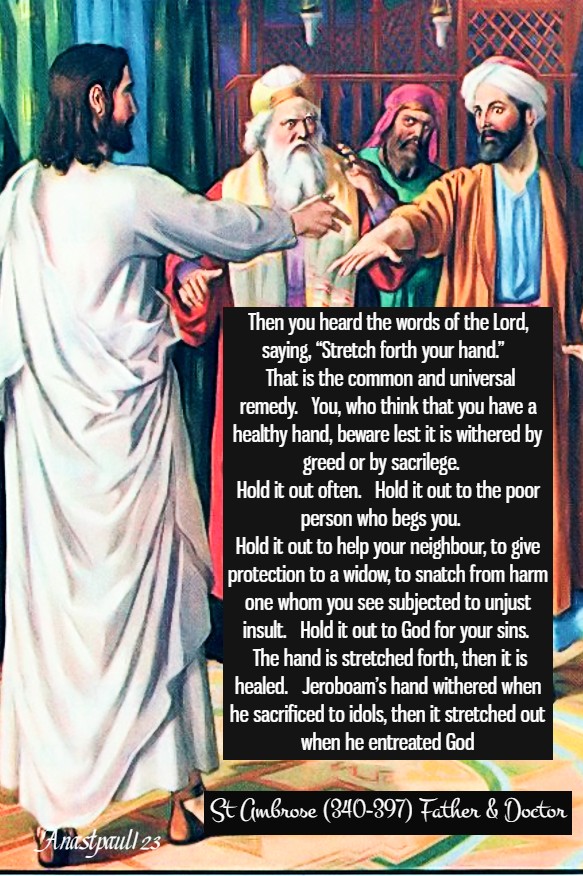
Purify yourself with your tears. Wash yourselves with mourning. If you weep for yourself, another will not weep for you…. One who is a sinner weeps for himself and rebukes himself, that he may become righteous, for just people accuse themselves of sin. Let us pursue order because, it is written, “Set in order love in me.” I have laid down sin. I have tempered my conduct. I have wept for my transgressions. I begin to hunger. I hunger for righteousness. The sick, when he is seriously ill, does not hunger, because the pain of the illness excludes hunger. What is the hunger for righteousness? What is the bread of which it is said, “I have been young and am old and I have not seen the righteous man forsaken, nor his seed begging bread?” Surely, one who is hungry, seeks increase of strength. What greater increase of virtue is there, than the rule of righteousness?” – St Ambrose (340-397) Bishop of Milan, Father and Doctor of the Church( Exposition on the Gospel of Luke, 5).
PRAYER – O God, Who taught blessed Gabriel to meditate continually on the sorrows of Thy most sweet Mother and Who, through her, exalted him by the glory of a holy life and miracles; grant us, we beseech Thee, through his intercession and example so to share in the sorrows of Thy Mother that her motherly protection may save us. Through Jesus Christ, Thy Son our Lord, Who lives and reigns with Thee, in the unity of the Holy Ghost, God, world without end. Amen (Collect).
Thought for the Day – 26 February – Meditations with Antonio Cardinal Bacci (1881-1971)
Interior Silence
“It is much easier to recollect ourselves in the Church in front of the Altar. For this reason, one could not sufficiently recommend a visit to Jesus in the Blessed Sacrament every morning before going to work and every evening, before going to bed.
The ideal is always daily Mass and Holy Communion. This will be tiring and maybe, inconvenient. But God is infinitely good and will handsomely reward us for anything we do out of love for Him or, for our own spiritual welfare.”
Quote/s of the Day – 26 February – The First Sunday of Lent – 2 Corinthians 6:1-10, Matthew 4:1-11
“Begone, Satan! for it is written: The Lord thy God shalt thou adore and Him only shalt thou serve.”
Matthew 4:10
“Do not, therefore, lose your confidence, which has a great reward. For you have need of patience that, doing the will of God, you may receive the promise. For yet a very little while and He Who is to come, will come and will not delay.”
Hebrews 10:35-37
“Expect temptation to your last breath.”
St Anthony Abbot (251-356)
“The demons that wage war on us, through our shortcomings in virtue, are those which teach — impurity, drunkenness, avarice and envy. Those that wage war on us, through our excessive zeal for virtue, teach — conceit, self-esteem and pride. They [the demons] secretly pervert, what is commendable, into what is reprehensible!”
St Maximus the Confessor (c 580-662) Father of the Church
“It might even be said that we are fortunate to have temptations, for these are the times of spiritual harvest when we gather up for Heaven. … If we were thoroughly saturated with God’s Holy Presence, it would be easy for us to resist the enemy. With the thought ‘God sees you!’ we would never sin!
There was a saint who complained to our Lord after being tempted and said to Him: “Where were Thou, my most loveable Jesus, during that awful storm?” Our Lord answered: “I was in the centre of thou heart…”
St John-Marie Baptiste Vianney (1786-1859) The Curé of Ars
“When tempted, turn immediately to your Guardian Angel and ask him, with all your heart, “My Guardian Angel help me now. Do not let me offend my God!”
St John Bosco (1815-1888)
“Why, we may ask, does God permit us to be tempted? He wishes us to realise, that only with His help, can we aspire to the supernatural life and triumph over our enemies. Apart from Him, we shall be lost but close to Him, we shall be invincible!”
Our Lenten Journey with St Francis de Sales – 26 February – The First Sunday of Lent – 2 Corinthians 6:1-10, Matthew 4:1-11 – Scripture search here: https://www.drbo.org/
“My son, when you come to serve God, prepare your soul for temptation.” Ecclus. Sirach 2:1
“At that time Jesus was led by the Spirit into the desert, to be tempted by the devil.” Matthew 4:1
TEMPTATION St Francis de Sales (1567-1622) Doctor Caritas
“IN THE FIRST PLACE, I note that although no-one can be exempt from temptation, still no-one should seek it or go of his own accord, to the place where it may be found, for undoubtedly, he who loves it will perish in it (Ecclus (Sirach 3:27). That is why the Evangelist says that Our Lord was led into the desert by the Spirit to be tempted – it was not then by His choice (I am speaking with regard to His human nature) that He went to the place of temptation but, He was led by the obedience He owed to His heavenly Father. …
If we are led by the Spirit of God to the place of temptation, we should not fear but should be assured that He will render us victorious! (1 Cor 10:13). But, we must not seek temptation, nor go out to allure it, however holy and generous we may think ourselves to be, for we are not more valiant than David, nor than our Divine Master Himself, Who did not choose to seek it. Our enemy is like a chained dog – if we do not approach, it will do us no harm, even though it tries to frighten us by barking at us. …
… No-one who comes to serve God can avoid temptations. … The great Apostle, St Paul, as soon as he had given himself to the Divine service and ranged himself on the side of Christianity, was immediately tempted for the rest of his life. (2 Cor 12:7). While he was an enemy of God and persecuted the Christians, he did not feel the attack of any temptation, or at least he has given us no testimony of it in his writings. But he did when he was converted by Our Lord.
Thus, it is a very necessary practice, to prepare our soul for temptation. That is, wherever we may be and however perfect we may be, we must rest assured that temptation will attack us. Hence, we ought to be so disposed and to provide ourselves with the weapons necessary to fight valiantly in order to carry off the victory – since the crown is only for the combatants and conquerors! (2 Tim 2:5; Jas 1:12). We ought never to trust in our own strength or in our courage and go out to seek temptation, thinking to confound it but, … if we encounter it, we must remain firm in the confidence which we ought to have that He will strengthen us against the attacks of our enemy, however furious they may be!.” (Extract-Sermon 1st Sunday of Lent – 13 February 1622).
One Minute Reflection – 26 February – The First Sunday of Lent – 2 Corinthians 6:1-10, Matthew 4:1-11 – Scripture search here: https://www.drbo.org/
“At that time Jesus was led by the Spirit into the desert, to be tempted by the devil.” – Matthew 4:1
REFLECTION – “If we look at the progress of our Lord’s temptation, we see how great the struggle was that set us free. from temptation. Our ancient enemy rose up against the first human being, our ancestor, in three temptations. He tempted him by gluttony, by vainglory and by avarice… He tempted him by gluttony when he showed him the forbidden food of the tree and told him: “Taste it.” He tempted him by vainglory when he said, “You will be like gods” (Gn 3:5). He tempted him by adding avarice when he said: “knowing good and evil.” Avarice is concerned not only with money but also with high position…
But the means by which the devil overcame the first Adam (1 Cor 15:47) were the same ones which caused him to yield, when he tempted the Second. He tempted Him by gluttony when he said, “Tell these stones to become bread.” He tempted Him by vainglory when he said, “If Thou are the Son of God, cast Thyself down.” He tempted him by an avaricious desire for high position when he showed him all the kingdoms of the world, saying: “I will give Thee all these, if Thou will fall down and worship me”… As a captive, the devil would depart from our hearts by the same avenue which had given him entrance, when he possessed us.
But there is something else we have to consider too in this temptation of the Lord’s… He could have plunged His tempter into the depths. He did not reveal the power of His might but He only brought forth the precepts of Scripture. This was to give us an example of His patience, so that as often as we suffer something from vicious persons, we should be aroused to teach, rather than to exact revenge. Consider how great God’s patience is, how great our impatience! If we are provoked by injuries, or by some attack, we are influenced by rage… the Lord endured the devil’s opposition and He answered him with nothing except words of meekness!” – St Gregory the Great (540-604) Pope, Father and Doctor of the Church (Homilies on the Gospel no 14).
PRAYER – O God, Thou Who purify Thy Church by the annual Lenten observance, grant to Thy household that what they strive to obtain from Thee by abstinence, they may achieve by good works. Through Jesus Christ, Thy Son our Lord, Who lives and reigns with Thee, in the unity of the Holy Ghost, God, world without end. Amen (Collect).

Quote/s of the Day – 25 February – The First Saturday of Lent – Isaias 58:9-14, Mark 6:47-56
“Thus says the Lord God: If you remove from your midst oppression, false accusation and malicious speech. if you bestow your bread on the hungry and satisfy the afflicted; then light shall rise for you in the darkness and the gloom shall become for you,like midday; then the Lord will guide you always and give you plenty, even on the parched land. He will renew your strength and you shall be like a watered garden, like a spring whose water never fails.”
Isaiah 58:9-11
“… If you hold back your foot on the Sabbath from following your own pursuits on My holy day, if you call the Sabbath a delight and the Lord’s Holy Day honourable; if you honour it, by not following your ways, seeking your own interests, or speaking with malice – then you shall delight in the Lord …”
Isaiah 58:13-14
“Take courage; it is I, do not be afraid. And He got into the boat with them and the wind fell.”
Our Lenten Journey with St Francis de Sales – 25 February – Saturday after Ash Wednesday – Isaias 58:9-14, Mark 6:47-56 – Scripture search here: https://www.drbo.org/
“One thing I have asked of the Lord, this will I seek after that I may dwell in the house of the Lord, all the days of my life. That I may see the delight of the Lord and may visit His temple.” Psalm 26:4
“Take courage, it is I be not afraid!” Mark 6:50
OUR COMPASS St Francis de Sales (1567-1622) Doctor Caritas
“ALL SHIPS HAVE A COMPASS which, when touched by the magnet, always turns towards the polar star. And even when the boat is making its way in a southward direction yet, the compass does not cease turning towards its north at all times.
In the same way, let the fine point of your spirit always turn towards God, its north. … You are about to take to the high seas of the world, do not, on this account, alter dial or mast, sail or anchor or wind. Keep Jesus Christ as your dial at all times, His Cross for a mast on which to hoist your resolutions, as a sail. Let our anchor be profound trust in Him and set out early. May the propitious wind of heavenly inspirations ever fill the sails of your vessel more and more and cause you to speed forward to the harbour of a holy eternity. …
Should everything turn upside down, I do not say around us but within us, that is to say, should our soul be sad, happy, in sweetness, in bitterness, peaceful, troubled, in light, in darkness, in temptation, in rest, in enjoyment, in disgust, in dryness, in gentleness, should the sun burn it or the dew refresh it, ah! this point of our heart, our spirit, our higher will, which is our compass, should, nevertheless, always and at all times, turn unceasingly, tend perpetually towards the love of God!” (From the Letters).
You must be logged in to post a comment.