Quote/s of the Day – 23 June – “Month of the Sacred Heart” – Tuesday of the Twelfth week in Ordinary Time, Year A, Readings: 2 Kings 19:9-11, 14-21, 31-36, Psalm 48:2-4, 10-11, Matthew 7:6, 12-14 and The Memorial of St Joseph Cafasso (1811-1860)
“Enter by the narrow gate. For the gate is wide and the way is easy that leads to destruction and those who enter by it are many. How narrow the gate and constricted the road that leads to life. And those who find it are few.”
Matthew 7:13-14
“I am the vine, you are the branches. Whoever remains in me and I in him will bear much fruit because without me, you can do nothing.”
John 15:5-6
“We give glory to You, Lord, who raised up Your Cross to span the jaws of death like a bridge by which souls might pass from the region of the dead to the land of the living. .. You are incontestably alive. Your murderers sowed Your living body in the earth as farmers sow grain but it sprang up and yielded an abundant harvest of men raised from the dead.”
St Ephrem (306-373)
Father and Doctor of the Church
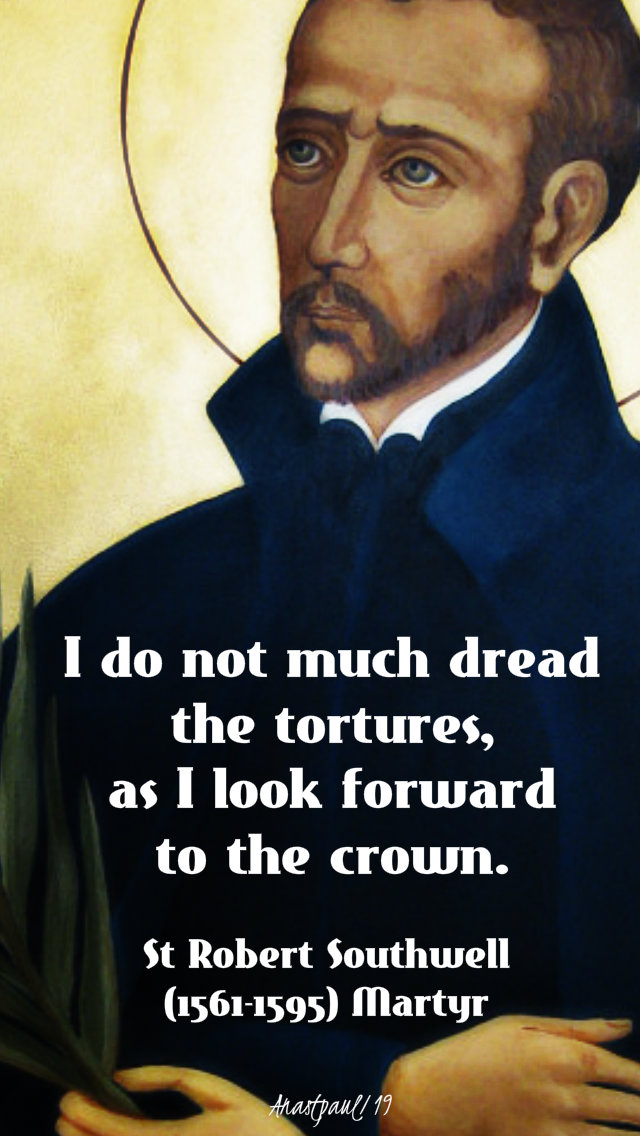
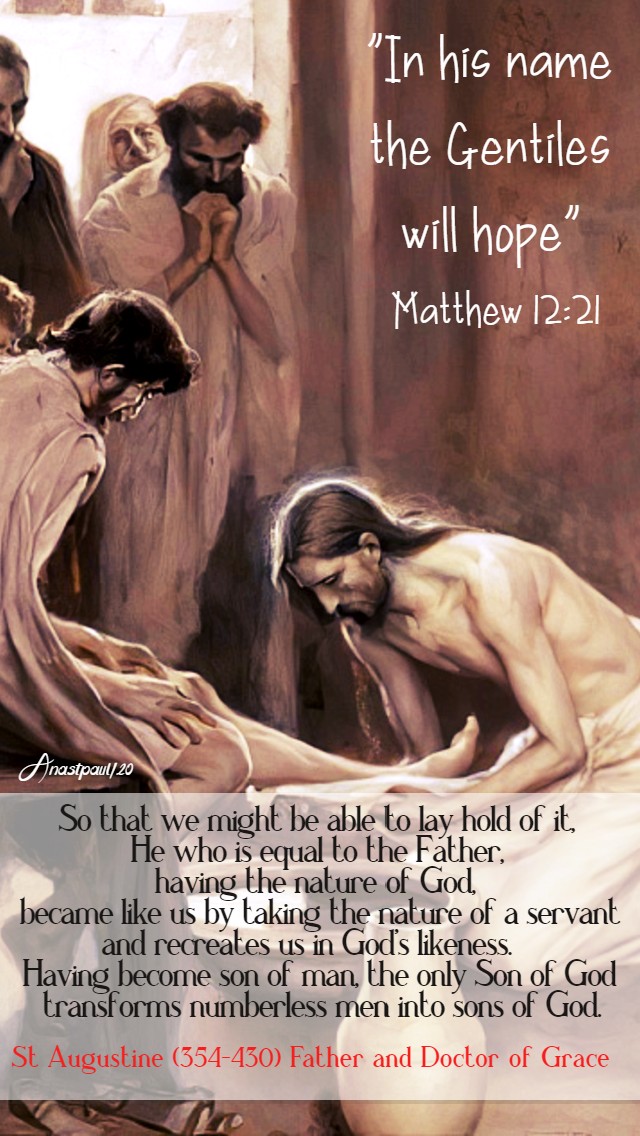
“God is not a deceiver, that He should offer to support us and then, when we lean upon Him, should slip away from us.”
St Augustine (354-430)
Father and Doctor of the Church
“He is the one who teaches the truth of prophecy through His presence and makes obedience to the commandments possible, through grace.”
St Pope Leo the Great (400-461)
Father and Doctor of the Church
“He who trusts in himself is lost. He who trusts in God can do all things.”
St Alphonsus Liguori (1696-1787)
Most Zealous Doctor
“Celebrate the feast of Christmas everyday, even every moment in the interior temple of your spirit, remaining like a baby in the bosom of the heavenly Father, where you will be reborn, each moment, in the Divine Word, Jesus Christ.”
One Minute Reflection – 23 June – “Month of the Sacred Heart” – Tuesday of the Twelfth week in Ordinary Time, Year A, Readings: 2 Kings 19:9-11, 14-21, 31-36, Psalm 48:2-4, 10-11, Matthew 7:6, 12-14
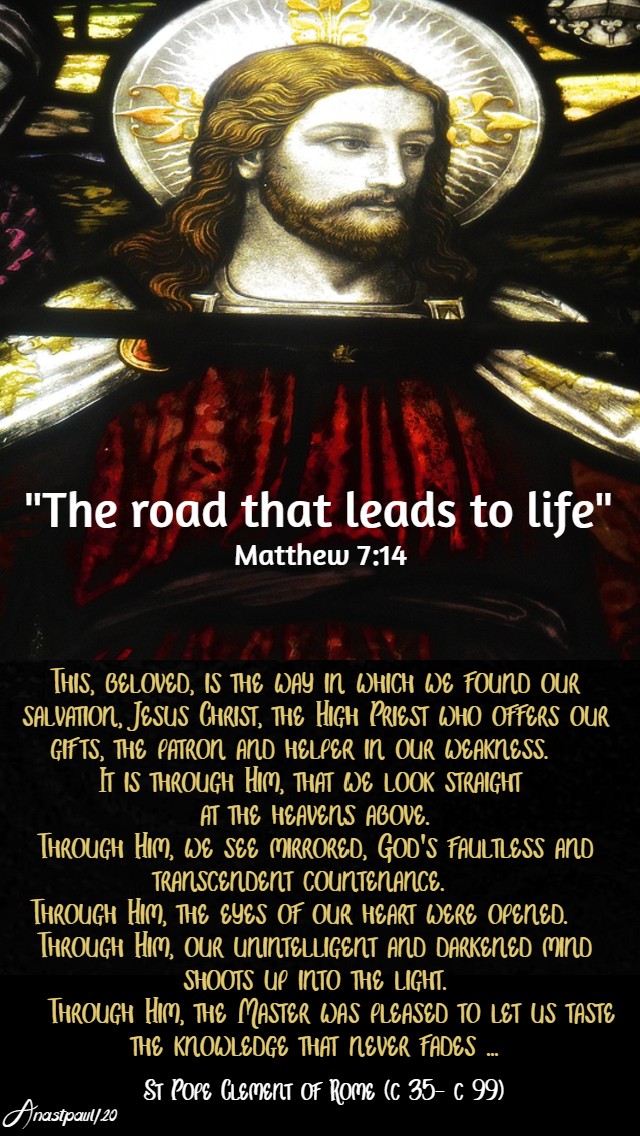
“The road that leads to life” … Matthew 7:14
REFLECTION – “This, beloved, is the way in which we found our salvation, Jesus Christ, the High Priest who offers our gifts, the patron and helper in our weakness (Heb 10:20; 7:27; 4:15). It is through Him, that we look straight at the heavens above. Through Him, we see mirrored, God’s faultless and transcendent countenance. Through Him, the eyes of our heart were opened. Through Him, our unintelligent and darkened mind shoots up into the light. Through Him, the Master was pleased to let us taste the knowledge that never fades, He who is “the radiance of His splendour, who towers as much above the angels, as the title He has inherited, is superior to theirs” (He 1:3-4) (…)
Let us take our body. The head is nothing without the feet and the feet are nothing without the head. The smallest organs of our body are necessary and valuable to the whole body, in fact, all parts conspire and yield the same obedience, toward maintaining the whole of the body (cf.1 Co 12:12f.).
Therefore, let the whole of our body be maintained in Christ Jesus and let each submit to their neighbour’s rights in the measure determined by the special gift bestowed on them. Let the strong care for the weak and the weak respect the strong; let the rich support the poor and the poor render thanks to God for giving them the means of supplying their needs; let the wise show their wisdom, not in words but in active help; the humble must not testify to themselves but leave it to another to testify in their behalf. Those who are continent must not boast, knowing that it is another who confers on them the ability to remain continent.
Let us, therefore reflect, brethren, of what clay we were made, what and who we were when we entered the world, out of what grave and darkness, our Maker and Creator has brought us into the world, where He has prepared His benefits before our birth. Since, then, we owe all these blessings to Him, we are obliged to thank Him in every way.” … St Pope Clement I (c 35 – c 99)- Pope from c 90 to c 99 – Letter to the Corinthians, § 36-38
PRAYER – The Elder Brother’s Prayer
Teach me, my Lord,
to be sweet and gentle in all the events of life,
in disappointments,
in the thoughtlessness of those I trusted,
in the unfaithfulness of those on whom I relied.
Let me put myself aside,
to think of the happiness of others,
to hide my little pains and heartaches,
so that I may be the only one to suffer from them.
Teach me to profit by the suffering
that comes across my path.
Let me so use it that it may make me
patient, not irritable.
That it may make me broad in my forgiveness,
not narrow, haughty and overbearing.
May no one be less good
for having come within my influence.
No one less pure, less true, less kind,
less noble for having been a fellow traveller
in our journey toward Eternal Life.
As I go my rounds from one distraction to another,
let me whisper from time to time,
a word of love to Thee.
May my life be lived in the supernatural,
full of power for good,
and strong in its purpose of sanctity.
Amen
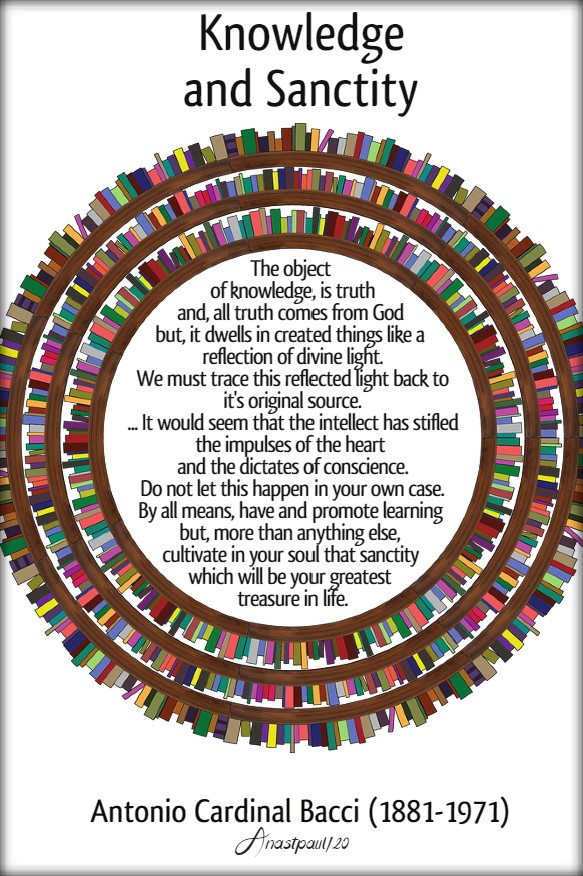
Thought for the Day – 22 June – Meditations with Antonio Cardinal Bacci (1881-1971)
Interior Mortification
“In the spiritual life, as in the physical order, death is the beginning of life. “Unless the grain of wheat falls into the ground and dies, it remains alone. But, if it dies, it brings forth much fruit. He who loves his life, loses it and he who hates his life in this world, keeps it unto life everlasting” (Jn 12:24-25).
This passage of the Gospel, epitomises the doctrine of Christian mortification – it is necessary to die to ourselves, in order to live in God. Anyone who is full of himself and of worldly matters, has no room in his heart for God. It is not possible, as St Augustine points out, to fill a vase with earth and then to fill it with water. There is no room left for the water and, if a little of it enters the vase, it is no longer pure water but muddy!
We must empty ourselves of ourselves and of worldly things, in order to fill ourselves with God. Jesus told us this quite clearly. “If anyone wishes to come after me, let him deny himself” (Mt 16:24).
If anyone denies himself in order to do God’s will in all things, he has achieved real interior mortification. Moreover, he has perfect peace, which consists in being established in the love of God.
This does not mean that all self-love is wrong. In fact, there are two kinds of self-love. We can love our true good, which is God and, therefore, desire to live in harmony with this supreme good in this life in order to enjoy it as our eternal reward. This kind of self-love is founded on the love of God, Who is the main reason why we love ourselves. But if we prefer our own pleasure and satisfaction to God, then our self-love is disproportionate and wrong and leads us into sin.
The first thing we must do, therefore, is to mortify our inordinate self-love. In other words, we must deny ourselves in matters where self-love is keeping us apart from God, Whom we should love more than anything else in life.”
Quote/s of the Day – 22 June – The Memorial of St John Fisher (1469-1535) Bishop, Martyr
“I reckon in this realm, no one man, in wisdom, learning and long approved virtue together, meet to be matched and compared with him.”
St Thomas More speaking of St John Fisher
“A good man is not a perfect man; a good man is an honest man, faithful and unhesitatingly responsive to the voice of God in his life.”
“Contrition is to have sorrow at heart and great repentance of all his sins and to have steadfast purpose to keep and abstain him from all deadly sins. For who has intention to return him to deadly sin, his confession avails him nothing!”
“Penance is a needful thing to the sinner, who desires to recover health of his soul. And, in doing penance, there be three things to be considered: serious compunction of heart, confession of mouth and satisfaction by deed.”
“As St Paul has said, for our justification, He [Christ], gave to man all that was necessary – His Blood to wash us, His Body to redeem us. In His Passion, Justice and peace have met each other.”
“Beware of those prophets who speak unto you and deceive you! They prophecy nothing but the imaginations and forgings of their own minds and not the truth of Holy Scripture!”
One Minute Reflection – 22 June – “Month of the Sacred Heart” – Monday of the Twelfth week in Ordinary Time, Year A, Readings: 2 Kings 17:5-8, 13-15, 18, Psalm 60:3-5, 12-13, Matthew 7:1-5 and the Memorial of St John Fisher (1469-1535) Bishop, Martyr
“You hypocrite, remove the wooden beam from your eye first; then you will see clearly to remove the splinter from your brother’s eye.” … Matthew 7:5
REFLECTION – “The word hypocrite is aptly employed here, since the denouncing of evils is best viewed as a matter only for upright persons of goodwill. When the wicked engage in it, they are like impersonators, masqueraders, hiding their real selves behind a mask, while they portray another’s character through the mask. The word hypocrites, in fact, signifies pretenders.
Hence we ought especially to avoid that meddlesome class of pretenders who, under the pretence of seeking advice, undertake the censure of all kinds of vices. They are often moved by hatred and malice.
Rather, whenever necessity compels one to reprove or rebuke another, we ought to proceed with godly discernment and caution.
First of all, let us consider whether the other fault is such, as we ourselves have never had, or whether it is one that we have overcome.
Then, if we have never had such a fault, let us remember that we are human and could have had it. But if we have had it and are rid of it now, let us remember our common frailty, in order that mercy, not hatred, may lead us to the giving of correction and admonition.
In this way, whether the admonition occasions the amendment, or the worsening of the one for whose sake we are offering it, (for the result cannot be foreseen), we ourselves shall be made safe through singleness of eye. But if on reflection we find that we ourselves have the same fault as the one we are about to reprove, let us neither correct nor rebuke that one. Rather, let us bemoan the fault ourselves and induce that person to a similar concern, without asking him to submit to our correction.”… St Augustine (354-430) Father and Doctor of Grace – Sermon on the Mount, 2
PRAYER – As we pray before You Lord, we ask You, in Your loving kindness, for the grace always to ponder in our hearts what we proclaim with our lips. Keep us in Your commandments and strengthen us by the prayers of St John Fisher, Your Martyr, that we may live by a holy conscience and never flinch from the protection of truth. Grant this we pray through Jesus Christ, Your Son, our Lord, in the love and unity of the Holy Spirit, God for always and forever, amen.
Thought for the Day – 21 June – “Month of the Sacred Heart” – Meditations with Antonio Cardinal Bacci (1881-1971) (Incorporating the Sunday Reflection)
Holy Communion
“Let us meditate on what an extraordinary thing Holy Communion is. Jesus, God made man, really descends into us, poor creature though we are. We become the living temples of the Holy Trinity.
Not only does Jesus come to us, body, soul and divinity but, He also becomes our food. There is a great difference, however, between the nourishment of material food and the spiritual nourishment which we receive from the body, blood, soul and divinity of Jesus Christ. When we take ordinary natural food, we assimilate it. In other words, we cause it to become blood of our blood and flesh of our flesh. When we receive Holy Communion, on the other hand, it is we who must be assimilated and changed into Jesus. Each of us should become, therefore, another Christ, in the manner indicated by St Paul: “It is now, no longer I that live but Christ, lives in me” (Gal 2:20).
Material food becomes human and is assimilated into our being. Our Eucharistic food assimilates us into Itself and, in a certain sense, deifies us. This is why St John Chrysostom calls it a mystery which transports us into Heaven.
Before this can happen, however, it is necessary for us to approach Holy Communion with the necessary dispositions. These are: (1) A lively and active faith, which will enable us to recognise in the white Host, the person of Jesus Himself, full of goodness, mercy and love, eager to shower upon us, all the treasures of His Heart. (2) Purity and freedom, not only from mortal sin but, also from any deliberate attachment to venial sin. (3) Deep humility because, Jesus loves the humble and holds the proud at a distance from Him. He wishes us to be like Him, in other words, meek and humble of heart. There must be no worldly ambition, therefore, no love of honours, riches or human greatness, no inordinate affection for things or persons. There must be only a great desire to please God alone and to offer Him our whole life, including every thought and action. (4) Finally, an ardent love for Jesus, which will consume all our imperfections and unite us to Him so intimately, that, we shall be transformed by Him.”
Quote/s of the Day – 21 June – “Month of the Sacred Heart” – Twelfth Sunday in Ordinary Time, Year A, Readings: Jeremiah 20:10-13, Psalm 69:8-10, 14, 17, 33-35, Romans 5:12-15, Matthew 10:26-33
“What I tell you in the dark, say in the light and what you hear whispered, proclaim on the housetops. And do not fear those who kill the body but cannot kill the soul.”
Matthew 10:27-28
“When the farmer leaves his home to go out and gather the harvest, he is brimming over with joy and shining with happiness. He thinks neither of the suffering nor the difficulties that he might encounter… Christ says, lend me your tongue and you will see the ripe grain going into the king’s granaries.”
St John Chrysostom (347-407)
Father & Doctor
“Everyone without God, has a dead soul. You, who bewail the dead, rather, should bewail sin. Bewail ungodliness. Bewail disbelief.”
St Augustine (354-430)
Father and Doctor of Grace
“Someone who truly follows the Lord wants everyone to follow Him, which is why he turns to his neighbour with kind attentions, prayers and proclamation of the Gospel. … Jesus loves the one who follows Him.”
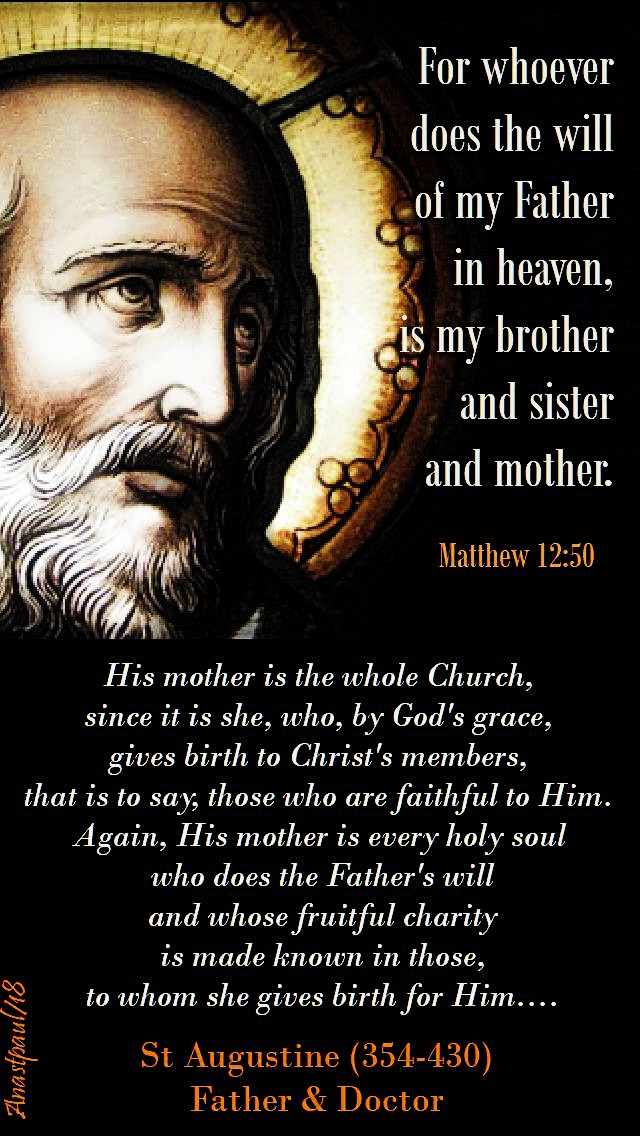
St Anthony of Padua (1195-1231)
Evangelical Doctor
“You would be very ashamed, if you knew what the experiences you call, setbacks, upheavals, pointless disturbances and tedious annoyances really are. You would realise that your complaints about them, are nothing more nor less, than blasphemies – though that never occurs to you. Nothing happens to you except by the will of God and yet [God’s] beloved children curse it, because they do not know it, for what it is!”
Father Jean-Pierre de Caussade (1675-1751)
Prayer for Submission to Divine Providence By St Joseph Maria Pignatelli SJ (1737 – 1811)
My God, I do not know
what must come to me today.
But I am certain
that nothing can happen to me
that You have not foreseen, decreed
and ordained from all eternity.
That is sufficient for me.
I adore Your impenetrable
and eternal designs,
to which I submit with all my heart.
I desire, I accept them all
and I unite my sacrifice to that of
Jesus Christ, my Divine Saviour.
I ask in His name
and through His infinite merits,
patience in my trials
and perfect and entire submission,
to all that comes to me
by Your good pleasure.
Amen
“Do not be afraid! God will show you, to the hour and moment, what you should say and what you should do.”
St Léonie Françoise De Sales Aviat
(1844-1914)
“Let us remain unafraid in all dangers, trusting calmly, in the Divine Providence, that watches over us day and night.”
St Joseph Freinademetz (1852-1908)
“We have the Providential love of God as our guide. When there is a ship at sea and heads towards the port, nobody doubts that it is led by a pilot and one could doubt that there is a God who guides the universe only because He cannot be seen? By His Providential Love, God arranges and regulates events, regulates everything, with gentleness and wisdom. I advise you to abandon yourself completely into the hands of Divine Providence. “
Blessed Edoardo Giuseppe Rosaz (1877-1903)
“We must never be afraid. We never walk alone. Jesus walks ahead.”
One Minute Reflection – 21 June – “Month of the Sacred Heart” – Twelfth Sunday in Ordinary Time, Year A, Readings: Jeremiah 20:10-13, Psalm 69:8-10, 14, 17, 33-35, Romans 5:12-15, Matthew 10:26-33 and the Memorial of St Aloysius de Gonzaga SJ (1568-1591)
“What you hear whispered, proclaim on the housetops.” … Matthew 10:27
REFLECTION – “It is not I who undertook this work but, it is Christ the Lord who commanded me to come to be with these Irish pagans for the rest of my life, if the Lord shall will it and shield me from every evil … But I do not trust myself “as long as I am in this mortal body” (2 Pt 1:13; Rm 7:24) … I did not lead a perfect life like other believers but I confess to my Lord and do not blush in His sight because I am not lying, from the time when I came to know Him in my youth, the love of God and fear of Him increased in me and right up until now, by God’s favour, “I have kept the faith” (2 Tm 4:7).
What is more, let anyone laugh and taunt if he so wishes. I am not keeping silent, nor am I hiding “the signs and wonders” (Dn 6:27) that were shown to me by the Lord many years before they happened, He who knew everything, even before the beginning of time. Thus, I should give thanks unceasingly to God, who has frequently forgiven my folly and my negligence, in more than one instance and has never been angry with me, who am placed as His helper, though I did not easily assent to what had been revealed to me, as the Spirit was urging. The Lord “took pity” on me “thousands upon thousands” of times, (Ex 20:6) because He saw within me, that I was prepared to serve Him. … Many were trying to prevent this mission, they were talking among themselves behind my back and saying, “Why is this fellow throwing himself into danger among enemies who do not know God?” Not from malice did they say this, as I myself can testify, they perceived my rusticity. And I was not quick to recognise the grace that was then in me, I now know, that I should have done so earlier.
Now I have put it frankly to my brothers and co-workers, who have believed me because of what “I have proclaimed and still proclaim” (2 Co 13:2) to strengthen and reinforce your faith. I wish only, that you too, would make greater and better efforts. This will be my pride, for “a wise son makes a proud father.” (Pr 10:1)” … St Patrick (c 385-461) – The Confessions, # 43-47
PRAYER – Lord God, teach us to fear and love Your Holy Name, for You never withdraw Your guiding hand, from those You establish in Your love. Guide our ways and direct our hearts, live in us and walk before us. May the intercession of St Aloysius Gonzaga help us to fully utilise the many gifts our Almighty God has bestowed on us as we journey home. We make our prayer through Jesus Christ our Lord, in union with You and the Holy Spirit, one God forever, amen.
Thought for the Day – 20 June – Meditations with Antonio Cardinal Bacci (1881-1971)
“All Generations Shall Call Me Blessed”
‘A Jewish girl, poor in this world’s goods but rich in virtue, arrived after a long and difficult journey at a village in the hills of Judea, called Hebron. There, she paid a visit to her cousin, Elizabeth. When Elizabeth saw the girl, she was immediately enlightened by the Holy Spirit with the knowledge, that her visitor, was the Mother of God. “How have I deserved,” she cried out, “that the mother of my Lord, should come to me?” (Lk 1:43). At these words, Mary looked up towards Heaven and gave spontaneous expression to a hymn of humble acknowledgement to God, Who had “regarded the lowliness of His Handmaid” (Lk 1:48). Then she made a solemn prophecy, which would surely have assured the cynical intellectuals and nobles of the land but, which history has wonderfully fulfilled. “Behold” she said, “all generations shall call me blessed” (ibid). We can testify today, that this miracle came to pass. All the nations have paid reverence to the Jewish girl, who became the Mother of God and our Mother, the Queen of Heaven and earth, the comforter of the afflicted, the conqueror of Satan and the invincible Guardian of the Church. From the engravings in the Catacombs, to the celestial Madonnas of the Angelico, from the rudimentary sculpture of Roman art, to the prayerful statues on the pinnacles of more modern Cathedrals, the image of Mary has shone as a beacon of hope for all generations. Men bow before her and ask for light, for comfort and for pardon. “If anyone follows Mary,” says St Bernard, “he will not lose his way; if anyone pray to her, he will not despair; if anyone thinks of her, he will not sin; if anyone reaches out to her, he will not fall; if anyone places himself under her protection, he need have no fear; if anyone places himself under her leadership, he will never give up; if anyone pays homage to her, he is certain reach his destination safely”(Homil Missus est 2:17).”
Quote/s of the Day – 20 June – “Month of the Sacred Heart” – Memorial of the Immaculate Heart of Mary
“I want My Church to…put the devotion to this Immaculate Heart beside the devotion to My Sacred Heart.”
Jesus to Lúcia of Fatima
“Look, my Daughter,” Our Lady said to Lúcia on 10 December 1925, “at my heart, surrounded with thorns, with which ungrateful men pierce me. “
Our Lady assured Lúcia: “My Immaculate Heart will be your refuge and the way that will lead you to God.” Thus, if we devote ourselves to her Immaculate Heart, Mary will lead us to her Son, Jesus Christ and we will be on the way to Heaven.
Our Lady of Fatima
“This Virgin Mother of the Only begotten of God is called Mary, worthy of God, Immaculate of the Immaculate, one of the one.”
Origen (c 185-253)
“Do you not know, that not only is Jesus, resting and dwelling continually in the Heart of Mary but that He is, Himself the Heart of Mary … “
St John Eudes
Apostle of the Two Holy Hearts
“If you put all the love, of all the mothers into one heart, it still would not equal the love of the Heart of Mary for her children.”
St Louis de Montfort (1673-1716)
“…Let us continue Immaculate Mary’s mission. All is included in it. May [we].. follow her example and be the handmaid of the Lord in everything, everywhere and always.”
One Minute Reflection – 20 June – “Month of the Sacred Heart” Memorial of the Immaculate Heart of Mary, Readings: Isaiah 61:9-11, Responsorial psalm 1 Samuel 2:1, 4-8, Luke 2:41-51
“He went down with them and came to Nazareth and was obedient to them and his mother kept all these things in her heart.” … Luke 2:51
REFLECTION – “Consider the most prudent woman Mary, mother of true Wisdom, as the pupil of her Son. For she learned from Him, not as from a child or man but as from God. Yes, she dwelt in meditation on His words and actions. Nothing of what was said or done by Him fell idly on her mind. As before, when she conceived the Word itself in her womb, so now, does she hold within her, His ways and words, cherishing them as it were, in her heart. That which she now beholds in the present, she waits to have revealed with greater clarity in the future. This practice she followed as a rule and law through all her life.” … St Bede the Venerable (673-735) Father and Doctor of the Church – Exposition of the Gospel of Luke
PRAYER – Lord open our hearts to Your grace. As You brought joy to the world through the incarnation of Your Son, Our Lord Jesus Christ, grant that through the prayer of the Immaculate Heart of His Ever-Virgin Mother, our hearts too may grow in virtue and love by learning to reflect constantly on His commandments and counsels. We make our prayer through our Lord Jesus, with the Holy Spirit, God forever, amen.
Solemnity of the Most Sacred Heart of Jesus – 19 June
May we all be abundantly Blessed today by the Sacred and Loving Heart of Jesus May we all grow closer and closer to the Sacred Heart, the source of all Love!
A little (actually, a lot! – please take the time to read it) of the History of the Devotion to the Sacred Heart
By Giovanni Gasparro
In the 13th century, the Franciscan Doctor of the Church (1217-1274) – “The Seraphic Doctor,” St Bonaventure’s work “With You is the Source of Life” (which is the reading for the Divine Office on the Solemnity of the Sacred Heart) began to point to the heart as the fountain from which God’s love poured into our lives:
“Take thought now, redeemed man and consider how great and worthy is He who hangs on the cross for you. His death brings the dead to life but at His passing, heaven and earth are plunged into mourning and hard rocks are split asunder. It was a divine decree that permitted one of the soldiers to open His sacred side with a lance. This was done so that the Church might be formed from the side of Christ as He slept the sleep of death on the cross and so that the Scripture might be fulfilled: ‘They shall look on him whom they pierced.’ The blood and water, which poured out at that moment, were the price of our salvation. Flowing from the secret abyss of our Lord’s Heart as from a fountain, this stream, gave the Sacraments of the Church, the power to confer the life of grace, while for those already living in Christ, it became a spring of living water welling up to life everlasting.”
The Devotion Spreads Slowly
At the end of the 13th century, St Gertrude the Great, on the feast of St John the Evangelist, had a vision in which she was allowed to rest her head near the wound in the Saviour’s side. She heard the beating of the Divine Heart and asked John if, on the night of the Last Supper, he too had felt this beating heart, why then had he never spoken of the fact. John replied that this revelation had been reserved for subsequent ages when the world, having grown cold, would have need to rekindle its love.
St Gertrude the Great
From that time until the time of St John Eudes Orat. (1501-1680), the devotion continued to spread, primarily as a private devotion but one that was increasingly wide-spread. Many religious orders prayed the devotion – the Franciscans, the Jesuits, the Carmelites of Spain and the Benedictines.
Let us now consider the key ideas which motivated St John Eudes in his great love for the Sacred Heart, so that by understanding them “Christ may dwell in your hearts through faith, that being rooted and grounded in love, you may have the power with all the saints to comprehend what is the breadth and length and height and depth and to know the love of Christ which surpasses knowledge, that you may be filled with all the fullness of God “(Eph 3, 17-19). Two interrelated thoughts overwhelmed St John Eudes, first:
“The Sacred Heart of Jesus, whether considered in His Divinity or in His humanity, is more ardently enkindled with love for His Father, loving Him infinitely more at any given moment, than all the hearts of angels and saints can love Him throughout all eternity.”
The second thought which rejoiced the heart of St John Eudes expands on the first:
[Jesus, the Son of God] “willed to be our Head and chose us as His members. He has associated us with Himself in His ineffable love [for the Father]. He has given us, as a result, the power to love the Father with the [very] same love with which He loves [the Father], with a love eternal, boundless and infinite.”
St John Eudes with the Sacred Heart of Jesus
St John Eudes discerned eight different flames of love, which issue from our Lord’s Heart in the Tabernacle, which are freely adapted here to our present needs (definitely a post soon). St Pope Pius X declared him, the Father, Doctor and Apostle of Devotion to the Sacred Heart of Jesus.
The Devotion Renewed: St Marguerite Marie Alacoque VHM (1647-1690)
In the late 17th century the devotion was renewed and adopted elsewhere, especially following the revelations to St Marguerite Marie Alacoque. The saint, a cloistered nun of the Visitation Order, received several private revelations of the Sacred Heart, the first on 27 December 1673 and the final one 18 months later. The visions revealed to her the form of the devotion, the chief features being reception of Holy Communion on the first Friday of each month, Eucharistic adoration during a “Holy hour” on Thursdays and the celebration of the Feast of the Sacred Heart.
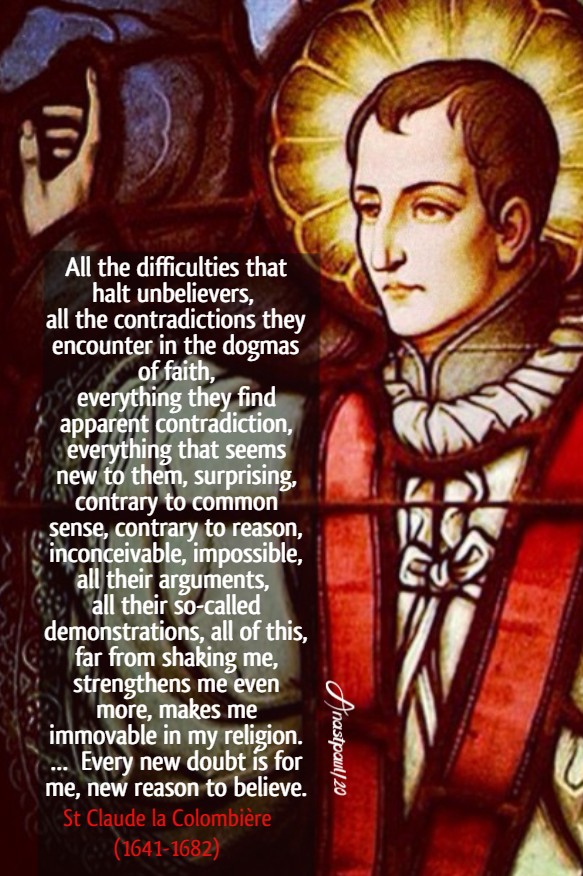
Initially discouraged in her efforts to follow the instruction she had received in her visions, Alacoque was eventually able to convince her superior of the authenticity of her visions. She was unable, however, to convince a group of theologians of the validity of her apparitions, nor was she any more successful with many of the members of her own community. She eventually received the support of St Claude de la Colombière SJ (1641-1682), the community’s confessor, who declared that the visions were genuine. Alacoque’s short devotional writing, La Devotion au Sacré-Coeur de Jesus (Devotion to the Sacred Heart of Jesus), was published posthumously in 1698. Here is an excerpt:
Saints of the Sacred Heart – St Joseph Benedict Labre, St Maria Goretti, St Dominic Savio, St Claude de la Colombiere, St John Eudes
“And He [Christ] showed me that it was His great desire of being loved by men and of withdrawing them from the path of ruin, that made Him form the design of manifesting His Heart to men, with all the treasures of love, of mercy, of grace, of sanctification and salvation which it contains, in order that those who desire to render Him and procure Him, all the honour and love possible, might themselves be abundantly enriched with those divine treasures of which His heart is the source.”
The devotion was fostered by the Jesuits and Franciscans but it was not until the 1928 encyclical Miserentissimus Redemptor by Pope Pius XI that the Church validated the credibility of Alacoque’s visions of Jesus Christ in having “promised her [Alacoque] that all those who rendered this honour to His Heart would be endowed with an abundance of heavenly graces.”
The World Consecrated to the Sacred Heart of Jesus
Maria Droste zu Vischering, was a German noble women, who at the age of 25 joined the congregation of Our Lady of Charity of the Good Shepherd, in Munster. She was given the name, BlSr Mary of the Divine Heart. In 1894, at the age of 31, she was transferred to Portugal and appointed superior of Oporto, Portugal. While there, she reported some messages from Jesus Christ in which she was asked to contact the Holy Father, requesting the consecration of the world to the Sacred Heart of Jesus.
On 10 June 1898, her Confessor at the Good Shepherd monastery wrote to Pope Leo XIII stating that Sister Mary of the Divine Heart had received a message from Christ, requesting the Holy Father to consecrate the entire world to the Sacred Heart. The Pope initially did not believe her and took no action. However, on 6 January 1899 she wrote another letter, asking that in addition to the consecration, the first Fridays of the month be observed in honour of the Sacred Heart. In the letter she also referred to the recent illness of the Pope and stated that Christ, had assured her, that Pope Leo XIII would live until he had performed the consecration to the Sacred Heart.
Bl Mary of the Divine Heart and St Margaret Mary Alacoque
Pope Leo XIII commissioned an inquiry on the basis of her revelation and Church tradition. In his 1899 encyclical letter Annum Sacrum, Leo XIII decreed that the Consecration of the entire human race to the Sacred Heart of Jesus should take place on 11 June 1899. Here is the consecration Pope Leo composed for the consecration:
“Most sweet Jesus, Redeemer of the human race, look down upon us humbly prostrate before Thine altar. We are Thine and Thine we wish to be but to be more surely united with Thee, behold each one of us, freely consecrates himself today, to Thy most Sacred Heart.
Many indeed have never known Thee, many too, despising Thy precepts, have rejected Thee. Have mercy on them all, most merciful Jesus and draw them to Thy Sacred Heart. Be Thou King, O Lord, not only, of the faithful who have never forsaken Thee but also, of the prodigal children who have abandoned Thee, grant that they may quickly return to Thy Father’s house, lest they die of wretchedness and hunger.
Be Thou King of those who are deceived by erroneous opinions, or whom discord keeps aloof and call them back to the harbour of truth and unity of faith, so that there may be but one flock and one Shepherd.
Be Thou King of all those who are still involved in the darkness of idolatry or of Islamism and refuse not to draw them into the light and kingdom of God. Turn Thine eyes of mercy towards the children of the race, once Thy chosen people: of old they called down upon themselves the Blood of the Saviour, may it now descend upon them a laver of redemption and of life.
Grant, O Lord, to Thy Church assurance of freedom and immunity from harm, give peace and order to all nations and make the earth resound from pole to pole with one cry: ‘Praise be to the divine Heart that wrought our salvation, to it be glory and honour forever.’” Amen
By Giovanni Gasparro – detail
The 100th Anniversary of the Feast of the Sacred Heart
In a landmark encyclical, Haurietis aquas (“You will draw waters”– written 15 May 1956) Venerable Pope Pius XII began his reflection by drawing from Isaiah 12:3, a verse which alludes to the abundance of the supernatural graces which flow from the heart of Christ. Haurietis aquas called the whole Church, to recognise the Sacred Heart as an important dimension of Christian spirituality. Pope Pius XII gave two reasons why the Church gives the highest form of worship to the Heart of Jesus. The first rests on the principle whereby the believers recognise that Jesus’ Heart is hypostatically united to the “Person of the Incarnate Son of God Himself.” The second reason is derived from the fact, that the Heart, is the natural sign and symbol of Jesus’ boundless love for humans . The encyclical recalls that for human souls the wound in Christ’s side and the marks left by the nails have been “the chief sign and symbol of that love” that ever more incisively shaped their life from within.
In a letter on 15 May 2006 Pope Benedict XVI wrote: “By encouraging devotion to the Heart of Jesus, the Encyclical Haurietis aquas exhorted believers to open themselves to the mystery of God and of His love and to allow themselves to be transformed by it. After 50 years, it is still a fitting task for Christians to continue to deepen their relationship with the Heart of Jesus, in such a way, as to revive their faith in the saving love of God and to welcome Him ever better into their lives.”
As the encyclical states, from this source, the heart of Jesus, originates the true knowledge of Jesus Christ and a deeper experience of His love. Thus, according to Pope Benedict XVI, we will be able to understand better what it means to know God’s love in Jesus Christ, to experience Him, keeping our gaze fixed on Him to the point that we live entirely on the experience of His love, so that we can subsequently witness to it to others.
Sadly, today, The League of the Sacred Heart founded in Ireland in the year of grace 1873, has fallen into obscurity, though, I know that in certain countries across the world, it is being revived. Below is a 14 minute video explaining the resuscitation of the League and the institution in America. The League however, still exists in a few isolated countries and we NEED, in these awful times, to revive it, wherever we are.
A great usurpation has taken place in the Church by the Divine Mercy Devotion – I know there are devotees of this latter Devotion on the site but if you would wish to educate yourself further in this regard, please go to the Youtube Channel – Ascent of Mount Carmel, where you will find lots of research on this subject. https://www.youtube.com/channel/UCcOObC8wjuxJjx6rBSiKo2A/videos
The Sacred Heart is knocking at the door of our heart. Will we open the door for Him? Will we make a commitment in devotion to serve Him with greater zeal and fidelity? Will we let Him in? The choice is now ours. Those who want to grow, know where the Sacred Heart is waiting for the response of their love and they know how to imitate His love in their daily life. Let us resume all that has been said with a final thought from St John Eudes: “The Son of God gives us His Heart not only to be the model and rule of our life but also to be our heart, so that by the gift of this Heart, immense, infinite and eternal, we may fulfil all our duties to God in a manner worthy of His infinite perfections. [Thus] we have received from our Divine Saviour, the gift of His adorable Heart, which is the perfect means of fulfilling all our duties. We should employ the Sacred Heart as if it were our own heart, to adore God fittingly, to love Him perfectly, and to satisfy all our obligations adequately so that our homage and love may be worthy of His supreme majesty. Eternal and infinite thanks be rendered to Thee, O Good Jesus, for the infinitely precious gift of Thy divine Heart. May all the angels, saints and all creatures bless Thee forever!
Let us Pray: Daily Consecration to the Sacred Heart
Daily Consecration to the Sacred Heart of Jesus Prayers to the Sacred Heart – The League of the Sacred Heart 1936 – 15th Edition, Dublin
O Sacred Heart of Jesus, filled with infinite love, broken by our ingratitude and pierced by our sins, yet loving us still, accept the Consecration we make to Thee, of all that we are and all that we have. Take every faculty of our souls and bodies, only day by day draw us, nearer and nearer to Thy Sacred Heart, and there, as we shall hear the lesson, teach us Thy Holy Way. Amen
Thought for the Day – 19 June – Solemnity of the Most Sacred Heart of Jesus – Meditations with Antonio Cardinal Bacci (1881-1971)
“Learn From Me, For I Am Meek and Humble of Heart”
“It is very easy to be gentle and humble when everything is going well for us.
It is difficult, however, when we meet humiliation, misunderstanding or opposition.
We need to be well advanced in perfection, if we are to have mildness and humility of heart, like that of Jesus.
We can only reach this state of perfection by prayer, sacrifice and character formation.
Pride, self-love and the desire to excel, are the evil effects of our corrupted nature.
St Francis de Sales jestingly remarked that self-love dies three days after us.
It is difficult to remove it completely from our character and to put, in it’s place, the love of God and of our neighbour but, this operation is necessary, if we are to obtain Christ-like humility and gentleness of heart.
God, not our own ego, should be the centre of our lives, He should be the focal point of all our thinking.
Let us beseech God for this grace and try and behave in this fashion on all occasions.
When we encounter lack of sympathy, coldness or injustice on the part of our fellowmen, we should try and avoid becoming annoyed or discourage.
The testimony of a sound conscience before God, is all that should concern us.
We should offer everything else to God, whether it is joy or sorrow, praise or criticism.
We shall be rewarded with peace of soul.
Jesus, meek and humble of heart, make my heart like unto Thine!”
Quote/s of the Day – 19 June – Solemnity of the Most Sacred Heart of Jesus and the World Day of Prayer for the Sanctification of Priests and the Memorial of Bl Maria Rosa Flesch FSMA (1826-1906)
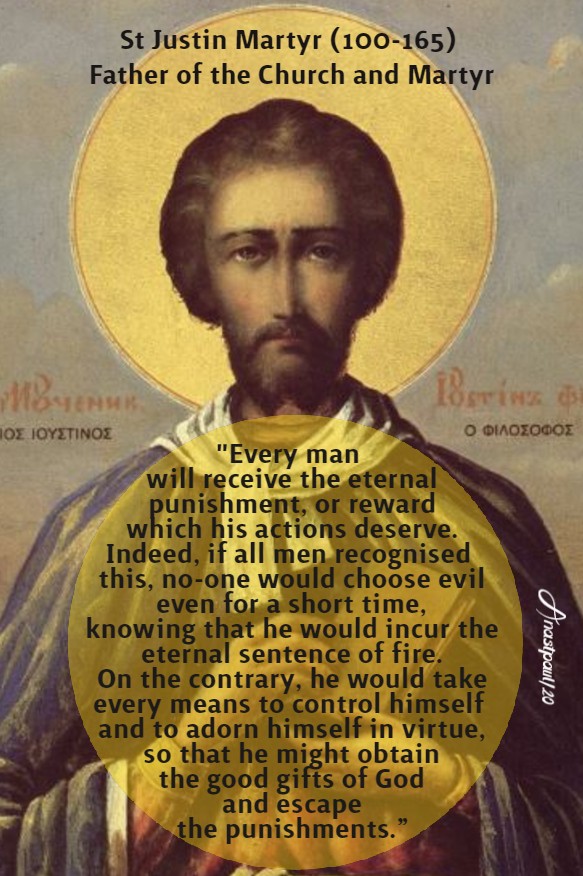
“We, Christians, are the true Israel which springs from Christ, for we are carved out of His Heart, as from a Rock!”
St Justin Martyr (100-165)
Father of the Church and Martyr
Looking forward to never-ending communion, St Gertrude ended her earthly life on 17 November 1301 or 1302, at the age of about 46. In the seventh Exercise, that of preparation for death, St Gertrude wrote:
“O Jesus, You who are immensely dear to me, be with me always, so that my heart may stay with You and that Your love may endure with me, with no possibility of division and bless my passing, so that my spirit, freed from the bonds of the flesh, may immediately find rest in you. Amen”
St Gertrude the Great (1256-1302)
“If the Jewish High priest carried the names of the twelve tribes of Israel written on his shoulders and on his breast, how much more Christ, our High Priest, carries our names written on His Heart”
St John of Avila (1500-1569)
Doctor of the Church
“Do everything out of love for God, for God, with God, to get to God.”
Bl Maria Rosa Flesch FSMA (1826-1906)
“The priesthood is the love of the heart of Jesus”
St John Marie Baptiste Vianney (1786-1859)
Patron of Priests
“Ah! Beside You I am not afraid of anything! I snuggle up against You and, like the lost sheep, hear the beating of Your Heart. Jesus, yet again I am Yours, Yours forever. With You, I am truly great, without You, nothing but a weak reed. Upheld by You, I am a pillar!”
One Minute Reflection – 19 June – Solemnity of the Most Sacred Heart of Jesus and the World Day of Prayer for the Sanctification of Priests, Gospel: Luke 15:3–7, Readings: Deuteronomy 7:6-11, Psalm 103:1-4, 6-8, 10, 1 John 4:7-16, Matthew 11:25-30
“Take my yoke upon you and learn from me, for I am meek and humble of heart and you will find rest for yourselves. For my yoke is easy, and my burden light.” … Matthew 11:29-30
REFLECTION – “Now, O love, my King and my God, now, O Jesus my dear one, receive me into the most gracious care of Your Divine Heart. There, there, so that I may live entirely for You, fasten me to Your love. Now release me into the great ocean of Your mercy’s abyss – there, there, commit me to the bowels of Your overflowing kindness. Ah! Now cast me into the voracious flame of Your living love. There, there, transmit me into You until my soul and spirit are reduced to ashes in the conflagration. And at the hour of my passing away, commit me to the providence of Your fatherly charity.
There, there, O my sweet Saviour, console me with the sight of Your gentle presence. There, by the taste of Your dear ransom with which You have redeemed me, recreate me. There, with the loving voice of Your incomparable love, call me to You. There, there, receive me in the embrace of Your infinitely merciful forgiveness. There, by the exquisite scent of the breath of Your Spirit’s sweetness, draw me to You, draw me in and draw me. There, in the kiss of perfect union of Your fruition, immerse me forever. And grant me then to see You, to have You, to enjoy You eternally in the greatest happiness, for my soul has yearns for You, O Jesus, dearest of all dear ones. Amen.” … St Gertrude the Great (1256-1302) Exercises IV, §400-419
PRAYER – Prayer to the Sacred Heart of Jesus – By St Gertrude the Great (1256-1302)
O Sacred Heart of Jesus,
fountain of eternal life,
Your Heart is a glowing furnace of Love.
You are my refuge and my sanctuary.
O my adorable and loving Saviour,
consume my heart with the burning fire
with which Yours is aflamed.
Pour down on my soul those graces
which flow from Your love.
Let my heart be united with Yours.
Let my will be conformed to Yours in all things.
May Your Will be the rule of all my desires and actions.
Amen
Thought for the Day – 18 June – Meditations with Antonio Cardinal Bacci (1881-1971)
Belonging Entirely to God
“Willing or unwilling, we belong entirely to God.
God created us from nothing and all that we have is His – soul and body, material and spiritual gifts and the world in which we live.
God has given us everything and, at any moment, He can take away the life which He gave us.
It is useless, indeed senseless, to rebel against Him, or to try and release ourselves from His absolute dominion.
Admittedly, He has given us free will and we can disobey and offend him but, even if we do so, we still belong completely to God and He has absolute power over us.
He has created us for Himself alone, for He is the final goal of all things.
We can never escape from His authority.
Do we rebel and hurl towards God, the cry of Satan: “I will not serve?”
Even if we do, whether we are in sin, or in the depths of hell, we still belong to Him.
We shall have to bear eternal witness to His infinite love and mercy, as well as, to His infinite justice.
We have been created for God’s glory and God is glorified, both in His goodness and in His justice.
We should meditate deeply, on this tremendous concept.
How much better it is for us to belong wholly to God in love and in obedience, than in the chastisement of His justice.
How much better it is, to obey and serve Him as our Sovereign Lord, to honour Him, as our Father and to love Him, as the Spouse of our souls.
All our thoughts and desires should, therefore, be directed to Him and all our plans and actions, should be offered to Him.
If we are attached to worldly possessions and persons, if we are vain and ambitious and, if we yield to our passionate inclinations, our hearts do not belong completely to God.
We are guilty of theft, if we do not offer our hearts entirely to God because, they are entirely His!
Moreover, we do ourselves a grave injury because, we can find nothing but disillusionment in the love of creatures and in the satisfaction of our senses.
God alone, can fully satisfy our hearts, which were made for Him alone.”
Quote/s of the Day – 18 June – Thursday of the Eleventh week in Ordinary Time, Year A, Readings: Sirach 48:1-14 (1-15), Psalm 97:1-7, Matthew 6:7-15
“Our Father who art in heaven, Hallowed be Thy name. Thy kingdom come. Thy will be done, On earth as it is in heaven. Give us this day our daily bread And forgive us our trespasses As we forgive those who trespass against us And lead us not into temptation but deliver us from evil. Amen”
Jesus
Matthew 6:9-13
“So, my brothers, let us pray as God our master has taught us. To ask the Father in words His Son has given us, to let Him hear the prayer of Christ ringing in His ears, is to make our prayer one of friendship, a family prayer. Let the Father recognise the words of His Son. Let the Son who lives in our hearts, be also on our lips. We have Him as an Advocate for sinners, before the Father, when we ask for forgiveness for ours sins, let us use the words given by our Advocate. He tells us – Whatever you ask the Father in my name, He will give you. What more effective prayer could we then make, in the name of Christ, than in the words of His own prayer?”
“As the Lord’s Prayer continues, we ask: Give us this day our daily bread. We can understand this petition in a spiritual and in a literal sense. For in the divine plan both senses may help toward our salvation. For Christ is the Bread of Life; this Bread does not belong to everyone but is ours alone. When we say, our Father, we understand that he is the Father of those who know Him and believe in Him. In the same way, we speak of our daily bread, because Christ is the Bread of those who touch His body.”
St Cyprian of Carthage (c 200- c 258)
Bishop, Father of the Church and Martyr
An excerpt from his “On the Lord’s Prayer”
“For the author and giver of divine blessings could not but be our teacher as well, providing the words of this prayer, as precepts of life, for those disciples who believe in Him and follow the way He taught in the flesh. Through these words, He has revealed the hidden treasures of wisdom and knowledge (Col 2:3) that exist in Him as pure form. And, in all who offer this prayer, He kindles the desire to enjoy such treasures.”
St Maximus the Confessor (c 580-662)
Monk and Theologian
Interpretation of the Lord’s Prayer
“You see, my children, the Christian’s treasure is not on earth, it is in heaven (Mt 6:20). So our thinking must go to where our treasure is. The human person has a beautiful task, to pray and to love. You pray, you love – that is the human being’s happiness on earth.”
“Prayer is nothing other than union with God. … This union of God with his little creature is something beautiful. It is a happiness that we cannot understand. We had deserved not to pray but God, in His goodness, allows us to speak to Him. Our prayer is incense, which He receives with tremendous pleasure.”
St John-Marie Vianney (1786-1859)
Catechism on Prayer]
“Father, hallowed be thy name.”
Luke 11:2
“I have an instinct within me, which leads me to rise and go to my Father, to name the Name of His well-beloved Son and having named it, to place myself, unreservedly in His hands, saying “if Thou, Lord, will mark iniquity, Lord, who shall stand it? For with Thee, there is merciful forgiveness.”
St John Henry Newman
(1801-1890)
To My Father
“God sees us always, for He is everywhere. …He sees clearly, everything which we think, desire or do, even our most secret hidden actions. Do we perfectly grasp this tremendous truth? Are we aware of it, at every moment of our lives and do we make it the guide for our conduct? If we were to live continually in the Presence of God, our lives would be angelic, rather than human, for we would not allow ourselves to commit even the slightest sin, nor to be guilty of the least thought, word or action, which might offend Him. The more we fail in our awareness of the Presence of God, the more disordered our actions become.”
One Minute Reflection – 18 June – “Month of the Sacred Heart” – Thursday of the Eleventh week in Ordinary Time, Year A, Readings: Sirach 48:1-14 (1-15), Psalm 97:1-7, Matthew 6:7-15
“Do not be like them. Your Father knows what you need before you ask him. Praythenlikethis: Our Father … “ … Matthew 6:8-9
REFLECTION – “Engrave, pious soul, engrave this teaching deeply into your soul common to all masters of the spiritual life – after your infidelities you must turn back to God at once, even if you should fall a hundred times a day and, when you have done this, immediately set yourself at peace again. … Between friends who love each other deeply, it is not uncommon, that a ruffled relationship is healed by humble apologies, which seals their friendship once more. Act in such a way, that it is the same between yourself and God – use your faults to make your bond of love with Him even tighter.
It may happen to you, to be at a loss before a decision to be made, or advice to be given. Here, too, don’t be afraid and do not neglect to act together with God as the faithful do amongst themselves. In every event they consult among themselves – you, consult God, pray to Him to suggest the solution to you that will be most pleasing to Him, “Lord, set on my lips the word I am to speak and in my heart, the resolution to take!” (Jdt 9:18 Vg.) Suggest to me what I have to do or answer and I shall do it. “Speak, Lord, for your servant is listening” (1 Sam 3:10).
Again, give God the testimony of friendly trust by discussing with Him, not just about your personal affairs but also about those of your neighbour. What pleasure you give to His heart if, sometimes even going so far as to forget your own worries, you call to His mind the interests of His glory and the misfortunes of others! … “O God, so worthy of all love, make yourself known and loved. May your kingdom be adored and blessed by all, may your love reign in every heart!”
Let us conclude. If you wish to charm the loving Heart of your God, set yourself to talk to Him as often as you can and, after a fashion, continually, together with the fullest and most confident liberty. He will not hold aloof from answering you and participating in the conversation on His part.” … St Alphonsus Maria de Liguori (1696-1787) Most Zealous Doctor – What should one converse about with God?
PRAYER – Our Father who art in heaven,
Hallowed be Thy name.
Thy kingdom come.
Thy will be done,
On earth as it is in heaven.
Give us this day our daily bread
And forgive us our trespasses
As we forgive those who trespass against us
And lead us not into temptation
but deliver us from evil.
Amen
Thought for the Day – 17 June – Meditations with Antonio Cardinal Bacci (1881-1971)
Purity of Intention
“Purity of intention consists in doing the will of God in all things from the motive of pure love.
We should not be egocentric but theocentric; in other words, we should perform all our actions, not for our own satisfaction but to please God.
Since God is our final end, everything should be done for Him.
Why are we so often agitated and discontented?
It is because, we are looking for success and for the approval of men.
If we do not get these, we imagine that we have failed and have accomplished nothing.
Men judge the value of an enterprise by it’s external success and by the amount of work which went into it.
It is not so with God.
He judges the value of our actions from the sincerity of our desire to please Him ad to prove our love for Him.
This is enough for Him; success is not necessary.
If we do everything for the love of God, we shall always be content as the Saints were, whether our projects succeed or fail.
We shall have achieved our purpose, if we have pleased God.
Purity of Intention in our actions, is fundamental in the Christian life. “If thy eye be sound,” Jesus Himself tells us, “thy whole body will be full of life. But, if thy eye be evil, thy whole body will be full of darkness” (Mt 6:22) “Men see those things that appear but the Lord beholds the heart” (1 Kings 16:7).
A man who works solely for the love of God, will have great peace of soul in this life and an everlasting reward in the next.
But, if in our actions, we seek our own satisfaction or the praise of men, we shall have already received our reward on earth and cannot expect to receive it in Heaven. “They have received their reward” (Mt 6:2).
Purity of intention, inspired by the love of God, transforms even our most trivial actions and makes them pleasing to God.
Without it, we lose all merit in the sight of God.
Do you remember the Gospel incident of the poor widow who offered her last two coins in the Temple?
Others were there, offering up large sums of money but she could not have given more. “Amen, I say to you,” said Jesus, “this poor widow has put in more than all those who have been putting into the treasury” (Mk 12:41-44).”
Quote/s of the Day – 17 June – “Month of the Sacred Heart” – Wednesday of the Eleventh Week in Ordinary Time, Year A, Readings: 2 Kings 2:1, 6-14, Psalm 31:20, 21, 24, Matthew 6:1-6, 16-18
Jesus said to his disciples: “Beware of practising your piety before men in order to be seen by them; for then you will have no reward from your Father who is in heaven.”
Matthew 6:1
“Christianity is not a matter of persuading people of particular ideas but of inviting them to share in the greatness of Christ. So pray, that I may never fall into the trap, of impressing people, with clever speech but instead, I may learn, to speak with humility, desiring only to impress people with Christ Himself.”
St Ignatius of Antioch (c 35 – 107)
Father of the Church, Martyr
“Do not boast of yourself if you have served well, as you should have done. The sun obeys, the moon complies and the angels serve. Let us not require praise for ourselves…”
St Ambrose (340-397)
Father and Doctor of the Church
”Vainglory can find a place, not only, in the splendour and pomp of worldly wealth but even in the sordid garment of sackcloth as well. It is then all the more dangerous because it is a deception, under the pretence of service to God.”
“Do you wish to RISE? Begin by DESCENDING. You plan a tower that will pierce the CLOUDS? Lay first the foundation of HUMILITY.”
“God looks at what is within, it is there He assesses, there He examines.”
St Augustine (354-430)
Doctor of Grace
“True humility scarcely ever utters words of humility.”
St Francis de Sales (1567-1622)
Doctor of Charity
“The truly humble reject all praise for themselves and refer it all to God.”
St Alphonsus Maria de Liguori (1696-1787)
Most Zealous Doctor
“God who is infinite, all powerful, has become man, the least of men. My way is always to seek the lowest place, to be as little as my Master, to walk with Him, step-by-step as a faithful disciple. My way, is to live with my God who lived this way all His life and, who has given me, such an example, from His very birth.
Blessed Charles of Jesus de Foucauld
(1858-1916)
“I sought to hear the voice of God And climbed the topmost steeple. But God declared “Go down again – I dwell among the people.”
St John Henry Newman (1801-1890)
“The humble man receives praise, the way a clean window takes the light of the sun. The truer and more intense the light is, the less you see of the glass.”
One Minute Reflection – 17 June – “Month of the Sacred Heart” – Wednesday of the Eleventh Week in Ordinary Time, Year A, Readings: 2 Kings 2:1, 6-14, Psalm 31:20, 21, 24, Matthew 6:1-6, 16-18
“Beware of practising your righteousness before other people in order to be seen by them, for then you will have no reward from your Father who is in heaven.” … Matthew 6:1
REFLECTION – “Our Lord, so the early Fathers say, used to tell His disciples to be well-proved bankers, proving all things, holding fast what is of value. No coin finds acceptance commercially if the gold is below standard, underweight, of it the piece is illegally struck; nor can our actions have any value spiritually, unless they are suitable, graced with charity and have a pious motive.
Take fasting, for instance – if I fast simply for the purpose of slimming, my fasting is for debased spiritual coinage; if temperance underlies it but I am not in a state of grace, it is still deficient, for charity alone gives weight to what we do; if I do it merely out of courtesy for the company in which I find myself, it lacks the stamp of right intention. Let my fasting be based on temperance, my soul in a state of grace, my intention solely to please God, then my efforts will ring true, fit to enlarge my store of charity.
Given utmost purity of intention and a firm resolve to please God, little actions are well done. In these circumstances they lead to great holiness. Some people, in spite of eating all they can, remain only skin and bone, weak, listless, their powers of digestion are poor. Others may eat next to nothing yet be fit as fiddles, full of energy — nothing is wrong with their digestion! Some folk there are, in the same way, who do many good things, yet have little extra charity to show for it – coldness and carelessness, or instinct and inclination rather than grace or zeal, is where the blame lies. On the other hand, there are those who accomplish little but to perfect is their will, their intention, however, that their growth in charity is great. They have only a little talent but they make such careful use of what they have that the Lord rewards them for it generously.” … St Francis de Sales (1567-1622) Bishop of Geneva, Doctor Caritatis
PRAYER – Litany of Humility
By Servant of God Cardinal Merry del Val (1865-1930) – who was accustomed to recite this prayer daily after the celebration of Holy Mass.
O Jesus meek and humble of heart, Hear me.
From the desire of being esteemed, Deliver me, Jesus.
From the desire of being loved, Deliver me, Jesus.
From the desire of being extolled, Deliver me, Jesus.
From the desire of being honoured, Deliver me, Jesus.
From the desire of being praised, Deliver me, Jesus.
From the desire of being preferred to others, Deliver me Jesus.
From the desire of being consulted, Deliver me, Jesus.
From the desire of being approved, Deliver me, Jesus.
From the fear of being humiliated, Deliver me, Jesus.
From the fear of being despised, Deliver me, Jesus.
From the fear of suffering rebukes, Deliver me, Jesus.
From the fear of being calumniated, Deliver, me, Jesus.
From the fear of being forgotten, Deliver me, Jesus.
From the fear of being ridiculed, Deliver me, Jesus.
From the fear of being wronged, Deliver me, Jesus.
From the fear of being suspected, Deliver me, Jesus.
That others may be loved more than I,
Jesus, grant me the grace to desire it.
That others may be esteemed more than I,
Jesus, grant me the grace to desire it.
That in the opinion of the world, others may increase
and I may decrease,
Jesus, grant me the grace to desire it.
That others may be chosen and I set aside,
Jesus, grant me the grace to desire it.
That others may be praised and I unnoticed,
Jesus, grant me the grace to desire it.
That others may be preferred to me in everything,
Jesus, grant me the grace to desire it.
That others may become holier than I,
provided that I become as holy as I should,
Jesus, grant me the grace to desire it.
Amen
Thought for the Day – 16 June – Meditations with Antonio Cardinal Bacci (1881-1971)
Steadfastness in Suffering
“We are all obliged to suffer in soul and body.
Suffering begins at birth and ends at death. “The whole life of a Christian is a cross,” (Sermon 31) says St Augustine.
For this reason, we have to develop the virtue of patience. “Let patience have it’s perfect work,” says St James, “that you may be perfect and entire” (Js 1:4).
If we are to be perfect, we must accept suffering and trials from the hands of God and offer them to Him in a spirit of harmony with His holy will.
In this way, all our actions become valuable, for they are acts of reparation and of love, which will be rewarded in Heaven.
Both our joys and our sorrows are sanctified, if we offer them to God, Who arranges everything for our own good.
The Saints longed to suffer because, they loved God and knew that suffering is the only true way in which we can prove our love.
Suffering is the best medicine for the soul, for when it is endured with patience, it purifies us and prepares us for Heaven. “If God does not punish you for our sins,” says St Augustine, “it is a sign that you are no longer counted among His sons” (De Pastoribus liber unus, c 5). “Whom the Lord loves, he chastises,” St Paul writes “and, he scourges every son whom he receives” (Heb 12:6).
Suffering is, in fact, a gift from God.
It reminds us that we have not been created for this world but for Heaven, in preparation for which, we must carry our cross with patience in the footsteps of Jesus.
No matter what we do, we must suffer.
Either we bear trials patiently and gain an increase of merit, or we rebel against them and gain no merit at all.
When we suffer, let us think of the two thieves, both of whom were tortured in the same way.
But the good thief accepted his torments with patience in reparation for his sins and was saved, while the bad thief, rebelled against his sufferings and was most probably damned forever!”
Quote/s of the Day – 16 June – “Month of the Sacred Heart” – Tuesday of the Eleventh week in Ordinary Time, Year A, Readings: 1 Kings 21:17-29, Psalm 51:3-6, 11, 16, Matthew 5:43-48
“You shall not hate your brother in your heart but you shall reason with your neighbour, lest you bear sin because of him. You shall not take vengeance or bear any grudge against the sons of your own people but, you shall love your neighbour as yourself: I am the Lord”
Leviticus 19:17-18
“But I say to you, love your enemies and pray for those who persecute you…”
Matthew 5:44
“So hold fast to the sweet and salutary bond of love, without which, the rich are poor and with which the poor are rich. What do the rich possess if not charity? … And since “God is love,” (1 Jn 4:8) as John the evangelist says, what can the poor lack, if they merit to possess God by means of charity? … So love, dearest brethren and hold fast to charity without which, no-one will ever see God.”
St Caesarius of Arles (470-543)
Monk and Bishop
Sermons addressed to the people, no. 23, 3
“We must show love for those who do evil to us and pray for them. Nothing is dearer or more pleasing to God than this.”
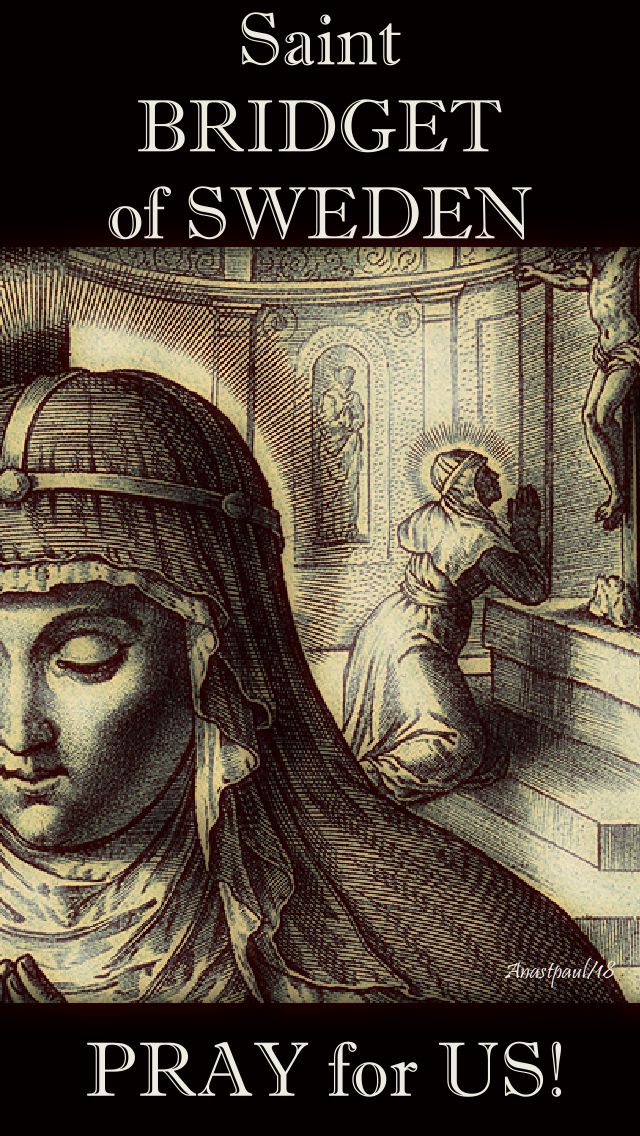
St Bridget of Sweden (c 1303-1373)
“… I declare to you, that there is no other way of salvation than the one followed by Christians. Since this way teaches me to forgive my enemies and all who have offended me, I willingly forgive the king and all those who have desired my death. And I pray that they will obtain the desire of Christian Baptism.”
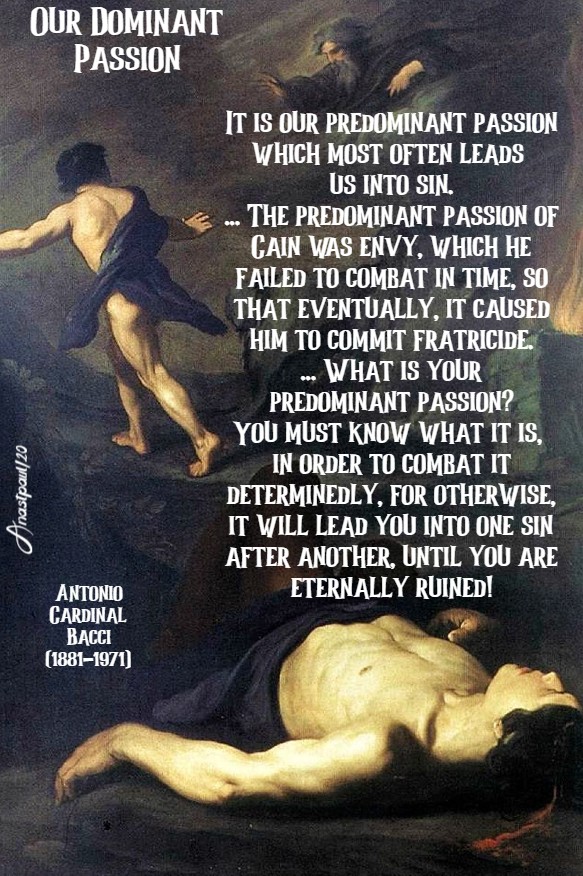
St Paul Miki SJ (1564-1597) Martyr
“All our religion is but a false religion and all our virtues are mere illusions and we ourselves are only hypocrites in the sight of God, if we have not that universal charity for everyone – for the good and for the bad, for the poor and for the rich and for all those who do us harm, as much as those who do us good.”
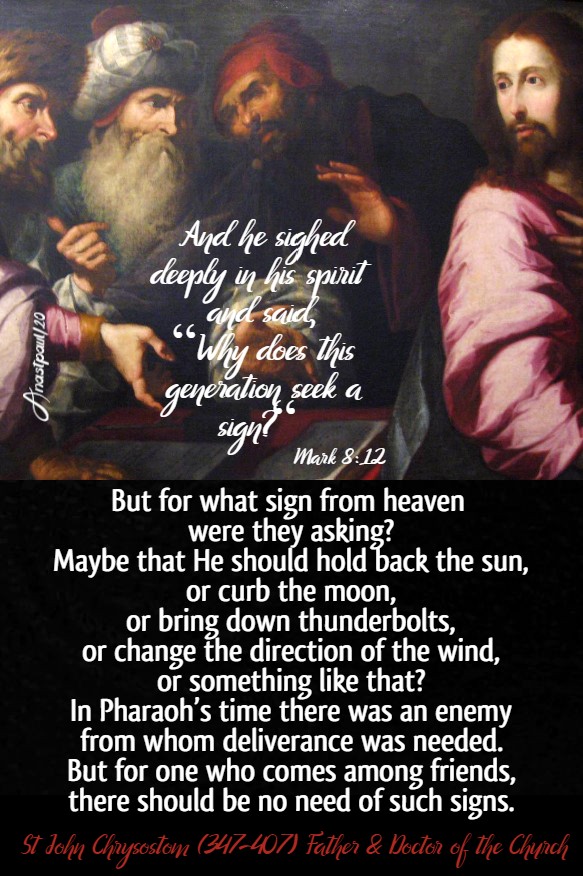
St John Vianney (1786-1859)
“When we talk about the coming of the Kingdom and pray for its coming, we are not thinking of a discrimination according to race or blood but of the brotherhood of all, for all men are our brothers – not excluding even those who hate and attack us – in a close bond with the One, who causes the sun to rise on the good and the bad alike (Mt 5:45).”
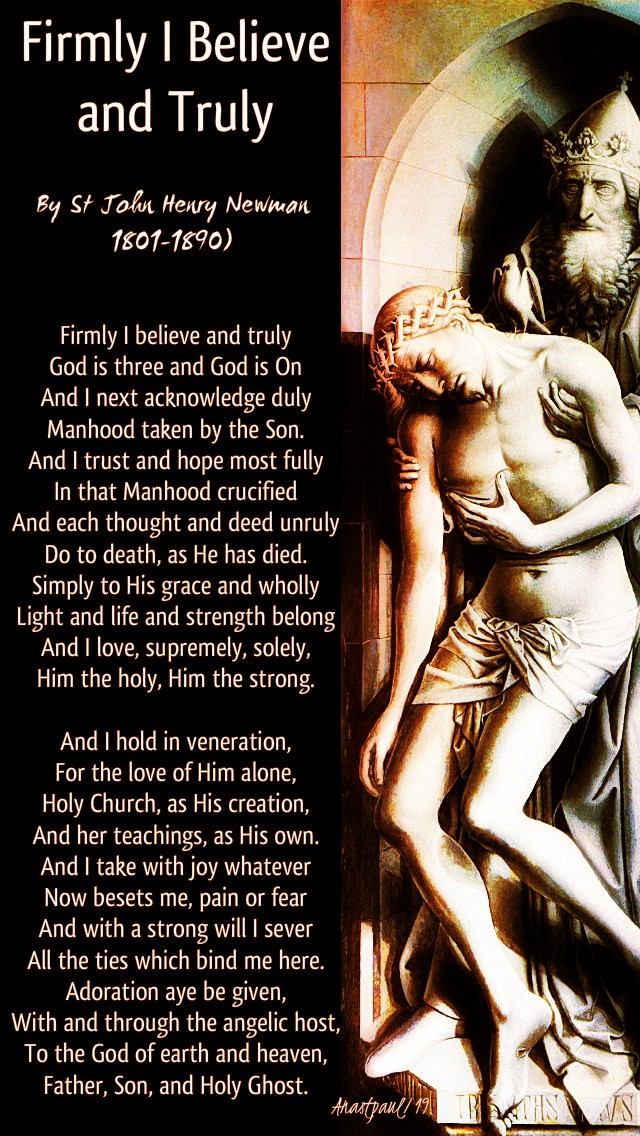
Blessed Titus Brandsma (1881-1942) Martyr
“Let us love our enemies, bless those who curse us, pray for Those who persecute us. For love will conquer and will endure for all eternity. And happy are they who live and die in God’s love.”
Blessed Franz Jägerstätter (1907-1943)
“Called-up to a Higher Order”
Martyr of Conscientious Objection
One Minute Reflection – 16 June – “Month of the Sacred Heart” – Tuesday of the Eleventh week in Ordinary Time, Year A, Readings: 1 Kings 21:17-29, Psalm 51:3-6, 11, 16, Matthew 5:43-48 and the Memorial of Bl Donizetti Tavares de Lima (1882-1961)
“But I say to you, love your enemies and pray for those who persecute you… For if you love those who love you, what recompense will you have?” … Matthew 5:44,46
REFLECTION – “There is in the Community, a Sister who has the faculty of displeasing me in everything – in her ways, her words, her character, everything seems very disagreeable to me. And still, she is a holy religious who must be very pleasing to God. Not wishing to give into the natural antipathy I was experiencing, I told myself that charity must not consist in feelings but in works, then I set myself to doing for this Sister, what I would do for the person, whom I loved the most. Each time I met her I prayed to God for her, offering Him all her virtues and merits. I felt this was pleasing to Jesus, for there is no artist who doesn’t love to receive praise for his works and Jesus, the Artist of souls, is happy when we don’t stop at the exterior but, penetrating into the inner sanctuary where He chooses to dwell, we admire it’s beauty.
I wasn’t content simply with praying very much for this Sister, who gave me so many struggles but I took care to render her all the services possible and when I was tempted to answer her back in a disagreeable manner, I was content with giving her my most friendly smile and with changing the subject of the conversation. … Frequently, when… I had occasion to work with this Sister, I used to run away like a deserter, whenever my struggles became too violent. As she was absolutely unaware of my feelings for her, never did she suspect the motives for my conduct and she remained convinced that her character was very pleasing to me. One day, at recreation, she asked in almost these words: “Would you tell me, Sister Therese of the Child Jesus, what attracts you so much toward me, every time you look at me, I see you smile?” Ah! what attracted me, was Jesus hidden in the depths of her soul, Jesus who makes sweet what is most bitter.” … St Thérèse of the Child Jesus (1873-1897) Doctor of the Church
PRAYER – Almighty God, to whom this world, with all it’s goodness and beauty belongs, give us grace joyfully, to begin this day for Christ Your Son, in Him and with Him and to fill it, with an active love for all Your children, even those who may not like or who do us harm. Help us to love as You do, so that we may become like You. Bl Donizetti Tavares de Lima, you who spread your charity far and wide, pray for us. Through Christ our Lord, with the Holy Spirit, one God, forever, amen.
Thought for the Day – 15 June – Meditations with Antonio Cardinal Bacci (1881-1971) and the Memorial of St Germaine Cousin (1579–1601) Shepherdess
The Divine Worker
“Let us open the Gospel of St John.
“In the beginning was the Word and the Word was with God and the Word ws God. He was in the beginning with God. All things were made through him and without him, was made nothing that has been made” (John 1:1-3).
The work of creation is attributed in a special way, to the Eternal Word, the Son of God.
He was the divine Worker, Who created from nothing, the sky, earth and the marvels which they contain.
Then the Eternal Word of God, became man (Jn 1:14).
But what position did He choose to occupy amongst us?
He could have been born heir to the illustrious throne of Rome, the most powerful in history.
He could have been born in Athens amongst the philosophers of the Areopagus, who handed down, through the centuries, the light of human wisdom and beauty.
But, it was not likely that the Word of God, should have abandoned, so to speak, the eternal glory of the Father, in order to wear the mantle of petty human power.
He had no need of this.
He came amongst us, to instruct us in the humility of the path to Heaven, not in the way of human greatness.
He was born, therefore, as the son of an artisan, “the carpenter’s son, (Mt 13:55) and an artisan Himself, “the carpenter, the son of Mary” (Mk 6:3).
According to the most ancient and most reliable tradition, He was one of the many carpenters in the Palestinian countryside who were prepared to adapt themselves to whatever job arose, whether it was the making of a door, a handle for a hoe, or a plough (Cf Justin Martyr, Dialogue with Trypho, 88:8).
From His youth, therefore, Jesus was a carpenter’s apprentice and, when St Joseph died, He carried on His trade and earned a livelihood for His Mother Mary and Himself.
It was only after many years of manual labour that Jesus ceased to be an artisan and dedicated Himself to work of the mind and heart.
In the three years of His public life, He was an Apostle of truth and goodness.
In this way, He sanctified every type of work, manual, intellectual and spiritual.
The great lesson which Jesus wished to teach us is, that every kind of work, is good and noble.
The manual labour of the farm-hand and of the artisan, is, a co-operation in the work of the Redemption.
Both were made holy by Jesus.
Let those who work with their hands take inspiration from Jesus, Who subjected Himself, for thirty years to all the sacrifices involved in manual labour.
Let intellectuals and apostolic workers look to Jesus also, for when His Hour had come, He sacrificed Himself in His apostolate and gave His life for us.
In His regard, the peasant’s hoe and the writer’s pen, the workman’s hammer and the priest’s stole, are all noble and holy.
The only condition, is that, all should perform their duties conscientiously from the motive of the love of God and of their neighbour.”
Antonio Cardinal Bacci
Cardinal Bacci and I did not plan that this post should fall on the Feast day of little St Germaine Cousins, the Shepherdess who gave every second of her labour and her life, for the love of God and His Will. She teaches us to sanctify the meanest of tasks, to constantly remember our daily offering of each and every form of our work for the glory of God and to honour His Divine Will and Providence.
Quote/s of the Day – 15 June – “Month of the Sacred Heart” – Monday of the Eleventh Week of Ordinary Time, Year A, Readings: 1 Kings 21:1-16, Psalm 5:2-3, 4-7, Matthew 5:38-42 and the Memorial of St Germaine Cousin (1579–1601)
“But I say to you, offer no resistance to one who is evil. When someone strikes you on your right cheek, turn the other one to him as well.”
Matthew 5:39
“But I say to you, love your enemies and pray for those who persecute you”
Matthew 5:44
“We are treated as deceivers and yet, are truthful, as unrecognised and yet, acknowledged, as dying and behold we live, as chastised and yet, not put to death, as sorrowful yet, always rejoicing, as poor yet, enriching many, as having nothing and yet, possessing all things.”
2 Corinthians 8-10
“You don’t love in your enemies what they are but what you would have them become, by your prayers!”
St Augustine (354-430) Father & Doctor
“For true charity, beloved brethren, is the soul of the whole of Scripture, the strength of prophecy, the structure of knowledge, the fruit of faith, the wealth of the poor, the life of the dying. So keep it faithfully; cherish it with all your heart and all the strength of your soul (cf Mk 12:30).”
St Caesarius of Arles (470-543)
Bishop and Monk
(Sermons to the people, no. 23, 4-5, which draws its inspiration from Saint Augustine)
“This Gospel passage is rightly considered, the magna carta of Christian non-violence. One then understands that for Christians, non-violence is not merely tactical behaviour but a person’s way of being, the attitude of one who is so convinced of God’s love and power that, he is not afraid to tackle evil with the weapons of love and truth alone. … Here is the newness of the Gospel which silently changes the world! Here is the heroism of the “lowly” who believe in God’s love and spread it, even at the cost of their lives.”
Pope Benedict XVI
Angelus, St Peter’s Square, Sunday, 18 February 2007
One Minute Reflection – 15 June – “Month of the Sacred Heart” – Monday of the Eleventh Week of Ordinary Time, Year A, Readings: 1 Kings 21:1-16, Psalm 5:2-3, 4-7, Matthew5:38-42 and the Memorial of St Germaine Cousin (1579–1601)
“Should anyone press you into service for one mile, go with him for two miles.” … Matthew 5:41
REFLECTION – “Do you grasp the excellence of a Christian disposition? After you give your coat and your cloak, even if your enemy should wish to subject your naked body to hardships and labours, not even then, Jesus says, must you forbid him. For He would have us possess all things in common, both our bodies and our goods, as with them that are in need, so with them that insult us. For the latter response comes from a courageous spirit, the former from mercy. Because of this, Jesus said, “If any one shall compel you to go one mile, go with him two.” Again He leads you to higher ground and commands you to manifest the same type of aspiration. For if the lesser things He spoke of at the beginning receive such great blessings, consider what sort of reward awaits those who duly perform these and what they become even before we hear of receiving rewards. You are winning full freedom from unworthy passions in a human and passible body.” … St John Chrysostom (347-407) Bishop, Father & Doctor (The Gospel of Matthew: Homily 18)
PRAYER – King of heaven and earth, Lord God, rule over or hearts and bodies this day. Sanctify us and guide our every thought, word and deed according to the commandments of Your law, so that now and forever, Your grace may free and save us. Teach us Lord to walk in the ways of the Cross of Your Son, our Saviour, as St Germaine Cousin so lovingly and willingly inspires us to do. Through Christ our Lord, with the Holy Spirit, God, forever, amen
Thought for the Day – 14 June – Meditations with Antonio Cardinal Bacci (1881-1971)
The Feast of Corpus Christi
“St Thomas Aquinas refers to the Blessed Eucharist as the greatest of all Jesus Christ’s miracles.
All the other miracles were accomplished in an instant or, at the most, protracted over a few years, like the raising to live of Lazarus, or the widow’s son at Naim.
The Eucharist, on the contrary, is a miracle which continues throughout the centuries and all over the world!
The other miracles, moreover, gave us a part of the power and goodness of Jesus.
But, the Eucharist gives us Jesus Himself with all His graces and gifts.
It was not enough for Our Lord to offer Himself on Calvary as a propitiary host for our sins.
It was not enough for Him to shed His precious Blood for our redemption.
It was not enough to give us the Church to instruct us and to guide us on the way to Heaven.
He wished to give us Himself in addition.
He wished to remain with us as our companion on our mortal pilgrimage and as the spiritual nourishment of our souls.
The power of Jesus is as infinite as His charity.
Nevertheless, in the Eucharist, this power and charity are, as it were, exhausted.
Only the immense love of God, could conceive such a miracle.
When we consider this mysterious gift which Jesus has given to each of us, we cannot say that it is too difficult for us to conquer the perverse inclinations of our corrupted nature and that we lack the strength to continue on the way of perfection.
Everything is possible with Jesus.
“I can do all things in him who strengthens me” (Phil 4:13).
Let us go to Jesus and take our nourishment from Him.
Then, like St Paul, we shall be able to do everything in Him, Who is our strength and our support.
In union with Jesus, we shall be able to conquer sin and to become holy. amen.”
Quote/s of the Day – 14 June – “Month of the Sacred Heart” – Corpus Christi, The Solemnity of The Most Holy Body and Blood of Christ, Readings: Deuteronomy 8:2-3, 14-16, Psalm 147:12-15, 19-20, 1 Corinthians 10:16-17, John 6:51-58
“Since we are talking about the Body, know that we, as many of us as partake of the Body, as many as partake of that Blood, we partake of something which is in no way different or separate from that which is enthroned on high, which is adored by the angels, which is next to Uncorrupt Power.”
St John Chrysostom (347-407)
Father & Doctor of the Church
“Source of all we have or know, feed and lead us here below. Grant that with Your saints above, Sitting at the feast of love, We may see You face to face.
Amen Alleluia!
St Thomas Aquinas (1225-1274)
Doctor angelicus/Doctor communis
(Last verse of the Lauda Sion)
Lord Jesus Christ, in the Most Blessed Sacrament,
we Adore and Love You!
“Perfect God and perfect man, Lord of heaven and earth, He offers Himself to us as nourishment in the most natural and ordinary way. Love has been awaiting us for two thousand years. That’s a long time and yet it’s not, for when you are in love time flies.”
St Josemaria Escrivá (1902-1975)
“Christ is PassingBy”
“Make every Mass your FIRST Mass, your LAST Mass your ONLY Mass.”
Sunday Reflection – 14 June – “Month of the Sacred Heart” – Corpus Christi, The Solemnity of The Most Holy Body and Blood of Christ, Readings: Deuteronomy 8:2-3, 14-16, Psalm 147:12-15, 19-20, 1 Corinthians 10:16-17, John 6:51-58
Moments with St John XXIII (1881-1963)
Sacrament of Love
When the Christians of the first centuries met around the Table of the Eucharist, they prayed with hearts full of love and longing:
“To You, O Lord, be glory forever! As this Bread we have broken together, was once scattered in ears of corn on the hills and became one, when it was harvested, so let Your Church be gathered from the ends of the earth into Your Kingdom. For Yours is the glory and the power, through Jesus Christ, forever.”
The doctrine of the Mystical Body, has cast gleams of shining light on this question of the union of Christians with Christ and, for their union with each other.
It has resulted in an amazing understanding of the union of the masses of the faithful, through the power of the Body and Blood of Christ, drawn together to scale the heights of Christian perfection.
In the light of this teaching, we find the truest conception of human, and Catholic brotherhood, inspired and renewed by the Holy Eucharist.
O Sacrament of love, may You always remain inviolate at the summit of Catholic doctrine and devotion!
Open our minds to soaring flights of thought and our hearts to the impulses of charity.
Lead us onto the fulfilment of the supreme ideals of justice and social peace.
Amen
ENGLISH TRANSLATIONS OF THE “PANGE LINGUA” but still using the tune in the Gregorian Chant, Mode III
Hail Our Saviour’s Glorious Body By St Thomas Aquinas Aquinas (1225-1274)
Doctor angelicus/Doctor communis Translated by Fr James Quinn SJ (1919-2010)
Hail our Saviour’s glorious Body,
which His Virgin Mother bore.
Hail the blood which bled for sinners,
did a broken world restore.
Hail the sacrament most holy,
flesh and blood of Christ adore!
To the Virgin, for our healing,
His own Son, the Father sends.
From the Father’s love proceeding
sower, seed and word descends;
wondrous life of Word Incarnate
with His greatest wonder ends.
On that paschal evening see Him
with the chosen twelve recline,
to the old law still obedient
in its feast of love divine,
love divine, the new law giving,
gives Himself as bread and wine.
By His word the Word Almighty
makes of bread His flesh indeed,
wine becomes His very lifeblood,
faith God’s living Word must heed!
Faith alone might simply guide us
where the senses cannot lead.
When the Procession reaches the place of Benediction, the priest sets the Monstrance down. Then he puts incense in the thurible and, kneeling, incenses the Blessed Sacrament, while Tantum ergo Sacramentum is sung.
Come, adore this wondrous presence,
bow to Christ, the source of grace!
Here is kept the ancient promise
of God’s earthly dwelling place!
Sight is blind before God’s glory,
faith alone may see His face!
Glory be to God the Father,
praise to His co-equal Son,
Adoration to the Spirit,
bond of love, in God-head one!
Blest be God by all creation
joyously while ages run!
(Fr James Quinn SJ (21 April 1919 – 8 April 2010) was a Scottish Jesuit Priest, Theologian and Hymnist.
You must be logged in to post a comment.