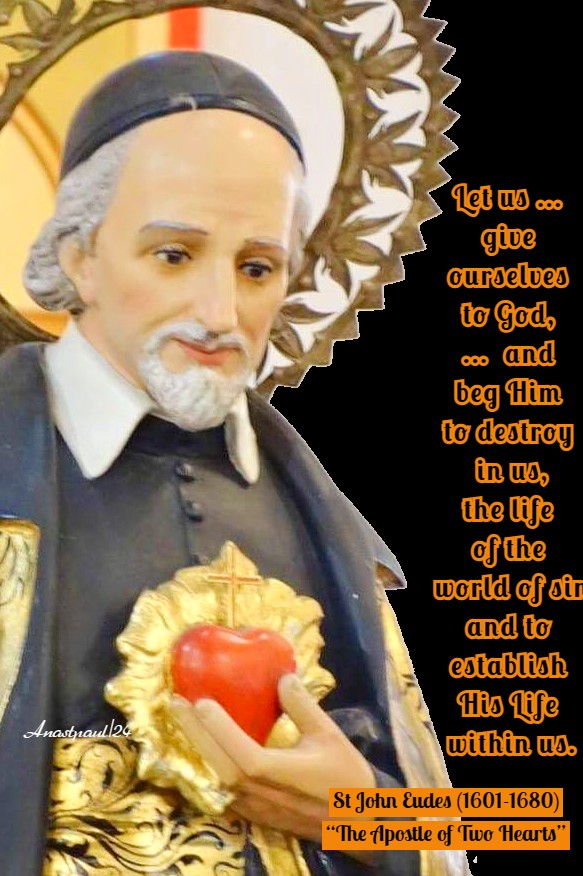
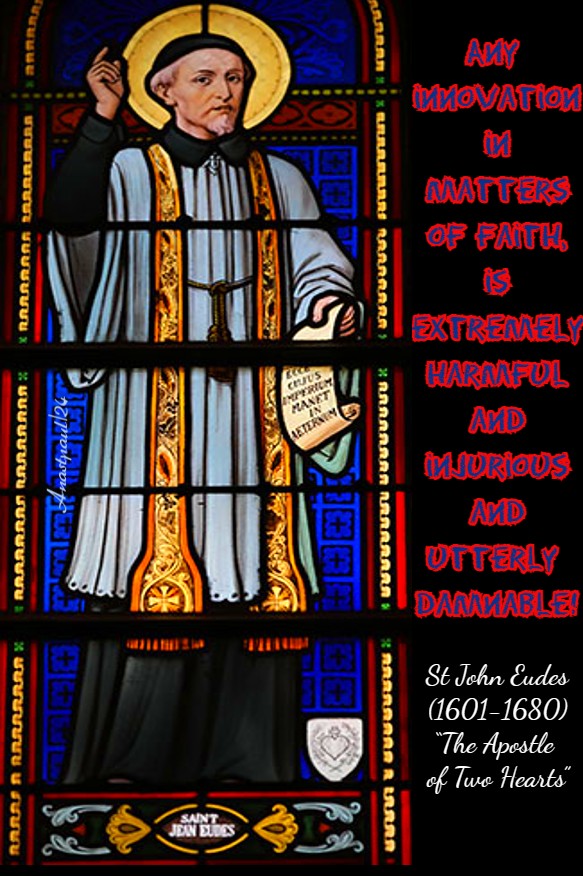
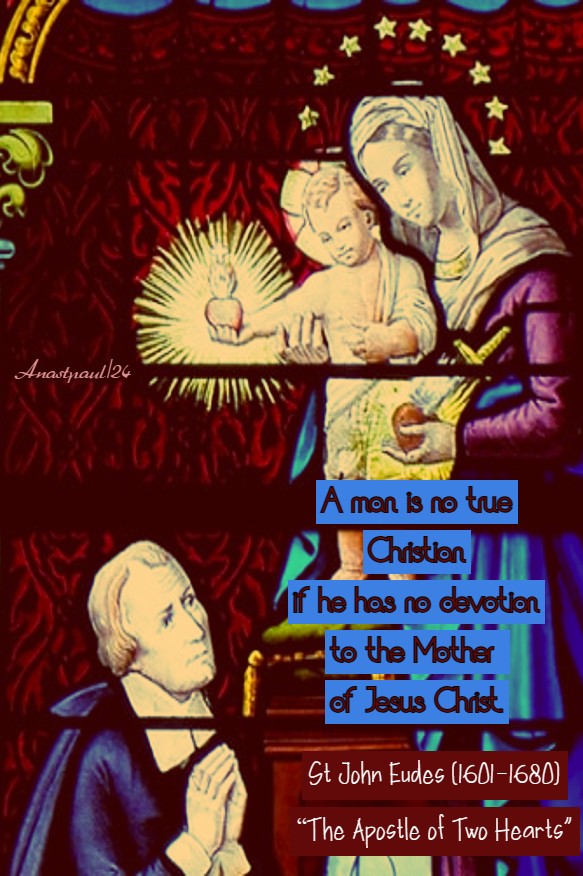
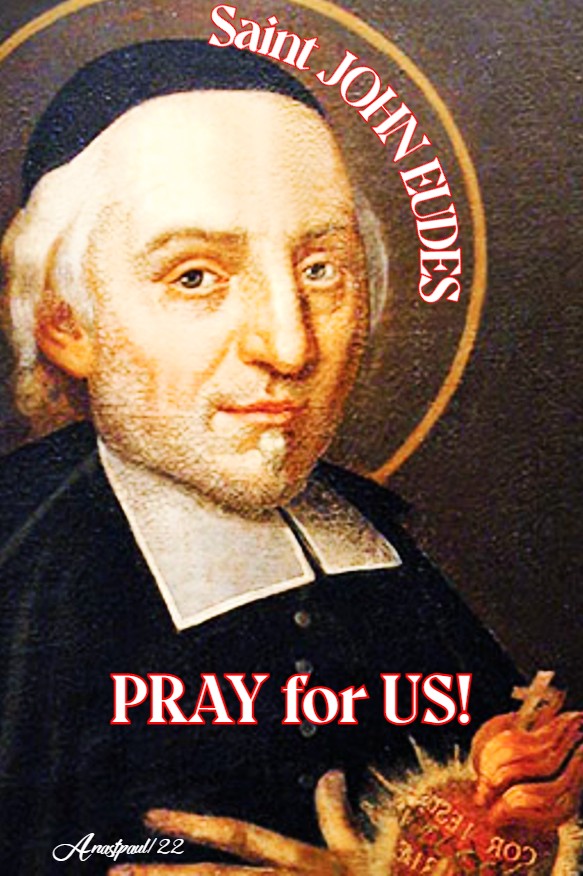
Quote/s of the Day – 19 August – “The Month of the Immaculate Heart of Mary” – the Feast St John Eudes (1601-1680) Confessor, “The Apostle of Two Hearts”
“Let us … give ourselves to God, … and beg Him to destroy in us, the life of the world of sin and to establish His Life within us.”
“Any innovation in matters of faith, is extremely harmful and injurious and utterly damnable!”
“A man is no true Christian if he has no devotion to the Mother of Jesus Christ.”
One Minute Reflection – 19 August – “The Month of the Immaculate Heart of Mary” – St John Eudes (1601-1680) Confessor, “The Apostle of Two Hearts” – – Sirach 31:8-11; Luke 12:35-40 – Scripture search here: https://www.drbo.org/
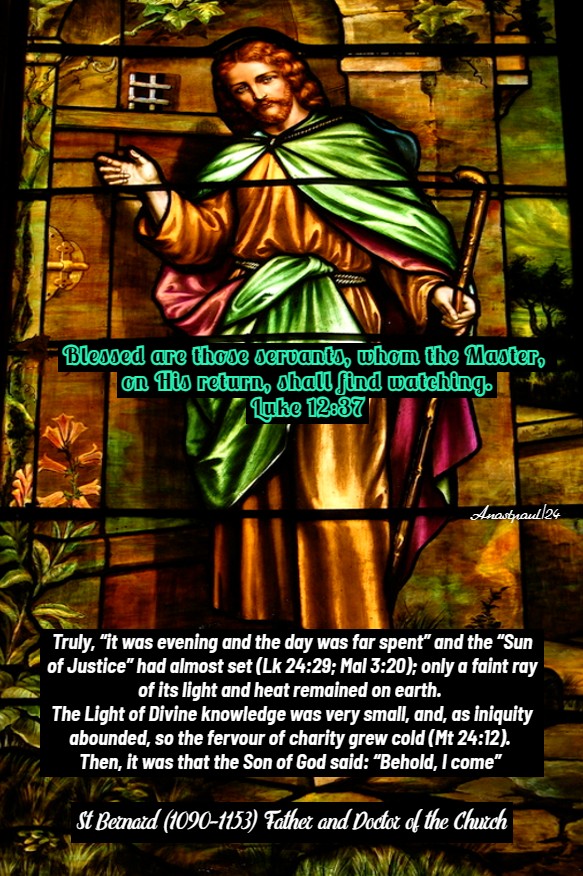
“Blessed are those servants, whom the Master, on His return, shall find watching.” – Luke 12:37
REFLECTION – “It is now fitting we should consider the time of our Lord’s coming. He came, as you know, not in the beginning, nor in the midst of time but in the end of it. This was no unsuitable choice but a truly wise dispensation of Infinite Wisdom, Who, aware that the sons of Adam are inclined to ingratitude, ordained that He would not come to their aid, until they were in the greatest need.
Truly, “it was evening and the day was far spent” and the “Sun of Justice” had almost set (Lk 24:29; Mal 3:20); only a faint ray of its light and heat remained on earth. The Light of Divine knowledge was very small, and, as iniquity abounded, so the fervour of charity grew cold (Mt 24:12). No Angel appeared; no Prophet spoke. The angelic vision and the prophetic spirit alike, had passed away, both hopelessly baffled by the obduracy and obstinacy of humankind. Then, it was that the Son of God said: “Behold, I come” (Ps 39:8; Heb 10:7). And “while all things were in quiet silence and night was in the midst of its swift course, Thy Almighty Word leaped down from Heaven, from Thy Royal throne” (Wis 18:14-15). As the Apostle Paul says: “When the fullness of time had come, God sent His Son” (Gal 4:4).” – St Bernard (1090-1153) Cistercian Abbot, Father and Doctor of the Church (Sermon 1 of Advent).
PRAYER – O God, Who wondrously enkindled St John, Thy Confessor, to promote the religious veneration of the Sacred Hearts of Jesus and Mary and through him, willed to found new religious families in the Church, grant, we beseech Thee that we may honour his holy merits and may learn from the example of his virtues. Through Jesus Christ, Thy Son our Lord, Who lives and reigns with Thee, in the unity of the Holy Ghost, God, world without end. Amen (Collect).
Our Morning Offering – 19 August – “The Month of the Immaculate Heart of Mary” – Feast of St John Eudes (1601-1680) Confessor, “The Apostle of Two Hearts”
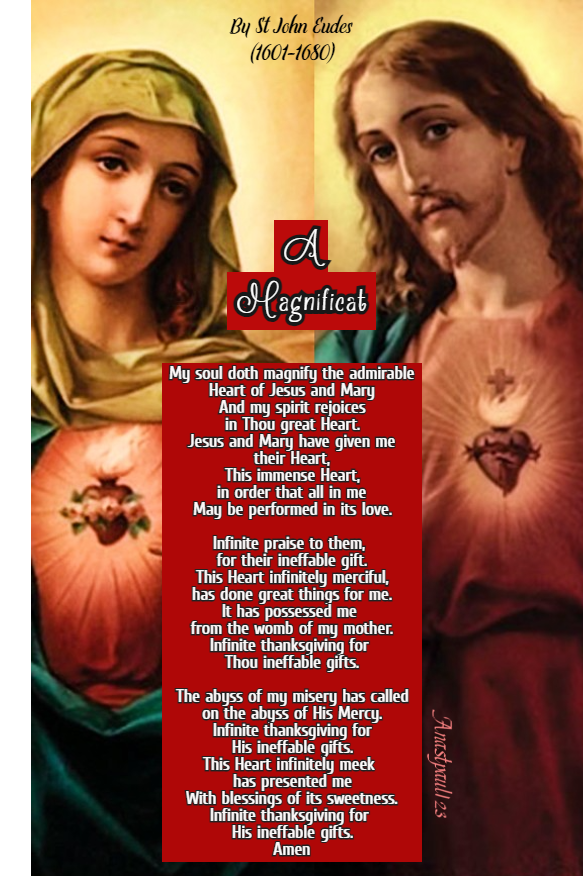
A Magnificat By St John Eudes (1601-1680) A Hymn of Praise and Thanksgiving to the Sacred Heart of Jesus and to the Holy Heart of Mary
My soul doth magnify the admirable Heart of Jesus and Mary And my spirit rejoices in Thou great Heart. Jesus and Mary have given me their Heart, This immense Heart, in order that all in me May be performed in its love.
Infinite praise to them, for their ineffable gift. This Heart infinitely merciful, has done great things for me. It has possessed me from the womb of my mother. Infinite thanksgiving for Thou ineffable gifts.
The abyss of my misery has called on the abyss of His Mercy. Infinite thanksgiving for His ineffable gifts. This Heart infinitely meek has presented me With blessings of its sweetness. Infinite thanksgiving for His ineffable gifts. Amen
Thought for the Day – 18 August – Meditations with Fr Richard Frederick Clarke SJ (1839-1900)
CHARITY Meditations for a Month
The Gratitude of Charity “We love Him because He first Loved us”
Perfect charity loves God for His Own sake, independently of any thought of ourselves. However, perfect charity, is preceded and accompanied by, a charity which has, at least, an indirect reference to ourselves. The love of God, first springs up within our hearts because, of the Love which He has shown to us. We think of all He has done for us and we recognise therein, a clear proof of His Love. Love begets love and we cannot help being drawn towards One, Who has, thus gratuitously, manifested towards us, a charity to which we owe all which is really precious in our lives and all the good gifts we possess. How then can we fail to be attracted towards Him, Who has shown such Love for us?
This love of gratitude, is not the same, as the love of concupiscence and, not the same, as the pure love of friendship. It most resembles the latter and always enters into it. Without some sort of gratitude, friendship would be mere admiration; the personal element necessary to love, would be wanting. When a Saint dwells with rapture on the Divine perfections, there is always present to his mind, a remembrance of all God has done for him. Do I, with gratitude, ever recount to myself all God has done for me?
This element of charity is present in the charity of the Saints in Heaven. Their song will not only be, “We give Thee thanks because, Thou hast taken to Thyself, great glory and hast reigned” but also “because Thou hast redeemed us to God in Thine own Blood.” The song, I must seek to sing in my heart, here on earth says, “Thanks to God, first for His great glory and then for His goodness and love to me.”
Quote/s of the Day – 18 August – Pentecost XIII – Galatians 3:16-22; Luke 17:11-19 – Scripture search here: https://www.drbo.org/
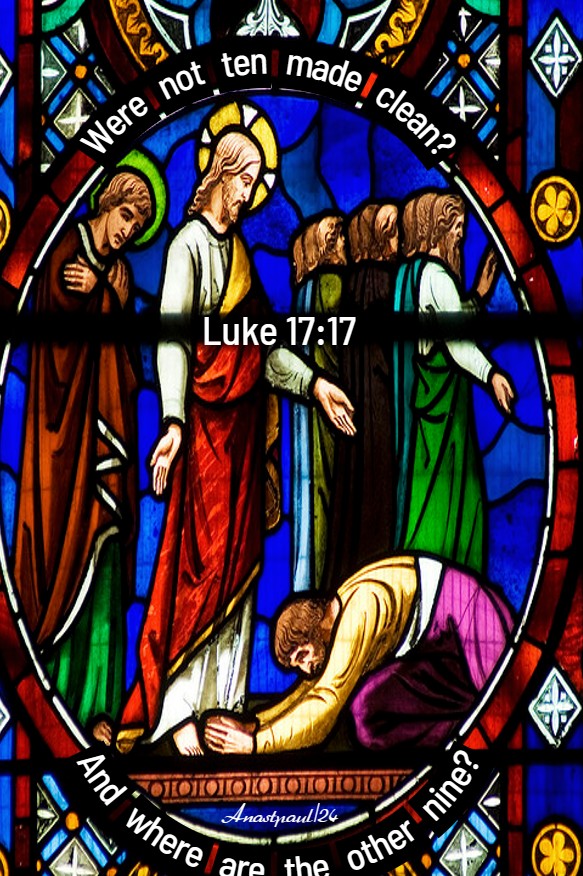
“Were not ten made clean? And where are the other nine?”
Luke 17:17
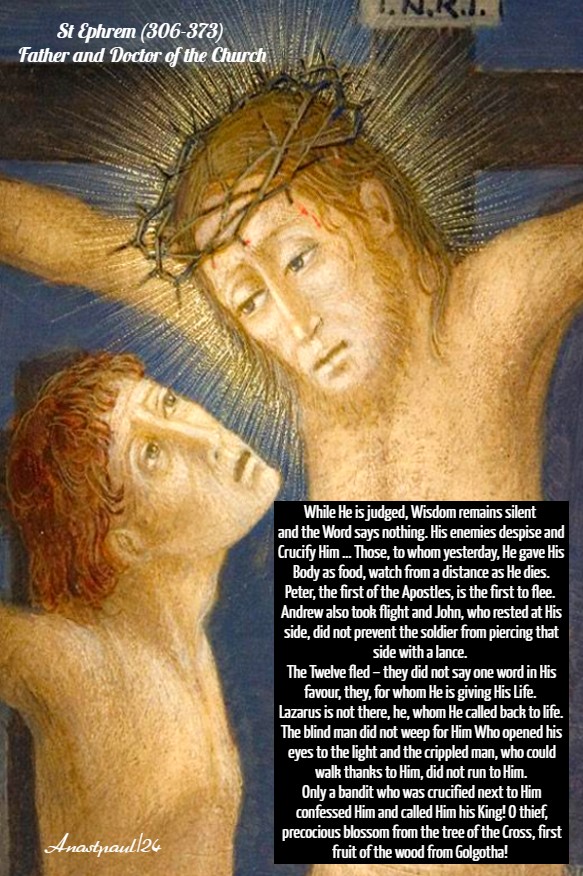
“While He is judged, Wisdom remains silent and the Word says nothing. His enemies despise and Crucify Him … Those, to whom yesterday, He gave His Body as food, watch from a distance as He dies. Peter, the first of the Apostles, is the first to flee. Andrew also took flight and John, who rested at His side, did not prevent the soldier from piercing that side with a lance. The Twelve fled – they did not say one word in His favour, they, for whom He is giving His Life. Lazarus is not there, he, whom He called back to life. The blind man did not weep for Him Who opened his eyes to the light and the crippled man, who could walk thanks to Him, did not run to Him. Only a bandit who was crucified next to Him confessed Him and called Him his King! O thief, precocious blossom from the tree of the Cross, first fruit of the wood from Golgotha!””
St Ephrem (306-373) Father and Doctor of the Church
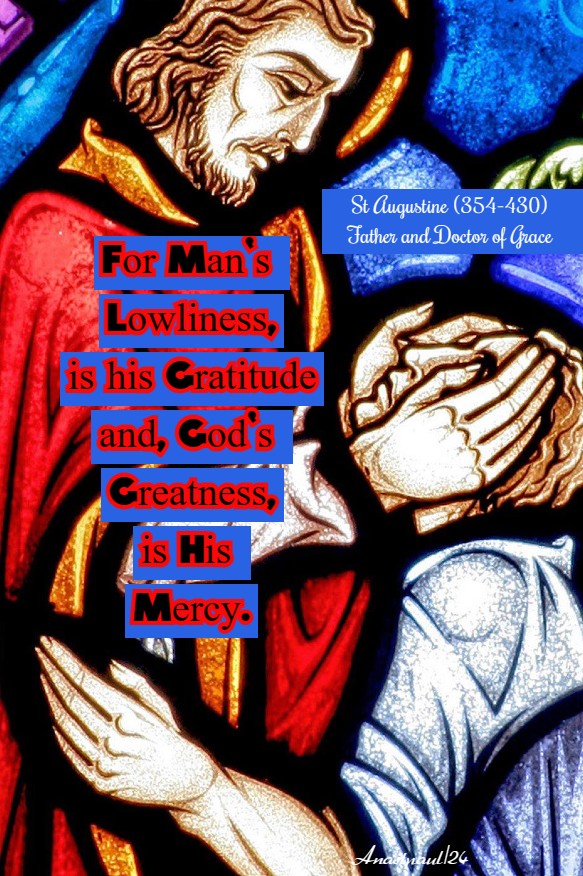
“ For man’s lowliness, is his gratitude and, God’s greatness, is His Mercy.”
St Augustine (354-430) Father and Doctor of Grace
Daily Consecration to the Sacred Heart of Jesus Prayers to the Sacred Heart 1936 – 15th Edition, Dublin
O Sacred Heart of Jesus, filled with infinite love, broken by our ingratitude and pierced by our sins, yet loving us still, accept the Consecration we make to Thee, of all that we are and all that we have. Take every faculty of our souls and bodies, only day by day draw us, nearer and nearer to Thy Sacred Heart, and there, as we shall hear the lesson, teach us Thy Holy Way. Amen
One Minute Reflection – 18 August – “The Month of the Immaculate Heart of Mary” – Pentecost XIII –Within the Octave of the Assumption of the Blessed Virgin – Galatians 3:16-22; Luke 17:11-19 – Scripture search here: https://www.drbo.org/
“Where are the other nine?” – Luke 17:17
REFLECTION – “In our own day we see many people at prayer but, unfortunately, we see none of them turning back to give thanks to God … “Ten were cleansed, were they not? Where are the other nine?” As I think you will remember, it was in these words that our Saviour complained about the lack of gratitude of the other nine lepers. We read that they knew well how to make “supplications, prayers, petitions” since they lifted up their voices, crying out: “Jesus, Master! Have pity on us!” But they lacked the fourth thing required by the Apostle Paul: “thanksgiving” (1Tm 2:1) for they did not turn back nor give thanks to God.
We see still more in our own day ,people who implore God for what they lack but a mere handful who seem to be grateful for the blessings they have received. There is no harm in imploring Him but what causes God not to grant our prayers, is His finding us lacking in gratitude. After all, perhaps it is even an act of mercy on His part, to hold back from the ungrateful, what they are asking for, so that they may not be judged all the more rigorously, on account of their ingratitude! … For, it is sometimes out of mercy that God holds back His mercy! …
So you see, not all those who are healed of the leprosy of this world, I mean their manifest complaints, profit by their cures. Indeed, many are secretly afflicted with an ulcer worse than leprosy, all the more dangerous, in that it is more interior. That is why it was correct that the Saviour of the world should ask, where the other nine lepers were, since sinners avoid cures. So, too, after his sin, God questioned the first man: “Where are you?” (Gn 3:9).” – St Bernard (1090-1153) Cistercian Abbot, Father and Doctor of the Church (Various sermons No 27).
PRAYER – O Lord, we beseech Thee, forgive the transgressions of Thy servants and, forasmuch as by our own deeds, we cannot please Thee, may we find safety through the prayers of the Mother of Thy Son and our Lord. Through the same Jesus Christ, Thy Son our Lord, Who lives and reigns with Thee, in the unity of the Holy Ghost, God, world without end. Amen (Collect).
Thought for the Day – 17 August – Meditations with Fr Richard Frederick Clarke SJ (1839-1900)
CHARITY Meditations for a Month
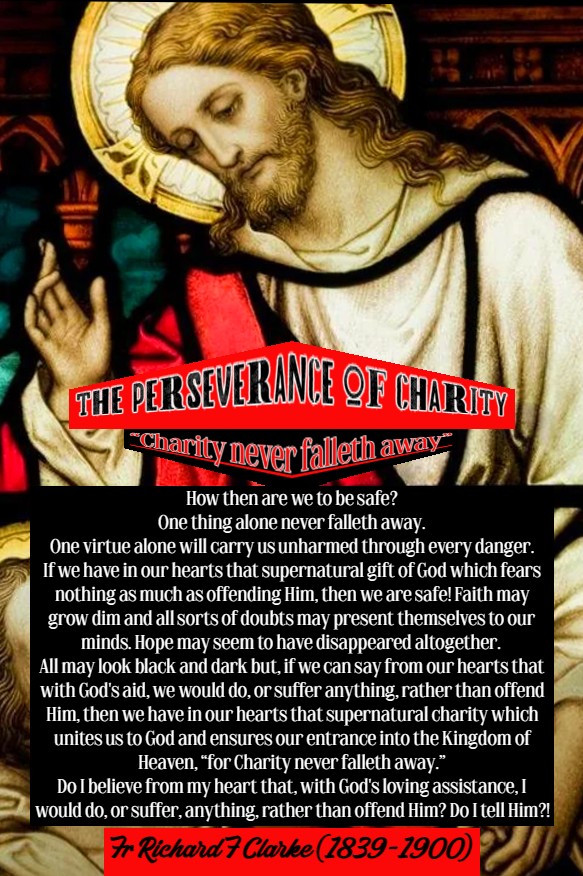
The Perseverance of Charity “Charity never falleth away”
We are all anxious to persevere to the end. We know, without perseverance, all else is of no avail. Of what use was it to the Israelites who perished in the desert for their sins, to have escaped from Egypt, safely crossed the Red Sea and toiled for years over the sandy plains? What use to Solomon to have been dear to God and endowed with supernatural wisdom, if, as some think, he did not persevere to the end? Therefore, all our graces are of no avail but rather, tend to our condemnation, if we, in the end, fall away and are lost.
Yet, who can be certain of perseverance? Who does not tremble at the thought of his own insecurity? We may have great gifts but they will not save us – talent, activity, zeal, courage, prudence, will be useless to us. Even faith will not save us – the devils believe and tremble! – and hope, may degenerate into presumption, or may disappear and leave us at the last, to an eternal despair.
How then are we to be safe? One thing alone never falleth away. One virtue alone will carry us unharmed through every danger. If we have in our hearts that supernatural gift of God which fears nothing as much as offending Him, then we are safe! Faith may grow dim and all sorts of doubts may present themselves to our minds. Hope may seem to have disappeared altogether. All may look black and dark but, if we can say from our hearts that with God’s aid, we would do, or suffer anything, rather than offend Him, then we have in our hearts that supernatural charity which unites us to God and ensures our entrance into the Kingdom of Heaven, “for Charity never falleth away.” Do I believe from my heart that, with God’s loving assistance, I would do, or suffer, anything, rather than offend Him? Do I tell Him?!
Quote/s of the Day – 17 August – “The Month of the Immaculate Heart of Mary” – St Hyacinth OP (1185-1257) ) Confessor – Sirach 31:8-11, Luke 12:35-40 – Scripture search here: https://www.drbo.org/
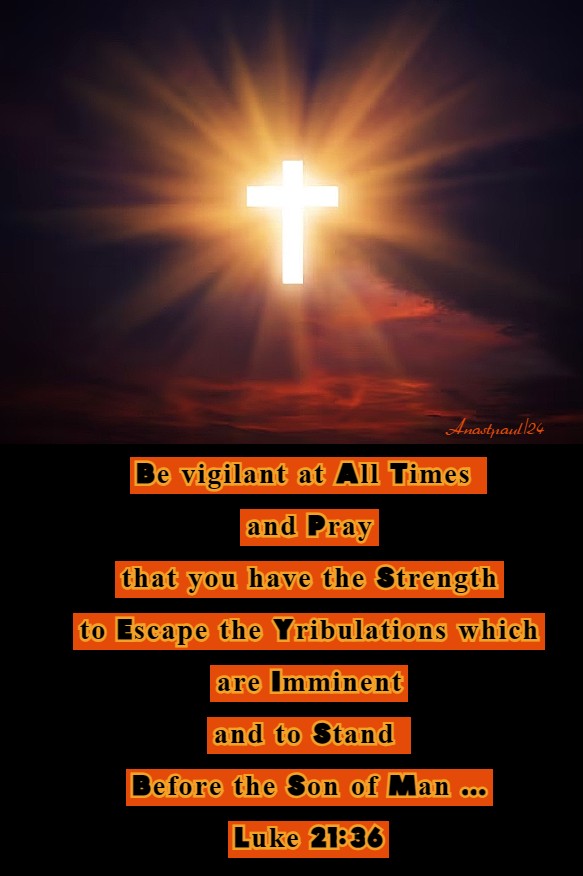
“Be vigilant at all times and pray that you have the strength to escape the tribulations that are imminent and to stand before the Son of Man…”
Luke 21:36
“Tell us when shall these things be? and what shall be the sign of Thy Coming and of the consummation of the world? ”
Matthew 24:3
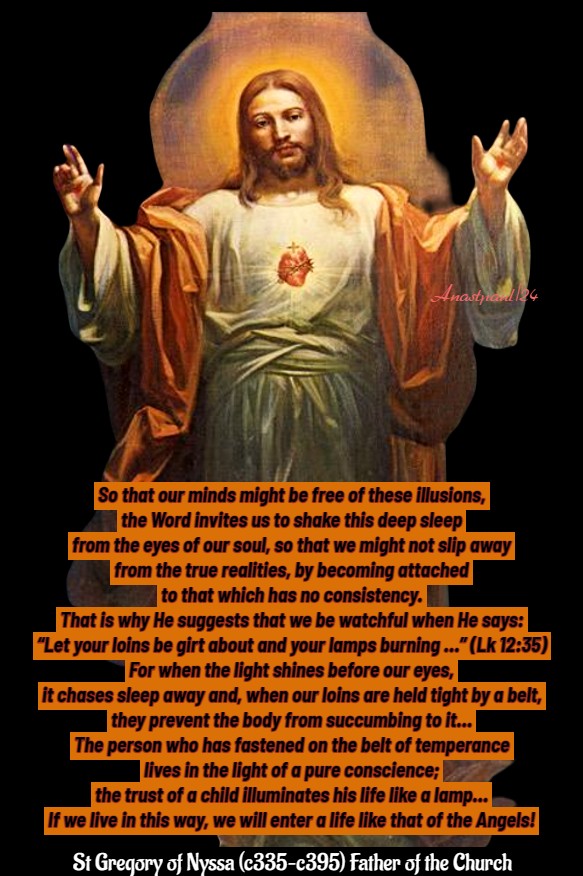
“So that our minds might be free of these illusions, the Word invites us to shake this deep sleep from the eyes of our soul, so that we might not slip away from the true realities, by becoming attached to that which has no consistency. That is why He suggests that we be watchful when He says: “Let your loins be girt about and your lamps burning …” (Lk 12:35) For when the light shines before our eyes, it chases sleep away and, when our loins are held tight by a belt, they prevent the body from succumbing to it… The person who has fastened on the belt of temperance lives in the light of a pure conscience; the trust of a child illuminates his life like a lamp… If we live in this way, we will enter a life like that of the Angels!”
St Gregory of Nyssa (c335–c395) Father of the Church (Brother of St Basil the Great)
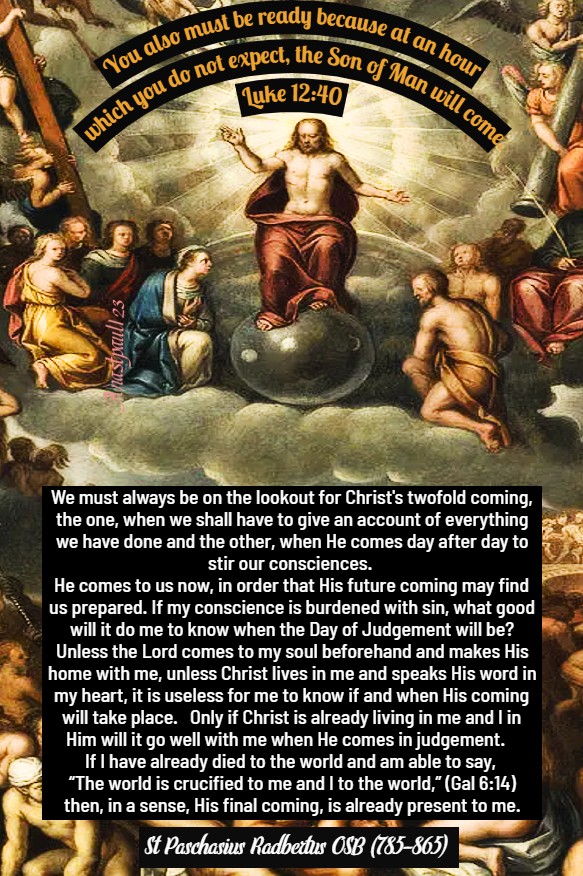
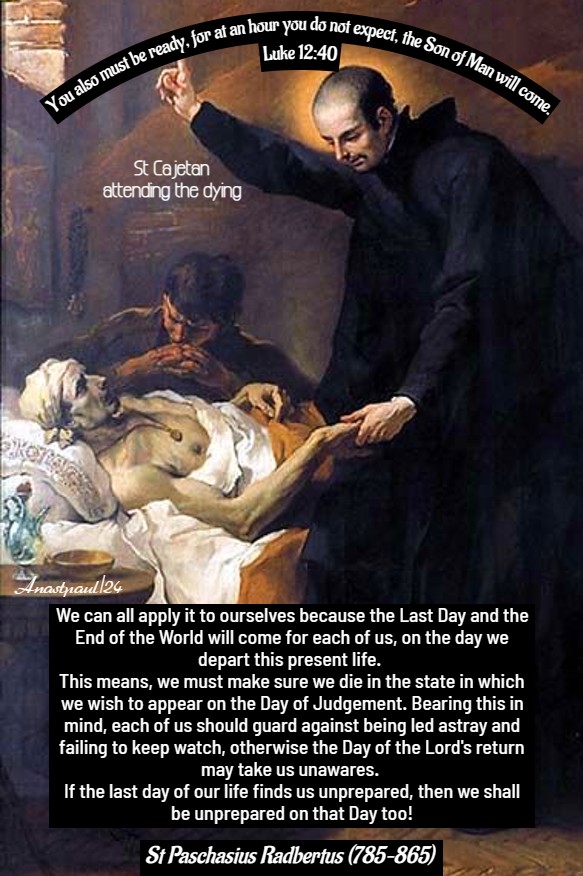
“You also must be ready because at an hour which you do not expect, the Son of Man will come.” Luke 12:40
“We must always be on the lookout for Christ’s twofold coming, the one, when we shall have to give an account of everything we have done and the other, when He comes, day after day, to stir our consciences. He comes to us now, in order that His future coming may find us prepared. If my conscience is burdened with sin, what good, will it do me, to know when the Day of Judgement will be? Unless the Lord comes to my soul beforehand and makes His home with me, unless Christ lives in me and speaks His word in my heart, it is useless for me to know if and when His coming will take place. Only if Christ is already living in me and I in Him, will it go well with me when He comes in judgement. If I have already died to the world and am able to say, “The world is crucified to me and I to the world,” (Gal 6:14) then, in a sense, His final coming is already present to me.”
St Paschasius Radbertus (785–865) Abbot, Theologian, Father of the Church
One Minute Reflection – 17 August – “The Month of the Immaculate Heart of Mary” – St Hyacinth OP (1185-1257) ) Confessor – Sirach 31:8-11; Luke 12:35-40 – Scripture search here: https://www.drbo.org/
“You also must be ready, for at an hour you do not expect, the Son of Man will come.” – Luke 12:40
REFLECTION –“Watch, for you do not know the day nor the hour.” Like many other scriptural texts, this admonition is addressed to all of us, although it is formulated, in such a way that it would seem to concern only Christ’s immediate audience. We can all apply it to ourselves because the Last Day and the End of the World will come for each of us, on the day we depart this present life. This means, we must make sure we die in the state in which we wish to appear on the Day of Judgement. Bearing this in mind, each of us should guard against being led astray and failing to keep watch, otherwise the Day of the Lord’s return may take us unawares. If the last day of our life finds us unprepared, then we shall be unprepared on that Day too!” – St Paschasius Radbertus OSB (785–865) Abbot of Corbie, Theoplogian, Father of the Church (Commentary on Saint Matthew’s Gospel 11, 24) His Life here: https://anastpaul.com/2019/04/26/saint-of-the-day-26-april-saint-paschasius-radbertus-785-865/
PRAYER – God, Who gladden us with the annual feast of blessed Hyacinth, Thy Confessor, mercifully grant that, while honouring the anniversary of his death, we may also imitate his deeds. Through Jesus Christ, Thy Son our Lord, Who lives and reigns with Thee, in the unity of the Holy Ghost, God, world without end. Amen (Collect).
Thought for the Day – 16 August – Meditations with Fr Richard Frederick Clarke SJ (1839-1900)
CHARITY Meditations for a Month
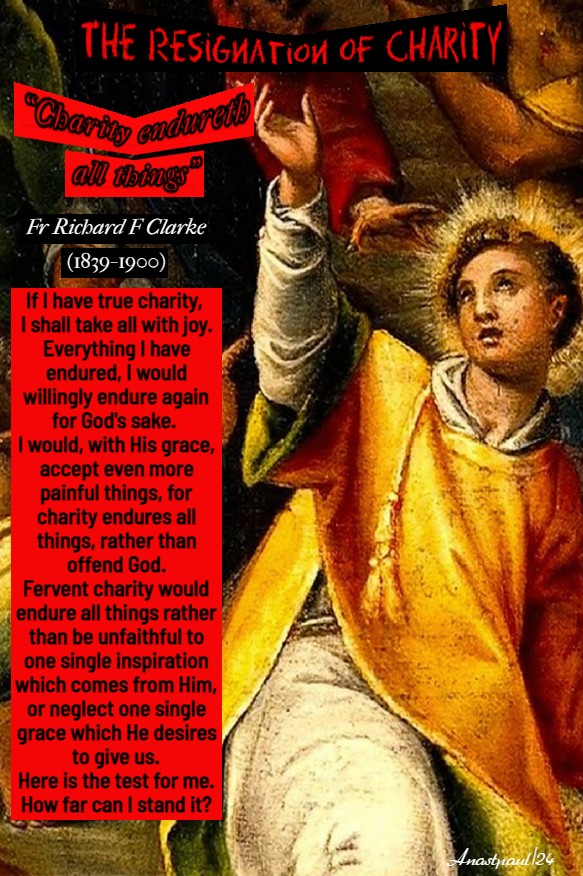
The Resignation of Charity “Charity endureth all things”
The test of our love for anyone, is what we are willing to endure for that person. If we love only a little, we are willing to endure only a little. If we love much, we are willing to endure much. If we love that person, better than we love ourselves, we are pleased to endure, for his sake, that which we would otherwise dread. If we love that person better than we love ourselves, we are pleased to endure, for his sake, that from which we would otherwise shrink. Hence, the test of our supernatural charity, is what we are willing to endure for God and whether ,it is a pleasure for us to endure, positive suffering, for Him.
We would consider it a great privilege, if we were called upon to lay down our lives for the Faith. However, this is a grace we poor ordinary mortals cannot expect and, we must be careful against deluding ourselves, by fancy pictures of the courage we should then display. The real question before us, is whether we willingly suffer the little, disagreeable effects of life, bodily ailments, failures in our projects, neglect or unkindness from others, or undeserved reproaches. It is no use thinking of Martyrdom until we have learnt to bear these!
If I have true charity, I shall take all with joy. Everything I have endured, I would willingly endure again for God’s sake. I would, with His grace, accept even more painful things, for charity endures all things, rather than offend God. Fervent charity would endure all things rather than be unfaithful to one single inspiration which comes from Him, or neglect one single grace which He desires to give us. Here is the test for me. How far can I stand it?
Quote/s of the Day – 16 August – “The Month of the Immaculate Heart of Mary” – St Joachim, Father of the Blessed Virgin Mary – Ecclesiasticus 31:8-11, Matthew1:1-16 – Scripture search here: https://www.drbo.org/
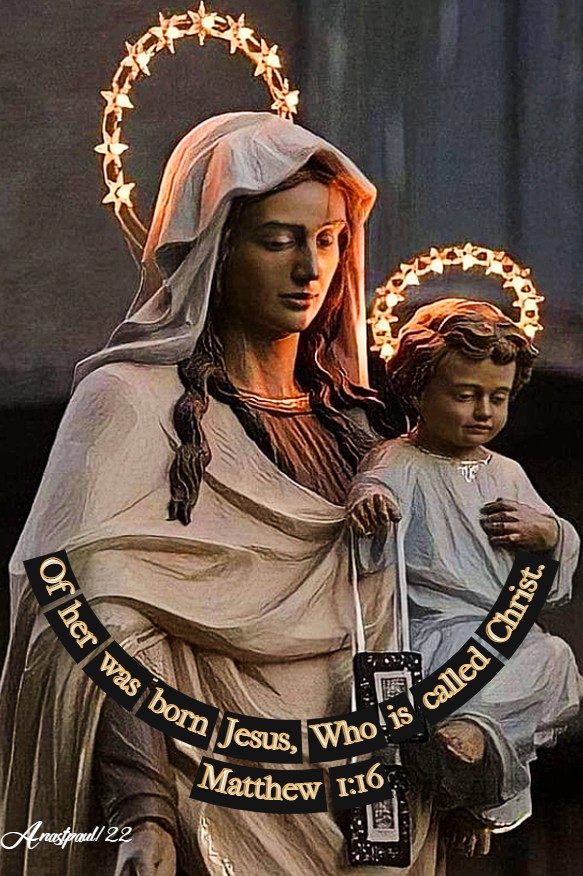
“And Jacob begot Joseph, the husband of Mary and of her was born Jesus, Who is called Christ.”
Matthew 1:16
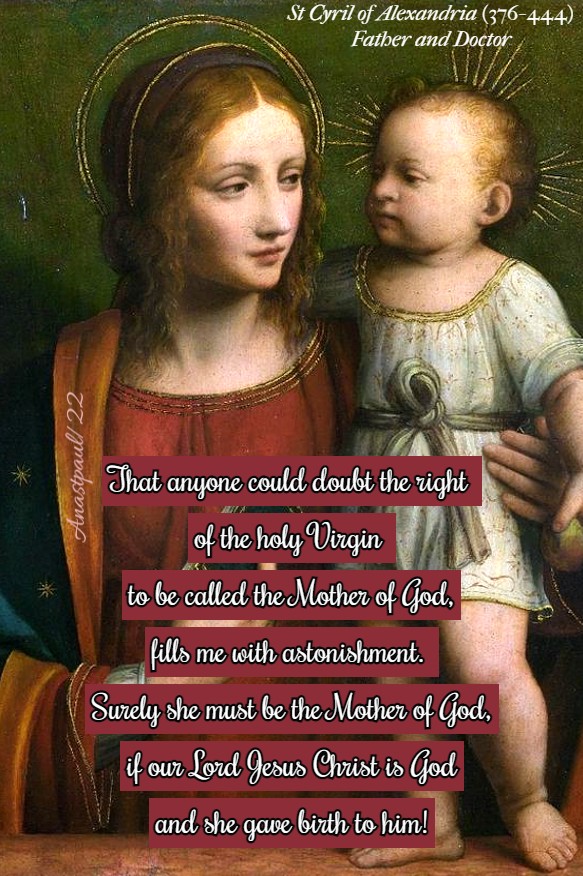
“That anyone could doubt the right of the holy Virgin to be called the Mother of God, fills me with astonishment. Surely she must be the Mother of God, if our Lord Jesus Christ is God and she gave birth to Him!”
St Cyril of Alexandria (376-444) Father and Doctor of the Church
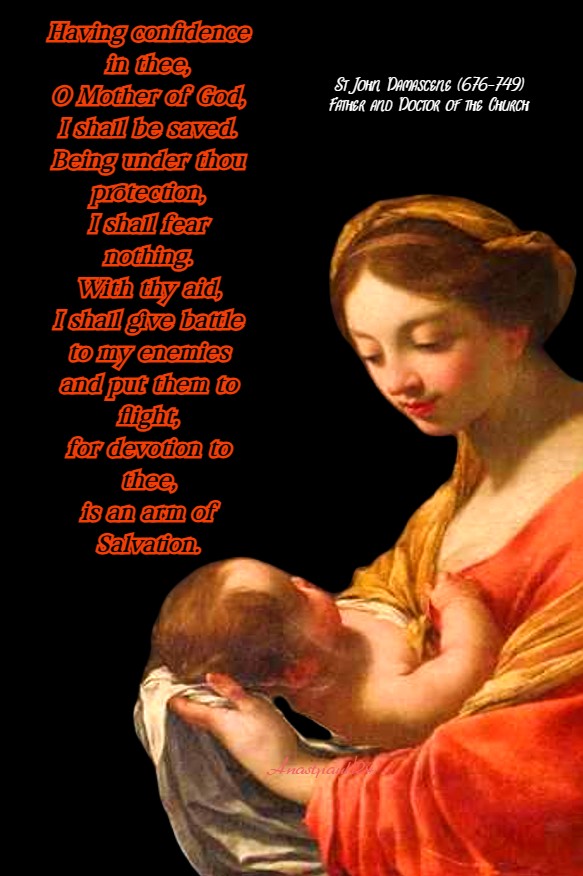
“Having confidence in thee, O Mother of God, I shall be saved. Being under thou protection, I shall fear nothing. With thy aid, I shall give battle to my enemies and put them to flight, for devotion to thee, is an arm of Salvation.”
St John Damascene (676-749) Father and Doctor of the Church
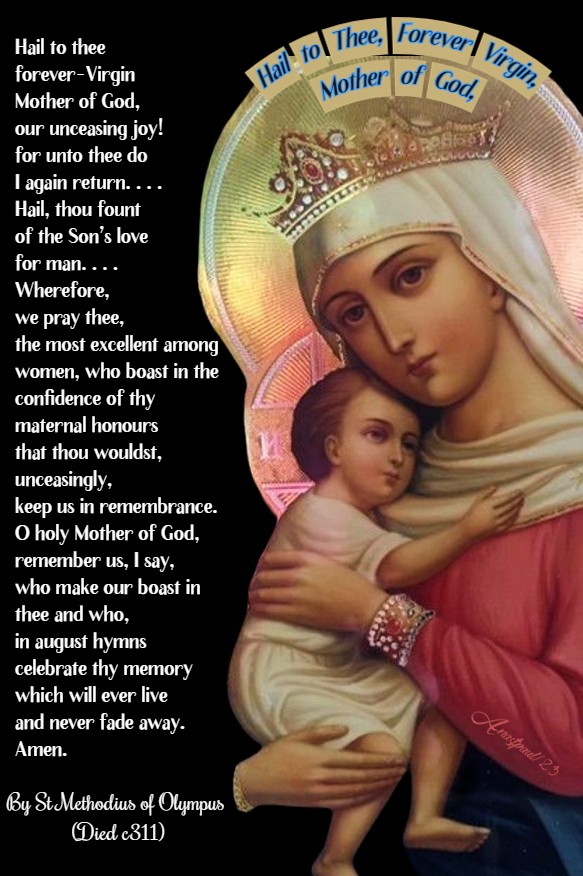
Hail to Thee, Forever Virgin, Mother of God, By St Methodius of Olympus (Died c311)
Hail to thee forever-Virgin Mother of God, our unceasing joy! for unto thee do I again return. . . . Hail, thou fount of the Son’s love for man. . . . Wherefore, we pray thee, the most excellent among women, who boast in the confidence of thy maternal honours that thou wouldst, unceasingly, keep us in remembrance. O holy Mother of God, remember us, I say, who make our boast in thee and who, in august hymns celebrate thy memory which will ever live and never fade away. Amen
Thought for the Day – 15 August – Meditations with Fr Richard Frederick Clarke SJ (1839-1900)
CHARITY Meditations for a Month
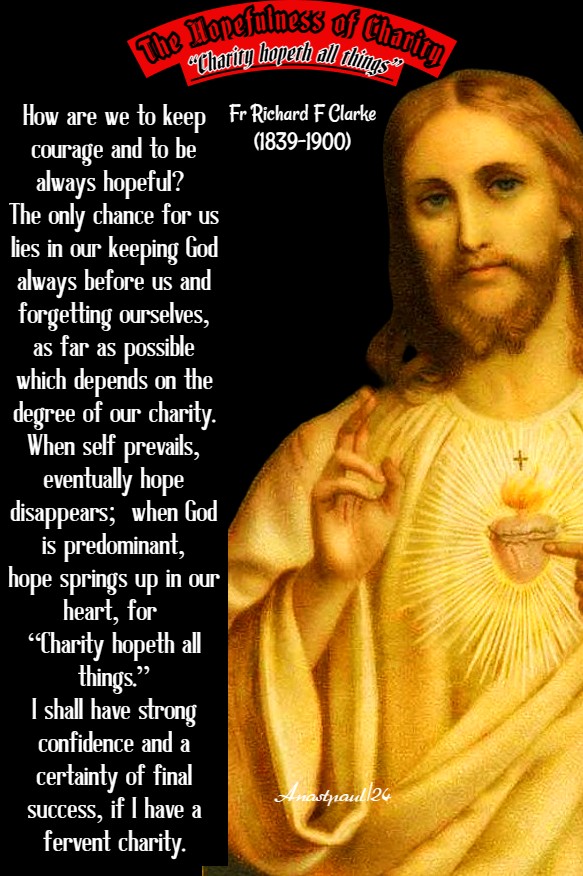
The Hopefulness of Charity “Charity hopeth all things”
How common and how fatal an evil is discouragement! Half of our enterprises fail,, simply because we become discouraged. More than half of our faults are owing to discouragement. We lose heart and, therefore, fail in the necessary perseverance. We become despondent and seek to console ourselves, by some earthly pleasure or perhaps, sinful indulgence. No general who was discouraged ever won a victory and, no sinner who lost heart, ever became a Saint or even turned to God, as long as the despondency remained.
Yet, it is no easy thing to keep up our courage and our hope. We so often fail and failures are discouraging. We commit so many faults; yet, nothing saps our courage, as much as the consciousness of having done wrong. Then too, there are continual impediments and obstacles in our way, the neglect and indifference shown by others to our work, the opposition we meet and a thousand things more. Too often, these are causes of discouragement to all who are working for God. We ought not to be discouraged by them, for often, difficulties and opposition are the best signs of coming success!
How are we to keep courage and to be always hopeful? The only chance for us lies in our keeping God always before us and forgetting ourselves, as far as possible which depends on the degree of our charity. When self prevails, eventually hope disappears; when God is predominant, hope springs up in our heart, for “Charity hopeth all things.” I shall have strong confidence and a certainty of final success, if I have a fervent charity.
One Minute Reflection – 15 August – “The Month of the Immaculate Heart of Mary” – The Assumption of the Blessed Virgin Mary into Heaven – Judith 13:22-25; 15:10, Luke 1:41-50 – Scripture search here: https://www.drbo.org/
“For behold, as soon as the voice of thy salutation sounded in my ears, the infant in my womb leaped for joy. ” – Luke 1:44
REFLECTION – “Today the Virgin Mary rises gloriously to Heaven. She completes the happiness of Angels and Saints. For it was she whose simple word of greeting made the child in his mother’s womb leap for joy (Lk 1:44). What, then, must have been the rejoicing of the Angels and Saints, when they found themselves able to hear her voice, see her face and rejoice in her blessed presence!
And what a great Feast her glorious Assumption is for us, beloved brethren, what reason for happiness and cause for joy today! Mary’s presence brightens the whole world, so greatly do the heavens shine, lightened by the brilliance of the most holy Virgin. Therefore, it is altogether fitting that the heavens resound with thanksgiving and praise.
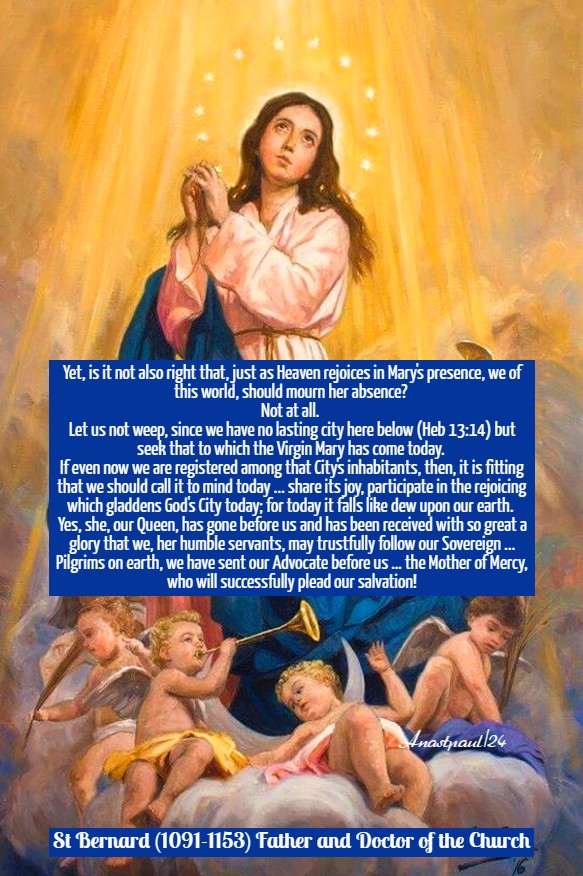
Yet, is it not also right that, just as Heaven rejoices in Mary’s presence, we of this world, should mourn her absence? Not at all. Let us not weep, since we have no lasting city here below (Heb 13:14) but seek that to which the Virgin Mary has come today. If even now we are registered among that City’s inhabitants, then, it is fitting that we should call it to mind today … share its joy, participate in the rejoicing which gladdens God’s City today; for today it falls like dew upon our earth. Yes, she, our Queen, has gone before us and has been received with so great a glory that we, her humble servants, may trustfully follow our Sovereign, crying [with the Bride of the Song of Songs]: “Draw us! We will run to the sweet scent of your perfumes!” (cf. Sg 1:3-4). Pilgrims on earth, we have sent our Advocate before us … the Mother of Mercy, who will successfully plead our salvation!” – St Bernard (1091-1153) Cistercian Abbot, Father and Doctor of the Church (1st Sermon for the Assumption).
PRAYER – O Lord, we beseech Thee, forgive the transgressions of Thy servants and, forasmuch as by our own deeds, we cannot please Thee, may we find safety through the prayers of the Mother of Thy Son and our Lord. Through the same Jesus Christ, Thy Son our Lord, Who lives and reigns with Thee, in the unity of the Holy Ghost, God, world without end. Amen (Collect).
Thought for the Day – 14 August – Meditations with Fr Richard Frederick Clarke SJ (1839-1900)
CHARITY Meditations for a Month
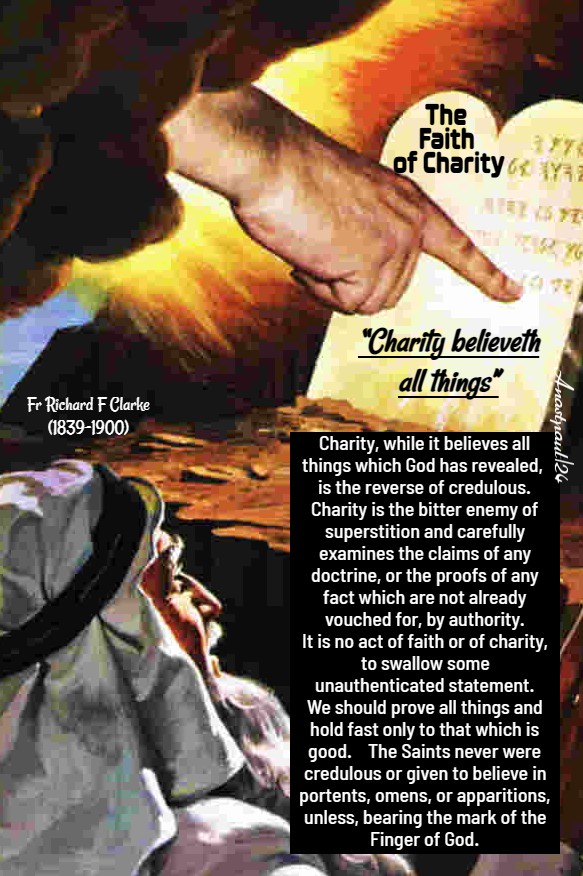
The Faith of Charity “Charity believeth all things”
Faith is a preliminary gift of God, without which, charity is impossible. No-one can do any work which is pleasing in His sight, unless that person believes in God and is ready to accept whatever God has revealed. Works of benevolence are not works of charity, if he who performs them, does not possess this belief. The charity which rests on a feeble faith, will always be itself feeble. He who minimises, in matters of faith, will generally have a minimum of charity. Hence, pray for a loyal readiness to believe, that so you may obtain, an intense charity.
Charity, while it believes all things which God has revealed, is the reverse of credulous. Charity is the bitter enemy of superstition and carefully examines the claims of any doctrine, or the proofs of any fact which are not already vouched for, by authority. It is no act of faith or of charity, to swallow some unauthenticated statement. We should prove all things and hold fast only to that which is good. The Saints never were credulous or given to believe in portents, omens, or apparitions, unless, bearing the mark of the Finger of God.
Charity supplements faith and it strengthens it. The stronger our love of God, the stronger will be our belief in all which He has revealed. When love waxes cold, faith becomes faint. No man ever loses his faith without first wilfully estranging himself from God, by deliberate mortal sin. If I want a strong faith, I must cultivate a fervent charity. My ready acceptance of all God has revealed, will be in proportion, to my love of Him. If I have difficulties in belief, is it because there are gaps and defects in my charity?
Thought for the Day – 13 August – Meditations with Fr Richard Frederick Clarke SJ (1839-1900)
CHARITY Meditations for a Month
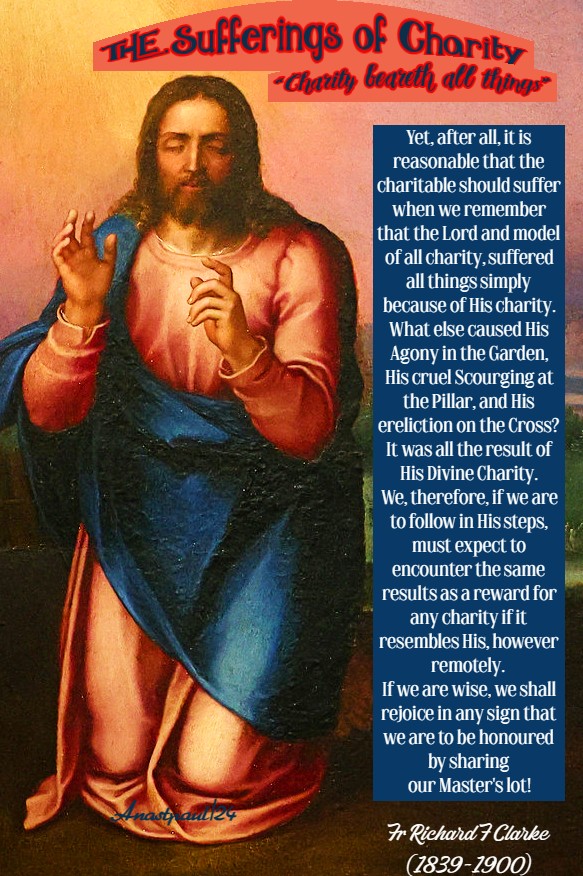
The Sufferings of Charity “Charity beareth all things”
If anyone deserves to be exempt from suffering, it is someone who is full of the spirit of charity. Suffering is indeed necessary to expiate sin, to humble our pride and to show us our own misery. Why should the charitable have to bear all kinds of trials simply because of their charity? Yet so it seems. Generally, the law seems to be – the more charity, the more suffering. Perhaps this is why I have comparatively little to suffer?
Yet, after all, it is reasonable that the charitable should suffer when we remember that the Lord and model of all charity, suffered all things simply because of His charity. What else caused His Agony in the Garden, His cruel Scourging at the Pillar, and His dereliction on the Cross? It was all the result of His Divine Charity. We, therefore,, if we are to follow in His steps, must expect to encounter the same results as a reward for any charity if it resembles His, however remotely. If we are wise, we shall rejoice in any sign that we are to be honoured by sharing our Master’s lot!
These sufferings are a source of joy to all who suffer for Jesus’ sake. He rejoiced to run the course of His Passion because of His longing to see those He loved delivered from bondage. For the joy which was set before Him, He endured the Cross. Thus, charity rejoices to suffer because charity knows those sufferings will obtain for it, in Heaven, the eternal joy of seeing others brought to God by its offering to Him, of all that it holds dear. Even if I have heavy trials, can I flatter myself that my trials are a sign of a high degree of supernatural charity?
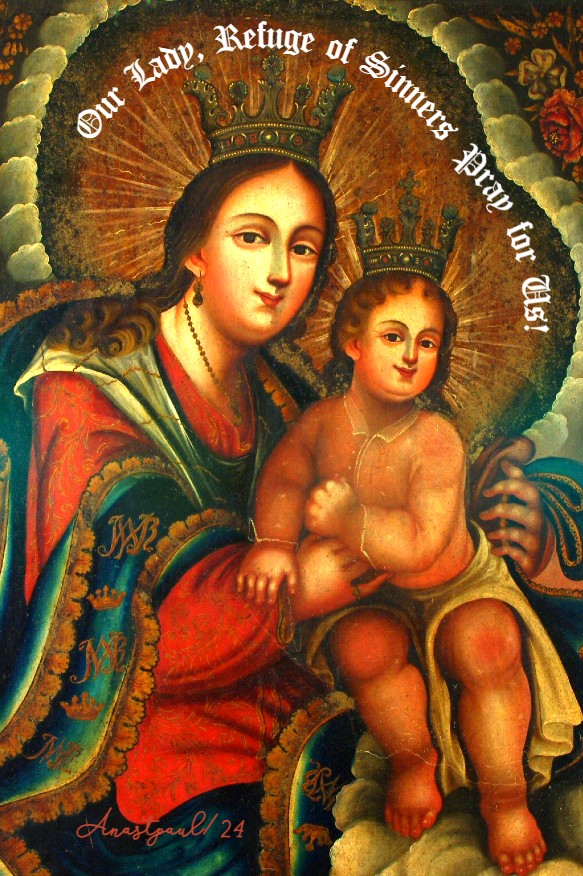
Quote of the Day – 13 August – “The Month of the Immaculate Heart of Mary” and the Feast of Our Lady Refuge of Sinners
O Mother Blest By St Alphonsus Maira Liguori (1696-1787) Most Zealous Doctor of the Church Trans. Fr Edmund Vaughn C.SS.R. (1827 – 1908 )
O Mother blest, whom God bestows On sinners and on just, What joy, what hope thou givest those Who in thy mercy trust. Thou are clement, thou are chaste, Mary thou art fair, Of all mothers, sweetest best, none with thee compare.
O heavenly Mother, mistress sweet! it never yet was told that suppliant sinner left thy feet, unpitied, unconsoloed. Thou are clement, thou are chaste, …
O Mother, pitiful and mild, Cease not to pray for me; For I do love thee as a child, And sigh for love of thee. Thou art clement, thou art chaste, …
Most powerful Mother, all men know Thy Son denies thee nought; Thou askest, wishest it, and lo! His power thy will hath wrought. Thou art clement, thou art chaste, …
O Mother blest, for me obtain, Ungrateful though I be, To love that God who first could deign To show such love for me. Thou art clement, thou art chaste, Mary, thou art fair. Of all mothers, sweetest, best, None with thee compare.
One Minute Reflection – 13 August – “The Month of the Immaculate Heart of Mary” – Saints Hippolytus and Cassian (Died c235) Martyrs – Our Lady Refuge of Sinners – Hebrews 10:32-38; Luke 12:1-8 – Scripture search here: https://www.drbo.org/
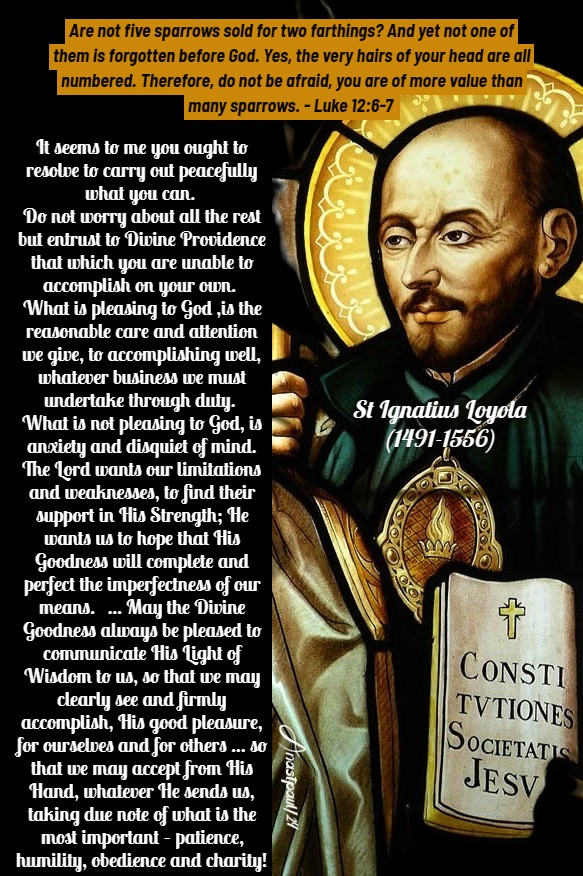
“Are not five sparrows sold for two farthings? And yet not one of them is forgotten before God. Yes, the very hairs of your head are all numbered. Therefore, do not be afraid, you are of more value than many sparrows.” – Luke 12:6-7
REFLECTION – “It seems to me you ought to resolve to carry out peacefully what you can. Do not worry about all the rest but entrust to Divine Providence that which you are unable to accomplish on your own. What is pleasing to God, is the reasonable care and attention we give, to accomplishing well, whatever business we must undertake through duty. What is not pleasing to God, is anxiety and disquiet of mind. The Lord wants our limitations and weaknesses, to find their support in His Strength; He wants us to hope that His Goodness will complete and perfect the imperfectness of our means.
Those who take on numerous responsibilities, even with an upright and pure intention, must resolve to do simply what lies within their power … If it is necessary to set certain things aside, arm yourselves with patience and do not think that God expects of us what we are unable to do. He does not want a man to distress himself on account of his limitations … there is no need to tire ourselves out excessively. More, if we have laboured to do our best, we can abandon all the rest to Him ,Who has the power to accomplish whatever He will.
May the Divine Goodness always be pleased to communicate His Light of Wisdom to us, so that we may clearly see and firmly accomplish, His good pleasure, for ourselves and for others … so that we may accept from His Hand, whatever He sends us, taking due note of what is the most important – patience, humility, obedience and charity!” – St Ignatius Loyola (1491-1556) Priest, Founder of the Society of Jesus (Letter of 17 November 1555)
PRAYER – Grant, we beseech Thee, O Lord God, unto all Thy servants that they may remain continually in the enjoyment of soundness, both of mind and body and, by the glorious intercession of the Blessed Mary, always a Virgin, may be delivered from present sadness and enter into the joy of Thine eternal gladness. Through Jesus Christ, Thy Son our Lord, Who lives and reigns with Thee, in the unity of the Holy Ghost, God, world without end. Amen (Collect).
Saint/s of the Day – 13 August – Saints Hippolytus and Cassian (Died c235) Martyrs. St Hippolytus is the Patron Saint of – horses, prison guards, officers and workers’ In Austria: Sankt Pölten, Zell am See. In Italy: Bardonecchia, Bibbiena, Cassano Valcuvia, Fogliano di Cascia, Laterina, Rogeno. St Cassian is the Patron Saint of – parish clerks and secretaries, of stenographers (proclaimed on 23 December 1952 by Pope Pius XII), students, teachers, typists. In Italy – Bibbiena, Cassano Valcuvia, Comacchio, Imola, La Salle, Laterina, Macherio, Rogeno, San Casciano dei Bagni, San Casciano in Val di Pesa, San Cassiano a Vico, San Cassiano di Controne, San Cassiano di Moriano, Trecate, the Diocese of Bolzano-Bressanone, the Diocese of Brixenand Imola. Of Mexico City, Mexico, Of Las Galletas, Tenerife, Spain.
The Roman Martyrology reads today: “At Rome, blessed Hippolytus, Martyr, who gloriously confessed the Faith, under the Emperor Decius {mpt Valerian}. After enduring other torments, he was tied by the feet to the necks of wild horses and being cruelly dragged through briars and brambles and having all his body lacerated, he yielded his spirit.” AND: “At Imola, the birthday of St Cassian, Martyr. As he refused to worship idols, the persecutor called the boys whom the Saint taught and who hated him, giving them leave to kill him. The torment suffered by the Martyr was the more grievious, as the hand which inflicted it by reason of its weakness, rendered death more tardy.”
St Hippolytus and St Cassian, (Died c235) Martyrs By Fr Francis Xavier Weninger SJ (1805-1888)
St Hippolytus, an Officer of the body-guard of the Emperor Decius, had been born in the darkness of idolatry but he had become a Christian, with all his household, in consequence of witnessing the many miracles which St Lawrence performedwhile in the prison under his charge.
The Martyrdom of St Hippolytus
He had also been present when the Saint, lying on the red-hot gridiron, endured the most terrible tortures. At the sight of the heroism of St Lawrence, he was filled with the desire to announce himself a Christian but he was prevented by St Lawrence. But when this Martyr had gloriously ended his combat, Hippolytus, with the assistance of a Priest, named Justinus, buried the sacred remains with great devotion and veneration. The Emperor on being informed of it, had Hippolytus seized and brought before him. He asked him if it was true that he had become a Christian? Hippolytus answered firmly: “Yes, I am a Christian and, moreover, resolved to die such.” The emperor, who had always highly esteemed him, endeavoured, first by promises and then by menaces, to induce him to forsake Christ. As, however, all was unavailing, he caused him to be tortured.
He was accordingly stretched on the ground, whipped with scourges and beaten with clubs so fearfully that it was believed he could not survive. But God, by a visible miracle, prolonged his life. Keeping his eyes fixed upon Heaven, he frequently repeated: “I am a Christian, I suffer for Christ’s sake.”
After having been tormented for a long time, he was cast into prison and the Prefect received the order to behead him. Before executing this order, however, he went to the house of Hippolytus to secure his property. Finding the entire household had become Christians, he took them beyond the gates of the City and had them beheaded. Concordia, an old and holy matron, who had been Hippolytus’ nurse, was scourged until she expired because she encouraged the others to remain firm in their faith.
At last, Hippolytus was taken out of prison and fastened to the necks of two horses and dragged by them until he was torn to pieces and his heroic soul was received into the Presence of Him Whom he had so fearlessly confessed.
On the same day, although at another place, St Cassian suffered a Martyrdom of unprecedented cruelty. This Saint, was the Bishop of Brescia but had been banished from his See on account of his faith.
St Cassian
He intended to go to Rome and offer the Pope his services for the salvation of souls in some other place. On his way, he changed his mind and taking up his residence at Imola, a Town in Italy, he resolved to teach children to read and write, hoping that occasion would not be wanting to do good. In this apparently humble position, he was no less zealous than he had been in the administration of his Diocese. He taught the children with love and gentleness and endeavoured to inspire them with respect for the Christian faith, fear and horror of sin and love of virtue and piety.
He continued in this occupation with great zeal for some years, to the great benefit of young and old. Suddenly a terrible persecution of the Christians arose. Cassian was one of the first who were taken prisoners. The tyrant commanded him to sacrifice to the gods. The holy Bishop and teacher refused, as might have been expected and tried to convince the Judge of his fearful blindness in worshipping dumb idols or making gods of godless men.
The tyrant, furious at his arguments, ordered the executioners to strip him of his clothes and tie his hands behind his back and leave him exposed to the mercy of the children whom he had taken such pains to teach. The children, who had been taught that Cassian was a magician and consequently must die, a most painful death, took their sharp iron pencils with which, in those days, they wrote upon their wax tablets and pierced him with them till the blood ran profusely from his veins. This torture lasted long and was extremely painful. The Saint, however, never complained of the ingratitude of his pupils, nor gave a sign of impatience but praised and thanked the Lord until his soul went to Heaven to receive the Crown of Martyrdom.
Thought for the Day – 12 August – Meditations with Fr Richard Frederick Clarke SJ (1839-1900)
CHARITY Meditations for a Month
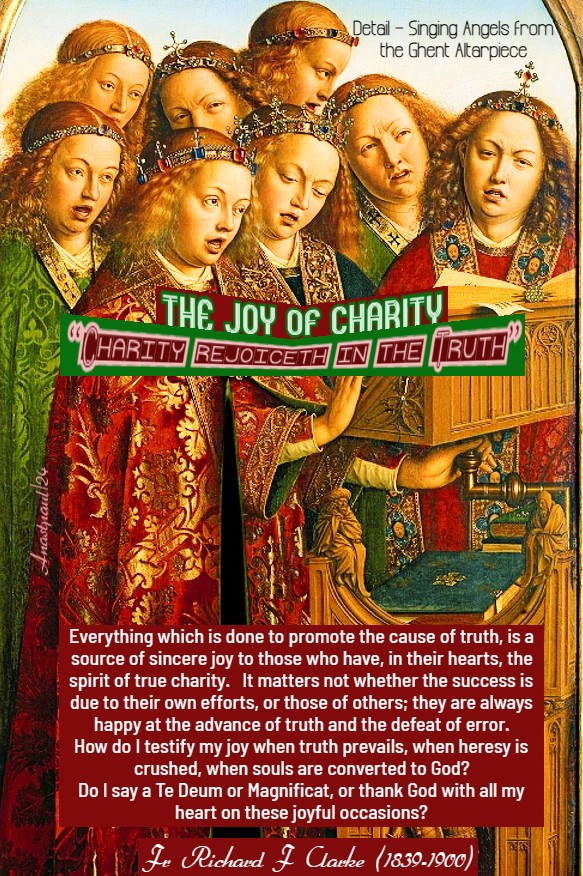
The Joy of Charity “Charity rejoiceth in the Truth”
Everything which is done to promote the cause of truth, is a source of sincere joy to those who have, in their hearts, the spirit of true charity. It matters not whether the success is due to their own efforts, or those of others; they are always happy at the advance of truth and the defeat of error. How do I testify my joy when truth prevails, when heresy is crushed, when souls are converted to God? Do I say a Te Deum or Magnificat, or thank God with all my heart on these joyful occasions?
Charity also finds pleasure in the truth being known. It has no wish to conceal anything. Those who have it in their hearts, make no attempt to hide the truth concerning themselves. They are willing to be known as they really are, with all their defects and imperfections. They are even happy their faults should be manifested, as far as the manifestation tends to the glory of God and the edification of their neighbour. I will examine myself to see what progress I have made in charity. Do I rejoice in the truth being known about myself, even in matters which may humble my pride?
Do I rejoice in the truth when I find, I have misjudged or misunderstood my neighbours and they are very different from that which I thought them to be and, far better than myself? Do I rejoice in the truth when I am shown to be incorrect in some opinion and when, others rectify me? Do I rejoice in the truth when I am brought, face-to-face with my own weakness and nothingness and find that I cannot trust in myself but have to trust in God alone?
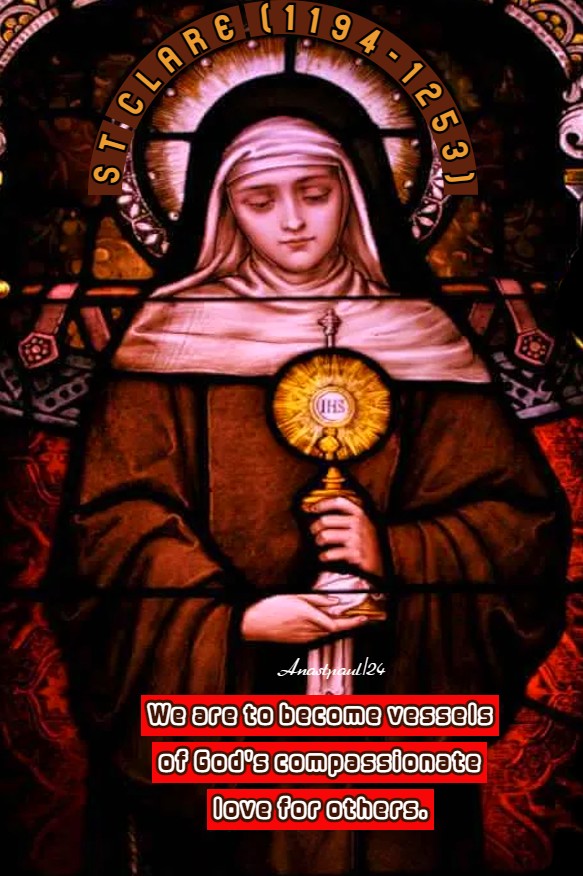
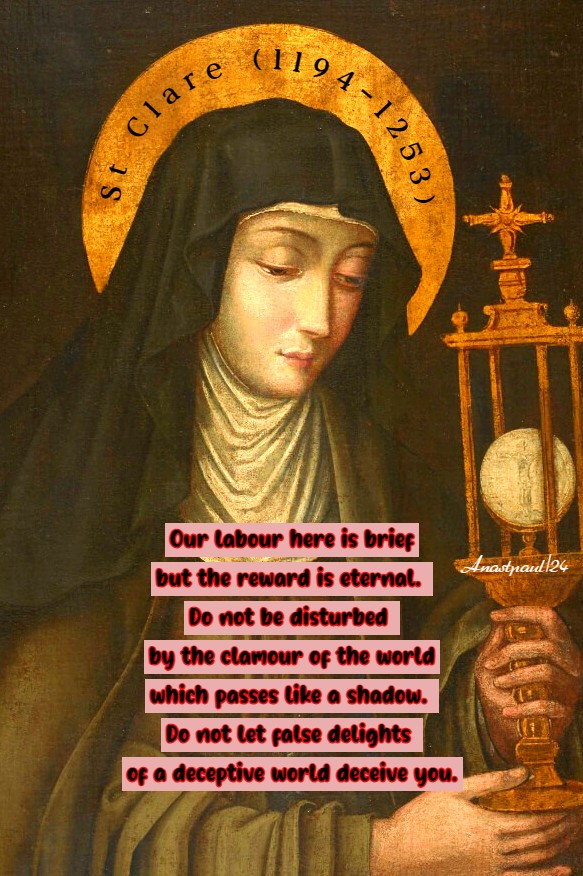
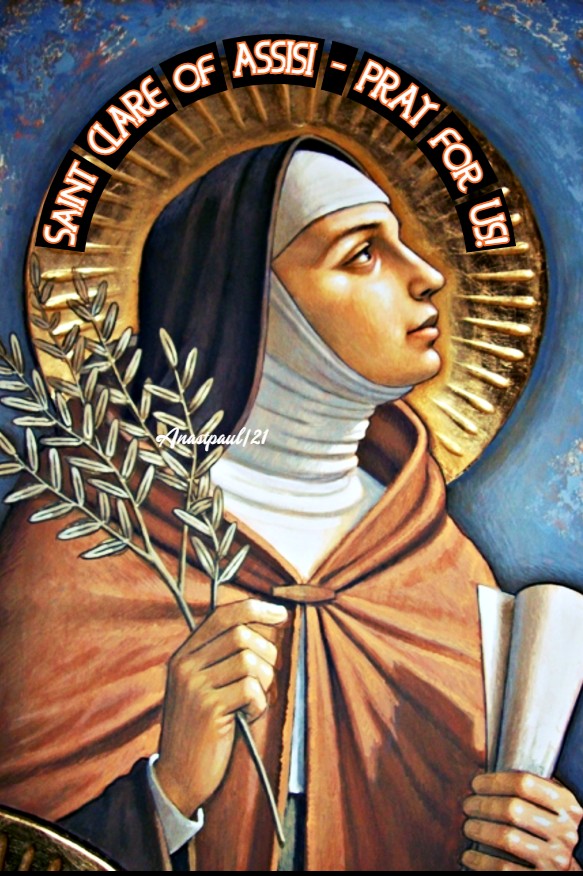
Quote/s of the Day – 12 August – St Clare (1194-1253) Virgin
“We are to become vessels of God’s compassionate love for others.”
“Our labour here is brief but the reward is eternal. Do not be disturbed by the clamour of the world which passes like a shadow. Do not let false delights of a deceptive world deceive you.”
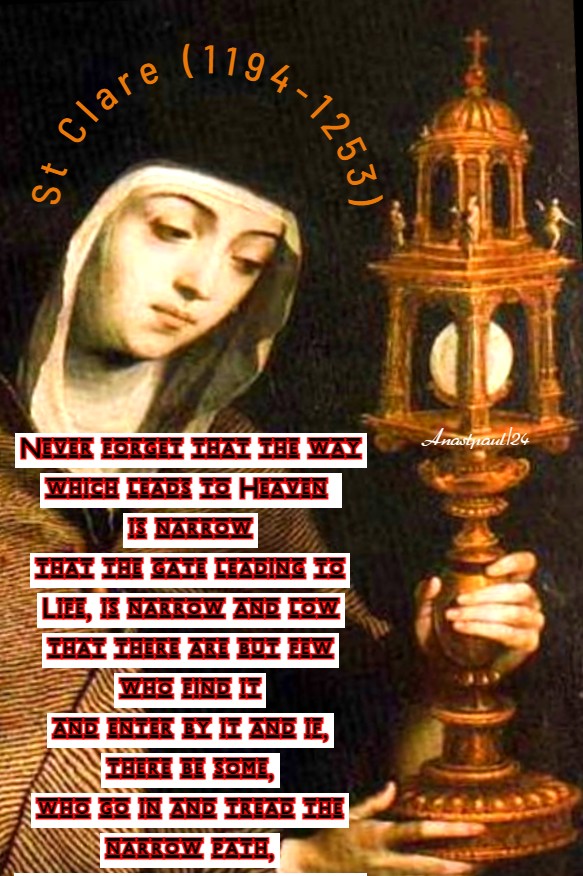
“Never forget that the way which leads to Heaven is narrow that the gate leading to Life, is narrow and low that there are but few who find it and enter by it and if, there be some, who go in and tread the narrow path, for some time, there are but very few, who persevere therein.”
One Minute Reflection – 12 August – “The Month of the Immaculate Heart of Mary” – St Clare of Assisi (1194-1253) Virgin – 2 Cor inthians 10:17-18; 11:1-2; Matthew 25:1-13 – Scripture search here: https://www.drbo.org/
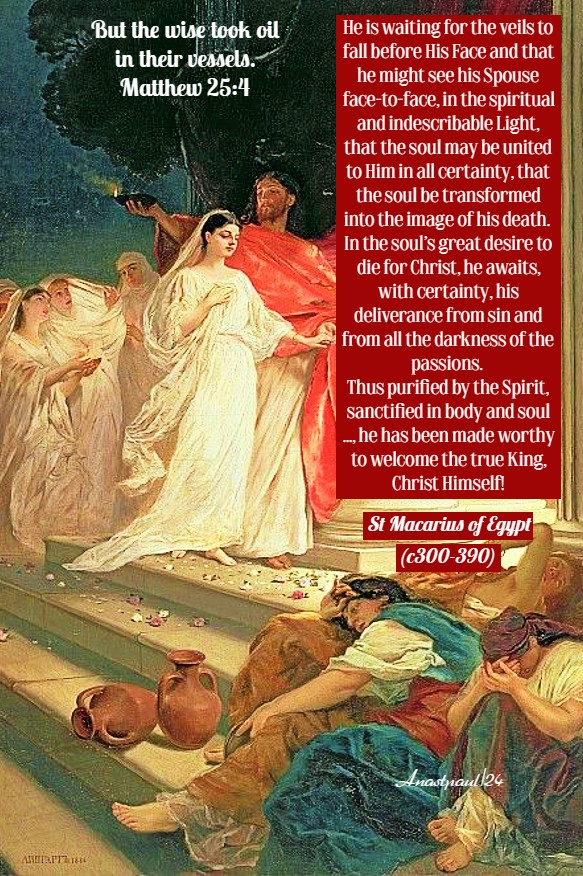
“But the wise took oil in their vessels” – Matthew 25:4
REFLECTION – “The soul who really loves God and Christ, even if it has done thousands of good works, thinks he has done nothing because of his insatiable hunger for God. Even if he has exhausted the body through fasting and vigils, he believes that he has not yet begun to be virtuous. In spite of the gifts of the Holy Ghost, the heavenly revelations and mysteries, he believes that he has not yet done anything because of his immense and insatiable love of the Lord. In faith and in love, he is always hungry and thirsty.
Persevering in prayer, he insatiably desires the mysteries of grace and to acquire every virtue. Wounded by love of the heavenly Spirit, animated by an ardent desire for his heavenly Spouse, he aspires to the grace of perfect, mysterious and ineffable communion with Him, in the sanctification of the Spirit. He is waiting for the veils to fall before His Face and that he might see his Spouse face-to-face, in the spiritual and indescribable Light, that the soul may be united to Him in all certainty, that the soul be transformed into the image of his death. In the soul’s great desire to die for Christ, he awaits, with certainty, his deliverance from sin and from all the darkness of the passions. Thus purified by the Spirit, sanctified in body and soul …, he has been made worthy to welcome the true King, Christ Himself!” – Sermon Attributed to St Macarius of Egypt (c300-390) Monk, Father
PRAYER – Hear us, O God, our Saviour that as we are gladdened by the festival of blessed Clare Thy virgin, so we may learn from it piety and devotion. Through the same Jesus Christ, Thy Son our Lord, Who lives and reigns with Thee, in the unity of the Holy Ghost, God, world without end. Amen (Collect).
Our Morning Offering – 12 August – “The Month of the Immaculate Heart of Mary”
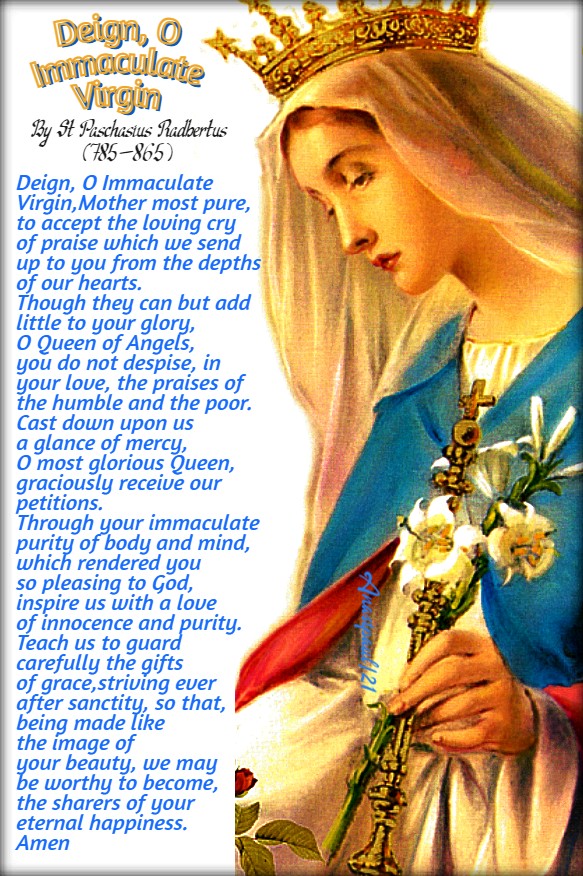
Deign, O Immaculate Virgin By St Paschasius Radbertus (785–865)
Deign, O Immaculate Virgin, Mother most pure, to accept the loving cry of praise which we send up to you from the depths of our hearts. Though they can but add little to your glory, O Queen of Angels, you do not despise, in your love, the praises of the humble and the poor. Cast down upon us a glance of mercy, O most glorious Queen, graciously receive our petitions. Through your immaculate purity of body and mind, which rendered you so pleasing to God, inspire us with a love of innocence and purity. Teach us to guard carefully the gifts of grace, striving ever after sanctity, so that, being made like the image of your beauty, we may be worthy to become, the sharers of your eternal happiness. Amen
Thought for the Day – 11 August – Meditations with Fr Richard Frederick Clarke SJ (1839-1900)
CHARITY Meditations for a Month
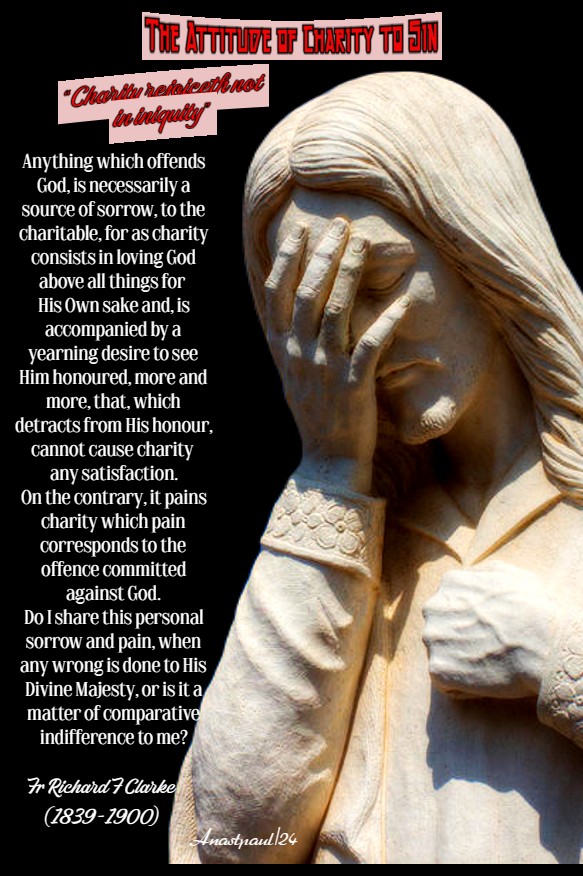
The Attitude of Charity to Sin “Charity rejoiceth not in iniquity”
Anything which offends God, is necessarily a source of sorrow, to the charitable, for as charity consists in loving God above all things for His Own sake and, is accompanied by a yearning desire to see Him honoured, more and more, that, which detracts from His honour, cannot cause charity any satisfaction. On the contrary, it pains charity which pain corresponds to the offence committed against God. Do I share this personal sorrow and pain, when any wrong is done to His Divine Majesty, or is it a matter of comparative indifference to me?
The Saints would gladly have given their lives to prevent sin. It was intensely painful to them to think how continually God is offended. Many Saints laid down their lives to prevent sin from being committed. The Saints all devoted themselves, with generous self-sacrifice, to the furtherance of God’s glory and, the hindrance of sin against Him. By prayer, by active zeal, by word, by work and by personal penance, the Saints fought against iniquity. What do I do to prevent all the sin and vice in this wicked world?
Above all, the Saints feared and dreaded any sin in themselves. They avoided with the utmost care anything which could lead to sin. No spectacle, however magnificent, no honour, however brilliant, no pleasure however intense, caused them anything but disgust and horror, if it was in any way mingled with iniquity. Is this true in my case? Do I relish things questionable or dangerous, or perhaps not altogether unmixed with positive sin!
Quote/s of the Day – 11 August – Pentecost XII – – 2 Corinthians 3:4-9; Luke 10:23-37– Scripture search here: https://www.drbo.org/
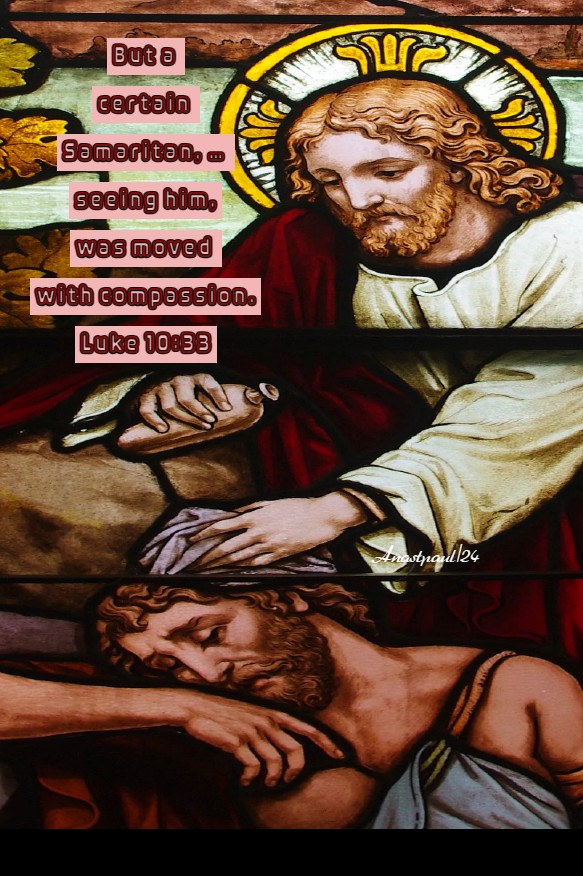
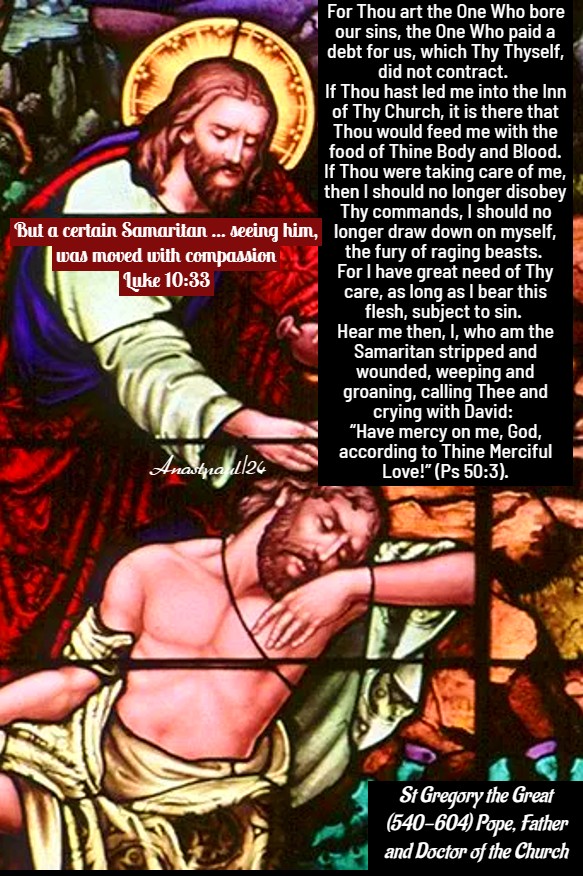
“But a certain Samaritan, … seeing him, was moved with compassion.”
Luke 10:33
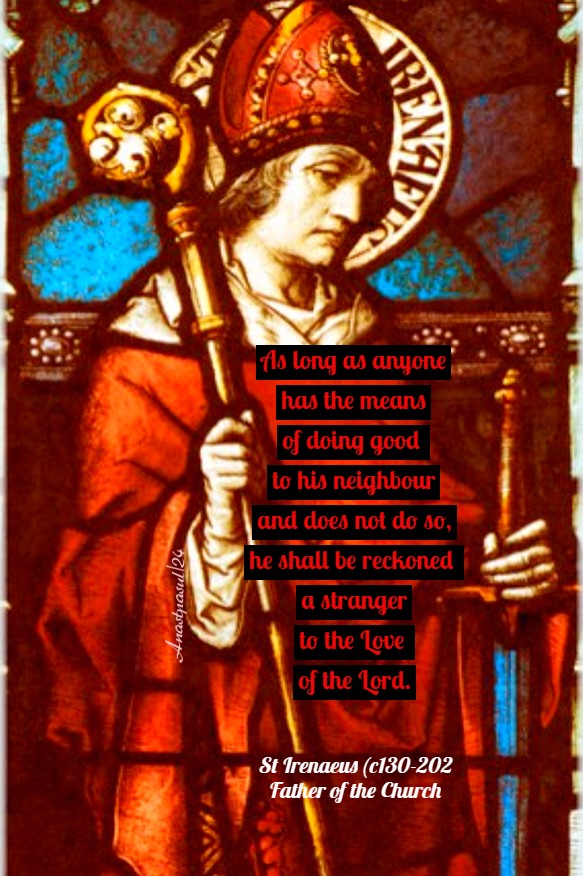
“As long as anyone has the means of doing good to his neighbour and does not do so, he shall be reckoned a stranger to the Love of the Lord.”
St Irenaeus (c130-202 Father of the Church
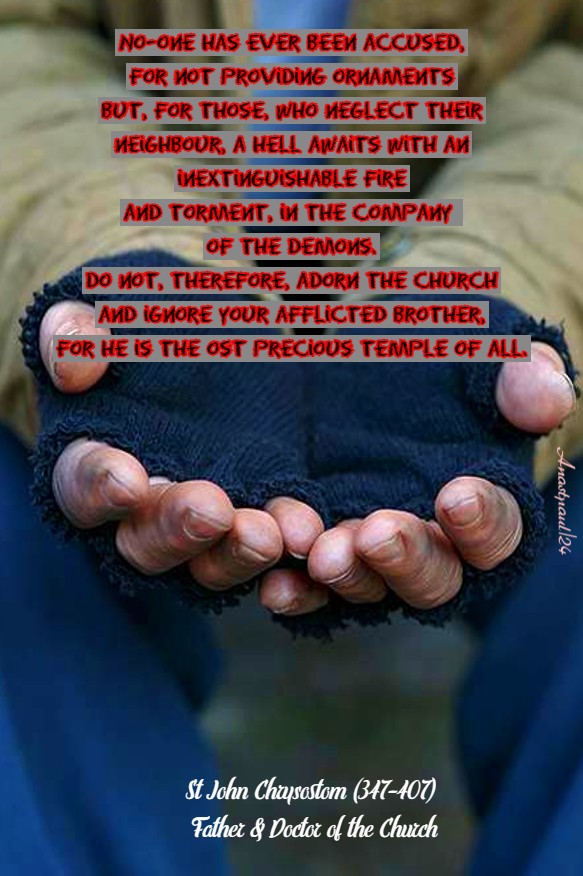
“No-one has ever been accused, for not providing ornaments but, for those, who neglect their neighbour, a hell awaits with an inextinguishable fire and torment, in the company of the demons. Do not, therefore, adorn the Church and ignore your afflicted brother, for he is the most precious temple of all.”
St John Chrysostom (347-407) Father & Doctor of the Church
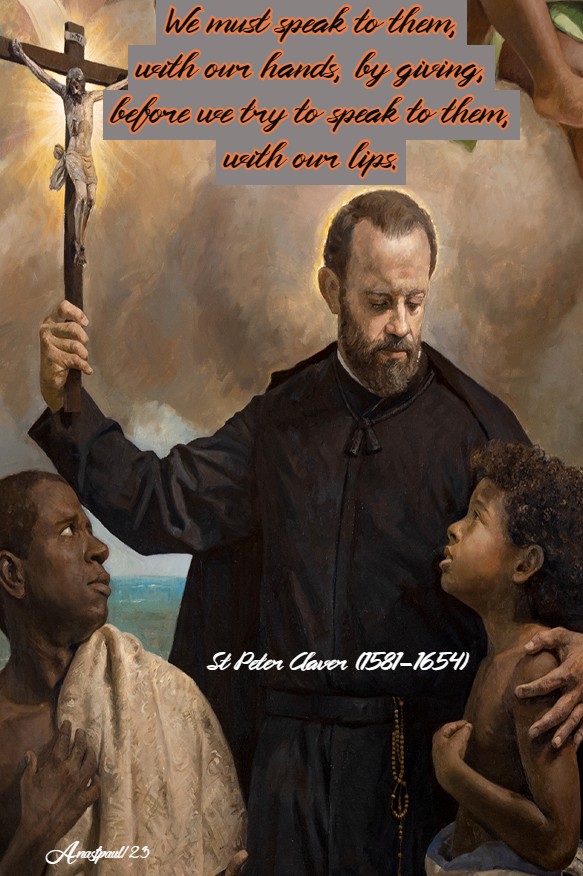
“We must speak to them with our hands before we speak to them with our lips.”
St Peter Claver (1580-1654)
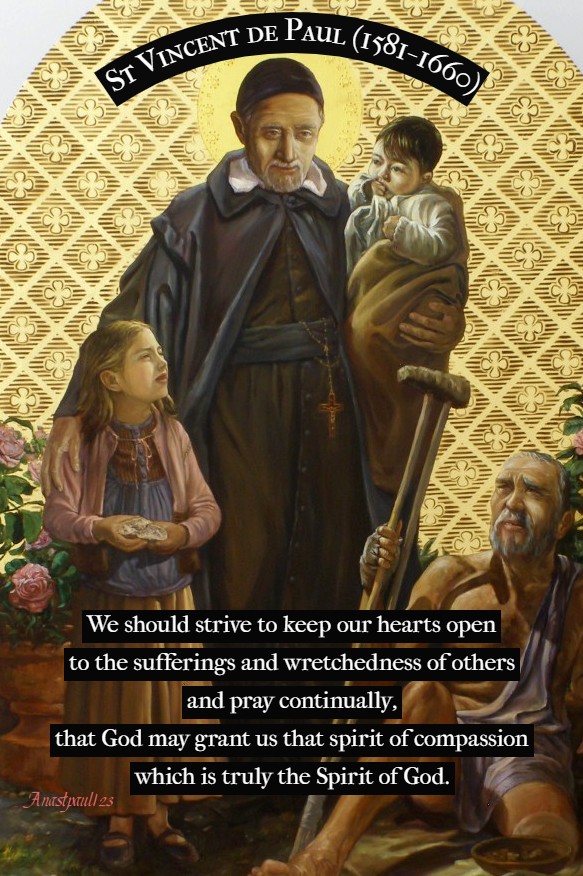
“We should strive to keep our hearts open to the sufferings and wretchedness of others and pray, continually, that God may grant us, that spirit of compassion which is truly the Spirit of God.”
St Vincent de Paul (1581-1660)
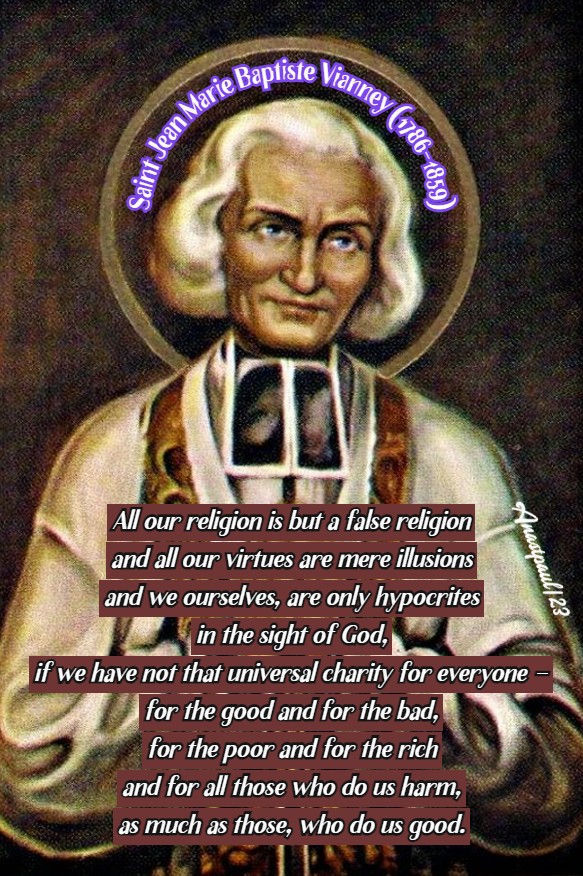
“All our religion is but a false religion and all our virtues are mere illusions and we ourselves are only hypocrites in the sight of God, if we have not that universal charity for everyone – for the good and for the bad, for the poor and for the rich and for all those who do us harm, as much as those who do us good.”
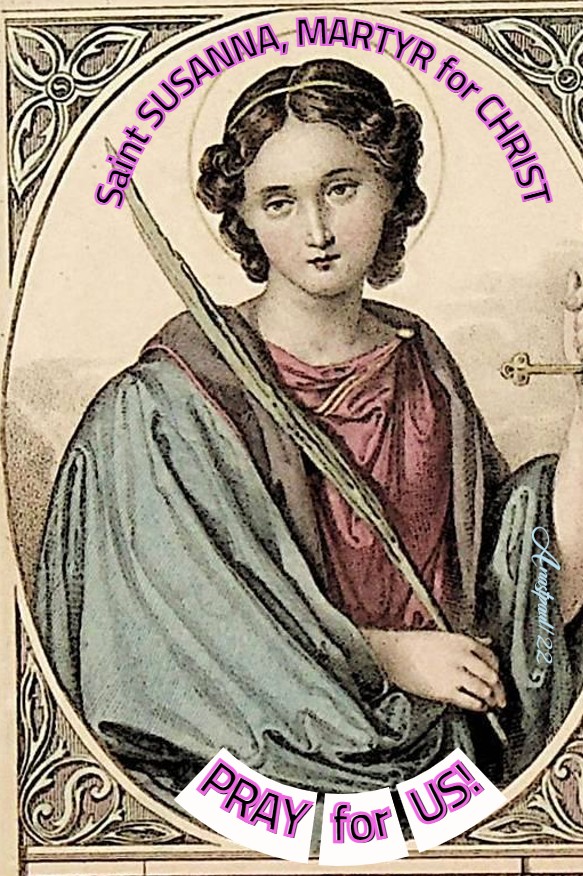
One Minute Reflection – 11 August – “The Month of the Immaculate Heart of Mary” – Pentecost XII – St Tiburtius (Died c286) Martyr, Layman, St Susanna of Rome (Died c 295) Virgin Martyr, St Philomena (Died 304) Virgin Martyr – 2 Corinthians 3:4-9; Luke 10:23-37– Scripture search here: https://www.drbo.org/
“But a certain Samaritan, … seeing him, was moved with compassion.” – Luke 10:33
REFLECTION – “O Lord Jesus, stirred by pity may Thou have the goodness to draw near me. Going down from Jerusalem to Jericho, Thou fall from the heights to our own lowest depths, from a state where people are full of life, to a land of the sick. Look, I have fallen into the hands of the angels of darkness, who have not only stripped off my garment of grace but, having beaten me with their blows, have left me half dead. May Thou treat the wounds of my sins, when Thou hast given me hope of recovering my health, lest they should triumph if I ever lose hope of healing. May Thou anoint me with the oil of Thine forgiveness and pour the wine of contrition, over me. If Thou set me on Thy Own mount, it is then that Thou “raise up the needy of the earth” that Thou “lift the poor from the ash-heap” (Ps 112:7).
For Thou art the One Who bore our sins, the One Who paid a debt for us, which Thy Thyself, did not contract. If Thou hast led me into the Inn of Thy Church, it is there that Thou would feed me with the food of Thine Body and Blood. If Thou were taking care of me, then I should no longer disobey Thy commands, I should no longer draw down on myself, the fury of raging beasts. For I have great need of Thy care, as long as I bear this flesh, subject to sin. Hear me then, I, who am the Samaritan stripped and wounded, weeping and groaning, calling Thee and crying with David: “Have mercy on me, God, according to Thine Merciful Love!” (Ps 50:3).” – St Gregory the Great (540-604) Pope, Father and Doctor of the Church (Exposition on the Seven Penitential Psalms),
PRAYER – May the constant protection of Thy holy Martyrs, Tiburtius and Susanna and Philomena support us, O Lord, for Thou never fails to look mercifully upon those whom Thou, hast given the help, of such intercession. Through Jesus Christ, Thy Son our Lord, Who lives and reigns with Thee, in the unity of the Holy Ghost, God, world without end. Amen (Collect).
Our Morning Offering – 11 August – “The Month of the Immaculate Heart of Mary” – Pentecost XII
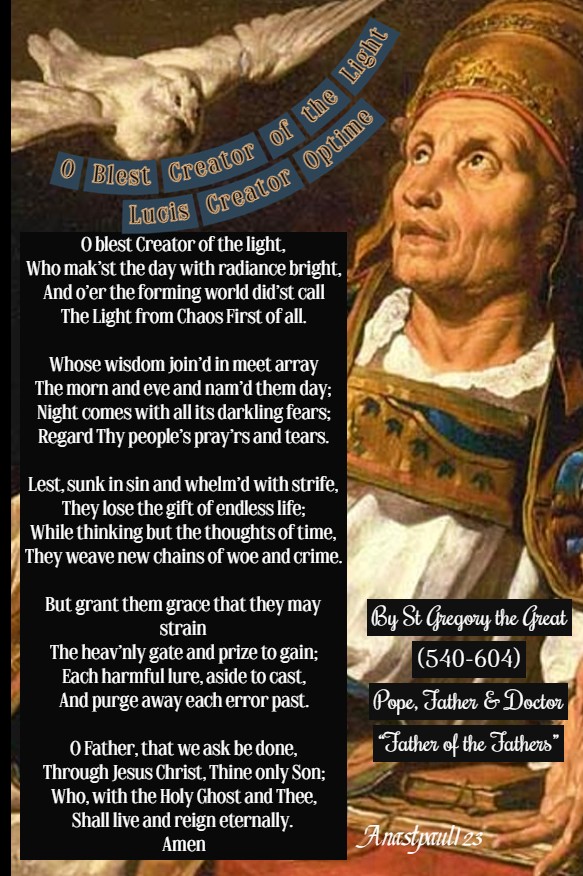
Lucis Creator Optime O Blest Creator of the Light By St Gregory the Great (540-604) Pope, Father & Doctor “Father of the Fathers”
O blest Creator of the light, Who mak’st the day with radiance bright, And o’er the forming world did’st call The Light from Chaos First of all.
Whose wisdom join’d in meet array The morn and eve and nam’d them day; Night comes with all its darkling fears; Regard Thy people’s pray’rs and tears.
Lest, sunk in sin and whelm’d with strife, They lose the gift of endless life; While thinking but the thoughts of time, They weave new chains of woe and crime.
But grant them grace that they may strain The heav’nly gate and prize to gain; Each harmful lure, aside to cast, And purge away each error past.
O Father, that we ask be done, Through Jesus Christ, Thine only Son; Who, with the Holy Ghost and Thee, Shall live and reign eternally. Amen
This hymn is used for Vespers (II) on Sundays throughout the year in the Extraordinary Form of the Roman Breviary. Trans John M Neale (1818-1866), 1851. Tune: “Lucis Creator Optime” Gregorian Chant, Mode VIII, traditional.
Thought for the Day – 10 August – Meditations with Fr Richard Frederick Clarke SJ (1839-1900)
CHARITY Meditations for a Month
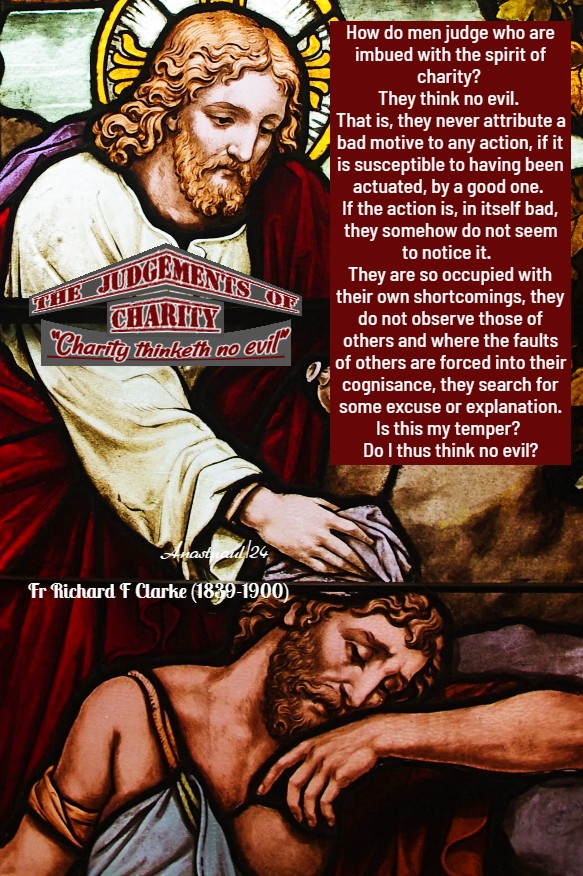
The Judgements of Charity “Charity thinketh no evil”
We are all surrounded by those, of whose actions, we are continual witnesses and, of whose character, from these actions, we cannot help forming an opinion. We see what they do and listen to what they say and we, not only receive, a certain impression from them but also, are tempted to judge them and to pronounce on their moral value. Moreover, we are too prone, to judge them unfavourably, rather than favourably, to ascribe to them inferior motives and, see faults in them, where there are none or, to exaggerate whatever defects maybe found in them. This unhappily, is my tendency. I cannot deny it!
Why is this? It is because I am so full of faults myself that I see many faults in others. It is the reflection of myself which I find so repulsive in them! I really attribute to them the very defects which, in some form or other, are to be found in me. It is because of my own want of charity that I judge them so harshly. How this ought to humble me and how careful it ought to make me, in my judgement of others.
How do men judge who are imbued with the spirit of charity? They think no evil. That is, they never attribute a bad motive to any action, if it is susceptible to having been actuated, by a good one. If the action is, in itself bad, they somehow do not seem to notice it. They are so occupied with their own shortcomings, they do not observe those of others and where the faults of others are forced into their cognisance, they search for some excuse or explanation. Is this my temper? Do I thus think no evil?
Quote/s of the Day – 10 August – St Lawrence (Died 258) Martyr, “Keeper of the Treasures of he Church” – 2 Corinthians 9:6-10; John 12:24-26 – Scripture search here: https://www.drbo.org/
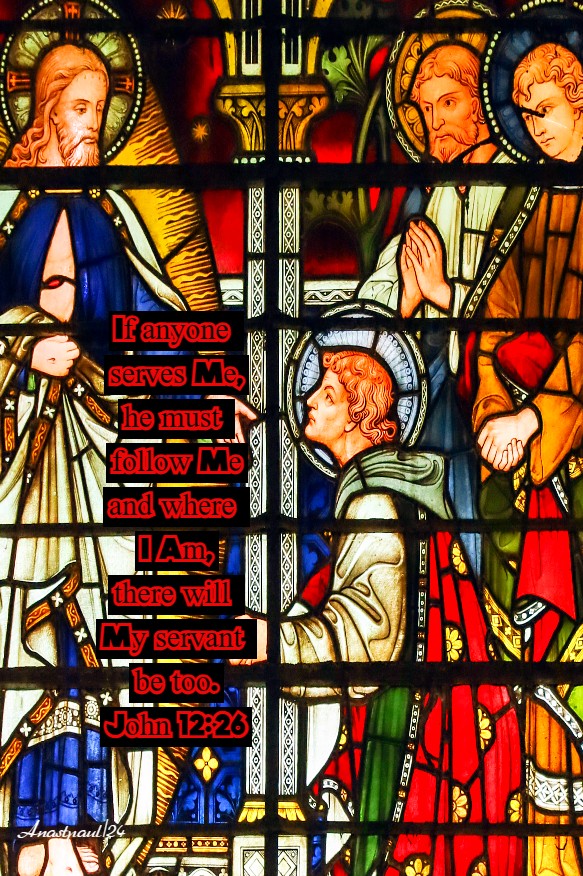
“If anyone serves Me, he must follow Me and where I Am, there will My servant be too.”
John 12:26
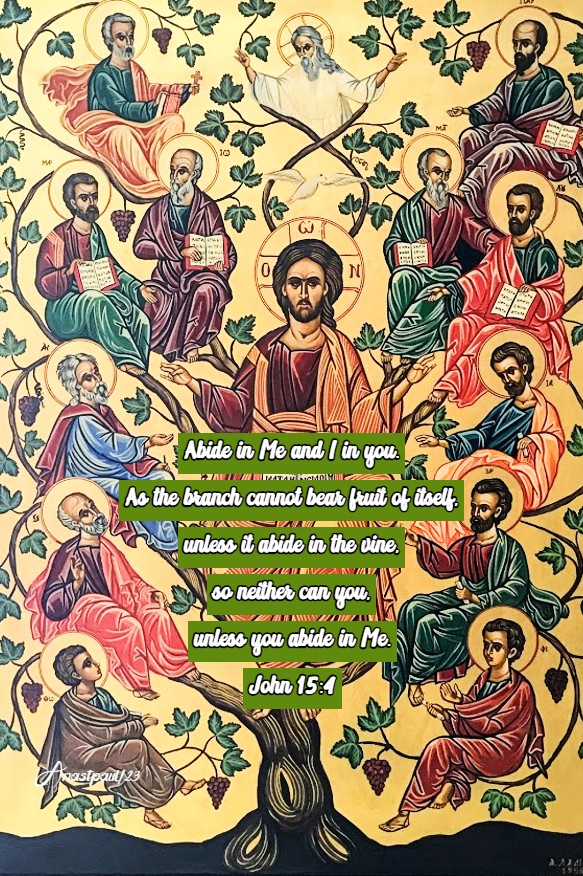
“Abide in Me and I in you. As the branch cannot bear fruit of itself, unless it abide in the vine, so neither can you, unless you abide in Me.”
John 15:4
“The present is nothing. But eternity abides for those on whom all Truth, all Good, has shone, in One Entire and Perfect Light. ”
St Paulinus of Nola (c 354-431)
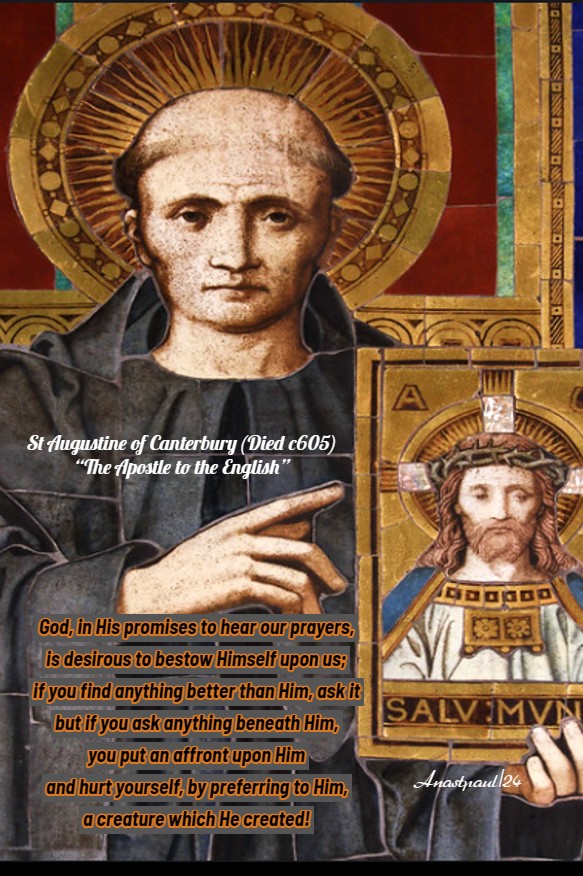
“God, in His promises to hear our prayers, is desirous to bestow Himself upon us; if you find anything better than Him, ask it but if you ask anything beneath Him, you put an affront upon Him and hurt yourself, by preferring to Him, a creature which He created!”
St Augustine of Canterbury (Died c605) “The Apostle to the English”
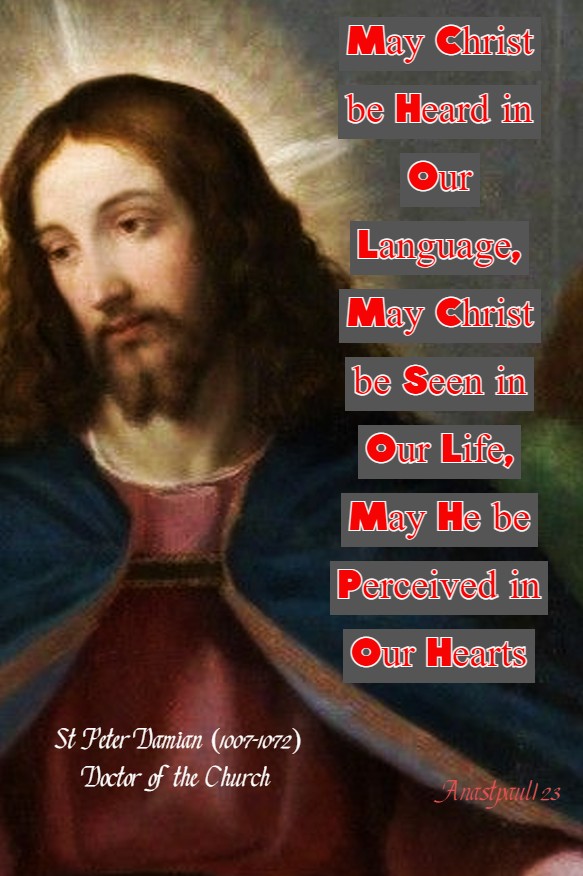
“May Christ be heard in our language, may Christ be seen in our life, may He be perceived in our hearts”
One Minute Reflection – 10 August – “The Month of the Immaculate Heart of Mary” – St Lawrence (Died 258) Martyr, “Keeper of the Treasures of he Church” – 2 Corinthians 9:6-10; John 12:24-26 – – – Scripture search here: https://www.drbo.org/
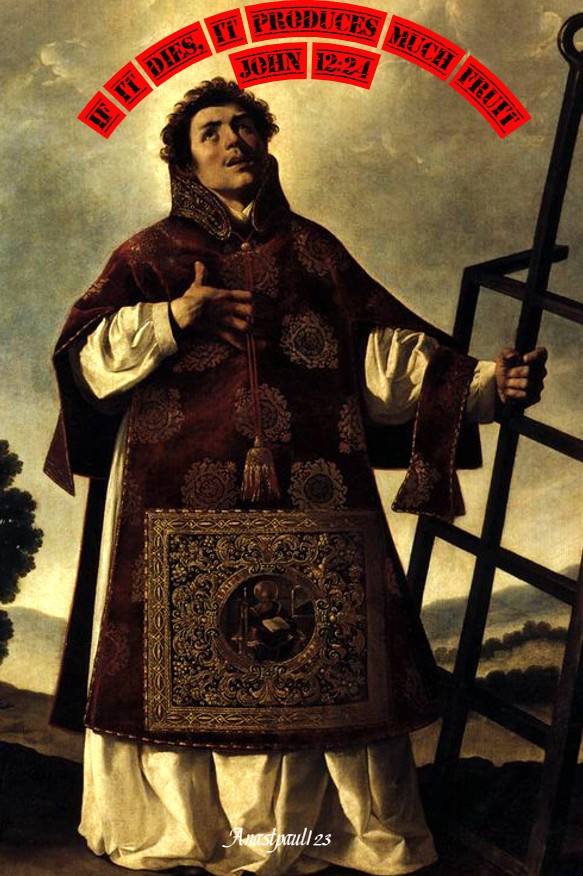
“If it dies, it produces much fruit” – John 12:24
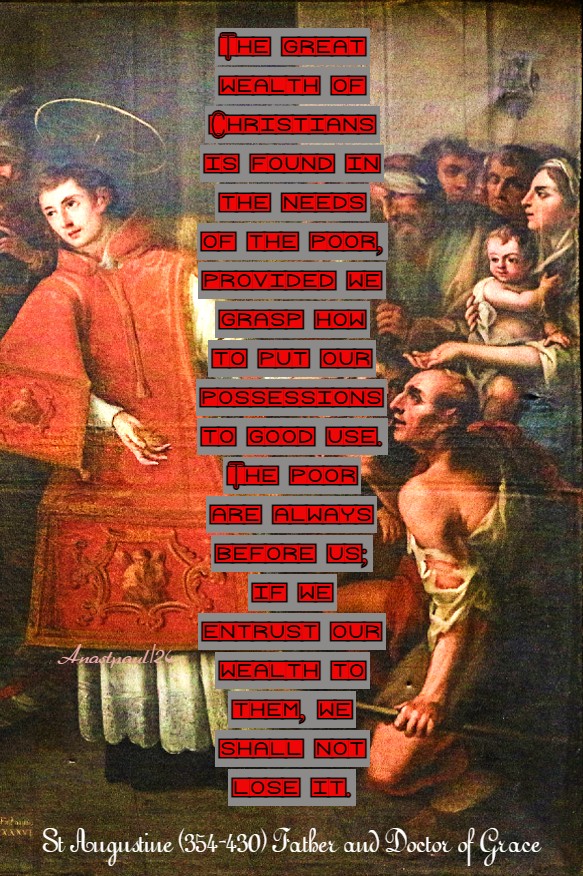
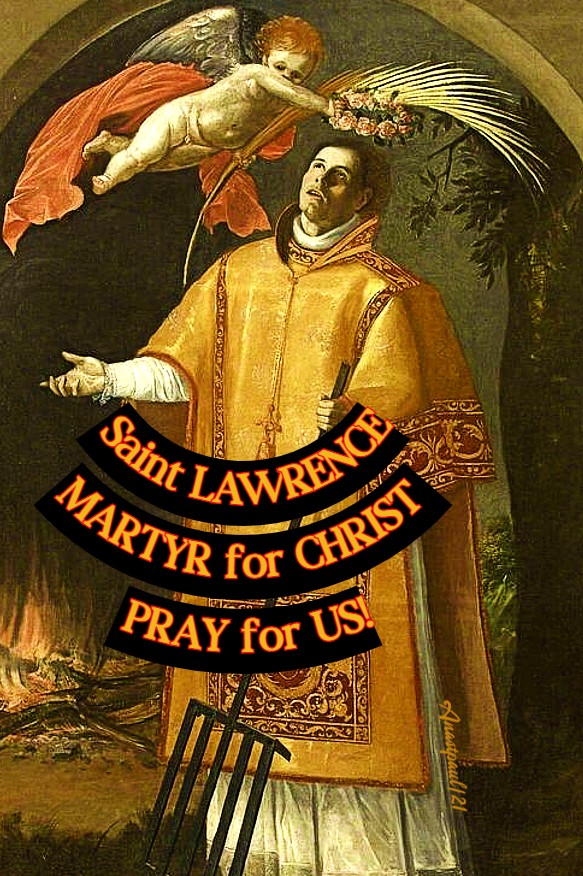
REFLECTION – “Saint Lawrence was a Deacon in Rome. The Church’s persecutors ordered him to hand over the treasures of the Church. It was to win a real treasure in Heaven that he underwent the torments which we cannot listen to, without horror, for he was stretched out on a gridiron over a fire … Nevertheless, he triumphed over all his bodily sufferings by means of the extraordinary strength he drew from his charity and, with the help of Him, Who made him resolute. “For we are His handiwork, created in Christ Jesus for the good works which God has prepared in advance that we should live in them” (Eph 2:10).
Now this is what stirred up his persecutors’ wrath … Lawrence said: “Order chariots to come along with me, on which I can bring you the treasures of the Church.” When he was given some chariots, he filled them with the poor and brought them back, saying: “These are the Church’s treasures.”
Nothing is truer, my brethren. The great wealth of Christians is found in the needs of the poor, provided we grasp how to put our possessions to good use. The poor are always before us; if we entrust our wealth to them, we shall not lose it.” – St Augustine (354-430) Father and Doctor of Grace (Sermon 302, for the Feast of Saint Lawrence).
PRAYER – Grant us, we beseech Thee, Almighty God, to extinguish the flames of our sins, as Thou granted St Lawrence to overcome the fires of his tortures. Through Jesus Christ, Thy Son our Lord, Who lives and reigns with Thee, in the unity of the Holy Ghost, God, world without end. Amen (Collect).
Thought for the Day – 9 August – Meditations with Fr Richard Frederick Clarke SJ (1839-1900)
CHARITY Meditations for a Month
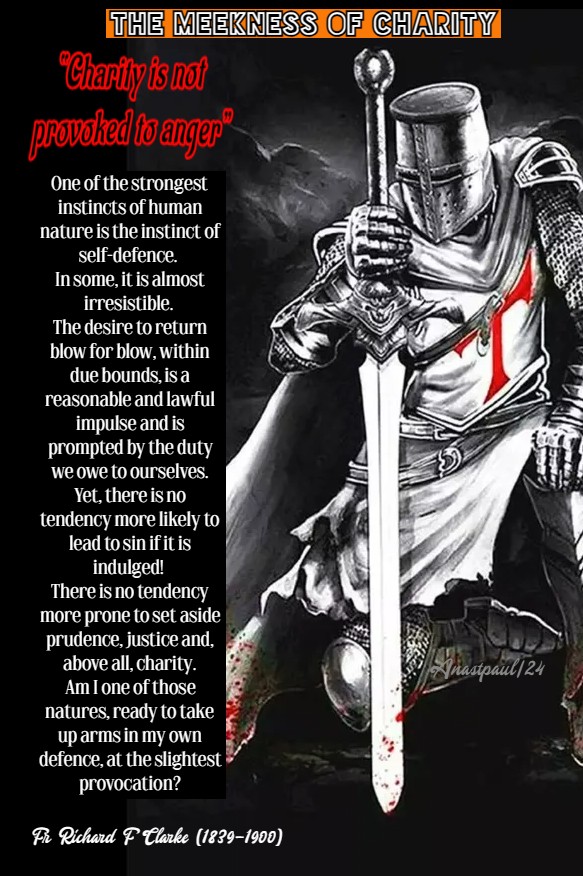
The Meekness of Charity “Charity is not provoked to anger”
One of the strongest instincts of human nature is the instinct of self-defence. In some, it is almost irresistible. The desire to return blow for blow, within due bounds, is a reasonable and lawful impulse and is prompted by the duty we owe to ourselves. Yet, there is no tendency more likely to lead to sin if it is indulged! There is no tendency more prone to set aside prudence, justice and, above all, charity. Am I one of those natures, ready to take up arms in my own defence, at the slightest provocation?
The instinct of self-defence is always prone to mislead us, due to our excessive self-love. We imagine we have been attacked, when in fact, nothing of the sort is the case. We see a slight or insult, when none was intended. We do not keep in mind how simple the true explanation may really be. We become angry, long for revenge and are carried beyond all bounds, by our wounded self-love. We say and do what we bitterly regret afterwards, alienating others from us and offending God by our angry words. How often, alas, I have done this!
How is this evil to be remedied? By charity and nothing else. If God were more prominent in our hearts, if we loved God more and ourselves less, if our ambition were to promote His honour and not our own, we should not indulge in these outbursts of intemperate or bitter words. Instead, we should not be easily provoked or become angry. We should take a gentle view of what has been done or we should accept the injury or unkindness done to us and offer it up for our sins in union with the supreme charity of Christ our Lord!


























You must be logged in to post a comment.