Thought for the Day – 25 November – Monday of the Thirty Fourth week in Ordinary Time, Year C, Gospel: Luke 21:1-4
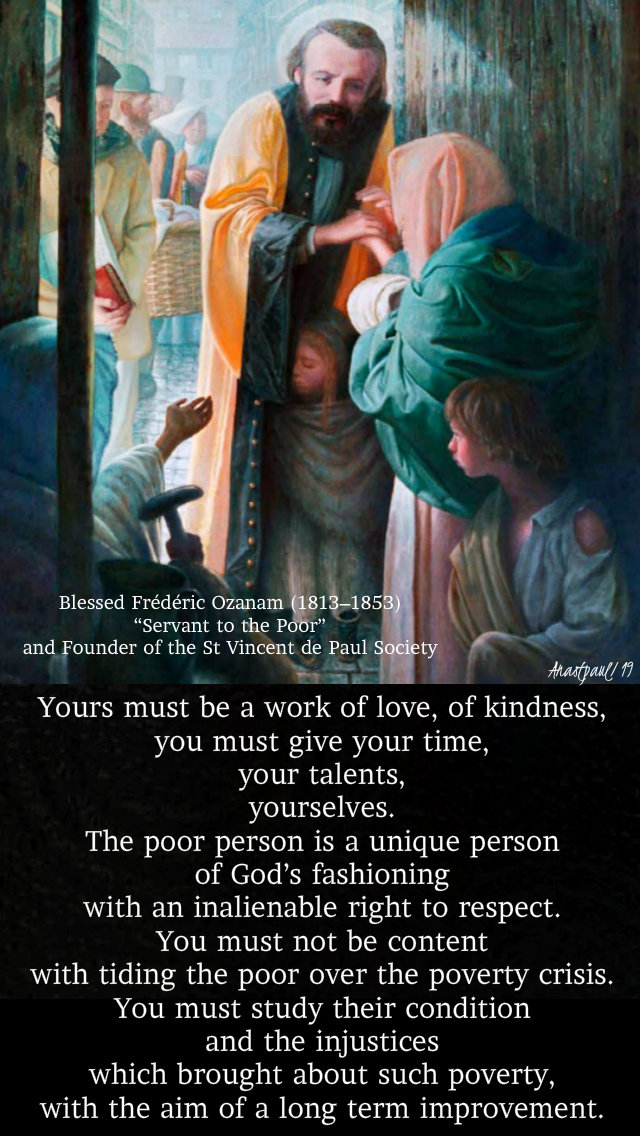
Blessed Frédéric Ozanam (1813–1853)
“Servant to the Poor”
and Founder of the St Vincent de Paul Society
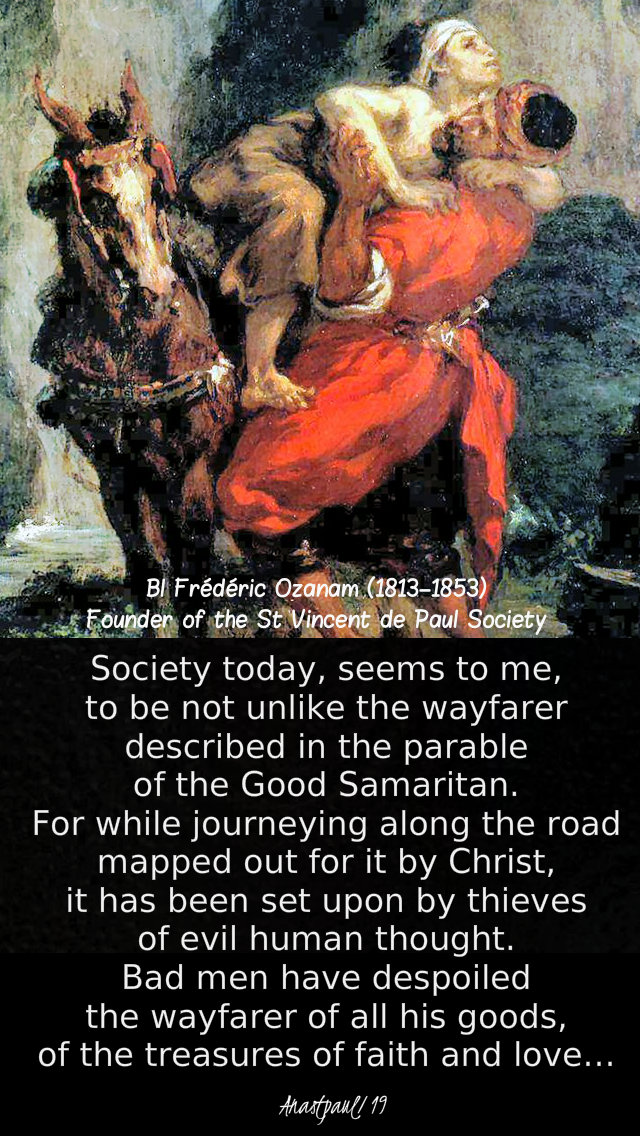
“Society today seems to me to be not unlike the wayfarer described in the parable of the Good Samaritan. For while journeying along the road, mapped out for it by Christ, it has been set upon by thieves of evil human thought. Bad men have despoiled the wayfarer of all his goods, of the treasures of faith and love… . The priests and the Levites have passed him by. But this time, being real priests and true Levites, they have approached the suffering, wretched creature and attempted to cure him. But in his delirium he has not recognised them and has driven them away. Then we, weak Samaritans, outsiders as we are, have dared to approach this great sick patient. Perhaps he will be less affrighted by us? Let us try to measure the extent of his wounds, in order to pour oil into them. Let us make words of peace and consolation ringing in his ears. Then, when his eyes are opened, we will hand him over to the tender care of those, whom God has chosen, to be the guardians and doctors of souls.”
Blest are the pure in heart, for they shall see our God, the secret of the Lord is theirs, their soul is Christ’s abode.
The Lord, who left the heavens, our life and peace to bring, to dwell in lowliness with men, their pattern and their King.
Still to the lowly soul, He does Himself impart and for His dwelling and His throne, chooses the pure in heart.
Lord, we Thy presence seek, May ours this blessing be: give us a pure and lowly heart, a temple fit for Thee.
Quote/s of the Day – 25 November – Monday of the Thirty Fourth week in Ordinary Time, Year C, Gospel: Luke 21:1-4
Speaking of: Mercy
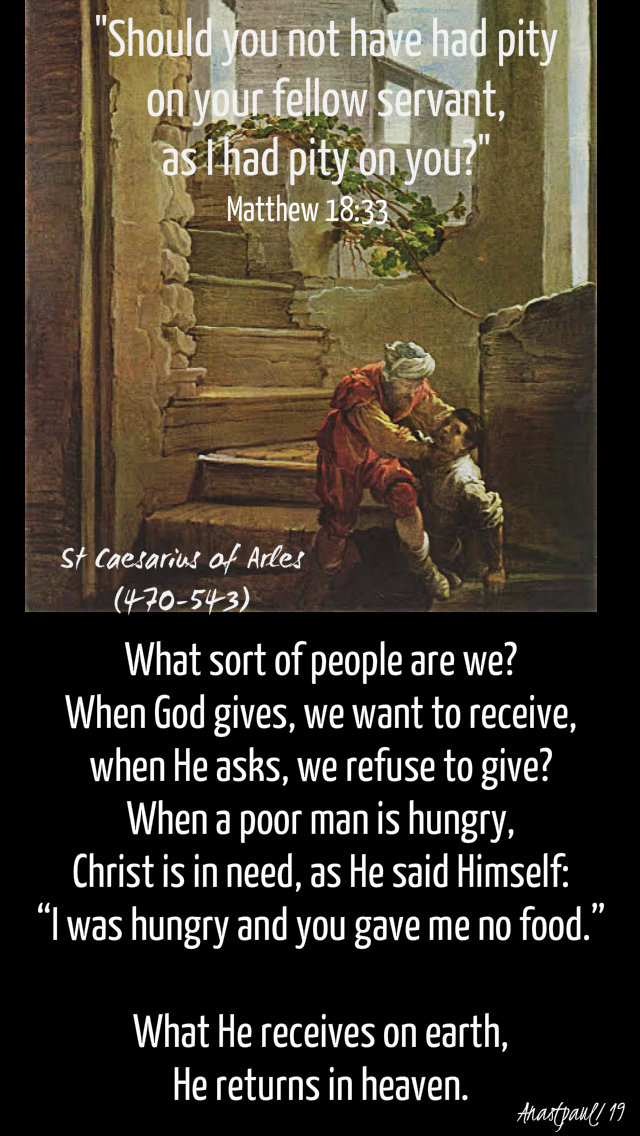
“What sort of people are we? When God gives, we want to receive, when He asks, we refuse to give? When a poor man is hungry, Christ is in need, as He said Himself: “I was hungry and you gave me no food” (v. 42). Take care not to despise the hardship of the poor, if you would hope, without fear, to have your sins forgiven… What He receives on earth, He returns in heaven!”
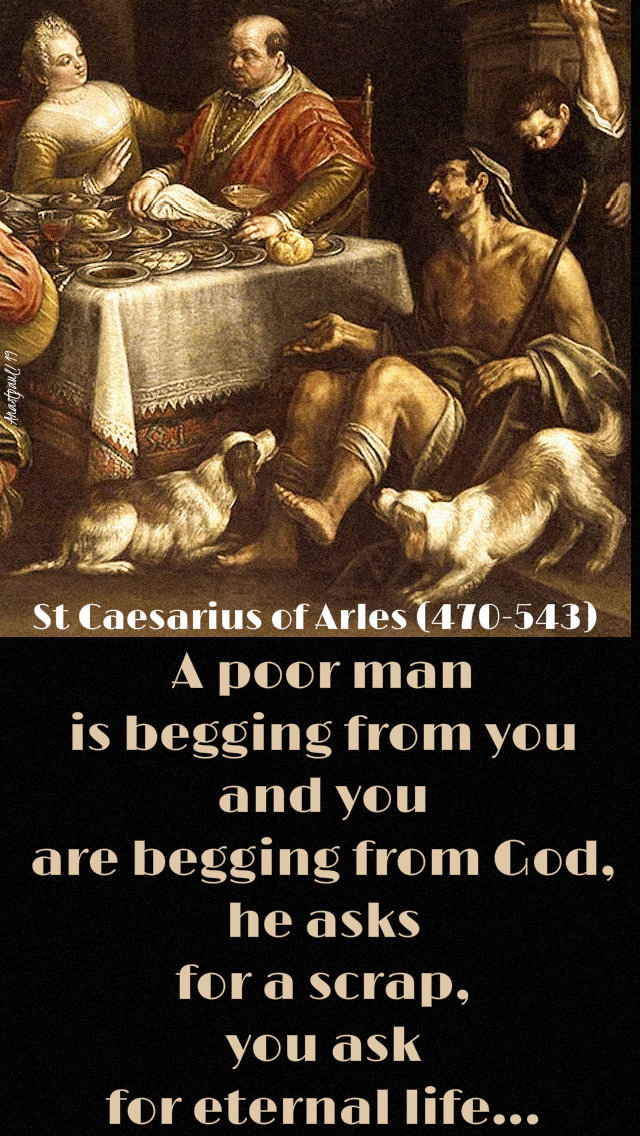
“I put you this question, dearly beloved – what is it you want, what is it you are looking for, when you come to church? What indeed if not mercy? Show mercy on earth and you will receive mercy in heaven. A poor man is begging from you and you are begging from God, he asks for a scrap, you ask for eternal life… And so when you come to church give whatever alms you can to the poor in accordance with your means.”
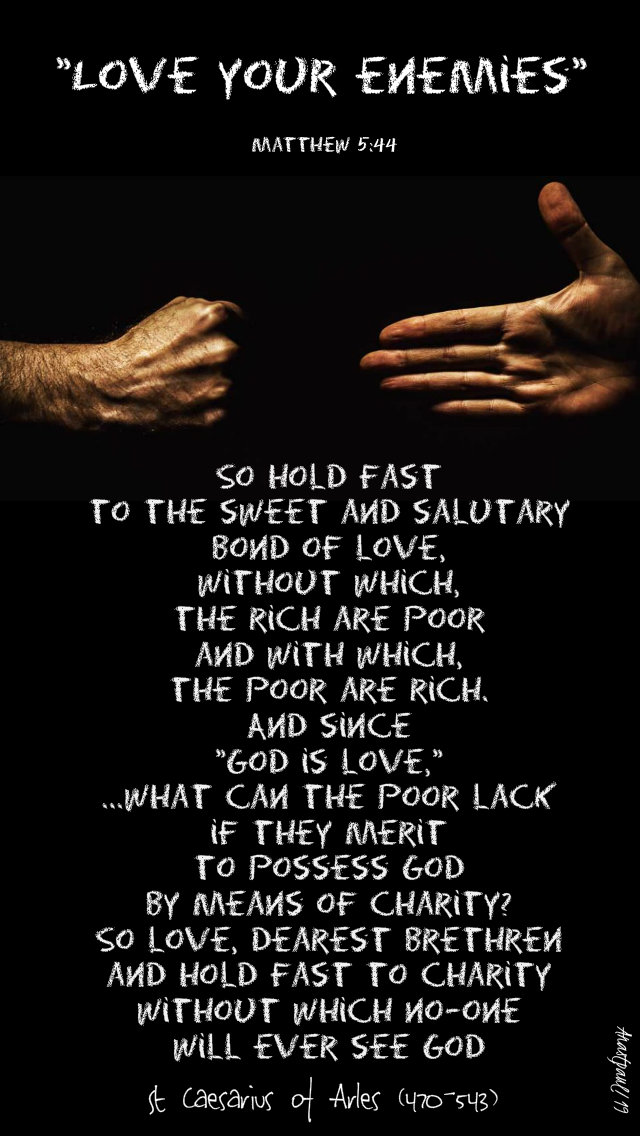
“So hold fast to the sweet and salutary bond of love, without which, the rich are poor and with which the poor are rich. What do the rich possess if not charity? (…) And since “God is love,” (1 Jn 4:8) as John the evangelist says, what can the poor lack, if they merit to possess God by means of charity? (…) So love, dearest brethren and hold fast to charity.
without which no-one
will ever see God.”
Saint Caesarius of Arles (470-543)
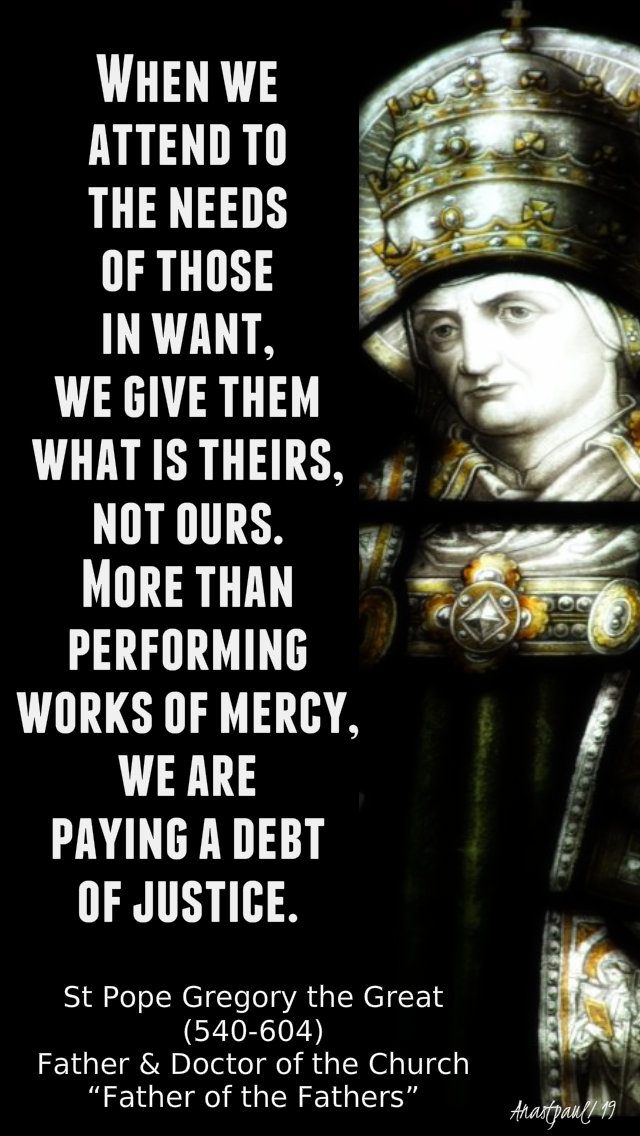
“When we attend to the needs of those in want, we give them what is theirs, not ours. More than performing works of mercy, we are paying a debt of justice.”
St Pope Gregory the Great (540-604)
Father & Doctor of the Church
“Father of the Fathers”
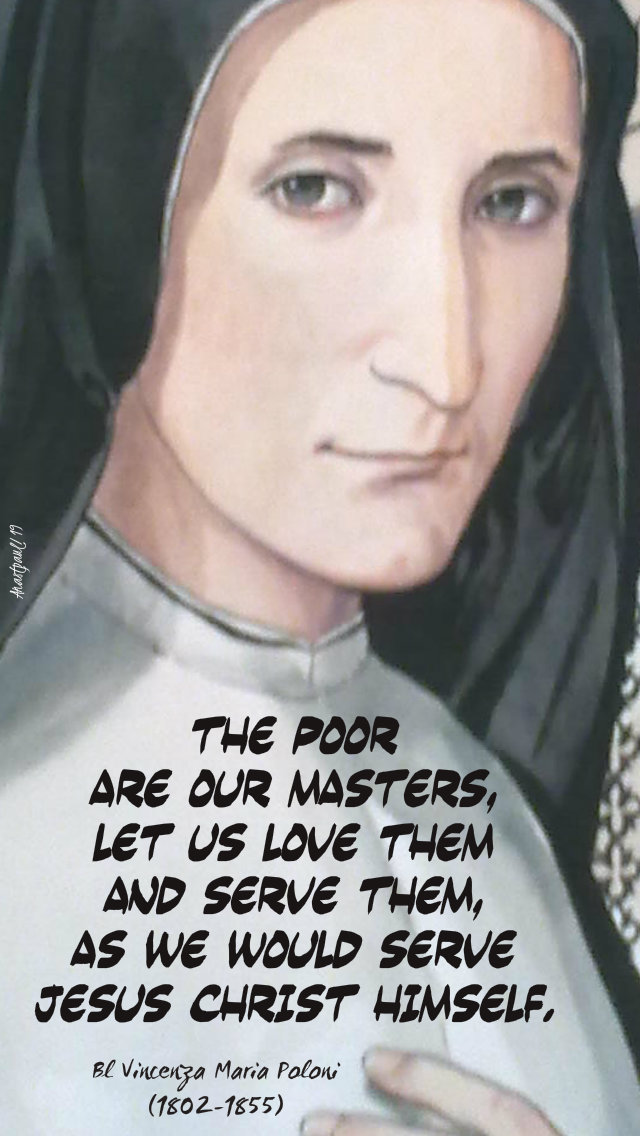
“The poor are our masters, let us love them and serve them, as we would serve Jesus Christ Himself. “
Blessed Vincenza Maria Poloni (1802-1855)
“Yours must be a work of love, of kindness, you must give your time, your talents, yourselves. The poor person is a unique person of God’s fashioning with an inalienable right to respect. You must not be content with tiding the poor over the poverty crisis, You must study their condition and the injustices which brought about such poverty, with the aim of a long term improvement.”
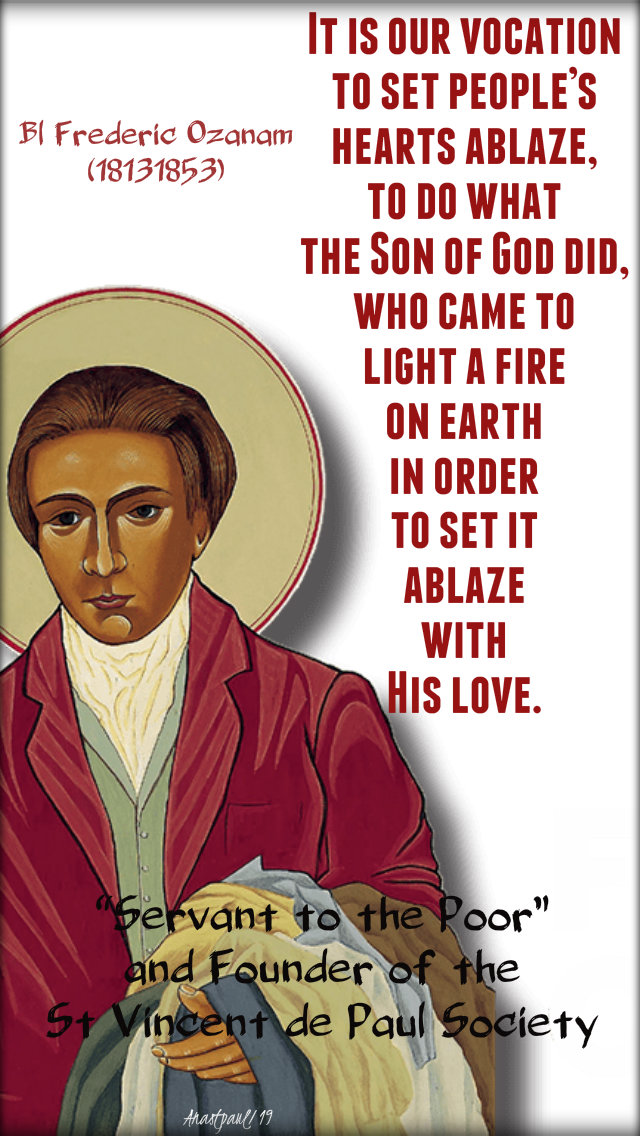
“It is our vocation to set people’s hearts ablaze, to do what the Son of God did, who came to light a fire on earth in order to set it ablaze with His love.”
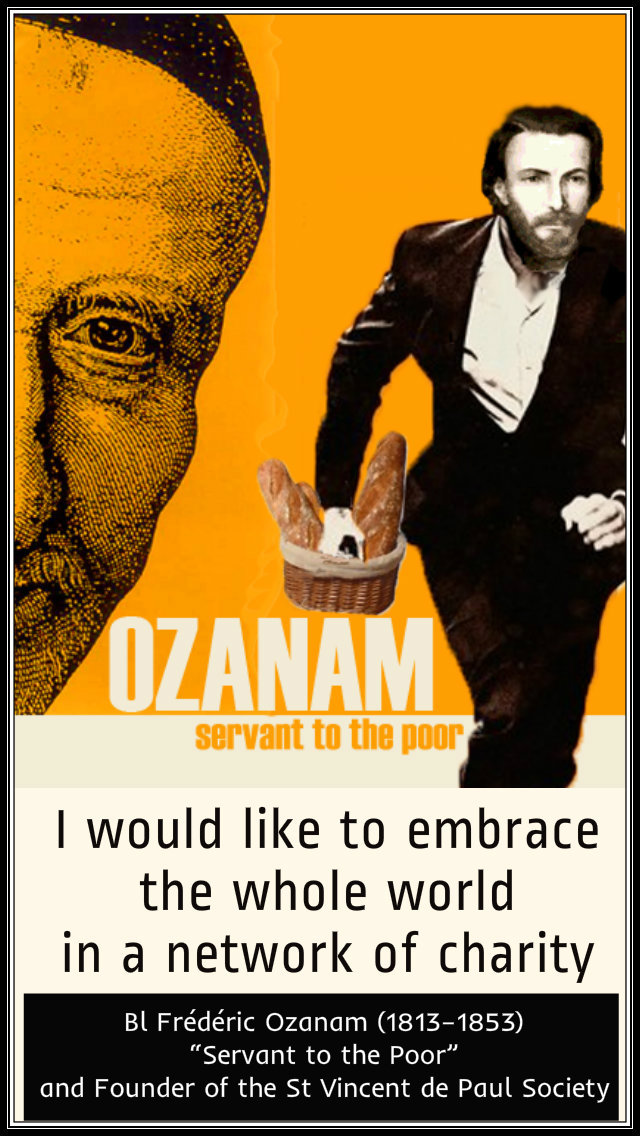
“I would like to embrace the whole world in a network of charity.”
Blessed Frédéric Ozanam (1813–1853)
“Servant to the Poor”
and Founder of the St Vincent de Paul Society
“True friendship with Jesus is expressed in how one lives, in the goodness of one’s heart, in one’s humility, kindness and mercy, in one’s love for justice and truth, in one’s sincere commitment to peace and reconciliation. This, we might say, is the ‘identity card’ that qualifies us as true ‘friends,’ it is the ‘passport’ that will let us enter eternal life.”
One Minute Reflection – 25 November – Monday of the Thirty Fourth week in Ordinary Time, Year C, Gospel: Luke 21:1-4
“… for those others have all made offerings from their surplus wealth but she, from her poverty, has offered her whole livelihood.” … Luke 21:4
REFLECTION – “Although the spite of some people does not grow gentle with any kindness, nevertheless the works of mercy are not fruitless and kindness never loses what is offered to the ungrateful. May no-one, dearly beloved, make themselves strangers to good works. Let no-one claim, that his poverty scarcely sufficed for himself and could not help another. What is offered from a little is great and in the scale of divine justice, the quantity of gifts is not measured but the steadfastness of souls. The “widow” in the Gospel put two coins into the “treasury” and this surpassed the gifts of all the rich. No mercy is worthless before God. No compassion is fruitless. He has given different resources to human beings but He does not ask different affections.” … St Pope Leo the Great (400-461) Father & Doctor of the Church (Sermon 20)
PRAYER – God our Father, You give us a share in the one bread and the one cup and make us one in Christ. Help us to live as Your children and by our lives to bring Your salvation and joy to all the world. May the Holy Spirit fill us with all His gifts and virtues so that we may await the coming of Your Son, guided by His Light and may Mary, the blessed Virgin, accompany us, guarding and giving us her prayerful help. Through Christ our Lord, with the Holy Spirit, God forever, amen.
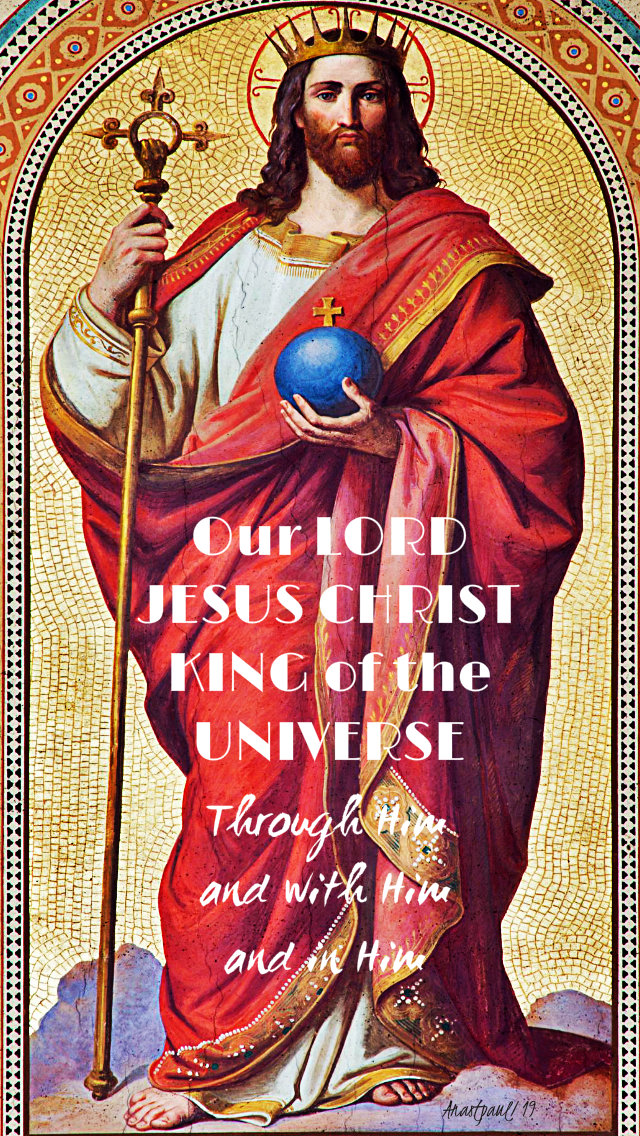
Quote/s of the Day – 24 November – The Solemnity of Christ the King
“Christ, has dominion over all creatures, a dominion not seized by violence nor usurped but His, by essence and by nature.”
St Cyril of Alexandria (376-444)
Father & Doctor of the Church
“Christ’s kingdom is not just a figure of speech. Christ is alive, He lives as a man, with the same body He took when He became man, when He rose after His death, the glorified body which subsists in the person of the Word together with His human heart. Christ, true God and true man, lives and reigns. He is the Lord of the universe. Everything that lives is kept in existence only through Him.”
St Josemaria Escrivá (1902-1975)
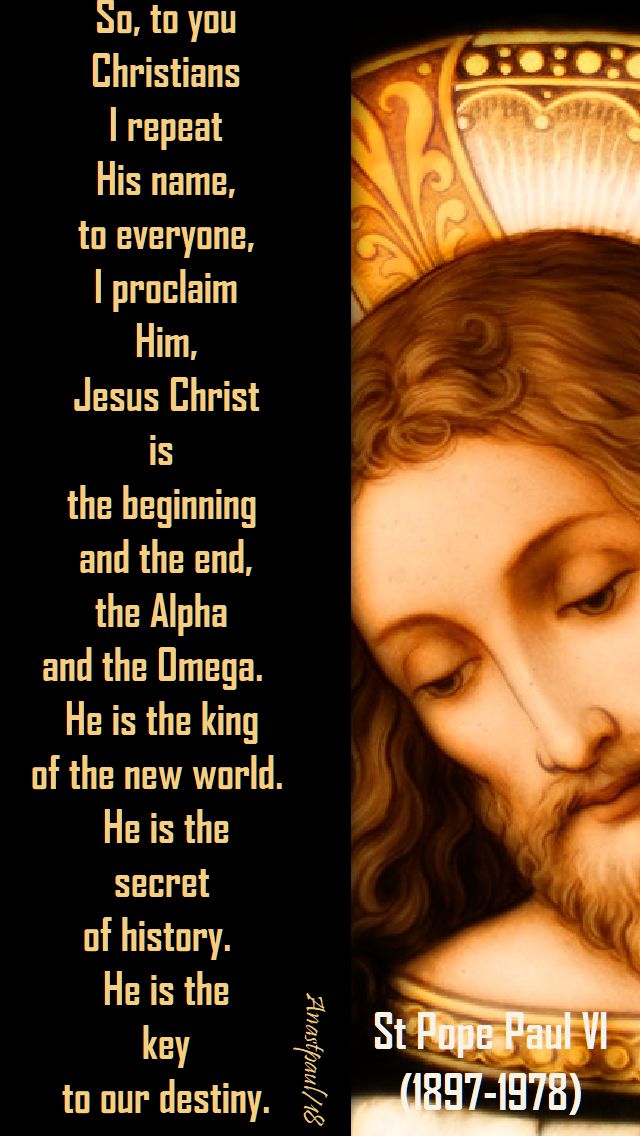
“Jesus Christ You have heard Him spoken of, indeed the greater part of you are already His – you are Christians. So, to you Christians I repeat His name, to everyone I proclaim Him – Jesus Christ is the beginning and the end, the Alpha and the Omega. He is the king of the new world. He is the secret of history. He is the key to our destiny.”
St Pope Paul VI (1897-1978)
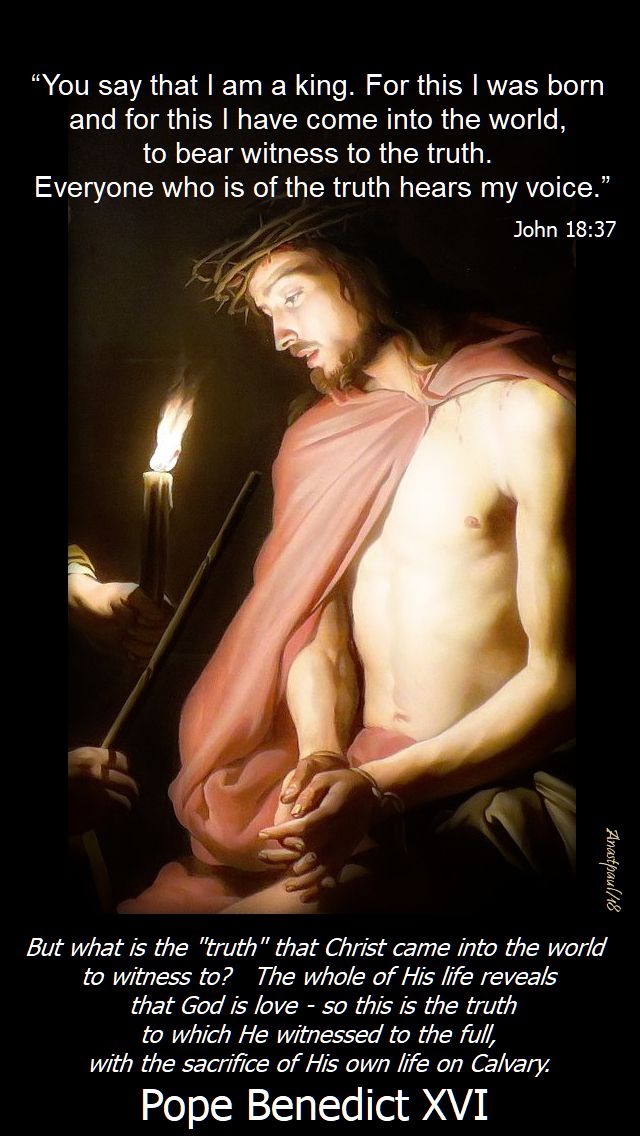
“You say that I am a king. For this I was born and for this I have come into the world, to bear witness to the truth. Everyone who is of the truth hears my voice.”
John 18:37
“But what is the “truth” that Christ came into the world to witness to? The whole of His life reveals that God is love – so this is the truth to which He witnessed to the full, with the sacrifice of His own life on Calvary.”
Pope Benedict XVI
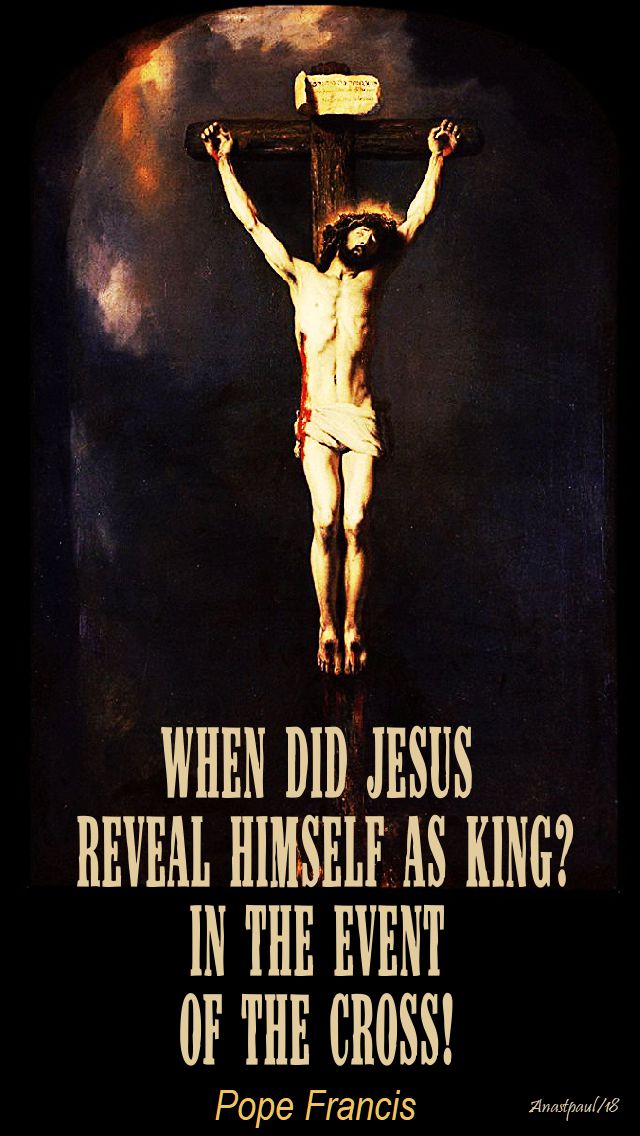
“When did Jesus reveal Himself as king? In the event of the Cross!”
Sunday Reflection – 24 November – The Solemnity of Christ the King, the last Sunday of the Liturgical Year C
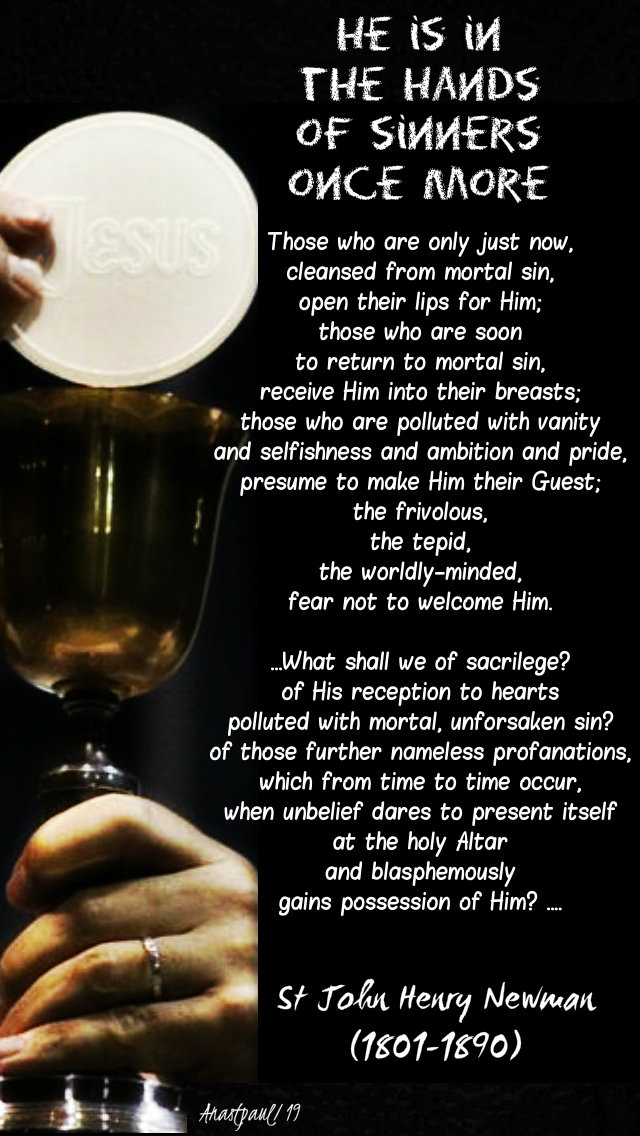
He is in the hands of sinners once more
St John Henry Newman (1801-1890)
He took bread and blessed and made it His Body. He took wine and gave thanks and made it His Blood and He gave His priests the power to do what He had done. Henceforth, He is in the hands of sinners once more. Frail, ignorant, sinful man, by the sacerdotal power given to him, compels the presence of the Highest; he lays Him up in a small Tabernacle; he dispenses Him to a sinful people. Those who are only just now, cleansed from mortal sin, open their lips for Him; those who are soon to return to mortal sin, receive Him into their breasts; those who are polluted with vanity and selfishness and ambition and pride, presume to make Him their Guest; the frivolous, the tepid, the worldly-minded, fear not to welcome Him.
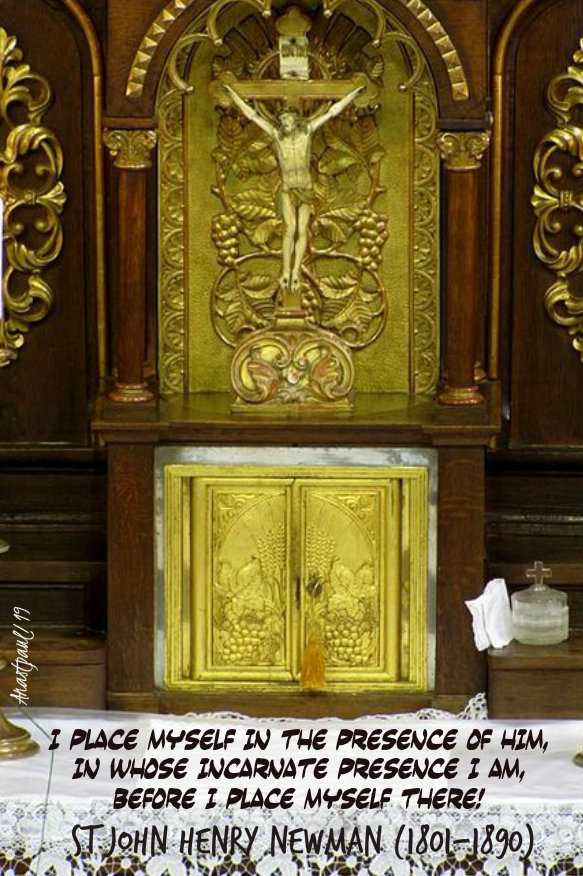
Alas! Alas! even those who wish to be more in earnest, entertain Him with cold and wandering thoughts and quench that Love which would inflame them with It’s own fire, did they but open to It! Such are the best of us and then for the worst? What shall we of sacrilege? of His reception to hearts polluted with mortal, unforsaken sin? of those further nameless profanations, which from time to time occur, when unbelief dares to present itself at the holy Altar and blasphemously gains possession of Him? …. I place myself in the presence of Him, in whose Incarnate Presence I am, before I place myself there!
I adore Thee, O my Saviour, present here as God and man, in soul and body, in true flesh and blood.
I acknowledge and confess, that I kneel before that Sacred Humanity, which was conceived in Mary’s womb and lay in Mary’s bosom; which grew up to man’s estate and by the Sea of Galilee, called the Twelve, wrought miracles and spoke words of wisdom and peace; which in due season hung on the Cross, lay in the tomb, rose from the dead and now reigns in heaven.
I praise and bless and give myself wholly to Him, who is the true Bread of my soul and my everlasting joy. Amen.
One Minute Reflection – 24 November – The Solemnity of Christ the King, Year C – Gospel: Luke 23:35–43
“Jesus, remember me when you come into your kingdom.” … Luke 23:42
REFLECTION – “Today paradise, closed for thousands of years, is opened to us. On this day, at this very hour, God brings the brigand into it. Thus He fulfils two wonders – He opens up paradise to us and causes a thief to enter in. Today God has given us back our former homeland, today He has brought us into the city of our ancestors, today He has opened up a home to be shared by all humanity. “This day,” He says, “you will be with me in paradise.” What are You saying, Lord? You are crucified, nailed down and do You promise paradise? Yes, He says, so that through the Cross You may learn my power…
Because it isn’t by raising a dead man, commanding the sea and wind, or casting out demons that He is able to change the thief’s sinful soul but by being crucified, pinned down by nails, covered with insults, spitting, mockery and torture, so that you might see the two sides of His sovereign power. He shook all creation, split the rocks (Mt 27:51) and drew to Himself the brigand’s soul, hard as stone, to cover it with honour…
Obviously, no king would ever allow a brigand or other of his subjects to be seated at his side when making his entry into his city. Yet Christ did so, when entering His holy homeland. He brings a brigand into it along with Him. In so doing… He does no dishonour to it by a brigand’s presence, for it is a glory for paradise, that it has a master, able to make a brigand worthy of the joys to be tasted there.
In the same way, when He brings publicans and prostitutes into the Kingdom of heaven (Mt 21:31)…, it is for the sake of the glory of that holy place. Because He shows it, that the Lord of the heavenly Kingdom is so great, that He can restore all their dignity, to prostitutes and publicans, even to their being worthy of this honour and this gift. We admire a doctor all the more when we see him heal people suffering from illnesses said to be incurable. So it is only right to admire Christ… when He restores publicans and prostitutes to such a state of spiritual health, that they become worthy of heaven.” … St John Chrysostom (345 407) Bishop of Constantinople, Father & Doctor of the Church – Homily 1 on the cross and the brigand, for Good Friday, 2
PRAYER – Lord God, You gave the peoples of the world as the inheritance of Your only Son, You crowned Him as King of Zion, Your holy city and gave Him Your Church to be His Bride. As He proclaims the law of Your eternal kingdom, may we serve Him faithfully and so share His royal power forever. We make our prayer, through Him and with Him and in Him, our King and our Redeemer, with the Holy Spirit, God forever, amen.
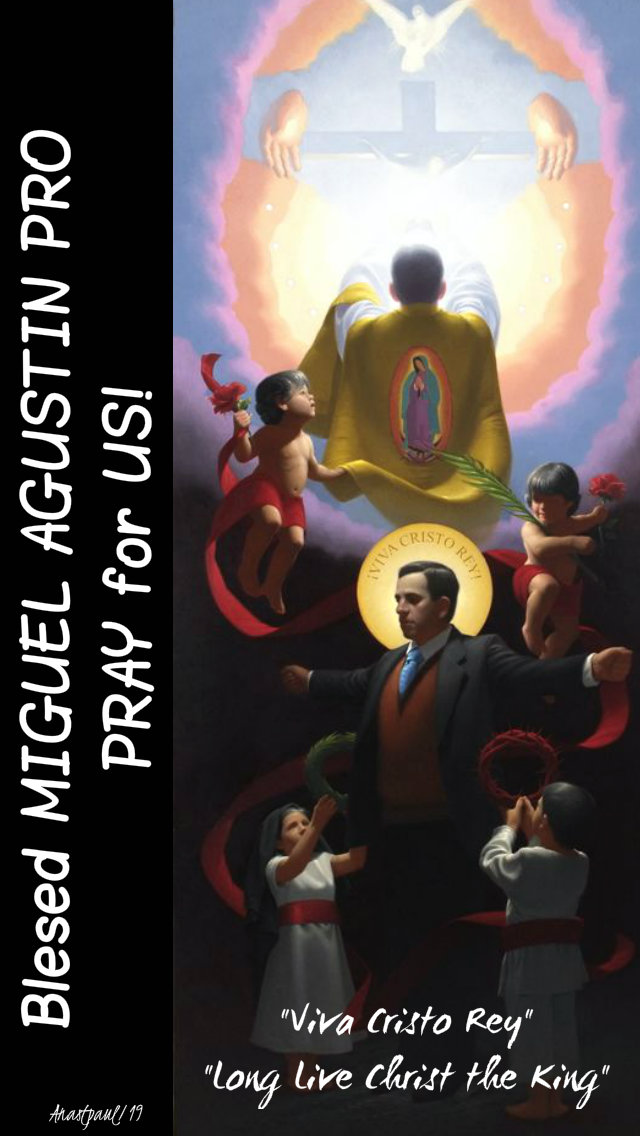
Thought for the Day – 23 November – The Memorial of Blessed Miguel Pro – Priest and Martyr of the Cristero War (1891-1927)
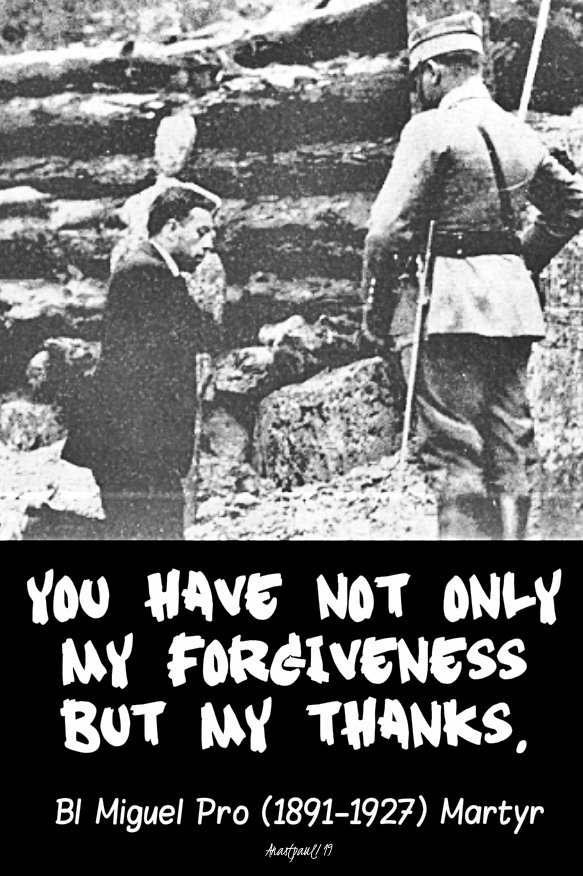
“You have not only my forgiveness but my thanks.”
Often Our Lord gives His saints a premonition that the curtain is soon to close on their earthly pilgrimage.
Back in September, when he was beginning his Mass for a community of nuns, he asked the angelic flock to pray that God would accept his life as a victim for priests and for the welfare of the Mexican Church. One of the nuns present, noted, that during the Mass he was totally transported and bathed in tears the whole time they were chanting. At the end of the Holy Sacrifice, he mentioned to someone in the community, “I know not whether it is mere imagination or has actually occurred but I feel clearly,. that Our Lord has evidently accepted my offering.”
One could almost see his mother smiling down upon him from Heaven and repeating those words she had answered him when he was a little boy, “May God hear you, child. But that is too great a happiness for me.”
One of the officers who had captured Father Pro led him out of jail to be executed. He begged Father to forgive him. Miguel put his arm around him and said, “You have not only my forgiveness but my thanks.”He also softly told the firing squad, “May God forgive you all.”Then with arms spread as if on a cross, Father Pro shouted, “Viva Cristo Rey – Long live Christ the King!” before a bullet silenced him.
Although the real criminal and one of Miguel’s brothers were also shot, the other brother was pardoned at the last moment. Despite the government’s ban on a public funeral, thousands came to Father Pro’s wake, for the ‘Blood of the Martyrs, is the seedbed of Faith!’
When Fr Miguel Pro was executed in 1927, no one could have predicted that 52 years later the bishop of Rome would visit Mexico, be welcomed by its president and celebrate open-air Masses before thousands of people. St Pope John Paul II made additional trips to Mexico in 1990, 1993, 1999, and 2002. Those who outlawed the Catholic Church in Mexico did not count on the deeply rooted faith of its people and the willingness of many of them, like Miguel Pro, to die as martyrs.
Quote/s of the Day – 23 November – The Memorial of Blessed Miguel Pro – Priest and Martyr of the Cristero War (1891-1927)
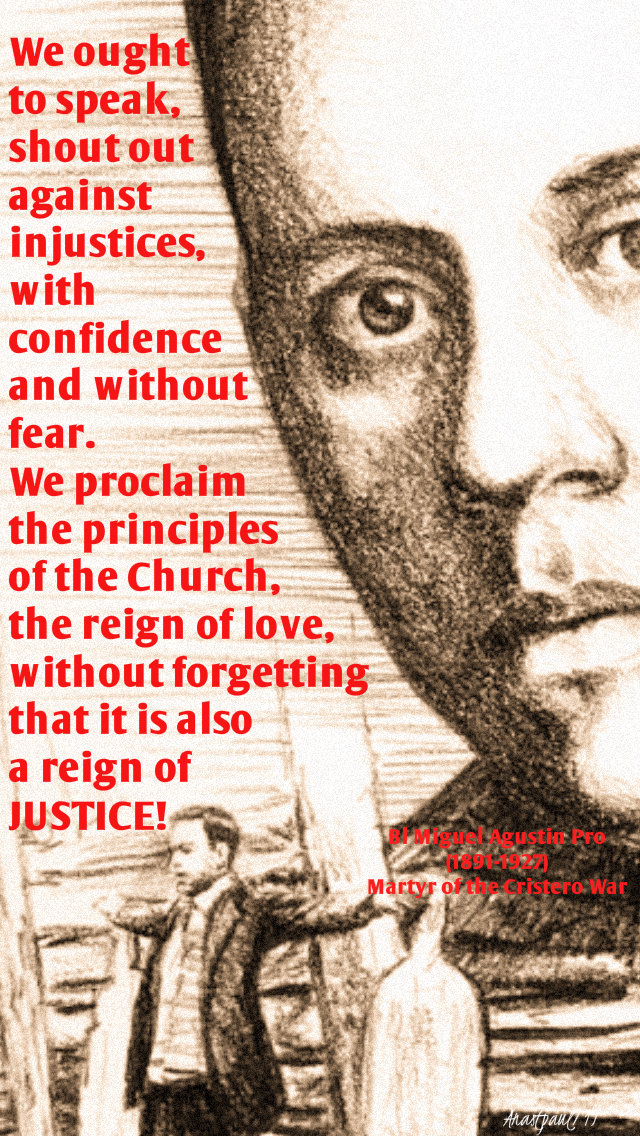
“We ought to speak, shout out against injustices, with confidence and without fear. We proclaim the principles of the Church, the reign of love, without forgetting that it is also a reign of JUSTICE!”
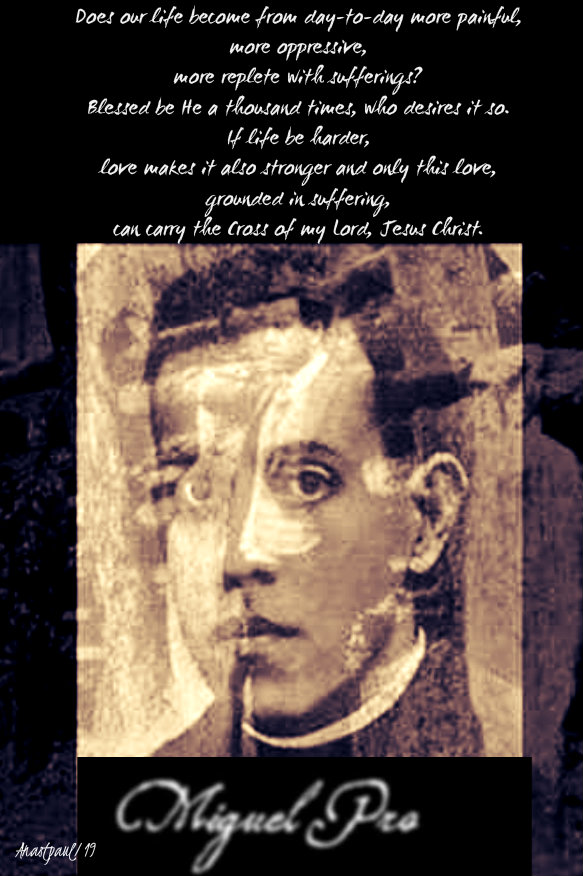
“Does our life become from day-to-day more painful, more oppressive, more replete with sufferings? Blessed be He a thousand times, who desires it so. If life be harder, love makes it also stronger and only this love, grounded in suffering, can carry the Cross of my Lord, Jesus Christ.”
After he had taken his vows in the Society, he recorded the following meditations in his spiritual notebook. The booklet was entitled My Treasure. The words speak for themselves:
“Deceitful are the ephemeral pleasures and joys of this world. Our supreme comfort in this life, is to die to the world that we may live with Jesus crucified. Let others seek gold and other earthly treasures. I already possess the immortal treasure of holy poverty on the Cross of Jesus crucified. The angelic virtue, growing like a pure, fragrant lily in the hidden beauteous garden of the cloister, adorns the forehead with heavenly tints, for it has roots in the Cross of Jesus crucified. A third crown completes my oblation, it is the seal of glory, whereby the obedient, spotless Lamb gained victory. Obedience is the secure science of living with Jesus crucified. With this triple treasure, I can hope to pass beyond the fleeting confines of mortal man, by living poor on this earth and rich in heaven, united with Jesus crucified.”
Thought for the Day – 22 November – The Memorial of St Cecilia (died 3rd Century) Virgin Martyr – Patron of Musicians
Sing to God with Songs of Joy
Saint Augustine (354-430)
Bishop and Great Western Father & Doctor of the Church
An excerpt from his Discourse on Psalm 32
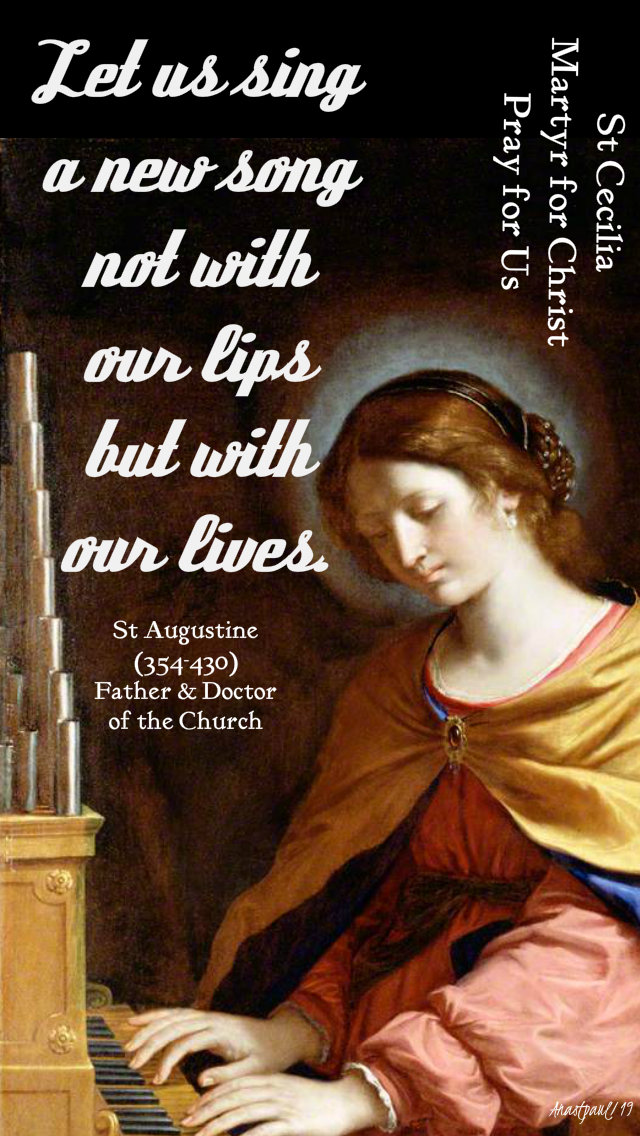
Praise the Lord with the lyre, make melody to Him with the harp of ten strings! Sing to Him a new song. Rid yourself of what is old and worn out, for you know a new song. A new man, a new covenant—a new song. This new song does not belong to the old man. Only the new man learns it, the man restored from his fallen condition through the grace of God and now sharing in the new covenant, that is, the kingdom of heaven. To it all our love now aspires and sings a new song. Let us sing a new song not with our lips but with our lives.
Sing to Him a new song, sing to Him with joyful melody. Everyone of us tries to discover how to sing to God. You must sing to Him but you must sing well. He does not want your voice to come harshly to His ears, so sing well, brothers!
If you were asked, “Sing to please this musician,” you would not like to do so without having taken some instruction in music, because you would not like to offend an expert in the art. An untrained listener does not notice the faults a musician would point out to you. Who, then, will offer to sing well for God, the great artist whose discrimination is faultless, whose attention is on the minutest detail, whose ear nothing escapes? When will you be able to offer Him a perfect performance that you will in no way displease such a supremely discerning listener?
See how He Himself provides you with a way of singing. Do not search for words, as if you could find a lyric which would give God pleasure. Sing to Him “with songs of joy.” This is singing well to God, just singing with songs of joy.
But how is this done? You must first understand that words cannot express the things that are sung by the heart. Take the case of people singing while harvesting in the fields or in the vineyards or when any other strenuous work is in progress. Although they begin by giving expression to their happiness in sung words, yet shortly there is a change. As if so happy that words can no longer express what they feel, they discard the restricting syllables. They burst out into a simple sound of joy, of jubilation. Such a cry of joy is a sound signifying that the heart is bringing to birth what it cannot utter in words.
Now, who is more worthy of such a cry of jubilation than God Himself, whom all words fail to describe? If words will not serve and yet you must not remain silent, what else can you do but cry out for joy? Your heart must rejoice beyond words, soaring into an immensity of gladness, unrestrained by syllabic bonds. Sing to Him with jubilation.
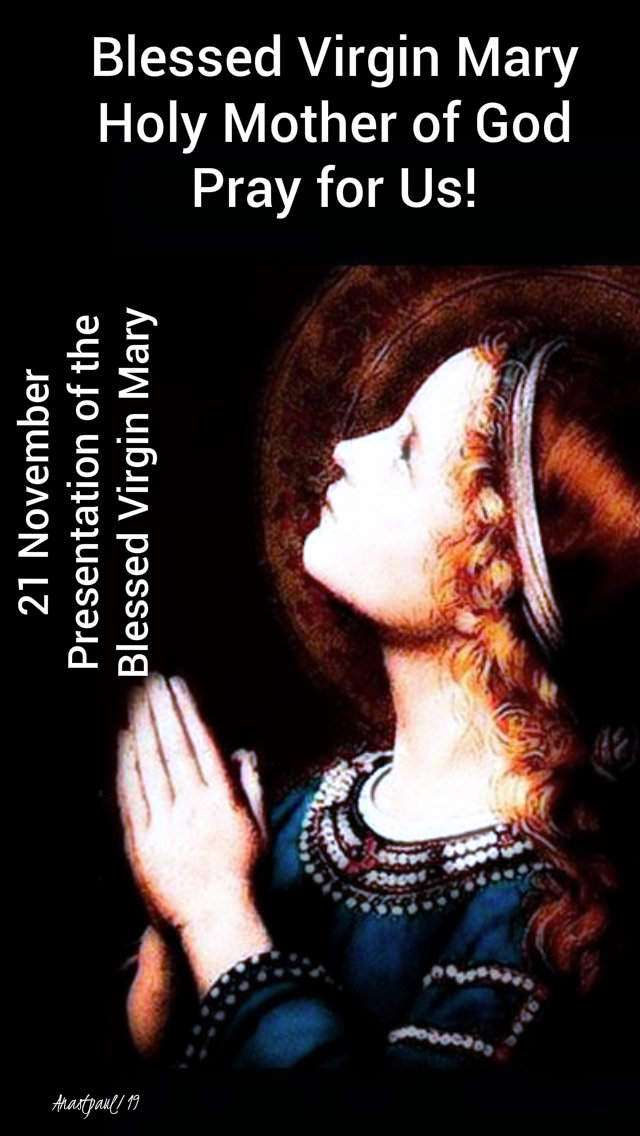
Thought for the Day – 21 November – The Memorial of the Presentation of the Blessed Virgin Mary
She Who Believed by Faith, Conceived by Faith
Saint Augustine (354-430)
Bishop, Father and Doctor of the Church
An excerpt from Sermon 25
“Stretching out His hand over His disciples, the Lord Christ declared: Here are my mother and my brothers; anyone who does the will of my Father who sent me is my brother and sister and my mother. I would urge you to ponder these words. Did the Virgin Mary, who believed by faith and conceived by faith, who was the chosen one from whom our Saviour was born among men, who was created by Christ before Christ was created in her—did she not do the will of the Father? Indeed the blessed Mary certainly did the Father’s will and so it was for her, a greater thing, to have been Christ’s disciple, than to have been His mother and she was more blessed in her discipleship than in her motherhood. Hers was the happiness of first bearing in her womb, Him, whom she would obey as her master.
Now listen and see if the words of Scripture do not agree with what I have said . The Lord was passing by and crowds were following Him. His miracles gave proof of divine power and a woman cried out: Happy is the womb that bore you, blessed is that womb! But the Lord, not wishing people to seek happiness in a purely physical relationship, replied: More blessed are those who hear the word of God and keep it. Mary heard God’s word and kept it and so she is blessed. She kept God’s truth in her mind, a nobler thing than carrying His body in her womb. The Truth and the Body were both Christ – He was kept in Mary’s mind, insofar as He is Truth, He was carried in her womb, insofar as He is man but, what is kept in the mind, is of a higher order than what is carried in the womb.
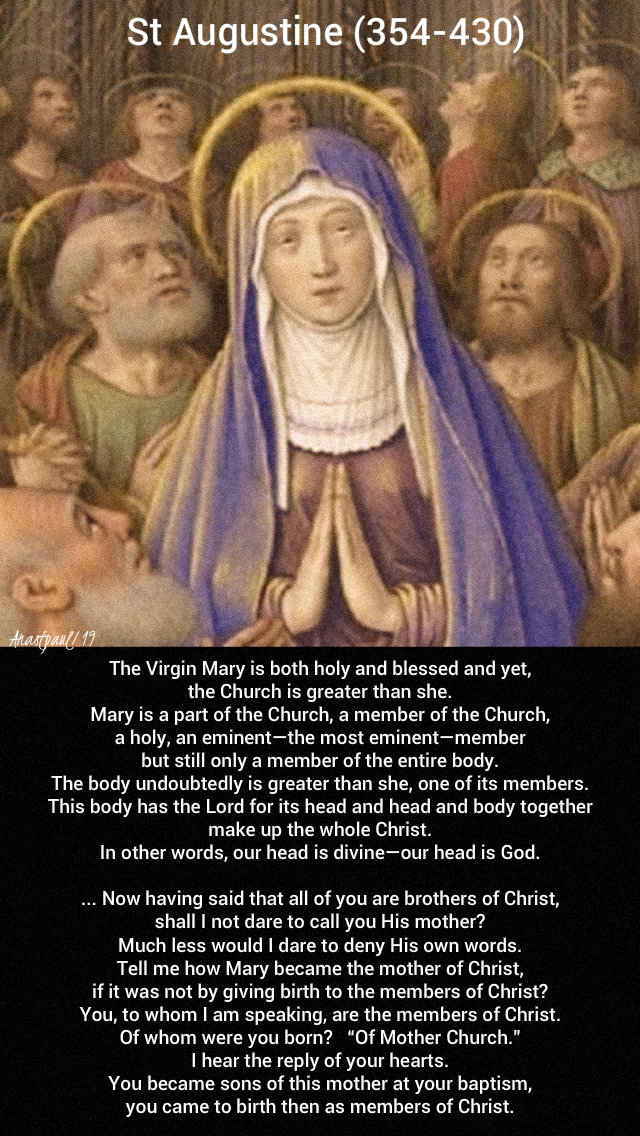
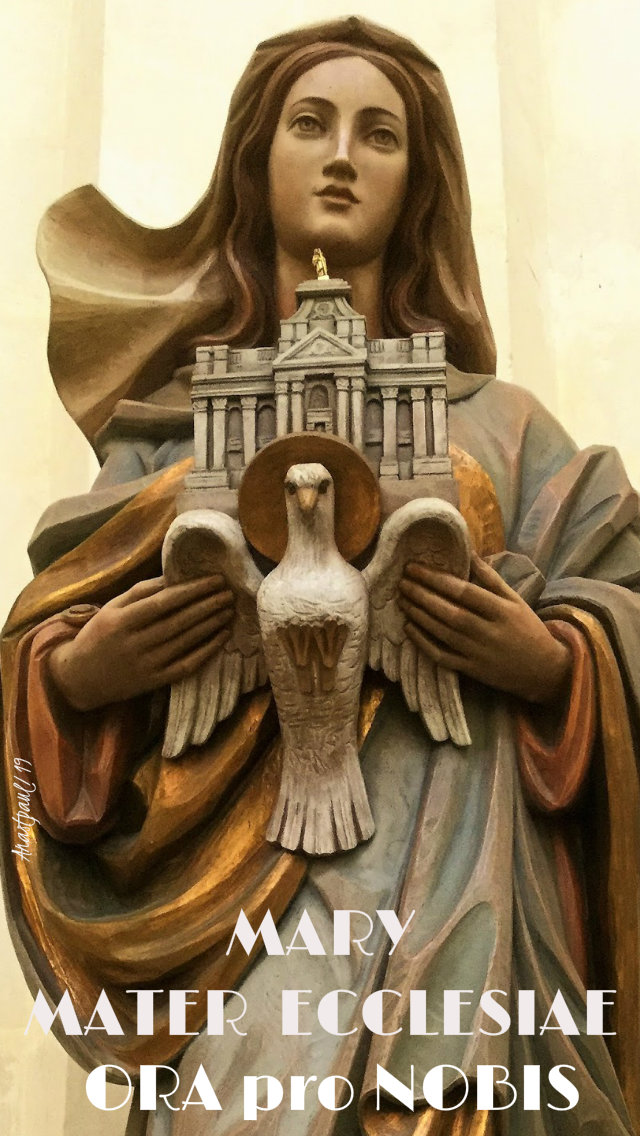
The Virgin Mary is both holy and blessed and yet, the Church is greater than she. Mary is a part of the Church, a member of the Church, a holy, an eminent—the most eminent—member but still only a member of the entire body. The body undoubtedly is greater than she, one of its members. This body has the Lord for its head and head and body together make up the whole Christ. In other words, our head is divine—our head is God.
Now, beloved, give me your whole attention, for you also are members of Christ, you also, are the body of Christ. Consider how you yourselves can be among those, of whom the Lord said: Here are my mother and my brothers. Do you wonder how you can be the mother of Christ? He Himself said: Whoever hears and fulfils the will of my Father in heaven is my brother and my sister and my mother. As for our being the brothers and sisters of Christ, we can understand this, because, although there is only one inheritance and Christ is the only Son, His mercy would not allow Him to remain alone. It was His wish, that we too should be heirs of the Father and co-heirs with Himself.
Now having said that all of you are brothers of Christ, shall I not dare to call you His mother? Much less would I dare to deny His own words. Tell me how Mary became the mother of Christ, if it was not by giving birth to the members of Christ? You, to whom I am speaking, are the members of Christ. Of whom were you born? “Of Mother Church,” I hear the reply of your hearts. You became sons of this mother at your baptism, you came to birth then as members of Christ. Now you, in your turn, must draw to the font of baptism as many as you possibly can. You became sons when you were born there yourselves and now, by bringing others to birth in the same way, you have it in your power, to become the mothers of Christ. Amen!”
Quote of the Day – 21 November – Thursday of the Thirty Third week in Ordinary Time, Year C and Memorial of the Presentation of the Blessed Virgin Mary
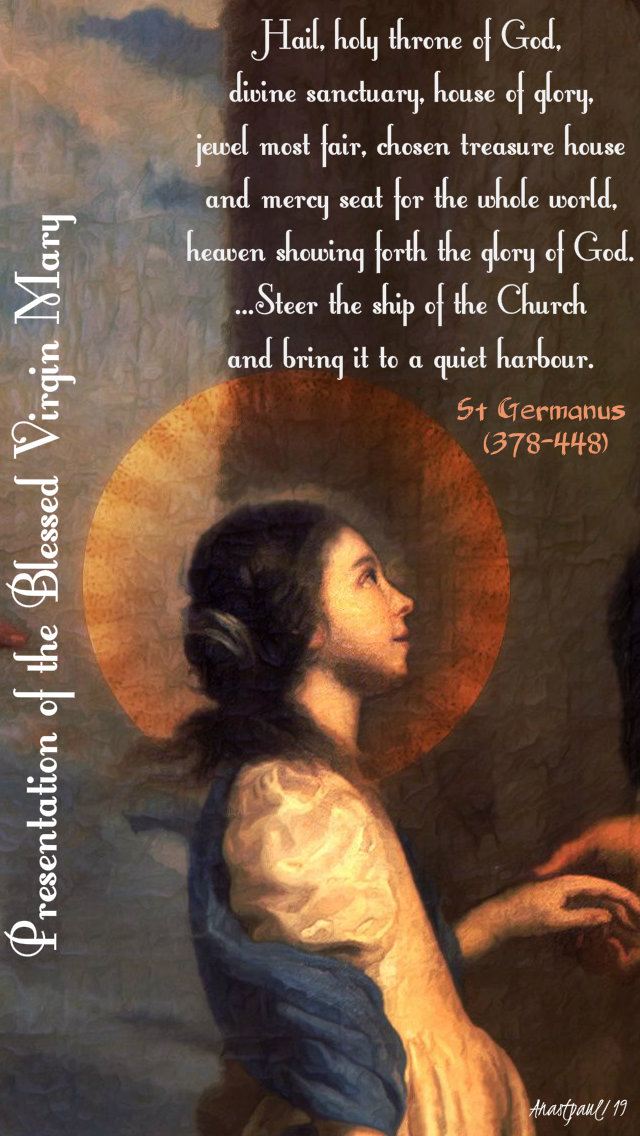
“Hail, holy throne of God, divine sanctuary, house of glory, jewel most fair, chosen treasure house and mercy seat for the whole world, heaven showing forth the glory of God.
Purest Virgin, worthy of all praise, sanctuary dedicated to God and raised above all human condition, virgin soil, unploughed field, flourishing vine, fountain pouring out waters, virgin bearing a child, mother without knowing man, hidden treasure of innocence, ornament of sanctity, by your most acceptable prayers, strong with the authority of motherhood, to our Lord and God, Creator of all, your Son who was born of you without a father, steer the ship of the Church and bring it to a quiet harbour.”
St Germanus (378-448)
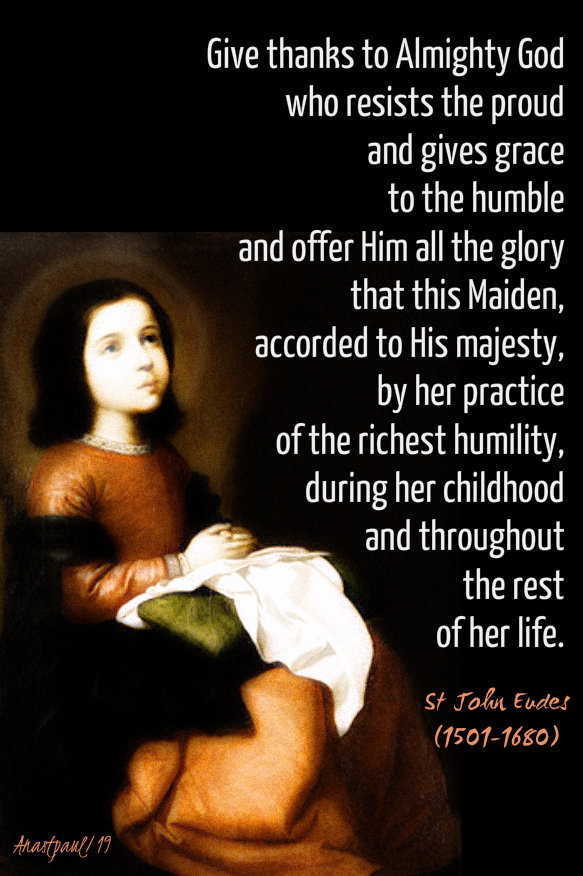
“Give thanks to Almighty God who resists the proud and gives grace to the humble and offer Him all the glory that this Maiden, accorded to His majesty, by her practice of the richest humility, during her childhood and throughout the rest of her life.”
One Minute Reflection – 21 November – Thursday of the Thirty Third week in Ordinary Time, Year C, Gospel: Luke 19:41-44 and Memorial of the Presentation of the Blessed Virgin Mary
And when he drew near and saw the city he wept over it, saying, “Would that even today you knew the things that make for peace!”…Luke 19:41-42
REFLECTION – “I rejoiced because they said to me, ‘We will go up to the house of the Lord.’ And now we have set foot within your gates, O Jerusalem” (Ps 122[121]:1-2). What Jerusalem is this? On earth there is a city of this name but it is a mere shadow of that other Jerusalem. What kind of happiness is there in standing in a Jerusalem here below that is unable to stand of itself but which fell to the ground in ruins?… It is not of the Jerusalem here below that someone speaks who has such great love, such great longing, such great desire to come to the Jerusalem, “our mother”, of which Saint Paul says that it is “eternal in the heavens” (Gal 4:26; 2 Cor 5:1)…
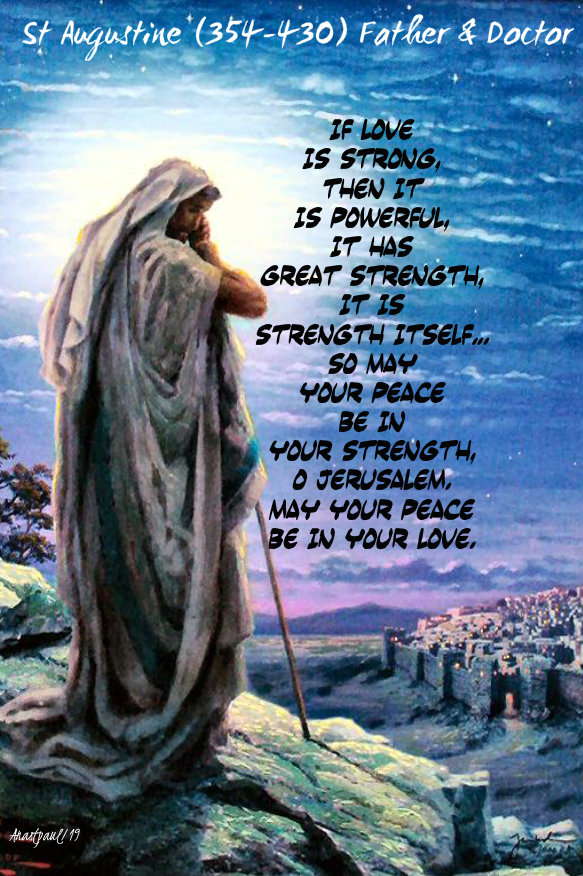
“O Jerusalem, may your peace be in your strength” (Ps 122[121]:7). That is to say, may your peace be in your love, for your love is your strength. Hear the Song of Songs: “Love is strong as death” (8:6)… And indeed, love destroys what we have been, so that we might become, through a sort of death, what we were not… This was the sort of death that was working in him who said: “The world is crucified to me and I to the world” (Gal 6:14). It was of this death that the same apostle was speaking when he said: “You have die, and your life is hidden with Christ in God” (Col 3:3). Yes, “love is strong as death”. If love is strong, then it is powerful, it has great strength, it is strength itself… So may your peace be in your strength, O Jerusalem. May your peace be in your love.” … St Augustine (354-430) Father & Doctor – Discourses on the Psalms, Ps 121[122]:1, §3,12
PRAYER – Lord, as we honour the memory of the Blessed Virgin Mary and seek her help, grant that we, like her, may shine in the fullness of Your grace. Through Christ our Lord, with the Holy Spirit, God forever, amen.
Thought for the Day – 20 November – Wednesday of the Thirty Third week in Ordinary Time, Year C, Gospel: Luke 19:11–28 and the Memorial of Blessed Maria Fortunata Viti OSB (1827-1922)
The Heart of the Just Man will Rejoice in the Lord
Saint Augustine (354-430) Bishop and Great Western Father and Doctor of the Church
An excerpt from Sermon 21
“The just man will rejoice in the Lord and put his hope in Him, the hearts of all good men will be filled with joy. We must surely have sung these words with our hearts as well as with our voices. Indeed, the tongue of the Christian expresses his deepest feelings when it addresses such words to God. The just man will rejoice, not in the world but in the Lord. Light has dawned for the just, Scripture says in another place and joy for the upright of heart. Were you wondering what reason he has for joy? Here you are told – the just man will rejoice in the Lord. Another text runs – Delight in the Lord and he will give you your heart’s desires.
What are we instructed to do then and what are we enabled to do? To rejoice in the Lord. But who can rejoice in something he does not see? Am I suggesting that we see the Lord then? No, but we have been promised that we shall see Him. Now, as long as we are in the body, we walk by faith, for we are absent from the Lord. We walk by faith and not by sight. When will it be by sight? Beloved, says John, we are now the sons of God, what we shall be has not yet been revealed but we know that when it is revealed we shall be like Him, because we shall see Him as He is. When this prophecy is fulfilled, then it will be by sight.
That will be the great joy, the supreme joy, joy in all its fullness. Then we shall no longer drink the milk of hope but we shall feed on the reality itself. Nevertheless, even now, before that vision comes to us, or before we come to that vision, let us rejoice in the Lord, for it is no small reason for rejoicing to have a hope that will some day be fulfilled.
Therefore, since the hope we now have inspires love, the just man rejoices, Scripture says, in the Lord but because he does not yet see, it immediately goes on to say and hopes in Him.
Yet already we have the first-fruits of the Spirit and have we not also other reasons for rejoicing? For we are drawing near to the one we love and not only are we drawing near—we even have some slight feeling and taste of the banquet we shall one day eagerly eat and drink.
But how can we rejoice in the Lord if He is far from us? Pray God He may not be far. If He is, that is your doing. Love and He will draw near, love and He will dwell within you. The Lord is at hand, have no anxiety. Are you puzzled to know how it is that He will be with you if you love? God is love.
“What do you mean by love?” you will ask me. It is that which enables us to be loving. What do we love? A good that words cannot describe, a good that is forever giving, a good that is the Creator of all good. Delight in Him from whom you have received everything that delights you. But in that I do not include sin, for sin is the one thing that you do not receive from Him. With that one exception, everything you have comes from Him.”
Quote/s of the Day – 20 November – Wednesday of the Thirty Third week in Ordinary Time, Year C, Gospel: Luke 19:11–28 and the Memorial of Blessed Maria Fortunata Viti OSB (1827-1922)
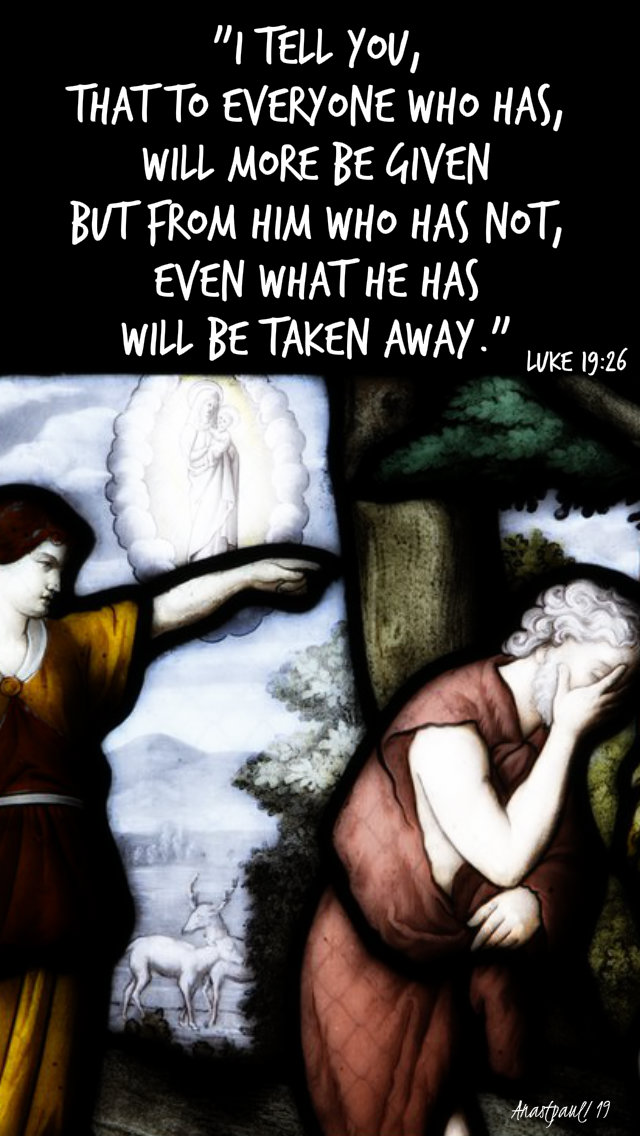
“‘I tell you, that to everyone who has, will more be given but from him who has not, even what he has will be taken away.”
Luke 19:26
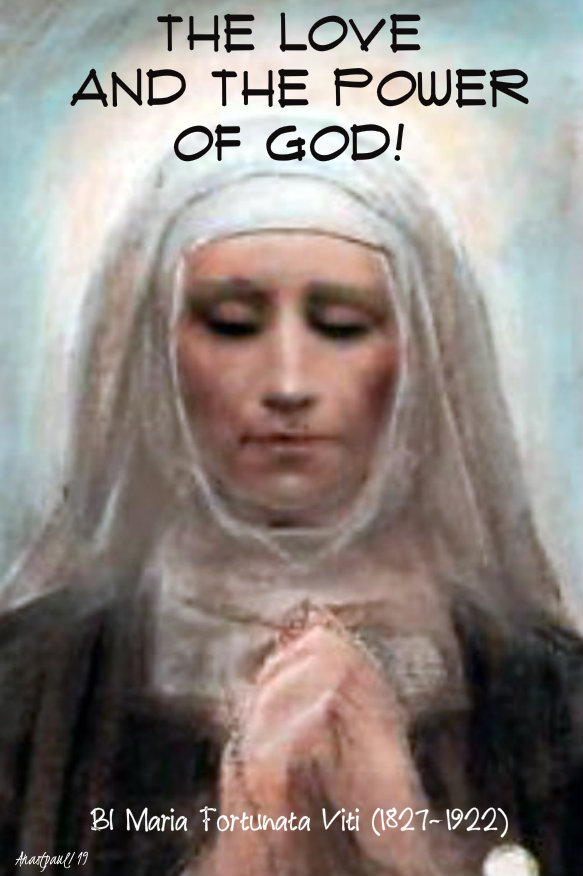
“The Love and the Power of God!”
Blessed Maria Fortunata Viti (1827-1922)
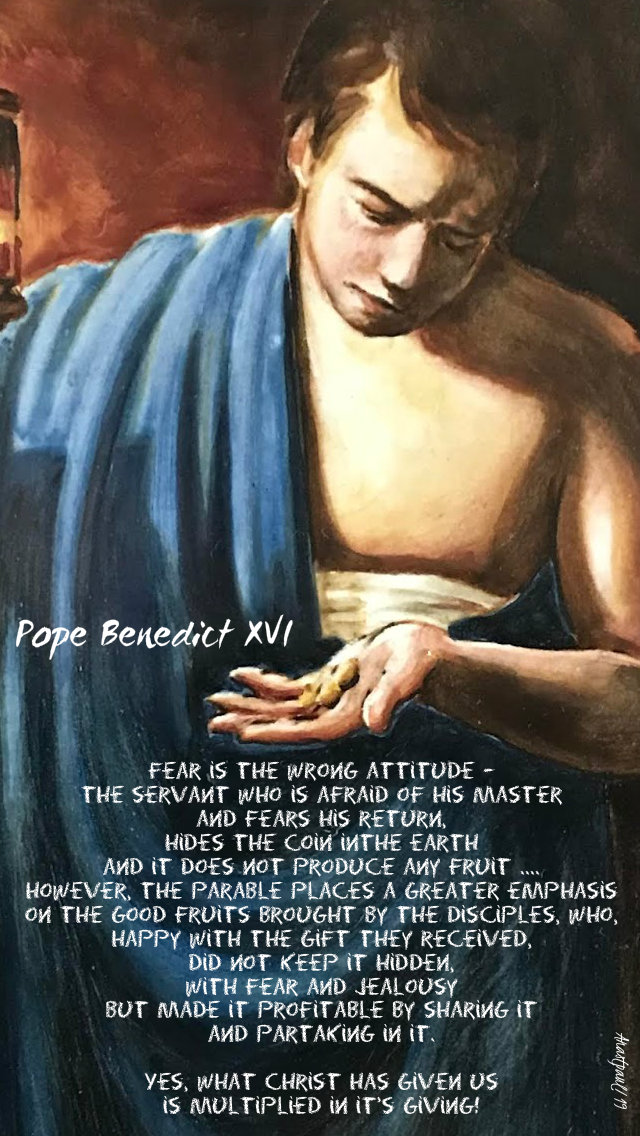
“Fear is the wrong attitude – the servant who is afraid of his master and fears his return, hides the coin inthe earth and it does not produce any fruit …. However, the parable places a greater emphasis on the good fruits brought by the disciples, who, happy with the gift they received, did not keep it hidden, with fear and jealousy but made it profitable by sharing it and partaking in it. Yes, what Christ has given us is multiplied in it’s giving!”
One Minute Reflection – 20 November – Wednesday of the Thirty Third week in Ordinary Time, Year C, Gospel: Luke 19:11–28 and the Memorial of Blessed Maria Fortunata Viti OSB (1827-1922)
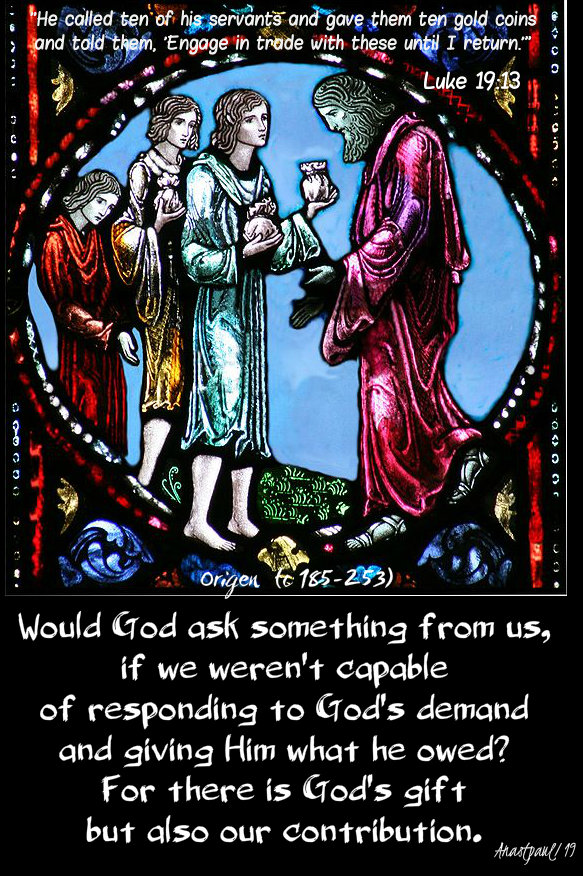
“He called ten of his servants and gave them ten gold coins and told them, ‘Engage in trade with these until I return.'” … Luke 19:13
REFLECTION – “What have we to offer God? Faith and love. That is where we find what God asks of us, as it is written: “And now, Israel, what does the Lord your God ask of you but to fear the Lord your God and follow his ways exactly, to love and serve the Lord your God with all your heart and all your soul” (Dt 10:12). These are the offerings and these the gifts we should make to the Lord. And if we are to offer Him these gifts with all our heart, then first of all, we must get to know Him. We must have drunk of the knowledge of His goodness from the deep waters of His well…
People who deny that salvation lay within the power of the our freedom, should be ashamed on hearing these words! Would God ask something from us if we weren’t capable of responding to God’s demand and giving Him what he owed? For there is God’s gift but also our contribution. For example, it was well within that man’s power that one gold coin should make ten or five more but, that the man should possess that gold coin, with which to produce ten more, in the first place, belonged to God. Once he had given God the ten gold coins he had made, the man received a new sort of gift – not money this time but the power and sovereignty over ten cities.
In the same way, God asked Abraham to make an offering of his son, Isaac, on the mountain He would show him. And Abraham, without hesitation, offered his only son – he laid him on the altar and drew out his knife to slay him. But at once a voice restrained him and a ram was given him to be sacrificed in his son’s place (Gn 22). So you see – what we offer God depends on us but, this offering is asked of us, so that, in making our gift, we might witness to our love for God and faith in Him.” … Origen (c185-253) Priest and Theologian – Homilies on the Book of Numbers, no. 12, #3
PRAYER – Lord God, true Light and Creator of light, grant that faithfully pondering on all that is holy, we may ever live in the splendour of Your presence. Protect us by Your power throughout our days, that even as You enable us to begin, do not let us turn aside to any sin but let our every thought, word and deed, aim at doing what is pleasing in Your sight. Listen, we pray, to the intercession of Blessed Maria Fortunata Viti on our behalf. Through Christ our Lord, with the Holy Spirit, God for all eternity, amen.
One Minute Reflection – – 19 November – Tuesday of the Thirty Third Week of Ordinary Time, Year C, Gospel: Luke 19:1–10 and the Memorial of St Matilda of Hackeborn (c 1241-1298)
“Zacchaeus, make haste and come down, for I must stay at your house today.” … Luke 19:6
REFLECTION – “Celine, what a mystery is our grandeur in Jesus. This is all that Jesus has shown us in making us climb the symbolic tree about which I was just talking to you. And now, what science is He about to teach us? Has He not taught us all? Let us listen to what He is saying to us: “Make haste to descend, I must lodge today at your house.” Well, Jesus tells us to descend. Where, then, must we descend? Celine you know better than I, however, let me tell you where we must now follow Jesus. In days gone by, the Jews asked our divine Saviour: “Master, where do you live?” And He answered: “The foxes have their lairs, the birds of heaven their nests, but I have no place to rest my head.” This is where we must descend in order that we may serve as an abode for Jesus. To be so poor that we do not have a place to rest our head. This is, dear Celine, what Jesus has done in my soul during my retreat. You understand, there is question here of the interior. (…)
What Jesus desires is that we receive Him into our hearts. No doubt, they are already empty of creatures but, alas, I feel mine is not entirely empty of myself and it is for this reason that Jesus tells me to descend. He, the King of kings, humbled Himself in such a way that His face was hidden and no one recognised Him and I, too, want to hide my face, I want my Beloved alone to see it, that He be the only one to count my tears, that in my heart at least He may rest His dear head and feel that there, He is known and understood!” … St Thérèse of the Child Jesus (1873-1897) Doctor of the Church
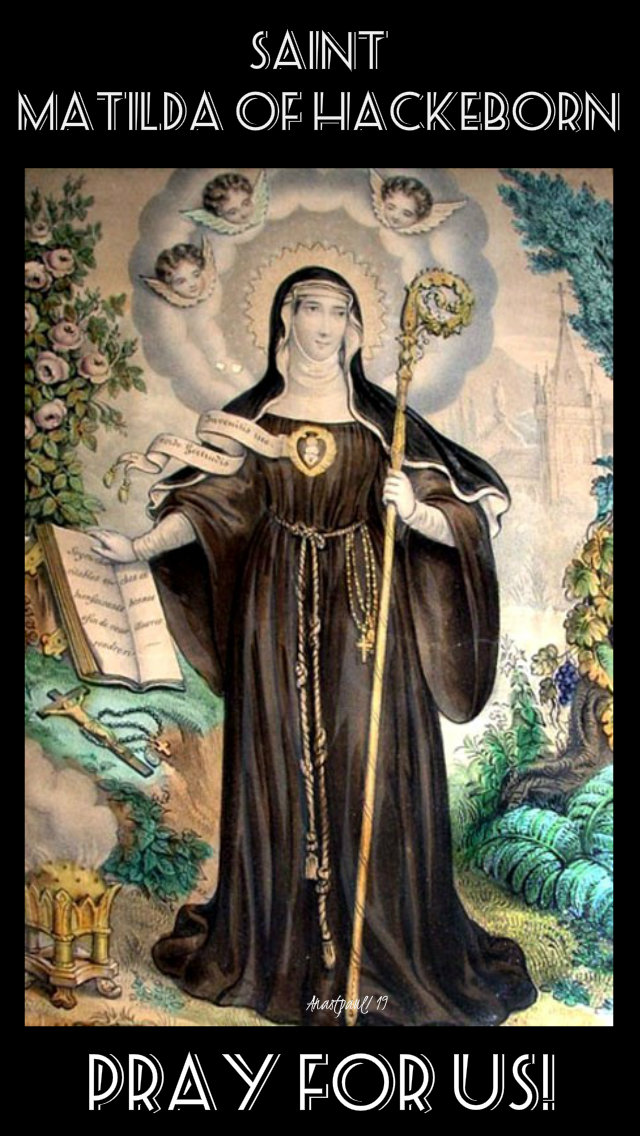
PRAYER – Look with favour on our prayer Lord and in Your saving love, may your light so penetrate the hidden places of our hearts, that we may become like You, pure and humble of heart. May no sordid desires darken our minds and may we be renewed and enlightened as we receive Your heavenly grace. Grant that the intercession of St Matilda of Hackeborn lead us to a new way of remorse and repentance as we learn from You, our Saviour. Through Christ, our Lord, with the Holy Spirit, one God forever and ever, amen.
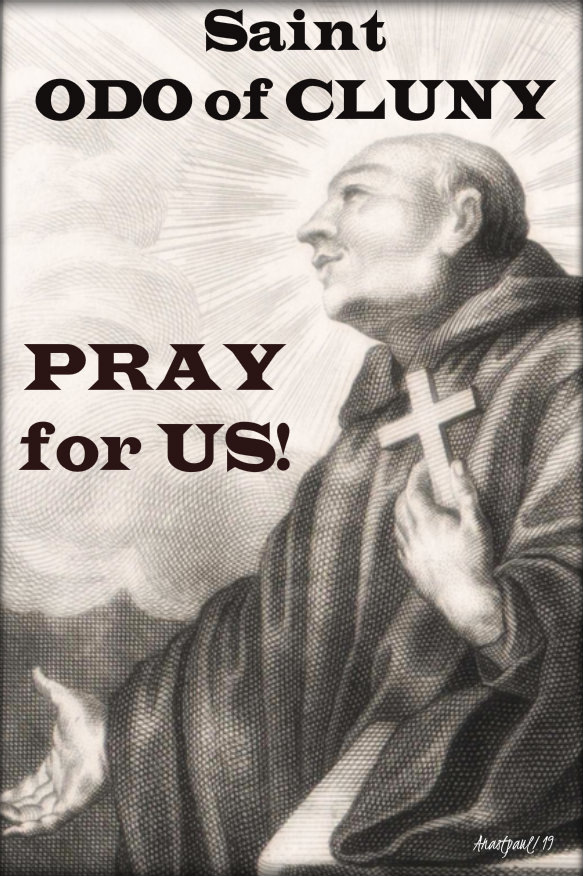
Thought for the Day – 18 November – The Memorial of Saint Odo of Cluny (c 880–942) Monk and Abbot
In the following passage, John of Salerno, Odo’s biographer, says he combined the power of his position as Abbot, with wry humour, to compel members of his entourage to behave charitably:
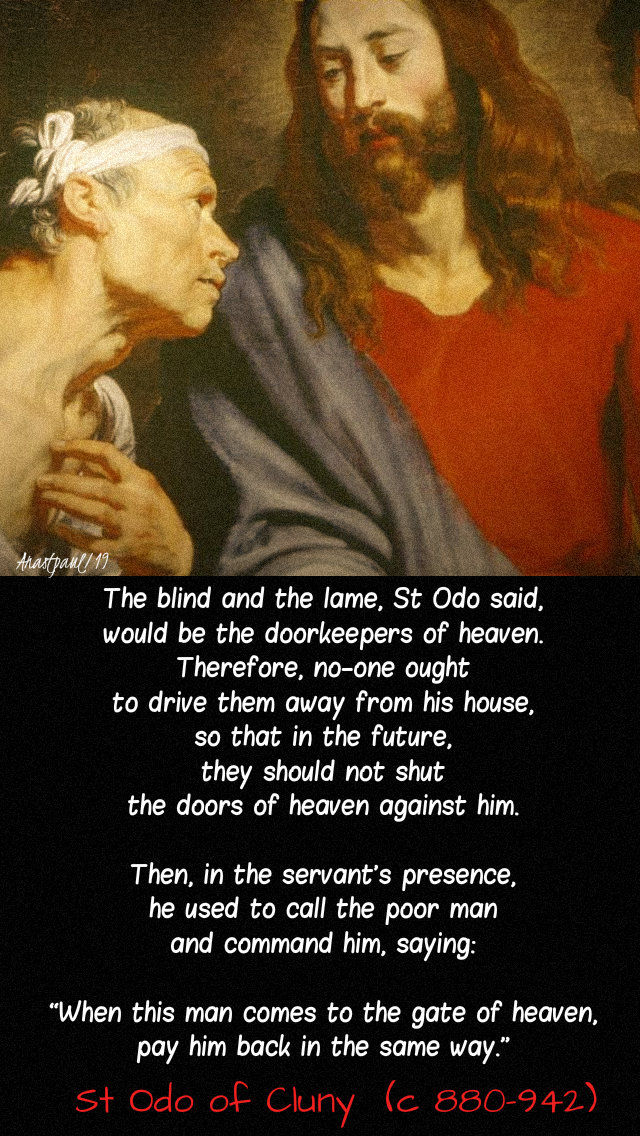
“The blind and the lame, Odo said, would be the doorkeepers of heaven. Therefore, no- one ought to drive them away from his house, so that in the future, they should not shut the doors of heaven against him. So if one of our servants, not being able to put up with their shameless begging, replied sharply to them or denied them access to the door of our tent, Odo at once rebuked him with threats. Then, in the servant’s presence, he used to call the poor man and command him, saying: “When this man comes to the gate of heaven, pay him back in the same way.” He said this to frighten the servants, so that they should not act in this way again, and that he might teach them to love charity.”
Perhaps Odo’s notion was not fictitious—that the poor we refuse or people we snub, will be our greeters after death.
Imagine that the person meeting us at heaven’s gate, will be the person we have offended most, now empowered to welcome or to reject us.
That thought, should make us hurry to be reconciled, with anyone we have hurt!
Let us run in haste and follow Odo’s bidding!
Quote/s of the Day – 18 November – The Memorial of Saint Odo of Cluny (c 880–942) Monk and Abbot
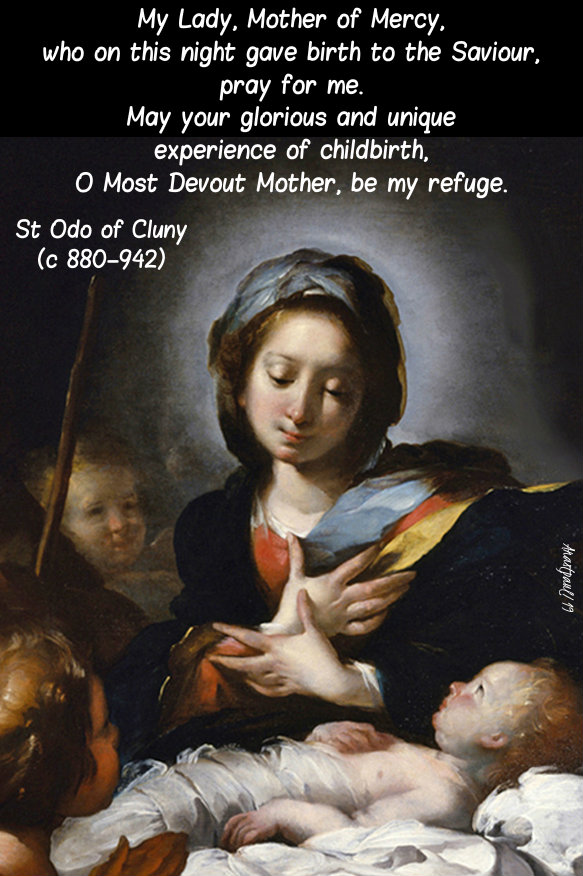
“My Lady, Mother of Mercy, who on this night gave birth to the Saviour, pray for me. May your glorious and unique experience of childbirth, O Most Devout Mother, be my refuge.”
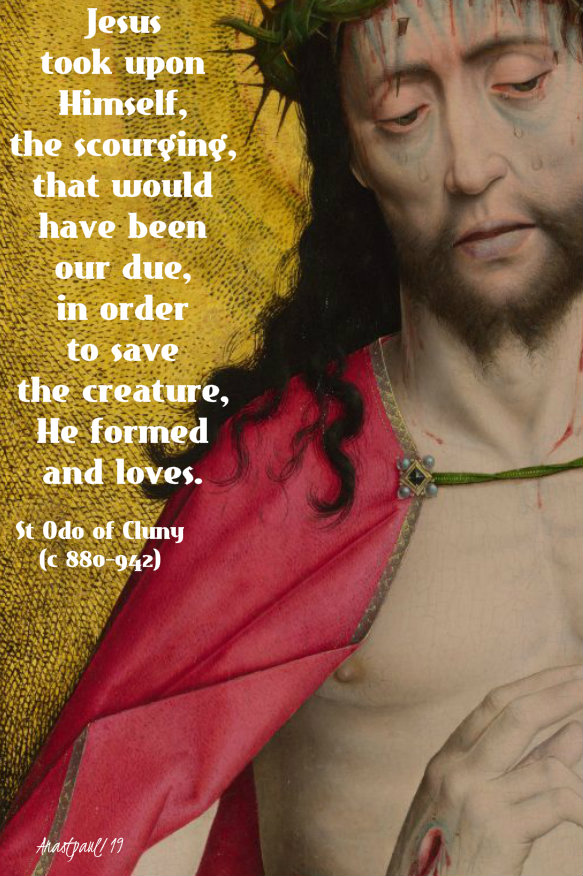
“Jesus took upon Himself the scourging, that would have been our due, in order to save the creature, He formed and loves.”
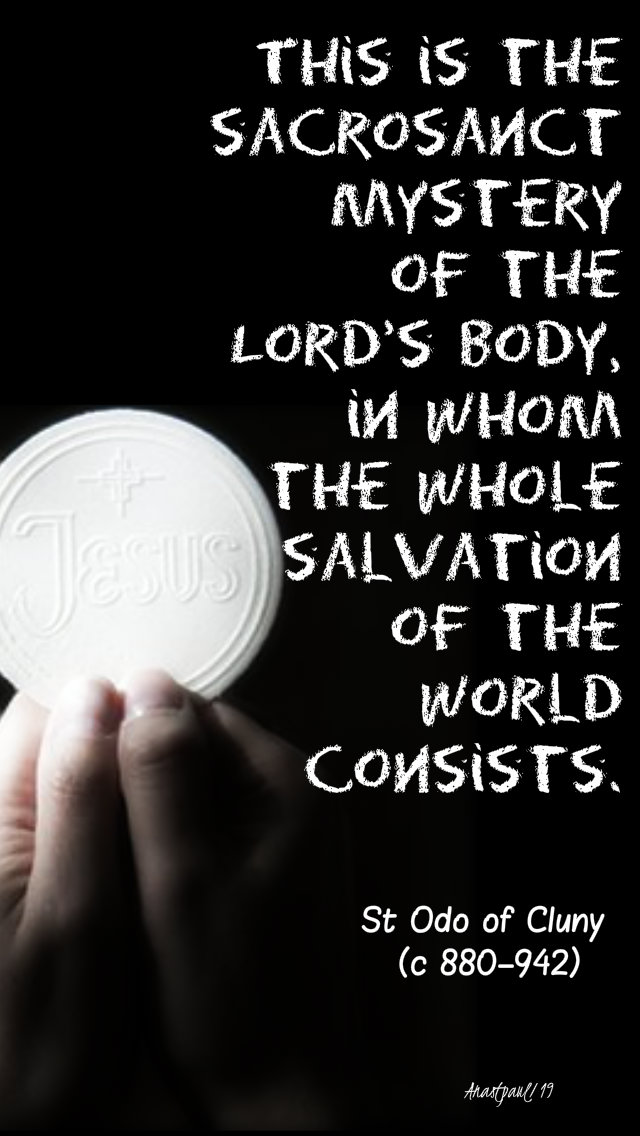
“]This is the] sacrosanct mystery of the Lord’s Body, in whom the whole salvation of the world consists.”
One Minute Reflection – 17 November – The Thirty Third Sunday in Ordinary Time, Year C, Luke 21:5–19, The Third World Day of Prayer for the Poor and the Memorial of St Elizabeth of Hungary (1207-1231)
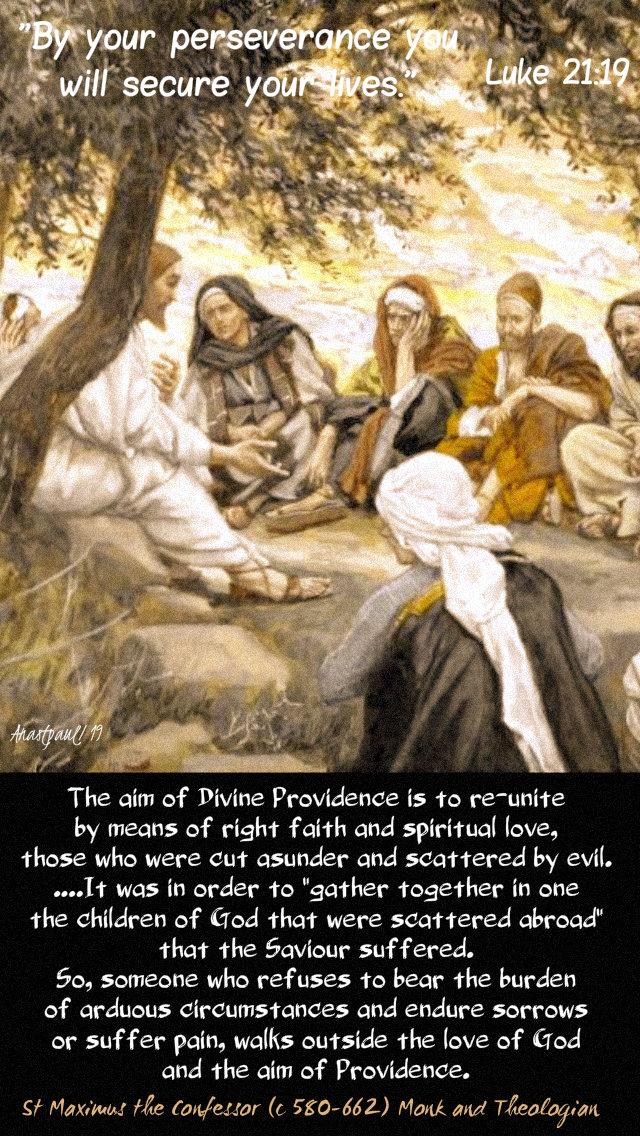
“By your perseverance you will secure your lives.” … Luke 21:19
REFLECTION – “That person has not yet attained perfect love and profound knowledge of Divine Providence who, in time of trial, when affliction befalls, does not have magnanimity but cuts himself off from love for the spiritual brethren.
The aim of Divine Providence is to re-unite by means of right faith and spiritual love, those who were cut asunder and scattered by evil. It was in order to “gather together in one the children of God that were scattered abroad” (Jn 11:52) that the Saviour suffered. So, someone who refuses to bear the burden of arduous circumstances and endure sorrows or suffer pain, walks outside the love of God and the aim of Providence. If “charity is patient and kind” (1Cor 13:4), does not the person who is fainthearted in sorrows, who bears malice against those giving offence, or who severs the love due to them, fall short of the aim of Divine Providence?… They are long-suffering who await the end of the trial and receive praise for what they have endured. “Whoever is slow to wrath abounds in wisdom” (Prv 14:29), for such a one, relates all that happens, to the ultimate end and, in its expectation, bears all afflictions. And the end, says the Apostle, is everlasting life (cf. Rm 6:22). “And this is eternal life, that they might know You, the only true God and Jesus Christ, whom You have sent” (Jn 17:3).” … St Maximus the Confessor (c 580-662) Monk, Theologian, Father – Fourth Century on Love, nos 16-18, 23-24
PRAYER – Holy God and Father, grant us a strong Faith! Poor Your graces into our hearts that we may believe with all our hearts, minds and souls and that in believing, we may constantly raise our entire being to You in prayer and supplication, in prayer and adoration, in prayer and love. May the intercession of St Elizabeth of Hungary, a woman of deep prayer from her youth, strengthen our perseverance and trust. Through Jesus Christ, our Lord in the unity of the Holy Spirit, God forever and ever, amen.
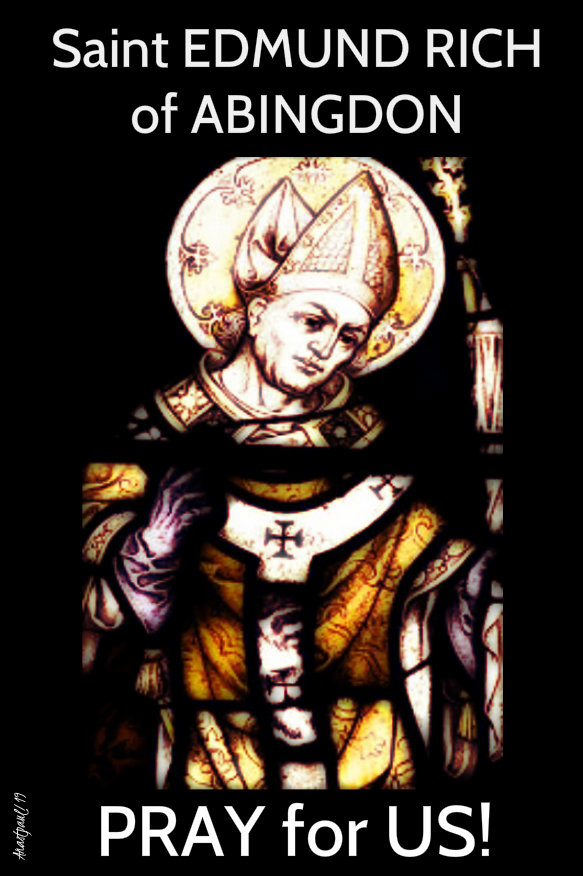
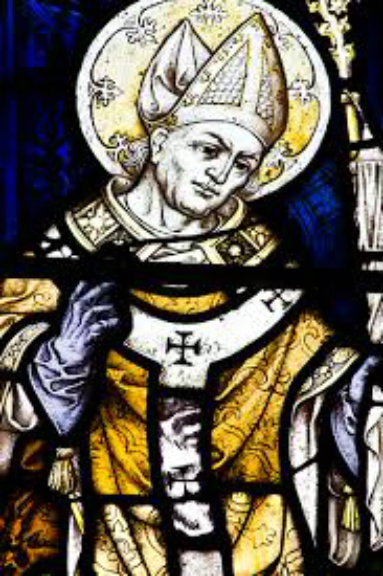
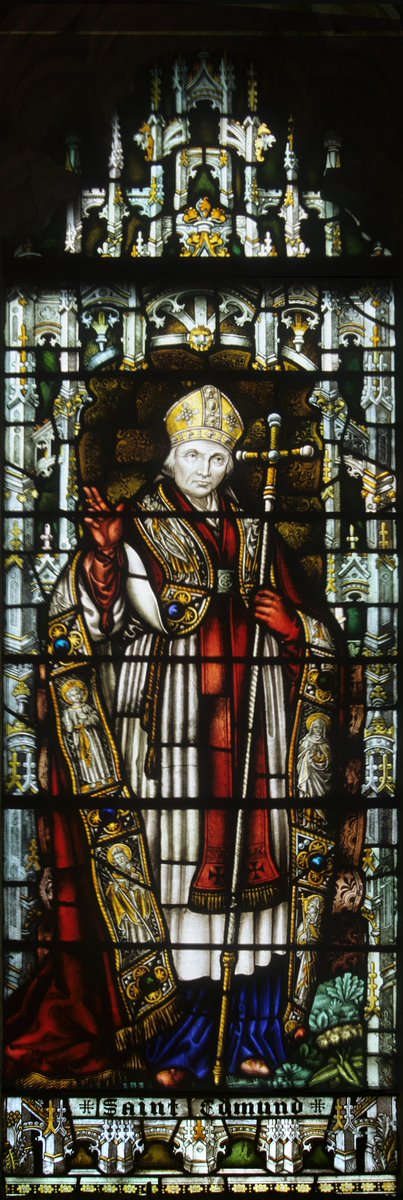
Thought for the Day – 16 November – The Memorial of St Edmund Rich of Abingdon (1175-1240) Archbishop of Canterbury
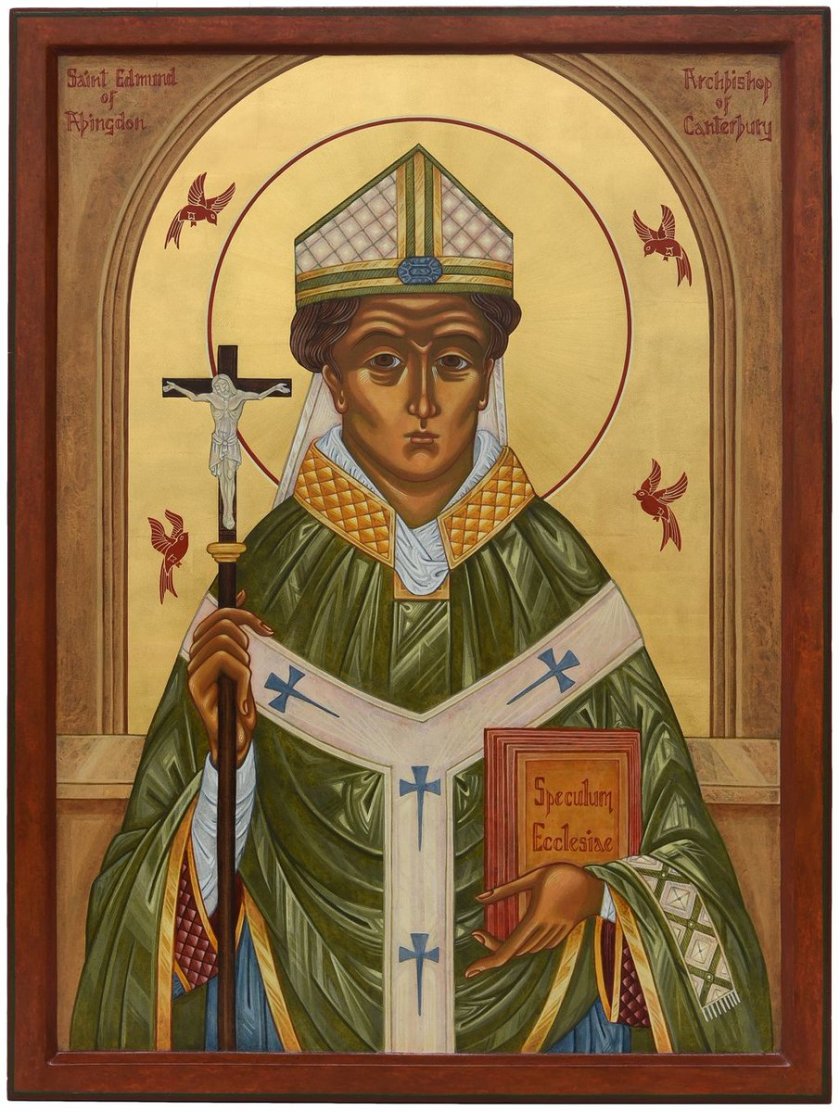
St Edmund’s best-known work in the Middle Ages was his Speculum Ecclesie. It’s a work on the contemplative life, offering (among other things) meditations on different moments in the life of Christ, aiming to help the reader to enter imaginatively into the scenes of His Passion and feel intense compassion for His sufferings. I don’t know whether people read the Speculum Ecclesie today, but most students of Middle English will have read a poem which survives as part of it. This is one of the earliest, shortest and most popular devotional poems in Middle English:
Nou goth sonne under wod,
Me reweth, Marie, thi faire rode.
Nou goth sonne under tre,
Me reweth, Marie, thi sone and thee.
Now goes the sun under the wood, I grieve, Mary, for your fair face. Now goes the sun under the tree, I grieve, Mary, for thy son and thee.
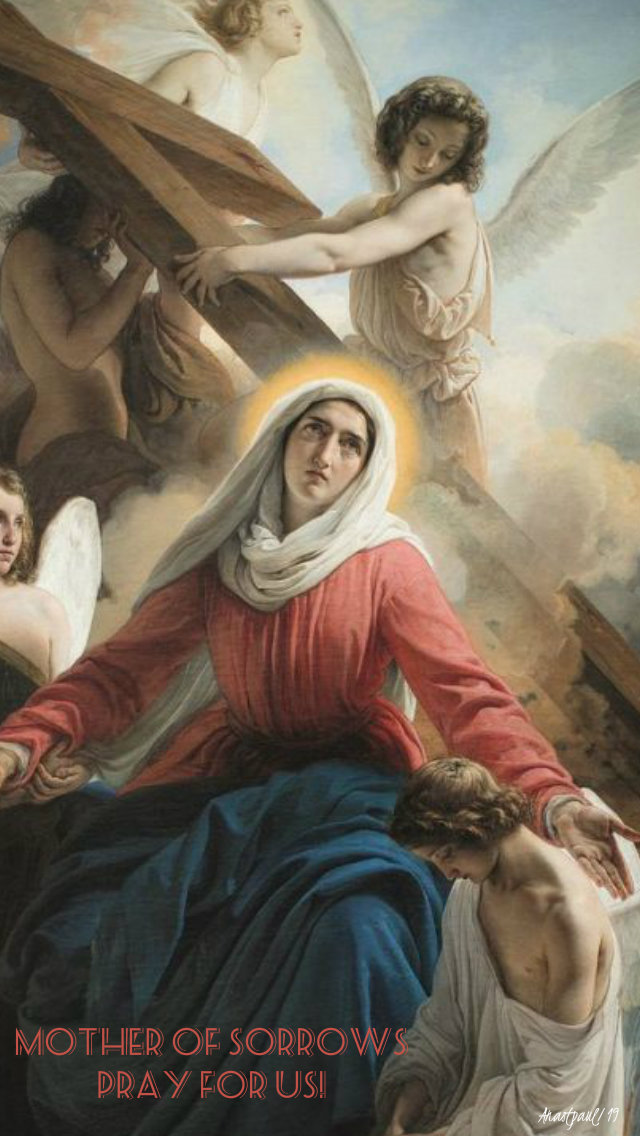
This short poem is designed to be a spur to meditation on the Crucifixion, perhaps at the appropriate hour of the day when the sun begins to set. Apparently very simple, the poem is dense with meaningful wordplay – as the sun sets behind the wood, so Christ the Son is shrouded in darkness on the wood of the cross, the tree; that is, the ‘rode’, which means both ‘face’ and ‘rood’ (cross). And here we have another pair of a mother and her son, and their strong emotional bond (like St Edmund himself and his mother). The poem encourages the reader to meditate and dwell on Christ’s Crucifixion by approaching the Son through the Mother, to feel compassion for His suffering as it is reflected in her grief (underlined by that wordplay on ‘rode’ – (His cross and her face). How wonderful it is that this poem should be associated with a saint whose mother was such an important presence in his life.
Back in Abingdon, the Catholic church is dedicated to him and to the Virgin Mary, the mother and bride who was so constant a presence in his spiritual life.
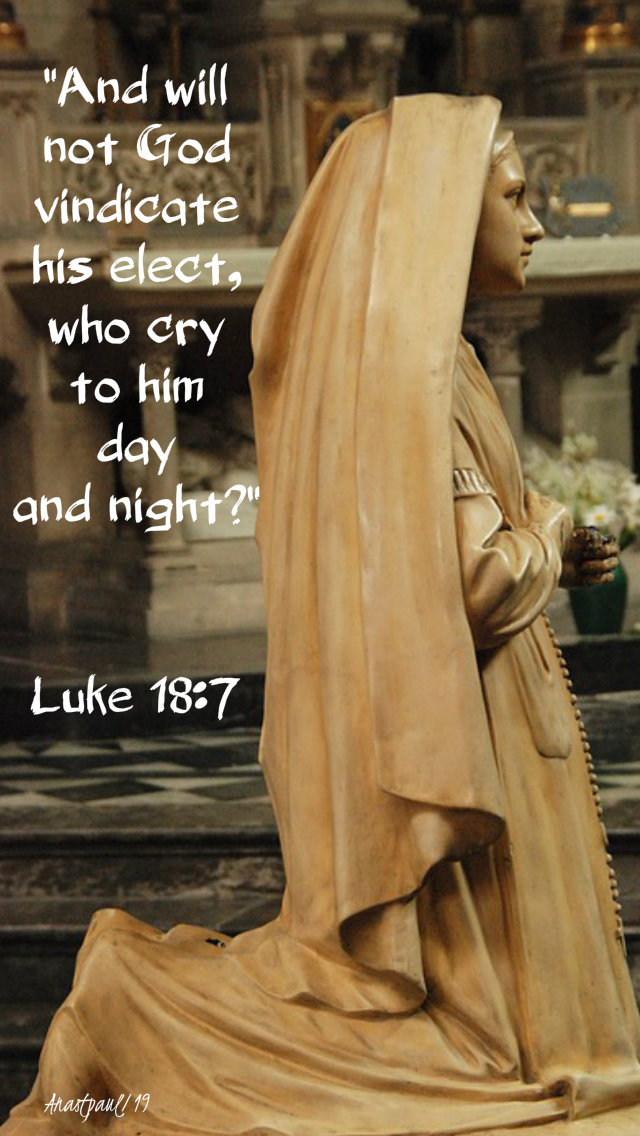
One Minute Reflection – 16 November – Saturday of the Thirty Second week in Ordinary Time, Year C, Gospel: Luke 18:1–8 and The Memorial of St Edmund Rich of Abingdon (1175-1240) Archbishop of Canterbury
“And will not God vindicate his elect, who cry to him day and night?” … Luke 18:7
REFLECTION – “ Pray at all times ” commands the apostle Paul (1 Th 5:17). Calling to mind this precept, Clement of Alexandria writes: “We have been commanded to praise and honour the Word, which we know to be our Savior and King and through Him, the Father, not on certain select days as others do but continually, our whole lives long and in every possible way.”
Amidst our daily occupations, at times when we overcome our egoistical tendencies, when we experience the joy of friendship towards others, at all such times, Christians must discover God. Through Christ and in the Holy Spirit, Christians gain intimacy with God the Father and run along the way, as they seek that kingdom which, although it is not of this world (Jn 18:36), is prepared for, in this world and begins in this world.
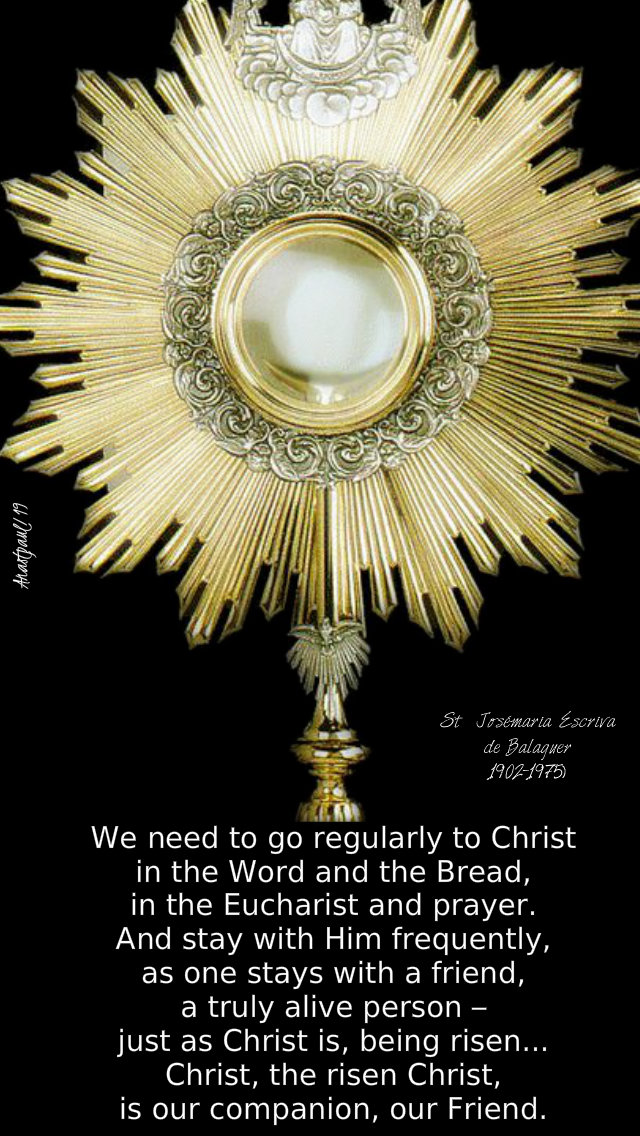
We need to go regularly to Christ in the Word and the Bread, in the Eucharist and prayer. And stay with Him frequently, as one stays with a friend, a truly alive person – just as Christ is, being risen… Christ, the risen Christ is our companion, our Friend. A companion who is only to be seen in the semi-darkness but whose reality fills our lives and makes us want His company permanently. “The Spirit and the Bride say: ‘Come!’ Let those who hear say: ‘Come!’ Let anyone who thirsts come forward and let those who desire it receive the gift of life-giving water… He who gives this testimony says: ‘Yes, I am coming soon!’ Amen. Come, Lord Jesus!” (Rv 22:17.20).” … St Josémaria Escriva de Balaguer (1902-1975) – Sermon of 26/03/67 in ‘Es Cristo que pasa’
PRAYER – Holy Father, grant us a strong Faith! Poor Your graces into our hearts that we may believe with all our hearts, minds and souls and that in believing, we may constantly raise our entire being to You in prayer and supplication, in prayer and adoration, in prayer and love. May the intercession of St Edmund Rich of Abingdon, a man of deep prayer from his youth, strengthen our perseverance. Through Jesus Christ, our Lord in the unity of the Holy Spirit, God forever and ever, amen.
Saint of the Day – 16 November – Saint Edmund Rich of Abingdon (1175-1240) Archbishop of Canterbury, Confessor, Apostle of Prayer and Charity, Mystic, Doctor of Divinity/Theology, eloquent Preacher, Ascetic, highly regarded Professor lecturer, Reformer, Writer, peacemaker, social activist and negotiator. Born, it is thought, on 20 November c. 1175 at St Edmund’s Lane, Abingdon, Berkshire (now Oxfordshire), England and died on 16 November 1240 at Soisy-Bouy, Seine-et-Marne, France. Patronages – Abingdon, Oxfordshire, Roman Catholic Diocese of Portsmouth; St Edmund’s College, Cambridge; St Edmund Hall, Oxford, St Edmund’s College, Ware.
Of English birth, he became a respected lecturer in mathematics, dialectics and theology at the Universities of Paris and Oxford, promoting the study of Aristotle. Having already an unsought reputation as an ascetic, he was ordained a priest, took a doctorate in divinity and soon became known, not only for his lectures on theology but as a popular preacher, spending long years travelling within England, and engaging, in 1227 preaching the sixth crusade. Obliged to accept an appointment as Archbishop of Canterbury by Pope Gregory IX, he combined a gentle personal temperament with a strong public stature and severity towards King Henry III in defence of Magna Carta and in general of good civil and Church government and justice. He also worked for strict observance in monastic life and negotiated peace with Llywelyn the Great. His policies earned him hostility and jealousy from the king and opposition from several monasteries and from the clergy of Canterbury Cathedral. He died in France at the beginning of a journey to Rome in 1240.
St Edmund was born circa 1174, possibly on 20 November (the feast of St Edmund the Martyr), in Abingdon in Berkshire (now Oxfordshire), 7 miles south of Oxford, England. He was the oldest of four children.
“Rich” was an epithet sometimes given to his wealthy merchant father, Reynold. It was never applied to Edmund or his siblings in their lifetimes. His father retired, with his wife’s consent, to the monastery at Eynsham Abbey, leaving in her hands the education of their family. Her name was Mabel, she was a devout woman who lived an ascetic life and encouraged her children to do the same. Both her daughters took the veil.
Edmund may have been educated at the monastic school in Abingdon. He developed a taste for religious learning, saw visions while still at school and at the age of twelve took a vow of perpetual chastity in the Virgin’s church at Oxford. His early studies were in England but he completed his higher learning in France, at the University of Paris. He became a teacher about 1200, or a little earlier. For six years he lectured on mathematics and dialectics, apparently dividing his time between Oxford and Paris and helped introduce the study of Aristotle.
Edmund became one of Oxford’s first lecturers with a Master of Arts but was not Oxford’s first Doctor of Divinity. Long hours at night spent in prayer had the result that he often “nodded off” during his lectures. There is a long-established tradition that he utilised his lecture-fees to build the Lady Chapel of St Peter’s in the East at Oxford. The site where he lived and taught was formed into a mediaeval academic hall in his name and later incorporated as the college of St Edmund Hall.
His mother’s influence then led to his taking up the study of theology. Though for some time Edmund resisted the change, he finally entered upon his new career between 1205 and 1210. He spent a year in retirement with the Augustinian canons of Merton Priory, received ordination, took a doctorate in divinity and soon became known as a lecturer on theology and as an extemporaneous preacher. In this capacity he gained some reputation for eloquence. He spent the fees which he received in charity and refused to spend upon himself the revenues which he derived from several benefices. He often retired for solitude to Reading Abbey and it is possible that he would have become a monk if that profession had afforded more scope for his gifts as a preacher and expositor.
His spiritual fervour, eloquent and effective preaching led to miracles and conversions. He constantly encouraged the faithful to pray. “A hundred thousand people are deceived by multiplying prayers,” he said once. “I would rather say five words devoutly with my heart, than 5,000 which my soul does not relish with affection and intelligence.”
He was known for his great self-discipline – under his clothes, he wore a sackcloth pressed close to his skin by metal plates and he slept only a few hours at night in order to spend time in prayer and meditation. On one occasion, he was observed levitating, consumed in prayer.
In 1233 he was named the 46th Archbishop of Canterbury against his wishes. He advised King Henry III and presided at the king’s confirmation of the Magna Carta in 1237. Edmund was at the centre of relations between Rome and England and spoke truth to power on both sides. He admonished the king for having favourites in his court and travelled to Rome to urge reforms in the Church.
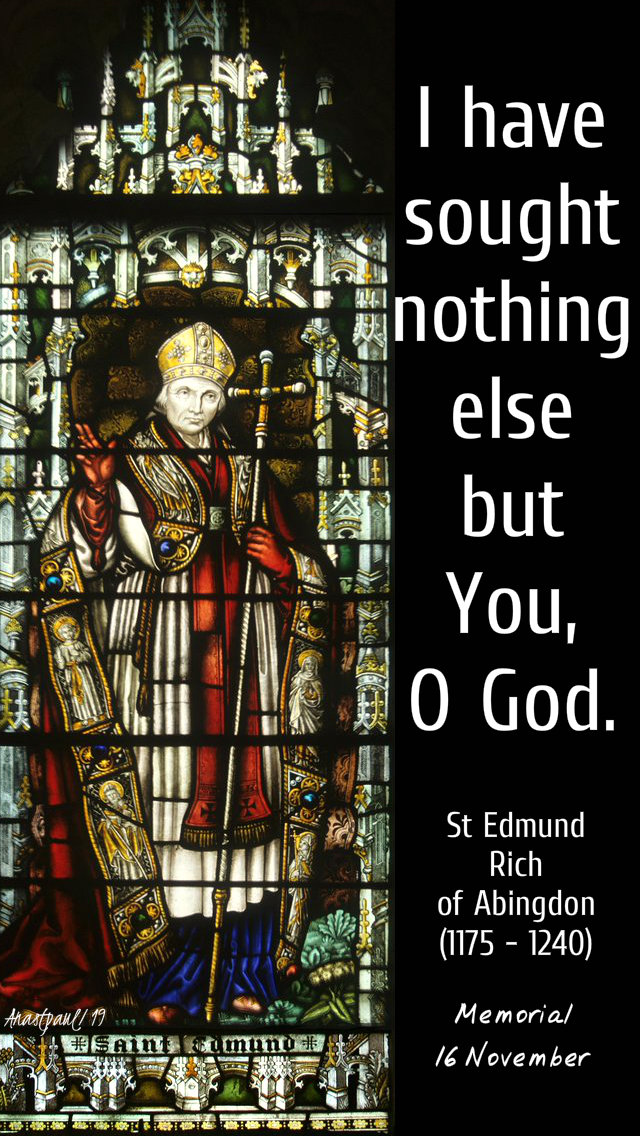
Because he was so truthful and did not vary from what he saw as just and right, many people found him inconvenient. Political movements forced Edmund’s resignation in 1240 and he moved to France and became a Monk. He died later that year and miracles at his grave were reported soon after his burial. His relics rest in the Reliquary Chapel in the Basilica. “I have sought nothing else but Thee, O God.” – St Edmund’s Dying Words.
In less than a year after Edmund’s death, miracles were wrought at his grave. Despite Henry’s opposition, he was Canonised only 6 years after his death, on 16 December 1246 by Pope Innocent IV. A few years later, the first chapel dedicated to him, St Edmund’s Chapel, was Consecrated in Dover, by his friend St Richard of Chichester (c 1197-1253), making it the only chapel dedicated to one English Saint by another.
Edmund’s body was never translated to Canterbury, because the Benedictine community there resented what they regarded as Edmund’s attacks on their independence. After his death he was taken back to Pontigny Abbey, where his main relics are now found in a baroque reliquary tomb dating to the 17th century.
An arm is enshrined in the Chapel of Our Lady of the Assumption at St Edmund’s Retreat on Enders Island off the coast of Mystic, Connecticut. The retreat is operated by the Society of the Fathers and Brothers of St Edmund.
In 1853, the fibula of the Edmund’s left leg was presented to St Edmund’s College, Ware,by Cardinal Wiseman. Many local cures of serious illnesses were attributed to the intercession of St Edmund, one of the earliest of these was of a student who nearly died after a fall in 1871. His complete healing led to the accomplishment of a vow to extend the beautiful Pugin chapel with a side chapel to honour the saint.
St Edmund’s silk chasuble, which Edmund had with him at his death, remains in a local church, with a stole and maniple. His works, Speculum Ecclesiae (Mirror of the Church)
and Provincial Constitution, are still relevant today. He holds the sad honour, of being the last Archbishop of Canterbury, to be Canonised. The Society of St Edmund, formed in his honour in France in the 1840s, operates from the US – you can read about them here: http://www.sse.org/history.html.
Thought for the Day – 15 November – The Memorial of St Albert the Great OP (1200-1280), Bishop and Doctor of the Church
Do This in Remembrance of Me
Saint Albert the Great
Bishop and Doctor of the Church
An excerpt from Commentary on the Gospel of Luke
Do this in remembrance of Me. Two things should be noted here. The firs,t is the command that we should use this Sacrament, which is indicated when He says: Do this. The second, is that this Sacrament commemorates the Lord’s going to death for our sake.
Do this. Certainly He would demand nothing more profitable, nothing more pleasant, nothing more beneficial, nothing more desirable, nothing more similar to eternal life. We will look at each of these qualities separately.
This Sacrament is profitable because it grants remission of sins; it is most useful because it bestows the fullness of grace on us in this life. The Father of spirits instructs us in what is useful for our sanctification. And his sanctification is in Christ’s sacrifice, that is, when He offers Himself in this Sacrament to the Father for our redemption, to us for our use. I consecrate Myself for their sakes. Christ, who through the Holy Spirit offered Himself up without blemish to God, will cleanse our consciences from dead works to worship the living God.
Nor can we do anything more pleasant. For what is better than God manifesting His whole sweetness to us. You gave them bread from heaven, not the fruit of human labour but a bread endowed with all delight and pleasant, to every sense of taste. For this substance of Yours revealed Your kindness toward Your children and serving the desire of each recipient, it changed to suit each one’s taste.
He could not have commanded anything more beneficial, for thisSsacrament is the fruit of the tree of life. Anyone who receives this Sacrament with the devotion of sincere faith will never taste death. It is a tree of life for those who grasp it and blessed is he who holds it fast. The man who feeds on Me shall live on account of Me.
Nor could He have commanded anything more lovable, for this Sacrament produces love and union. It is characteristic of the greatest love to give itself as food. Had not the men of my tent exclaimed: Who will feed us with his flesh to satisfy our hunger? as if to say: I have loved them and they have loved Me so much, that I desire to be within them and they wish to receive Me so that they may become My members. There is no more intimate or more natural means for them to be united to Me and I to them.
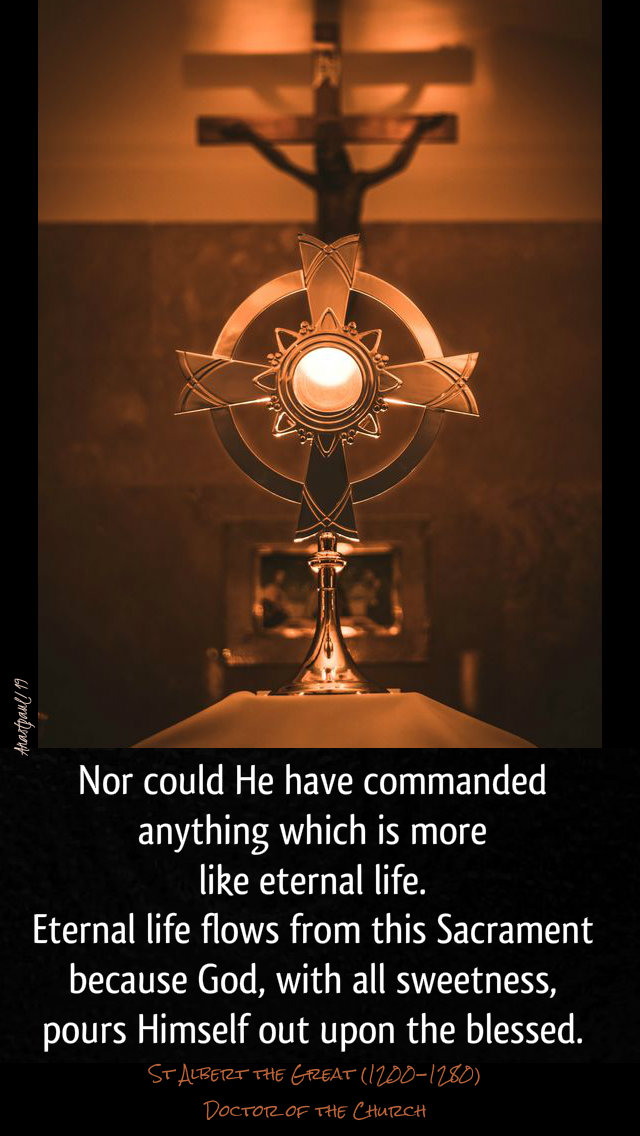
Nor could He have commanded anything, which is more like eternal life. Eternal life flows from this Sacrament, because God, with all sweetness, pours Himself out upon the blessed.
St Albert the Great, Pray for Us that we may receive the Body of Christ with total faith, conviction and love!
Quote/s of the Day – 15 November – The Memorial of St Albert the Great OP (1200-1280) Doctor of the Church and of Bl Mary of the Passion FMM (1839-1904)
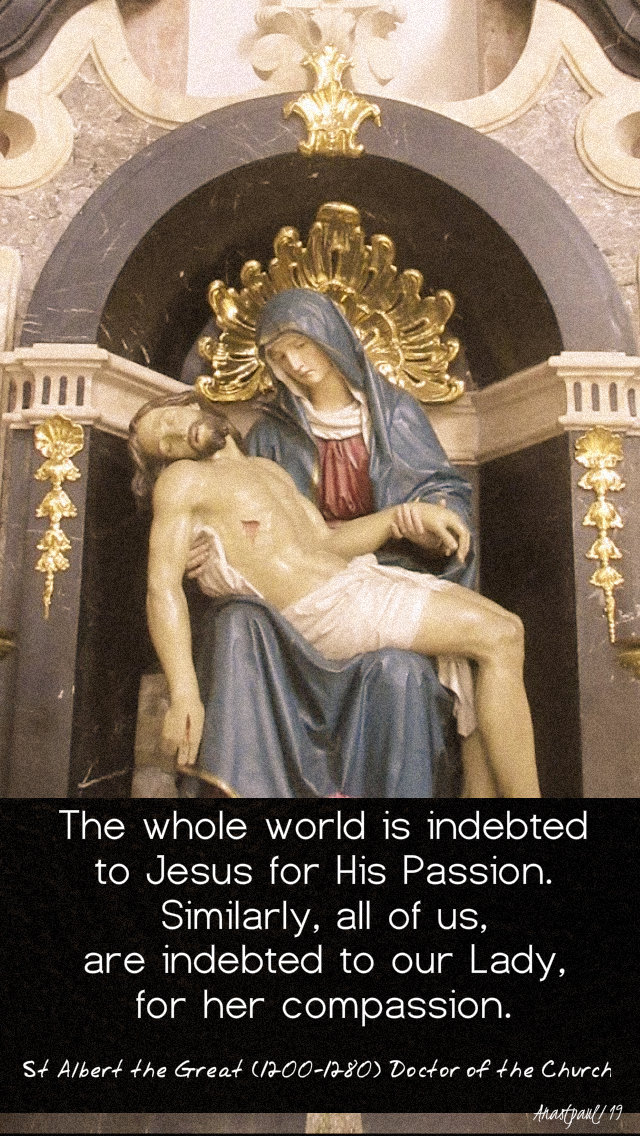
“The whole world is indebted to Jesus for His Passion. Similarly, all of us, are indebted to our Lady, for her compassion.”
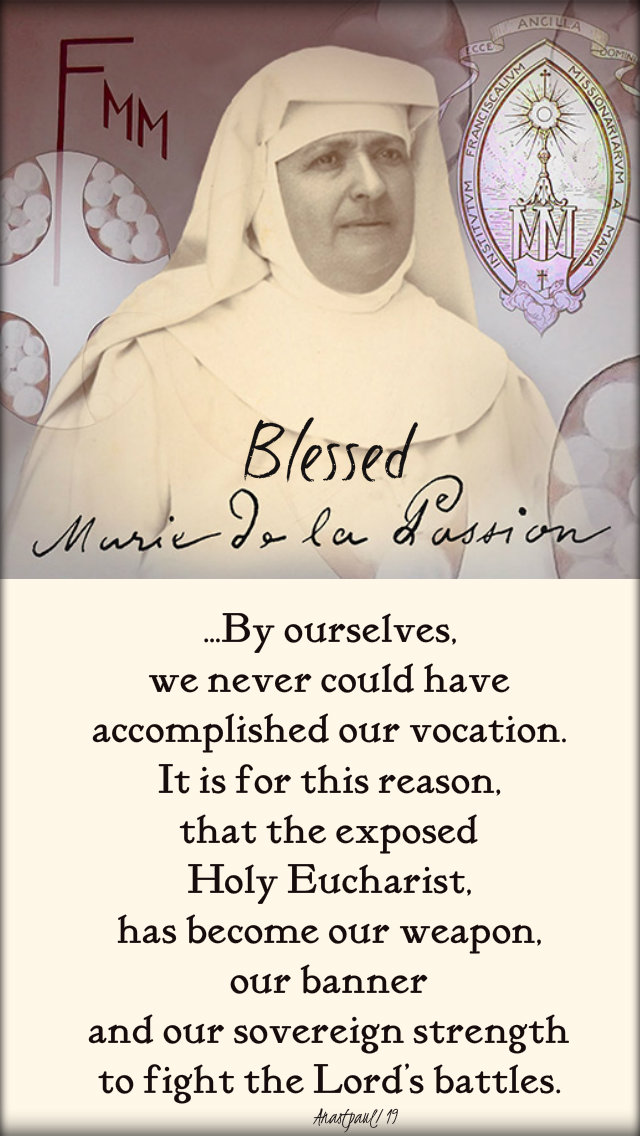
“…By ourselves, we never could have accomplished our vocation. It is for this reason, that the exposed Holy Eucharist, has become our weapon, our banner and our sovereign strength to fight the Lord’s battles.”
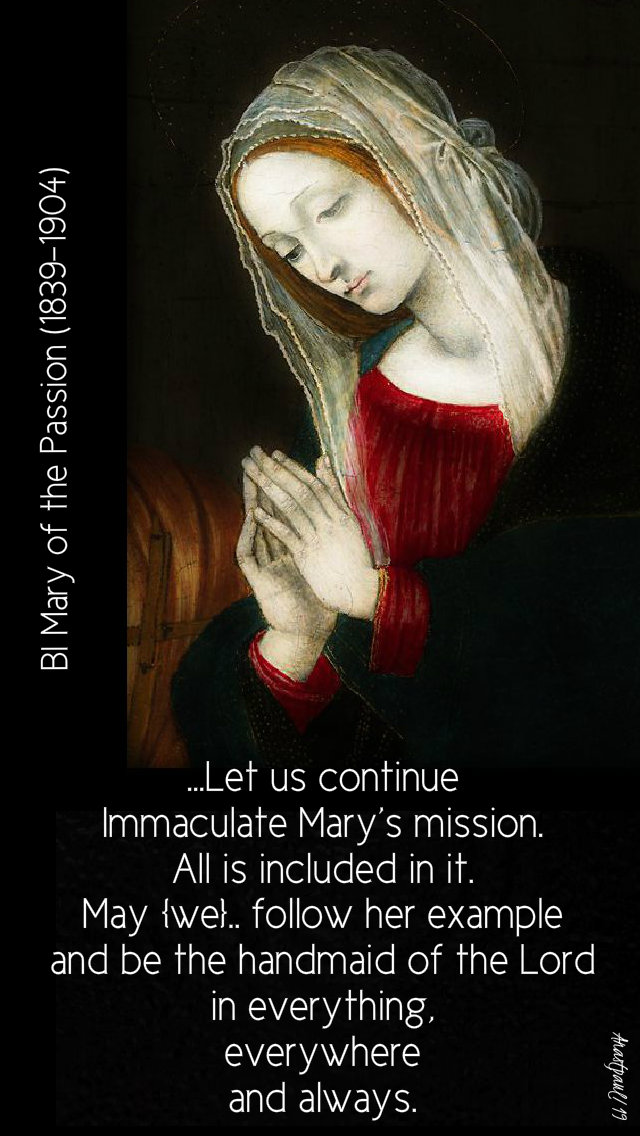
“…Let us continue Immaculate Mary’s mission. All is included in it. May [we].. follow her example and be the handmaid of the Lord in everything, everywhere and always.”
One Minute Reflection – 15 November – Friday of the Thirty Second week in Ordinary Time, Year C, Gospel: Luke 17:26–37 and the Memorial of St Albert the Great OP (1200-1280) Doctor of the Church and of Bl Bl Mary of the Passion FMM (1839-1904)
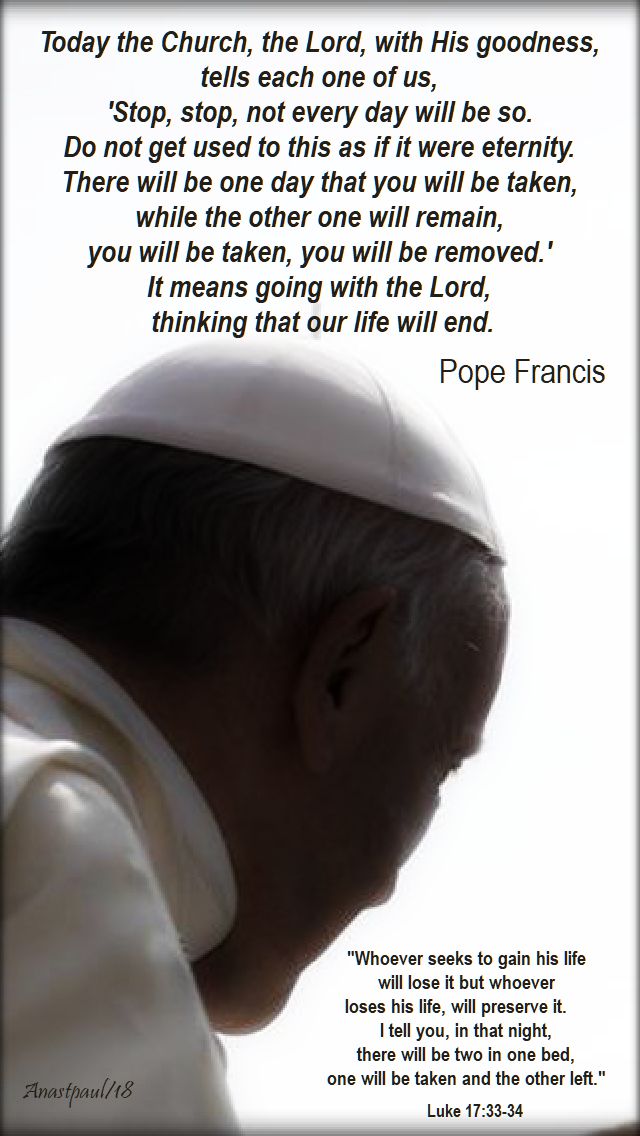
“Whoever seeks to gain his life, will lose it but whoever loses his life, will preserve it. I tell you, in that night there will be two in one bed, one will be taken and the other left.”…Luke 17:33-34
REFLECTION – “Today the Church, the Lord, with His goodness, tells each one of us, ‘Stop, stop, not every day will be so. Do not get used to this as if it were eternity. There will be one day that you will be taken, while the other one will remain, you will be taken, you will be removed.’ It means going with the Lord, thinking that our life will end.”…Pope Francis – Santa Marta, 17 November 2017
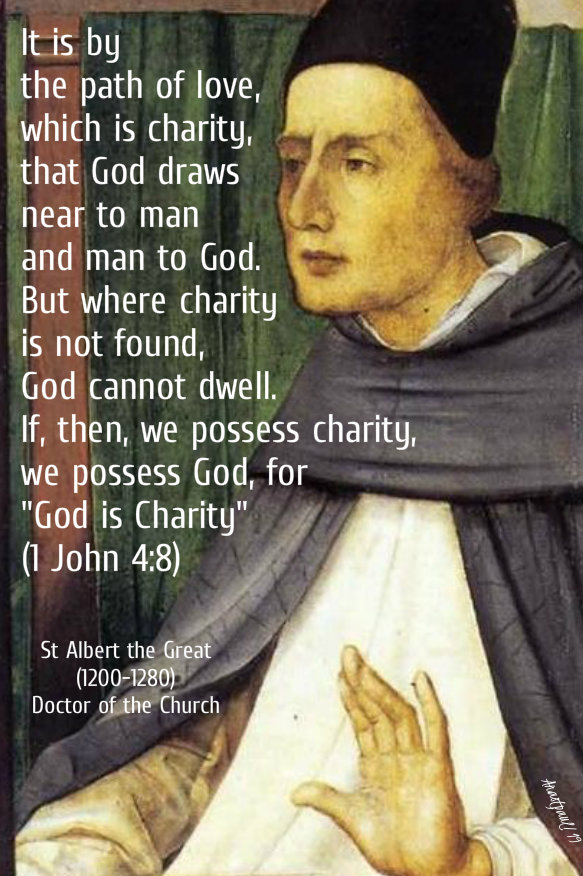
“It is by the path of love, which is charity, that God draws near to man and man to God. But where charity is not found, God cannot dwell. If, then, we possess charity, we possess God, for “God is Charity” (1 John 4:8) …
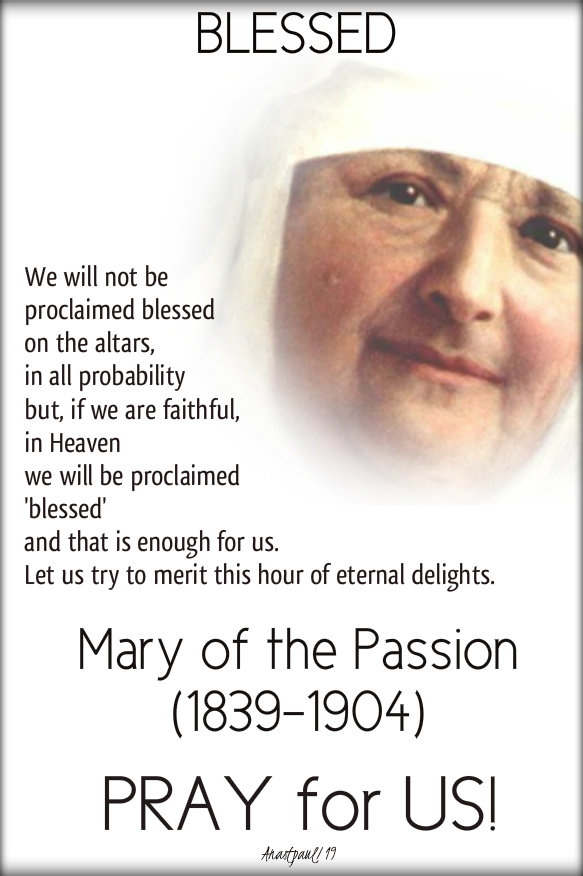
“We will not be proclaimed blessed on the altars in all probability but if we are faithful, in Heaven we will be proclaimed ‘blessed’ and that is enough for us. Let us try to merit this hour of eternal delights.” … Bl Mary of the Passion (1839-1904)
PRAYER – Lord God, You made St Albert great by his gift for reconciling human wisdom with divine faith. Help us so to follow his teaching that every advance in science may lead us to a deeper knowledge and love of You. May his prayers on our behalf be a succour to us all. We ask too for the intercession of the blessed Mary of the Passion that her zeal and perseverance may be the driving force of our lives. Through our Lord Jesus Christ with the Holy Spirit, one God for all eternity, amen.
Thought for the Day – 14 November – Thursday of the Thirty Second week in Ordinary Time, Year C, Gospel: Luke 17:20–25
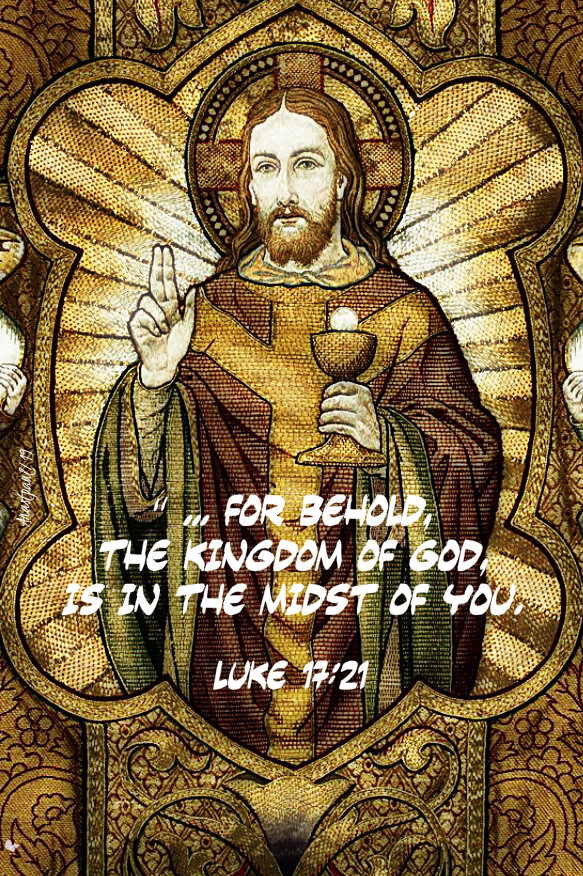
” … For behold, the kingdom of God, is in the midst of you.”
Luke 17:21
My Lord and my God!
St John Henry Newman (1801-1890)
“I am slow to master the great Truth, that Christ is, as it were, walking among us and, by His Hand, or eye, or voice bidding me to follow Him.
I do not understand, that His call, is a thing which takes place now.
I think it took place in the Apostles’ days but I do not believe in it, I do not look out for it in my own case.
I have not eyes to see the Lord – far different from the beloved Apostle, who knew Christ, even when the rest of the disciples knew Him not! When He stood on the shore after His Resurrection and bade them cast the net into the sea, “that disciple whom Jesus loved, said unto Peter, ‘It is the Lord!'” …
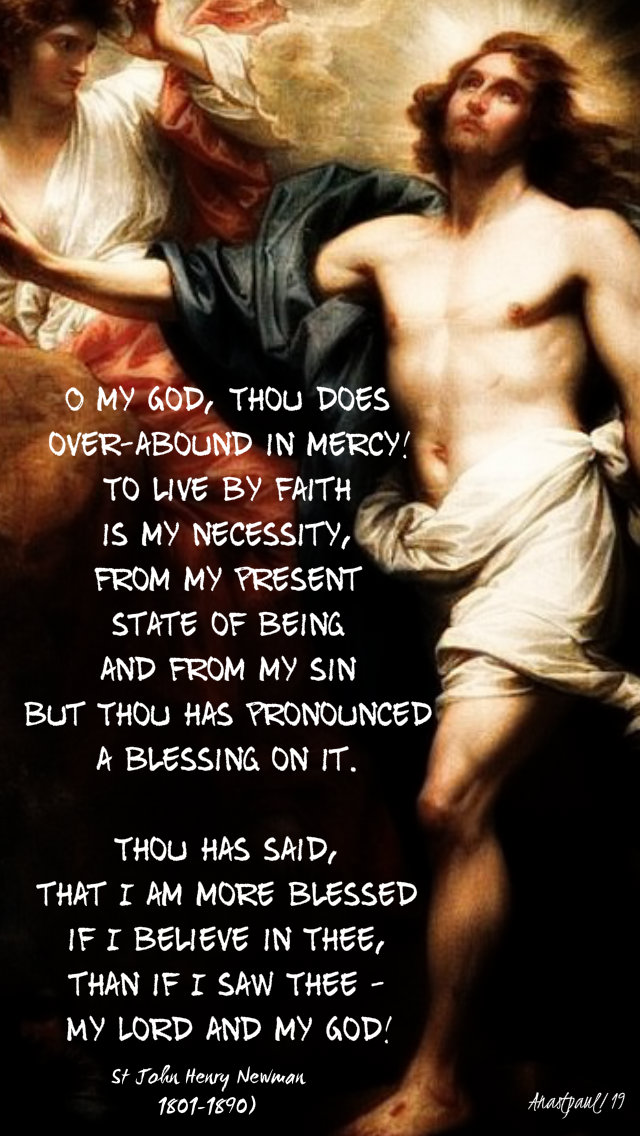
O my God, Thou does over-abound in mercy!
To live by faith is my necessity, from my present state of being and from my sin but Thou has pronounced a blessing on it. Thou has said, that I am more blessed if I believe in Thee, than if I saw Thee – My Lord and my God!”
Quote/s of the Day – 14 November – Thursday of the Thirty Second week in Ordinary Time, Year C, Gospel: Luke 17:20–25
” … For behold, the kingdom of God, is in the midst of you.”
Luke 17:21
” …[The Kingdom of God] … is within you. That is, it depends on your own wills and is in your own power, whether or not you receive it. Everyone, that has attained to justification, by means of faith in Christ and decorated by every virtue, is counted worthy, of the kingdom of heaven.”
St Cyril of Alexandria (376-444)
(Commentary on Luke, 117) Known as “The Pillar of Faith” Archbishop of Alexandria, Father & Doctor of the Church
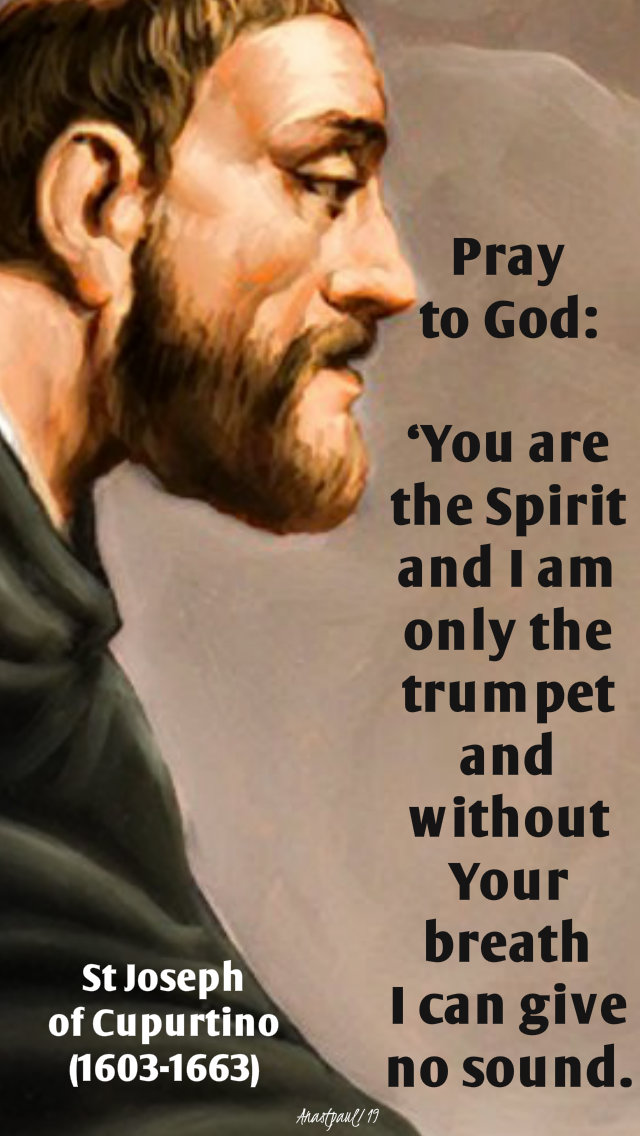
“Pray to God:
‘You are the Spirit and I am only the trumpet and without Your breath I can give no sound.’”
St Joseph of Cupurtino (1603-1663)
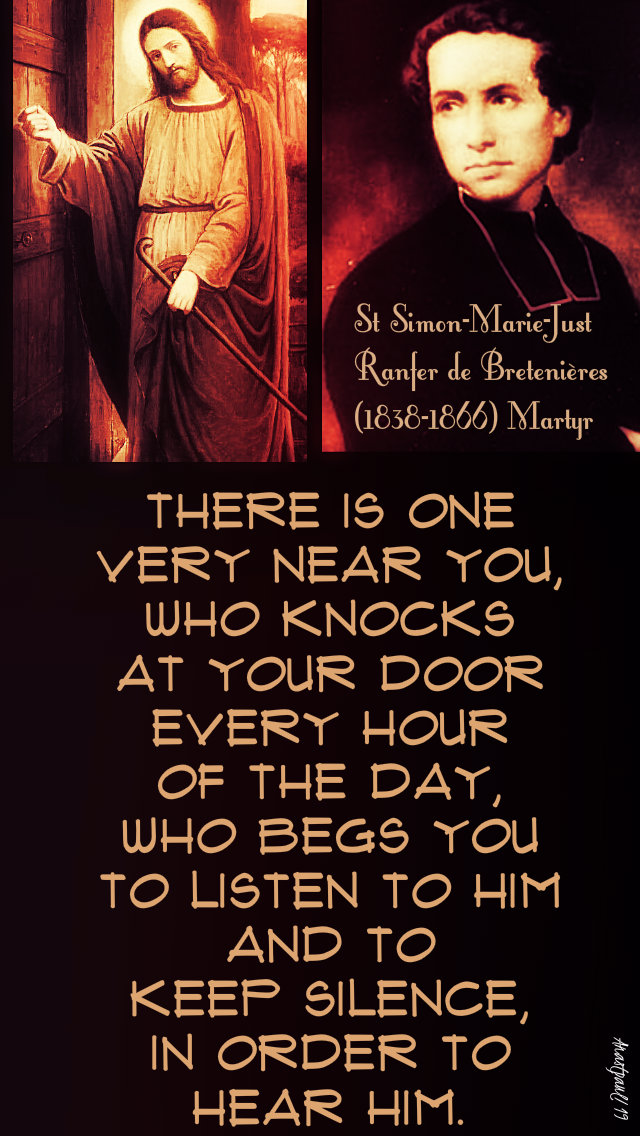
“There is One very near you Who knocks at your door every hour of the day, Who begs you to listen to Him and to keep silence in order to hear Him.”
St Simon-Marie-Just Ranfer de Bretenières (1838-1866) Martyr
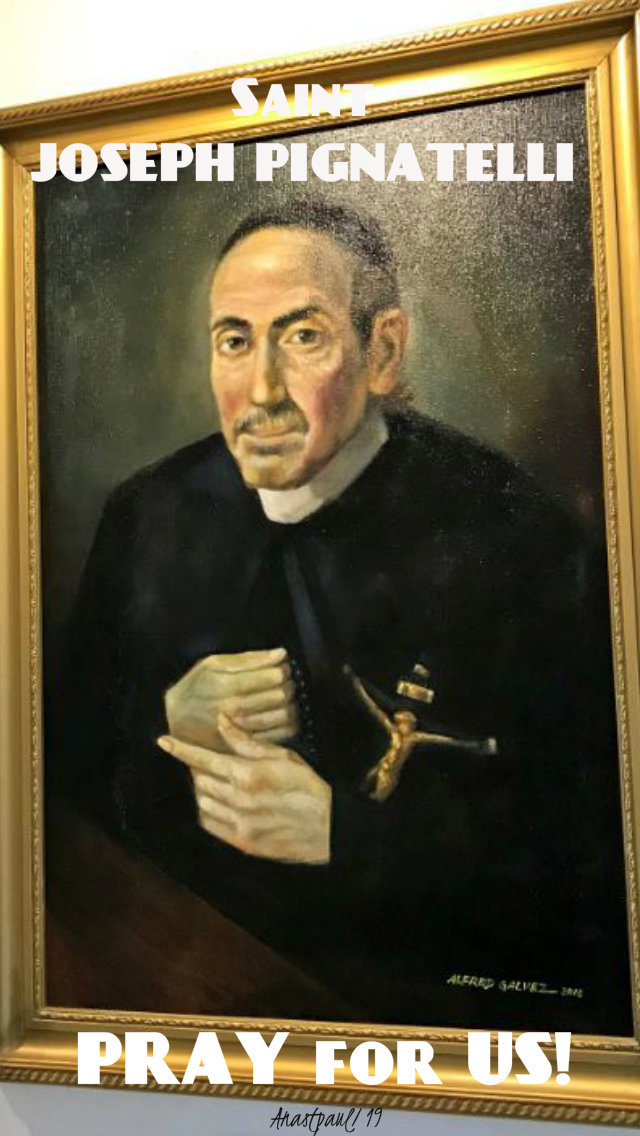
One Minute Reflection – 14 November – Thursday of the Thirty Second week in Ordinary Time, Year C, Gospel: Luke 17:20–25 and the Memorial of Saint Joseph Maria Pignatelli SJ (1737 – 1811)
” … For behold, the kingdom of God is in the midst of you.” … Luke 17:21
REFLECTION – “Is it difficult to faith to admit the word of Scripture concerning our connection with a world superior to us?… The world of spirits then, though unseen, is present, present, not future, not distant. It is not above the sky, it is not beyond the grave, it is now and here, “the kingdom of God is among us.” Of this the text speaks—”We look,” says St Paul, “not at the things which are seen, but at the things which are not seen, for the things which are seen are temporal but the things which are not seen are eternal” (2 Cor 4:18)…
Such is the hidden kingdom of God and, as it is now hidden, so in due season it shall be revealed. Men think that they are lords of the world and may do as they will. They think this earth their property and its movements in their power, whereas… it contains Christ’s little ones, whom they despise and His Angels, whom they disbelieve and these, at length, shall take possession of it and be manifested. At present, “all things,” to appearance, “continue as they were from the beginning of the creation” and scoffers ask, “Where is the promise of His coming?”(2 Pt 3:4) but at the appointed time there will be a “manifestation of the sons of God” and the hidden saints “shall shine out as the sun in the kingdom of their Father.” (Mt 13:43)
When the Angels appeared to the shepherds, it was a sudden appearance—“Suddenly there was with the Angel a multitude of the heavenly host” (Lk 2:13). How wonderful a sight! The night, had before that, seemed just like any other night – they were keeping watch over their sheep, they were watching the night as it passed. The stars moved on—it was midnight. They had no idea of such a thing when the Angel appeared. Such are the power and virtue hidden in things which are seen and at God’s will, they are manifested.” … St John Henry Newman (1801-1890) Cardinal, founder of the Oratory in England, Theologian – PPS “The Invisible world” vol.4, no.13
PRAYER – Our Father, hallowed be Your name, Your kingdom come, Your will be done! Grant us Lord, a true knowledge of our salvation, so that freed from fear and from the power of our foes, we may serve You faithfully, all the days of our lives and thus attain eternal joy with You. May the prayers of St Joseph Pignatelli on our behalf, be a succour to us all. Through our Lord Jesus Christ with the Holy Spirit, one God for all eternity, amen.

















 AnaStpaul
You must be logged in to post a comment.