Thought for the Day – 5 December – Meditations with Antonio Cardinal Bacci (1881-1971)
Peace of Soul
“After expounding this doctrine of interior peace, The Imitation of Christ goes onto saw: “But never to feel any grief at all, nor to suffer any trouble of heart or body, is not the state of this present life but, of everlasting rest. Think nor, therefore, that thou hast found true peace, if thou feel no burden; nor that then all is well, if thou have no adversary, nor that thou hast attained to perfection, if all things be done according to thy inclination. Neither do thou conceive a great notion of thyself, or imagine thyself to be especially beloved, if thou experiences great devotion and sweetness; for it is not in such things as these, that a true lover of virtue is known; nor doth the progress and perfection of man consist in these things!” (Bk III c25).
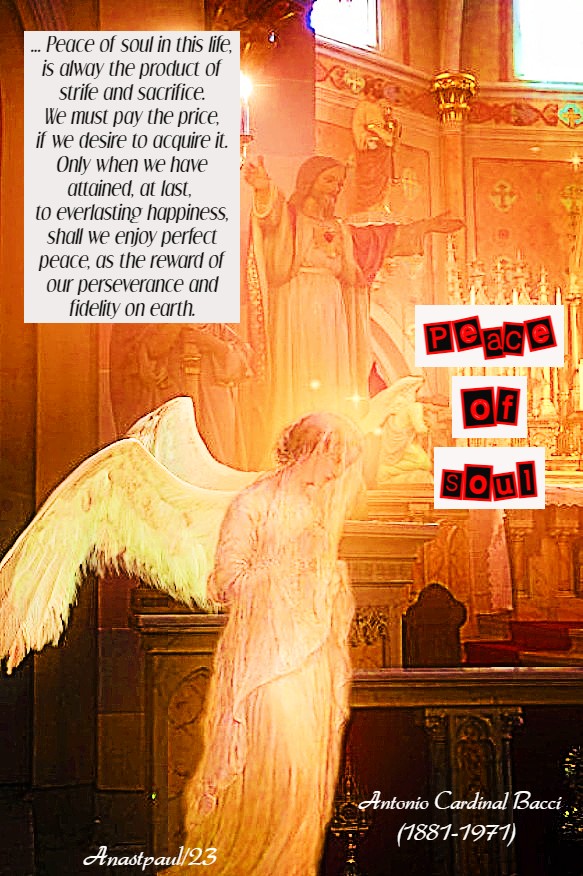
We can see from this that peace of soul in this life, is alway the product of strife and sacrifice. We must pay the price, if we desire to acquire it. Only when we have attained, at last, to everlasting happiness, shall we enjoy perfect peace, as the reward of our perseverance and fidelity on earth.”
Quote/s of the Day – 26 November – St Leonard of Port Maurice OFM (1676-1751) Confessor, Priest
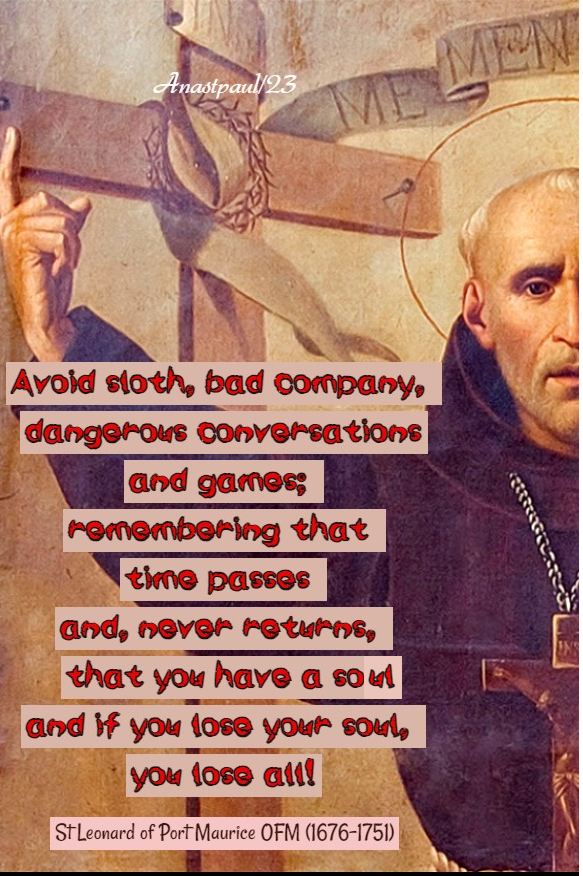
“Avoid sloth, bad company, dangerous conversations and games; remembering that time passes and never returns, that you have a soul and, if you lose your soul, you lose all!”
“Oh Most Sacred Name, Name of peace, Balsam of life, which is the centre of all the sighs, of the most fervent lovers of Jesus. The Sign of those, who truly love Jesus, is to bear Jesus imprinted in the heart and to name often and with devotion, the Most Holy Name of Jesus.”
One Minute Reflection – 30 October – Resumed Mass of Sunday – Philippians 1:6-11, Matthew 22:15-21 – Scripture search here: https://www.drbo.org/
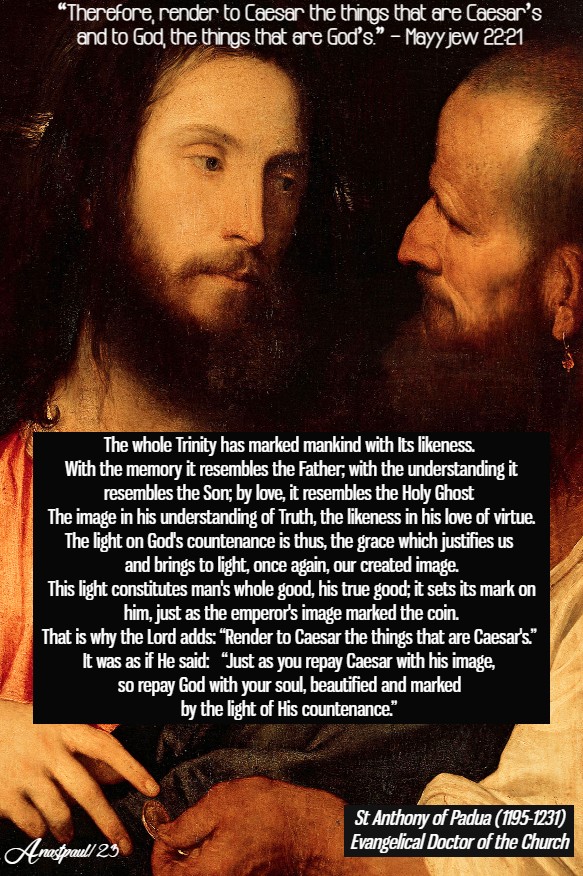
“And Jesus said to them, “Whose likeness and inscription is this?” They said, “Caesar’s.” Then he said to them, “Therefore, render to Caesar the things that are Caesar’s and to God, the things that are God’s.” – Matthew 22:20-21
REFLECTION – “Just as this coin bears the image of Caesar, so our soul is in the image of the Blessed Trinity, as one of the Psalms says: “The light of Thy countenance, has been imprinted upon us” (4:6 LXX) … Lord, the light of Your countenance that is to say, the light of Your grace that sets Your image within us and makes us become like You, has been imprinted upon us, imprinted in our rational faculty which is the highest power of our soul and receives this light as wax receives the mark of a seal. God’s countenance is our reason because, just as we recognise someone by his face, so we recognise God through the mirror of reason. However, this reason has been deformed by human sin, since sin sets us against God. The grace of Christ has put our reason right. Hence, the Apostle Paul says to the Ephesians: “Be renewed in your minds” (4:23). The light in question, in the Psalm [above], is thus the grace which restores God’s image imprinted in our nature …
The whole Trinity has marked mankind with Its likeness. With the memory it resembles the Father; with the understanding it resembles the Son; by love, it resembles the Holy Ghost … From the beginning of creation man was made “in the image and likeness of God” (Gn 1:26). The image in his understanding of Truth, the likeness in his love of virtue. The light on God’s countenance is thus, the grace which justifies us and brings to light, once again, our created image. This light constitutes man’s whole good, his true good; it sets its mark on him, just as the emperor’s image marked the coin.That is why the Lord adds: “Render to Caesar the things that are Caesar’s.” It was as if He said: “Just as you repay Caesar with his image, so repay God with your soul, beautified and marked by the light of His countenance.”– St Anthony of Padua (1195-1231) Franciscan, Evangelical Doctor of the Church (Sermons for Sundays and Feasts of the Saints).
PRAYER – O God, our refuge and our strength, the very source of holiness, heed the devout prayers of Thy Church and grant that what we seek in faith, we may obtain in fact. Through Jesus Christ, Thy Son our Lord, Who lives and reigns with Thee, in the unity of the Holy Ghost, God, world without end. Amen (Collect).
One Minute Reflection – 5 October – “The Month of the Most Holy Rosary and of the Angels” – Hebrews 10:32-38, Luke 12:1-8 – Scripture search here: https://www.drbo.org/
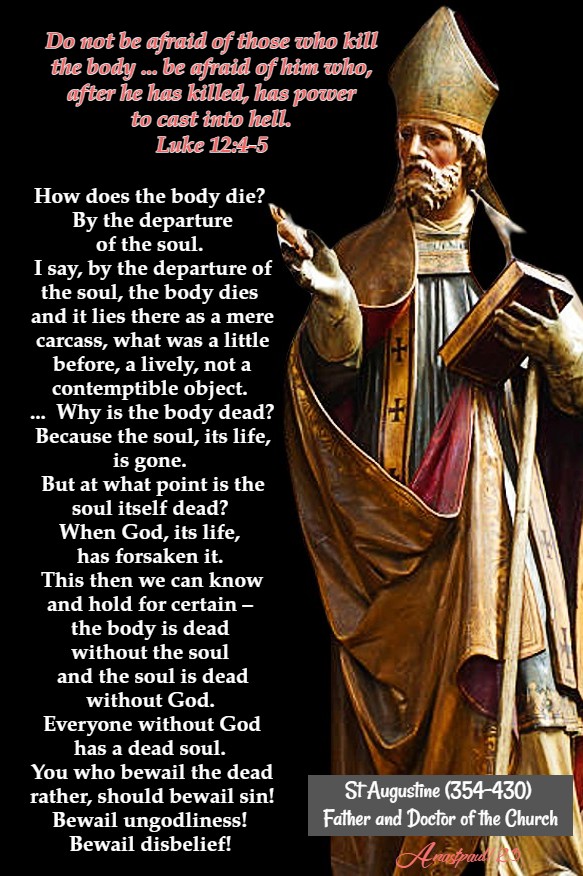
“Do not be afraid of those who kill the body and after that have nothing more that they can do. … be afraid of him who, after he has killed, has power to cast into hell. ” – Luke 12:4-5
REFLECTION – “The Gospel is life. Impiety and infidelity are the death of the soul. So then, if the soul can die, how then is it yet immortal? Because, there is always a dimension of life in the soul which can never be extinguished. And how does it die? Not in ceasing to be life but by losing its proper life. For the soul is both life to something else and it has it own proper life. Consider the order of the creatures. The soul is the life of the body. God is the life of the soul. As the life that is the soul, is present with the body that the body may not die, so the life of the soul (God), ought to be with the soul that it may not die.
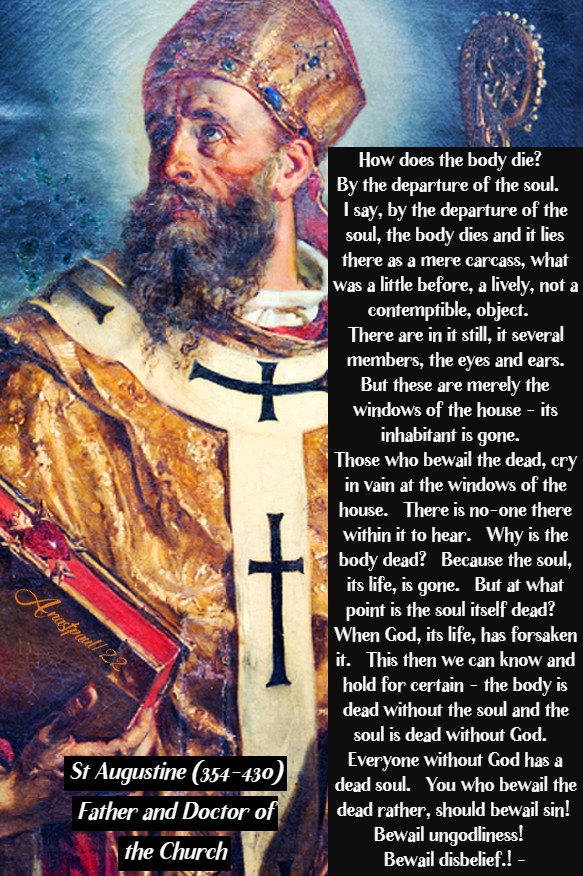
How does the body die? By the departure of the soul. I say, by the departure of the soul, the body dies and it lies there as a mere carcass, what was a little before, a lively, not a contemptible object. There are in it still, its several members, the eyes and ears. But these are merely the windows of the house – its inhabitant is gone. Those who bewail the dead, cry in vain at the windows of the house. There is no-one there within it to hear. Why is the body dead? Because the soul, its life, is gone. But at what point is the soul itself dead? When God, its life, has forsaken it. This then we can know and hold for certain – the body is dead without the soul and the soul is dead without God. Everyone without God has a dead soul. You who bewail the dead rather, should bewail sin! Bewail ungodliness! Bewail disbelief! – St Augustine (354-430) Bishop of Hippo, Father and Doctor of the Church (Sermon 65).
PRAYER – Grant, we beseech Thee, O Lord God, unto all Thy servants, that they may remain continually in the enjoyment of soundness, both of mind and body and by the glorious intercession of the Blessed Mary, always a Virgin, maybe delivered from present sadness and enter into the joy of Thine eternal gladness. Through Jesus Christ, Thy Son our Lord, Who lives and reigns with Thee, in the unity of the Holy Ghost, God, world without end. Amen (Collect).
26 August – Feast of Salus Infirmorum / Our Lady, Health of the Sick – Saturday before the last Sunday in August:
Salus Infirmorum / Our Lady, Health of the Sick By Cardinal Alexis Henri Marie Lepicier OSM (1863-1936) Prefect of the Sacred Congregation for Religious
“And I perfumed my dwelling as storax and galbanum and onyx and aloes and as the frankincense not cut and my odour is, as the purest balsam.“” (Ecclus 24:21)
Salus Infirmorum
The sin of our first parents not only deprived man of original justice and of all the gifts consequent thereon; it reduced him, furthermore, to a state of great weakness, so that it is impossible for us to accomplish works of supernatural value, without a special grace. Fallen man is like one sick, who has no relish for any nourishment, whatever. He is deficient in vital energy and his actions are wanting, in that vigour which naturally belongs to a healthy person. He is strongly inclined to vice and finds the practice of virtue tedious and difficult!
This natural incapacity regarding the performance of good works, is further increased, by actual sin, whether mortal or venial. The former, by depriving the soul of divine grace which is the principle of spiritual life, hinders man from doing anything pleasing to God, so as to merit eternal happiness. The latter, venial sin, by diminishing the fervour of charity, makes the practice of virtue labourious, since charity has for its effect, precisely to facilitate the performanc, of what is good. Sin is, therefore, a great evil because, if mortal, it saps altogetherthe spiritual energy of the soul and if venial, it notably weakens it. If, from individuals we pass onto nations, we perceive that sin, like a subtle poison, eats into the heart of them, weakening and preparing their ruin.
Divine bounty, which for bodily ailments, has procured us efficacious remedies, is not less industrious in providing the means to heal our spiritual maladies. With the Sacraments instituted by Jesus Christ, to restore our souls to grace or to augment it within us, God has also been pleased to grant us, in Mary’s aid, a potent remedy for our spiritual infirmities. In fact, Our Lady has not only given us Jesus Christ, the Shepherd and Physician of our souls but, furthermore, she watches over us as a tender mother does, by the cradle of an ailing child.
Besides this, Our Lady’s example encourages us in our conflict with the devil. For she is the Immaculate Virgin, who never was defiled by sin. Her sweet soul was always filled with the perfume of the noblest virtues.
Mary never ceases also to hearken to the voice of our supplications and to present them before the throne of God, often anticipating our requests and obtaining for us, through her own merits and those of Jesus Christ, all the helps necessary to us in our spiritual needs.
And what Our Lady does for individuals, she also does for whole nations. As a pity-full Queen, she succours them in their distress; she raises them from their bed of sickness and is, for them, a bulwark of defence (Cant. 8:10).
Our Lady’s power and motherly care not only embrace spiritual miseries: they also extend to the ills of the body. How often do we see Our Lady restoring health to the sick, who have recourse to her with filial confidence!
In Our Lady’s readiness to alleviate bodily ailments, shines forth, most splendidly, God’s love for her. It seems as if the Most High had placed no limit to the efficacy of His Mother’s intercession. While other saints are invoked only in particular cases of corporal infirmity, Our Lady’s power, on the other hand, is exercised over every kind of malady. Hence, we may say that, at her word, as once at the word of Jesus, the blind see, the lame walk, the lepers are cleansed and the deaf hear (Mt 11:5). The sole difference is that Jesus Christ, being God, wrought these miracles of His own personal authority, while Our Lady, obtains for us, of the Divine Clemency, the graces she asks, by virtue of the efficacy of her intercession with God.
However, although Our Lady is so powerful in curing all bodily ailments, yet, she does not always deliver her clients from every such trial because, God sees best to exercise them in patience that they may, thereby, win the reward prepared for them in Heaven. But when Our Lady does not restore bodily health, yet, for all that, she never ceases to act the part of a tender Mother toward us, watching over us and obtaining for us, in place of bodily strength, resignation to the divine will and interior peace – two sovereign means of sanctification and salvation!
Thought for the Day – 4 August – Meditations with Antonio Cardinal Bacci (1881-1971)
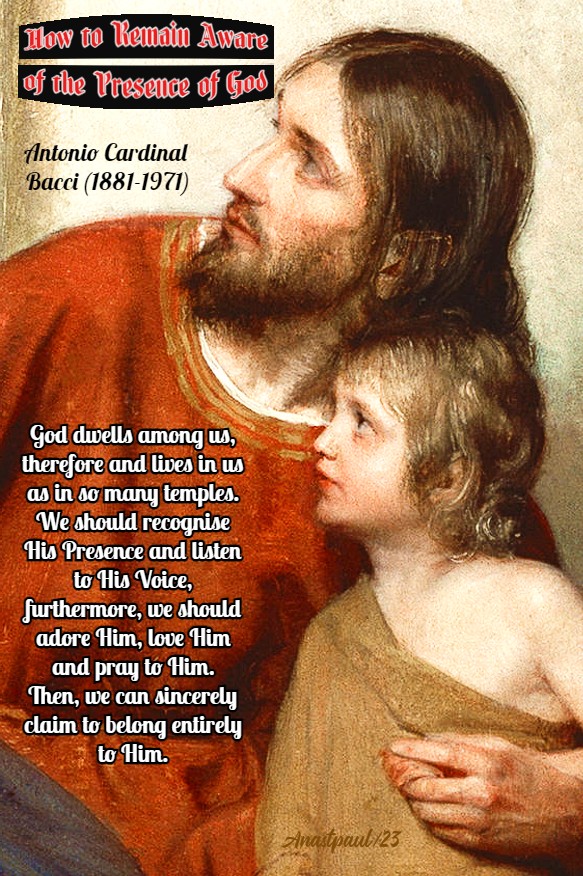
How to Remain Aware of the Presence of God
“The third way of remaining attentive to the Presence of God is to contemplate Him living in ourselves. While it is true that God is present everywhere, He dwells in a special manner in the human soul which is the masterpiece of creation!
When our souls are adorned with His grace, His delight in us is unbounded. “I will dwell and move among them. I will be their God and they shall be My people” (2 Cor 6:16). “Do you not know that you are the temple of God and that the Spirit of God dwells in you” (1 Cor 3:16).
God dwells among us, therefore and lives in us as in so many temples. We should recognise His Presence and listen to His Voice, furthermore, we should adore Him, love Him and pray to Him. Then, we can sincerely claim to belong entirely to Him.”
Quote/s of the Day – 10 June – “The Month of the Sacred Heart of Jesus” – Within the Octave of Corpus Christi – 1 Corinthians 23-29, John 6:56-59 – Scripture search here: https://www.drbo.org/
“He who eats My Flesh and drinks My Blood, abides in Me and I in him.”
John 6:57
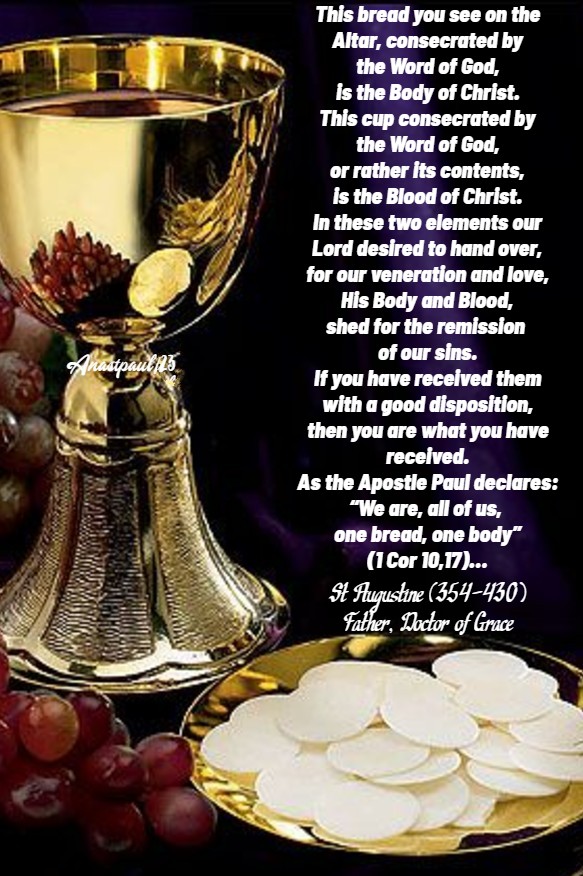
“This bread you see on the Altar, consecrated by the Word of God, is the Body of Christ. This cup consecrated by the Word of God, or rather its contents, is the Blood of Christ. In these two elements our Lord desired to hand over, for our veneration and love, His Body and Blood, shed for the remission of our sins. If you have received them with a good disposition, then you are what you have received. As the Apostle Paul declares: “We are, all of us, one bread, one body” (1 Cor 10,17)…”
St Augustine (354-430) Father, Doctor of Grace
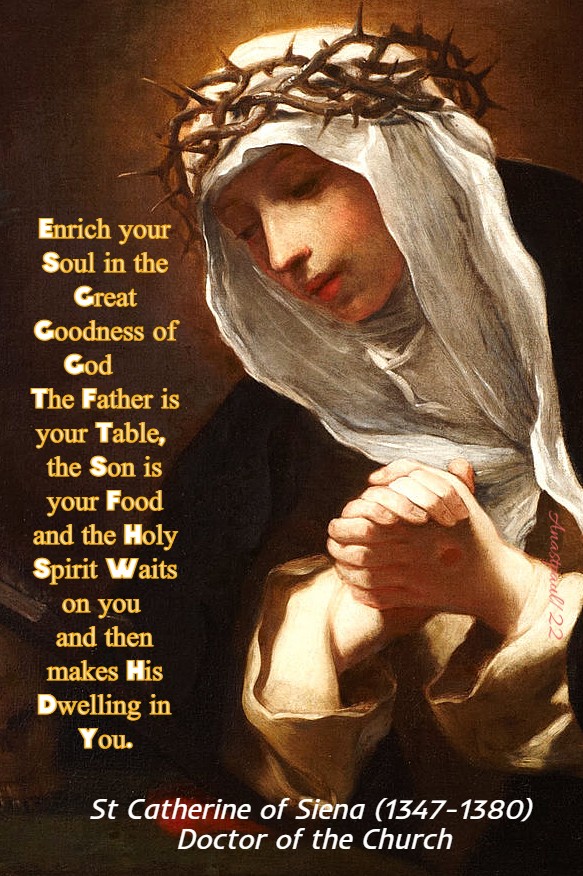
“Enrich your soul in the great goodness of God – The Father is your Table, the Son is your Food and the Holy Spirit waits on you and then makes His Dwelling in you.”
St Catherine of Siena OP (1347-1380) Doctor of the Church
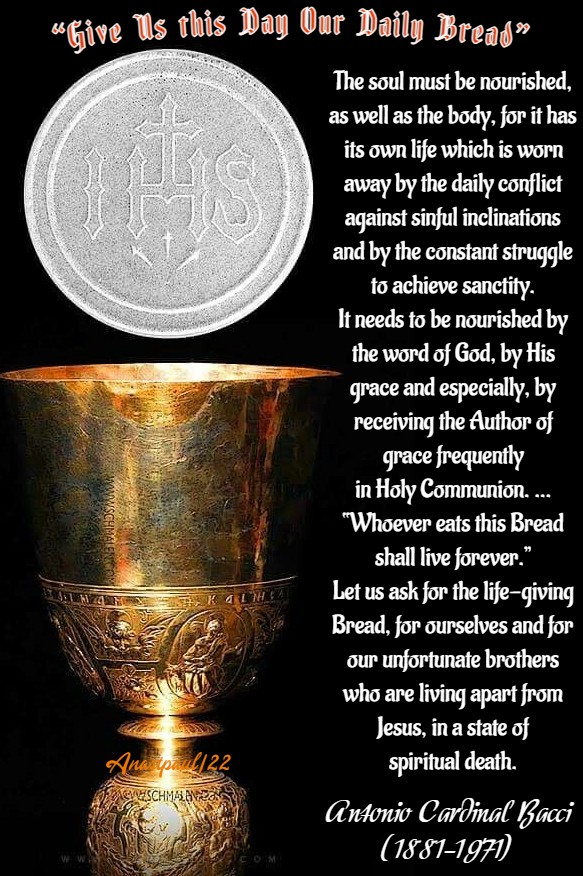
“The soul must be nourished, as well as the body, for it has its own life which is worn away by the daily conflict against sinful inclinations and by the constant struggle to achieve sanctity. It needs to be nourished by the word of God, by His grace and especially, by receiving the Author of grace frequently in Holy Communion. … “Whoever eats this Bread shall live forever.” Let us ask for the life-giving Bread, for ourselves and for our unfortunate brothers who are living apart from Jesus, in a state of spiritual death.”
Thought for the Day – 9 March – Meditations with Antonio Cardinal Bacci (1881-1971)
The Human Soul
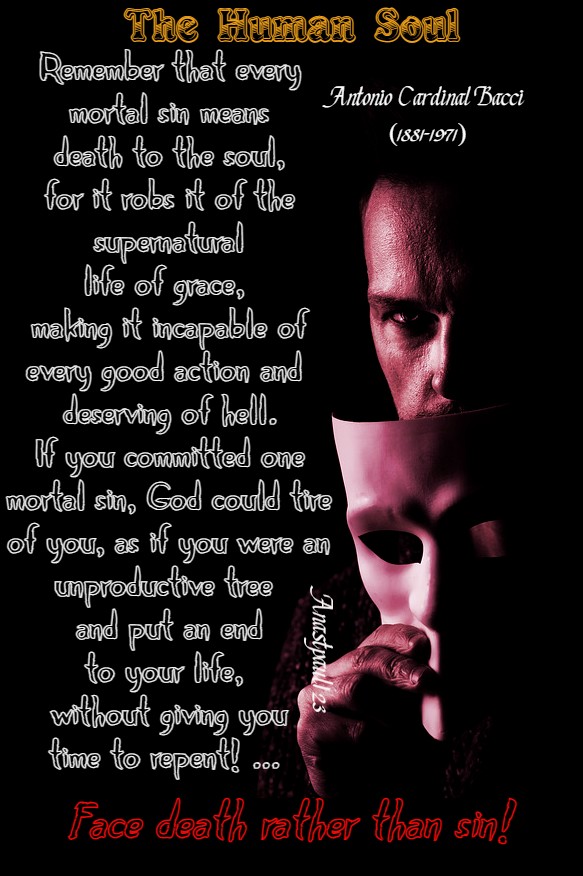
“Remember that every mortal sin means death to the soul, for it robs it of the supernatural life of grace, making it incapable of every good action and deserving of hell. If you committed one mortal sin, God could tire of you, as if you were an unproductive tree and put an end to your life, without giving you time to repent! Then, you would be lost for all eternity. This thought should never leave your mind, particularly in time of temptation. At such a time, turn to God with confidence, tell Him that you love Him and do not wish to offend Him at any price. Face death rather than sin.”
Our Lenten Journey with St Francis de Sales – 6 March – Ecclesiasticus Sirach 51:13-17, Matthew 13:44-52 – Scripture search here: https://www.drbo.org/
“The Kingdom of Heaven is like a treasure …” Matthew 13:44
“Again, the Kingdom of Heaven is like a merchant in search of fine pearls. When he finds a single pearl of great price, he goes and sells all that he has and buys it.” Matthew13:45-46
HEAVENLY TREASURE St Francis de Sales (1567-1622) Doctor Caritas
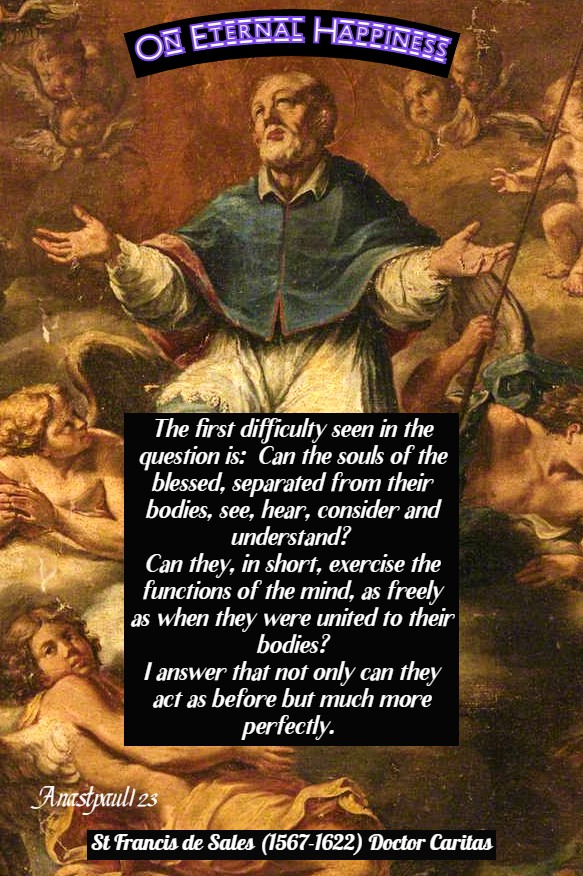
“The first difficulty seen in the question is: Can the souls of the blessed, separated from their bodies, see, hear, consider and understand? Can they, in short, exercise the functions of the mind, as freely as when they were united to their bodies? I answer that not only can they act as before but much more perfectly. And to support this theory I shall give you a story from St Augustine, an author in whom one can place complete trust. He relates that he was acquainted with a physician from Carthage who was as famous in Rome as in that City, both because he excelled in the art of medicine and because, he was a very good man, one who did many charitable works and served the poor gratis.
His charity towards his neighbour, moved God to lift him out of an error into which he had fallen as a young man. God always greatly favours those who practise charity toward their neighbour; indeed, there is nothing that draws down His mercy upon us more abundantly. Our Lord has declared it His own special commandment [Jn. 15:12], the one He loves and cherishes most. For after that of the love of God, there is none greater [Matt 22:37-40].
St Augustine recounts how this physician told him that when young, he began to doubt whether the soul, separated from the body, can see, hear, or understand anything. One day, while in this error, he fell asleep. Suddenly, a handsome young man appeared to him in his sleep and said: “Follow me.” The physician did so and his guide led him into a large and spacious field where, on one side he showed him incomparable beauties and on the other allowed him to hear a concert of delightful music. Then the physician awoke.
Some time after, the same young man again appeared to him in sleep and asked: “Do you recognise me?” The physician answered that he did indeed recognise him distinctly, that it was he who had conducted him to the beautiful field where he had heard such pleasing music. “But how can you see and recognise me?” asked the youth. “Where are your eyes?” “My eyes,” he replied, “are in my body.” “And where is your body?” “My body is lying in my bed.” “And are your eyes open or closed?” “They are closed.” “If they are closed, they can see nothing. Admit, then, since you see me even with your eyes closed, recognise me distinctly and have heard the music, even though your senses slept, that the functions of the mind do not depend on the corporal senses and that the soul, even when separated from the body, can nevertheless see, hear, consider and understand. ” Then the sacred dream ended and the youth left the physician, who never after doubted this truth.” – (Sermon for the Second Sunday of Lent, 20 February 1622).
Thought for the Day – 16 January – Meditations with Antonio Cardinal Bacci (1881-1971)
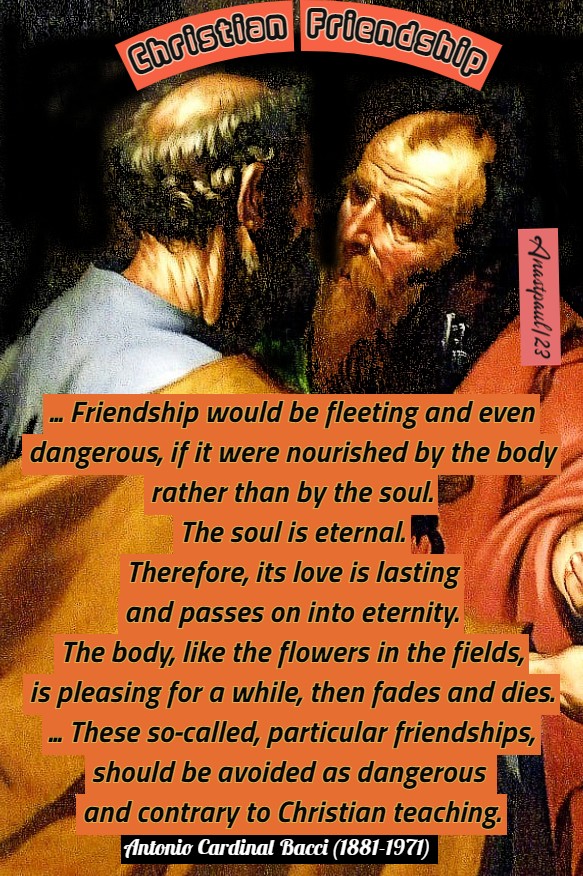
Christian Friendship
“Forget the series of useless and often academic questions which the philosophers asked concerning the nature of friendship. Cicero’s definition, however, is worth recording because it is not far from the Christian concept of friendship. Friends, he says, are those who are united by a bond of affection and of agreement in matters of spiritual and human importance. True friendship is the result of a mysterious and mutual attraction between two persons, who grow to know, respect and love one another (De Amicitia VI).
Thus, friendship would be fleeting and even dangerous, if it were nourished by the body rather than by the soul. The soul is eternal. Therefore, its love is lasting and passes on into eternity. The body, like the flowers in the fields, is pleasing for a while, then fades and dies. St Augustine tells us, in his Confessions that he was passionately attached to a young man of his own age, who was blooming with the flower of adolescence. But he adds, immediately, that this was not a genuine friendship because it did not spring from the charity which the Spirit of God pours into our hearts (Confessions IV, 4:7). These so-called, particular friendships, should be avoided as dangerous and contrary to Christian teaching.”
Quote/s of the Day – 13 January – Octave Day of Epiphany – Isaias 60:1-6, John 1:29-34 – Scripture search here: https://www.drbo.org/
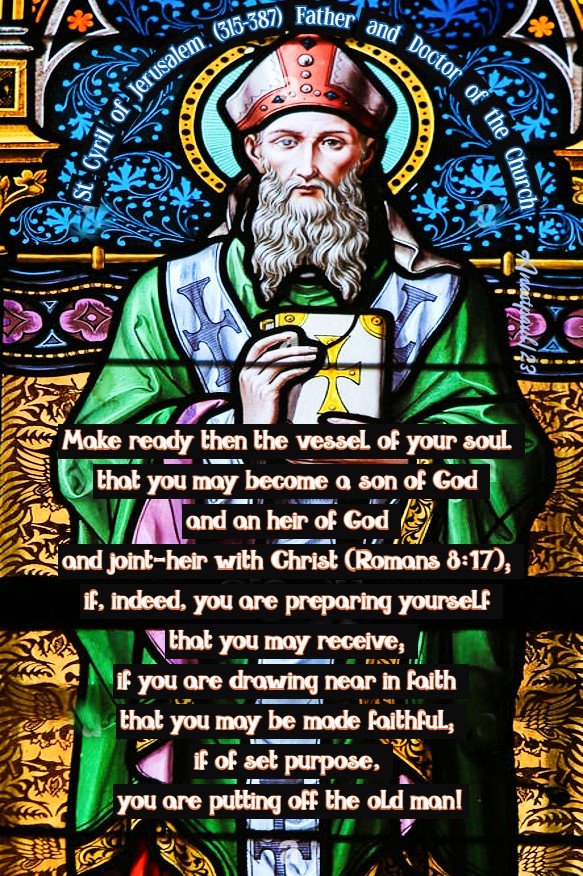
“Make ready then the vessel of your soul that you may become a son of God and an heir of God and joint-heir with Christ (Romans 8:17); if, indeed, you are preparing yourself that you may receive; if you are drawing near in faith that you may be made faithful; if of set purpose, you are putting off the old man!”
St Cyril of Jerusalem (315-387) Father and Doctor of the Church
“Let us become like Christ, since Christ became like us. He assumed the worse, that He might give us the better; He became poor, that we through His poverty, might be rich.”
St Gregory of Nazianzen (330-390) Father and Doctor of the Church
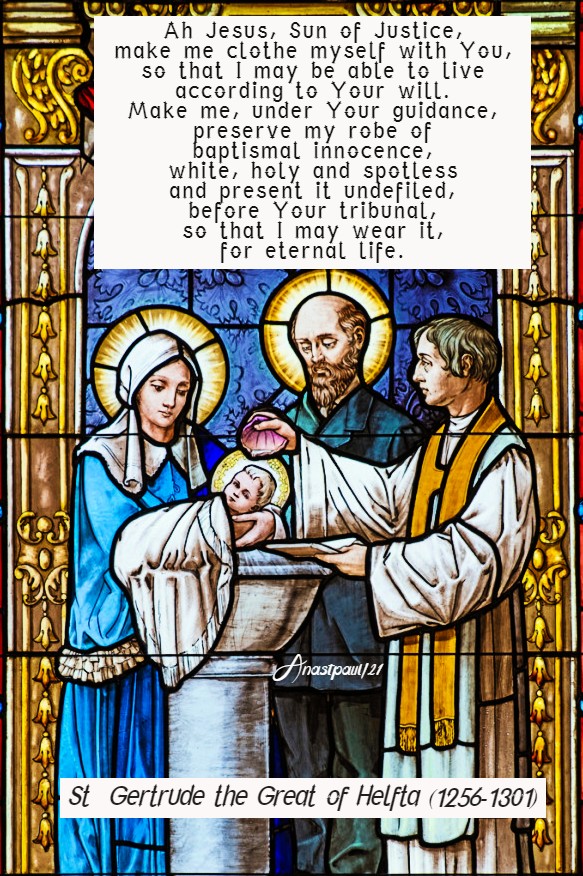
“Ah Jesus, Sun of Justice, make me clothe myself with You, so that I may be able to live according to Your will. Make me, under Your guidance, preserve my robe of Baptismal innocence, white, holy and spotless and present it undefiled, before Your tribunal, so that I may wear it, for eternal life.”
St Gertrude the Great of Helfta (1256-1301)
“If we wish to make any progress in the service of God, we must begin everyday of our life, with new eagerness. We must keep ourselves, in the presence of God, as much as possible and have no other view or end, in all our actions but the divine honour.”
St Charles Borromeo (1538-1584)
“Anyone who takes life seriously in the Christian sense, will regard it as a difficult journey towards perfection and towards God. This journey will be, at the same time, painful and joyful. … It is our own loss if we sit down lazily on the side of the road, which should lead us to Heaven. It is even more disastrous, if we acknowledge defeat and lay down the spiritual weapons of prayer and renunciation, in order to surrender ourselves to sin or to indifference. Everyday we should say to ourselves, in the presence of God – A new life is beginning … in You, by Your grac and for You! Amen”
Quote/s of the Day – 22 November – St Cecilia Died 3rd Century) Virgin Martyr – Ecclesiasticus 51:13-17, Matthew 25:1-13 – Scripture search here: https://www.drbo.org/
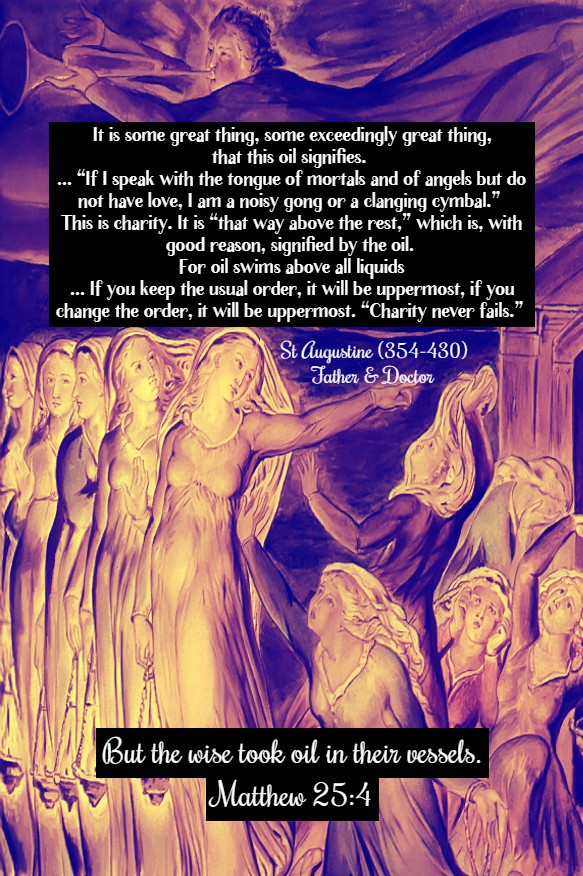
“But the wise took oil in their vessels”
Matthew 25:4
“The Apostle says, “I will show you a still more excellent way.” “If I speak with the tongue of mortals and of angels but do not have love, I am a noisy gong or a clanging cymbal.” This is charity. It is “that way above the rest,” which is, with good reason, signified by the oil. For oil swims above all liquids. Pour in water and pour in oil upon it, the oil will swim above. If you keep the usual order, it will be uppermost, if you change the order, it will be uppermost. “Charity never fails!”
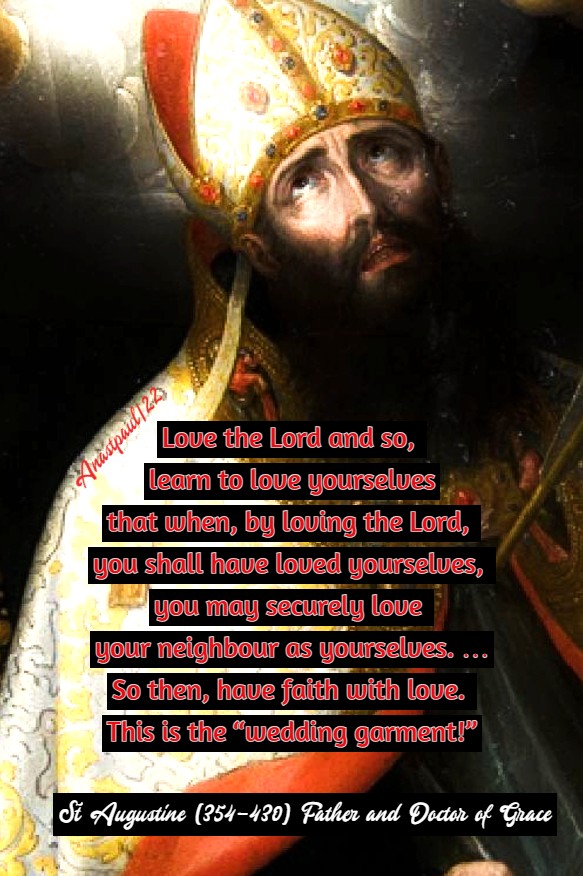
“Love the Lord and so, learn to love yourselves that when, by loving the Lord, you shall have loved yourselves, you may securely love your neighbour as yourselves. … So then, have faith with love. This is the “wedding garment!”
St Augustine (354-430) Father and Doctor of Grace
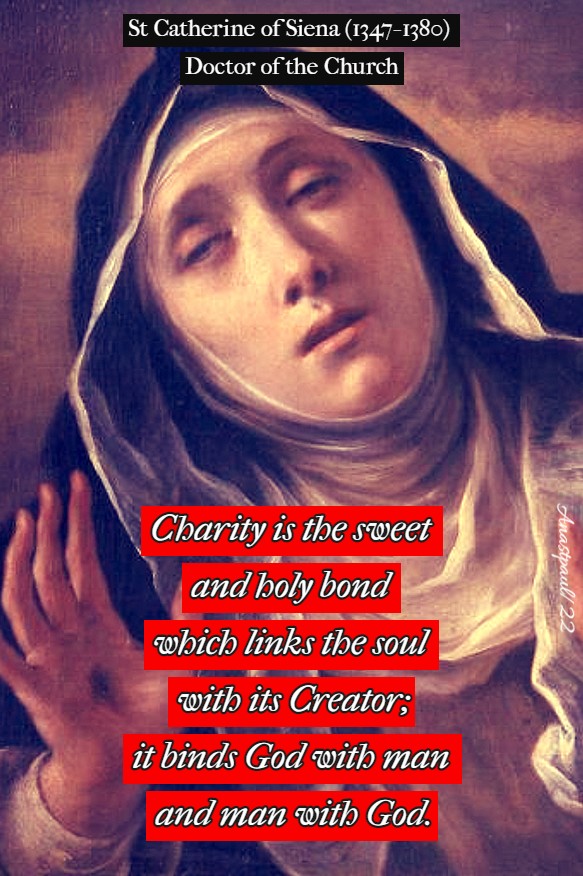
“Charity is the sweet and holy bond which links the soul with its Creator; it binds God with man and man with God.”
St Catherine of Siena OP (1347-1380) Doctor of the Church
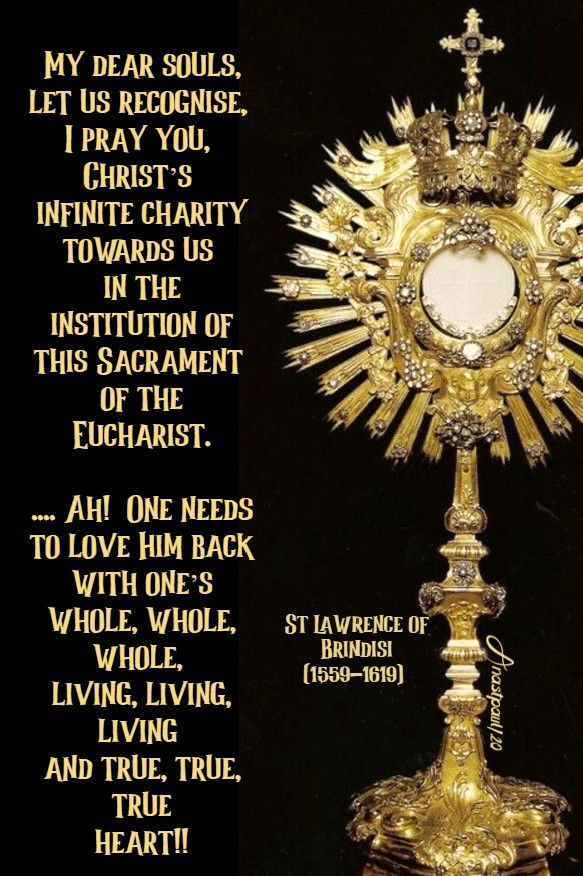
“My dear souls, let us recognise, I pray you, Christ’s infinite charity towards us in the institution of this Sacrament of the Eucharist. In order that our love be a spiritual love, He wills a new heart, a new love, a new spirit for us. It is not with a carnal heart but with a spiritual one, that Christ has loved us with a gratuitous love, a supreme and most ardent love, by way of pure grace and charity. Ah! One needs to love Him back with one’s whole, whole, whole, living, living, living and true, true, true heart!”
St Lawrence of Brindisi(1559-1619)
“Humility and charity are the two master chords – one, the lowest; the other, the highest; all the others are dependent on them. Therefore, it is necessary, above all. to maintain ourselves in these two virtues, for observe well, that the preservation of the whole edifice depends on the foundation and the roof!”
St Vincent de Paul (1581-1660)
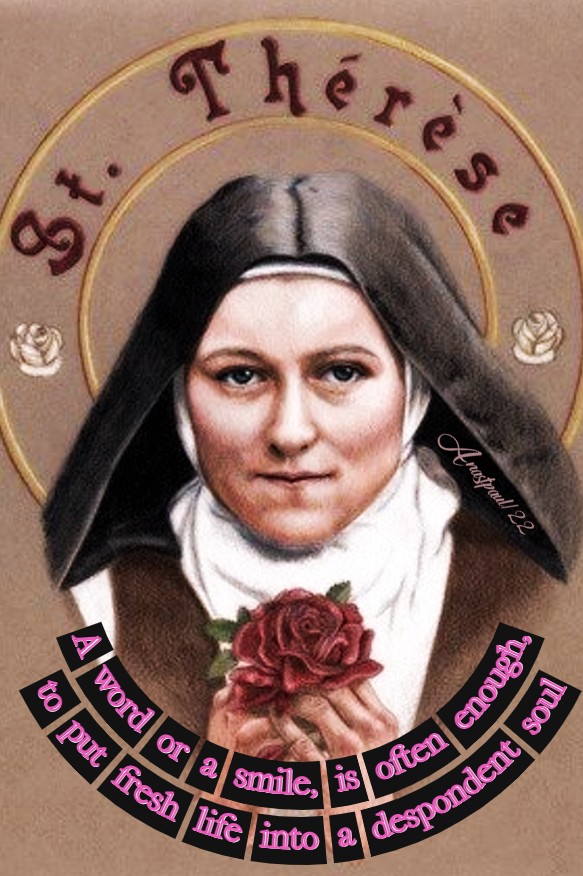
“A word or a smile, is often enough, to put fresh life into a despondent soul.”
St Therese of the Child Jesus and the Holy Face (1873-1897) Doctor of the Church
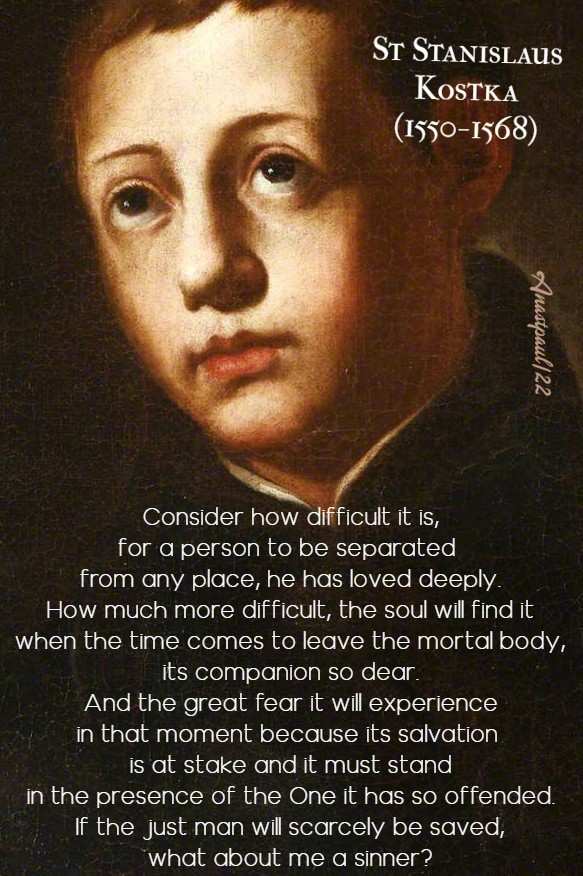
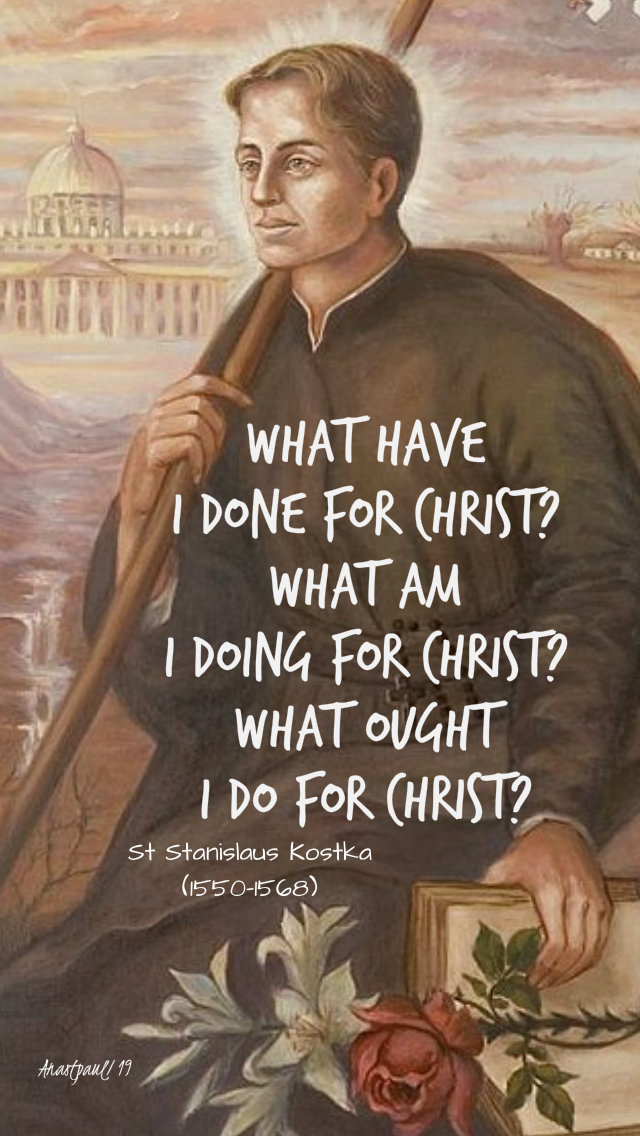
Quote/s of the Day – 13 November – St Stanislaus Kostka SJ (1550-1568) Jesuit Novice
“Consider how difficult it is, for a person to be separated from any place, he has loved deeply. How much more difficult, the soul will find it when the time comes to leave the mortal body, its companion so dear. And the great fear it will experience in that moment because its salvation is at stake and it must stand in the presence of the One it has so offended. If the just man will scarcely be saved, what about me a sinner?”
“What have I done for Christ? What am I doing for Christ? What ought I do for Christ?”
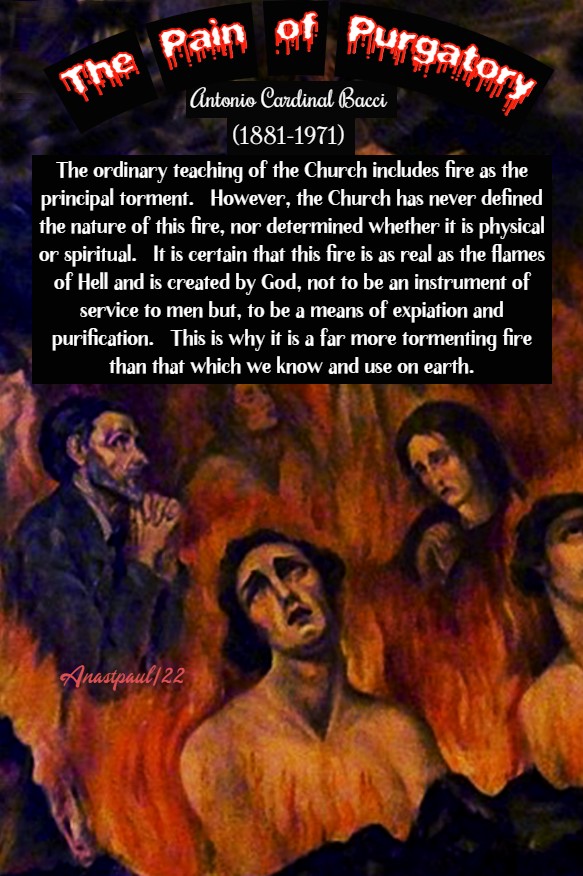
Thought for the Day – 3 November – Meditations with Antonio Cardinal Bacci (1881-1971)
The Pain of Purgatory
“In the course of her vivid description of Purgatory, St Catherine of Genoa writes: “The suffering souls experience such torments as the human tongue could not describe, nor the human intellect comprehend, unless God Himself, revealed them by means of a special grace!”
The ordinary teaching of the Church includes fire as the principal torment. However, the Church has never defined the nature of this fire, nor determined whether it is physical or spiritual. It is certain that this fire is as real as the flames of Hell and is created by God, not to be an instrument of service to men but, to be a means of expiation and purification. This is why it is a far more tormenting fire than that which we know and use on earth. St Thomas Aquinas holds that it is actually a physical fire. He meets the objection that material fire could never touch a spiritual soul by saying that, even as the soul is affected on earth, by the suffering of the body, to which it is joined, so it can be subject in the next life, to the action of the fires of Purgatory (Supplementum Tertiae Partis q7, a3).”
Quote/s of the Day – 27 October – Vigil of Saints Simon and Jude – 1 Corinthians 4:9-14, John 15:1-7 – Scripture search here: https://www.drbo.org/
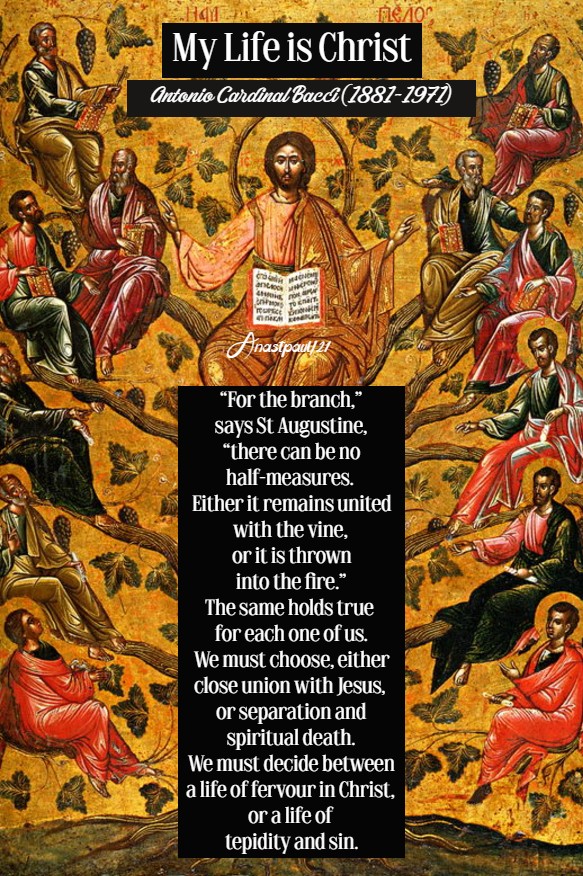
“I am the vine, you the branches; whoever remains in me and I in him, the same bears much fruit; for without Me you can do nothing.”
John 15:5
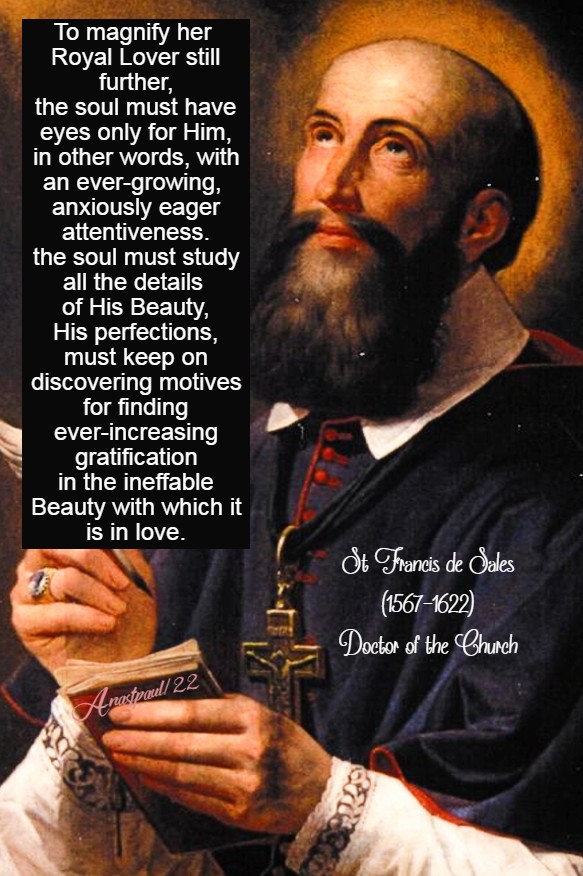
“To magnify her Royal Lover still further, the soul must have eyes only for Him, in other words, with an ever-growing, anxiously eager attentiveness. the soul must study all the details of His Beauty, His perfections, must keep on discovering motives for finding ever-increasing gratification in the ineffable Beauty with which it is in love.”
St Francis de Sales (1567-1622) Doctor of the Church
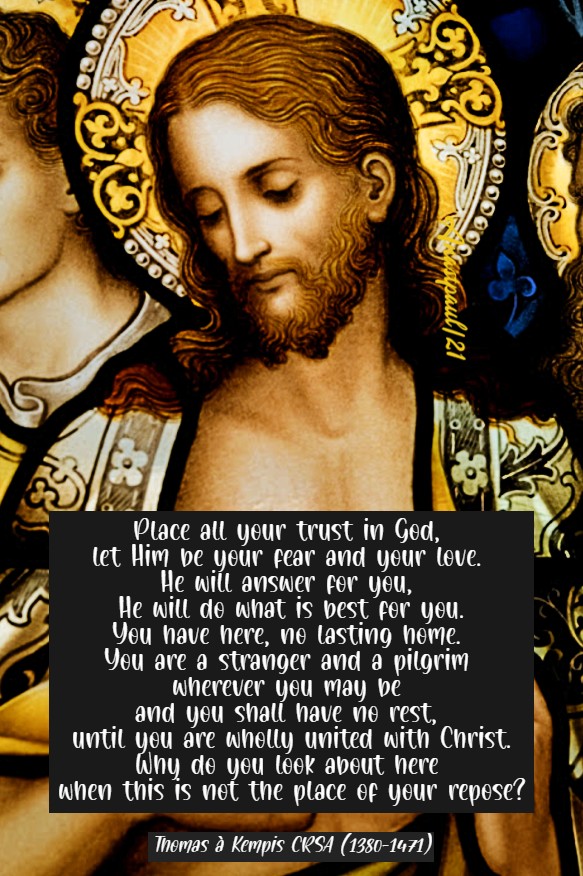
“Place all your trust in God, let Him be your fear and your love. He will answer for you, He will do what is best for you. You have here no lasting home. You are a stranger and a pilgrim wherever you may be and you shall have no rest, until you are wholly united with Christ. Why do you look about here when this is not the place of your repose?”
Thomas à Kempis CRSA (1380-1471)
“For the branch,” says St Augustine, “there can be no half-measures. Either it remains united with the vine, or it is thrown into the fire.” The same holds true for each one of us. We must choose, either close union with Jesus, or separation and spiritual death. We must decide between a life of fervour in Christ, or a life of tepidity and sin.”
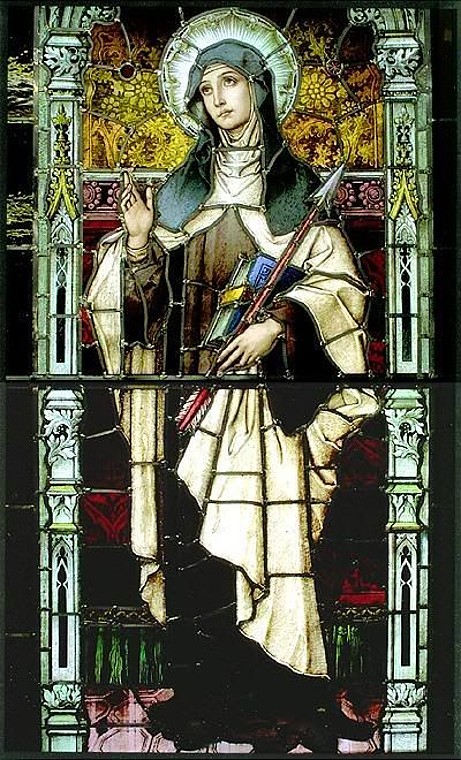
Saint of the Day – 15 October – St Teresa of Jesus of Avila OCD (1515-1582) Virgin and Doctor of the Church
Practical Considerations On the Life of Saint Teresa By Fr Francis Xavier Weninger SJ (1805-1888)
I. Teresa began in early youth, after the teachings of her pious parents, to read devout books. From this, she first drew the spirit of piety. No sooner, however, had she become interested in reading worldly books, than she grew, from day-to-day, more indolent in the service of God and she returned, not to her first fervour, until she had cast aside those works and again resumed her pious reading – a proof of the great benefit we may derive from devout books and of the harm which worldly writings may do us. Oh! that those, who desire to, live piously, may understand this and conform their lives to it. Oh! that all Christians would guide their children, from their early youth, to the reading of devout books!
II. Teresa, after the death of her mother, chose the Blessed Virgin to be another mother to her, and sought and found, in her, comfort and assistance in all her needs. Thrugh her intercession and that of St Joseph, she received the grace of being constant in her reform. Love Mary as your mother – seek, with filial trust, consolation and assistance from her. St Joseph should be one of your principal Patrons, as his intercession is very powerful with the Almighty and, especially, as he has now been solemnly declared the Patron Saint of the Universal Church.
III. The sight of the wounded Jesus, filled the heart of St Teresa with great contrition for her former indifferent life. It inflamed her with true love of God and kept her, until her end, in these sentiments. Consider frequently how your Saviour suffered for your sake and repent of your sins sincerely, as they were the cause of Christ’s bitter Passion. Love your Redeemer with all the strength of your heart and make the resolution to serve Him in future most fervently.
IV. Teresa saw the place in hell which would have been hers, if she had not discontinued her idle discourses and her indifference in the worship of the Most High. Hence, she often gave humble thanks to God that He had not condemned her and she learned, by it, how hurtful even a menial sin can become, since it may lead us gradually to the path of everlasting perdition. You have still more reason to give thanks to God that He did not call you away, from this mortal life, in your sin. How long would you already have been in hell? If idle, empty conversation would have led Teresa gradually into hell, what may you not have to fear, if you do not abstain from so much sinful talking, in which you indulge? Learn also that you should not esteem a venial sin, however small it appears to you, as trifling, for, it may slowly lead you to damnation!
V. Many other lessons, which the life of St Teresa contains, I leave to yourself to consider. One thing only I request of you. Call to mind frequently the words which the Saint uttered in her ecstasy: “Only one God! Only one death! Only one soul! Love this only God and do not offend Him. Take earnest care of your only, your precious, your immortal soul. ‘Keep thyself, therefore and thy soul, carefully.’ (Deut., iv.)”
Quote/s of the Day – 5 October – Hebrews 10:32-38, Luke 12:1-8 Scripture search – https://www.drbo.org/
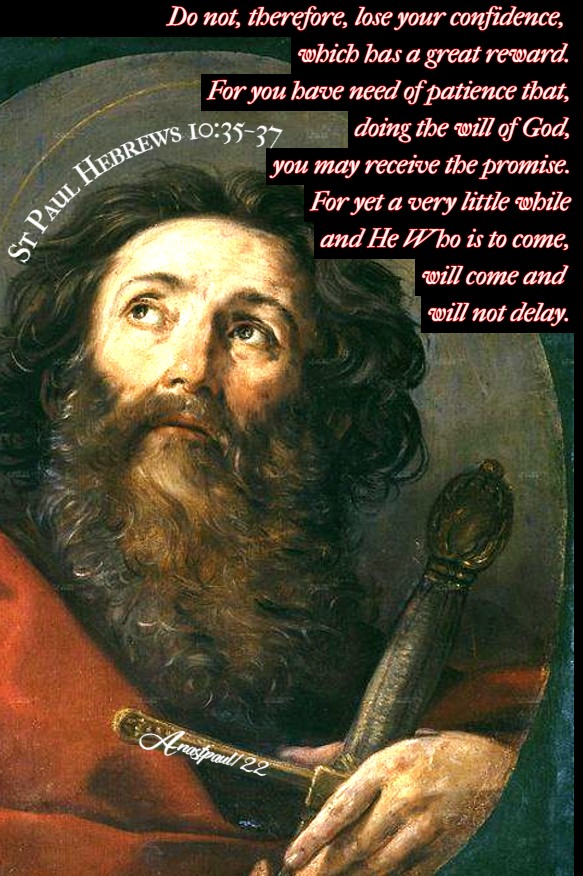
“Do not, therefore, lose your confidence, which has a great reward. For you have need of patience that, doing the will of God, you may receive the promise. For yet a very little while and He Who is to come, will come and will not delay.”
Hebrews 10:35-37
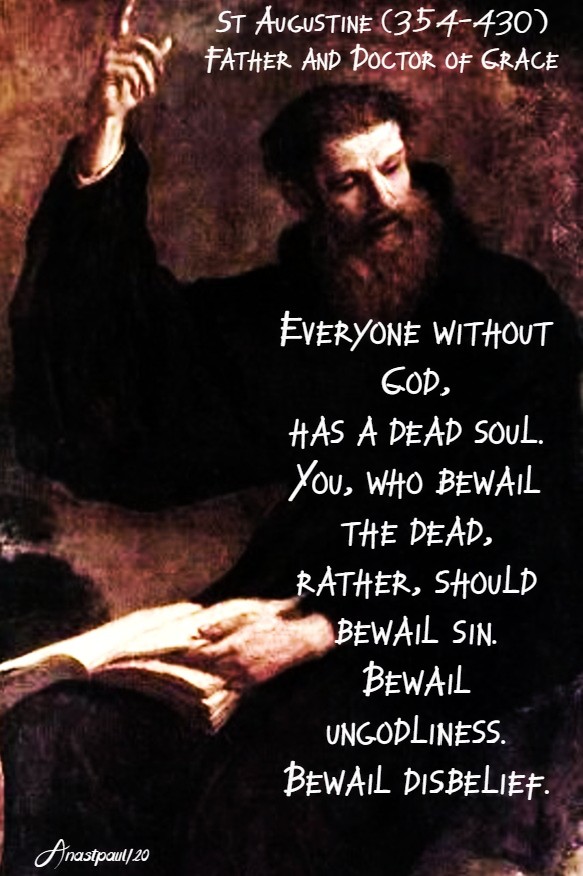
“Everyone without God, has a dead soul. You, who bewail the dead, rather, should bewail sin. Bewail ungodliness. Bewail disbelief.”
St Augustine (354-430) Father and Doctor of Grace
“We have the Providential love of God as our guide. When there is a ship at sea and heads towards the port, nobody doubts that it is led by a pilot and one could doubt that there is a God who guides the universe only because He cannot be seen? By His Providential Love, God arranges and regulates events, regulates everything, with gentleness and wisdom. I advise you to abandon yourself completely into the hands of Divine Providence. “
Blessed Edoardo Giuseppe Rosaz (1877-1903)
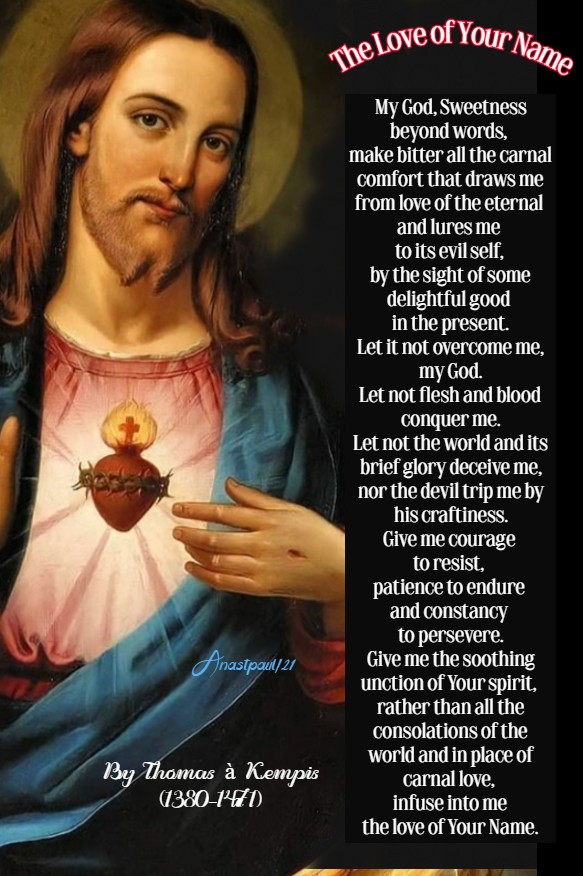
The Love of Your Name
“My God, Sweetness beyond words, make bitter all the carnal comfort that draws me from love of the eternal and lures me to its evil self, by the sight of some delightful good in the present. Let it not overcome me, my God. Let not flesh and blood conquer me. Let not the world and its brief glory deceive me, nor the devil trip me by his craftiness. Give me courage to resist, patience to endure and constancy to persevere. Give me the soothing unction of Your spirit, rather than all the consolations of the world and in place of carnal love, infuse into me the love of Your Name.”
Thomas à Kempis CRSA (1380-1471) The Imitation of Christ (Book 3 Ch 26:1-4)
One Minute Reflection – 5 October – “The Month of the Most Holy Rosary and of the Angels” – Hebrews 10:32-38, Luke 12:1-8 – Scripture search – https://www.drbo.org/
“Do not be afraid of those who kill the body, and after that have nothing more that they can do. … be afraid of him who, after he has killed, has power to cast into hell. ” – Luke 12:4-5
REFLECTION – “The Gospel is life. Impiety and infidelity are the death of the soul. So then, if the soul can die, how then is it yet immortal? Because, there is always a dimension of life in the soul which can never be extinguished. And how does it die? Not in ceasing to be life but by losing its proper life. For the soul is both life to something else and it has it own proper life. Consider the order of the creatures. The soul is the life of the body. God is the life of the soul. As the life that is the soul, is present with the body, that the body may not die, so the life of the soul (God), ought to be with the soul that it may not die.
How does the body die? By the departure of the soul. I say, by the departure of the soul, the body dies and it lies there as a mere carcass, what was a little before, a lively, not a contemptible object. There are in it still, its several members, the eyes and ears. But these are merely the windows of the house – its inhabitant is gone. Those who bewail the dead, cry in vain at the windows of the house. There is no-one there within it to hear. Why is the body dead? Because the soul, its life, is gone. But at what point is the soul itself dead? When God, its life, has forsaken it. This then we can know and hold for certain – the body is dead without the soul and the soul is dead without God. Everyone without God has a dead soul. You who bewail the dead rather, should bewail sin! Bewail ungodliness! Bewail disbelief.! – St Augustine (354-430) Bishop of Hippo, Father and Doctor of the Church (Sermon 65).
PRAYER – Grant, we beseech Thee, O Lord God, unto all Thy servants, that they may remain continually in the enjoyment of soundness, both of mind and body and by the glorious intercession of the Blessed Mary, always a Virgin, maybe delivered from present sadness and enter into the joy of Thine eternal gladness. Through Jesus Christ, Thy Son our Lord, Who lives and reigns with Thee, in the unity of the Holy Ghost, God, world without end. Amen (Collect).
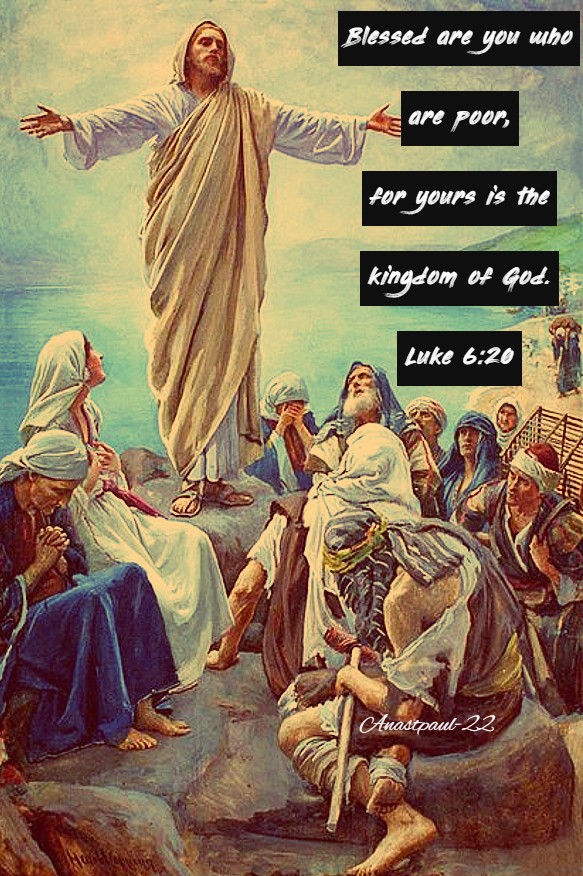
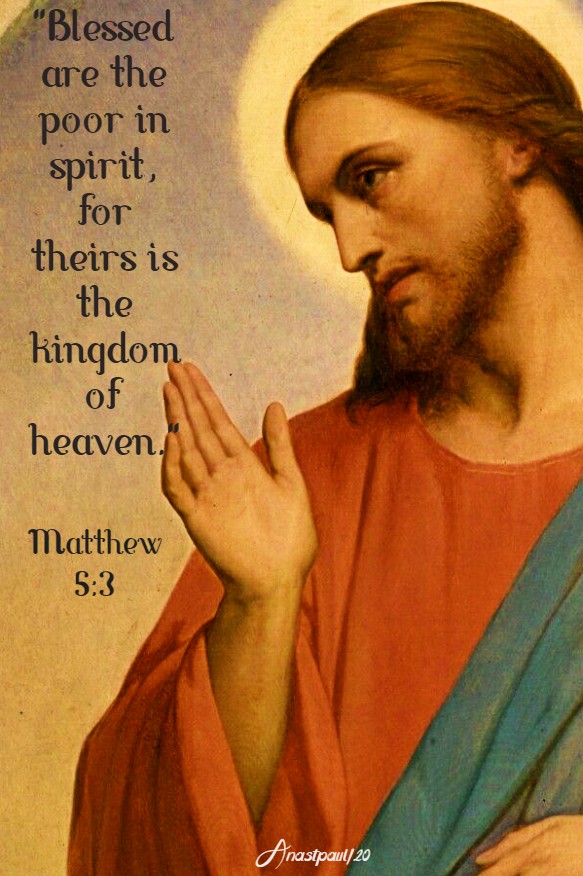
Quote/s of the Day – 27 September – Wisdpm 5:16-20, Luke 6:17-23
“Blessed are you who are poor, for yours is the Kingdom of God.”
Luke 6:20
“Blessed are the poor in spirit, for theirs is the Kingdom of Heaven.”
Matthew 5:3
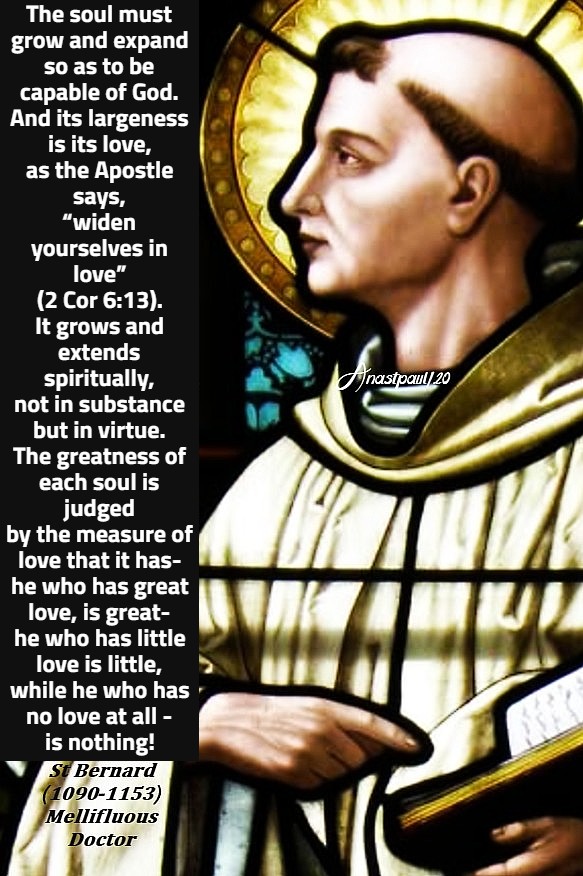
“The soul must grow and expand so as to be capable of God. And its largeness is its love, as the Apostle says, “widen yourselves in love” (2 Cor 6:13). It grows and extends spiritually, not in substance but in virtue. The greatness of each soul is judged by the measure of love that it has- he who has great love, is great- he who has little love is little, while he who has no love at all – is nothing!”
St Bernard (1090-1153) Mellifluous Doctor of the Church
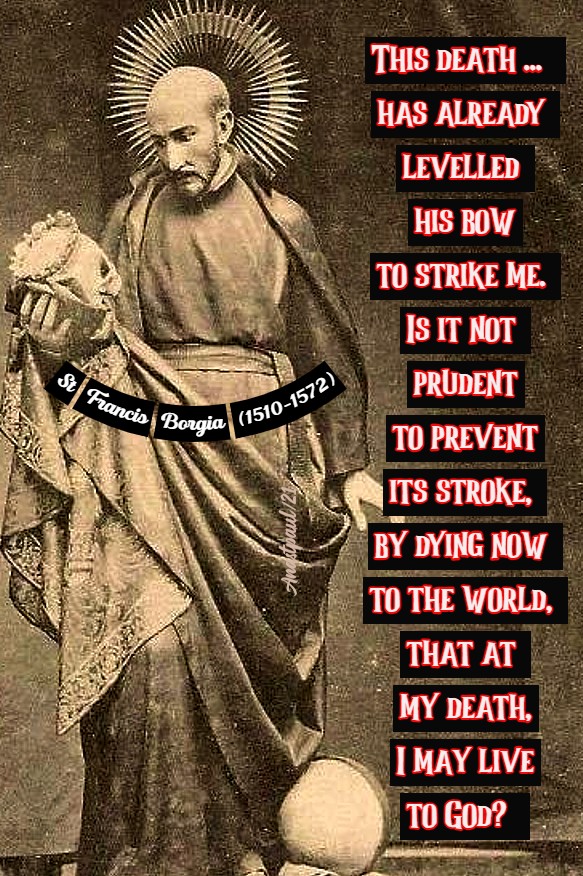
“This death … has already levelled his bow to strike me. Is it not prudent to prevent its stroke, by dying now to the world, that at my death, I may live to God?”
St Francis Borgia (1510-1572)
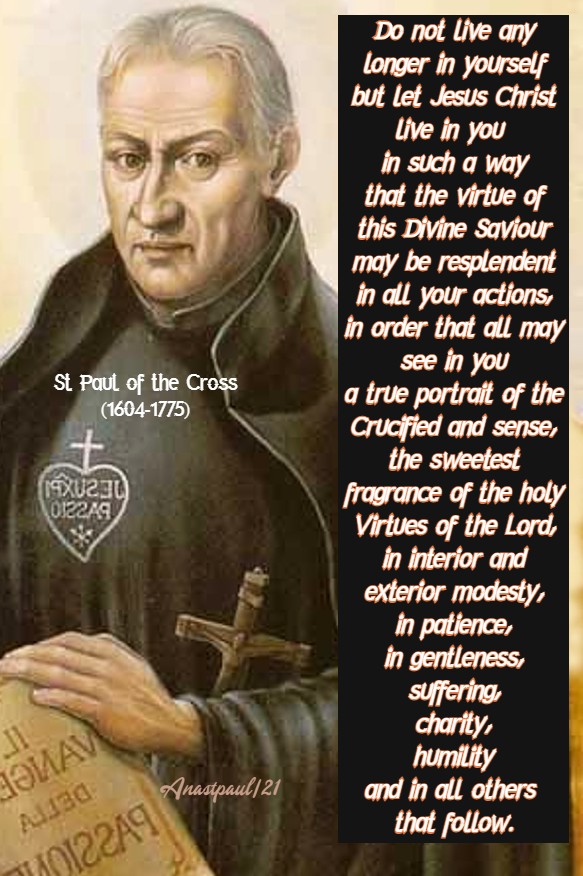
“Do not live any longer in yourself but let Jesus Christ live in you in such a way that the virtue of this Divine Saviour may be resplendent in all your actions, in order that all may see in you a true portrait of the Crucified and sense, the sweetest fragrance of the holy virtues of the Lord, in interior and exterior modesty, in patience, in gentleness, suffering, charity, humility and in all others that follow.”
St Paul of the Cross (1604-1775)
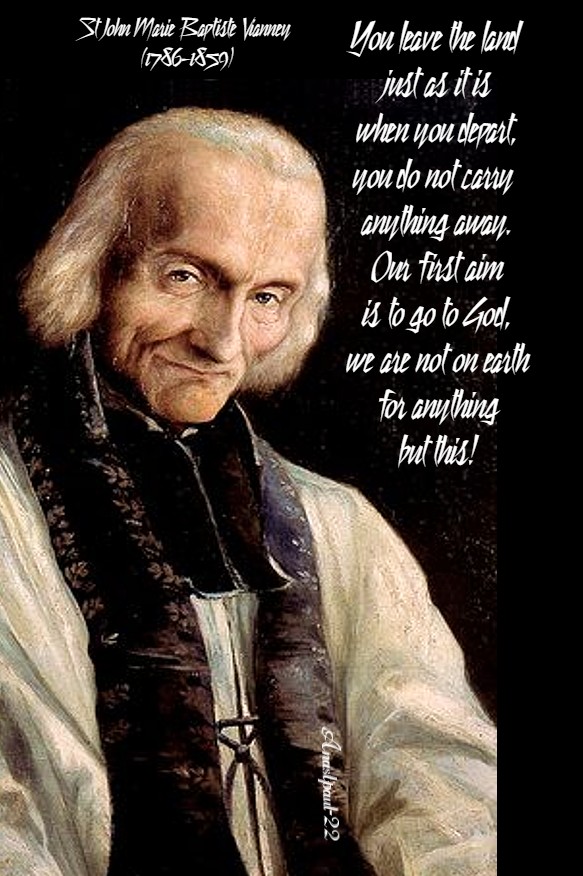
“You leave the land just as it is when you depart, you do not carry anything away. Our first aim is to go to God, we are not on earth for anything but this!”
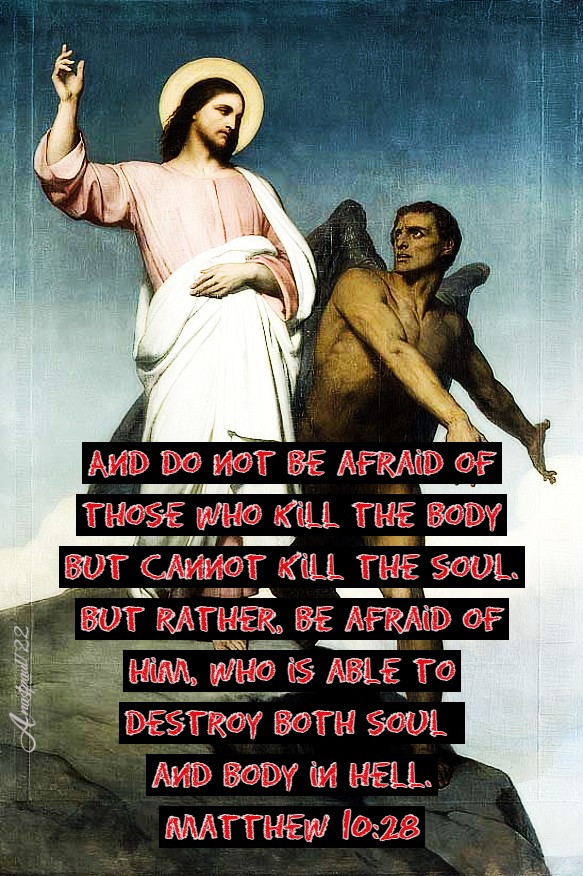
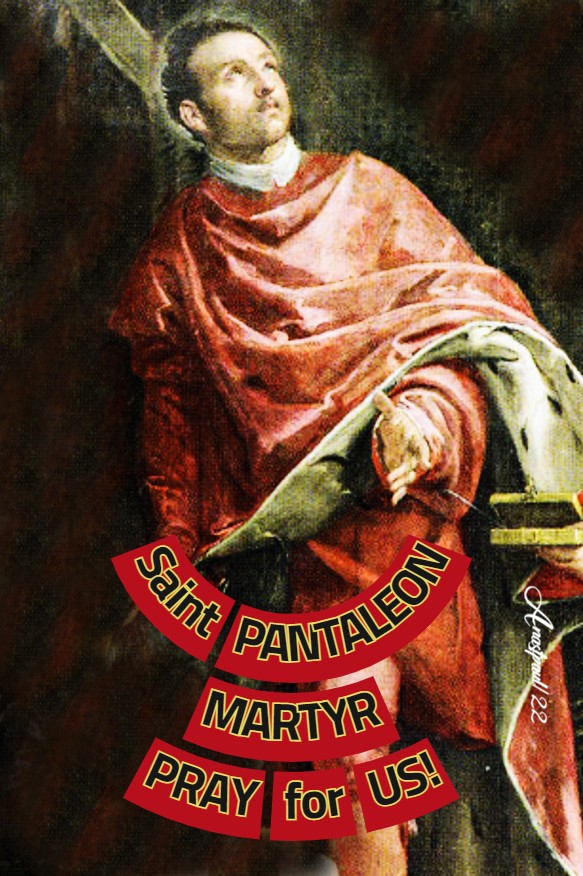
One Minute Reflection – 27 July – “The Month of the Precious Blood” – The Memorial of St Pantaleon (Died c 305) Martyr, Lay Physician, one of the Fourteen Holy Helpers – 2 Tim. 2:8-10; 3:10-12, Matthew 10:26-32
“And do not be afraid of those who kill the body but cannot kill the soul. But rather, be afraid of him, who is able to destroy both soul and body in hell.” – Matthew 10:28
REFLECTION – “The Gospel is life. Impiety and infidelity are the death of the soul. So then, if the soul can die, how then is it yet immortal? Because, there is always a dimension of life in the soul which can never be extinguished. And how does it die? Not in ceasing to be life but by losing its proper life. For the soul is both life to something else and it has it own proper life. Consider the order of the creatures. The soul is the life of the body. God is the life of the soul. As the life that is the soul, is present with the body, that the body may not die, so the life of the soul (God), ought to be with the soul that it may not die.
How does the body die? By the departure of the soul. I say, by the departure of the soul, the body dies and it lies there as a mere carcass, what was a little before, a lively, not a contemptible object. There are in it still, its several members, the eyes and ears. But these are merely the windows of the house – its inhabitant is gone. Those who bewail the dead, cry in vain at the windows of the house. There is no-one there within it to hear. Why is the body dead? Because the soul, its life, is gone. But at what point is the soul itself dead? When God, its life, has forsaken it. This then we can know and hold for certain – the body is dead without the soul and the soul is dead without God. Everyone without God has a dead soul. You who bewail the dead rather, should bewail sin! Bewail ungodliness! Bewail disbelief.! – St Augustine (354-430) Bishop of Hippo, Father and Doctor of the Church (Sermon 65).
PRAYER – Grant, we beseech Thee, Almighty God, that through the intercession of Thy blessed Martyr Pantaleon, we may be delivered from all afflictions of the body and cleansed from all evil thoughts of the mind. Through Jesus Christ, Thy Son our Lord, Who lives and reigns with Thee, in the unity of the Holy Ghost, God, world without end. Amen (Collect).
Thought for the Day – 14 July – Meditations with Antonio Cardinal Bacci (1881-1971)
The Enemies of the Soul
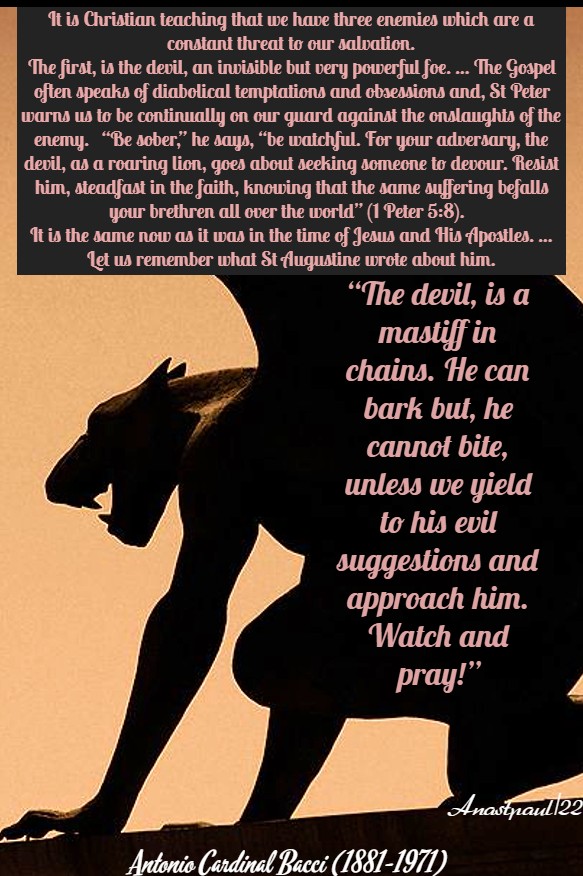
“It is Christian teaching that we have three enemies which are a constant threat to our salvation. The first, is the devil, an invisible but very powerful foe.
The devil was once an Angel of beauty. He had gifts superior to those of men and was in a state of happiness. But God required from him, a proof of his fidelity before he could merit the everlasting reward for which he had been destined.
Lucifer was proud of his beauty and power. Believing that he was equal to the Most High God, he rebelled against his Creator and drew with him, into eternal ruin, innumerable bands of disloyal Angels. Their sin was greater than ours because they had been endowed with a superior intellect and their will was not subject to the pull of the sensitive appetites of a material body. This is why God did not give them time to repent but condemned them immediately to the everlasting torments of Hell. It is false to imagine, however, that they are confined, as it were, in one place. Being pure spirit, they can, with God’s permission, wander throughout the world, carrying their hell within themselves. Moreover, they can endanger, in a thousand ways, our eternal salvation. The Gospel often speaks of diabolical temptations and obsessions and, St Peter warns us to be continually on our guard against the onslaughts of the enemy. “Be sober,” he says, “be watchful. For your adversary, the devil, as a roaring lion, goes about seeking someone to devour. Resist him, steadfast in the faith, knowing that the same suffering befalls your brethren all over the world” (1 Peter 5:8).
It is the same now as it was in the time of Jesus and His Apostles.
We do not see this infernal spirit but, we feel his presence. Let us remember what St Augustine wrote about him. “The devil,” he said, “is a mastiff in chains. He can bark but, he cannot bite, unless we yield to his evil suggestions and approach him. Watch and pray!””
One Minute Reflection – 14 April – Maundy Thursday – 1 Corinthians 11:20-32, John 13:1-15
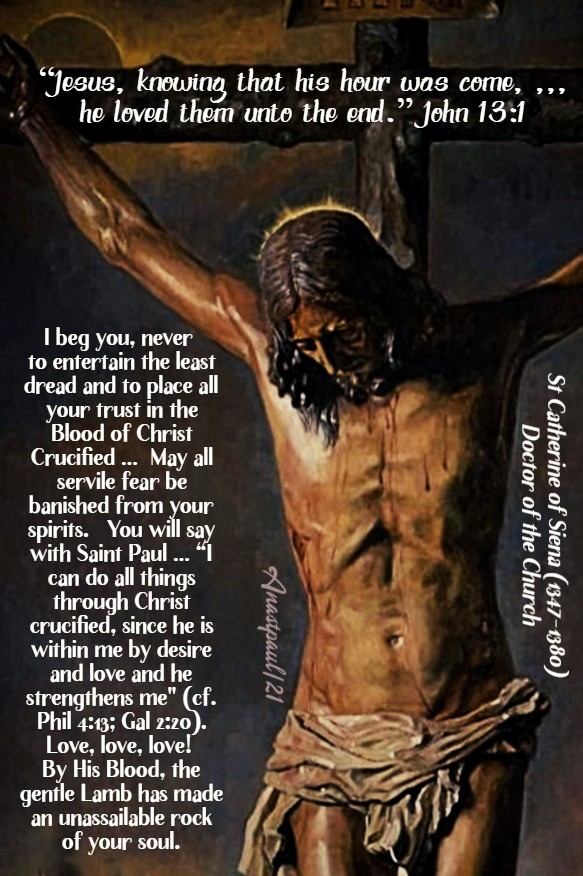
“Jesus, knowing that his hour was come, … he loved them unto the end.” – John 13:1
REFLECTION – “Be obedient to the death, following the example of the spotless Lamb who obeyed His Father even to a shameful death on the Cross. Reflect that He is the way and the rule you are to follow. Always hold Him present before the eyes of your spirit. See how obedient He is, this Word, this Utterance of God! He does not refuse to take up the burden of suffering laid on Him by His Father; to the contrary, He throws Himself into it, spurred on by His great desire. Isn’t this what He reveals during the Last Supper on Maundy Thursday, when He says: “I have eagerly desired to eat this Passover with you before I suffer” (Lk 22:15)? By “eat this Passover” He means, the accomplishment of the Father’s will and His desire. Seeing that scarcely any time lies before Him (He was already looking ahead to the end, when He would sacrifice His body for our sake), He rejoices, He is glad and joyfully says: “I have greatly desired.” Here is the Passover He is speaking about – that which consists in giving His own self as food, in laying down His own body in obedience to the Father.
Jesus had celebrated many another Passover with His disciples but never this one, O unspeakable, sweet and burning charity! You think neither of Your suffering nor of Your humiliating death – if You had thought of them, You would not have been so joyful, You would not have called it a Passover. The Word sees ,that it is He Himself Who has been chosen, He Himself Who has received all our humanity as His spouse. He has been asked to give us His own Blood so that God’s will might be accomplished in us, so that it might be His Blood that sanctifies us. This is, indeed, the sweet Passover, this Lamb without blemish accepts (cf. Ex 12:5) and it is with great love and great desire that He fulfils the Father’s will and wholly carries out His design. What unspeakably sweet love! …
That is why, my beloved, I beg you never to entertain the least dread and to place all your trust in the Blood of Christ Crucified … May all servile fear be banished from your spirits. You will say with Saint Paul …: “I can do all things through Christ crucified, since he is within me by desire and love and he strengthens me” (cf. Phil 4:13; Gal 2:20). Love, love, love! By His Blood, the gentle Lamb has made an unassailable rock of your soul.” – St Catherine of Siena (1347-1380) Dominican tertiary, Doctor of the Church, Co-patron of Europe – Letter 129
PRAYER – O God, from whom Judas received the punishment of his guilt and the thief the reward of his confession: grant unto us the full fruit of Thy clemency, that even as in His Passion, our Lord Jesus Christ gave to each a retribution according to his merits, so having taken away our old sins, He may bestow upon us the grace of His Resurrection. Who with Thee lives and reigns in the unity of the Holy Ghost, God, world without end. Amen
Thought for the Day –26 March – Meditations with Antonio Cardinal Bacci (1881-1971)
The Human Soul
“Remember that every mortal sin means death to the soul, for it robs it of the supernatural life of grace, making it incapable of every good action and deserving of hell. If you committed one mortal sin, God could tire of you, as if you were an unproductive tree and put an end to your life, without giving you time to repent! Then, you would be lost for all eternity. This thought should never leave your mind, particularly in time of temptation. At such a time, turn to God with confidence, tell Him that you love Him and do not wish to offend Him at any price. Face death rather than sin.”
Thought for the Day – 9 March – Meditations with Antonio Cardinal Bacci (1881-1971)
The Human Soul
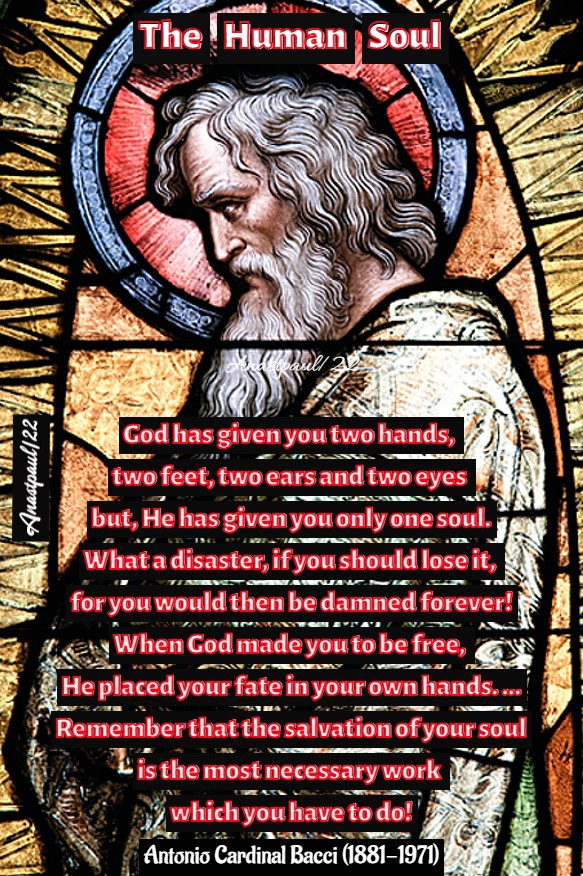
“Consider that you have only one soul, which belongs entirely to God and has Heaven for its true home. God has given you two hands, two feet, two ears and two eyes but, He has given you only one soul. What a disaster, if you should lose it, for you would then be damned forever! When God made you to be free, He placed your fate in your own hands. “When God, in the beginning, created man, He made him subject to his own free choice” (Ecclus 15:14). Remember that the salvation of your soul is the most necessary work which you have to do! It is more precious to you than gold or silver. “More precious than gold is health and well-being, contentment of spirit, than coral” (Ecclus 30:15). All our attention should be devoted to keeping our soul free from sin and endowing it with every virtue.”
Thought for the Day – 24 January – Meditations with Antonio Cardinal Bacci (1881-1971)
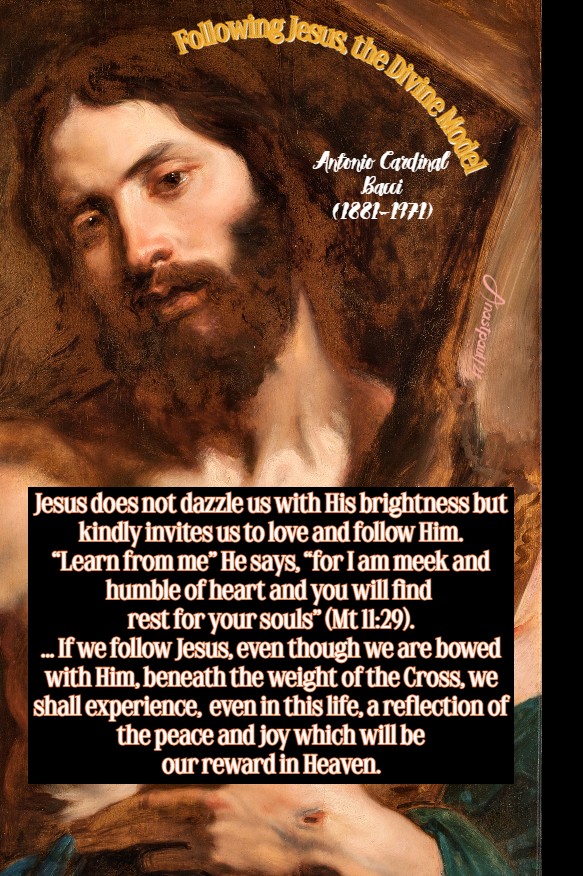
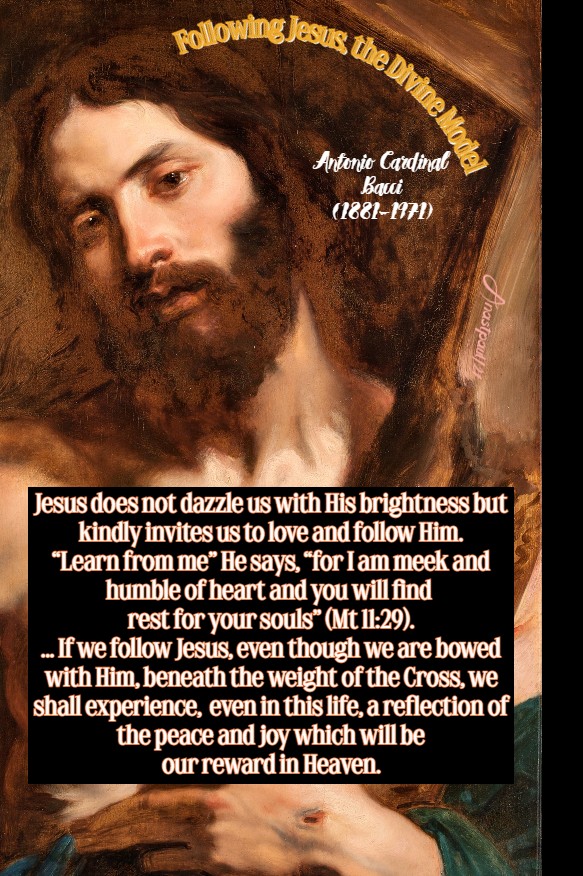
Following Jesus, the Divine Model
“Jesus is the Divine Model, Whom we ought to follow and imitate. In Him, the virtues possess both the infinite splendour of the Divinity and the gentle appeal of glorified Humanity. Jesus does not dazzle us with His brightness but kindly invites us to love and follow Him. “Learn from me” He says, “for I am meek and humble of heart and you will find rest for your souls” (Mt 11:29). After He has indicated humility, meekness and interior peace, as the foundations of the spiritual life, He invites us to take up the yoke of His law and assures us, that we shall find it light (Mt 11).
If we follow Jesus, even though we are bowed with Him, beneath the weight of the Cross, we shall experience, even in this life, a reflection of the peace and joy which will be our reward in Heaven.”
One Minute Reflection – 28 November – The First Sunday of Advent – Readings: Jeremiah 33: 14-16; Psalm 25: 4-5, 8-10, 14; First Thessalonians 3: 12 – 4: 2; Luke 21: 25-28, 34-36
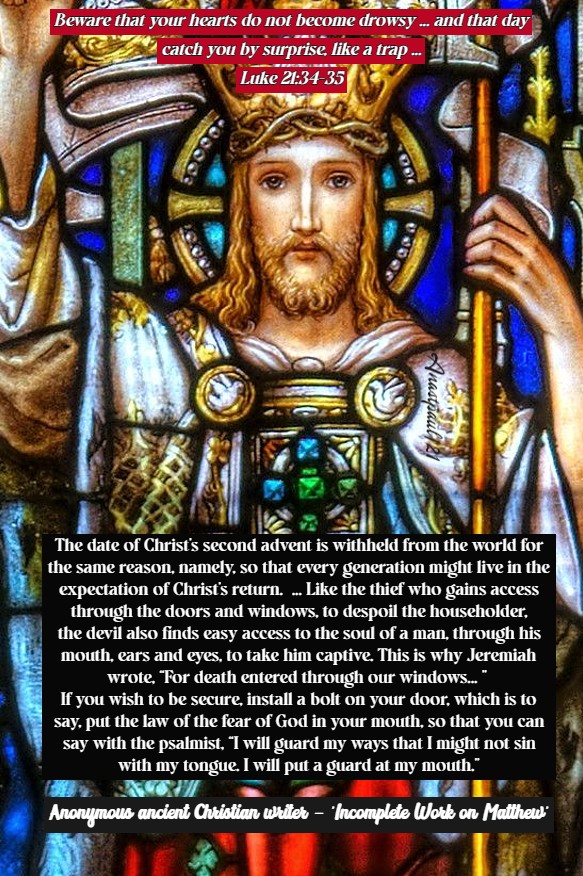
“Beware that your hearts do not become drowsy, from carousing and drunkenness and the anxieties of daily life and that day catch you by surprise, like a trap.”- Luke 21:34-35
REFLECTION – “Why is the date of an individual’s death hidden from him? Clearly, it is so that he might always do good, since he can expect to die at any moment.
The date of Christ’s second advent is withheld from the world for the same reason, namely, so that every generation might live in the expectation of Christ’s return. This is why when His disciples asked Him, “Lord, will you restore the kingdom to Israel at this time?” Jesus replied, “It is not for you to know the times and the seasons, which the Father has established by his authority. But know this, that if the head of the household had known the hour at which the thief would arrive, he would have been vigilant and would never have allowed his house to be burglarised.”
The head of the household represents the human soul, the thief is the devil, the house is the body, the doors are the mouth and ears and the windows are the eyes. Like the thief who gains access through the doors and windows, to despoil the householder, the devil also finds easy access to the soul of a man, through his mouth, ears and eyes, to take him captive. This is why Jeremiah wrote, “For death entered through our windows .. ”
If you wish to be secure, install a bolt on your door, which is to say, put the law of the fear of God in your mouth, so that you can say with the psalmist, “I will guard my ways that I might not sin with my tongue. I will put a guard at my mouth.” – Anonymous ancient Christian writer. The ancient work is known as the ‘Incomplete Work on Matthew’ – (Homily 51)
PRAYER – Holy God, Father Almighty, grant we pray, by the true Light of the world, Your only-begotten Son, our Lord Jesus Christ, Who enlightens all men for their salvation, give us grace to herald His coming, by preparing the ways of justice, love and peace. May the Holy Spirit fill us with all His gifts and virtues, so that we may await the coming of Your Son, guided by His Light and may Mary, the blessed Virgin, accompany us, guarding and giving us her prayerful help. Through Christ our Lord, with the Holy Spirit, God forever, amen.
One Minute Reflection – 17 October – “Month of the Holy Rosary” – Readings: Isaiah 53: 10-11; Psalm 33: 4-5, 18-20, 22; Hebrews 4: 14-16; Mark 10: 35-45
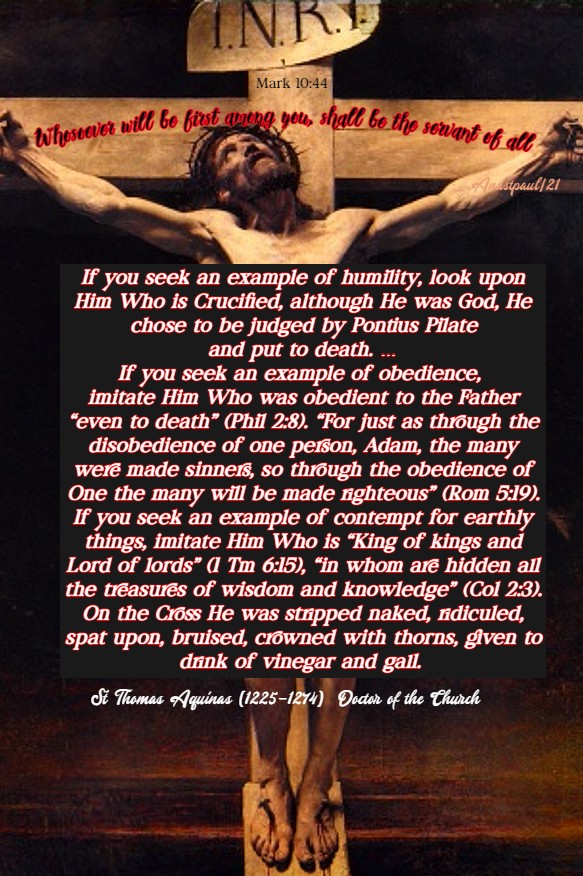
“Whosoever will be first among you, shall be the servant of all.” – Mark 10:44
REFLECTION – “What need was there that the Son of God should suffer for us? There was great need and indeed, it can be assigned to two reasons. The first, is that it was a remedy against sin and the second, is for an example of what we should do. … For the Passion of Christ can bring about a complete reformation of our lives. … If you seek an example of charity, then “no-one has greater love than this, to lay down one’s life for one’s friends” (Jn 15:13). … If you seek an example of patience, you will find it in its highest degree on the Cross. … Christ suffered greatly upon the Cross and with all patience because “when he was insulted, he returned no insult” (1 Pt 2:23), “like a lamb led to the slaughter, he opened not his mouth” (Is 53:7). … “Let us persevere in running the race that lies before us while keeping our eyes fixed on Jesus, the leader and perfecter of faith. For the sake of the joy that lay before him, he endured the cross, despising its shame” (Heb 12:1-2).
If you seek an example of humility, look upon Him Who is Crucified, although He was God, He chose to be judged by Pontius Pilate and put to death. … If you seek an example of obedience, imitate Him Who was obedient to the Father “even to death” (Phil 2:8). “For just as through the disobedience of one person, Adam, the many were made sinners, so through the obedience of One the many will be made righteous” (Rom 5:19). . If you seek an example of contempt for earthly things, imitate Him Who is “King of kings and Lord of lords” (1 Tm 6:15), “in whom are hidden all the treasures of wisdom and knowledge” (Col 2:3). On the Cross He was stripped naked, ridiculed, spat upon, bruised, crowned with thorns, given to drink of vinegar and gall. – St Thomas Aquinas (1225-1274) Dominican Theologian, Doctor of the Church (On the Apostles’ Creed – Collationes In Symbolum apostolorum, art. 4 # 64.70.72-76; [trans. Joseph Collins])
PRAYER – Holy Father, grant me an operative faith, a faith that will move mountains. Enlighten my soul with Your Light, Goodness, Power and Wisdom. Let my faith be an image of You by lively deeds and love and by conforming myself to Your Will in all things. As the Blessed Virgin, Mother of Your only-begotten Son, longed only to serve the God of all in complete self-denial and humility, may we always strive to imitate her Fiat in serving You, with upright hearts and thus manifest a true faith, through Christ our Lord, with the Holy Spirit, God forever, amen.
Thought for the Day – 22 September – Meditations with Antonio Cardinal Bacci (1881-1971)
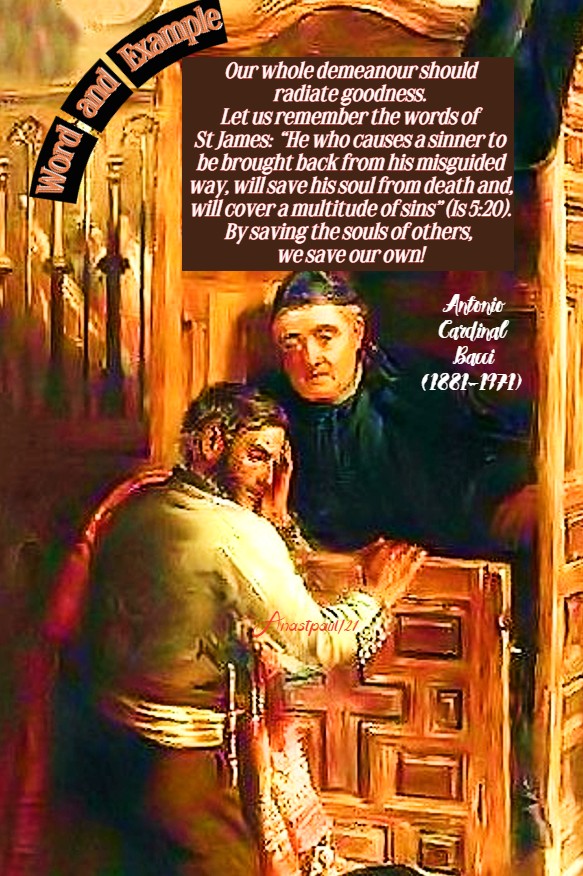
Word and Example
“We should give good example everywhere and in every way, at home and in the Church, in the company of those who are subordinate to us and of those who have authority over us, in speech and in dress, by moderation in our eating habits and in the furnishings of our house, by the pictures which we hang in our rooms and by the books and magazines which we read. We should be particularly careful to keep, in safe custody, those books and journals which are necessary to us for purposes of study but could be an occasion of sin for others.
Our whole demeanour should radiate goodness. Let us remember the words of St James: “He who causes a sinner to be brought back from his misguided way, will save his soul from death and, will cover a multitude of sins” (Is 5:20). By saving the souls of others, we save our own!”
Thought for the Day – 21 September – Meditations with Antonio Cardinal Bacci (1881-1971)
Following Jesus, the Divine Model
“Jesus is the Divine Model, Whom we ought to follow and imitate. In Him, the virtues possess both the infinite splendour of the Divinity and the gentle appeal of glorified Humanity. Jesus does not dazzle us with His brightness but kindly invites us to love and follow Him. “Learn from me” He says, “for I am meek and humble of heart and you will find rest for your souls” (Mt 11:29). After He has indicated humility, meekness and interior peace, as the foundations of the spiritual life, He invites us to take up the yoke of His law and assures us, that we shall find it light (Mt 11).
If we follow Jesus, even though we are bowed with Him, beneath the weight of the Cross, we shall experience, even in this life, a reflection of the peace and joy which will be our reward in Heaven.”





























 AnaStpaul
You must be logged in to post a comment.