One Minute Reflection – 23 October – Twentieth Sunday after Pentecost – Feast of the Most Holy Redeemer – Ephesians 5:15-21, John 4:46-53 Scripture search here: https://www.drbo.org/
“Unless you see signs and wonders, you believe not.” – John 4:48
REFLECTION – “Whoever examines the majesty of God will be crushed by His glory” (Prv 25,27 Vg). God can do works that surpass man’s understanding… Faith is required of you and sincerity of life – not high intelligence, nor penetrating knowledge of the mysteries of God. If you do not understand, nor grasp what is below you, how will you comprehend what is above you? Be subject to God, submit yourself to the faith and the light of knowledge will be given to you, as much as you need and can use.
Some have grave temptations concerning faith and sacraments, which are not to be imputed to them but rather, to the enemy. Take no notice, do not argue with your thoughts, nor answer the doubts with which the devil attacks you; believe God’s word, believe His saints and prophets and the wicked enemy will be routed. It is often most profitable to God’s servant, to endure such things. For the devil does not tempt the infidel or sinner, of whom he has already secure possession but he uses various means, to tempt and harass the devout faithful.
Go on then with simple unquestioning faith and approach the Sacrament with reverent beseeching. Anything you cannot understand, commit it surely to God, Who is omnipotent. God does not deceive you – the over-confident person deceives himself. God walks in step with the simple ones, He shows Himself to the humble ones, He grants understanding to the little ones; “He reveals hidden meanings to little ones” and hides away His grace from the inquisitive and the proud. Human reason is feeble and fallible but true faith cannot be deceived. All use of reason, all human inquiry should walk in the footsteps of faith; it should not go on in front of it, nor call it in question.” – Thomas à Kempis CRSA (1380-1471) (The Imitation of Christ IV, 18).
PRAYER – O Lord, we beseech Thee, graciously grant Thou faithful, forgiveness and peace that they may be cleansed of all sin and serve Thee with minds free from care. Through Jesus Christ, Thy Son our Lord, Who lives and reigns with Thee, in the unity of the Holy Ghost, God, world without end. Amen (Collect).
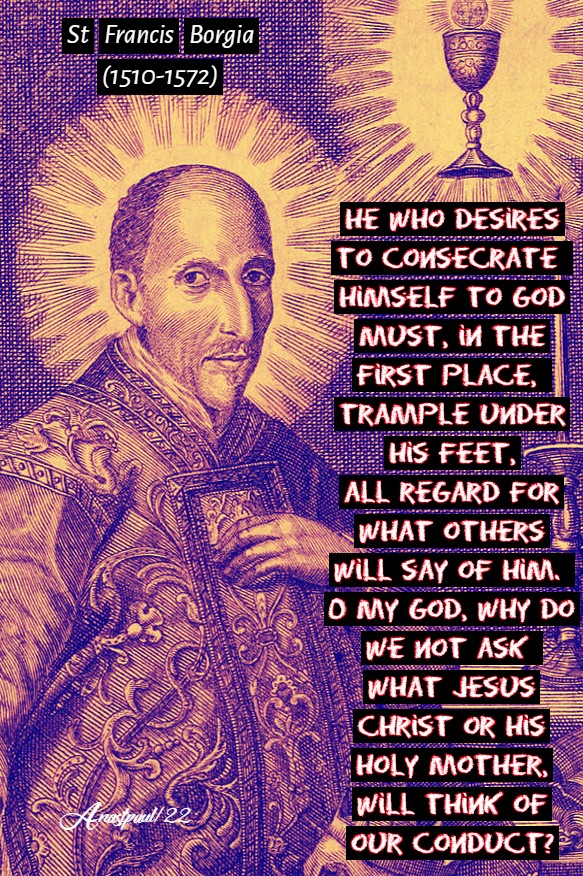
Quote/s of the Day – 10 October – St Francis Borgia SJ (1510-1572) Confessor
“He who desires to consecrate himself to God must, in the first place, trample under his feet, all regard for what others will say of him. O my God, why do we not ask what Jesus Christ or His holy Mother, will think of our conduct?”
“Wherever our brethren may be, let their first care be, for those already converted. Their first aim must be, to strengthen these in the faith and to help them save their souls. After this, they may convert others not yet Baptised.”
(Excerpt from his correspondence, as Master General of the Order, to the Jesuit Missionaries he had sent to the Spanish colonies in Florida, Mexico and Peru.)
“This beast, (so he often called his body) “must suffer ,to expiate the delight it formerly took, in immoderately flattering its palate and can I forget, that Christ drank gall for me on His Cross!”
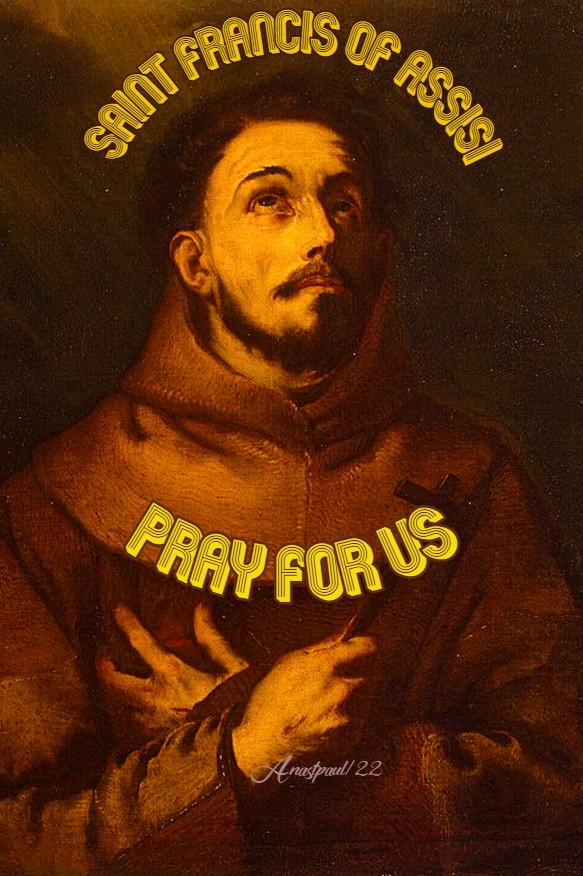
One Minute Reflection – 4 October – St Francis of Assisi OFM (c 1181–1226) Confessor, Founder – Galatians 6:14-18, Matthew 11:25-30 Scripture Search here: https://www.drbo.org/
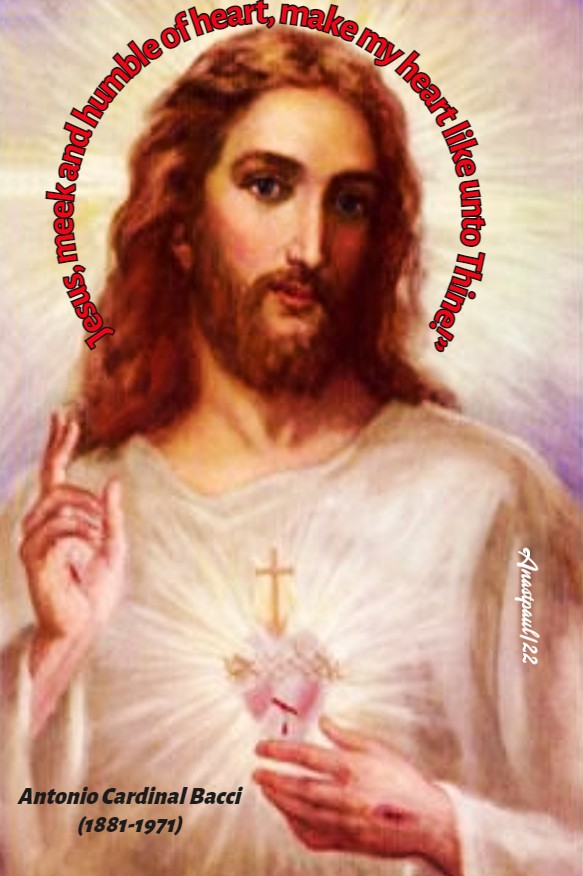
“Take my yoke upon you and learn from me, for I am meek and humble of heart and you will find rest for your souls…” – Matthew 11:29
REFLECTION – “You are to “take my yoke upon you and learn from me.” You are not learning from me how to refashion the fabric of the world, nor to create all things visible and invisible, nor to work miracles and raise the dead. Rather, you are simply learning of me: “that I am meek and lowly in heart.”
If you wish to reach high, then begin at the lowest level. If you are trying to construct some mighty edifice in height, you will begin with the lowest foundation. This is humility. However great the mass of the building you may wish to design or erect, the taller the building is to be, the deeper you will dig the foundation. The building in the course of its erection, rises up high but he who digs its foundation, must first go down very low. So then, you see even a building is low before it is high and the tower is raised, only after humiliation.”… St Augustine(354-430) Father & Doctor (Sermon 69)
PRAYER – O God, Who by the good works of blessed Francis enriched Thy Church by establishing a new religious family, grant us to imitate him by emulation of him, by looking upon the things of earth as nought and ever to rejoice in sharing Thy heavenly gifts. ThroughJesus Christ, Thy Son our Lord, Who lives and reigns with Thee, in the unity of the Holy Ghost, God, world without end. Amen (Collect).
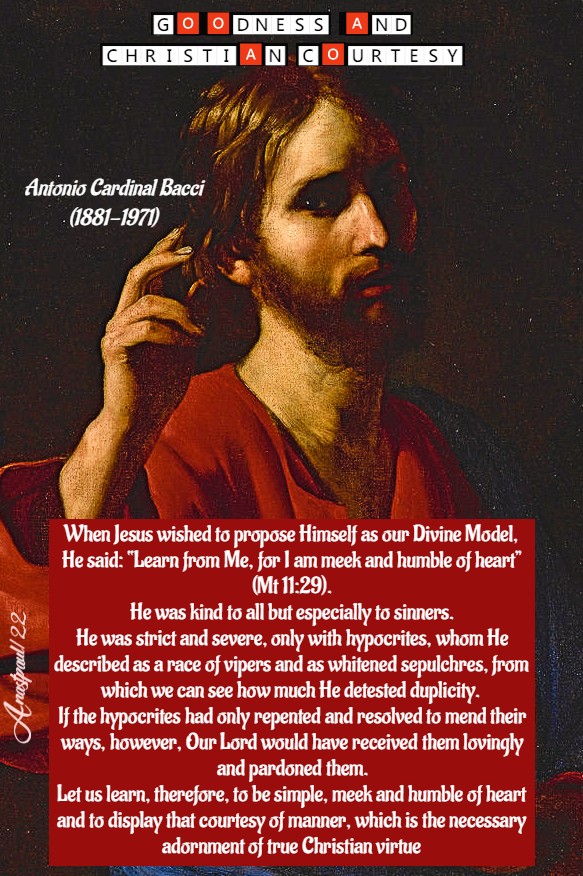
Thought for the Day – 29 September – Meditations with Antonio Cardinal Bacci (1881-1971)
Goodness and Christian Courtesy
“When Jesus wished to propose Himself as our Divine Model, He said: “Learn from Me, for I am meek and humble of heart” (Mt 11:29). He was kind to all but especially to sinners. He was strict and severe, only with hypocrites, whom He described as a race of vipers and as whitened sepulchres, from which we can see how much He detested duplicity. If the hypocrites had only repented and resolved to mend their ways, however, Our Lord would have received them lovingly and pardoned them.
Let us learn, therefore, to be simple, meek and humble of heart and to display that courtesy of manner, which is the necessary adornment of true Catholic virtue”
One Minute Reflection – 29 September – The Feast of the Dedication of the Archangel St Michael – Apocalypse 1:1-5, Matthew 18:1-10 – Scripture Search here: https://www.drbo.org/
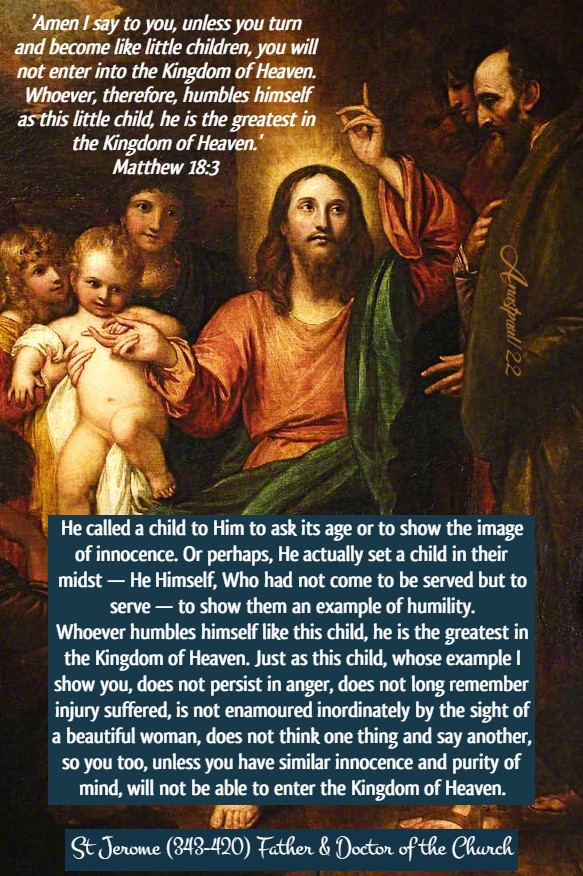
“At that time, the disciples came to Jesus, saying, ‘who then is greatest in the Kingdom of Heaven?’ And Jesus called a little child unto Him, set him in their midst and said, ‘Amen I say to you, unless you turn and become like little children, you will not enter into the Kingdom of Heaven. Whoever, therefore, humbles himself as this little child, he is the greatest in the Kingdom of Heaven. And whoever receives one such little child for My sake, receives Me.’” – Matthew 18:1-5
REFLECTION – “We must seek for reasons for individual sayings and actions of the Lord. After the coin was found, after the tribute paid, what do the Apostles’ sudden questions mean? Why precisely “at that time” did the disciples come to Jesus saying, “Who is the greatest in the Kingdom of Heaven?” Because they had seen that the same tax had been paid for both Peter and the Lord. From the equal price, they inferred that Peter may have been set over all the other Apostles, since Peter had been compared with the Lord in the paying of the tax. So they ask, who is greater in the Kingdom of Heaven. Jesus, seeing their thoughts and understanding the causes of their error, wants to heal their desire for glory, with a struggle for humility.
He called a child to Him to ask its age or to show the image of innocence. Or perhaps, He actually set a child in their midst — He Himself, Who had not come to be served but to serve — to show them an example of humility.
Whoever humbles himself like this child, he is the greatest in the Kingdom of Heaven. Just as this child, whose example I show you, does not persist in anger, does not long remember injury suffered, is not enamoured inordinately by the sight of a beautiful woman, does not think one thing and say another, so you too, unless you have similar innocence and purity of mind, will not be able to enter the Kingdom of Heaven. Or it might be taken in another way: “Whosoever, therefore, humiliates himself like this child, is greater in the Kingdom of Heaven,” so as to imply that anyone who imitates Me and humiliates himself following My example, so that he abases himself, as much as I abased Myself in accepting the form of a servant, will enter the Kingdom of Heaven.” – St Jerome (343-420) Priest, Monk, Translator of the Scriptures, Father and Doctor of the Church (Commentary on Matthew 3).
PRAYER – O God, Who assign according to a wondrous order, the duties of Angels and men, mercifully grant that our life on earth be guarded by those who continually stand in Thy presence and minister to Thee in Heaven. Through Jesus Christ, thy Son our Lord, Who lives and reigns with Thee, in the unity of the Holy Ghost, God, world without end. Amen (Collect).
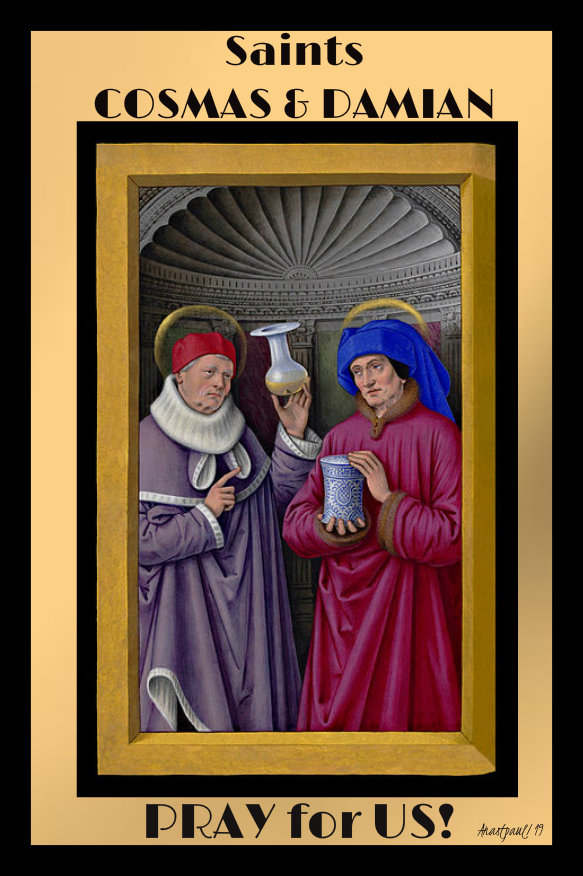
One Minute Reflection – 27 September – Saints Cosmas and Damian (Died c 286 ) Martyrs – Wisdpm 5:16-20, Luke 6:17-23
“And raising his eyes toward his disciples he said: “Blessed are you who are poor, for yours is the Kingdom of God.” – Luke 6:20
REFLECTION – “Let us see how St Luke encompassed the eight blessings in the four. We know that there are four Cardinal Virtues – Temperance, Justice, Prudence and Fortitude. One who is poor in spirit, is not greedy. One who weeps, is not proud but is submissive and tranquil. One who mourns, is humble. One who is just does not deny what he knows is given jointly to all for us. One who, is merciful – gives away his own goods. One who bestows his own goods, does not seek another’s, nor does he contrive a trap for his neighbour. These virtues are interwoven and interlinked, so that one, who has one, may be seen to have several and a single virtue, befits the Saints. Where virtue abounds, the reward too abounds…. Thus temperance has purity of heart and spirit, justice has compassion, patience has peace and endurance has gentleness.
“Blessed,” it says, “are the poor.” Not all the poor are blessed, for poverty is neutral. The poor can be either good or evil, unless, perhaps, the blessed pauper is to be understood as he whom the prophet described, saying, “A righteous poor man is better than a rich liar.” Blessed is the poor man who cried and whom the Lord heard. Blessed is the man poor in offence. Blessed is the man poor in vices. Blessed is the poor man, in whom the prince of this world finds nothing. Blessed is the poor man who, is like that Poor Man Who, although He was rich, became poor for our sake. Matthew fully revealed this when he said, “Blessed are the poor in spirit.” One poor in spirit is not puffed up, is not exalted in the mind of his own flesh. This Beatitude is first, when I have laid aside every sin and I have taken off all malice and I am content with simplicity, destitute of evils. All that remains is that I regulate my conduct. For what good does it do me to lack worldly goods, unless I am meek and gentle?
Although there are many charms of delights in riches, yet there are more incentives to practice virtues. Although virtue does not require assistance and the contribution of the poor person, is more commended, than the generosity of the rich, yet with the authority of the heavenly saying, He condemns, not those who have riches but those who do not know how to use them. The pauper is more praiseworthy who gives with eager compassion and is not restrained, by the bolts of looming scarcity. He thinks that he who has enough for nature, does not lack. So the rich person is the more guilty, who does not give thanks to God, for what he has received but vainly hides wealth given for the common use and conceals it, in buried treasures. Then the offence consists, not in the wealth but in the attitude.
Purify yourself with your tears. Wash yourselves with mourning. If you weep for yourself, another will not weep for you…. One who is a sinner weeps for himself and rebukes himself, that he may become righteous, for just people accuse themselves of sin. Let us pursue order because, it is written, “Set in order love in me.” I have laid down sin. I have tempered my conduct. I have wept for my transgressions. I begin to hunger. I hunger for righteousness. The sick, when he is seriously ill, does not hunger, because the pain of the illness excludes hunger. What is the hunger for righteousness? What is the bread of which it is said, “I have been young and am old and I have not seen the righteous man forsaken, nor his seed begging bread?” Surely, one who is hungry, seeks increase of strength. What greater increase of virtue is there, than the rule of righteousness?” – St Ambrose (340-397) Bishop of Milan, Father and Doctor of the Church( Exposition on the Gospel of Luke, 5).
PRAYER – Grant, we beseech Thou, almighty God, that we who celebrate the anniversary of the death of Thy holy Martyrs, Cosmas and Damian, may by their intercession, be delivered from all the evils that threaten us. Through Christ, Thy Son our Lord, Who lives and reigns with Thee, in the unity of the Holy Ghost, God, world without end. Amen (Collect).
One Minute Reflection – 25 September – “The Month of the Seven Sorrows of the Blessed Virgin Mary and the Holy Cross” – Ephesians 3:13-21, Luke 14:1-11 – Seardh Scripture here: https://www.drbo.org/
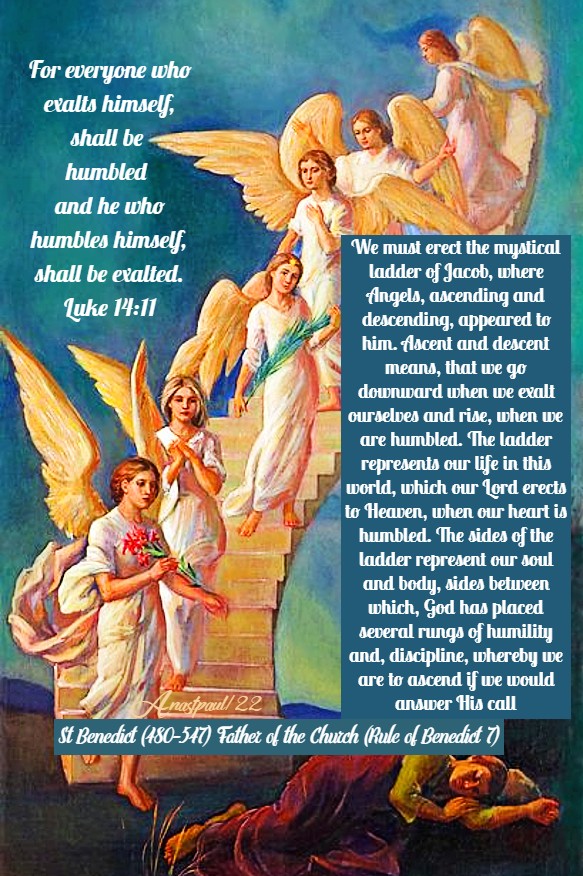
“For everyone who exalts himself, shall be humbled and he who humbles himself, shall be exalted.” – Luke 14:11
REFLECTION – “The Scripture asserts that “everyone who exalts himself shall be humbled and he who humbles himself shall be exalted.” If we want to attain to true humility and come quickly to the top of that heavenly ascent, to which we can only mount, by lowliness in this present life, we must ascend by good works.
We must erect the mystical ladder of Jacob, where Angels, ascending and descending, appeared to him. Ascent and descent means, that we go downward when we exalt ourselves and rise, when we are humbled. The ladder represents our life in this world, which our Lord erects to Heaven, when our heart is humbled. The sides of the ladder represent our soul and body, sides between which, God has placed several rungs of humility and, discipline, whereby we are to ascend if we would answer His call.”– St Benedict (480-547) Father of the Church (Rule of Benedict #7)
PRAYER – Grant, we beseech Thee, O Lord God, unto all Thy servants, that they may remain continually in the enjoyment of soundness, both of mind and body and by the glorious intercession of the Blessed Mary, always a Virgin, our sorrowful Mother, may be delivered from present sadnes, and enter into the joy of thine eternal gladness.Through Jesus Christ, Thy Son our Lord, Who lives and reigns with Thee, in the unity of the Holy Ghost, God, world without end. Amen (Collect).
Thought for the Day – 22 September – Meditations with Antonio Cardinal Bacci (1881-1971)
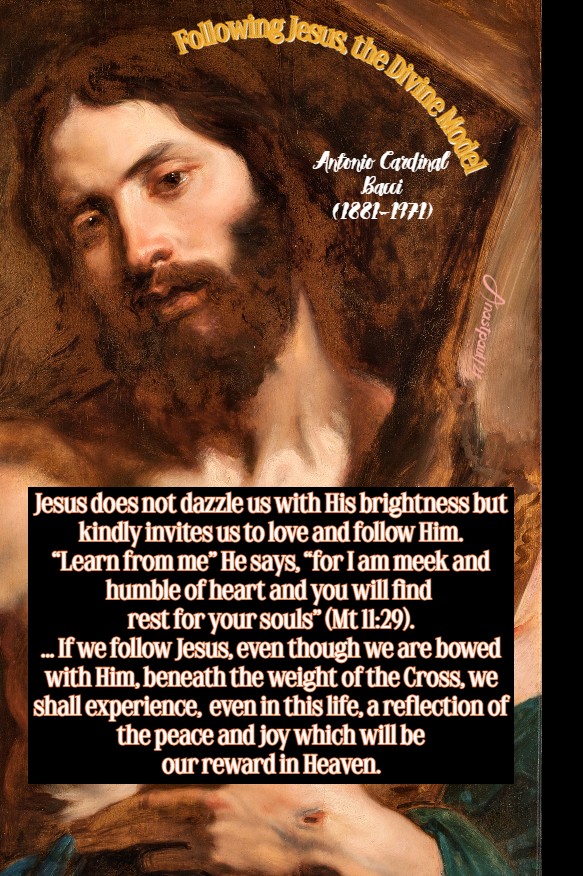
Following Jesus, the Divine Model
“Jesus is the Divine Model, Whom we ought to follow and imitate. In Him, the virtues possess both the infinite splendour of the Divinity and the gentle appeal of glorified Humanity. Jesus does not dazzle us with His brightness but kindly invites us to love and follow Him. “Learn from me” He says, “for I am meek and humble of heart and you will find rest for your souls” (Mt 11:29). After He has indicated humility, meekness and interior peace, as the foundations of the spiritual life, He invites us to take up the yoke of His law and assures us, that we shall find it light (Mt 11).
If we follow Jesus, even though we are bowed with Him, beneath the weight of the Cross, we shall experience, even in this life, a reflection of the peace and joy which will be our reward in Heaven.”
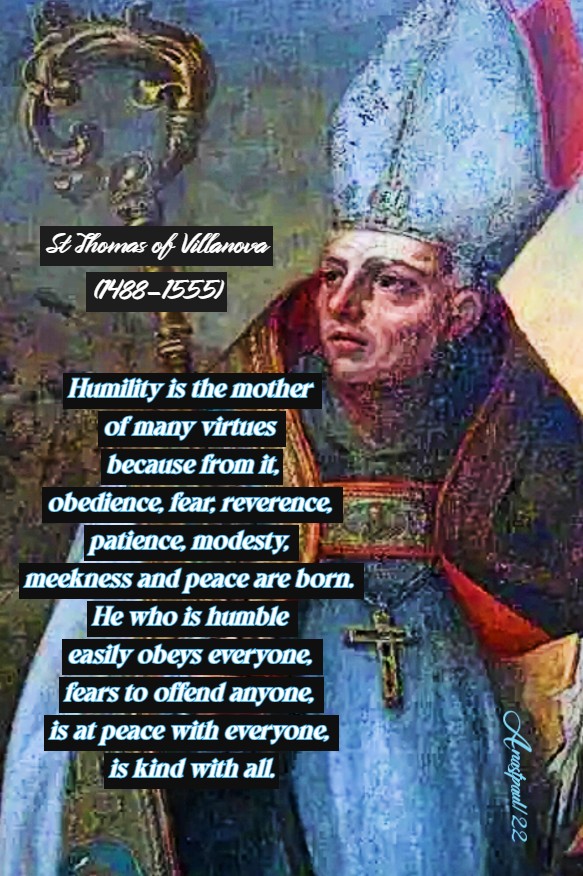
Quote/s of the Day – 22 September – The Memorial of St Thomas of Villanova OSA (1488-1555) Archbishop, Confessor
“Humility is the mother of many virtues because from it, obedience, fear, reverence, patience, modesty, meekness and peace are born. He who is humble easily obeys everyone, fears to offend anyone, is at peace with everyone, is kind with all.”
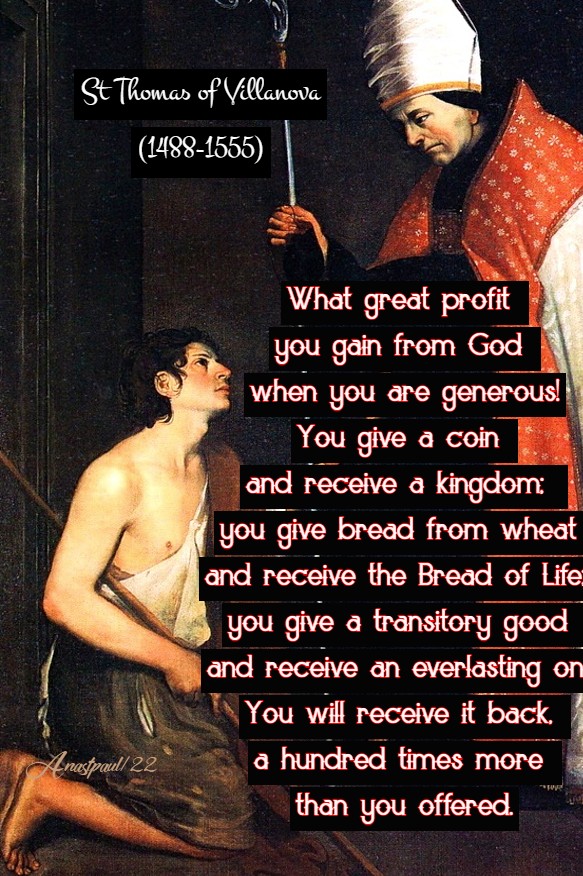
“What great profit you gain from God when you are generous! You give a coin and receive a kingdom; you give bread from wheat and receive the Bread of Life; you give a transitory good and receive an everlasting one. You will receive it back, a hundred times more than you offered.”
“If you want God to hear your prayers, hear the voice of the poor. If you wish God to anticipate your wants, provide for those of the need, without waiting for them to ask you. Especially, anticipate the needs of those, who are ashamed to beg. To make them ask for alms, is to make them buy it!”
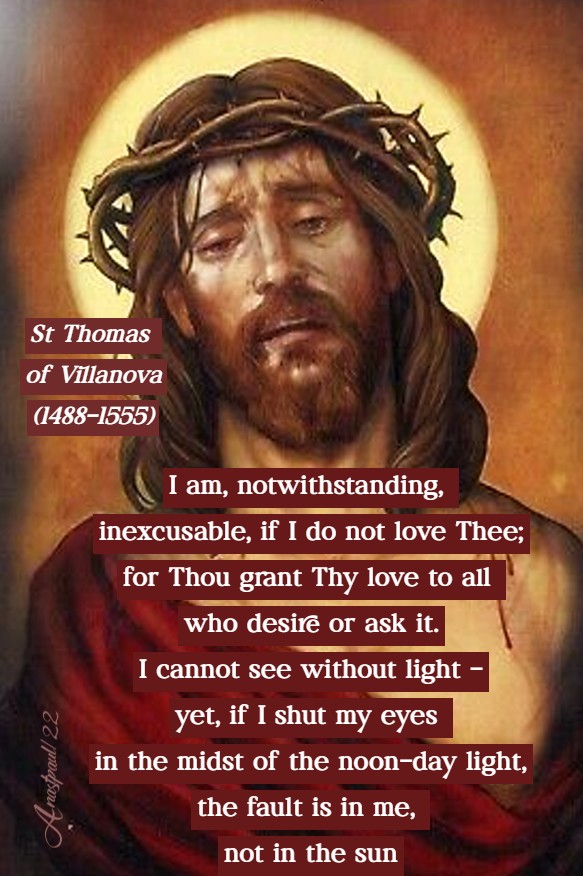
“I am, notwithstanding, inexcusable, if I do not love Thee for Thou grant Thy love to all who desire or ask it. I cannot see without light – yet, if I shut my eyes in the midst of the noon-day light, the fault is in me, not in the sun.”
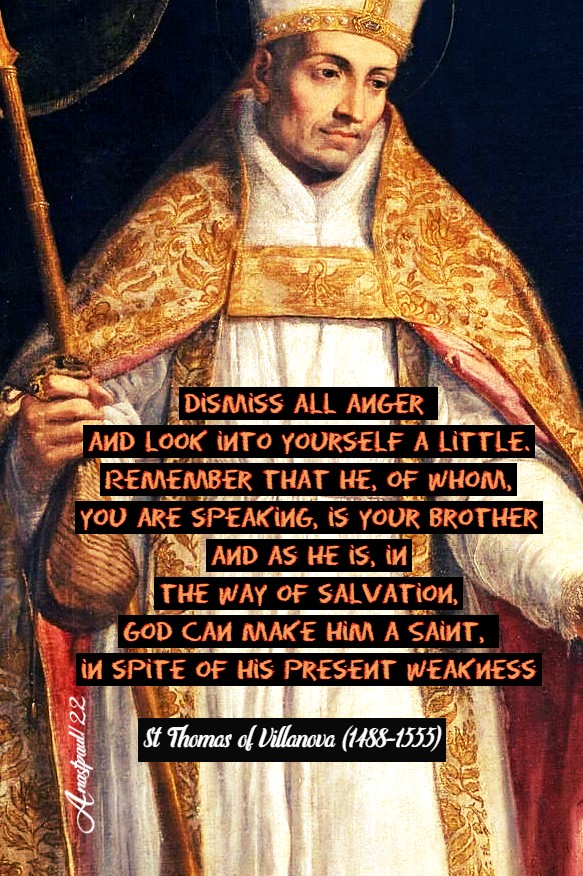
“Dismiss all anger and look into yourself a little. Remember that he, of whom, you are speaking, is your brother and as he is, in the way of salvation, God can make him a Saint, in spite of his present weakness.”
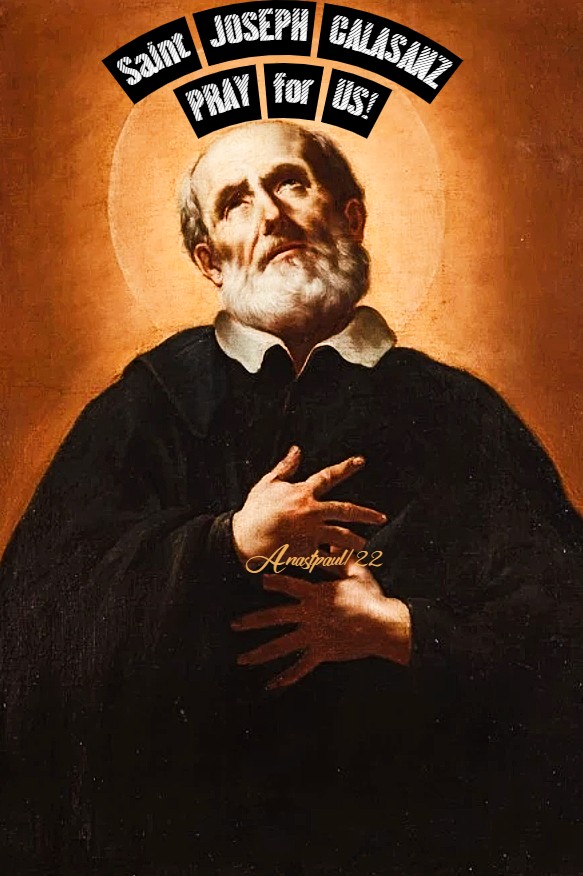
One Minute Reflection – 27 August – “The Month of the Immaculate Heart of Mary” and the celebration of St Joseph Calasantius (1557-1648) Spanish Confessor – Wisdom 10:10-14, Matthew 18:1-5
“Amen, I say to you, unless you turn and become like little children, you will not enter the kingdom of heaven.”… Matthew 18:3
REFLECTION – “We must seek for reasons for individual sayings and actions of the Lord. After the coin was found, after the tribute paid, what do the Apostles’ sudden questions mean? Why precisely “at that time” did the disciples come to Jesus saying, “Who is the greatest in the kingdom of heaven?” Because they had seen that the same tax had been paid for both Peter and the Lord. From the equal price they inferred, that Peter may have been set over all the other Apostles, since Peter had been compared with the Lord in the paying of the tax. So they ask, who is greater in the Kingdom of Heaven. Jesus, seeing their thoughts and understanding the causes of their error, wants to heal their desire for glory, with a struggle for humility.”
He called a child to Him, to ask its age or to show the image of innocence. Or perhaps He actually set a child in their midst — He Himself, Who had not come to be served but to serve — to show them an example of humility.
Whoever humbles himself like this child, he is the greatest in the Kingdom of Heaven. Just as this child, whose example I show you, does not persist in anger, does not long remember injury suffered, is not enamoured inordinately by the sight of a beautiful woman, does not think one thing and say another, so you too, unless you have similar innocence and purity of mind, will not be able to enter the Kingdom of Heaven! Or, it might be taken in another way: “Whosoever, therefore, humiliates himself like this child, is greater in the kingdom of heaven,” so as to imply that anyone, who imitates Me and humiliates himself following My example, so that he abases himself as much as I abased Myself in accepting the form of a servant, will enter the Kingdom of Heaven.” – St Jerome (343-420) Translator of Sacred Scripture into Latin (The Vulgate) One of the original four Doctors of the Latin Church, Father (Commentary on Matthew 3).
PRAYER – O God, Who through St Joseph, Thy Confessor, did graciously will to provide Thy Church with a new method for the training of youth, in the spirit of understanding and holiness grant, we beseech Thee, that, following his example and through his intercession, we may live and teach so as to acquire an everlasting reward. Through Jesus Christ, Thy Son our Lord, Who lives and reigns with Thee, in the unity of the Holy Ghost, God, world without end. Amen (Collect).
Quote/s of the Day – 20 August – “The Month of the Immaculate Heart of Mary” and the Memorial of St Bernard (1090-1153) Abbot, Confessor, “Doctor Mellifluus” of the Church and the Last Father of the Church,“The Bard of Mary
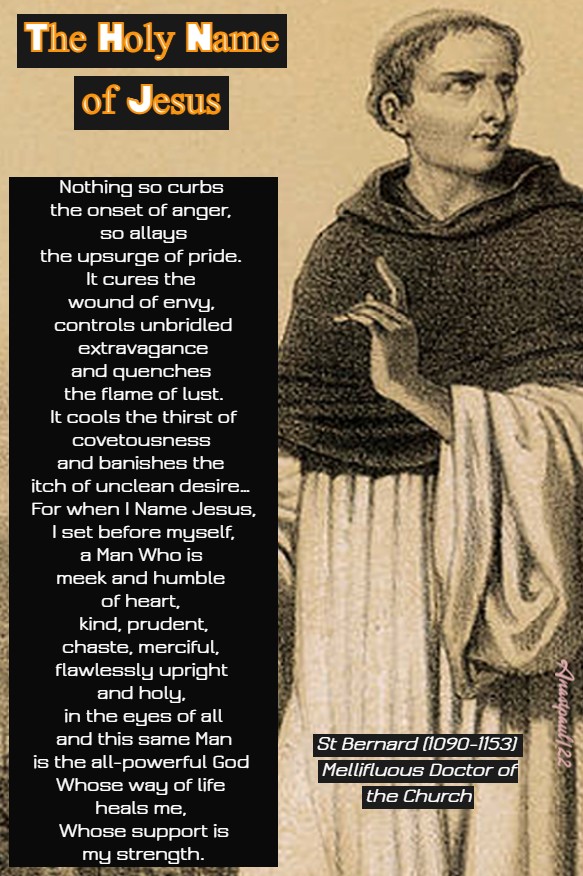
“Nothing so curbs the onset of anger, so allays the upsurge of pride. It cures the wound of envy, controls unbridled extravagance and quenches the flame of lust. It cools the thirst of covetousness and banishes the itch of unclean desire… For when I Name Jesus, I set before myself, a Man Who is meek and humble of heart, kind, prudent, chaste, merciful, flawlessly upright and holy in the eyes of all and this same Man is the all-powerful God Whose way of life heals me, Whose support is my strength.”
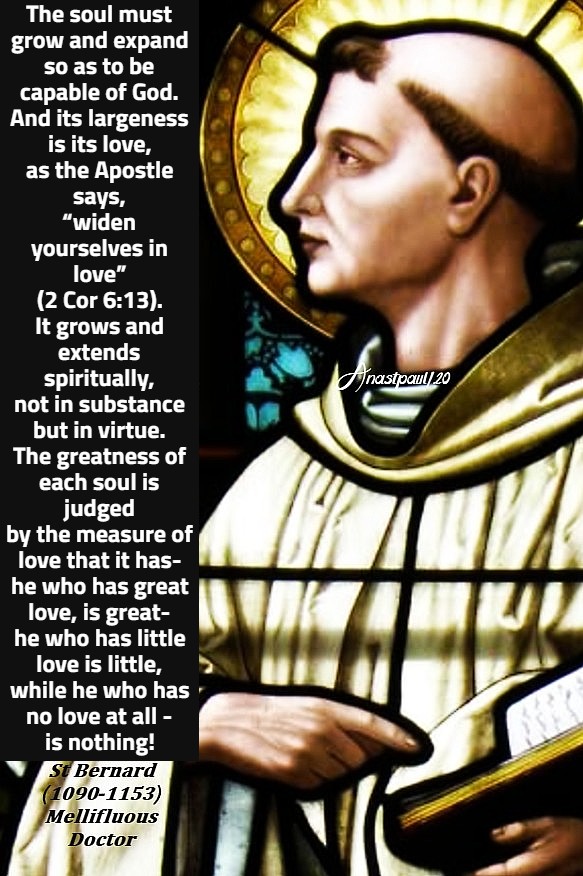
“The soul must grow and expand so as to be capable of God. And its largeness is its love, as the Apostle says, “widen yourselves in love” (2 Cor 6:13). It grows and extends spiritually, not in substance but in virtue. The greatness of each soul is judged by the measure of love that it has- he who has great love, is great- he who has little love is little, while he who has no love at all – is nothing!”
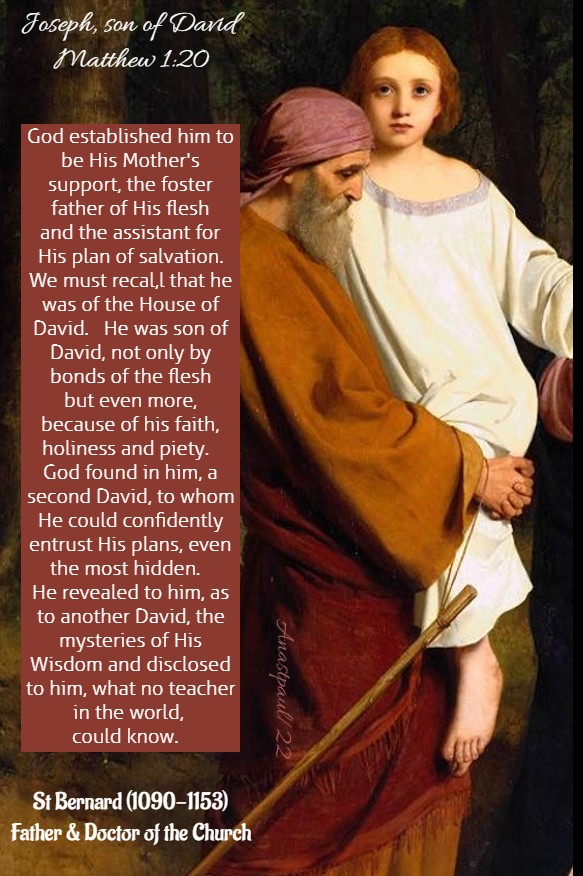
“God established him to be His Mother’s support, the foster father of His flesh and the assistant for His plan of salvation. We must recall, that he was of the House of David. He was son of David, not only by bonds of the flesh but even more, because of his faith, holiness and piety. God found in him, a second David, to whom He could confidently entrust His plans, even the most hidden. He revealed to him, as to another David, the mysteries of His Wisdom and disclosed to him, what no teacher in the world, could know.”
“O great, O gentle, O most lovable Mary, thy Holy Name cannot be spoken without inflaming the heart. To those who love thee, it is unspeakable consolation and joy even to think of thee; thou art a sweet memory to those who honour thee.”
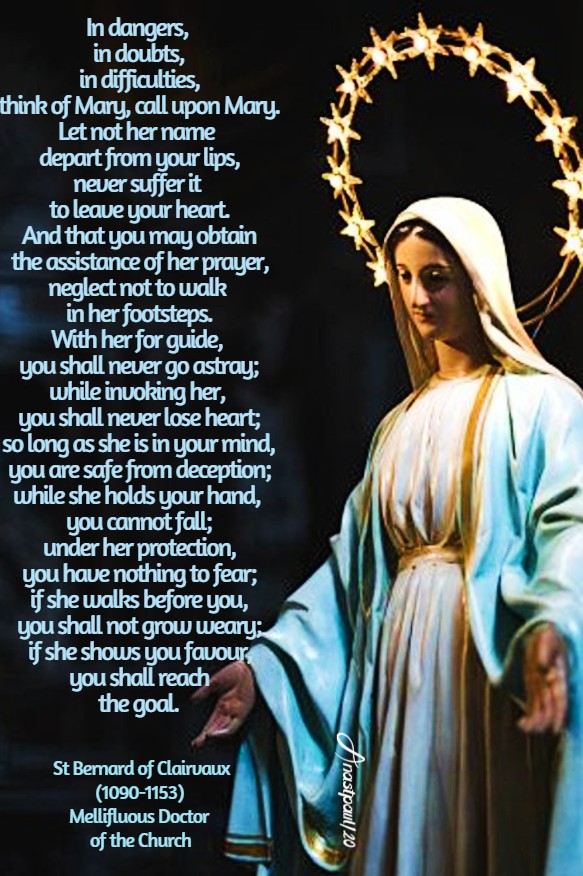
“In dangers, in doubts, in difficulties, think of Mary, call upon Mary. Let not her name depart from your lips, never suffer it to leave your heart. And that you may obtain the assistance of her prayer, neglect not to walk in her footsteps. With her for guide, you shall never go astray; while invoking her, you shall never lose heart; so long as she is in your mind, you are safe from deception; while she holds your hand, you cannot fall; under her protection you have nothing to fear; if she walks before you, you shall not grow weary; if she shows you favour, you shall reach the goal.”
“O Mary, I have not doubt that whenever we run to you, we shall obtain all that we desire. Let those then who have no hope, hope in you!”
St Bernard (1090-1153) Mellifluous Doctor of the Church
Thought for the Day – 18 August – Meditations with Antonio Cardinal Bacci (1881-1971)
Pride is Robbery!
“With the exception of our Blessed Lady and the Saints, all men are more or less proud. Pride employs many subtle stratagems in order to insinuate itself into our hearts. Very often it does not take the form of an open revolt against God, like tat of Lucifer but expresses itself in a sense of self-complacency which feeds on the praise and adulation of others. We forget that it was God, Who gave us whatever talents we possess. If we have achieved any kind of success or have accomplished anything good in the world, we forget that we have been dependent upon God for our very existence, as well as for our power to act.
We believe that we are important, whereas, we are as nothing before the infinite Majesty of God and before the immensity of His universe.
Let us be humble, therefore. If we wish to be raised up by God, let us abase ourselves in the sight of Him, Who resists the proud but gives grace to the humble. Only then shall we e able to perform actions worthy of everlasting life.”
Quote/s of the Day – 14 August – The 10th Sunday after Pentecost – 1 Cor.inthians 12:2-11, Luke 18:9-14
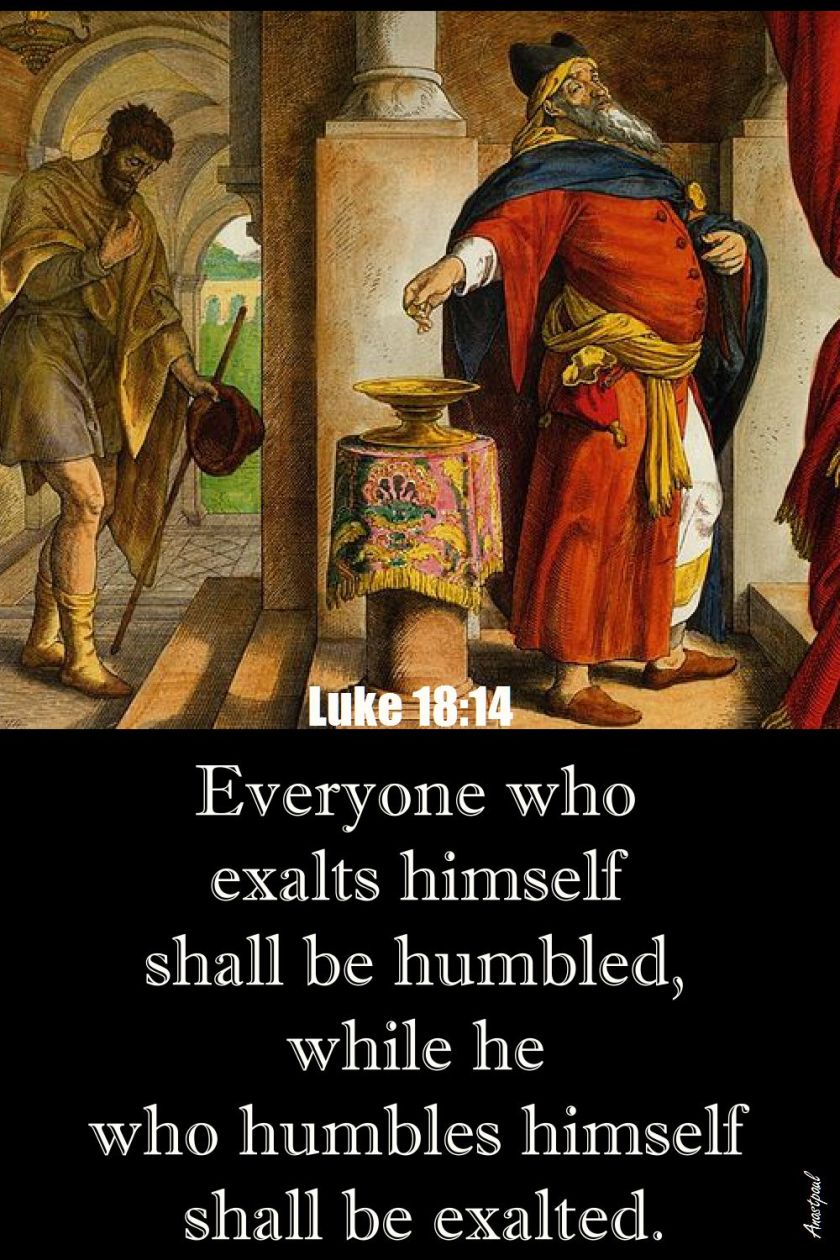
“… For everyone who exalts himself shall be humbled and he who humbles himself shall be exalted.”
Luke 18:14
“Let him who is greatest among you, become as the youngest and he who is the leader, as the servant.”
Luke 22:25
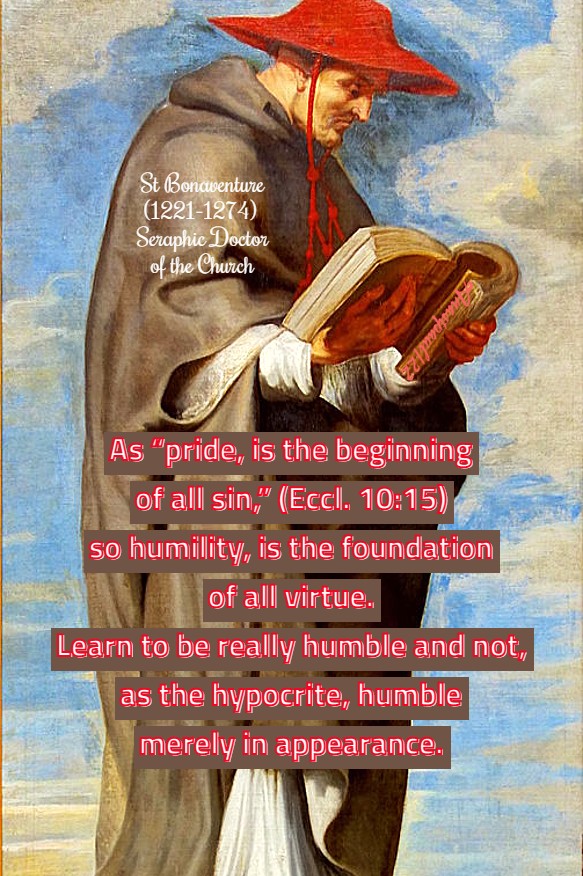
“As “pride, is the beginning of all sin,” (Eccl. 10:15) so humility, is the foundation of all virtue. Learn to be really humble and not, as the hypocrite, humble merely in appearance.”
St Bonaventure (1221-1274) Seraphic Doctor of the Church
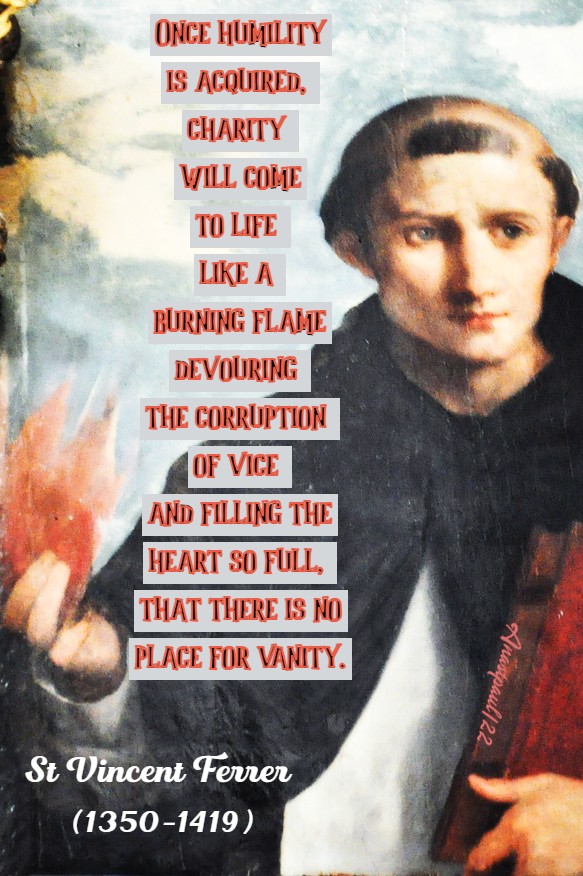
“Once humility is acquired, charity will come to life like a burning flame devouring the corruption of vice and filling the heart so full, that there is no place for vanity.”
St Vincent Ferrer (1350-1419)
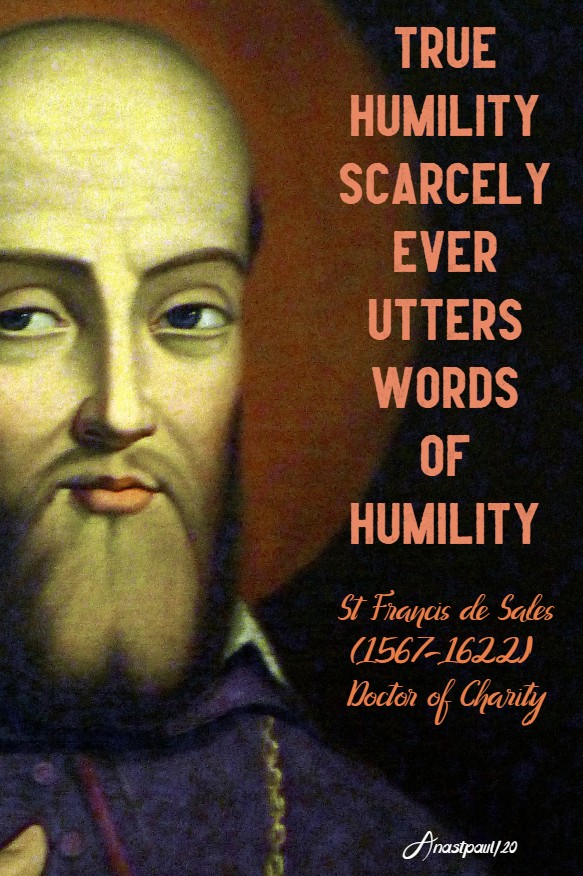
“True humility scarcely ever utters words of humility.”
One Minute Reflection – 14 August – “The Month of the Immaculate Heart of Mary” – The 10th Sunday after Pentecost – 1 Cor.inthians 12:2-11, Luke 18:9-14
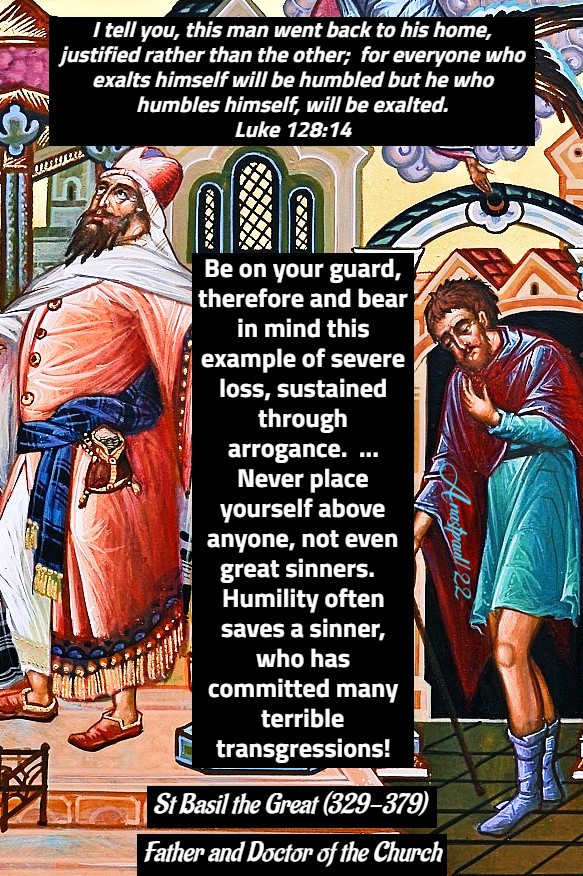
“I tell you, this man went back to his home, justified rather than the other; for everyone who exalts himself will be humbled but he who humbles himself, will be exalted” – Luke 18:14
REFLECTION – “The stern Pharisee, who in his overweening pride, not only boasted of himself but also discredited the tax collector, in the Presence of God, made his justice void by being guilty of pride. Instead of the Pharisee, the tax collector went down justified because he had given glory to God, the Holy One. He did not dare lift his eyes but sought only to plead for mercy. He accused himself by his posture, by striking his breast and by entertaining no other motive, except propitiation.
Be on your guard, therefore and bear in min, this example of severe loss, sustained through arrogance. The one guilty of insolent behaviour suffered the loss of his justice and forfeited his reward, by his bold self-reliance. He was judged inferior to a humble man and a sinner because, in his self-exaltation, he did not await the judgement of God but pronounced it himself.
Never place yourself above anyone, not even great sinners. Humility often saves a sinner, who has committed many terrible transgressions!” – St Basil the Great (329-379) Bishop of Caesarea, Father and Doctor of the Church (On Humility)
PRAYER – O God, Thou manifest Thy power, particularly in forbearance and pity, show us Thy mercy again and again, so that hastening toward Thy promises, we may become partakers of the blessings of Heaven. Through Jesus Christ, Thy Son our Lord, Who lives and reigns with Thee, in the unity of the Holy Ghost, God, world without end. Amen (Collect).
Thought for the Day – 30 July – Meditations with Antonio Cardinal Bacci (1881-1971)
Knowledge and Sanctity
“We have no right to speak evil of human learning and industry, which are a gift from God. But we must recognise that goodness is more important than knowledge. The devil’s intellect is superior to ours but, he has lost God and in losing God, has lost everything which is good.
“Knowledge puffs up” writes St Paul (1 Cor 8:1). Pride and presumption can easily spring from a little learning, whereas the fruits of holiness are always beneficial to ourselves and to others.
Let us be humble in our scientific studies and use the results which we obtain, for our own progress in sanctity.”
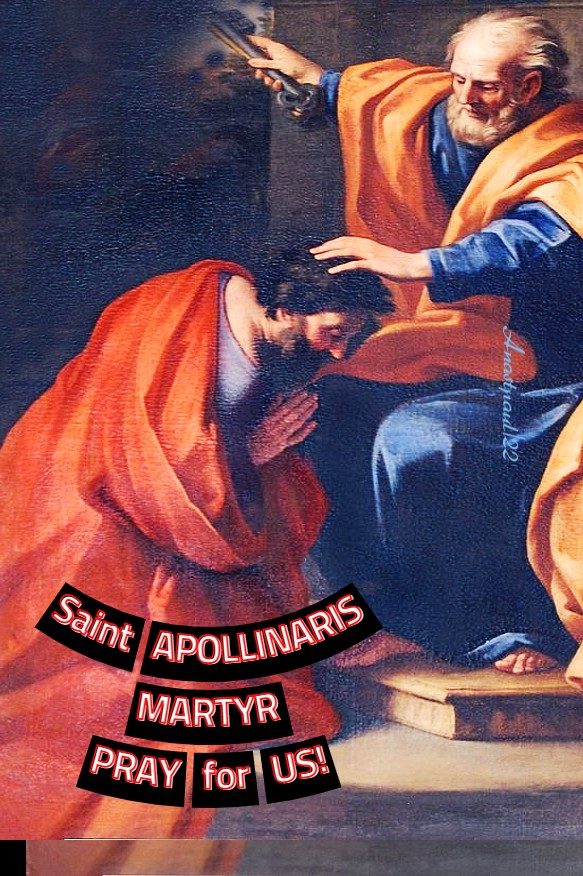
Quote/s of the Day – 23 July – The Memorial of St Apollinaris (1st Century) Bishop Martyr, Disciple of St Peter – 1 Peter 5:1-11, Luke 22:24-30
“Let him who is greatest among you, become as the youngest and he who is the leader, as the servant.”
Luke 22:25
“Those who refuse to be humble cannot be saved. They cannot say with the prophet: See, God comes to my aid; the Lord is the helper of my soul. But anyone who makes himself humble, like a little child, is greater in the kingdom of heaven.”
St Bede the Venerable (673-735) Father and Doctor if the Church
“When insults have no effect on us, when persecutions and penalties, have no terror for us, when prosperity or adversity, has no influence on us, when friend and foe, are viewed in the same light… do we not come close, to sharing, the serenity of God?”
St Aelred of Rievaulx (1110-1167) “St Bernard of the North”
“O blessed Jesus, give me stillness of soul in You. Let Your mighty calmness reign in me. Rule me, O King of Gentleness, King of Peace.”
St John of the Cross (1542-1591) Doctor of the Church
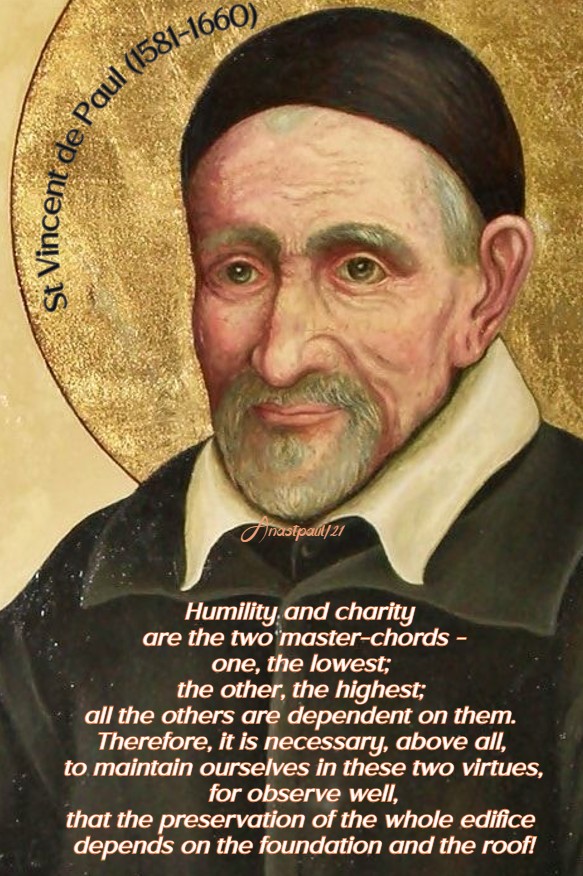
“Humility and charity are the two master chords – one, the lowest; the other, the highest; all the others are dependent on them. Therefore, it is necessary, above all. to maintain ourselves in these two virtues, for observe well, that the preservation of the whole edifice depends on the foundation and the roof!”
One Minute Reflection –23 July – the Memorial of St Apollonaris (1st Century) Bishop Martyr, Disciple of St Peter – 1 Peter 5:1-11, Luke 22:24-30
“At that time, there arose a dispute among the disciples, which of them was reputed to be the greatest.” – Luke 22:24
REFLECTION – “Why are there strife and passion, schisms and even war among you? Do we not possess the same Spirit of grace which was given to us and the same calling in Christ? Why do we tear apart and divide the Body of Christ? Why do we revolt against our own Body? Why do we reach such a degree of insanity that we forget that we are members of one another? Do not forget the words of Jesus our Lord: Woe to that man; it would be better for him if he had not been born rather than scandalise one of my chosen ones. Indeed it would be better for him to have a great millstone round his neck and to be drowned in the sea, than that he lead astray one of my chosen ones. Your division has led many astray, has made many doubt, has made many despair and has brought grief upon us all. And still your rebellion continues!
Pick up the letter of blessed Paul the Apostle. What did he write to you at the beginning of his ministry? Even then you had developed factions. So Paul, inspired by the Holy Spirit, wrote to you concerning himself and Cephas and Apollos. But that division involved you in less sin because you were supporting Apostles of high reputation and a person approved by them.
We should put an end to this division immediately. Let us fall down before our Master and implore His mercy with our tears. Then He will be reconciled to us and restore us to the practice of brotherly love that befits us. For this is the Gate of Justice that leads to life, as it is written: Open to me the Gates of Justice. When I have entered there, I shall praise the Lord. This is the Gate of the Lord, the just shall enter through it. There are many gates which stand open but the Gate of Justice, is the Gateway of Christ. All who enter through this Gate, are blessed, pursuing their way in holiness and justice, performing all their tasks without discord. A person may be faithful, he may have the power to utter hidden mysteries, he may be discriminating in the evaluation of what is said and pure in his actions. But the greater he seems to be, the more humbly he ought to act and the more zealous he should be, for the common good, rather than his own interest.” – St Pope Clement I (c 35-c 101) Pope from about 88 to 101 Apostolic Father, Bishop of Rome and Martyr (An excerpt from his Letter to the Corinthians).
PRAYER – O God, the rewarder of faithful souls, grant that we may obtain pardon through the prayers of blessed Apollinaris, Thy Martyr and Bishop, whose feast we are celebrating .Through Jesus Christ, Thy Son our Lord, Who lives and reigns with Thee, in the unity of the Holy Ghost, God, world without end. Amen (Collect).
Thought for the Day – 21 July – Meditations with Antonio Cardinal Bacci (1881-1971)
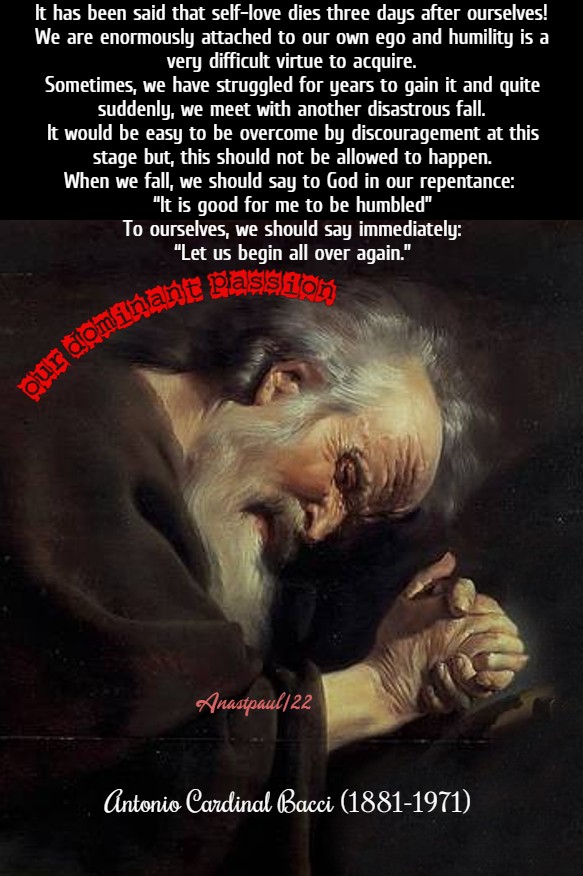
Our Dominant Passion
“Holy and God-fearing people know their own particular weakness. They accept it as a cross and will not rest until they have conquered it with God’s help, The battle cannot be won in a day but, in most cases, takes a great many years. Often the ultimate victory is not gained until the hour of death.
It has been said that self-love dies three days after ourselves! We are enormously attached to our own ego and humility is a very difficult virtue to acquire. Sometimes, we have struggled for years to gain it and quite suddenly, we meet with another disastrous fall. It would be easy to be overcome by discouragement at this stage but, this should not be allowed to happen. When we fall, we should say to God in our repentance: “It is good for me to be humbled.” To ourselves, we should say immediately: “Let us begin all over again.”
St Francis de Sales was endowed by nature with a sharp and hasty temperament, against which he fought for many years with great determination and reliance on God’s help. Finally, he conquered and came to regarded as an angel of peace. Nevertheless, even in the late years of his life, he still experienced inward tendencies towards anger, so that his exterior gentleness, was really a supreme act of victory!
Quote/s of the Day –19 July – The Memorial of St Vincent de Paul (1581-1660) Confessor
“Every time, that some unexpected event befalls us, be it affliction, or be it spiritual or corporal consolation, we should endeavour to receive it. with equanimity of spirit, since all comes from the Hand of God.”
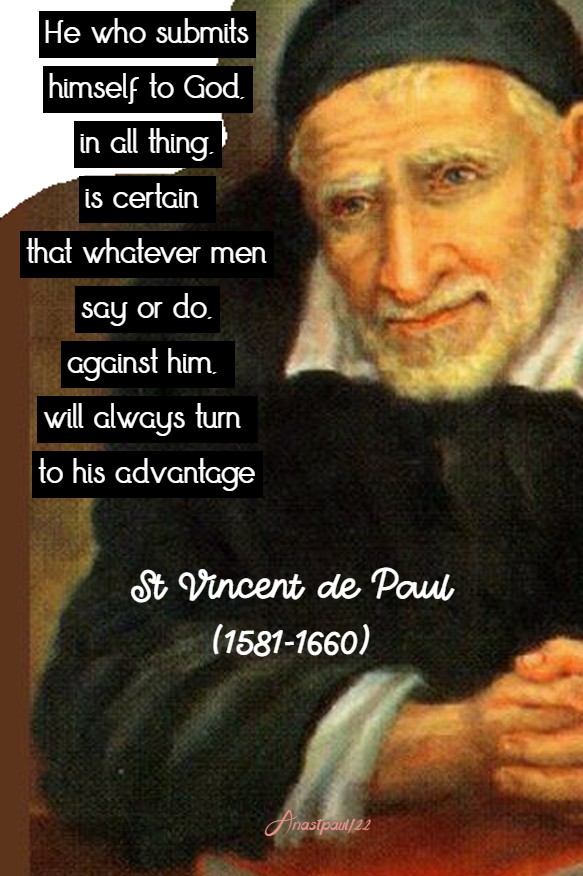
“He who submits himself to God, in all thing, is certain that whatever men say or do, against him, will always turn to his advantage.”
“After knowing the Will of God, in regard to a work which we undertake, we should continue courageously, however difficult it may be. We should follow it to the end with as much constancy as the obstacles, which we encounter, are great.”
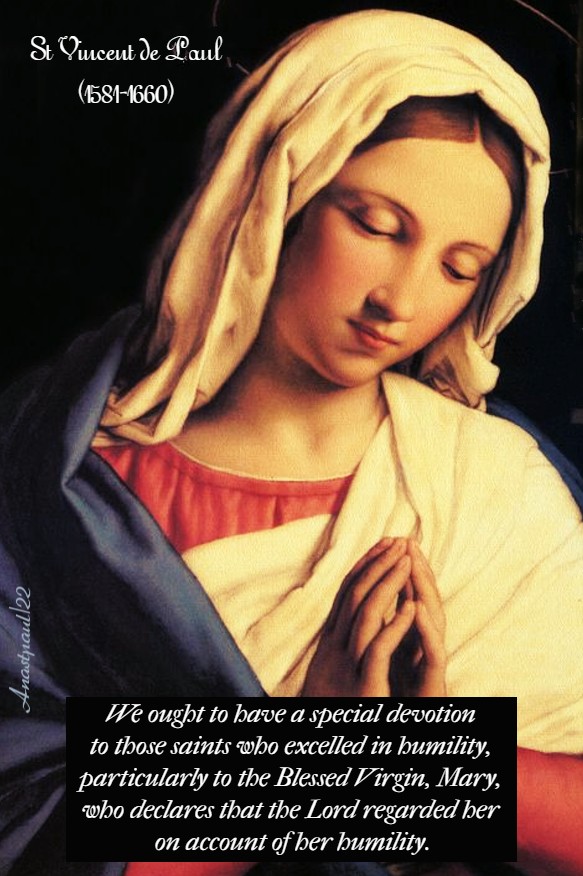
“We ought to have a special devotion to those saints who excelled in humility, particularly to the Blessed Virgin, Mary, who declares that the Lord regarded her on account of her humility.”
Thought for the Day – 17 July – Meditations with Antonio Cardinal Bacci (1881-1971)
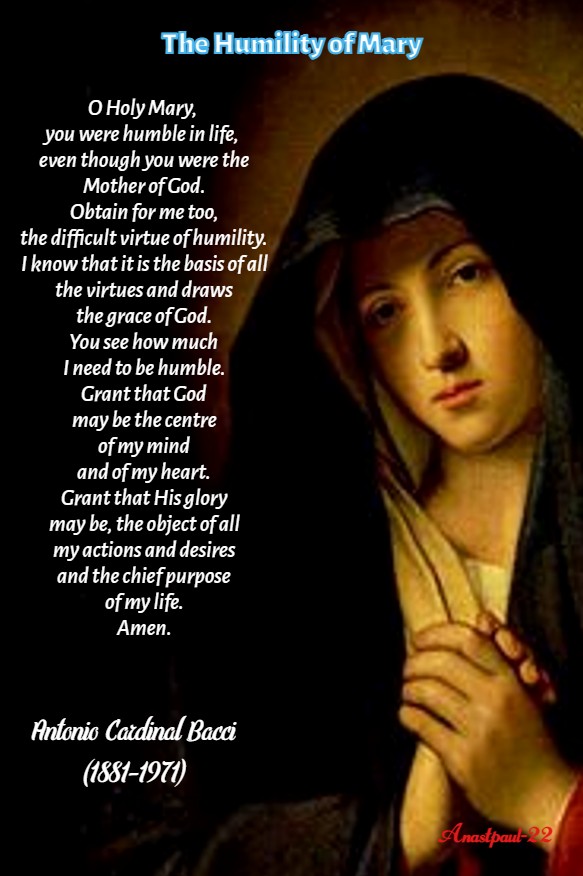
The Humility of Mary
“O Holy Mary, you were humble in life, even though you were the Mother of God. Obtain for me too, the difficult virtue of humility. I know that it is the basis of all the virtues and draws the grace of God. You see how much I need to be humble. Grant that God may be the centre of my mind and of my heart. Grant that His glory may be, the object of all my actions and desires and the chief purpose of my life. Amen.”
Quote/s of the Day – 17 July – The Sixth Sunday after Pentecost – The Humility of Mary
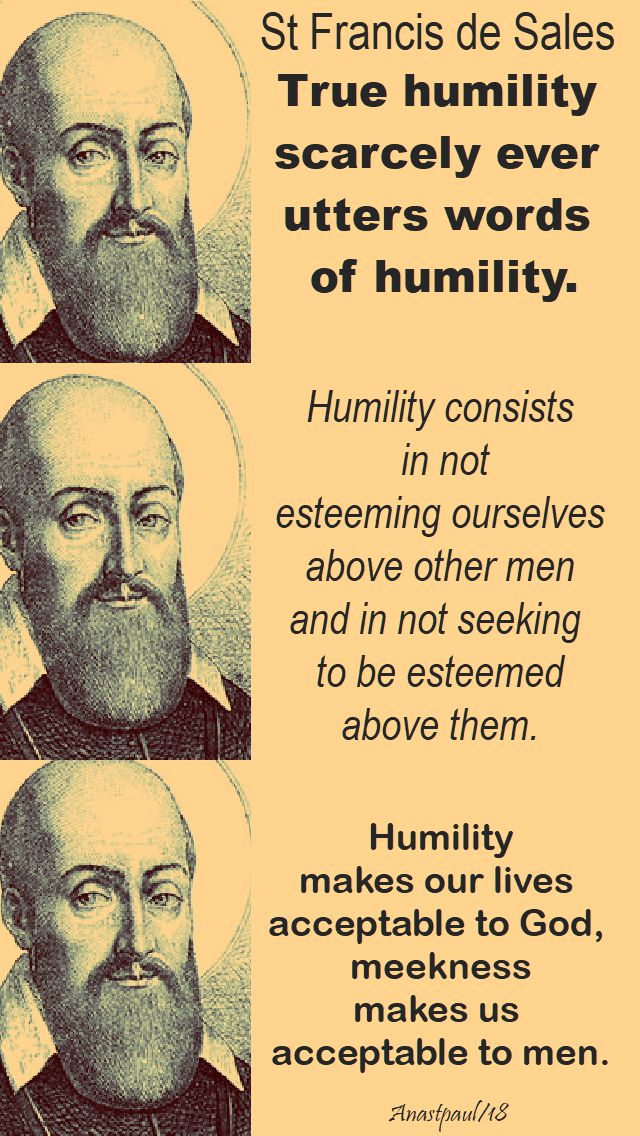
“True humility scarcely ever utters words of humility.”
“Humility, makes our lives acceptable to God, meekness, makes us acceptable to men.”
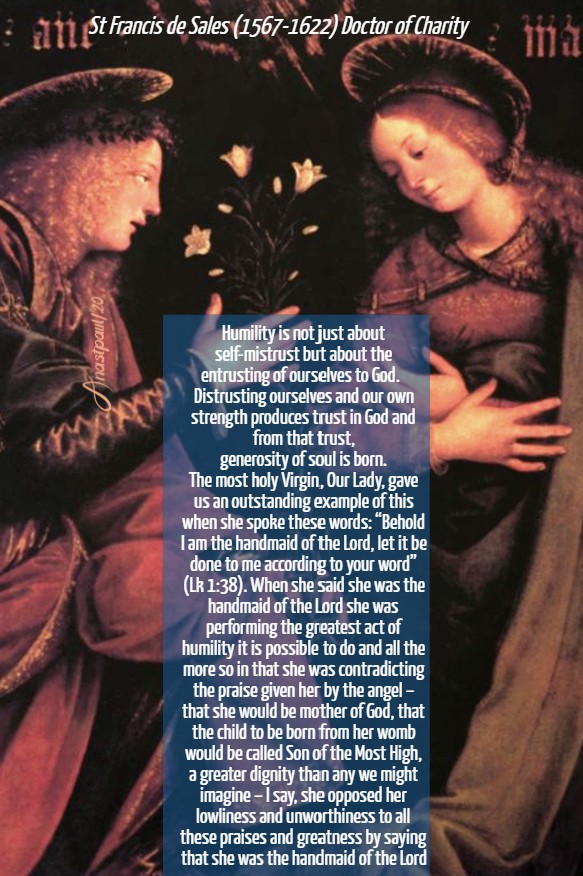
“Humility is not just about self-mistrust but about the entrusting of ourselves to God. Distrusting ourselves and our own strength produces trust in God and from that trust, generosity of soul is born.”
The most holy Virgin, Our Lady, gave us an outstanding example of this when she spoke these words: “Behold I am the handmaid of the Lord, let it be done to me according to your word” (Lk 1:38). When she said she was the handmaid of the Lord, she was performing the greatest act of humility it is possible to do and, all the more so, in that she was contradicting the praise given her by the angel – that she would be mother of God, t hat the child to be born from her womb would be called Son of the Most High, a greater dignity than any we might imagine – I say, she opposed her lowliness and unworthiness to all these praises and greatness, by saying t hat she was the handmaid of the Lord.”
Our Morning Offering – 17 July – The Sixth Sunday after Pentecost – The Humility of Mary
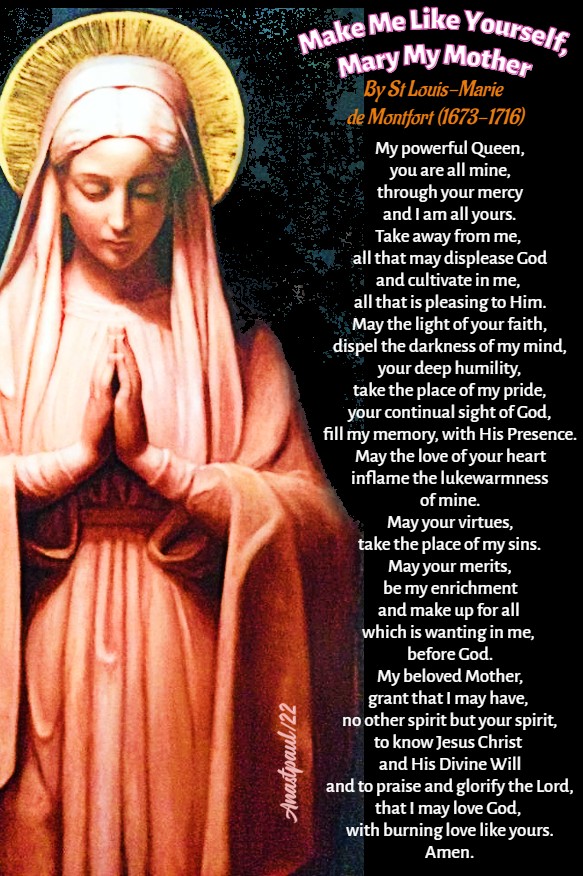
Make Me Like Yourself, Mary My Mother By St Louis-Marie de Montfort (1673-1716)
My powerful Queen, you are all mine, through your mercy and I am all yours. Take away from me, all that may displease God and cultivate in me, all that is pleasing to Him. May the light of your faith, dispel the darkness of my mind, your deep humility, take the place of my pride, your continual sight of God, fill my memory, with His Presence. May the love of your heart inflame the lukewarmness, of mine. May your virtues, take the place of my sins. May your merits, be my enrichment and make up for all which is wanting in me, before God. My beloved Mother, grant that I may have, no other spirit but your spirit, to know Jesus Christ and His Divine Will and to praise and glorify the Lord, that I may love God, with burning love like yours. Amen
By St Alphonsus Maria de Liguori (1696-1787) Most Zealous Doctor of the Church The Humility of Mary Excerpt from: “The Glories of Mary”
“Humility” says St. Bernard, “is the foundation and guardian of virtues” and with reason, for without it, no other virtue can exist in a soul. Should she possess all virtues, all will depart when humility is gone. But, on the other hand, as St Francis de Sales wrote to St Jane Frances de Chantal, “God so loves humility, that whenever He sees it, He is immediately drawn there.” This beautiful and so necessary virtue, was unknown in the world but the Son of God Himself came upon the earth, to teach it by His Own example and willed that in that virtue, in particular, we should endeavour to imitate Him – “Learn of Me, for I am meek and humble of heart.”
Mary, being the first and most perfect disciple of Jesus Christ, in the practice of all virtues, was the first also in that of humility and by it, merited to be exalted above all creatures. It was revealed to St. Matilda that the first virtue in which the Blessed Mother particularly exercised herself, from her very childhood, was that of humility.
The first effect of humility of heart is a lowly opinion of ourselves: – “Mary had always so humble an opinion of herself, that,” as it was revealed to the same St Matilda, “although she saw herself enriched with greater graces, than all other creatures, she never preferred herself to anyone.” The Abbot Rupert, explaining the passage of the Sacred Canticles, Thou hast wounded my heart, my sister, my spouse, …with one hair of thy neck, [Cant. 4:9] says, that the humble opinion, which Mary had of herself, was precisely that hair of the Spouse’s neck, with which she wounded the heart of God.” Not indeed that Mary considered herself a sinner: for humility is truth, as St Teresa remarks and Mary knew that she had never offended God: nor was it that she did not acknowledge that she had received greater graces from God, than all other creatures; for a humble heart always acknowledges the special favours of the Lord, to humble herself the more but the Divine Mother, by the greater light wherewith she knew the infinite greatness and goodness of God, also knew, her own nothingness and, therefore, more than all others, humbled herself, saying with the Sacred Spouse – Do not consider that I am brown, because the sun hath altered my colour. [Cant. 1:5] That is, as St Bernard explains it, “When I approach Him, I find myself black.” “
Yes,” says St Bernardine, for “the Blessed Virgin had always the majesty of God and her own nothingness, present to her mind.” As a beggar, when clothed with a rich garment, which has been bestowed upon her, does not pride herself on it, in the presence of the giver but is rather humbled, being reminded thereby, of her own poverty, so also, the more Mary saw herself enriched, the more did she humble herself, remembering that all was God’s gift; whence she herself told St Elizabeth of Hungary, that “she might rest assured that she looked upon herself, as most vile and unworthy of God’s grace.” Therefore, St Bernardine says, that “after the Son of God, no creature in the world was so exalted as Mary because, no creature in the world ever humbled itself, as much as she did.”
Moreover, it is an act of humility to conceal heavenly gifts. Mary wished to conceal from St Joseph, the great favour whereby she had become the Mother of God, although it seemed necessary to make it known to him, if only to remove from the mind of her poor spouse, any suspicions as to her virtue, which he might have entertained on seeing her pregnant: or, at least the perplexity, in which it indeed threw him: for St. Joseph,, on the one hand, unwilling to doubt Mary’s chastity and on the other, ignorant of the Mystery, was minded to put her away privately. [Matt. 1:19] This he would have done, had not the Angel revealed to him that his Spouse was pregnant by the operation of the Holy Ghost.
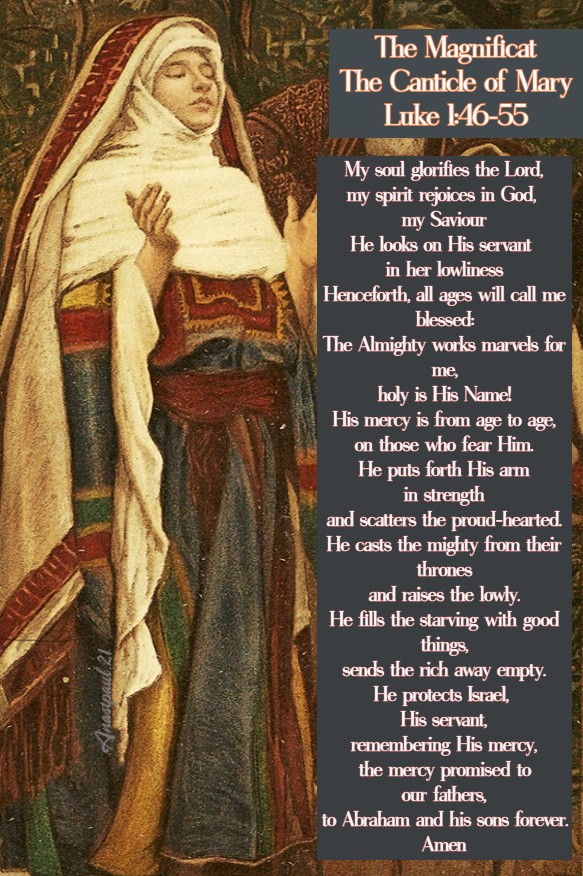
Again, a soul that is truly humble refuses her own praise and should praises be bestowed on her, she refers them all to God. Behold, Mary is disturbed at hearing herself praised by St Gabriel and when St Elizabeth said, Blessed art thou among women … and whence is this to me, that the Mother of my Lord should come to me? … blessed art thou that hast believed, [ Luke 1:42] Mary referred all to God, and answered in that humble Canticle, My soul doth magnify the Lord, [Ibid., 46-47] as if she had said: “Thou dost praise me, Elizabeth but I praise the Lord, to Whom alone honour is due, thou wonders that I should come to thee and I wonder at the Divine Goodness in which alone my spirit exults” and my spirit hath rejoiced in God my Saviour.Thou praisest me because I have believed; I praise my God because He hath been pleased to exalt my nothingness: because He hath regarded the humility of His handmaid. Hence Mary said to St Bridget: “I humbled myself so much and thereby, merited so great a grace because I though, and knew, that of myself I possessed nothing. For this same reason I did not desire to be praised, I only desired that praises should be given to the Creator and Giver of all.” Wherefore, an ancient author, speaking of the humility of Mary, says: “O truly blessed humility, which hath given God to men, opened Heaven and delivered souls from Hell.“
It is also a part of humility to serve others. Mary did not refuse to go and serve Elizabeth for three months. Hence St Bernard says, “Elizabeth wondered that Mary should have come to visit her but that which is still more admirable, is that she came, not to be ministered to but to minister.”
Those who are humble are retiring and choose the last places and, therefore, Mary, remarks St Bernard, when her Son was preaching in a house, as it is related by St Matthew, [12:46], wishing to speak to Him, would not, of her own accord, enter but “remained outside and did not avail herself of her maternal authority to interrupt Him.” For the same reason, when she was with the Apostles awaiting the coming of the Holy Ghost, she took the lowest place, as St Luke relates, All these were persevering with one mind in prayer, with the women, and Mary, the Mother of Jesus. [Acts 1:14] Not that St Luke was ignorant of the Divine Mother’s merits, on account of which, he should have named her in the first place but because she had taken the last place amongst the Apostles and women and, therefore, he described them all, as an author remarks, in the order in which they were. Hence St. Bernard says, “Justly has the last become the first, who being the first of all became the last.”
In fine, those who are humble, love to be contemned, therefore, we do not read that Mary showed herself in Jerusalem on Palm Sunday, when her Son was received by the people with so much honour but, on the other hand, at the Death of her Son, she did not shrink from appearing on Calvary, through fear of the dishonour which would accrue to her, when it was known that she was the Mother of Him Who was condemned to die an infamous death, as a criminal. Therefore, she said to St Bridget, “What is more humbling than to be called a fool, to be in want of all things and to believe one’s self, the most unworthy of all? Such, O daughter, was my humility, this was my joy, this was all my desire, with which I thought how to please my Son alone.”
The Venerable Sister Paula of Foligno was given to understand, in an ecstasy, how great was the humility of our Blessed Lady and giving an account of it to her Confessor, she was so filled with astonishment at its greatness that she could only exclaim, “O, the humility of the Blessed Virgin! O, Father, the humility of the Blessed Virgin, how great was the humility of the Blessed Virgin! In the world there is no such thing as humility, not even in its lowest degree, when you see the humility of Mary.” On another occasion our Lord showed St Bridget two ladies. The one was all pomp and vanity. “She,” He said, “is Pride but the other one, whom you see with her head bent down, courteous towards all, having God alone in her mind and considering herself as no -ne, is Humility: her name is Mary.” Hereby God was pleased to make known to us that the humility of His Blessed Mother, was such that she was humility itself.
Then, O my Queen, I can never be really thy child, unless I am humble but dost thou not see that my sins, after having rendered me ungrateful to my Lord, have also made me proud? O my Mother, do thou supply a remedy. By the merit of thy humilit, obtain that I may be truly humble and thus become thy child, Amen.
Quote/s of the Day – 14 July – “The Month of the Precious Blood” – The Memorial of St Bonaventure OFM (1221-1274) Seraphic Doctor of the Church (No images until later. We are being subjected to constant Power Cuts again – they can be up to 8 hours per day.)
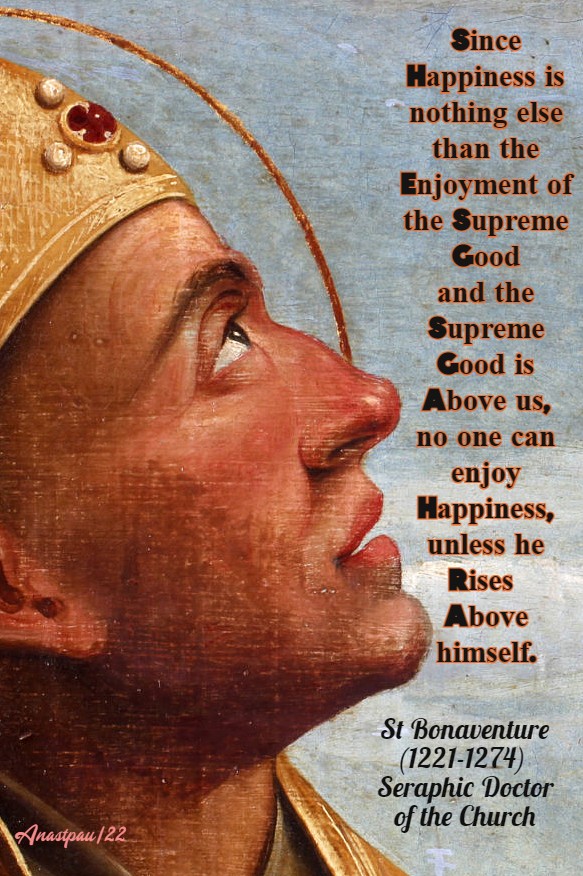
“Since happiness is nothing else than the enjoyment of the Supreme Good and the Supreme Good is above us, no-one can enjoy happiness, unless he rises above himself.”
“As “pride, is the beginning of all sin,” (Eccl. 10:15) so humility, is the foundation of all virtue. Learn to be really humble and not, as the hypocrite, humble merely in appearance.”
Quote/s of the Day – 11 July – The Memorial of St John Gualbert (c 985-1073) Abbot – Ecclesiasticus 45:1-6, Matthew 5:43-48
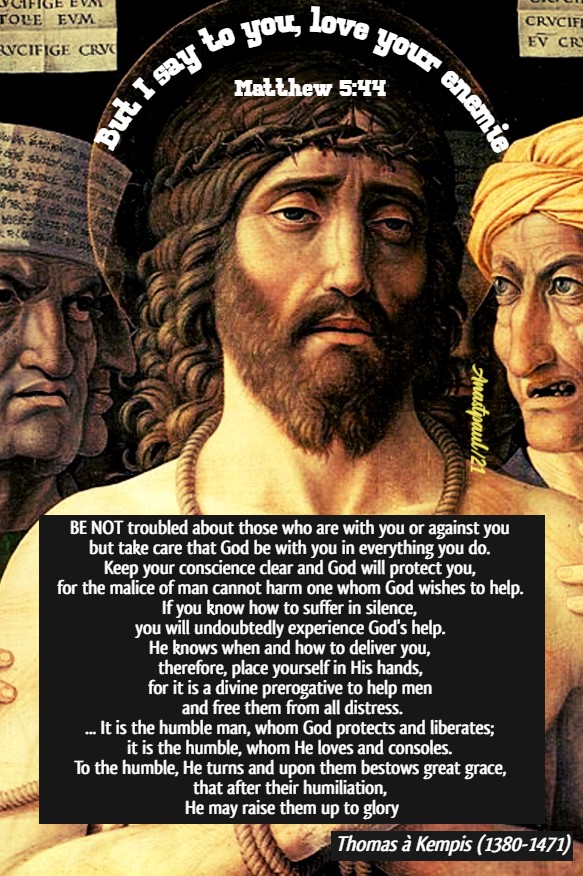
“But I say to you, love your enemies …”
Matthew 5:44
St John Gualbert said to his enemy, “I cannot refuse what you ask in Christ’s Name. I grant you your life and I give you my friendship. Pray that God may forgive me my sin.”
St John Gualbert (c 985-1073) “The Merciful Knight.”
“BE NOT troubled about those who are with you or against you but take care that God be with you in everything you do. Keep your conscience clear and God will protect you, for the malice of man cannot harm one whom God wishes to help. If you know how to suffer in silence, you will undoubtedly experience God’s help. He knows when and how to deliver you, therefore, place yourself in His hands, for it is a divine prerogative to help men and free them from all distress. … It is the humble man, whom God protects and liberates; it is the humble, whom He loves and consoles. To the humble, He turns and upon them bestows great grace, that after their humiliation, He may raise them up to glory.”
Thought for the Day – 6 July – Meditations with Antonio Cardinal Bacci (1881-1971) – Octave Day of Saints Peter and Paul
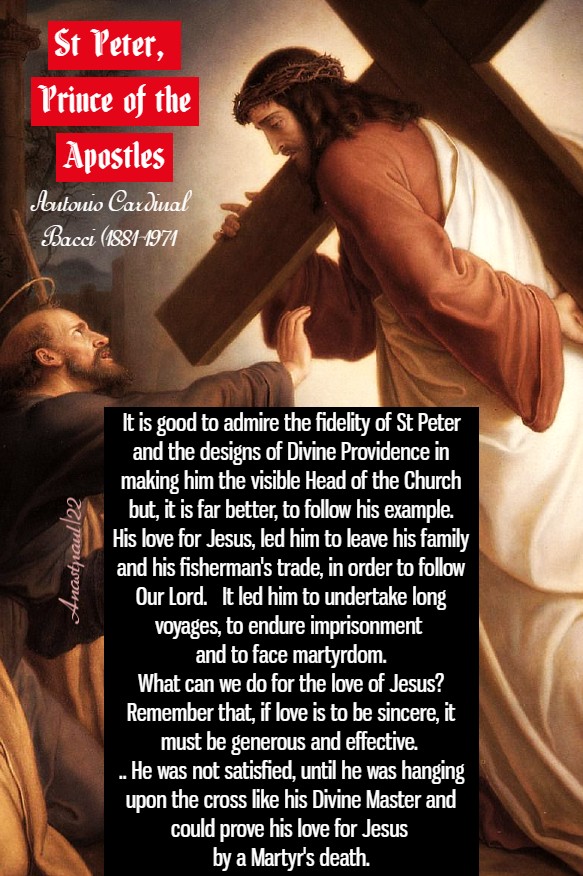
St Peter, Prince of the Apostles St Paul, the Apostle to the Gentiles
“It is good to admire the fidelity of St Peter and the designs of Divine Providence in making him the visible Head of the Church but, it is far better, to follow his example. His love for Jesus, led him to leave his family and his fisherman’s trade, in order to follow Our Lord. It led him to undertake long voyages, to endure imprisonment and to face martyrdom. What can we do for the love of Jesus? Remember that, if love is to be sincere, it must be generous and effective.
Secondly let us meditate on and imitate, the ardent and fearless faith of St Peter. He was not afraid to preach the teaching of Christ before the Sanhedrin. He was not afraid of Herod, who cast him into prison.
He was not afraid of the Roman Emperor, who caused him to be crucified. Our faith should be steadfast and lively, like his!
Finally, let us imitate Peter in his repentance. Although he loved Jesus very much and had such great faith in Him, in a moment of weakness and of imprudence, he denied Him three times. All his life, however, be wept bitterly for this sin. Whenever he heard a cock crowing, it was as if an arrow had pierced his heart. He was not satisfied, until he was hanging upon the cross like his Divine Master and could prove his love for Jesus by a Martyr’s death.”
St Paul, the Apostle to the Gentiles
We can learn many other virtues from St Paul, besides his zealous love for God and for his fellowmen. We can also learn from him, the virtues of humility and of apostolic fervour. The Apostle of the Gentiles reached such heights of sanctity, as to feel himself transformed into Christ Himself and to deserve to be taken up into the third Heaven, where he enjoyed a foretaste of eternal happiness. Nevertheless, he considered himself unworthy to be called an Apostle and he realised, that all his gifts came to him from God. “Not that we are sufficient of ourselves, to think anything as from ourselves but our sufficiency, is from God” (2 Cor 3:5). Whenever we succeed in any project, we should think on the same lines because, it is only when we are humble and depend on the grace of God, that the success of our actions will redound to the glory of our Creator. If the cancer of ambition or of self-love, should corrupt our purity of intention, our work would not be blessed by God and would not make us worthy of everlasting life. Let us repeat often: “All for You, with You and in You, my God.”
Quote/s of the Day – 9 June – “The Month of the Sacred Heart” – Pentecost Thursday – Acts 8:5-8, Luke 9:1-6
“Take nothing for your journey, neither staff, nor bag, nor bread, nor money; neither have two tunics.”
Luke 9:3
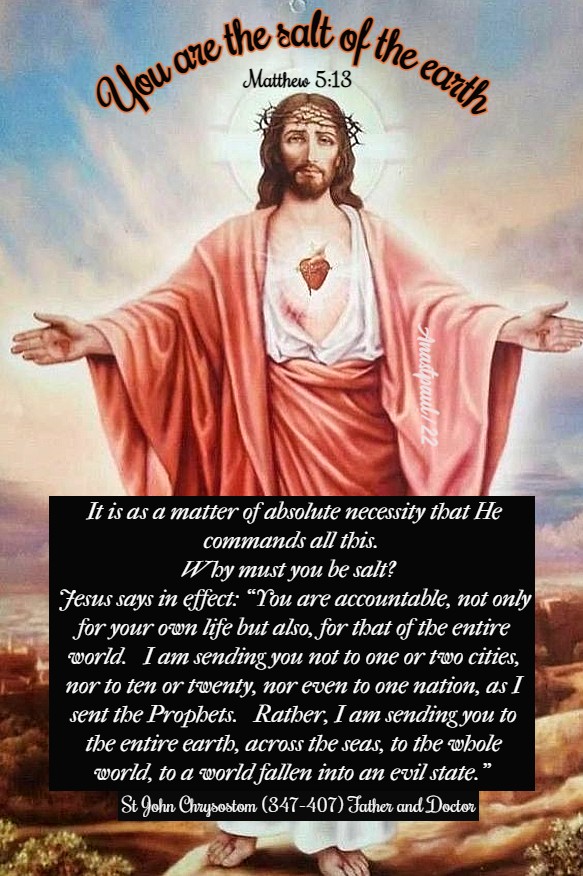
“You are the salt of the earth.”
Matthew 5:13
“It is as a matter of absolute necessity that He commands all this. Why must you be salt? Jesus says in effect: “You are accountable, not only for your own life but also, for that of the entire world. I am sending you not to one or two cities, nor to ten or twenty, nor even to one nation, as I sent the Prophets. Rather, I am sending you to the entire earth, across the seas, to the whole world, to a world fallen into an evil state.”
St John Chrysostom (347-407) Father and Doctor of the Church
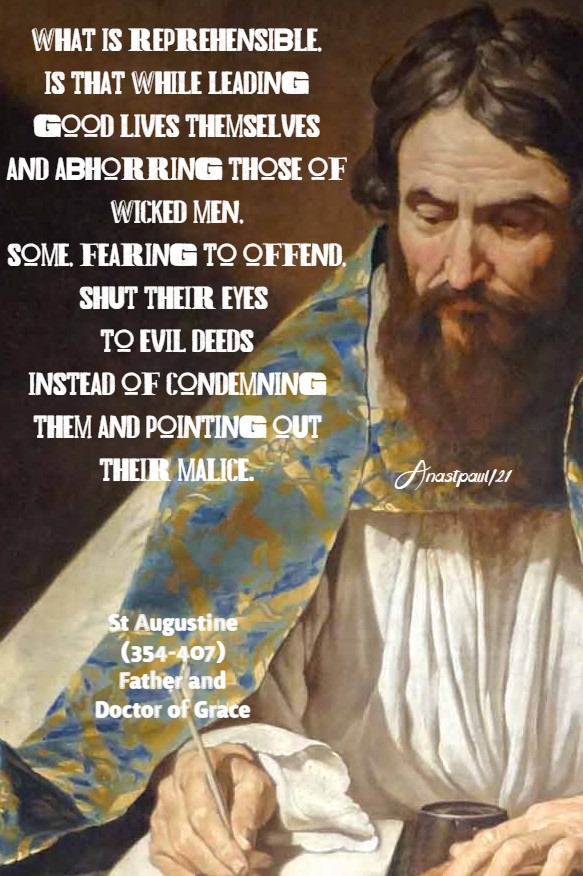
“What is reprehensible, is that while leading good lives themselves and abhorring those of wicked men, some, fearing to offend, shut their eyes to evil deeds instead of condemning them and pointing out their malice.”
St Augustine (354-407) Father and Doctor of Grace
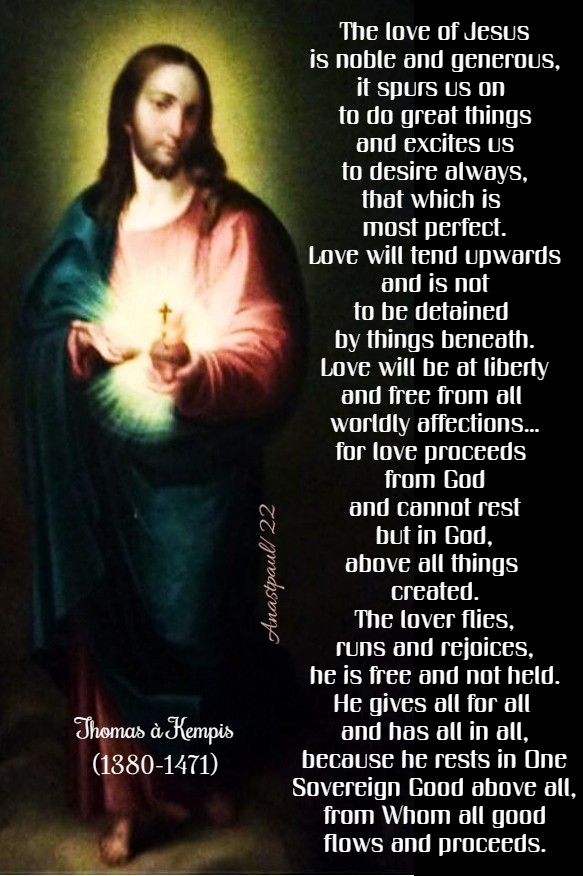
“The love of Jesus is noble and generous, it spurs us on to do great things and excites us to desire always, that which is most perfect. Love will tend upwards and is not to be detained by things beneath. Love will be at liberty and free from all worldly affections… for love proceeds from God and cannot rest but in God, above all things created. The lover flies, runs and rejoices, he is free and not held. He gives all for all and has all in all, because he rests in One Sovereign Good above all, from Whom all good flows and proceeds.”
Thomas à Kempis CRSA (1380-1471)
(Book III, Chapter V, 3-4)
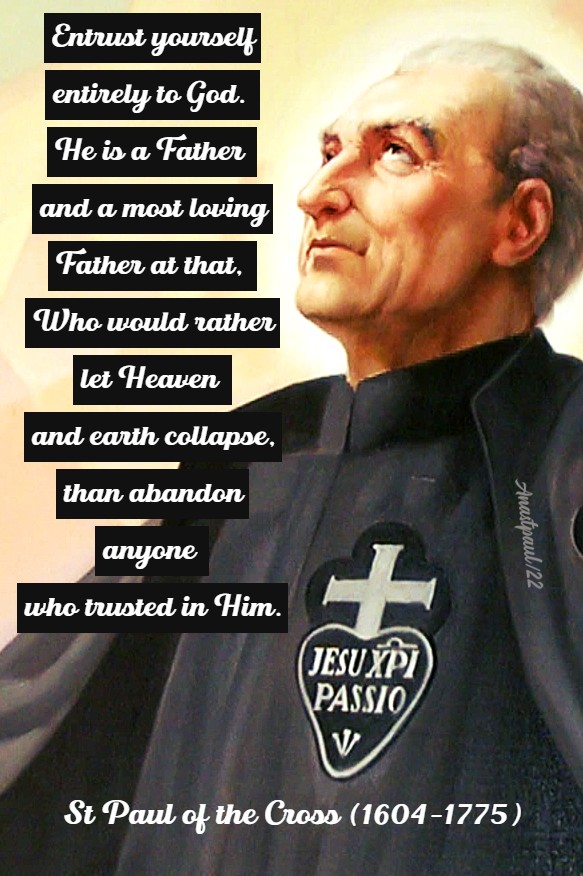
“Entrust yourself entirely to God. He is a Father and a most loving Father at that, Who would rather let Heaven and earth collapse, than abandon anyone who trusted in Him.”
St Paul of the Cross (1604-1775)
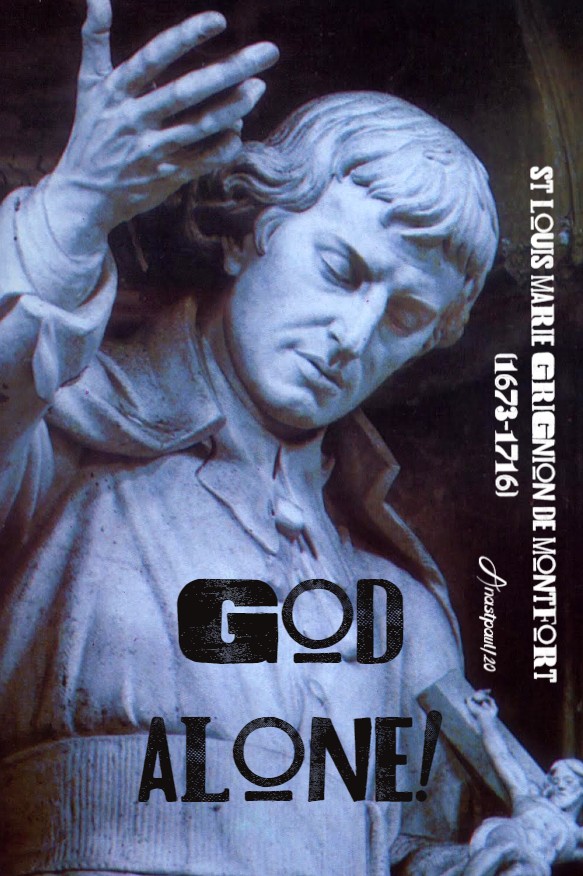
“God alone!”
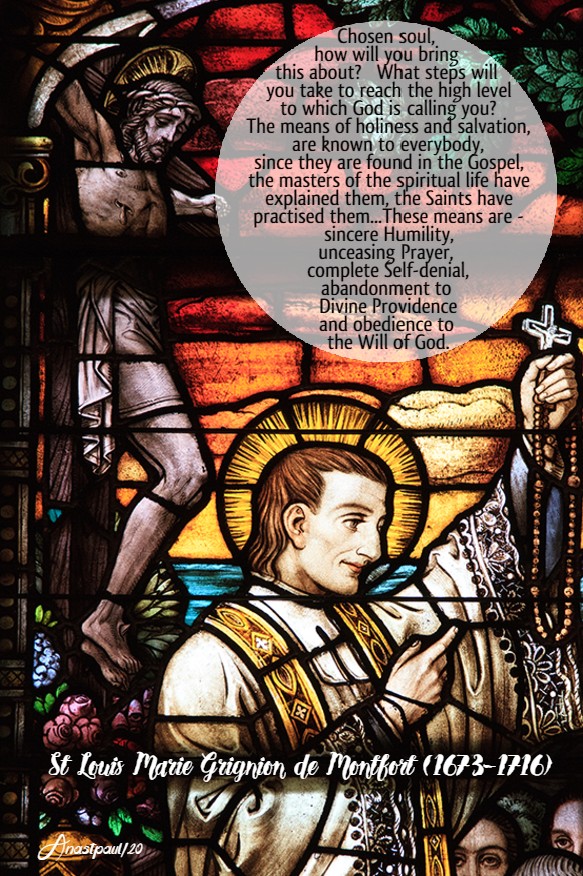
“Chosen soul, how will you bring this about? What steps will you take to reach the high level to which God is calling you? The means of holiness and salvation, are known to everybody, since they are found in the Gospel, the masters of the spiritual life have explained them, the Saints have practised them… These means are – sincere Humility, unceasing Prayer, complete Self-denial, abandonment to Divine Providence and obedience to the Will of God.”
Quote/s of the Day – 29 May – Sunday within the Octave of Ascension – The Memorial of St Maria Magdalena de’ Pazzi O.Carm (1566-1607)
“You will be consoled according to the greatness of your sorrow and affliction; the greater the suffering, the greater will be the reward.”
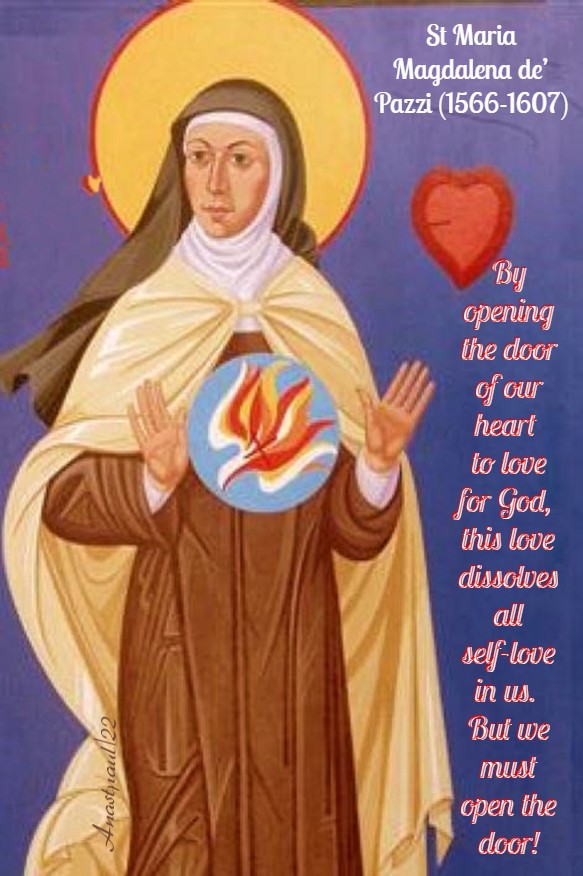
“By opening the door of our heart to love for God, this love dissolves all self-love in us. But we must open the door!”
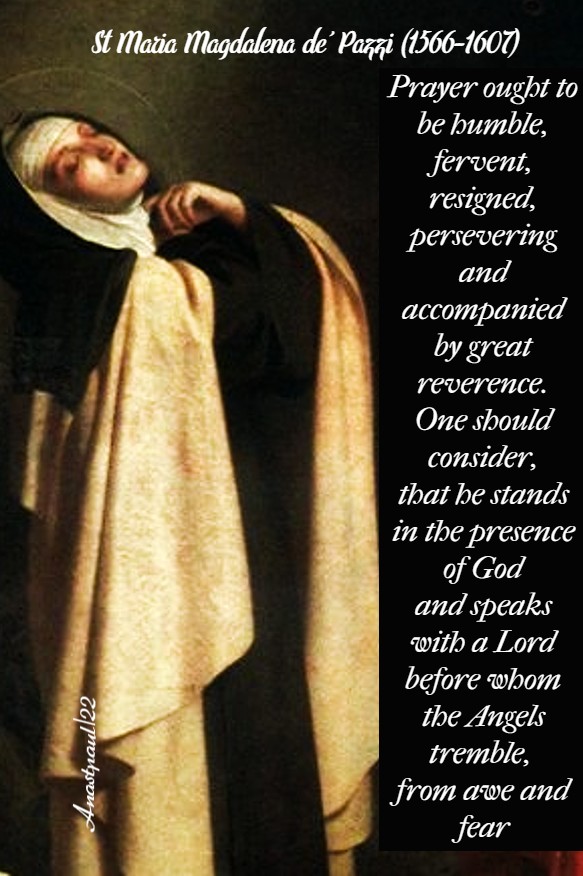
“Prayer ought to be humble, fervent, resigned, persevering and accompanied by great reverence. One should consider, that he stands in the presence of God and speaks with a Lord before whom the Angels tremble, from awe and fear.”
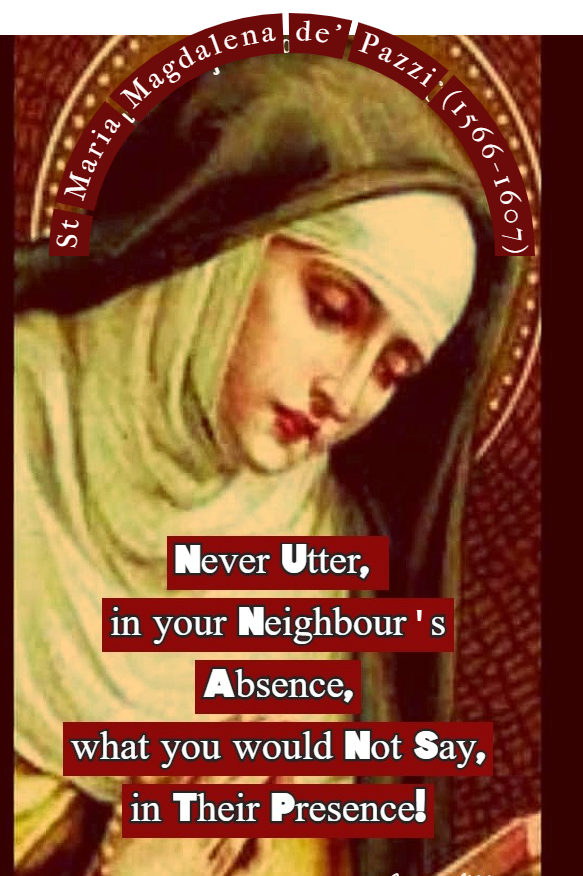
“Never utter, in your neighbour’s absence, what you would not say, in their presence.”
Quote/s of the Day – 24 May – “The Month of the Blessed Virgin Mary” – James 1:22-27, John 16:23-30
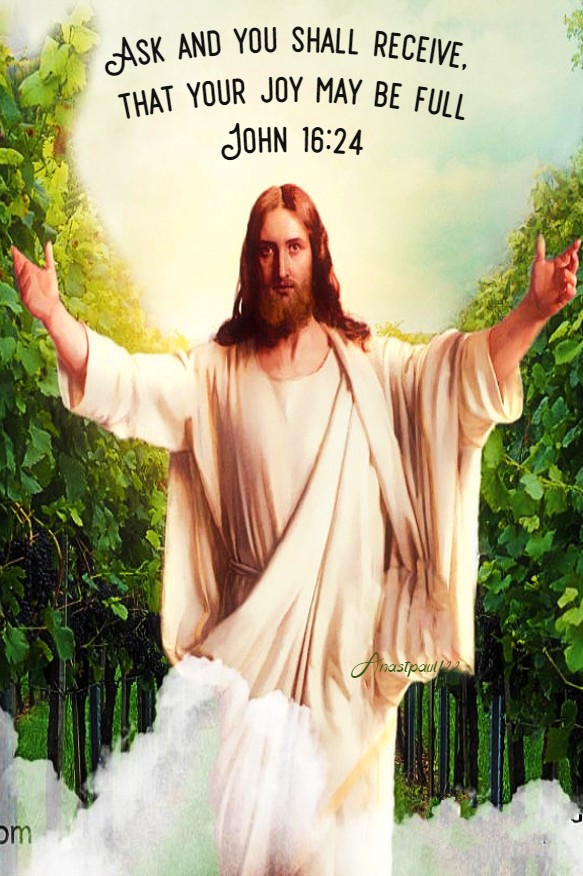
“Ask and you shall receive, that your joy may be full.”
John 16:24
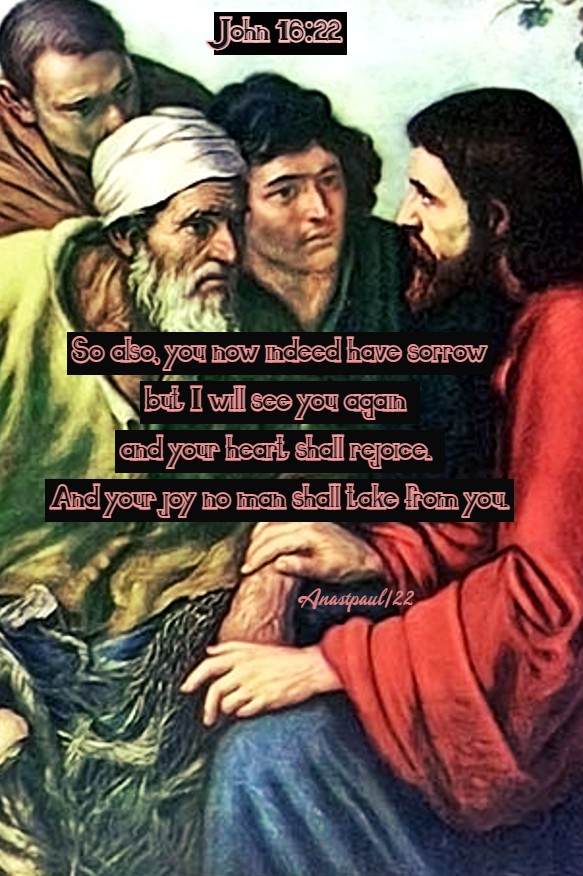
“So also, you now indeed have sorrow but I will see you again and your heart shall rejoice. And your joy, no man shall take from you.”
John 16:22
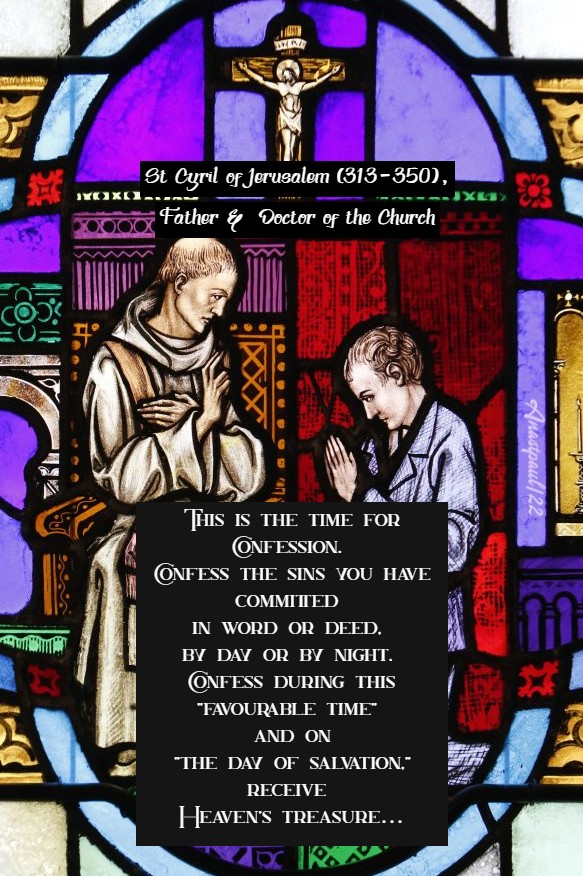
“This is the time for Confession. Confess the sins you have committed in word or deed, by day or by night. Confess during this “favourable time” and on “the day of salvation,” receive Heaven’s treasure… ”
St Cyril of Jerusalem (313-350), Father & Doctor of the Church
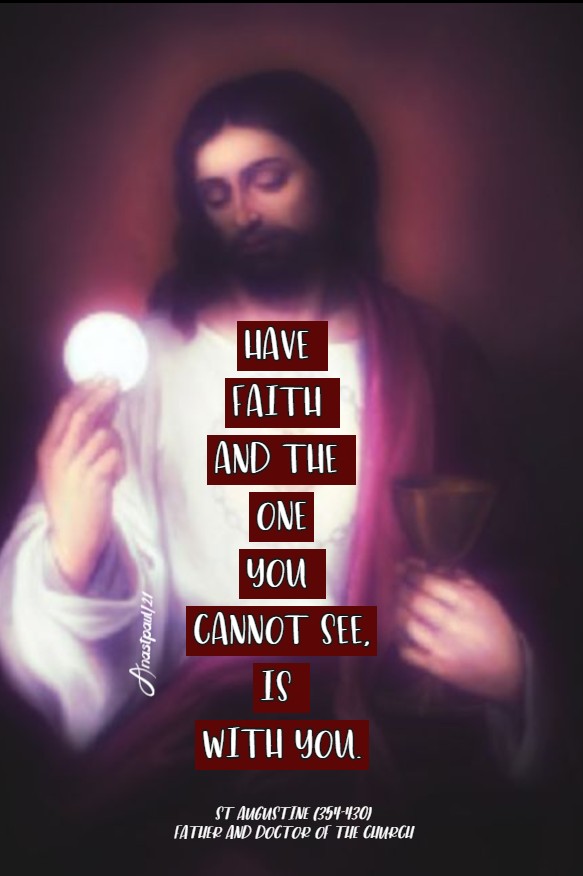
“Have faith and the One you cannot see, is with you.”
St Augustine (354-430) Father and Doctor of the Church
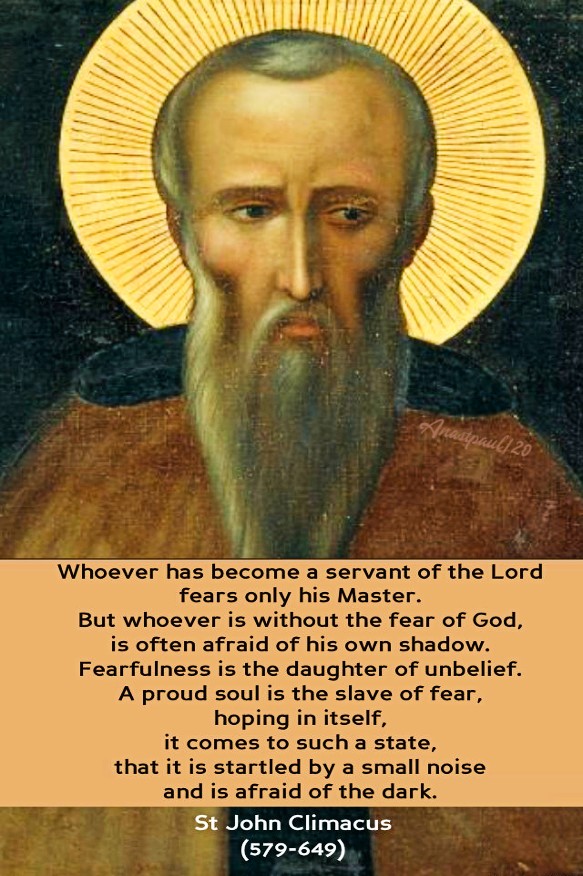
“Whoever has become a servant of the Lord, fears only his Master. But whoever is without the fear of God, is often afraid of his own shadow. Fearfulness is the daughter of unbelief. A proud soul is the slave of fear, hoping in itself, it comes to such a state, that it is startled by a small noise and is afraid of the dark.”
St John Climacus (579-649) Father of the Church
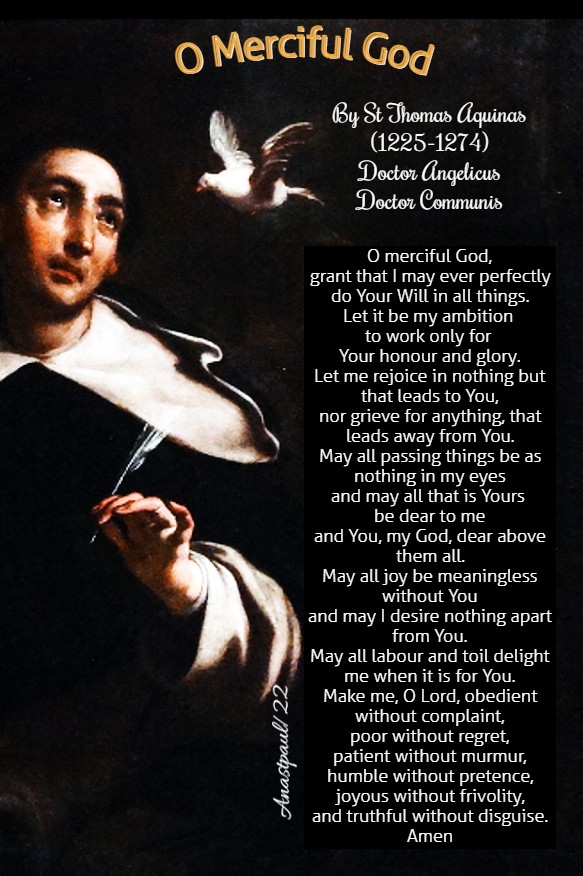
O Merciful God By St Thomas Aquinas (1225-1274) Doctor Angelicus, Doctor Communis
O merciful God, grant that I may ever perfectly do Your Will in all things. Let it be my ambition to work only for Your honour and glory. Let me rejoice in nothing but that leads to You, nor grieve for anything, that leads away from You. May all passing things be as nothing in my eyes and may all that is Yours, be dear to me and You, my God, dear above them all. May all joy be meaningless without You and may I desire nothing, apart from You. May all labour and toil delight me when it is for You. Make me, O Lord, obedient without complaint, poor without regret, patient without murmur, humble without pretence, joyous without frivolity, and truthful without disguise. Amen



































 AnaStpaul
You must be logged in to post a comment.