Thought for the Day – 12 February – Meditations with Antonio Cardinal Bacci (1881-1971)
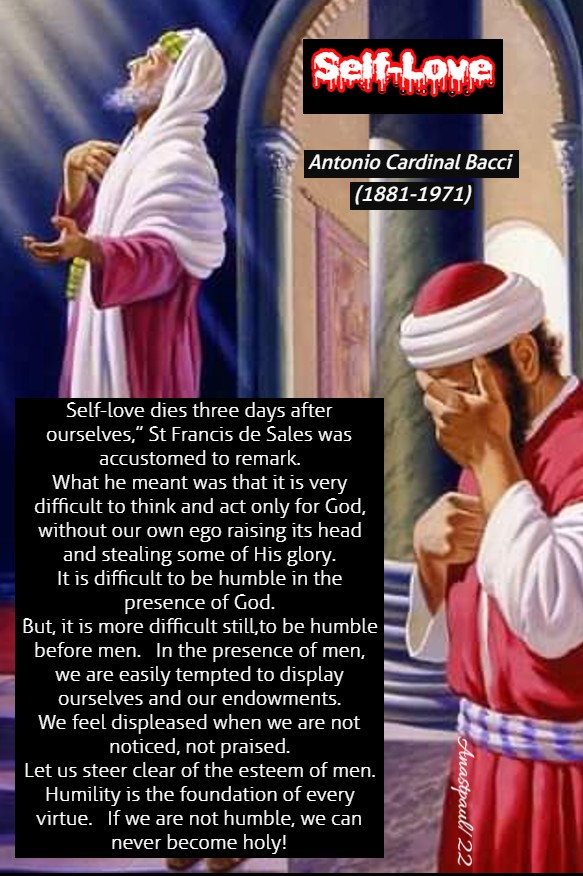
SELF-LOVE
“Self-love dies three days after ourselves,” St Francis de Sales was accustomed to remark. What he meant was that it is very difficult to think and act only for God, without our own ego raising its head and stealing some of His glory. It is difficult to be humble in the presence of God. But, it is more difficult still,to be humble before men.
When anyone genuflects in front of the Altar and begins to pray in the presence of God, it is not too difficult for him to bow his head and recognise his own weakness and dependance. But it is different among other men. In the presence of men, we are easily tempted to display ourselves and our endowments. We feel displeased when we are not noticed, not praised.
Let us steer clear of the esteem of men. Humility is the foundation of every virtue. If we are not humble, we can never become holy!”
One Minute Reflection –7 February – The Memorial of St Romuald, Abbot (c 951-1027) – Ecclus 45:1-6, Matthew 19:27-29.
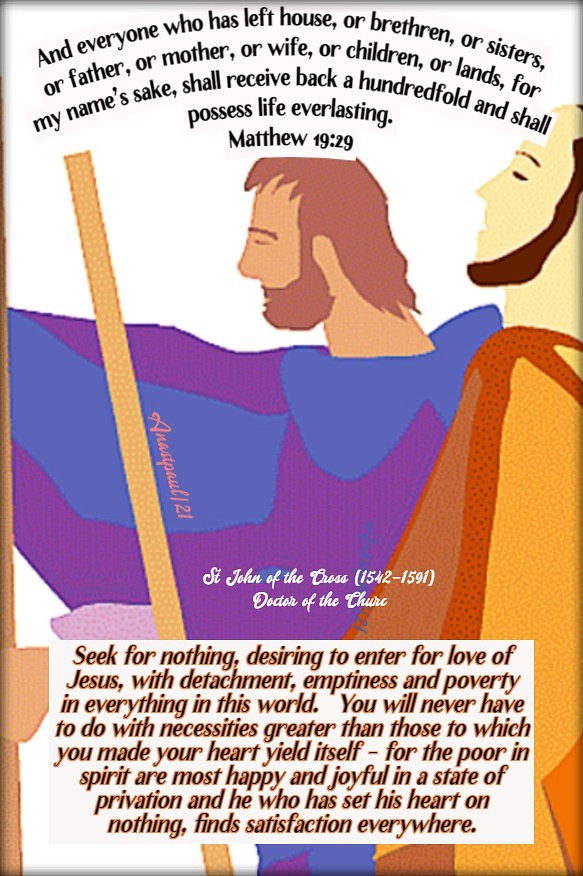
“And everyone who has left house, or brethren, or sisters, or father, or mother, or wife, or children, or lands for my name’s sake, shall receive a hundredfold and shall possess life everlasting.” – Matthew 19:29
REFLECTION – “Seek for nothing, desiring to enter for love of Jesus, with detachment, emptiness and poverty in everything in this world. You will never have to do with necessities greater than those to which you made your heart yield itself – for the poor in spirit are most happy and joyful in a state of privation and he who has set his heart on nothing, finds satisfaction everywhere.
The poor in spirit (Mt 5:3) give generously all they have and their pleasure consists in being thus deprived of everything for God’s sake and out of love to their neighbour … Not only do temporal goods – the delights and tastes of the senses – hinder and thwart the way of God but spiritual delights and consolations also, if sought for or clung to eagerly, disturb the way of virtue.” – St John of the Cross (1542-1591) Carmelite, Doctor of the Church (Spiritual maxims, nos. 352, 355,356, 364; 1693 edition)
PRAYER – Father of might and power, every good and perfect gift comes to us from You. Implant in our hearts the love of Your Name and Your creatures. Increase our zeal for Your service by following behind Your Son with determination and joy. Nourish in us what good and tend it with watchful care. Grant that the prayers and caring love of the Blessed Virgin, our Mother, may help us to follow Jesus our Saviour unreservedly and thus attain eternal life. We make our prayer through Christ, our Lord in the union of the Holy Spirit, one God for all eternity, amen.
Quote/s of the Day – 5 February – St Agatha (c 231- c 251) Virgin and Martyr – 1 Corinthians 1:26-31, Matthew 19:3-12
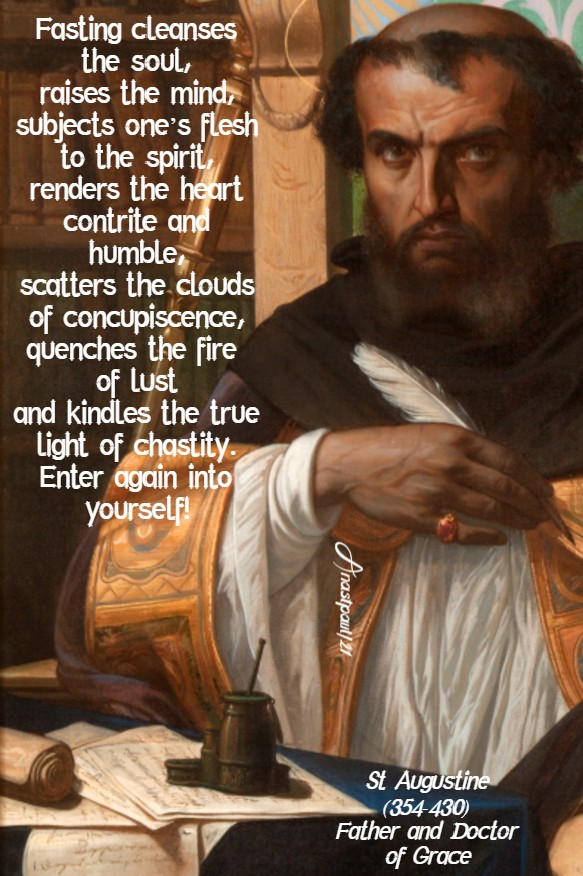
“Fasting cleanses the soul, raises the mind, subjects one’s flesh to the spirit, renders the heart contrite and humble, scatters the clouds of concupiscence, quenches the fire of lust and kindles the true light of chastity. Enter again into yourself!”
St Augustine (354-430) Bishop of Hippo Father and Doctor of Grace
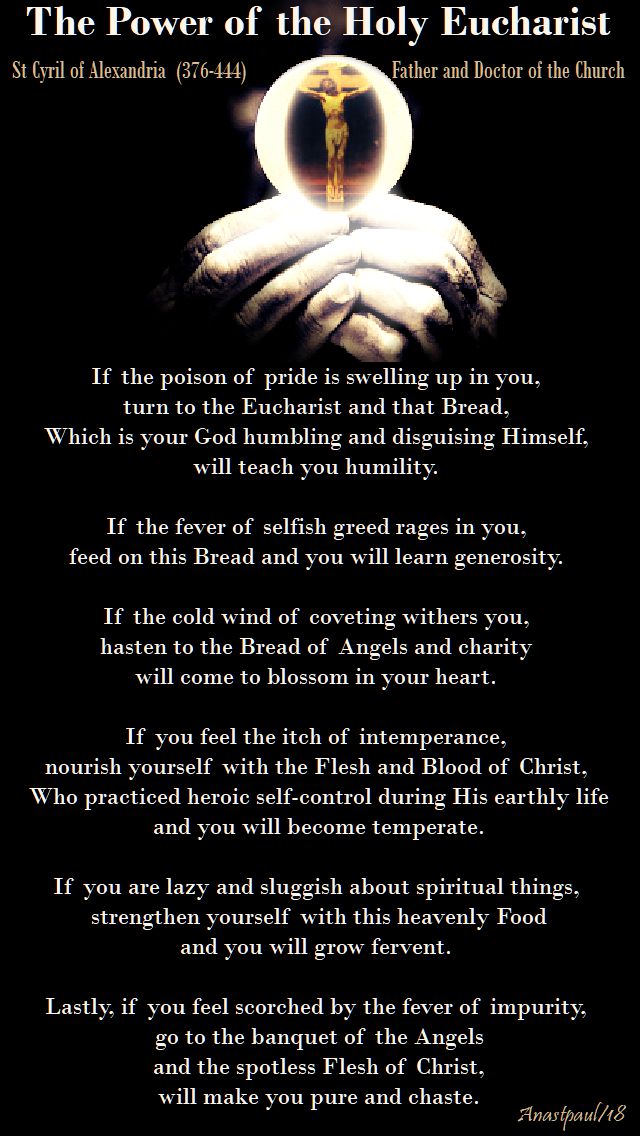
“If the poison of pride is swelling up in you, turn to the Eucharist and that Bread, Which is your God humbling and disguising Himself, will teach you humility.
If the fever of selfish greed rages in you, feed on this Bread and you will learn generosity.
If the cold wind of coveting withers you, hasten to the Bread of Angels and charity will come to blossom in your heart.
If you feel the itch of intemperance, nourish yourself with the Flesh and Blood of Christ, Who practiced heroic self-control during His earthly life and you will become temperate.
If you are lazy and sluggish about spiritual things, strengthen yourself with this heavenly Food and you will grow fervent.
Lastly, if you feel scorched by the fever of impurity, go to the banquet of the Angels and the spotless Flesh of Christ, will make you pure and chaste.”
St Cyril of Alexandria (376-444) Father and Doctor
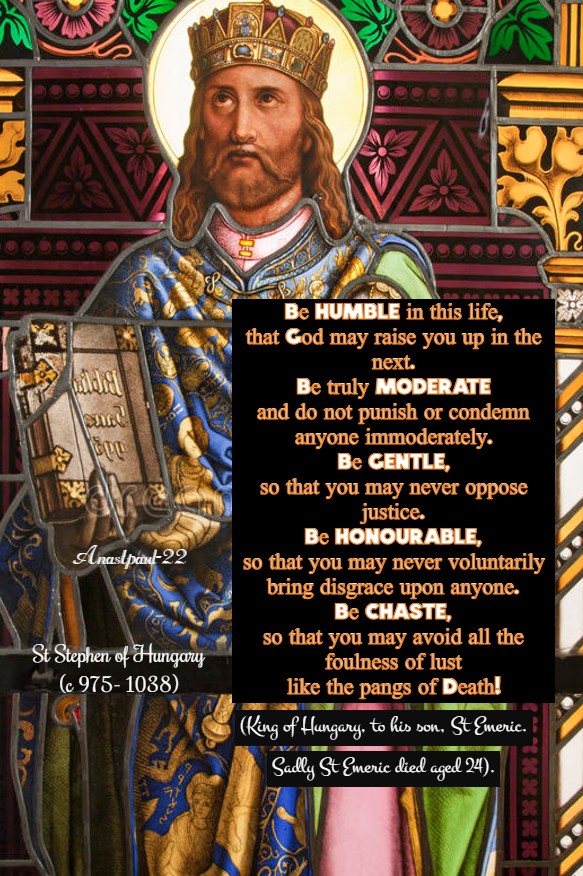
“Be HUMBLE in this life, that God may raise you up in the next. Be truly MODERATE and do not punish or condemn anyone immoderately. Be GENTLE, so that you may never oppose justice. Be HONOURABLE, so that you may never voluntarily bring disgrace upon anyone. Be CHASTE, so that you may avoid all the foulness of lust like the pangs of death.”
St Stephen of Hungary (c 975- 1038)
(King of Hungary, to his son, St Emeric. Sadly St Emeric died aged 24 but had taken a private vow of Celibacy.)
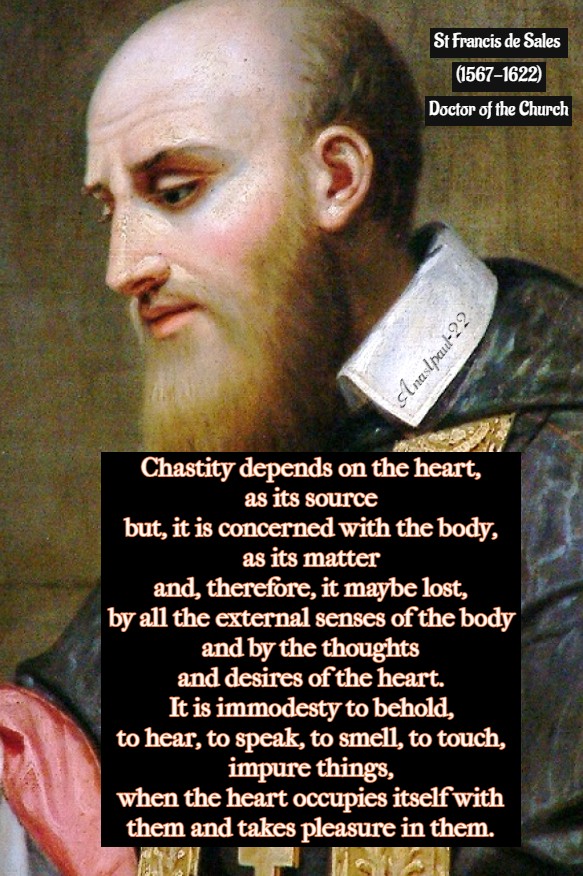
“Chastity depends on the heart, as its source but, it is concerned with the body, as its matter and, therefore, it maybe lost, by all the external senses of the body and by the thoughts and desires of the heart. It is immodesty to behold, to hear, to speak, to smell, to touch, impure things, when the heart occupies itself with them and takes pleasure in them.”
St Francis de Sales (1567-1622) Doctor of the Church
(Introduction to the Devout Life Part Three Chap 13).
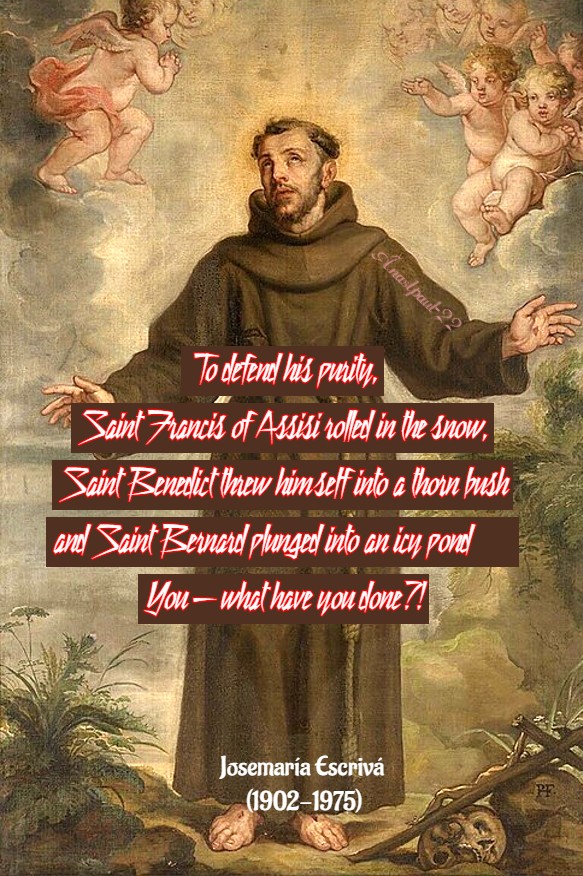
“To defend his purity, Saint Francis of Assisi rolled in the snow, Saint Benedict threw himself into a thorn bush and Saint Bernard plunged into an icy pond… You – what have you done?”
Thought for the Day – 1 February – Meditations with Antonio Cardinal Bacci (1881-1971)
“Unless You Turn and Become Like Little Children, You Will Not Enter into the Kingdom of Heaven”
“At the beginning of their ministry, before they had been strengthened and enlightened by the Holy Spirit, the Apostles were as ambitious as most other men. One day, the mother of John and James, the sons of Zebedee, came to Jesus and asked Him, if her two sons could have precedence over the other Apostles and sit on the highest thrones in His Kingdom, one at His right hand and the other at His left. Jesus disapproved of this desire to predominate. “Whoever wishes to become great among you,” He said, “shall be your servant and, whoever wishes to be first among you shall be your slave; even as the Son of Man has not come to be served but to serve and to give his life as a ransom for many” (Mt 20:26-28).
On another occasion, the Apostles came to Jesus and asked Him, which of them would be the greatest in the Kingdom of Heaven. Jesus’ only answer was to call a little child and to place him in the centre of the group. “Amen, I say to you, unless you turn and become like little children, you shall not enter into the kingdom of heaven. Whoever, therefore, humbles himself as this little child, he is the greatest in the kingdom of heaven” (Mt 18:3-4).
This is the lofty teaching of the Gospel. If we wish to be great and pleasing in the eyes of God, we must be unimportant in our own regard and in our relations with men. The Gospel involves an overthrow of human values. Anyone who makes himself insignificant, will become great. Anyone who tries to make himself out to be a great man, becomes of little account in the eyes of God. “God resists the proud but gives grace to the humble” (Cf Js 4:6; 1 Peter 5:5). If we wish to please the Sacred Heart of Jesus, the first thing we must do, is become as little children. In other words, we shall have to suppress our ambition and vanity and destroy our self-love, so that, the Sacred Heart may fill our hearts with the love of God alone!”
Thought for the Day – 31 January – Meditations with Antonio Cardinal Bacci (1881-1971)
Humility
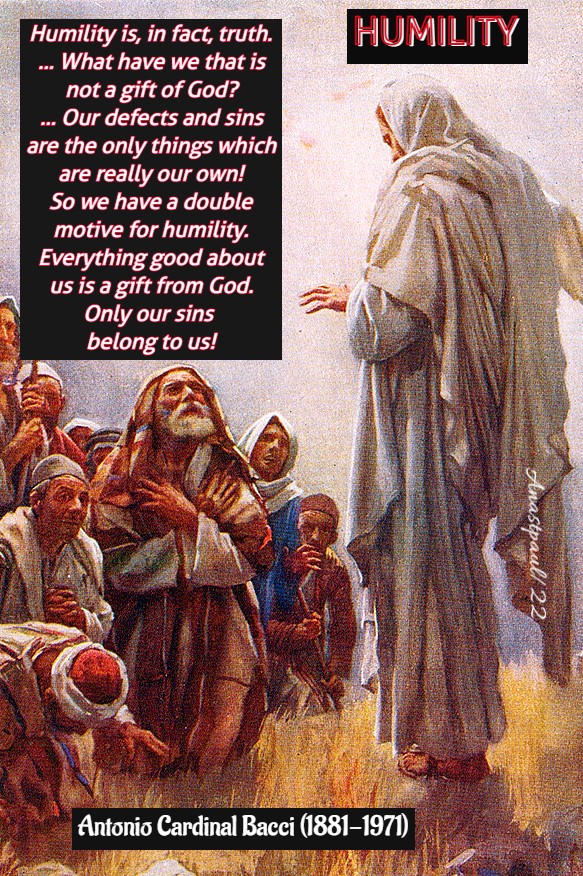
“Humility is, in fact, truth. Many think that it is a menial fiction, or a pious congregation and that only a few can really achieve it.
In other words, we must disregard ourselves. We must be content to be unknown and unesteemed. This might seem to be contrary to, or at least, superior to human nature but it is based on the simple naked truth. What have we that is not a gift of God? All that we have in the natural and supernatural order, we have received from God: “What hast thou that thou hast not received? And if thou hast receive it, why dost thou boast as if thou hast not received it?” (1 Cor 4:7).
Our defects and sins are the only things which are really our own! So we have a double motive for humility. Everything good about us is a gift from God. Only our sins belong to us!”
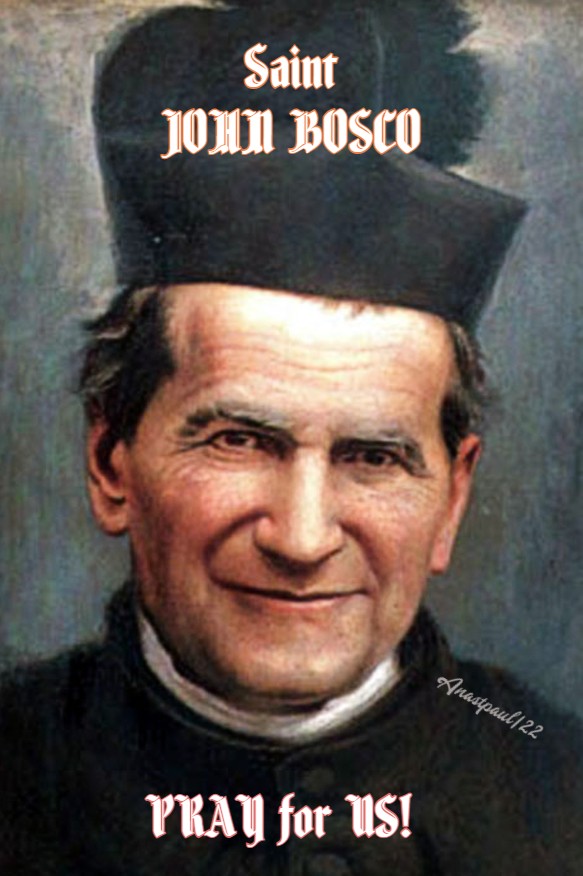
One Minute Reflection – 31 January – St John Bosco, Confessor (1815-1888 – Philippians 4:4-9, Matthew 18:1-5
“Amen, I say to you, unless you turn and become like little children, you will not enter the kingdom of heaven.”… Matthew 18:3
REFLECTION – “We must seek for reasons for individual sayings and actions of the Lord. After the coin was found, after the tribute paid, what do the Apostles’ sudden questions mean? Why precisely “at that time” did the disciples come to Jesus saying, “Who is the greatest in the kingdom of heaven?” Because they had seen that the same tax had been paid for both Peter and the Lord. From the equal price they inferred, that Peter may have been set over all the other Apostles, since Peter had been compared with the Lord in the paying of the tax. So they ask, who is greater in the Kingdom of Heaven. Jesus, seeing their thoughts and understanding the causes of their error, wants to heal their desire for glory, with a struggle for humility.”
He called a child to Him, to ask its age or to show the image of innocence. Or perhaps He actually set a child in their midst — He Himself, Who had not come to be served but to serve — to show them an example of humility.
Whoever humbles himself like this child, he is the greatest in the Kingdom of Heaven. Just as this child, whose example I show you, does not persist in anger, does not long remember injury suffered, is not enamoured inordinately by the sight of a beautiful woman, does not think one thing and say another, so you too, unless you have similar innocence and purity of mind, will not be able to enter the Kingdom of Heaven! Or, it might be taken in another way: “Whosoever, therefore, humiliates himself like this child, is greater in the kingdom of heaven,” so as to imply that anyone, who imitates Me and humiliates himself following My example, so that he abases himself as much as I abased Myself in accepting the form of a servant, will enter the Kingdom of Heaven.” – St Jerome (343-420) Translator of Sacred Scripture into Latin (The Vulgate) One of the original four Doctors of the Latin Church, Father (Commentary on Matthew 3).
PRAYER – O God, Who in Your Confessor, blessed John, raised up a father and teacher of youth and willed that through him, with the help of the Virgin Mary, new religious families should bloom in the Church, grant, we beseech You, that, inflamed by the same fire of love, we may seek to win souls and to serve You alone. Through Jesus Christ, Thy Son our Lord, Who lives and reigns with Thee, in the unity of the Holy Ghost, God, world without end. Amen (Collect)
Thought for the Day – 28 January – Meditations with Antonio Cardinal Bacci (1881-1971)
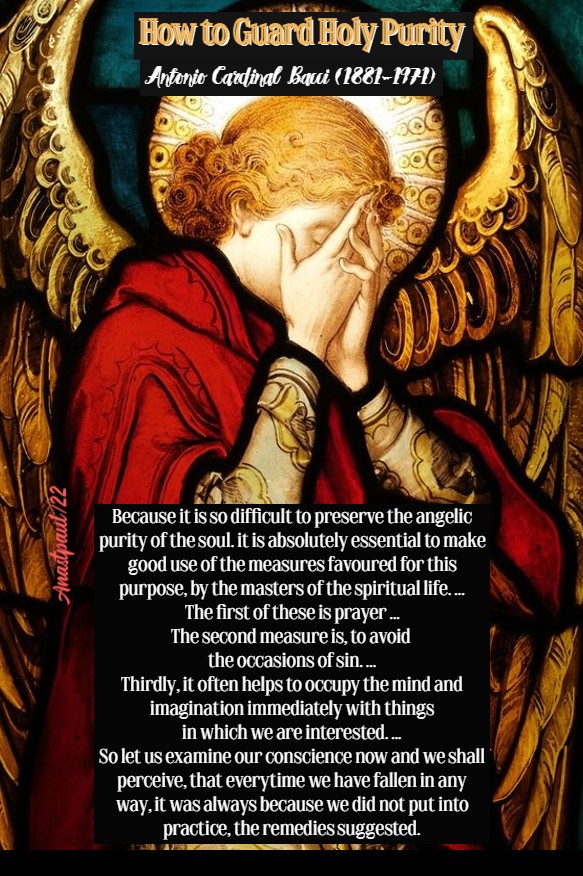
How to Guard Holy Purity
“Because it is so difficult to preserve the angelic purity of the soul. it is absolutely essential to make good use of the measures favoured for this purpose, by the masters of the spiritual life. The first of these is prayer – the spirit of prayer will keep us close to God. If our minds and hearts are united to God in the performance of every action, we will never allow ourselves to be separated from Him by impurity. This spirit of prayer must be based on humility and the consciousness of our continual need of God and, must be kept alive, by love for Him.
The second measure is, to avoid the occasions of sin. “Sensuality is best conquered by flight.” St Thomas Aquinas advises us (Summa Theologiae I-II, q 35). “He who loves danger will perish in it” (Ecclus 3:25). Battles like this, said St Francis de Sales, are won by the soldiers who retreat. As soon as an impure thought or image intrudes itself, drive it away as if a serpent were attacking you. It is fatal to allow the thought or image to gain ground, for at this stage, victory becomes extremely difficult!
Thirdly, it often helps to occupy the mind and imagination immediately with things in which we are interested. The greatest danger of all in these moments of temptation is idleness.
So let us examine our conscience now and we shall perceive, that everytime we have fallen in any way, it was always because we did not put into practice, the remedies suggested.”
Quote/s of the Day – 26 January – The Memorial of St Polycarp (c 69 – c 155) Martyr and Apostolic Father of the Church,
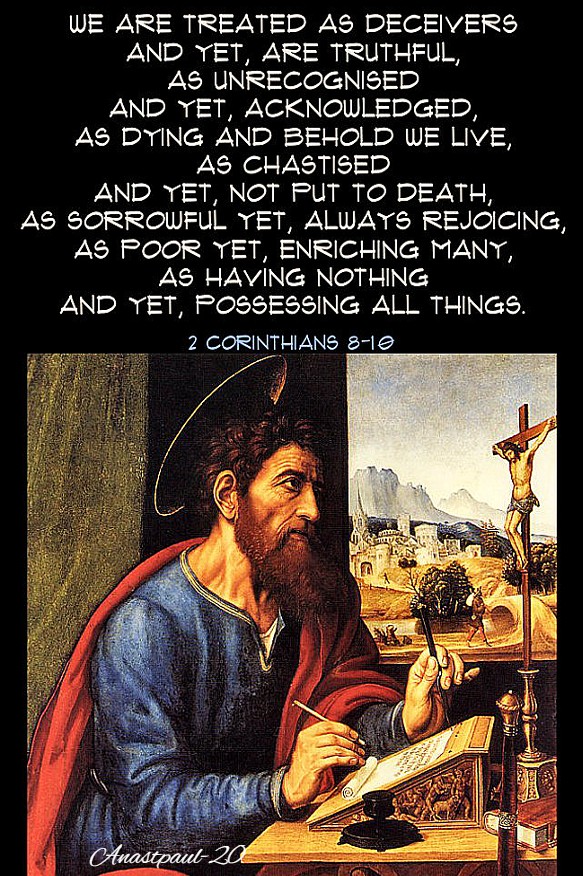
“We are treated as deceivers and yet, are truthful, as unrecognised and yet, acknowledged, as dying and behold we live, as chastised and yet, not put to death, as sorrowful yet, always rejoicing, as poor yet, enriching many, as having nothing and yet, possessing all things.”
2 Corinthians 8-10
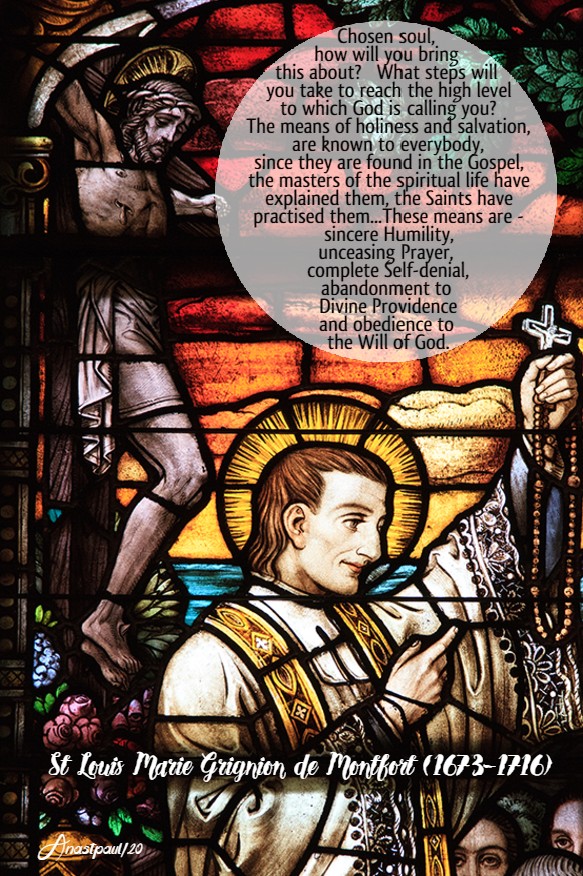
“Chosen soul, how will you bring this about? What steps will you take to reach the high level to which God is calling you? The means of holiness and salvation, are known to everybody, since they are found in the Gospel, the masters of the spiritual life have explained them, the Saints have practised them… These means are – sincere Humility, unceasing Prayer, complete Self-denial, abandonment to Divine Providence and obedience to the Will of God.”
St Louis Marie Grignion de Montfort (1673-1716)
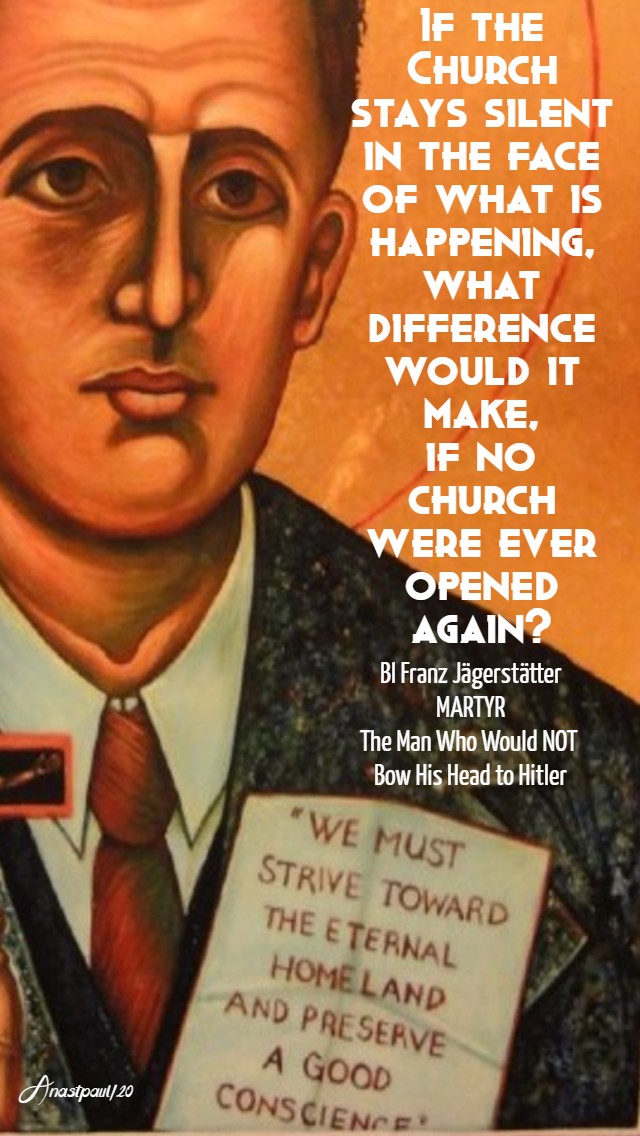
“If the Church stays silent in the face of what is happening, what difference would it make, if no church were ever opened again?”
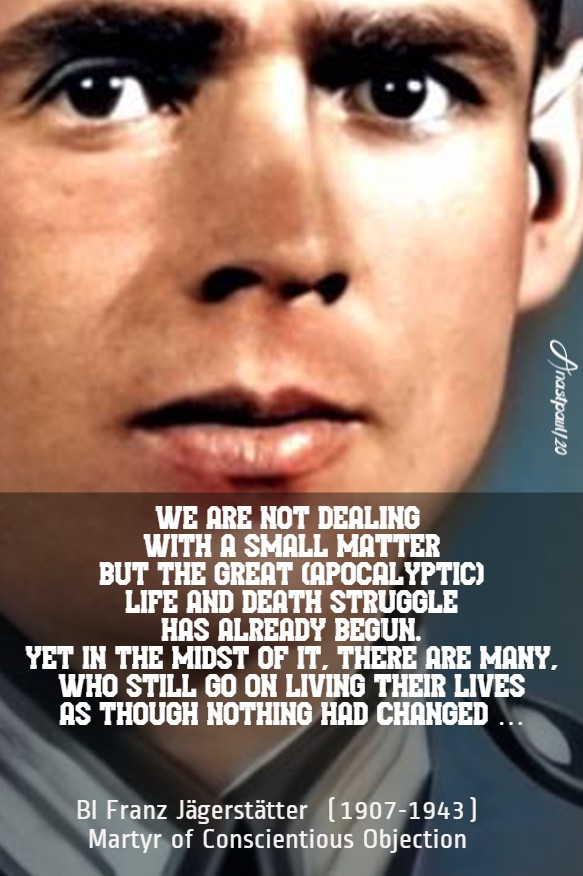
“We are not dealing with a small matter but the great (apocalyptic) life and death struggle has already begun. Yet in the midst of it, there are many, who still go on living their lives as though nothing had changed … “
Quote/s of the Day – 20 January – Hebrews 11:33-39; Luke 6:17-23
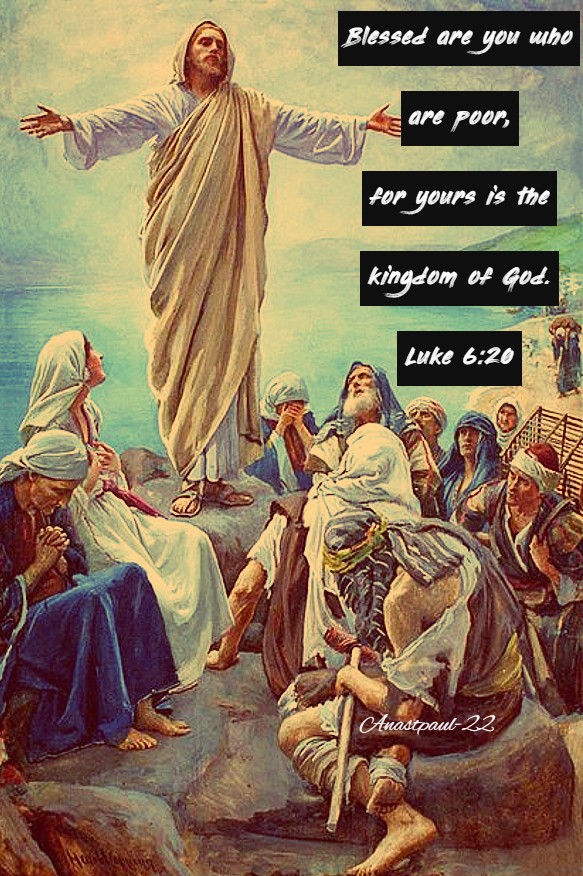
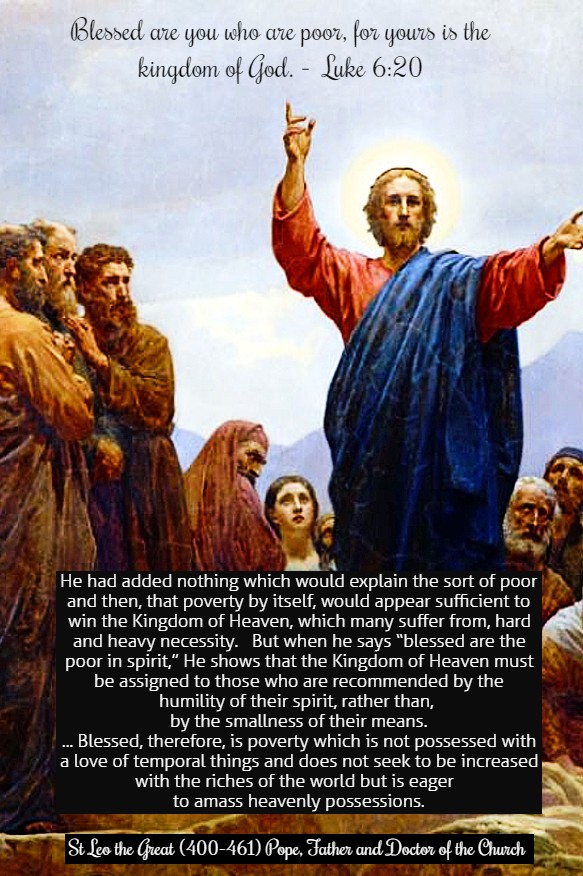
“Blessed are you who are poor, for yours is the kingdom of God.”
Luke 6:20
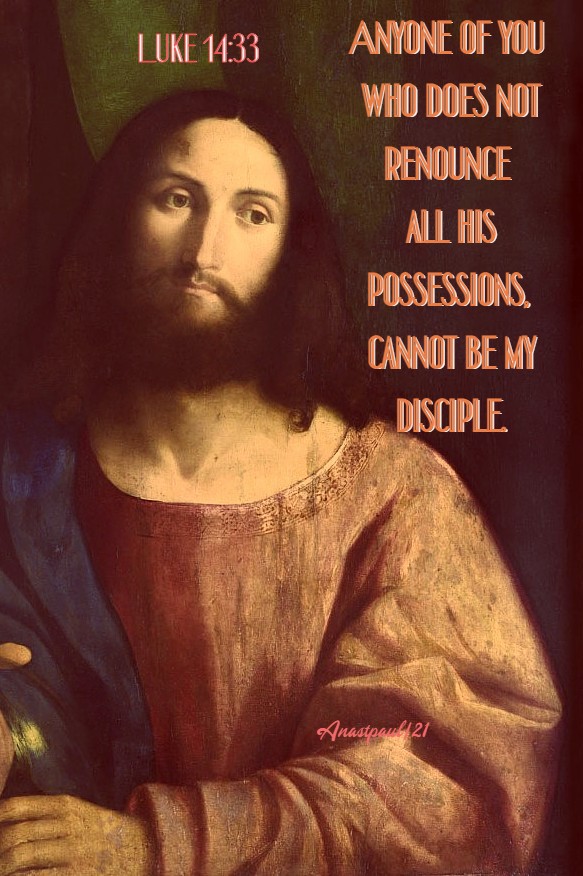
“… Anyone of you who does not renounce all his possessions, cannot be my disciple.”
Luke 14:33
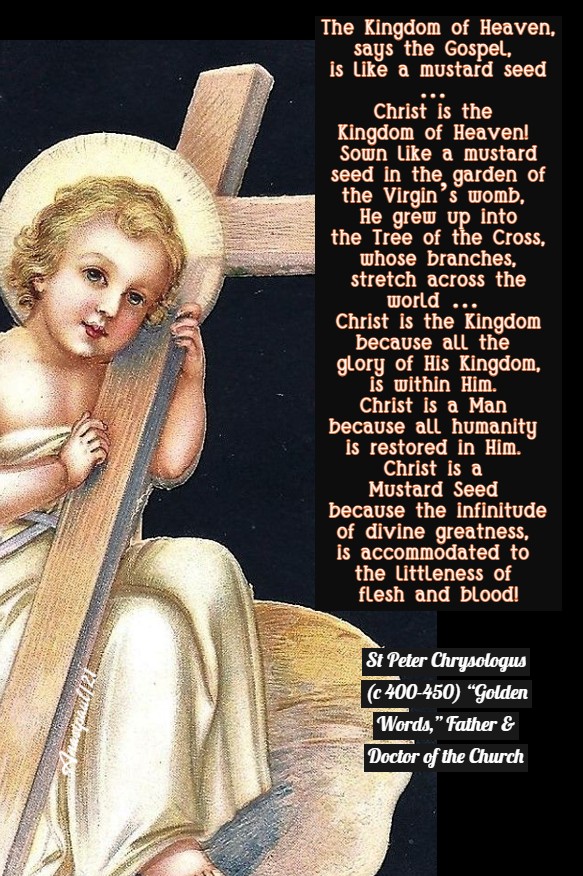
“The Kingdom of Heaven, says the gospel, is like a mustard seed … Christ is the Kingdom of Heaven! Sown like a mustard seed in the garden of the Virgin’s womb, He grew up into the Tree of the Cross, whose branches, stretch across the world … Christ is the Kingdom because all the glory of His Kingdom, is within Him. Christ is a Man because all humanity is restored in Him. Christ is a Mustard Seed because the infinitude of divine greatness, is accommodated to the littleness of flesh and blood!”
St Peter Chrysologus (c 400-450) “Golden Words” Father & Doctor of the Church
“Keep a clear eye toward life’s end. Do not forget your purpose and destiny as God’s creature. What you are in His sight, is what you are and nothing more. Remember that when you leave this earth, you can take nothing that you have received… but only what you have given – a full heart enriched by honest service, love, sacrifice and courage.”
St Francis of Assisi (c 1181-1226)
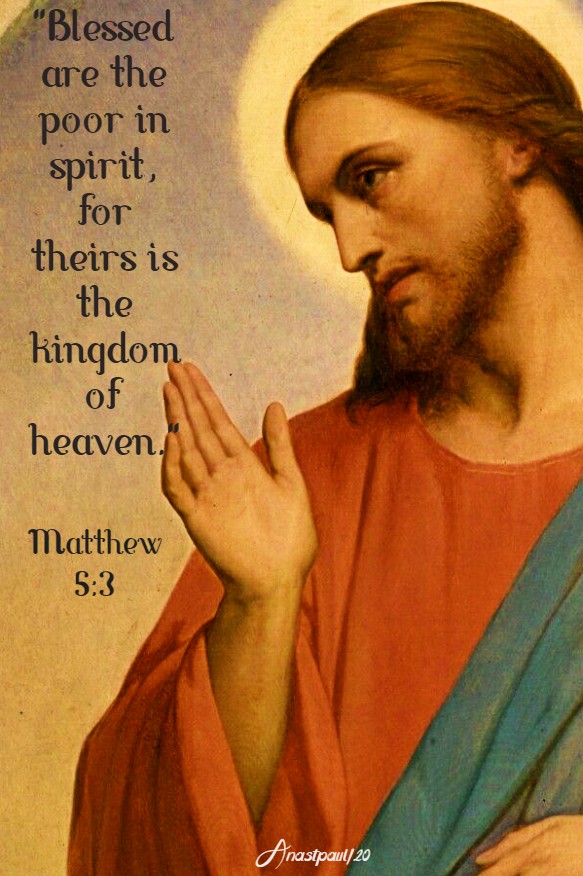
“Blessed are the poor in spirit, for theirs is the kingdom of heaven.”
Matthew 5:3
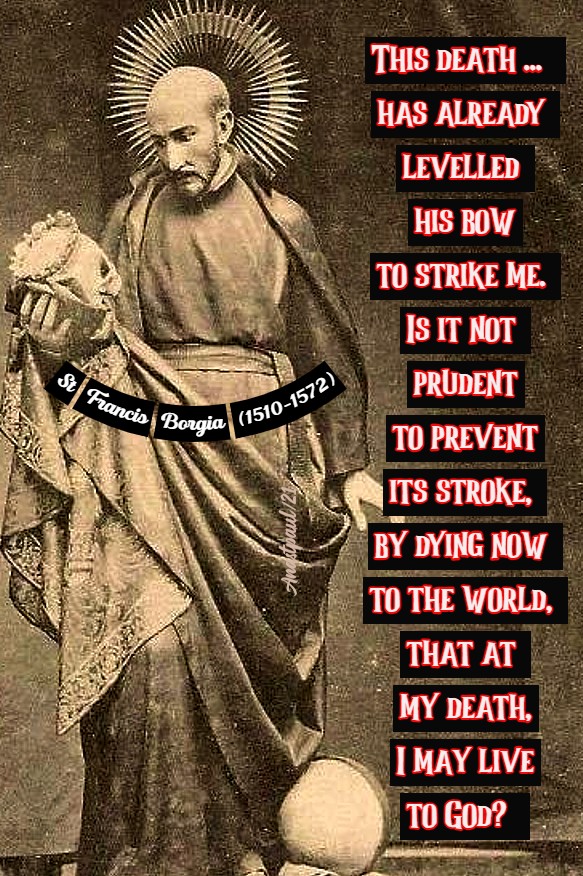
“This death … has already levelled his bow to strike me. Is it not prudent to prevent its stroke, by dying now to the world, that at my death, I may live to God?”
St Francis Borgia (1510-1572)
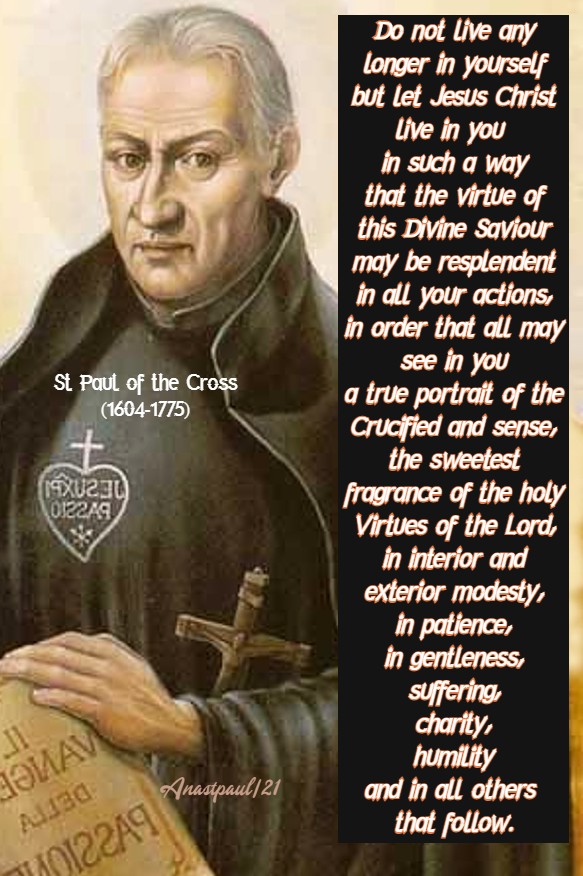
“Do not live any longer in yourself but let Jesus Christ live in you in such a way that the virtue of this Divine Saviour may be resplendent in all your actions, in order that all may see in you a true portrait of the Crucified and sense, the sweetest fragrance of the holy virtues of the Lord, in interior and exterior modesty, in patience, in gentleness, suffering, charity, humility and in all others that follow.”
St Paul of the Cross (1604-1775)
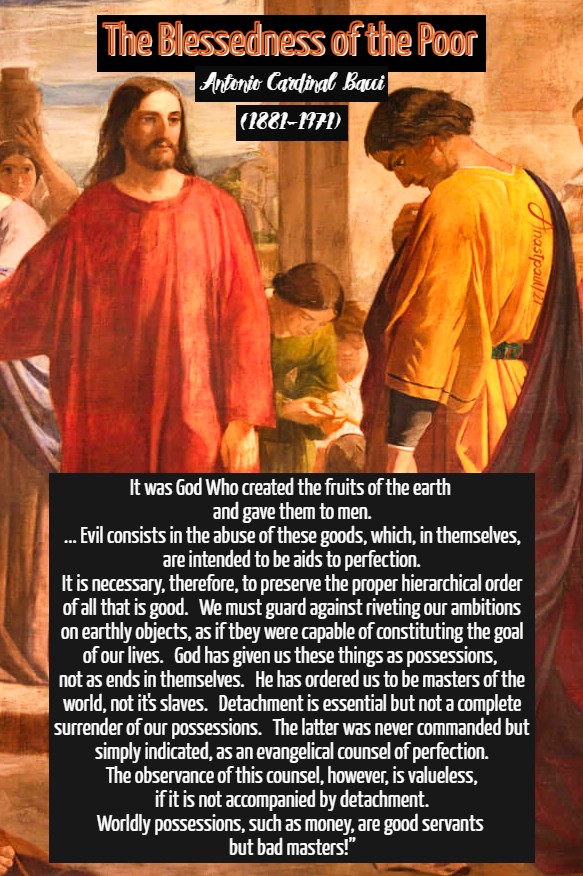
“It was God Who created the fruits of the earth and gave them to men. … Evil consists in the abuse of these goods, which, in themselves, are intended to be aids to perfection. It is necessary, therefore, to preserve the proper hierarchical order of all that is good. We must guard against riveting our ambitions on earthly objects, as if tbey were capable of constituting the goal of our lives. God has given us these things as possessions, not as ends in themselves. He has ordered us to be masters of the world, not it’s slaves. Detachment is essential but not a complete surrender of our possessions. The latter was never commanded but simply indicated, as an evangelical counsel of perfection. The observance of this counsel, however, is valueless, if it is not accompanied by detachment. Worldly possessions, such as money, are good servants but bad masters!”
One Minute Reflection – 20 January – Hebrews 11:33-39; Luke 6:17-23 and – The Memorial of St Pope Fabian (c 200 – c 250) Martyr and St Sebastian (Died c 288) Martyr
“Blessed are you who are poor, for yours is the kingdom of God.” – Luke 6:20
REFLECTION – “Blessed,” He says, “are the poor in spirit, for theirs is the kingdom of heaven” (Mt 5:3). It would perhaps be doubtful what poor He was speaking of, if in saying “blessed are the poor ” He had added nothing which would explain the sort of poor and then, that poverty by itself, would appear sufficient to win the Kingdom of Heaven, which many suffer from, hard and heavy necessity. But when he says “blessed are the poor in spirit,” He shows that the Kingdom of Heaven must be assigned to those who are recommended by the humility of their spirit, rather than, by the smallness of their means.
Yet it cannot be doubted, that this possession of humility is more easily acquired by the poor than the rich: for submissiveness is the companion of those, who want, while loftiness of mind dwells with riches. Notwithstanding, even in many of the rich, is found that spirit which uses its abundance, not for the increasing of its pride but on works of kindness and counts that for the greatest gain, which it expends in the relief of others’ hardships. It is given to every kind and rank of men, to share in this virtue, because men may be equal in will, though unequal in fortune and it does not matter, how different they are in earthly means, who are found equal in spiritual possessions. Blessed, therefore, is poverty which is not possessed with a love of temporal things and does not seek to be increased with the riches of the world but is eager to amass heavenly possessions.” – St Leo the Great (400-461) Pope, Father and Doctor of the Church (Sermon 95, PL 54, 461).
PRAYER – Shed Your clear light on our hearts, Lord, keep us in Your Way, that we too may stretch out our hands and love to those who come our way. May Your law be our light and Your love our only way. Hear the prayers of the Your Angels and Saints and the Blessed Virgin Mary, Mother of Our Lord and our mother and lead us to eternal life. We make our prayer through Christ, our Lord with the Holy Spirit, God now and forever, amen.
Thought for the Day – 19 January – Meditations with Antonio Cardinal Bacci (1881-1971)
Humility
“Humility is the most difficult of all the virtues because, it requires us to deny ourselves. Jesus warns us, that anyone who wishes to follow Him, must deny himself. “If anyone wishes to come after me, let him deny himself” (Mt 16:24).
Humility is necessary if we wish to go straight to Jesus, Who was the first to humble Himself by becoming obedient unto death, even to the death of the Cross (Phil 2:8). The Imitation of Christ contains some profound remarks upon this subject. “Seldom do we find anyone, so spiritual, as to be stripped of all things… If a man gives his whole substance, still it is nothing. And if he do great penance, it is but little. And if he attain to all knowledge, he is far off still. And if he have great virtue and very fervent devotions, there is still much wanting to him, namely, the one thing which is supremely necessary for him. What is that? That having left all things else, he leave also himself and wholly go out of himself and retain nothing of self-love.” (Bk II, c.2:4).
When he has done all this, remember, he has only given God all that he received from Him. He has given nothing which was really his. He has only fulfilled an obligation of restitution. When he has arrived at this stage of humility, therefore, he should repeat the words of Jesus. “When you have done everything that was commanded you, say, ‘We are unprofitable servants, we have done what it was our duty to do’” (Lk 17:10).
This is genuine humility, as preached in the Gospel.”
Quote/s of the Day – 17 January – The Memorial of St Anthony Abbot (251-356)
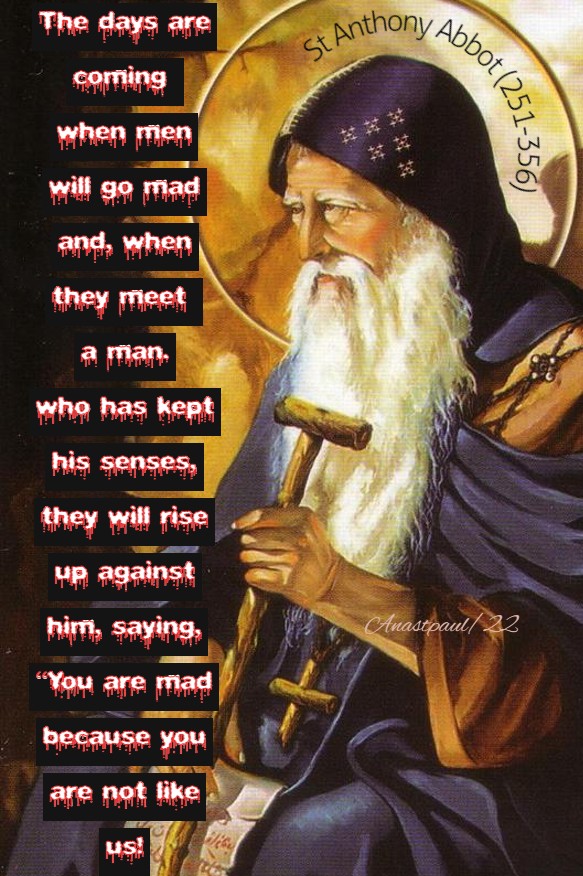
“The days are coming when men will go mad and, when they meet a man. who has kept his senses, they will rise up against him, saying, “You are mad because you are not like us!”
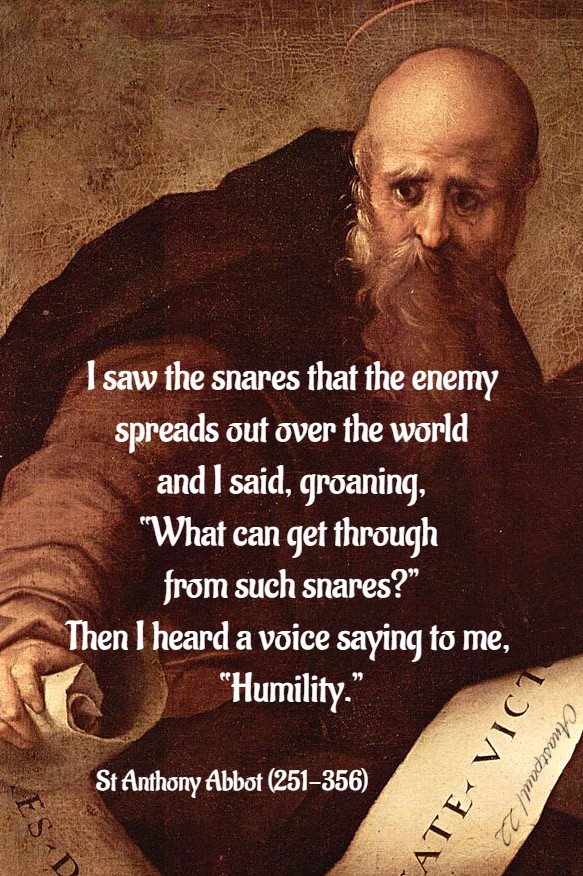
“I saw the snares that the enemy spreads out over the world and I said, groaning, “What can get through from such snares?” Then I heard a voice saying to me, “Humility.”
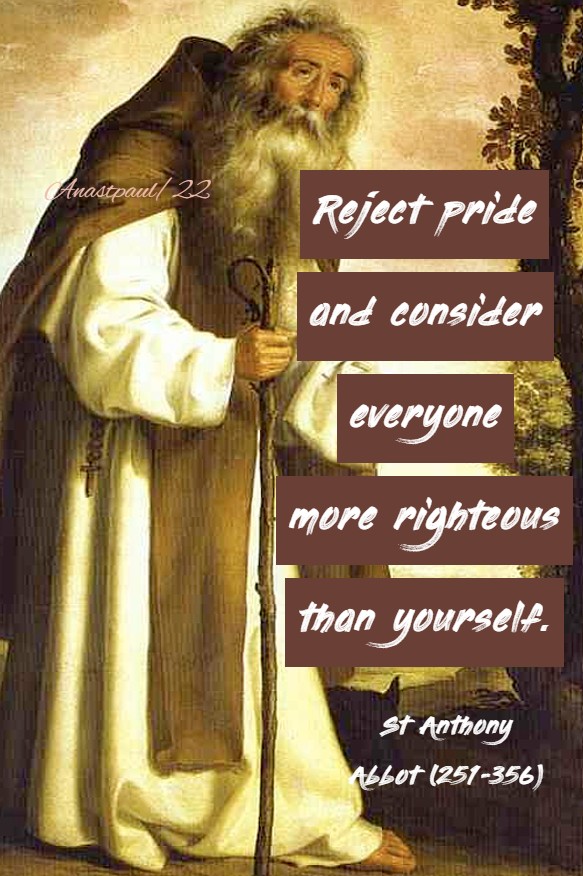
“Reject pride and consider everyone more righteous than yourself.”
Thought for the Day – 15 January – Meditations with Antonio Cardinal Bacci (1881-1971)
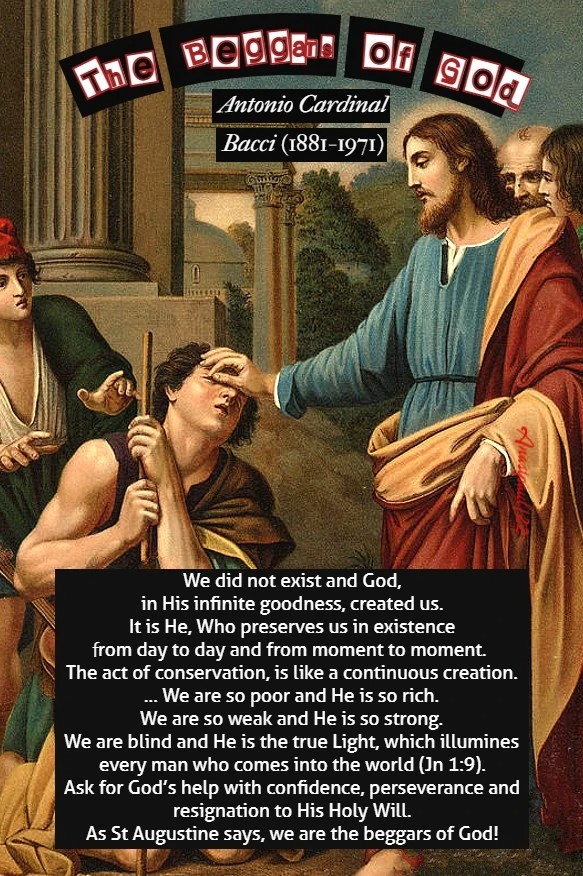
The Beggars of God
“Both in the natural and in the supernatural order, we are in continual need of the help of God. We did not exist and God, in His infinite goodness, created us. It is He, Who preserves us in existence from day to day and from moment to moment. The act of conservation, is like a continuous creation. If God did not sustain us, we should return immediately to the dust from which we came: “Remember, man, that dust you are and unto dust you shall return” (Gen 3:19).
We are continually dependent on our Lord and Creator for our existence and activity. If we remained always aware of this tremendous fact, we would never offend God. We would show Him a filial gratitude and humbly implore His assistance.
We are so poor and He is so rich. We are so weak and He is so strong. We are blind and He is the true Light, which illumines every man who comes into the world (Jn 1:9). Ask for God’s help with confidence, perseverance and resignation to His Holy Will. As St Augustine says, we are the beggars of God!”
Quote/s of the Day – 15 January – Readings: Phillippians 3:7-12, Matthew 11:25-34
“Take my yoke upon you and learn from me, for I am meek and humble of heart and you will find rest for your souls…”
Matthew 11:29
“For in prosperity, a man is often puffed up with pride, whereas tribulations chastens and humbles him through suffering and sorrow. In the midst of prosperity, the mind is elated, and in prosperity. a man forgets himself. In hardship, he is forced to reflect on himself, even though he be unwilling. In prosperity, a man often destroys the good he has done. Amidst difficulties, he often repairs what he long since did in the way of wickedness.”
St Alfred the Great (849-899) King
“How can you become a sharer, in His glory (1 Pt 5:1) if you will not consent, to become a sharer, in His humiliating death?”
St Simeon the New Theologian (949-1022)
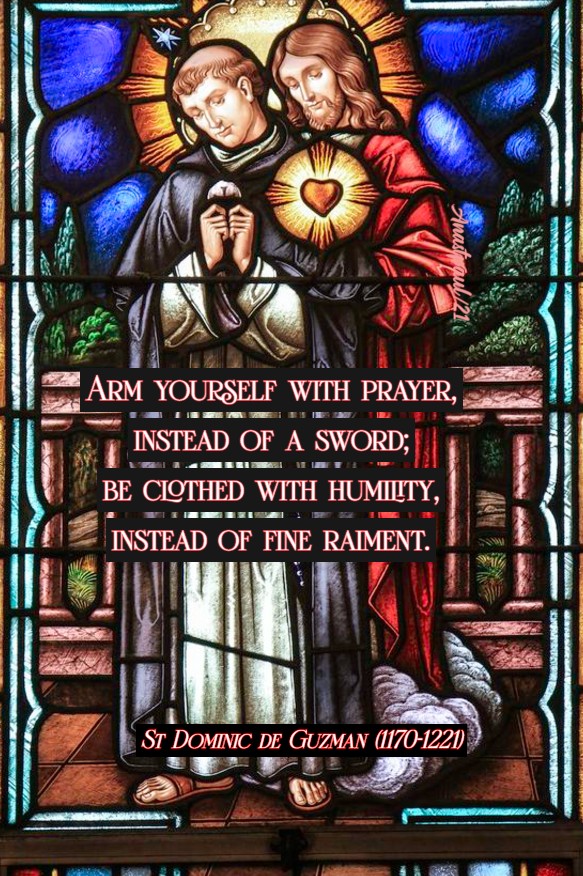
“Arm yourself with prayer, instead of a sword; be clothed with humility, instead of fine raiment.”
St Dominic de Guzman OP (1170-1221)
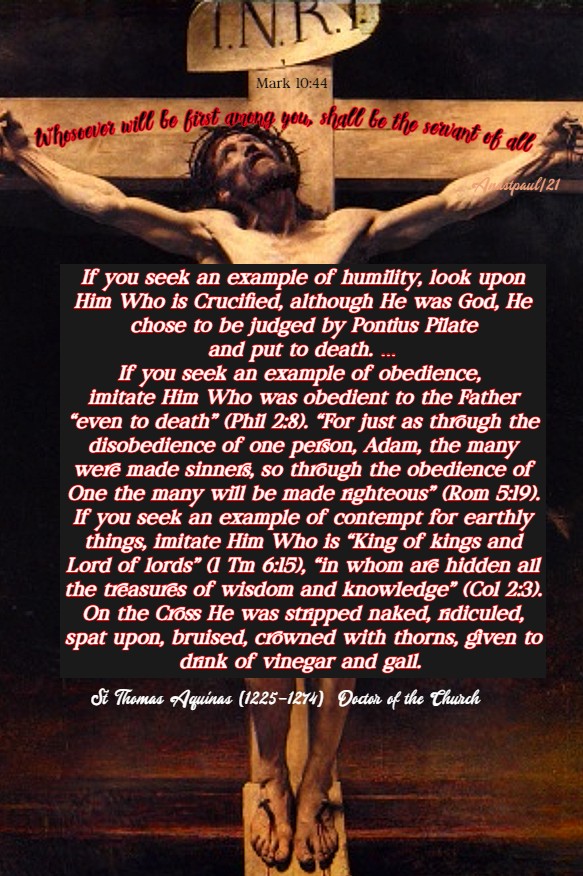
“If you seek an example of humility, look upon Him Who is Crucified, although He was God, He chose to be judged by Pontius Pilate and put to death. … If you seek an example of obedience, imitate Him Who was obedient to the Father “even to death” (Phil 2:8). “For just as through the disobedience of one person, Adam, the many were made sinners, so through the obedience of One, the many will be made righteous” (Rom 5:19). . If you seek an example of contempt for earthly things, imitate Him Who is “King of kings and Lord of lords” (1 Tm 6:15), “in whom are hidden all the treasures of wisdom and knowledge” (Col 2:3). On the Cross He was stripped naked, ridiculed, spat upon, bruised, crowned with thorns, given to drink of vinegar and gall.”
St Thomas Aquinas (1225-1274) Angelic Doctor of the Church
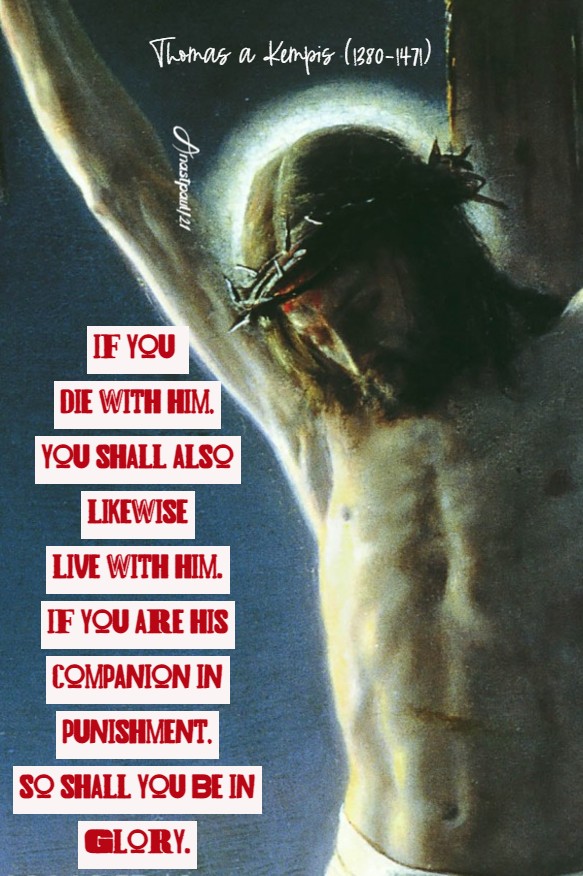
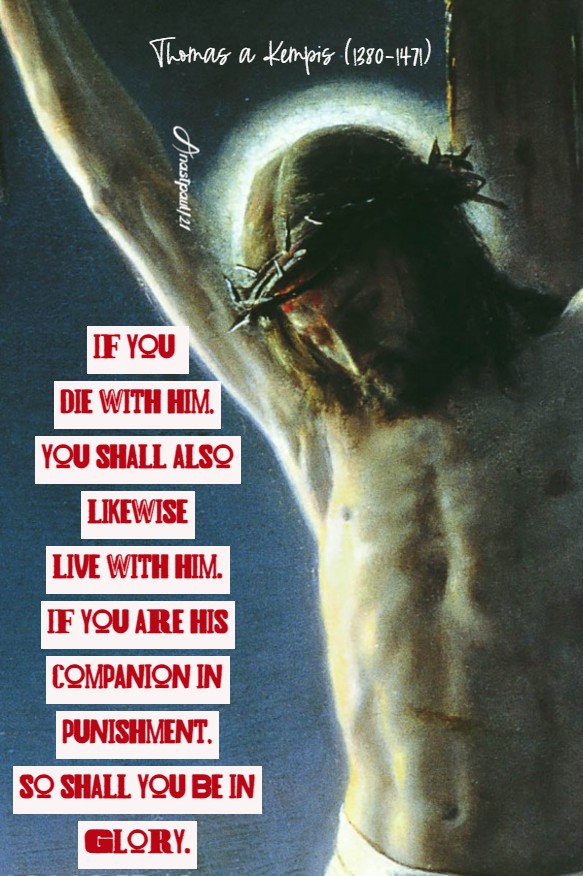
“ … If you die with Him, you shall also likewise live with Him. If you are His companion in punishment, so shall you be in glory.”
Thomas à Kempis (1380-1471)
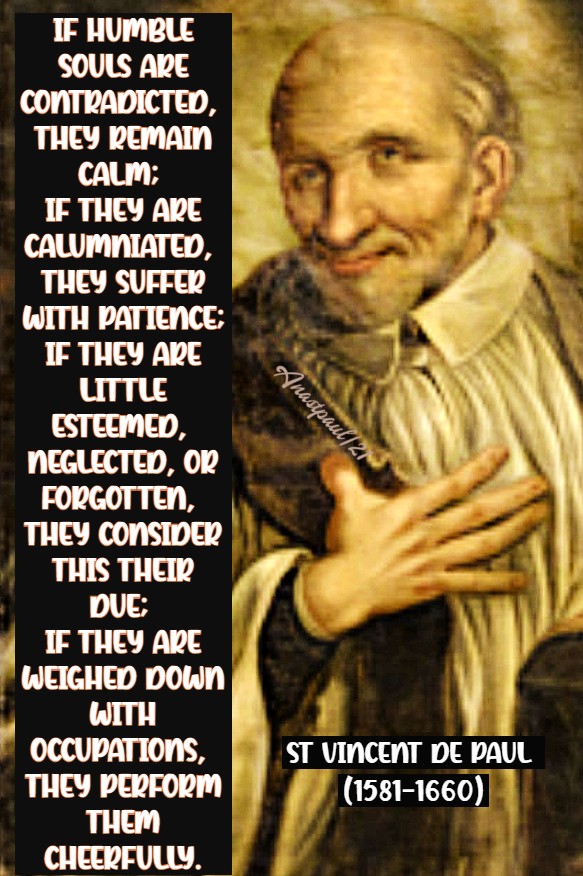
“If humble souls are contradicted, they remain calm; if they are calumniated, they suffer with patience; if they are little esteemed, neglected, or forgotten, they consider this their due; if they are weighed down with occupations, they perform them cheerfully. ”
Quote/s of the Day – 14 January – The Memorial of St Hilary of Poitiers (315-368) Father & Doctor of the Church
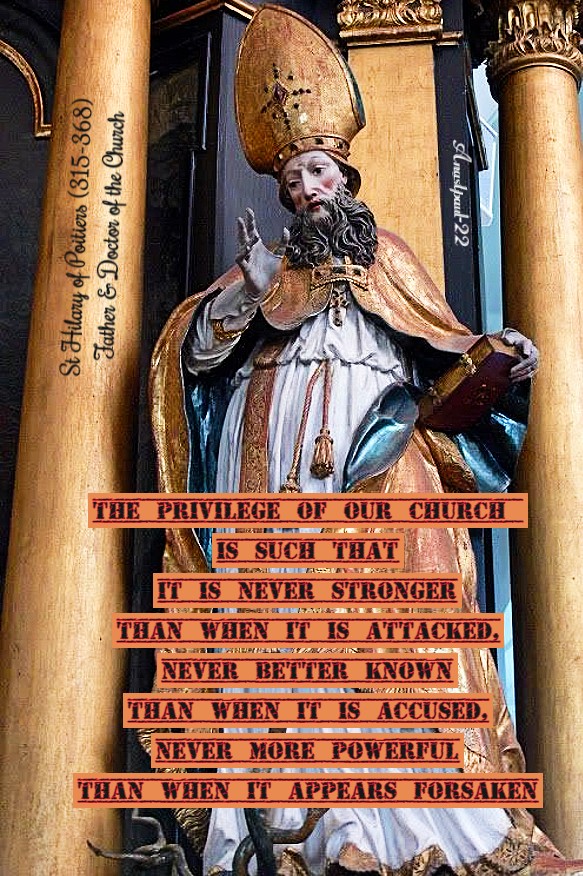
“The privilege of our Church is such that it is never stronger than when it is attacked, never better known than when it is accused, never more powerful than when it appears forsaken.”
(Treatise on the Trinity)
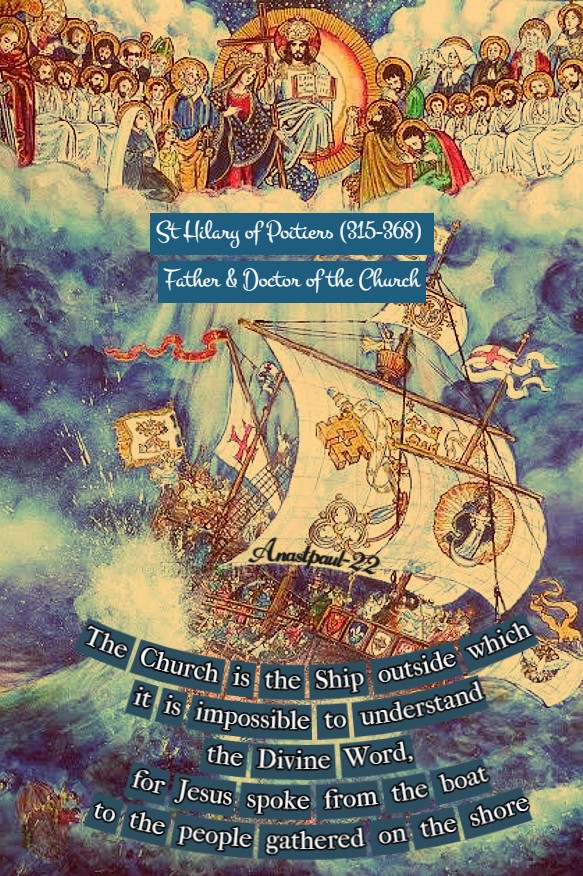
“The Church is the Ship outside which it is impossible to understand the Divine Word, for Jesus spoke from the boat to the people gathered on the shore.”
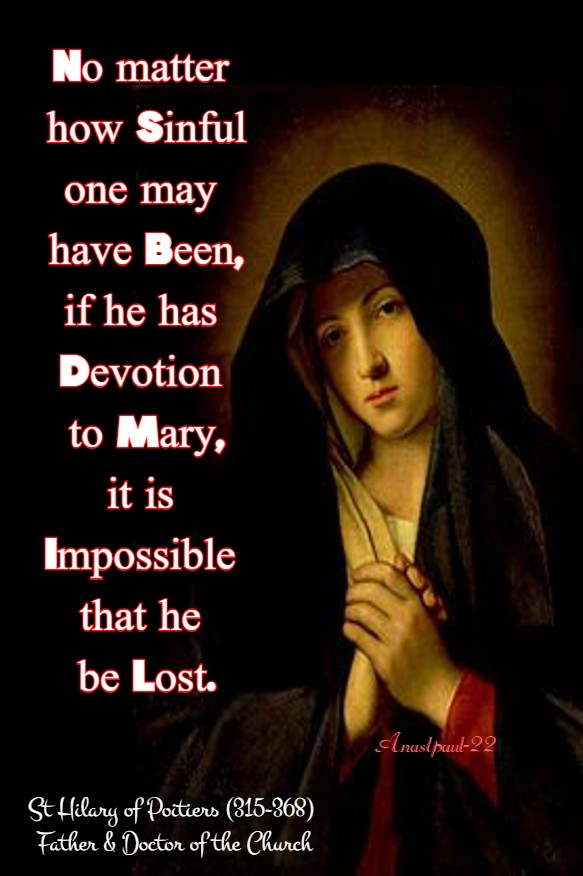
“No matter how sinful one may have been, if he has devotion to Mary, it is impossible that he be lost.”
“Little children follow and obey their father. They love their mother. They know nothing of covetousness, ill-will, bad temper, arrogance and lying. This state of mind, opens the road to Heaven. To imitate our Lord’s own humility, we must return to the simplicity of God’s little ones.”
St Hilary of Poitiers (315-368) Father & Doctor of the Church
One Minute Reflection – 5 January – “Month of the Most Holy Name of Jesus” – Christmas Weekday, Readings: 1 John 4:7-10, Psalms 72:1-2, 3-4,7-8, Mark 6:34-44
“But he answered them, “You give them something to eat .. ” – Mark 6:37
REFLECTION – “Let us take note of the disciples’ trusting abandonment to God’s providence in life’s greatest necessities and their disdain for a life of luxury – there were twelve of them and they only had five loaves and two fish. They were not bothered by bodily things but dedicated all their zeal to the things of the soul. Moreover, they did not keep these provisions for themselves, they handed them over to the Saviour at once, when He asked them for them. Let us learn from this example, to share what we have, with those in need, even if we only have a little. When Jesus asks them to bring the five loaves, they don’t say: “What will there be for us later on? Where will we find what is necessary for our own needs?” They obey promptly … Taking the loaves, then, the Lord broke them and entrusted the honour of distributing them to the disciples. He did not just want to honour them by this holy service but desired them to take part in the miracle, so as to be wholly convinced witnesses to it and, not forget what had taken place under their own eyes …. It is through them, that He made the people sit down and, that He distributed the bread, so that each one of them, might bear witness to the miracle accomplished at their hands … Everything in this event – the desert place, the bare ground, the small supply of bread and fish, the distribution of these same things to everyone without distinction, each one of them having the same as their neighbour – all this teaches us humility, frugality and fraternal charity. To love one another equally, to place everything in common amongst those who are serving the same God – this is what our Saviour is teaching us here.” – St John Chrysostom (345-407) Bishop of Constantinople, Father and Doctor of the Church
PRAYER – All-powerful, eternal God, splendour of true light and never-ending day, let our striving for Your kingdom not fall short through selfishness or fear, may the universe be alive with the Spirit and our homes be the pledge of the world redeemed. May our eyes see and our hearts have compassion, to all those who need us. May the intercession of our Holy Mother and all the saints, be a strength and a comfort. Through Jesus, our compassionate and loving Redeemer, with the Holy Spirit, one God with You forever, amen.
Thought for the Day – 4 January – Meditations with Antonio Cardinal Bacci (1881-1971)
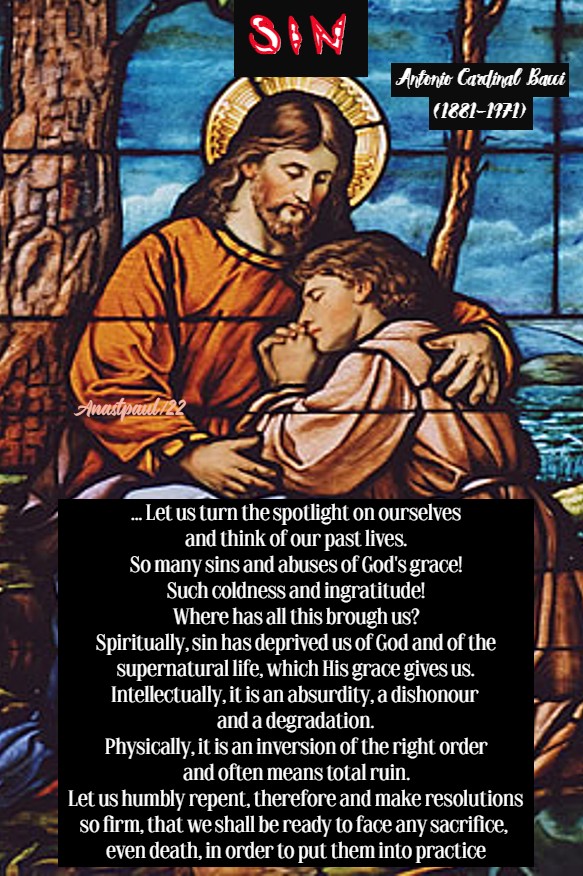
Sin
“In order to understand more clearly, the gravity of sin, it is helpful at this stage, to consider three things:
(a) The world with all its evils – sorrows, diseases, wars, plagues and death. All these things do not come directly from the Will of God, Who is the highest good but happen, with His permission.” They are the effect of original sin and of the continuing transgressions of men.
(b) Hell, which is the handiwork of sin, God, infinitely good but also infintely just, has ordained this terrible and everlasting punishment for the rebellious sinner.
(c) The Crucifix. To save us from sin, the God-Man has suffered the cruellest of torments and death but, men go on offending Him with unbelievable ingratitude!
Now, let us turn the spotlight on ourselves and think of our past lives. So many sins and abuses of God’s grace! Such coldness and ingratitude! Where has all this brough us? Spiritually, sin has deprived us of God and of the supernatural life, which His grace gives us. Intellectually, it is an absurdity, a dishonour and a degradation. Physically, it is an inversion of the right order and often means total ruin.
Let us humbly repent, therefore and make resolutions so firm, that we shall be ready to face any sacrifice, even death, in order to put them into practice.”
Quote/s of the Day – 30 December – The Sixth Day in the Christmas Octave, Readings: 1 John 2:12-17, Psalm 96:7-10, Luke 2:36-40
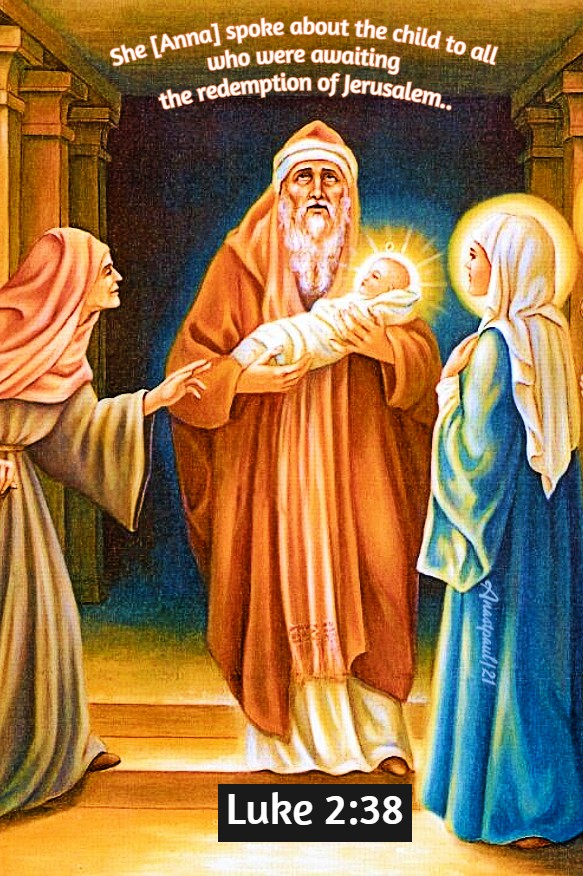
“She [Anna] spoke about the child to all who were awaiting the redemption of Jerusalem…”
Luke 2:38
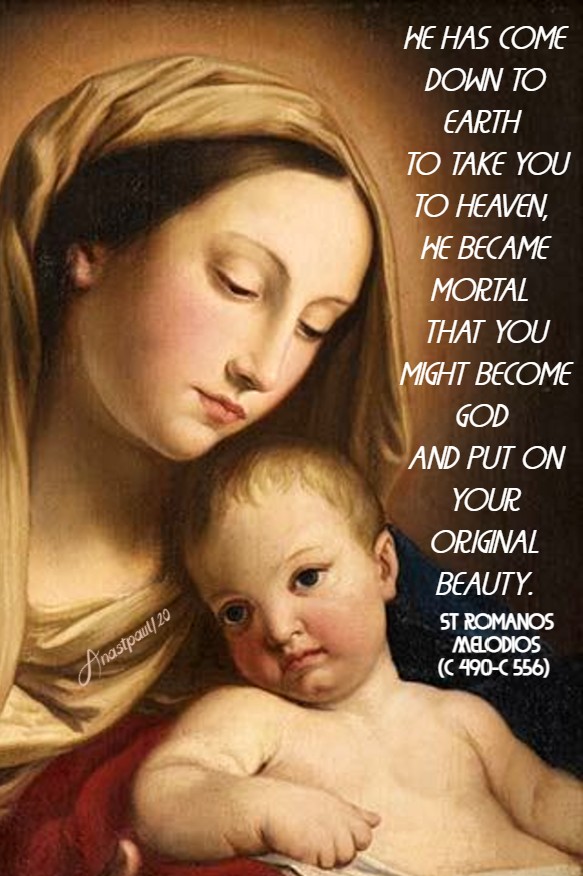
“He has come down to earth to take you to heaven, He became mortal that you might become God and put on your original beauty.”
St Romanos Melodios (c 490-c 556) Monk, Composer of Hymns, Poet
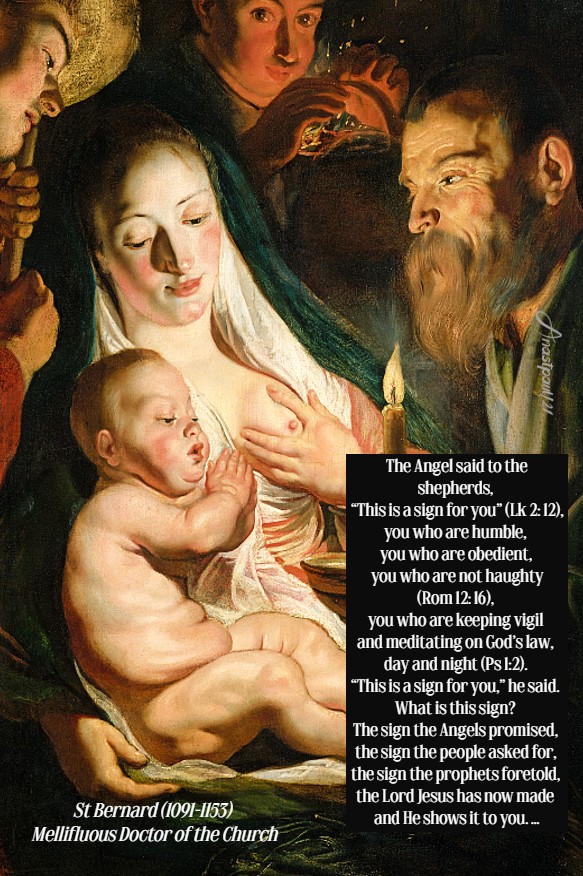
“The Angel said to the shepherds, “This is a sign for you” (Lk 2: 12), you who are humble, you who are obedient, you who are not haughty (Rom 12: 16), you who are keeping vigil and meditating on God’s law, day and night (Ps 1:2). “This is a sign for you,” he said. What is this sign? The sign the Angels promised, the sign the people asked for, the sign the prophets foretold, the Lord Jesus has now made and He shows it to you. …”
St Bernard (1091-1153) Mellifluous Doctor of the Church
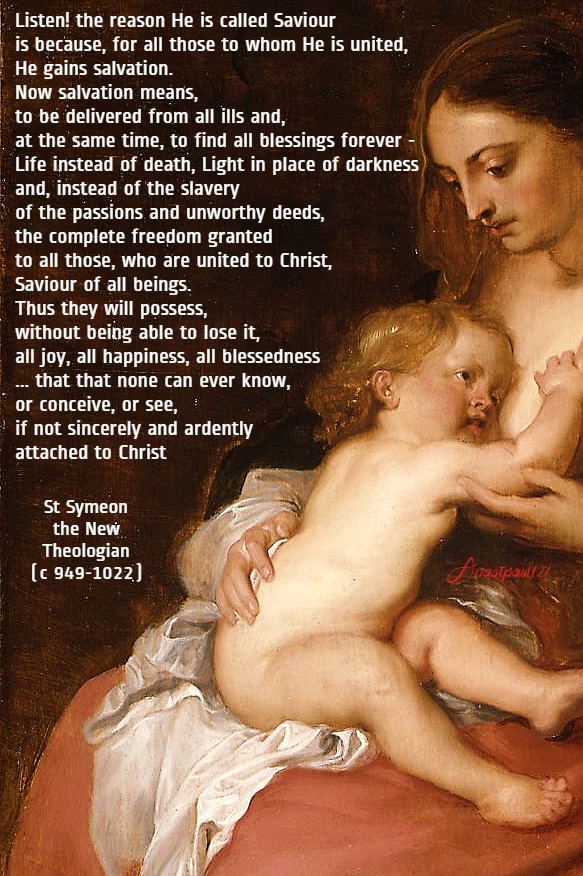
“Listen! the reason He is called Saviour is because, for all those to whom He is united, He gains salvation. Now salvation means, to be delivered from all ills and, at the same time, to find all blessings forever – Life instead of death, Light in place of darkness and, instead of the slavery of the passions and unworthy deeds, the complete freedom granted to all those, who are united to Christ, Saviour of all beings. Thus they will possess, without being able to lose it, all joy, all happiness, all blessedness (…) that that none can ever know, or conceive, or see, if not sincerely and ardently attached to Christ.”
St Symeon the New Theologian (c 949-1022)
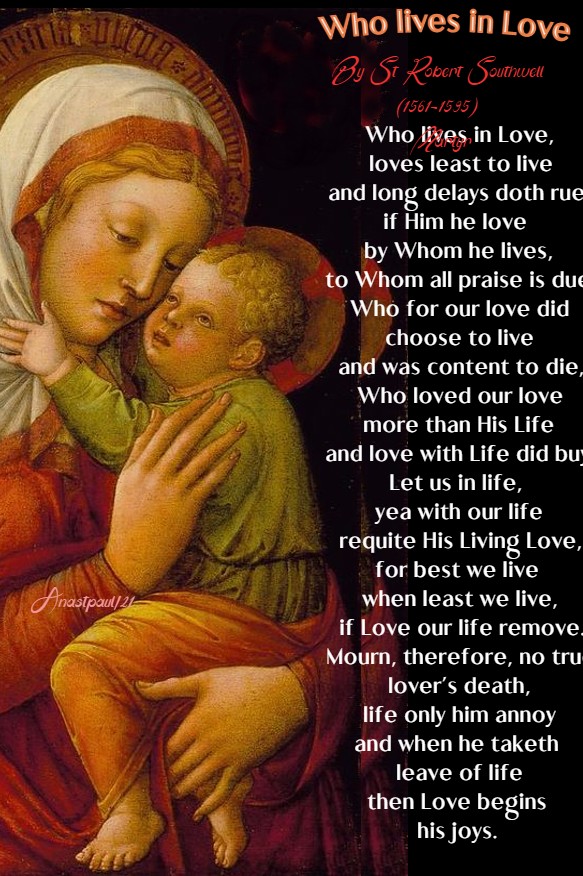
Who lives in Love By St Robert Southwell SJ (1561-1595) Martyr
Who lives in Love, loves least to live and long delays doth rue, if Him he love by Whom he lives, to Whom all praise is due, Who for our love did choose to live and was content to die, Who loved our love more than His life and love with Life did buy. Let us in life, yea with our life requite His Living Love, for best we live when least we live, if Love our life remove. Mourn, therefore, no true lover’s death, life only him annoy and when he taketh leave of life then Love begins his joys.
Quote/s of the Day – 25 December – The Solemnity of the Nativity of Our Lord, Jesus Christ
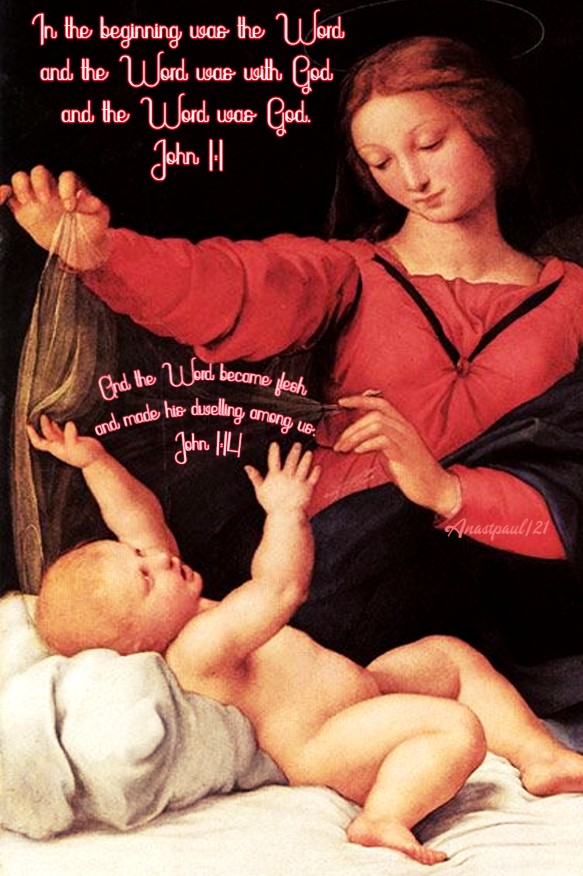
“In the beginning was the Word and the Word was with God and the Word was God.”
John 1:1
“And the Word became flesh and made his dwelling among us and we saw his glory, the glory as of the Father’s only Son, full of grace and truth.”
John 1:14
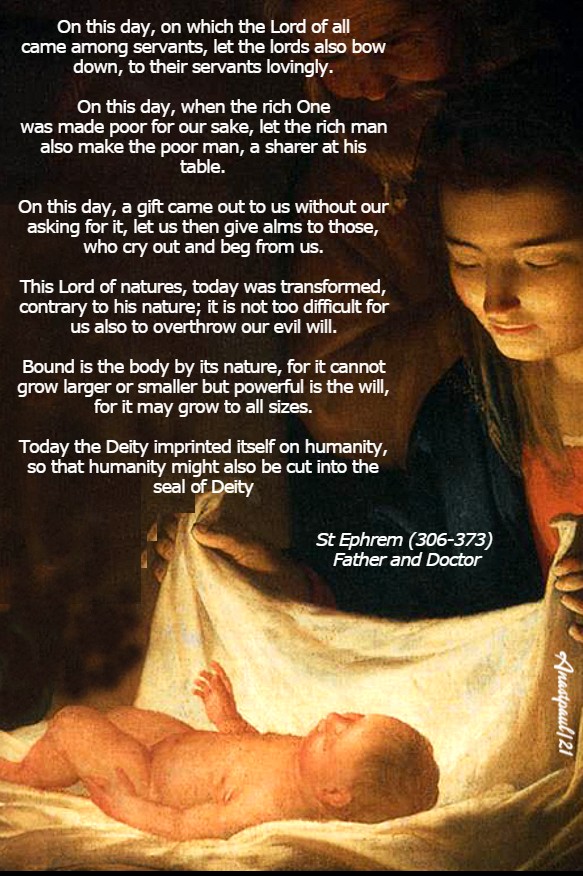
“On this day, on which the Lord of all came among servants, let the lords also bow down, to their servants lovingly.
On this day, when the rich One was made poor for our sake, let the rich man also make the poor man, a sharer at his table.
On this day, a gift came out to us without our asking for it, let us then give alms to those, who cry out and beg from us.
This Lord of natures, today was transformed, contrary to his nature; it is not too difficult for us also to overthrow our evil will.
Bound is the body by its nature, for it cannot grow larger or smaller but powerful is the will, for it may grow to all sizes.
Today the Deity imprinted itself on humanity, so that humanity might also be cut into the seal of Deity.”
St Ephrem (306-373) Father and Doctor
(Homily on Our Lord, 21)
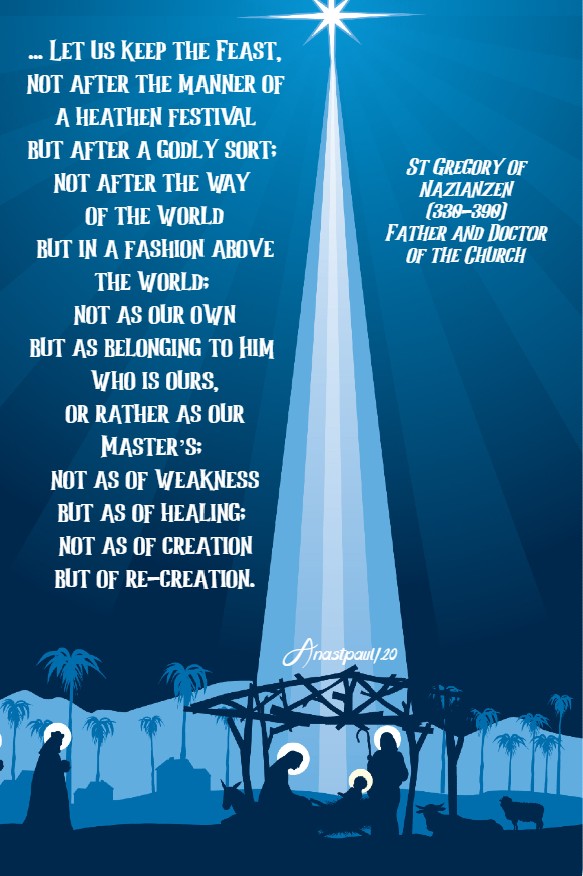
“… Let us keep the Feast, not after the manner of a heathen festival but after a godly sort; not after the way of the world but in a fashion above the world; not as our own but as belonging to Him who is ours, or rather as our Master’s; not as of weakness but as of healing; not as of creation but of re-creation.”
St Gregory of Nazianzen (330-390) Father and Doctor of the Church
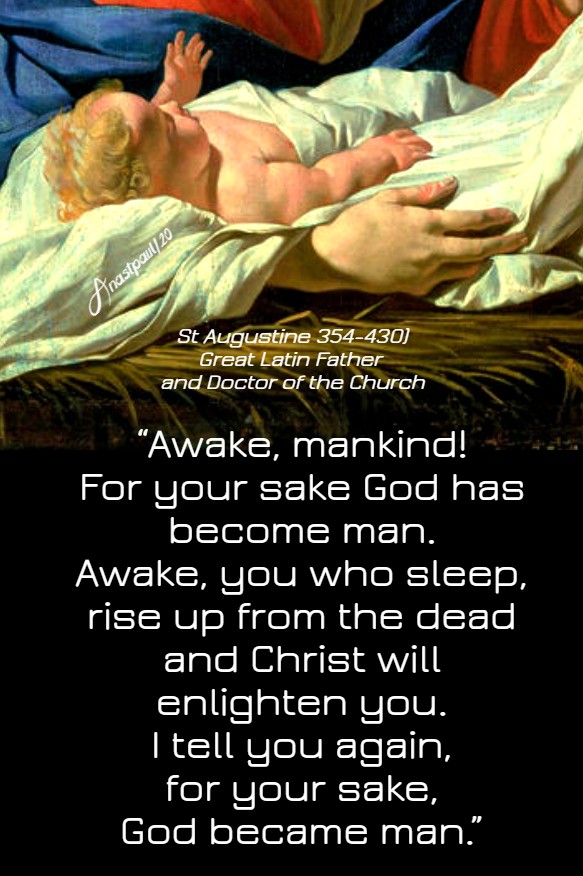
“Awake, mankind! For your sake God has become man. Awake, you who sleep, rise up from the dead and Christ will enlighten you. I tell you again, for your sake, God became man.”
St Augustine 354-430) Great Latin Father and Doctor of the Church
Thought for the Day – 24 December – Meditations with Antonio Cardinal Bacci (1881-1971)
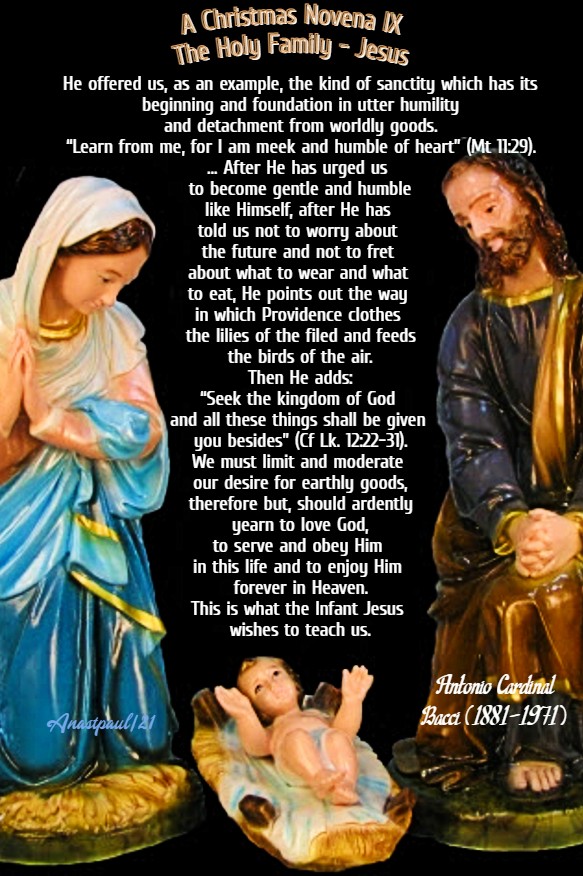
A Christmas Novena IX The Holy Family – Jesus
“We have in the Holy Family, the highest possible models of perfection – Jesus, Mary and Joseph. As God, Jesus is essentially holy. By means of the Hypostatic Union, this sanctity is transmitted also to His human nature. The holiness of Jesus was only gradually revealed as He grew older because He wished to be like us in everything, save in sin. As the Gospel says, He “advanced in wisdom and age and grace before God and men” (Lk 2:52). Jesus gave us an example of holiness which we should find easier to imitate because it was eternally increasing all the time. He offered us, as an example, the kind of sanctity which has its beginning and foundation in utter humility and detachment from worldly goods. “Learn from me, for I am meek and humble of heart” (Mt 11:29).
Socrates advised his followers to have few desires and to desire these as little as possible, in order to remain content, for the man who is full of desires is always uneasy and restless. This human counsel is very true but, it is incomplete. It recommends detachment from earthly things but fails to teach the ardent and practical desire for supernatural things. Jesus Christ teaches us both. After He has urged us to become gentle and humble like Himself, after He has told us not to worry about the future and not to fret about what to wear and what to eat, He points out the way in which Providence clothes the lilies of the filed and feeds the birds of the air. Then He adds: “Seek the kingdom of God and all these things shall be given you besides” (Cf Lk. 12:22-31).
We must limit and moderate our desire for earthly goods, therefore but, should ardently yearn to love God, to serve and obey Him in this life and to enjoy Him forever in Heaven. This is what the Infant Jesus wishes to teach us.”
Thought for the Day – 21 December – Meditations with Antonio Cardinal Bacci (1881-1971)
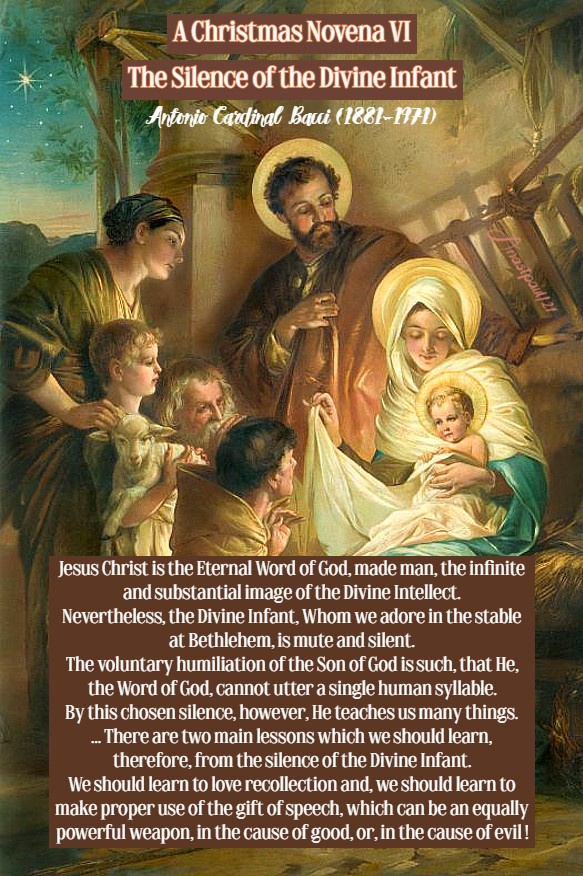
A Christmas Novena VI The Silence of the Divine Infant
“Jesus Christ is the Eternal Word of God, made man, the infinite and substantial image of the Divine Intellect. Nevertheless, the Divine Infant, Whom we adore in the stable at Bethlehem, is mute and silent. The voluntary humiliation of the Son of God is such, that He, the Word of God, cannot utter a single human syllable. By this chosen silence, however, He teaches us many things. In the first place, He teaches us humility and self-denial. He teaches us, moreover, to recollect ourselves in the Presence of God, so that it may be easier for us to speak with Him and for Him, to make known what He requires of us. The silence of prayer brings forth divine consolations and inspirations to holiness,
Do we love to be silent? It is not necessary to become hermits but, it is essential, from time to time, to place ourselves quietly in the Presence of God. God cannot be heard through the noise and confusion of the world, whereas, He speaks clearly to the soul, which seeks the silence of prayer. In any case, if we go about looking for the gossip and idle chatter of the world, it is almost impossible not to offend God. “Avoid profane and empty babblings,” St Paul urges us, “for they contribute much to ungodliness” (2 Tim 2:16). “If anyone does not offend in word,” adds St James, “he is a perfect man” (Js 3:2). “The tongue is a little member,” he continues but, goes onto emphasis that it is capable of doing either a great deal of good or a great deal of harm. “With it, we bless God the Father and, with it, we curse men, who have been made after the likeness of God. Out of the same mouth proceed blessing and cursing. These things, my brethren ought not to be so” (Js 3:5-10).
There are two main lessons which we should learn, therefore, from the silence of the Divine Infant. We should learn to love recollection and, we should learn to make proper use of the gift of speech, which can be an equally powerful weapon, in the cause of good, or, in the cause of evil!”
Thought for the Day – 20 December – Meditations with Antonio Cardinal Bacci (1881-1971)
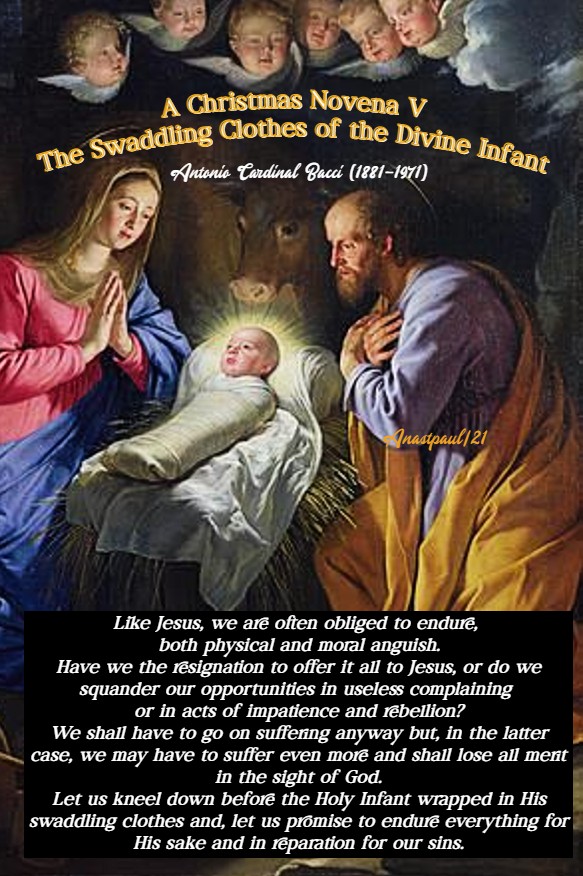
A Christmas Novena V The Swaddling Clothes of the Divine Infant
“Mary, like other mothers in those days, wrapped the Infant Jesus in swaddling clothes. The Divine Child quietly offered this new humiliation to His heavenly Father. He saw prefigured in these bands, the ropes with which He would be bound in the garden of Gethsemane, even after He had given sinful humanity, His celestial teaching, example and miracles and finally, His own Body inthe Sacrament of the Eucharist. He saw in them too, the chains with which He would be secured to the pillar, in order to be scourged in the Praetorium of Pilate among the jeers and insults of the onlookers. He saw in them, finally, the cords with which, after having been condemned to the ignominious death of the Cross, He would be tied, while being led to the place of execution on Mount Calvary. Filled with infinite love for stricken humanity, the Heart of the Divine Infant offered all this, in advance, to His Father in heaven.
Are we making any effort to return such great love? Like Jesus, we are often obliged to endure, both physical and moral anguish. Have we the resignation to offer it all to Jesus, or do we squander our opportunities in useless complaining or in acts of impatience and rebellion? We shall have to go on suffering anyway but, in the latter case, we may have to suffer even more and shall lose all merit in the sight of God.
Let us kneel down before the Holy Infant wrapped in His swaddling clothes and, let us promise to endure everything for His sake and in reparation for our sins.”
Thought for the Day – 19 December – Meditations withAntonio Cardinal Bacci (1881-1971)
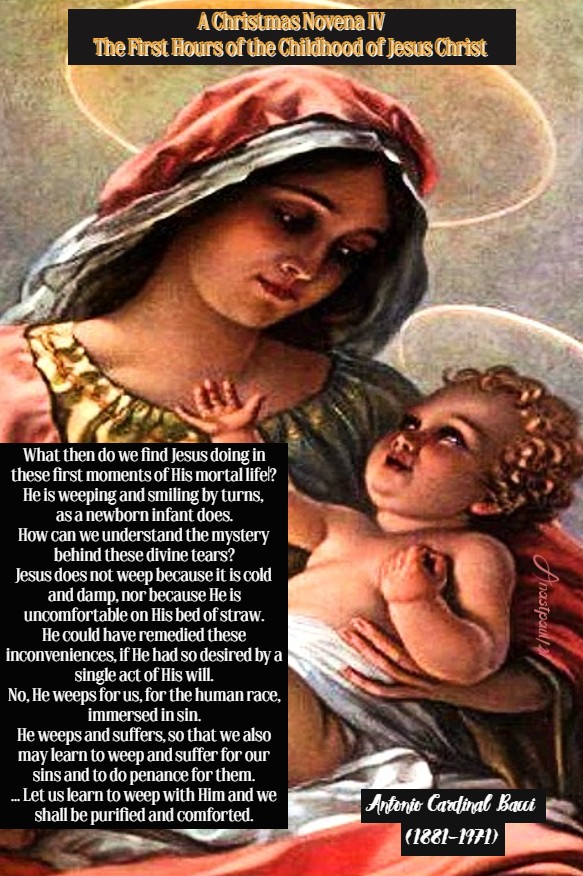
A Christmas Novena IV The First Hours of the Childhood of Jesus Christ
“Enter in spirit into the stable at Bethlehem and humbly kneel before the Word of God made man. What do we find Jesus doing in these first moments of His mortal life. By a single act of His divine will, He could have instantly transformed the human race. But, He came to redeem men and preach to them before anything else, the virtues which they most needed – humility, indifference to worldly possessions and the acceptance of suffering. He taught them to endure suffering, neither rebelliously, nor even as a disagreeable necessity but, as a means of purification and sanctification. Before the time of Jesus Christ, suffering was dreaded and abhorred. He taught us to love it because it is the salt of the earth which saves us from corruption because, it detaches us from worldly things and because, it lifts our thoughts towards Heaven.
What then do we find Jesus doing in these first moments of His mortal life|? He is weeping and smiling by turns, as a newborn infant does. How can we understand the mystery behind these divine tears? Jesus does not weep because it is cold and damp, nor because He is uncomfortable on His bed of straw. He could have remedied these inconveniences, if He had so desired by a single act of His will. No, He weeps for us, for the human race, immersed in sin. He weeps and suffers, so that we also may learn to weep and suffer for our sins and to do penance for them. This is the explanation of the tears of the Divine Child. Let us learn to weep with Him and we shall be purified and comforted.”
Thought for the Day – 18 December – Meditations with Antonio Cardinal Bacci (1881-1971)
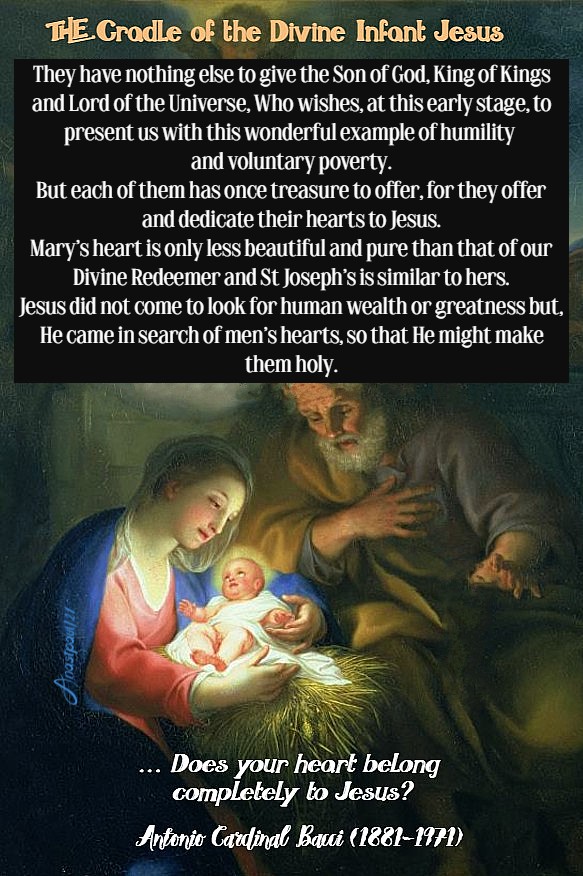
A Christmas NovenaIII The Cradle of the Divine Infant Jesus
“Enter once more with faith and love into the stable of Bethlehem. As soon as her Son has been miraculously delivered without any damage to her virginity, Mary adores Him and, with such maternal love as we could never conceive of, she takes Him to her heart. Joseph, kneeling in ecstasy at the sight, bows reverently and kisses the forehead of the Divine Infant. In this moment of blis, he is well rewarded for his unshaken faith and for all the sacrifices which he has made from his youth until the time of his alliance with Mary.
Now Mary and Joseph look around and, since they can find no better cradle for the Baby Jesus, they place Him upon some straw in a manger and cover Him with a rough linen cloth. They have nothing else to give the Son of God, King of Kings and Lord of the Universe, Who wishes, at this early stage, to present us with this wonderful example of humility and voluntary poverty. But each of them has once treasure to offer, for they offer and dedicate their hearts to Jesus. Mary’s heart is only less beautiful and pure than that of our Divine Redeemer and St Joseph’s is similar to hers.
Jesus did not come to look for human wealth or greatness but, He came in search of men’s hearts, so that He might make them holy. Throughout the centuries there have been many generous-hearted people who joined with Mary and Joseph in loving Jesus and in dedicating themselves entirely to Him. Does your heart belong completely to Jesus?”
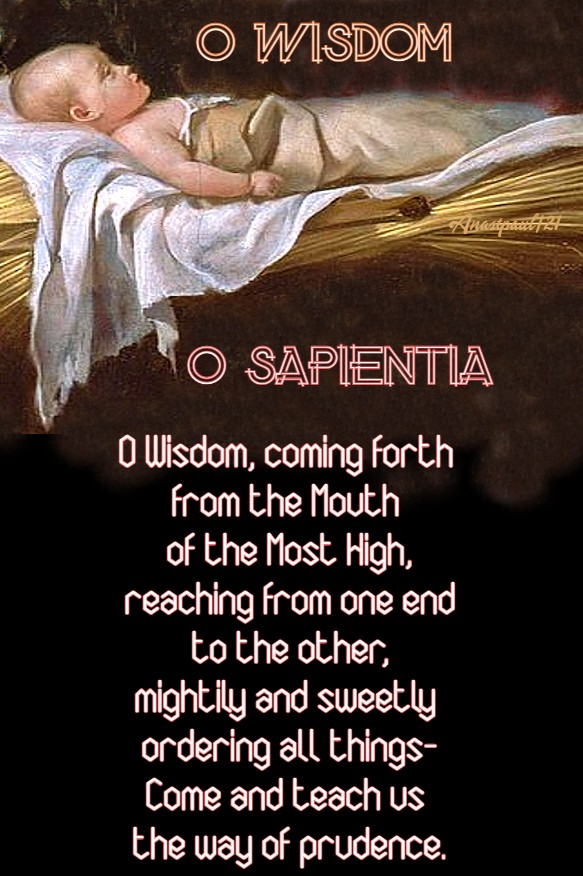
One Minute Reflection – 17 December – O Wisdom … O Sapientia … – Friday of the Third Week of Advent, Readings: Genesis 49: 2, 8-10; Psalm 72: 1-4, 7-8, 17; Matthew 1: 1-17
O Wisdom O Sapientia
O Sapientia, quae ex ore Altissimi prodiisti, attingens a fine usque ad finem, fortiter suaviterque disponens omnia- veni ad docendum nos viam prudentiae.
O Wisdom, coming forth from the Mouth of the Most High, reaching from one end to the other, mightily and sweetly ordering all things- Come and teach us the way of prudence.
The book of the genealogy of Jesus Christ, the son of David, the son of Abraham. … Matthew 1:1
REFLECTION – “The Incarnation of the Word only contributed to the doing of those things that were done and the mystery of humankind’s salvation was never, even in the remotest age, at a standstill. What the propehts foretold, the apostles announced, nor were those things fulfilled too late, which had always been believed. But the wisdom and goodness of God, made us all the more receptive of His call … as the foretelling of it had been ancient and oft-repeated.
And so it was no new counsel, no tardy pity, whereby God took thought for us but from the foundation of the world, He ordained one and the same cause of Salvation for all. For the grace of God, by which the whole body of the saints is continually made righteous, was increased, not initiated, when Christ was born. And this mystery of God’s great love, with which the whole world is now filled, was so effectively pre-signified, that those who believed the promise, obtained no less, than those who were the actual recipients.
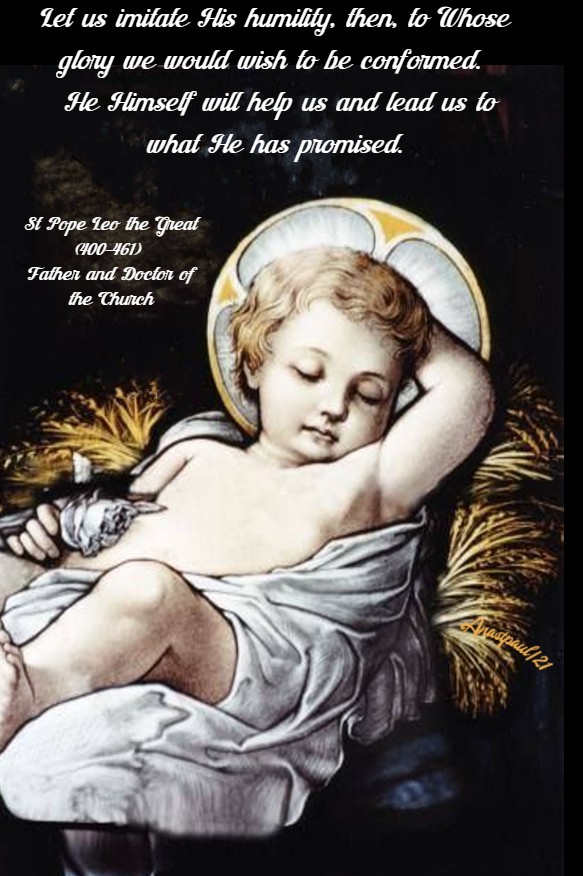
And so, dearly beloved, since that loving-kindness is now manifest with which all the wealth of divine goodness has been showered on us, Whose call to eternal life has been promoted, not only by the supportive example of those who went before us but, by the visible and bodily appearance of Truth itself, we are bound to keep the day of our Lord’s Nativity with a joy beyond this world… By the illumination of the Holy Spirit consider who it was who received us into Himself and Whom we have received, since as the Lord Jesus became our flesh by being born, so we also became His Body by being re-born… For God suggested to us the standard of His own gentleness and humility… Let us imitate His humility, then, to whose glory we would wish to be conformed. He Himself will help us and lead us to what He has promised.” … St Pope Leo the Great (400-461) Father and Doctor of the Church (3rd sermon on the Feast of the Nativity, 4-5).
PRAYER – Collect: O God, Creator and Redeemer of human nature, Who willed that Your Word should take flesh in an ever-virgin womb, look with favour on our prayers, that Your only Begotten Son, having taken to Himself our humanity, may be pleased to grant us a share in his divinity. Who lives and reigns with You in the unity of the Holy Spirit, one God, for ever and ever. Amen
Rejoice! Rejoice! Emmanuel Shall come to thee, O Israel
Thought for the Day – 16 December – Meditations with Antonio Cardinal Bacci (1881-1971)
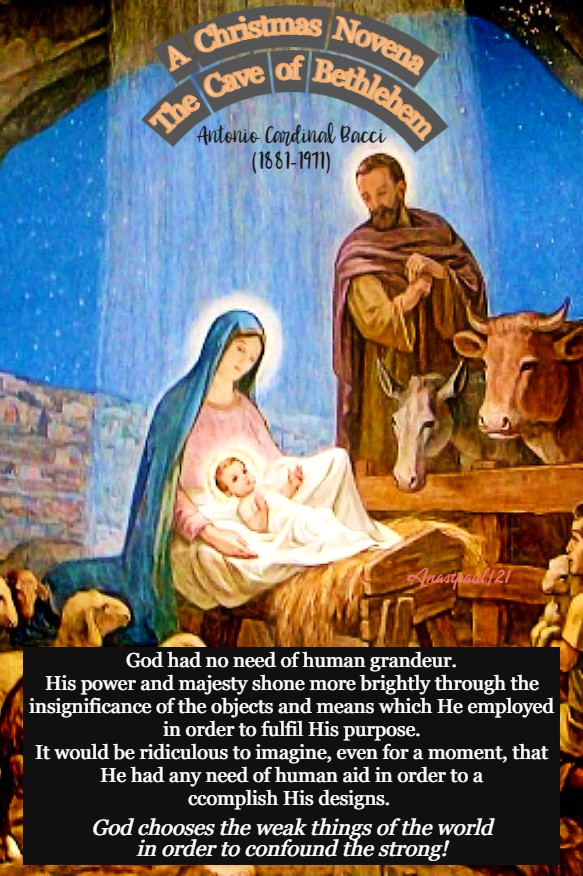
A Christmas Novena The Cave of Bethlehem
“Why, asked Bossuet, should the Eternal Word of God, infinitely and everlastingly happy, have deigned to assume in time, the fallen state of humanity? Why should He have chosen, as the scene of His miraculous life of love, this insignificant world, a planet almost imperceptible among the myriads of gigantic heavenly bodies? It was for the very same reason, Bossuet replied, that propmpted Him, once He had become man, to choose as His birthplace, the tiny and unknown village of Nazareth in Galilee rather than Rome, the centre of power, or Athens, the centre of learning, or Jerusalem, the capital of the State of Israel. Our world is the Nazareth of creation, one of the smallest planets in the firmament.
God did not even choose, moreover, to be born in the poor but comparatively comfortable house at Nazareth. He preferred to be born in the strange town of Bethlehem. It was the cradle of His ancestral line but it gave Him no welcome and compelled Him to be born in a cold and squalid barn on the straw of a manger. God had no need of human grandeur. His power and majesty shone more brightly through the insignificance of the objects and means which He employed in order to fulfil His purpose. It would be ridiculous to imagine, even for a moment, that He had any need of human aid in order to accomplish His designs. God chooses the weak things of the world in order to confound the strong!” (Missale Romanum, Miss. Virg et Mart).
Thought for the Day – 12 December – Meditations with Antonio Cardinal Bacci (1881-1971)
Peace of Soul
“Peace of soul is more to be desired than anything else in this world. Wealth, honours and pleasures are valueless, as long as we are discontented and disturbed at heart. Happiness is essentially internal, not external. Anyone who looks for it outside himself cannot find it, simply because it does not exist there. Interior peace, however, is capable of bringing us whatever happiness can be obtained in this world.
We can have this peace if, we avoid sin. The Holy Spirit assures us that “there is no peace for the wicked” (Isa 48:22). Our tranquillity will be increased by humility and gentleness. A haughty and ambitious man can never be at peace. “Come to me” Jesus invites us, “all you who labour and are burdened and I will give you rest. Take my yoke upon you and learn from me, for I am meek and humble of heart and you will find rest for your soul” (Mt 11:28-29).
The only way then, by which we can acquire peace of soul, is by avoiding sin, practising humility and obeying the law of God. The Saints possessed this serenity, even in times of trial and of suffering because they lived in God and were perfectly faithful to His law.”
Quote/s of the Day – 11 December – Saturday of the Second week of Advent
“Let us become like Christ, since Christ became like us. He assumed the worse, that He might give us the better; He became poor, that we through His poverty, might be rich.”
St Gregory of Nazianzen (330-390) Father and Doctor of the Church
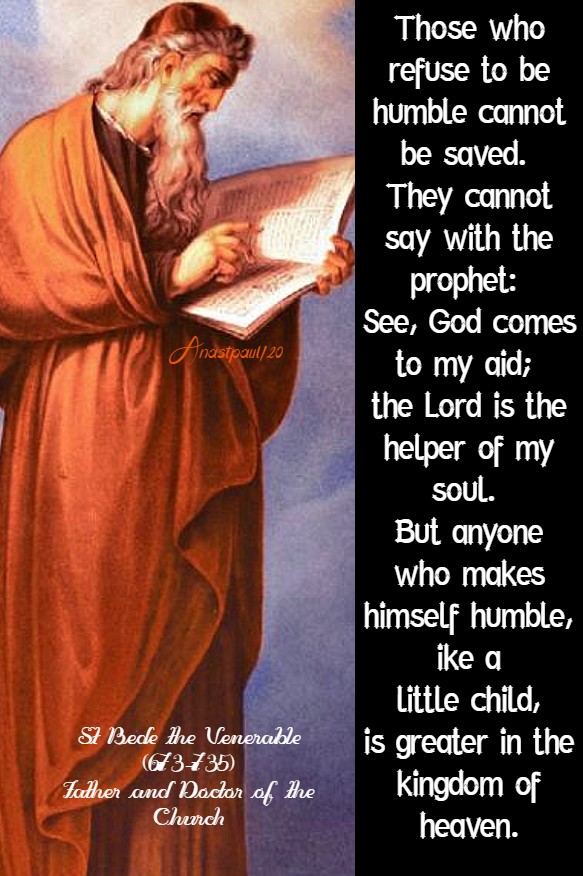
“Those who refuse to be humble cannot be saved. They cannot say with the prophet: See, God comes to my aid; the Lord is the helper of my soul. But anyone who makes himself humble, like a little child, is greater in the kingdom of heaven.”
St Bede the Venerable (673-735)
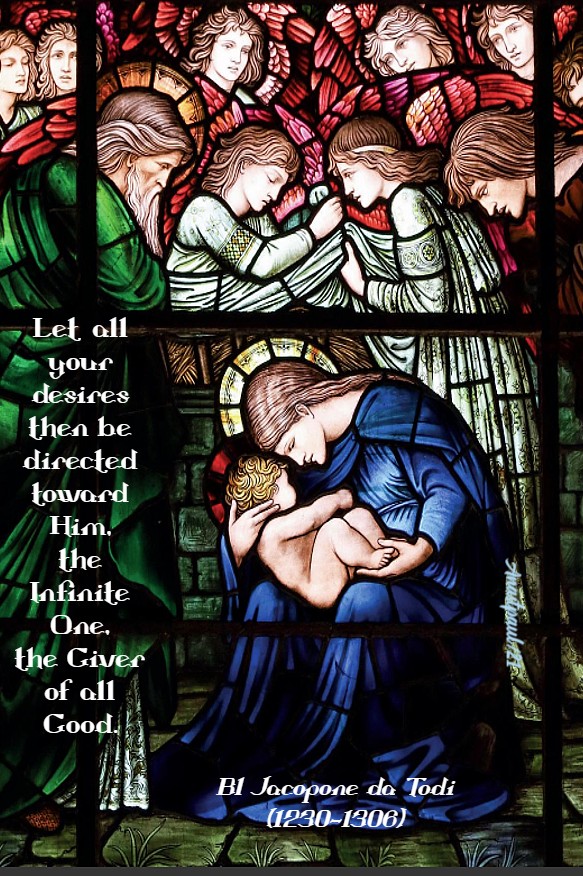
“Let all your desires then be, directed toward Him, the Infinite One, the Giver of all Good.”
Bl Jacopone da Todi (1230-1306)
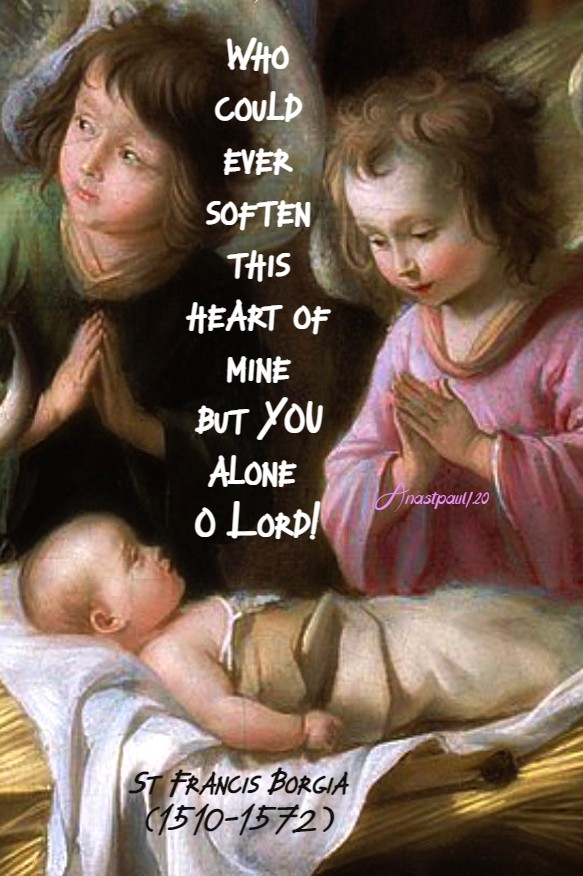
“Who could ever soften this heart of mine but YOU alone O Lord!”
St Francis Borgia (1510-1572)
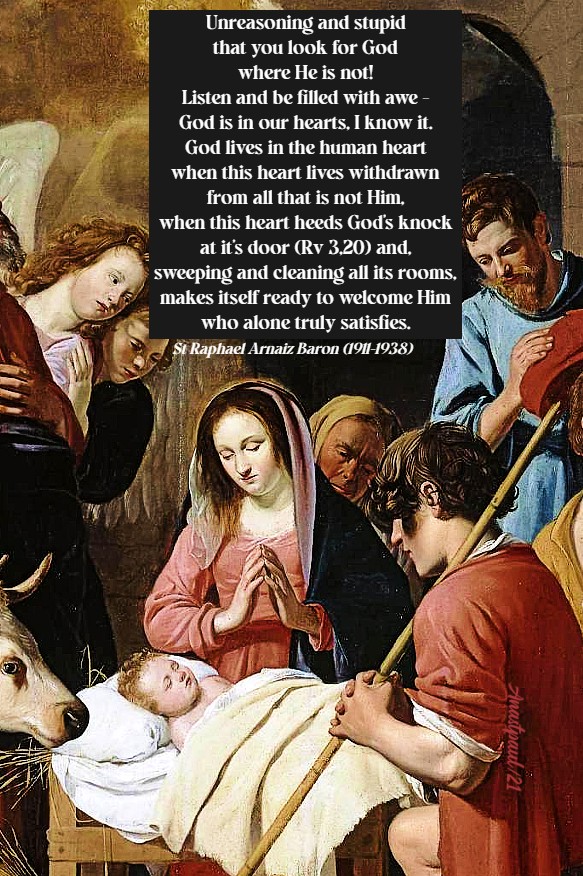
“Unreasoning and stupid that you look for God where He is not! Listen and be filled with awe – God is in our hearts, I know it. God lives in the human heart when this heart lives withdrawn from all that is not Him, when this heart heeds God’s knock at it’s door (Rv 3,20) and, sweeping and cleaning all its rooms, makes itself ready to welcome Him who alone truly satisfies.”
Thought for the Day – 29 November – Meditations with Antonio Cardinal Bacci (1881-1971)
The Blessedness of the Meek
“Charity, as St Thomas Aquinas says, is the source of all the virtues (Summa Theologiae, II-II, q 157, a 2). This includes meekness, or that quality of moderation by which a Christian ought to govern his passions, especially anger and keep them subject to the control of reason. This virtue is opposed to pride and to vanity, in that these passions, when wounded, culminate in outbursts of anger and in quests for revenge.
Meekness is not simply a form of apathy or of good natured affability. On the contrary, it is based both on humility and on fortitude. It feels insults and ingratitude and does not remove the suffering which accompanies them but it demands the heroism of silence and of charitable behaviour towards those who hurt us. For this reason it is not identical with weakness but, requires spiritual fortitude because, it makes a man complete master of himself (Cf Summa Theologiae II-II, 1 157 a 4). Anger is not always sinful, as the Holy Spirit indicates (Ps 4-5). If it remains subject to the control of reason and of charity, indeed, it is only a reaction against evil and can exist alongside Christian meekness. It is fatal, however, to allow anger to become blind and tyrannical, for it will then betray a man into hatred and vengefulness. It will grow noisy and vulgar, give scandal to others and leave, in the soul, a sense of restlessness and of vexation (Cf St Francis de Sales, Introduction to the Devout Life, Bk III, ch 9). “If the Holy Spirit may be called, the peace of the soul, uncontrolled anger may be called, its disturber. Nothing is more hostile than anger to the indwelling of the Holy Spirit within us” (St John Climacus Scala Paradisi p 286).
Let us resolve never to allow ourselves to be led away by immoderate anger but, to preserve, at all times, our meekness and peace of soul.”
Quote/s of the Day – 29 November – Monday of the First Week of Advent – Readings: Isaiah 2: 1-5; Psalms 122: 1-9; Matthew 8: 5-11
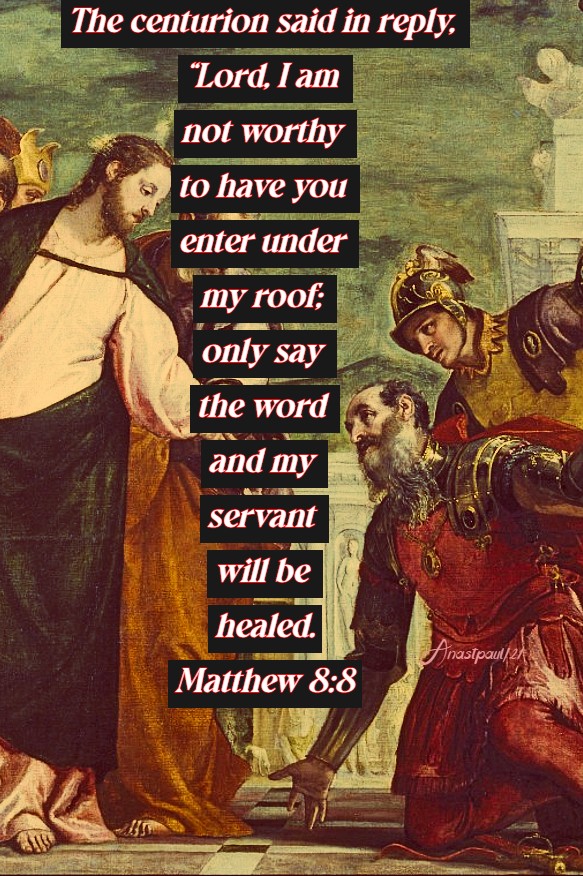
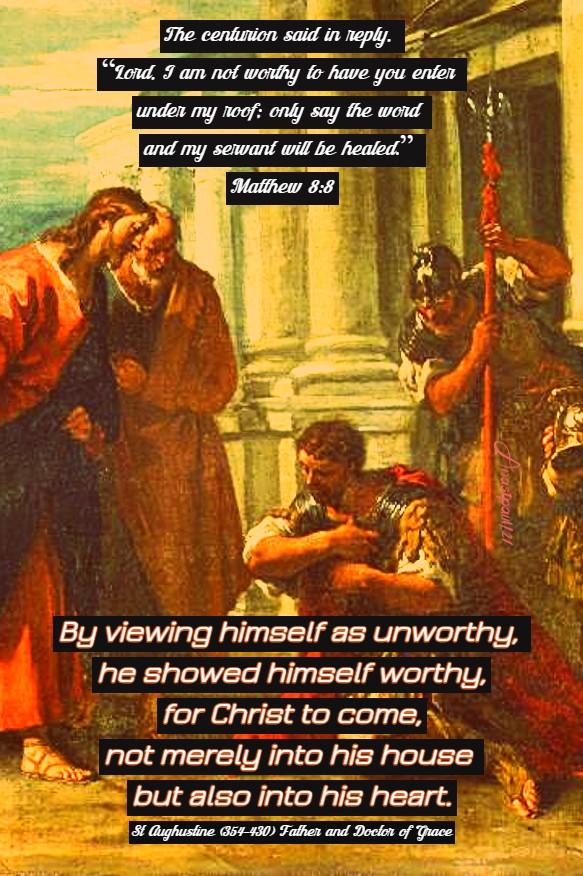
“The centurion said in reply, “Lord, I am not worthy to have you enter under my roof; only say the word and my servant will be healed.”
Matthew 8:8
“By viewing himself as unworthy, he showed himself worthy, for Christ to come, not merely into his house but also into his heart.”
“For the Master of humility, both by word and example, sat down also, in the house of a certain proud Pharisee, Simon and although He sat down in his house, there was no place in his heart. For in his heart. the Son of Man could not lay His head.”
St Aughustine (354-430) Father and Doctor of Grace
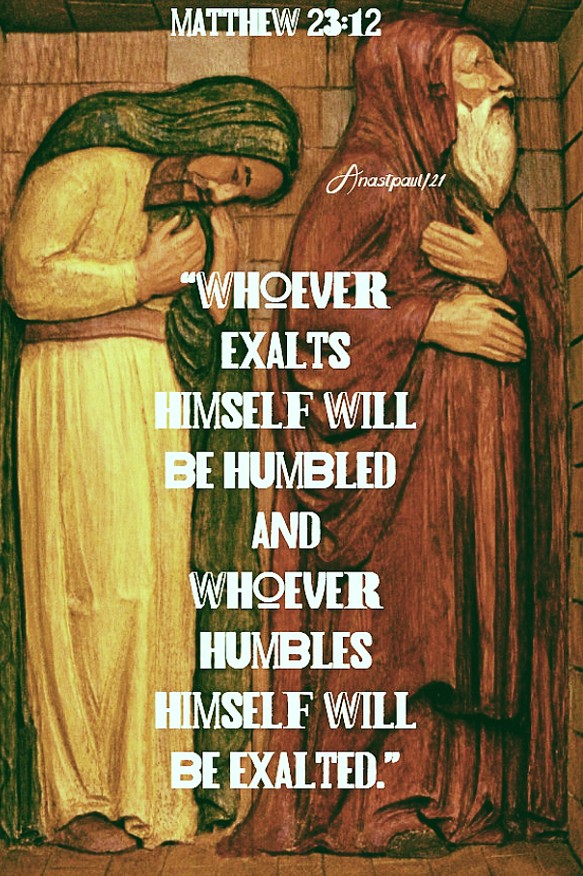
“Whoever exalts himself will be humbled and whoever humbles himself will be exalted.”
Matthew 23:12
“Arm yourself with prayer, instead of a sword; be clothed with humility, instead of fine raiment.”
St Dominic de Guzman OP (1170-1221)
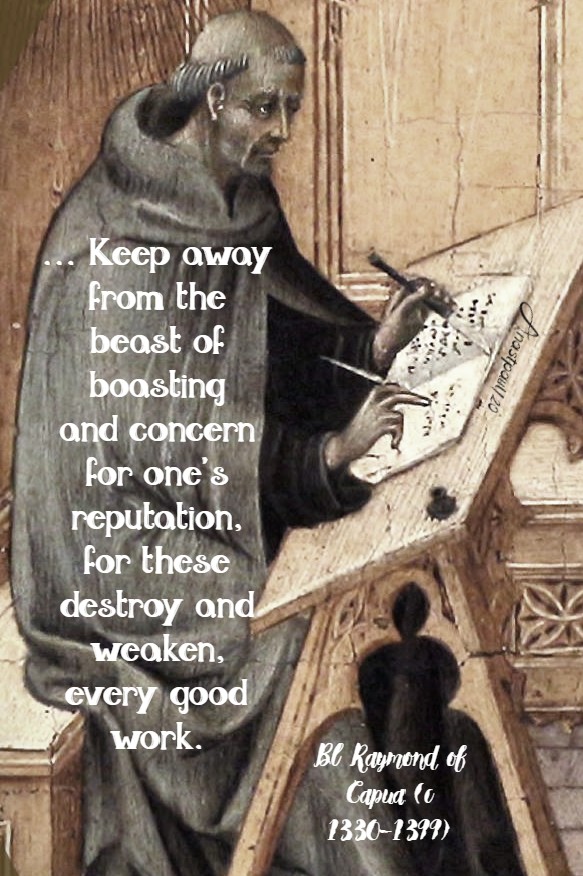
“My brothers, keep away from the beast of boasting and concern for one’s reputation, for these destroy and weaken, every good work.”
Bl Raymond of Capua (c 1330-1399)
“ … If you die with Him, you shall also likewise live with Him. If you are His companion in punishment, so shall you be in glory.”
Thomas à Kempis (1380-1471)
“Humility and charity are the two master chords – one, the lowest; the other, the highest; all the others are dependent on them. Therefore, it is necessary, above all. to maintain ourselves in these two virtues, for observe well, that the preservation of the whole edifice depends on the foundation and the roof!”

































 AnaStpaul
You must be logged in to post a comment.