Posted in DOCTORS of the Church, FATHERS of the Church, FEASTS and SOLEMNITIES, MORNING Prayers, QUOTES of the SAINTS, QUOTES on FAITH, QUOTES on the CHURCH, The APOSTLES & EVANGELISTS

Thought for the Day – 22 February – St Pope Leo the Great “The Chair of Peter”

Thought for the Day – 22 February – The Feast of the Chair of Saint Peter

Pope Saint Leo the Great (400-461)
Bishop of Rome and Great Latin Father & Doctor of the Church

An excerpt from Sermo 4

Out of the whole world one man, Peter, is chosen to preside at the calling of all nations and to be set over all the apostles and all the fathers of the Church.   Though, there are, in God’s people many shepherds, Peter is thus appointed, to rule in his own person, those whom Christ also rules as the original ruler.   Beloved, how great and wonderful is this sharing of His power that God in His goodness has given to this man.   Whatever Christ has willed to be shared in common, by Peter and the other leaders of the Church, it is only through Peter, that He has given to others, what He has not refused to bestow on them.

The Lord now asks the apostles as a whole, what men think of him.   As long as they are recounting the uncertainty born of human ignorance, their reply is always the same.

But when He presses the disciples to say what they think themselves, the first to confess his faith in the Lord, is the one who is first in rank, among the apostles.

Peter says:  You are the Christ, the Son of the living God.   Jesus replies:  Blessed are you, Simon Bar-Jona, for flesh and blood has not revealed it to you, but my Father who is in heaven.   You are blessed, he means, because my Father has taught you.   You have not been deceived by earthly opinion but have been enlightened by inspiration from heaven. It was not flesh and blood that pointed Me out to you but the one whose only-begotten Son I am.

He continues:  And I say to you.   In other words, as my Father has revealed to you my godhead, so I in my turn make known to you, your pre-eminence.   You are Peter:  though I am the inviolable rock, the cornerstone that makes both one, the foundation apart from which no one can lay any other, yet you also are a rock, for you are given solidity by my strength, so that which is my very own because of my power is common between us through your participation.

And upon this rock I will build my Church and the gates of hell shall not prevail against it.   On this strong foundation, He says, I will build an everlasting temple.   The great height of my Church, which is to penetrate the heavens, shall rise on the firm foundation of this faith.

The gates of hell shall not silence this confession of faith;  the chains of death shall not bind it.   Its words are the words of life.   As they lift up to heaven those who profess them, so they send down to hell those who contradict them.

Blessed Peter is therefore told – To you I will give the keys of the kingdom of heaven. Whatever you bind on earth is also bound in heaven.   Whatever you lose on earth shall be loosed also in heaven.

The authority vested in this power passed also to the other apostles and the institution, established by this decree, has been continued in all the leaders of the Church.   But, it is not without good reason, that what is bestowed on all, is entrusted to one.   For Peter, received it separately, in trust, because he is the prototype, set before all the rulers of the Church.
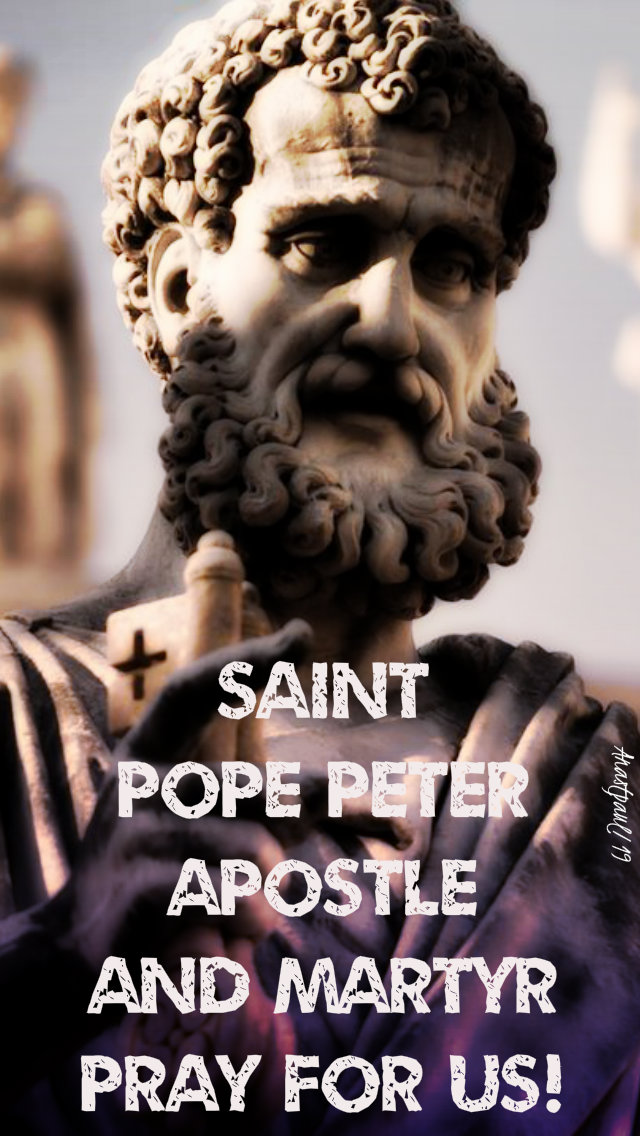
Saint Pope Peter
Apostle and Martyr
Pray for us!st pope peter apostle and martyr pray for us 22feb2019.jpg

Posted in DOCTORS of the Church, FATHERS of the Church, FEASTS and SOLEMNITIES, MORNING Prayers, QUOTES of the SAINTS, QUOTES on the CHURCH, SAINT of the DAY

One Minute Reflection – 22 February – The Feast of the Chair of Saint Peter

One Minute Reflection – 22 February – The Feast of the Chair of Saint Peter

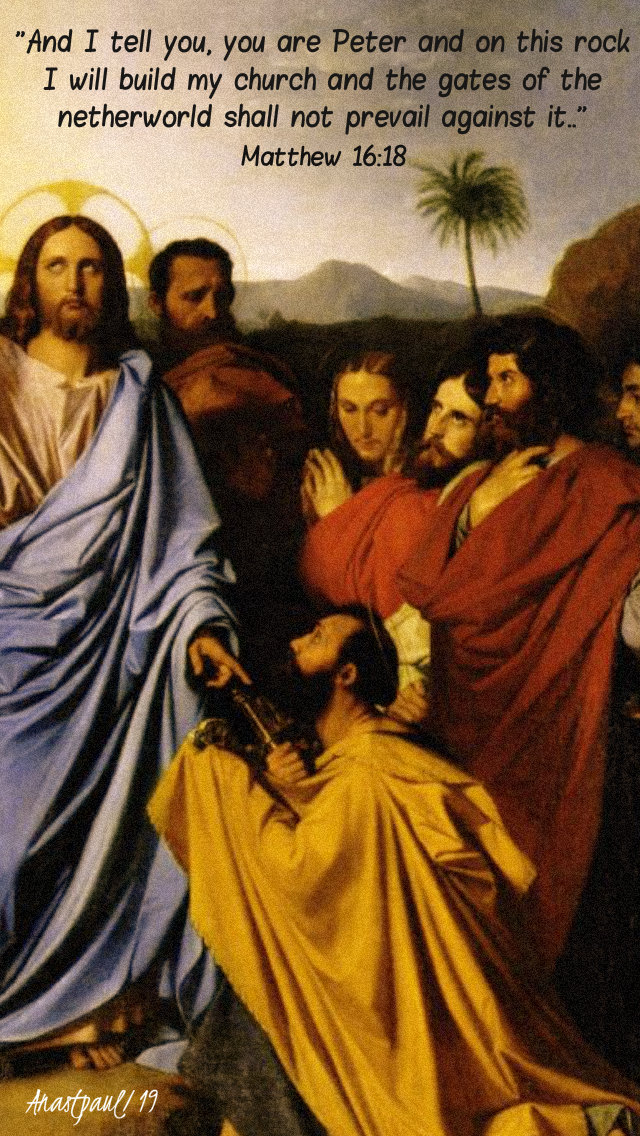
“And I tell you, you are Peter and on this rock I will build my church and the gates of the netherworld shall not prevail against it..”…Matthew 16:18matthew 16 18 and i tell you you are peter and on this rock 22 feb 2019.jpg

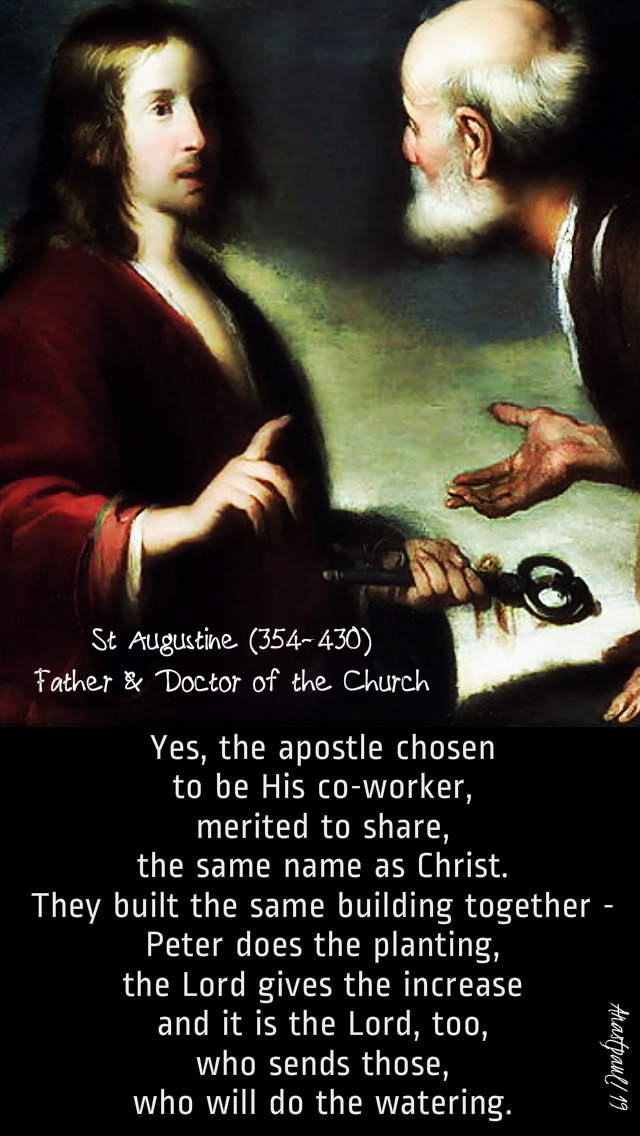
REFLECTION – “You are Peter and on this rock I shall build my Church.”   He was given this name of ‘Peter’ because he was the first to set the foundations of the faith among the nations and because he is, the indestructible rock on which rests, the judgement seat and the whole edifice, belonging to Christ Jesus.   It was on account of his faithfulness that he was called Peter, whereas our Lord receives the same name on account of His power according to Saint Paul’s words:  “They drank from a spiritual rock that followed them and that rock was the Christ” (1Cor 10:4).   Yes, the apostle chosen to be His co-worker, merited to share, the same name as Christ.   They built the same building together – Peter does the planting, the Lord gives the increase and it is the Lord, too, who sends those, who will do the watering (cf. 1 Cor 3:6f.).
As you know, my beloved, it was following on from his own failure, when our Saviour suffered, that blessed Peter was raised up.   It was after he had denied the Lord that he became the first next to him.   Rendered more faithful when he wept over the faith he had betrayed, he received a still greater grace than the one he had lost.   To him Christ confided His flock, so that he might guide it like a good shepherd and he who had been so weak, would now become the support of all.   He who had fallen when questioned about his faith, must now establish the others, on the unshakeable foundations of faith. Hence he is called the foundation stone of the piety of the Churches.”…St Augustine (354-430) Father & Doctor of the Churchyes, the apostle chosen to be his co-worker - st augustine - 22 feb 2019.jpg

PRAYER – Holy Father, send Your Divine Enlightener into the hearts of all Your faithful, filling us with the strength to fulfil our mission as the followers of the Chair of St Peter. And most of all, we pray Lord Holy God to inspire and light the way of our Holy Father, Francis. Sustain and guide him, keep him in health and strength, to lead Your people by the Light of the Way and the Truth. Holy Father, have mercy on us, Holy Spirit guide and lead us, Lord Jesus Christ be our intercessor and teacher, amen.st peter pray for us 22 feb 2019.jpg

Posted in DOCTORS of the Church, PAPAL SERMONS, PRACTISING CATHOLIC, QUOTES of the SAINTS, SAINT of the DAY, The HOLY CROSS, The SIGN of the CROSS

Thought for the Day – 21 February – Peter, Servant of the Servants of the Cross of Christ

Thought for the Day – 21 February – the Memorial of St Peter Damian OSB (1007-1072) Doctor of the Church

Excerpt from Pope Benedict’s Catechesis on St Peter Damian
General Audience
Wednesday, 9 September 2009

One detail should be immediately emphasised – the Hermitage at Fonte Avellana was dedicated to the Holy Cross and the Cross was the Christian mystery that was to fascinate Peter Damian more than all the others.   “Those who do not love the Cross of Christ do not love Christ”, he said (Sermo XVIII, 11, p. 117) and he described himself as “Petrus crucis Christi servorum famulus Peter, servant of the servants of the Cross of Christ” (Ep, 9, 1).
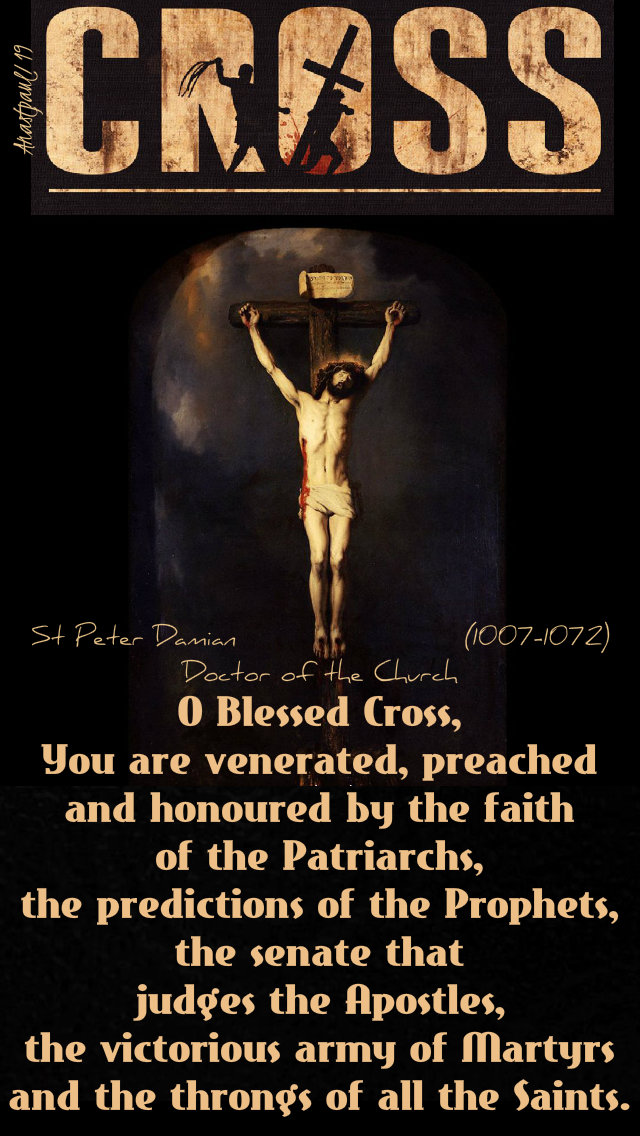
Peter Damian addressed the most beautiful prayers to the Cross in which he reveals a vision of this mystery which has cosmic dimensions for it embraces the entire history of salvation: “O Blessed Cross”, he exclaimed, You are venerated, preached and honoured by the faith of the Patriarchs, the predictions of the Prophets, the senate that judges the Apostles, the victorious army of Martyrs and the throngs of all the Saints” (Sermo XLVII, 14, p. 304).
Dear Brothers and Sisters, may the example of St Peter Damian spur us too always to look to the Cross as to the supreme act God’s love for humankind of God, who has given us salvation.

St Peter Damian, who was essentially a man of prayer, meditation and contemplation, was also a fine theologian – his reflection on various doctrinal themes led him to important conclusions for life.   Thus, for example, he expresses with clarity and liveliness the Trinitarian doctrine, already using, under the guidance of biblical and patristic texts, the three fundamental terms which were subsequently to become crucial also for the philosophy of the West – processio, relatio and persona (cf. Opusc. XXXVIII: PL CXLV, 633-642; and Opusc. II and III: ibid., 41 ff. and 58 ff).
However, because theological analysis of the mystery led him to contemplate the intimate life of God and the dialogue of ineffable love, between the three divine Persons, he drew ascetic conclusions from them for community life and even for relations between Latin and Greek Christians, divided on this topic.   His meditation on the figure of Christ, is significantly reflected, in practical life, since the whole of Scripture is centred on Him.
The “Jews”, St Peter Damian notes, “through the pages of Sacred Scripture, bore Christ on their shoulders as it were” (Sermo XLVI, 15).   Therefore Christ, he adds, must be the centre of the monk’s life:  “May Christ be heard in our language, may Christ be seen in our life, may he be perceived in our hearts” (Sermo VIII, 5).   Intimate union with Christ engages not only monks but all the baptised.   Here we find a strong appeal for us too not to let ourselves be totally absorbed by the activities, problems and preoccupations of every day, forgetting that Jesus must truly be the centre of our life.

Communion with Christ creates among Christians a unity of love.   In Letter 28, which is a brilliant ecclesiological treatise, Peter Damian develops a profound theology of the Church as communion.   “Christ’s Church”, he writes, is united by the bond of charity to the point that just as she has many members so is she, mystically, entirely contained in a single member – in such a way that the whole universal Church is rightly called the one Bride of Christ in the singular, and each chosen soul, through the sacramental mystery, is considered fully Church”.   This is important – not only that the whole universal Church should be united but that the Church should be present in her totality in each one of us.   Thus the service of the individual becomes “an expression of universality” (Ep 28, 9-23).
However, the ideal image of “Holy Church” illustrated by Peter Damian does not correspond as he knew well to the reality of his time.   For this reason he did not fear to denounce the state of corruption that existed in the monasteries and among the clergy, because, above all, of the practice of the conferral by the lay authorities of ecclesiastical offices; -various Bishops and Abbots were behaving as the rulers of their subjects rather than as pastors of souls.   Their moral life frequently left much to be desired.   For this reason, in 1057 Peter Damian left his monastery with great reluctance and sorrow and accepted, if unwillingly, his appointment as Cardinal Bishop of Ostia.   So it was that he entered fully into collaboration with the Popes in the difficult task of Church reform.   He saw that to make his own contribution of helping in the work of the Church’s renewal contemplation did not suffice.   He thus relinquished the beauty of the hermitage and courageously undertook numerous journeys and missions.

Dear brothers and sisters, it is a great grace that the Lord should have raised up in the life of the Church a figure as exuberant, rich and complex as St Peter Damian.   Moreover, it is rare to find theological works and spirituality as keen and vibrant as those of the Hermitage at Fonte Avellana.

St Peter Damian was a monk through and through, with forms of austerity which to us today might even seem excessive.   Yet, in that way he made monastic life an eloquent testimony of God’s primacy and an appeal to all to walk towards holiness, free from any compromise with evil.   He spent himself, with lucid consistency and great severity, for the reform of the Church of his time.  He gave all his spiritual and physical energies to Christ and to the Church but always remained, as he liked to describe himself, Petrus ultimus monachorum servus, Peter, the lowliest servant of the monks.

St Peter Damian,

‘Peter, Servant of the Servants of the Cross of Christ’

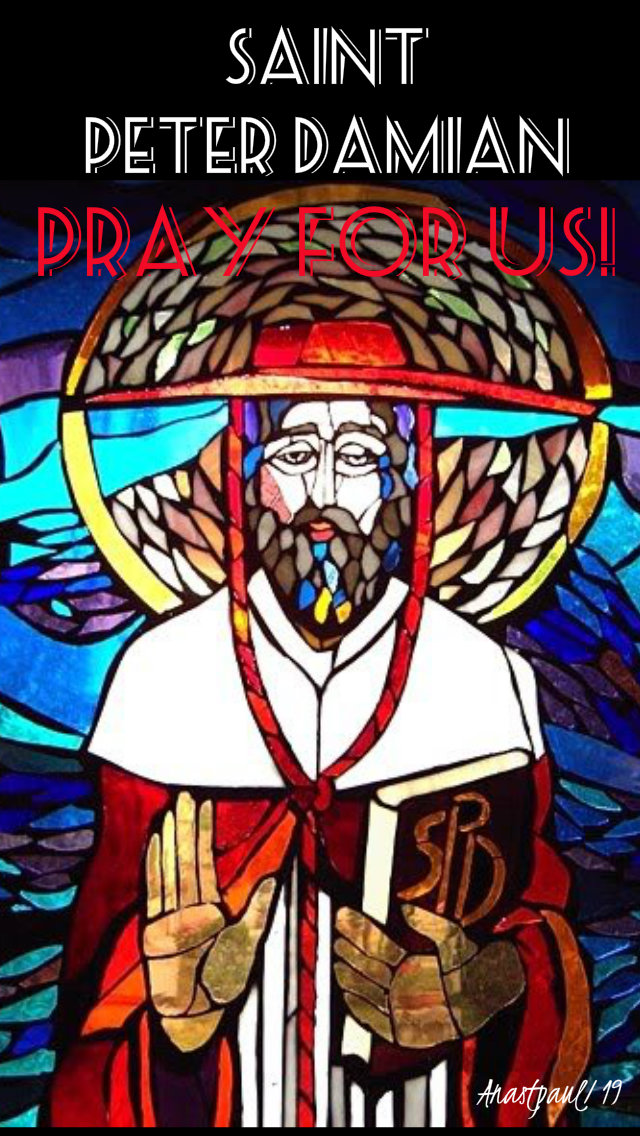
Pray for the Church, Pray for Us All!st peter damian pray for us 21 feb 2019.jpg

Posted in DOCTORS of the Church, PRACTISING CATHOLIC, QUOTES of the SAINTS, QUOTES on EVANGELISATION, QUOTES on SUFFERING, QUOTES on the CROSS of CHRIST, SAINT of the DAY, The HOLY GHOST, The SIGN of the CROSS

Quote/s of the Day – 21 February – St Peter Damian

Quote/s of the Day – 21 February – the Memorial of  St Peter Damian OSB (1007-1072) Doctor of the Church

“Let us faithfully transmit to posterity,
the example of virtue,
which we have received,
from our forefathers.”let us faithfully transmit - st peter damian 21 feb 2019.jpg

“He pours light into our minds,
arouses our desire and gives us strength…
As the soul is the life of the body,
so the Holy Spirit, is the life of our souls.”he-pours-light-into-our-minds-st-peter-damian-21-feb-2018.jpg

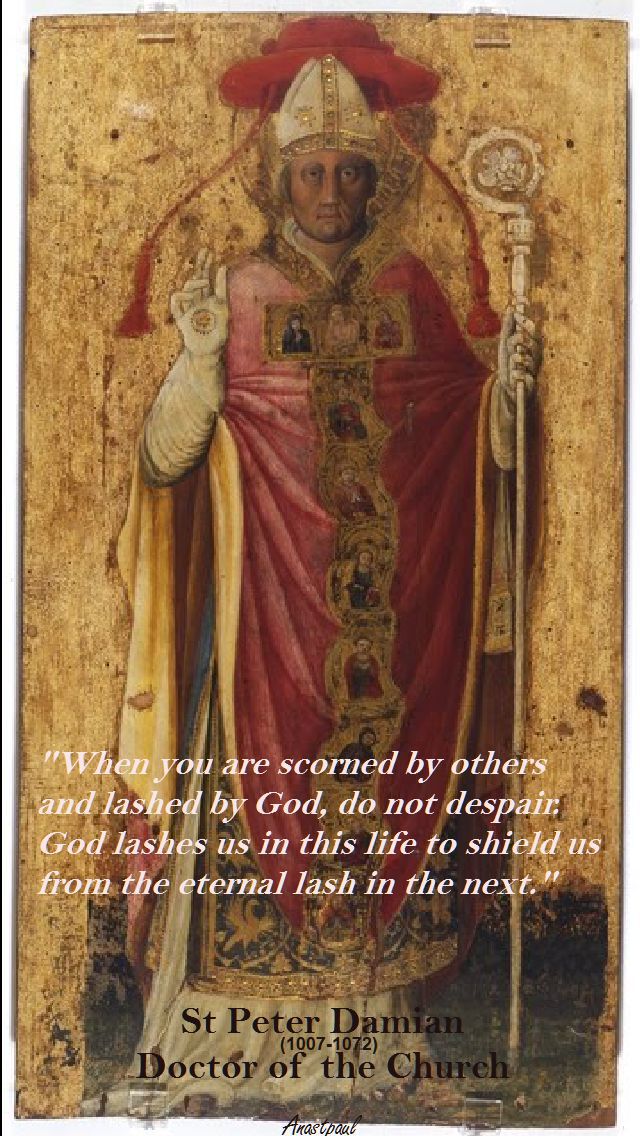
“When you are scorned by others
and lashed by God, do not despair.
God lashes us in this life,
to shield us from the eternal lash, in the next.”when-you-are-scorned-by-others-st-peter-damian-21-feb-2018.jpg

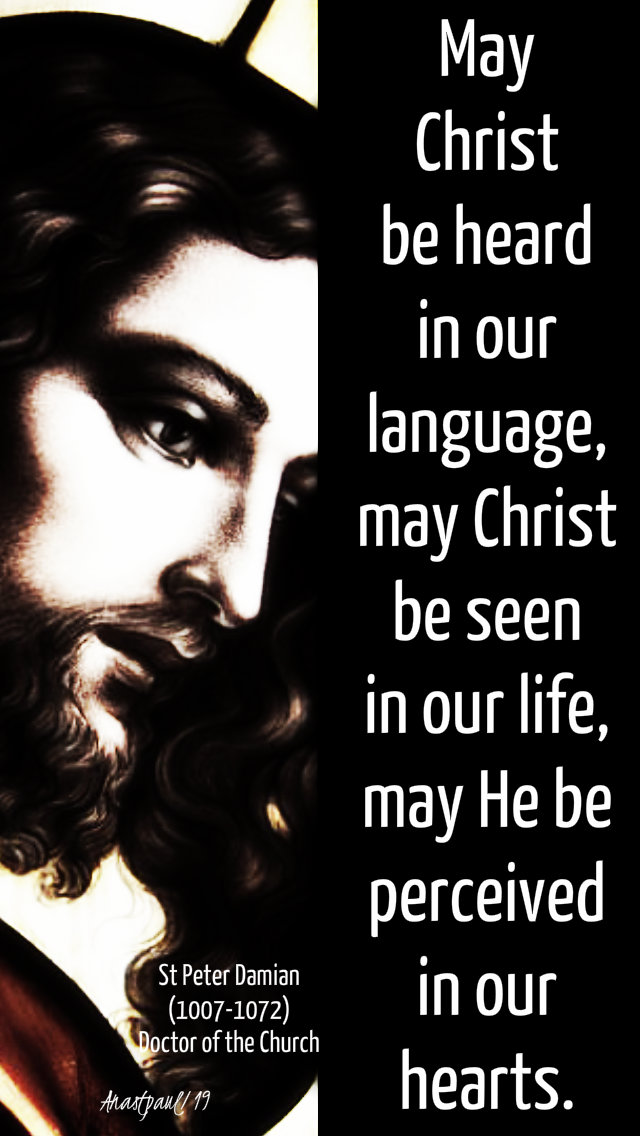
“May Christ be heard in our language,
may Christ be seen in our life,
may He be perceived in our hearts”
(Sermo VIII, 5)may christ be heard - st peter damian 21 feb 2019.jpg

“O Blessed Cross,
You are venerated, preached
and honoured by the faith of the Patriarchs,
the predictions of the Prophets,
the senate that judges the Apostles,
the victorious army of Martyrs
and the throngs of all the Saints”
(Sermo XLVII, 14, p. 304)o blessed cross - st peter damian - 21 feb 2019.jpg

“Those, who do not love
the Cross of Christ,
do not love Christ”
(Sermo XVIII, 11, p. 117)

St Peter Damian (1007-1072) Doctor of the Churchthose who do not love the cross of christ do not love christ - st peter damian 21 feb 2019.jpg

those who do not love no 2 st peter damian 21 feb 2019.jpg

Posted in DOCTORS of the Church, MORNING Prayers, SAINT of the DAY, The WORD

One Minute Reflection – 21 February – “You are the Christ.”

One Minute Reflection – 21 February – Thursday of the Sixth week in Ordinary Time, Year C, Gospel: Mark 8:27-33 and the Memorial of St Peter Damian OSB (1007-1072) Doctor of the Church

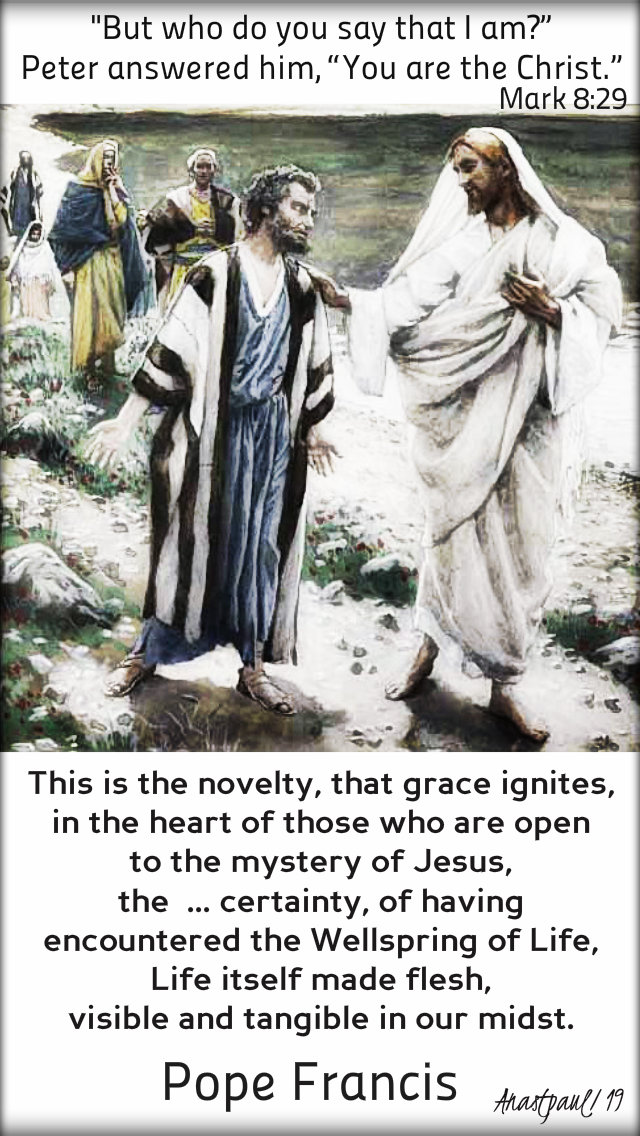
“Who do men say that I am?”… “But who do you say that I am?” Peter answered him, “You are the Christ.” ...Mark 8:27,29

REFLECTION – “With these two questions, Jesus seems to say that it is one thing to follow the prevailing opinion and another, to encounter Him and open oneself to His mystery, there one discovers the truth.   Prevailing opinion contains a true but partial response, Peter and with him, the Church of the past, present and always, by the grace of God, responds with the truth:  “You are the Christ, the Son of the living God”.
Jesus is the Son of God – hence He is perennially alive as His Father is eternally alive.  This is the novelty, that grace ignites, in the heart of those who are open to the mystery of Jesus, the non-mathematical — but even stronger, inner — certainty, of having encountered the Wellspring of Life, Life itself made flesh, visible and tangible in our midst.   This, is the experience of Christians and it is not their merit, not that of we Christians, it is not our merit but comes from God, it is a grace of God, the Father and Son and Holy Spirit.   All this is contained in the seed of Peter’s response: “You are the Christ, the Son of the living God”.Pope Francis – Angelus, 29 June 2018mark 8 29 but who do you say - this is the novelty -pope francis 21 feb 2019.jpg

PRAYER – Lord of heaven and earth, by Your grace You have brought our hearts and mind to seek and hope in Your saving love, in Your only Son, our Lord Jesus Christ.   May we, who like Peter, our father in faith, declare, ‘You are the Christ!’, remain ever in His steps, carrying the cross behind Him.   We thank You for the blessing of St Peter Damian, grant that, through his intercession, we may, like him, constantly follow the Light of Christ and so rise to eternal life.   We make our prayer through our Lord Jesus, in unity with the Holy Spirit, one God forever, amenST PETER DAMIAN PRAY FOR US.jpg

Posted in DANTE ALIGHIERI!, DOCTORS of the Church, SAINT of the DAY

Saint of the Day – 21 February – St Peter Damian OSB (1007-1072) Doctor of the Church

Saint of the Day – 21 February – St Peter Damian OSB (1007-1072) Doctor of the Church, Bishop Cardinal, Benedictine Monk, Confessor, Theologian, Writer, Teacher, Preacher, Poet, Reformer.   Patronages – Spiritual warfare, Church Reformers and Faenza, Italy. Partly because he was orphaned and had been treated shabbily by one of his brothers, Peter Damian was very good to the poor.   It was the ordinary thing for him to have a poor person or two with him at table and he liked to minister personally to their needs.

221peter14.jpg

Peter escaped poverty and the neglect of his own brother when a second brother, who was Archpriest of Ravenna, took him under his wing.   His brother sent him to good schools and Peter became a professor.

Already in those days, Peter was very strict with himself.   He wore a hair shirt under his clothes, fasted rigorously and spent many hours in prayer.   Soon, he decided to leave his teaching and give himself completely to prayer with the Benedictines of the reform of Saint Romuald at Fonte Avellana.   They lived two monks to a hermitage.   Peter was so eager to pray and slept so little that he soon suffered from severe insomnia.   He found he had to use some prudence in taking care of himself.   When he was not praying, he studied the Bible.

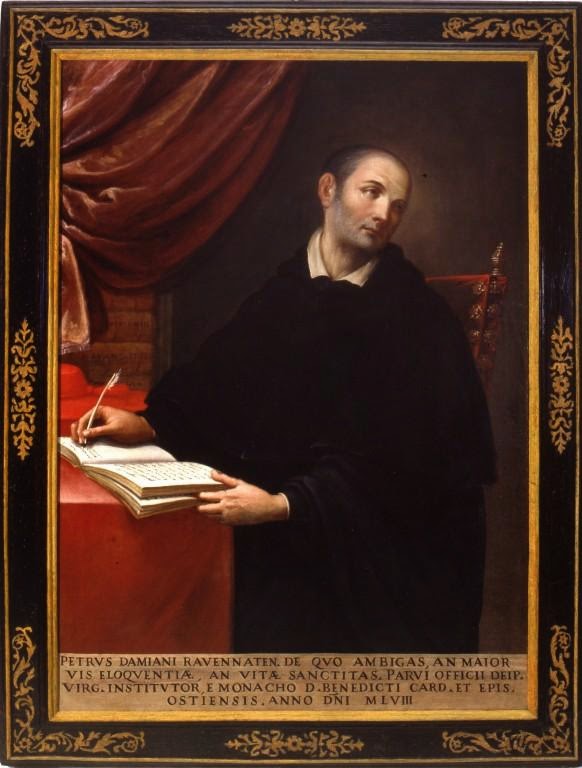
st per damian ravenna  2.jpg
Unknown
St Peter Damian
1725

The abbot commanded that when he died Peter should succeed him.   Abbot Peter founded five other hermitages.   He encouraged his brothers in a life of prayer and solitude and wanted nothing more for himself.   The Holy See periodically called on him, however, to be a peacemaker or troubleshooter, between two abbeys in dispute or a cleric or government official in some disagreement with Rome.

Finally, Pope Stephen IX made Peter the Cardinal-Bishop of Ostia.   He worked hard to wipe out simony—the buying of church offices–and encouraged his priests to observe celibacy and urged even the diocesan clergy to live together and maintain scheduled prayer and religious observance.   He wished to restore primitive discipline among religious and priests, warning against needless travel, violations of poverty and too-comfortable living.   He even wrote to the Bishop of Besancon complaining that the canons there sat down when they were singing the psalms in the Divine Office.

He wrote many letters.   Some 170 are extant.   We also have 53 of his sermons and seven lives, or biographies, that he wrote.   He preferred examples and stories rather than theory in his writings.   The liturgical offices he wrote are evidence of his talent as a stylist in Latin.

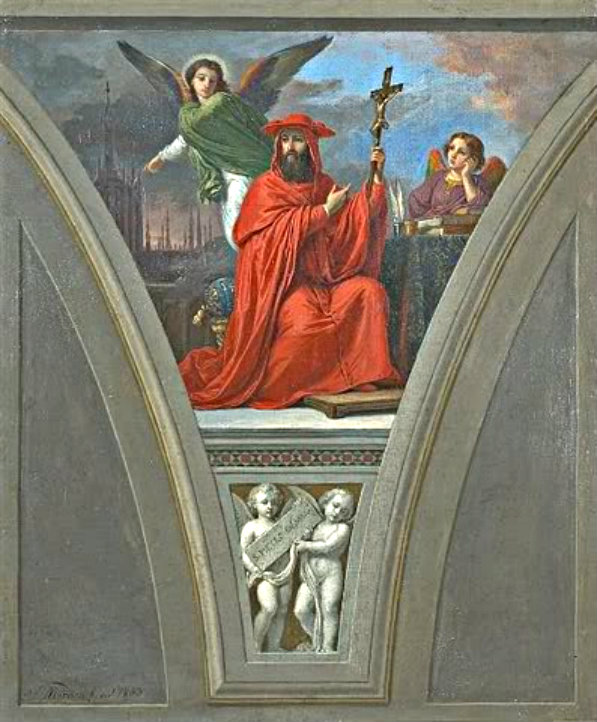
ST PETER DAMIAN 2.png
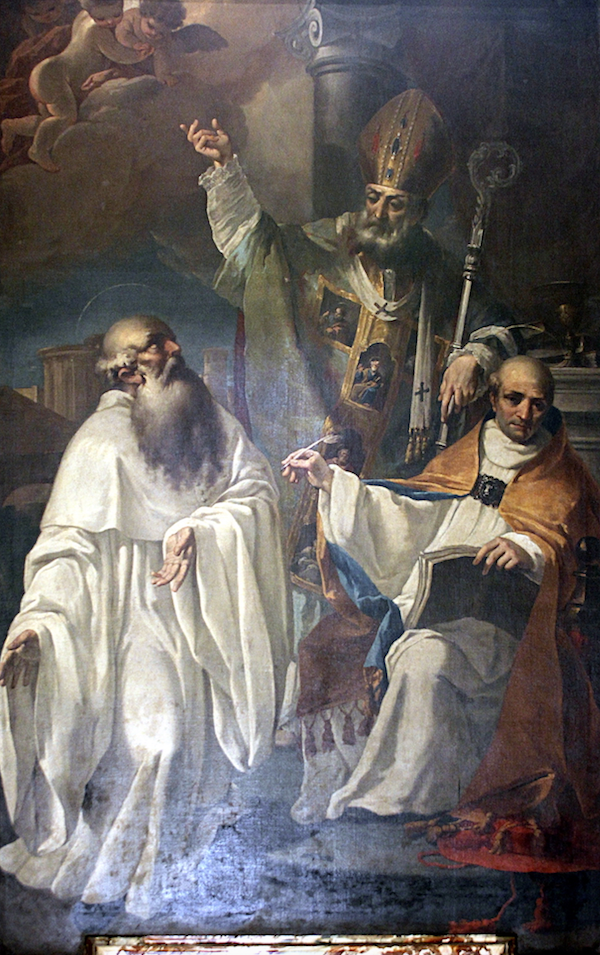
I cannot find out much about this image, it seems to be Saint Romuald on the left (of whom St Peter wrote a biography), St Peter Damian in the centre and an unknown saint, I presume on the right.

He asked often to be allowed to retire as Cardinal-Bishop of Ostia and finally Pope Alexander II consented.   Peter was happy to become once again just a monk but he was still called to serve as a papal legate.   When returning from such an assignment in Ravenna, he was overcome by a fever.   With the monks gathered around him saying the Divine Office, he died on 22 February 1072.

In 1828, he was declared a Doctor of the Church.st peter damian statue snip.JPG

In Canto XXI, Dante has the Saint pronounce an invective against the luxury enjoyed by prelates in the Church of his day and in that of Dante`s – the translation below is by Allen Mandelbaum:

113 … There, within that monastery,
114 in serving God, I gained tenacity:
115 with food that only olive juice had seasoned,
116 I could sustain with ease both heat and frost,
117 content within my contemplative thoughts.

118 That cloister used to offer souls to Heaven,
119 a fertile harvest but it now is barren
120 as Heaven’s punishment will soon make plain.

121 There I was known as Peter Damian
122 and, on the Adriatic shore, was Peter
123 the Sinner when I served Our Lady’s House.

124 Not much of mortal life was left to me
125 when I was sought for, dragged to take that hat
126 which always passes down from bad to worse.

127 Once there were Cephas and the Holy Ghost’s
128 great vessel – they were barefoot, they were lean,
129 they took their food at any inn they found.

130 But now the modern pastors are so plump
131 that they have need of one to prop them up
132 on this side, one on that and one in front,

133 and one to hoist them saddleward.  Their cloaks
134 cover their steeds, two beasts beneath one skin:
135 o patience, you who must endure so much!”

amos nattini st peter damian
Amos Nattini (1892-1985)
Divina Commedia, Paradiso canto XXI, San Pier Damiani nel cielo di Saturno
1923-1941
Posted in DOCTORS of the Church, SAINT of the DAY

Memorials of the Saints – 21 February

St Peter Damian OSB (1007-1072) Doctor of the Church (Optional Memorial)
A lot about St Peter here:   https://anastpaul.wordpress.com/2017/02/21/saint-of-the-day-21-february-st-peter-damian/

St Avitus II of Clermont
Bl Caterina Dominici
Bl Claudio di Portaceli
St Daniel of Persia
Bl Eleanora
St Ercongotha
St Eustathius of Antioch
St Felix of Metz
St George of Amastris
St Germanus of Granfield
St Gundebert of Sens
Bl Noel Pinot
St Paterius of Brescia
St Pepin of Landen
St Peter Mavimenus
St Randoald of Granfield
St Robert Southwell SJ (1561-1595) Martyr
St Robert’s Biography: https://anastpaul.wordpress.com/2018/02/21/saint-of-the-day-21-february-st-robert-southwell-s-j-1561-1595-martyr/

St Severian of Scythopolis
St Severus of Syrmium
Bl Thomas Pormort
St Valerius of San Pedro de Montes
St Verda of Persia

Martyrs of Sicily – 79 saints – Seventy-nine Christians martyred together in the persecutions of Diocletian. They were martyred in c 303 on Sicily.

Martyrs of Hadrumetum – A group of 26 Christians martyred together by Vandals. We know little more than eight of their names – Alexander, Felix, Fortunatus, Saturninus, Secundinus, Servulus, Siricius and Verulus. c 434 at Hadrumetum (modern Sousse, Tunisia)

Martyrs Uchibori – Three Japanese laymen, all brothers, all sons of Paulus Uchibori Sakuemon, one a teenager, one only five years old and all martyred for their faith in the persecutions in Japan. 21 February 1627 in Shimabara, Nagasaki, Japan. Beatified 24 November 2008 by Pope Benedict XVI.
Antonius
Balthasar
Ignatius

Posted in DOCTORS of the Church, FATHERS of the Church, MORNING Prayers, QUOTES of the SAINTS, QUOTES on CONVERSION, SAINT of the DAY, The WORD

One Minute Reflection – 20 February – “Let us open ourselves, to the light of the Lord”

One Minute Reflection – 20 February – Wednesday of the Sixth week in Ordinary Time, Year C – Gospel: Mark 8:22-26 and The First Memorial of Saints Francisco (1908-1919) and Jacinta (1910-1920) and Blessed Julia Rodzinska OP (1899-1945) Martyr

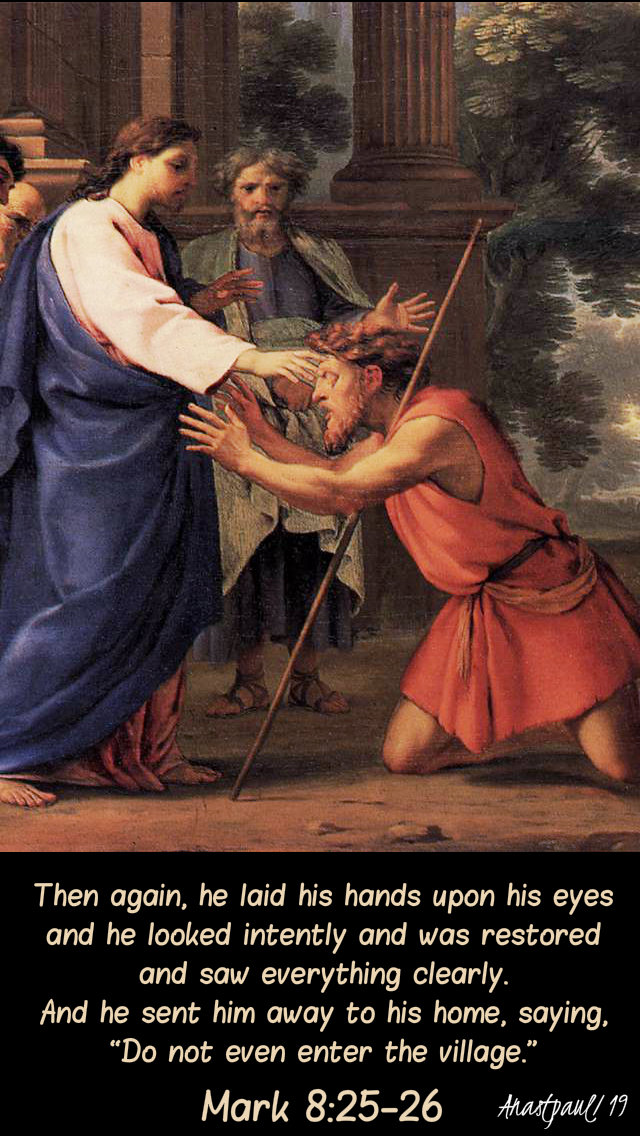
And he took the blind man by the hand and led him out of the village….Then again he laid his hands upon his eyes;  and he looked intently and was restored and saw everything clearly.   And he sent him away to his home, saying, “Do not even enter the village.”...Mark 8:22,25-26then again he laid his hands upon his eyes - mark 8 25-26 20 feb 2019.jpg

REFLECTION – “They came, then, to Bethsaida, into the village of Andrew and Peter, James and John.   Bethsaida means “house of fishers” and, in truth, from this house, hunters and fishermen are sent into the whole world.   Ponder the text.   The historical facts are clear, the literal sense is obvious.   But we must now search into its spiritual message.   That He came to Bethsaida, that there was a blind man there, that He departed, what is there remarkable about all that?   Nothing, but what He did there is great;  striking, however, only if it should take place today, for we have ceased to wonder about such things.

How, then, is his house not in Bethsaida?   Note the text exactly.   If we consider the literal interpretation only, it does not make any sense.   If this blind man is found in Bethsaida and is taken out and cured and he is commanded:  “Return to your own house,” certainly, he is bid:   “Return to Bethsaida.”   If, however, he returns there, what is the meaning of the command:  “Do not go into the village?”   You see, therefore, that the interpretation is symbolic.   He is led out from the house of the Jews, from the village, from the law, from the traditions of the Jews.   He, who could not be cured in the law, is cured in the grace of the gospel.   It is said to him, “Return to your own house” — not into the house that you think, the one from which he came out but into the house that was also the house of Abraham, since Abraham is the father of those who believe.”… St Jerome (343-420) Father & Doctor of the Church – Tractate on the Gospel of Mark, Homily 79.he is led out from the house of the jews - mark 8 25-26 20 feb 2019 st jerome.jpg

“Our lives are sometimes similar to that of the blind man who opened himself to the light, who opened himself to God, who opened himself to His grace.  Today, we are invited to open ourselves to the light of Christ in order to bear fruit in our lives, to eliminate unchristian behaviours;  we are all Christians but we all, everyone, sometimes has unchristian behaviours, behaviours that are sins.   We must repent of this, eliminate these behaviours in order to journey well along the way of holiness, which has its origin in baptism.   We, too, have been “enlightened” by Christ in baptism, so that, as St Paul reminds us, we may act as “children of light” (Eph 5:8), with humility, patience and mercy.
Let us ask ourselves about the state of our own heart?   Do I have an open heart or a closed heart?   It is opened or closed to God?   Open or closed to my neighbour?   We are always closed to some degree, which comes from original sin, from mistakes, from errors.   We need not be afraid!
Let us open ourselves, to the light of the Lord, He awaits us always in order to enable us to see better, to give us more light, to forgive us.   Let us not forget this!”…Pope Francis – Angelus, 30 March 2014

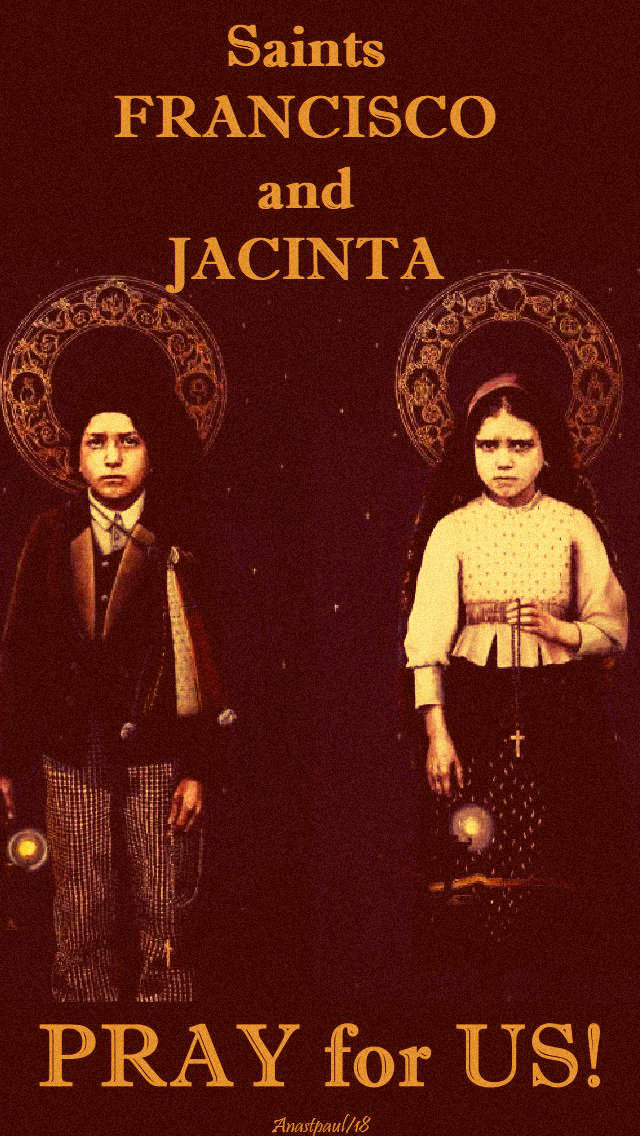
PRAYER – Heavenly Father, just as the little children, Francisco and Jacinta and Blessed Julia Rodzinska, were chosen to be bearers of Your message, grant we pray, that by their prayers on our behalf, we too may Your bearers of light.   Be with us, holy Mother, during our journey to the eternal glory of your Son, help us to become like little children and in that new purity, shine with His Light.   Through Jesus our Lord, with the Holy Spirit, one God forever, amen.sts-francisco-jacinta-20-feb-2018.jpg

bl julia rodzinska pray for us 20 feb 2019 no 2.jpg

Posted in DOCTORS of the Church, Our MORNING Offering, PRAYERS of the SAINTS, REDEMPTORISTS CSSR

Our Morning Offering – 20 February – Prayer for the Gift of Prayer

Our Morning Offering – 20 February – Wednesday of the Sixth week in Ordinary Time, Year C

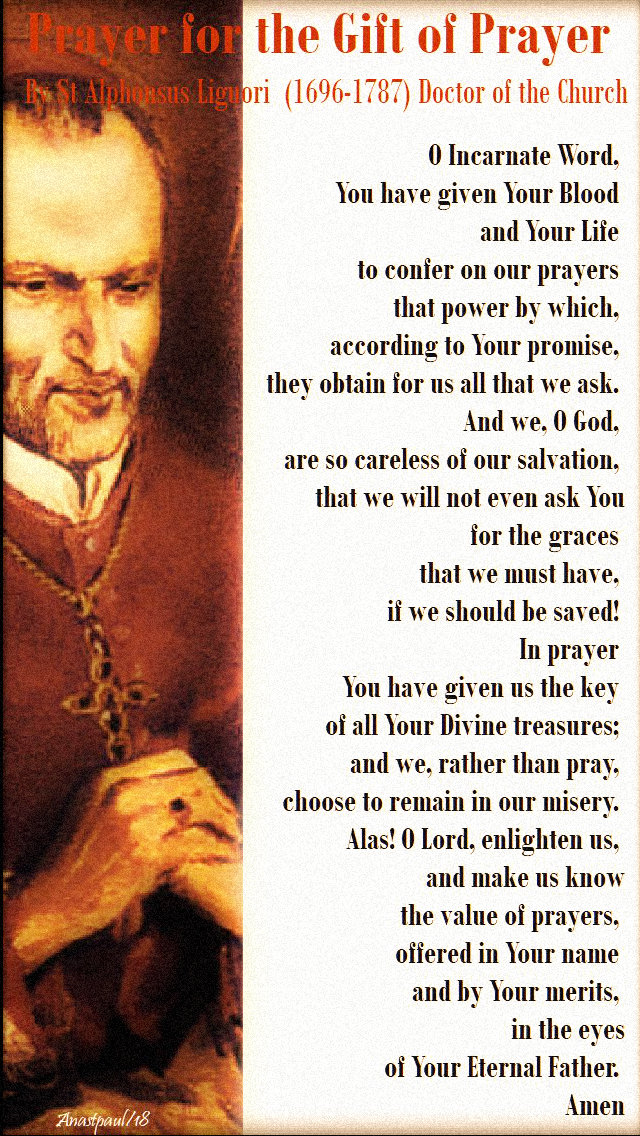
Prayer for the Gift of Prayer
By St Alphonsus Liguori (1696-1787) Doctor of the Church

O Incarnate Word,
You have given Your Blood and Your Life
to confer on our prayers that power by which,
according to Your promise,
they obtain for us all that we ask.
And we, O God,
are so careless of our salvation,
that we will not even ask You for the graces
that we must have, if we should be saved!
In prayer You have given us the key
of all Your Divine treasures;
and we, rather than pray,
choose to remain in our misery.
Alas! O Lord, enlighten us,
and make us know the value of prayers,
offered in Your name and by Your merits,
in the eyes of Your Eternal Father.
Amenprayer for the gift of prayer - st alphonsus liguori 2nd time 20 feb 2019.jpg

Posted in DOCTORS of the Church, EUCHARISTIC Adoration, JESUIT SJ, PRAYERS for CANONISATION, PRAYERS to the SAINTS, QUOTES of the SAINTS, QUOTES on FAITH, SAINT of the DAY, The WORD

Thought for the Day – 19 February – “If you do not believe, you will not understand”

Thought for the Day – 19 February – Tuesday of the Sixth week in Ordinary Time, Year C, Gospel: Mark 8:14–21 and the memorial of Bl John Sullivan SJ (1861-1933)

And He said to them “Do you not yet understand or comprehend?”...Mark 8:21

Faith, the theologians say, is a certain and obscure habit of soul.   It is an obscure habit because it brings us to believe divinely revealed truths, that transcend every natural light and infinitely exceed, all human understanding.   As a result, the excessive light of faith bestowed on a soul, is darkness for it – a brighter light will eclipse and suppress a dimmer one.   The sun so obscures all other lights, that they do not seem to be lights at all when it is shining and instead of affording vision to the eyes, it overwhelms, blinds and deprives them of vision since its light is excessive and disproportioned to the visual faculty.   Similarly, the light of faith in its abundance, suppresses and overwhelms that of the intellect…

Another clearer example…  If those born blind were told about the nature of the colours white or yellow, they would understand absolutely nothing, no matter how much instruction they received, since they never saw these colours…   Only the names of these colours would be grasped, since the names are perceptible through hearing…   Such is faith to the soul – it informs us of matters we have never seen or known…   The light of natural knowledge does not show them to us…   Yet we come to know it through hearing, by believing, what faith teaches, in blinding our natural light and bringing it in to submission.   St Paul states:  “Faith comes through hearing” (Rm 10:17).   This amounts, to saying, that faith is not a knowledge, derived from the senses but an assent of the soul, to what enters through hearing…   Faith, manifestly, is a dark night for souls but in this way, it gives them light.   The more darkness it brings on them, the more light it sheds.   For by blinding, it illumines them, according to those words of Isaiah:  “If you do not believe, you will not understand” (cf. Is 7:9).isaiah 7 9 - if you do not believe you will not understand 19 feb 2019.jpg

Blessed John Sullivan was illuminated by the Light of faith, in his many hours of silent prayer before the Blessed Sacrament, the place where our light is found.

God and Father,
You honour those who honour You.
Make sacred the memory
of Your servant John Sullivan,
by granting through his intercession,
the petition we now make
……………….(name the petition)
and hastening the day,
when his name will be venerated
by the title of Saint.
We make our prayer
through Christ our Lord,
in the Holy Spirit,
God forever.
Amen

Blessed John Sullivan, Pray for Us!bl-john-sullivan-pray-for-us-no-2-19-feb-2018.jpg

Posted in DOCTORS of the Church, QUOTES of the SAINTS, QUOTES on FAITH, QUOTES on LOVE, The WORD

Quote/s of the Day – 18 February – “Man believes with his heart…”

Quote/s of the Day – 18 February – Monday of the Sixth week in Ordinary Time, Year C, Gospel: Mark 8:11–13

And he sighed deeply in his spirit and said,
“Why does this generation seek a sign?…Mark 8:12-13

Happy is the man who has found wisdom.
Even more happy is the man who lives in wisdom,
for he perceives its abundance.
There are three ways for wisdom
or prudence to abound in you –
if you confess your sins,
if you give thanks and praise
and if your speech is edifying.
Man believes with his heart and so he is justified.
He confesses with his lips and so he is saved.
In the beginning of his speech,
the just man is his own accuser,
next he gives glory to God and thirdly,
if his wisdom extends that far,
he edifies his neighbour.

St Bernard (1090-1153)
Mellifluous Doctorman believes with his heart - st bernard - 18 feb 2019.jpg

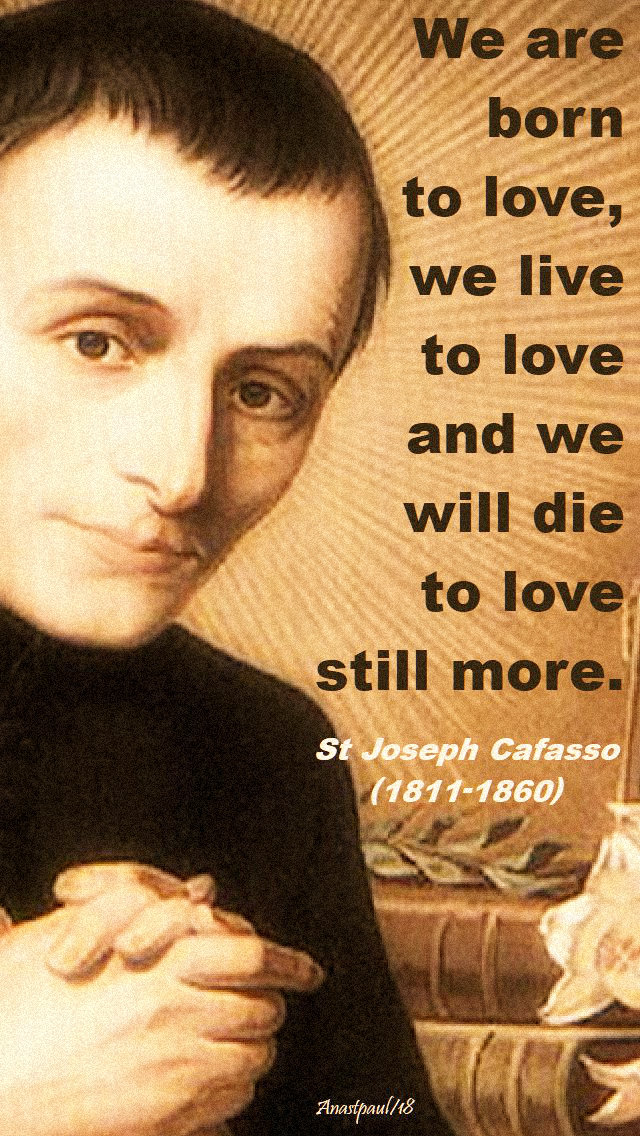
“We are born to love,
we live to love
and we will die
to love still more.”

St Joseph Cafasso (1811-1860)we-are-norn-to-love-st-joseph-cafasso-no 2 - 18feb2019 - 23-june-2018.jpg

Posted in DOCTORS of the Church, FATHERS of the Church, MORNING Prayers, QUOTES of the SAINTS, QUOTES on FAITH, SAINT of the DAY

One Minute Reflection – 18 February – “But for one who comes among friends, there should be no need of such signs.”

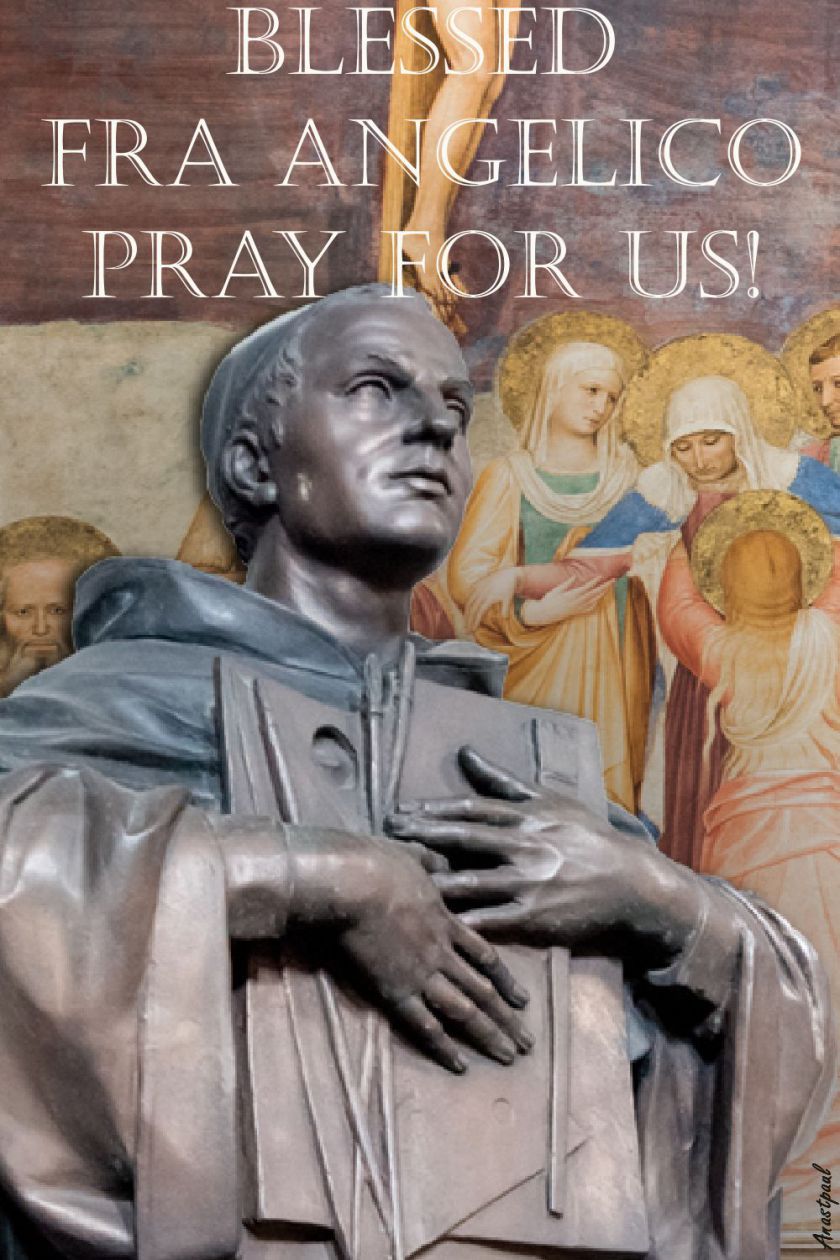
One Minute Reflection – 18 February – Monday of the Sixth week in Ordinary Time, Year C – Gospel: Mark 8:11–13 and the Memorial of The Memorial of St Flavian of Constantinople(Died 449) and Blessed John of Fiesole/Fra Angelico OP (1387-1455)

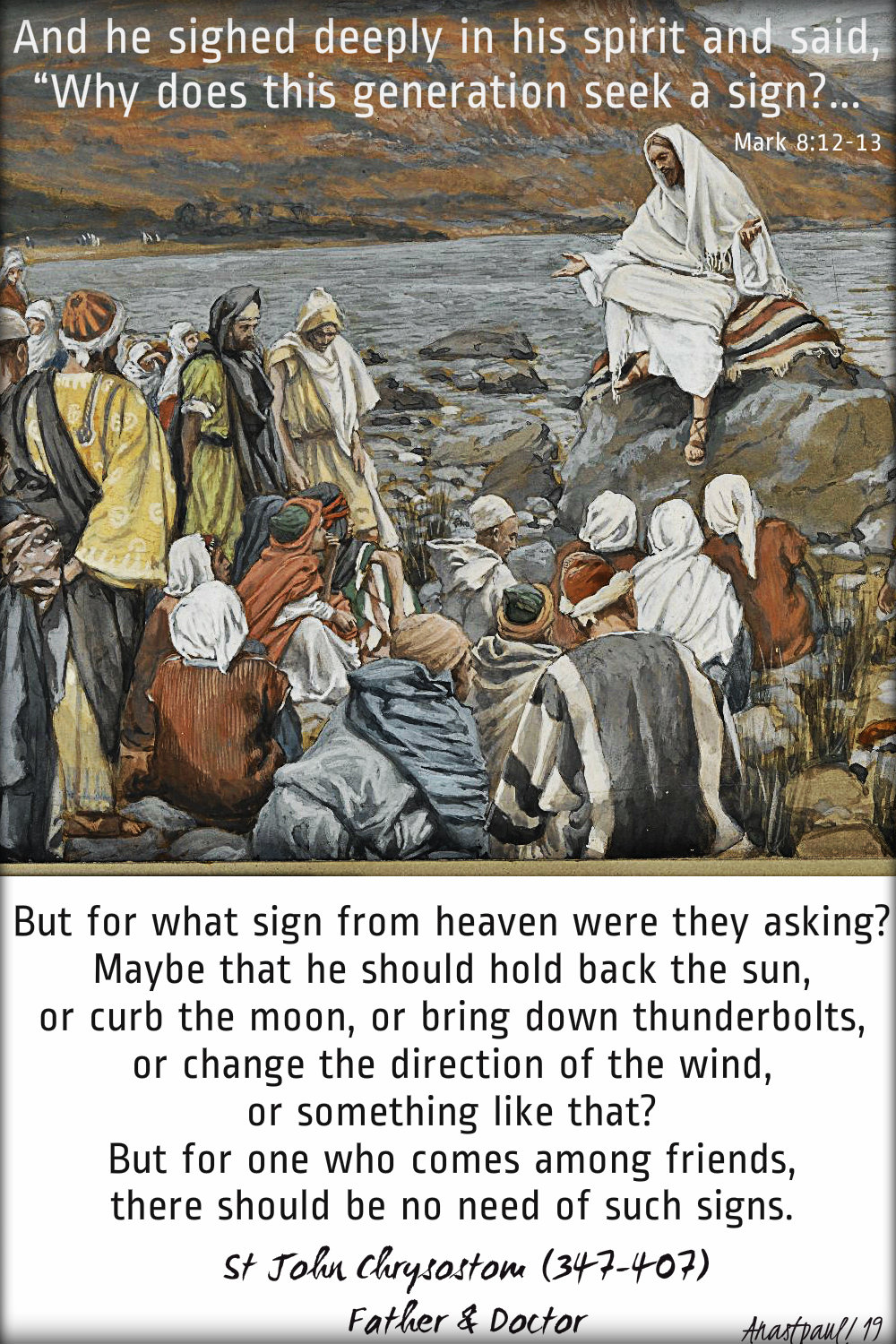
And he sighed deeply in his spirit and said, “Why does this generation seek a sign?...Mark 8:12-13

REFLECTION – “But for what sign from heaven were they asking?   Maybe that he should hold back the sun, or curb the moon, or bring down thunderbolts, or change the direction of the wind, or something like that?   In Pharaoh’s time there was an enemy from whom deliverance was needed.   But for one who comes among friends, there should be no need of such signs.
No sign more impressed the crowds than the miracles of the loaves.   Not only did they want to follow him but also seemed ready to make him a king.   In order to avoid all suspicion of usurping civil authority, he made a speedy exit after this wonderful work. He did not even leave on foot, lest they chase after him but took off by boat.”…St John Chrysostom (347-407) Father & Doctor (Gospel of Saint Matthew, Homily 53)mark 8 12-13 and he sighed deeply - but for what sign where they asking st john chrysostom 18 feb 2019.jpg

PRAYER – Almighty Lord and God, protect us by Your power throughout the course of this day, even as You have enabled us to begin it.   Your grace is all that we need to see the loving kindness of Your Son, our Lord Jesus in all we meet.   Do not let us turn aside from His path but by the faith You have granted us, let us find meaning in all, which is the sign of Your glory.   Do not let us turn aside to sin and may the intercession of St Flavian and Blessed Fra Angelico, grant us courage and peace. Through Jesus Christ, our Saviour, with the Holy Spirit, God now and forever, amen.st flavian of constantinople pray for us 18 feb 2019

bl-fra-angelico-pray-for-us-2-18-feb-2018

Posted in DOCTORS of the Church, FATHERS of the Church, MORNING Prayers, QUOTES of the SAINTS, SUNDAY REFLECTIONS, The HOLY EUCHARIST / The HOLY MASS

Sunday Reflection – 17 February “As many as touched him were healed”

Sunday Reflection – 17 February -“As many as touched him were healed”-Mark 6:56

Saint Cyril of Alexandria (380-444)
Father & Doctor of the Church

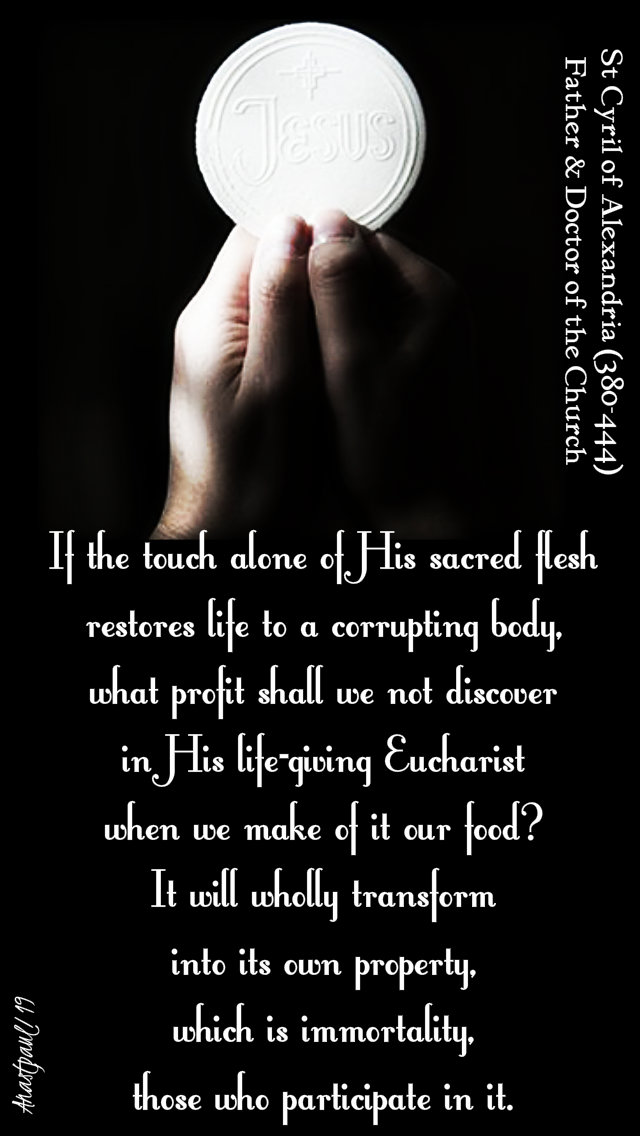
Even for restoring the dead to life the Saviour did not stop at acting by word alone, though it was the bearer of divine commands.   For such a surpassing work He took his own flesh as His assistant – if one might put it that way – that He might show, that it has the power to give life and that He might cause it to be seen, that it is entirely one with Him.   For it is indeed His very own flesh and not an alien body.

This is what happened when He restored life to the synagogue leader’s daughter, saying to her:  “My child, arise!” (Mk 5:41).   He took her by the hand, as it is written.   As God, He gave her back her life by His all-powerful command and animated her also by contact with His holy flesh.   Thus, He bore witness that, in flesh as in His word, one and the same divine energy was at work.   In the same way, too, when He came to a town called Nain where the widow’s only son was being buried, He touched the coffin, saying: “Young man, I tell you, arise!” (Lk 7:14).

Thus He not only conferred to His word, the power to raise the dead but He even touched the dead, to show that His body is life-giving and, through His flesh, He caused life to pass into their corpses.   If the touch alone of His sacred flesh, restores life to a corrupting body, what profit shall we not discover, in His life-giving Eucharist, when we make of it our food?   It will wholly transform into its own property, which is immortality, those who participate in it.

Commentary on the Gospel of John, ch. 4if the touch alone of his sacred flesh - sty cyril of alexandria 17 feb 2019 sun reflection.jpg

Posted in DOCTORS of the Church, FATHERS of the Church, QUOTES of the SAINTS, QUOTES on CONVERSION, QUOTES on LOVE, SAINT of the DAY

Thought for the Day – 14 February – “Satisfying our Restless Hearts”

Thought for the Day – 14 February – The Memorial of St Valentine (176-273) Martyr

SATISFYING OUR RESTLESS HEARTS
by Fr Steve Grunow

“And what is this God?   I asked the earth and it answered: ‘I am not God and all the things in the earth made the same confession.’   I asked the sea and the deeps and creeping things and they answered:   ‘We are not your God, seek higher.’   I asked the winds that blow and the whole air with all that is in it and the wind answered: ‘  I am not God.’   I asked the heavens, the sun, the moon, the stars and they answered:   ‘Neither are we God whom you seek.’   So I asked all those things that entice the senses:   ‘Tell me then of this Mysterious One that I search for.’   And all cried out to me in one great voice: ‘God made us and God made you…’”

“So I set about to find God and found that I could not find Him until I embraced the mediator between God and man, Christ Jesus, who is all over all these things, who was calling me and saying: ‘I am the Way, the Truth and the Life…’”

These marvellous words belong to St Augustine….

St Augustine is one of the most renowned and influential saints of the Church, though his early life did not foreshadow such an identity and mission.   He lived much of his young life in resistance to God’s will and purposes.   Preoccupied with his body, he sought satisfaction in sex.   Preoccupied with power, he sought to ingratiate himself with the mighty.   Preoccupied with status, he sought self-promotion.   Preoccupied with wealth, he tried to sell himself to a career.

And none of these things, for all their allure and all their promises, brought him satisfaction.

As a result, Augustine embraced the prevailing esoteric and arcane “spiritualities” of his day.   He followed strange gods in an attempt to shake his alarming sense of dissatisfaction.   This left him emptier and even more diminished.

But a reckoning came that changed Augustine forever.

“I found myself weeping in the bitter sorrow of my heart.   And suddenly I heard a voice from a nearby house, a child’s voice, boy or girl I do not know – but it was sort of a sing song that repeated over and over again.   ‘Take and read, take and read.’   Wiping away my tears I took this as a divine command and opened the scriptures and in silence read the passage on which my eyes first fell – ‘Not in rioting and drunkenness, not in debauchery and impurity, not in contention and envy but put on the Lord Jesus…’”i found myself weeping in the bitter sorrow - sdt augustine - conversion - 14 feb 2019

So this is what Augustine did- he discarded the skin of his old self and put on the Lord Jesus.   And what God did with Augustine was remarkable.   He became a leader in the Faith, as a teacher, priest and bishop.   His writings have directed the mind and soul of the Church for centuries.   His influence is with us still- in how we pray, how we worship, and in what we believe.

At the heart of the Gospel is the call to conversion in Christ.   There is no moment in our life when this call does not beckon toward us.   There is no time in our life we are exempt from the summons.   Conversion is the substance of the work of the spiritual life. Conversion in Christ is our privileged spiritual way.

Like Augustine, so many of us fall into the illusion that something other than God can satisfy us or give our lives purpose and meaning.   Like the young Augustine, we are captivated by self-deception that directs us away from the one who is absolutely necessary – Christ.   In response to all the futility of our refusals, the wisdom of St Augustine rings true:

“You have made us for yourself and our hearts are restless until they rest in you.”

St Augustine, Pray for Us!st augustine pray for us 14 feb 2019.jpg

Posted in DOCTORS of the Church, FATHERS of the Church, JESUIT SJ, QUOTES of the SAINTS, QUOTES on LOVE, SAINT of the DAY

Quote/s of the Day – 14 February – Falling in love

Quote/s of the Day – 14 February – The Memorial of St Valentine (176-273) Martyr

“You have made us
for Yourself, O Lord
and our heart is restless
until it rests in You.”you have made us for yourself - st augustine 14 feb 2019.jpg

“God loves each of us as if there were only one of us.”

St Augustine (354-430) Father & Doctorgod loves each of us as if - st augustine - 9 jan 2018

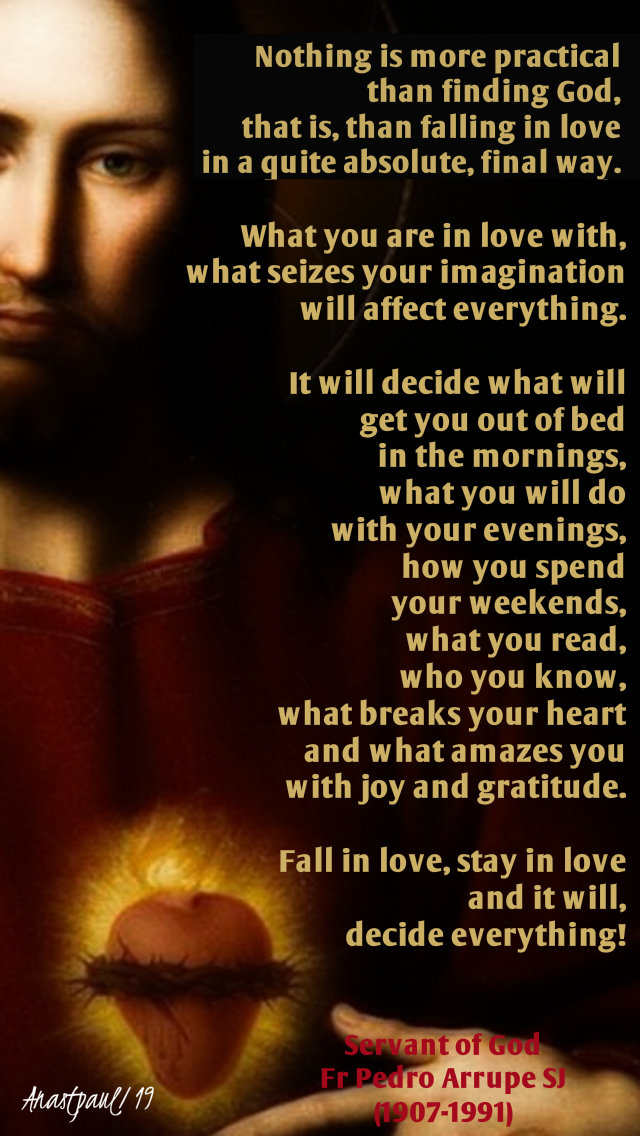
“Nothing is more practical
than finding God,
that is, than falling in love
in a quite absolute, final way.
What you are in love with,
what seizes your imagination
will affect everything.
It will decide what will
get you out of bed
in the mornings,
what you will do
with your evenings,
how you spend
your weekends,
what you read,
who you know,
what breaks your heart
and what amazes you
with joy and gratitude.
Fall in love, stay in love
and it will decide everything.”

Servant of God Fr Pedro Arrupe SJ (1907-1991)

(the 28th Superior General of the Society of Jesus)nothing is more practical than falling in love - servant of god pedro arrupe sj no 2- 14 feb 2019.jpg

Posted in DIVINE Mercy, Goodness, Patience, DOCTORS of the Church, FATHERS of the Church, MORNING Prayers, QUOTES on CONSCIENCE, QUOTES on CONVERSION, QUOTES on FAITH, QUOTES on FEAR, QUOTES on FORGIVENESS, QUOTES on REPENTANCE, QUOTES on TRUST and complete CONFIDENCE in GOD, SAINT of the DAY, The WORD

One Minute Reflection – 14 February – “The faith of the Canaanite woman”

One Minute Reflection – 14 February – Thursday of the Fifth week in Ordinary Time, Year C – Gospel: Mark 7:24–30 and the Memorial of Sts Cyril and Methodius “Apostles to the Slavs”- Patrons of Europe and St Valentine (176-273) Martyr

But immediately a woman, whose little daughter was possessed by an unclean spirit, heard of him and came and fell down at his feet....Mark 7:25

REFLECTION – “O woman, your faith is great.   Let it be done to you as you wish” (Mt 15:28).   Indeed, she had great enough faith, since she knew neither the ancient miracles, commands and promises of the prophets, nor the more recent ones of the Lord himself. In addition, as often as she was disregarded by the Lord, she persevered in her entreaties and she did not cease knocking by asking him, though she knew only by popular opinion that he was the Saviour.   On account of this, she secured the great object for which she implored…
If one of us has a conscience polluted by the stain of avarice, conceit, vain-glory, indignation, irascibility, or envy and the other vices, he has “a daughter badly troubled by a demon” like the Canaanite woman.   He should hasten to the Lord, making supplication for her healing…   Being submissive with due humility, [such a person] must not judge himself to be worthy of the company of the sheep of Israel (that is, souls that are pure) but instead, he must be of the opinion that he is unworthy of heavenly favours. Nevertheless, let him not, in despair, rest from the earnestness of his entreaty but with his mind free of doubt, let him trust in the goodness of the supreme Benefactor, for the one who could make a confessor from a robber (Lk 23:39f.), an apostle from a persecutor (Acts 9:1-30, an evangelist from a publican (Mt 9:9-13) and who could make sons for Abraham out of stones, could turn even the most insignificant dog into an Israelite sheep.”...St Bede the Venerable (673-735) – Father & Doctor of the Churchmark 7 25 the caananite woman - if one of us - st bede 14 feb 2019.jpg

PRAYER – Help us Lord, to cleave to You alone and grow in sanctity and charity. Create in us a clean heart O Lord!   As we walk in the ways of Your divine Son, our Saviour, may we grow in faith and by our lives and words, be a light in the world.   Grant that by the prayers of Sts Valentine and Sts Cyril and Methodius, we may be strengthen and grow in worthiness to receive Your grace.   Through our Lord Jesus Christ in unity with the Holy Spirit, one God forever, amen.st valentine pray for us 14 feb 2019sts-cyril-and-methodius-pray-for-us-14-feb-2018-no-2

Posted in DOCTORS of the Church, FATHERS of the Church, Our MORNING Offering, PRAYERS of the SAINTS

Our Morning Offering – 13 February – Wednesday of the Fifth week in Ordinary Time, Year C

Our Morning Offering – 13 February – Wednesday of the Fifth week in Ordinary Time, Year C

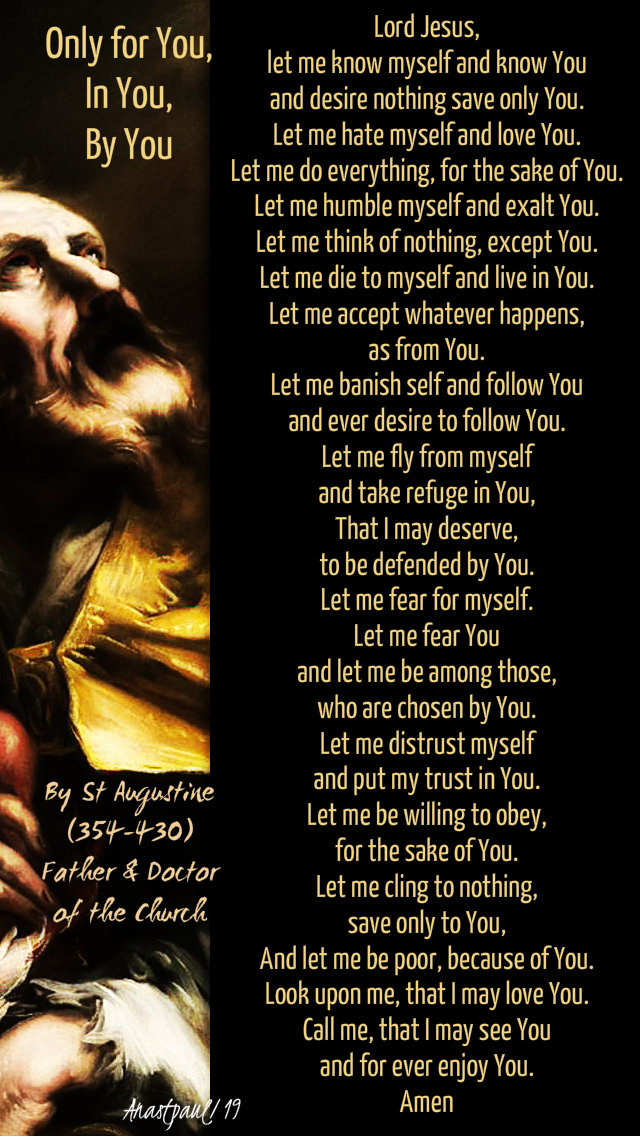
Only For You, In You, By You.
By St Augustine (354-430) Father & Doctor of the Church

Lord Jesus,
let me know myself and know You
and desire nothing save only You.
Let me hate myself and love You.
Let me do everything, for the sake of You.
Let me humble myself and exalt You.
Let me think of nothing, except You.
Let me die to myself and live in You.
Let me accept whatever happens, as from You.
Let me banish self and follow You
and ever desire to follow You.
Let me fly from myself and take refuge in You,
That I may deserve, to be defended by You.
Let me fear for myself.
Let me fear You
and let me be among those, who are chosen by You.
Let me distrust myself and put my trust in You.
Let me be willing to obey, for the sake of You.
Let me cling to nothing, save only to You,
And let me be poor, because of You.
Look upon me, that I may love You.
Call me, that I may see You
and for ever enjoy You.
Amenonly fo you in you by you - st augustine 13 feb 2019.jpg

Posted in DOCTORS of the Church, FATHERS of the Church, QUOTES of the SAINTS, QUOTES on PRAYER, SAINT of the DAY

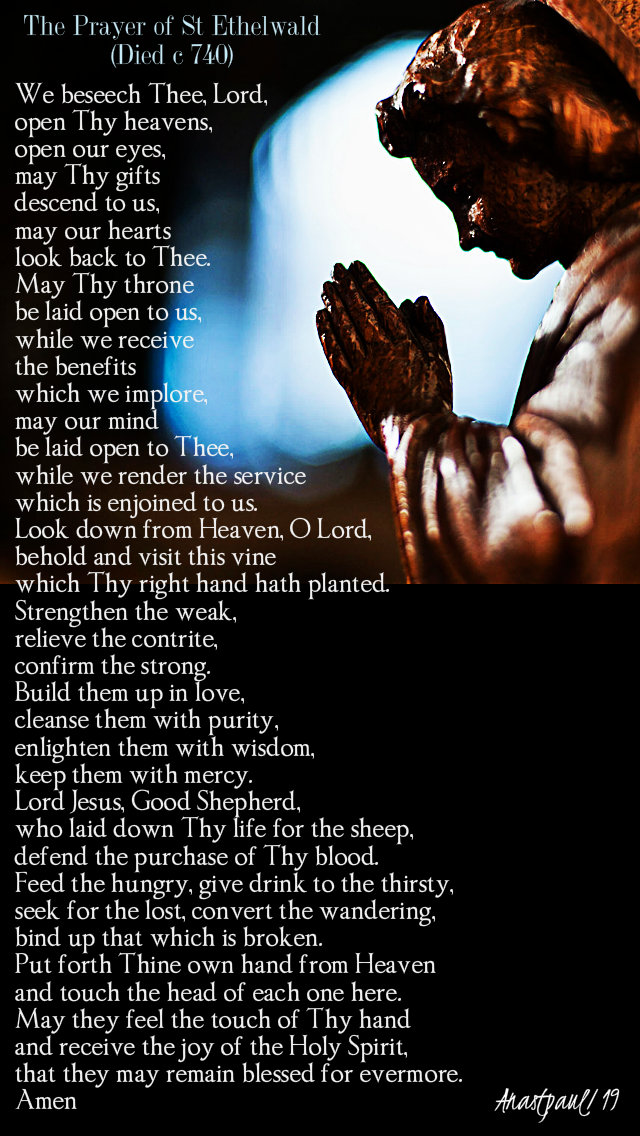
Thought for the Day – 12 February – The Prayer of St Ethelwald (Died c 740)

Thought for the Day – 12 February – the Memorial of St Ethelwald (Died c 740)

How Ethelwald, successor to Cuthbert, leading a hermit’s life, calmed a tempest by his prayers when the brethren were in danger at sea. [687-699]
The venerable Ethewald succeeded the man of God, Cuthbert, in the exercise of a solitary life, which he spent in the isle of Fame before he became a bishop.   After he had received the priesthood, he consecrated his office by deeds worthy of that degree for many years in the monastery which is called Inhrypum.

To the end that his merit and manner of life may be the more certainly made known, I will relate one miracle of his, which was told me by one of the brothers for and on whom the same was wrought; to wit, Guthfrid, the venerable servant and priest of Christ, who also, afterwards, as abbot, presided over the brethren of the same church of Lindisfarne, in which he was educated.

“I came,” says he, “to the island of Fame, with two others of the brethren, desiring to speak with the most reverend father, Ethelwald.   Having been refreshed with his discourse and asked for his blessing, as we were returning home, behold on a sudden, when we were in the midst of the sea, the fair weather in which we were sailing, was broken and there arose so great and terrible a tempest, that neither sails nor oars were of any use to us, nor had we anything to expect but death.   After long struggling with the wind and waves to no effect, at last we looked back to see whether it was possible by any means at least to return to the island whence we came but we found that we were on all sides alike cut off by the storm, and that there was no hope of escape by our own efforts. But looking further, we perceived, on the island of Fame, our father Ethelwald, beloved of God, come out of his retreat to watch our course, for, hearing the noise of the tempest and raging sea, he had come forth to see what would become of us.   When he beheld us in distress and despair, he bowed his knees to the Father of our Lord Jesus Christ, in prayer for our life and safety and, as he finished his prayer, he calmed the swelling water, in such sort that the fierceness of the storm ceased on all sides and fair winds attended us over a smooth sea to the very shore.   When we had landed and had pulled up our small vessel from the waves, the storm, which had ceased a short time for our sake, presently returned and raged furiously during the whole day, so that it plainly appeared, that the brief interval of calm had been granted by Heaven, in answer to the prayers of the man of God, to the end that we might escape.”

The man of God remained in the isle of Fame twelve years,and died there but was buried in the church of the blessed Apostle Peter, in the isle of Lindisfarne, beside the bodies of the aforesaid bishops.’

These things happened in the days of King Aldfrid, who, after his brother Egfrid, ruled the nation of the Northumbrians for nineteen years.

From Bede’s Ecclesiastical History of England
By The Venerable Bede (673-735)
Father & Doctor of the Church

We beseech Thee, Lord,
open Thy heavens, open our eyes,
may Thy gifts descend to us,
may our hearts look back to Thee.
May Thy throne be laid open to us,
while we receive the benefits which we implore,
may our mind be laid open to Thee,
while we render the service which is enjoined to us.
Look down from Heaven, O Lord,
behold and visit this vine
which Thy right hand hath planted.
Strengthen the weak,
relieve the contrite,
confirm the strong.
Build them up in love,
cleanse them with purity,
enlighten them with wisdom,
keep them with mercy.
Lord Jesus, Good Shepherd,
who laid down Thy life for the sheep,
defend the purchase of Thy blood.
Feed the hungry, give drink to the thirsty,
seek for the lost, convert the wandering,
bind up that which is broken.
Put forth Thine own hand from Heaven
and touch the head of each one here.
May they feel the touch of Thy hand
and receive the joy of the Holy Spirit,
that they may remain blessed for evermore.
Amen

Saint Ethelwald (Died c 740)the prayer of st ethelwald 12 feb 2019

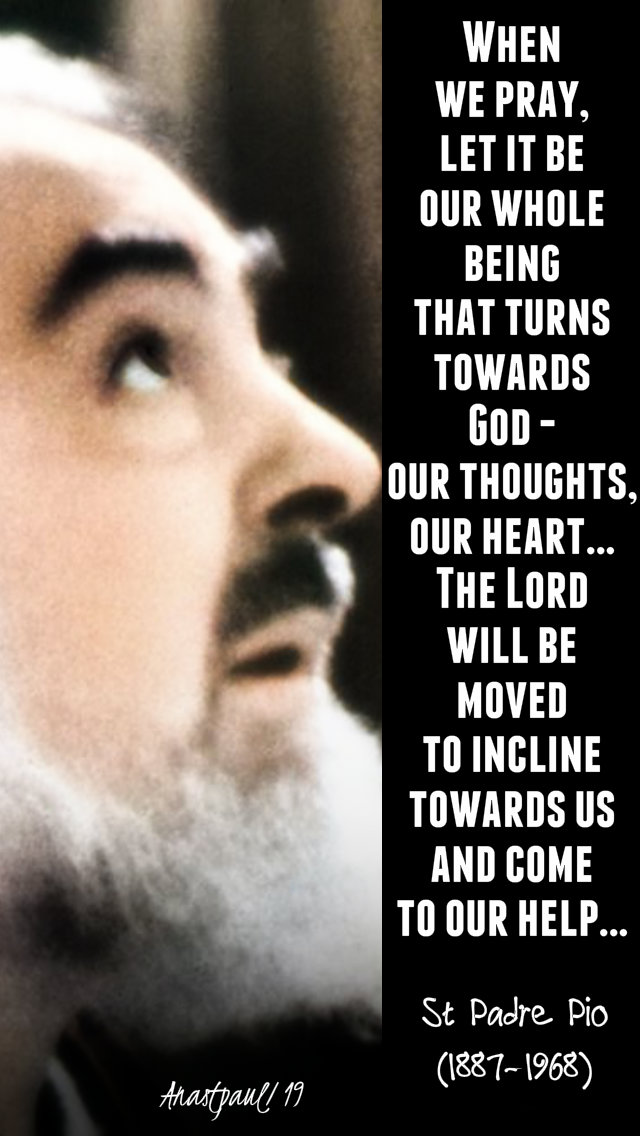
When we pray,
let it be our whole being
that turns towards God –
our thoughts,
our heart…
The Lord will be moved
to incline towards us
and come to our help…

St Pio of Pietralcina “Padre Pio” (1887-1968)when we pray - st padre pio 12 feb 2019

Posted in DOCTORS of the Church, FATHERS of the Church, POETRY, SAINT of the DAY

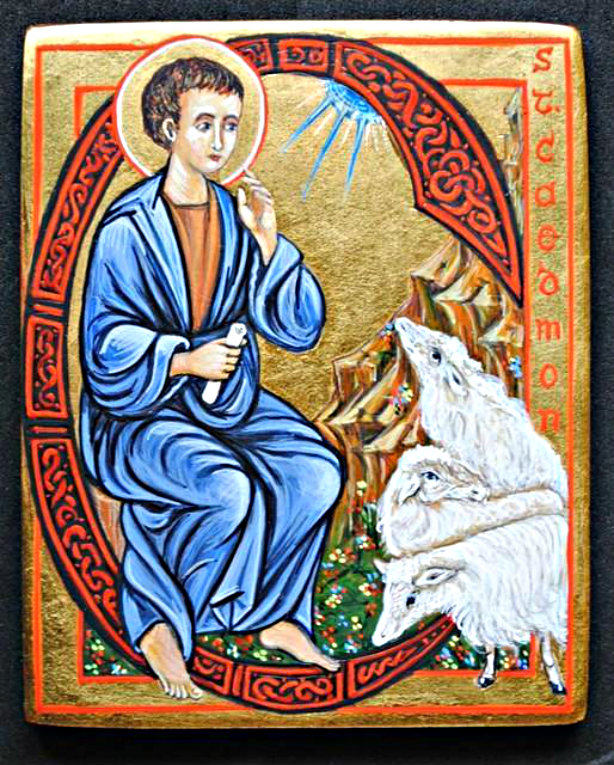
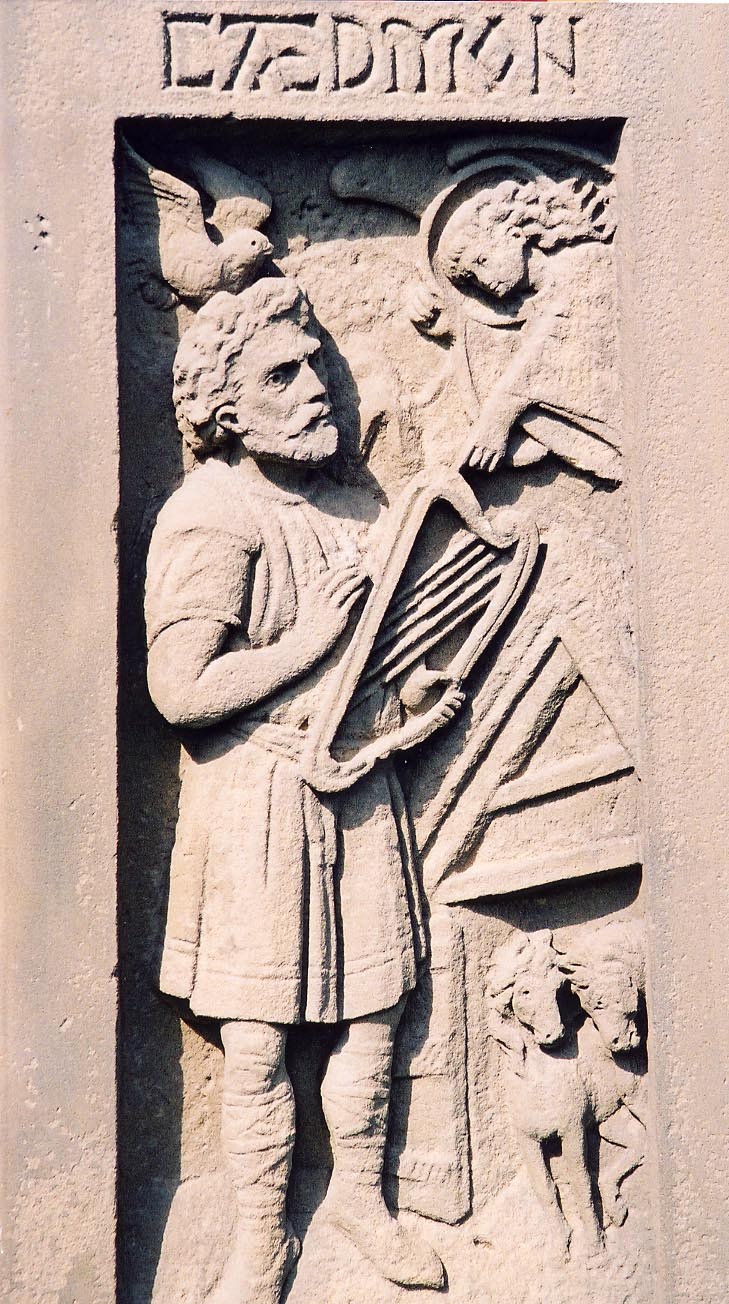
Saint of the Day – 11 February – St Caedmon (Died c 680)

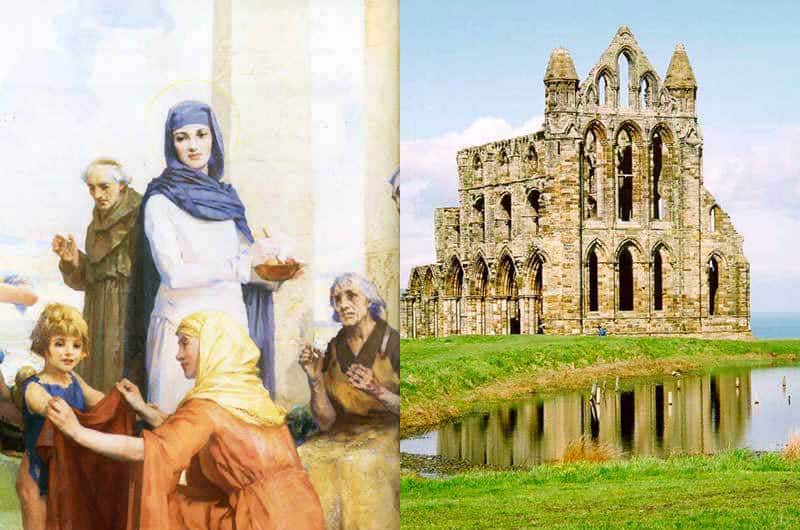
Saint of the Day – 11 February – St Caedmon (Died c 680) is the earliest English (Northumbrian) poet whose name is known.   An Anglo-Saxon who cared for the animals at the double monastery of Streonæshalch (Whitby Abbey, in Yorkshire, England) during the abbacy (657–680) of the Founder, St Hilda (614–680), he was originally ignorant of “the art of song” but learned to compose one night in the course of a dream, according to the 8th-century historian and Saint, The Venerable St Bede (673-735) Father & Doctor of the Church.   He later became a zealous monk and an accomplished and inspirational Christian poet.caed4.jpg
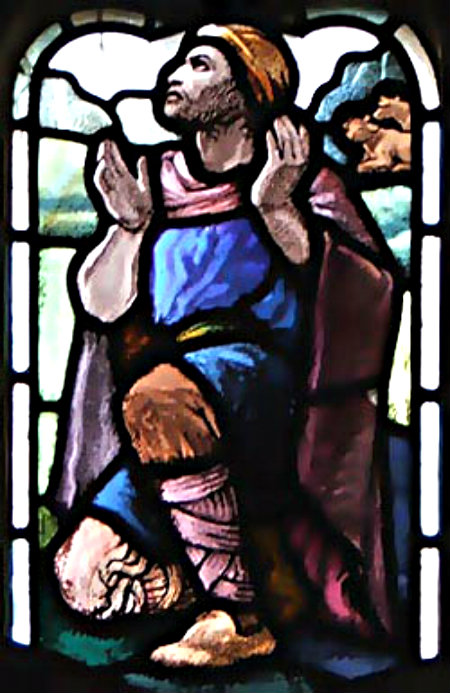
The sole source of original information about Cædmon’s life and work is St Bede’s Historia ecclesiastica.    According to Bede, Cædmon was a lay brother who cared for the animals at the monastery Streonæshalch, now known as Whitby Abbey.   One evening, while the monks were feasting, singing and playing a harp, Cædmon left early to sleep with the animals because he knew no songs.   The impression clearly given by St Bede is that he lacked the knowledge of how to compose the lyrics to songs.   While asleep, he had a dream in which “someone” approached him and asked him to sing principium creaturarum, “the beginning of created things.”   After first refusing to sing, Cædmon subsequently produced a short eulogistic poem praising God, the Creator of heaven and earth.
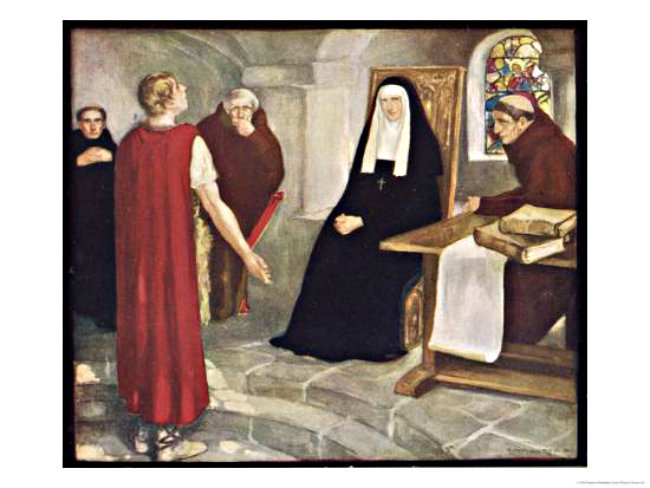
Upon awakening the next morning, Cædmon remembered everything he had sung and added additional lines to his poem.   He told his foreman about his dream and gift and was taken immediately to see the abbess, St Hilda of Whitby.   The abbess and her counsellors asked Cædmon about his vision and, satisfied that it was a gift from God, gave him a new commission, this time for a poem based on “a passage of sacred history or doctrine”, by way of a test.   When Cædmon returned the next morning with the requested poem, he was invited to take monastic vows.   The abbess ordered her scholars to teach Cædmon sacred history and doctrine, which after a night of thought, Bede records, Cædmon would turn into the most beautiful verse.   According to Bede, Cædmon was responsible for a large number of splendid vernacular poetic texts on a variety of Christian topics.saint-hilda-of-whitby-anglo-saxon-abbess-receiving-a-visit-from-caedmon_u-l-otenj0st-hilda-whitby-abbey

After a long and zealously pious life, Cædmon died like a saint – receiving a premonition of death, he asked to be moved to the abbey’s hospice for the terminally ill where, having gathered his friends around him, he died after receiving the Holy Eucharist, just before nocturns.st caedmon.jpg

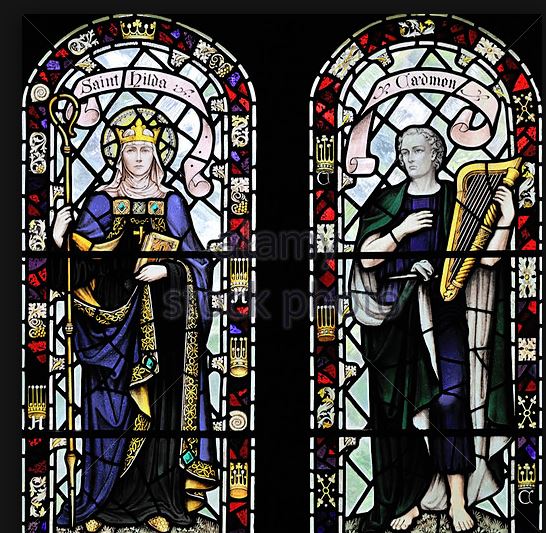
Bede’s narrative shows that Bede, an educated and intelligent man, believed Cædmon to be an important figure in the history of English intellectual and religious life.   He, however, gives no specific dates in his story.   Cædmon is said to have taken holy orders at an advanced age and it is implied that he lived at Whitby, at least in part, during Hilda’s abbacy (657–680).  caedmon and hilda.JPG

Cædmon is one of twelve Anglo-Saxon poets identified in medieval sources and one of only three of these for whom both roughly contemporary biographical information and examples of literary output have survived.   St Bede wrote, “there was in the Monastery of this Abbess a certain brother particularly remarkable for the Grace of God, who was wont to make religious verses, so that whatever was interpreted to him out of scripture, he soon after put the same into poetical expressions of much sweetness and humility in Old English, which was his native language.   By his verse the minds of many were often excited to despise the world and to aspire to heaven.”

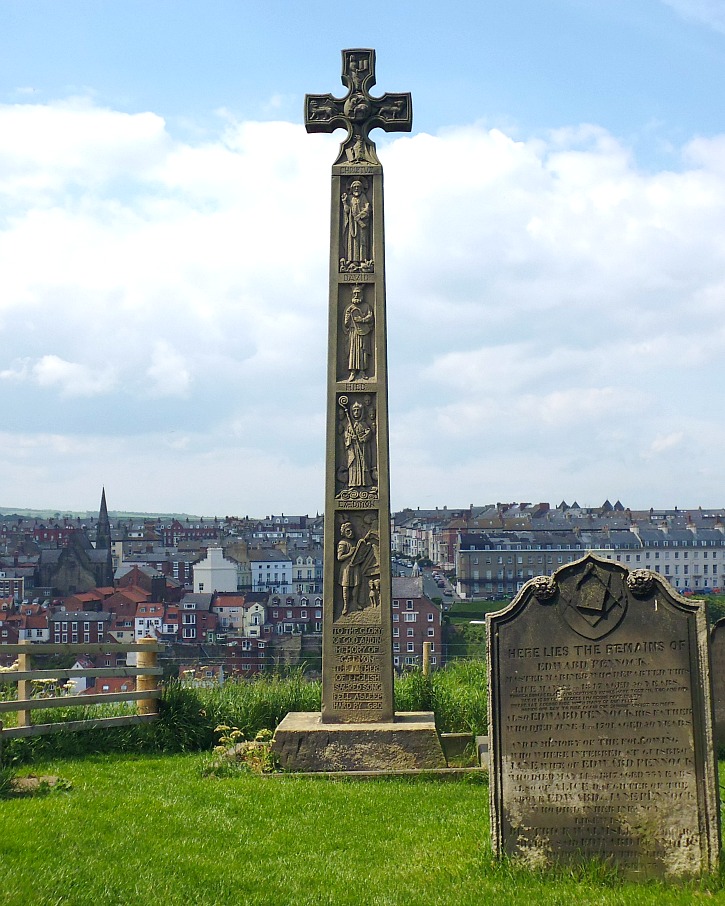
Cædmon’s only known surviving work is Cædmon’s Hymn, the nine-line alliterative vernacular praise poem in honour of God which he learned to sing in his initial dream. The poem is one of the earliest attested examples of Old English and is one of the earliest recorded examples of sustained poetry in a Germanic language.   In 1898, St Cædmon’s Cross was erected in his honour in the graveyard of St Mary’s Church in Whitby.

caedmons-cross-1x1.jpg
St Caedmon’s Cross

St Bede’s Latin version of St Caedmon’s poem runs as follows:

Nunc laudare debemus auctorem regni caelestis,
potentiam creatoris,
et consilium illius facta Patris gloriae –
quomodo ille,
cum sit aeternus Deus,
omnium miraculorum auctor exstitit,
qui primo filiis hominum caelum
pro culmine tecti dehinc terram
custos humani generis
omnipotens creavit.

Now we must praise the author
of the heavenly realm,
the might of the creator
and His purpose,
the work of the Father of glory –
as He, who, the almighty guardian
of the human race,
is the eternal God,
is the author of all miracles,
who first created the heavens
as highest roof
For the children of men,
then the earth.

caedmon_caedmon_cross

Posted in DOCTORS of the Church, FATHERS of the Church, QUOTES of the SAINTS, QUOTES on GRATITUDE, The WORD

Thought for the Day – 9 February – Let us give thanks…

Thought for the Day – 9 February – Saturday of the Fourth week in Ordinary Time, Year C – First Reading: Hebrews 13:15–17

Through him then let us continually offer up a sacrifice of praise to God, that is, the fruit of lips that acknowledge his name. …Hebrews 13:15

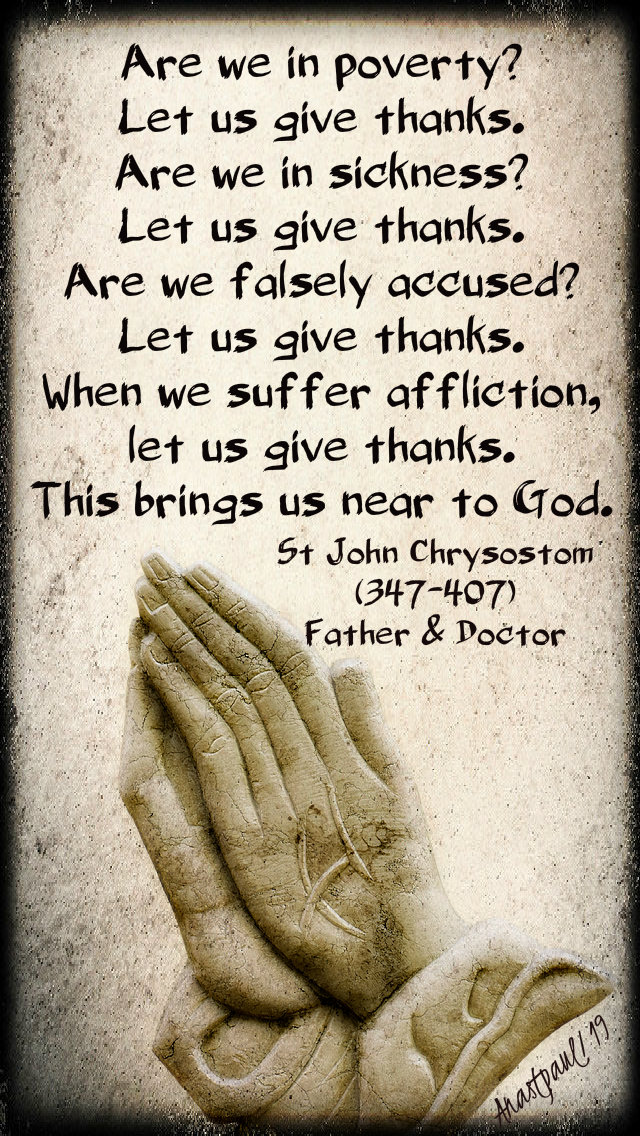
“Let us bear all things thankfully, be it poverty, be it disease, be it anything else whatever, for God alone knows the things expedient for us, “for we do not know how to pray as we ought.”

We, then, who do not know even how to ask for what is fitting unless we have received of the Spirit, let us take care to offer up thanksgiving for all things and let us bear all things nobly.

Are we in poverty? Let us give thanks.   Are we in sickness? Let us give thanks.   Are we falsely accused? Let us give thanks.   When we suffer affliction, let us give thanks. This brings us near to God.”

St John Chrysostom (347-407) Father & Doctor
(On the Epistle to the Hebrews, 33)are we in poverrty - st john chrysostom - giving thanks - 9 feb 2019.jpg

Posted in DOCTORS of the Church, FATHERS of the Church, PRACTISING CATHOLIC, QUOTES of the SAINTS, QUOTES on EVANGELISATION, QUOTES on SACRIFICE, QUOTES on SUFFERING, QUOTES on the CROSS of CHRIST, The HOLY CROSS, The WORD

Thought for the Day – 7 February – Go Forth Set the World on Fire!

Thought for the Day – 7 February – Thursday of the Fourth week in Ordinary Time, Year C. Gospel: Mark 6:7-13

He charged them to take nothing for their journey...Mark 6:8

For all Christians, wherever they live, are bound to show forth, by the example of their lives and by the witness of the word, that new man put on at baptism and that power of the Holy Spirit, by which they have been strengthened at Confirmation.   Thus other men, observing their good works, can glorify the Father and can perceive more fully the real meaning of human life and the universal bond of the community of mankind. (cf Col 3:10; Mt 5:16)….Decree on the missionary activity of the Church, “ Ad Gentes ”, # 10-11 – Vatican Council II

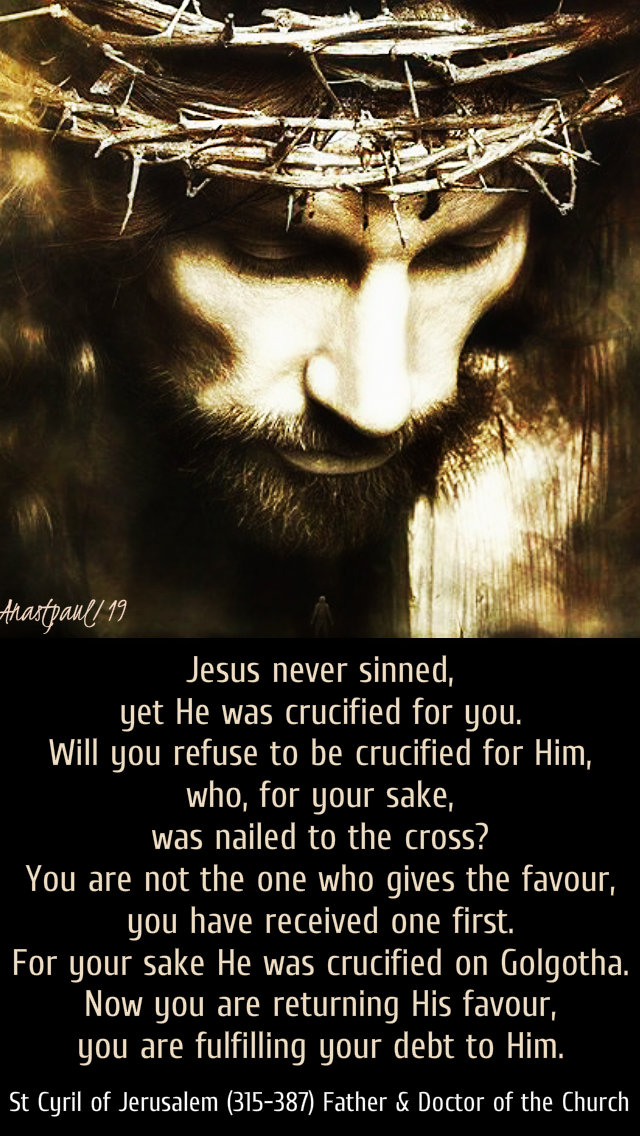
“Jesus never sinned, yet He was crucified for you.   

Will you refuse to be crucified for Him, who for your sake was nailed to the cross?   

You are not the one who gives the favour, you have received one first.   

For your sake He was crucified on Golgotha.   

Now you are returning His favour, you are fulfilling your debt to Him.”

St Cyril of Jerusalem (315-387) Father & Doctor of the Church

jesus never sinned yet he was crucified for you - st cyrilofjerusalem 7feb2019.jpg

“Go Forth, Set the World on Fire”

St Ignatius Loyola (1491-1556)go forth set the world on fire - st ignatius 7 feb 2019.jpg

Posted in DIVINE Mercy, Goodness, Patience, DOCTORS of the Church, FATHERS of the Church, MORNING Prayers, PRACTISING CATHOLIC, QUOTES of the SAINTS, QUOTES on REPENTANCE, QUOTES on SIN, SAINT of the DAY, The HOLY EUCHARIST / The HOLY MASS, The WORD

One Minute Reflection – 5 February …”I say to you, arise.”… Mark 5:41

One Minute Reflection – 5 February – Tuesday of the Fourth week in Ordinary Time, Year C – Gospel: Mark 5:21–43 and The Memorial of St Agatha (c 231- c 251)

…”I say to you, arise.”… Mark 5:41

mark 5 41 - i say to you arise - jairus' daughter - 5 feb 2019

REFLECTION – ““He took the child by the hand and said to her: ‘Talitha koum’, which means, ‘Little girl…arise.’”   “Since you have been born again, you are to be called ‘little girl’.   Little girl, arise for my sake – your healing does not come from you.”   “And immediately the little girl arose and walked around.”   May Jesus touch us, too and at once we shall walk.   We may well be paralysed, our deeds may be evil and we may be unable to walk, we may be lying on the bed of our sins… but if Jesus touches us, then we shall immediately be healed.   Peter’s mother-in-law was suffering with fever – Jesus touched her hand and she arose and immediately served Him (Mk 1:31)…

“They were utterly astounded and he gave them strict orders that no one should know this.”   Do you see now why He put the people out when He was going to work a miracle? He ordered and not just ordered but strictly ordered, that no one should know of this.   He ordered the three apostles and He ordered the parents, too, that no one should know. Our Lord ordered them all but the little girl herself, she who had stood up, could not be silent.

“And he said she should be given something to eat” – so that her resurrection might not be thought to be a ghostly apparition.   And He Himself, after His resurrection, ate fish and a piece of honeycomb (Lk 24:42)…   Lord, I beseech you, touch our hands as we, too, lie prostrate.   Make us rise from our bed of sins and enable us to walk.   And when we have walked, make them give us something to eat.   We cannot eat when we are lying down- unless we are standing, we shall not be able to receive the Body of Christ.”…St Jerome (347-420) – Father & Doctor of the Church

PRAYER – Increase in us, O Lord, the gift of faith, so that we may arise and offer our praise to You and by Your grace, yield fruit from heaven, for the glory of Your Kingdom. Lord God, let St Agatha, who became precious in Your sight through her pure life and valiant martyrdom, plead for our forgiveness.   For, with joy and rejoicing, as though to a feast, St Agatha, went to prison and offered her sufferings to You, with many prayers. Through Jesus Christ, Your divine Son, in unity with the Spirit, one God forever. St Agatha, pray for us, amen.

Posted in CONFESSION/PENANCE, DOCTORS of the Church, FATHERS of the Church, MORNING Prayers, QUOTES of the SAINTS, SUNDAY REFLECTIONS, The HOLY EUCHARIST / The HOLY MASS, Uncategorized

Sunday Reflection – 3 February – “May we be Worthy” – St Cyprian of Carthage

Sunday Reflection – 3 February – Fourth Sunday in Ordinary Time, Year C

“May we be Worthy”

“He [Paul] threatens, moreover, the stubborn and forward and denounces them, saying, ‘Whosoever eats the bread or drinks the cup of the Lord unworthily, is guilty of the body and blood of the Lord’ [1 Cor. 11:27].

All these warnings being scorned and contemned—[lapsed Christians will often take Communion] before their sin is expiated, before confession has been made of their crime, before their conscience has been purged by sacrifice and by the hand of the priest, before the offence of an angry and threatening Lord has been appeased, [and so] violence is done to His body and blood and they sin now, against their Lord, more with their hand and mouth than when they denied their Lord”

St Cyprian of Carthage (c 200- c 258) Bishop and Martyr, Father of the Church
(The Lapsed 15–16 [written in 251])lapsed christians - st cyprian of carthage - 3 feb 2019 sun reflec.jpg

Posted in DOCTORS of the Church, FATHERS of the Church, MORNING Prayers, SAINT of the DAY, The WORD

One Minute Reflection – 3 February – Gospel: Luke 4:21–30 “And they rose up and put him out of the city”

One Minute Reflection – 3 February – Fourth Sunday in Ordinary Time, Year C, Gospel: Luke 4:21–30 and The Memorial of St Blaise – Martyr (Died c 316) and St Ansgar (801-865)

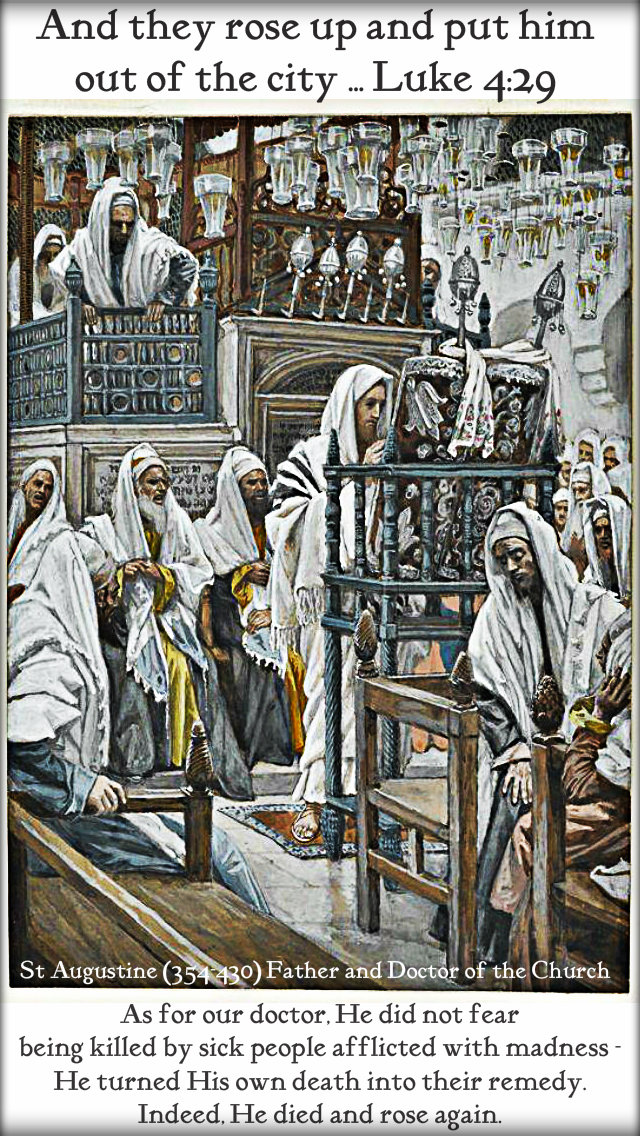
And they rose up and put him out of the city and led him to the brow of the hill on which their city was built, that they might throw him down headlong.   But passing through the midst of them he went away….Luke 4:29-30

REFLECTION – “A doctor came amongst us to restore us to health – our Lord Jesus Christ. He discovered blindness in our hearts and promised the light that “eye has not seen and ear has not heard, and has not entered the heart of man” (1Cor 2:9).
The humility of Jesus Christ is the cure for your pride.   Don’t scorn what will bring you healing, be humble, you for whom God humbled Himself.   Indeed, He knew that the medicine of humility would cure you, He who well understood your sickness and knew how to cure it.   While you were unable to run to the doctor’s house, the doctor in person came to your house… He is coming, He wants to help you, He knows what you need.
God has come with humility precisely in order that man might imitate Him.   If He had remained above you, how would you have been able to imitate Him?   And, without imitating Him, how could you be healed?   He came with humility because He knew the nature of the remedy He had to administer – a little bitter, it is true but healing.   And do you continue to scorn Him?   He who holds out the cup to you and you say:  “But what sort of God is this God of mine?   He was born, suffered, was covered with spittle, crowned with thorns, nailed on the cross!”   O miserable soul!   You see the doctor’s humility and not the cancer of your pride.   That is why humility displeases you…
It often happens that mentally ill people end up by beating their doctor.   When that happens, the unfortunate doctor is not only not distressed by the one who beat him but attempts to treat him…   As for our doctor, He did not fear being killed by sick people afflicted with madness, He turned His own death into their remedy.   Indeed, He died and rose again.”…St Augustine (354-430) Father and Doctor of the Churchluke 4 29 and they rose and oput him out - as for our doctor - st augustine 3 feb 2019.jpg

PRAYER –  Lord our God, make us love You above all things and all our fellow-men, with a love that is worthy of You.   May we look to Your Divine Son in love and imitation.   Holy Father, You sent St Ansgar, Monk and Bishop, to bring the light of Christ to many nations of Northern Europe.   Through his prayer give us grace to live always in the light of Your truth.   Grant too, that by the prayers of St Blaise, we too may be granted the grace to follow Your only Son, no matter our sufferings, to You, in our heavenly home.   We make our prayer, through Christ our Lord, in the unity of the Holy Spirit, one God, forever amen.st-blaise-pray-for-us-3-february-20171

st-ansgar-pray-for-us-3-feb-2018

Posted in DOCTORS of the Church, EUCHARISTIC Adoration, Our MORNING Offering, PRAYERS of the SAINTS, The HOLY EUCHARIST / The HOLY MASS

Our Morning Offering – 3 February – The Bread of Angels

Our Morning Offering – 3 February – Fourth Sunday in Ordinary Time, Year C

The Bread of Angels
By St Bonaventure (1217-1274) Doctor of the Church

Pierce, O most sweet Lord Jesus,
my inmost soul with the most joyous
and healthful wound of Your love,
and with true, calm and most holy apostolic charity,
that my soul may ever languish and melt
with entire love and longing for You,
may yearn for You and for Your courts,
may long to be dissolved and to be with You.
Grant that my soul may hunger after You,
the Bread of Angels, the refreshment of holy souls,
our daily and supersubstantial bread,
having all sweetness and savour
and every delightful taste.
May my heart ever hunger after and feed upon You,
Whom the angels desire to look upon,
and may my inmost soul
be filled with the sweetness of Your savour;
may it ever thirst for You,
the fountain of life,
the fountain of widsom and knowledge,
the fountain of eternal light,
the torrent of pleasure,
the fulness of the house of God;
may it ever compass You,
seek You, find You, run to You,
come up to You, meditate on You, speak of You
and do all for the praise and glory of Your name,
with humility and discretion,
with love and delight,
with ease and affection,
with perseverence to the end
and be You alone ever my hope,
my entire confidence, my riches, my delight,
my pleasure, my joy, my rest and tranquility,
my peace, my sweetness, my food, my refreshment,
my refuge, my help, my wisdom, my portion,
my possession, my treasure;
in Whom may my mind and my heart
be ever fixed and firm and rooted immovably.
Amenthe bread of angels - st bonaventure - 3 feb 2019.jpg

Posted in CONFESSION/PENANCE, DIVINE Mercy, Goodness, Patience, DOCTORS of the Church, QUOTES of the SAINTS, QUOTES on SIN

Thought for the Day – 30 January – Where sin abounded grace has overflowed – St Bernard

Thought for the Day – 30 January – Wednesday of the Third week in Ordinary Time, Year C – Gospel: Mark 4:1-20

Where sin abounded grace has overflowed

Saint Bernard of Clairvaux (1090-1153)
Abbot and Doctor of the Church

An excerpt from his Sermon 61 On the Song of Songs

“Where can the weak find a place of firm security and peace, except in the wounds of the Saviour?   Indeed, the more secure is my place there, the more He can do to help me.   The world rages, the flesh is heavy and the devil lays his snares but I do not fall, for my feet are planted on firm rock.   I may have sinned gravely.   My conscience would be distressed but it would not be in turmoil, for I would recall the wounds of the Lord – He was wounded for our iniquities.   What sin is there so deadly that it cannot be pardoned by the death of Christ?   And so, if I bear in mind this strong, effective remedy, I can never again be terrified by the malignancy of sin.

Surely the man who said – my sin is too great to merit pardon, was wrong.   He was speaking as though he were not a member of Christ and had no share in His merits, so that he could claim them as his own, as a member of the body can claim what belongs to the head.   As for me, what can I appropriate that I lack from the heart of the Lord who abounds in mercy?   They pierced His hands and feet and opened His side with a spear.   Through the openings of these wounds I may drink honey from the rock and oil from the hardest stone:  that is, I may taste and see that the Lord is sweet.

He was thinking thoughts of peace and I did not know it, for who knows the mind of the Lord, or who has been His counsellor?   But the piercing nail has become a key to unlock the door, that I may see the good will of the Lord.   And what can I see as I look through the hole?   Both the nail and the wound cry out that God was in Christ reconciling the world to Himself.   The sword pierced His soul and came close to His heart, so that He might be able to feel compassion for me in my weaknesses.

Through these sacred wounds we can see the secret of His heart, the great mystery of love, the sincerity of His mercy with which He visited us from on high.   Where have Your love, Your mercy, Your compassion shone out more luminously that in Your wounds, sweet, gentle Lord of mercy?   More mercy than this no one has than that He lay down His life for those who are doomed to death.where have your love your mercy - st bernard 30 jan 2019.jpg

My merit comes from His mercy, for I do not lack merit so long as He does not lack pity.   And if the Lord’s mercies are many, then I am rich in merits.   For even if I am aware of many sins, what does it matter?   Where sin abounded grace has overflowed. And if the Lord’s mercies are from all ages forever, I too will sing of the mercies of the Lord for ever.   Will I not sing of my own righteousness?   No, Lord, I shall be mindful only of Your justice.   Yet that too is my own; for God has made You my righteousness.”

Holy Mother, Pray for Us!holy mother pray for us 30 jan 2019.jpg


Posted in DOCTORS of the Church, GOD the FATHER, MORNING Prayers, PRACTISING CATHOLIC, QUOTES of the SAINTS, QUOTES on OBEDIENCE, QUOTES on PERSEVERANCE, QUOTES on TRUST and complete CONFIDENCE in GOD, The WILL of GOD, The WORD

Thought for the Day – 29 January – Doing the Will of God

Thought for the Day – 29 January – Tuesday of the Third week in Ordinary Time, Year C – Gospel: Mark 3:31–35

31 And his mother and his brethren came; and standing outside they sent to him and called him. 32 And a crowd was sitting about him and they said to him, “Your mother and your brethren are outside, asking for you.” 33 And he replied, “Who are my mother and my brethren?” 34 And looking around on those who sat about him, he said, “Here are my mother and my brethren! 35 Whoever does the will of God, is my brother and sister and mother.”

Whoever does the will of God,

is my brother and sister and mother.

St Francis de Sales (1567-1622)

Our determination to follow God’s will in all things without exception is contained in the Lord’s prayer, in the words we say each day:  “Your will be done on earth as in heaven.”  In heaven there is no resistance to the divine will, everything is submitted to Him and obeys Him, we promise to do the same for Our Lord, never offering any resistance but always remaining very subject to this divine will in every circumstance.   Now, the will of God can be understood in two ways: there is the will of God that is clearly stated and the will that is His good pleasure.

The will that is stated consists of four parts:   His commandments, His counsels, the counsels of the Church and His inspirations.   As regards the commandments of God and His Church, each of us must bow the neck and submit to obedience because in this, the will of God is absolute, willing that we should obey if we wish to be saved.

He wants us to observe the counsels by desire but not in an absolute manner, since some are so opposed to each other, that it would be altogether impossible to take on the practice of one of them, without taking away the means of practising the other.   For example, it is a counsel to leave all one has in order to follow our Lord, stripped of everything and it is a counsel to lend and give alms.   But how can someone lend who all at once has left all that he has, or how can he give alms, tell me, when he has nothing?   So we have to follow the counsels God wants us to follow and not think He has given them all to us, so that we should embrace them all.

In addition there is the will of God’s good pleasure which we are to consider in every eventuality, I mean in all those things that happen to us – in sickness, death, affliction, consolation, in things that are adverse and things that are profitable, in brief in everything unforeseen.   And to this will of God we should always be ready to submit in all that happens, in the agreeable as in the disagreeable, in affliction as in consolation, in death as in life and in all that is not clearly against the stated will of God, for that always comes first.

Blessed Virgin, Mary Most Devout Mother, Pray for Us!mary most devout virgin - pray for us - 19 may 2018.jpg

Posted in DOCTORS of the Church, QUOTES of the SAINTS, SPEAKING of ....., The WILL of GOD

Quote/s of the Day – 29 January – Speaking of: Doing God’s Will

Quote/s of the Day – 29 January – Tuesday of the Third week in Ordinary Time, Year C – Gospel: Mark 3:31–35

Speaking of: Doing God’s Will

“God does not command impossibilities
but by commanding,
admonishes you to DO what you can
and to PRAY for what you cannot
and AIDS you that you may be able.”

St Augustine (354-430) Father & Doctor of the Churchgod does not comman impossibilities - st augustine - 29 jan 2019

“I am the king’s good servant
but God’s first.”

St Thomas More (1478-1535) Martyr i am the kings good servant but god's first - st thomas more 29 jan 2019.jpg

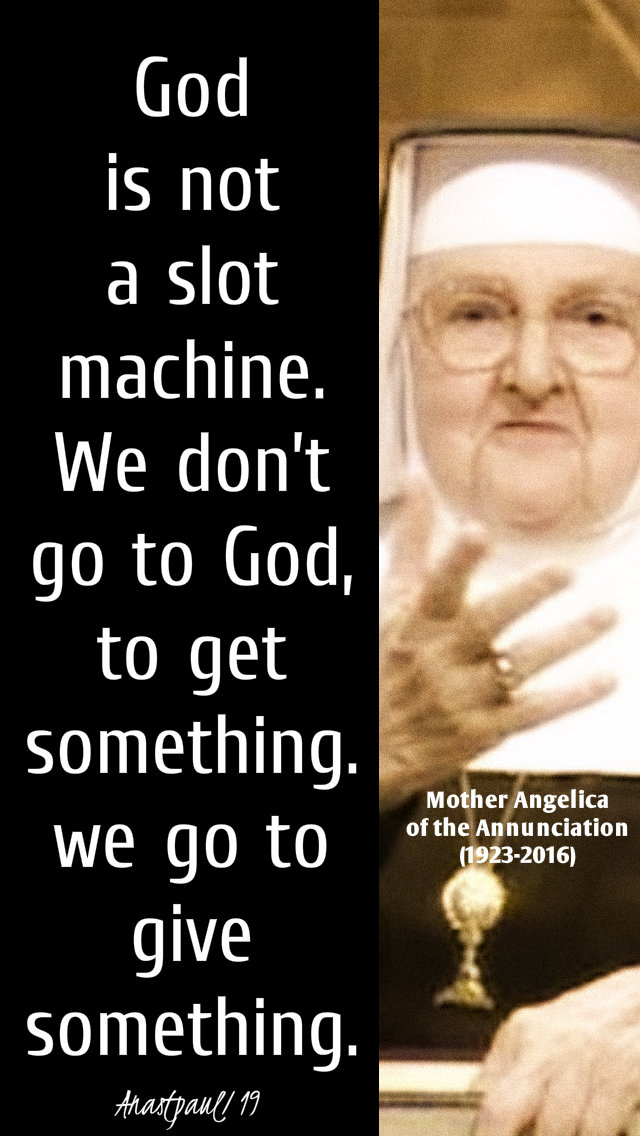
“God is not a slot machine.
We don’t go to God,
to get something.
we go to give something.”

Mother Angelica of the Annunciation PCPA (1923-2016)god is not a slot machine - mother angelica - 29jan2019.jpg

“If we wish to follow Christ closely,
we cannot choose an easy, quiet life.
It will be a demanding life
but full of joy.”

Pope Francisif we wish to follow christ closely - pope francis - 29jan2019.jpg

“The will of God
will never take you,
to where the grace of God,
will not protect you.”the will of god will never - fr mike schmitz 29 jan 2019

“A disciple of Jesus
is a decision maker.”

Father Mike Schmitza disciple of jesus is a decision maker - fr mike - 29jan2019

“Jesus promises two things
for those who follow Him:
1. Trouble
2. Victory”

Father John Parksjesus promises two things - fr john parks - 29 jan 2019

Father John Parks is a priest for the Diocese of Phoenix, Arizona. Before seminary, Father Parks received a degree in theatre from Arizona State University and was a youth speaker specialising in pro-life and chastity topics.   Father Parks was ordained a priest in 2010, has taught theology and philosophy at a Catholic high school the last four years and is currently the vicar for Evangelisation for the Diocese of Phoenix.   Father Parks has a great passion for the Gospel and loves being a priest.

Posted in DOCTORS of the Church, QUOTES of the SAINTS, QUOTES on HUMILITY, QUOTES on LOVE, QUOTES on OBEDIENCE, QUOTES on PATIENCE, QUOTES on SUFFERING, QUOTES on the CROSS of CHRIST, SAINT of the DAY, The HOLY CROSS, The PASSION

Thought for the Day – 28 January – The cross exemplifies every virtue

Thought for the Day – 28 January – The Memorial of St Thomas Aquinas (1225-1274) Doctor of the Church

The Cross Exemplifies every Virtue

Saint Thomas Aquinas
Priest and Doctor of the Church

An excerpt from a Conference

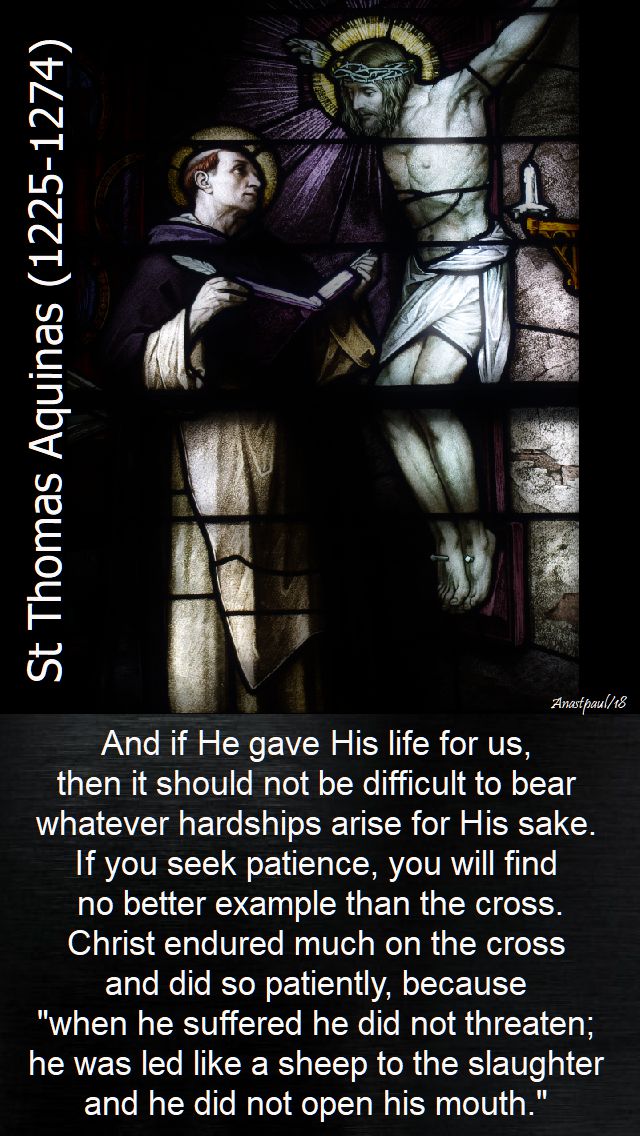
Why did the Son of God have to suffer for us?   There was a great need and it can be considered in a twofold way – in the first place, as a remedy for sin and secondly, as an example of how to act.

It is a remedy, for, in the face of all the evils which we incur on account of our sins, we have found relief through the passion of Christ.   Yet, it is no less an example, for the passion of Christ completely suffices to fashion our lives.   Whoever wishes to live perfectly should do nothing but disdain what Christ disdained on the cross and desire what He desired, for the cross exemplifies every virtue.

If you seek the example of love:  Greater love than this no man has, than to lay down his life for his friends.   Such a man was Christ on the cross.   And if He gave His life for us, then it should not be difficult to bear whatever hardships arise for His sake.

If you seek patience, you will find no better example than the cross.   Great patience occurs in two ways – either when one patiently suffers much, or when one suffers things which one is able to avoid and yet does not avoid.   Christ endured much on the cross and did so patiently, because when He suffered He did not threaten;,He was led like a sheep to the slaughter and He did not open His mouth.   Therefore, Christ’s patience on the cross, was great.   In patience let us run for the prize set before us, looking upon Jesus, the author and perfecter of our faith who, for the joy set before Him, bore His cross and despised the shame.

If you seek an example of humility, look upon the crucified one, for God wished to be judged by Pontius Pilate and to die.

If you seek an example of obedience, follow Him who became obedient to the Father even unto death.   For just as by the disobedience of one man, namely, Adam, many were made sinners, so by the obedience of one man, many were made righteous.

If you seek an example of despising earthly things, follow Him who is the King of kings and the Lord of lords, in whom are hidden all the treasures of wisdom and knowledge.   Upon the cross He was stripped, mocked, spat upon, struck, crowned with thorns and given only vinegar and gall to drink.

Do not be attached, therefore, to clothing and riches because they divided my garments among themselves.   Nor to honours, for He experienced harsh words and scourgings. Nor to greatness of rank, for weaving a crown of thorns, they placed it on my head.   Nor to anything delightful, for in my thirst they gave me vinegar to drink.

St Thomas Aquinas, Pray for Us!st thomas aquinas pray for us 28 jan 2019.jpg

Posted in DOCTORS of the Church, QUOTES of the SAINTS, QUOTES on ANGELS, QUOTES on CHARITY, QUOTES on CONVERSION, QUOTES on EVANGELISATION, QUOTES on FAITH, QUOTES on GRATITUDE, QUOTES on PERSEVERANCE, QUOTES on SUFFERING, QUOTES on the CROSS of CHRIST, QUOTES on WOMEN, SAINT of the DAY

Quote/s of the Day – 28 January – St Thomas Aquinas (1225-1274) Doctor of the Church

Quote/s of the Day – 28 January – The Memorial of St Thomas Aquinas (1225-1274) Doctor of the Church

“Believing is an act of the intellect,
assenting to the divine truth,
by command of the will,
moved by God,
through grace.”everything-is-possible-mark-9-23- no 2 - believing-is-an-act-of-the-will-st-thomas-aquinas-5-june-2018

“The only-begotten Son of God,
wanting to make us
sharers in His divinity,
assumed our nature,
so that He, made man,
might make men gods.”the only-begotten son of god - st thomas aquinas - 28jan2019

“Charity is the form,
mover, mother
and root
of all the virtues.”charity is the form mover mother and root - st thomas aquinas 28 jan 2019

“To convert somebody,
go and take them by the hand
and guide them.”to-convert-somebody-st-thomas-aquinas-18-sept-2018

“We are like children,
who stand in need of masters
to enlighten us and direct us
and God has provided for this,
by appointing His angels,
to be our teachers and guides. “we are like children - st thomas aquinas no 2 - 28 jan 2019.jpg

“Just as a woman
had announced
the words of death
to the first man,
so also, a woman was the first
to announce to the Apostles
the words of life.”just-as-a-woman-had-announced-st-thomas-aquinas-22-july-2018.jpg

And if He gave His life for us,
then it should not be difficult
to bear whatever hardships arise for His sake.
If you seek patience,
you will find no better example than the cross.
Christ endured much on the cross and did so patiently,
because “when he suffered he did not threaten,
he was led like a sheep to the slaughter
and he did not open his mouth.”

St Thomas Aquinas (1225-1274) Doctor of the Churchand-if-he-gave-his-life-for-us-st-thomas-aquinas-28-jan-2018