Quote of the Day – 6 May “Mary’s Month!” – Sixth Sunday of Eastertide B
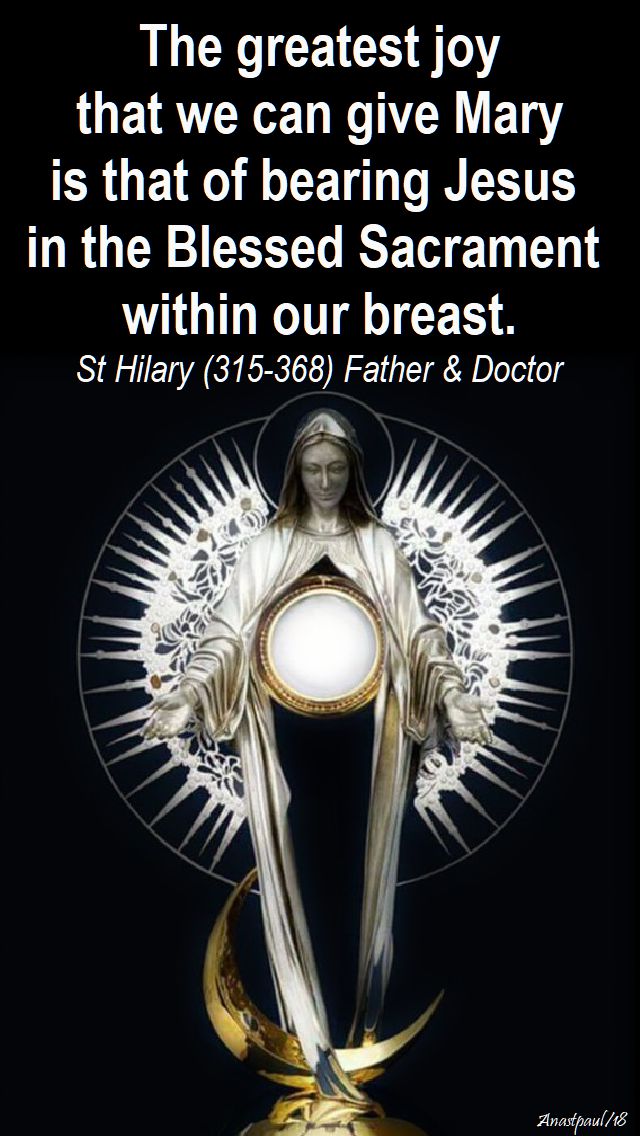
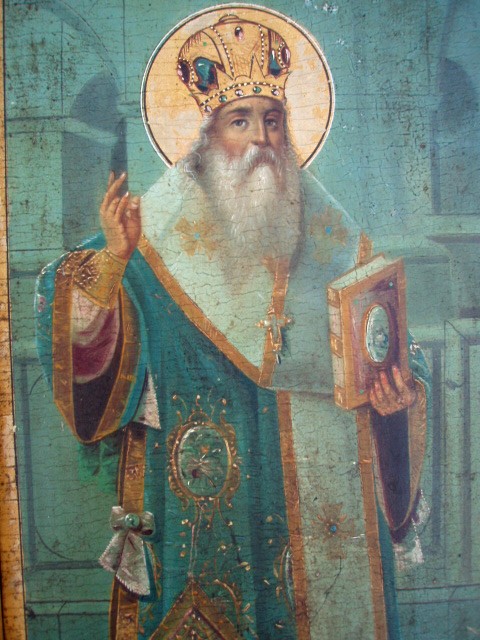
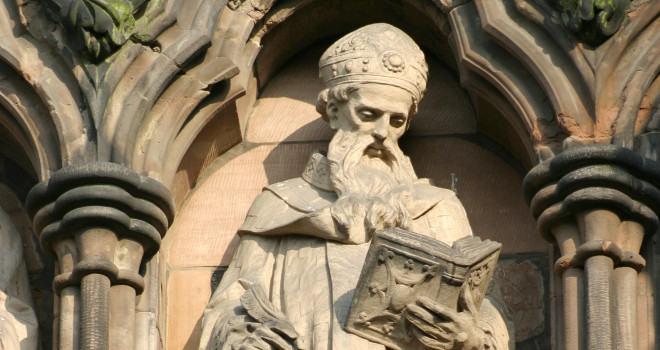
The great St Hilary (315-368) , Father and Doctor of the Church (Doctor of the Divinity of Christ), wrote this excellent passage:
“The greatest joy that we can give Mary is that of bearing Jesus in the Blessed Sacrament within our breast.”
Her motherly union with Jesus becomes a union also with whoever is united to Jesus, especially in Holy Communion. And what can give as much joy to one who loves, as union with the person loved? And we—–do we not happen to be beloved children of the heavenly Mother?
Our Morning Offering – 5 May “Mary’s Month!” – Saturday of the Fifth Week of Eastertide
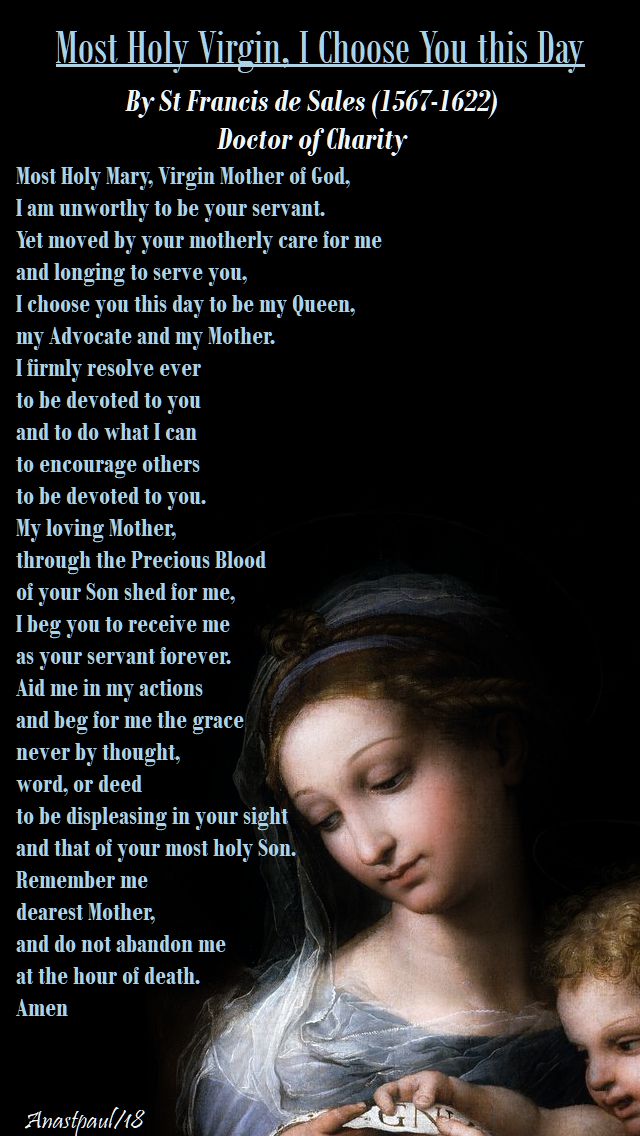
Most Holy Virgin, I Choose You this Day By St Francis de Sales (1567-1622) Doctor of Charity
Most Holy Mary, Virgin Mother of God,
I am unworthy to be your servant.
Yet moved by your motherly care for me
and longing to serve you,
I choose you this day to be my Queen,
my Advocate and my Mother.
I firmly resolve ever
to be devoted to you
and to do what I can
to encourage others
to be devoted to you.
My loving Mother,
through the Precious Blood
of your Son shed for me,
I beg you to receive me
as your servant forever.
Aid me in my actions
and beg for me the grace
never by thought, word, or deed
to be displeasing in your sight
and that of your most holy Son.
Remember me, dearest Mother,
and do not abandon me at the hour of death.
Amen
Quote/s of the Day – 4 May – Friday of the Fifth Week of Eastertide: Today’s Gospel John 15:12-17
Speaking of: LOVE
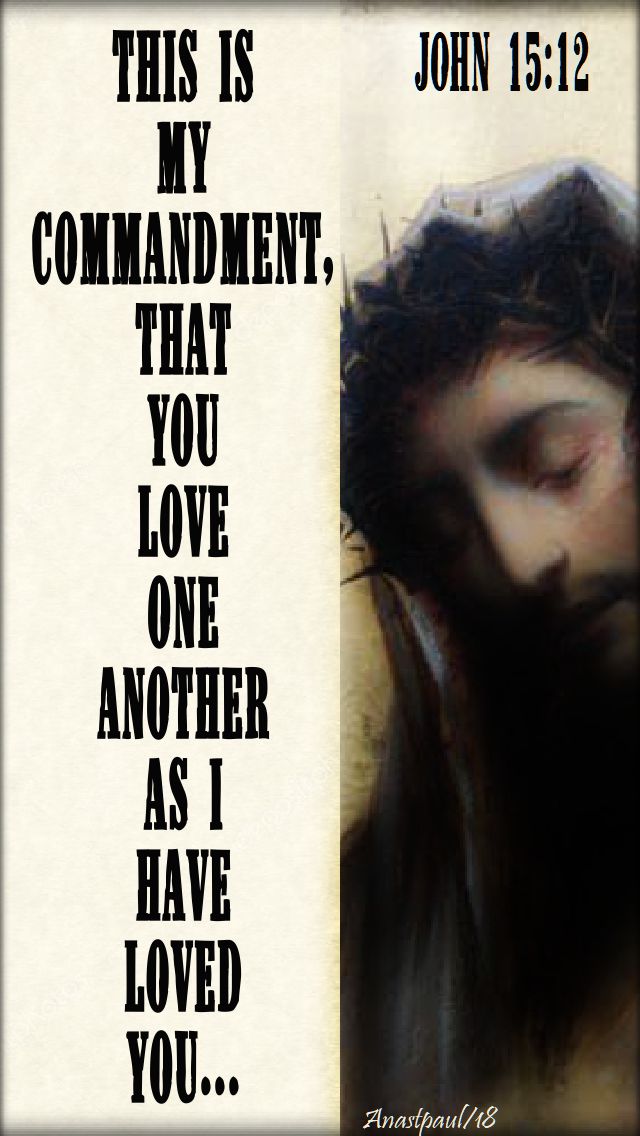
“This is my commandment, that you love one another as I have loved you…
John 15:12
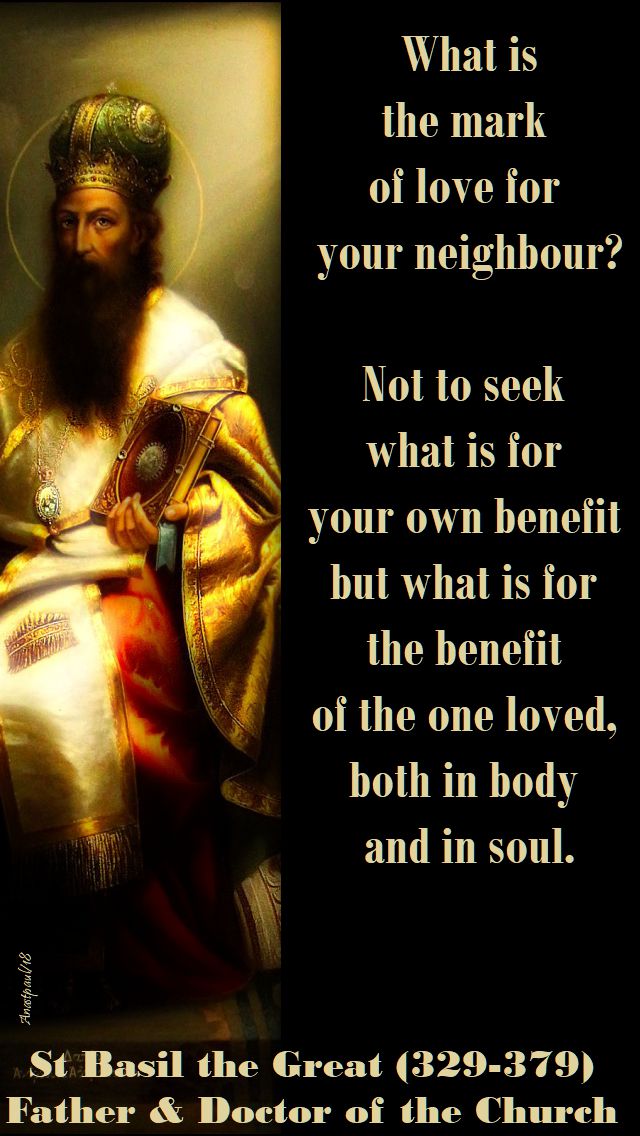
“What is the mark of love for your neighbour? Not to seek what is for your own benefit but what is for the benefit of the one loved, both in body and in soul.”
St Basil the Great (329-379) Father & Doctor of the Church
“Love is watchful. Sleeping, it does not slumber. Wearied, it is not tired. Pressed, it is not straitened. Alarmed, it is not confused but like a living flame, a burning torch, it forces its way upward and passes unharmed through every obstacle.”
“Nothing is sweeter than love, nothing stronger or higher or wider; nothing is more pleasant, nothing fuller and nothing better in heaven or on earth, for love is born of God and cannot rest except in God, Who is above all created things.”
Thomas a Kempis (1380-1471) – Imitation of Christ
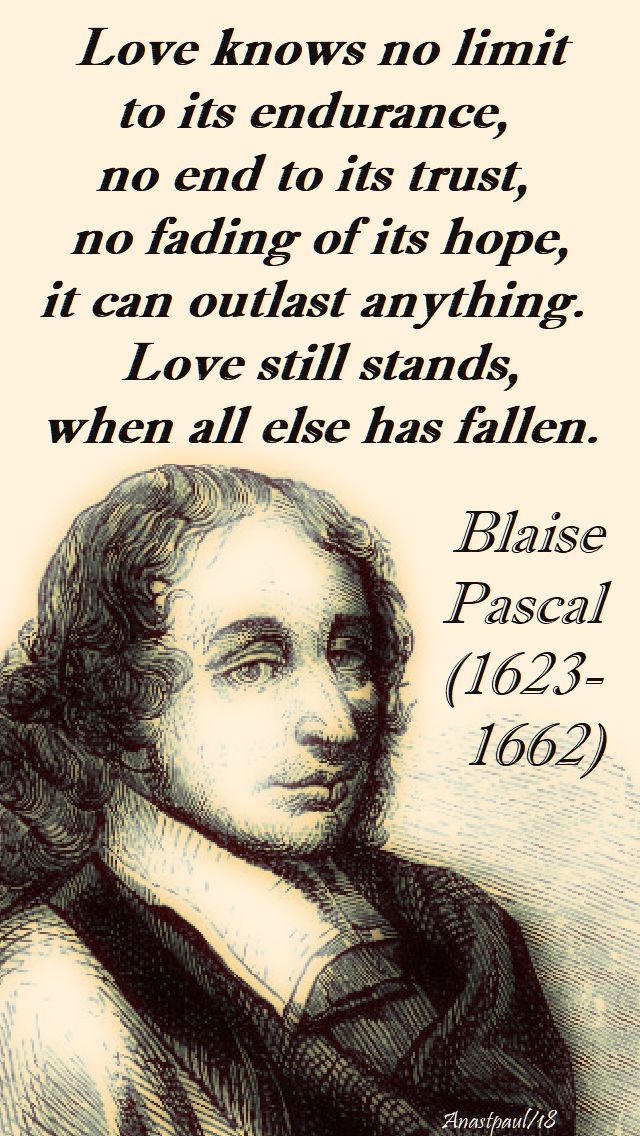
“Love knows no limit to its endurance, no end to its trust, no fading of its hope, it can outlast anything. Love still stands, when all else has fallen.”
Our Morning Offering – 4 May Mary’s Month! – Friday of the Fifth Week of Eastertide
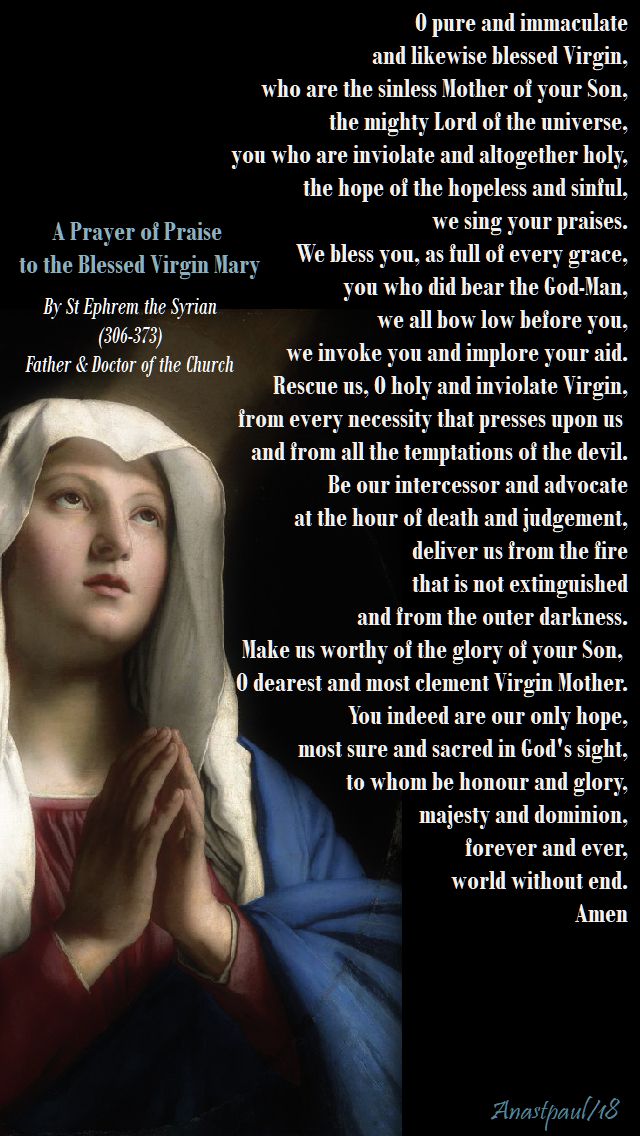
A Prayer of Praise to the Blessed Virgin Mary By St Ephrem the Syrian (306-373) Father & Doctor of the Church
O pure and immaculate and likewise blessed Virgin,
who are the sinless Mother of your Son,
the mighty Lord of the universe,
you who are inviolate and altogether holy,
the hope of the hopeless and sinful,
we sing your praises.
We bless you, as full of every grace,
you who did bear the God-Man,
we all bow low before you,
we invoke you and implore your aid.
Rescue us, O holy and inviolate Virgin,
from every necessity that presses upon us
and from all the temptations of the devil.
Be our intercessor and advocate
at the hour of death and judgement,
deliver us from the fire that is not extinguished
and from the outer darkness.
Make us worthy of the glory of your Son,
O dearest and most clement Virgin Mother.
You indeed are our only hope,
most sure and sacred in God’s sight,
to whom be honour and glory,
majesty and dominion,
forever and ever, world without end.
Amen
Quote/s of the Day – 3 May – Thursday of the Fifth Week of Eastertide and the Feast of Sts Philip and James Apostles and Martyrs
Speaking of: Seeking Augustine
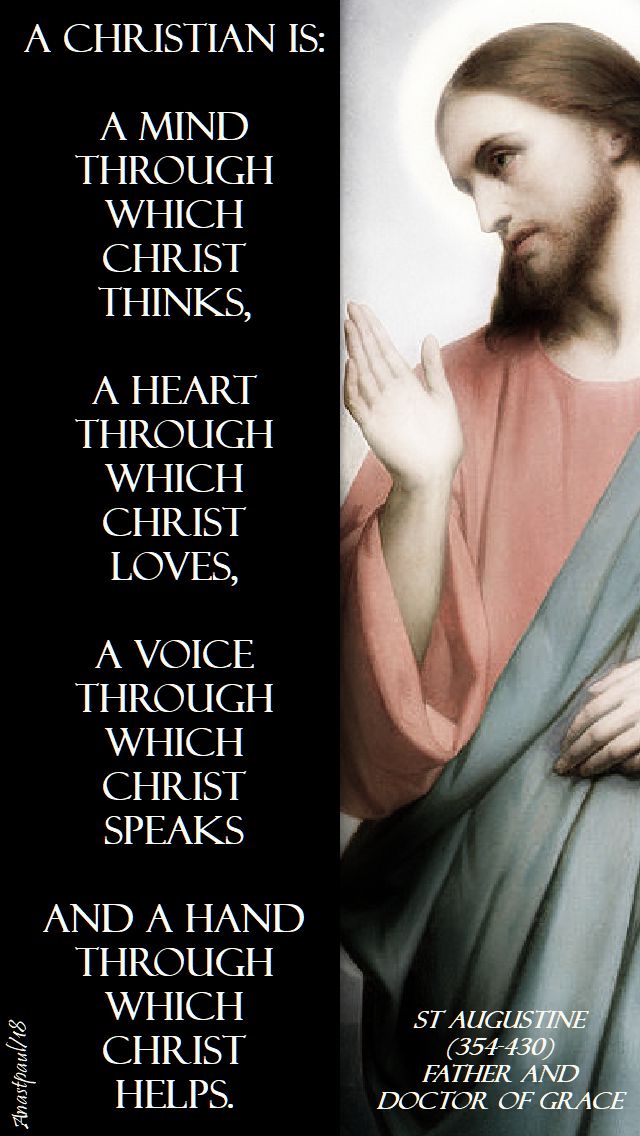
A Christian is: a mind through which Christ thinks, a heart through which Christ loves, a voice through which Christ speaks and a hand through which Christ helps.
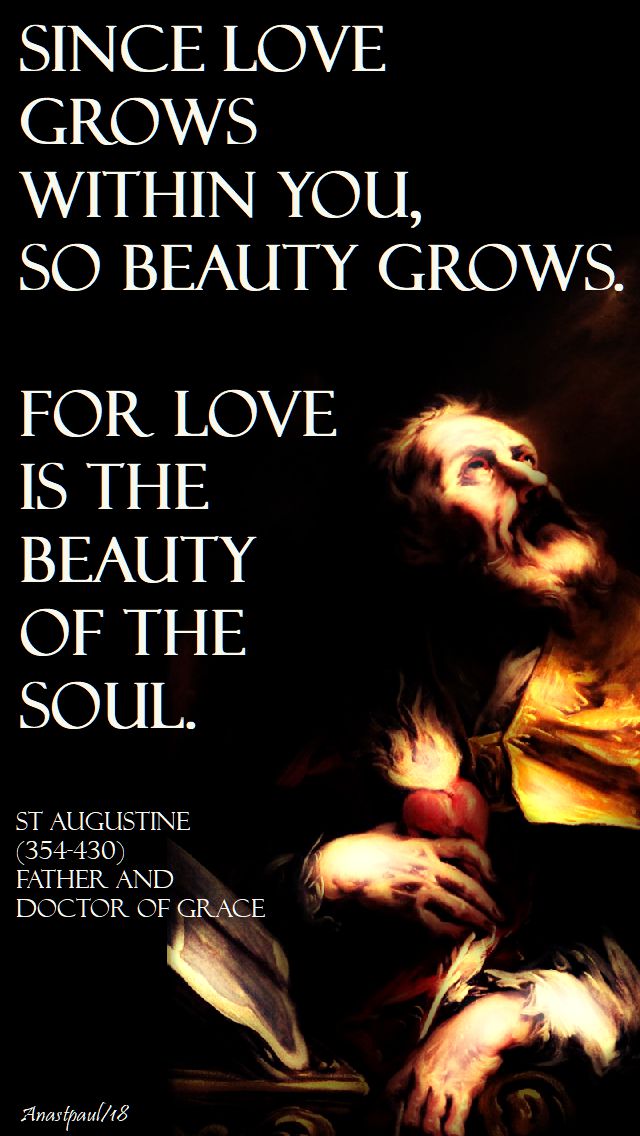
Since love grows within you, so beauty grows. For love is the beauty of the soul.
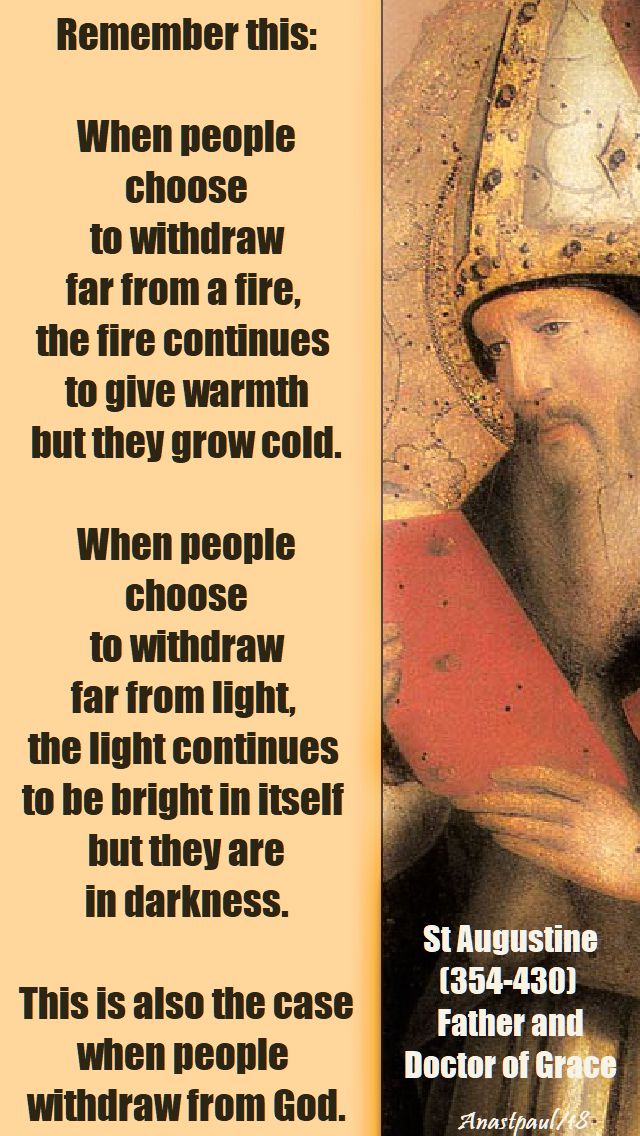
Remember this. When people choose to withdraw far from a fire, the fire continues to give warmth but they grow cold. When people choose to withdraw far from light, the light continues to be bright in itself but they are in darkness. This is also the case when people withdraw from God.
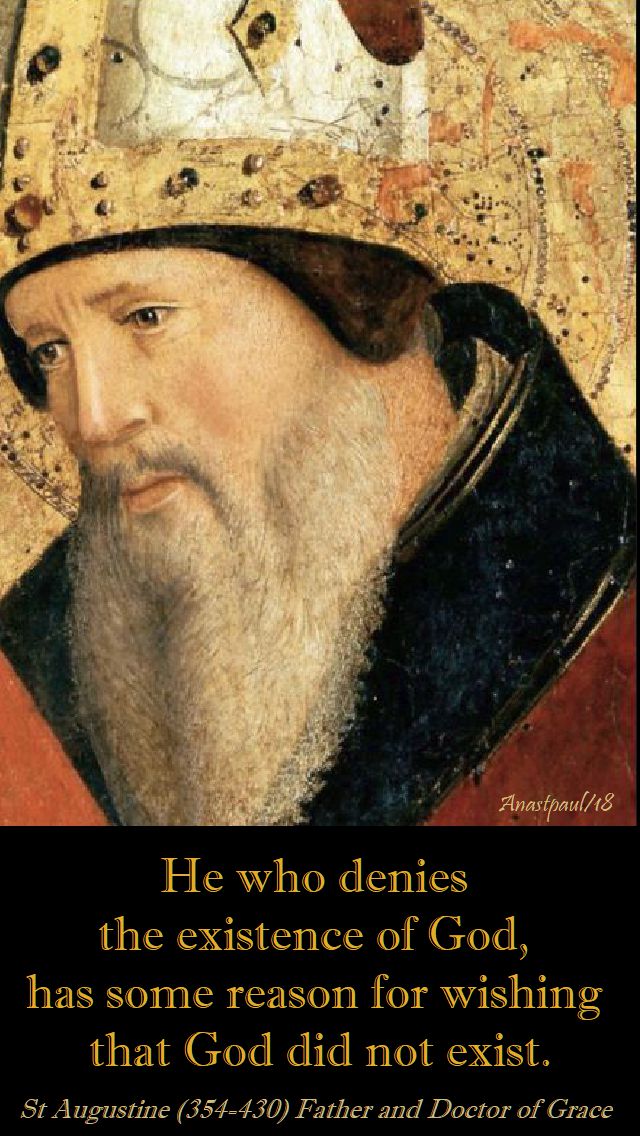
He who denies the existence of God, has some reason for wishing that God did not exist
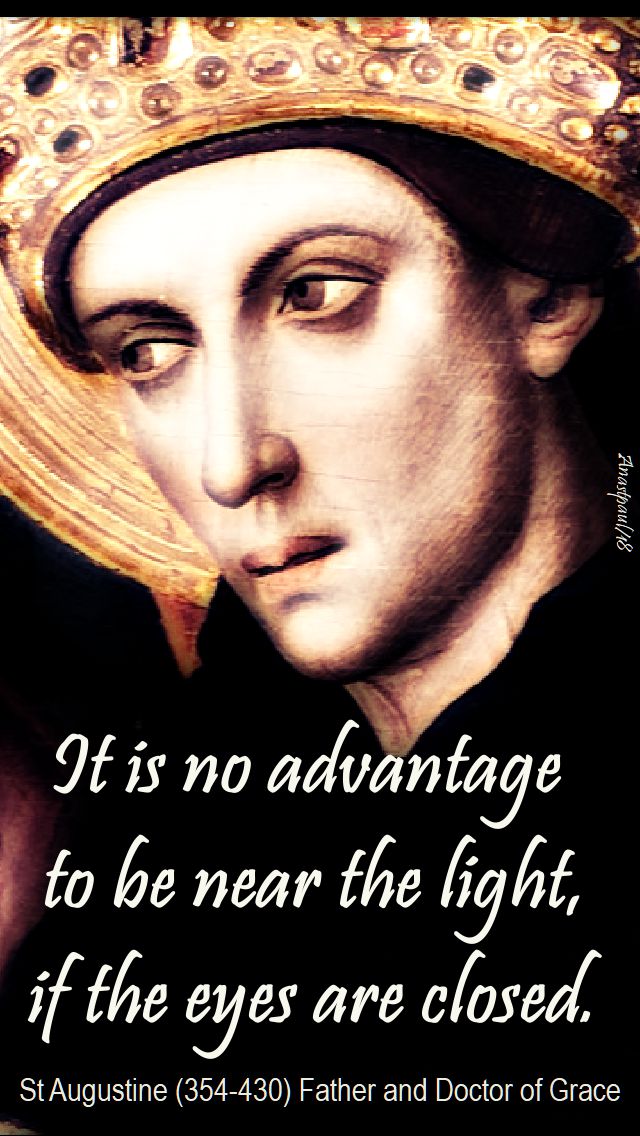
It is no advantage to be near the light, if the eyes are closed.
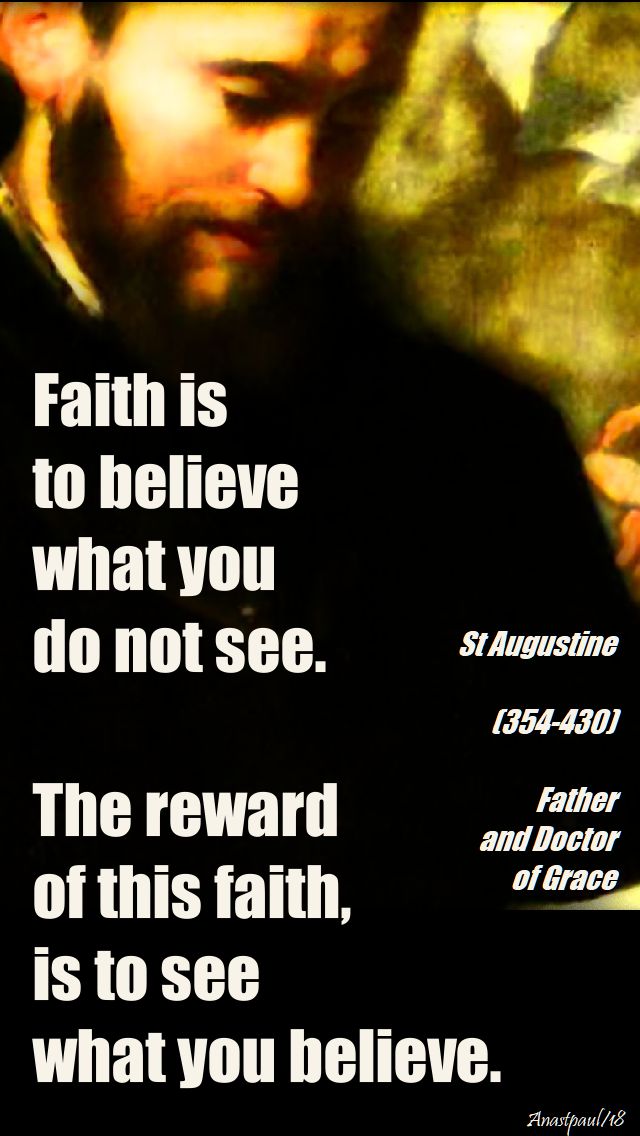
Faith is to believe what you do not see. The reward of this faith, is to see what you believe.
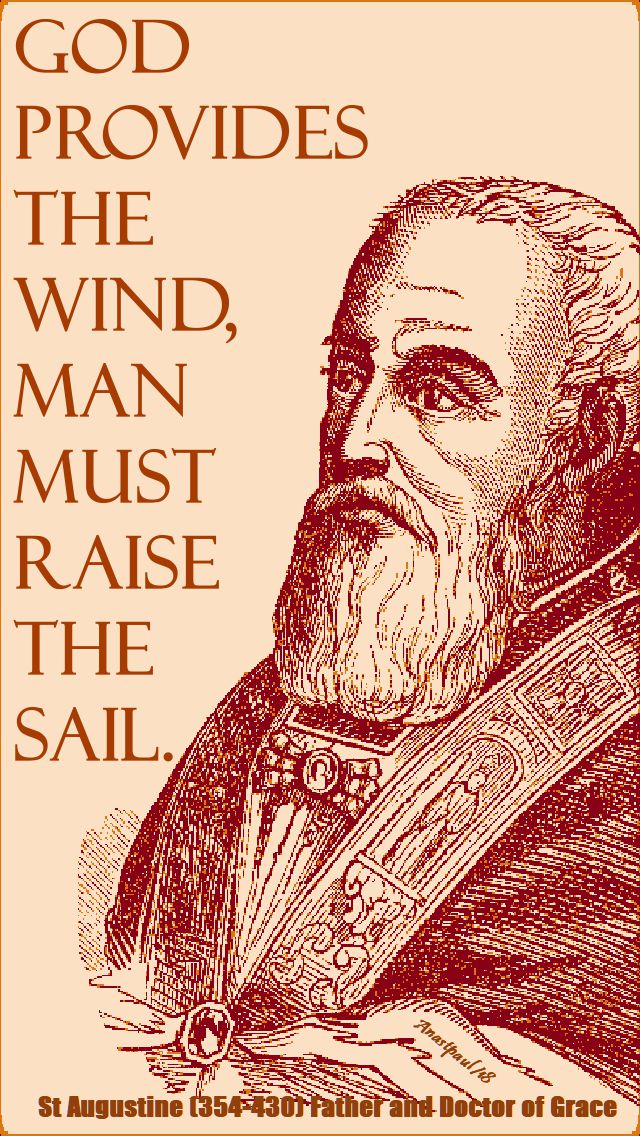
God provides the wind, man must raise the sail.
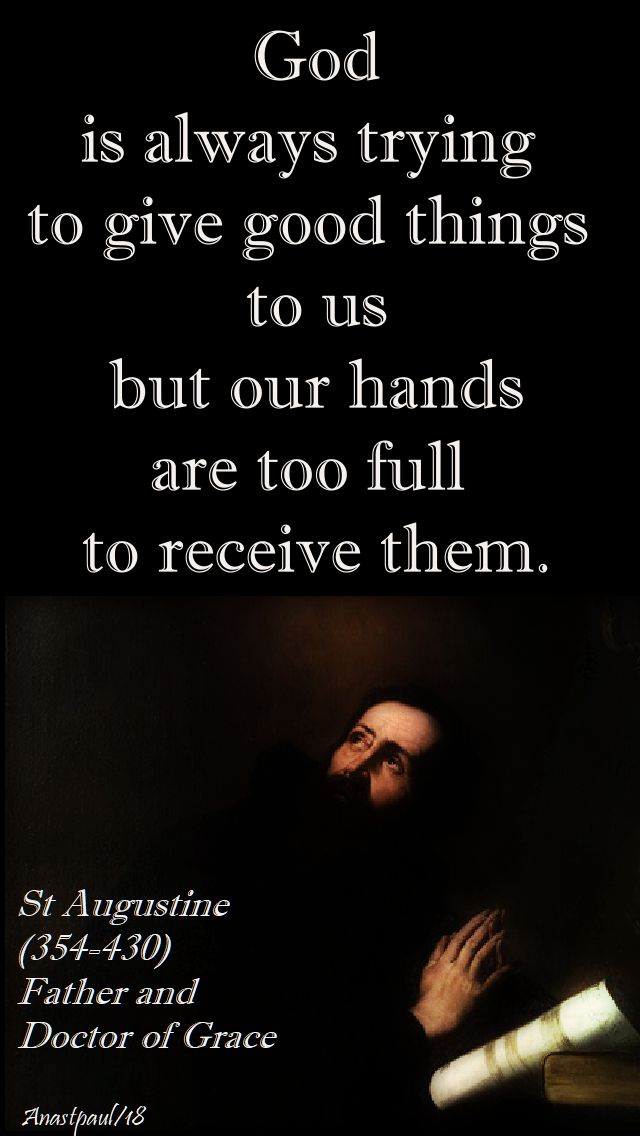
God is always trying to give good things to us but our hands are too full to receive them.
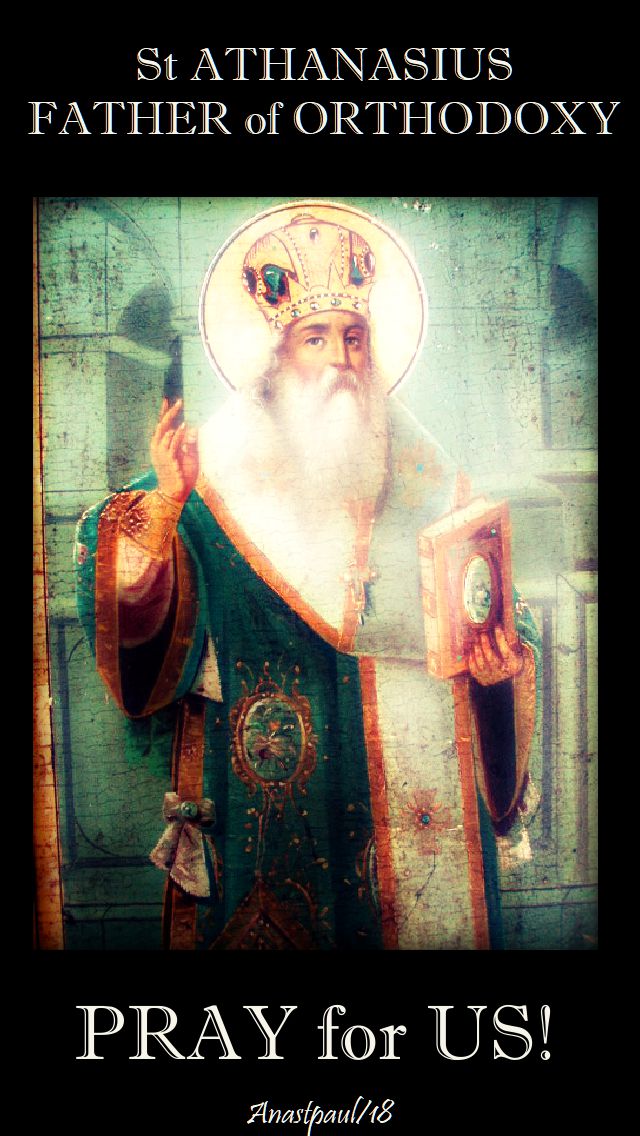
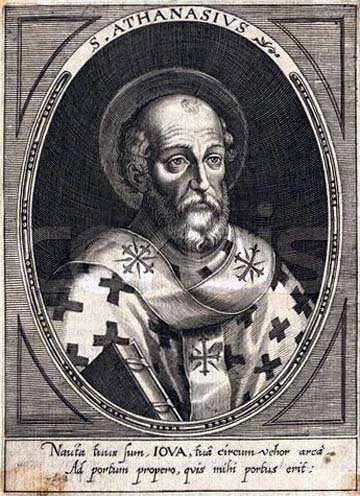
Thought for the Day – 2 May – Wednesday of the Fifth Week of Easter and the Memorial of St Athanasius (c295-373) – Father and Doctor of the Church “The Father of Orthodoxy”
Athanasius suffered many trials while he was bishop of Alexandria. He was given the grace to remain strong against what probably seemed at times to be insurmountable opposition. Athanasius lived his office as bishop completely. He defended the true faith for his flock, regardless of the cost to himself. In today’s world we are experiencing this same call to remain true to our faith, no matter what.
Quote/s of the Day – 2 May – Wednesday of the Fifth Week of Easter and the Memorial of St Athanasius (c295-373) – Father and Doctor of the Church
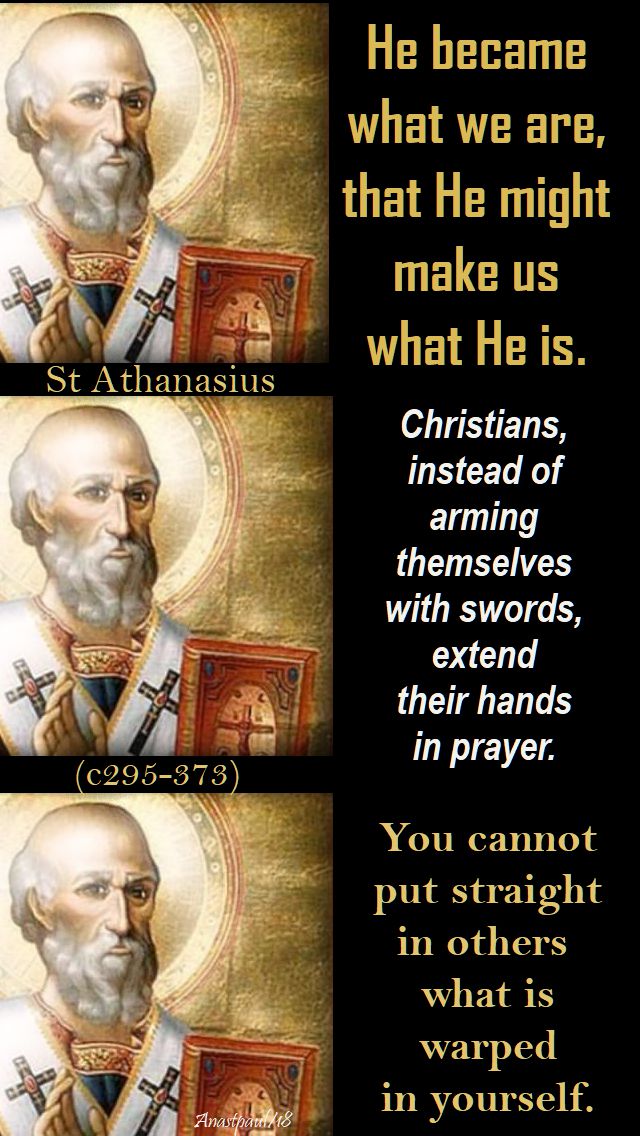
“He became what we are, that He might make us what He is.”
“You cannot put straight in others what is warped in yourself.”
“Christians, instead of arming themselves with swords, extend their hands in prayer.”
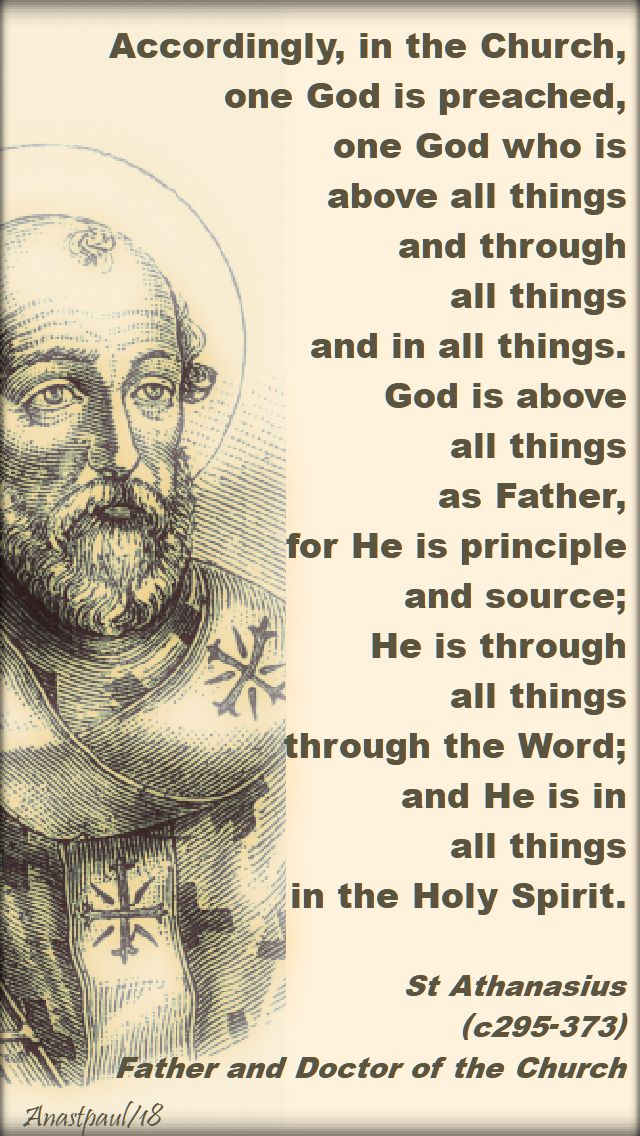
“Accordingly, in the Church, one God is preached, one God who is above all things and through all things and in all things. God is above all things as Father, for He is principle and source; He is through all things through the Word; and He is in all things in the Holy Spirit.”
Our Morning Offering – 2 May “Mary’s Month!” – Wednesday of the Fifth Week of Easter and the Memorial of St Athanasius (c295-373) Father and Doctor of the Church
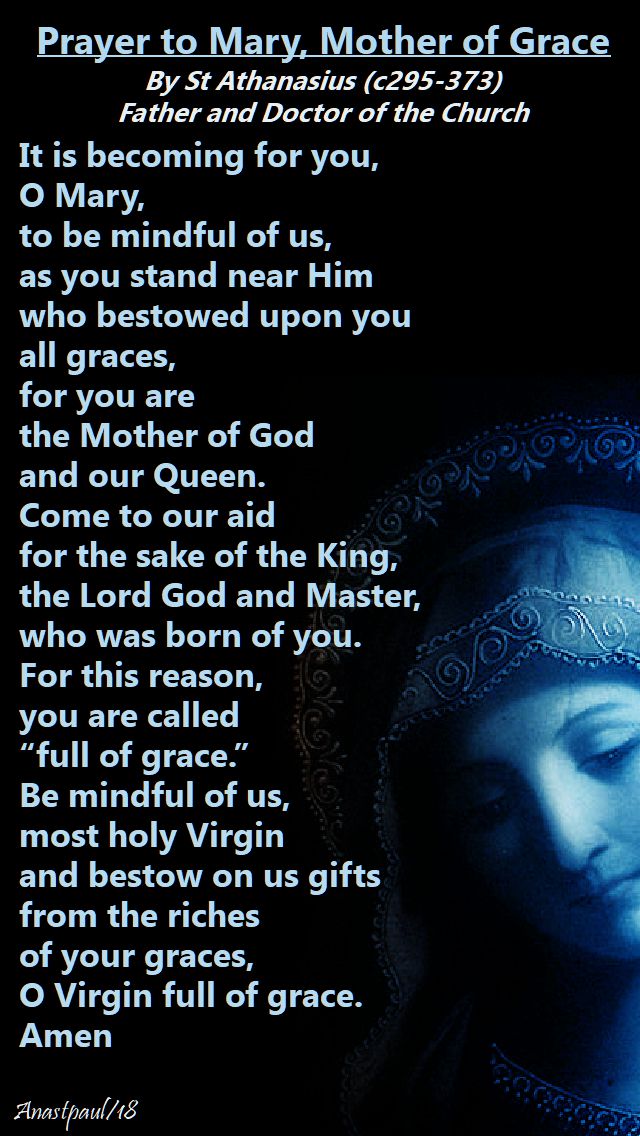
Prayer to Mary, Mother of Grace By St Athanasius (297-373) Father and Doctor of the Church
It is becoming for you, O Mary,
to be mindful of us,
as you stand near Him
who bestowed upon you all graces,
for you are the Mother of God and our Queen.
Come to our aid for the sake of the King,
the Lord God and Master,
who was born of you.
For this reason,
you are called “full of grace.”
Be mindful of us,
most holy Virgin and bestow on us gifts
from the riches of your graces,
O Virgin full of grace.
Amen
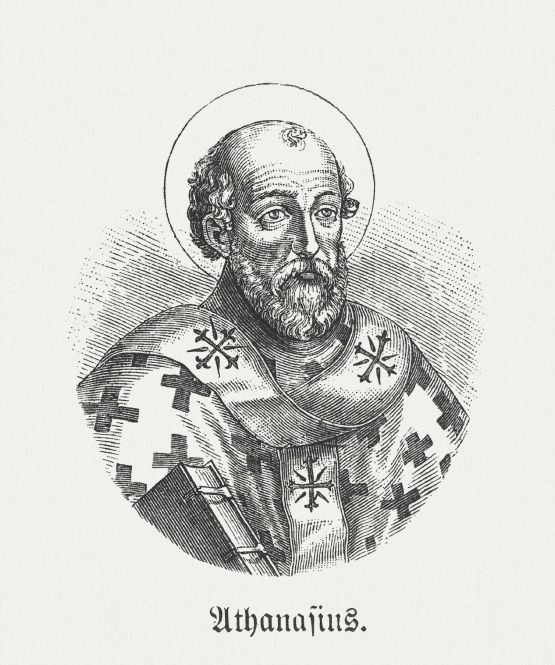
Saint of the Day – 2 May – St Athanasius (c295-373) –Confessor, Bishop of Alexandria, Father and Doctor of the Church – “Father of Orthodoxy”. St Athanasius, Great Defender of the orthodox faith, throughout his life opposed the Arian heresy. By denying the Godhead of the Word, the Arians turned Christ into a mere man, only higher in grace than others in the eyes of God. St Athanasius took part in the Council of Nicea in 325 and until the end remained a champion of the faith, as it was defined by the Council. In him, the Church venerates one of her Great Fathers and Doctors. He was subjected to persecutions for upholding the true teaching concerning the person of Christ and was sent into exile from his See no less than five times. He died at Alexandria in 373 after an Episcopate of forty-six years.
St Athanasius atrue champion of orthodoxy! He did not die a martyr but his life was martyrdom in the truest sense. Athanasius was the Church’s greatest hero in the battle against Arianism. Even as a young deacon at the Council of Nicea (325), he was recognised as “Arius’ ablest enemy” and the foremost defender of the Church’s faith. After the death of his Bishop (328), “the entire Catholic congregation with one accord, as one soul and body, voiced the wish of the dying Bishop Alexander, that Athanasius should succeed him. Everyone esteemed him as a virtuous, holy man, an ascetic, a true bishop.“
There followed fifty years of constant conflict. Under five Emperors and by exile on five different occasions, he gave testimony to the truth of the Catholic position. His allegiance to the Church never wavered, his courage never weakened. As consolation in the face of horrendous calumnies and cruel persecution, Athanasius looked to the unwavering love of his Catholic people. Even time brought no mitigation in Arian hatred. For five years he hid in a deep, dry cistern to be safe from their raging wrath and their attempts to assassinate him. The place was known only to one trusted friend who secretly supplied necessary food.
That Athanasius enjoyed God’s special protection should have been obvious to all. On one occasion when the Emperor’s assassins were pursuing him, Athanasius ordered the ship on which he was fleeing to double-back and sail upstream so that he might meet and by-pass his persecutors. Not recognising the boat upon meeting in semi-darkness, they naively asked whether the ship carrying Athanasius was still far ahead. Calmly and truthfully Athanasius himself called back, “He is not far from here.” So his persecutors kept sailing on in the same direction, allowing the Saint to complete his escape.
Preserved by Divine Providence through a lifetime of trial and danger, he finally died in his own quarters at Alexandria during the reign of the Emperor Valens (373). Athanasius enriched Christian literature with many important works, some pointed toward piety and edification, others polemical and dogmatic in nature. He ruled the Church of Alexandria for forty-six years…..Excerpted from The Church’s Year of Grace, Pius Parsch
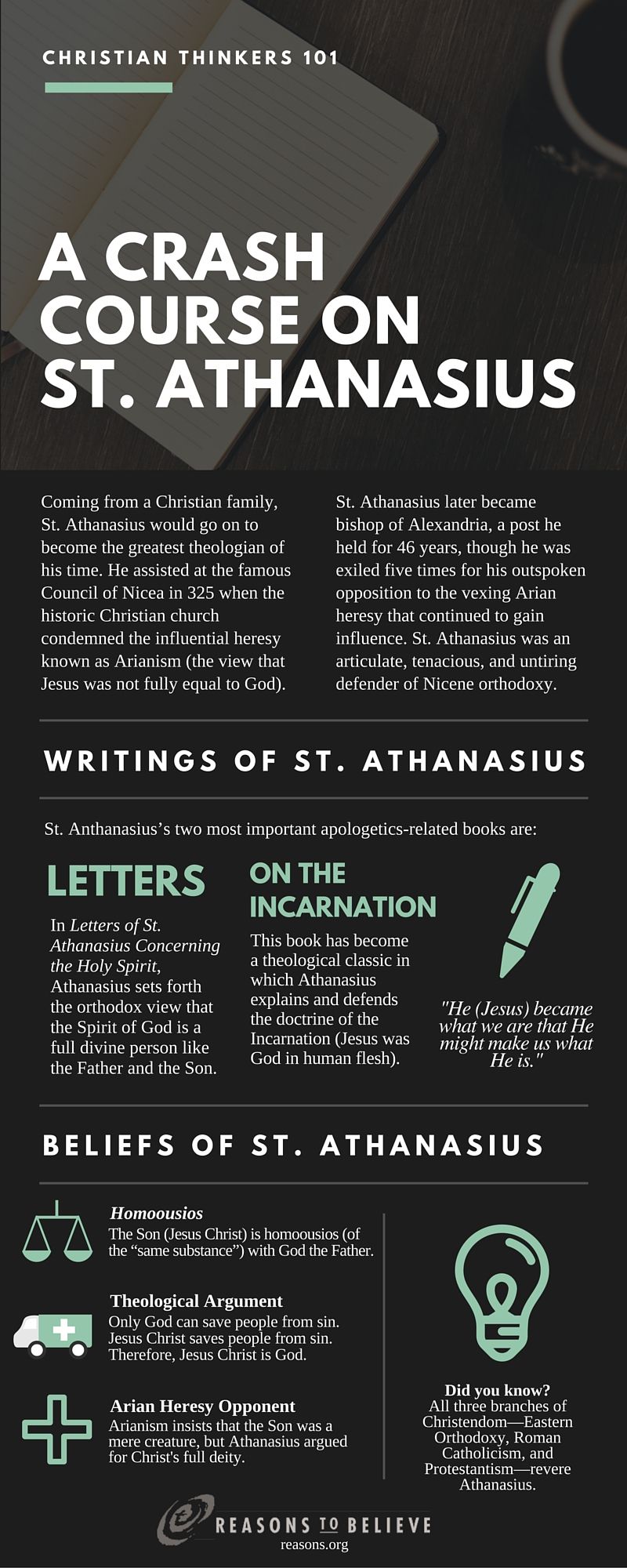
What Did St. Athanasius Write? – Among several works, St Athanasius’ two most important apologetics-related books are On the Incarnation and Letters of St Athanasius Concerning the Holy Spirit. The first book has become a theological classic in which Athanasius explains and defends the doctrine of the Incarnation (Jesus was God in human flesh). In the second work, he both critiques the heretical view that the Holy Spirit is a mere creature and sets forth the orthodox view that the Spirit of God is a full divine person like the Father and the Son.
What Did St. Athanasius Believe? – Athanasius’ three most important ideas or arguments for historic Christianity are the following: St Athanasius affirmed Nicene orthodoxy and argued that the Son (Jesus Christ) is homoousios (of the “same substance”) with God the Father. St. Athanasius tied the Incarnation and atonement together in his theological reasoning. He is known for formulating the following theological argument: Only God can save people from sin. Jesus Christ saves people from sin. Therefore, Jesus Christ is God. At a time when the Arian heresy was at its most influential, the Bishops who sided with Arianism taunted Athanasius with the words “The world is against you Athanasius.” But Athanasius defiantly responded: “Athanasius contra mundum.” (“No. It’s Athanasius against the world.”)While Arianism insisted that the Son was a mere creature, Athanasius argued for Christ’s full deity.
Bl John Henry Newman described him as a “principal instrument, after the Apostles, by which the sacred truths of Christianity have been conveyed and secured to the world”.[Letters..]
St Athanasius (c295-373) – Father and Doctor of the Church (Memorial)
—
St Alpin de Châlons
Bl Bernard of Seville
St Bertinus the Younger
Bl Boleslas Strzelecki
Bl Conrad of Seldenbüren
St Cyriacus of Pamphylia
St Eugenius of Africa
St Exsuperius of Pamphylia
St Felix of Seville
St Fiorenzo of Algeria
St Gennys of Cornwall
St Germanus of Normandy
St Gluvias
St Guistano of Sardinia
St José María Rubio y Peralta
St Joseph Luu
Bl Juan de Verdegallo
St Longinus of Africa
St Neachtain of Cill-Uinche
St Theodulus of Pamphylia
St Ultan of Péronne
St Vindemialis of Africa
St Waldebert of Luxeuil
St Wiborada of Saint Gall
Bl William Tirry
St Zoe of Pamphylia
—
Martyrs of Alexandria – 4 saints: A group of Christians marytred together in the persecutions of Diocletian. We know little more than their names – Celestine, Germanus, Neopolus and Saturninus. 304 in Alexandria, Egypt
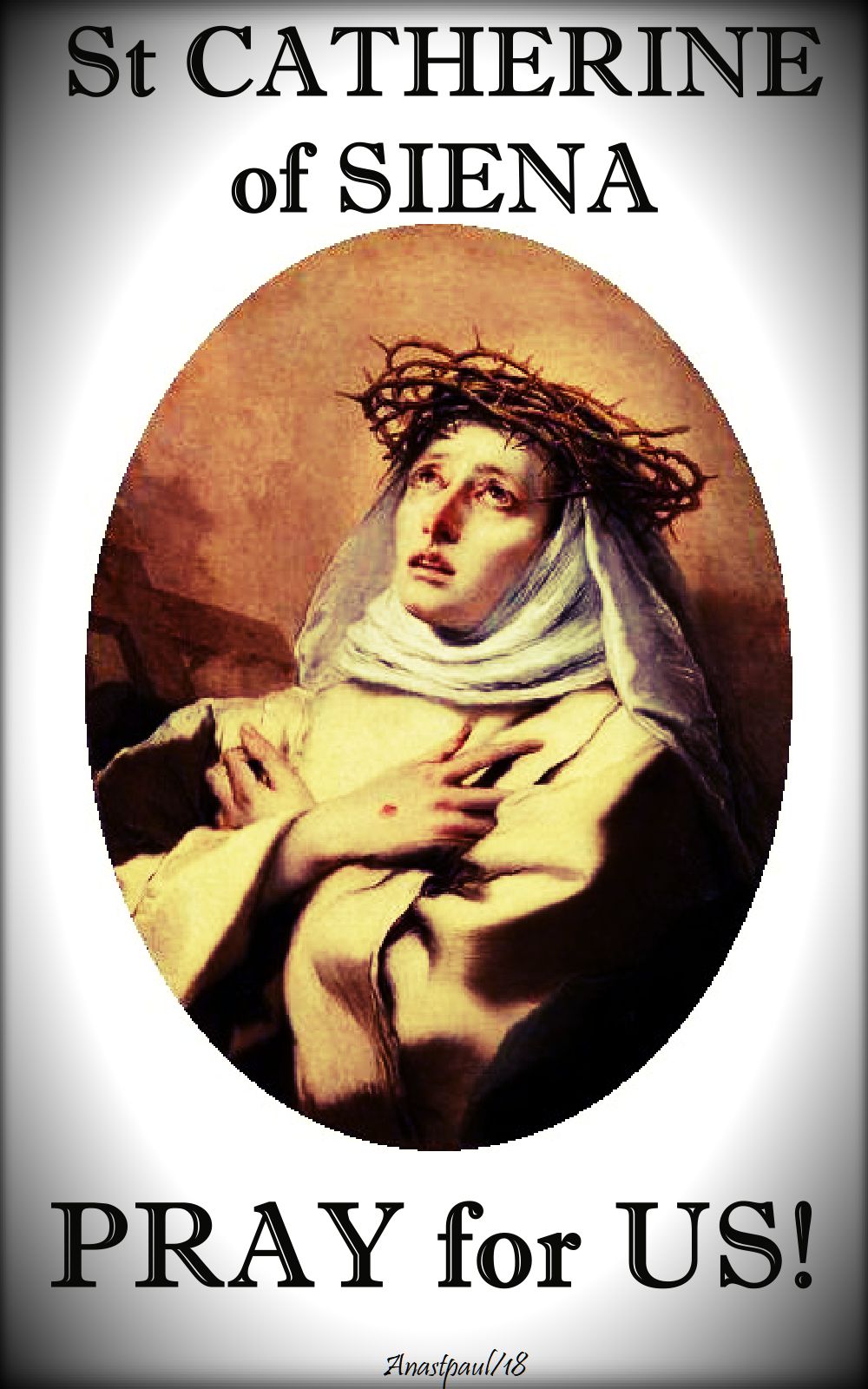
Thought for the Day – 29 April – Fifth Sunday of Eastertide and the Memorial of St Catherine of Siena (1347-1380) Doctor of the Church
Catherine of Siena is one of the most remarkable figures of the fourteenth century and had an influence far beyond her holiness of life. She took part in the politics of both Church and State and was a beacon of light in a very difficult time.
The mystical experiences that were to last throughout her whole life and an intimacy with her Saviour that transformed her whole existence began when she was but six years old. She grew up, known for cheerfulness and merriment, with no indication of the astonishing role she was to play in the work of the Church.
In 1364, she became a member of the Third Order of St Dominic and from this time her influence began to grow in Siena as she gathered around her a circle of followers. She began dictating letters to this circle and to take part in public affairs. (She had never learnt to write, which was not uncommon for women in that era). In 1374, she began to interest herself in furthering a crusade against the Turks and in the return of the Pope from Avignon to Rome. In 1376, she went to Avignon to urge Pope Gregory XI to return to Rome. With her encouragement, he did but died shortly thereafter. In 1375, whilst on a trip to Pisa, she received the Stigmata.
Pope Gregory’s successor, Urban VI, so alienated the Cardinals who elected him, that they decided to elect another pope. This was the beginning of the Great Western Schism in which two and later three, popes, divided the allegiance of Christendom. Catherine was shattered by this division in the Church and went to Rome to work for the reunification of the Church.
Burdened with sorrow and offering herself for the unity of the Church, Catherine died in Rome on 29 April 1380. She left a huge collection of letters as well as her chief work, The Dialogues.
By the sheer force of her personality, St Catherine converted thousands and the mere sight of her would convert hardened sinners. We may not have her personality but we can reach into the lives of others and influence them for good. We cannot have warmth ourselves, without giving it to others. “Then they said to each other, ‘Did not our hearts burn within us as he talked to us on the road and explained the scriptures to us?’...Luke 24:32
Quote/s of the Day – 29 April – Fifth Sunday of Eastertide and the Memorial of St Catherine of Siena (1347-1380) Doctor of the Church
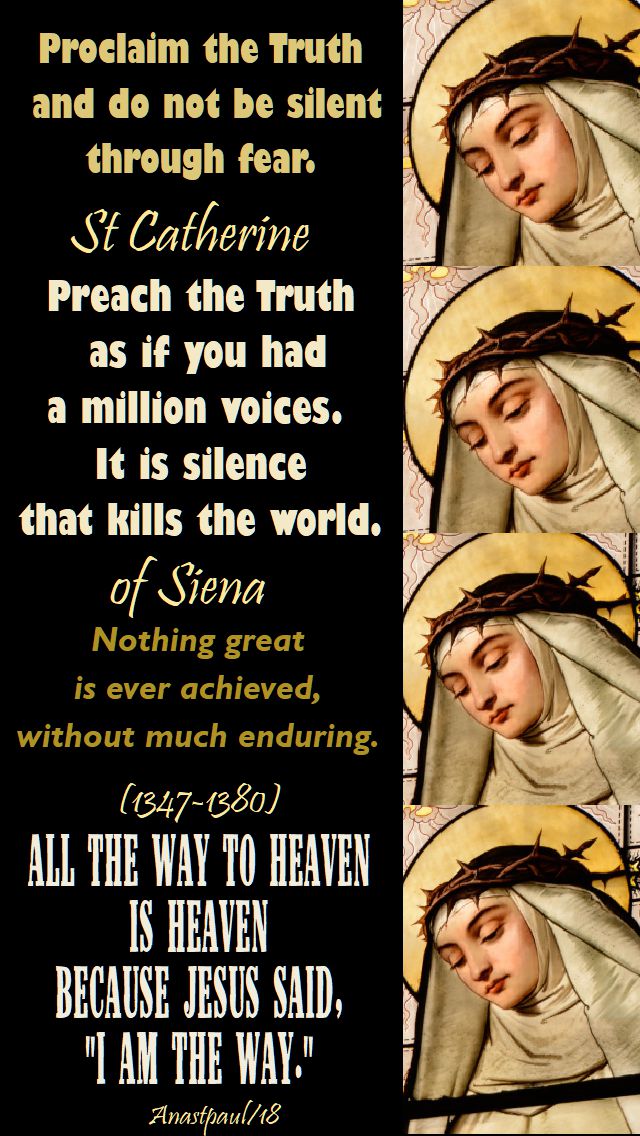
“Proclaim the Truth and do not be silent through fear.”
“Preach the Truth as if you had a million voices. It is silence that kills the world.”
“Nothing great is ever achieved, without much enduring.”
“All the way to heaven is heaven because Jesus said, “I am the way.”
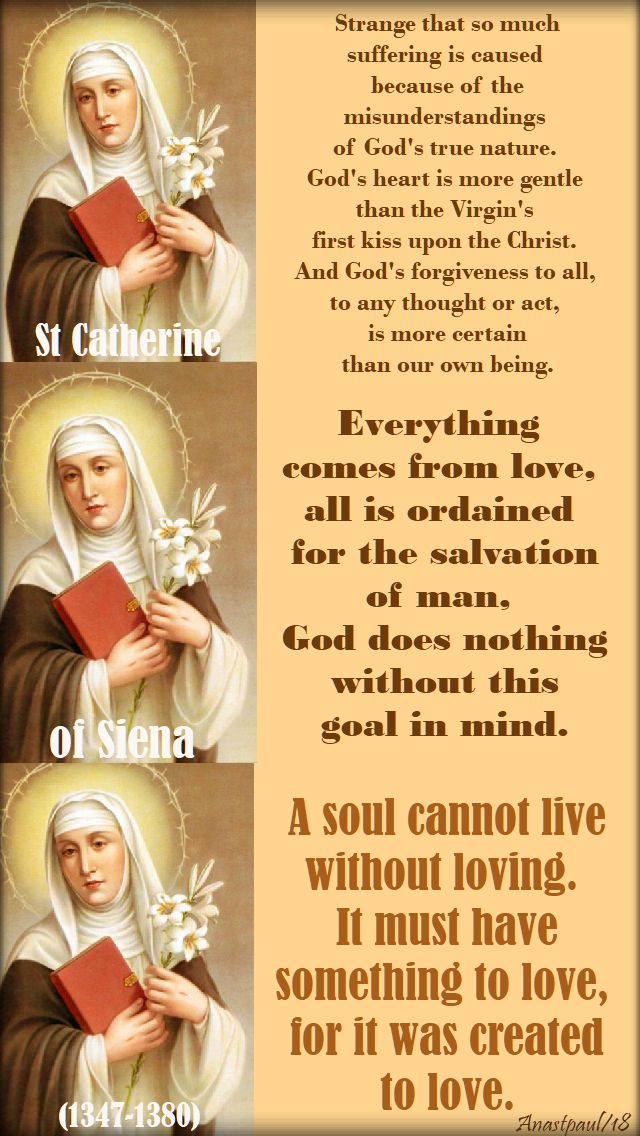
“Strange that so much suffering is caused because of the misunderstandings of God’s true nature. God’s heart is more gentle than the Virgin’s first kiss upon the Christ. And God’s forgiveness to all, to any thought or act, is more certain than our own being.”
“Everything comes from love, all is ordained for the salvation of man, God does nothing without this goal in mind.”
“A soul cannot live without loving. It must have something to love, for it was created to love.”
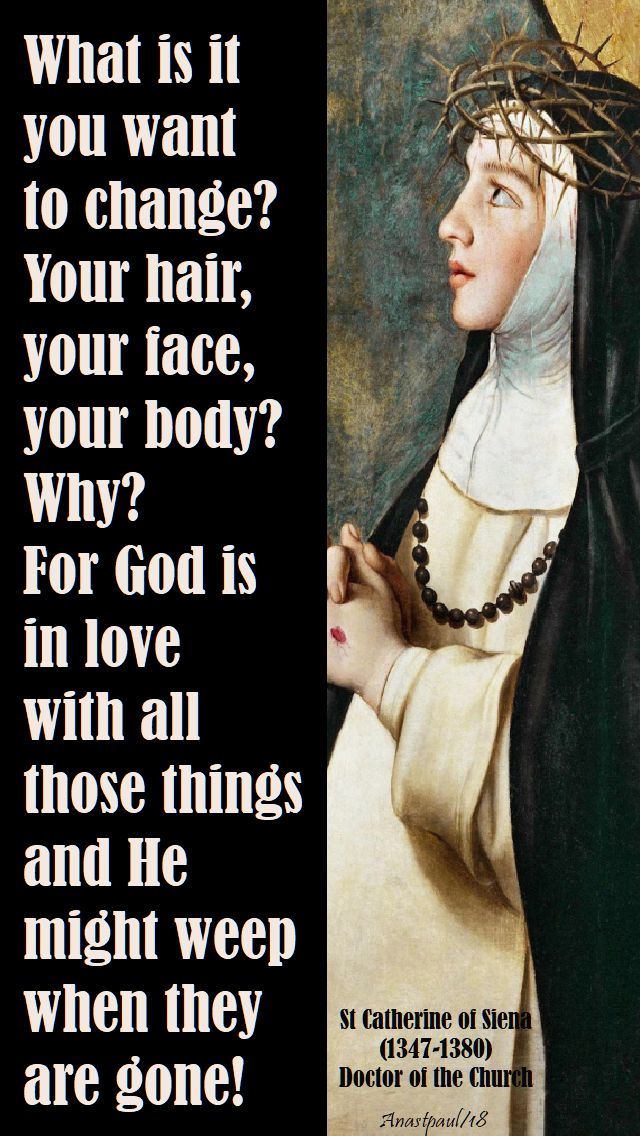
“What is it you want to change? Your hair, your face, your body? Why? For God is in love with all those things and He might weep when they are gone!”
St Catherine of Siena (1347-1380) Doctor of the Church
One Minute Reflection – 29 April – Fifth Sunday of Eastertide and the Memorial of St Catherine of Siena (1347-1380) Doctor of the Church
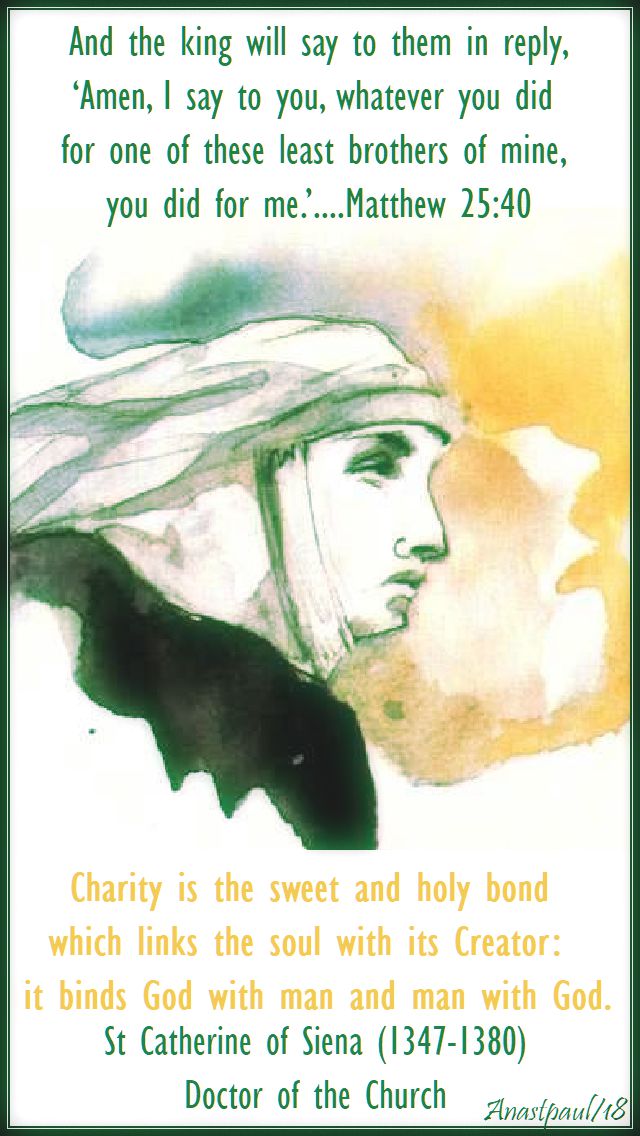
And the king will say to them in reply, ‘Amen, I say to you, whatever you did for one of these least brothers of mine, you did for me.’….Matthew 25:40
REFLECTION – “Charity is the sweet and holy bond which links the soul with its Creator: it binds God with man and man with God.”…. St Catherine of Siena
PRAYER – Almighty God, You made St Catherine of Siena, a contemplative lover of the Lord’s sufferings and an ardent servant of her neighbour and the Church. Grant that through her prayer, Your people may be united to Christ in His Mystery and true lovers of His sheep. May we live the commands He gave us and see His face in our neighbour. Through Jesus, our Lord, one God with You in the unity of the Holy Spirit, amen.
Our Morning Offering – 29 April – Fifth Sunday of Eastertide
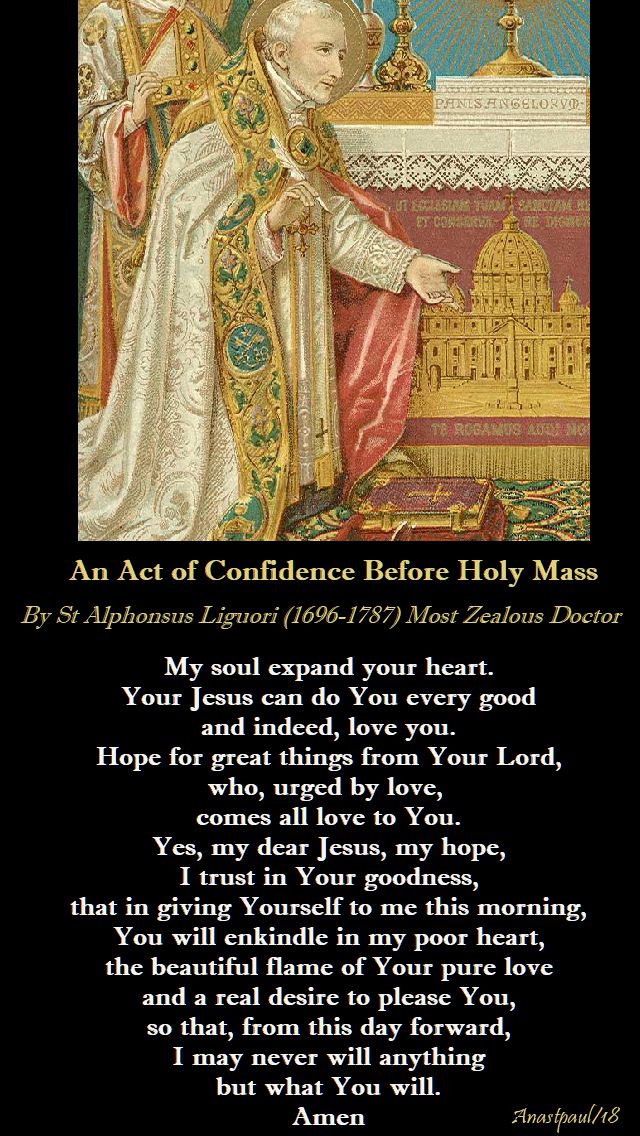
An Act of Confidence Before Holy Mass By St Alphonsus Liguori (1696-1787) Most Zealous Doctor
My soul expand your heart.
Your Jesus can do You every good
and indeed, love you.
Hope for great things from Your Lord,
who, urged by love,
comes all love to You.
Yes, my dear Jesus, my hope,
I trust in Your goodness,
that in giving Yourself to me this morning,
You will enkindle in my poor heart,
the beautiful flame of Your pure love
and a real desire to please You,
so that, from this day forward,
I may never will anything
but what You will.
Amen
Saint of the Day – 29 April – St Catherine of Siena (1347-1380) Doctor of the Church, Virgin, Stigmatist, Mystic, Scholastic Philosopher and Theologian, Writer, Reformer, Adviser, Mediator, Dominican Tertiary. St Catherine was born Caterina Benincasa on 25 March 1347 at Siena, Tuscany, Italy and died on 29 April 1380 in Rome, Italy of a mysterious and painful illness which manifested itself suddenly and was never diagnosed. Her body was buried in the Dominican church of Santa Maria sopra Minerva in Rome. The first funerary monument was erected in 1380 by Blessed Raymond of Capua, her Relics were re-enshrined in 1430 and again in 1466, at the High Altar of the Church. She was Canonised in July 1461 by Pope Pius II.
Patronages – against bodily ills, against fire, against miscarriages, against sexual temptation, against sickness, firefighters, nurses, nursing services, people ridiculed for their piety, joint patron of Europe with St Benedict of Nursia, St Gertrude of Sweden, Sts Cyril & Methodius and St Edith Stein,3 Diocese, Siena, Joint Patron of Italy, with St Francis of Assisi, of Varazze, Italy.
Caterina Benincasa was born in Siena on 25 March 1347, the last of 25 children of the wealthy wool-dyer Jacopo Benincasa and Lapa di Puccio dé Piacenti.
At the age of six, Catherine received her first vision, near the Church of San Domenico. From this moment onwards the child began to follow a path of devotion, taking the oath of chastity only a year later. After initial resistance from her family, eventually her father gave in and left Catherine to follow her inclinations. In 1363, at just 15 years of age, Catherine donned the black cloak of the Dominican Tertiary sisters. In 1367 she began working tirelessly to help the sick at the hospital of Santa Maria della Scala.As her fame spread throughout Christendom, during a visit to the city of Pisa, Catherine received the stigmata from a wooden cross hanging in the Church of Santa Cristina. Her many travels abroad to act as mediator for the Papacy included a trip to Avignon, where she urged Pope Gregory to bring the Papal Court back to Rome from its exile in France.
On returning to Siena, Catherine founded the Monastery of Santa Maria degli Angeli in the castle of Belcaro. With the death of Pope Gregory XI in 1378, his successor Urban VI had to face strong opposition from a number of cardinals who had elected a second Pope with the name of Clement VII, thereby provoking what would later come to be termed the Great Schism of the West. Pope Urban VI called on Catherine to act as mediator with princes, politicians and members of the Church, with a view to legitimising his election.
In 1380, at just 33, Catherine died and was buried in the Rome church of Santa Maria Sopra Minerva. In 1461 Pope Pius II proclaimed her saint and in 1866 Pius IX included her as one of the patron saints of Rome. In 1939, along with St Francis of Assisi, St Catherine of Siena was proclaimed patron saint of Italy by Pope Pius XII.
In 1970 Paul VI conferred the title of Doctor of the Universal Church on Catherine and in 1999 she was proclaimed co-patron saint of Europe by Pope John Paul II.
Catherine of Siena is one of the outstanding figures of medieval Catholicism, by the strong influence she has had in the history of the papacy. She is behind the return of the Pope from Avignon to Rome and then carried out many missions entrusted by the pope, something quite rare for a simple nun in the Middle Ages.
Her writings—and especially The Dialogue, her major work which includes a set of treatises she would have dictated during ecstasies—mark theological thought. She is one of the most influential writers in Catholicism, to the point that she is one of only four women to be declared a doctor of the Church. This recognition by the Church consecrates the importance of her writings.
St Catherine’s home now known as The Sanctuary of St Catherine is a major Pilgrimage Site in Siena. The architecture of this sanctuary dedicated to Saint Catherine isn’t entirely original but the atmosphere definitely is. As are many of the objects that belonged to the saint. The rooms have been altered a lot since 1461, when the house was bought by the city of Siena and transformed into a museum. The idea wasn’t faithful architectural conservation but rather preserving her honour and memory, hence the eclectic art collection celebrating her life and work. It’s a sensitive place, full of religious passion and historical references and well reflects the extraordinary life of this woman.
The Oratory of the Bedroom: this houses the small cubicle where Catherine rested and prayed and the stone where the saint would lay her head. This space is connected with the first phase of Catherine’s life, where she would withdraw from the world in contemplation. Images below.
Church of the Crucifix: The church is home to the wooden crucifix from which Saint Catherine received the stigmata, an event which took place in Pisa, where Catherine had gone in 1375 to persuade the Lords of the city to shun the anti-papal league. The stigmata remained visible only to the Saint for the rest of her life, miraculously appearing at the moment of her death.
Abbots of Cluny: A feast that recognizes the great and saintly early abbots of Cluny Abbey:
• Saint Aymardus of Cluny
• Saint Berno of Cluny
• Saint Hugh of Cluny
• Saint Mayeul
• Saint Odilo of Cluny
• Saint Odo of Cluny
• Saint Peter the Venerable
—
St Antonius Kim Song-u
St Ava of Denain
St Daniel of Gerona
St Dichu
St Endellion of Tregony
St Fiachan of Lismore
St Hugh of Cluny
St Gundebert of Gumber
St Joseph Benedict Cottolengo
St Paulinus of Brescia
St Peter Verona
Bl Robert Gruthuysen
St Senan of Wales
St Severus of Naples
St Theoger
St Torpes of Pisa
St Tychicus
St Wilfrid the Younger
—
Martyrs of Cirta: A group of clergy and laity martyred together in Cirta, Numidia (in modern Tunisia) in the persecutions of Valerian. They were – Agapius, Antonia, Emilian, Secundinus and Tertula, along with a woman and her twin children whose names have not come down to us.
Martyrs of Corfu: A gang of thieves who converted while in prison, brought to the faith by Saint Jason and Saint Sosipater who were had been imprisoned for evangelizing. When the gang announced their new faith, they were martyred together. They were – Euphrasius, Faustianus, Insischolus, Januarius, Mammius, Marsalius and Saturninus. They were boiled in oil and pitch in the 2nd century on the Island of Corcyra (modern Corfu, Greece.
Also known as:
• Martyrs of Corcyra
• Seven Holy Thieves
• Seven Holy Robbers
• Seven Robber Saints
Quote/s of the Day – 27 April – Friday of the Fourth Week of Eastertide
“Speaking of: Sin and Suffering”
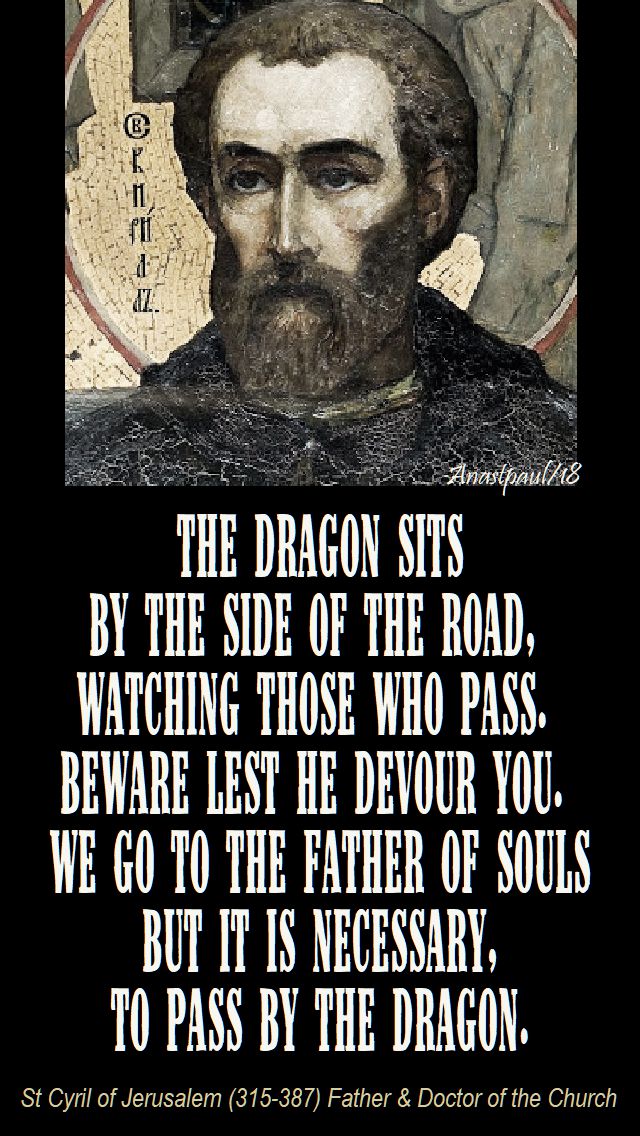
“The dragon, sits by the side of the road, watching those who pass. Beware lest he devour you. We go to the Father of Souls but it is necessary, to pass by the dragon.”
St Cyril of Jerusalem (315-387) Father & Doctor of the Church
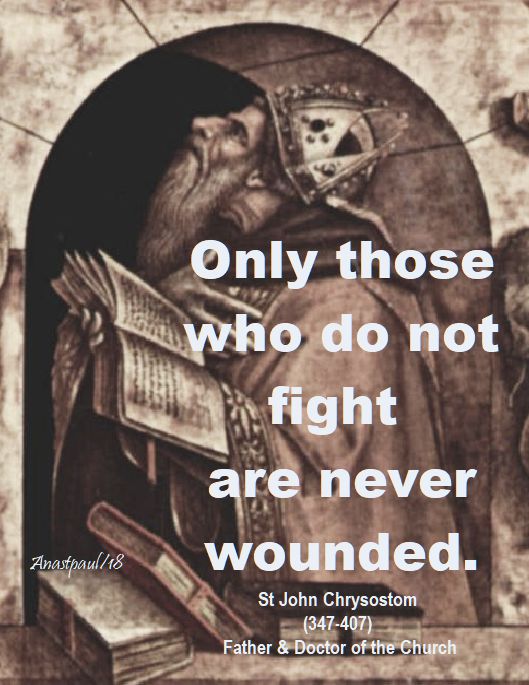
“Only those who do not fight are never wounded.”
St John Chrysostom (347-407) Father & Doctor of the Church
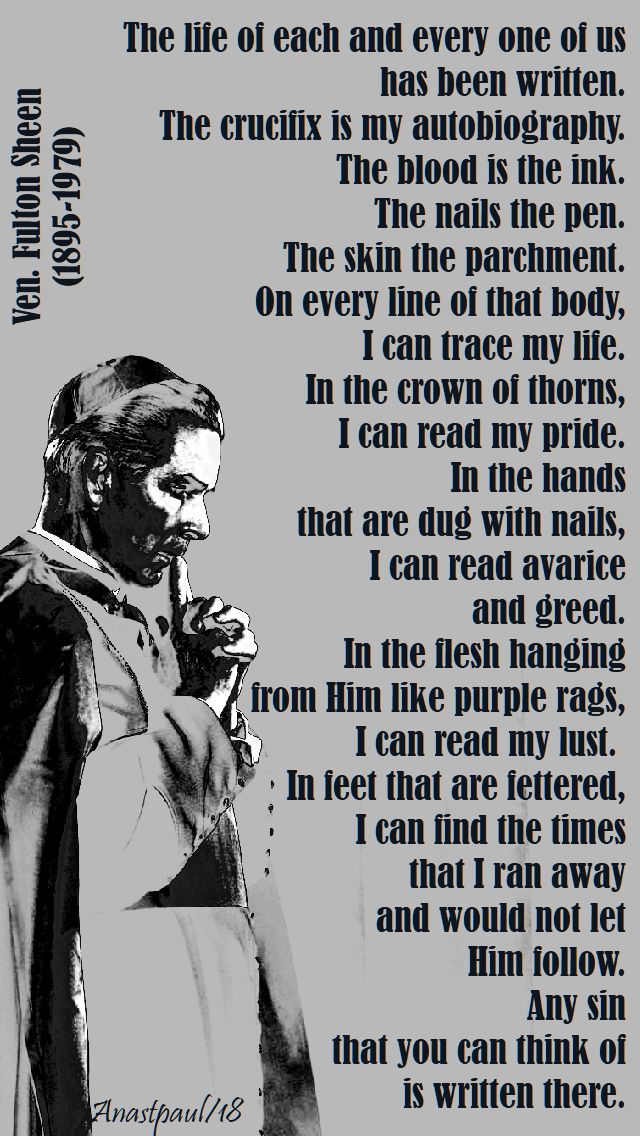
“The life of each and every one of us has been written. The crucifix is my autobiography. The blood is the ink. The nails the pen. The skin the parchment. On every line of that body, I can trace my life. In the crown of thorns I can read my pride. In the hands that are dug with nails, I can read avarice and greed. In the flesh hanging from him like purple rags, I can read my lust. In feet that are fettered, I can find the times that I ran away and would not let Him follow. Any sin that you can think of is written there.”
Venerable Archbishop Fulton Sheen (1895-1979)
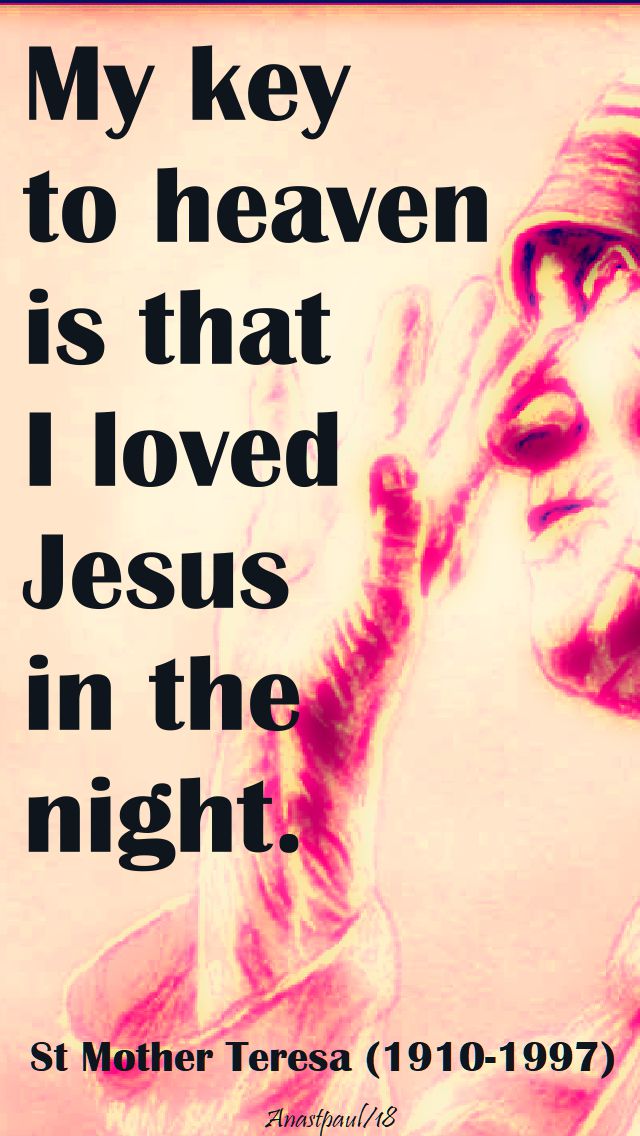
“My key to heaven is that I loved Jesus in the night.”
Our Morning Offering – 27 April – Friday of the Fourth Week of Eastertide and the Feast of Our Lady of Montserrat (718)
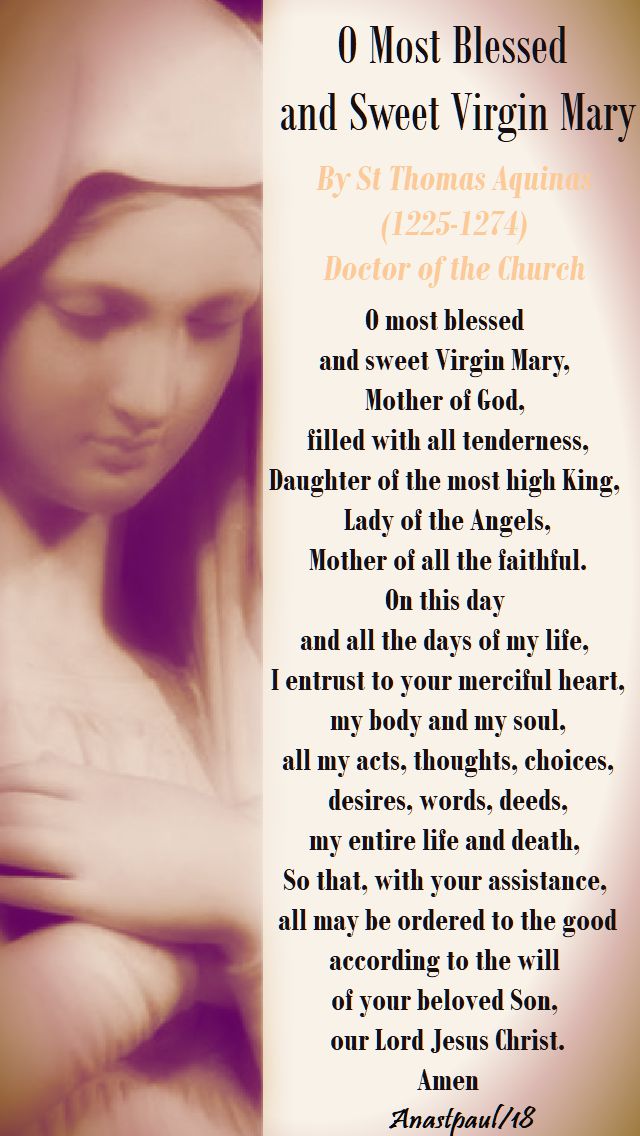
O Most Blessed and Sweet Virgin Mary By St Thomas Aquinas (1225-1274) Doctor of the Church
0 most blessed and sweet Virgin Mary,
Mother of God, filled with all tenderness,
Daughter of the most high King,
Lady of the Angels,
Mother of all the faithful,
On this day and all the days of my life,
I entrust to your merciful heart,
my body and my soul,
all my acts, thoughts, choices,
desires, words, deeds,
my entire life and death,
So that, with your assistance,
all may be ordered to the good
according to the will of your beloved Son,
our Lord Jesus Christ.
Amen
Quote/s of the Day – 25 April – Wednesday of the Fourth Week of Easter and the Feast of St Mark the Evangelist
Speaking of: Being Catholic
“I would not believe in the Gospel, had not the authority of the Catholic Church already moved me.”
St Augustine (354-430) Father & Doctor
“In her voyage, across the ocean of this world, the Church is like a great ship being pounded by the waves of life’s different stresses. Our duty is not to abandon ship but to keep her on her course.”
St Boniface (672-754) Father & Martyr
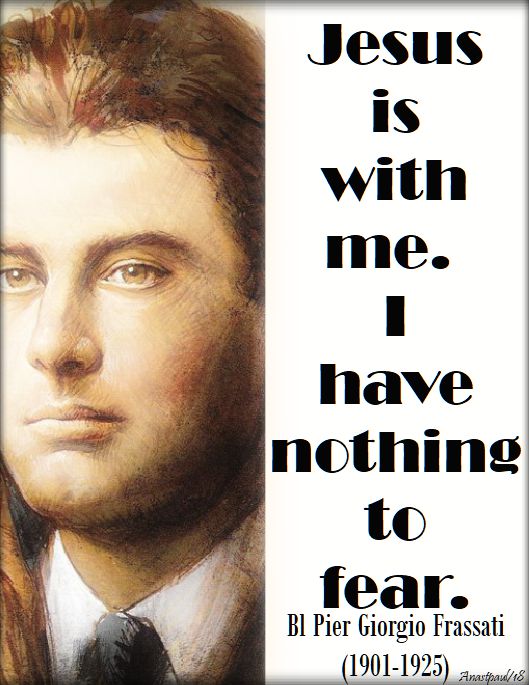
“Jesus is with me. I have nothing to fear.”
Blessed Pier Giorgio Frassati (1901-1925)
“The Jesus of the Gospels is surely not convenient for us.”
“The Jesus who makes everything okay for everyone is a phantom, a dream, not a real figure…”
Pope Benedict XVI
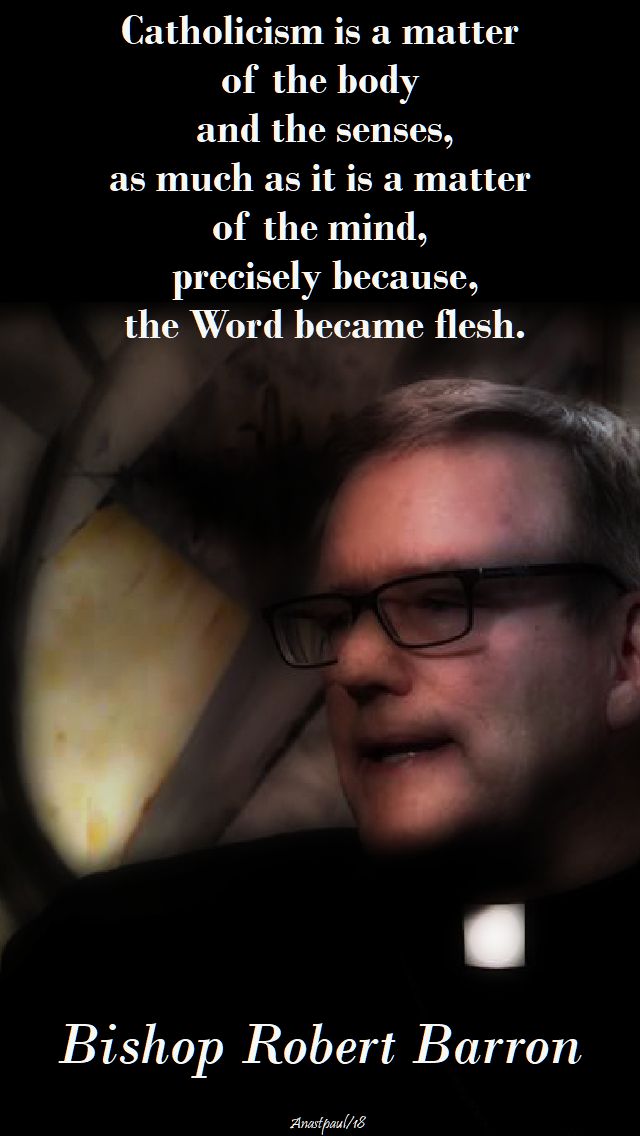
“Catholicism is a matter of the body and the senses, as much as it is a matter of the mind, precisely because, the Word became flesh.”
“Easter is an earthquake, an explosion. If you see it as less than that, you’re not getting it.”
Bishop Robert Barron
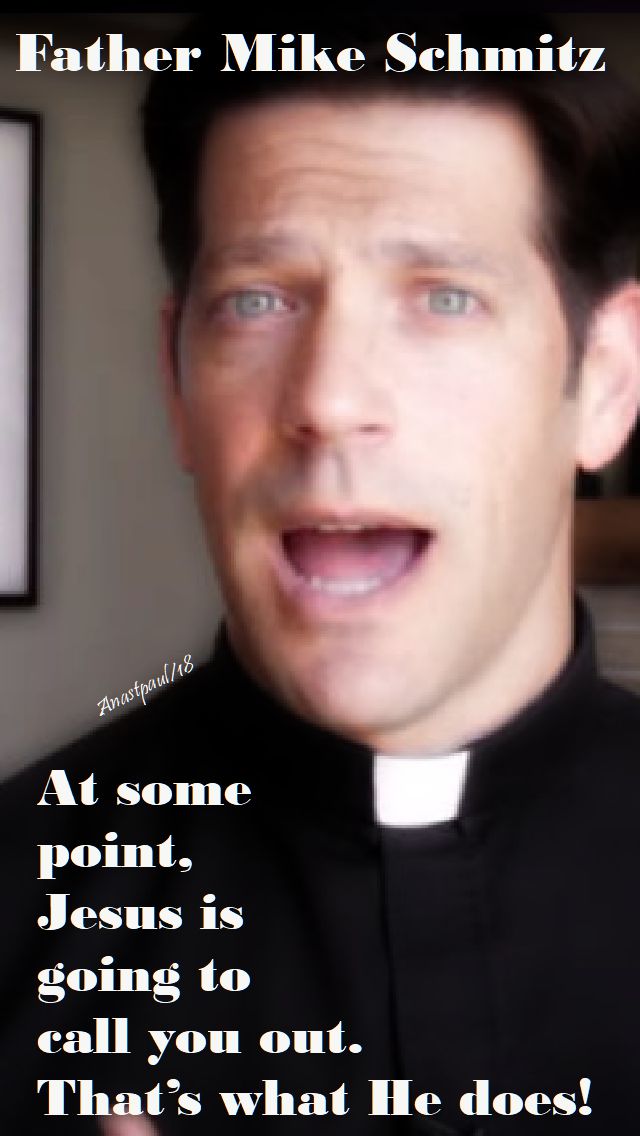
“At some point, Jesus is going to call you out. That’s what He does.”
Our Morning Offering – 25 April – Wednesday of the Fourth Week of Easter
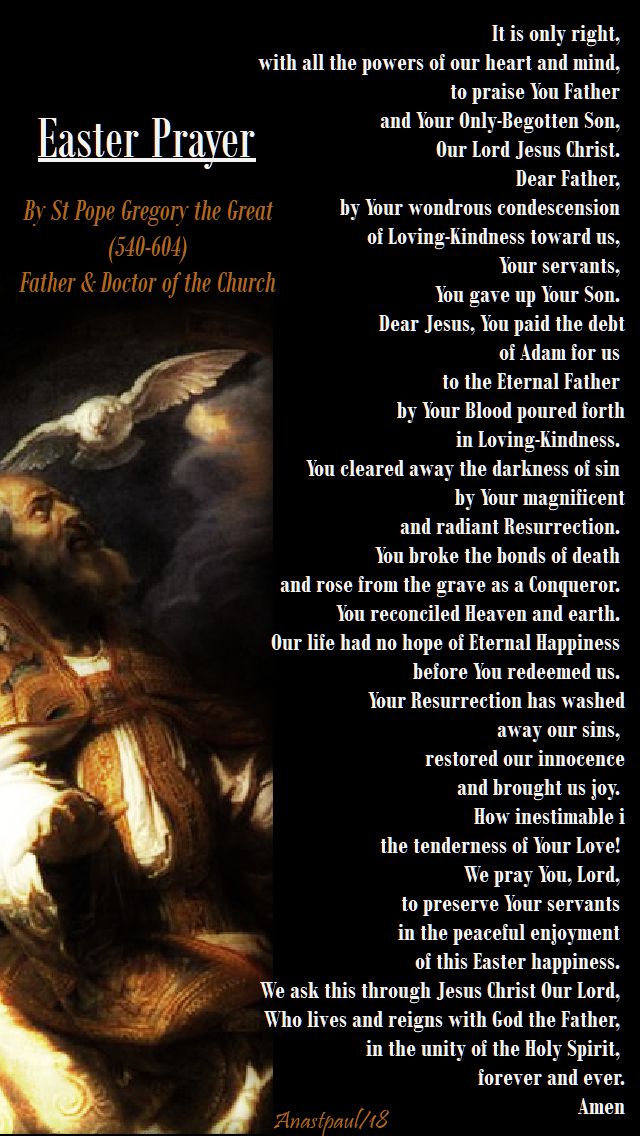
Easter Prayer By St Pope Gregory the Great (540-604) Father & Doctor of the Church
It is only right,
with all the powers of our heart and mind,
to praise You Father
and Your Only-Begotten Son,
Our Lord Jesus Christ.
Dear Father,
by Your wondrous condescension
of Loving-Kindness toward us,
Your servants,
You gave up Your Son.
Dear Jesus, You paid the debt of Adam for us
to the Eternal Father
by Your Blood poured forth in Loving-Kindness.
You cleared away the darkness of sin
by Your magnificent and radiant Resurrection.
You broke the bonds of death
and rose from the grave as a Conqueror.
You reconciled Heaven and earth.
Our life had no hope of Eternal Happiness
before You redeemed us.
Your Resurrection has washed away our sins,
restored our innocence and brought us joy.
How inestimable is the tenderness of Your Love!
We pray You, Lord,
to preserve Your servants
in the peaceful enjoyment
of this Easter happiness.
We ask this through Jesus Christ Our Lord,
Who lives and reigns with God the Father,
in the unity of the Holy Spirit,
forever and ever.
Amen
Quote/s of the Day – 23 April – Monday of the Fourth Week of Eastertide
“Speaking of Love, Life & Virtue”
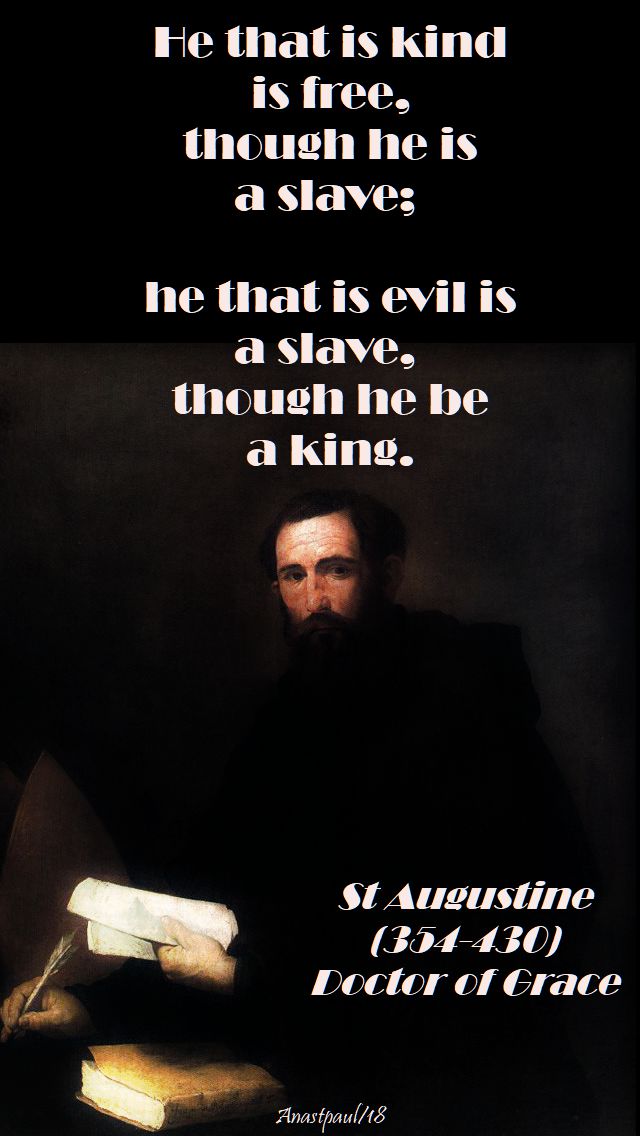
“He that is kind is free, though he is a slave; he that is evil is a slave, though he be a king.”
St Augustine (354-430) Doctor of Grace
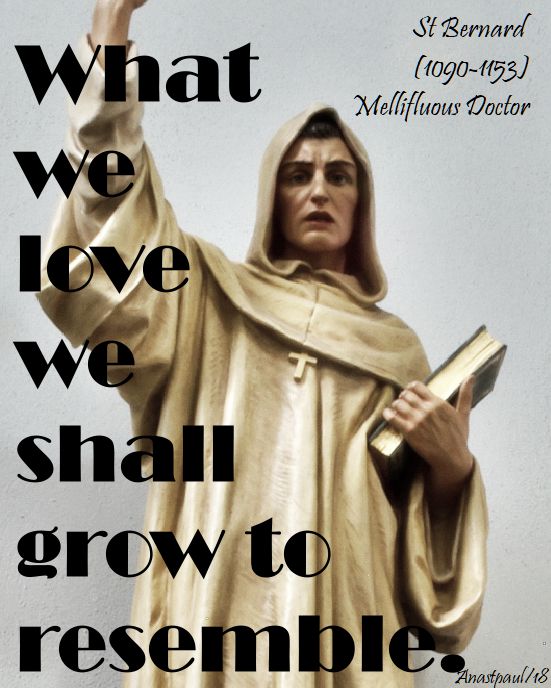
“What we love we shall grow to resemble.”
St Bernard of Clairvaux (1090-1153) Mellifluous Doctor
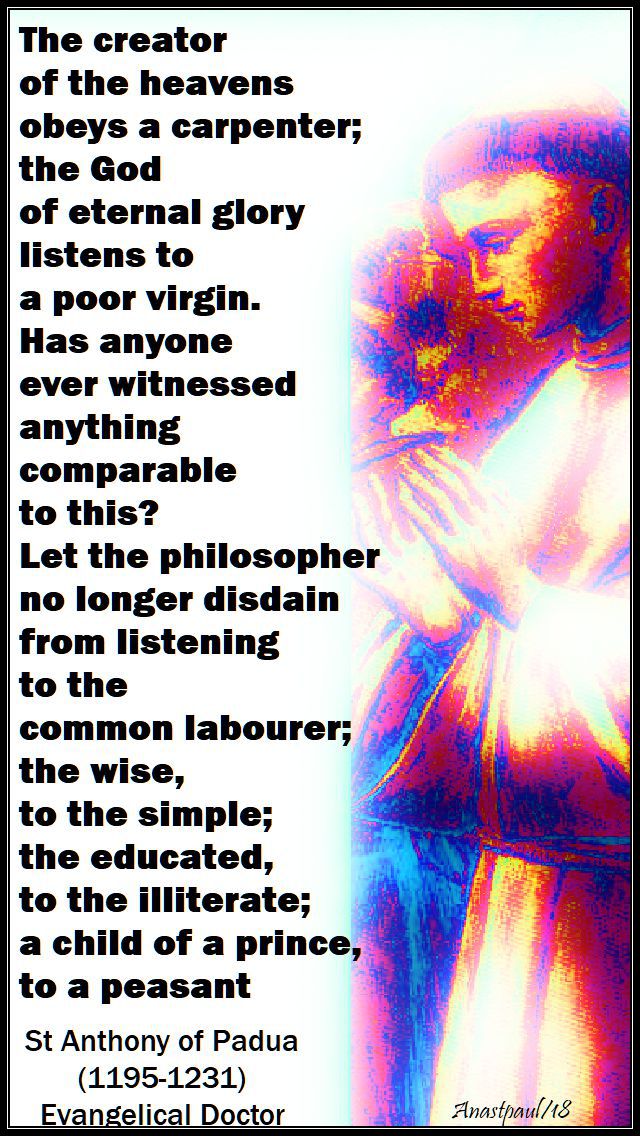
“The creator of the heavens obeys a carpenter; the God of eternal glory listens to a poor virgin. Has anyone ever witnessed anything comparable to this? Let the philosopher no longer disdain from listening to the common labourer; the wise, to the simple; the educated, to the illiterate; a child of a prince, to a peasant.”
St Anthony of Padua (1195-1231) Evangelical Doctor
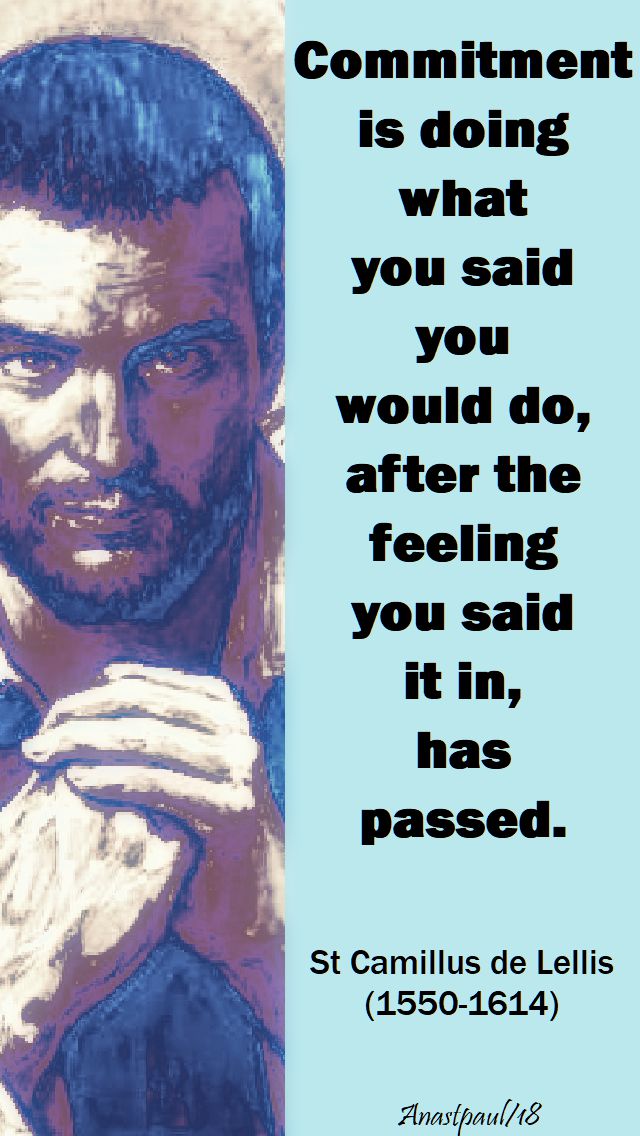
“Commitment is doing what you said you would do, after the feeling you said it in, has passed.”
St Camillus de Lellis (1550-1614)
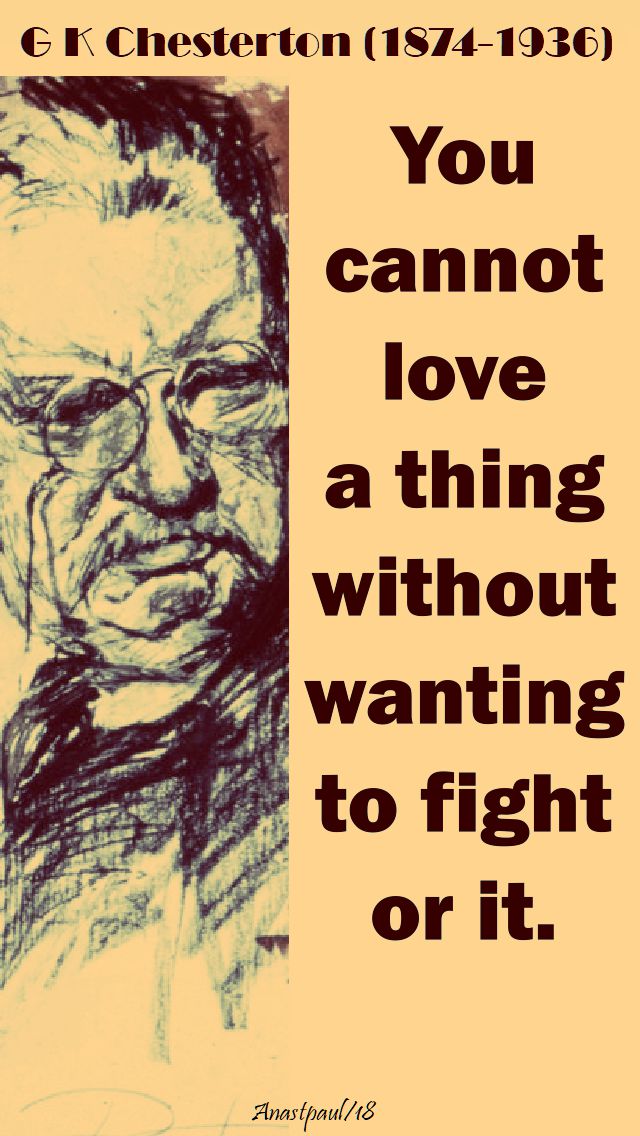
“You cannot love a thing without wanting to fight for it.”
G K Chesterton (1874-1936)
“You can’t go back and change the beginning but you can start where you are and change the ending.”
C S Lewis (1898-1963)
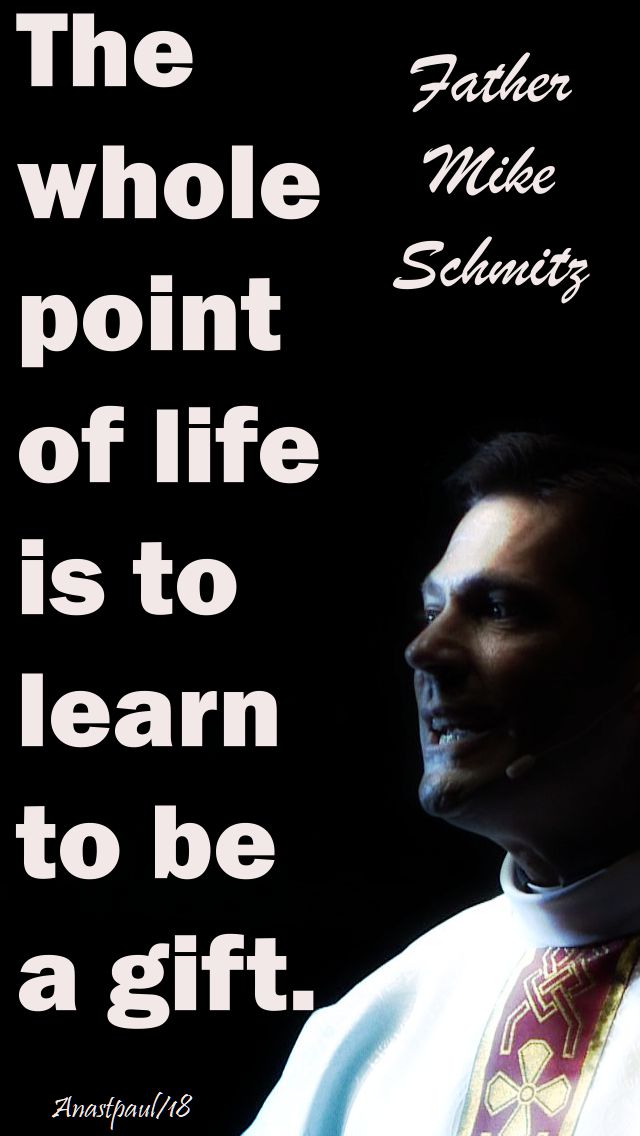
“The whole point of life is to learn to be a gift.”
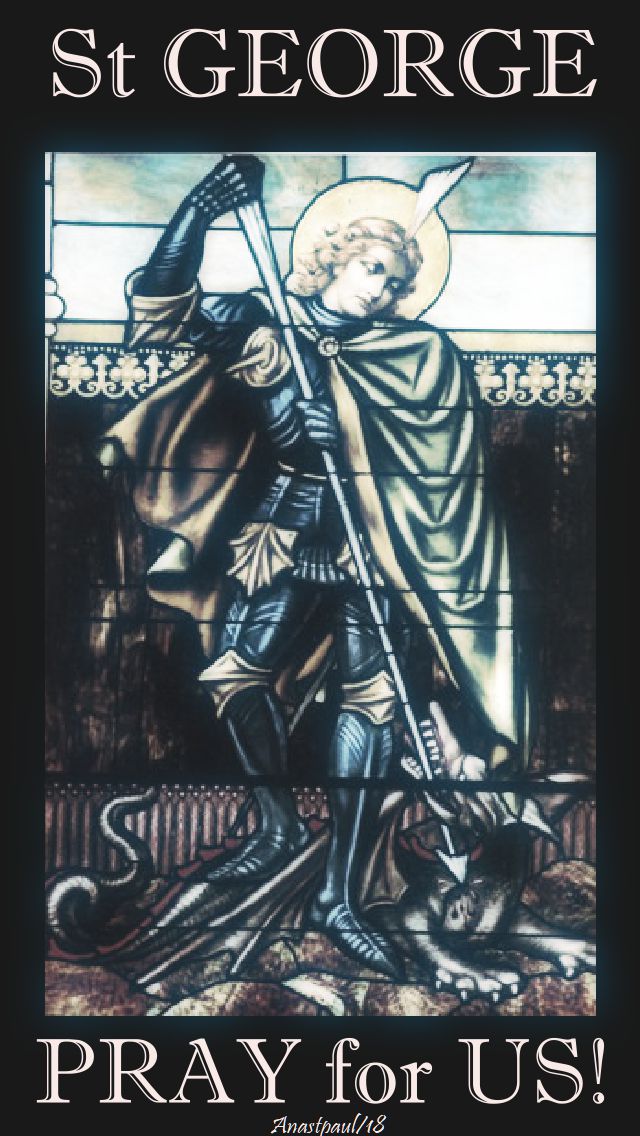
One Minute Reflection – 23 April – Monday of the Fourth Week of Eastertide and the Memorial of St George
Since we have these promises, beloved, let us cleanse ourselves from every defilement of flesh and spirit, making holiness perfect in the fear of God.…2 Corinthians 7:1
REFLECTION – “Saint George was a man who abandoned one army for another, he gave up the rank of tribune to enlist as a soldier for Christ. Eager to encounter the enemy, he first stripped away his worldly wealth by giving all he had to he poor. Then, free and unencumbered, bearing the shield of faith, he plunged into the thick of the battle, an ardent soldier for Christ. Clearly what he did, serves to teach us a valuable lesson, if we are afraid to strip ourselves of out worldly possessions, then we are unfit to make a strong defence of the faith. Dear brothers, let us not only admire the courage of this fighter in heaven’s army but follow his example. Let us be inspired to strive for the reward of heavenly glory. We must now cleanse ourselves, as Saint Paul tells us, from all defilement of body and spirit, so that one day we too may deserve to enter that temple of blessedness to which we now aspire.” – from a sermon by St Peter Damian (1007-1072) Doctor of the Church
PRAYER – Almighty, everliving God, we confidently call You Father, as well as Lord. Renew Your Spirit in our hearts, make us ever more perfectly Your children. Grant that all who have received the grace of Baptism may strive to be worthy of their Christian calling and reject everything opposed to it. St George, in strength and love, you rejected false Gods, gave all you had to the poor and bravely went to your death in complete trust, please pray for us. Through our Lord Jesus Christ, in union with the Holy Spirit, one God forever, amen.
Our Morning Offering – 23 April – Monday of the Fourth Week of Eastertide
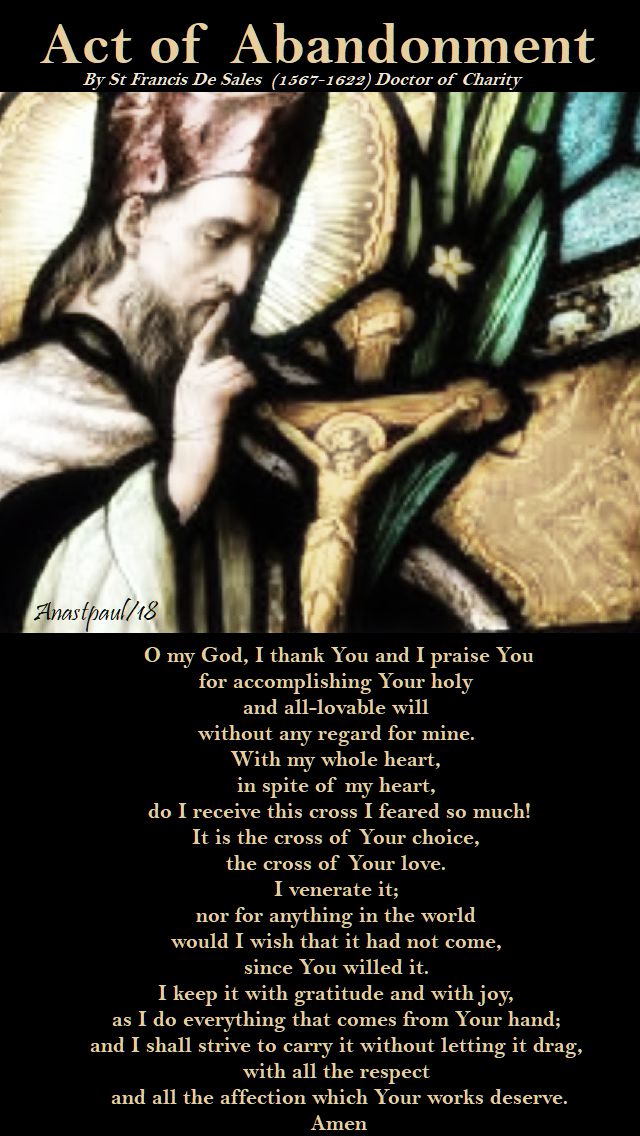
Act of Abandonment By St Francis De Sales (1567-1622) Doctor of Charity
O my God, I thank You
and I praise You
for accomplishing Your holy
and all-lovable will
without any regard for mine.
With my whole heart,
in spite of my heart,
do I receive this cross I feared so much!
It is the cross of Your choice,
the cross of Your love.
I venerate it;
nor for anything in the world
would I wish that it had not come,
since You willed it.
I keep it with gratitude and with joy,
as I do everything that comes from Your hand;
and I shall strive to carry it without letting it drag,
with all the respect
and all the affection which Your works deserve.
Amen
Sunday Reflection – 22 April – The Fourth Sunday of Easter – Good Shepherd/Vocations Sunday – Year B
“There flowed from His side water and blood. Beloved, do not pass over this mystery without thought; it has yet another hidden meaning, which I will explain to you. I said that water and blood symbolised Baptism and the Holy Eucharist. From these two sacraments the Church is born:- from baptism, the cleansing water that gives rebirth and renewal through the Holy Spirit and from the holy Eucharist.
Since the symbols of baptism and the Eucharist flowed from His side, it was from His side that Christ fashioned the Church, as He had fashioned Eve from the side of Adam. Moses gives a hint of this when he tells the story of the first man and makes him exclaim:- Bone from my bones and flesh from my flesh! As God then took a rib from Adam’s side to fashion a woman, so Christ has given us blood and water from His side to fashion the Church. God took the rib when Adam was in a deep sleep and in the same way Christ gave us the blood and the water after His own death.
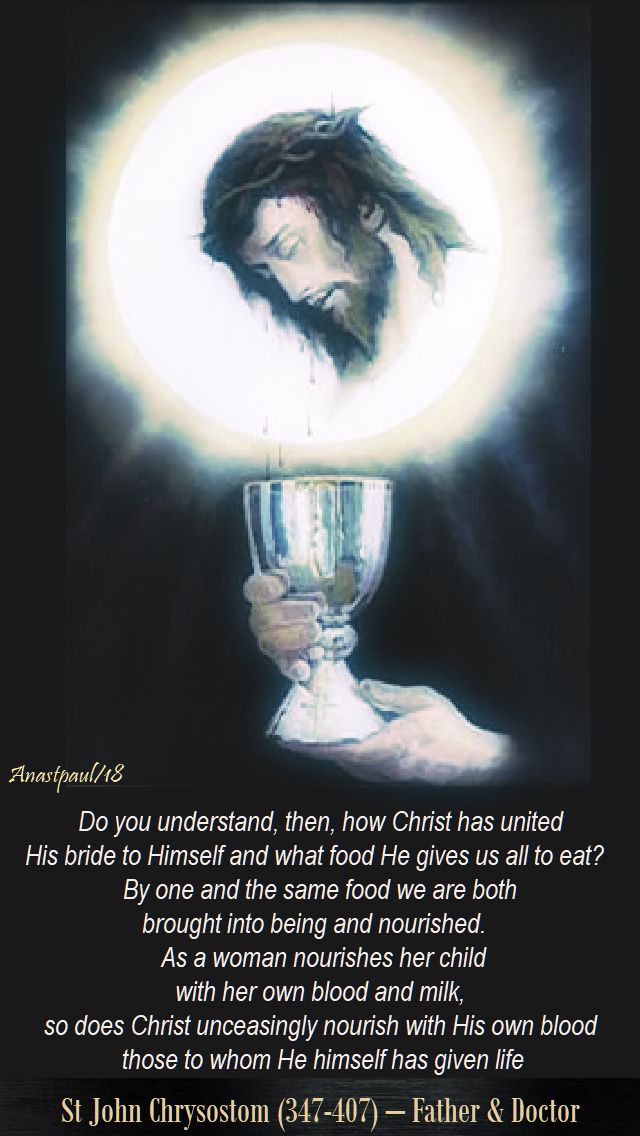
Do you understand, then, how Christ has united His bride to Himself and what food He gives us all to eat? By one and the same food we are both brought into being and nourished. As a woman nourishes her child with her own blood and milk, so does Christ unceasingly nourish with His own blood those to whom He himself has given life.’”
Our Morning Offering -22 April – The Fourth Sunday of Easter Year B
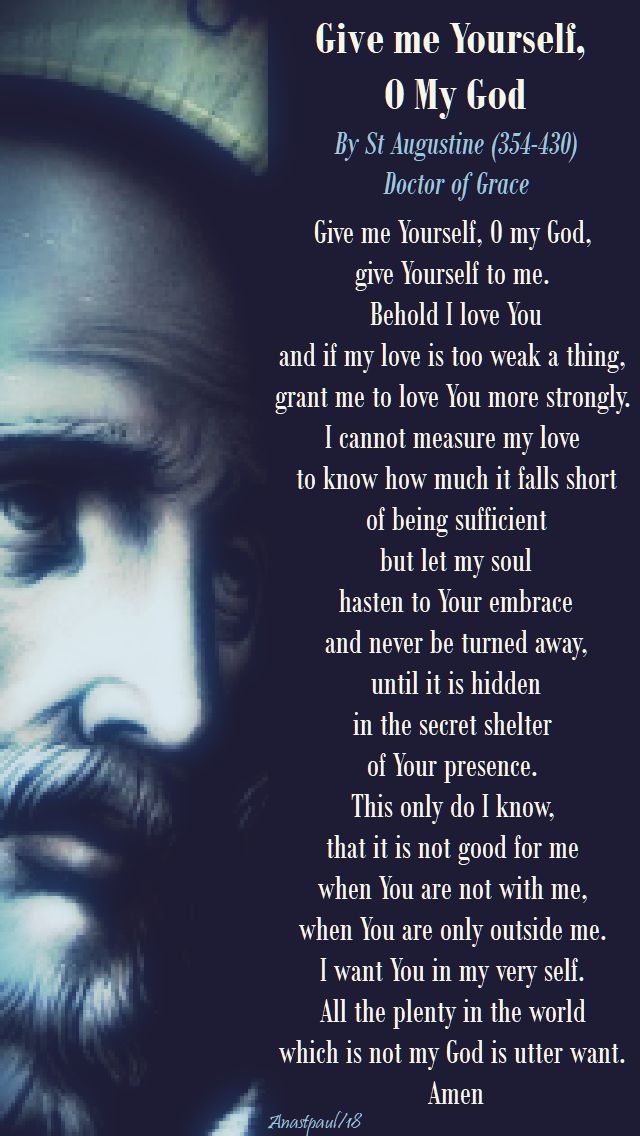
Give me Yourself, O My God By St Augustine (354-430) Doctor of Grace
Give me Yourself, O my God,
give Yourself to me.
Behold I love You
and if my love is too weak a thing,
grant me to love You more strongly.
I cannot measure my love
to know how much it falls short of being sufficient
but let my soul hasten to Your embrace
and never be turned away,
until it is hidden in the secret shelter
of Your presence.
This only do I know,
that it is not good for me
when You are not with me,
when You are only outside me.
I want You in my very self.
All the plenty in the world
which is not my God is utter want.
Amen
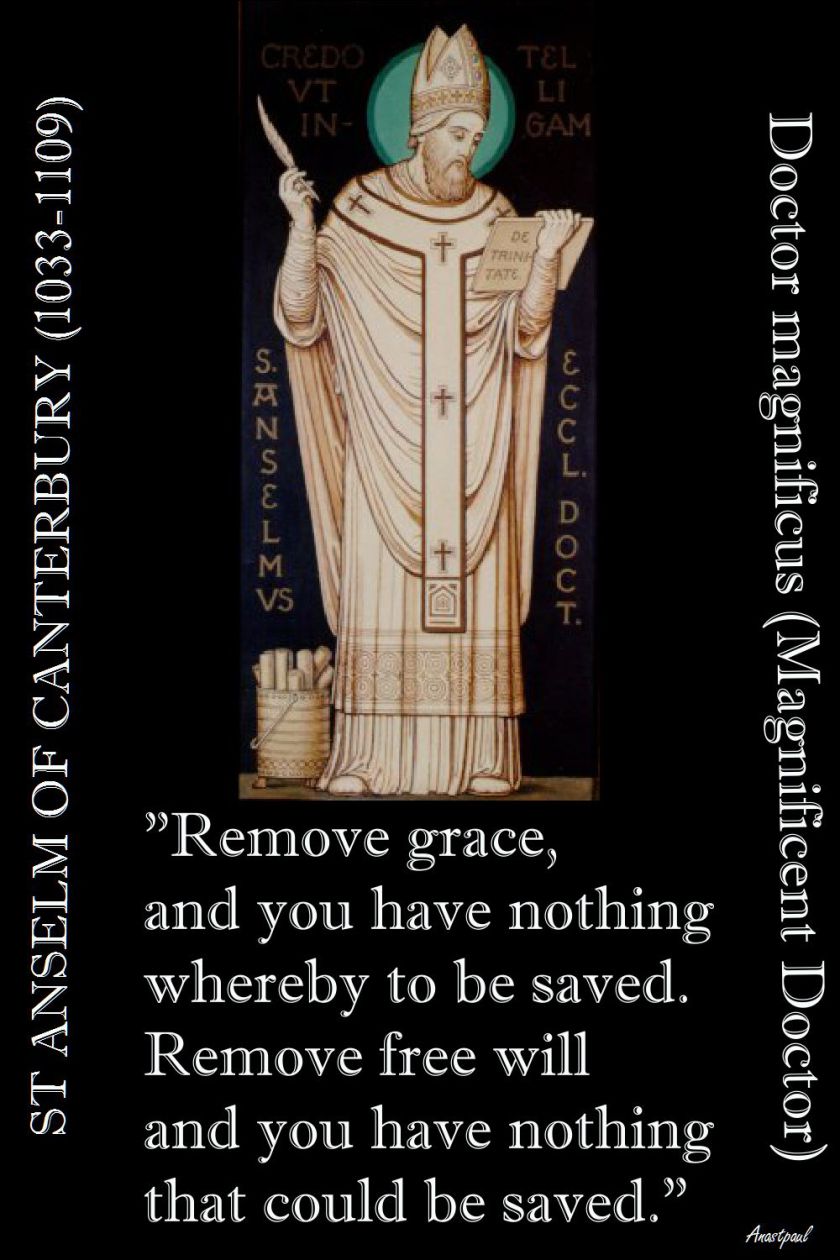
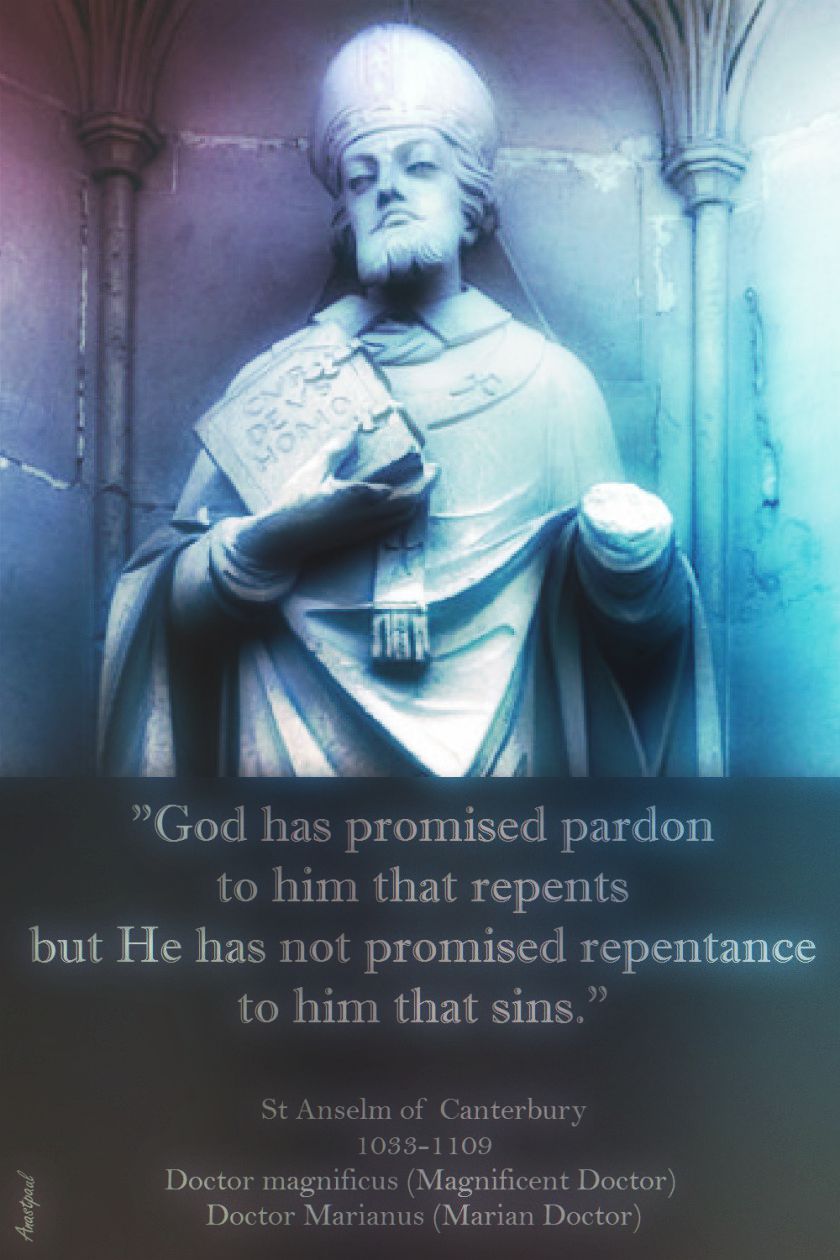
Quote/s of the Day – 21 April – Saturday of the Third Week of Eastertide, the Memorial of St Anselm (1033-1109) Doctor of the Church and of St Conrad of Parzham OFM Cap. (1818-1894)
“Remove grace and you have nothing whereby to be saved. Remove free will and you have nothing that could be saved.”
“God has promised pardon to him that repents but he has not promised repentance to him that sins.”
St Anselm (1033-1109) Doctor of the Church
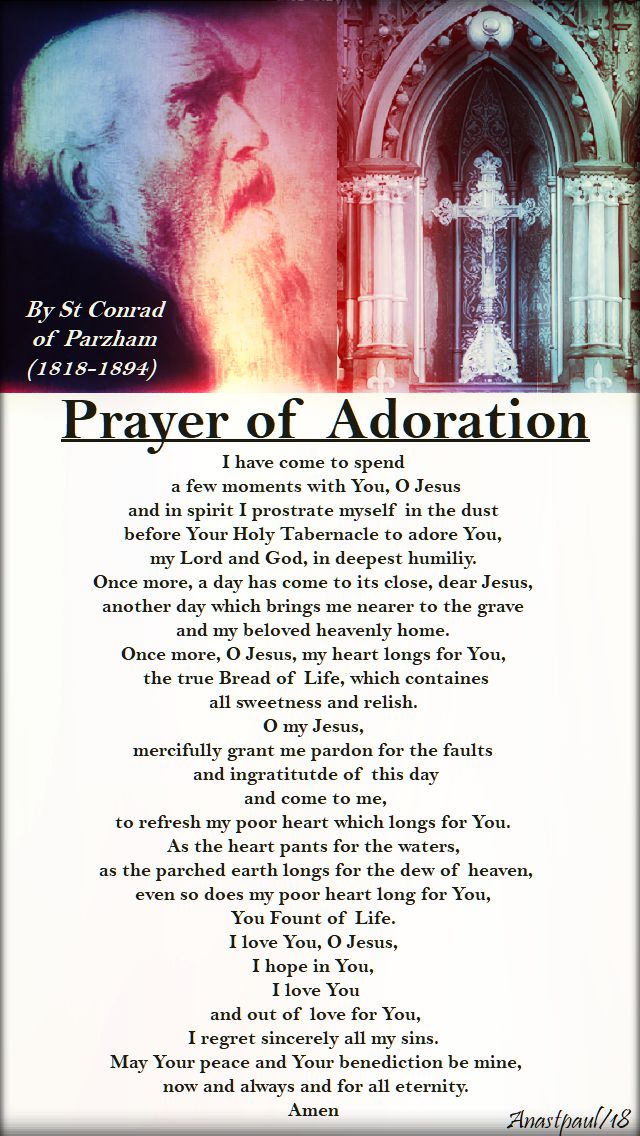
Prayer of Adoration and Repentance/Night Prayer By St Conrad of Parzham (1818-1894)
I have come to spend a few moments with You, O Jesus and in spirit I prostrate myself in the dust before Your Holy Tabernacle to adore You, my Lord and God, in deepest humility. Once more, a day has come to its close, dear Jesus, another day which brings me nearer to the grave and my beloved heavenly home. Once more, O Jesus, my heart longs for You, the true Bread of Life, which contains all sweetness and relish. O my Jesus, mercifully grant me pardon for the faults and ingratitude of this day and come to me, to refresh my poor heart which longs for You. As the heart pants for the waters, as the parched earth longs for the dew of heaven, even so does my poor heart long for You, You Fount of Life. I love You, O Jesus, I hope in You, I love You and out of love for You, I regret sincerely all my sins. May Your peace and Your benediction be mine, now and always and for all eternity. Amen
Our Morning Offering – 21 April – Saturday of the Third Week of Eastertide and the Memorial of St Anselm (1033-1109) Doctor of the Church
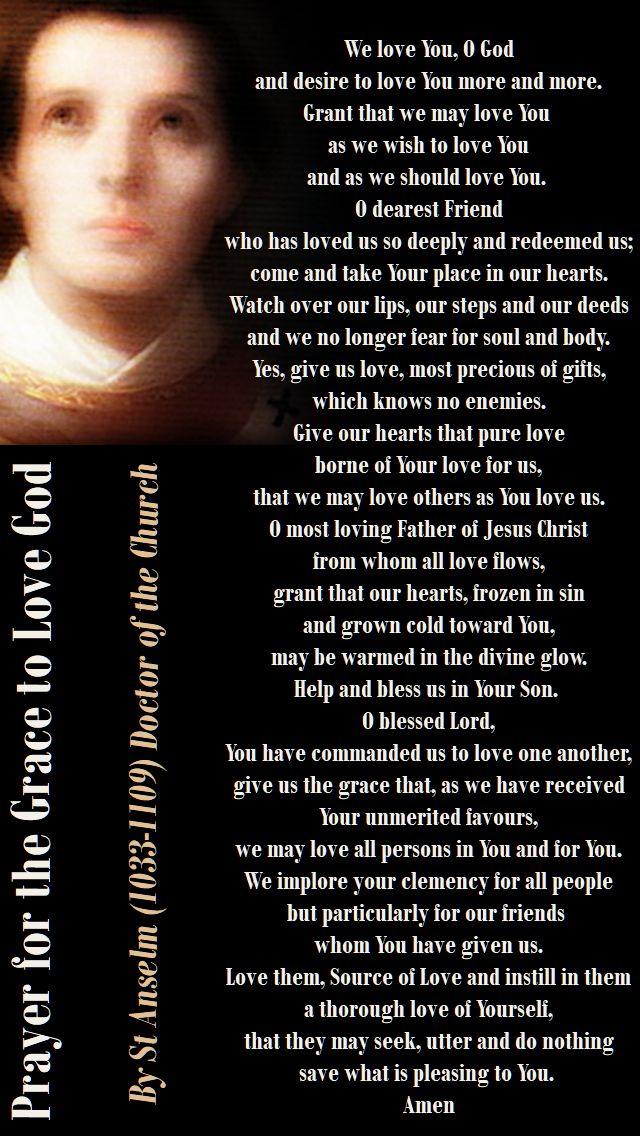
Prayer for the Grace to Love God By St Anselm (1033-1109) Doctor of the Church
We love You, O God
and desire to love You more and more.
Grant that we may love You
as we wish to love You
and as we should love You.
O dearest Friend
who has loved us so deeply and redeemed us;
come and take Your place in our hearts.
Watch over our lips, our steps and our deeds
and we no longer fear for soul and body.
Yes, give us love, most precious of gifts,
which knows no enemies.
Give our hearts that pure love
borne of Your love for us,
that we may love others as You love us.
O most loving Father of Jesus Christ
from whom all love flows,
grant that our hearts, frozen in sin
and grown cold toward You,
may be warmed in the divine glow.
Help and bless us in Your Son.
O blessed Lord,
You have commanded us to love one another,
give us the grace that, as we have received
Your unmerited favours,
we may love all persons in You and for You.
We implore your clemency for all people
but particularly for our friends
whom You have given us.
Love them, Source of Love and instill in them
a thorough love of Yourself,
that they may seek, utter and do nothing
save what is pleasing to You.
Amen
St Anselm (of Canterbury) (1033-1109) Doctor of the Church (Optional Memorial)
Holy Infant of Good Health (Mexico)
—
St Abdechalas
St Anastasius I of Antioch
St Anastasius of Sinai
St Apollo of Nicomedia
St Apollonius the Apologist
St Arator of Alexandria
St Beuno Gasulsych
St Conrad of Parzham (1818-1894)
St Crotates of Nicomedia
St Cyprian of Brescia
St Felix of Alexandria
St Fortunatus of Alexandria
St Frodulphus
St Isacius of Nicomedia
Bl John Saziari
St Maelrubba of Applecross
St Roman Adame Rosales
St Silvius of Alexandria
St Simeon of Ctesiphon
St Vitalis of Alexandria
Bl Vitaliy Bayrak
Bl Wolbodó of Liège



 The Oratory of the Bedroom: this houses the small cubicle where Catherine rested and prayed and the stone where the saint would lay her head. This space is connected with the first phase of Catherine’s life, where she would withdraw from the world in contemplation. Images below.








 AnaStpaul
You must be logged in to post a comment.