St Peter Damian (1007-1072) Doctor of the Church (Optional Memorial)
St Avitus II of Clermont
Bl Caterina Dominici
Bl Claudio di Portaceli
St Daniel of Persia
Bl Eleanora
St Ercongotha
St Eustathius of Antioch
St Felix of Metz
St George of Amastris
St Germanus of Granfield
St Gundebert of Sens
Bl Noel Pinot
St Paterius of Brescia
St Pepin of Landen
St Peter Mavimenus
St Randoald of Granfield
St Robert Southwell S.J. (1561-1595)
St Severian of Scythopolis
St Severus of Syrmium
Bl Thomas Pormort
St Valerius of San Pedro de Montes
St Verda of Persia
—
Martyrs of Sicily – 79 saints – Seventy-nine Christians martyred together in the persecutions of Diocletian. They were martyred in c 303 on Sicily.
Martyrs of Hadrumetum – A group of 26 Christians martyred together by Vandals. We know little more than eight of their names – Alexander, Felix, Fortunatus, Saturninus, Secundinus, Servulus, Siricius and Verulus. c 434 at Hadrumetum (modern Sousse, Tunisia)
Martyrs Uchibori – Three Japanese laymen, all brothers, all sons of Paulus Uchibori Sakuemon, one a teenager, one only five years old and all martyred for their faith in the persecutions in Japan. 21 February 1627 in Shimabara, Nagasaki, Japan. Beatified 24 November 2008 by Pope Benedict XVI.
Antonius
Balthasar
Ignatius
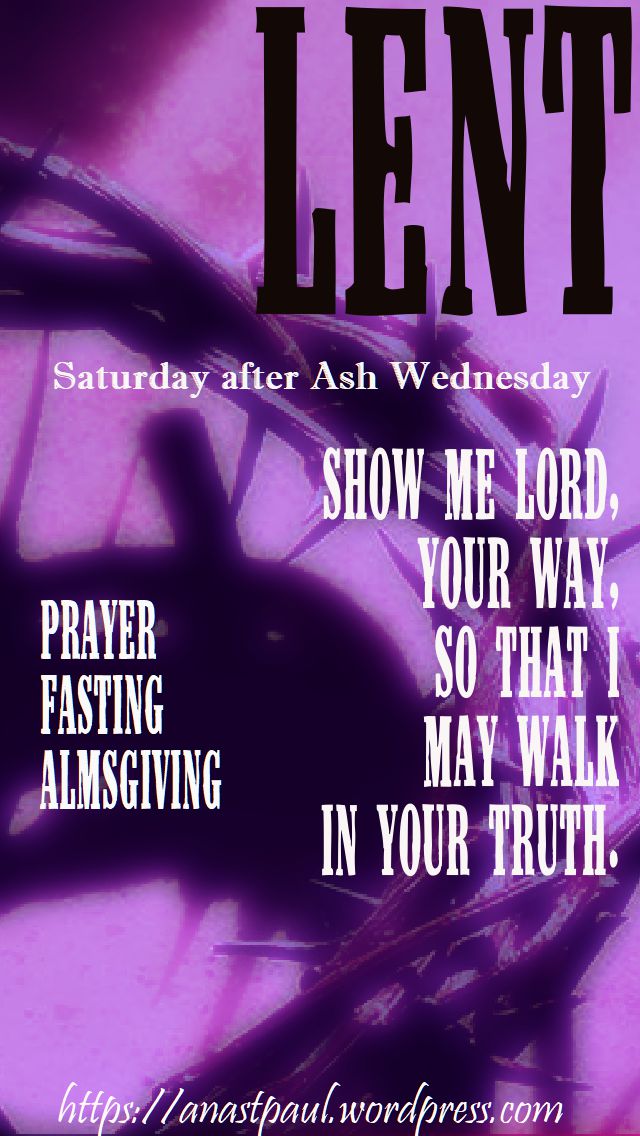
Saturday after Ash Wednesday – 17 February 2018 Isaiah 58:9-14, Psalms 86:1-6, Luke 5:27-32
Show me Lord, your way, so that I may walk in your truth.
Isaiah 58:9-10: “If you take away from the midst of you the yoke, the pointing of the finger and speaking wickedness, if you pour yourself out for the hungry and satisfy the desire of the afflicted, then shall your light rise in the darkness and your darkest hour will be like noon.
Luke 5:32: “I have come to call not the upright but sinners to repentance.”
Isaiah makes it abundantly clear that it is our service to the poor and the weak that wins God’s favour, not lifeless religious practices. The message becomes most meaningful in modern society, marked by unfair distribution of resources, hatred, violence, abuse and mutual accusations. It is only when we strive against such evils that we win God’s approval. “You shall be like the watered garden” the prophet says. The image stands for the possession of every good thing that we desire.
The Gospel speaks of the call of Levi. His joy was so great that he could hardly contain it.
He organised a party for his fellow tax-collectors, which unfailingly earned the criticism of the Pharisees. Jesus’ answer was that His mission was precisely to wrongdoers, to the least and the lost. These words indeed offer us hope when we stray and urge us to reach out to others as Jesus did.
That is the Christian calling, that is the Christian ‘job’! (Archbishop Thomas Menamparanpil SDB – Gods Word)
Don’t you wonder what it was about Levi that moved Jesus to call him? And what was it that caused Levi to respond?
He must have been a pretty successful man in economic terms but as a tax collector, he was undoubtedly not popular in his own community and was seen as a collaborator with Rome. Perhaps he had a nagging sense of “there must be something more to life”. perhaps a sense of emptiness and sadness. Something touched him so deeply at Jesus call, that he let go of a previous way of life and opened himself instantly to the gift being offered. He was overjoyed, he was filled with joy, he was joyous, he bubbled over and threw a big party in order to share his joy! And Jesus attended the party! He was at the party! He is at our party too when we allow Him entrance to our hearts.
When asked who he is, Pope Francis responded “I am a sinner, whom the Lord has looked upon.” When we are able to see ourselves as Pope Francis does, as loved sinners, we are open to receive the forgiveness and help God longs to give us. When we are aware of ourselves as sinners, loved and called by God, we respond with a deep sense of repentance, gratitude and joy, we throw that party and invite other sinners to join us. We simply have to share the joy!
Where do I experience my own sinfulness? How is this awareness a gift? Spend some time with Jesus today sharing with Him your struggles and Your need of His help. Have a party with Him! (excerpt Fr Nicholas King S.J. ‘The Long Journey to the Resurrection’)
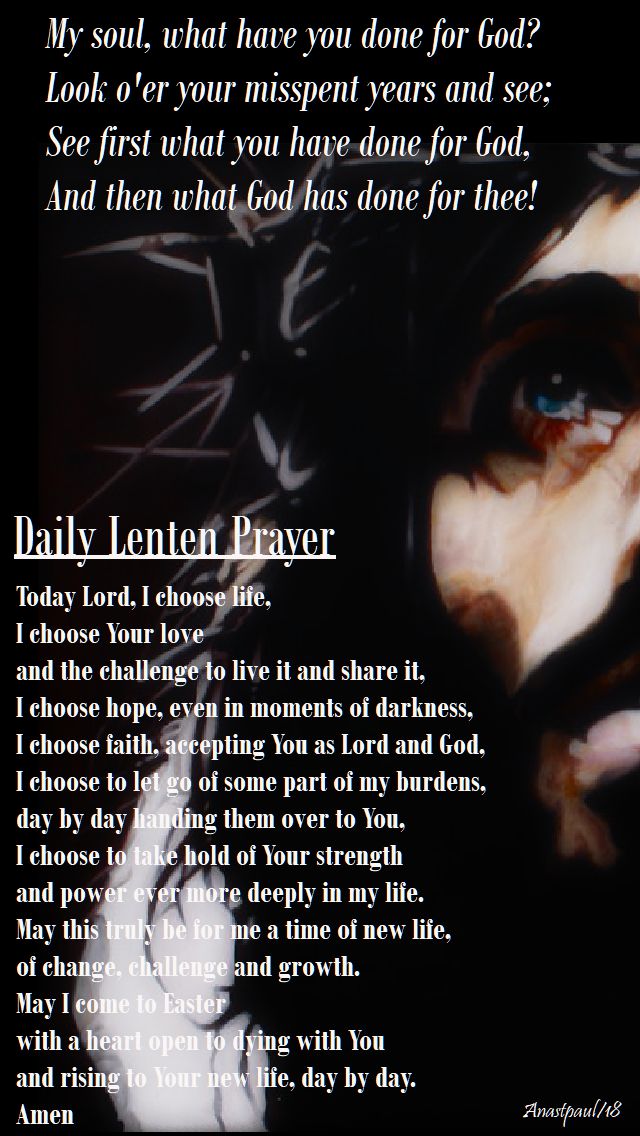
My soul, what have you done for God?
Look o’er your misspent years and see;
See first what you have done for God,
And then what God has done for thee!
Daily Lenten Prayer
Today Lord, I choose life,
I choose Your love
and the challenge to live it and share it,
I choose hope, even in moments of darkness,
I choose faith, accepting You as Lord and God,
I choose to let go of some part of my burdens,
day by day handing them over to You,
I choose to take hold of Your strength
and power ever more deeply in my life.
May this truly be for me a time of new life,
of change, challenge and growth.
May I come to Easter with a heart open to dying with You
and rising to Your new life, day by day.
Amen
Thought for the Day – – 16 February – The First Friday of Lent 2018
Alas, for our dearest Lord! up to this day what have we done for Him?
You see what He has done for us and the end of His doing it was to gain our love!
We look upon a crucifix and it hardly moves us.
We hear of His bittter passion but our eyes are dry and our hearts indifferent.
We kneel down to pray but we can hardly keep our thoughts fixed upon Him for a quarter of an hour together.
We go into His own most holy presence and we hardly bend the knee before the Tabernacle lest it should spoil our clothes.
We see others sin and what is it to us that Jesus is offended, so long as it is not we, who are risking our souls, by offending Him?
These are strange signs of love!
Surely Jesus cannot be much to us if this is the way we feel about Him.
Yet so it is.
We go our own way and do our own will.
The great thing is to please ourselves and to make things easy to ourselves.
Life must be taught to run smooth.
As to penance, it must be kept at arm’s length.
We must have our bodily comforts and worldly conveniences and our spiritual life must be nothing but a sufficiency of those inward consolations without which our souls give us pain, because they are not at rest.
If we worship God it is for self, if we do good to others, it is self we are seeking, even in our charity.
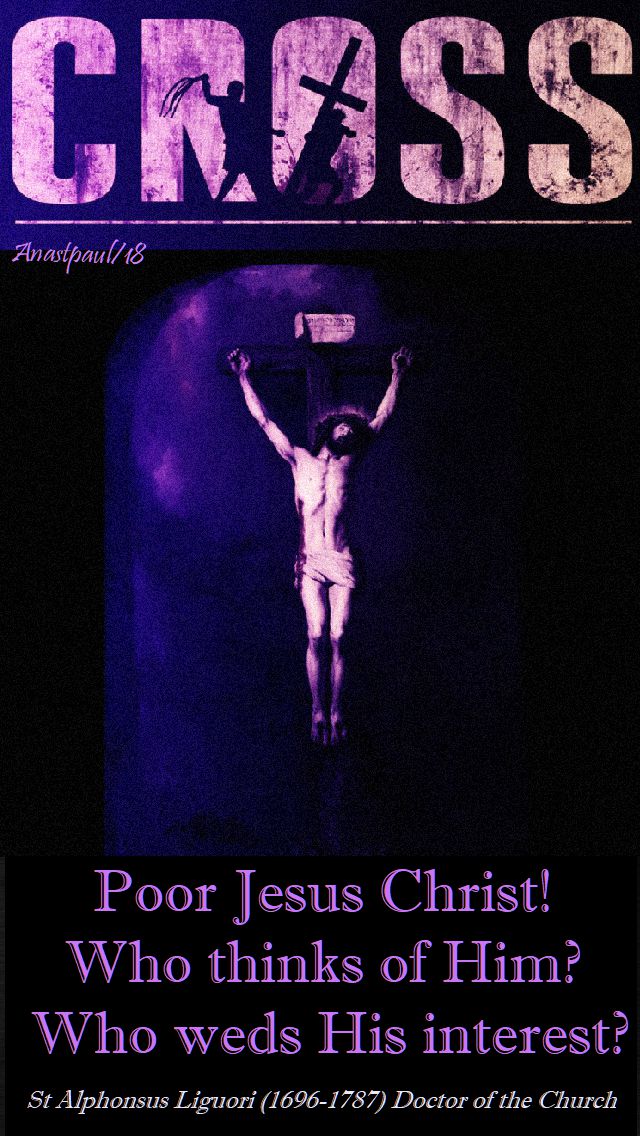
Poor Jesus Christ! as Saint Alphonsus used to say, “Poor Jesus Christ! Who thinks of Him? Who weds His interest?”
Father Faber – Remember Me: Daily Readings for Lent
Quote of the Day – 16 February – The First Friday of Lent 2018
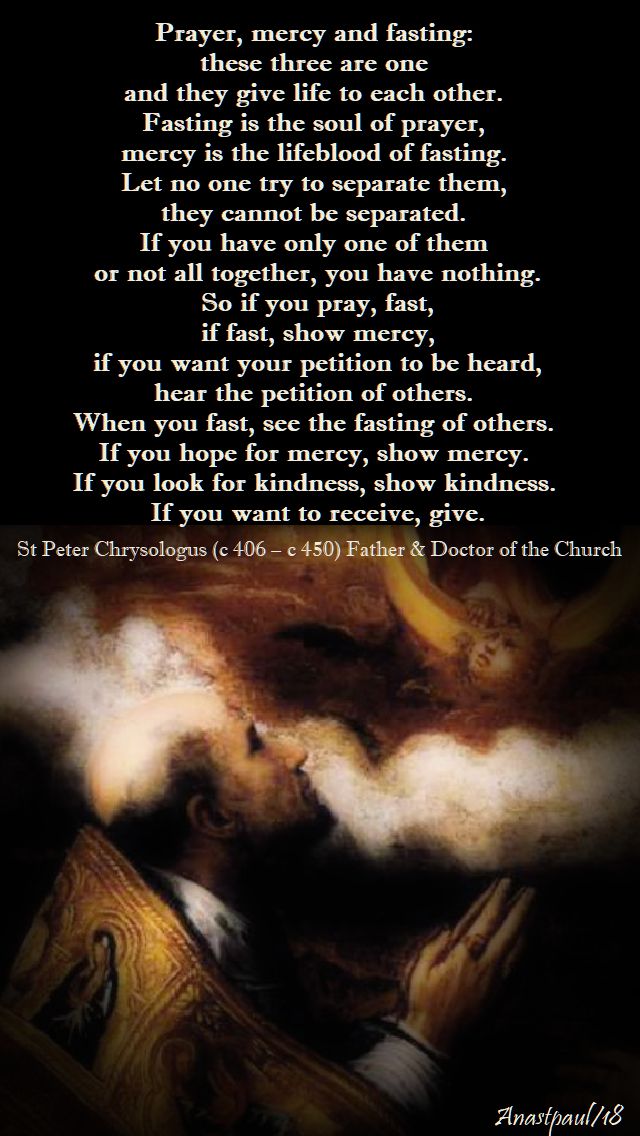
“Prayer, mercy and fasting: these three are one and they give life to each other. Fasting is the soul of prayer, mercy is the lifeblood of fasting. Let no one try to separate them, they cannot be separated. If you have only one of them or not all together, you have nothing. So if you pray, fast, if fast, show mercy, if you want your petition to be heard, hear the petition of others. When you fast, see the fasting of others. If you hope for mercy, show mercy. If you look for kindness, show kindness. If you want to receive, give.”
St Peter Chrysologus (c 406 – c 450) Father & Doctor of the Church
One Minute Reflection – 14 February 2018 – Ash Wednesday
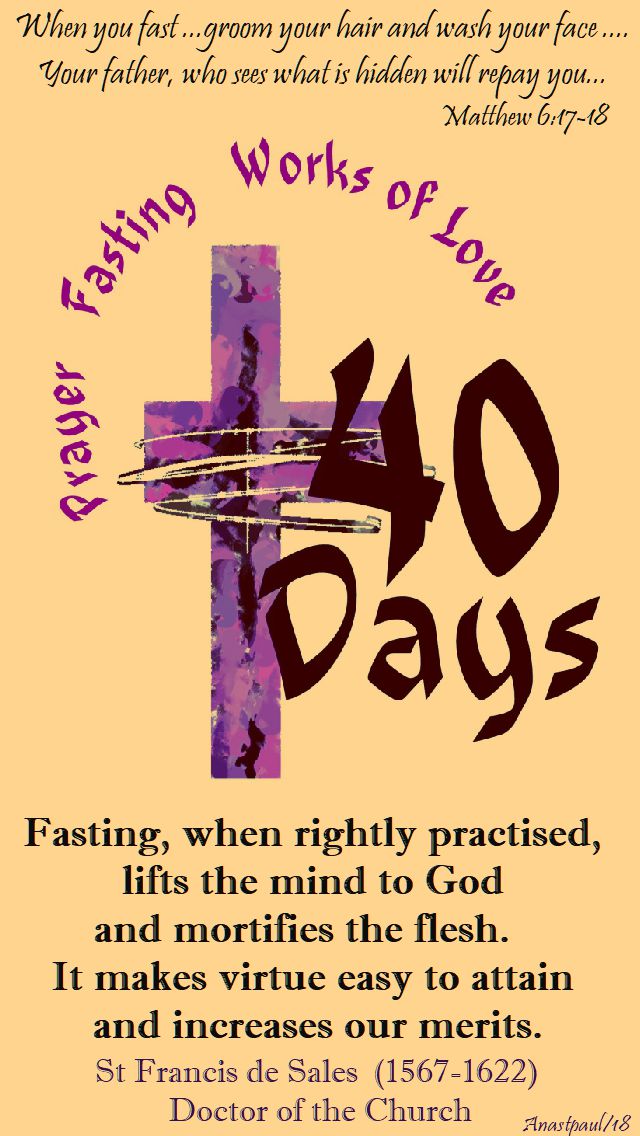
When you fast …groom your hair and wash your face ….Your father, who sees what is hidden will repay you.…Matthew 6:17-18
REFLECTION – “Fasting, when rightly practised, lifts the mind to God and mortifies the flesh. It makes virtue easy to attain and increases our merits.”…St Francis de Sales (1567-1622) Doctor of the Church
PRAYER – Support us Lord, as with this Lenten fast we begin our Christian warfare, so that in doing battle against the spirit of evil, we may be armed with the weapon of self-denial. Heavenly Father, help us to fast for the right reasons. Teach us to fast to curb illicit desires and to obtain closer union with You. Help us Lord, during this Lenten season to cleave to You alone and grow in sanctity and charity. Create in me a clean heart O Lord! Through our Lord Jesus Christ in unity with the Holy Spirit, one God forever, amen.
Our Morning Offering – 13 February – The Memorial of Blessed Jordan of Saxony O.P.
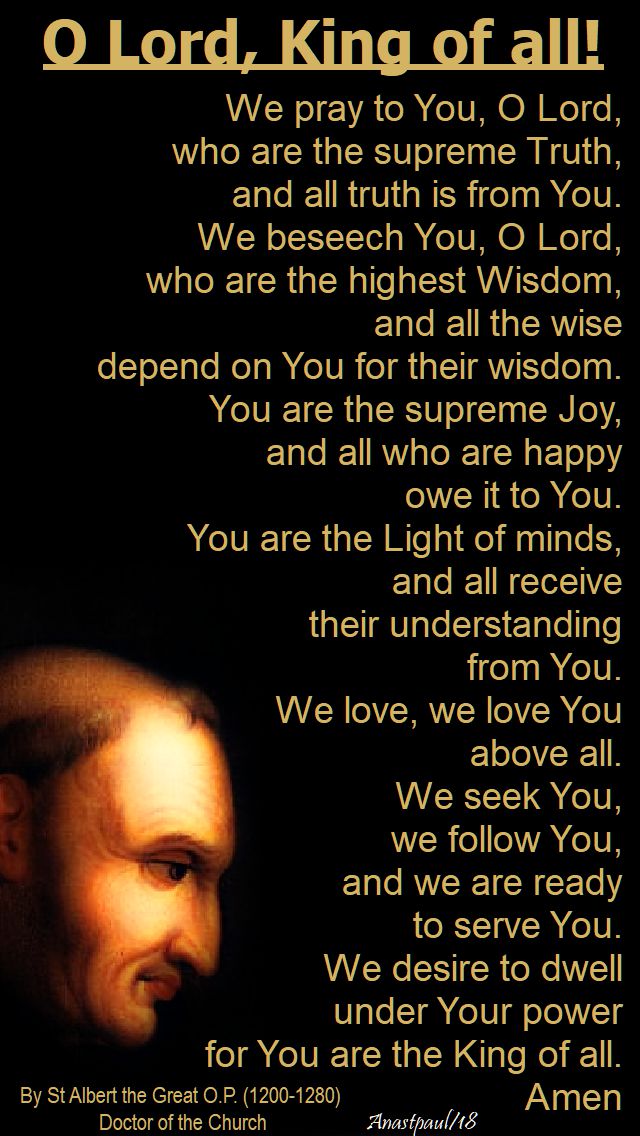
O Lord, King of all! By St Albert the Great O.P. (1200-1280) Doctor of the Church
We pray to You, O Lord,
who are the supreme Truth,
and all truth is from You.
We beseech You, O Lord,
who are the highest Wisdom,
and all the wise depend on You for their wisdom.
You are the supreme Joy,
and all who are happy owe it to You.
You are the Light of minds,
and all receive their understanding from You.
We love, we love You above all.
We seek You, we follow You,
and we are ready to serve You.
We desire to dwell under Your power
for You are the King of all.
Amen.
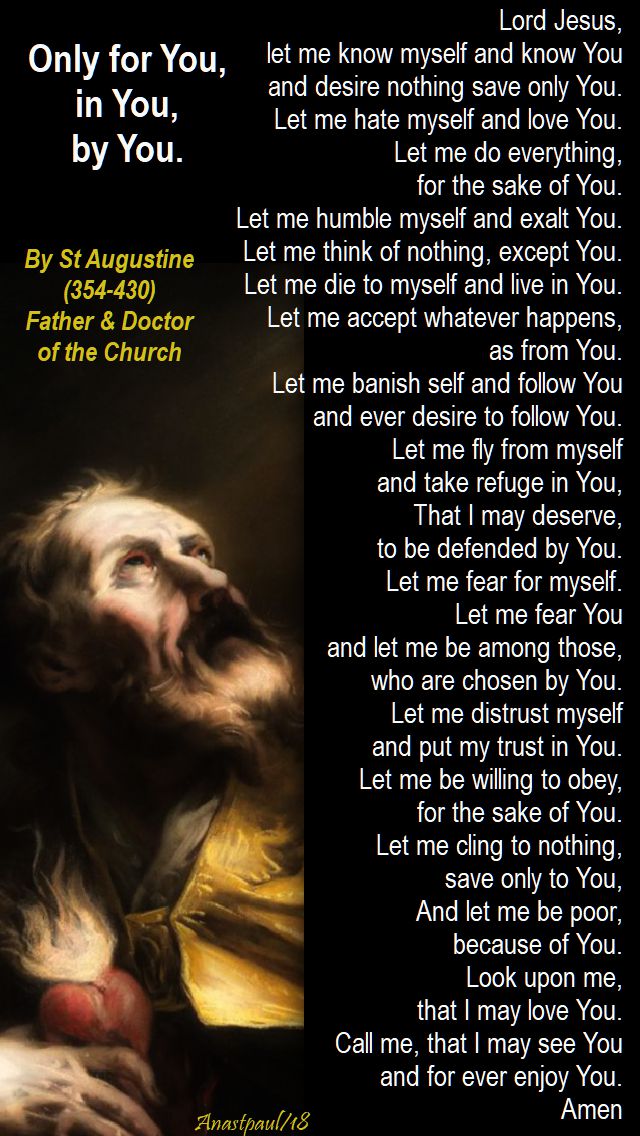
Only for You, in You, by You. By St Augustine (354-430) Father & Doctor of the Church
Lord Jesus,
let me know myself and know You
and desire nothing save only You.
Let me hate myself and love You.
Let me do everything, for the sake of You.
Let me humble myself and exalt You.
Let me think of nothing, except You.
Let me die to myself and live in You.
Let me accept whatever happens, as from You.
Let me banish self and follow You
and ever desire to follow You.
Let me fly from myself and take refuge in You,
That I may deserve, to be defended by You.
Let me fear for myself.
Let me fear You
and let me be among those, who are chosen by You.
Let me distrust myself and put my trust in You.
Let me be willing to obey, for the sake of You.
Let me cling to nothing, save only to You,
And let me be poor, because of You.
Look upon me, that I may love You.
Call me, that I may see You
and for ever enjoy You.
Amen
Our Morning Offering – 11 February – 6th Sunday of Year B
Your Sacred Table – A Prayer Before Holy Communion – By Saint Francis de Sales (1567-1622) Doctor of the Church
Divine Saviour,
we come to Your sacred table
to nourish ourselves,
not with bread but with Yourself,
true Bread of eternal life.
Help us daily to make a good and perfect meal
of this divine food.
Let us be continually refreshed
by the perfume of Your kindness and goodness.
May the Holy Spirit fill us with His Love.
Meanwhile, let us prepare a place
for this holy food by emptying our hearts.
Amen.
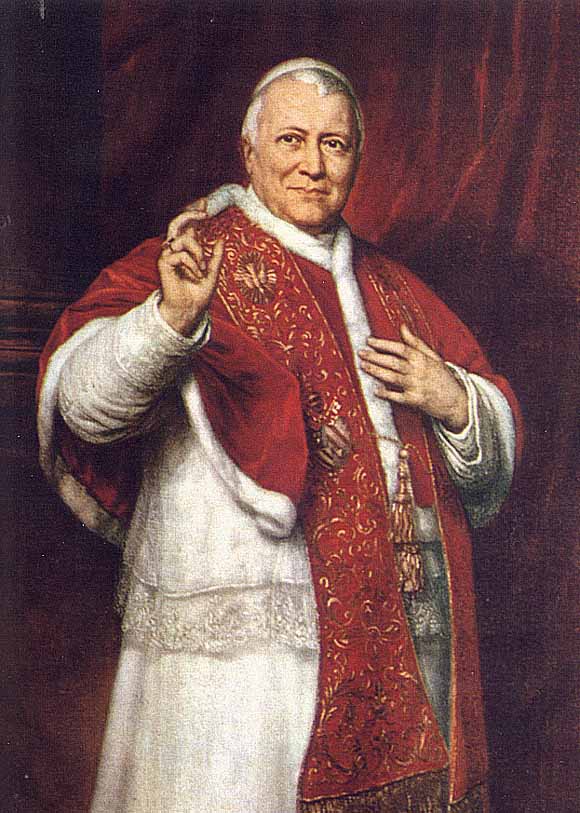
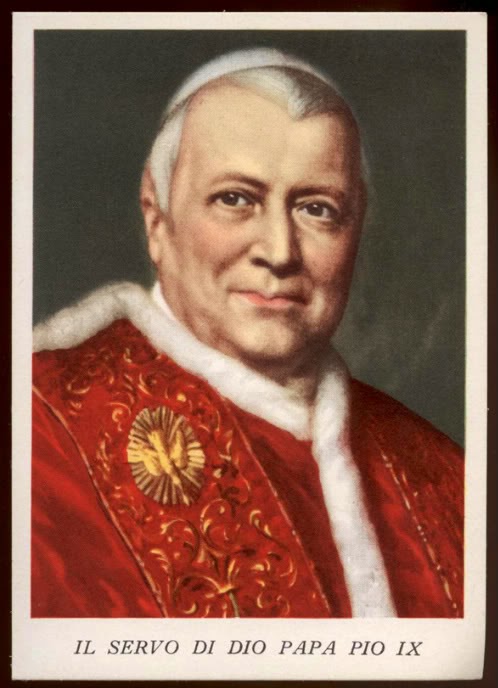
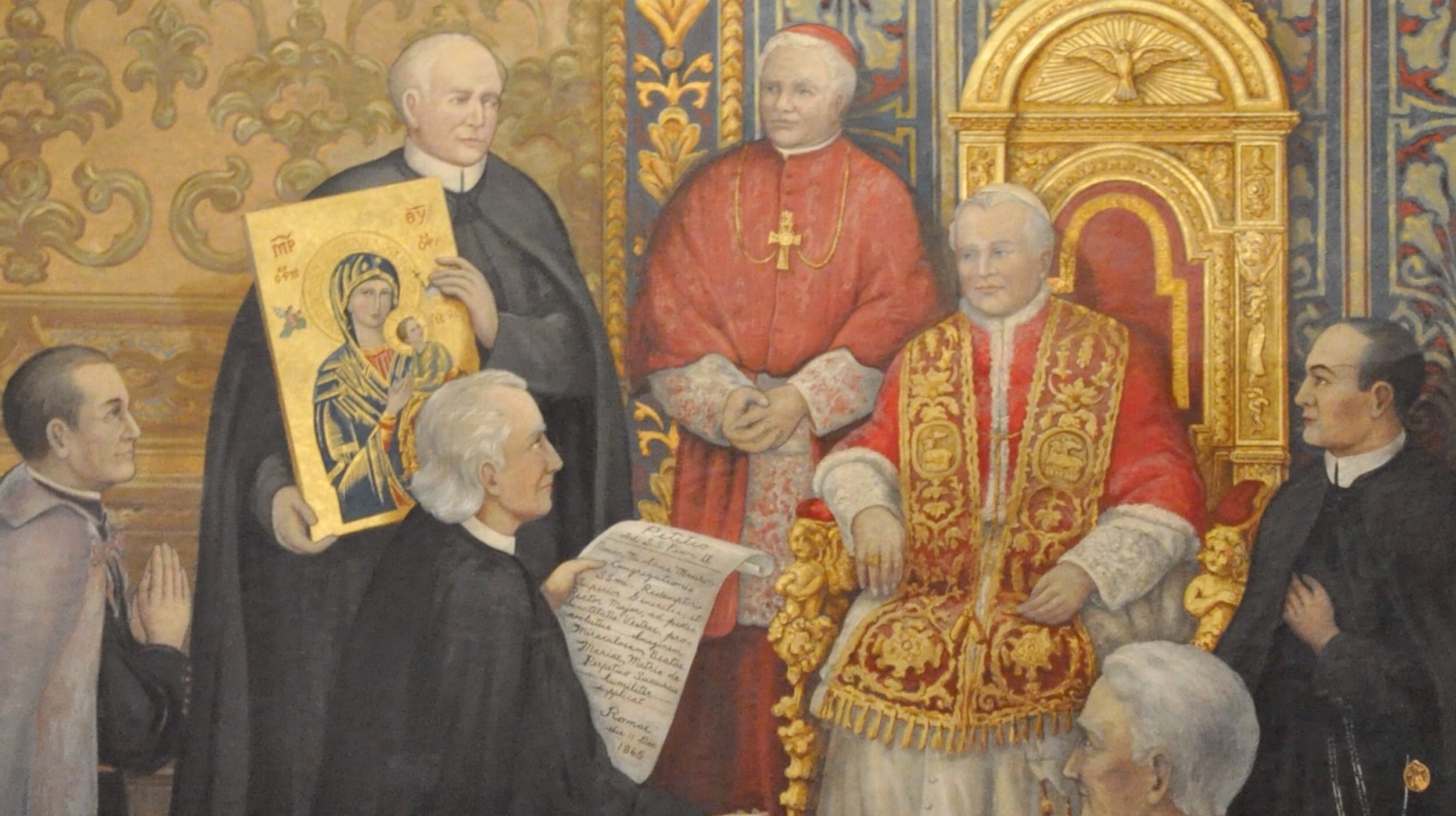
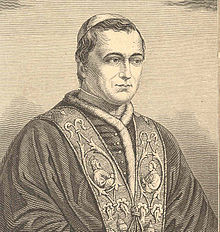
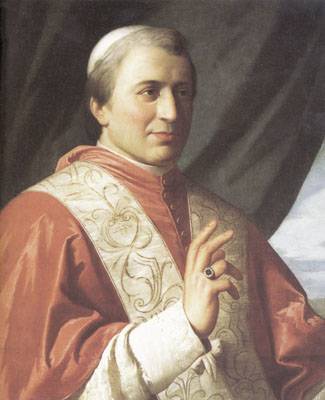
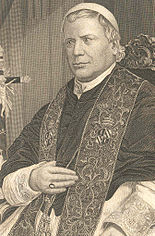
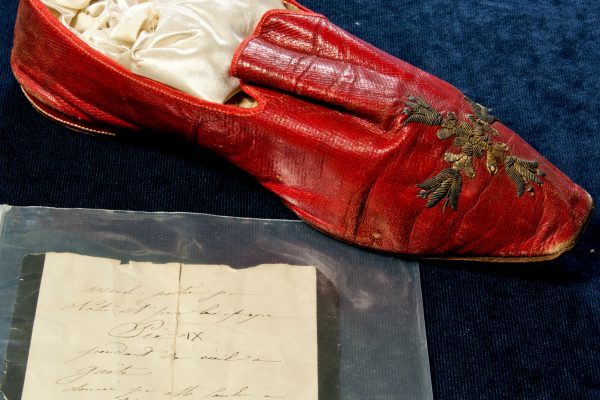
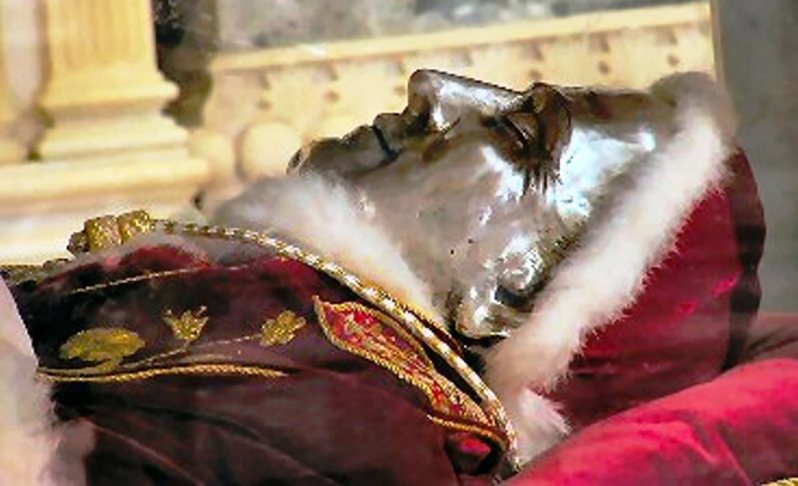
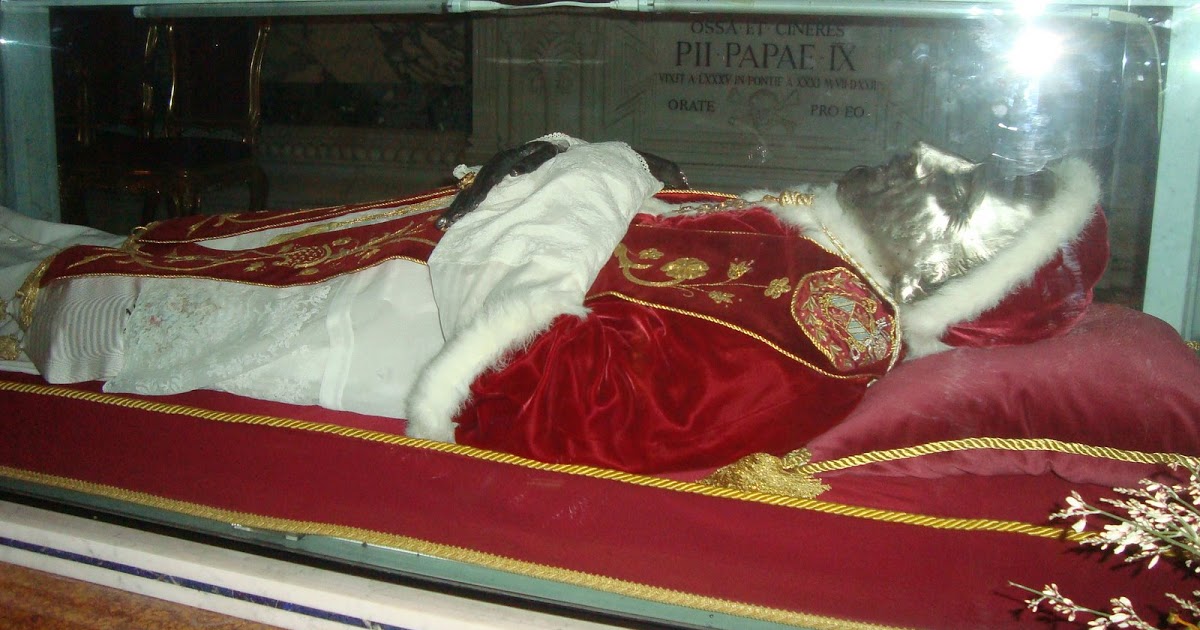
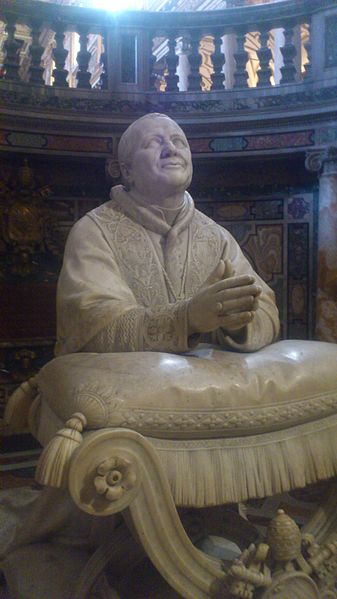
Saint of the Day 7 February – Blessed Pope Pius IX (1792-1878) Bishop of Rome, Writer. The longest regining Pope. Bl Pius was born as Giovanni Maria Mastai-Ferretti on 13 May 1792 in Senigallia, Italy and he died on 7 February 1878 in Vatican City of natural causes. He reigned from 16 June 1846 to the day of his death. He is the longest-reigning Pope in the history of the Church, serving for over 31 years. During his Pontificate, Pius IX convened the First Vatican Council (1869–70), which decreed Papal Infallibility and promulgated the Dogma of the Immaculate Conception, thus articulating a long-held belief that Mary, the Mother of God, was conceived without original sin. He conferred the title Our Mother of Perpetual Succour on a famous Byzantine icon from Crete entrusted to the Redemptorists. Pope Pius IX named three new Doctors of the Church: Hilary of Poitiers (1851), Alphonsus Liguori (1871), and Francis de Sales (19 July 1877).Patronages – Pius Seminary of Rome, Senigallia, Diocese of Senigallia, First Vatican Council. His body is incorrupt.
Bl Pope Pius IX was born in Senigallia, Italy, on 13 May 1792, the son of Gerolamo of the Counts Mastai Ferretti and Caterina Solazzi, of the local nobility. He was baptised on the day of his birth with the name Giovanni Maria. Of delicate physical constitution but of very lively intelligence, his childhood was marked by little voluntary mortifications and an intense religious life.
In 1809 he moved to Rome for higher studies. A disease not well diagnosed, which some called epilepsy, forced him to interrupt his studies in 1812. He was accepted into the Pontifical Noble Guard in 1815 but because of his illness he was immediately discharged. It was at this time that St Vincent Pallotti predicted that he would become Pope and that the Virgin of Loreto would free him eventually from the disease.
After serving briefly in the Tata Giovanni Educational Institute, he participated as a catechist in 1816 in a memorable mission in Senigallia and, immediately thereafter, decided to enter the ecclesiastical state. He was ordained a priest in 1819. Conscious of his noble rank, he committed himself to avoiding a prelatial career in order to remain only at the service of the Church.
He celebrated his first Mass in the Church of St Anne of the Carpenters at the Tata Giovanni Institute, of which he was named rector, remaining there until 1823. He was immediately recognised as assiduous in prayer, in the ministry of the Word, in the celebration of the liturgy, in the confessional and above all in his daily ministry at the service of the humblest and neediest. He admirably united the active and the contemplative life: ready for pastoral needs but always interiorly recollected, with strong Eucharistic and Marian devotion and fidelity to daily meditation and the examination of conscience.
In 1823 he left the institute to serve the Apostolic Nuncio in Chile, Mons. Giovanni Muzi. There he remained until 1825, when he was elected President of St Michael’s Hospice, a grand but complex institution in need of effective reform. To it Mastai applied himself with more than gratifying results but without ever neglecting his priestly duties. Two years later, at the age of 35, he was consecrated Archbishop of Spoleto. In 1831 the revolution which had begun in Parma and Modena spread to Spoleto. The Archbishop did not want the shedding of blood and repaired, as much as possible, the deleterious effects of the violence. When calm was restored, he obtained a pardon for all, even for those who did not merit it.
Another turbulent see awaited Mastai in Imola, where he was transferred in 1832. He remained an eloquent preacher, prompt in charity toward everyone, zealous for the supernatural as well as the material well-being of his Diocese, devoted to his clergy and seminarians, a promoter of education for the young, sensitive to the needs of the contemplative life, devoted to the Sacred Heart and to Our Lady, benevolent towards all but firm in his principles. In 1840 he received the Cardinal’s hat at the age of 48.
Despite having shunned honours, on the evening of 16 June 1846 Mastai found himself burdened with the greatest of them: he was elected Pope and took the name Pius IX.
He had a difficult pontificate, but precisely because of that he was a great Pope, certainly one of the greatest. Thoroughly aware of being the “Vicar of Christ” and responsible for the rights of God and of the Church, he was clear, simple consistent. He combined firmness and understanding, fidelity and openness.
He began with an act of generosity and Christian sensitivity: amnesty for political crimes. His first Encyclical was a programmatic vision but anticipated the “Syllabus”: in it he condemned secret societies, freemasonry and communism. In 1847 he promulgated a decree granting extensive freedom of the press and instituted a civil guard, the municipal and communal council, the Council of State and the Council of Ministers. From then on his interventions as Father of all nations and temporal Prince continued unabated.
The question of Italian independence, which he sympathised with, did not set the Prince against the Pope, a fact that alienated the most intransigent liberals. The situation came to a head on 15 November when Pellegrino Rossi, the head of government, was killed and Pius IX had to take refuge in Gaeta. After the proclamation of the Roman Republic (9 February 1849), he moved to Portici and later returned to Rome (12 April 1850). He reorganised the Council of State, established the Council for Finances, granted a new amnesty, re-established the Catholic hierarchy in England and in Holland.
In 1853 he condemned Gallican doctrines and founded the well-known “Seminario Pio”. He established the Commission on Christian Archaeology, defined the dogma of the Immaculate Conception on 8 December 1854 and blessed the rebuilt St Paul’s Basilica which had been destroyed by fire in 1823.
In 1856 he approved the plan for railways in the Papal States and on 24 April 1859 inaugurated the first section between Rome and Civitavecchia. In 1857 he visited the Papal States and was welcomed everywhere with rejoicing. He sent missionaries to the North Pole, India, Burma, China and Japan.
Meanwhile dark clouds gathered over him with the Italian “Risorgimento”, the Piedmontese annexations that were dismantling the Papal States and the expropriation of the Legations. Suffering but undaunted, he continued to show his charity and concern for all. In 1862 he established a dicastery to deal with the concerns of Eastern-rite Catholics; in 1864 he published his Syllabus condemning modern errors; in 1867 he celebrated the 18th centenary of the martyrdom of Peter and Paul; in 1869 he received the homage of the entire world for the golden jubilee of his priestly ordination. Later that year he opened the First Vatican Ecumenical Council, the pearl of his pontificate, and closed it on 18 July 1870.
With the fall of Rome (20 September 1870) and of the temporal power, the saddened Pontiff considered himself a prisoner of the Vatican, resisting the “Laws of Guarantees”, but approving the “Work of Congresses”. He consecrated the Church to the Sacred Heart of Jesus, disciplined the participation of Catholics in political life with the Non expedit and restored the Catholic hierarchy of Scotland. Suffering from poor health, he gave his last address to the parish priests of Rome on 2 February 1878. On 7 February the longest pontificate in history ended with his holy death. His body is incorrupt. He was Beatified on 3 September 2000 by St Pope John Paul II. (vatican.va).
Writings
• Amantissimi Redemptoris – On Priests and the Care of Souls, by Pope Pius IX, 3 May 1858 • Apostolicae Nostrae Caritatis – Urging Prayers For Peace, by Pope Pius IX, 1 August 1854 • Beneficia Dei – On The Twenty-Fifth Anniversary of His Pontificate, by Pope Pius IX, 4 June 1871 • Cum Nuper – On Care for Clerics, by Pope Pius IX, 20 January 1858 • Cum Sancta Mater Ecclesia – Pleading for Public Prayer, by Pope Pius IX, 27 April 1859 • Etsi Multa – On the Church in Italy, Germany, and Switzerland, by Pope Pius IX, 21 November 1873 • Exultavit Cor Nostrum – On the Effects of the Jubilee, by Pope Pius IX, 21 November 1851 • Graves ac Diuturnae – On the Church in Switzerland, by Pope Pius IX, 23 March 1875 • Gravibus Ecclesiae – Proclaiming a Jubilee for 1875, by Pope Pius IX, 24 December 1874 • Incredibili – On Persecution in New Granada, by Pope Pius IX, 17 September 1863 • Ineffabilis Deus – The Immaculate Conception, by Pope Pius IX, 8 December 1854 • Levate – On the Afflictions of the Church, by Pope Pius IX, 21 October 1867 • Maximae Quidem – On the Church in Bavaria, by Pope Pius IX, 18 August 1864 • Meridionali Americae – On the Seminary for Native Clergy, by Pope Pius IX, 30 September 1865 • Neminem Vestrum – On The Persecution Of Armenians, by Pope Pius IX, 2 February 1854 • Nemo Certe Ignorat – On Discipline for Clergy, by Pope Pius IX, 25 March 1852 • Nostis et Nobiscum – On The Church In The Pontifical States, by Pope Pius IX, 8 December 1849 • Nullis Certe Verbis – On the Need for Civil Sovereignty, by Pope Pius IX, 19 January 1860 • Omnem Sollicitudinem – On The Greek-Ruthenian Rite, Pope Pius IX, 13 May 1874 • Optime Noscitis – On Episcopal Meetings, by Pope Pius IX, 5 November 1855 • Optime Noscitis – On The Proposed Catholic University Of Ireland, by Pope Pius IX, 20 March 1854 • Praedecessores Nostros – On Aid for Ireland, by Pope Pius IX, 25 March 1847 • Quae in Patriarchatu – On the Church in Chaldae, by Pope Pius IX, 16 November 1872 • Quanta Cura – Condemning Current Errors, by Pope Pius IX, 8 December 1864 • Quanto Conficiamur Moerore – On Promotion of False Doctrines, by Pope Pius IX, 10 August 1863 • Quartus Supra – On the Church in Armenia, by Pope Pius IX, 6 January 1873 • Qui Nuper – On Pontifical States, by Pope Pius IX, 18 June 1859 • Qui Pluribus – On Faith And Religion, by Pope Pius IX, 9 November 1846 • Quod Nunquam – On the Church in Prussia, by Pope Pius IX, 5 February 1875 • Respicientes – Protesting the Taking of the Pontifical States, by Pope Pius IX, 1 November 1870 • Saepe Venerabiles Fratres – On Thanksgiving For Twenty-Five Years Of Pontificate, by Pope Pius IX, 5 August 1871 • Singulari Quidem – On the Church in Austria, by Pope Pius IX, 17 March 1856 • Syllabus of Errors, by Pope Blessed Pius IX, 8 December 1864 • Ubi Nos – On Pontifical States, by Pope Pius IX, 15 May 1871 • Ubi Primum – On Discipline for Religious, by Pope Pius IX, 17 June 1847 • Ubi Primum – On The Immaculate Conception, by Pope Pius IX, 2 February 1849 • Vix Dum a Nobis – On the Church in Austria, by Pope Pius IX, 7 March 1874
Quote/s of the Day – 4 February – 5th Sunday of Year B
“Speaking of the Eucharist/the Holy Mass”
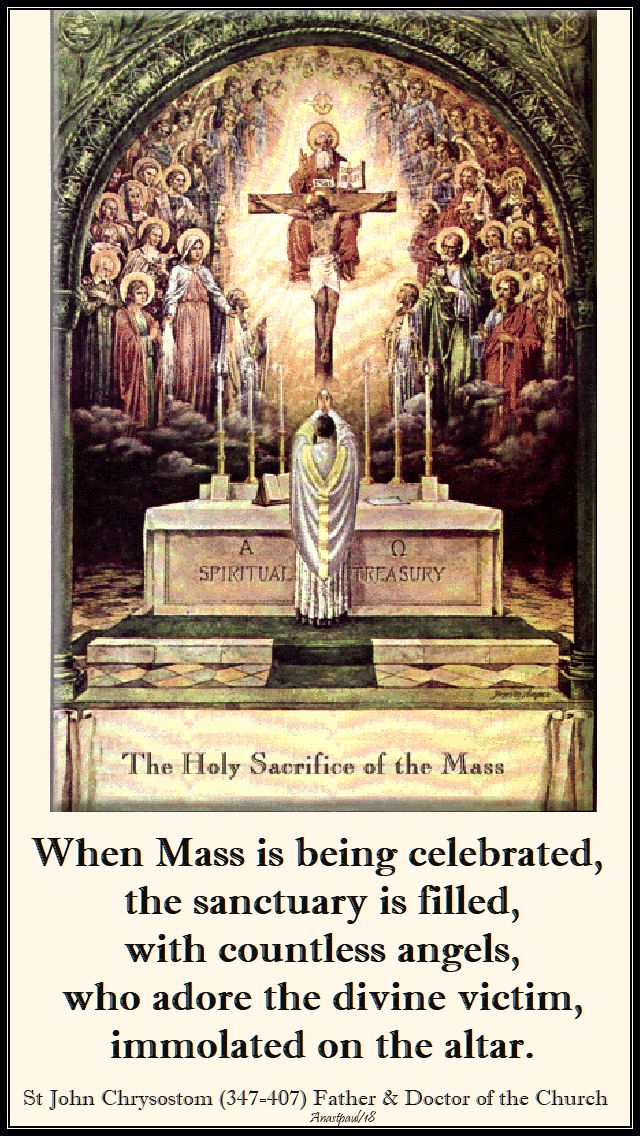
“When Mass is being celebrated, the sanctuary is filled, with countless angels, who adore the divine victim, immolated on the altar.”
St John Chrysostom (347-407) Father & Doctor of the Church
“The Holy Mass would be of greater profit, if people had it offered in their lifetime, rather than having it celebrated for the relief of their souls, after death.”
Pope Benedict XV (1854-1922)
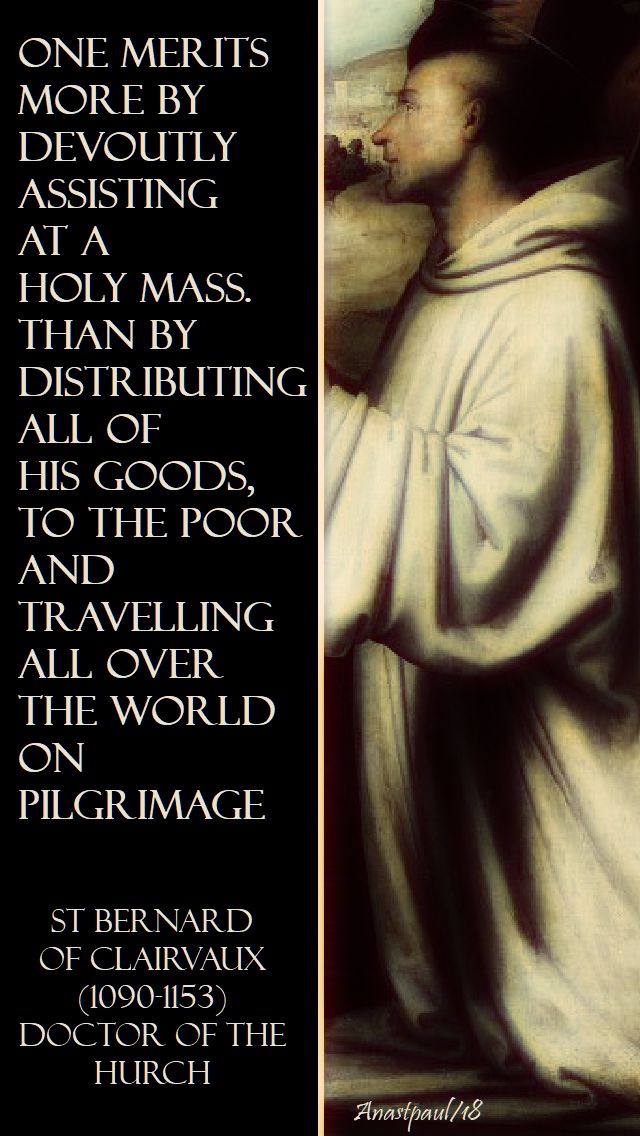
“One merits more, by devoutly assisting at a Holy Mass, than by distributing, all of his goods to the poor and travelling, all over the world, on pilgrimage.”
St Bernard if Clairvaux (1090-1153) Doctor of the Church
“The celebration of Holy Mass has the same value as the Death of Jesus on the Cross.”
St Thomas Aquinas (1225-1274) Doctor of the Church
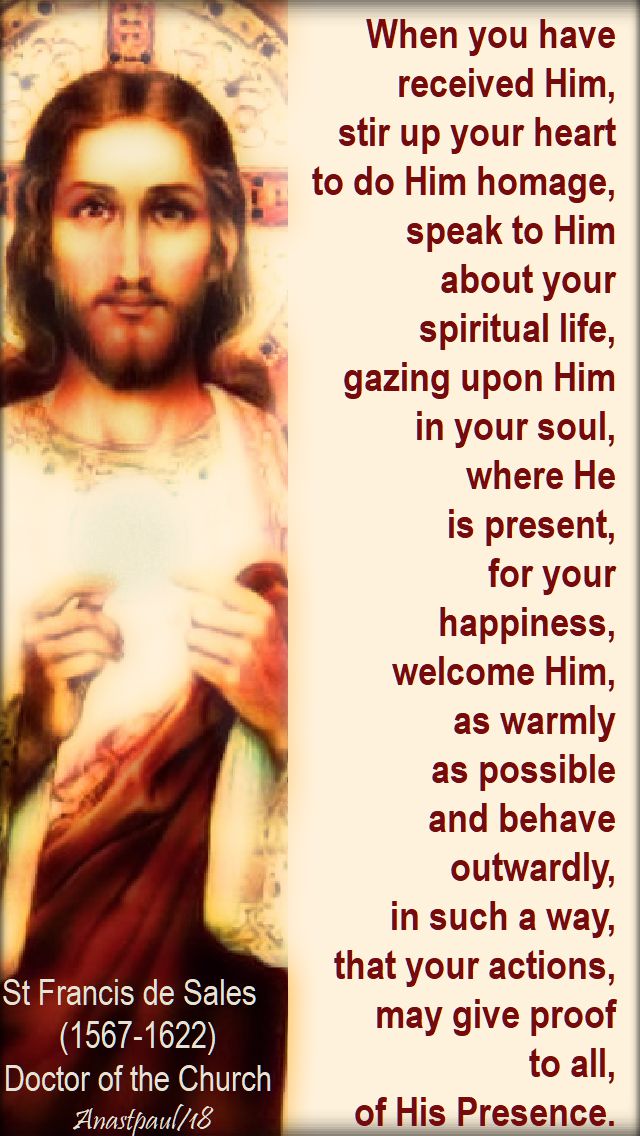
“When you have received Him, stir up your heart to do Him homage, speak to Him about your spiritual life, gazing upon Him in your soul, where He is present, for your happiness, welcome Him as warmly as possible and behave outwardly, in such a way, that your actions, may give proof to all, of His Presence.”
St Francis de Sales (1567-1622) Doctor of the Church
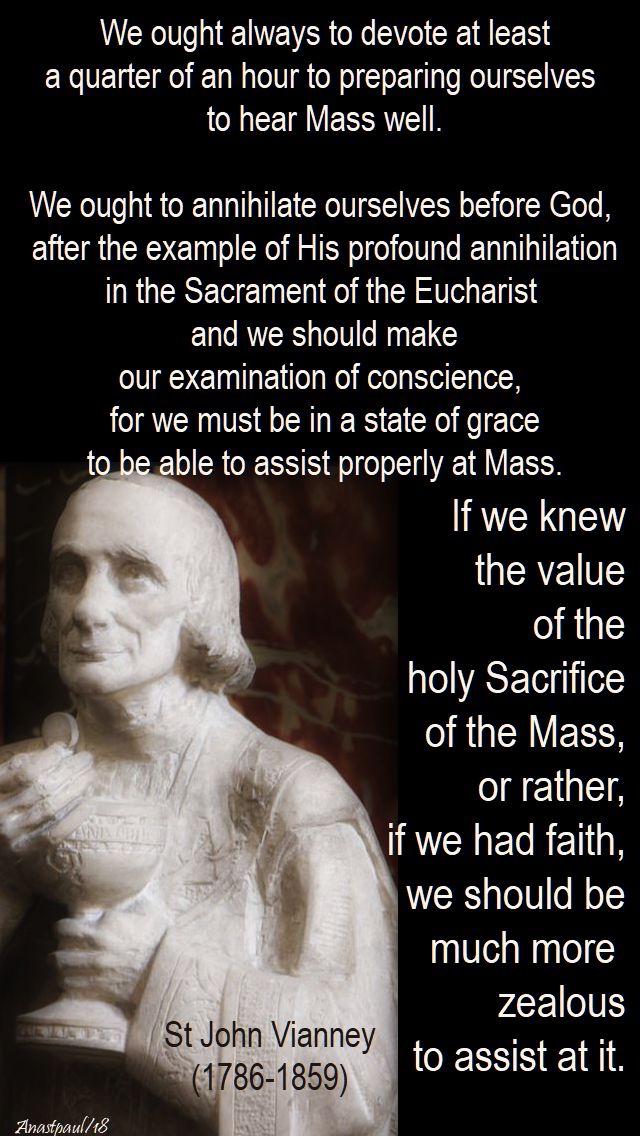
“If someone said to us, “At such an hour a dead person is to be raised to life, ” we should run very quickly to see it. But is not the Consecration, which changes bread and wine into the Body and Blood of God, a much greater miracle than to raise a dead person to life? We ought always to devote at least a quarter of an hour to preparing ourselves to hear Mass well. We ought to annihilate ourselves before God, after the example of His profound annihilation in the Sacrament of the Eucharist and we should make our examination of conscience, for we must be in a state of grace. to be able to assist properly at Mass. If we knew the value of the holy Sacrifice of the Mass, or rather, if we had faith, we should be much more zealous to assist at it.”
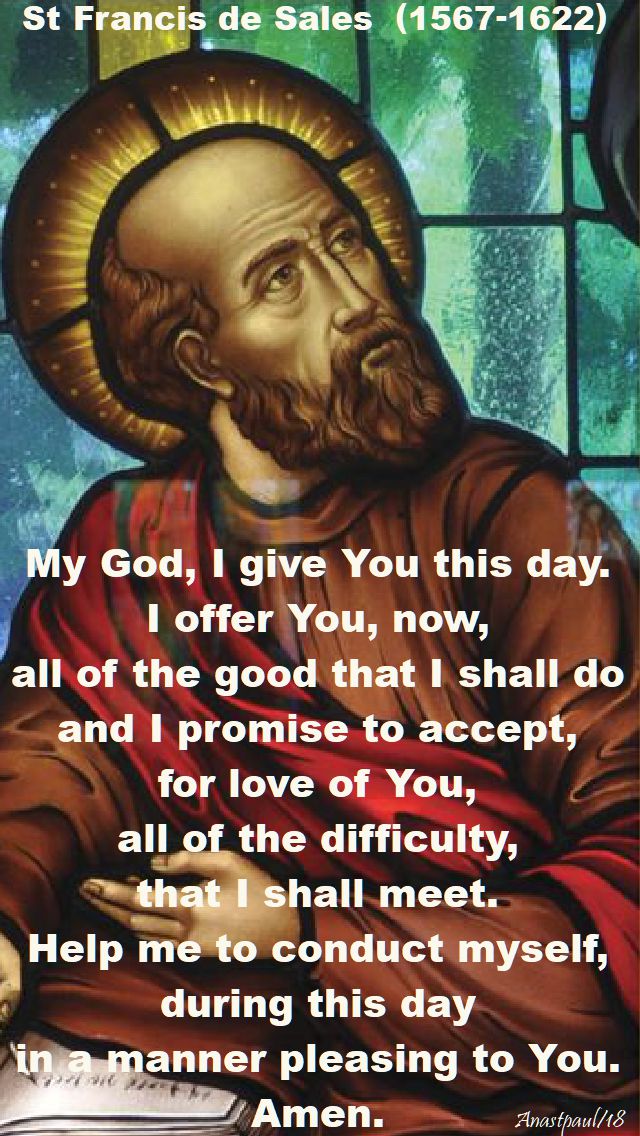
A Morning Offering of St Francis de Sales (1567-1622)
My God, I give You this day.
I offer You, now,
all of the good that I shall do
and I promise to accept,
for love of You,
all of the difficulty, that I shall meet.
Help me to conduct myself,
during this day
in a manner pleasing to You.
Amen
Quote of the Day – 2 February – Feast of the Presentation of the Lord and the World Day of Prayer for Consecrated Life
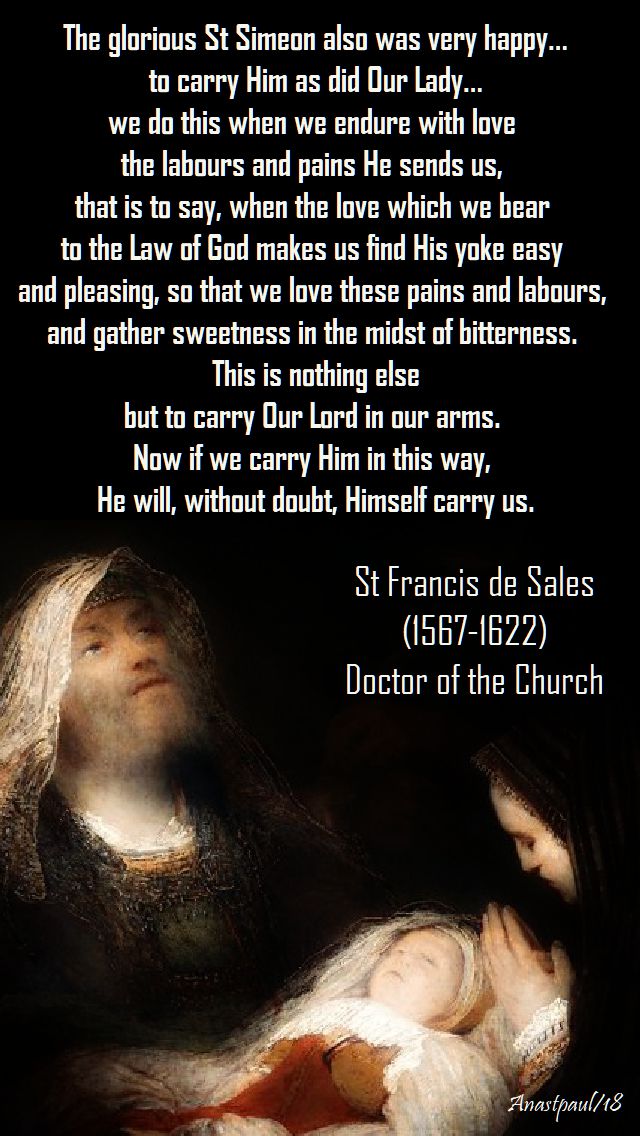
“The glorious St Simeon also was very happy… to carry Him as did Our Lady… we do this when we endure with love the labours and pains He sends us, that is to say, when the love which we bear to the Law of God makes us find His yoke easy and pleasing, so that we love these pains and labours, and gather sweetness in the midst of bitterness. This is nothing else but to carry Our Lord in our arms. Now if we carry Him in this way, He will, without doubt, Himself carry us.”
St Francis de Sales (1567-1622) Doctor of the Church
Quote/s for the Day – 1 February – The Memorial of Bl Benedict Daswa (1946-1990) Martyr – The First South African-born to be Beatified.
Would it not have been so simple for Blessed Benedict to pay his share of the required amount to hire the Sangona (Witch Doctor) to “sniff out” the witch who caused the storms? It was not a huge amount of money required by each resident. The temptation to do so must have been quite appealing but he refused and tried to explain that the storms were a natural phenomenon. He did, however, pay the ultimate price for his fidelity, with his blood.
“Speaking of Temptation”
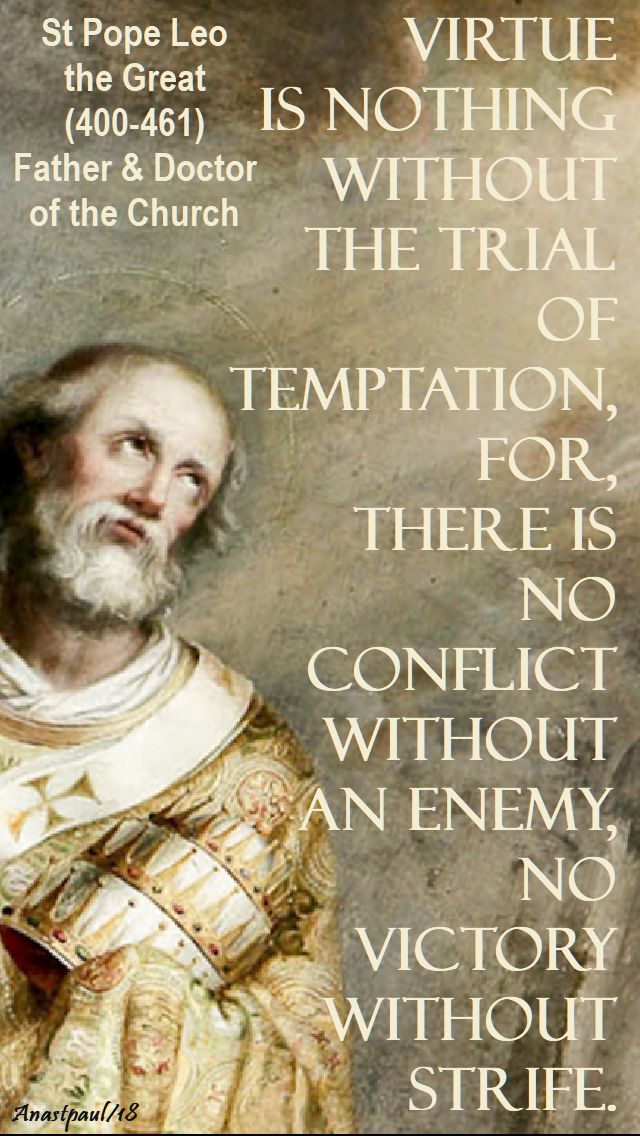
“Virtue is nothing, without the trial of temptation, for there is no conflict, without an enemy, no victory, without strife.”
St Pope Leo the Great (400-461) Father & Doctor of the Church
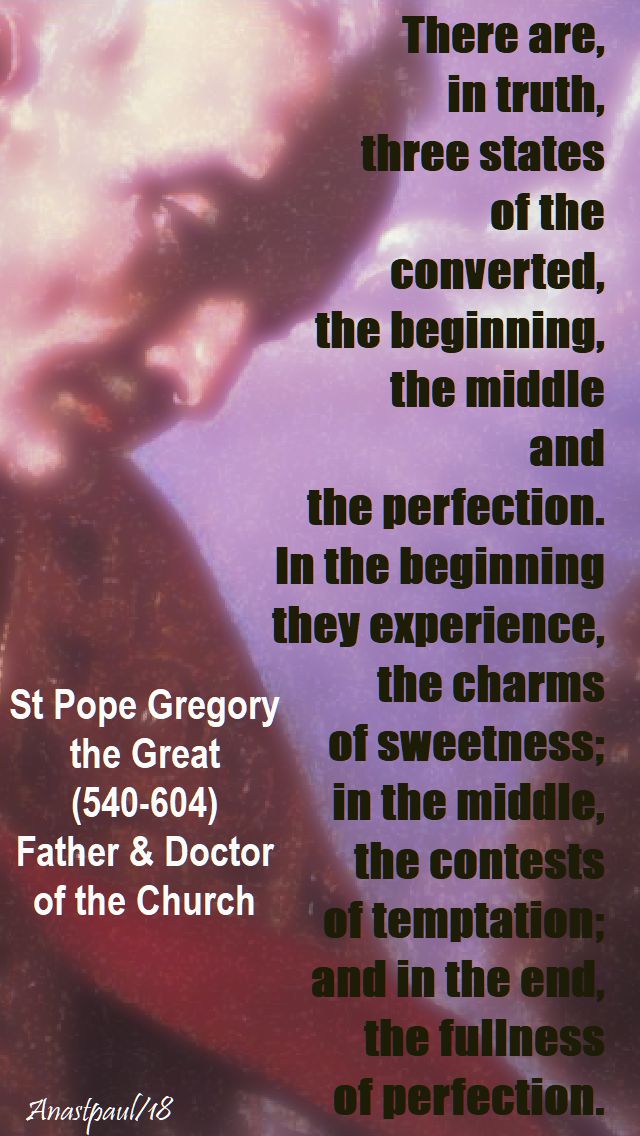
“There are in truth, three states of the converted, the beginning, the middle and the perfection. In the beginning, they experience the charms of sweetness; in the middle, the contests of temptation; and in the end, the fullness of perfection.”
St Pope Gregory the Great (540-604) Father & Doctor of the Church
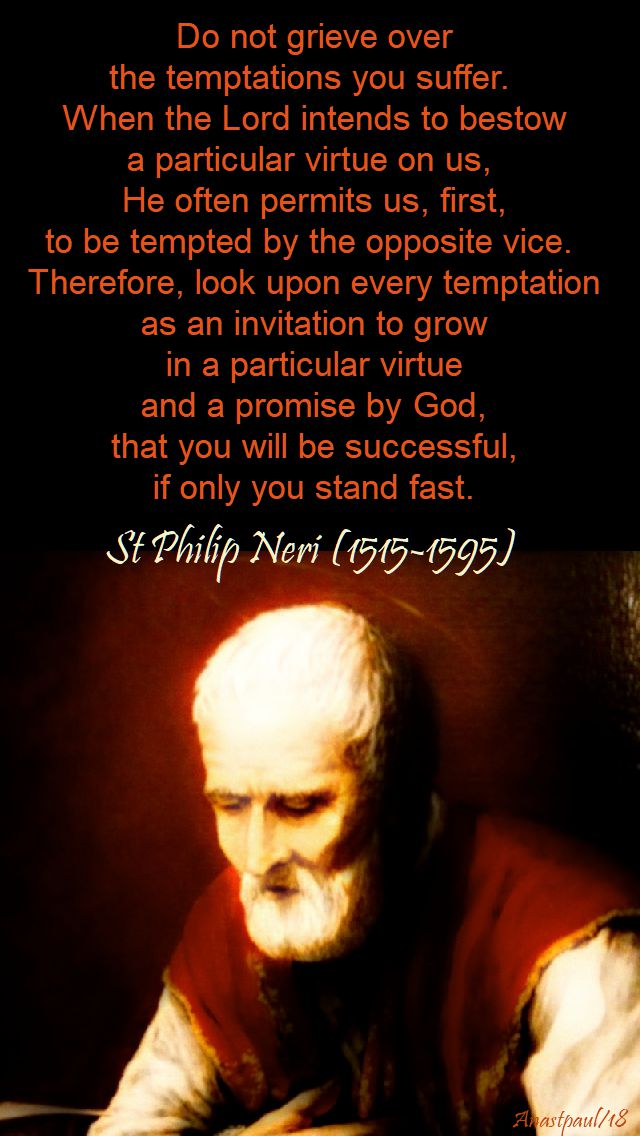
“Do not grieve over the temptations you suffer. When the Lord intends to bestow a particular virtue on us, He often permits us first to be tempted by the opposite vice. Therefore, look upon every temptation as an invitation to grow in a particular virtue and a promise by God, that you will be successful, if only you stand fast.”
St Philip Neri (1515-1595)
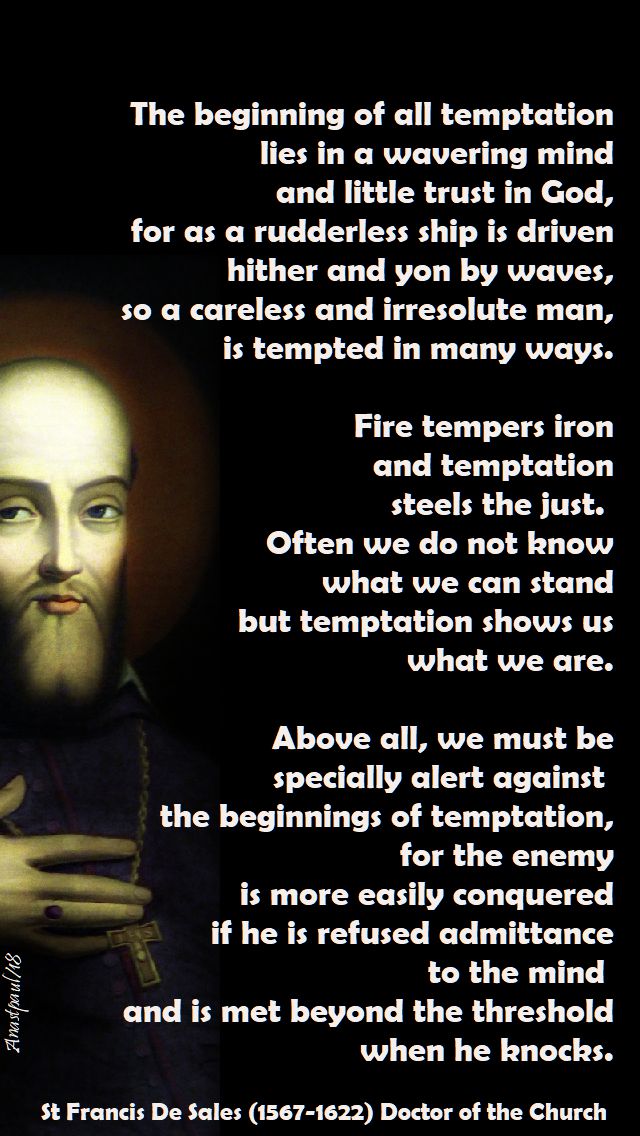
“The beginning of all temptation lies in a wavering mind and little trust in God, for as a rudderless ship is driven hither and yon by waves, so a careless and irresolute man, is tempted in many ways. Fire tempers iron and temptation steels the just. Often we do not know what we can stand but temptation shows us what we are. Above all, we must be especially alert against the beginnings of temptation, for the enemy is more easily conquered if he is refused admittance to the mind and is met beyond the threshold when he knocks.”
St Francis De Sales (1567-1622) Doctor of the Church
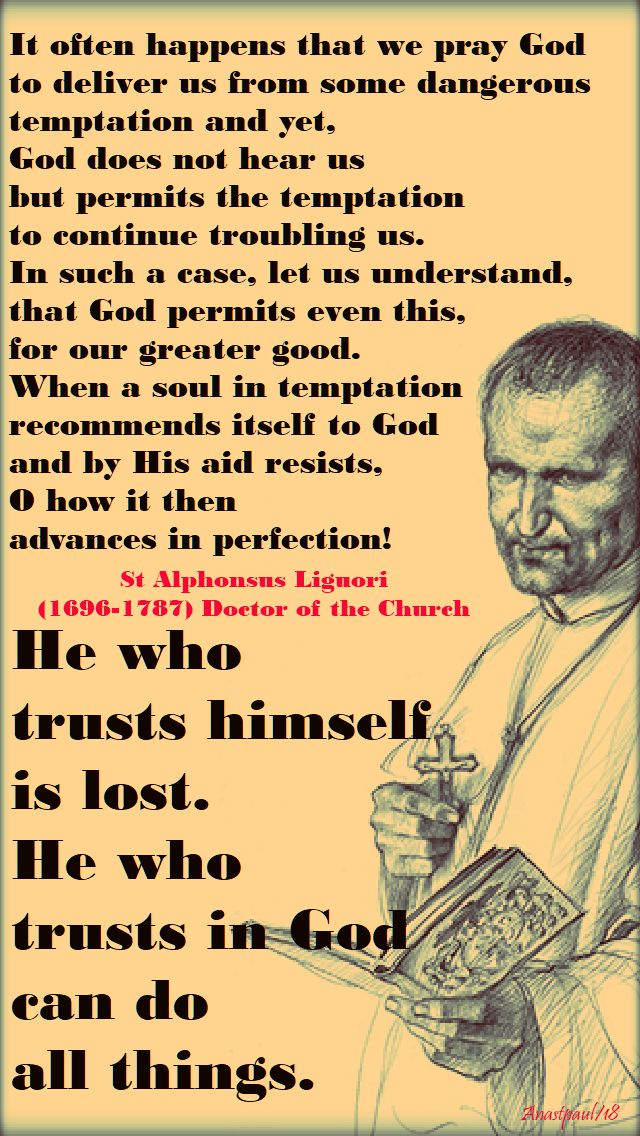
“It often happens that we pray God to deliver us from some dangerous temptation and yet, God does not hear us but permits the temptation to continue troubling us. In such a case, let us understand, that God permits even this for our greater good. When a soul in temptation recommends itself to God and by His aid resists, O how it then advances in perfection.”
“He who trusts himself is lost. He who trusts in God can do all things.
St Alphonsus Liguori (1696-1787) Doctor of the Church
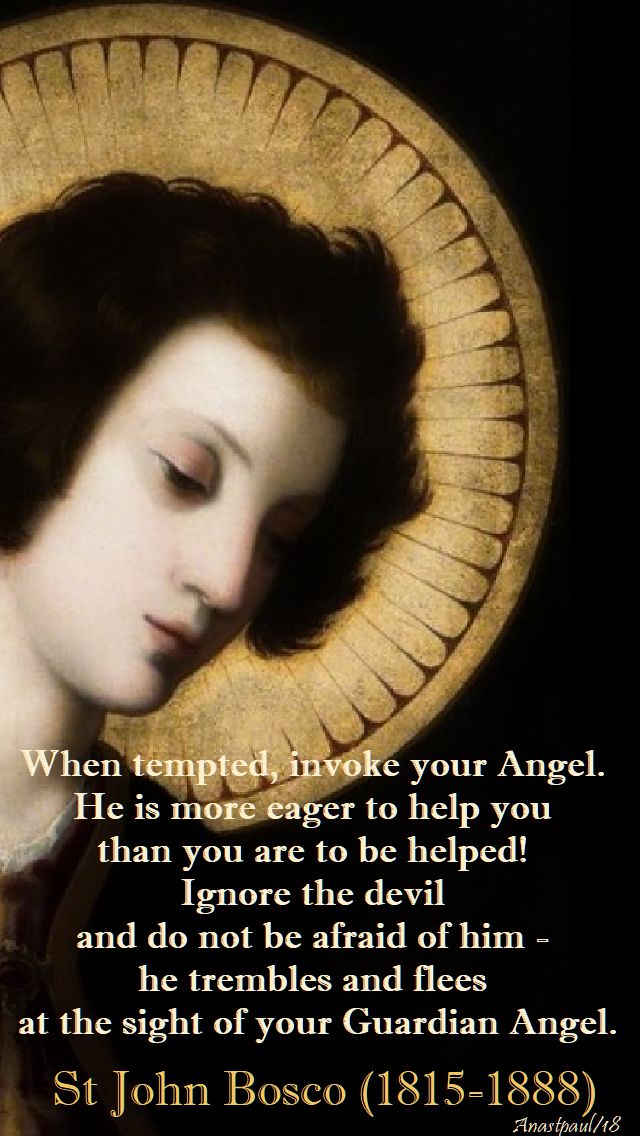
“When tempted, invoke your Angel. He is more eager to help you, than you are to be helped! Ignore the devil and do not be afraid of him – he trembles and flees, at the sight of your Guardian Angel.”
One Minute Reflection – 1 February – The Memorial of Bl Benedict Daswa (1946-1990) Martyr
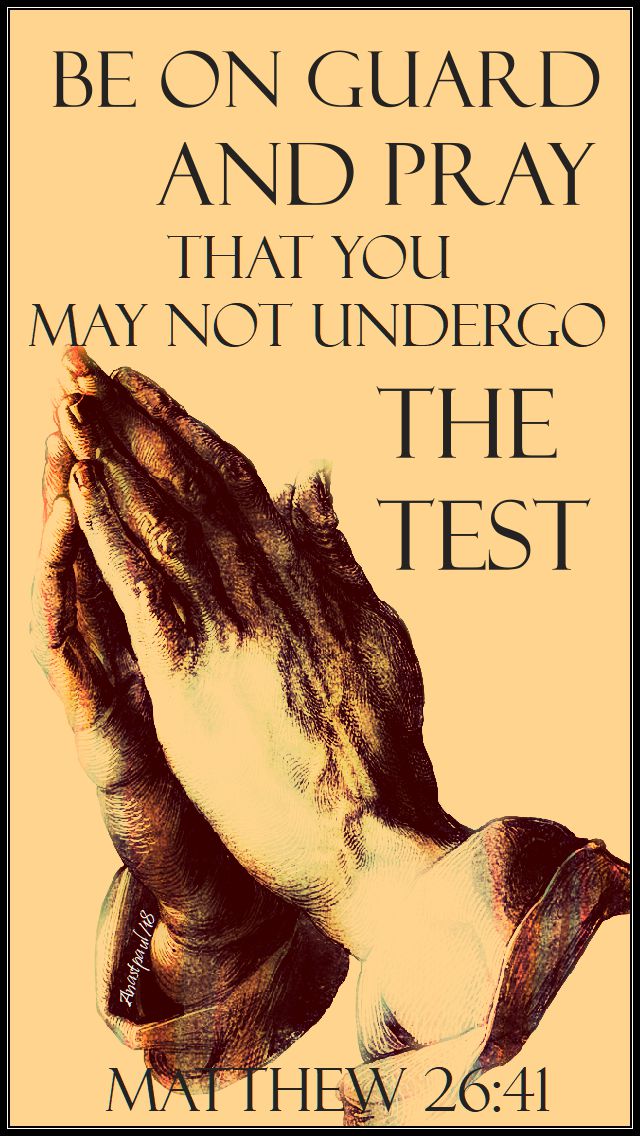
Be on guard and pray, that you may not undergo the test………Matthew 26:41
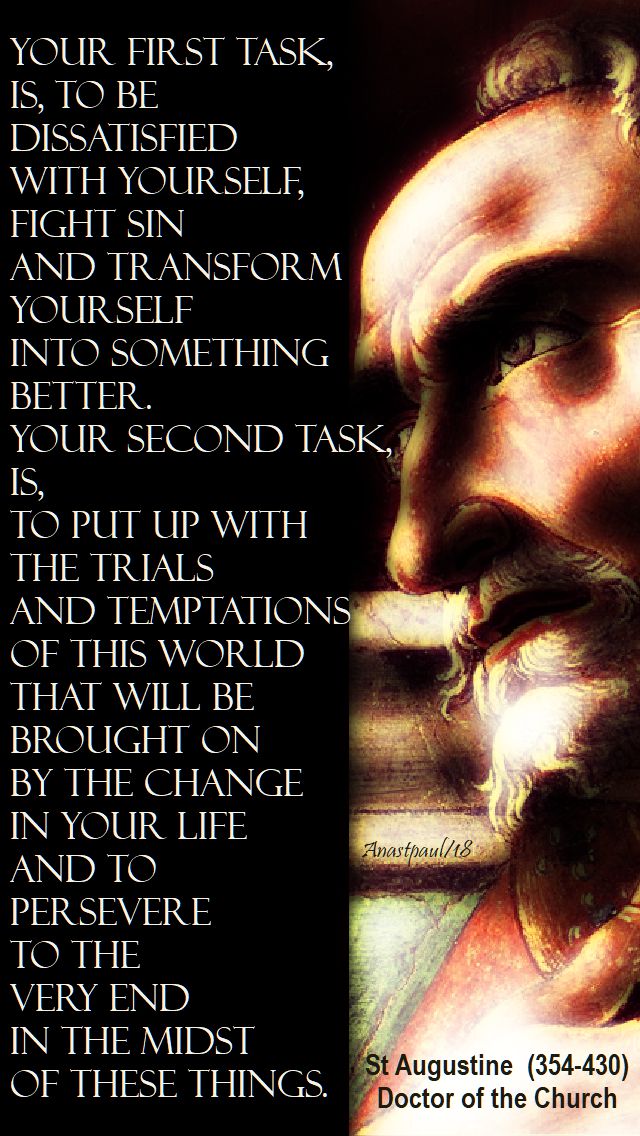
REFLECTION – “Your first task, is, to be dissatisfied with yourself, fight sin and transform yourself into something better. Your second task, is, to put up with the trials and temptations of this world, that will be brought on by the change in your life and to persevere to the very end, in the midst of these things…St Augustine
PRAYER – Heavenly Father, help me to work out my salvation in fear and trembling. Let me pray daily that I may withstand temptation and carry out Your will in all things. Blessed Benedict Daswa you who withstood all attempts to sway you into evil ways for the love of God, please intercede for us that we may too be freed when the test comes. Through Jesus Christ, our Lord, in unity with the Holy Spirit, one God forever, amen.
Our Morning Offering – 31 January – The Memorial of St John Bosco (1815-1888) Founder of the Salesians, which is founded on the spirituality and philosophy of Saint Francis de Sales.
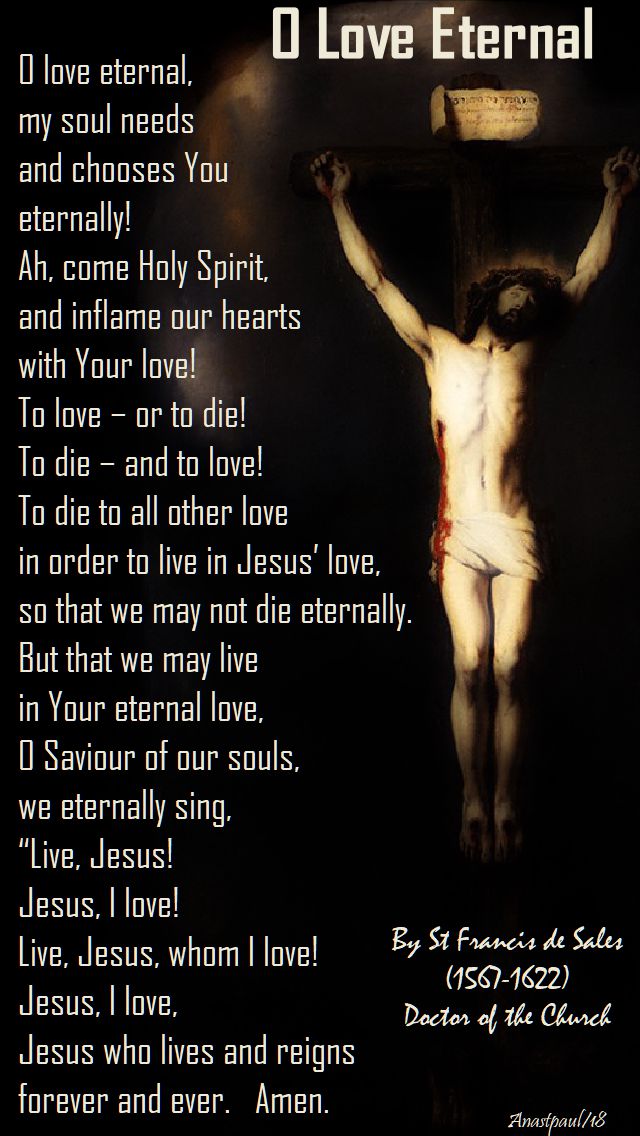
O Love Eternal By St Francis de Sales (1567-1622) Doctor of the Church
O love eternal,
my soul needs
and chooses You eternally!
Ah, come Holy Spirit,
and inflame our hearts
with Your love!
To love – or to die!
To die – and to love!
To die to all other love
in order to live in Jesus’ love,
so that we may not die eternally.
But that we may live
in Your eternal love,
O Saviour of our souls,
we eternally sing,
“Live, Jesus!
Jesus, I love!
Live, Jesus, whom I love!
Jesus, I love,
Jesus who lives and reigns
forever and ever. Amen.
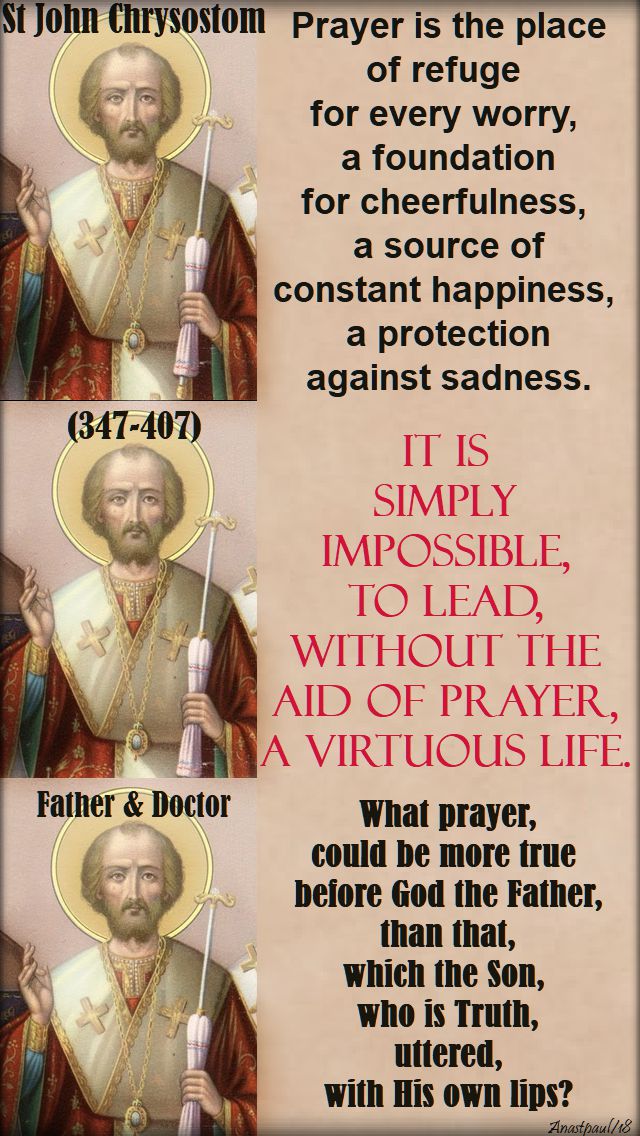
“Prayer is the place of refuge for every worry, a foundation for cheerfulness, a source of constant happiness, a protection against sadness.”
“It is simply impossible, to lead, without the aid of prayer, a virtuous life.”
“What prayer, could be more true before God the Father, than that, which the Son, who is Truth, uttered with His own lips?”
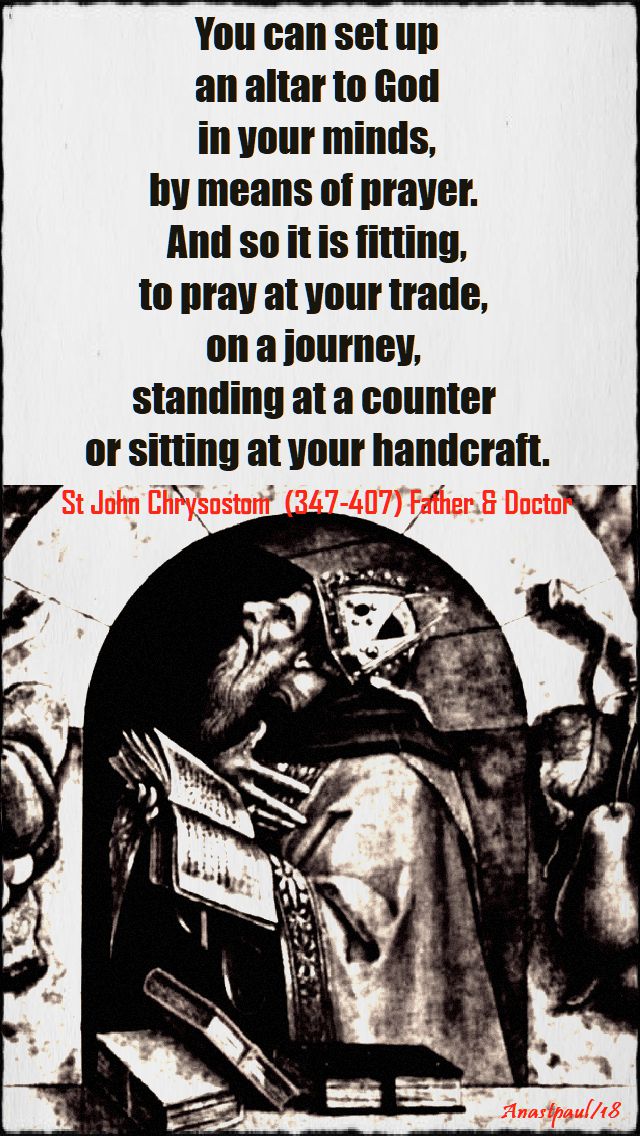
“You can set up an altar to God in your minds, by means of prayer. And so it is fitting, to pray at your trade, on a journey, standing at a counter or sitting at your handcraft.”
St John Chrysostom (347-407) Father & Doctor
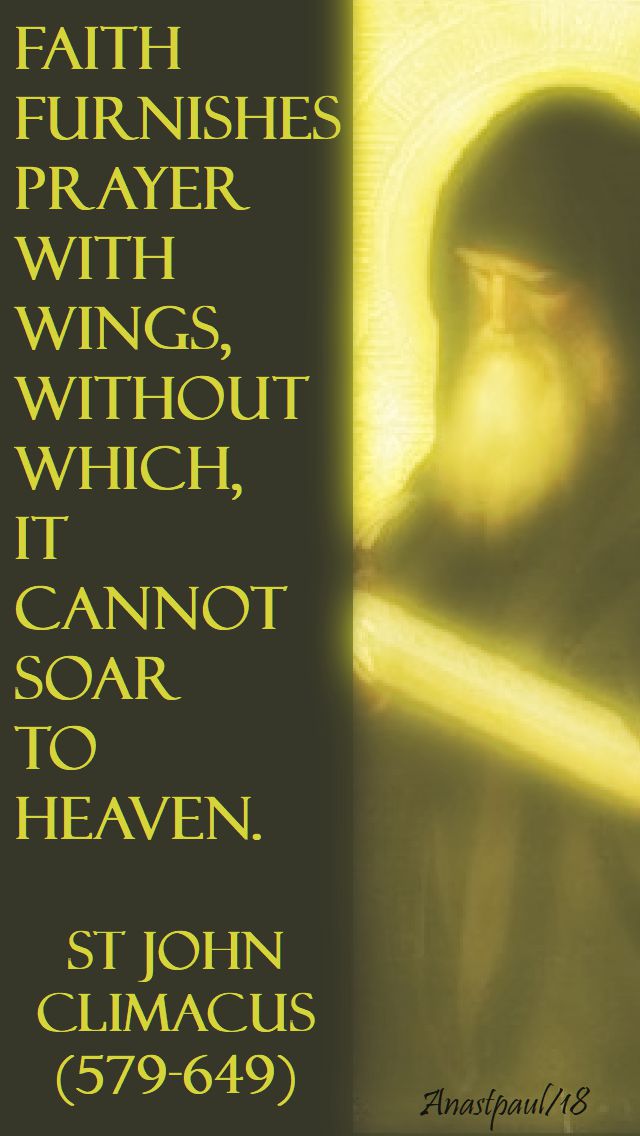
“Faith furnishes prayer with wings, without which it cannot soar to heaven.”
St John Climacus (579-649)
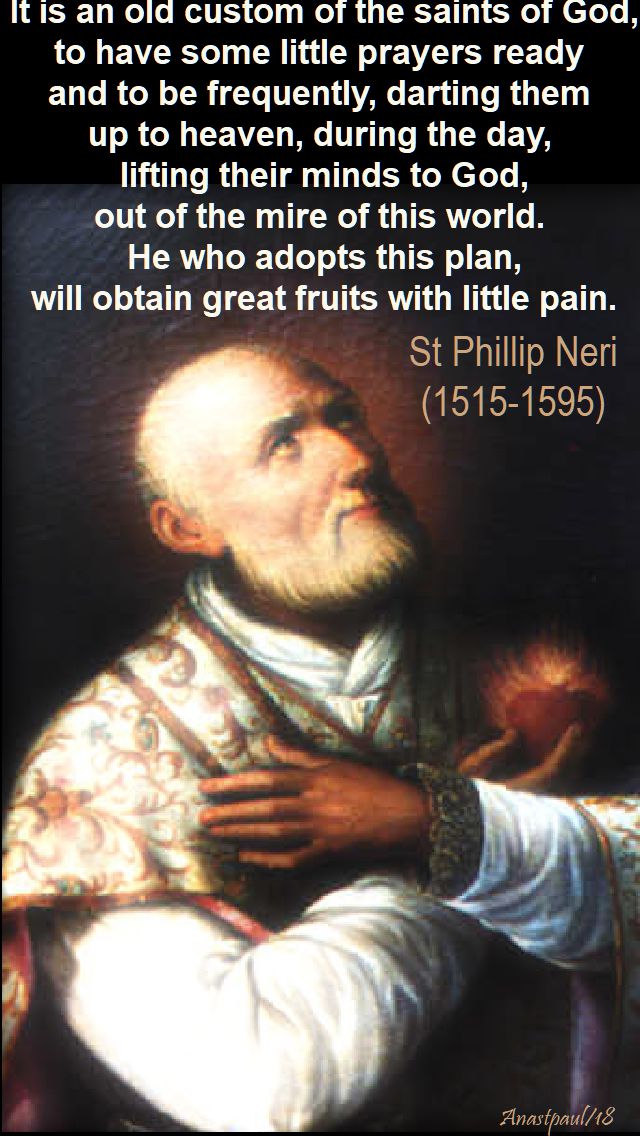
“It is an old custom of the saints of God, to have some little prayers ready and to be frequently, darting them up to heaven, during the day, lifting their minds to God, out of the mire of this world. He who adopts this plan, will obtain great fruits with little pain.”
St Phillip Neri (1515-1595)
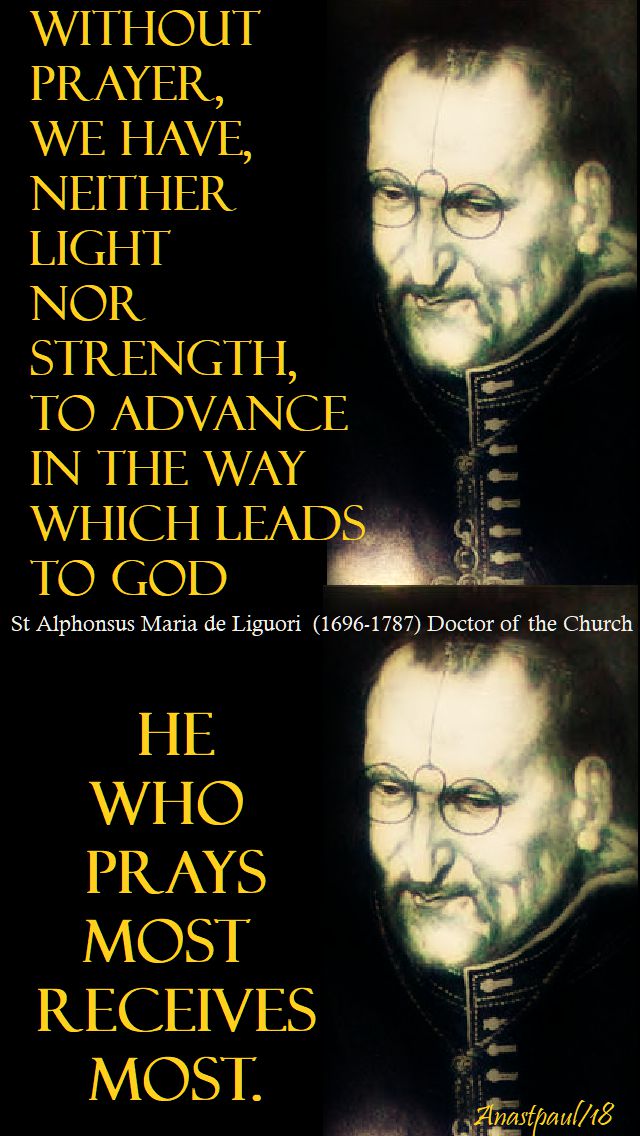
“Without prayer, we have, neither light nor strength, to advance in the way which leads to God.”
“He who prays most receives most.”
St Alphonsus Maria de Liguori (1696-1787) Doctor of the Church
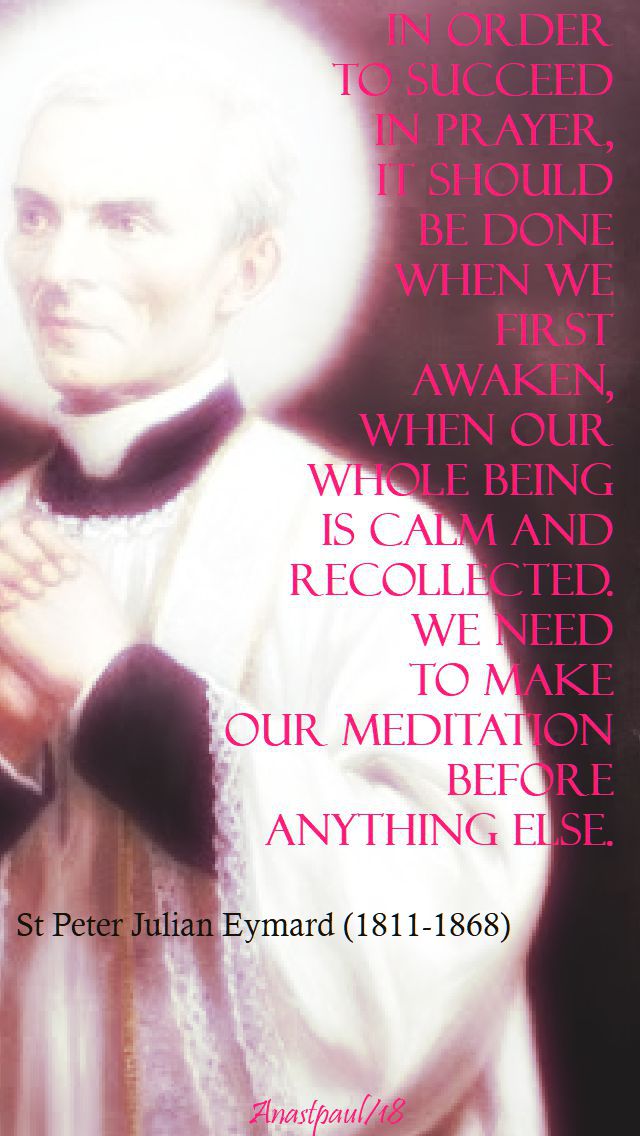
“In order to succeed in prayer, it should be done when we first awaken, when our whole being is calm and recollected. We need to make our meditation before anything else.”
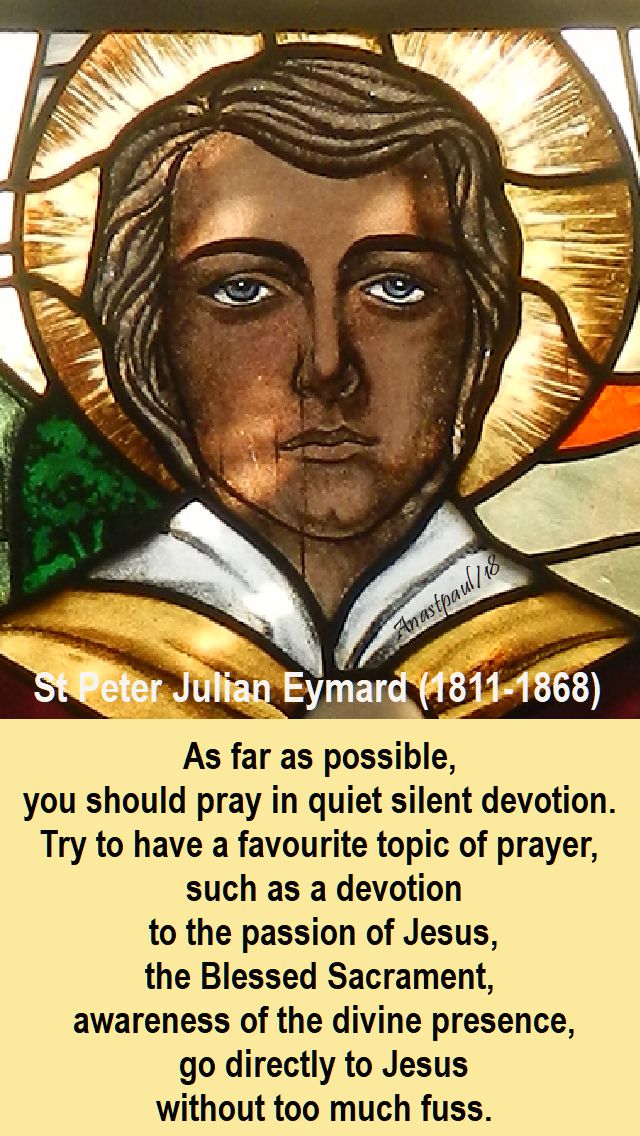
“As far as possible, you should pray in quiet silent devotion. Try to have a favourite topic of prayer, such as a devotion to the passion of Jesus, the Blessed Sacrament, awareness of the divine presence, go directly to Jesus without too much fuss.”
Thought for the Day – 29 January – “Speaking of Repentance”
Catholics have largely deserted the confessional. Our Communion lines are full and our confessionals are empty. Unless there has been some radical change in human nature over the past half century, something I see no evidence for, there is something very, very wrong in all this.
Saint Augustine, who once prayed before his conversion, Lord make me chaste but not now, knew the temptation to put off until some theoretical tomorrow repentance. We know that God will accept our repentance but true repentance means putting away sins we are deeply attached to, or ones we in despair think we cannot summon up the willpower to avoid in future. Saint Augustine, in Sermon 32 responds to this manana mentality by reminding us that while God has promised us forgiveness He has not promised us endless tomorrows to seek His forgiveness. As we enter Lent, let us recall these words of the Bishop of Hippo:
I know and as I do every one knows, who has used a little more than ordinary consideration, that no man who has any fear of God omits to reform himself in obedience to His words but he who thinks that he has longer time to live. This it is which kills so many, while they are saying, Tomorrow, Tomorrow and suddenly the door is shut. He remains outside with the raven’s croak, because he had not the moaning of the dove. Tomorrow, Tomorrow- is the raven’s croak. Moan plaintively as the dove and beat your breast but while you are inflicting blows on your breast, be the better for the beating lest you seem not to beat your conscience but rather with blows to harden it and make an evil conscience more unyielding instead of better.
Moan with no fruitless moaning. For it may be you are saying to yourself, God has promised me forgiveness, whenever I reform myself I am secure – I read the divine Scripture, In the day that the wicked man turns away from his wickedness and does that which is lawful and right, I will forget all his iniquities. I am secure then, whenever I reform myself, God will give me pardon for my evil deeds.
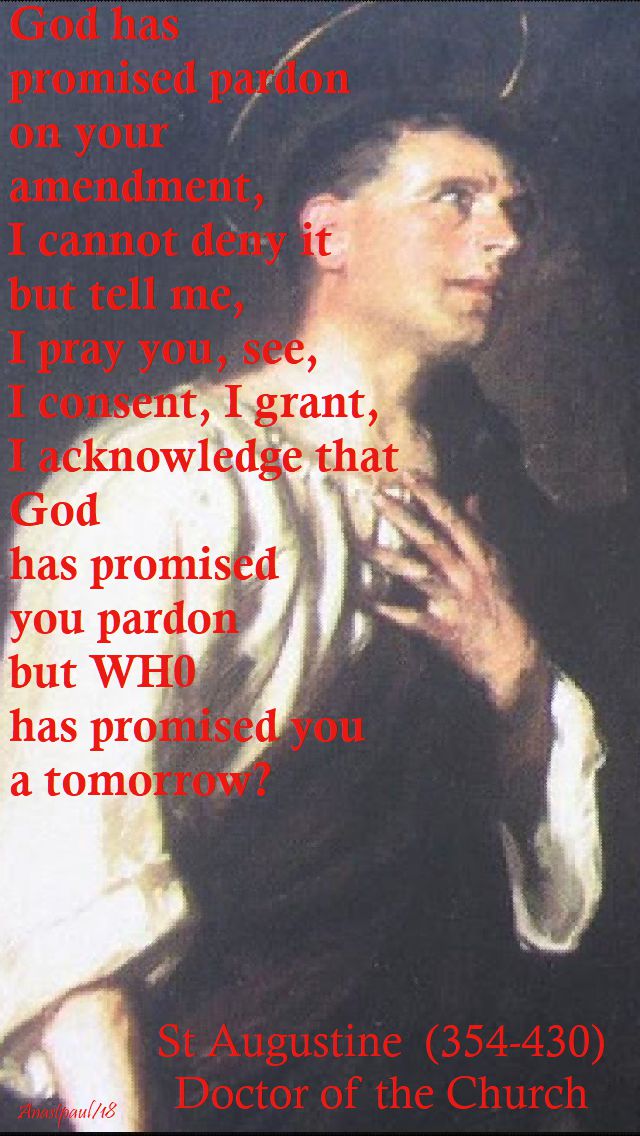
What can I say to this? Shall I lift up my voice against God? Shall I say to God, Do not give him pardon? Shall I say, this is not written, God has not promised this? If I should say ought of this, I should say falsely. You speak well and truly; God has promised pardon on your amendment, I cannot deny it but tell me, I pray you, see, I consent, I grant, I acknowledge that God has promised you pardon but who has promised you a tomorrow?
Where you read to me that you shall receive pardon, if you reform yourself, there read to me how long you have to live. Thou dost confess, I cannot read it there.
You know not then how long you have to live.
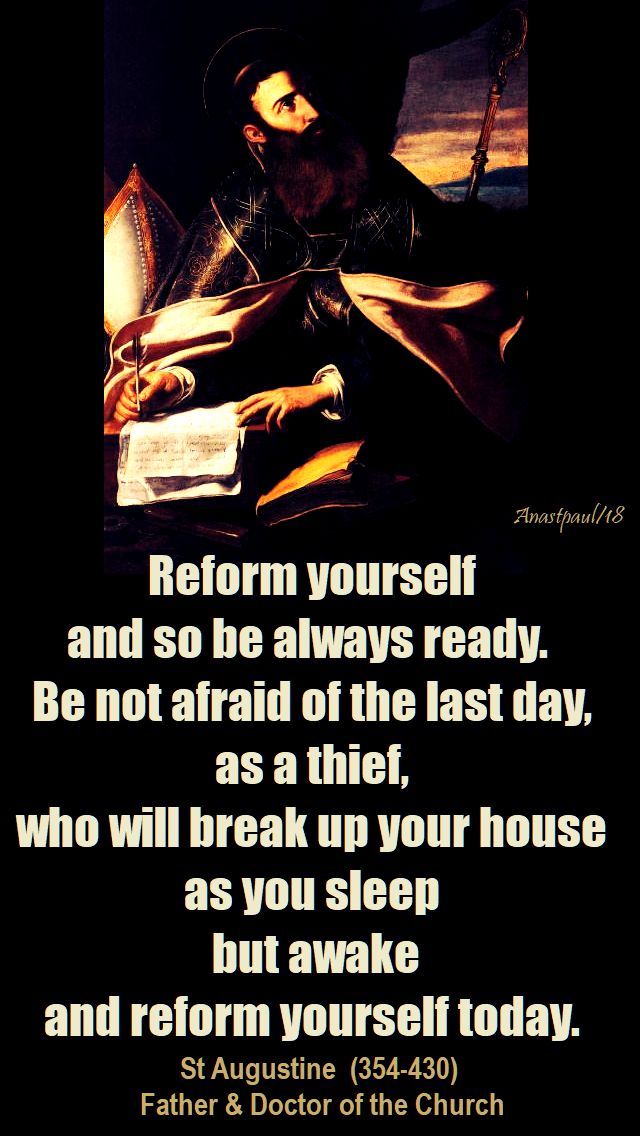
Reform yourself and so be always ready. Be not afraid of the last day, as a thief, who will break up your house as you sleep but awake and reform yourself today.
Why do you put it off till tomorrow? If your life is to be a long one, let it be both long and good. No one puts off a good dinner because it is to be a long one and do you wish to have a long evil life? Surely if it is to be long, it will be all the better if it be good; if it is to be short, it is well that its good be as long as possible.
But men neglect their life to such a degree, as that they are unwilling to have anything bad, except it. You buy a farm and you look out for a good one; you wish to marry a wife, you choose a good one; you wish for the birth of children and you long for good ones; you bargain for shoes and you do not wish for bad ones; and yet a bad life you do love. How has your life offended you, that you are willing to have it only bad, that amid all your good things, you should yourself alone be evil?
St Augustine (354-430) Father & Doctor of the Church, pray for us and thank you!
To speak of repentance is not fashionable today in a world that prefers to ignore sin, yet we who belong to Christ can testify that repentance is the way to forgiveness and freedom. It is the key that unlocks the mercy of God! The call to repentance is always addressed to ourselves first, since all of us are continually in need of deeper conversion.
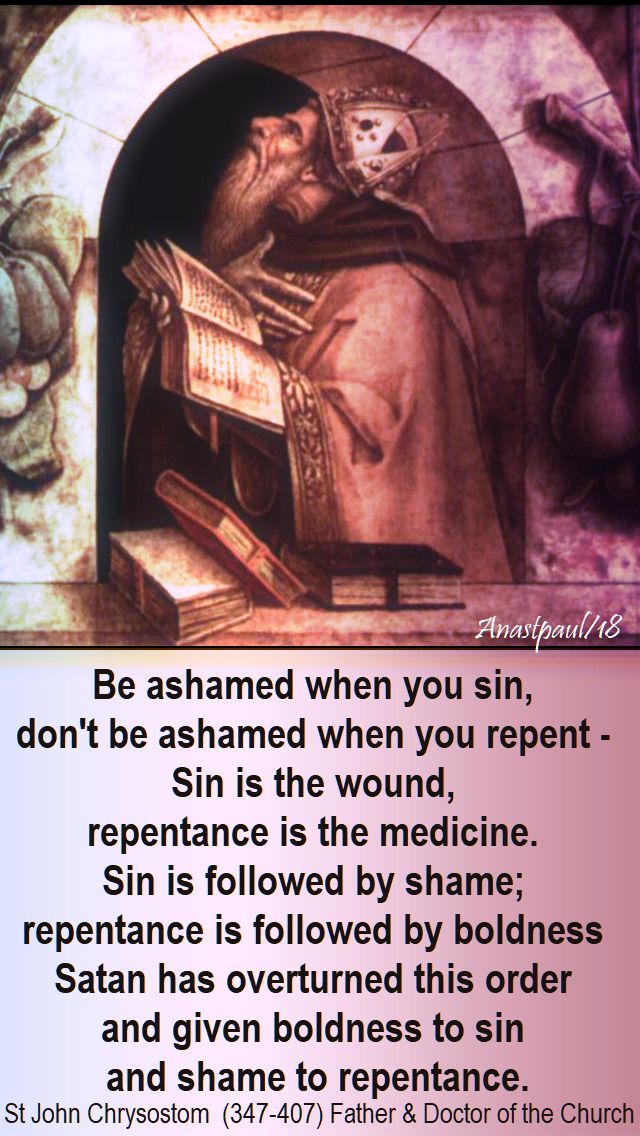
“Be ashamed when you sin, don’t be ashamed when you repent – Sin is the wound, repentance is the medicine. Sin is followed by shame; repentance is followed by boldness Satan has overturned this order and given boldness to sin and shame to repentance.”
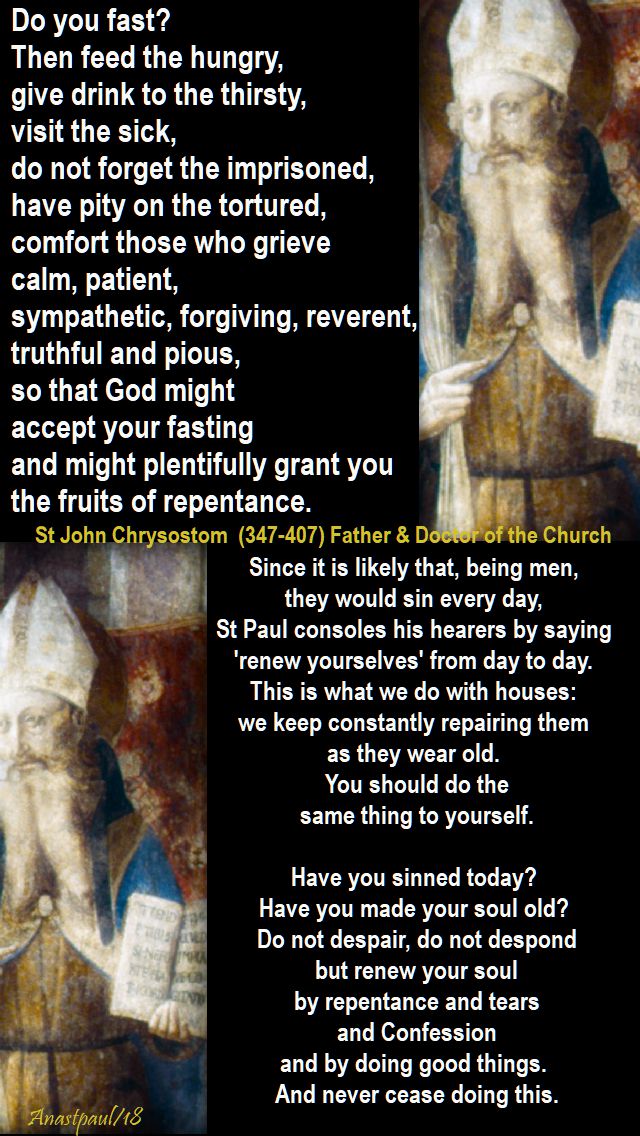
“Do you fast? Then feed the hungry, give drink to the thirsty, visit the sick, do not forget the imprisoned, have pity on the tortured, comfort those who grieve and who weep, be merciful, humble, kind, calm, patient, sympathetic, forgiving, reverent, truthful and pious, so that God might accept your fasting and might plentifully grant you the fruits of repentance.”
“Since it is likely that, being men, they would sin every day, St Paul consoles his hearers by saying ‘renew yourselves’ from day to day. This is what we do with houses: we keep constantly repairing them as they wear old. You should do the same thing to yourself. Have you sinned today? Have you made your soul old? Do not despair, do not despond but renew your soul by repentance and tears and Confession and by doing good things. And never cease doing this.”
St John Chrysostom (347-407) Father & Doctor of the Church
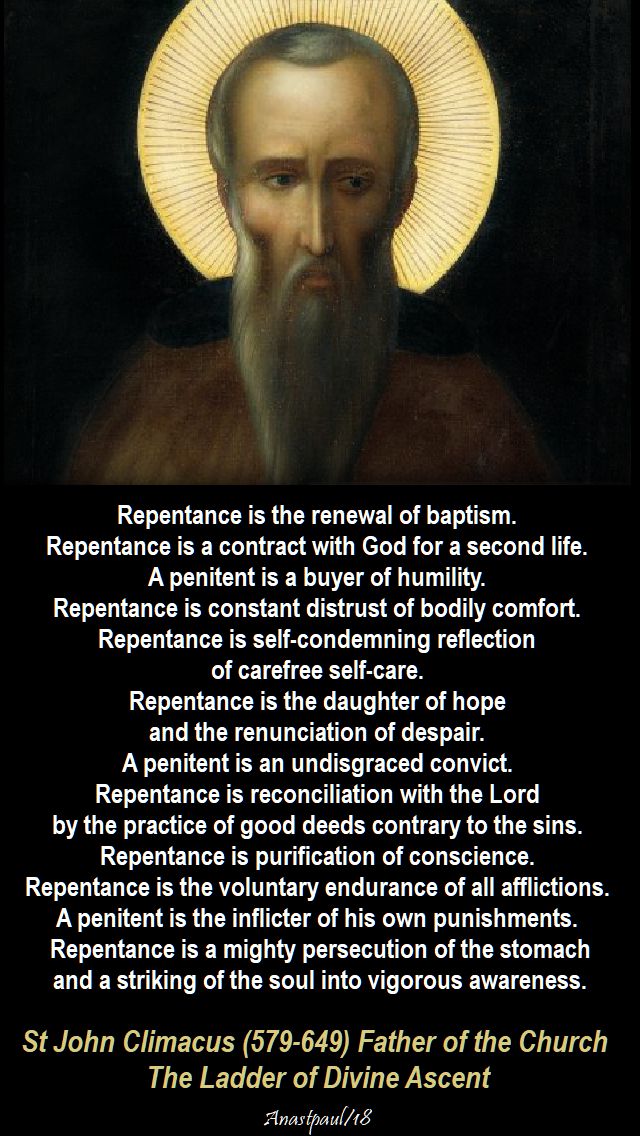
“Repentance is the renewal of baptism. Repentance is a contract with God for a second life. A penitent is a buyer of humility. Repentance is constant distrust of bodily comfort. Repentance is self-condemning reflection of carefree self-care. Repentance is the daughter of hope and the renunciation of despair. A penitent is an undisgraced convict. Repentance is reconciliation with the Lord by the practice of good deeds contrary to the sins. Repentance is purification of conscience. Repentance is the voluntary endurance of all afflictions. A penitent is the inflicter of his own punishments. Repentance is a mighty persecution of the stomach and a striking of the soul into vigorous awareness.”
St John Climacus (579-649) Father of the Church – The Ladder of Divine Ascent
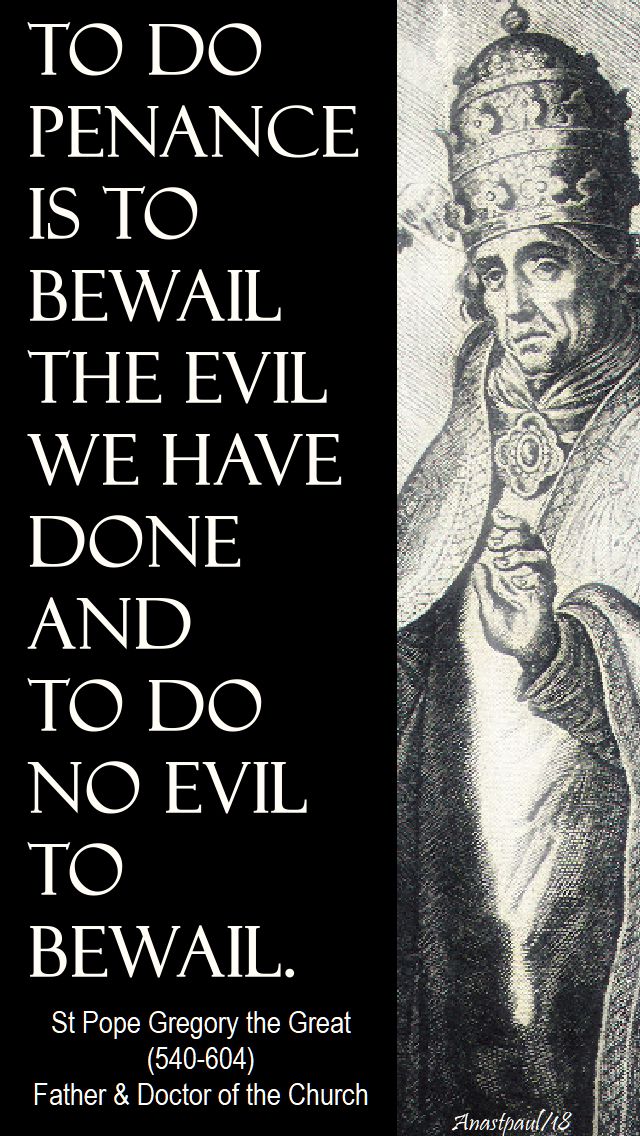
“To do penance is to bewail the evil we have done and to do no evil to bewail.”
St Gregory the Great (540-604) Father & Doctor of the Church
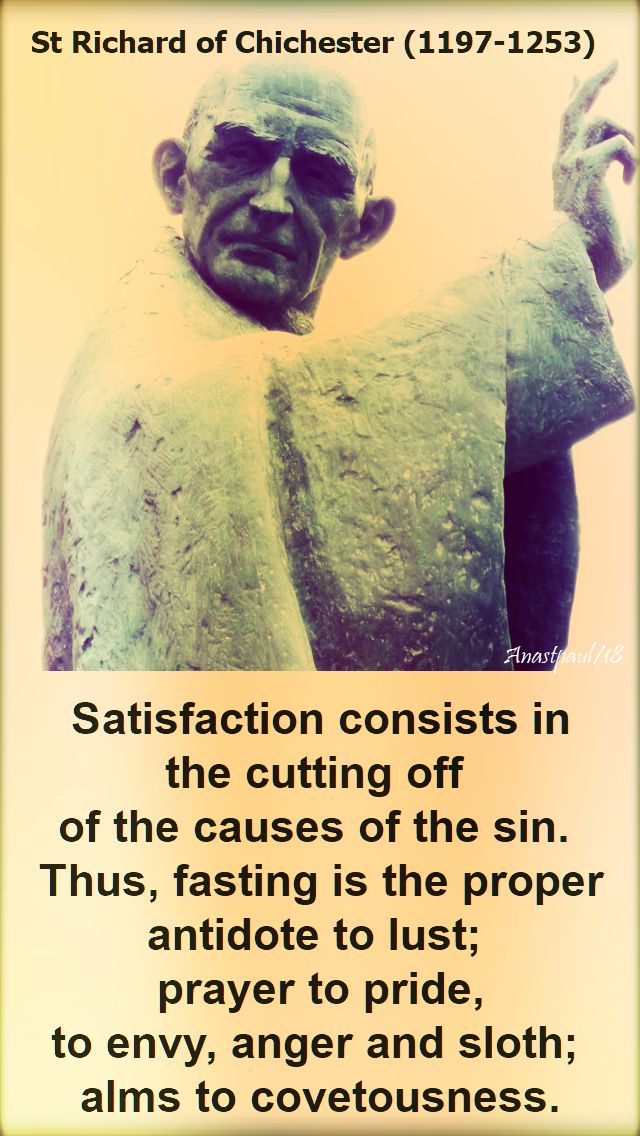
“Satisfaction consists in the cutting off of the causes of the sin. Thus, fasting is the proper antidote to lust; prayer to pride, to envy, anger and sloth; alms to covetousness.”
St Richard of Chichester (1197-1253)
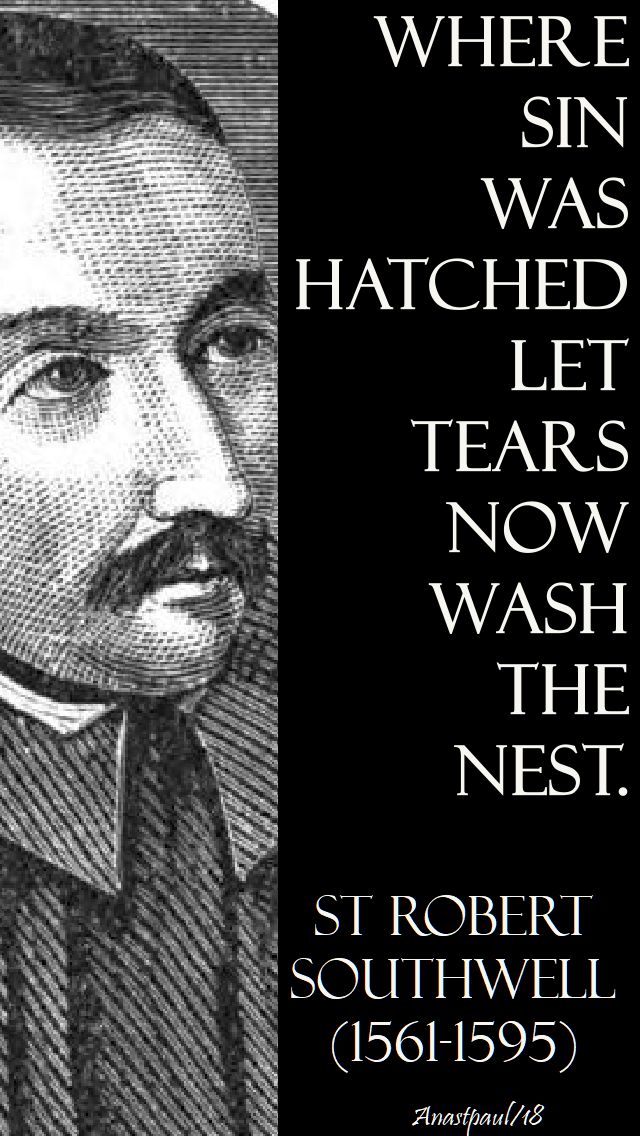
“Where sin was hatched, let tears now wash the nest.”
St Robert Southwell (1561-1595)
“We come to confession quite preoccupied with the shame that we shall feel. We accuse ourselves with hot air. It is said that many confess and few are converted. I believe it is so, my children, because few confess with tears of repentance.”
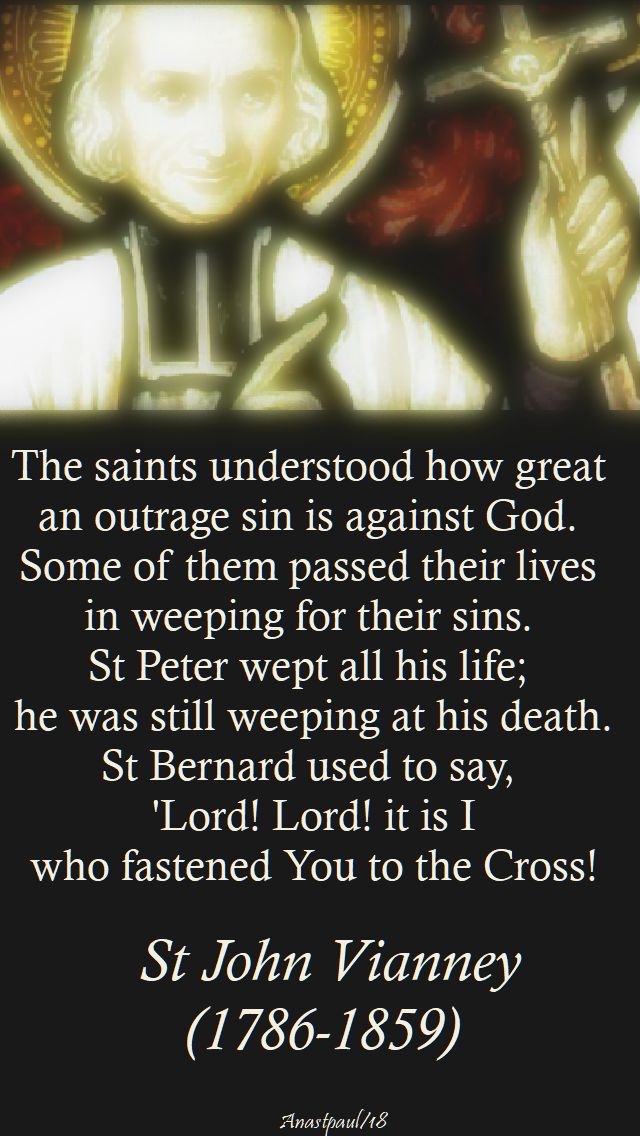
“The saints understood how great an outrage sin is against God. Some of them passed their lives in weeping for their sins. St Peter wept all his life; he was still weeping at his death. St Bernard used to say, ‘Lord! Lord! it is I who fastened You to the Cross!'”
One Minute Reflection – 29 January – Speaking of Repentance
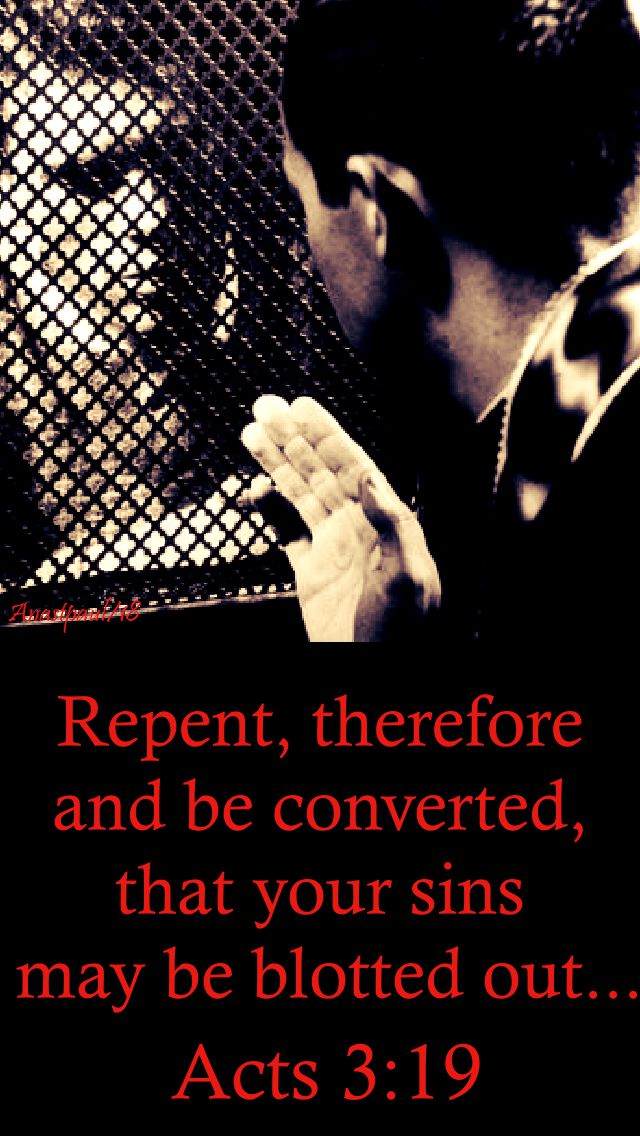
Repent, therefore and be converted, that your sins may be blotted out...Acts 3:19
REFLECTION – “I know and as I do every one knows, who has used a little more than ordinary consideration, that no man who has any fear of God omits to reform himself in obedience to His words but he who thinks that he has longer time to live. This it is which kills so many, while they are saying, Tomorrow, Tomorrow and suddenly the door is shut. He remains outside…You speak well and truly; God has promised pardon on your amendment, I cannot deny it but tell me, I pray you, see, I consent, I grant, I acknowledge that God has promised you pardon but who has promised you a tomorrow?”…St Augustine (354-430) Doctor of the Church, Sermon 32
PRAYER – Lord, my holy God, grant that I may always seek Your forgiveness and strive each moment to live Your will. I am weak and a sinful creature but long to see Your face and reach my heavenly home. Fill me with Your grace that I may live in the Light and footsteps of Your divine Son. Lord, Jesus Christ, son of God, my father, have mercy on me, a sinner. Amen
Thought for the Day – 28 January – The Memorial of St Thomas Aquinas (1225-1274) Doctor angelicus (Angelic Doctor) and Doctor communis (Common Doctor)
Pope John Paul II, recalled that “the Church has been justified in consistently proposing St Thomas as a master of thought and a model of the right way to do theology” (n. 43). It is not surprising that, after St Augustine, among the ecclesiastical writers mentioned in the Catechism of the Catholic Church, St Thomas is cited more than any other, at least 61 times! He was also called the Doctor Angelicus, perhaps because of his virtues and, in particular, the sublimity of his thought and the purity of his life.
The last months of Thomas’ earthly life remain surrounded by a particular, I would say, mysterious atmosphere. In December 1273, he summoned his friend and secretary Reginald to inform him of his decision to discontinue all work because he had realised, during the celebration of Mass subsequent to a supernatural revelation, that everything he had written until then “was worthless”. This is a mysterious episode that helps us to understand not only Thomas’ personal humility but also the fact that, however lofty and pure it may be, all we manage to think and say about the faith is infinitely exceeded by God’s greatness and beauty which will be fully revealed to us in Heaven.
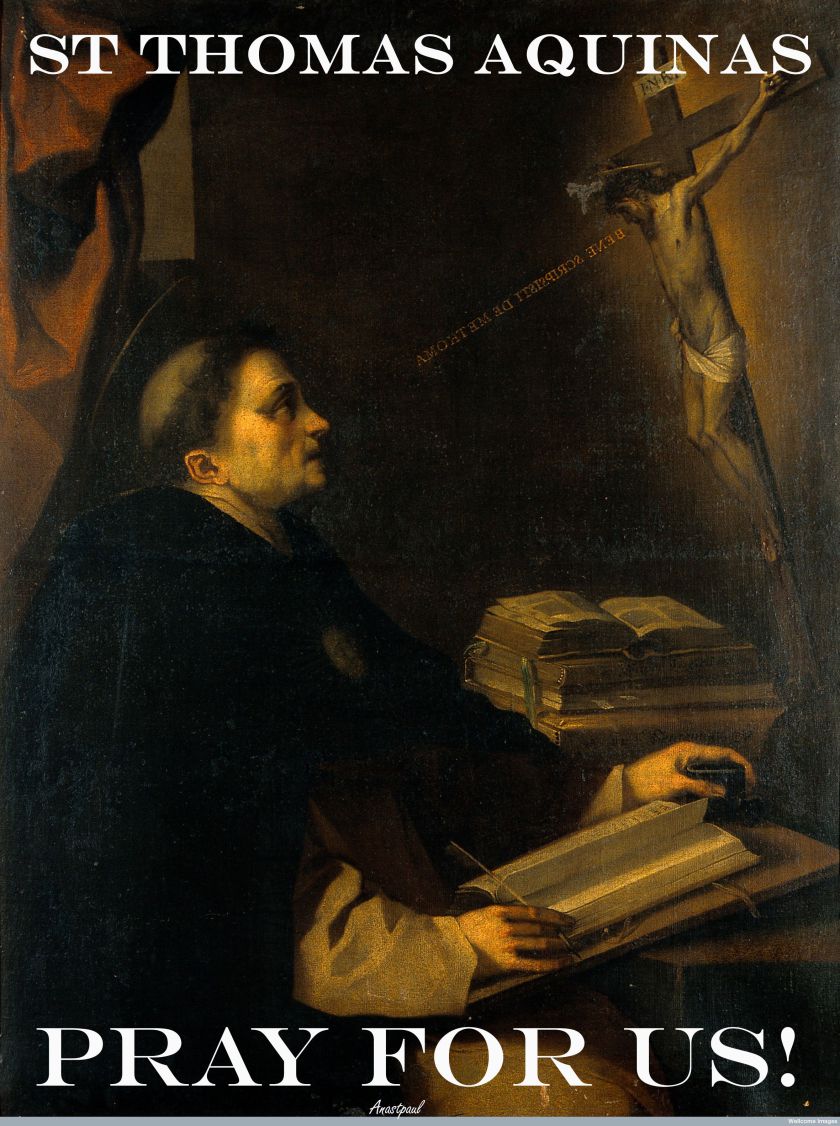
The life and teaching of St Thomas Aquinas could be summed up in an episode passed down by his ancient biographers. While, as was his wont, the Saint was praying before the Crucifix in the early morning in the chapel of St Nicholas in Naples, Domenico da Caserta, the church sacristan, overheard a conversation. Thomas was anxiously asking whether what he had written on the mysteries of the Christian faith was correct. And the Crucified One answered him: “You have spoken well of me, Thomas. What is your reward to be?”.And the answer Thomas gave him was what we too, friends and disciples of Jesus, always want to tell him: “Nothing but Yourself, Lord!”…Pope Benedict XVI – First in the series of Catechesis on St Thomas Aquinas – 2 June 2010
Quote/s of the Day – 28 January – The Memorial of St Thomas Aquinas (1225-1274) Doctor angelicus (Angelic Doctor) and Doctor communis (Common Doctor)
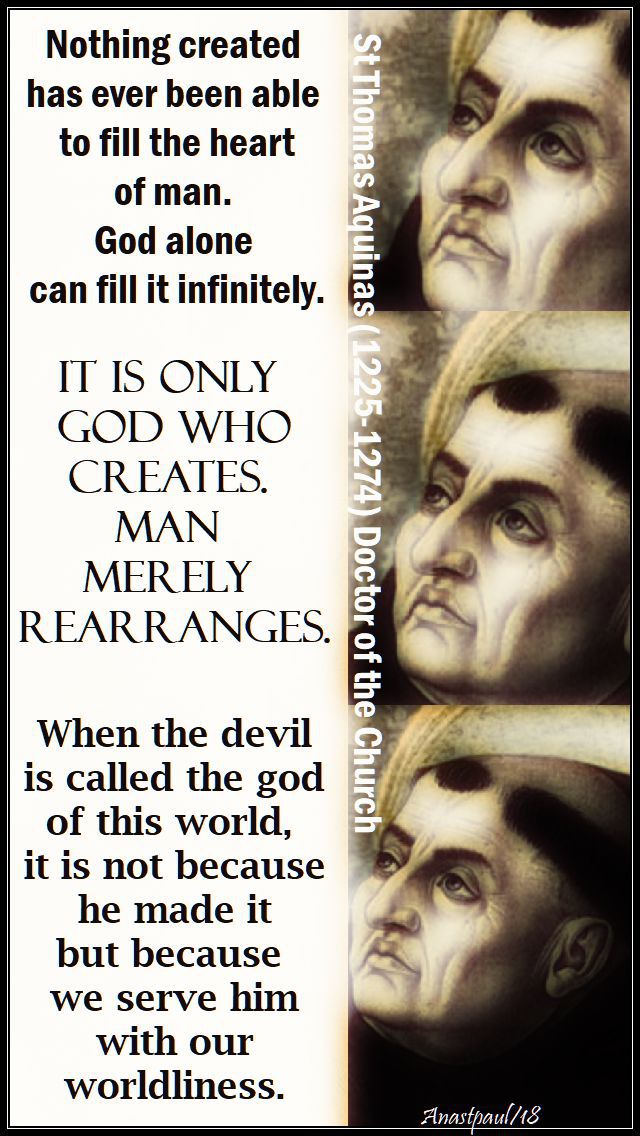
“Nothing created has ever been able to fill the heart of man. God alone can fill it infinitely.”
“It is only God who creates. Man merely rearranges.”
“When the devil is called the god of this world, it is not because he made it but because we serve him with our worldliness.”
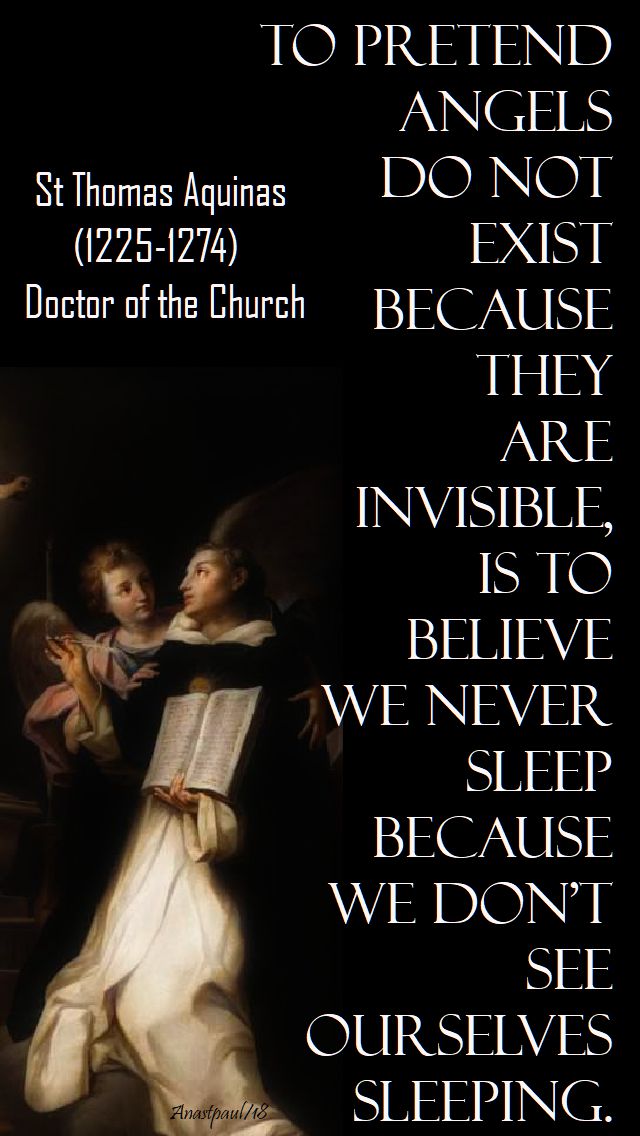
“To pretend angels do not exist because they are invisible, is to believe we never sleep because we don’t see ourselves sleeping.”
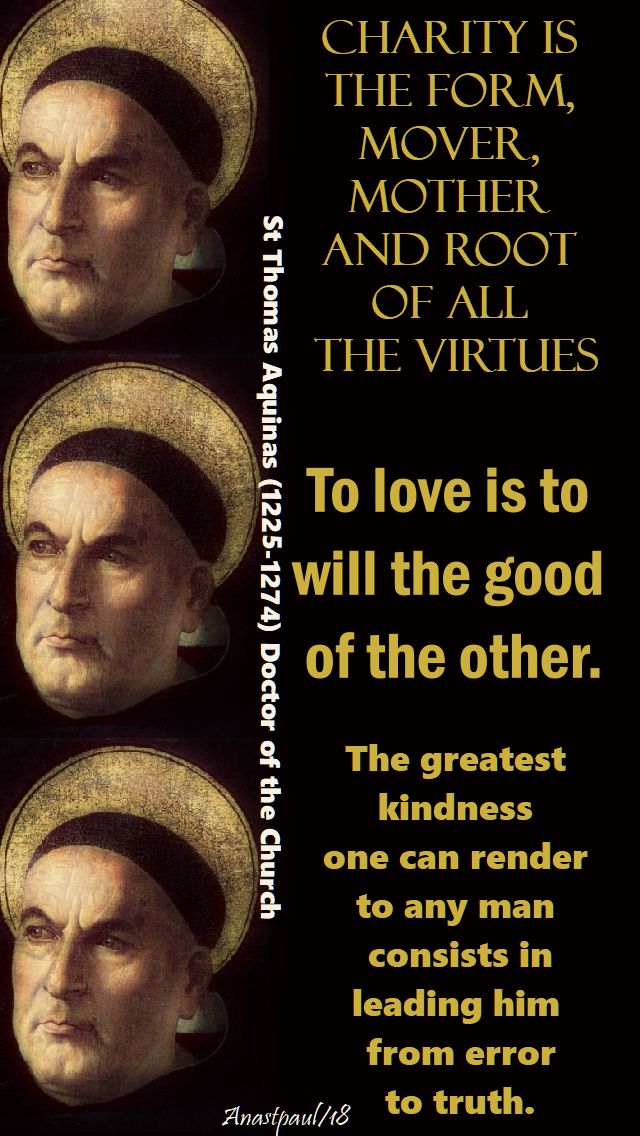
“Charity is the form, mover, mother and root of all the virtues.”
“To love is to will the good of the other.”
“The greatest kindness one can render to any man consists in leading him from error to truth.”
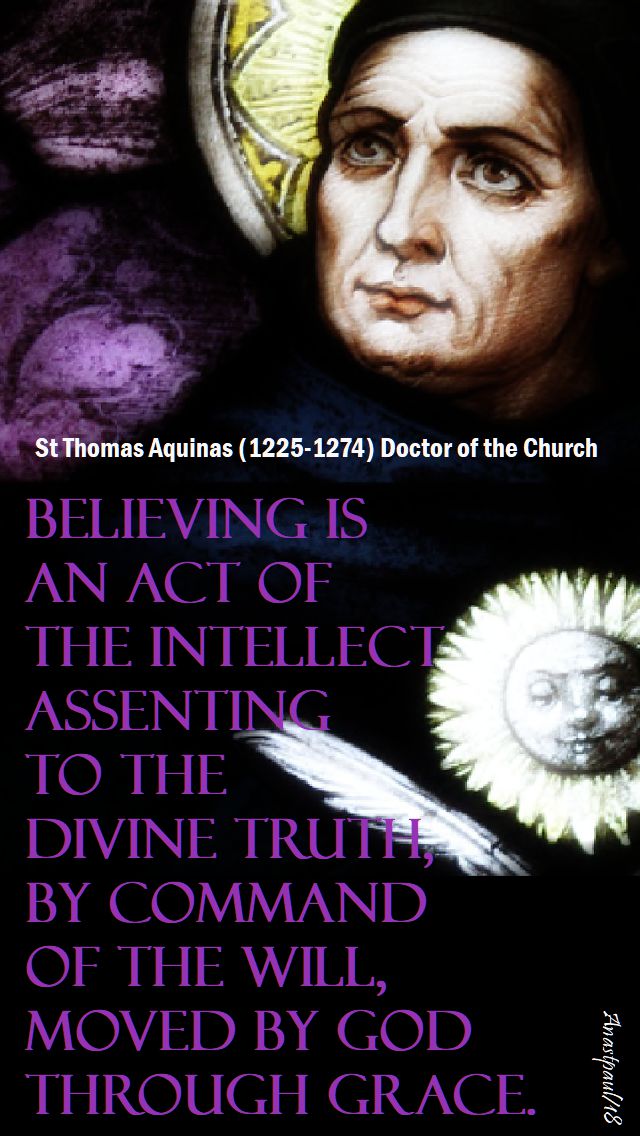
“Believing is an act of the intellect assenting to the divine truth, by command of the will, moved by God through grace.”
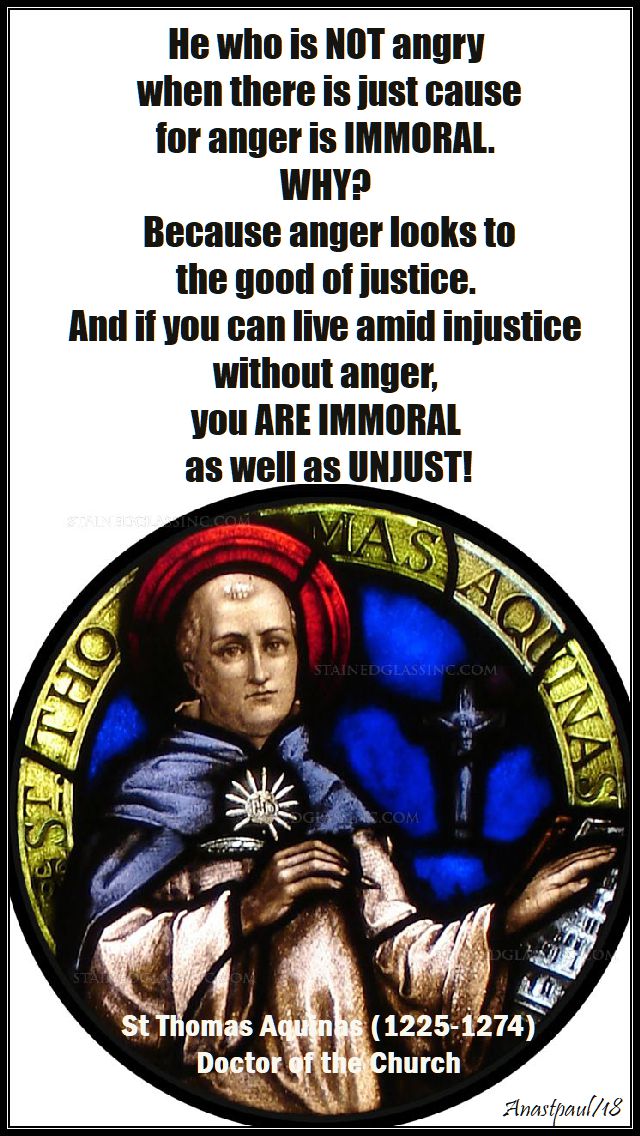
“He who is NOT angry when there is just cause for anger is IMMORAL. WHY? Because anger looks to the good of justice. And if you can live amid injustice without anger, you ARE IMMORAL as well as UNJUST!”
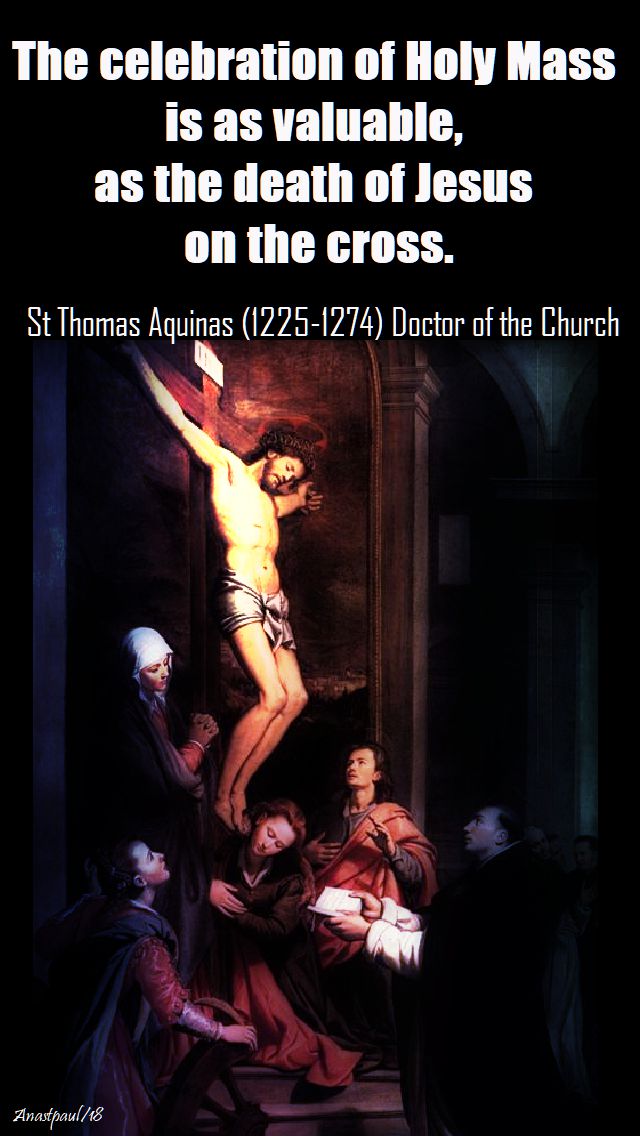
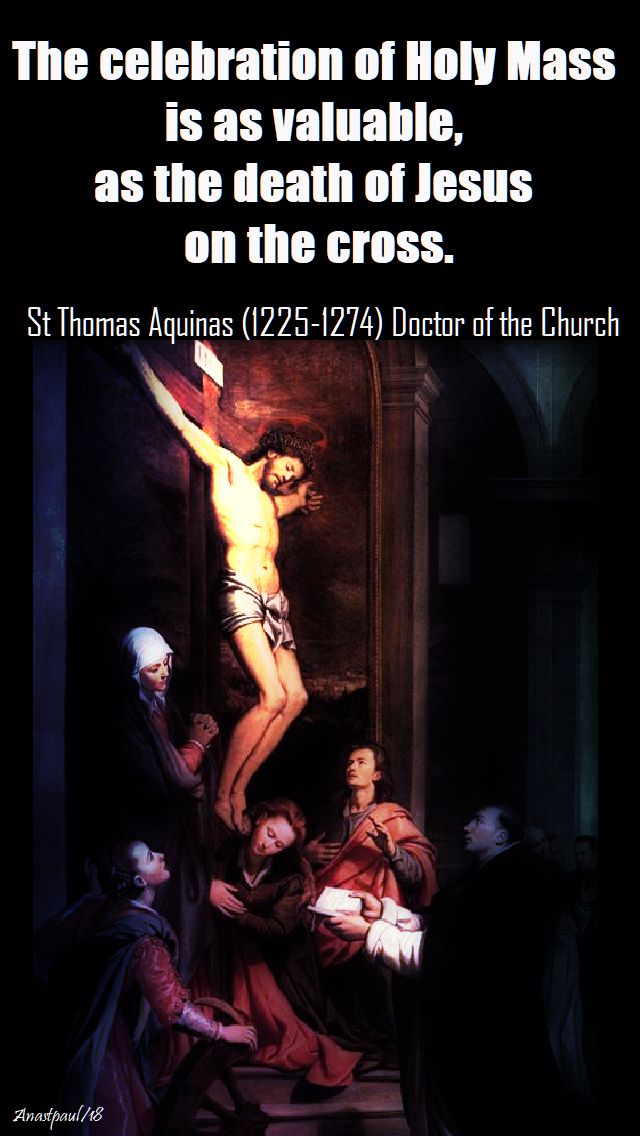
“The celebration of Holy Mass is as valuable, as the death of Jesus on the cross.”
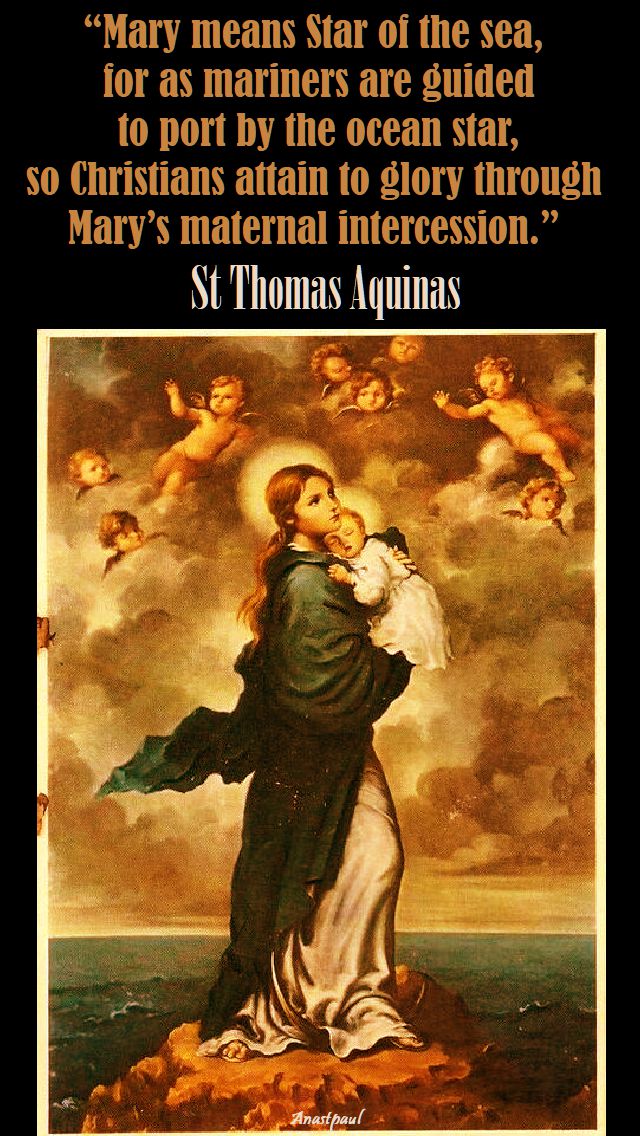
“Mary means Star of the sea, for as mariners are guided to port by the ocean star, so Christians attain to glory through Mary’s maternal intercession.”
St Thomas Aquinas (1225-1274) Doctor of the Church
One Minute Reflection – 28 January – The Memorial of St Thomas Aquinas (1225-1274) Doctor angelicus (Angelic Doctor) and Doctor communis (Common Doctor)
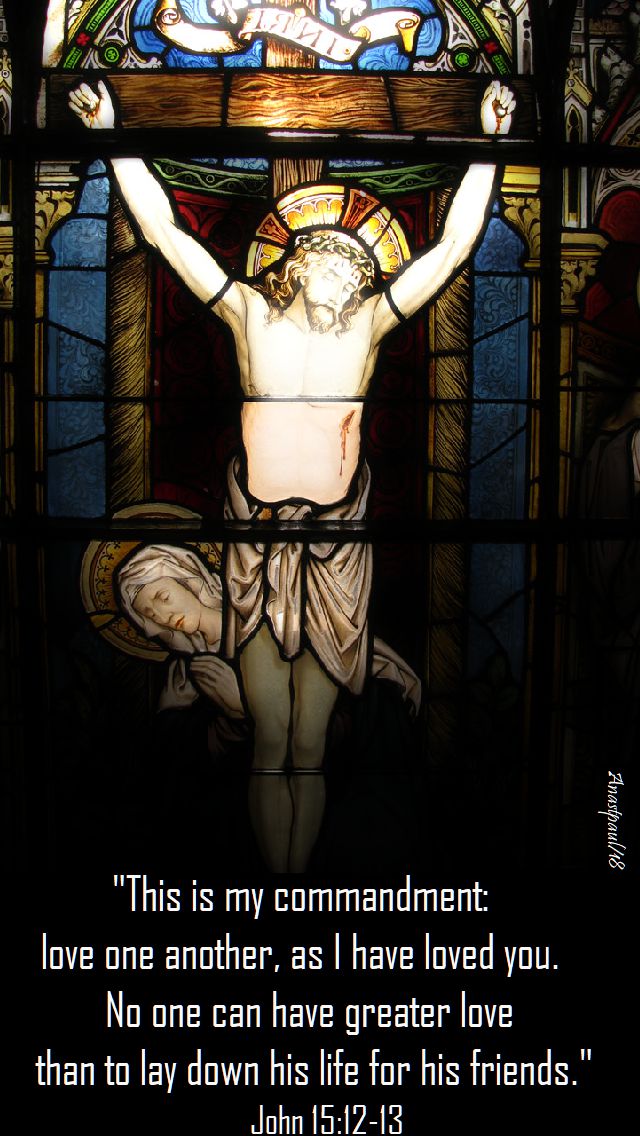
“This is my commandment: love one another, as I have loved you. No one can have greater love than to lay down his life for his friends.”…John 15:12-13
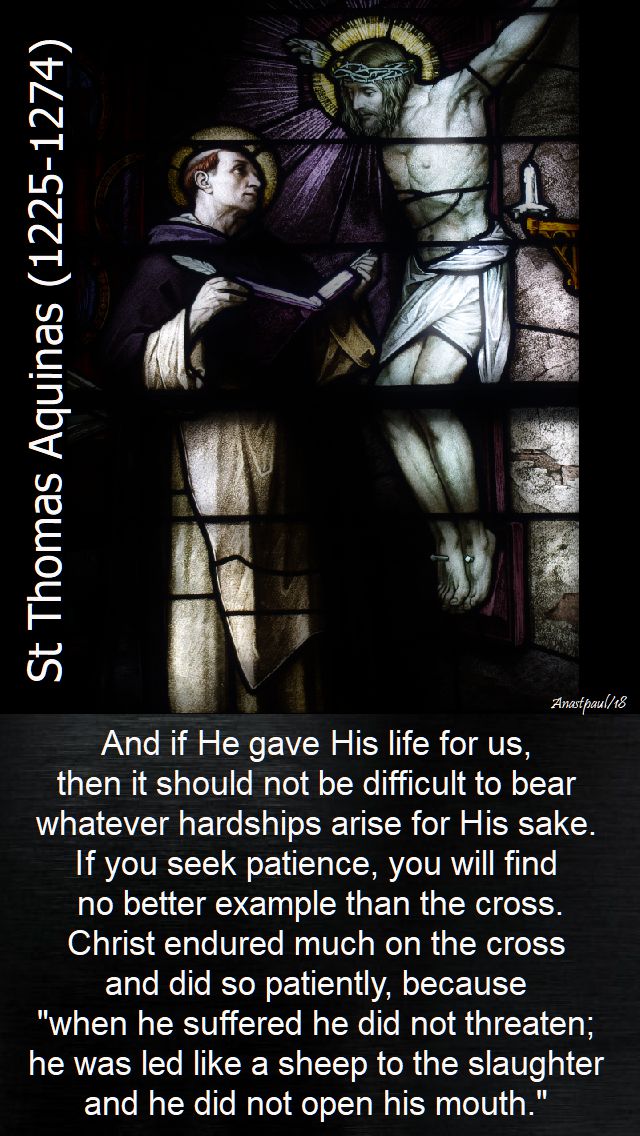
REFLECTION – “If you seek the example of love: “Greater love than this no man has, than to lay down his life for his friends.” Such a man was Christ on the cross. And if He gave His life for us, then it should not be difficult to bear whatever hardships arise for His sake. If you seek patience, you will find no better example than the cross. Christ endured much on the cross and did so patiently, because “when he suffered he did not threaten; he was led like a sheep to the slaughter and he did not open his mouth.” If you seek an example of obedience, follow Him who became obedient to the Father even unto death. “For just as by the disobedience of one man,” namely, Adam, “many were made sinners, so by the obedience of one man, many were made righteous.” If you seek an example of despising earthly things, follow Him who is “the King of kings and the Lord of lords, in whom are hidden all the treasures of wisdom and knowledge.” Upon the cross He was stripped, mocked, spat upon, struck, crowned with thorns and given only vinegar and gall to drink. Do not be attached, therefore, to clothing and riches, because “they divided my garments among themselves.” Nor to honours, for He experienced harsh words and scourgings. Nor to greatness of rank, for “weaving a crown of thorns they placed it on my head.” Nor to anything delightful, for “in my thirst they gave me vinegar to drink.” – from the writings of Saint Thomas Aquinas
PRAYER – Lord, our God, since it was by your gift that St Thomas became so great a saint and theologian, give us grace to understand his teaching and follow his way of life. May his great love for Jesus Crucified and His pure adoration of the Blessed Sacrament, be our guide to follow in Your Son’s footsteps and take up our cross and follow Him. Grant that by the prayers of St Thomas, we may grow in love and sanctity, amen.
Our Morning Offering – 28 January – The Memorial of St Thomas Aquinas (1225-1274) Doctor angelicus (Angelic Doctor) and Doctor communis (Common Doctor)
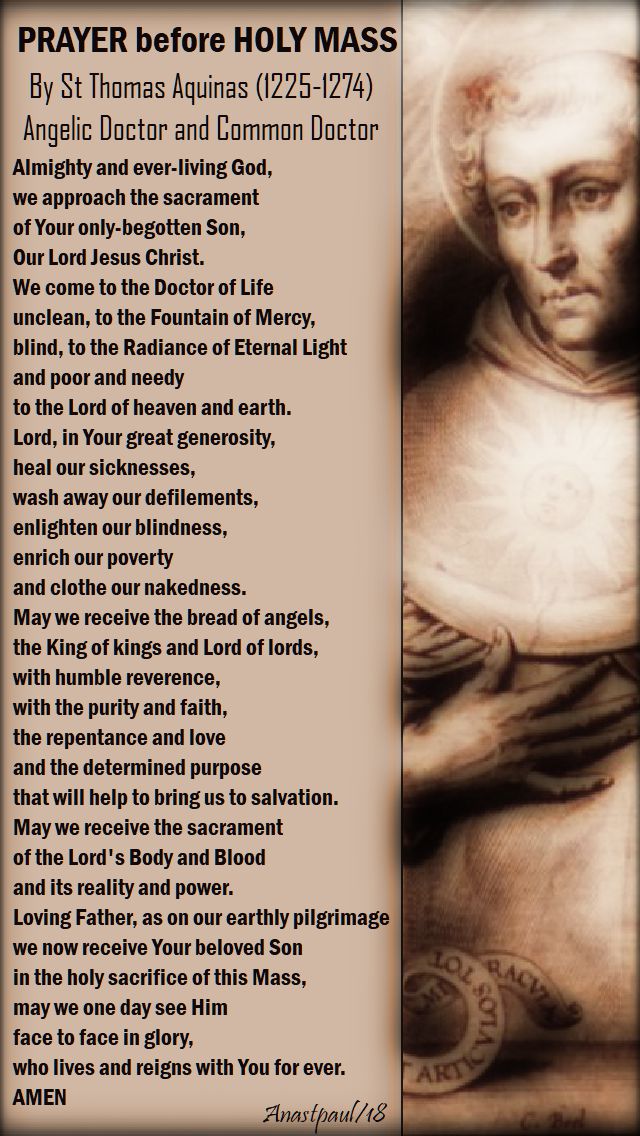
PRAYER before HOLY MASS By St Thomas Aquinas (1225-1274) Angelic Doctor and Common Doctor
Almighty and ever-living God,
we approach the sacrament
of Your only-begotten Son,
Our Lord Jesus Christ.
We come to the Doctor of Life
unclean, to the Fountain of Mercy,
blind, to the Radiance of Eternal Light
and poor and needy
to the Lord of heaven and earth.
Lord, in Your great generosity,
heal our sicknesses,
wash away our defilements,
enlighten our blindness,
enrich our poverty
and clothe our nakedness.
May we receive the bread of angels,
the King of kings and Lord of lords,
with humble reverence,
with the purity and faith,
the repentance and love
and the determined purpose
that will help to bring us to salvation.
May we receive the sacrament
of the Lord’s Body and Blood
and its reality and power.
Loving Father, as on our earthly pilgrimage
we now receive Your beloved Son
in the holy sacrifice of this Mass,
may we one day see Him face to face in glory,
who lives and reigns with You for ever,
AMEN.
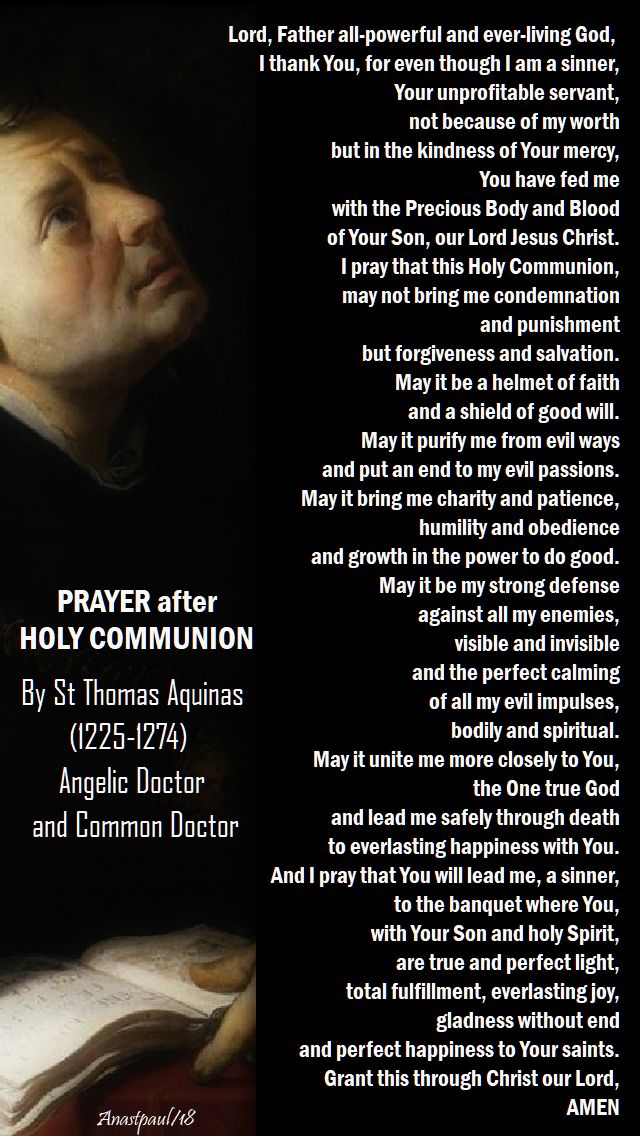
PRAYER after HOLY COMMUNION By St Thomas Aquinas (1225-1274) Angelic Doctor and Common Doctor
Lord, Father all-powerful and ever-living God,
I thank You, for even though I am a sinner,
Your unprofitable servant,
not because of my worth
but in the kindness of Your mercy,
You have fed me
with the Precious Body and Blood
of Your Son, our Lord Jesus Christ.
I pray that this Holy Communion,
may not bring me condemnation
and punishment
but forgiveness and salvation.
May it be a helmet of faith
and a shield of good will.
May it purify me from evil ways
and put an end to my evil passions.
May it bring me charity and patience,
humility and obedience
and growth in the power to do good.
May it be my strong defense
against all my enemies,
visible and invisible
and the perfect calming
of all my evil impulses,
bodily and spiritual.
May it unite me more closely to You,
the One true God
and lead me safely through death
to everlasting happiness with You.
And I pray that You will lead me, a sinner,
to the banquet where You,
with Your Son and holy Spirit,
are true and perfect light,
total fulfillment, everlasting joy,
gladness without end
and perfect happiness to Your saints.
Grant this through Christ our Lord,
AMEN.
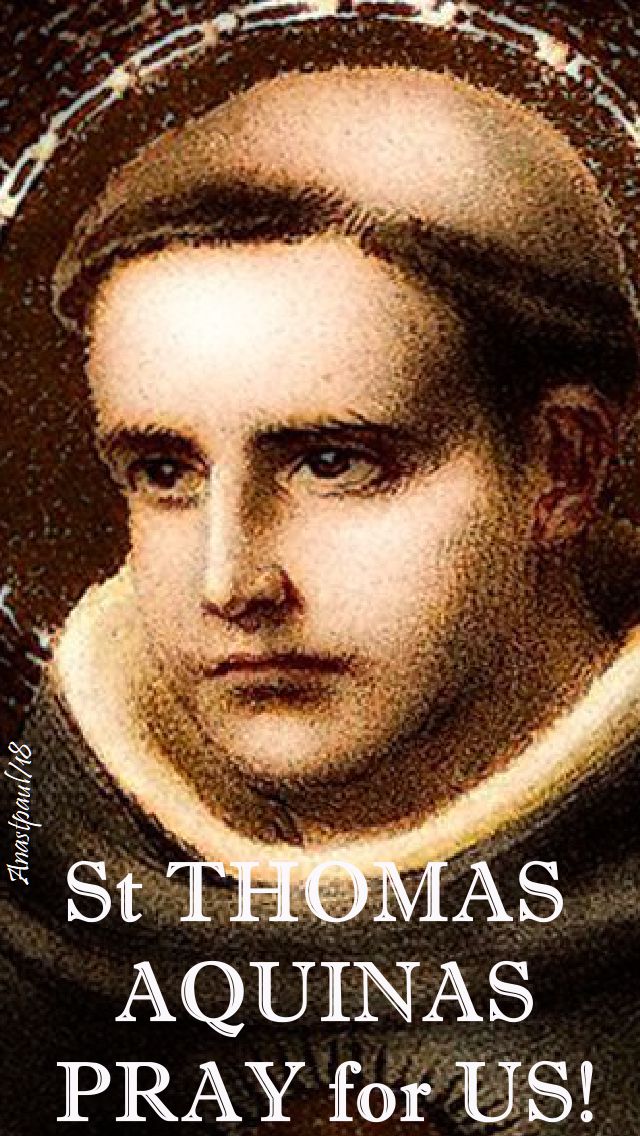
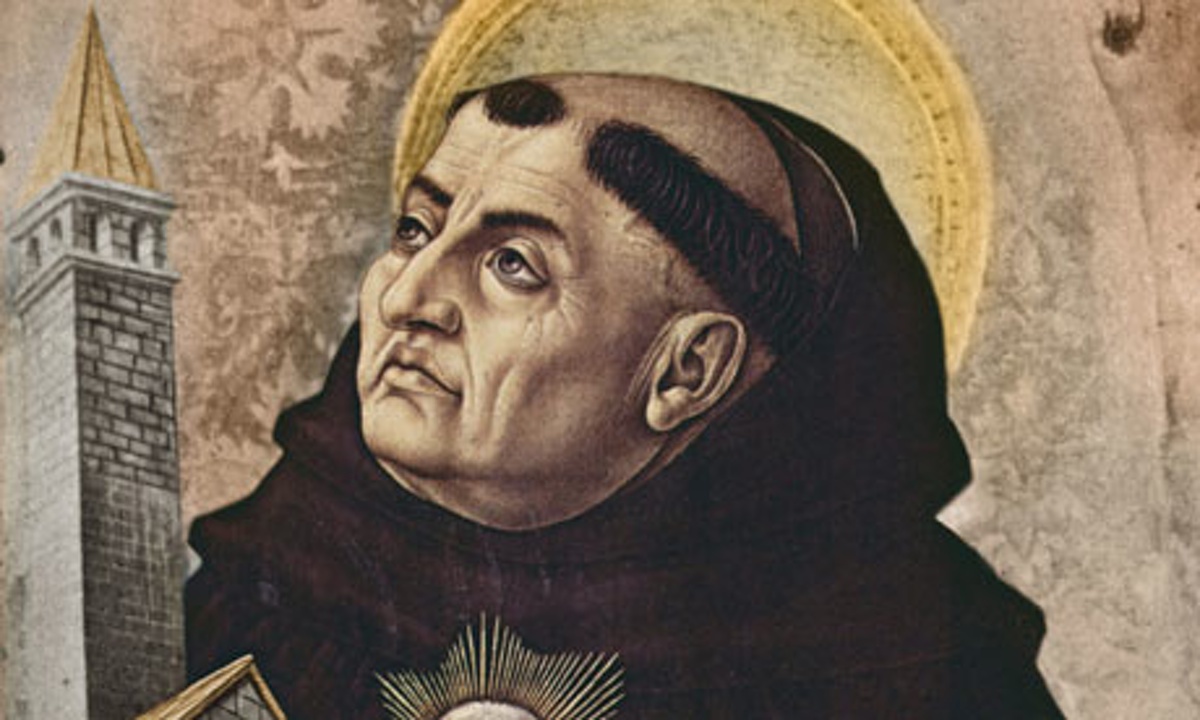
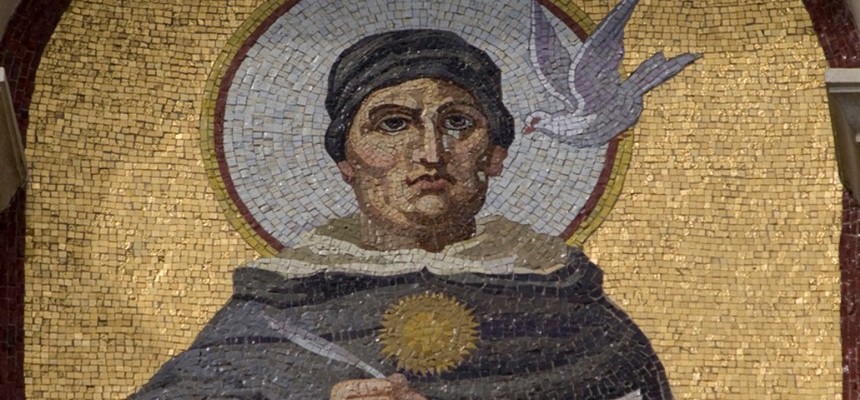
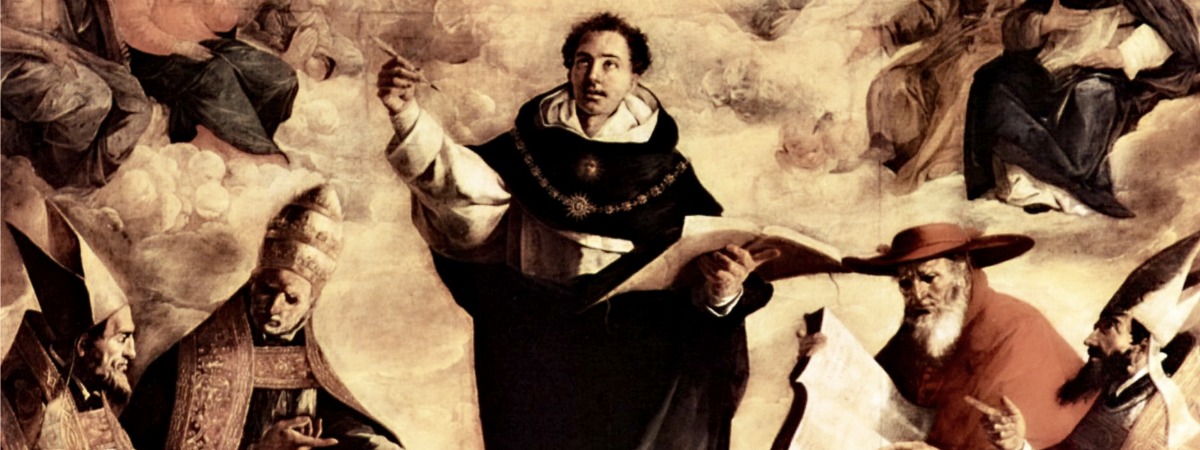
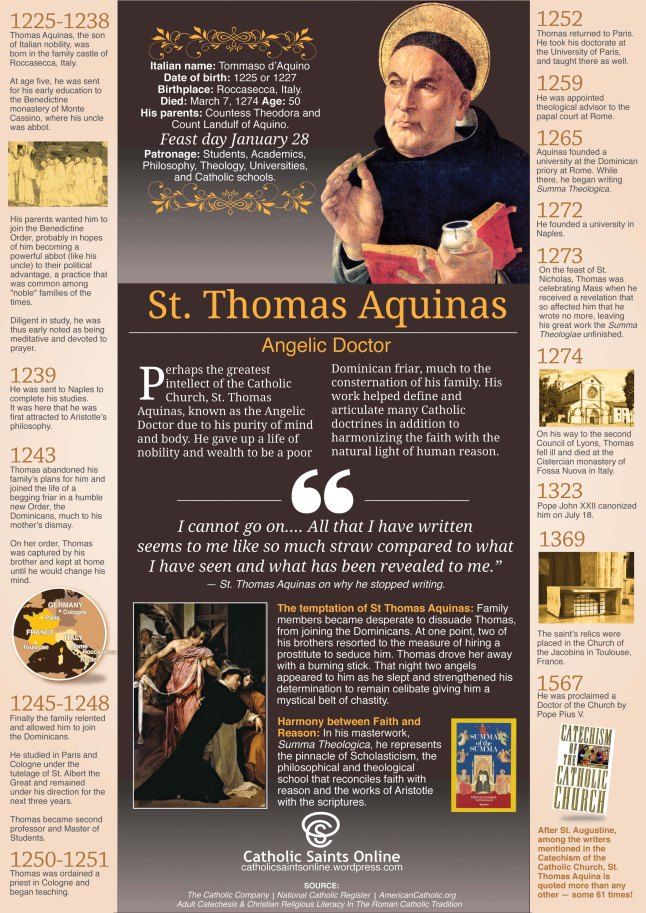
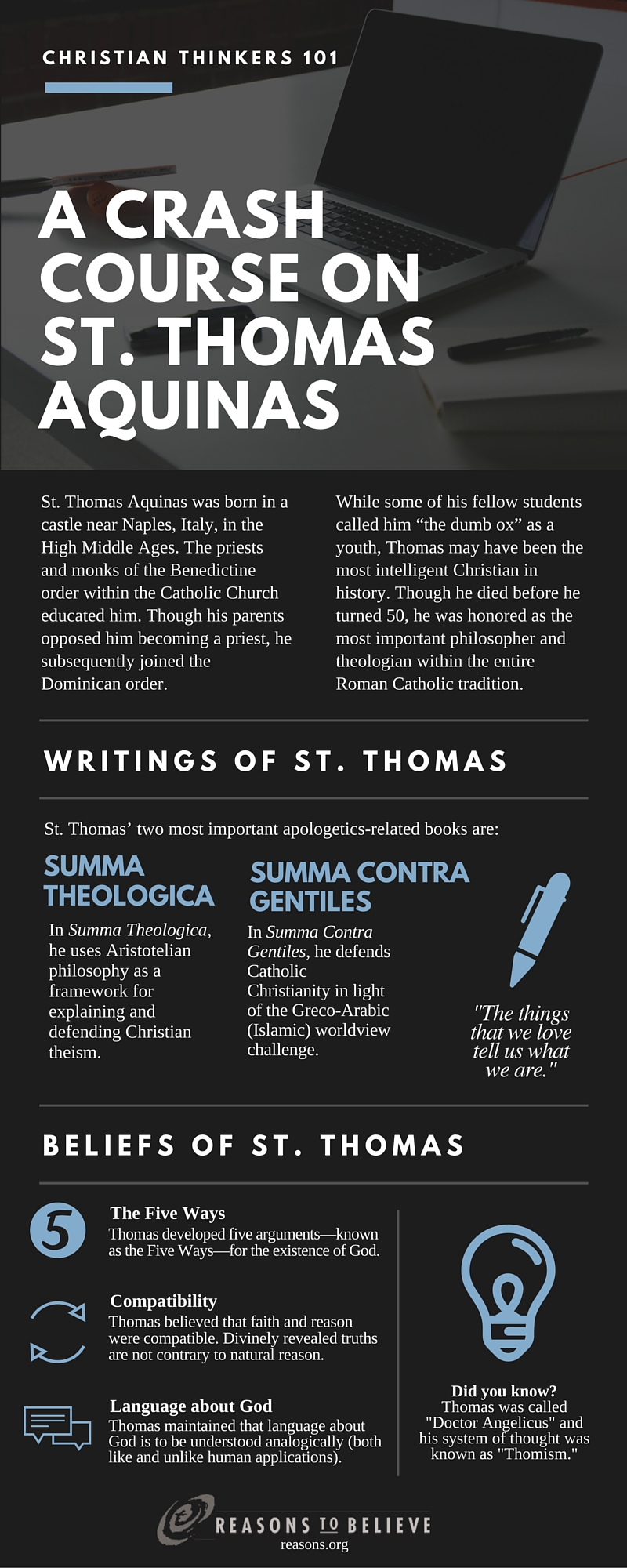
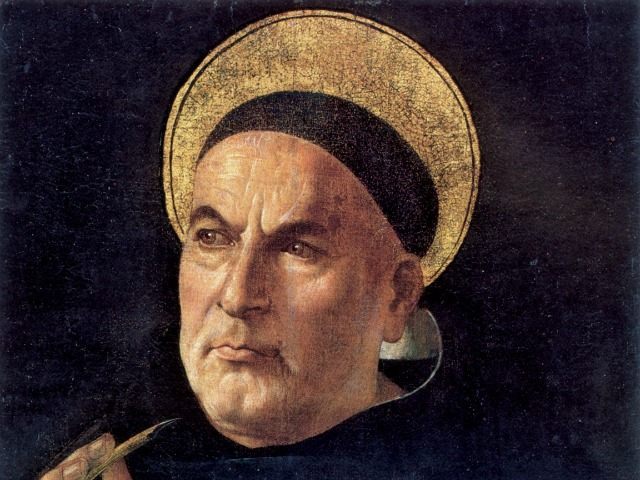
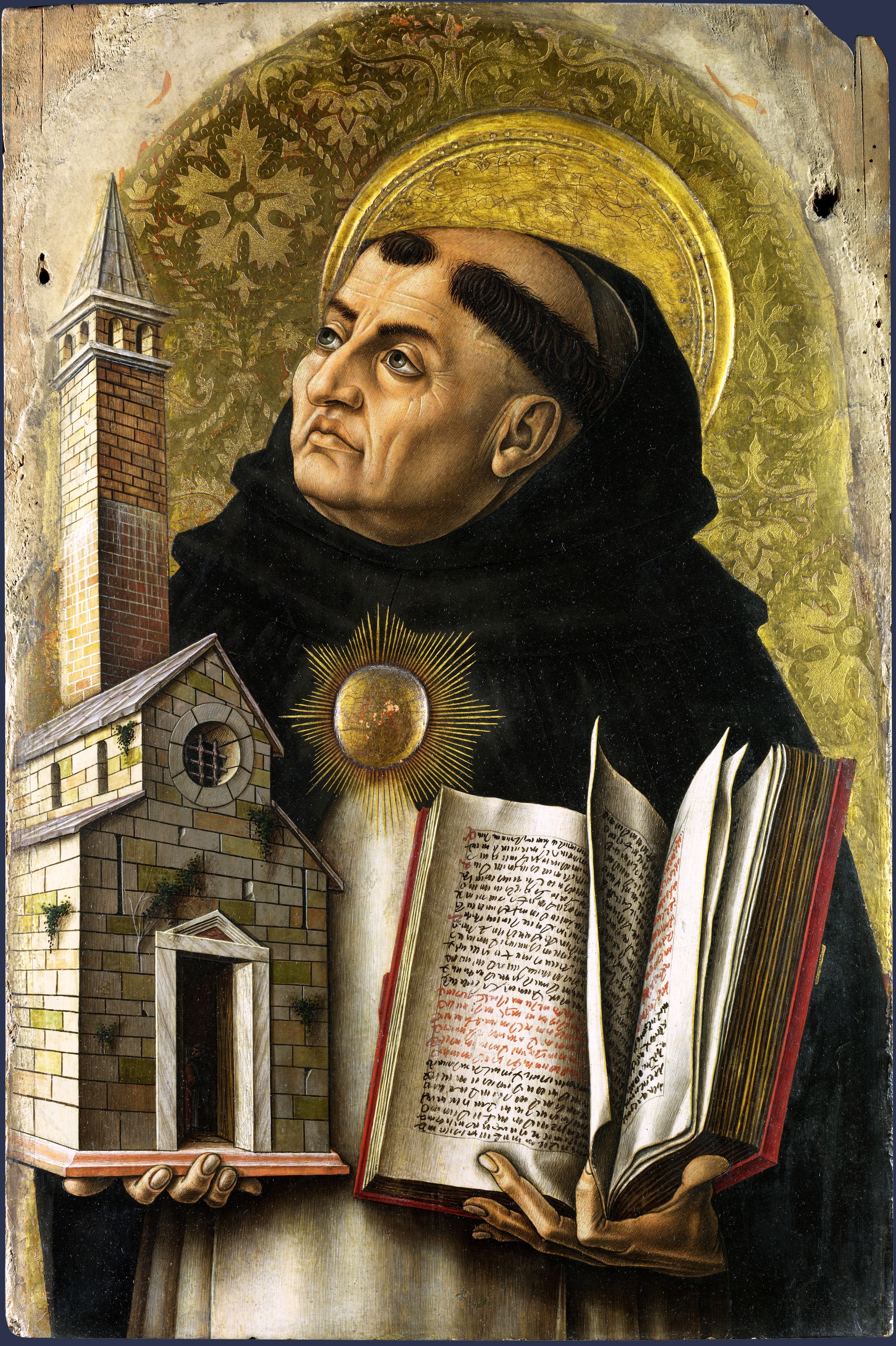
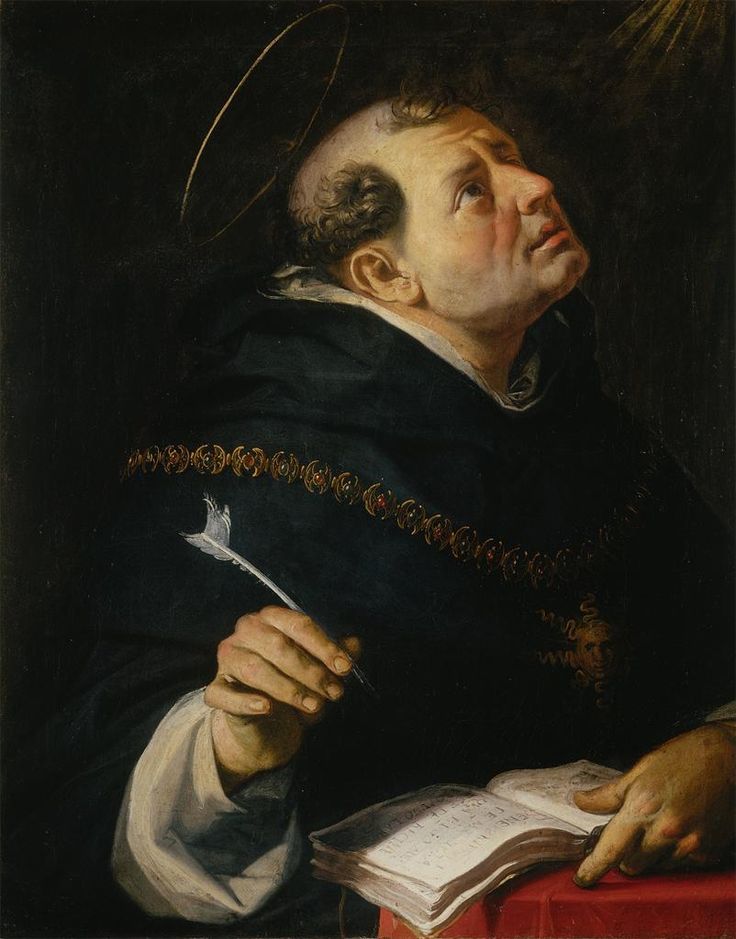
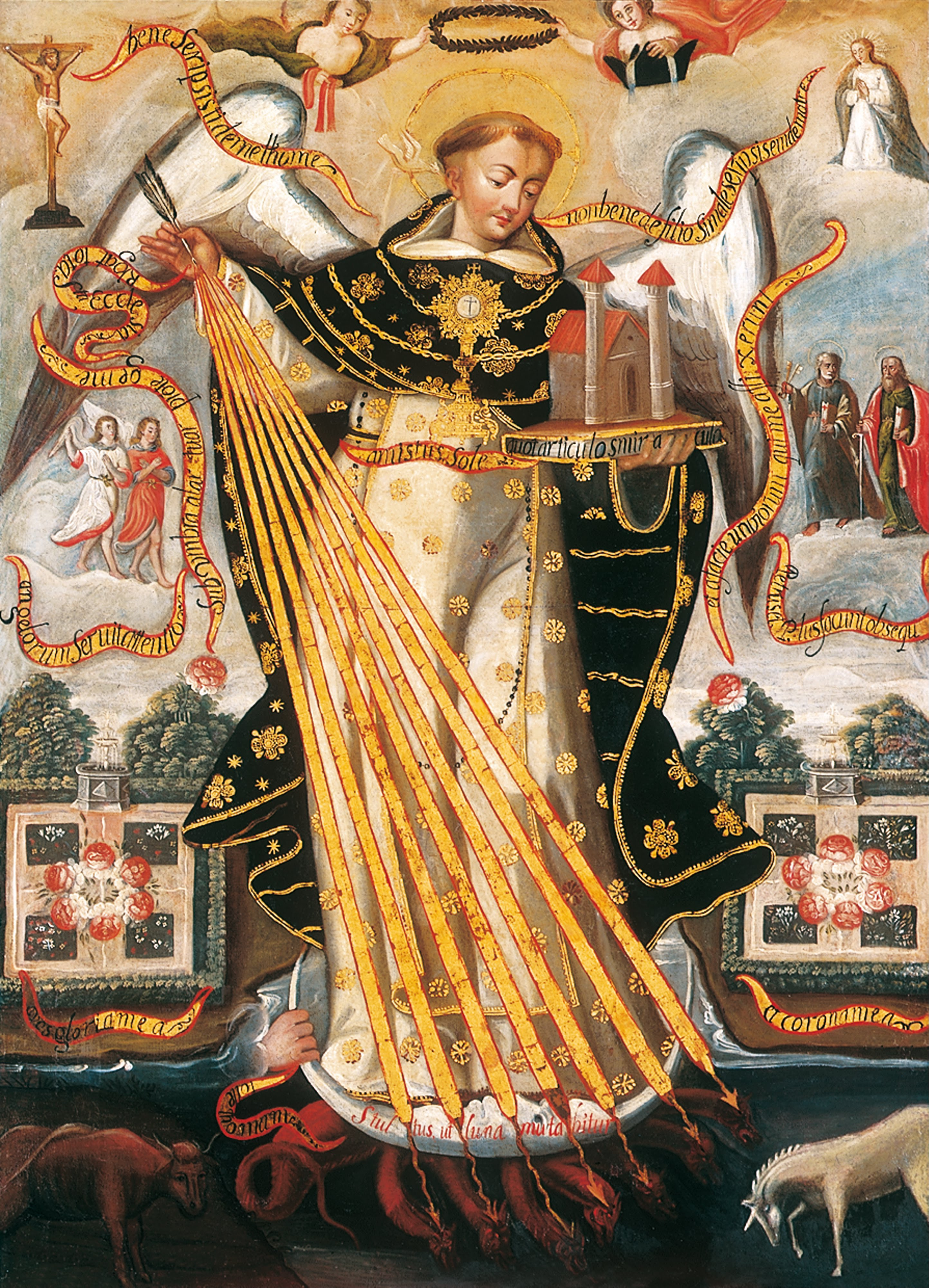
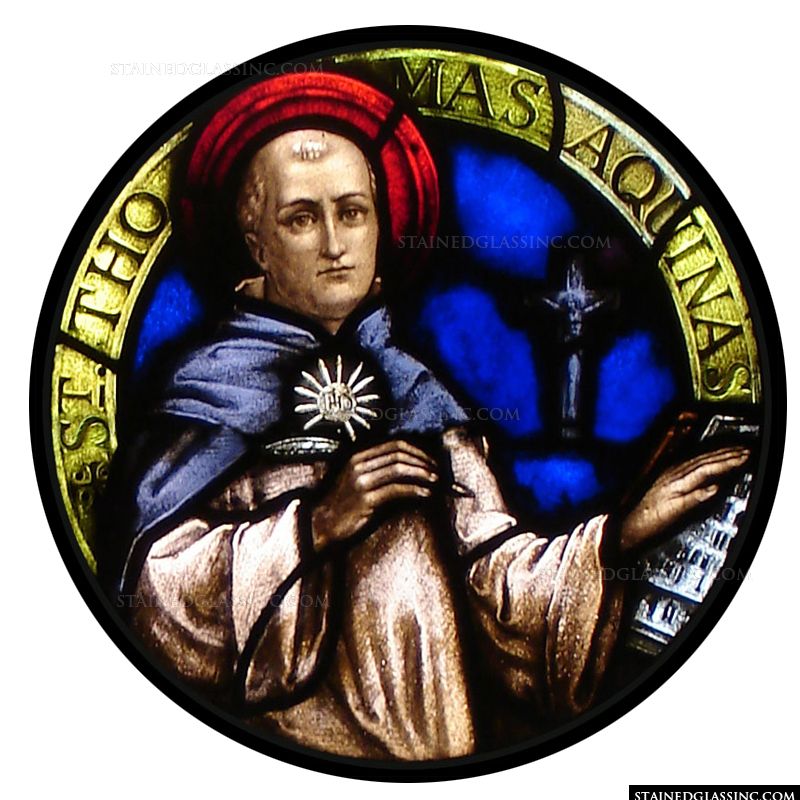
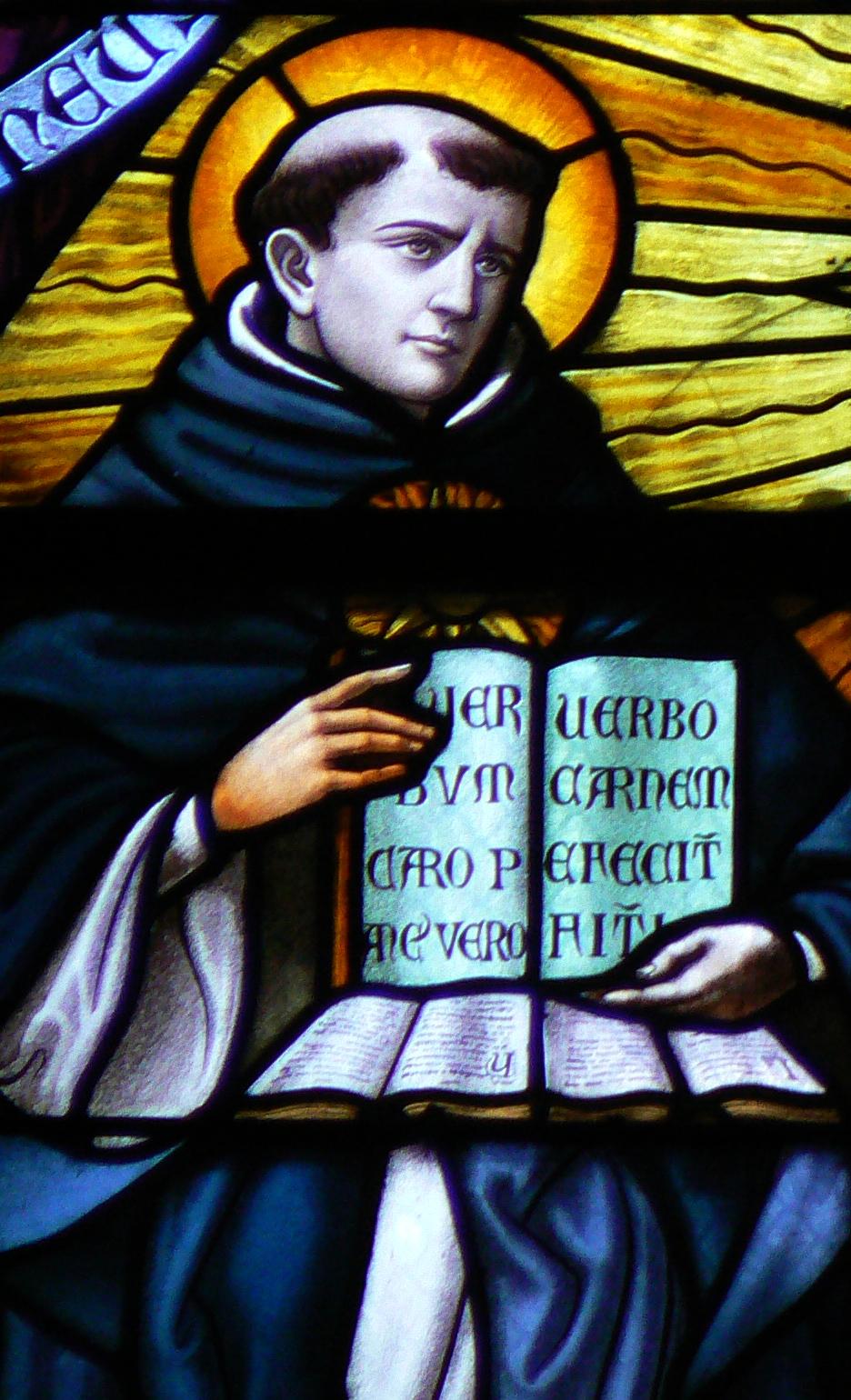
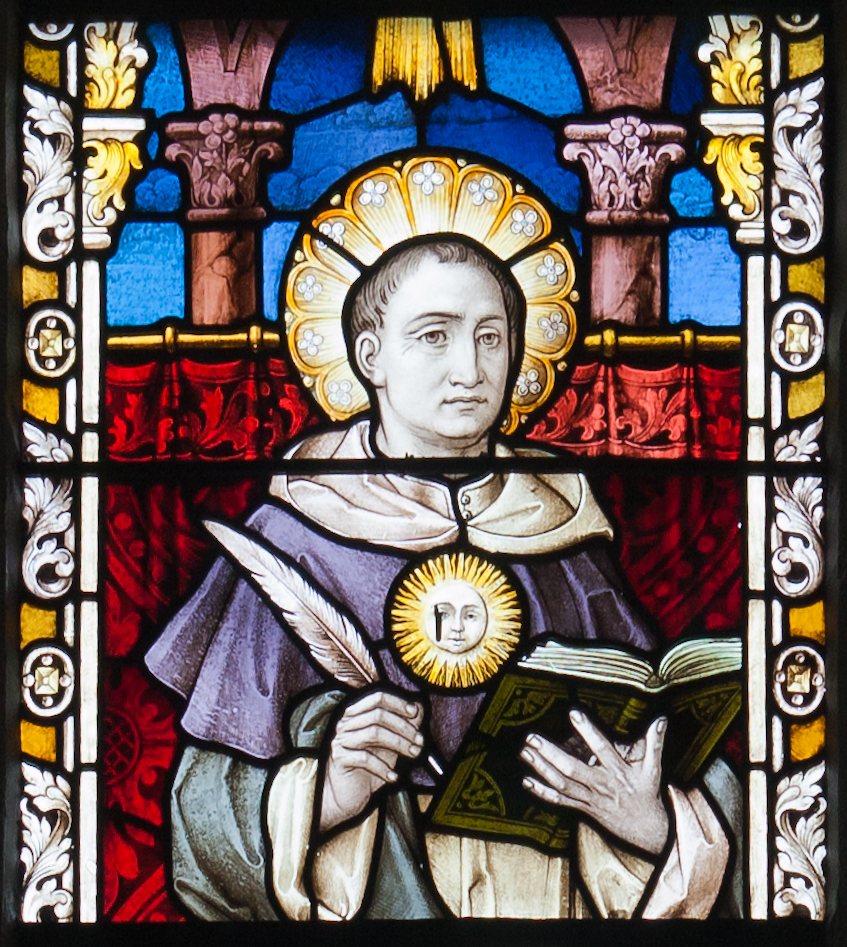
Saint of the Day – 28 January – St Thomas Aquinas O.P. (1225-1274 aged 49 ) Doctor angelicus (Angelic Doctor) and Doctor communis (Common Doctor). Priest, Religious, Master Theologian, Philosopher, Write, Teacher, Jurist. Also known as: The Angelic Doctor/Doctor Angelicus, Common Doctor/Doctor Communis. The Great Synthesiser, The Dumb Ox, The Universal Teacher. Patron of Academics, Theologians, against storms, against lightning, apologists, book sellers, Catholic academies, Catholic Schools – (proclaimed on 4 August 1880 by Pope Leo XIII), Catholic universities, Catholic Colleges, chastity, learning; pencil makers, philosophers, publishers, scholars, students, University of Vigo and of St. Tomas, Batangas, theologians, Aquino, Italy; Belcastro, Italy, Diocese of Aquino, Falena, Italy. Attributes – chalice, dove, usually speaking into his ear, sometimes as he writes, monstrance, ox, star, sun, teacher with pagan philosophers at his feet, teaching, person trampled under foot. By universal consent, Thomas Aquinas is the pre-eminent spokesman of the Catholic tradition of reason and of divine revelation. He is one of the great teachers of the medieval Catholic Church, honoured with the titles Angelic and Common Doctor, being one of the 36 Doctors of the Church and is regarded as the “Master Theologian.”
St Thomas Aquinas is known as the greatest philosopher and theologian of the intellectually rich 13th century and for many hundreds of years the work of this Patron Saint of Catholic Schools dominated the curriculum of seminaries and colleges around the world. He has been called one of the most profound teachers on Eucharistic doctrine, not only expounding on the mysterious processes in which bread and wine become the actual Body and Blood of Christ but coining the word transubstantiation used to describe it. And, because he wrote not only for scholars but also for the simple Catholic worshipper down the ages, the church has officially accorded him the titles “Angelic” and “Common” Doctor of the Church.”
It is generally believed Thomas Aquinas was born about the year 1225 at the castle of his father, the Count of Aquino, in Rocca Secca near Naples, Italy. A precocious child, he amazed his teachers at the Monastery of Monte Cassino, where he received his early education, with one persistent question: “What is God?” It was a question he would reflect upon all his life.
When attending the University of Naples, he was attracted to the intellectual apostolate of the Dominican Friars and joined the order. Outraged at his rejection of their own plans for him to become a prestigious abbot and looking down on Dominicans as beggars, his aristocratic family kidnapped him on his way to Paris and imprisoned him at Rocca Secca. It took almost two years and the intercession of the Pope and the Emperor before his family finally gave up and allowed him to rejoin the Dominicans.
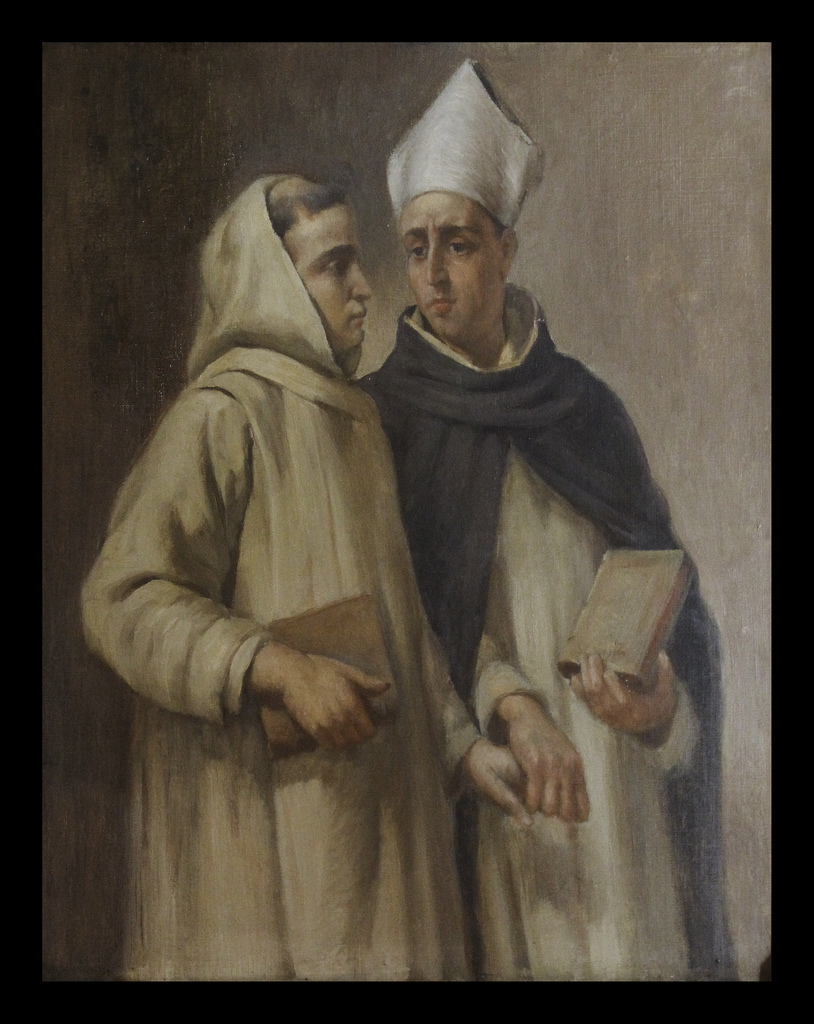
St Albert the Great (1200-1280), also a Doctor of the Church, who taught him Aristotelian philosophy at Paris and Cologne, soon spotted his genius and became his mentor. When Thomas was nicknamed the “Dumb Ox” by his classmates, most likely because of his bulky frame and quiet manner, Albert prophesied: “You call him a dumb ox, but I tell you this dumb ox will bellow so loudly that his bellowing will fill the world.”
Indeed, this master teacher attracted thousands of people to his public lectures, compiled more than 20 volumes of work, was consulted by popes and a king (Louis IX), and showed that one could use pure reason, not faith, to defend theological tenets such as the existence of God. His greatest work, the Summa Theologica (Summary of Theology), which he began in 1265, is, a comprehensive treatise on all the Christian mysteries.
Despite his reputation as a thinker, Thomas remained a humble, devout priest who resisted attempts to make him a bishop, fasted frequently and spent whole nights in prayer before the Blessed Sacrament and the Crucifix. He told his intimate friend, St Bonaventure(1217-1274), another Doctor of the Church, that it was while he leaned his head against the tabernacle and turned his mind in sorrow to the image of the crucified Christ, that he derived all his learning.
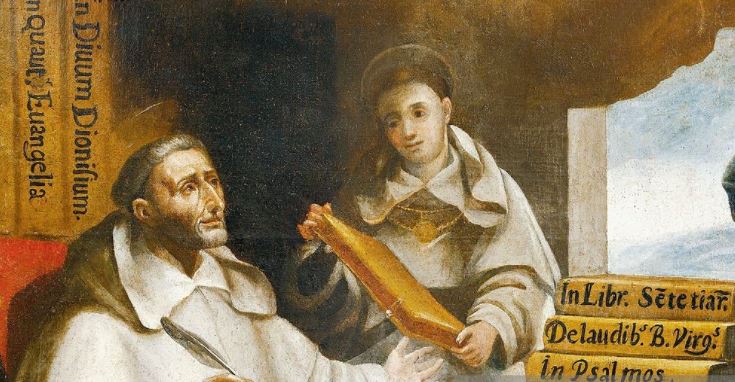
Painting depicting Saint Thomas Aquinas by Antoni Viladomat (1678-1755) Catalonian painter in the Baroque style. Dated 18th Century. (Photo by Universal History Archive/UIG via Getty Images)
Once, when Thomas was lost in prayer while living in the Dominican priory in Naples, a sacristan concealed himself to watch. He saw Thomas lifted into the air and heard Christ speak to him from the crucifix on the chapel wall, “Thomas, you have written well of me. What reward will you have?”
“Lord, nothing but yourself,” he heard Thomas reply.
Soon after, while saying Mass on 6 December 1273 in that same chapel, Thomas had a profound revelation. He told his longtime secretary that compared to this experience, “All that I have written seems like straw to me.”
After that, he never wrote again, leaving his Summa Theologica unfinished.
In May of 1274, Thomas was called to the Second Council of Lyon, where his works for Pope Urban IV would be presented. While journeying to the meeting, Thomas hit his head on the branch of a fallen tree and fell ill. He was escorted to Monte Cassino to recover, then he set out again. Unfortunately, he became ill once again and stopped at the Cistercian Fossanova Abbey, where the monks cared for him for several days.
He received his last rites and prayed, “I receive Thee, ransom of my soul. For love of Thee have I studied and kept vigil, toiled, preached and taught…”
On the day of Thomas’ death, 7 March1274, St Albert the Great, then in Cologne, suddenly broke into tears among the community and exclaimed, “Brother Thomas Aquinas, my son in Christ, the light of the Church, is dead! God has revealed it to me.”
Quote/s of the Day – 26 January – Memorial of Sts Timothy and Titus, Disciples and Companions of the Apostle Paul and Bishops of the Catholic Church
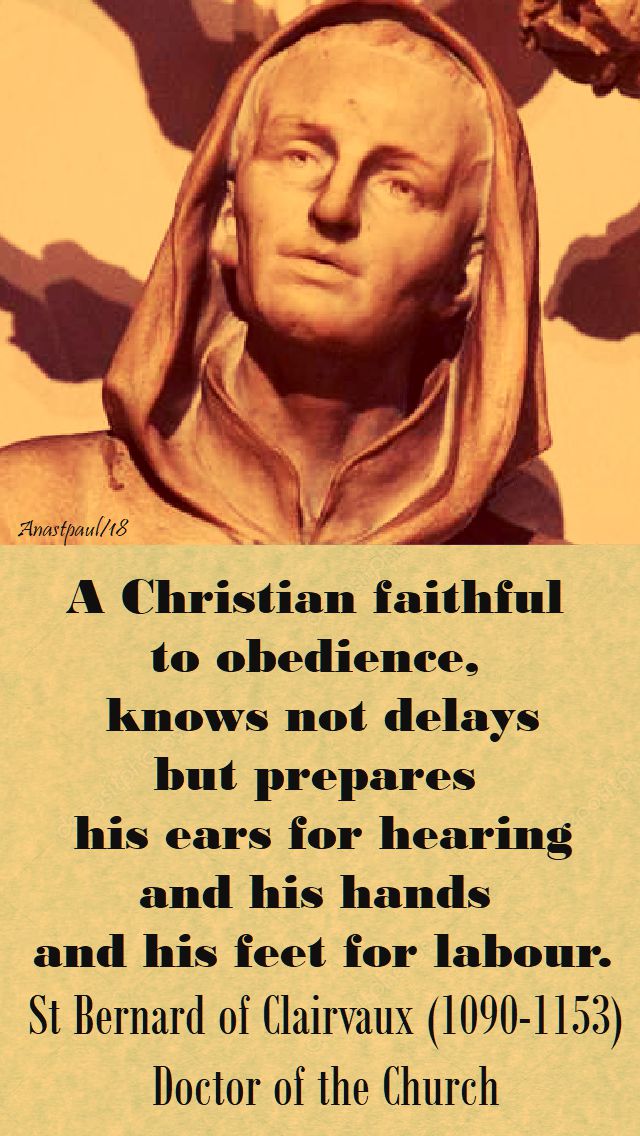
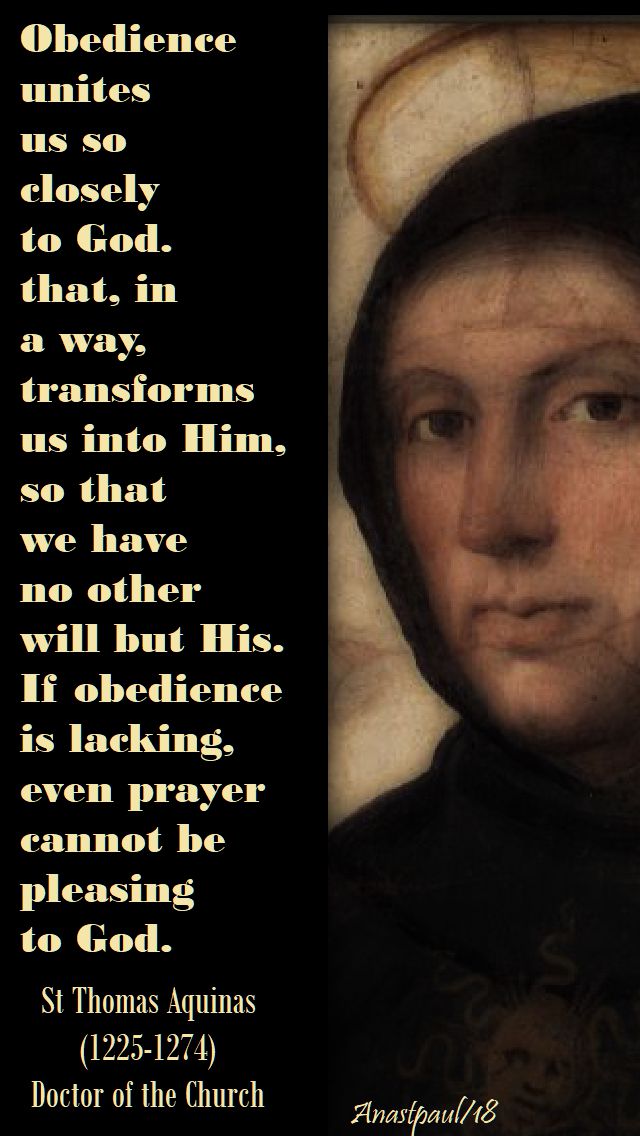
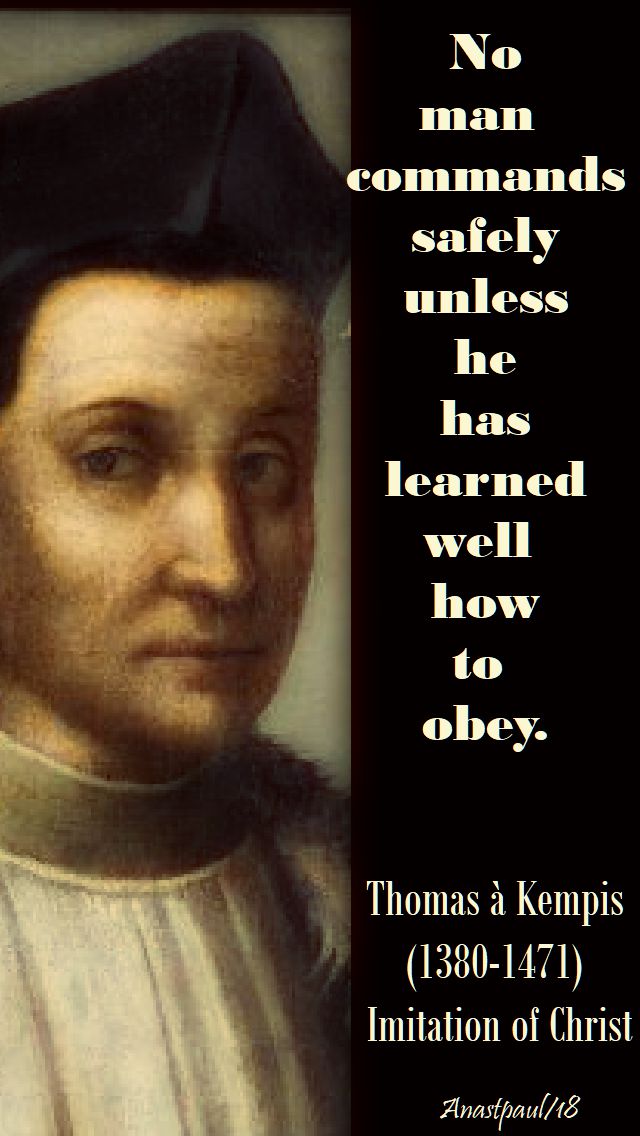
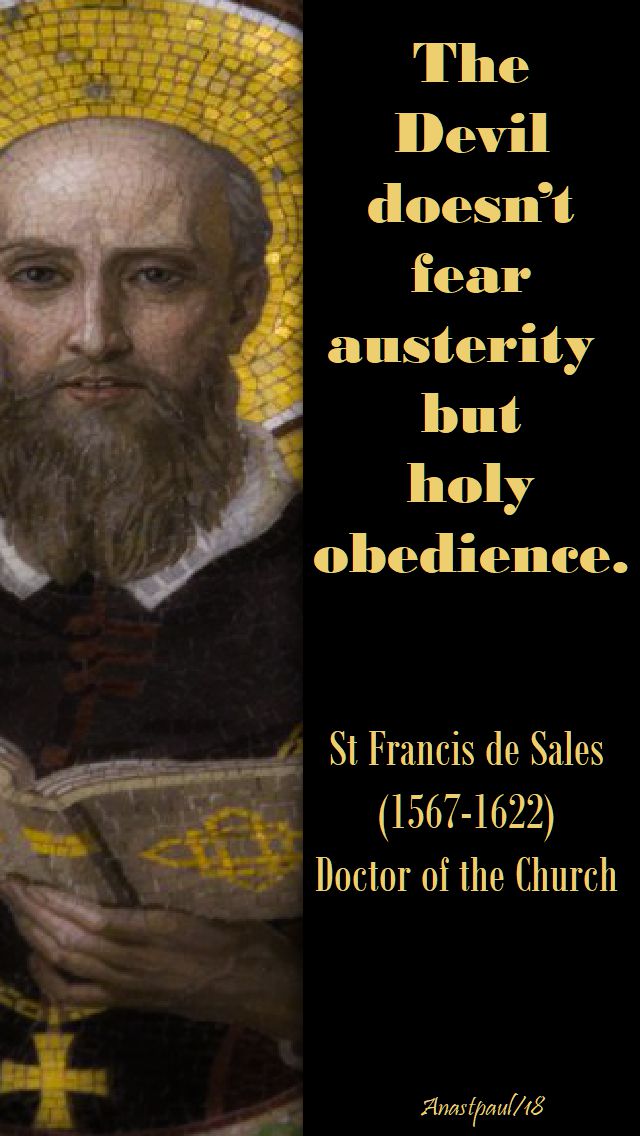
“Speaking of Obedience”
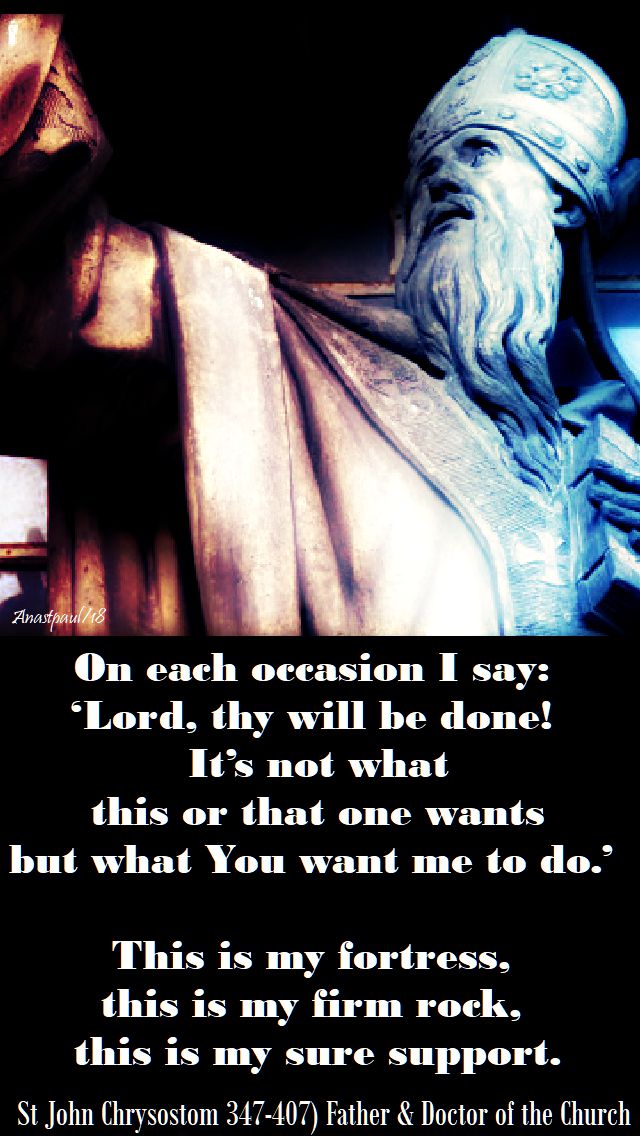
“On each occasion I say: ‘Lord, thy will be done! It’s not what this or that one wants but what You want me to do.’ This is my fortress, this is my firm rock, this is my sure support.”
St John Chrysostom 347-407) Father & Doctor of the Church
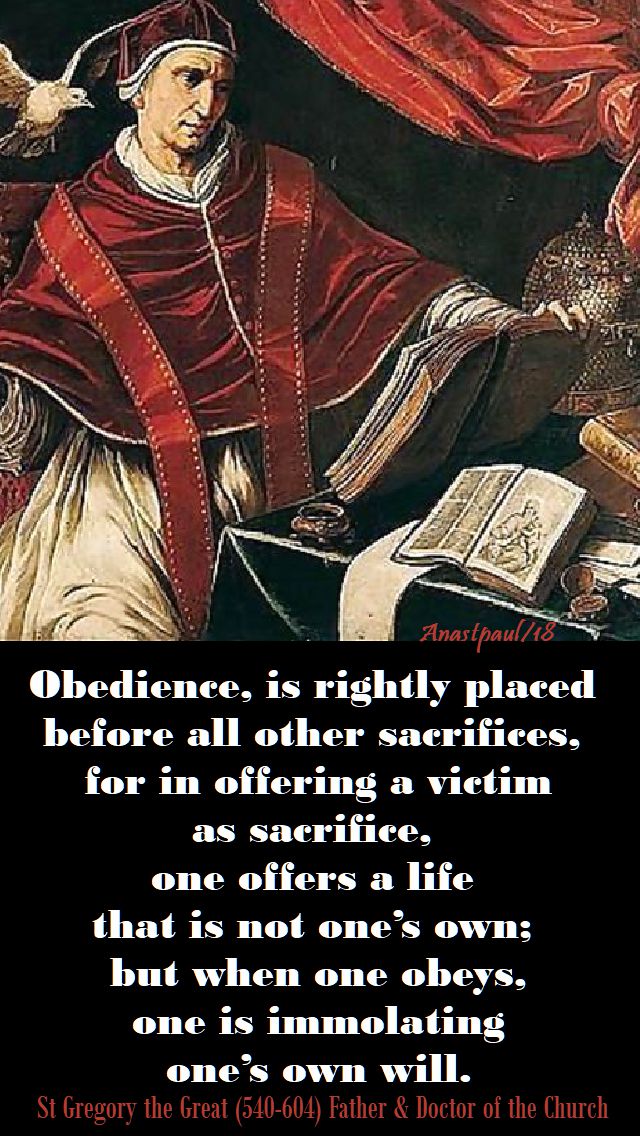
“Obedience, is rightly placed before all other sacrifices, for in offering a victim as sacrifice, one offers a life that is not one’s own; but when one obeys, one is immolating one’s own will.”
St Gregory the Great (540-604) Father & Doctor of the Church
“A Christian faithful to obedience, knows not delays but prepares his ears for hearing and his hands and his feet for labour.”
St Bernard of Clairvaux (1090-1153) Doctor of the Church
“Obedience unites us so closely to God. that in a way transforms us into Him, so that we have no other will but His. If obedience is lacking, even prayer cannot be pleasing to God.”
St Thomas Aquinas (1225-1274) Doctor of the Church
“No man commands safely unless he has learned well how to obey.”
Thomas à Kempis (1380-1471) – Imitation of Christ
“The Devil doesn’t fear austerity but holy obedience.”
St Francis de Sales (1567-1622) Doctor of the Church
One Minute Reflection – 25 January – Feast of the Conversion of St Paul the Apostle
I have appeared to you for this purpose, to appoint you as a servant and witness of what you have seen and what you will be shown. I shall deliver you from this people and from the Gentiles to whom I send you,to open their eyes that they may turn from darkness to light and from the power of Satan to God, so that they may obtain forgiveness of sins and an inheritance among those who have been consecrated by faith in me…Acts 26:16-18
REFLECTION – “Paul, more than anyone else, has shown us what man really is and in what our nobility consists and of what virtue this particular animal is capable. Each day he aimed ever higher; each day he rose up with greater ardour and faced with new eagerness the dangers that threatened him. He summed up his attitude in the words: “I forget what is behind me and push on to what lies ahead”…The most important thing of all to him, however, was that he knew himself to be loved by Christ. Enjoying this love, he considered himself happier than anyone else”…….St John Chrysostom
PRAYER – Today Lord, we celebrate the conversion of St Paul, Your chosen vessel for carrying Your name to the whole world. Help us to make our way towards You by following in his footsteps and by being Your disciples before the men and women of our day. Grant that by the prayers of St Paul, we too may say, “Yet I live, no longer I, but Christ lives in me; insofar as I now live in the flesh, I live by faith in the Son of God who has loved me and given himself up for me.” (Galatians 2:20) Through Jesus Christ, our Lord, in union with the Holy Spirit, one God forever and ever, amen.
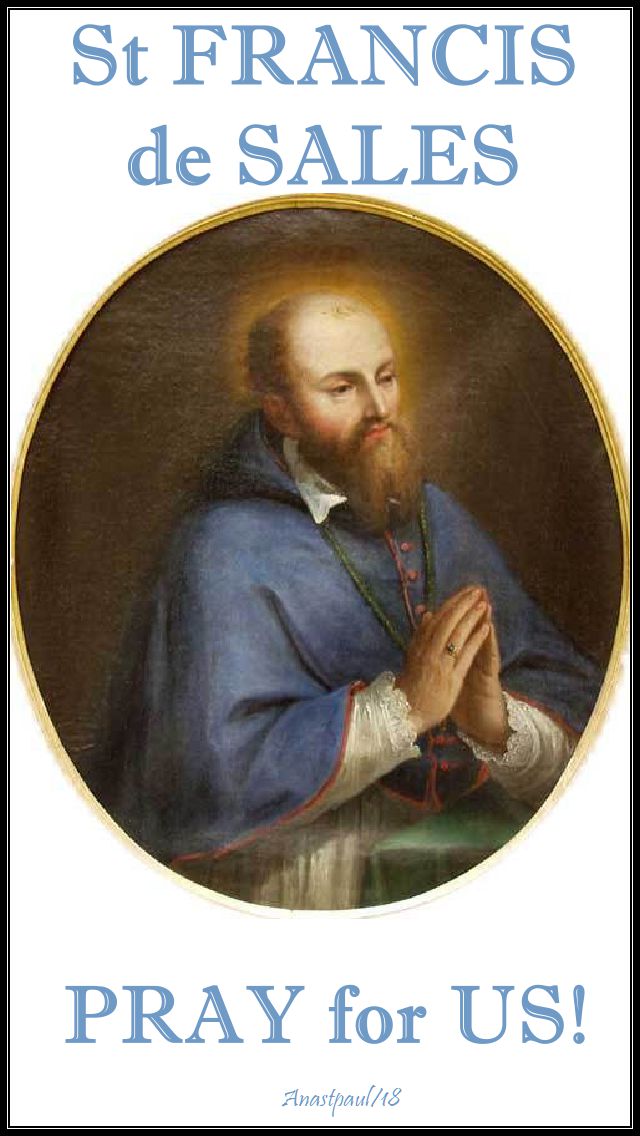
Quote/s of the Day – 24 January – The Memorial of St Francis de Sales (1567-1622) Doctor of the Church: Doctor caritatis (Doctor of Charity)
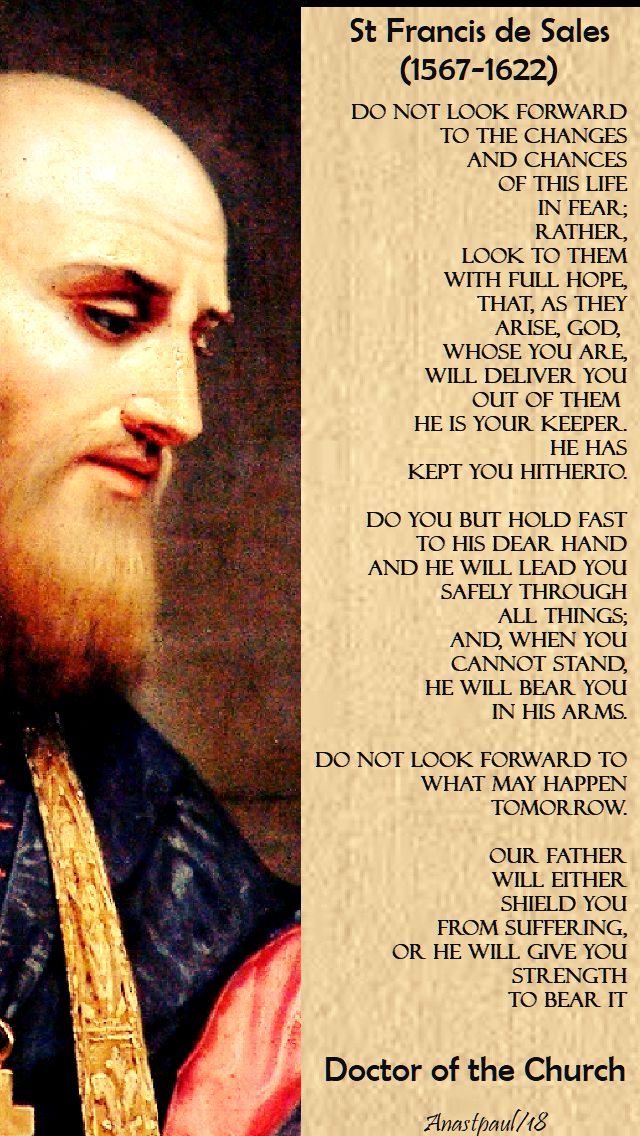
“Do not look forward to the changes and chances of this life in fear; rather look to them with full hope that, as they arise, God, whose you are, will deliver you out of them. He is your keeper. He has kept you hitherto. Do you but hold fast to His dear hand and He will lead you safely through all things; and, when you cannot stand, He will bear you in His arms. Do not look forward to what may happen tomorrow. Our Father will either shield you from suffering, or He will give you strength to bear it.”
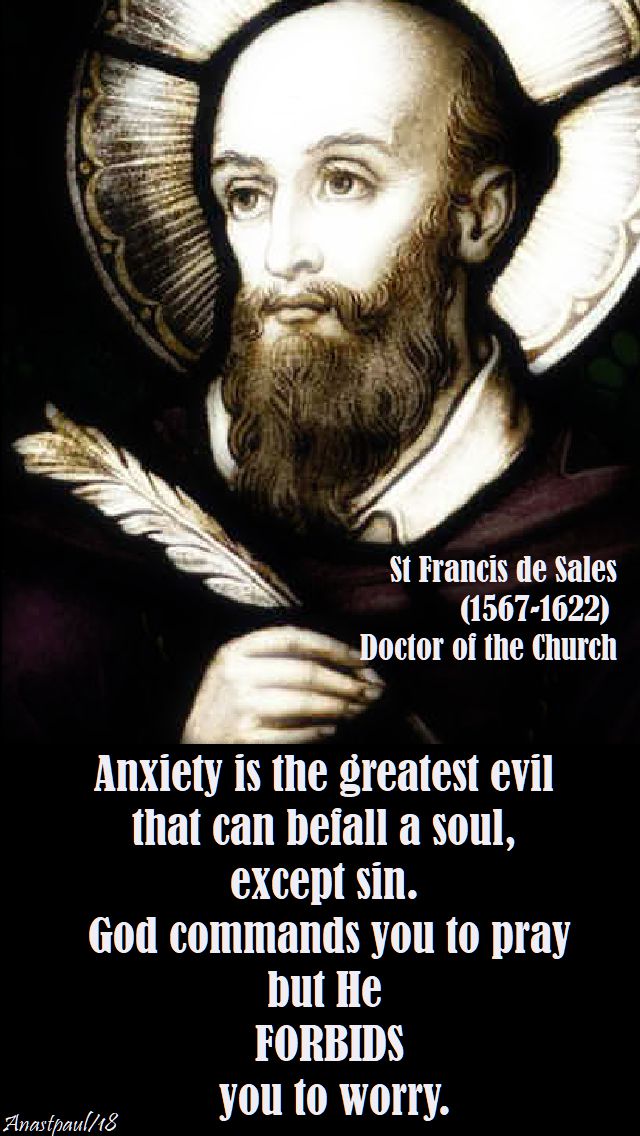
“Anxiety is the greatest evil that can befall a soul, except sin. God commands you to pray but He forbids you to worry.”
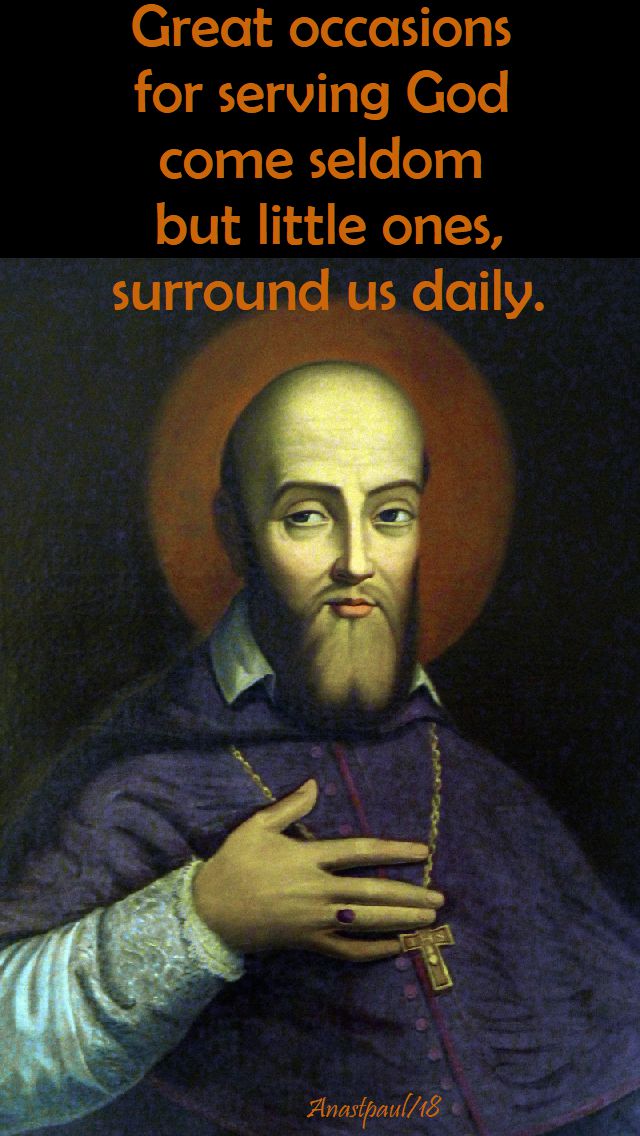
“Great occasions for serving God come seldom but little ones, surround us daily.”
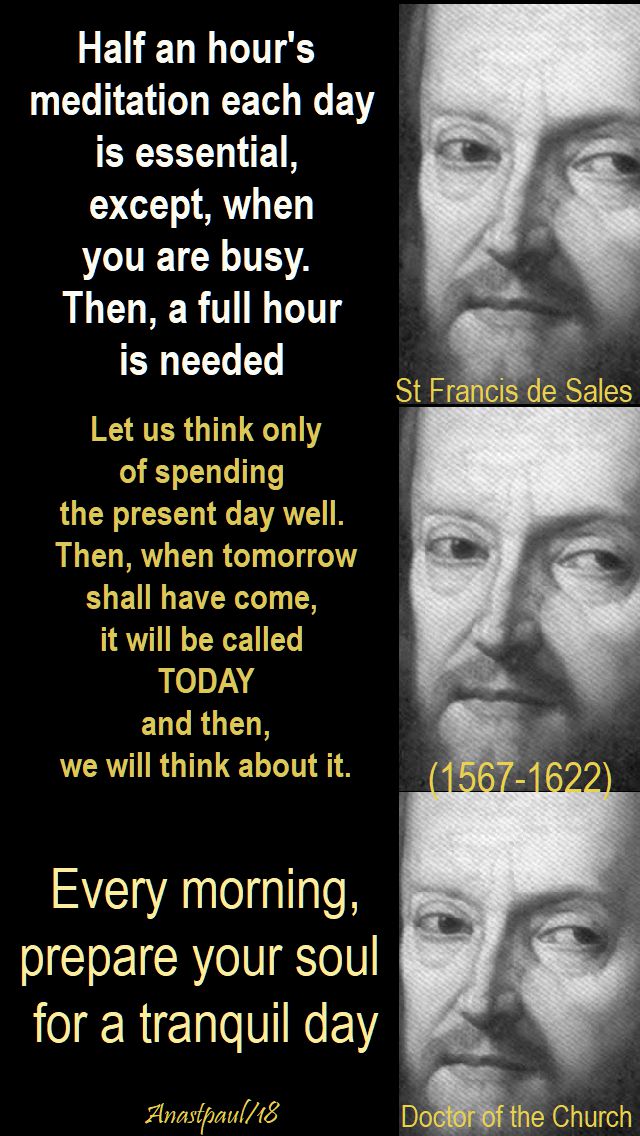
“Half an hour’s meditation each day is essential, except, when you are busy. Then a full hour is needed.”
“Let us think only of spending the present day well. Then, when tomorrow shall have come, it will be called TODAY and then, we will think about it.”
“Every morning, prepare your soul for a tranquil day.”
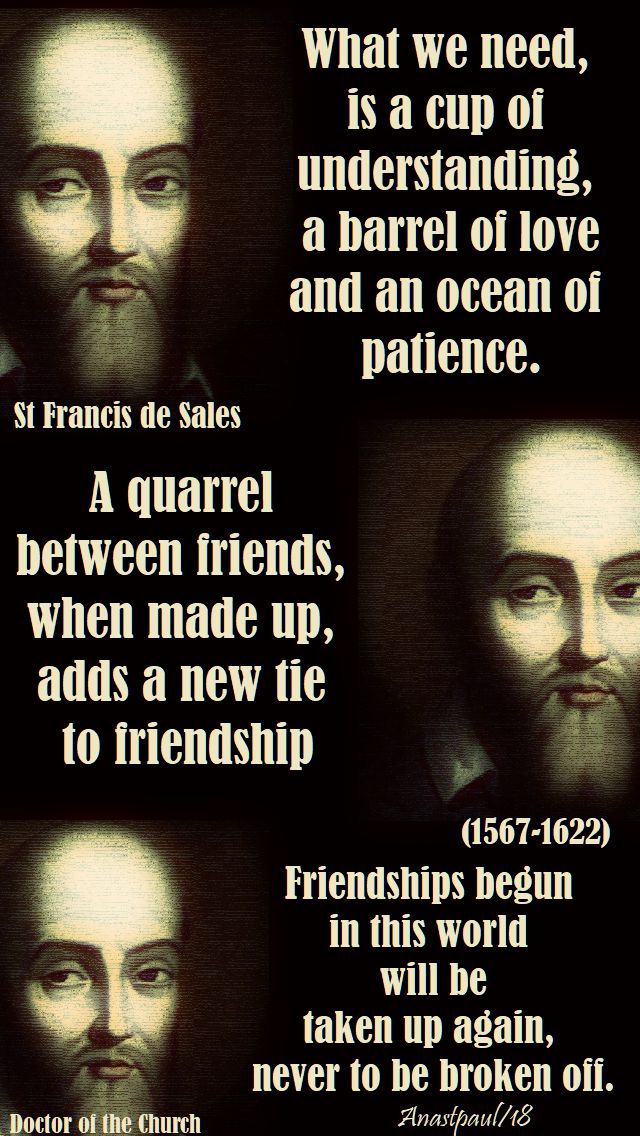
“What we need, is a cup of understanding, a barrel of love and an ocean of patience.”
“A quarrel between friends, when made up, adds a new tie to friendship.”
“Friendships begun in this world will be taken up again, never to be broken off. “
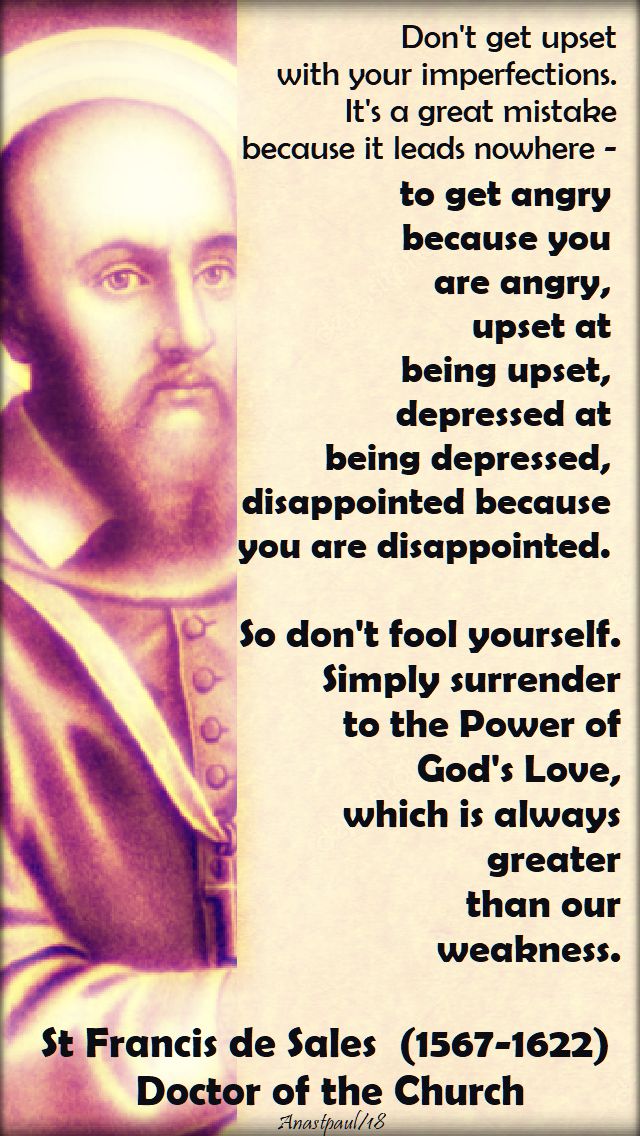
“Don’t get upset with your imperfections. It’s a great mistake because it leads nowhere – to get angry because you are angry, upset at being upset, depressed at being depressed, disappointed because you are disappointed. So don’t fool yourself. Simply surrender to the Power of God’s Love, which is always greater than our weakness.”
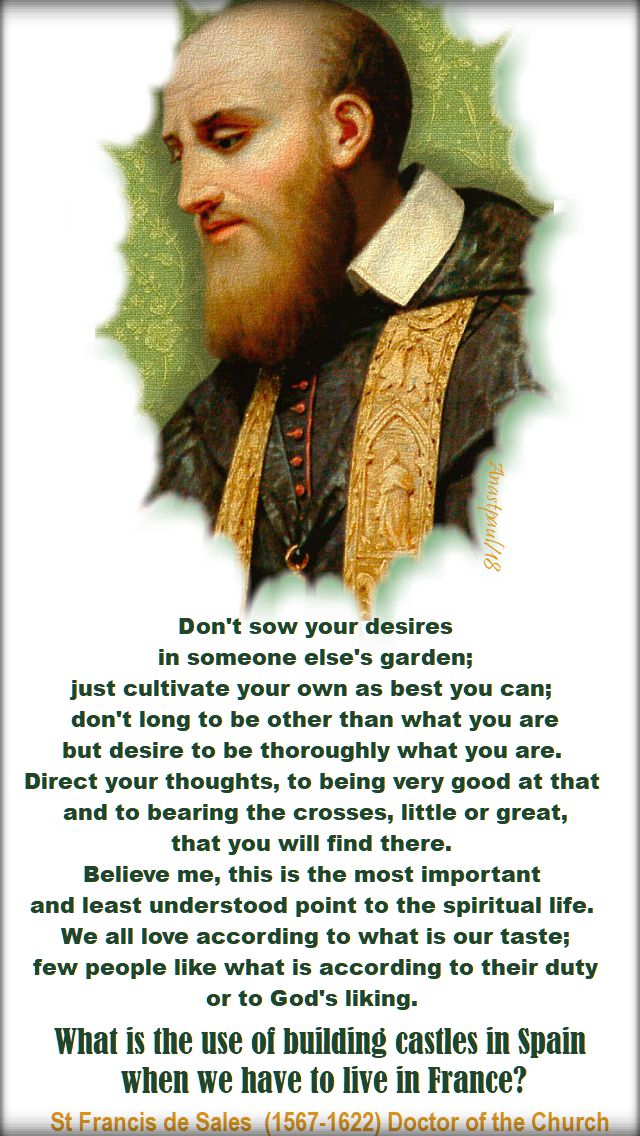
“Don’t sow your desires in someone else’s garden; just cultivate your own as best you can; don’t long to be other than what you are but desire to be thoroughly what you are. Direct your thoughts, to being very good at that and to bearing the crosses, little or great, that you will find there. Believe me, this is the most important and least understood point to the spiritual life. We all love according to what is our taste; few people like what is according to their duty or to God’s liking. What is the use of building castles in Spain when we have to live in France?”
St Francis de Sales (1567-1622) Doctor of the Church
One Minute Reflection – 24 January – The Memorial of St Francis de Sales (1567-1622) Doctor of the Church: Doctor Caritatis (Doctor of Charity)
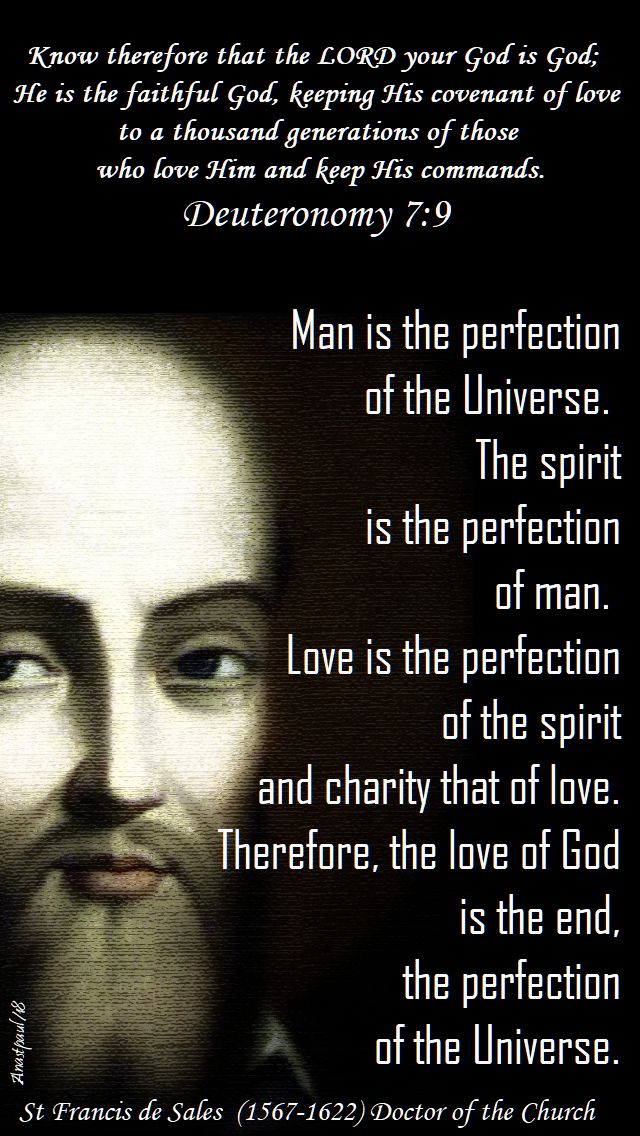
Know therefore that the LORD your God is God; He is the faithful God, keeping his covenant of love to a thousand generations of those who love Him and keep His commands…Deuteronomy 7:9
REFLECTION: “Man is the perfection of the Universe.
The spirit is the perfection of man.
Love is the perfection of the spirit and charity that of love.
Therefore, the love of God is the end, the perfection of the Universe.”… St Francis de Sales
PRAYER : Grant Lord, that in the service of our fellowmen, we may always reflect Your own gentleness and love and so imitate St Francis de Sales, whom You made all things to all men, for the saving of souls. Grant that his prayers on our behalf may assist us in our daily struggles in traversing our pilgrim way. Through Jesus Christ our Lord, in union with the Holy Spirit, one God forever and ever, amen.
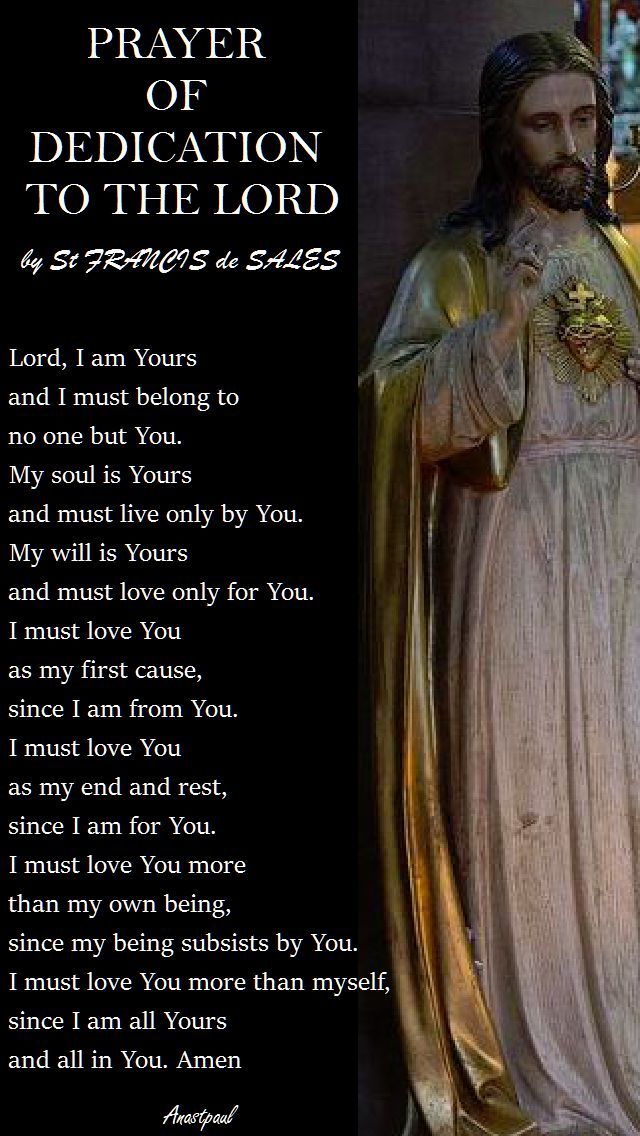
Our Morning Offering – 24 January – The Memorial of St Francis de Sales (1567-1622) Doctor of the Church: Doctor caritatis (Doctor of Charity)
Prayer of Dedication to the Lord By St Francis de Sales (1567-1622)
Lord,
I am Yours
and I must belong to no one but You.
My soul is Yours
and I must live only by You.
My will is Yours
and must love only for You.
I must love You as my first cause,
since I am from You.
I must love You as my end and rest,
since I am for You.
I must love You more than my own being,
since my being subsists by You.
I must love You more than myself,
since I am all Yours
and all in You.
Amen.













 AnaStpaul
You must be logged in to post a comment.