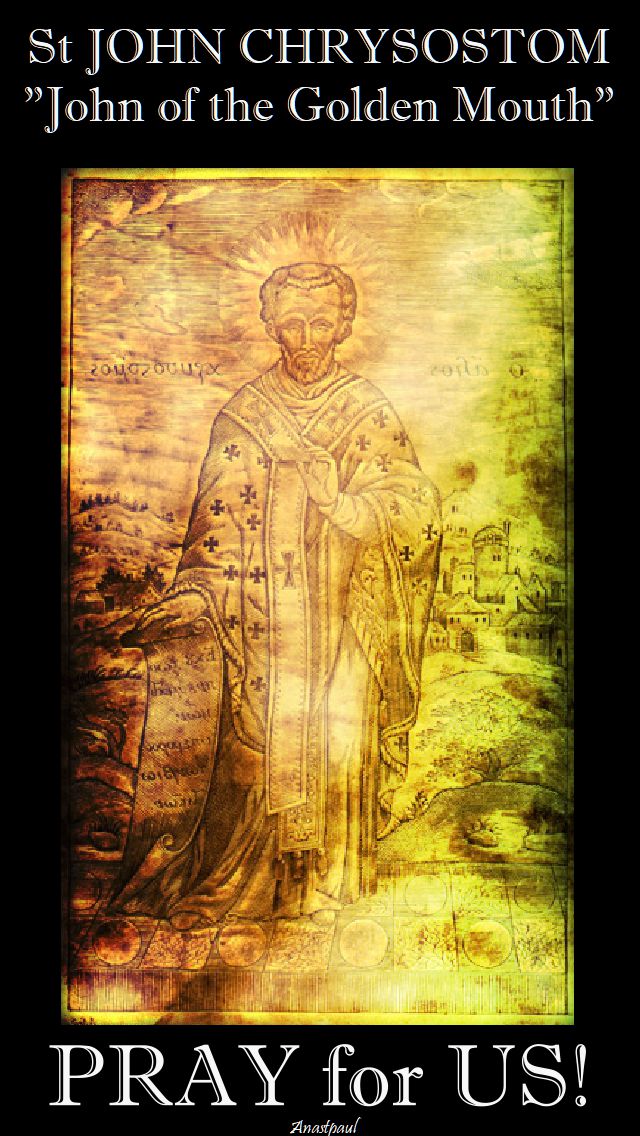
Quote/s of the Day – 13 September – St John Chrysostom (347-407) Doctor – “John of the Golden Mouth”
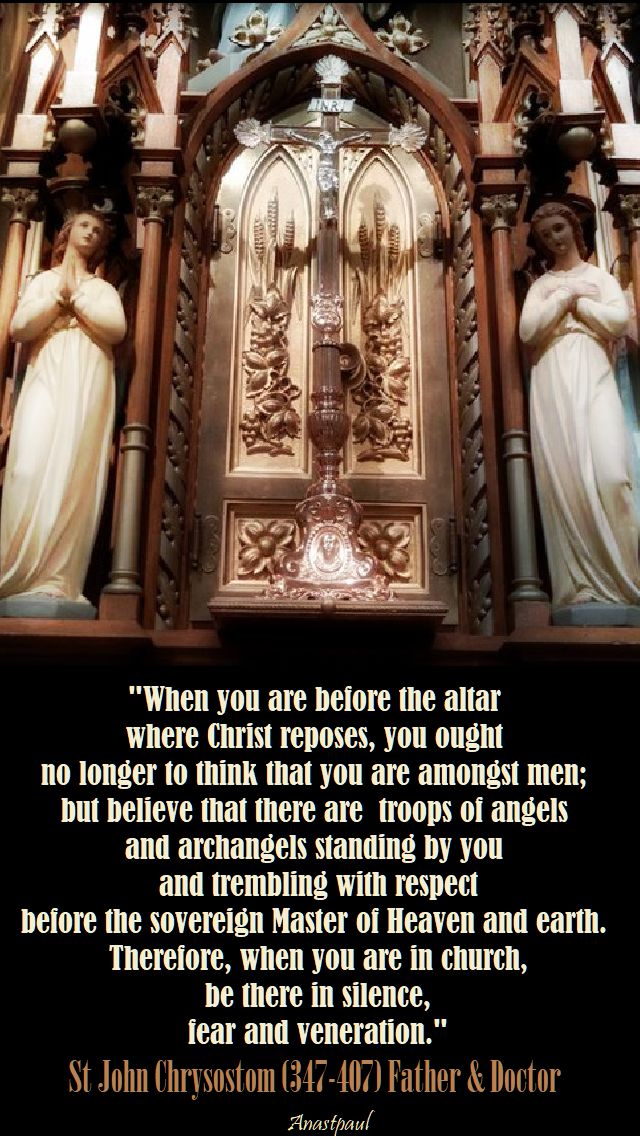
“When you are before the altar where Christ reposes, you ought no longer to think that you are amongst men; but believe that there are troops of angels and archangels standing by you and trembling with respect before the sovereign Master of Heaven and earth. Therefore, when you are in church, be there in silence, fear and veneration.”
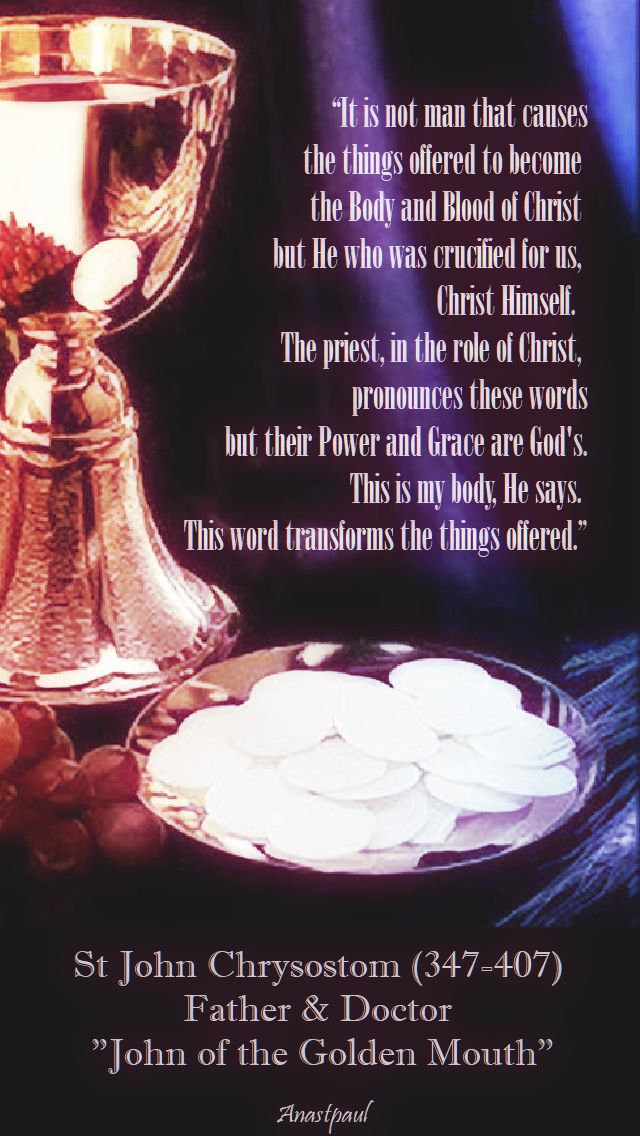
“It is not man that causes the things offered to become the Body and Blood of Christ but He who was crucified for us, Christ Himself. The priest, in the role of Christ, pronounces these words, but their Power and Grace are God’s. This is my body, He says. This word transforms the things offered.”
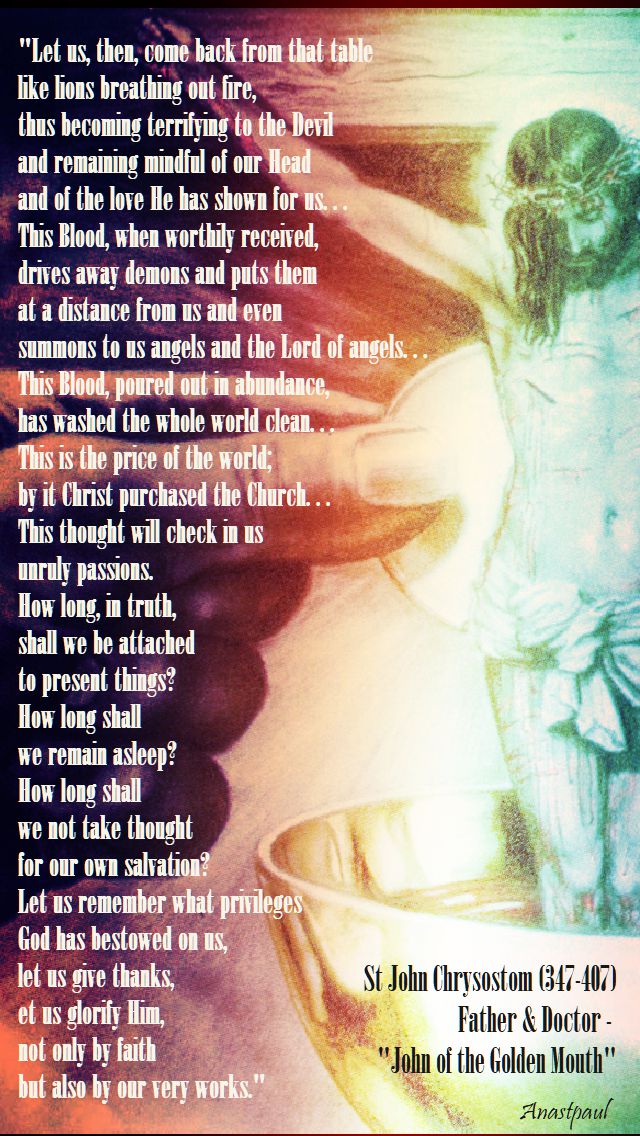
“Let us, then, come back from that table like lions breathing out fire, thus becoming terrifying to the Devil and remaining mindful of our Head and of the love He has shown for us. . . This Blood, when worthily received, drives away demons and puts them at a distance from us, and even summons to us angels and the Lord of angels. . . This Blood, poured out in abundance, has washed the whole world clean. . . This is the price of the world; by it Christ purchased the Church. . . This thought will check in us unruly passions. How long, in truth, shall we be attached to present things? How long shall we remain asleep? How long shall we not take thought for our own salvation? Let us remember what privileges God has bestowed on us, let us give thanks, let us glorify Him, not only by faith but also by our very works.”
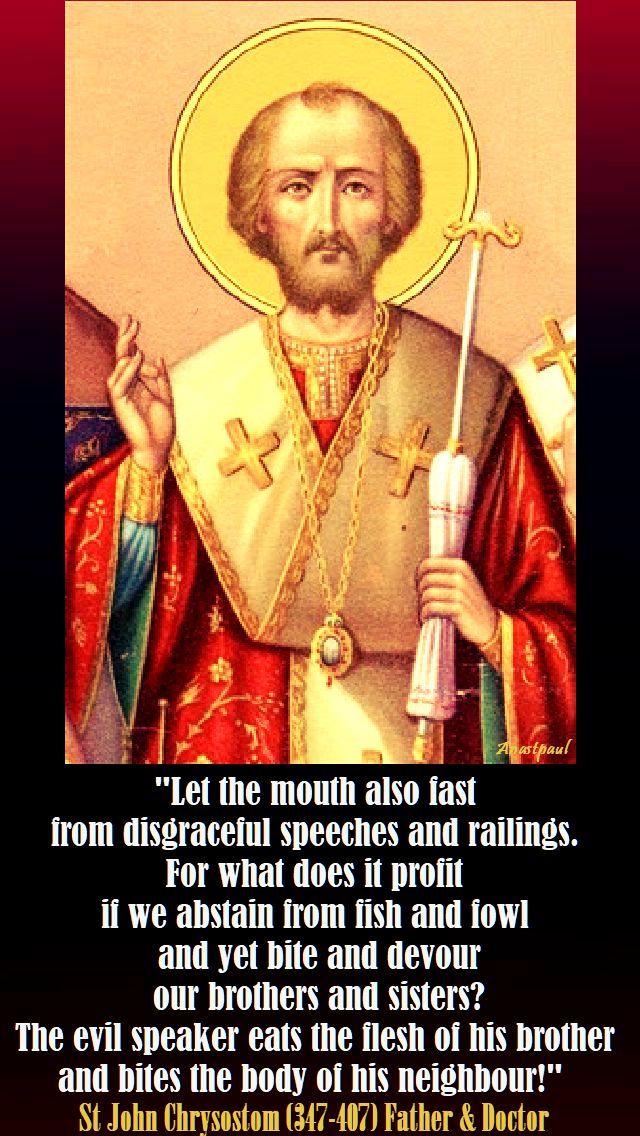
“Let the mouth also fast from disgraceful speeches and railings. For what does it profit if we abstain from fish and fowl and yet bite and devour our brothers and sisters? The evil speaker eats the flesh of his brother and bites the body of his neighbour!”
St John Chrysostom (347-407) Father & Doctor – “John of the Golden Mouth”
One Minute Reflection – 13 September – St John Chrysostom (347-407) Doctor – “John of the Golden Mouth”
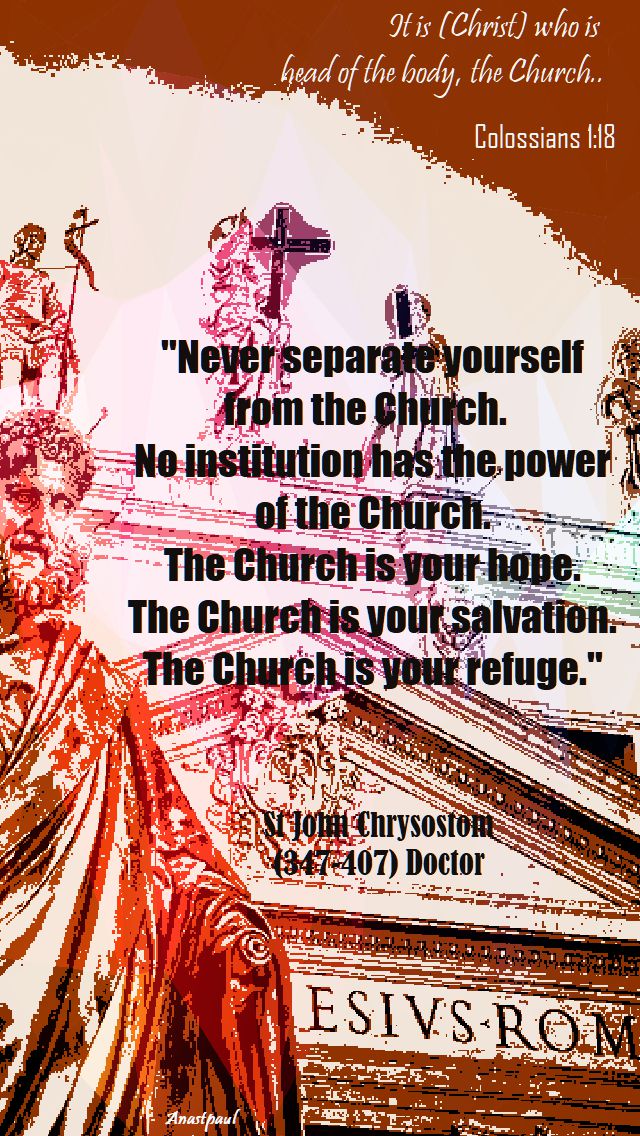
It is (Christ) who is head of the body, the Church….Colossians 1:18
REFLECTION – “Never separate yourself from the Church.
No institution has the power of the Church.
The Church is your hope.
The Church is your salvation.
The Church is your refuge.”..St John Chrysostom
PRAYER – Lord God, strength of those who hope in You, by Your will, St John Chrysostom became renowned in the Church for his astounding eloquence and his forbearance in persecution. Grant that we may be enriched by his teaching and encouraged by the example of his unconquerable fortitude. St John of the Golden Mouth, pray for us, amen.
Our Morning Offering – 13 September (347-407) Father and Doctor of the Church
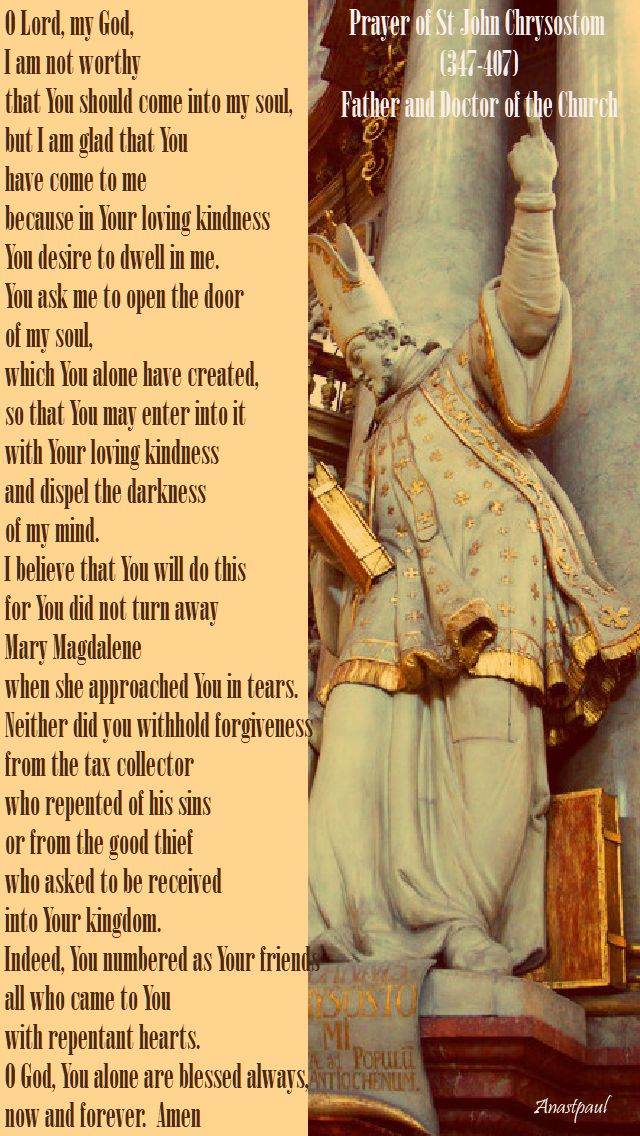
Prayer of St John Chrysostom
O Lord, my God,
I am not worthy
that You should come into my soul,
but I am glad that You have come to me
because in Your loving kindness
You desire to dwell in me.
You ask me to open the door of my soul,
which You alone have created,
so that You may enter into it
with Your loving kindness
and dispel the darkness of my mind.
I believe that You will do this
for You did not turn away Mary Magdalene
when she approached You in tears.
Neither did you withhold forgiveness
from the tax collector
who repented of his sins
or from the good thief
who asked to be received into Your kingdom.
Indeed, You numbered as Your friends
all who came to You with repentant hearts.
O God, You alone are blessed always,
now and forever. Amen
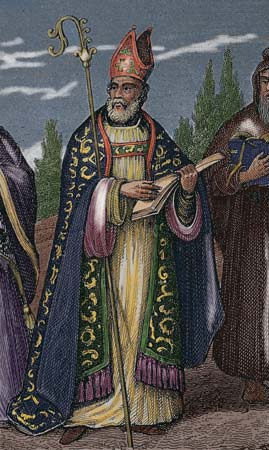
Saint of the Day – 13 September – St John Chrysostom (347-407) Father and Doctor of the Church – “Golden Mouthed” – (c 347 at Antioch, Asia Minor – 407 of natural causes) Bishop, Confessor, Father and Doctor, Preacher, Orator, Writer, Theologian, Name Meaning – • God is gracious; gift of God (John), • golden-mouthed (Chrysostom). Patronages – • epileptics; against epilepsy• Constantinople; Istanbul, Turkey• lecturers, preachers, speakers, orators (proclaimed on 8 July 1908 by St Pope Pius X). St John Chrysostom was the Archbishop of Constantinople and is an important Early Church Father. He is known for his preaching and public speaking, his denunciation of abuse of authority by both ecclesiastical and political leaders, the Divine Liturgy of Saint John Chrysostom and his ascetic sensibilities. Chrysostom was among the most prolific authors in the early Christian Church, exceeded only by St Augustine in the quantity of his surviving writings.
John was born in Antioch in 349 to Greek parents from Syria. John’s father died soon after his birth and he was raised by his mother. He was baptised in 368 or 373 and tonsured as a reader. As a result of his mother’s influential connections in the city, John began his education under the pagan teacher Libanius. From Libanius, John acquired the skills for a career in rhetoric, as well as a love of the Greek language and literature. As he grew older, however, John became more deeply committed to Christianity and went on to study theology under Diodore of Tarsus, founder of the re-constituted School of Antioch.
John lived in extreme asceticism and became a hermit in about 375; he spent the next two years continually standing, scarcely sleeping and committing the Bible to memory. As a consequence of these practices, his stomach and kidneys were permanently damaged and poor health forced him to return to Antioch.
Diaconate and service in Antioch:
John was ordained as a deacon in 381 by Saint Meletius of Antioch who was not then in communion with Alexandria and Rome. After the death of Meletius, John separated himself from the followers of Meletius, without joining Paulinus, the rival of Meletius for the bishopric of Antioch. But after the death of Paulinus he was ordained a presbyter (priest) in 386 by Evagrius, the successor of Paulinus.
In Antioch, over the course of twelve years (386–397), John gained popularity because of the eloquence of his public speaking at the Golden Church, Antioch’s cathedral, especially his insightful expositions of Bible passages and moral teaching. The most valuable of his works from this period are his Homilies on various books of the Bible. He emphasised charitable giving and was concerned with the spiritual and temporal needs of the poor. He spoke against abuse of wealth and personal property:
“Do you wish to honour the body of Christ? Do not ignore him when he is naked. Do not pay him homage in the temple clad in silk, only then to neglect him outside where he is cold and ill-clad. He who said: “This is my body” is the same who said: “You saw me hungry and you gave me no food”, and “Whatever you did to the least of my brothers you did also to me”… What good is it if the Eucharistic table is overloaded with golden chalices when your brother is dying of hunger? Start by satisfying his hunger and then with what is left you may adorn the altar as well.”
His straightforward understanding of the Scriptures – in contrast to the Alexandrian tendency towards allegorical interpretation – meant that the themes of his talks were practical, explaining the Bible’s application to everyday life. Such straightforward preaching helped Chrysostom to garner popular support. He founded a series of hospitals in Constantinople to care for the poor.
Archbishop of Constantinople:
In the autumn of 397, John was appointed Archbishop of Constantinople, after having been nominated without his knowledge. He had to leave Antioch in secret due to fears that the departure of such a popular figure would cause civil unrest. During his time as Archbishop he adamantly refused to host lavish social gatherings, which made him popular with the common people but unpopular with wealthy citizens and the clergy. His reforms of the clergy were also unpopular. He told visiting regional preachers to return to the churches they were meant to be serving—without any payout.
His time in Constantinople was more tumultuous than his time in Antioch. Theophilus, the Patriarch of Alexandria, wanted to bring Constantinople under his sway and opposed John’s appointment to Constantinople. Theophilus had disciplined four Egyptian monks (known as “the Tall Brothers”) over their support of Origen’s teachings. They fled to John and were welcomed by him. Theophilus therefore accused John of being too partial to the teaching of Origen. He made another enemy in Aelia Eudoxia, wife of Emperor Arcadius, who assumed that John’s denunciations of extravagance in feminine dress were aimed at herself. Eudoxia, Theophilus and other of his enemies held a synod in 403 (the Synod of the Oak) to charge John, in which his connection to Origen was used against him. It resulted in his deposition and banishment. He was called back by Arcadius almost immediately, as the people became “tumultuous” over his departure, even threatening to burn the royal palace. There was an earthquake the night of his arrest, which Eudoxia took for a sign of God’s anger, prompting her to ask Arcadius for John’s reinstatement.
Peace was short-lived. A silver statue of Eudoxia was erected in the Augustaion, near his cathedral. John denounced the dedication ceremonies as pagan and spoke against the Empress in harsh terms: “Again Herodias raves; again she is troubled; she dances again; and again desires to receive John’s head in a charger”, an allusion to the events surrounding the death of John the Baptist. Once again he was banished, this time to the Caucasus in Abkhazia.
Exile and death:
Faced with exile, John Chrysostom wrote an appeal for help to three churchmen: Pope Innocent I, Venerius the Bishop of Milan and the third to Chromatius, the Bishop of Aquileia. In 1872, church historian William Stephens wrote:
“The Patriarch of the Eastern Rome appeals to the great bishops of the West, as the champions of an ecclesiastical discipline which he confesses himself unable to enforce, or to see any prospect of establishing. No jealousy is entertained of the Patriarch of the Old Rome by the Patriarch of the New Rome. The interference of Innocent is courted, a certain primacy is accorded him but at the same time he is not addressed as a supreme arbitrator; assistance and sympathy are solicited from him as from an elder brother, and two other prelates of Italy are joint recipients with him of the appeal.”
Pope Innocent I protested John’s banishment from Constantinople to the town of Cucusus in Cappadocia, but to no avail. Innocent sent a delegation to intercede on behalf of John in 405. It was led by Gaudentius of Brescia; Gaudentius and his companions, two bishops, encountered many difficulties and never reached their goal of entering Constantinople.
John wrote letters which still held great influence in Constantinople. As a result of this, he was further exiled from Cucusus (where he stayed from 404 to 407) to Pitiunt (Pityus) (in modern Abkhazia) where his tomb is a shrine for pilgrims. He never reached this destination, as he died at Comana Pontica on 14 September 407 during the journey. His last words are said to have been “Glory be to God for all things”.
Veneration and canonisation:
John came to be venerated as a saint soon after his death. Almost immediately after, an anonymous supporter of John (known as pseudo-Martyrius) wrote a funeral oration to reclaim John as a symbol of Christian orthodoxy. But three decades later, some of his adherents in Constantinople remained in schism. Saint Proclus, Patriarch of Constantinople (434–446), hoping to bring about the reconciliation of the Johannites, preached a homily praising his predecessor in the Church of Hagia Sophia. He said, “O John, your life was filled with sorrow but your death was glorious. Your grave is blessed and reward is great, by the grace and mercy of our Lord Jesus Christ O graced one, having conquered the bounds of time and place! Love has conquered space, unforgetting memory has annihilated the limits and place does not hinder the miracles of the saint.”
St John Chrysostom (Memorial) – https://www.youtube.com/watch?v=a53YGJHmwXc
Dedication of the Basilicas of Jerusalem: Commemoration of the dedications of the basilicas built on Mount Calvary and the Church of the Holy Sepulchre in Jerusalem.
—
St Aigulf
St Amatus
St Amatus of Sion
St Barsenorius
Bl Claude Dumonet
St Columbinus of Lure
St Emiliano of Valence
St Evantius of Autun
Bl Gertrude Prosperi
St Gordian of Pontus
Bl Hedwig of Hreford
St Julian of Ankyra
St Ligorius
St Litorius of Tours
St Macrobius
St Marcellinus of Carthage
Bl María López de Rivas Martínez
St Maurilius of Angers
St Nectarius of Autun
St Philip of Rome
St Venerius of Tino
—
Martyrs of Ireland:
• Blessed Edward Stapleton
• Blessed Elizabeth Kearney
• Blessed James Saul
• Blessed Margaret of Cashel
• Blessed Richard Barry
• Blessed Richard Butler
• Blessed Theobald Stapleton
• Blessed Thomas Morrissey
• Blessed William Boyton
Martyred in the Spanish Civil War including the Martyrs of Pozo de Cantavieja – 11 beati:
• Blessed Bienvenido Villalón Acebrón
• Blessed Emilio Antequera Lupiáñez
• Blessed Florencio Arnáiz Cejudo
• Blessed Francisco Rodríguez Martínez
• Blessed Joaquín Gisbert Aguilera
• Blessed José Álvarez-Benavides de La Torre
• Blessed José Cano García
• Blessed José Román García González
• Blessed Juan Capel Segura
• Blessed Juan Ibáñez Martín
• Blessed Luis Eduardo López Gascón
• Blessed Manuel Alvarez y Alvarez
• Blessed Manuel Martínez Giménez
• Blessed Pío Navarro Moreno
• Blessed Ramiro Argüelles Hevia
• Blessed Sabino Ayastuy Errasti
• Blessed Teófilo Montes Calvo
Quote/s of the Day – 12 September – Blessed Feast of the Holy Name of Mary!
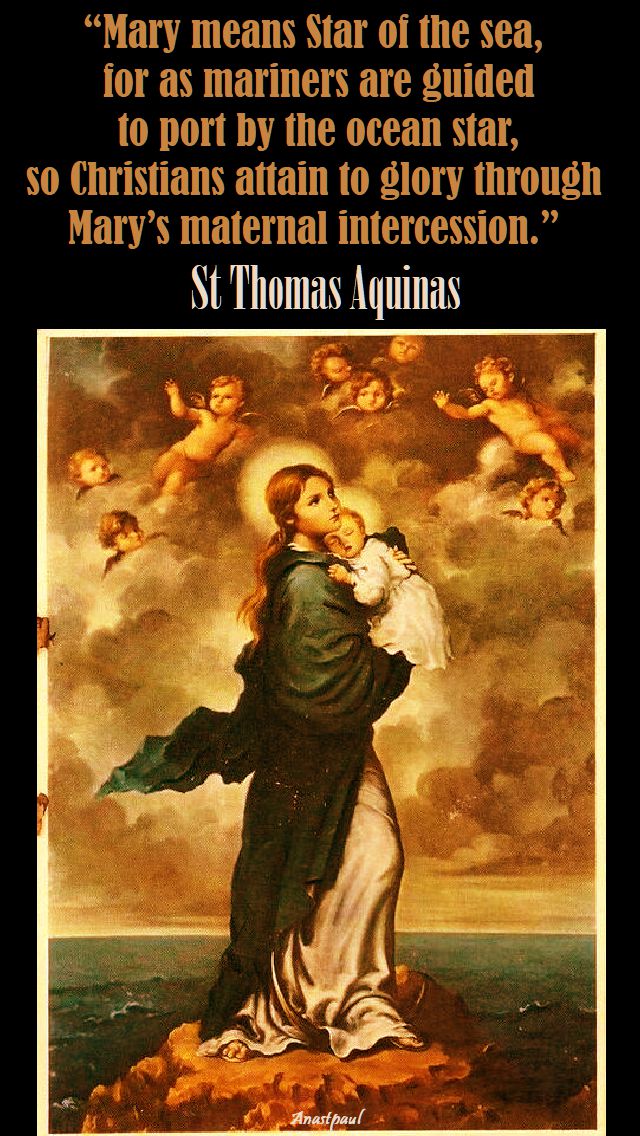
“Mary means Star of the sea, for as mariners are guided to port by the ocean star, so Christians attain to glory through Mary’s maternal intercession.”
St Thomas Aquinas
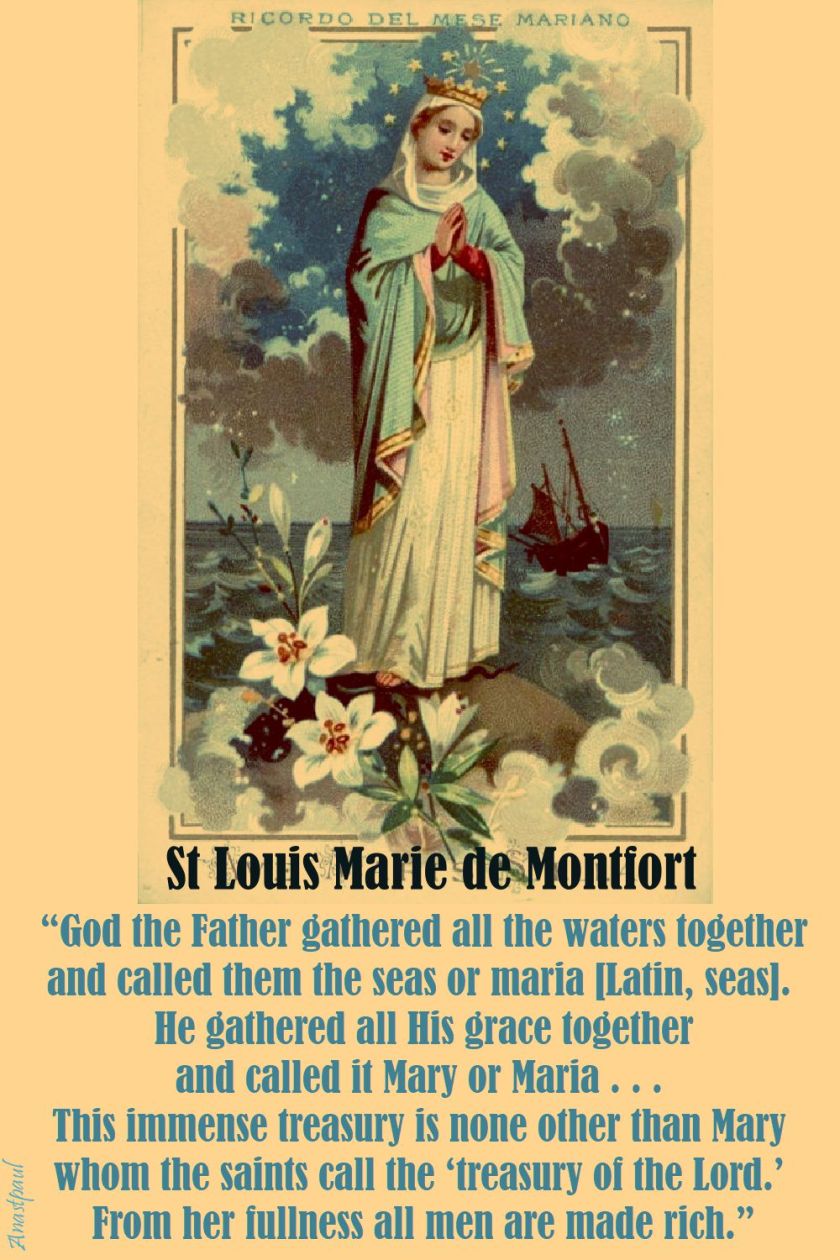
“God the Father gathered all the waters together and called them the seas or maria [Latin, seas]. He gathered all His grace together and called it Mary or Maria . . . This immense treasury is none other than Mary whom the saints call the ‘treasury of the Lord.’ From her fullness all men are made rich.”
St Louis de Montfort
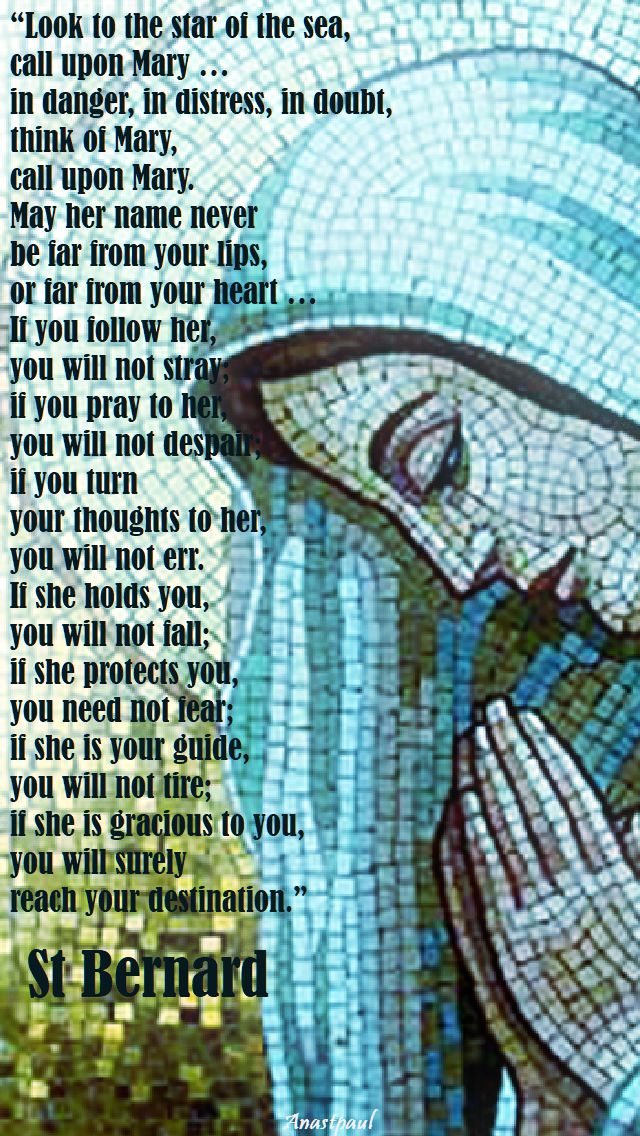
“Look to the star of the sea, call upon Mary … in danger, in distress, in doubt, think of Mary, call upon Mary. May her name never be far from your lips, or far from your heart … If you follow her, you will not stray; if you pray to her, you will not despair; if you turn your thoughts to her, you will not err. If she holds you, you will not fall; if she protects you, you need not fear; if she is your guide, you will not tire; if she is gracious to you, you will surely reach your destination.”
One Minute Reflection – 12 September – The Feast of the Most Holy Name of Mary
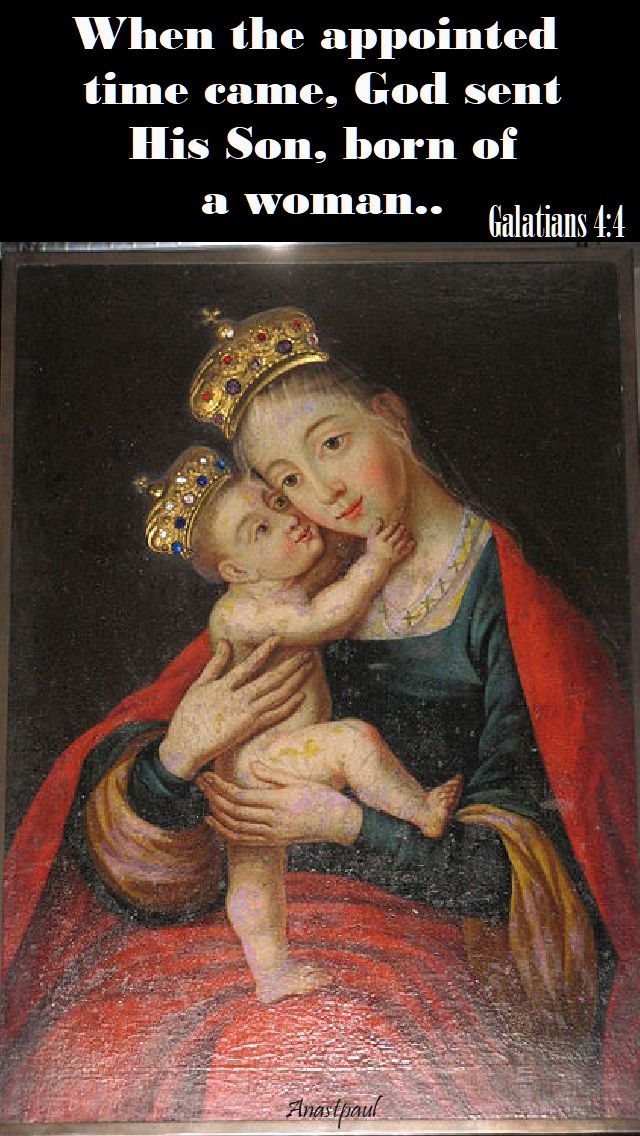
When the appointed time came, God sent His Son, born of a woman.….Galatians 4:4
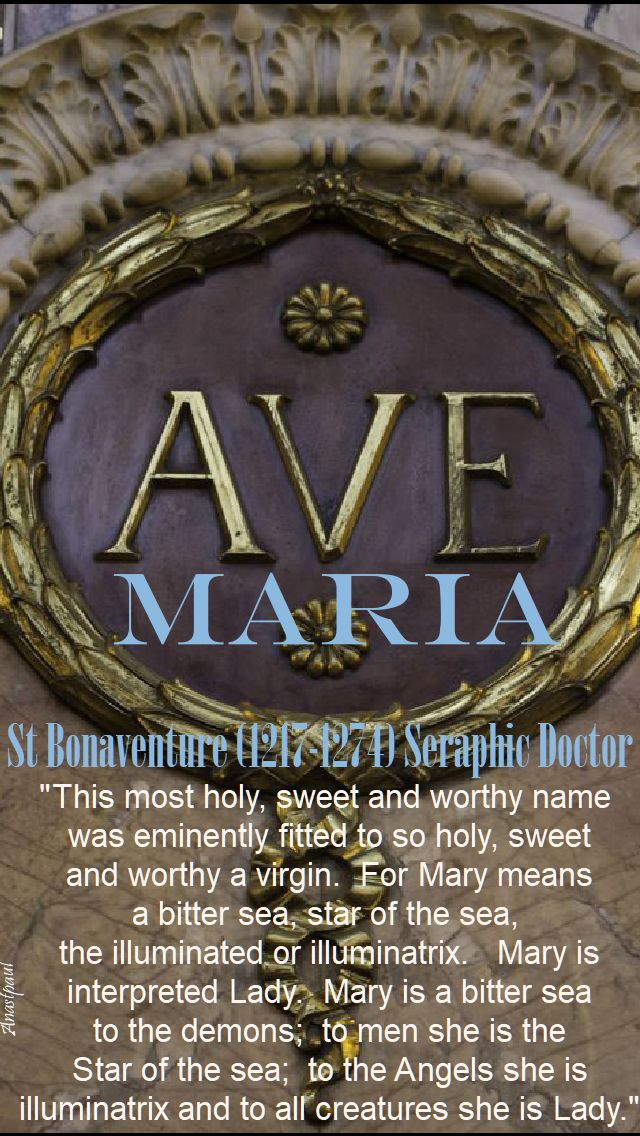
REFLECTION – “This most holy, sweet and worthy name was eminently fitted to so holy, sweet and worthy a virgin. For Mary means a bitter sea, star of the sea, the illuminated or illuminatrix. Mary is interpreted Lady. Mary is a bitter sea to the demons; to men she is the Star of the sea; to the Angels she is illuminatrix and to all creatures she is Lady.” … St Bonaventure (1217-1274) Seraphic Doctor
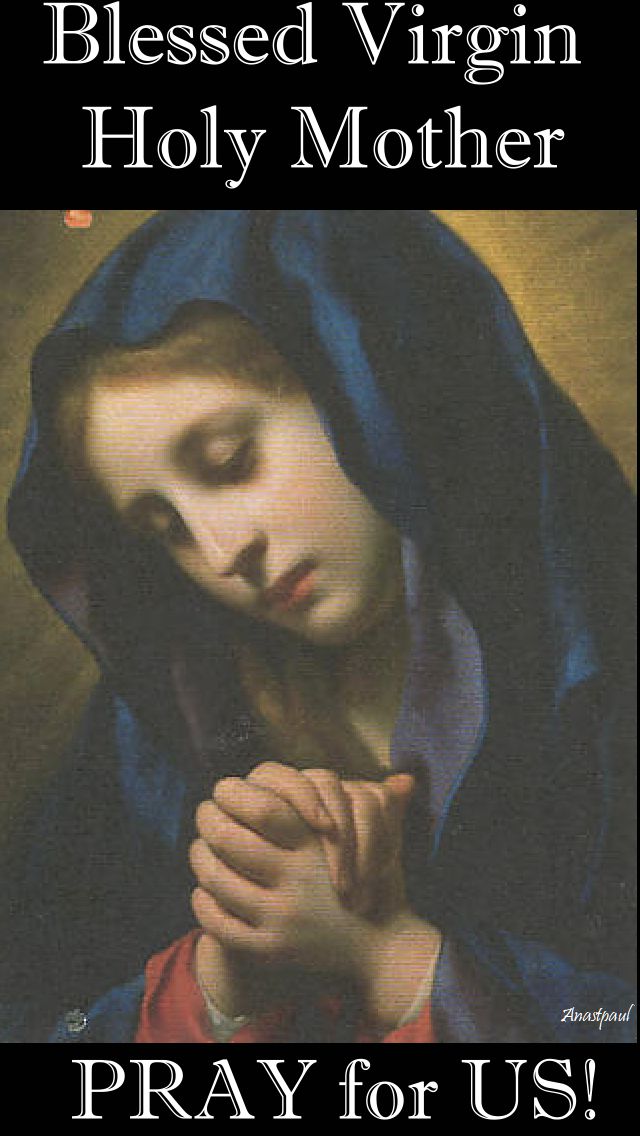
PRAYER – Heavenly Father, assist us at all times to obtain a spirit of worthy penance, for our sins and that of all the world. To the invocation of Your Divine Son, Jesus, we call on the intercession of His holy Mother to aid us on our pilgrimage. With great affection and confidence, we honour the Holy Hearts and invoke the Holy Names of Jesus and Mary, to be our constant source of pure assistance and succour. Blessed Virgin, Most Holy Mother, pray for us. Amen
Come by yourselves to an out-of-the-way place and rest a little.….Mark 6:30
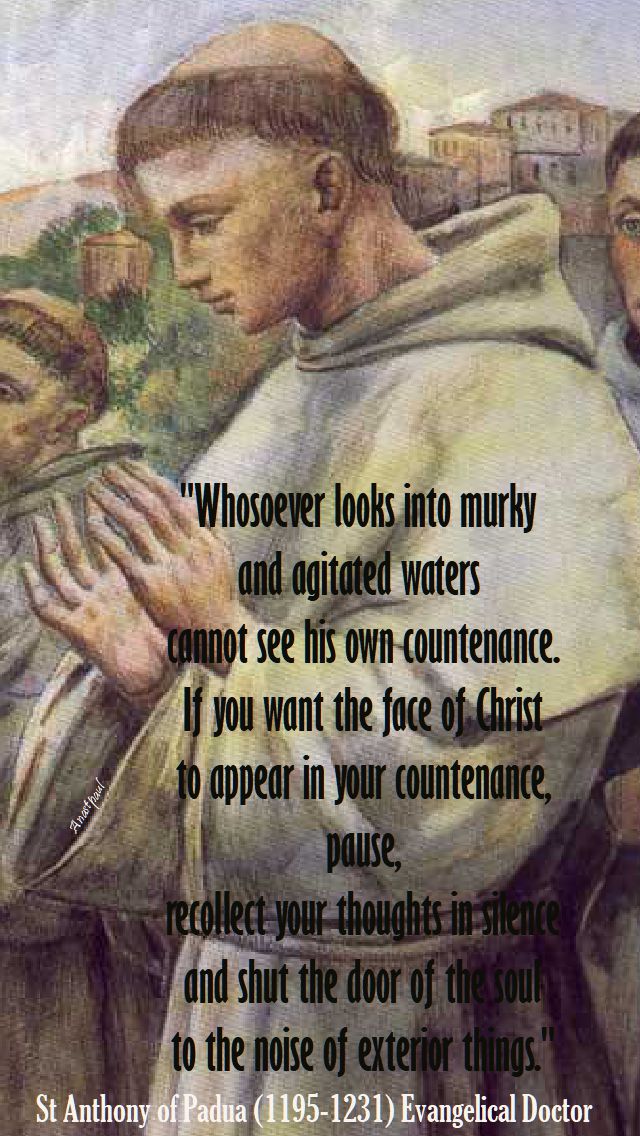
REFLECTION – “Whosoever looks into murky and agitated waters cannot see his own countenance.
If you want the face of Christ to appear in your countenance, pause, recollect your thoughts in silence
and shut the door of the soul to the noise of exterior things.”….St Anthony of Padua (1195-1231) Evangelical Doctor
PRAYER – Lord Jesus Christ, teach me to pause often during my active life and recollect myself.
Let me put away the problems of life and commune with You in prayer and meditation.
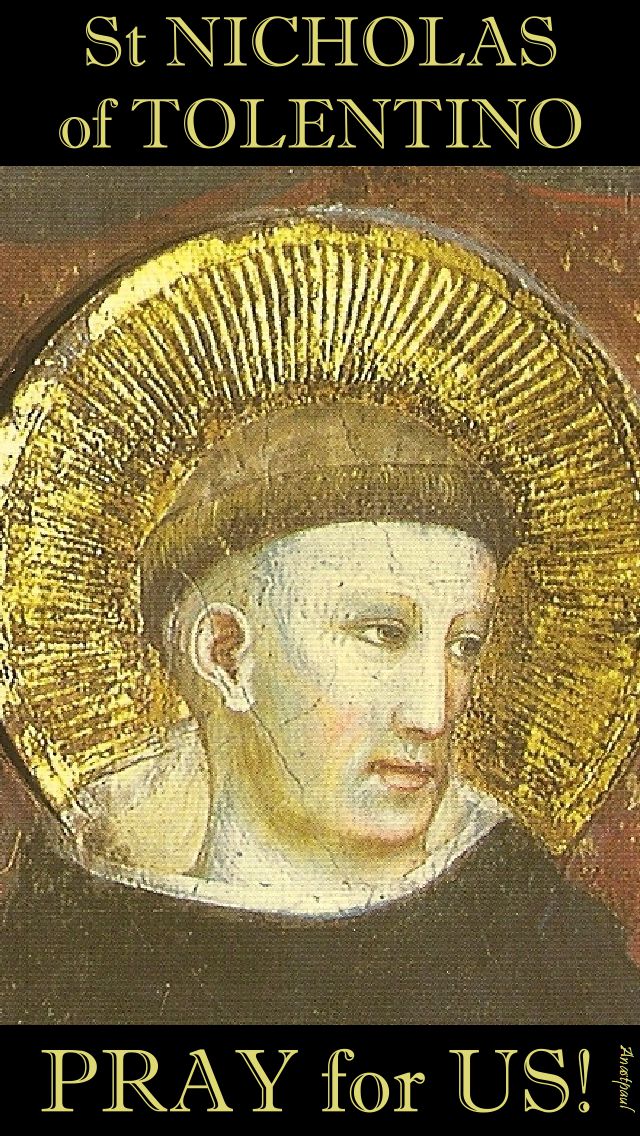
St Nicholas of Tolentino, amidst his busy life of charity to all, constantly resumed silence in You
and thus, in his mystical union with You, reflected Your Face. St Nicholas, pray for us, amen.
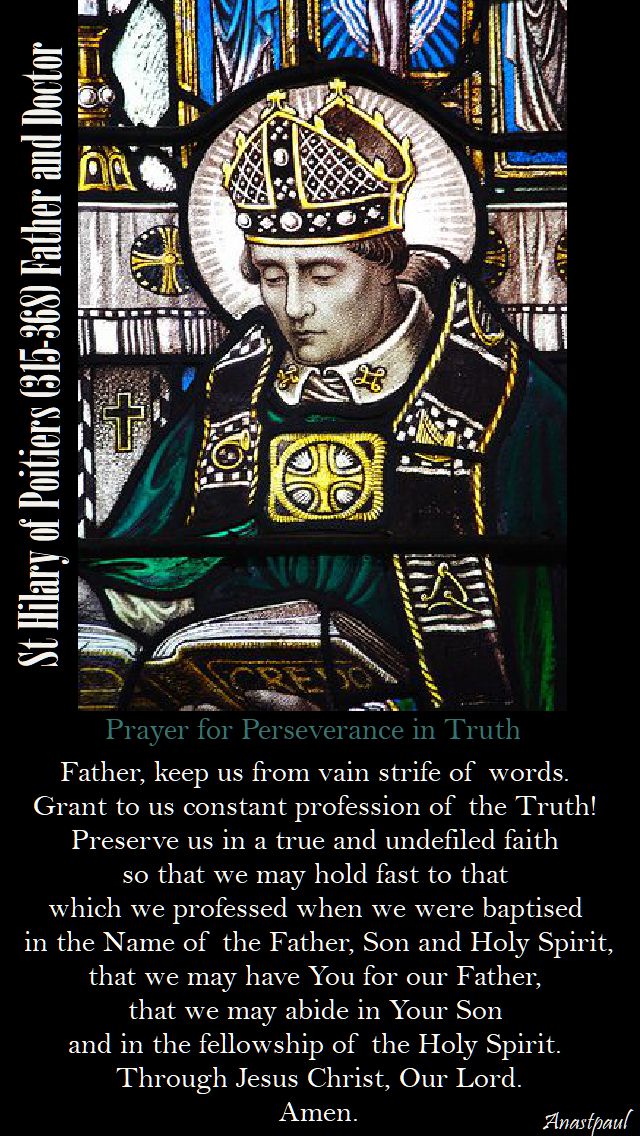
Prayer for Perseverance in Truth By St HILARY OF POITIERS – (315-368) Father and Doctor
Father, keep us from vain strife of words.
Grant to us constant profession of the Truth!
Preserve us in a true and undefiled faith
so that we may hold fast to that
which we professed when we were baptised
in the Name of the Father, Son and Holy Spirit,
that we may have You for our Father,
that we may abide in Your Son
and in the fellowship of the Holy Spirit.
Through Jesus Christ, Our Lord.
Amen.
This prayer is an excerpt from a sermon ‘On the Trinity’ by Saint Hilary of Poitiers, a bishop and early Church Father of the fourth century and Doctor of the Church, who struggled valiantly against the Arian heresy, defending the divinity of Christ and the doctrine of the Trinity.
Quote/s of the Day – 4 September – The Feast of Our Lady of Consolation
“Has anyone ever come away from Mary, troubled or saddened or ignorant of the heavenly Mysteries? Who has not returned to everyday life gladdened and joyful because a request has been granted by the Mother of God?”
St Amadeus of Lausanne (1110-1159)
“As the Mother of Christ, Mary is the Mother of our wisdom and justice, of our holiness and redemption. She is more our Mother than the mother of our flesh.”
St Aelred (1109-1166)
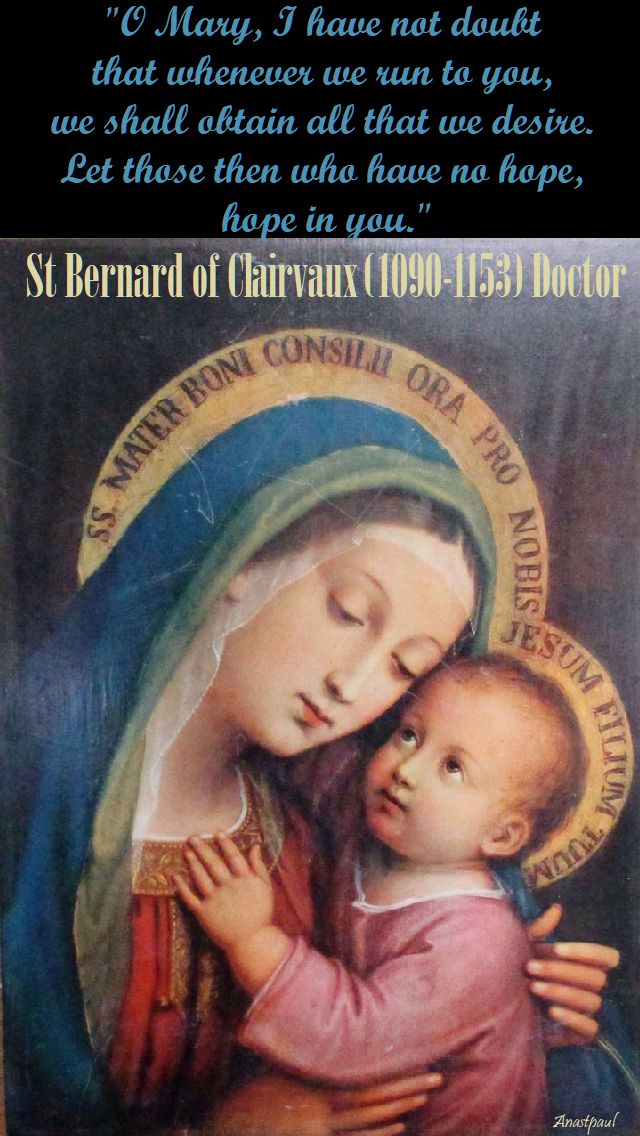
“O Mary, I have not doubt that whenever we run to you, we shall obtain all that we desire. Let those then who have no hope, hope in you.”
St Bernard of Clairvaux (1090-1153) Doctor of the Church
One Minute Reflection – 4 September – The Feast of Our Lady of Consolation
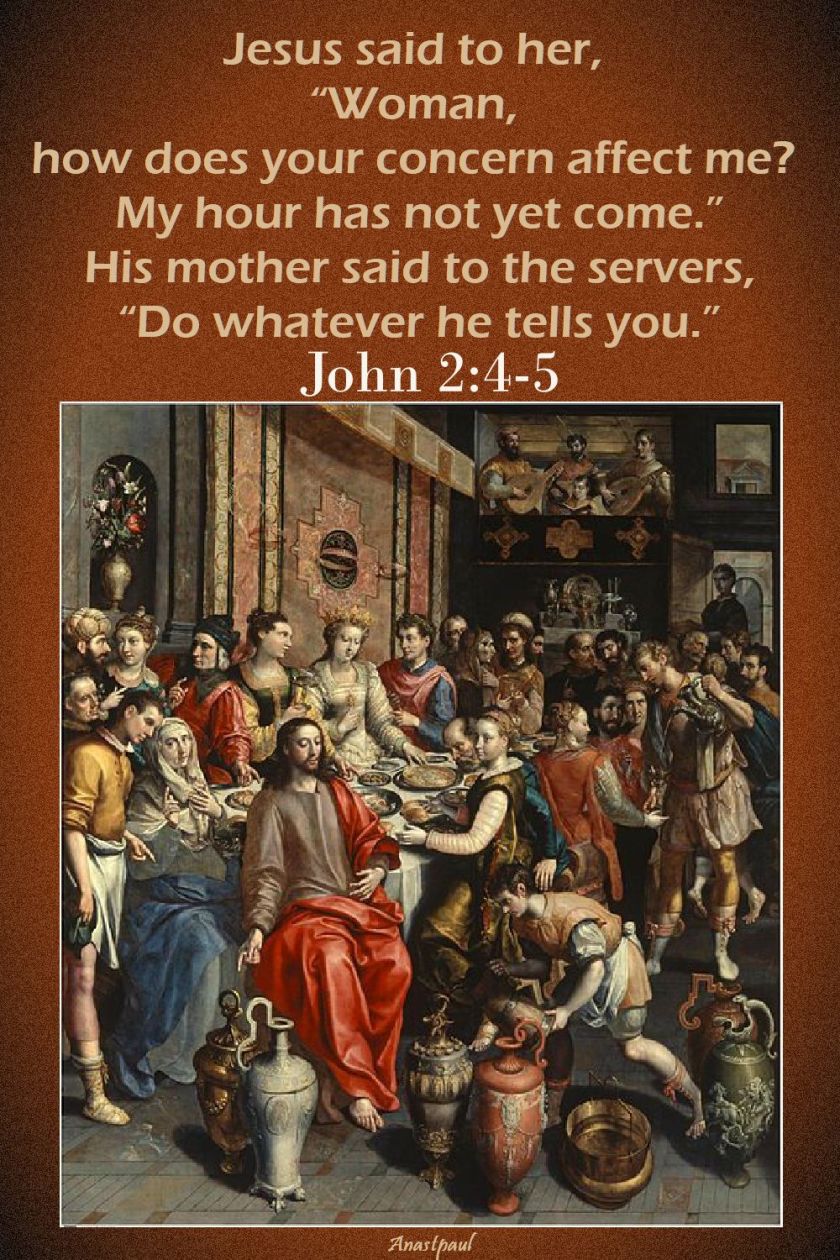
Jesus said to her, “Woman, how does your concern affect me? My hour has not yet come.” His mother said to the servers, “Do whatever he tells you.”….John 2:4-5
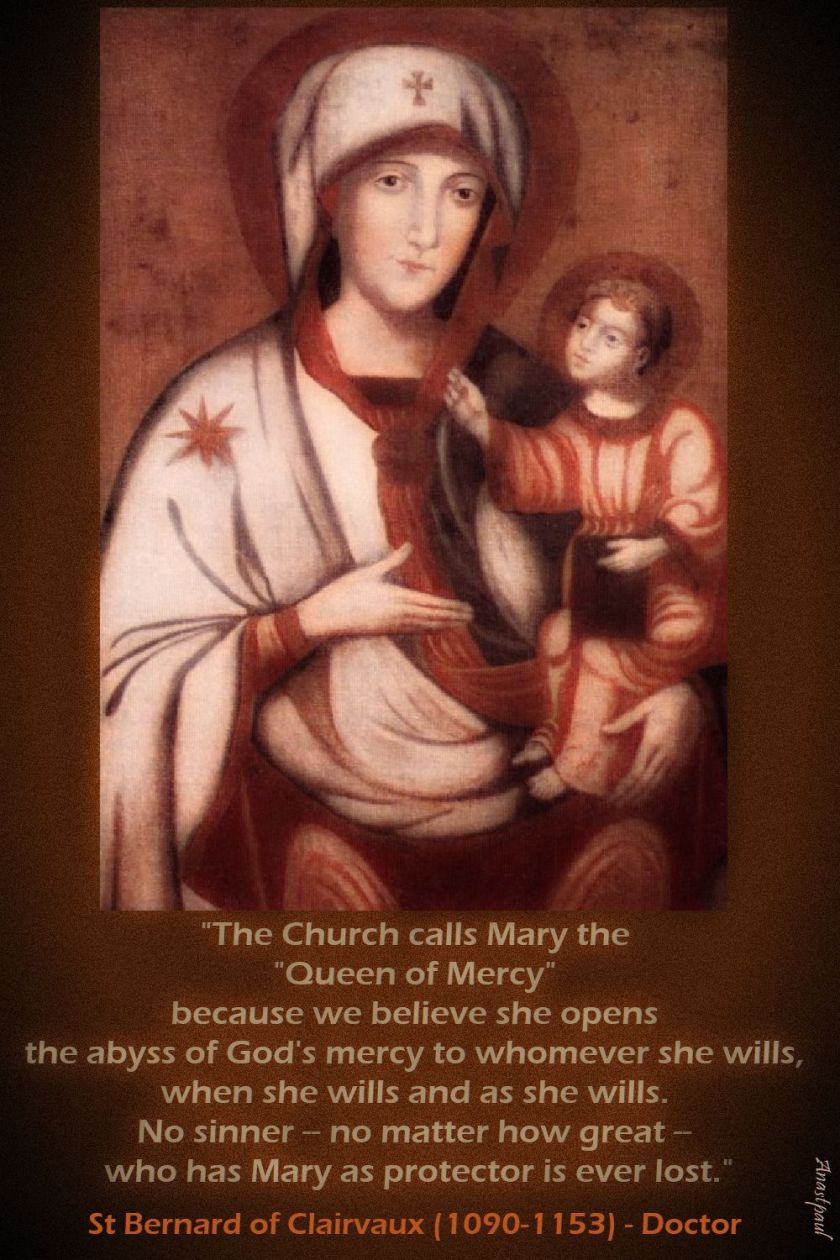
REFLECTION – “The Church calls Mary the “Queen of Mercy” because we believe she opens the abyss of God’s mercy to whomever she wills, when she wills and as she wills.
No sinner — no matter how great — who has Mary as protector is ever lost.”…St Bernard of Clairvaux (1090-1153) – Doctor of the Church
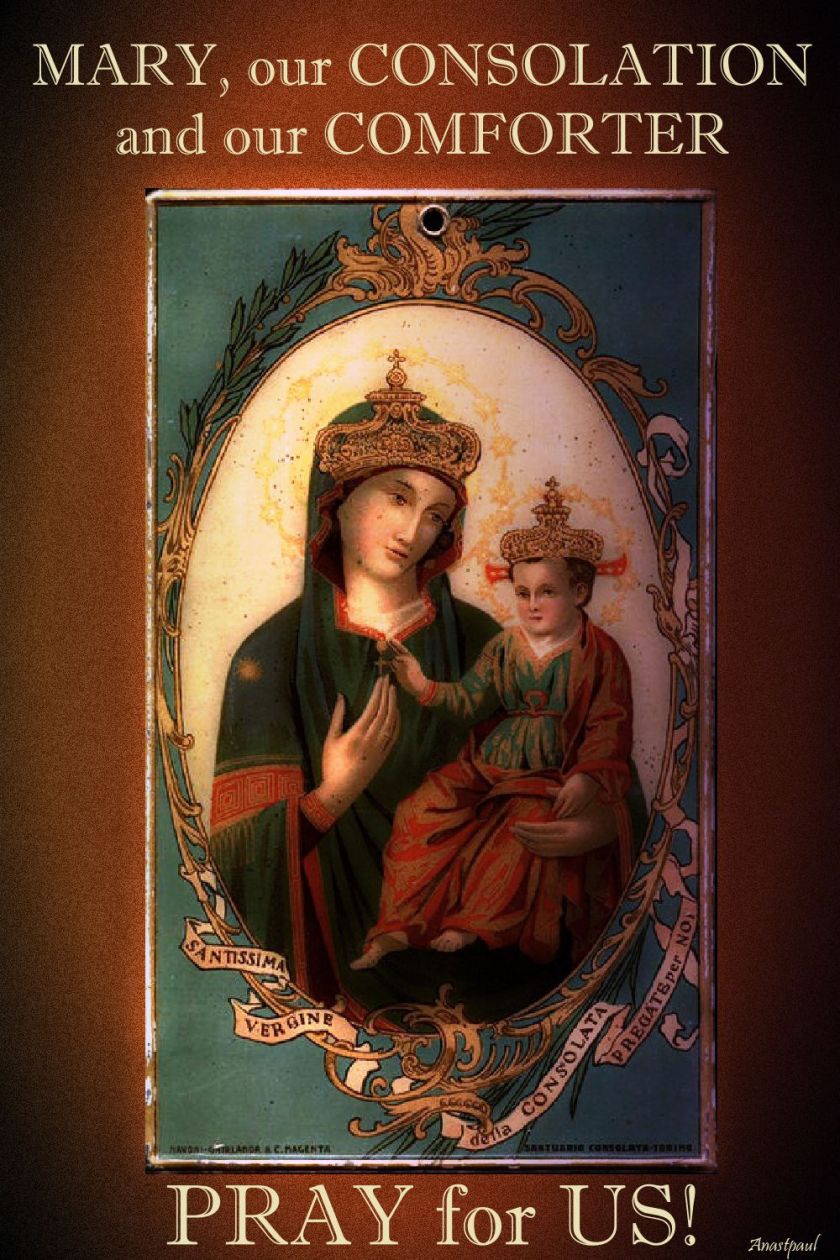
PRAYER – Almighty God, grant that Your faithful, who rejoice in the protection of the Blessed Virgin Mary, may be delivered from every evil here on earth, through her prayer and come to the enduring joys of heaven. Through our Lord, Jesus Christ, in union with the Holy Spirit Mary, our Consolation and Comforter, pray for us! Amen.
Quote/s of the Day – 3 September – The Memorial of St Pope Gregory the Great (540-604) – Father & Doctor of the Church
“If we knew at what time we were to depart from this world, we would be able to select a season for pleasure and another for repentance. But God, who has promised pardon to every repentant sinner, has not promised us tomorrow. Therefore we must always dread the final day, which we can never foresee. This VERY DAY is a day of truce, a day for conversion. And yet we refuse to cry over the evil we have done! Not only do we not weep for the sins we have committed, we even add to them…”
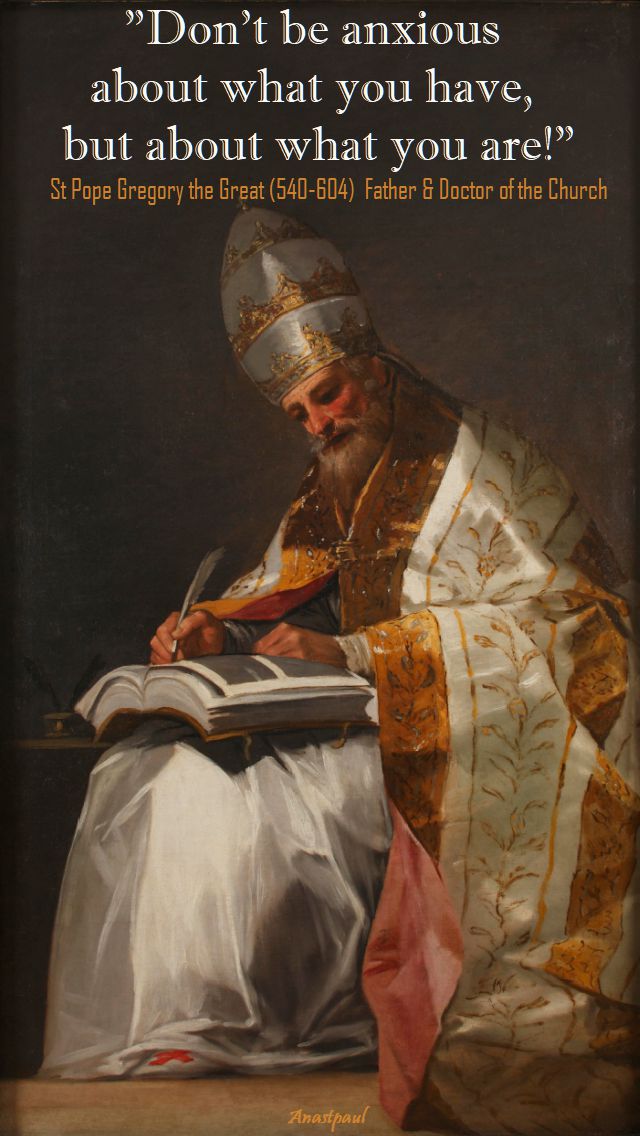
“Don’t be anxious about what you have, but about what you are!”
“When we attend to the needs of those in want, we give them what is theirs, not ours. More than performing works of mercy, we are paying a debt of justice.”
“The Emperor of heaven, the Lord of men and of angels, has sent you His epistles for your life’s advantage— and yet you neglect to read them eagerly. Study them, I beg you and meditate daily on the words of your Creator. Learn the heart of God in the words of God, that you may sigh more eagerly for things eternal, that your soul may be kindled with greater longings for heavenly joy.”
St Pope Gregory the Great (540-604) – Father & Doctor of the Church
One Minute Reflection –3 September – The Memorial of St Pope Gregory the Great (540-604) – Father & Doctor of the Church
Since the Creation of the world….God’s eternal power and divinity have become visible, recognised through the things he has made..Romans 1:20
REFLECTION – “God is within all things but not included; outside all things but not excluded. God is above all things but not beyond their reach.”….St Pope Gregory the Great
PRAYER – Lord of creation, grant me the grace to see You in all things and in all places on earth. Help me to seek and reach You in all the events I experience and all the persons I encounter every day of my life. St Pope Gregory the Great, Pray for us! Amen
Saint of the Day – 3 September – St Pope Gregory the Great (540-604) – Father & Doctor of the Church. Also known as “Father of the Fathers” (c 540 at Rome, Italy – Papal Ascension: 3 September 590 – 12 March 604 at Rome, Italy of natural causes). Pope, Prefect of Rome, Monk, Abbot, Writer, Theologian, Teacher, Liturgist. Patronages – • against gout • against plague/epidemics,• choir boys,• teachers• stone masons, stonecutters, • students, school children,• Popes, the Papacy,• musicians,• singers,• England, • West Indies,• Legazpi, Philippines, Diocese of,• Order of Knights of Saint Gregory, • Kercem, Malta,• Montone, Italy,• San Gregorio nelle Alpi, Italy. Attributes – • crozier
• dove,• pope working on sheet music,• pope writing,• tiara.
4 Original Latin Fathers – Jerome, Gregory, Ambrose, Augustine
Pope St. Gregory was born in Rome, the son of a wealthy Roman Senator. His mother was St. Sylvia. He followed the career of public service that was usual for the son of an aristocratic family, becoming Prefect of the City of Rome but resigned within a year to pursue monastic life.
He founded with the help of his vast financial holdings seven monasteries, of which six were on family estates in Sicily. A seventh, which he placed under the patronage of St. Andrew and which he himself joined, was erected on the Clivus Scauri in Rome. For several years, he lived as a good and holy Benedictine monk.
Then Pope Pelagius made him one of the seven deacons of Rome. For six years, he served as permanent ambassador to the Court of Byzantium. In the year 586, he was recalled to Rome and with great joy returned to St Andrew’s Monastery. He became abbot soon afterwards and the monastery grew famous under his energetic rule. When the Pope died, Gregory was unanimously elected to take his place because of his great piety and wisdom. However, Gregory did not want that honour, so he disguised himself and hid in a cave but was found and made Pope anyway.
He was elected Pope on 3 September 590, the first monk to be elected to this office. For fourteen years he ruled the Church. Even though he was always sick, Gregory was one of the greatest popes the Church has ever had. He reformed the administration of the Church’s estates and devoted the resulting surplus to the assistance of the poor and the ransoming of prisoners. He negotiated treaties with the Lombard tribes who were ravaging northern Italy and by cultivating good relations with these and other barbarians he was able to keep the Church’s position secure in areas where Roman rule had broken down.
His works for the propagation of the faith include the sending of St Augustine of Canterbury and his monks as missionaries to England in 596, providing them with continuing advice and support and (in 601) sending reinforcements. He wrote extensively on pastoral care, spirituality and morals and designated himself “servant of the servants of God”, a title which all Popes have used since that time.
He never rested and wore himself down to almost a skeleton. Even as he lay dying, he directed the affairs of the Church and continued his spiritual writing.
He codified the rules for selecting deacons to make these offices more spiritual. Prior to this, deacons were selected on their ability to sing the liturgy and chosen if they had good voices.
Because he loved the solemn celebration of the Eucharist, St. Grergory devoted himself to compiling the Antiphonary, which contains the chants of the Church used during the liturgy (the Gregorian Chant). He also set up the Schola Cantorum, Roman’s famous training school for chorusters.
St Gregory died on March 12, 604 and was buried in St Peter’s Church. He is designated as the fourth Doctor of the Latin Church. His feast is celebrated on the date of his election as Pope.
The Eucharistic Miracle of St Pope Gregory
St Gregory the Great is perhaps especially remembered by many for the Eucharistic Miracle that occurred in 595 during the Holy Sacrifice. This famous incident was related by Paul the Deacon in his 8th century biography of the holy pope, Vita Beati Gregorii Papae.
Pope Gregory was distributing Holy Communion during a Sunday Mass and noticed amongst those in line a woman who had helped make the hosts was laughing. This disturbed him greatly and so he inquired what was the cause of her unusual behaviour. The woman replied that she could not believe how the hosts she had prepared could become the Body and Blood of Christ just by the words of consecration.
Hearing this disbelief, St. Gregory refused to give her Communion and prayed that God would enlighten her with the truth. Just after making this plea to God, the pope witnessed some consecrated Hosts (which appeared as bread) change Their appearance into actual flesh and blood. Showing this miracle to the woman, she was moved to repentance for her disbelief and knelt weeping. Today, two of these miraculous Hosts can still be venerated at Andechs Abbey in Germany (with a third miraculous Host from Pope Leo IX [11th century], thus the Feast of the Three Hosts of Andechs [Dreihostienfest]).
During the Middle Ages, the event of the Miraculous Mass of St. Gregory was gradually stylised in several ways. First the doubting woman was often replaced by a deacon, while the crowd was often comprised of the papal court of cardinals and other retinue. Another important feature was the pious representation of the Man of Sorrows rising from a sarcophagus and surrounded by the Arma Christi, or the victorious display of the various instruments of the Passion.
The artistic representation of this Eucharistic Miracle became especially prominent in Europe during the Protestant Reformation in reaction to the heretical denial of the doctrine of the Real Presence.
Our Morning Offering – 3 September – The Memorial of St Pope Gregory the Great – Father & Doctor
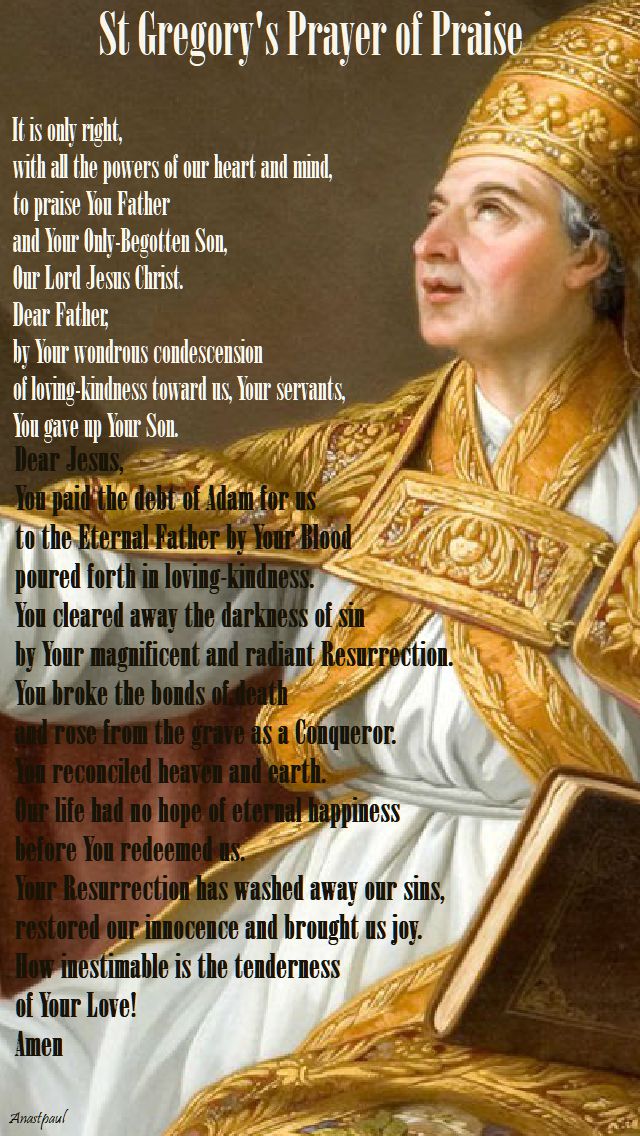
St Gregory’s Prayer of Praise
It is only right,
with all the powers of our heart and mind,
to praise You Father
and Your Only-Begotten Son,
Our Lord Jesus Christ.
Dear Father,
by Your wondrous condescension
of loving-kindness toward us, Your servants,
You gave up Your Son.
Dear Jesus,
You paid the debt of Adam for us
to the Eternal Father by Your Blood
poured forth in loving-kindness.
You cleared away the darkness of sin
by Your magnificent and radiant Resurrection.
You broke the bonds of death
and rose from the grave as a Conqueror.
You reconciled heaven and earth.
Our life had no hope of eternal happiness
before You redeemed us.
Your Resurrection has washed away our sins,
restored our innocence and brought us joy.
How inestimable is the tenderness
of Your Love!
Amen
One Minute Reflection – 31 August – Gospel Mathew 24:42-51
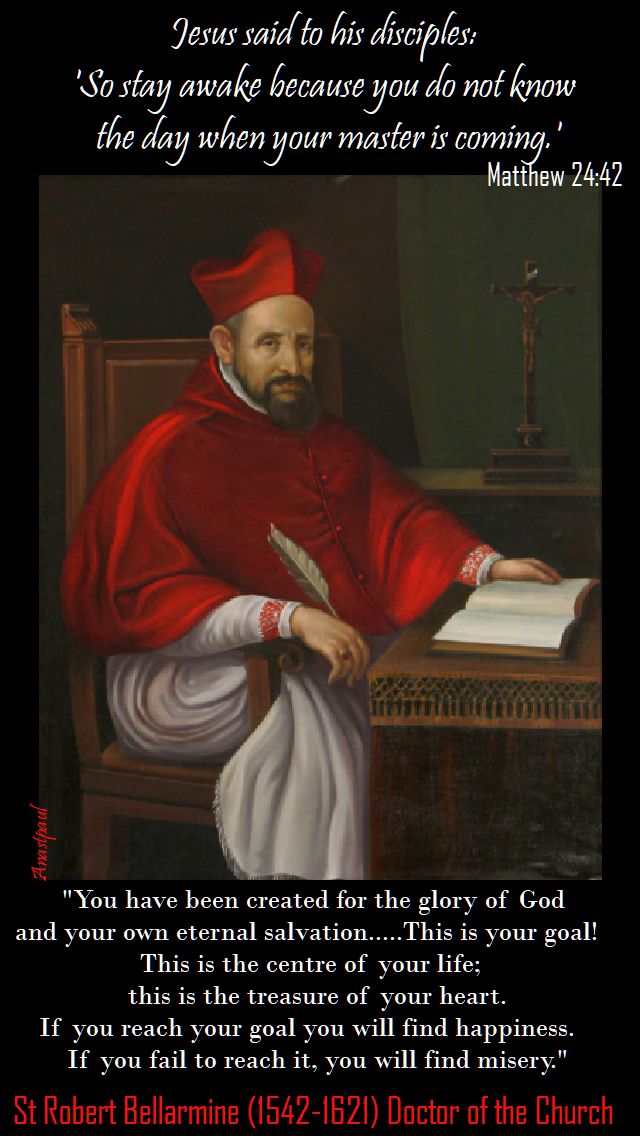
Jesus said to his disciples: ‘So stay awake, because you do not know the day when your master is coming.’...Matthew 24:42
REFLECTION – “You have been created for the glory of God and your own eternal salvation…..This is your goal! This is the centre of your life; this is the treasure of your heart. If you reach your goal you will find happiness. If you fail to reach it, you will find misery.”……St Robert Bellarmine (1542-1621) Doctor of the Church
PRAYER – My Lord and my God, help me eternal Father, to stay awake! Teach me to be constantly on guard against my own weakness, to constantly keep watch for temptation and to live constantly in prayer, that Your Son will lead me to safety. St Raymond Nonnatus, you suffered torture but always remain prayerful and awake, waiting for the Lord, please pray for me, amen.
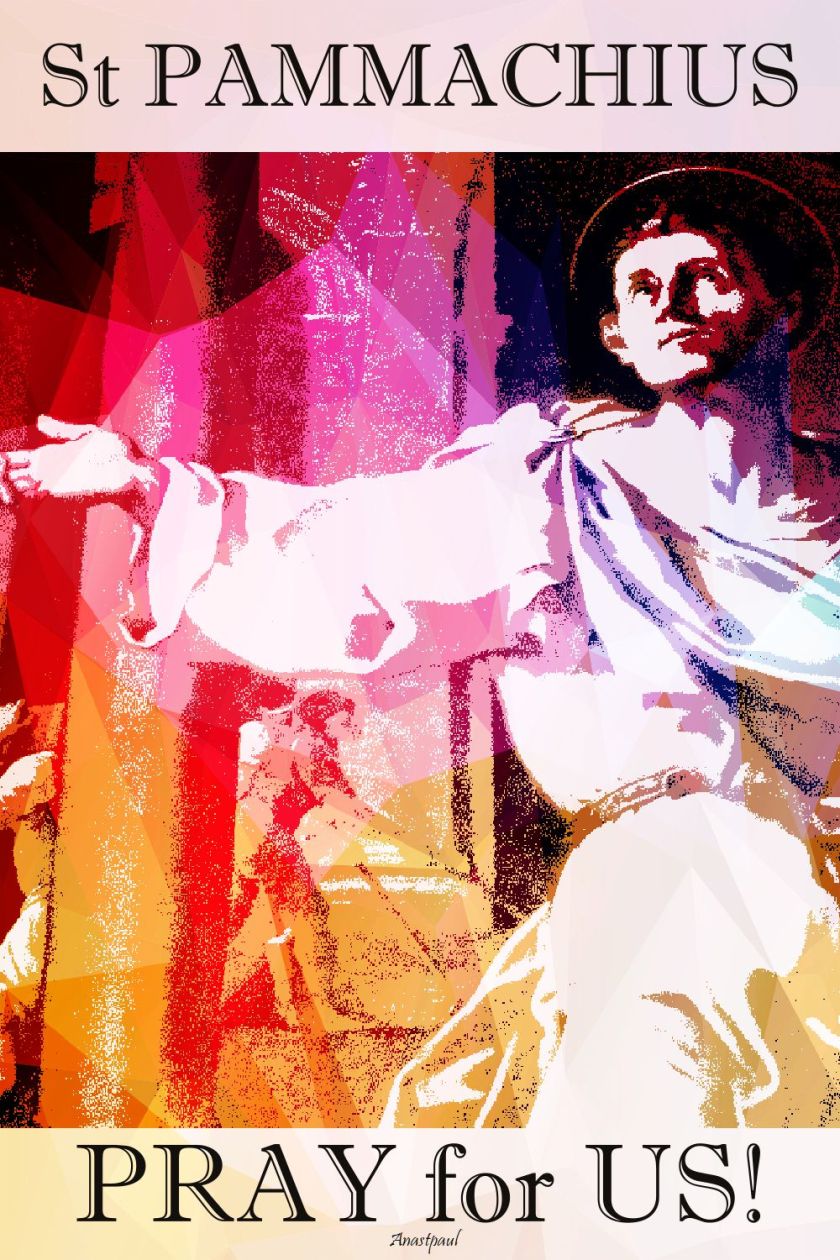
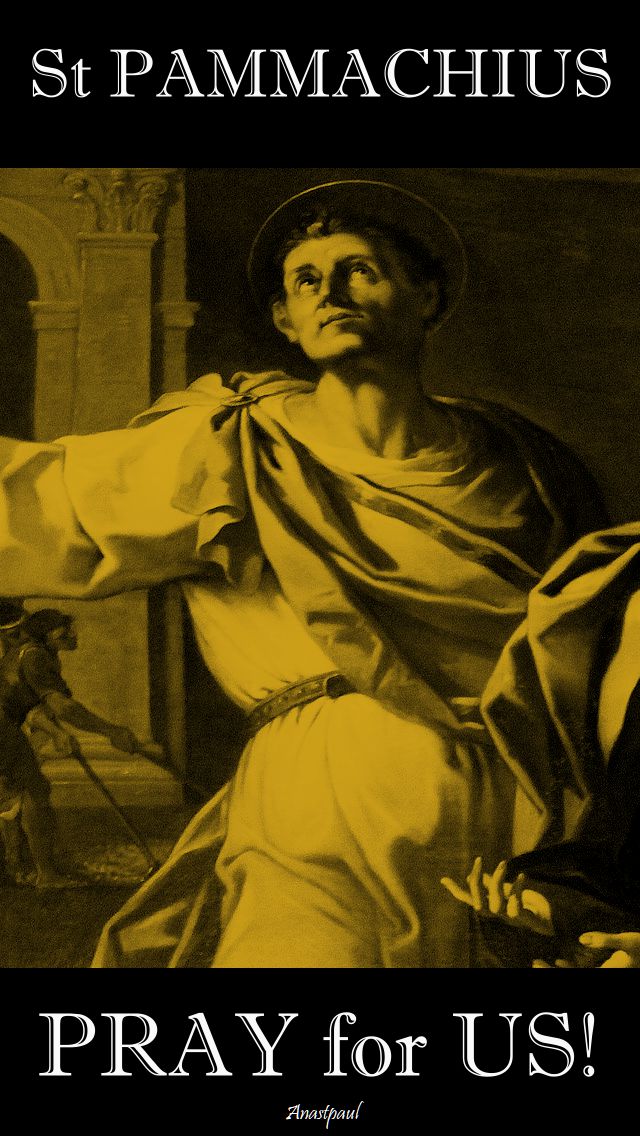
Since he had no children, St Pammachius made the poor his heirs and became known in Rome as the benefactor of the blind, the poor and the handicapped. Since he was one of the first Romans of senatorial rank to become a Christian and live the faith to its fullest in love and charity, his works and deeds of extending his hand to all in need, were remembered for centuries and perhaps, even more importantly, he is became a powerful example of the effect of Christian teaching upon a person of rank and power.
For a wealthy man, there are so many opportunities to help others and St Pammachius looked upon his works of charity as an obligation of his Christian conscience. His best friend, St Jerome, Father and one of the original four doctors of the Latin Church, said “instead of speaking saintly words, we must act them” and that is precisely what St Pammachius did – for he lived the words of Our Lord, he lived the Beatitudes!
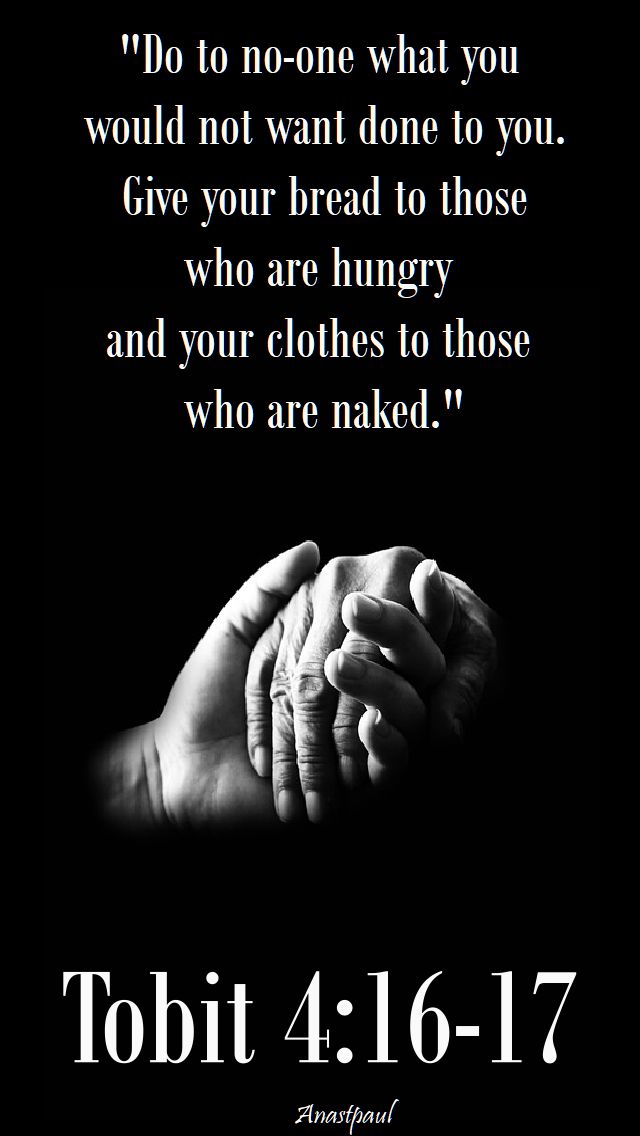
“Do to no-one what you would not want done to you. Give your bread to those who are hungry and your clothes to those who are naked.”… Tobit 4:16-17
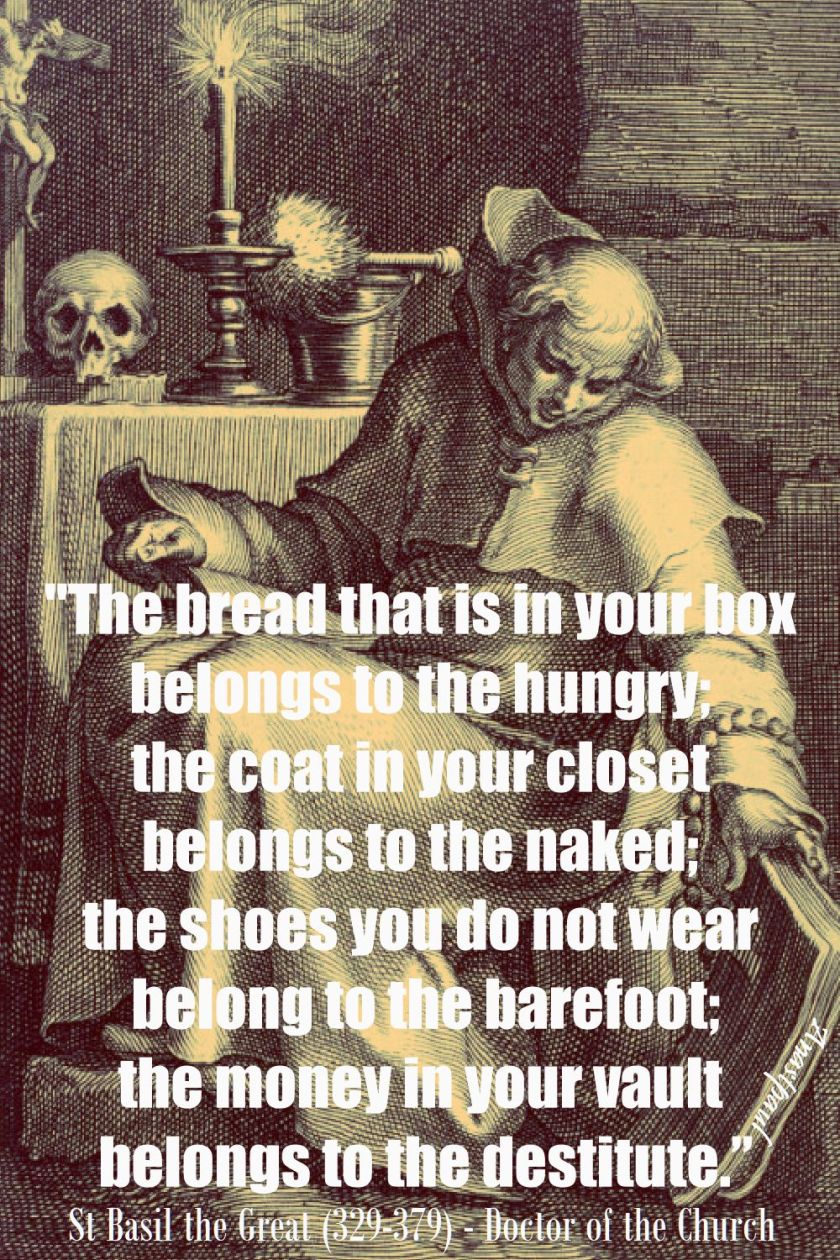
REFLECTION – “The bread that is in your box belongs to the hungry;
the coat in your closet belongs to the naked;
the shoes you do not wear belong to the barefoot;
the money in your vault belongs to the destitute.”…..St Basil the Great (329-379) – Doctor of the Church
PRAYER – God our Saviour, through the grace of Baptism you made us children of light. Hear our prayer, that we may always walk in that light and work for truth, love and charity, as Your witnesses before men. St Pammachius, you lived a life of total charity to those most in need, please pray for us, amen.
O Lord, the house of my soul is narrow By St Augustine (354-430) Father & Doctor
O God, the Light of the heart that sees You,
The Life of the soul that loves You,
The Strength of the mind that seeks You:
May I ever continue
to be steadfast in Your love.
Be the joy of my heart;
Take all of me to Yourself and abide therein.
The house of my soul is,
I confess, too narrow for You.
Enlarge it that You may enter.
It is ruinous but do repair it.
It has within it what must offend Your eyes;
I confess and know it,
but whose help shall I seek
in cleansing it but Yours alone?
To You, O God, I cry urgently.
Cleanse me from secret faults.
Keep me from false pride and sensuality
That they not get dominion over me.
Amen
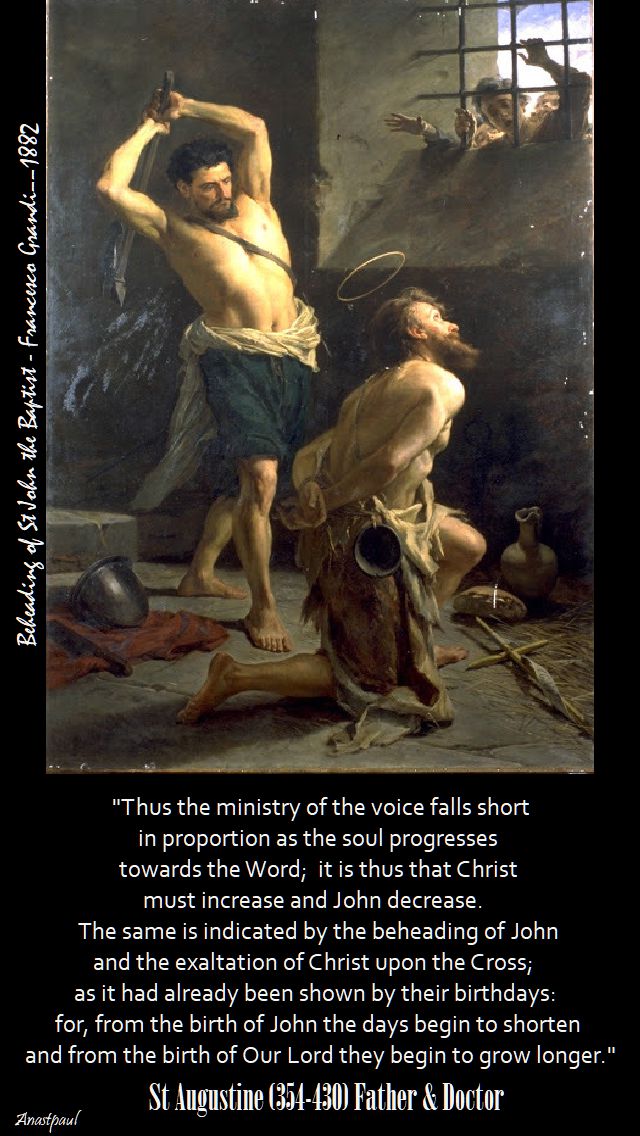
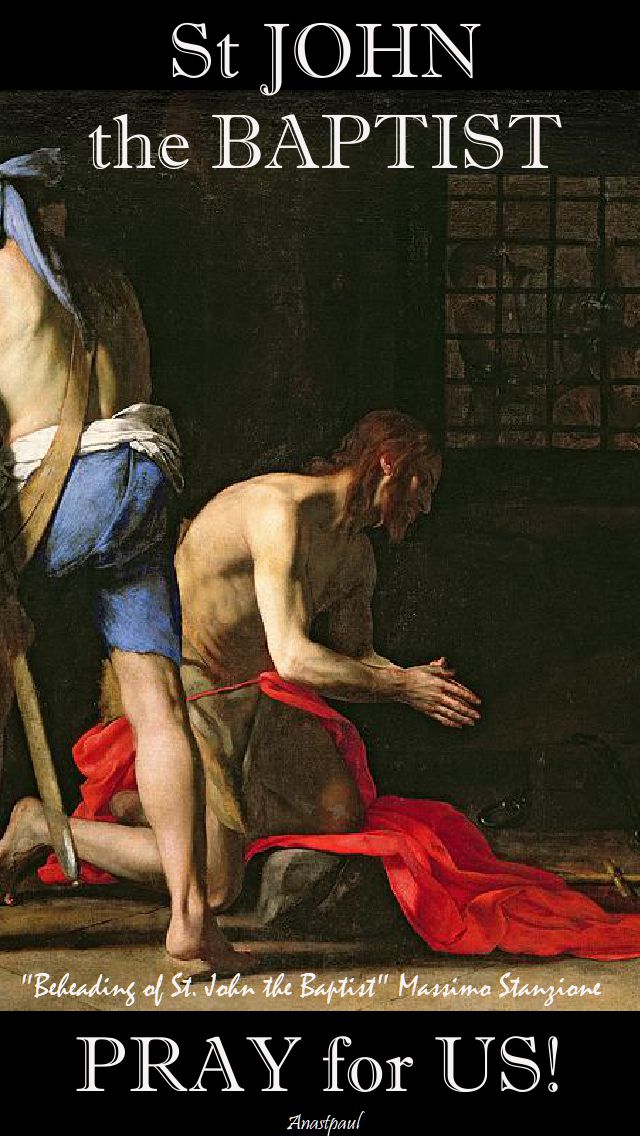
One Minute Reflection – 29 August – The Beheading of St John the Baptist
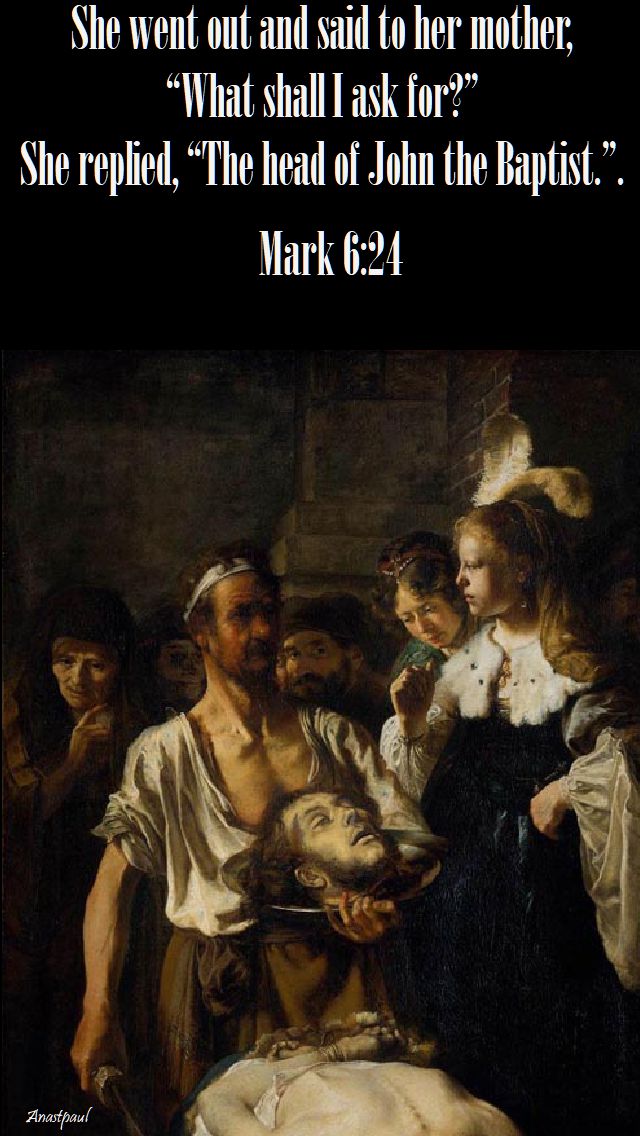
She went out and said to her mother, “What shall I ask for?” She replied, “The head of John the Baptist.”…Mark 6:24
REFLECTION – “O great and admirable mystery! He must increase, but I must decrease, said John, said the voice which personified all the voices that had gone before announcing the Father’s Word Incarnate in His Christ…. But He is said to grow in us, when we grow in Him. To him, then, who draws near to Christ, to him who makes progress in the contemplation of wisdom, words are of little use; of necessity they tend to fail altogether. Thus the ministry of the voice falls short in proportion as the soul progresses towards the Word; it is thus that Christ must increase and John decrease. The same is indicated by the beheading of John and the exaltation of Christ upon the Cross; as it had already been shown by their birthdays: for, from the birth of John the days begin to shorten and from the birth of Our Lord they begin to grow longer.”….St Augustine (354-420)
PRAYER – God our Father, You appointed St John The Baptist to be the herald of the birth and death of Christ Your Son. Grant that as he died a martyr for justice and truth, so we may also courageously bear witness to Your Word. St John the Baptist, pray for us, amen.
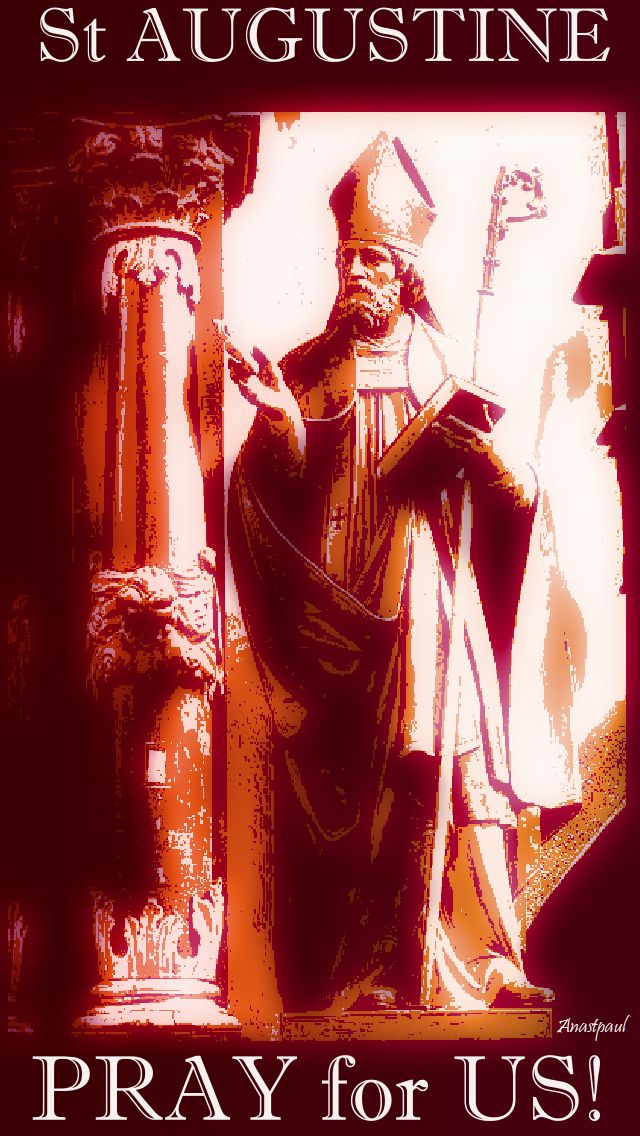
Thought for the Day – 28 August – The Memorial of St Augustine (354-430) Father & Doctor of Grace
A Christian at 33, a priest at 36, a bishop at 41: Many people are familiar with the biographical sketch of Augustine of Hippo, sinner turned saint. But really to get to know the man is a rewarding experience.
There quickly surfaces the intensity with which he lived his life, whether his path led away from or toward God. The tears of his mother, the instructions of Ambrose and, most of all, God himself speaking to him in the Scriptures, redirected Augustine’s love of life to a life of love.
Having been so deeply immersed in creature-pride of life in his early days and having drunk deeply of its bitter dregs, it is not surprising that Augustine should have turned, with a holy fierceness, against the many demon-thrusts rampant in his day. His times were truly decadent: politically, socially, morally. He was both feared and loved, like the Master. The perennial criticism leveled against him: a fundamental rigorism.
In his day, Augustine providentially fulfilled the office of prophet. Like Jeremiah and other greats, he was hard-pressed but could not keep quiet. “I say to myself, I will not mention him,/I will speak in his name no more./But then it becomes like fire burning in my heart,/imprisoned in my bones;/I grow weary holding it in,/I cannot endure it” (Jeremiah 20:9).
Augustine is still acclaimed (and condemned) in our day. He is a prophet for today, trumpeting the need to scrap escapisms and stand face-to-face with personal responsibility and dignity. (Fr Don Miller OFM – Saint of the Day)
St Augustine, our Father in Faith, pray for us now and at the hour of our death!
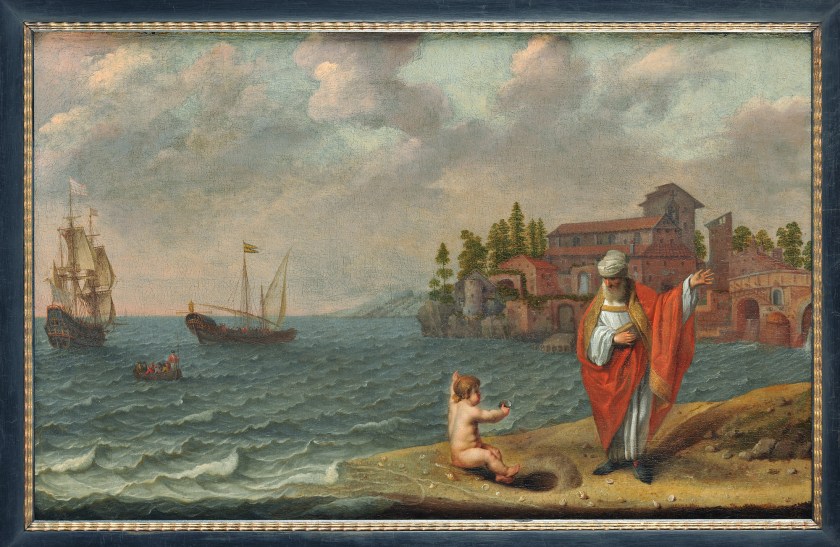
St Augustine, the Holy Trinity, the Child and the SeaShell
Today, 11 June 2017, on the Solemnity of the Holy Trinity, we remember the legend of St Augustine and the Seashell.
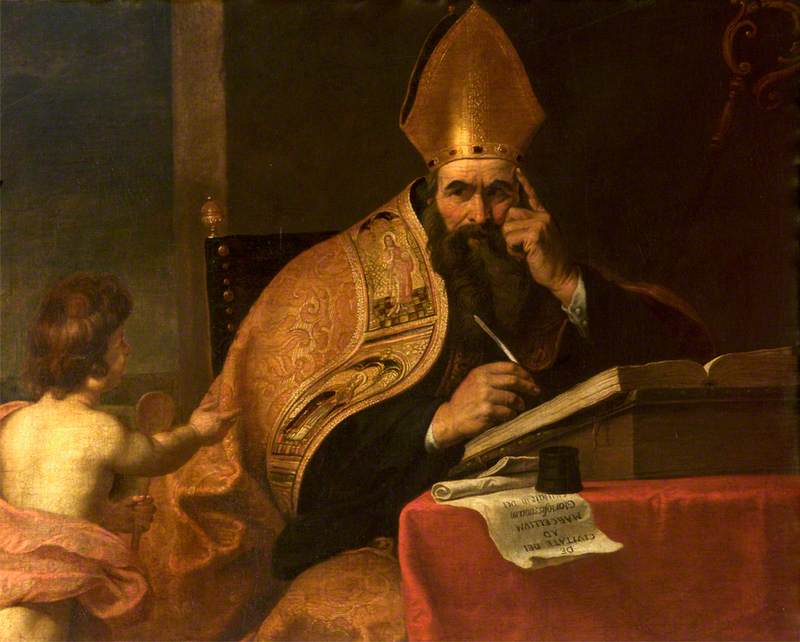
Abraham Willaerts – St Augustine and the Child
The great Doctor of the Church St. Augustine of Hippo spent over 30 years working on his treatise De Trinitate [about the Holy Trinity], endeavouring to conceive an intelligible explanation for the mystery of the Trinity.
He was walking by the seashore one day contemplating and trying to understand the mystery of the Holy Trinity when he saw a small boy running back and forth from the water to a spot on the seashore. The boy was using a sea shell to carry the water from the ocean and place it into a small hole in the sand.
The Bishop of Hippo approached him and asked, “My boy, what are…
Quote/s of the Day – 28 August – The Memorial of St Augustine
“To fall in love with God is the greatest romance; to seek Him the greatest adventure; to find Him the greatest human achievement.”
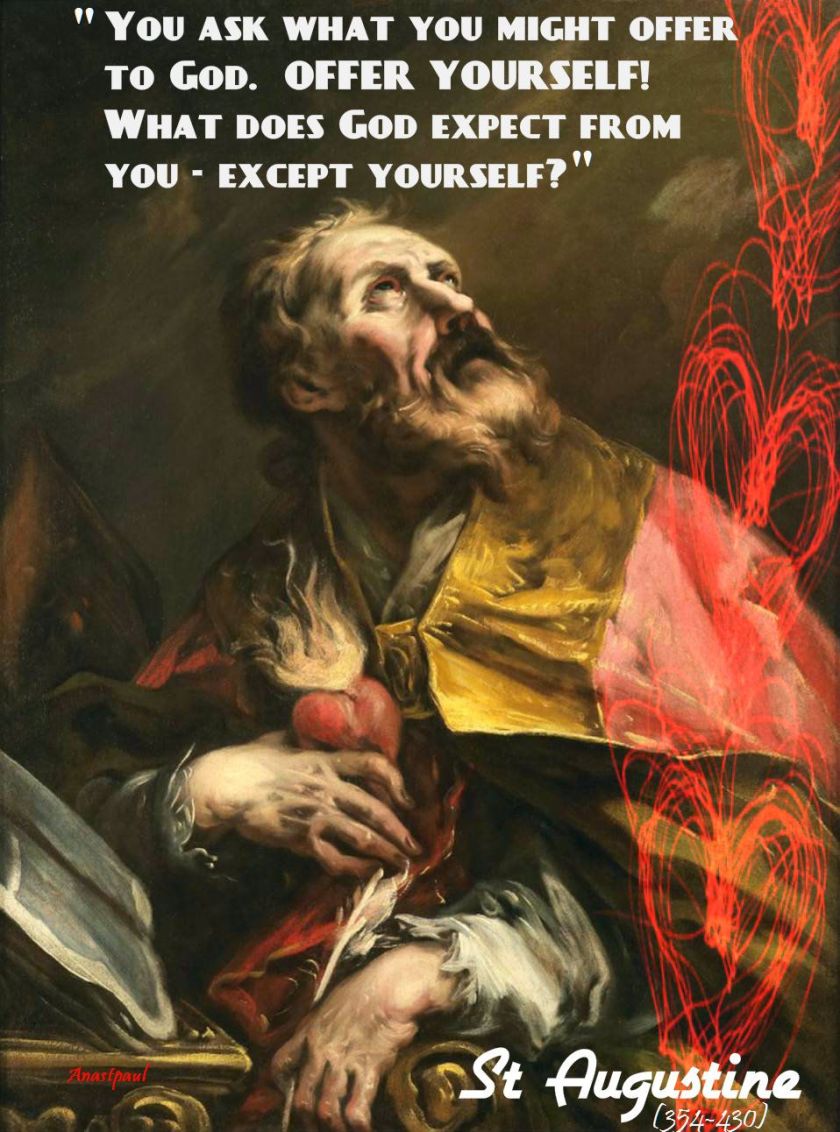
“You ask what you might offer to God? Offer yourself! What does God expect from you, except yourself?”
“One of the holiest works, one of the best exercises of piety which we can practice in this world, is to offer sacrifices, alms and prayer for the dead.”
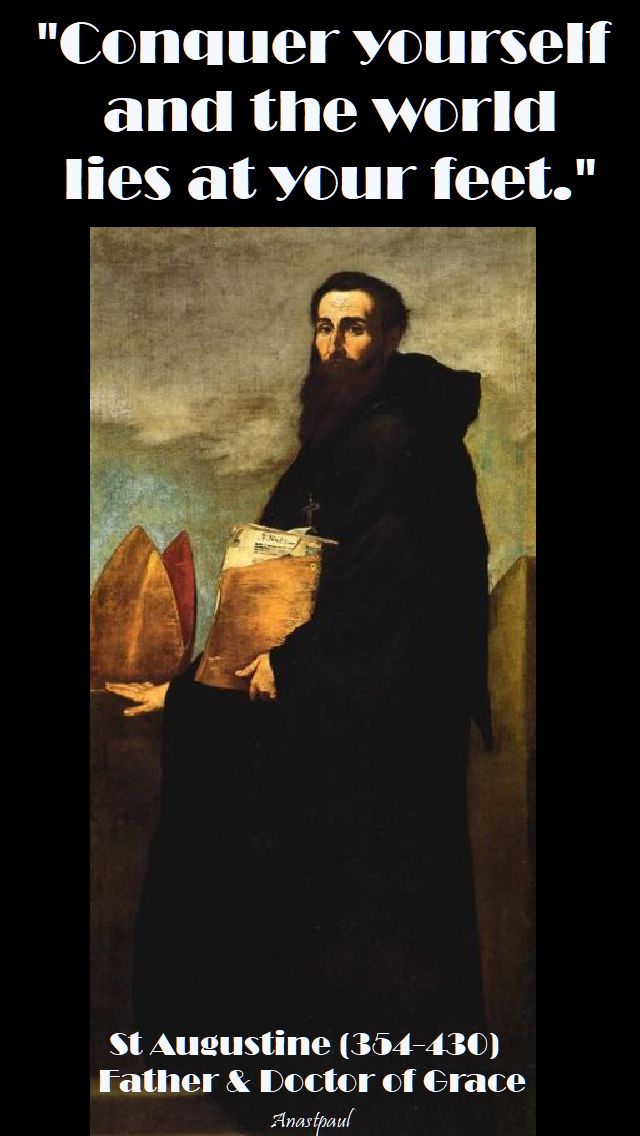
“Conquer yourself and the world lies at your feet.”
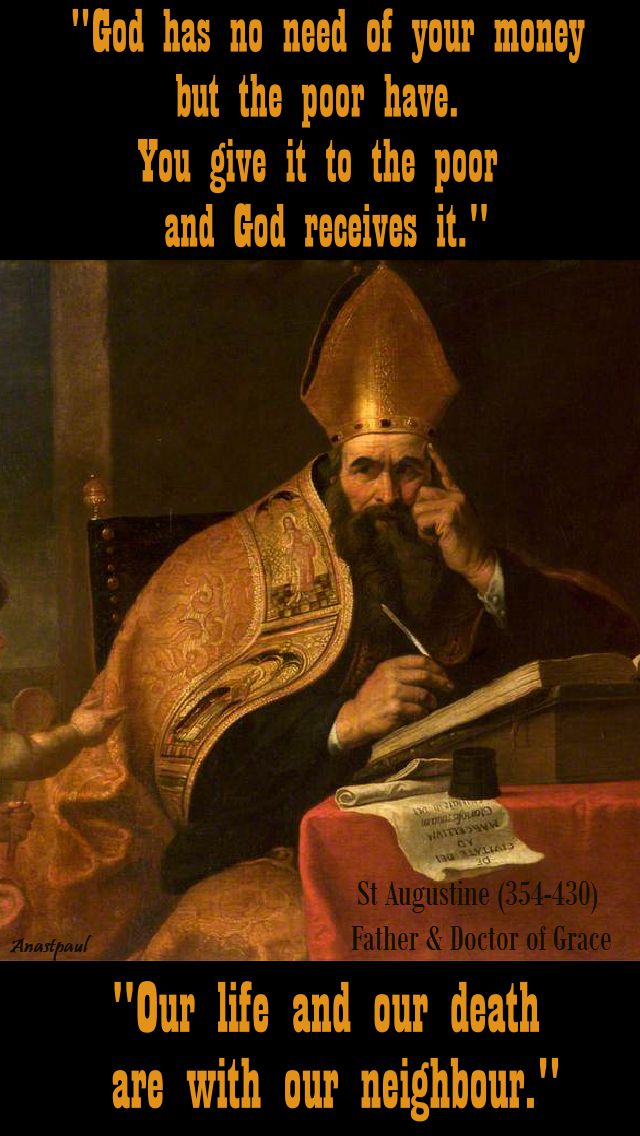
“God has no need of your money but the poor have. You give it to the poor and God receives it.”
“Our life and our death are with our neighbour.”
“Do you wish to RISE? Begin by DESCENDING. You plan a tower that will pierce the CLOUDS? Lay first the foundation of HUMILITY”
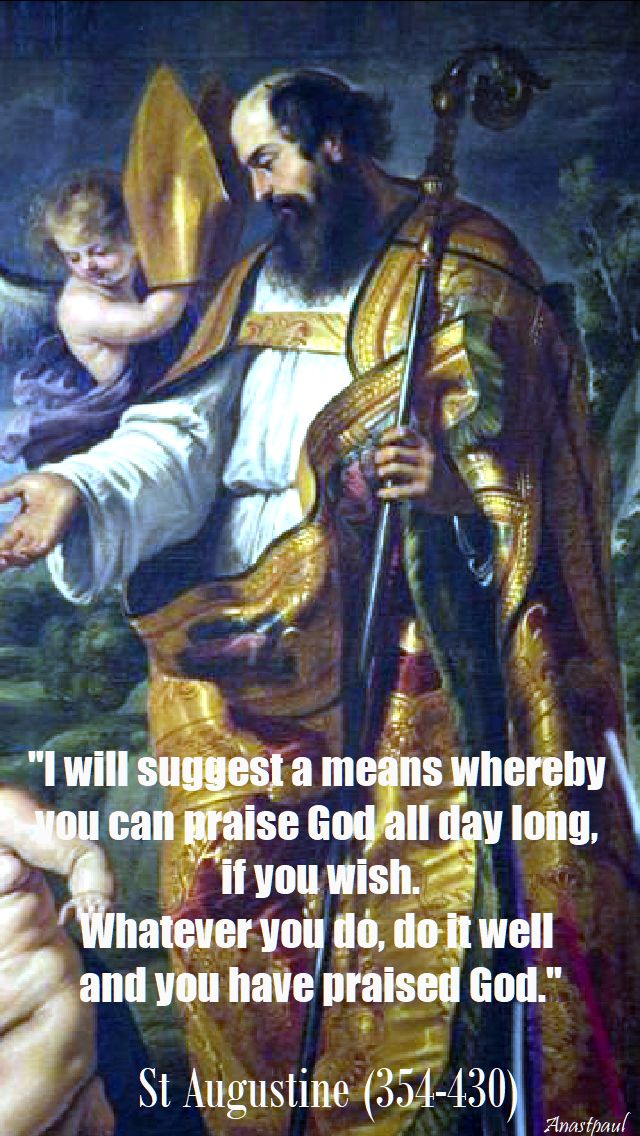
“I will suggest a means whereby you can praise God all day long, if you wish. Whatever you do, do it well and you have praised God.”
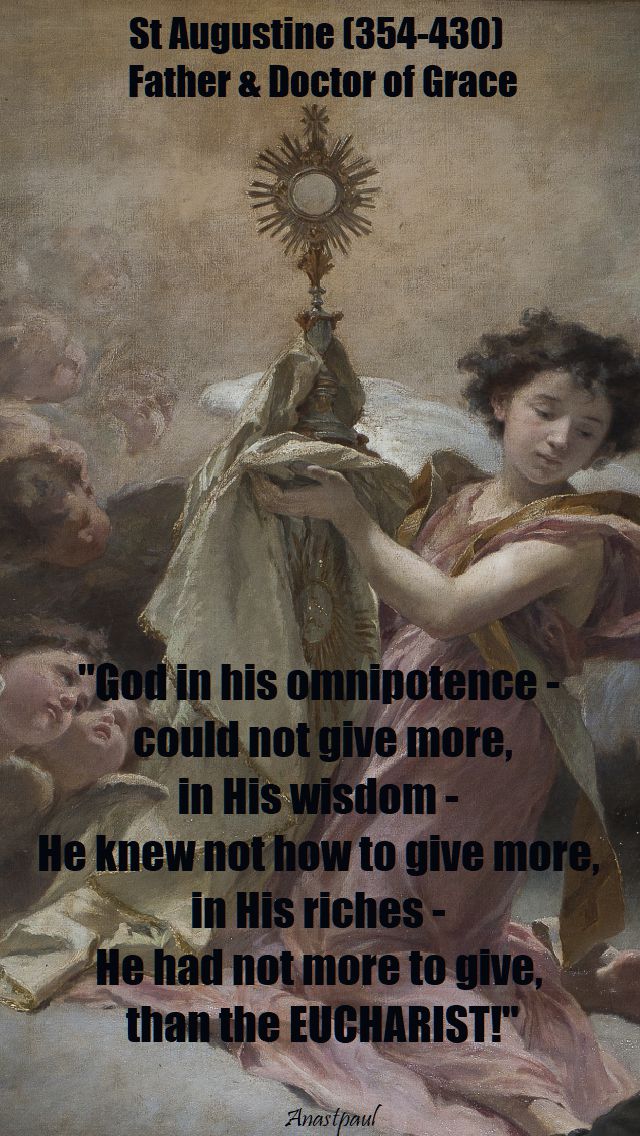
“God in his omnipotence could not give more, in His wisdom: He knew not how to give more, in His riches: He had not more to give, than the EUCHARIST!”
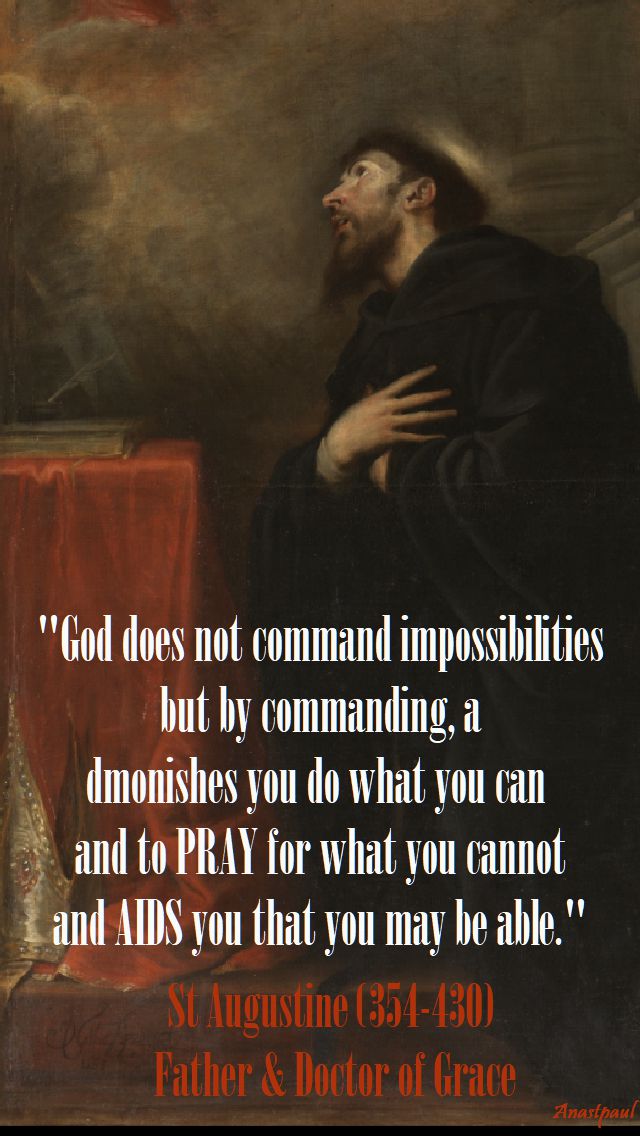
“God does not command impossibilities but by commanding, admonishes you do what you can and to PRAY for what you cannot and AIDS you that you may be able.”
One Minute Reflection – 28 August – The Memorial of St Augustine (354-430) – Doctor of Grace
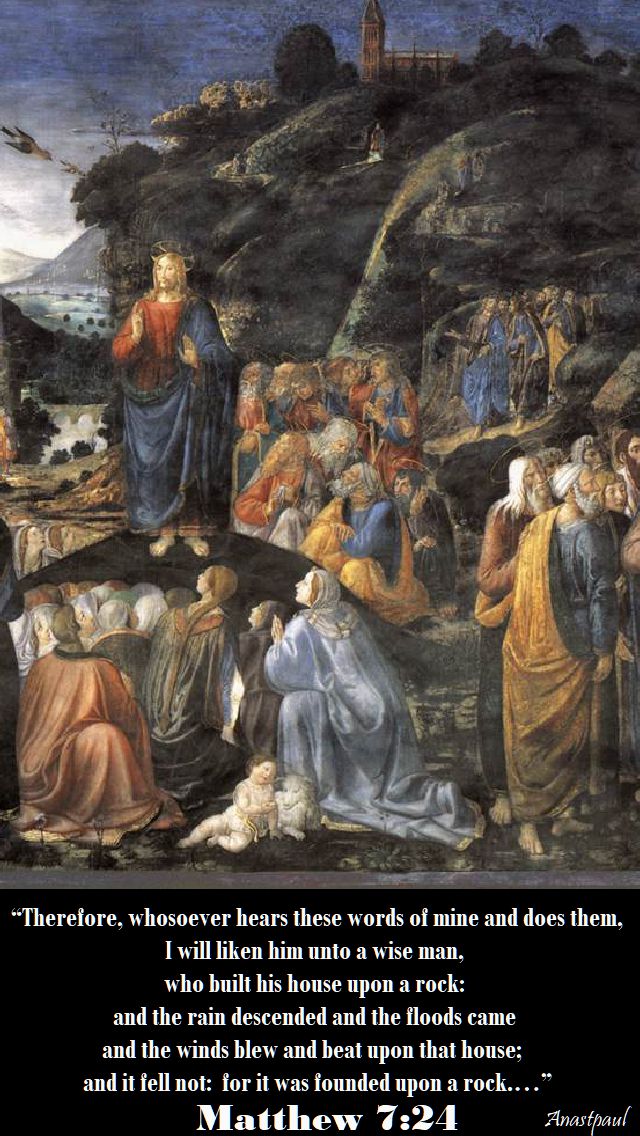
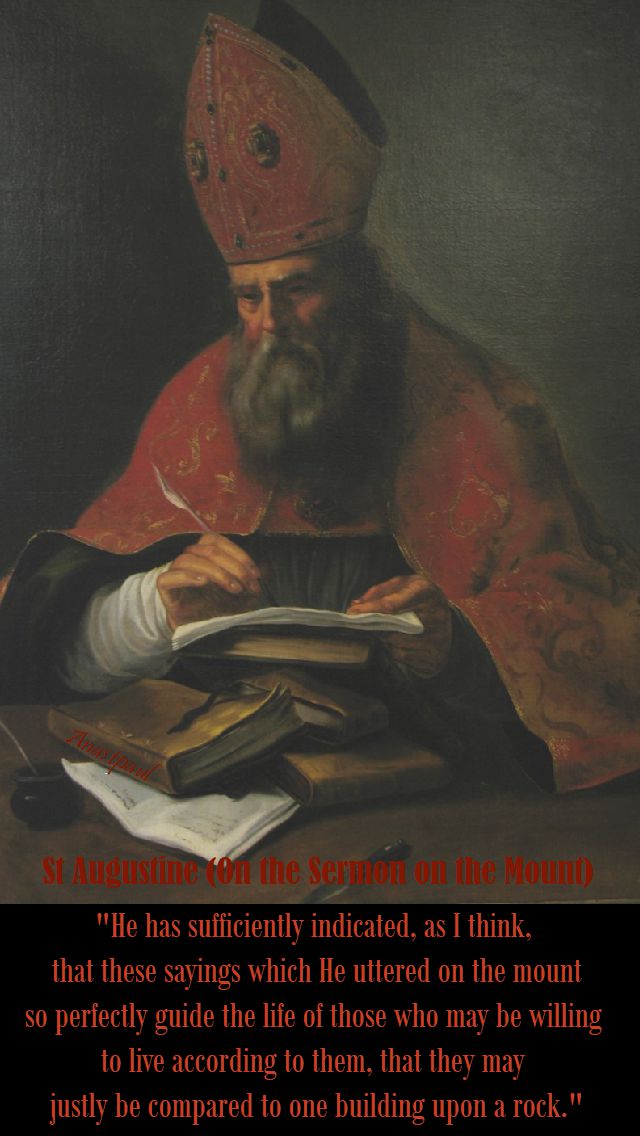
“Therefore, whosoever hears these words of mine and does them, I will liken him unto a wise man, who built his house upon a rock: and the rain descended and the floods came and the winds blew and beat upon that house; and it fell not: for it was founded upon a rock.…” Matthew 7:24
REFLECTION – “If any one will piously and soberly consider the sermon which our Lord Jesus spoke on the mount, as we read it in the Gospel according to Matthew, I think that he will find in it, so far as regards the highest morals, a perfect standard of the Christian life: and this we do not rashly venture to promise but gather it from the very words of the Lord Himself.
For the sermon itself is brought to a close in such a way, that it is clear there are in it all the precepts which go to mould the life. … He has sufficiently indicated, as I think, that these sayings which He uttered on the mount so perfectly guide the life of those who may be willing to live according to them, that they may justly be compared to one building upon a rock.”...St Augustine (On the Sermon on the Mount)
PRAYER – Lord God, renew Your Church with he Spirit of wisdom and love which You gave to St Augustine. Lead us by that same Spirit, to seek You, the only fountain of true wisdom and the source of everlasting love. Through our Lord Jesus Christ, Your Son, in union with the Spirit, one God, forever and ever, St Augustine, pray for the Church and for us all, amen.
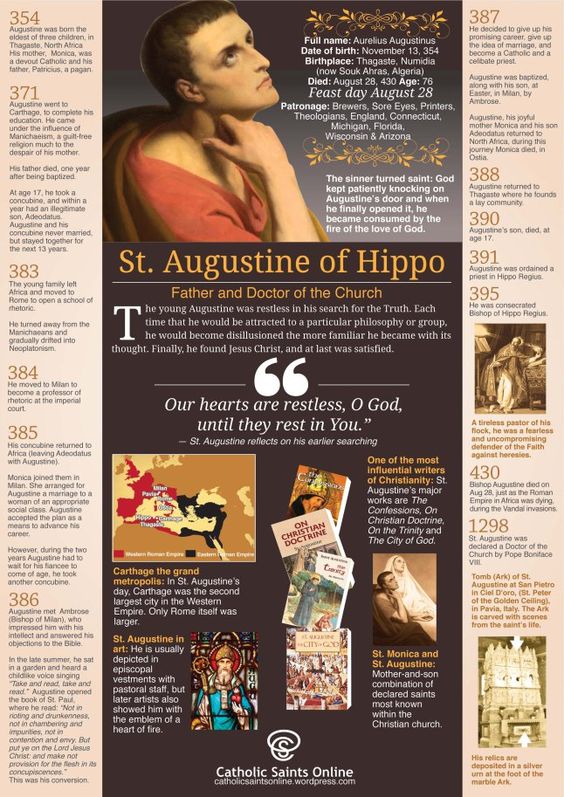
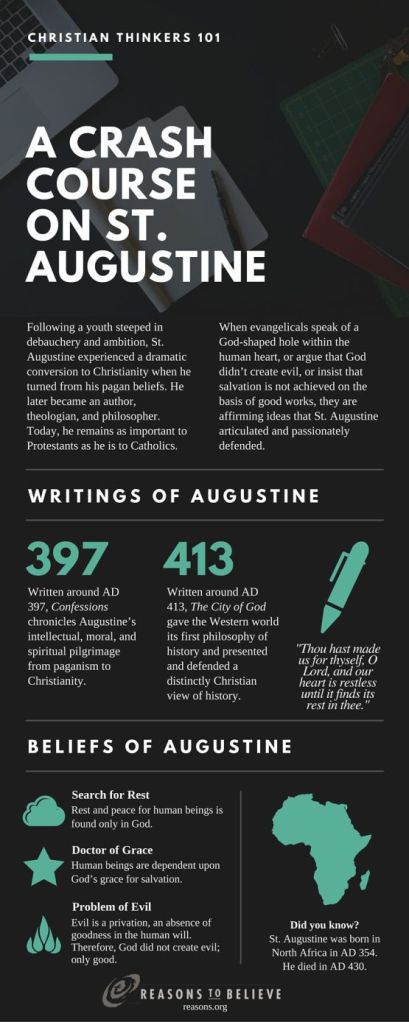
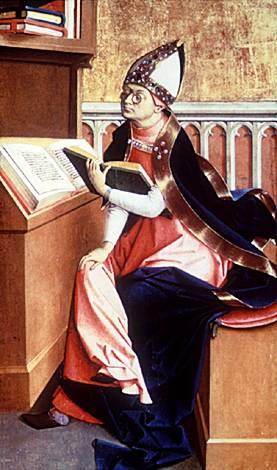
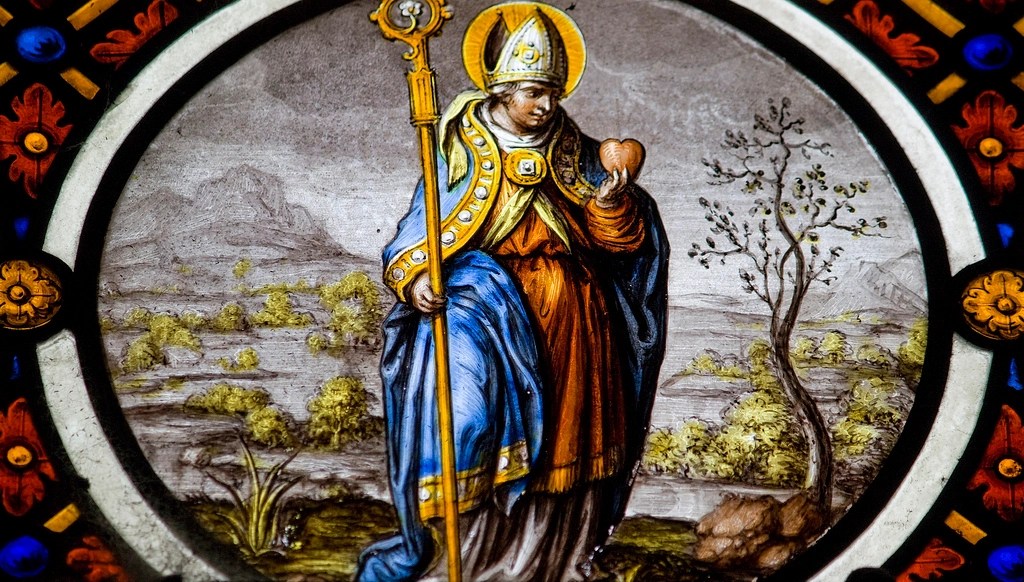
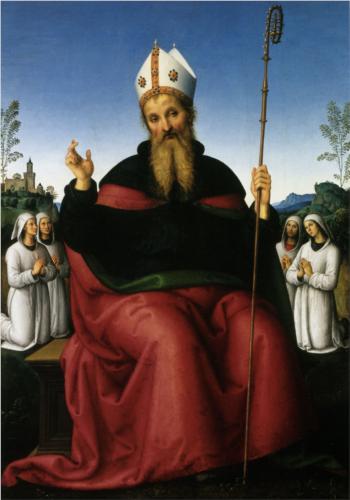
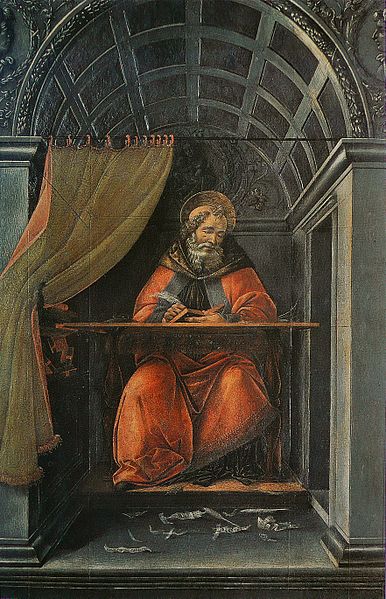
Saint of the Day – 28 August – St Augustine (354-430) born Augustinus Aurelius (13 November 354 at Tagaste, Numidia, North Africa (Souk-Ahras, Algeria) – 28 August 430 at Hippo, North Africa) – Doctor of Grace and one of the original Four Fathers & Doctors of the Latin Church – Bishop, Theologian, Philosopher, Rhetorician, Writer, Preacher, Teacher, Advisor, Reformer, Confessor, Apologist, Apostle of Charity. PATRONAGES – of theologians, brewers, printers, 7 Diocese, 7 Cities, against sore eyes, eye diseases, against vermin. Attributes – Child; dove; pen; shell, pierced heart, holding book with a small church, bishop’s staff, mitre, flaming heart, an allusion to a passage in his Confessions.
Augustine was born in the year on 13 November in 354 AD in the municipium of Thagaste (now Souk Ahras, Algeria) in Roman Africa. His mother, Monica, was a devout Christian; his father Patricius was a Pagan who converted to Christianity on his deathbed. Scholars generally agree that Augustine and his family were Berbers, an ethnic group indigenous to North Africa but that they were heavily Romanized, speaking only Latin at home as a matter of pride and dignity. In his writings, Augustine leaves some information as to the consciousness of his African heritage. For example, he refers to Apuleius as “the most notorious of us Africans,” to Ponticianus as “a country man of ours, insofar as being African”and to Faustus of Mileve as “an African Gentleman.”
Augustine’s family name, Aurelius, suggests that his father’s ancestors were freedmen of the gens Aurelia given full Roman citizenship by the Edict of Caracalla in 212. Augustine’s family had been Roman, from a legal standpoint, for at least a century when he was born. It is assumed that his mother, Monica, was of Berber origin, on the basis of her name but as his family were an upper class of citizens known as honorable men, Augustine’s first language is likely to have been Latin.
Augustine Aurelius still unbaptised and burning for knowledge, he came under the influence of the Manicheans, which caused his mother intense sorrow. He left Africa for Rome, deceiving his mother, who was ever anxious to be near him. She prayed and wept. A bishop consoled her by observing that a son of so many tears would never be lost. Yet the evil spirit drove him constantly deeper into moral degeneracy, capitalising on his leaning toward pride and stubbornness. Grace was playing a waiting game; there still was time and the greater the depths into which the evil spirit plunged its fledgling, the stronger would be the reaction.
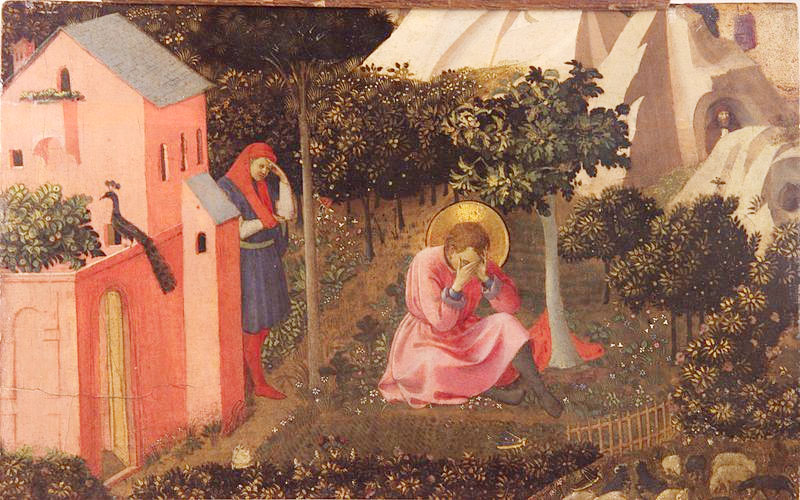
Augustine recognised this vacuum; he saw how the human heart is created with a great abyss; the earthly satisfactions that can be thrown into it are no more than a handful of stones that hardly cover the bottom. And in that moment grace was able to break through: Restless is the heart until it rests in God. The tears of his mother, the sanctity of Milan’s Bishop Ambrose, the book of St Anthony the hermit and the sacred Scriptures wrought his conversion, which was sealed by baptism on Easter night 387. Augustine’s mother went to Milan with joy and witnessed her son’s baptism. It was what it should have been, the greatest event of his life, his conversion — metanoia. Grace had conquered. Augustine accompanied his mother to Ostia, where she died. She was eager to die, for now she had given birth to her son for the second time.
St Augustine and St Ambrose
In 388 he returned to Tagaste, where he lived a common life of prayer and solitude with his friends. In 391 he was ordained priest at Hippo, in 394 made coadjutor to bishop Valerius and then from 396 to 430 bishop of Hippo.
Augustine, numbered among the four great Doctors of the Western Church, possessed one of the most penetrating minds of ancient Christendom. He was the most important Platonist of patristic times, the Church’s most influential theologian, especially with regard to clarifying the dogmas of the Trinity, grace and the Church. He was a great speaker, a prolific writer, a saint with an inexhaustible spirituality. His Confessions, a book appreciated in every age, describes a notable portion of his life (until 400), his errors, his battles, his profound religious observations. Famous too is his work The City of God, a worthy memorial to his genius, a philosophy of history. Most edifying are his homilies, especially those on the psalms and on the Gospel of St. John.
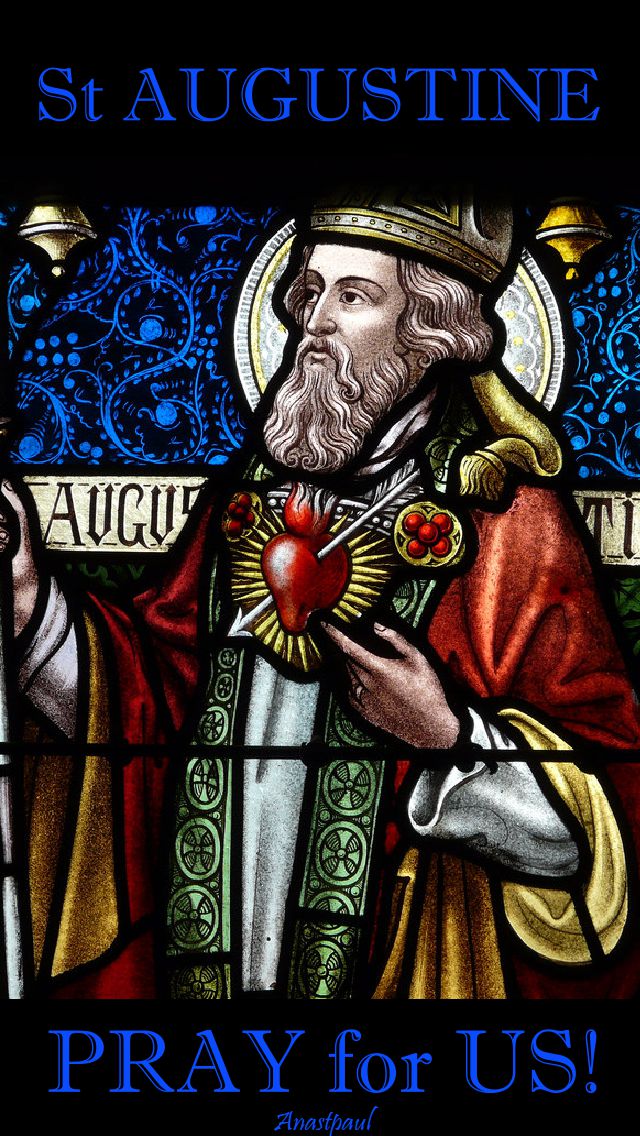
Augustine’s episcopal life was filled with mighty battles against heretics, over all of whom he triumphed. His most illustrious victory was that over Pelagius, who denied the necessity of grace; from this encounter he earned the surname “Doctor of grace.” As an emblem Christian art accords him a burning heart to symbolise the ardent love of God which permeates all his writings. He is the founder of canonical life in common; therefore Augustinian monks and the Hermits of St. Augustine honour him as their spiritual father.
As bishop, Augustine worked tirelessly for his people. He fought false religious teachings, protected the people from corrupt officials and invaders and cared for the sick, the poor and those in prison. His many sermons, letters and books reflect the ever-deepening love he felt for God. He wisely observed: “You have made us, O God, for yourself, and our hearts shall find no rest until they rest in you.”
He wrote and advised bishops, popes and councils. His influence on the Church and his fight against heresy were exceptional. He was loved by many, for he had struggled much and could help others who were struggling.
In 430 Vandals invaded the province. For three months Augustine inspired Christian hope in his people. According to Possidius, Augustine spent his final days in prayer and repentance, requesting that the penitential Psalms of David be hung on his walls so that he could read them. vv He directed that the library of the church in Hippo and all the books therein should be carefully preserved. He died on 28 August 430. Shortly after his death, the Vandals lifted the siege of Hippo but they returned not long thereafter and burned the city. They destroyed all of it but Augustine’s cathedral and library, which they left untouched.
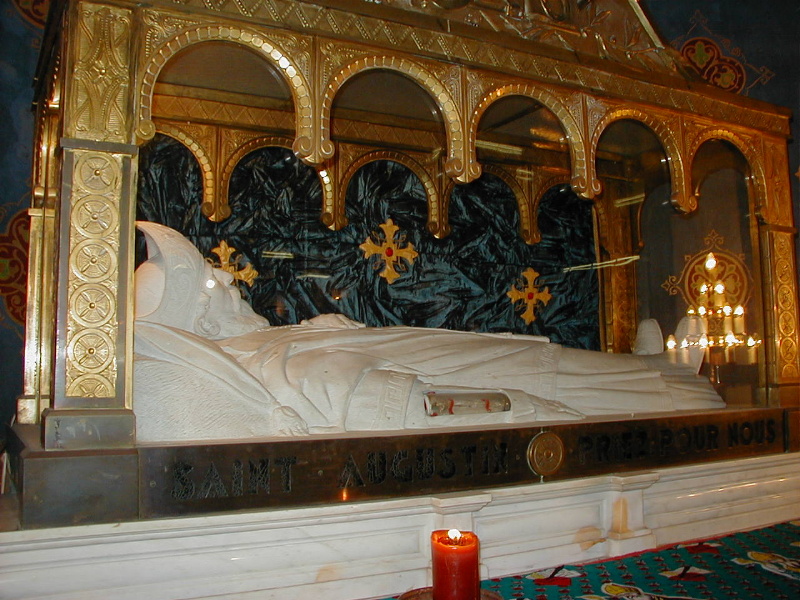
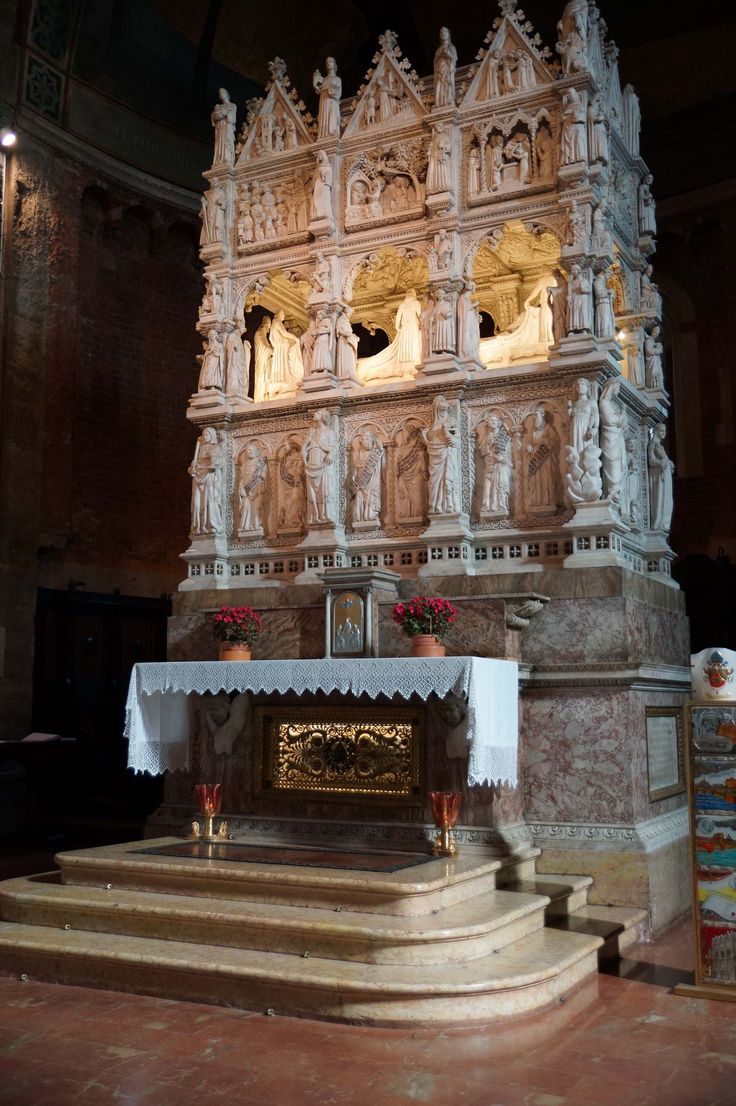
St Bede’s True Martyrology, recounts that Augustine’s body was later translated or moved to Cagliari, Sardinia, by the Catholic bishops expelled from North Africa by Huneric. Around 720, his remains were transported again by Peter, bishop of Pavia and uncle of the Lombard king Liutprand, to the church of San Pietro in Ciel d’Oro in Pavia, in order to save them from frequent coastal raids by Muslims. In January 1327, Pope John XXII issued the papal bull Veneranda Santorum Patrum, in which he appointed the Augustinians guardians of the tomb of Augustine (called Arca), which was remade in 1362 and elaborately carved with bas-reliefs of scenes from Augustine’s life.
St Augustine’s Relics in HippoSt Augustine’s Shrine at San Pietro
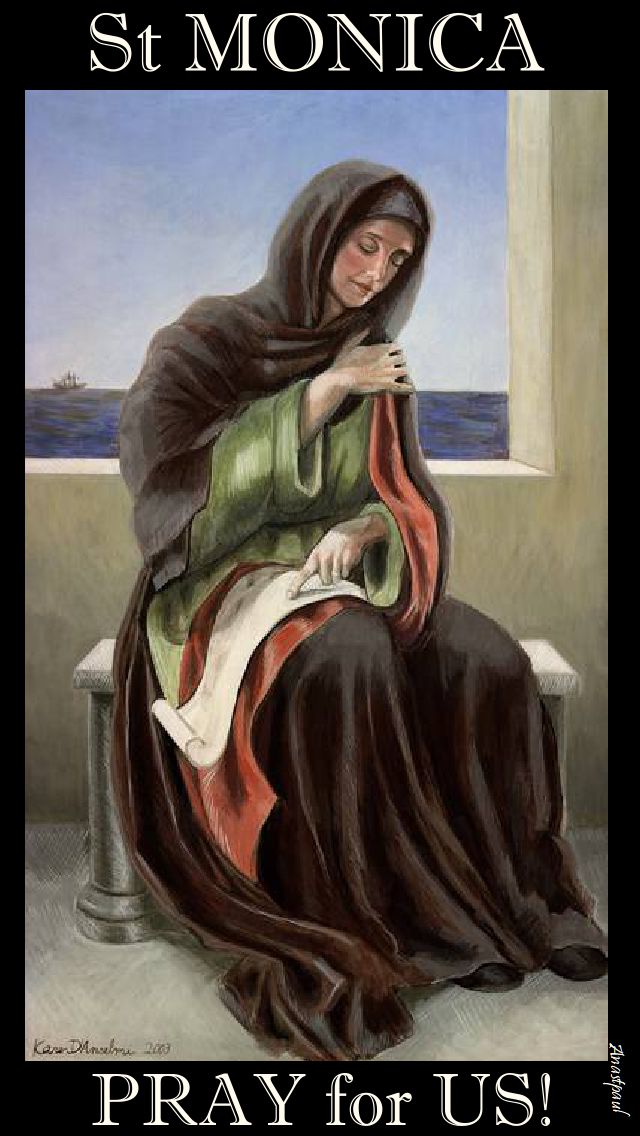
Thought for the day – 27 August – The Memorial of St Monica
Today we celebrate the memorial of St Monica, the mother of St Augustine, whose memorial we will celebrate tomorrow.
We celebrate this memorial not simply because St Monica was the mother of a great saint.
The opening prayer for Mass goes like this and it is worthwhile to take note: ‘God of mercy, comfort of those in sorrow, the tears of St Monica moved you to convert her son, St Augustine to the faith of Christ.’
All in all, she prayed for something like 30 years before she finally had the joy of seeing St Augustine baptised.
St Monica enfleshed the words which we hear in the 1st reading: ‘May our Lord Jesus Christ and God our Father, who has given us His love and through His grace, such inexhaustible comfort and such sure hope, comfort you and strengthen you.’
The consolation, experienced by St Monica and her total abandonment to God can also be ours today when we persevere in patience and in trust – this is Monica’s lesson – keep on praying good folk, for God hears you!
St Monica, pray for us!
“The day was now approaching when my mother Monica would depart from this life; You know that day, Lord, though we did not. She and I happened to be standing by ourselves at a window that overlooked the garden in the courtyard of the house. At the time we were in Ostia on the Tiber. And so the two of us, all alone, were enjoying a very pleasant conversation, “forgetting the past and pushing on to what is ahead..” We were asking one another in the presence of the Truth – for You are the Truth – what it would be like to share the eternal life enjoyed by the saints, which “eye has not seen, nor ear heard, which has not even entered into the heart of man.” We desired with all our hearts to drink from the streams of your heavenly fountain, the fountain of life. That was the substance of our talk, though not the exact words. But You know, O Lord, that in the course of our conversation that day, the world and its pleasures lost all their attraction for us. My mother said, “Son, as far as I am concerned, nothing in this life now gives me any pleasure. I do not know why I am still here, since I have no further hopes in this world. I did have one reason for wanting to live a little longer: to see you become a Catholic Christian before I died. God has lavished His gifts on me in that respect, for I know that you have even renounced earthly happiness to be his servant. So what am I doing here?” I do not really remember how I answered her. Shortly, within five days or thereabouts, she fell sick with a fever. Then one day during the course of her illness she became unconscious and for a while she was unaware of her surroundings. My brother and I rushed to her side but she regained consciousness quickly. She looked at us as we stood there and asked in a puzzled voice: “Where was I?” We were overwhelmed with grief, but she held her gave steadily upon us, and spoke further: “Here you shall bury your mother.” I remained silent as I held back my tears. However, my brother haltingly expressed his hope that she might not die in a strange country but in her own land, since her end would be happier there. When she heard this, her face was filled with anxiety and she reproached him with a glance because he had entertained such earthly thoughts. Then she looked at me and spoke: “Look what he is saying.” Thereupon she said to both of us, “Bury my body wherever you will; let not care of it cause you any concern. One thing only I ask you, that you remember me at the altar of the Lord wherever you may be.” Once our mother had expressed this desire as best she could, she fell silent as the pain of her illness increased.”– from the Confessions of Saint Augustine
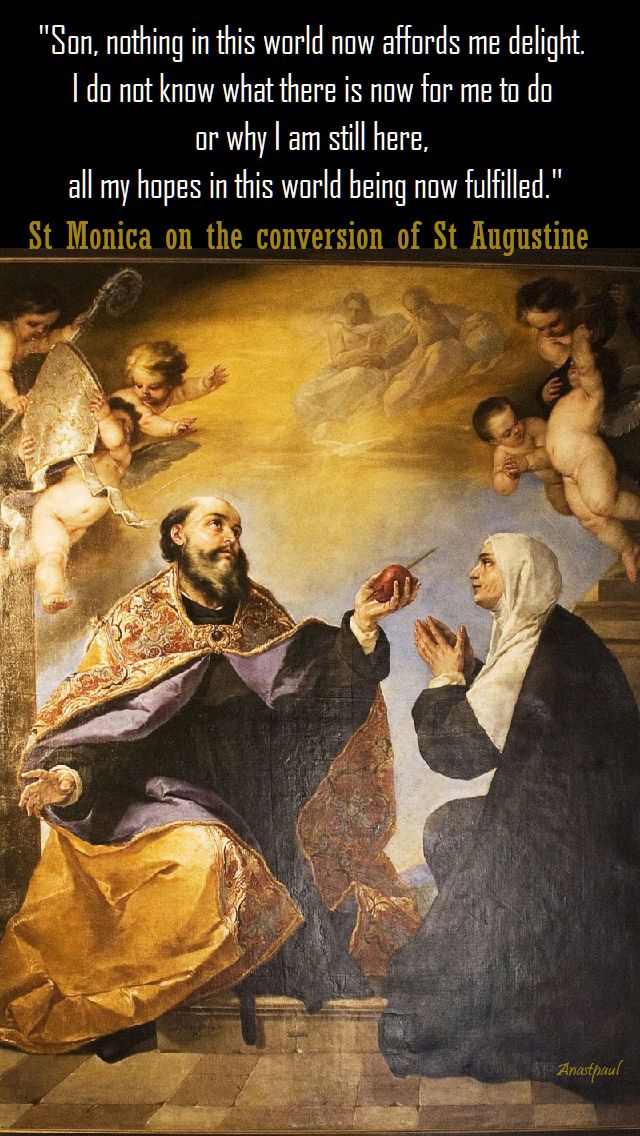
Quote of the Day – 27 August – The Memorial of St Monica
“Son, nothing in this world now affords me delight. I do not know what there is now for me to do or why I am still here, all my hopes in this world being now fulfilled.”
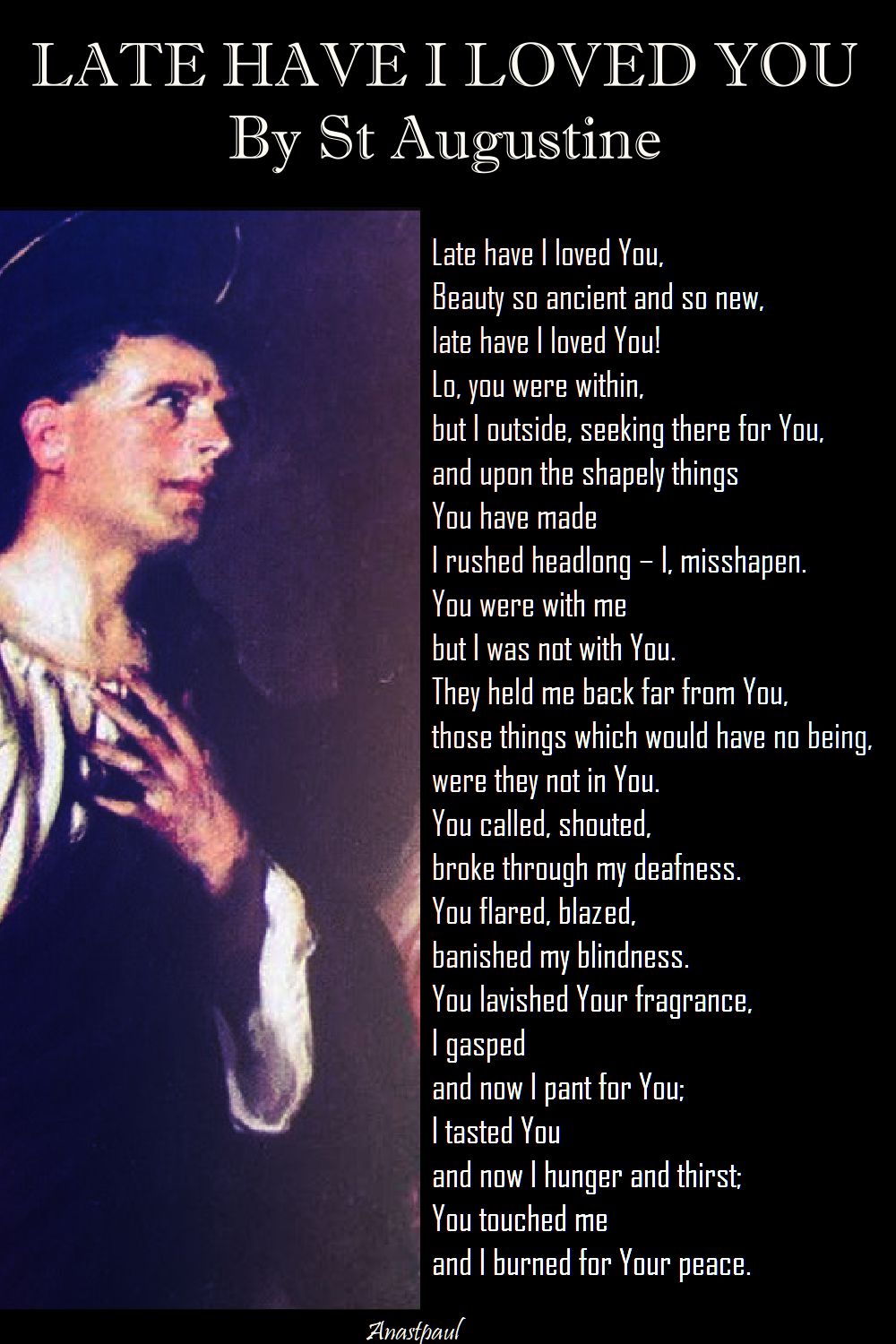
Our Morning Offering – 27 August – The Memorial of St Monica
LATE HAVE I LOVED YOU By St Augustine
Late have I loved You,
Beauty so ancient and so new,
late have I loved You!
Lo, you were within,
but I outside, seeking there for You,
and upon the shapely things You have made
I rushed headlong – I, misshapen.
You were with me but I was not with You.
They held me back far from You,
those things which would have no being,
were they not in You.
You called, shouted, broke through my deafness.
You flared, blazed, banished my blindness.
You lavished Your fragrance, I gasped
and now I pant for You;
I tasted You and now I hunger and thirst;
You touched me and I burned for Your peace.








![Bartolo-di-Fredi-xx-A-Papal-Saint-Saint-Gregory-the-Great-1380s[1]](https://i0.wp.com/anastpaul.com/wp-content/uploads/2017/09/bartolo-di-fredi-xx-a-papal-saint-saint-gregory-the-great-1380s1.jpg?w=166&h=330&ssl=1 "Bartolo-di-Fredi-xx-A-Papal-Saint-Saint-Gregory-the-Great-1380s[1]")





 Abraham Willaerts – St Augustine and the Child

 AnaStpaul
You must be logged in to post a comment.