Posted in ADVENT, CARMELITES, DOCTORS of the Church, MORNING Prayers, PRAYERS of the SAINTS, SAINT of the DAY, Uncategorized

Our Morning Offering – 14 December – The Memorial of St John of the Cross (1542-1591) Doctor of the Church

Our Morning Offering – 14 December – The Memorial of St John of the Cross (1542-1591) Doctor of the Church

O King of Gentleness
By St John of the Cross

O blessed Jesus,
give me stillness of soul in You.
Let Your mighty calmness reign in me.
Rule me, O King of Gentleness,
King of Peace.o king of gentleness - o blessed jesus give me - st john of the cross - 14 dec 2017

Posted in ADVENT, CARMELITES, CONTEMPLATIVE Prayer, DOCTORS of the Church, SAINT of the DAY

Saint of the Day – 14 December – (1542-1591) Doctor of the Church

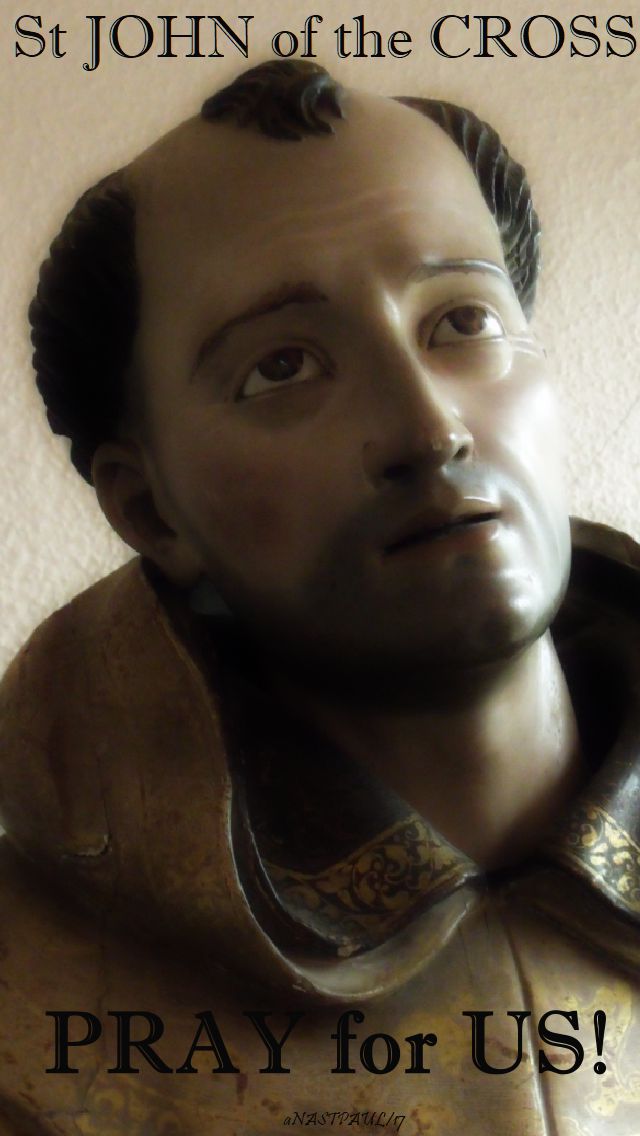
Saint of the Day – 14 December – (1542-1591) Doctor of the Church – Carmelite monk and Priest, Religious Founder, Writer, Poet, Mystic, Apostle of Contemplative Prayer.   Also known as • Doctor of Mystical Theology • John della Croce • John de la Croix • John de la Cruz.   Patronages – • contemplative life, contemplatives• mystical theology, mystics• Spanish poets• World Youth Day 2011• Segovia, Spain• Ta’ Xbiex, Malta.   Attributes – eagle, Crucifix, Cross, Carmelite habit.    John of the Cross is known for his writings.   Both his poetry and his studies on the growth of the soul are considered the summit of mystical Spanish literature and one of the peaks of all Spanish literature.   He was canonised as a saint in 1726 by Pope Benedict XIII.   He is one of the thirty-six Doctors of the Church, added by Pope Pius XI in 1926.   His works are • Ascent of Mount Carmel• Dark Night of the Soul, Book 1 • Dark Night of the Soul, Book 2 • A Spiritual Canticle of the Soul and the Bridegroom Christ.st john of the cross - infost john cross LARGE

St John was born Juan de Yepes y Álvarez into a converso family (descendents of Jewish converts to Christianity) in Fontiveros, near Ávila, a town of around 2,000 people.  John’s father had been disowned by his wealthy Spanish family when he married a poor weaver rather than a woman of equal economic status.   Living in poverty proved to be too much for him and he died shortly after John was born.   John spent much of his youth in an orphanage, where he was clothed, fed and given an elementary education.   At the age of 17, he found a job in a hospital and was accepted into a Jesuit college.   In 1563 he entered the Carmelite Order.   Eventually he enrolled in another university, where he did so well that he was asked to teach a class and to help settle disputes.

Ordained a Carmelite priest in 1567 at age 25, John met Teresa of Avila and, like her, vowed himself to the primitive Rule of the Carmelites.   As partner with Teresa and in his own right, John engaged in the work of reform and came to experience the price of reform:  increasing opposition, misunderstanding, persecution, imprisonment.    John was caught up in a misunderstanding and imprisoned at Toledo, Spain.   During those months of darkness in that little cell, John could have become bitter, revengeful, or filled with despair.   But instead, he kept himself open to God’s action, for no prison could separate him from God’s all-embracing love.   During this time he had many beautiful experiences and encounters with God in prayer.   He came to know the cross acutely—to experience the dying of Jesus—as he sat month after month in his dark, damp, narrow cell with only his God.Zurbarán_St._John_of_the_Cross. - large

Yet, the paradox!   In this dying of imprisonment John came to life, uttering poetry.   In the darkness of the dungeon, John’s spirit came into the Light.   There are many mystics, many poets-  John is unique as mystic-poet, expressing in his prison-cross the ecstasy of mystical union with God in the Spiritual Canticle.the blessed St John of the Cross


But as agony leads to ecstasy, so John had his Ascent to Mt Carmel, as he named it in his prose masterpiece.   As man-Christian-Carmelite, he experienced in himself this purifying ascent;  as spiritual director, he sensed it in others;  as psychologist-theologian, he described and analysed it in his prose writings.   His prose works are outstanding in underscoring the cost of discipleship, the path of union with God:  rigorous discipline, abandonment, purification.   Uniquely and strongly John underlines the gospel paradox: The cross leads to resurrection, agony to ecstasy, darkness to light, abandonment to possession, denial to self to union with God.   If you want to save your life, you must lose it.   John is truly “of the Cross.”   He died at 49—a life short, but full.    AND his reforms of the “Discalced” Carmelites revitalised the Order.   He was proclaimed a Doctor of the Church by Pope Pius XI on 24 August 1926.

496px-diego_de_sanabria_-_saint_john_of_the_cross_-_google_art_project
Diego de Sanabria – Saint John of the Cross
535px-el_greco_-_view_of_toledo_-_google_art_project
Image above – El Greco‘s landscape of Toledo depicts the priory in which John was held captive, just below the old Muslim alcázar and perched on the banks of the Tajo on high cliffs
Posted in DOCTORS of the Church, MORNING Prayers, QUOTES of the SAINTS, QUOTES on SUFFERING, SAINT of the DAY

Quote/s of the Day – 13 December

Quote/s of the Day – 13 December

“If you want to honour the body of Christ,
do not scorn it when it is naked;
do not honour the Eucharistic Christ
with silk vestments and then,
leaving the church, neglect the other Christ
suffering from cold and nakedness”

St John Chrysostom (347-407)

Father and Doctor of the Church – (Hom. in Matthaeum, 50.3: PG 58)if-you-want-to-honour-the-body-of-christ-st-john-chrysostom-19-nov-2017

“The more we are afflicted in this world,
the greater is our assurance in the next;
the more we sorrow in the present,
the greater will be our joy in the future.”

St Isidore of Seville (560-636) Doctor of the Churchthe more we are afflicted - st isidore of seville - 13 dec 2017

“When it is all over, you will not regret having suffered;
rather, you will regret, having suffered so little
and suffered that little so badly.”

Bl Sebastian Valfre (1629-1710)when it is all over - bl sebastian valfre - 13 dec 2017

Posted in ADVENT, DOCTORS of the Church, FATHERS of the Church, QUOTES of the SAINTS, SAINT of the DAY

Saint of the Day – 11 December – St Pope Damasus I (c 305-384)

Saint of the Day – 11 December – St Pope Damasus I (c 305-384) Priest and Pope – ( c 305 in Rome, Italy –  11 December 384 in Rome, Italy of natural causes).  Patronage – archeologists.   He was buried in the Mark and Marcellianus catacombs in Rome
and his bones re-buried in the church of San Lorenzo in Damaso.Dec. 11 - Pope St. Damasus

The son of a Roman priest, possibly of Spanish extraction, Damasus started as a deacon in his father’s church and served as a priest in what later became the basilica of San Lorenzo in Rome.    He served Pope Liberius (352-366) and followed him into exile.

When Liberius died, Damasus was elected bishop of Rome; but a minority elected and consecrated another deacon, Ursinus, as pope.   The controversy between Damasus and the antipope resulted in violent battles in two basilicas, scandalising the bishops of Italy. At the synod that Damasus called on the occasion of his birthday, he asked them to approve his actions.   The bishops’ reply was curt:  “We assembled for a birthday, not to condemn a man unheard.”   Supporters of the antipope even managed to get Damasus accused of a grave crime—probably sexual—as late as 378.   He had to clear himself before both a civil court and a Church synod.

As pope, his lifestyle was simple in contrast to other ecclesiastics of Rome and he was fierce in his denunciation of Arianism and other heresies.   A misunderstanding of the Trinitarian terminology used by Rome threatened amicable relations with the Eastern Church and Damasus was only moderately successful in dealing with that challenge.

He appointed St Jerome as his confidential secretary.   Invited to Rome originally to a synod of 382 convened to end the schism of Antioch, Jerome made himself indispensable to the pope and took a prominent place in his councils.   Jerome spent three years (382–385) in Rome in close intercourse with Pope Damasus and the leading Christians.   Writing in 409, Jerome remarked, “A great many years ago when I was helping Damasus, bishop of Rome with his ecclesiastical correspondence, I was also helping to write his answers to the questions referred to him by the councils of the east and west…”

Sts Jerome and Damasus

In order to put an end to the marked divergences in the western texts of that period, Damasus encouraged the highly respected scholar Jerome to revise the available Old Latin versions of the Bible into a more accurate Latin on the basis of the Greek New Testament and the Septuagint, resulting in the Vulgate.   Jerome devoted a very brief notice to Damasus in his De Viris Illustribus, written after Damasus’ death:  “he had a fine talent for making verses and published many brief works in heroic metre. He died in the reign of the emperor Theodosius at the age of almost eighty”.

The letters from Jerome to Damasus are examples of the primacy of the See of Peter:

Yet, though your greatness terrifies me, your kindness attracts me.   From the priest I demand the safe-keeping of the victim, from the shepherd the protection due to the sheep.   Away with all that is overweening;  let the state of Roman majesty withdraw.   My words are spoken to the successor of the fisherman, to the disciple of the cross.   As I follow no leader save Christ, so I communicate with none but your blessedness, that is with the chair of Peter.   For this, I know, is the rock on which the church is built!   This is the house where alone the paschal lamb can be rightly eaten.   This is the ark of Noah and he who is not found in it shall perish when the flood prevails.   But since by reason of my sins I have betaken myself to this desert which lies between Syria and the uncivilised waste, I cannot, owing to the great distance between us, always ask of your sanctity the holy thing of the Lord.   Consequently I here follow the Egyptian confessors who share your faith and anchor my frail craft under the shadow of their great argosies. I know nothing of Vitalis;  I reject Meletius;  I have nothing to do with Paulinus.   He that gathers not with you scatters;  he that is not of Christ is of Antichrist!”

During his pontificate, Christianity was declared the official religion of the Roman state, and Latin became the principal liturgical language as part of the Pope’s reforms.   His encouragement of Saint Jerome’s biblical studies led to the Vulgate, the Latin translation of Scripture which 12 centuries later the Council of Trent declared to be “authentic in public readings, disputations, preaching.”

san_damaso_i_b
Posted in ADVENT, DOCTORS of the Church, MARIAN QUOTES, MARIAN TITLES, MIRACLES, MORNING Prayers, QUOTES of the SAINTS, SAINT of the DAY, The BLESSED VIRGIN MARY, The WORD

One Minute Reflection – 10 December- The Memorial of Our Lady and the Holy House of Loreto

One Minute Reflection – 10 December- The Memorial of Our Lady and the Holy House of Loreto

You shall love the Lord your God with all your heart, with all your soul, with all your strength and with all your mind………..Luke 10:27luke 10 27

REFLECTION – “Love for Christ pierced Mary’s heart in such a way that no part of it was left unkindled.   Mary thus fulfilled the first commandment of love in all its fullness
and without the slightest imperfection.”….St Bernard of Clairvaux (1090–1153) Doctor of the Churchlove for christ - st bernard - 10 dec 2917

PRAYER – O Mother! You, who carried the Divine Saviour in your immaculate womb and lived with Him in the Holy House that we venerate on the Loreto Hill, grant us the grace to seek Him and imitate His example, He who leads us to salvation.    Our Lady of Loreto work miracles in us all! Amenour lady of loreto pray for us - 10 dec 2017

Posted in ADVENT, BREVIARY Prayers, CATHOLIC-PRAYERS OF THE CHURCH, CHRISTMASTIDE!, DOCTORS of the Church, HYMNS, MARIAN PRAYERS, MARIAN TITLES, MORNING Prayers, POETRY, PRAYERS of the CHURCH, QUOTES - J R R Tolkien and MORE, SAINT of the DAY, The BLESSED VIRGIN MARY

Our Morning Offering – 10 December – The Second Sunday of Advent and the Memorial of Our Lady and the Holy House of Loreto

Our Morning Offering – 10 December – The Second Sunday of Advent and the Memorial of Our Lady and the Holy House of Loreto

Maiden yet a Mother
By Dante Alighieri (1265-1321)
Tr Msgr Ronald A Knox (1888-1957)

Maiden yet a mother,
daughter of thy Son,
high beyond all other,
lowlier is none;
thou the consummation
planned by God’s decree,
when our lost creation
nobler rose in thee!

Thus His place prepared,
he who all things made
‘mid his creatures tarried,
in thy bosom laid;
there His love He nourished,
warmth that gave increase
to the root whence flourished
our eternal peace.

Nor alone thou hearest
When thy name we hail;
Often thou art nearest
When our voices fail;
Mirrored in thy fashion
All creation’s gird,
Mercy, might compassion
Grace thy womanhood.

Lady, let our vision
Striving heavenward, fail,
Still let thy petition
With thy Son prevail,
Unto whom all merit,
prayer and majesty,
With the Holy Spirit
And the Father be.

Maiden Yet A Mother is a translation of a poem by Durante (Dante) degli Alighieri (c 1265–1321).    It is based upon the opening verses of Canto 33 of the Paradiso from his Divine Comedy in which St Bernard of Clairvaux (1090–1153) praises and prays to the Virgin Mother on behalf of Dante.   It was translated from the original Italian into English by the Catholic convert, Monsignior Ronald A Knox (1888-1957).maiden yet a mother - dante - 10 dec 2017

Posted in ADVENT, DOCTORS of the Church, FATHERS of the Church, MORNING Prayers, QUOTES of the SAINTS, SAINT of the DAY, The WORD

One Minute Reflection – – 9 December 2017- Saturday of the First Week of Advent

One Minute Reflection – – 9 December 2017- Saturday of the First Week of Advent

How I wish you were ….hot or cold!   But because you are lukewarm … I will spew you out of my mouth!….Revelations 3:15revelations 3-15

REFLECTION – The Word of God moves swiftly.   He is not won by the lukewarm nor held fast by the negligent. Be attentive to His message and diligently follow the path God tells you to take.   For He is swift in His passing…..St Ambrose (340-397) Father & Doctor of the Churchthe word of god - st ambrose - 9 dec 2017

PRAYER – Lord Jesus, my Lord and Saviour, help me to avoid this lukewarmness in my spiritual growth.   Allow me, this Advent, to use the time well to prepare for Your swift passing.   Grant me an ardent faith, hope and love so that I may be ready for Your coming, every watchful and zealous in following You.   May the great love and prayers of St Juan Diego, whose feast we celebrate today, be acceptable to You on our behalf, amen.st juan diego pray for us

Posted in CATHOLIC DEVOTIONS of the Month, DOCTORS of the Church, DOGMA, FATHERS of the Church, FEASTS and SOLEMNITIES, MARIAN QUOTES, MARIAN TITLES, PAPAL ENCYLICALS, PAPAL MESSAGES, QUOTES of the SAINTS, SAINT of the DAY, The BLESSED VIRGIN MARY

Quote/s of the Day – 8 December – The Solemnity of the Immaculate Conception

Quote/s of the Day – 8 December – The Solemnity of the Immaculate Conception

“Mary, a Virgin,
not only not only UNDEFILED
but a Virgin whom grace
has made INVIOLATE,
FREE from EVERY STAIN of SIN.”

St Ambrose (340-397) Father and Doctor, Sermon 22, in the year 338mary a virgin - st ambrose - 8 dec 2017

The Apostolic Constitution «Ineffabilis Deus», published on 8th December 1854, more 150 years ago, by Blessed Pope Pius IX on the theology regarding the privilege of the Immaculate Conception, in the following solemn proclamation of this Dogma of Catholic faith:

“To the honour of the holy and undivided Trinity, to the worthiness and splendid beauty of the Virgin Mother of God, to the upholding of the Catholic faith and to the furthering of the Christian religion, with the authority of Our Lord Jesus Christ, with that of the holy Apostles Peter and Paul and with Our own authority, we declare, we pronounce and we define the doctrine which holds that the most Blessed Virgin Mary, in the very first moments of her Conception, through the singular grace of Almighty God and through the foresight of the merits of Christ Jesus, Saviour of the human race, was preserved immune from all stains of original sin.   We furthermore declare, pronounce and define that this doctrine has been revealed by God and, therefore, has to be strongly and always believed by all the faithful.”  Blessed Pope Pius IX

“As soon as she [Mary] had the use of reason, that is, from the first moment of her Immaculate Conception in the womb of St Anne, from that time she began with all her powers to love her God and thus she continued to do, ever advancing more in perfection and love through her whole life.   All her thoughts, her desires, her affections, were wholly given to God.   Not a word, not a motion, not a glance of the eye, not a breath of hers that was not for God and for His glory, never departing one step, nor separating herself for one moment from the divine love.”…Saint Alphonsus Ligouri  (1696-1787) Doctor of the Church

Posted in ADVENT, CATHOLIC DEVOTIONS of the Month, DOCTORS of the Church, FEASTS and SOLEMNITIES, MARIAN QUOTES, MARIAN TITLES, MORNING Prayers, QUOTES of the SAINTS, The WORD

One Minute Reflection – 8 December  – The Solemnity of the Immaculate Conception

One Minute Reflection – 8 December  – The Solemnity of the Immaculate Conception

You shall love the Lord your God with all your heart, with all your soul,
with all your strength and with all your mind ………………Luke 10:22luke 10 - 22

REFLECTION – Love for Christ pierced Mary’s heart in such a way that no part
of it was left unkindled.   Mary thus fulfilled the first commandment of love
in all its fullness and without the slightest imperfection…………St Bernardlove for christ - st bernard - 8 dec 2017

PRAYER – Heavenly Father, help us to imitate Your Immaculate Daughter Mary in her love for You.   Grant us the grace to love You as much as she, all our lives and grant, that through her help and her prayers, we ourselves may come to You , cleansed from our sins. O Mary Immaculate, mother of our Lord, Pray for us! Amenimmaculate mary - pray for us

Posted in ADVENT, DOCTORS of the Church, FATHERS of the Church, MORNING Prayers, SAINT of the DAY, The WORD

Thought for the Day – 7 December – The Memorial of St Ambrose (c 340-397)- Father and Doctor of the Church

Thought for the Day – 7 December – The Memorial of St Ambrose (c 340-397)- Father and Doctor of the Church

St Ambrose exemplifies for us the truly catholic character of Christianity.

He is a man steeped in the learning, law and culture of the ancients and of his contemporaries.   Yet, in the midst of active involvement in this world, this thought runs through Ambrose’ life and preaching – the hidden meaning of the Scriptures calls our spirit to rise to another world.

It is all for HIM, all for the WORD made flesh, all for GOD that we live!

St Ambrose Pray for us!st ambrose - pray for us 2

Posted in ADVENT, CATECHESIS, DOCTORS of the Church, EUCHARISTIC Adoration, FATHERS of the Church, MORNING Prayers, QUOTES of the SAINTS, QUOTES on CHARITY, The HOLY EUCHARIST / The HOLY MASS

Quote/s of the Day – 7 December – The Memorial of St Ambrose (c 340-397)- Father and Doctor of the Church

Quote/s of the Day – 7 December – The Memorial of St Ambrose (c 340-397)- Father and Doctor of the Church

“The Church of the Lord is built upon the rock
of the apostles among so many dangers in the world;
it therefore remains unmoved.
The Church’s foundation is unshakable and firm
against assaults of the raging sea.
Waves lash at the Church but do not shatter it.
Although the elements of this world, constantly beat
upon the Church with crashing sounds,
the Church possesses the safest harbour
of salvation for all in distress.”

the church of the lord - st ambrose - 7 dec 2017

“Rise, you who were lying fast asleep…
Rise and hurry to the Church:
here is the Father,
here is the Son,
here is the Holy Spirit.”

rise you who were lying fast asleep - st ambrose - my pic 2017

“It is a better thing
to save souls for the Lord,
than to save treasures.
He who sent forth
His apostles without gold,
He had not need of gold
to form His Church.
The Church possesses gold,
not to hoard
but to scatter abroad
and come to the aid
of the unfortunate.”

it is a better thing - st ambrose - 7 dec 2017

“When we speak about WISDOM,
we are speaking about CHRIST.
When we speak about VIRTUE,
we are speaking about CHRIST.
When we speak about JUSTICE,
we are speaking about CHRIST.
When we speak about PEACE,
we are speaking about CHRISTt.
When we speak about TRUTH,
and LIFE and REDEMPTION,
we are speaking about CHRIST.”

when we speak - st ambrose - 7 dec 2017

“If it is “daily bread,” why do you take it once a year? . . .
Take daily what is to profit you daily.
Live in such a way that you may deserve
to receive it daily.
He who does not deserve to receive it daily,
does not deserve to receive it once a year.”

if it ias daily - st ambrose - 7 dec 2017

“Let your door stand open
to receive Him,
unlock your soul to Him,
offer Him a welcome in your mind
and then you will see
the riches of simplicity,
the treasures of peace,
the joy of grace.
Throw wide the gate of your heart,
stand before the sun of the everlasting light.”

let your door stand open - st ambrose - 7 dec 2017

“…He, who forgave all, required of all,
that what every one remembers
to have been forgiven to himself,
he also should forgive others.”

“The devil tempts, that he may ruin;
God tests, that He may crown.”

“The rich man who gives to the poor
does not bestow alms but pays a debt.”

“Therefore, let your words be rivers, clean and limpid,
so that you may charm the ears of people.
And by the grace of your words win them over
to follow your leadership.
…. That is, let the meaning of your words shine forth,
let understanding blaze out.
Let no word escape your lips in vain or be uttered,
without depth of meaning.”  from a letter by Saint Ambrose

St Ambrose (c 340-397)- Father and Doctor of the Church

he, who forgave all - st ambrose - 7 dec 2017

Posted in ADVENT, DOCTORS of the Church, FATHERS of the Church, MORNING Prayers, QUOTES of the SAINTS, SAINT of the DAY, The WORD

One Minute Reflection – 7 December – The Memorial of St Ambrose (c 340-397)- Father and Doctor of the Church

One Minute Reflection – 7 December – The Memorial of St Ambrose (c 340-397)- Father and Doctor of the Church

But you are “a chosen race, a royal priesthood, a holy nation, a people of his own, so that you may announce the praises” of him who called you out of darkness into his wonderful light…1 Peter 2:91 peter 2-9 - 7 dec 2017

REFLECTION – “All the children of the Church are priests. At Baptism, they received the anointing that gives them a share in the priesthood. The sacrifice that they must offer to God is completely spiritual – it is themselves.”…St Ambroseall the children of the church - st ambrose - 7 dec 2017

PRAYER – Holy Father, teach me to offer myself to You with all my thoughts, words and actions. Let me also exercise my “common priesthood” by faithful participation at Holy Mass and in all my encounters with my neighbour. St Ambrose, holy father, teacher of the saints, pray for us! Amenst ambrose pray for us - 7 dec 2017

Posted in ADVENT, CHRISTMASTIDE!, DOCTORS of the Church, FATHERS of the Church, HYMNS, MORNING Prayers, PRAYERS of the SAINTS, SAINT of the DAY, The CHRIST CHILD

Our Morning Offering – 7 December – The Memorial of St Ambrose (c 340-397)- Father and Doctor of the Church

Our Morning Offering – 7 December – The Memorial of St Ambrose (c 340-397)- Father and Doctor of the Church

Veni Redemptor gentium
Saviour of the Nations, Come
St Ambrose’s Advent Hymn

Saviour of the nations, come;
Virgin’s Son, here make Thy home!
Marvel now, O heaven and earth,
That the Lord chose such a birth.

Not by human flesh and blood;
By the Spirit of our God
Was the Word of God made flesh,
Woman’s offspring, pure and fresh.

Wondrous birth! O wondrous Child
Of the virgin undefiled!
Though by all the world disowned,
Still to be in heaven enthroned.

From the Father forth He came
And returneth to the same,
Captive leading death and hell
High the song of triumph swell!

Thou, the Father’s only Son,
Hast over sin the victory won.
Boundless shall Thy kingdom be;
When shall we its glories see?

Brightly doth Thy manger shine,
Glorious is its light divine.
Let not sin o’ercloud this light;
Ever be our faith thus bright.

Praise to God the Father sing,
Praise to God the Son, our King,
Praise to God the Spirit be
Ever and eternally.

Translated from Latin to German by Martin Luther, 1523;
translated from German to English by William M Reynolds, 1851veni redemptor gentium - st ambrose advent him saviour of the nations, come - 7 dec 2017

O Lord, Give me a Heart to Love You
Prayer of St Ambrose (c 340-397) Father and Doctor of the Church

O Lord, who has mercy upon all,
take away from me my sins
and mercifully kindle in me
the fire of Your Holy Spirit.
Take away from me the heart of stone
and give me a heart of flesh,
a heart to love and adore You,
a heart to delight in You,
to follow and enjoy You,
for Christ’s sake. Ameno lord give me a heart to love you - prayer of st ambrose - 7 dec 2017

Posted in ADVENT, DOCTORS of the Church, DOMESTIC ANIMALS, FATHERS of the Church, Of BISHOPS, Of Catholic Education, Students, Schools, Colleges etc, SAINT of the DAY

More on today’s Saint – 7 December – St Ambrose (c340-397) Confessor, Bishop, Father and Doctor of the Church

More on today’s Saint – St Ambrose (c 340-397)Confessor, Bishop, Father and Doctor of the Church –  Theologian, Apostle of Charity, Writer, Musician, Preacher, Reformer and protector – all-in-all a brilliant, charismatic, vibrant man.  Patronages – • bee keepers• bees• Bishops• candle makers• chandlers• domestic animals• French Commissariat• geese• honey cake bakers• learning• livestock• police officers • students, school-children• security personnel• starlings• wax melters• wax refiners• Archdiocese of Milan, Italy• 8 Cities.

Traditionally, Ambrose is credited with promoting “antiphonal chant”, a style of chanting in which one side of the choir responds alternately to the other, as well as with composing Veni redemptor gentium, an Advent hymn.   Ambrose is one of the four original Doctors of the Church and is the Patron saint of Milan.   He is notable for his influence on St Augustine, whom he Baptised.

This politician-turned churchman was profoundly aware of his lack of preparation for this great responsibility as Bishop and so set himself immediately to prayer and the study of Scripture.    His deep spirituality and love of God’s Word married together with the oratorical skill acquired in law and politics made St Ambrose one of the greatest preachers of the early church.

His feast day in the Roman calendar is 7 December, the day he was Ordained Bishop. From the Roman liturgy for the Feast of St. Ambrose:   “Lord, you made Saint Ambrose an outstanding teacher of the Catholic faith and gave him the courage of an apostle.   Raise up in your Church more leaders after your own heart, to guide us with courage and wisdom.   We ask this through our Lord Jesus Christ, Your Son, who lives and reigns with you and the Holy Spirit, one God forever and ever. Amen.”  

Here is Jimmy Akin’s article “St Ambrose: Strangest Life Story Ever?”
1) Who was St Ambrose?

St Ambrose of Milan was born around A.D. 338 and died in 397.
He was the bishop of Milan, Italy.

2) What makes is his life story so strange?

Originally, he was a government official, he became bishop in a most extraordinary way.
After the death of the local bishop, the Catholics and Arians got into a vehement conflict about who should be the new bishop.
Ambrose was trying to keep the peace and settle the two groups down when someone—allegedly a small boy—began chanting “Ambrose, bishop!”
Soon the two groups began chanting together that Ambrose should be the new bishop.
(The Arians, apparently, felt that although Ambrose was Catholic in belief he would be a kinder bishop than they otherwise would likely get.)
This set of circumstances is extraordinary enough, but what’s even more extraordinary is that Ambrose wasn’t even a Christian yet. He was an unbaptised catechumen!

3) Can it get any stranger?

Ambrose did not want to be bishop and so he went into hiding.
The Emperor Valentinian then got word of all this and declared severe penalties on anyone who would give Ambrose shelter.
He was thus forced to come out of hiding and accept his ordination as bishop.
They quickly ran him through the preliminary grades of orders and he was consecrated a bishop about a week later.

4) How did he do as bishop?

He was great!   That’s part of why he ended up as a doctor of the Church.
He left many wonderful writings.   He helped convert St Augustine.   And he combated heresy.
He also introduced a practice into the West that has remained with us to this day.

5) What practice was that?

Lectio Divina. Pope Benedict XVI explained:
Culturally well-educated but at the same time ignorant of the Scriptures, the new Bishop briskly began to study them.
From the works of Origen, the indisputable master of the “Alexandrian School”, he learned to know and to comment on the Bible.
Thus, Ambrose transferred to the Latin environment the meditation on the Scriptures which Origen had begun, introducing in the West the practice of lectio divina.
The method of lectio served to guide all of Ambrose’s preaching and writings, which stemmed precisely from prayerful listening to the Word of God.

6) How did Ambrose help with Augustine’s conversion?

That also involved a rather dramatic story, in which Ambrose stood up to the emperor at the risk of his own life.
Pope Benedict explained:
A passage from St Augustine’s Confessions is relevant.
He had come to Milan as a teacher of rhetoric;   he was a sceptic and not Christian.  He was seeking the Christian truth but was not capable of truly finding it.
What moved the heart of the young African rhetorician, sceptic and downhearted and what impelled him to definitive conversion was not above all Ambrose’s splendid homilies (although he deeply appreciated them).
It was rather the testimony of the Bishop and his Milanese Church that prayed and sang as one intact body.
It was a Church that could resist the tyrannical ploys of the Emperor and his mother, who in early 386 again demanded a church building for the Arians’ celebrations.
In the building that was to be requisitioned, Augustine relates, “the devout people watched, ready to die with their Bishop”.
This testimony of the Confessions is precious because it points out that something was moving in Augustine, who continues: “We too, although spiritually tepid, shared in the excitement of the whole people” (Confessions 9, 7).

7) Was Ambrose remarkable in other ways?

He was remarkable in many ways, one of them we today would find quite surprising.
Pope Benedict explained:
[Augustine] writes in his text that whenever he went to see the Bishop of Milan, he would regularly find him taken up with catervae [Latin, “crowd”]of people full of problems for whose needs he did his utmost.
There was always a long queue waiting to talk to Ambrose, seeking in him consolation and hope.
When Ambrose was not with them, with the people (and this happened for the space of the briefest of moments), he was either restoring his body with the necessary food or nourishing his spirit with reading.
Here Augustine marvels because Ambrose read the Scriptures with his mouth shut, only with his eyes (cf. Confessions, 6, 3).
Indeed, in the early Christian centuries reading was conceived of strictly for proclamation and reading aloud also facilitated the reader’s understanding.
That Ambrose could scan the pages with his eyes alone suggested to the admiring Augustine a rare ability for reading and familiarity with the Scriptures.

Got that?

Ambrose was known for the ability to read with his mouth shut, not using his voice or moving his lips.
We’re all taught to do this today, but it was rare in the ancient world! Back then, if you even could read, you usually had to at least move your lips.
Ambrose also passed on to Augustine a very famous piece of advice, that many people quote today without even knowing where it comes from.

8) What advice was that?

Augustine noted that the liturgical customs in Rome were different than those used in other places and Ambrose told him something we still quote today.

We paraphrase it in English, but it’s the same thought: “When in Rome, do as the Romans do.”Some-Advice-On-Prayer-2-saint-ambrose-of-milan-1St_AmbroseSome-Advice-On-Prayer-2-St.-Ambrose-Stained-Glass

Posted in ADVENT, DOCTORS of the Church, FATHERS of the Church, Re-BLOGS, SAINT of the DAY

Saint of the Day – 7 December – St Ambrose (c 340-397) Father and Doctor of the Church

via Saint of the Day – 7 December

Posted in ADVENT, DOCTORS of the Church, FATHERS of the Church, QUOTES of the SAINTS

Thought for the Day – Tuesday of the First Week of Advent – 5 December 2017

Thought for the Day – Tuesday of the First Week of Advent – 5 December 2017

THE TWOFOLD COMING OF CHRIST
St CYRIL OF JERUSALEM (313-386)  Father & Doctor of the Church

We do not preach only one coming of Christ but a second as well, much more glorious than the first.   The first coming was marked by patience;  the second will bring the crown of a divine kingdom.

In general, whatever relates to our Lord Jesus Christ has two aspects.   There is a birth from God before the ages and a birth from a virgin at the fullness of time.   There is a hidden coming, like that of rain on fleece and a coming before all eyes, still in the future.

At the first coming He was wrapped in swaddling clothes in a manger.   At His second coming He will be clothed in light as in a garment.   In the first coming He endured the cross, despising the shame;  in the second coming He will be in glory, escorted by an army of angels.

We look then beyond the first coming and await the second.   At the first coming we said: Blessed is He who comes in the name of the Lord.   At the second we shall say it again;  we shall go out with the angels to meet the Lord and cry out in adoration:  Blessed is He who comes in the name of the Lord.

The Saviour will not come to be judged again but to judge those by whom He was judged. At His own judgement He was silent;  then He will address those who committed the outrages against Him when they crucified Him and will remind them:  You did these things and I was silent.

His first coming was to fulfil His plan of love, to teach men by gentle persuasion.   This time, whether men like it or not, they will be subjects of His kingdom by necessity.

The prophet Malachi speaks of the two comings.   And the Lord whom you seek will come suddenly to His temple: that is one coming.

Again he says of another coming:   Look, the Lord almighty will comeand who will endure the day of His entry, or who will stand in His sight?   Because He comes like a refiner’s fire, a fuller’s herb and He will sit refining and cleansing.

These two comings are also referred to by Paul in writing to Titus:   The grace of God the Saviour has appeared to all men, instructing us to put aside impiety and worldly desires and live temperately, uprightly and religiously in this present age, waiting for the joyful hope, the appearance of the glory of our great God and Saviour, Jesus Christ.   Notice how he speaks of a first coming for which he gives thanks and a second, the one we still await.

That is why the faith we profess has been handed on to you in these words:  He ascended into heaven and is seated at the right hand of the Father, and He will come again in glory to judge the living and the dead and His kingdom will have no end.

Our Lord Jesus Christ will therefore come from heaven.   He will come at the end of the world, in glory, at the last day.   For there will be an end to this world and the created world will be made new.

“Maranatha, Come Lord Jesus.”the twofold coming of christ - st cyril of jerusalem - 5 dec 2017

Posted in CATHOLIC Quotes, DEVOTIO, DOCTORS of the Church, EUCHARISTIC Adoration, FATHERS of the Church, MORNING Prayers, ON the SAINTS, QUOTES of the SAINTS, SAINT of the DAY, The HOLY EUCHARIST / The HOLY MASS, The LISTS of the CHURCH, The MOST HOLY & BLESSED TRINITY

Quote/s of the Day – 4 December – The Memorial of St John Damascene (676-749) – Father and Doctor of the Church

Quote/s of the Day – 4 December – The Memorial of St John Damascene (676-749) – Father and Doctor of the Church

“Think of the Father as a spring of life begetting the Son,
like a river and the Holy Ghost like a sea,
for the spring and the river and sea are all one nature.
Think of the Father as a root and of the Son as a branch
and the Spirit as a fruit, for the substance in these three is one.
The Father is a sun with the Son as rays and the Holy Ghost as heat.”ST JOHN DAMASCENE ON THE HOLY TRINITY

“‘How can this come about?’ Mary asked.
‘The Holy Spirit will come upon you,’ the angel answered’
and the power of the Most High will cover you with its shadow.’
And now you are the one who puts the question:
‘How can bread become Christ and wine His Blood?’
I answer:
‘The power of the Holy Spirit will be at work
to give us a marvel which surpasses understanding.'”how can this come about - st john damascene - 4 dec 2017

“If the Word of God is living and powerful
and if the Lord does all things whatsoever he wills;
if he said, “Let there be light” and it happened;
if he said, “let there be a firmament” and it happened;
…if finally the Word of God Himself willingly became man
and made flesh for Himself out of the most pure
and undefiled blood of the holy and ever Virgin,
why should He not be capable of making bread
His Body and wine and water His Blood?…
God said “This is my Body” and “This is my Blood.”if the word of god - st john damascene - 4 dec 2017

“”GLUTTONY should be destroyed by self-control;

UNCHASTITY by desire for God and longing for the blessings held in store;

AVARICE by compassion for the poor;

ANGER by goodwill and love for all men;

WORLDLY dejection by spiritual joy;

LISTLESSNESS by patience, perseverance and offering thanks to God;

SELF-ESTEEM by doing good in secret and, by praying constantly,with a contrite heart;

and PRIDE by not judging or despising anyone, in the manner of the boastful Pharisee
and by considering oneself the least of all men.”GLUTTONY - ST JOHN DAMASCENE - 4 DEC 2017 - no 2.

“The saints must be honoured as friends of Christ
and children and heirs of God. Let us carefully
observe the manner of life of all the apostles,
martyrs, ascetics and just men who announced
the coming of the Lord. And let us emulate their
faith, charity, hope, zeal, life, patience under suffering
and perseverance unto death so that we may also
share their crowns of glory.”the saints must be honoured-st john damascene doctor of the church (675-749)

“Angels are intelligent reflections of light,
that original light which has no beginning.
They can illuminate.
They do not need tongues or ears,
for they can communicate without speech, in thought.”angels are intelligent reflections of light - st john damascene - 4 dec 2016

St John Damascene (676-749) – Father and Doctor of the Church

Posted in DOCTORS of the Church, FATHERS of the Church, MORNING Prayers, SAINT of the DAY, The WORD

One Minute Reflection – 4 December – The Memorial of St John Damascene (676-749) Doctor of the Church

One Minute Reflection – 4 December – (676-749) Doctor of the Church

I have much more to tell you but you cannot bear it now…John 16:12john 16 12

REFLECTION – God knows all things and provides what is profitable for each one.
He revealed what it is to our benefit to know.   But He kept secret what we are
unable to bear now……….St John Damascenegod knows all things - st john damascene - 2016 image

PRAYER – Lord Jesus, help me to meditate on Your Revelations every day.   Grant that by learning fully what You have revealed, I may one day in heaven attain the knowledge of all that You did not reveal.   St John Damascene Pray for us!st john damascene pray for us 2016

Posted in DOCTORS of the Church, FATHERS of the Church, MARIAN PRAYERS, MORNING Prayers, PRAYERS of the SAINTS, SAINT of the DAY, The BLESSED VIRGIN MARY

Our Morning Offering – 4 December – The Memorial of St John Damascene – Father and Doctor of the Church

Our Morning Offering – 4 December – The Memorial of St John Damascene – Father and Doctor of the Church

O Mary, my Hope!
St John Damascene 

I salute you, O Mary!
you are the hope of Christians:
receive the prayer of a sinner,
who loves you tenderly,
honours you in a special manner
and places in you the whole hope
of his salvation.
From you I have my life.
You reinstate me in the grace of your Son:
you are the sure pledge of my salvation.
I beseech of you, therefore, to deliver me
from the burden of my sins:
dispel the darkness of my mind,
banish from my heart the love of the world,
repress the temptations of my enemies
and so rule my whole life, that by your means
and under your guidance,
I may obtain everlasting happiness in heaven.
Amen (modernised)

o Mary my Hope - st john damascene - 4 dec 2017 - I salute you, O Mary

Posted in ADVENT, DOCTORS of the Church, MORNING Prayers, QUOTES - J R R Tolkien and MORE, QUOTES of the SAINTS

Quote/s of the Day – 3 December 2017 – The First Sunday of Advent

Quote/s of the Day – 3 December 2017 – The First Sunday of Advent

“In the first Coming He comes in the flesh and in weakness;
in the second, He comes in spirit and in power;
in the third, He comes in glory and in majesty;
and the second Coming is the means
whereby we pass from the first to the third.”

St Bernard of Clairvaux (1090-1153) Doctor of the Churchin the first coming - st bernard - 3 dec 2017

It is Advent. All our answers remain fragmentary.
The first thing we have to accept is, ever and again,
the reality of an enduring Advent.
If we do that, we shall begin to realise
that the borderline between “before Christ” and “after Christ”
does not run through historical time, in an outward sense
and cannot be drawn on any map;
it runs through our own hearts.
Insofar as we are living on a basis of selfishness, of egoism,
then even today, we are “before Christ.”
But in this time of Advent, let us ask the Lord to grant
that we may live less and less “before Christ”
and certainly not “after Christ,” but truly “with Christ and in Christ” –
with Him who is indeed Christ yesterday, today and forever.

Joseph Ratzinger (1964) aka Pope Emeritus Benedict XVIit is advent - ratzinger - benedict - 3 dec 2017

Posted in DOCTORS of the Church, MORNING Prayers, PRAYERS of the SAINTS

Our Morning Offering – 20 November

Our Morning Offering – 20 November

PRAYER OF DEDICATION TO THE LORD
by St Francis de Sales

Lord, I am Yours
and I must belong to
no one but You.
My soul is Yours
and must live only by You.
My will is Yours
and must love only for You.
I must love You
as my first cause,
since I am from You.
I must love You
as my end and rest,
since I am for You.
I must love You more
than my own being,
since my being subsists by You.
I must love You more than myself,
since I am all Yours
and all in You. Amen.

This beautiful prayer from Treatise on the Love of God by St Francis de Sales is a prayer of giving oneself totally to God, of wanting to love Him above all thing and is a very appropriate Daily Prayer to add to your memory.LORD I AM YOURS - ST FRANCIS DE SALES

Posted in DOCTORS of the Church, FATHERS of the Church, MORNING Prayers, PAPAL MESSAGES, PRACTISING CATHOLIC, QUOTES of the SAINTS, QUOTES on CHARITY, QUOTES on MERCY, SAINT of the DAY

Quote/s of the Day – 19 November – The First World Day of the

Quote/s of the Day – 19 November – The First World Day of the Poor

Let us love, not with words but with deeds.”1st annual world day of the poor - 19 nov - let us love not with words but with deeds - 2017.-no2

“As long as Lazarus lies at the door of our homes
there can be no justice or social peace.”as long as lazarus - pope francis - 19 nov 2017

“Blessed are the open hands that embrace
the poor and help them – they are hands
that bring hope.
Blessed are the hands that reach beyond
every barrier of culture, religion and nationality
and pour the balm of consolation over
the wounds of humanity.
Blessed are the open hands that ask nothing
in exchange, with no “ifs” or “buts” or “maybes”:
they are hands that call down God’s blessing
upon their brothers and sisters.

Pope Francis

FIRST WORLD DAY OF THE POOR
33rd Sunday in Ordinary Time
19 November 2017blessed are the open hands - pope francis - 19 nov 2017

“If you want to honour the body of Christ,
do not scorn it when it is naked;
do not honour the Eucharistic Christ
with silk vestments and then,
leaving the church, neglect the other Christ
suffering from cold and nakedness”

St John Chrysostom (347-407)

Father and Doctor of the Church – (Hom. in Matthaeum, 50.3: PG 58)if you want to honour the body of christ - st john chrysostom - 19 nov 2017

Posted in DOCTORS of the Church, FATHERS of the Church, MORNING Prayers, QUOTES on CHARITY, QUOTES on MERCY, SAINT of the DAY, The WORD

One Minute Reflection – 19 November – The First World Day of the Poor

One Minute Reflection – 19 November – The First World Day of the Poor

Whatever you do, work at it with your whole being.   Do it for the Lord.……….Colossians 3:23colossians 3-23

REFLECTION -“We do not cease praying so long as we continue to do good.
The prayer of the heart and of good deeds has more value than the prayer of the lips.”…………….St Augustinewe do not cease praying-st augustine

PRAYER – Dear God, move me to make a morning offering to You with total sincerety each day and then grant that all my deeds may be a devout continuation of that prayer. Open my eyes to those who need me in any way, let me see as You do and do as You do. On this First annual World Day of prayer for the Poor help us all to start again sweet Shepherd, to become the shepherds of our neighbour, the and helper of all in need, in Him who showed us the way, with the Holy Spirit who breathes in us, amen.if there are poor - pope francis - 19 nov 2017

Posted in DOCTORS of the Church, FATHERS of the Church, JESUIT SJ, MORNING Prayers, QUOTES of the SAINTS, QUOTES on CHARITY, QUOTES on MERCY, SAINT of the DAY

Quote/s of the Day – 17 November – Mercy/Charity/Love on the Memorial of St Elizabeth of Hungary – Apostle of Charity (1207-1231)

Quote/s of the Day – 17 November – Mercy/Charity/Love on the Memorial of St Elizabeth of Hungary – Apostle of Charity (1207-1231)

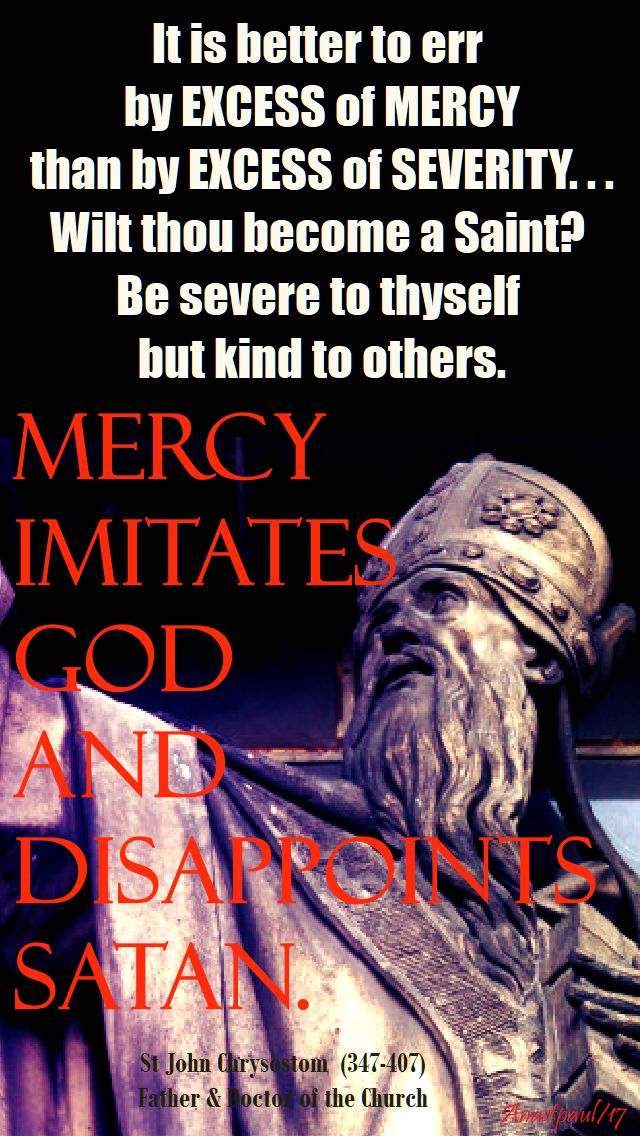
“It is better to err by excess of mercy
than by excess of severity. . .
Wilt thou become a Saint?
Be severe to thyself but kind to others.”

“Mercy imitates God and disappoints Satan.”

St John Chrysostom (347-407) Father & Doctor of the Churchmercy imitates god - st john chrysostom - 17 nov 2017

“Two works of mercy set a person free:
Forgive and you will be forgiven
and give and you will receive.”two works of mercy - st augustine - 17 nov 2017

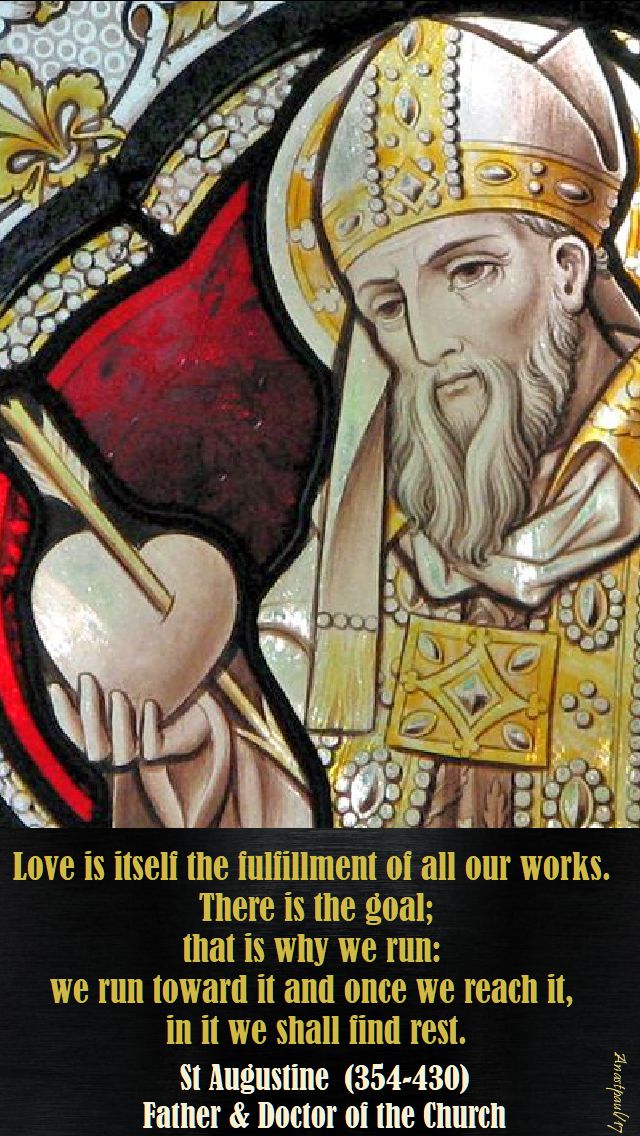
” Love is itself the fulfillment of all our works.
There is the goal;
that is why we run:
we run toward it and once we reach it,
in it we shall find rest.

St Augustine (354-430) Father & Doctor of the Churchlove is itself - st augustine - 17 nov 2017

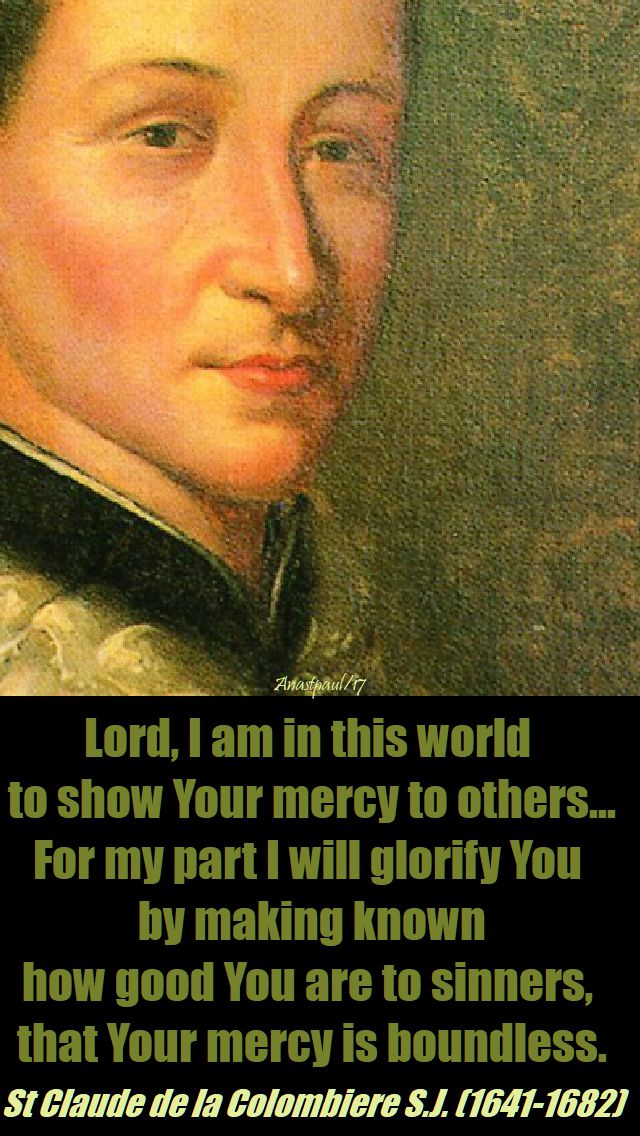
“Lord, I am in this world to show Your mercy to others…
For my part I will glorify You by making known
how good You are to sinners, that Your mercy is boundless.”

St Claude de la Colombiere S.J. (1641-1682)lord, i am in this world - st claude de la colombiere- 17 nov 2017

Posted in DOCTORS of the Church, DOMINICAN OP, MORNING Prayers, QUOTES of the SAINTS, SAINT of the DAY

Thought for the Day – 15 November – The Memorial of St Albert the Great (1200-1280) Doctor of the Church: Pope Benedict XVI on St Albert, Faith and Science

Thought for the Day – 15 November – The Memorial of St Albert the Great (1200-1280) Doctor of the Church Pope Benedict XVI on St Albert, Faith and Science (Excerpt)

One of the great masters of medieval theology is St Albert the Great.   The title “Great”, (Magnus), with which he has passed into history indicates the vastness and depth of his teaching, which he combined with holiness of life.   However, his contemporaries did not hesitate to attribute to him titles of excellence even then.   One of his disciples, Ulric of Strasbourg, called him the “wonder and miracle of our epoch”.

He still has a lot to teach us.   Above all, St Albert shows that there is no opposition between faith and science, despite certain episodes of misunderstanding that have been recorded in history.   A man of faith and prayer, as was St Albert the Great, can serenely foster the study of the natural sciences and progress in knowledge of the micro- and macrocosm, discovering the laws proper to the subject, since all this contributes to fostering thirst for and love of God.   The Bible speaks to us of creation as of the first language through which God who is supreme intelligence, who is the Logos reveals to us something of himself.   The Book of Wisdom, for example, says that the phenomena of nature, endowed with greatness and beauty, is like the works of an artist through which, by analogy, we may know the Author of creation (cf. Wis 13: 5).   With a classical similitude in the Middle Ages and in the Renaissance one can compare the natural world to a book written by God that we read according to the different approaches of the sciences (cf. Address to the participants in the Plenary Meeting of the Pontifical Academy of Sciences, 31 October 2008; L’Osservatore Romano English edition, 5 November 2008, p. 6).   How many scientists, in fact, in the wake of St Albert the Great, have carried on their research inspired by wonder at and gratitude for a world which, to their eyes as scholars and believers, appeared and appears as the good work of a wise and loving Creator! Scientific study is then transformed into a hymn of praise.   Enrico Medi, a great astrophysicist of our time, whose cause of beatification has been introduced, wrote:  “O you mysterious galaxies… I see you, I calculate you, I understand you, I study you and I discover you, I penetrate you and I gather you.   From you I take light and make it knowledge, I take movement and make it wisdom, I take sparkling colours and make them poetry;  I take you stars in my hands and, trembling in the oneness of my being, I raise you above yourselves and offer you in prayer to the Creator, that through me alone you stars can worship” (Le Opere. Inno alla creazione).

St Albert the Great reminds us that there is friendship between science and faith and that through their vocation to the study of nature, scientists can take an authentic and fascinating path of holiness.

His extraordinary openmindedness is also revealed in a cultural feat which he carried out successfully, that is, the acceptance and appreciation of Aristotle’s thought.   In St Albert’s time, in fact, knowledge was spreading of numerous works by this great Greek philosopher, who lived a quarter of a century before Christ, especially in the sphere of ethics and metaphysics.   They showed the power of reason, explained lucidly and clearly the meaning and structure of reality, its intelligibility and the value and purpose of human actions.   St Albert the Great opened the door to the complete acceptance in medieval philosophy and theology of Aristotle’s philosophy, which was subsequently given a definitive form by St Thomas.   This reception of a pagan pre-Christian philosophy, let us say, was an authentic cultural revolution in that epoch.   Yet many Christian thinkers feared Aristotle’s philosophy, a non-Christian philosophy, especially because, presented by his Arab commentators, it had been interpreted in such a way, at least in certain points, as to appear completely irreconcilable with the Christian faith. Hence a dilemma arose: are faith and reason in conflict with each other or not?

This is one of the great merits of St Albert:  with scientific rigour he studied Aristotle’s works, convinced that all that is truly rational is compatible with the faith revealed in the Sacred Scriptures.   In other words, St Albert the Great thus contributed to the formation of an autonomous philosophy, distinct from theology and united with it only by the unity of the truth.   So it was that in the 13th century a clear distinction came into being between these two branches of knowledge, philosophy and theology, which, in conversing with each other, cooperate harmoniously in the discovery of the authentic vocation of man, thirsting for truth and happiness:  and it is above all theology, that St Albert defined as “emotional knowledge”, which points out to human beings their vocation to eternal joy, a joy that flows from full adherence to the truth.

St Albert the Great was capable of communicating these concepts in a simple and understandable way.   An authentic son of St Dominic, he willingly preached to the People of God, who were won over by his words and by the example of his life.

Dear brothers and sisters, let us pray the Lord that learned theologians will never be lacking in holy Church, wise and devout like St Albert the Great and that he may help each one of us to make our own the “formula of holiness” that he followed in his life:  “to desire all that I desire for the glory of God, as God desires for His glory all that He desires”, in other words always to be conformed to God’s will, in order to desire and to do everything only and always for His glory.

Pope Benedict XVI – Saint Peter’s Square, Wednesday, 24 March 2010

St Albert the Great, Pray for us!st albert the great - pray for us

Posted in CARMELITES, DOCTORS of the Church, DOMINICAN OP, EUCHARISTIC Adoration, MORNING Prayers, QUOTES of the SAINTS, SAINT of the DAY, The HOLY EUCHARIST / The HOLY MASS

Quote/s of the Day – 15 November – The Memorials of St Albert the Great (1200-1280) Doctor of the Church and St Raphael Kalinowski (1835-1907)

Quote/s of the Day – 15 November – The Memorials of St Albert the Great (1200-1280) Doctor of the Church and St Raphael Kalinowski (1835-1907)

“Nor could He have commanded anything more lovable,
for this sacrament produces love and union.
It is characteristic of the greatest love to give itself as food.
“Had not the men of my text exclaimed:
‘ Who will feed us with his flesh to satisfy our hunger?’
as if to say: ‘I have loved them and they have loved me
so much that I desire to be within them
and they wish to receive me so that the,
may become my members.’
There is no more intimate or more natural means
for them to be united to me and I to them.
Nor could He have commanded anything
which is more like eternal life.
Eternal life flows from this sacrament
because God with all sweetness
pours Himself out upon the blessed.”

St Albert the Great (1200-1280) Doctor of the Church

“Our Redeemer ever present in the most Blessed Sacrament,
extends His hands to everyone.
He opens His heart and says, ‘Come to Me, all of you.'”

St Raphael Kalinowski (1835-1907)our redeemer ever present - st raphael kalinowski - 15 nov 2017

Posted in DOCTORS of the Church, DOMINICAN OP, MORNING Prayers, QUOTES of the SAINTS, SAINT of the DAY, The WORD

One Minute Reflection – 15 November – – The Memorial of St Albert the Great (1200-1280) Doctor of the Church

One Minute Reflection – 15 November – – The Memorials of St Albert the Great (1200-1280) Doctor of the Church and St Raphael Kalinowski (1835-1907)

Blessed are the pure in heart for they shall see God ….Matthew 5:8

REFLECTION – “The surest and quickest way to attain perfection is to strive for purity of heart.   Once the obstacles have been removed, God finds a clear path and does wonders both in and through the soul.”…St Albert the Great (1200-1280) Doctor of the Church

“God refuses only the person who does not admit his own weakness; He sends away only the unhappy proud person. You must “hold him” well and strongly, with a poor spirit, with a poor heart, with a life entirely poor…”St Raphael Kalinowski (1835-1907)

the surest and quickest way - st albert the great - 15 nov 2017god refuses - st raphael kalinowski - 15 nov 2017PRAYER – Lord God, You made St Albert great by his gift for reconciling human wisdom with divine faith. Help us so to follow his teaching that every advance in science may lead us to a deeper knowledge and love of You. May his prayers on our behalf be a succour to us all.   We ask too for the intercession of the blessed Father St Raphael that his zeal and perseverance may be the driving force of our lives.   Through our Lord Jesus Christ with the Holy Spirit, one God for all eternity, amen.st albert the great - pray for us - 14 nov 2017st raphaelk kalinowski - pray for us - 15 nov 2017

Posted in DOCTORS of the Church, DOMINICAN OP, MORNING Prayers, PRAYERS of the SAINTS, SAINT of the DAY

Our Morning Offering – 15 November – The Memorial of St Albert the Great (1200-1280) Doctor of the Church

Our Morning Offering – 15 November – The Memorial of St Albert the Great (1200-1280) Doctor of the Church

Prayer “O Lord, King of all!”
St Albert the Great (1200-1280)

We pray to You, O Lord,
who are the supreme Truth,
and all truth is from You.
We beseech You, O Lord,
who are the highest Wisdom,
and all the wise depend on You for their wisdom.
You are the supreme Joy,
and all who are happy owe it to You.
You are the Light of minds,
and all receive their understanding from You.
We love, we love You above all.
We seek You, we follow You,
and we are ready to serve You.
We desire to dwell under Your power
for You are the King of all. Amenour lord, king of all - st albert the geat op

Posted in DOCTORS of the Church, DOMINICAN OP, Of Catholic Education, Students, Schools, Colleges etc, Of SCIENTISTS, SAINT of the DAY

Saint of the Day – 15 November – St Albert the Great OP (1200-1280) Bishop, Confessor, Doctor of the Church

Saint of the Day – 15 November – St ALBERTUS MAGNUS/Albert the Great OP (1200-1280) Bishop, Confessor, Doctor of the Church – Doctor universalis (Universal Doctor) – Priest and Friar of the Order of Preachers,Theologian, Scientist, Philosopher, Teacher, Writer.   Born in c 1200 at Lauingen an der Donau, Swabia (part of modern Germany) – 15 November 1280 at Cologne, Prussia (part of modern Germany) of natural causes.   Patronages – • Medical Technicians• Natural Sciences• Philosophers• schoolchildren• Scientists (proclaimed on 13 August 1948 by Pope Pius XII) Theology students.   Scholars have referred to him as the greatest German philosopher and theologian of the Middle Ages.H_LITANY-OF-ALBERT-THE-GREATSaint-Albert-the-Great - HEADERSOC0080

Born around 1206 in Launingen, Germany, Albert was educated as a young man at the University of Padua, and joined the Dominican Order in 1223.   He spent the following years engaged in various studies and teaching assignments in several German cities, most prominently Cologne.   He left Cologne for the University of Paris in 1245.

It was there that one of his students, a brilliant if quiet and heavy-set young man was so impressed by him that he later accompanied him back to Cologne and later became his most famous pupil!   Albert said of his student, St Thomas Aquinas, after St. Thomas’ remarkable explanation of a difficult treatise, “We call this young man a dumb ox but one day his bellowing in his teaching will be heard throughout the world.”

ST ALBERT AND ST THOMAS. getty - my snipSt-Albert-and-St-Thomas-Aquinas (1)

Not that St Albert wasn’t an intellectual heavyweight in his own right.   He was known as Albertus Magnus (Albert the Great).   St Albert can truly be called a Renaissance man, a century before the Renaissance actually began!   This Dominican friar and bishop was also known for his scholarly contributions to the sciences and philosophy as well as theology.   The publication of his complete writings in Paris in 1899 came to 38 volumes and covered his extensive knowledge of such diverse subjects as theology, botany, astronomy, mineralogy, alchemy (the forerunner of chemistry), justice and law among others!   He was the first to comment on virtually all of the writings of Aristotle, thus making them accessible to wider academic debate.   The study of Aristotle brought him to study and comment on the teachings of Muslim academics, notably Avicenna and Averroes and this would bring him into the heart of academic debate.

In 1254 Albert was made provincial of the Dominican Order and fulfilled the duties of the office with great care and efficiency.   During his tenure he publicly defended the Dominicans against attacks by the secular and regular faculty of the University of Paris, commented on John the Evangelist and answered what he perceived as errors of the Islamic philosopher Averroes.

In 1259 he took part in the General Chapter of the Dominicans at Valenciennes together with Thomas Aquinas, masters Bonushomo Britto, Florentius, and Peter (later Pope Innocent V) establishing a ratio studiorum or program of studies for the Dominicans that featured the study of philosophy as an innovation for those not sufficiently trained to study theology.   This innovation initiated the tradition of Dominican scholastic philosophy put into practice, for example, in 1265 at the Order’s studium provinciale at the convent of Santa Sabina in Rome, out of which would develop the Pontifical University of Saint Thomas Aquinas, the “Angelicum”

In 1260 Pope Alexander IV made him bishop of Regensburg, an office from which he resigned after three years.   During the exercise of his duties he enhanced his reputation for humility by refusing to ride a horse, in accord with the dictates of the Order, instead traversing his huge diocese on foot.   This earned him the affectionate sobriquet “boots the Bishop” from his parishioners.   In 1263 Pope Urban IV relieved him of the duties of bishop and asked him to preach the eighth Crusade in German-speaking countries.  After this, he was especially known for acting as a mediator between conflicting parties.   In Cologne he is not only known for being the founder of Germany’s oldest university there but also for “the big verdict” (der Große Schied) of 1258, which brought an end to the conflict between the citizens of Cologne and the archbishop.   Among the last of his labours was the defense of the orthodoxy of his former pupil, Thomas Aquinas, whose death in 1274 grieved Albert (the story that he travelled to Paris in person to defend the teachings of Aquinas can not be confirmed).

After suffering a collapse of health in 1278, he died on 15 November 1280, in the Dominican convent in Cologne, Germany.   Since then 15 November 1954, his relics are in a Roman sarcophagus in the crypt of the Dominican St Andreas Church in Cologne. Although his body was discovered to be incorrupt at the first exhumation three years after his death, at the exhumation in 1483 only a skeleton remained.

Pope Pius XI, when he canonised him in 1931, said he had “that rare and divine gift, scientific instinct, in the highest degree.”   Like St Thomas, he was very much influenced by Aristotle in seeing the compatibility of natural sciences and philosophy with theology. Also like his star pupil, he rightly saw God’s hand behind all creation!

Posted in DOCTORS of the Church, DOMINICAN OP, MORNING Prayers, PRAYERS of the SAINTS

Our Morning Offering – 14 November

Our Morning Offering – 14 November

Grant me, O Lord my God
St Thomas Aquinas (1225-1274) Doctor of the Church

Grant me, O Lord my God,
a mind to know You,
a heart to seek You,
wisdom to find You,
conduct pleasing to You,
faithful perseverance in waiting for You,
and a hope of finally embracing You.
Amen.grant me o lord my god - st thomas aquinas - 14 nov 2017