Our Morning Offering – 4 February – Tuesday of the Fourth Week in Ordinary Time, Year A and The Memorial of Blessed Rabanus Maurus (776-856)
Veni Creator Spiritus By Blessed Rabanus Maurus (776-856)
Come, Creator, Spirit,
come from Your bright heavenly throne,
come take possession of our souls
and make them all Your own.
You who are called the Paraclete,
best gift of God above,
the living spring,
the vital fire,
sweet christ’ning and true love. . . .
O guide our minds with Your best light,
with love our hearts inflame
and with Your strength,
which ne’er decays,
confirm our mortal frame.
Far from us drive our deadly foe,
true peace unto us bring
and through all perils lead us safe
beneath Your sacred wing.
Through You may we the Father know,
through You th’eternal Son
and You the Spirit of them both,
thrice-blessed Three in One. . . .
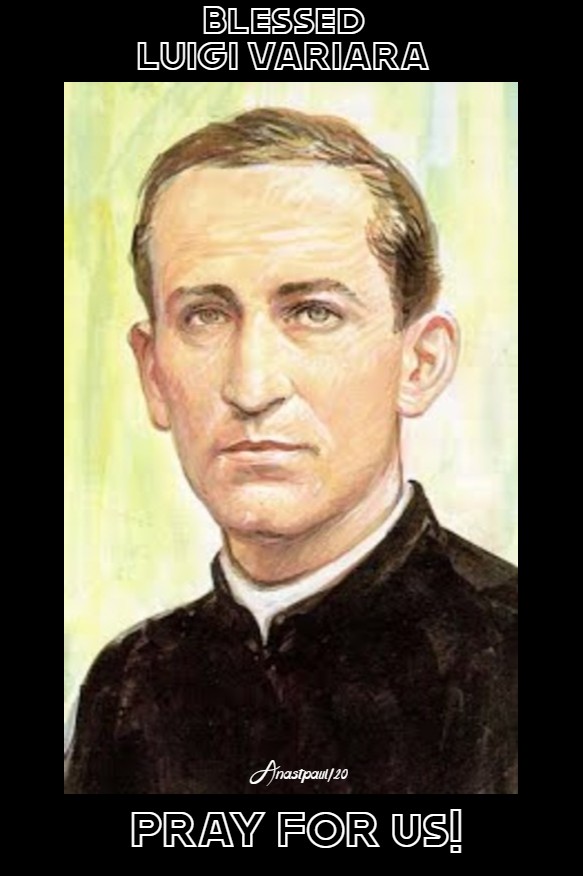
One Minute Reflection – 1 February – Saturday of the Third Week in Ordinary Time, Year A , Readings: 2 Sm 12:1-7A, 10-17, Psalm 51(50),12-13.14-15.16-17, Mk 4:35-41 and the Memorial of Blessed Luigi Variara SDB (1875-1923)
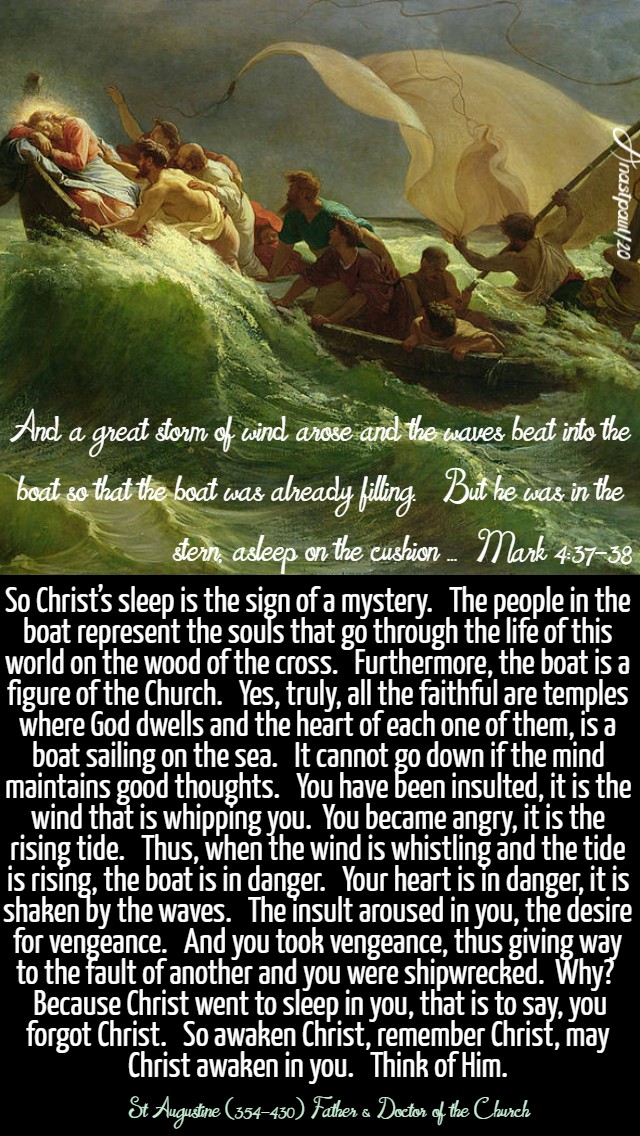
And a great storm of wind arose, and the waves beat into the boat so that the boat was already filling. But he was in the stern, asleep on the cushion … Mark 4:37-38
REFLECTION – “With the Lord’s grace, I am going to talk to you about today’s gospel. With God’s help, I also want to encourage you not to let faith sleep in your hearts in the midst of the storms and swells of this world. Without any doubt, the Lord Jesus Christ exercised His power over sleep, no less than over death and, when He was sailing on the lake, the Almighty could not succumb to sleep, if He did not want to do so. If you think He did not have this power, it is because Christ is asleep in you. If on the contrary, Christ is awake in you, your faith is also awake. The apostle Paul said: “May Christ dwell in your hearts through faith.” (Eph 3:17)
So Christ’s sleep is the sign of a mystery. The people in the boat represent the souls that go through the life of this world on the wood of the cross. Furthermore, the boat is a figure of the Church. Yes, truly, all the faithful are temples where God dwells and the heart of each one of them, is a boat sailing on the sea. It cannot go down if the mind maintains good thoughts. You have been insulted, it is the wind that is whipping you. You became angry, it is the rising tide. Thus, when the wind is whistling and the tide is rising, the boat is in danger. Your heart is in danger, it is shaken by the waves. The insult aroused in you, the desire for vengeance. And you took vengeance, thus giving way to the fault of another and you were shipwrecked. Why? Because Christ went to sleep in you, that is to say, you forgot Christ. So awaken Christ, remember Christ, may Christ awaken in you. Think of Him.” … St Augustine (354-430) Bishop of Hippo and Father & Doctor of the Church – Sermon 63, 1-3
PRAYER – Waken us holy Lord, to Your presence in us, with us, now and forever. Open our eyes to see Your presence and our ears to hear Your voice. Teach us that You are always with us and Your presence is all we need to survive the storms and the winds of this world. For You, just You, are our rock and our foundation, our ship and our harbour. Grant that the prayers of Blessed Luigi Variara and all Your saints may serve to remind us of Your love and power. Through Christ our Lord, with the Holy Spirit, God forever, amen.
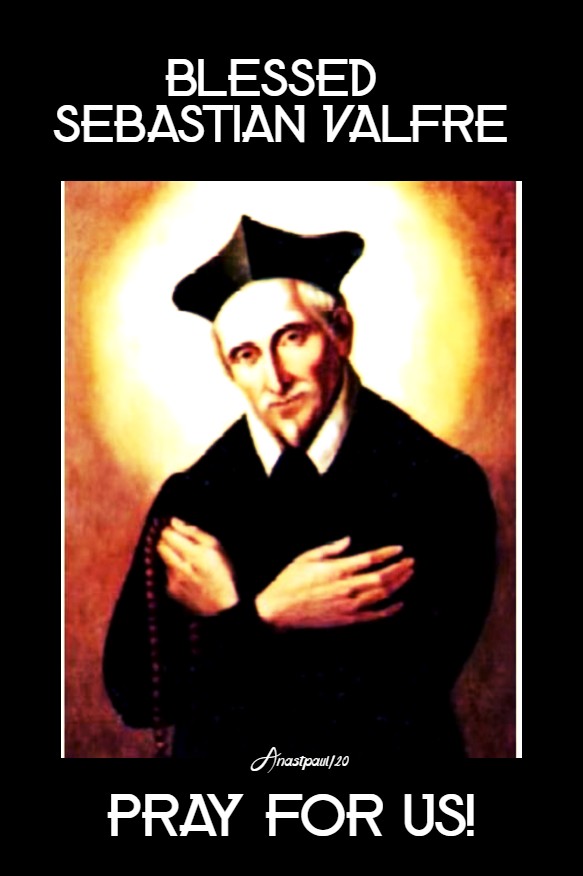
One Minute Reflection – 30 January – Thursday of the Third week in Ordinary Time, Year A, Readings: 2 Samuel 7:18-19, 24-29, Psalm 132:1-5, 11-14, Mark 4:21-25 and the Memorial of Blessed Sebastian Valfrè CO (1629-1710)
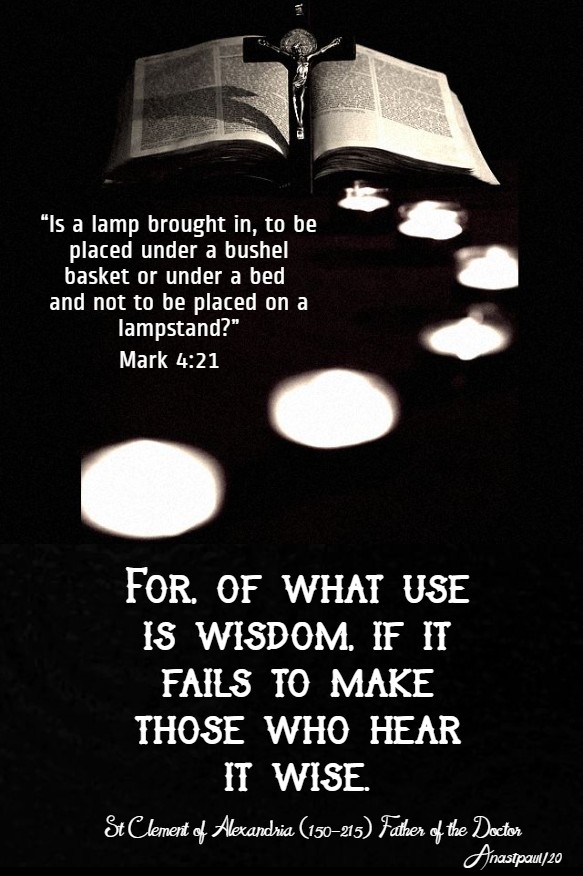
He said to them, “Is a lamp brought in to be placed under a bushel basket or under a bed, and not to be placed on a lampstand?” … Mark 4:21
REFLECTION – “A well, when pumped regularly, produces purer water. If neglected, and no-one uses it, it changes into a source of pollution. Use, keeps metal brighter but disuse produces rust. For, in a word, exercise produces a healthy condition both in souls and bodies. So “No-one lights a candle and puts it under a bowl but upon a candlestick, that it may give light.” For of what use is wisdom, if it fails to make those who hear it wise.” … St Clement of Alexandria (150-215) Father of the Doctor
PRAYER – Lord God, in Your wisdom You created us, by Your providence You rule us, You have planted us, penetrate our inmost being Your holy Light, so that our way of life may always be one of faithful service to You. Grant us the grace and love to walk in Your ways and to radiate Your Light by our lives. May the prayers of all the angels and saints and of Blessed Sebastian Valfrè be unfailing assistance to us. Through Jesus Christ our Lord, with You and the Holy Spirit, one God forever, amen.
One Minute Reflection – 26 January – Third Sunday in Ordinary Time, Year A – Readings: Isaiah 8:1-4 (8, 23–9:3), Psalm 27:1, 4, 13-14, 1 Corinthians 1:10-13, 17, Matthew 4:12-23
“…the people who sat in darkness have seen a great light and for those, who sat in the region and shadow of death, light has dawned.”…Matthew 4:16
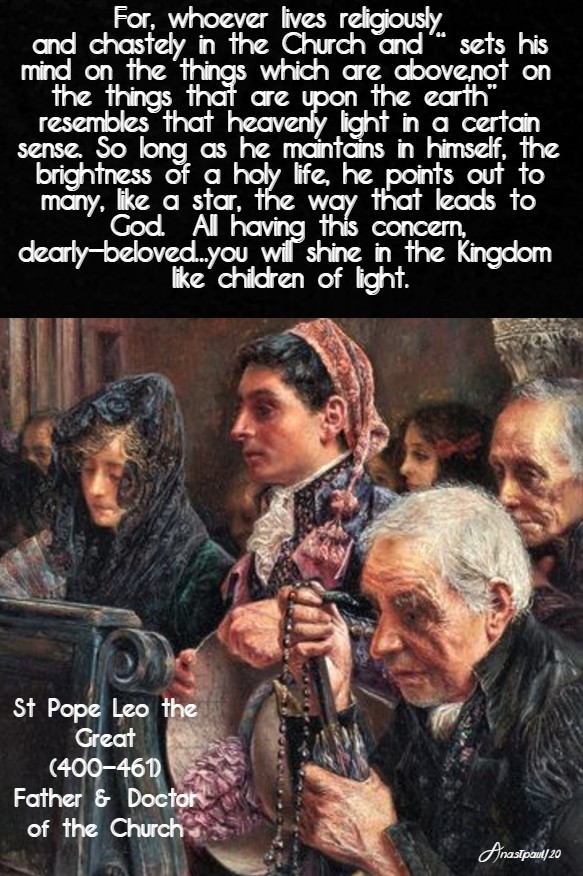
REFLECTION – “All these things we know to have taken place ever since the three wise men, aroused in their far-off land, were led by a star to recognise and worship the King of heaven and earth. The responsiveness of that star exhorts us to imitate it’s obedience and, as much as we can, to make ourselves servants of that grace which invites us all to Christ. For, whoever lives religiously and chastely in the Church and “sets his mind on the things which are above, not on the things that are upon the earth” (Col 3:2) resembles that heavenly light in a certain sense. So long as he maintains in himself, the brightness of a holy life, he points out to many, like a star, the way that leads to God. All having this concern, dearly-beloved… you will shine in the Kingdom like children of light.”…St Pope Leo the Great (400-461) Father & Doctor of the Church
PRAYER – Lord, may the radiance of Your glory, light up our hearts and bring us through the shadows of this world, until we reach our homeland of everlasting light. Grant we pray, that by the intercession of Your holy Mother and ours, our way may be smoothed and our troubles eased. We ask this through Jesus, our Lord, with the Holy Spirit, God forever, amen.
One Minute Reflection – 22 January – Wednesday of the Second week in Ordinary Time, Year A, Readings: 1 Samuel 17:32-33, 37, 40-51, Psalm 144:1-2, 9-10, Mark 3:1-6 and the Memorial of Blessed William Joseph Chaminade SM (1761-1850), Founder of the Marianists
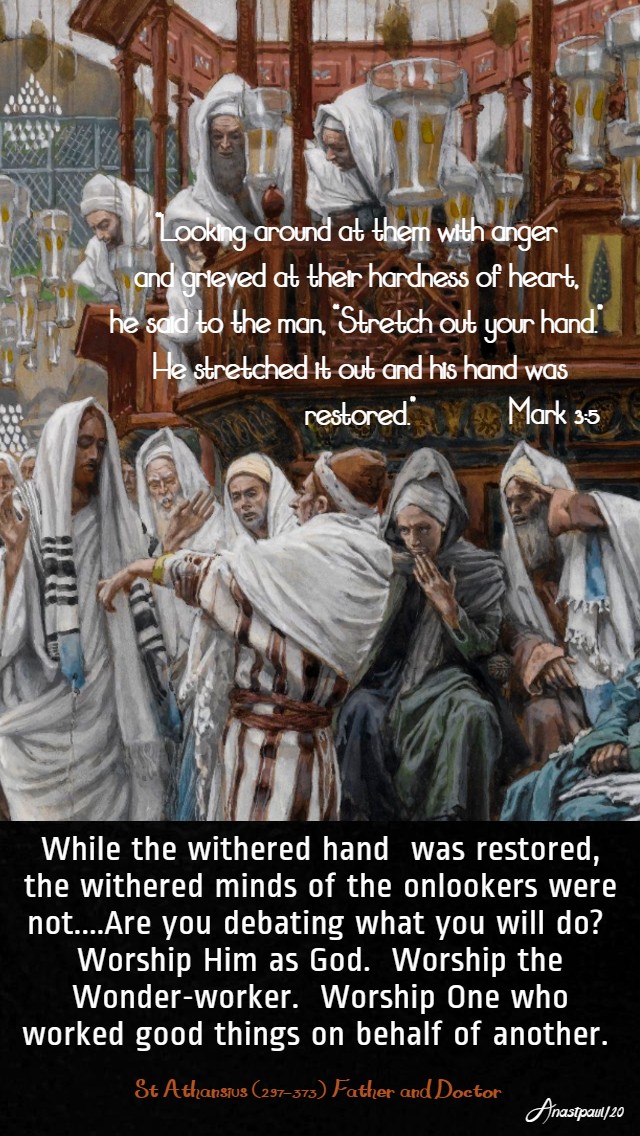
“Looking around at them with anger and grieved at their hardness of heart, he said to the man, “Stretch out your hand.” He stretched it out and his hand was restored.” … Mark 3:5
REFLECTION – “But Jesus, deeply grieved in heart at the hardness of their hearts, said in effect: “Let the ones who see continue to see. Let the ones who refuse to hear, do what they want to do. Let the ones who are hard in heart become stone. But let your right hand become full and tender. Rise, beg no longer.”
In effect Jesus was saying: “Do not continue to beg because of having a withered hand but after you finally have received it healthy and whole and have begun to work, stretch out your hand to the poor. Rise up and stand in their midst. Become a marvel to those who see. In you the struggle concerning the sabbath is finally being contested. Stand in their midst, so that the ones who are lame in their legs might stand . Stretch out your hand. I am not touching you so that they may not bring a charge against me. I am speaking with a speech so that they may not think that touching is an act of work. God did not say, ‘Do not speak on the sabbath.’ But if speech becomes an act of work, let the one who has spoken be an object of amazement. Stretch out your hand.”
While the withered hand was restored, the withered minds of the onlookers were not. For they went out and immediately, according to the reading, were debating what they would do to Jesus.
Are you debating what you will do? Worship Him as God. Worship the Wonder-worker. Worship One who worked good things on behalf of another. He did not add plasters, He was not tenderising with lotions. He did not apply medical ointments. He did this work openly, standing in their midst and not in a hidden way, so that some might retort: “He applied a plant, He added a plaster.”… St Athansius Bishop of Alexandria (297-373) Father and Doctor of the Church – Homilies, 28
PRAYER – Shed Your clear light on our hearts, Lord, keep us in Your Way, that we too may stretch out our hands and love to those who come our way. May Your law be our light and Your love our only way. Hear the prayers of Blessed William Joseph Chaminade and lead us to eternal life. We make our prayer through Christ, our Lord with the Holy Spirit, God now and forever, amen.
Thought for the Day – 21 January – Meditations with Antonio Cardinal Bacci (1881-1971)
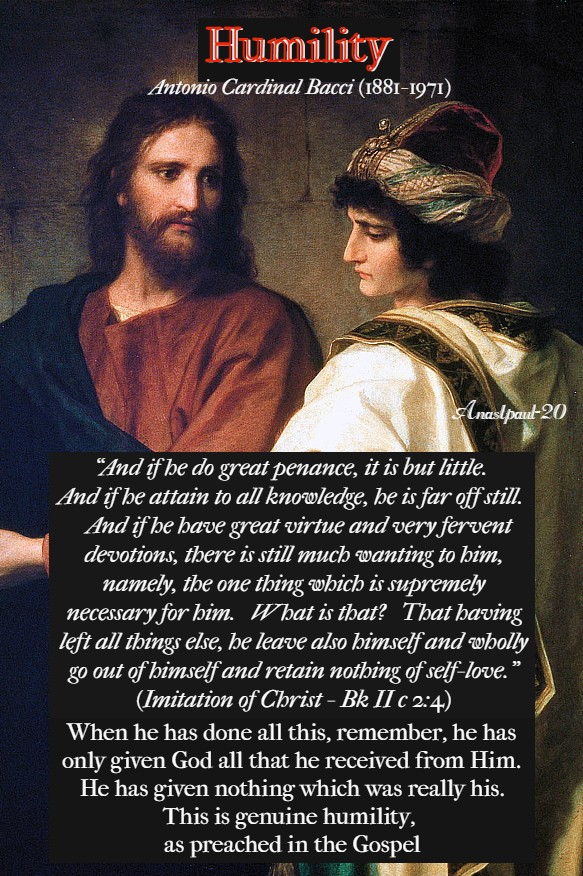
Humility
“Humility is the most difficult of all the virtues, because it requires us to deny ourselves. Jesus warns us, that anyone who wishes to follow Him, must deny himself. “If anyone wishes to come after me, let him deny himself” (Mt 16:24).
Humility is necessary if we wish to go straight to Jesus, Who was the first to humble Himself by becoming obedient unto death, even to the death of the Cross (Phil 2:8). The Imitation of Christ contains some profound remarks upon this subject. “Seldom do we find anyone so spiritual as to be stripped of all things… If a man gives his whole substance, still it is nothing. And if he do great penance, it is but little. And if he attain to all knowledge, he is far off still. And if he have great virtue and very fervent devotions, there is still much wanting to him, namely, the one thing which is supremely necessary for him. What is that? That having left all things else, he leave also himself and wholly go out of himself and retain nothing of self-love.” (Bk II c 2:4).
When he has done all this, remember, he has only given God all that he received from Him. He has given nothing which was really his. He has only fulfilled an obligation of restitution. When he has arrived at this stage of humility, therefore, he should repeat the words of Jesus. “When you have done everything that was commanded you, say, ‘We are unprofitable servants, we have done what it was our duty to do'” (Lk 17:10).
This is genuine humility, as preached in the Gospel.”
One Minute Reflection – 21 January – Tuesday of the Second week in Ordinary Time, Year A, Readings: 1 Samuel 16:1-13, Psalm 89:20-22, 27-28, Mark 2:23-28 and the Memorial of St Agnes (c 291- c 304) – Virgin Martyr
“…so the Son of man is lord even of the sabbath.”...Mark 2:28
REFLECTION – “From the first, the law of the Sabbath conferred many and great benefits, for instance, it made the Jews gentle and humane towards those of their own household, it taught them God the Creator’s providence and wisdom… hence God gave the law for the Sabbath He said… that He would have them refrain from evil works only when he said: “You must do no work, except for what is necessary for life” (Ex 12:16 LXX).
And in the temple, too, everything continued with more diligence than ever. Thus even by means of the very shadow, He was secretly opening the full light of truth (cf. Col 2:17).
Did Christ then do away with so highly profitable a thing? Far from it, He greatly enhanced it. For it was unnecessary… that we should learn from it, that God made all things or that we should be made kind by it, who are called to imitate God’s own love. For He says: “Be merciful, as your heavenly Father is merciful”(Lk 6:36). It was no longer necessary to fix a day of festival for those who are commanded to keep a feast all their life long. For: “Let us keep the feast,” Saint Paul writes, “not with old leaven, neither with leaven of malice and wickedness but with the unleavened bread of sincerity and truth” (1Cor 5:8)…
So now, why is any sabbath required for Christians who are always keeping the feast and whose conversation is in heaven? Yes, my brethren, let us celebrate that continual, heavenly sabbath.”…St John Chrysostom (c 345-407) Father & Doctor
PRAYER – Almighty, ever-living God, You choose what is weak in the world to shame what is strong. Grant that, as we celebrate the martyrdom of St Agnes, we may follow her example of steadfastness and trust in faith. We pray that through her intercession, we may grow in holiness. Through our Lord Jesus Christ, with the Holy Spirit, one God forever, amen.
Quote of the Day – 21 January – Monday of the Second week in Ordinary Time, Year A – Readings: 1 Samuel 15:16-23, Psalm 50:8-9, 16-17, 21, 23, Mark 2:18-22
“And so, dearly beloved brethren, let us each examine his conscience and when he sees that he has been wounded by some sin, let him first strive to cleanse his conscience by prayer, fasting, almsgiving and so dare to approach the Eucharist. If he recognises his guilt and is reluctant to approach the holy altar, he will be quickly pardoned by the Divine Mercy, “for whoever exalts himself will be humbled and whoever humbles himself will be exalted” (Mt 23:12). If then, as I have said, a man conscious of his sins, humbly decides to stay away from the altar until he reforms his life, he will not be afraid of being completely excluded from the eternal banquet of heaven.”
St Caesarius of Arles (470-542)
Bishop of Arles
Father of the Church
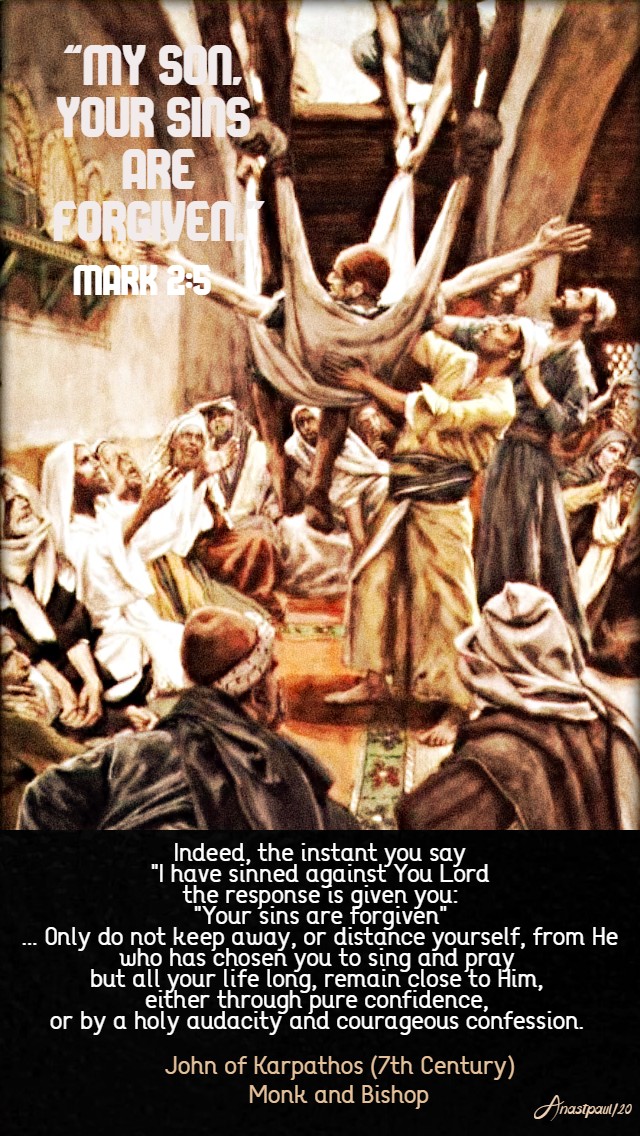
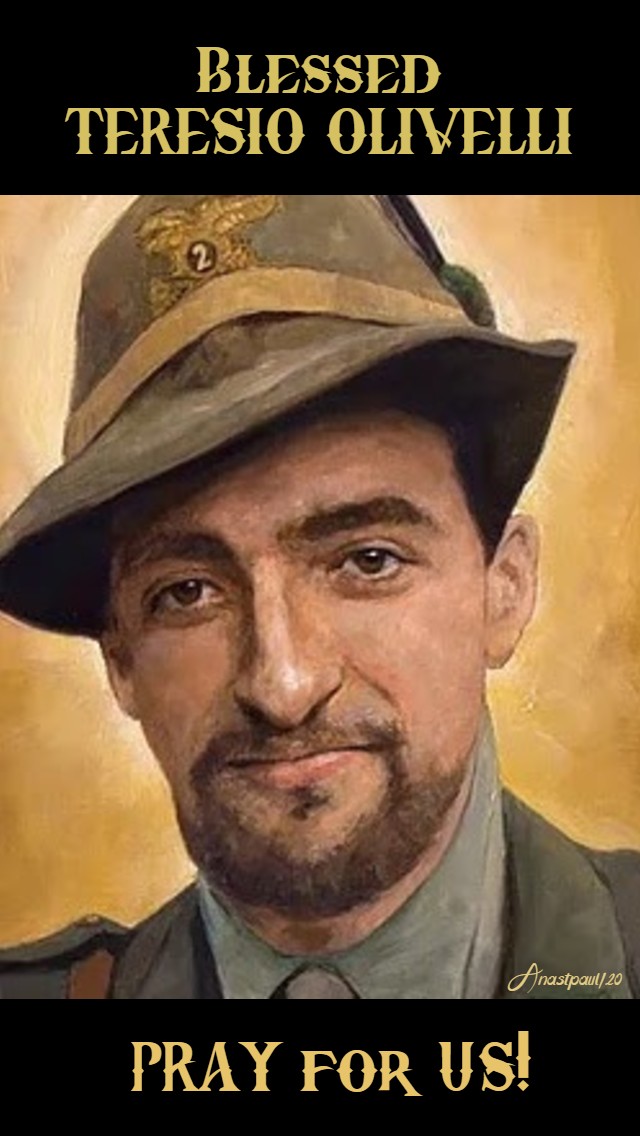
One Minute Reflection – 17 January – Friday of the First week in Ordinary Time, Year A – Readings: 1 Samuel 8:4-7, 10-22, Psalm 89:16-19, Mark 2:1-12 and the Memorial of Blessed Teresio Olivelli (1916–1945) Martyr “Rebel for Love”
“My son, your sins are forgiven.” … Mark 2:5
REFLECTION – “Why are you downcast? See. Someone’s hands are fishy; a little oil makes them clean. How much more can God’s compassion purify you. For just as you have no difficulty in washing your garment, in the same way – and even more – it is not difficult for the Lord to wash you clean from all reproach, even if each day you naturally have to experience temptation. Indeed, the instant you say: “I have sinned against the Lord”, the response is given you: “Your sins are forgiven” (Mt 9:2). “It is I who wipe out and remember no more” (Is 43:25 LXX). As far as the east is from the west, so far has He removed your sins. As a father has compassion on his children, I have had compassion on you” (Ps 102[103], 12-13 LXX).
Only do not keep away, or distance yourself, from He who has chosen you to sing and pray but all your life long, remain close to Him, either through pure confidence, or by a holy audacity and courageous confession. Then He will hear and purify you. Is He not God who has justified us in His love for human souls? Who will condemn us? (cf. Rm 8:33). If we invoke the name of our Lord Jesus Christ, our conscience is easily purified and nothing separates us from the prophets and other saints.
For God has not destined us for wrath but to gain salvation through our Lord Jesus Christ who died for us. So, whether we are awake in virtue, or asleep in some kind of woe, or are bearing certain circumstances according to nature, we will live with Christ (1 Thes 5:9-10), turning our eyes towards Him, sighing deeply, weeping constantly and only breathing Him. Let us then put on the breastplate of faith and wear the helmet of salvation (cf. 1 Thes 5:8) that the arrows of discouragement and despair may not penetrate us.” … John of Karpathos (7th Century) Monk and Bishop – Texts for the monks in India (The Philokalia)
PRAYER – Lord God, You hold out the light of Your Word to those who do not know You. Strengthen in our hearts, the faith You have given us, so that no trials may quench the fire Your Spirit has kindled within us. Grant us the grace of approaching You in sorrow and repentance, so that we may hear Your Word, “your sins are forgiven you, go and sin no more.” May the prayers of Blessed Teresio Olivelli, grants us eyes to see and ears to hear and strength to approach You. Through Christ, our Lord, with the Holy Spirit, God now and forever, amen.
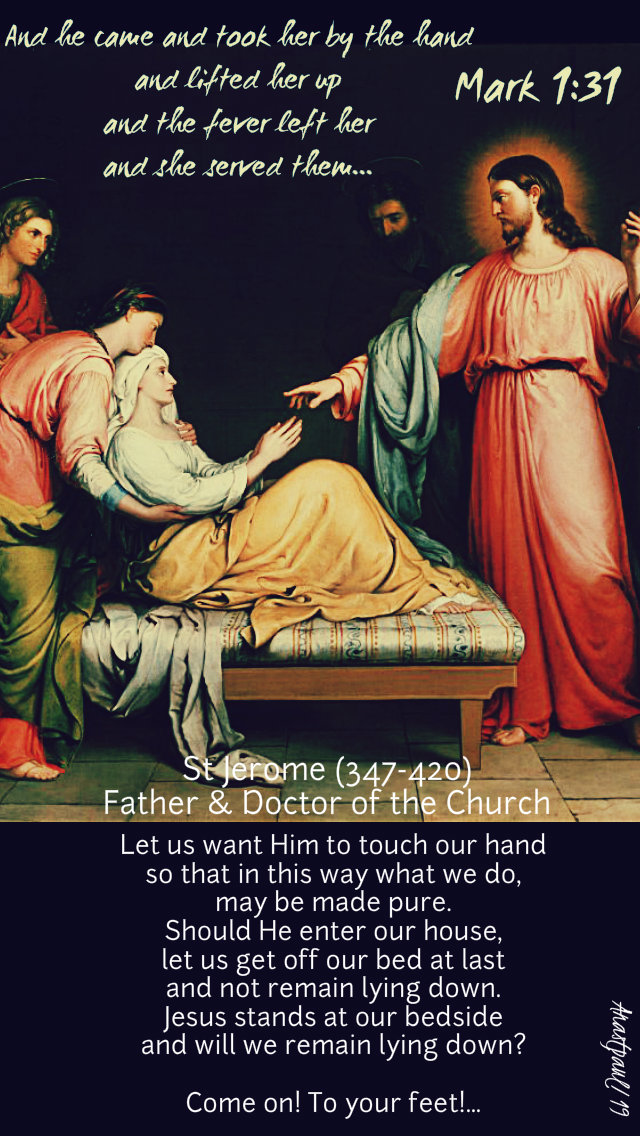
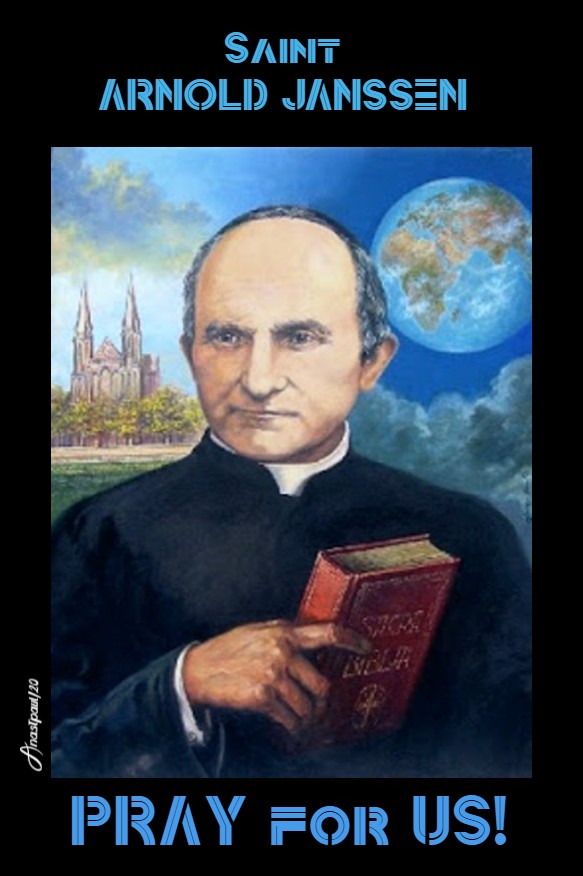
One Minute Reflection – 15 January – Wednesday of the First week in Ordinary Time, Year A – Readings: 1 Samuel 3:1-10, 19-20, Psalm 40:2, 5, 7-10, Mark 1:29-39 and the Memorial of St Arnold Janssen SVD (1837-1909)
And he came and took her by the hand and lifted her up and the fever left her and she served them...Mark 1:31
REFLECTION – “And he helped her up.” As she couldn’t stand up by herself, it was the Lord who helped her. “He grasped her hand and helped her up.” When Peter was in danger on the sea, just as he was going to drown, he too was grasped by the hand and raised up… What a beautiful sign of friendship and love towards this sick woman! He helped her up by taking her hand, His hand healed the sick woman’s hand. He grasped that hand as a doctor would have done, He, who is both doctor and remedy, took her pulse and assessed the gravity of the fever. Jesus touched it and the fever vanished.
Let us want Him to touch our hand so that in this way what we do may be made pure. Should He enter our house, let us get off our bed at last and not remain lying down. Jesus stands at our bedside and will we remain lying down? Come on! To your feet!… “There is one among you whom you do not recognise” (Jn 1:26), “the kingdom of God is among you” (Lk 17:21). Let us have faith and we shall see Jesus among us.”…St Jerome (347-420) Father & Doctor of the Church
PRAYER – God our Saviour, through the grace of Baptism, You made us children of light. You lead us by the hand and guide and protect us by Your commandments. Fill us with joy at Your nearness and the light of Your Son, by whose beam we see You and follow. St Arnold Janssen was a shining example to us all, grant, we pray, that his prayers may aid us. Through Jesus our Lord and Christ, with the Holy Spirit, God forever, amen.
Quote/s of the Day – 13 January – Monday of the First week in Ordinary Time, Year A and the Memorial of St Hilary of Poitiers (315-368) Father and Doctor of the Church
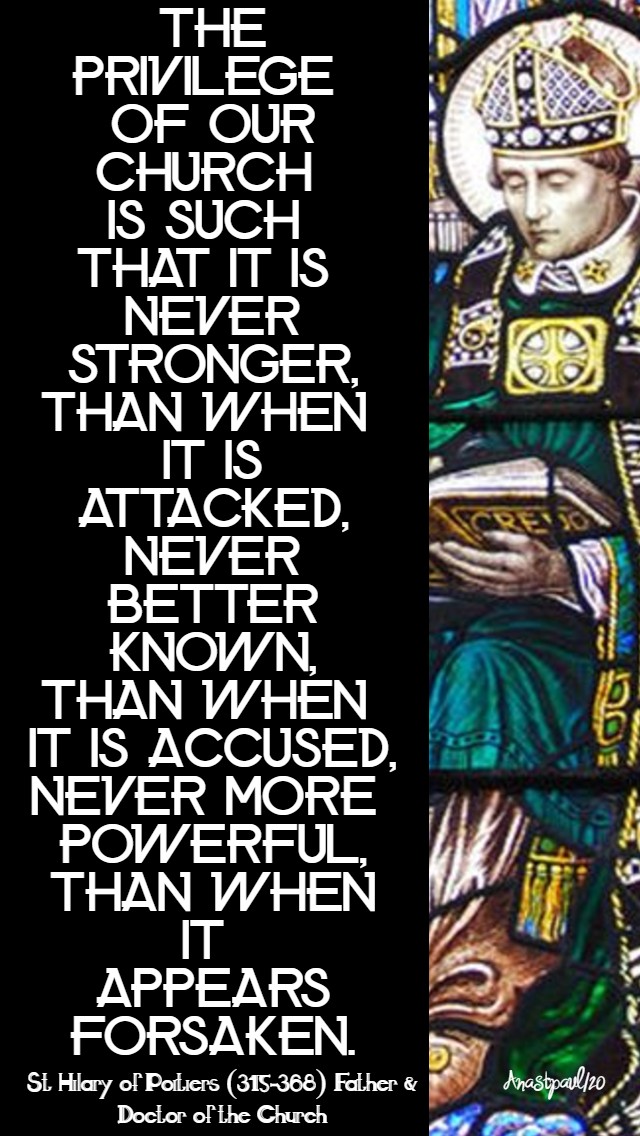
“The privilege of our Church is such that it is never stronger, than when it is attacked, never better known, than when it is accused, never more powerful, than when it appears forsaken.”
(Treatise on the Trinity)
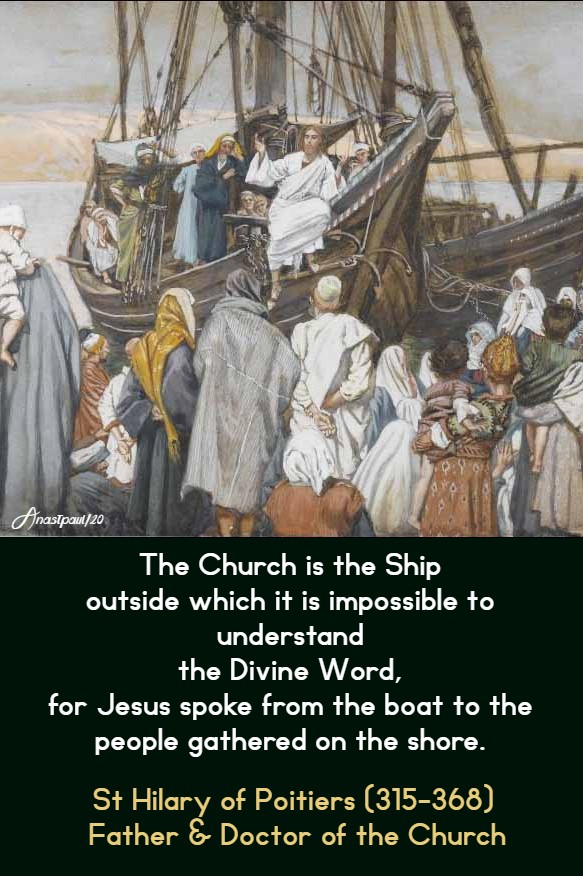
“The Church is the Ship outside which it is impossible to understand the Divine Word, for Jesus spoke from the boat to the people gathered on the shore.”
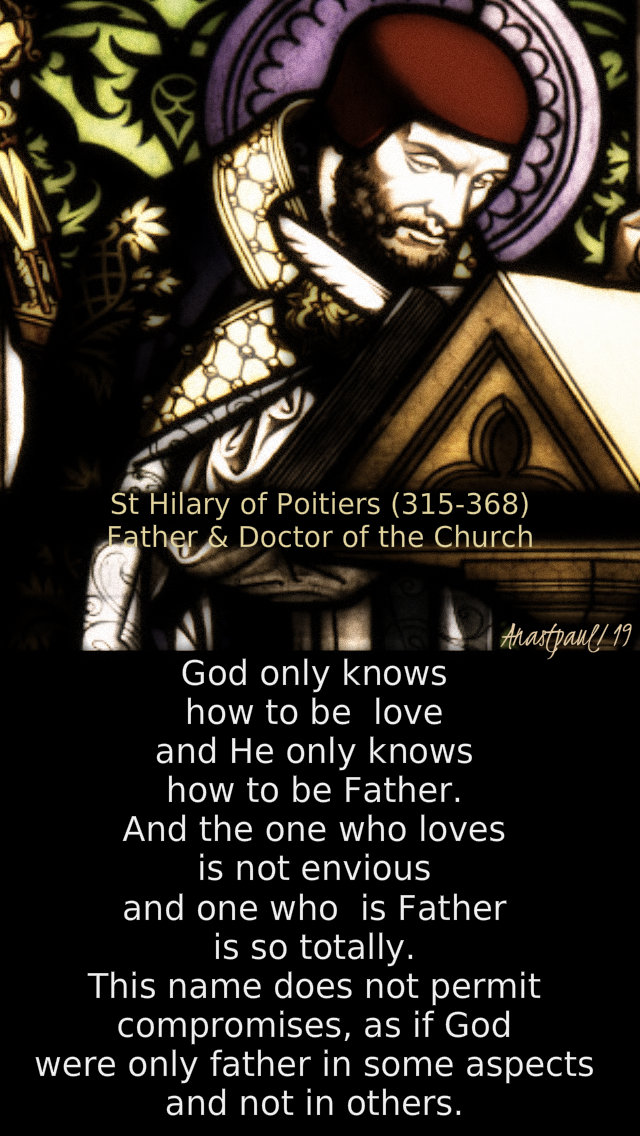
“God only knows, how to be love and He only knows, how to be Father. And the one who loves is not envious and one who is Father is so totally. This name does not permit compromises, as if God were only father in some aspects and not in others.”
St Hilary of Poitiers
(315-368)
Father & Doctor of the Church
Quote/s of the Day – 12 January – Feast of the Baptism of the Lord
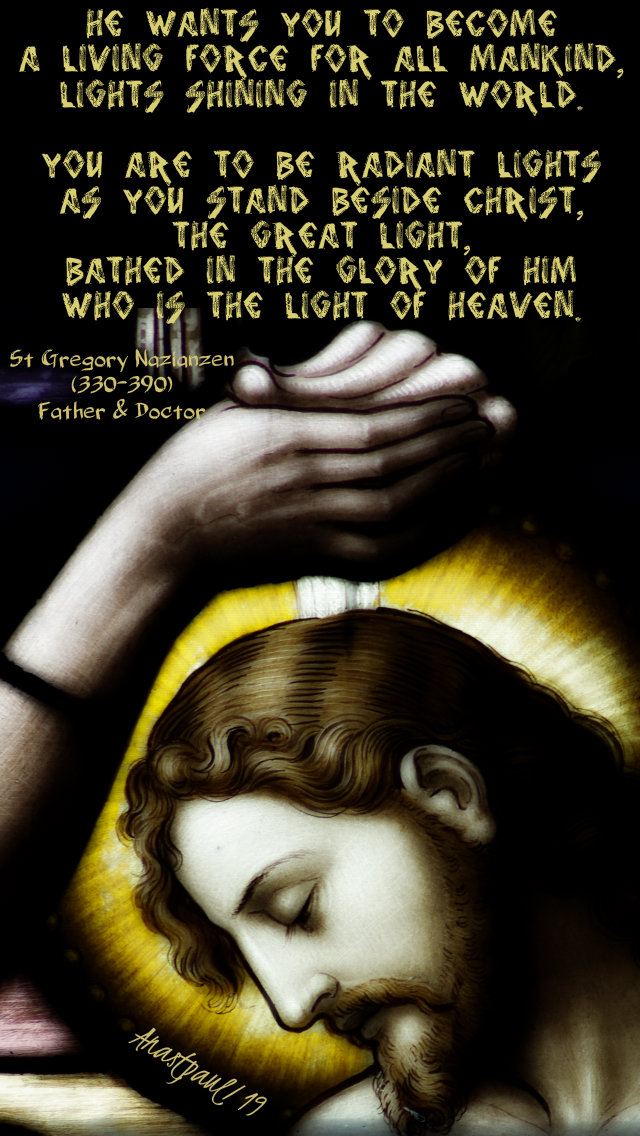
“He wants you to become a living force for all mankind, lights shining in the world.
You are to be radiant lights as you stand beside Christ, the great light, bathed in the glory of Him who is the light of heaven.”
St Gregory Nazianzen (330-390)
Father & Doctor of the Church
(An excerpt from Oration 39 – On Holy Light)
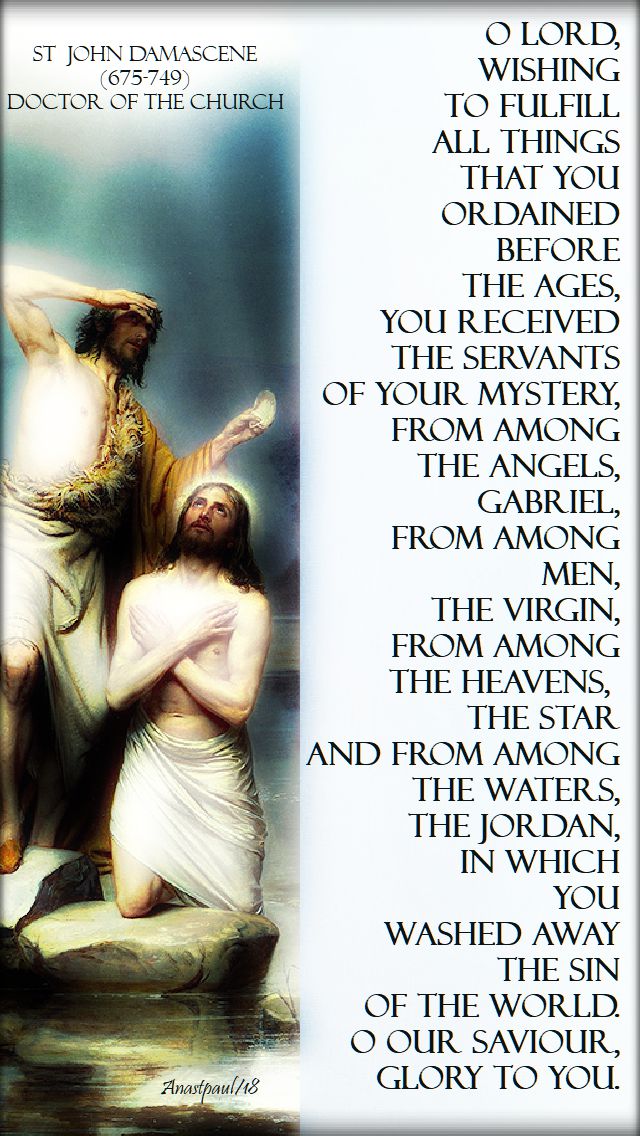
“O Lord, wishing to fulfil all things that You ordained before the ages, You received the servants of Your mystery, from among the Angels, Gabriel, from among Men, the Virgin, from among the Heavens, the Star and from among the Waters, the Jordan, in which You washed away the sin of the world, O our Saviour, glory to You.”
St John Damascene (675-749)
Father & Doctor of the Church
Sunday Reflection – 12 January – Feast of the Baptism of the Lord
“When you see (the Most Blessed Sacrament) exposed, say to yourself –
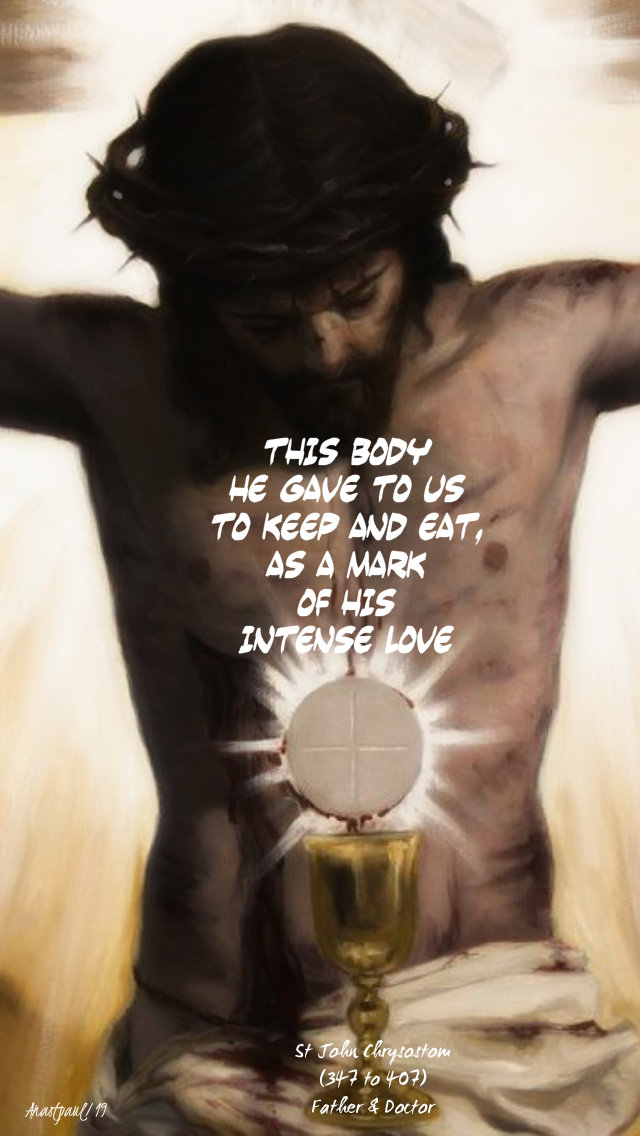
‘Thanks to this Body, I am no longer dust and ashes, I am no more a captive but a freeman, hence, I hope to obtain heaven and the good things that are there in store for me… eternal life, the heritage of the angels, companionship with Christ; death has not destroyed this Body which was pierced by nails and scourged . . . this is that Body which was once covered with blood, pierced by a lance, from which issued saving fountains upon the world, one of blood and the other of water. . . This Body He gave to us to keep and eat, as a mark of His intense love’.”
Our Morning Offering – 12 January – Feast of the Baptism of the Lord
Prayer after Holy Communion By St John Damascene (675-749) Father and Doctor of the Church
God, my God,
unextinguishable and invisible fire,
You make Your angels flaming fire.
Out of Your inexpressible love,
You have given me
Your divine Flesh as food
and through this communion
of Your immaculate Body
and precious Blood,
You receive me
as a partaker of Your divinity.
Permeate all my body and soul,
all my bones and sinews.
Consume my sins in fire.
Enlighten my soul
and illumine my mind.
Sanctify my body
and make Your abode in me,
together with Your Blessed Father
and All-Holy Spirit,
that I may always abide in You,
through the intercession
of Your immaculate Mother
and all Your saints.
Amen
This feast marks the ending of the Christmas season. Traditionally, the event of Christ’s Baptism was linked with the visit of the Magi and the wedding feast of Cana as two additional “manifestations” of God with us.
Matthew’s simple account of the Baptism ends with the heavenly voice introducing “my beloved Son.” Here, at the end of our focus on the mystery of Christmas, we are invited to welcome the Beloved One into our midst once more and to prepare ourselves through the Sundays which follow to hear His proclamation of Good News.
Many have expressed the wish that the spirit of Christmas last all through the year. Christians take that responsibility seriously – We want to make the meaning of Christmas—the fact that God has come to dwell with us in Jesus Christ — the central fact of life. And, we want all we say and do to help express, to make manifest, that basic truth. Merry Christmas, one more time!
The Baptism of Christ
A sermon by St Gregory Nazianzen (330-390)
Father and Doctor of the Church
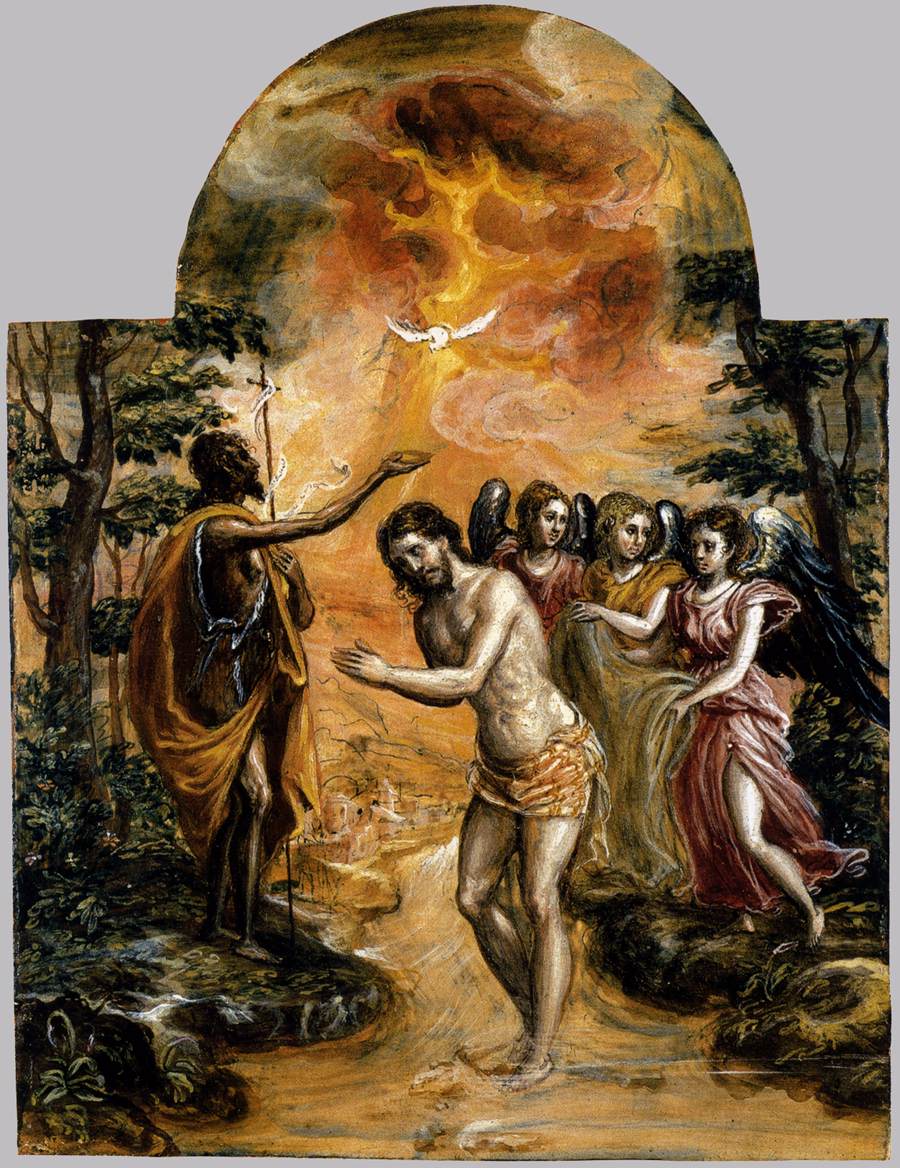
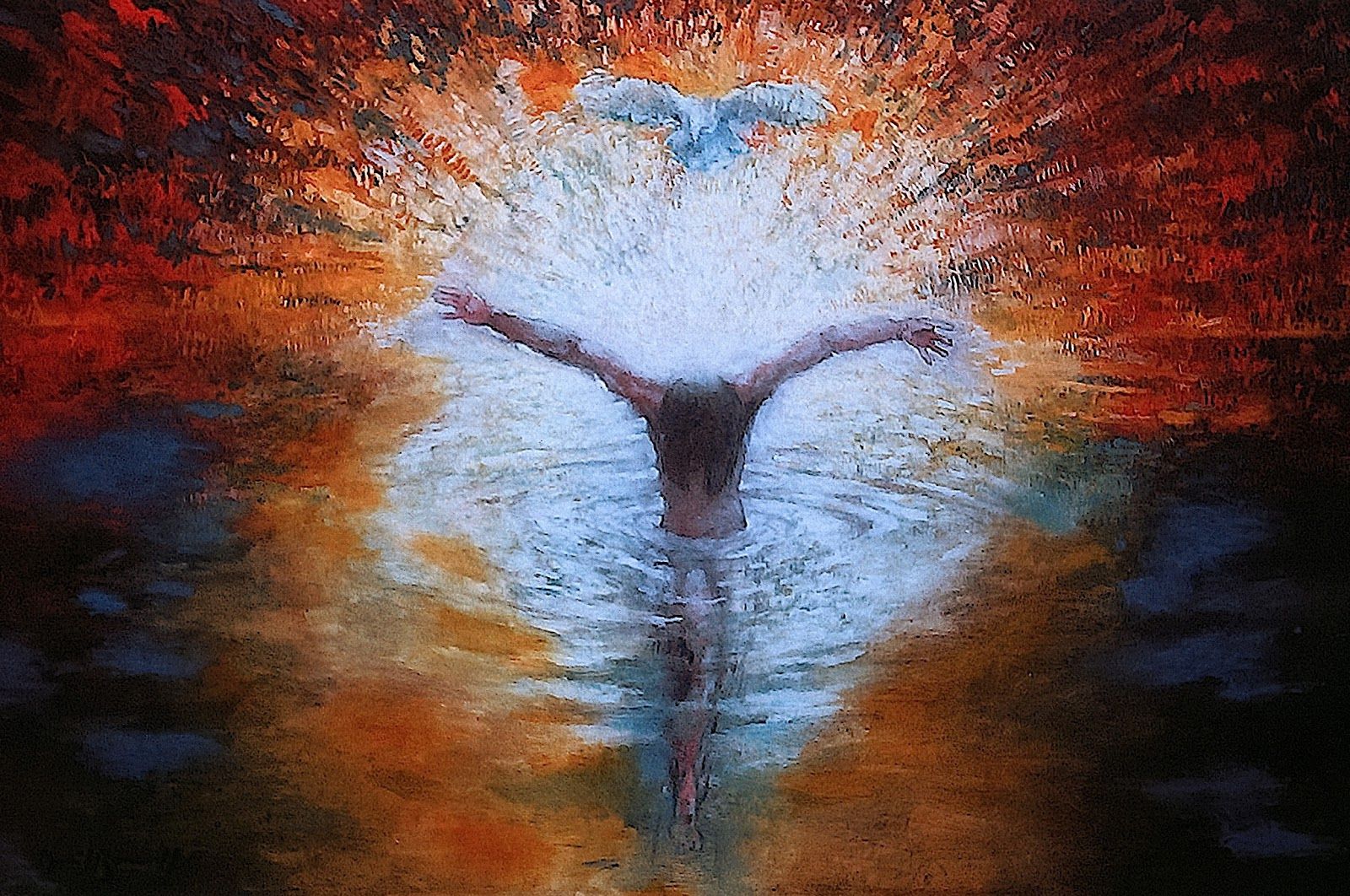
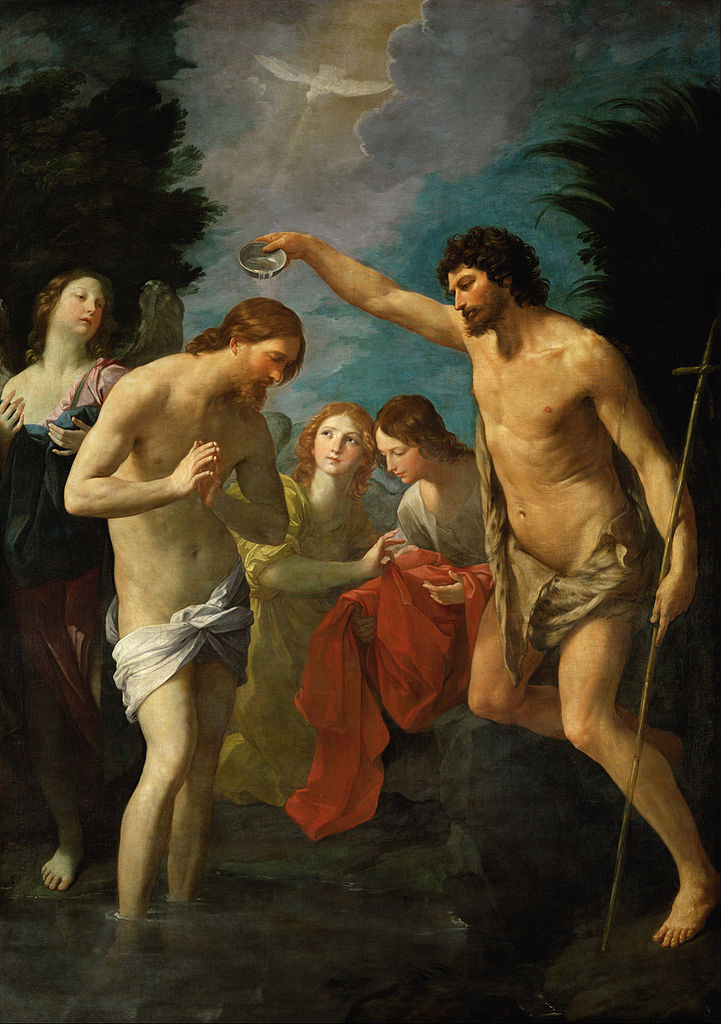
Christ is bathed in light, let us also be bathed in light. Christ is baptised, let us also go down with Him and rise with Him.
John is baptising when Jesus draws near. Perhaps He comes to sanctify His baptiser, certainly He comes to bury sinful humanity in the waters. He comes to sanctify the Jordan for our sake and in readiness for us, He who is spirit and flesh comes to begin a new creation through the Spirit and water.
The Baptist protests – Jesus insists. Then John says: I ought to be baptised by You. He is the lamp in the presence of the sun, the voice in the presence of the Word, the friend in the presence of the Bridegroom, the greatest of all born of woman in the presence of the firstborn of all creation, the one who leapt in his mother’s womb in the presence of Him who was adored in the womb, the forerunner and future forerunner in the presence of Him who has already come and is to come again. I ought to be baptised by you – we should also add, “and for you,” for John is to be baptised in blood, washed clean like Peter, not only by the washing of his feet.
Jesus rises from the waters – the world rises with Him. The heavens, like Paradise with its flaming sword, closed by Adam for himself and his descendants, are rent open. The Spirit comes to Him as to an equal, bearing witness to His Godhead. A voice bears witness to Him from heaven, His place of origin. The Spirit descends in bodily form like the dove that so long ago announced the ending of the flood and so gives honour to the body that is One with God.
Today, let us do honour to Christ’s Baptism and celebrate this feast in holiness. Be cleansed entirely and continue to be cleansed. Nothing, gives such pleasure to God, as the conversion and salvation of men, for whom His every word and every revelation exist. He wants you to become a living force for all mankind, lights shining in the world. You are to be radiant lights as you stand beside Christ, the great light, bathed in the glory of Him who is the light of heaven. You are to enjoy, more and more, the pure and dazzling light of the Trinity, as now you have received – though not in its fullness – a ray of its splendour, proceeding from the one God, in Christ Jesus our Lord, to whom be glory and power for ever and ever. Amen.
Quote/s of the Day – 11 January – Saturday after Epiphany, Readings: 1 John 5:14-21, Psalm 149:1-6, 9, John 3:22-30
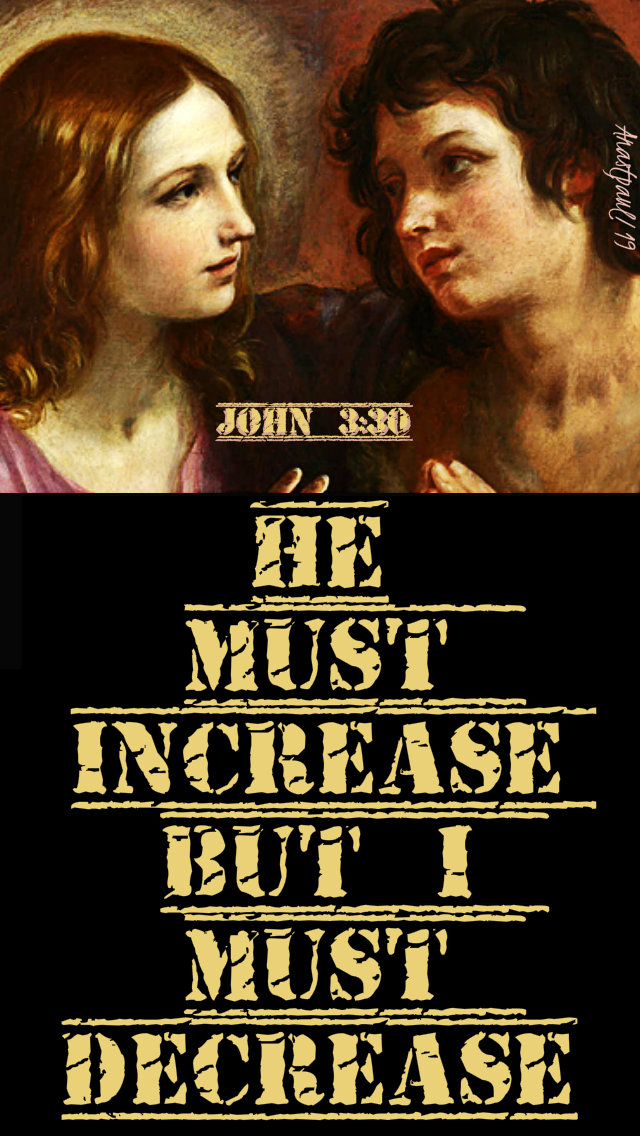
“He must increase but I must decrease.”
John 3:30
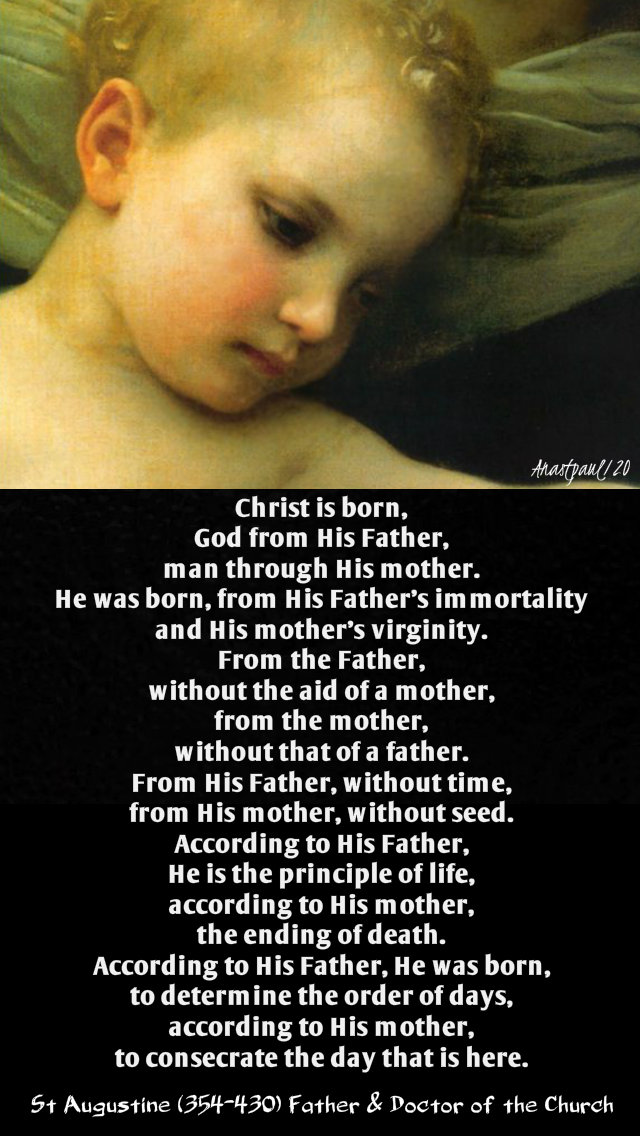
“Christ is born, God from His Father, man through His mother. He was born from His Father’s immortality and His mother’s virginity. From the Father, without the aid of a mother, from the mother, without that of a father. From His Father, without time, from His mother, without seed. According to His Father, He is the principle of life, according to His mother, the ending of death. According to His Father, He was born to determine the order of days, according to His mother, to consecrate the day that is here.”
St Augustine (354-430)
Father & Doctor of the Church
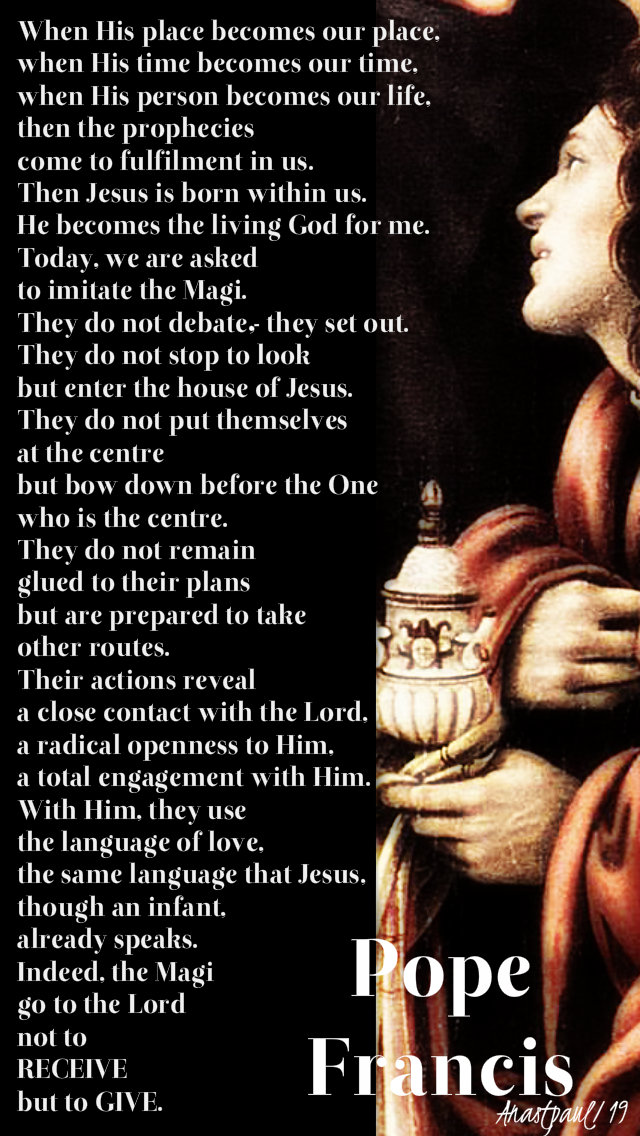
“When His place becomes our place, when His time becomes our time, when His person becomes our life, then the prophecies come to fulfilment in us. Then Jesus is born within us. He becomes the living God for me. Today we are asked to imitate the Magi. They do not debate – they set out. They do not stop to look but enter the house of Jesus. They do not put themselves at the centre but bow down before the One who is the centre. They do not remain glued to their plans but are prepared to take other routes. Their actions reveal a close contact with the Lord, a radical openness to Him, a total engagement with Him. With Him, they use the language of love, the same language that Jesus, though an infant, already speaks. Indeed, the Magi go to the Lord not to receive but to give.
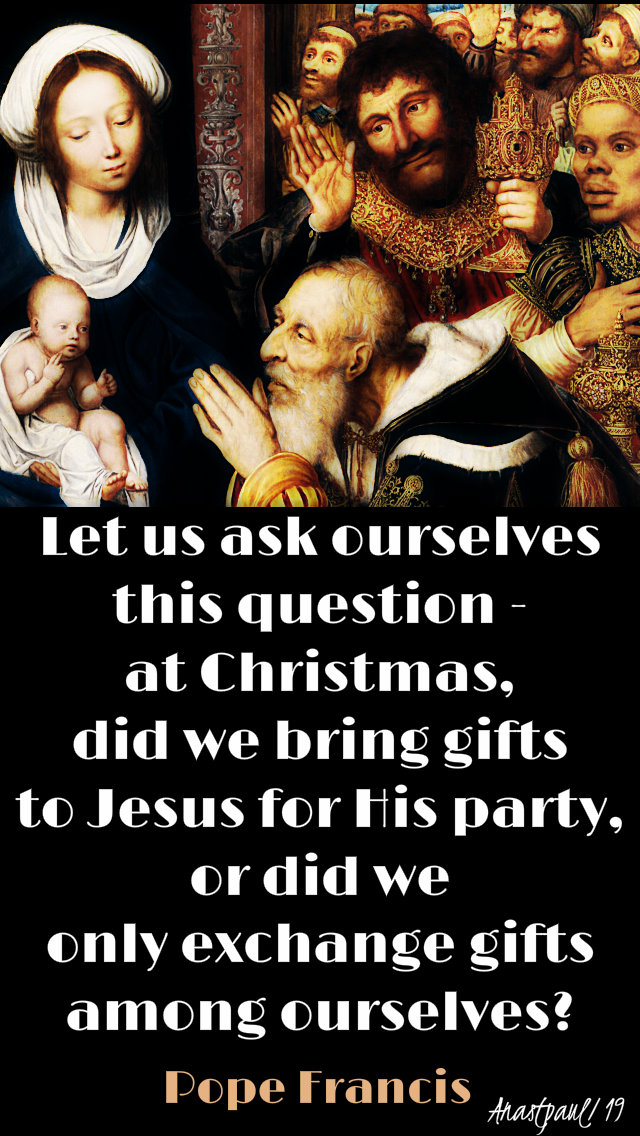
Let us ask ourselves this question – at Christmas, did we bring gifts to Jesus for His party, or did we only exchange gifts among ourselves?
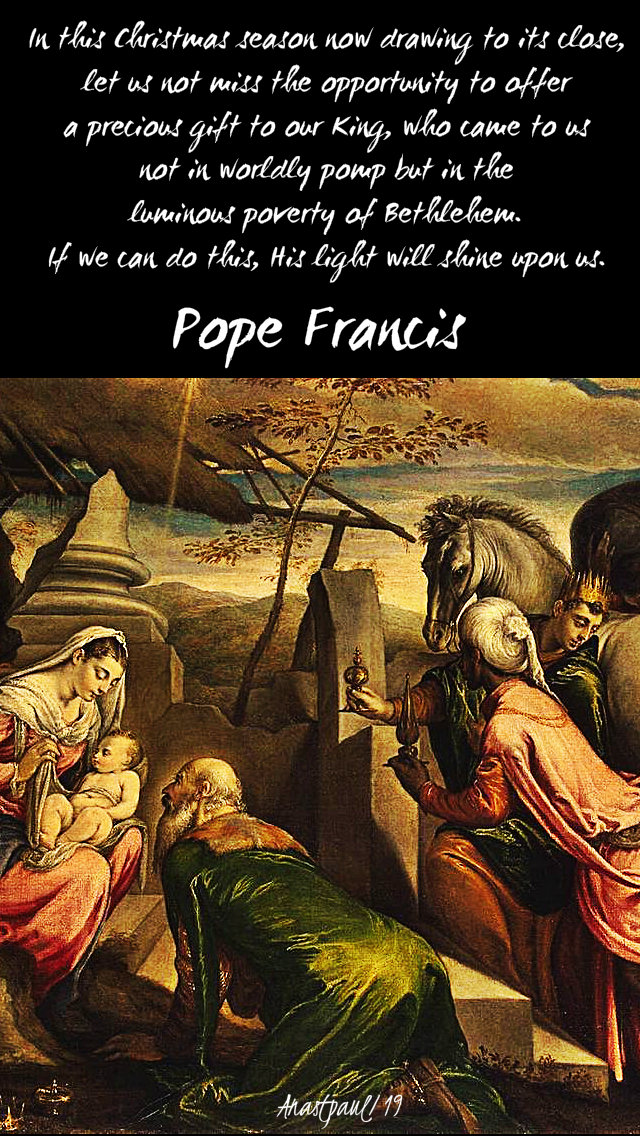
In this Christmas season, now drawing to its close, let us not miss the opportunity to offer a precious gift to our King, who came to us, not in worldly pomp but in the luminous poverty of Bethlehem. If we can do this, His light will shine upon us.”
Our Morning Offering – 10 January – Fifth Day after Epiphany
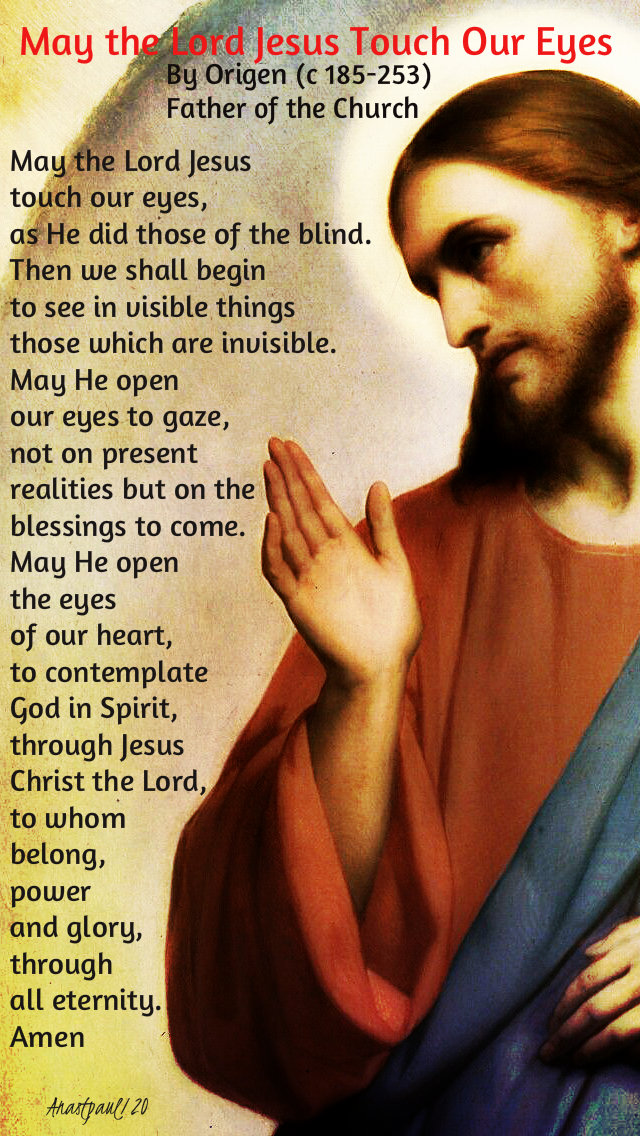
May the Lord Jesus Touch Our Eyes By Origen (c 185-253) Father of the Church
May the Lord Jesus touch our eyes,
as He did those of the blind.
Then we shall begin to see in visible things
those which are invisible.
May He open our eyes to gaze,
not on present realities
but on the blessings to come.
May He open the eyes of our heart,
to contemplate God in Spirit,
through Jesus Christ the Lord,
to whom belong,
power and glory,
through all eternity.
Amen
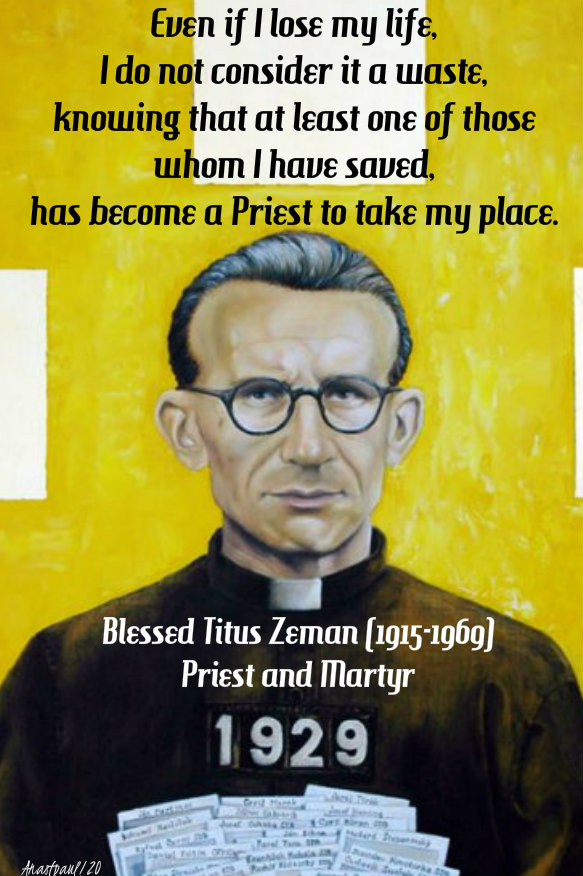
Quote/s of the Day – 8 January – Third day after Epiphany, Readings: 1 John 4:11-18, Psalm 72:1-2, 10-13, Mark 6:45-52 and the Memorial of Blessed Titus Zeman SDB (1915-1969) Priest and Martyr
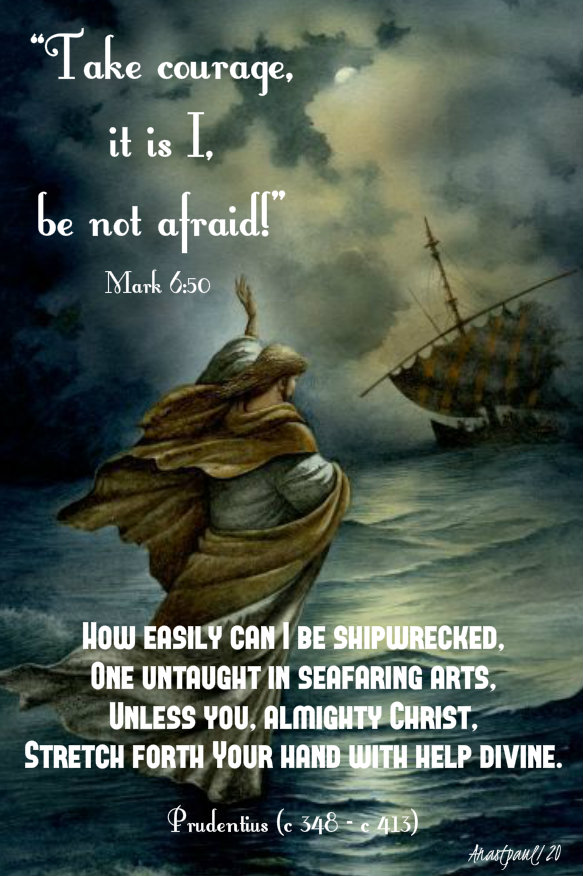
“They had all seen him and were terrified. But at once he spoke with them, “Take courage, it is I, be not afraid!” (Mark 6:50)
Prudentius (c 348 – c 413) (formally known as Aurelius Clemens Prudentius) comments on this verse from the Gospel proclaimed during today’s Mass:
Thus I by my loquacious tongue From the heaven of silence am led Into perils unknown and dark.
Not as Peter, disciple true, Confident in his virtue and faith, I am as one whose unnumbered sins Have shipwrecked on the rolling seas.
How easily can I be shipwrecked, One untaught in seafaring arts, Unless you, almighty Christ, Stretch forth Your hand with help divine.
(Against Symmachus, 2)
Aurelius Prudentius Clemens was a Roman Christian poet, born in the Roman province of Tarraconensis (now Northern Spain) in 348. He probably died in the Iberian Peninsula some time after 405, possibly around 413. Prudentius practised law with some success and was twice provincial governor, perhaps in his native country. Towards the end of his life (possibly around 392) Prudentius retired from public life to become an ascetic, fasting until evening and abstaining entirely from animal food and writing poems, hymns and controversial works in defence of Christianity. Prudentius later collected the Christian poems written during this period and added a preface, which he himself dated 405. The poetry of Prudentius is influenced by early Christian authors, such as Tertullian and St. Ambrose, as well as the Bible and the acts of the martyrs. His hymn Da, puer, plectrum (including “Corde natus ex parentis” – “Of the Father’s Love Begotten”) and the hymn for Epiphany O sola magnarum urbium (“Earth Has Many A Noble City”), both from the Cathemerinon, are still in use today.
“Even if I lose my life, I do not consider it a waste, knowing that at least one of those whom I have saved, has become a Priest to take my place.”
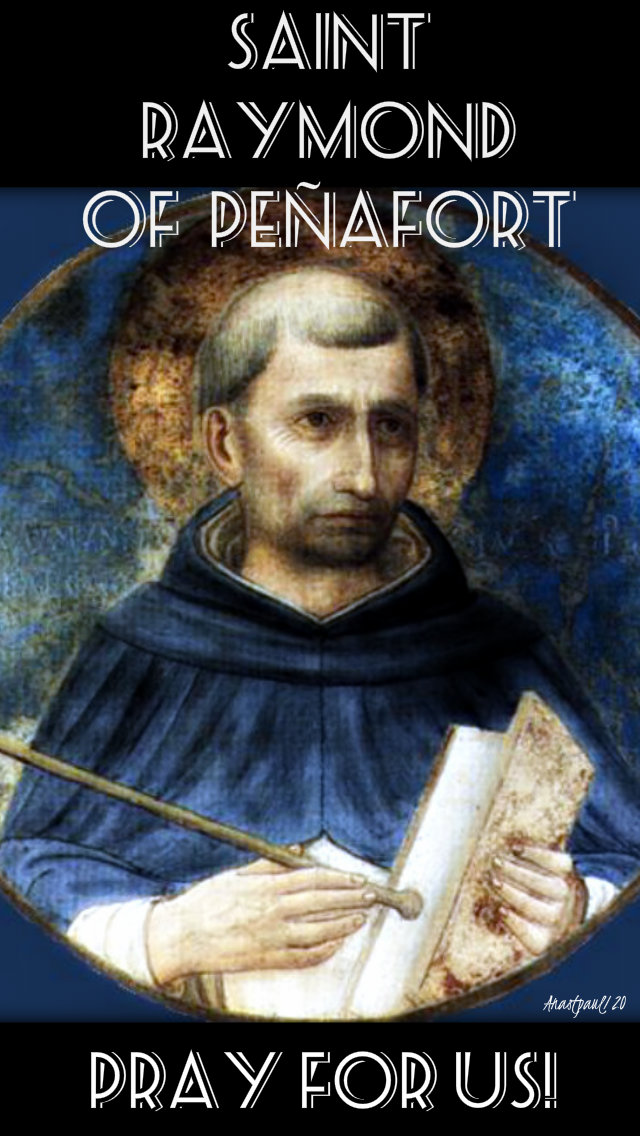
One Minute Reflection – 7 January – Second day after Epiphany, Readings: 1 John 4:7-10, Psalm 72:1-4, 7-8, Mark 6:34-44 and the Memorial of St Raymond of Peñafort OP (1175-1275)
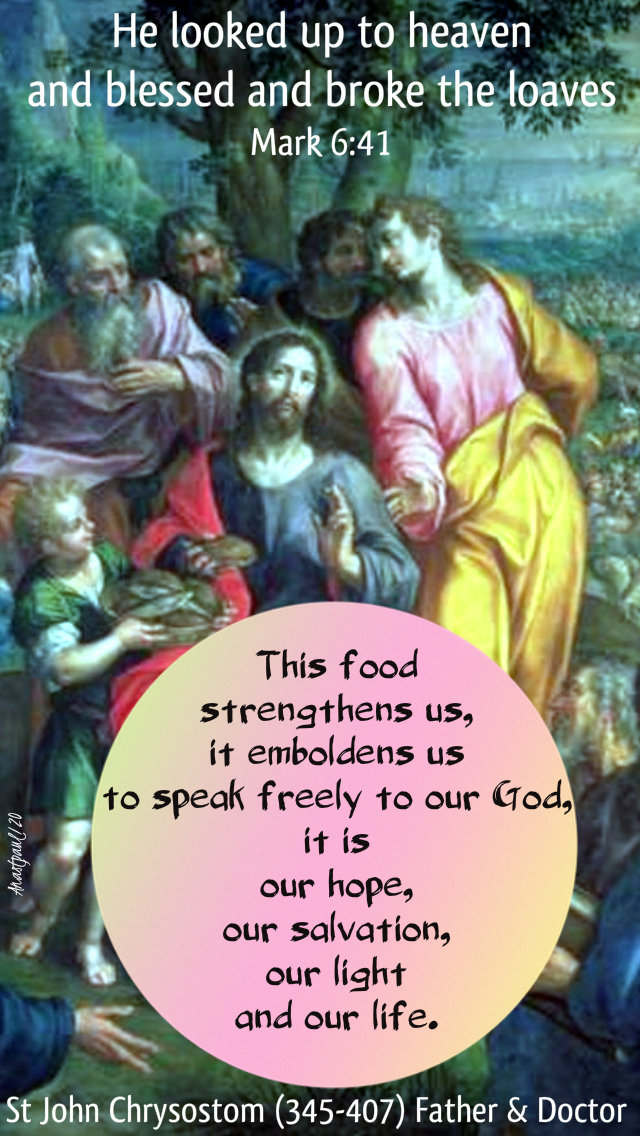
And taking the five loaves and the two fish, he looked up to heaven and blessed and broke the loaves and gave them to the disciples to set before the people ... Mark 6:41
REFLECTION – “Christ gave us His flesh to eat in order to deepen our love for Him. When we approach Him, then, there should be burning within us, a fire of love and longing… The wise men paid homage to Christ’s body even when it was lying in a manger… They only saw Christ in a manger, they saw nothing of what you now see and yet they approached Him with profound awe and reverence.
You see Him, not in a manger but on an altar, not carried by a woman but offered by a priest and you see the Spirit bountifully poured out upon the offerings of bread and wine. Unlike the wise men, you do not merely see Christ’s body, you know His power as well and the whole divine plan for our salvation… Let us then awaken in ourselves a feeling of awe and let us show a far greater reverence than did those foreigners so that we do not approach this sacrament casually, without thinking of what we do…
This food strengthens us, it emboldens us to speak freely to our God, it is our hope, our salvation, our light and our life.
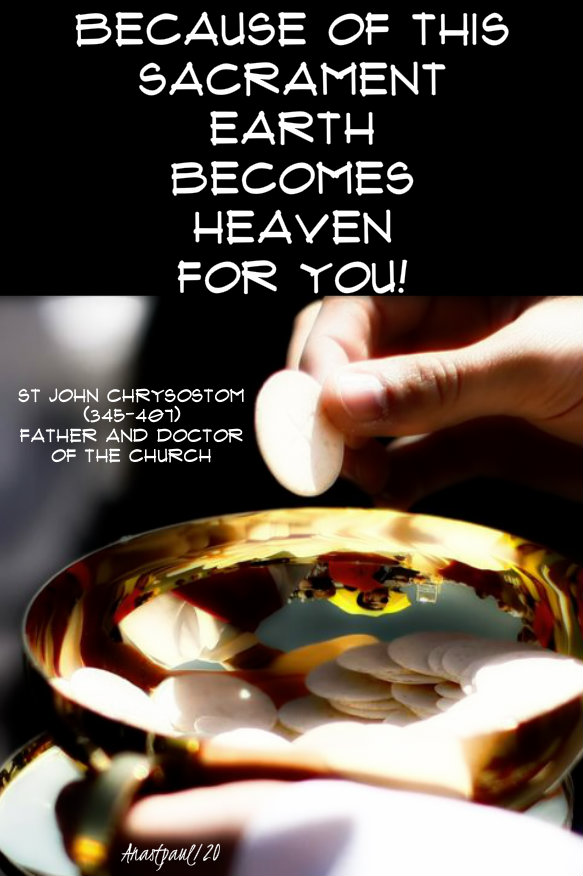
If we go to the next world fortified by this sacrifice, we shall enter its sacred portals with perfect confidence, as though protected all over, by armour of gold. But why do I speak of the next world? Because of this sacrament earth becomes heaven for you. Throw open the gates of heaven, look through and you will see the proof of what I say. What is heaven’s most precious possession? I will show you it here on earth. I do not show you angels or archangels, heaven or the heaven of heavens but I show you the very Lord of all these. Do you not see how you gaze, here on earth, upon what is most precious of all? You not only gaze on it but touch it as well. You not only touch it but eat it. So cleanse your soul from sin and prepare your mind to receive these mysteries.” … St John Chrysostom (345-407) Bishop of Constantinople, Father and Doctor of the Church
PRAYER – Almighty God, our Father, when Your only-begotten Son revealed Himself in flesh and blood, we came to know Him as our fellow-man . Now He feeds us by His mysteries and cleanses us by His Blood to transform us inwardly, until we bear His likeness. As You inspired St Raymond of Peñafort with an immense compassion for sinners and captives, grant us, through his prayer, freedom from sin and the grace to do Your will. Through our Lord, Jesus Christ, with the Holy Spirit, one God forever with You, amen.
Our Morning Offering – 7 January – Second day after Epiphany
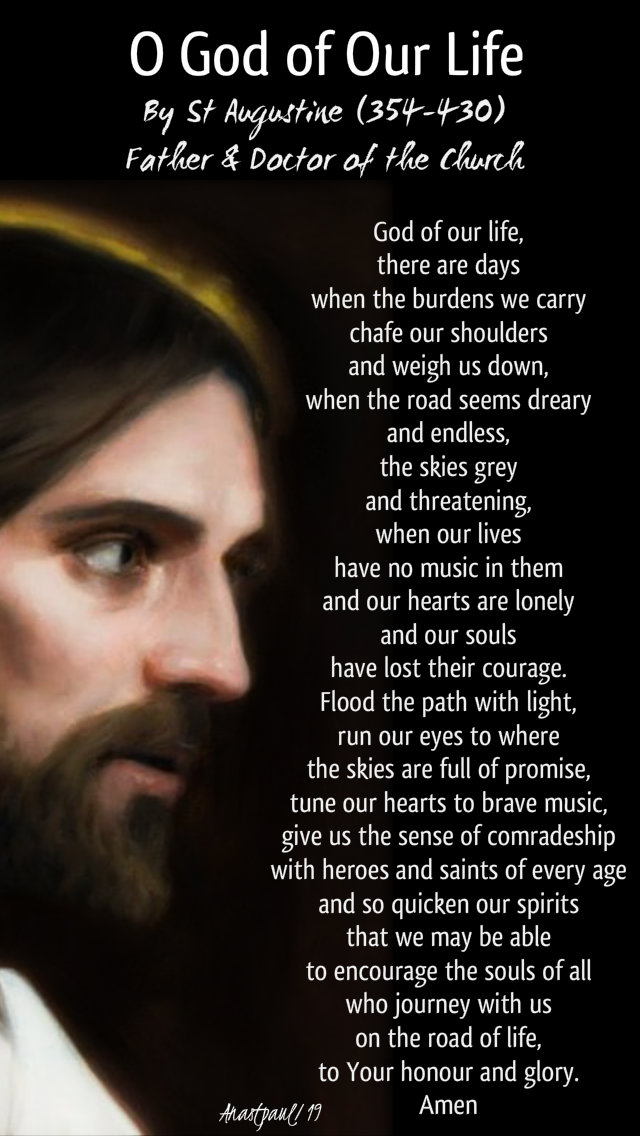
O God of Our Life By St Augustine (354-430) Father & Doctor of the Church
God of our life,
there are days when the burdens we carry
chafe our shoulders and weigh us down,
when the road seems dreary and endless,
the skies grey and threatening,
when our lives have no music in them
and our hearts are lonely
and our souls have lost their courage.
Flood the path with light,
run our eyes to where
the skies are full of promise,
tune our hearts to brave music,
give us the sense of comradeship
with heroes and saints of every age
and so quicken our spirits
that we may be able
to encourage the souls of all
who journey with us on the road of life,
to Your honour and glory.
Amen
Quote/s of the Day – 5 January – The Solemnity of the Epiphany of the Lord
“If the Magi had come in search of an earthly King, they would have been disconcerted at finding that they had taken the trouble to come such a long way for nothing. Consequently they would have neither adored nor offered gifts. But since they sought a heavenly King, though they found in Him no signs of royal pre-eminence, yet, content with the testimony of the star alone, they adored – for they saw a man and they acknowledged God.”
St John Chrysostom (347-407)
Father and Doctor of the Church
“The Gospel account of the Magi describes their journey from the East as a journey of the spirit, as a journey toward the encounter with Christ. They are attentive to signs that indicate His presence, they are tireless in facing the trials of the search, they are courageous in deducing the implications for life that derive from encounter with the Lord. This is life – Christian life, is a journey but being attentive, tireless and courageous. A Christian, journeys like this. Journey attentively, tirelessly, courageously!”
“And as they fell to their knees before the small, poor and vulnerable Infant, the unexpected and unknown Child of Bethlehem, they discovered the glory of God.”
One Minute Reflection – 5 January – The Solemnity of the Epiphany of the Lord, Readings: Isaiah 60:1-6, Psalm 72:1-2, 7-8, 10-13, Ephesians 3:2-3, 5-6, Matthew 2:1-12
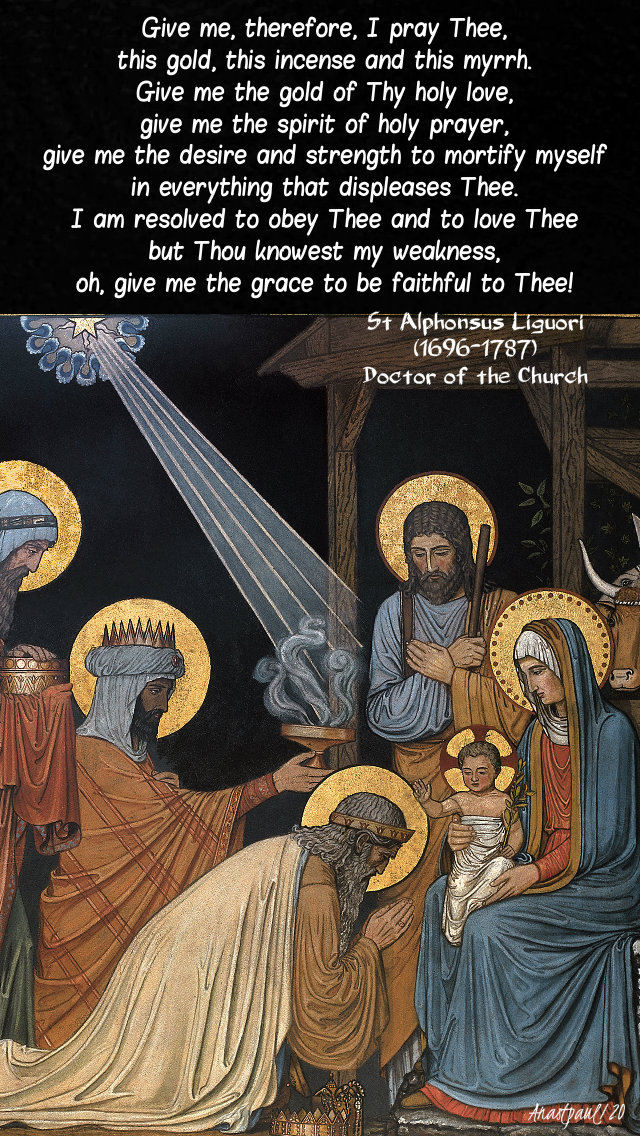
“… They fell down and worshipped him. Then, opening their treasures, they offered him gifts, gold and frankincense and myrrh.” … Matthew 2:11
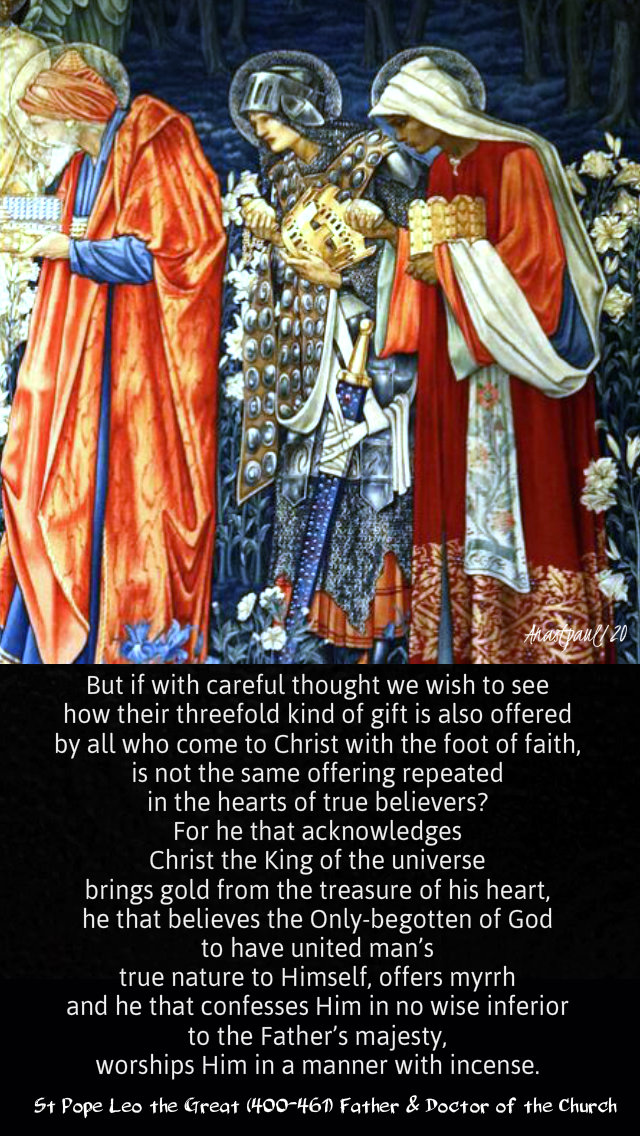
REFLECTION – “But if with careful thought we wish to see how their threefold kind of gift is also offered by all who come to Christ with the foot of faith, is not the same offering repeated in the hearts of true believers? For he that acknowledges Christ the King of the universe brings gold from the treasure of his heart, he that believes the Only-begotten of God to have united man’s true nature to Himself, offers myrrh and he that confesses Him in no wise inferior to the Father’s majesty, worships Him in a manner with incense.” … St Pope Leo the Great (400-461) Father and Doctor of the Church
PRAYER – “Give me, therefore, I pray Thee, this gold, this incense and this myrrh. Give me the gold of Thy holy love, give me the spirit of holy prayer, give me the desire and strength to mortify myself in everything that displeases Thee. I am resolved to obey Thee and to love Thee but Thou knowest my weakness, oh, give me the grace to be faithful to Thee!” … St Alphonsus Liguori (1696-1787) Doctor of the Church
One Minute Reflection – 4 January – Saturday of Christmas, Readings:
1 John 3:7-10, Psalm 98:1, 7-9, John 1:35-42
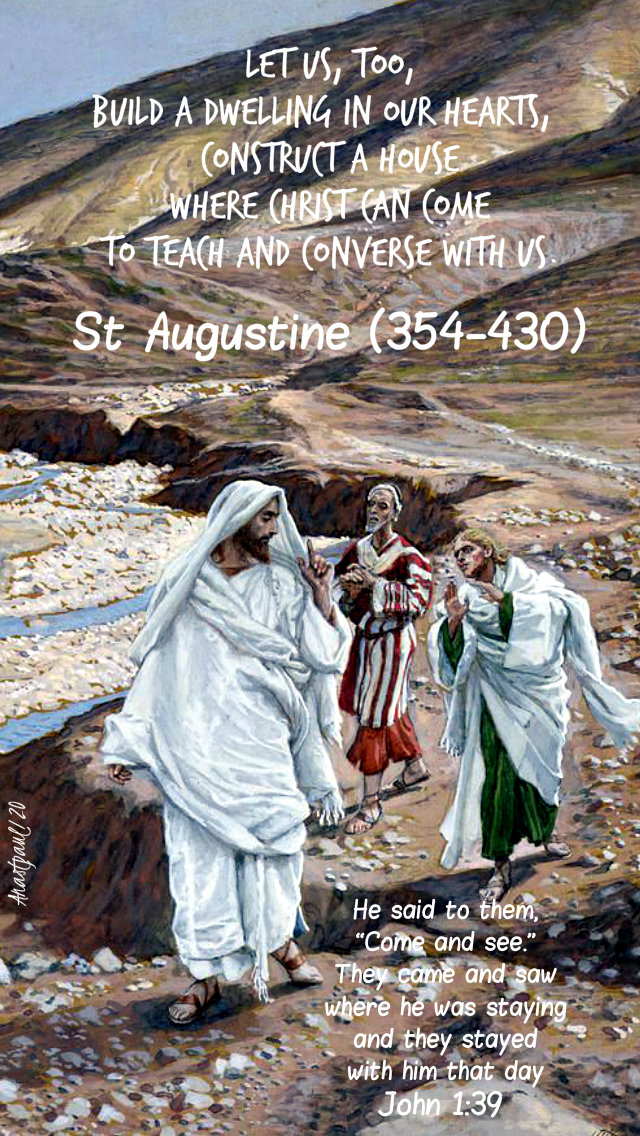
He said to them, “Come and see.” They came and saw where he was staying and they stayed with him that day … John 1:39
REFLECTION – “John was there and two of his disciples with him.” John was such “a friend of the Bridegroom” that he did not seek his own glory, he simply bore witness to the truth (Jn 3:29.26). Did he dream of keeping back his disciples and preventing them from following the Lord? Not in the least. He himself showed them the one they were to follow (…) He declared: “Why cling to me? I am not the Lamb of God. Behold the Lamb of God (…) Behold him who takes away the sins of the world.”
At these words the two disciples who were with John followed Jesus. “Jesus turned and saw that they were following him and said to them: ‘What are you looking for?’ They said to him: ‘Rabbi, where are you staying?” As yet they were not following Him definitively, as we know, they joined themselves to Him when He called them to leave their boat (…), when He said to them: “Come after me and I will make you fishers of men” (Mt 4:19). That was the moment they joined Him definitively, no longer to leave Him. But for now they wanted to see where Jesus was living and put into practice the words of Scripture: “If you see an intelligent man, seek him out at daybreak; let your feet wear away his doorstep! Learn from him the precepts of the Lord” (cf. Sir 6:36f.). So Jesus showed them where He was living, they went and stayed with Him. What a happy day they spent! What a blessed night! Who can say what it was they heard from the Lord’s mouth? Let us, too, build a dwelling in our hearts, construct a house where Christ can come to teach and converse with us.” … St Augustine (354-430) Bishop of Hippo, Father & Doctor of the Church – Sermons on Saint John’s Gospel, no 7
PRAYER – Almighty God, the light of a new star in heaven, heralded Your saving love . Let the light of Your salvation dawn in our hearts and keep them always open to Your life-giving grace. May we stay with Your Son, for He will teach us Your ways. Kindly hear the prayers on our behalf of Mary our mother and of all Your saints and may St Angela of Foligno intercede today on our behalf. Through Christ, our Lord, with the Holy Spirit, God now and forever, amen.
Quote/s of the Day – 3 January – Christmas Weekday
and the Feast of the Most Holy Name of Jesus
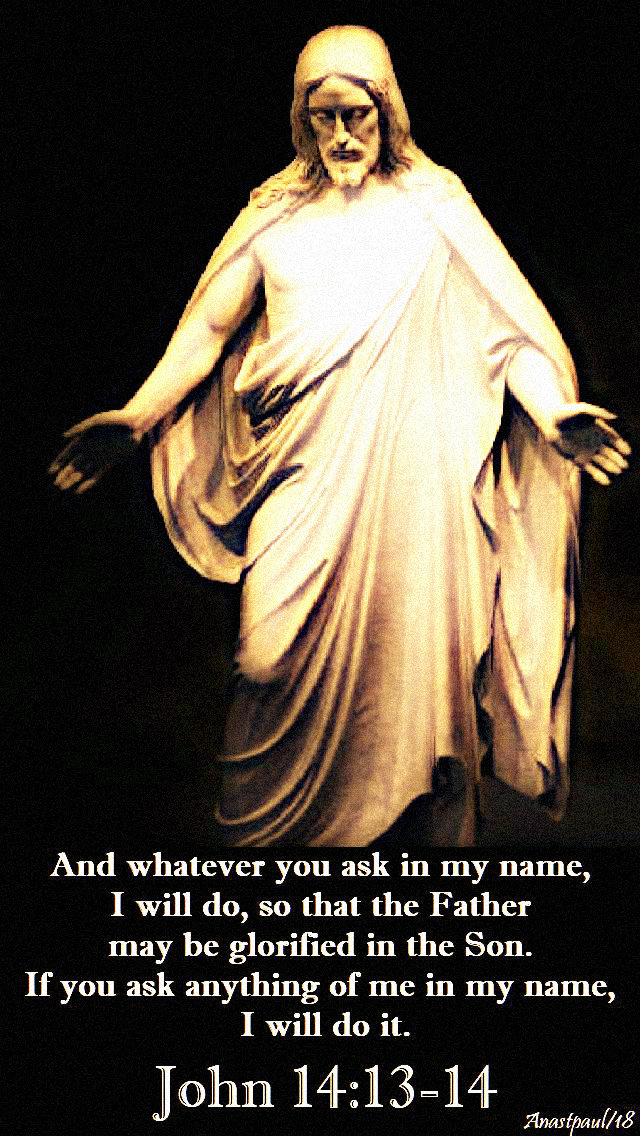
“And whatever you ask in my name, I will do, so that the Father may be glorified in the Son. If you ask anything of me, in my name, I will do it.”
John 14:14-14
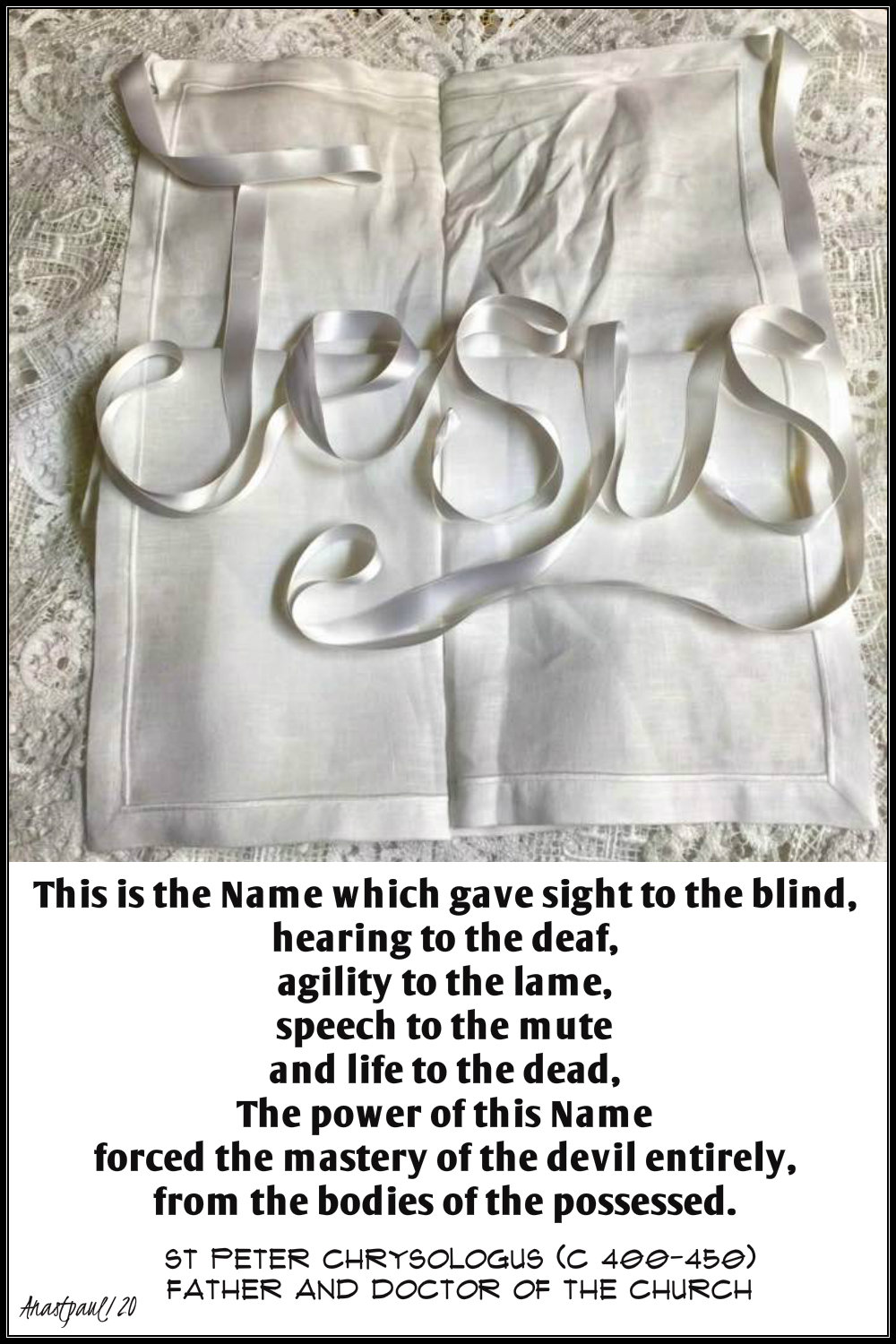
“And you shall call His name Jesus, because in His Name we adore the entire majesty of the Godhead. All who dwell in the heavens, those who abide upon the earth and everyone of those who are held in the depths of hell, bow down prostate to this Name. This is the Name which gave sight to the blind, hearing to the deaf, agility to the lame, speech to the mute and life to the dead, The power of this Name forced the mastery of the devil entirely, from the bodies of the possessed.”
St Peter Chrysologus (c 400-450)
Father and Doctor of the Church
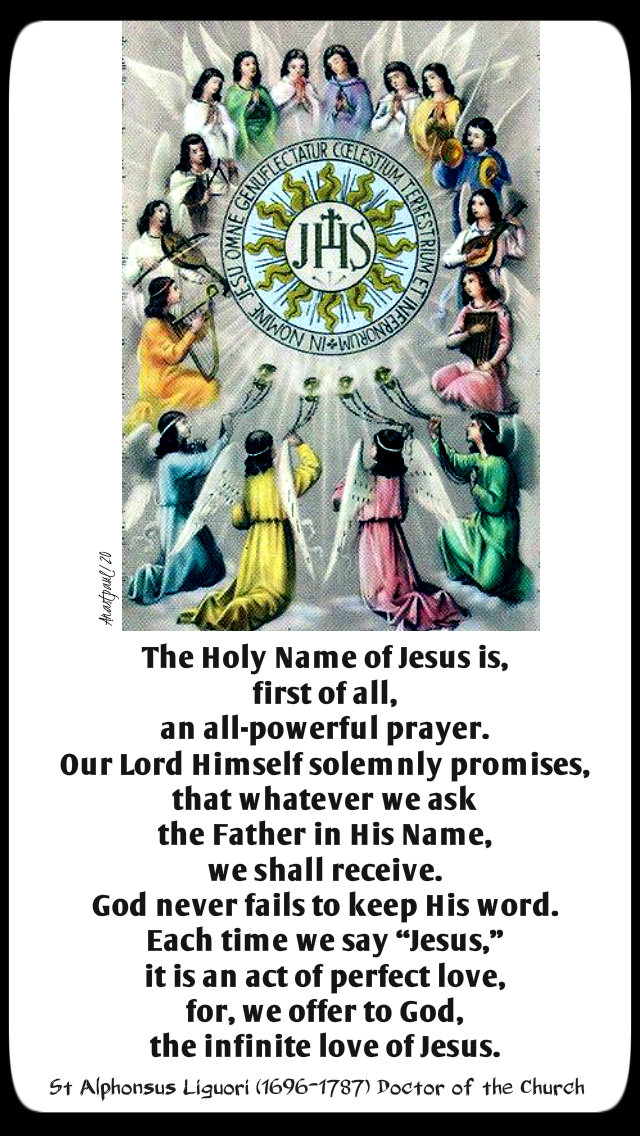
“The Holy Name of Jesus is, first of all, an all-powerful prayer. Our Lord, Himself, solemnly promises, that whatever we ask the Father in His Name, we shall receive. God never fails to keep His word. Each time we say “Jesus,” it is an act of perfect love, for, we offer to God, the infinite love of Jesus”
St Alphonsus Liguori (1696-1787)
Doctor of the Church
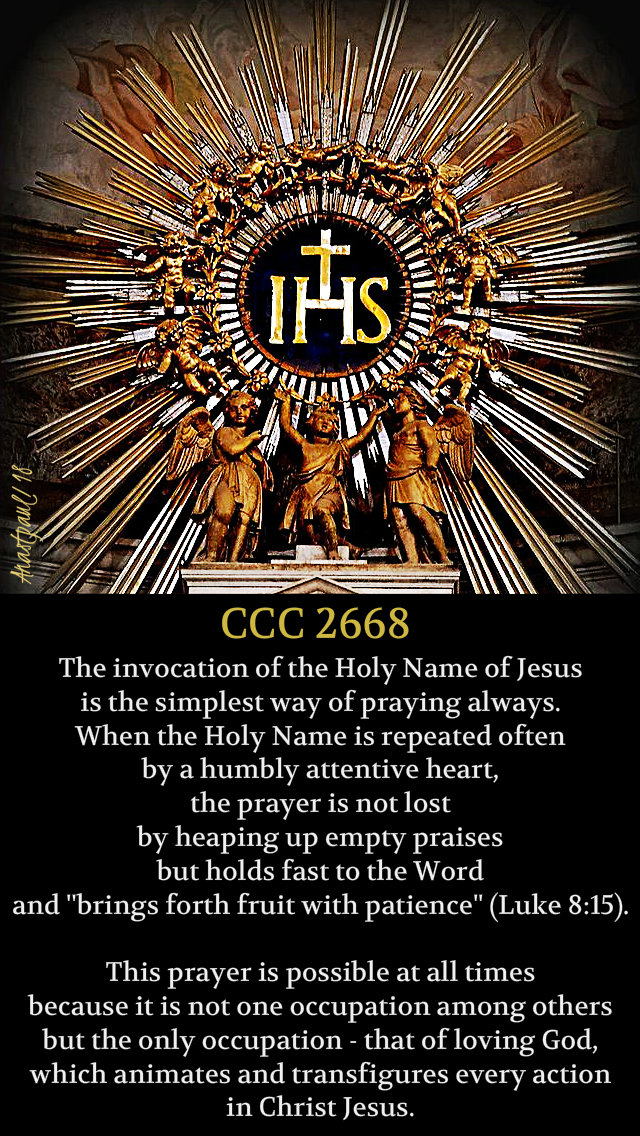
”The invocation of the Holy Name of Jesus, is the simplest way of praying always. When the Holy Name is repeated often by a humbly attentive heart, the prayer is not lost by heaping up empty praises but holds fast to the Word and ”brings forth fruit with patience” (Luke 8:15). This prayer is possible at all times because it is not one occupation among others but the only occupation – that of loving God which animates and transfigures every action in Christ Jesus”
CCC 2668
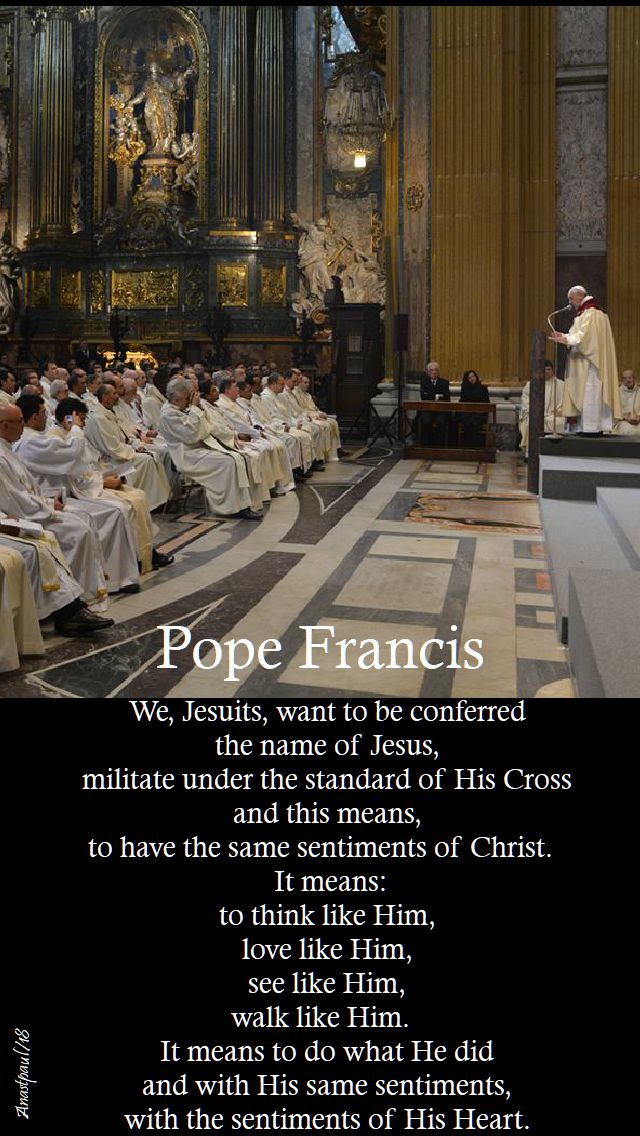
“We, Jesuits, want to be conferred the name of Jesus, militate under the standard of His Cross and this means, to have the same sentiments of Christ. It means to think like Him, love like Him, see like Him, walk like Him. It means to do what He did and with His same sentiments, with the sentiments of His Heart. The heart of Christ is the heart of a God who, out of love, “emptied” Himself.
Pope Francis
(3 January 2014)
Blessed be the Most Holy Name of Jesus without end!
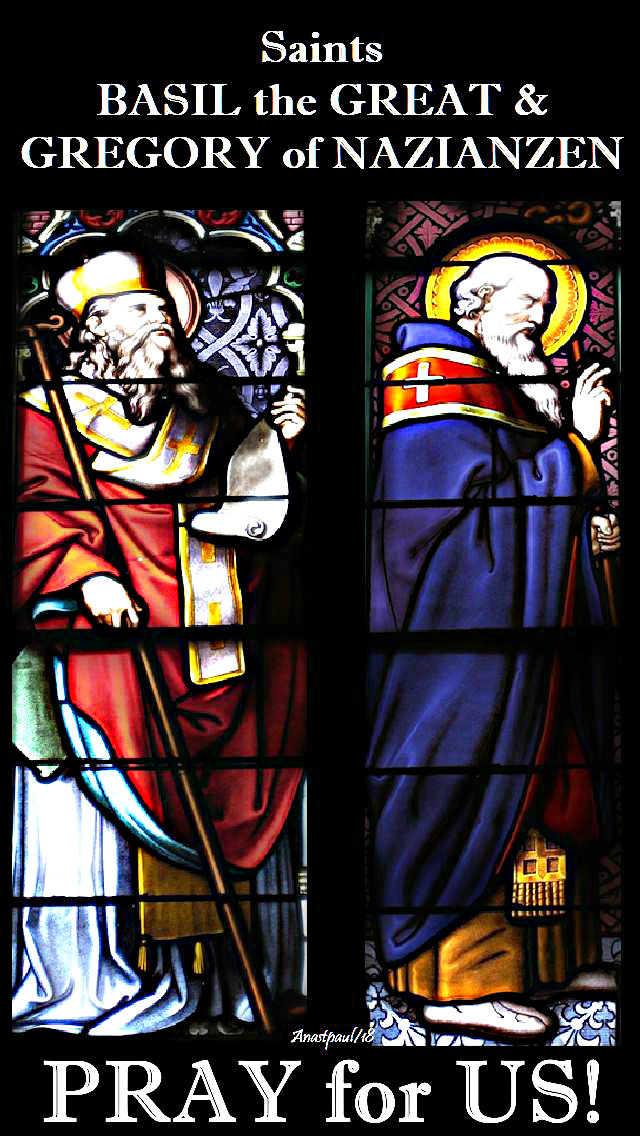
Quote/s of the Day – 2 January – Christmas Weekday and The Memorial of St Basil the Great (329-379) and St Gregory of Nazianzen (330-390), Readings: 1 John 2:22-28, Psalm 98:1-4, John 1:19-2
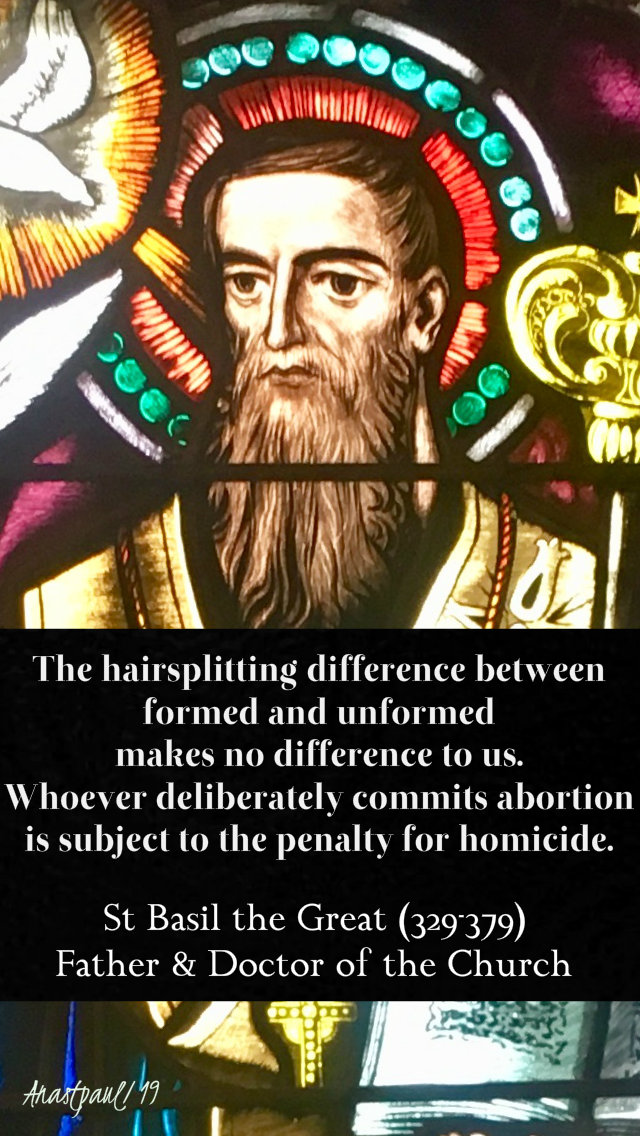
“The hairsplitting difference between formed and unformed makes no difference to us. Whoever deliberately commits abortion is subject to the penalty for homicide.”
St Basil the Great (329-379)
Father & Doctor of the Church
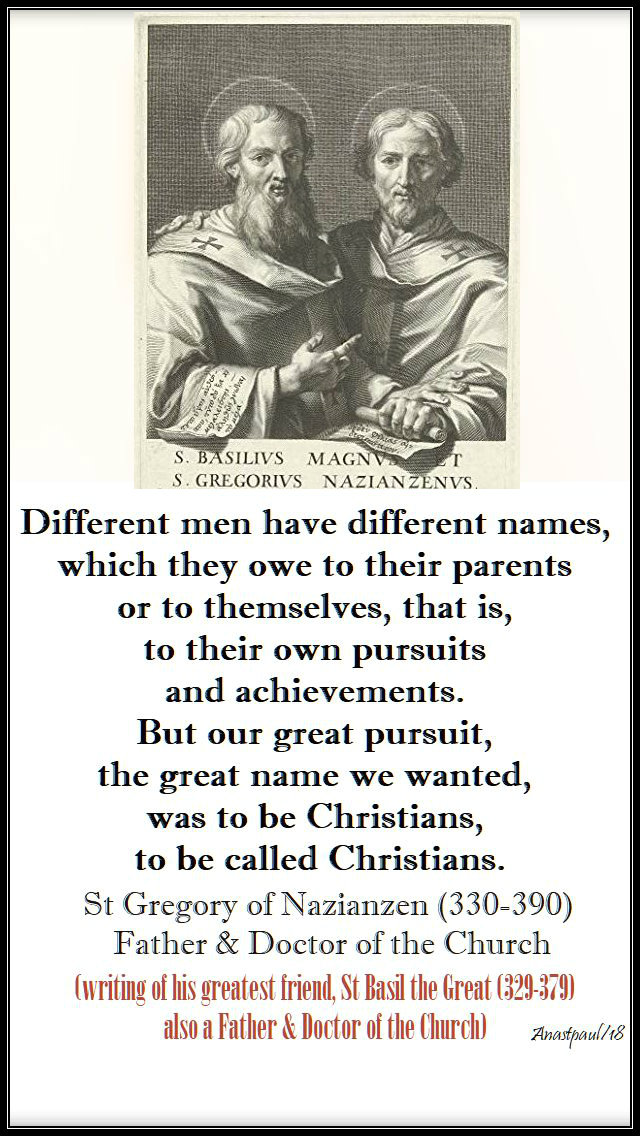
“Different men have different names, which they owe to their parents or to themselves, that is, to their own pursuits and achievements. But our great pursuit, the great name we wanted, was to be Christians, to be called Christians.”
St Gregory of Nazianzen (330-390)
(from his writings on his friendship with St Basil)
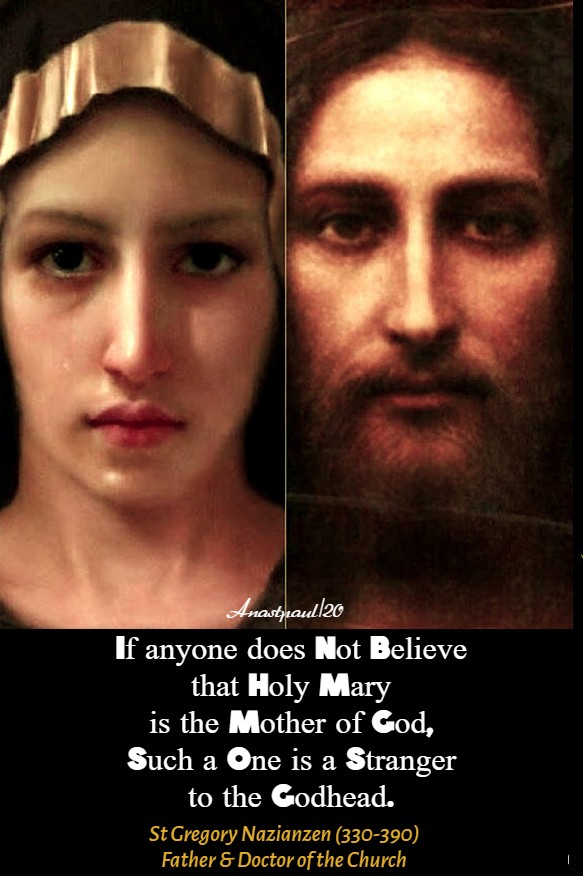
“If anyone does not believe that Holy Mary is the Mother of God, such a one is a stranger to the Godhead.”
St Gregory of Nazianzen (330-390) Father & Doctor of the Church
One Minute Reflection – 2 January – Christmas Weekday and The Memorial of St Basil the Great (329-379) and St Gregory of Nazianzen (330-390), Readings: 1 John 2:22-28, Psalm 98:1-4, John 1:19-28
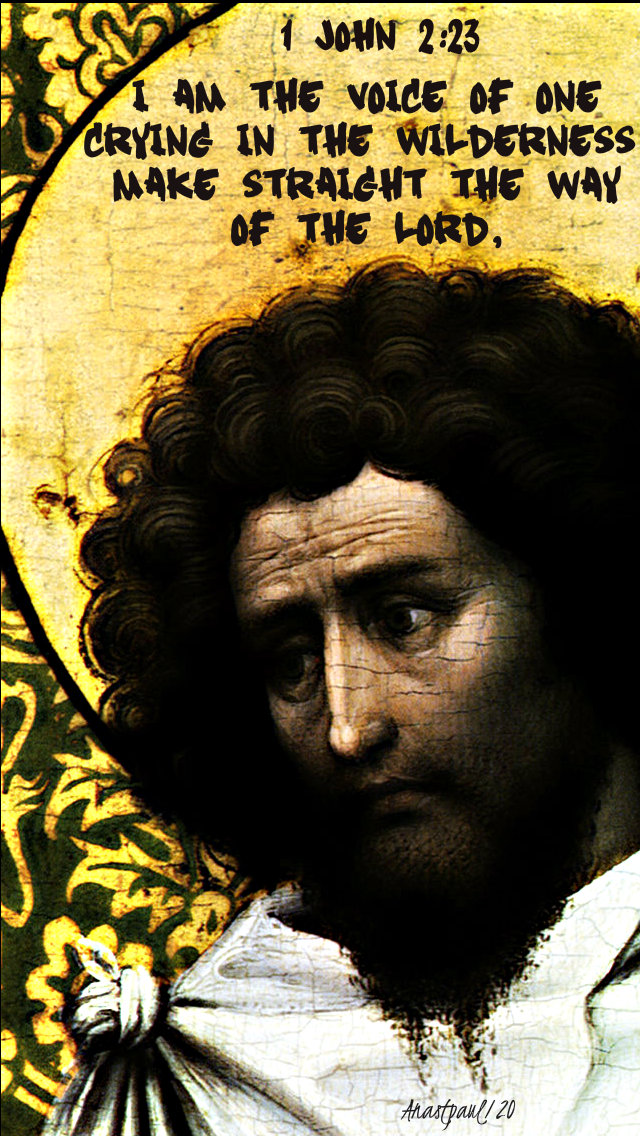
He said, “I am the voice of one crying in the wilderness, ‘Make straight the way of the Lord,’ as the prophet Isaiah said.” … 1 John 2:23
REFLECTION – “Prepare a way for the Lord.” Brethren, however far you journey along it… from the very nature of goodness, there is no limit to the way along which you travel. And so… the wise and indefatigable traveller… can say to himself each day: “Now I begin”… And how many “go astray in the wilderness”… None of them can yet say: “Now I begin.”
For “the beginning of wisdom is the fear of the Lord.” If the beginning of wisdom, then surely it is also the beginning of the way of goodness… It is this that encourages praise…; it also moves the proud to penance, so that they hear the voice of him crying in the wilderness,ordering the preparation of the way and thus showing how to begin it: “Do penance for the kingdom of heaven is close at hand”…
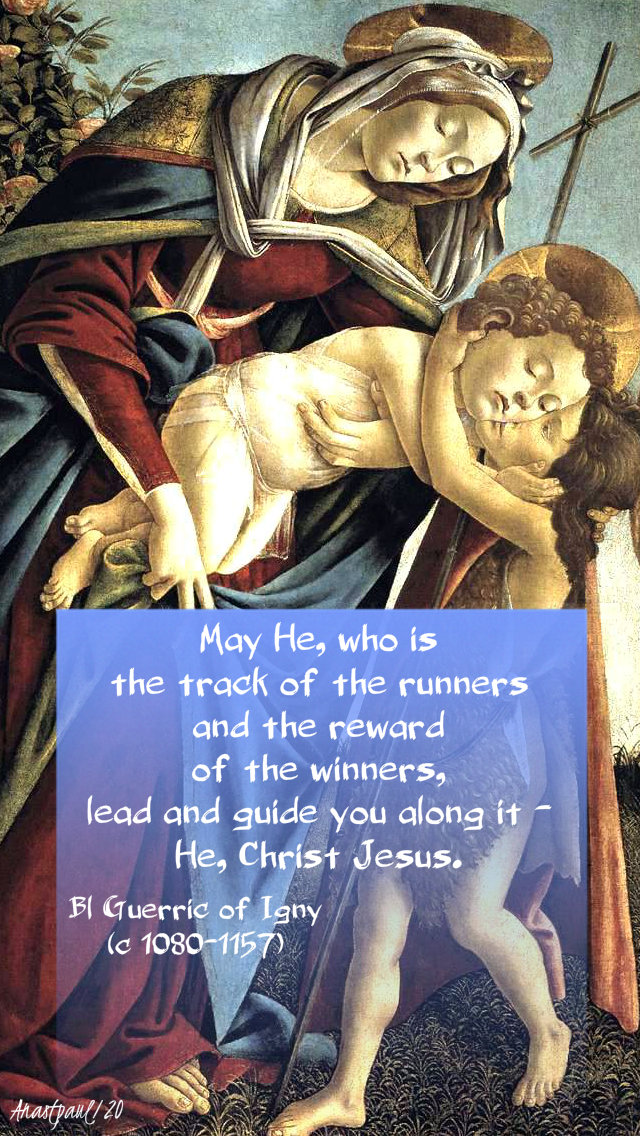
If you are on the way then fear only one thing, lest you leave it, lest you offend the Lord who leads you along it so that He would abandon you to “wander in the way of your own heart”… If you feel that the way is too narrow look forward to the end to which it leads you. If you were to see how everything is to be attained, then you would say without hesitation: “Broad indeed is your command!” If you cannot see so far, believe Isaiah who could… “Behold,” he says, “the redeemed shall walk by this way and the ransomed of the Lord shall return and come to Sion with singing, everlasting joy shall be upon their heads . They shall obtain also joy and gladness and sorrow and sighing shall flee away.” Those who dwell sufficiently on this end I think will not only make the way easier for himself but also grow wings, so that he no longer walks but flies… May He, who is the track of the runners and the reward of the winners, lead and guide you along it – He, Christ Jesus.” … Blessed Guerric of Igny (c 1080-1157) Cistercian Abbot – 5th sermon of Advent, SC 166
PRAYER – Look with favour on our morning prayer, Lord and in Your saving love, let Your light penetrate the wilderness in our hearts. May no sordid desires darken our minds, renewed and enlightened as we are, by Your heavenly grace. God our Father, You enriched Your Church and gave examples for us to follow in the life and teachings of Sts Basil and Gregory. Grant that, learning Your truth with humility, we may practise it in faith and love. Sts Basil and Gregory, pray for our beloved Church, pray for all Catholic Christians, through Jesus Christ with the Holy Spirit, God forever, amen.
Our Morning Offering – 2 January – Christmas Weekday and The Memorial of St Basil the Great (329-379) and St Gregory of Nazianzen (330-390)
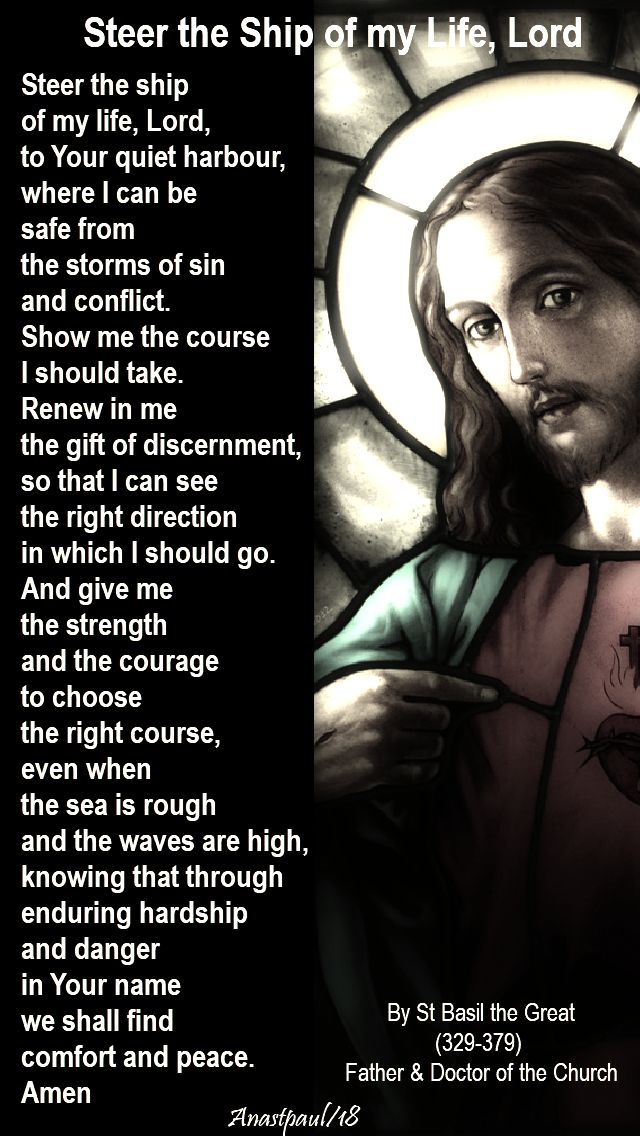
Steer the Ship of my Life, Lord By St Basil the Great (329-379)
Steer the ship of my life, Lord,
to Your quiet harbour,
where I can be safe from
the storms of sin and conflict.
Show me the course I should take.
Renew in me the gift of discernment,
so that I can see the right direction
in which I should go.
And give me the strength
and the courage to choose the right course,
even when the sea is rough
and the waves are high,
knowing that through enduring
hardship and danger in Your name
we shall find comfort and peace.
Amen
St Basil the Great (329-379) Father & Doctor of the Church (Memorial) St Gregory of Nazianzen (330-390) Father & Doctor of the Church (Memorial) About these 2 great fathers:
St Adelard of Corbie
Bl Airaldus of Maurienne
St Asclepius of Limoges
St Aspasius of Auch
St Blidulf of Bobbio
Bl Guillaume Répin
St Hortulana of Assisi
St Isidore of Antioch
St Isidore of Nitria
St Laurent Bâtard
St Macarius the Younger Blessed Marie Anne Blondin SSA (1809-1890)
St Maximus of Vienne
Bl Odino of Rot
St Paracodius of Vienne
St Seraphim of Sarov
St Seiriol
Bl Stephana de Quinzanis
St Telesphorus, Pope
St Theodota
St Theopistus
St Vincentian of Tulle
—
Many Martyrs Who Suffered in Rome: There were many martyrs who suffered in the persecutions of Diocletian for refusing to surrender the holy books. Though we know these atrocities occured, we do not know the names of the saints and we honour them as a group. c 303 in Rome, Italy.
Martyrs of Antioch – 5 saints: A group of Christian soldiers martyred together for their faith. We know the names of five – Albanus, Macarius, Possessor, Starus and Stratonicus. They were born in Greece and were martyred in Antioch (modern Antakya, Turkey).
Many Martyrs of Britain: The Christians of Britain appear to have escaped unharmed in the earlier persecutions which afflicted the Church but the cruel edicts of Diocletian were enforced in every corner of the empire and the faithful inhabitants of this land, whether native Britons or Roman colonists, were called upon to furnish their full number of holy Martyrs and Confessors. The names of few are on record but the British historian, Saint Gildas, after relating the martyrdom of Saint Alban, tells us that many others were seized, some put to the most unheard-of tortures and others immediately executed, while not a few hid themselves in forests and deserts and the caves of the earth, where they endured a prolonged death until God called them to their reward. The same writer attributes it to the subsequent invasion of the English, then a pagan people, that the recollection of the places, sanctified by these martyrdoms, has been lost and so little honour paid to their memory. It may be added that, according to one tradition, a thousand of these Christians were overtaken in their flight near Lichfield and cruelly massacred and that the name of Lichfield, or Field of the Dead, is derived from them.
Martyrs of Ethiopia – 3 saints: A group of Christians martyred together for their faith. We know the names of three – Auriga, Claudia and Rutile.
Martyrs of Jerusalem – 2 saints: A group of Christians martyred together for their faith. We know the names of two – Stephen and Vitalis.
Martyrs of Lichfield: Many Christians suffered at Lichfield (aka Lyke-field, meaning field of dead bodies), England in the persecutions of Diocletian. Though we know these atrocities occured, we do not know the names of the saints, and we honour them as a group. Their martyrdom occurred in 304 at Lichfield, England.
Martyrs of Piacenza: A group of Christians who died together for their faith in the persecutions of Diocletian. No details about them have survived. They were martyred on the site of church of Madonna di Campagna, Piacenza, Italy.
Martyrs of Puy – 4 saints: Missionaries, sent by Saint Fronto of Périgueux to the area of Puy, France. Tortured and martyred by local pagans. We know the names – Frontasius, Severinus, Severian and Silanus. They were beheaded in Puy (modern Puy-en-Velay), France and buried together in the church of Notre Dame, Puy-en-Velay by Saint Fronto, their bodies laid out to form a cross.
Martyrs of Syrmium – 7 saints: Group of Christians martyred together, date unknown. We know the names of seven – Acutus, Artaxus, Eugenda, Maximianus, Timothy, Tobias and Vitus – but very little else. This occurred in the 3rd or 4th century at Syrmium, Pannonia (modern Sremska Mitrovica, Serbia).
Martyrs of Tomi – 3 saints: Three brothers, all Christians, all soldiers in the imperial Roman army, and all three martyred in the persecutions of emperor Licinius Licinianus. We know their names – Argeus, Marcellinus and Narcissus – but little else.
They were martyred in 320 at Tomi, Exinius Pontus, Moesia (modern Constanta, Romania).
Quote/s of the Day – 1 January – The Solemnity of Mary, Mother of God and the Octave Day of the Nativity of the Lord and the Memorial of St Fulgentius of Ruspe (c 462 – 533)
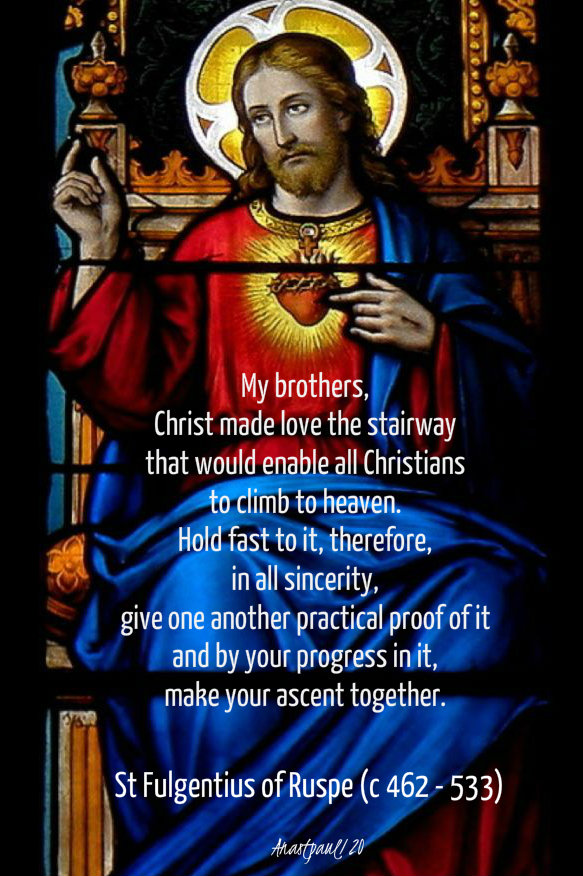
“My brothers, Christ made love the stairway that would enable all Christians to climb to heaven. Hold fast to it, therefore, in all sincerity, give one another practical proof of it and by your progress in it, make your ascent together.”
St Fulgentius of Ruspe (c 462 – 533)
From a sermon on The Feast of Saint Stephen
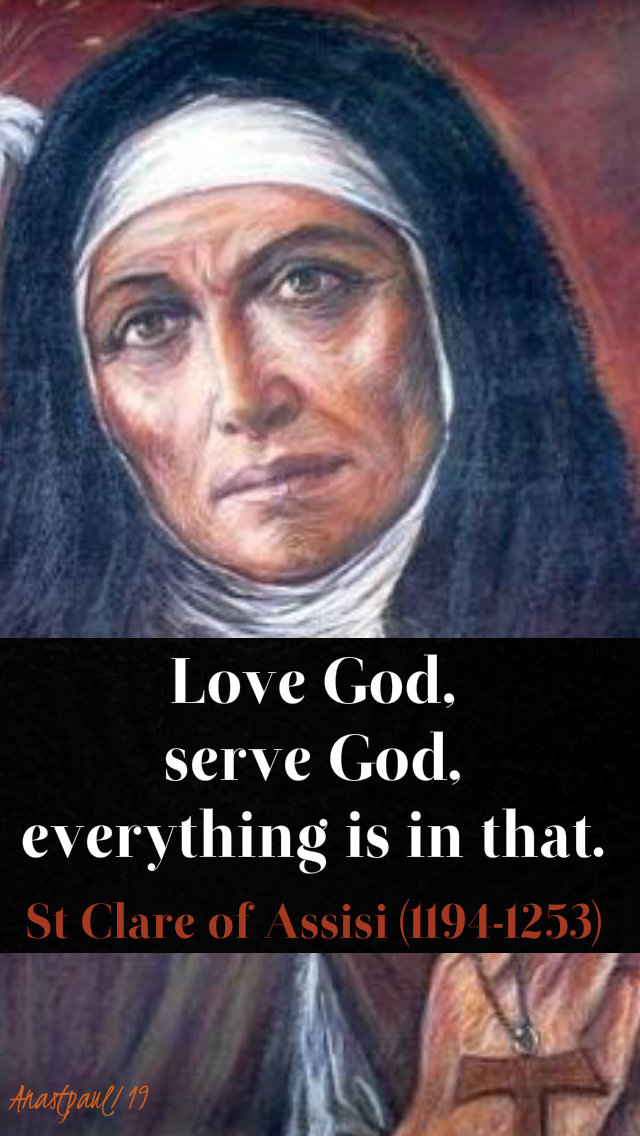
“Love God, serve God, everything is in that.”
St Clare of Assisi (1194-1253)
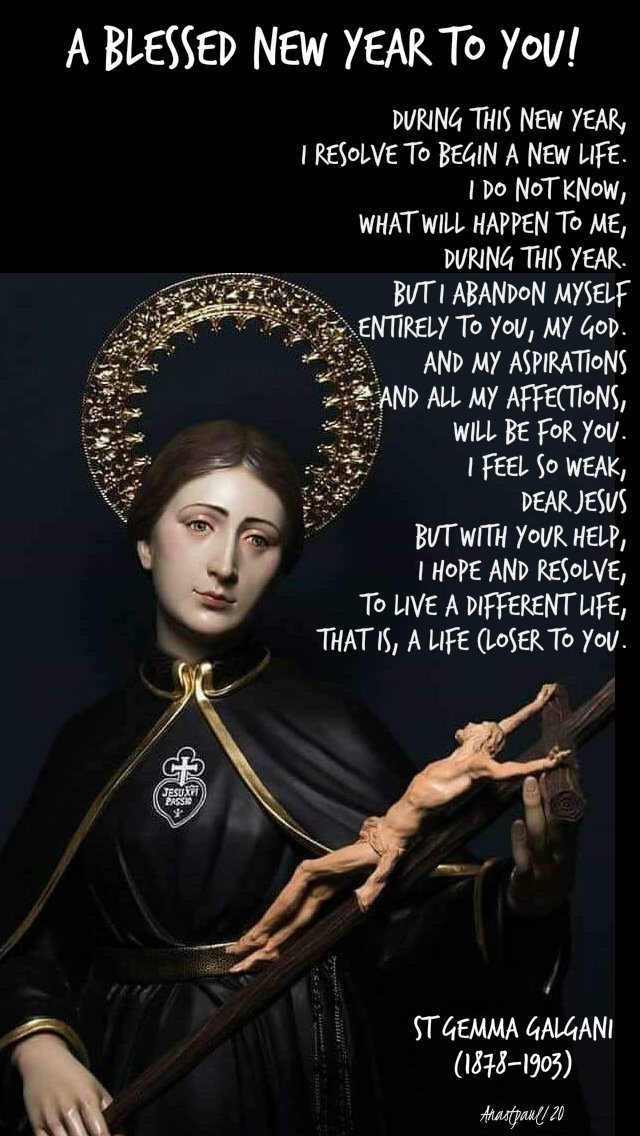
“During this new year, I resolve to begin a new life. I do not know, what will happen to me, during this year. But I abandon myself entirely to You, my God. And my aspirations and all my affections, will be for You. I feel so weak, dear Jesus but with Your help, I hope and resolve, to live a different life, that is, a life closer to You.”
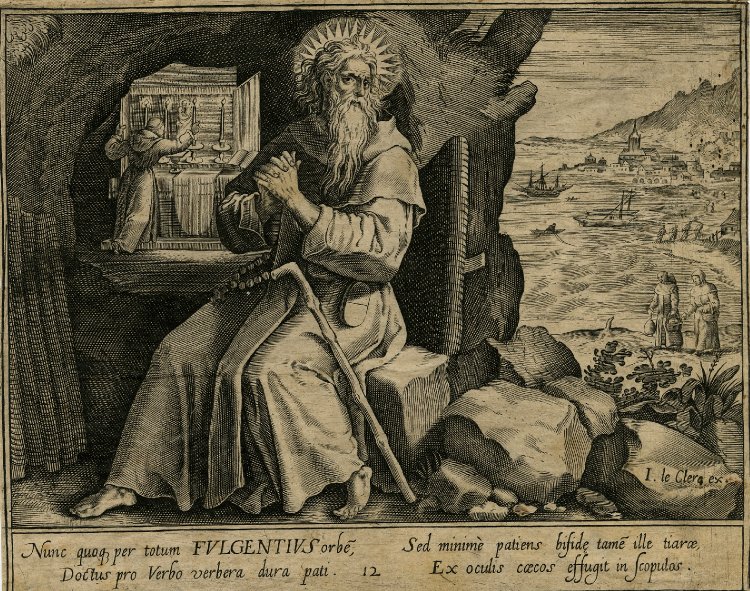
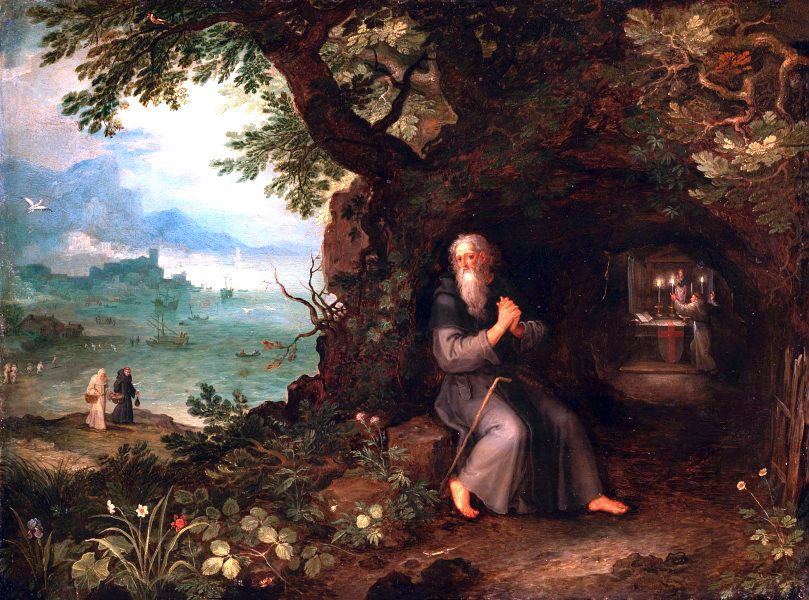
Saint of the Day – 1 January – Saint Fulgentius of Ruspe (c 462 – 533) Abbot, Bishop of the city of Ruspe, Roman province of Africa, North Africa in modern day Tunisia, Theologian, Writer- known as “The Pocket Augustine” – born Fabius Claudius Gordianus Fulgentius in c 462 at Carthage, North Africa (modern Tunis, Tunisia) and died on 1 January 533 in Ruspe of natural causes. He is venerated today and on 3 January by the Augustinians.
He was born to a Roman senatorial family, and was well educated. His father Claudius, died while Fulgentius was still quite young. His mother, Mariana taught him to speak Greek and Latin. He became so good at Greek, that he spoke it like a native and committed all of Homer to memory. He was also well trained in Latin literature.
As he grew older, he managed his house wisely in subjection to his mother and Fulgentius quickly gained wide respect for his conduct of the family affairs. This reputation helped him to acquire a post as a civil servant in the government of Rome, as a procurator of Byzacena.
He quickly grew tired of the provincial life. This, together with his studies of religion, particularly a sermon of Saint Augustine of Hippo on Psalm 36, led to his being attracted to a religious life and he entered a monastery, became a monk, then was Ordained and became Abbot.
At the time, the Arian persecutions had ceased but the election of Catholic bishops was forbidden. In 508 it became necessary to defy the law when bishops were consecrated, Fulgentius being chosen for Ruspe (modern Kudiat Rosfa, Tunisia). He was exiled with 60 other bishops to Sardinia. There they built a monastery and continued to write, pray, and study.
Fulgentius was invited back to Carthage by the Arian king Thrasimund to hold a debate with his Arian replacement around 515 and so successfully refuted his Arian opponents that he was exiled again in 518.
King Hilderic succeeded Thrasimund in 523 and permitted the exiles to return. Peace finally being restored to the African church, Fulgentius returned to his Diocese. He would have preferred to return to his monastery and resume his studies but he was such a popular preacher, he was kept busy in the pulpit until his death.
As a Bishop, he followed Augustine’s example in living in community with the clergy of his Diocese. He founded several other monasteries in Africa. When he was exiled to Sardinia, not wanting to be away from the monastic community life, he even founded monasteries there.
Various letters and eight sermons survive. Fulgentius’s work shows his vast knowledge of Greek and a strong influence and agreement with Saint Augustine, so much so, that he is known as “The Pocket Augustine.” He wrote frequently against Arianism and Pelagianism.
Saint Fulgentius died of natural causes in 533 at Ruspe. Some of his relics are located at Bourges, France.
St Fulgentius truly aimed to live a life in conformity with St Augustine’s precept:
“Everything outside of us fluctuates with the storms and temptations of this age. But we need an interior desert, where we gather ourselves and live of our faith.” … (Sermo 47,25)













You must be logged in to post a comment.