Quote/s of the Day – 6 August – Feast of the Transfiguration of the Lord – Readings: Daniel 7: 9-10, 13-14; Psalm 97: 1-2, 5-6, 9; Peter 1: 16-19; Mark 9: 2-10
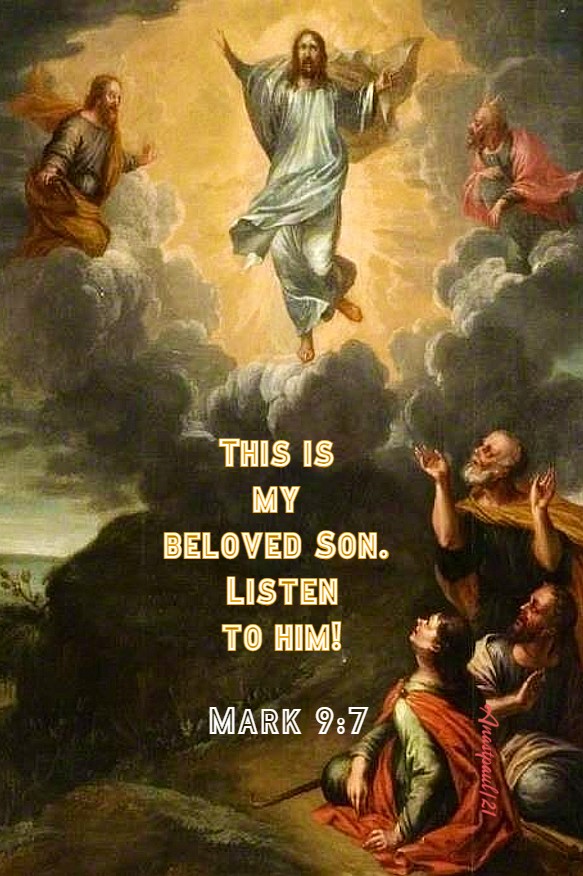
“This is my beloved Son. Listen to him..”
Mark 9:7
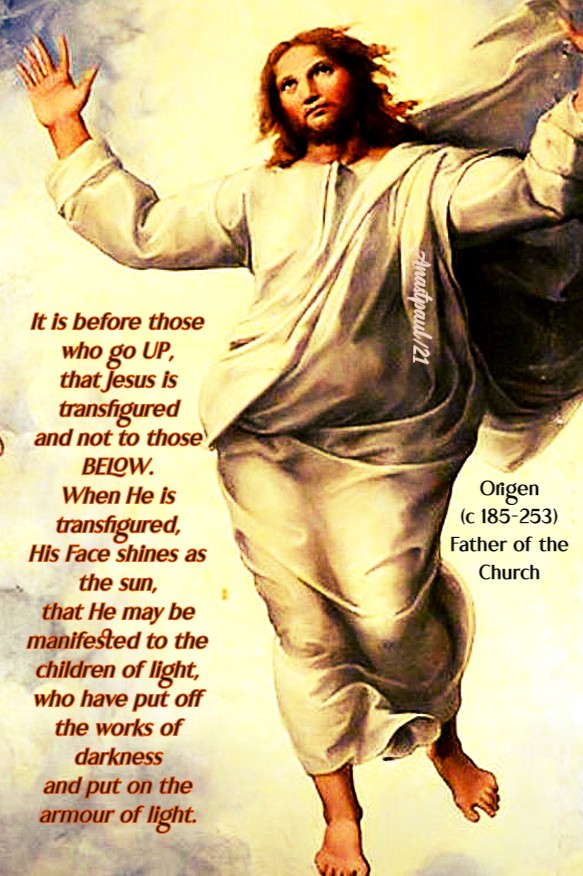
“It is before those who go UP that Jesus is transfigured and not to those BELOW. When He is transfigured, His Face shines as the sun, that He may be manifested to the children of light, who have put off the works of darkness and put on the armour of light..”
Origen (c 185-253) Father of the Church
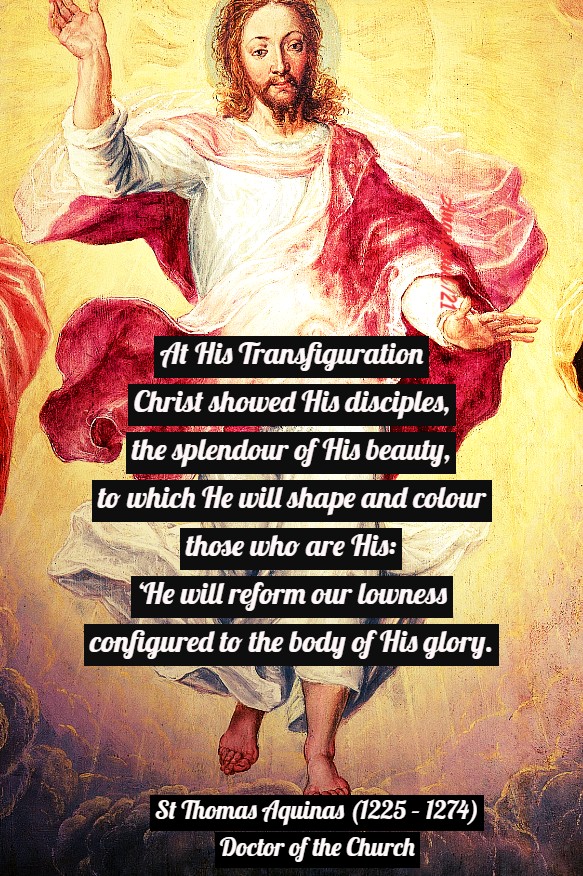
“At His Transfiguration Christ showed His disciples, the splendour of His beauty, to which He will shape and colour those who are His: ‘He will reform our lowness configured to the body of His glory.’”
St Thomas Aquinas (1225 – 1274) Doctor of the Church
One Minute Reflection – 6 August – “Month of the Immaculate Heart of Mary”- Feast of the Transfiguration of the Lord – Readings: Daniel 7: 9-10, 13-14; Psalm 97: 1-2, 5-6, 9; Peter 1: 16-19; Mark 9: 2-10
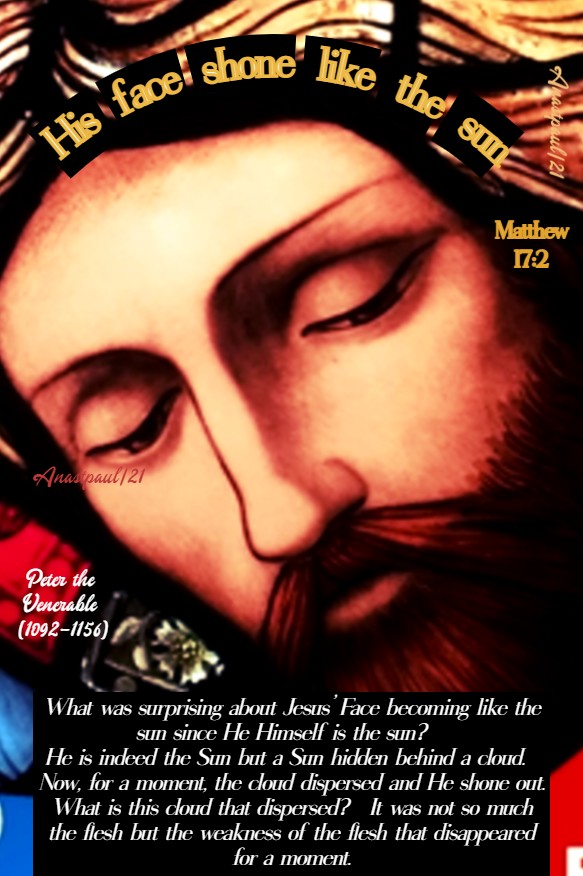
“His face shone like the sun” – (Matthew 17:2)
REFLECTION – “What was surprising about Jesus’ Face becoming like the sun since He Himself is the Sun? He is indeed the Sun but a Sun hidden behind a cloud. Now, for a moment, the cloud dispersed and He shone out. What is this cloud that dispersed? It was not so much the flesh but the weakness of the flesh that disappeared for a moment.
This is the cloud spoken of by the prophet: “See, the Lord will ride on a swift cloud” (Is 19:1) -the cloud, the flesh that covers His divinity; swift, because this flesh bears not a trace of evil in itself, a cloud concealing the divine splendour; swift, because it is to rise up to the eternal splendour. This is the cloud of which it is written in the Song of Songs: “I was seated in the shadow of him for whom my soul longs” (cf. Sg 3:2). It is a swift cloud because this is the flesh of “the Lamb who takes away the sins of the world” (Jn 1:29) and, once these have been removed, the world is carried up to heavenly heights, divested of the weight of all its sins.
The sun concealed by this flesh is not that “which rises for good and bad alike” (Mt 5:45) but “the Sun of righteousness” (Mal 3:20), which rises only for those who fear God. Veiled, normally, by the cloud of the flesh, this light that “enlightens everyone” (Jn 1:9) shines out today in all its brilliance. Today it gives glory to this same flesh, it displays itself deified to the Apostles ,so that they, the Apostles, might make it known to the world.” – Peter the Venerable (1092-1156) Abbot of Cluny – Sermon 1 for the Transfiguration
PRAYER – Father, at the Transfiguration in glory of Your only-begotten Son, You confirmed the mysteries of faith by the witness to Jesus of the prophets Moses and Elijah. You foreshadowed what we shall be when You bring our sonship to its perfection. Grant that by listening to the voice of Jesus, we may become heirs with Him, who lives and reigns with You and the Holy Spirit, God forever and may Mary, our tender and caring Mother, help us to be bright rays of the saving light of her Son Jesus. Amen
Nossa Senhora das Graças / Our Lady of Graces, Pesqueira, Pernambuco, Northeast, Brazil (1936) – 6 August :
On 6 August 1936, Maria da Luz Teixeira, 13, and Maria da Conceição, 16 (a poor girl living with the Teixeira family), were gathering castor beans on Guarda mountain in the Cimbres district, 15 miles from Pesqueira. There was a flash of light and then Maria da Conceição said, “Look, there’s an image that looks like Our Lady.” Maria da Luz saw it too, up on a rock. They ran home and told Maria da Luz’s parents. At her mother’s insistence, Artur Teixeira climbed the hill with the girls, who reached the spot long before he struggled up through the brush. He saw nothing unusual but, at his suggestion, the girls together asked the image, “Who are you?”“I am Grace.” They asked what she wanted. “I’ve come to warn of three punishments sent by God. Tell the people to pray much and do penance.”
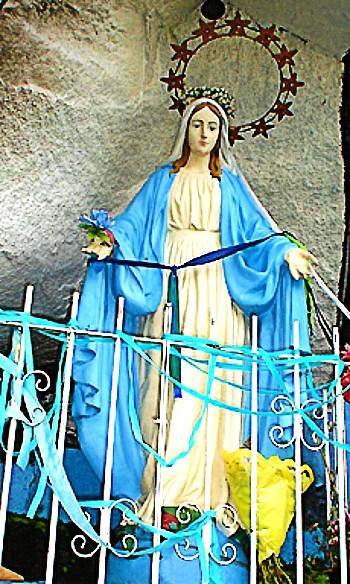
After this the girls returned to the site daily, where they prayed with a growing crowd of pilgrims. On 9 August, the crowd demanded a sign; reluctantly, the girls asked for one. The next day, they found water flowing from the rock and two sets of footprints embedded in stone, one an adult’s and one a child’s. The apparition confirmed they belonged to her and her son. The Bishop conducted an investigation. Maria da Luz described Our Lady of Grace as “similar to Our Lady of Mount Carmel in Pesqueira Cathedral but her mantle is blue and her dress cream, with a belt. She has a little child in her left arm and both have very beautiful crowns on their heads.”
Eventually the Virgin told her that the people’s response had been sufficient to avert the three chastisements, sometimes identified as armed bandits (particularly the notorious Lampião, killed by police in 1938) and the coming of World War II or a Communist regime to Brazil. Maria da Conceição died young. In 1940, Maria da Luz joined the Religious of Christian Instruction, taking the name Sister Adélia. In her absence, pilgrims continued to visit the Shrine at the apparition site, where 296 carved stone steps lead to a Statue of Our Lady of Grace (as depicted on the Miraculous Medal, without the Child, not as the girls saw her) and to report miracles there. In 1966, the Vatican approved the apparitions. Sister Adélia has since participated in some events at the Shrine, including the anniversary pilgrimages of 1985 and 1986 and reported some new messages from Our Lady. As of 2010 she was still living, aged 87. Because the original site is located in the Xukuru Indian reservation, an area of constant conflict, the City and Diocese of Pesqueira have built a new Shrine to Our Lady of Grace, with a grotto and Chapel, on a Calvary Shrine hill closer to town.
Bl Gezelin of Schlebusch St Gislain of Luxemburg St Glisente of Brescia Bl Goderanno Bl Guillermo Sanz St Hardulf of Breedon
Bl Octavian of Savona St Pope Sixtus II (Died 258) Pope and Martyr
St Stephen of Cardeña Bl Tadeusz Dulny Bl William of Altavilla — Martyrs of Cardeña: Two hundred Benedictine monks at the Saint Peter of Cardegna monastery, Burgos, Spain who were martyred in the 8th century by invading Saracens. They were buried by local Christians in a nearby churchyard in Burgos, Spain and Beatified in 1603 by Pope Clement VIII (cultus confirmed).
Martyred in the Spanish Civil War: 10 Beati • Blessed Alejandro Casare Menéndez • Blessed Andrés Soto Carrera • Blessed José González Ramos Campos • Blessed José María Recalde Magúregui • Blessed Juan Silverio Pérez Ruano • Blessed Saturnino Ortega Montealegre
Portiuncula Indulgence: An Indulgence which may be gained in any Church so designated by the Bishop, by all the faithful who, after Confession and Holy Communion, visit such Churches between noon of 1 August and midnight of 2 August, or on the Sunday following. The Indulgence is toties quoties and is applicable to the souls in Purgatory.
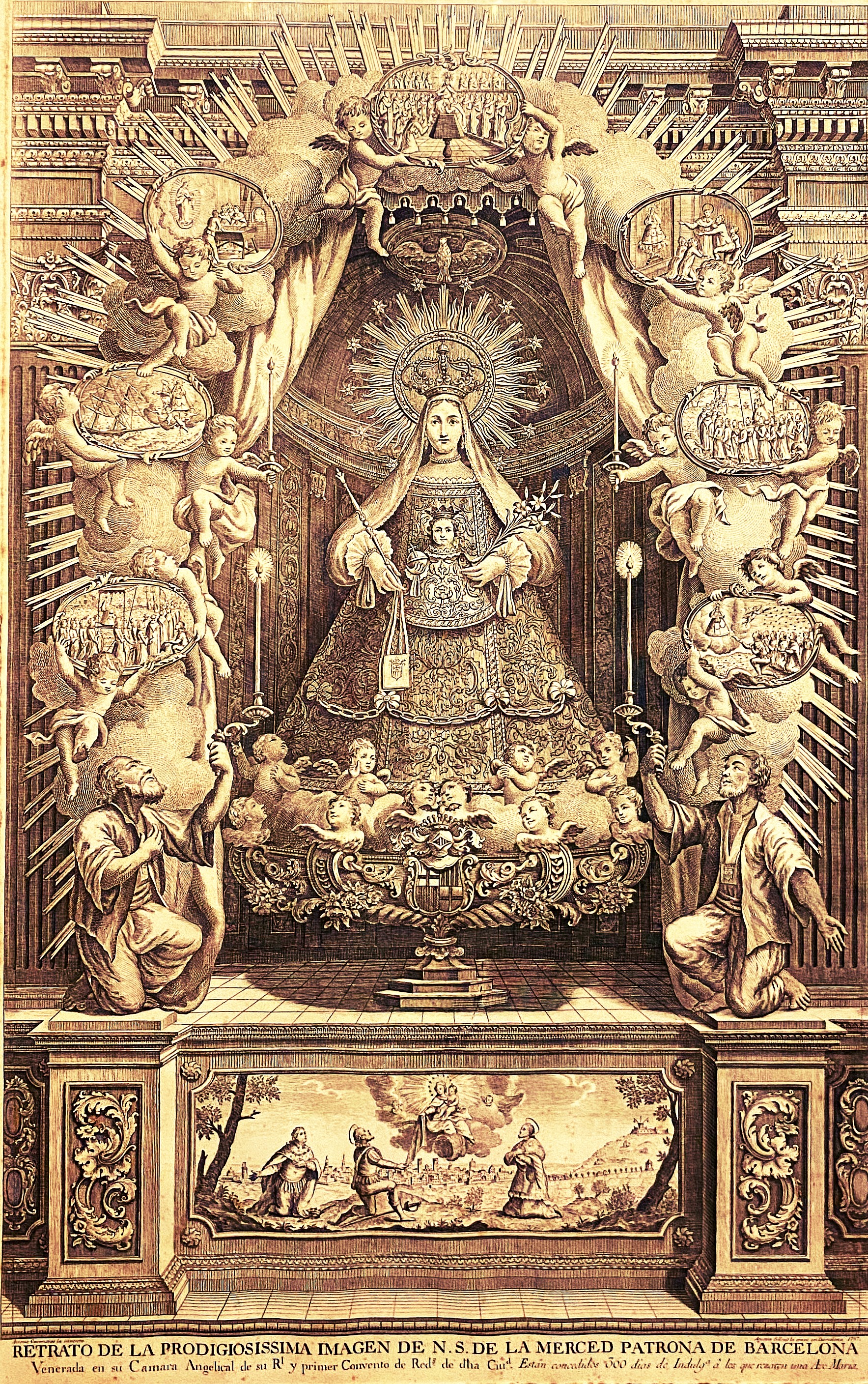
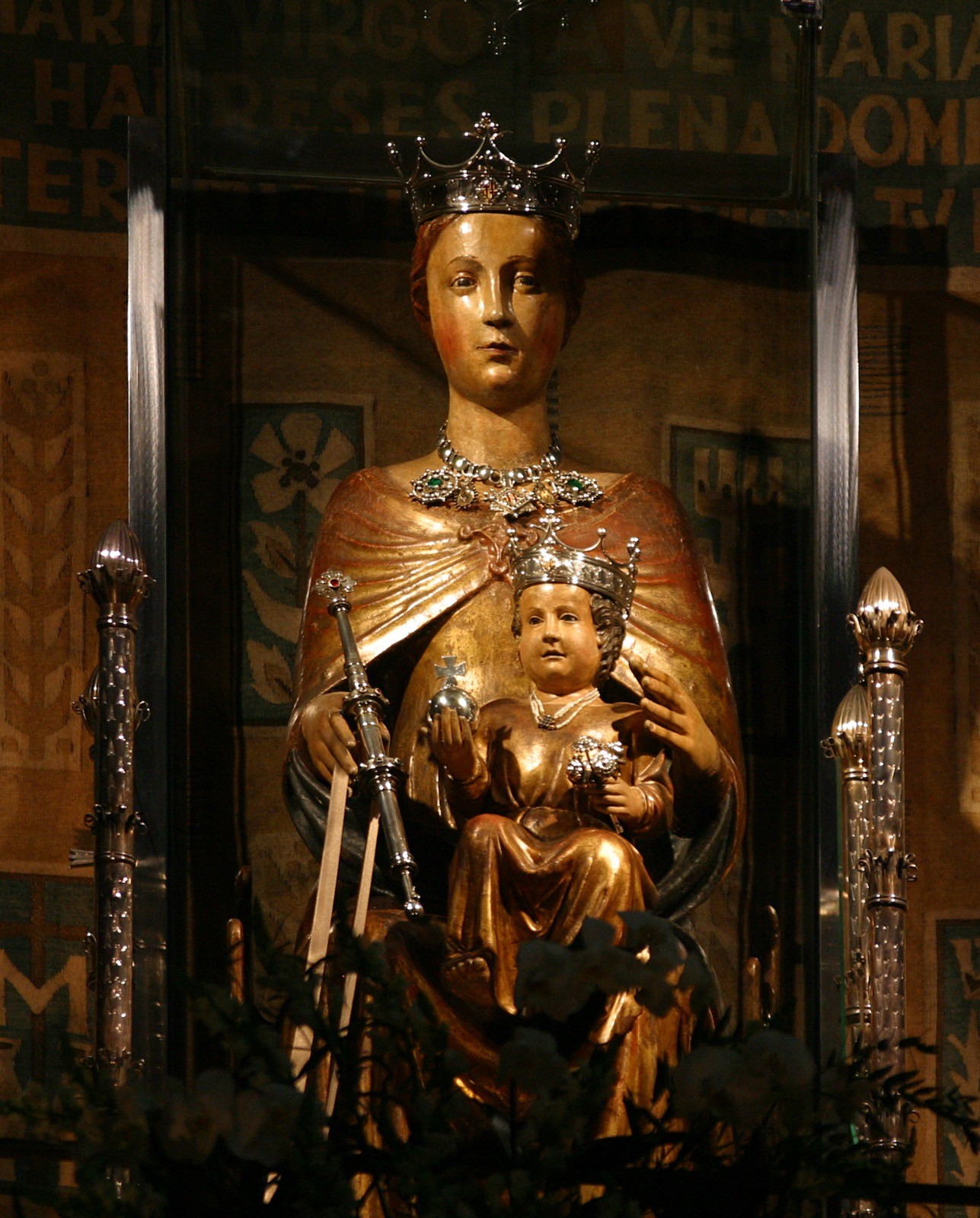
Nuestra Señora de las Mercedes / Our Lady of Mercy, Barcelona, Spain (1218,) Founding of the Mercedarian Order – 1 August, 24 September :
Original image from the Mercedarian website
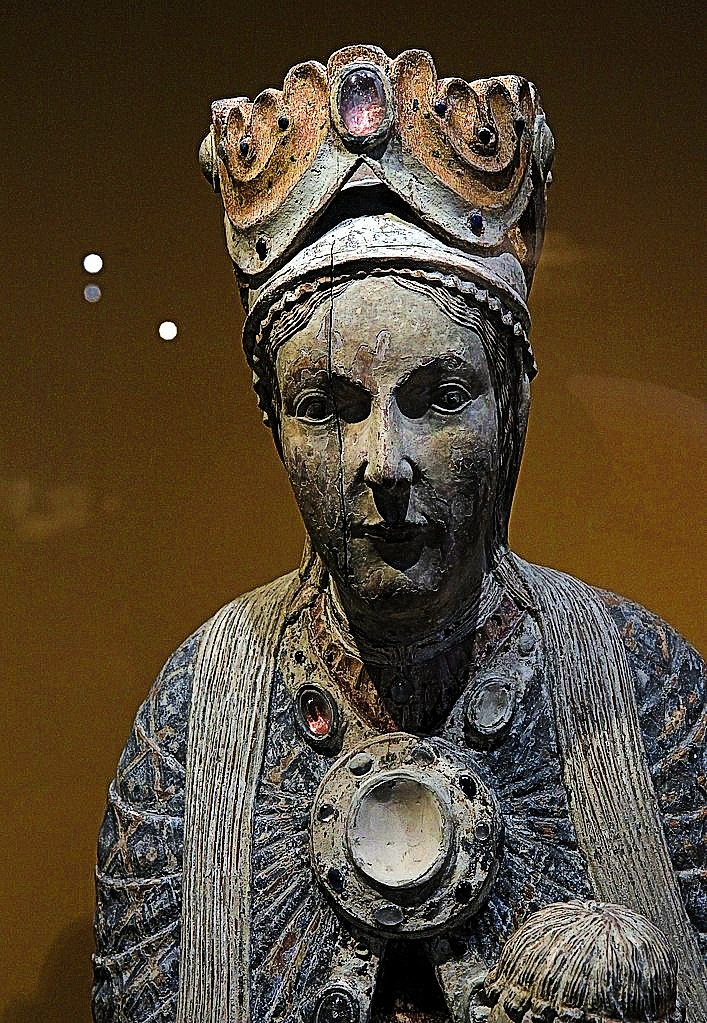
On 1 August of 1218, St Peter Nolasco, St Raymund of Penafort and James, King of Aragon, each had a vision of the Virgin Mary asking them to found a religious Order devoted to freeing Christian captives from the Muslims, who still held much of Spain. The Order of the Blessed Virgin Mary of Mercy grew quickly, collecting alms for ransom and sometimes offering themselves in exchange for prisoners. The Statue of the Mother of God of Mercy in Barcelona (below) dates from the 1300s. She became the City’s Patron after saving it from a plague of locusts in 1687. Before the counter-reformation, the Mercedarian Order celebrated the Feast of Our Lady of Ransom on 1 August, the date when she showed St. Peter Nolasco their white habit. The Vatican changed the date to 24 September when it extended the feast to entire Church in 1696. Since Vatican II, Catholic observance of Our Lady of Mercy’s day is limited to places and organisations that claim her as Patron. Meanwhile, the Mercedarians have changed their mission to teaching and chaplaincy and the Barcelona soccer team visits the Basilica of La Mercè after victories in thanksgiving for her help. Her fiesta in Barcelona is a spectacular sequence of processions, dances, music, games and fireworks.
St Adela Mardosewicz Bl Aleksy Sobaszek St Alexander of Perga St Almedha St Arcadius St Attius of Perga St Buono St Brogan St Charity St Ethelwold of Winchester (c 912-984) Bishop St Exuperius of Bayeux St Faith St Faustus St Felix of Gerona St Friard Bl Giovanni Bufalari St Hope St Jadwiga Karolina Zak St Jonatus St Justin of Paris St Kenneth of Wales St Leontius of Perga St Maur St Nemesius of Lisieux Bl Orlando of Vallombrosa St Peregrinus of Modena St Rioch Bl Rudolph St Secundel St Secundus of Palestrina St Sophia St Verus of Vienne
Holy Maccabees: Jewish dynasty which began with the rebellion of Mathathias and his five sons against the Syrian king, Antiochus IV (168 BC) and ruled the fortunes of Israel until the advent of Herod the Great. Syrian attempts to force Greek paganism on the Jews, the profanation of the Temple at Jerusalem and the massacre which followed, brought the nation to arms under Mathathias, a priest of the sons of Joarib. At the death of Mathathias, Judas Machabeus, his third son, drove the Syrians and Hellenists out of Jerusalem, rededicated the Temple and began an offensive and defensive alliance with the Romans. Before the treaty was concluded, however, Judas, with 800 men, risked battle at Laisa with an overwhelming army of Syrians under Bacchides, and was slain. He was succeeded in command by his youngest brother, Jonathan (161 BC). Jonathan defeated Bacchides, revenged the death of his brother and made peace with Alexander who had usurped the throne of Demetrius, the successor to Antiochus. A period of peace followed in which Jonathan ruled as high priest in Jerusalem but Tryphon, who was plotting for the throne of Asia, treacherously captured him at ptolemais and later put him to death. The captaincy of the armies of Israel then fell to Simon, the second son of Mathathias. Under him the land of Juda flourished exceedingly. He obtained the complete independence of the country and a grateful people bestowed upon him the hereditary kingship of the nation. His rule marked five years of uninterrupted peace. He was treacherously slain by his son-in-law, Ptolemy, about the year 135 BC After Simon the race of the Machabees quickly degenerated. In 63 BC the Romans thought it necessary to interfere in the fratricidal war between Hyrcanus II and Aristobulus II. With this interference and the advent of Herod the Great the sceptre passed forever from the land of Juda. The story of the Machabees is written in the two books of the Old Testament which bear that name.
Saints Faith, Hope and Charity: The daughters of Saint Sophia. While still children, they were tortured and martyred for their faith in the persecutions of Hadrian. They were scourged, thrown into a fire, and then beheaded.
Martyrs of Nowogrodek – 11 beati: A group of eleven Holy Family of Nazareth nuns who were murdered by the Nazi Gestapo in exchange for 120 condemned citizens of Nowogrodek, Belarus who were scheduled for revenge killings. They are – • Adela Mardosewicz • Anna Kukolowicz • Eleonora Aniela Józwik • Eugenia Mackiewicz • Helena Cierpka • Jadwiga Karolina Zak • Józefa Chrobot • Julia Rapiej • Leokadia Matuszewska • Paulina Borowik • Weronika Narmontowicz They were machine-gunned by firing squad on 1 August 1943 by the Gestapo about three miles outside Novogrudok (Nowogródek), Hrodzyenskaya voblasts’, in Nazi occupied Belarus and buried on the site of the execution in a common grave. One of their surviving sisters, Maria Malgorzata Banas, located the grave on 19 March 1945 and tended to it until her death in 1966. Their relics have since been re-interred in a common sarcophagus in the chapel of the Novograd Farny Church (the Church of the Transfiguration, also known as Biala Fara or the White Church).
One Minute Reflection – 25 July – “Month of the Most Precious Blood” – Feast of St James the Greater – Reaqdings: Second Kings 4: 42-44; Psalms 145: 10-11, 15-16, 17-18; Ephesians 4: 1-6; John 6: 1-15
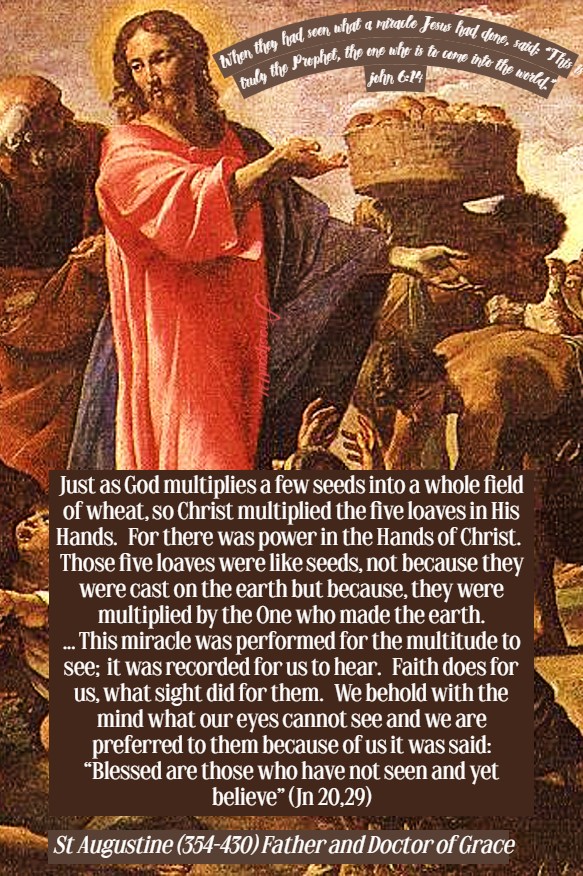
When they had seen what a miracle Jesus had done, said: , “This is truly the Prophet, the one who is to come into the world.” – John 6:14
REFLECTION – “Governing the entire universe is a greater miracle than feeding five thousand people with five loaves of bread, yet no-one marvels at it. People marvel at the feeding of the five thousand not because this miracle is greater but because, it is out of the ordinary. Who is even now providing nourishment for the whole world if not the God Who creates a field of wheat from a few seeds? Christ did what God does. Just as God multiplies a few seeds into a whole field of wheat, so Christ multiplied the five loaves in His Hands. For there was power in the Hands of Christ. Those five loaves were like seeds, not because they were cast on the earth but because, they were multiplied by the One who made the earth.
This miracle was presented to our senses, in order to stimulate our minds… and so make us marvel at “the God we do not see because of his works, which we do see” (Rom 1,20). For then, when we have been raised to the level of faith and purified by faith, we shall long to behold, though not with our eyes, the invisible God Whom we recognise through what is visible. This miracle was performed for the multitude to see; it was recorded for us to hear. Faith does for us, what sight did for them. We behold with the mind what our eyes cannot see and we are preferred to them because of us, it was said: “Blessed are those who have not seen and yet believe” (Jn 20,29). – St Augustine (354-430) Father and Doctor of Grace – Homilies on Saint John’s gospel, 24, 1.6.7.
PRAYER – Lord our God, You accepted the sacrifice of St James, the first of Your Apostles to give his life for Your sake. May Your Church find strength in his martyrdom and support in his constant prayer. Through our Lord Jesus Christ, your Son, who lives and reigns with you in the unity of the Holy Spirit, one God, for ever and ever. St James the Greater, Apostle of Christ, Pray for us! Amen
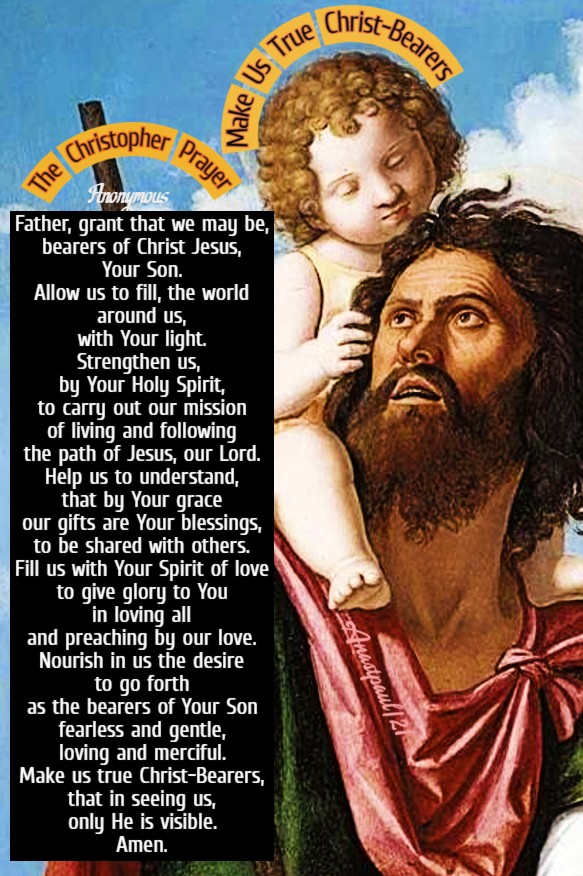
Our Morning Offering – 25 July – “Month of the Most Precious Blood” – Feast of St James the Greater and the Memorial of St Christopher (died c 251)
The Christopher Prayer, Make Us True Christ-Bearers Anonymous
Father, grant that we may be, bearers of Christ Jesus, Your Son. Allow us to fill, the world around us, with Your light. Strengthen us, by Your Holy Spirit, to carry out our mission of living and following the path of Jesus, our Lord. Help us to understand, that by Your grace our gifts are Your blessings, to be shared with others. Fill us with Your Spirit of love to give glory to You in loving all and preaching by our love. Nourish in us the desire to go forth as the bearers of Your Son fearless and gentle, loving and merciful. Make us true Christ-Bearers, that in seeing us, only He is visible. Amen.
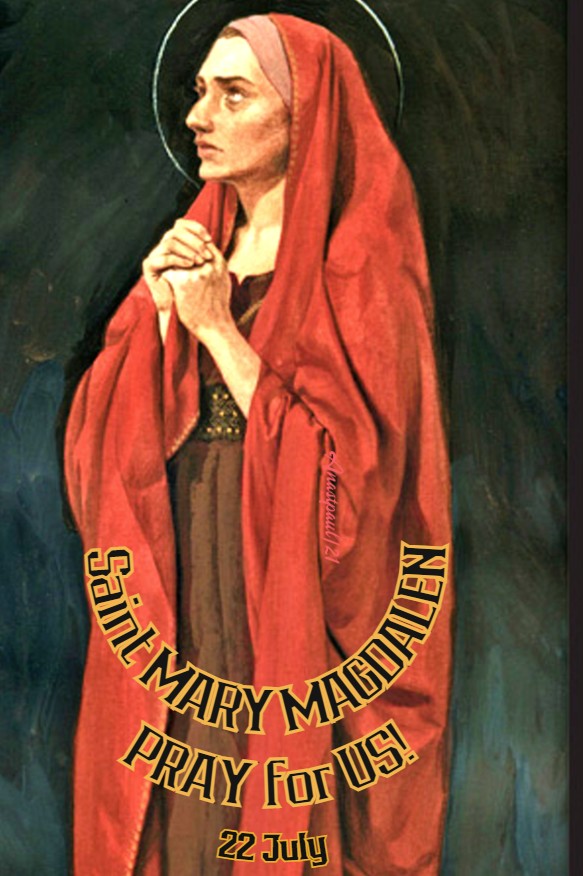
One Minute Reflection – 22 July –“Month of the Most Precious Blood” – Feast of St Mary of Magdala – Readings: Song of Solomon 3:1-4, Psalm 63:2-6, 8-9, John 20:1-2, 11-18
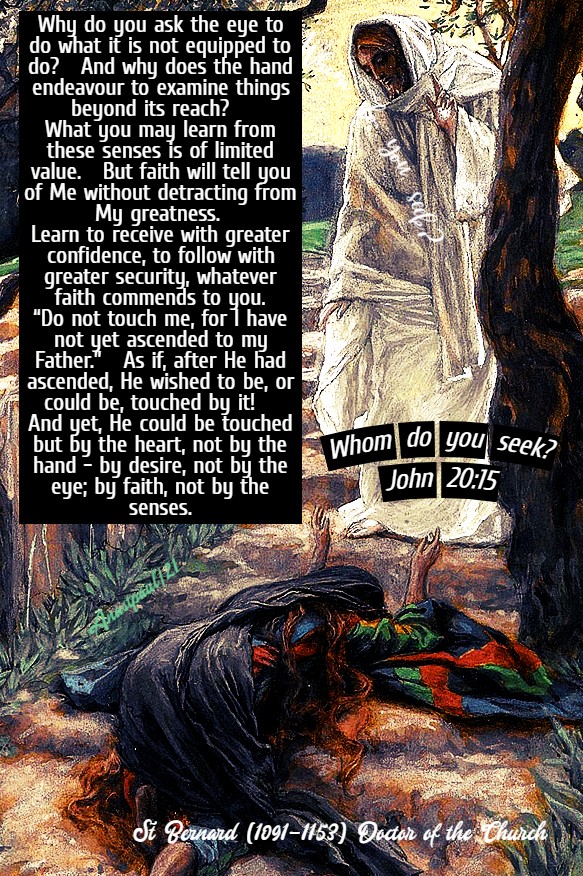
“Whom do you seek?” – John 20:15
REFLECTION – “Only the hearing that catches the Word possesses the truth … “Do not touch me,” says the Lord. He meant: – depend no longer on this fallible sense, put your trust in the Word, get used to faith. Faith cannot be deceived. With the power to understand invisible truths, faith does not know the poverty of the senses; it transcends even the limits of human reason, the capacity of nature, the bounds of experience. Why do you ask the eye to do what it is not equipped to do? And why does the hand endeavour to examine things beyond its reach? What you may learn from these senses is of limited value. But faith will tell you of Me without detracting from My greatness. Learn to receive with greater confidence, to follow with greater security, whatever faith commends to you.
“Do not touch me, for I have not yet ascended to my Father.” As if, after He had ascended, He wished to be, or could be, touched by it! And yet, He could be touched but by the heart, not by the hand – by desire, not by the eye; by faith, not by the senses. “Why do you want to touch Me now?” He says … “Do you not remember that, while I was still Mortal, the eyes of the disciples could not endure, for a short space, the glory of My Transfigured Body that was destined to die? I still accommodate Myself to your senses by bearing this form of a servant (Phil 2:7) which you are accustomed to seeing. But this glory of Mine is too wonderful for you … Defer your judgement, therefore, … With its fuller comprehension, faith will define it more worthily and more surely … They, therefore, will touch Me worthily, who will accept Me as being seated with the Father (Mk 16:19; Ps 110[109]:1), no longer in lowly guise but in My own flesh, transformed with heaven’s beauty. Why wish to touch what is ugly? Have patience, that you may touch Me in My Beauty.” – St Bernard (1091-1153) – Cistercian Monk and Doctor of the Church – Sermons on the Song of Songs, no. 28, 9-10
PRAYER – Almighty, ever-living God, Your only-begotten Son, Jesus Christ made Mary of Magdala the first herald of Easter joy. Grant that, following her example and helped by her prayers, we may, in this life, proclaim the living Christ and come to see Him reigning with You in glory. Through our Lord Jesus Christ, in unity with the Holy Spirit, one God forever and ever, amen.
Solemnity of Saints Peter and Paul (29 June) +2021
Nuestra Señora del Refugio / Our Lady of Refuge, Matamoros, Tamaulipas, Mexico (1720) – 4 July:
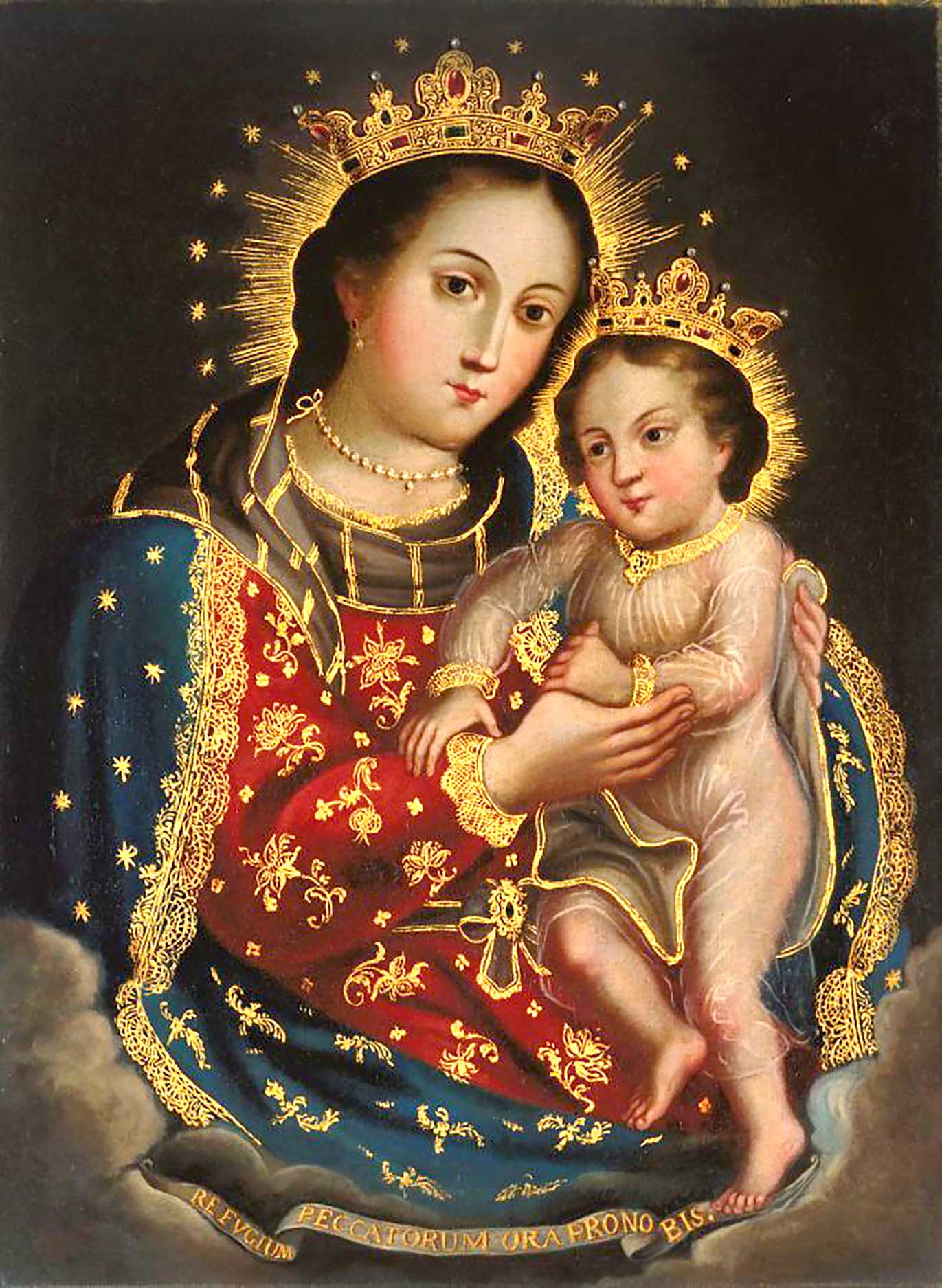
Jesuit Missionary Father Juan José Güica brought a painting of Our Lady, Refuge of Sinners from Italy to Mexico in 1720. In a dream, the Virgin told Padre Güica to ask the Franciscans of Zacatecas to use and promote the image; – they distributed over 150 copies, making this one of the most widespread Marian devotions in Mexico.
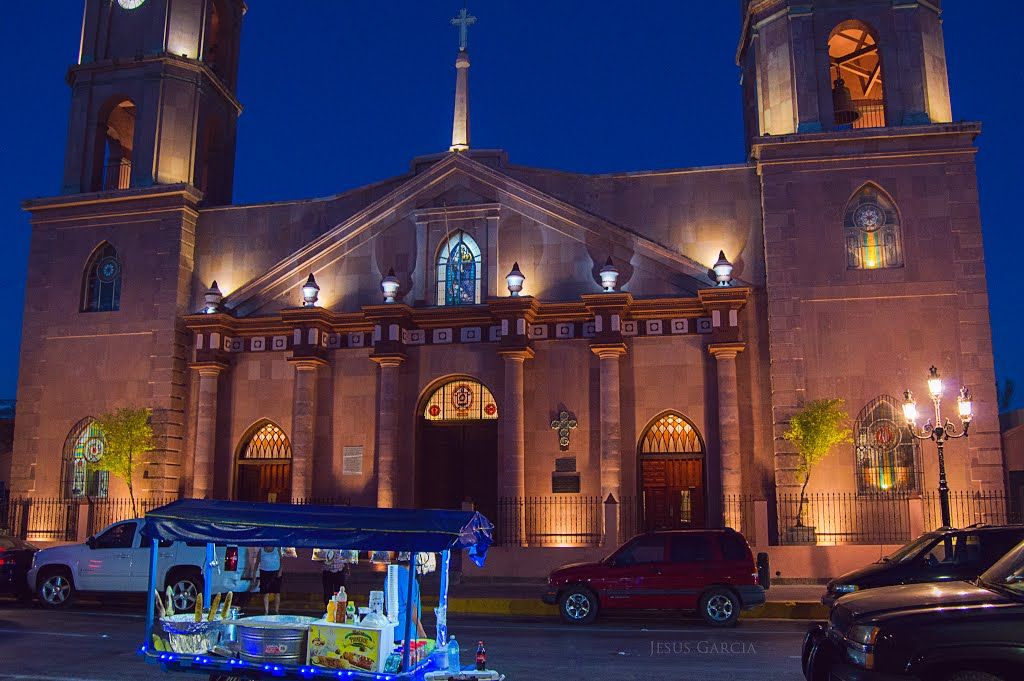
In 1793 Franciscan Friars came to the new settlement which would become Matamoros, renaming the area “Nuestra Señora del Refugio de los Esteros Hermosos” (Our Lady of the Refuge of the Lovely Marshes).
The Cathedral of Our Lady of Refuge, built in 1832, displays an 1886 painting of her. Her fiesta, celebrated in many Mexican Towns, commemorates the coronation of the original “Refugium Peccatori” in the Jesuit Church of Frascati, Italy, on 4 July 1717.
Bl Agatha Yun Jeom-Hye St Albert Quadrelli St Andrew of Crete St Anthony Daniel St Aurelian of Lyons St Bertha of Blangy St Carileffo of Anille Bl Catherine Jarrige St Cesidio Giacomantonio Bl Damiano Grassi of Rivoli St Donatus of Libya St Edward Fulthrop St Elias of Jerusalem St Finbar of Wexford St Fiorenzo of Cahors St Flavian of Antioch St Giocondiano Bl Giovanni of Vespignano St Haggai the Prophet Bl Hatto of Ottobeuren Bl Henry Abbot St Henry of Albano St Hosea the Prophet St Innocent of Sirmium Bl John Carey Blessed John Cornelius SJ (1557– 1594) Martyr, English Priest of the Society of Jesus, Missionary. Bl Jozef Kowalski St Jucundian St Laurian of Seville St Lauriano of Vistin Bl Maria Crocifissa Curcio St Namphanion the Archmartyr Bl Natalia of Toulouse St Odo the Good Bl Odolric of Lyon Bl Patrick Salmon Bl Pedro Romero Espejo
Quote/s of the Day – 3 July – Feast of St Thomas Apostle – Readings: Ephesians 2: 19-22, Psalms 117: 1bc, 2, John 20: 24-29
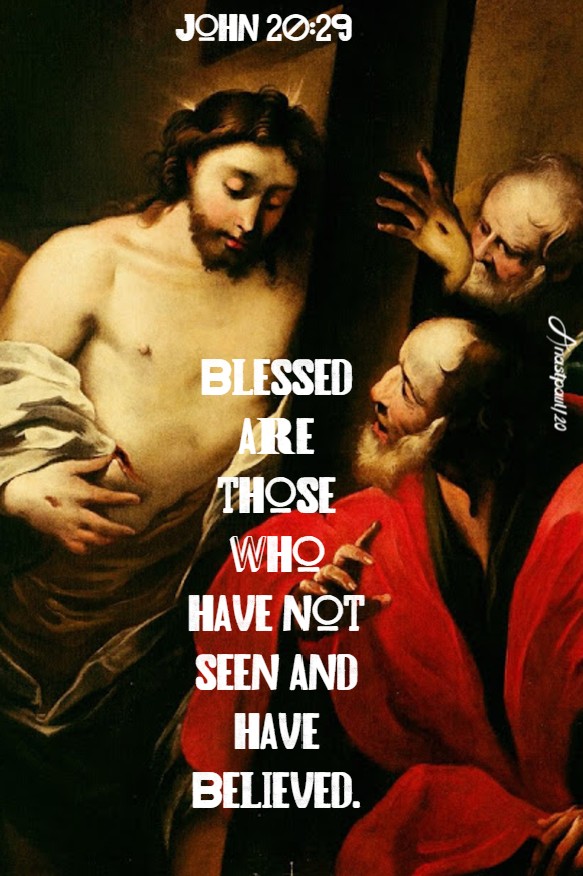
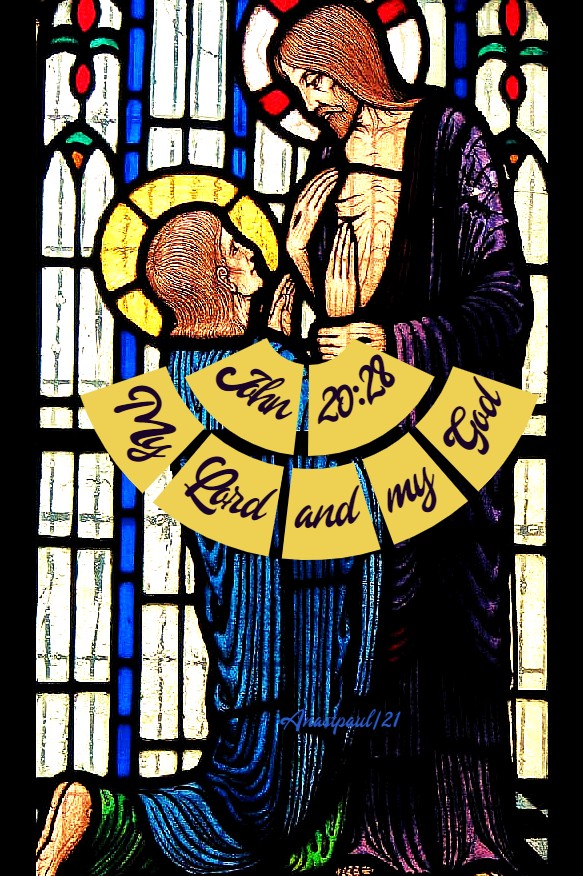
Jesus said to him, “Have you come to believe because you have seen me? Blessed are those who have not seen and have believed.”
John 20:28-29
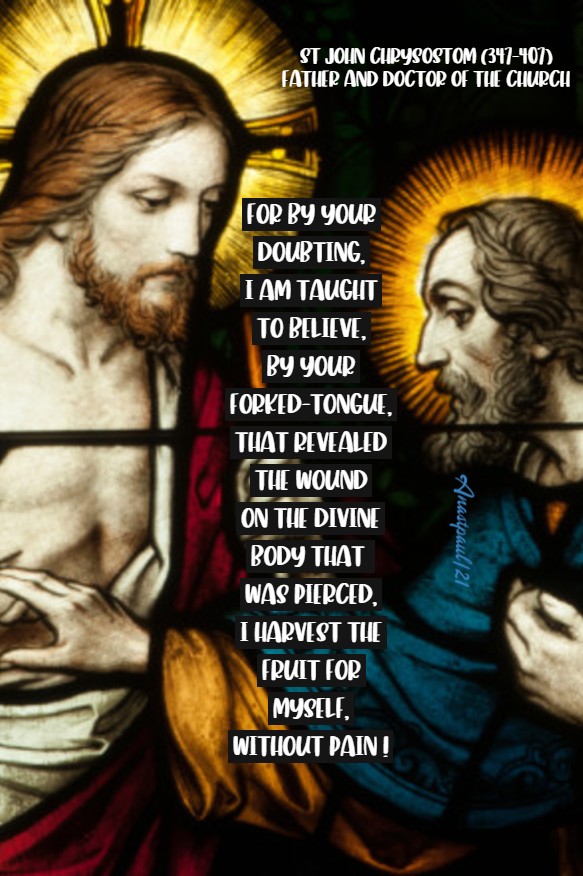
“For by your doubting, I am taught to believe, by your forked-tongue, that revealed the Wound on the Divine Body that was pierced, I harvest the fruit for myself, without pain!”
St John Chrysostom (347-407) Father and Doctor
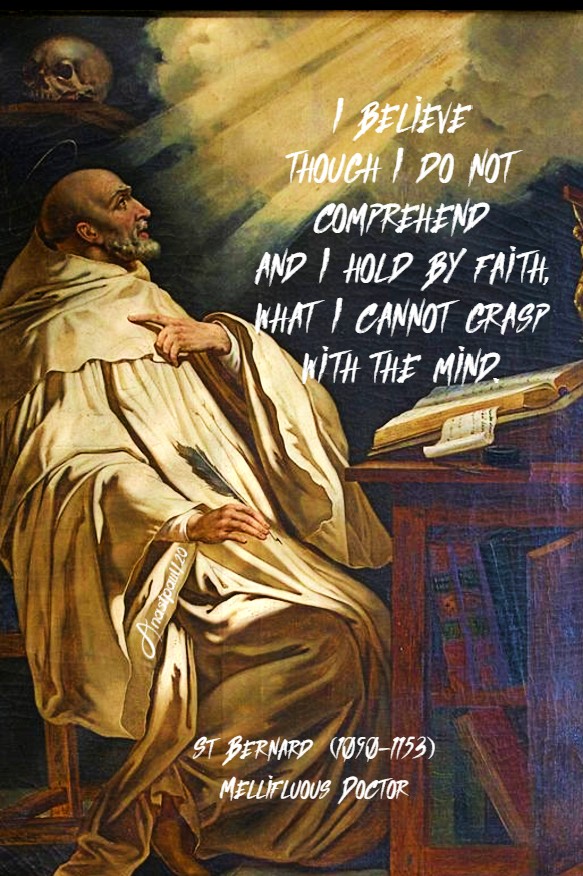
“I believe though I do not comprehend and I hold by faith, what I cannot grasp with the mind.”
St Bernard (1090-1153) Mellifluous Doctor
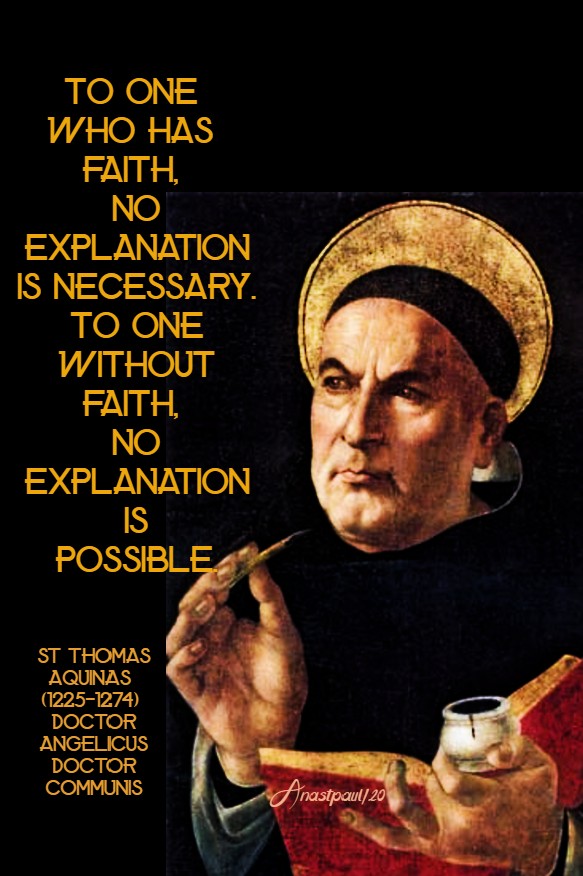
“To one who has faith, no explanation is necessary. To one without faith, no explanation is possible.”
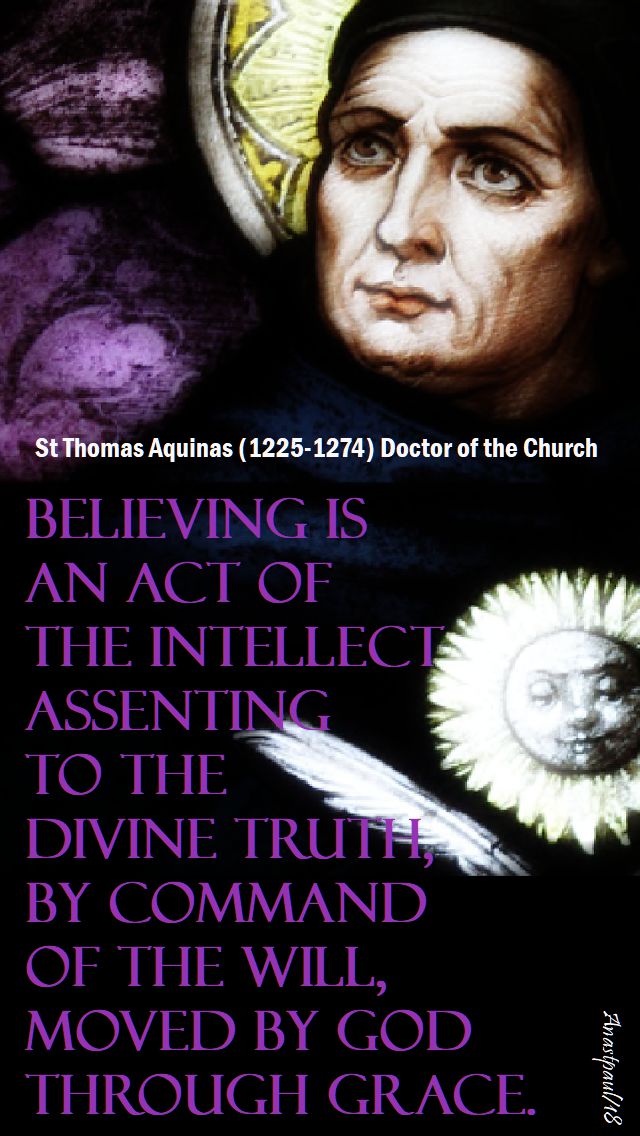
“Believing is an act of the intellect assenting to the divine truth, by command of the will, moved by God through grace.”
St Thomas Aquinas (1225-1274) Doctor Angelicus/Doctor Communis
One Minute Reflection – 3 July – Feast of St Thomas Apostle – Readings: Ephesians 2: 19-22, Psalms 117: 1bc, 2, John 20: 24-29
“Blessed are those who have not seen and have believed.” – John 20:29
REFLECTION – “There was a wonderful providence behind these words of the Saviour and they can be of very great help to us. They show, once again, how much He cares for our souls, for He is good and| as Scripture says: “He wants everyone to be saved and to come to knowledge of the truth” (1Tm 2,4).
Even so, this saying of His may surprise us. As always, Christ had to be patient with Thomas, when he said he would not believe and, with the other disciples too, when they thought they were seeing a ghost! Because of His desire to convince the whole world, He most willingly showed them the marks of the nails and the wound in His side; – because He wished those, who sought this evidence, as a support for their faith, to have no possible reason for doubt – He even took food, although He had no need for it (Lk 24,41)…
But when anyone accepts what he has not seen, believing on the word of his teacher, the faith, by which he honours the One his teacher proclaims to him, is worthy of great praise. Blessed, therefore, is everyone who believes the message of the holy Apostles who, as Saint Luke says, were eyewitnesses of Christ’s actions and “ministers of the word” (Lk 1,2). If we desire eternal life and long for a dwelling place in heaven, we must listen to them.” – St Cyril of Alexandria (380-444), Bishop, Father and Doctor of the Church – Commentary on Saint John’s gospel, 12, 22
PRAYER – Father, let our celebration on the feast of Saint Thomas the Apostle, be the source of his unfailing help and protection. Fill us with Your life-giving grace through our faith in Your Son, Jesus the Christ, whom Thomas acknowledged to be his Lord and his God. We make our prayer, through our Lord Jesus in union with the Holy Spirit, one God with You, forever and ever, amen.
Notre-Dame-de-la-Carole / Our Lady of la Carole, Paris (1418) – 3 July:
Roadside Shrines can still be seen in places all over Europe, though it is nothing like it used to be in the Middle Ages when these Shrines were extremely prevalent. They were public reminders of God and His Saints and were meant for the good of the general public, who would come upon the Shrine and pause for a moment to pray. They could be simple or somewhat elaborate, ranging from unadorned crosses to free standing towers or even small Chapels. On 3 July in the year 1418, a Swiss soldier committed a sacrilege upon a Statue of the Blessed Virgin known as Our Lady of la Carole, or Our Lady of Carole. It was located at the corner of the Rue aux Ours, which was built in the 13th century and terminated at the hospital of Saint John, which is no longer in existence. The Rue aux Ours is now a short street that begins at Rue Saint-Martin and ends at the Boulevard Sebastopol in Paris, France. The soldier of the Duke of Burgandy’s troops, said to be a Swiss soldier, came upon the Shrine of the Blessed Virgin after having left a tavern where he had gambled away his money. He was probably intoxicated when he drew his sword and repeatedly struck the Statue of the Blessed Virgin with the weapon. The Statue of Our Lady of Carole then began to bleed profusely, as if made of flesh and blood and WAS wounded by the blows. The citizens who had observed the sacrilege were outraged and followed the soldier as he fled from the scene of his crime. The man was eventually caught and apprehended and then brought before the Chancellor where he was sentenced to death for the outrage.
In remembrance of this incident and in expiation for the crime, there was a popular feAST that took place on the Rue aux Ours every year. There were fireworks and a wax figure representing the sacrilegious wretch who had struck the image of the Blessed Virgin was set ablaze. This festival continued until the French Revolution brought an end to the traditional observance.
St Anatolius of Constantinople (Diedc 458) Bishop Bl Andreas Ebersbach Bl Barbara Jeong Sun-mae St Bladus St Byblig St Cillene St Dathus of Ravenna St Eusebius of Laodicea St Firminus St Firmus Bl Gelduin St Giuse Nguyen Ðình Uyen St Gunthiern St Guthagon St Heliodorus of Altinum St Hyacinth of Caesarea St Ioannes Baptista Zhao Mingxi St Irenaeus of Chiusi
St Maelmuire O’Gorman St Mark of Mesia St Mennone the Centurian St Mucian of Mesia St Paul of Mesia St Petrus Zhao Mingzhen St Philiphê Phan Van Minh St Raymond of Toulouse (Died 1118) Layman — Martyrs of Alexandria – 13 saints: Thirteen Christian companions marytred together. No details about them have survived but the names – Apricus, Cyrion (2 of), Eulogius, Hemerion, Julian, Julius, Justus, Menelaus, Orestes, Porfyrios and Tryphon (2 of). They martyred in Alexandria, Egypt, date unknown.
Martyrs of Constantinople – 24 saints: A group of 24 Christians martyred in the persecutions of Arian emperor Valens. We know little more than their names – Acacios, Amedinos, Ammonius, Ammus, Cerealis, Cionia, Cionius, Cyrianus, Demetrius, Eulogius (2), Euphemia, Heliodoros, Heraclios, Horestes, Jocundus, Julian, Martyrios, Menelaeus, Sestratus, Strategos, Thomas, Timotheos and Tryphon. They were martyred in c367 in Constantintinople.
Theodotus and Companions – 6 saints: Six Christians who were imprisoned, tortured and martyred together in the persecutions of Trajan. Saint Hyacinth ministered to them in prison. We know nothing else about them but their names – Asclepiodotus, Diomedes, Eulampius, Golinduchus, Theodota and Theodotus. They were beheaded in c110, location unknown.
The Most Precious Blood of Our Lord, Jesus Christ – 1 July: The feast was removed from the General Roman Calendar in 1969, “because the Most Precious Blood of Christ the Redeemer is already venerated in the solemnities of the Passion, of Corpus Christi, of the Sacred Heart of Jesus and in the feast of the Exaltation of the Holy Cross.” However, as this is the Month of the Most Precious Blood, this day, is most worthy of celebrating this Feast Day everyday. There is a wonderful Sermon here: https://altcensored.com/watch?v=Lfju6KSKc5Q
Dedication of the Church of Jumieges, Normandy, France (1067) 1 July:
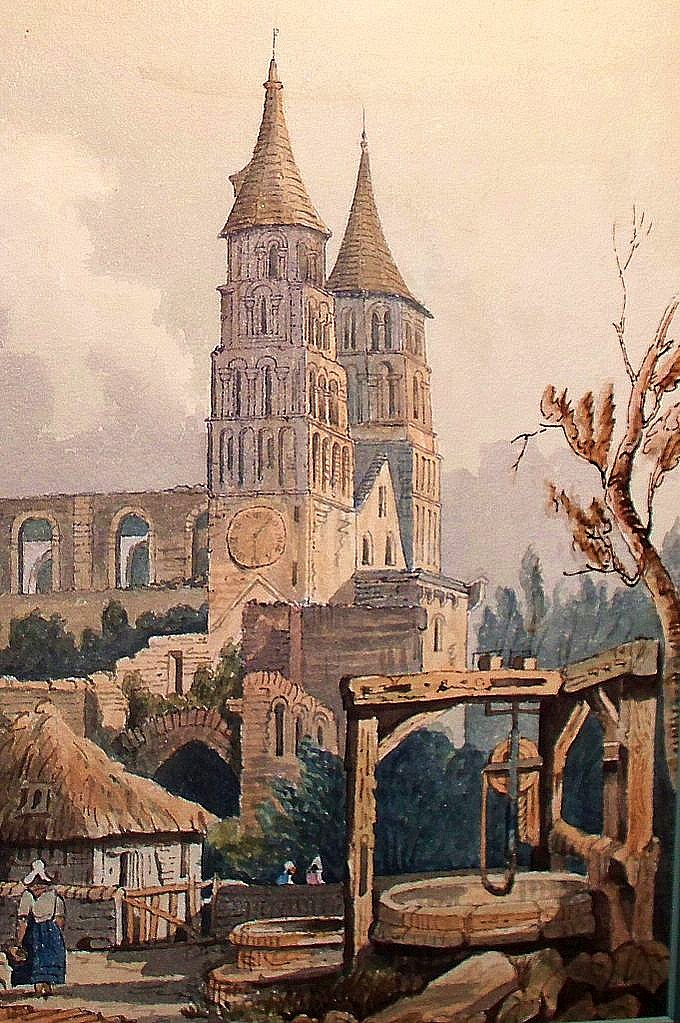
The Benedictine Abbey of Jumieges in Normandy has an ancient and remarkable history. Founded in the year 654 by Saint Philibert, it was once one of the magnificent Benedictine Monasteries in France and the home of some 700 Monks with over twice that number of lay brothers. Sadly, it is now nothing more than a tourist attraction and the vestiges of the surviving structures, though vacant, scarred and exposed to the elements, are celebrated as a magnificent example of Romanesque art. All that remains standing today are the Church of Notre Dame with its impressive twin towers soaring to a height of 150 feet, the western façade, and sections of which, were once the cloisters and library. The rest is but a pile of rubble, though it is proudly proclaimed the largest medieval ruin in France. Victor Hugo notably Baptised there “the most beautiful ruin in France” but one is left to wonder how it once appeared when the Catholic Faith was still vibrant and alive in France. Located a little west of Rouen along a bend in the Lower Seine, it was vulnerable to the attacks of the Vikings in the ninth and tenth centuries. During one invasion it was set on fire and pillaged of its wealth. It was soon lovingly rebuilt, however, by the Duke of Normandy. The Church of Jumieges was consecrated by Maurice, the Archbishop of Rouen, in the year 1067. William the Conqueror attended the dedication of the Church of Jumieges and the subsequent celebrations. Larger and more beautiful than ever before, the Abbey once again became wealthy and influential. A centre of learning, it was famed for its Scriptorium where Monks worked diligently copying and illustrating manuscripts by hand. The errors of Martin Luther came to France, as they did to all of Christendom, followed by the usual looting of Churches. The destruction was widespread and the Abbey of Jumieges was not spared. When the French Revolution came along, the Monastery was finished, and only the imposing ruins of what had once been a thriving community was left in its wake. In 1793 the whole was sold at auction and mined as a stone quarry. The Chancel, with its marble Altar and the lantern tower were intentionally imploded and the rest was subject to the deprivations of vandals. What remained was rescued in the year 1852 by the Lepel-Cointet family. A lodge was built and the rest landscaped and made into a park before being sold to the State in the year 1946. The Church is not open but one can walk about the ruins and imagine the glory that once was.
St Arnulf of Mainz Bl Assunta Marchetti St Atilano Cruz Alvarado St Calais of Anisole St Carilephus St Castus of Sinuessa St Cewydd St Concordius of Toledo St Cuimmein of Nendrum St Domitian of Lerins Bl Elisabeth de Vans St Eparchius of Perigord St Eutychius of Umbria St Esther the Queen St Gall of Clermont Bl George Beesley St Golvinus of Leon St Gwenyth of Cornwall St Huailu Zhang Bl Jan Nepomucen Chrzan Bl Jean-Baptiste Duverneuil St Julius of Caerleon St Justino Orona Madrigal St Juthware St Leonorious of Brittany St Leontius of Autun Bl Luis Obdulio Navarro St Martin of Vienne Bl Montford Scott
Blessed Ignatius “Nazju” Falzon OFS (1813-1865) Catechist, Confessor, Evangelist, Apostle of seamen, the poor and the marginalised, Apostle of the Passion of Our Lord and of the Blessed Virgi Mary, Doctor of Civil and Canon Law, Writer. He spread devotion to both the Stations of the Cross and the Holy Rosary in all his works His Life: https://anastpaul.com/2020/07/01/saint-of-the-day-1-july-blessed-ignatius-nazju-falzon-ofs-1813-1865/
St Nicasius of Jerusalem
St Oliver Plunkett (1629-1681) Martyr, Archbishop and Primate of All Ireland
Bl Pierre-Yrieix Labrouhe de Laborderie St Secundinus of Sinuessa St Servan of Culross St Theobald of Vicenza St Theodoric of Mont d’Or Bl Thomas Maxfield Bl Tullio Maruzzo St Veep — Martyrs of Rome – 6 saints: Six Christians who were martyred together. No details have survived except their names – Esicius, Antonius, Processus, Marina, Serenus and Victor. They were martyred in Rome, Italy, date unknown.
Thought for the Day – 29 June – Meditations with Antonio Cardinal Bacci (1881-1971)
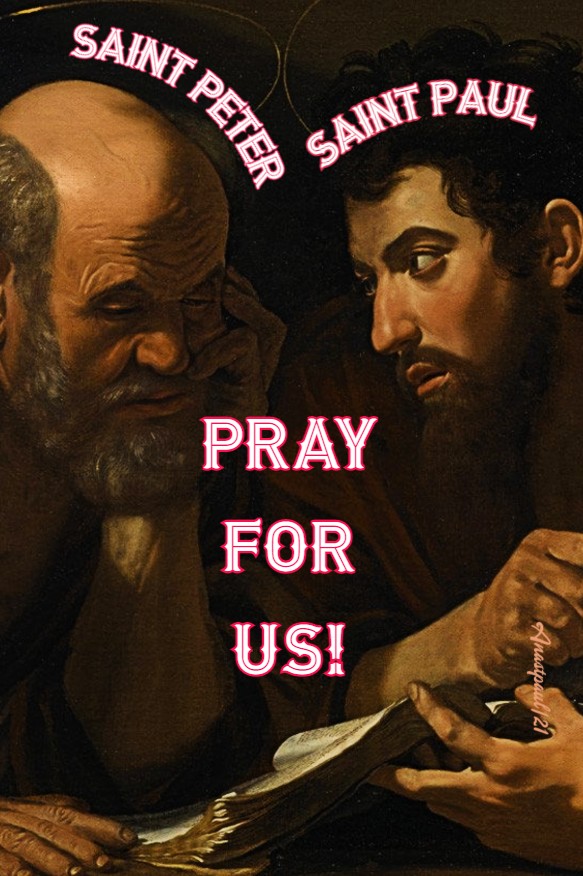
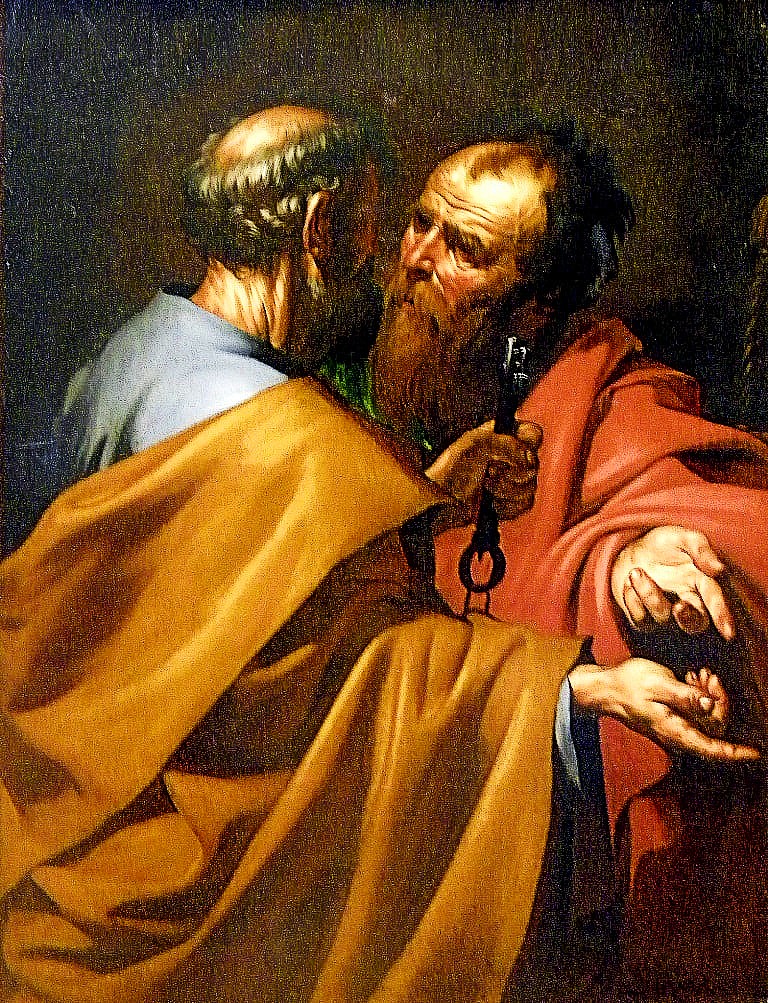
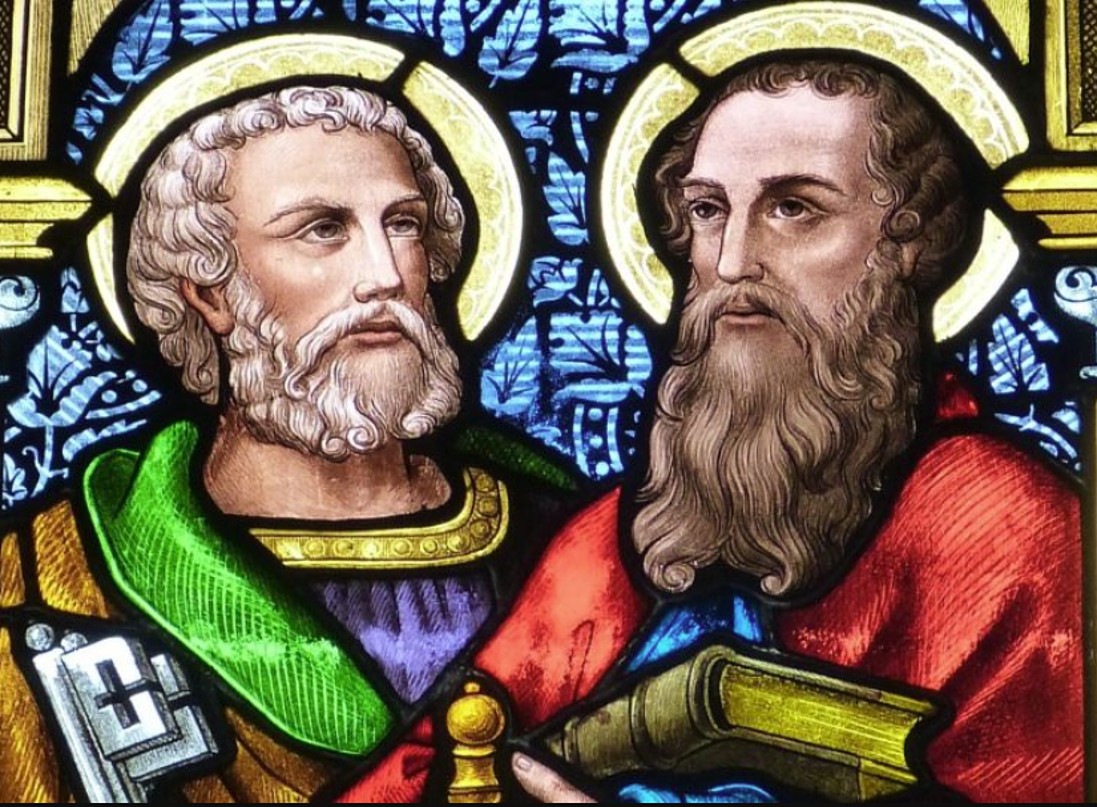
St Peter, Prince of the Apostles St Paul, the Apostle to the Gentiles
“Jesus was walking one day along the shoe of the Sea of Galilee, when He saw two fishermen casting their nets into the water. He approached them and said: “Come, follow me and I will make you fishers of men” (Mk 1:17). These two fishermen were brothers named, Simon and Andrew. The divine Master won their hearts immediately, so that they left their boat and their nets and followed Jesus. Simon was later called Peter and became the leader of the Apostles.
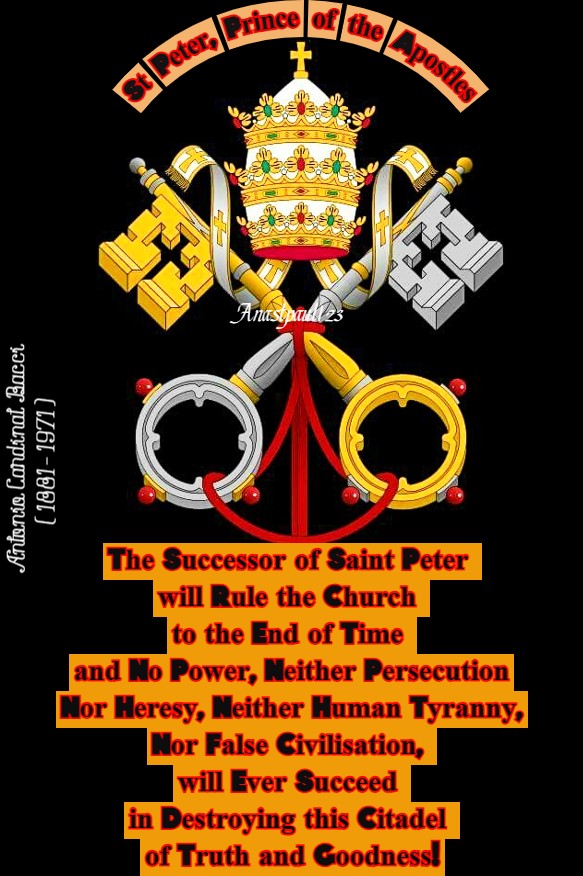
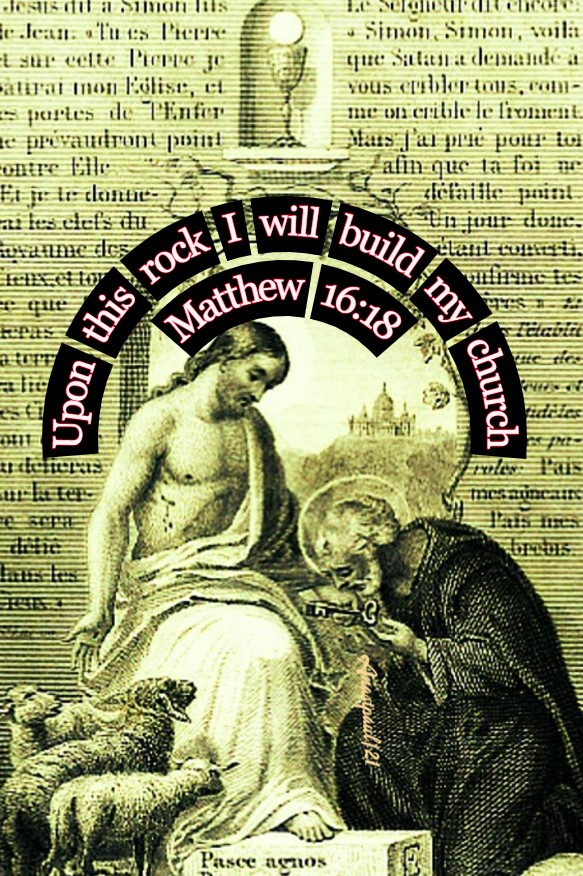
Peter’s generosity and great love for Jesus are evident in the pages of the Gospel. When Our Lord foretold the institution of the Blessed Eucharist, many of His disciples were scandalised and left Him. “Do you also wish to go away?” Jesus asked His Apostles. St Peter answered Him without delay. “Lord, to whom shall we go? Thou has the words of everlasting life and we have come to believe and to know, that Thou are the Christ, the Son of God” (Jn 6:69). On another occasion, Jesus asked His disciples – “Who do men say the Son of Man is?” The Apostles hesitated and began to suggest the names of various Prophets. But St Peter was inspired to make the reply: “Thou are the Christ, the Son of the living God.” Then Our Lord appointed him Head of the Church. “Blessed are thou, Simon Bar-Jona … thou are Peter and upon this rock I will build my Church and the gates of hell, shall not prevail against it. And I will give thee the keys of the kingdom of heaven and whatever you shall bind on earth shall be bound in heaven” (Mt 16:15-19). By these words there was instituted the loftiest and most ancient of the dynasties, the Papacy. The successor of St Peter will rule the Church to the end of time and no power, neither persecution nor heresy, neither human tyranny nor false civilisation, will ever succeed in destroying this citadel of truth and goodness!”
St Paul, the Apostle to the Gentiles
“St Paul was by nature, fiery and zealous. Once he discovered the truth, he was ready to die for it. Originally he was convinced that Judaism contained the whole truth and, for this reason he hated the Christians, whom he regarded as a sect which had corrupted the sacred Hebrew tradition. The deacon Stephen was the first victim of his persecuting zeal. As he was being stoned and beaten to death this saintly young man prayed for his persecutors. It may be that in this moment his eyes, shining with faith and love, encountered those of the man who hated him. Soon afterwards, Saul (this was Paul’s real name), left Jerusalem for Damascus, carrying letters investing him with new powers for the persecution of the infant Church. On the way, this headstrong but sincere enemy of Christianity was suddenly dazzled by a light from Heaven. He fell to the ground and heard a mysterious voice saying: “Saul, Saul, why do thou persecute me?” Terrified he answered: “Who are thou, Lord?” “I am Jesus,” the voice said, “whom thou are persecuting” (Acts 9:1-15). From that day, Saul was changed completely. Under the influence of divine grace, he became the Apostle to the Gentiles.
Before he set out on his missionary journeys, Paul wet apart into the desert of Arabia (Cf Gal 1:17), where, he remained sometime in prayer and recollection. Then he went to Jerusalem to pay homage to the Prince of the Apostles, St Peter (Gal 1:18). After this, he began his apostolic travels, in the course of which, he encountered all kinds of hardships and dangers. The Jews frequently hunted him, in order to put him to death. He was often cruelly scourged and flung into prison and, several times, he was shipwrecked and had miraculous escapes from death (CF 2 Cor 11:23-27). He bore everything joyfully however, in order to prove his liove for Jesus Christ. Charity was always his main incentive. “The love of Christ impels us” (2 Cor 5:14). Charity, he said himself, “Believes all things, hopes all things,edues all things” (Cf 1 Cor 13:4-13). His charity was so great, that he could truthfully say: “Who is weak and I am not weak? Who is made to stumble and I am not inflamed?” (2 Cor 11:29).
St Paul could make this claim because his heart had become identified with the Heart of Jesus. Therefore, he could say: “It is now no longer I that live but Christ lives in me,” (Gal 2:20) and: “For me to live is Christ and to die is gain,” (Phil 1:21) and: “I am hard pressed from both sides, desiring to depart and to be with Christ, a lot by far the better; yet, to stay on in the flesh is necessary, for your sake” (Phil 1:23-24).
Let us meditate on this ardent love of God. Let us cast aside our coldness and indifference and ask St Paul, to set us on fire with divine charity.” Amen
Quote/s of the Day – 29 June – “Month of the Sacred Heart” – The Solemnity of Saints Peter and Paul
“Look at the holy Apostles. It was by sinful jealousy that Peter was subjected to tribulation, not once or twice but many times; it was in that way, that he bore his witness before leaving us for his well-earned place in glory. And Paul, because of jealousy and contention, has become the very type of endurance rewarded. … In him we have one of the greatest of all examples of endurance. … [And] we too, are in the same arena and have the same conflict before us.”
St Pope Clement I of Rome (c 35-99)
Letter to the Corinthians, 5-7
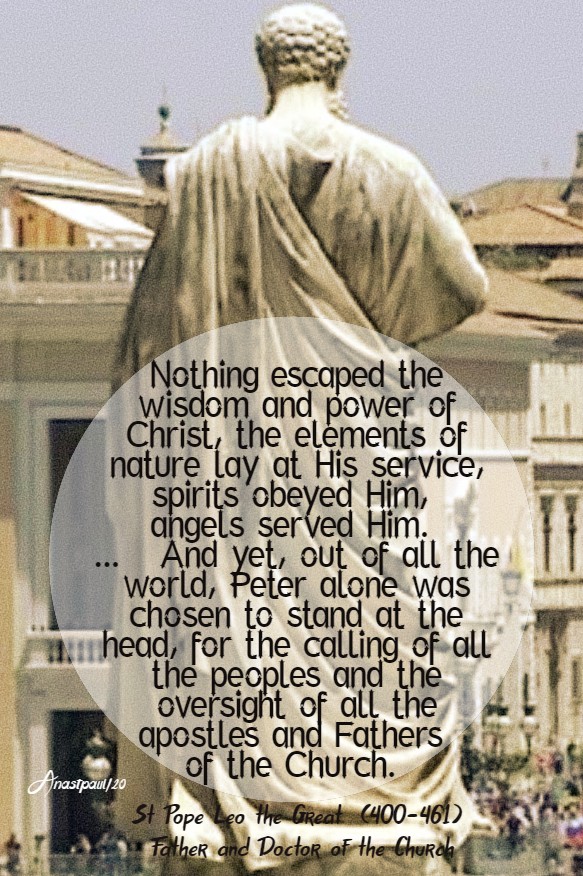
“Nothing escaped the wisdom and power of Christ, the elements of nature lay at His service, spirits obeyed Him, angels served Him. … And yet, out of all the world, Peter alone was chosen to stand at the head, for the calling of all the peoples and the oversight of all the apostles and Fathers of the Church. .”
St Pope Leo the Great (400-461) Father and Doctor of the Church
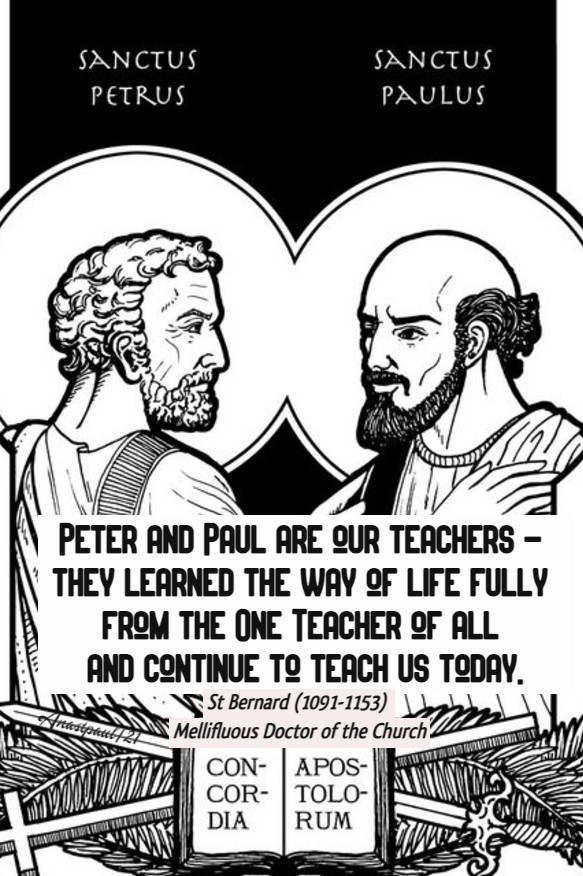
“Peter and Paul are our teachers – they learned the way of life fully from the One Teacher of all and continue to teach us today.”
St Bernard (1091-1153) Mellifluous Doctor of the Church
One Minute Reflection – 29 June – “Month of the Sacred Heart” – The Solemnity of Saints Peter and Paul, Readings: Acts 12:1-11, Psalm 34:2-9, 2 Timothy 4:6-8, 17-18, Matthew 16:13-19
“Upon this rock I will build my church” – Matthew 16:18
REFLECTION –“Though the earth and all who dwell in it quake, I have set firm its pillars” (Ps 74[75],40). All the Apostles are pillars of the earth but, at their head, the two whose feast we are celebrating. They are the two pillars who support the Church with their teaching, their prayer and the example of their steadfastness. The Lord Himself strengthened these pillars. For at first they were weak, completely incapable of supporting either themselves or others. And in this, the Lord’s great design appears – if they had always been strong, people could have thought their strength came from themselves. That is why the Lord wanted to show, what they were capable of, before strengthening them, so that all might know their strength came from God… Peter was thrown to the ground by the voice of a mere servant… and the other pillar was very weak too: “I was once a blasphemer and persecutor and an arrogant man” (1Tm 1,13)…
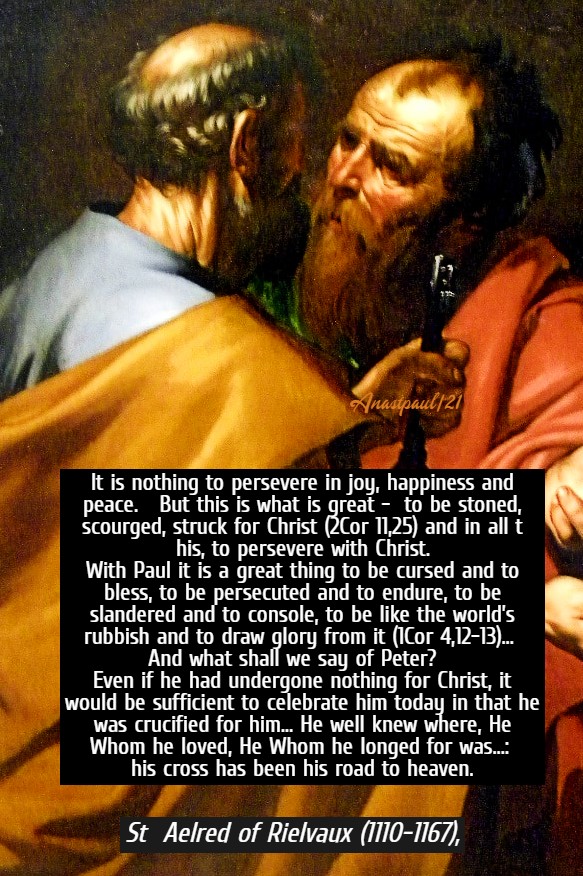
Hence, we ought to praise these Saints with all our heart – our fathers who bore such trials for the Lord’s sake and who persevered with such determination. It is nothing to persevere in joy, happiness and peace. But this is what is great – to be stoned, scourged, struck for Christ (2Cor 11,25) and in all this, to persevere with Christ. With Paul it is a great thing to be cursed and to bless, to be persecuted and to endure, to be slandered and to console, to be like the world’s rubbish and to draw glory from it (1Cor 4,12-13)… And what shall we say of Peter? Even if he had undergone nothing for Christ, it would be sufficient to celebrate him today in that he was crucified for him… He well knew where, He Whom he loved, He whom he longed for was…: his cross has been his road to heaven.” – St Aelred of Rielvaux (1110-1167), Cistercian Monk – Sermon 18, for the Feast of Saints Peter and Paul – PL 195, 298
PRAYER – Almighty ever-living God, You give us the great joy of devoting this day to the honour of the great Apostles Peter and Paul. Grant Your Church may follow their teachings fully because these are the men who first taught us to worship You in Christ, Your Son, Who lives and reigns with You and the Holy Spirit, God forever and ever, amen.
Our Morning Offering – 29 June – The Solemnity of Saints Peter and Paul
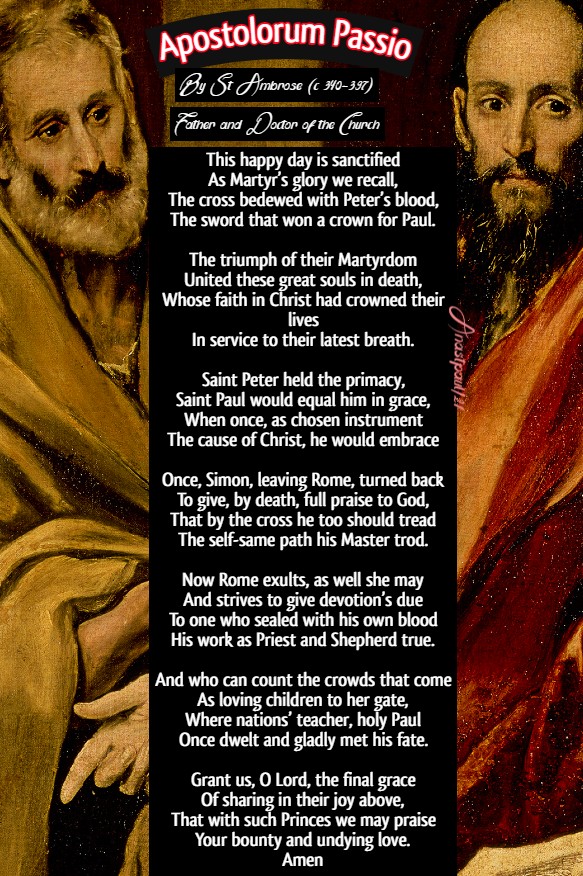
Apostolorum Passio By St Ambrose (c 340-397) Father and Doctor of the Church
This happy day is sanctified As Martyr’s glory we recall, The cross bedewed with Peter’s blood, The sword that won a crown for Paul.
The triumph of their Martyrdom United these great souls in death, Whose faith in Christ had crowned their lives In service to their latest breath.
Saint Peter held the primacy, Saint Paul would equal him in grace, When once, as chosen instrument The cause of Christ, he would embrace
Once, Simon, leaving Rome, turned back To give, by death, full praise to God, That by the cross he too should tread The self-same path his Master trod.
Now Rome exults, as well she may And strives to give devotion’s due To one who sealed with his own blood His work as Priest and Shepherd true.
And who can count the crowds that come As loving children to her gate, Where nations’ teacher, holy Paul Once dwelt and gladly met his fate.
Grant us, O Lord, the final grace Of sharing in their joy above, That with such Princes we may praise Your bounty and undying love. Amen
Translation: The Benedictines of Saint Cecilia’s Abbey, Ryde, UK
Solemnity of Saints Peter and Paul Apostles and Martyrs – 29 June
After the great Solemnities of the movable cycle, and the Feast of St John the Baptist, none is more ancient, nor more universal in the Church, than that of the two Princes of the Apostles. From the beginning, Rome celebrated their triumph on the very day itself which saw them go up from earth to heaven, 29 June. Her practice prevailed, at a very early date, over the custom of several other countries, which put the Apostles’ feast towards the close of December. It was, no doubt, a fair thought which inspired the placing of these Fathers of the Christian people in the cortege of Emmanuel at His entry into this world. But, as we have already seen, today’s teachings have intrinsically an important preponderance in the economy of Christian dogma; – they are the completion of the whole Work of the Son of God – the cross of Peter fixes the Church in her stability and marks out for the Divine Spirit, the immutable centre of His operations. Rome, therefore, was well inspired when, leaving to the Beloved Disciple the honour of presiding over his brethren at the Crib of the Infant God, she maintained the solemn memory of the Princes of the Apostles upon the day chosen by God Himself to consummate their labours and to crown, at once, both their life and the whole cycle of mysteries.
Fully today, do the heavens declare the glory of God, as David expresses it, today do they show us the course of the Spouse completed on the eternal hills (Ps. xviii. 2-6). Day unto day uttereth speech and night unto night revealeth the deep secret (Ibid. 3). From north and south of the new Sion, from either side of her stream, Peter and Paul waft one to other, as a farewell song, as a sacred Epithalamium, the good Word (Ps. xliv. 2); sublime that echo, sonorous its power, vocal still throughout the whole earth (Ibid. xviii. 4, 5), and yet, to resound as long as the world lasts. These two torches of salvation blend their flames above the palaces of ancient Rome; the passing darkness of their death, that night of which the Psalmist sings, now concentrates light, forever, in the midst of the Queen City. Beside the throne of the Bridegroom fixed forever and ever, on yonder seven hills (Ps. xliv. 7-10), the Gentile world, now become the Bride, is resplendent in glory (Eph. v. 27), all fair in that peerless purity which she derives from their blood united, as it is, to that of the Son of God.
But seemly is it, not to forget, on so great a day, those other messengers sent forth by the divine householder and who watered earth’s highways with their sweat and with their blood, the while they hastened the triumph and the gathering in of the guests invited to the Marriage feast (St.Matth. xxii. 8-10). To them is it due, if now the law of grace is definitively promulgated throughout all nations and if, in every language and upon every shore, the good tidings have been sounded (Ps. xviii. 4, 5). Thus the festival of St Peter, completed by the more special memory of St Paul his comrade in death, has been from earliest times regarded as the festival likewise of the whole Apostolic college. In those primitive times it seemed impossible to dream of separating from their glorious leader any of those whom Our Lord had so intimately joined together in the responsibility of one common work. But in course of time, however, particular solemnities were successively consecrated to each one of the Apostles and so, the feast of 29 June was more exclusively attributed to the two Princes whose Martyrdom rendered this day illustrious. (from the Liturgical Year, 1904).
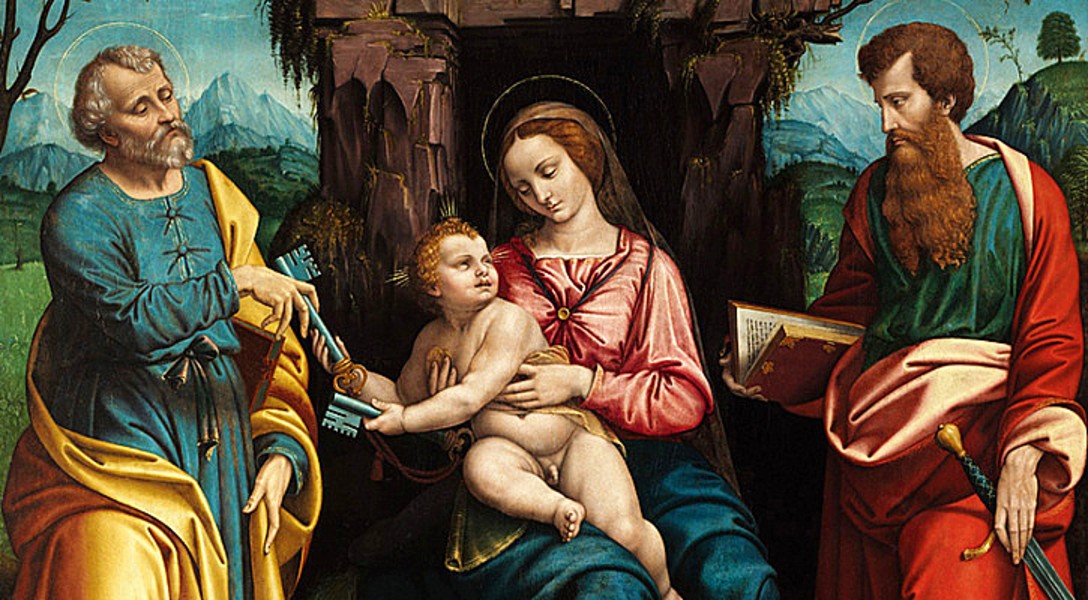
the Virgin and Child with Saints Peter and Paul by Girolamo Figino
Notre-Dame de Buglose / Our Lady of Buglose, France (1634) – 29 June:
Located about two leagues from Acqe in Glascony is the Shrine containing a miraculous image of Our Lady of Buglose. The original Shrine of Notre-Dame de Buglose was burned and completely destroyed by the Huguenots, and the Statue of Our Lady was hidden in a marsh. The exact location of the Statue was eventually forgotten, as was the memory even that the place had once been the location of a Shrine in honour of the Blessed Virgin. Years later, a shepherd led his herd into the marshes and observed that one of his oxen did not go with the others but went into an area of the marsh alone and began to bellow in a strange manner. The shepherd climbed a tree to see what was happening, and saw the ox licking an unknown object that was half buried in the mud. Not understanding the mystery, he ran into Town to bring others back with him to see what had happened. When the shepherd returned, the Statue of the Blessed Virgin holding the baby Jesus in her arms had been revealed. It was respectfully removed from the water and the Bishop of Dax desired to take the image to his Church in Pouy. He placed the Statue in a cart that was pulled by oxen to transport it back to Pouy. The procession began with hymns and prayers but had only gone a short distance, when the oxen stopped and would not move any further. It was understood that the Blessed Virgin desired that her image should stay near the fountain. The Bishop accepted the revelation as a divine order and thanks to the zeal and enthusiastic support of the people living in the region, a new Church was built with prodigious speed. The Shrine was, for a long time, popular as a place of pilgrimage in France – now it is further renowned as the birthplace of Saint Vincent de Paul. The house where he was born and where he spent his boyhood, is still visited as a Museum of the Saint.
|The Basilica of St Vincent de Paul and Our Lady of Buglose
There have been many miracles at the Shrine, as indeed Buglose had become known as a land of miracles. There were 19 miracles recorded in the year 1622 alone. There is a fountain near the Chapel marking the place where the Statue of Our Lady of Buglose was found buried. In 1623, a man named Bernard Ducassou came to the shrine seeking a cure for the seven boils that covered his left leg. He spent the entire night in prayer and the next day bathed at the fountain. The ulcers that would not heal were suddenly closed. Pilgrims still travel to the famous Shrine of Our Lady where miracles are continuously granted to pious devotees.
St Anastasius of Bourges St Benedicta of Sens St Cassius of Narni St Ciwg ap Arawn St Cocha St Ilud Ferch Brychan St Judith of Niederaltaich St Marcellus of Bourges St Mary, the Mother of John Mark St Salome of Niederaltaich St Syrus of Genoa Bl William of Sann — Martyrs of China Ioannes Baptista Wu Mantang Magdalena Du Fengju Maria Du Tianshi Paulus Wu Anju Paulus Wu Wanshu
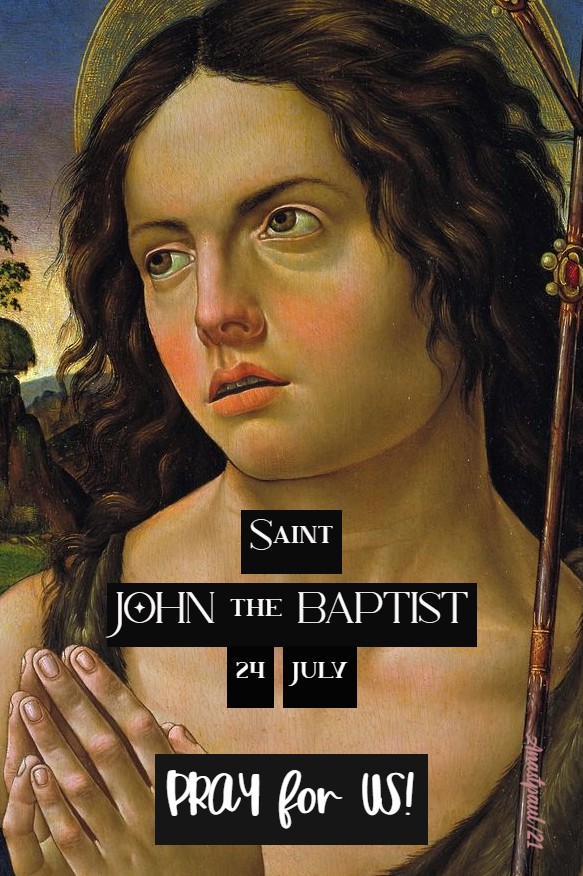
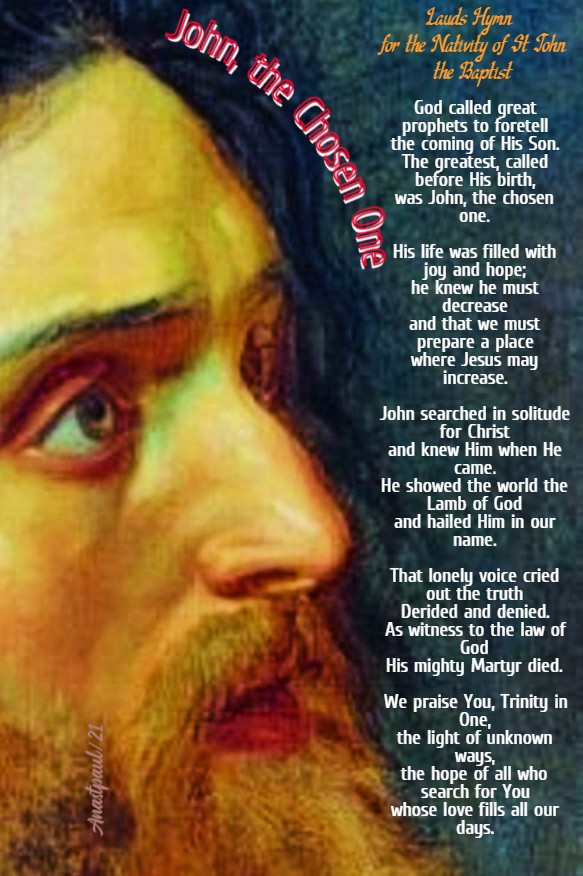
Quote/s of the Day – 24 June – The Solemnity of the Nativity of St John the Baptist
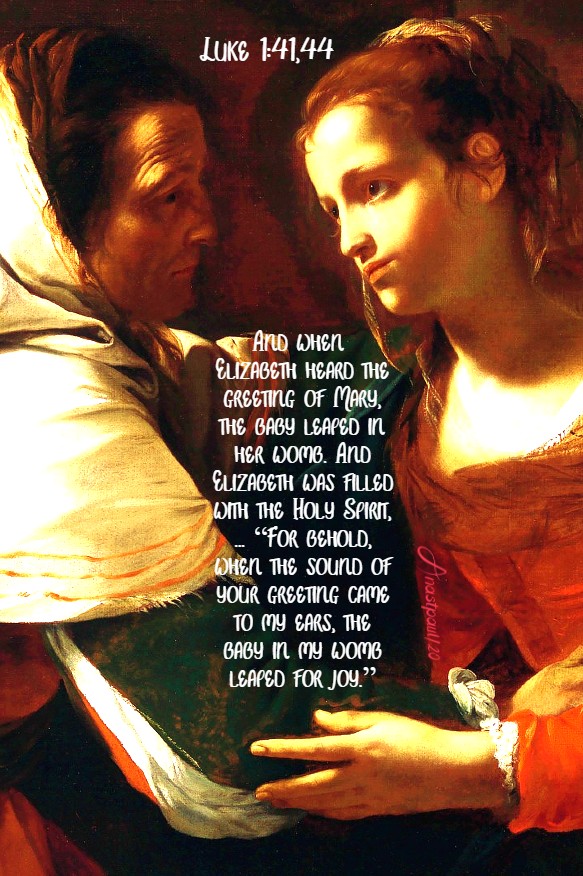
“ And when Elizabeth heard the greeting of Mary, the baby leaped in her womb. And Elizabeth was filled with the Holy Spirit … “For behold, when the sound of your greeting came to my ears, the baby in my womb leaped for joy.”
Luke 1:41,44
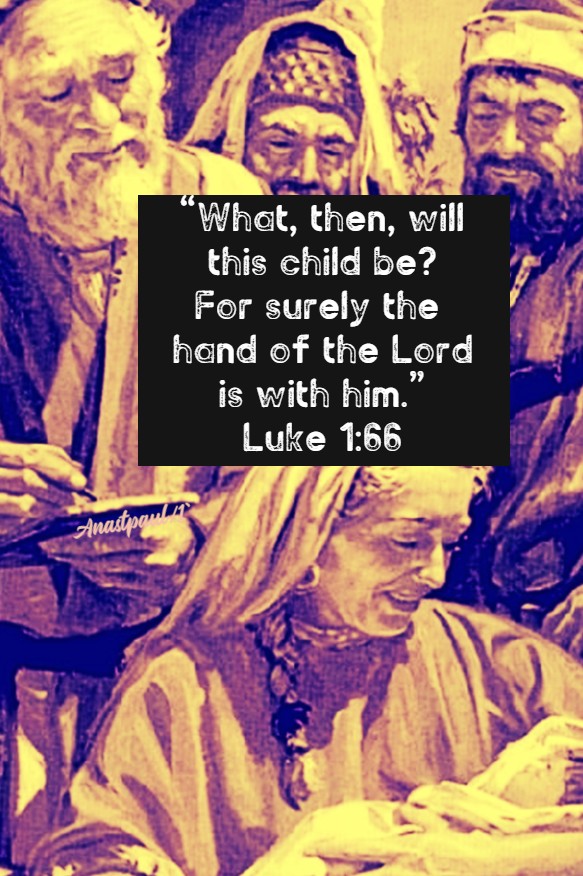
“What, then, will this child be? For surely the hand of the Lord is with him.”
Luke 1:66
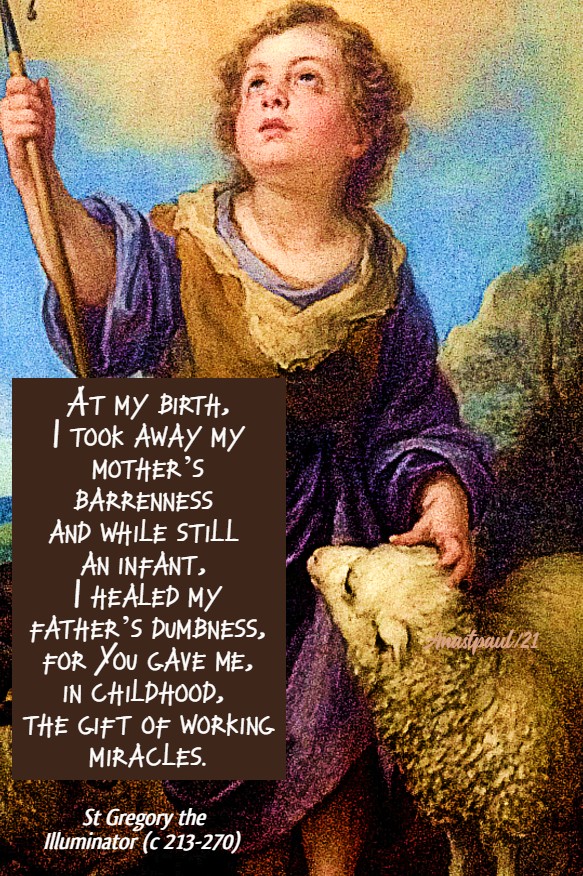
“At my birth, I took away my mother’s barrenness and while still an infant, I healed my father’s dumbness, for You gave me in childhood, the gift of working miracles.”
St Gregory the Illuminator (c 213-270) Bishop
Homily on the holy Incarnation, 4
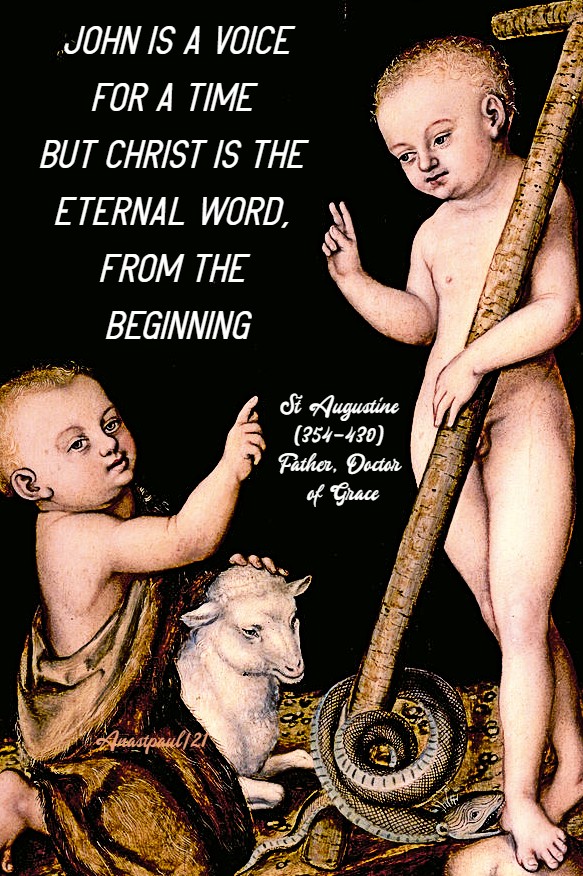
“John is a voice for a time but Christ is the eternal Word, from the beginning.”
St Augustine (354-430) Bishop, Father, Doctor of Grace
One Minute Reflection – 24 June – The Solemnity of the Nativity of St John the Baptist – Readings: Isaiah 49:1-6, Psalm 139:1-3, 13-15, Acts 13:22-26, Luke 1:57-66, 80
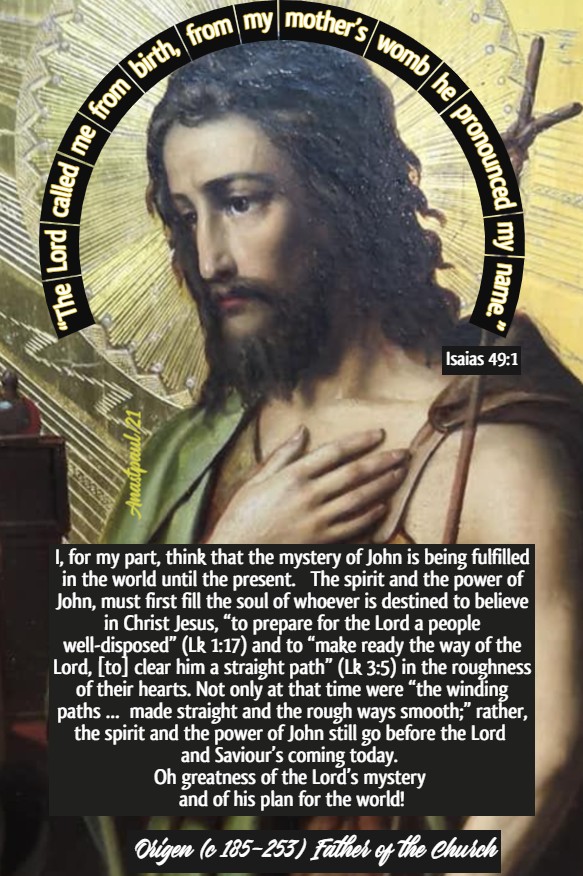
“The Lord called me from birth, from my mother’s womb he pronounced my name.” – Isaias 49:1
REFLECTION – “The birth of John the Baptist is full of miracles. An Archangel announced the coming of our Lord and Saviour Jesus; similarly, an Archangel announced the birth of John (Lk 1:13) and said: “He will be filled with the Holy Spirit from his mother’s womb.” The Jewish people did not see that our Lord did “signs and wonders” and healed their illnesses but John leapt for joy when he was still in his mother’s womb. It was impossible to hold him back and when the mother of Jesus arrived, the child already tried to come out of Elizabeth’s womb. “The moment your greeting sounded in my ears, the baby leapt in my womb for joy.” (Lk 1:44) Still in his mother’s womb, John had already received the Holy Spirit …
Scripture then says: “Many of the sons of Israel will he bring back to the Lord their God.” (Lk 1:16) John brought back “a large number,” the Lord brought back not a large number but everyone. For it is his task to bring all men back to God the Father …
I, for my part, think that the mystery of John is being fulfilled in the world until the present. The spirit and the power of John, must first fill the soul of whoever is destined to believe in Christ Jesus, “to prepare for the Lord a people well-disposed” (Lk 1:17) and to “make ready the way of the Lord, [to] clear him a straight path” (Lk 3:5) in the roughness of their hearts. Not only at that time were “the winding paths … made straight and the rough ways smooth;” rather, the spirit and the power of John still go before the Lord and Saviour’s coming today. Oh greatness of the Lord’s mystery and of his plan for the world! ” – Origen Adamantius (c 185-253) Priest, Theologian, Exegist, Writer, Apologist, Father – Homilies on St Luke, no. 4, 4-6
PRAYER – Almighty God and Father, You sent St John the Baptist, to the people of Israel to make them ready for Christ the Lord. Give us the grace of joy in the Spirit and guide the hearts of all the faithful, in the way of salvation and peace, as they harken to the voice of John, the Lord’s herald and bring them safely to Jesus, whom John foretold. St John the Baptist, may your intercession for the Church, bring us to the Light and the Way. We make our prayer through our Lord Jesus Christ, in the unity of the Holy Spirit, one God with You, forever amen.
Madonna della Navicella / Our Lady of the Ship , Chioggia, Venezia, Veneto, Italy (1508) – 24 June:
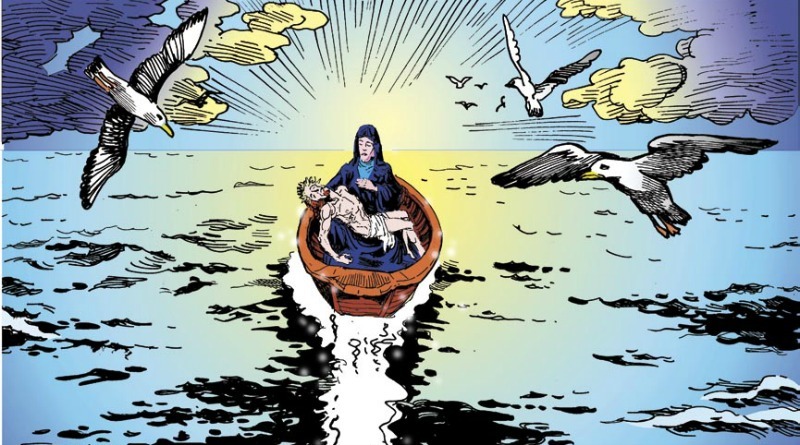
On 24 June 1508, in the afternoon, a strong storm, with disastrous effects, hit the inhabited area of Chioggia and Sottomarina. Rain, wind and storm had lashed the coast for a few hours. In the evening, fortunately, the storm abated and the weather improved. A greengrocer, Baldissera Zalon, went to the vegetable gardens, where the Sanctuary now stands , to see for himself the damage that the powerful storm had caused. Baldissera was a simple man, a peasant, who lived near his fields and lived on his work in the vegetable gardens. As soon as he left the house, after scanning the clouds of the sky that were moving away and the setting sun was peeping, he heard himself called by name. After the first moments of amazement, Baldissera turned and saw a majestic Lady, all dressed in black, who sat on a treetrunk thrown on the beach by the waves of the stormy sea. The greengrocer was stunned, so much so, that he was about to pass out, when the Lady revealed to him that she was the Mother of God, giving him courage and inviting him to go to the Bishop to warn him that the sins of the Chioggia challenged the justice of God and that penance had to be preached tenaciously, to avoid worse punishment. Then the Lady got on a craft that was near the shore but before leaving and disappearing, she opened her cloak showing the wounded and bleeding body of Jesus, making it clear that it had also been reduced by the sins of the Chioggiotti.
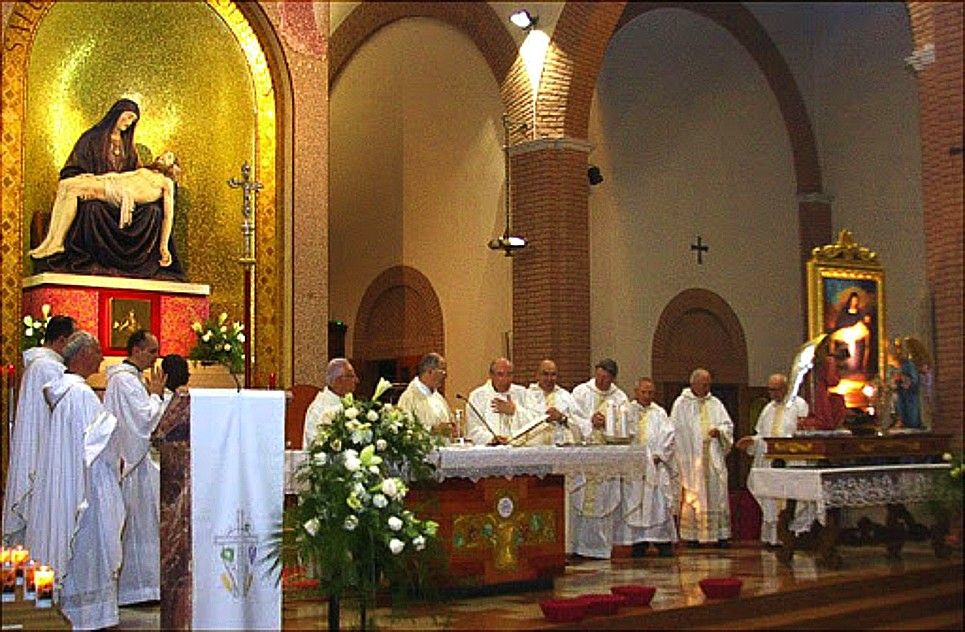
Baldiserra wasted no time and went to the Bishop, who organised a pilgrimage to the place of the apparition and the turnout of the faithful became more and more consistent day after day. In a short time, a Chapel was built on the spot and then, in 1515, a Sanctuary which was, however, destroyed in 1814. The current Church was built between 1952 and 1958 and was Consecrated on 24-25 June 1958 by Bishop Piasentini. The miraculous image was found, according to popular belief, a few days after the apparition, together with the log on which the Madonna sat when she appeared to Baldissera. The image and the LOG are preserved and are visible in the Basilica of San Giacomo.
St Aglibert of Créteil St Agoard of Créteil St Alena of Brussels St Amphibalus of Verulam
Bl Christopher de Albarran St Erembert I of Kremsmünster St Faustus of Rome and Companions St Festus of Rome St Germoc St Gohardus of Nantes Bl Henry of Auxerre/the Hagiographer St Ivan of Bohemia St John of Rome St John Theristus (c 1049-1129) Monk St John of Tuy St Joseph Yuan Zaide Bl Maksymilian Binkiewicz
St Rumold St Simplicio of Autun Bl Theodgar of Vestervig St Theodulphus of Lobbes — Martyrs of Satala: Seven Christian brothers who were soldiers in the imperial Roman army. They were kicked out of the military, exiled and eventually martyred in the persecutions of Maximian. We know little more about them than their names – Cyriacus, Firminus, Firmus, Longinus, Pharnacius, Heros and Orentius. The martyrdoms occurred in c 311 at assorted locations around the Black Sea.
Thought for the Day – 12 June – Meditations with Antonio Cardinal Bacci (1881-1971) “Month of the Sacred Heart” – Memorial of the Immaculate Heart of Mary
“All Generations Shall Call Me Blessed”
‘A Jewish girl, poor in this world’s goods but rich in virtue, arrived after a long and difficult journey at a village in the hills of Judea, called Hebron. There, she paid a visit to her cousin, Elizabeth. When Elizabeth saw the girl, she was immediately enlightened by the Holy Spirit with the knowledge, that her visitor, was the Mother of God. “How have I deserved,” she cried out, “that the mother of my Lord, should come to me?” (Lk 1:43). At these words, Mary looked up towards Heaven and gave spontaneous expression to a hymn of humble acknowledgement to God, Who had “regarded the lowliness of His Handmaid” (Lk 1:48). Then she made a solemn prophecy, which would surely have assured the cynical intellectuals and nobles of the land but, which history has wonderfully fulfilled. “Behold” she said, “all generations shall call me blessed” (ibid). We can testify today, that this miracle came to pass. All the nations have paid reverence to the Jewish girl, who became the Mother of God and our Mother, the Queen of Heaven and earth, the comforter of the afflicted, the conqueror of Satan and the invincible Guardian of the Church. From the engravings in the Catacombs, to the celestial Madonnas of the Angelico, from the rudimentary sculpture of Roman art, to the prayerful statues on the pinnacles of more modern Cathedrals, the image of Mary has shone as a beacon of hope for all generations. Men bow before her and ask for light, for comfort and for pardon. “If anyone follows Mary,” says St Bernard, “he will not lose his way; if anyone pray to her, he will not despair; if anyone thinks of her, he will not sin; if anyone reaches out to her, he will not fall; if anyone places himself under her protection, he need have no fear; if anyone places himself under her leadership, he will never give up; if anyone pays homage to her, he is certain to reach his destination safely”(Homil Missus est 2:17).”
One Minute Reflection – 12 June – “Month of the Sacred Heart” Memorial of the Immaculate Heart of Mary, Readings: Second Corinthians 5: 14-21, Psalms 103: 1-2, 3-4, 9-10, 11-12, Gospel: Luke 2: 41-51
“And his mother kept all these words in her heart.” – Luke 2:51
REFLECTION – “Often, it seems to us, Mary forgot to eat and to drink, keeping vigil in order to think about Christ, to see Christ in His flesh. She burned with love of Him and passionately loved to serve Him. She often did what the Song of Songs sings about: “I was sleeping, but my heart kept vigil.” (Song 5:2) Even when she was resting, she continued to dream of Him who filled her thoughts throughout the day. Whether she was keeping vigil or resting in peace, she always lived in Him, was always occupied with Him.
Where her treasure was, there also was her heart (Mt 6:21); where her glory was, there also was her mind. She loved her Lord and her Son with all her heart, with all her mind, with all her strength (Mt 22:37). She saw with her eyes, touched with her hands, the Word of Life (1 Jn 1:1). How blessed was Mary, to whom it was given to embrace Him who embraces and nourishes everything! How happy was she who carried Him, who carries the universe (Heb 1:3), she who nursed a Son, who gives her life, a Son who nourishes her and all beings on earth (Ps 145:15).
The One Who is the wisdom of the Father, put His arms around her neck, the One Who is the strength, that gives movement to everything sat in her arms. He Who is the rest of souls, (Mt 11:29) rested on her motherly breast. How gently He held her in His hands, peacefully looked at her, He Whom the angels wish to contemplate (1 Pet 1:12) and He gently called her, He Whom every being calls upon when in need. Filled with the Holy Spirit, she held Him close to her heart … She never had enough of seeing Him or of hearing Him, Whom “many prophets and kings wished to see … but did not see.” (Lk 10:24) Thus Mary grew evermore in love and her mind was unceasingly attached to divine contemplation.” – St Amadeus of Lausanne (1108-1159) Bishop – Homily on Mary, 4
PRAYER – Lord open our hearts to Your grace. As You brought joy to the world through the incarnation of Your Son, Our Lord Jesus Christ, grant that through the prayer of the Immaculate Heart of His Ever-Virgin Mother, our hearts too may grow in virtue and love by learning to reflect constantly on His commandments and counsels. We make our prayer through our Lord Jesus, with the Holy Spirit, God forever, amen.
Our Morning Offering – 12 June – “Month of the Sacred Heart” Memorial of the Immaculate Heart of Mary
O Mother Blest By St Alphonsus Maria Liguori (1696-1787) Most Zealous Doctor of the Church Trns. Fr Edmund Vaughn C.SS,R, (1827 – 1908 )
O Mother blest, whom God bestows On sinners and on just, What joy, what hope thou givest those Who in thy mercy trust. Thou are clement, thou are chaste, Mary thou art fair, Of all mothers, sweetest best, none with thee compare.
O heavenly Mother, mistress sweet! it never yet was told that suppliant sinner left thy feet, unpitied, unconsoled. Thou are clement, thou are chaste, …
O Mother, pitiful and mild, Cease not to pray for me; For I do love thee as a child, And sigh for love of thee. Thou art clement, thou art chaste, …
Most powerful Mother, all men know Thy Son denies thee nought; Thou askest, wishest it, and lo! His power thy will hath wrought. Thou art clement, thou art chaste, …
O Mother blest, for me obtain, Ungrateful though I be, To love that God who first could deign To show such love for me. Thou art clement, thou art chaste, Mary, thou art fair. Of all mothers, sweetest, best, None with thee compare.
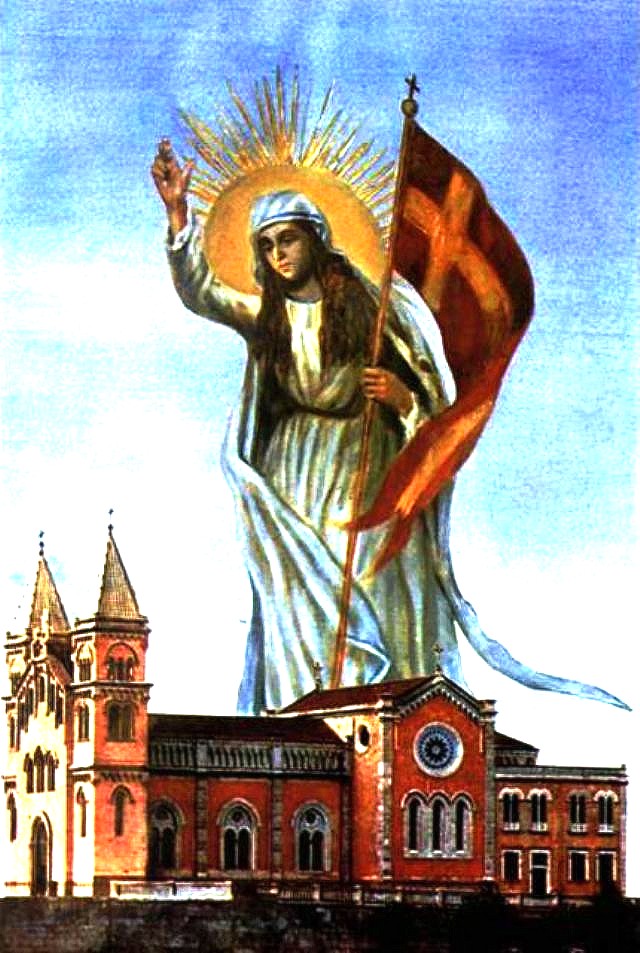
Madonna del Giorno di Montalto / Our Lady of Montalto, Messina, Italy, 1294 – 12 June:
One night a humble Friar named Nicholas dreamt of the Virgin Mary who told him to go the next day, by the Senate of Messina and inform them, that Our Lady wanted a temple on that hill, dedicated as the Lady of the High Mountain. In the morning, the Friar thought it was all his imagination and not believing that the Mother of our Lord Jesus Christ would go to a poor Friar and thought no more of it. The next night, the Virgin appeared again in a dream to Nicholas, scolding him for disobedience. The monk then asked him how he could get himself heard by the Senate. Our Lady told him not to despair and the next day, at noon, a white dove on the hill site was outlined at the area where the Church was to be built. So it was, 12 June 1294, the hill was full of people and notables of Messina and a white dove appeared and marked out the spot for the Church (this miracle is represented by Statues in motion in the bell tower of the Cathedral). Fra Nicholas then went to the nearby Matagrifone castle to find the Queen Constance. He explained the facts, in the presence of a Court handmaiden who advised the Queen to drive the Monk away. The evil courtesan was suddenly seized with paralysis of her arm and excruciating pain throughout her body. The Monk advised her to apologise to the Madonna, she did so, and the pain was relieved. Queen Constance, remained shaken from the occurrence and she promised her help, indeed it was she who laid the first stone. By 1295 the Church was already built.
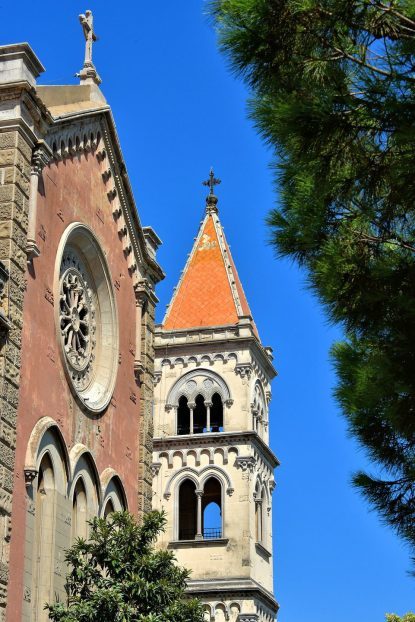
The Santuario della Madonna di Montalto was severely damaged during the 1908 earthquake and rebuilt in 1930. This view of the bell tower gives you a hint of the beauty of this Gothic and Romanesque structure.
St Amphion of Nicomedia Bl Antonia Maria Verna Bl Antonio de Pietra St Arsenius of Konev St Christian O’Morgair of Clogher St Chrodobald of Marchiennes St Cominus Bl Conrad of Maleville St Cunera St Cuniald St Cyrinus of Antwerp St Eskil St Galen of Armenia
St Pope Leo III (c 750-816) Bishop of Rome and Ruler of the Papal States from 26 December 795 to his death. Know as “Charlemagne’s Pope” St Lochinia of Ireland
Bl Mercedes Maria of Jesus St Odulf of Utrecht St Olympius of AEnos St Onuphrius of Egypt Bl Pelagia Leonti of Milazzo St Peter of Mount Athos St Placid of Val d’Ocre Bl Stanislaw Kubista Bl Stefan Grelewski Bl Stefan Kielman St Ternan of Culross St Valerius of Armenia
Martyrs of Bologna: Three Christians who were martyred at different times and places, but whose relics have been collected and enshrined together – Celsus, Dionysius, and Marcellinus. Their relics were enshrined in churches in Bologna and Rome in Italy.
Martyrs of Rome: Four members of the Imperial Roman nobility. They were all soldiers, one or more may have been officers, and all were martyred in the persecutions of Diocletian – Basilides, Cyrinus, Nabor and Nazarius. They were martyred in 304 outside Rome, Italy and buried along the Aurelian Way.
Three Holy Exiles: Three Christian men who became Benedictine monks at the Saint James Abbey in Regensburg, Germany, then hermits at Griestatten and whose lives and piety are celebrated together. – Marinus, Vimius and Zimius.
Quote/s of the Day – 11 June – Solemnity of the Most Sacred Heart of Jesus
“We, Christians, are the true Israel which springs from Christ, for we are carved out of His Heart, as from a Rock!”
St Justin Martyr (100-165) Father of the Church and Martyr
“How good and pleasant it is to dwell in the Heart of Jesus! Who is there who does not love a heart so wounded? Who can refuse a return of love to a Heart so loving? Amen.”
St Bernard (1090-1153) Mellifluous Doctor
“It is our vocation to set people’s hearts ablaze, to do what the Son of God did, who came to light a fire on earth in order to set it ablaze with His love.”
Blessed Frédéric Ozanam (1813–1853) “Servant to the Poor”
“The well-being of souls is only in Christ. Therefore, let the love of Jesus be our perfection and our profession, let us light our hearts from the eternal flames of love that radiate from the Sacred Heart of Jesus.”
One Minute Reflection – 11 June – Solemnity of the Most Sacred Heart of Jesus, Readings: First: Hosea 11: 1, 3-4, 8c-9, Psalm: Isaias 12: 2-3, 4, 5-6 (3), Second: Ephesians 3: 8-12, 14-19, Gospel: John 19: 31-37
“With joy you will draw water at the fountain of salvation” – Isaias 12:3
REFLECTION – “So where can our fragility find rest and security if not in the Saviour’s wounds? … They pierced His hands, His feet and His side with a thrust of a lance. Through these gaping holes, I can taste the honey from the rock (Ps 81:17) and the oil that flows from the very hard rock, which is to say, “Taste and see how good the Lord is.” (Ps 34:9) He had plans of peace (cf. Jer 29:11) and I did not know it. “For ‘who has known the mind of the Lord? Or who has been his counselor?’” (Rom 11:34) The nail that enters His flesh has become for me, a key that opens to me, the mystery of His plans.
How could we not see through these openings? The nails and the wounds cry out, that truly, in the person of Christ, God reconciles the world to Himself. Iron pierced His being and touched His Heart, so that He is no longer ignorant of how to suffer my weaknesses. The secret of His Heart, is laid bare, in the wounds of His body; we see revealed the great mystery of His kindness, the merciful tenderness of our God, “the Dayspring who visited us from on high.” (Lk 1:78) And how could this tenderness not be manifested in His wounds? How could You show more clearly, than by Your wounds, that You, Lord, are gentle and compassionate and very merciful, since there is no greater love, than to give one’s life (Jn 15:13) for those who are condemned to death?!
So, all my merit is the Lord’s mercy and I shall not be lacking in merit, so long as mercy is not lacking in Him. If God’s mercies multiply, my merits will be many. But what will happen if I have to reproach myself with many faults? “Where sin increased, grace abounded all the more.” (Rom 5:20) And if “the steadfast love of the Lord is from everlasting to everlasting,” I for my part “will sing forever the favours of the Lord.” (Ps 103:17; 89:2) Is that my righteousness? Lord, I shall remember Your righteousness alone, for it is my righteousness, since You became “righteousness of God for me (Rom 1:17). ”- St Bernard (1091-1153) Mellifluous Ddoctor of the Church – Homilies on the Song of Songs, no. 61, 3-5
PRAYER – Almighty God and Father, we glory in the Sacred Heart of Jesus, Your beloved Son, as we dwell on the great things His love has done for us. Fill us with the grace which flows in abundance from the wounded Heart of Jesus, the source of Heaven’s gifts and eternal life. Through Christ our Lord in the unity of the Holy Spirt and the glory of God the Father, amen. Sweet Heart of my JESUS, Make me love Thee ever more and more! – 300 Days Indulgence Once a day, Plenary Once a month – Blesed Pope Pius IX – 26 November 1876
Our Morning Offering – 11 June – Solemnity of the Most Sacred Heart of Jesus
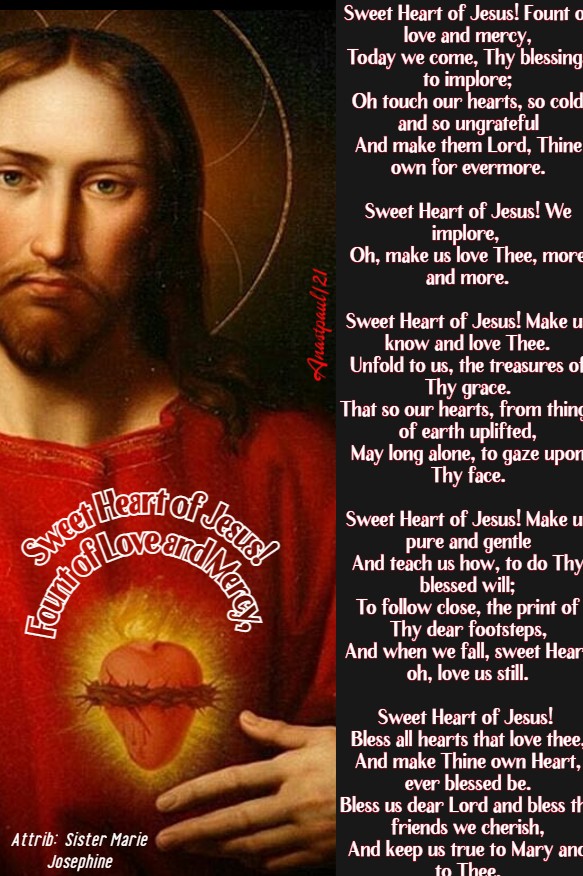
Sweet Heart of Jesus! Fount of Love and Mercy Attrib: Sister Marie Josephine.
Sweet Heart of Jesus! Fount of love and mercy, Today we come, Thy blessings to implore; Oh touch our hearts, so cold and so ungrateful And make them Lord, Thine own for evermore.
Sweet Heart of Jesus! We implore, Oh, make us love Thee, more and more.
Sweet Heart of Jesus! Make us know and love Thee. Unfold to us, the treasures of Thy grace. That so our hearts, from things of earth uplifted, May long alone, to gaze upon Thy face.
Sweet Heart of Jesus! Make us pure and gentle And teach us how, to do Thy blessed will; To follow close, the print of Thy dear footsteps, And when we fall, sweet Heart oh, love us still.
Sweet Heart of Jesus! Bless all hearts that love thee, And make Thine own Heart, ever blessed be. Bless us dear Lord and bless the friends we cherish, And keep us true to Mary and to Thee.
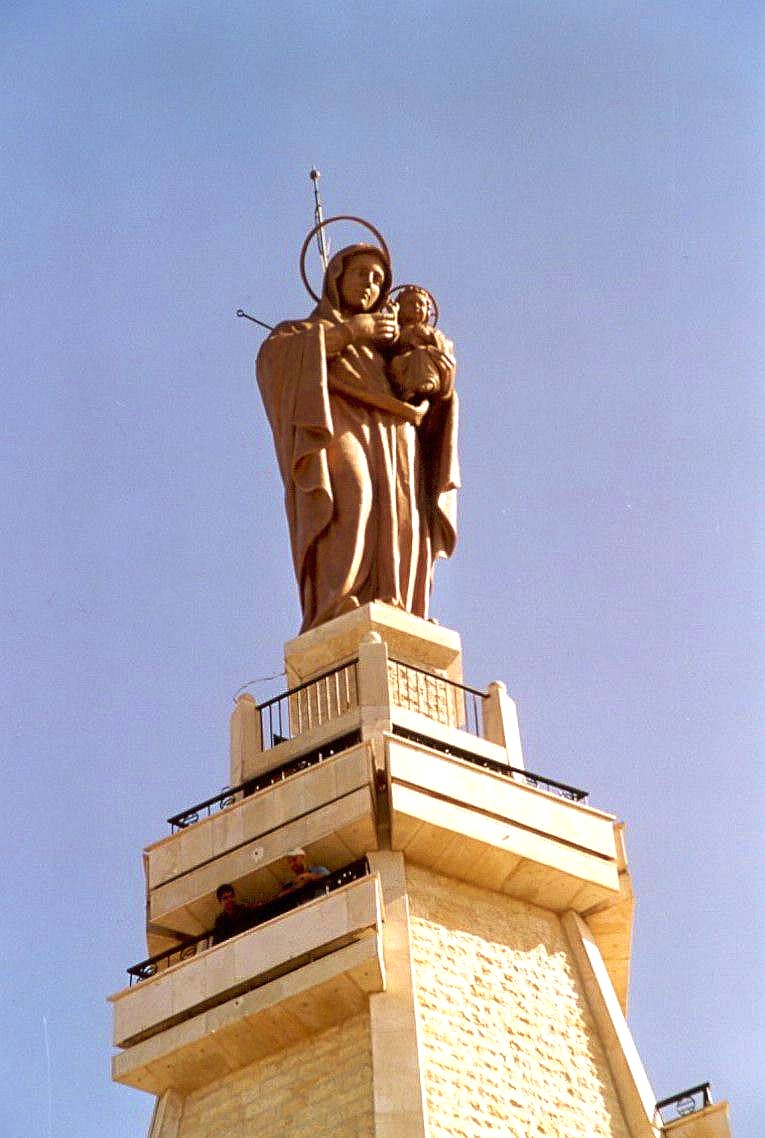
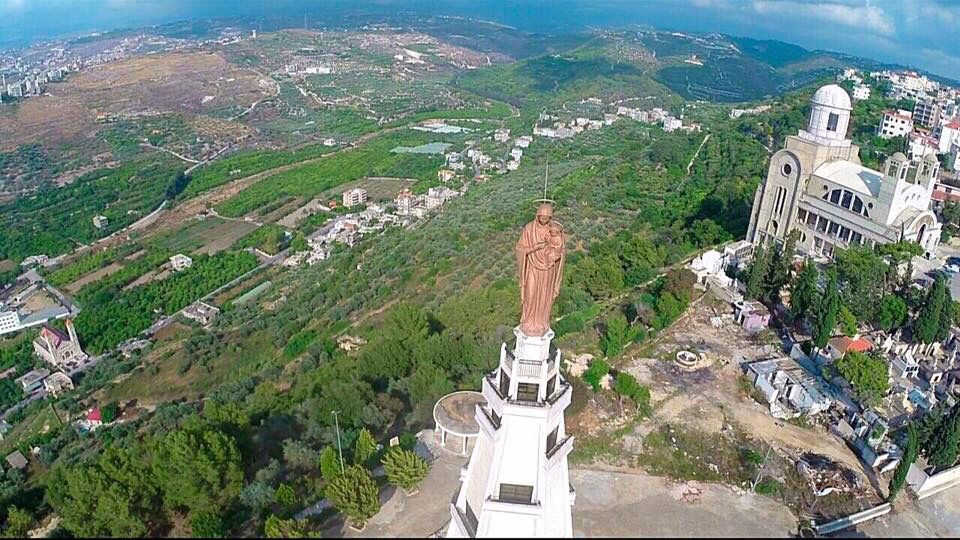
Our Lady of Mantara / Our Lady of ‘Awaiting’, Maghdouché, Sidon, South Governorate, Lebanon (1721) – 11 June, 8 September:
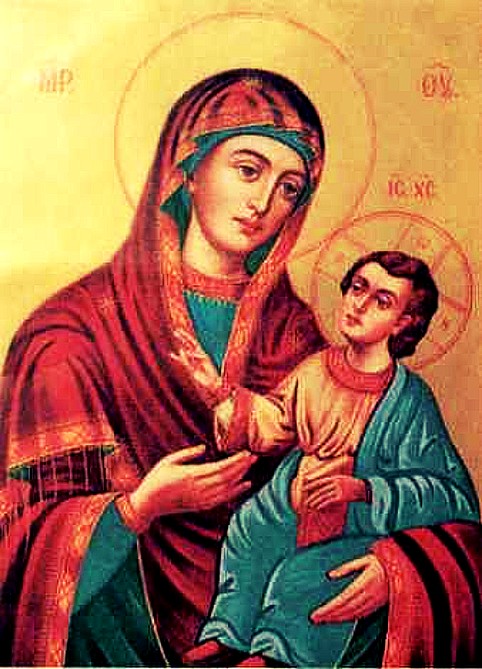
While Jesus preached in Sidon, Mary is said to have waited here in the cave of Mantara (“awaiting” in Arabic). Emperor Constantine’s wife Helena replaced a pagan shrine with one to the Holy Mother, donating to it an Icon and Altar furnishings. Three centuries later, after takeover by an intolerant Arab ruler, Christians sealed the cave and fled Maghdouché. In 1683, descendants of the exiles returned to their homeland under the inclusive Prince Fakhreddin II. On 8 September 1721, when a goat fell through a gap in the porous limestone, its young herder made a rope from vine twigs, tied it to a tree and followed the animal into the hole but the rope broke. The boy fell into the darkness, where eventually he made out the golden glimmer of an Icon of the Madonna and Child. On seeing the image, the Melkite Catholic clergy recognised it as St Helen’s Icon.
Christians now celebrate its rediscovery annually on 8 September, Feast of the Virgin’s Birth. A Cathedral was added to the site in 1860 and a modern tower topped with a bronze Statue in the 1960s.
On 11 June 1911, some 400 people saw a silent, luminous apparition of the Madonna and Child near the cave. Our Lady of Mantara is invoked for the healing of eye diseases and the protection of children, so the Shrine is a popular site for infant Baptisms.
Bl Kasper of Grimbergen St Maximus of Naples St Parisius St Paula Frasinetti St Riagail of Bangor St Tochumra of Kilmore St Tochumra of Tuam — Martyrs of Tavira – 7 beati: Members of the Knights of Santiago de Castilla. During the re-conquest of the Iberian peninsula from the Muslims by Christian forces, in a period of truce between the armies, the group was allowed to leave the Portuguese camp to hunt. Near Tavira, Portugal, he and his companions were ambushed and killed by a Muslim force. Making a reprisal attack, the Portuguese army took the city of Tavira. The murdered knights were considered to be martyrs as they died in an action defending the faith. They were – • Blessed Alvarus Garcia • Blessed Beltrão de Caia • Blessed Damião Vaz • Blessed Estêvão Vasques • Blessed Garcia Roiz • Blessed Mendus Valle • Blessed Pedro Rodrigues They were martyred in 1242 outside Tavira, Faro, Portugal. Their relics are enshrined under the altar of Saint Barnabas in the Church of Our Lady, Queen of the Angels (modern Santa Maria do Castelo) in Tavria
Mercedarian Martyrs of Damietta: Three Mercedarian lay knights who worked to ransom Christians enslaved by Muslims. During the 7th Crusade, a plague swept through the Christian army and these knights volunteered to work with the sick. During this work they were captured by Muslims and ordered to convert to Islam; they refused. They were tortured, taken to Damietta, Egypt where they were murdered for their faith. They were thrown from a tower in the mid-13th century in Damietta, Egypt.























 AnaStpaul
You must be logged in to post a comment.