Thought for the Day – 6 June – Meditations with Antonio Cardinal Bacci (1881-1971)
The Feast of Corpus Christi
“Human words cannot express the beauty ad depth of the passage from the Gospel which the liturgy of the Holy Mass offers for our meditation. It is the passage in which Jesus promises the institution of the Blessed Eucharist.
“ For my flesh is food indeed and my blood is drink indeed. He that eateth my flesh and drinketh my blood, abideth in me and I in him. As the living Father hath sent me and I live by the Father; so he that eateth me, the same also shall live by me. This is the bread that came down from heaven. Not as your fathers did eat manna and are dead. He that eateth this bread, shall live forever.” (Jn 6:56-59)
No human being could have visualised or uttered such words. Only the God-Man could have spoken them.
Even outside the Eucharist, God communicates with us, descending with His grace into our souls. We feel that He is present, we experience His supernatural influence and inspiration, His appeals to us to do good. But in the Eucharist, we have far more than this. We have the God-Man as the food of our souls, through which we live His own life, so that, like St Paul, it is no longer we who live but Christ Who lives in us.
This intimate and mysterious union has been compared with the unfathomable union in which the Son of God, lives the life of His heavenly Father because. by means of the Eucharist, we should live the supernatural life of Jesus. A a result of this transformation, there can be no further place in us for sin, nor for disordered affectations and desires but only for virtue and for God.”
Quote/s of the Day – 6 June – “Month of the Sacred Heart” – Corpus Christi, The Solemnity of The Most Holy Body and Blood of Christ
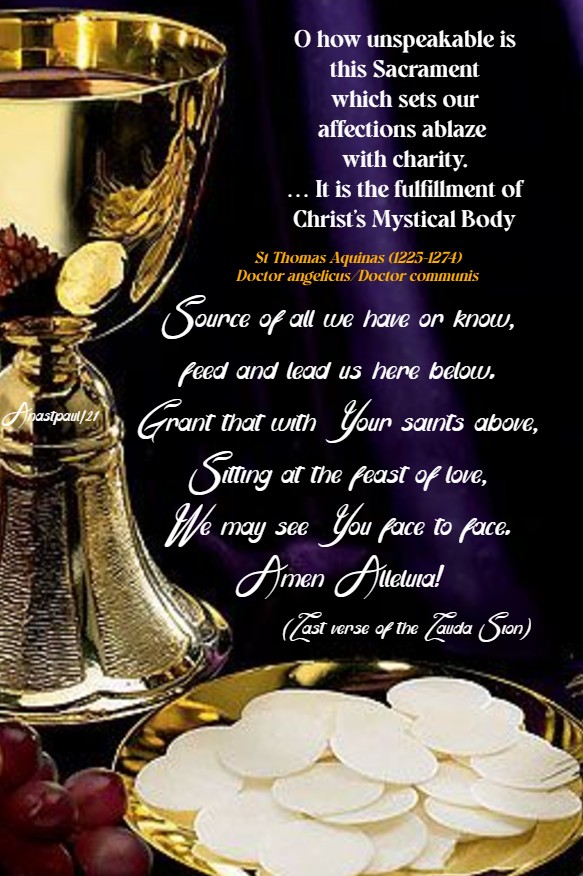
“O how unspeakable is this Sacrament which sets our affections ablaze with charity. … It is the fulfillment of Christ’s Mystical Body.”
“Source of all we have or know, feed and lead us here below. Grant that with Your saints above, Sitting at the feast of love, We may see You face to face.”
Amen Alleluia!
(Last verse of the Lauda Sion)
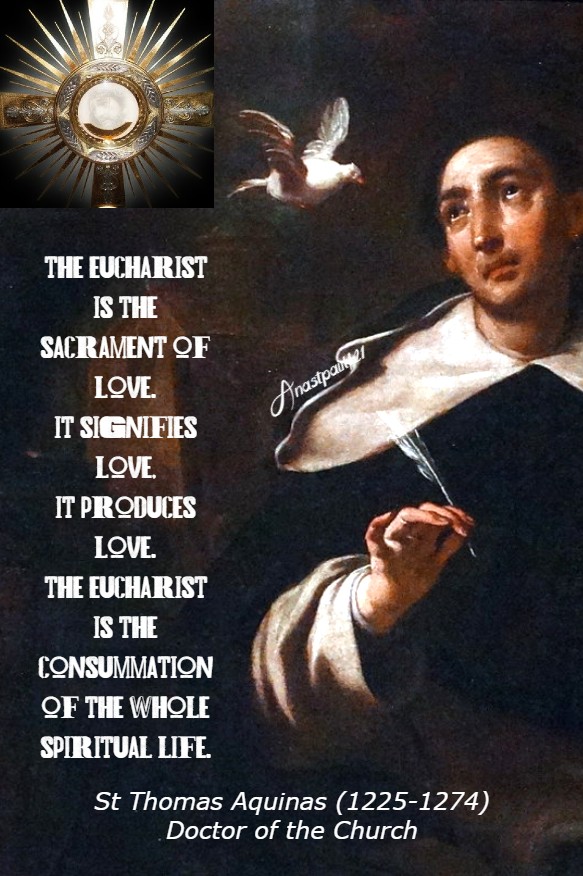
“The Eucharist is the Sacrament of Love. It signifies Love, It produces love. The Eucharist is the consummation of the whole spiritual life.”
St Thomas Aquinas (1225-1274) Doctor angelicus/Doctor communis
One Minute Reflection – 6 June – “Month of the Sacred Heart” – Corpus Christi, The Solemnity of The Most Holy Body and Blood of Christ, Readings: First: Exodus 24: 3-8, Psalm: Psalms 116: 12-13, 15-16, 17-18 (13), Second: Hebrews 9: 11-15, Gospel: Mark 14: 12-16, 22-26
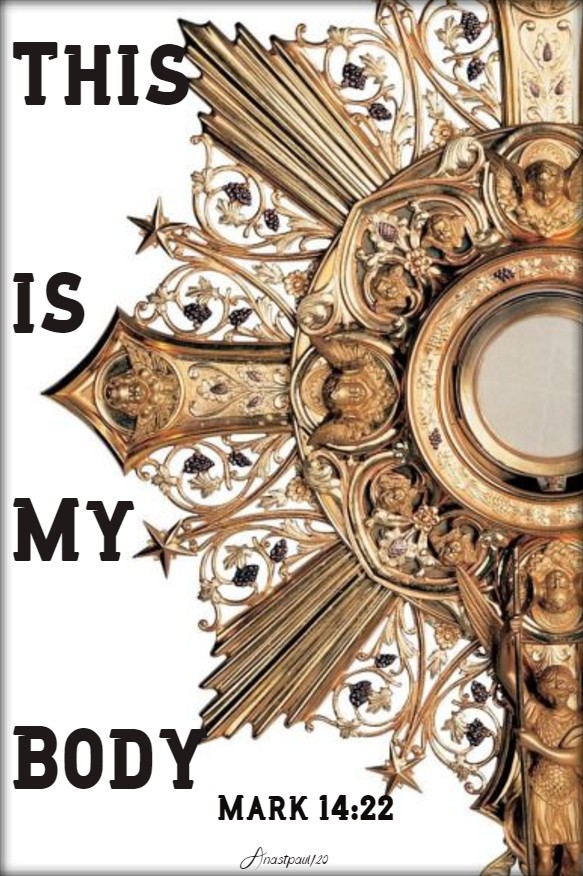
“ This is my body … this is my blood ” – Mark14: 22,24
REFLECTION – “The lovers of this world display their generosity by giving money, clothes and various gifts but not one of them gives his own blood. Christ gives His. In this way He demonstrates the tenderness He feels for us and His ardent love. Under the Old Law … God consented to receive the blood of sacrifices but this was just to prevent His people from offering it to false gods and, already, this was proof of a very great love. But Christ transformed this rite… there is no longer the same sacrificial victim – it is Himself He offers in sacrifice.
“The bread that we break, is it not a communion in the body of Christ?” (1 Cor 10:16) What is this bread? The Body of Christ. What becomes of those who communicate in it? The Body of Christ – not a large number of bodies but just one Body. Just as this bread, made up of so many wheat grains, makes only one loaf into which the grains disappear – for even though the grains remain in it, yet it is impossible to distinguish them in such a closely compacted mass – so all of us, together with Christ, make up a single whole … Now, if we all share in the same bread and are united to the same Christ, why don’t we show the same love to each other? Why don’t we become one in this case too?
This is what was seen at the beginning: “The community of believers was of one heart and mind” (Acts 4:32) … Christ came in search of you who were far away from Him to unite Himself to you but you do not wish to become one with your brother? … You violently separate yourself from him, after winning from the Lord so great a proof of His love – and life! For He did not only give His Body but, just as our flesh, drawn from the earth, had lost its life and died through sin, so He has introduced, so to speak, another substance like a leaven, this is His Body, the Body sharing the same nature as ours but free from sin and abounding in life. And He has given it to all of us, so that, fed with the banquet of this new food … we might enter immortal life.” – St John Chrysostom (347-407) Archbishop of Constantinople, Father ad Doctor of the Church – 24th homily on the 1st letter to the Corinthians 2
PRAYER – Lord Jesus Christ, You gave Your Church, an admirable Sacrament as the abiding memorial of Your Passion. Teach us to worship the sacred mystery of Your Body and Blood, that it’s redeeming power may sanctify us always. Who live and reign with the Father and the Holy Spirit, God, forever, amen.
Our Morning Offering – 6 June – “Month of the Sacred Heart” – The Solemnity of Corpus Christi – The Most Holy Body ad Blood of Our Lord Jesus Christ
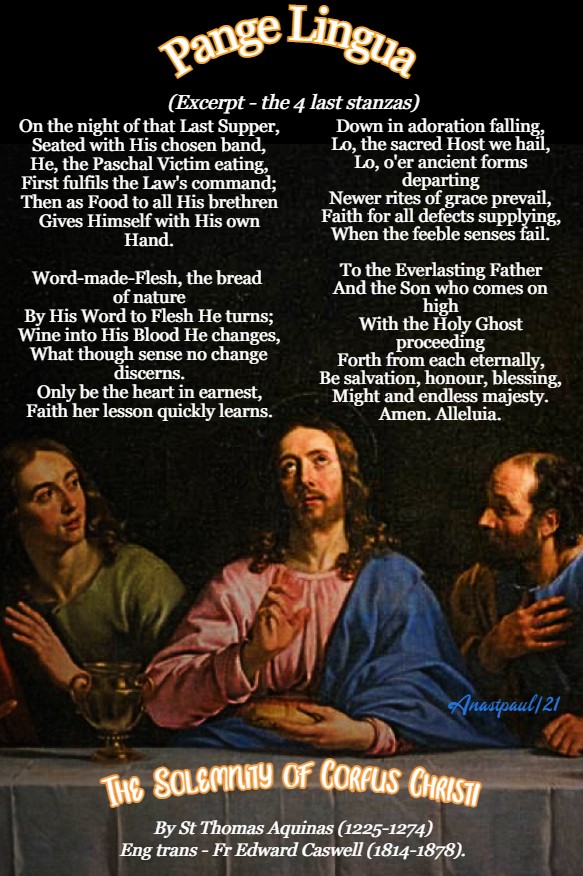
Pange Lingua Sing, My Tongue By St Thomas Aquinas (1225-1274) Eng trans – Fr Edward Caswell CO (1814-1878) (Excerpt on the image – the 4 last stanzas)
Sing, my tongue, the Saviour’s glory, Of His Flesh, the mystery sing; Of the Blood, all price exceeding, Shed by our Immortal King, Destined, for the world’s redemption, From a noble Womb to spring.
Of a pure and spotless Virgin Born for us on earth below, He, as Man, with man conversing, Stayed, the seeds of truth to sow; Then He closed in solemn order Wondrously His Life of woe.
On the night of that Last Supper, Seated with His chosen band, He, the Paschal Victim eating, First fulfils the Law’s command; Then as Food to all His brethren Gives Himself with His own Hand.
Word-made-Flesh, the bread of nature By His Word to Flesh He turns; Wine into His Blood He changes, What though sense no change discerns. Only be the heart in earnest, Faith her lesson quickly learns.
Down in adoration falling, Lo, the sacred Host we hail, Lo, o’er ancient forms departing Newer rites of grace prevail, Faith for all defects supplying, When the feeble senses fail.
To the Everlasting Father And the Son who comes on high With the Holy Ghost proceeding Forth from each eternally, Be salvation, honour, blessing, Might and endless majesty. Amen. Alleluia.
Written by St Thomas Aquinas (1225-1274) for the Solemnity of Corpus Christi, this Hymn is considered the most beautiful of Aquinas’ Hymns and one of the great seven Hymns of the Church. The Hymn is also used on Holy Thursday. The last two stanzas make up the Tantum Ergo (Down in Adoration Falling) that is used at Benediction of the Blessed Sacrament.
PANGE, lingua, gloriosi Corporis mysterium, Sanguinisque pretiosi, quem in mundi pretium fructus ventris generosi Rex effudit Gentium.
Nobis datus, nobis natus ex intacta Virgine, et in mundo conversatus, sparso verbi semine, sui moras incolatus miro clausit ordine.
In supremae nocte cenae recumbens cum fratribus observata lege plene cibis in legalibus, cibum turbae duodenae se dat suis manibus.
Verbum caro, panem verum verbo carnem efficit: fitque sanguis Christi merum, et si sensus deficit, ad firmandum cor sincerum sola fides sufficit.
Tantum ergo Sacramentum veneremur cernui: et antiquum documentum novo cedat ritui: praestet fides supplementum sensuum defectui.
Genitori, Genitoque laus et iubilatio, salus, honor, virtus quoque sit et benedictio: procedenti ab utroque compar sit laudatio. Amen. Alleluia.
Solemnity of Corpus Christi – The Most Holy Body ad Blood of Our Lord Jesus Christ +2021 – celebrated today in many countries, where Thursday was not a Holy Day
Panna Mária,/ Blessed Virgin Mary, Pozba, Nové Zámky, Nitra, Slovakia 1512 –Second Sunday after Feast of the Ascension:
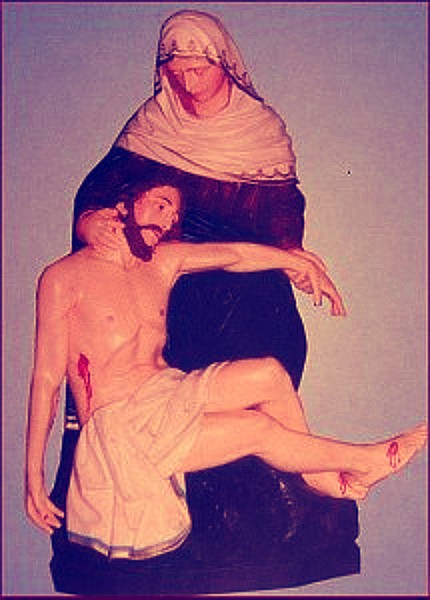
In 1512, the Pauline Fathers built a Marian Shrine, in the southwest Slovakian Town of Vel’ké Lovce. In the 1700s is was a popular place of pilgrimage. One day in those years, shepherds and pilgrims, observed a white dove bathing in a spring in the woods five miles away, outside the village of Pozba. The story circulated that a shepherd’s blind daughter regained her sight after washing her eyes with the dove’s bathwater. The landowner made fun of this, wondering if the spring could help his blind horse. It did, but he went blind instead. A sick girl saw the Virgin, wearing a white dress and blue sash, in a pear tree and was immediately cured. From the wood of this tree, a Pietà was carved, still venerated in a Chapel by the spring, which hosts annual pilgrimages on Pentecost Sunday and on 15 September, Feast of Our Lady of Sorrows.
St Norbert (c 1080-1134) (Optional Memorial) Bishop, Confessor, Founder of the Premonstratensian or theNorbertine Canons and Sisters, “Defender of the Eucharist” and “Apostle of the Eucharist,” Exorcist, Reformer, Preacher His amazing life: https://anastpaul.com/2017/06/06/saint-of-the-day-6-june-st-norbert/
St Agobard of Lyon St Alexander of Fiesole St Alexander of Noyon St Amantius of Noyon St Anoub of Skete St Artemius of Rome St Bazalota of Abyssinia St Bertrand of Aquileia (1258– 1350) Bishop St Candida of Rome St Ceratius of Grenoble St Claudius of Besançon St Cocca St Colmán of Orkney Bl Daniel of Bergamo St Euphemia of Abyssinia St Eustorgius II of Milan Bl Falco of La Cava Bl Gilbert of Neufontaines St Grazia of Germagno St Gudwall Bl Gundisalvus of Azebeyro St Hilarion the Younger
St Paulina of Rome St Phêrô Dung St Phêrô Thuan St Rafael Guízar y Valencia St Vincent of Bevagna St Vinh-Son Duong — Marytrs of Tarsus: A group of 20 martyrs who were killed together during the persecutions of Diocletian. They were martyred in Tarsus (in modern Turkey).
Mercedarian Fathers of Avignon: Several Mercedarians from the Santa Maria convent of Avignon, France who worked with plague victims in that city and died of the disease themselves. They died in Avignon, France of plague and are remembered together today for their great charity and commitment to their people.
Quote/s of the Day – 3 June – Solemnity of Corpus Christi, The Most Holy Body and Blood of our Lord Jesus Christ
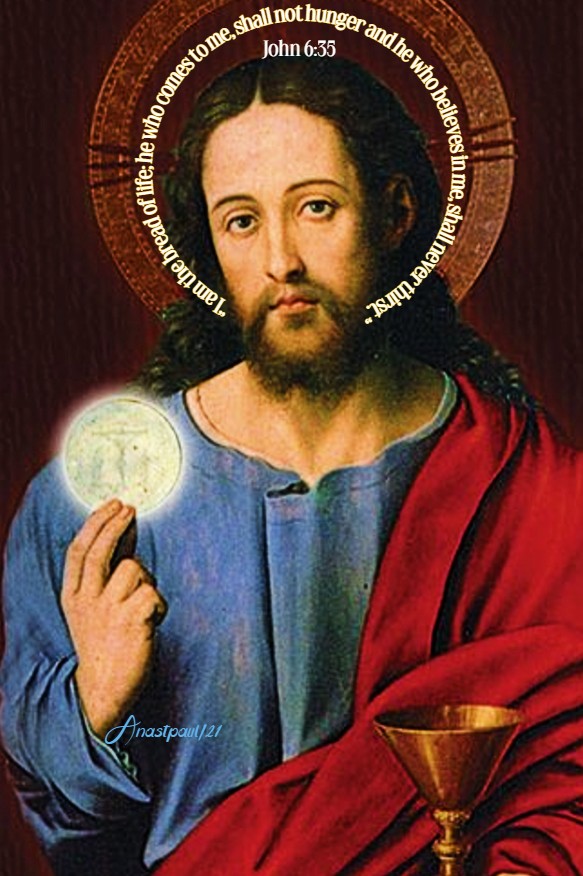
“I am the bread of life; he who comes to me, shall not hunger and he who believes in me, shall never thirst.”
John 6:35
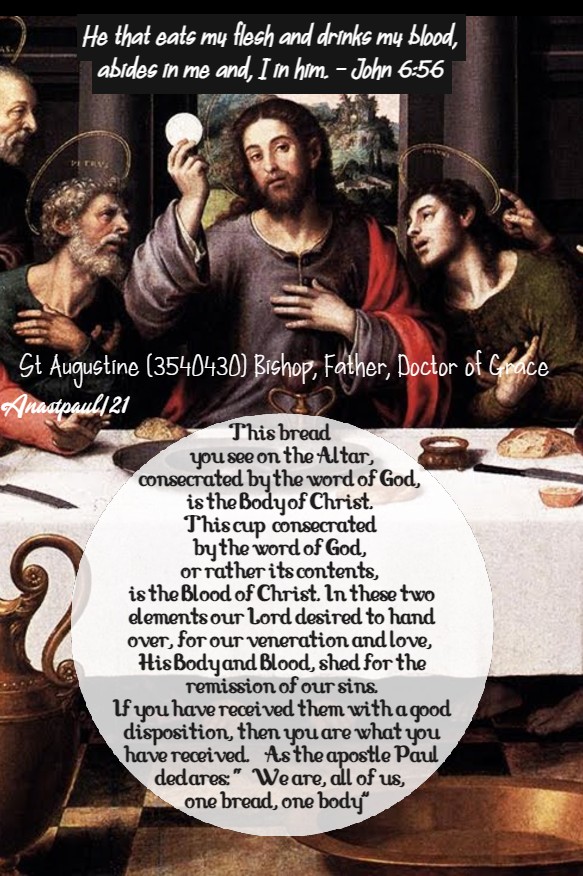
“This bread you see on the Altar, consecrated by the word of God, is the Body of Christ. This cup consecrated by the word of God, or rather its contents, is the Blood of Christ. In these two elements our Lord desired to hand over, for our veneration and love, His Body and Blood, shed for the remission of our sins. If you have received them with a good disposition, then you are what you have received. As the apostle Paul declares: “We are, all of us, one bread, one body” (1 Cor 10,17)…”
St Augustine (354-430) Bishop, Father, Doctor of Grace
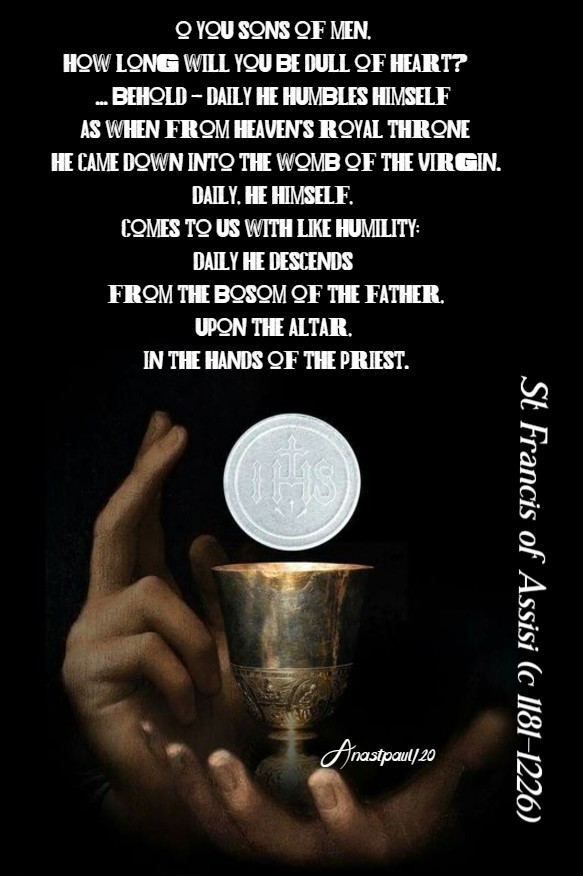
“O you sons of men, how long will you be dull of heart? … Behold – daily He humbles Himself as when from heaven’s royal throne He came down into the womb of the Virgin. Daily, He Himself, comes to us with like humility; daily He descends from the bosom of the Father, upon the Altar, in the hands of the Priest.”
St Francis of Assisi (c 1181–1226)
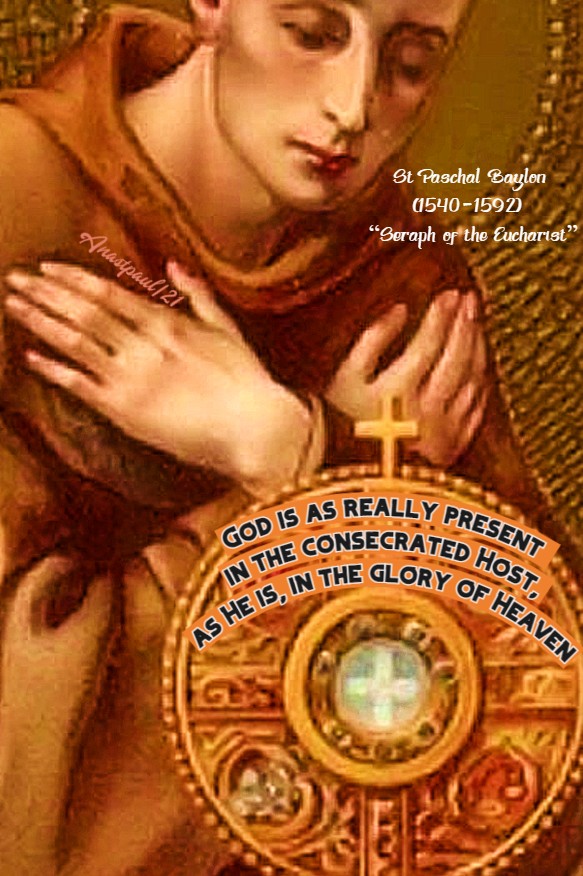
“God is as really present in the consecrated Host, as He is, in the glory of Heaven.”
St Paschal Baylon (1540-1592)
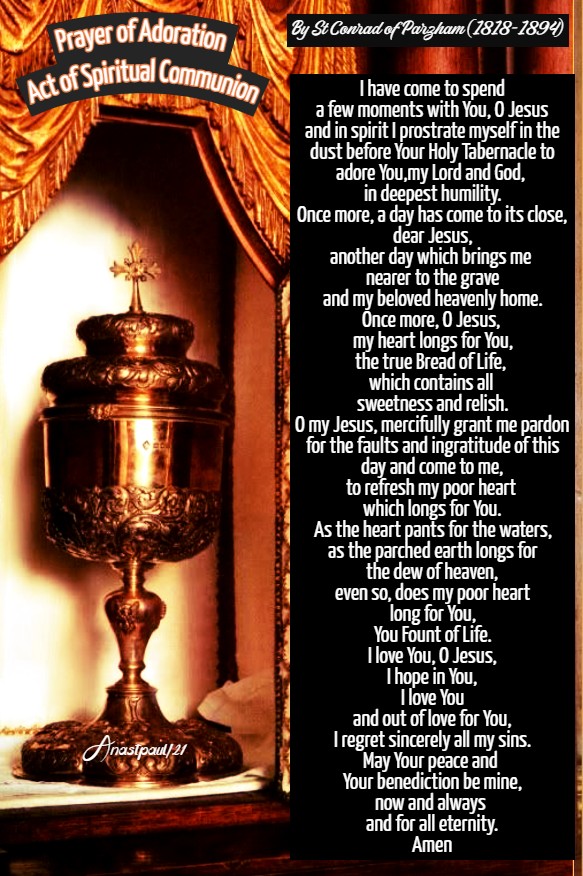
Prayer of Adoration Act of Spiritual Communion By St Conrad of Parzham (1818-1894)
I have come to spend a few moments with You, O Jesus and in spirit I prostrate myself in the dust before Your Holy Tabernacle to adore You, my Lord and God, in deepest humility. Once more, a day has come to its close, dear Jesus, another day which brings me nearer to the grave and my beloved heavenly home. Once more, O Jesus, my heart longs for You, the true Bread of Life, which contains all sweetness and relish. O my Jesus, mercifully grant me pardon for the faults and ingratitude of this day and come to me, to refresh my poor heart which longs for You. As the heart pants for the waters, as the parched earth longs for the dew of heaven, even so, does my poor heart long for You, You Fount of Life. I love You, O Jesus, I hope in You, I love You and out of love for You, I regret sincerely all my sins. May Your peace and Your benediction be mine, now and always and for all eternity. Amen
One Minute Reflection – 3 June – Solemnity of Corpus Christi, The Most Holy Body and Blood of our Lord Jesus Christ, Readings: First: Exodus 24: 3-8, Psalm: Psalms 116: 12-13, 15-16, 17-18 (13), Second: Hebrews 9: 11-15, Gospel: John 6:44-51
“The bread that I will give, is my flesh for the life of the world.” – John 6:51
REFLECTION – “They are wholly mistaken who reject God’s plan for His creation, deny the salvation of the flesh and scoff at the idea of its regeneration, asserting that it cannot put on an imperishable nature. If the flesh is not saved, then the Lord did not redeem us with His Blood, the Chalice of the Eucharist is not a share in His Blood and the Bread which we break is not a share in His Body (1Cor 10,16). For… the human substance, which the Word of God truly became, redeems us with His Blood…
Since we are His members (1Cor 6,15) and are nourished by His creation… He declared, that the Chalice of His creation is His own Blood, from which He augments our own blood and He affirmed, that the Bread of His creation is His own Body from which He gives growth to our being.
So, when the mixed chalice and the baked loaf receive the word of God and when the Eucharistic elements become the Body and Blood of Christ, which brings growth and sustenance to our bodily frame, how can it be maintained that our flesh is incapable of receiving God’s gift of eternal life?
For our flesh feeds on the Lord’s Body and Blood and is His member. So Saint Paul writes: “We are members of his body, of his flesh and of his bones” (Eph 5,30; Gn 2,23). He is not speaking about some spiritual and invisible man…: he is speaking of the anatomy of a real man, consisting of flesh, nerves and bones. It is this that is nourished by His Chalice, the Chalice of His Blood and gains growth from the Bread which is His Body… In the same way, our bodies are nourished by the after being buried in the earth and… rise again in due season, when the word of God confers resurrection upon them “for the glory of God the Father” (Phil 2,11).” – St Irenaeus of Lyons (130-202) Bishop, Theologian and Martyr
PRAYER – Lord Jesus Christ, You gave Your Church an admirable Sacrament, as the abiding memorial of Your Passion. Teach us so to worship the sacred mystery of Your Body and Blood, that ts redeeming power may sanctify us always. Who live and reign with the Father and the Holy Spirit, God forever and ever, amen.
Our Morning Offering – 3 June – Solemnty of Corpus Christ, The Most Holy Body and Blood of our Lord Jesus Christ
St Thomas Aquinas wrote the Liturgy for Corpus Christi when Pope Urban IV added the Solemnity to the universal Church’s Liturgical calendar in 1264. He provided a great sequence, one of the great poems chanted or recited before the proclamation of the Gospel. Lauda Sion is one of only four medieval sequences which were preserved in the Roman Missal published in 1570 following the Council of Trent (1545–1563)—the others being Victimae Paschali Laudes (Easter), Veni Sancte Spiritus (Pentecost) and Dies irae (requiem masses). (A fifth, Stabat Mater, would later be added in 1727.) Before Trent, many feasts had their own sequences. The existing versions were unified in the Roman Missal promulgated in 1570. The Lauda Sion is still sung today as solemn Eucharistic hymn, though its use is optional in the post-Vatican II Ordinary form. As with St Thomas’s other three Eucharistic Hymns, the last few stanzas of the Lauda Sion are often used alone, in this case, to form the “Ecce Panis Angelorum”.
Lauda Sion Salvatorem Sion, Lift Up thy Voice and Sing (Excerpt) By St Thomas Aquinas (1225-1274) Doctor Angelicus / Doctor Communis
Sion, lift thy voice and sing, Praise thy Saviour and thy King, Praise with hymns thy Shepherd true, Dare thy most to praise Him well, For He doth all praise excel, None can ever reach His due.
Special theme of praise is Thine, That true living Bread divine, That life-giving flesh adored, Which the brethren twelve received, As most faithfully believed, At the Supper of the Lord.
Let the chant be loud and high, Sweet and tranquil be the joy Felt to-day in every breast; On this festival divine Which recounts the origin Of the glorious Eucharist.
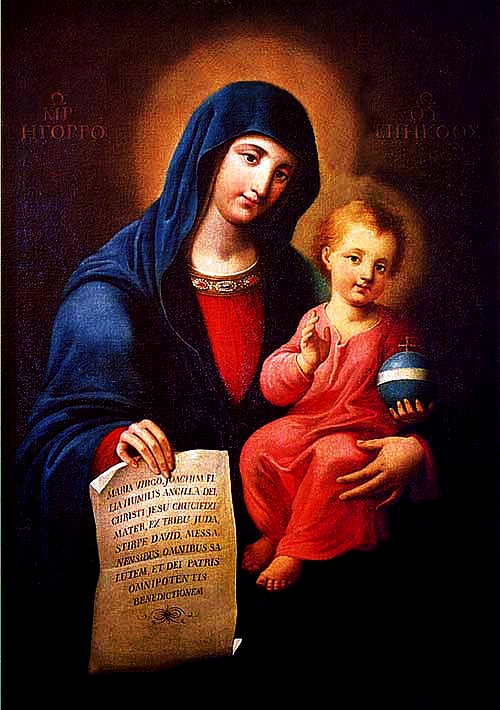
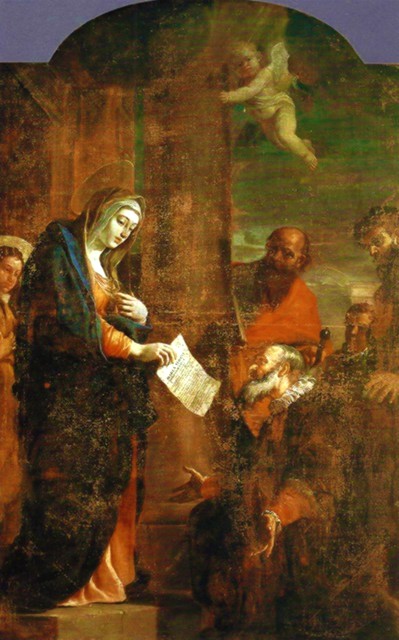
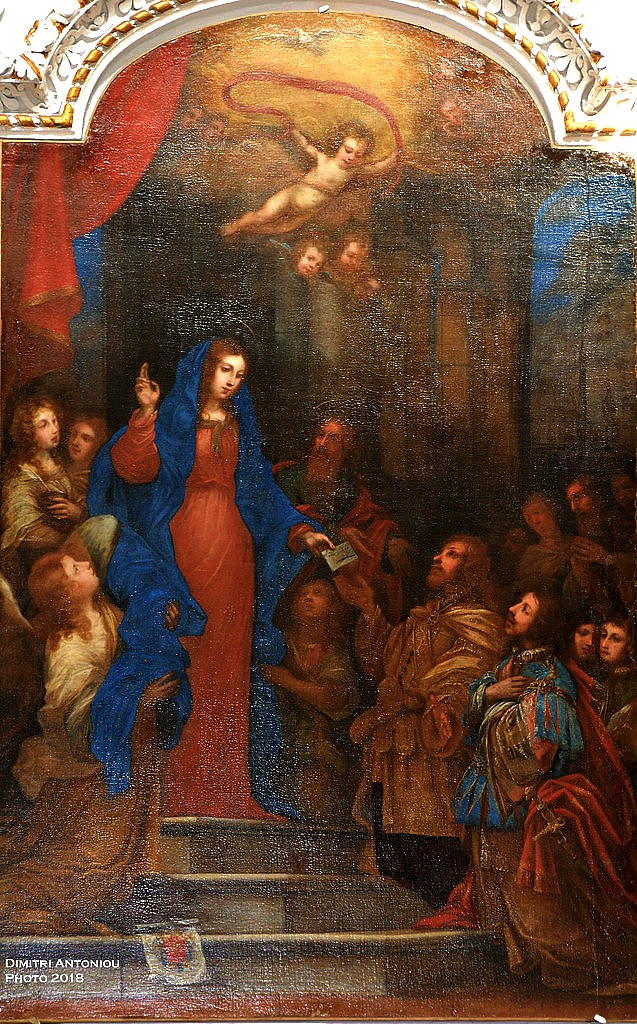
Madonna della Lettera / Our Lady of the Letter (Messina, Sicily, Italy) 1693 – Patron of Messina, Palmi (Reggio Calabria) and of Finale (Palermo) – 3 June and 9 January:
According to tradition, Saint Paul arrived in Messina to preach the Gospel and the population welcomed him with enthusiasm, thus obtaining many conversions. In 42, when Paul was about to return to Palestine, some Messinesi asked to accompany him in order to get to know Our Lady in person. So a delegation of Messinesi went to Palestine with a missive, in which many fellow citizens converted to the faith of Christ, professed their faith and asked for the protection of Mary.
Mary welcomed them and, in response to the letter, sent back a letter of her, written in Hebrew, rolled up and tied with a lock of her hair. The delegation returned to Messina on 8 September 42 carrying the important letter. In it, Mary praised their faith, mentioning that their devotion pleased her and assured them of her perpetual prayers and protection.
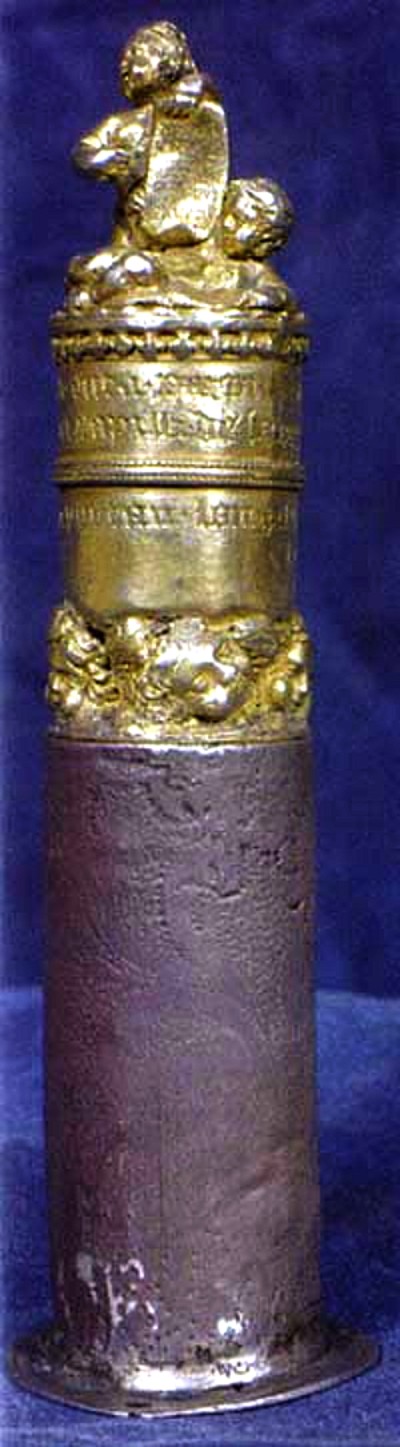
The lock of hair is kept in the Cathedral of Messina and exposed on the day of Corpus Christi set in the tree of a small galleon built in silver, which represents one of the examples of the protection of the Lady for Messina. (see image below)
The cult of Our Lady of the Letter, however, only became established in 1716, the year in which the Monk Gregorio Arena brought a translation of the letter of Mary from Arabic into Messina. Since then, the City of Messina has celebrated the festival on 3 June with a crowded procession of the silvery litter of Our Lady. The tradition of the names Letterio and Letteria (abbreviations, respectively Lillo and Lilla) derives from the cult of Our Lady of the Letter, spread above all in Messina and the Province.
The text of the letter delivered to the Messina delegation reads:
“Most humble servant of God, Mother of Jesus crucified, of the tribe of Judah, of the lineage of David, good health to all the Messinese and Blessing of God the Father Almighty. It is clear to us, through public instrument, that all of you with great faith, have sent Legates and Ambassadors, confessing that Our Son, begotten of God, is God and man and that after his Resurrection, ascended into heave. Having known the way of truth through the preaching of Paul, the chosen Apostle for whom we bless you and your city and, of which, we want to be its perpetual protector.
(From Jerusalem 3 June year 42 of Our Son. Indiction 1 moon XXVII) “
The phrase VOS ET IPSAM CIVITATEM BENEDICIMUS(“We bless you and your City”) is now written in large letters at the base of the Statue of Our Lady on the extreme arm of the Port of Messina. It should be noted that the text of the letter has an inconsistency in the date, since at that time Christian dating did not yet exist.
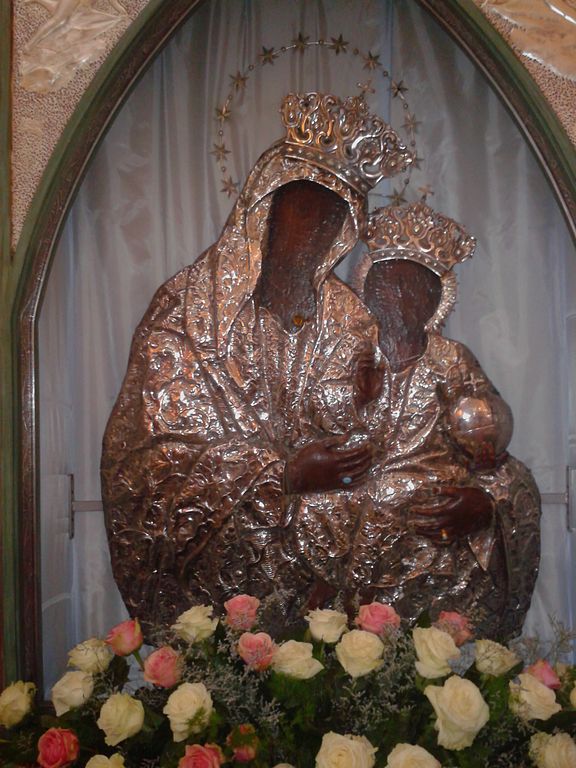
The devotion in Palmi (Reggio Calabria): – In 1575 an epidemic of plague broke out in Messina which caused the death of over 40,000 people. The citizens of Palmi welcomed those who fled the Peloritan City and also, through its sailors, sent aid of various kinds of food and oil. After the calamity, the City of Messina wanted to donate one of the hairs of Our Lady that were brought to the Sicilian City to the ecclesial authorities of Palmi, as a sign of gratitude for the help given. In 1582 a reliquary containing a Holy Hair of the Virgin arrived at the Marina di Palmi. From that moment, veneration towards Our Lady with the title “of the Holy Letter” began also in the people of Palmese and her Effigy carved in dark wood and enclosed in a silver mantle, similar to that venerated in the Peloritan City, was adopted.
Martyrs of Uganda (Memorial) – 22 saints: Twenty-two (22) young Ugandan converts martyred in the persecutions of King Mwanga. They are – • Achileo Kiwanuka • Adolofu Mukasa Ludigo • Ambrosio Kibuuka • Anatoli Kiriggwajjo • Anderea Kaggwa • Antanansio Bazzekuketta • Bruno Sserunkuuma • Charles Lwanga • Denis Ssebuggwawo • Gonzaga Gonza • Gyavire • James Buzabaliao • John Maria Muzeyi • Joseph Mukasa • Kizito • Lukka Baanabakintu • Matiya Mulumba • Mbaga Tuzinde • Mugagga • Mukasa Kiriwawanvu • Nowa Mawaggali • Ponsiano Ngondwe They were Canonised on 18 October 1964 by Pope Paul VI at Rome, Italy. The Lives and Martyrdom of the Ugandan Martyrs: https://anastpaul.com/2017/06/03/saints-of-the-day-3-june-uganda-martyrs-or-st-charles-lwanga-companions/
Bl Adam of Guglionesi St Albert of Como St Athanasius of Traiannos St Auditus of Braga Bl Beatrice Bicchieri St Caecilius of Carthage
St Charles Lwanga & Companions (see the Martyrs of Uganda above)
Bl Charles-René Collas du Bignon St Clotilde of France St Conus of Lucania St Cronan the Tanner St Davinus of Lucca Bl Diego Oddi Bl Francis Ingleby St Gausmarus of Savigny St Genesius of Clermont St Glunshallaich St Hilary of Carcassone St Isaac of Córdoba
St Laurentinus of Arezzo St Liphardus of Orléans St Morand of Cluny St Moses of Arabia St Oliva of Anagni St Paula of Nicomedia St Pergentinus of Arezzo St Phaolô Vu Van Duong St Urbicius — Dominicans Martyred in China
Martyrs of Africa – 156 saints: 156 Christians martyred together in Africa, date unknown; the only other information to survive are some of their names – • Abidianus• Demetria• Donatus• Gagus• Januaria• Juliana• Nepor• Papocinicus• Quirinus• Quirus Martyrs of Byzantium – 5 saints: A group of Christians, possibly related by marriage, who were martyred together. They were – • Claudius• Dionysius• Hypatius• Lucillian• Paul They were Martyred in 273 in Byzantium.
Martyrs of Rome – 8 saints: A group of Christians martyred together. We know nothing else about them but the names – • Amasius• Emerita• Erasmus• Lucianus• Orasus• Satuaucnus• Septiminus• Servulus They were Martyred in Rome, Italy, date unknown.
Martyrs of Rome – 86 saints: 85+ Christians martyred together in Rome, Italy, date unknown. The only details that have survived are some of their names – • Apinus • Apronus • Aurelius • Avidus • Cassianus • Criscens • Cyprus • Domitius • Donata • Donatus • Emeritus • Extricatus • Exuperia • Faustina • Felicitas • Felix • Flavia • Florus • Fortunata • Fortunatus • Fructus • Gagia • Gagus • Gallicia • Gorgonia • Honorata • Januaria • Januarius • Justa • Justus • Libosus • Luca • Lucia • Matrona • Matura • Mesomus • Metuana • Nabor • Neptunalis • Obercus • Paula • Peter • Pompanus • Possemus • Prisca • Procula • Publius • Quintus • Rogatian • Romanus • Rufina • Saturnin • Saturnus • Secundus • Severa • Severus • Sextus • Silvana • Silvanus • Sinereus • Tertula • Titonia • Toga • Urban • Valeria • Veneria • Veranus • Victor • Victoria • Victorinus • Victuria • Victurina • Virianus • Weneria • Zetula. They were Martyred in Rome date unknown.
Our Morning Offering – 23 May – Pentecost Sunday, Alleluia!
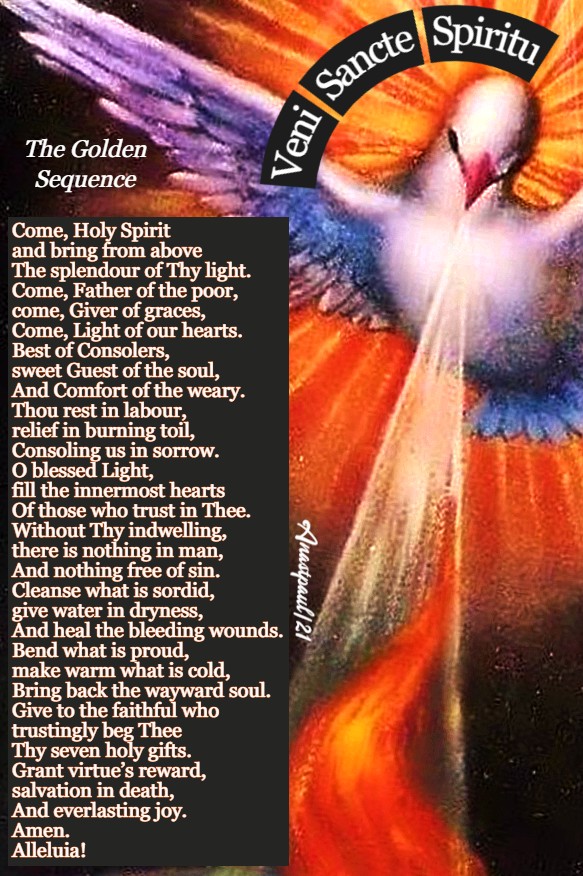
Veni Sancte Spiritus – The Golden Sequence
Come, Holy Spirit and bring from above The splendour of Thy light. Come, Father of the poor, come, Giver of graces, Come, Light of our hearts. Best of Consolers, sweet Guest of the soul, And Comfort of the weary. Thou rest in labour, relief in burning toil, Consoling us in sorrow. O blessed Light, fill the innermost hearts Of those who trust in Thee. Without Thy indwelling, there is nothing in man, And nothing free of sin. Cleanse what is sordid, give water in dryness, And heal the bleeding wounds. Bend what is proud, make warm what is cold, Bring back the wayward soul. Give to the faithful, who trustingly beg Thee Thy seven holy gifts. Grant virtue’s reward, salvation in death, And everlasting joy. Amen. Alleluia!
“Veni Sancte Spiritus,” the “Golden Sequence”, is a sequence prescribed in the Roman Liturgy for the Masses of Pentecost and its octave, exclusive of the following Trinity Sunday. It is usually attributed to either the thirteenth-century Pope Innocent III (c 1160 – 1216) or to the Archbishop of Canterbury, Cardinal Stephen Langton (c 1150 – 1228).
Quote/s of the Day – 14 May – “Mary’s Month” – Feast of St Matthias Apostle, Readings: Acts 1:15-17, 20-26, Psalm 113:1-8, John 15:9-17
“The lot fell upon Matthias, and he was numbered with the eleven apostles.”
Acts 1:26
“He needed to be a witness not of the times before or after that event and not of the signs and wonders but only of the Resurrection itself. For the rest happened by general admission, openly but the Resurrection took place secretly and was known to these men only.”
St John Chrysosthom (347-407) Father & Doctor of the Church
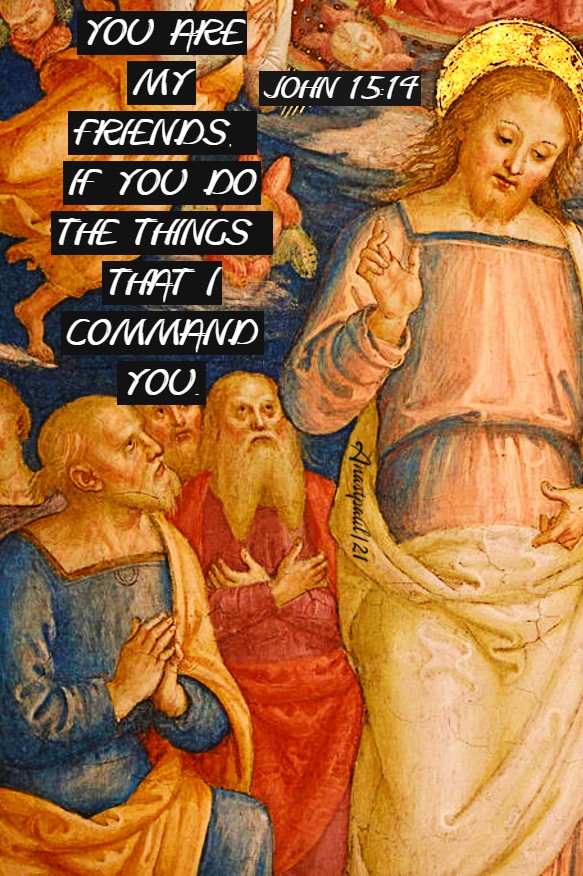
“You are my friends, if you do the things that I command you.”
John 15:14
“I have chosen you and have appointed you, that you should go and should bring forth fruit and your fruit should remain, says the Lord.”
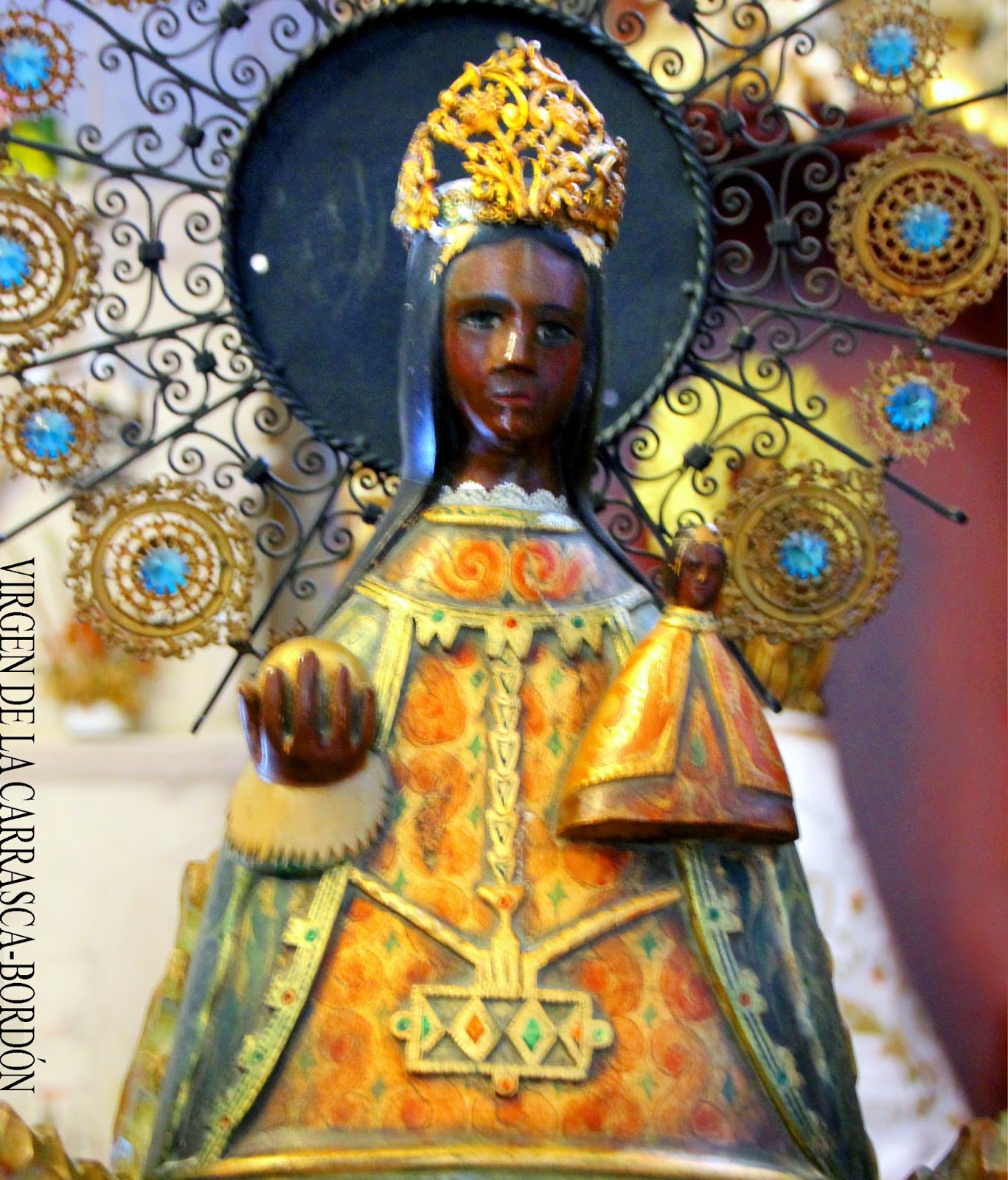
Virgen de la Carrasca, Bordón, Teruel, Aragón, Spain (1212) – 3 May:
Commemorated on First Monday of May
In 1212, a herder found an image of the Virgin in a holm oak (carrasca) in the rocky countryside of Aragón in Spaon. There are several stories about what happened then, all of them ending with a Shrine in Bordón. Templars carried the Statue to Castellote, 12 miles north but the next day the image was back in the oak, the Virgin made those carrying her to Castellote keep turning toward Bordón and springs arose at each turn.
Original Statue
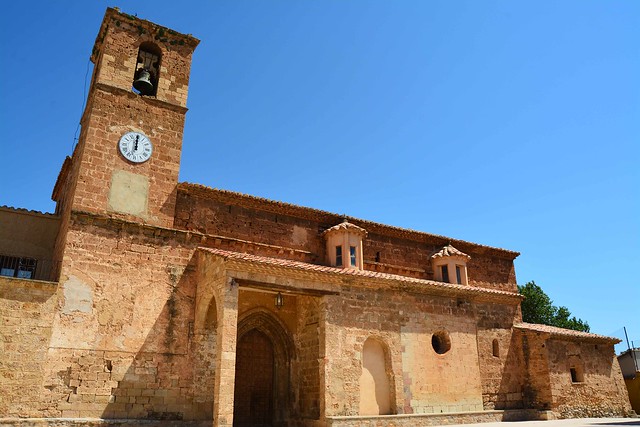
In the place where it was found, a hermitage was built to house it, which would later be replaced by the building that today is the Parish Church of Bordón, built in 1306 by the Templar Order (The Order was dissolved by Pope Clement V in 1312 ).
Although its exterior hardly stands out, its interior is magical and fascinating, a place full of mystery. In one of the Chapels inside, the Templar novices who previously made a pilgrimage on foot from Castellote, capital of the Templar Commandery, performed initiation rites to become Knights of the Order.
In the 18th century, the interior of the Church was covered with marvellous frescoes, which have been recently restored. Unfortunately, the venerated carving of the Black Virgin of the Carrasca was lost during the Civil War, along with another very famous Romanesque carving with a reputation for miraculously calming storms, the Virgin of the Spider, only a series of photographs being preserved, which allowed the making a replica.
Replica Statue
On the first Monday in May, the faithful from the three towns to the south—Tronchón, Olocau del Rey and Mirambel—conduct a processional pilgrimage to the Virgin de la Carrasca. They have done this “from time immemorial,” according to a document of 1390 in the Parish archives of Tronchón.
St Adalsindis of Bèze Bl Adam of Cantalupo in Sabina St Ahmed the Calligrapher St Aldwine of Peartney St Pope Alexander I St Alexander of Constantinople Bl Alexander of Foigny St Alexander of Rome Bl Alexander Vincioli St Ansfrid of Utrecht (c 940-1010) Bishop St Antonina of Constantinople St Diodorus the Deacon
St Ethelwin of Lindsey St Eventius of Rome St Fumac St Gabriel Gowdel St Juvenal of Narni Bl Maria Leonia Paradis St Maura of Antinoe St Peter of Argos St Philip of Zell Bl Ramon Oromí Sullà St Rhodopianus the Deacon St Scannal of Cell-Coleraine Bl Sostenaeus
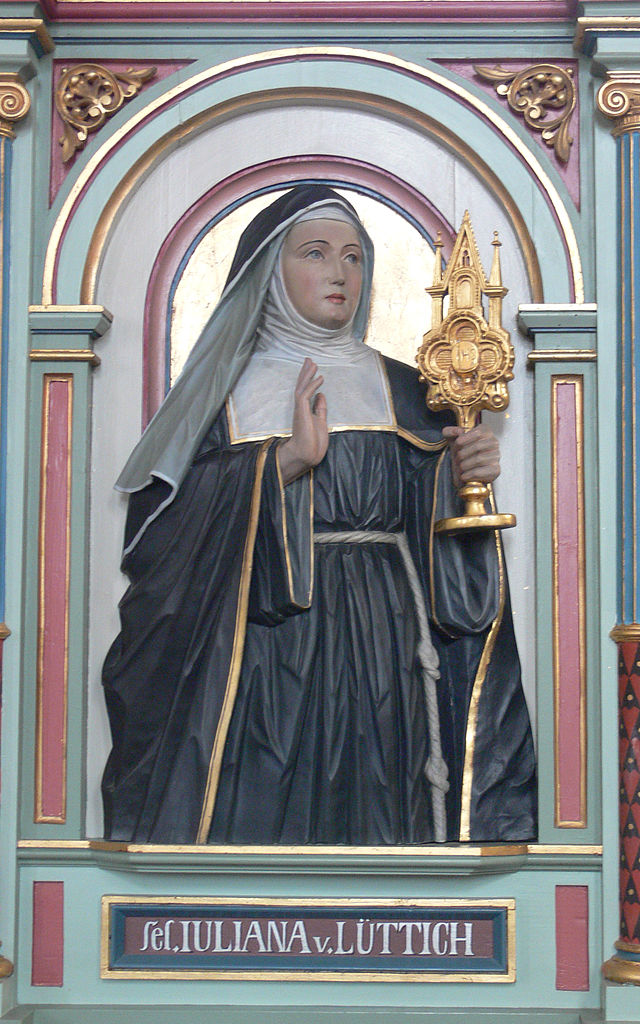
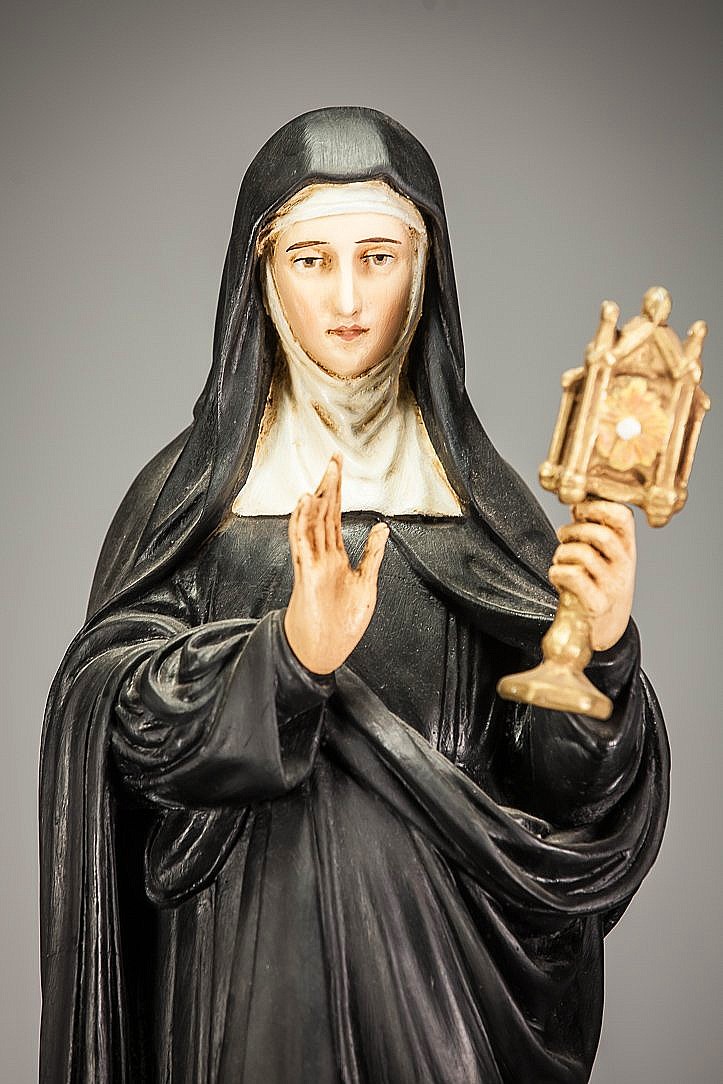
Saint of the Day – 6 April – Saint Juliana of Cornillon (c 1192-1258) Nun, Mystic “Apostle of the Blessed Sacrament.” Born in c 1192 or 1103 at Retinnes, Flanders, Belgium and died on 5 April 1258 of natural causes. Patronage– Devotion to the Blessed Sacrament. St Juliana is little known but the Church is deeply indebted to her, not only because of the holiness of her life but also because, with her great fervour, she contributed to the institution of one of the most important solemn Liturgies of the year, namely the Solemnity of Corpus Christi. She is also known as Juliana of Mount Cornillon, Julliana, Juliana of Liège.
We know several facts about her life, mainly from a Biography that was probably written by a contemporary cleric; it is a collection of various testimonies of people who were directly acquainted with the Saint.
Juliana was born near Liège, Belgium between 1191 and 1192. It is important to emphasise this place because at that time, the Diocese of Liège was, so to speak, a true “Eucharistic Upper Room.” Before Juliana, eminent theologians had illustrated the supreme value of the Sacrament of the Eucharist and, again in Liège, there were groups of women generously dedicated to Eucharistic worship and to fervent communion. Guided by exemplary Priests, they lived together, devoting themselves to prayer and to charitable works.
Orphaned at the age of five, Juliana, together with her sister Agnes, was entrusted to the care of the Augustinian nuns at the Convent and leprosarium of Mont-Cornillon. She was taught mainly by a Sister called “Sapienza” [wisdom], who was in charge of her spiritual development to the time Juliana received the religious habit and thus became an Augustinian Nun.
She became so learned that she could read the words of the Church Fathers, of St Augustine and St Bernard in particular, in Latin. In addition to a keen intelligence, Juliana showed a special propensity for contemplation from the outset. She had a profound sense of Christ’s presence, which she experienced by living the Sacrament of the Eucharist especially intensely and by pausing frequently to meditate upon Jesus’ words: “And lo, I am with you always, to the close of the age” (Mt 28:20).
When Juliana was 16 she had her first vision, which recurred subsequently several times during her Eucharistic adoration. Her vision presented the moon in its full splendour, crossed diametrically by a dark stripe. The Lord made her understand the meaning of what had appeared to her. The moon symbolized the life of the Church on earth, the opaque line, on the other hand, represented the absence of a liturgical feast for whose institution Juliana was asked to plead effectively, namely, a feast in which believers would be able to adore the Eucharist so as to increase in faith, to advance in the practice of the virtues and to make reparation for offences, to the Most Holy Sacrament.
The vision of St Juliana
Juliana, who in the meantime had become Prioress of the convent, kept this revelation that had filled her heart with joy a secret for about 20 years. She then confided it to two other fervent adorers of the Eucharist, Blessed Eva, who lived as a hermit, and Isabella, who had joined her at the Monastery of Mont-Cornillon. The three women established a sort of “spiritual alliance” for the purpose of glorifying the Most Holy Sacrament. They also chose to involve a highly regarded Priest, John of Lausanne, who was a Canon of the Church of St Martin in Liège. They asked him to consult theologians and clerics on what was important to them. Their affirmative response was encouraging.
What happened to Juliana of Cornillon occurs frequently in the lives of Saints. To have confirmation that an inspiration comes from God, it is always necessary to be immersed in prayer to wait patiently, to seek friendship and exchanges with other good souls and to submit all things to the judgement of the Shepherds of the Church. It was in fact Bishop Robert Torote, Liège who, after initial hesitation, accepted the proposal of Juliana and her companions and first introduced the Solemnity of Corpus Christi in his Diocese. Later other Bishops following his example and instituted this Feast in the territories entrusted to their pastoral care.
However, to increase their faith the Lord often asks Saints to sustain trials. This also happened to Juliana who had to bear the harsh opposition of certain members of the clergy and even of the Superior on whom her Monastery depended. Of her own free will, therefore, Juliana left the Convent of Mont-Cornillon with several companions. For 10 years — from 1248 to 1258 — she stayed as a guest at various Monasteries of Cistercian sisters. She edified all with her humility, she had no words of criticism or reproach for her adversaries and continued zealously to spread Eucharistic worship.
She died at Fosses-La-Ville, Belgium, in 1258. In the cell where she lay, the Blessed Sacrament was exposed and, according to her biographer’s account, Juliana died contemplating with a last effusion of love Jesus in the Eucharist, Whom she had always loved, honoured and adored.
Jacques Pantaléon of Troyes was also won over to the good cause of the Feast of Corpus Christi during his ministry as Archdeacon in Lièges. It was he, who, having become Pope with the name of Urban IV in 1264, instituted the Solemnity of Corpus Christi on the Thursday after Pentecost as a Feast of precept for the universal Church.
In the Bull of its institution, entitled Transiturus de hoc mundo, (11 Aug. 1264), Pope Urban even referred discreetly to Juliana’s mystical experiences, corroborating their authenticity. He wrote: “Although the Eucharist is celebrated solemnly everyday, we deem it fitting, that at least once a year. it be celebrated with greater honour and a solemn commemoration.
Indeed we grasp the other things we commemorate with our spirit and our mind but this does not mean, that we obtain their real presence. On the contrary, in this sacramental commemoration of Christ, even though in a different form, Jesus Christ is present with us in His own substance. While He was about to ascend into Heaven, He said ‘And lo, I am with you always, to the close of the age’ (Matthew 28:20)”.
The Pontiff made a point of setting an example by celebrating the solemnity of Corpus Christi in Orvieto, the town where he was then residing. Indeed, he ordered that the famous Corporal with the traces of the Eucharistic miracle which had occurred in Bolsena the previous year, 1263, be kept in Orvieto Cathedral — where it still is today.
While a Priest was consecrating the bread and the wine, he was overcome by strong doubts about the Real Presence of the Body and Blood of Christ in the Sacrament of the Eucharist. A few drops of blood began miraculously to ooze from the consecrated Host, thereby confirming what our faith professes.
Urban iv asked one of the greatest theologians of history, St Thomas Aquinas — who at that time was accompanying the Pope and was in Orvieto — to compose the texts of the Liturgical Office for this great Feast. They are masterpieces, still in use in the Church today, in which theology and poetry are fused into glorious prayers. These texts pluck at the heartstrings in an expression of praise and gratitude to the Most Holy Sacrament, while the mind, penetrating the mystery with wonder, recogniSes in the Eucharist, the Living and Real Presence of Jesus, of His Sacrifice of Love, that reconciles us with the Father and gives us salvation.
Although, after the death of Urban iv the celebration of the Feast of Corpus Christi was limited to certain regions of France, Germany, Hungary and Northern Italy, it was another Pontiff, John XXII who in 1317, re-established it for the universal Church. Since then, the Feast experienced a wonderful development and is still deeply appreciated by the Catholic faithful.
In remembering St Juliana of Cornillon, let us also renew our faith in the Real Presence of Christ in the Eucharist. As we are taught “Jesus Christ is present in the Eucharist in a unique and incomparable way. He is present in a true, real and substantial way, with His Body and His Blood, with His Soul and His Divinity. In the Eucharist, therefore, there is present in a sacramental way, that is, under the Eucharistic Species of bread and wine, Christ whole and entire, God and Man” (n. 282). (Excerpt – Pope Benedict XVI)
St Juliana was Canonised in 1869 by Blessed Pope Pius IX.
The Saints never failed to find strength, consolation and joy in the Eucharistic encounter. Let us repeat before the Lord present in the Most Blessed Sacrament ,the words of the Eucharistic hymn “Adoro te devote”: [Devoutly I adore Thee]: Make me believe ever more in you, “Draw me deeply into faith, / Into Your hope, into Your love.”
Our Morning Offering – 4 April – Easter Sunday, The Resurrection of the Lord
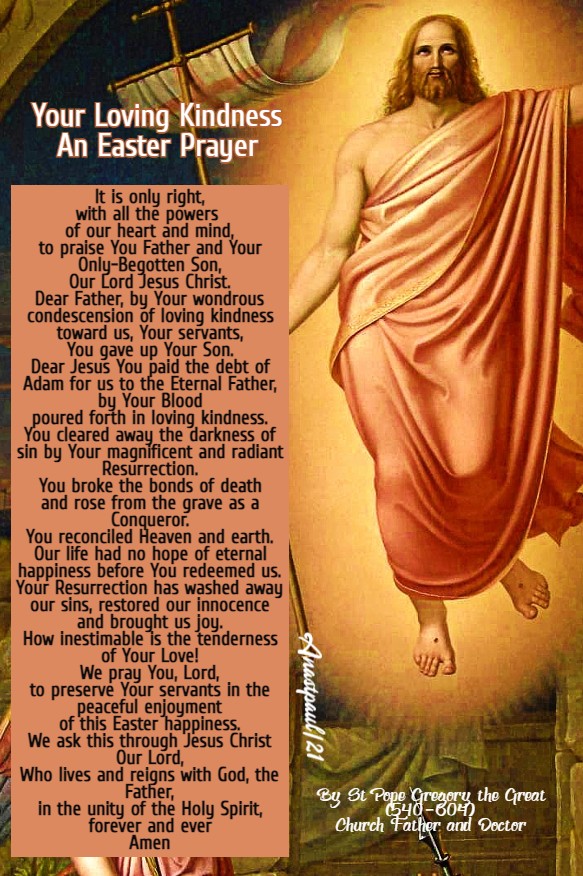
Your Loving Kindness An Easter Prayer By St Pope Gregory the Great (540-604) Church Father and Doctor
It is only right, with all the powers of our heart and mind, to praise You Father and Your Only-Begotten Son, Our Lord Jesus Christ. Dear Father, by Your wondrous condescension of loving kindness toward us, Your servants, You gave up Your Son. Dear Jesus You paid the debt of Adam for us to the Eternal Father, by Your Blood poured forth in loving kindness. You cleared away the darkness of sin by Your magnificent and radiant Resurrection. You broke the bonds of death and rose from the grave as a Conqueror. You reconciled Heaven and earth. Our life had no hope of eternal happiness before You redeemed us. Your Resurrection has washed away our sins, restored our innocence and brought us joy. How inestimable is the tenderness of Your Love! We pray You, Lord, to preserve Your servants in the peaceful enjoyment of this Easter happiness. We ask this through Jesus Christ Our Lord, Who lives and reigns with God, the Father, in the unity of the Holy Spirit, forever and ever Amen
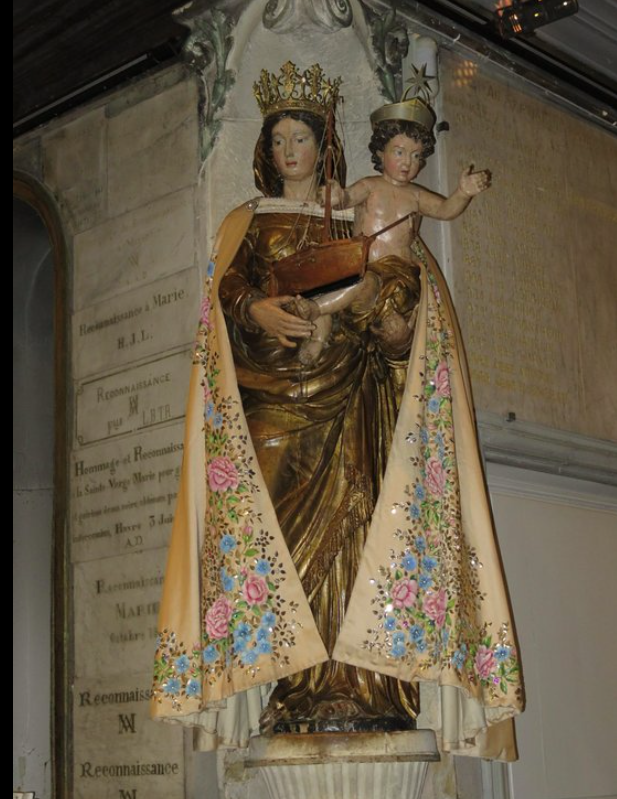
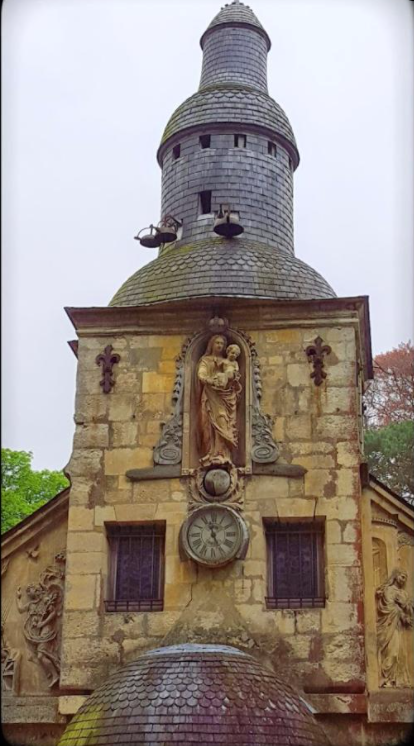
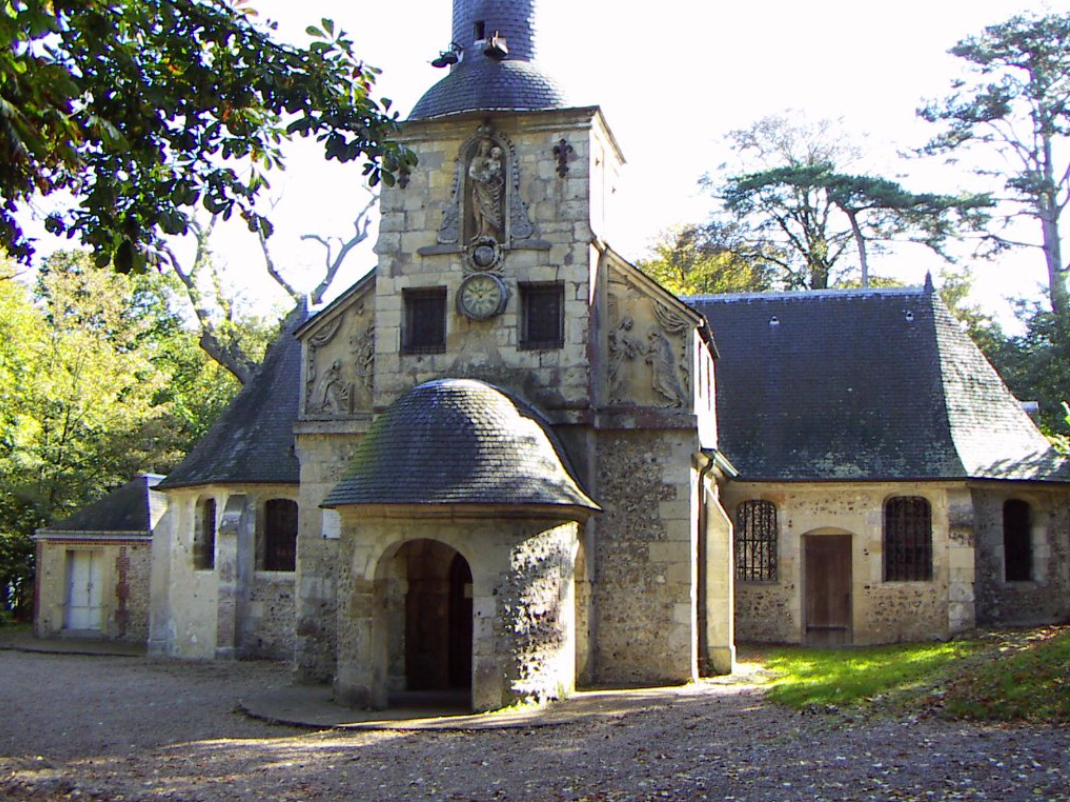
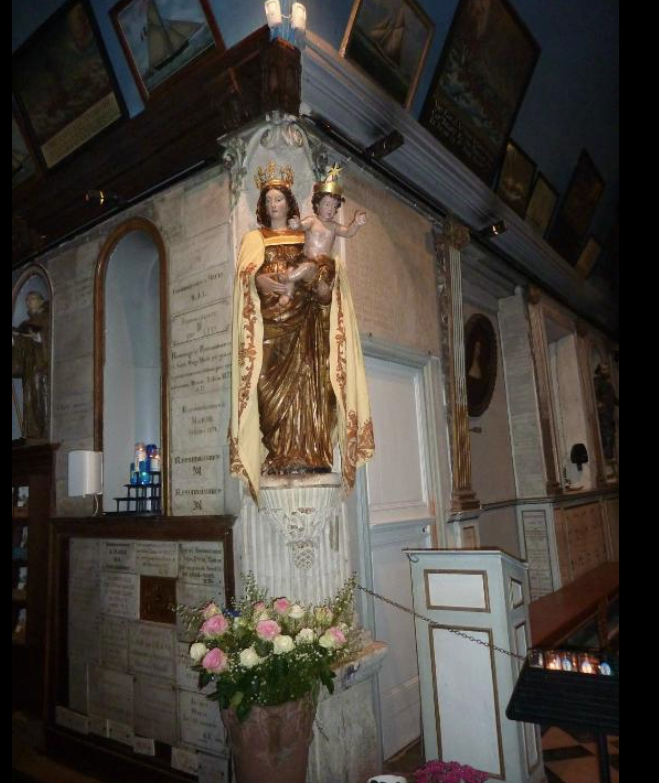
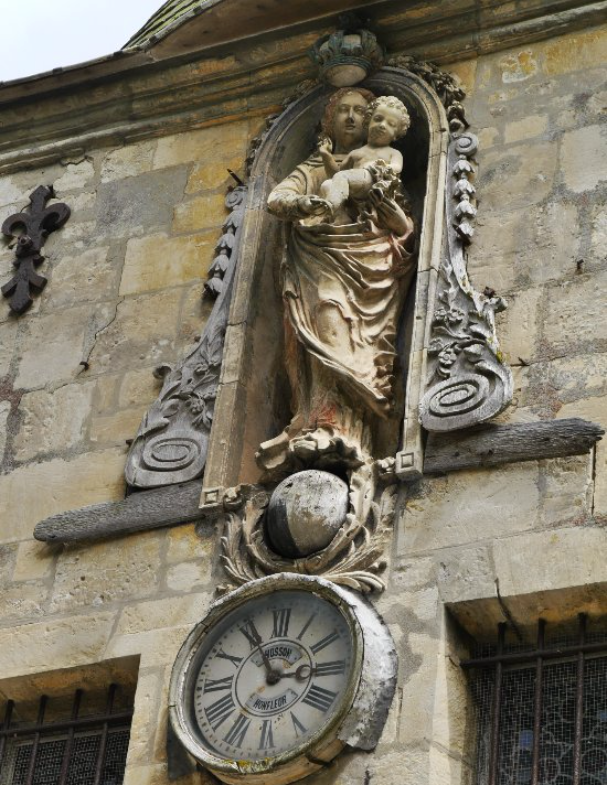
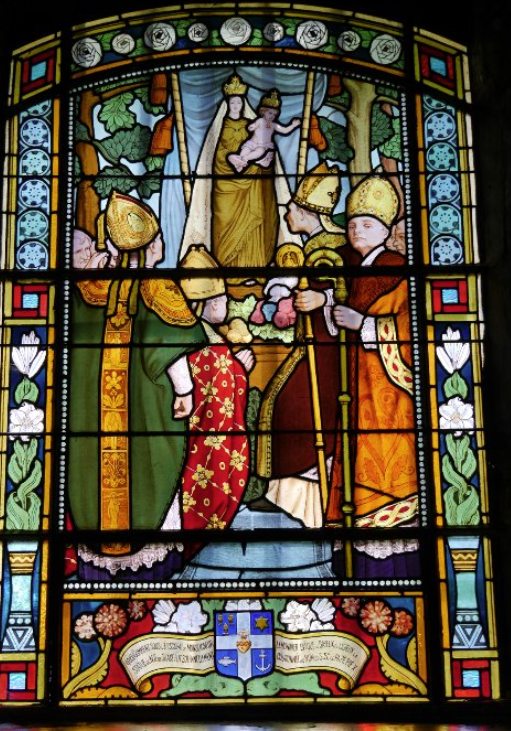
EASTER SUNDAY +2021 The Resurrection of the Lord – Solemnity of Solemnities! __ Notre-Dame de Grace, Honfleur, Normandie / Our Lady of Grace, Normandy, France – 4 April:
Our Lady of Grace is one of the most ancient maritime Chapels of Normandy. This Sanctuary was built in consequence of a vow made by a Norman Duke, who was very devout to the Blessed Virgin. That Duke, Robert the Magnificent, was once caught in a terrible storm off the coast of Normandy and knew, that a shipwreck would surely cost him his life. He swore, in the midst of that tempest, that was even then overwhelming him, that if he could somehow survive, he would build a Shrine on the hill, which he could still see, through the rain and surf from his sinking ship ,in thanksgiving to God for his rescue. Robert was saved and so his harrowing experience ended, not in tragedy but instead, the duke kept his promise, which gave birth to a monument that millions of pilgrims STILL visit each year. The original Chapel he constructed was finished early in the 11th century, at a height 90 meters above sea level. That Chapel stood through the centuries until it was swept away by landslide in the 16th century. The present Chapel, the Chapel of Notre-Dame-de-Grace, replaces the original.
The site of this handsome Chapel of Our Lady of Grace, surrounded by large trees, in the midst of turf replete with flowers, is beautiful and calm, like the rich and fresh landscapes of the magnificent province of which it forms a part. Our Lady of Grace appears like the fortress of Honfleur; from the little mountain which it crowns, the mouth of the Seine is visible, and farther on, the ocean, with its long waves of dark green, which receives in its bosom, the river of blue waters. Two roads lead to the Chapel – the one rough and rocky, the other smooth and even. In other times the inhabitants of Honfleur took delight in pointing out Our Lady of Grace, in reducing its steepness, in covering it with small, fine sand, so that a gracious princess, who had made herself beloved in these parts by her generous bounty, might be able to ascend it without fatigue, when she went to offer her prayers and vows to the Blessed Virgin.
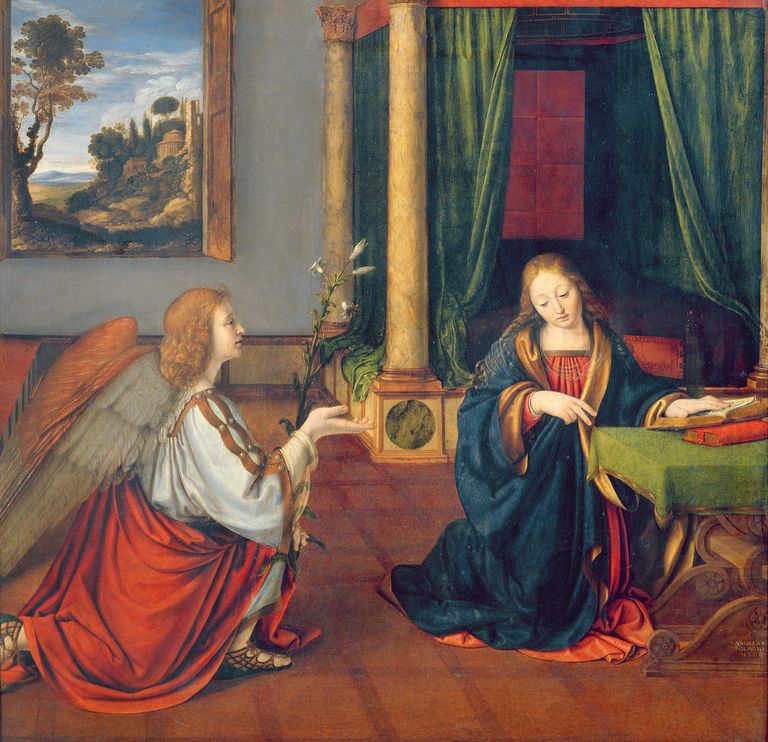
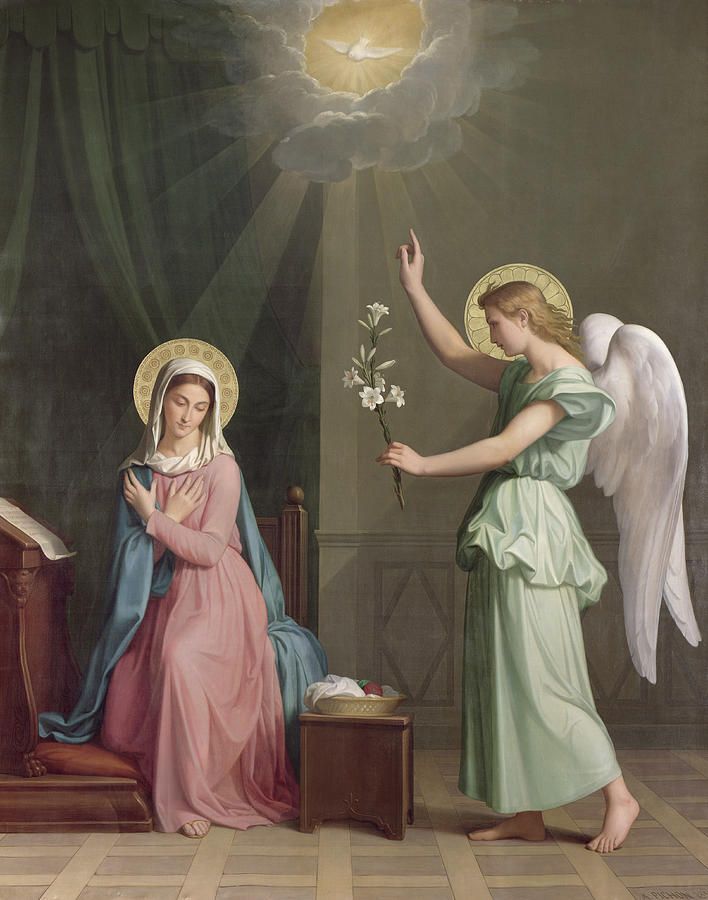
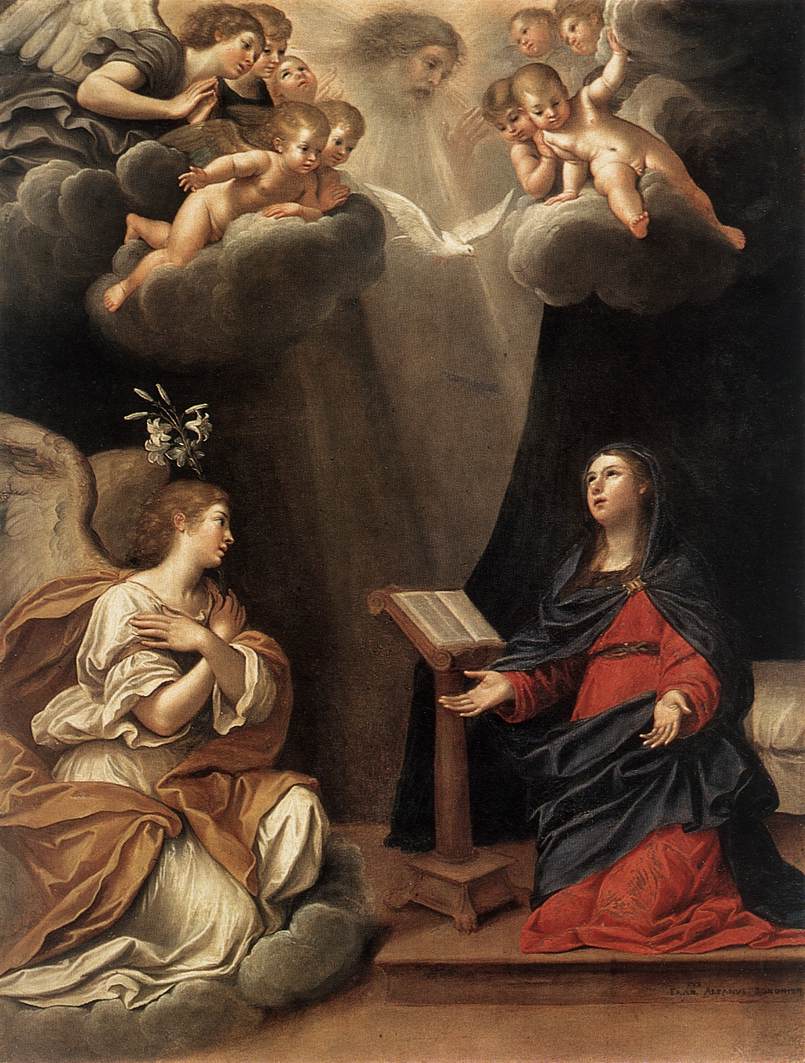
Lenten Journey Day thirty five – 25 March – The Solemnity of the Annunciation of the Lord, Readings: Isaiah 7:10-14; 8: 10, Psalms 40:7-8,8-9, 10, 11, Hebrews 10:4-10, Luke 1:26-38
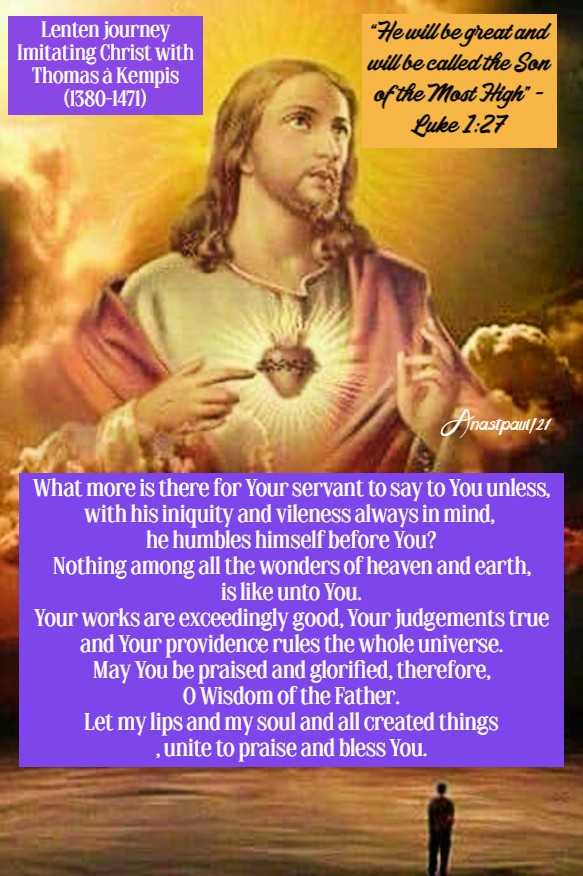
Imitating Christ with Thomas à Kempis (1380-1471)
In You is the source of life and in Your Light Lord, we see light Psalm 35(36)
“He will be great and will be called the Son of the Most High” – Luke 1:27
ABOVE all things and in all things, O my soul, rest always in the Lord my God, for He is the everlasting rest and joy of the angels and the saints.
O Jesus, Splendour of eternal glory, Consolation of the pilgrim soul, who labour in this sinful world, with You my lips utter no sound and to You my silence speaks. How long will my Lord delay His coming? Let Him come to His poor servant and make him happy. Let Him put forth His hand and take this miserable creature from his anguish. Come, O come, for without You there will be no happy day or hour because You are my happiness and without You my table is empty. I am wretched, as it were imprisoned and weighted down with fetters, until You fill me with the light of Your presence, restore me to liberty and show me a friendly countenance. Let others seek, instead of You, whatever they will but nothing pleases me, or will please me but You, my God, my Hope, my everlasting Salvation. I will not be silent, I will not cease praying, until Your grace returns to me and You speak inwardly to me, saying: “Behold, I am here. Lo, I have come to you because you have called Me. Your tears and the desire of your soul, your humility and contrition of heart, have inclined Me and brought Me to you.”
Lord, I have called You and have desired You and have been ready to spurn all things for Your sake. For You first spurred me on, to seek You. May You be blessed, therefore, O Lord, for having shown this goodness to Your servant according to the multitude of Your mercies.
What more is there for Your servant to say to You unless, with his iniquity and vileness always in mind, he humbles himself before You? Nothing among all the wonders of heaven and earth, is like unto You. Your works are exceedingly good, Your judgements true and Your providence rules the whole universe. May You be praised and glorified, therefore, O Wisdom of the Father. Let my lips and my soul and all created things, unite to praise and bless You. (Book 3 Ch 21:1,4-6)
Quote/s of the Day – 25 March – The Solemnity of the Annunciation of the Lord, Readings: Isaiah 7:10-14; 8: 10, Psalms 40:7-8,8-9, 10, 11, Hebrews 10:4-10, Luke 1:26-38
“Behold, I am the handmaid of the Lord; let it be to me according to your word.”
Luke 1:38
“And so, when God’s birth is proclaimed to you, keep silent. Let Gabriel’s word be held in your mind for nothing is impossible to this glorious Majesty, who humbled Himself for us and was born of our humanity.”
“In her, God spun a garment with which to save us.”
St Ephrem (306-373) Father & Doctor
“He came from Him, from whom He did not depart, going forth from Him, with whom He stayed, so that without intermission, He was wholly in eternity, wholly in time, wholly was He found in the Father when wholly in the Virgin, wholly in His own majesty and in His Father’s, at the time when He was wholly in our humanity. ”
“Has anyone ever come away from Mary, troubled or saddened or ignorant of the heavenly Mysteries? Who has not returned to everyday life gladdened and joyful because a request has been granted by the Mother of God?”
St Amadeus of Lausanne (1110-1159)
“The Father bending down to this beautiful creature, who was so unaware of her own beauty, willed that she be the Mother, in time, of Him, Whose Father He is, in eternity. Then the Spirit of love, Who presides over all of God’s works, came upon her; the Virgin said her fiat: “Behold the handmaid of the Lord, be it done to me according to thy word” and the greatest of mysteries, was accomplished!”
One Minute Reflection – 25 March – The Solemnity of the Annunciation of the Lord, Readings: Isaiah 7:10-14; 8: 10, Psalms 40:7-8,8-9, 10, 11, Hebrews 10:4-10, Luke 1:26-38
“Hail, full of grace!” – Luke 1:28
REFLECTION – “This woman will be the Mother of God, the door to light, source of life; she will reduce to oblivion the judgement that weighed on Eve. “The rich among the people seek the face” of this woman, “the kings of the nations shall pay her homage,” they shall “offer gifts”… yet the glory of the Mother of God is an interior glory – the fruit of her womb.
O woman, so worthy of love, thrice happy, “blessed are you among women and blessed is the fruit of your womb.” Daughter of David the king and Mother of God, King of the universe, masterpiece in whom the Creator rejoices… you are to be nature’s full achievement. For you, life is not yours; you were not born for yourself alone but your life is to be God’s. You came into the world for Him, you will serve for the salvation of all people, fulfilling God’s design established from the beginning – the incarnation of the Word and our own divinisation. Your whole desire is to feed on the words of God, to be strengthened by their sap, like “a green olive tree in the house of God,” “like a tree planted by running water,” you are the “tree of life” who “yielded its fruit in due season”…
He who is infinite, limitless, came to dwell in your womb, God, the Child Jesus, was nourished by your milk. You are the ever virginal doorway of God; your hands hold your God; your lap is a throne raised up above the cherubim… You are the wedding chamber of the Spirit, the “city of the living God, gladdened by the runlets of the stream,” that is to say, the waves of the Spirit’s gifts. You are “all fair, the Beloved” of God.” – St John Damascene (675-749) Monk, Theologian, Father and Doctor of the Church – Homily on the Nativity of the Virgin, § 9 ; SC 80 ( Biblical references : Ps 44[45],13; 71[72],11.10; Mt 2,11; Lk 1,42; Is 62,5; Ps 51[52],10; 1,3; cf Gn 2,9, Rv 22,2; cf Ez 44,2; Ps 79[80],2; cf Sg 1,4; Ps 45[46],5; Sg 4,7)
PRAYER – Shape us in the likeness of the Divine nature of our Redeemer, whom we believe to be true God and true man, since it was Your will, Lord God, that He, Your Word, should take to Himself, our human nature in the womb of the Blessed Virgin Mary. We make our prayer through our Lord Jesus, in the unity of the Holy Spirit, God for always and forever, amen.
Our Morning Offering – 25 March – The Solemnity of the Annunciation of the Lord
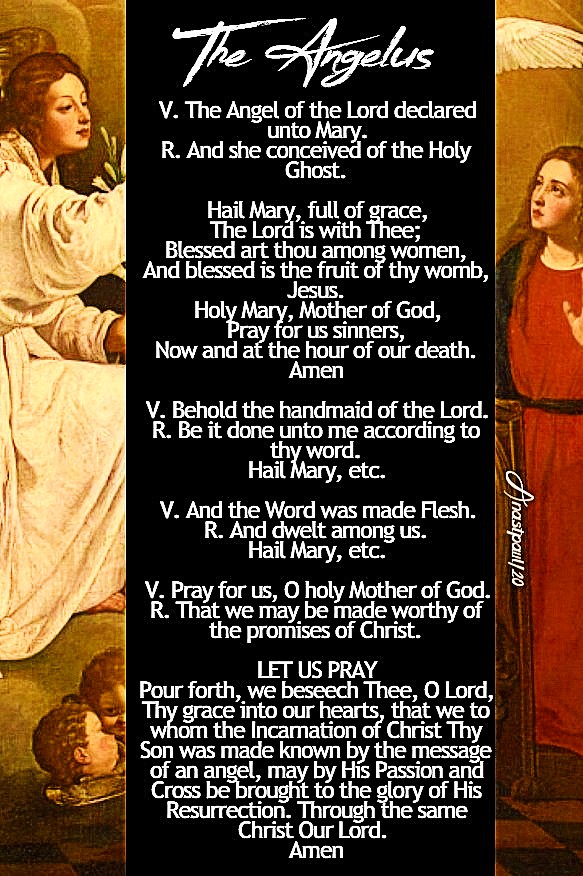
The Angelus
V. The Angel of the Lord declared unto Mary. R. And she conceived of the Holy Spirit. Hail Mary, full of grace, The Lord is with Thee; Blessed art thou among women, And blessed is the fruit of thy womb, Jesus. Holy Mary, Mother of God, Pray for us sinners, Now and at the hour of our death. Amen V. Behold the handmaid of the Lord. R. Be it done unto me according to thy word. Hail Mary, etc. V. And the Word was made Flesh. R. And dwelt among us. Hail Mary, etc. V. Pray for us, O holy Mother of God. R. That we may be made worthy of the promises of Christ. LET US PRAY Pour forth, we beseech Thee, O Lord, Thy grace into our hearts, that we to whom the Incarnation of Christ Thy Son was made known by the message of an angel, may by His Passion and Cross be brought to the glory of His Resurrection. Through the same Christ Our Lord. Amen
A tradition, which has come down from the apostolic ages, tells us that the great mystery of the Incarnation, was achieved on the twenty-fifth day of March. It was at the hour of midnight, when the most holy Virgin was alone and absorbed in prayer, that the Archangel Gabriel appeared before her and asked her, in the name of the Blessed Trinity, to consent to become the Mother of God. Let us assist, in spirit, at this wonderful interview between the angel and the Virgin: and, at the same time, let us think of that other interview which took place between Eve and the serpent. A holy Bishop and Martyr of the second century, Saint Irenaeus, who had received the tradition from the very disciples of the Apostles, shows us that Nazareth, is the counterpart of Eden.
In the garden of delights there is a virgin and an angel and a conversation takes place-between them. At Nazareth a virgin is also addressed by an angel and she answers him but the angel of the earthly paradise, is a spirit of darkness and he of Nazareth, is a spirit of light. In both instances, it is the angel that has the first word. ‘Why,’ said the serpent to Eve, ‘hath God commanded you, that you should not eat of every tree of paradise?’ His question implies impatience and a solicitation to evil, he has contempt for the frail creature to whom he addresses it but he hates the image of God, which is upon her.
See, on the other hand, the angel of light; see with what composure and peacefulness he approaches the Virgin of Nazareth, the new Eve and how respectfully he bows himself down before her: ‘Hail, full of grace! The Lord is with thee! Blessed art thou among women!’ Such language is evidently of heaven, none but an angel could speak thus to Mary.
Scarcely has the wicked spirit finished speaking than Eve casts a longing look at the forbidden fruit, she is impatient to enjoy the independence it is to bring her. She rashly stretches forth her hand, she plucks the fruit, she eats it and death takes possession of her: death of the soul, for sin extinguishes the light of life; and death of the body, which being separated from the source of immortality, becomes an object of shame and horror and finally, crumbles into dust.
But let us turn away our eyes from this sad spectacle and fix them on Nazareth. Mary has heard the angel’s explanation of the mystery, the will of heaven is made known to her and how grand an honour it is to bring upon her! She, the humble maid of Nazareth, is to have the ineffable happiness of becoming the Mother of God and yet, the treasure of her virginity is to be left to her! Mary bows down before this sovereign will and says to the heavenly messenger: ‘Behold the handmaid of the Lord, be it done unto me, according to thy word.’
Thus, as the great St Irenaeus and so many of the holy fathers remark, the obedience of the second Eve, repaired the disobedience of the first, for no sooner does the Virgin of Nazareth speak her fiat, ‘be it done,’ than the eternal Son of God (who, according to the divine decree, awaited this word) is present, by the operation of the Holy Ghost, in the chaste womb of Mary and there, He begins His human life. A Virgin is a Mother and Mother of God and it is this Virgin’s consenting to the divine will, that has made her conceive by the power of the Holy Ghost. This sublime mystery puts between the eternal Word and a mere woman, the relations of Son and Mother, it gives to the almighty God, a means whereby He may, in a manner worthy of His majesty, triumph over satan, who hitherto seemed to have prevailed against the divine plan.
Never was there a more entire or humiliating defeat than that which this day befell satan. The frail creature, over whom he had so easily triumphed at the beginning of the world, now rises and crushes his proud head. Eve conquers in Mary. God would not choose man for the instrument of His vengeance, the humiliation of satan would not have been great enough and, therefore, she who was the first prey of hell, the first victim of the tempter, is selected to give battle to the enemy. The result of so glorious a triumph is, that Mary is to be superior not only to the rebel angels but to the whole human race, yea, to all the angels of heaven. Seated on her exalted throne, she, the Mother of God, is to be the Queen of all creation. Satan, in the depths of the abyss, will eternally bewail his having dared to direct his first attack against the woman, for God has now so gloriously avenged her and, in heaven, the very Cherubim and Seraphim reverently look up to Mary and deem themselves honoured, when she smiles upon them, or employs them in the execution of any of her wishes, for she is the Mother of their God.
Therefore is it that we, the children of Adam, who have been snatched by Mary’s obedience from the power of hell, solemnise this day of the Annunciation. Well may we say of Mary, those words of Debbora, when she sang her song of victory over the enemies of God’s people: ‘The valiant men ceased and rested in Israel, until Debbora arose, a mother arose in Israel. The Lord chose new wars and He Himself, overthrew the gates of the enemies.’ Let us also refer to the holy Mother of Jesus, these words of Judith, who by her victory over the enemy was another type of Mary: ‘Praise ye the Lord our God, who hath not forsaken them that hope in Him. And by me, His handmaid, He hath fulfilled His mercy, which He promised to the house of Israel and He hath killed the enemy of His people, by my hand this night. . . . The almighty Lord hath struck him and hath delivered him into the hands of a woman and hath slain him.’
Our Lady of Betania: The name Betania means Bethany in Spanish. It was originally given this name by Maria Esperanza and was the site of their farm, in Venezuela. Apparitions of the Blessed Virgin Mary were reported and eventually a small Chapel was built there and the faithful began to gather, especially on Feast Days but throughout the year.
St Alfwold of Sherborne St Barontius of Pistoia St Desiderius of Pistoia St Dismas (Crucified with Jesus) “The Good Thief”
Bl Everard of Nellenburg Bl Herman of Zahringen St Hermenland St Humbert of Pelagius Bl James Bird Bl Josaphata Mykhailyna Hordashevska St Kennocha of Fife St Lucia Filippini St Marie-Alphonsine/Mariam Sultaneh Danil Ghattas (1843-1927) About St Marie-Alphonusine: https://anastpaul.com/2020/03/25/saint-of-the-day-25-march-st-marie-alphonsine-danil-ghattas-1843-1927/ St Matrona of Barcelona St Matrona of Thessaloniki St Mona of Milan St Ndre Zadeja Bl Pawel Januszewski St Pelagius of Laodicea Bl Placido Riccardi St Procopius St Quirinus of Rome Bl Tommaso of Costacciaro — 262 Martyrs of Rome: A group 262 Christians martyred together in Rome. We know nothing else about them, not even their names.
“When Joseph awoke, he did as the angel of the Lord had commanded him” – Matthew 1:24
REFLECTION – “How faithful in humility was the great Saint we are celebrating! That can’t be said in all its perfection for, in spite of what he was, in what poverty and lowliness he lived all the days of his life, a poverty and lowliness beneath which he kept hidden and concealed his great virtues and dignity!… Truly, I have no doubt at all, that the angels came, beside themselves with admiration, rank upon rank, to behold and wonder at his humility, while he sheltered that dearest Child, in the poor workshop where he worked at his employment, so as to feed the little Boy and the mother entrusted to him.
There is no doubt at all, that Saint Joseph was braver than David and wiser that Solomon, [who were his ancestors]. Nevertheless, seeing him reduced to the exercise of carpentry, who could have discerned this, unless they were enlightened by a heavenly light, so hidden did he keep the remarkable gifts, with which God had favoured him?
And what wisdom did he not have? For God gave him, His most glorious Son to care for… the universal Prince of heaven and earth… Nevertheless, you can see how low and humbled he was brought, more than can be said or imagined… he went to his own country and town of Bethlehem and none but he, was turned away from all those inns…
Notice how the angel turns him about with both hands. He tells him he has to go to Egypt and he goes, he orders him to return and he returns. God wants him to be always poor… and he submits to it with love and not only for a while, for he was poor his whole life long.”- St Francis de Sales (1567-1622) Bishop of Geneva and Doctor of the Church – Conferences, no. 19
PRAYER – Almighty God, at the beginnings of our salvation, when Mary conceived your Son and brought Him forth into the world, you placed them under Joseph’s watchful care. May his prayer still help Your Church to be an equally faithful guardian of Your mysteriest and a sign of Christ to mankind. We make our prayer through our Lord Jesus, with the Holy Spirit, God, forever, amen.
Our Morning Offering – 19 March – The Solemnity of St Joseph
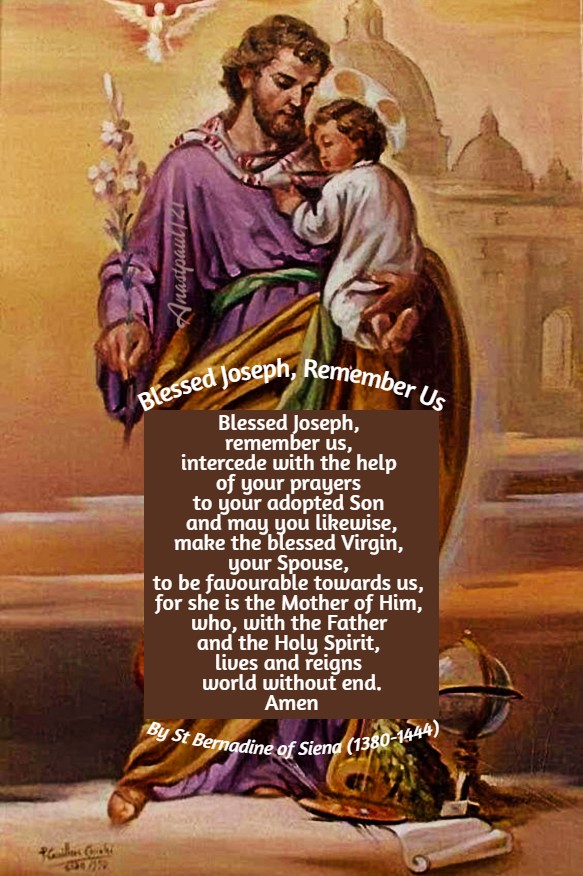
Blessed Joseph, Remember Us By St Bernadine of Siena (1380-1444)
Blessed Joseph, remember us, intercede with the help of your prayers to your adopted Son and may you likewise, make the blessed Virgin, your Spouse, to be favourable towards us, for she is the Mother of Him, who, with the Father and the Holy Spirit, lives and reigns world without end. Amen
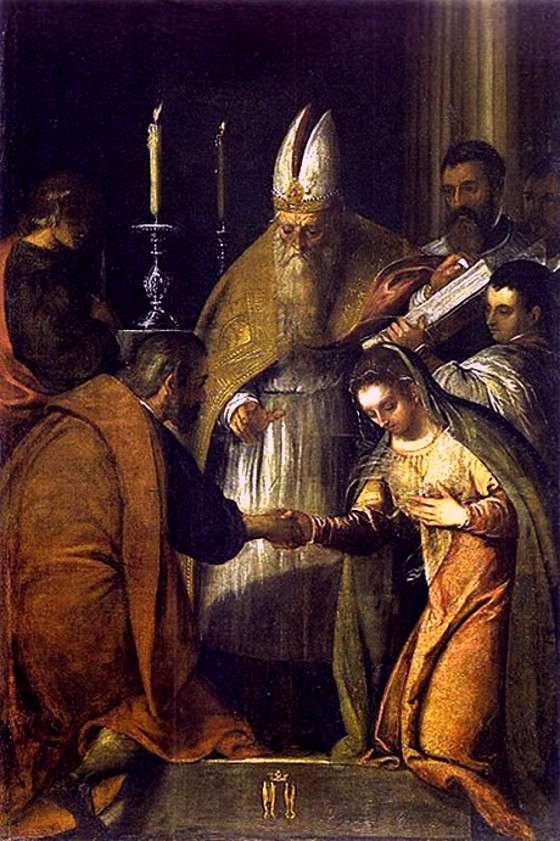
Solemnity of St Joseph, Spouse of the Blessed Virgin Mary – 19 March:
“All the unmarried men gathered in the temple and prayed to the Lord conjointly with the Priests, in order to be governed by the Holy Spirit in what they were about to do. The Most High spoke to the heart of the High Priest, inspiring him to place into the hands of each one of the young men, a dry stick, with the command that each ask his Majesty with a lively faith, to single out the one, whom He had chosen as the spouse of Mary. And as the sweet odour of her virtue and nobility, the fame of her beauty, her possessions and her modesty and her position as being the firstborn in her family, was known to all of them, each one coveted the happiness of meriting her as a spouse. Among them all, only the humble and most upright Joseph, thought himself unworthy of such a great blessing and remembering the vow of chastity, which he had made and resolving anew its perpetual observance, he resigned himself to God’s will, leaving it all to His disposal and being filled at the same time, with a veneration and esteem greater than that of any of the others, for the most noble maiden Mary. While they were thus engaged in prayer, the staff which Joseph held was seen to blossom and at the same time, a dove of purest white and resplendent with admirable light, was seen to descend and rest upon the head of the saint, while, in the interior of his heart, God spoke:
“Joseph, my servant, Mary shall be thy Spouse; accept Her with attentive reverence, for She is acceptable in my eyes, just and most pure in soul and body and thou, shalt do all that She shall say to Thee.”
At this manifestation and token from heaven, the Priests declared Saint Joseph as the Spouse selected by God Himself for the maiden Mary. Calling Her forth for her espousal, the chosen one issued forth like the sun, more resplendent than the moon, and She entered into the presence of all, with a countenance more beautiful than that of an angel, incomparable in the charm of her beauty, nobility and grace and the Priests espoused Her to the most chaste and holy of man, Saint Joseph.”
*From The City of God by Ven. Mary of Jesus of Agreda OIC (1602-1665) (a Franciscan abbess and spiritual writer, known especially for her extensive correspondence with King Philip IV of Spain and reports of her bilocation between Spain and its colonies in New Spain. She was a noted mystic of her era. A member of the Order of the Immaculate Conception, also known as Conceptionists, Mary of Jesus wrote 14 books, including a series of revelations about the life of the Blessed Virgin Mary. Ven Mary of Jesus’ body is incorrupt. Less than ten years after her death, Mary of Jesus was declared Venerable by Pope Clement X, in honour of her “heroic life of virtue.” Although the process of beatification was opened in 1673, it has not as yet been completed.)
St Adrian of Maastricht St Alkmund of Northumbria St Amantius of Wintershoven Bl Andrea Gallerani St Apollonius of Braga St Auxilius of Ireland Bl Clement of Dunblane St Colocer of Saint-Brieuc St Corbasius of Quimperlé St Cuthbert of Brittany St Gemus Blessed Isnard de Chiampo OP (Died 1244) Priest, known as the “Apostle of Pavia” Bl Jan Turchan St John the Syrian of Pinna St Lactali of Freshford St Landoald of Maastricht St Leontinus of Braga St Leontinus of Saintes Blessed Marcel Callo (1921-1945) Martyr Biography: https://anastpaul.com/2019/03/19/saint-of-the-day-19-march-blessed-marcel-callo-1921-1945-aged-23-martyr/
Bl Mark of Montegallo St Pancharius of Nicomedia Blessed Sibyllina Biscossi OP (1287-1367) Her Life: https://anastpaul.com/2020/03/19/saint-of-the-day-19-march-blessed-sibyllina-biscossi-op-1287-1367/ — Martyrs of Sorrento: A group of three sisters and a brother who were martyred together. We have little more than their names – Mark, Quartilla, Quintilla and Quintius. They were martyred in Sorrento, Italy, date unknown. Mark Quartilla Quintilla Quintius
Martyred in the Spanish Civil War • Blessed Alberto Linares de La Pinta • Blessed Jaume Trilla Lastra
Thought for the Day – 22 February – Meditations with Antonio Cardinal Bacci (1881-1971) – The Feast of the Chair of Saint Peter
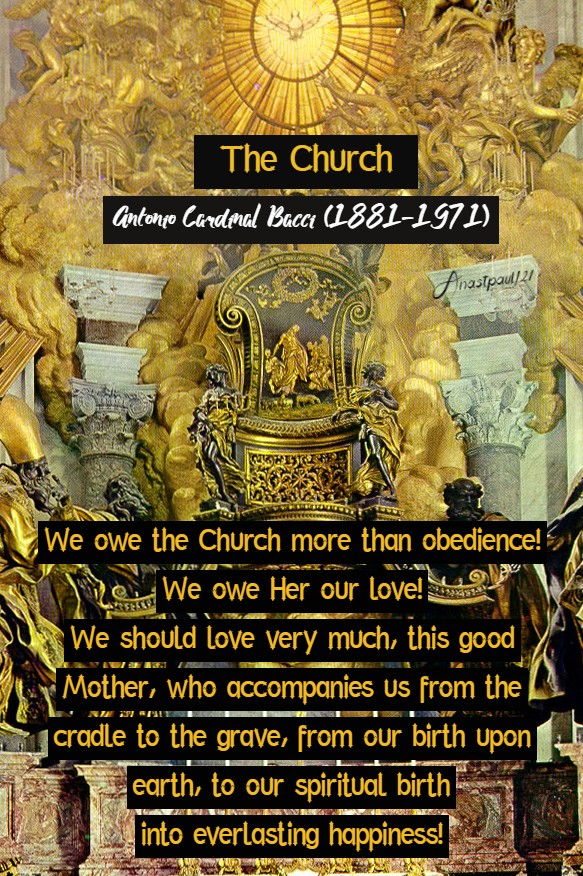
The Church
“Besides being our infallible teacher, the Church is also our affectionate Mother. Along with the inexhaustible treasury of His graces, it has inherited, from Jesus, His infinite love fo all mankind. Let us consider what the Church does and has done for us. As soon as we are born into this mortal life, She gives us, through the waters of Baptism, a second life, which is supernatural and everlasting. When we are a little older and exposed to the onslaughts of evil, She stengthens us in gace by means of another Sacrament and makes us soldiers of Christ. She raises us up. In the Sacament of Penance, She gives us God’s forgiveness and the spiritual strength to rise agin. Moeover, She gives us Jesus Christ Himself, in the Blessed Eucharist. By means of another Sacament, she elevates those who receive the power of Orders. In yet another, She blesses and consecrates matrimonial love and the pure marriage union. When we are dying, She comes, compassionately to our side again and, through the final Sacrament, gives us strength and purity of purpose, for the great journey into eternity. Nor is this enough. She is present with her prayers and blessings, even by our coffin nd by our graveside.
We owe the Church more than obedience! We owe Her our love! We should love very much, this good Mother, who accompanies us from the cradle to the grave, from our birth upon earth, to our spiritual birth into everlasting happiness!” Amen
Quote/s of the Day – 22 February – The Feast of the Chair of Saint Peter
“The Church, instituted by the Lord and confirmed by the Apostles, is one for all men; but the frantic folly of the diverse impious sects, has cut them off from her. It cannot be denied, that this tearing asunder of the faith, has arisen from the defect of poor intelligence, which twists what is read, to confirm to its opinion, instead of adjusting its opinion to the meaning of what is read. However, while individual parties fight among themselves, the Church stands revealed, not only by her own doctrines but by those also, of her adversaries. And although they are all ranged against her, she confutes the most wicked error which they all share, by the very fact that she is alone and one. All the heretics, therefore, come against the Church but while all the heretics can conquer each other, they can win nothing for themselves. For their victory is the triumph of the Church over all of them. One heresy struggles against that teaching of another, which the faith of the Church has already condemned in the other heresy – for there is nothing which the heretics hold in common, – and, the result is that they affirm our faith, while fighting among themselves.”
St Hilary (315-368) Bishop of Poitiers Father and Doctor of the Divinity of Christ
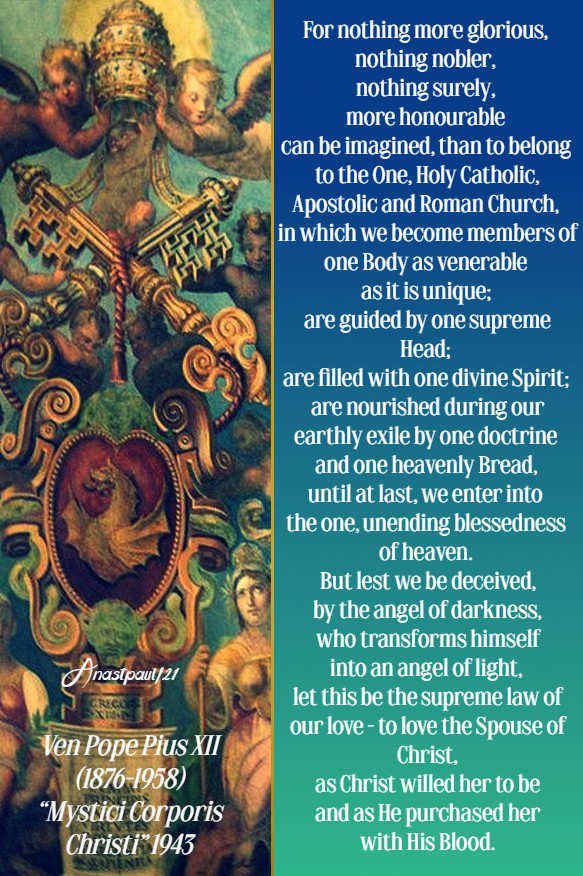
“For nothing more glorious, nothing nobler, nothing surely, more honourable can be imagined, than to belong to the One, Holy Catholic, Apostolic and Roman Church, in which we become members of one Body as venerable as it is unique; are guided by one supreme Head; are filled with one divine Spirit; are nourished during our earthly exile by one doctrine and one heavenly Bread, until at last, we enter into the one, unending blessedness of heaven. But lest we be deceived, by the angel of darkness, who transforms himself into an angel of light, let this be the supreme law of our love – to love the Spouse of Christ, as Christ willed her to be and as He purchased her with His blood.”
Pope Pius XII (1876-1958) “Mystici Corporis Christi” 1943
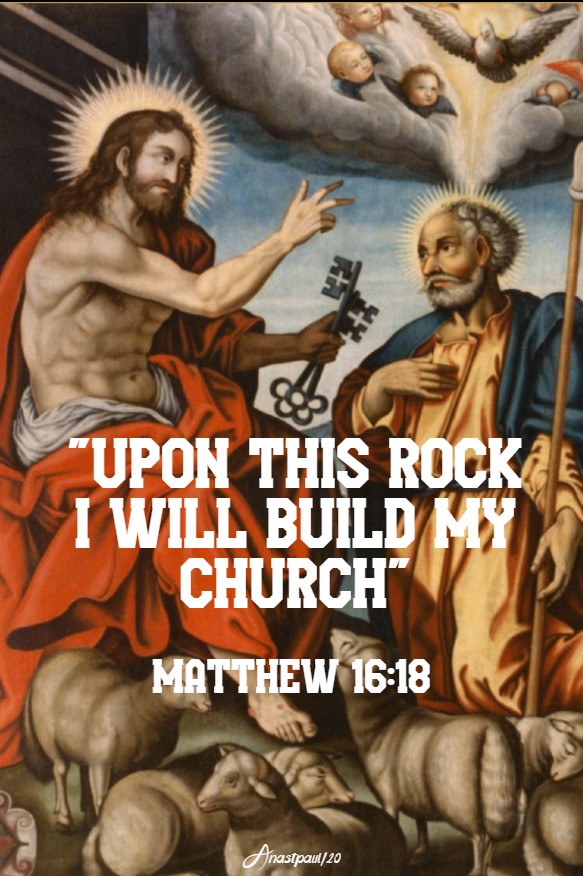
“Upon this rock I will build my church and the gates of hell shall not prevail against it. I will give you the keys of the kingdom of heaven and whatever you bind on earth shall be bound in heaven and, whatever you loose on earth, shall be loosed in heaven.” … Matthew 16:18-19
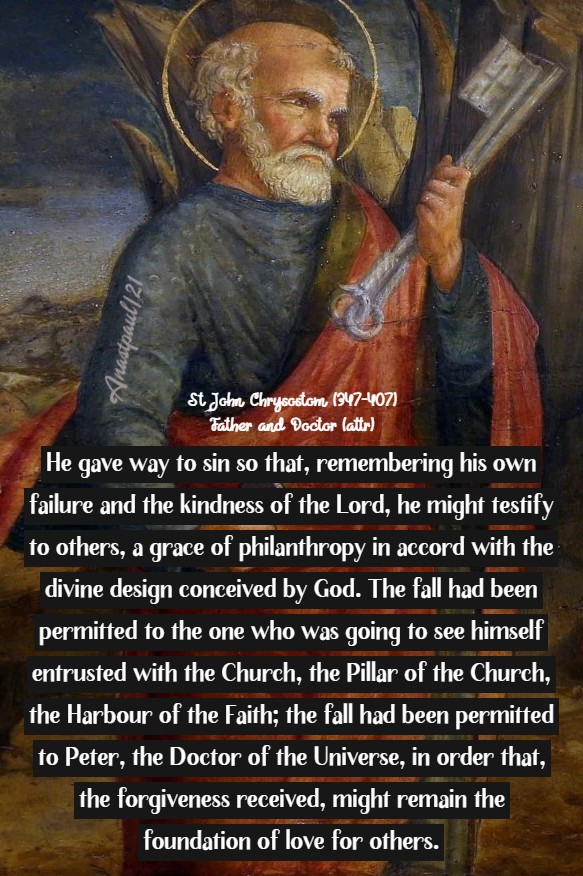
REFLECTION – “Peter was to receive on deposit, the keys of the Church, or rather the keys of heaven and, he should see himself entrusted with the numerous people. What did the Lord actually say to him? “Whatever you bind on earth shall be bound in heaven and whatever you loose on earth shall be loosed in heaven” (Mt 16:19). For Peter had a somewhat abrupt character; if he had been without sin what sort of forgiveness would the disciples have received from him? This is why divine grace allowed him to fall into a certain fault, in order that his own trial should make him benevolent towards others. Do you see how God can let someone fall into sin; this Peter, the leader of the Apostles, the unshakable foundation, indestructible rock, first in the Church, impregnable harbour, unshakable tower — this same Peter who had said to Christ: “Even though I should have to die with you, I will not deny you” (Mt 26:35), Peter who, by a divine revelation, had confessed the truth: “You are the Christ, Son of the Living God” (Mt 16:16). (…) But as I said, God arranged it in this way and allowed Peter to sin because he had it in mind, to confer numerous people on him and he feared, that his roughness, joined to his impeccability, might make him unsympathetic towards his brothers. He gave way to sin so that, remembering his own failure and the kindness of the Lord, he might testify to others, a grace of philanthropy in accord with the divine design conceived by God. The fall had been permitted to the one who was going to see himself entrusted with the Church, the Pillar of the Church, the Harbour of the Faith; the fall had been permitted to Peter, the Doctor of the Universe, in order that, the forgiveness received, might remain the foundation of love for others.” – (Attr) St John Chrysostom (347-407) Bishop of Constantinople, Father and Doctor of the Church – On the apostle Peter and the prophet Elijah
PRAYER – Holy Father, send Your Divine Enlightener into the hearts of all Your faithful, filling us with the strength to fulfil our mission as the followers of the Chair of St Peter. And most of all, we pray Lord Holy God, to inspire and light the way of our Holy Father, Francis. Sustain and guide him, keep him in health and strength, to lead Your people by the Light of the Way and the Truth. Holy Father, have mercy on us, Holy Spirit guide and lead us, Lord Jesus Christ be our intercessor and teacher, amen.
Our Morning Offering – 22 February – Feast of the Chair of St Peter
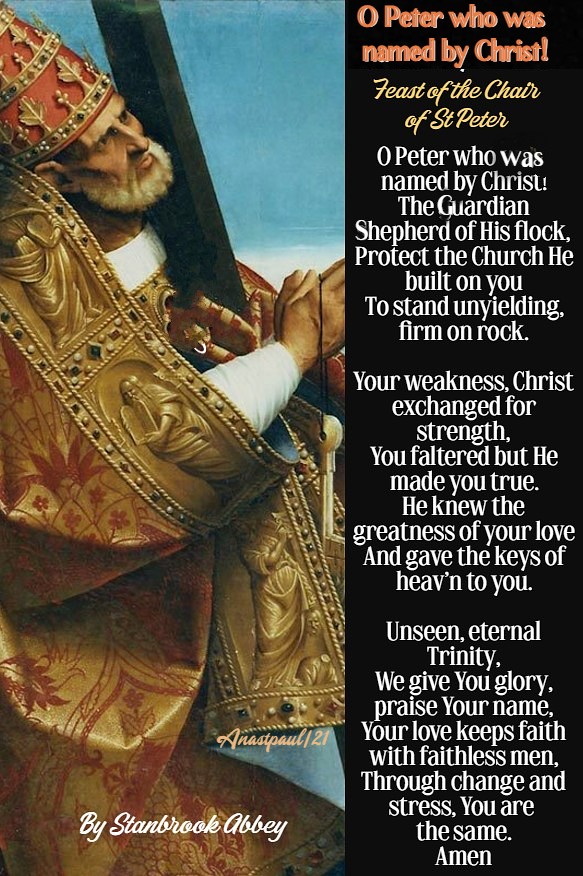
O Peter, who was Named by Christ! By Stanbrook Abbey For the Feast of the Chair of St Peter
O Peter who was named by Christ! The Guardian-Shepherd of His flock, Protect the Church He built on you To stand unyielding, firm on rock.
Your weakness, Christ exchanged for strength, You faltered but He made you true. He knew the greatness of your love And gave the keys of heav’n to you.
Unseen, eternal Trinity, We give You glory, praise Your name, Your love keeps faith with faithless men, Through change and stress, You are the same. Amen
Notre-Dame de Rennes / Our Lady of Miracles and Virtues, Rennes, France (1357) – 22 February:
The Statue of Our Lady of Miracles and Virtues in the Lady Chapel at Saint Sauveur at Rennes
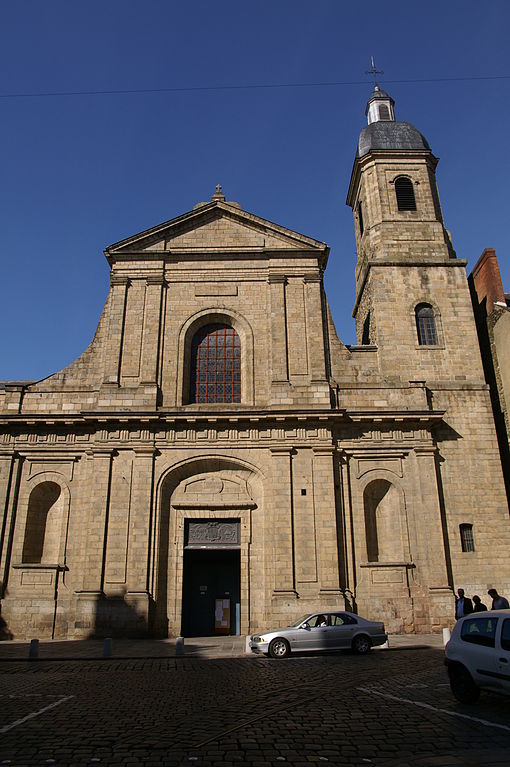
Our Lady of Rennes, in Britanny. The English, having made a mine to blow up the town, it is said that the candles in theCchapel were found miraculously lighted; the bells rung of themselves and the image of the Blessed Virgin was seen to stretch out its arms towards the middle of the Church, where the mine was, which, by that means was discovered. The people rushed to the spot and so, the plot was discovered and the entire town saved through the intervention of Our Lady of Rennes. Great was the rejoicing and deep the gratitude of the people. Known today as the Basilica of Saint Sauveur in Rennes, it is located in the heart of historic Rennes, which was once the capital of Brittany. It is situated at the termination of Saint-Sauveur Street on which its façade faces. As the original Gothic Church partially collapsed in the year 1682, the Classical style Church that can currently be seen, was constructed beginning in 1703 and consecrated in August of 1719. In the year 1793, during the French Revolution, the Church was made into a Temple of Reason and the miraculous statue of Our Lady was destroyed. It was not until 1802, after the end of the Terror, that the Church was opened again to worship. The Church was made into a minor Basilica in 1916 by Pope Benedict XV.
The Altar of Our Lady in the main body of the Basilica of Saint Sauveur at Rennes
According to popular tradition there was a famous miracle attributed to Our Lady at Rennes during the War of Succession at Brittany. As Rennes was being besieged by the invading English army under the Duke of Lancaster, the people of the city expected the English forces to mine their way under the walls into the City. On the night of 8 February 1357, the Church bells began to ring of their own accord and the candles were spontaneously lit. The Statue of Our Lady, known as Our Lady of Miracles and Virtues, pointed out a particular slab in the Church. The inhabitants of the city thus were alerted to the mine and the point of the English attack, and were able to repulse the invasion. The miracle was a popular subject for ballads, especially the troubadour Cavalier. In 1634 the miracle was officially recognised by the Bishop of Rennes, Pierre Cornulier. There are many miracles attributed to Our Lady, including the miraculous healing of Magdalene Morice in the year 1761. She had gangrene in her right foot which was instantly healed on Easter Sunday. The Statue of Our Lady of Miracles and Virtues currently displayed at the Basilica was placed there in February of 1876. In 1684 a boy of eleven left home for the City of Rennes, in hopes of enrolling at the Jesuit College of Thomas a Becket. The young Louis-Marie was an intelligent boy who was taken under the guidance of the Jesuit Priests and it was at Rennes that he began to consider a possible vocation to the Priesthood. It was here, at the Shrine of Our Lady at Rennes, that Saint Louis de Montfort made the final decision to become a Priest. Amen! We thank our Lady for giving us St Louis-Marie Grignion de Montfort!
St Maximian of Ravenna St Miguel Facerías Garcés St Mohammed Abdalla St Papias of Heirapolis St Paschasius of Vienne St Raynerius of Beaulieu St Thalassius — Martyrs of Arabia – A memorial for all the unnamed Christians martyred in the desert and mountainous areas south of the Dead Sea during the persecutions of Emperor Valerius Maximianus Galerius.
Thought for the Day – 2 February – Meditations with Antonio Cardinal Bacci (1881-1971)
The Purification of Our Lady
“Today, the Church commemorates the Presentatio of the Child Jesus in the temple ad the Purification of the Blessed Virgin Mary. These ceremonies were carried out, in order to comply with a twofold Mosaic law. One part of this law referred to women who had become mothers; the other pat was concerned with first-born male children. According to the first law, a mother was officially regarded as impure for forty days after she had given birth to a child. When this period was over, she had to present herself in the temple and make an offering of a lamb and a turtledove. If she were poor, she could substitute a second young pigeon for the lamb (Cf Lev 12). The second law (Cf Es 13:2, 34:19; Num 8:16; Lev 27:26) commanded the mother to offer and consecrate to God, her first-born son. She was to do this in memory of the miracle in Egypt when the Angel of God destroyed all the first-born sons of the people of the country and spared those of the Israelites. In later times, when the ritual worship of God became the special obligation of the tribe of Levi, the first-born sons of the other tribes, had to be presented in the temple and bought back by an offering.
It is quite clear, that Jesus and Mary were not bound by this twofold law. But they voluntarily subjected themselves to it, in order to give an example of humility and obedience.”

























 AnaStpaul
You must be logged in to post a comment.