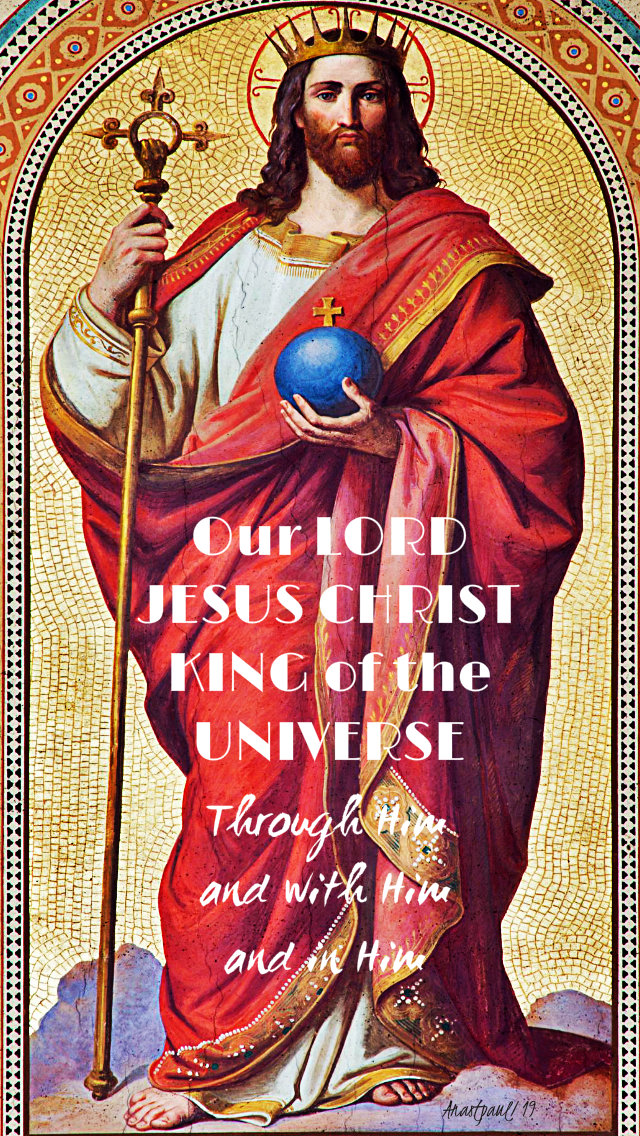
Quote/s of the Day – 24 November – The Solemnity of Christ the King
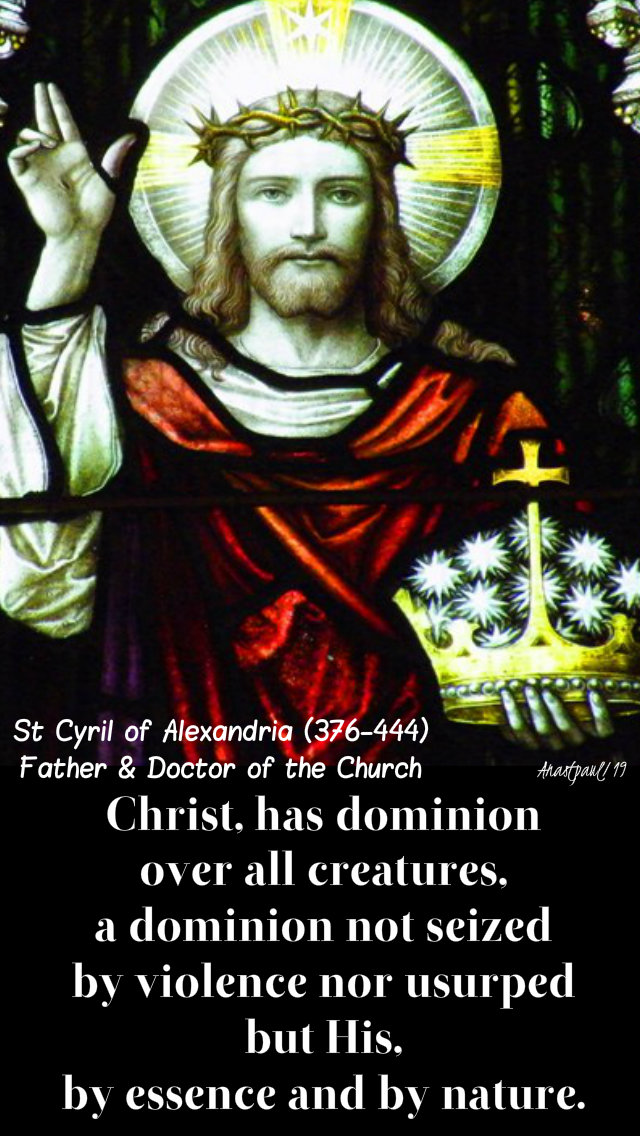
“Christ, has dominion over all creatures, a dominion not seized by violence nor usurped but His, by essence and by nature.”
St Cyril of Alexandria (376-444)
Father & Doctor of the Church
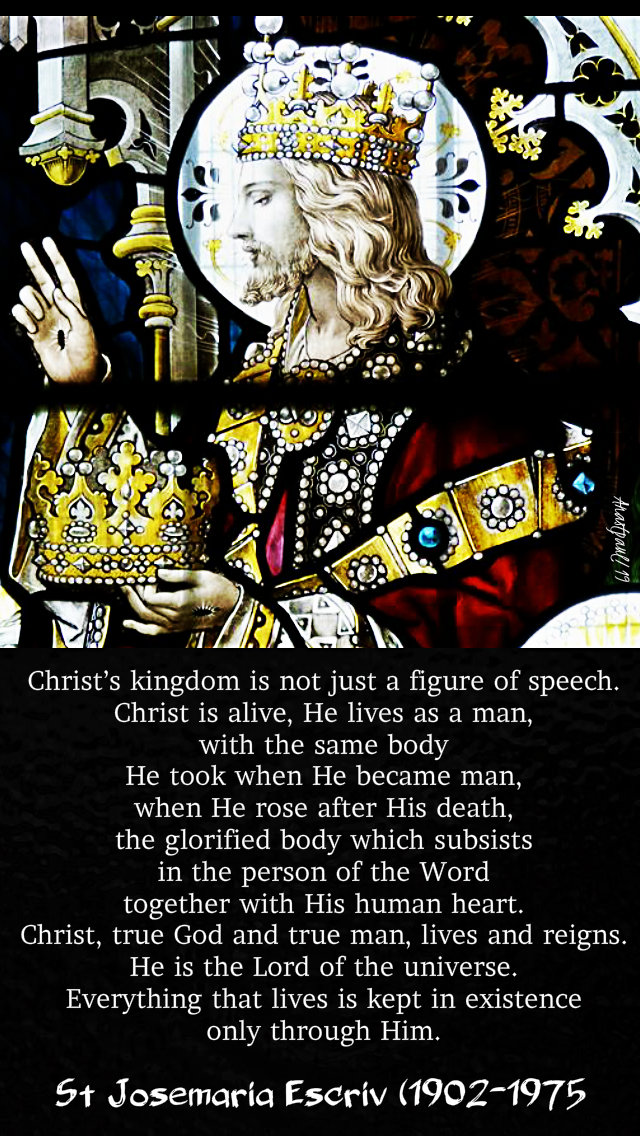
“Christ’s kingdom is not just a figure of speech. Christ is alive, He lives as a man, with the same body He took when He became man, when He rose after His death, the glorified body which subsists in the person of the Word together with His human heart. Christ, true God and true man, lives and reigns. He is the Lord of the universe. Everything that lives is kept in existence only through Him.”
St Josemaria Escrivá (1902-1975)
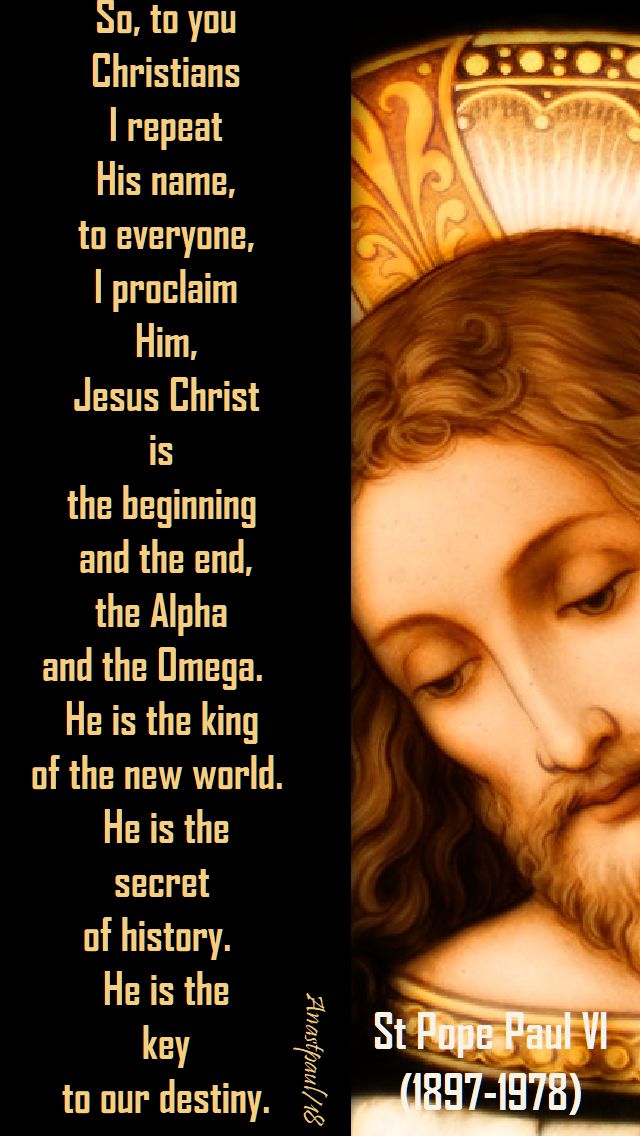
“Jesus Christ You have heard Him spoken of, indeed the greater part of you are already His – you are Christians. So, to you Christians I repeat His name, to everyone I proclaim Him – Jesus Christ is the beginning and the end, the Alpha and the Omega. He is the king of the new world. He is the secret of history. He is the key to our destiny.”
St Pope Paul VI (1897-1978)
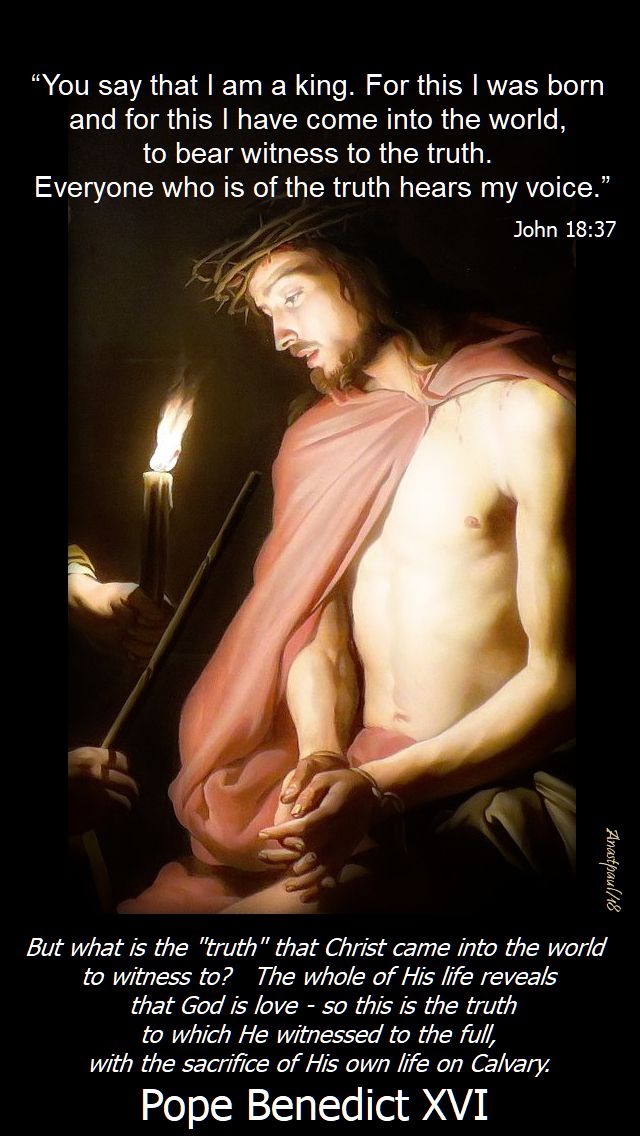
“You say that I am a king. For this I was born and for this I have come into the world, to bear witness to the truth. Everyone who is of the truth hears my voice.”
John 18:37
“But what is the “truth” that Christ came into the world to witness to? The whole of His life reveals that God is love – so this is the truth to which He witnessed to the full, with the sacrifice of His own life on Calvary.”
Pope Benedict XVI
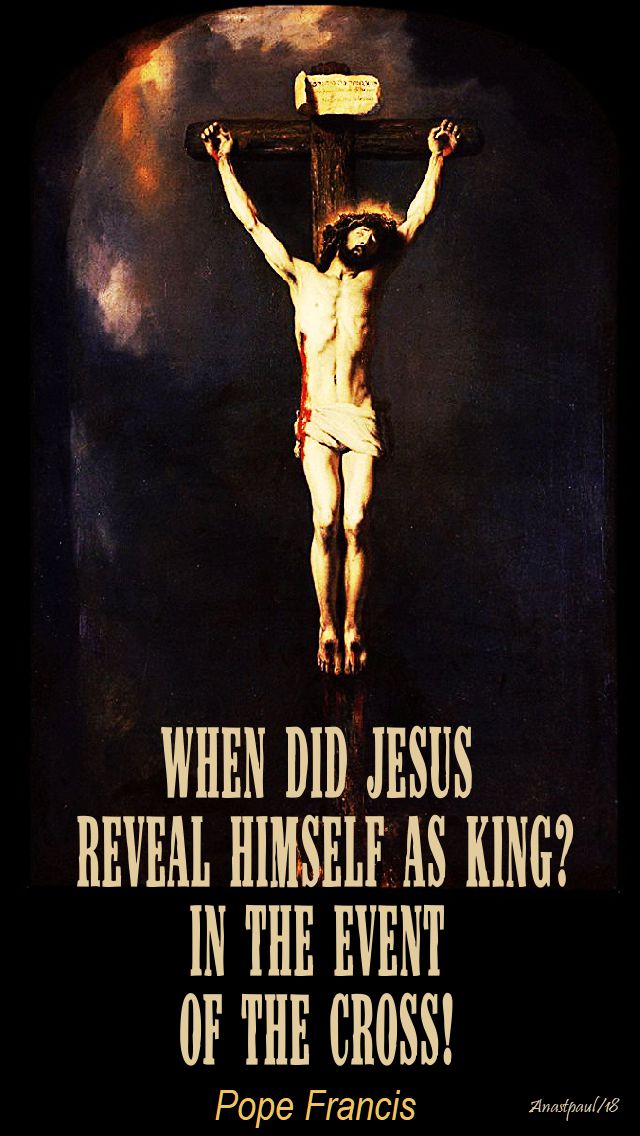
“When did Jesus reveal Himself as king? In the event of the Cross!”
Sunday Reflection – 24 November – The Solemnity of Christ the King, the last Sunday of the Liturgical Year C
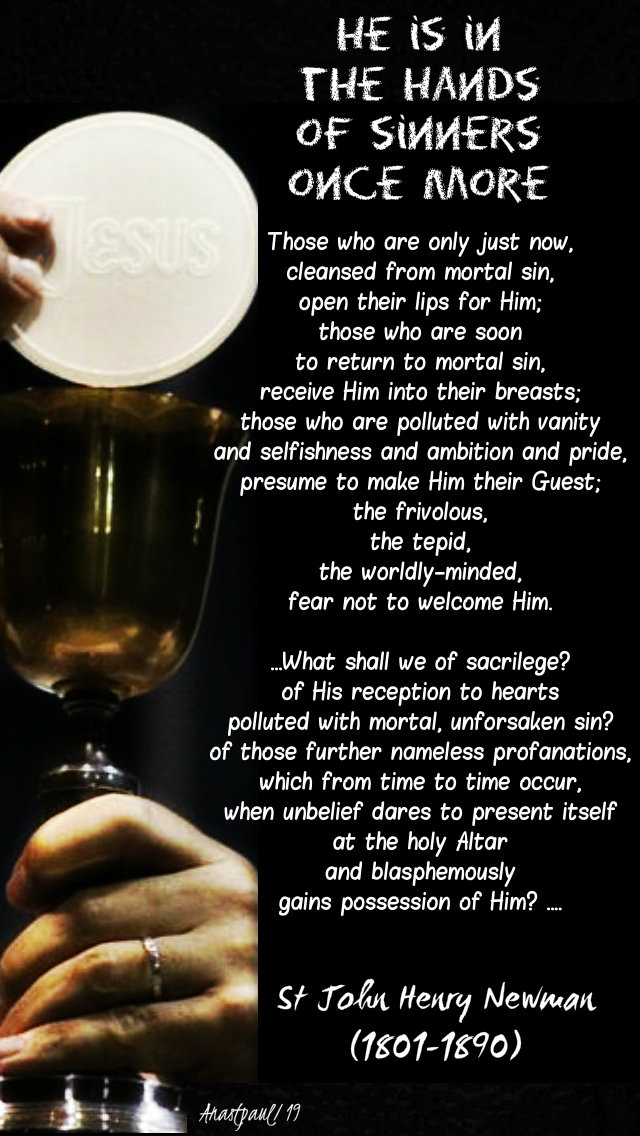
He is in the hands of sinners once more
St John Henry Newman (1801-1890)
He took bread and blessed and made it His Body. He took wine and gave thanks and made it His Blood and He gave His priests the power to do what He had done. Henceforth, He is in the hands of sinners once more. Frail, ignorant, sinful man, by the sacerdotal power given to him, compels the presence of the Highest; he lays Him up in a small Tabernacle; he dispenses Him to a sinful people. Those who are only just now, cleansed from mortal sin, open their lips for Him; those who are soon to return to mortal sin, receive Him into their breasts; those who are polluted with vanity and selfishness and ambition and pride, presume to make Him their Guest; the frivolous, the tepid, the worldly-minded, fear not to welcome Him.
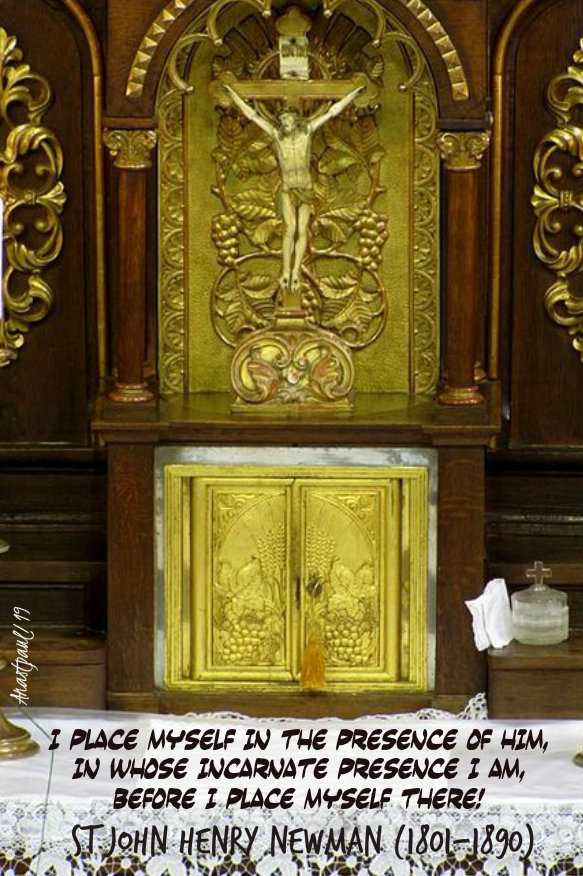
Alas! Alas! even those who wish to be more in earnest, entertain Him with cold and wandering thoughts and quench that Love which would inflame them with It’s own fire, did they but open to It! Such are the best of us and then for the worst? What shall we of sacrilege? of His reception to hearts polluted with mortal, unforsaken sin? of those further nameless profanations, which from time to time occur, when unbelief dares to present itself at the holy Altar and blasphemously gains possession of Him? …. I place myself in the presence of Him, in whose Incarnate Presence I am, before I place myself there!
I adore Thee, O my Saviour, present here as God and man, in soul and body, in true flesh and blood.
I acknowledge and confess, that I kneel before that Sacred Humanity, which was conceived in Mary’s womb and lay in Mary’s bosom; which grew up to man’s estate and by the Sea of Galilee, called the Twelve, wrought miracles and spoke words of wisdom and peace; which in due season hung on the Cross, lay in the tomb, rose from the dead and now reigns in heaven.
I praise and bless and give myself wholly to Him, who is the true Bread of my soul and my everlasting joy. Amen.
One Minute Reflection – 24 November – The Solemnity of Christ the King, Year C – Gospel: Luke 23:35–43
“Jesus, remember me when you come into your kingdom.” … Luke 23:42
REFLECTION – “Today paradise, closed for thousands of years, is opened to us. On this day, at this very hour, God brings the brigand into it. Thus He fulfils two wonders – He opens up paradise to us and causes a thief to enter in. Today God has given us back our former homeland, today He has brought us into the city of our ancestors, today He has opened up a home to be shared by all humanity. “This day,” He says, “you will be with me in paradise.” What are You saying, Lord? You are crucified, nailed down and do You promise paradise? Yes, He says, so that through the Cross You may learn my power…
Because it isn’t by raising a dead man, commanding the sea and wind, or casting out demons that He is able to change the thief’s sinful soul but by being crucified, pinned down by nails, covered with insults, spitting, mockery and torture, so that you might see the two sides of His sovereign power. He shook all creation, split the rocks (Mt 27:51) and drew to Himself the brigand’s soul, hard as stone, to cover it with honour…
Obviously, no king would ever allow a brigand or other of his subjects to be seated at his side when making his entry into his city. Yet Christ did so, when entering His holy homeland. He brings a brigand into it along with Him. In so doing… He does no dishonour to it by a brigand’s presence, for it is a glory for paradise, that it has a master, able to make a brigand worthy of the joys to be tasted there.
In the same way, when He brings publicans and prostitutes into the Kingdom of heaven (Mt 21:31)…, it is for the sake of the glory of that holy place. Because He shows it, that the Lord of the heavenly Kingdom is so great, that He can restore all their dignity, to prostitutes and publicans, even to their being worthy of this honour and this gift. We admire a doctor all the more when we see him heal people suffering from illnesses said to be incurable. So it is only right to admire Christ… when He restores publicans and prostitutes to such a state of spiritual health, that they become worthy of heaven.” … St John Chrysostom (345 407) Bishop of Constantinople, Father & Doctor of the Church – Homily 1 on the cross and the brigand, for Good Friday, 2
PRAYER – Lord God, You gave the peoples of the world as the inheritance of Your only Son, You crowned Him as King of Zion, Your holy city and gave Him Your Church to be His Bride. As He proclaims the law of Your eternal kingdom, may we serve Him faithfully and so share His royal power forever. We make our prayer, through Him and with Him and in Him, our King and our Redeemer, with the Holy Spirit, God forever, amen.
Our Morning Offering – 24 November – The Solemnity of Christ the King
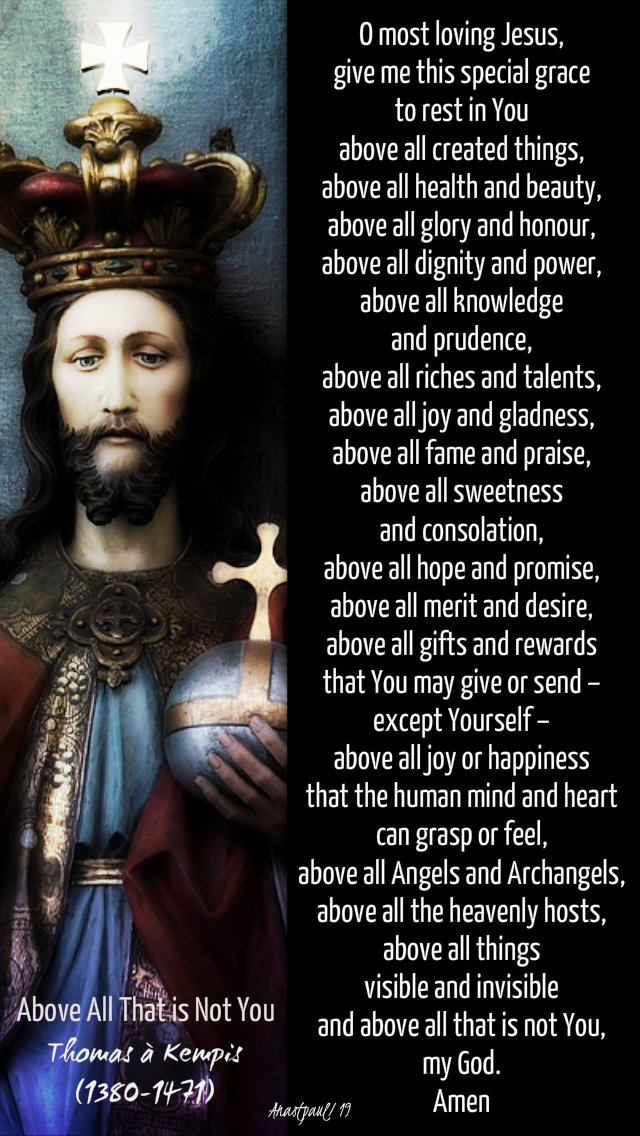
Above All That is Not You Thomas à Kempis (1380-1471)
O most loving Jesus,
give me this special grace to rest in You
above all created things,
above all health and beauty,
above all glory and honour,
above all dignity and power,
above all knowledge and prudence,
above all riches and talents,
above all joy and gladness,
above all fame and praise,
above all sweetness and consolation,
above all hope and promise,
above all merit and desire,
above all gifts and rewards
that You may give or send –
except Yourself –
above all joy or happiness
that the human mind and heart
can grasp or feel,
above all Angels and Archangels,
above all the heavenly hosts,
above all things visible and invisible
and above all that is not You,
my God.
Amen
Thought for the Day – 9 November – Feast of the Dedication of the Lateran Basilica in Rome
We have All been made Temples of God through Baptism
Saint Caesarius of Arles (470-543)
An excerpt from Sermon 229
My fellow Christians, today is the birthday of this church, an occasion for celebration and rejoicing. We, however, ought to be the true and living temple of God. Nevertheless, Christians rightly commemorate this Feast of the Church, their mother, for they know that through her, they were reborn in the spirit. At our first birth, we were vessels of God’s wrath, reborn, we became vessels of His mercy. Our first birth brought death to us but our second restored us to life.
Indeed, before our Baptism we were sanctuaries of the devil but after our Baptism we merited the privilege of being temples of Christ. And if we think more carefully about the meaning of our salvation, we shall realise that we are, indeed, living and true temples of God. God does not dwell only in structures fashioned by human hands, in homes of wood and stone but rather He dwells principally, in the soul made according to His own image and fashioned by His own hand. Therefore, the apostle Paul says: The temple of God is holy and you are that temple.
When Christ came, He banished the devil from our hearts, in order to build in them a temple for Himself. Let us, therefore, do what we can with His help, so that our evil deeds will not deface that temple. For whoever does evil, does injury to Christ. As I said earlier, before Christ redeemed us, we were the house of the devil but afterward, we merited the privilege of being the house of God. God Himself in His loving mercy, saw fit, to make of us, His own home.
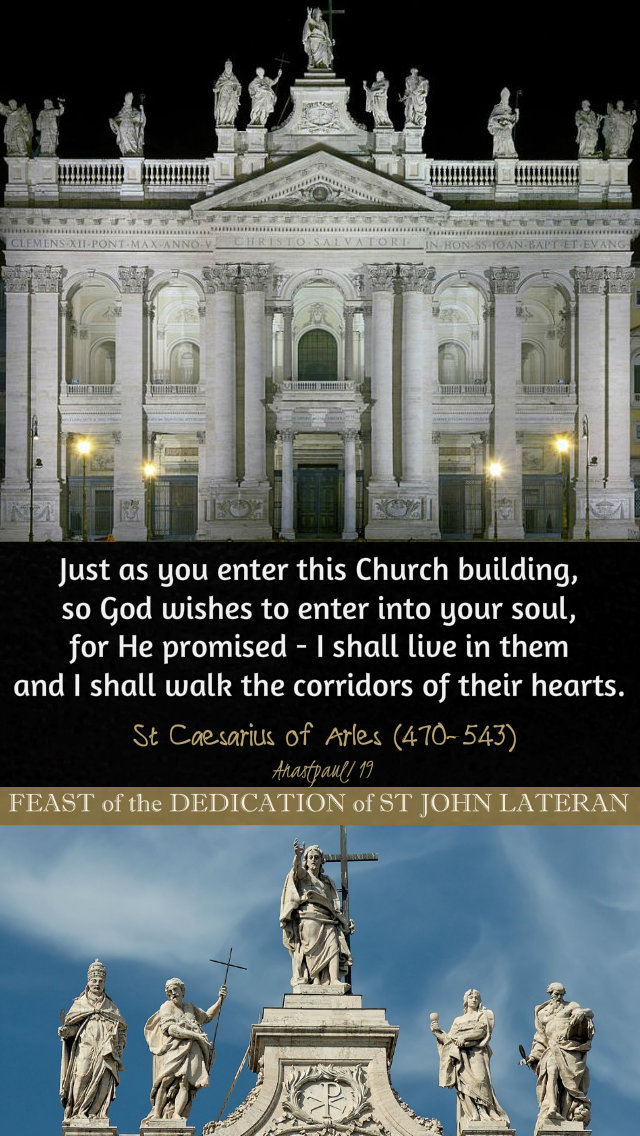
My fellow Christians, do we wish to celebrate joyfully the birth of this temple? Then let us not destroy the living temples of God in ourselves by works of evil . I shall speak clearly, so that all can understand. Whenever we come to Church, we must prepare our hearts to be as beautiful as we expect this Church to be. Do you wish to find this Basilica immaculately clean? Then do not soil your soul with the filth of sins. Do you wish this Basilica to be full of light? God too, wishes that your soul be not in darkness but that the light of good works shine in us, so that He, who dwells in the heavens, will be glorified. Just as you enter this Church building, so God wishes to enter into your soul, for He promised – I shall live in them and I shall walk the corridors of their hearts.
Quote/s of the Day – 9 November – Feast of the Dedication of the Lateran
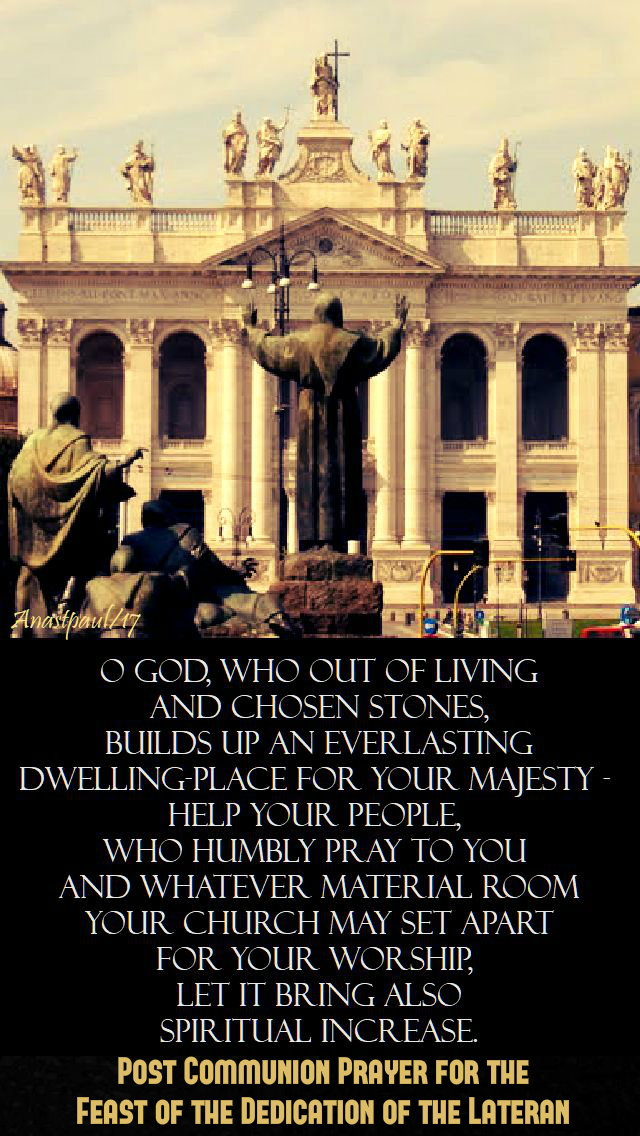
“O God, who out of living and chosen stones, builds up an everlasting dwelling-place for Your Majesty – help Your people, who humbly pray to You and whatever material room Your Church may set apart for Your worship, let it bring also spiritual increase.”
Post Communion prayer
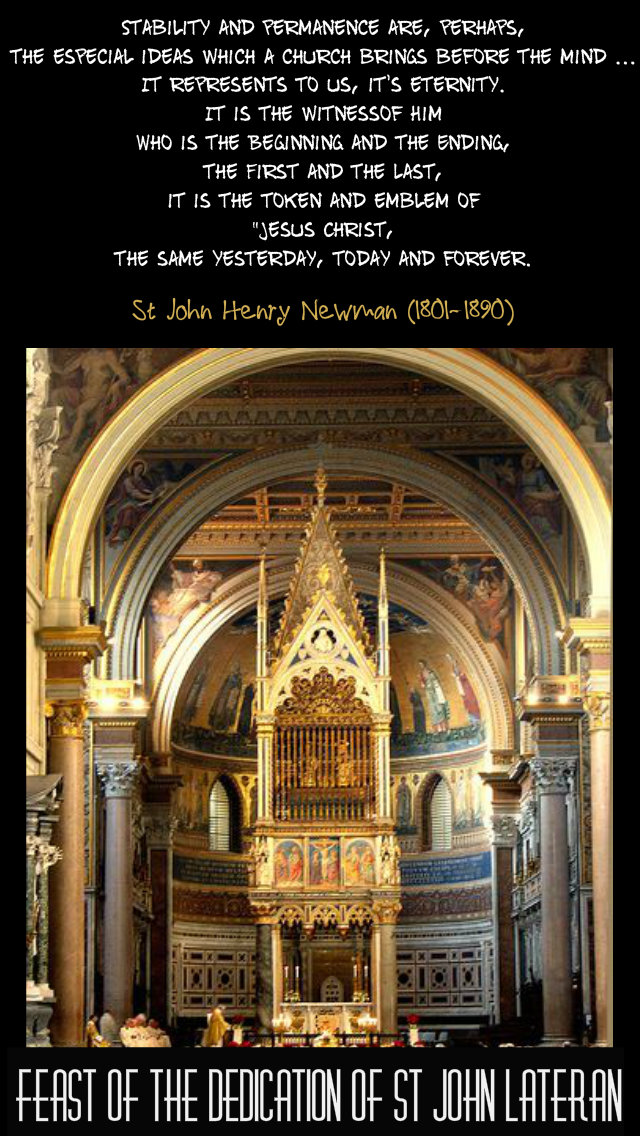
“Stability and permanence are, perhaps, the especial ideas which a church brings before the mind … It represents to us, it’s eternity. It is the witness of Him Who is the Beginning and the Ending, the First and the Last, it is the token and emblem of “Jesus Christ, the same yesterday, today and forever.”
St John Henry Newman (1801-1890) Cardinal
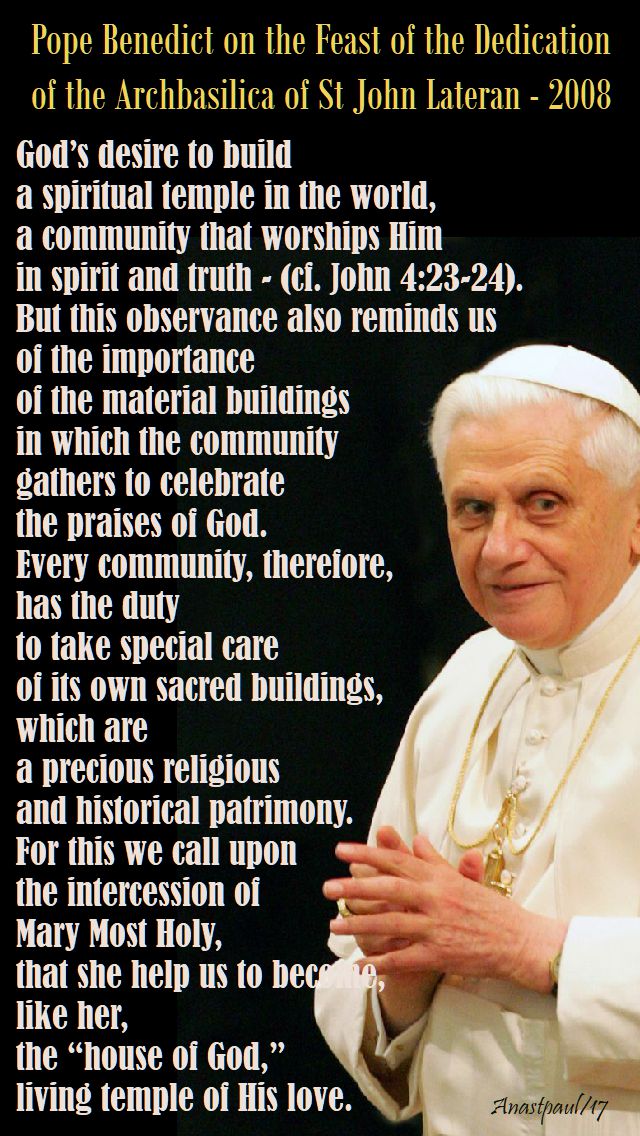
“God’s desire to build a spiritual temple in the world, a community that worships him in spirit and truth (cf. John 4:23-24). But this observance also reminds us of the importance of the material buildings in which the community gathers to celebrate the praises of God. Every community, therefore, has the duty to take special care of its own sacred buildings, which are a precious religious and historical patrimony. For this we call upon the intercession of Mary Most Holy, that she help us to become, like her, the “house of God,” living temple of His love.”
One Minute Reflection – 9 November – The Feast of the Dedication of St John Lateran – Gospel: John 2:13–22
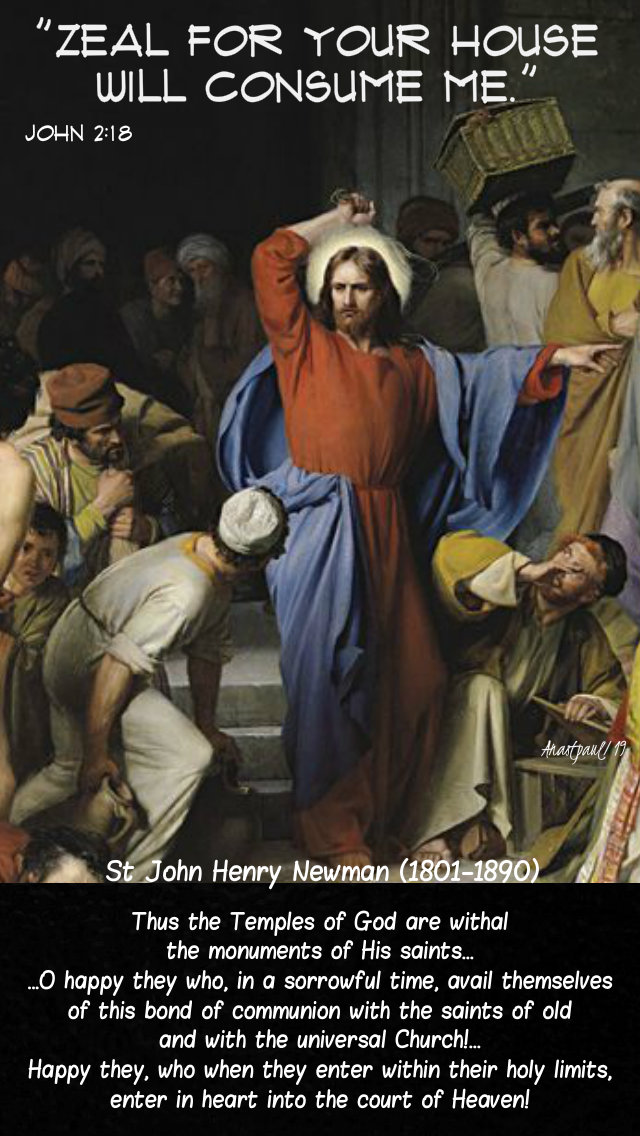
“Zeal for your house will consume me.” ... John 2:18
REFLECTION – “Is a cathedral the offspring of a random thought, a thing to will and to accomplish at our pleasure?… Surely the churches which we inherit are not the purchase of wealth nor the creation of genius, they are the fruits of martyrdom. They come of high deeds and sufferings, as long before their very building as we are after it. Their foundations are laid very deep, even in the preaching of apostles and the confession of saints and the first victories of the gospel in our land. All that is so noble in their architecture, all that captivates the eye and makes its way to the heart, is not a human imagination but a divine gift, a moral result, a spiritual work.
The Cross is ever planted in hazard and suffering and is watered with tears and blood. No where does it take root and bear fruit, except its preaching be with self-denial. It is easy, indeed, for the ruling powers to make a decree and set religion on high and extend its range,and herald its name but they cannot plant it, they can but impose it. The Church alone can plant the Church. The Church alone can found her sees and inclose herself within walls. None but saintly men, mortified men, preachers of righteousness, and confessors for the truth, can create a home for the truth in any land.
Thus the Temples of God are withal the monuments of His saints… Their simplicity, grandeur, solidity, elevation, grace and exuberance of ornament, do but bring to remembrance the patience and purity, the courage, meekness and great charity, the heavenly affections, the activity in well-doing, the faith and resignation, of men who themselves did but worship in mountains and in deserts,and in caves and dens of the earth. They laboured but not in vain, for other men entered into their labours (cf. Jn 4:38) and, as if by natural consequence, at length their word prospered after them and made itself a home, even these sacred palaces in which it has so long dwelt… O happy they who, in a sorrowful time, avail themselves of this bond of communion with the saints of old and with the universal Church!… Happy they, who when they enter within their holy limits, enter in heart into the court of Heaven!” … St John Henry Newman (1801-1890) Cardinal, Founder of the Oratory in England, Theologian – PPS vol. 6, 19
PRAYER – Almighty God, as we recall with joy, the Dedication of this house of Yours on each recurring anniversary, listen to Your people’s prayer and grant that our worship here may be a sincere and holy service, honouring Your Name and bringing us the fullness of redemption. Through Jesus Christ, our Lord, in union with the Holy Spirit, one God for all eternity, amen.
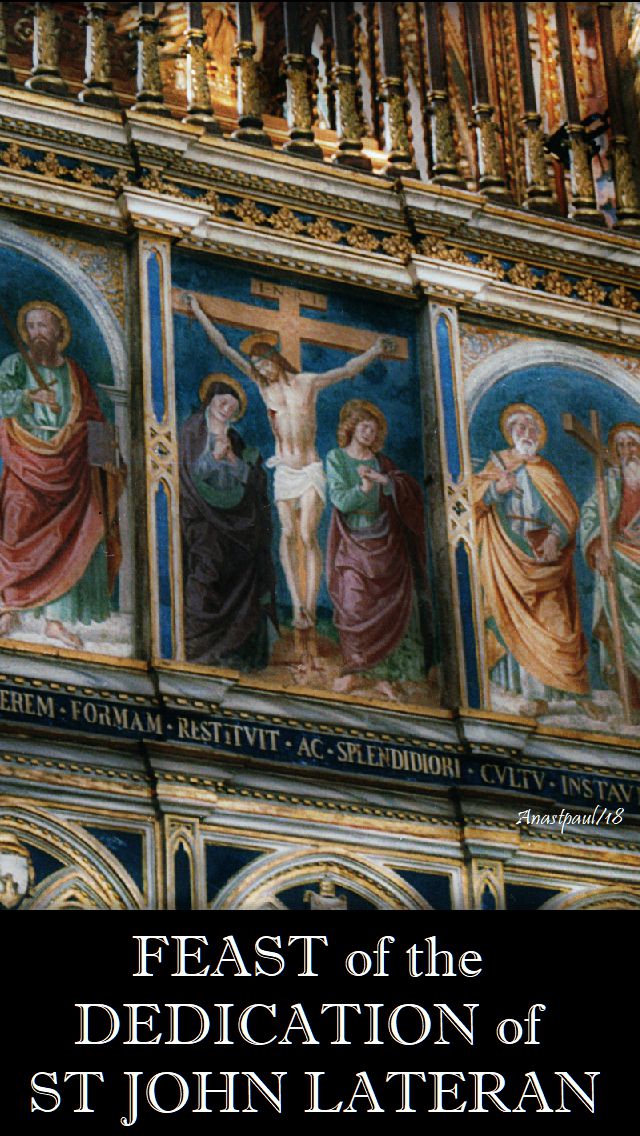
Dedication of the Basilica of Saint John Lateran (Feast): The oldest and first in rank of the four basilicas of Rome, Italy. The name is derived from the Laterani family, on the site of whose palace the basilica stands. King Constantine presented this palace to the Church. Its annual celebration throughout the Latin Church is a sign of love and unity with the Papacy and Pope.
The original church building, probably adapted from the hall of the palace, was dedicated to the Saviour and from its splendour was known as the Basilica Aurea. Though several times destroyed and rebuilt, the basilica retained its ancient form, being divided by rows of columns into aisles and having an atrium with colonnades. The tasteless restoration of the 17th century changed its appearance. A monastery was formerly between the basilica and the city wall of which the cloister still remains. The original apse survived until 1878, when it was destroyed and a deeper apse built. The ancient mosaics have been preserved The high altar, which is of wood and is believed to have been used by Saint Peter, is now encased in marble. In the upper part of the baldachinum are the heads of the Apostles, Peter and Paul. The baptistery is an octagonal edifice with porphyry columns. The font is of green basalt. This basilica has been the cathedral of Rome since the 4th century.
Our Lady of Almudena: The Virgin of Almudena (Virgen de la Almudena) is a medieval icon of the Virgin Mary, mother of Jesus Christ. The image is the advocation of the Virgin that serves as a patroness of Madrid, Spain.
Intriguingly, however, its name derives from the Arabic term of Al Mudayna, or the citadel. There are various legends regarding the icon. One story is that in 712, prior to the capture of the town by the advancing Muslim forces, the inhabitants of the town secreted the image of the virgin, for its own protection, inside the walls surrounding the town. In the 11th century, when Madrid was reconquered by the King Alfonso VI of Castile, the Christian soldiers endeavoured to find the statue. After days of prayer, the spot on the wall hiding the icon crumbled, revealing the statue. Another legend is that as Christian soldiers approached the town, they had a vision of Mary imploring them to allow her to lead them into the city. Again the miraculous crumbling of the wall occurred, with the icon showing an entry route through the walls.
The Cathedral of Madrid is dedicated to this advocation of the Virgin and her feast day, 9 November, is a major holiday in Madrid.
St Agrippinus of Naples
St Alexander of Salonica
St Aurelius of Riditio
St Benignus of Armagh
St Eustolia
St Francisco José Marín López de Arroyave
St Gabriel Ferretti
Bl George Napper
Bl Gratia of Cattaro
Bl Helen of Hungary
Bl Henryk Hlebowicz
St Jane of Segna Bl Ludovico Morbioli (1433-1485)
St Justo Juanes Santos
St Luigi Beltrame Quattrocchi
St Luis Morbioli
St María de la Salud Baldoví Trull
Bl María del Carmen of the Child Jesus
St Pabo
St Sopatra
St Theodore Stratelates
St Ursinus of Bourges
St Valentín Gil Arribas
St Vitonus of Verdun
—
Martyrs of Constantinople – 3 saints: A group of ten Catholic Christians who tried to defend an image of Jesus over the Brazen Gate of Constantinople from an attack by Iconoclasts during the persecutions of emperor Leo the Isaurian. The group of was seized by soldiers, condemned by judges for opposing the emperor, and martyred. The only details that have survived are three of their names – Julian, Marcian and Maria. They were martyred in 730 at Constantinople (modern Istanbul, Turkey).
Martyred in the Spanish Civil War:
• Blessed Anastasio Garzón González
• Blessed Francisco José Marín López de Arroyave
• Blessed Justo Juanes Santos
• Blessed María de la Salud Baldoví Trull
• Blessed Valentín Gil Arribas
All Saints and Blesseds of The Society of Jesus: The Society of Jesus, commonly known as the Jesuits, was Founded in 1534 by Saint Ignatius Loyola (1491-1556) at Montmartre, Paris, France. A body of clerics regular organised for Apostolic work, following a religious rule and relying on alms for their support. It was the chief instrument of the Catholic Reformation. Pope Paul III approved the new rule in 1540 and Ignatius was elected the first general of the order in 1541. The constitutions, drafted by him and based on his Spiritual Exercises were adopted in 1558. It was the first order which enjoined by its constitutions devotion to the cause of education. The ministry of the Society consists chiefly in preaching. teaching catechism, administering the sacraments, conducting missions in parishes, taking care of parishes, organising pious confraternities, teaching in schools of every grade, writing books, pamphlets, periodical articles, going on foreign missions and special missions when ordered by the current Holy Father, to whom they take a vow of total obedience. Our current Holy Father, Pope Francis is a Jesuit and has jokingly wondered aloud who is boss of whom in his Order. The general resides at Rome, Italy and has a council of assistants. The motto of the Society is Ad Majorem Dei Gloriam (For the greater glory of God).
St Augustine of Terracina
Bl Bernhard Lichtenberg
St Bertille
St Canonica
St Comasia
St Ðaminh Mau
St Dominator of Brescia
St Domninus the Physician
St Epistemis
St Eusebius of Terracina
St Felix of Terracina
St Fibitius
St Galation
St Gerald of Beziers
Bl Gomidas Keumurjian
Bl Gregory Lakota
St Guetnoco St Guido Maria Conforti (1865-1931)
St St Hermenegild
St Idda
St Juan Antoni Burró Mas
St Juan Duarte Martín
St Kanten
St Kea
St Laetus of Orleans
St Magnus of Milan
St Mamete
St Marco of Troia
Bl María del Carmen Viel Ferrando
Bl Simon Ballachi
St Spinulus of Moyen-Moûtier
St Sylvanus of Syria
—
Martyrs of Caesarea Maritima – 4 saints: Four young Christian men who were martyred together in the persecutions of Maximian – Aussenzius, Philotheus, Timothy and Theotimus. They were martyred in the arena at Caesarea Maritima, Palestine.
Martyred in the Spanish Civil War:
• Blessed Juan Antoni Burró Mas
• Blessed Juan Duarte Martín
• Blessed María del Carmen Viel Ferrando
Thought for the Day – 1 November – The Solemnity of All Saints
The Idea of a Saint
Saint John Henry Newman (1801-1890)
“Very various are the saints, their very variety is a token of God’s workmanship but, however various and whatever was their special line of duty, they have been heroes in it, they have attained such noble self-command,
they have so crucified the flesh,
they have so renounced the world,
they are so meek,
so gentle,
so tenderhearted,
so merciful,
so sweet,
so cheerful,
so full of prayer,
so diligent, so forgetful of injuries – they have attained such great and continued pains,
they have persevered in such vast labours,
they have made such valiant confessions,
they have wrought such abundant miracles,
they have been blessed with such strange successes,
that they have set up a standard before us of truth, of magnanimity, of holiness, of love.
They are not always our examples, we are not always bound to follow them – not more than we are bound to obey literally, some of our Lord’s precepts, such as turning the cheek or giving away the coat – not more than we can follow the course of the sun, moon or stars in the heavens;
but, though not always our examples,
they are always our standard of right and good,
they are raised up to be monuments and lessons,
they remind us of God,
they introduce us into the unseen world,
they teach us what Christ loves,
they track out for us the way which leads heavenwards.
They are to us who see them, what wealth, notoriety, rank and name are to the multitude of men who live in darkness – objects of our veneration and of our homage.
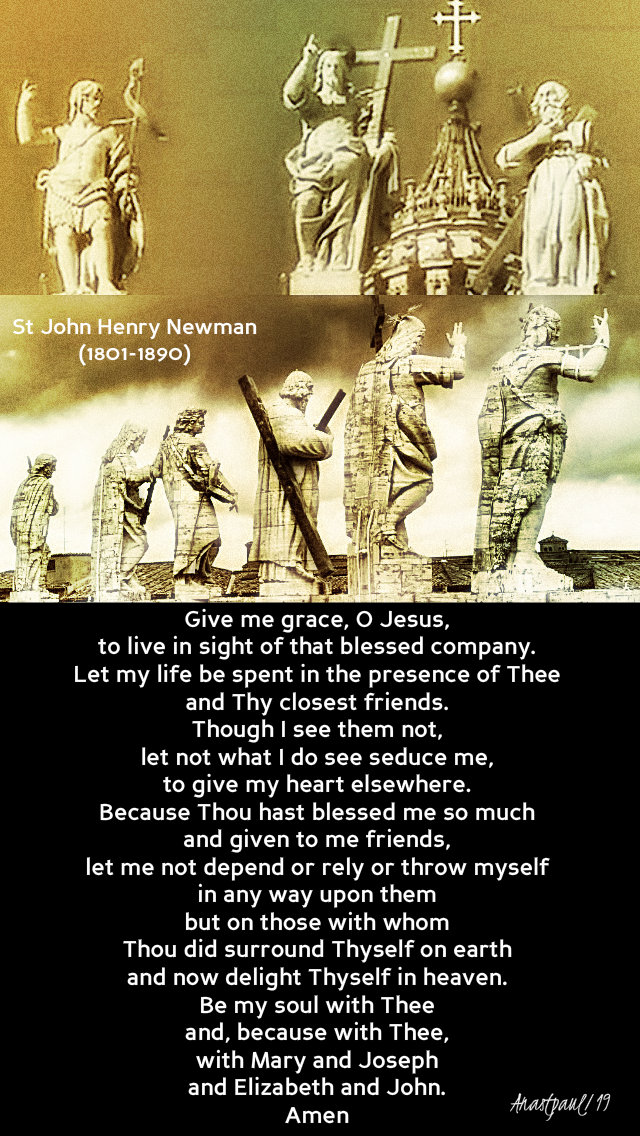
Give me grace, O Jesus, to live in sight of that blessed company. Let my life be spent in the presence of Thee and Thy closest friends. Though I see them not, let not what I do see seduce me, to give my heart elsewhere. Because Thou hast blessed me so much and given to me friends, let me not depend or rely or throw myself in any way upon them but on those with whom Thou did surround Thyself on earth and now delight Thyself in heaven. Be my soul with Thee and, because with Thee, with Mary and Joseph and Elizabeth and John. Amen
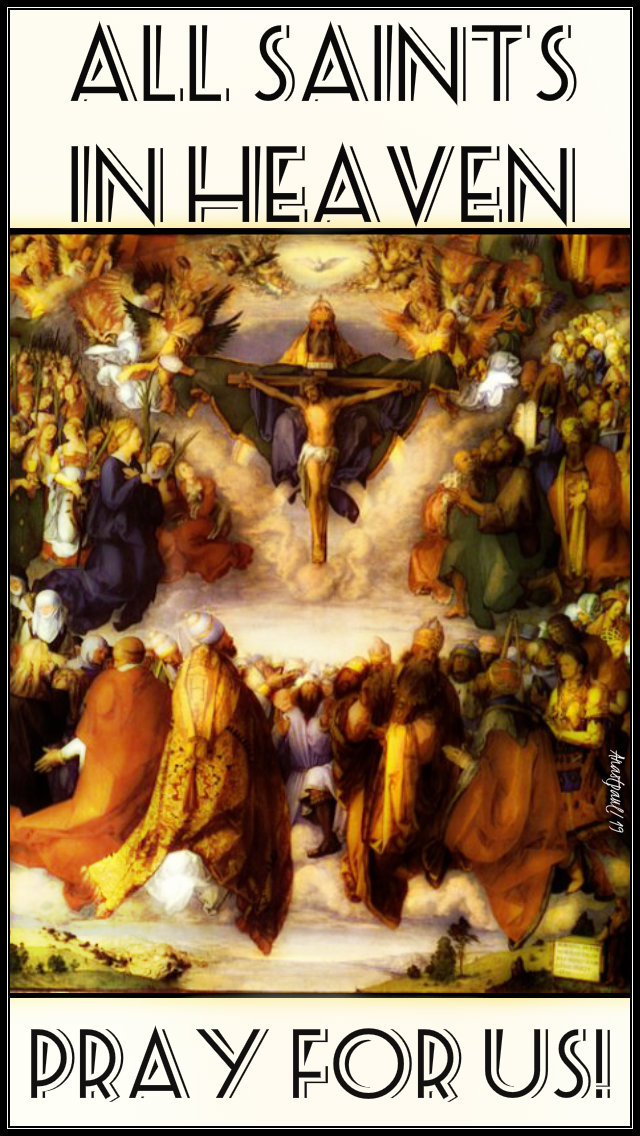
All Holy Saints in Heaven, not forgetting You, St John Henry, Pray for Us!
Quote/s of the Day – 1 November – The Solemnity of All Saints
“Follow Me”
Matthew 9:9
“Follow the saints, because those who follow them will become saints.”
Saint Pope Clement I (c 35-99)
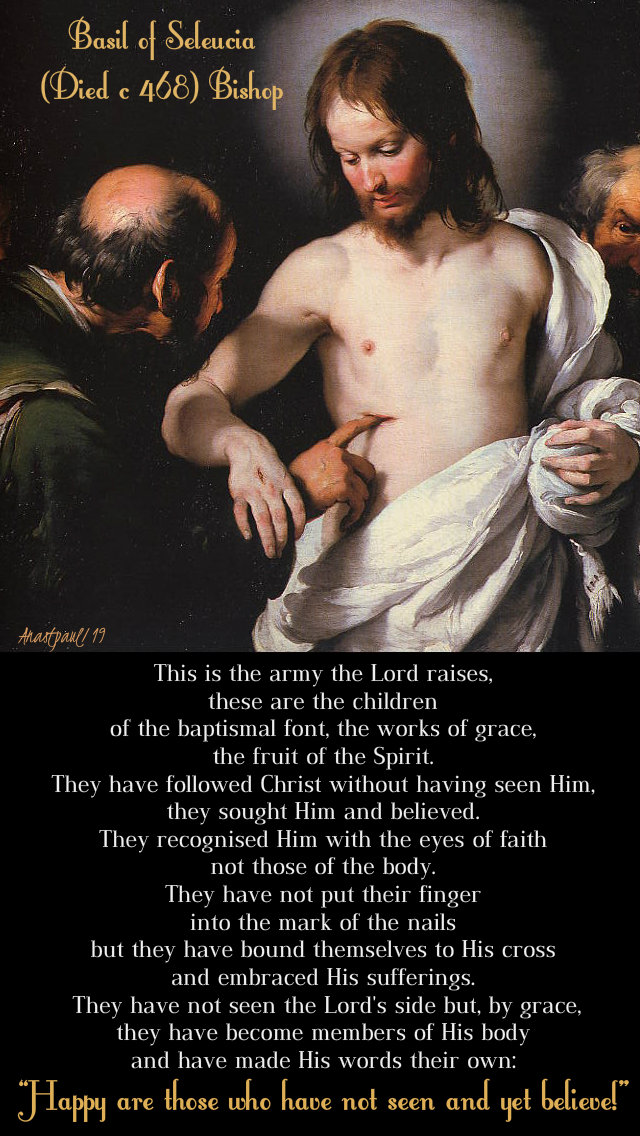
“This is the army the Lord raises, these are the children of the baptismal font, the works of grace, the fruit of the Spirit. They have followed Christ without having seen Him, they sought Him and believed. They recognised Him with the eyes of faith not those of the body. They have not put their finger into the mark of the nails but they have bound themselves to His cross and embraced His sufferings. They have not seen the Lord’s side but, by grace, they have become members of His body and have made His words their own: “Happy are those who have not seen and yet believe!”
Basil of Seleucia (Died c 468) Bishop
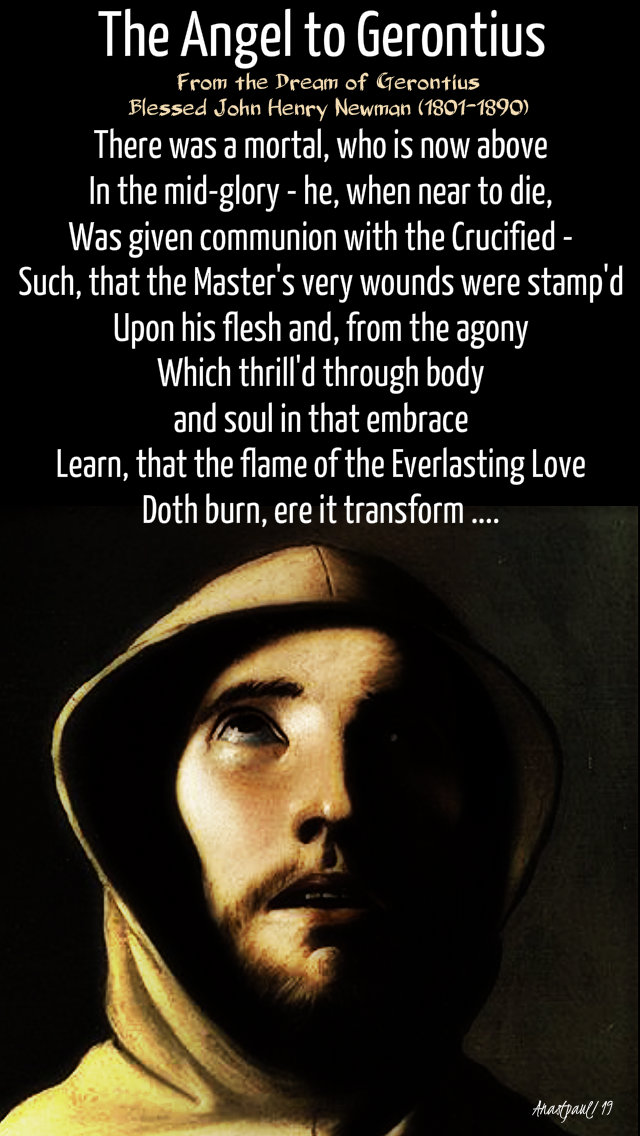
The Angel to Gerontius “There was a mortal, who is now above In the mid-glory – he, when near to die, Was given communion with the Crucified – Such, that the Master’s very wounds were stamp’d Upon his flesh and, from the agony Which thrill’d through body and soul in that embrace Learn, that the flame of the Everlasting Love Doth burn, ere it transform ….”
From the Dream of Gerontius
Blessed John Henry Newman (1801-1890)
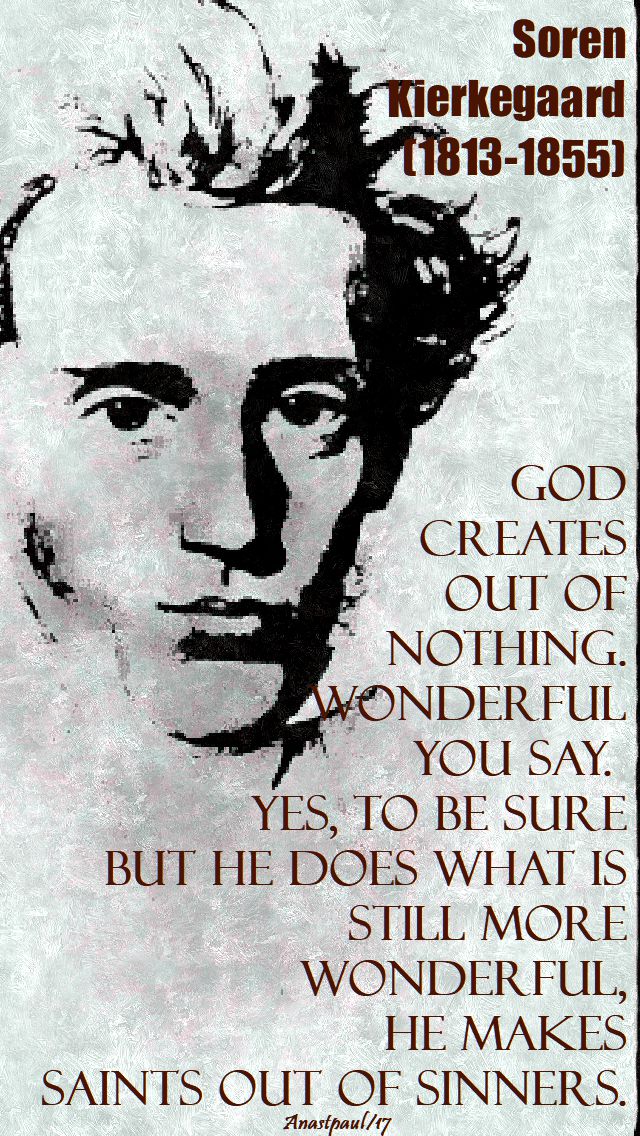
“God creates out of nothing. Wonderful you say. Yes, to be sure but He does. what is still more wonderful, He makes saints out of sinners.”
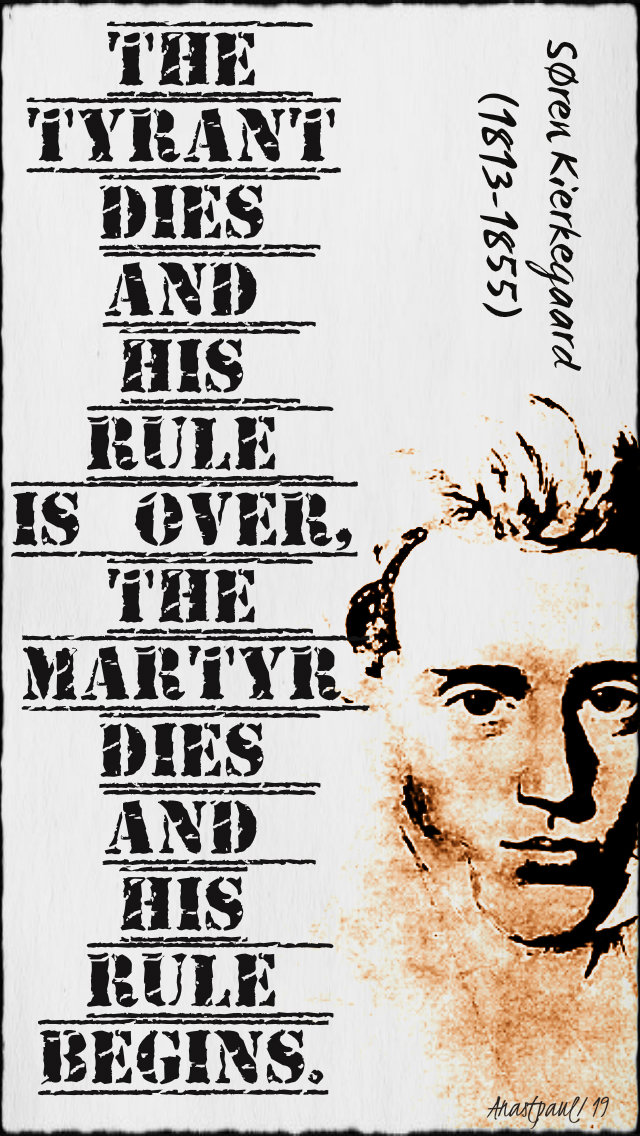
“The tyrant dies and his rule is over, the Martyr dies and his rule begins.”
Soren Kierkegaard (1813-1855)
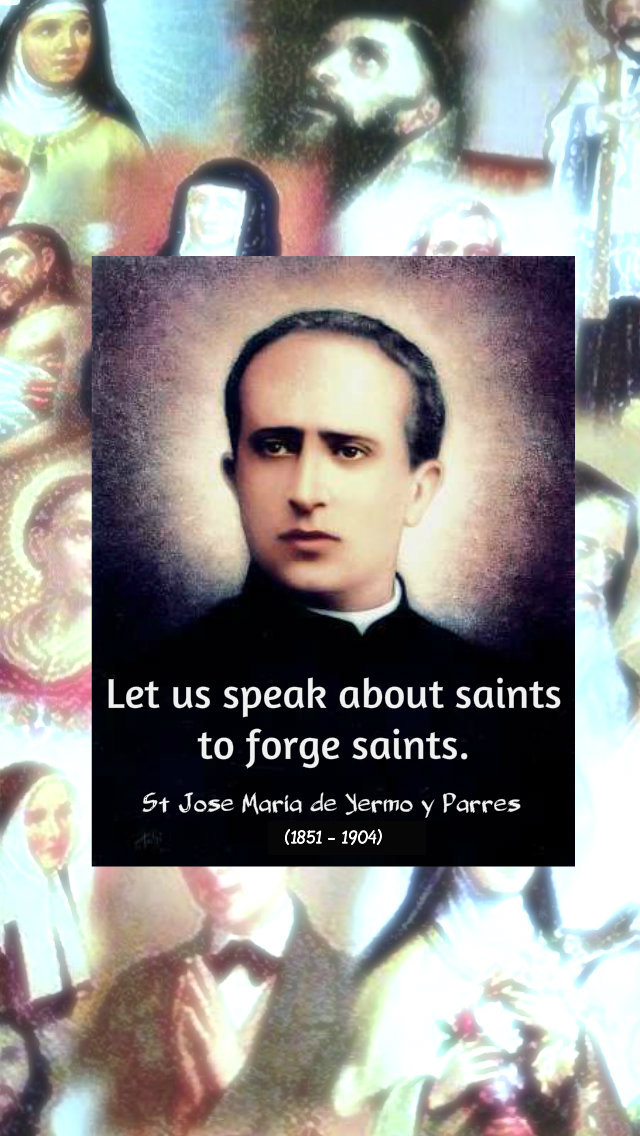
“Let us speak about saints to forge saints.”
Saint Jose Maria de Yermo y Parres (1851–1904)
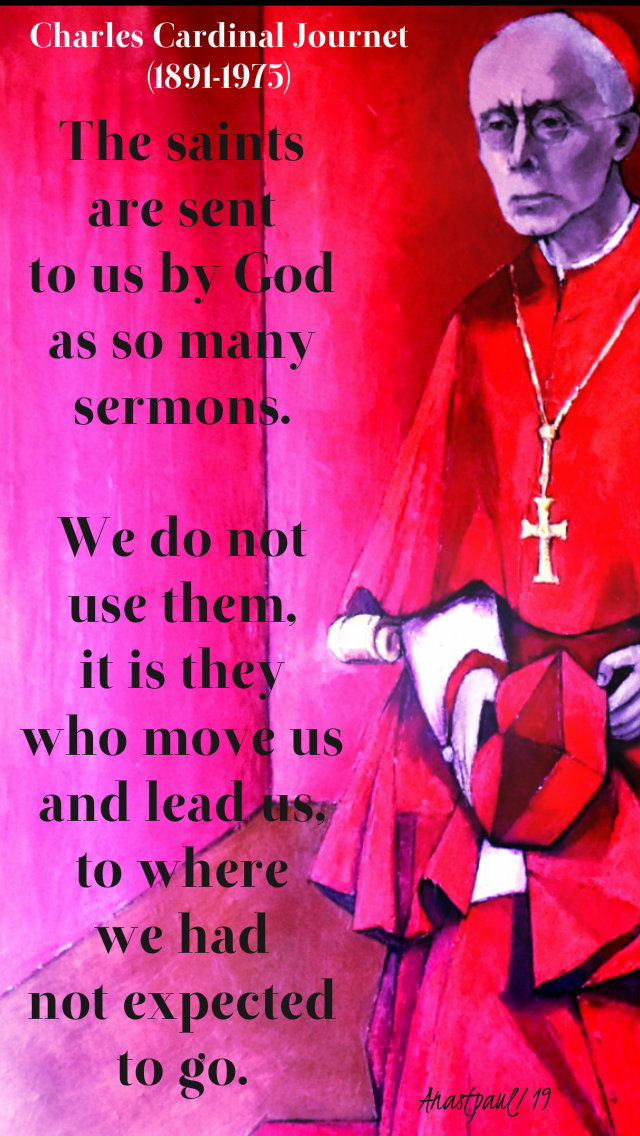
“For the saints are sent to us by God as so many sermons. We do not use them, it is they who move us and lead us, to where we had not expected to go.”
One Minute Reflection – 1 November – The Solemnity of All the Saints, Gospel: Matthew 5:1–12
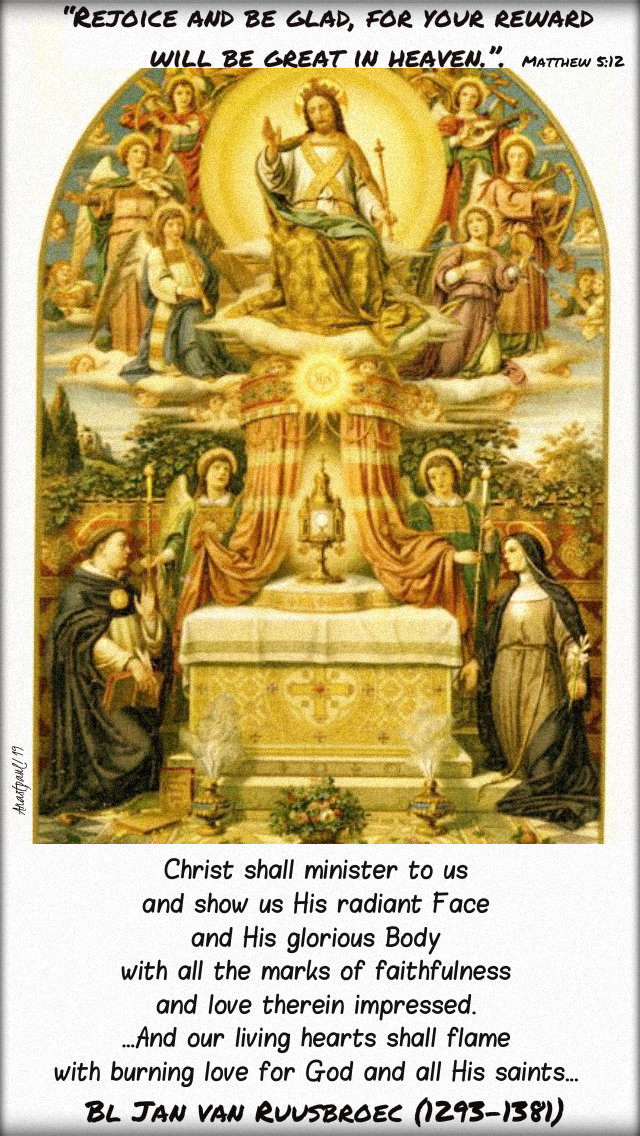
“Rejoice and be glad, for your reward will be great in heaven.”…Matthew 5:12
REFLECTION – “But in the last day of the judgement of God, after we shall have risen again with our glorified bodies through the power of the Lord, these same shall be white and gleaming as snow shining clear in the sun, transparent as crystal… And Christ our cantor and precentor, shall sing with His glorious sweet voice, an endless canticle of the praise and honour of His heavenly Father and we shall all sing the same, with glad heart and clear voice, eternally and without end. The joy and glory of our souls, shall flow into our senses and through all our members and we shall look upon ourselves with eyes of glory, hearing and declaring and singing the praise of the Lord with unfailing voices.
Christ shall minister to us and show us His radiant Face and His glorious Body with all the marks of faithfulness and love therein impressed. And we shall see all the glorious bodies clothed with all the many tokens of love won in the service of God since the beginning of the world… And our living hearts shall flame with burning love for God and all His saints…
Christ in His human nature, shall rule the right-hand choir, for He is the loftiest and noblest being of all that has been made by God and to this choir belong all in whom He lives and who live in Him. The other choir is that of the angels, for although they are of a more excellent nature, we have a higher gift in Jesus Christ, with Whom we are one. And on that account, Christ Jesus will be the High Priest between the choirs of angels and of men before the throne of the sovereign majesty of God. And before His heavenly Father, God Almighty, He will offer and renew all sacrifices which have ever been offered by angels and by men and these same, shall be ceaselessly renewed and remain established in the glory of God.” … Blessed Jan van Ruusbroec (1293-1381) Canon Regular, “Doctor Divinus Ecstaticus” , Mystic, Spiritual Writer – The seven steps of the ladder of spiritual love
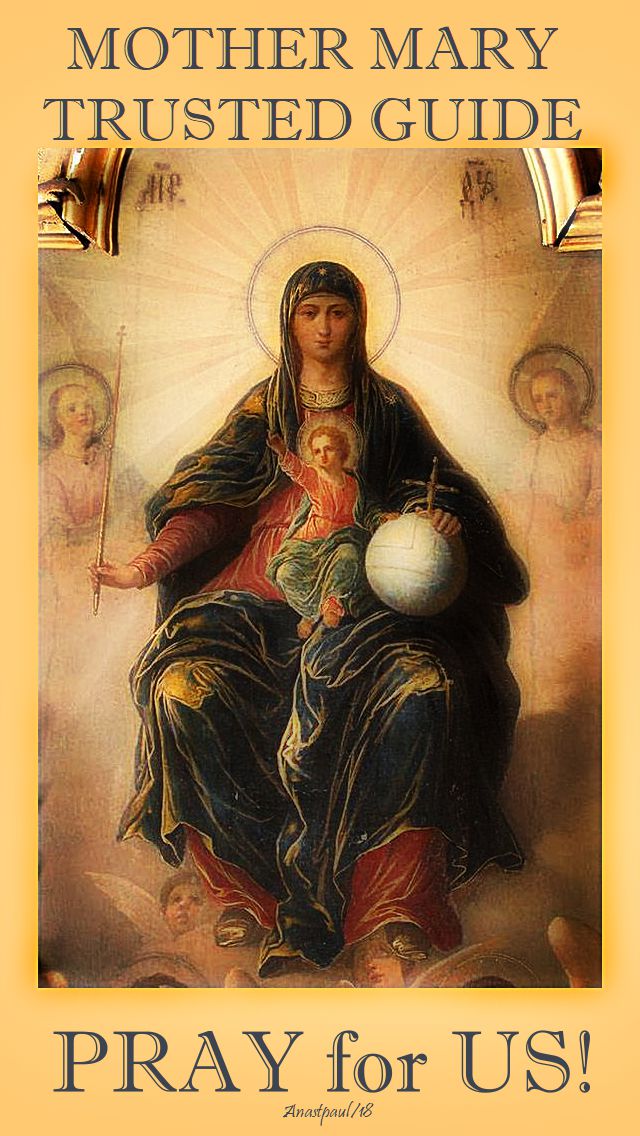
PRAYER – Father, All-Powerful and ever-living God, today we rejoice in the holy men and women of every time and place. May their prayers bring us your forgiveness and love. Blessed Virgin, Mother of God, our trusted guide and loving mother and all you holy Saints of the Church Triumphant, pray for us! We make our prayer through Christ our Lord, in union with the Holy Spirit, God forever, amen.
Our Morning Offering – 1 November – The Solemnity of All Saints
For All the Saints From the Breviary Evening Prayer I
For all the saints, who from their labours rest,
Who Thee by faith before the world confessed,
Thy Name, O Jesus, be forever blest.
Alleluia, alleluia!
Thou was their Rock, their Fortress and their Might,
Thou, Lord, their Captain in the well-fought fight,
Thou, in the darkness drear, their one true light.
Alleluia, alleluia!
O blest communion, fellowship divine!
We feebly struggle, they in glory shine,
Yet all are one in Thee, for all are Thine.
Alleluia, alleluia!
But lo! there breaks a yet more glorious day,
The saints triumphant rise in bright array,
The King of glory passes on His way:
Alleluia, alleluia!
All Saints Day (Solemnity) – (a Holy Day of Obligation) Instituted to honour all the saints, known and unknown. It owes its origin in the Western Church to the dedication of the Roman Pantheon in honour of the Blessed Virgin Mary and all the martyrs by Pope Saint Boniface IV in 609, the anniversary of which was celebrated at Rome on 13 May. Pope Saint Gregory III consecrated a chapel in the Vatican basilica in honour of All Saints, designating 1 November as their feast. Pope Gregory IV extended its observance to the whole Church. It has a vigil and octave and is a holy day of obligation – the eve is popularly celebrated as Hallowe’en. Patronage – Arzignano, Italy.
St Amabilis of Auvergne
St Austremonius
St Benignus of Dijon
St Cadfan
St Caesarius of Africa
St Caesarius of Damascus
St Ceitho
St Cledwyn of Wales
Bl Clemens Kyuemon
St Cyrenia of Tarsus
St Dacius of Damascus
St Deborah the Prophetess
St Dingad
Bl Dionysius Fugixima
St Floribert of Ghent
St Gal of Clermont
St Genesius of Lyon
St Germanus of Montfort
St Harold the King
St James of Persia
St Jerome Hermosilla
St John of Persia
St Julian of Africa
St Juliana of Tarsus
St Lluís Estruch Vives
St Marcel of Paris
St Mary the Slave
St Mathurin
St Meigan
St Nichole
St Pabiali of Wales
St Pere Josep Almató Ribera Auras
St Peter Absalon
Bl Peter Paul Navarra
Bl Petrus Onizuka Sadayu
St Rachel the Matriarch
St Ruth the Matriarch
St Salaun of Leseven
St Severinus of Tivoli
St Valentin Faustino Berri Ochoa
St Vigor of Bayeux
All Saints Day is connected to the doctrine of The Communion of Saints. This is the Catholic teaching that all of God’s people, on heaven, earth and in Purgatory are spiritually connected and united. In other words, Catholic and Orthodox Christians believe that the saints of God, are just as alive, as those on earth and are constantly interceding on our behalf. Our connection with the saints in heaven is grounded in an eucharistic communion. Because of our common communion with and through Jesus Christ, our prayers are joined with the heavenly community of Christians. St Cyril of Jerusalem (315-387), testifies to this belief:
“We mention those who have fallen asleep, first the patriarchs, prophets, apostles and martyrs, that through their prayers and supplications God would receive our petition..”.(Catechetical Lecture 23:9).
The Catholic Catechism concisely describes this communion among believers, by which we are connected to Christ and thus to one another:
“Being more closely united to Christ, those who dwell in heaven fix the whole Church more firmly in holiness… They do not cease to intercede with the Father for us… So, by their fraternal concern, our weakness is greatly helped.”
“…as Christian communion among our fellow pilgrims brings us closer to Christ, so our communion with the saints joins us to Christ, from whom as from its fountain and head issues all grace and the life of the People of God itself. We worship Christ as God’s Son, we love the martyrs as the Lord’s disciples and imitators and rightly so, because of their matchless devotion towards their king and master. May we also be their companions and fellow disciples.” (CCC 956, 957)
There are thousands of Canonised saints, that is, those individuals officially recognised by the Church as holy men and women worthy of our imitation. Because miracles have been associated with them and their lives have been fully examined and found holy by the Church, we have assurance they are prime examples of holiness and powerful intercessors before God on our behalf.
There are also many patron saints, guardians or protectors of different areas and states of life. For instance, St Vitus is the patron saint against oversleeping and St Joseph of Cupertino is the patron saint of air travellers. It may sound odd to have a patron saint “against oversleeping” but the Church has something meaningful for every area of our human lives.
Christians have been officially honouring saints and martyrs since at least the second century. The Martyrdom of St Polycarp, probably written near the middle of the second century, attests to this reality:
Accordingly, we afterwards took up his bones, more precious than the most exquisite jewels and more pure than gold and deposited them in a fitting place, so that when being gathered together, as opportunity is allowed us, with joy and rejoicing, the Lord shall grant us to celebrate the anniversary of his martyrdom, both in memory of those who have already finished their course and for the exercising and preparation of those yet to walk in their steps (18).
Initially the calendars of saints and martyrs varied by location, with churches honouring local saints. However, gradually feast days became more universal. The first reference to a general feast celebrating all saints occurs in St Ephrem the Syrian (306-373). St John Chrysostom (347-407) assigned a day to the feast, the first Sunday after Pentecost, where in the Eastern Churches the feast is celebrated to this day.
The earliest certain observance of a feast in honour of all the saints is an early fourth-century commemoration of “all the martyrs.” In the early seventh century, after successive waves of invaders plundered the catacombs, Pope Boniface IV gathered up some 28 wagon-loads of bones and re-interred them beneath the Pantheon, a Roman temple dedicated to all the gods. The pope rededicated the shrine as a Christian church. According to Venerable Bede, the pope intended “that the memory of all the saints might in the future be honoured in the place which had formerly been dedicated to the worship not of gods but of demons” (On the Calculation of Time).
In the Roman Catholic Church, the next day, All Souls’ Day, specifically commemorates the departed faithful who have not yet been purified and reached heaven. Catholics celebrate All Saints’ Day and All Souls’ Day in the fundamental belief that there is a prayerful spiritual communion between those in the state of grace who have died and are either being purified in purgatory or are in heaven (the ‘church penitent’ and the ‘church triumphant’, respectively) and the ‘church militant’ who are the living.
Thought for the Day – 28 October – Feast of Saints Simon and Jude, Apostles and Martyrs, Gospel: Luke 6:12-19
As the Father Sent Me, so I am Sending You
Saint Cyril of Alexandria (376-444)
Bishop, Father & Doctor of the Church
An excerpt from his Commentary on the Gospel of John
Our Lord Jesus Christ has appointed certain men to be guides and teachers of the world and stewards of His divine mysteries. Now He bids them to shine out like lamps and to cast out their light, not only over the land of the Jews but over every country under the sun and over people scattered in all directions and settled in distant lands. That man has spoken truly who said: No one takes honour upon himself, except the one who is called by God, for it was our Lord Jesus Christ who called His own disciples before all others to a most glorious apostolate. These holy men became the pillar and mainstay of the truth and Jesus said that He was sending them just as the Father had sent Him.
By these words, He is making clear, the dignity of the apostolate and the incomparable glory of the power given to them but He is also, it would seem, giving them a hint about the methods they are to adopt, in their apostolic mission. For if Christ thought it necessary to send out His intimate disciples in this fashion, just as the Father had sent Him, then surely, it was necessary, that they, whose mission was to be patterned on that of Jesus, should see exactly why the Father had sent the Son. And so Christ interpreted the character of His mission to us in a variety of ways. Once He said – I have come to call not the righteous but sinners to repentance. And then at another time He said – I have come down from heaven, not to do My own will but the will of Him who sent me. For God sent His Son into the world, not to condemn the world but that the world might be saved through Him.
Accordingly, in affirming that they are sent by Him just as He was sent by the Father, Christ sums up in a few words the approach they themselves should take to their ministry. From what He said, they would gather that it was their vocation to call sinners to repentance, to heal those who were sick, whether in body or spirit, to seek in all their dealing, never to do their own will but the will of Him who sent them and, as far as possible, to save the world by their teaching.
Surely it is in all these respects, that we find His holy disciples striving to excel. To ascertain this is no great labour, a single reading of the Acts of the Apostles or of Saint Paul’s writings is enough.
Quote/s of the Day – 28 October – Feast of Saints Simon and Jude, Apostles and Martyrs, Gospel: Luke 6:12-19
“Simon was worlds apart from Matthew, who, on the contrary, had an activity behind him as a tax collector that was frowned upon as entirely impure. This shows that Jesus called His disciples and collaborators, without exception, from the most varied social and religious backgrounds.
It was people who interested Him, not social classes or labels! And the best thing is that in the group of His followers, despite their differences, they all lived side by side, overcoming imaginable difficulties, indeed, what bound them together, was Jesus Himself, in whom they all found themselves united with one another.
This is clearly a lesson for us who are often inclined to accentuate differences and even contrasts, forgetting, that in Jesus Christ, we are given the strength to get the better of our continual conflicts.
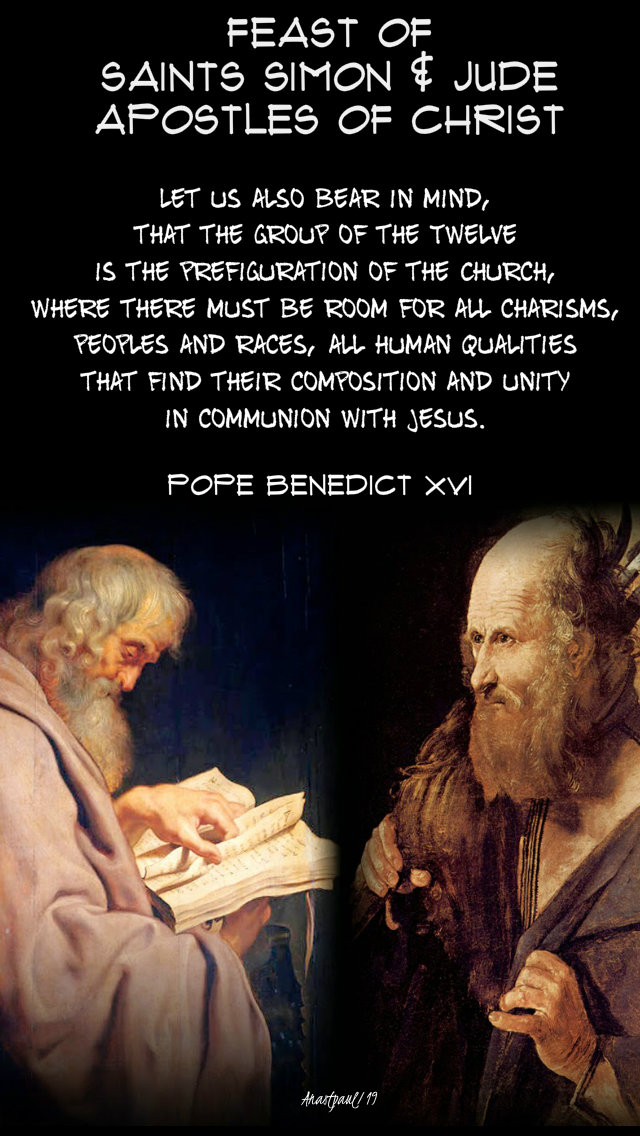
Let us also bear in mind, that the group of the Twelve, is the prefiguration of the Church, where there must be room for all charisms, peoples and races, all human qualities that find their composition and unity in communion with Jesus.”
Pope Benedict XVI
Catechesis on Saints Simon and Jude General Audience Saint Peter’s Square Wednesday, 11 October 2006
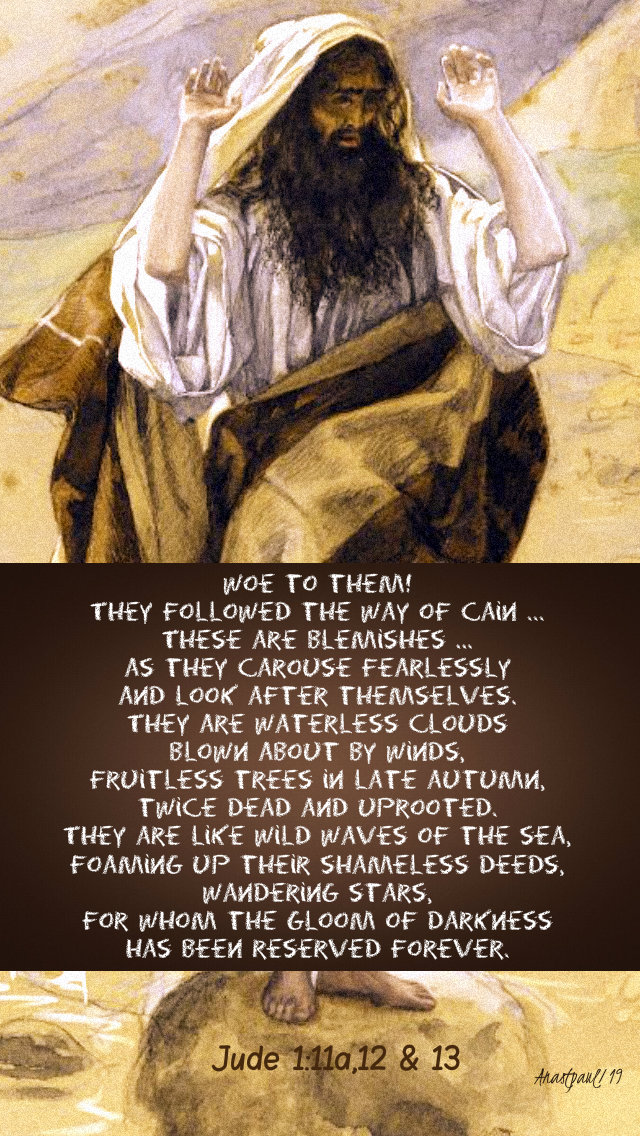
“Woe to them! They followed the way of Cain … These are blemishes … as they carouse fearlessly and look after themselves. They are waterless clouds blown about by winds, fruitless trees in late autumn, twice dead and uprooted. They are like wild waves of the sea, foaming up their shameless deeds, wandering stars, for whom the gloom of darkness has been reserved forever.”
One Minute Reflection – 28 October – Feast of Saints Simon and Jude, Apostles and Martyrs, Gospel: Luke 6:12-19
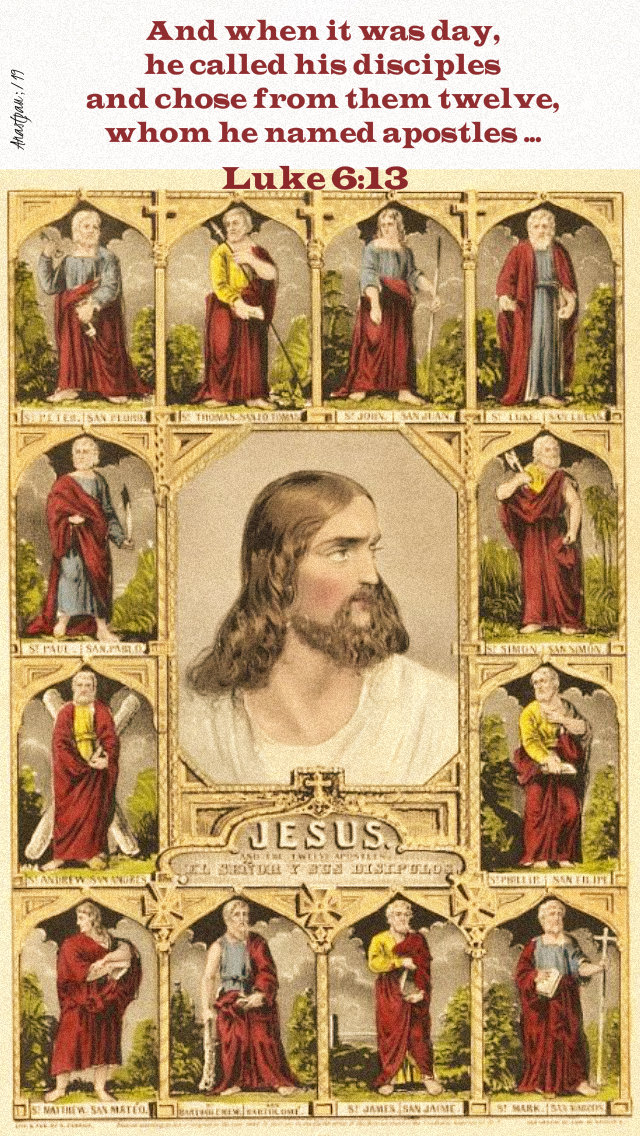
And when it was day, he called his disciples and chose from them twelve, whom he named apostle … Luke 6:13
REFLECTION – “Saint Paul said: “The weakness of God is stronger than all men” (1Cor 1:25). It is clear from this too that the gospel is divine. For whence did it strike twelve unlettered men to attempt such great enterprises, men who were living in marshes, or rivers, in desert places, who had never perhaps gone into a city or the public square? Whence did it strike them to array themselves against the whole world? That they were cowardly and unmanly, he who has written about them shows, inasmuch as he does not even deprecate nor try to gloss over their failings. This, in itself, is a powerful proof of the truth. What then does this man say about them? That after the innumerable miracles they had seen Christ work, when He was taken prisoner some fled, while the one who remained, although he was head over the rest, denied Him.
Here were men who failed to stand up to the Jews when Christ was alive. Yet when He died and was buried, they arrayed themselves against the whole world… Would they not have said to themselves: “What is this? He had not strength to save Himself, will He protect us? He did not defend Himself when He was alive, will He reach out His hand to us, now He is dead? When He was alive He did not conquer a single nation—shall we convince the whole world by speaking His name?”… Hence it is clear that, if they had not seen Him risen and received this mighty proof of His power, they would never have risked such a gamble.” … St John Chrysostom (c.345-407) Priest at Antioch then Bishop of Constantinople, Father & Doctor of the Church – Homily on the 1st letter to the Corinthians 4, 3
PRAYER – Lord God, You taught us to call upon Your name, through the preaching of the Apostles. Open our eyes each day, grant that we may see Jesus Your Son at our side, open our ears that we may hear His voice, open our mouths, that we may beg forgiveness and proclaim the good news, as we follow the way Your Son carved out for us. At the intercession of Sts Simon and Jude, may Your Church continue to grow and to hope in Your love. We make our prayer through Jesus our Lord, with the Holy Spirit, God forever, amen.
Our Morning Offering – 28 October – Feast of Saints Simon and Jude, Apostles and Martyrs
Come, let us worship the Lord, the King of Apostles.
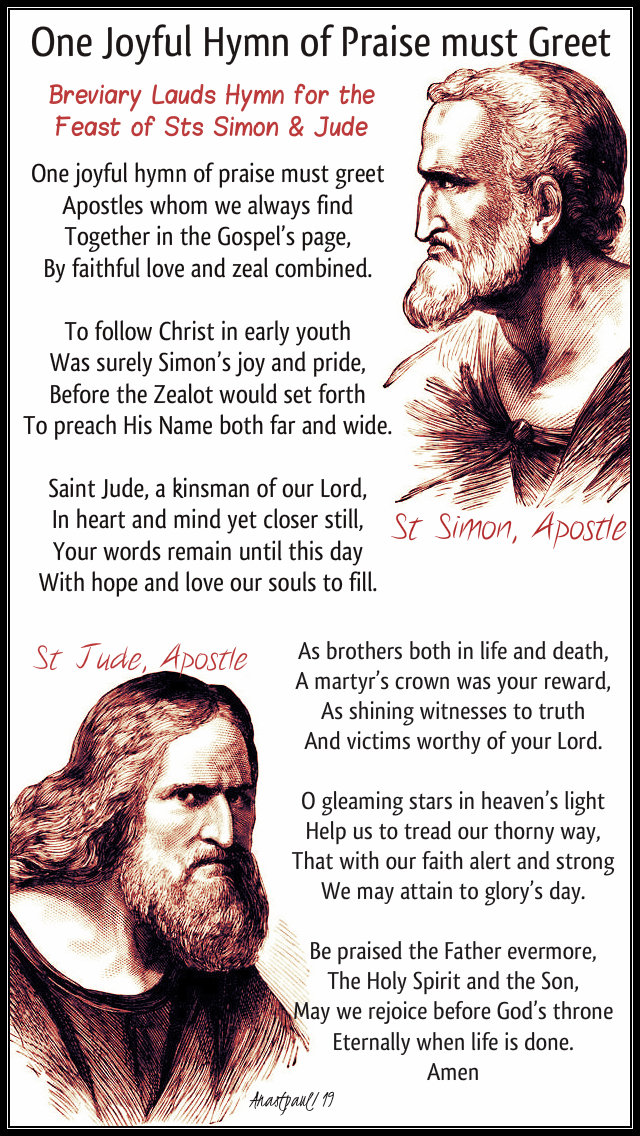
One Joyful Hymn of Praise must Greet Morning Hymn On the Feast of Sts Simon and Jude From the Breviary The Benedictines of Saint Cecilia’s Abbey, Ryde, UK
One joyful hymn of praise must greet
Apostles whom we always find
Together in the Gospel’s page,
By faithful love and zeal combined.
To follow Christ in early youth
Was surely Simon’s joy and pride,
Before the Zealot would set forth
To preach His Name both far and wide.
Saint Jude, a kinsman of our Lord,
In heart and mind yet closer still,
Your words remain until this day
With hope and love our souls to fill.
As brothers both in life and death,
A martyr’s crown was your reward,
As shining witnesses to truth
And victims worthy of your Lord.
O gleaming stars in heaven’s light
Help us to tread our thorny way,
That with our faith alert and strong
We may attain to glory’s day.
Be praised the Father evermore,
The Holy Spirit and the Son,
May we rejoice before God’s throne
Eternally when life is done.
Amen
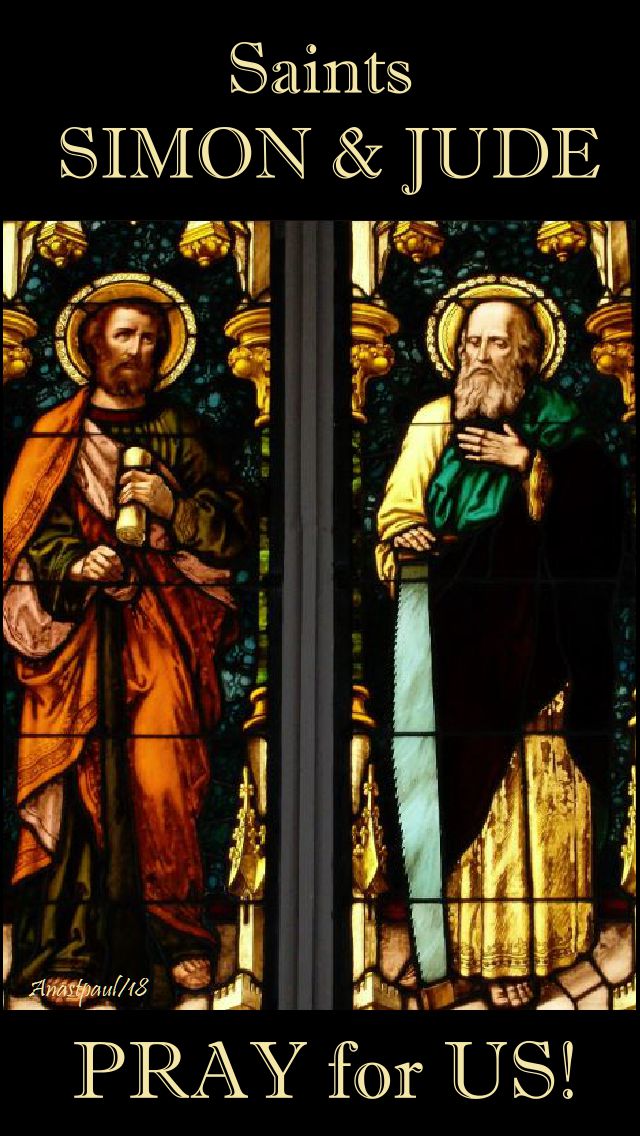
Feast of Saints Simon and Jude, Apostles of Christ – 28 October
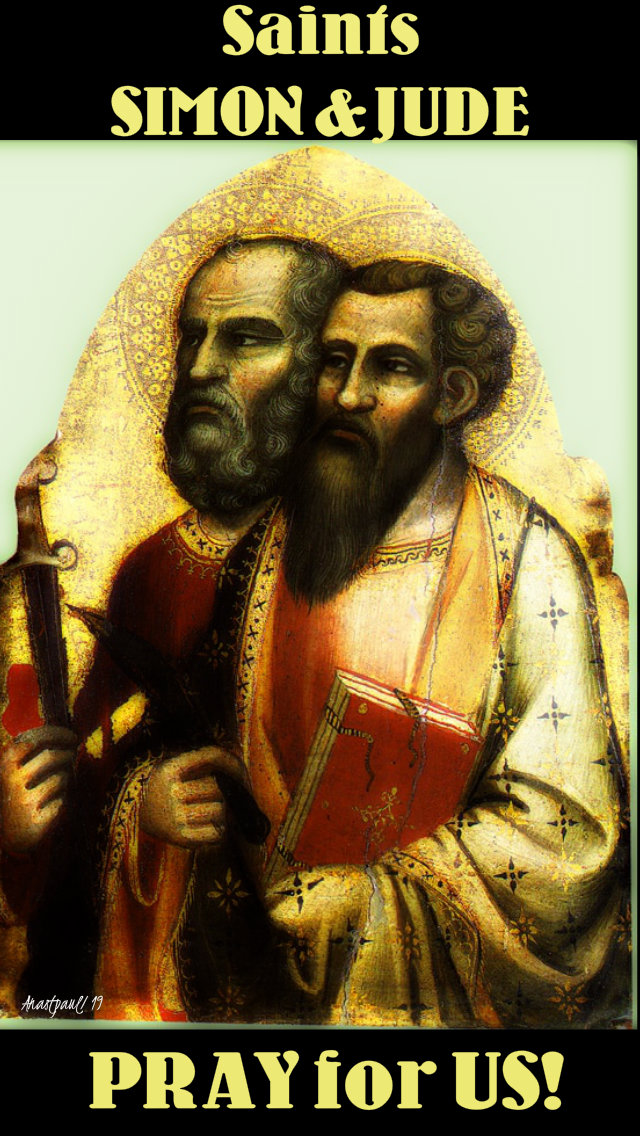
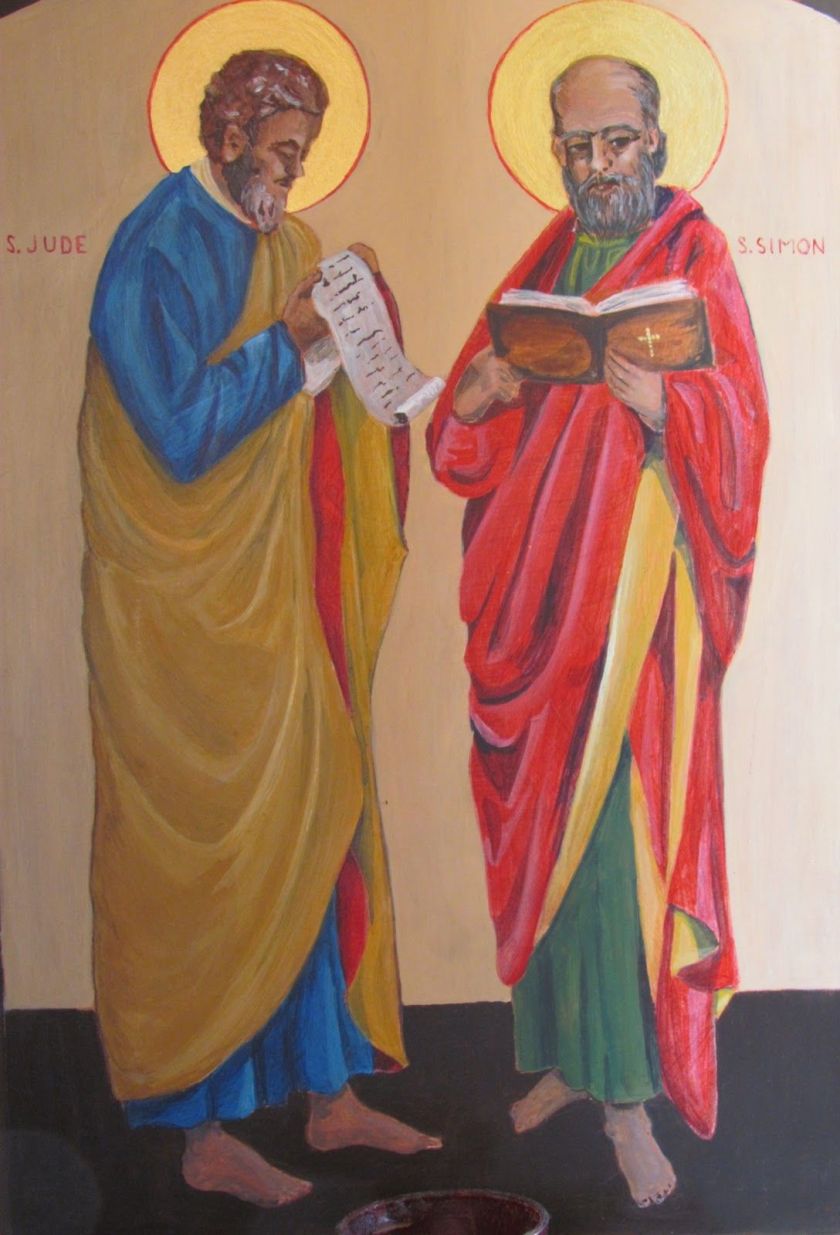
Today the Church celebrates the feast of Sts Simon and Jude whose names occur together in the Canon of the Mass and are also celebrated on the same day. These two Apostles have been linked in name since the early days of Christianity and some believe that this is because they were relatives of Jesus.
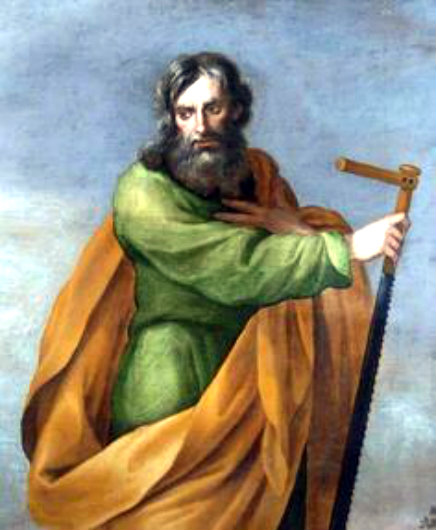
San Simón | Jusepe de Ribera / Image: Saint Jude Thaddeus | Georges de La Tour
St Simon in the Gospels is called “the Zealot” and this may indicate that he belonged to that military group of Jews called the Zealots, the last of whom committed suicide on Masada rather than surrender to the Roman legions. Legend has Simon evangelising the area around Edessa in Syria, where later a great school of theology arose. It is also said, that after preaching in Egypt, he joined St Jude in Mesopotamia and that they both went as missionaries to Persia and were martyred there. Undoubtedly, their names are linked also because of this association.
St Simon
Jude was most certainly a cousin of Jesus and is mentioned in the lists of the “brothers of the Lord.” In Luke he is called Jude and in Matthew and Mark, ‘Thaddeus’ and is considered to be the brother of James, the first Bishop of Jerusalem and the leader of the early Christian community there – this is James the Lesser, not the brother of St John. He is the author of the Epistle of Jude in the New Testament, one of those called the ‘Catholic Epistles.’ It is believed that the early translators of the New Testament from Greek into English, sought to distinguish him from Judas Iscariot and subsequently abbreviated his forename. In iconography, , St Jude is often shown with an image of his cousin, our Lord Jesus and a tongue of fire over his head.
At the Last Supper, it was Jude who asked the Lord Jesus, why He did not manifest Himself to the rest of the world and Jesus answered that he and the Father would visit all those who loved Him, saying – “We will come to him and make our abode with him.”
Jude is the patron of ‘hopeless cases’ and devotion to him, as the advocate of impossible causes, is widespread throughout the Church. So why is St Jude Thaddaeus the patron saint of desperate causes? The traditional reason is rather simple – When one hears the name Judas (Latin and Greek) or even Jude (English), one immediately thinks of Judas Iscariot who betrayed our Lord. Therefore, a person had to be desperate to invoke his name. Being so seldom invoked and reverenced, St Jude is ready and waiting to hear the prayers of those who call upon him. Ironically, he is probably the Apostle who is invoked the most in prayer and the most memorialised in churches, with statues and stained glass windows or other artworks.
It is a beautiful tradition, associated with prayer to St Jude, for his intercession, to leave a copy of the prayer in a Church, or before his Statue, Picture or Shrine, for someone else in great need, to find. The prayer is usually prayed as a Novena.
Prayer to St Jude
Patron of Impossible Causes
Most holy Apostle, St Jude,
faithful servant and friend of Jesus,
the Church honours and invokes you universally,
as the patron of hopeless causes,
of things almost despaired of.
Pray for me, I am so helpless and alone.
Help me, I implore you,
by that particular privilege given to you,
to bring visible and speedy help
where help is almost despaired of.
Come to my assistance in this great need,
that I may receive the consolation
and help of Heaven in all my necessities,
tribulation and sufferings,
particularly ………………… (state request)
and that I may praise God with you
and all the elect forever.
I promise, O blessed St Jude,
to be ever mindful of this great favour,
to always honour you as my special and powerful patron
and to gratefully encourage devotion to you.
Amen
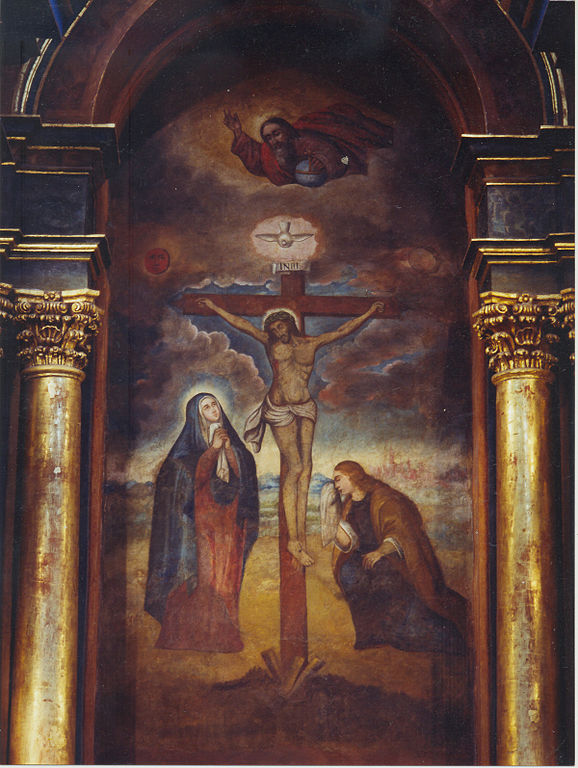
Lord of Miracles/Señor de los Milagros de Nazarenas: A mid-17th-century painting of the Crucifixion that is venerated in Lima, Peru and its celebration involves one of the largest processions in the world.
It was painted by an unnamed African taken to Peru as a slave from what is now Angola. Above the Cross is the Holy Spirit and God the Father. Below and to the right of Jesus, is His mother, the Virgin Mary with her heart pierced by a sword of sorrow. Kneeling and weeping at the foot of the cross is St Mary Magdalene.
The name originated on 13 November 1655 when everything around it was destroyed in an earthquake that left the painting standing and undamaged. Christ is shown enduring the pain of crucifixion.
Every year in October, hundreds of thousands of devotees from all races and economic backgrounds participate in a procession honouring the image through the streets of Lima. Boulevards are decorated in purple on 18,19 and the final Feast 28 October to celebrate the Lord of Miracles.
St Abdias of Babylon
St Abraham of Ephesus
St Alberic of Stavelot
St Anastasia the Elder
St Anglinus of Stavelot
St Cyril of Rome
St Cyrilla of Rome
St Diomedes the Younger
St Dorbhene of Iona
St Eadsin of Canterbury
St Elius of Lyon
St Faro of Meaux
St Ferrutius
St Fidelis of Como
St Genesius of Thiers
Bl Germain of Talloires
St Gioan Dat
St Godwin of Stavelot
St Maria Ascuncion
St Remigius of Lyons
St Rodrigo Aguilar Aleman
St Salvius of Amiens
—
Martyrs of Avila – 3 saints: Two sisters and a brother who, during a period of persecution, fled Talavera de la Reina, Spain, were caught and executed. Martyrs: Christeta, Sabina and Vincent. 303 in Avila, Spain.
Martyred in the Spanish Civil War:
• Blessed Claudio Julían García San Román
• Blessed Maria Asuncion
Thought for the Day – 24 October – The Feast of the Holy Redeemer
St John Paul II from ‘Redemptor Hominis’ his first Enycyclical, ‘The Redeemer of Humankind.’ In it he dealt with the core of our faith, the Person of Jesus Christ, the Redeemer of the World.
10 . The human dimension of the mystery of the Redemption
We cannot live without love. We remain beings that are incomprehensible for ourselves, our lives are senseless, if love is not revealed to us, if we do not encounter love, if we do not experience it and make it our own, if we do not participate intimately in it. This, as has already been said, is why Christ the Redeemer “fully reveals man to himself”, ‘fully reveals us to ourselves’.
If we may use the expression, this is the human dimension of the mystery of the Redemption. In this dimension we find again the greatness, dignity and value that belong to our humanity.
In the mystery of the Redemption we become newly “expressed” and, in a way, are newly created. We are newly created! “There is neither Jew nor Greek, there is neither slave nor free, there is neither male nor female; for you are all one in Christ Jesus”64.
If we wish to understand ourselves thoroughly-and not just in accordance with immediate, partial, often superficial and even illusory standards and measures of his being-we must with our unrest, uncertainty and even our weakness and sinfulness, with our life and death, draw near to Christ. We must, so to speak, enter into Him with all His own self, we must “appropriate” and assimilate the whole of the reality of the Incarnation and Redemption in order to find ourselves. If this profound process takes place within us, we then bear fruit not only of adoration of God but also of deep wonder at ourselves.
How precious must we be in the eyes of the Creator, if we “gained so great a Redeemer” and if God “gave his only Son “in order that we “should not perish but have eternal life”.
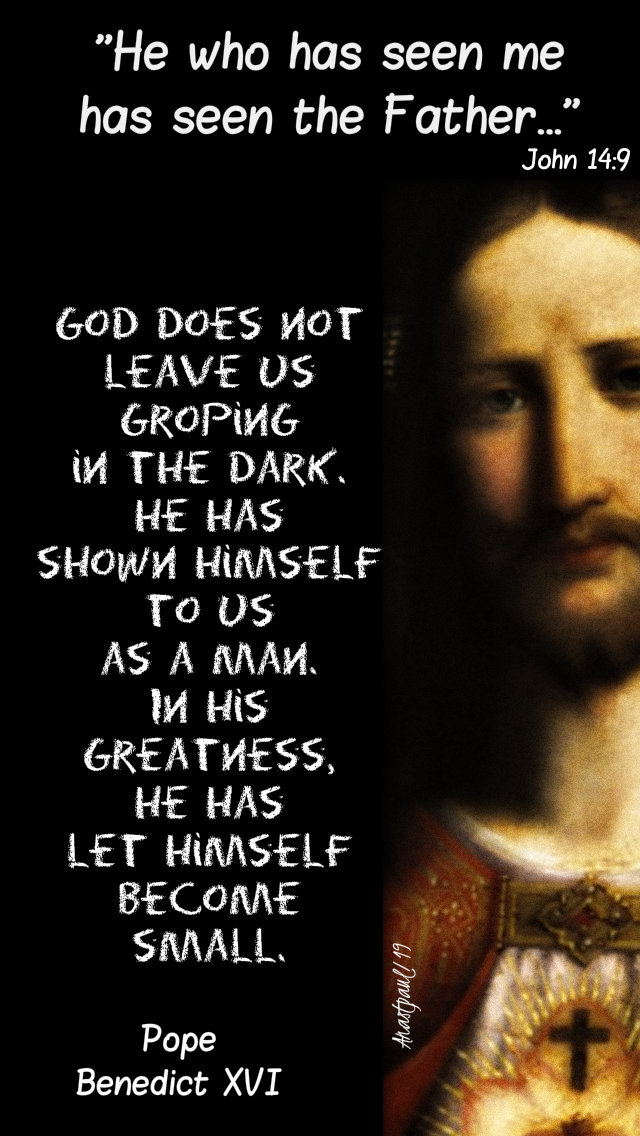
God does not leave us groping in the dark. He has shown Himself to us as a man. In His greatness, He has let Himself become small. ... Pope Benedict XVI
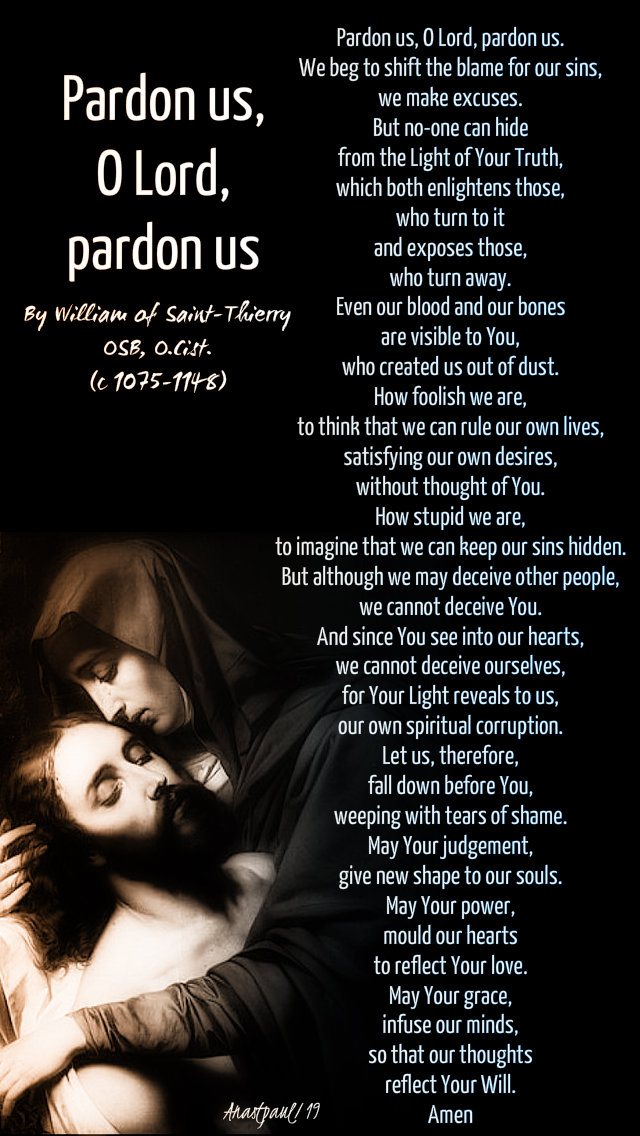
Pardon us, O Lord, Pardon us By William of Saint-Thierry OSB, O.Cist. (c 1075-1148) Abbot, Monk, Theologian, Mystic, Writer Friend of St Bernard of Clairvaux (1090-1153)
Pardon us, O Lord, pardon us.
We beg to shift the blame for our sins,
we make excuses.
But no-one can hide
from the Light of Your Truth,
which both enlightens those,
who turn to it and exposes those,
who turn away.
Even our blood and our bones
are visible to You,
who created us out of dust.
How foolish we are,
to think that we can rule our own lives,
satisfying our own desires,
without thought of You.
How stupid we are,
to imagine that we can keep our sins hidden.
But although we may deceive other people,
we cannot deceive You.
And since You see into our hearts,
we cannot deceive ourselves,
for Your Light reveals to us,
our own spiritual corruption.
Let us, therefore, fall down before You,
weeping with tears of shame.
May Your judgement,
give new shape to our souls.
May Your power, mould our hearts
to reflect Your love.
May Your grace, infuse our minds,
so that our thoughts reflect Your Will.
Amen
Quote of the Day – 23 October – The Feast of the Most Holy Redeemer
“Yes, my gentle Redeemer, let me say it, You are crazy with love! Is it not foolish for You to have wanted to die for me? But if You, my God, have become crazy with love for me, how can I not become crazy with love for You?”
St Alphonsus Liguori (1696-1787)
Most Zealous Doctor
Our Morning Offering – 23 October – Wednesday of the Twenty Ninth Week in Ordinary Time, Year C and the Feast of the Most Holy Redeemer celebrated today by the Redemptorists
Jesus, My Saviour, Help Me By St Alphonsus Liguori (1696-1787) Most Zealous Doctor
Jesus, my Saviour, help me.
I am resolved truly to love You
and to leave all to please You.
Help me to free myself
from everything that hinders me
from belonging wholly to You
who have loved me so much.
By your prayers, O Mother Mary,
which are so powerful with God,
obtain for me this grace
to belong wholly to God.
Amen
The Feast of the Most Holy Redeemer was a Catholic liturgical feast. It is celebrated in Venice as the Festa del Redentore. It is also celebrated by the Redemptorists and was celebrated in the City of Rome.
The feast is found only in the special calendar of some dioceses and religious orders and is celebrated with proper Mass and Office either on the third Sunday of July or on 23 October. In Venice this feast has been observed for more than four centuries with great solemnity. In 1576 a plague broke out in Venice which in a few days carried off thousands of victims. To avert this scourge the Senate vowed to erect a splendid temple to the Redeemer of mankind and to offer therein, each year, on the third Sunday of July public and solemn services of thanksgiving. Scarcely had the plague ceased, when they began to fulfil their vow. The church was designed by the famous Andrea Palladio and the corner-stone was laid by the Patriarch Trevisan on 3 May 1577. The celebrated painters Paolo Veronese and Jacopo Tintoretto decorated the interior. The church was consecrated in 1592 and, at the urgent solicitations of Pope Gregory XIII, placed in charge of the Capuchin Fathers.
By concession of Pope Benedict XIV, dated 8 March 1749, the Congregation of the Most Holy Redeemer solemnises this feast as a double of the first class with an octave on the third Sunday of July. The same congregation also keeps the feast as a greater double on 23 October and 25 February and has, besides, the privilege of reciting once a month the votive office of the Most Holy Redeemer.
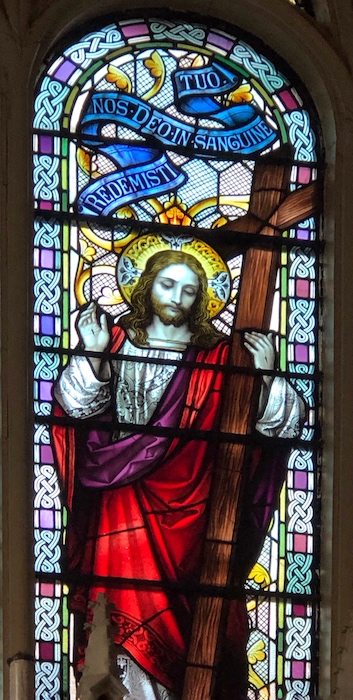
‘You have redeemed us Lord, in Your Blood’
In Rome also Pope Pius VIII introduced the feast and by a Decree of 8 May 1830, the Sacred Congregation of Rites assigned it to 23 October. The characteristics of the Mass and Office are joy and gratitude for the ineffable graces and benefits of the Redemption. This appears especially from the Introit “Gaudens gaudebo”, from the antiphons of Lauds “Cantate Domino”, from the Epistle of the Mass, taken from St Paul to the Ephesians, (chapter 1), “Blessed be the God and Father of our Lord Jesus Christ, Who hath blessed us with spiritual blessings . . . in Christ”. For this reason white is the colour of the vestments and not red, as in the Mass of the Passion.
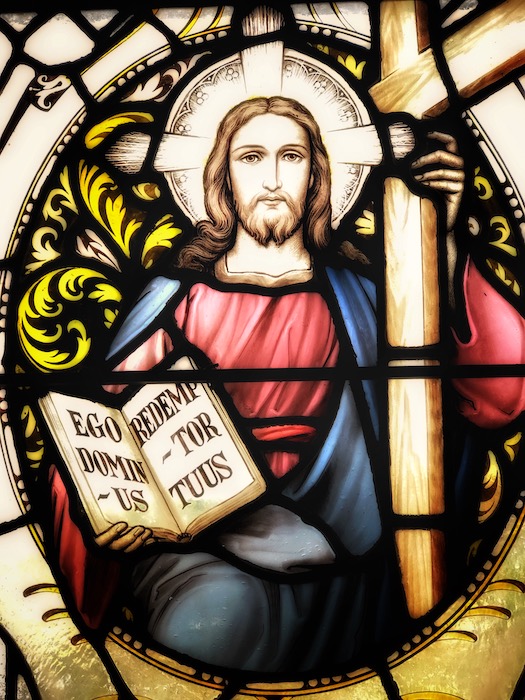
‘I, the Lord, am your Redeemer’
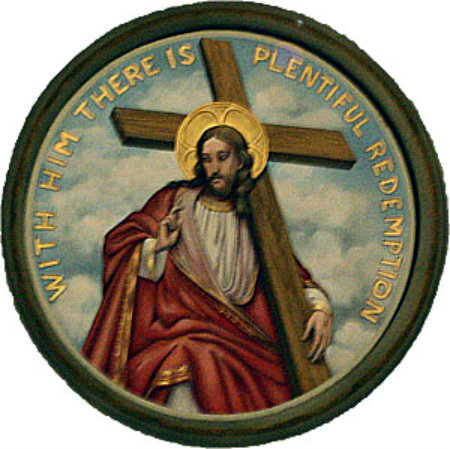
Why do Redemptorists celebrate the Feast of the Most Holy Redeemer?
Who are Redemptorists?
A young priest, Alphonsus de Liguori, 36 years of age, gathered a group of companions around him in November of 1732. He was passionate about reaching out to people who were abandoned, socially and religiously, in the countryside all around the then-great city of Naples, in Italy. They were ‘like sheep without a shepherd’. After a shaky start -his first companions left him -he gathered a group of like-minded men around him, who had the same passion, to go out to people, to share the Good News of Jesus of Nazareth with them, to show them the divine dignity that was in each human being and to share with them, the wonder of being redeemed, being set free, by the blood that Jesus shed for all people, everywhere.
That was the dream then. That is still the same dream now. Redemptorists all over the world (about 6000 in number) and their companions work to bring the joy of the Gospel to everyone we meet. ‘Caritas Christi urget nos’ –Christ’s love drives us.
‘Simon, do you love me?’ asked Jesus of Simon Peter. ‘Yes, Lord, you know that I love you’. ‘Feed my sheep!’ That’s what the young Alphonsus taught, again and again, that Redemptorists are to be about – if we love Jesus Christ (‘Jesus Christ is the centre of your life’ as a group – this is in our Constitutions), If we love Him, we will feed his people constantly. Hold us to it!
Why the name ‘Redemptorists’? The full title in Latin is ‘Congregatio Santissimi Redemptoris’ – a congregation of priests and brothers, under the title of ‘The Most Holy Redeemer’. In Italy, we are known as the Missionari Redentoristi, (playing on the word Redemptoris, in the Latin) and in Ireland we call ourselves ‘Redemptorist Missionaries’. Our middle name is SENT – just like Jesus! Everything about us is meant to reflect that -the way we live, the way we work, the way we pray, the joy in us, our community life together around the person of Jesus, the Redeemer. ‘The Son of Man did not come to be served but to serve’, Jesus said.
And St Mark tells us, about the calling of the Twelve Apostles: ‘he called them to be with him and to go out.’ ‘ To be with him’ in our lives, in our prayer and preparation, ‘to go out’ in our efforts always to reach out, to go to people, to be with them along the road of life, to go out physically to people, to reach out by all media available.
The Nuns of the Redemptoristine Order were founded one year before us. They live enclosed lives of prayer for the whole world. In Ireland, they are in Drumcondra, in St Alphonsus’ Monastery, St Alphonsus Road.
Both the Redemptoristines and the Redemptorists are constantly praying that young women and young men, in their twenties and older, will come and share the passion in us for people. We want the work of the Most Holy Redeemer to continue into future generations. … (Redemptorists, Ireland).
‘Every new generation is a continent to be won for Christ!’ (St John Paul II)
St Benedict of Sebaste
St Clether
St Domitius
St Elfleda
St Ethelfleda
St Gratien of Amiens
St Henry of Cologne
St Ignatius of Constantinople
Bl John Angelo Porro
Bl John Buoni
St John of Syracuse
Oda of Aquitaine
St Phaolô Tong Viet Buong
St Romanus of Rouen
Bl Severinus Boethius
St Severinus of Cologne
Syra of Faremoutiers
St Theodoret of Antioch
Bl Thomas Thwing
St Verus of Salerno
—
Martyrs of Cadiz – 2 saints
Germanus
Servandus
Martyrs of Hadrianopolis – 2 saints
Dorotheus
Severus
Martyrs of Nicaea – 3 saints
Euerotas
Socrates
Theodota
Martyrs of Valenciennes – 6 beati: A group of Urusuline and Briggittine nuns murdered together in the anti-Christian excesses of the French Revolution. They were guillotined on 23 October 1794 in Valenciennes, Nord, France and Beatified on 13 June 1920 by Pope Benedict XV.
• Anne-Joseph Leroux
• Clotilde-Joseph Paillot
• Jeanne-Louise Barré
• Marie-Augustine Erraux
• Marie-Liévine Lacroix
• Marie-Marguerite-Joseph Leroux
Martyred in the Spanish Civil War including Martyrs of Manzanares (7 beati):
• Agapit Gorgues Manresa
• Agustín Nogal Tobar
• Andrés Navarro Sierra
• César Elexgaray Otazua
• Cristóbal González Carcedo
• Dorinda Sotelo Rodríguez
• Eduardo Valverde Rodríguez
• Felipe Basauri Altube
• José María Fernández Sánchez
• Juan Nuñez Orcajo
• Leonardo Olivera Buera
• Manuel Navarro Martínez
• Roque Guillén Garcés
• Toribia Marticorena Sola
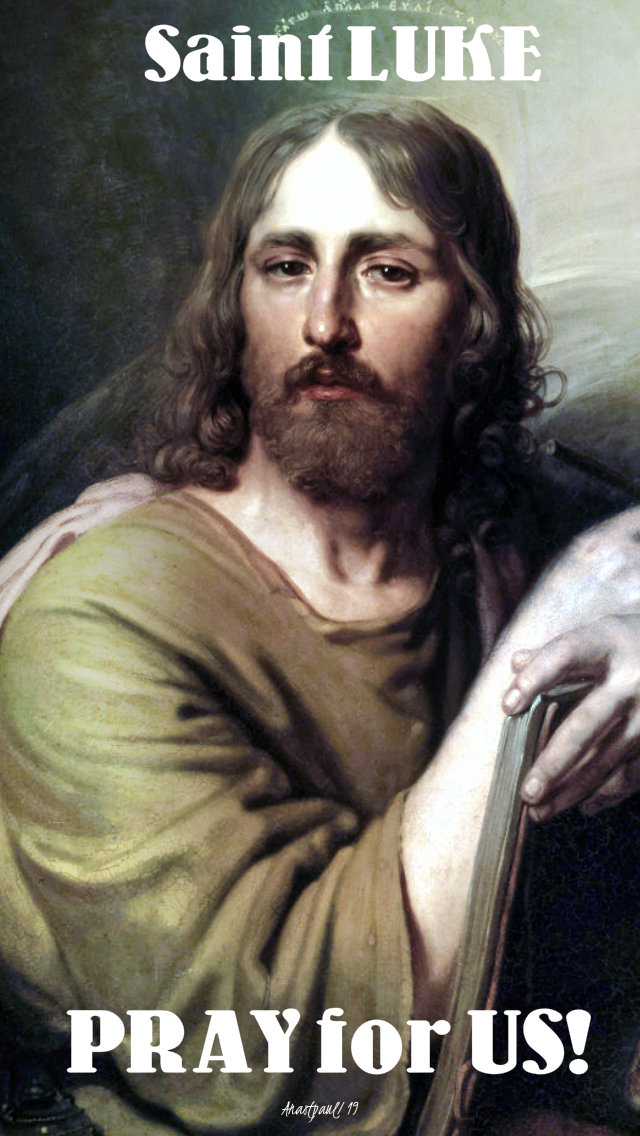
Thought for the Day – 18 October – Feast of St Luke the Evangelist
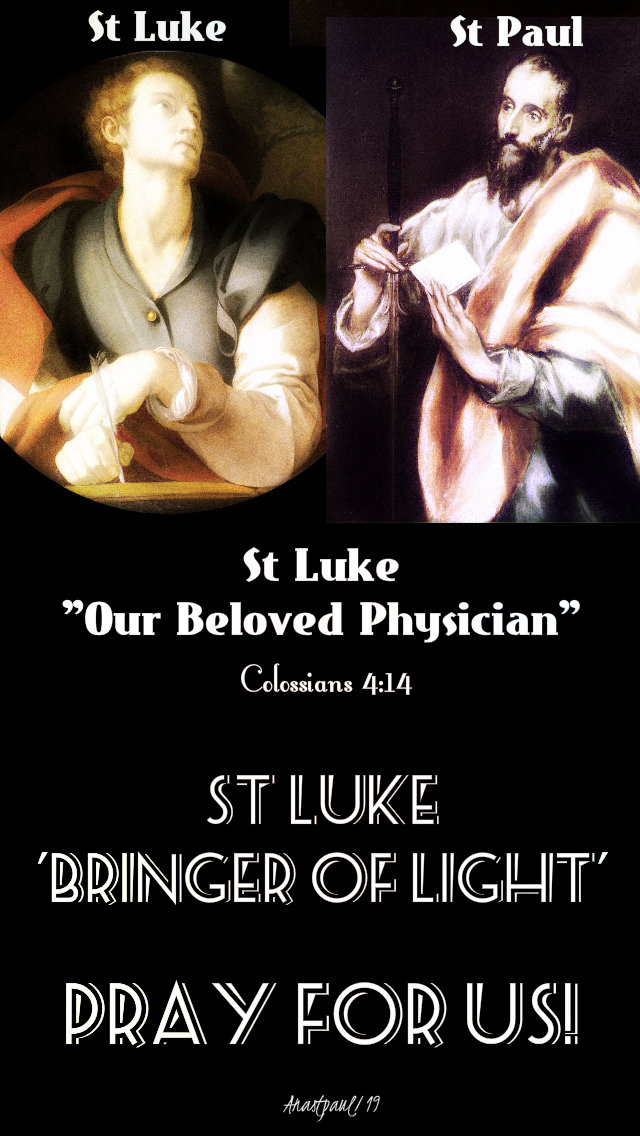
“Our Beloved Physician” – Bringer of Light
Luke wrote as a Gentile for Gentile Christians. His Gospel and Acts of the Apostles reveal his expertise in classic Greek style, as well as his knowledge of Jewish sources. There is a warmth to Luke’s writing that sets it apart from that of the other synoptic Gospels and yet, it beautifully complements those works. The treasure of the Scriptures is a true gift of the Holy Spirit to the Church.
Luke wrote one of the major portions of the New Testament, a two-volume work comprising the third Gospel and Acts of the Apostles. In the two books, he shows the parallel between the life of Christ and that of the Church. He is the only Gentile Christian among the Gospel writers. Tradition holds him to be a native of Antioch and Paul calls him “our beloved physician (Col 4:14).” His Gospel was probably written between 70 and 85.
Luke appears in Acts, during Paul’s second journey, remains at Philippi for several years, until Paul returns from his third journey, accompanies Paul to Jerusalem and remains near him when he is imprisoned in Caesarea. During these two years, Luke had time to seek information and interview persons, who had known Jesus. He accompanied Paul on the dangerous journey to Rome where he was a faithful companion.
Luke’s unique character may best be seen by the emphases of his Gospel, which has been given a number of subtitles:
1) The Gospel of Mercy
2) The Gospel of Universal Salvation
3) The Gospel of the Poor
4) The Gospel of Absolute Renunciation
5) The Gospel of Prayer and the Holy Spirit
6) The Gospel of Joy
One Minute Reflection – 18 October – The Feast of St Luke the Evangelist, Gospel: Luke 10:1-9
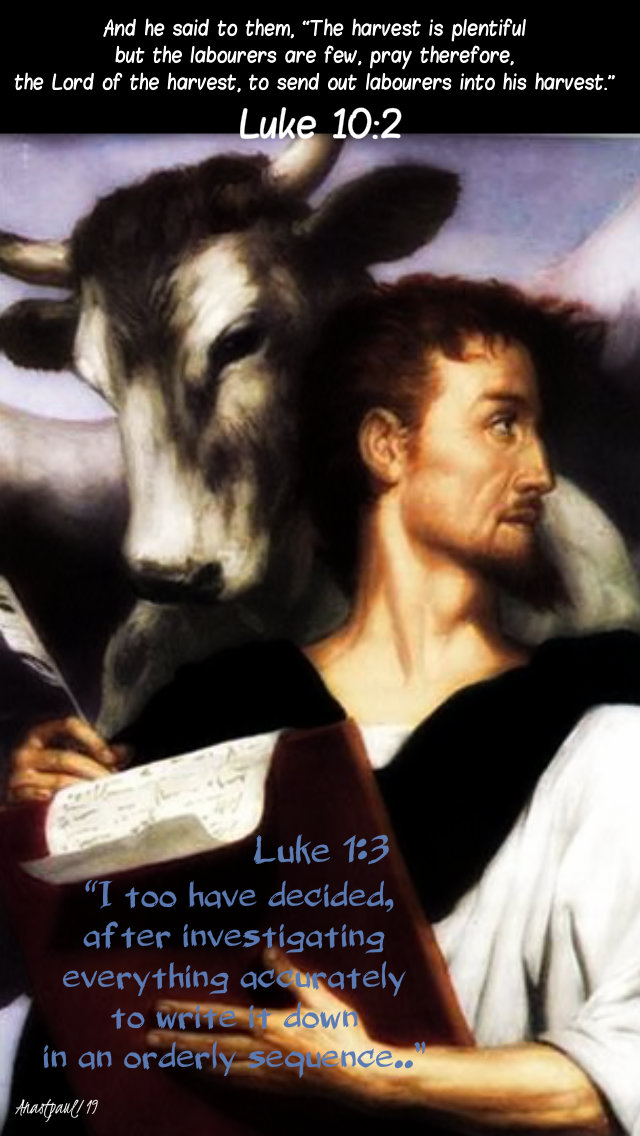
And he said to them, “The harvest is plentiful but the labourers are few, pray therefore, the Lord of the harvest, to send out labourers into his harvest.” … Luke 10:2
Saint Luke’s testimony – “I too have decided, after investigating everything accurately to write it down in an orderly sequence” (Luke 1:3)
REFLECTION – “Among all the Scriptures, even those of the New Testament, the Gospels have a special pre-eminence and rightly so, for they are the principal witness for the life and teaching of the incarnate Word, our Saviour. The Church has always and everywhere, held and continues to hold, that the four Gospels are of apostolic origin. For what the Apostles preached in fulfilment of the commission of Christ, afterwards, they themselves and apostolic men, under the inspiration of the divine Spirit, handed on to us in writing – the foundation of faith, namely, the fourfold Gospel, according to Matthew, Mark, Luke and John.
Holy Mother Church has firmly and with absolute constancy, held and continues to hold, that the four Gospels just named, whose historical character the Church unhesitatingly asserts, faithfully hand on what Jesus Christ, while living among men, really did and taught for their eternal salvation until the day He was taken up into heaven (Acts 1:1-2). Indeed, after the Ascension of the Lord the Apostles handed on to their hearers what He had said and done. This they did with that clearer understanding which they enjoyed after they had been instructed by the glorious events of Christ’s life and taught by the light of the Spirit of truth (Jn 14:26).
The sacred authors wrote the four Gospels, selecting some things from the many which had been handed on by word of mouth or in writing, reducing some of them to a synthesis, explaining some things in view of the situation of their churches and preserving the form of proclamation but always, in such fashion, that they told us the honest truth about Jesus. For their intention in writing, was that either from their own memory and recollections, or from the witness of those who “themselves from the beginning were eyewitnesses and ministers of the Word” we might know “the truth concerning those matters about which we have been instructed” (Lk 1, 1-4). … Vatican Council II – Dogmatic Constitution on Revelation “ Dei Verbum ” # 18-19
PRAYER – Lord God, You chose St Luke to reveal the mystery of Your love in his preaching and his writings. Grant, we pray, that we may grow in love for the Holy Face of Christ, His words and His directions, revealed to us in the Gospels, in the example of your saints. Today, on his feast, we especially look to St Luke, to guide, teach and pray for us. We make our prayer through our Lord Jesus Christ, with the Holy Spirit, one God with You, forever and ever, amen.
Our Morning Offering – 18 October – The Feast of St Luke,
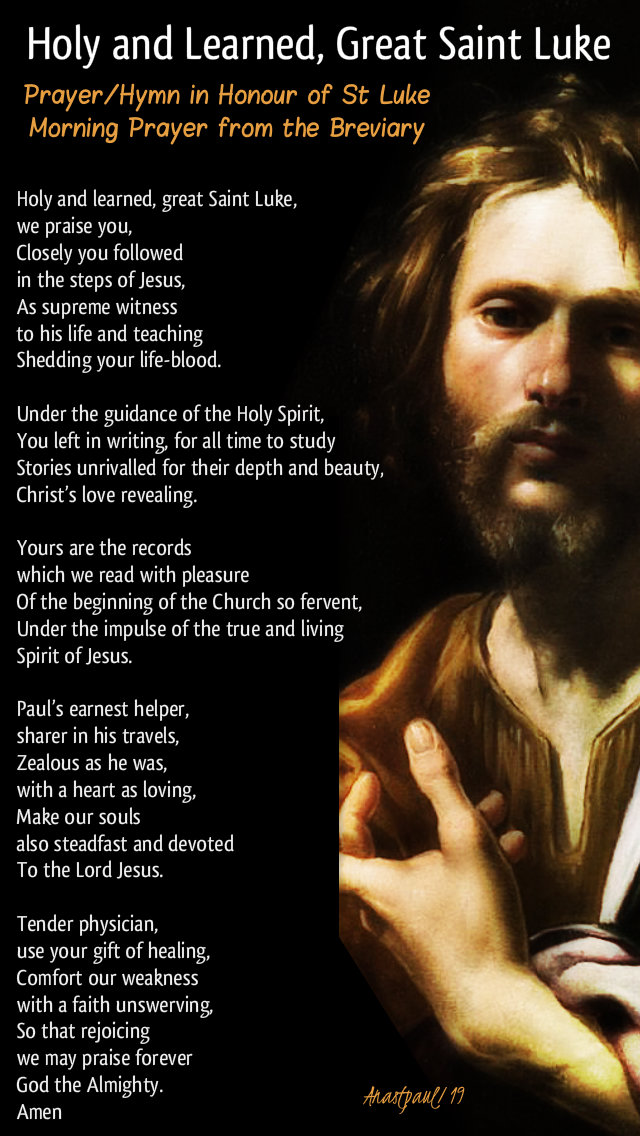
Holy and Learned, Great Saint Luke Prayer/Hymn in Honour of St Luke Morning Prayer from the Breviary
Holy and learned, great Saint Luke, we praise you,
Closely you followed in the steps of Jesus,
As supreme witness to his life and teaching
Shedding your life-blood.
Under the guidance of the Holy Spirit,
You left in writing, for all time to study
Stories unrivalled for their depth and beauty,
Christ’s love revealing.
Yours are the records which we read with pleasure
Of the beginning of the Church so fervent,
Under the impulse of the true and living
Spirit of Jesus.
Paul’s earnest helper, sharer in his travels,
Zealous as he was, with a heart as loving,
Make our souls also steadfast and devoted
To the Lord Jesus.
Tender physician, use your gift of healing,
Comfort our weakness with a faith unswerving,
So that rejoicing we may praise forever
God the Almighty.
Amen



 Through Jesus Christ, our Lord, in union with the Holy Spirit, one God for all eternity, amen.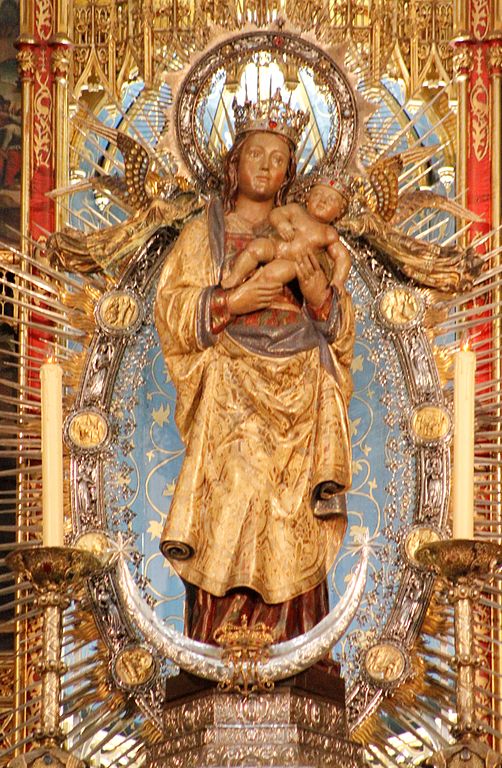











 AnaStpaul
You must be logged in to post a comment.