Posted in FEASTS and SOLEMNITIES, MORNING Prayers, PRAYERS of the CHURCH, SAINT of the DAY

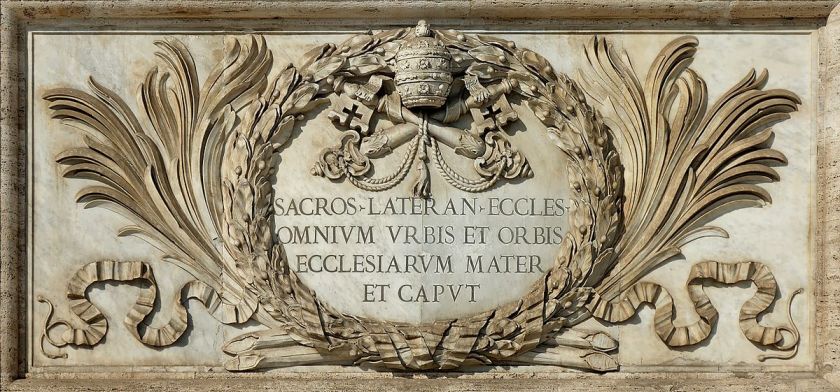
Thought for the Day – 9 November – Feast of the Dedication of the Basilica of Saint John Lateran – “omnium urbis et orbis ecclesiarum mater et caput…the Mother and head of all the Churches of the City and the World.”

Thought for the Day – 9 November – Feast of the Dedication of the Basilica of Saint John Lateran – “omnium urbis et orbis ecclesiarum mater et caput…the Mother and head of all the Churches of the City and the World.”

Saint Augustine gives us a few a ideas to meditate on: “‘Jerusalem that is being built as a city.’   When David was uttering these words, that city had been finished, it was not being built.   It is some city he speaks of, therefore, which is now being built, unto which living stones run in faith, of whom Peter says, ‘You also, as living stones, are built up into a spiritual house, that is, the holy temple of God’.   What does it mean, you are built up as living stones?   You live, if you believe, but if you believe, you are made a temple of God; for the Apostle Paul says, ‘For God’s temple is holy, and you are that temple’.

Unlike the commemorations of other Roman churches, this anniversary is a Feast.   The dedication of a church is a Feast for all its parishioners.   In a sense, St John Lateran is the parish church of all Catholics because it is the Pope’s Cathedral.   This church is the spiritual home of the people who are the Church.

We celebrate the dedication of this Church as the seat of the Bishop of Rome from which all other pastoral authority is derived.   We honour the anniversary of a church’s dedication because a church gives full voice to the sacred Liturgy.   The feast of the dedication gives full acceptance and capacity to live the ancient theological principle, legem credendi lex statuat supplicandi (the law of belief given through the law of prayer, or even more of short-hand, the law of prayer is the law of belief).

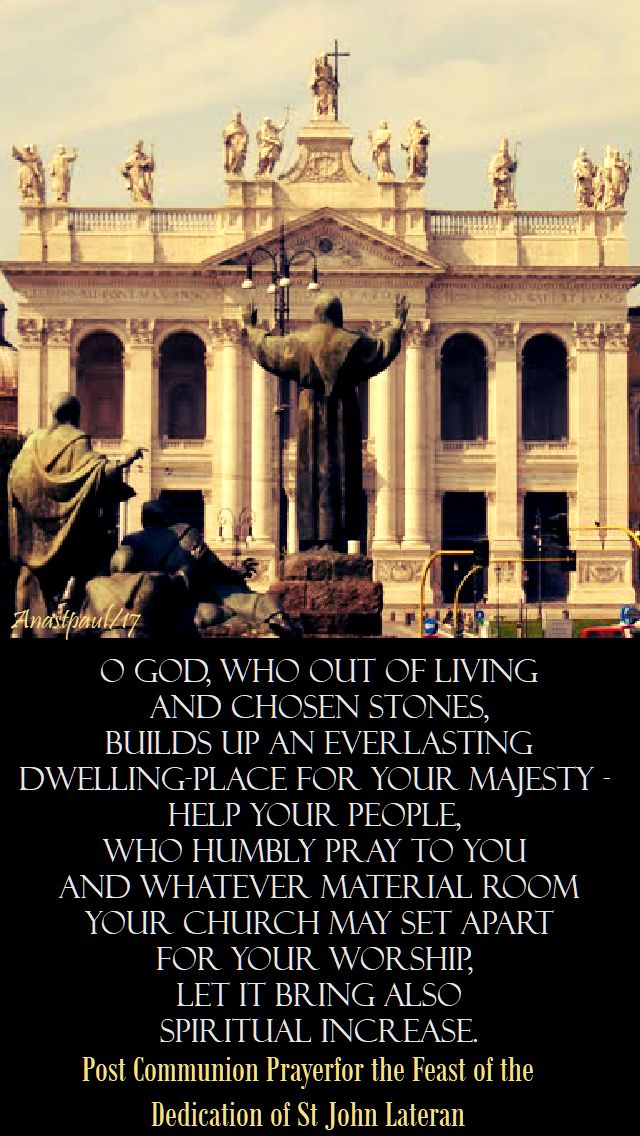
O God, who out of living and chosen stones, builds up an everlasting dwelling-place for Your Majesty –  help Your people, who humbly pray to You and whatever material room Your Church may set apart for Your worship, let it bring also spiritual increase.
(Post-Communion prayer)o god, who out of living - feast of st john lateran - 9 nov 2017

Posted in DOCTORS of the Church, FEASTS and SOLEMNITIES, MORNING Prayers, QUOTES of the SAINTS, SAINT of the DAY

Quote/s of the Day – 9 November – Feast of the Dedication of the Basilica of Saint John Lateran

Quote/s of the Day – 9 November – Feast of the Dedication of the Basilica of Saint John Lateran

“What was done here, as these walls were rising, is reproduced when we bring together those who believe in Christ. For, by believing they are hewn out, as it were, from mountains and forests, like stones and timber; but by catechising, baptism and instruction they are, as it were, shaped, squared and planed by the hands of the workers and artisans. Nevertheless, they do not make a house for the Lord until they are fitted together through love”.

St Augustine (354-430) Doctor of the Church – Sermon 36what was done here - st augustine - 9 nov 2017

“God’s desire to build a spiritual temple in the world, a community that worships him in spirit and truth (cf. John 4:23-24). But this observance also reminds us of the importance of the material buildings in which the community gathers to celebrate the praises of God. Every community, therefore, has the duty to take special care of its own sacred buildings, which are a precious religious and historical patrimony. For this we call upon the intercession of Mary Most Holy, that she help us to become, like her, the “house of God,” living temple of his love.”

Pope Benedict XVI  – 9 November 2008.gods desire to build - pope benedict - 9 nov 2017

Posted in DOCTORS of the Church, FEASTS and SOLEMNITIES, QUOTES of the SAINTS, The WORD

One Minute Reflection – 9 November – Feast of the Dedication of the Basilica of Saint John Lateran

One Minute Reflection – 9 November – Feast of the Dedication of the Basilica of Saint John Lateran

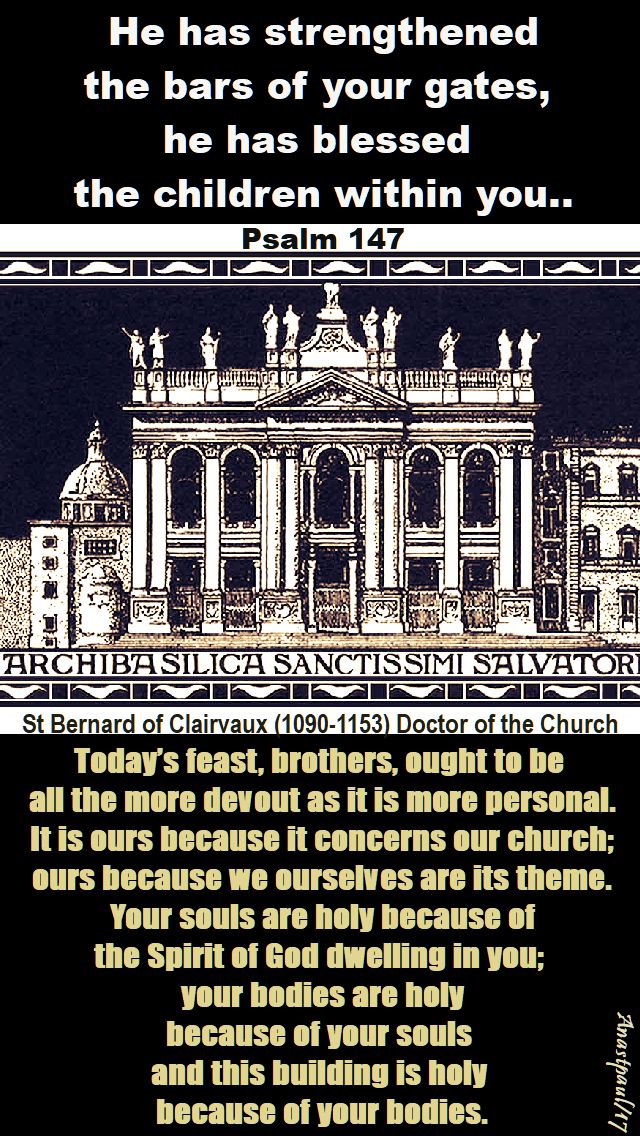
He has strengthened the bars of your gates, he has blessed the children within you.…Psalm 147

REFLECTION – “Today’s feast, brothers, ought to be all the more devout as it is more personal.   For other celebrations we have in common with other ecclesiastical communities, but this one is proper to us, so that if we do not celebrate it nobody will.   It is ours because it concerns our church;  ours because we ourselves are its theme.   You are surprised and even embarrassed, perhaps, at celebrating a feast for yourselves.   But do not be like horses and mules that have no understanding.  Your souls are holy because of the Spirit of God dwelling in you;  your bodies are holy because of your souls and this building is holy because of your bodies.”…St Bernard of Clairvaux (1090-1153)today's feast, brothers, - st bernard - 9 nov 2017 - dedication st john lateran

PRAYER – Almighty God, as we recall with joy, the Dedication of this house of Yours on each recurring anniversary, listen to Your people’s prayer and grant that our worship here may be a sincere and holy service, honouring Your Name and bringing us the fullness of redemption. Through Jesus Christ, our Lord, in union with the Holy Spirit, one God for all eternity, amen.feast of the dedication of st john lateran - 9 nov 2017

Posted in CATHOLIC-PRAYERS OF THE CHURCH, FEASTS and SOLEMNITIES, MORNING Prayers, SAINT of the DAY

Our Morning Offering – 9 November – Feast of the Dedication of the Basilica of Saint John Lateran

Our Morning Offering – 9 November – Feast of the Dedication of the Basilica of Saint John Lateran

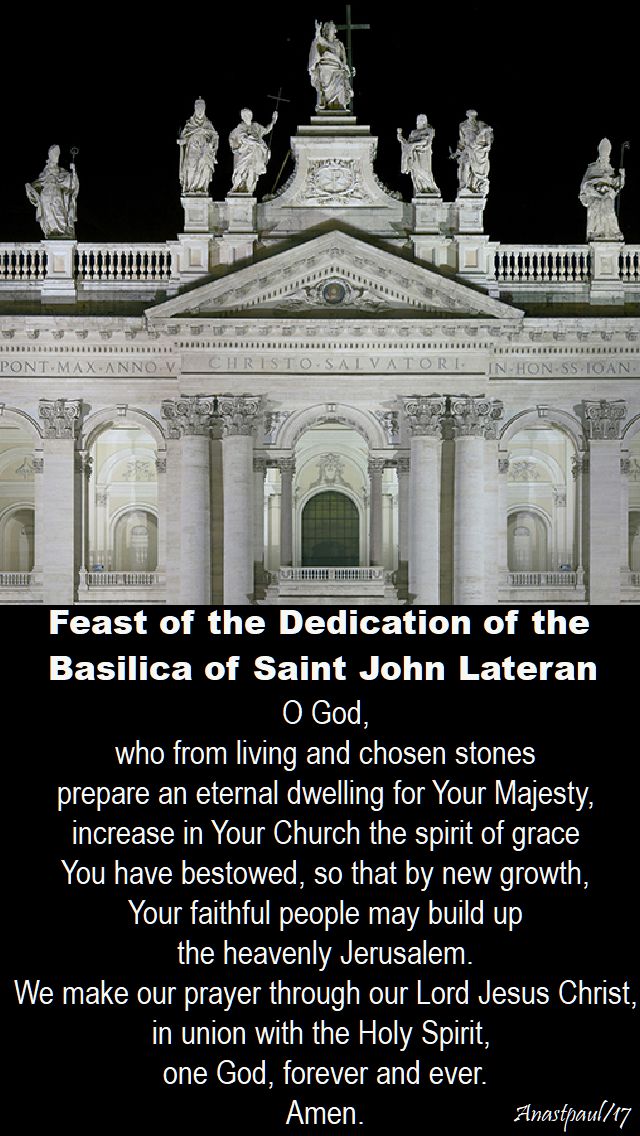
O God,
who from living and chosen stones
prepare an eternal dwelling for Your Majesty,
increase in Your Church the spirit of grace
You have bestowed, so that by new growth,
Your faithful people may build up
the heavenly Jerusalem.
We make our prayer through our Lord Jesus Christ,
in union with the Holy Spirit,
one God, forever and ever.
Amen.prayer for the feast of the dedication of st john lateran - 9 nov 2017

Posted in FEASTS and SOLEMNITIES, SAINT of the DAY

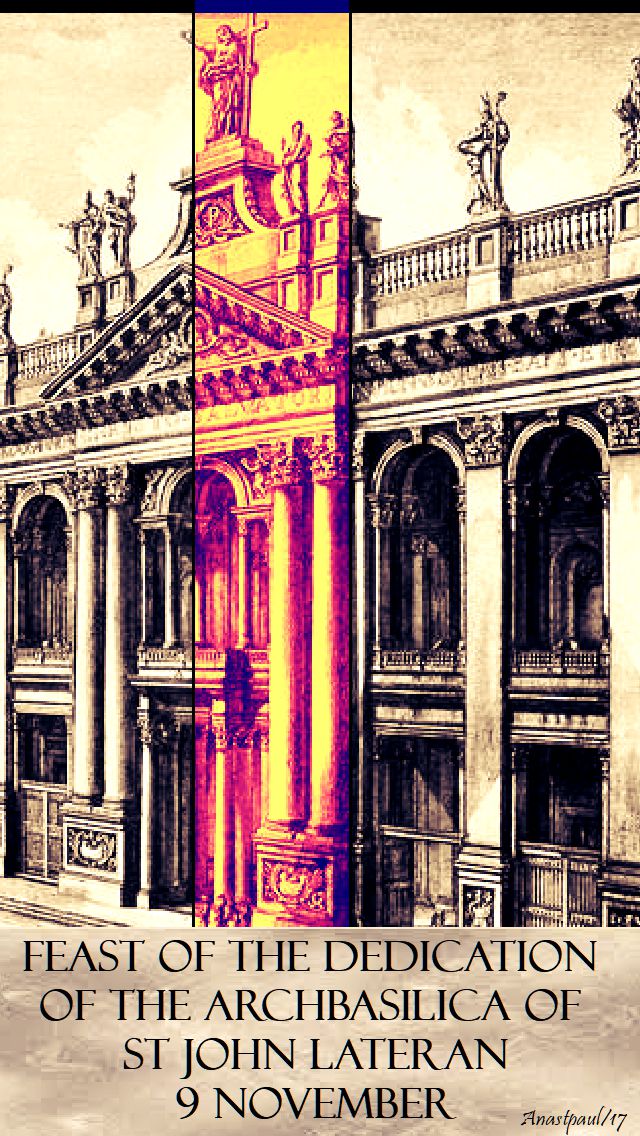
Feast of the Dedication of The Cathedral of the Most Holy Saviour and of Saints John the Baptist and John the Evangelist in the Lateran – 9 November

Feast of the Dedication of The Cathedral of the Most Holy Saviour and of Saints John the Baptist and John the Evangelist in the Lateran- 9 November

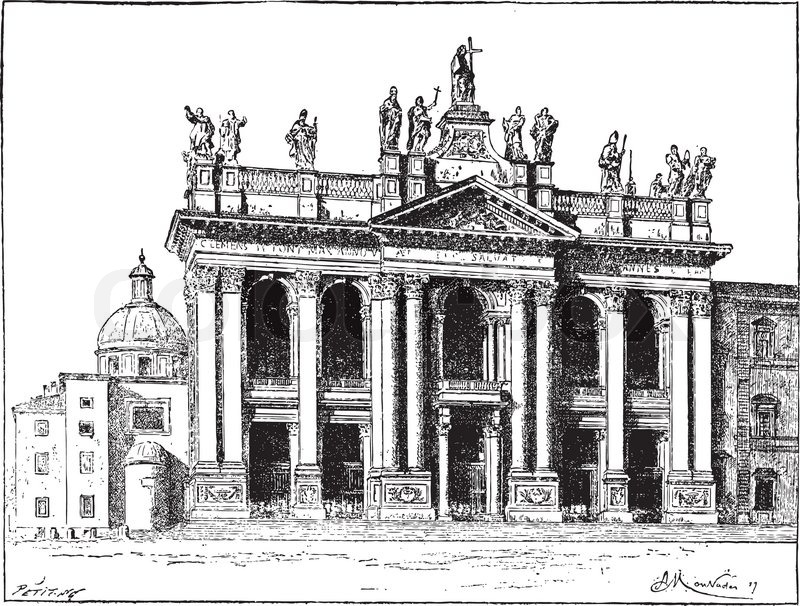
The Papal Archbasilica of St John in Lateran (Italian: Arcibasilica Papale di San Giovanni in Laterano), commonly known as St John Lateran Archbasilica, St John Lateran Basilica, St John Lateran, or simply the Lateran Basilica, is the cathedral church of Rome, Italy and therefore houses the cathedra, or ecclesiastical seat, of the Roman Pontiff.
It is the oldest of and has precedence among the four papal major basilicas, all of which are in Rome, because it is the oldest church in the West and houses the cathedra of the Roman Pontiff.   It has the title of ecumenical mother church of the Roman Catholic faithful.feast of the dedication - HEADERHEADER 1HEADER 1 A-Inscription_Ecclesiarum_Mater_San_Giovanni_in_Laterano_2006-09-07

The current archpriest is Angelo De Donatis, Cardinal Vicar General for the Diocese of Rome.   The President of the French Republic, currently Emmanuel Macron, is ex officio the “first and only honorary canon” of the archbasilica, a title that the heads of state of France have possessed since King Henry IV.

The large Latin inscription on the façade reads:  Clemens XII Pont Max Anno V Christo Salvatori In Hon SS Ioan Bapt et Evang; which is a highly abbreviated inscription which translates to: “Pope Clement XII, in the fifth year [of his Pontificate], dedicated this building to Christ the Saviour, in honour of Saints John the Baptist and John the Evangelist”. The inscription indicates, that the archbasilica was originally dedicated to Christ the Saviour and, centuries later, co-dedicated to St John the Baptist and St John the Evangelist.   As the Cathedral of the Pope qua Bishop of Rome, it ranks superior to all other churches of the Roman Catholic Church, including St Peter’s Basilica and therefore it alone is titled “Archbasilica” among all other basilicas.

The archbasilica is sited in the City of Rome, outside and distanced from Vatican City proper, which is approximately 4 km (2.5 mi) to its northwest, although the archbasilica and its adjoining edifices have extraterritorial status from Italy as one of the properties of the Holy See, subject to the sovereignty of the latter, pursuant to the Lateran Treaty of 1929 with Italy under Benito Mussolini.

This feast commemorates the Dedication of the Basilica of St John Lateran which, by a tradition dating to the 12th century, is said to have taken place on this day.   It was dedicated as the first Catholic basilica in Rome, by Pope Sylvester in 324.   Until the 15th century, the Lateran was the residence of the popes.    It is the episcopal seat of the bishop of Rome, the pope and until the 15th century, it was also his residence.   At first, the feast was kept only in the City of Rome but the, in honour of the Basilica, which is called the “Mother and Head of all Churches of the City and the World” (omnium urbis et orbis ecclesiarum mater et caput) it was extended to the whole of the Roman Rite as a sign of unity and respect towards the Holy See of Peter, the Holy Father and the Magisterium, which, as St Ignatius of Antioch wrote, presides over the whole assembly of charity.

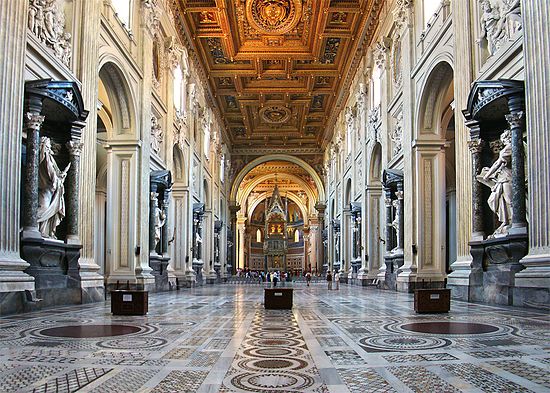
Rom,_Basilika_San_Giovanni_in_Laterano,_Decke_der_Basilika_2
Ceiling

In the year 313 the Roman Emperor Constantine declared the Edict of Milan, granting religious freedom to Christians.   Constantine himself donated the palace of the Lateran, a portion of his wife’s dowry, to the Church for its basilica.   The Lateran is the cathedral  of the Bishop of Rome, the pope, and, as such, it ranks as the “mother and head of all the churches in the city and the world.”

Lazio_Roma_SGiovanni1_tango7174 (1)
Main body of the basilica, after the radical transformation by Francesco Borromini.

The pope celebrates the Holy Thursday liturgy at Saint John Lateran, surrounded by towering statues of the twelve Apostles bearing the instrument of their martyrdom. Above its towering 18th century façade can be seen the image of Christ Triumphant, surrounded by saints and doctors.

We are all members of our own local church, work for he universal kingdom of Christ,  are also members of this “mother-church” in Rome.

The dedication of churches can be traced back to the Jewish practice of dedicating the Temple in Jerusalem to God.   Once the Temple had been dedicated, there was a feast each year to celebrate the anniversary of the dedication.   This feast was celebrated not only in Jerusalem but in every synagogue as well.   Similarly, every Western Catholic church observes the dedication of the Lateran Basilica in Rome.

This feast helps us move beyond our narrow geographical confines to a sense of the universal Church.

“Every place set aside for divine worship is a sign of that spiritual temple, which is the Church, made up of living stones: of the faithful united by the one faith, of the participation in the sacraments and of the bond of charity. The Saints, in particular, are precious stones of that spiritual temple”… Saint Pope John Paul II.

Posted in FEASTS and SOLEMNITIES, SAINT of the DAY

Feast of the Dedication of the Basilica of Saint John Lateran, Feast of Our Lady of Almudena and Memorials of the Saints – 9 November

Dedication of the Basilica of Saint John Lateran (Feast): The oldest and first in rank of the four basilicas of Rome, Italy.   The name is derived from the Laterani family, on the site of whose palace the basilica stands.   King Constantine presented this palace to the Church. Its annual celebration throughout the Latin Church is a sign of love and unity with the Papacy and Pope.
The original church building, probably adapted from the hall of the palace, was dedicated to the Saviour and from its splendour was known as the Basilica Aurea. Though several times destroyed and rebuilt, the basilica retained its ancient form, being divided by rows of columns into aisles and having an atrium with colonnades.   The tasteless restoration of the 17th century changed its appearance.  A monastery was formerly between the basilica and the city wall of which the cloister still remains.   The original apse survived until 1878, when it was destroyed and a deeper apse built.   The ancient mosaics have been preserved.   The high altar, which is of wood and is believed to have been used by Saint Peter, is now encased in marble.   In the upper part of the baldachinum are the heads of the Apostles, Peter and Paul.   The baptistery is an octagonal edifice with porphyry columns. The font is of green basalt.   This basilica has been the cathedral of Rome since the 4th century.
Video – https://www.youtube.com/watch?v=NzrS5oQ43oQ

Our Lady of Almudena:  The Virgin of Almudena (Virgen de la Almudena) is a medieval icon of the Virgin Mary, mother of Jesus Christ. The image is the advocation of the Virgin that serves as a patroness of Madrid, Spain.
Intriguingly, however, its name derives from the Arabic term of Al Mudayna, or the citadel. There are various legends regarding the icon.   One story is that in 712, prior to the capture of the town by the advancing Muslim forces, the inhabitants of the town secreted the image of the virgin, for its own protection, inside the walls surrounding the town.   In the 11th century, when Madrid was reconquered by the King Alfonso VI of Castile, the Christian soldiers endeavoured to find the statue.   After days of prayer, the spot on the wall hiding the icon crumbled, revealing the statue.   Another legend is that as Christian soldiers approached the town, they had a vision of Mary imploring them to allow her to lead them into the city.   Again the miraculous crumbling of the wall occurred, with the icon showing an entry route through the walls.
The Cathedral of Madrid is dedicated to this advocation of the Virgin and her feast day, 9 November, is a major holiday in Madrid.

Original Virgin of Almudena statue on display at Almudena Cathedral


St Agrippinus of Naples
St Alexander of Salonica
St Aurelius of Riditio
St Benignus of Armagh
St Eustolia
St Francisco José Marín López de Arroyave
St Gabriel Ferretti
Bl George Napper
Bl Gratia of Cattaro
Bl Helen of Hungary
Bl Henryk Hlebowicz
St Jane of Segna
St Justo Juanes Santos
St Luigi Beltrame Quattrocchi
St Luis Morbioli
St María de la Salud Baldoví Trull
Bl María del Carmen of the Child Jesus
St Pabo
St Sopatra
St Theodore Stratelates
St Ursinus of Bourges
St Valentín Gil Arribas
St Vitonus of Verdun

Martyrs of Constantinople – 3 saints:  A group of ten Catholic Christians who tried to defend an image of Jesus over the Brazen Gate of Constantinople from an attack by Iconoclasts during the persecutions of emperor Leo the Isaurian.  The group of was seized by soldiers, condemned by judges for opposing the emperor, and martyred.  The only details that have survived are three of their names – Julian, Marcian and Maria. They were martyred in 730 at Constantinople (modern Istanbul, Turkey).

Martyred in the Spanish Civil War:
• Blessed Anastasio Garzón González
• Blessed Francisco José Marín López de Arroyave
• Blessed Justo Juanes Santos
• Blessed María de la Salud Baldoví Trull
• Blessed Valentín Gil Arribas

Posted in FEASTS and SOLEMNITIES, SAINT of the DAY

Feast of the Holy Relics – 5 November

Feast of the Holy Relics – 5 November

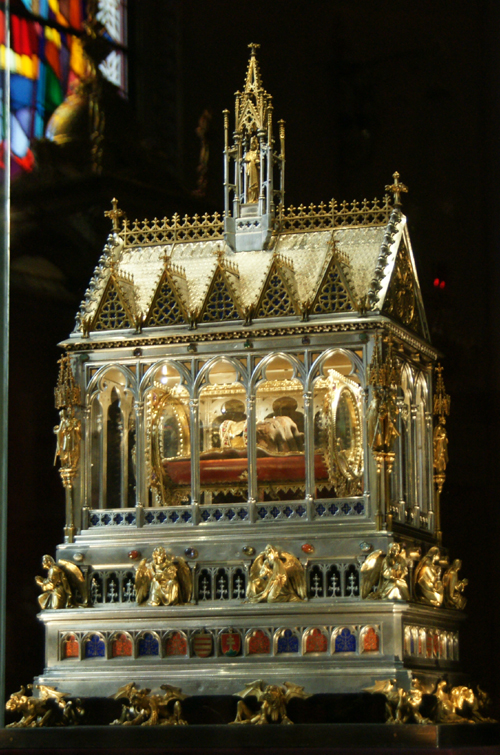
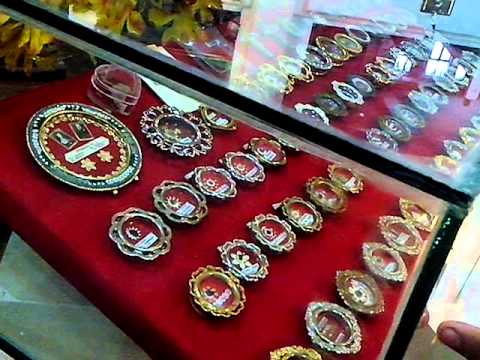
By relics of the Saints we mean all that remains of them after their death — their bones, their ashes, their clothing and other objects used by them.   Enemies of the Church have condemned the cult of the Relics of the Saints as being borrowed from pagan customs and without apostolic origin.   The decision of the Council of Trent suffices to show, the falsehood and bad faith of their reasoning.   That Council, in effect, decreed quite otherwise that the bodies of the martyrs and other Saints, who were the living members of Jesus Christ and the temples of the Holy Spirit, must be honoured by the faithful and that through them, God grants a great many benefits to the living.   Its decision was based on the usage already established in the 1st Century and which has remained constant in the Church, and on the teaching of the Fathers and Councils.

The cult of Holy Relics is, therefore, not only permitted but commanded;   it is not only a right but, a duty.     Let us note well that the cult of Holy Relics diverges from pagan practices, in that it is supernatural.   We do not honour what remains of the Saints for any motive derived from naturaL but, from motives based on the Faith.  If one honours the memory and remains of great men worthy of that appellation, it is regarded as justice but, when one honours the memory and remains of the Saints, it is more than justice, it is the virtue of religion.   The final object of the cult of the Holy Relics, is God, Who sanctifies the Saints; it is Jesus Christ, Whose members the Saints are.   This cult is so legitimate that God Himself sometimes glorifies the Relics of His Saints by heavenly perfumes, by other marvellous privileges, by countless miracles.   Let us add, the cult of Holy Relics also has its foundation in the glorious Resurrection which is awaiting the bodies of the Saints. God Himself will reassemble these remains at the end of the world and will give them all the brilliance and beauty of which they are capable.

Relic of Hand of St. Stephen
Reliquary of St Stephen’s Hand
relics 2
Various Relics
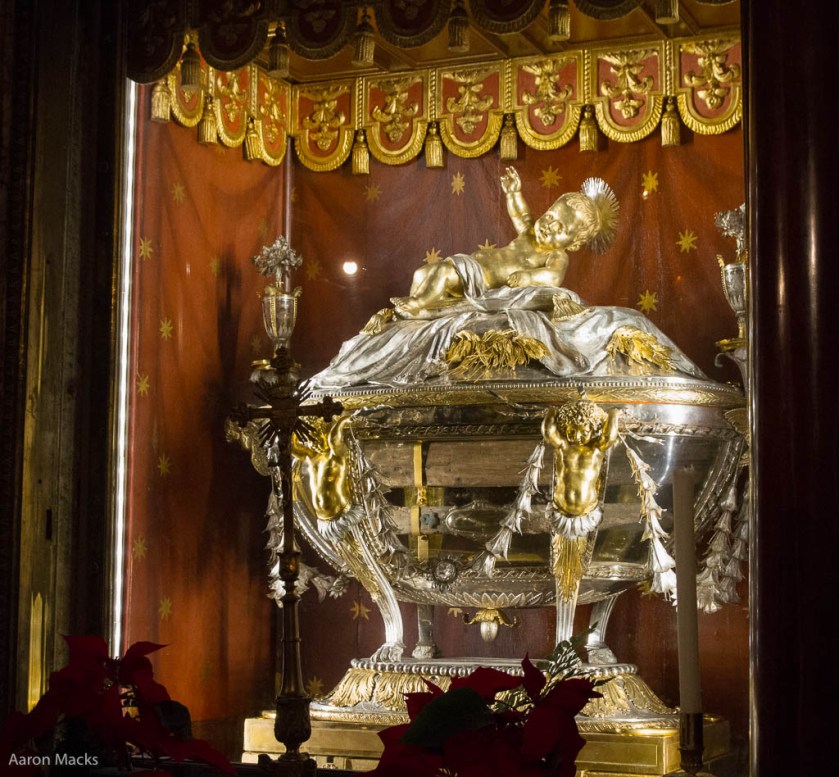
Reliquary of the crib
Holy Crib Reliquary at St Mary Major
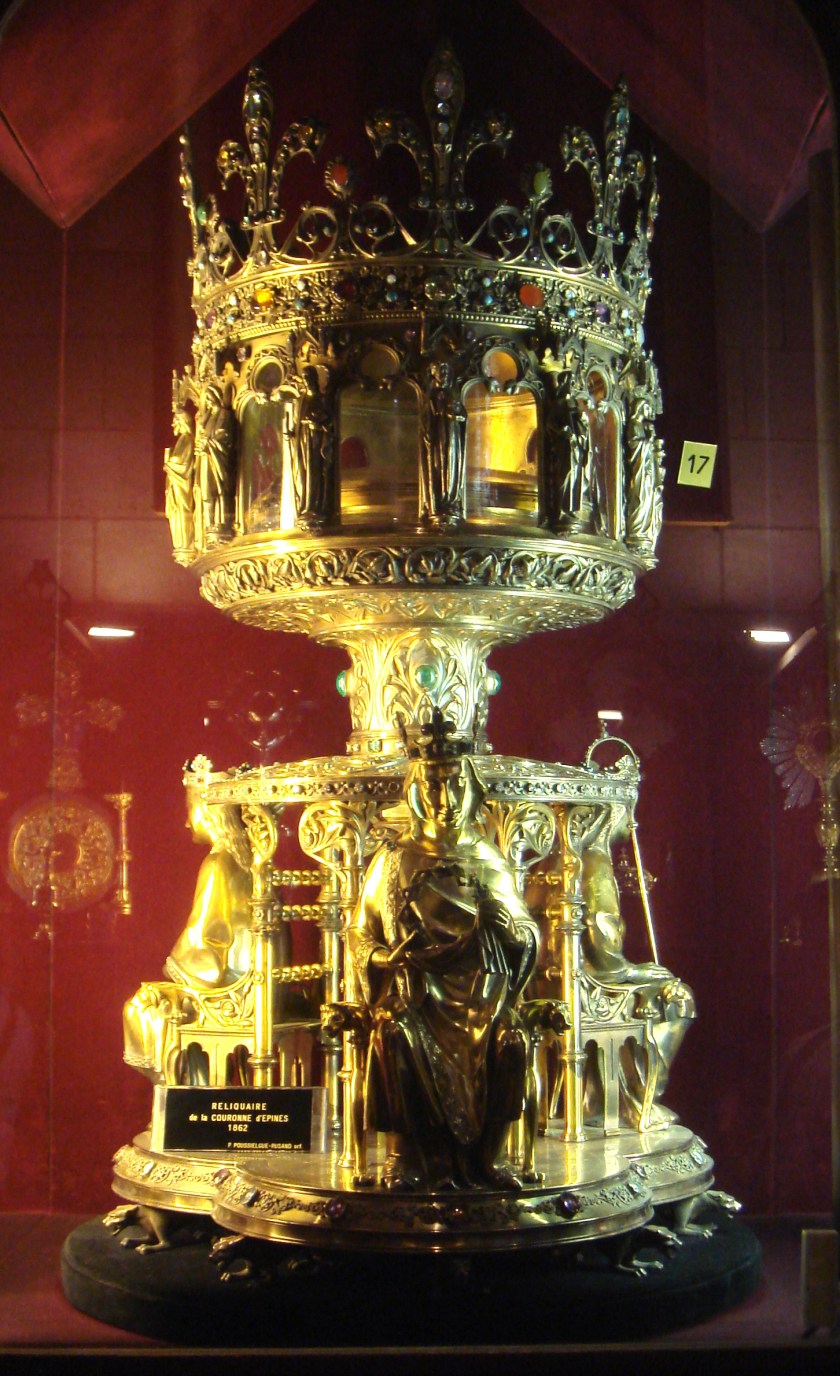
HolyCrown
Crown of Thorns Reliquary

Let us then venerate, with respect, devotion and confidence,, these precious Relics which once were animated by such great souls, were the instruments of beautiful and holy works and of astonishing virtues and which, will some day be honoured by a brilliant and immortal glory.   Let us value pilgrimages made to the tombs of the Saints and celebrate, religiously, the Feast of the Holy Relics, which appropriately follows closely upon All Saints Day and the Feast day of the splendid Holy Souls who are in Heaven.

Posted in FEASTS and SOLEMNITIES, SAINT of the DAY

Feast of Holy Relics and Memorials of the Saints – 5 November

Feast of Holy Relics

St Augustine of Terracina
Bl Bernhard Lichtenberg
St Bertille
St Canonica
St Comasia
St Ðaminh Mau
St Dominator of Brescia
St Domninus the Physician
St Epistemis
St Eusebius of Terracina
St Felix of Terracina
St Fibitius
St Galation
St Gerald of Beziers
Bl Gomidas Keumurjian
Bl Gregory Lakota
St Guetnoco
St Guido Maria Conforti
St St Hermenegild
St Idda
St Juan Antoni Burró Mas
St Juan Duarte Martín
St Kanten
St Kea
St Laetus of Orleans
St Magnus of Milan
St Mamete
St Marco of Troia
Bl María del Carmen Viel Ferrando
Bl Simon Ballachi
St Spinulus of Moyen-Moûtier
St Sylvanus of Syria

Martyrs of Caesarea Maritima – 4 saints: Four young Christian men who were martyred together in the persecutions of Maximian – Aussenzius, Philotheus, Timothy and Theotimus. They were martyred in the arena at Caesarea Maritima, Palestine.

Martyred in the Spanish Civil War:
• Blessed Juan Antoni Burró Mas
• Blessed Juan Duarte Martín
• Blessed María del Carmen Viel Ferrando

Posted in CHRIST the KING, FEASTS and SOLEMNITIES, MORNING Prayers, NOVENAS

Announcing a Novena in Preparation for the Solemnity of Christ the King – 26 November 2017

Announcing a Novena in Preparation for the Solemnity of Christ the King – 26 November 2017

Let us enter into Nine days of prayer which will focus on Jesus as the Universal King.  The Roman Catholic Church sets aside the last Sunday of the liturgical year as the Feast of Christ the King, this year 2017, the Feast is on 26 November.

The Feast of Christ the King is, as Catholic feasts go, a relatively recent one.  It was established by Pope Pius XI in 1925, to remind Catholics (and the world generally) that Jesus Christ is Lord of the Universe, both as God and as Man.   Pius XI announced the feast in his encyclical Quas Primas, which was delivered on 11 December 1925.   At the end of the encyclical, he declared that he expected three “blessings” to flow from the celebration of the feast:   first, that “men will doubtless be reminded that the Church, founded by Christ as a perfect society, has a natural and inalienable right to perfect freedom and immunity from the power of the state”;   second, that “Nations will be reminded by the annual celebration of this feast that not only private individuals but also rulers and princes are bound to give public honour and obedience to Christ”;   and third, that “The faithful, moreover, by meditating upon these truths, will gain much strength and courage, enabling them to form their lives after the true Christian ideal.”

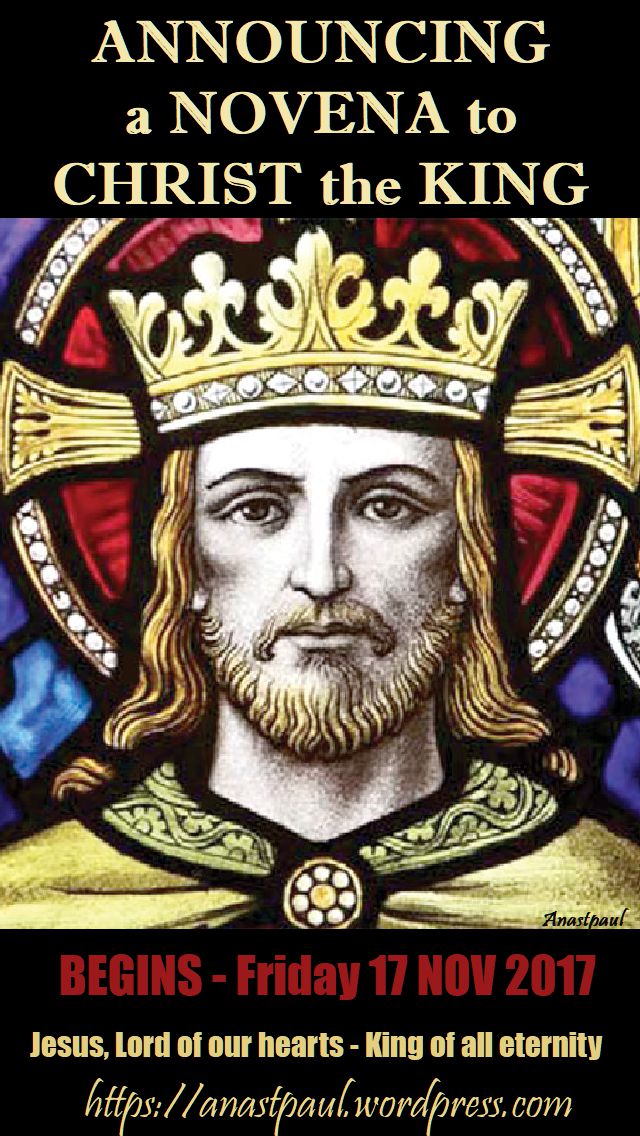
ANNOUNCING A NOVENA TO CHRIST THE KING - BEGINS FRIDAY 17 NOV


Posted in CATHOLIC Quotes, FEASTS and SOLEMNITIES, MORNING Prayers, ON the SAINTS, QUOTES - J R R Tolkien and MORE, QUOTES of the SAINTS, SAINT of the DAY

Quote/s of the Day – 1 November – – The Solemnity of All the Saints

Quote/s of the Day – 1 November – – The Solemnity of All the Saints

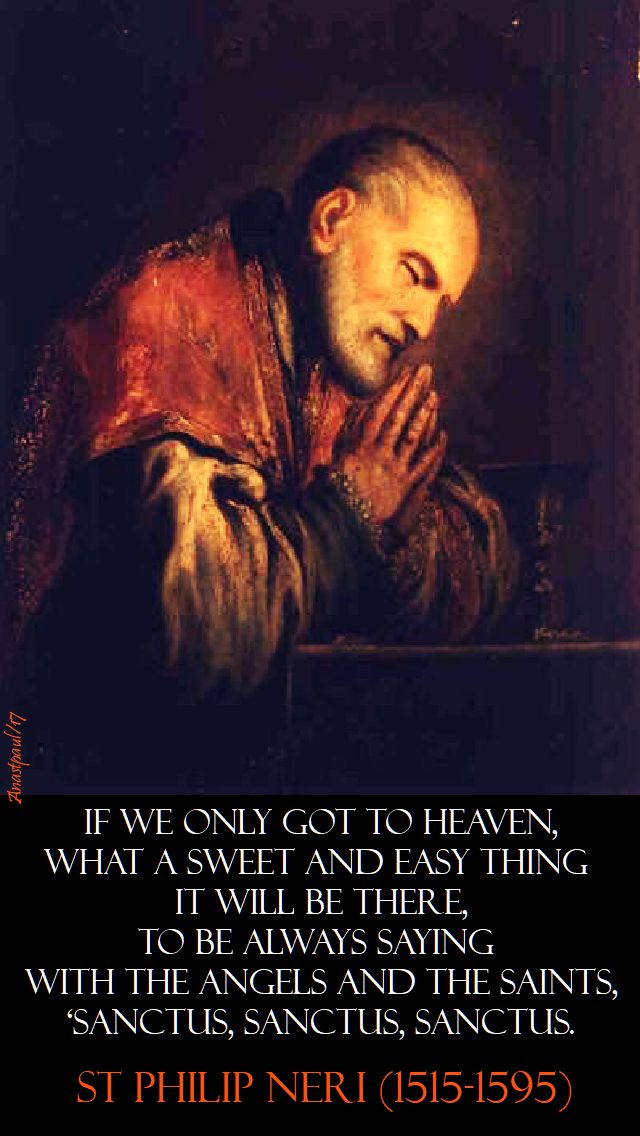
“If we only got to heaven,
what a sweet and easy thing it will be there,
to be always saying with the angels and the saints,
‘Sanctus, sanctus, sanctus.’”

St Philip Neri (1515-1595) if we only got top heaven - st philip neri - all saints day 2017

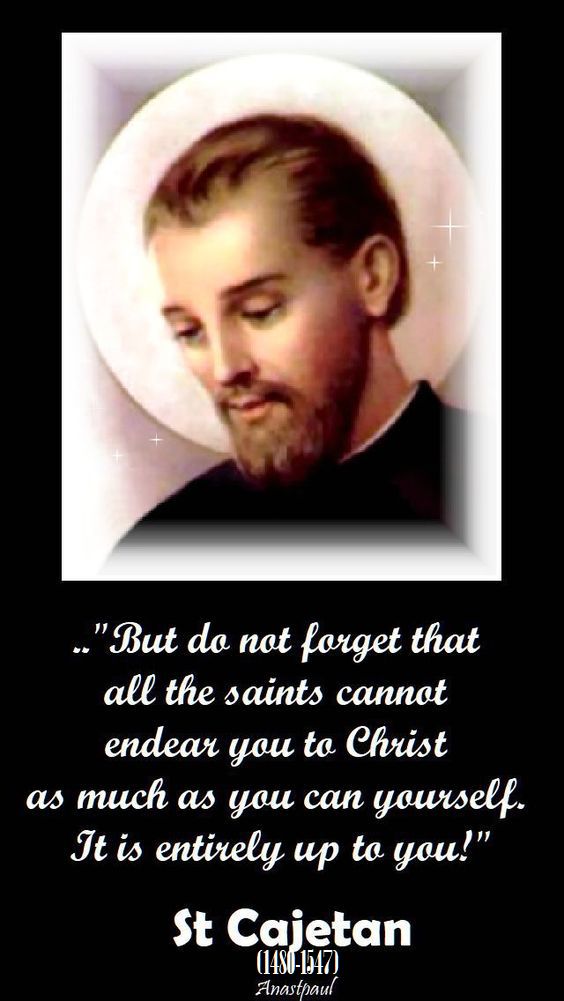
...”But do not forget that all the saints
cannot endear you to Christ
as much as you can yourseIf.
It is entirely up to You!”

St Cajetan (1480-1547) Founder of the Theatinesbut do not forget that all the saints cannot endear you to christ - st cajetan

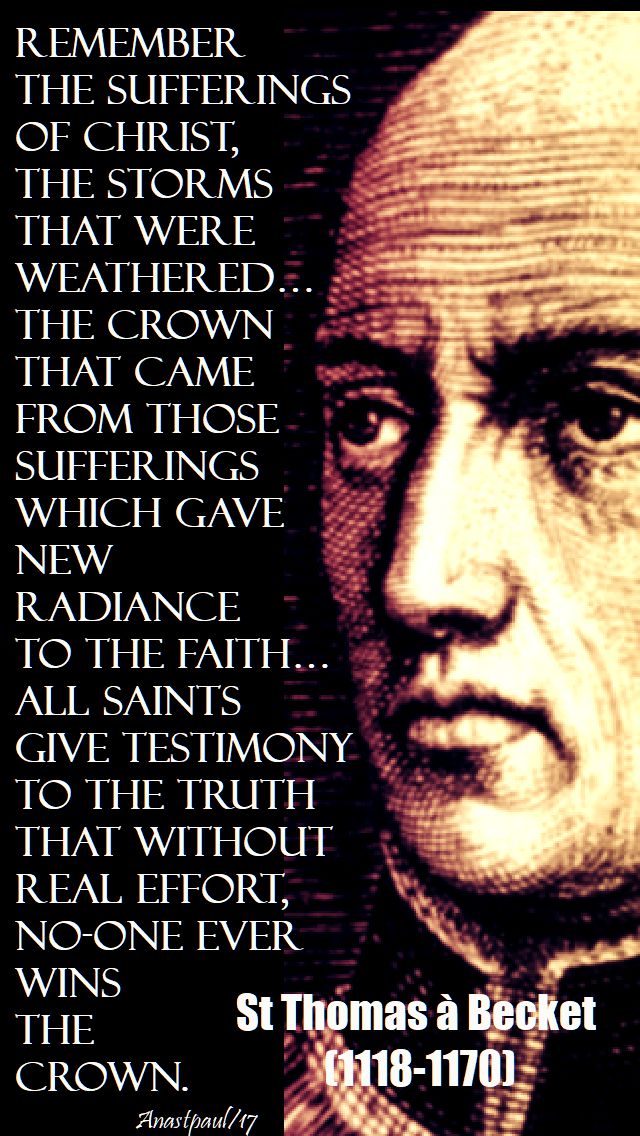
“Remember the sufferings of Christ,
the storms that were weathered…
the crown that came from those sufferings
which gave new radiance to the faith…
All saints give testimony to the truth
that without real effort,
no-one ever wins the crown.”

St Thomas à Becket (1118-1170)remember the sufferings - st thomas a becket - 1 nov 2017

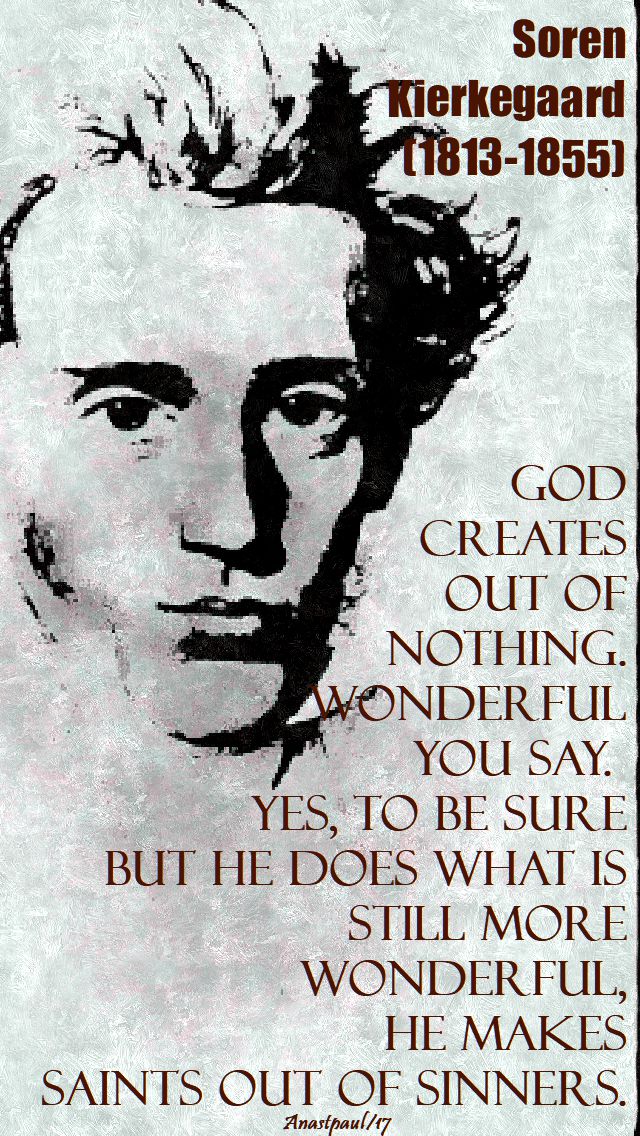
“God creates out of nothing.
Wonderful you say.
Yes, to be sure but He does.
what is still more wonderful,
He makes saints out of sinners.”

Soren Kierkegaardgod creates out of nothing - soren kierkegaard - 1 nov 2017

Posted in DOCTORS of the Church, FEASTS and SOLEMNITIES, MORNING Prayers, QUOTES of the SAINTS, SAINT of the DAY, The WORD

One Minute Reflection – 1 November – The Solemnity of All the Saints

One Minute Reflection – 1 November – The Solemnity of All the Saints

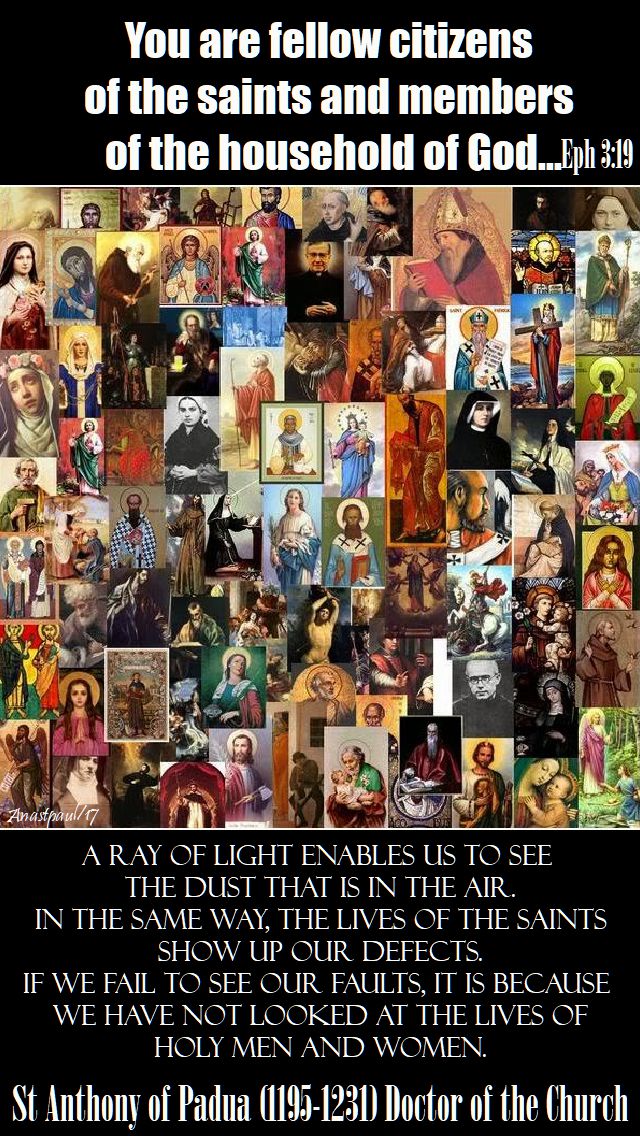
You are fellow citizens of the saints and members of the household of God………Eph 3:19

REFLECTION – “A ray of light enables us to see the dust that is in the air.
In the same way, the lives of the Saints show up our defects.
If we fail to see our faults, it is because we have not looked at the lives of
holy men and women.”…St Anthony of Paduaa ray of light enables us to see - st anthony of padua - 1 nov 2017

PRAYER – Heavenly Father, help me to love and respect Your Saints.   Grant me to obtain an example from their way of life, fellowship in their communion and aid through their intercession.   Holy Saints in Heaven, Pray for us. Amenholy saints in heaven pray for us - 1 nov 2017

Posted in DEVOTIO, FEASTS and SOLEMNITIES, MORNING Prayers, ON the SAINTS, PRAYERS of the SAINTS, SAINT of the DAY, Uncategorized

Our Morning Offering – 1 November – The Solemnity of All the Saints

Our Morning Offering – 1 November – The Solemnity of All the Saints

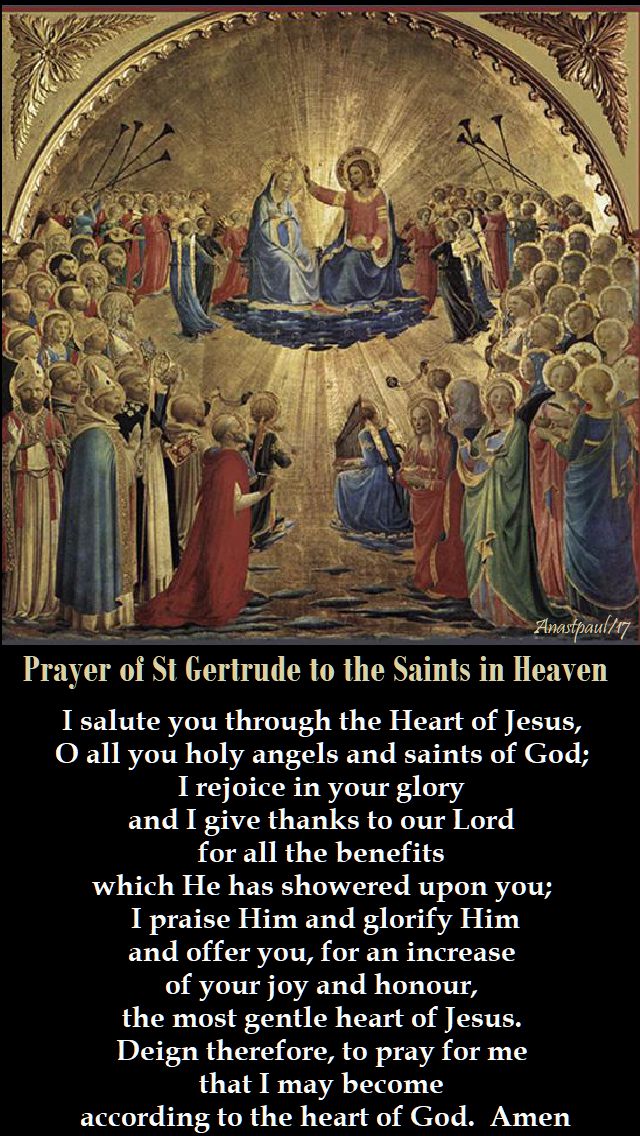
Prayer of St Gertrude to the Saints in Heaven

I salute you through the Heart of Jesus,
O all you holy angels and saints of God;
I rejoice in your glory and I give thanks to our Lord
for all the benefits which He has showered upon you;
I praise Him and glorify Him
and offer you, for an increase of your joy and honour,
the most gentle heart of Jesus.
Deign therefore, to pray for me
that I may become
according to the heart of God. Amenprayer of st gertrude to the saints in heaven - 1 nov 2017

Posted in FEASTS and SOLEMNITIES, SAINT of the DAY, Uncategorized

1 November – The Feast of All the Saints

1 November – The Feast of All the Saints:

All Saints Day is a special feast day on which Catholics celebrate all the saints, known and unknown.   While most saints have a particular feast day on the Catholic calendar (usually, though not always, the date of their death), not all of those feast days are observed.   And saints who have not been canonised—those who are in Heaven but whose sainthood is known only to God—have no particular feast day.   In a special way, All Saints Day is their feast.

QUICK FACTS ABOUT ALL SAINTS DAY
Date: 1 November
Type of Feast: Solemnity; Holy Day of Obligation
Readings: Revelation 7:2-4, 9-14; Psalm 24:1bc-2, 3-4ab, 5-6; 1 John 3:1-3; Matthew 5:1-12a
Prayers: Litany of the Saints
Other Names for the Feast: All Saints’ Day, Feast of All Saints, Solemnity of All Saints

THE HISTORY OF ALL SAINTS DAY
All Saints Day is a surprisingly old feast.   It arose out of the Christian tradition of celebrating the martyrdom of saints on the anniversary of their martyrdom.   When martyrdoms increased during the persecutions of the late Roman Empire, local dioceses instituted a common feast day in order to ensure that all martyrs, known and unknown, were properly honoured.   By the late fourth century, this common feast was celebrated in Antioch and Saint Ephrem the Syrian mentioned it in a sermon in 373.

In the early centuries, this feast was celebrated in the Easter season and the Eastern Churches, both Catholic and Orthodox, still celebrate it then, tying the celebration of the lives of the saints in with Christ’s Resurrection.

WHY 1 NOVEMBER?
The current date of November 1 was instituted by Pope Gregory III (731-741) when he consecrated a chapel to all the martyrs in Saint Peter’s Basilica in Rome.   Gregory ordered his priests to celebrate the Feast of All Saints annually.   This celebration was originally confined to the diocese of Rome but Pope Gregory IV (827-844) extended the feast to the entire Church and ordered it to be celebrated on November 1.

HALLOWEEN, ALL SAINTS DAY AND ALL SOULS DAY
In English, the traditional name for All Saints Day was All Hallows Day.  (A hallow was a saint or holy person.)   The vigil or eve of the feast, 31 October, is still commonly known as All Hallows Eve, or Halloween.   Despite concerns among some Christians (including some Catholics) in recent years about the “pagan origins” of Halloween the vigil was celebrated from the beginning—long before Irish practices, stripped of their pagan origins (just as the Christmas tree was stripped of similar connotations), were incorporated into popular celebrations of the feast.

In fact, in post-Reformation England, the celebration of Halloween and All Saints Day were outlawed not because they were considered pagan but because they were Catholic. Later, in the Puritan areas of the Northeastern United States, Halloween was outlawed for the same reason, before Irish Catholic immigrants revived the practice as a way of celebrating the vigil of All Saints Day.

allsaints.jpg

Posted in FEASTS and SOLEMNITIES, SAINT of the DAY, Uncategorized

Solemnity of All Saints and Memorials of the Saints – 1 November

All Saints Day (Solemnity):  (a Holy Day of Obligation)  Instituted to honour all the saints, known and unknown.   It owes its origin in the Western Church to the dedication of the Roman Pantheon in honour of the Blessed Virgin Mary and all the martyrs by Pope Saint Boniface IV in 609, the anniversary of which was celebrated at Rome on 13 May.   Pope Saint Gregory III consecrated a chapel in the Vatican basilica in honour of All Saints, designating 1 November as their feast.   Pope Gregory IV extended its observance to the whole Church. It has a vigil and octave and is a holy day of obligation;   the eve is popularly celebrated as Hallowe’en. Patronage – Arzignano, Italy.

St Amabilis of Auvergne
St Austremonius
St Benignus of Dijon
St Cadfan
St Caesarius of Africa
St Caesarius of Damascus
St Ceitho
St Cledwyn of Wales
Bl Clemens Kyuemon
St Cyrenia of Tarsus
St Dacius of Damascus
St Deborah the Prophetess
St Dingad
Bl Dionysius Fugixima
St Floribert of Ghent
St Gal of Clermont
St Genesius of Lyon
St Germanus of Montfort
St Harold the King
St James of Persia
St Jerome Hermosilla
St John of Persia
St Julian of Africa
St Juliana of Tarsus
St Lluís Estruch Vives
St Marcel of Paris
St Mary the Slave
St Mathurin
St Meigan
St Nichole
St Nuño de Santa Maria Alvares Pereira
St Pabiali of Wales
St Pere Josep Almató Ribera Auras
St Peter Absalon
Bl Peter Paul Navarra
Bl Petrus Onizuka Sadayu
St Rachel the Matriarch
St Ruth the Matriarch
St Salaun of Leseven
St Severinus of Tivoli
Bl Teodor Jurij Romza
St Valentin Faustino Berri Ochoa
St Vigor of Bayeux

Posted in FEASTS and SOLEMNITIES, MARIAN QUOTES, MORNING Prayers, QUOTES of the SAINTS, SAINT of the DAY, The APOSTLES & EVANGELISTS

Thought for the Day – 18 October – The Feast of St Luke the Evangelist

Thought for the Day – 18 October – The Feast of St Luke the Evangelist

According to a pious tradition, Luke is thought to have painted the image of Mary, the Virgin Mother.   But the real portrait that Luke draws of Jesus’ Mother is the one that emerges from the pages of his work:   in scenes that have become familiar to the People of God, he draws an eloquent image of the Virgin.   The Annunciation, the Visitation, the Nativity, the Presentation in the Temple, life in the home of Nazareth, Jesus’ discussion with the doctors and his being lost and Pentecost have provided abundant material down the centuries for the ever new creations of painters, sculptors, poets and musicians.

What is most important however is to discover that, through pictures of Marian life, Luke introduces us to Mary’s interior life, helping us at the same time to understand her unique role in salvation history.

Mary is the one who says fiat, a personal and total “yes” to God’s invitation, calling herself the “handmaid of the Lord” (Lk 1: 38).   This attitude of total assent to God and unconditional acceptance of his Word represents the highest model of faith, the anticipation of the Church as the community of believers.

The life of faith grows and develops in Mary through sapiential meditation on the words and events of Christ’s life (cf. Lk 2: 19, 51).   She “ponders in her heart” to understand the deep meaning of his words, in order to assimilate it and share it with others.

The Magnificat hymn (cf. Lk 1: 46-55) shows another important aspect of Mary’s “spirituality”: she embodies the figure of the poor person, capable of putting all her trust in God, who casts down the mighty from their thrones and raises up the lowly.

Luke also describes the figure of Mary in the early Church, showing that she is present in the Upper Room as they await the Holy Spirit:  “All these [the 11 Apostles] with one accord devoted themselves to prayer, together with the women and Mary the mother of Jesus, and with his brethren” (Acts 1: 14).

The group gathered in the Upper Room forms the original nucleus of the Church.   Within it Mary carries out a double role:  on the one hand, she intercedes for the birth of the Church through the Holy Spirit; on the other, she shares her experience of Jesus with the newborn Church. (St John Paul on the Feast of St Luke, Padua 2000 at the Shrine of St Luke)

Luke wrote as a Gentile for Gentile Christians.   His Gospel and Acts of the Apostles reveal his expertise in classic Greek style as well as his knowledge of Jewish sources.   There is a warmth to Luke’s writing that sets it apart from that of the other synoptic Gospels and yet it beautifully complements those works.   The treasure of the Scriptures is a true gift of the Holy Spirit to the Church and the Marian writings of St Luke are a great treasure to us all!

St Luke, pray for us.
Holy Mother of God, pray for us.
St John Paul, pray for us.st luke pray for us 18 oct 2017 - no 2HOLY MARY MOTHER OF GOD - PRAY FOR USst john paul pray for us

Posted in FEASTS and SOLEMNITIES, MORNING Prayers, QUOTES of the SAINTS, SAINT of the DAY, The APOSTLES & EVANGELISTS, The HOLY GHOST, Uncategorized

Quote/s of the Day – 18 October – The Feast of St Luke the Evangelist

Quote/s of the Day – 18 October – The Feast of St Luke the Evangelist

“The Church’s mission begins at Pentecost
“from Jerusalem” to expand “to the ends of the earth”.
Jerusalem does not mean just a geographical point.
Rather it signifies a focal point of salvation history.
The Church does not leave Jerusalem to abandon her
but to graft the pagan nations onto the olive tree of Israel.”the church's mission - 18 oct 2017

“We must abandon ourselves to the power of the Spirit,
who is able to infuse light and especially love for Christ;
we must open ourselves to the inner fascination that Jesus works
in the hearts of those who aspire to authenticity,
while fleeing from half measures.”

St John Paul on the Feast of St Luke, Padua 2000 at the Shrine of St Lukewe must abandon - st jp on the feast of st luke - 18 oct 2017

Posted in FEASTS and SOLEMNITIES, MORNING Prayers, SAINT of the DAY, The APOSTLES & EVANGELISTS, The WORD

One Minute Reflection – 18 October – The Feast of St Luke the Evangelist

One Minute Reflection – 18 October – The Feast of St Luke the Evangelist

“If any man would come after me, let him deny himself and take up his cross daily and follow me.”…Luke 9: 23.

REFLECTION – “To be a Christian for Luke means to follow Jesus on the path that he takes.  It is Jesus Himself who takes the initiative and calls us to follow Him and He does it decisively, unmistakably, thus showing His extraordinary identity,   His mystery of being the Son who knows the Father and reveals Him.   At the origin of the decision to follow Jesus lies the fundamental option in favour of His person.   If we have not been attracted by the face of Christ, it is impossible to follow Him with fidelity and constancy. This is also because Jesus walks a difficult road;  He lays down extremely demanding conditions and heads for a paradoxical destiny, that of the Cross. Luke emphasises that Jesus does not like compromises and requires a commitment of the whole person, a decisive detachment from any nostalgia for the past, from family demands, from material possessions (cf. Lk 9: 57-62; 14: 26-33).”….St John Paul 18 Oct 2000at the origin of the decision - st john paul - feat of st luke 18 oct 2017

PRAYER – Lord God, You chose St Luke to reveal the mystery of Your love in his preaching and his writings. Grant, we pray, that we may grow in love for the Holy Face of Christ, His words and His directions, revealed to us in the Gospels, in the example of your saints. Today, on his feast, we especially look to St Luke, to guide, teach and pray for us. We make our prayer through our Lord Jesus Christ, with the Holy Spirit, one God with You, forever and ever, amen.st luke pray for us 18 oct 2017

Posted in CATHOLIC DEVOTIONS of the Month, FEASTS and SOLEMNITIES, franciscan OFM, MARIAN PRAYERS, MORNING Prayers, PRAYERS of the SAINTS

Our Morning Offering – 18 October 

Our Morning Offering – 18 October

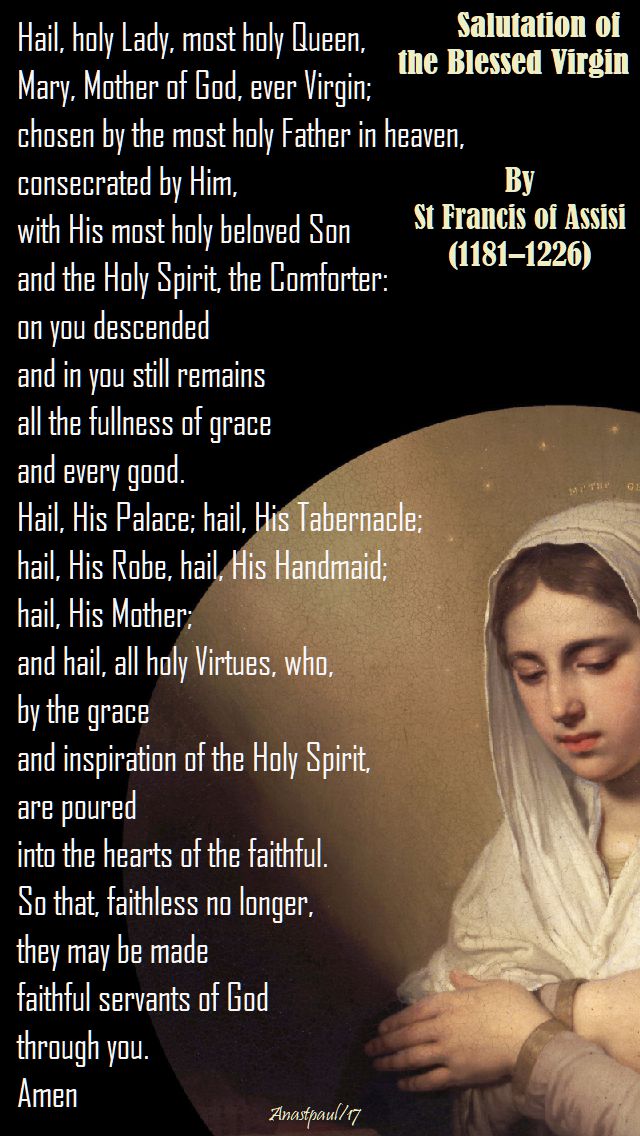
Salutation of the Blessed Virgin
By St Francis of Assisi (1181–1226)

Hail, holy Lady, most holy Queen,
Mary, Mother of God, ever Virgin;
chosen by the most holy Father in heaven,
consecrated by Him,
with His most holy beloved Son
and the Holy Spirit, the Comforter:
on you descended and in you still remains
all the fullness of grace and every good.
Hail, His Palace; hail, His Tabernacle;
hail, His Robe, hail, His Handmaid;
hail, His Mother;
and hail, all holy Virtues, who,
by the grace and inspiration of the Holy Spirit,
are poured into the hearts of the faithful.
So that, faithless no longer,
they may be made faithful servants of God
through you.
Amenhail holy lady - st francis of assisi - morning prayer on the feast of st luke 18 oct 2017

Posted in BREWERS, DOCTORS, / SURGEONS / MIDWIVES., FEASTS and SOLEMNITIES, Of BACHELORS, Of LAWYERS & CANON Lawyers, Attorneys, Solicitors, Barristers, Notaries, Para-Legals, SAINT of the DAY, The APOSTLES & EVANGELISTS

Saint of the Day – St Luke the Evangelist – 18 October

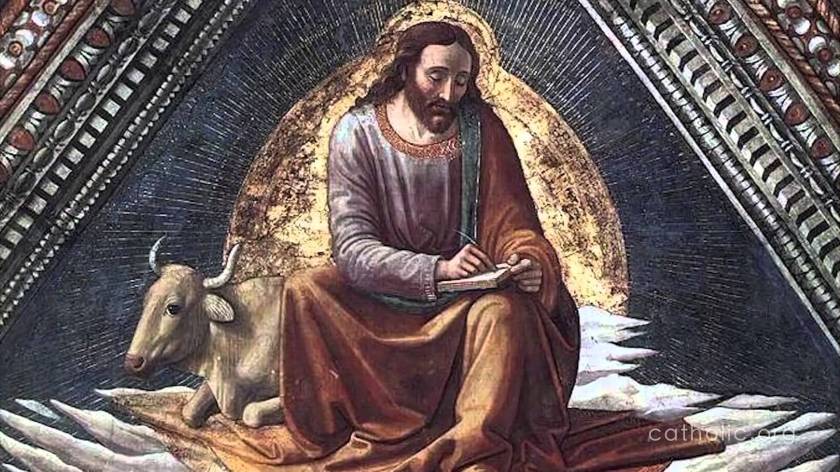
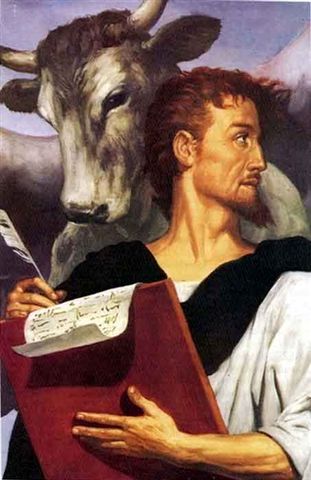
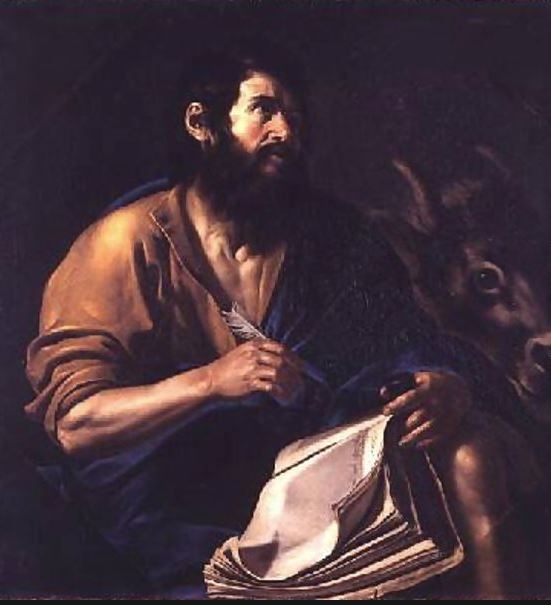
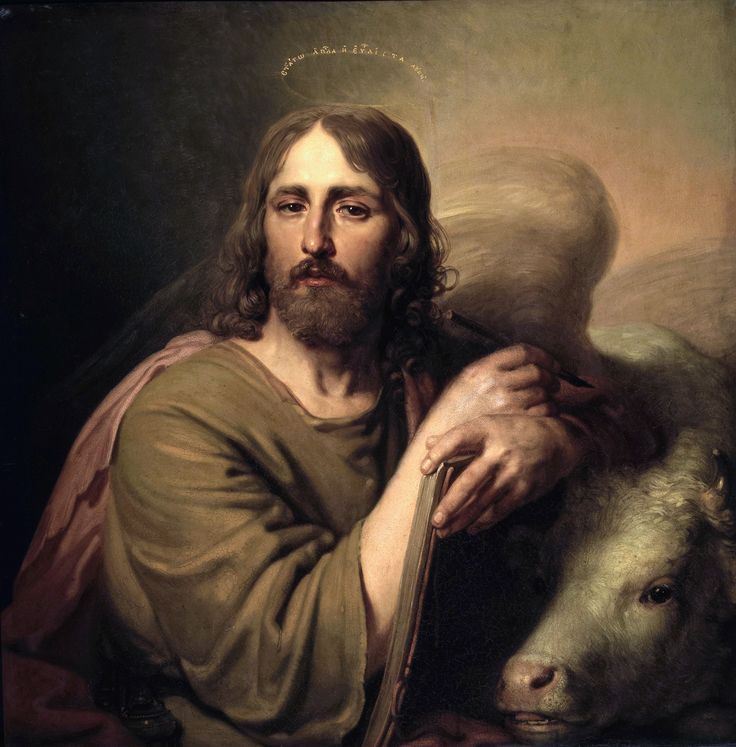
Saint of the Day – St Luke the Evangelist – 18 October – Physician,Ddisciple of St Paul, Evangelist, Author of the Gospel according to Luke and the Acts of the Apostles.   Tradition says he was an Artist too.  He was born at Antioch and Died in c 74 in Greece.   Some say he was Martyred, others that he died of natural causes.  His relics reside at Padua, Italy.   Patronages – artists, bachelors, bookbinders, brewers, butchers, doctors, glass makers, glassworkers, glaziers, gold workers, goldsmiths, lacemakers, lace workers, notaries, painters, physicians, sculptors, stained glass workers, surgeons, 2 cities.   Attributes – Evangelist, Physician, a Bishop, a book or a pen, a man accompanied by a winged ox/winged calf/ox, a man painting an icon of the Blessed Virgin Mary, a brush or a palette (referring to the tradition that he was a painter).   St Luke is one of the Four Evangelists—the four traditionally ascribed authors of the canonical Gospels.   The early Church Fathers ascribed to him authorship of both the Gospel according to Luke and the book of Acts of the Apostles, which would mean Luke contributed over a quarter of the text of the New Testament, more than any other author.   Prominent figures in early Christianity such as Jerome and Eusebius later reaffirmed his authorship.   The New Testament mentions Luke briefly a few times and the Pauline epistle to the Colossians refers to him as a physician (from Greek for ‘one who heals’);  thus he is thought to have been both a physician and a disciple of Paul. Christians since the faith’s early years have regarded him as a saint.   He is believed to have been a martyr, reportedly as having been hanged from an olive tree, though some believe otherwise.

HEADER - st luke

Luke came from the large metropolitan city of Antioch, a part of modern-day Turkey.   In Luke’s lifetime, his native city emerged as an important center of early Christianity. During the future saint’s early years, the city’s port had already become a cultural center, renowned for arts and sciences.   Historians do not know whether Luke came to Christianity from Judaism or paganism, although there are strong suggestions that Luke was a gentile convert.SOD-1018-SaintLuke-790x480

Educated as a physician in the Greek-speaking city, Luke was among the most cultured and cosmopolitan members of the early Church.   Scholars of archeology and ancient literature have ranked him among the top historians of his time period, besides noting the outstanding Greek prose style and technical accuracy of his accounts of Christ’s life and the apostles’ missionary journeys.LUKE!!!luke

Other students of biblical history adduce from Luke’s writings that he was the only evangelist to incorporate the personal testimony of the Blessed Virgin Mary, whose role in Christ’s life emerges most clearly in his gospel.   Tradition credits him with painting several icons of Christ’s mother and one of the sacred portraits ascribed to him – known by the title “Salus Populi Romano – Salvation of the Roman People”– survives to this day in the Basilica of St Mary Major.

Some traditions hold that Luke became a direct disciple of Jesus before His ascension, while others hold that he became a believer only afterward.   After St Paul’s conversion, Luke accompanied him as his personal physician– and, in effect, as a kind of biographer, since the journeys of Paul on which Luke accompanied him occupy a large portion of the Acts of the Apostles.   Luke probably wrote this text, the final narrative portion of the New Testament, in the city of Rome where the account ends.

Luke appears in Acts during Paul’s second journey, remains at Philippi for several years until Paul returns from his third journey, accompanies Paul to Jerusalem and remains near him when he is imprisoned in Caesarea.   During these two years, Luke had time to seek information and interview persons who had known Jesus.   He accompanied Paul on the dangerous journey to Rome where he was a faithful companion   After the martyrdom of St Paul in the year 67, St Luke is said to have preached elsewhere throughout the Mediterranean and possibly died as a martyr.   However, even tradition is unclear on this point.   Fittingly, the evangelist whose travels and erudition could have filled volumes, wrote just enough to proclaim the gospel and apostolic preaching to the world.

Luke’s unique character may best be seen by the emphases of his Gospel, which has been given a number of subtitles:
1) The Gospel of Mercy
2) The Gospel of Universal Salvation
3) The Gospel of the Poor
4) The Gospel of Absolute Renunciation
5) The Gospel of Prayer and the Holy Spirit
6) The Gospel of Joy

luke 3.Евангелист Лука

Posted in FEASTS and SOLEMNITIES, SAINT of the DAY

Feast of St Luke the Evangelist and Memorials of the Saints – 18 October

St Luke the Evangelist (Feast)

St Acutius of Pozzuoli
St Asclepiades of Antioch
St Brothen
Bl Burchard I of Halberstadt
St Cadwaladr of Brittany
Bl Domenico of Perpignano
St Eutychius of Pozzuoli
St Gwen
St Gwen of Tagarth
St Gwendoline
St Isaac Jogues
St Julian the Hermit
St Justus of Beauvais
Bl Margherita Tornielli
St Monon of Nassogne
St Proculus of Pozzuoli
Bl Theobald of Narbonna
St Tryphonia of Rome

Martyrs of Africa – 9 saints: A group of Christians martryed together in Africa. The only details that have survived are the names – Beresus, Dasius, Faustinus, Leucius, Lucius, Martialis, Victoricus, Victrix and Viktor. They were martyred in c.300 in Africa.

Martyred in the Spanish Civil War:
• Blessed Alfredo Almunia López-Teruel
• Blessed Francisco Roselló Hernández
• Blessed Isidro Juan Martínez

Posted in FEASTS and SOLEMNITIES, MARIAN TITLES, SAINT of the DAY, The BLESSED VIRGIN MARY

Feast of Our Lady Aparecida, Our Lady of the Pillar and Memorials of the Saints – 12 October

Our Lady Aparecida:   Also known as – Our Lady Who Appeared
In October 1717, Dom Pedro de Almedida, Count of Assumar passed through the area of Guarantinqueta, a small city in the Paraiba river valley.   The people there decided to hold a feast in his honour and though it was not fishing season, the men went to the waters to fish for the feast.   Three of the fishermen, Domingos Garcia, Joco Alves and Felipe Pedroso, prayed to the Immaculate Conception and asked God’s help.   However, after several hours they were ready to give up. Joco cast his net once more near the Port of Itaguagu but instead of fish, he hauled in the body of a statue.   The three cast their net again, and brought up the statue’s head.  After cleaning the statue they found that it was Our Lady of the Immaculate Conception.   Naming their find Our Lady Aparecida, they wrapped it in cloth and continued to fish; now their nets were full.
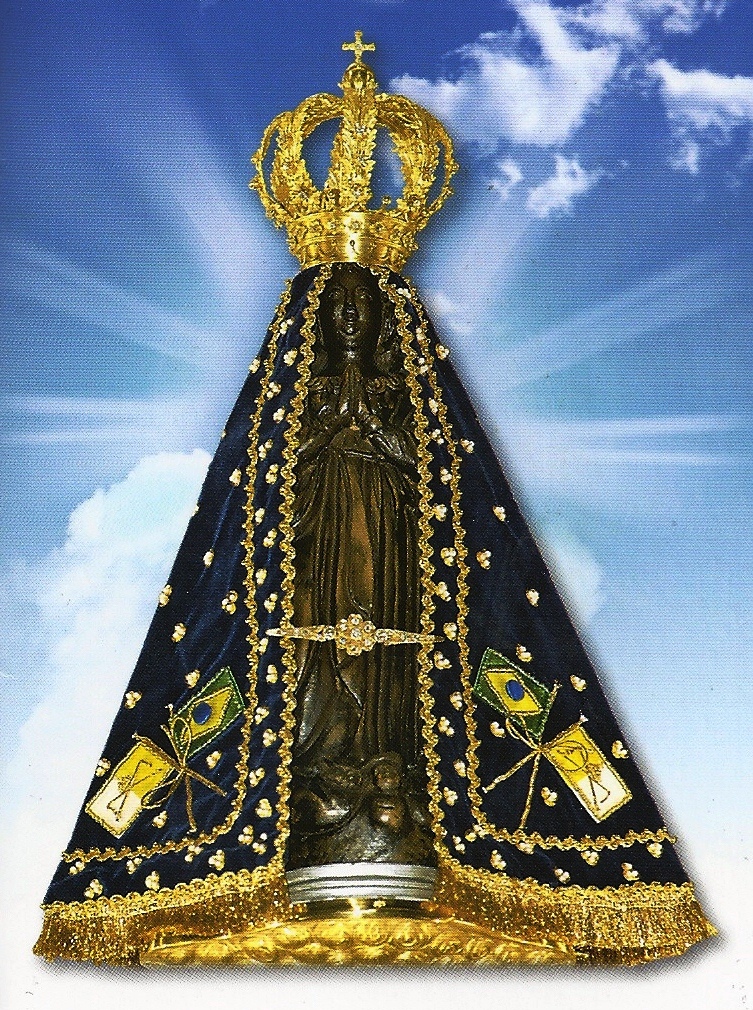
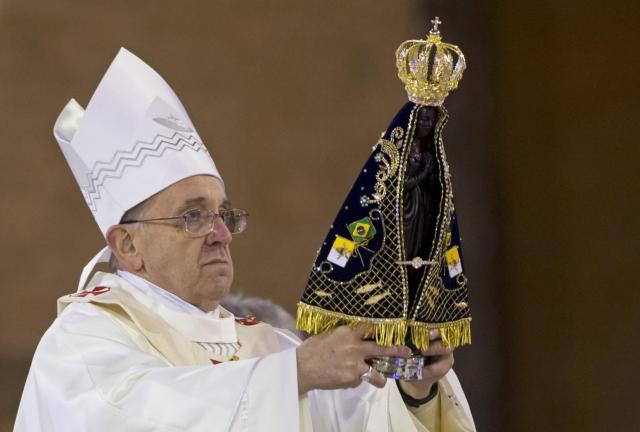
While we do not know why the statue was at the bottom of the river, we do know who made it. Frei Agostino de Jesus, a carioca monk from Sao Paulo known for his sculpture. The image was less than three feet tall, was made around 1650 and must have been underwater for years. It is a dark brown colour, is covered by a stiff robe of richly embroidered thick cloth and wears an imperial crown which was added in 1904. Only her face and hands can be seen.   Pope Pius XII proclaimed her principal patroness of Brazil in 1930.   The statue was vandalised by being broken into several pieces just prior to a visit by St Pope John Paul II but a group of dedicated artists and artisans carefully pieced it together again.
Patronages: • Aparecida, Brazil, diocese of • Brazil • World Youth Day 2013Our Lady Aparecida imageOUR LADY OF APARECIDA

Our Lady of the Pillar:  Tradition says that in the early day of the Church, Saint James the Greater was spreading the Gospel in Spain but making very little progress.   He was dejected and questioning his mission.   About 44, the Virgin Mary, who was still living in Jerusalem at the time, bi-located and appeared to him in a vision to boost his morale. In it, she was atop a column or pillar, which was being carried by angels.   That pillar is believed to be the same one venerated in Zaragoza, Spain today. Miraculous healings reported at the scene.
PatronageS: • Imus, Philippines, diocese of • Tagbilaran, Philippines • Zamboanga, Philippines, archdiocese of • Zamboanga City, Philippines • Zaragoza, Spain.


St Amelius of Mortara
St Amicus of Mortara
St Cyprian
St Domnina of Anazarbus
St Edisto
St Edistius of Ravenna
St Edwin of Northumbria
St Evagrius the Martyr
St Felix
St Felix IV, Pope
St Fiace
St Herlindis
St Juan Osiense
St Maximilian of Celeia
St Meinards
St Monas of Milan
St Pantalus of Basle
St Priscian the Martyr
St Relindis
Bl Roman Sitko
St Salvinus of Verona
Bl Thomas Bullaker

Martyred in the Spanish Civil War:
• Blessed Bartolomé Caparrós García
• Blessed Eufrasio of the Child Jesus
• Blessed José González Huguet
• Blessed Pedro Salcedo Puchades
• Blessed Rafael Lluch Garín

Posted in ArchAngels and Angels, CATECHESIS, DOCTORS of the Church, FEASTS and SOLEMNITIES, MORNING Prayers, SAINT of the DAY, The WORD, Uncategorized

Thought for the Day – 29 September – The Feast of Sts Michael, Gabriel and Raphael

Thought for the Day – 29 September – The Feast of Sts Michael, Gabriel and Raphael

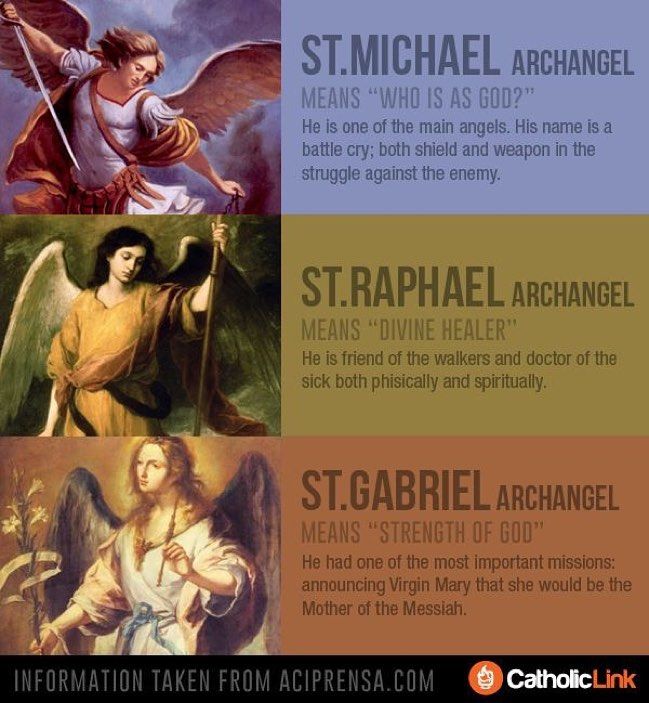
We are celebrating the Feast of the three Archangels who are mentioned by name in Scripture: Michael, Gabriel and Raphael.   But what is an Angel?   Sacred Scripture and the Church’s tradition enable us to discern two aspects.

On the one hand, the Angel is a creature who stands before God, oriented to God with his whole being.   All three names of the Archangels end with the word “El”, which means “God”.   God is inscribed in their names, in their nature.
Their true nature is existing in His sight and for Him.   In this very way the second aspect that characterizes Angels is also explained:  they are God’s messengers.   They bring God to men, they open heaven and thus open earth.  Precisely because they are with God, they can also be very close to man.

Like an angel to others
Indeed, God is closer to each one of us than we ourselves are.   The Angels speak to man of what constitutes his true being, of what in his life is so often concealed and buried. They bring him back to himself, touching him on God’s behalf.   In this sense, we human beings must also always return to being angels to one another – angels who turn people away from erroneous ways and direct them always, ever anew, to God.
If the ancient Church called Bishops “Angels” of their Church, she meant precisely this: Bishops themselves must be men of God, they must live oriented to God. “Multum orat pro populo” – “Let them say many prayers for the people”, the Breviary of the Church says of holy Bishops.   The Bishop must be a man of prayer, one who intercedes with God for human beings.   The more he does so, the more he also understands the people who are entrusted to him and can become an angel for them – a messenger of God who helps them to find their true nature by themselves, and to live the idea that God has of them.

St Michael:  making a space for God in the world
All this becomes even clearer if we now look at the figures of the three Archangels whose Feast the Church is celebrating today.  First of all there is Michael.   We find him in Sacred Scripture above all in the Book of Daniel, in the Letter of the Apostle St Jude Thaddeus and in the Book of Revelation.

Two of this Archangel’s roles become obvious in these texts.   He defends the cause of God’s oneness against the presumption of the dragon, the “ancient serpent”, as John calls it.   The serpent’s continuous effort is to make men believe that God must disappear so that they themselves may become important;   that God impedes our freedom and, therefore, that we must rid ourselves of him.

However, the dragon does not only accuse God.   The Book of Revelation also calls it “the accuser of our brethren…, who accuses them day and night before our God” (12: 10). Those who cast God aside do not make man great but divest him of his dignity.   Man then becomes a failed product of evolution.   Those who accuse God also accuse man. Faith in God defends man in all his frailty and short-comings:  God’s brightness shines on every individual.   It is the duty of the Bishop and of every christian, as a man of God, to make room in the world for God, to counter the denials of Him and thus to defend man’s greatness.   And what more could one say and think about man than the fact that God Himself was made man?   Michael’s other role, according to Scripture, is that of protector of the People of God (cf. Dn 10: 21; 12: 1).
Dear friends, be true “guardian angels” of the Church which will be entrusted to you! Help the People of God whom you must lead in its pilgrimage to find the joy of faith and to learn to discern the spirits: to accept good and reject evil, to remain and increasingly to become, by virtue of the hope of faith, people who love in communion with God-Love.

St Gabriel: God who calls
We meet the Archangel Gabriel especially in the precious account of the annunciation to Mary of the Incarnation of God, as Luke tells it to us (1: 26-38).   Gabriel is the messenger of God’s Incarnation.   He knocks at Mary’s door and, through him, God himself asks Mary for her “yes” to the proposal to become the Mother of the Redeemer, of giving her human flesh to the eternal Word of God, to the Son of God.   The Lord knocks again and again at the door of the human heart.   In the Book of Revelation He says to the “angel” of the Church of Laodicea and, through him, to the people of all times:  “Behold, I stand at the door and knock; if any one hears my voice and opens the door, I will come in to him and eat with him, and he with me” (3: 20).   The Lord is at the door – at the door of the world and at the door of every individual heart.   He knocks to be let in, the Incarnation of God, His taking flesh, must continue until the end of time.  All must be reunited in Christ in one body –  the great hymns on Christ in the Letters to the Ephesians and to the Colossians tell us this. Christ knocks.   Today too He needs people who, so to speak, make their own flesh available to Him, give Him the matter of the world and of their lives, thus serving the unification between God and the world, until the reconciliation of the universe.   Dear friends, it is your task to knock at people’s hearts in Christ’s Name.   By entering into union with Christ yourselves, you will also be able to assume Gabriel’s role: to bring Christ’s call to men.

St Raphael: recovering sight
St Raphael is presented to us, above all in the Book of Tobit, as the Angel to whom is entrusted the task of healing.   When Jesus sends His disciples out on a mission, the task of proclaiming the Gospel is always linked with that of healing.   The Good Samaritan, in accepting and healing the injured person lying by the wayside, becomes without words a witness of God’s love.   We are all this injured man, in need of being healed.   Proclaiming the Gospel itself already means healing in itself, because man is in need of truth and love above all things.

The Book of Tobit refers to two of the Archangel Raphael’s emblematic tasks of healing. He heals the disturbed communion between a man and a woman.  He heals their love. He drives out the demons who over and over again exhaust and destroy their love.   He purifies the atmosphere between the two and gives them the ability to accept each other for ever.   In Tobit’s account, this healing is recounted with legendary images.

In the New Testament, the order of marriage established in creation and threatened in many ways by sin, is healed through Christ’s acceptance of it in His redeeming love.   He makes marriage a sacrament:  His love, put on a cross for us, is the healing power which in all forms of chaos offers the capacity for reconciliation, purifies the atmosphere and mends the wounds.   The priest is entrusted with the task of leading men and women ever anew to the reconciling power of Christ’s love.  He must be the healing “angel” who helps them to anchor their love to the sacrament and to live it with an ever renewed commitment based upon it.

Secondly, the Book of Tobit speaks of the healing of sightless eyes. We all know how threatened we are today by blindness to God.   How great is the danger that with all we know of material things and can do with them, we become blind to God’s light.   Healing this blindness through the message of faith and the witness of love is Raphael’s service, entrusted day after day to the priest and in a special way to the Bishop.   Thus, we are prompted spontaneously also to think of the Sacrament of Reconciliation, the Sacrament of Penance which in the deepest sense of the word is a sacrament of healing.   The real wound in the soul, in fact, the reason for all our other injuries, is sin.   And only if forgiveness exists, by virtue of God’s power, by virtue of Christ’s love, can we be healed, can we be redeemed.

“Abide in my love”, the Lord says to us today in the Gospel (Jn 15: 9).   At the moment of your Episcopal Ordination he says so particularly to you, dear friends.   Abide in His love!   Abide in that friendship with Him, full of love, which He is giving you anew at this moment!   Then your lives will bear fruit, fruit that abides (cf. Jn 15: 16).   Let us all pray for you at this time, dear Brothers, so that this may be granted to you. Amen.

Benedict XVI, fragments of a homily (to Bishops) given on September 29, 2007

Sts Michael, Gabriel and Raphael, pray for us!

holy archangels - pray for us.2

Posted in ArchAngels and Angels, DOCTORS of the Church, FATHERS of the Church, FEASTS and SOLEMNITIES, MORNING Prayers, QUOTES of the SAINTS, SAINT of the DAY

Quote of the Day – 29 September – – The Feast of Sts Michael, Gabriel and Raphael

Quote of the Day – 29 September – – The Feast of Sts Michael, Gabriel and Raphael

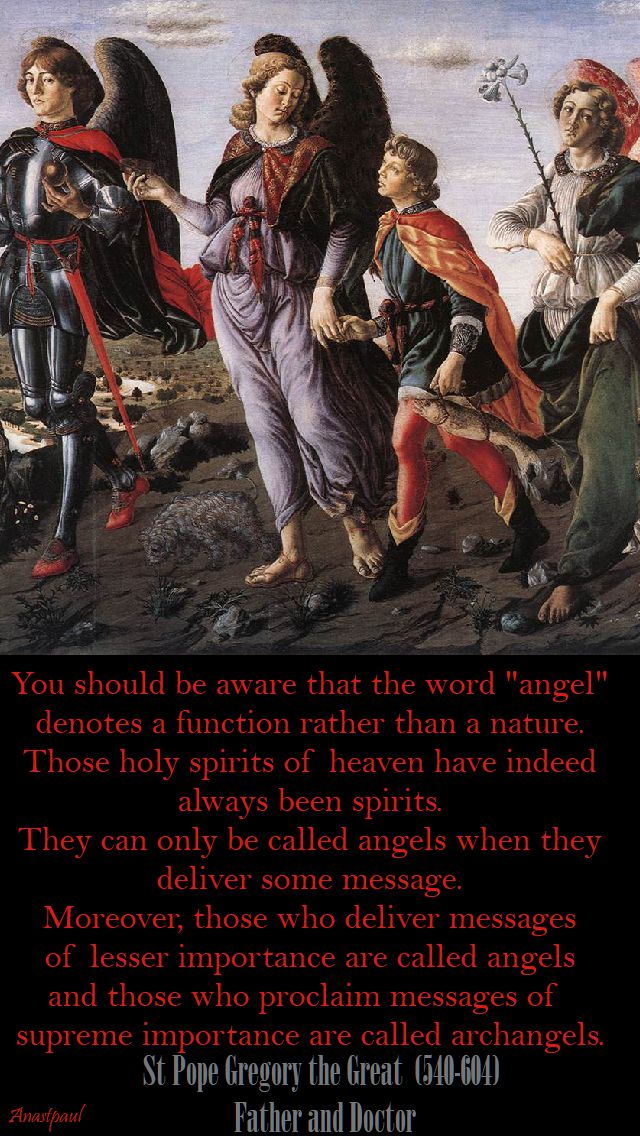
St Gregory the Great teaches us about the Archangels and why they are distinct from angels.

You should be aware that the word “angel” denotes a function rather than a nature.
Those holy spirits of heaven have indeed always been spirits.
They can only be called angels when they deliver some message.

ANGELS & ARCHANGELS
Moreover, those who deliver messages of lesser importance are called angels;  and those who proclaim messages of supreme importance are called archangels.   And so it was that not merely an angel but the archangel Gabriel was sent to the Virgin Mary.   It was only fitting that the highest angel should come to announce the greatest of all messages.you should be aware - st gregory the great - 29 sept 2017

Some angels are given proper names to denote the service they are empowered to perform.   In that holy city, where perfect knowledge flows from the vision of almighty God, those who have no names may easily be known.   But personal names are assigned to some, not because they could not be known without them but rather to denote their ministry when they came among us.   Thus, Michael means “Who is like God”  Gabriel is “The Strength of God” and Raphael is “God’s Remedy.”

ST MICHAEL
Whenever some act of wondrous power must be performed, Michael is sent, so that his action and his name may make it clear that no one can do what God does by his superior power.   So also our ancient foe desired in his pride to be like God, saying:  I will ascend into heaven;  I will exalt my throne above the stars of heaven;  I will be like the Most High.   He will be allowed to remain in power until the end of the world when he will be destroyed in the final punishment.   Then, he will fight with the archangel Michael, as we are told by John:   A battle was fought with Michael the archangel.

GABRIEL & RAPHAEL
So too Gabriel, who is called God’s strength, was sent to Mary.   He came to announce the One who appeared as a humble man to quell the cosmic powers.   Thus God’s strength announced the coming of the Lord of the heavenly powers, mighty in battle.   [Luke 1:11-38]

Raphael means, as I have said, God’s remedy, for when he touched Tobit’s eyes in order to cure him, he banished the darkness of his blindness.   Thus, since he is to heal, he is rightly called God’s remedy.

This post on the archangels is an excerpt from a homily on the Gospels (Hom. 32, 8-9: PL 76, 1250-1251) by St Gregory the Great is used in the Roman Catholic Office of Readings for the Feast of the Archangels Michael, Gabriel and Raphael today.

Posted in ArchAngels and Angels, DOCTORS of the Church, FEASTS and SOLEMNITIES, MARIAN QUOTES, MORNING Prayers, QUOTES of the SAINTS, SAINT of the DAY, The WORD

One Minute Reflection – 29 September – The Feast of Sts Michael, Gabriel and Raphael

One Minute Reflection – 29 September – The Feast of Sts Michael, Gabriel and Raphael

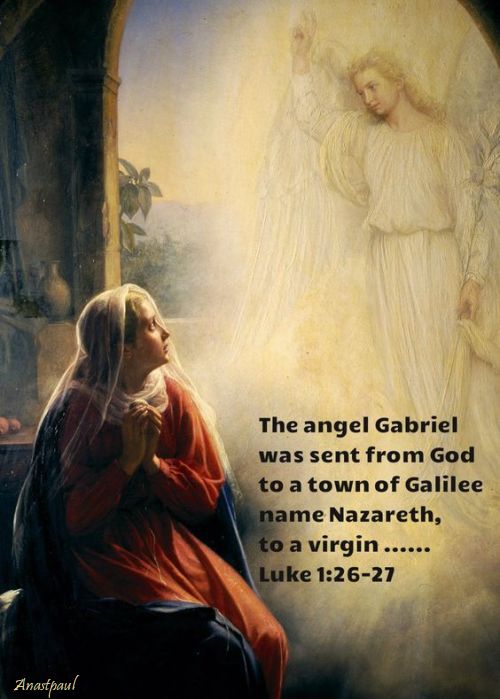
The angel Gabriel was sent from God to a town of Galilee name Nazareth, to a virgin ….Luke 1:26-27

luke 1 26-27

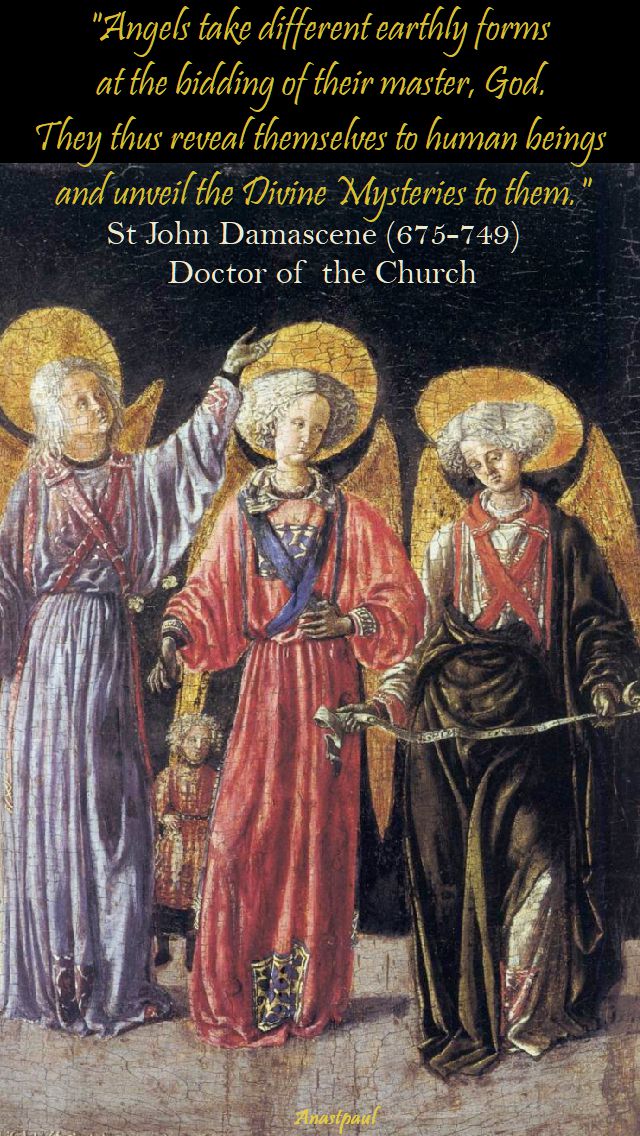
REFLECTION – Angels take different earthly forms at the bidding of their master, God.
They thus reveal themselves to human beings and unveil the Divine Mysteries to them……St John Damasceneangels take different forms - st john damascene - 29 sept 2017

PRAYER – God of all Wisdom, You direct the ministry of angels and of human beings. Grant that the angels who always minister to You in heaven may defend us during our life on earth and protect us from evil.   Grant this, through our Lord Jesus Christ, Your Son, in union with the Holy Spirit, one God forever and ever.   Amenholy archangels - pray for us

Posted in ArchAngels and Angels, BREVIARY Prayers, FEASTS and SOLEMNITIES, MORNING Prayers, SAINT of the DAY

Our Morning Offering – 29 September – The Feast of Sts Michael, Gabriel and Raphael

Our Morning Offering – 29 September – The Feast of Sts Michael, Gabriel and Raphael

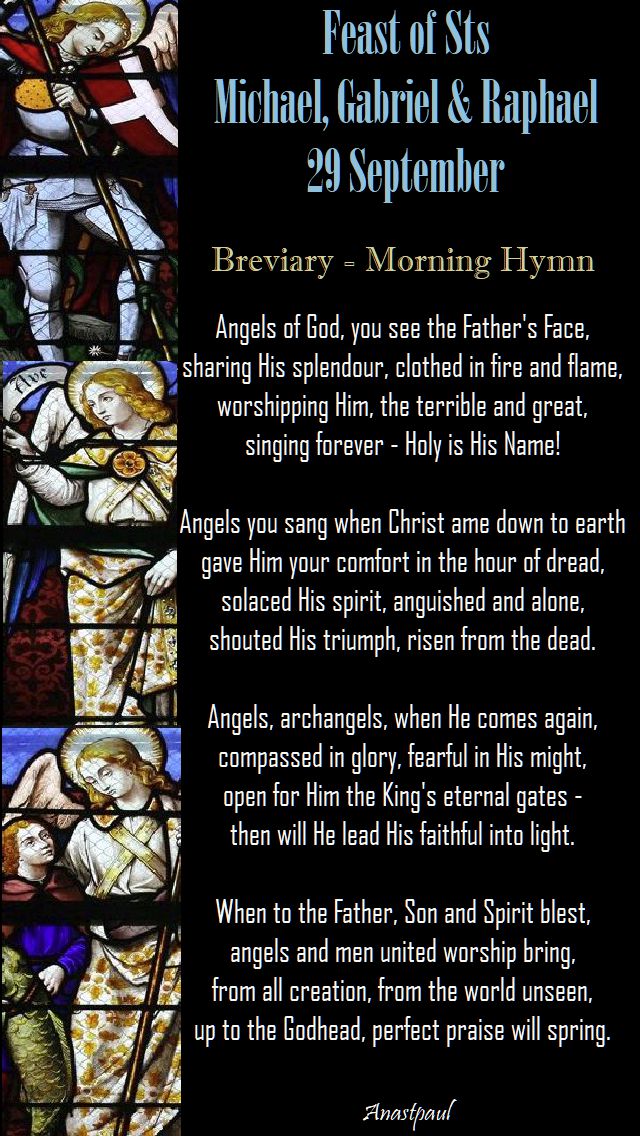
Morning Hymn from the Breviary

Angels of God, you see the Father’s Face,
sharing His splendour, clothed in fire and flame,
worshipping Him, the terrible and great,
singing forever – Holy is His Name!
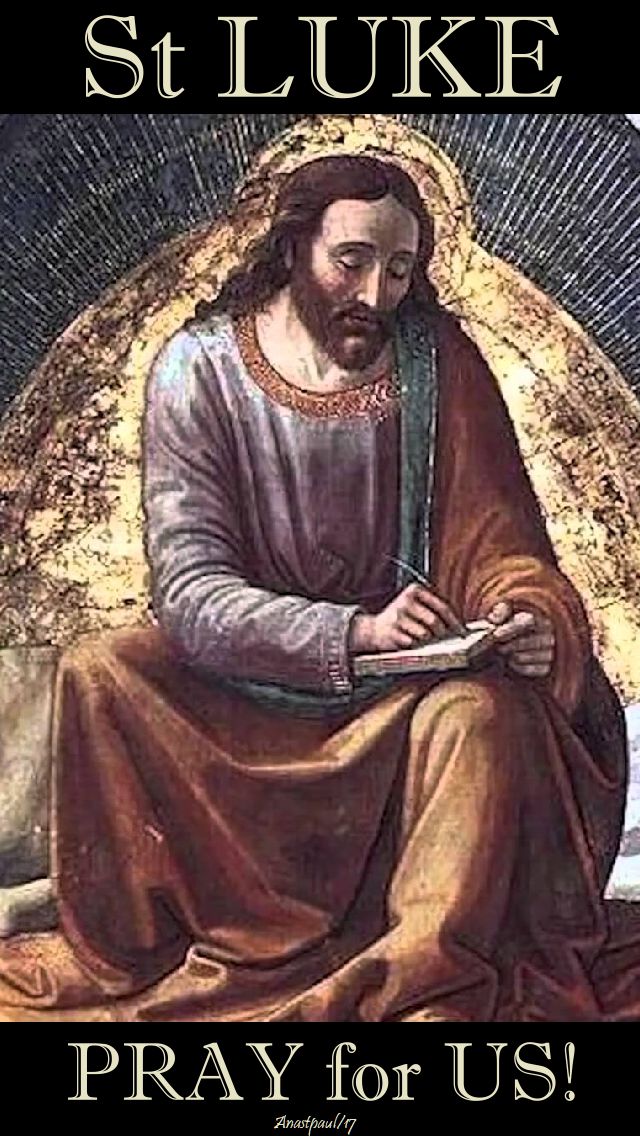
Angels you sang when Christ ame down to earth
gave Him your comfort in the hour of dread,
solaced His spirit, anguished and alone,
shouted His triumph, risen from the dead.

Angels, archangels, when He comes again,
compassed in glory, fearful in His might,
open for Him the King’s eternal gates –
then will He lead His faithful into light.

When to the Father, Son and Spirit blest,
angels and men united worship bring,
from all creation, from the world unseen,
up to the Godhead, perfect praise will spring.breviary morning hymn - 3 archangels - 29 sept 2017

Posted in ArchAngels and Angels, FEASTS and SOLEMNITIES, SAINT of the DAY

Saints of the Day – Feast of The Three Archangels – 29 September

Saints of the Day – Feast of The Three Archangels – 29 Septemberarcangeli

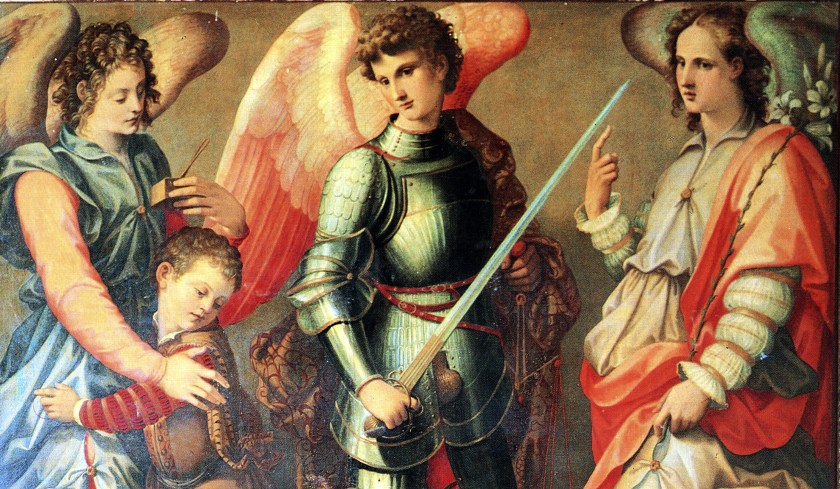
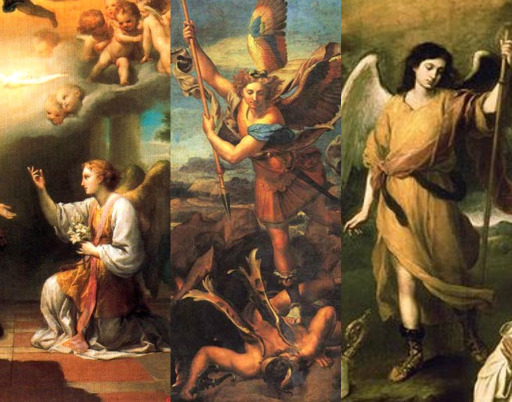
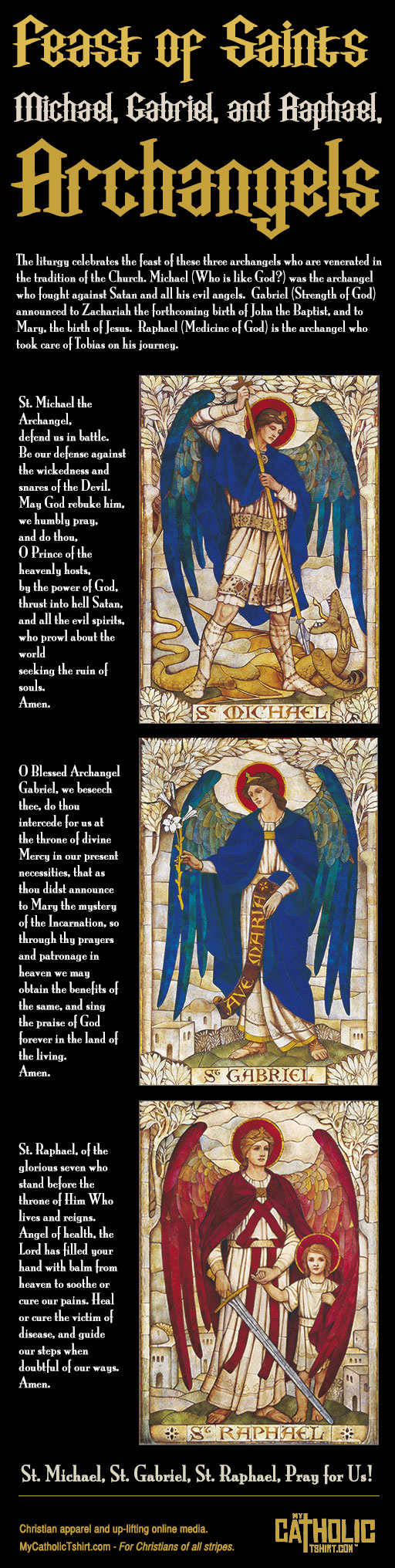
The liturgy celebrates the feast of these three archangels who are venerated in the tradition of the Church.   Michael (Who is like God?) was the archangel who fought against Satan and all his evil angels, defending all the friends of God.   He is the protector of all humanity from the snares of the devil.   Gabriel (Strength of God) announced to Zachariah the forthcoming birth of John the Baptist and to Mary, the birth of Jesus.   His greeting to the Virgin, “Hail, full of grace,” is one of the most familiar and frequent prayers of the Christian people.   Raphael (Medicine of God) is the archangel who took care of Tobias on his journey.archangels

The Catechism of the Catholic Church teaches us that, “[T]he existence of the spiritual, non-corporeal beings that Sacred Scripture usually calls “angels” is a truth of faith.   The witness of Scripture is as clear as the unanimity of Tradition.”feast of three archangels

Angels are pure, created spirits.   The name angel means servant or messenger of God. Angels are celestial or heavenly beings, on a higher order than human beings.   Angels have no bodies and do not depend on matter for their existence or activity.   They are distinct from saints, which men can become.   Angels have intellect and will and are immortal.   They are a vast multitude but each is an individual.   Archangels are one of the nine choirs of angels listed in the Bible.   In ascending order, the choirs or classes are 1) Angels, 2) Archangels, 3) Principalities, 4) Powers, 5) Virtues, 6) Dominations, 7) Thrones, 8) Cherubim, and 9) Seraphim.info - 3 archangels

St Michael
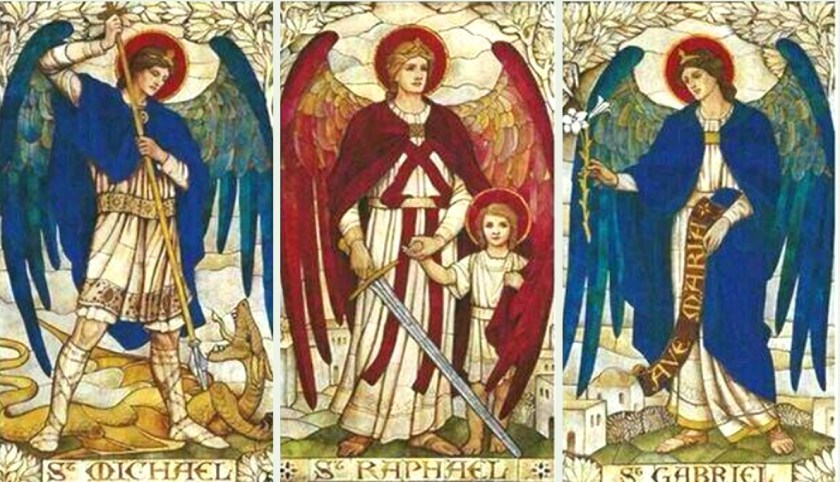
The name of the archangel Michael means, in Hebrew, who is like unto God? and he is also known as “the prince of the heavenly host.”   He is usually pictured as a strong warrior, dressed in armour and wearing sandals.   His name appears in Scripture four times, twice in the Book of Daniel and once each in the Epistle of St Jude and the Book of Revelation.   From Revelation we learn of the battle in heaven, with St. Michael and his angels combating Lucifer and the other fallen angels (or devils).   We invoke St Michael to help us in our fight against Satan;  to rescue souls from Satan, especially at the hour of death;  to be the champion of the Jews in the Old Testament and now Christians;  and to bring souls to judgment.
Patronages:  Against temptations; against powers of evil; artists; bakers; bankers; battle; boatmen; cemeteries; coopers; endangered children; dying; Emergency Medical Technicians; fencing; grocers; hatmakers; holy death; knights; mariners; mountaineers; paramedics; paratroopers; police officers; radiologists; sailors; the sick; security forces; soldiers; against storms at sea; swordsmiths; those in need of protection; Brussels, Belgium; Caltanissett, Sicily; Cornwall, England; Diocese of Pensacola-Tallahassee Florida; England; Germany; Archdiocese of Mobile, Alabama; Papua, New Guinea; Puebla, Mexico; San Miguel de Allende, Mexico; Sibenik, Croatia; Archdiocese of Seattle, Washington; Diocese of Springfield, Massachusetts.

Attributes: Angel with wings; dressed in armour; lance and shield; scales; shown weighing souls; millstone; piercing dragon or devil; banner charged with a dove; symbolic colours orange or gold.

St Gabriel
St Gabriel’s name means “God is my strength”.   Biblically he appears three times as a messenger.   He had been sent to Daniel to explain a vision concerning the Messiah.  He appeared to Zachary when he was offering incense in the Temple, to foretell the birth of his son, St John the Baptist.   St Gabriel is most known as the angel chosen by God to be the messenger of the Annunciation, to announce to mankind the mystery of the Incarnation.

The angel’s salutation to our Lady, so simple and yet so full of meaning, Hail Mary, full of grace, has become the constant and familiar prayer of all Christian people.

Patronages: Ambassadors; broadcasting; childbirth; clergy; communications; diplomats; messengers; philatelists; postal workers; public relations; radio workers; secular clergy; stamp collectors; telecommunications; Portugal; Archdiocese of Seattle, Washington.

Attributes: Archangel; sceptre and lily; MR or AM shield; lantern; mirror; olive branch; scroll with words Ave Maria Gratia Plena; Resurrection trumpet; shield; spear; lily; symbolic colours, silver or blue.

St Raphael
Our knowledge of the Archangel Raphael comes to us from the book of Tobit.   His mission as wonderful healer and fellow traveller with the youthful Tobias has caused him to be invoked for journeys and at critical moments in life. Tradition also holds that Raphael is the angel that stirred the waters at the healing sheep pool in Bethesda.   His name means “God has healed”.
Patronages: Blind; bodily ills; counselors; druggists; eye problems; guardian angels; happy meetings; healers; health inspectors; health technicians; love; lovers; mental illness; nurses; pharmacists; physicians; shepherds; against sickness; therapists; travellers; young people; young people leaving home for the first time; Archdiocese of Dubuque, Iowa; Archdiocese of Seattle, Washington.

Attributes: Staff; wallet and fish; staff and gourd; archangel; young man carrying a staff; young man carrying a fish; walking with Tobias; holding a bottle or flask; symbolic colours, gray or yellow.

Posted in ArchAngels and Angels, FEASTS and SOLEMNITIES, SAINT of the DAY

Feast of the The Three Archangels and Memorials of the Saints – 29 September

St Gabriel the Archangel (Feast) – https://www.youtube.com/watch?v=nimeh0094yg
St Michael the Archangel (Feast)
St Raphael the Archangel (Feast)

archangels-together

Bl Alericus
St Anno of Eichstätt
St Casdoe of Persia
St Catholdus of Eichstätt
Bl Charles of Blois
St Dadas of Persia
St Diethardus of Eichstätt
St Fraternus of Auxerre
St Gabdelas of Persia
St Grimoaldus of Pontecorvo
St Gudelia
St Guillermo Courtet
Bl John de Montmirail
Bl John of Ghent
St Lazaro of Kyoto
St Liutwin of Trier
Bl Luigi Monza
St Miguel de Aozaraza
St Quiriacus of Palestine
St Rene Goupil
St Rhipsime
Bl Richard Rolle
St Sapor of Persia
St Theodota of Thrace
St Vicente Shiwozuka de la Cruz

Martyrs of Thrace – 3 saints: Three Christian men murdered in Thrace for their faith. They are – Eutychius, Heracleas and Plautus.

Martyred in the Spanish Civil War:
• Blessed Antonio Arribas Hortigüela
• Blessed Antonio Martínez López
• Blessed Dario Hernández Morató
• Blessed Francesc de Paula Castelló Aleu
• Blessed Francisco Edreira Mosquera
• Blessed José Villanova Tormo
• Blessed Pau Bori Puig
• Blessed Vicente Sales Genovés
• Blessed Virgilio Edreira Mosquera

Posted in DOCTORS of the Church, FATHERS of the Church, FEASTS and SOLEMNITIES, MORNING Prayers, QUOTES of the SAINTS, SAINT of the DAY, The APOSTLES & EVANGELISTS

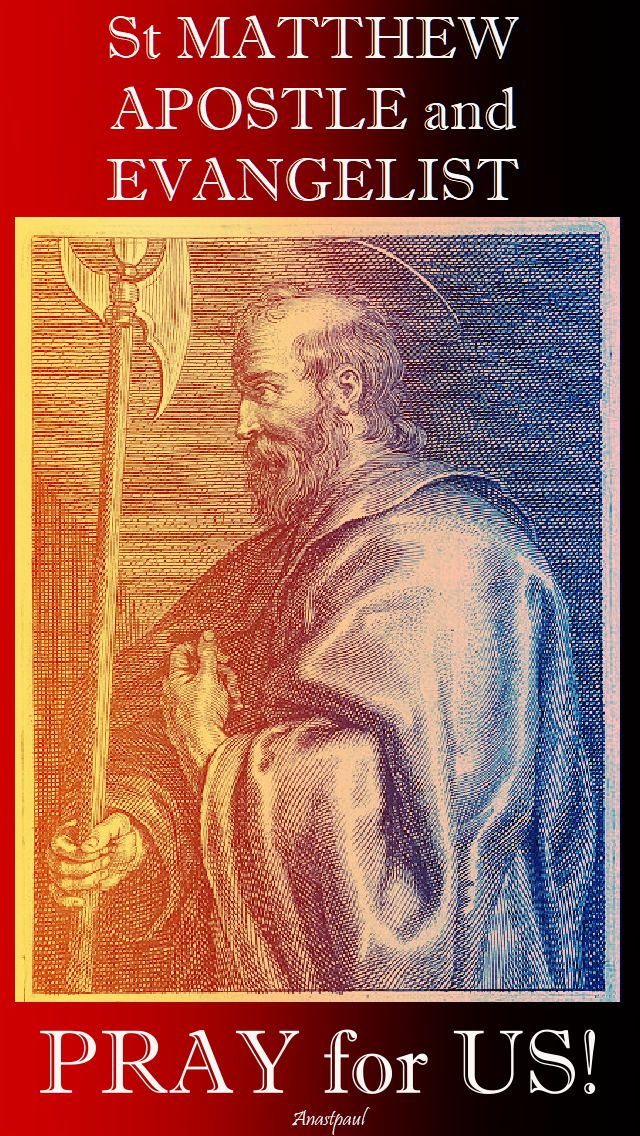
Quote/s of the Day – 21 September – The Feast of St Matthew, Apostle and Evangelist

Quote/s of the Day – 21 September – The Feast of St Matthew, Apostle and Evangelist

“On hearing Christ’s voice, we open the door to receive Him,
as it were, when we freely assent to His promptings
and when we give ourselves over to doing what must be done.
Christ, since He dwells in the hearts of His chosen ones
through the grace of His love, enters so that He might eat with us
and we with Him. He ever refreshes us by the light of His presence
insofar as we progress in our devotion to and longing for the things of heaven.
He Himself is delighted by such a pleasing banquet.”

St Bede the Venerable (673-735) Doctor of the Churchon hearing christ's voice - st bede the venerable - 21 sept 2017

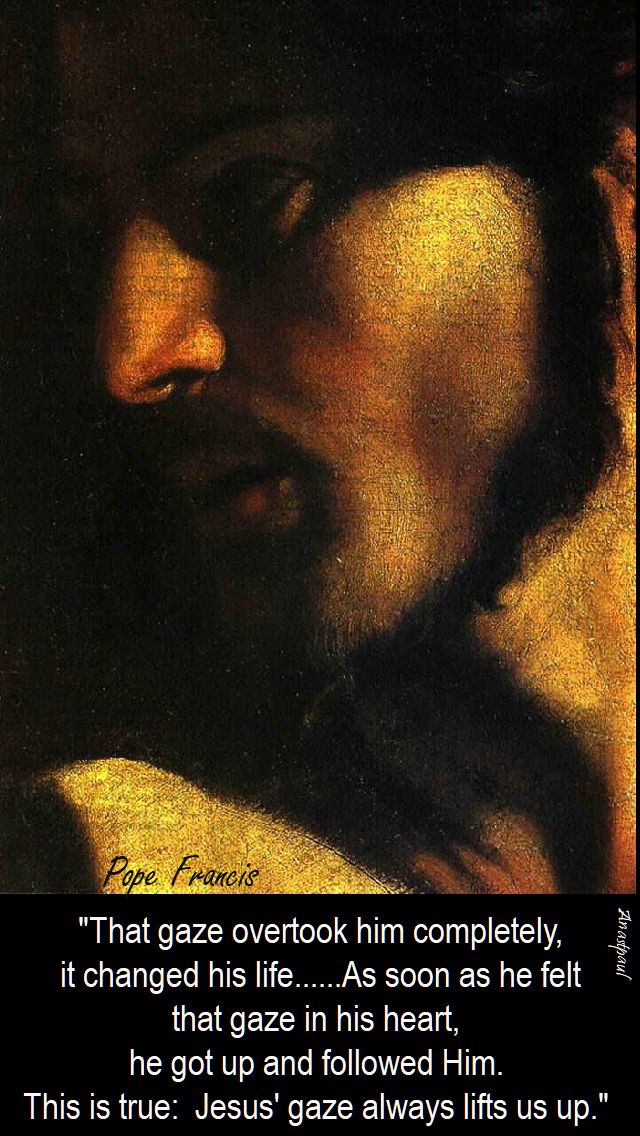
“That gaze overtook him completely, it changed his life.
We say he was converted. He Changed his life.
As soon as he felt that gaze in his heart, he got up and followed Him.
This is true: Jesus’ gaze always lifts us up.
It is a look that always lifts us up and never leaves you in your place,
never lets us down, never humiliates. It invites you to get up –
a look that brings you to grow, to move forward, that encourages you,
because the One who looks upon you loves you.
The gaze makes you feel that He loves you.
This gives the courage to follow Him: ‘and he got up and followed Him.'”

Pope Francis 21 September 2013that gaze overtook him completely-pope francis

Posted in DOCTORS of the Church, FATHERS of the Church, FEASTS and SOLEMNITIES, MORNING Prayers, QUOTES of the SAINTS, SAINT of the DAY, The WORD

One Minute Reflection – 21 September – The Feast of St Matthew, Apostle and Evangelist

One Minute Reflection – 21 September – The Feast of St Matthew, Apostle and Evangelist

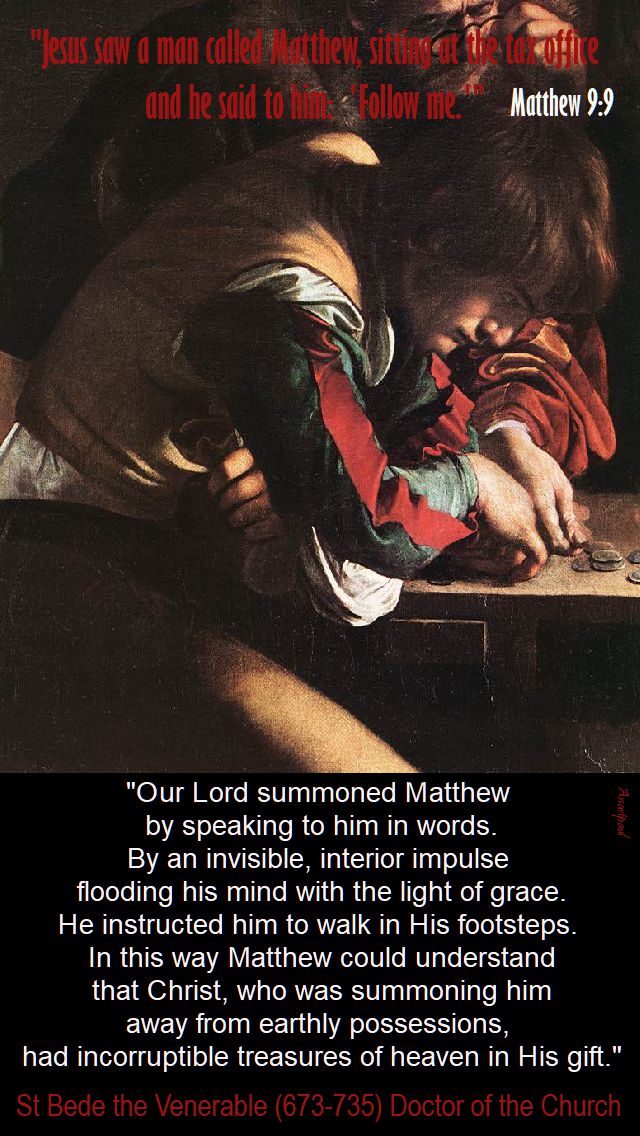
“Jesus saw a man called Matthew sitting at the tax office, and he said to him: Follow me.“…
Matthew 9:9

REFLECTION – “Jesus saw Matthew, not merely in the usual sense, but more significantly with His merciful understanding of men.”
He saw the tax collector and, because He saw him through the eyes of mercy and chose him, He said to him: “Follow me.”
This following meant imitating the pattern of His life – not just walking after Him.
Saint John tells us: “Whoever says he abides in Christ ought to walk in the same way in which he walked.”
“And he rose and followed him.”
There is no reason for surprise that the tax collector abandoned earthly wealth as soon as the Lord commanded him.
Nor should one be amazed that neglecting his wealth, he joined a band of men whose leader had, on Matthew’s assessment, no riches at all. Our Lord summoned Matthew by speaking to him in words.
By an invisible, interior impulse flooding his mind with the light of grace, He instructed him to walk in his footsteps.
In this way Matthew could understand that Christ, who was summoning him away from earthly possessions, had incorruptible treasures of heaven in His gift.” – from a homily by St Bede the Venerable (673-735) Doctor of the Churchour lord summoned matthew by speaking - st bede - 21 sept 2017

PRAYER – Lord, You showed Your great mercy to Matthew the tax-gatherer,by calling him to become Your Apostle,supported by his prayer and example, may we always answer Your call and live in close union with You.
We make our prayer, in union with God our Father and the Holy Spirit, one God forever and ever.   St Matthew, Apostle of Christ, pray for us, amen.st matthew - pray for us - 21 sept 2017

Posted in FEASTS and SOLEMNITIES, MORNING Prayers, SAINT of the DAY, The HOLY CROSS

Thought for the Day – 14 September – Feast of the Exaltation of the Holy Cross/Triumph of the Cross

Thought for the Day – 14 September – Feast of the Exaltation of the Holy Cross

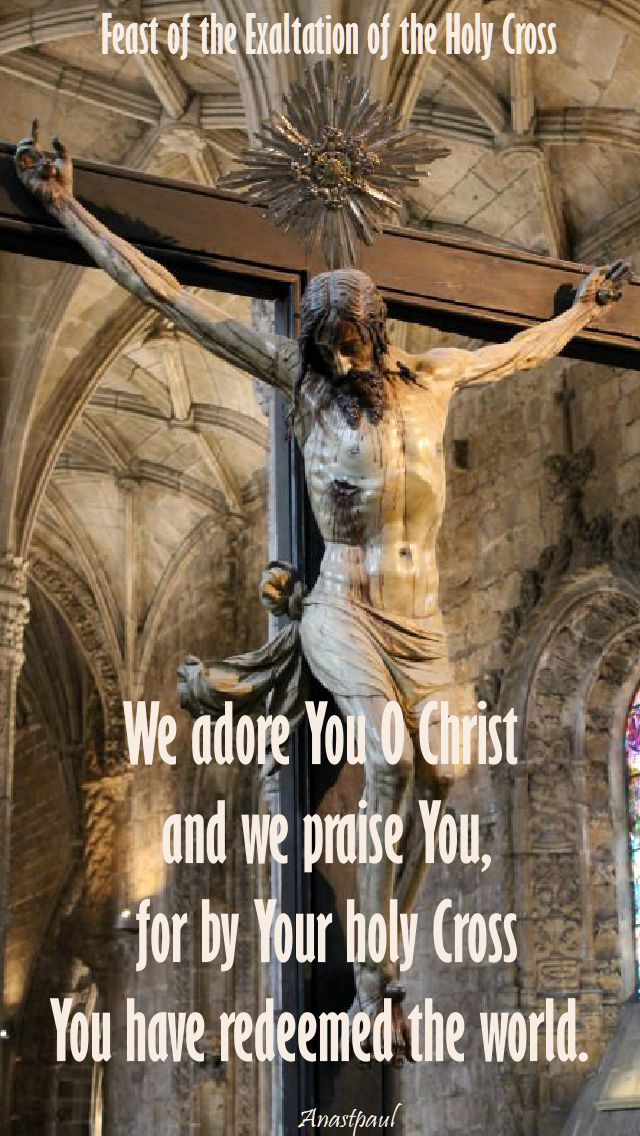
Christians “exalt” (raise on high) the Cross of Christ as the instrument of our salvation. Adoration of the Cross is, thus, adoration of Jesus Christ, the God Man, who suffered and died on this Roman instrument of torture for our redemption from sin and death.   The cross represents the One Sacrifice by which Jesus, obedient even unto death, accomplished our salvation.   The cross is a symbolic summary of the Passion, Crucifixion and Resurrection of Christ — all in one image.

The Cross — because of what it represents — is the most potent and universal symbol of the Christian faith.   It has inspired both liturgical and private devotions: for example, the Sign of the Cross, which is an invocation of the Holy Trinity;  the “little” Sign of the Cross on head, lips and heart at the reading of the Gospel;  praying the Stations (or Way) of the Cross;  and the Veneration of the Cross by the faithful on Good Friday by kissing the feet of the image of Our Saviour crucified.

Placing a crucifix (the cross with an image of Christ’s body upon it) in churches and homes, in classrooms of Catholic schools and in other Catholic institutions, or wearing this image on our persons, is a constant reminder — and witness — of Christ’s ultimate triumph, His victory over sin and death through His suffering and dying on the Cross. (Fr  FRANCISCO NASCIMENTO)

We adore You Christ and we praise You, for by Your holy Cross You have redeemed the world.we adore you - holy cross.jpg