Quote/s of the Day – 11 June – “The Month of the Sacred Heart of Jesus” – The Solemnity of Corpus Christi – 1 John 3:13-18, Luke 14:16-24. – Scripture search here: https://www.drbo.org/
“… This Body which He took from us, He gave wholly for our salvation. For, He offered His own Body to God the Father, upon the Altar of the Cross, as a Victim for our reconciliation and, He shed, His own Blood, both to redeem and cleanse us that we, being bought back from a wretched slavery, might be washed from all our sins. And then, that the memory of such a great benefit might abide in us, He left His Body to be our food and His Blood to be our drink that the faithful might receive them under the species of Bread and Wine.”
St Thomas Aquinas (1225-1274) Doctor Angelicus/Doctor Communis
“I adore Thee at every moment, O Living Bread of Heaven, great Sacrament! Jesus, heart of Mary, I pray Thee, bless my soul. Holiest Jesus, my Saviour, I give Thee my heart.”
(Indulgence of Two Hundred Days; Pope Pius VII, 1915)
The Divine Praises
Blessed be God. Blessed be His Holy Name. Blessed be Jesus Christ, true God and true Man. Blessed be the Name of Jesus. Blessed be His Most Sacred Heart. Blessed be Jesus in the Most Holy Sacrament of the Altar. Blessed be the Holy Spirit, the Paraclete. Blessed be the great Mother of God, Mary most holy. Blessed be her holy and Immaculate Conception. Blessed be her glorious Assumption. Blessed be the name of Mary, Virgin and Mother. Blessed be Saint Joseph, her most chaste spouse. Blessed be God in His Angels and in His Saints.
May the Heart of Jesus, in the Most Blessed Sacrament, be praised, adored and loved with grateful affection, at every moment, in all the Tabernacles of the world, even to the end of time. Amen.
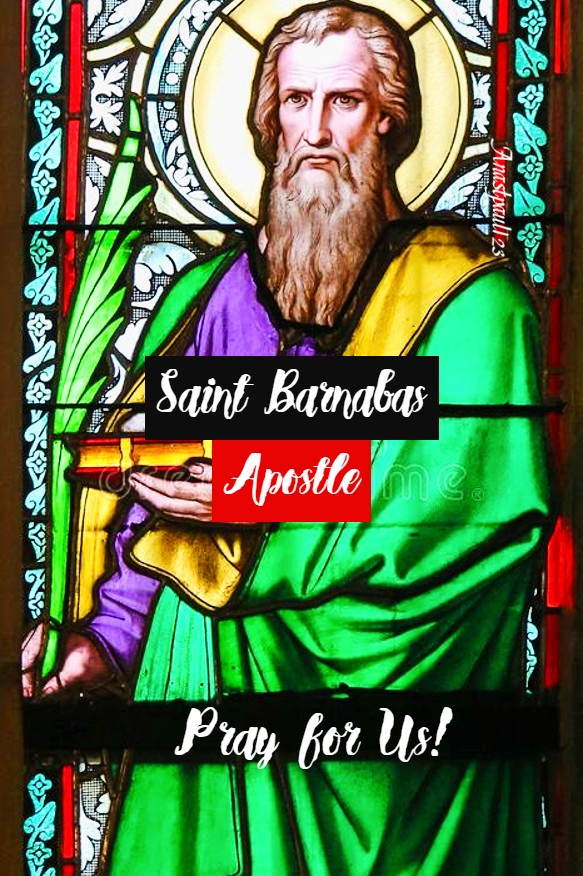
One Minute Reflection – 11 June – “The Month of the Sacred Heart of Jesus” – The Solemnity of Corpus Christi and the Feast of St Barnabas Apostle – 1 John 3:13-18, Luke 14:16-24. – Scripture search here: https://www.drbo.org/
“But I say unto you that none of those men who were invited shall taste of my supper.” – Luke 14:24
REFLECTION – “The Psalmist says: “Bread fortifies the heart of man and wine rejoices his heart” (Ps 103:15). For those who believe in Him, Christ is Food and Drink, Bread and Wine. He is Bread when He strengthens and establishes us according to Peter’s words: “After you have suffered a little, the God of all grace Who called you to His eternal glory in Christ, will restore, strengthen and establish you” (1 Pt 5:10). He is Drink and Wine when He makes us glad according to the words of the Psalmist: “Gladden the soul of Thy servant, for to Thee, O Lord, I lift up my soul” (Ps 85:4).
Everything in us which is strong, steadfast, firm, happy and joyful to carry out God’s commands, bear with misfortune, act obediently, stand up for justice – all these things come from this Bread’s strength, this Wine’s gladness. Happy are they whose deeds are strong and joyful! And since no-one can do it of themselves, happy are they who have an eager desire to cleave to what is just and right and to be strengthened in everything and rejoice through Him Who said: “Blessed are they who hunger and thirst for righteousness” (Mt 5:6). If Christ is Food and Drink even now for the strength and joy of the righteous, how much more so will He be in the life to come, when He will give to the righteous without measure?!” – Baldwin of Canterbury (c1125-1190) Cistercian Abbot of Forde Monastery and Archbishop of Canterbury (The Sacrament of the Altar – II:3 ).
PRAYER – O God, Who gladden us by the merits and intercession of blessed Barnabas, Thy Apostle, mercifully grant that we, who ask of Thee favours through him, may obtain them by the gift of Thy grace.ThroughJesus Christ, Thy Son our Lord, Who lives and reigns with Thee, in the unity of the Holy Ghost, God, world without end. Amen (Collect).
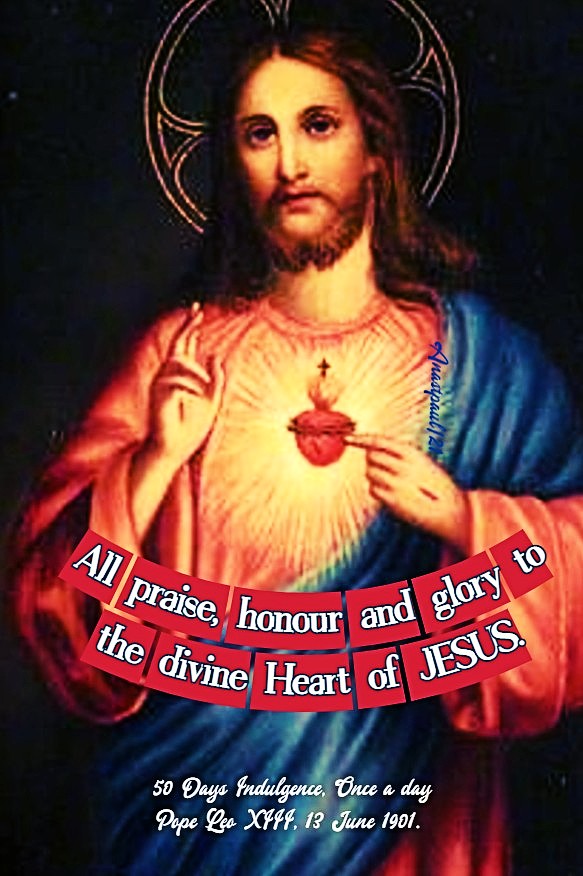
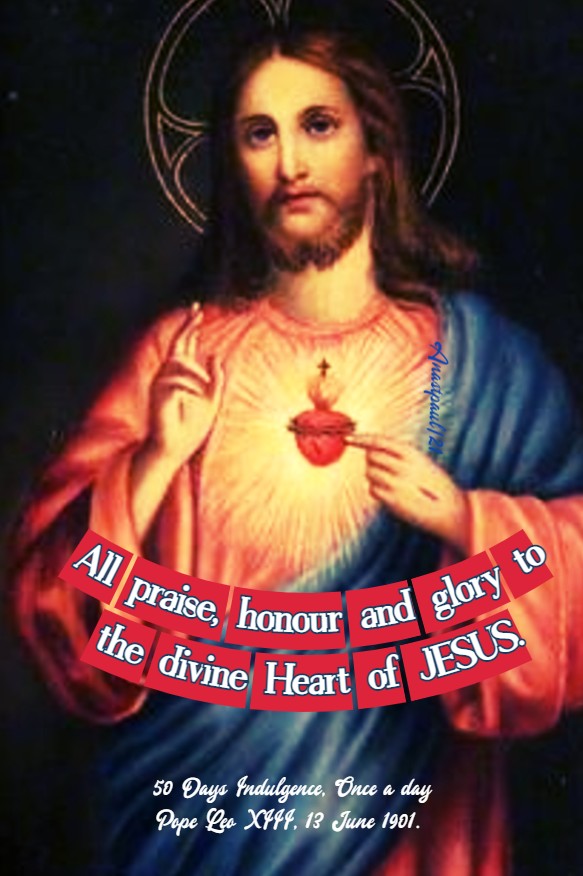
All praise, honour and glory to the Divine Heart of JESUS. 50 Days Indulgence, Once a day, Raccolta, 168 Pope Leo XIII, 13 June 1901.
Our Morning Offering – 11 June – “The Month of the Sacred Heart of Jesus” – The Solemnity of Corpus Christi, The Most Holy Body and Blood of Our Lord Jesus Christ and Sunday within the Octave – The Second Sunday after Pentecost
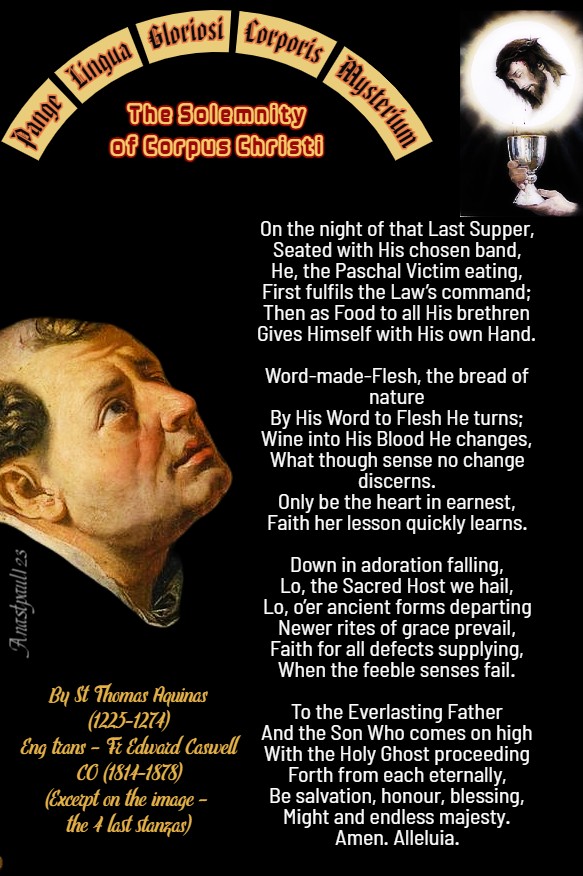
Pange Lingua Gloriosi Corporis Mysterium Sing, My Tongue By St Thomas Aquinas (1225-1274) Eng trans – Fr Edward Caswell CO (1814-1878) (Excerpt on the image – the 4 last stanzas)
Sing, my tongue, the Saviour’s glory, Of His Flesh, the Mystery sing; Of the Blood, all price exceeding, Shed by our Immortal King, Destined, for the world’s redemption, From a noble Womb to spring.
Of a pure and spotless Virgin Born for us on earth below, He, as Man, with man conversing, Stayed, the seeds of truth to sow; Then He closed in solemn order Wondrously His Life of woe.
On the night of that Last Supper, Seated with His chosen band, He, the Paschal Victim eating, First fulfils the Law’s command; Then as Food to all His brethren Gives Himself with His own Hand.
Word-made-Flesh, the bread of nature By His Word to Flesh He turns; Wine into His Blood He changes, What though sense no change discerns. Only be the heart in earnest, Faith her lesson quickly learns.
Down in adoration falling, Lo, the Sacred Host we hail, Lo, o’er ancient forms departing Newer rites of grace prevail, Faith for all defects supplying, When the feeble senses fail.
To the Everlasting Father And the Son Who comes on high With the Holy Ghost proceeding Forth from each eternally, Be salvation, honour, blessing, Might and endless majesty. Amen. Alleluia.
Written by St Thomas Aquinas (1225-1274) the Angelic and Common Doctor of the Church, for the very first Solemnity of Corpus Christi, this Hymn is considered the most beautiful of Aquinas’ Hymns and one of the seven great Hymns of the Church.
The last two stanzas make up the Tantum Ergo (Down in Adoration Falling) which is used at Benediction of the Blessed Sacrament. The Hymn is also used on Maundy Thursday during the procession from the Sanctuary to the Altar of Repose, where the Blessed Sacrament is kept until Good Friday.
PANGE, Lingua, Gloriosi Corporis Mysterium
Corporis mysterium, Sanguinisque pretiosi, quem in mundi pretium fructus ventris generosi Rex effudit Gentium.
Nobis datus, nobis natus ex intacta Virgine, et in mundo conversatus, sparso verbi semine, sui moras incolatus miro clausit ordine.
In supremae nocte cenae recumbens cum fratribus observata lege plene cibis in legalibus, cibum turbae duodenae se dat suis manibus.
Verbum caro, panem verum verbo carnem efficit: fitque sanguis Christi merum, et si sensus deficit, ad firmandum cor sincerum sola fides sufficit.
Tantum ergo Sacramentum veneremur cernui: et antiquum documentum novo cedat ritui: praestet fides supplementum sensuum defectui.
Genitori, Genitoque laus et iubilatio, salus, honor, virtus quoque sit et benedictio: procedenti ab utroque compar sit laudatio. Amen. Alleluia.
St Herebald of Bretagne Bl Hugh of Marchiennes Bl Jean de Bracq
Bl Kasper of Grimbergen St Maximus of Naples
St Parisius ECMC (c 1160-1267) Priest and Monk of the Camaldolese Hermits of Mount Corona, Spiritual Director, Reformer, Miracle-worker during his life and after his death. A very long life of humble and loving service, for the glory of God!: The Roman Martyrology reads: “In Treviso, Saint Parisio, Priest of the Camaldolese Order, who for seventy-seven years took care of the spiritual direction of the Nuns with healthy advice, dying at the age of one hundred and eight.” https://anastpaul.com/2022/06/11/saint-of-the-day-11-june-st-parisius-ecmc-c-1160-1267-a-very-long-life-of-humble-and-loving-service-for-the-glory-of-god/
St Rembert of Hamburg (c830-888) Archbishop St Riagail of Bangor Bl Stephen Bandelli OP St Tochumra of Kilmore St Tochumra of Tuam
Martyrs of Tavira – 7 Beati: Members of the Knights of Santiago de Castilla. During the re-conquest of the Iberian peninsula from the Muslims by Christian forces, in a period of truce between the armies, the group was allowed to leave the Portuguese camp to hunt. Near Tavira, Portugal, he and his companions were ambushed and killed by a Muslim force. Making a reprisal attack, the Portuguese army took the city of Tavira. The murdered knights were considered to be martyrs as they died in an action defending the faith. They were – Blessed Alvarus Garcia, Blessed Beltrão de Caia, Blessed Damião Vaz, Blessed Estêvão Vasques, Blessed Garcia Roiz, Blessed Mendus Valle, Blessed Pedro Rodrigues’ They were Martyred in 1242 outside Tavira, Faro, Portugal. Their relics are enshrined under the altar of Saint Barnabas in the Church of Our Lady, Queen of the Angels (modern Santa Maria do Castelo) in Tavria, Portugal.
Mercedarian Martyrs of Damietta: Three Mercedarian Lay Knights who worked to ransom Christians enslaved by Muslims. During the 7th Crusade, a plague swept through the Christian army and these knights volunteered to work with the sick. During this work they were captured by Muslims and ordered to convert to Islam; they refused. They were tortured, taken to Damietta, Egypt where they were murdered for their faith. They were thrown from a tower in the mid-13th century in Damietta, Egypt.
One Minute Reflection – 8 June – “The Month of the Sacred Heart of Jesus” – Feast of Corpus Christi – 1 Corinthians 23-29, John 6:56-59 – Scripture search here: https://www.drbo.org/
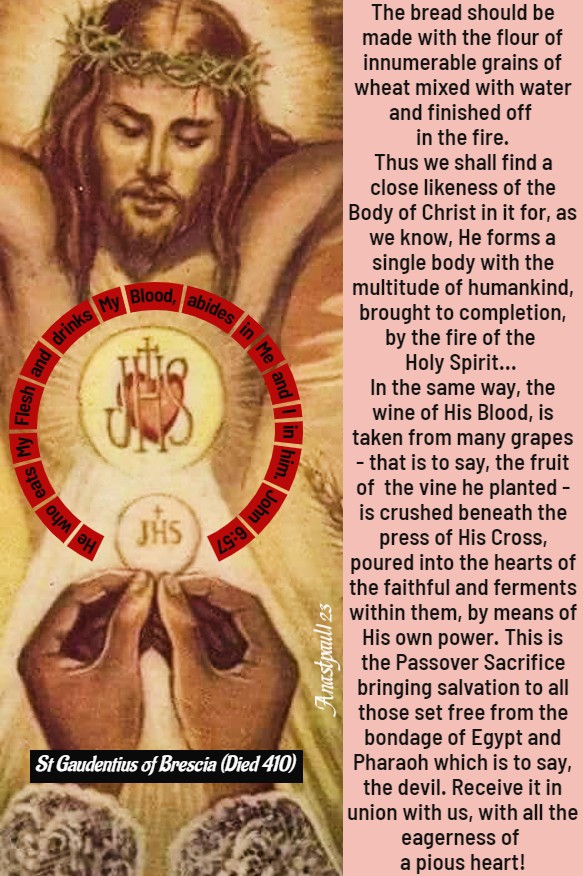
“He who eats My Flesh and drinks My Blood, abides in Me and I in him. ” – John 6:57
REFLECTION – “The heavenly sacrifice which Christ instituted is indeed the inheritance bequeathed to us through His new covenant. He left it to us on the night He was delivered up to be Crucified, as a token of His Presence. It is viaticum for our journey, food on our life’s path, until we come to it upon leaving this world. That is why our Lord said: “Unless you eat My Flesh and drink My Blood, you do not have life within you.” He wished His deeds of kindness to remain among us and the souls He redeemed, by His Precious Blood, always to be made holy in the image of His own Passion. This is why He commanded His faithful disciples, instituted as the first Priests of His Church, to celebrate these mysteries of eternal life, in perpetuity… Thus all the faithful would have before their eyes, day-by-day, a representation of Christ’s Passion. Taking Him in our hands, receiving Him in our mouths and hearts, we will hold fast to an indelible remembrance of our Redemption.
The bread should be made with the flour of innumerable grains of wheat mixed with water and finished off in the fire. Thus we shall find a close likeness of the Body of Christ in it for, as we know, He forms a single body with the multitude of humankind, brought to completion, by the fire of the Holy Spirit… In the same way, the wine of His Blood, is taken from many grapes – that is to say, the fruit of the vine he planted – is crushed beneath the press of His Cross, poured into the hearts of the faithful and ferments within them, by means of His own power. This is the Passover Sacrifice bringing salvation to all those set free from the bondage of Egypt and Pharaoh which is to say, the devil. Receive it in union with us, with all the eagerness of a pious heart.” – St Gaudentius of Brescia (Died 410) Bishop , Father, renowned Preacher, Theologian, Diplomatic Mediator (An Excerpt from a Paschal Homily no 68:30).
PRAYER – O God, Thou Who in this wondrous Sacrament have left us a memorial of Thy Passion, grant us, we beseech Thee, so to venerate the Sacred Mysteries of Thy Body and Blood that we may ever experience, within us, the effect of Thy Redemption.Through the same Jesus Christ, Thy Son our Lord, Who lives and reigns with Thee, in the unity of the Holy Ghost, God, world without end. Amen (Collect). All praise, honour and glory to the divine HEART of JESUS. – Indulgence 50 Days, Once a day. Raccolta 168 Pope Leo XIII, 14 June 1901.
Corpus Christi The Feast is liturgically celebrated on the Thursday after Trinity Sunday or, “where the Solemnity of The Most Holy Body and Blood of Christ is not a Holy Day of Obligation, it is assigned to the Sunday after the Most Holy Trinity, as its proper day.” (Sanctissimi Corpus et Sanguis Christi.)
Bl Armand of Zierikzee St Bron of Cassel St Calliope St Clodulf of Metz Bl Engelbert of Schäftlarn St Eustadiola of Moyen-Moutier St Fortunato of Fano
St Gildard of Rouen (c 456-c 545 Bishop of Rouen, Confessor * Twin Brother of St Medard below. The Roman Martyrology states of St Medard and his twin brother, St Gildard, today: “At Soissons, in France, the birthday of St Gildard, Bishop of Rouen, whose life and precios death are illustrated by glorios miracles – at Rouen, St Gildard, Bishop, twin brother of St Medard,who was born with his brother on the same day, Consecrated Bishops at the same time and being taken away from this life, also on the same day, they entered Heaven together!” About St Gildard: https://anastpaul.com/2022/06/08/saint-of-the-day-8-june-st-gildard-of-rouen-c-456-c-545/
Bl Giorgio Porta Bl Giselbert of Cappenberg St Heraclius of Sens Bl John Davy O.Cart. (Died 1537) Deacon Martyr Bl essedJohn Rainuzzi Bl Maddallena of the Conception St Maximinus of Aix (1st Century) The first Bishop of Aix-en-Provence, France, in the 1st Century.
St Medard (c 456-545) Bishop and Convessor * Twin Brother of St Gildard above About this iluustrious Saint: https://anastpaul.com/2020/06/08/saint-of-the-day-8-june-saint-medard-c-456-545-bishop/ The Roman Martyrology states of St Medard and his twin brother, St Gildard, today: “At Soissons, in France, the birthday of St Medard, Bishop of Novon, whose life and precios death are illustrated by glorious miracles – at Rouen, St Gildard, Bishop, twin brother of St Medard,who was born with his brother on the same day, Consecrated Bishops at the same time and being taken away from this life, also on the same day, they entered Heaven together!”
St Melania the Elder St Muirchu St Pacificus of Cerano Bl Peter de Amer Bl Robert of Frassinoro St Sallustian St Syra of Troyes St Victorinus of Camerino
St Francis Caracciolo CRM (1563-1608) Confessor, Priest, Co-Founder of the Congregation of the Clerics Regular Minor with Venerable John Augustine (1551-1587) the “Adorno Fathers,” Apostle of the Eucharistic Adoration. His body was given enough preparation for a long journey to Naples. Truly, God has left His own sign on him. When the body was lanced, the blood spouted a red and scented fluid and his vital organs were incorrupt. Around his heart were printed the words of the Psalm: “The zeal of Thy House consumes me” (Ps 69:10). Wow!: https://anastpaul.com/2020/06/04/saint-of-the-day-4-june-saint-francis-caracciolo-crm-1563-1608/
St Aldegrin of Baume St Alexander of Verona St Alonio St Aretius of Rome Bl Boniface of Villers St Breaca of Cornwall St Buriana of Cornwall St Christa of Sicily St Clateus of Brescia St Cornelius McConchailleach OSA (Died 1176) Archbishop of Armagh St Croidan St Cyrinus of Aquileia St Dacian of Rome St Degan St Edfrith of Lindisfarne St Elsiar of Lavedan St Ernin of Cluain Bl Francis Ronci Bl Margaret of Vau-le-Duc St Medan Bl Menda Isategui St Metrophanes of Byzantium St Nennoc St Nicolo of Sardinia St Optatus of Milevis
St Quirinus of Croatia St Quirinus of Tivoli St Rutilus of Sabaria St Saturnina of Arras St Trano of Sardinia St Walter of Fontenelle St Walter of Serviliano Blessed Werner von Ellerbach (11th-12th Century) Abbot
Martyrs of Cilicia – 13 Saints: A group of 13 Christians who were Martyred together. The only details about them that have survived are their names – Cama• Christa• Crescentia• Eiagonus• Expergentus• Fortunus• Italius • Jucundian• Julia• Momna• Philip• Rustulus• Saturnin They were Martyred in Cilicia, Asia Minor (in modern Turkey), date unknown
Martyrs of Nyon – 41 Saints: A group of 41 Christians Martyred together for refusing to sacrifice to imperial Roman idols. We know the names of some but no other details. Amatus• Attalus• Camasus• Cirinus• Dinocus• Ebustus• Euticus• Eutychius • Fortunius• Galdunus• Julia• Quirinus• Rusticus• Saturnina• Saturninus • Silvius• Uinnita• Zoticus Martyred by being beheaded in Noviodunum (modern Nyon, Switzerland).
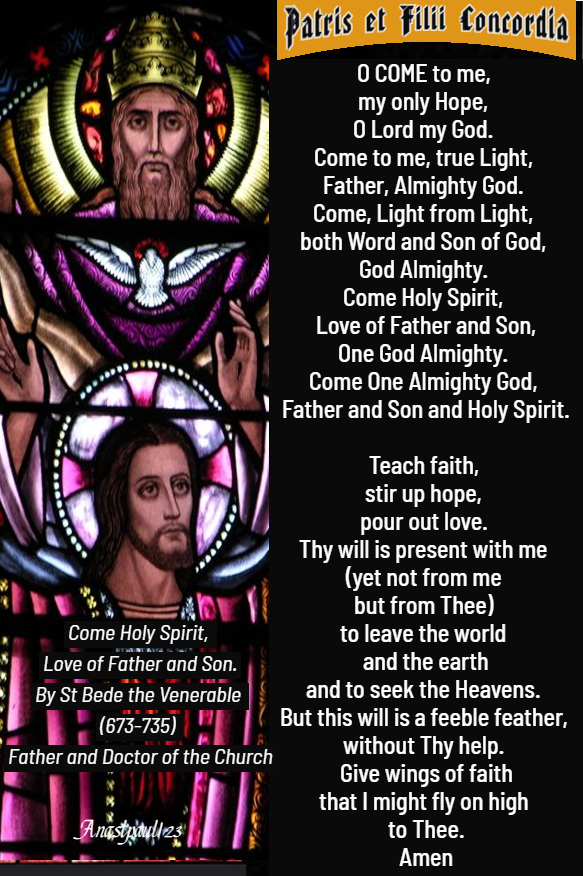
Patris et Filii Concordia Come Holy Spirit, Love of Father and Son. By St Bede the Venerable (673-735) Father and Doctor of the Church
O COME to me, my only Hope, O Lord my God. Come to me, true Light, Father, Almighty God. Come, Light from Light, both Word and Son of God, God Almighty. Come Holy Spirit, Love of Father and Son, One God Almighty. Come One Almighty God, Father and Son and Holy Spirit.
Teach faith, stir up hope, pour out love. Thy will is present with me (yet not from me but from Thee) to leave the world and the earth and to seek the Heavens. But this will is a feeble feather, without Thy help. Give wings of faith that I might fly on high to Thee. Amen
St Accidia Bl Albert of Csanád St Caraunus of Chartres St Caraunus the Deacon St Crescens of Rome St Dioscorides of Rome St Eoghan the Sage St Gemiliano of Cagliari
Bl Mary of the Nativity St Moel-Odhran of Iona St Paulus of Rome St Phaolô Hanh St Podius of Florence Bl Robert Johnson St Senator of Milan Bl Thomas Ford St Ubaldesca Taccini St William of Gellone (755-812) Monk
Martyrs of Palestine: A group of early 5th century Monks in Palestine who were Martyred by invading Arabs.
Martyrs of Sardinia – 6 Saints: A group of early Christians for whom a Church on Sardinia is dedicated; they were probably Martyrs but no information about them has survived except the names Aemilian, Aemilius, Emilius, Felix, Lucian and Priamus. Patrons of the Diocese of Alghero-Bosa, Italy.
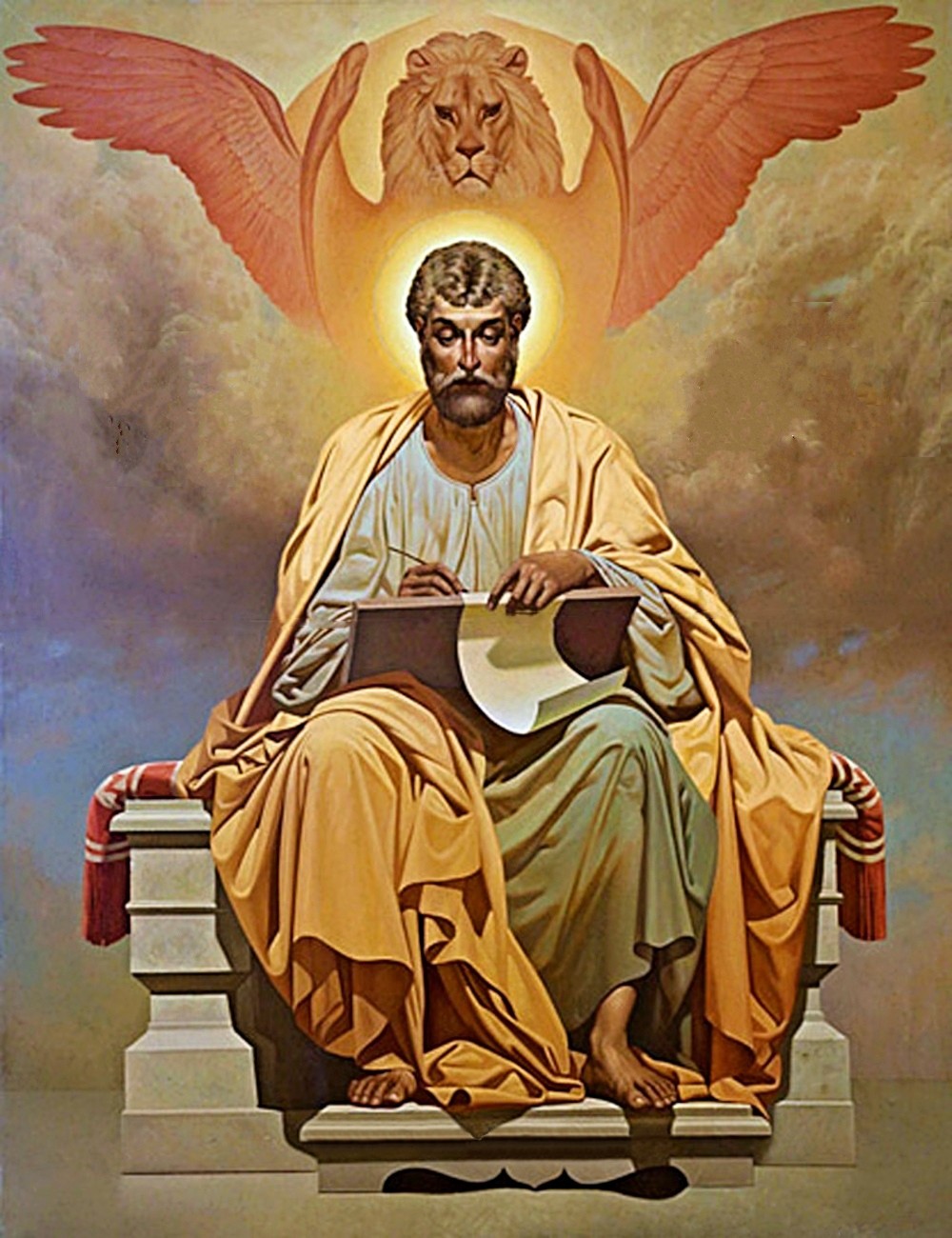
Quote/s of the Day – 25 April – Feast of St Mark Evangelist
The Gospel of Saint Mark was written in Greek around the 60s. He was Martyred in 68 and his Relics are preserved in the St Mark Cathedral of Venice. He is represented by a Winged Lion, one of the four living creatures of the Apocalypse, for he begins his Gospel by narrating St John the Baptist crying out in the wilderness, like a roaring lion.
By Alexander Sytov 1995
“To what shall we compare the Kingdom of God, or what parable can we use for it? It is like a mustard seed …”
Mark 4:30-31
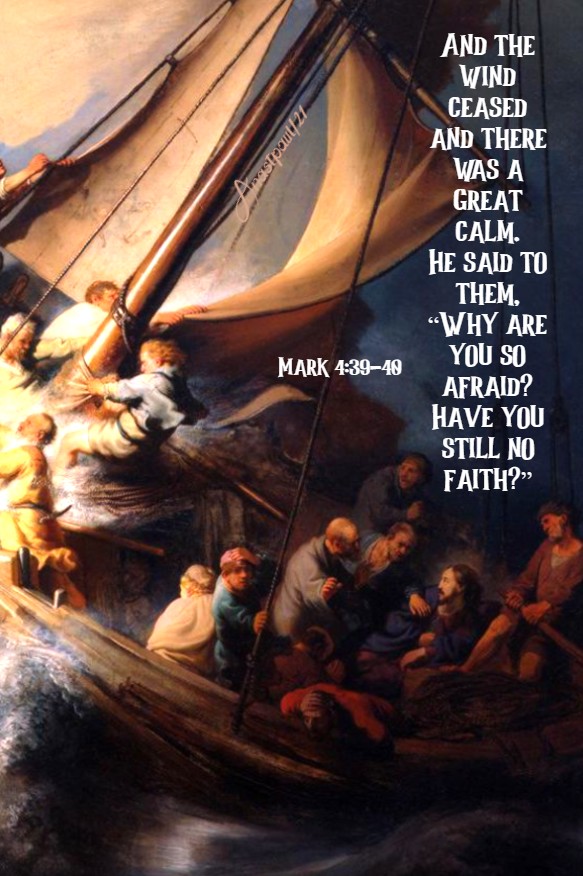
“And the wind ceased and there was a great calm. He said to them: “Why are you so afraid? Have you still no faith?”
Mark 4:39-40
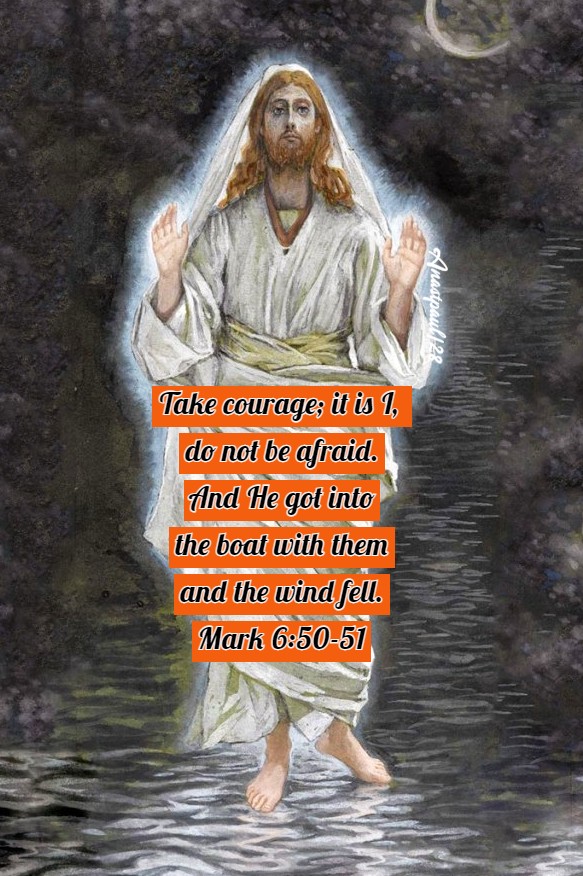
“Take courage: It is I, do not be afraid. And He got into the boat with them and the wind fell”
Mark 6:50-51
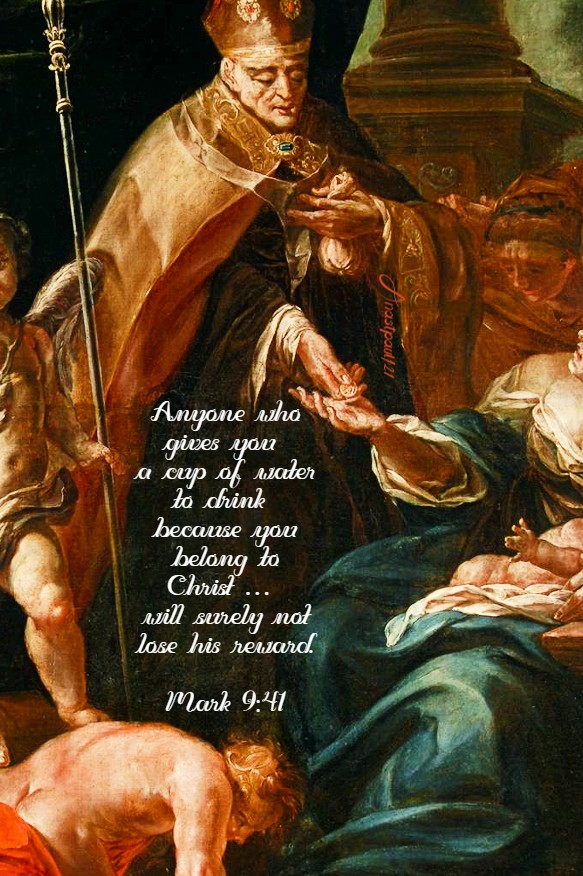
“Anyone who gives you a cup of water to drink because you belong to Christ …, will surely not lose his reward.”
Mark 9:41
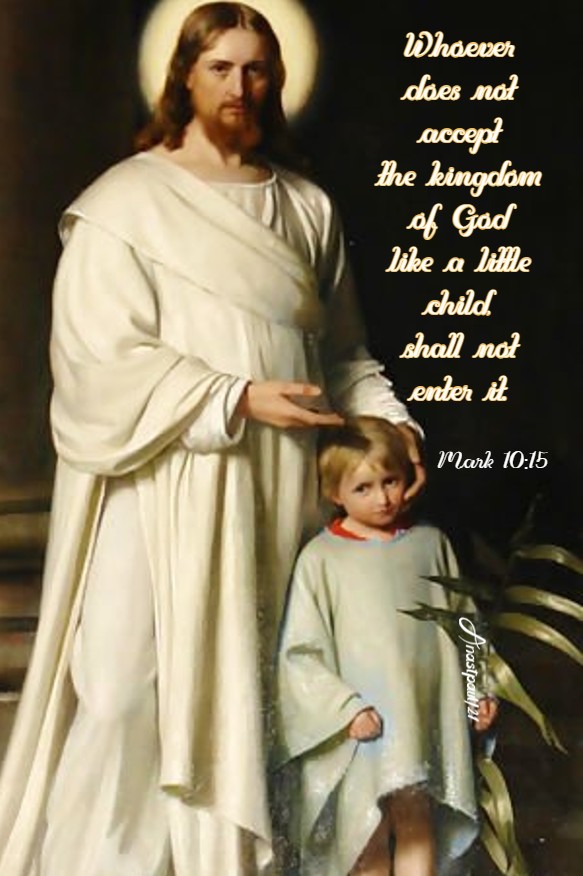
“Whoever does not accept the Kingdom of God, like a little child, shall not enter it.”
Mark 10:15
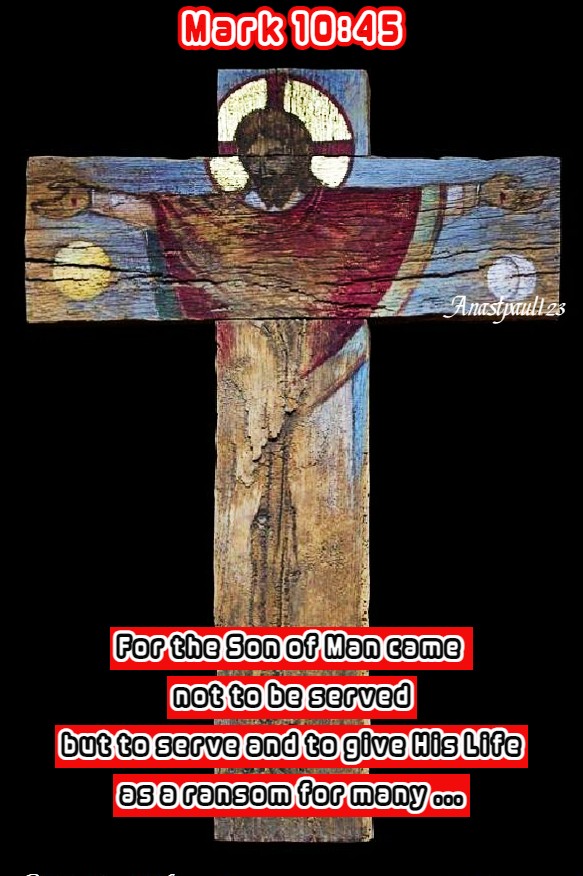
“For the Son of Man came not to be served but to serve and to give His Life as a ransom for many …”
One Minute Reflection – 25 April – “The Month of the Resurrection” – Feast of St Mark Evangelist – Ezekiel 1:10-14, Luke 10:1-9 – Scripture search here: https://www.drbo.org/
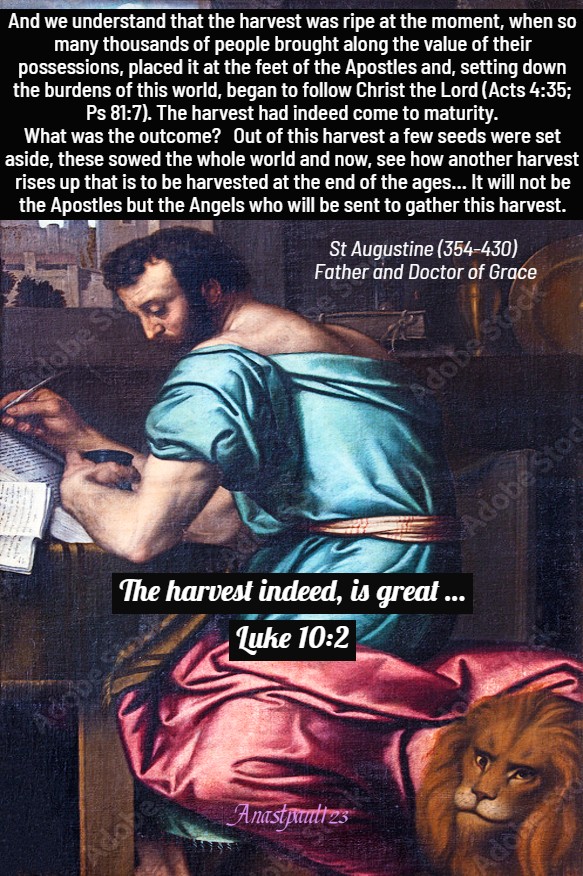
“The harvest indeed, is great …” – Luke 10:2
REFLECTION – “Christ, filled with enthusiasm for His work, prepared to send out labourers… And so He has sent out reapers. “For here the saying is verified that ‘One sows and another reaps’. I sent you to reap what you have not worked for, others have done the work and you are sharing the fruits of their work” (Jn 4:37-38). Now what is this? Has He sent reapers without sending sowers? Where has He sent the reapers? Where others had already laboured… Where the prophets had already preached, since they themselves were the sowers…
Who were the ones who thus laboured? Abraham, Isaac, Jacob. Read the account of their labours – in all their works, a Prophecy of Christ is to be found; in this sense, then, they were sowers. As for Moses, the other Patriarchs and all the Prophets, how much they had to put up with in the cold, while they were sowing! It follows that the harvest was already ready in Judah. And we understand that the harvest was ripe at the moment, when so many thousands of people brought along the value of their possessions, placed it at the feet of the Apostles and, setting down the burdens of this world, began to follow Christ the Lord (Acts 4:35; Ps 81:7). The harvest had indeed, come to maturity.
What was the outcome? Out of this harvest a few seeds were set aside, these sowed the whole world and now, see how another harvest rises up that is to be harvested at the end of the ages… It will not be the Apostles but the Angels who will be sent to gather this harvest.” – St Augustine (354-430) Bishop, Father and Doctor of Grace (Sermons on Saint John’s Gospel, no 15).
PRAYER – O God, Who didst exalt Thy blessed Evangelist Mark, by giving him grace to preach Thine Evangel, grant unto us, we beseech Thee, ever to follow more and more what he teaches and ever to be shielded from all evil by his prayers. Through Jesus Christ, Thy Son our Lord, Who lives and reigns with Thee, in the unity of the Holy Ghost, God, world without end. Amen (Collect).
Our Morning Offering – 25 April – Feast of St Mark Evangelist
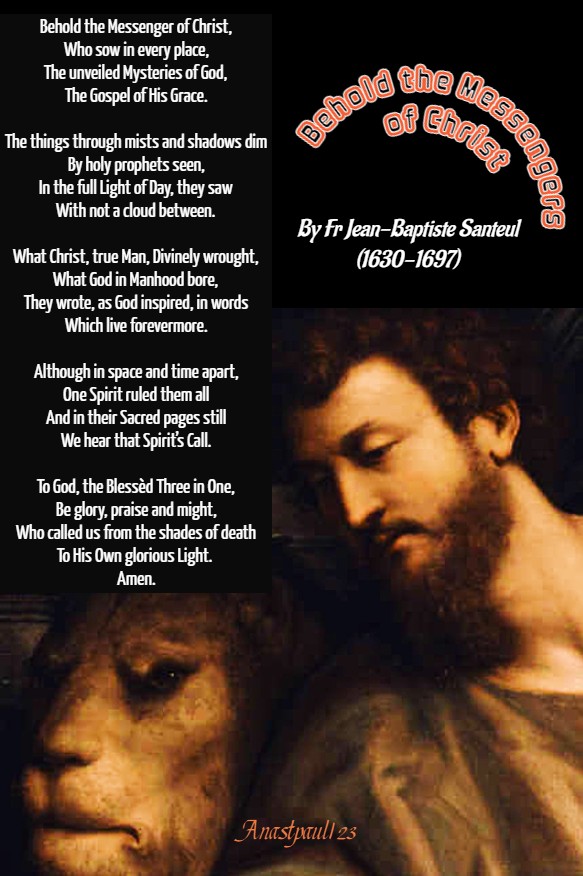
Behold the Messengers of Christ By Fr Jean-Baptiste Santeul (1630-1697) Priest, Monk, Hymnist, Poet, Writer
Behold the Messengers of Christ, Who sow in every place, The unveiled Mysteries of God, The Gospel of His Grace.
The things through mists and shadows dim By holy prophets seen, In the full Light of Day, they saw With not a cloud between.
What Christ, true Man, Divinely wrought, What God in Manhood bore, They wrote, as God inspired, in words Which live forevermore.
Although in space and time apart, One Spirit ruled them all And in their Sacred pages still We hear that Spirit’s Call.
To God, the blessèd Three in One, Be glory, praise and might, Who called us from the shades of death To His Own glorious Light. Amen.
Trans. Compilers of Hymns Ancient and Modern, 1861. This Hymn was used for Vespers I & II and Nocturns on the Feasts of St Mark and St Luke in the Paris Breviary (1736). Cardinal Newman’s Hymni Ecclesiae has it listed for the same hours, as the Common of Evangelists in the Paris Breviary (presumably a later edition). Tune: “Tiverton“ Rev J Grigg, c1791.
St Francis of Paola O.M. (1416-1507) known as “Saint Francis the Fire Handler” – Confessor, Monk and Founder, inspired with the Gift of Prophecy and still called the “Miracle-Worker” Apostle of the poor, Peacemaker. He was an Italian mendicant Friar and the Founder of the Order of Minims. Unlike the majority of founders of men’s religious orders and like his Patron Saint, Francis was never ordained a priest. His Body was Incorrupt until destroyed in the French Revolution. He was Canonised in 1519 by Pope Leo X. St Francis’s Life: https://anastpaul.wordpress.com/2018/04/02/saint-of-the-day-2-april-st-francis-of-paola-o-m-1416-1507/
St Abundius of Como St Agnofleda of Maine St Appian of Caesarea (c287-306) Martyr, Layman Blessed Arnulf of Leuven O.Cist. (c1200-1276) Abbot St Bronach of Glen-Seichis St Constantine of Scotland St Ebbe the Younger St Eustace of Luxeuil St Gregory of Nicomedia St John Payne
Blessed Leopold of Gaiche OFM Cap (1732-1815) Priest, and Friar of the Order of Friars Minor of the Capuchin branch, Missionary Preacher in Italy, called “The Apostle of Umbria.” He became renowned for wearing a crown of thorns. He served in a position of power in the Franciscan Order in the Umbrian region in which he supported strong adherence to the Rule of Saint Francis. Biography: https://anastpaul.com/2022/04/02/saint-of-the-day-2-april-blessed-leopold-of-gaiche-ofm-cap-1732-1815/
St Lonochilus of Maine St Musa of Rome St Nicetius of Lyon St Rufus of Glendalough St Theodora of Tiria
Martyrs of Africa – 10 Saints: A group of ten Christians Martyred together in Africa, date unknown. We have six of their names – Marcellinus, Procula, Quiriacus, Regina, Satullus and Saturnin but no other information has survived.
Martyrs of Thessalonica – 16 Saints: Sixteen Christians who were Martyred together in Thessalonica in Greece, date unknown. We know nothing else about them but 13 of their names – Agapitus, Agatophus, Cyriacus, Dionysius, Gagus, Julianus, Mastisius, Proculus, Publius, Theodoulus, Urbanus, Valerius and Zonisus.
St Dula the Slave Bl Everard of Nellenburg Bl Herman of Zahringen St Hermenland St Humbert of Pelagius Bl James Bird St Kennocha of Fife
St Lucia Filippini (1672-1732) Religious Sister, Founder of the Religious Teachers Filippini for whom she founded countless schools all over Italy, she concentrated too on raising her students to continue the work within their families in order to strengthen familt life and the role and dignity of woman. On 22 June 1930, Lucia Filippini was declared a Saint of the Church by Pope Pius XI and her Statue was given the last available niche in the Basilica of Saint Peter in Rome. Her statue can be seen in the first upper niche from the main entrance on the left (south) side of the nave of St Peter’s. Biography: https://anastpaul.com/2022/03/25/saint-of-the-day-25-march-st-lucia-filippini-1672-1732/
St Margaret Clitherow (1556-1586) Martyr, Married Laywoman and Mother of 3. Her 2 sons became Priests and her daughter a Nun. She is one of the Forty Martyrs of England and Wales. She was Beatified on 15 December 1929 by Pope Pius XI. St Matrona of Barcelona St Matrona of Thessaloniki St Mona of Milan St Ndre Zadeja St Nicodemus of Mammola (c900-990) Monk, Abbot, Hermit St Pelagius of Laodicea Bl Placido Riccardi OSB (1844-1915) Priest, Benedictine Monk. Beatified on 5 December 1954 by Pope Pius XII. St Procopius St Quirinus of Rome Bl Tommaso of Costacciaro
262 Martyrs of Rome: A group 262 Christians Martyred together in Rome. We know nothing else about them, not even their names.
Quote/s of the Day – 17 March – Feast of the Five Holy Wounds
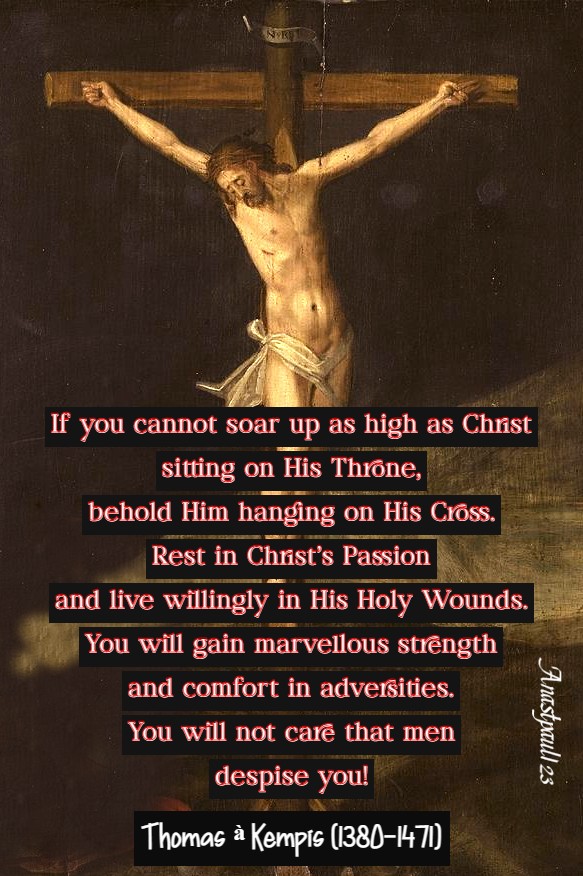
“If you cannot soar up as high as Christ sitting on His Throne, behold Him hanging on His Cross. Rest in Christ’s Passion and live willingly in His Holy Wounds. You will gain marvellous strength and comfort in adversities. You will not care that men despise you!”
Thomas à Kempis CRSA (1380-1471)
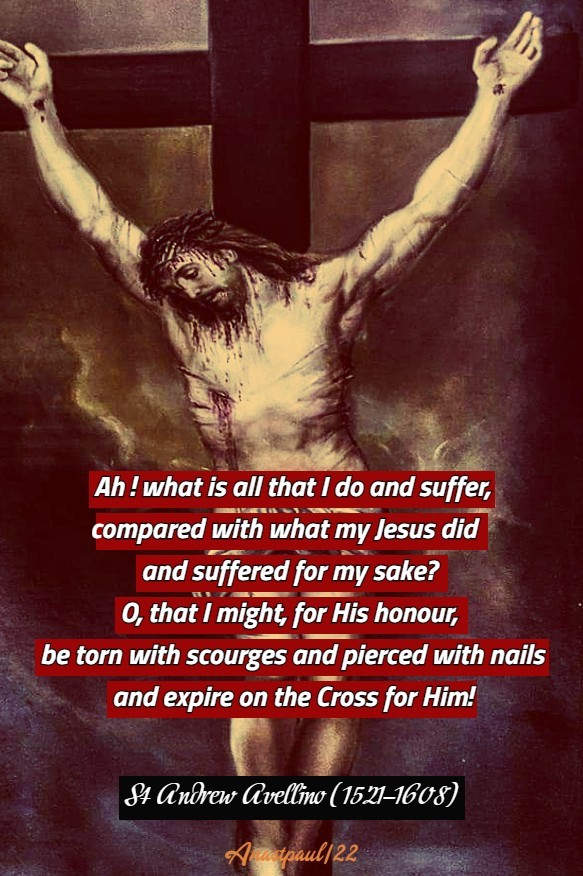
“Ah ! what is all that I do and suffer, compared with what my Jesus did and suffered for my sake? O, that I might, for His honour, be torn with scourges and pierced with nails and expire on the Cross for Him!”
St Andrew Avellino (1521–1608)
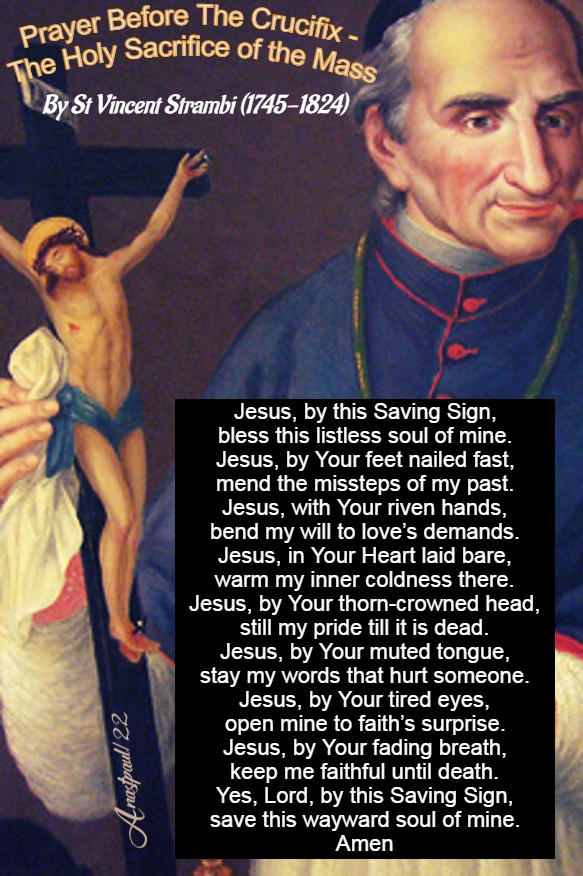
Prayer Before The Crucifix – The Holy Sacrifice of the Mass By St Vincent Strambi (1745-1824)
Jesus, by this Saving Sign, bless this listless soul of mine. Jesus, by Your feet nailed fast, mend the missteps of my past. Jesus, with Your riven hands, bend my will to love’s demands. Jesus, in Your Heart laid bare, warm my inner coldness there. Jesus, by Your thorn-crowned head, still my pride till it is dead. Jesus, by Your muted tongue, stay my words that hurt someone. Jesus, by Your tired eyes, open mine to faith’s surprise. Jesus, by Your fading breath, keep me faithful until death. Yes, Lord, by this Saving Sign, save this wayward soul of mine. Amen
Our Lenten Journey with St Francis de Sales – 17 March – Feast of the Five Holy Wounds – Scripture search here: https://www.drbo.org/– – – Scripture search here: https://www.drbo.org/
“But He was wounded for our iniquities, He was bruised for our sins; … and by His stripes we are healed.” Isaias 53:5
“He Himself bore our sins in His Body on the Cross, so that we might die to sin and live to righteousness, for by His wounds you were healed.” 1 Peter 2:24
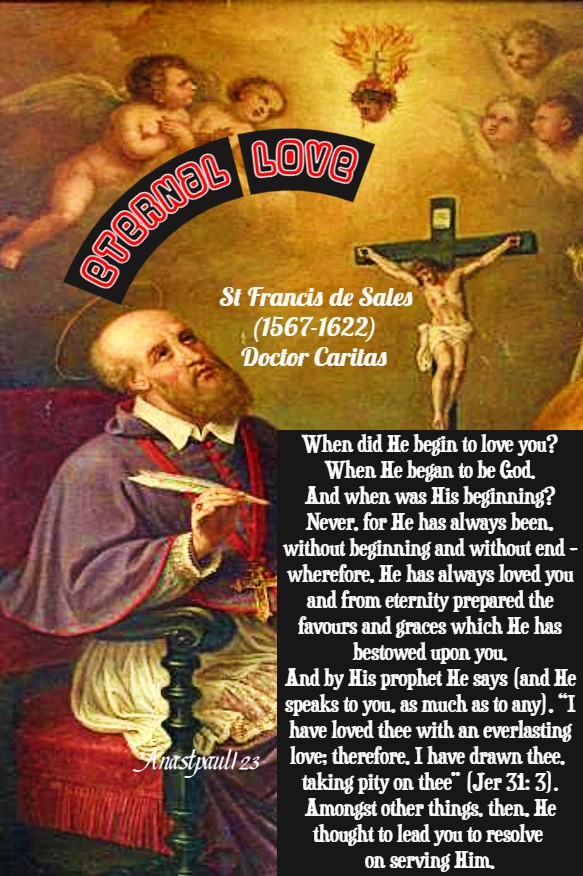
ETERNAL LOVE St Francis de Sales (1567-1622) Doctor Caritas
“Consider the eternal love which God had borne you – for even before our blessed Lord Jesus Christ became man and suffered on the Cross for you, His Divine Majesty foresaw you in His Sovereign Goodness and loved you exceedingly.
When did He begin to love you? When He began to be God. And when was His beginning? Never, for He has always been, without beginning and without end – wherefore, He has always loved you and from eternity prepared the favours and graces which He has bestowed upon you. And by His prophet He says (and He speaks to you, as much as to any), “I have loved thee with an everlasting love; therefore, I have drawn thee, taking pity on thee” (Jer 31: 3).
Amongst other things, then, He thought to lead you to resolve on serving Him.” – (Introduction to the Devout Life).”
The Feast of the Five Holy Wounds – 17 March – Celebrated on Friday after the Third Sunday in Lent
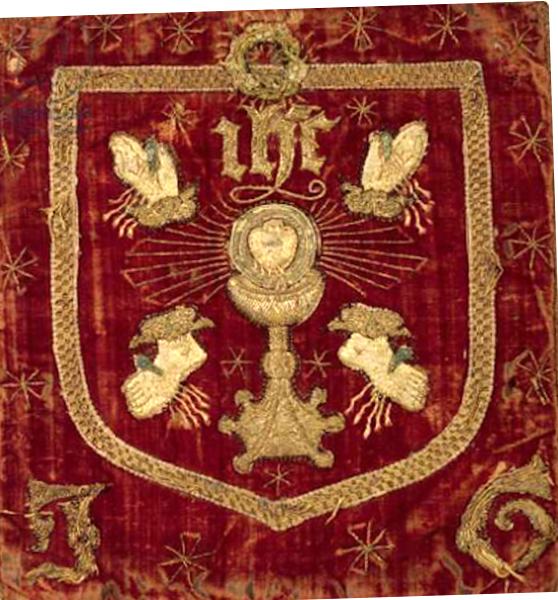
The Tudor Banner of the Five Holy Wounds which led the Pilgrimage of Grace against Henry VIII, which took place from October 1536-February 1537
The revival of religious life and the zealous activity of St. Bernard and St. Francis in the Twelfth and Thirteenth Centuries, together with the enthusiasm of the Crusaders returning from the Holy Land, gave a wonderful impulse to devotion to the Passion of Jesus Christ and, particularly, to practices in honour of the Wounds in His Sacred Hands, Feet and Side. The reason for this devotion was well expressed at a later period in the memorial of the Polish Bishops to Pope Clement XIII:
“Moreover, the Five Wounds of Christ are honoured by a Mass and an Office and, on account of these Wounds, we venerate also the Feet, Hands and Side of the most loving Redeemer, these parts of Our Lord’s Most Holy Body being held more worthy of a special cult than the others, precisely because they suffered special pains for our salvation and because they are decorated with these wounds as with an illustrious mark of love. Therefore, with living faith they cannot be looked upon, without a special feeling of religion and devotion.” (Nilles, “De rat. fest. SS. Cord. Jesu et Mariae” I 126).
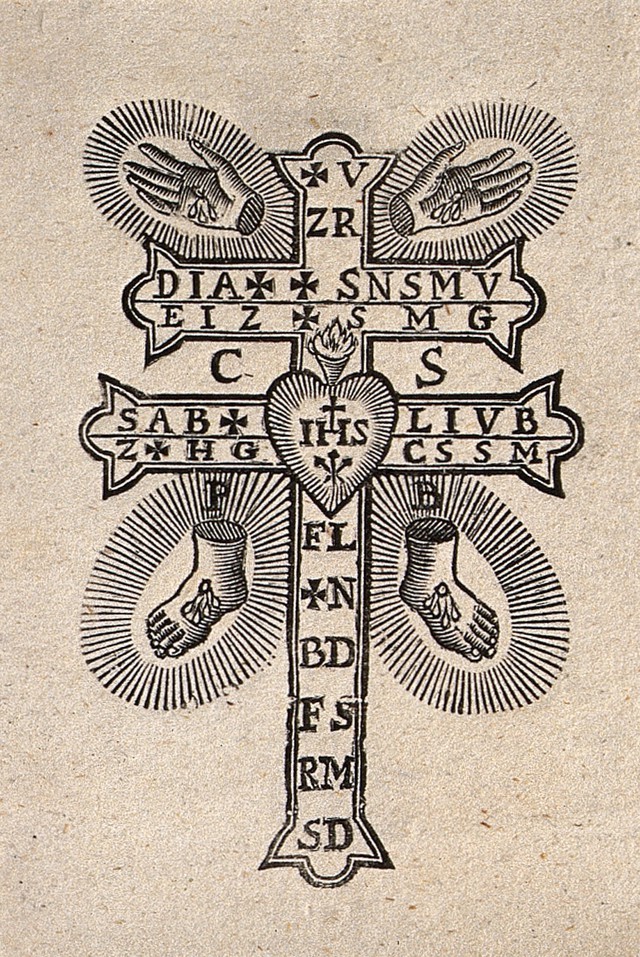
Plague Cross featuring the Sacred Heart of our Lord and the Five Holy Wounds
Many beautiful medieval prayers in honour of the Sacred Wounds, including some attributed to St Clare of Assisi (Indulgenced on 21 November 1885), have been preserved. St Mechtilde and St Gertrude the Great of Helfta, were devoted to the Holy Wounds, the latter Saint reciting daily, a prayer in honour of the 5466 Wounds, which, according to tradition, were inflicted on Jesus during His Passion. In the Fourteenth Century, it was customary in southern Germany, to recite fifteen Pater Nosters each day (which thus amounted to 5475 in the course of a year) in memory of the Sacred Wounds.
In his 1761 book, The Passion and Death of Jesus Christ, St Alphonsus Maria de Liguori, Founder of the Redemptorist Fathers, listed, among various pious exercises, the Little Chaplet of the Five Wounds of Jesus Crucified. St Alphonsus wrote the devotional as a Meditation on the Five Piercing Wounds that Christ suffered during His Crucifixion.
The earliest evidence of a Feast in honour of the Wounds of Christ comes from the Monastery of Fritzlar, Thuringia, where in the Fourteenth Century, a Feast was kept on the Friday after the Octave of Corpus Christi. In the Fifteenth Century it had spread to different countries, to Salisbury (England), Huesca and Jaca (Spain), Vienna, and Tours and was included in the Breviaries of the Carmelites, Franciscans, Dominicans and other orders
The Feast of the Five Wounds, celebrated since the Middle Ages at Evora and elsewhere in Portugal on 6 February (at Lisbon on the Friday after Ash-Wednesday) is of historical interest. It commemorates the founding of the Portuguese kingdom in 1139, when, before the battle on the plains of Ourique, Christ appeared to Alfonso Henriquez, promising victory over the Moors and commanding him to insert into the coat of arms of the new kingdom the emblem of the Five Wounds. This feast is celebrated today in all Portuguese-speaking countries. In parts of France the Feast is celebrated on for the Friday after Ash Wednesday, on which day it is still kept in many dioceses
Since 1831, when the Feasts in honour of the Passion were adopted at Rome by the Passionists and the City, this Feast was assigned to the Friday after the Third Sunday in Lent. The Office is one of those bequeathed to us by the Middle Ages. As this Feast is not celebrated in the entire Church, the Office and Mass are placed in the appendix of the Breviary and the Missal.
COLLECT: O God, Who by the Passion of Thine Only Son and by the pouring out of the Blood of His Five Wounds, hast restored human nature lost by sin, grant unto us, we beseech Thee that by venerating the protective Wounds on earth, we may, thereby, merit the fruits of the same Precious Blood in Heaven. Through the same Lord Jesus Christ, Who liveth and reigneth with Thee in the unity of the Holy Ghost, One God, world without end. Amen.
St Llinio of Llandinam St Paul of Cyprus St Stephen of Palestrina St Theodore of Rome St Thomasello St Withburga (Died 743) Abbess, Princess
Martyrs of Alexandria – Also known as Martyrs of Serapis: An unknown number of Christians who were Martyred together by a mob of worshippers of the Graeco-Egyptian sun god Serapis. They were Martyred in c 392 in Alexandria, Egypt.
Quote/s of the Day – 2 February – The Feast of the Purification of the Blessed Virgin – Candlemas
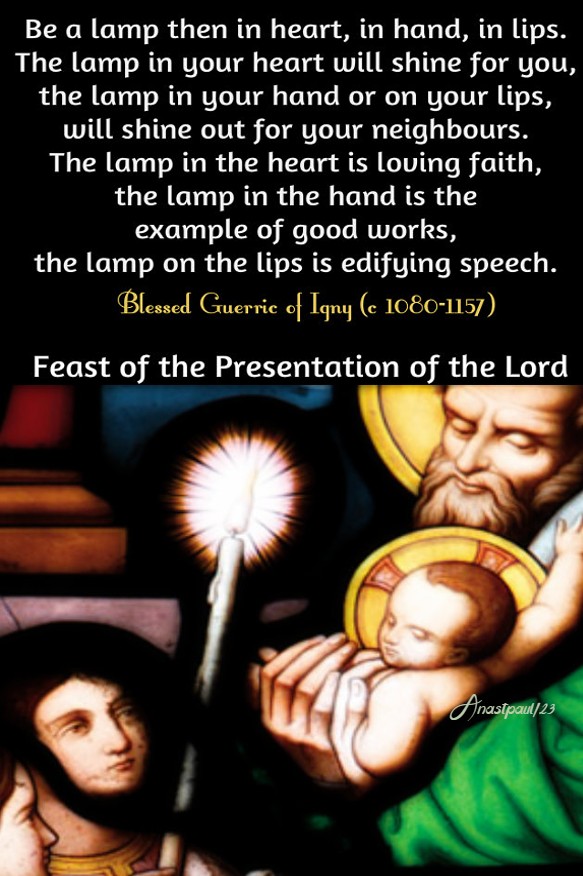
“We must be burning with love and radiant with good deeds and so, take up Christ in our hands with Simeon … Could anyone hold up a lighted candle in his hands on this day, without at once remembering that old man, who on this same day, took up in his arms, Jesus, God’s Word, clothed in flesh like a candle-flame, clothed in wax and affirmed Him to be “the Light which would be a beacon for the Gentiles.”
“Be a lamp then in heart, in hand, in lips. The lamp in your heart will shine for you, the lamp in your hand or on your lips will shine out for your neighbours. The lamp in the heart, is loving faith, the lamp in the hand, is the example of good works, the lamp on the lips, is edifying speech.”
Bl Guerric of Igny (c 1080-1157)
“The glorious St Simeon also was very happy… to carry Him as did Our Lady… we do this when we endure with love, the labours and pains He sends us, that is to say, when the love which we bear to the Law of God, makes us find His yoke easy and pleasing, so that we love these pains and labours and gather sweetness in the midst of bitterness. This is nothing else but to carry Our Lord in our arms. Now if we carry Him in this way, He will, without doubt, Himself carry us!”
St Francis de Sales (1567-1622) Doctor of the Church
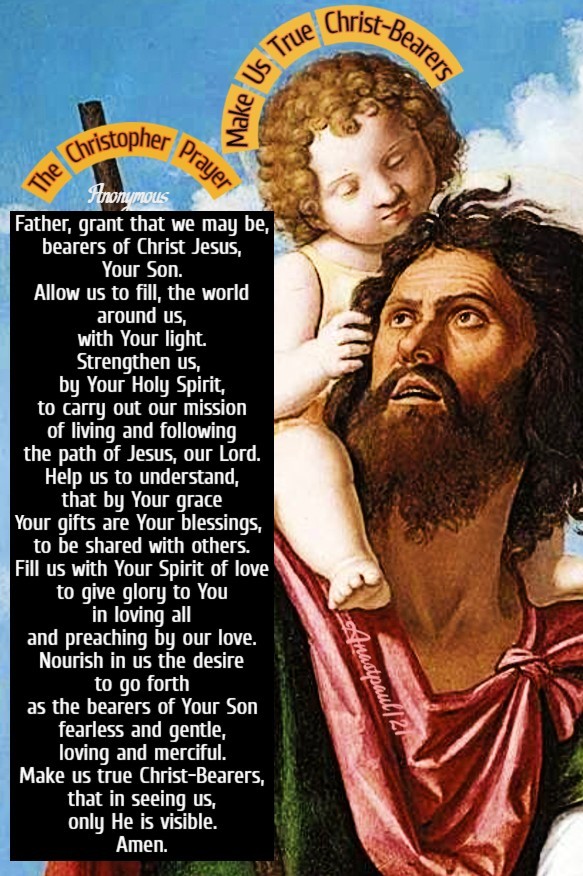
The Christopher Prayer, Make Us True Christ-Bearers Anonymous
Father, grant that we may be, bearers of Christ Jesus, Your Son. Allow us to fill, the world around us, with Your light. Strengthen us, by Your Holy Spirit, to carry out our mission of living and following the path of Jesus, our Lord. Help us to understand, that by Your grace our gifts are Your blessings, to be shared with others. Fill us with Your Spirit of love to give glory to You in loving all and preaching by our love. Nourish in us the desire to go forth as the bearers of Your Son fearless and gentle, loving and merciful. Make us true Christ-Bearers, that in seeing us, only He is visible. Amen.
One Minute Reflection – 2 February – The Feast of the Purification of the Blessed Virgin – Candlemas – Malachias 3:1-4, Luke 2:22-32 – Scripture search here: https://www.drbo.org/
“The Lord, Whom you are seeking, will suddenly enter His Temple” – Malachias 3:1
REFLECTION – “Today the Virgin Mary brings the Lord of the Temple, into the Temple of the Lord. And Joseph, too, takes along there, to the Lord that Son Who is not his own but is the beloved Son in Whom God has set all His favour (Mt 3:17). Simeon, the just man, recognises the One for Whom he was waiting; Anna, the widow, gives Him praise. For the first time, a procession is celebrated on this day, by these four people, a procession that would subsequently be celebrated with joy, by the whole world… Do not be astonished that this procession is so small, since He is also very small Whom the temple receives. But there are no sinners in that place: all are righteous, all are Saints, all are perfect.
Are these the only ones you are going to save, Lord? Your Body is going to grow greater, Your tenderness will also increase… Now, I see a second procession, in which great crowds precede the Lord and crowds follow Him – it is no longer the Virgin who bears Him but a little donkey. So He despises no-one…, if at least those garments of apostles are not lacking them (Mt 21:7): their doctrine, habits and the charity which covers over a multitude of sins (1Pt 4:8). But I will go even further and say that He has saved a place in that procession for us as well… David, King and Prophet, rejoiced to see that day: “he saw it and was glad” (Jn 8:56). If he had not, would he have sung the words: “We have received, O God, Thy mercy in the midst of Thy Temple”? (Ps 47[48]:8). David received this mercy from the Lord, Simeon received it and we, too, have received it as have all those predestined for life, since “Christ is the same today, yesterday and forever” (Heb 13:8)…
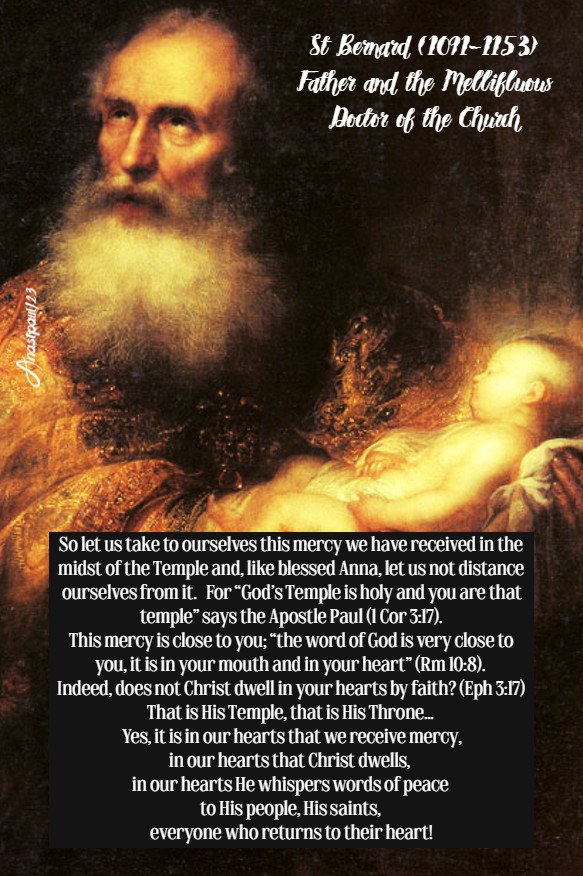
So let us take to ourselves this mercy we have received in the midst of the Temple and, like blessed Anna, let us not distance ourselves from it. For “God’s Temple is holy and you are that temple” says the Apostle Paul (1 Cor 3:17). This mercy is close to you; “the word of God is very close to you, it is in your mouth and in your heart” (Rm 10:8). Indeed, does not Christ dwell in your hearts by faith? (Eph 3:17) That is His Temple, that is His Throne… Yes, it is in our hearts that we receive mercy, in our hearts that Christ dwells, in our hearts He whispers words of peace to His people, His saints, everyone who returns to their heart!” – St Bernard (1090-1153) Cistercian Monk, known as the Last Father and the Mellifluous Doctor of the Church (1st sermon for the Purification).
PRAYER – Almighty, eternal God, we humbly beseech Thy Majesty that, as Thy Only-begotten Son was this day presented in the temple in the nature of our flesh, so may Thou grant us to be presented to Thee with purified minds. Through Jesus Christ, Thy Son our Lord, Who lives and reigns with Thee, in the unity of the Holy Ghost, God, world without end. Amen (Collect).
Our Morning Offering – 2 February – The Feast of the Purification of the Blessed Virgin – Candlemas
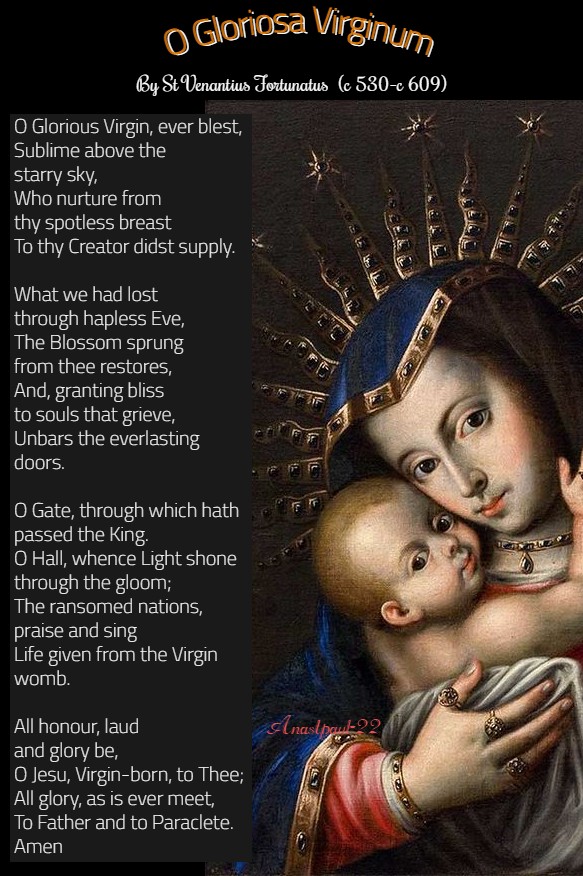
O Gloriosa Virginum By St Venantius Fortunatus (c530 – c609)
O Glorious Virgin, ever blest, Sublime above the starry sky, Who nurture from thy spotless breast To thy Creator didst supply.
What we had lost through hapless Eve, The Blossom sprung from these restores, And, granting bliss to souls that grieve, Unbars the everlasting doors.
O Gate, through which hath passed the King. O Hall, whence Light shone through the gloom; The ransomed nations, praise and sing Life given from the Virgin womb.
All honour, laud and glory be, O Jesu, Virgin-born, to Thee; All glory, as is ever meet, To Father and to Paraclete. Amen
O Gloriosa Domina is the second half of the Hymn: Quem Terra, Pontus, Aethera. It was composed by St Venantius Fortunatus (c530 – c609) the Bishop of Poitiers. In 1632, in accordance with revisions made to the hymns of the Divine Office by Pope Urban VIII (1568-1644), it was altered and changed to O Gloriósa Vírginum. It is sung in the Common of the Blessed Virgin Mary of the Roman Breviary. It is said that St Anthony of Padua (1195-1231) was always singing this Hymn. His mother sang it to him as a baby and even on his death bed, after receiving Extreme Unction, he intoned the Hymn.
Our Lady of the Candles – (formally known as Nuestra Señora de la Purificación y la Candelaria) is a Marian title and image venerated by Filipino Catholics. The image, which is enshrined on the balcony of Jaro Cathedral, is known as the patroness of Jaro District of Iloilo City and the whole of the Western Visayas. The feast day of Our Lady of the Candles is on Candlemas (2 February) and is celebrated in Iloilo City with a Solemn Pontifical Mass presided by the Archbishop of Jaro.
St Adalbald of Ostrevant St Adeloga of Kitzingen St Agathodoros of Tyana St Apronian the Executioner Bl Bernard of Corbara St Bruno of Ebsdorf St Burchard of Wurzburg St Candidus the Martyr St Columbanus of Ghent St Cornelius the Centurion St Felician the Martyr St Feock St Firmus of Rome St Flosculus of Orléans St Fortunatus the Martyr St Hilarus the Martyr St Jeanne de Lestonnac (1556-1640) Widow, Mother, Founder
St Lawrence of Canterbury (Died 2 February 619) The Second Archbishop of Canterbury, the successor of St Augustine of Canterbury from 604 until his death in 619, but he was Consecrated as Archbishop by his predecessor, St Augustine, during Augustine’s lifetime, to ensure continuity in the office, Benedictine Monk, Missionary. He was a member of the Gregorian mission sent from Italy to England to Christianise the Anglo-Saxons. About St Lawrence: https://anastpaul.com/2022/02/02/saint-of-the-day-2-february-saint-lawrence-of-canterbury-died-619/
Blessed Luigi Giuseppe Bellesini OSA (1774-1840) Priest and Friar of the Hermits of St Augustine St Marquard of Hildesheim St Mun
St Rogatus the Martyr St Saturninus the Martyr St Sicharia of Orleans St Simon of Cassia Fidati St Theodoric of Ninden St Victoria the Martyr
Martyrs of Ebsdorf: Members of the army of King Louis III of France under the leadership of Duke Saint Bruno of Ebsdorf. The Martyrs died fighting invading pagan Norsemen, and defending the local Christian population. Four bishops, including Saint Marquard of Hildesheim and Saint Theodoric of Ninden, eleven nobles, and countless unnamed foot soldiers died repelling the invaders. They were martyred in the winter of 880 in battle at Luneberg Heath and Ebsdorf, Saxony (modern Germany).
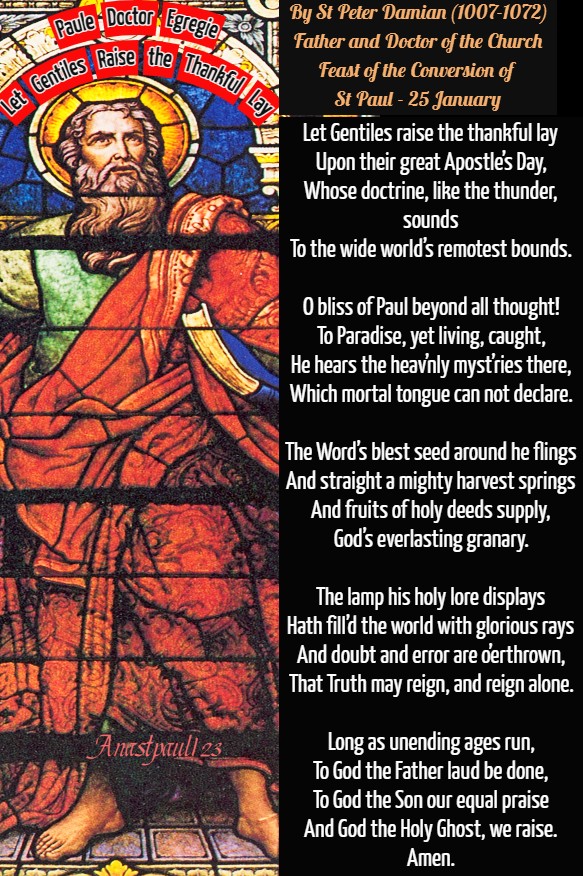
Quote/s of the Day – 25 January – Feast of the Conversion of St Paul, Apostle – Acts 9:1-22, Matthew 19:27-29 – Scripture search here: https://www.drbo.org/
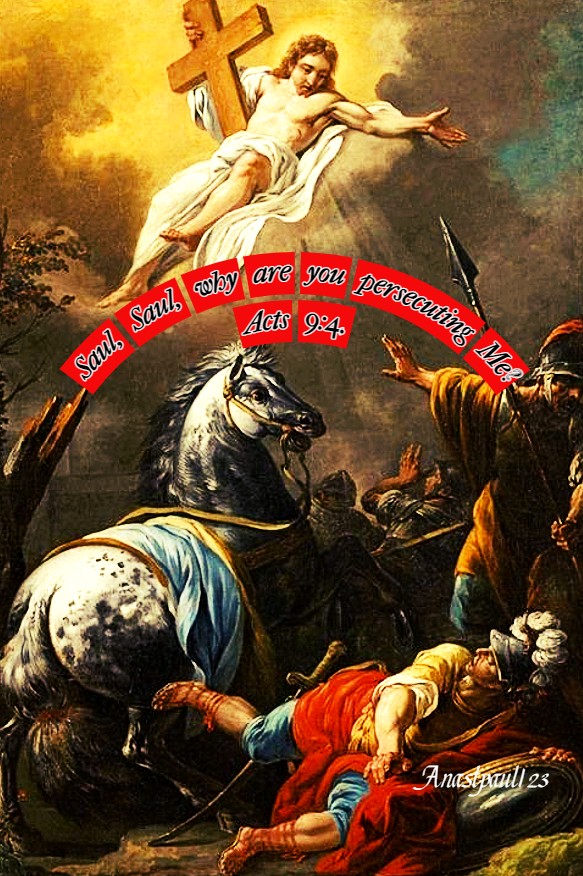
“Saul, Saul, why are you persecuting Me?”
Acts 9:4.
“So Saul was led to Ananias – the ravaging wolf is led to the sheep. But the Shepherd, Who guides everything from Heaven above, reassures him… “Do not fear, I will show him what he will have to suffer, for My Name’s sake” (Acts 9:16). What wonder is this! The wolf is led, a captive, to the sheep… The Lamb who died for the sheep, teaches it not to be afraid any more!”
St Augustine (354-430) Father and Doctor of the Church
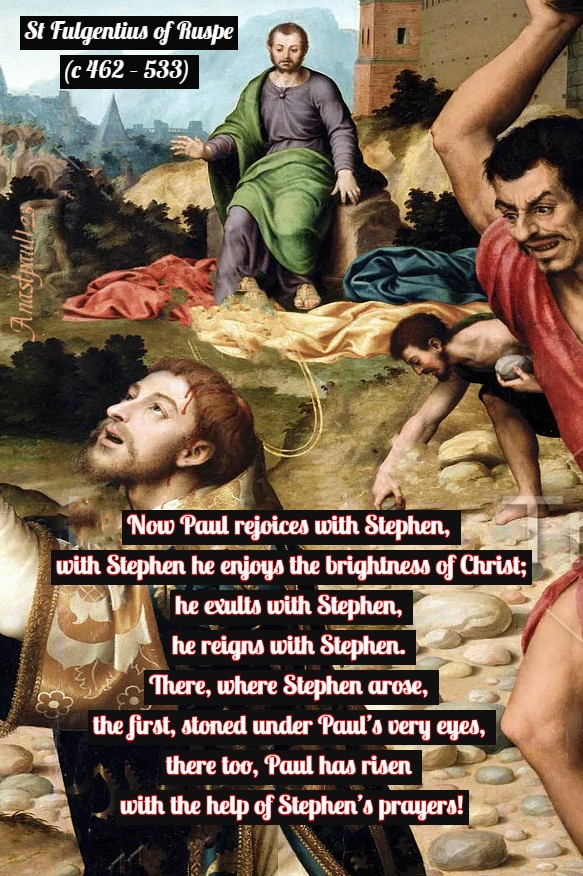
“Now Paul rejoices with Stephen, with Stephen he enjoys the brightness of Christ; he exults with Stephen, he reigns with Stephen. There, where Stephen arose, the first, stoned under Paul’s very eyes, there too, Paul has risen with the help of Stephen’s prayers!”
St Fulgentius of Ruspe (c 462 – 533) Bishop in North Africa
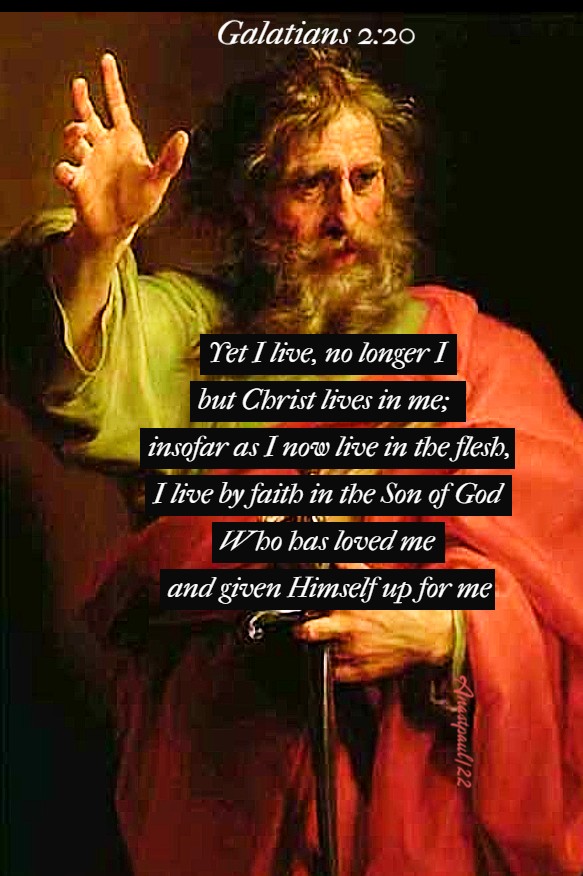
“Yet I live, no longer I but Christ lives in me; insofar as I now live in the flesh, I live by faith in the Son of God, Who has loved me and given himself up for me.”
Galatians 2:20
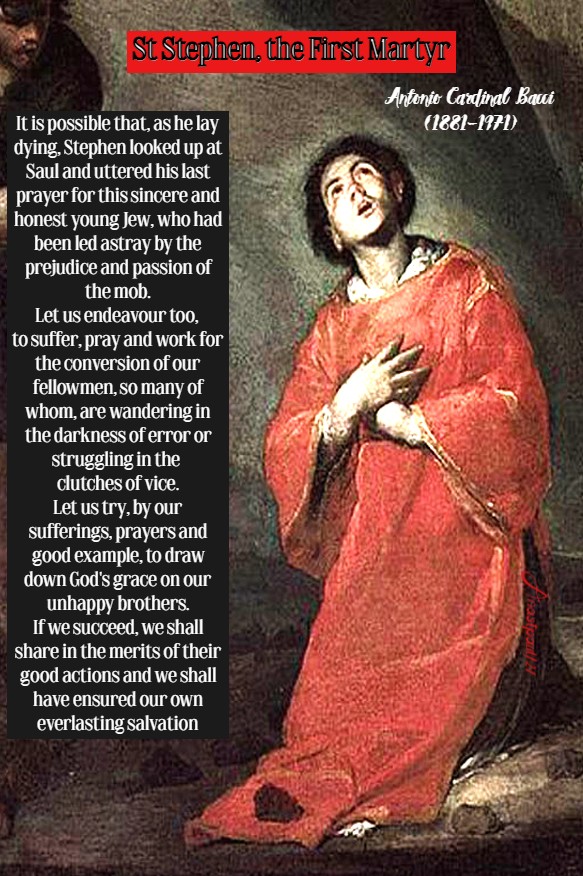
“It is possible that, as he lay dying, Stephen looked up at Saul and uttered his last prayer for this sincere and honest young Jew, who had been led astray by the prejudice and passion of the mob. … Let us endeavour too, to suffer, pray and work for the conversion of our fellowmen, so many of whom, are wandering in the darkness of error or struggling in the clutches of vice. Let us try, by our sufferings, prayers and good example, to draw down God’s grace on our unhappy brothers. If we succeed, we shall share in the merits of their good actions and we shall have ensured our own everlasting salvation.”
One Minute Reflection – 25 January – Feast of the Conversion of St Paul, Apostle – Acts 9:1-22, Matthew 19:27-29 – Scripture search here: https://www.drbo.org/
“He fell to the ground and heard a voice saying to him, “Saul, Saul, why are you persecuting Me?” – Acts 9:4.
REFLECTION – “From Heaven’s height Christ’s Voice overturned Saul. He received a command to carry out his persecutions no more and fell face downwards to the ground. He had first to be knocked down and afterwards raised up – first struck, then healed. For Christ would never have come to live in him, if Saul had not died to his former life of sin. Cast down to the earth in this way, what was it he heard? “Saul, Saul, why are thou persecuting Me? It is hard for thou to kick against the goad” (Acts 9:4-5). And he replied: “Who are you, Lord?” Then the voice from on high continued: “I am Jesus of Nazareth, Whom thou art persecuting.” The members are still on the ground, while the Head cries out, from the heights of Heaven. He is not saying: “Why art thou persecuting My servants?” but “Why art thou persecuting Me?”
And Paul, who had put all his energy into his persecutions, is already preparing to obey: “What do Thou want me to do?” The persecutor is already transformed into the preacher, the wolf has become a sheep, the enemy, a defender. Paul learns what he is to do – if he has become blind, if this world’s light is held back from him for a while, it is so as to make the light within shine in his heart. Light is taken away from the persecutor, so that it may be given to the preacher; at the very moment he no longer saw anything of this world, he saw Jesus. This symbolises the believer – those who believe in Christ, must fix the eyes of their soul on Him, without paying attention to outward things…
So Saul was led to Ananias – the ravaging wolf is led to the sheep. But the Shepherd, Who guides everything from Heaven above, reassures him… “Do not fear, I will show him what he will have to suffer, for My Name’s sake” (Acts 9:16). What wonder is this! The wolf is led, a captive, to the sheep… The Lamb who died for the sheep, teaches it not to be afraid any more!” – St Augustine (354-430) Bishop, Father and Doctor of Grace of the Church (Sermon 279).
PRAYER – O God, Who taught the whole world by the preaching of Thy blessed Apostle Paul, grant, we beseech Thee that we, who today celebrate his conversion, may draw closer to Thee, by way of hia example.Through Jesus Christ, Thy Son our Lord, Who lives and reigns with Thee, in the unity of the Holy Ghost, God, world without end. Amen (Collect).
Feast of the Conversion of St Paul, Apostle – 25 January
From the Liturgical Year, 1904
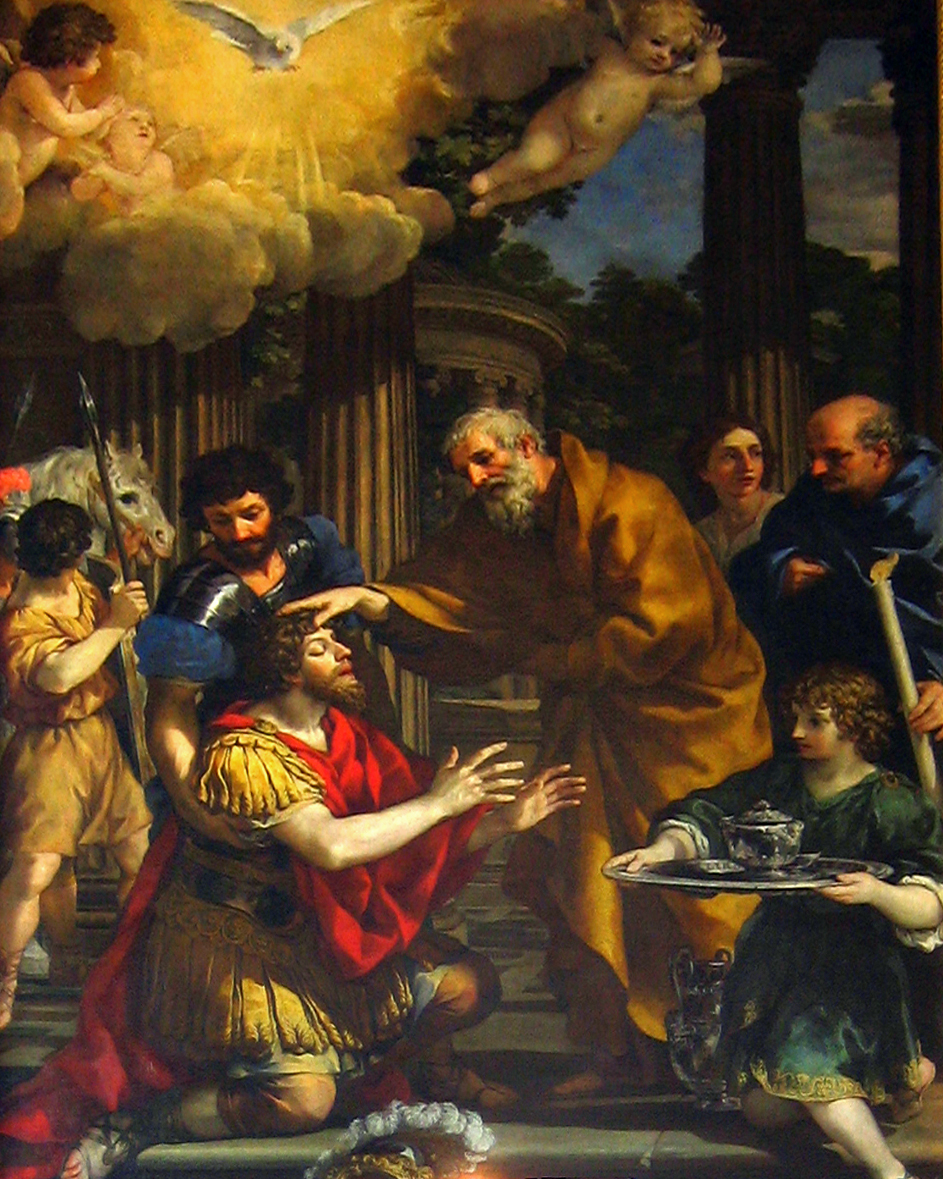
We have already seen how the Gentiles, in the person of the Three Magi, offered their mystic gifts to the Divine Child of Bethlehem and received from Him, in return, the precious gifts of faith, hope and charity. The harvest is ripe; it is time for the reaper to come. But who is to be God’s labourer? The Apostles of Christ are still living under the very shadow of Mount Sion. All of them have received the mission to preach the Gospel of Salvation to the uttermost parts of the world but, not one among them, has, as yet, received the special character of Apostle of the Gentiles. Peter, who had received the Apostleship of Circumcision (Gal 2:8), is sent especially, as was Christ Himself, to the sheep that are lost of the house of Israel (Mt 15:24). And yet, as he is the Head and the Foundation, it belongs to him to open the door of Faith to the Gentiles (Acts 14:26) which he solemnly does, by conferring Baptism on Cornelius, the Roman Centurion.
But the Church is to have one more Apostle – an Apostle for the Gentiles – and he is to be the fruit of the Martyrdom and prayer of St Stephen. Saul, a citizen of Tarsus, has not seen Christ in the flesh and yet, Christ alone can make an Apostle. It is then, from Heaven, where He reigns, impassible and glorified, that Jesus will call Saul to be His disciple, just as, during the period of His active life, He called the fishermen of Genesareth to follow Him and hearken to His teachings. The Son of God will raise Saul up to the Third Heaven and there, will reveal to Him, all His Mysteries and when Saul, having come down again to this earth, shall have seen Peter (Gal 1:18) and compared his Gospel with that recognised by Peter (Ibid 2: 2) – he can say, in all truth that he is an Apostle of Christ Jesus (Gal 1:1) and that he has done nothing less. than the great Apostles (2 Cor 11:55).
It is on this glorious day of the Conversion of Saul, who is soon to change his name into Paul that this great work is commenced. It is on this day, that is heard the Almighty Voice which breaketh the cedars of Libanus (Ps 28:5) and can make a persecuting Jew become, first a Christian and then an Apostle. This admirable transformation had been prophesied by Jacob, when, upon his death-bed, he unfolded, to each of his sons, the future of the tribe of which he was to be the father. Juda was to have the precedence of honour; from his royal race, was to be born the Redeemer, the Expected of nations. Benjamin’s turn came – his glory is not to be compared with that of his brother Juda and yet, it was to be very great – for, from his tribe, is to be born Paul, the Apostle of the Gentile nations!
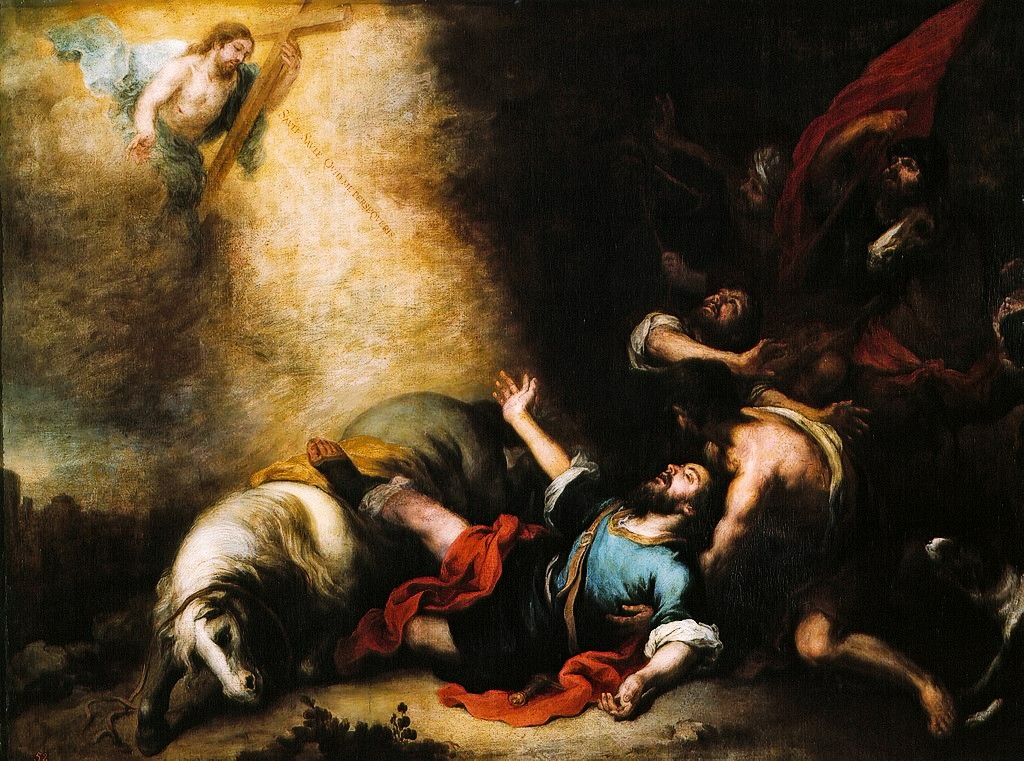
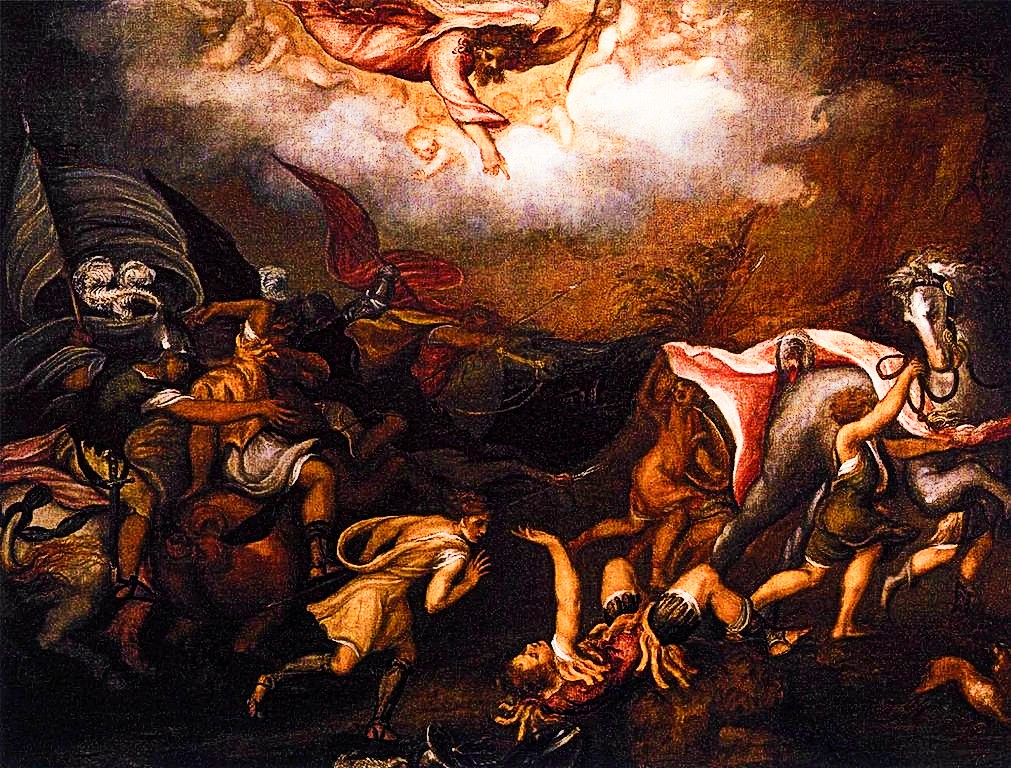
Bartolomé Esteban Murillo: Conversion of Saint Paul
These are the words of the dying Prophet – Benjamin, a ravenous wolf, in the morning shall eat the prey and in the evening, shall divide the spoil (Gen 49:27). Who, says an ancient writer (These words are taken from a Sermon, which for long time was thought to be St Augustine), is he, that in the morning of impetuous youth, goes like a wolf, in pursuit of the sheep of Christ, breathing threatenings and slaughter against them? Is it not Saul on the road to Damascus, the bearer and doer of the high-priest’s orders and stained with the blood of Stephen, whom he has stoned by the hands of all those, over whose garments he kept watch? And he, who, in the evening, not only does not despoil but, with a charitable and peaceful hand, breaks to the hungry the bread of life – is it not Paul, of the tribe of Benjamin, the Apostle of Christ, burning with zeal for his brethren, making himself all to all and wishing even to be an anathema for their sakes?
Oh! the power of our dear Jesus! how wonderful! how irresistible! He wishes that the first worshippers at His Crib should be humble Shepherds – and, He invites them by His Angels, whose sweet hymn was enough to lead these simple-hearted men to the Stable, where lies, in swaddling-clothes, He Who is the hope of Israel. He would have the Gentile Princes, the Magi, do Him homage – and bids to arise in the Heavens, a Star, whose mysterious apparition, joined to the interior speaking of the Holy Ghost, induces these men of desire, to come from the far East and lay, at the feet of an humble Babe, their riches and their hearts. When the time is come for forming the Apostolic College, He approaches the banks of the sea of Tiberias and, with this single word: Follow me, He draws after Him such as He wishes to have as His Disciples. In the midst of all the humiliations of His Passion, He has but to look at the unfaithful Peter and Peter is a penitent. Today, it is from Heaven that He evinces His power – all the Mysteries of our Redemption have been accomplished and He wishes to show mankind that He is the Sole Author and Master of the Apostolate and that, His alliance with the Gentiles, is now perfect – He speaks – the sound of His reproach bursts like thunder over the head of this hot Pharisee, who is bent on annihilating the Church. He takes this heart of the Jew and, by His grace, turns it into the heart of the Apostle, the Vessel of election, the Paul, who is afterwards to say of himself: I live, not I but Christ liveth in me (Gal 2:20).
The commemoration of this great event was to be a Feast in the Church and it had a right to be kept, as near as might be to the one which celebrates the Martyrdom of St Stephen, for Paul is the Protomartyr’s convert. The anniversary of his Martyrdom would, of course, have to be solemnised at the summer-solstice – where, then, place the Feast of his Conversion if not near Christmas and thus our own Apostle, would be at Jesus’ Crib and Stephen’s side? Moreover, the Magi could claim him, as being the conqueror of that Gentile-world, of which they were the first-fruits.
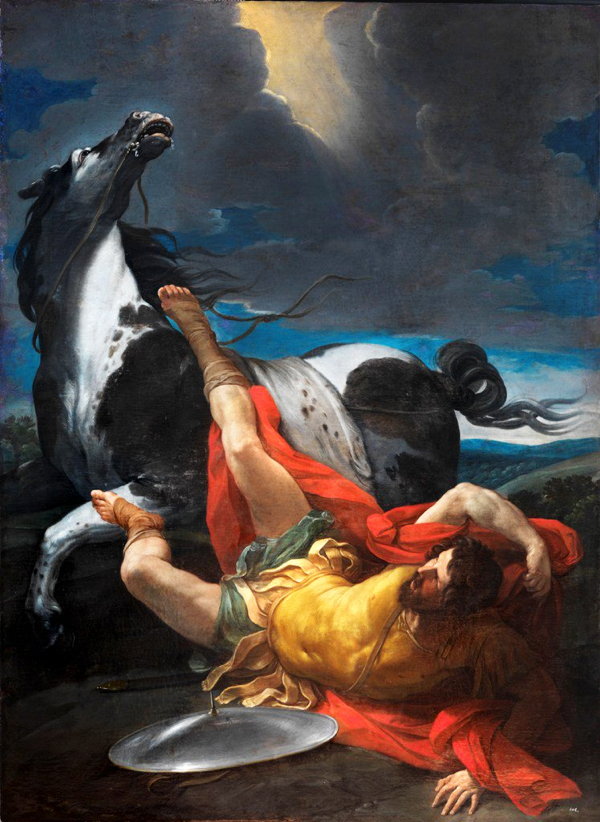
Andrea Schiavone: Conversion of Saul
And lastly, it was necessary, in order to give the Court of our Infant-King its full beauty that the two Princes of the Church – the Apostle of the Jews and the Apostle of the Gentiles – should stand close to the mystic Crib – Peter, with his Keys and Paul, with his Sword. Bethlehem thus becomes the perfect figure of the Church and the riches of this season of the Cycle are abundant beyond measure. Amen.
St Apollo of Heliopolis Bl Archangela Girlani St Artemas of Pozzuoli St Auxentius of Epirus St Bretannion of Tomi St Donatus the Martyr St Dwynwen (Died c 460) Virgin Princess, Nun. St Eochod of Galloway St Joel of Pulsano St Juventinus of Antioch St Maximinus of Antioch St Palaemon
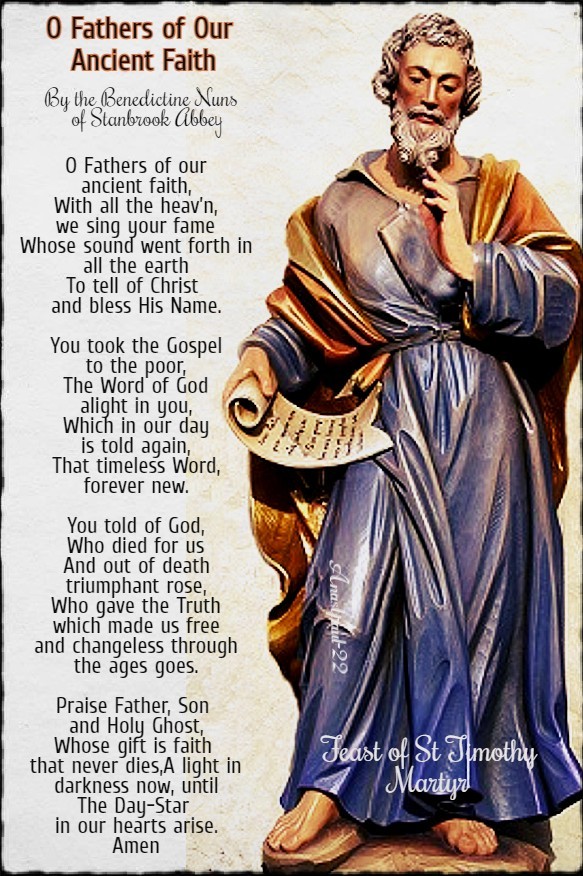
Our Morning Offering – 24 January – Feast of Saint Timothy, Bishop and Martyr
O Fathers of Our Ancient Faith
O Fathers of our ancient faith, With all the heav’n, we sing your fame Whose sound went forth in all the earth To tell of Christ and bless His Name.
You took the Gospel to the poor, The Word of God alight in you, Which in our day is told again, That timeless Word, forever new.
You told of God, Who died for us And out of death triumphant rose, Who gave the Truth which made us free and changeless through the ages goes.
Praise Father, Son and Holy Spirit, Whose gift is faith that never dies, A light in darkness now, until The Day-Star in our hearts arise.
O Fathers of Our Ancient Faith is written by the Benedictine Nuns of Stanbrook Abbey. In the Divine Office it is sung at Morning Prayer in the Common of Apostles. It is set to the anonymous tune associated with the 7th century Latin hymn, Creator Alme Siderum.
Quote/s of the Day – 18 January – Feast of the Chair of the Apostle, St Peter at Rome – 1 Peter 1:1-7, Matthew 16:13-19 – Scripture search here: https://www.drbo.org/
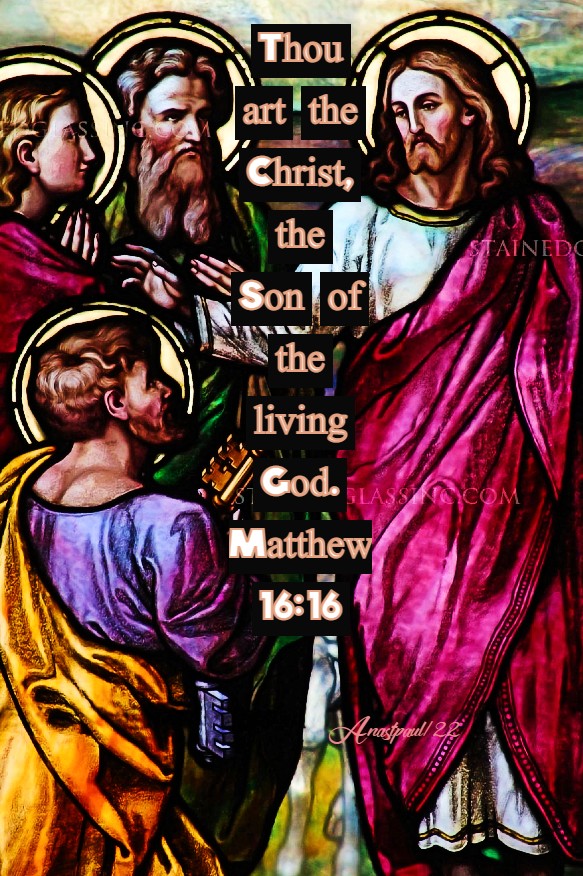
“Thou art the Christ, the Son of the living God.”
Matthew 16:16
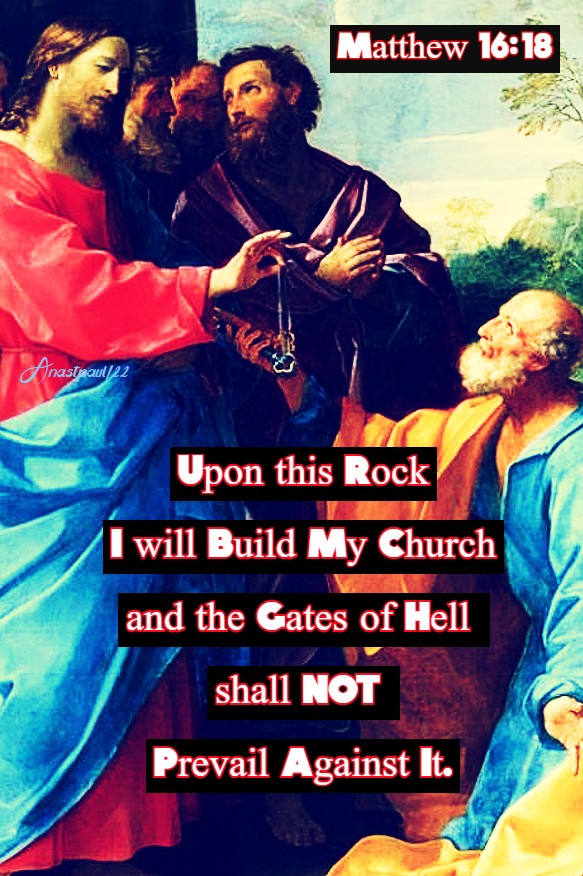
“Upon this rock I will build My Church”
Matthew 16:18
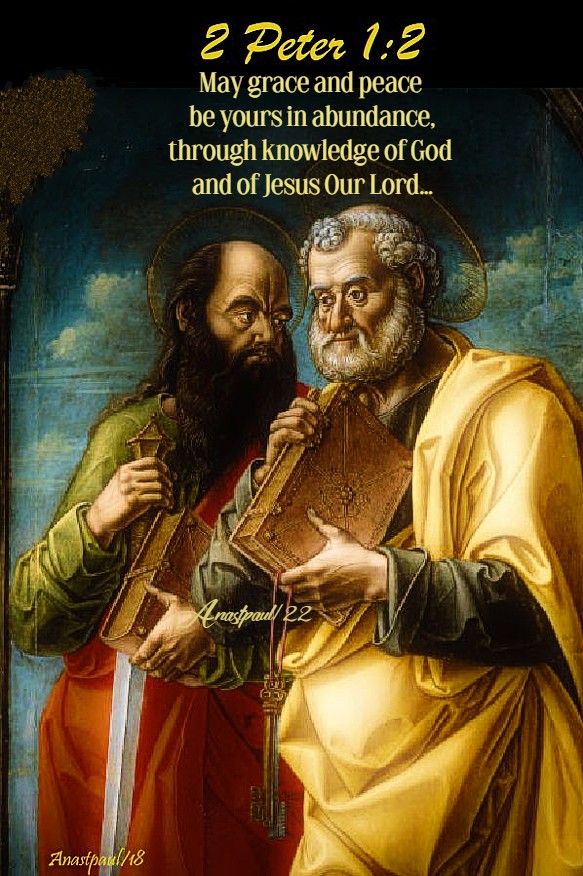
“… May grace and peace be yours in abundance, through knowledge of God and of Jesus Our Lord…”
2 Peter 1:2
“So Peter wept and wept bitterly; he wept so hard that he washed away his offence with his tears. And you, too, if you would win pardon, wipe out your guilt with tears. At that very moment, in that same hour, Christ will look at you. If some kind of fall happens to you, then He, the ever-present witness of your intimate life, looks at you to call you back and cause you to confess your lapse. Then do as Peter did, who thrice said: “Lord, you know that I love you” (Jn 21:15). He denied three times and three times he also confessed. But he denied by night; he confessed in broad daylight.”
St Ambrose (340-397) Father and Doctor of the Church
“Yes, the Apostle chosen to be His co-worker, merited to share, the same Name as Christ. They built the same Building together – Peter does the planting, the Lord gives the increase and it is the Lord, too, Who sends those, who will do the watering (cf 1 Cor 3:6f).”
St Augustine (354-430) Father & Doctor of the Church
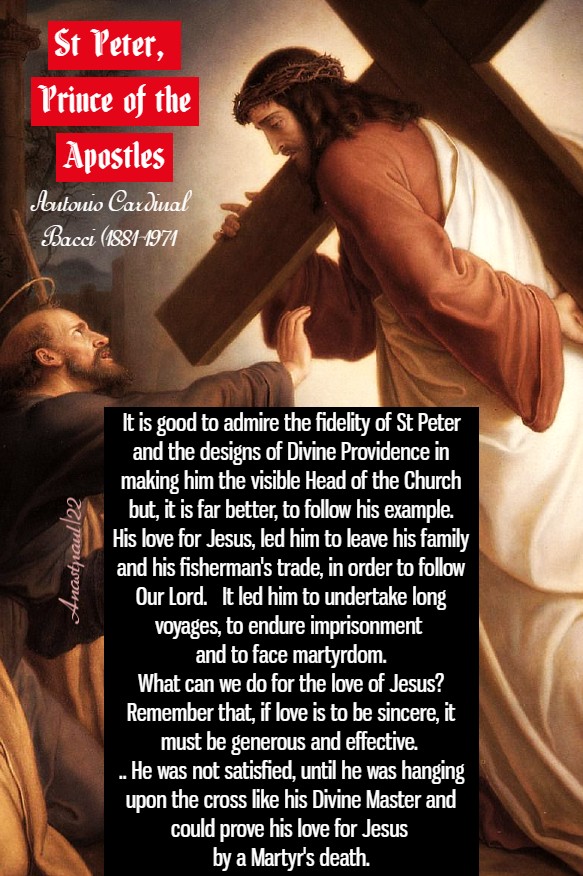
“It is good to admire the fidelity of St Peter and the designs of Divine Providence in making him the visible Head of the Church but, it is far better, to follow his example. His love for Jesus, led him to leave his family and his fisherman’s trade, in order to follow Our Lord. It led him to undertake long voyages, to endure imprisonment and to face Martyrdom. What can we do for the love of Jesus? Remember that, if love is to be sincere, it must be generous and effective. … He was not satisfied, until he was hanging upon the cross like his Divine Master and could prove his love for Jesus by a Martyr’s death.”































 AnaStpaul
You must be logged in to post a comment.