Our Morning Offering – 5 March – Thursday of the Second Week of Lent
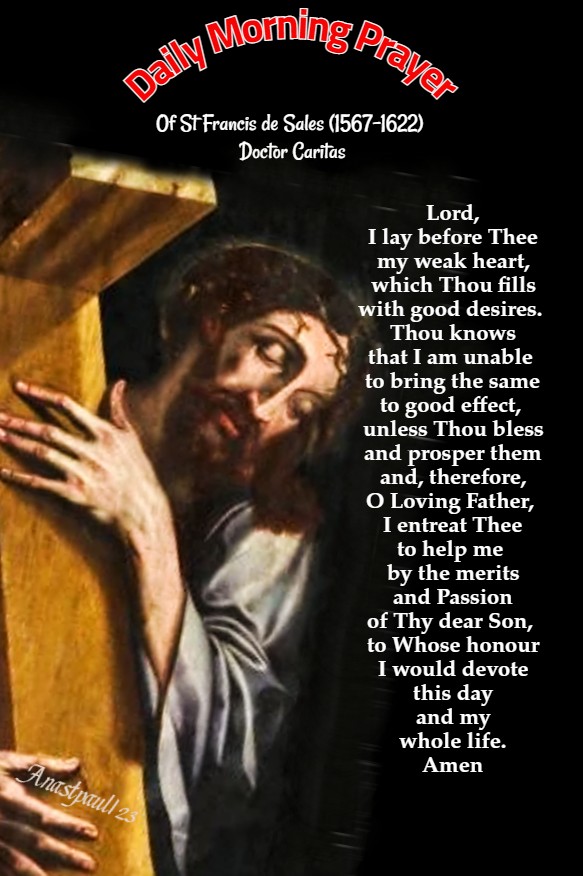
Daily Morning Prayer Of St Francis de Sales (1567-1622) Doctor Caritatis
Lord, I lay before Thee my weak heart, which Thou fills with good desires. Thou knows that I am unable to bring the same to good effect, unless Thou bless and prosper them and, therefore, O Loving Father, I entreat Thee to help me by the merits and Passion of Thy dear Son, to Whose honour I would devote this day and my whole life. Amen
Quote of the Day – 1 March – The Second Sunday in Lent – Thessalonians 5:14-23, Matthew 17:1-9 – Scripture search here: https://www.drbo.org/
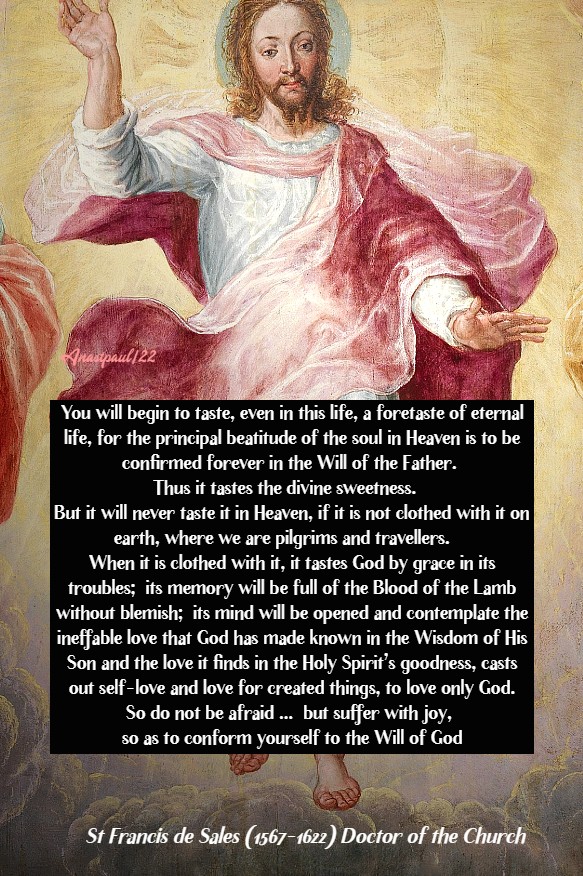
“You will begin to taste, even in this life, a foretaste of eternal life, for the principal beatitude of the soul in Heaven, is to be confirmed forever in the Will of the Father. Thus, it tastes the Divine sweetness. But it will never taste it in Heaven, if it is not clothed with it on earth, where we are pilgrims and travellers. When it is clothed with it, it tastes God by grace in its troubles; its memory will be full of the Blood of the Lamb without blemish; its mind will be opened and contemplate the ineffable Love that God has made known in the Wisdom of His Son and the love it finds, in the Holy Spirit’s goodness, casts out self-love and love for created things, to love only God. So do not be afraid … but suffer with joy, so as to conform yourself to the Will of God.””
The Second Sunday of Lent – 1 March – Our Lenten Journey With St Thomas Aquinas (1225-1274) Doctor of the Church
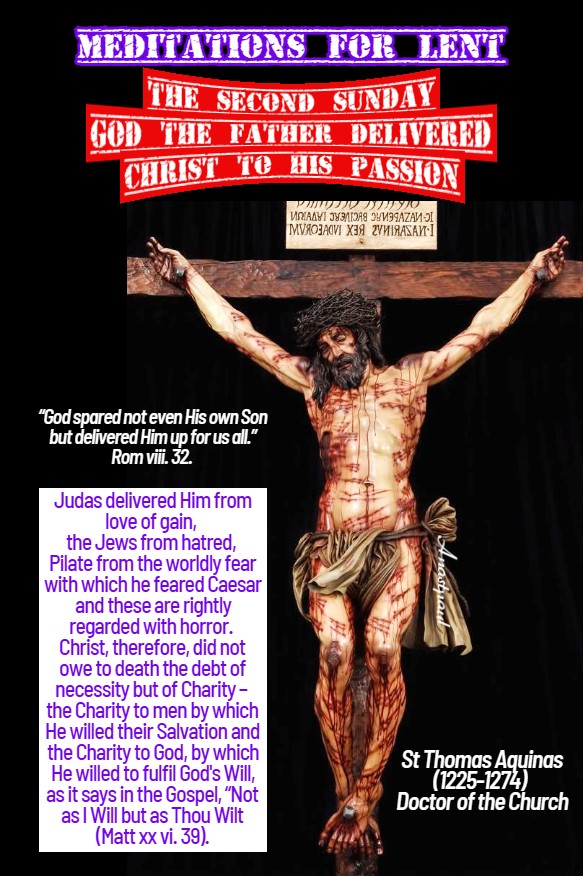
The Second Sunday God the Father Delivered Christ to His Passion
“God spared not even His own Son but delivered Him up for us all.” Rom viii. 32.
Christ suffered willingly, moved by obedience to His Father. Wherefore, God the Father delivered Christ to His Passion and this, in three ways:
Because the Father, of His Eternal Will, preordained the Passion of Christ as the means whereby to free the human race. So it is said in Isaias, “The Lord hath laid on Him the iniquity of us all” (Isa liii. 6) and again, “The Lord was pleased to bruise Him in infirmity” (ibid liii. 10).
Because He inspired Our Lord with the willingness to suffer for us, pouring into His Soul the Love which produced the will to suffer. Whence the Prophet goes on to say, “He was offered because it was His Own Will” (Isa liii. 7).
Because He did not protect Our Lord from the Passion but exposed Him to His persecutors. Whence we read in St Matthew’s Gospel: as He hung on the cross Christ said, “My God, My God, why hast thou forsaken Me” (Matt xxvii. 46). For God the Father, that is to say, had left Him at the mercy of His torturers.
To hand over an innocent man to suffering and to death, against his will, compelling him to die as it were, would indeed be cruel and wicked. But it was not in this way God the Father delivered Christ. He delivered Christ by inspiring Him with the Will to suffer for us. By so doing, the severity of God is made clear – no sin is forgiven without punishment! which St Paul again teaches when he says, God spared not His Own Son.
At the same time God’s kindness and goodness is exhibited in the fact that whereas man could not, no matter what his punishment, sufficiently make satisfaction, God has given man someone Who is able to make that satisfaction for him. Which is what St Paul means by, He delivered Him up for us all and again when he says, God hath proposed Christ to be an appeasement through faith in His Blood (Rom iii. 25). The same activity in a good man and in a bad man is differently judged, inasmuch as the root from which it proceeds is different. The Father, for example, delivered Christ and Christ delivered Himself and this from love and, therefore, They are praised.
Judas delivered Him from love of gain, the Jews from hatred, Pilate from the worldly fear with which he feared Caesar and these are rightly regarded with horror. Christ, therefore, did not owe to death the debt of necessity but of Charity – the Charity to men by which He willed their Salvation and the Charity to God, by which He willed to fulfil God’s Will, as it says in the Gospel, “Not as I Will but as Thou Wilt (Matt xx vi. 39).
ST THOMAS AQUINAS (1225-1274) Priest, Theologian, Dominican Doctor Angelicus (Angelic Doctor) Doctor Communis (Common Doctor) Added by Pope Saint Pius V in 1568
Thought for the Day – 20 October – Meditations with Antonio Cardinal Bacci (1881-1971)
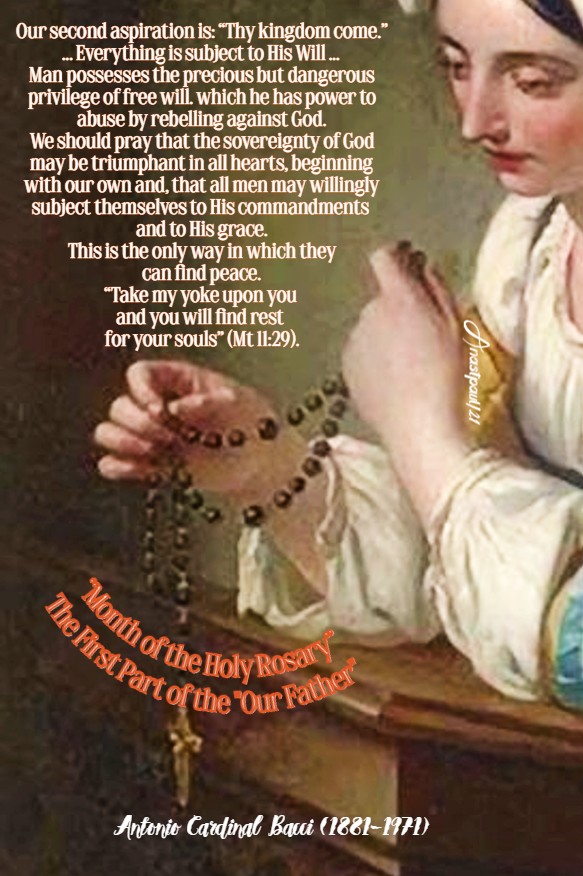
“Month of the Holy Rosary” The First Part of the “Our Father”
“Our second aspiration is: “Thy Kingdom come.” It is true, that God reigns over Heaven, earth and the infernal regions. Everything is subject to His Will – the sun, the stars, the birds of the air, the fishes of the sea and the tiniest insects carry out His commands. Even the demons of Hell, who He has condemned to eternal punishment, are obedient to His Will. But what about the human race?
Man possesses the precious but dangerous privilege of free will which he has power to abuse by rebelling against God. We should pray that the sovereignty of God may be triumphant in all hearts, beginning with our own and, that all men may willingly subject themselves to His commandments and to His grace. This is the only way in which they can find peace. “Take my yoke upon you and you will find rest for your souls” (Mt 11:29).
We should pray, moreover, for the Church, which is the Kingdom of God upon earth. We should pray for her peaceful victory over her enemies, who persecute her and impede her work for the salvation of souls. We should love the Church even as we love Jesus Christ, for the Church is His handiwork and the fruit of His Precious Blood.”
Thought for the Day – 18 October – Meditations with Antonio Cardinal Bacci (1881-1971)
“The Month of the Holy Rosary” The “Our Father”
“Our Lord exhorted His disciples on many occasions to pray often and with confidence, if they wished to be heard. Everything which they asked His heavenly Father, in His name, He said, they would obtain. Ask, He said and it shall be given you; seek and you shall find, knock and it shall be opened to you. Finally, He insisted that we ought to pray and never to give up. In other words, life can be a continuous prayer if we offer to God all our thoughts, words and actions.
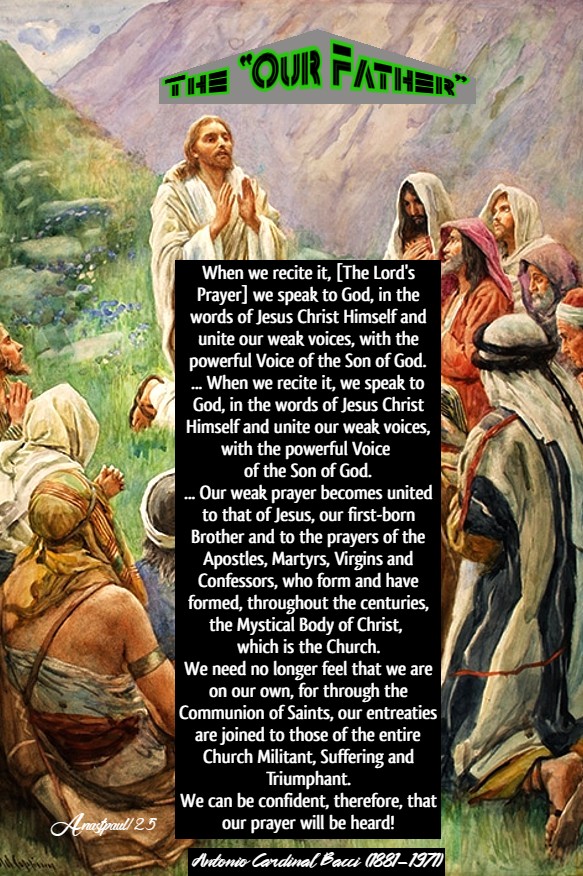
The ideal Christian prayer is to do the Will of God at all times from the motive of pure love. The Apostles, however, who had not made that much progress in the spiritual life, asked Jesus to teach them how to pray (Lk 11:1). It was then that Our Lord composed the most beautiful of prayer, the “Our Father” (Mt 6:9-13). When we recite it, we speak to God, in the words of Jesus Christ Himself and unite our weak voices, with the powerful Voice of the Son of God. We address the Eternal God, moreover, by the name of Father. Even in the Old Testament, God is often referred to in this way. Then, however, He figured as the Father of the chosen people, whereas now, He is the Father of all. He is our Father, the Father of all mankind and of all races, whom He has willed to redeem from the slavery of sin. The term “Our Father” has taken on a new and fuller meaning. Our weak prayer becomes united to that of Jesus, our first-born Brother and to the prayers of the Apostles, Martyrs, Virgins and Confessors, who form and have formed, throughout the centuries, the Mystical Body of Christ, which is the Church. We need no longer feel that we are on our own, for through the Communion of Saints, our entreaties are joined to those of the entire Church Militant, Suffering and Triumphant. We can be confident, therefore, that our prayer will be heard!”
Quote/s of the Day – 12 October – 1 Corinthians 1:4-8 – Matthew 9:1-8 – Scripture search here: https://www.drbo.org/
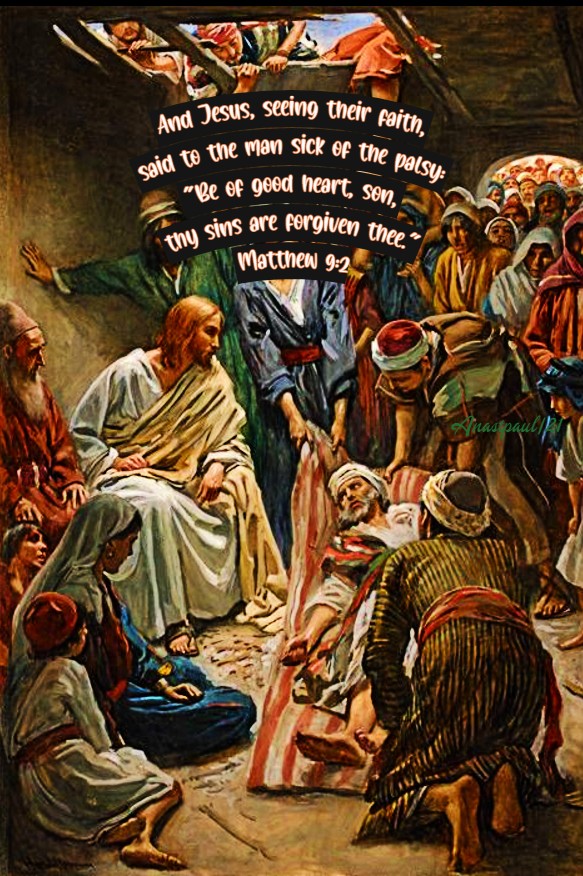
“And Jesus, seeing their faith, said to the paralytic, Take courage, son, your sins are forgiven you.”
Matthew 9:2
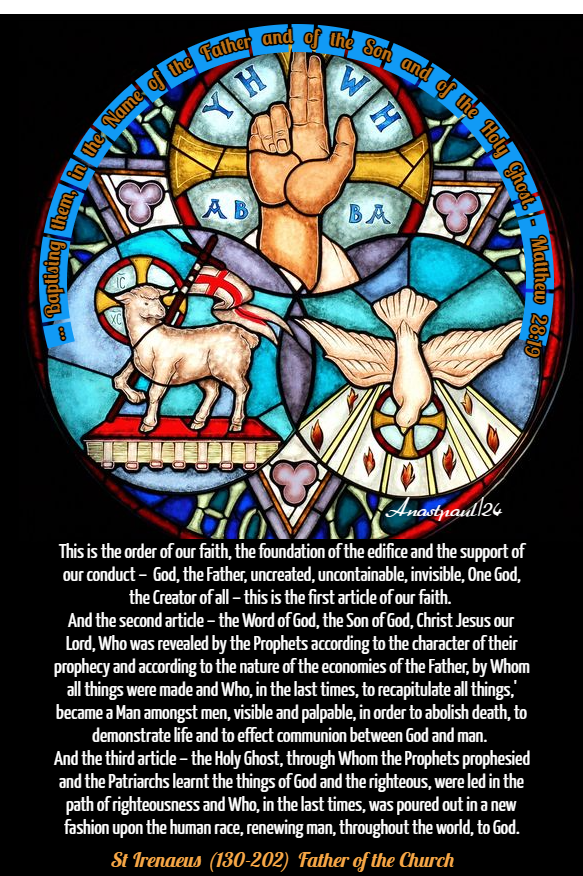
“This is the order of our faith, the foundation of the edifice and the support of our conduct – God, the Father, uncreated, uncontainable, invisible, One God, the Creator of all – this is the first article of our faith. And the second article – the Word of God, the Son of God, Christ Jesus our Lord, Who was revealed by the Prophets according to the character of their prophecy and according to the nature of the economies of the Father, by Whom all things were made and Who, in the last times, to recapitulate all things, became a Man amongst men, visible and palpable, in order to abolish death, to demonstrate life and to effect communion between God and man. And the third article – the Holy Ghost, through Whom the Prophets prophesied and the Patriarchs learnt the things of God and the righteous, were led in the path of righteousness and Who, in the last times, was poured out in a new fashion upon the human race, renewing man, throughout the world, to God.”
St Irenaeus (130-202) Martyr, Father of the Church
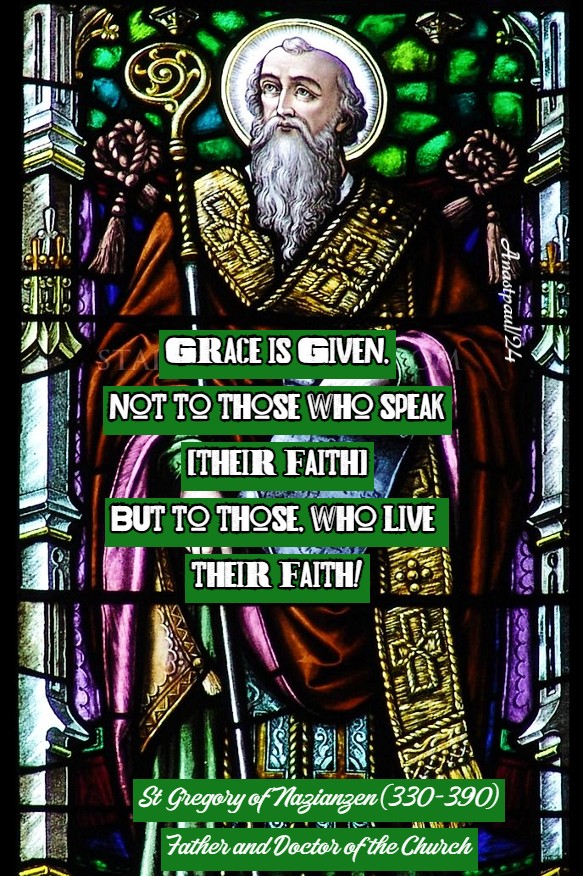
“Grace is given, not to those who speak [their faith] but to those, who live their faith!”
St Gregory Nazianzen (330-390) Father and Doctor of the Church
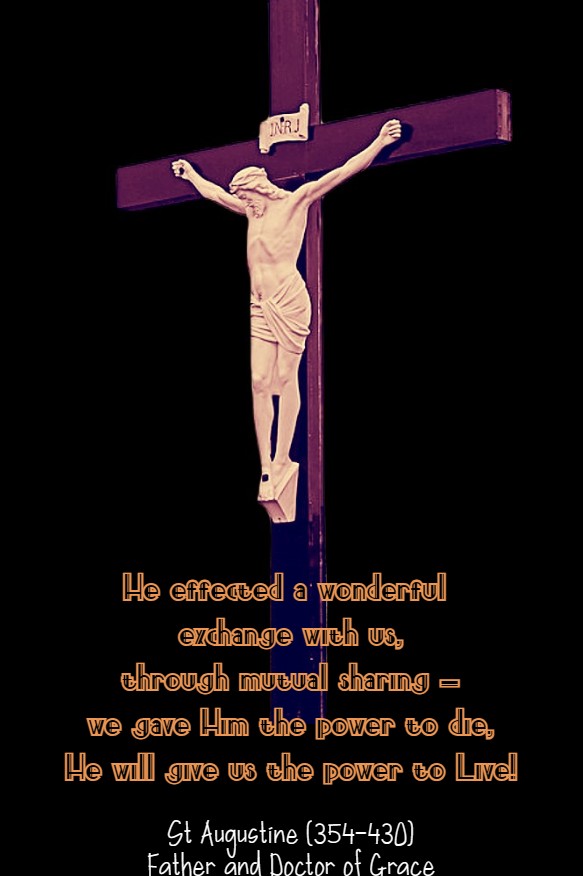
“… He effected a wonderful exchange with us, through mutual sharing – we gave Him the power to die, He will give us the power to Live!”
St Augustine (354-430) Father and Doctor of Grace
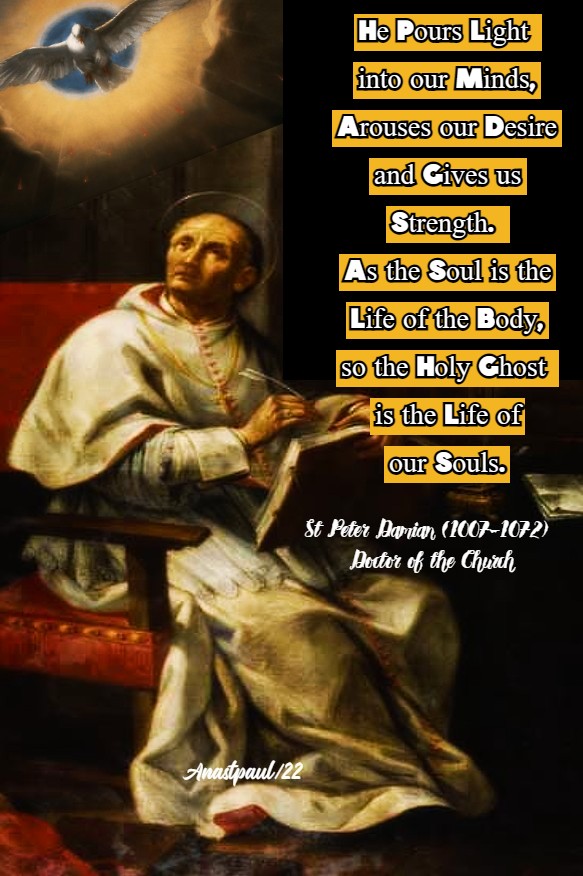
“He pours light into our minds, arouses our desire and gives us strength… As the soul is the life of the body, so the Holy Ghost is the life of our souls.”
St Peter Damian (1007-1072) Bishop, Father and Doctor of the Church
One Minute Reflection – 4 October – “The Month of The Most Holy Rosary and The Holy Angels” – St Francis of Assisi OFM (c1181–1226) Confessor, Founder – Galatians 6:14-18 – Matthew 11:25-30 – Scripture search here: https://www.drbo.org/
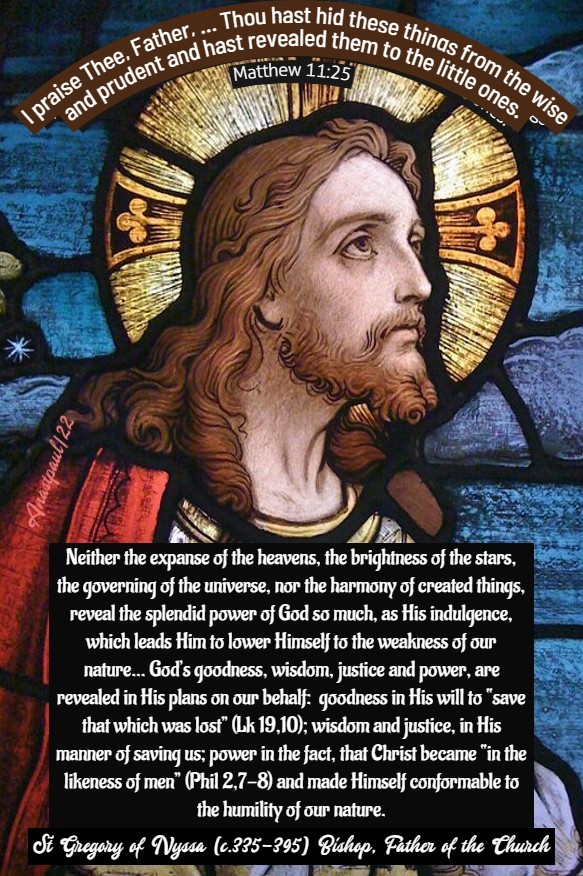
“I praise Thee, Father, … Thou hast hid these things from the wise and prudent and hast revealed them to the little ones. ” – Matthew 11:25
REFLECTION – “The fact that the all-powerful God has been able to humble Himself even to the humility of the human condition, constitutes a greater proof than the impact and supernatural character of miracles. Indeed, when Divine power effects something of great sublimity, this is, after a fashion, in conformity with and appropriate to God’s nature… On the other hand, that God descended even to our lowliness is, in a certain way, the expression of an overwhelming power which, is not in the least restrained by what is contrary to its nature…
Neither the expanse of the heavens, the brightness of the stars, the governing of the universe, nor the harmony of created things, reveal the splendid power of God so much, as His indulgence, which leads Him to lower Himself to the weakness of our nature… God’s goodness, wisdom, justice and power, are revealed in His plans on our behalf: goodness in His will to “save that which was lost” (Lk 19,10); wisdom and justice, in His manner of saving us; power in the fact, that Christ became “in the likeness of men” (Phil 2,7-8) and made Himself conformable to the humility of our nature.” – St Gregory of Nyssa (c.335-395) Bishop, Father of the Church (Catechetical Discourse 23-26 ; SC 453).
PRAYER – O God, Who by the good works of blessed Francis enriched Thy Church by establishing a new religious family, grant us to imitate him by emulation of him, by looking upon the things of earth as nought and ever to rejoice in sharing Thy heavenly gifts. Through Jesus Christ, Thy Son our Lord, Who lives and reigns with Thee, in the unity of the Holy Ghost, God, world without end. Amen (Collect).
Thought for the Day – 29 July – Meditations with Antonio Cardinal Bacci (1881-1971)
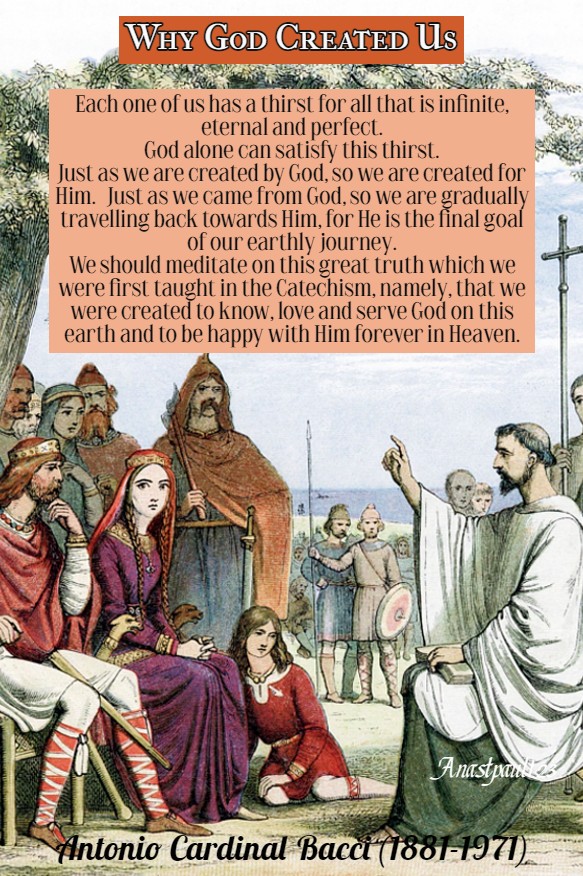
Why God Created Us
“We should ask the reason for everything which comes from the Hand of God. Have you ever seriously considered WHY you are in this world? It is certainly not for the sake of this passing earthly existence, for the sake of earning your living, or enjoying yourself. You know well, that the passing pleasures of this life do not satisfy the human heart and cannot be the final goal of life. Each one of us has a thirst for all that is infinite, eternal and perfect. God alone can satisfy this thirst. Just as we are created by God, so we are created for Him. Just as we came from God, so we are gradually travelling back towards Him, for He is the final goal of our earthly journey. We should meditate on this great truth which we were first taught in the Catechism, namely, that we were created to know, love and serve God on this earth and to be happy with Him forever in Heaven. Let us not allow ourselves to be dazzled by earthly beauty. God alone is the eternal beauty which will satisfy our hearts.”
Our Morning Offering – 18 July – “The Month of the Most Precious Blood”
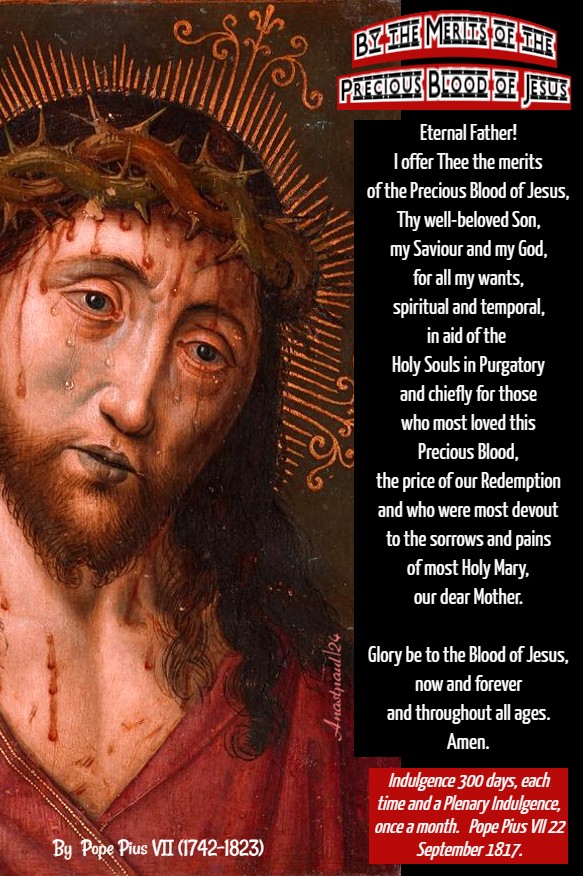
By the Merits of the Precious Blood of Jesus By Servant of God Pope Pius VII (1742-1823) Papacy from 1800 to 1823 Indulgenced Act of Oblation to Our Father
Eternal Father! I offer Thee the merits of the Precious Blood of Jesus, Thy well-beloved Son, my Saviour and my God, for all my wants, spiritual and temporal, in aid of the Holy Souls in Purgatory and chiefly for those who most loved this Precious Blood, the price of our redemption and who were most devout to the sorrows and pains of most Holy Mary, our dear Mother.
Glory be to the Blood of Jesus, now and forever and throughout all ages. Amen.
Indulgence of 300 days, each time this prayed is offered, 22 September 1817 with a Plenary Indulgence, once a month, under the usual conditions.
Note of Interest:On 15 August 1811 – the Feast of the Assumption – it is recorded that the Pope celebrated Mass and was said to have entered a trance and began to levitate in a manner that drew him to the Altar. This particular episode aroused great wonder and awe among attendants, which included the French soldiers guarding him, who were awestruck at what had occurred and left records of it.
Thought for the Day – 15 June – Meditations with Antonio Cardinal Bacci (1881-1971)
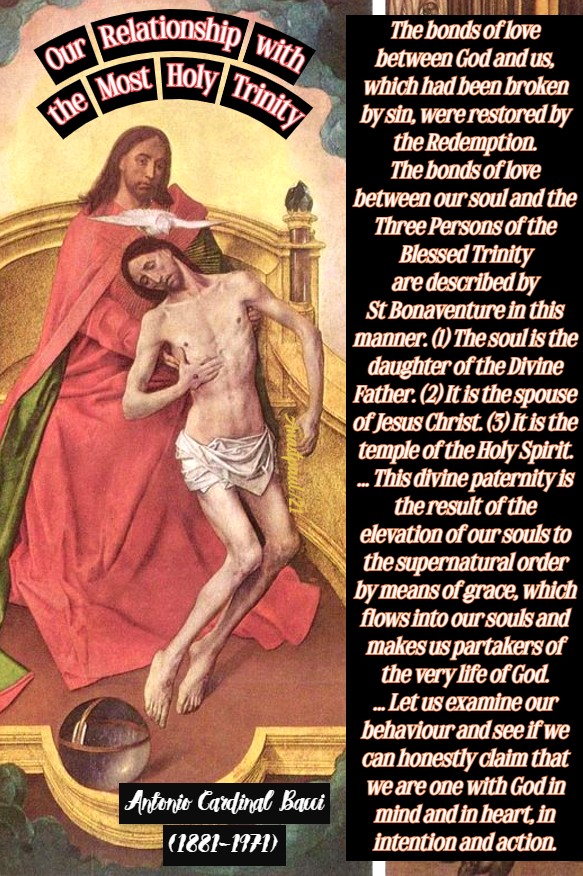
Our Relationship with the Most Holy Trinity
“The bonds of love between God and man which had been broken by sin, were restored by the Redemption. The bonds of love between our soul and the Three Persons of the Blessed Trinity are described by St Bonaventure in this manner. (1) The soul is the daughter of the Divine Father. (2) It is the spouse of Jesus Christ. (3) It is the temple of the Holy Spirit.
The concept of our divine sonship can be found even in the Old Testament. “As one whom the mother caresseth,” God promises, “so will I comfort you” (Is 66:13). But Jesus insisted in a special way on this concept of our divine sonship, so that we might love our heavenly Father more. He told us to address God as Father in our prayers. He described Him as a loving Father, waiting with love and forgiveness for His prodigal sons. When leaving this earth, He told us: “I go to my Father and to your Father.”
“Behold what manner of love the Father has bestowed upon us.” writes St John, “that we should be called children of God and so we are” (1 Jn 3:1). “You have not received a spirit of bondage,” explains St Paul, “so as to be again in fear but, you have received a spirit of adoption as sons, by virtue of which, we cry: “Abba! Father!” (Rom 8:15). This divine paternity is the result of the elevation of our souls to the supernatural order by means of grace, which flows into our souls and makes us partakers of the very life of God. It is necessary, therefore, to nourish this grace in ourselves by praying to our heavenly Father with humility and with perseverance. It is equally essential for us to keep this grace alive by being obedient always to the commandments of God and to His holy Will.
Let us examine our behaviour and see if we can honestly claim that we are one with God in mind and in heart, in intention and action.”
“This is the order of our Faith, the foundation of the edifice and the support of our conduct – God, the Father, uncreated, uncontainable, invisible, One God, the Creator of all – this is the first article of our Faith. And the second article – the Word of God, the Son of God, Christ Jesus our Lord, Who was revealed by the Prophets according to the character of their prophecy and according to the nature of the economies of the Father, by Whom all things were made and Who, in the last times, to recapitulate all things, became a Man amongst men, visible and palpable, in order to abolish death, to demonstrate life and to effect communion between God and man. And the third article – the Holy Ghost, through Whom the Prophets prophesied and the Patriarchs learnt the things of God and the righteous, were led in the path of righteousness and Who, in the last times, was poured out in a new fashion upon the human race, renewing man, throughout the world, to God.”
St Irenaeus (130-202) Martyr, Father of the Church
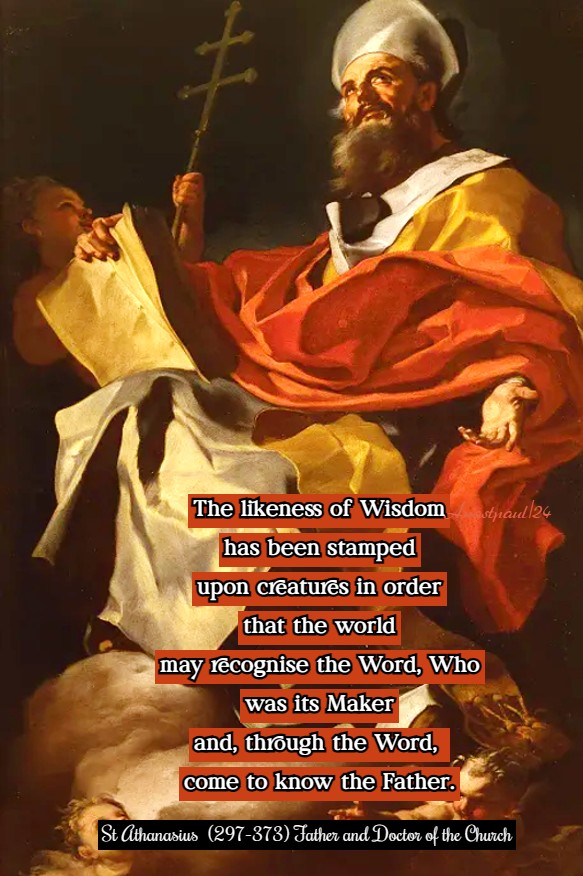
“The likeness of Wisdom has been stamped upon creatures, in order that the world may recognise the Word, Who was its Maker and, through the Word, come to know the Father. ”
St Athanasius (297-373) Father and Doctor of the Church
“He pours light into our minds, arouses our desire and gives us strength… As the soul is the life of the body, so the Holy Ghost is the life of our souls.”
St Peter Damian (1007-1072) Bishop, Father and Doctor of the Church
O SANCTISSIMA~ O MOST HOLY! Indulgenced Prayer to the Most Holy Trinity
O Most Holy Trinity, I adore Thee, Who art dwelling, by Thy grace, within my soul.
O Most Holy Trinity, Who art dwelling, by Thy grace, within my soul, make me love Thee, more and more.
O Most Holy Trinity, Who art dwelling, by Thy grace, within my soul, sanctify me more and more.
Abide with me, O Lord, be Thou my true joy. Amen
An Indulgence of 300 days for each of the above prayers, even when recited separately. (SP Ap. 26 April 1921 and 23 October 1928).
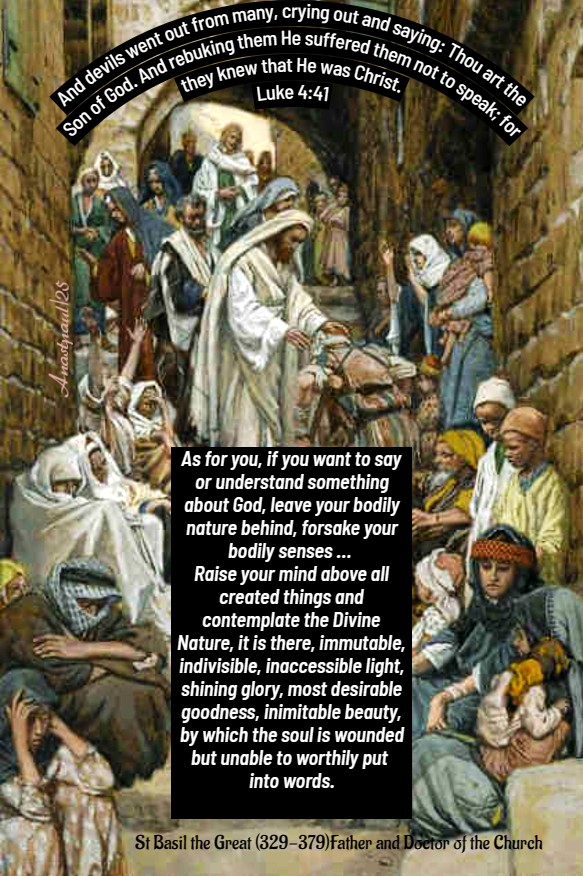
One Minute Reflection – 14 June – “The Month of the Most Sacred Heart of Jesus” – Ember Saturday – Pentecost Satuirday – Romans 5:1-5. – Luke 4:38-44 – St Basil the Great (329-379) Bishop, Confessor, Father and Doctor of the Church – Scripture search here: https://www.drbo.org/
“And devils went out from many, crying out and saying: Thou art the Son of God. And rebuking them He suffered them not to speak; for they knew that He was Christ.” – Luke 4:41
REFLECTION – “The soul who loves God is never satisfied, yet, to speak of God is bold indeed, our minds are very far from so great a matter … The further one goes in the knowledge of God, the more one feels one’s powerlessness. This is what it was like for Abraham, this, too, was what it was like for Moses, even though they were able to see God – insofar as that is humanly possible – both made themselves least of all. Abraham referred to himself as “dust and ashes” Moses said of himself that he was stumbling and slow in speech (Gn 1827; Ex 4:10). In fact, he was giving testimony; the feebleness of his tongue gave voice to the greatness of Him, Whom his mind grasped. We speak about God, not as He Is but, insofar as we can grasp Him.
As for you, if you want to say or understand something about God, leave your bodily nature behind, forsake your bodily senses … Raise your mind above all created things and contemplate the Divine Nature, it is there, immutable, indivisible, inaccessible light, shining glory, most desirable goodness, inimitable beauty, by which the soul is wounded but unable to worthily put into words.
There is the Father, the Son and Holy Ghost … The Father is the principle of all things, the Cause of being of all that is, Origin of living creatures. He is the one from Whom flows the Source of Life, Wisdom, Power, the Image Who perfectly resembles the invisible God; the Son, begotten of the Father, living Word, Who is God and turned towards the Father (1 Cor 1:24; Heb 1:3; Jn 1:1). From this Name ‘Son’ we learn that He shares the same nature; He is not created through an order but unceasingly shines out from within His Own substance, one with the Father from all eternity, equal to Him in goodness, partaking in His glory … And when our intellect has been purified of all earthly passions and, has set aside every sensible creature, like a fish which rises from the depths to the surface, given back to the purity of its creation, it will then see the Holy Ghost where the Son and the Father are to be found. This Spirit, being of the same essence ,according to its nature, likewise possesses every good: goodness, uprightness, holiness, life … Just as burning belongs to fire and shining to light, so one can no more take away from the Holy Ghost the task of making holy or giving life, than of goodness and uprightness.” – St Basil the Great (329-379) Bishop, Confessor, Father and Doctor of the Church (Sermons on Faith).
PRAYER – We beseech Thee, O Lord, hear our prayers which we offer on the festival of blessed Basil, Thy Confessor and Bishop and through his intercessory merits, who had the grace to serve Thee worthily, absolve us from all our sins. Through Jesus Christ, Thy Son our Lord, Who lives and reigns with Thee, in the unity of the Holy Ghost, God, world without end. Amen (Collect).
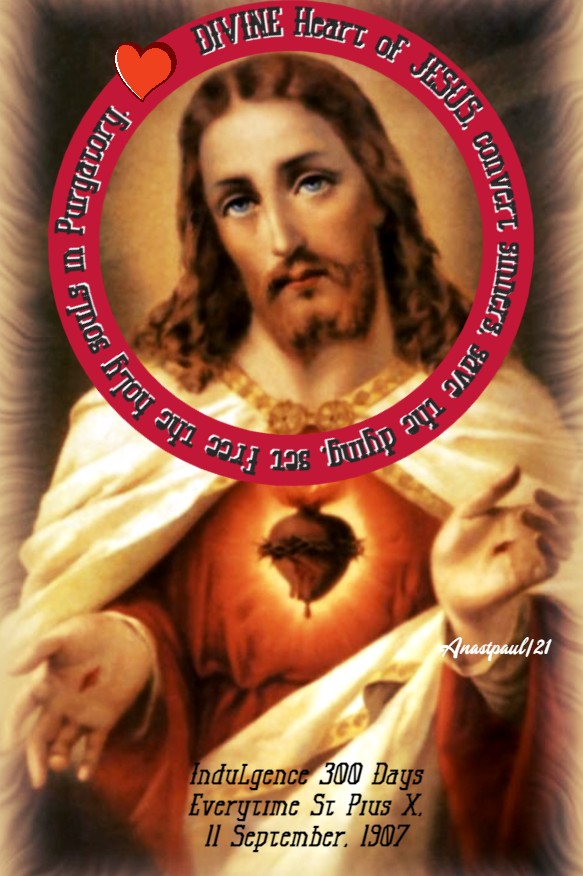
DIVINE Heart of JESUS, convert sinners, save the dying, set free the holy souls in Purgatory.Indulgence 300 Days Everytime – St Pius X, 11 September, 1907.
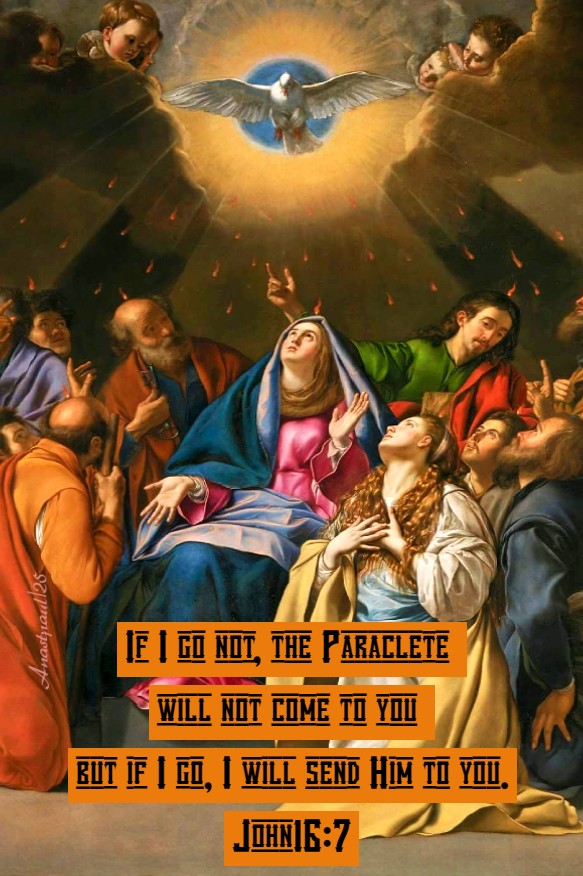
Quote/s of the Day – 18 May – Easter IV – James 1:17-21 – John 16:5-14 – Scripture search here: https://www.drbo.org/
“If I go not, the Paraclete will not come to you but if I go, I will send Him to you. ”
John16:7
“This is the order of our faith, the foundation of the edifice and the support of our conduct – God, the Father, uncreated, uncontainable, invisible, One God, the Creator of all – this is the first article of our faith. And the second article – the Word of God, the Son of God, Christ Jesus our Lord, Who was revealed by the Prophets according to the character of their prophecy and according to the nature of the economies of the Father, by Whom all things were made and Who, in the last times, to recapitulate all things, became a Man amongst men, visible and palpable, in order to abolish death, to demonstrate life and to effect communion between God and man. And the third article – the Holy Ghost, through Whom the Prophets prophesied and the Patriarchs learnt the things of God and the righteous, were led in the path of righteousness and Who, in the last times, was poured out in a new fashion upon the human race, renewing man, throughout the world, to God.”
St Irenaeus (130-202) Martyr, Father of the Church
“He pours light into our minds, arouses our desire and gives us strength… As the soul is the life of the body, so the Holy Ghost is the life of our souls.”
St Peter Damian (1007-1072) Bishop, Father and Doctor of the Church
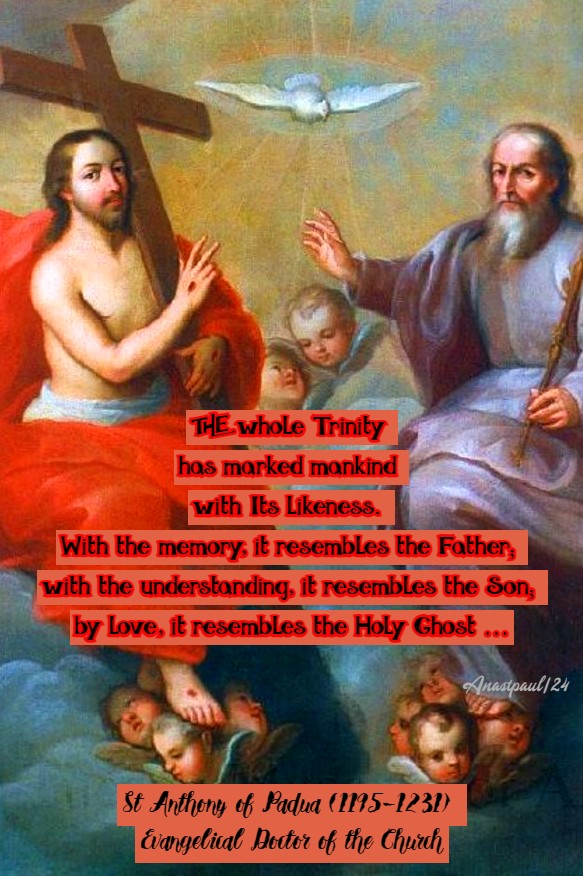
“The whole Trinity has marked mankind with Its likeness. With the memory, it resembles the Father; with the understanding, it resembles the Son; by love, it resembles the Holy Ghost … ”
St Anthony of Padua (1195-1231) Evangelical Doctor of the Church
Thought for the Day – 9 May – The Imitation of the Blessed Virgin Mary By Thomas à Kempis (1380-1471)
Extracts from The Imitation of the Blessed Virgin Mary By Thomas à Kempis CRSA (1380-1471) Imprimatur 17 February 1947 Translated from the French Dr Célestin Albin de Cigala (1865-1928)
PART ONE THE JOYFUL MYSTERIES Chapter II OUR DUTIES TO MARY
i. Choose, O my son, Mary for mother, for advocate and for model, before all things. Greet her everyday with the Angelic Salutation. This salutation pleases her above all others. If sometimes, the devil tempts you and turns you from your duties as a devout servant of Mary, do not permit that to stop you from invoking her always. Think always of Mary; repeat the name of Mary, over and over. Honour Mary; glorify Mary in everything; prostrate yourself before Mary; give yourself again to Mary. Live with Mary; meditate with Mary; rejoice with Mary; weep with Mary; work with Mary; watch with Mary; act with Mary; rest with Mary. With Mary, bear Jesus in your arms; live at Nazareth with Mary. Go to Jerusalem, go with Mary; search, as Mary did, for Jesus. Remain near the Cross with Mary, weep for Jesus; weep for Him with Mary; with Mary bury Jesus in the tomb; rise with Jesus and with Mary. Rise to Heaven with Jesus and with Mary! Live always with Mary in life and in death.
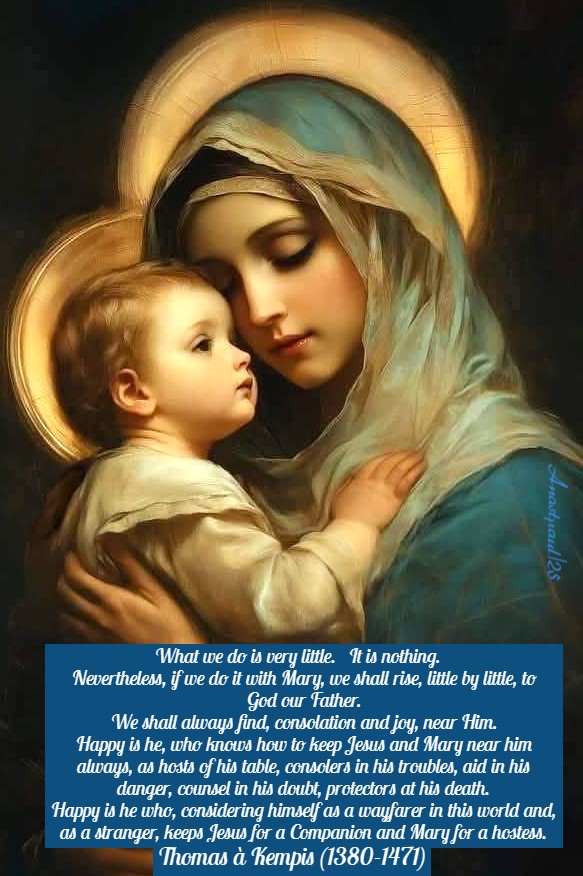
ii. If you know how to think and act in this way, you will advance rapidly in perfection. Mary will protect you with all her power and, Jesus will hear you in His gentle mercy. What we do is very little. It is nothing. Nevertheless, if we do it with Mary, we shall rise, little by little, to God our Father. We shall always find, consolation and joy, near Him. Happy is he, who knows how to keep Jesus and Mary near him always, as hosts of his table, consolers in his troubles, aid in his danger, counsel in his doubt, protectors at his death. Happy is he who, considering himself as a wayfarer in this world and, as a stranger, keeps Jesus for a Companion and Mary for a hostess.
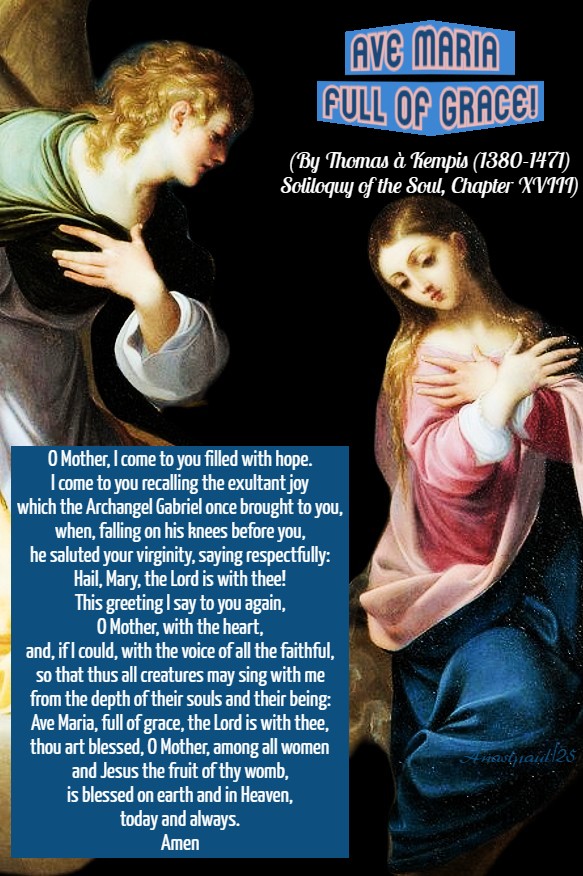
iii. Prayer: Ave Maria, Full of Grace!
O Mother, I come to you filled with hope. I come to you recalling the exultant joy which the Archangel Gabriel once brought to you, when, falling on his knees before you, he saluted your virginity, saying respectfully: Hail, Mary, the Lord is with thee! This greeting I say to you again, O Mother, with the heart, and, if I could, with the voice of all the faithful, so that thus all creatures may sing with me from the depth of their souls and their being: Ave Maria, full of grace, the Lord is with thee, thou art blessed, O Mother, among all women and Jesus the fruit of thy womb, is blessed on earth and in Heaven, today and always.
(By Thomas à Kempis (1380-1471) Soliloquy of the Soul, Chapter XVIII)
Thought for the Day – 15 April – The Spiritual Combat (1589) – Dom Lorenzo Scupoli OSM (c1530-1610)
“None shall be crowned who has not fought well.” 2 Tim 2: 5
XLVI: … On Meditation
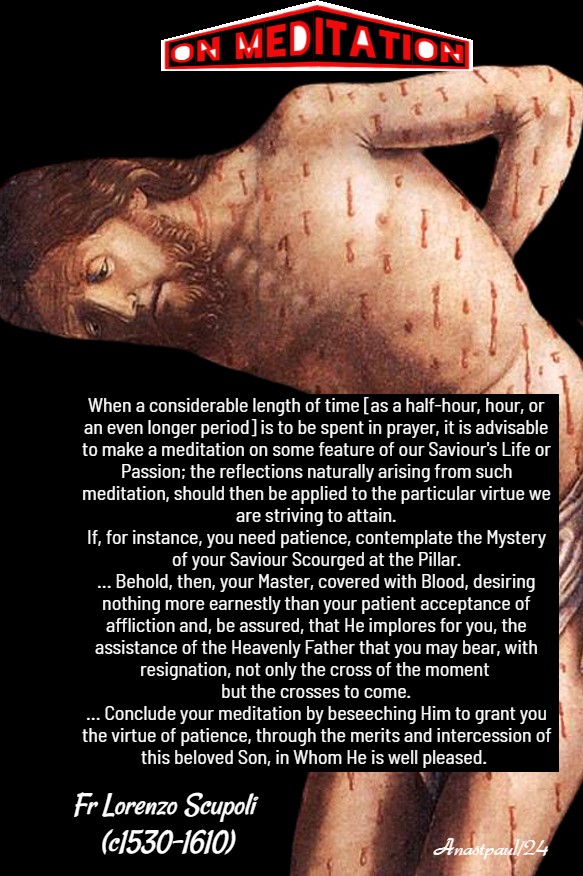
“When a considerable length of time [as a half-hour, hour, or an even longer period] is to be spent in prayer, it is advisable to make a meditation on some feature of our Saviour’s Life or Passion; the reflections naturally arising from such meditation, should then be applied to the particular virtue we are striving to attain.
If, for instance, you need patience, contemplate the Mystery of your Saviour Scourged at the Pillar. Consider firstly, the blows and revilements hurled at Him by the soldiers as they brutally drag their innocent victim to the appointed place as ordered. Secondly, consider Him stripped of His garments, exposed to the piercing cold. Thirdly, picture those innocent hands, bound tightly to the pillar. Fourthly, consider His Body, torn with whips until His Blood moistened the earth. And finally, envision the frequency of the blows, creating new wounds, re-opening others on that Sacred Body.
Dwelling on these or similar details, calculated to inspire in yourself, a love of patience, you should try to feel within your very soul the inexpressible anguish so patiently borne by your Divine Master. Then consider the excruciating agony of His spirit and the patience and mildness with which that agony was endured by Him, Who was ready to suffer even more for God’s glory and your welfare.
Behold, then, your Master, covered with Blood, desiring nothing more earnestly than your patient acceptance of affliction and, be assured, that He implores for you, the assistance of the Heavenly Father that you may bear, with resignation, not only the cross of the moment but the crosses to come.
Strengthen, therefore, by frequent acts, your resolution to suffer, with joy and, raising your mind to Heaven, give thanks to the Father of mercies, Who didst send His Only Son into this world to suffer indescribable torments and, to intercede for you in your necessities.
Conclude your meditation by beseeching Him to grant you the virtue of patience, through the merits and intercession of this beloved Son, in Whom He is well pleased.”
Our Morning Offering – 19 February – “The Month of the Blessed Trinity”
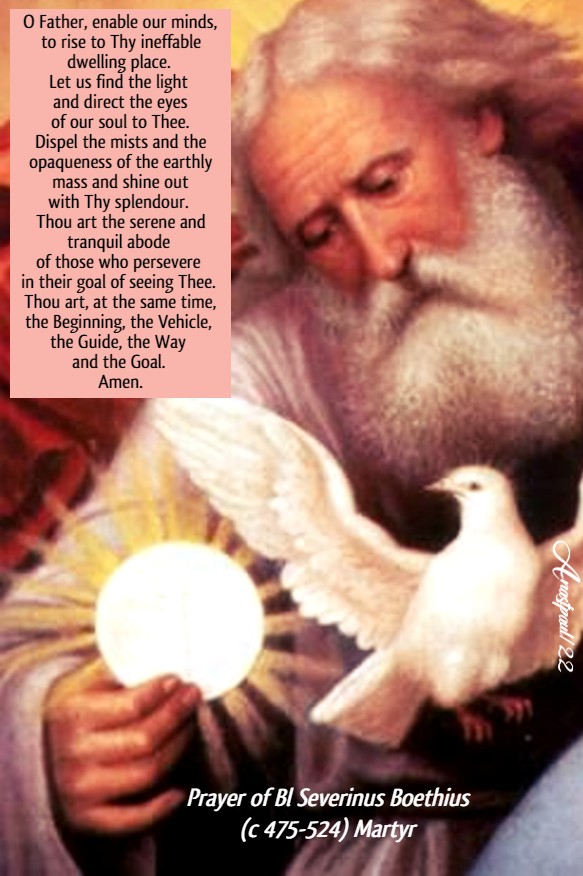
Prayer of Blessed Severinus Boethius (c 475-524) Martyr
O Father, enable our minds, to rise to Thy ineffable dwelling place. Let us find the light and direct the eyes of our soul to Thee. Dispel the mists and the opaqueness of the earthly mass and shine out with Thy splendour. Thou art the serene and tranquil abode of those who persevere in their goal of seeing Thee. Thou art, at the same time, the Beginning, the Vehicle, the Guide, the Way and the Goal. Amen
Quote/s of the Day – 13 February – “The Month of the Blessed Trinity”
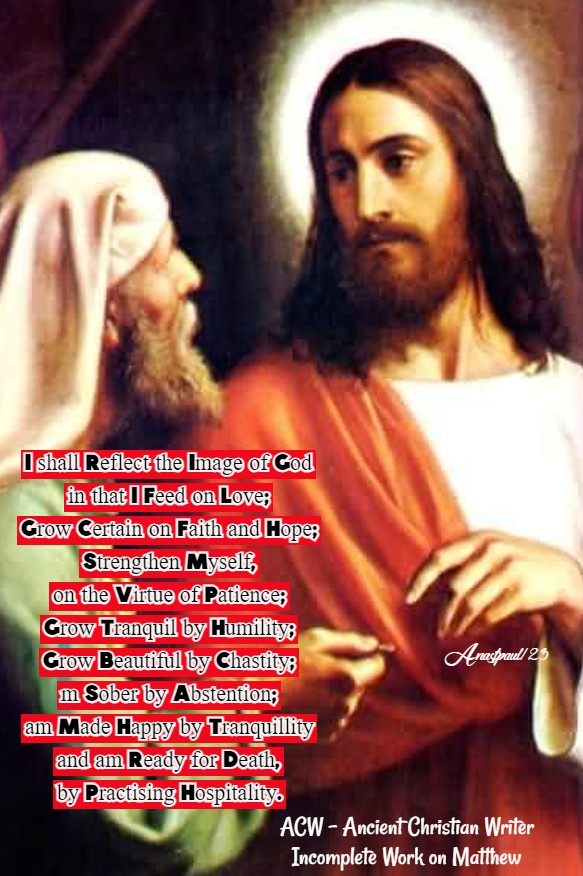
“I shall reflect the image of God in that I feed on love; grow certain on faith and hope; strengthen myself, on the virtue of patience; grow tranquil by humility; grow beautiful by chastity; am sober by abstention; am made happy by tranquillity and am ready for death, by practising hospitality.”
ACW – Ancient Christian Writer Incomplete Work on Matthew
(Homily 40)
“This is the order of our faith, the foundation of the edifice and the support of our conduct – God, the Father, uncreated, uncontainable, invisible, One God, the Creator of all – this is the first article of our faith. And the second article – the Word of God, the Son of God, Christ Jesus our Lord, Who was revealed by the Prophets according to the character of their prophecy and according to the nature of the economies of the Father, by Whom all things were made and Who, in the last times, to recapitulate all things, became a Man amongst men, visible and palpable, in order to abolish death, to demonstrate life and to effect communion between God and man. And the third article – the Holy Ghost, through Whom the Prophets prophesied and the Patriarchs learnt the things of God and the righteous, were led in the path of righteousness and Who, in the last times, was poured out in a new fashion upon the human race, renewing man, throughout the world, to God.”
St Irenaeus (130-202) Martyr, Father of the Church
“The likeness of Wisdom has been stamped upon creatures, in order that the world may recognise the Word, Who was its Maker and, through the Word, come to know the Father. ”
St Athanasius (297-373) Father and Doctor of the Church
“The whole Trinity has marked mankind with Its likeness. With the memory, it resembles the Father; with the understanding, it resembles the Son; by love, it resembles the Holy Ghost … ”
St Anthony of Padua (1195-1231) Evangelical Doctor of the Church
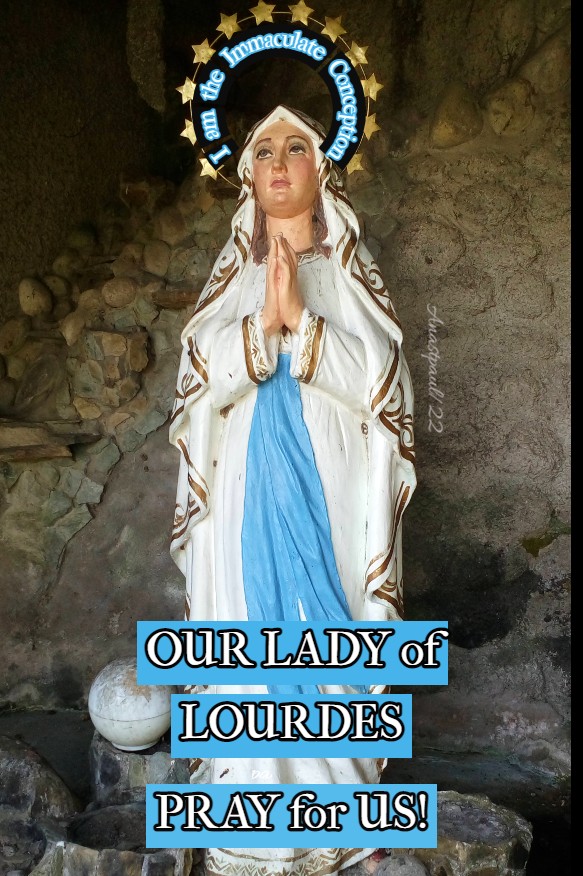
One Minute Reflection – 11 February – “The Month of the Blessed Trinity” – The Feast of the Immaculate Conception, Our Lady of Lourdes – Apocalypse 11:19; 12:1, 10; Luke 1:26-31 – Scripture search here: https://www.drbo.org/
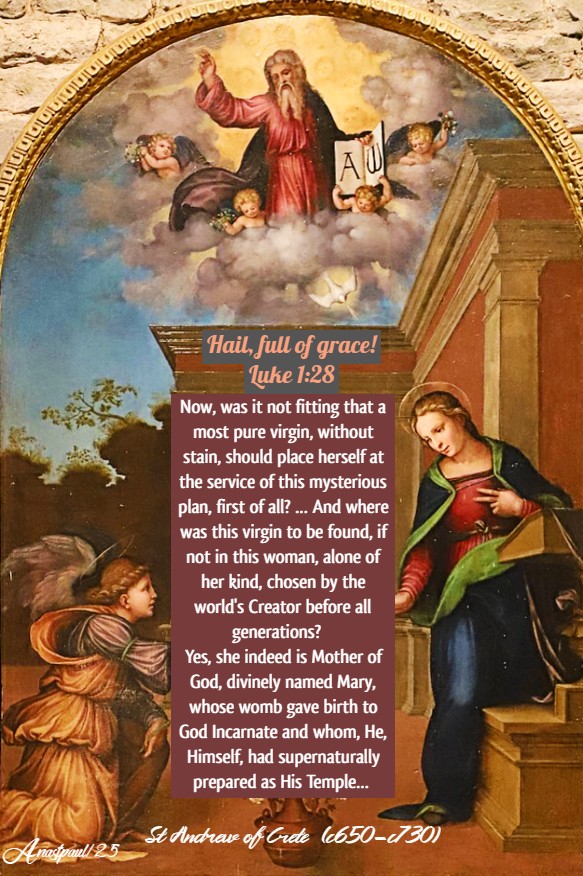
“Hail, full of grace!” – Luke 1:28
REFLECTION – “The degeneration caused by sin had obscured the beauty of our original nobility. But when, the mother of Supreme Beauty is born, our nature finds its purity once more and sees itself moulded according to the perfect model, worthy of God (Gn 1:26) … We had all preferred the world below to that above. There no longer remained any hope of salvation. The state of our nature cried aloud to Heaven to come to the rescue … Then at last, in His good pleasure, the world’s Divine Artificer determined to make a new world appear, a different world full of harmony and youth.
Now, was it not fitting that a most pure virgin, without stain, should place herself at the service of this mysterious plan, first of all? … And where was this virgin to be found, if not in this woman, alone of her kind, chosen by the world’s Creator before all generations? Yes, she indeed is Mother of God, divinely named Mary, whose womb gave birth to God Incarnate and whom, He, Himself, had supernaturally prepared as His Temple…
In this way, then, the design of the Redeemer of our race was to bring about a birth and, as it were, a new creation to replace the one which went before. Therefore, just as in Paradise, He had taken a litle clay out of the pure and spotless earth, to fashion the first Adam (Gn 2:7), so, at the moment of bringing about His own Incarnation, He made use of another earth, so to speak, namely this pure and immaculate Virgin, chosen from among all other beings He had created. It is in her that He, Adam’s Creator, has remade us in our very substance and become a new Adam (1 Cor 15:45) that the old, might be saved by the new and eternal.” – St Andrew of Crete (c650-c730) Bishopand Father of the Church (Sermon 1 for the Nativity of the Mother of God).
PRAYER – O God, Who by the Immaculate Conception of the Virgin, prepared a worthy dwelling for Thy Son, we humbly beseech Thee that, recalling the apparition of the same Virgin, we may obtain health for both soul and body. Through the same Jesus Christ, Thy Son our Lord, Who lives and reigns with Thee, in the unity of the Holy Ghost, God, world without end. Amen (Collect).
Our Morning Offering – 10 February – “The Month of the Most Holy and Blessed Trinity”
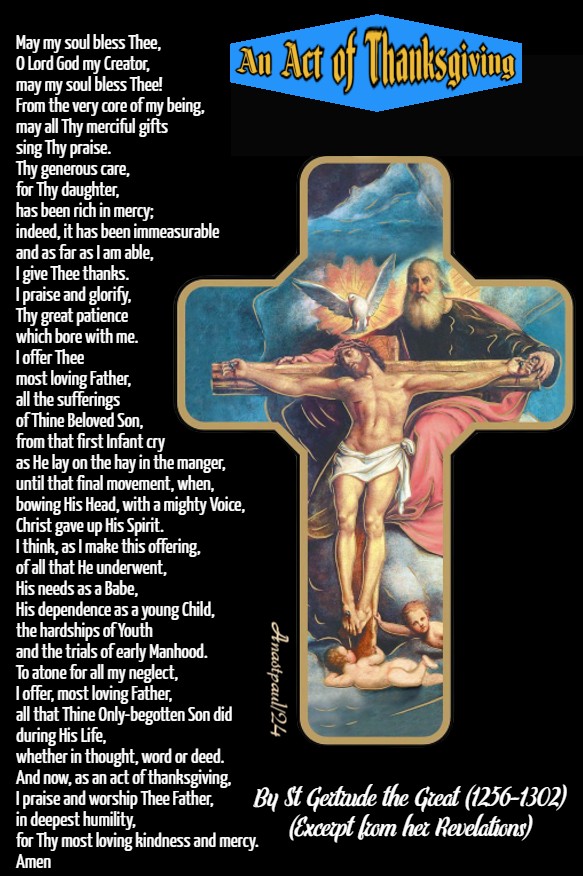
An Act of Thanksgiving By St Gertrude the Great (1256-1302) (Excerpt from her Revelations)
May my soul bless Thee, O Lord God my Creator, may my soul bless Thee! From the very core of my being, may all Thy merciful gifts sing Thy praise. Thy generous care, for Thy daughter, has been rich in mercy; indeed, it has been immeasurable and as far as I am able, I give Thee thanks. I praise and glorify, Thy great patience which bore with me. I offer Thee, most loving Father, all the sufferings of Thine Beloved Son, from that first Infant cry as He lay on the hay in the manger, until that final movement, when, bowing His Head, with a mighty Voice, Christ gave up His Spirit. I think, as I make this offering, of all that He underwent, His needs as a Babe, His dependence as a young Child, the hardships of Youth and the trials of early Manhood. To atone for all my neglect, I offer, most loving Father, all that Thine Only-begotten Son did during His Life, whether in thought, word or deed. And now, as an act of thanksgiving, I praise and worship Thee Father, in deepest humility, for Thy most loving kindness and mercy. Amen
Our Morning Offering – 8 February – “The Month of the Most Holy and Blessed Trinity”
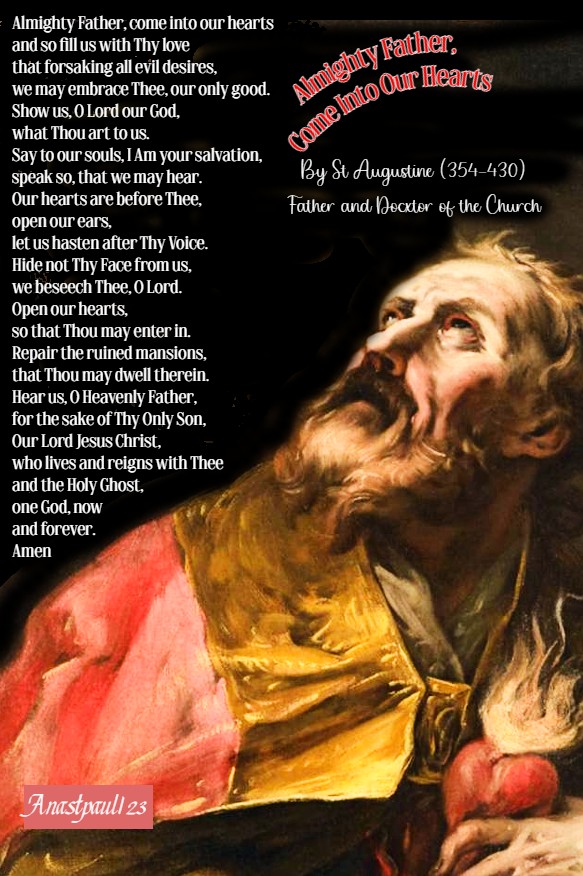
Almighty Father, Come Into Our Hearts By St Augustine (354-430)
Almighty Father, come into our hearts and so fill us with Thy love that forsaking all evil desires, we may embrace Thee, our only good. Show us, O Lord our God, what Thou art to us. Say to our souls, I Am your salvation, speak so, that we may hear. Our hearts are before Thee, open our ears, let us hasten after Thy Voice. Hide not Thy Face from us, we beseech Thee, O Lord. Open our hearts, so that Thou may enter in. Repair the ruined mansions, that Thou may dwell therein. Hear us, O Heavenly Father, for the sake of Thy Only Son, Our Lord Jesus Christ, who lives and reigns with Thee and the Holy Ghost, one God, now and forever. Amen
Thought for the Day – 2 February – Meditations with Fr Richard Frederick Clarke SJ (1839-1900)
Meditations on “The Great Truths” From “The Devout Year” By Fr Richard Frederick Clarke SJ (1839-1900)
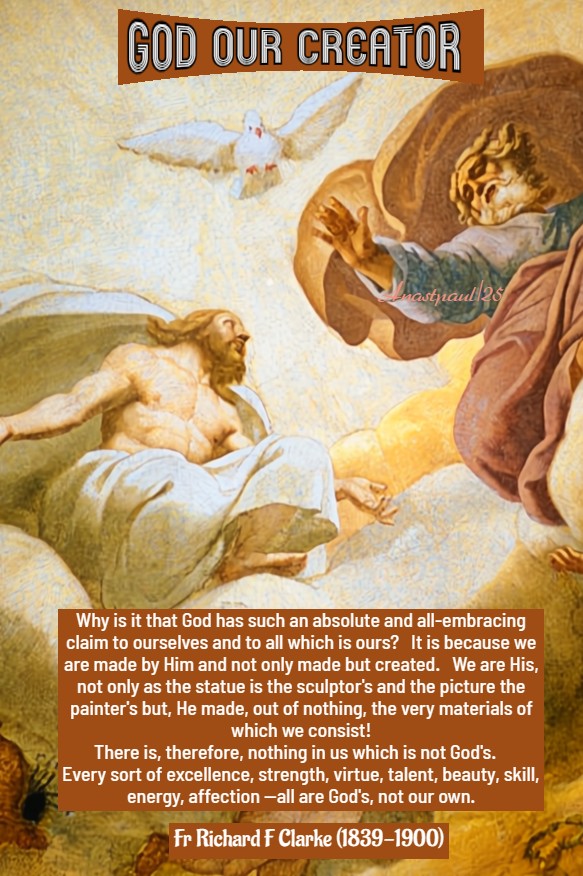
2nd Day – God our Creator
Thou art worthy, O Lord our God, to receive glory and honour and power because Thou hast created all things. (Apoc iv:II)
+1. Why is it that God has such an absolute and all-embracing claim to ourselves and to all which is ours? It is because we are made by Him and not only made but created. We are His, not only as the statue is the sculptor’s and the picture the painter’s but, He made, out of nothing, the very materials of which we consist! There is, therefore, nothing in us which is not God’s. Every sort of excellence, strength, virtue, talent, beauty, skill, energy, affection —all are God’s, not our own.
+2. God created everyone with certain gifts of his own which, He did not give to another and He gave him those gifts, to do a special work which God had appointed to him alone. He created me with a certain object, from all eternity He had been planning my soul and body and providing me with all that I needed – that both one and the other, might serve Him. Have I, on the whole, carried out God’s plan? Shall I be able to say, when I come to die: “I have completed the work Thou hast tasked me with?”
+3. What a serious thought this is – God had a plan for my life! He meant me to occupy a certain position in society and to have certain employments; to influence certain persons for good, to overcome certain temptations, to practice certain virtues beyond the rest, to attain a certain place in Heaven. Has my life been ordered by God’s holy inspirations? has not my own self-will too, often had a part in it? Pray that you may not fail in fulfilling God’s intentions concerning yourself and the works He requires of you!🙏
Thought for the Day – 1 February – Meditations with Fr Richard Frederick Clarke SJ (1839-1900)
Meditations on “The Great Truths” From “The Devout Year” By Fr Richard Frederick Clarke SJ (1839-1900)
Ist Day – God our Lord
The Lord hath made all things for Himself. (Prov xvi:4)
+I. We are all of us jealous of that which belongs to ourselves. We resent it if anyone interferes with it, or deprives us of any portion of it Yet, no-one owns anything by a title, so absolute as that by which God is the Lord and Owner of all creatures in the universe. My body and my soul are His; everything I possess is His; every action, every thought belongs to Him. He has given all these in charge to me to use for Him alone. Do I do so?
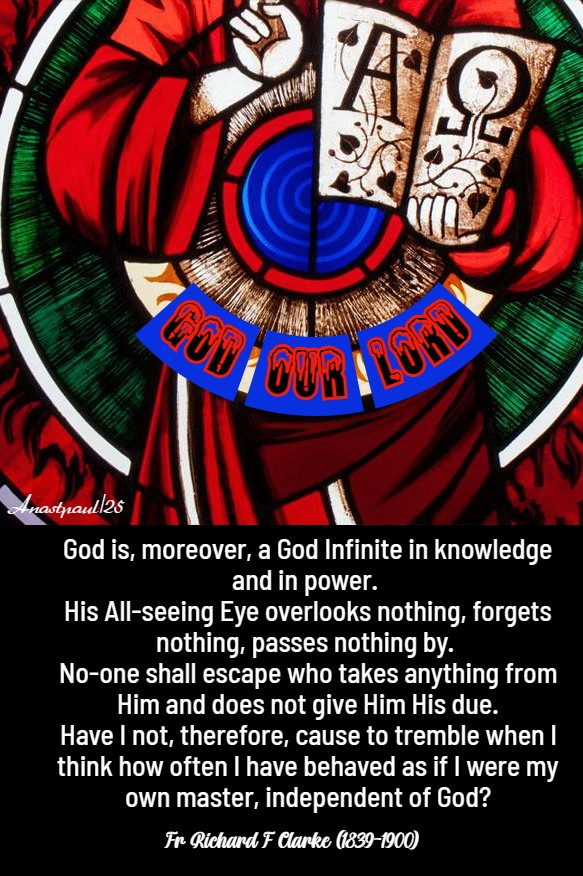
+2. God is, moreover, a God Infinite in knowledge and in power. His All-seeing Eye overlooks nothing, forgets nothing, passes nothing by. No-one shall escape who takes anything from Him and does not give Him His due. Have I not, therefore, cause to tremble when I think how often I have behaved as if I were my own master, independent of God?
+3. Yet, in the end, I must recognise God’s ownership; if I do not do so, willingly and with joyful loyalty, I shall have to do so unwillingly and in misery and pain. Everything I have taken from God and appropriated to myself will have to be given back to Him. I shall have to pay the penalty for each misuse of what was entrusted to me. How much wiser and happier to recognise Him now, in all things, as my Lord and Master! Offer yourself to God with loyal submission as your God and Lord!
Our Morning Offering – 22 January – “The Month of the Holy Name of Jesus and the Holy Family”
Prayer in Praise of God By St Francis of Assisi (c1181-1226)
Thou art Holy, Lord, the only God and Thine Deeds art wonderful. Thou art Strong. Thou art Great. Thou art the Most High. Thou art Almighty. Thou, Holy Father art King of Heaven and earth. Thou art Three and One, Lord God, all Good. Thou art Good, all Good, Supreme Good, Lord God, Living and True. Thou art Love. Thou art Wisdom. Thou art Humility. Thou art Endurance. Thou art Rest. Thou art Peace. Thou art Joy and Gladness. Thou art Justice and Moderation. Thou art all our Riches and Thou art Suffice for us. Thou art Beauty. Thou art Gentleness. Thou art our Protector. Thou art our Guardian and Defender. Thou art our Courage. Thou art our Haven and our Hope. Thou art our Faith, our great Consolation. Thou art our Eternal Life, Great and Wonderful Lord, God Almighty, Merciful Saviour. Amen
Quote/s of the Day – 19 December – “The Month of the Divine Infancy and the Immaculate Conception of the Blessed Virgin Mary”
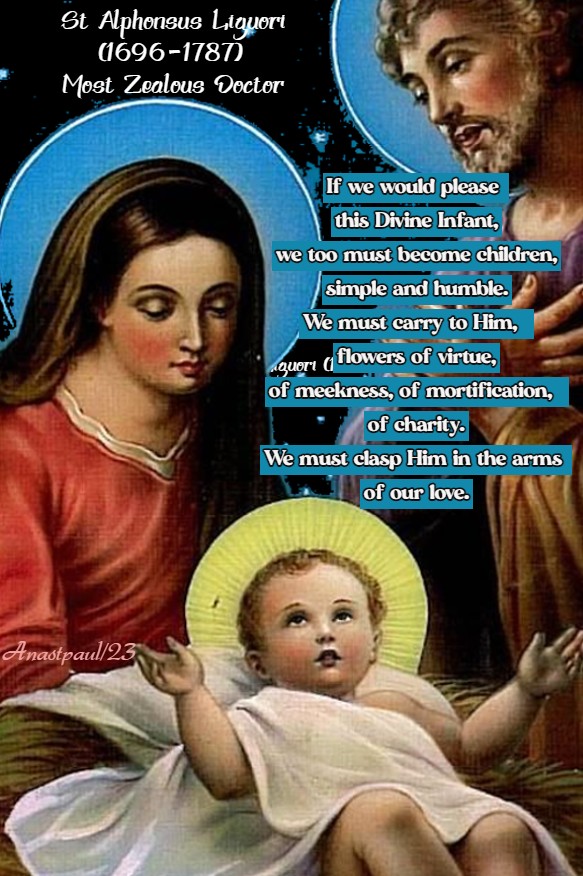
“If we would please this Divine Infant, we too must become children, simple and humble. We must carry to Him, flowers of virtue, of meekness, of mortification, of charity. We must clasp Him in the arms of our love.”
St Alphonsus Liguori (1696-1787) Most Zealous Doctor
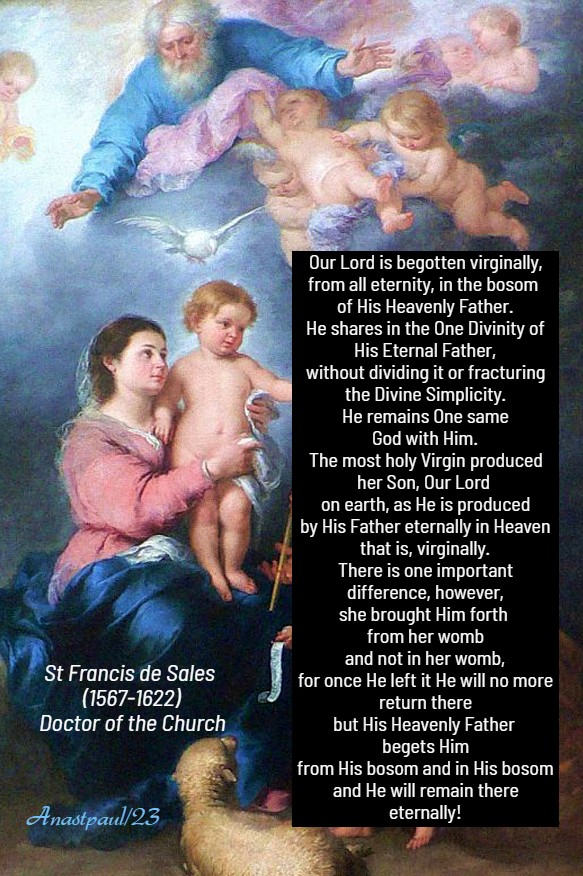
“Our Lord is begotten virginally, from all eternity, in the bosom of His Heavenly Father. He shares in the One Divinity of His Eternal Father, without dividing it or fracturing the Divine Simplicity. He remains One same God with Him. The most holy Virgin produced her Son, Our Lord on earth, as He is produced by His Father eternally in Heaven that is, virginally. There is one important difference, however, she brought Him forth from her womb and not in her womb, for once He left it He will no more return there but His Heavenly Father begets Him from His bosom and in His bosom and He will remain there eternally!”
(The Coming of the Divine Infant 24 December 1613 Sermon for Christmas Eve)
St Francis de Sales (1567-1622) Doctor of the Church
Our Morning Offering – 2 December – “The Month of the Divine Infancy and the Immaculate Conception of the Blessed Virgin Mary”
An Act of Thanksgiving By St Gertrude the Great (1256-1302) (Excerpt from her Revelations)
May my soul bless Thee, O Lord God my Creator, may my soul bless Thee! From the very core of my being, may all Thy merciful gifts sing Thy praise. Thy generous care, for Thy daughter, has been rich in mercy; indeed, it has been immeasurable and as far as I am able, I give Thee thanks. I praise and glorify, Thy great patience which bore with me. I offer Thee, most loving Father, all the sufferings of Thine Beloved Son, from that first Infant cry as He lay on the hay in the manger, until that final movement, when, bowing His Head, with a mighty Voice, Christ gave up His Spirit. I think, as I make this offering, of all that He underwent, His needs as a Babe, His dependence as a young Child, the hardships of Youth and the trials of early Manhood. To atone for all my neglect, I offer, most loving Father, all that Thine Only-begotten Son did during His Life, whether in thought, word or deed. And now, as an act of thanksgiving, I praise and worship Thee Father, in deepest humility, for Thy most loving kindness and mercy. Amen
One Minute Reflection – 28 November – St Catherine Labouré DC (1806-1876) Virgin, Religious Sister of the Daughters of Charity of Saint Vincent de Paul and the Marian Visionary of the Miraculous Meda – Feria Day of the Last Sunday after Pentecost – Colossians 1:9-14; Matthew 24:15-35 – Scripture search here: https://www.drbo.org/
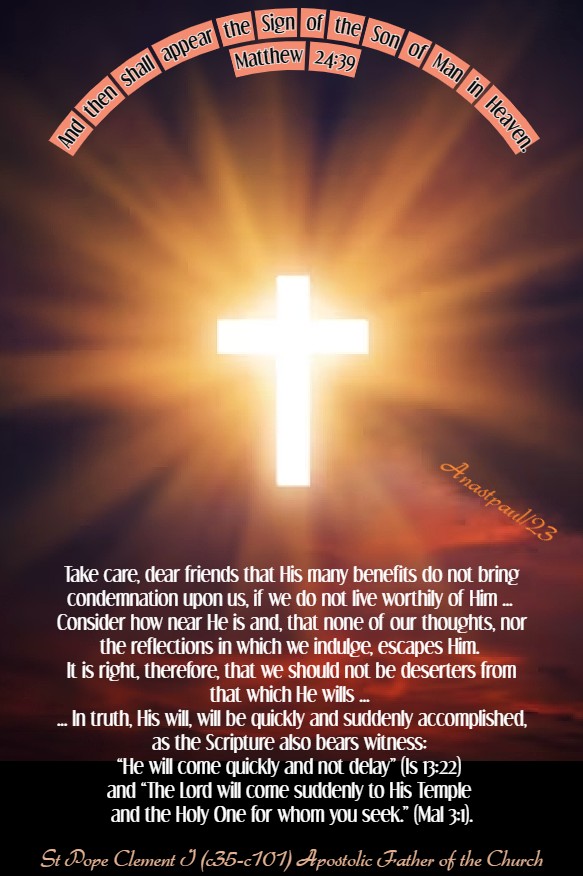
“And then shall appear the Sign of the Son of Man in Heaven. ” – Matthew 24:30
REFLECTION – “Let us fix our eyes on the Father and Creator of the world and cling to His splendid and surpassing gifts of peace and His benefits. Let us see Him with our mind and look with the eyes of the soul at His patient purpose. Let us consider how free from anger He is toward all His creation … For He ordered the universe to be in peace and harmony, in His kindness to all things but especially, to ourselves, who have taken refuge in His mercy …
Take care, dear friends that His many benefits do not bring condemnation upon us, if we do not live worthily of Him … Consider how near He is and, that none of our thoughts, nor the reflections in which we indulge, escapes Him. It is right, therefore, that we should not be deserters from that which He wills … . Far be it from us that Scripture, where it says: “How wretched are those who waver, who are of a doubting heart and say: “We heard those things even in our forefather’s time and here, we have grown old and none of them has happened to us.” You senseless people! Compare yourselves to a tree – take a vine. First it sheds its leaves, then a shoot appears, then a leaf, then a flower and afterward, a sour grape, then a ripe grape. You see in that, in a short time the fruit of the tree comes to maturity. In truth, His will, will be quickly and suddenly accomplished, as the Scripture also bears witness: “He will come quickly and not delay” (Is 13:22) and “The Lord will come suddenly to His Temple and the Holy One for Whom you seek.” (Mal 3:1).” – St Pope Clement I (c35-c101) Apostolic Father of the Church (Letter to the Corinthians 19-23)
PRAYER – From all perils of soul and body, defend us, O Lord, we beseech Thee and by the intercession of blessed and glorious ever Virgin Mary, Mother of God, of blessed Joseph, of thy blessed Apostles Peter and Paul and of blessed Catherine Labouré and all the Saints, graciously grant us safety and peace that all adversities and errors, being overcome, Thy Church may serve Thee in security and freedom. Through Jesus Christ, Thy Son our Lord, Who lives and reigns with Thee, in the unity of the Holy Ghost, God, world without end. Amen (Collect).
Quote/s of the Day – 22 October – Feria –Philippians 1:6-11; Matthew 22:15-21 – Scripture search here: https://www.drbo.org/
“I shall reflect the image of God in that I feed on love; grow certain on faith and hope; strengthen myself, on the virtue of patience; grow tranquil by humility; grow beautiful by chastity; am sober by abstention; am made happy by tranquillity and am ready for death, by practising hospitality.”
ACW – Ancient Christian Writer Incomplete Work on Matthew
(Homily 40)
“The likeness of Wisdom has been stamped upon creatures, in order that the world may recognise the Word, Who was its Maker and, through the Word, come to know the Father. ”
St Athanasius (297-373) Father and Doctor of the Church
“The whole Trinity has marked mankind with Its likeness. With the memory, it resembles the Father; with the understanding, it resembles the Son; by love, it resembles the Holy Ghost … ”
St Anthony of Padua (1195-1231) Evangelical Doctor of the Church
Quote/s of the Day – 28 August – The Feast of St Augustine (354-430) Bishop, Confessor, Great Western Father and Doctor of the Church
“Let Us Hate Our Sins and Love Him Who Will Exact Punishment for Them. What then should the Christian do? He ought to use the world, not become its slave. And what does this mean? It means having, as though not having. … Are we really certain that we love Him? Or do we love our sins more? Therefore, let us hate our sins and love Him Who, will exact punishment for them. He will come whether we wish it or not. Do not think that because He is not coming just now, He will not come at all. He will come, you know, not when and provided He finds you prepared, your ignorance of the time of His coming, will not be held against you.”
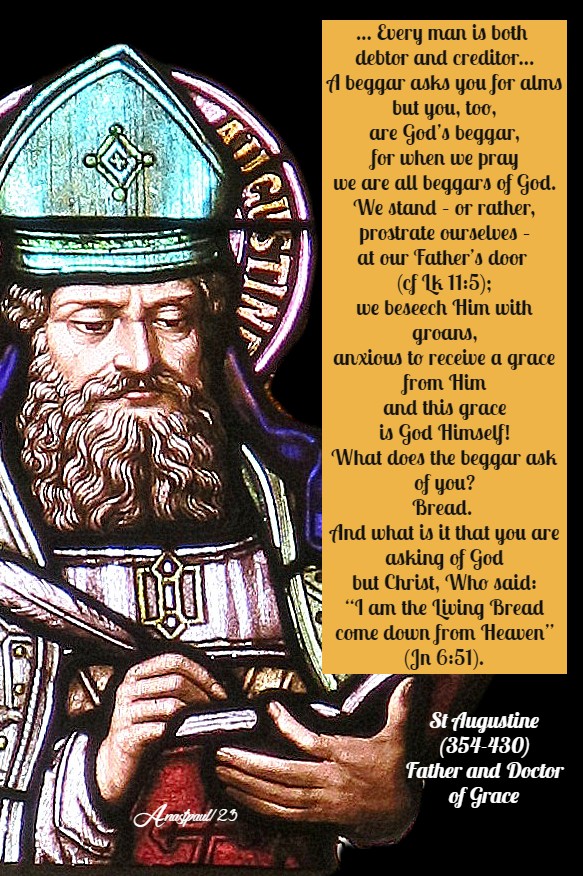
“… Every man is both debtor and creditor… A beggar asks you for alms but you, too, are God’s beggar, for when we pray we are all beggars of God. We stand – or rather, prostrate ourselves – at our Father’s door (cf Lk 11:5); we beseech Him with groans, anxious to receive a grace from Him and this grace is God Himself! What does the beggar ask of you? Bread. And what is it that you are asking of God but Christ, Who said: “I am the Living Bread come down from Heaven” (Jn 6:51).”
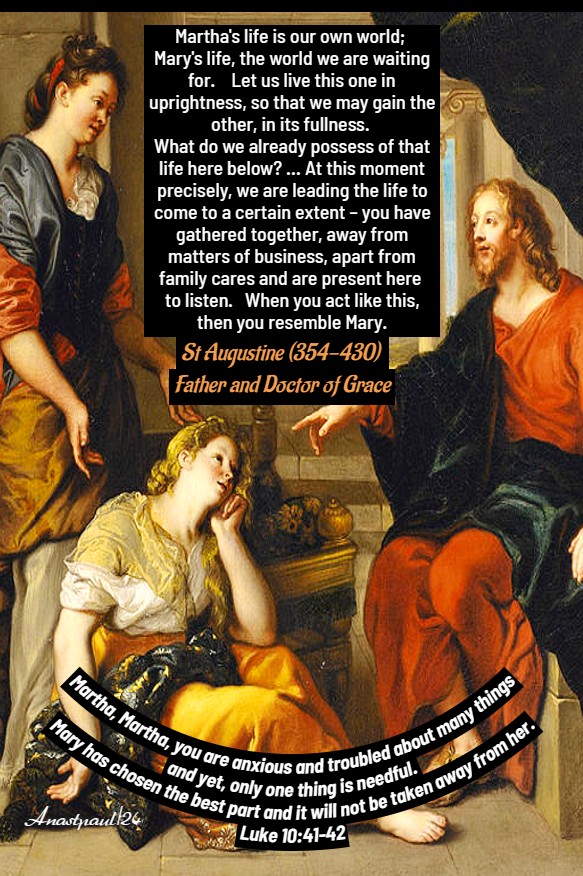
“Martha’s life is our own world; Mary’s life, the world we are waiting for. Let us live this one in uprightness, so that we may gain the other, in its fullness. What do we already possess of that life here below? … At this moment precisely, we are leading the life to come to a certain extent – you have gathered together, away from matters of business, apart from family cares and are present here to listen. When you act like this, then you resemble Mary.”
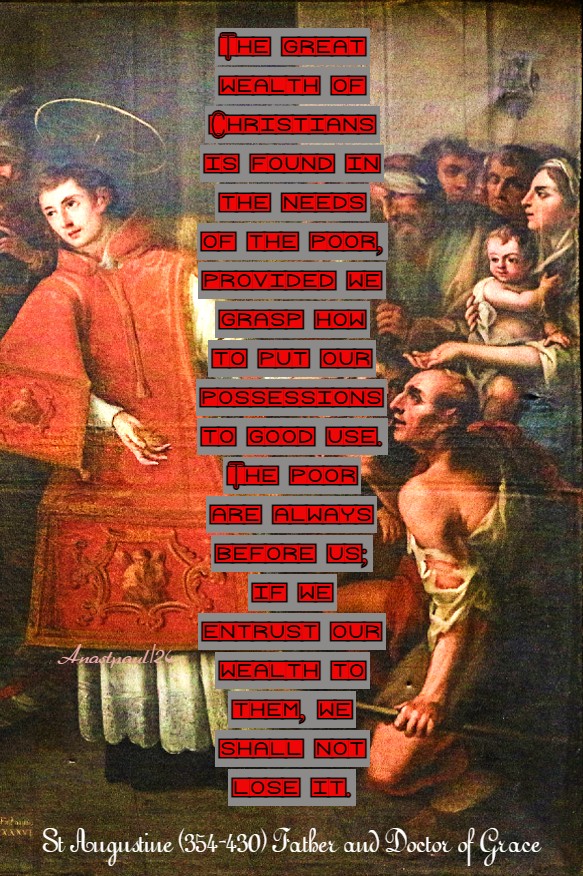
“The great wealth of Christians is found in the needs of the poor, provided we grasp how to put our possessions to good use. The poor are always before us; if we entrust our wealth to them, we shall not lose it.”
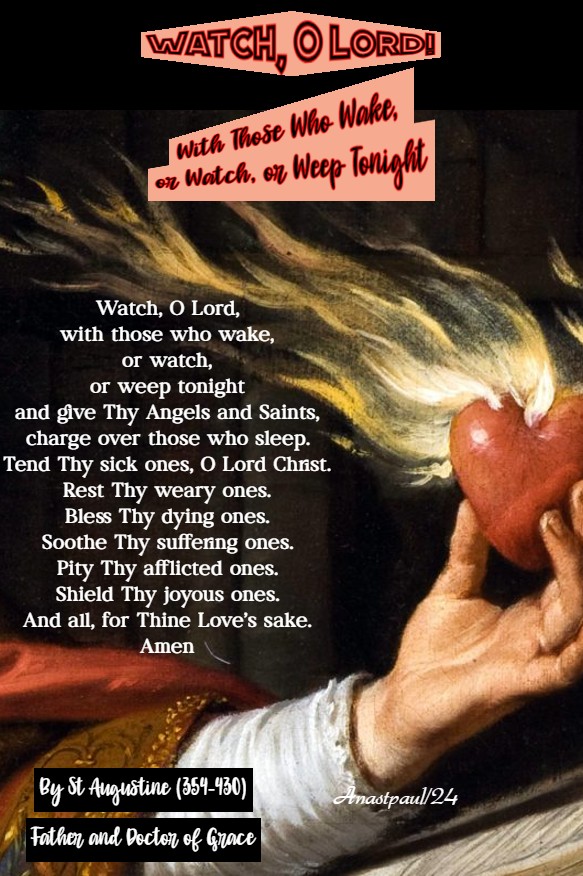
Watch, O Lord! With Those Who Wake, or Watch, or Weep Tonight By St Augustine (354-430) Father and Doctor of Grace
Watch, O Lord, with those who wake, or watch, or weep tonight and give Thy Angels and Saints, charge over those who sleep. Tend Thy sick ones, O Lord Christ. Rest Thy weary ones. Bless Thy dying ones. Soothe Thy suffering ones. Pity Thy afflicted ones. Shield Thy joyous ones. And all, for Thine Love’s sake. Amen
Almighty Father, Come Into Our Hearts By St Augustine (354-430)
Almighty Father, come into our hearts and so fill us with Thy Love that forsaking all evil desires, we may embrace Thee, our only good. Show us, O Lord our God, what Thou art to us. Say to our souls, I Am your salvation, speak so, that we may hear. Our hearts are before Thee, open our ears, let us hasten after Thy Voice. Hide not Thy Face from us, we beseech Thee, O Lord. Open our hearts, so that Thou may enter in. Repair the ruined mansions, that Thou may dwell therein. Hear us, O Heavenly Father, for the sake of Thy Only Son, Our Lord Jesus Christ, who lives and reigns with Thee and the Holy Ghost, one God, now and forever. Amen
Quote/s of the Day – 6 August – The Transfiguration of the Lord – Scripture search here: https://www.drbo.org/
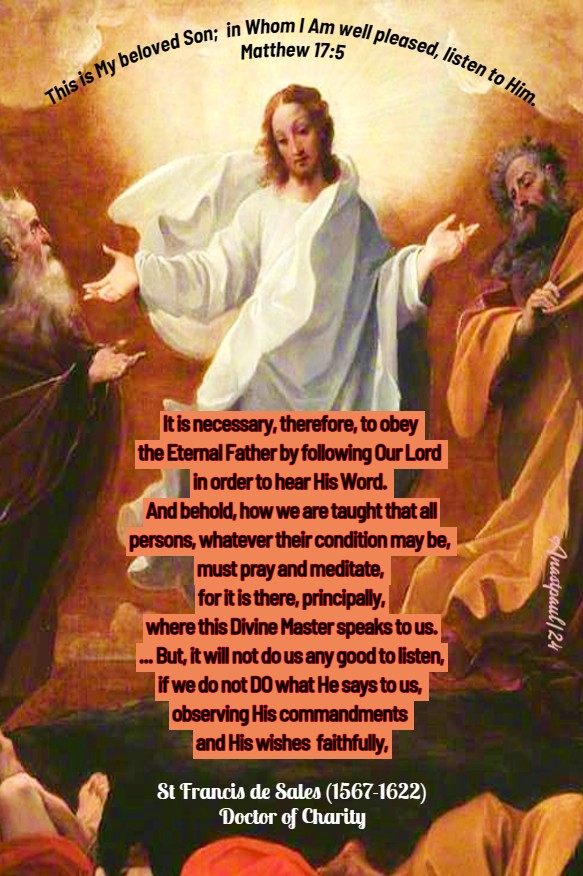
“This is My beloved Son; in Whom I Am well pleased, listen to Him.”
Matthew 17:5
“I Am the Light of the world. Whoever follows Me will never walk in darkness but will have the Light of Life.”
John 8:12
“Let us listen to the holy Voice of God which summons us from on high, from the holy mountain top. There, we must hasten – I make bold to say – like Jesus, Who is our leader and has gone before us into Heaven. There, with Him, may the eyes of our mind shine with His light and the features of our soul be made new; may we be transfigured with Him and moulded to His image, ever becoming divine, being transformed in an ever greater degree of glory.”
St Anastasius Sinaita (Died 6th Century) Priest and Abbot
“At His Transfiguration Christ showed His disciples, the splendour of His Beauty, to which He will shape and colour, those who are His : ‘He will reform our lowness configured to the Body of His Glory.”
St Thomas Aquinas (1225-1274) Doctor of the Church
“ It is necessary, therefore, to obey the Eternal Father by following Our Lord in order to hear His Word. And behold, how we are taught that all persons, whatever their condition may be, must pray and meditate, for it is there, principally, where this Divine Master speaks to us. … But, it will not do us any good to listen, if we do not DO what He says to us, observing His commandments and His wishes faithfully,”
















 AnaStpaul
You must be logged in to post a comment.