Our Morning Offering – 18 January – Feast of the Chair of the Apostle, St Peter at Rome
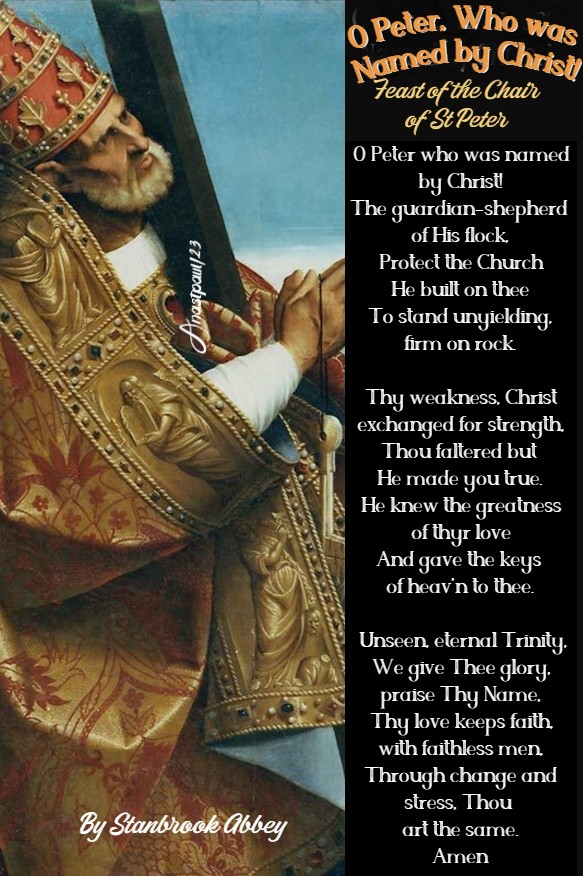
O Peter, Who was Named by Christ! By Stanbrook Abbey For the Feast of the Chair of St Peter
O Peter who was named by Christ! The guardian-shepherd of His flock, Protect the Church He built on thee To stand unyielding, firm on rock.
Thy weakness, Christ exchanged for strength, Thou faltered but He made thee true. He knew the greatness of thy love And gave the keys of heav’n to thee.
Unseen, eternal Trinity, We give Thee glory, praise Thy Name, Thy love keeps faith, with faithless men, Through change and stress, Thou art the same. Amen
Our Morning Offering – 4 January – Christmas Weekday “Month of the Most Holy Name”
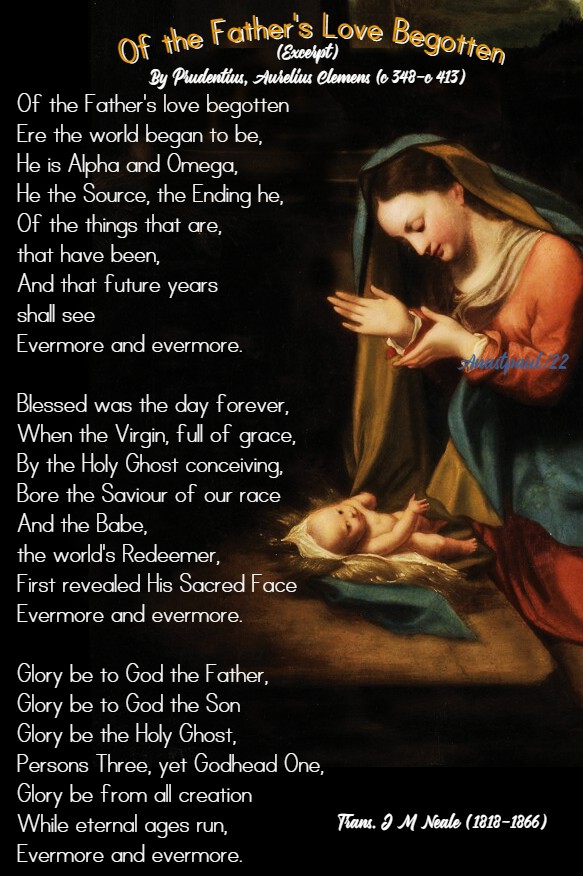
Of the Father’s Love Begotten (Excerpt) By Prudentius, Aurelius Clemens (c 348-c 413) Trans. J M Neale (1818-1866)
Of the Father’s love begotten Ere the world began to be, He is Alpha and Omega, He the Source, the Ending he, Of the things that are, that have been, And that future years shall see Evermore and evermore.
Blessed was the day forever, When the Virgin, full of grace, By the Holy Ghost conceiving, Bore the Saviour of our race And the Babe, the world’s Redeemer, First revealed His Sacred Face Evermore and evermore.
Glory be to God the Father, Glory be to God the Son Glory be the Holy Ghost, Persons Three, yet Godhead One, Glory be from all creation While eternal ages run, Evermore and evermore.
Aurelius Prudentius Clemens was a Roman Christian Poet, born in the Roman Province of Tarraconensis (now Northern Spain) in c 348. He probably died in the Iberian Peninsula some time after 405, possibly around 413. Prudentius practised law with some success and was twice Provincial Governor, perhaps in his native country. Towards the end of his life (possibly around 392) Prudentius retired from public life to become an ascetic, fasting until evening and abstaining entirely from animal food and writing poems, hymns and controversial works in defence of Christianity. Prudentius later collected the Christian poems written during this period and added a preface, which he himself dated 405. The poetry of Prudentius is influenced by early Christian authors, such as Tertullian and St Ambrose, as well as the Sacred Scriptures and the Acts of the Martyrs. His hymn Da, puer, plectrum – “Of the Father’s Love Begotten”) and the hymn for Epiphany O sola magnarum urbium (“Earth Has Many A Noble City”), both from the Cathemerinon, are still frequently in use today, although many others are too but perhaps less frequently..
Our Morning Offering – 27 December – Feast of St John the Evangelist and the Third Day of the Christmas Octave
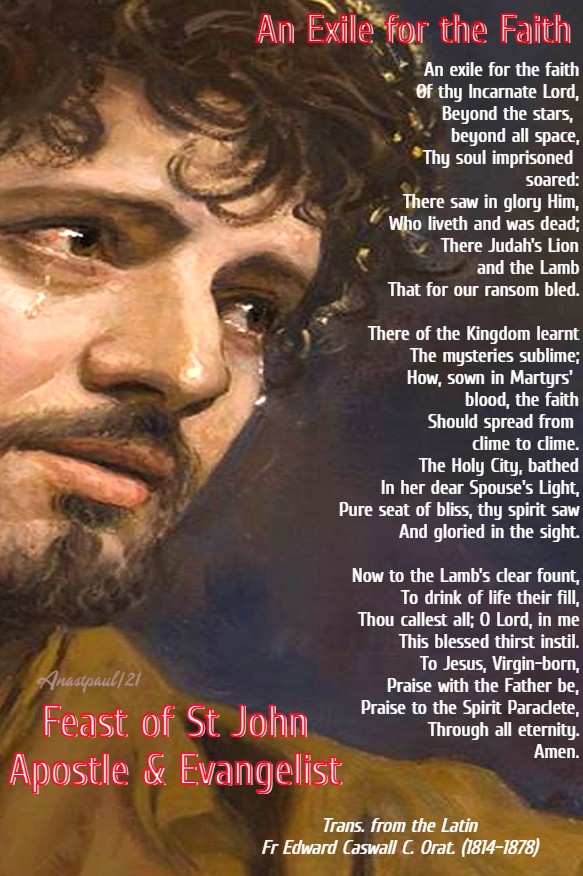
An Exile for the Faith Trans. from the Latin Fr Edward Caswall C. Orat. (1814–1878)
An exile for the faith Of thy Incarnate Lord, Beyond the stars, beyond all space, Thy soul imprisoned soared: There saw in glory Him, Who liveth and was dead; There Judah’s Lion and the Lamb That for our ransom bled.
There of the Kingdom learnt The mysteries sublime; How, sown in Martyrs’ blood, the faith Should spread from clime to clime. The Holy City, bathed In her dear Spouse’s Light, Pure seat of bliss, thy spirit saw And gloried in the sight.
Now to the Lamb’s clear fount, To drink of life their fill, Thou callest all; O Lord, in me This blessed thirst instil. To Jesus, Virgin-born, Praise with the Father be, Praise to the Spirit Paraclete, Through all eternity. Amen.
Our Morning Offering – 26 December – Feast of St Stephen the ProtoMartyr and The Second Day in the Christmas Octave
Sleep, Holy Babe By Fr Edward Caswell C.Orat. (1814-1878)
Sleep, holy Babe, Upon Your Mother’s breast! Great Lord of earth and sea and sky, How sweet it is to see You lie In such a place of rest! Sleep, holy Babe, Your angels watch around, All bending low with folded wings Before th’incarnate King of kings In rev’rent awe profound! Sleep, holy Babe, While I with Mary gaze In joy upon that face awhile, Upon the loving Infant smile Which there divinely plays. Sleep, holy Babe, And take Your brief repose; Too quickly will Your slumbers break And You to lengthened pains awake, That death alone shall close. Amen
Our Morning Offering – 24 December – Vigil of the Nativity of the Lord/Mass at Midnight
Silent Night, Holy Night! Stille Nacht, heilige Nacht! By Father Joseph Mohr (1792-1818)
Silent night, holy night! All is calm, all is bright, Round yon Virgin Mother and Child! Holy Infant so tender and mild, Sleep in heavenly peace, Sleep in heavenly peace.
Silent night, holy night! Son of God, how the light Radiates love from Thy heavenly face, At the dawn of redeeming grace, Jesus, Lord at Thy birth, Jesus, Lord at Thy birth.
O Come, O come, Emmanuel And ransom captive Israel, That mourns in lonely exile here Until the Son of God appear. Refrain: Rejoice! Rejoice! Emmanuel Shall come to thee, O Israel!
O come, Thou Wisdom, from on high And order all things far and nigh, To us the path of knowledge show And teach us in her ways to go. Refrain
O come, o come, Thou Lord of might, Who to thy tribes on Sinai’s height In ancient times did give the law, In cloud, and majesty and awe. Refrain
O come, Thou Rod of Jesse’s stem, From ev’ry foe deliver them That trust Thy mighty power to save And give them vict’ry o’er the grave. Refrain
O come, Thou Key of David, come And open wide our heav’nly home, Make safe the way that leads on high, That we no more have cause to sigh. Refrain
O come, Thou Dayspring from on high And cheer us by thy drawing nigh. Disperse the gloomy clouds of night And death’s dark shadow put to flight. Refrain
O come, Desire of nations, bind In one the hearts of all mankind. Bid every strife and quarrel cease And fill the world with heaven’s peace. Refrain
The favourite O Come, O Come Emmanuel carol was originally written in Latin text in the 12th Century. The author of the words and composer to the music of O Come, O Come Emmanuel is unknown. It is, however, believed that the melody was of French origin and added to the text a hundred years later. The Latin was translated into English by John Mason Neale in 1851.
Our Morning Offering – 18 December – “Month of the Immaculate Conception”and also the Feast of Our Lady of Expectation
O Purest of Creatures, Sweet Mother, Sweet Maid ByFr Frederick W Faber C.Orat. (1814-1863)
O Purest of creatures, sweet Mother, sweet maid, The one spotless womb wherein Jesus was laid! Dark night hath come down on us, Mother! and we Look out for thy shining, sweet Star of the Sea!
Deep night hath come down on this rough-spoken world, And the banners of darkness are boldly unfurled; And the tempest-tossed Church,— all her eyes are on thee; They look to thy shining, sweet Star of the Sea!
He gazed on thy soul, it was spotless and fair, For the empire of sin—it had never been there; None ever had owned thee, dear Mother but He. And He blest thy clear shining, sweet Star of the Sea!
Earth gave Him one lodging; t’was deep in thy breast, And God found a home where the sinner finds rest; His home and His hiding-place, both were in thee, He was won by thy shining, sweet Star of the Sea!
Raised in the Church of England, Frederick W Faber (born at Calverley, Yorkshire, England, 1814 and died Kensington, London, England, 1863) came from a Huguenot and strict Calvinistic family background. He was educated at Balliol College, Oxford and ordained in the Church of England in 1839. Influenced by the teaching of John Henry Newman, Faber followed Newman into the Roman Catholic Church in 1845 and served under Newman’s supervision in the Oratory of St Philip Neri. Fr Faber wrote 150 hymns for the use of the Catholic faithful. One of his best known is , “Faith of Our Fathers.”
Our Morning Offering – 17 December – “Month of the Immaculate Conception” – Friday of the Third Week of Advent
Queen on Whose Starry Brow Doth Rest St Venantius Fortunatus (c 530-c 609) Translation by Monsignor Ronald A Knox (1888 – 1957)
Queen, on whose starry brow doth rest The crown of perfect maidenhood, The God who made thee, from thy brest Drew, for our sakes, His earthly food.
The grace that sinful Eve denied, With thy Child-bearing, re-appears; Heaven’s lingering door, set open wide, Welcomes the children of her tears.
Fate, for such royal progress meet, Beacon, whose rays such light can give, Look, how the ransomed nations greet The virgin-womb that bade them live!
O Jesus, whom the Virgin bore, Be praise and glory unto Thee. Praise to the Father evermore And His life-giving Spirit be. Amen!
Saint Venantius Fortunatus (c 530 – c 609) Bishop, Poet, Hymnist, Writer – born c 530 at Rreviso, Italy and died c 609 at Poitiers, modern France of natural causes. St Venantius was unique, first a travelling lay poet, he later became a Priest and then a Bishop. But he always remained a professional author of poetry, a “Troubadour” of Christ. He is the attributed author of the Ave Maris Stella, amongst many others.
Our Morning Offering – 5 December – The Second Sunday of Advent
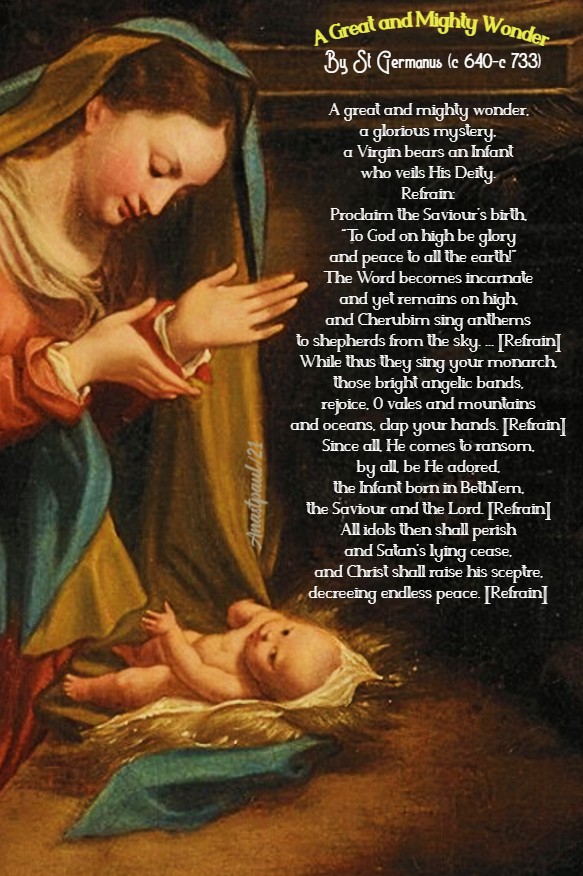
A Great and Mighty Wonder By St Germanus (c 640-c 733)
A great and mighty wonder, a glorious mystery, a Virgin bears an Infant who veils His Deity. Refrain: Proclaim the Saviour’s birth, “To God on high be glory and peace to all the earth!” The Word becomes incarnate and yet remains on high, and Cherubim sing anthems to shepherds from the sky. … [Refrain] While thus they sing your monarch, those bright angelic bands, rejoice, O vales and mountains and oceans, clap your hands. [Refrain] Since all, He comes to ransom, by all, be He adored, the Infant born in Bethl’em, the Saviour and the Lord. [Refrain] All idols then shall perish and Satan’s lying cease, and Christ shall raise his sceptre, decreeing endless peace. [Refrain]
St Germanus was one of the Greek hymnwriters and one of the grandest among the defenders of the Icons. He was born at Constantinople of a patrician family, was ordained there and became subsequently Bishop of Cyzicus. He was present at the Synod of Constantinople in 712, which restored the Monothelite heresy but in after years he condemned it. He was made Archbishop of Constantinople in 715. In 730 he was driven from the See, not without blows, for refusing to yield to the Iconoclastic Emperor Leo the Isaurian. He died shortly afterwards in exile at a good old age. His Life below: https://anastpaul.com/2021/05/12/saint-of-the-day-12-may-saint-germanus-of-constantinople-c-640-733/
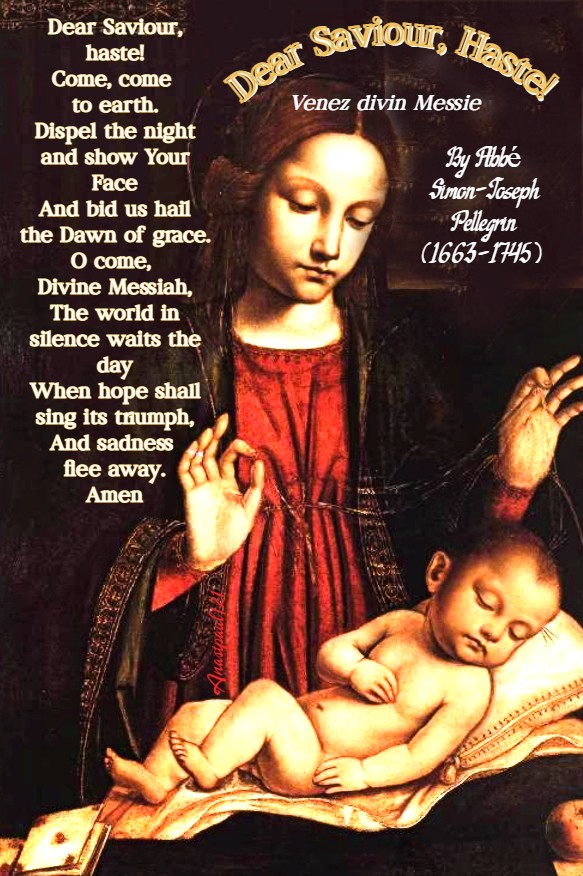
Dear Saviour, haste! Come, come to earth. Dispel the night and show Your Face And bid us hail the Dawn of grace. O come, Divine Messiah, The world in silence waits the day When hope shall sing its triumph, And sadness flee away. Amen
This is the Refrain from a beautiful Advent Hymn by Abbé Simon-Joseph Pellegrin, a French Cluniac Monk, Poet, Composer and Playwright.
Our Morning Offering – 28 November – Th4 First Sunday of Advent
Come, Sun and Saviour 8th Century Catholic Advent Prayer/Hymn
Come, Sun and Saviour, to embrace our gloomy world, its weary race. As groom to bride, as bride to groom, The wedding chamber, Mary’s womb. At Your great Name, O Jesus, now All knees must bend, all hearts must bow, All things on earth with one accord, Like those in heaven, shall call You Lord. Come in Your holy might, we pray, Redeem us for eternal day. Defend us, while we dwell below, From all assaults of our dread foe. Amen
Our Morning Offering – 14 November – The Twenty Fifth Sunday after Pentecost
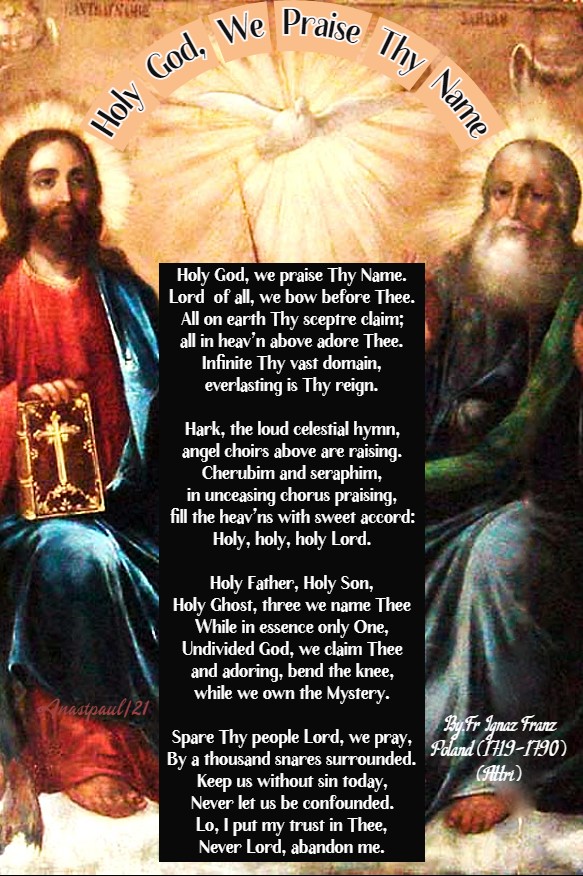
Holy God, We Praise Thy Name
Holy God, we praise Thy Name. Lord of all, we bow before Thee. All on earth Thy sceptre claim; all in heav’n above adore Thee. Infinite Thy vast domain, everlasting is Thy reign.
Hark, the loud celestial hymn, angel choirs above are raising. Cherubim and seraphim, in unceasing chorus praising, fill the heav’ns with sweet accord: Holy, holy, holy Lord.
Holy Father, Holy Son, Holy Ghost, three we name Thee While in essence only One, Undivided God, we claim Thee and adoring, bend the knee, while we own the Mystery.
Spare Thy people Lord, we pray, By a thousand snares surrounded. Keep us without sin today, Never let us be confounded. Lo, I put my trust in Thee, Never Lord, abandon me.
Fr Ignaz Franz Poland (1719-1790) (Attri) Archbishop of Schlawa, Germany, Hymnist, Musician He also functioned as the Assessor for Theological Affairs at the Apostolic Vicariate. He wrote hymn lyrics and compiled religious music. Trans. by Fr Clarence A Walworth (1820-1900) Convert, writer. He was one of the Founders of the Order of the Paulists in the U.S.A.
Our Morning Offering – 28 October – Feast of Saints Simon and Jude Apostles
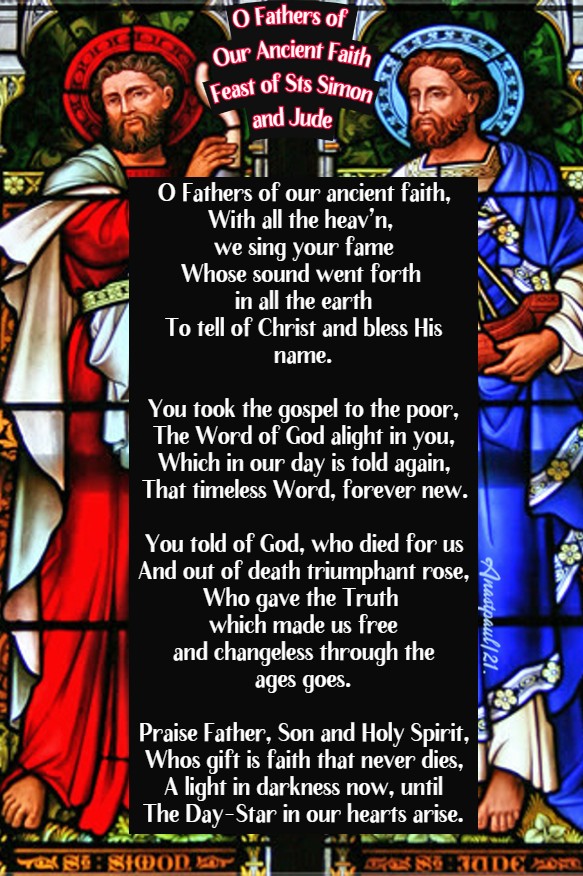
O Fathers of Our Ancient Faith
O Fathers of our ancient faith, With all the heav’n, we sing your fame Whose sound went forth in all the earth To tell of Christ and bless His name.
You took the gospel to the poor, The Word of God alight in you, Which in our day is told again, That timeless Word, forever new.
You told of God, who died for us And out of death triumphant rose, Who gave the Truth which made us free and changeless through the ages goes.
Praise Father, Son and Holy Spirit, Whos gift is faith that never dies, A light in darkness now, until The Day-Star in our hearts arise.
O Fathers of Our Ancient Faith is written by the Benedictine Nuns of Stanbrook Abbey. In the Divine Office (1974) it is sung at Morning Prayer in the Common of Apostles. It is set to the anonymous tune associated with the 7th century Latin hymn, Creator Alme Siderum.
Our Morning Offering – 18 October – The Feast of St Luke, the Evangelist
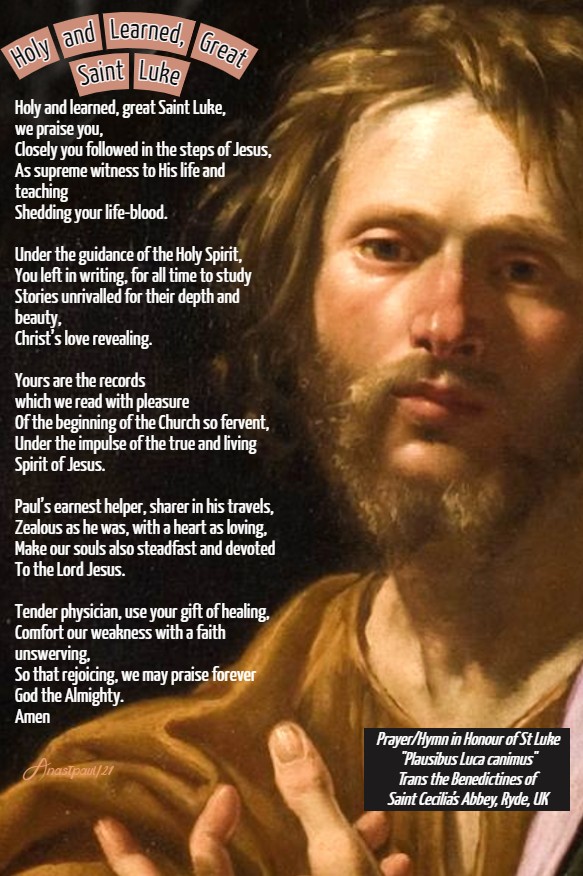
Holy and Learned, Great Saint Luke Prayer/Hymn in Honour of St Luke “Plausibus Luca canimus” Trans the Benedictines of Saint Cecilia’s Abbey, Ryde, UK
Holy and learned, great Saint Luke, we praise you, Closely you followed in the steps of Jesus, As supreme witness to His life and teaching Shedding your life-blood.
Under the guidance of the Holy Spirit, You left in writing, for all time to study Stories unrivalled for their depth and beauty, Christ’s love revealing.
Yours are the records which we read with pleasure Of the beginning of the Church so fervent, Under the impulse of the true and living Spirit of Jesus.
Paul’s earnest helper, sharer in his travels, Zealous as he was, with a heart as loving, Make our souls also steadfast and devoted To the Lord Jesus.
Tender physician, use your gift of healing, Comfort our weakness with a faith unswerving, So that rejoicing, we may praise forever God the Almighty. Amen
Quote/s of the Day – 28 September – The Memorial of St Wenceslaus (907-935) King of Bohemia, Martyr
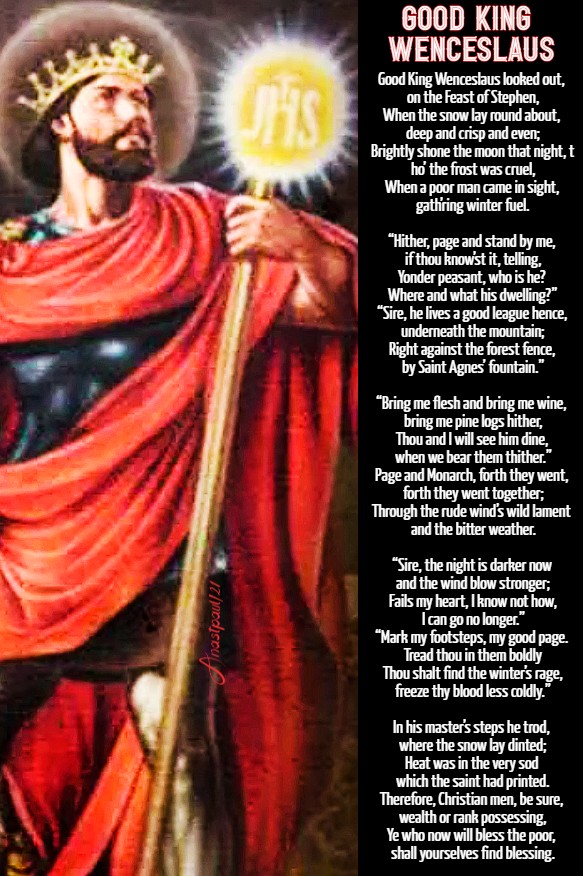
Good King Wenceslaus
Good King Wenceslaus looked out, on the Feast of Stephen, When the snow lay round about, deep and crisp and even; Brightly shone the moon that night, t ho’ the frost was cruel, When a poor man came in sight, gath’ring winter fuel.
“Hither, page and stand by me, if thou know’st it, telling, Yonder peasant, who is he? Where and what his dwelling?” “Sire, he lives a good league hence, underneath the mountain; Right against the forest fence, by Saint Agnes’ fountain.”
“Bring me flesh and bring me wine, bring me pine logs hither, Thou and I will see him dine, when we bear them thither.” Page and Monarch, forth they went, forth they went together; Through the rude wind’s wild lament and the bitter weather.
“Sire, the night is darker now and the wind blow stronger; Fails my heart, I know not how, I can go no longer.” “Mark my footsteps, my good page. Tread thou in them boldly Thou shalt find the winter’s rage, freeze thy blood less coldly.”
In his master’s steps he trod, where the snow lay dinted; Heat was in the very sod which the saint had printed. Therefore, Christian men, be sure, wealth or rank possessing, Ye who now will bless the poor, shall yourselves find blessing.
Our Morning Offering – 12 September – Feast of the Holy Name of Mary
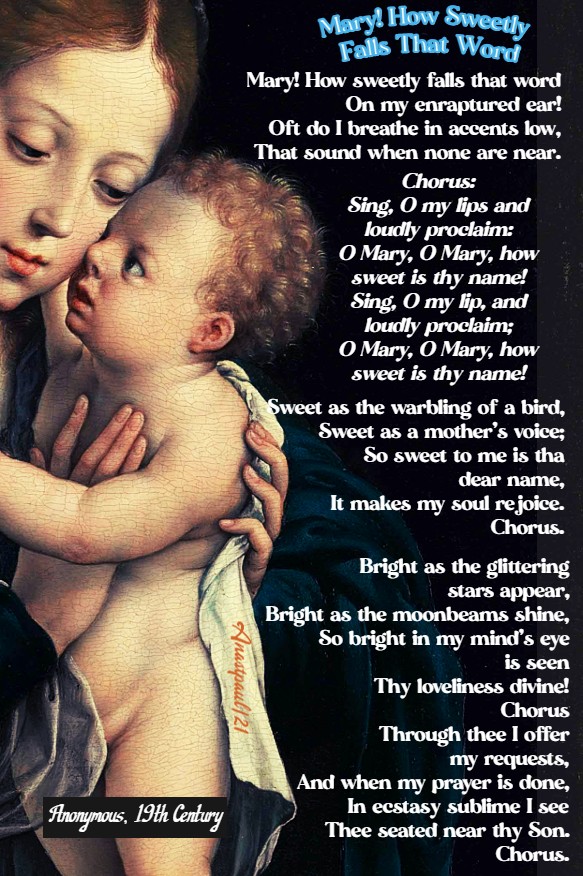
Mary! How Sweetly Falls That Word Anonymous, 19th Century
Mary! How sweetly falls that word On my enraptured ear! Oft do I breathe in accents low, That sound when none are near. Chorus: Sing, O my lips and loudly proclaim: O Mary, O Mary, how sweet is thy name! Sing, O my lip, and loudly proclaim; O Mary, O Mary, how sweet is thy name!
Sweet as the warbling of a bird, Sweet as a mother’s voice; So sweet to me is that dear name, It makes my soul rejoice. Chorus.
Bright as the glittering stars appear, Bright as the moonbeams shine, So bright in my mind’s eye is seen Thy loveliness divine! Chorus.
Through thee I offer my requests, And when my prayer is done, In ecstasy sublime I see Thee seated near thy Son. Chorus.
Our Morning Offering – 6 September – “Month of the Seven Sorrows of the Blessed Virgin Mary”
The Day is Filled with Splendour Benedictine Nuns of Stanbrook Abbey
The day is filled with splendour When God brings light from light, And all renewed creation Rejoices in His sight. — The Father gives His children The wonder of the world In which His power and glory Like banners are unfurled. — With every living creature, Awaking with the day, We turn to God our Father, Lift up our hearts and pray: — O Father, Son and Spirit, Your grace and mercy send, That we may live to praise You Today and to the end. Amen
The Day is Filled with Splendour, is a hymn written by the Benedictine Nuns of Stanbrook Abbey. It is sung during Morning Prayer in the Divine Office. It is set to the hymn tune: Paderborn, first published in the Katholische Kirchengesänge of 1616. Psalter Week 3.
Our Morning Offering – 7 August – “Month of the Immaculate Heart of Mary”
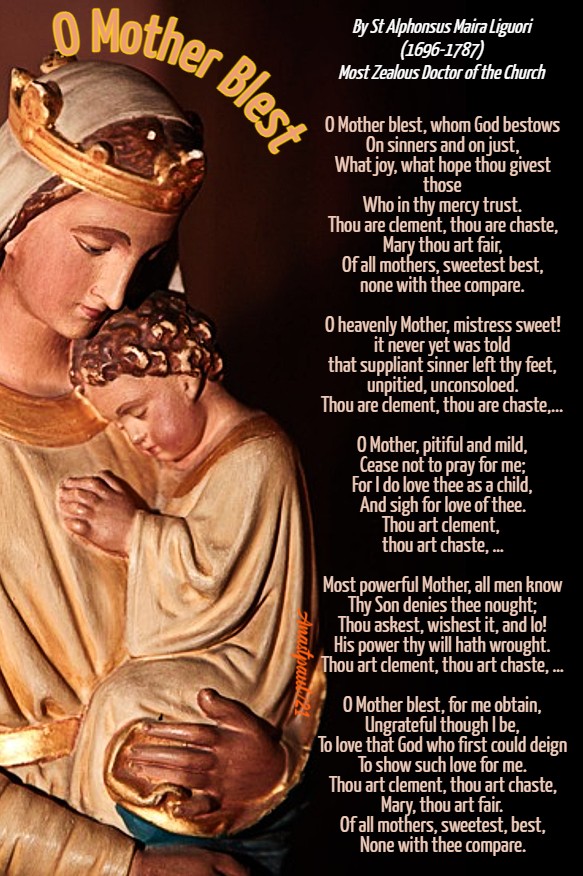
O Mother Blest By St Alphonsus Maira Liguori (1696-1787) Most Zealous Doctor of the Church Trans. Fr Edmund Vaughn C.SS,R, (1827 – 1908 )
O Mother blest, whom God bestows On sinners and on just, What joy, what hope thou givest those Who in thy mercy trust. Thou are clement, thou are chaste, Mary thou art fair, Of all mothers, sweetest best, none with thee compare.
O heavenly Mother, mistress sweet! it never yet was told that suppliant sinner left thy feet, unpitied, unconsoloed. Thou are clement, thou are chaste, …
O Mother, pitiful and mild, Cease not to pray for me; For I do love thee as a child, And sigh for love of thee. Thou art clement, thou art chaste, …
Most powerful Mother, all men know Thy Son denies thee nought; Thou askest, wishest it, and lo! His power thy will hath wrought. Thou art clement, thou art chaste, …
O Mother blest, for me obtain, Ungrateful though I be, To love that God who first could deign To show such love for me. Thou art clement, thou art chaste, Mary, thou art fair. Of all mothers, sweetest, best, None with thee compare.
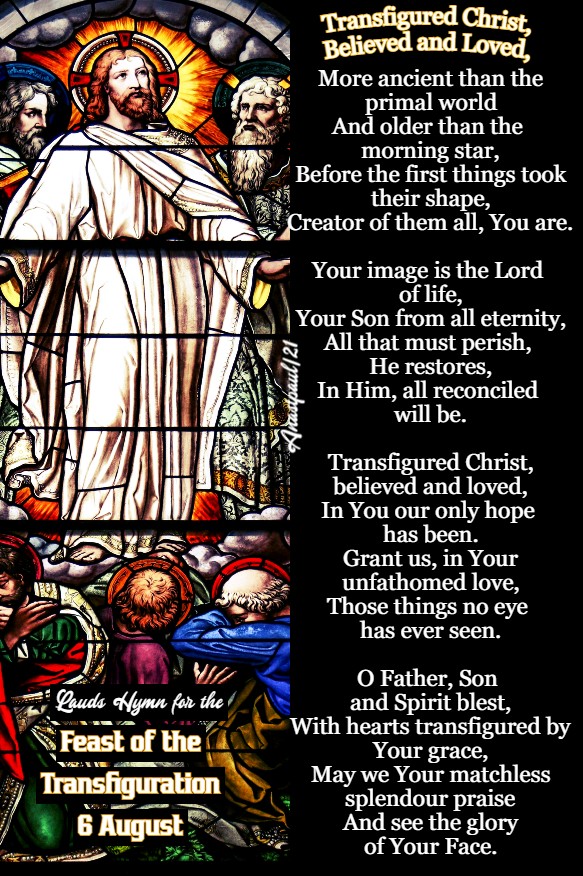
Our Morning Offering – 6 August – “Month of the Immaculate Heart of Mary”- Feast of the Transfiguration of the Lord
Transfigured Christ, Believed and Loved, (More Ancient than the Primal World) Benedictine Nuns of Stanbrook Abbey Breviary Lauds Hymn Feast of the Transfiguration
More ancient than the primal world And older than the morning star, Before the first things took their shape, Creator of them all, You are.
Your image is the Lord of life, Your Son from all eternity, All that must perish, He restores, In Him, all reconciled will be.
Transfigured Christ, believed and loved, In You our only hope has been. Grant us, in Your unfathomed love, Those things no eye has ever seen.
O Father, Son and Spirit blest, With hearts transfigured by Your grace, May we Your matchless splendour praise And see the glory of Your Face.






























You must be logged in to post a comment.