Posted in GOD is LOVE, LENT 2026, Thomas Aquinas

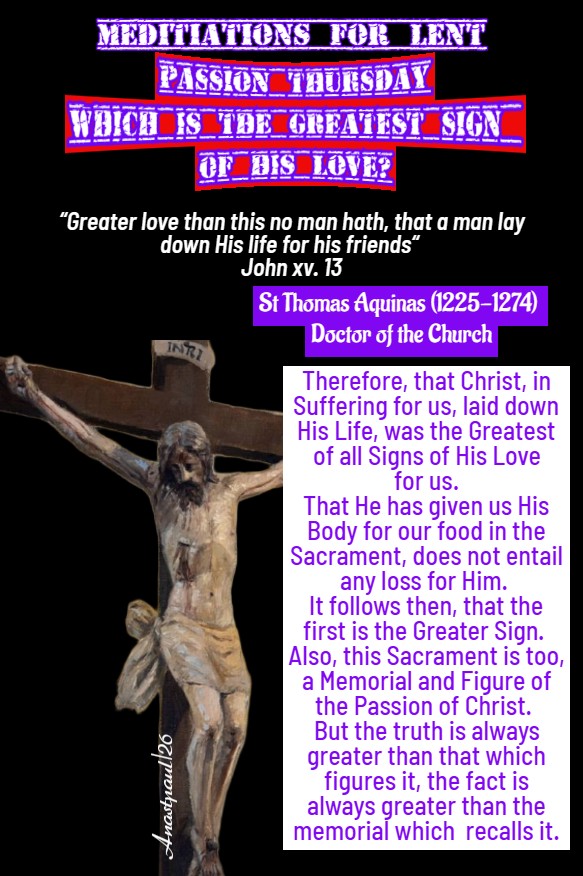
Passion Thursday – 26 March – Our Lenten Journey With St Thomas Aquinas – Which is the Greatest Sign of His Love?

Passion Thursday – 26 March – Our Lenten Journey With St Thomas Aquinas (1225-1274) Doctor of the Church

Passion Thursday
Which is the Greatest Sign of His Love?

Greater love than this no man hath, that a man lay down His life for his friends“
John xv. 13
It would seem Christ gave us a greater Sign of His Love by giving us His Body as our food, than by Suffering for us.
For the Love which will be in the life to come, is a more perfect element than the Love which is in this life.
And the benefit which Christ bestows upon us by giving us His Body as food, is more like to the Love of the life to come in which we shall fully enjoy God.
The Passion which Christ underwent for us is, on the other hand, more like to the Love which is of this life, in which we, too, are to suffer for Christ.
Therefore, it is a greater Sign of Christ’s Love that He delivered His Body to us as our food, than that He Suffered for us.

Nevertheless, it is an argument against this that in St John’s Gospel, Our Lord Himself says, “Greater love than this no man hath, that a man lay down His life for his friends“ (John xv. 13).

The strongest of human loves is the love with which a man loves himself.
Therefore, this love must be the measure, by comparison with which we estimate the love by which a man loves others than himself.
Now, the extent of a man’s love for another, is shown by the extent of good desired for himself which he forgoes for his friend.
As Holy Scripture says, “He who neglecteth a loss for the sake of a friend, is just” (Prov xii. 26).

Now, a man wishes well to himself as to three things, namely, his soul, his body and external items outside himself.
It is then already a sign of love that, for another, a man is willing to suffer loss of things outside himself.

It is a greater sign if he is also willing to suffer loss in his body for another, that is, by bearing the burden of work or undergoing punishment.
It is the greatest of all signs of love, if a man is willing, by dying for his friend, to lay down his very life.

Therefore, that Christ, in Suffering for us, laid down His Life, was the Greatest of all Signs of His Love for us.
That He has given us His Body for our food in the Sacrament, does not entail any loss for Him.
It follows then, that the first is the Greater Sign.
Also, this Sacrament is too, a Memorial and Figure of the Passion of Christ.
But the truth is always greater than that which figures it, the fact is always greater than the memorial which recalls it.

The showing forth of the Body of Christ in the Sacrament has about it, it is true, a certain Figure of the Love with which God Loves us in the life to come.
But Christ’s Passion is associated with that Love itself, by which God calls us from perdition to the life to come.
The Love of God, however, is not greater in the life to come than it is in this present life.

ST THOMAS AQUINAS (1225-1274)
Priest, Theologian, Dominican
Doctor Angelicus (Angelic Doctor)
Doctor Communis (Common Doctor)

Added by Pope Saint Pius V in 1568

Posted in "Follow Me", APRIL -MONTH of the RESURRECTION and the BLESSED SACAMENT, BAPTISM, LENT 2026, QUOTES on DEATH, The PASSION, The RESURRECTION, The SECOND COMING, Thomas Aquinas

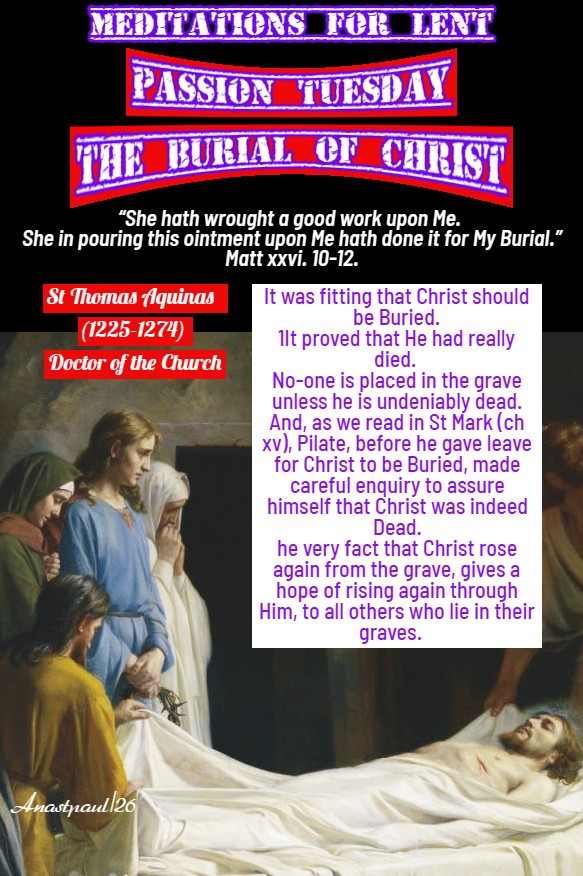
Passion Tuesday – 24 March – Our Lenten Journey With St Thomas Aquinas – The Burial of Christ

Passion Tuesday – 24 March – Our Lenten Journey With St Thomas Aquinas (1225-1274) Doctor of the Church

Passion Tuesday
The Burial of Christ

She hath wrought a good work upon Me.
She in pouring this ointment upon Me hath done it for My Burial.

Matt xxvi. 10-12.

It was fitting that Christ should be Buried.

  1. It proved that He had really died.
    No-one is placed in the grave unless he is undeniably dead. And, as we read in St Mark (ch xv), Pilate, before he gave leave for Christ to be Buried, made careful enquiry to assure himself that Christ was indeed Dead.
  2. The very fact that Christ rose again from the grave, gives a hope of rising again through Him, to all others who lie in their graves.
    “As it says in the gospel, All who are in the grave shall hear the Voice of the Son of God. And they who hear shall live.”(John v. 28, 25),
  3. It was an example for those who, by the Death of Christ, are spiritually dead to sin, for those, that is, who are hidden away from the turmoil of human affairs.
    So St Paul says, “You are dead and your life is hidden with Christ in God” (Col iii. 3).
    So too, those who are Baptised, since by the Death of Christ they die to sin, are as it were, buried with Christ in their immersion, as St Paul again says, We are buried together with Christ by Baptism unto death (Rom vi. 4).

As the Death of Christ efficiently wrought our salvation, so too, is His Burial effective for us.
St Jerome, for example, says, “By the Burial of Christ, we all rise again” and explaining the words of Isaias (liii. 9), He shall give the ungodly for His Burial, “This means He shall give to God the Father, the nations lacking in filial devotion, for through His Death and Burial He has obtained possession of them.”

The Psalm (Ps Ixxxvii. 6) says, “I am become as a man without help, free among the dead.”
Christ, by being Buried showed Himself free among the dead indeed, for His being enclosed in the Tomb, was not allowed to hinder His coming forth in the Resurrection.

ST THOMAS AQUINAS (1225-1274)
Priest, Theologian, Dominican
Doctor Angelicus (Angelic Doctor)
Doctor Communis (Common Doctor)
Added by Pope Saint Pius V in 1568

Posted in JULY - The MOST PRECIOUS BLOOD, LENT 2026, QUOTES on HEAVEN, QUOTES on MORTAL SIN, QUOTES on REPARATION/EXPIATION, QUOTES on SIN, The MOST PRECIOUS BLOOD, Thomas Aquinas

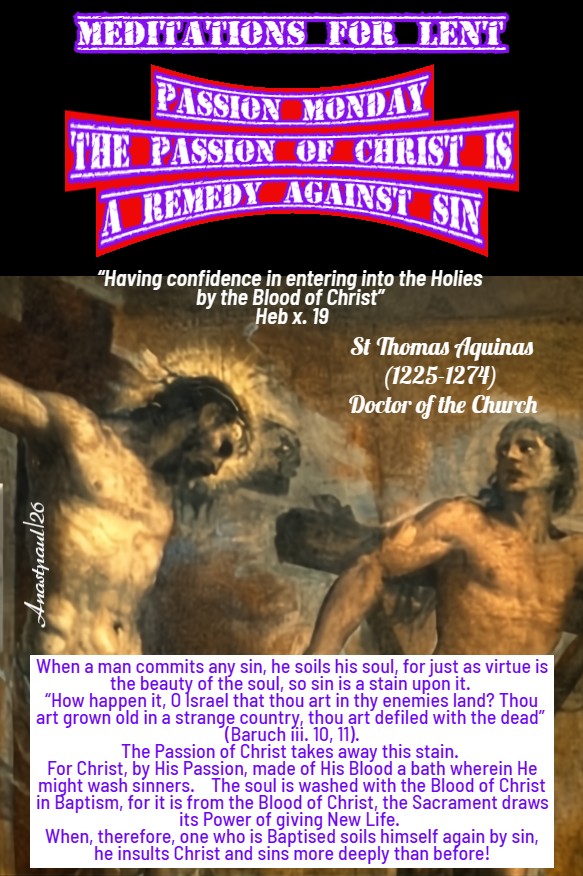
Passion Monday – 23 March – Our Lenten Journey With St Thomas Aquinas – The Passion of Christ is a Remedy Against Sin

Passion Monday – 23 March – Our Lenten Journey With St Thomas Aquinas (1225-1274) Doctor of the Church

Passion Monday
The Passion of Christ is a Remedy Against Sin

Having confidence in entering into the Holies by the Blood of Christ
Heb x. 19

We find in the Passion of Christ a remedy against all the evils which we incur through sin.
Now, these evils are five in number.
(i) We ourselves become unclean.
When a man commits any sin, he soils his soul, for just as virtue is the beauty of the soul, so sin is a stain upon it.
“How happen it, O Israel that thou art in thy enemies land? Thou art grown old in a strange country, thou art defiled with the dead” (Baruch iii. 10, 11).
The Passion of Christ takes away this stain.
For Christ, by His Passion, made of His Blood a bath wherein He might wash sinners.
The soul is washed with the Blood of Christ in Baptism, for it is from the Blood of Christ, the Sacrament draws its Power of giving New Life.
When, therefore, one who is Baptised soils himself again by sin, he insults Christ and sins more deeply than before!

(ii) We offend God.
As the man who is fleshly-minded loves what is beautiful to the flesh, so God Loves spiritual beauty, the beauty of the soul.
When the soul’s beauty is defiled by sin, God is offended and holds the offender in hatred.
But the Passion of Christ takes away this hatred, for it does what man himself could not possibly do, namely, it makes full satisfaction to God for the sin.
The Love and Obedience of Christ, was greater than the sin and rebellion of Adam.

(iii) We ourselves are weakened.
Man believes that, once he has committed the sin, he will be able to keep from sin for the future.
Experience shows, however, that which really happens is quite the otherwise.
The effect of the first sin is to weaken the sinner and make him still more inclined to sin.
Sin dominates man more and more and man, left to himself, whatever his powers, places himself in such a state, he cannot arise from this state of sin.
Like a man who has thrown himself into a well, there he must lie, unless he is drawn up by Divine Power.
After the sin of Adam then, our human nature was weaker, it had lost its perfection and men were more prone to sin.
But Christ, although He did not utterly make an end of this weakness, nevertheless, greatly lessened it.
Man is so strengthened by the Passion of Christ and the effect of Adam’s sin is so weakened, man is no longer dominated by sin.
Assisted by the Grace of God, given him in the Sacraments which derive their Power from the Passion of Christ, man is now able to make an effort and so arise from his sins.
Before the Passion of Christ, there were few who lived without mortal sin but since the Passion, many have lived and do live without it.

(iv) Liability to the punishment earned by sin.
This, the Justice of God demanded, namely – for each sin the sinner should be punished, the penalty to be measured according to the sin.
Whence, since mortal sin is infinitely wicked, seeing that it is a sin against what is Infinitely Good, i.e., God Whose commands the sin despises, the punishment due by mortal sin is infinite too.
But by His Passion, Christ took away from us this penalty, for He endured it Himself.
“Who, His own self bore our sins, that is the punishment due to us for our sins, in His Body upon the tree”(i Pet ii. 24).
So great was the power and value of the Passion of Christ that it was sufficient to expiate all the sins of all the world, calculated in millions though they be.
This is the reason why Baptism frees the baptised from all their sins and why the Priest can forgive sin.
This is why the man who more and more fashions his life in conformity with the Passion of Christ and makes himself like to Christ in His Passion, attains an ever fuller pardon and ever greater Graces.

(v) Banishment from the Kingdom.
Subjects who offend the king are sent into exile.
So too, man was expelled from Paradise.
Adam, having sinned, was straightaway ejected and the Gates barred against him.
But, by His Passion, Christ opened those Gates and called back the exiles from banishment.
As the Side of Christ opened to the soldier’s lance, the Gates of Heaven opened to man and as Christ’s Blood flowed, the stain was washed away, God was appeased, our weakness strengthened, reparatiion made for our sins and the exiles were recalled.

Thus it was that Our Lord said immediately to the repentant thief, “This day thou shalt be with Me in Paradise” (Luke xxiii. 43).
Such a thing was never before said to any man, not to Adam nor to Abraham, nor even to David.
But This Day, the day on which the Gate is opened, the thief does but ask and he finds.
“Having confidence in entering into the Holies by the Blood of Christ” (Heb x. 19).

ST THOMAS AQUINAS (1225-1274)
Priest, Theologian, Dominican
Doctor Angelicus (Angelic Doctor)
Doctor Communis (Common Doctor)
Added by Pope Saint Pius V in 1568
Posted in "Follow Me", CHRIST, the WAY,TRUTH,LIFE, DOMINICAN OP, FATHERS of the Church, LENT 2026, OUR Cross, Quote on SELF-ABANDONMENT, QUOTES on DEATH, QUOTES on ETERNAL LIFE, QUOTES on SELF-DENIAL, QUOTES on SUFFERING, QUOTES on TEMPTATION, QUOTES on the CROSS of CHRIST, Quotes Self-Oblation, SEPTEMBER-The SEVEN SORROWS of MARY and The HOLY CROSS, The GOOD SHEPHERD, The PASSION

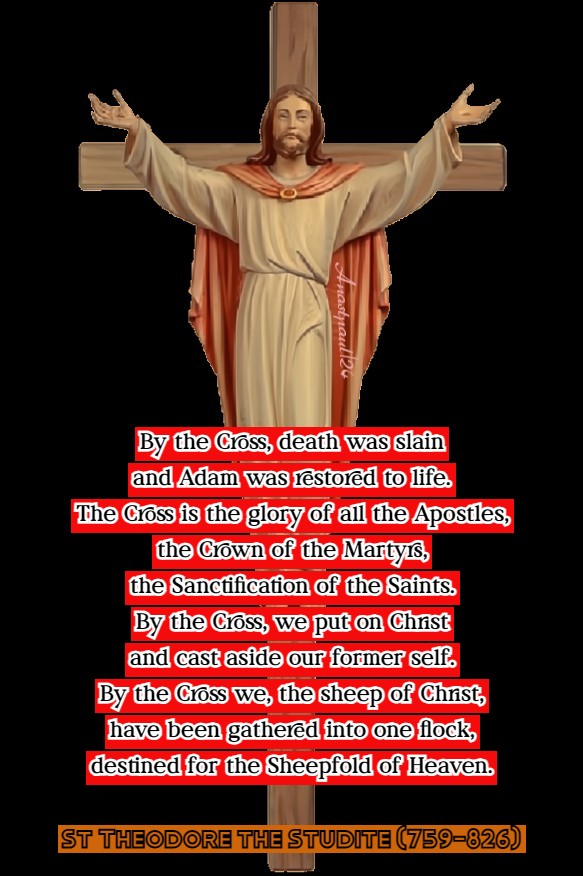
Quote/s of the Day – 23 March– ‘… By the Cross, we put on Christ …’

Quote/s of the Day – 23 March – Monday in Passion Week

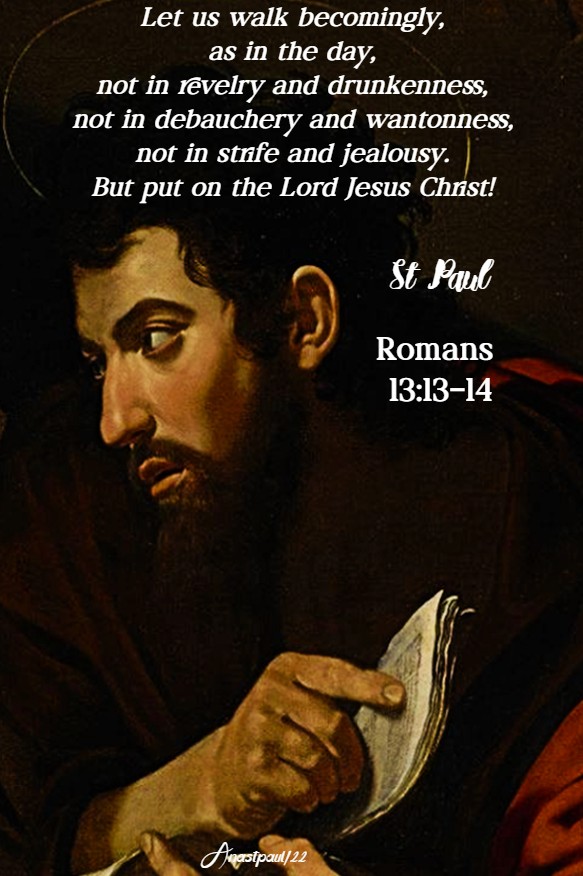
Let us walk becomingly, as in the day,
not in revelry and drunkenness,
not in debauchery and wantonness,
not in strife and jealousy.
But put on the Lord Jesus Christ.

Romans 13:13-14

By the Cross, death was slain
and Adam was restored to life.
The Cross is the glory of all the Apostles,
the Crown of the Martyrs,
the Sanctification of the Saints.
By the Cross, we put on Christ
and cast aside our former self.
By the Cross we, the sheep of Christ,
have been gathered into one flock,
destined for the Sheepfold of Heaven
.”

St Theodore the Studite (759-826)
Abbot, Confessor, Father of the Church

“He who findeth his life, shall lose it
and he, who shall lose his life for Me,
shall find it.
 ”
Matthew 10:39

My dear child, accept this cross from God and bear it –
it will turn into a truly lovable cross,
if you would hand these trials over to God,
accept them from Him with true abandonment
and thank God for them:
“My soul magnifies the Lord”
in everything (cf Lk 1:46).
Whether God takes or gives, the Son of Man
must be raised up on the Cross …
Dear child, leave all that behind;
rather, give your attention to true abandonment …
and think about accepting to bear
the cross of temptation, rather than going
in search of spiritual sweetness …
Our Lord has said: “If anyone wishes to come after Me,
let him take up his cross and follow Me
” (Lk 9:23).”

Fr JohannesTauler OP (c1300-1361)
Dominican Priest and Friar,
renowned Preacher and Theologian

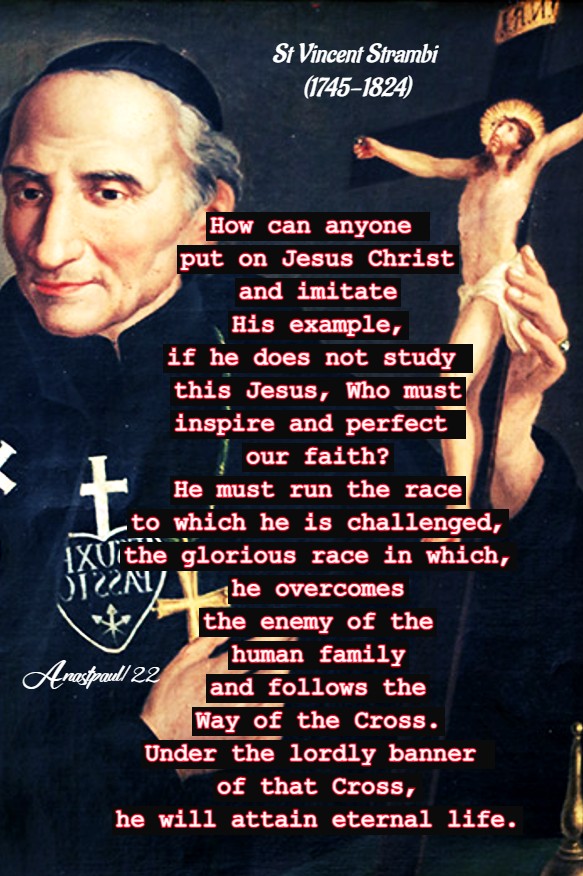
“… How can anyone put on Jesus Christ
and imitate His example,
if he does not study this Jesus,
Who must inspire and perfect our faith?
He must run the race to which he is challenged,
the glorious race in which,
he overcomes the enemy of the human family
and follows the Way of the Cross.
Under the lordly banner of that Cross,
he will attain eternal life.

St Vincent Strambi CP (1745-1824)

Posted in LENT 2026, The PASSION

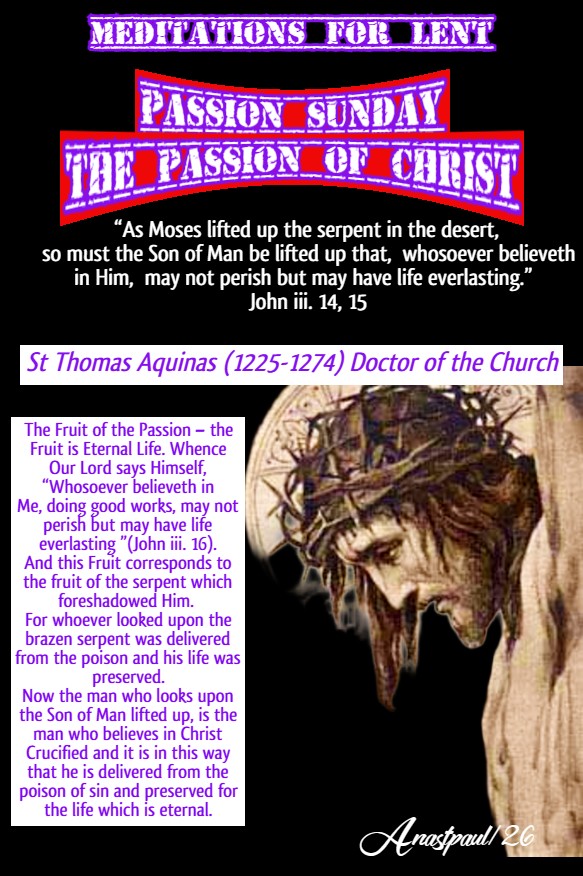
Passion Sunday – 22 March – Our Lenten Journey With St Thomas Aquinas – The Passion of Christ

Passion Sunday – 22 March – Our Lenten Journey With St Thomas Aquinas (1225-1274) Doctor of the Church

Passion Sunday
The Passion of Christ

“As Moses lifted up the serpent in the desert, so must the Son of Man be lifted up that, whosoever believeth in Him, may not perish but may have life everlasting.”
John iii. 14, 15

We may note here three lessons.

  1. The Figure of the Passion.
    As Moses lifted up the serpent in the desert.
    When the Jews said, “Our soul now loatheth this very light food” (Num xxi. 5), the Lord sent serpents in punishment and afterwards, for a remedy, He commanded the brazen serpent to be made — as a remedy against the serpents and too, as a figure of the Passion.
    It is the nature of a serpent to be poisonous but the brazen serpent had no poison — it was but the figure of a poisonous serpent.
    So too, Christ had no sin — which is the poison but He had the likeness of sin.
    “ God sent His Own Son in the likeness of sinful flesh and of sin” (Rom viii. 3).
    Therefore, Christ had the effect of the serpent against the movements of our desires.
  2. The Mode of the Passion.
    So must the Son of Man be lifted up. This refers to His being raised upon the Cross.
    He willed to die lifted up,
    (i) To purify the air – already He had purified the earth by the holiness of His Living upon it but it still remained for Him to purify the air by His Dying there;
    (ii) To triumph over the devils, who in the air, make their preparations to war on us;
    (iii) To draw our hearts to His Heart, by His Dying there, “I, if I be lifted up from the earth, will draw all things to
    Myself ” (John xii. 32). “”
    Since, in the Death of the Cross, He was Exalted and since, it was there that He overcame His enemies, we say that He was Exalted rather than, He Died.
    “He shall drink of the strrent by the wayside, therefore, shall He lift up His Head” (Ps. cix. 7).

The Cross was the cause of His Exaltation.
“He became obedient unto death, even to the Death of the Cross, wherefore God hath Exalted Him” (Phil ii. 8).

  1. The Fruit of the Passion – the Fruit is Eternal Life. Whence Our Lord says Himself, “Whosoever believeth in
    Me, doing good works, may not perish but may have life everlasting ”(John iii. 16).

And this Fruit corresponds to the fruit of the serpent which foreshadowed Him.
For whoever looked upon the brazen serpent was delivered from the poison and his life was preserved.
Now the man who looks upon the Son of Man lifted up, is the man who believes in Christ Crucified and it is in this way that he is delivered from the poison of sin and preserved for the life which is eternal.

ST THOMAS AQUINAS (1225-1274)
Priest, Theologian, Dominican
Doctor Angelicus (Angelic Doctor)
Doctor Communis (Common Doctor)
Added by Pope Saint Pius V in 1568
Posted in CHRIST the WORD and WISDOM, DOCTORS of the Church, DYING / LAST WORDS, GOD ALONE!, LENT 2026, QUOTES on DEATH, QUOTES on ETERNAL LIFE, QUOTES on PURITY, QUOTES on SUFFERING, St Francis de Sales, The PASSION, The WORD

Quote/s of the Day – 22 March – How to escape death …

Quote/s of the Day – 22 March – Passion Sunday – Hebrews 9:11-15, John 8:46-59 – Scripture search here: https://www.drbo.org/

Amen, amen, I say to you,
if anyone keep My word,
he will never see death
.”

John 8:51

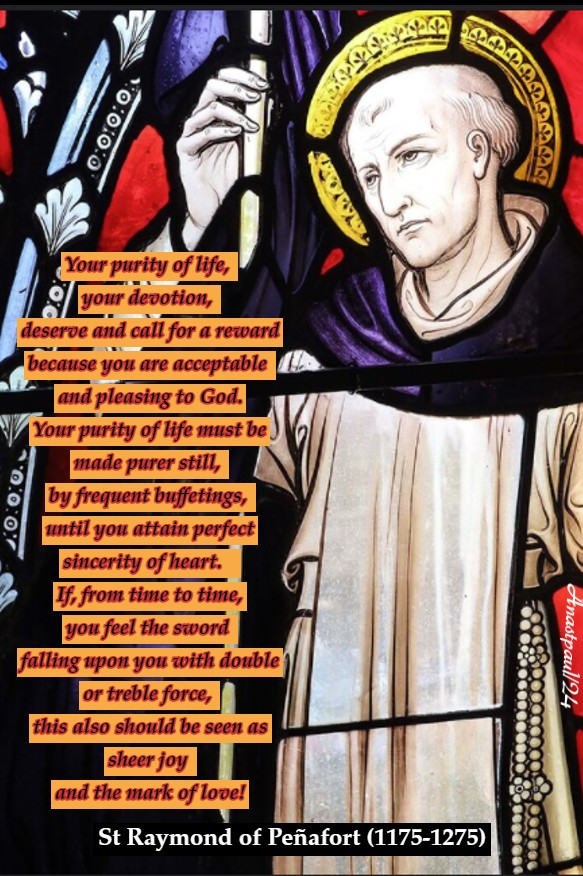
Your purity of life, your devotion,
deserve and call for a reward
because you are acceptable
and pleasing to God.
Your purity of life must be made purer still,
by frequent buffetings,
until you attain perfect sincerity of heart.
If, from time to time, you feel the sword
falling upon you with double or treble force,
this also should be seen as sheer joy
and the mark of love!

St Raymond of Peñafort (1175-1275)

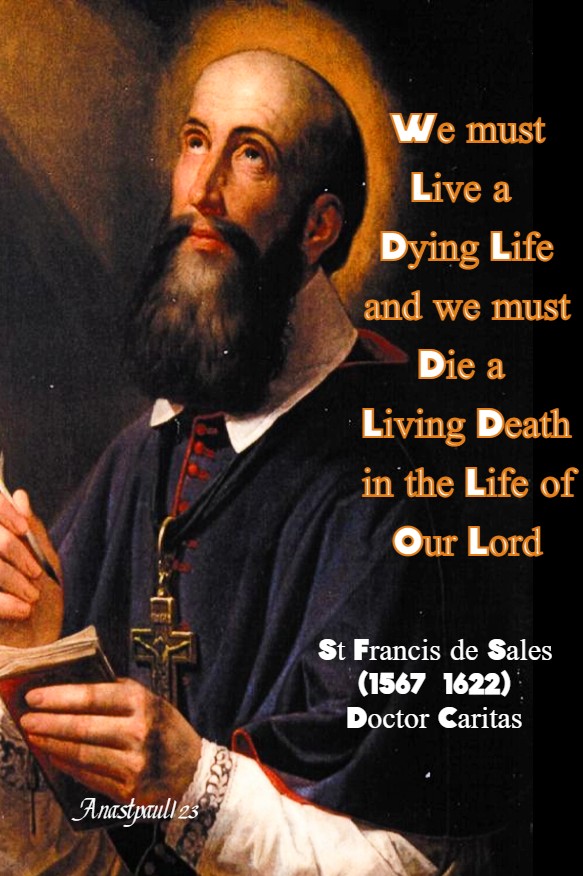
We must live a dying life
and we must die a living death
in the life of our Lord
.”
(The Spirit of St. François de Sales, XV, 6 )

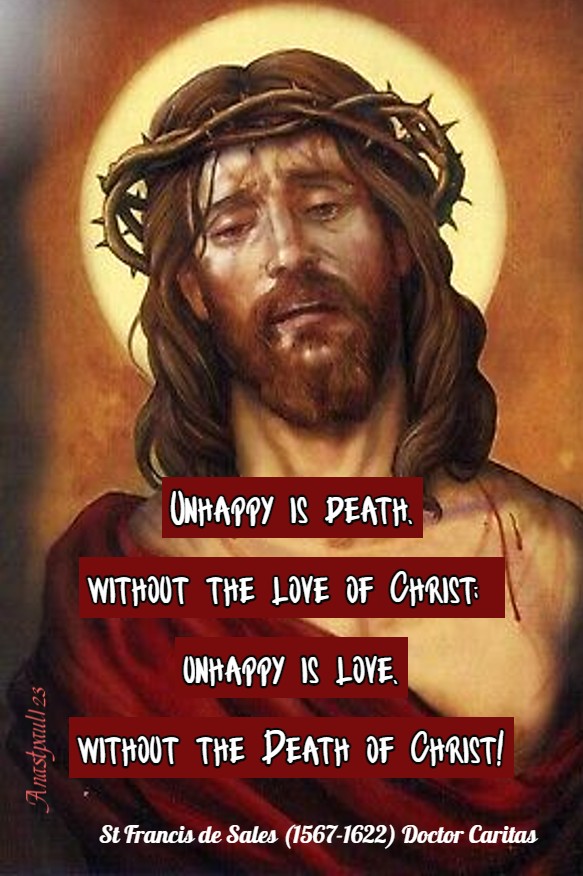
Unhappy is death,
without the love of Christ;
unhappy is love,
without the Death of Christ
!”

(Treatise on the Love of God,
Book 12, Chapter 13)

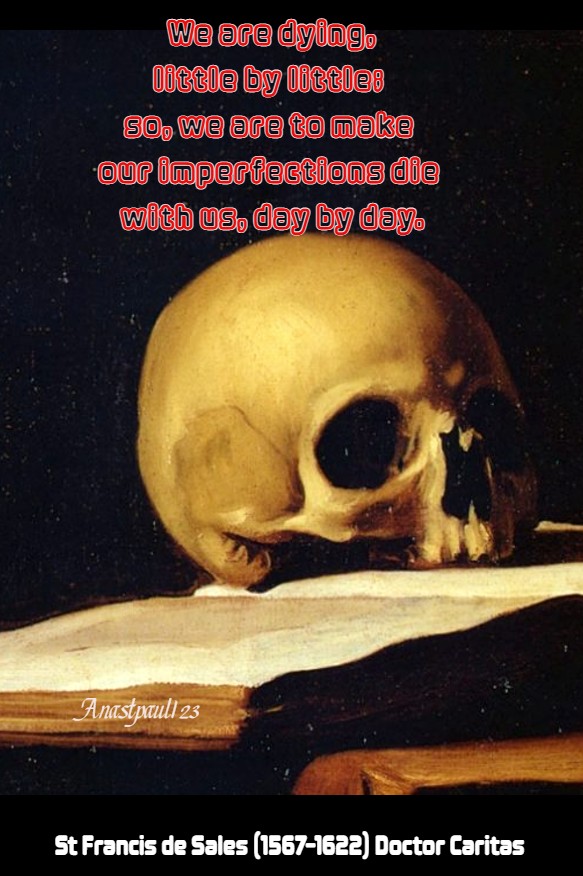
We are dying,
little by little;
so, we are to make
our imperfections die
with us, day by day. 

(Letters to Persons in the World I:5)

St Francis de Sales (1567-1622)
Doctor Caritas

Posted in LENT 2026, The PASSION, Thomas Aquinas

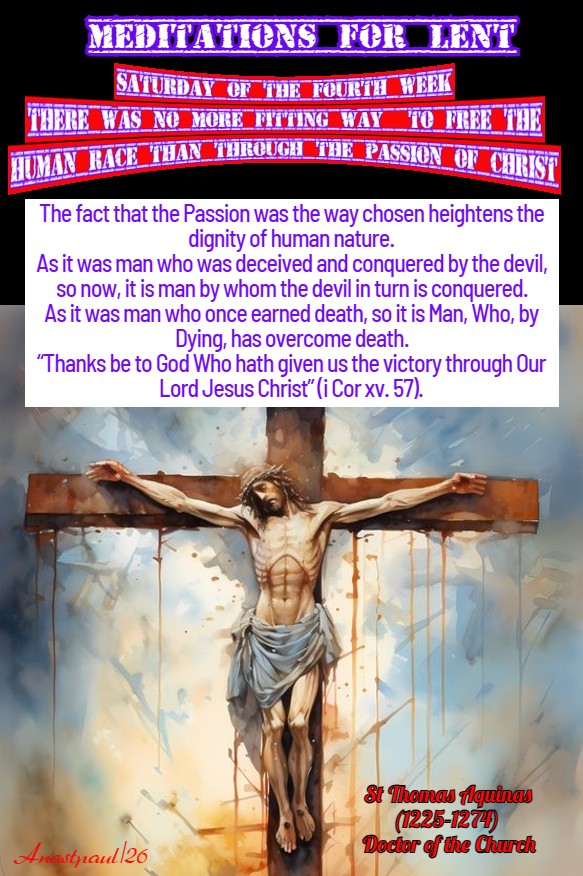
Saturday of the 4th Week of Lent – 21 March – Our Lenten Journey With St Thomas Aquinas – There was No More Fitting Way to Free the Human Race than Through the Passion of Christ

Saturday of the 4th Week of Lent – 21 March – Our Lenten Journey With St Thomas Aquinas (1225-1274) Doctor of the Church

Saturday of the Fourth Week
There was No More Fitting Way to Free the Human Race
than Through the Passion of Christ

“God commendeth His Charity towards us because, when as yet we were sinners, Christ died for us”
Rom v. 8

The suitability of any particular way, for the attainment of a given end, is reckoned according to the greater or lesser number of elements useful to that end which, the way in question brings about.
The more helpful to the end by the method chosen, the better and more suitable is that method or way.
Now owing to the fact that it was through the Passion of Christ that man was delivered, many other elements, helpful to man’s salvation, came about in addition to his being freed from sin.

(i) Thanks to the fact that it was through the Passion that man was delivered, man learns how much God Loves him and is, thereby stimulated to that love of God, in which is to be found the perfection of man’s salvation.
“God commendeth His Charity towards us because, when as yet we were sinners, Christ died for us” (Rom v. 8).
(ii) In the Passion He gave us an example of obedience, humility, constancy, justice and of other virtues also, all of which we must practise if we are to be saved.
“Christ suffered for us, leaving you an example that you should follow His Steps” (i Pet ii. 21).
(iii) Christ, by His Passion, not only delivered man from sinbut also, merited for man, the grace which makes him acceptable to God and the glory of life with God for eternity.
(iv) The fact that it is through the Passion that man has been saved, impresses upon man the need of keeping himself free from sin.
Man has only to realise, t it was at the price of the Blood of Christ that he was bought from sin.
“You are bought by a great Price.
Glorify God and bear Him in your body” (i Cor vi. 20).
(v) The fact that the Passion was the way chosen heightens the dignity of human nature.
As it was man who was deceived and conquered by the devil, so now, it is man by whom the devil in turn is conquered.
As it was man who once earned death, so it is Man, Who, by Dying, has overcome death.
“Thanks be to God Who hath given us the victory through Our Lord Jesus Christ” (i Cor xv. 57).

ST THOMAS AQUINAS (1225-1274)
Priest, Theologian, Dominican
Doctor Angelicus (Angelic Doctor)
Doctor Communis (Common Doctor)

Added by Pope Saint Pius V in 1568
Posted in CARMELITES, LENT, LENT 2026, Our MORNING Offering, PRAYERS of the SAINTS, QUOTES on REPARATION/EXPIATION

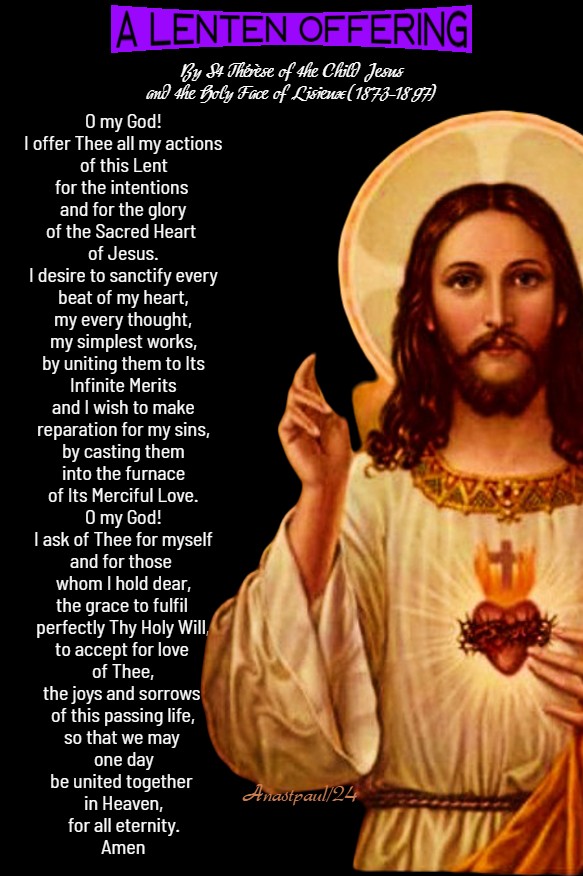
Our Morning Offering – 21 March – A Lenten Offering

Our Morning Offering – 21 March – Thursday in Passion Week

A Lenten Offering
By St Thérèse of the Child Jesus
and the Holy Face of Lisieux (1873-1897)

O my God!
I offer Thee all my actions of this Lent
for the intentions and for the glory
of the Sacred Heart of Jesus.
I desire to sanctify every beat of my heart,
my every thought,
my simplest works,
by uniting them to Its Infinite Merits
and I wish to make reparation for my sins,
by casting them into the furnace
of Its Merciful Love.
O my God!
I ask of Thee for myself
and for those whom I hold dear,
the grace to fulfil perfectly Thy Holy Will,
to accept for love of Thee,
the joys and sorrows of this passing life,
so that we may one day
be united together in Heaven,
for all eternity.
Amen

Posted in LENT 2026, ORIGINAL SIN, QUOTES on DEATH, QUOTES on SIN, Thomas Aquinas

Thursday of the 4th Week of Lent –19 March – Our Lenten Journey With St Thomas Aquinas – The Death of Lazarus

Thursday of the 4th Week of Lent –19 March – Our Lenten Journey With St Thomas Aquinas (1225-1274) Doctor of the Church

Thursday of the Fourth Week
The Death of Lazarus

Lazarus our friend, sleepeth
John xi. 11

Our friend, for the many benefits and services he rendered us and, therefore, we owe it, not to fail in his necessity. Sleepeth, therefore, we must come to his assistance; “a brother is proved in distress” (Prov xvii. 17).

He sleepeth, I say, as St Augustine says, to the Lord.
But to men he was dead, nor had they power to raise him.

Sleep is a word we use with various meanings.
We use it to mean natural sleep, negligence, blameworthy inattention, the peace of contemplation, the peace of future glory and, we use it also, to mean death.
We will not have you ignorant, concerning the last sleep, that you be not sorrowful, even as others who have no hope, says St Paul (i Thess. iv. 12).

Death is called sleep because of the hope of resurrection and so it has been customary to give death this name since the time when Christ Died and was Raised again, “I have Slept and have taken My rest”(Ps. iii. 6).
“I go that I may awake him out of sleep” (John xi. n).

In these words, Jesus gives us to understand that He could raise Lazarus from the tomb as easily as we raise a sleeper from his bed.
Nor is this to be wondered at, for He is none other than the Lord Who raiseth up the dead and giveth life (John v. 21). And hence, He is able to say, “The hour ccmeth when all who are in the graves, shall hear the Voice of the Son of God (ibid. v. 28).

“Let us go to Him” (John xi. 15).

Here it is the mercifulness of God which we are shown.
Men, living in sin and, as it were, dead, unable by any power of their own to come to Him, He mercifully draws them, anticipating their desire and need.
Jeremias speaks of this when he says, “Thus saith the Lord, I have Loved thee with an Everlasting Love, therefore, have I drawn thee, taking pity on thee”(Jer. xxxi. 3).

“Jesus, therefore, came and found, he had been in the grave, four days already” (John xi. 17).

St Augustine sees in the four day dead Lazarus, a figure of the fourfold spiritual death of the sinner.
He dies, in fact, through Original Sin, through actual sin, against the natural law, through actual sin against the written law, through actual sin against the law of the Gospel and of Grace.

Another interpretation is that the first day represents the sin of the heart, “Take away the evil of your thoughts” says Isaias (i. 16); the second day represents sins of the tongue, “Let no evil speech proceed from your mouth” says St Paul (Eph iv. 29); the third day represents the sins of evil action, “Cease to act perversely” (Isaias i. 16); the fourth day represents the sins of wicked habit.

Whatever explanation we give, Our Lord at times does heal those who are four days dead, i.e, those who have broken the law of the Gospel and are bound fast by habits of sin.

ST THOMAS AQUINAS (1225-1274)
Priest, Theologian, Dominican
Doctor Angelicus (Angelic Doctor)
Doctor Communis (Common Doctor)
Added by Pope Saint Pius V in 1568
Posted in "Follow Me", GOD ALONE!, LENT 2026, QUOTES for CHRIST, QUOTES on FRIENDSHIP, QUOTES on LOVE of GOD, Thomas Aquinas

Wednesday of the Fourth Week of Lent – 18 March – Our Lenten Journey With St Thomas Aquinas – The Divine Friend

Wednesday of the Fourth Week of Lent –18 March – Our Lenten Journey With St Thomas Aquinas (1225-1274) Doctor of the Church

Wednesday of the Fourth Week
The Divine Friend

His sisters sent to Him saying :
Lord, behold, he whom Thou lovest, is ill.”

John xi. 3

Three things here call for thought.

  1. God’s friends are afflicted from time to time in the body.
    It is not, therefore, in any way a proof that a man is not a friend of God if he is ill and ailing.
    Eliphaz argued falsely against Job when he said, “Remember, I pray thee, who ever perished being innocent?or when were the just destroyed?” (Job iv. 7).

The Gospel corrects this when it says, “Lord, behold, he whom Thou lovest is ill” and the Book of Proverbs, too, where we read, “For whom the Lord loveth, He chastiseth and as a father in the son, He pleaseth Himself” (Prov. iii. 12).

  1. The sisters do not say, “Lord, come and heal him.”
    They merely explain that Lazarus is ill, they say, he is sick. This is to remind us that, when we are dealing with a friend, it is enough to make known our necessity, we do not need to add a request.
    For a friend, since he wills the welfare of his friend, as he wills his own, is as anxious to ward off evil from his friend as he is to ward it off from himself.
    This is true, most of all in the case of Him Who, of all friends, Loves most truly.
    “The Lord keepeth all those who love Him”(Ps cxliv. 20).
  2. These two sisters, who so greatly desire the cure of their ill brother, do not come to Christ personally, as did the centurion and the man ill of the palsy.
    From the special Love and familiarity which Christ had shown them, they had a special confidence in Him.
    And, possibly, their grief kept them at home, as St Chrysostom thinks.
    “A friend, if he continue steadfast, shall be to thee, as thyself, and shall act with confidence among those of thy household” (Ecclus vi. 11).

ST THOMAS AQUINAS (1225-1274)
Priest, Theologian, Dominican
Doctor Angelicus (Angelic Doctor)
Doctor Communis (Common Doctor)
Added by Pope Saint Pius V in 1568

Posted in "Follow Me", CHRIST, the WAY,TRUTH,LIFE, LENT 2026, QUOTES on DEATH, QUOTES on the CROSS of CHRIST, The HOLY CROSS, The PASSION, Thomas Aquinas

Tuesday of the 4th Week of Lent –16 March – Our Lenten Journey With St Thomas Aquinas – The Example of Christ Crucified

Tuesday of the 4th Week of Lent –16 March – Our Lenten Journey With St Thomas Aquinas (1225-1274) Doctor of the Church

Tuesday of the Fourth Week
The Example of Christ Crucified

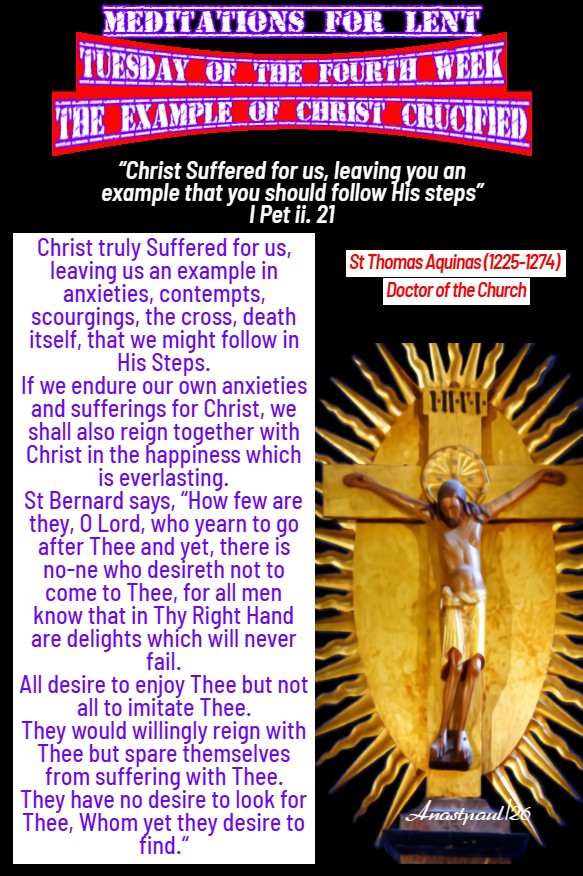
Christ Suffered for us, leaving you an example that you should follow His steps”
I Pet ii.
21

Christ assumed human nature in order to restore fallen humanity.
He had, therefore, to Suffer and to execute, according to human nature, all which could serve as a remedy against the sin of the fall.

Man’s sin consists in this – that he so cleaves to bodily goods that he neglects what is good spiritually.
It was, therefore, necessary for the Son of God to show this in the humanity He had taken, through all He did and Suffered, so that men should repute temporal things, whether good or evil, as nothing, for otherwise, hindered by an exaggerated affection for them, they would be less devoted to spiritual things.

Christ, therefore, chose poor people for His Parents, people nevertheless, perfect in virtue, so that none of us should glory in the mere rank or wealth of our parents.

He led the life of a poor man, to teach us to set no store by wealth.

He lived the life of an ordinary man, without any rank, to wean men from an undue desire for honours.

Toil, thirst, hunger, the aches of the body, all these He endured, to encourage men, whom pleasures and delights attract, not to be deterred from virtue by the austerity a good life entails.

He went as far as to endure even Death, lest the fear of death might at any time tempt man to abandon the Truth.
And lest any of us might dread to die, even a shameful death for the Truth, He chose to Die by the most Accursed Death of all, by Crucifixion.

That the Son of God, made man, should Suffer Death was also fitting for this reason – by His example, He stimulates our courage and so, makes true what St Peter said, “Christ Suffered for us, leaving you an example that you should follow His steps” (I Pet ii. 21).

Christ truly Suffered for us, leaving us an example in anxieties, contempts, scourgings, the cross, death itself, that we might follow in His Steps.
If we endure our own anxieties and sufferings for Christ, we shall also reign together with Christ in the happiness which is everlasting.
St Bernard says, “How few are they, O Lord, who yearn to go after Thee and yet, there is no-ne who desireth not to come to Thee, for all men know that in Thy Right Hand are delights which will never fail.
All desire to enjoy Thee but not all to imitate Thee.
They would willingly reign with Thee but spare themselves from suffering with Thee.
They have no desire to look for Thee, Whom yet they desire to find.

ST THOMAS AQUINAS (1225-1274)
Priest, Theologian, Dominican
Doctor Angelicus (Angelic Doctor)
Doctor Communis (Common Doctor)

Posted in LENT 2026, QUOTES on MERIT, The PASSION, Thomas Aquinas

Monday of the 4th Week of Lent –16 March – Our Lenten Journey With St Thomas Aquinas – Christ, by His Passion, Merited to be Exalted

Monday of the 4th Week of Lent –16 March – Our Lenten Journey With St Thomas Aquinas (1225-1274) Doctor of the Church

Monday of the 4th Week
Christ, by His Passion, Merited to be Exalted

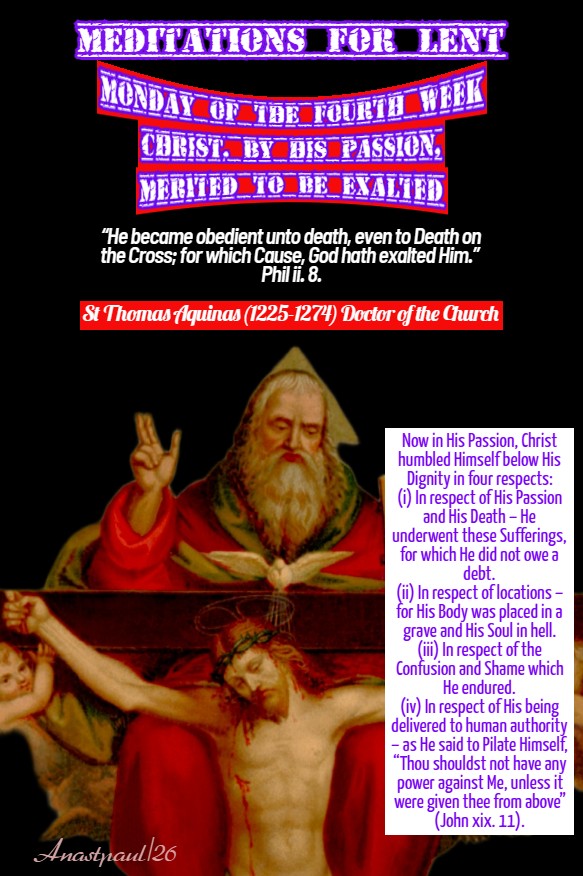
“He became obedient unto death, even to Death on the Cross; for which Cause, God hath exalted Him.
Phil ii. 8.

Merit implies a certain equality of justice.
Thus, St Paul says, “To him who worketh, the reward is reckoned according to debt”(Rom iv. 4).

Now, since a man who commits an injustice takes for himself more than is due to him, it is just that he suffer loss even in what is actually due to him.
If a man steals one sheep, he shall give back four as it says in Holy Scripture (Exod xxii. i).
And this is said to be merited, inasmuch as in this way the man’s evil will is punished.
In the same way, the man who acts with such justice that he take less than what is due to him, merits that more shall be generously added to what he has, as a reward for his just will .
So, for instance, the Gospel tells us, “he who humbleth himself shall be exalted” (Luke xiv. 11).

Now in His Passion, Christ humbled Himself below His Dignity in four respects:
(i) In respect of His Passion and His Death – He underwent these Sufferings, for which He did not owe a debt.
(ii) In respect of locations – for His Body was placed in a grave and His Soul in hell.
(iii) In respect of the Confusion and Shame which He endured.
(iv) In respect of His being delivered to human authority – as He said to Pilate Himself, “Thou shouldst not have any power against Me, unless it were given thee from above” (John xix. 11).

Therefore, on account of His Passion, He Merited a fourfold Exaltation.
(i) A glorious Resurrection.
It is said in the Psalm (Ps cxxxviii. 1), “Thou hast known My Sitting down that is, the humiliation of My Passion and My Rising up.”
(ii) An Ascension into Heaven.

Whence it is said, “He Descended first into the lower parts of the earth – He who Descended is the same Who Ascended above all the heavens” (Eph iv. 9, 10).
(iii) To be seated at the Right Hand of the Father, with His Divinity made manifest.
Isaias says, He shall be Exalted and Extolled, and shall be exceeding high. As many have been astonished at thee, so shall His visage be inglorious among men and St Paul says, “He became obedient unto Death, even to the Death on the Cross. For which Cause God hath Exalted Him and hath given Him a Name which, is above all names” (Phil ii. 8, 9) that is to say, He shall be named God by all and all shall pay Him reverence as God.
And this is why St Paul adds,“In the Name of Jesus every knee should bow, of those who are in Heaven, on earth, and under the earth” (ibid. x).
(iv) A Power of Judgement.
For it is said, “Thy Cause hath been judged as that of the wicked. Cause and judgement thou shalt recover” (Job xxxvi. 17).

ST THOMAS AQUINAS (1225-1274)
Priest, Theologian, Dominican
Doctor Angelicus (Angelic Doctor)
Doctor Communis (Common Doctor)
Added by Pope Saint Pius V in 1568
Posted in LENT 2026, QUOTES on HEAVEN, The PASSION, Thomas Aquinas

LAETARE – The 4th SUNDAY of Lent –15 March – Our Lenten Journey With St Thomas Aquinas – Christ, by His Passion, Opened the Gates of Heaven

LAETARE – The 4th SUNDAY of Lent –15 March – Our Lenten Journey With St Thomas Aquinas (1225-1274)
Doctor of the Church

The Fourth (LAETARE) Sunday
Christ, by His Passion, Opened, the Gates of Heaven

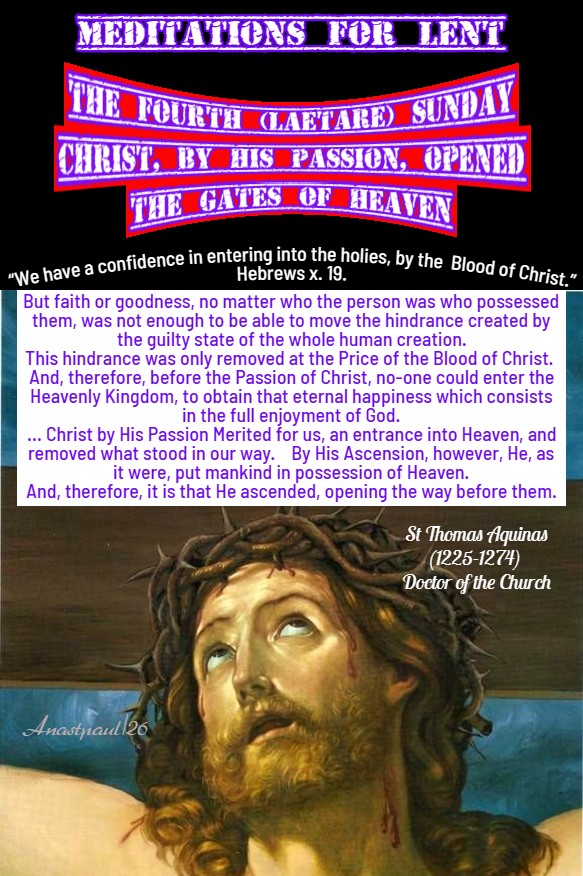
“We have a confidence in the entering into the holies by the Blood of Christ.”
Hebrews x. 19.

The closing of a gate is an obstacle hindering men’s entrance.
Now men are hindered by sin, from entrance to the Heavenly Kingdom, for Isaias says, “It shall be called the holy way, the unclean shall not pass over it”(Is xxxv. 8).

Now the sin which hinders man’s entrance into Heaven,is of two kinds.
There is, first of all, the sin of our first parents.
By this sin, access to the Kingdom of Heaven was barred to man.
We read in Genesis (iii. 24) that after the sin of our first parents God placed before the paradise of pleasure, Cherubim and a flaming sword, turning every way, to protect the way of the tree of life.
The other kind of hindrance arises from the sins of each individual, the sins each man commits by his own particular action.

By the Passion of Christ, we are freed not only from the sin common to all human nature and this both as to the sin and as to its appointed penalty, since Christ Pays the Price on our behalf but too, we are delivered from our personal sins if we are numbered among those who are linked to the Passion by faith, by charity and by the Sacraments of the Faith.
Thus, it is that through the Passion of Christ the Gates of Heaven are thrown open to us.
And hence, St Paul says that Christ, being a High Priest of the good things to come, by His Own Blood entered once into the holies, having obtained a redemption which is eternal (Heb ix. 11).

And this was foreshadowed in the Old Testament, where we read (Num xxxv. 25, 28), the Man-slayer shall abide there, that is, in the City of Refuge, until the Death of the High Priest, Who is anointe with holy oil. And after He is Dead, then shall the Man-slayer return to His own cCuntry.

The holy fathers who (before the coming of Christ) wrought works of justice earned their entrance into Heaven through faith in the Passion of Christ, as is written, “The saints, by faith, conquered kingdoms, wrought justice” (Heb xi. 33).
By faith, too, it was that individuals were cleansed from the sins they had individually committed.
But faith or goodness, no matter who the person was who possessed them, was not enough to be able to move the hindrance created by the guilty state of the whole human creation.
This hindrance was only removed at the Price of the Blood of Christ.
And, therefore, before the Passion of Christ, no-one could enter the Heavenly Kingdom, to obtain that eternal happiness which consists in the full enjoyment of God.

Christ by His Passion Merited for us, an entrance into Heaven, and removed what stood in our way.
By His Ascension, however, He, as it were, put mankind in possession of Heaven.
And, therefore, it is that He ascended, opening the way before them.

ST THOMAS AQUINAS (1225-1274)
Priest, Theologian, Dominican
Doctor Angelicus (Angelic Doctor)
Doctor Communis (Common Doctor)
Added by Pope Saint Pius V in 1568
Posted in DIVINE Mercy, Goodness, Patience, HYMNS, JULY - The MOST PRECIOUS BLOOD, LENT 2026, Our MORNING Offering, QUOTES on SIN, QUOTES on the CROSS of CHRIST, The HOLY CROSS, The MOST PRECIOUS BLOOD, The PASSION

Our Morning Offering – 15 March – God of Mercy and Compassion

Our Morning Offering – 15 March – Laetare Sunday / The Fourth Sunday in Lent

God of Mercy and Compassion
By Giovanni Battista Pergolesi (1710-1736)
Composer

God of mercy and compassion,
Look with pity upon me,
Father, let me call Thee Father,
‘Tis Thy child returns to Thee.

Refrain:
Jesus, Lord, I ask for mercy.
Let me not implore in vain,
All my sins, I now detest them,
Never will I sin again.

By my sins I have deserved
Death and endless misery,
Hell with all its pains and torments,
And for all eternity.
(Refrain)

By my sins I have abandoned
Right and claim to heav’n above.
Where the Saints rejoice forever
In a boundless sea of love.
(Refrain)

See our Saviour, bleeding, dying,
On the cross of Calvary;
To that Cross my sins have nail’d Him,
Yet He bleeds and dies for me.
(Refrain)

Posted in LENT 2026, The PASSION

Saturday of the Third Week of Lent – 14 March – Our Lenten Journey With St Thomas Aquinas – The Passion of Christ Reconciles us to God

Saturday of the Third Week of Lent –14 March – Our Lenten Journey With St Thomas Aquinas (1225-1274) Doctor of the Church

Saturday of the Third Week
The Passion of Christ Reconciles us to God

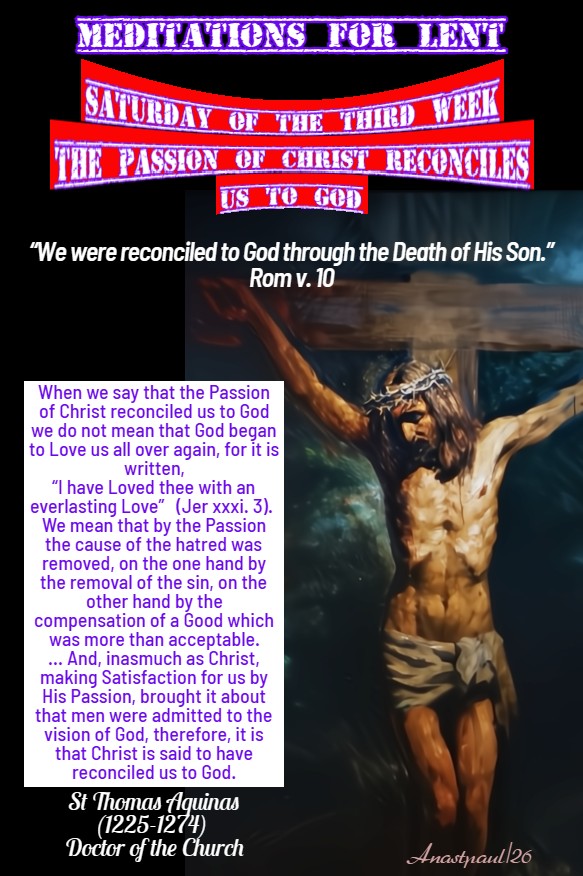
We were reconciled to God through the Death of His Son.” Rom v. 10

The Passion of Christ brought about our reconciliation to God in two ways.

  1. It removed the sin which had made the human race God’s enemy, as it says in Holy Scripture,
    “To God, the wicked and his wickedness are alike hateful” (Wis xiv. 9) and again, “Thou hatest all the workers of iniquity” (Ps. v. 7).

Secondly, the Passion was a sacrifice most acceptable to God.
It is in fact, the peculiar effect of sacrifice to be itself a method by which God is placated, just as a man remits offences done against him for the sake of some acknowledgment, pleasing to him which is made.
Whence it is said, “If the Lord stir thee up against me, let Him accept sacrifice” (1 Kings xxvi. 19).
Likewise, the voluntary Suffering of Christ was so good in itself that, for the sake of this good thing found in human nature, God was pleased beyond the totality of offences committed by all mankind, as far as concerns all those who are linked to Christ in His Suffering by faith and by charity.

When we say that the Passion of Christ reconciled us to God we do not mean that God began to Love us all over again, for it is written, “I have Loved thee with an everlasting Love” (Jer xxxi. 3).
We mean that by the Passion the cause of the hatred was removed, on the one hand by the removal of the sin, on the other hand by the compensation of a Good which was more than acceptable.

  1. As far as those who slew Our Lord were concerned,the Passion was indeed a cause of wrath.

But the Love of Christ Suffering, was greater than the wickedness of those who caused Him to Suffer.
And, therefore, the Passion of Christ was more powerful in reconciling to God the whole human race, than in moving God to anger.

God’s Love for us is shown by what it does for us.
God is said to Love some men because He gives them a share in His own Goodness, in that vision of His very Essence from which there follows this, that we live with Him, in His Company as His friends, for it is in that delightful condition that happiness (beatitude) consists.

God is then said to Love those whom He admits to that vision, either by giving them the vision directly or by giving them what will bring them to the vision as when he gives the Holy Ghost as a pledge of the vision.

It was from this sharing in the Divine Goodness, from this vision of God’s very Essence that man, by sin, had been removed and it is in this sense that we speak of man as deprived of God’s Love.

And, inasmuch as Christ, making Satisfaction for us by His Passion, brought it about that men were admitted to the vision of God, therefore, it is that Christ is said to have reconciled us to God.

ST THOMAS AQUINAS (1225-1274)
Priest, Theologian, Dominican
Doctor Angelicus (Angelic Doctor)
Doctor Communis (Common Doctor)
Added by Pope Saint Pius V in 1568
Posted in AUGUSTINIANS OSA, CONFESSION/PENANCE, DOCTORS of the Church, FATHERS of the Church, LENT 2026, QUOTES on FORGIVENESS, QUOTES on REPENTANCE, QUOTES on SIN, QUOTES on the DEVIL/EVIL

Quote/s of the Day – 14 March – From NOW on …

Quote/s of the Day – 14 March – Saturday of the 3rd Week in Lent – Ferial Day – Daniel 13:1-9,15-17,19-30,33-62 – John 8:1-11

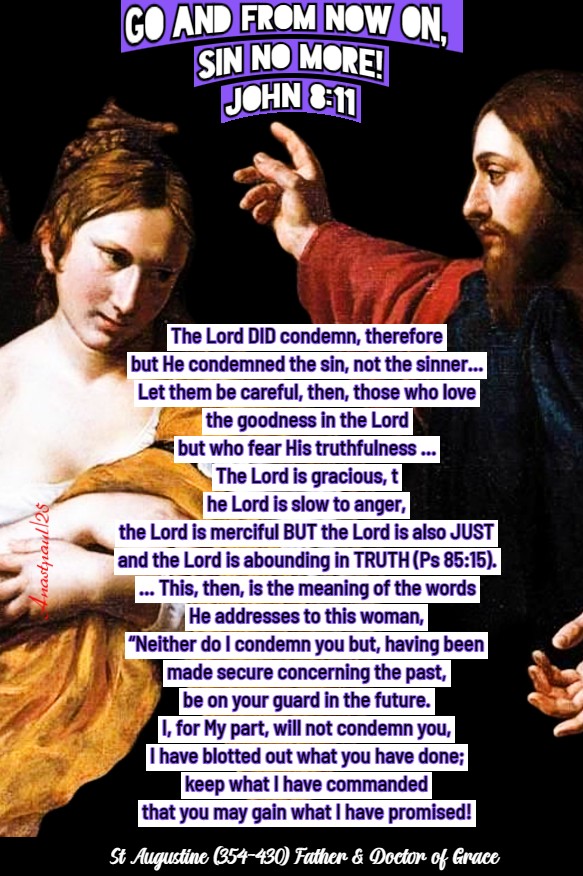
Go and from now on,
sin no more

John 8:11

The Lord did condemn, therefore
but He condemned the sin, not the sinner…
Let them be careful, then, those who love
the goodness in the Lord
but who fear His truthfulness …
The Lord is gracious, t
he Lord is slow to anger,
the Lord is merciful BUT the Lord is also JUST
and the Lord is abounding in TRUTH (Ps 85:15).
… This, then, is the meaning of the words
He addresses to this woman,
“Neither do I condemn you but, having been
made secure concerning the past,
be on your guard in the future.
I, for My part, will not condemn you,
I have blotted out what you have done;
keep what I have commanded
that you may gain what I have promised
!”

You do not know
when your last day may come.
You are an ingrate!
Why not use the day, today,
that God has given you
to repen
t?”

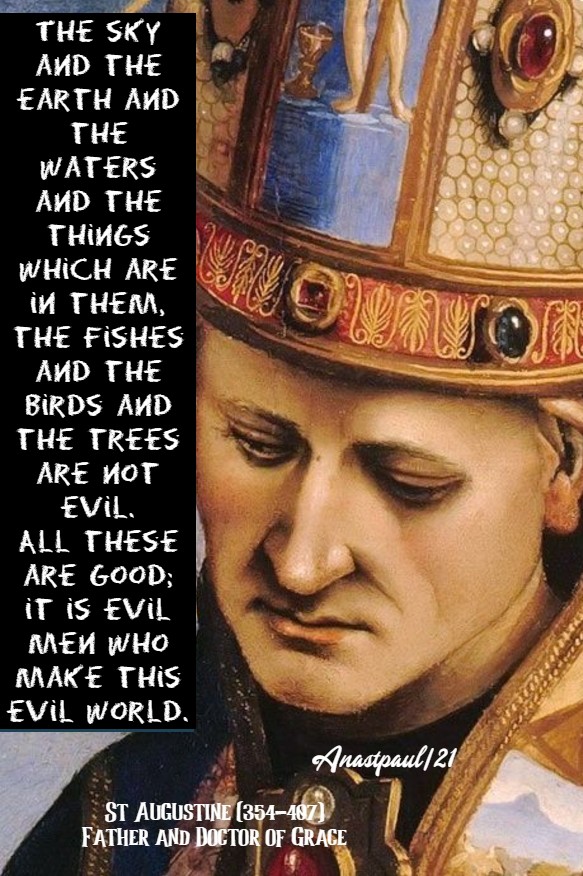
The sky and the earth and the waters
and the things which are in them, the fishes
and the birds and the trees are not evil.
All these are good;
it is evil men who make this evil world.

St Augustine (354-430)
Father & Doctor of Grace

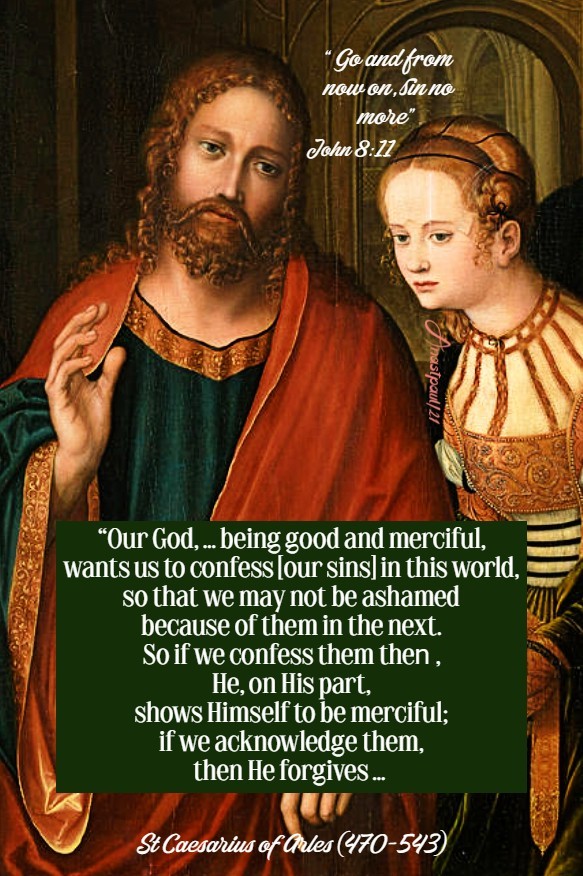
Our God, … being good and merciful,
wants us to confess [our sins] in this world,
so that we may not be ashamed
because of them in the next.
So if we confess them then,
He, on His part,
shows Himself to be merciful;
if we acknowledge them,
then He forgives
 … ”

St Caesarius of Arles (470-543)
Bishop and Monk

Posted in LENT 2026, QUOTES on HELL, QUOTES on SIN, QUOTES on THE MYSTICAL BODY, The PASSION, Thomas Aquinas

Friday of the Third Week of Lent –13 March – Our Lenten Journey With St Thomas Aquinas – It is by the Passion of Christ that we have been Freed from the Punishment Due to Sin

Friday of the Third Week of Lent –13 March – Our Lenten Journey With St Thomas Aquinas (1225-1274) Doctor of the Church

Friday of the Third Week
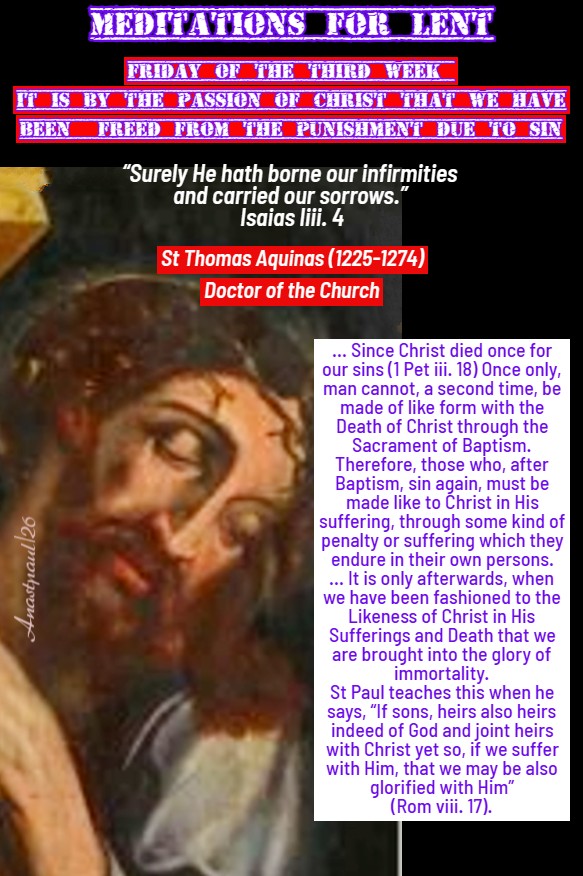
It is by the Passion of Christ that we have been
Freed from the Punishment Due to Sin

Surely He hath borne our infirmities
and carried our sorrows.

Isaias liii. 4.

By the Passion of Christ we are freed from the liability to be punished for sin with the punishment which sin calls for, in two ways, directly and indirectly.

We are freed directly ,inasmuch as the Passion of Christ made sufficient and more than sufficient Satisfaction for the sins of the whole human race.
Now once sufficient Satisfaction has been made, the liability to the punishment mentioned is destroyed.

We are freed indirectl, inasmuch as the Passion of Christ causes the sin to be remitted and, it is from the sin that the liability to the punishment derives.

Souls in hell, however, are not freed by the Passion of Christ because the Passion of Christ shares its effect with those to whom it is applied by faith and by charity and by the Sacraments of faith.
Therefore, the souls in hell, who are not linked to the Passion of Christ in the way just mentioned, cannot receive its effects thereof.

Now, although we are freed from liability to the precise penalty which sin deserves, there is, nevertheless, enjoined to the repentant sinner, a penalty or penance of satisfaction. For, in order that the effect of the Passion of Christ be fully achieved in us, it is necessary for us to be made of like form with Christ.
Now we are made of like form with Christ in Baptism by the Sacrament, as is said by St Paul, “We are buried together with Him by Baptism into death” (Rom vi. 4).
Whence it is, no penalty of satisfaction is imposed on those who are Baptised.
Through the Satisfaction made by Christ, they are wholly set free.
But since Christ died Once for our sins (1 Pet iii. 18) Once only, man cannot, a second time, be made of like form with the death of Christ through the Sacrament of Baptism. Therefore, those who, after Baptism, sin again, must be made like to Christ in His suffering, through some kind of penalty or suffering which they endure in their own persons.

If death which is a penalty due to sin, continues to subsist, the reason is this: The Satisfaction made by Christ produces its effect in us, insofar as we are made of One Body with Him, in the way limbs are One Body with the Head.
Now it is necessary that the limbs be made to conform to the head. Wherefore since Christ at first had, together with the Grace in His Soul, a liability to Suffer in His Body and came to His glorious immortality through the Passion, so also should it be with us, who are His Limbs. By the Passion we are indeed delivered from any punishment as a debt applied to us but, we are delivered in such a way that it is in the soul we first receive the spirit of the adoption of sons, by which we are added to the list for the inheritance of eternal glory, while we still retain a body which an suffer and die.

It is only afterwards, when we have been fashioned to the Likeness of Christ in His Sufferings and Death that we are brought into the glory of immortality.
St Paul teaches this when he says, “If sons, heirs also heirs indeed of God and joint heirs with Christ yet so, if we suffer with Him, that we may be also glorified with Him” (Rom viii. 17).

ST THOMAS AQUINAS (1225-1274)
Priest, Theologian, Dominican
Doctor Angelicus (Angelic Doctor)
Doctor Communis (Common Doctor)
Added by Pope Saint Pius V in 1568

Posted in "Follow Me", CHRIST the LIGHT, CHRIST the WORD and WISDOM, CHRIST, the WAY,TRUTH,LIFE, LENT 2026, The WORD, Thomas Aquinas

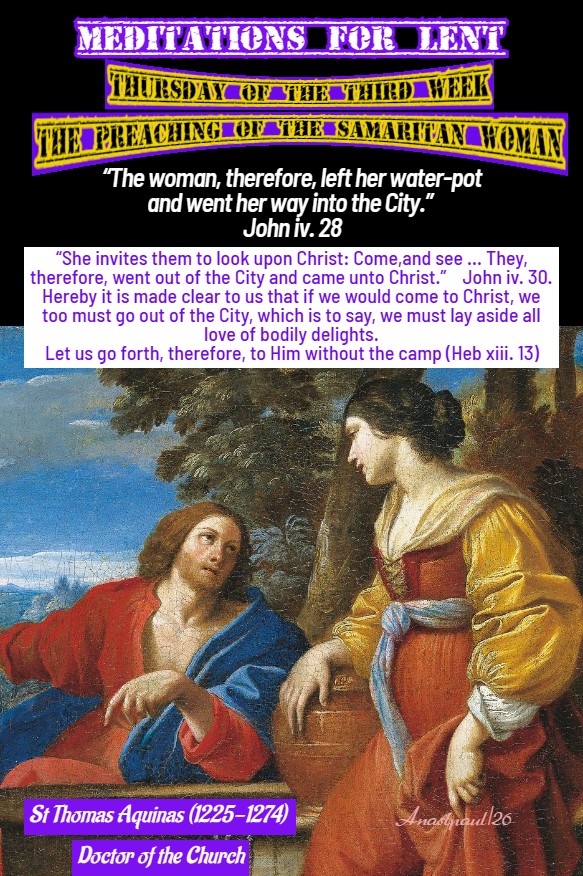
Thursday of the Third Week of Lent – 12 March – Our Lenten Journey With St Thomas Aquinas – The Preaching of the Samaritan Woman

Thursday of the Third Week of Lent – 12 March – Our Lenten Journey With St Thomas Aquinas (1225-1274) Doctor of the Church

Thursday of the Third Week
The Preaching of the Samaritan Woman

The woman, therefore, left her water-pot
and went her way into the City.

John iv. 28.

This woman, once Christ had instructed her, became an apostle.
There are three elements which we can gather from what she said and what she did.

  1. The entirety of her surrender to Our Lord.
    This is shown:

(i) From the fact that she left lying there, almost as if forgotten that for which she had come to the well, the water and the water-pot. So great was her absorption.
Hence it is said, The woman left her water-pot and went away into the city, went away to announce the wonderful works of Christ. She cared no longer for the bodily comforts, in view of the usefulness of better things, following in this, the example of the Apostles of whom it is said, “Leaving their nets, they followed the Lord” (Mark 1. 18).

The water-pot represents fashionable desire, by means of which men draw up pleasures from those depths of darkness, signified by the well, i.e. from practices which are of the earth.
Those who abandon such desires for the sake of God, are like the woman who left her water-pot.

(ii) From the multitude to whom she tells the news, not to one nor to two or three but to a whole City.
This is why she went away into the City.

  1. A method of preaching.
    “She saith to the men there: Come, and see a Man Who has told me all things whatsoever I hav done. Is not He the Christ?” John iv. 29.

(i) She invites them to look upon Christ: Come,and see a Man–she did not straightway say that they should give themselves to Christ, for that might have been for them an occasion for blasphemy but, to begin, she told them about Christ facits which were believable and open to observation. She told them He was a Man.
Nor did she say, Believe but come and see, for she knew that if they, too, tasted of that well, looked upon Our Lord, they, too, would feel all she had felt.
And she follows the example of a true preacher in that she attracts the men not to herself but, to Christ!

(ii) She gives them a hint that Christ is God when she says, A Man Who has told me all things whatsoever I have done, that is to say, how many husbands she had had. She is not ashamed to bring up facits which make for her own confusion because the soul, once it is aliight with the Divine Fire, in no way looks to earthly values and standards, cares neither for its own glory nor its shame but only for that Flame which holds and consumes it.

(iii) She suggests that this proves the majesty of Christ, saying, Is not He the Christ?
She does not dare to assert that He is the Christ, lest she have the appearance of wishing to teach others and the others, irritated thereat, refuse to go out to Him.
Nor, on the other hand, does she leave the matter in silence but she puts it before them questioningly, as though she left it to their own judgment.
For this is the easiest of all ways of persuasion.

  1. The Fruit of Preaching.
    “She invites them to look upon Christ: Come,and see … They, therefore, went out of the City and came unto Christ.” John iv. 30.

Hereby it is made clear to us that if we would come to Christ, we too must go out of the City, which is to say, we must lay aside all love of bodily delights.

Let us go forth, therefore, to Him without the camp (Heb xiii. 13)

ST THOMAS AQUINAS (1225-1274)
Priest, Theologian, Dominican
Doctor Angelicus (Angelic Doctor)
Doctor Communis (Common Doctor)
Added by Pope Saint Pius V in 1568
Posted in LENT 2026, QUOTES on SUFFERING, The MOST HOLY REDEEMER, Our SAVIOUR, The PASSION, The REDEMPTION, Thomas Aquinas

Wednesday of the Third Week of Lent – 11 March – Our Lenten Journey With St Thomas Aquinas – The Price of Our Redemption

Wednesday of the Third Week of Lent – 11 March – Our Lenten Journey With St Thomas Aquinas (1225-1274) Doctor of the Church

Wednesday of the Third Week
The Price of Our Redemption

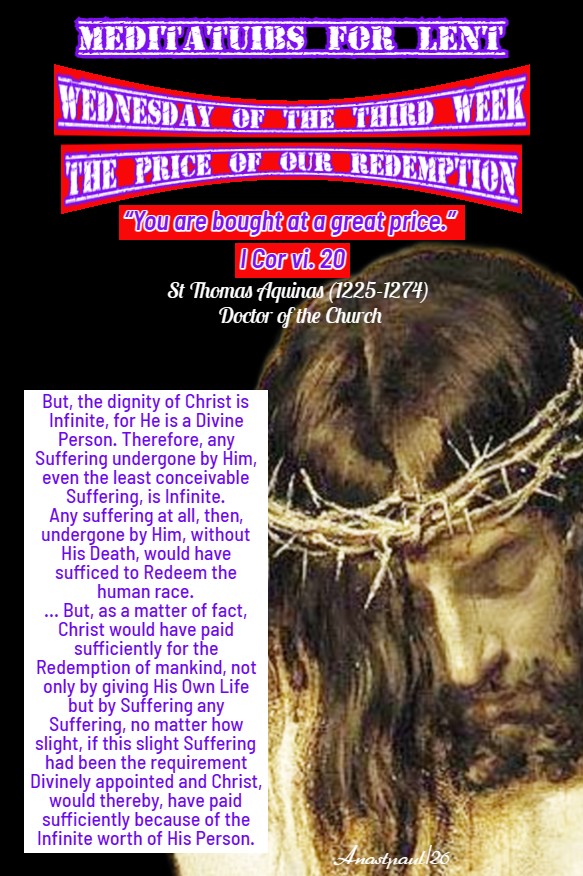
You are bought at a great price.”
I Cor vi. 20

The indignities and sufferings anyone suffers are measured according to the dignity of the person concerned.
If a King is struck in the face, he suffers a greater indignity than does a private person.
But, the dignity of Christ is Infinite, for He is a Divine Person. Therefore, any Suffering undergone by Him, even the least conceivable Suffering, is Infinite.
Any suffering at all, then, undergone by Him, without His Death, would have sufficed to Redeem the human race.

St Bernard says – the least drop of the Blood of Christ would have sufficed for the Redemption of us all.
And Christ could have shed that One Drop without Dying. Therefore, even without Dying He could, by some kind of Suffering, have Redeemed, that is, Bought Back, all mankind.

Now in any purchase, two elements are required, i.e. an amount equal to the price demanded and, the assigning of that amount to the purpose of buying.
For if a man gives a price which is not equal in value to the item to be purchased, we do not say that he has bought it but only that he has partly bought it and partly been given it.
For example, if a man buys, for ten shillings, a book worth twenty shillings, he has partly bought the book and it has, partly been donated to him.

… If, therefore, when we speak of the Redemption and Buying Back of the human race, we have, in view, the amount of the Price required, we must say that any Suffering undergone by Christ, even without His Death, would have sufficed because of the Infinite worth of His Person.
If, however, we speak of the Redemption with reference to the setting of the Price to the purpose in hand, we have then to say that no other Suffering of Christ less than His Death, was set by God and by Christ, as the Price to be paid for the Redemption of man kind.

And this was so for three reasons:

  1. That the Price of our Redemption should not only be Infinite in value but be of the same kind as what it bought, i.e., that it should be with a Death that He Bought us Back from death.
  2. That the Death of Christ would be not only the Price of our Redemption but too, an example of courage, so that men would not be afraid to die, for the Truth.
    St Paul makes mention of this and the preceding cause when he says, That, through death, He might destroy him who had the empire of death (this is the first cause) and might deliver them, who throug the fear of death were subject to servitude all their lifetime (this for the second cause) (Heb ii. 14, 15).
  3. That the Death of Christ might be a Sacrament to work our Salvation; we, that is, dying to sin, to bodily desires and to our own will through the power of the Death of Christ. These reasons are given by St Peter when he says, Christ who Died once for our sins, the Just for the unjust that He might offer us to God, being put to Death indeed in the flesh but enlivened in the spirit (1 Pet iii. 18).

And so it is that mankind has not been Redeemed by any other Suffering of Christ without His Death.

But, as a matter of fact, Christ would have paid sufficiently for the Redemption of mankind, not only by giving His Own Life but by Suffering any Suffering, no matter how slight, if this slight Suffering had been the requirement Divinely appointed and Christ, would thereby, have paid sufficiently because of the Infinite worth of His Person.

ST THOMAS AQUINAS (1225-1274)
Priest, Theologian, Dominican
Doctor Angelicus (Angelic Doctor)
Doctor Communis (Common Doctor)
Added by Pope Saint Pius V in 1568
Posted in LENT 2026, QUOTES on the ANTI-christ, QUOTES on the DEVIL/EVIL, The PASSION, Thomas Aquinas

Monday of the Third Week of Lent – 8 March – Our Lenten Journey With St Thomas Aquinas – The Passion of Christ has Delivered us from the devil.

Monday of the Third Week of Lent – 8 March – Our Lenten Journey With St Thomas Aquinas (1225-1274) Doctor of the Church

Monday of the Third Week
The Passion of Christ has Delivered us from the devil.

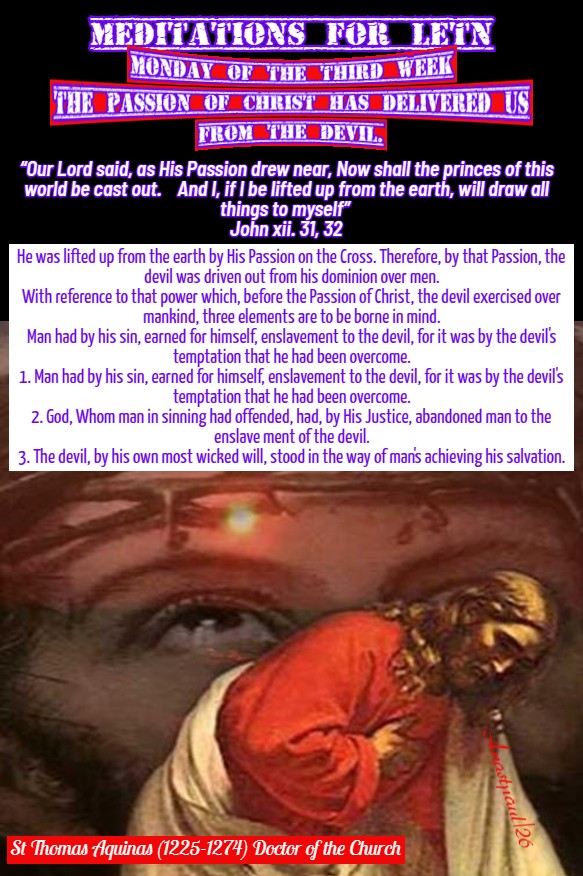
“Our Lord said, as His Passion drew near, Now shall the princes of this world be cast out.
And I, if I be lifted up from the earth, will draw all things to myself”
John xii. 31, 32

He was lifted up from the earth by His Passion on the Cross. Therefore, by that Passion, the devil was driven out from his dominion over men.

With reference to that power which, before the Passion of Christ, the devil exercised over mankind, three elements are to be borne in mind.

  1. Man had by his sin, earned for himself, enslavement to the devil, for it was by the devil’s temptation that he had been overcome.
  2. God, Whom man in sinning had offended, had, by His Justice, abandoned man to the enslave ment of the devil.
  3. The devil, by his own most wicked will, stood in the way of man’s achieving his salvation.

With regard to the first point, the Passion of Christ set man free from the devil’s power because the Passion of Christ brought about the forgiveness of sin.
As to the second point the Passion delivered man from the devil because it brought about a reconciliation between God and man. A
s to the third point, the Passion of Christ freed us from the devil’s power because, in his action during the Passion, the devil over-reached himself. He went beyond the limits of the power over men allowed to him by God, when he plotted the death of Christ, upon Whom, since he was without sin, there lay no debt payable by death.
Whence St Augustine s words, “The devil was overcome by the Justice of Christ. In Him the devil found nothing which deserved death but, nonetheless, he slew Him.
And, it was but just that those debtors who the devil detained, should go free since they believed in Him Whom, though He was under no bond to him, the devil had slain.”

The devil still continues to exercise a power over men.
He can, God permitting it, tempt them in soul and in body. There is, however, made available for man a remedy in the Passion of Christ, by means of which he can defend himself against these attacks, so that they do not lead him into the destruction of eternal death.
Likewise, all those, who before the Passion of Christ, resisted the devil had derived their power to resist from the Passion, although the Passion had not yet been accomplished.
But in one point, none of those who lived before the Passion had been able to escape the hand of the devil, namely, they all had to go down into hell, a thing from which, since the Passion, all men can, by His Power, defend them selves.

God also, allows the devil to deceive men in certain persons, times and places, according to the hidden character of His Designs.
Such, for example, will be anti-Christ.
But there always remains and, for the age of anti-Christ too, a remedy prepared for man through the Passion of Christ, a power of protecting himself against the wickedness of the devils.
The fact that there are some who neglect to make use of this remedy, does not lessen the efficacy of the Passion of Christ.

ST THOMAS AQUINAS (1225-1274)
Priest, Theologian, Dominican
Doctor Angelicus (Angelic Doctor)
Doctor Communis (Common Doctor)
Added by Pope Saint Pius V in 1568
Posted in LENT 2026, QUOTES on SIN, The PASSION, Thomas Aquinas

The Third Sunday of Lent – 8 March – Our Lenten Journey With St Thomas Aquinas – It is the Passion of Christ which has Freed Us from Sin

The Third Sunday of Lent – 8 March – Our Lenten Journey With St Thomas Aquinas (1225-1274) Doctor of the Church

The Third Sunday of Lent
It is the Passion of Christ
which has Freed Us from Sin

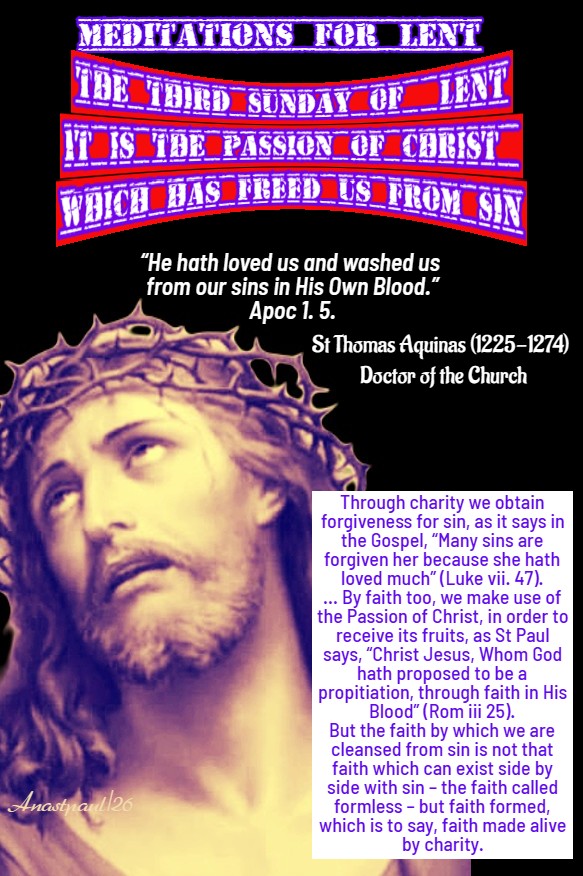
He hath loved us and washed us
from our sins in His Own Blood.

Apoc 1. 5.

The Passion of Christ is the proper Cause of the remission of our sins and that in three ways:

  1. Because it provokes us to love God. St Paul says, “God commendeth His Charity towards us because when, as yet we were sinners, Christ died for us” (Rom v. 8).

Through charity we obtain forgiveness for sin, as it says in the Gospel, “Many sins are forgiven her because she hath loved much” (Luke vii. 47).

2.The Passion of Christ is the Cause of the forgiveness of sins because it is an act of Redemption. Since Christ is Himself our Head, He has, by His Own Passion undertaken from Love and Obedience delivered us, His Members, from our sins, as it were, at the Price of His Passion.
Just as a man might, by some act of goodness undertaken with his hands, buy himself off for an error he had comitted with his feet.
For as man’s natural body is a unity, made up of different limbs, so the whole Church, which is the Mystical Body of Christ, is reckoned as a single person with its own Head and this Head is Christ.

3.The Passion of Christ was equal to its task.
For the Human Nature, through which Christ Suffered His Passion, is the instrument of His Divine Nature.
Whence all the actions and all the sufferings of that Human Nature wrought to drive out sin, are wrought by a Power which is Divine.

Christ, in His Passion, delivered us from our sins in a causal way, which is to say, He set up for us a Cause of our emancipation, a thing whereby any sin might, at any time, be remitted, whether committed now, or in times gone by, or in time to come: much as a physician might make a medicine from which all who are sick may be healed, even those sick in the years yet to come.

But since, what gives the Passion of Christ its excellence is the fact that it is the universal cause of the forgiveness of sins, it is necessary that we each of us ourselves make use of it for the forgiveness of our own particular sins. This is done through Baptism, Penance and the other sacraments, whose power derives from the Passion of Christ.

By faith too, we make use of the Passion of Christ, in order to receive its fruits, as St Paul says, “Christ Jesus, Whom God hath proposed to be a propitiation, through faith in His Blood” (Rom iii 25).
But the faith by which we are cleansed from sin is not that faith which can exist side by side with sin – the faith called formless – but faith formed, which is to say, faith made alive by charity.

So that the Passion of Christ is not through faith applied merely to our understanding but also, to our will. Again, it is from the Power of the Passion of Christ that the sins are forgiven which are forgiven by faith in this way.

ST THOMAS AQUINAS (1225-1274)
Priest, Theologian, Dominican
Doctor Angelicus (Angelic Doctor)
Doctor Communis (Common Doctor)
Added by Pope Saint Pius V in 1568
Posted in CHRIST the SUN of JUSTICE, LENT 2026, QUOTES on REPARATION/EXPIATION, QUOTES on SIN, QUOTES on the DEVIL/EVIL, The MOST HOLY REDEEMER, Our SAVIOUR, The PASSION, The REDEMPTION, Thomas Aquinas

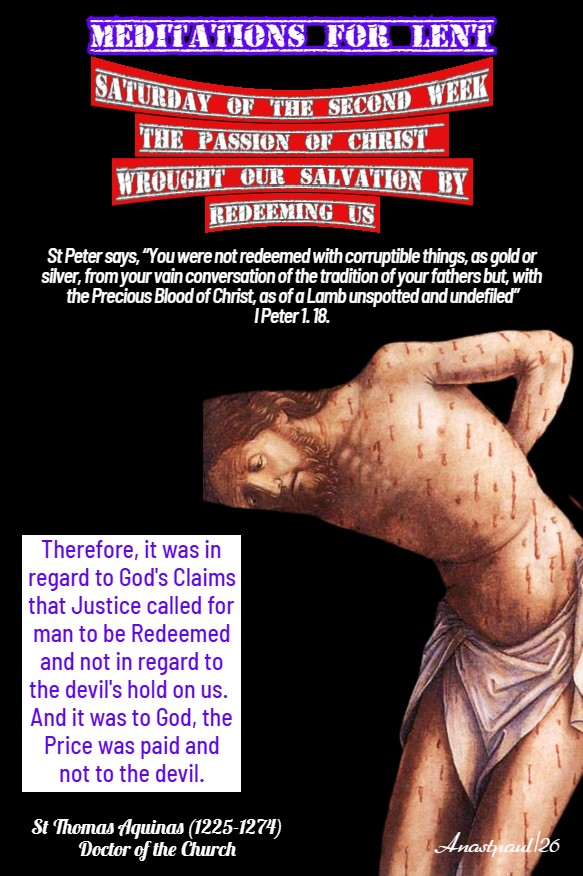
Saturday of the Second Week of Lent – 6 March – Our Lenten The Passion of ChristWrought our Salvation by Redeeming usJourney With St Thomas Aquinas –

Saturday of the Second Week of Lent – 6 March – Our Lenten Journey With St Thomas Aquinas (1225-1274) Doctor of the Church

Saturday of the Second Week
The Passion of Christ
Wrought our Salvation by Redeeming us

St Peter says, “You were not redeemed with corruptible things, as gold or silver, from your vain conversation of the tradition of your fathers but, with the Precious Blood of Christ, as of a Lamb unspotted and undefiled
I Peter 1. 18.

St.Paul says, “Christ hath Redeemed us from the curse of the law, being made a Curse for us“ (Gal iii. 13).
He is said to be accursed in our place, inasmuch as it was for us that He Suffered on the Cross. Therefore, by His Passion, He Redeemed us.

Sin, in fact, had bound man with a double obligation.

(i) An obligation which made him sin’s slave. For Jesus said, “whosoever committeth sin is the servant of sin” (John viii. 34).
A man is enslaved to whoever overcomes him.
Therefore, since the devil, in inducing man to sin, had overcome man, man was bound in servitude to the devil.

(ii) A further obligation existed, namely between man and the penalty due for the sin committed and man was bound in this way in accord with the Justice of God.
This too was a servitude, for to servitude or slavery, it belongs that a man must suffer, otherwise than he chooses, since the free man is the man who uses himself as he wills.

Since then, the Passion of Christ made sufficient and, more than sufficient, Satisfaction for the sins of all mankind and for the penalty due to them, the Passion was a Price through which we were freed from both these obligations.
For the satisfaction itself, by means of which, one makes satisfaction, whether for oneself or for another, is spoken of as a price by which one redeems or buys back oneself or another, from sin and from merited penalties.
So in Holy Scripture it is said, “Redeem thou thy sins with alms” (Dan iv. 24).

Christ made Satisfaction, not indeed by a gift of money or anything material but, by a gift which was the greatest of all, by giving Himself for us.
And thus it is that the Passion of Christ is called our Redemption.

By sinning man bound himself, not to God but to the devil.
As far as concerns the guilt of what he did, he had offended God and had made himself subject to the devil, assenting to the devil’s will.
Hence, he did not, by reason of the sin committed, bind himself to God but rather, deserting God’s Service, he had fallen under the yoke of the devil.
And God, with Justice if we remember the offence committed against Him, had not prevented this.

But, if we consider the matter of the punishment earned, it was chiefly and in the first place to God that man was bound, as to the Supreme Judge.
Man was, in respect of punishment, bound to the devil only in a lesser sense, as to the torturer, as it says in the Gospel, “Lest the adversary deliver thee to the Judge and the Judge deliver thee to the officer”(Matt v. 25) that is, to the cruel minister of punishments.

Therefore, although the devil unjustly, as far as was in his power, held man whom, by his lies he had deceived, bound in slavery, held him bound both on account of the guilt and of the punishment due for it, it was nevertheless just, that man should suffer in this way.
The slavery which he suffered on account of the evils committed which God did not prevent and, the slavery he suffered as punishment God decreed!

Therefore, it was in regard to God’s Claims that Justice called for man to be Redeemed and not in regard to the devil’s hold on us.
And it was to God, the Price was paid and not to the devil.

ST THOMAS AQUINAS (1225-1274)
Priest, Theologian, Dominican
Doctor Angelicus (Angelic Doctor)
Doctor Communis (Common Doctor)

Added by Pope Saint Pius V in 1568
Posted in DECEMBER - The DIVINE INFANCY and The IMMACULATE CONCEPTION, HOLY WEEK, IMMACULATE CONCEPTION Prayers and Novena, LENT 2026, QUOTES on CONSCIENCE, QUOTES on the CHURCH, The IMMACULATE CONCEPTION, The PASSION, The SEVEN PASSION Feasts, Thomas Aquinas

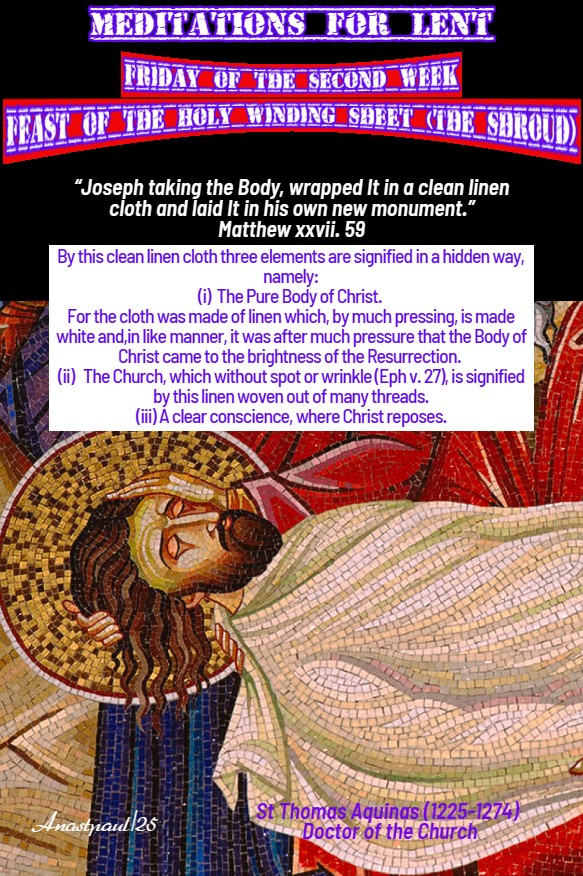
Friday of the Second Week of Lent – 6 March – Our Lenten Journey With St Thomas Aquinas – Feast of the Holy Winding Sheet (the Shroud)

Friday of the Second Week of Lent – 6 March – Our Lenten Journey With St Thomas Aquinas (1225-1274) Doctor of the Church

Friday of the Second Week
Feast of the Holy Winding Sheet (the Shroud)

Joseph taking the Body, wrapped It in a clean linen cloth and laid It in his own new monument.
Matthew xxvii. 59

By this clean linen cloth three elements are signified in a hidden way, namely:

(i) The Pure Body of Christ.
For the cloth was made of linen which, by much pressing, is made white and,in like manner, it was after much pressure that the Body of Christ came to the brightness of the Resurrection.
Thus it behoved Christ to Suffer and to Rise again from the dead on the third day (Luke xxiv. 46).

(ii) The Church, which without spot or wrinkle (Eph v. 27), is signified by this linen woven out of many threads.

(iii) A clear conscience, where Christ reposes.

And laid Him in his own new monument.
It was Joseph’s own grave and certainly it was appropriate that He Who had Died for the sins of others, should be buried in another man’s grave!

Notice that it was a new grave.
Had other bodies already been laid in it, there might have been a doubt which had arisen.
There is another fitness in this circumstance, namely – He Who was buried in this new tomb, as He who was born of a virgin mother.

As Mary’s womb knew no child before Him nor after Him, so was it with this tomb.
Again we may understand, it is in a renewed soul renewed where Christ is buried by faith, where Christ may dwell by faith in our hearts (Eph iii. 17).

St. John’s Gospel adds, Now there was in the place where He was crucified, a garden ; and in the garden a new sepulchre (John xix. 41). Which recalls to us that as Christ was taken in a garden and suffered His agony in a garden, so in a garden was He buried, and thereby we are reminded that it was from the sin committed by Adam in the garden of delightfulness that, by the power of His Passion, Christ set us free, and also that through the Passion the Church was consecrated, the Church which again is as a garden closed.

ST THOMAS AQUINAS (1225-1274)
Priest, Theologian, Dominican
Doctor Angelicus (Angelic Doctor)
Doctor Communis (Common Doctor)
Added by Pope Saint Pius V in 1568
Posted in LENT 2026, Our MORNING Offering, PRAYERS of the SAINTS, QUOTES on the CROSS of CHRIST, The HOLY CROSS, The PASSION

Our Morning Offering – 6 March – The Feast of the Holy Shroud of Jesus

Our Morning Offering – 6 March – The Feast of the Holy Shroud of Jesus

Faithful Cross! Above All Other
By St Venantius Fortunatus (c 530 – c 609)

Faithful Cross! above all other,
one and only noble tree!
None in foliage, none in blossom,
none in fruit thy peer may be;
sweetest wood and sweetest iron,
sweetest weight is hung on thee.

Bend thy boughs, O tree of glory!
Thy relaxing sinews bend;
for awhile the ancient rigour
that thy birth bestowed, suspend
and the King of heavenly beauty
gently on thine arms extend.

Praise and honour to the Father,
praise and honour to the Son,
praise and honour to the Spirit,
ever Three and ever One:
One in might and One in glory
while eternal ages run.

Posted in LENT 2026, QUOTES on SACRIFICE, The PASSION, Thomas Aquinas

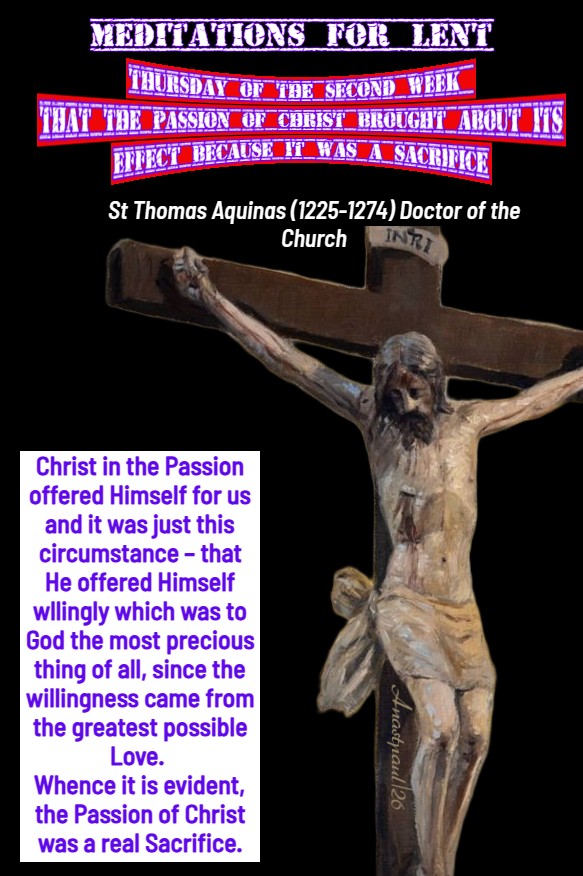
Thursday of the Second Week of Lent – 5 March – Our Lenten Journey With St Thomas Aquinas – That the Passion of Christ brought about its effect because it was a Sacrifice

Thursday of the Second Week of Lent – 5 March – Our Lenten Journey With St Thomas Aquinas (1225-1274) Doctor of the Church

Thursday of the Second Week
That the Passion of Christ brought about its effect
because it was a Sacrifice

A sacrifice, properly so called, is something done to render God the honour specially due to Him, in order to appease Him. St Augustine teaches this, saying, “Every work done in order that we may, in a holy union, cleave to God, is a true sacrifice; every work, that is to say, related to that final Good Whose possession alone can make us truly happy.”
Christ in the Passion offered Himself for us and it was just this circumstance – that He offered Himself wllingly which was to God the most precious thing of all, since the willingness came from the greatest possible Love. Whence it is evident, the Passion of Christ was a real Sacrifice.

And as He Himself adds later.
The former sacrifices of the saints were so many signs, of different kinds, of this One True Sacrifice. …
St Augustine speaks of four elements being found in every sacrifice, namely – Christ in the Passion offered Himself for us and it was just a person to whom the offering is made, one by whom it is made, the thing offered and those on whose behalf it is offered.
These are all found in the Passion of Our Lord. It is the same Person, the only, true Mediator Himself, Who through the sacrifice of peace reconciles us to God, yet remains One with Him to Whom He offers, those for whom He offers and is Himself One Who both offers and is offered.

It is true in those sacrifices of the old law which were types of Christ, human flesh was never offered but, it does not follow from this that the Passion of Christ was not a sacrifice.
For although the reality and that which typifies it must coincide in one point, it is not necessy that they coincide in every point, for the reality must go beyond that which typifies it.
It was then very fitting that the Sacrifice in which the Flesh of Christ is offered for us was typified by a sacrifice not of the flesh of man but of other animals, to fores-shadow the flesh of Christ which is the Most Perfect Sacrifice of all.

(i) Because, since it is the flesh of human nature which is offered, it is a thing fittingly offered for men and fittingly received by men in a Sacrament.

(ii) Because, since the Flesh of Christ was able to Suffer and to Die it was suitable for immolation.

(iii) Because, since that Flesh was itself without sin, it had a power to cleanse from sin.

(iv) Because, being the Flesh of the very Offerer, it was acceptable to God by reason of the unspeakable Love of the One Who was offering His Own Flesh.

Whence St Augustine says, “What is there more suitably received by men, of offerings made on their behalf, than human flesh and what is so suitable for immolation as mortal flesh? And what is as clean for cleansing mortal viciousness, as that flesh born, without stain of carnal desire, in the womb and of the womb of a virgin?
And what can be so graciously offered and received, as the Flesh of our Sacrifice, the Body so produced of our Priest?”

ST THOMAS AQUINAS (1225-1274)
Priest, Theologian, Dominican
Doctor Angelicus (Angelic Doctor)
Doctor Communis (Common Doctor)

Added by Pope Saint Pius V in 1568
Posted in AUGUSTINIANS OSA, CHRIST the WORD and WISDOM, DOCTORS of the Church, FATHERS of the Church, franciscan OFM, GOD ALONE!, LENT 2026, Of BEGGARS, the POOR, against POVERTY, QUOTES on ALMS, QUOTES on ETERNAL LIFE, QUOTES on GREED, WEALTH, QUOTES on HEAVEN, QUOTES on HUMILITY, QUOTES on SANCTITY, QUOTES on SUFFERING, QUOTES on the POOR, The HEART, The WORD

Quote/s of the Day – 5 March – ‘ … Give earth and receive Heaven! …’

Quote/s of the Day – 5 March – Ferial Day – Thursday of the Second Week in Lent – Jeremias 17:5-10 – Luke 16:19-31 – Scripture search here: https://www.drbo.org/

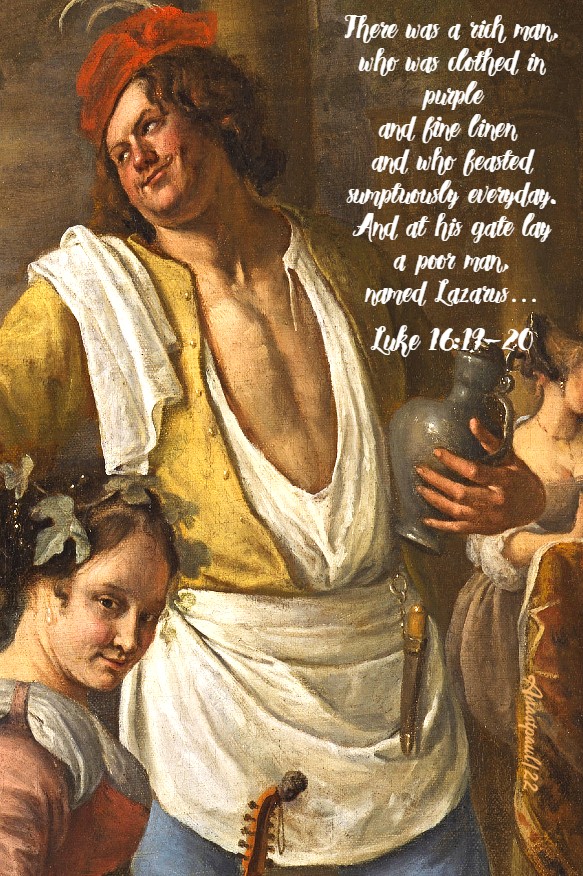
There was a rich man,
who was clothed in purple
and fine linen
and who feasted sumptuously everyday.
And at his gate lay a poor man,
named Lazarus
…”

Luke 16:19–20

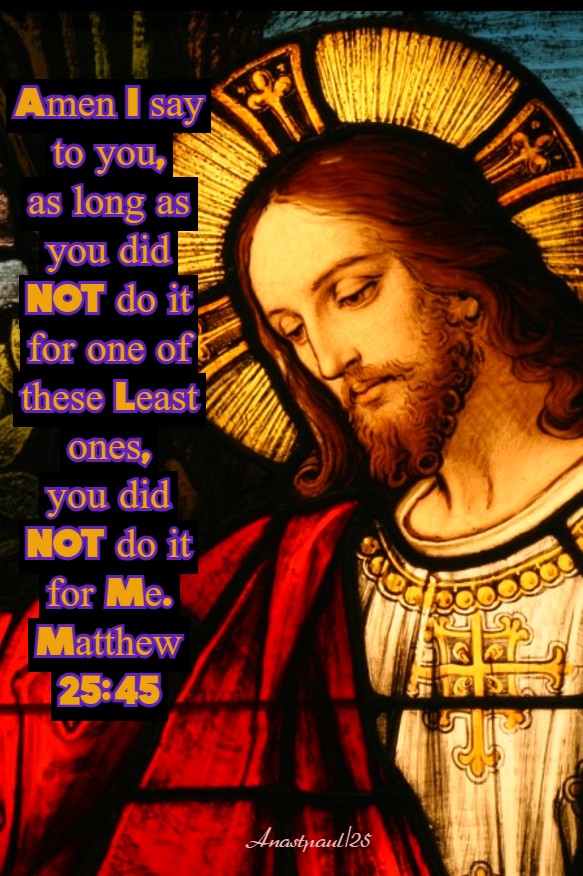
Amen I say to you,
as long as you did NOT do it
for one of these least ones,
you did NOT do it for Me.

Matthew 25:45

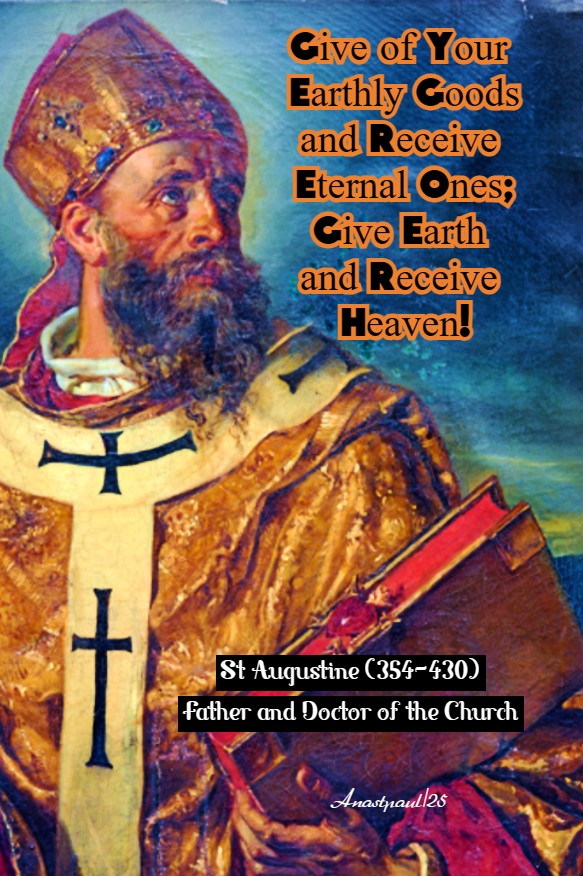
Give of your earthly goods
and receive eternal ones;
give earth and receive Heaven
!”

St Augustine (354-430)
Father and Doctor of the Church

What is a man’s treasure
but the heaping up of profits
and the fruit of his toil?
For, whatever a man sows,
this too will he reap and each man’s gain,
matches his toil and where delight
and enjoyment are found,
there the heart’s desire is attached.
Now, there are many kinds of wealth
and a variety of grounds for rejoicing –
every man’s treasure is that, which he desires.
If it is based on earthly ambitions,
its acquisition makes men not blessed but wretched.
… By distributing what might be superfluous
to support the poor, they are amassing
imperishable riches, so that what they have
discreetly given, cannot be subject to loss.
They have properly placed those riches,
where their heart is – it is a most blessed thing,
to work to increase such riches,
rather than to fear that they may pass away.

St Pope Leo the Great (400-461)
ather and Doctor of the Church

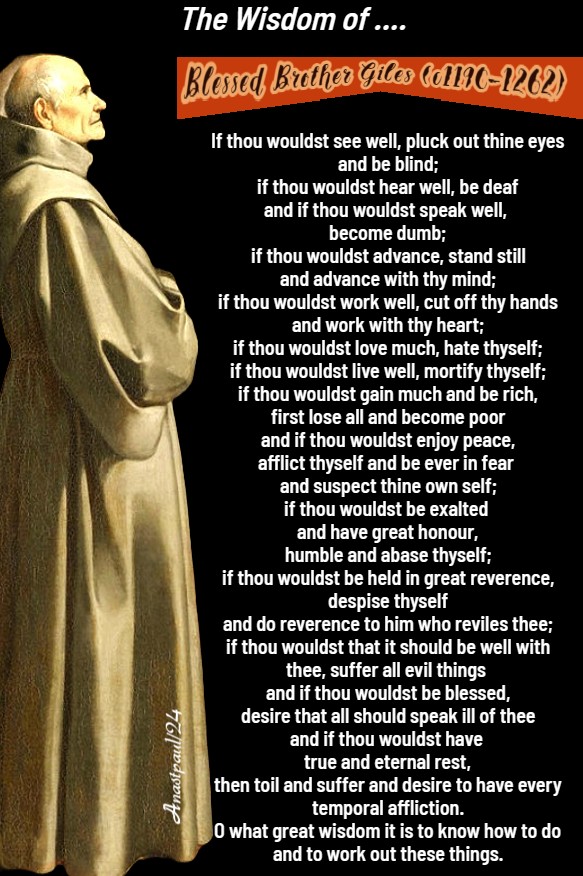
If thou wouldst see well, pluck out thine eyes and be blind;
if thou wouldst hear well, be deaf
and if thou wouldst speak well, become dumb;
if thou wouldst advance, stand still
and advance with thy mind;
if thou wouldst work well, cut off thy hands
and work with thy heart;
if thou wouldst love much, hate thyself;
if thou wouldst live well, mortify thyself;
if thou wouldst gain much and be rich,
first lose all and become poor
and if thou wouldst enjoy peace, afflict thyself
and be ever in fear and suspect thine own self;
if thou wouldst be exalted and have great honour,
humble and abase thyself;
if thou wouldst be held in great reverence, despise thyself
and do reverence to him who reviles thee;
if thou wouldst that it should be well with thee,
suffer all evil things and if thou wouldst be blessed,
desire that all should speak ill of thee
and if thou wouldst have true and eternal rest,
then toil and suffer and desire to have every temporal affliction.
O what great wisdom it is to know how to do
and to work out these things.”

Blessed Giles of Assisi (c1190-1262)

Posted in LENT 2026, REDEMPTIVE Suffering, The MOST HOLY REDEEMER, Our SAVIOUR, The PASSION, The REDEMPTION, Thomas Aquinas

Wednesday of the Second Week of Lent – 4 March – Our Lenten Journey With St Thomas Aquinas The Passion of Christ brought about our Salvation because it was an Act of Satisfaction

Wednesday of the Second Week of Lent – 4 March – Our Lenten Journey With St Thomas Aquinas (1225-1274) Doctor of the Church

Wednesday of the Second Week
The Passion of Christ brought about our Salvation
because it was an Act of Satisfaction

He is the propitiation for our sins and not for ours alone but also for those of the whole world.
I John ii. 2.

Satisfaction for offences ,is truly made, when there is offered ,to the person offended, something which he loves as much as, or more than, he hates the offences.

Christ, however, by Suffering through His Love and through His Obedience, offered to God something greater by far than the satisfaction needed by all the sins of all mankind and this for three reasons.

In the first place, there was the greatness of the Love which moved Him to Suffer.
Then there was the worth of the Life which He laid down in satisfaction, the Life of God and Man.
Finally, on account of the way in which His Passion involved every part of His Being and of the greatness of the Suffering he undertook.
So it is that the Passion of Christ was not merely sufficient but superabundant as a satisfaction for man’s sins.

It would seem indeed to be the case that satisfaction should be made by the person who committed the offence. But Head and Members are, as it were, One Mystical Person and, therefore, the satisfaction made by Christ avails all the faithful as they are the Members of Christ. One man can always make satisfaction for another, as long as the two are one in charity.

  1. Although Christ, by His Death, made sufficient Satisfaction for Original Sin, it is not unfitting that the penal consequences of Original Sin should still remain even in those who are made sharers in Christ’s Redemption.
    This has been done fittingly and usefully, so that the penalties remain even though the guilt has been removed.

(i) It has been done so that there might be conformity between the faithful and Christ, as there is conformity between members and Head. Just as Christ, first of all, suffered many pains and came in this way to His Glory, so it is only right that His faithful should also first be subjected to sufferings and thence enter into immortality themselves, bearing as it were, the livery of the Passion of Christ so as to enjoy a glory somewhat like to His.

(ii) A second reason is that if men coming to Christ were straightaway freed from suffering and the necessity of death, only too many would come to Him attracted rather by these temporal advantages than by spiritual virtues.
And this would be altogether contrary to the intention of Christ, Who came into this world that He might convert men from a love of temporal advantages and win them to spiritual love and virtue.

(iii) Finally, if those who came to Christ were straightaway rendered immortal and impassible, this would, in a certain way compel men to receive the Faith of Christ and, therefore, the merit of believing would be lessened.

ST THOMAS AQUINAS (1225-1274)
Priest, Theologian, Dominican
Doctor Angelicus (Angelic Doctor)
Doctor Communis (Common Doctor)

Added by Pope Saint Pius V in 1568
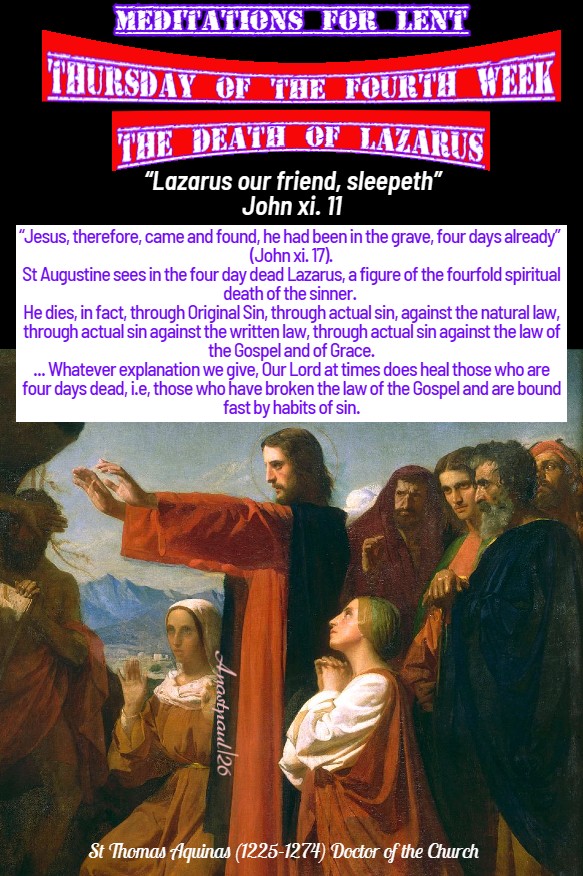
Posted in LENT 2026, Quotes on SALVATION, The PASSION, Thomas Aquinas

Tuesday of the Second Week of Lent – 3 March – Our Lenten Journey With St Thomas Aquinas – The Passion of Christ brought about our Salvationbecause it was a Meritorious Act

Tuesday of the Second Week of Lent – 3 March – Our Lenten Journey With St Thomas Aquinas (1225-1274) Doctor of the Church

Tuesday of the Second Week
The Passion of Christ brought about our Salvation
because it was a Meritorious Act

They shall deliver Him to the Gentiles
to be Mocked and Scourged and Crucified.

Matt xx. 19

Grace was given to Christ not only as to a particular person but also, as far as He is the Head of the Church, in order that the Grace might pass from Him to His Members. And the good works Christ performed, therefore, stand in this same way in relationship to Him and to His Members, as the good works of any other man in a State of Grace relate to himself.

Now it is evident that any man who, in a State of Grace, suffers for justice, merits for himself, by this very fact alone, salvation.
As is said in the Gospel, “Blessed are they who suffer persecution for justice sake” (Matt v. 10).
Whence Christ, by His Passion, merited Salvation, not only for Himself but for all His Members.

Christ, indeed, from the very instant of His conception, merited eternal Salvation for us.
But there still remained certain obstacles on our part, obstacles which kept us from possessing ourselves of the effect of what Christ had merited. Wherefore, in order to remove these obstacles, it behoved Christ to Suffer (Luke xxiv. 46).

Now although the love of Christ for us was not increased in the Passion and was not greater in the Passion than before it, the Passion of Christ had a certain effect which His previous meritorious activity did not.
The Passion produced this effect, not on account of any greater Love shown thereby but because, it was an action designed to produce that effect, as is evident from what has already been said on the fitness of the Passion of Christ.

Head and Members belong to One and the same Person. Now Christ is our Head, according to His Divinity and to the fullness of His Grace which overflows upon others too. We are His Members.
What Christ then meritoriously acquires, is not something external and foreign to us but, by virtue of the unity of the Mystical Body, it overflows upon us too.

We should know too, that although Christ, by His Death acquired merit sufficient for the whole human race, there are special elements needed for the particular Salvation of each individual soul and these each soul must itself seek out. The Death of Christ is, as it were, the cause of all Salvation, as the sin of the first man was the cause of all condemnation. But if each individual man is to share in the effect of a universal cause, the universal cause needs to be specially applied to each individual man.

Now the effect of the sin of the first parents is transmitted to each individual through his bodily origin (i.e., through his being a bodily descendant of the first man).
The effect of the Death of Christ is transmitted to each man through a spiritual rebirth, a re-birth in which man is, as it were, conjoined to Christ and incorporated with Him.

Therefore, it is that each individual must seek to be born again through Christ and to receive those other elements in which works the power of the Death of Christ.

ST THOMAS AQUINAS (1225-1274)
Priest, Theologian, Dominican
Doctor Angelicus (Angelic Doctor)
Doctor Communis (Common Doctor)
Added by Pope Saint Pius V in 1568

Posted in LENT 2026, The PASSION, Thomas Aquinas

Monday of the Second Week of Lent – 2 March – Our Lenten Journey With St Thomas Aquinas – It was fitting that our Lord should Suffer at the hands of the Gentiles

Monday of the Second Week of Lent – 2 March – Our Lenten Journey With St Thomas Aquinas (1225-1274) Doctor of the Church

Monday of the Second Week
It was fitting that our Lord should Suffer
at the hands of the Gentiles

They shall deliver Him to the Gentiles
to be Mocked and Scourged and Crucified.

Matt xx. 19

In the very manner of the Passion of Our Lord its effects are foreshadowed.
In the first place, the Passion of Our Lord had, for its effect , the salvation of Jews, many of whom were baptised in His death.

Secondly, by the preaching of these Jews, the effects of the Passion passed to the Gentiles too. There was thus, a certain fitness in Our Lord’s Passion beginning with the Jews and then, the Jews handing Him on, that it should be completed at the hands of the Gentiles.

To show the abundance of the Love which moved Him to suffer, Christ, on the very Cross, asked mercy for His tormentors. And, since He wished Jew and Gentile alike, should realise this Truth regarding His Love, so He wished that both should have a share in His Suffering.

It was the Jews and not the Gentiles who offered the figurative sacrifices of the Old Law.
The Passion of Christ was an Offering through Sacrifice, inasmuch as Christ underwent Death by His Own Will moved by Charity.
But, insofar as those who put Him to Death were concerned, they were not offering a sacrifice but committing a Mortal Sin!

When the Jews declared, “It is not lawful for us to put any man to death” (John xix. 31), they may have had many areas of concern in mind.
It was not lawful for them to put anyone to death on account of the holiness of the Feast they had begun to keep. Perhaps they wished Christ to be killed not as a transgressor of their own law but as an enemy of the state, because He had made Himself a King, a charge concerning which they had no jurisdiction.
Or again, they may have meant that they had no power to crucify which was what they longed for but only to stone, as they later stoned St Stephen.
Or, the most likely thing of all, that their Roman Conquerors had taken away their power of life and death!

ST THOMAS AQUINAS (1225-1274)
Priest, Theologian, Dominican
Doctor Angelicus (Angelic Doctor)
Doctor Communis (Common Doctor)
Added by Pope Saint Pius V in 1568
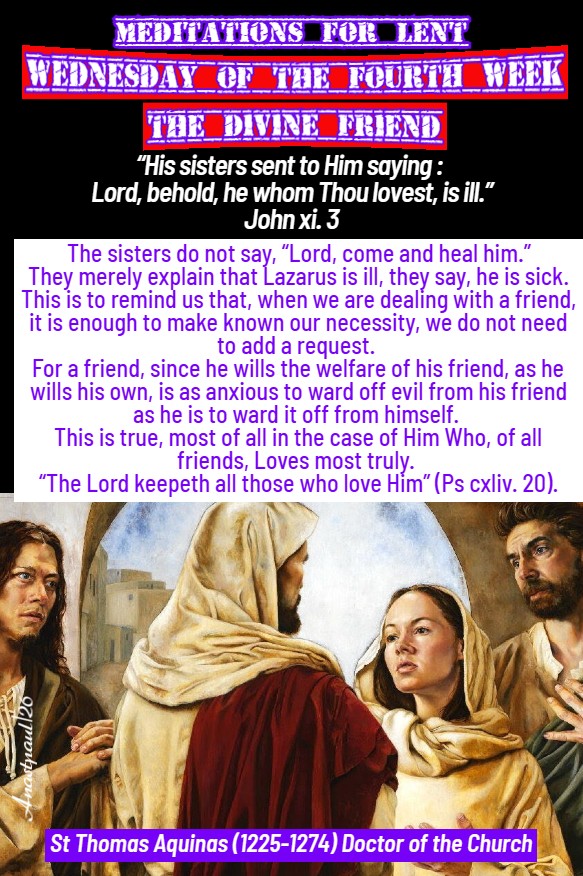
Posted in CHRIST the LIGHT, FATHERS of the Church, LENT 2026, Our MORNING Offering, PRAYERS of the SAINTS, QUOTES on HEAVEN, QUOTES on PURITY

Our Morning Offering – 2 March – Lord Jesus, Think on Me By St Synesius

Our Morning Offering – 2 March – Monday of the Second Week of Lent

Lord Jesus, Think on Me
By St Synesius of Cyrene (375-430)
Bishop of Ptolemais
, Father

Lord Jesus, think on me
and purge away my sin,
from earth-born passions set me free,
and make me pure within.
Lord Jesus, think on me,
With care and woe oppressed,
let me Thy loving servant be
and taste Thy promised rest.
Lord Jesus, think on me,
nor let me go astray,
through darkness and perplexity
point Thou the heav’nly way.
Lord Jesus, think on me,
that, when the flood is past,
I may eternal brightness see
and share Thy joy at last.
Amen