Quote/s of the Day – 11 February – Apparition of the Immaculate Virgin Mary at Lourdes
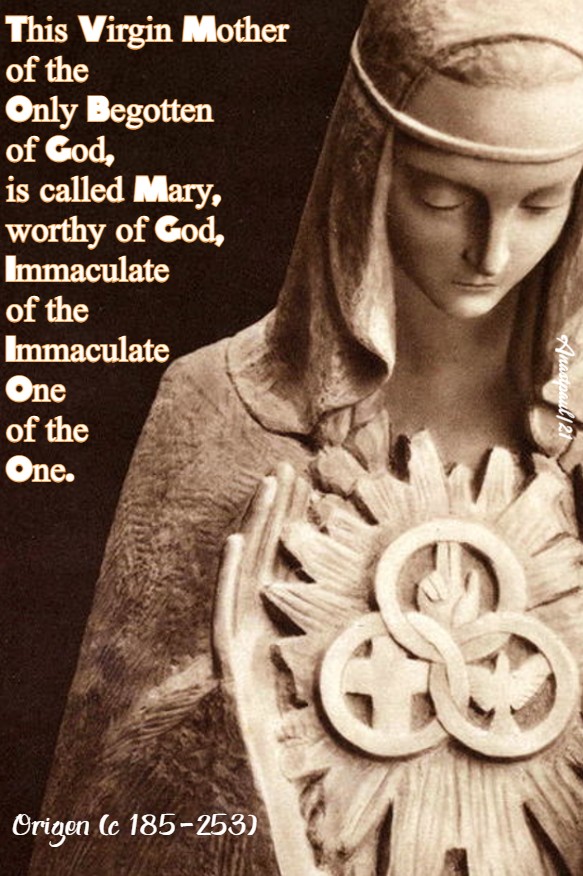
“This Virgin Mother of the Only begotten of God, is called Mary, worthy of God, Immaculate of the Immaculate, One of the One.”
Origen (c 185-253)
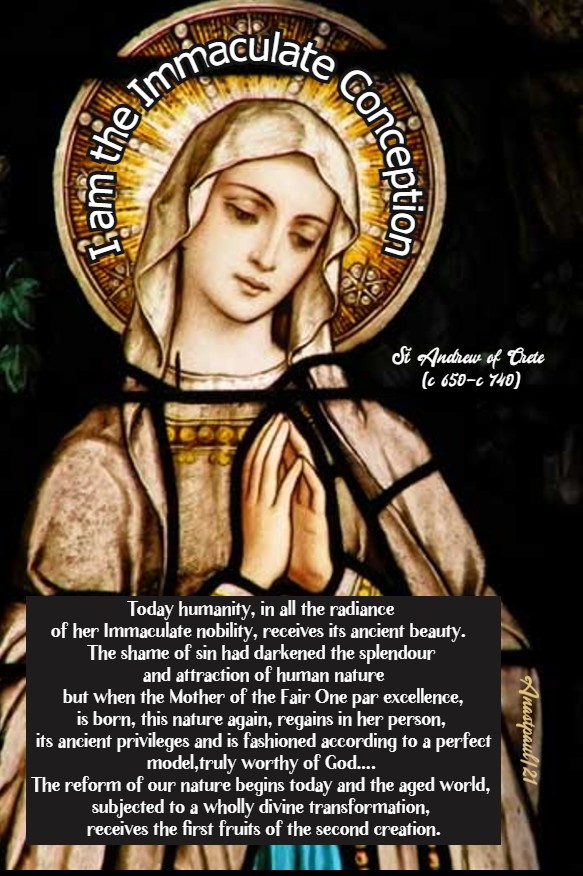
“Today humanity, in all the radiance of her Immaculate nobility, receives its ancient beauty. The shame of sin had darkened the splendour and attraction of human nature but when the Mother of the Fair One par excellence, is born, this nature again, regains in her person, its ancient privileges and is fashioned according to a perfect model, truly worthy of God…. The reform of our nature begins today and the aged world, subjected to a wholly divine transformation, receives the first fruits of the second creation.”
St Andrew of Crete (c 650-c 740) Bishop, Theologian, Hymnist
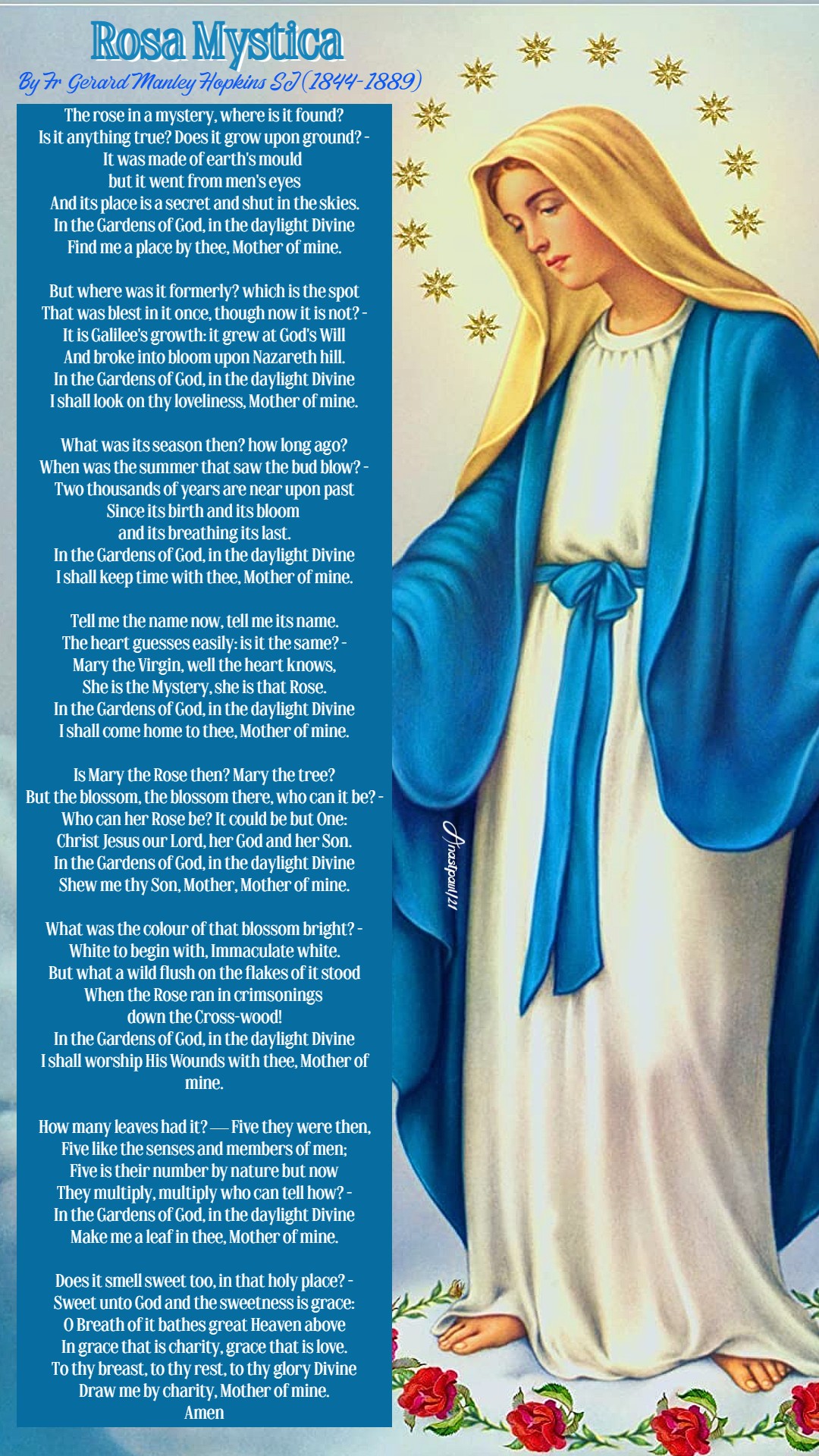
Rosa Mystica By Fr Gerard Manley Hopkins SJ (1844-1889)
The rose in a mystery, where is it found? Is it anything true? Does it grow upon ground? — It was made of earth’s mould but it went from men’s eyes And its place is a secret and shut in the skies. In the Gardens of God, in the daylight Divine Find me a place by thee, Mother of mine.
But where was it formerly? which is the spot That was blest in it once, though now it is not? — It is Galilee’s growth: it grew at God’s Will And broke into bloom upon Nazareth hill. In the Gardens of God, in the daylight Divine I shall look on thy loveliness, Mother of mine.
What was its season then? how long ago? When was the summer that saw the bud blow? — Two thousands of years are near upon past Since its birth and its bloom and its breathing its last. In the Gardens of God, in the daylight Divine I shall keep time with thee, Mother of mine.
Tell me the name now, tell me its name. The heart guesses easily: is it the same? — Mary the Virgin, well the heart knows, She is the Mystery, she is that Rose. In the Gardens of God, in the daylight Divine I shall come home to thee, Mother of mine.
Is Mary the Rose then? Mary the tree? But the blossom, the blossom there, who can it be? — Who can her Rose be? It could be but One: Christ Jesus our Lord, her God and her Son. In the Gardens of God, in the daylight Divine Shew me thy Son, Mother, Mother of mine.
What was the colour of that blossom bright? — White to begin with, Immaculate white. But what a wild flush on the flakes of it stood When the Rose ran in crimsonings down the Cross-wood! In the Gardens of God, in the daylight Divine I shall worship His Wounds with thee, Mother of mine.
How many leaves had it? — Five they were then, Five like the senses and members of men; Five is their number by nature but now They multiply, multiply who can tell how?┬░ In the Gardens of God, in the daylight Divine Make me a leaf in thee, Mother of mine.
Does it smell sweet too, in that holy place? — Sweet unto God and the sweetness is grace: O Breath of it bathes great Heaven above In grace that is charity, grace that is love. To thy breast, to thy rest, to thy glory Divine Draw me by charity, Mother of mine. Amen
Our Morning Offering – 11 February – Apparition of the Immaculate Virgin Mary at Lourdes
Hail! all Hail! Great Queen of Heaven, Notre Dame de Lourdes Unknown Author First Published in 1905
Hail! all Hail! great Queen of Heaven, Hail sweet Notre Dame de Lourdes, ‘Neath whose care our weary exile, Is from countless ills secured.
Refrain: Then let men and angels praise thee, Fount of grace to all assured, While in gladsome strains we are singing, Hail! sweet Notre Dame de Lourdes Hail! sweet Notre Dame de Lourdes.
Blessed thou above all others, Mary Mistress of the spheres, Star of hope, serenely beaming Through this darksome vale of tears. Refrain
Happy angels joy to own thee, O’er their choirs exalted high, Throned in blissful light and beauty, Empress of the starry sky. Refrain
As the fount is still unsealing Its pure treasures softly fair, May each drop be fraught with healing, Dearest Mother, at thy prayer. Refrain
Quote/s of the Day – 9 February – The Memorial of St Cyril of Alexandria (376-444) Bishop, Confessor, Father and Doctor of the Church
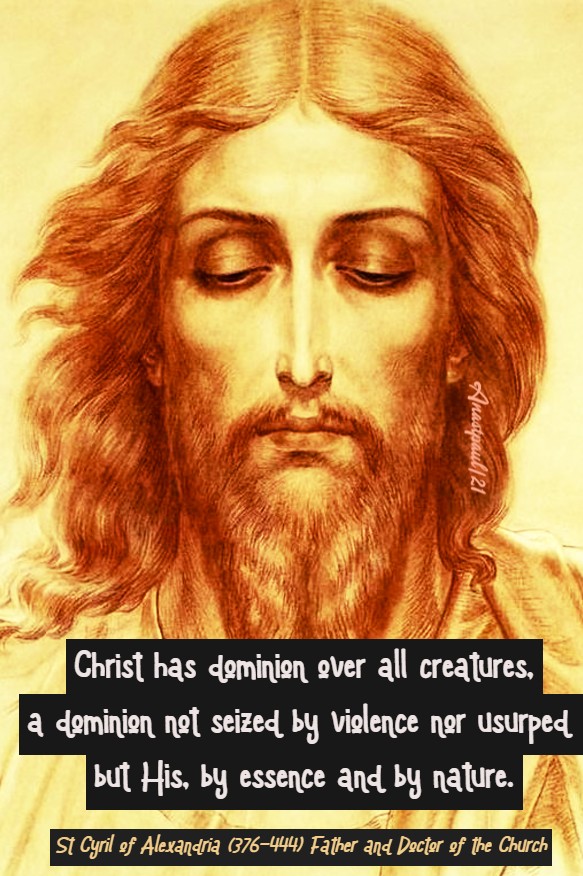
“Christ has dominion over all creatures, a dominion not seized by violence nor usurped but His, by essence and by nature.”
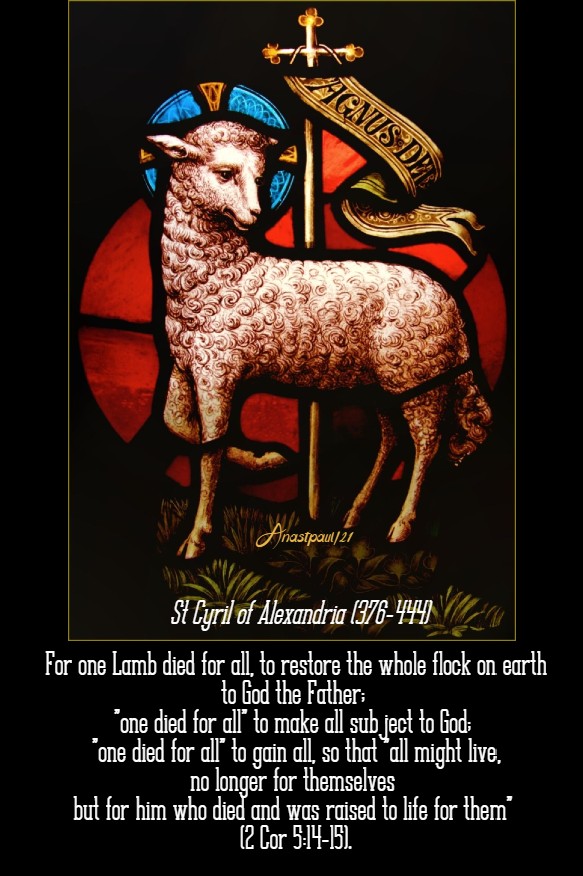
“For one Lamb died for all, to restore the whole flock on earth to God the Father; “one died for all” to make all subject to God; “one died for all” to gain all, so that “all might live, no longer for themselves but for Him who died and was raised to life for them” (2 Cor 5:14-15).”
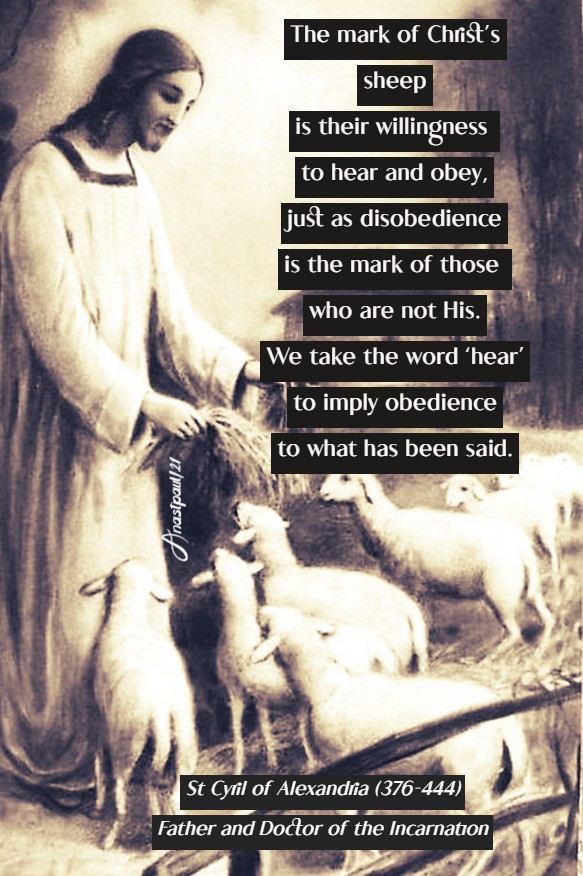
“The mark of Christ’s sheep is their willingness to hear and obey, just as disobedience is the mark of those who are not His. We take the word ‘hear’ to imply obedience to what has been said.”
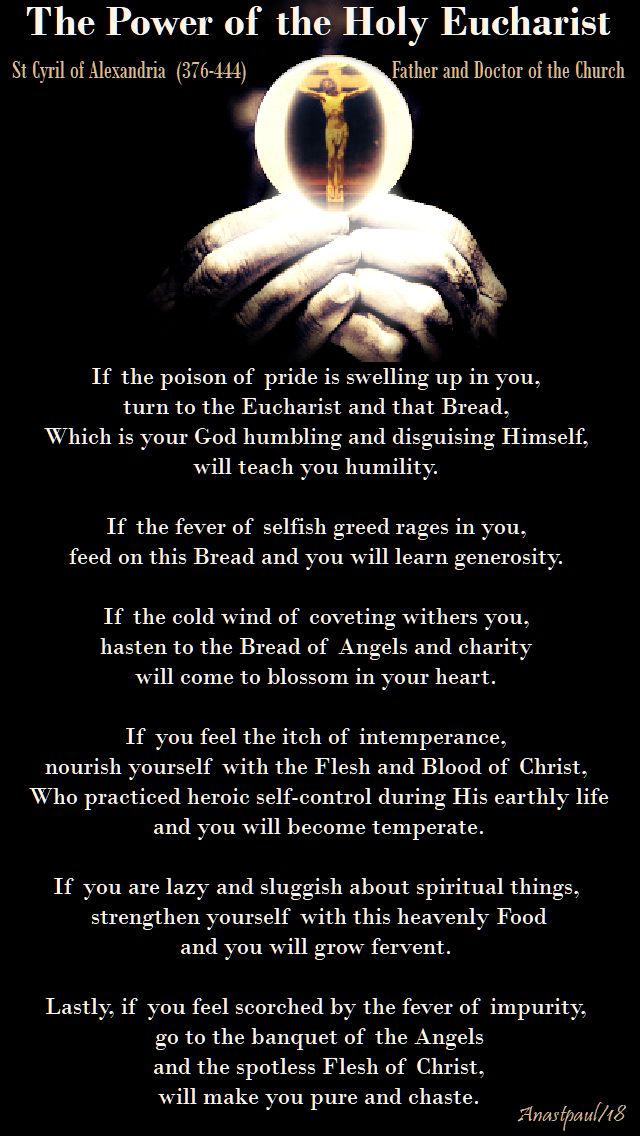
“If the poison of pride is swelling up in you, turn to the Eucharist and that Bread, Which is your God humbling and disguising Himself, will teach you humility.
If the fever of selfish greed rages in you, feed on this Bread and you will learn generosity.
If the cold wind of coveting withers you, hasten to the Bread of Angels and charity will come to blossom in your heart.
If you feel the itch of intemperance, nourish yourself with the Flesh and Blood of Christ, Who practiced heroic self-control during His earthly life and you will become temperate.
If you are lazy and sluggish about spiritual things, strengthen yourself with this heavenly Food and you will grow fervent.
Lastly, if you feel scorched by the fever of impurity, go to the banquet of the Angels and the spotless Flesh of Christ, will make you pure and chaste.”
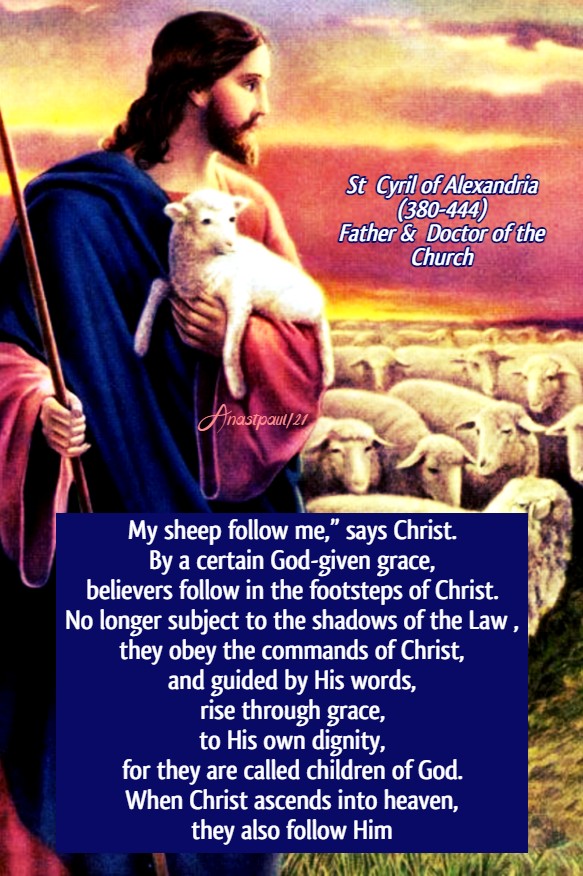
“My sheep follow me,” says Christ. By a certain God-given grace, believers follow in the footsteps of Christ. No longer subject to the shadows of the Law , they obey the commands of Christ, and guided by His words, rise through grace, to His own dignity, for they are called children of God. When Christ ascends into heaven, they also follow Him.”
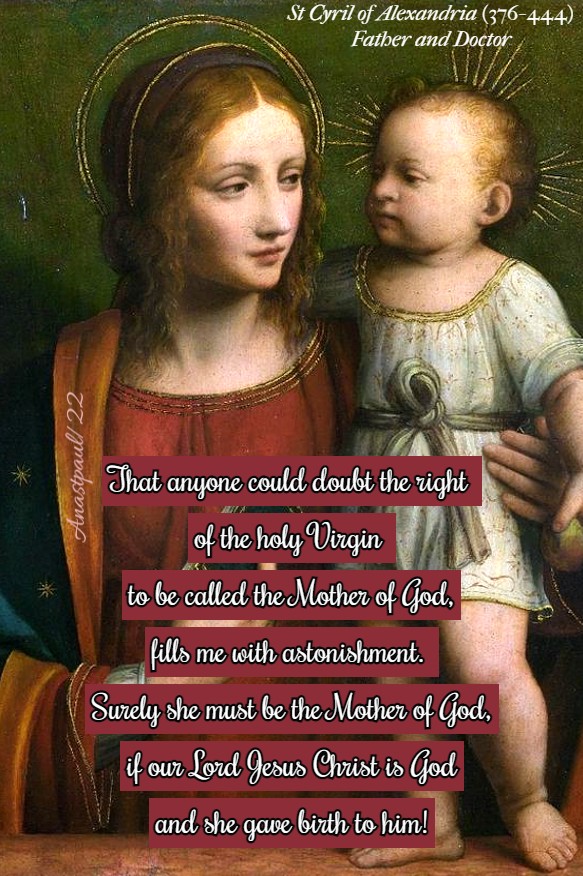
“That anyone could doubt the right of the holy Virgin to be called the Mother of God, fills me with astonishment. Surely she must be the Mother of God, if our Lord Jesus Christ is God and she gave birth to him!”
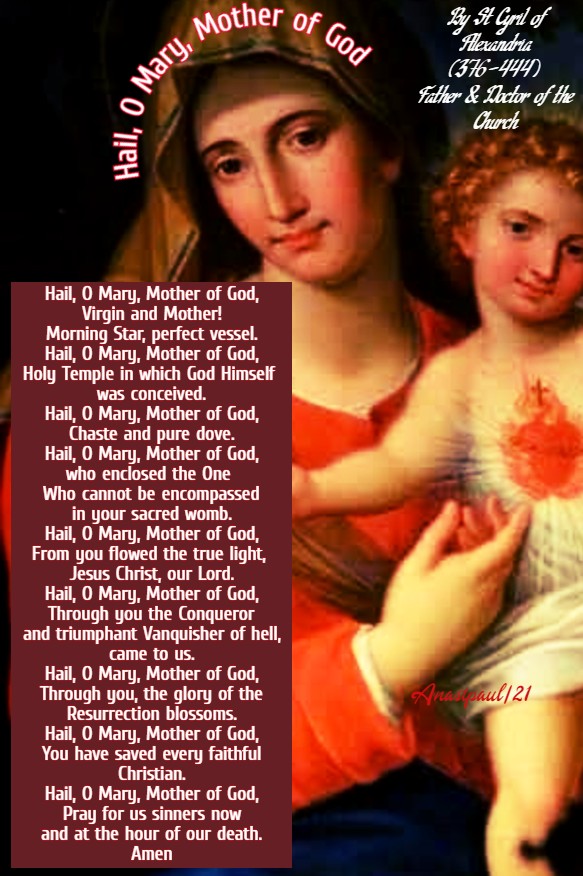
Hail, O Mary, Mother of God By St Cyril of Alexandria (376-444) Father & Doctor of the Church
Hail, O Mary, Mother of God, Virgin and Mother! Morning Star, perfect vessel. Hail, O Mary, Mother of God, Holy Temple in which God Himself was conceived. Hail, O Mary, Mother of God, Chaste and pure dove. Hail, O Mary, Mother of God, who enclosed the One Who cannot be encompassed in your sacred womb. Hail, O Mary, Mother of God, From you flowed the true light, Jesus Christ, our Lord. Hail, O Mary, Mother of God, Through you the Conqueror and triumphant Vanquisher of hell, came to us. Hail, O Mary, Mother of God, Through you, the glory of the Resurrection blossoms. Hail, O Mary, Mother of God, You have saved every faithful Christian. Hail, O Mary, Mother of God, Pray for us sinners now and at the hour of our death. Amen
Our Morning Offering – 2 February – The Feast of the Purification of the Blessed Virgin. Candlemas
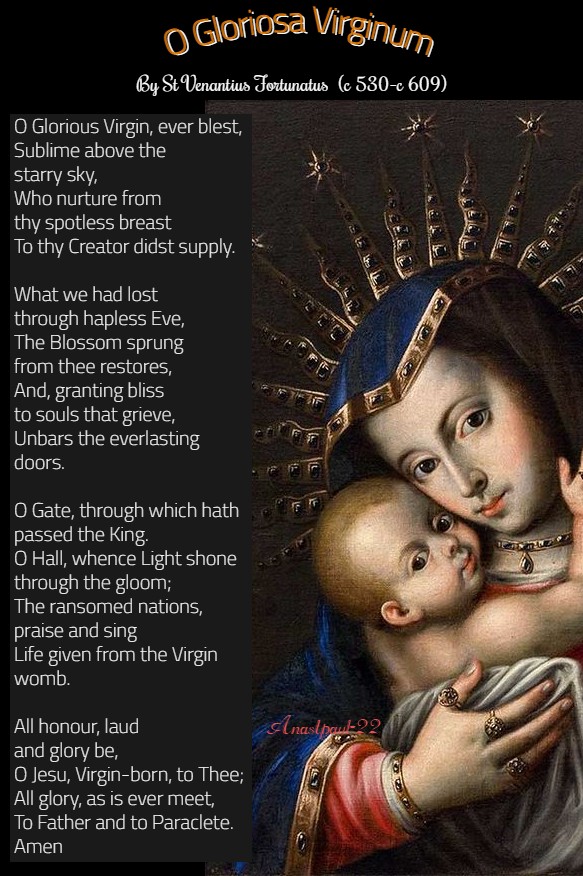
O Gloriosa Virginum By St Venantius Fortunatus (c 530 – c 609)
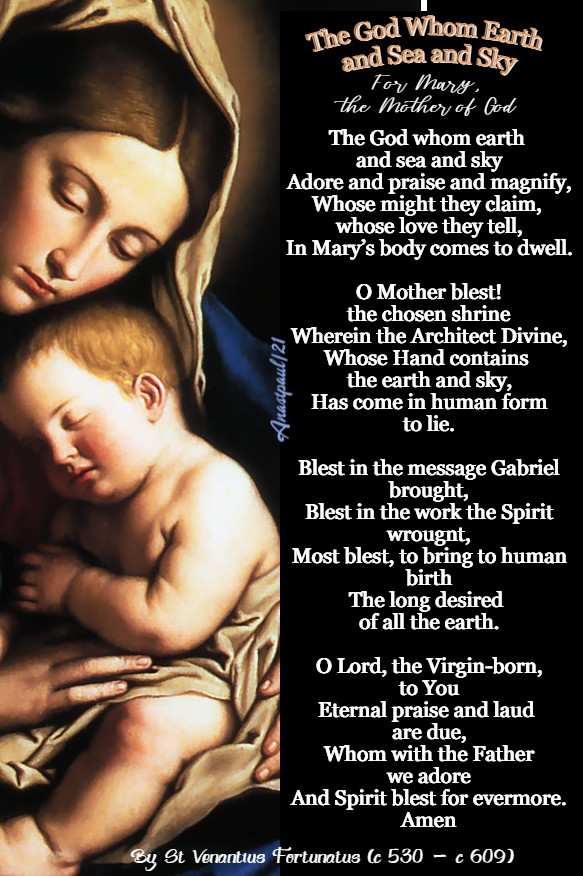
O Glorious Virgin, ever blest, Sublime above the starry sky, Who nurture from thy spotless breast To thy Creator didst supply.
What we had lost through hapless Eve, The Blossom sprung from these restores, And, granting bliss to souls that grieve, Unbars the everlasting doors.
O Gate, through which hath passed the King. O Hall, whence Light shone through the gloom; The ransomed nations, praise and sing Life given from the Virgin womb.
All honour, laud and glory be, O Jesu, Virgin-born, to Thee; All glory, as is ever meet, To Father and to Paraclete. Amen
O Gloriosa Domina is the second half of the hymn: Quem Terra, Pontus, Aethera. It was composed by St Venantius Fortunatus (c 530 – c 609) the Bishop of Poitiers. In 1632, in accordance with revisions made to the hymns of the Divine Office by Pope Urban VIII (1568-1644), it was altered and changed to O Gloriósa Vírginum. It is sung in the Common of the Blessed Virgin Mary of the Roman Breviary. It is said that St Anthony of Padua (1195-1231) was always singing this hymn. His mother sang it to him as a baby,and even on his death bed after receiving Extreme Unction, he intoned the hymn.
Our Morning Offering – 29 January – St Francis de Sales (1567-1622) Bishop, Confessor and Doctor and Mary’s Day and Mary’s Day
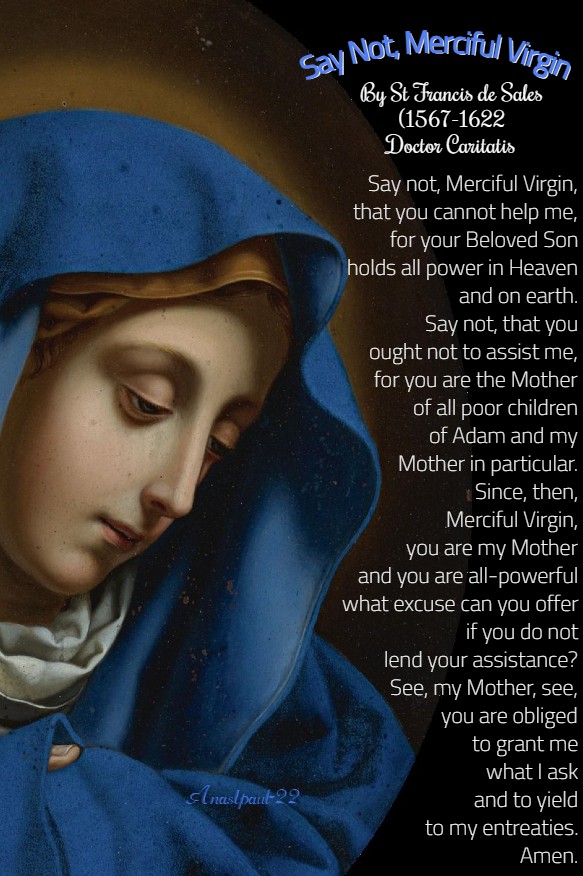
Say Not, Merciful Virgin By St Francis de Sales (1567-1622 Doctor Caritatis
Say not, Merciful Virgin, that you cannot help me, for your Beloved Son holds all power in Heaven and on earth. Say not, that you ought not to assist me, for you are the Mother of all poor children of Adam and my Mother in particular. Since, then, Merciful Virgin, you are my Mother and you are all-powerful, what excuse can you offer if you do not lend your assistance? See, my Mother, see, you are obliged to grant me what I ask and to yield to my entreaties. Amen.
Our Morning Offering – 27 January – The Memorial of St John Chrysostom (347-407) Father and Doctor of the Church, Bishop, Confessor.
Hail, O Mother! By St John Chrysostom (347-407) Father and Doctor of the Church
Hail, O Mother! Virgin, heaven, throne, glory of our Church, it’s foundation and ornament. Earnestly pray for us to Jesus, your Son and Our Lord, that through your intercession, we may have mercy on the day of judgement. Pray that we may receive, all those good things which are reserved for those who love God. Through the grace and favour of Our Lord, Jesus Christ, to Whom, with the Father and the Holy Spirit, be power, honour and glory, now and forever. Amen
Our Morning Offering – 22 January – Mary’s Saturday
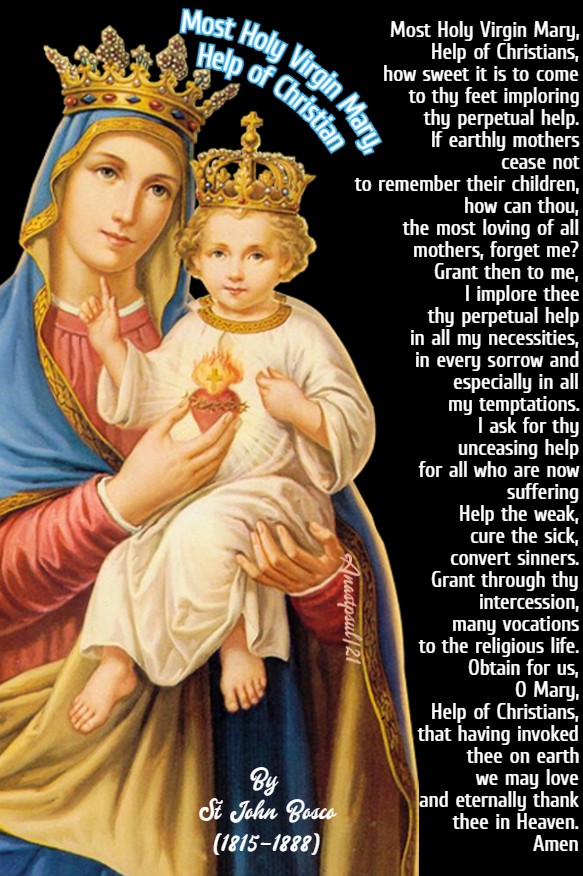
Most Holy Virgin Mary, Help of Christian By St John Bosco (1815-1888)
Most Holy Virgin Mary, Help of Christians, how sweet it is to come to thy feet imploring thy perpetual help. If earthly mothers cease not to remember their children, how can thou, the most loving of all mothers, forget me? Grant then to me, I implore thee thy perpetual help in all my necessities, in every sorrow and especially in all my temptations. I ask for thy unceasing help for all who are now suffering. Help the weak, cure the sick, convert sinners. Grant through thy intercession, many vocations to the religious life. Obtain for us, O Mary, Help of Christians, that having invoked thee on earth we may love and eternally thank thee in Heaven. Amen
Our Morning Offering – 15 January – Mary’s Saturday
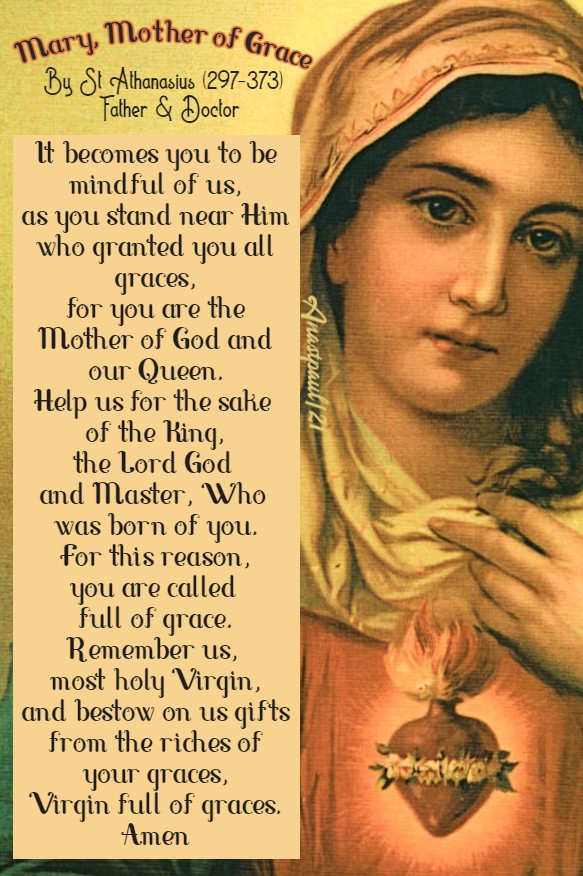
Mary, Mother of Grace By St Athanasius (297-373) Father & Doctor of the Church
It becomes you to be mindful of us, as you stand near Him Who granted you all graces, for you are the Mother of God and our Queen. Help us for the sake of the King, the Lord God and Master who was born of you. For this reason, you are called, full of grace. Remember us, most Holy Virgin, and bestow on us gifts from the riches of your graces, O Virgin full of graces. Amen
Our Morning Offering – 8 January – Octave of Epiphany and Mary’s Day
Mother of Salvation, Blessed Lady By Anselm (1033-1109) Magnificent Doctor Marian Doctor
Mother of Salvation, Blessed Lady, you are the Mother of Justification and those who are justified; the Mother of Reconciliation and those who are reconciled; the Mother of Salvation and those who are saved. What a blessed trust and what a secure refuge! The Mother of God is our Mother. The Mother of the One in Whom alone, we hope and Whom alone, we fear, is our Mother! … The One Who partook of our nature and by restoring us to life, made us children of His Mother, invites us by this grace, to proclaim that we are His brothers and sisters. Therefore, our Judge, is also our Brother. The Saviour of the world, is our Brother. Our God has become – through Mary – our Brother! Anen
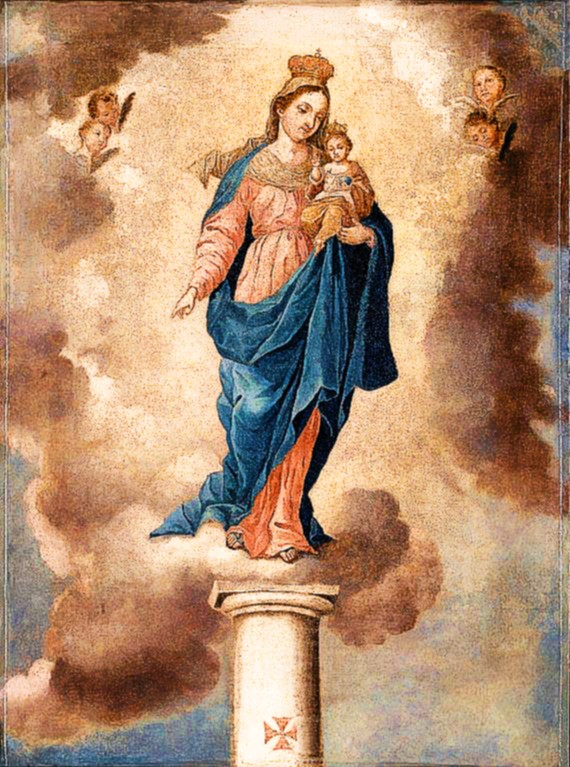
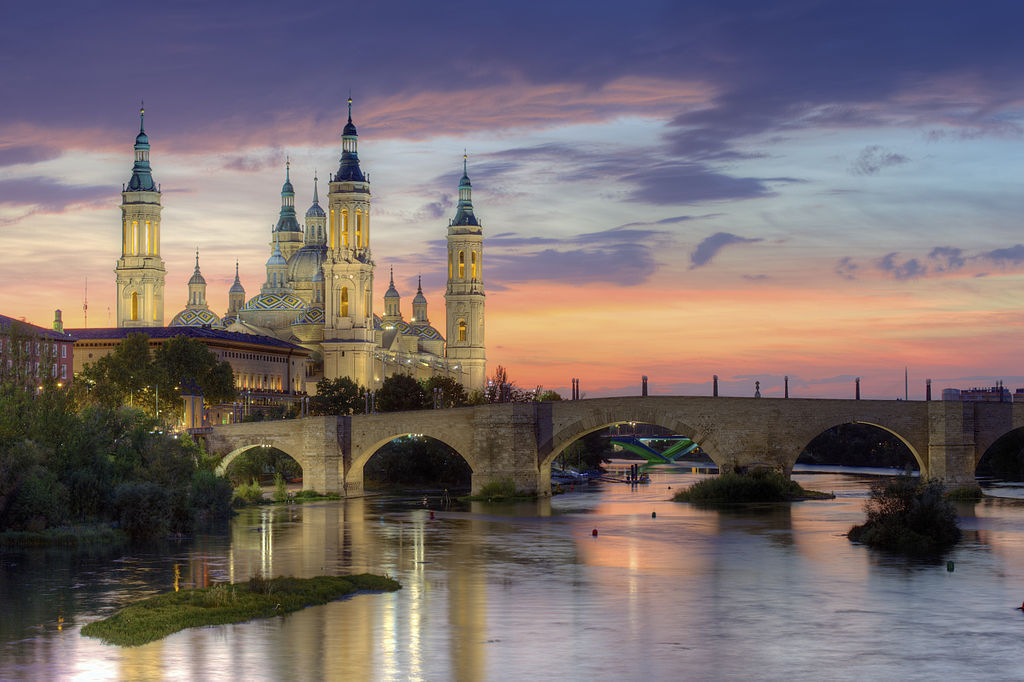
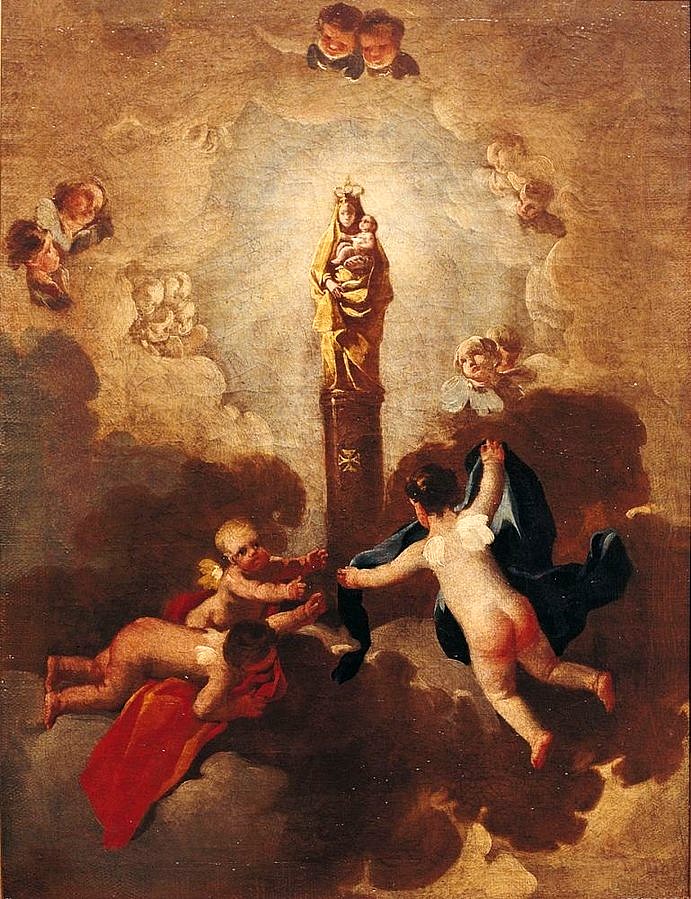
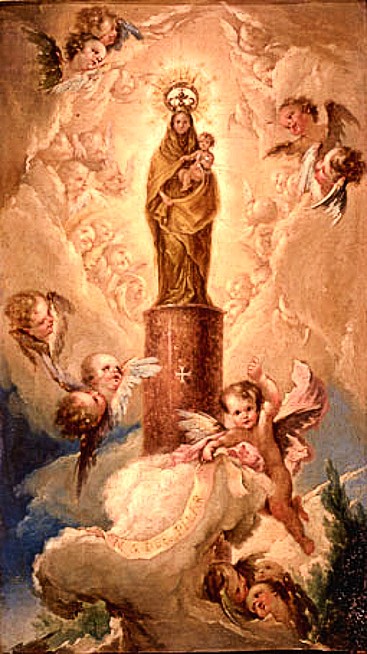
Nuestra Señora del Pilar / Our Lady of the Pillar (Zaragoza, Spain) (40) – 2 January, 12 October (originally 4 October), 15 August – (This Apparition it is considered the first Marian Apparition, and is unique because it happened while Mary was still living on Earth):
According to ancient Spanish history, on 2 January in the year 40, in the early days of Christianity, James the Greater, one of the original Twelve Apostles of Jesus Christ, was preaching the Gospel in what was then the pagan land of Caesaraugusta (now Zaragoza), in the Roman Province of Hispania.
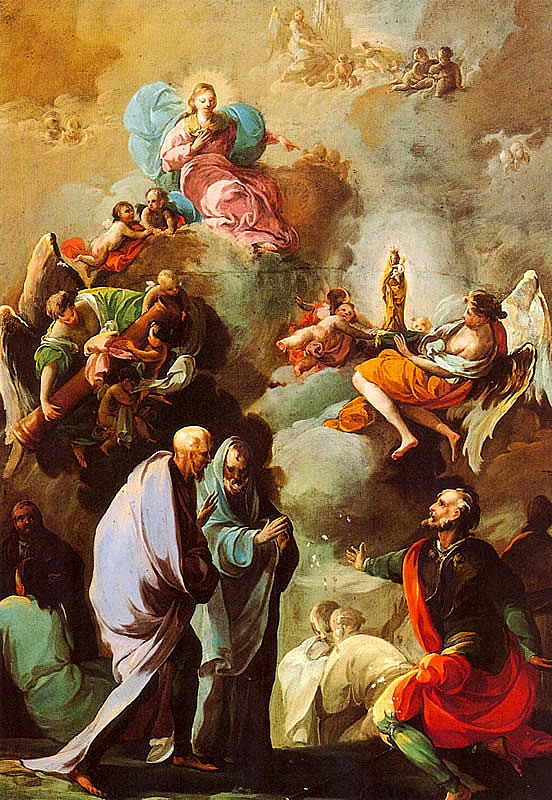
St James was disheartened with his mission, having made only a few converts. While he was praying by the banks of the Ebro River with some of his disciples, the Blessed Virgin Mary miraculously appeared before him atop a pillar accompanied by Angels. Mary assured James that the people would eventually be converted, becoming a stronghold of the Faith due to his efforts and their faith would be as strong as the pillar she was standing on. She gave him the pillar as a symbol and a wooden image of herself. James was also instructed to build a Chapel on the spot where she left the pillar which he did, making it the first Church in Spain.
Apparition of the Virgin of the Pillar to Saint James and his Saragossan disciples by Francisco Goya, c 1769.
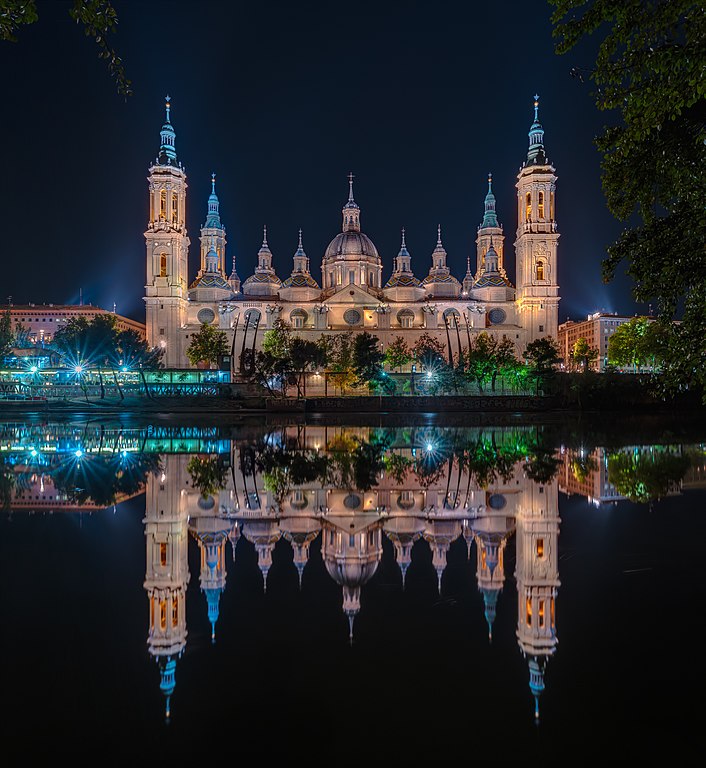
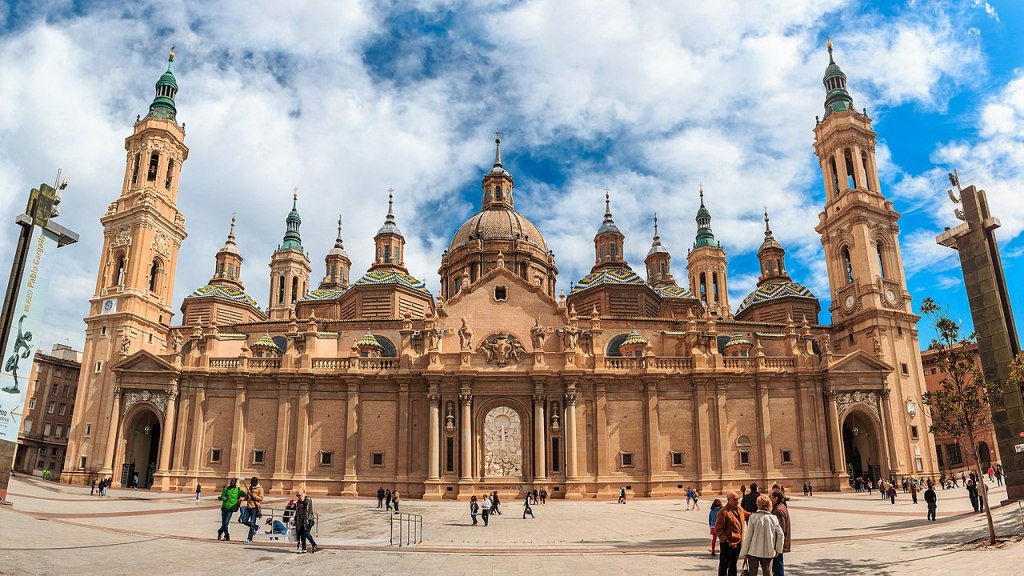
It is generally believed, that Mary appeared to James through bilocation, as she was still living, either in Ephesus or Jerusalem, at the time of this event, as she is believed to have died three to fifteen years after Jesus ascended into Heaven. After establishing the church, James returned to Jerusalem with some of his disciples where he became a Martyr, beheaded in 44 under Herod Agrippa. His disciples returned his body to Spain. The pillar left by the Virgin Mary is presently enshrined in the same but larger Basilica of Our Lady of the Pillar. It is believed to be the same pillar given and promised by Mary, in spite of numerous disasters that beset the Church. A fire in 1434 razed the Church that preceded the present Basilica Cathedral, see below.
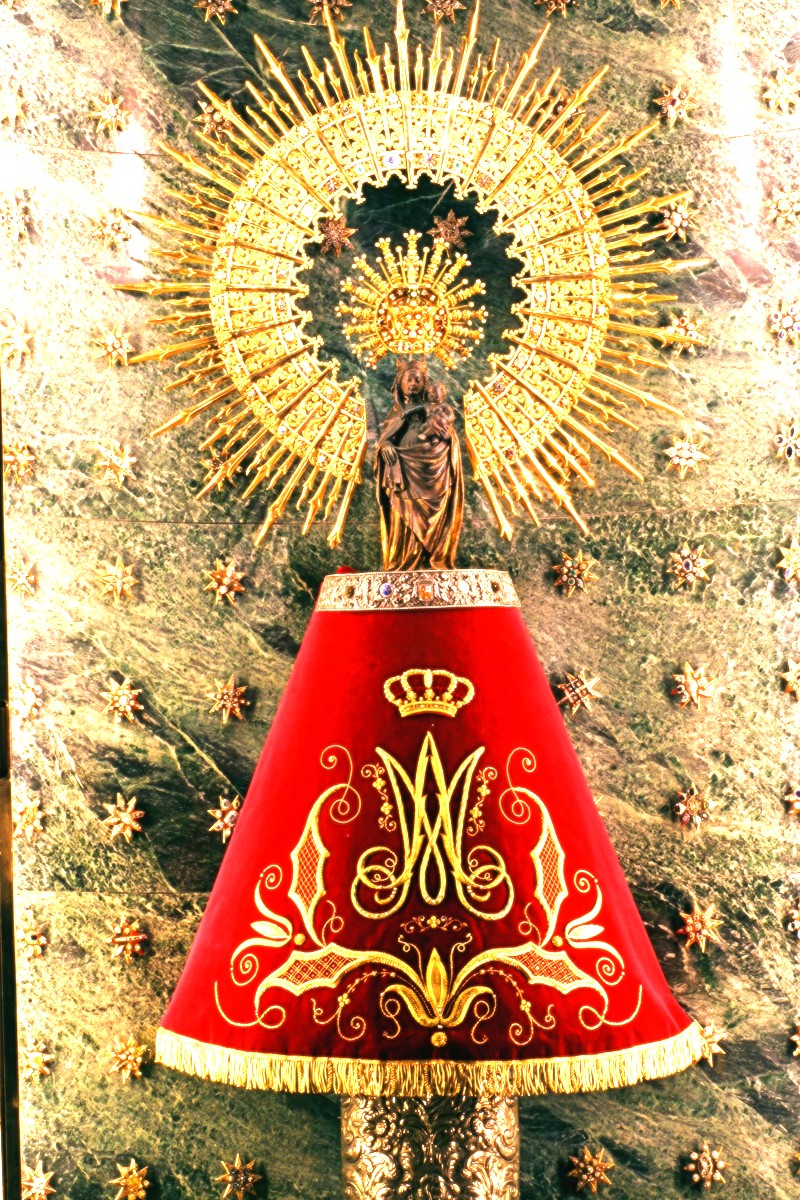
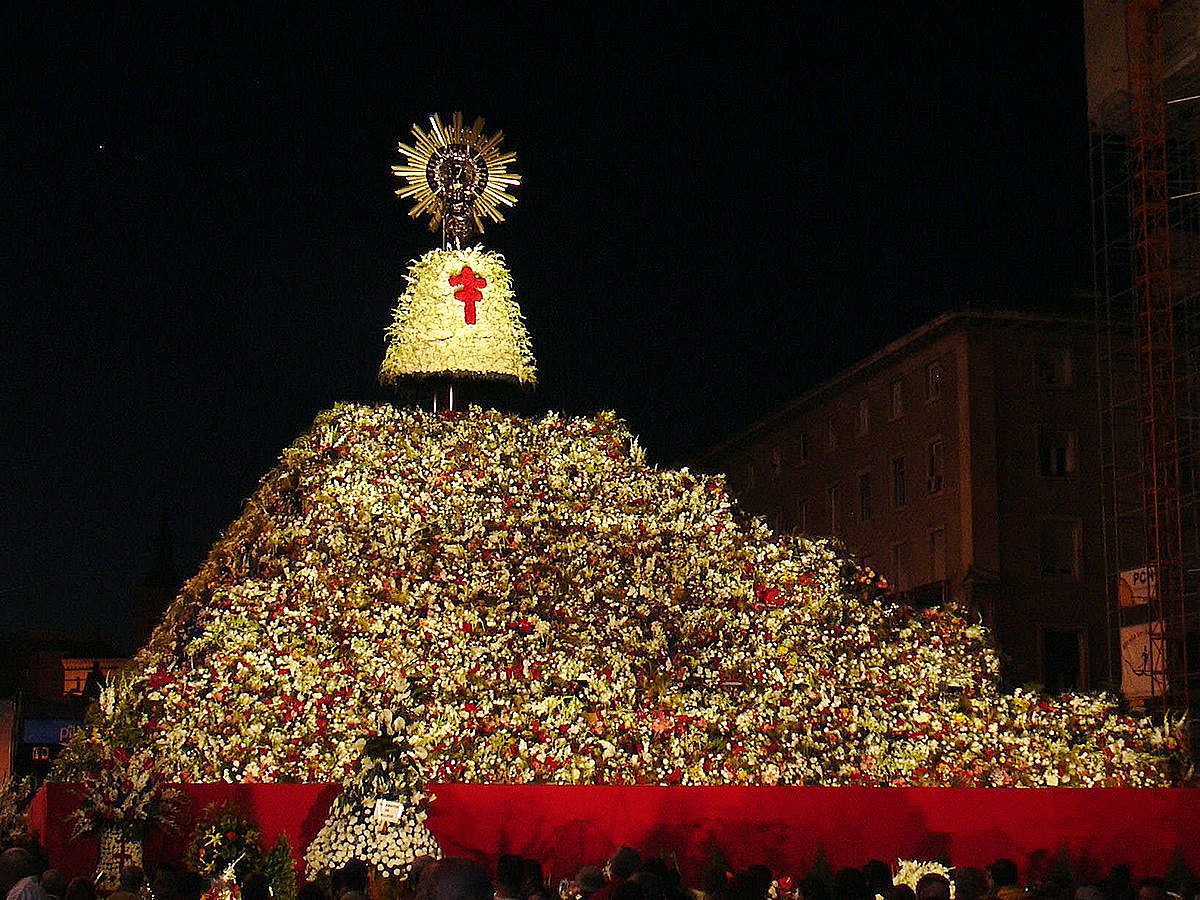
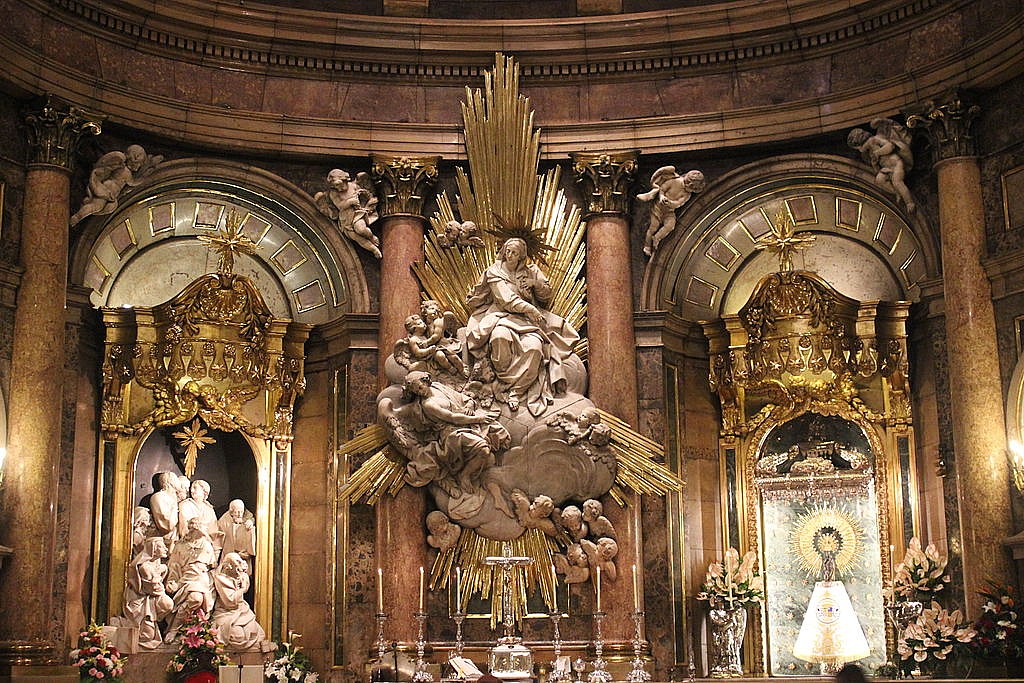
The image of the Blessed Virgin Mary may or may not be the original. Some reports state that the original wooden image was destroyed when the Church burned down in 1434, contradicting other reports, that it is still the original Statue. The Statue of the Blessed Virgin Mary is made of wood and stands 39 centimetres tall while the 1.8 m pillar is made of jasper.quartz. The Statue depicts Mother Mary with the Child Jesus on her left arm, Who has a dove sitting on His left palm. Since the 16th century, the pillar is usually draped in a skirt-like cover called manto (in English: mantle). As a whole, it is protected by a bronze case and then another case of silver. The image was canonically crowned in 1905 during the reign of Pope Pius X. The crown was designed by the Marquis of Griñi, valued at 450,000 pesetas (£18,750, in1910). During the three Marian festivities of today, 15 August and 12 October, the faithful adorn the base of the Pillar and Statue with flowers – see below (both our Blessed Mother and St James would be thrilled by this display of such immense faith and piety!)
The apparition of Our Lady of the Pillar is a widely accepted sacred tradition. Popes from earliest times issued Papal Bulls attesting to the authenticity of the Shrine and the appearance of the Virgin Mary. Pope Calixtus III issued a Bull in 1456 encouraging pilgrimage to the Lady of the Pillar. It acknowledged the miracle of its foundation and the miracles that had taken place at the Spanish Shrine. It was also through this Bull that the name “Our Lady of the Pillar” was confirmed. So many contradictions had arisen concerning the miraculous origin of the Church that during the reign of Pope Innocent XIII , the Bishops of Spain appealed to the Holy See to settle the controversy. After careful investigation, the twelve Cardinals, in whose hands the affair rested, adopted the following account, which was approved by the Sacred Congregation of Rites on 2 August 1723 and has since been inserted in the lessons of the Office of the Feast of Our Lady of the Pillar, celebrated on 12 October.
“Of all the places that Spain offers for the veneration of the devout, the most illustrious is doubtless the Sanctuary consecrated to God under the invocation of the Blessed Virgin, under the title of Our Lady of the Pillar, at Saragossa. According to ancient and pious tradition, St James the Greater, led by Providence into Spain, spent some time at Saragossa. He there received a signal favour from the Blessed Virgin. As he was praying with his disciples one night, upon the banks of the Ebro, as the same tradition informs us, the Mother of God, who still lived, appeared to him and commanded him to erect an oratory in that place. The Apostle delayed not to obey this injunction,and with the assistance of his disciples, soon constructed a small Chapel. In the course of time, a larger Church was built and dedicated, which, with the dedication of Saint Saviour’s, is kept as a festival in the City and Diocese of Saragossa on the 4th of October.“
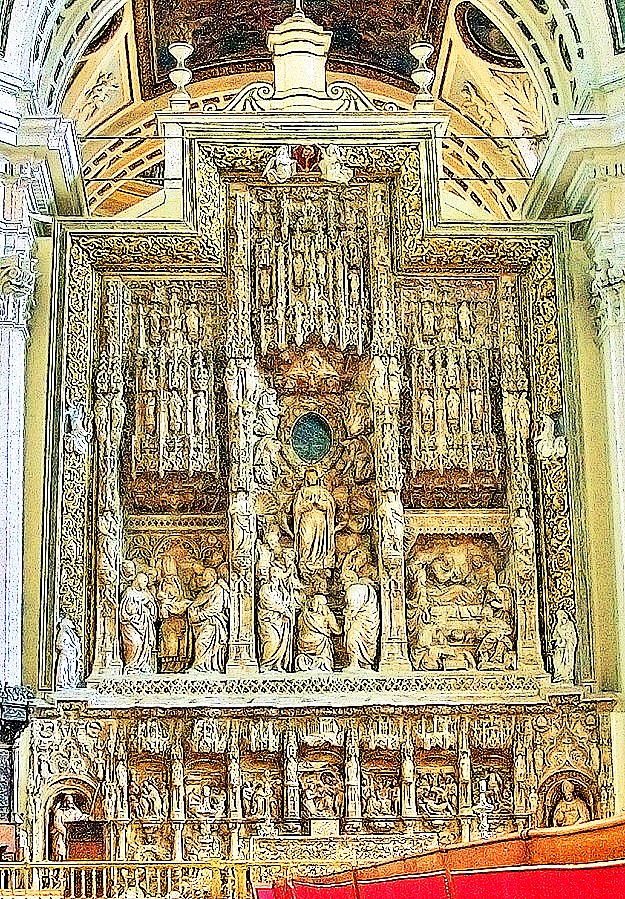
Holy Chapel of the Pillar of Zaragoza. Altar with the Arrival of the Virgin by ‘José Ramírez de Arellano.
In 1730, Pope Clement XII allowed the celebration of the Feast of Our Lady of the Pillar all over the Spanish Empire. As the date coincides with the discovery of the Americas, the Lady was later named as Patroness of the Hispanic World although her Patronages include all of the following: Zaragoza, Spain, Melo, Uruguay, Buenos Aires, Argentina, Diocese of Imus, Cavite, Zamboanga City, Santa Cruz, Manila, Alaminos, Laguna, San Simon, Pampanga, Libmanan, Camarines Sur, Pilar and Morong in Bataan, Mamburao, Occidental Mindoro, Sibonga, Cebu, Baleno, Masbate, Cauayan, Isabela.
Prayer: Hail, Mary, Our Lady of the Pillar, conceived without sin, I come to venerate and honour you. above all the Angels and Saints in Heaven, as my Queen, my Lady and my dearest Mother. I firmly resolve to serve you always and to do whatever I am able, that all may render faithful service to you. Most Holy Mary, through your kind intercession and by your own merits, obtain for me from your Divine Son Jesus, our Lord and Saviour, all the graces I need for the eternal salvation of my soul. Therefore, most devoted Mother of mothers, through the Precious Blood which your Son shed for us, I humbly beseech thee to receive me among your devotees and to accept me as your servant forever. Help me in my every thought, action word and deed, never to be displeasing in your sight and in the sight of your Son, our Lord and Redeemer. Think of me always, my dear Lady of the Pillar and do not forsake me in the hour of my death. Amen.
Bl Airaldus of Maurienne St Asclepius of Limoges St Aspasius of Auch St Blidulf of Bobbio Bl Guillaume Répin St Hortulana of Assisi St Isidore of Antioch St Isidore of Nitria St Laurent Bâtard
Saint Macarius the Younger of Alexandria (Died c 401) Priest, Monk, Desert Hermit.
St Maximus of Vienne Bl Odino of Rot St Paracodius of Vienne St Seiriol Blessed Sylvester of Troina St Telesphorus, Pope St Theodota St Theopistus St Vincentian of Tulle
Many Martyrs Who Suffered in Rome: There were many Martyrs who suffered in the persecutions of Diocletian for refusing to surrender the holy books. Though we know these atrocities occurred, we do not know the names of the Saints and we honour them as a group. c 303 in Rome, Italy.
Martyrs of Antioch – 5 saints: A group of Christian soldiers Martyred together for their faith. We know the names of five – Albanus, Macarius, Possessor, Starus and Stratonicus. They were born in Greece and were Martyred in Antioch (modern Antakya, Turkey).
Many Martyrs of Britain: The Christians of Britain appear to have escaped unharmed in the earlier persecutions which afflicted the Church but the cruel edicts of Diocletian were enforced in every corner of the Roman Empire and the faithful inhabitants of this land, whether native Britons or Roman colonists, were called upon to furnish their full number of holy Martyrs and Confessors. The names of few are on record but the British historian, Saint Gildas, after relating the Martyrdom of Saint Alban, tells us, that many others were seized, some put to the most unheard-of tortures and others immediately executed, while not a few hid themselves in forests and the caves of the earth, where they endured a prolonged death until God called them to their reward. The same writer attributes it to the subsequent invasion of the English, then a pagan people, that the recollection of the places, sanctified by these Martyrdoms, has been lost and so little honour paid to their memory. It may be added, that, according to one tradition, a thousand of these Christians were overtaken in their flight near Lichfield and cruelly massacred and that the name of Lichfield, or Field of the Dead, is derived from them.
Martyrs of Ethiopia – 3 saints: A group of Christians Martyred together for their faith. We know the names of three – Auriga, Claudia and Rutile.
Martyrs of Jerusalem – 2 saints: A group of Christians Martyred together for their faith. We know the names of two – Stephen and Vitalis.
Martyrs of Lichfield: Many Christians suffered at Lichfield (aka Lyke-field, meaning field of dead bodies), England in the persecutions of Diocletian. Though we know these atrocities occurred, we do not know the names of theSsaints and we honour them as a group. Their Martyrdom occurred in 304 at Lichfield, England.
Martyrs of Piacenza: A group of Christians who died together for their faith in the persecutions of Diocletian. No details about them have survived. They were Martyred on the site of Church of Madonna di Campagna, Piacenza, Italy.
Martyrs of Puy – 4 saints: Missionaries, sent by Saint Fronto of Périgueux to the area of Puy, France. Tortured and Martyred by local pagans. We know the names – Frontasius, Severinus, Severian and Silanus. They were beheaded in Puy (modern Puy-en-Velay), France and buried together in the Church of Notre Dame, Puy-en-Velay by Saint Fronto, their bodies laid out to form a cross.
Martyrs of Syrmium – 7 saints: Group of Christians Martyred together, date unknown. We know the names of seven – Acutus, Artaxus, Eugenda, Maximianus, Timothy, Tobias and Vitus – but very little else. This occurred in the 3rd or 4th century at Syrmium, Pannonia (modern Sremska Mitrovica, Serbia).
Martyrs of Tomi – 3 saints: Three brothers, all Christian soldiers, in the Imperial Roman army and all three Martyred in the persecutions of Emperor Licinius Licinianus. We know their names – Argeus, Marcellinus and Narcissus – but little else. They were Martyred in 320 at Tomi, Exinius Pontus, Moesia (modern Constanta, Romania).
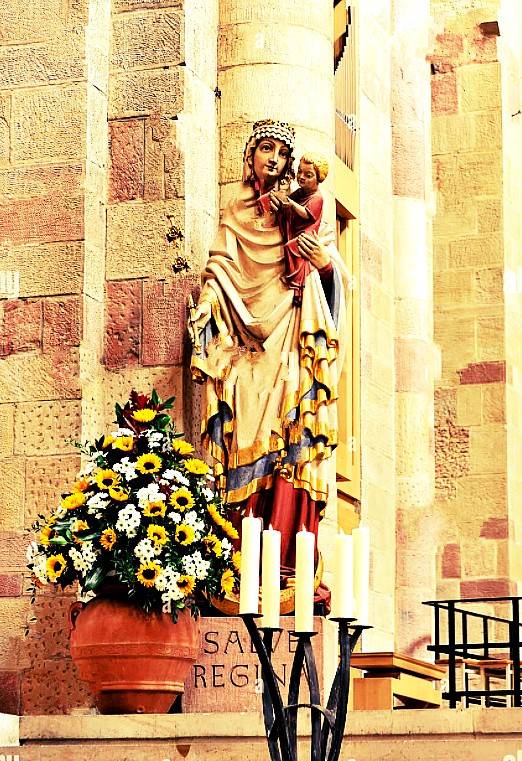
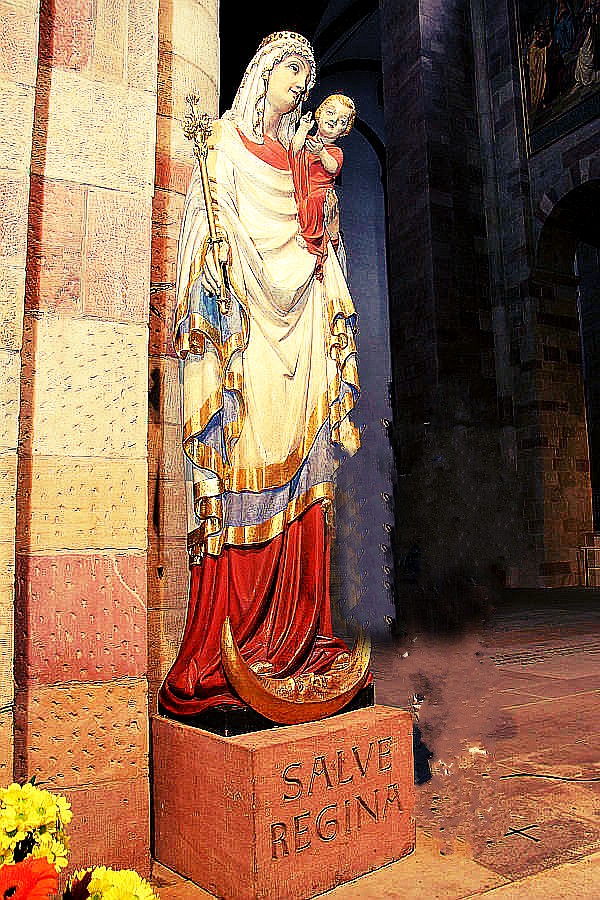
Unsere Liebe Frau vom Speyer / Our Lady of Speyer, Germany Featuring the Salve Regina and St Bernard (1146) – 29 December:
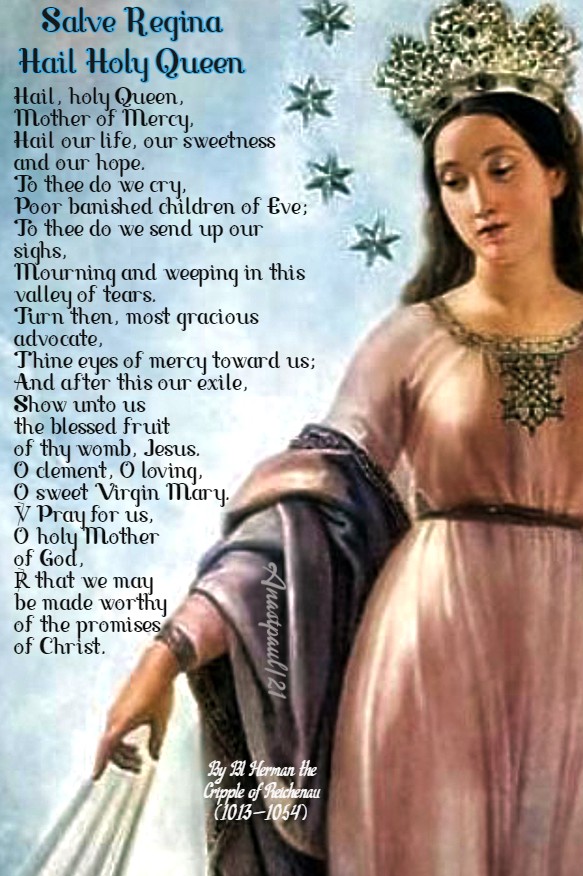
The Abbot Orsini wrote: “Our Lady of Spire (Speyer), in Germany. Saint Bernard, entering this Church on the 29th of December, 1146, was honourably received there by the Canons, who conducted him to the choir, singing the Salve Regina. The antiphon being finished, Saint Bernard saluted the image of the Blessed Virgin in these terms: “O clems, O pia, O dulcis Virgo Maria!” and she answered: “Salve Bernarde!” The words of this Saint to the image are seen engraved in a circle on the pavement of the Church, on the same spot where he pronounced them and they have since been added to the Salve Regina, which was composed in the year 1040, by Herman, surnamed Contractus, a Benedictine monk.” [He is Blessed Herman of Reichenau (often known as Blessed Herman the Cripple OSB (1013–1054) – his Biography here: https://anastpaul.com/2019/09/25/saint-of-the-day-blessed-herman-of-reichenau-the-cripple-osb-1013-1054-the-wonder-of-his-age/ ]
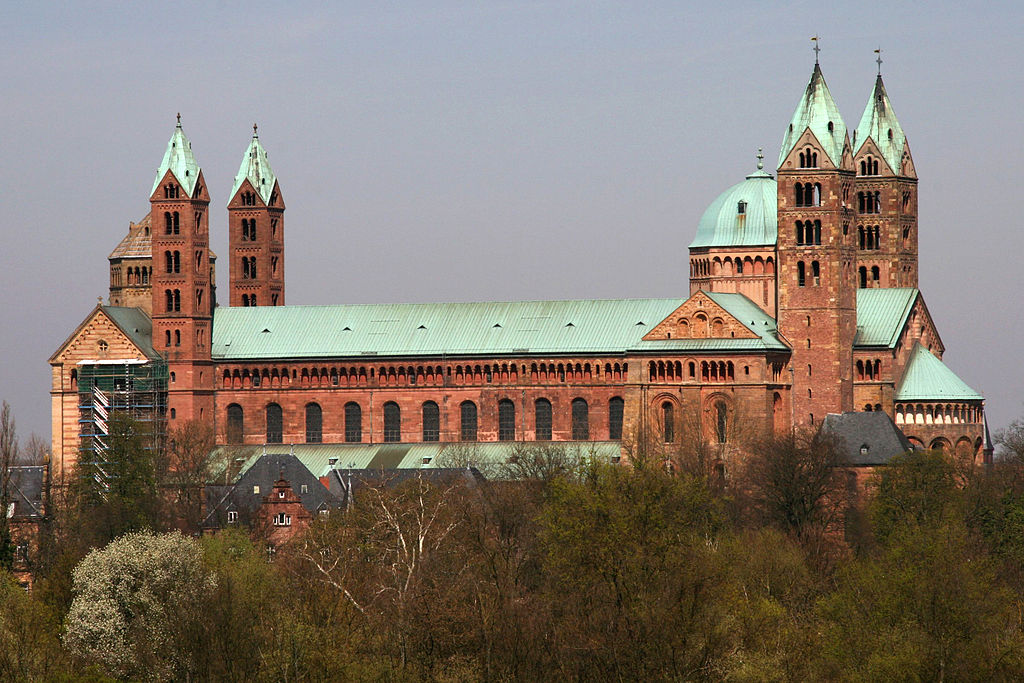
This date on the Marian calendar, Our Lady of Speyer, actually refers to the Cathedral of Speyer, dedicated to the Blessed Virgin Mary and known as Kaiserdom zu Speyer in Germany. Construction began on the Romanesque style Cathedral in the year 1030 and was completed in 1106. It is 134 metres long and 43 metres wide, which made it one of the largest buildings constructed at that time and is now thought to be, the largest surviving Romanesque building in the world.
During the Nine Years’ War the entire Town of Speyer was burned to the ground and the heat from the inferno caused part of the nave to collapse. In 1792 the Town was occupied by the French revolutionary troops and the Church pillaged. It was in that century that the ruins of the Chapel of Saint Bernard were removed. The Cathedral was subsequently used as a warehouse and hospital. In 1957 the Cathedral was restored and, although much of the plaster and 19th century paintings were removed, the scenes of the life of the Blessed Virgin were left undisturbed. n 1981 the Cathedral was added to the World Heritage List of UNESCO.
St Aileran of Clonard St Albert of Gambron St Aproniano de Felipe González St David the King St Ebrulf of Ouche (c 626-c 706) Abbot, Hermit St Enrique Juan Requena St Florent of Bourges Bl Francis Ruiz St Girald of Fontenelle St Jacinto Gutiérrez Terciado Bl José Aparicio Sanz Bl José Perpiñá Nácher St Juan Bautista Ferreres Boluda St Libosus of Vaga St Marcellus the Righteous St Martinian of Milan Bl Paul Mary Bl Peter the Venerable St Quartillosa of Carthage St Thaddeus of Scythia St Trophimus of Arles St Trophimus of Ephesus
Martyrs of North Africa – (8 saints): A group of Christians executed together for their faith. The only details to survive are eight names – Crescentius, Dominic, Honoratus, Lybosus, Primian, Saturninus, Secundus and Victor.
Martyrs of Rome – (3 saints): A group of Christians executed together for their faith. The only details to survive are three names – Boniface, Callistus and Felix.
Martyrs of Seoul – (7 saints): Additional Memorial – 20 September as part of the Martyrs of Korea. A group of seven lay woman in the apostolic vicariate of Korea who were martyred together. • Barbara Cho Chung-I • Barbara Ko Sun-I • Benedicta Hyong Kyong-Nyon • Elisabeth Chong Chong-Hye • Magdalena Han Yong-I • Magdalena Yi Yong-Dok • Petrus Ch’oe Ch’ang-Hub They were born in South Korea and were martyred by beheading on 29 December 1839 at the Small West Gate, Seoul, South Korea. They were Canonised on 6 May 1984 by St Pope John Paul II.
Martyred in the Spanish Civil War: Thousands of people were murdered in the anti-Catholic persecutions of the Spanish Civil War from 1934 to 1939. • Blessed Aproniano de Felipe González • Blessed Enrique Juan Requena • Blessed Jacinto Gutiérrez Terciado • Blessed Juan Bautista Ferreres Boluda
Our Morning Offering – 25 December – The Solemnity of the Nativity of the Lord, Jesus Christ
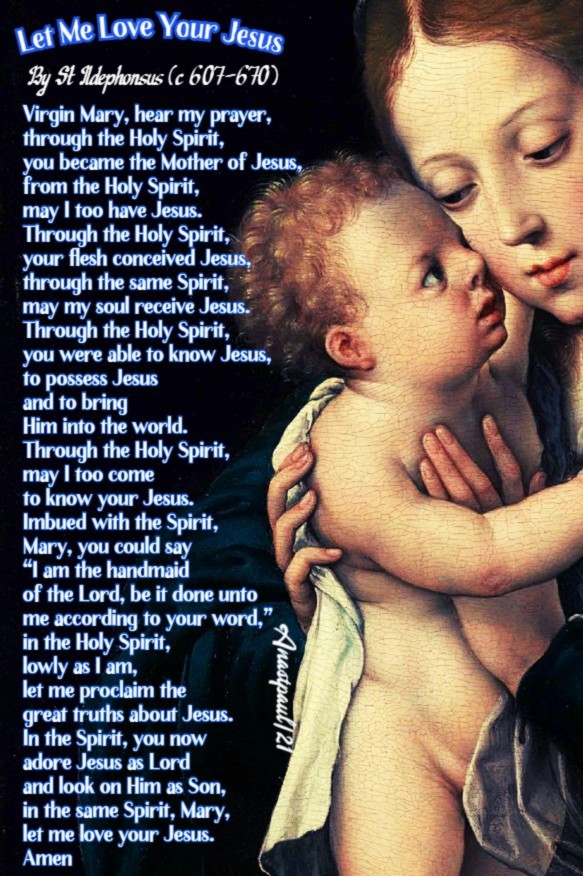
Let Me Love Your Jesus By St Ildephonsus (c 607-670)
Virgin Mary, hear my prayer, through the Holy Spirit, you became the Mother of Jesus, from the Holy Spirit, may I too have Jesus. Through the Holy Spirit, your flesh conceived Jesus, through the same Spirit, may my soul receive Jesus. Through the Holy Spirit, you were able to know Jesus, to possess Jesus and to bring Him into the world. Through the Holy Spirit, may I too come to know your Jesus. Imbued with the Spirit, Mary, you could say “I am the handmaid of the Lord, be it done unto me according to your word,” in the Holy Spirit, lowly as I am, let me proclaim the great truths about Jesus. In the Spirit, you now adore Jesus as Lord and look on Him as Son, in the same Spirit, Mary, let me love your Jesus. Amen
One Minute Reflection – 22 December – “Month of the Immaculate Conception” – Wednesday of the Fourth Week of Advent, O Rex Gentium/O King of all Nations, Readings: Samuel 1:24-28; First Samuel 2: 1, 4-8; Luke 1:46-56
The Lord is at hand, come let us adore Him.
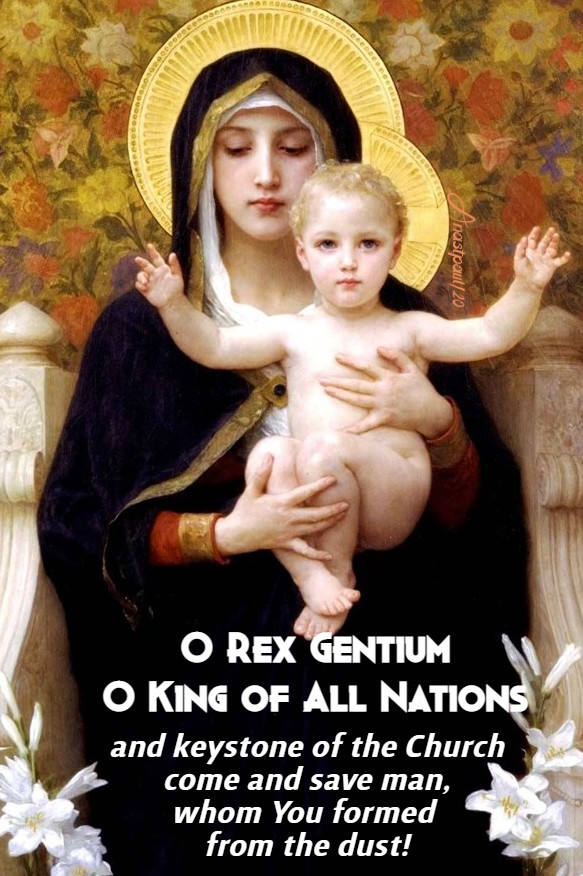
O KING OF ALL NATIONS and keystone of the Church come and save man, whom You formed from the dust!
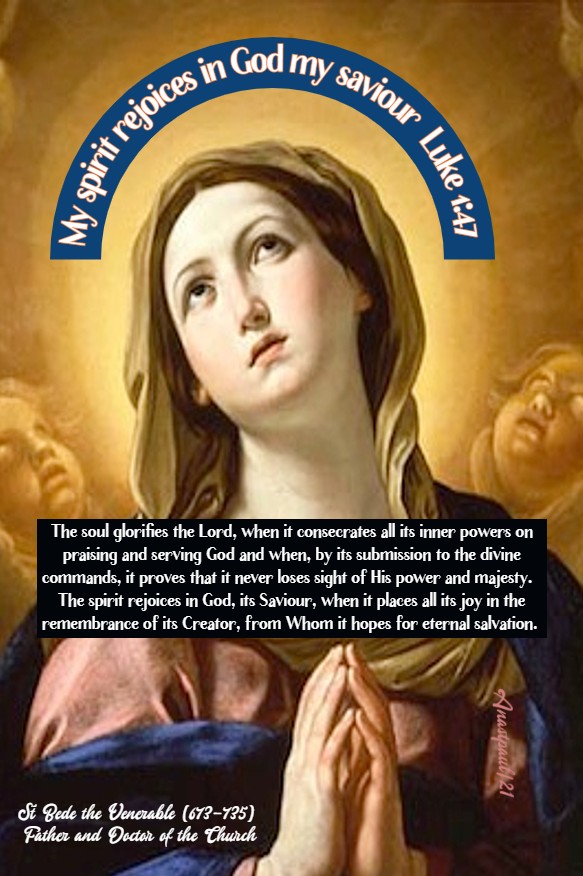
“My spirit rejoices in God my saviour” – Luke 1:47
REFLECTION – “My soul magnifies the Lord, my spirit rejoices in God my Saviour.”. The first interpretation of these words is undoubtedly to acknowledge the gifts granted to her, to Mary in particular, by God. But then she recalls the universal blessing with which God never ceases to surround the human race.
The soul glorifies the Lord, when it consecrates all its inner powers on praising and serving God and when, by its submission to the divine commands, it proves that it never loses sight of His power and majesty. The spirit rejoices in God, its Saviour, when it places all its joy in the remembrance of its Creator, from Whom it hopes for eternal salvation. Without doubt, these words exactly express the thought of all the Saints but it was most especially fitting they should be spoken by the blessed Mother of God, who, filled with a special privilege, burned with a wholly spiritual love for the One she had the joy of conceiving in her flesh. More than any other Saint she had good reason to rejoice in Jesus – that is to say, in her Saviour – because He Whom she acknowledged to be the Eternal Author of our salvation, would in time, as she knew, be born in His own flesh and with such authenticity, that in one and the same Person her Son and her God, would be truly present…
Hence it is a praiseworthy and salutary custom, whose fragrance perfumes Holy Church, when everyday at Vespers, we sing the Canticle of the Virgin. We may well expect from this, that the souls of the faithful, by so often calling to mind the Lord’s Incarnation, will be enflamed with even greater fervour and that, such a frequent reminder of His Holy Mother’s example, will strengthen them in virtue. And Vespers is the best time to come back to this song, since our souls, tired by the day and drawn this way and that by the day’s thoughts, need to come back together again, when the hour of rest draws near, so that they may find, once more, their singleness of focus.” – St Bede the Venerable (673-735) Monk, Father and Doctor of the Church (Homilies on the Gospel, I, 4 ; CCL 122, 25f)
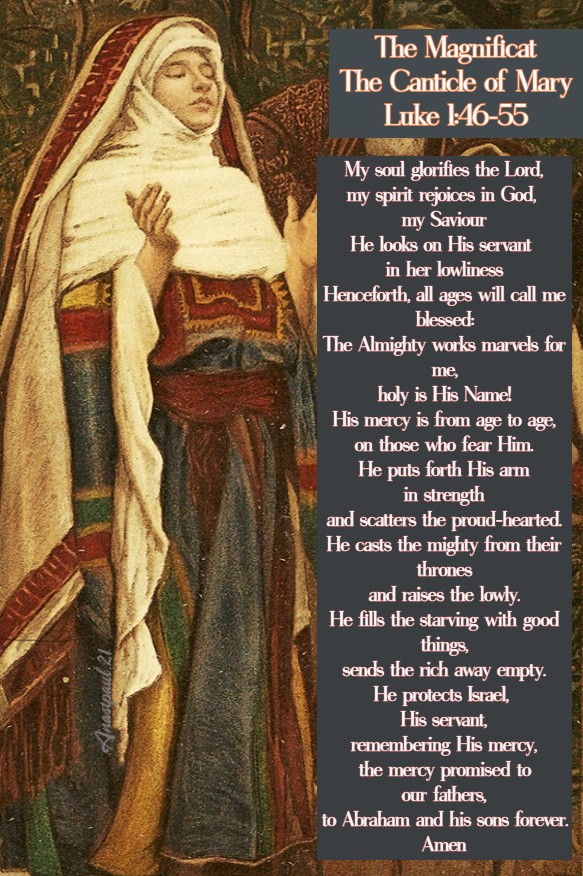
PRAYER –The Magnificat The Canticle of Mary Luke 1:46-55
My soul glorifies the Lord, my spirit rejoices in God, my Saviour He looks on His servant in her lowliness Henceforth, all ages will call me blessed: The Almighty works marvels for me, holy is His Name! His mercy is from age to age, on those who fear Him. He puts forth His arm in strength and scatters the proud-hearted. He casts the mighty from their thrones and raises the lowly. He fills the starving with good things, sends the rich away empty. He protects Israel, His servant, remembering His mercy, the mercy promised to our fathers, to Abraham and his sons forever. Amen.
One Minute Reflection – 21 December – O Oriens/O Radiant Dawn – “Month of the Immaculate Conception” – Tuesday of the Fourth Week of Advent, Readings: Songs 2: 8-14 or Zephaniah 3: 14-18a; Psalm 33: 2-3, 11-12, 20-21; Luke 1: 39-45
The Lord is at hand, come let us adore Him.
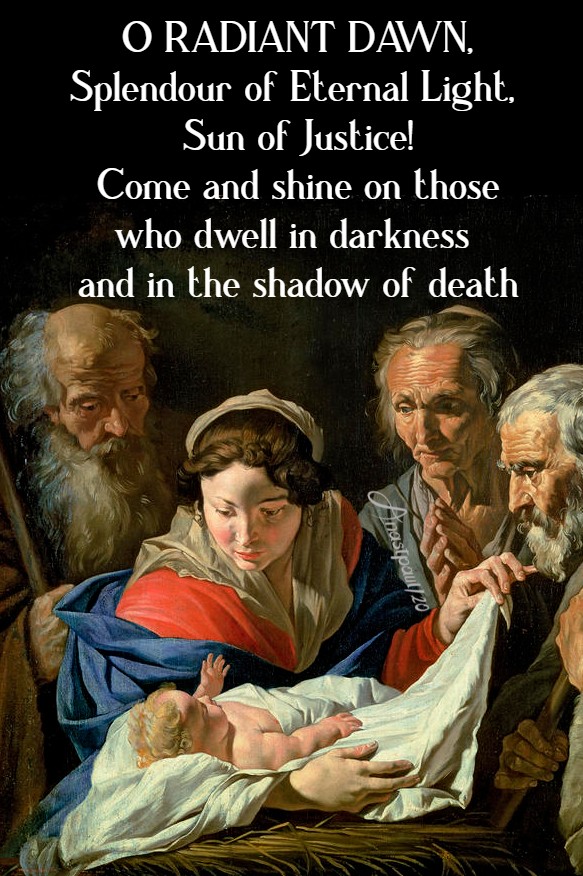
O Radiant Dawn, Splendour of Eternal Light, Sun of Justice! Come and shine on those who dwell in darkness and in the shadow of death.
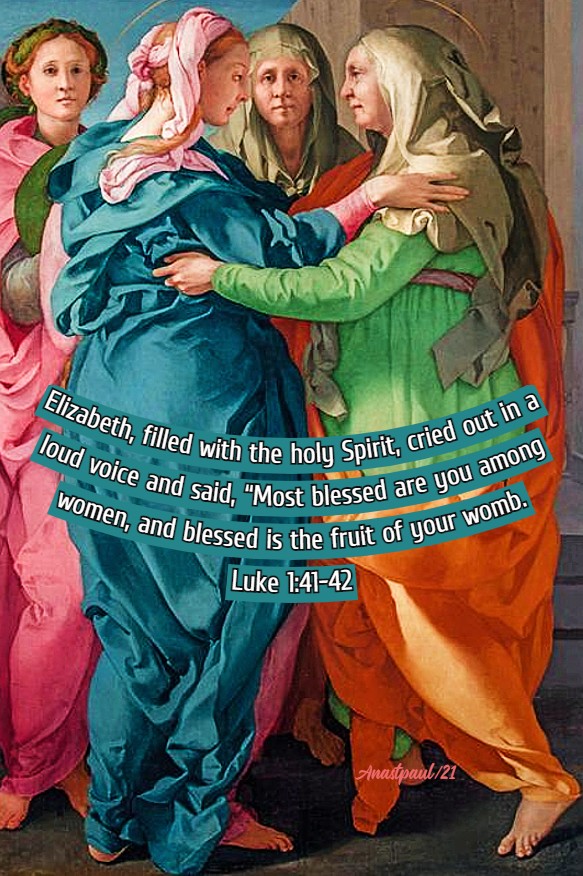
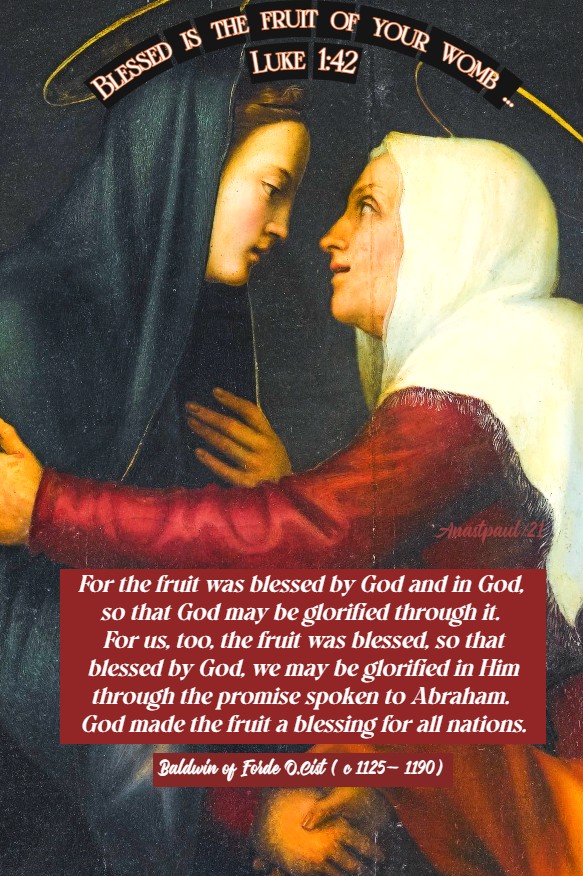
“Elizabeth, filled with the holy Spirit, cried out in a loud voice and said, “Most blessed are you among women, and blessed is the fruit of your womb.” – Luke 1:41-42
REFLECTION – “Everyday we devoutly greet the most Blessed Virgin Mary with the angel’s greeting and we usually add: Blessed is the fruit of thy womb. After she was greeted by the Virgin, Elizabeth added this phrase as if she were echoing the salutation of the Angel – Blessed are you among women and blessed is the fruit of your womb. This is the fruit of which Isaiah spoke – On that day the shoot of the Lord shall be splendid and radiant—the sublime fruit of earth. What is this fruit but the holy one of Israel, the seed of Abraham, the shoot of the Lord, the flower arising from the Root of Jesse, the fruit of life, Whom we have shared?
Blessed surely in seed and blessed in the shoot, blessed in the flower, blessed in the gift, finally blessed in thanksgiving and praise, Christ, the Seed of Abraham, was brought forth from the seed of David into the flesh.
He alone among men is found perfected in every good quality, for the Spirit was given to Him without measure so that He alone could fulfill all justice. For His justice is sufficient for all nations, according to the Scriptures. As the earth brings forth its buds and as the garden germinates its own seed, so the Lord God shall bring forth justice and praise before all the nations. For this is the shoot of justice, which the flower of glory adorns with its blessings when it has grown. But how great is this glory? How can anyone think of anything more glorious, or rather, how can anyone conceive of this at all? For the flower rises from the root of Jesse. you ask: “How far?” Surely it rises even to the highest place because Jesus Christ is in the glory of God the Father. His magnificence is elevated above the heavens, so that He, the issue of the Lord, is splendid and glorious, the sublime fruit of earth.
But what is our benefit from this fruit? What other than the fruit of blessing from the blessed fruit? From this seed, this shoot, this flower, surely the fruit of blessing comes forth. It has come even to us; first as a seed it is planted through the grace of pardon, then germinated with the increase of perfection and finally, it flowers in the hope or the attainment of glory. For the fruit was blessed by God and in God, so that God may be glorified through it. For us, too, the fruit was blessed, so that blessed by God, we may be glorified in Him through the promise spoken to Abraham. God made the fruit a blessing for all nations.” – Baldwin of Forde O.Cist ( c 1125– 1190) Cistercian Abbot, Bishop, then Archbishop of Canterbury ( An excerpt from A Sermon on the ‘Hail Mary’).
PRAYER – In Your goodness Lord, as we rejoice at the coming of Your Son in flesh and blood like ours, grant that when He comes again in glory, we may receive the gift of eternal life. And may His Blessed and Immaculate ever Virgin Mother, cast upon us a look of mercy and intercede on our behalf. Through Jesus Christ our Lord, with the Holy Spirit, God now and for all eternity, amen.
Our Morning Offering – 21 December – “Month of the Immaculate Conception” – Tuesday of the Fourth Week of Advent
Hail Mary, the Angelic Salutation
The Hail Mary/Ave Maria
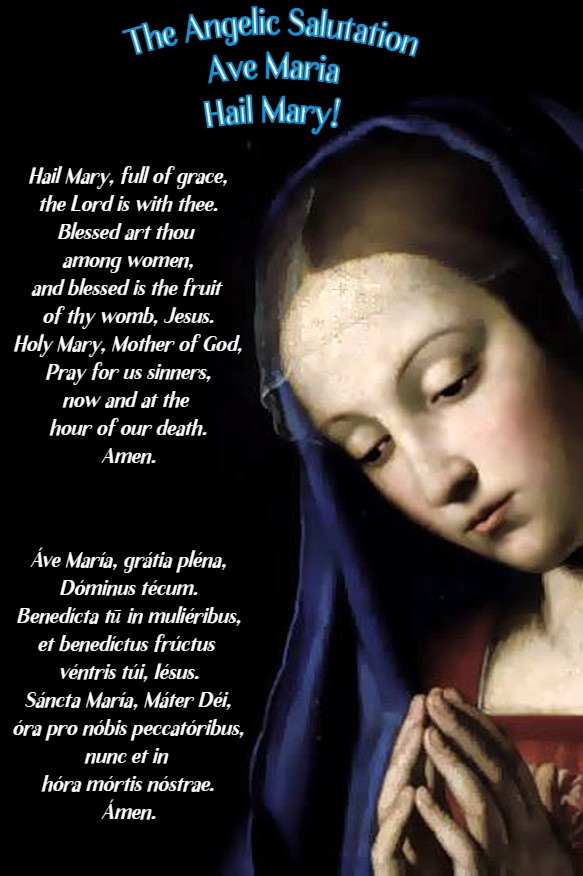
Hail Mary, full of grace, the Lord is with thee. Blessed art thou among women, and blessed is the fruit of thy womb, Jesus. Holy Mary, Mother of God, pray for us sinners, now and at the hour of our death. Amen.
Áve María, grátia pléna, Dóminus técum. Benedícta tū in muliéribus, et benedíctus frúctus véntris túi, Iésus. Sáncta María, Máter Déi, óra pro nóbis peccatóribus, nunc et in hóra mórtis nóstrae. Ámen.
Today, Catholics may wish to thank St Peter Canisdius (1521-1397), for this Doctor of the Church gave us the second half of the Hail Mary prayer.
This 16th-century Saint, known as the second Apostle of Germany, followed in the giant footsteps of St Boniface, who evangelised Germany a thousand years earlier. He was also active at the Council of Trent and wrote much on the Blessed Virgin Mary.
The first half of the Hail Mary, of course, comes from Scripture. What many Catholics don’t know, is that the second half of this Catholic prayer is due to the intervention of St Peter Canisius at the Council of Trent. St Peter began adding onto the scriptural part of the Hail Mary, the “Holy Mary Mother of God pray for us sinners, now and at the hour of our death.” It was Trent that officially accepted this addition to the prayer and included it in their famous Catechism of the Council of Trent in 1566.
Our Morning Offering – 17 December – “Month of the Immaculate Conception” – Friday of the Third Week of Advent
Queen on Whose Starry Brow Doth Rest St Venantius Fortunatus (c 530-c 609) Translation by Monsignor Ronald A Knox (1888 – 1957)
Queen, on whose starry brow doth rest The crown of perfect maidenhood, The God who made thee, from thy brest Drew, for our sakes, His earthly food.
The grace that sinful Eve denied, With thy Child-bearing, re-appears; Heaven’s lingering door, set open wide, Welcomes the children of her tears.
Fate, for such royal progress meet, Beacon, whose rays such light can give, Look, how the ransomed nations greet The virgin-womb that bade them live!
O Jesus, whom the Virgin bore, Be praise and glory unto Thee. Praise to the Father evermore And His life-giving Spirit be. Amen!
Saint Venantius Fortunatus (c 530 – c 609) Bishop, Poet, Hymnist, Writer – born c 530 at Rreviso, Italy and died c 609 at Poitiers, modern France of natural causes. St Venantius was unique, first a travelling lay poet, he later became a Priest and then a Bishop. But he always remained a professional author of poetry, a “Troubadour” of Christ. He is the attributed author of the Ave Maris Stella, amongst many others.
Quote/s of the Day – 15 December – “Month of the Immaculate Conception” – The Octave Day of the Immaculate Conception of the Blessed Virgin Mary
“I am the Immaculate Conception.”
Our Lady of Lourdes to St Bernadette 25 March 1858
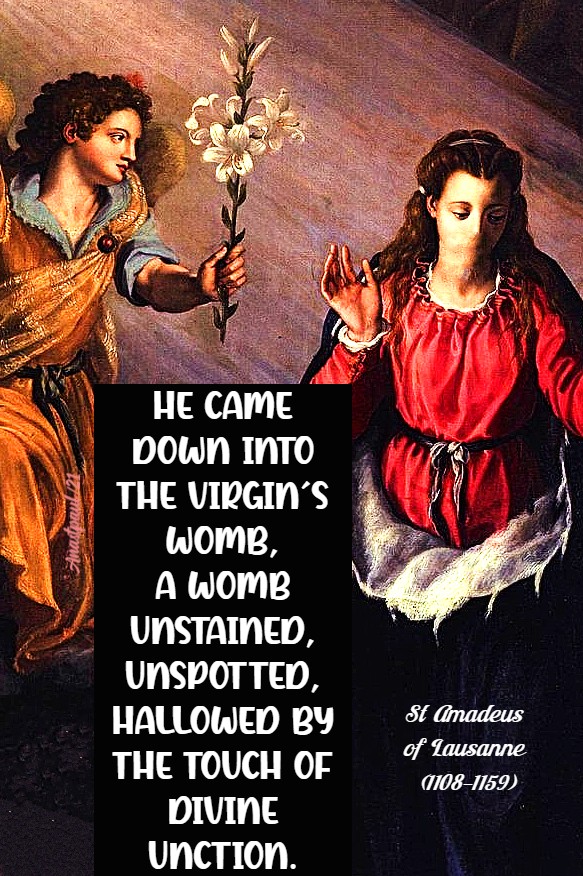
“He came down into the Virgin’s womb, a womb unstained, unspotted, hallowed by the touch of divine unction.”
St Amadeus of Lausanne (1108-1159)
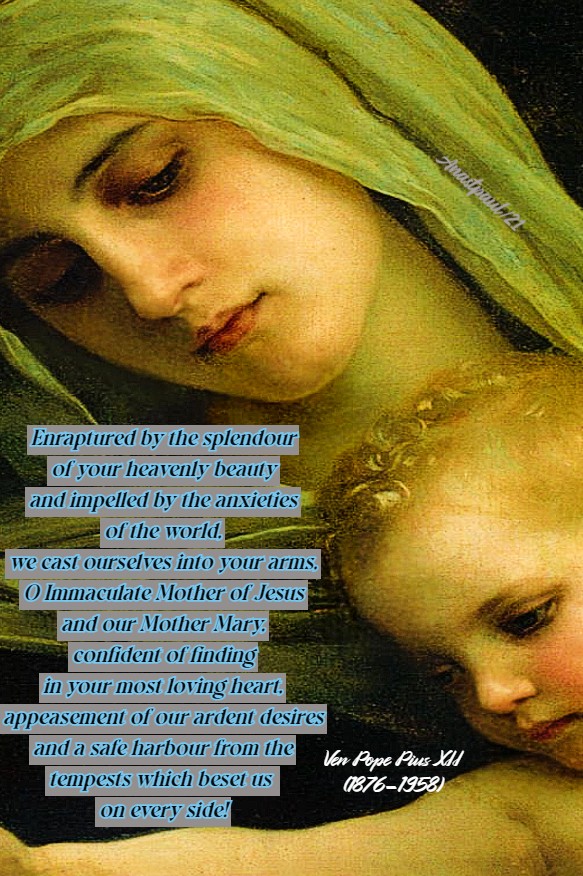
“Enraptured by the splendour of your heavenly beauty and impelled by the anxieties of the world, we cast ourselves into your arms, O Immaculate Mother of Jesus and our Mother Mary, confident of finding in your most loving heart, appeasement of our ardent desires and a safe harbour from the tempests which beset us on every side.”
Ven Pope Pius XII (1876-1958)
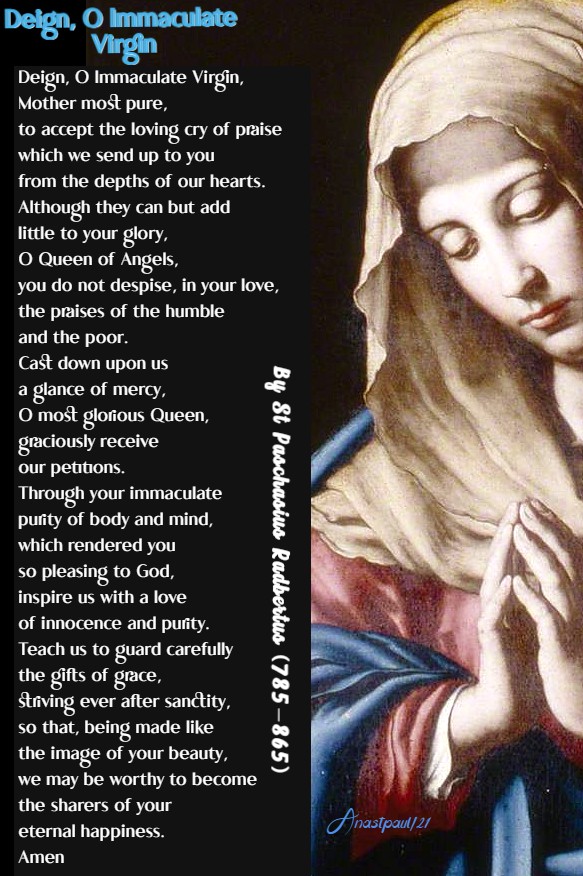
Deign, O Immaculate Virgin By St Paschasius Radbertus (785–865)
Deign, O Immaculate Virgin, Mother most pure, to accept the loving cry of praise which we send up to you from the depths of our hearts. Though they can but add little to your glory, O Queen of Angels, you do not despise, in your love, the praises of the humble and the poor. Cast down upon us a glance of mercy, O most glorious Queen, graciously receive our petitions. Through your immaculate purity of body and mind, which rendered you so pleasing to God, inspire us with a love of innocence and purity. Teach us to guard carefully the gifts of grace, striving ever after sanctity, so that, being made like the image of your beauty, we may be worthy to become the sharers of your eternal happiness. Amen
Our Morning Offering – 15 December – “Month of the Immaculate Conception” – The Octave Day of the Immaculate Conception of the Blessed Virgin Mary
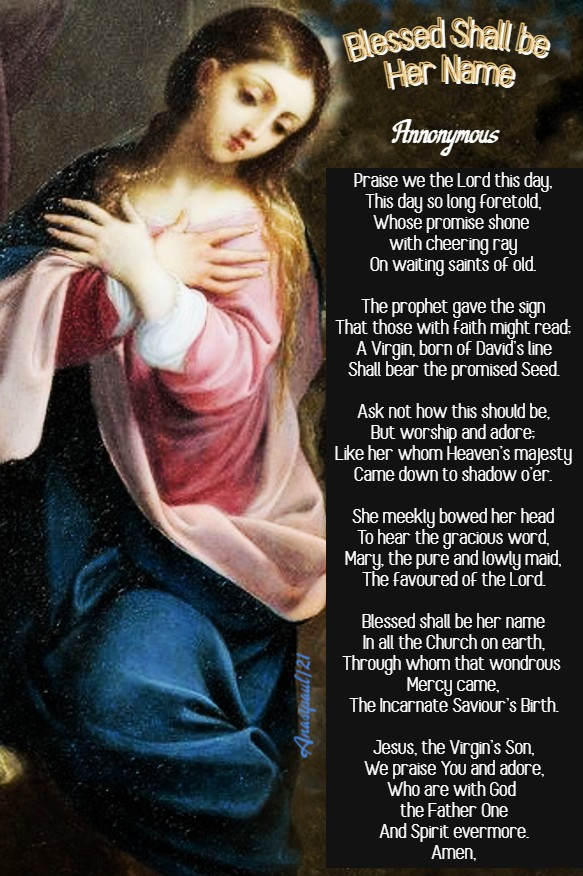
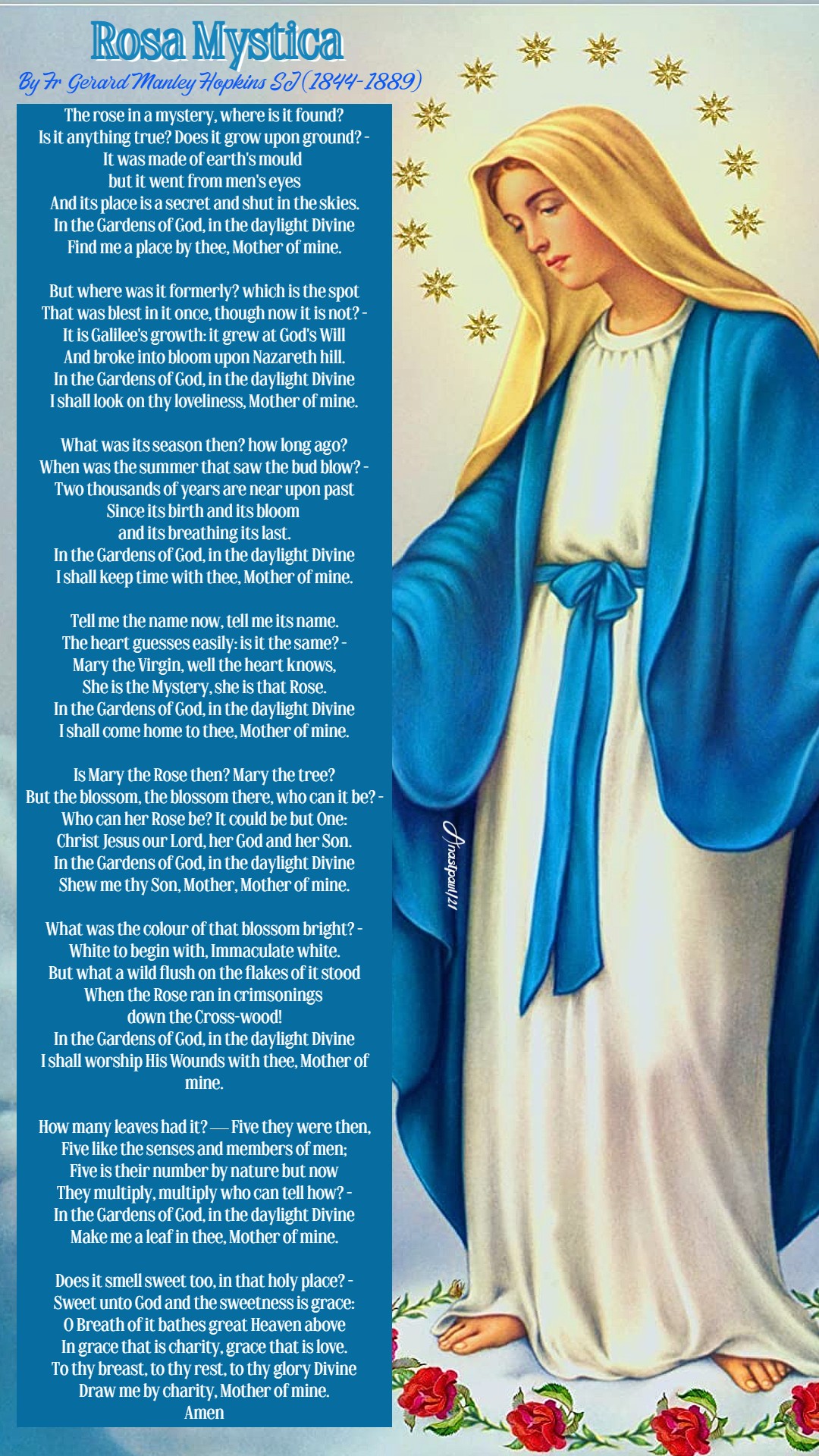
Rosa Mystica By Fr Gerard Manley Hopkins SJ (1844-1889)
The rose in a mystery, where is it found? Is it anything true? Does it grow upon ground? — It was made of earth’s mould but it went from men’s eyes And its place is a secret and shut in the skies. In the Gardens of God, in the daylight Divine Find me a place by thee, Mother of mine.
But where was it formerly? which is the spot That was blest in it once, though now it is not? — It is Galilee’s growth: it grew at God’s Will And broke into bloom upon Nazareth hill. In the Gardens of God, in the daylight Divine I shall look on thy loveliness, Mother of mine.
What was its season then? how long ago? When was the summer that saw the bud blow? — Two thousands of years are near upon past Since its birth and its bloom and its breathing its last. In the Gardens of God, in the daylight Divine I shall keep time with thee, Mother of mine.
Tell me the name now, tell me its name. The heart guesses easily: is it the same? — Mary the Virgin, well the heart knows, She is the Mystery, she is that Rose. In the Gardens of God, in the daylight Divine I shall come home to thee, Mother of mine.
Is Mary the Rose then? Mary the tree? But the blossom, the blossom there, who can it be? — Who can her Rose be? It could be but One: Christ Jesus our Lord, her God and her Son. In the Gardens of God, in the daylight Divine Shew me thy Son, Mother, Mother of mine.
What was the colour of that blossom bright? — White to begin with, Immaculate white. But what a wild flush on the flakes of it stood When the Rose ran in crimsonings down the Cross-wood! In the Gardens of God, in the daylight Divine I shall worship His Wounds with thee, Mother of mine.
How many leaves had it? — Five they were then, Five like the senses and members of men; Five is their number by nature but now They multiply, multiply who can tell how?┬░ In the Gardens of God, in the daylight Divine Make me a leaf in thee, Mother of mine.
Does it smell sweet too, in that holy place? — Sweet unto God and the sweetness is grace: O Breath of it bathes great Heaven above In grace that is charity, grace that is love. To thy breast, to thy rest, to thy glory Divine Draw me by charity, Mother of mine. Amen
Our Morning Offering – 11 December – As Sunday is the Feast of Our Lady of Guadalupe and today is Mary’s Saturday, let us pray this powerful indulgenced prayer now.
Our Lady of Guadalupe, Mystical Rose Prayer to Our Lady of Guadalupe By St Pius X (1835-1914)
Our Lady of Guadalupe, Mystical Rose, make intercession for the holy Church, protect the Sovereign Pontiff, help all those who invoke thee in their necessities, and since thou art the ever Virgin Mary and Mother of the true God, obtain for us from thy most holy Son the grace of keeping our faith, sweet hope in the midst of the bitterness of life, burning charityand the precious gift of final perseverance. Amen
This prayer was approved and enriched with an indulgence of five hundred days by St Pope Pius X at an audience held on August, 1908 and was included in the official edition of approved indulgenced prayers (1950). Raccolta number 389, 500 days Indulgence, St Pope Pius X audience, 15 August 1908.
Our Morning Offering – 10 December – Friday of the Second Week of Advent and the Memorial of Our Lady of Loreto and the Holy House
Maiden yet a Mother By Dante Alighieri (1265-1321) Trans. Msgr Ronald A Knox (1888-1957)
Maiden yet a mother, daughter of thy Son, high beyond all other, lowlier is none; thou the consummation planned by God’s decree, when our lost creation nobler rose in thee!
Thus His place prepared, He who all things made ‘mid His creatures tarried, in thy bosom laid; there His love He nourished, warmth that gave increase to the root whence flourished our eternal peace.
Nor alone thou hearest When thy name we hail; Often thou art nearest When our voices fail; Mirrored in thy fashion All creation’s gird, Mercy, might compassion Grace thy womanhood.
Lady, let our vision Striving heavenward, fail, Still let thy petition With thy Son prevail, Unto whom all merit, prayer and majesty, With the Holy Spirit And the Father be.
Maiden Yet A Mother is a translation of a Poem by Durante (Dante) degli Alighieri (c 1265–1321). It is based upon the opening verses of Canto 33 of the Paradiso from his Divine Comedy in which St Bernard of Clairvaux (1090–1153) praises and prays to the Virgin Mother on behalf of Dante. It was translated from the original Italian into English by the Catholic convert, Monsignor Ronald A Knox (1888-1957).
One Minute Reflection – 8 December on the Solemnity of the Immaculate Conception – Readings: Genesis 3:9-15, 20, Psalm 98:1-4, Ephesians 1:3-6, 11-12, Luke 1:26-38
And behold, you will conceive in your womb and bear a son and you shall call his name Jesus.
And Mary said, “Behold, I am the handmaid of the Lord, let it be done to me according to your word.” … Luke 1:38
REFLECTION – “Son of God, grant me Your own admirable Gift, that I may celebrate the wondrous beauty of Your beloved Mother! The Virgin gave birth to a Son while preserving her virginity, she suckled Him who gives nourishment to the peoples, in her Immaculate breast she bore Him who carries the whole world in His Hands. She is Virgin and Mother, what will she not be hereafter? Holy in body, all beautiful in soul, pure of mind, upright in intelligence, perfect in feeling, chaste and faithful, pure of heart and filled with virtue.
May the hearts of virgins rejoice in Mary, since of her was born the One Who set humankind free from dreadful slavery. May the old Adam, wounded by the serpent, rejoice in Mary; it is Mary who gives Adam a posterity that allows him to crush the accursed serpent and who cures him of his mortal wound (Gen 3:15). Let Priests rejoice in the blessed Virgin; she has brought the High Priest into the world, Who gave Himself as a victim, putting an end to the sacrifices of the Old Covenant. … Let the Prophets rejoice in Mary, since in her, were fulfilled their visions, in her were realised their prophecies, in her were confirmed their oracles. Let all the Patriarchs rejoice in Mary since she received the blessing promised to them, she, who, in her Son, has brought them to completion. …
Mary is the new Tree of Life, who, instead of the bitter fruit picked by Eve, gives to mankind that Sweet Fruit on which the whole world is fed.” – St Ephrem (306-373) Deacon in Syria, Father and Doctor of the Church (Marian hymn).
PRAYER –O Mary, My Hope! By St John Damascene (675-749) Father and Doctor of the Church I salute you, O Mary! you are the hope of Christians. Receive the prayer of a sinner, who loves you tenderly, honours you in a special manner and places in you the whole hope of his salvation. From you I have my life. You reinstate me in the grace of your Son: you are the sure pledge of my salvation. I beseech of you, therefore, to deliver me from the burden of my sins, dispel the darkness of my mind, banish from my heart the love of the world, repress the temptations of my enemies and so rule my whole life, that by your means and under your guidance, I may obtain everlasting happiness in heaven. Amen
Our Morning Offering – 8 December – The Solemnity of the Immaculate Conception
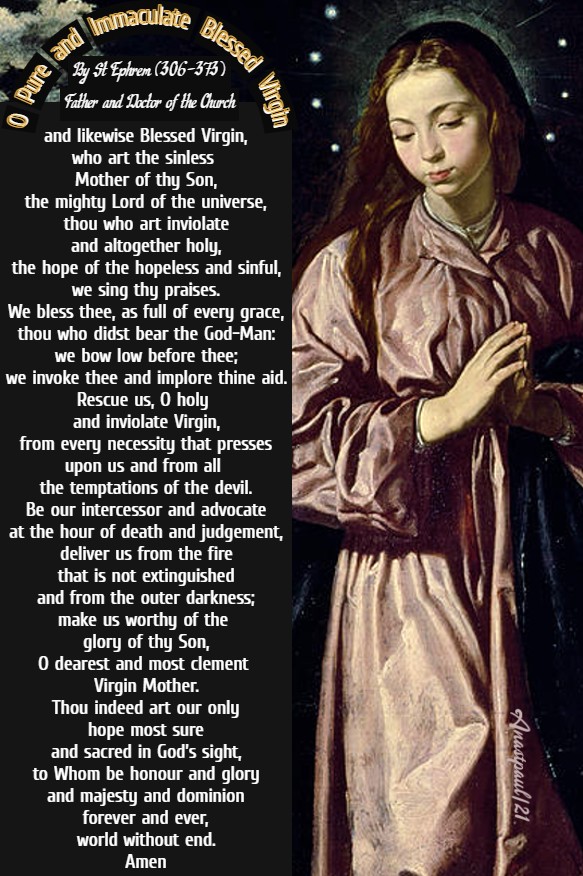
O Pure and Immaculate Blessed Virgin By St Ephrem (306-373) Father and Doctor of the Church
O Pure and Immaculate and likewise Blessed Virgin, who art the sinless Mother of thy Son, the mighty Lord of the universe, thou who art inviolate and altogether holy, the hope of the hopeless and sinful, we sing thy praises. We bless thee, as full of every grace, thou who didst bear the God-Man: we bow low before thee; we invoke thee and implore thine aid. Rescue us, O holy and inviolate Virgin, from every necessity that presses upon us and from all the temptations of the devil. Be our intercessor and advocate at the hour of death and judgement, deliver us from the fire that is not extinguished and from the outer darkness; make us worthy of the glory of thy Son, O dearest and most clement Virgin Mother. Thou indeed art our only hope most sure and sacred in God’s sight, to Whom be honour and glory and majesty and dominion forever and ever, world without end. Amen
Our Morning Offering – 4 December – Saturday of the First Week of Advent – Mary’s Day
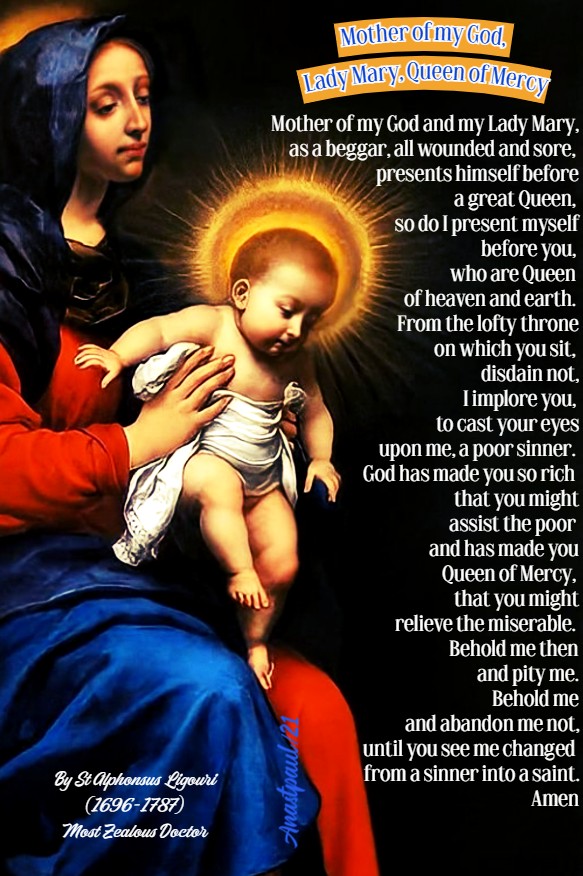
Mother of my God, Lady Mary, Queen of Mercy By St Alphonsus Ligouri (1696-1787) Most Zealous Doctor
Mother of my God and my Lady Mary, as a beggar, all wounded and sore, presents himself before a great Queen, so do I present myself before you, who are Queen of heaven and earth. From the lofty throne on which you sit, disdain not, I implore you, to cast your eyes on me, a poor sinner. God has made you so rich that you might assist the poor and has made you Queen of Mercy, that you might relieve the miserable. Behold me then and pity me. Behold me and abandon me not, until you see me changed from a sinner into a saint. Amen
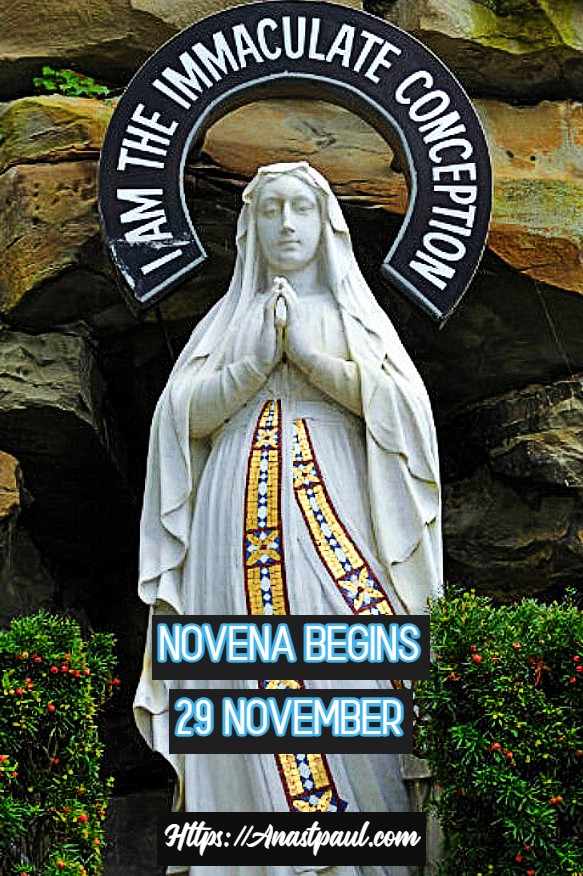
Novena in honour of the Immaculate Conception Begins 29 November Feast 8 December
The Dogma was promulgated by Blessed Pius IX in 1854 in the Bull Ineffabilis Deus. This Dogma is rejected by all Protestants including the Orthodox – another reason why we cannot interact with these the way some do and the Vatican II church endorses.
Let us Pray to our Mother, the Immaculate and Blessed Virgin Mary, conceived without sin.
Our Morning Offering – 27 November – The Memorial of The Medal of the Immaculate Conception / Our Lady of the Miraculous Medal and Mary’s Day
Prayer to Our Lady of the Miraculous Medal
Virgin Mother of God, Mary Immaculate, we unite ourselves to thee under thy title of Blessed Mother, Our Lady of the Miraculous Medal. May this medal be, for each one of us, a sure sign of thy motherly affection for us and a constant reminder of our filial duties towards thee. While wearing it, may we be blessed by thy loving protection and preserved in the grace of thy Son. Most powerful Virgin, Mother of our Saviour, keep us close to thee, every moment of our lives so that like thee, we may live and act according to the teaching and example of thy Son. Obtain for us, thy children, the grace of a happy death, so that in union with thee we may enjoy the happiness of heaven forever. Amen O Mary, conceived without sin, pray for us who have recourse to thee.
Our Morning Offering – 24 November – The Memorial of St John of the Cross OCD (1542-1591) Doctor of the Church
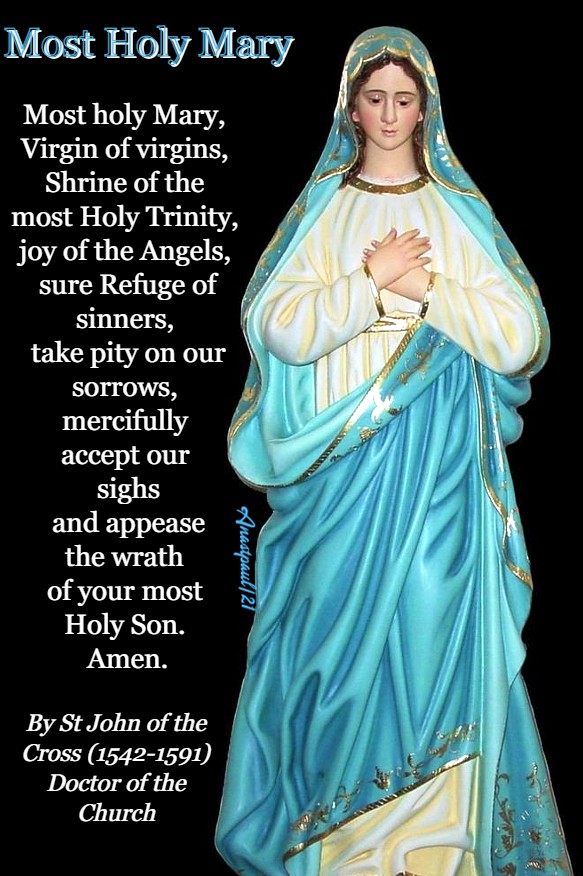
Most Holy Mary By St John of the Cross (1542-1591) Doctor of the Church
Most holy Mary, Virgin of virgins, Shrine of the most Holy Trinity, joy of the Angels, sure Refuge of sinners, take pity on our sorrows, mercifully accept our sighs and appease the wrath of your most holy Son. Amen.
Quote/s of the Day – 13 November – The Memorial of All Saints of the Augustinian Order and the Anniversary of the Birth of St Augustine (354-430)
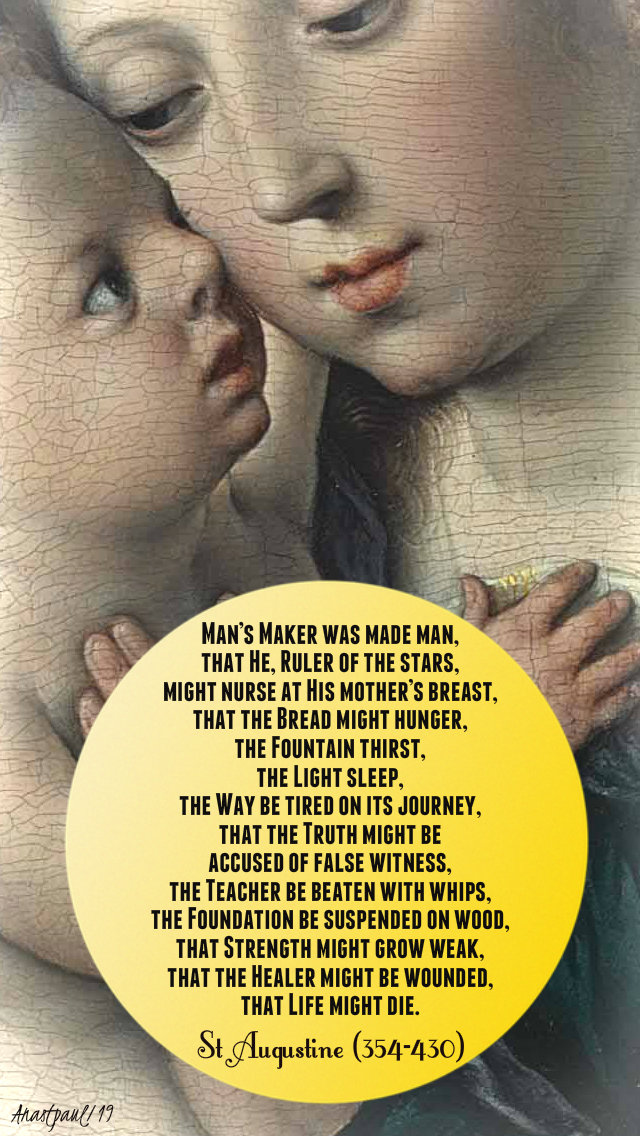
“Man’s Maker was made man, that He, Ruler of the stars, might nurse at His mother’s breast, that the Bread might hunger, the Fountain thirst, the Light sleep, the Way be tired on its journey, that the Truth might be accused of false witness, the Teacher be beaten with whips, the Foundation be suspended on wood, that Strength might grow weak, that the Healer might be wounded, that Life might die.”
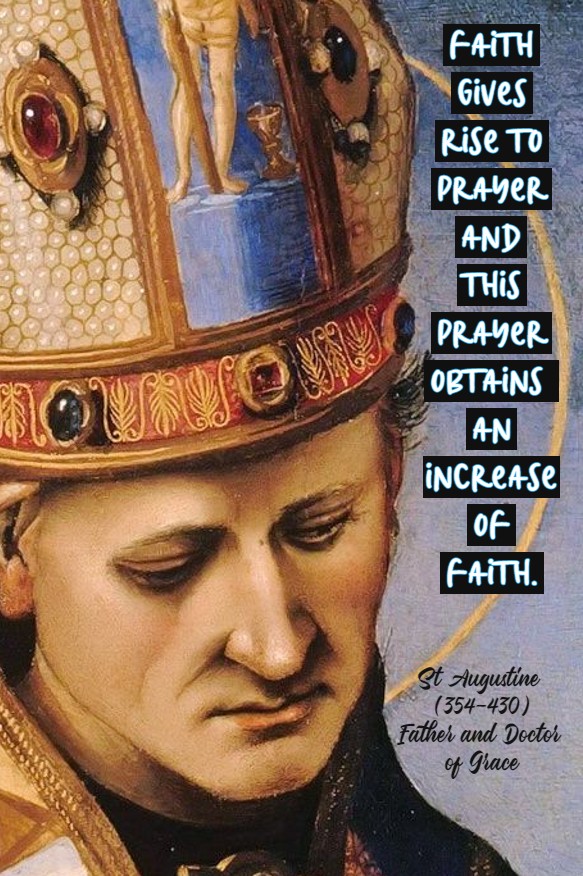
“Faith gives rise to prayer and this prayer obtains an increase of faith.”
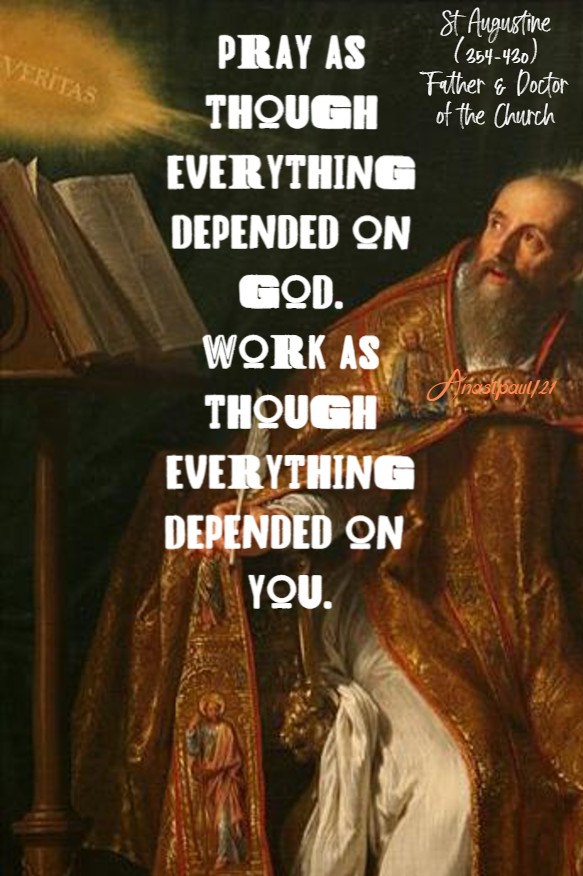
“Pray as though everything depended on God. Work as though everything depended on you.”
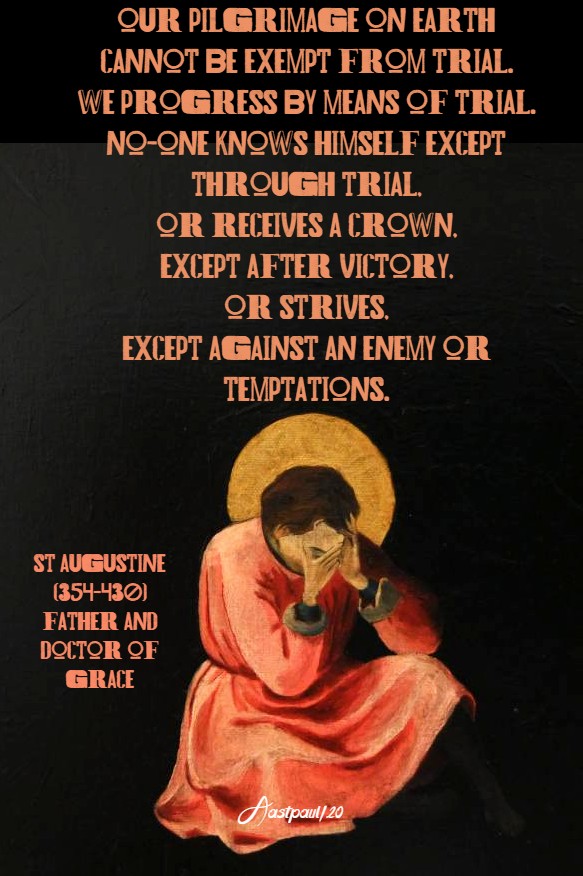
“Our pilgrimage on earth cannot be exempt from trial. We progress by means of trial. No-one knows himself except through trial, or receives a crown, except after victory, or strives, except against an enemy or temptations.”
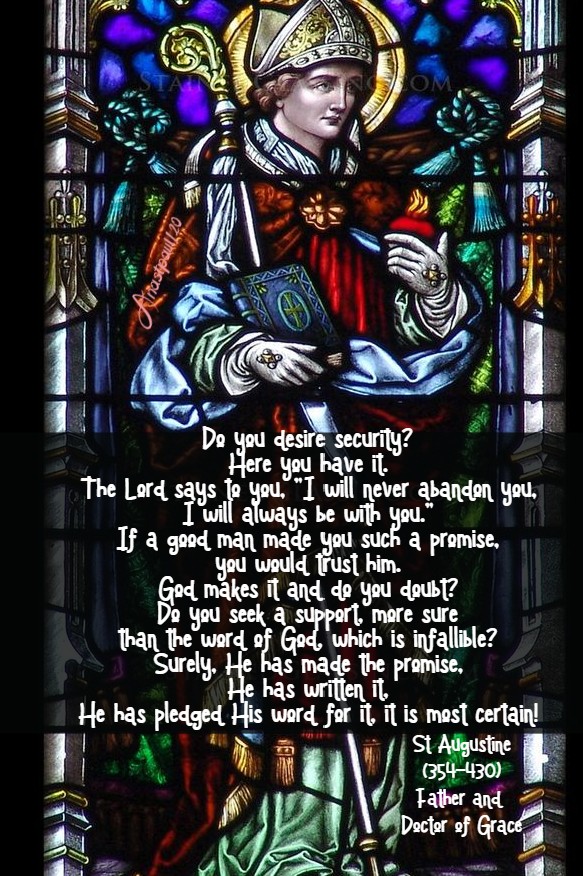
“Do you desire security? Here you have it. The Lord says to you, “I will never abandon you, I will always be with you.” If a good man made you such a promise, you would trust him. God makes it and do you doubt? Do you seek a support, more sure than the Word of God, which is infallible? Surely, He has made the promise, He has written it, He has pledged His Word for it, it is most certain!”
“If you believe what you like in the Gospels and reject what you don’t like, it is not the Gospel you believe but yourself.”
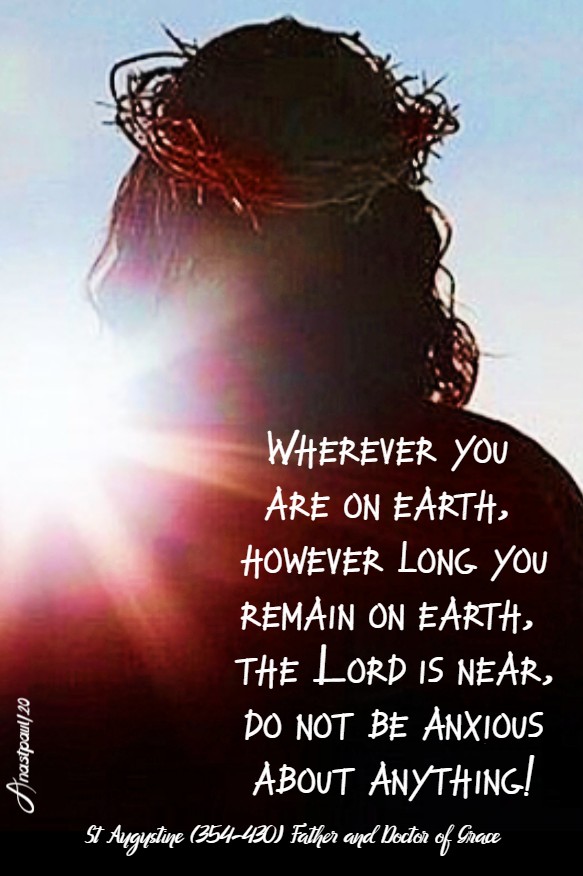
“Wherever you are on earth, however long you remain on earth, the Lord is near, do not be anxious about anything!”
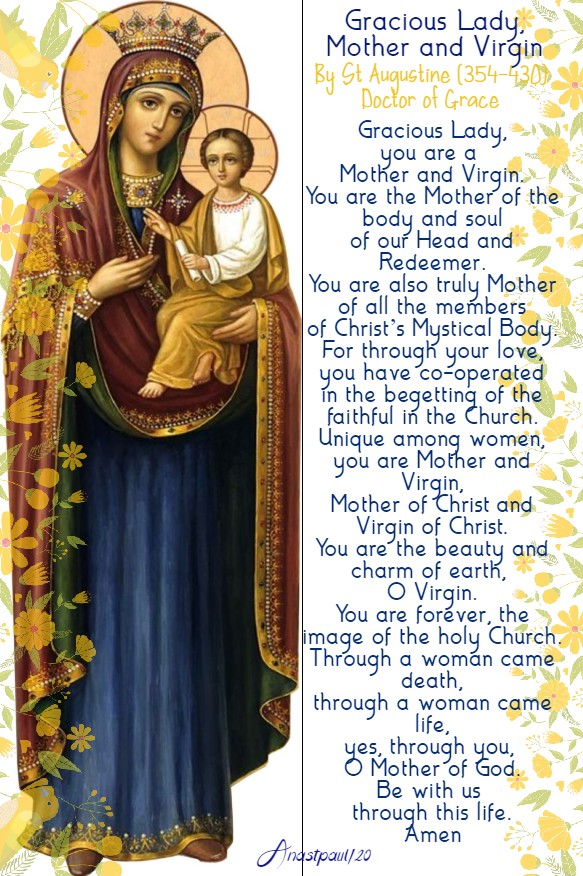
Gracious Lady, Mother and Virgin By St Augustine (354-430) Doctor of Grace
Gracious Lady, you are a Mother and Virgin. You are the Mother of the body and soul of our Head and Redeemer. You are also truly Mother of all the members of Christ’s Mystical Body. For through your love, you have co-operated in the begetting of the faithful in the Church. Unique among women, you are Mother and Virgin, Mother of Christ and Virgin of Christ. You are the beauty and charm of earth, O Virgin. You are forever, the image of the holy Church. Through a woman came death, through a woman came life, yes, through you, O Mother of God. Be with us through this life. Amen
Our Morning Offering – 13 November – Mary’s Saturday and the Anniversary of the Birth of St Augustine in 354
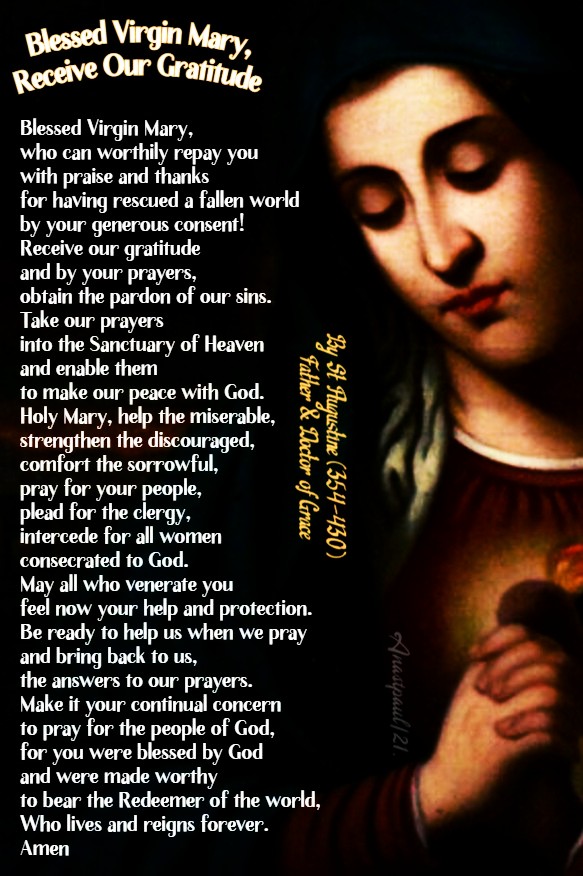
Blessed Virgin Mary, Receive Our Gratitude By St Augustine (354-430) Father & Doctor of Grace
Blessed Virgin Mary, who can worthily repay you with praise and thanks for having rescued a fallen world by your generous consent! Receive our gratitude and by your prayers, obtain the pardon of our sins. Take our prayers into the Sanctuary of Heaven and enable them to make our peace with God. Holy Mary, help the miserable, strengthen the discouraged, comfort the sorrowful, pray for your people, plead for the clergy, intercede for all women consecrated to God. May all who venerate you feel now your help and protection. Be ready to help us when we pray and bring back to us, the answers to our prayers. Make it your continual concern to pray for the people of God, for you were blessed by God and were made worthy to bear the Redeemer of the world, Who lives and reigns forever. Amen





















You must be logged in to post a comment.