St Evasius of Brescia St Habakkuk the Prophet Bl John Amero
Blessed Jan van Ruysbroec (c 1293-1382) Known as John “the Admirable,” “the Ecstatic Doctor,” “the Divine Doctor.” Priest, Hermit, Mystic, Spiritual Director and Spiritual Writer. Beatified on 1 December 1908 by Pope Pius X. About Blessed Jan: https://anastpaul.com/2018/12/02/saint-of-the-day-2-december-blessed-john-van-ruysbroeck/ St Lupus of Verona St Nonnus of Edessa St Oderisius de Marsi OSB (Died c 1105) Italian Cardinal, Abbot of Monte Cassino, Mediator and Peacemaker. St Pimenio in Rome St Pontian
Bl Robert of Matallana St Silvanus
Greek Martyrs of Rome – (9 Saints): Several Greek Christians Martyred in the persecutions of Valerian – Adria, Aurelia, Eusebius, Hippolytus, Marcellus, Mary Martana, Maximus, Neon and Paulina. They were martyred by various means between 254 and 259 in Rome, Italy and are buried in the Callistus catacombs, Rome.
Martyrs of Africa – (4 Saints): Four Christians Martyred in Africa in the persecutions of Arian Vandals – Januarius, Securus, Severus and Victorinus.
St Agericus of Verdun St Agnofleta St Alexander Briant St Ambon of Rome St Ananias of Arbela St Ansanus the Baptizer Bl Antony Bonfadini St Candida of Rome St Candres of Maestricht St Cassian of Rome St Castritian of Milan Bl Christian of Perugia St Constantine of Javron St Declan St Didorus St Domnolus of Le Mans
St Evasius of Asti St Filatus of Rome St Florence of Poitiers St Florentius St Grwst St Jabinus of Rome and Companions Blessed John Beche OSB (Died 1539) Abbot Martyr St Latinus of Rome St Leontius of Fréjus St Lucius of Rome St Marianus St Marina of Rome St Martinus St Nahum the Prophet St Natalia of Nicomedia St Olympiades St Proculus of Narni St Ralph Sherwin St Resignatus of Maastricht Bl Richard Langley St Rogatus of Rome St Simon of Cyrene St Superatus of Rome St Ursicinus of Brescia
Martyrs of Oxford University: A joint commemoration of all the men who studied at one of the colleges of Oxford University and who were later Martyred for their loyalty to the Catholic Church during the official persecutions in the Protestant Reformation in England under Elizabeth I. They are:
Blessed Edward James • Blessed Edward Powell • Blessed Edward Stransham • Blessed George Napper • Blessed George Nichols • Blessed Hugh More • Blessed Humphrey Pritchard • Blessed James Bell • Blessed James Fenn • Blessed John Bodey • Blessed John Cornelius • Blessed John Forest • Blessed John Ingram • Blessed John Mason • Blessed John Munden • Blessed John Shert • Blessed John Slade • Blessed John Storey • Blessed Lawrence Richardson • Blessed Mark Barkworth • Blessed Richard Bere • Blessed Richard Rolle de Hampole • Blessed Richard Sergeant • Blessed Richard Thirkeld • Blessed Richard Yaxley • Blessed Robert Anderton • Blessed Robert Nutter • Blessed Robert Widmerpool • Blessed Stephen Rowsham • Blessed Thomas Belson • Blessed Thomas Cottam • Blessed Thomas Pilcher • Blessed Thomas Plumtree • Blessed Thomas Reynolds • Blessed William Filby • Blessed William Hart • Blessed William Hartley • Saint Alexander Briant • Saint Cuthbert Mayne • Saint Edmund Campion • Saint John Boste • Saint John of Bridlington • Saint John Roberts • Saint Ralph Sherwin • Saint Thomas Garnet • Saint Thomas More.
St Abraham of Persia St Anders of Slagelse Bl Andrew of Antioch Bl Arnold of Gemblours St Castulus of Rome St Constantius of Rome St Crider of Cornwall Blessed Cuthbert Mayne (1544-1577) Priest Martyr St Domninus of Antioch St Euprepis of Rome Bl Everard of Stahleck
Bl Joscius Roseus St Justina of Constantinople St Mahanes the Persian St Maura of Constantinople St Merola of Antioch St Mirocles of Milan St Sapor St Simeon of Persia St Trojan St Tudwal of Tréguier Bl William de Paulo Zosimus the Wonder Worker
Martyrs of Saxony – 6 Saints: Missionaries who worked with Saint Willehad of Bremen. Martyrs. – Attroban, Benjamin, Emmingen, Folkard, Gerwald and Grisold. They were martyred on 30 November 782 at River Weser, Lawer Saxony, Germany.
All Saints of the Seraphic Order (Franciscan): the Church celebrates the many Franciscan Saints who followed in the footsteps of St Francis. It is a special day for all Franciscans to celebrate theFfeast of ‘All the Saints of the Seraphic Order.’ Also on this day in 1223, the final Rule of life for Franciscan Friars was approved. To commemorate this and all the saintly examples produced in the Franciscan Order, on this day all the Saints of the Seraphic order are remembered at Franciscan Churches throughout the world.
Bl Frederick of Ratisbon St Hardoin of Brittany St Illuminata of Todi St James of Saroug Bl Jutta of Heiligenthal St Paphnutius of Heracleopolis St Paramon St Philomenus of Ancyra St Radbod of Utrecht Blessed Redemptorus of the Cross OCD (1598-1638) Martyr,, Portugeuse Lay Brother of the Order of Discalced Carmelites. St Sadwen of Wales St Saturninus of Rome St Saturninus of Toulouse St Sisinius of Rome St Walderic of Murrhardt
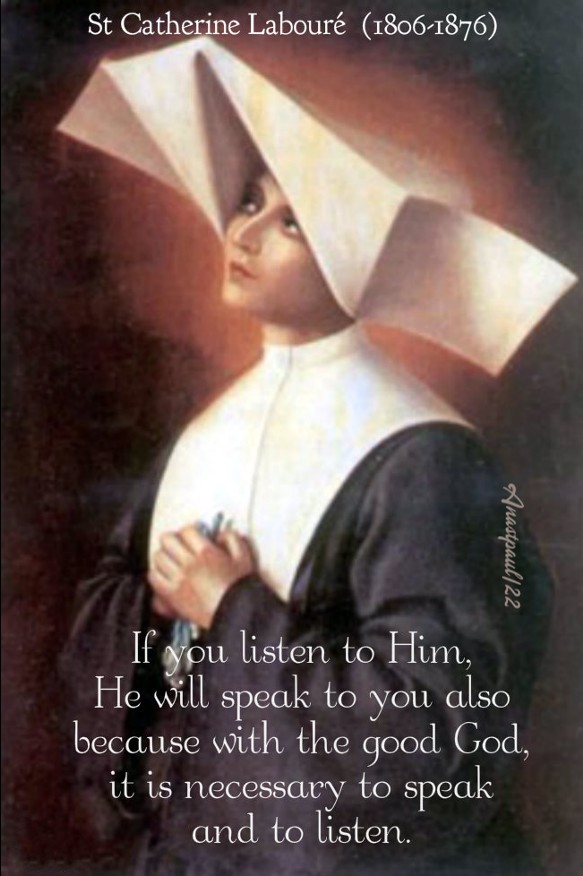
Quote/s of the Day – 28 November – The Memorial of St Catherine Labouré DC (1806-1876) Virgin, Religious Sister of the Daughters of Charity of Saint Vincent de Paul and the Marian visionary of the Miraculous Medal.
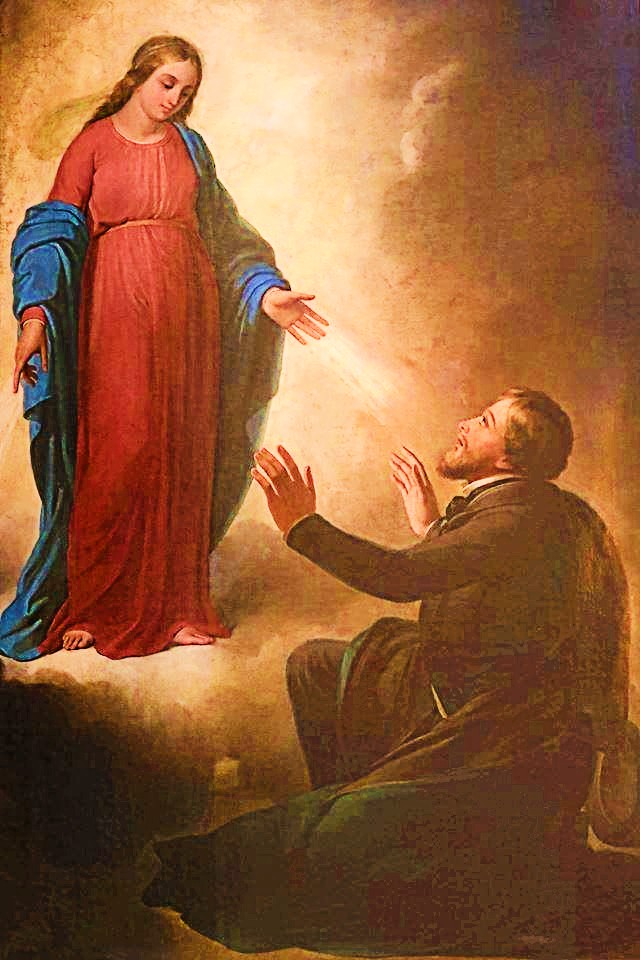
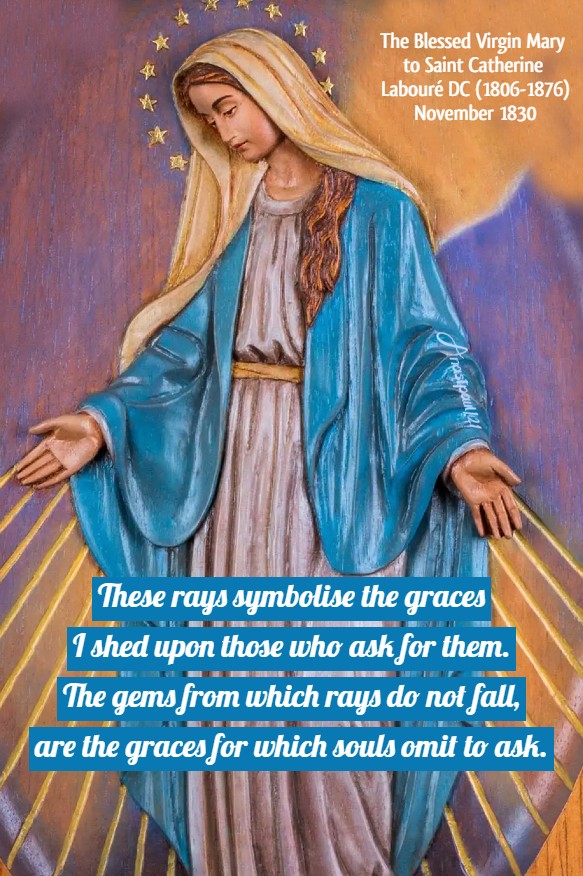
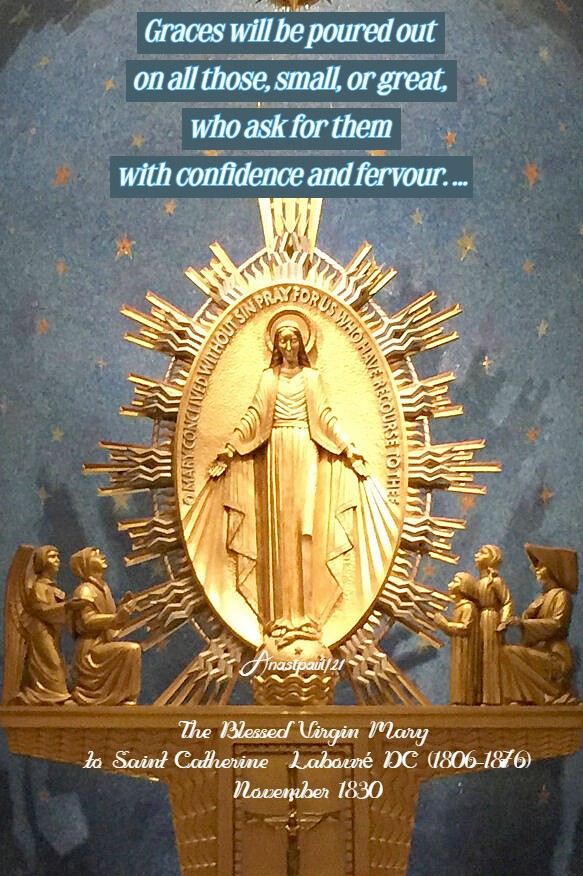
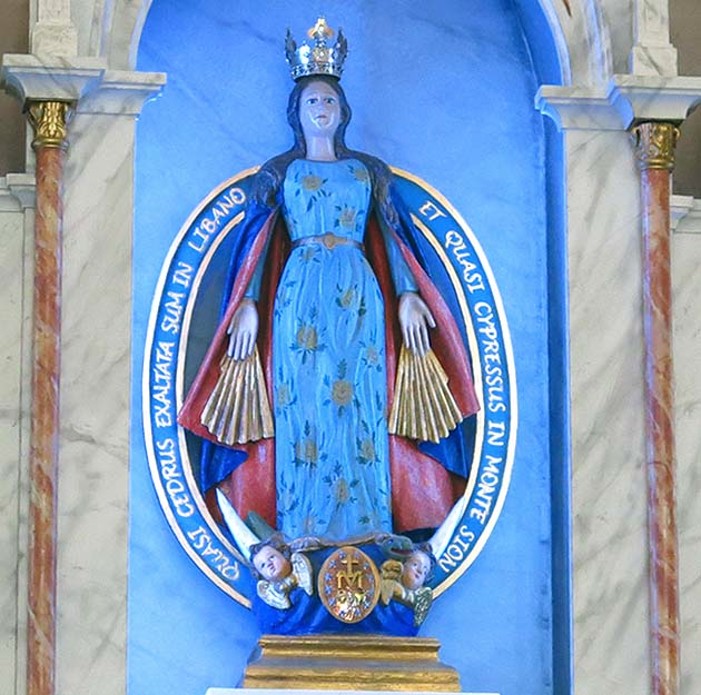
THE PROMISES OF THE MEDAL When Our Lady appeared to Saint Catherine Labouré on 27 November 1830, rays of light flowed from the rings (made of precious stones) on her fingers. However, some of the stones on the rings did not shine.
Our Lady explained:
“These rays symbolise the graces I shed upon those who ask for them. The gems from which rays do not fall are the graces for which souls omit to ask.”
“Graces will be poured out on all those, small, or great, who ask for them with confidence and fervour. … ”
The Blessed Virgin Mary to Saint Catherine Labouré DC (1806-1876) November 1830
“If you listen to Him, He will speak to you also because with the good God, it is necessary to speak and to listen.”
St Leonard of Port Maurice OFM (1676-1751) Confessor, Priest and Friar of the Friars Minor, reacher – in particular Parish Mission Preacher, Ascetic Writer, Spiritual Director. St Leonard founded many pious societies and confraternities and exerted himself to spread devotion to the Sacred Heart of Jesus, the Perpetual Adoration of the Most Blessed Sacrament, the Blessed Virgin Mary and the Passion of Christ. He was among the few to insist that the concept of the Immaculate Conception of Mary be defined as a Dogma of the Faith. He was Beatified on 19 June 1796 by Pope Pius VI and Canonised on 29 June 1867 by Pope Pius IX. About St Leonard: https://anastpaul.com/2018/11/27/saint-of-the-day-27-november-st-leonard-of-port-maurice-ofm-1676-1751/
Bl Albert of Haigerloch St Alypius Stylites St Amator of Autun St Basolus of Verzy St Bellinus of Padua (Died 1151) Bishop and Martyr St Bertger of Herzfeld St Conrad of Constance Bl Delphine of Glandèves St Egelwine of Athelney St Ida of Cologne St James the Hermit St Magnance of Ste-Magnance St Marcellus of Nicomedia St Martin of Arades St Nicon of Sparta Bl Pontius of Faucigny St Sabaudus of Trier St Siricius, Pope St Stylianus St Vacz
Martyrs of Alexandria – 650+- Saints: A group of approximately 650 Christian Priests, Bishops and Laity Martyred together in the persecution of Maximian Galerius. We have the names and a few details only seven of them – Ammonius, Didius, Faustus, Hesychius, Pachomius, Phileas and Theodore. The were born in Egypt and were martyred there in c 311 in Alexandria, Egypt.
Martyrs of Capua – 7 Saints: A group of seven Christians Martyred together. The only details about them to survive are the names – Ammonius, Cassianus, Felicissimus, Nicander, Romana, Saturnin and Serenus. They were martyred in Capua, Campania, Italy, date unknown.
Martyrs of Nicomedia – 6 Saints: A group of six Christians Martyred by Arians. Few details have survived except their names – Marcellus, Melisus, Numerius, Peter, Serenusa and Victorinus. Martyred in 349 in Nicomedia, Bithynia, Asia Minor (modern Izmit, Turkey).
Bl Conrad of Frisach St Crescentian of Rome St Eanfleda of Whitby St Felicissimus of Perugia St Félix Alonso Muñiz St Firmina of Amelia St Flora of Cordoba St Francisco Borrás Román St Hitto of Saint-Gall St Kenan of Damleag St Leopardinus of Vivaris Bl Maria Anna Sala St Marinus of Maurienne St Mary of Cordoba St Pierre Rose Ursule Dumoulin Borie St Portianus of Miranda St Protasius of Milan St Romanus of Le Mans
St Adalbert of Casauria St Alexander Nevski St Amphilochius of Iconium St Augusta of Alexandria St Clement of Metz Bl Detlev of Ratzeburg St Falitrus of Chabris St Faustina of Alexandria St Gregory of Girgenti Bl Guy of Casauria St Jaume Nàjera Gherna St Loëvan of Brittany St Lucretia of Mérida Bl Margaret of Savoy St Mustiola of Chiusi St Paternian of Fano St Paulinus of Whitland St Rachildis of Saint-Gall St Severin of Paris St Sisinius of Cyzicus St Trudo of Hesbaye St Wilfetrudis of Nivelless
St Amelberga of Susteren St Celsus the Martyr St Clement the Martyr St Colman Iomramha of Inishmore St Columba the Younger St Demetrius of Ostia St Digain Bl Eoin O’Mulkern St Pope Gelasius I St Heliodorus of Pamphylia St Hilary of Vulturno St Honorius of Ostia St Maurus of Cesena (Died 946) Bishop, Priest, Monk, Abbot St Maurus of Porec St Maurus of Verona Bl Nicholas Giustiniani St Rufus of Rome
Martyrs of Asta – 3 Saints: Three Christians Martyred together for their faith during the persecutions of Diocletian. The only details about them to survive are their names – Eutychius, Honorius and Stephen. They were martyred in c 300 at Asta, Andalusia, Spain.
Our Morning Offering – 19 November – Feast of Our Lady of Divine Providence and Mary’s Saturday
Prayer to Our Lady Mary, Mother of Divine Providence
Virgin Mary, Immaculate Mother of Divine Providence, protect our life and sanctify us with the gift of grace. Obtain for us from the Father of Mercy and the God of consolation, pardon for our sins, reconciliation with our brothers and sisters and comfort in the midst of afflictions. Renew our hearts, that they may become worthy dwelling places of your Divine Son, Jesus. Help us in our struggles against mediocrity, self-seeking and pride, so we can generously serve our neighbour. We entrust ourselves to you, O Mary, in our pilgrimage in this world. We invoke you as our guide and our defence against dangers. In the present tribulations, give us secure refuge. O sweet Mother of Divine Providence, turn your eyes toward us, you who are our hope on earth. Grant that we may have you as our Mother in the glory of Heaven. Amen
St Acisclus St Aignan of Orléans St Alphaeus of Palestine St Eugene of Florence St Eusebio Roldán Vielva St Florinus of Remüs (Died c 856)Priest, Confessor St Giacinto Ansalone St Gregory of Tours
St Margaret of Scotland (1045-1093) Queen Consort of Scotland Saint Margaret’s name signifies “pearl” “a fitting name,” says Bishop Turgot, her Confessor and her first Biographer, “for one such as she.” Her soul was like a precious pearl. Today is the date of St Margaret’s Death and the usual date for a Feast and in Scotland St Margaret is remembered today. But the Traditional Calendar holds her Feast on 10 June as set by Pope Innocent XII in 1693. About St Margaret: https://anastpaul.com/2018/11/16/saint-of-the-day-16-november-st-margaret-of-scotland-1045-1093-queen/
St Elpidius the Martyr St Eucherius of Lyon St Eustochius the Martyr St Felicita of Capua St Fidentius of Padua St Gobrain of Vannes St Ludre St Marcellus the Martyr St Othmar of Saint Gall (c 689-c 759) Priest, the First Abbot of the Abbey of St Gall in Switzerland. Bl Simeon of Cava
St Albertus Magnus OP (1200-1280) Bishop, Confessor, Doctor of the Church – Doctor Universalis (Universal Doctor) – Priest and Friar of the Order of Preachers, Theologian, Scientist, Philospher, Teacher, Writer. St Albert was Beatified in 1622 by Pope Gregory XV and Canonised and created a Doctor of the Church in 1931 by Pope Pius XI. St Albert was known during his lifetime as Doctor universalis and Doctor expertus and, late in his life, the sobriquet Magnus was appended to his name. St Albert! https://anastpaul.com/2017/11/15/saint-of-the-day-15-november-st-st-albertus-magnus-albert-the-great-o-p-1200-1280-doctor-of-the-church/
St Anianus of Wilparting St Arnulf of Toul Bl Caius of Korea St Desiderius of Cahors St Eugene of Toledo St Felix of Nola St Findan St Fintan the Missionary St Gurias of Edessa Bl Hugh Faringdon Bl John Eynon Bl John Rugg Bl John Thorne
Blessed Lucia (Lucy) of Narni OP (1476-1544) Virgin, Tertiary of the Order of Preachers, Mystic, Stigmatist, Her body is incorrupt. So many miracles occurred at her Shrine that Lucia was finally Beatified on 1 March 1710 by Pope Clement XI. It is thought that Lucia was the inspiration for th little girl Lucy, who could see many things that no-one else could, in C S Lewis’ The Chronicles of Narnia. Her Life: https://anastpaul.com/2021/11/15/saint-of-the-day-15-november-blessed-lucia-of-narni-op-1476-1544/
St Luperius of Verona St Machudd of Llanfechell St Malo of Aleth St Marinus of Wilparting
St Paduinus of Le Mans Bl Richard Whiting Bl Roger James St Shamuna of Edessa St Sidonius of Saint-Saens
Martyrs of Hippo – 20 Saints: 20 Christians Martyred together and celebrated by Saint Augustine. The only details about them to survive are three of the names – Fidenziano, Valerian and Victoria. Hippo, Numidia (in north Africa).
Martyrs of North Africa – 3 Saints: A group of Christians murdered for their faith in imperial Roman north Africa. The only details that have survived are the names of three of them – Fidentian, Secundus and Varicus.
All Saints of the Carmelite Order: On this day, the Carmelite Family celebrates the memory of all its holy men and women, those known and those unknown, those living on Earth and those living in Heaven, who reflect the glory of God.
St Joseph Maria Pignatelli SJ (1737 – 1811) Priest of the Society of Jesus known as “The Restorer of the Society of Jesus” and “The Second Founder of the Society of Jesus” following the suppression of the Society of Jesus by Pope Clement XIV in 1773. He was Beatified on 21 May 1933 by Pope Pius XI and was Canonised on 12 June 1954 by Venerable Pope Pius XII. His Life: https://anastpaul.com/2019/11/14/saint-of-the-day-14-november-saint-joseph-maria-pignatelli-sj-1737-1811/
St Jucundus of Bologna
St Laurence O’Toole/Lorcán Ua Tuathail (c 1128 – 1180) Archbishop of Dublin, Abbot, Reformer, Mediator, Preacher, Apostle of Charity, Papal Legate to Ireland, he established new Churches and Monasteries. Due to the great number of miracles that rapidly occurred either at his tomb or through his intercession, Lorcán was canonised only 45 years after his death in 1225 by Pope Honorius III. Biography: https://anastpaul.com/2018/11/14/saint-of-the-day-14-november-st-laurence-otoole-c-1128-1180/
St Modanic St Pierre of Narbonne St Ruf of Avignon St Serapion of Alexandria
St Serapion of Algiers OdeM (c 1179–1240) Mercedarian Priest and Martyr, Soldier and Crusader. The Roman Martyrology states today: “At Algiers in Africa, the blessed Serapion, of the Order of Our Blessed Lady of Ransom, for the Redemption of the faithful in captivity and the preaching of the Christian Faith. He was the first of his Order to deserve the Palm of Martyrdom by being crucified and cut to pieces.” On 14 July 1728, a decree was issued confirming his immemorial cult. he was Canonised on 14 April 1728 by Pope Benedict XIII and on 24 August 1743, he was included in the Roman Martyrology. His Life and Death: https://anastpaul.com/2021/11/14/saint-of-the-day-14-november-saint-serapion-of-algiers-odem-c-1179-1240-martyr/
St Siard OPraem (Died 1230) Abbot of the Premonstratensian Order or the “Norbertines.” St Venerando the Centurian St Venerandus of Troyes
Martyrs of Emesa: Group of Christian women tortured and executed for their faith in the persecutions of the Arab chieftain Mady. They died in Emesa (modern Homs, Syria).
Martyrs of Heraclea – (3 Saints): Group of Christians murdered together for their faith. The only details we have are three of their names – Clementinus, Philomenus and Theodotus. They were Martyred in Heraclea, Thrace.
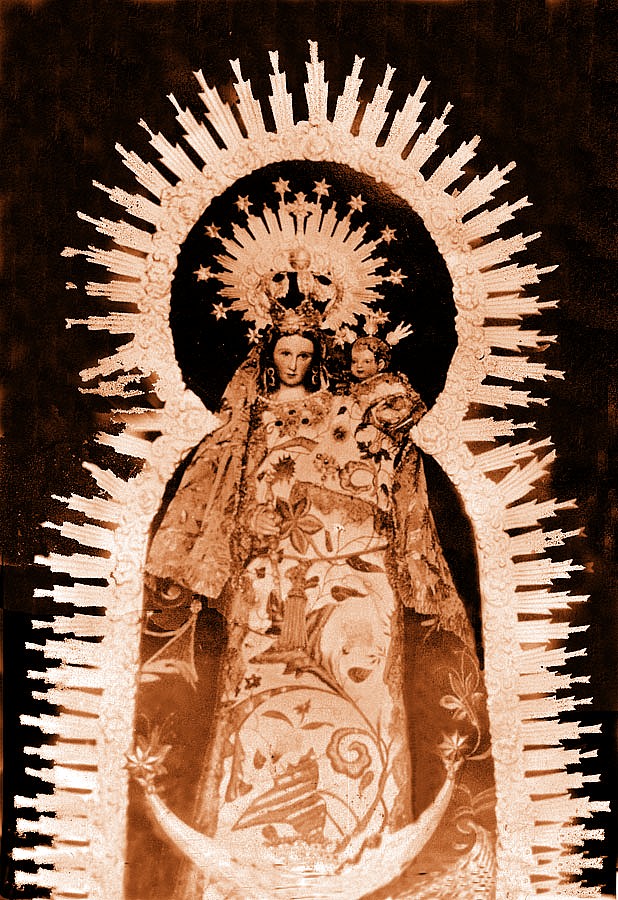
Fiesta del Patronato de Nuestra Señora / Feast of the Patronage of Our Lady (1679):
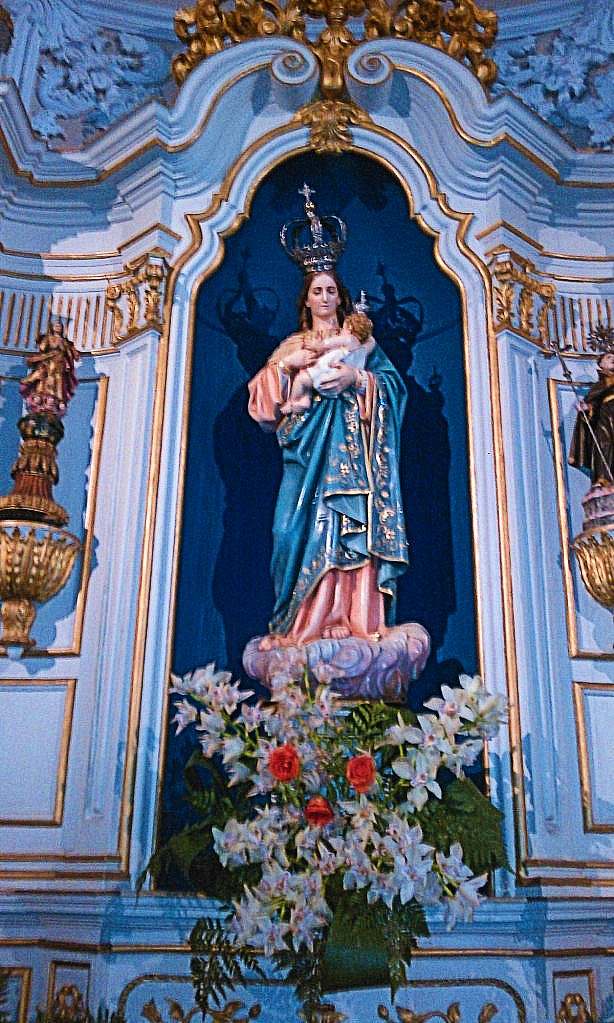
Statue of Our Lady in Barcelona Cathedral
This Feast was first permitted by Decree of the Sacred Congregation of Rites, on 6 May, 1679, for all the Provinces of Spain, in memory of the victories obtained over the Saracens, heretics and other enemies, from the sixth century to the reign of Philip IV. Pope Benedict XII ordered it to be kept in the Papal States on the third Sunday of November. To other places it is granted, on request, for a Sunday in November, to be designated by the ordinary. The Office is taken entirely from the Common of the Blessed Virgin and the Mass is the “Salve sancta parens”. In many places the Feast of the Patronage of Our Lady, is held with an additional title of Queen of All Saints, of Mercy, Mother of Graces.
St Didacus de Alcalá de Henares) OFM (c 1400-1463) Confessor, Lay Brother of the Order of Friars Minor, Hermit, Mystic. Months passed before it was possible to bury Brother Didacus, so great was the number of people who came to venerate his remains. Not only did his body remain incorrupt but it diffused a pleasant odour. After it was laid to rest in the Franciscan Church at Alcalá de Henares, astounding miracles continued to occur at his tomb. Pope Sixtus V, himself a Franciscan, Canonised Brother Didacus in 1588. About this lovely Sainst: https://anastpaul.com/2021/11/13/saint-of-the-day-13-november-saint-didacus-ofm-c-1400-1463/
St Frances Xavier Cabrini (1850-1917) Mother Cabrini, was an Italian-American religious sister, who founded the Missionary Sisters of the Sacred Heart of Jesus, that was a major support to the Italian immigrants to the United States, Cardinal Mundelein of Chicago officiated at her funeral and in 1938 also presided at her beatification by Pius XI. She was canonised by Pius XII in 1946. She lies buried under the altar of the chapel of Mother Cabrini High School in New York City.(Memorial for the United States only ) – her Universal Feast Day is 22 December. Biography: https://anastpaul.com/2017/12/22/saint-of-the-day-22-december-st-frances-xavier-cabrini-m-s-c-1850-1917/
All Saints of the Augustinian Order: On 13 November – St Augustine’s Birthday, we celebrate the Feast of All Saints of the Augustinian Order. On this day we call to mind the many unsung brothers and sisters of the Augustinian family who have “fought the good fight” and celebrate now, in Heaven. Let us pray for one another that we too may one day join in the “unceasing chorus of praise” with all our Augustinian brethren in Heaven.
All Saints of the Benedictine & Cistercian Orders: Those interested in the Benedictine family may be interested to know that today, within the Benedictine liturgical tradition, is traditionally celebrated the Feast of All Saints of the Benedictine Order – In Festo Omnium Sanctorum Ordinis S.P.N. Benedicti. The Cistercians — who also follow the Rule of St Benedict — likewise observe this day for All Saints of their Order. (On a related note, the Benedictines also traditionally observe 14 November as All Souls of their Order.
All Benedictine Saints
St Benedict and St Bernard -1542
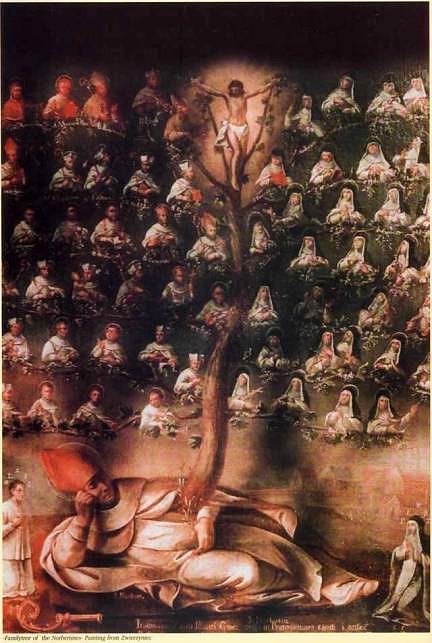
All Saints of the Premonstratensian Order or the “Norbertines.” The Order of Canons Regular of Prémontré, also known as the Premonstratensians, the Norbertines and, in Britain and Ireland, as the White Canons , are a Roman Catholic religious order of canons regular founded in Prémontré near Laon in 1120 by Saint Norbert, who later became Archbishop of Magdeburg. Premonstratensians are designated by O.Praem. following their name. St Norbert was a friend of Saint Bernard of Clairvaux and so was largely influenced by the Cistercian ideals as to both the manner of life and the government of his order. Aside from St Norbert there are at present fifteen saints of the Order who have been Canonised or have had their immemorial cults confirmed by the Holy See. St Norbert (c 1080-1134) “Defender of the Eucharist” and “Apostle of the Eucharist” – Bishop, Confessor, Founder. Patron for peace, invoked during childbirth for safe delivery, of infertile married couples. St Norbert here: https://anastpaul.com/2017/06/06/saint-of-the-day-6-june-st-norbert/
St Norbert
All Saints of the Norbertines
All Deceased Dominican Brothers and Sisters
St Abbo of Fleury St Amandus of Rennes St Amanzio St Beatrix of Bohemia St Brice of Tours (Died 444) Bishop St Caillin St Chillien of Aubigny St Columba of Cornwall St Dalmatius of Rodez St Devinicus St Eugenius of Toledo St Florido of Città di Castello St Gredifael St Himerius St Homobonus of Cremona St Juan Ortega Uribe Blessed Leone of Assisi OFM (Died 1271)Priest and Friar of the Friars Minor, Companion, Secretary and Confessor of St Francis. St Leoniano of Vienne St Maxellendis St Mitrius St Pope Nicholas I St Paterniano St Quintian of Rodez Bl Robert Scurlock Bl Warmondus of Ivrea
Martyrs of Caesarea – 5 Saints: A group of Christians murdered for their faith in the persecutions of Diocletian, Galerius Maximian and Firmilian. – Antoninus, Ennatha, Germanus, Nicephorus and Zebinas. 297 at Caesarea, Palestine.
Martyrs of Ravenna – 3 Saints: A group of Christians murdered together in the persecutions of Diocletian. The only information about them that has survived are three names – Solutor, Valentine and Victor. c 305 in Ravenna, Italy.
Martyrs of Salamanca – 5 Saints: The first group of Christians exiled, tortured and executed for their adherence to the Nicene Creed during the persecutions of the Arian heretic Genseric. – Arcadius, Eutychianus, Paschasius, Paulillus and Probus. Born in Spain and Martyred in 437. Their relics are at Medina del Campo, Spain.
St Aurelius St Cadwallader St Cummian Fada St Cunibert of Cologne (Died c 663) Archbishop of Cologne St Emilian Cucullatus St Evodius of Le Puy St Hesychius of Vienne Bl John Cini della Pace
St Livinus of Alost St Machar of Aberdeen St Namphasius St Nilus the Elder St Paternus of Sens St Publius St Renatus of Angers St Rufus of Avignon St Ymar of Reculver
Five Polish Brothers – Martyrs: They weren’t Polish and they weren’t related but were instead five Italian Benedictine Monks who worked with Saint Adalbert of Prague as missionaries to the Slavs and were Martyred together. They were – Benedict, Christinus, Isaac, John and Matthew. Born in Italy. They were Martyred in 1005 at the Benedictine Monastery near Gnesen, Poland and Canonised by Pope Julius II.
St Bartholomew of Rossano (c 970-c 1065) Abbot Confessor, Spiritual disciple and friend of St Nilus (910-1005), Hymnist an highly skilled Calligrapher of sacred manuscripts – the art of calligraphy he had learned from his blessed guide and teacher, He is known as the “Second Founder,” of the Monastery of Grottaferrata founded by St Nilus. A copyist of many codices, Bartholomew is also considered the greatest hymnographer of the 11th century. His Life: https://anastpaul.com/2021/11/11/saint-of-the-day-11-november-saint-bartholomew-of-rossano-c-970-c-1065/
St Bertuin of Malonne St Cynfran of Wales St Isidre Costa Hons Bl Josaphat Chichkov St Marina of Omura St Mennas of Santomenna St Mercurius the Soldier Bl Pavel Dzjidzjov St Rhediw St Theodore the Studite St Turibius of Palencia St Veranus of Lyon St Veranus of Vence
St Andrew Avellino (1521 – 1608) Confessor, Theatine Priest, Canon and Civil Lawyer, Reformer, Founder of many new Theatine houses, Preacher, Spiritual Advisor. In 1624, only 16 years after his death, he was Beatified by Pope Urban VIII and in 1712 was Canonised by Pope Clement XI. His remains lie buried in the Church of St Paul at Naples. Patron against sudden death/of a Holy Death, against Apoplexy or Strokes. Biography: https://anastpaul.com/2018/11/10/saint-of-the-day-10-november-st-andrew-avellino-cr-1521-1608/
St Aedh Mac Bricc St Anianus the Deacon St Baudolino (c 700–c 740) Hermit St Demetrius of Antioch St Elaeth the King St Eustosius of Antioch St Grellen St Guerembaldus St Hadelin of Sees Bl Joaquín Piña Piazuelo St John of Ratzenburg St Joseph the Martyr
St Leo of Melun St Monitor of Orleans St Narses of Subagord St Nonnus of Heliopolis St Orestes of Cappadocia St Probus of Ravenna St Theoctiste St Tryphaena of Iconium St Tryphosa of Iconium
Martyrs of Agde – 3 Saints: A group of Christians who were tortured and Martyred together in the persecutions of Diocletian. The only about them to survive are the names – Florentia, Modestus and Tiberius. Martyred c 303 in Agde, France.
St Agrippinus of Naples St Alexander of Salonica St Aurelius of Riditio St Benignus of Armagh St Eustolia St Francisco José Marín López de Arroyave
Blessed Gabriel Ferretti OFM (1385-1456) Priest, Friar of the Order of Friars Minor,, Provincial Superior, Mystic. renowned missionary Preacher. He was zealous in the restoration and establishment of new Convents. He was an ancestor to both Cardinal Gabriele Ferretti and Blessed Pope Pius IX, having been descended from a long noble lineage. Patronage – Ancona. His body is incorrupt. He was Beatified on 19 September 1753 by Pope Benedict XIV. Biography: https://anastpaul.com/2021/11/09/saint-of-the-day-9-november-blessed-gabriel-ferretti-ofm-1385-1456/
Bl George Napper Blessed Gratia of Cattaro OSA (1438-1508) Lay Brother of the Hermits of St Augustine Bl Helen of Hungary St Jane of Segna
St Justo Juanes Santos St Luigi Beltrame Quattrocchi St Luis Morbioli St María de la Salud Baldoví Trull St Pabo St Sopatra St Theodore Stratelates St Ursinus of Bourges St Valentín Gil Arribas St Vitonus of Verdun
Martyrs of Constantinople – 3 Saints: A group of ten Christians who tried to defend an image of Jesus over the Brazen Gate of Constantinople from an attack by Iconoclasts during the persecutions of Emperor Leo the Isaurian. The group of was seized by soldiers, condemned by judges for opposing the emperor, and Martyred. The only details that have survived are three of their names – Julian, Marcian and Maria. They were martyred in 730 at Constantinople (modern Istanbul, Turkey).
Four Crowned Martyrs: Saint Castorus, Saint Claudius, Saint Nicostratus and Saint Simpronian. Skilled stone carvers in the 3rd century quarries. Martyred when they refused to carve an idol of Aesculapius for Diocletian. They were drowned in the River Sava in 305. Patronages – against fever, cattle, sculptors, stone masons, stonecutters.
St Adeodatus I, Pope (Died 618) Bishop of Rome from 19 October 615 to 8 November 618 St Clair of Tours St Cybi of Caenarvon St Drouet
All Saints of the Diocese of Evry: A regional memorial of all the Saints and Beati of the calendar who have a connection to the Diocese of Evry-Corbeil-Essonnes, France. • Blessed Isabella of France, founded the Longchamp monastery • Blessed Nicolas Gaudreau, pastor of Vert-le-Petit • Blessed Pierre Bonse, pastor of Massy • Our Lady of Good Guard, patron saint of the diocese, venerated in Longpont-sur-Orge, France • Saint Corbinian, born in Saint-Germain-lès-Arpajon • Saint Denis of Paris, evangelizer of part of Essonne and revered ni Longpont-sur-Orge • Saint Eloi, who lived in Chilly-Mazarin • Saint Germain of Paris • Saint William of Bourges, son of Count Baldwin IV of Corbeil • Saint William of Aebelholt, pastor of Brunoy • Saint Wulfran of Sens, born in Milly-la-Forêt • Blessed Nativelle, vicar of Longjumeau • Blessed René Le Bris, pastor of Bris-sous-Forges • Saint Spire of Bayeux, whose relics are in Corbeil in the cathedral that bears his name All Saints of Wales
The Feast of All Saints of the Order of Preachers: “Fountain of all holiness, You stirred up in our holy brothers and sisters an extraordinary love of truth, conformity to Christ Crucified and a thirst for the salvation of souls: may we imitate them in offering You thanksgiving on account of the way of life they gave us.” — From the Intercessions at Lauds for the Feast of All Saints of the Order of Preachers. HERE: https://anastpaul.com/2019/11/07/thought-for-the-day-7-november-feast-of-all-dominican-saints/
Blessed Anthony Baldinucci SJ (1665-1717) Priest of the Society of Jesus, Preacher, Writer and Missionary. Fr Baldinucci was Beatified by Pope Leo XIII on 25 March 1893. Biography here: tps://anastpaul.wordpress.com/2017/11/07/saint-of-the-day-blessed-anthony-baldinucci-s-j-1665-1717/
St Athenodorus of Neo-Caesarea St Auctus of Amphipolis St Baud of Tours St Blinlivet St Congar
St Ernest of Mecca St Florentius of Strasburg (Died 693) Bishop St Gebetrude of Remiremont St Herculanus of Perugia St Hesychius of Mytilene St Hieron of Mytilene St Hyacinth Castañeda Puchasons St Lazarus the Stylite Bl Lucia of Settefonti St Nicander of Mytilene Bl Peter Ou St Prosdocimus of Padua St Prosdocimus of Rieti St Raverranus of Séez St Rufus of Metz St Taurion of Amphipolis St Thessalonica of Amphipolis St Tremorus of Brittany
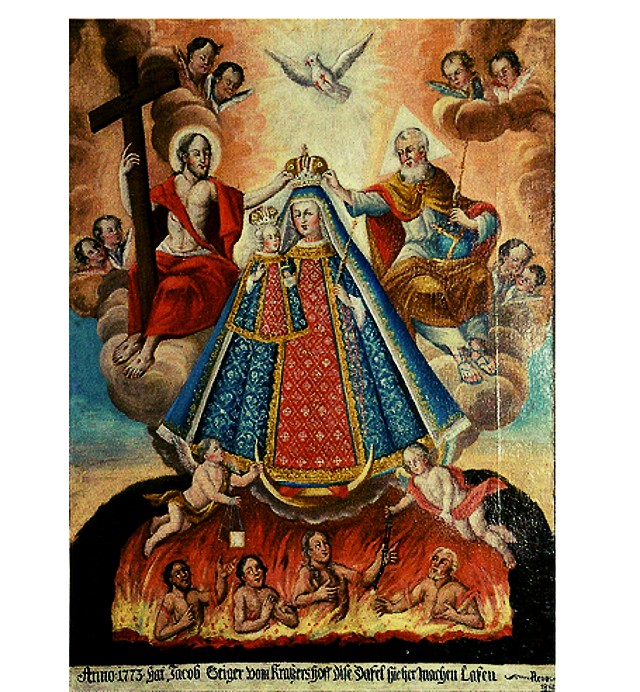
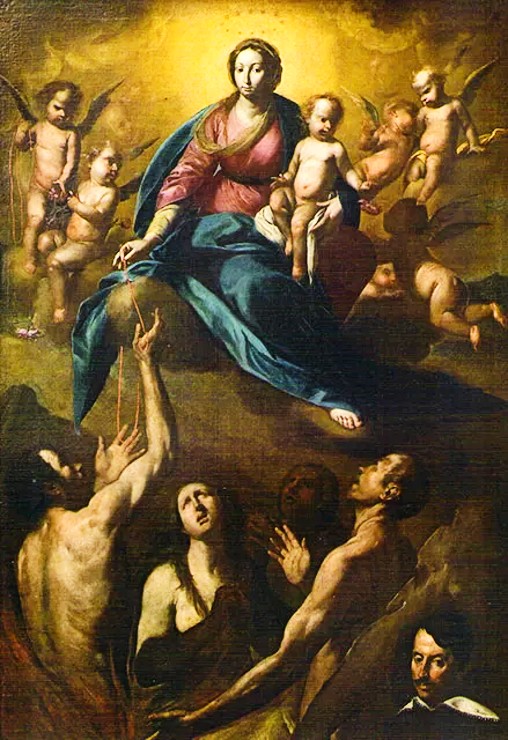
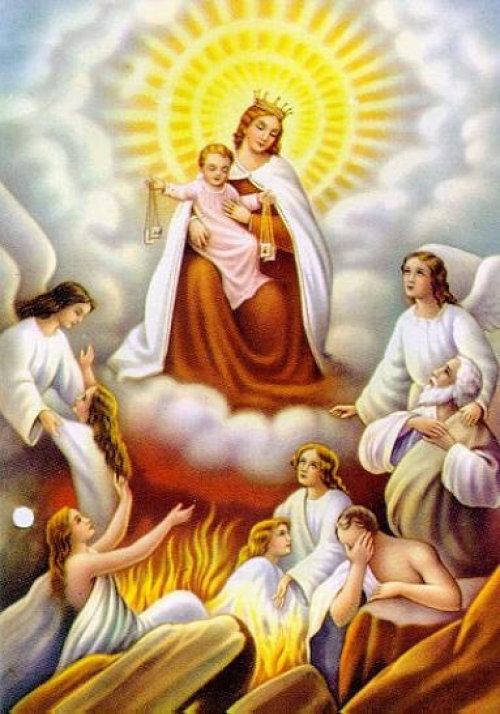
Saint of the Day – 6 November – Nostra Signora del Suffragio / Our Lady of Suffrage for the Souls in Purgatory.
The Archconfraternity of Death and Prayer (mortis et orationis), founded in Rome, 1538, to provide for the burial of the poor and abandoned, still exists (cf. Berignani, loc. cit). At the beginning of the 17th Century, it was granted a new Indulgences by Pope Paul V (Rescr. auth. S. C. Indulg., n. 26, pp. 448 sqq. Moroni, II, 303). About 1687, the Rules for a special Confraternity “for the relief of the Most Needy Souls in Purgatory” under the Sacred Names of Jesus, Mary and Joseph, were approved in Rome. The Confraternity for the relief of the departed under the title of “Jesus Christ on Mount Calvary and the Sorrowful Mother” enjoyed special popularity and on 8 September 1760, inaugurated, the processions of the Way of the Cross in the Roman Coliseum. Among its illustrious members was St Leonard of Port Maurice OFM (1676-1751).
In 1874, the Ingolstadt Mass Association, formed by the Franciscans of Ingolstadt in 1726, to procure for all members the grace of a happy death and for those already deceased, speedy assistance and liberation form the pains of Purgatory, was raised to a formal and legal Confraternity, under the title of the Immaculate Conception. An ancient, highly venerated painting of the Mother of God, was adopted as the Titular image of the Association, which has received all the Indulgences of the Confraternity of the same name, in the Ara Coeli at Rome, that is, the Indulgences of the Blue Scapular. It numbers its members by tens and hundreds of thousands; almost 2000 Masses are daily celebrated for the intentions of the Marian Mass Association, which includes the intention of particularly assisting for the most recently deceased members.
At the close of the Middle Ages, the old Confraternities, generally confined to a town or small district, gradually disappeared, as also did many of the later ones in the confusion at the end of the eighteenth century, while others preserved only a semblance of life. Since the beginning of the 19th Century, they have been replaced by vigorous new Associations, which, richly endowed with Indulgences by ecclesiastical authorities, have rapidly extended to the entire Church.
By brief of 5 October, 1818, Pope Pius VII endowed the Archconfraternity of Our Mother of Sorrows and Suffrage of the Poor Souls in Purgatory, which was erected in the Basilica of San Maria in Trastevere, with rich Indulgences.
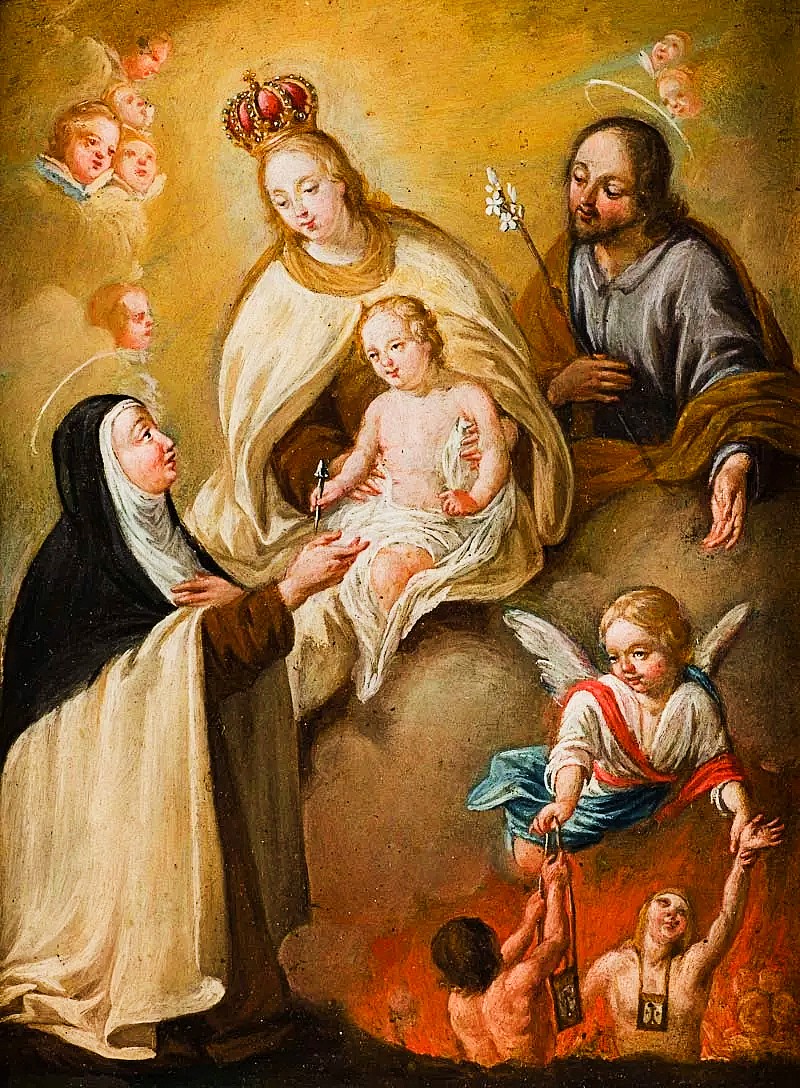
St Teresa of Jesus of Avila, intercedes with Our Lady of Suffrage for the Poor Souls in Purgatory
First among the later Confraternities which have extended throughout Christendom, is the “Archconfraternity for the Relief of the Poor Souls in Purgatory under the title of the Assumption of Mary, in the Redemptorist Church of San Maria in Monterone at Rome.” Founded in 1841, it rapidly developed, especially in England and North America and was endowed with Indulgences in 1841-63. Priests empowered to receive the faithful into the Confraternity enjoy various other faculties. This Confraternity is especially adapted for rapid expansion because in 1860, it was expressly authorised to include, every Confraternity of whatever name and object and to communicate to them its graces and privileges, provide they added to their original Titles “and for the relief of the Poor Souls in Purgatory.” The Redemptorist Fathers conduct this Archconfraternity.
Indulgences of the Confraternities are ever applicable to the Souls in Purgatory and the privileges of the Altar for Churches and for Priests, who are members, may be used in favour of dead members or for all poor souls. The formation of the “Catholic League for Constant Intercession for the Poor Souls in Purgatory” was proposed by certain pious citizens of Rome, approved by Leo XIII in the last years of his reign, and enriched with Indulgences. The only requisite for membership is to recite thrice daily the prayer, “Requiem æternam – Eternal Rest grant unto them O Lord …” thereby gaining, once daily, an Indulgence of 200 days.
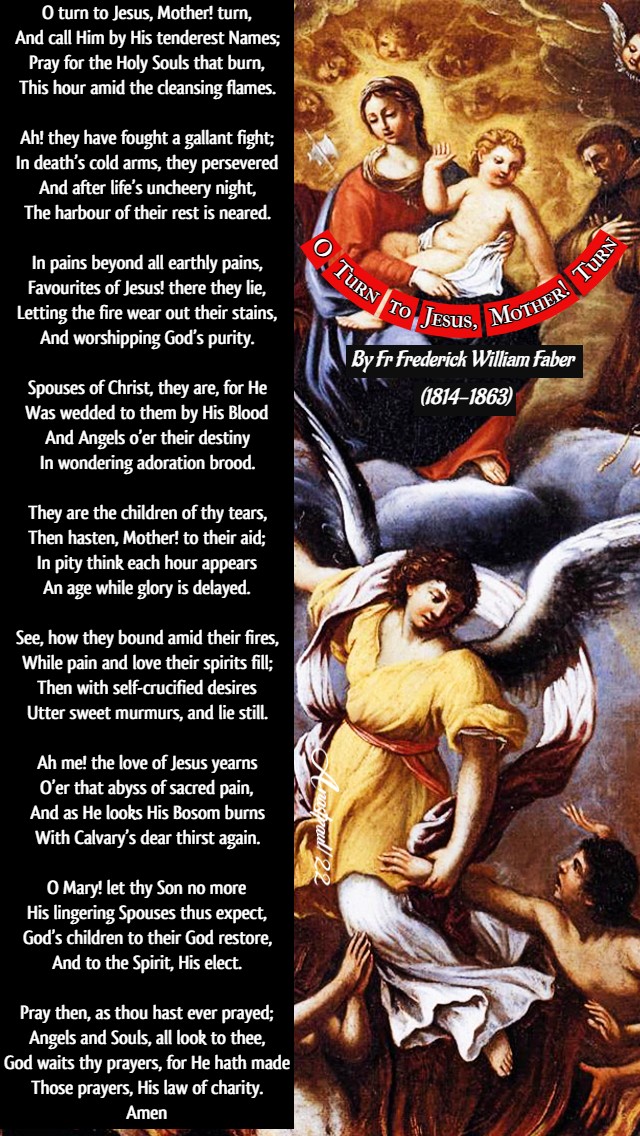
O Turn to Jesus, Mother! Turn By Fr Frederick William Faber CO (1814-1863)
O turn to Jesus, Mother! turn, And call Him by His tenderest Names; Pray for the Holy Souls that burn, This hour amid the cleansing flames.
Ah! they have fought a gallant fight; In death’s cold arms, they persevered And after life’s uncheery night, The harbour of their rest is neared.
In pains beyond all earthly pains, Favourites of Jesus! there they lie, Letting the fire wear out their stains, And worshipping God’s purity.
Spouses of Christ, they are, for He Was wedded to them by His Blood And Angels o’er their destiny In wondering adoration brood.
They are the children of thy tears, Then hasten, Mother! to their aid; In pity think each hour appears An age while glory is delayed.
See, how they bound amid their fires, While pain and love their spirits fill; Then with self-crucified desires Utter sweet murmurs, and lie still.
Ah me! the love of Jesus yearns O’er that abyss of sacred pain, And as He looks His Bosom burns With Calvary’s dear thirst again.
O Mary! let thy Son no more His lingering Spouses thus expect, God’s children to their God restore, And to the Spirit, His elect.
Pray then, as thou hast ever prayed; Angels and Souls, all look to thee, God waits thy prayers, for He hath made Those prayers, His law of charity.
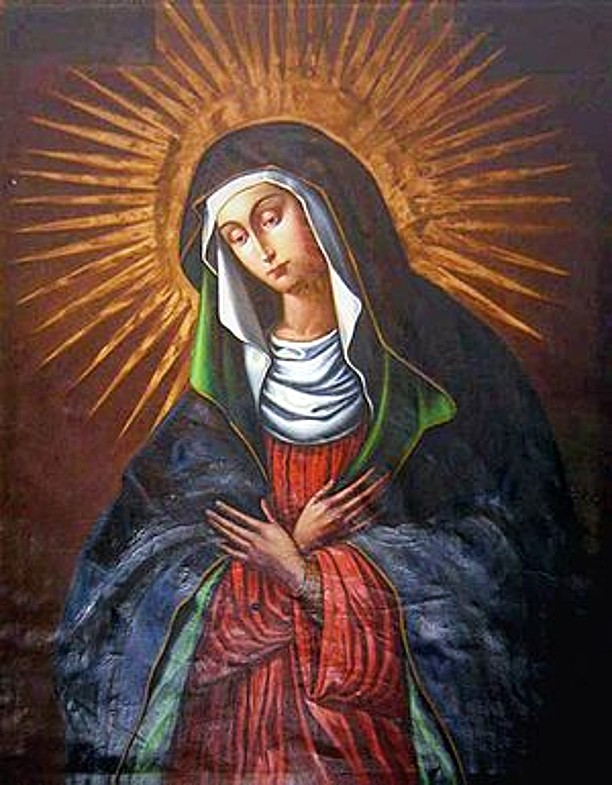
Nostra Signora del Suffragio / Our Lady of Suffrage (For the Souls in Purgatory)
St Atticus St Barlaam of Novgorod Bl Beatrice of Olive Bl Christina of Stommeln St Demetrian of Cyprus St Edwen of Northumbria St Efflam of Brittany St Emilian of Faenza St Erlafrid of Hirschau St Felix of Fondi St Felix of Genoa St Felix of Thynissa St Illtyd St Israel of Limoges
St Leonard of Reresby Bl Leonianus of Autun St Melaine of Rennes St Paul of Constantinople St Pinnock St Protasius of Lausanne St Severus of Barcelona Bl Simon of Aulne St Stephen of Apt St Theobald of Dorat Bl Thomas Ochia Jihyoe St Valentine of Genoa St Victor Chumillas-Fernández
Martyrs of Antioch – 10 Saints: Ten Christians murdered together by Arabs after their seizure of Antioch, Syria. No names or other details about them have come down to us. 637 in Antioch, Syria.
Martyrs of Gaza – 9 Saints: A group of Christian soldiers who were captured by Saracens invading the area of Gaza in Palestine. When the men continued to profess their Christianity, they were executed. We know the names of some of the Martyrs – Himerius, John (2 of them), Kallinikos (Callinoco), Paul, Peter, Stephen and Theodore (2 of them). They were beheaded in Gaza, Palestine.
All Saints and Blesseds of the Society of Jesus: The Society of Jesus, commonly known as the Jesuits, was Founded in 1534 by Saint Ignatius Loyola (1491-1556) at Montmartre, Paris, France. A body of clerics regular organised for Apostolic work, following a religious rule and relying on alms for their support. It was the chief instrument of the Catholic Reformation. Pope Paul III approved the new rule in 1540 and Ignatius was elected the first general of the order in 1541. The constitutions, drafted by him and based on his Spiritual Exercises were adopted in 1558. It was the first order which enjoined by its constitutions devotion to the cause of education. The ministry of the Society consists chiefly in preaching. teaching catechism. administering the sacraments. conducting missions in parishes, taking care of parishes. organising pious confraternities, teaching in schools of every grade, writing books, pamphlets, periodical articles, going on foreign missions and special missions when ordered by the current Holy Father, to whom they take a vow of total obedience. Our current Holy Father, Pope Francis is a Jesuit and has jokingly wondered aloud who is boss of whom in his Order. The general resides at Rome, Italy and has a council of assistants. The motto of the Society is Ad Majorem Dei Gloriam (For the greater glory of God). All Jesuit Saints and Blesseds: https://anastpaul.com/2018/11/05/feast-of-all-the-saints-and-blesseds-of-the-society-of-jesus/
St Canonica St Comasia St Dominator of Brescia St Elizabeth St Domninus the Physician St Epistemis St Eusebius of Terracina St Felix of Terracina St Fibitius St Galation St Gerald of Beziers Bl Gomidas Keumurjian Bl Gregory Lakota St Guetnoco St Hermenegild St Idda St Juan Antoni Burró Mas St Juan Duarte Martín St Kanten St Kea St Laetus of Orleans St Magnus of Milan St Mamete St Marco of Troia Bl Simon Ballachi St Spinulus of Moyen-Moûtier St Sylvanus of Syria St Zachary
Martyrs of Caesarea Maritima – 4 Saints: Four young Christian men who were Martyred together is the persecutions of Maximian – Aussenzius, Philotheus, Timothy and Theotimus. They were martyred in the arena at Caesarea Maritima, Palestine.
St Acepsimas St Acheric of Vosges Bl Alphais of Cudot Bl Berardo dei Marsi Bl Berchtold of Engelberg St Caesarius St Cecilio Manrique Arnáiz St Clydog St Cristiolus St Domnus of Vienne St Elerius St Englatius St Florus of Lodeve St Francisco Colom González St Gaudiosus of Tarazona St Germanus St Guenhael St Hermengaudius of Urgell St Hilary of Viterbo
St Papulus St Pirmin St Quartus St Rumwold of Buckingham Blessed Simon Ballachi OP (c 1210-1319) Lay Brother of the Order of Preachers, Mystic. St Sylvia of Rome St Theophilus St Valentine of Viterbo St Valentinian St Vitalis St William of Vosges St Winifred of Wales St Wulganus
Innumerable Martyrs of Saragossa: A large group of Christians martyred in Zaragoza, Spain by Dacian during the persecutions of Diocletian. Dacian ordered all Christians of the city into exile under pain of death; when they were assembled to leave, Dacian ordered imperial soldiers to massacre the lot of them. They were Martyred in 304.
Saint of the Day – 1 November – Unsere Liebe Frau von Heede / Our Lady of Heede, Queen of the Universe (1937-1945) Also known as Queen of the Poor Souls in Purgatory.
Our Lady appeared to four children Margaret Gansferth, Greta Gansferth, Anna Schulte, Susanna Bruns near their homes, in a meadow and at other place nearby. She was holding the Divine Child in her arms when she first appeared. Our Lady appeared to the children an undetermined number of times of which only three were recorded. After the children were forbidden by the Gestapo (and briefly arrested) to go to the place of the original apparition, Our Lady appeared to them in secret. Prayer, conversion and the Holy Rosary were the primary messages.
Heede is a town very close to the Dutch border where, since the evening of the Feast of All Saints (1 November) in 1937, four visionaries: Maria (12 years old) and Grete Ganseforth (11 years old), Anna Schulte (12 years old) and Susi Bruns (13 years old) began to receive numerous apparitions of the Blessed Virgin. In fact, according to what is said, the Madonna would have deigned to appear more than a hundred times to the four girls.
As in many towns of Gennania, so also in Heede, the Parish Church is a little away from the town centre and has the cemetery next to it. It was in the cemetery where the Madonna appeared on 1 November 1937, the eve of All Souls. The girls wished to gain an Indulgence by praying in the cemetery. Suddenly, looking towards the cemetery, one of them said: “Do you see Our Lady over there?”
The other girl, who couldn’t see anything, said: “You’re crazy!” but then looking closer, she too saw the Celestial Vision in front of a group of three cypresses. Frightened, the two fleD towards the village but on the way they met two of their peers who were heading to Church. They tell them what they had seen and, taking courage, all four went together to make sure of that strange Vision. In fact, having arrived at the place the Lady of the Apparition smiled sweetly and invites them to come back again. Thus began the wonderful facts of Heede.
Both in that first Apparition and in the following ones , the Madonna was dressed in white, her feet rested on a bluish cloud , so that she appeared to be hovering in the air, about three feet above the ground. A white veil fell over her shoulders and down to the cloud. The Virgin supported the Child in her left hand, Who was also dressed in white. Both their eyes were blue and the Child had blond hair. In his right hand He was holding a small golden globe, surmounted by a Cross. The right hand of the Madonna also rested on the golden globe, so that the Cross seemed to be between the Virgin’s fingers. The vision always appeared surrounded by a luminous halo. The Virgin appeared a young woman, while the Child looked one or two.
When the girls explained what had happened, the residents received their testimony with scepticism. But before long, miraculous occurred, revealing its authenticity. Many pilgrims travelled to Heede from nearby towns and villages to hear the messages. However, these were the times of the Nazi regime, so the Gestapo intervened and concluded that the Heede appearances were simply superstition.
As a result, the Nazis arrested the girls and put them in asylum for a month. They were then released and forbidden to return to the apparition site. However, Our Lady continued secretly appearing elsewhere in the area.
She revealed scenes of disasters and warned of terrible events that could occur and be considered a “lesser judgement.” She was referring to World War II.
In another Heede appearance, the Virgin said to Greta: “ The world is about to drink the dregs of the chalice of divine wrath for their innumerable sins which wound the Sacred Heart of Jesus. Pray. Pray a great deal, especially for the conversion of sinners.”
The final apparition of the Madona of Heede occurred on 3 November 1940 at 8.30 pm. Our Lady again spoke to each of them, without the others being able to hear. Then they prayed to the Holy Virgin once again for her blessing, Our Lady replied: “Now, my dear girls, I bless you in this farewell. Remain good and faithful to God! Pray the Rosary often and willingly, […] I return to Heaven.”
One of the girls, Grete Ganseforth, received the grace of the Stigmata in 1939.
Finally on 3 June 1959, the vicariate of Osnabruck confirmed, in a circular letter to the clergy of the Dioceses, the validity of the apparitions. However, there was no formal and official recognition by the Holy See. It has been falsely reported that the Vatican rejected or even condemned the apparitions of Heede. A new Parish Priest, appointed by the Bishop at the time the apparitions commenced, declared that there are “undeniable proofs of the seriousness and authenticity of these manifestations.” Pilgrimages and devotions in honour of Our Lady of Heede have always been freely permitted. The history of the apparitions and messages has appeared in numerous publications bearing the Imprimatur of various Bishops. Great caution is required on the part of the faithful, however because of the flood of allegations of apparitions and supernatural messages. These phony apparitions almost always contradict the true Catholic Faith in some way. But in the apparitions and messages of Heede, we find nothing contrary to the Faith; indeed, their similarity to the approved apparitions of Fatima, Lourdes and La Salette give good indications of their authenticity.
All Saints Day – (a Holy Day of Obligation) Instituted to honour all the saints, known and unknown. It owes its origin in the Western Church to the dedication of the Roman Pantheon in honour of the Blessed Virgin Mary and all the Martyrs by Pope Saint Boniface IV in 609, the anniversary of which was celebrated at Rome on 13 May. Pope Saint Gregory III Consecrated a Chapel in the Vatican Basilica in honour of All Saints, designating 1 November as their feast. Pope Gregory IV extended its observance to the whole Church. It has a Vigil and Octave and is a Holy Day of Obligation – the eve is popularly celebrated as Hallowe’en. Patronage – Arzignano, Italy. ABOUT: https://anastpaul.com/2019/11/01/solemnity-of-all-saints-1-november/ AND: https://anastpaul.com/2018/11/01/1-november-solemnity-of-all-saints/ AND: https://anastpaul.wordpress.com/2017/11/01/1-november-the-feast-of-all-the-saints/
Unsere Liebe Frau von Heede / Our Lady of Heede, Queen of the Universe , Queen of the Poor Souls in Purgatory (1937-1945) – 1 November
St Amabilis of Auvergne St Austremonius St Benignus of Dijon St Cadfan St Caesarius of Africa St Caesarius of Damascus St Ceitho St Cledwyn of Wales Bl Clemens Kyuemon St Cyrenia of Tarsus St Dacius of Damascus St Deborah the Prophetess St Dingad Bl Dionysius Fugixima St Floribert of Ghent St Gal of Clermont St Genesius of Lyon St Germanus of Montfort St Harold the King St James of Persia St John of Persia St Julian of Africa St Juliana of Tarsus St Lluís Estruch Vives St Marcel of Paris St Mary the Slave St Mathurin St Meigan St Nichole St Pabiali of Wales St Pere Josep Almató Ribera Auras St Peter Absalon Bl Peter Paul Navarra Bl Petrus Onizuka Sadayu St Rachel the Matriarch
Quote/s of the Day – 31 October – “The Month of the Most Holy Rosary and of the Angels” – Goodbye October
“Mary, thou art the vessel and tabernacle containing all Mysteries. Thou knows that, which the Patriarchs, never knew, thou hast experienced that, which was never revealed to the Angels, thou has heard that, which the Prophets never heard. In a word, all that was hidden from preceding generations, was made known to thee, even more, most of these wonders, depended on thee!”
St Gregory theWonderworker (c 213–270)
The Fifteen Promises is a tradition held by the Order of Preachers, that the Blessed Virgin Mary made Fifteen specific Promises through Saint Dominic (1170-1221)and Blessed Alain de la Roche (1428-1475), to those who faithfully pray the Rosary.
The 15 Promises of The Most Holy Rosary Given by The Blessed Virgin Mary
Those who faithfully serve me, by the recitation of the Rosary shall receive signal graces.
I promise my special protection and the greatest graces, to all those who shall recite the Rosary.
The Rosary shall be a powerful armour against hell. It will destroy vice, decrease sin and defeat heresies.
It will cause virtue and good works to flourish. It will obtain for souls the abundant mercy of God. It will withdraw the hearts of men from the love of the world and its vanities and will lift them to the desire of eternal things. Oh, that souls would sanctify themselves by this means.
The soul which recommends itself to me by the recitation of the Rosary, shall not perish.
Whoever shall recite my Rosary devoutly, applying himself to the consideration of its Sacred Mysteries, shall never be conquered and never overwhelmed by misfortune. God shall not chastise him in His justice, he shall not perish by an unprovided death Sinners shall convert. The just shall grow in grace and become worthy of eternal life.
Whoever shall have a true devotion to the Holy Rosary, shall not die without the Sacraments of the Church.
Those who are faithful, in reciting the Rosary, shall have, during their life and at their death, the Light of God and the plenitude of His graces. At the moment of death, they shall participate in the merits of the Saints in paradise.
I shall deliver from Purgatory, those who have been devoted to the Rosary.
The faithful children of the Rosary, shall merit a high degree of glory in Heaven.
You shall obtain all you ask of me, by the recitation of the Rosary.
All those who propagate the Holy Rosary, shall be aided by me, in their necessities.
I have obtained from my Divine Son, that all the advocates of the Rosary, shall have for intercessors, the entire Celestial Court during their life and at the hour of death.
All who recite the Rosary are my sons and brothers of my only Son, Jesus Christ.
Devotion to my Rosary is a great sign of predestination.
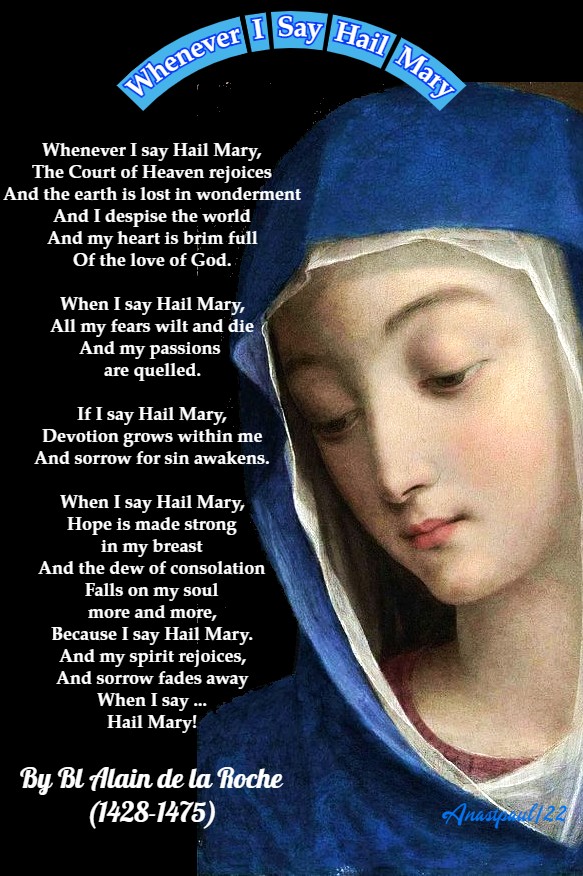
Whenever I Say Hail Mary Blessed Alain de la Roche (1428-1475)
Whenever I say Hail Mary, The Court of Heaven rejoices And the earth is lost in wonderment And I despise the world And my heart is brim full Of the love of God.
When I say Hail Mary, All my fears wilt and die And my passions are quelled.
If I say Hail Mary, Devotion grows within me And sorrow for sin awakens.
When I say Hail Mary, Hope is made strong in my breast And the dew of consolation Falls on my soul more and more, Because I say Hail Mary. And my spirit rejoices, And sorrow fades away When I say … Hail Mary!
Our Morning Offering – 31 October – “The Month of the Most Holy Rosary and of the Angels” – Goodbye October
Through Thee, to Us, our Saviour Came Sweet Lady of the Rosary By St Amadeus of Lausanne O.Cist (1108-1159)
Through thee, to us, our Saviour came, Through thee, to Him, we fain would go. Our lives are marred by wrong and shame, Yet, confidence in thee we know. The friendship thou dost give to all Who love thy name, shall ever be Assurance thou wilt hear our call, Sweet Lady of the Rosary!
Thou art our Strength upon the way, Our Morning Star, to cheer and guide; Our Beacon Light to show the day, And lead us to the Saviour’s Side; A Comforter in ev’ry pain We find, O Mother blest, in thee, And seek we, never, thee in vain, Fair Lady of the Rosary!
Thy praises, Mary, we would sing, And all our faculties employ, That unto thee our hearts might bring A glory-crown of love and joy. Bless thou each humble effort made In thy regard and grant that we, May by thy influence be swayed, Our Lady of the Rosary!
Vigil of All Saints Day or All Hallow’s Eve: Eve of the Feast of All Hallows, that is, All Saints Day. Halloween is a day on which many quaint customs are revived. It is popular in the United States and Scotland and in the US has become the second largest secular holiday of the year.
St Ampliatus St Antoninus of Milan St Apelles of Eraclea Sintica St Arnulf of Novalesa St Begu of Hackness Blessed Christopher of Romagna OFM (Died 1272) Priest St Epimachus of Melusio St Erth of Cornwall
Bl Irene Stefani St Jesús Miquel Girbau St Lucilla of Rome Bl Maria de Requesens St Narcissus St Notburga of Cologne St Quentin St Stachys of Constantinople
St Wolfgang of Regensburg (c 934 –994) “The Great Almoner,” Bishop, Monk, Missionary, Ascetic, Apostle of Charity. He is regarded as one of the three great German saints of the 10th century, the other two being Saint Ulrich and Saint Conrad of Constance. He was Canonised in 1052 by Pope Leo IX. St Wolfgang’s life: https://anastpaul.com/2019/10/31/saint-of-the-day-31-october-saint-wolfgang-of-regensburg-c-934-994/

























You must be logged in to post a comment.