Thought for the Day – 9 July – Monday of the Fourteenth Week in Ordinary Time, Year B
THE GIFT OF EVERY DAY
St John Vianney (1786-1859)
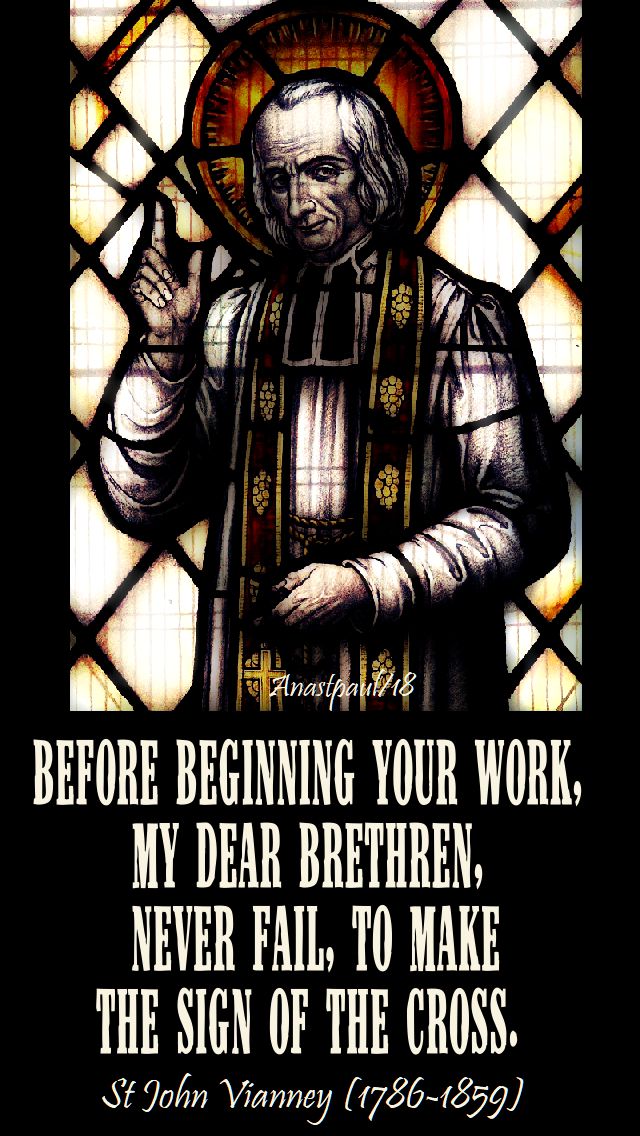
“Before beginning your work, my dear brethren, never fail to make the Sign of the Cross.
Do not imitate those people without religion who dare not do this because they are in company.
Offer quite simply all your difficulties to God and renew from time to time this offering, for by that means you will have the happiness of drawing down the blessing of Heaven on yourself and on all you do.
Just think, my dear brethren, how many acts of virtue you can practice by behaving in this way, without making any change in what you are actually doing.
If you work with the object of pleasing God and obeying His Commandments, which order you to earn your bread by the sweat of your brow, that is an act of obedience.
If you want to expiate your sins, you are making an act of penance.
If you want to obtain some grace for yourself or for others, it is an act of hope and of charity.
Oh, how we could merit Heaven every day, my dear brethren, by doing just our ordinary duties, but by doing them for God and the salvation of our souls! Who stops you, when you hear the chimes striking, from thinking on the shortness of time and of saying in your minds:
“Time passes and death comes closer. I am hastening towards eternity. Am I really ready to appear before the tribunal of God?Am I not in a state of sin?”
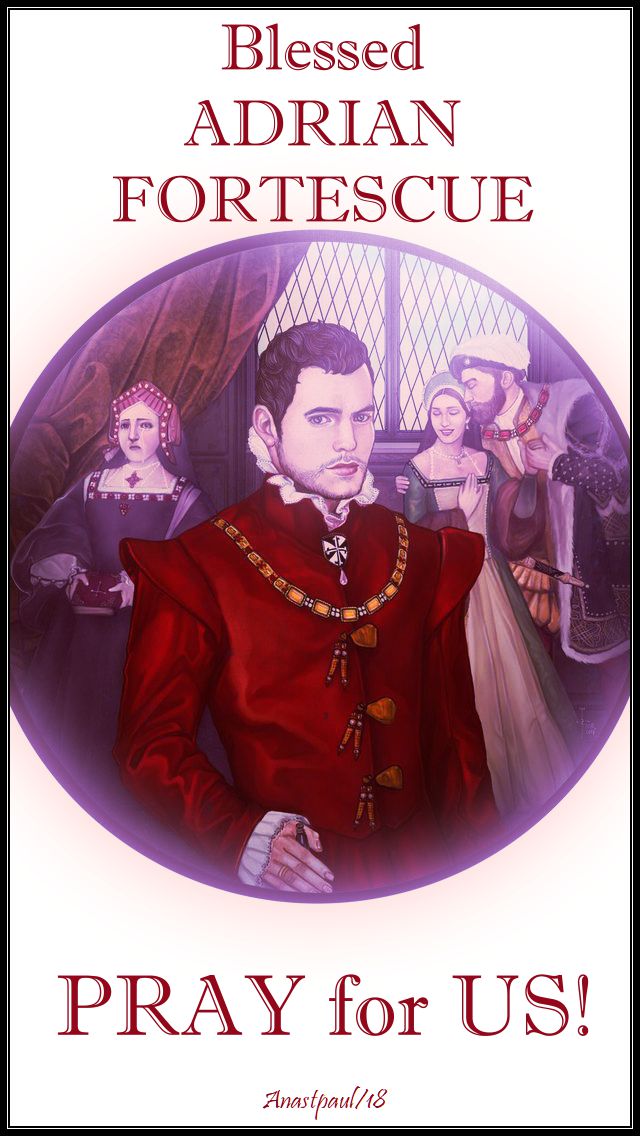
Quote/s of the Day – 9 July – The Memorial of Blessed Adrian Fortescue T.O.S.D. (1476-1539) Martyr
“In Husbands Bosworth Hall, the residence of Miss Fortescue-Turville, the last direct descendant of the blessed martyr, was found some years ago a very precious relic, being nothing less than the Book of Hours which he habitually used.
The manuscript has suffered a good deal from time and careless handling but on the outer leaf can still be read another series of maxims, a kind of rule of life written and signed by the martyr’s own hand. It will be seen how, while yet in the days of his prosperity, this truly Christian knight was preparing all unconsciously for the martyr’s crown and palm.
The Book of Hours is now reverently preserved as a relic in the beautiful little Catholic church adjoining the old hall of Husbands Bosworth :”
Quotations (slightly updated – from his famous Book of Hours)
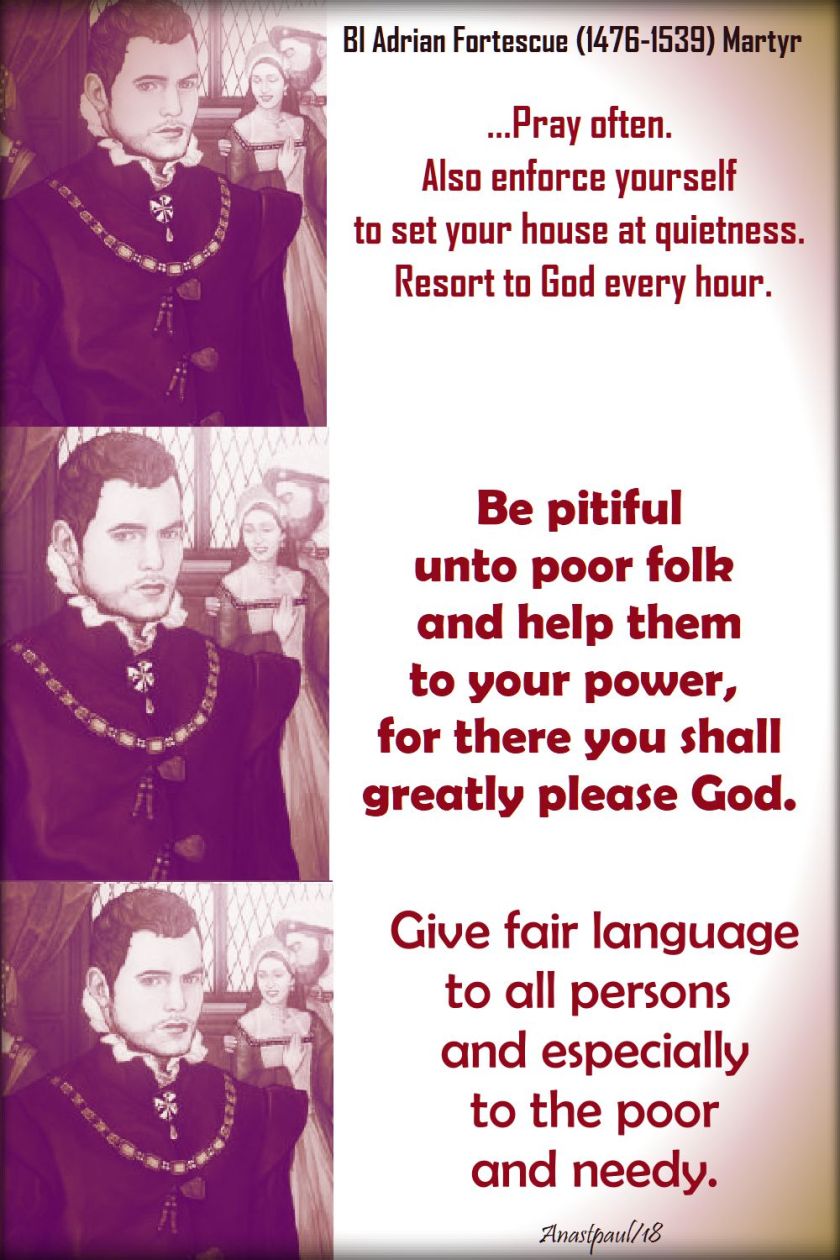
…”Pray often. Also enforce yourself to set your house at quietness. Resort to God every hour.”
“Be pitiful unto poor folk and help them to your power, for there you shall greatly please God.”
“Give fair language to all persons and especially to the poor and needy.”
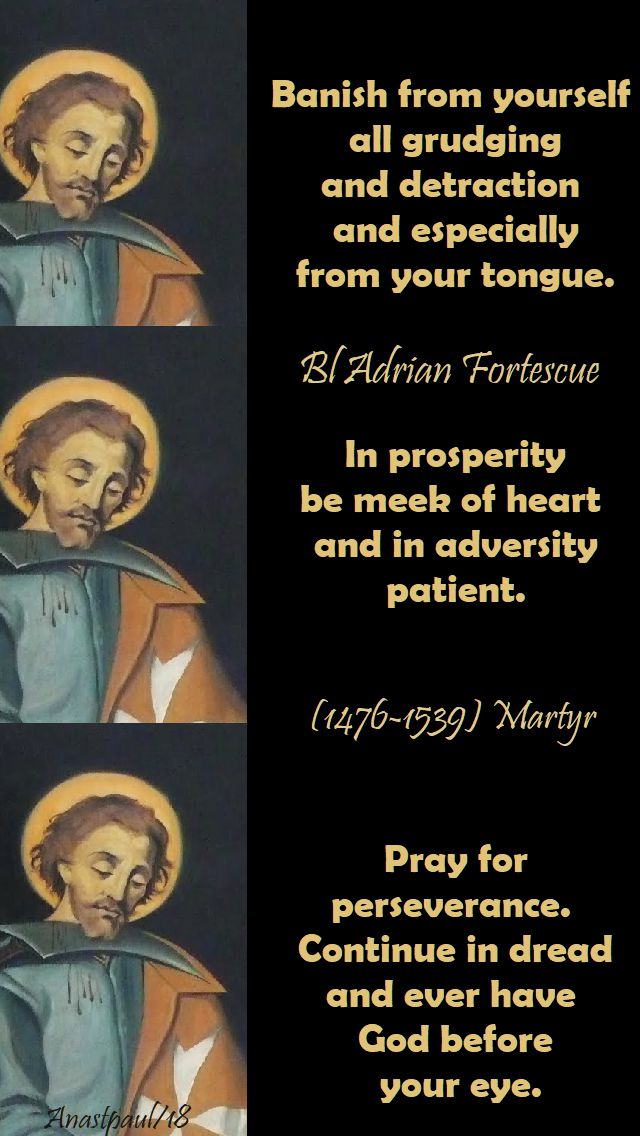
“Banish from yourself all grudging and detraction and especially from your tongue.”
“In prosperity be meek of heart and in adversity patient.”
“Pray for perseverance. Continue in dread and ever have God before your eye.”
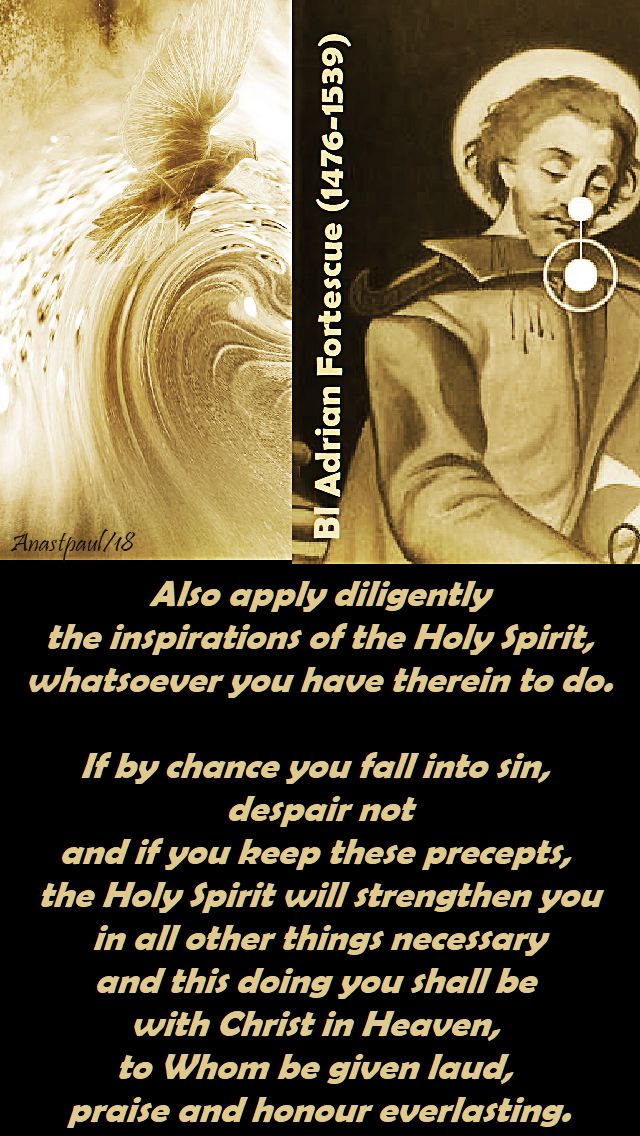
“Also apply diligently the inspirations of the Holy Spirit, whatsoever you have therein to do.”
“If by chance you fall into sin, despair not and if you keep these precepts, the Holy Spirit will strengthen you in all other things necessary and this doing you shall be with Christ in Heaven, to Whom be given laud, praise and honour everlasting.”
One Minute Reflection – 9 July – The Memorial of Blessed Adrian Fortescue T.O.S.D. (1476-1539) Martyr
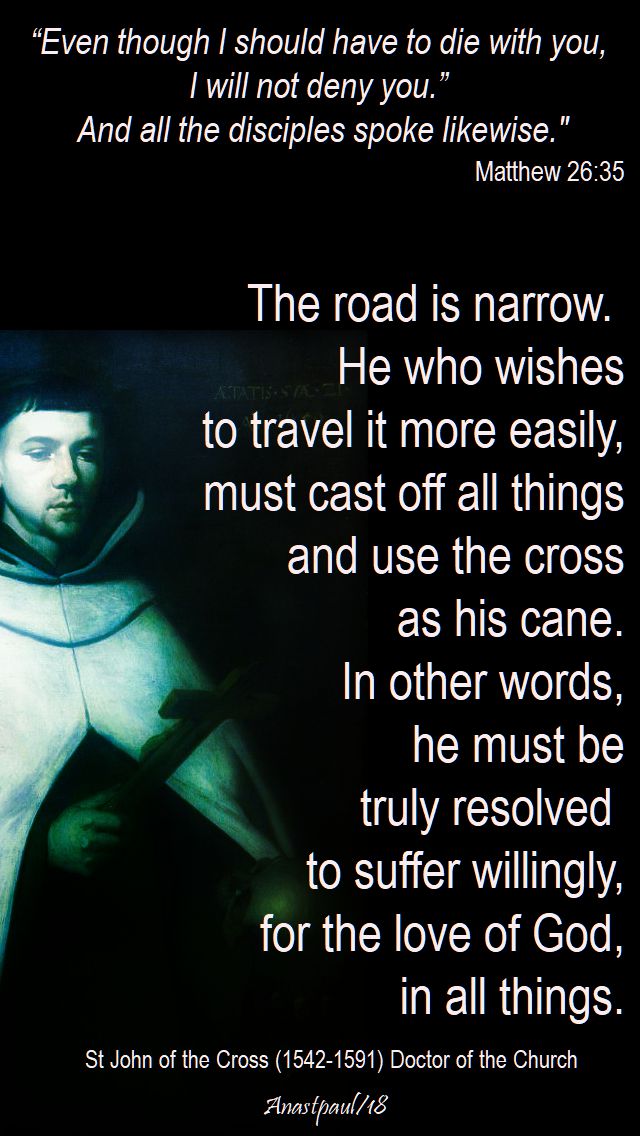
“Even though I should have to die with you, I will not deny you.” And all the disciples spoke likewise”…Matthew 26:35.
REFLECTION – “The road is narrow. He who wishes to travel it more easily must cast off all things and use the cross as his cane. In other words, he must be truly resolved to suffer willingly for the love of God in all things.”…St John of the Cross (1542-1591) Doctor of the Church
PRAYER – O God, You specially strengthened Blessed Adrian Fortescue with a wonderful spirit of holiness and courage. Hear the prayers of Your people and from his renowned example, may we learn to be obedient to You rather than to human authority. We ask this through our Lord Jesus Christ, Your Son, who lives and reigns with you and the Holy Spirit, one God forever and ever. Amen
Our Morning Offering – 9 July – The Memorial of Blessed Adrian Fortescue T.O.S.D. (1476-1539) Martyr
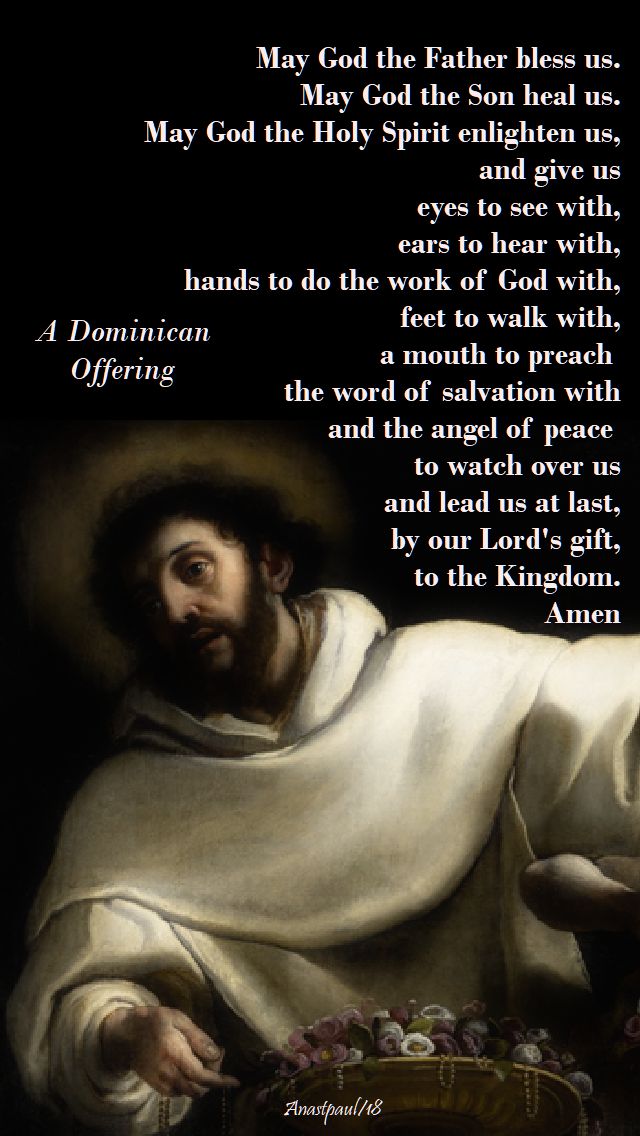
A Dominican Offering
May God the Father bless us.
May God the Son heal us.
May God the Holy Spirit enlighten us,
and give us
eyes to see with,
ears to hear with,
hands to do the work of God with,
feet to walk with,
a mouth to preach
the word of salvation with,
and the angel of peace
to watch over us and lead us at last,
by our Lord’s gift, to the Kingdom.
Amen
Sunday Reflection – 8 July – Fourteenth Sunday in Ordinary Time, Year B
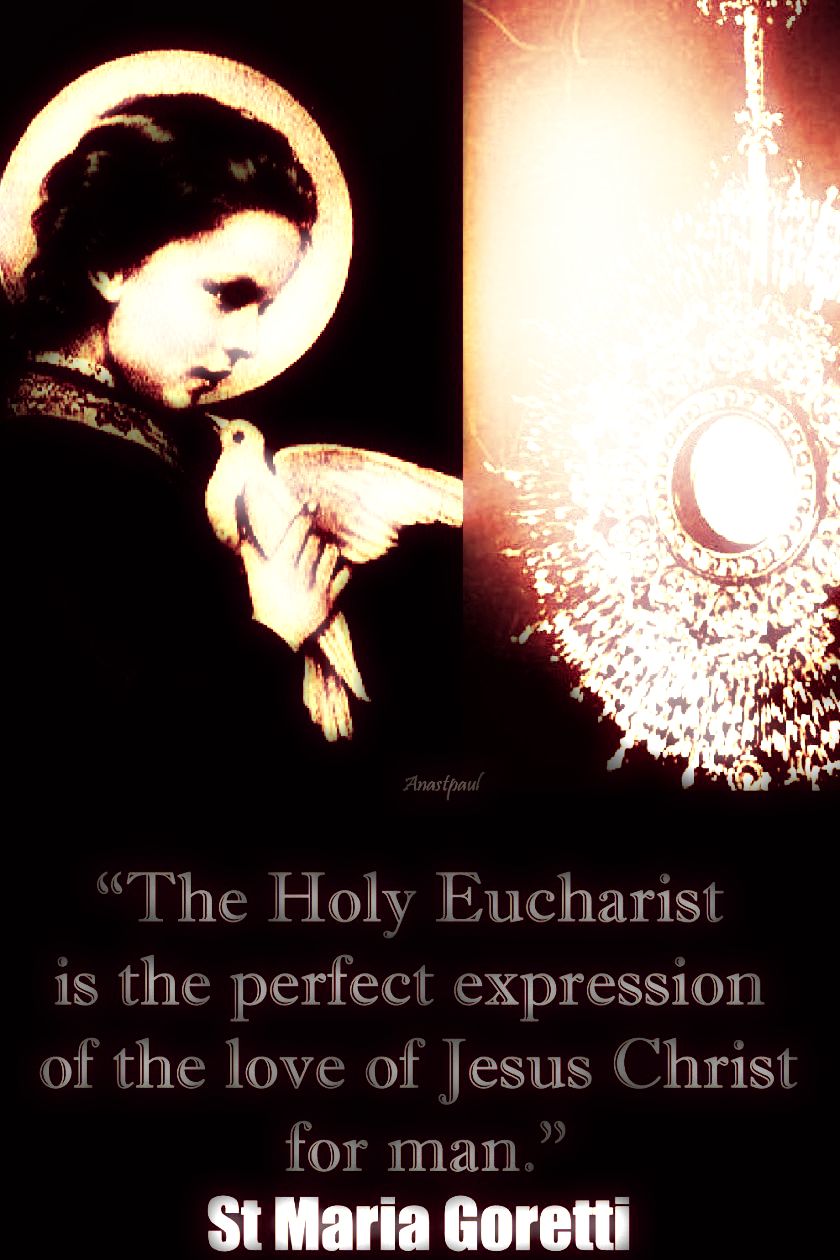
“What does Jesus Christ do in the Eucharist?
It is God who, as our Saviour, offers Himself each day for us to His Father’s justice.
If you are in difficulties and sorrows, He will comfort and relieve you.
If you are sick, He will either cure you or give you strength to suffer so as to merit Heaven.
If the devil, the world and the flesh are making war upon you, He will give you the weapons with which to fight, to resist and to win victory.
If you are poor, He will enrich you with all sorts of riches for time and eternity.
Let us open the door of His sacred and adorable Heart and be wrapped about for an instant by the flames of His love and we shall see what a God who loves us can do.
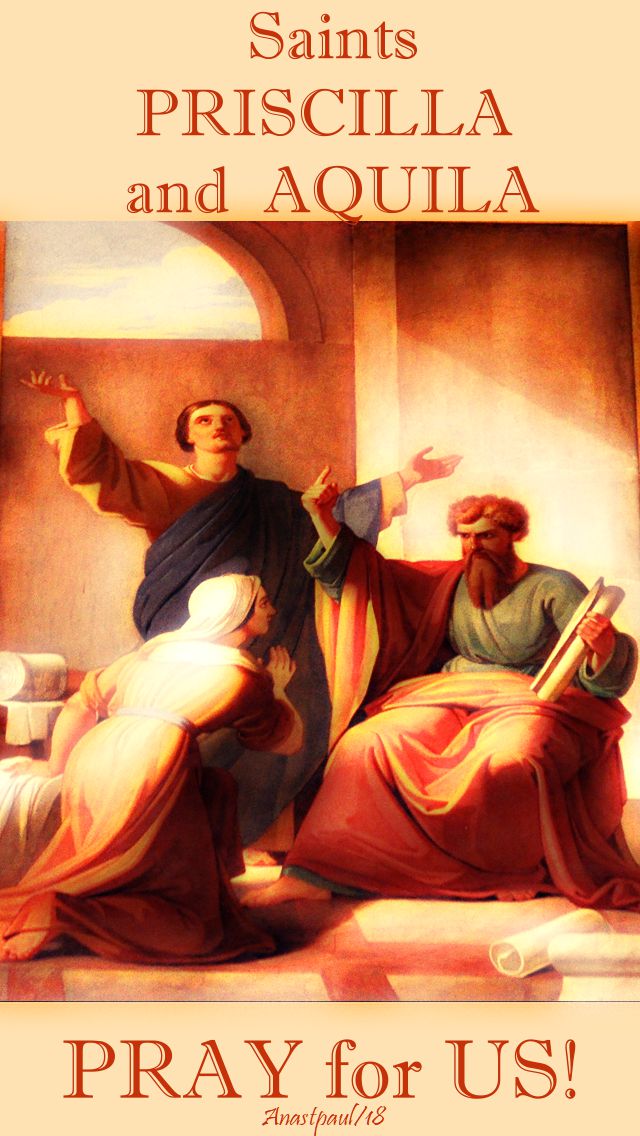
Quote/s of the Day – 8 July – The Memorial of Sts Priscilla and Aquila – Patrons of Catholic Marriage and Families
Speaking of Marriage and the Family
“Authentic married love is caught up into divine love . . . so that this love may lead the spouses to God . . . and in God, they find the strength, to carry on their roles and responsibilities.”
Gaudium et Spes (Joy and Hope, the Pastoral Constitution on the Church in the Modern World), 48
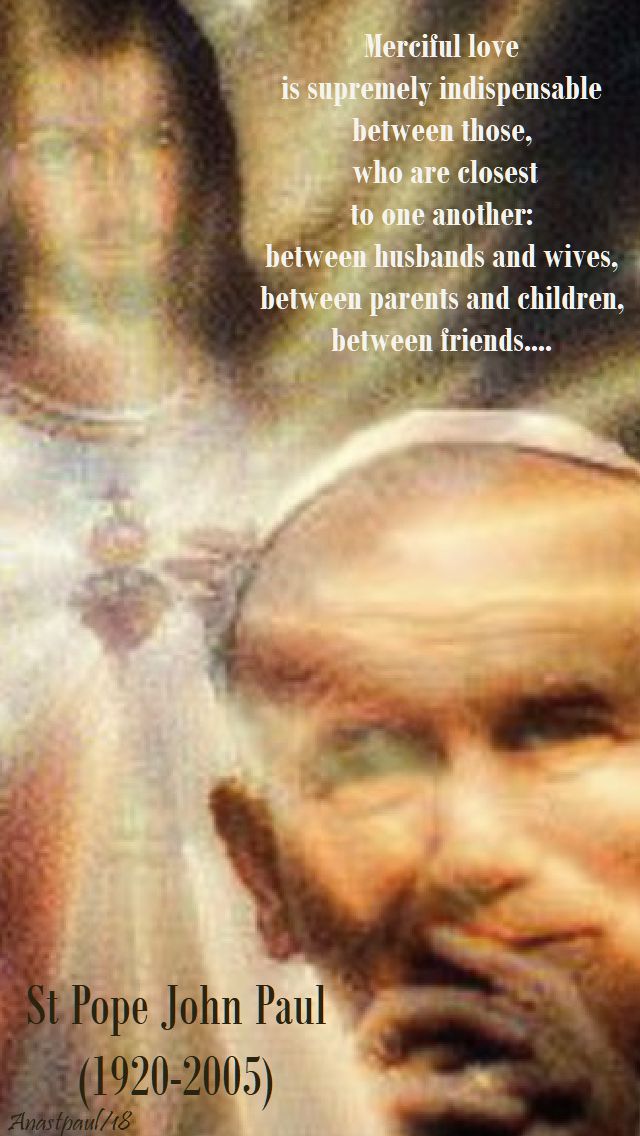
“Merciful love is supremely indispensable between those who are closest to one another: between husbands and wives, between parents and children, between friends and it is indispensable in education and in pastoral work.”
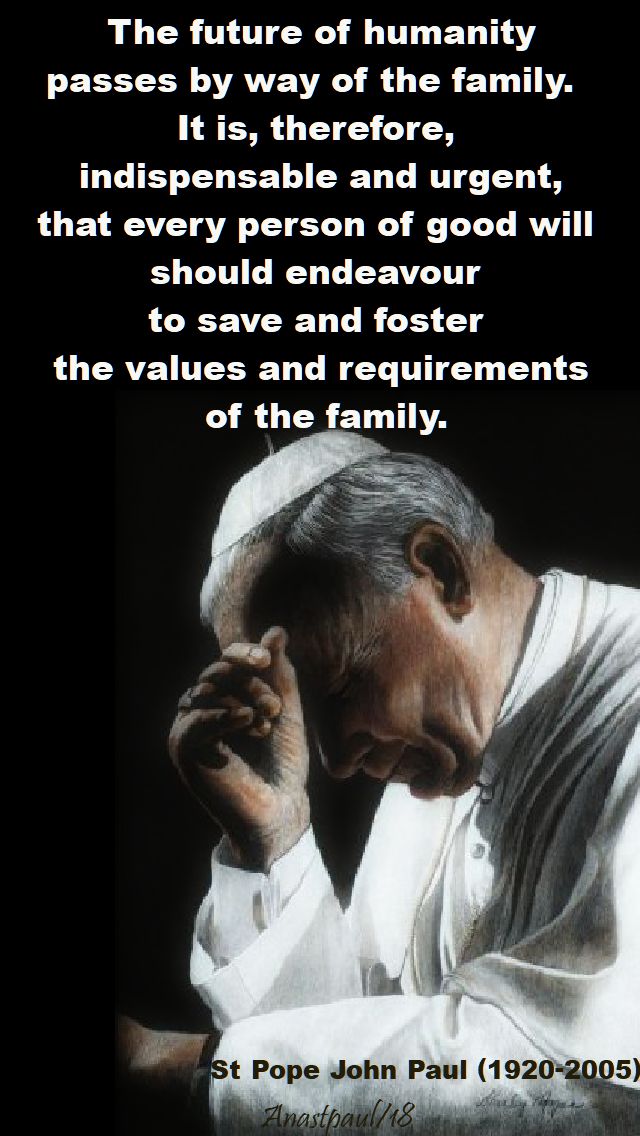
“The future of humanity passes by way of the family. It is therefore indispensable and urgent, that every person of good will should endeavour to save and foster the values and requirements of the family. I feel that I must ask for a particular effort in this field, from the sons and daughters of the Church. Faith gives them full knowledge of God’s wonderful plan, they, therefore, have an extra reason for caring for the reality that is the family in this time of trial and of grace. They must show the family special love. This is an injunction that calls for concrete action.”
St Pope John Paul (1920-2005)
“We speak a lot about behavioural problems, mental health, the well-being of the child, the anxiety of the parents and the children— but do we even know what a wound of the soul is? Do we feel the weight of the mountain that crushes the soul of a child in those families, where members mistreat and hurt one another to the point of breaking the bonds of marital fidelity? What effect do our choices — often poor choices— have on the souls of children?”
Pope Francis
24 June 2015
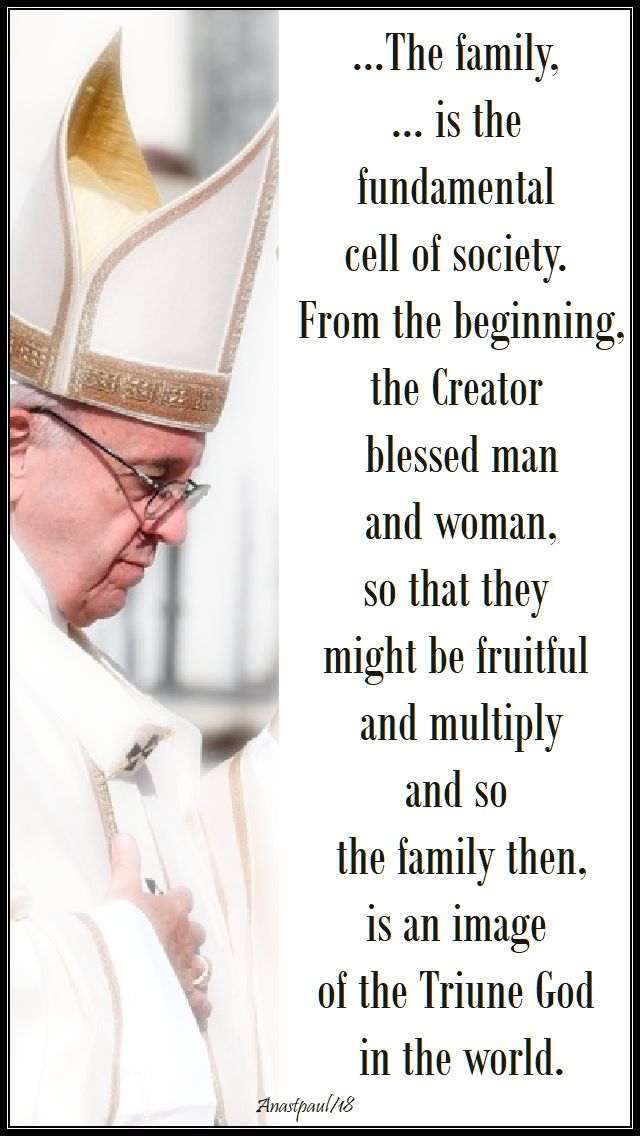
“During these days, we will reflect in particular on the family, which is the fundamental cell of society. From the beginning the Creator blessed man and woman, so that they might be fruitful and multiply and so the family then, is an image of the Triune God in the world.”
Thought for the Day – 8 July – The Memorial of Sts Priscilla and Aquila
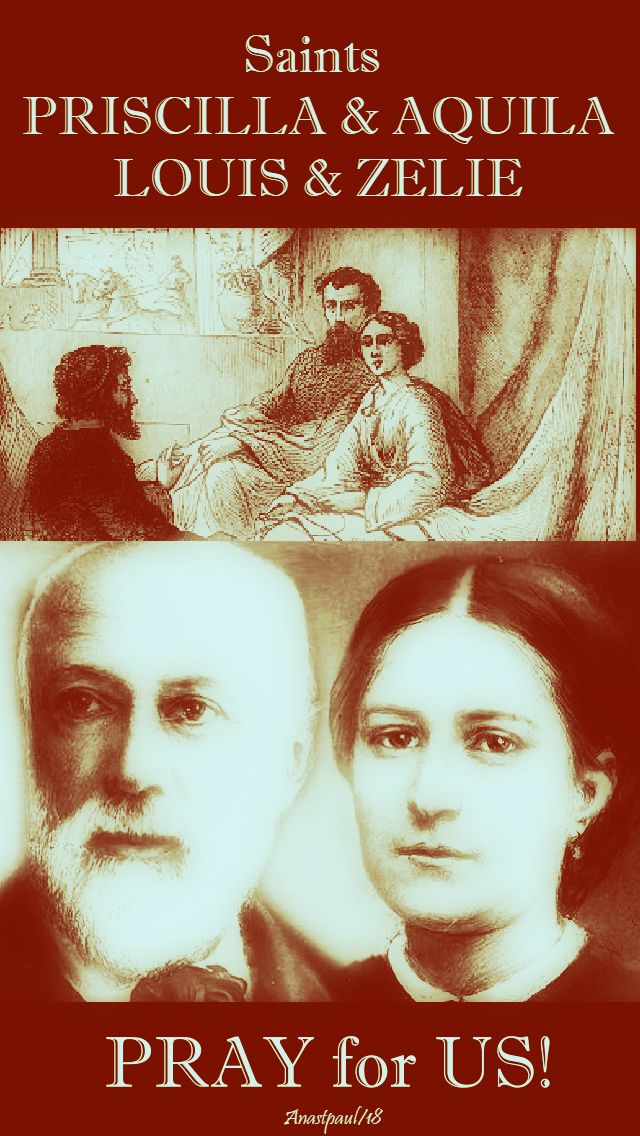
It is appropriate that today, on the Memorial of Saints Priscilla and Aquila that we remember the parents of “the Little Flower”, the first married couple to be formally canonised together, Louis and Zelie Martin.
Louis and Zélie Martin, parents of St Thérèse of Lisieux (“The Little Flower”), were the first married couple to be canonised together and just three weeks after the annual feast day of Thérèse. Their canonisation coincided with the Ordinary Synod on the Family in Rome.
Though the Martins were known as a typical French family of their time, Louis and Zélie espoused and upheld a rare and unblemished love for God, each other and their children.
Although Louis intended to become a monk, wishing to enter the Augustinian Great St Bernard Monastery, he was rejected because he did not succeed at learning Latin. Later he decided to become a watchmaker and studied his craft in Rennes and in Strasbourg.
Zélie wanted to become a nun but was turned away by the Sisters of Charity of Saint Vincent de Paul due to respiratory difficulties and recurrent headaches. She then prayed for God to give her many children and that they would be consecrated to God. She later decided to become a lacemaker, manufacturing Alençon lace. She fell in love with the watchmaker Louis Martin in 1858 and married him, only three months later, on 12 July 1858, at the Basilica of Notre-Dame in Alençon. Zélie’s business became so successful that, in 1870, Louis sold his watchmaking business to go into partnership with her.
The couple nurtured their marriage and maintained a joyful Catholic home, while balancing the demands of business and day-to-day life with their children. Mr and Mrs Martin exemplified the multi-faceted vocation of being married Catholics and astute parents – putting God first; mentoring, educating and disciplining their children; being honourable business owners and employers; helping local families destitute and in need; and persevering in faith through loss of children, Zélie’s breast cancer and her early death.
As a father, Louis loved nature with a deep sentimental enthusiasm . It was from him that Thérèse inherited her passion for flowers and meadows and for her native landscape, clouds, thunderstorms, the sea and the stars. He made pilgrimages to Chartres and Lourdes, went to Germany and Austria, travelled twice to Rome and even to Constantinople and planned but did not live to carry out, a pilgrimage to the Holy Land. Along with this desire for adventure was an impulse towards withdrawal; in Lisieux Louis arranged a little den for himself high up in the attic, a true monastic cell for praying, reading and meditation. Even his daughters were allowed to enter it only if they wished spiritual converse and self-examination. As in a monastery, he divided the day into worship, garden work and relaxation. As a jeweller and watchmaker, Louis loved the precious things with which he dealt. To his daughters he gave touching and naïve pet names: Marie was his “diamond”, Pauline his “noble pearl”, Céline “the bold one” and “the guardian angel”. Thérèse was his “little queen … to whom all treasures belonged”
On 18 October 2015, Louis and Azélie-Marie Martin were canonised as saints by Pope Francis.
“The holy spouses Louis Martin and Marie-Azélie Guérin practised Christian service in the family, creating day by day an environment of faith and love which nurtured the vocations of their daughters, among whom was Saint Therese of the Child Jesus.
The radiant witness of these new saints inspires us to persevere in joyful service to our brothers and sisters, trusting in the help of God and the maternal protection of Mary. From heaven may they now watch over us and sustain us by their powerful intercession.”…Pope Francis
Indeed we cry out to God, “Call down your mercy on marriage!
Sts Priscilla and Aquila, Louis and Zélie, pray for all married couples, pray for the sanctity of marriage and for us all!
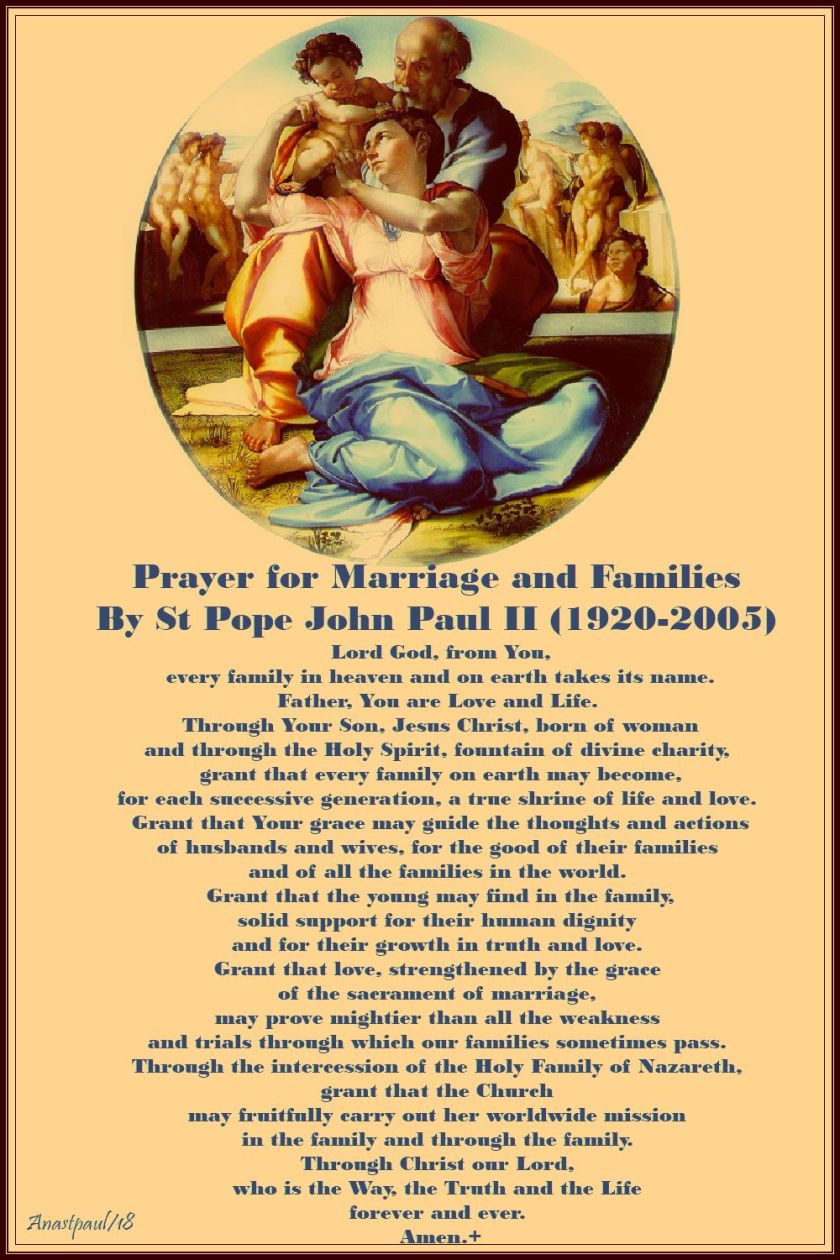
Prayer for Marriage and Families By St Pope John Paul II (1920-2005)
Lord God, from You,
every family in heaven and on earth takes its name.
Father, You are Love and Life.
Through Your Son, Jesus Christ, born of woman
and through the Holy Spirit, fountain of divine charity,
grant that every family on earth may become,
for each successive generation, a true shrine of life and love.
Grant that Your grace may guide the thoughts and actions
of husbands and wives, for the good of their families
and of all the families in the world.
Grant that the young may find in the family,
solid support for their human dignity
and for their growth in truth and love.
Grant that love, strengthened by the grace
of the sacrament of marriage,
may prove mightier than all the weakness
and trials through which our families sometimes pass.
Through the intercession of the Holy Family of Nazareth,
grant that the Church
may fruitfully carry out her worldwide mission
in the family and through the family.
Through Christ our Lord,
who is the Way, the Truth and the Life
forever and ever.
Amen.+
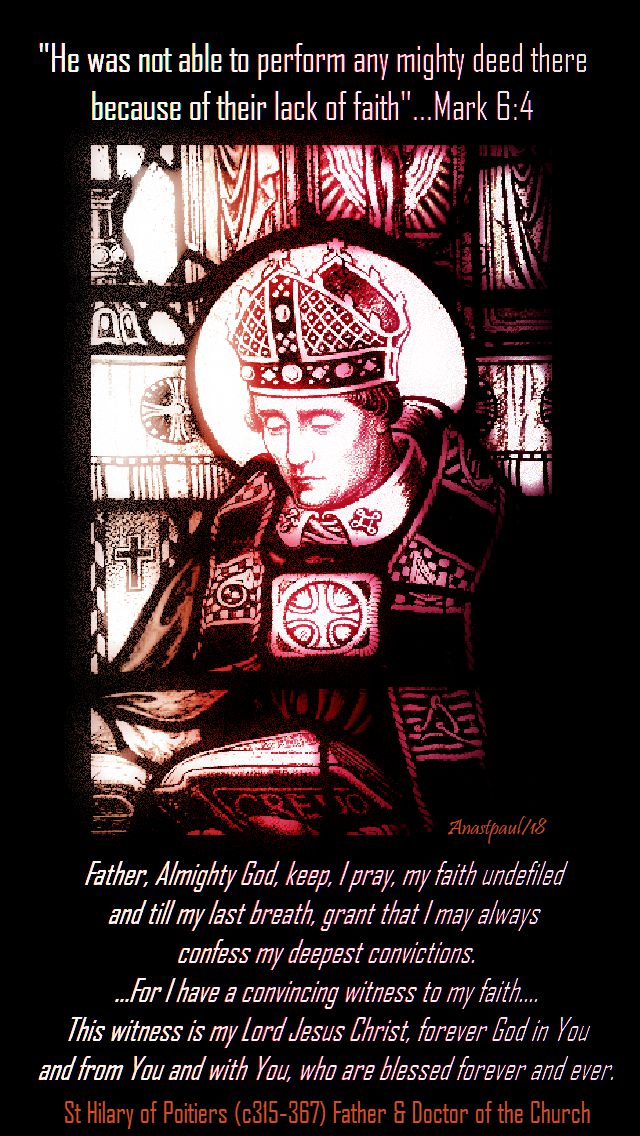
One Minute Reflection – 8 July – – Fourteenth Sunday in Ordinary Time, Year B – “He was not able to perform any mighty deed there because of their lack of faith”...Mark 6:4
And he could do no mighty work there, except that he laid his hands upon a few sick people and healed them. And he marvelled because of their unbelief...Mark 6:5-6
REFLECTION – “Father, Almighty God, keep, I pray, my faith undefiled and till my last breath, grant that I may always confess my deepest convictions. May I ever hold fast to everything which I professed in the creed of my new birth, when I was baptised in the Father and the Son, and the Holy Spirit. May I always adore You our Father and your Son who is one with You; give me always Your Holy Spirit, who proceeds from You, through Your Only-begotten Son.
For I have a convincing witness to my faith, who says, “Father, everything of mine is yours and everything of yours is mine” (Jn 17:10). This witness is my Lord Jesus Christ, forever God in You and from You and with You, who are blessed forever and ever. Amen”…Saint Hilary (c315-367) Bishop of Poitiers, Father & Doctor of the Church (De Trinitate, XII, final prayer)
PRAYER – Lord Holy God and Father of all, hold us always in Your Heart, keep us near to Your Son, that our faith may never fail us! Grant that by the prayers of Sts Aquila and Priscilla, we may hold fast to our Saviour, even in times of distress, hardship, persecution and humiliation, when this world assails us. Through Christ our Lord, in the unity of the Holy Spirit, one God forever amen.
Our Morning Offering – 8 July – Fourteenth Sunday in Ordinary Time, Year B
Prayer before Holy Communion By Blessed John Henry Newman (1801-1890)
O my God, holiness becomes Your House,
and yet You make Your abode in my breast.
My Lord, my Saviour, to me You come,
hidden under the semblance of earthly things,
yet in that very flesh and blood
which You took from Mary,
You, who did first inhabit Mary’s breast,
come to me.
My God, You see me;
I cannot see myself…
You see how unworthy, so great a sinner is,
to receive the One Holy God,
whom the Seraphim adore with trembling…
My God, enable me to bear You,
for You alone can.
Cleanse my heart and mind from all that is past…
give me a true perception of things unseen,
and make me truly, practically,
and in the details of life,
prefer You to anything on earth,
and the future world,
to the present.
Amen
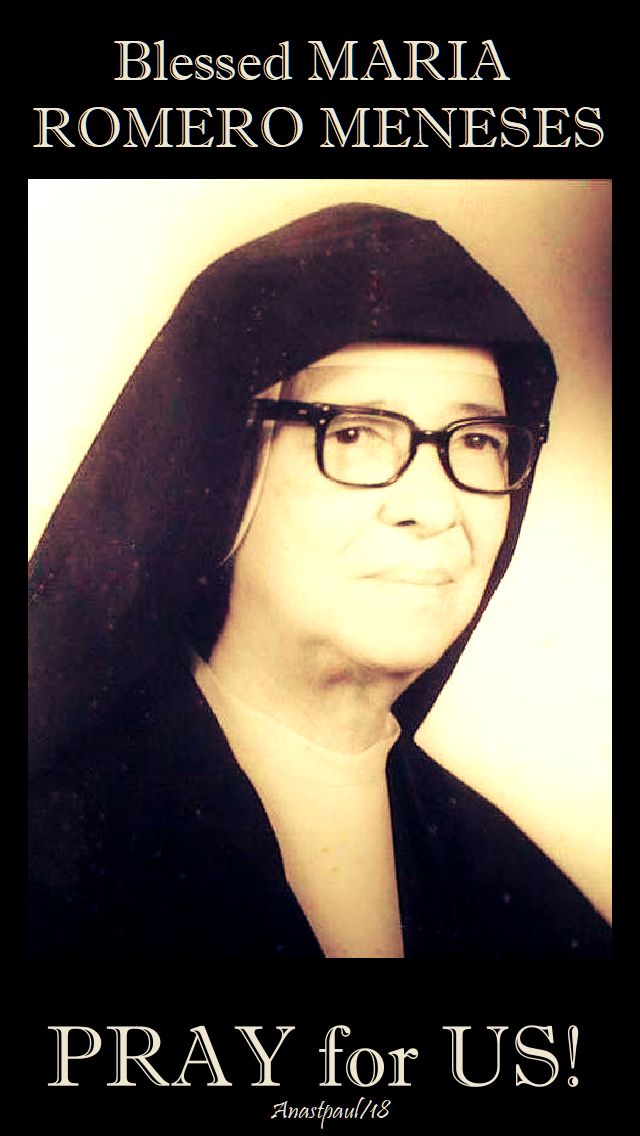
Quote/s of the Day – 7 July – The Memorial of Maria Romero Meneses F.M.A. (1902-1977)
“My secret: Live making continuous Acts of love of God.”
“Prayer is like air is for the lungs. For this reason, the one who prays is saved.”
“As God gave all the animals the instinct of self-defence, He gave humans that of prayer.”
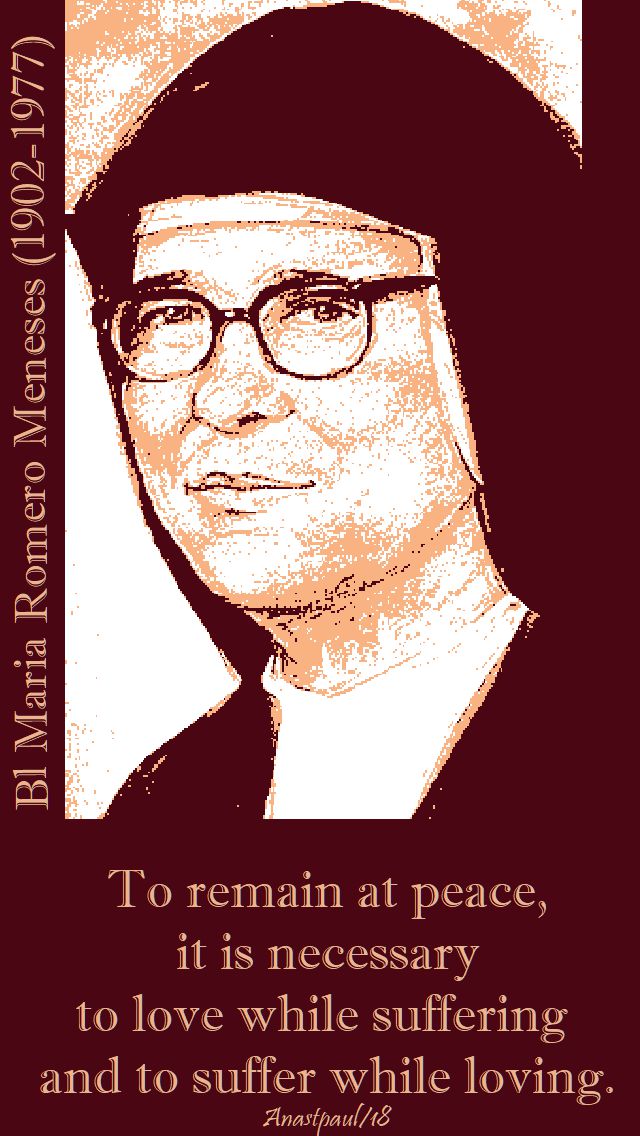
“To remain at peace, it is necessary to love while suffering and to suffer while loving.”
“Faith produces miracles, it is not miracles that produce faith.”
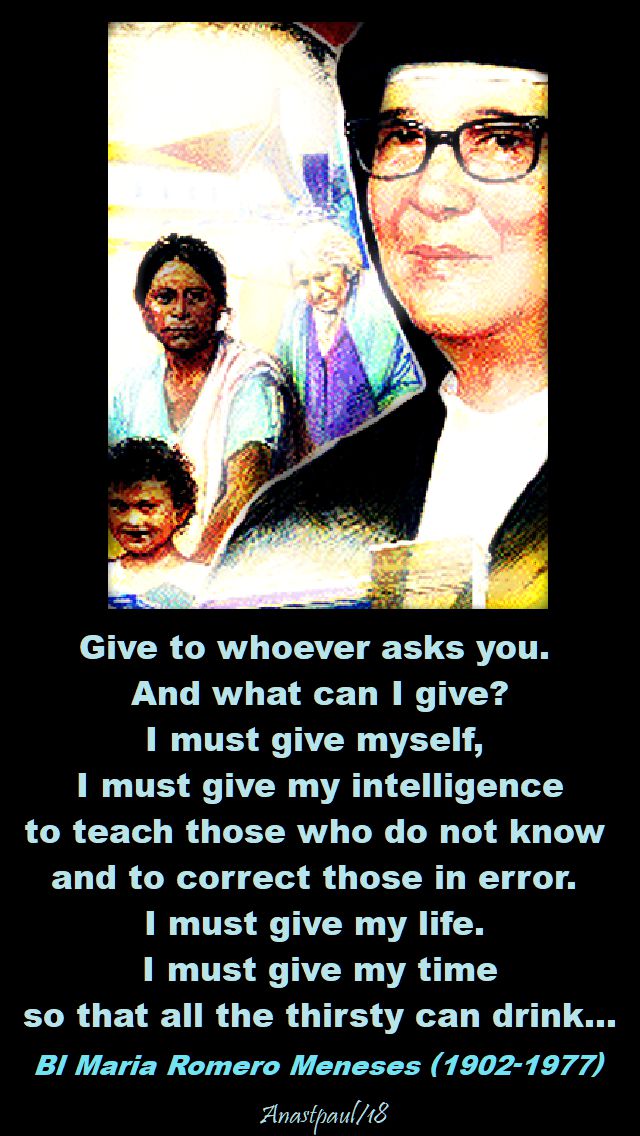
“Give to whoever asks you. And what can I give? I must give myself, I must give my intelligence to teach those who do not know and to correct those in error. I must give my life. I must give my time so that all the thirsty can drink…”
One Minute Reflection – 7 July – Saturday of the Thirteenth Week of Ordinary Time, Year B – Today’s Gospel Matthew 9:14-17.
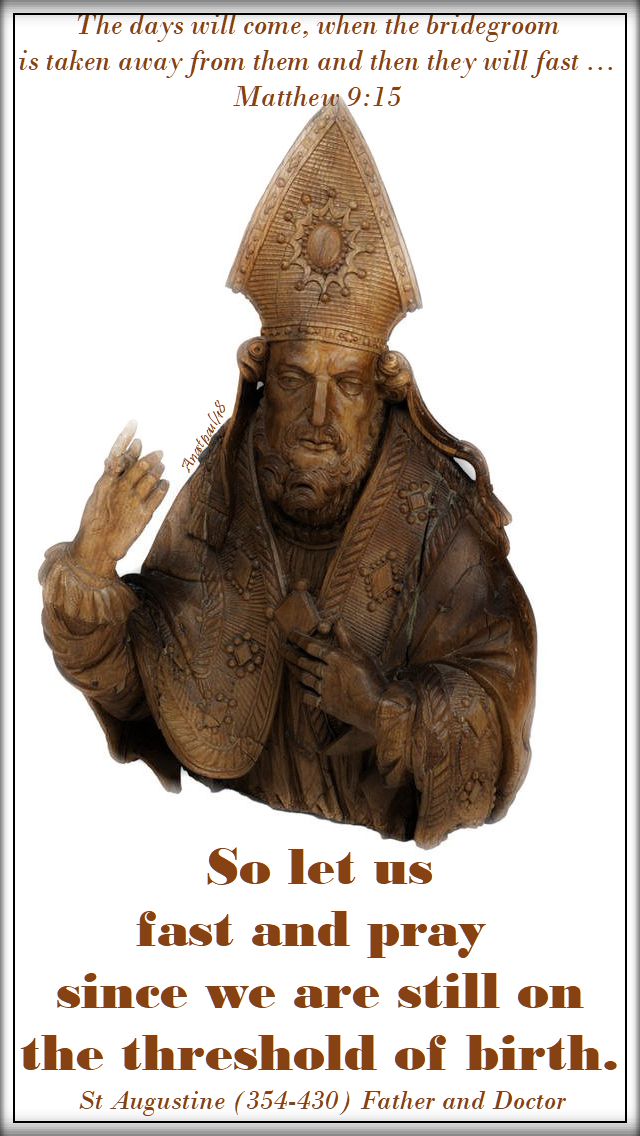
And Jesus said to them, “Can the wedding guests mourn as long as the bridegroom is with them? The days will come, when the bridegroom is taken away from them, and then they will fast...Matthew 9:15
REFLECTION – “However, our mourning is right if we burn with desire to see Him. How happy they were who were able to enjoy His presence before His Passion, to question Him as they wished and listen to Him as necessary… As for us, we see the fulfilment of what He said: “The days are coming when you will long to see one of the days of the Son of Man, and you will not see it” (Lk 17:22)…A little while and you will no longer see me and again a little while and you will see me” (Jn 16:19). But now this is the hour of which He said: “You will weep and mourn but the world will rejoice… But, He added, I will see you again and your hearts will rejoice and no one will take your joy away from you” (v.22). The hope thus given us by Him, who is faithful in His promises, never now leaves us, without a certain joy — until that overwhelming joy comes on the day when we will be like Him because we will see Him as he is (1Jn 3:2)… “When a woman is in labour, she has pain because her hour has come,” says the Lord, “but when her child is born, she no longer remembers the anguish because of the joy of having brought a human being into the world” (Jn 16:21). This is the joy no one can take away from us and with which we will be satisfied when we pass to eternal light from our present conception in faith. So let us fast and pray since we are still on the threshold of birth.“…St Augustine (354-430) Father and Doctor
PRAYER – Father almighty, as we wait and work and pray and fast in joyful hope of our eternal life with You, grant we pray that we may always remain steadfast in Your love. Blessed Maria Romero Meneses, pray for us that we will fully utilise the many gifts our Almighty God has bestowed on us as we journey home. We make our prayer through Jesus Christ our Lord, in union with You and the Holy Spirit, one God forever, amen.
Our Morning Offering – 7 July – The Memorial of Maria Romero Meneses F.M.A. (1902-1977)
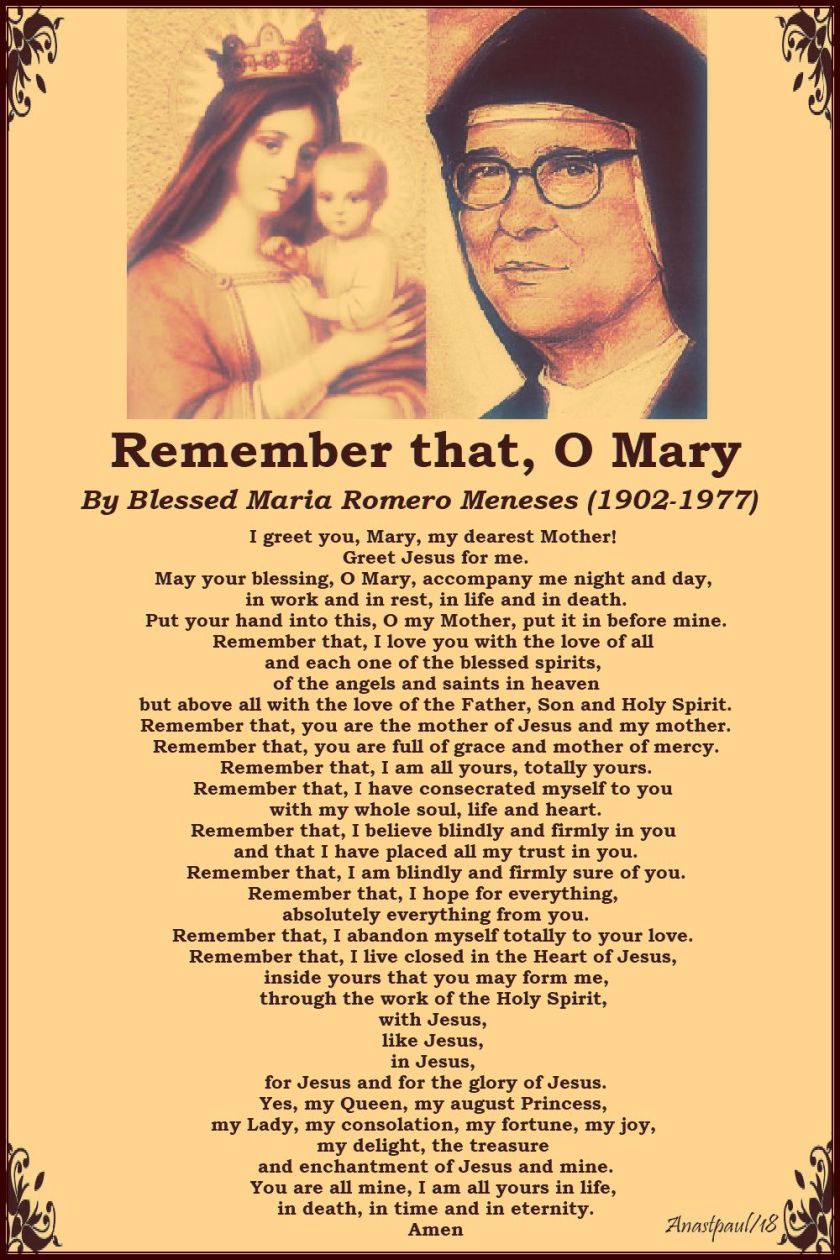
Remember that, O Mary By Blessed Maria Romero Meneses (1902-1977)
I greet you, Mary, my dearest Mother!
Greet Jesus for me.
May your blessing, O Mary, accompany me night and day,
in work and in rest, in life and in death.
Put your hand into this, O my Mother, put it in before mine.
Remember that, I love you with the love of all
and each one of the blessed spirits,
of the angels and saints in heaven
but above all with the love of the Father, Son and Holy Spirit.
Remember that, you are the mother of Jesus and my mother.
Remember that, you are full of grace and mother of mercy.
Remember that, I am all yours, totally yours.
Remember that, I have consecrated myself to you
with my whole soul, life and heart.
Remember that, I believe blindly and firmly in you
and that I have placed all my trust in you.
Remember that, I am blindly and firmly sure of you.
Remember that, I hope for everything,
absolutely everything from you.
Remember that, I abandon myself totally to your love.
Remember that, I live closed in the Heart of Jesus,
inside yours that you may form me,
through the work of the Holy Spirit,
with Jesus,
like Jesus,
in Jesus,
for Jesus and for the glory of Jesus.
Yes, my Queen, my august Princess,
my Lady, my consolation, my fortune, my joy,
my delight, the treasure
and enchantment of Jesus and mine.
You are all mine, I am all yours in life,
in death, in time and in eternity.
Amen
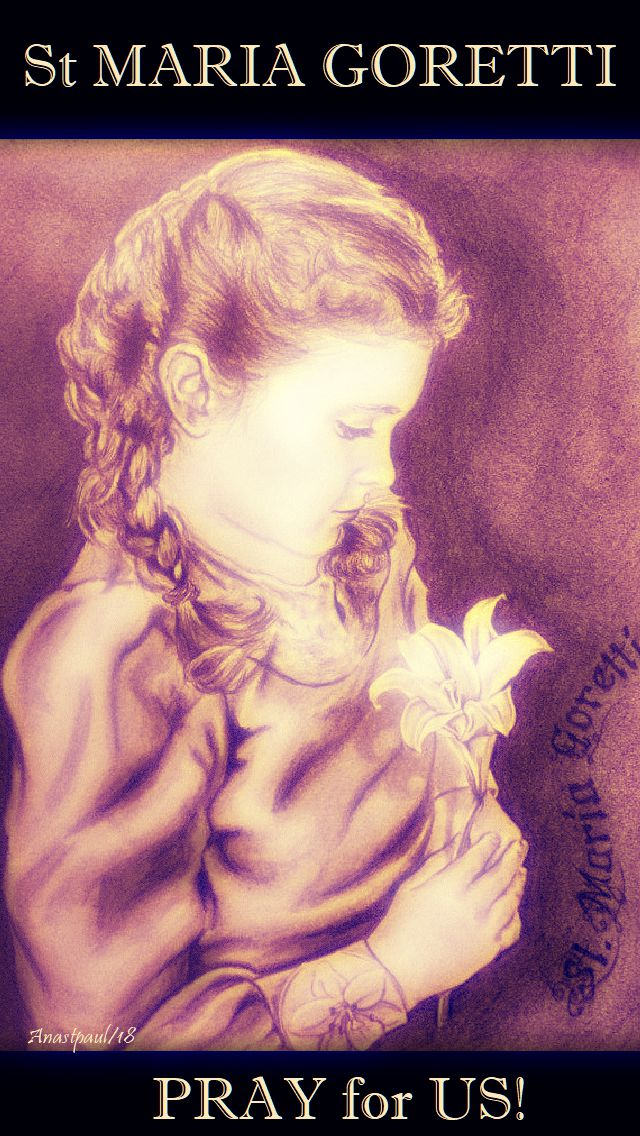
Thought for the Day – 6 July – The Memorial of St Maria Goretti (1890-1902)
One of the largest crowds ever assembled for a canonisation—250,000—symbolised the reaction of millions touched by the simple story of Maria Goretti. She was the daughter of a poor Italian tenant farmer, had no chance to go to school, never learned to read or write. When Maria made her First Communion not long before her death at age 12, she was one of the taller and somewhat backward members of the class.
Maria may have had trouble with catechism but she had no trouble with faith.
God’s will was holiness, decency, respect for one’s body, absolute obedience, total trust. In a complex world, her faith was simple: it is a privilege to be loved by God and to love Him—at any cost . Oh, that we too may always remember this!
One Minute Reflection – 6 July – The Memorial of St Maria Goretti (1890-1902)
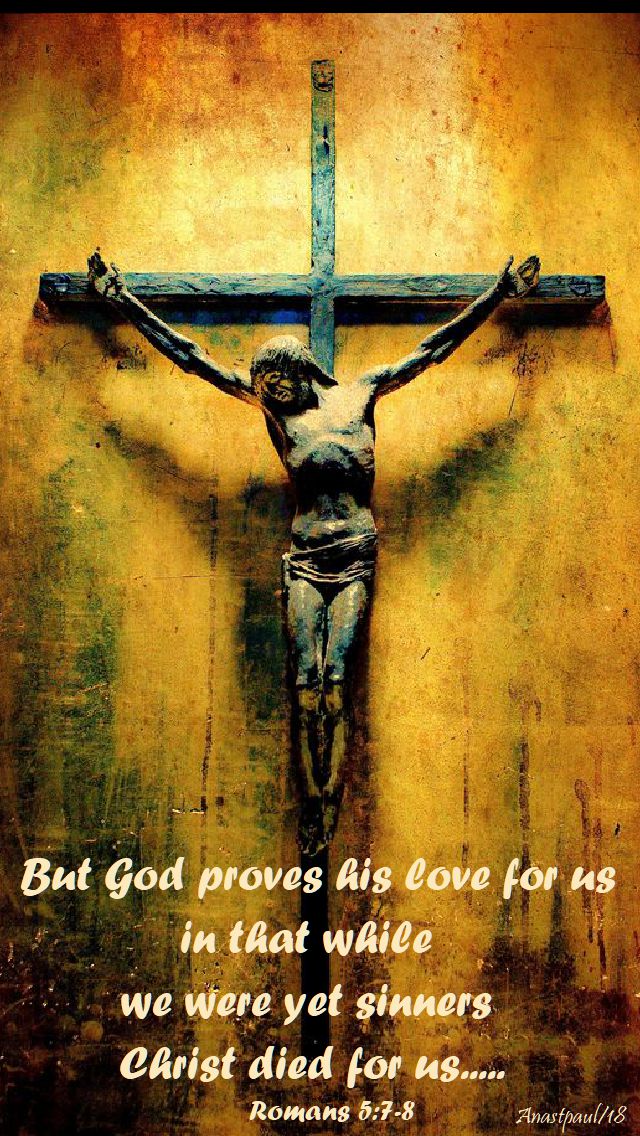
Why, one will hardly die for a righteous man—though perhaps for a good man, one will dare even to die. But God proves his love for us in that while we were yet sinners Christ died for us………..Romans 5:7-8
REFLECTION – “The new commandment, “Love one another as I have loved you” (Jn 15:12), urges us to pattern our love on the example of Jesus, who dies that we may live.
If our ability to love in a divine way seems unfairly offset by an impossible ideal—in other words, that Jesus can love like God because He is God but we can’t—then we have to reckon with the violent, yet highly avoidable death of an eleven-year-old girl. When you find a mere human being, loving as God loves by dying as God dies and forgiving as God forgives, you encounter someone who understands not only the force of the new commandment – but also of the extent of the self-sacrifice involved in loving like Jesus.”………Fr John Henry Hanson, O. Praem.
PRAYER – Lord God, You alone can give the grace of innocence and love . By Your grace, St Maria Goretti, though as yet but a young child, was able to offer herself in death for Your sake. As You crowned her virginity with martyrdom, grant us, by her intercession, constancy in Your love. We make our prayer through Christ our Lord, in union with the Holy Spirit, one God forever and ever – St Maria pray for us! amen.
Our Morning Offering – 6 July – The Memorial of St Maria Goretti (1890-1902)
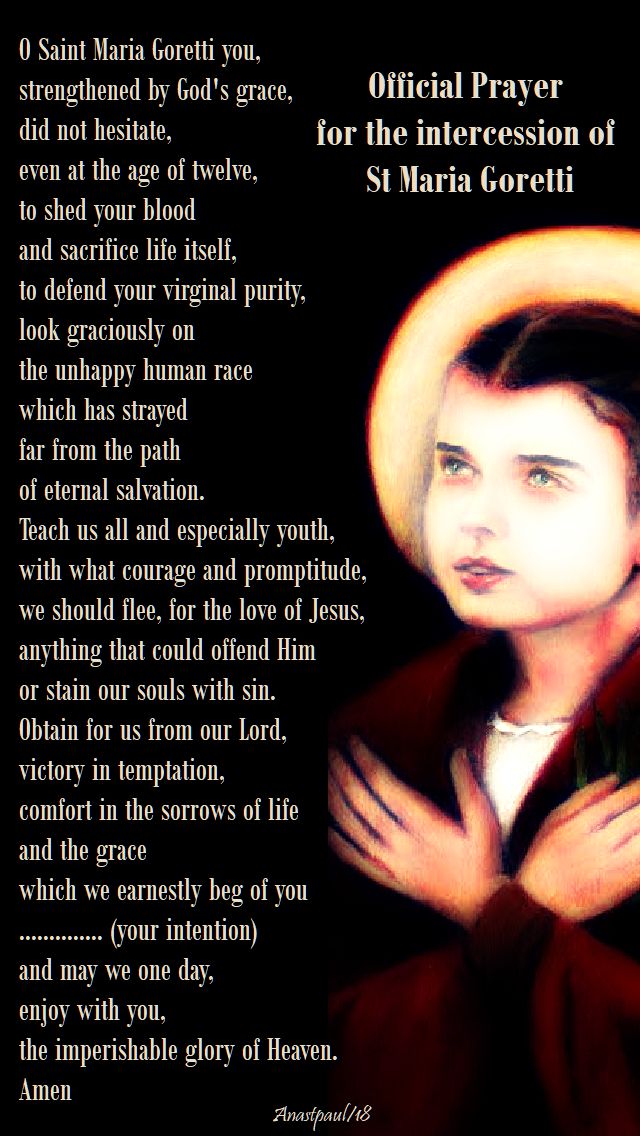
Official Prayer for the intercession of St Maria Goretti
O Saint Maria Goretti you,
strengthened by God’s grace,
did not hesitate,
even at the age of twelve,
to shed your blood
and sacrifice life itself,
to defend your virginal purity,
look graciously on
the unhappy human race
which has strayed
far from the path
of eternal salvation.
Teach us all and especially youth,
with what courage and promptitude,
we should flee, for the love of Jesus,
anything that could offend Him
or stain our souls with sin.
Obtain for us from our Lord,
victory in temptation,
comfort in the sorrows of life
and the grace
which we earnestly beg of you
…………………… (your intention)
and may we one day,
enjoy with you,
the imperishable glory of Heaven.
Amen
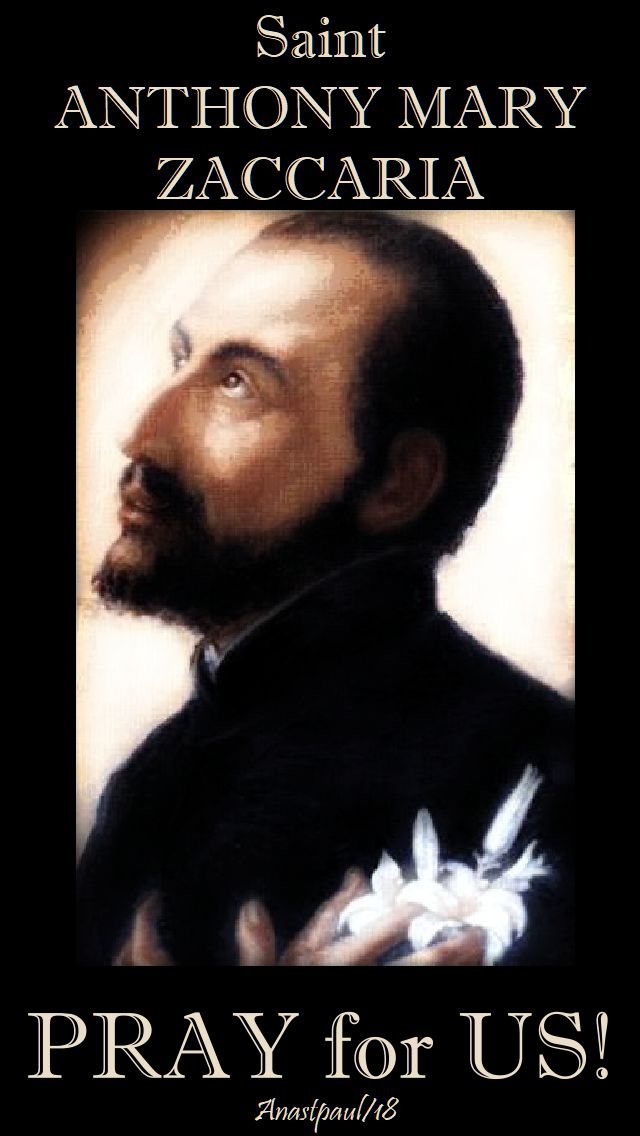
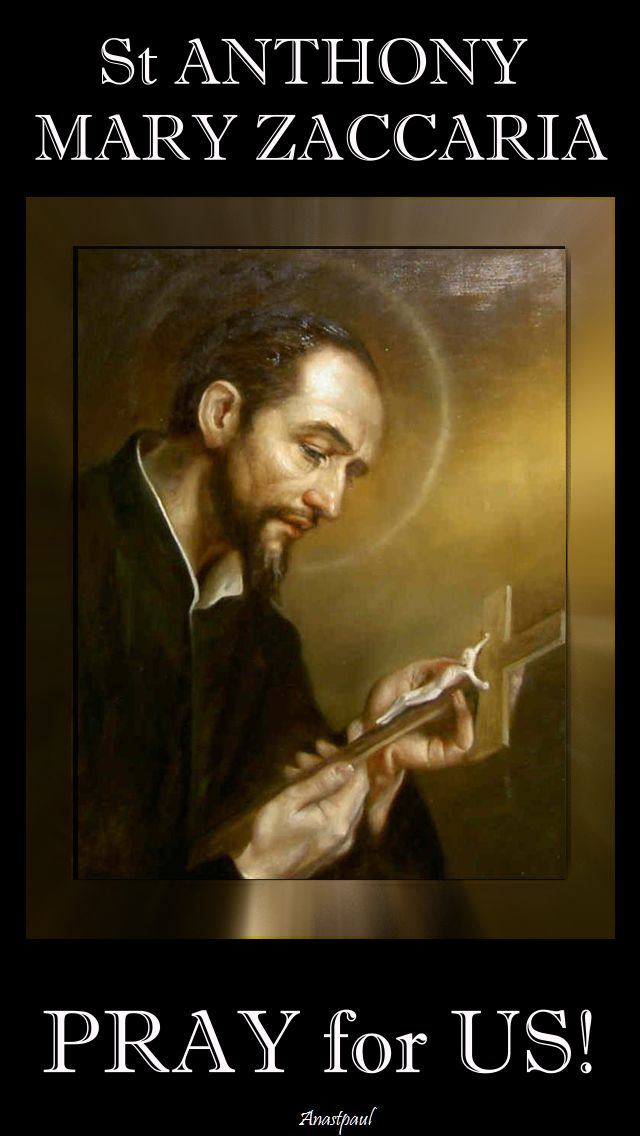
Thought for the Day – 5 July – The Memorial of St Anthony Mary Zaccaria (1502-1539)
Compassion for the sick and the poor led Dr Anthony Mary Zaccaria to see beyond the sick bodies of his patients and recognise the need for a different kind of healing. After becoming “Fr” Zaccaria, he tried to fill that need and dedicated the rest of his life to doing so. …….the Pauline ardour of his preaching would probably “turn off” many people today. When even some psychiatrists complain at the lack of a sense of sin, it may be time to tell ourselves that not all evil is explained by emotional disorder, subconscious and unconscious drives, parental influence and so on. The old-time “hell and damnation” mission sermons have given way to positive, encouraging, biblical homilies. We do indeed need assurance of forgiveness, relief from existential anxiety and future shock. But we still need prophets to stand up and tell us, “If we say ‘We are without sin,’ we deceive ourselves and the truth is not in us” (1 John 1:8). (Fr Don Miller OFM). St Anthony was such a prophet, he let God step in and lead him to a whole new set of plans. May we too allow God room in our boat to navigate us to a new way of life!
“We are fools for Christ’s sake:
our holy guide and most revered patron, was speaking about himself and the rest of the apostles and about the other people who profess the Christian and apostolic way of life.
But there is no reason, dear brothers, that we should be surprised or afraid; for the disciple is not superior to his teacher, nor the slave to his master. We should love and feel compassion for those who oppose us, rather than abhor and despise them, since they harm themselves and do us good and adorn us with crowns of everlasting glory while they incite God’s anger against themselves. And even more than this, we should pray for them and not be overcome by evil but overcome evil by goodness.
We should heap good works like red-hot coals of burning love upon their heads, as our Apostle urges us to do, so that when they become aware of our tolerance and gentleness they may undergo a change of heart and be prompted to turn in love to God.”
Quote/s of the Day – 5 July – The Memorial of St Anthony Mary Zaccaria (1502-1539)
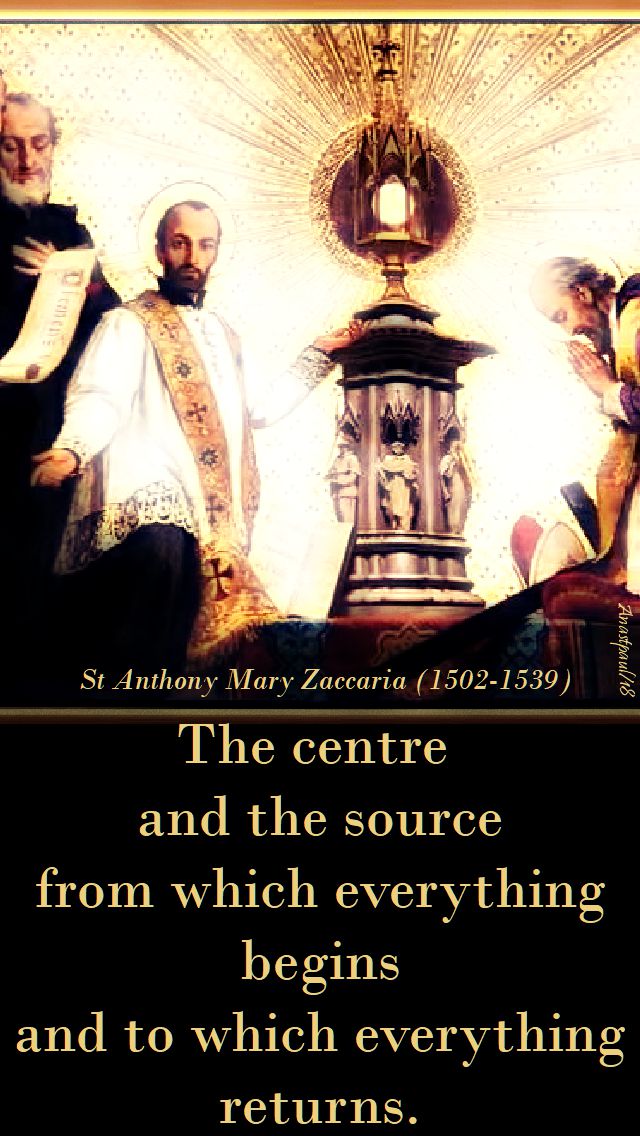
“The centre and the source from which everything begins and to which everything returns.”
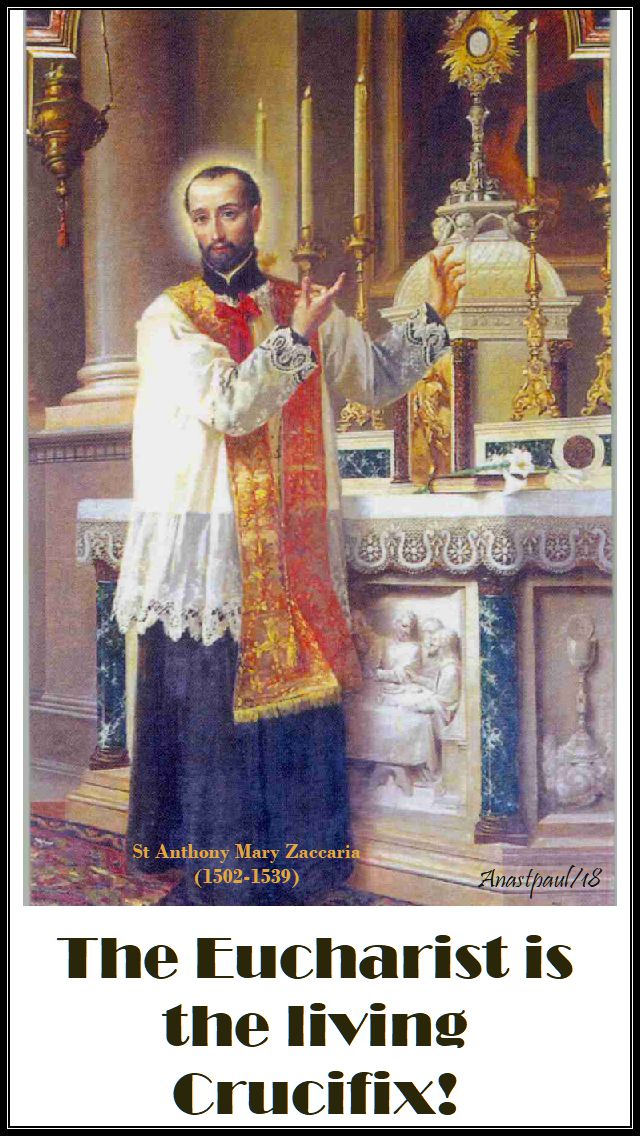
“The Eucharist is the living Crucifix!”
“If you want to obtain what you pray for, adapt yourself to it, that is, if you want humility, do not avoid humiliations.”
“Let them keep in mind, therefore, that there can be no humility without reproaches and mockery and anyone who feels ashamed of them … may as well abandon all hope, of being able to achieve perfection.”
“That which God commands seems difficult and a burden. The way is rough; you draw back; you have no desire to follow it. Yet DO SO – and you will attain glory.”
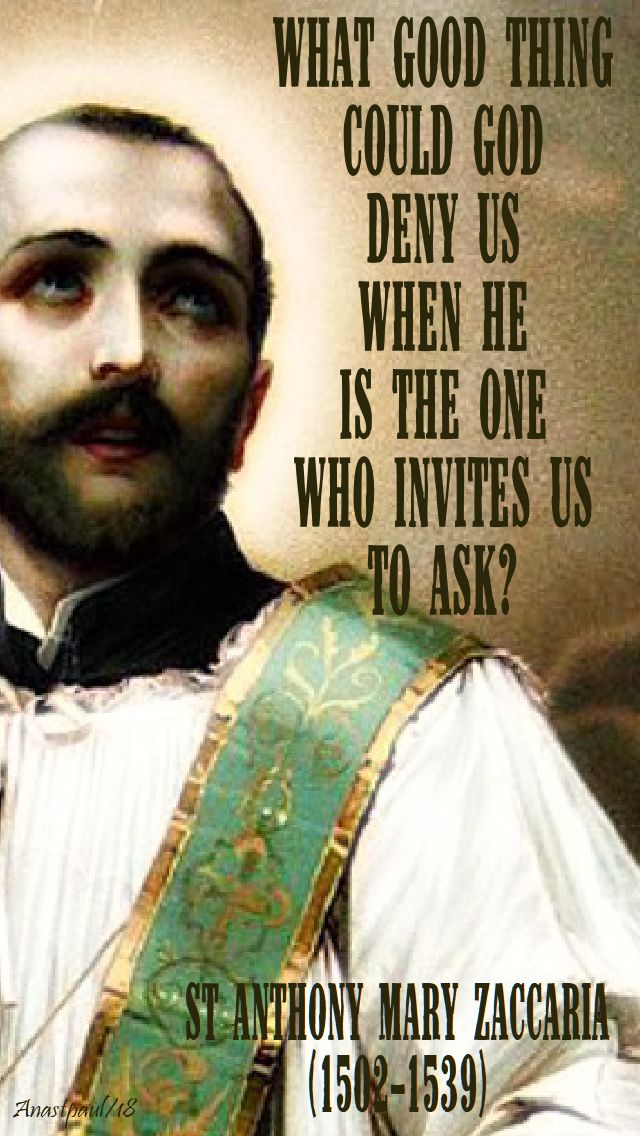
“What good thing could God deny us when He is the one who invites us to ask?”
One Minute Reflection – 5 July – The Memorial of St Anthony Mary Zaccaria (1502-1539)
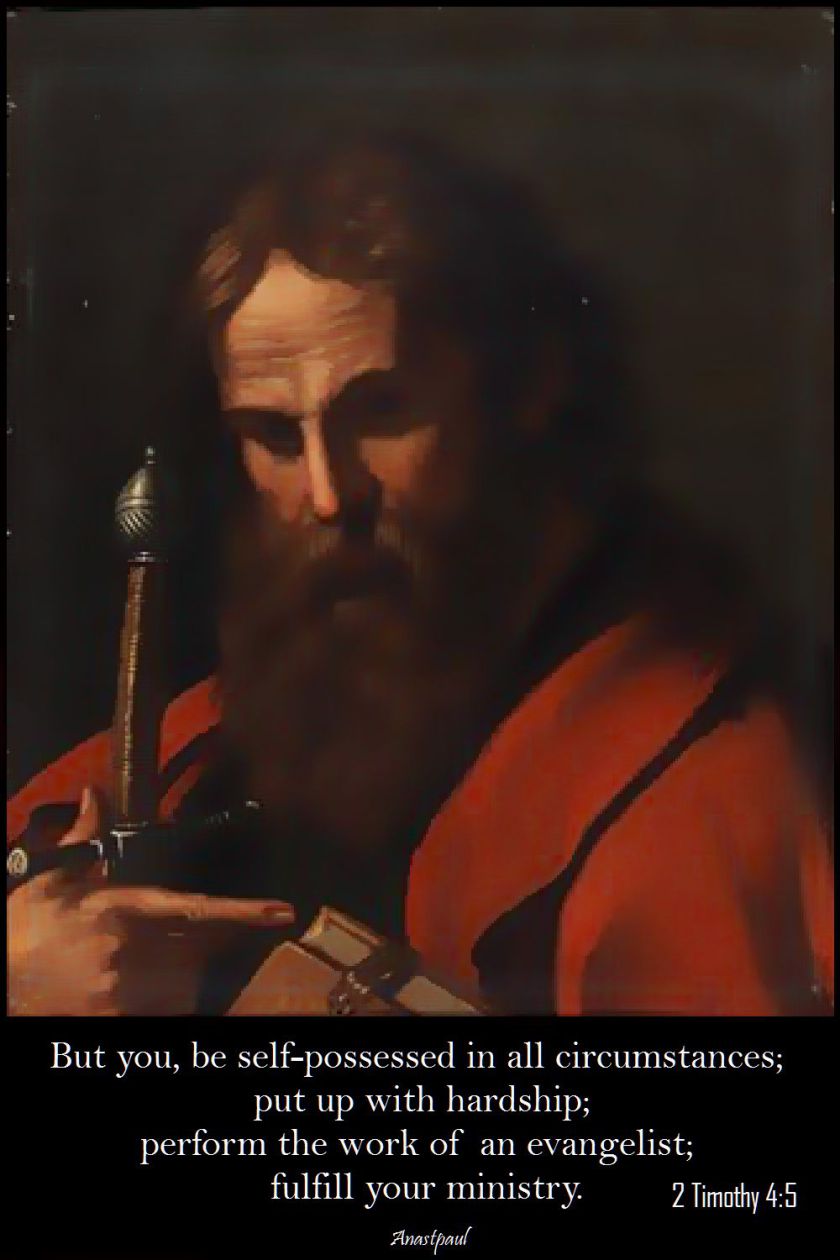
But you, be self-possessed in all circumstances; put up with hardship; perform the work of an evangelist; fulfil your ministry……2 Timothy 4:5
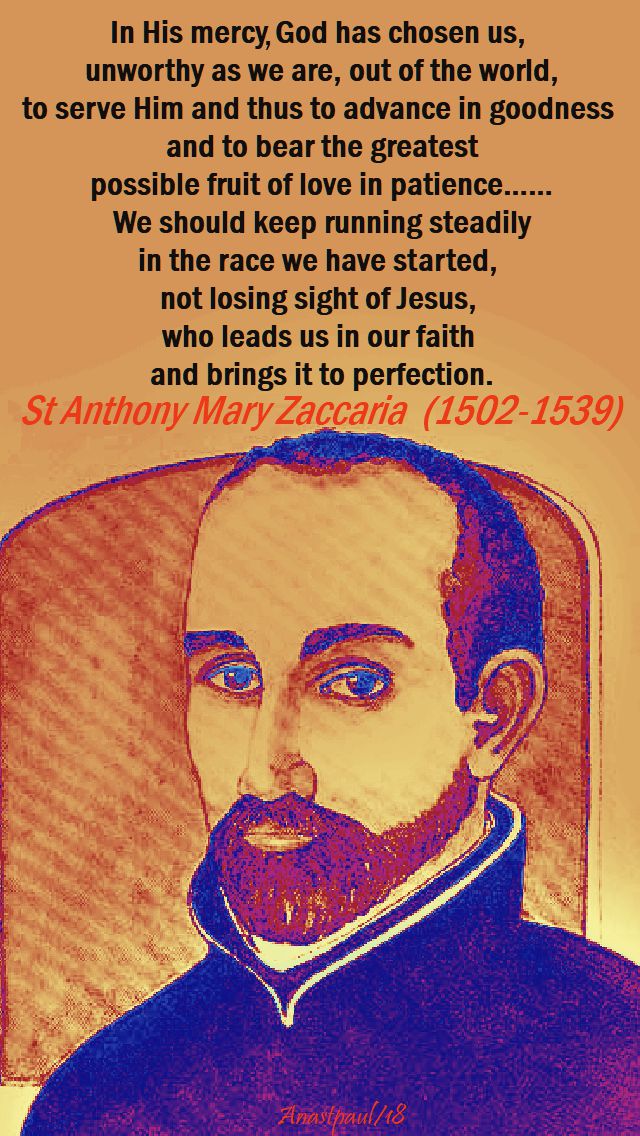
REFLECTION – “In His mercy, God has chosen us, unworthy as we are, out of the world, to serve Him and thus to advance in goodness and to bear the greatest possible fruit of love in patience……We should keep running steadily in the race we have started, not losing sight of Jesus, who leads us in our faith and brings it to perfection.”……….St Anthony Mary Zaccaria (An excerpt from a letter of Saint Anthony to his congregation).
PRAYER – Lord, enable us to grasp in the spirit of Saint Paul, the sublime wisdom of Jesus Christ, the wisdom which inspired Saint Anthony Zaccaria to preach the message of salvation in Your church. Grant this, we pray, through our Lord Jesus Christ, Your Son,who lives and reigns with you and the Holy Spirit, one God, forever and ever. St Anthony Mary Zaccaria, pray for us amen.
Our Morning Offering – 5 July 2018 – The Memorial of St Anthony Mary Zaccaria (1502-1539)
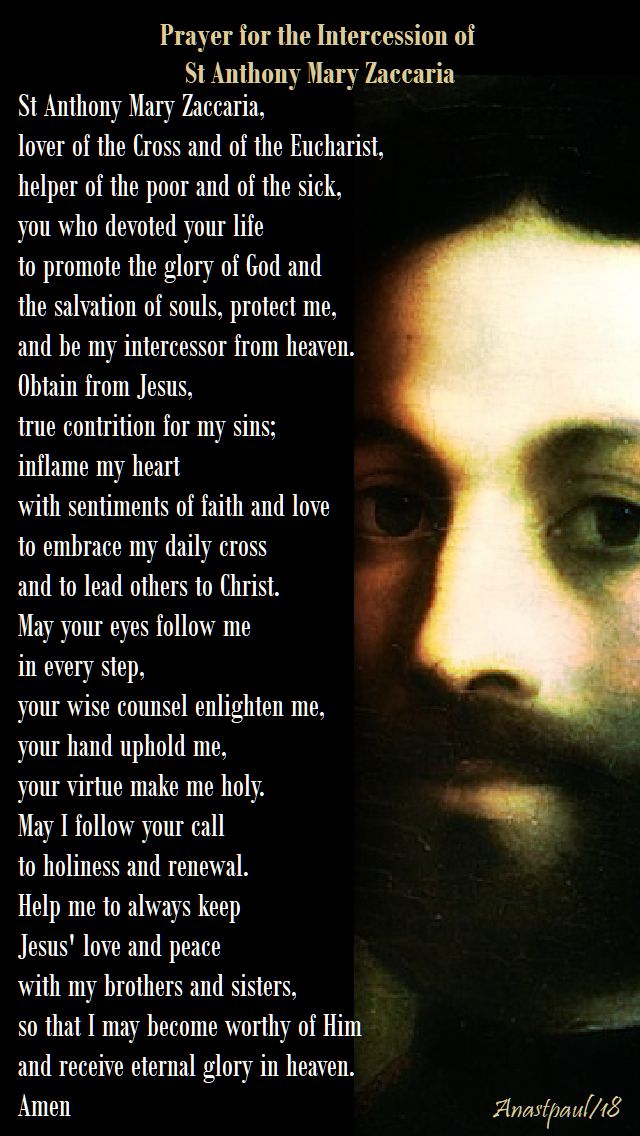
Prayer for the Intercession of St Anthony Mary Zaccaria
St Anthony Mary Zaccaria,
lover of the Cross and of the Eucharist,
helper of the poor and of the sick,
you who devoted your life
to promote the glory of God and
the salvation of souls, protect me,
and be my intercessor from heaven.
Obtain from Jesus,
true contrition for my sins;
inflame my heart
with sentiments of faith and love
to embrace my daily cross
and to lead others to Christ.
May your eyes follow me in every step,
your wise counsel enlighten me,
your hand uphold me,
your virtue make me holy.
May I follow your call
to holiness and renewal.
Help me to always keep
Jesus’ love and peace
with my brothers and sisters,
so that I may become worthy of Him
and receive eternal glory in heaven.
Amen
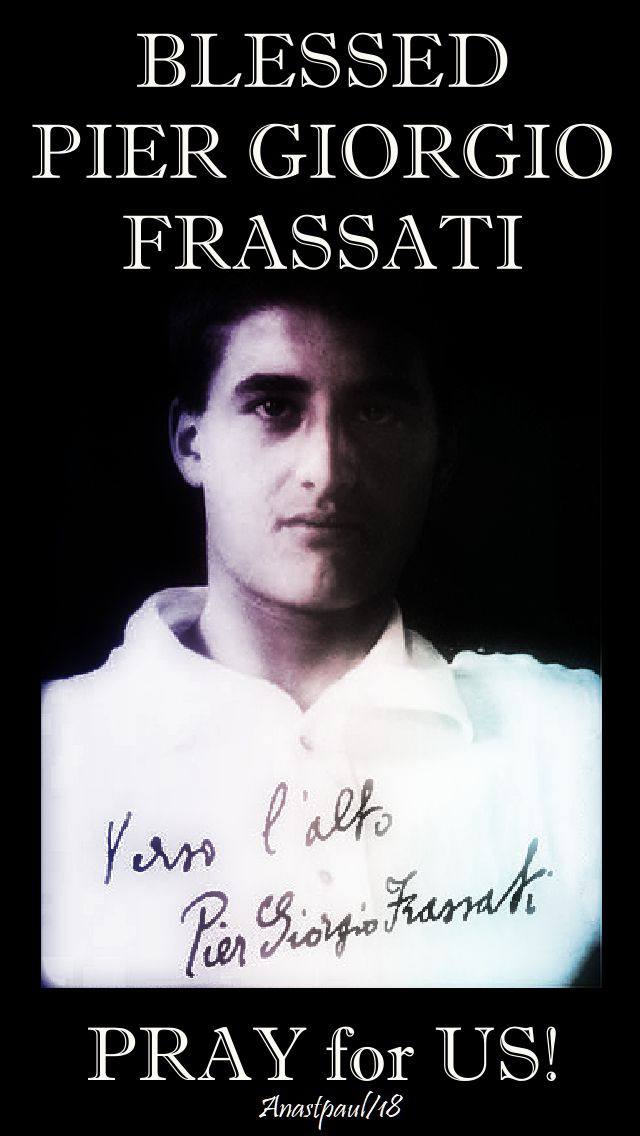
Our Morning Offering – 4 July – The Memorial of Blessed Pier Giorgio Frassati T.O.S.D. (1901-1925) “Man of the Eight Beatitudes”
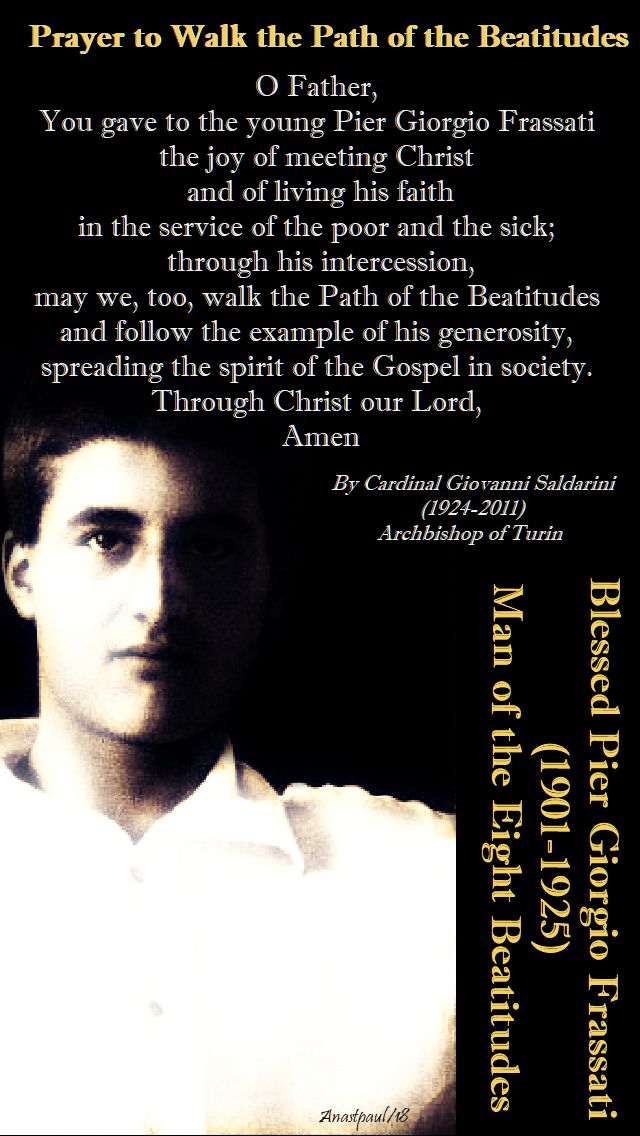
Prayer to Walk the Path of the Beatitudes By Cardinal Giovanni Saldarini (1924-2011) Archbishop of Turin
O Father,
You gave to the young Pier Giorgio Frassati
the joy of meeting Christ
and of living his faith
in the service of the poor and the sick,
through his intercession,
may we, too, walk the Path of the Beatitudes
and follow the example of his generosity,
spreading the spirit of the Gospel in society.
Through Christ our Lord,
Amen
Thought for the Day – 4 July – The Memorial of Blessed Pier Giorgio Frassati T.O.S.D. (1901-1925) “Man of the Eight Beatitudes”
Once after visiting a badly disfigured leper he explained to a friend his rationale for his selfless giving:
“How rich we are to be in good health. The deformation of that young man will disappear in a few years when he enters Paradise. But we have the duty of putting our health at the service of those who haven’t it. To act otherwise would be to betray the gift of God. No human being should ever be left abandoned. But the best of all charities is that consecrated to the sick. That is an exceptional work: few have the courage to face its difficulties and dangers, to take on themselves the sufferings of others, in addition to their own needs and their own precautions and cares.”
Pier Giorgio was famous in Turin but his family regarded him as a problem . His father, Alfredo Frassati, editor of the daily La Stampa, seems to have resented his largesse. And his mother was inconvenienced by his frequent absences and his lateness to meals. Only after his death did they come to appreciate their son.
A virulent form of poliomyelitis attacked Pier Giorgio in July 1925 and he died within a week. He was twenty-four years old.
Once a friend observed that when Pier Giorgio finished praying in church, he waved a little farewell towards the tabernacle. I like to imagine the scene when this jovial saint said hello to Christ in heaven. My thought is this, on the Memorial of his beautiful saint, Bl Pier Giorgio, that the greatest gift and the only glory of my life is being a Catholic and striving each day, to grow in those greatest of all commandments, to love God above all and to love my neighbour as myself. St Edmund Campion (1540-1581), put it so well, “to be a Catholic is my greatest glory.”
Blessed Pier Giorgio Frassati, pray for us!
LET US PRAY:
PRAYER FOR THE CANONISATION OF BLESSED PIER GIORGIO FRASSATI
O merciful God,
Who through the perils of the world
deigned to preserve by Your grace
Your servant the blessed Pier Giorgio Frassati
pure of heart and ardent of charity,
listen, we ask You, to our prayers, and
if it is in Your designs that he be glorified by the Church,
show us Your will,
granting us the graces we ask of You,
through his intercession,
by the merits of Jesus Christ, Our Lord,
in union with the Holy Spirit,
one God forever and ever.
Amen
Quote/s of he Day – 4 July – The Memorial of Blessed Pier Giorgio Frassati T.O.S.D. (1901-1925) “Man of the Eight Beatitudes”
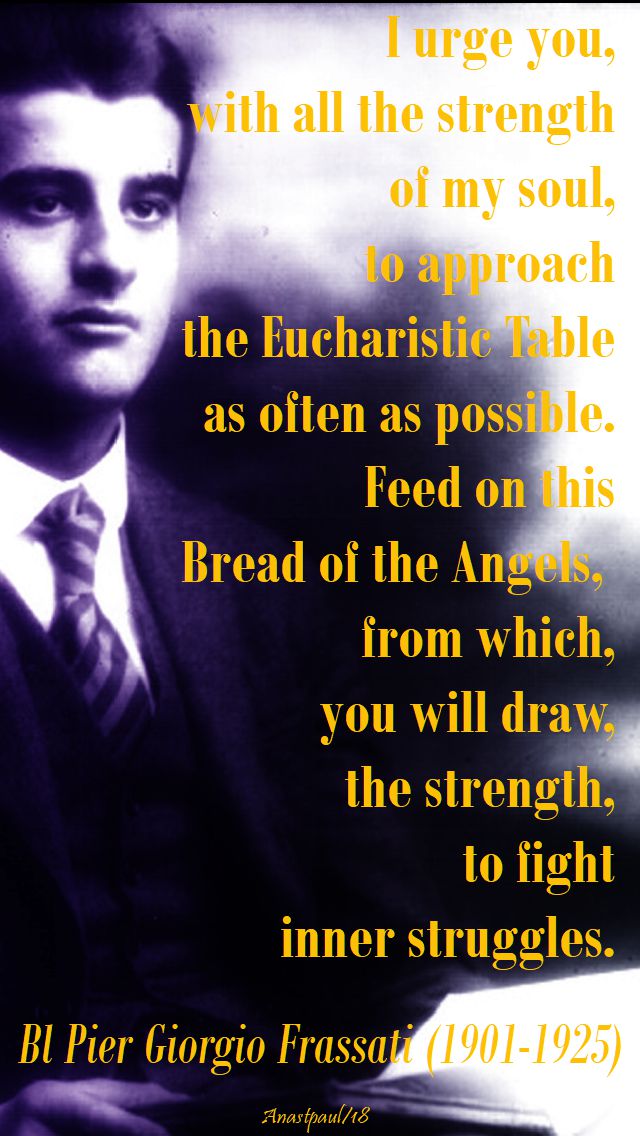
“I urge you, with all the strength of my soul, to approach the Eucharistic Table as often as possible. Feed on this Bread of the Angels, from which you will draw, the strength, to fight inner struggles.”
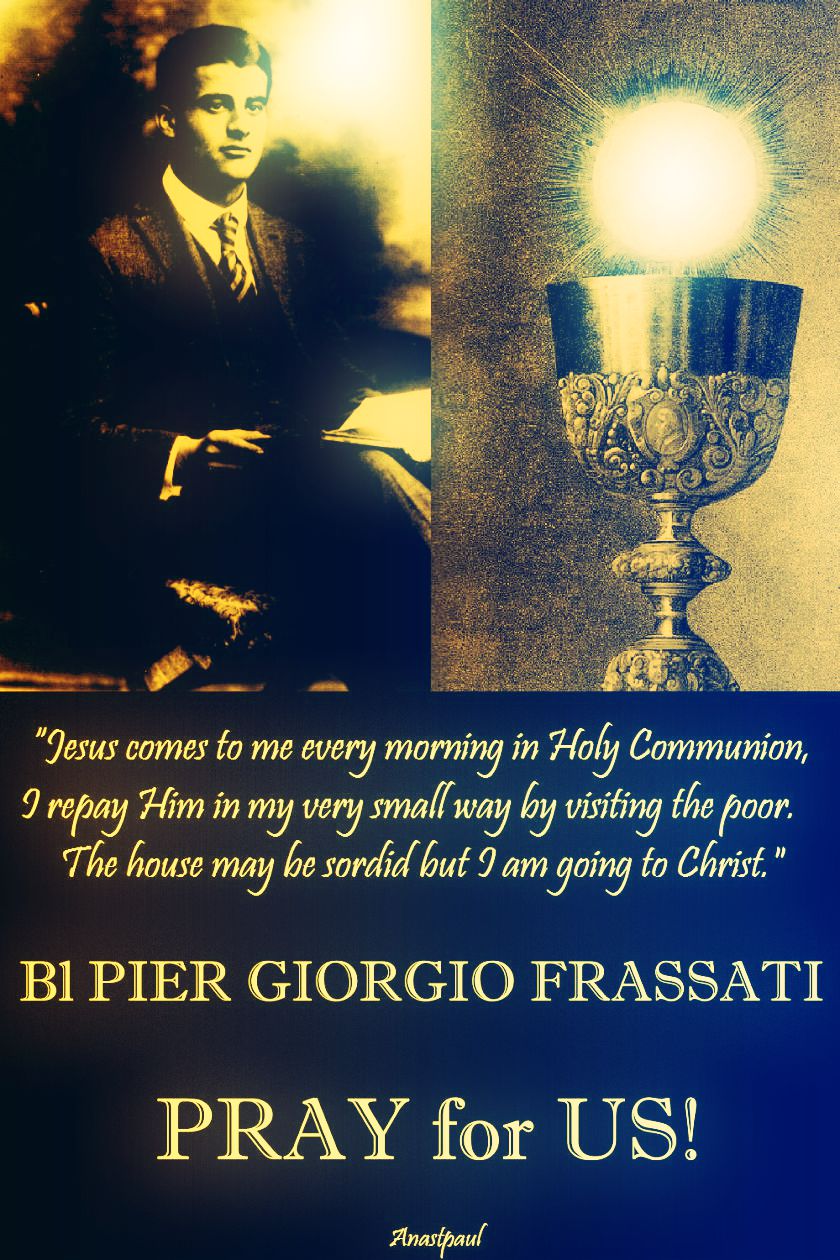
“Jesus comes to me every morning in Holy Communion, I repay Him, in my very small way, by visiting the poor. The house may be sordid but I am going to Christ.”
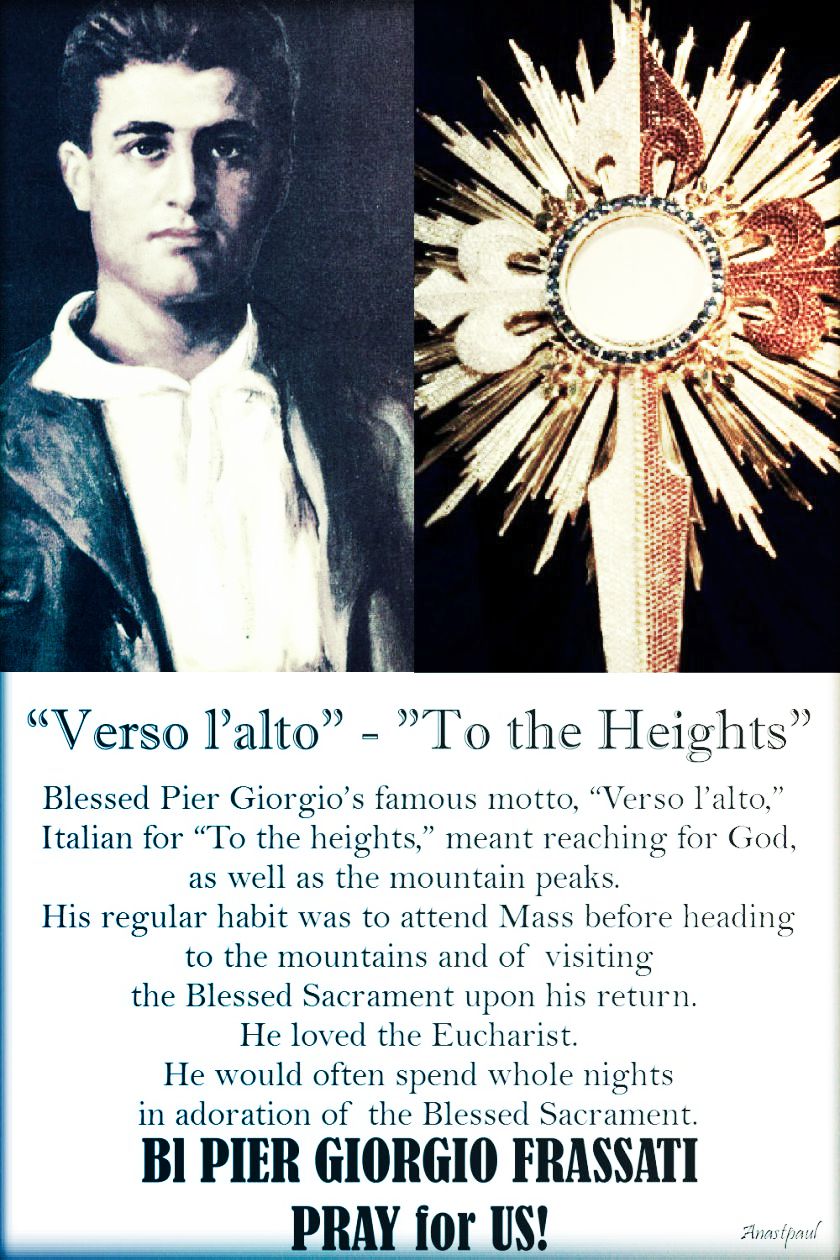
“Verso l’alto,”
“To the Heights”
Blessed Pier Giorgio’s famous motto, “Verso l’alto,” Italian for “To the heights,” meant reaching for God as well as the mountain peaks. His regular habit was to attend Mass before heading to the mountains and of visiting the Blessed Sacrament upon his return. He loved the Eucharist. He would often spend whole nights in adoration of the Blessed Sacrament.
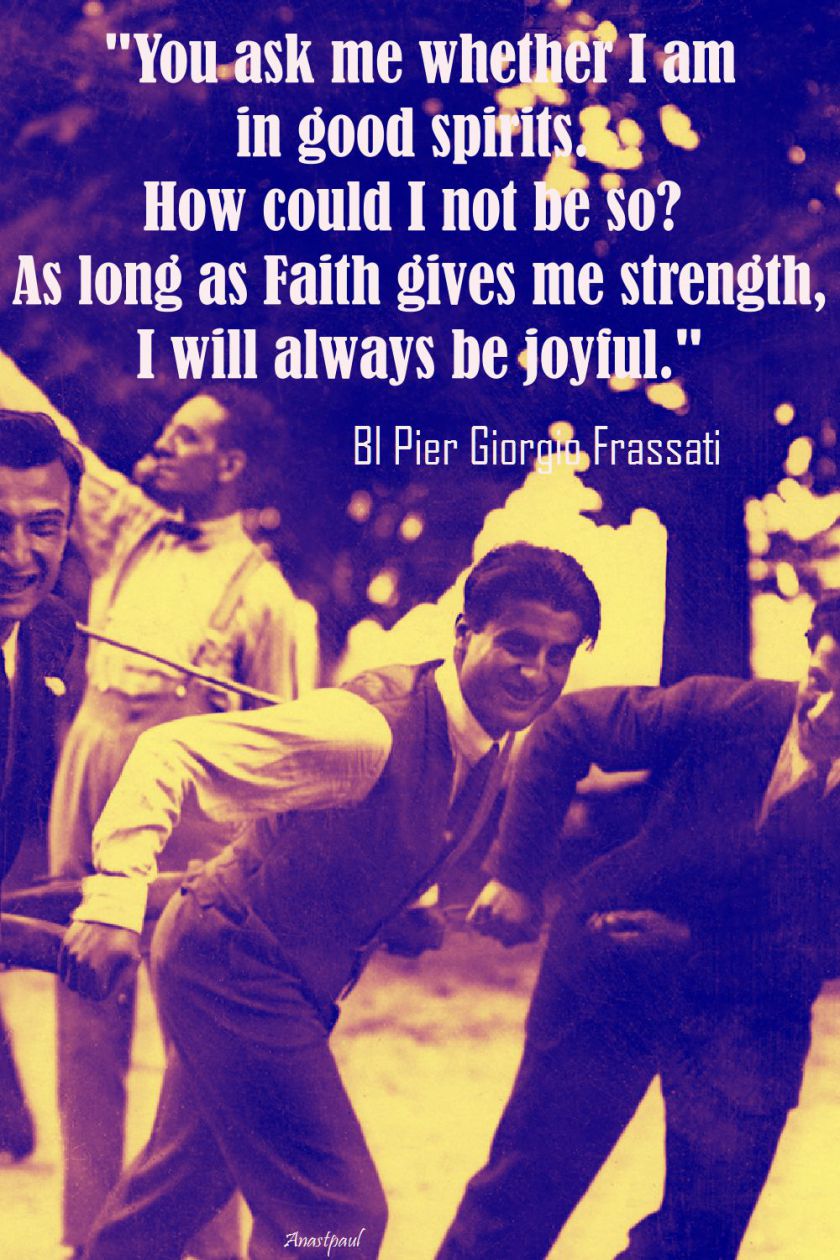
“You ask me whether I am in good spirits. How could I not be so? As long as Faith gives me strength, I will always be joyful. Sadness ought to be banished from Catholic souls… the purpose for which we have been created shows us the path; even if strewn with many thorns, it is not a sad path. It is joyful even in the face of sorrow.”
One Minute Reflection – 4 July – The Memorial of Blessed Pier Giorgio Frassati T.O.S.D. (1901-1925) “Man of the Eight Beatitudes”
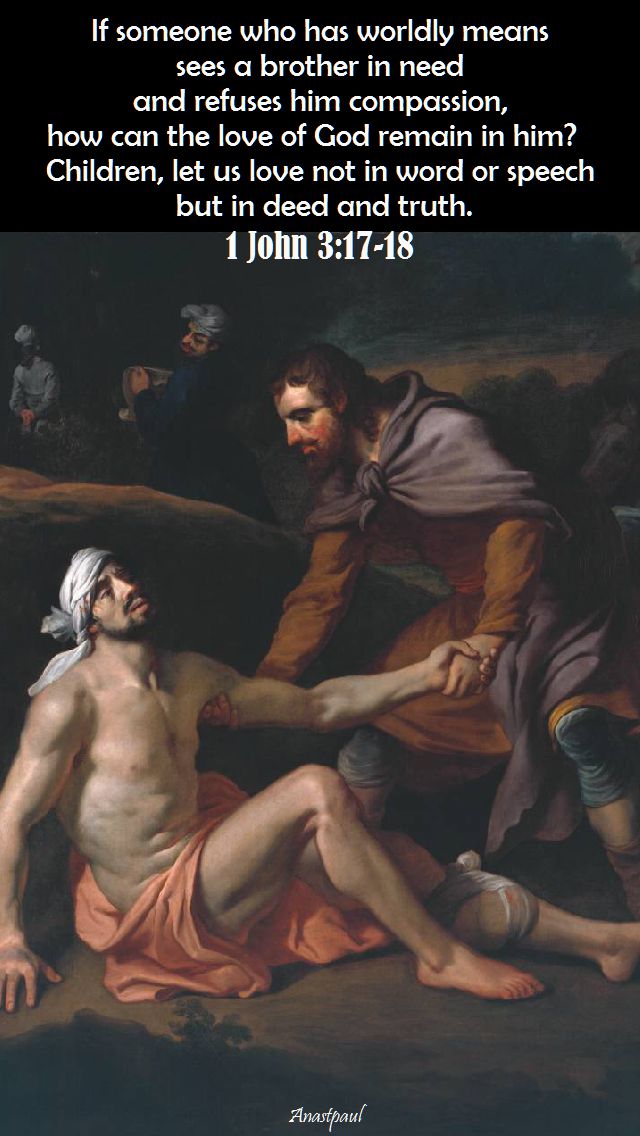
If someone who has worldly means sees a brother in need and refuses him compassion, how can the love of God remain in him? Children, let us love not in word or speech but in deed and truth…..1 John 3:17-18
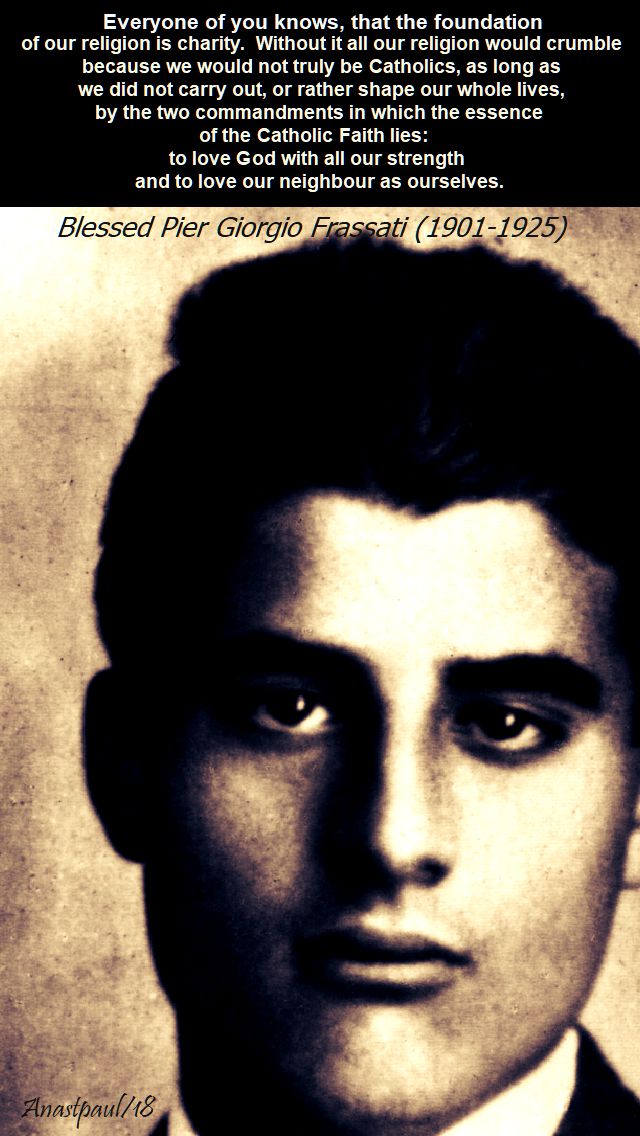
REFLECTION – “Everyone of you knows, that the foundation of our religion is charity. Without it all our religion would crumble because we would not truly be Catholics, as long as we did not carry out, or rather shape our whole lives, by the two commandments in which the essence of the Catholic Faith lies: to love God with all our strength and to love our neighbour as ourselves.”…….Bl Pier Giorgio Frassati
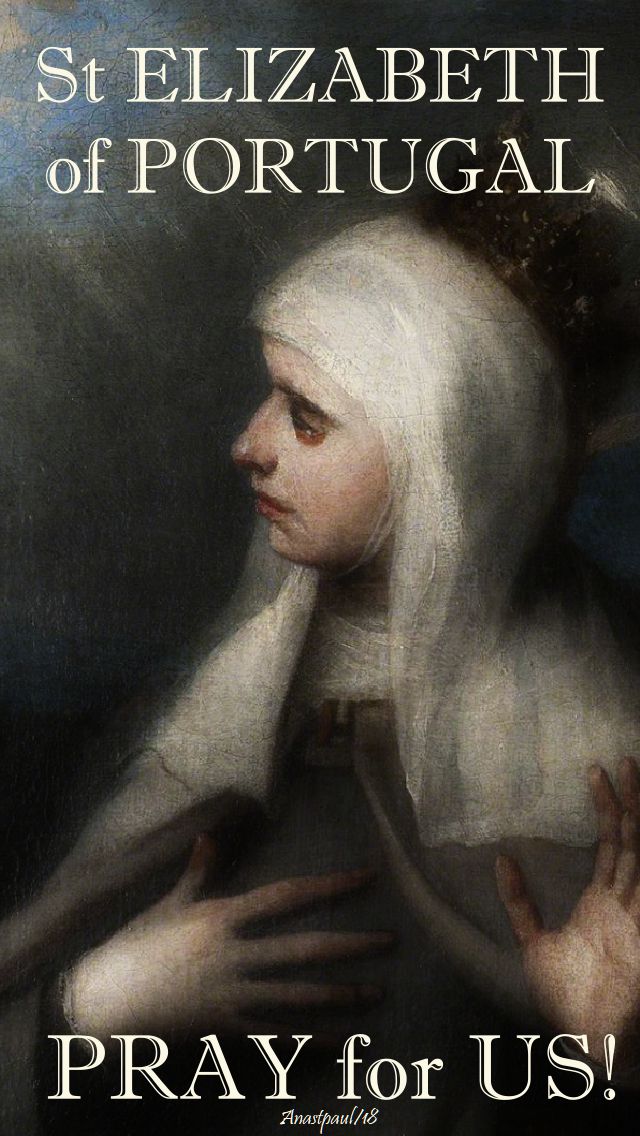
PRAYER – Loving Father, teach me to see the face of Your Divine Son in all those I meet especially those in need. Help me to realise that love is the most powerful force in the world. Saint Elizabeth of Portugal and Blessed Pier Georgio are an inspiration to us all, teaching us by their actions, that it is only in living love in charity that we can be true Catholics. Saint Elizabeth of Portugal and Blessed Pier Georgio pray for us, amen.
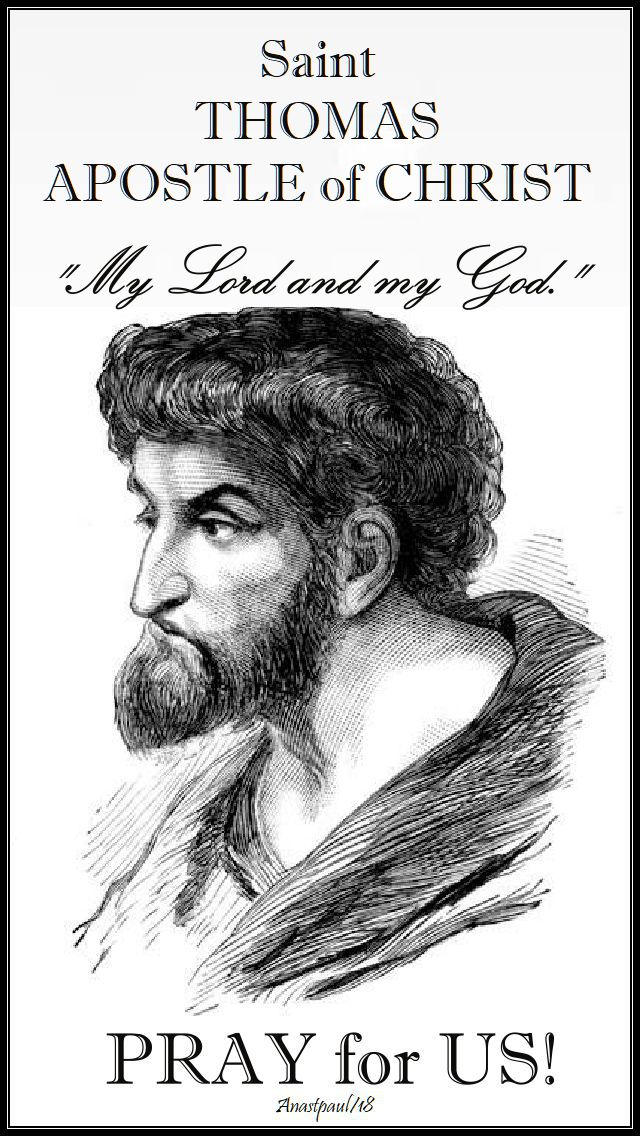
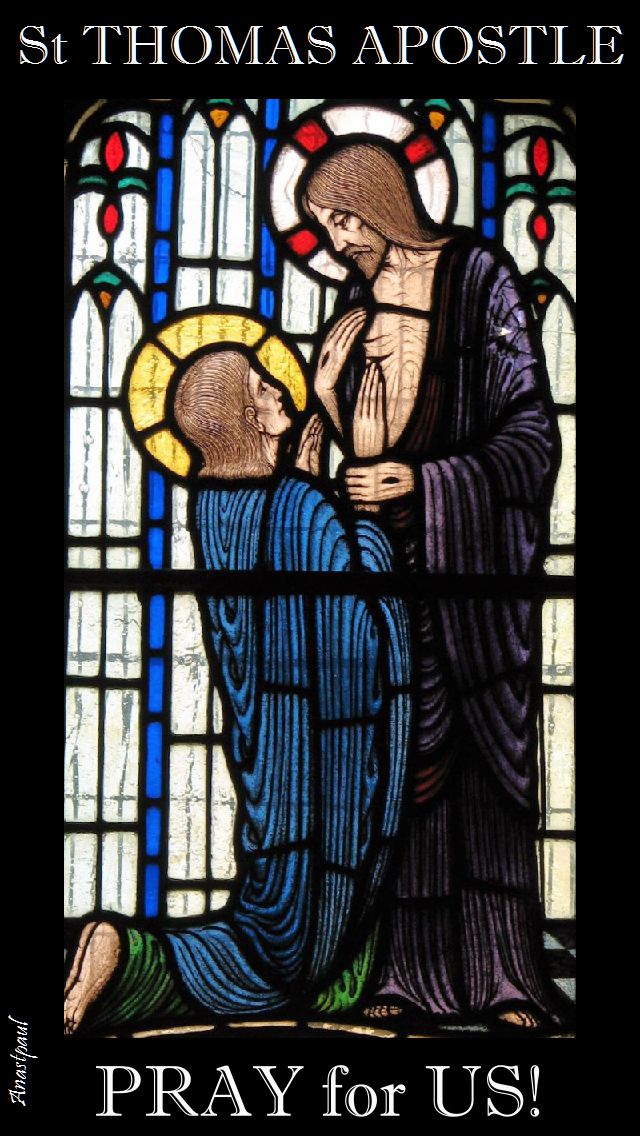
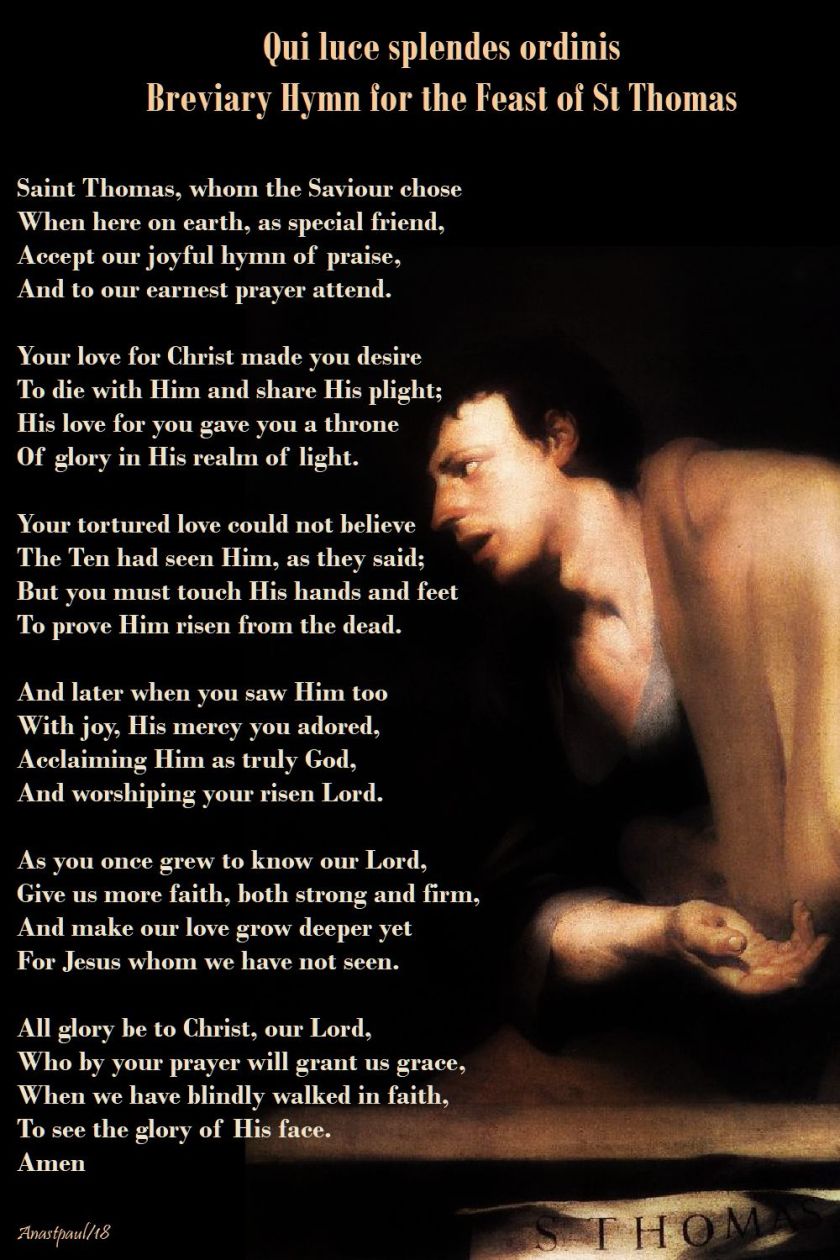
Thought for the Day – 3 July – Feast of St Thomas Apostle
The weakness of Thomas’s faith
is a source of our Lord’s great blessing for the Church
We must not suppose that St Thomas differed greatly from the other apostles. They all, more or less, mistrusted Christ’s promises when they saw Him led away to be crucified. When He was buried, their hopes were buried with Him and when the news was brought them, that He was risen again, they all disbelieved it. On His appearing to them, He “upbraided them with their unbelief and hardness of heart.” (Mark 16:14)… Thomas was convinced latest, because He saw Christ latest. On the other hand, it is certain that, though he disbelieved the good news of Christ’s resurrection at first, he was no cold-hearted follower of his Lord, as appears from his conduct on a previous occasion, when he expressed a desire to share danger and to suffer with Him…: “Let us also go, that we may die with him.” (Jn 11:16)… It was at the instance of Thomas that they hazarded their lives with their Lord.
St Thomas then loved his Master, as became an apostle and was devoted to His service; but when he saw him crucified, his faith failed for a season with that of the rest… and more than the rest. His standing out alone, not against one witness only but against his ten fellow disciples, besides Mary Magdalene and the other women is evidence of this… He seems to have required some sensible insight into the unseen state, some infallible sign from heaven, a ladder of angels like Jacob’s (Gn 28:12), which would remove anxiety by showing him the end of the journey at the time he set out. Some such secret craving after certainty beset him. And a like desire arose within him on the news of Christ’s resurrection.
While our Saviour allowed Thomas his wish and satisfied his senses that He was really alive, He accompanied the permission with a rebuke: “Because thou hast seen me, thou hast believed: blessed are they that have not seen and yet have believed.”… All His disciples minister to Him even in their weaknesses, that so He may convert them into instruction and comfort for His Church….Blessed John Henry Newman (1801-1890)PPS II, Sermon 2. “Faith without Sight”
“My Lord and my God!”
St Thomas, Pray for us that we too may so love our Lord and our God and “follow Him” to the end of time!
Quote of the Day – 3 July – Feast of St Thomas Apostle
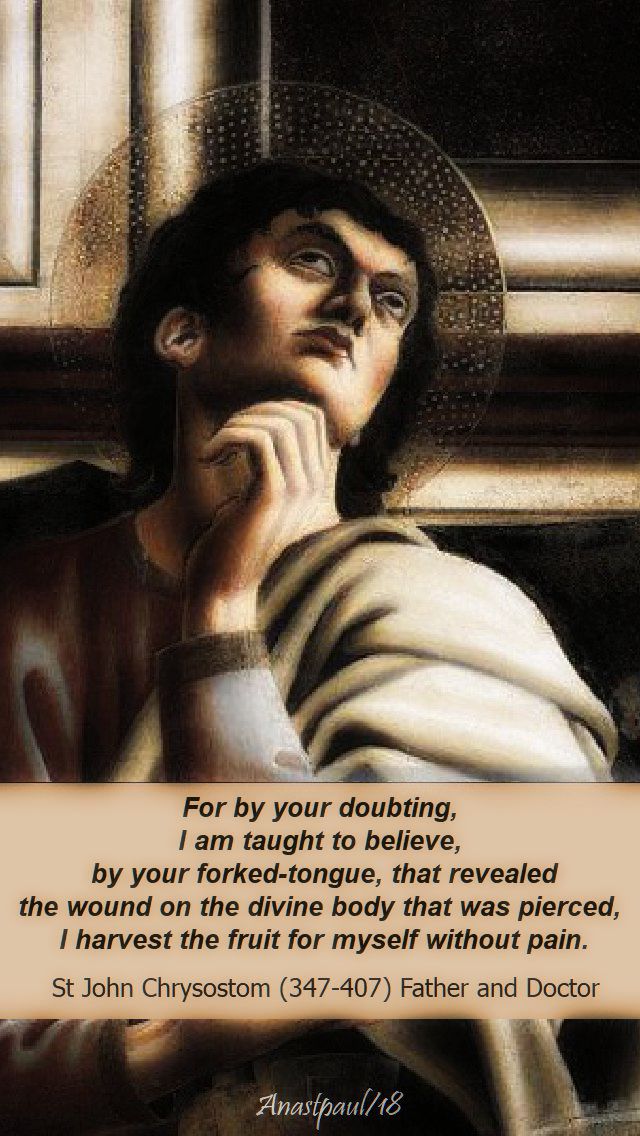
“For by your doubting, I am taught to believe, by your forked-tongue, that revealed the wound on the divine body that was pierced, I harvest the fruit for myself without pain.”
One Minute Reflection – 3 July – Feast of St Thomas Apostle – Today’s Gospel: John 20:24-29.
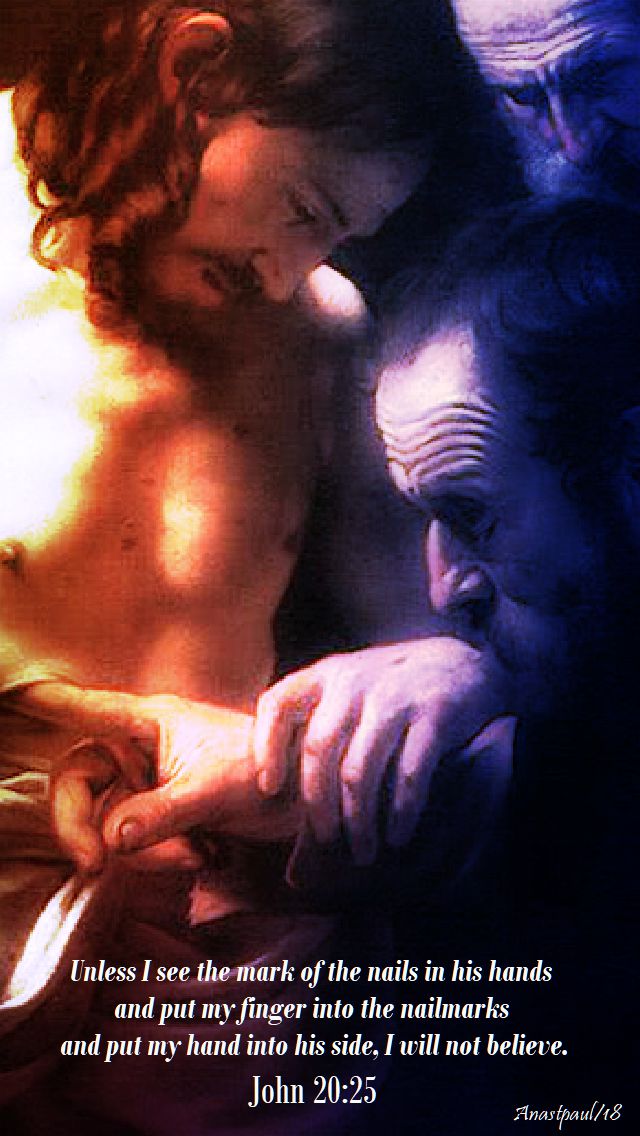
Thomas, called Didymus, one of the Twelve, was not with them when Jesus came. So the other disciples said to him, “We have seen the Lord.” But he said to them, “Unless I see the mark of the nails in his hands and put my finger into the nailmarks and put my hand into his side, I will not believe.”...John 20:24-25
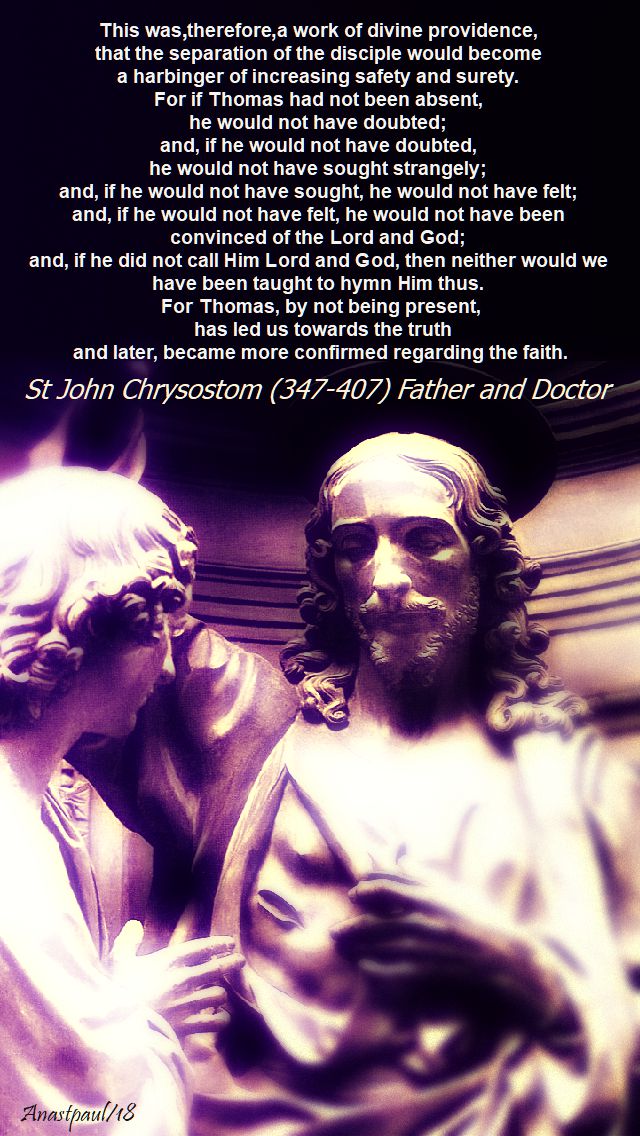
REFLECTION – “This was, therefore, a work of divine providence, that the separation of the disciple, would become a harbinger of increasing safety and surety. For if Thomas had not been absent, he would not have doubted; and, if he would not have doubted, he would not have sought strangely; and, if he would not have sought, he would not have felt; and, if he would not have felt, he would not have been convinced of the Lord and God; and, if he did not call Him Lord and God, then neither would we have been taught to hymn Him thus. For Thomas, by not being present, has led us towards the truth and later, became more confirmed regarding the faith.”… St John Chrysostom (347-407) Father and Doctor
PRAYER – Father, let our celebration on the feast of Saint Thomas the Apostle, be the source of his unfailing help and protection. Fill us with Your life-giving grace through our faith in Your Son, Jesus the Christ, whom Thomas acknowledged to be his Lord and his God. We make our prayer, through our Lord Jesus in union with the Holy Spirit, one God with You, forever and ever, amen.
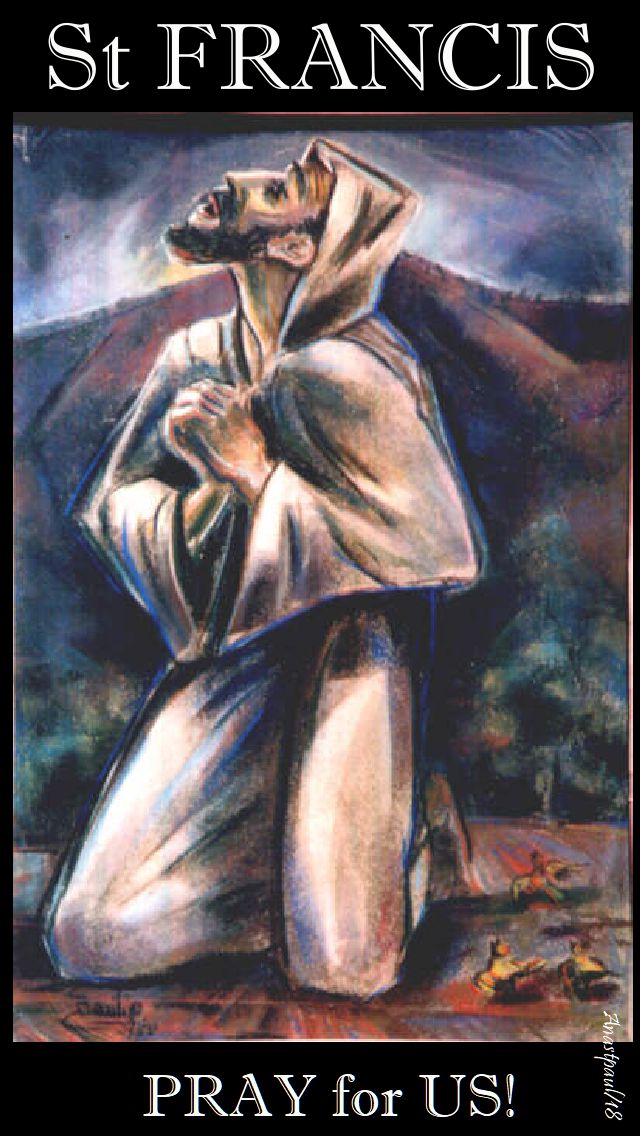
Thought for the Day – 2 July – Monday of the Thirteenth Week, Year B – Today’s Gospel: Matthew 8:18-22
“The poverty that makes rich.”
Excerpt from the “Sacrum Commercium” – “The Sacred Exchange between St Francis and Lady Poverty”
“And when He had fulfilled all those
Things of which you have spoken,
and desired to return to the Father Who had sent Him,
He made me a Testament to His Elect
and confirmed it by irrefragable Decrees :
Lay not up Gold nor Silver, nor Money.
Carry neither Purse, nor Scrip, nor Bread, nor a Staff, nor Shoes, nor two Coats.
And if any Man will contend with thee and take away thy Coat,
let go thy Cloak also. And whoever shall compel thee to go a mile,
go with him other twain.
Lay not up unto yourselves Treasures upon Earth,
where Rust and Moth doth corrupt
and where Thieves break through and steal.
Take no thought, saying:
What shall we eat, or what shall we drink,
or wherewithal shall we be clothed?
And take no thought of the morrow,
for the morrow will take thought for itself.
Sufficient unto the Day is the Evil thereof.
Whosoever doth not renounce
all that he hath, cannot be my
disciple . . . And many the
like sayings, which are all to
be found in the Gospels.”
The Sacred Exchange between Saint Francis and Lady Poverty, is one of the richest texts of the early Franciscan movement, “the single most brilliant example of the simple but lapidary allegory which was to become a major mode of spiritual writing in the later Middle Ages.” An allegory offering insights into Francis’s vision of poverty, the Sacred Exchange weaves a luxuriant tapestry of images held together by the strong threads of a biblical theology. For all of its richness, however, no text of these first hundred and fifty years is more mysterious. Like the weaver of an undated tapestry, the author of the Sacred Exchange is content to hide obscurely making sure that the ends and threads are in their proper place that the beauty and exactness of his work may be seen. Although there are many names suggested, the author of the Sacred Exchange still remains unknown. The same holds true for the date of its composition though it is believed by solid historical explorations, to date from late 13th century.
The allegory is an exhortation written to encourage Francis’s followers to live in the authentic way of the saint’s biblical vision of poverty. The central figure of the work is Lady Poverty, the personification of biblical Wisdom and, at times, of the Church. The Passage above is one of the most profound, as each word is taken from scripture and bound together into a poem of immense richness.
This is a lesson we now need to embrace, as difficult as it would seem in the world in which we live, the world led only by riches. For this is a true desire for sanctity, with Christ alone as our riches!
















You must be logged in to post a comment.