Posted in DOCTORS of the Church, EUCHARISTIC ADORATION and Nocturnal, FATHERS of the Church, QUOTES on HELL, The HOLY EUCHARIST / The HOLY MASS, The INCARNATION, The PASSION

Quote/s of the Day – 4 December – St Peter Chrysologus (c400-450) “Golden Words”

Quote/s of the Day – 4 December – St Peter Chrysologus (c400-450) “Golden Words” Confessor, Father & Doctor of the Church

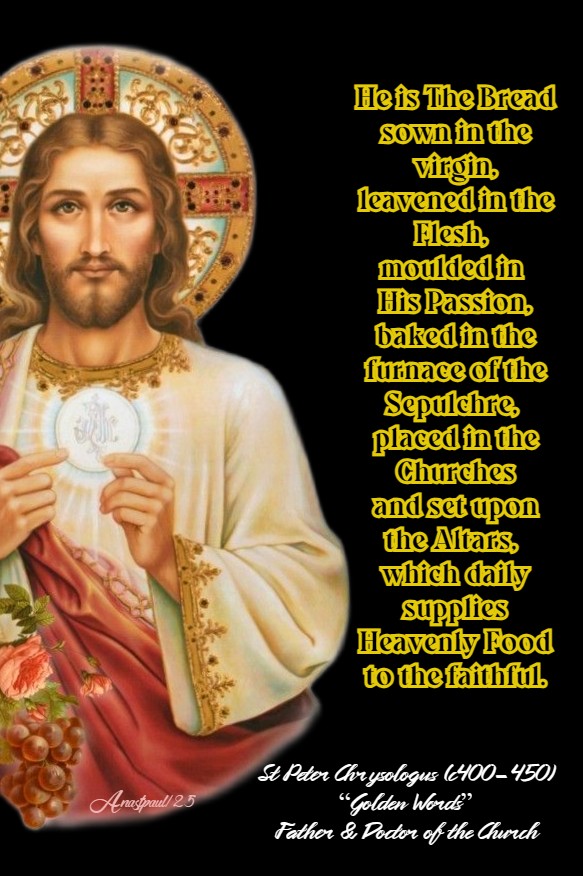
He is The Bread sown in the virgin,
leavened in the Flesh,
moulded in His Passion,
baked in the furnace of the Sepulchre,
placed in the Churches
and set upon the Altars,
which daily supplies Heavenly Food to the faithful.

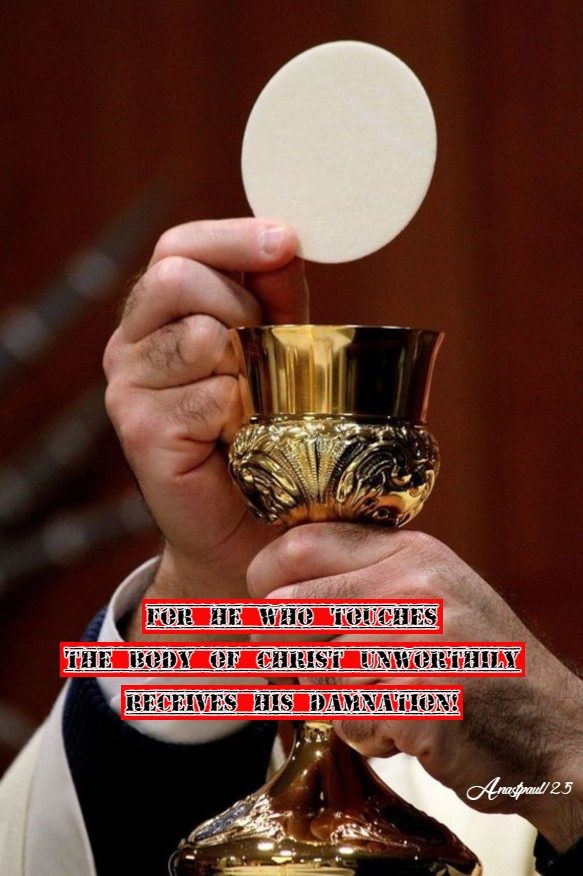
For he who touches
the Body of Christ unworthily
receives his damnation
!”

MORE:
https://anastpaul.com/2024/12/04/quote-s-of-the-day-4-december-saint-golden-words/

St Peter Chrysologus (c400-450)
“Golden Words”
Father & Doctor of the Church

Posted in CATHOLIC TIME, Of FATHERS, GRANDfathers, GRANDparents, Of PARENTS & FAMILIES of LARGE Families, PRAYERS & NOVENA to St Joseph, PRAYERS for VARIOUS NEEDS, PRAYERS TO St Joseph, PRAYERS to the SAINTS, QUOTES on the FAMILY, QUOTES/PRAYERS on THE FAMILY, St JOSEPH

Our Morning Offering – 5 November – A Parent’s Prayer to St Joseph

Our Morning Offering – 5 November – “The Month of the Holy Souls in Purgatory” – On Wednesdays many Catholics make a special devotion to St Joseph by going to Mass on the 1st Wednesdays of 9 consecutive months and offering their Communions in his honour and for the salvation of the dying.

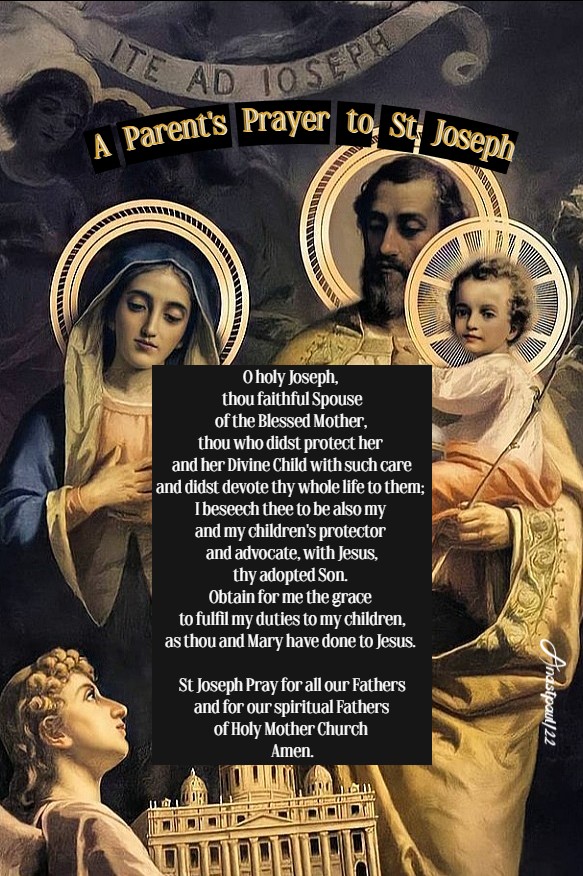
A Parent’s Prayer to St Joseph

O holy Joseph,
thou faithful Spouse
of the Blessed Mother,
thou who didst protect her
and her Divine Child with such care
and didst devote thy whole life to them;
I beseech thee to be also my
and my children’s protector
and advocate, with Jesus,
thy adopted Son.
Obtain for me the grace
to fulfil my duties to my children,
as thou and Mary have done to Jesus.

St Joseph Pray for all our Fathers
and for our spiritual Fathers
of Holy Mother Church
Amen.

Posted in Of the SICK, the INFIRM, All ILLNESS, SAINT of the DAY

Saint of the Day – 5 November – Saint Laetus (Died 534) Priest and Confessor of Orleans,

Saint of the Day – 5 November – Saint Laetus (Died 534) Priest and Confessor of Orleans, France, Monk, Monk, Hermit, Miracle-worker. Whilst still a Monk, Laetus was a spiritual guide to St Leonard of Noblac, who was a fellow Monk. Born in the region of Berry, France and died in 534 in the forest of Orléan. Patronage – of the sick. Also known as – Lie, Lié, Lyé, Leto, Lieto. Additional Feast – 2 January in Mohon, in the Ardennes.

The Roman Martyrology reads today: “At Orleans, in France, St Laetus, Priest, Confessor.”

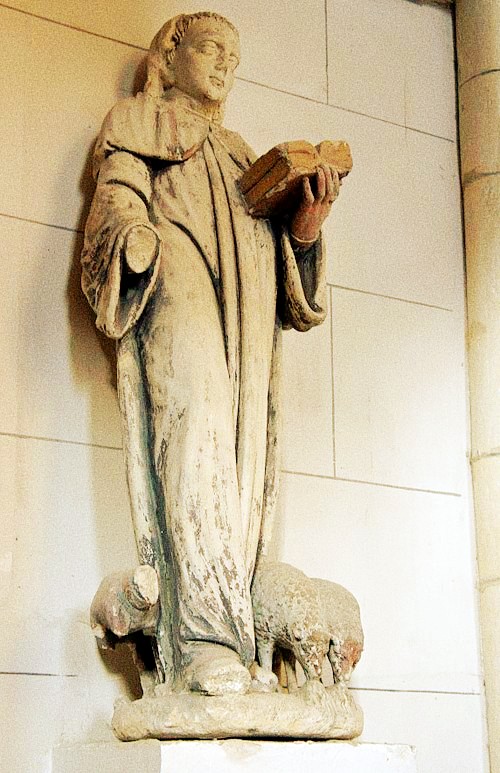
Statue of St Laetus at Ville-Dommange

Born of a family in Berry, France sometime during the reign of Chlothar I, his name suggests a Gallo-Roman background. Small of stature,, he was a peasant herdsman, who embraced the monastic life at the age of 12. He spent some time at the Monastery of Micy-Saint Mesmin, near Orléans, where he was welcomed by the Abbot Treïcius, who Ordained him a Deacon and then a Priest. While at Micy, Lié provided direction to fellow Monk and Saint Leonard of Noblac (c496-559).

After a few years, Laetus left the Monastery in search of greater solitude. He headed north and stopped on the edge of the Loges Forest (Forest of Orleans), not far from a clearing where poor woodcutters were felling oaks. There, having found a dense thicket where no sound entered, he built himself a hut and there, spent his days in prayer, living only on wild fruits.

Laetus only left this solitude to visit the sick, to comfort them with a few holy words and to soften the bitterness of the last passage. The blind, the lame, the crippled came to meet him and more than once obtained cures through his intercessary prayer. He was greatly loved by all, especially the sick and hopeless. Laetus was viewed an example to all for his humility. .He lived there until the year 534, which he predicted would be the year of his entry into eternal beatitude. He was buried in the place where he had lived and, on his Tomb, a Chapel was erected.

His body was later brought by Ermentheus, the Bishop of Orleans, to the Church of Pithiviers. They burnt by the Huguenots in 1580. However, there were stille fragments of his legs preserved by Christians of Pithiviers. In 1664, they were returned to the Village of Saint-Lyé after many adventures. They now rest in a Reliquary placed at the foot of the Altar dedicated to him. On Pentecost Monday, many pilgrims would come to venerate St Laetus and ask for the cure of their infirmities.

In 1523 a Brotherhood dedicated to venerating Saint Laetus was founded at Mohon, in the Ardennes. The Brotherhood in 1611, having obtained an Indulgence from Pope Paul V, the dedication of the local Church was changed from that of Saint Gilles to Saint Laetus. Some of his Relics were transported to the Église Saint-Lié de Mohon, probably around 1683. There he is celebrated on 2 January.

Saint Laetus is depicted on a pillar of the south porch of Chartres Cathedral. There are numerous Churches, places, Villages names for our Saint in many regions of France.

Posted in Against EPIDEMICS, Against SNAKE BITES / POISON, EYES - Diseases, of the BLIND, GOUT, KNEE PROBLEMS, ARTHRITIS, etc, Of ANIMALS / ANIMAL WELFARE, PATRONAGE-INFERTILITY & SAFE CHILDBIRTH, SAINT of the DAY, The CREED

Saint of the Day – 3 November – Saint Pirminus (c690-753) Bishop

Saint of the Day – 3 November – Saint Pirminus (c690-753) Missionary Bishop on the Upper Rhine in Germany, Abbot, Founder of Monasteries, Reformer, Miracle-worker, Born in around 690 in Ireland or in Narbonne or in Paris, France and died on 3 November in 753 in Hornbach, Germany. Patronages – against eye ailments, against plague/epidemics, against poisoning, against rheumatism, against snake bites, against vermin, for happy birth, of livestock; in Austria –
Innsbruck; in France – Alsace; in Germany – Amorbach, Monsheim, Palatinate, Pirmasens, Reichenau Island, Speyer, Diocese (with St Bernard).
Also known as – Pirmin, Pirminius.

The Roman Martyrology reads today: “The departure from this life of St Pirminus, Bishop of Meaux.

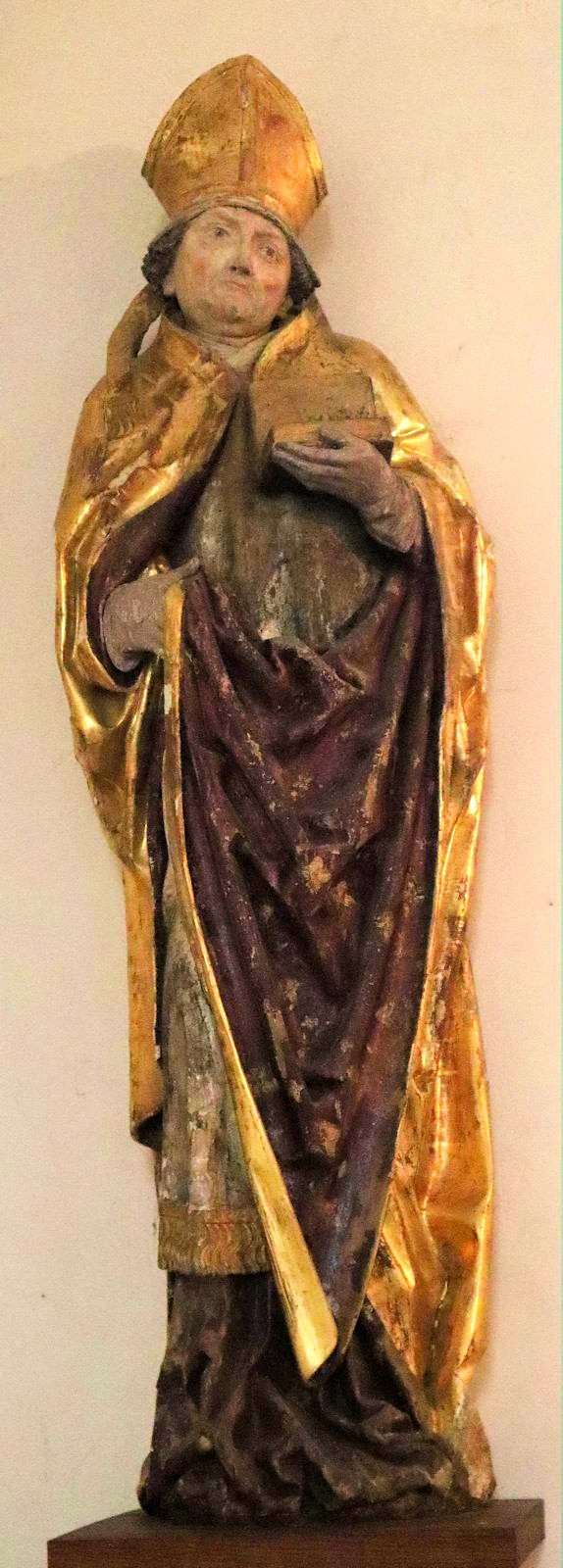
St Pirminus Statue in the Murbach Monastery

Pirminus is described in various sources, as a Visigoth, an Irish Scot, or of Roman origin. He was Consecrated as an itinerant Bishop around 720 – possibly in Meaux in France – and sent on a mission to north-western France and the Upper Rhine region.

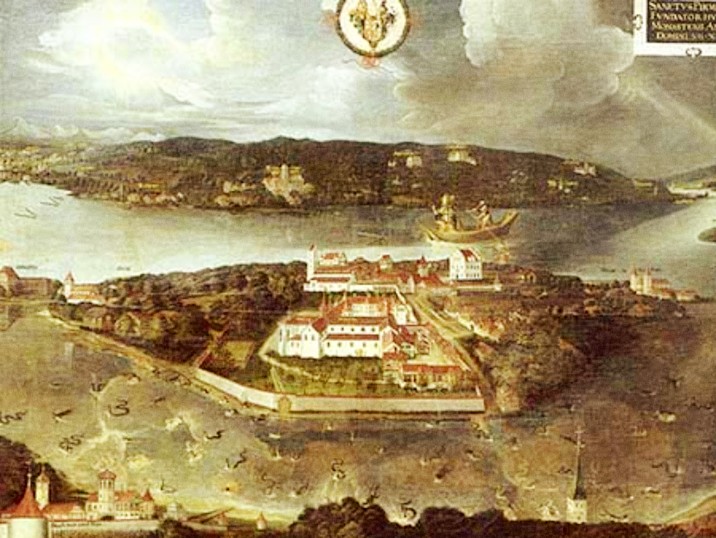
Arrival of Saint Pirmin on the Island of Reichenau

He maintained good relations with the Frankish Mayor of the Palace, Charles Martel, who, in 724, placed him under his protection and founded numerous Monasteries, including probably Pfungen near Winterthur and certainly the Mittelzell Monastery on the Lake Constance Island of Reichenau. All the crawling creatures which damaged the Island are said to have fallen into the water upon his arrival and thus disappeared. According to tradition, Pirminus remained on Reichenau until 726 and was then expelled by Duke Theobald.

Pirminus then went to Alsace to continue his work there. Here he was active in the Carolingian territory. In 727, he founded what was then Murbach Abbey and was able to realise his ideas there, that is, monastic life based on the Benedictine Rule, understood as a permanent pilgrimage without worldly ties and the Abbey’s freedom from the local Bishop, led by its own Abbot. Pirminus held this office in Murbach. The founding of the Monasteries in Neuweiler (present-day Neuwiller-lès-Saverne ) , Schwarzach in Rheinmünster in Baden and Pfäfers near Chur, are also attributed to Pirminus. According to local tradition, he lived for a time in the cave near Winterthur which was later named after him.

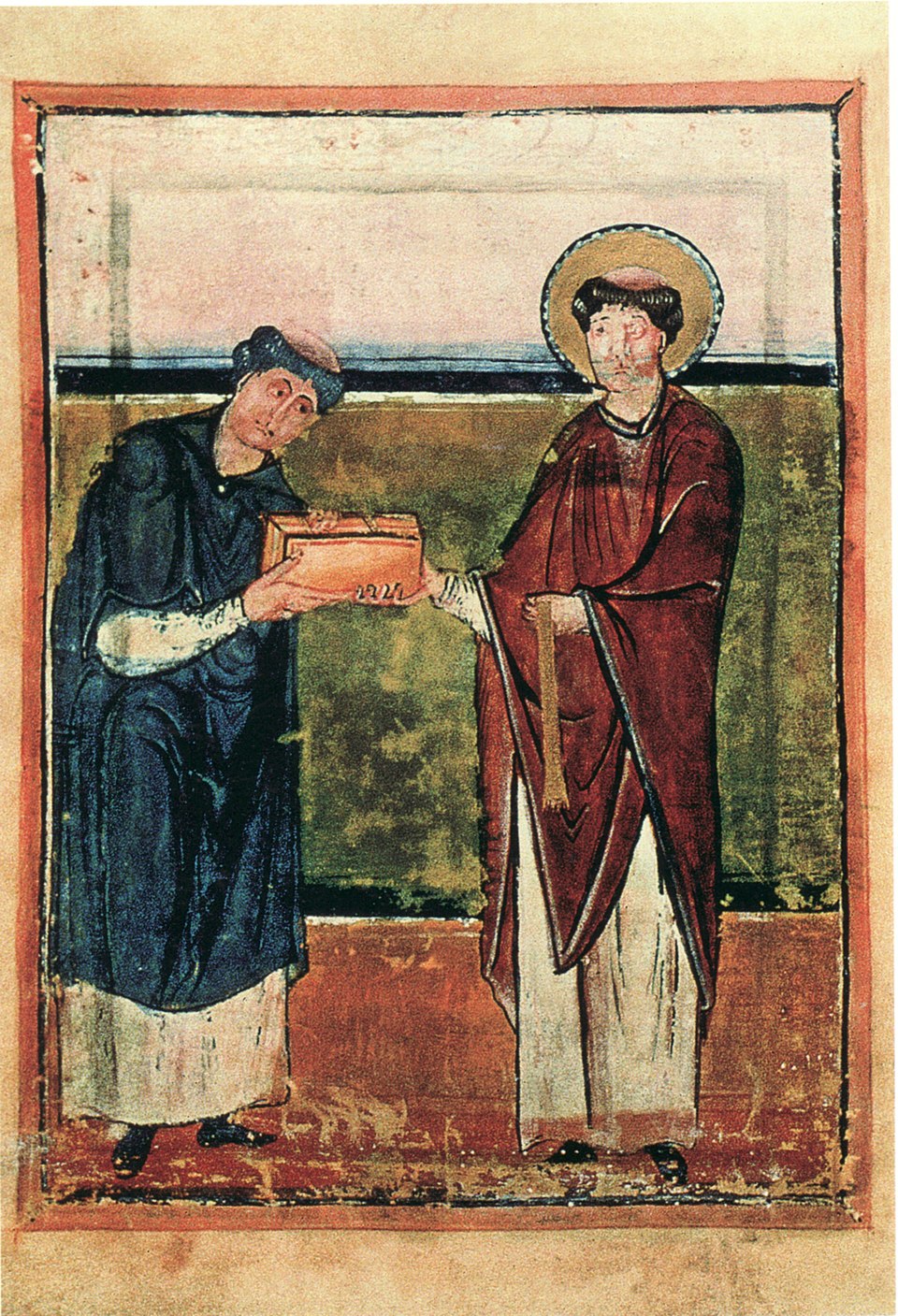
Illustration from the Hornbach Sacramentary: Abbot Adalbert of Hornbach presents the manuscript to his Patron Saint, St Pirminus

According to 9th and 12th Century traditions, Pirminus founded the Monastery in Gengenbach with the support of the Frankish nobleman Ruthard. By 820, it was the largest Monastery in the region and an Imperial Abbey. He is said to have introduced the Benedictine Rule at the Monastery in Schuttern, thus initiating its flourishing. The Monastery of Amorbach in the Odenwald may also indeed, have originated by our Saint Pirminus. In around 742, Pirminus founded the Monastery in Hornbach in the Palatinate on a hill where a Roman sanctuary had likely previously stood. He reformed the Monasteries in Weißenburg /Wissembourg and Maursmünster Marmoutier in Alsace which had been founded in the 5th/6th Centuries and, in 741 he sent Monks from Mittelzell to found Niederaltaich Abbey.

St Pirminus Relics at Speyer Cathedral

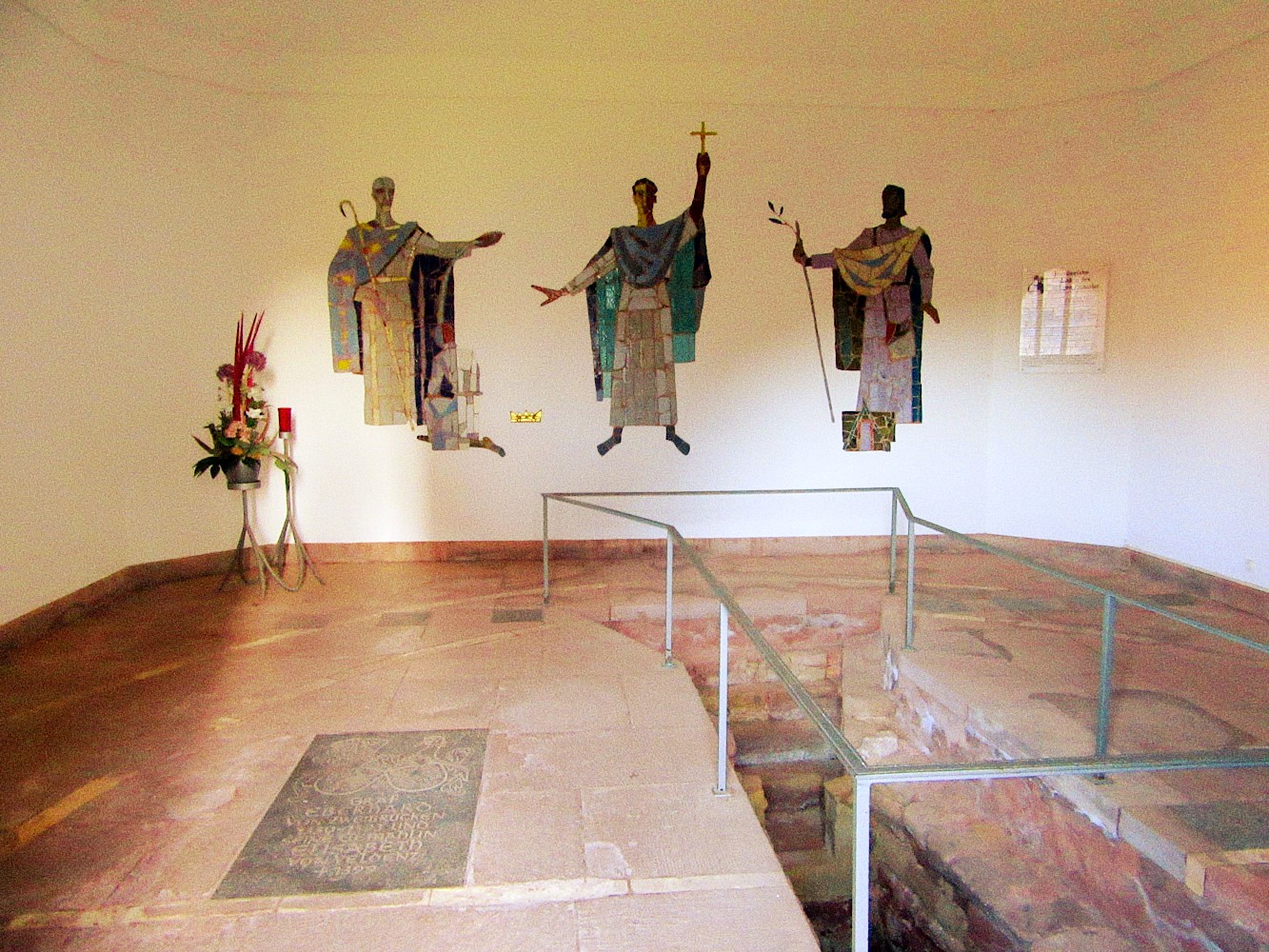
Pirminus died in his Monastery in Hornbach. As early as the end of the 8th Century, he was referred to as a Saint in a manuscript from Metz . After 814, Abbot Wyerund of Hornbach Monastery had Pirminus’ remains exhumed and interred in the Church he had recently built. In 827, Pirminus was first mentioned as the Church’s Patron Saint, and Hrabanus Maurus wrote a Tomb Inscription. The Tomb was excavated in 1953 and, in 1957, the present Chapel was built over it.

St Pirminus Grave built in 1957

“The first recorded version of the Apostles’ Creed, as it is known today, is found in the Treatise De singulis libris canonicis scarapsus (Excerpt from the Unique Canonical Books), most possibly written by St Pirminus.
In it, he describes how the Apostles were gathered at Pentecost, the Holy Ghost descended upon them and they then began to speak in turn:
Peter : I believe in God, the Father Almighty, Creator of Heaven and earth.
John : And in Jesus Christ, His only Son, our Lord.
James said: He was conceived by the Holy Ghost and born of the Virgin Mary.
Andrew said: He suffered under Pontius Pilate, was Crucified, Died and was buried.
Philip said: He descended into Hades.
Thomas said: On the third day He Rose from the dead.
Bartholomew said: He Ascended into Heaven and was seated at the Right Hand of God the Father Almighty.
Matthew said: From thence He shall come to judge the living and the dead.
James, the son of Alpheus, said: I believe in the Holy Ghost.
Simon the Zealot said: And the Holy Catholic Church.
Jude, the son of James, said: In the communion of the Saints and the forgiveness of sins.
Likewise, Thomas said [he spoke a second time]: In the Resurrection of the body and eternal life.”

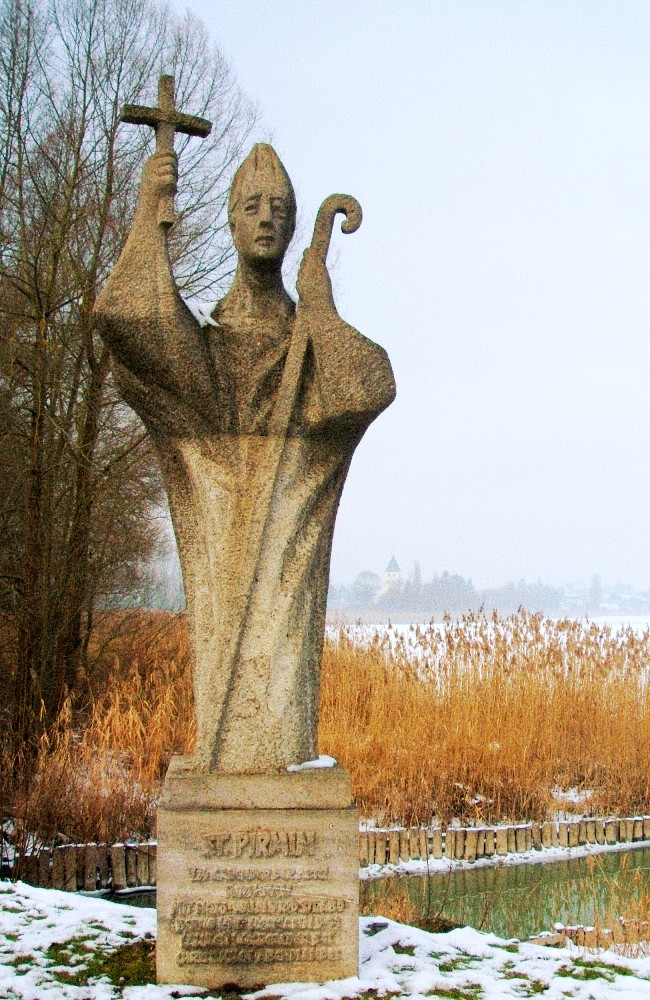
Pirminus Statue on Reichenau Island
Posted in AUGUST - The Immaculate Heart of Mary, EUCHARISTIC ADORATION and Nocturnal, GOD ALONE!, HOLY COMMUNION, IMMACULATE HEART Quotes, JUNE-THE SACRED HEART, PRAYERS of the SAINTS, QUOTES on CONSOLATION, QUOTES on HUMILITY, QUOTES on LOVE of GOD, QUOTES on PEACE, QUOTES on SUFFERING, SACRED and IMMACULATE HEARTS, SACRED HEART PRAYERS, SACRED HEART QUOTES, The HOLY EUCHARIST / The HOLY MASS

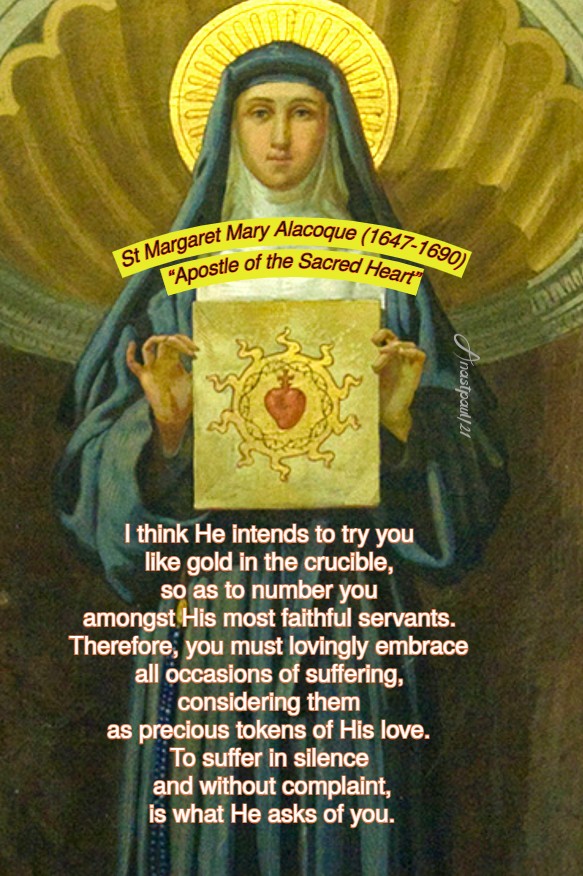
Quote/s of the Day – 17 October – St Margaret Mary Alacoque (1647-1690)St Margaret Mary Alacoque (1647-1690)“Visionary and Apostle of the Sacred Heart“

Quote/s of the Day – 17 October – St Margaret Mary Alacoque (1647-1690) Virgin

Keep your heart in peace
and let nothing trouble you,
not even your faults.
You must humble yourself
and amend them peacefully,
without being discouraged or cast down,
for God’s dwelling, is in peace.

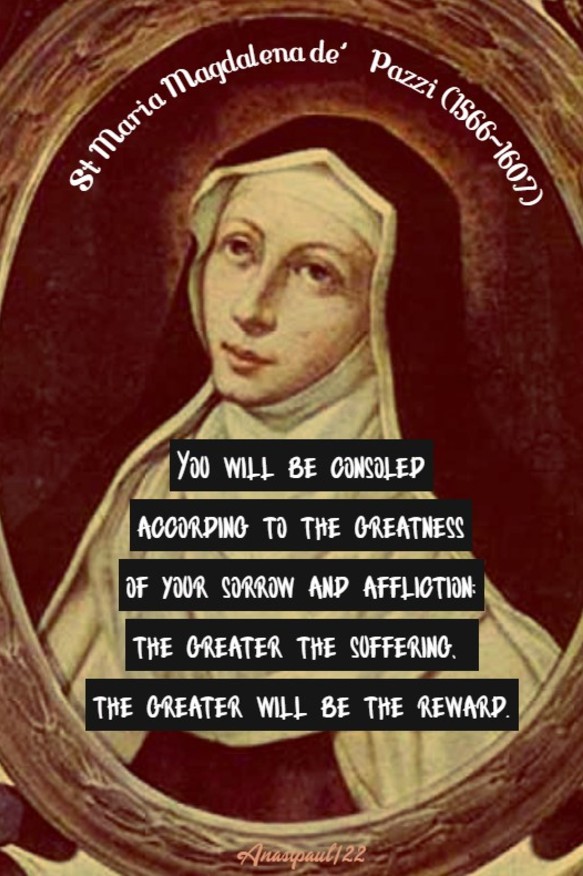
You will be consoled
according to the greatness
of your sorrow and affliction;
the greater the suffering,
the greater will be the reward.

I think He intends to try you
like gold in the crucible,
so as to number you
amongst His most faithful servants.
Therefore, you must lovingly embrace
all occasions of suffering,
considering them
as precious tokens of His love.
To suffer in silence
and without complaint,
is what He asks of you.”

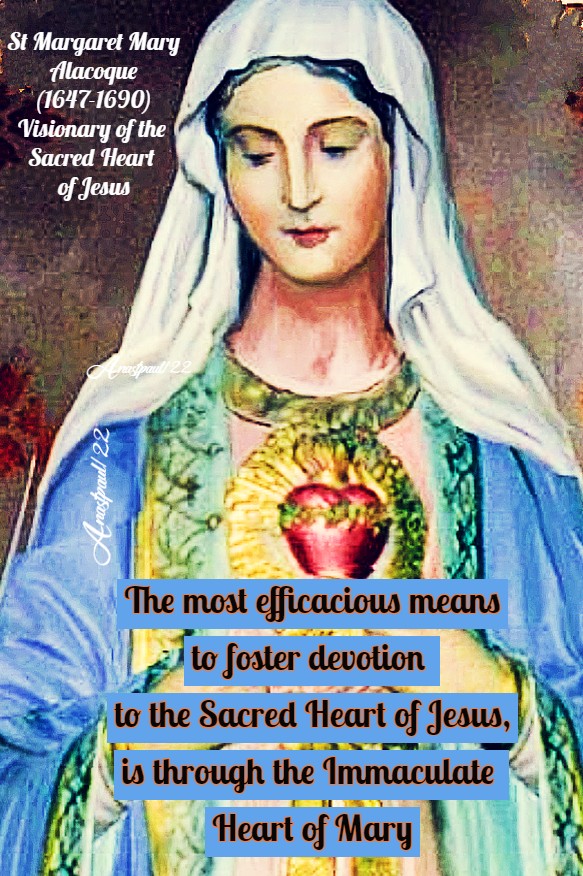
The most efficacious means
to foster devotion
to the Sacred Heart of Jesus,
is through the Immaculate Heart of Mary.

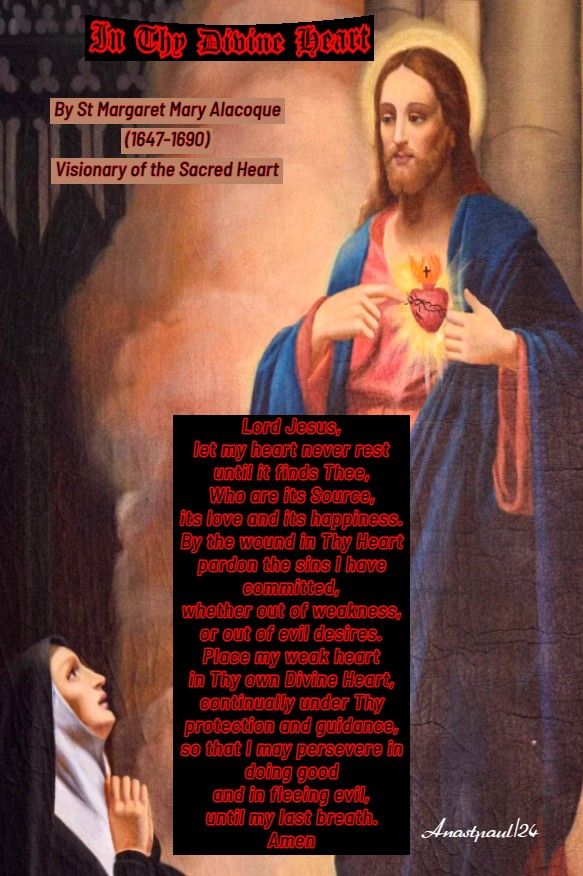
In Thy Divine Heart
By St Margaret Mary Alacoque (1647-1690)
Visionary of the Sacred Heart

Lord Jesus,
let my heart never rest
until it finds Thee,
Who are its Source,
its love and its happiness.
By the wound in Thy Heart
pardon the sins I have committed,
whether out of weakness,
or out of evil desires.
Place my weak heart
in Thy own Divine Heart,
continually under Thy
protection and guidance,
so that I may persevere in doing good
and in fleeing evil,
until my last breath.
Amen

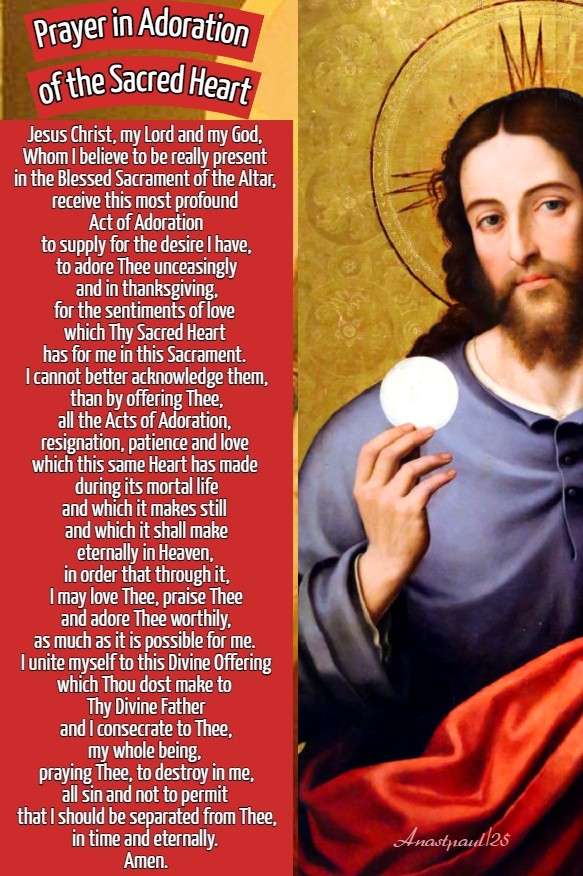
Prayer in Adoration of the Sacred Heart
in the Blessed Sacrament
By St Margaret Mary Alacoque (1647-1690)

Visionary and Apostle of the Sacred Heart of Jesus

Jesus Christ, my Lord and my God,
Whom I believe to be really present
in the Blessed Sacrament of the Altar,
receive this most profound Act of Adoration
to supply for the desire I have,
to adore Thee unceasingly
and in thanksgiving,
for the sentiments of love
which Thy Sacred Heart
has for me in this Sacrament.
I cannot better acknowledge them,
than by offering Thee,
all the Acts of Adoration,
resignation, patience and love
which this same Heart has made
during its mortal life
and which it makes still
and which it shall make eternally in Heaven,
in order that through it,
I may love Thee, praise Thee
and adore Thee worthily,
as much as it is possible for me.
I unite myself to this Divine Offering
which Thou dost make to Thy Divine Father
and I consecrate to Thee,
my whole being,
praying Thee, to destroy in me,
all sin and not to permit
that I should be separated from Thee,
in time and eternally.
Amen.

MORE:
https://anastpaul.com/2024/10/17/quote-s-of-the-day-17-octoberber-st-margaret-mary-alacoque/

St Margaret Mary Alacoque (1647-1690)
“Visionary and Apostle of the Sacred Heart“

Posted in EYES - Diseases, of the BLIND, SAINT of the DAY

Saint of the Day – 6 October – Saint Pardulf (c658-c738) Founder Abbot

Saint of the Day – 6 October – Saint Pardulf (c658-c738) Founder Abbot of the Abbey of Guéret, Hermit, Miracle-worker. Born in c658 in Sardent, France and died in c738 at his Abbey in Guéret. Patronages – of the blind, painful eyes and eye ailments, cattle breeders, of Limoges, France. Also known as – Pardoux, Pardulfus, Pardulphus, Pardolf, Pardolfo.

St Pardulf’s Vita writtenin around 750 by a Monk of his Abbey. He was born in Sardent, fifteen kilometers south of Guéret, to a peasant family. When caught in a thunderstorm, he was injured and momentarily blinded by a falling tree, while several companions were killed. This event led him to devote himself to God and he soon acquired a reputation as a man of holiness, living soley for God and a miracle-worker.

After some hesitation, he agreed to become the first Abbot of a Monastery which the Count of Limoges, Lanterius, had built in Guéret. He set an example for his disciples through an austere life and, performed many miracles there.

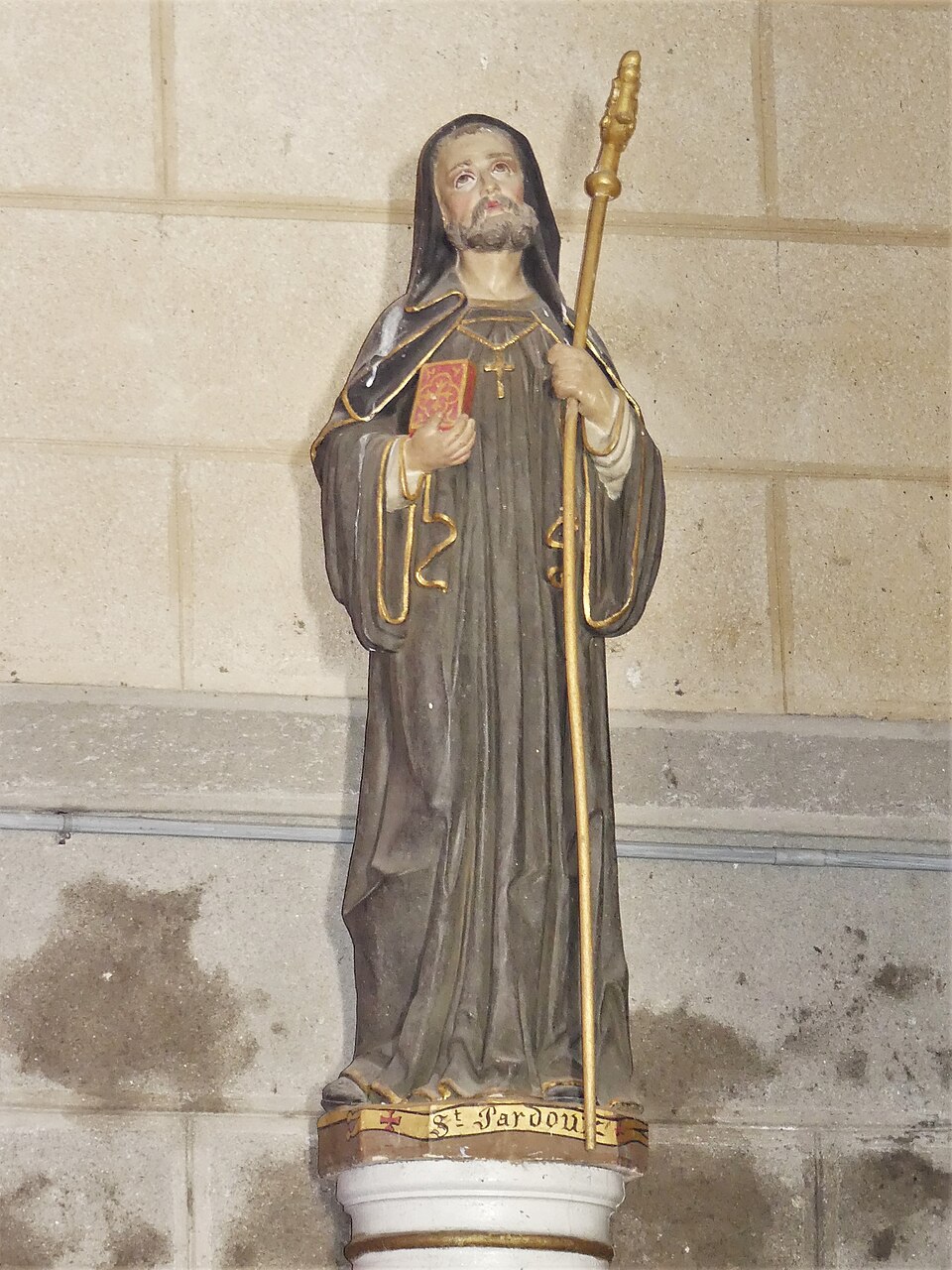
St Pardulf Statue at Sardent Church, his birth Town.

After the battle of Poitiers (732), the Monks of Guéret fled, terrified by the Saracens who were devastating the regopm bit Pardulf remained alone with a companion and the Saracens did not dare enter the Monastery; the Monks returned shortly afterwards, very contrite for their cowardice and amazed by their Abbot’s bravery.

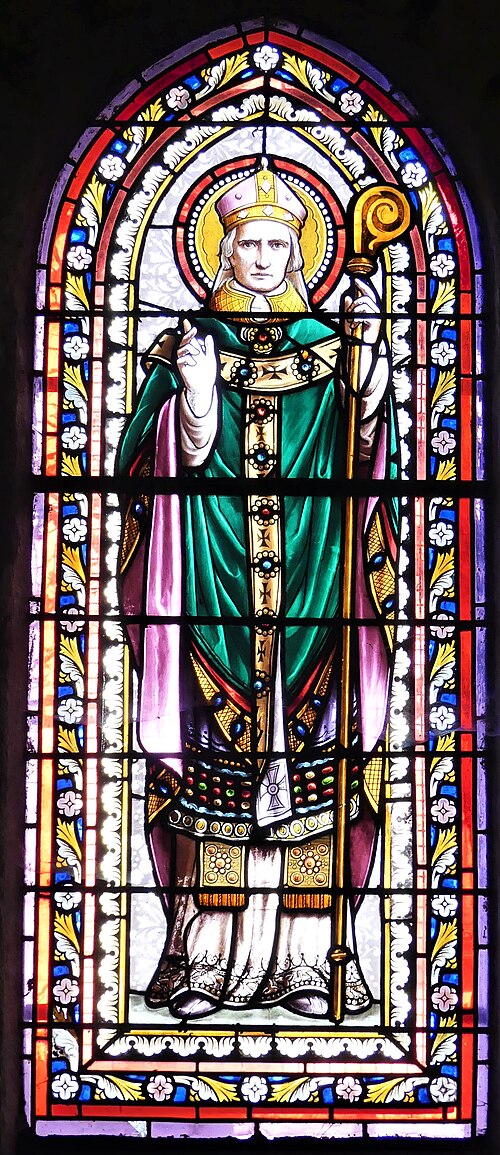
St Pardulf window at Guéret Church

Pardulf died on 6 October c737/8 at the age of eighty and was buried in the Monastery Church. Many miracles occurred at his tomb. In the 9th Century the Abbey was destroyed by the Normans and Pardulf’s remains were dispersed: some Relics are venerated in Guéret and others in Arnac.

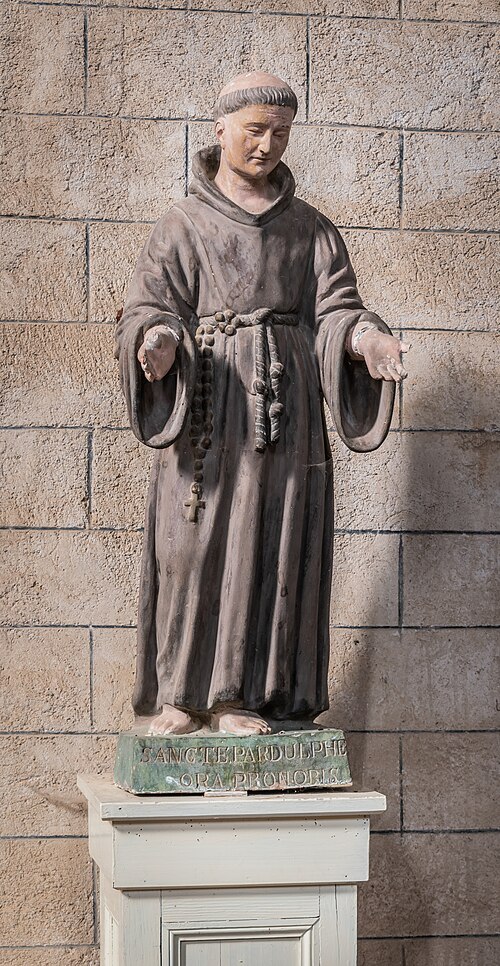
Statue of St Pardulf at La Serre-Bussière-Vieille Church

His Feast Day, fixed on 6 October, appears in the Liturgical books since the 10th Century. His cult has had a great diffusion in Limousin, Quercy, Poitou and Corrèze. Twenty-two communes bear his name, sometimes altered to Perdoux, Perdon or Pardon.

Because of his temporary blindness and many miracles reported of cures for eye ailments by his intercession, he is particularly invoked against diseased eyes and the sick bathe their eyes with water from the Fountains called “of San Pardulf.”

Posted in ACT of REPARATION, CATHOLIC Quotes, DIVINE Mercy, Goodness, Patience, EUCHARISTIC ADORATION and Nocturnal, GOOD RESOLUTIONS, QUOTES on GRATITUDE, QUOTES on MODESTY, SACRED HEART PRAYERS, The HOLY EUCHARIST / The HOLY MASS

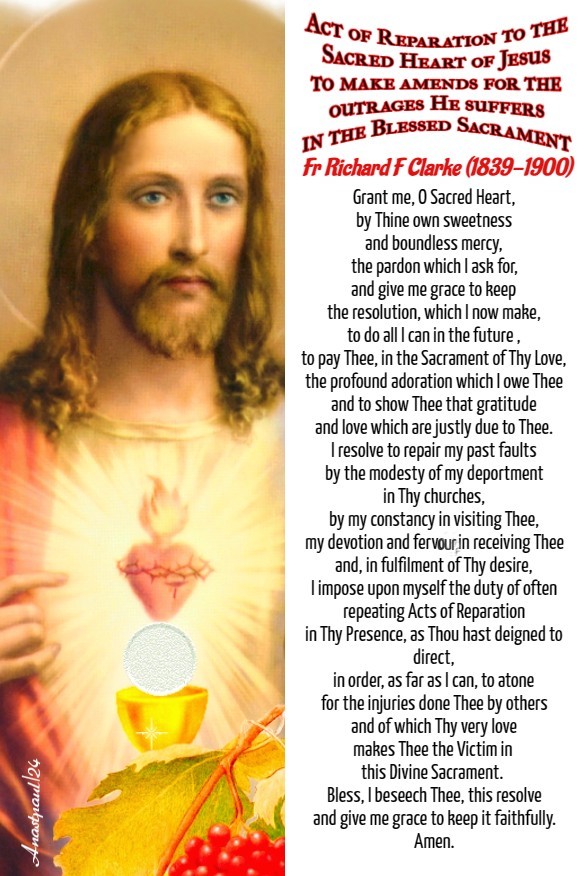
Our Morning Offering – 28 September – Act of Reparation to the Sacred Heart of Jesus to make amends for the outrages He suffers in the Blessed Sacrament

Our Morning Offering – 28 September – “The Month of The Seven Sorrows of the Blessed Virgin Mary and The Holy Cross” – Pentecost XVI

Act of Reparation to the Sacred Heart of Jesus
to make amends for the outrages He suffers
in the Blessed Sacrament
By Fr Richard Frederick Clarke SJ (1839-1900)

Grant me, O Sacred Heart,
by Thine own sweetness
and boundless mercy,
the pardon which I ask for,
and give me grace to keep
the resolution, which I now make,
to do all I can in the future ,
to pay Thee, in the Sacrament of Thy Love,
the profound adoration which I owe Thee
and to show Thee that gratitude
and love which are justly due to Thee.
I resolve to repair my past faults
by the modesty of my deportment
in Thy Churches,
by my constancy in visiting Thee,
my devotion and fervour in receiving Thee
and, in fulfilment of Thy desire,
I impose upon myself the duty of often
repeating Acts of Reparation
in Thy Presence, as Thou hast deigned to direct,
in order, as far as I can, to atone
for the injuries done Thee by others
and of which Thy very love
makes Thee the Victim in this Divine Sacrament.

Bless, I beseech Thee, this resolve
and give me grace to keep it faithfully.
Amen

Posted in Of Catechists, PATRONAGE - IN-LAW PROBLEMS, PATRONAGE - of MOTHERS, MOTHERHOOD, SAINT of the DAY, WIDOWS and WIDOWERS

Saint of the Day – 16 September – St Ludmila (c860-921) Martyr, Widow

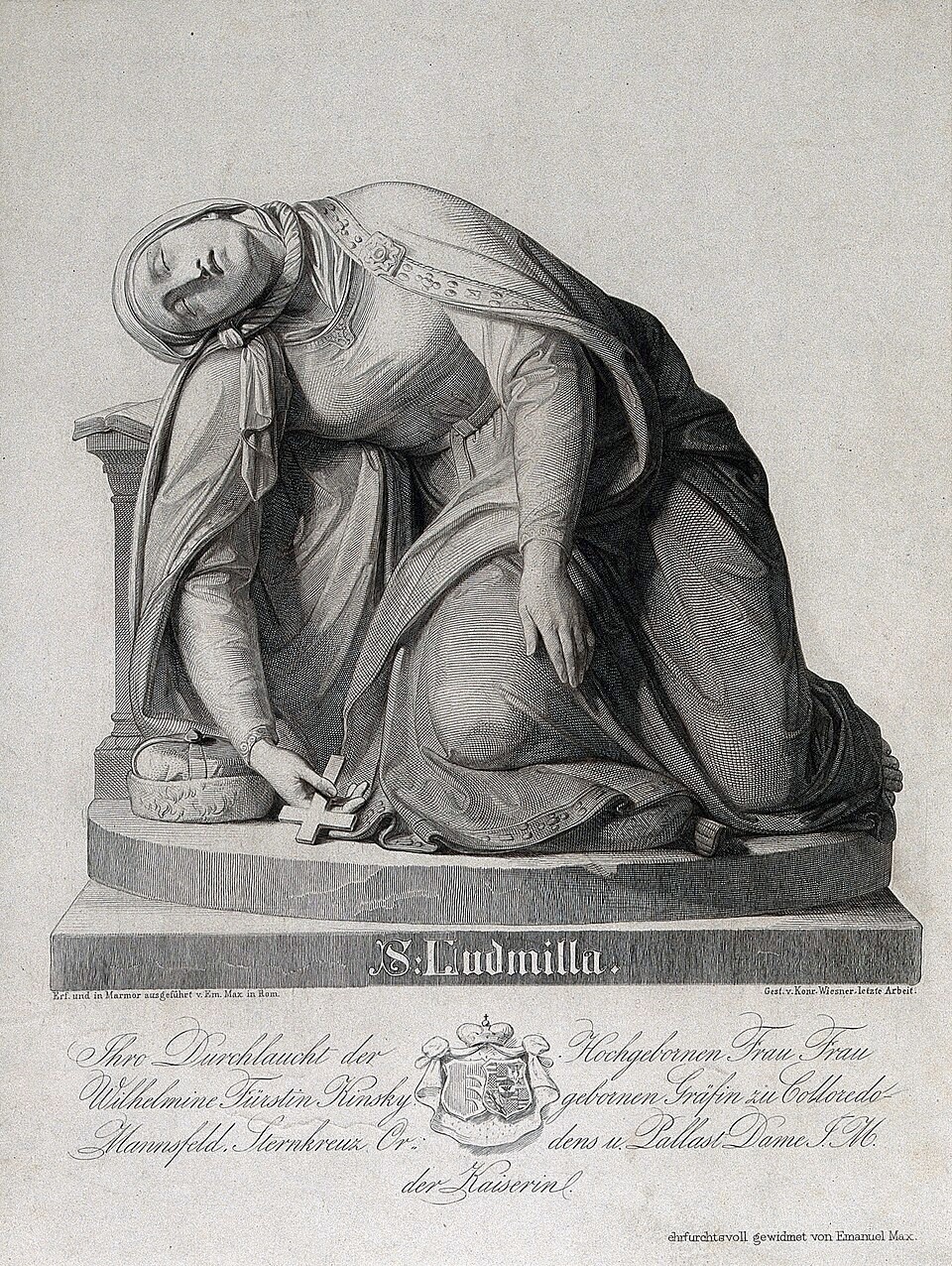
Saint of the Day – 16 September – St Ludmila (c860-921) Martyr, Mother, Widow, apostle of the poor and ill. Ludmila was the grandmother of Saint Wenceslaus, who is widely referred to as Good King Wenceslaus. Born in c860 at Mielnik (in modern Poland) and died by strangulation by hired assassins at Tetin, (modern Czech Republic) on 15 September 921 by the orders of her daughter-in-law, due to her influence over Saint Wenceslaus, her Grandson. Patronages – against in-law problems, Catechists, converts, Duchesses, mothers, widows, Bohemia, Czech Republic, the City of Prague, Czech Republic. Also known as – Ludmilla. Saint Ludmila was Canonisd shortly after her death. As part of the process of Canonisation, in 925, St Wenceslaus translated her remains to St George’s Basilica, Prague.

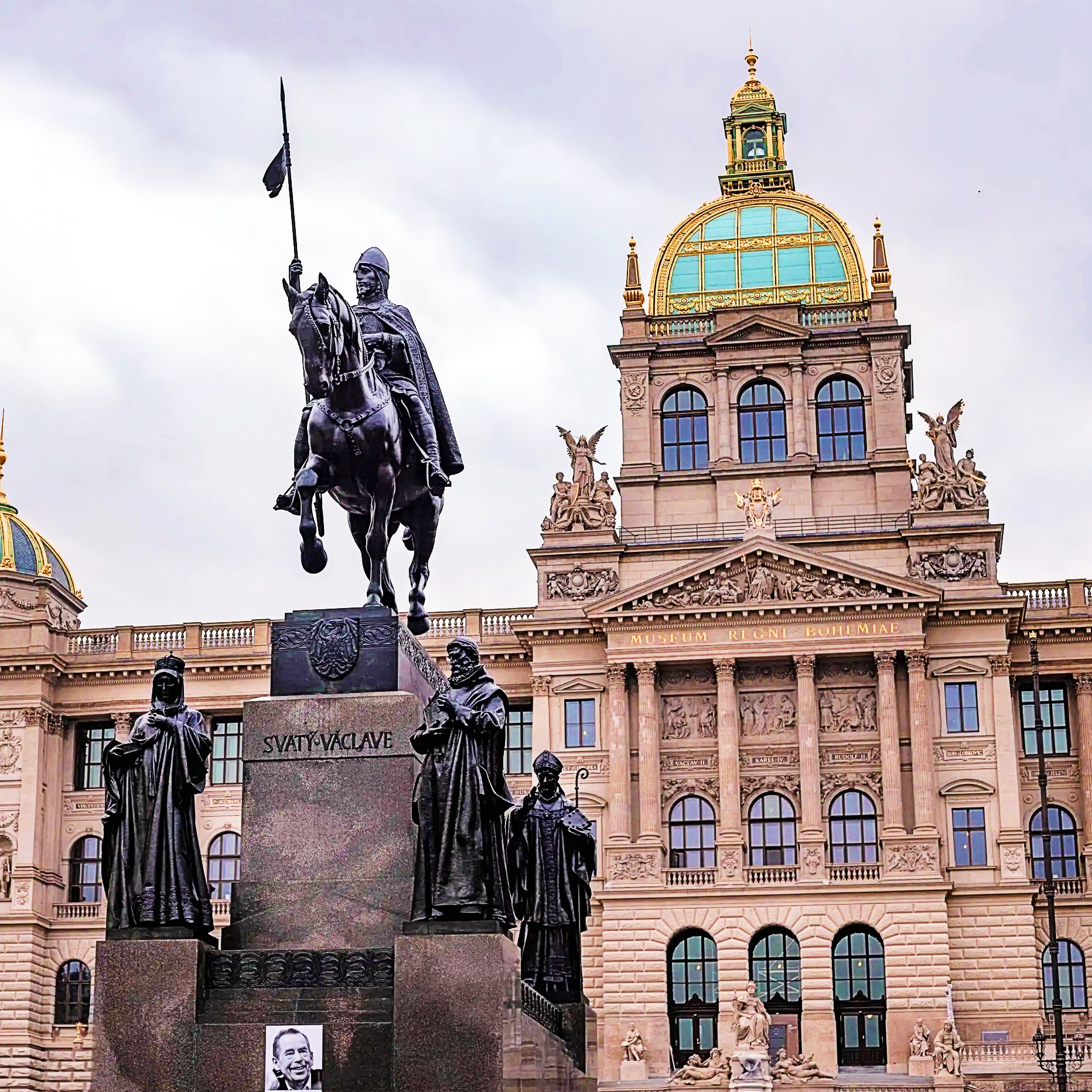
Anyone who has been to Prague will certainly remember, among its countless and breath-taking monuments and statuess, shrines and displays, the enormous Wenceslas Square, strategically located between the Old Town and the New as a symbol of national destiny and Czech identity in modern history.

There, beneath the National Museum, stands the equestrian Monument of the Patron Saint, Saint Wenceslas (c905–935), the propagator of Christianity in Bohemia and murdered as a young man by his diabolical brother, Boleslav. His large Statue is surrounded by the four Bohemian Patron Saints: Adalbert and Agnes behind him, Prokop and, not coincidentally, Ludmila herself.

St Ludmila on the left

She was Wenceslas’ Grandmother, with a name which translates from Slavic means “beloved of the people” and the title, after her death of “mother of the poor” for her charitable works. She was born around 860 in Lusatia, a historical region located in Central Europe and divided today between Poland, Germany and the Czech Republic. Her father, Slavibor, was the Duke of Milsko and Ludmilla married Borisvoj, Duke of Bohemia,in 873, while still a teenager. The two were later Baptized by Saints Cyril and Methodius, Apostles of the Slavs in the 9th Century.

The couple were blessed with three sons and three daughters and were committed to their Christian education and, at the same time, to the spread of Christianity in that region.

Widowed in 894, Ludmila donated all her possessions to the poor and devoted herself to a life of piety, living with her eldest son, Vratislaus. When he died prematurely in 916, the nobles entrusted the Regency of the Duchy to his wife, Drahomira and the education of their firstborn grandson, Wenceslaus, to his Christian Grandmother. Drahomira, still essentially attached to paganism and jealous of her mother-in-law’s influence over the child, forced Ludmila to retreat to Tetin Castle. There, in 920, the poor widow was strangled with the widow’s veil she wore, likely on Drahomira’s orders.

Wenceslas, as soon as he came of age and became the Duke himself, had his Grandmother’s Relics, venerated and miracle-working, translated to the Basilica of the Ducal Castle in Prague. Unfortunately, this Basilica was transformed into a museum during the communist regime in Czechoslovakia.

Posted in ACT of ADORATION, EUCHARISTIC ADORATION and Nocturnal, Our MORNING Offering, PRAYERS of the SAINTS, SACRED HEART PRAYERS, The ADORABLE HEART of JESUS, The NINE FIRST FRIDAYS

Our Morning Offering – 5 September – Prayer in Adoration of the Sacred Heart for the First Friday today

Our Morning Offering – 5 September – “The Month of The Seven Sorrows of the Blessed Virgin Mary and The Holy Cross” – First Friday

Prayer in Adoration of the Sacred Heart
By St Margaret Mary Alacoque (1647-1690)
Visionary and Apostle of the Sacred Heart of Jesus

Jesus Christ, my Lord and my God,
Whom I believe to be really present
in the Blessed Sacrament of the Altar,
receive this most profound Act of Adoration
to supply for the desire I have,
to adore Thee unceasingly
and in thanksgiving,
for the sentiments of love
which Thy Sacred Heart
has for me in this Sacrament.
I cannot better acknowledge them,
than by offering Thee,
all the Acts of Adoration,
resignation, patience and love
which this same Heart has made
during its mortal life
and which it makes still
and which it shall make eternally in Heaven,
in order that through it,
I may love Thee, praise Thee
and adore Thee worthily,
as much as it is possible for me.
I unite myself to this Divine Offering
which Thou dost make to Thy Divine Father
and I consecrate to Thee,
my whole being,
praying Thee, to destroy in me,
all sin and not to permit
that I should be separated from Thee,
in time and eternally.
Amen.

Posted in ALTAR BOYS, DEACONS, SACRISTANS, Of BACHELORS, SAINT of the DAY

Saint of the Day – 4 September – Saint Marinus (c279-c366) Deacon

Saint of the Day – 4 September – Saint Marinus (c279-c366) Deacon of Rimini, Hermit, Stonemason, Founder of the State of San Marino. Born in the c275 island of Rab in Croatia and died on 3 September c366 on Mount Titano im San Marino. Patronages – bachelors, Deacons, falsely accused people, stone masons, of the independent City State of San Marino (officially the Republic of San Marino, is a landlocked country in Southern Europe, completely surrounded by Italy). Also known as – Marino in Italian, Marinao… the name means ‘man from the sea'(Latin).

The Roman Martyrology reads today: “At Rimini, St Marinus, Deacon.

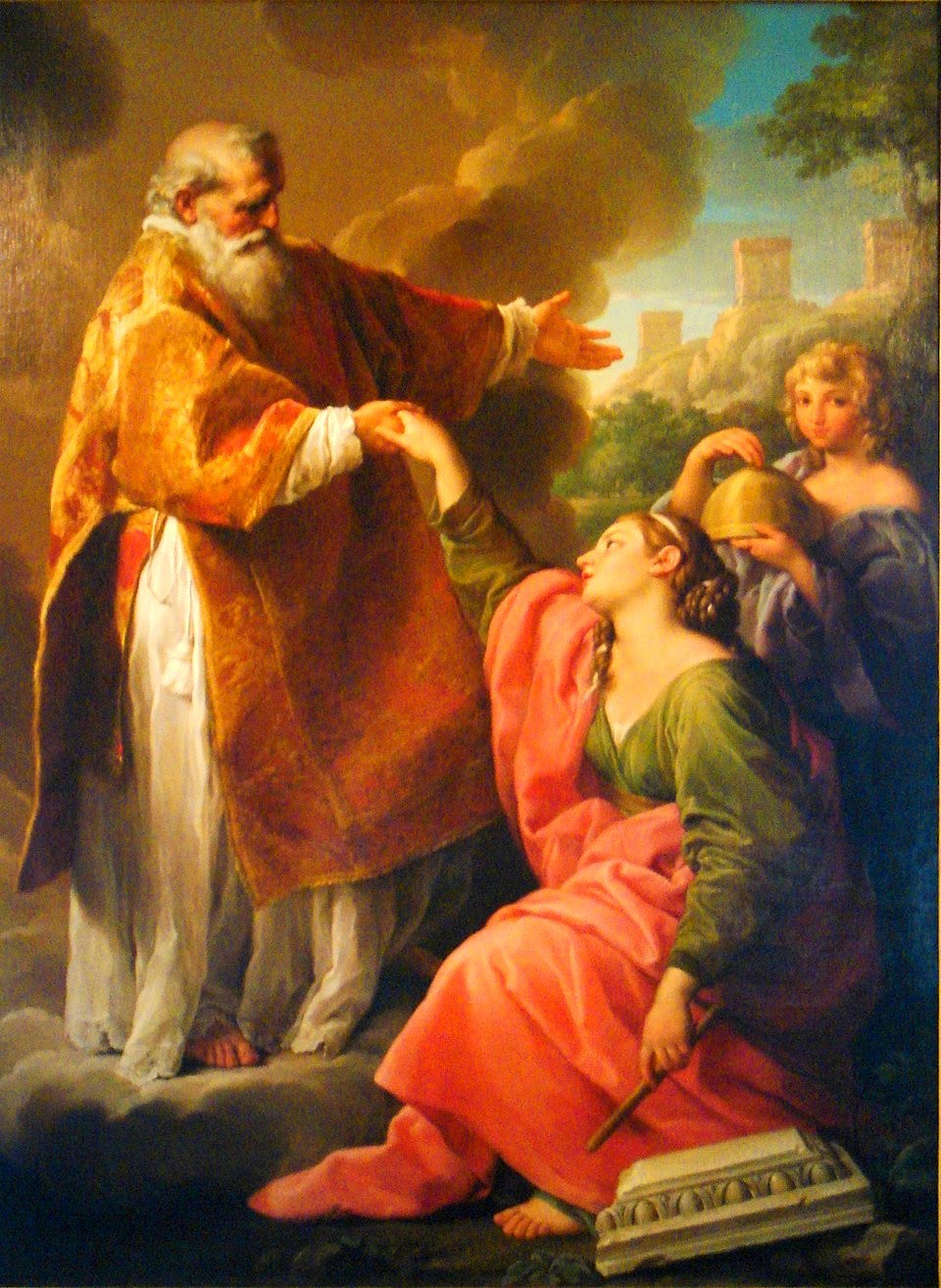
Portrait by Pompeo Batoni, 1740

According to tradition, Marinus, along with Leus of Montefeltro, was forced to perform forced labour in Rimini around 305 during the Diocletianic persecutions. There, they were tasked with building the City walls with stones brought from Mount Titano in what is now the little Sate of San Marino, named after Marinus.

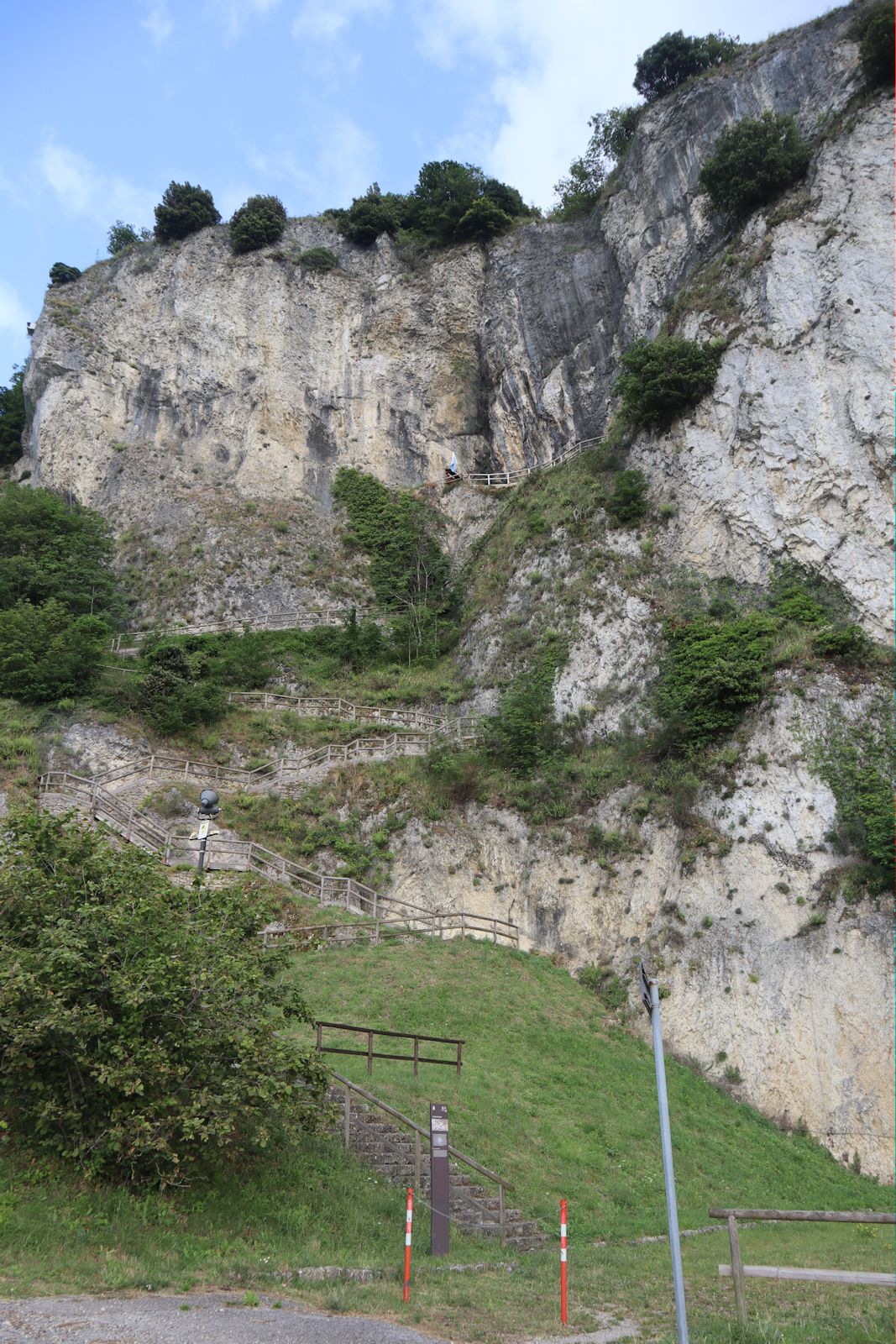
Afterward, the two separated and Marinus lived as a Hermit in a cave on Mount Titano. Bishop Gaudentius of Rimini Ordained him a Deacon in 311—after the persecutions ended.

Rock with entrance to Marinus’ Cave

After some time, Marinus was discovered in his cave by herdsmen who spread the news about him. He then acted as a messenger of the Faith, converting and Baptising a woman whose brother gave Marinus land at the top of the mountain. Marinus left his cave and built the Church of San Pietro there.

Marinus died with the words, “I leave you free from both men” these are considered the founding myth of the State of San Marino which, was founded after Marinus’ death and is therefore the oldest State in the world with a republican constitution and emphasise its independence from the Emperor and the Pope.

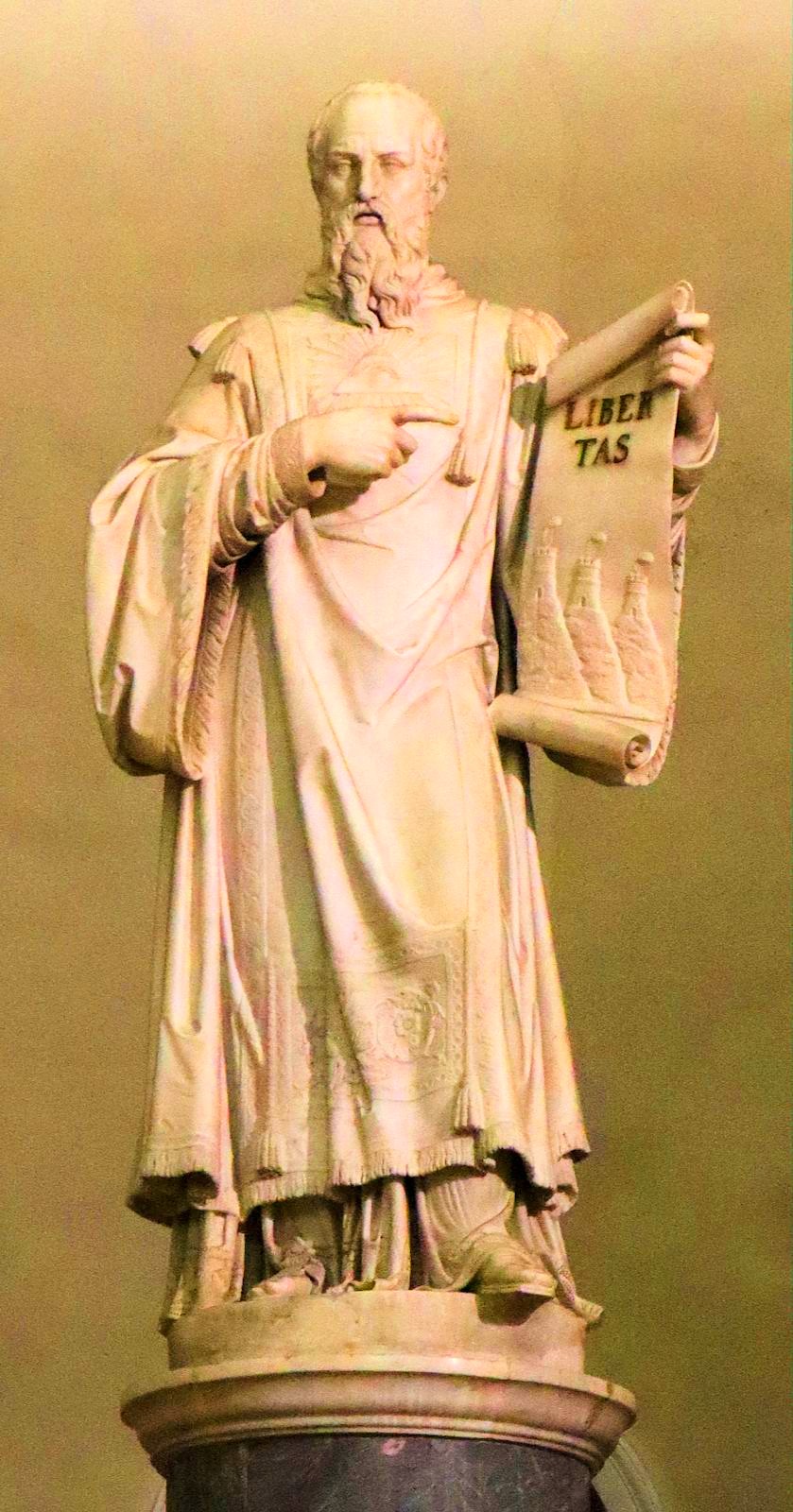
Adamo Tadolini: Statue, around 1850, in the 
Basilica of San Marino in San Marino

San Marino remains the oldest State in the world with a Republican constitution.

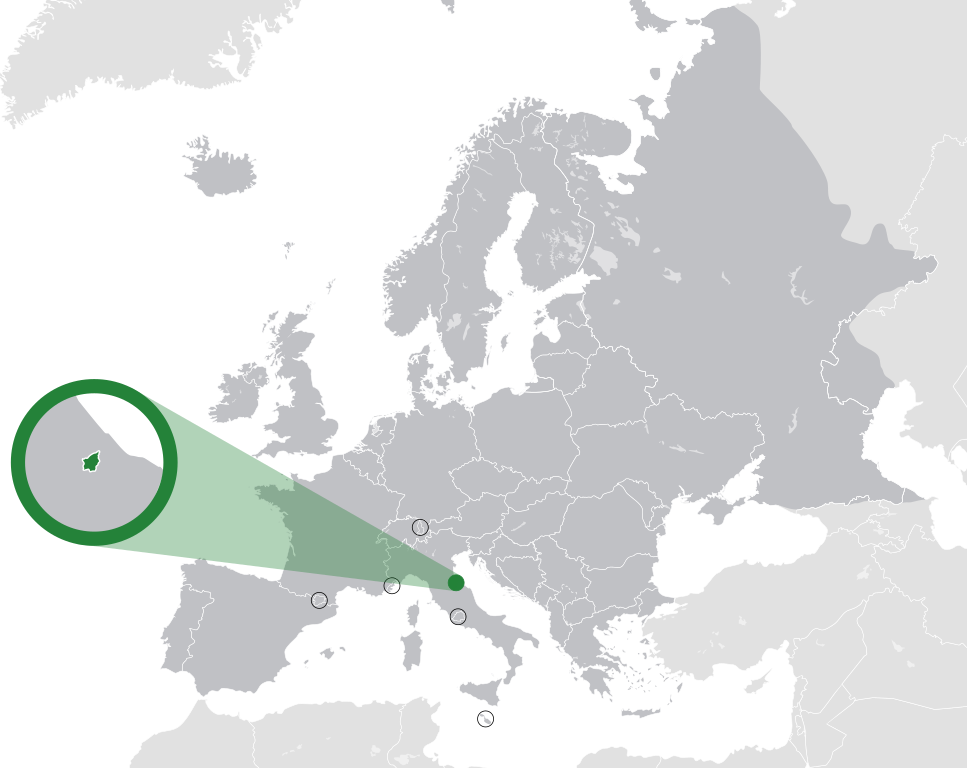
Location of San Marino (green)
in Europe (dark grey)

Marinus and Leus of Montefeltro were buried in two niches carved into the rock which can still be seen today in the crypt of the Church of San Pietro. Since the 4th Century, a Parish Church dedicated to Marinus stood nearby on the site of the Basilica of San Marino built at the beginning of the 19th Century. Under the High Altar, some of Marinus’ Relics discovered on 3 March 1586, lie; others have been on the island of Rab since 1595 .

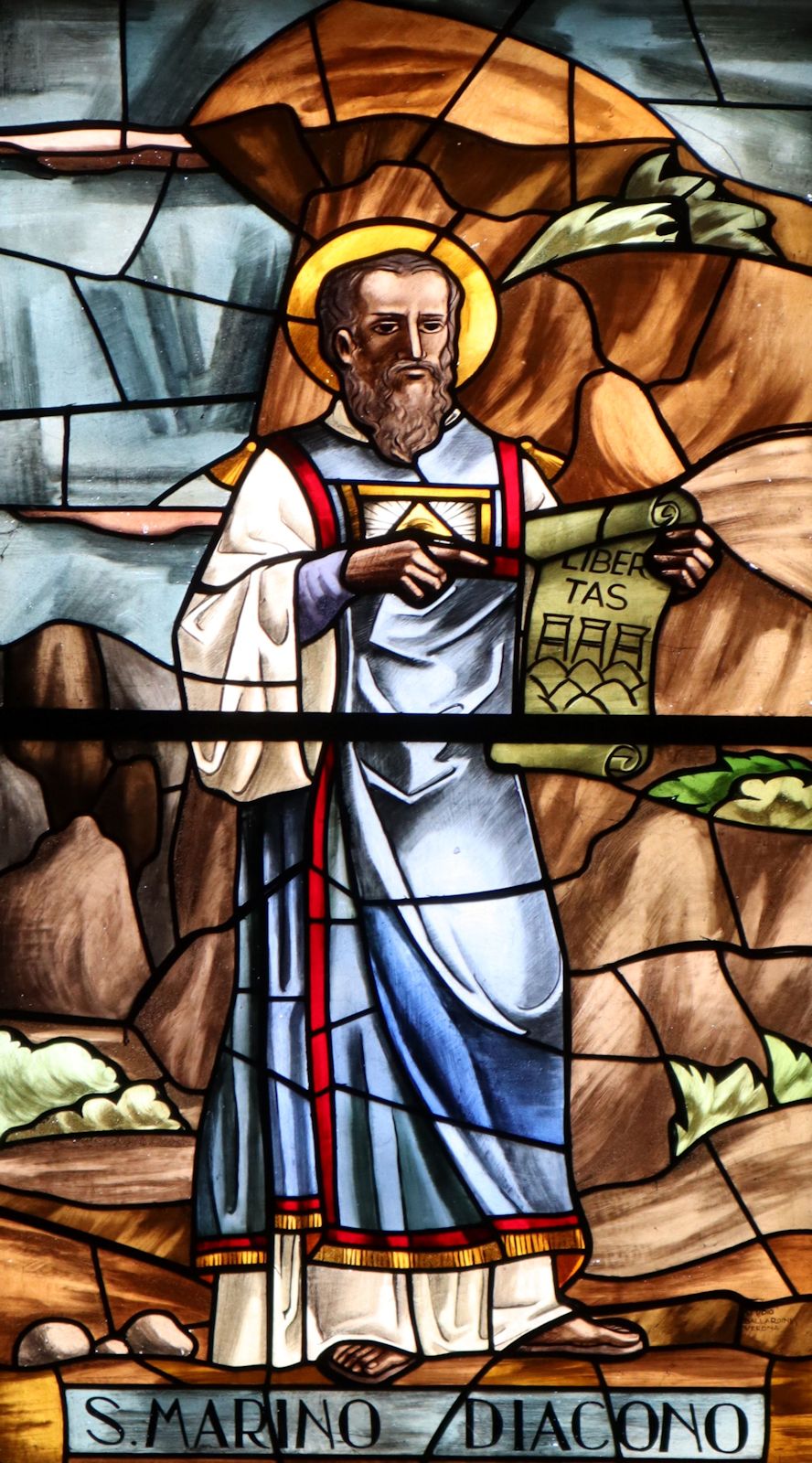
Stained glass window in today’s Parish Church in Voghenza

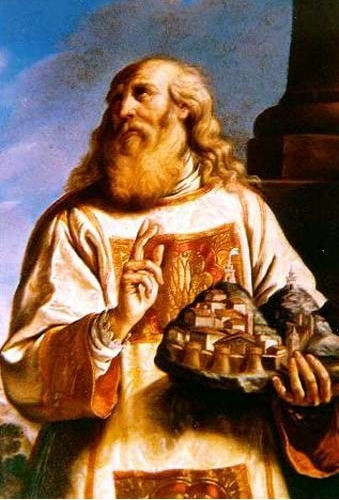
In around 500, there was a Monastery on Mount Titas and around 754, a Castle named after Marinus was documented there. Marinus’ Vita was written in 900 and another in the 11th Century. Marinus is considered the founder of San Marino, therefore, Guercino’s image was used on the State’s 20 cent coin.

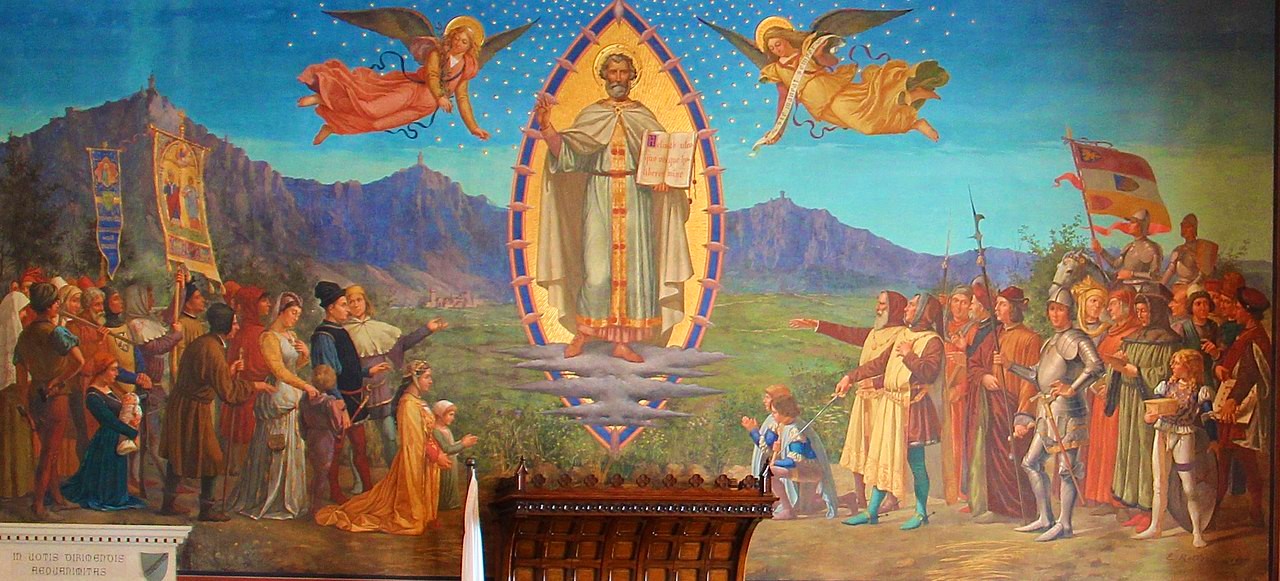
Painting of Saint Marinus descending from Heaven surrounded by the people of San Marino, painting located within the Palazzo Pubblico
Posted in CATHOLIC TIME, CATHOLIC-PRAYERS OF THE CHURCH, Our MORNING Offering, PAPAL PRAYERS, PRAYERS & NOVENA to St Joseph, PRAYERS of the CHURCH, PRAYERS of the SAINTS, PRAYERS TO St Joseph, PRAYERS to the SAINTS, QUOTES on GOOD WORKS, QUOTES on WORK/LABOUR, WORKERS

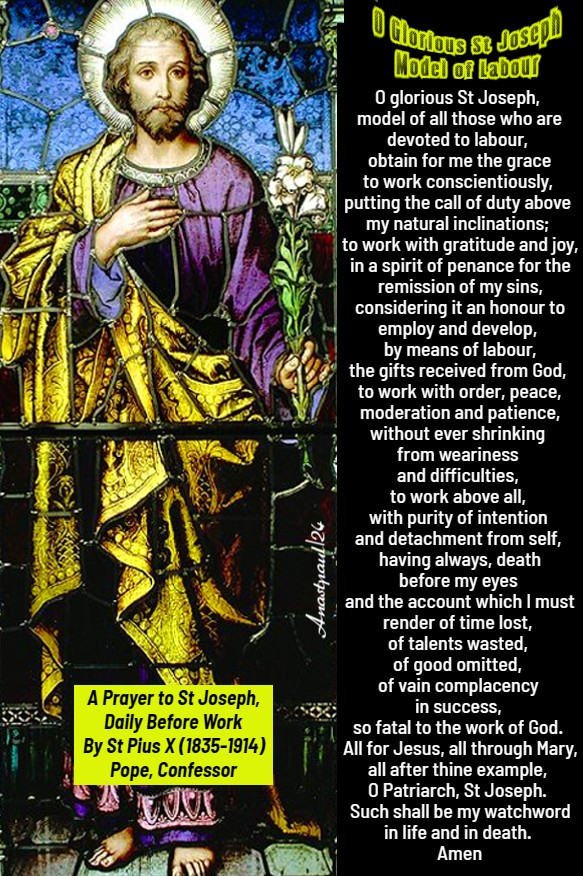
Our Morning Offering – 3 September – O Glorious St Joseph, Model of Labour By St Pius X

Our Morning Offering – 3 September – “The Month of The Seven Sorrows of the Blessed Virgin Mary and The Holy Cross” – St Pius X (1835-1914) Pope, Confessor and today, Wednesday, being St Joseph’s day. St Joseph continues his fatherly guardianship of Christ’s Body, the Holy Catholic Church. He is a very powerful intercessor for all of us. 

O Glorious St Joseph,
Model of Labour
A Prayer to St Joseph, Daily Before Work
By St Pius X (1835-1914) Pope, Confessor

O glorious St. Joseph,
model of all those who are devoted to labour,
obtain for me the grace to work conscientiously,
putting the call of duty above
my natural inclinations;
to work with gratitude and joy,
in a spirit of penance for the remission of my sins, considering it an honour to employ
and develop, by means of labour,
the gifts received from God,
to work with order, peace, moderation and patience, without ever shrinking
from weariness and difficulties,
to work above all, with purity of intention
and detachment from self,
having always, death before my eyes
and the account which I must render of time lost,
of talents wasted, of good omitted,
of vain complacency in success,
so fatal to the work of God.
All for Jesus, all through Mary,
all after thine example, O Patriarch, St Joseph.
Such shall be my watchword in life and in death.
Amen

Posted in EYES - Diseases, of the BLIND, SAINT of the DAY

Saint of the Day – 3 September – St Aigulphus OSB (c630-c679) Abbot

Saint of the Day – 3 September – St Aigulphus OSB (c630-c679) Abbot of Lérins. Born around 630 near Blois in France and died around 676 on the Island of Aigylion / Caprasia, today Capraia in Italy. Patronage – the cure of eyes ailments, against obsessions. Also known as – Aigulphe, Aygulphe, Ayou, Ayoul. Additional Memorial – 17 May (translation of Relics to Lérins).

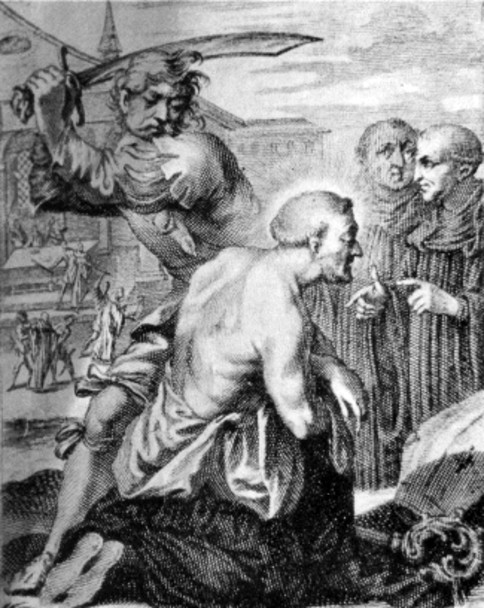
The Roman Martyrology reads today: “The birthday of the holy Martyrs, Aigulphus Abbot of Lérins and the Monks, his companions who, after their tongues were cut off and their eyes plucked out were murdered with the sword.”

Aigulphus became a Benedictine Monk in the Monastery founded around 651 in Fleury – today’s Saint-Benoît-sur-Loire.

According to tradition, in around 655 he fetcjed the remains of Saints Benedict and Scholastica from the Monastery of Monte Cassino, which had been devastated by the Lombards. Around 661 he was elected as the Abbot of the Monastery on the Lérins Island. There he wanted to introduce the mixed Rule comprising elements of the Order of Columban and the Benedictines.

Aigulphus and 3 companion Monk were attacked by pagans who objected to the growing influence of the Monks. Horrible tortures were inflicted upon Aigulphus. His tongues and eyes were cut and gouged ou t. Then heand his companions were forced into exile on the Island of Caprasia – today’s Island of Capraia – where there was a colony of Hermits which is now named after St Aigulphus. He was finally killed by pirates on this Island. Some sources say that this torture and Martyrdom was actually perpetrated by Monks who disliked Aigulphus’ strict reforms.

It is often said that he had 33 companions but in reality there were probably only three, namely the monks Trucharius and Frongentius (Frugentius) and one whose name is unknown.

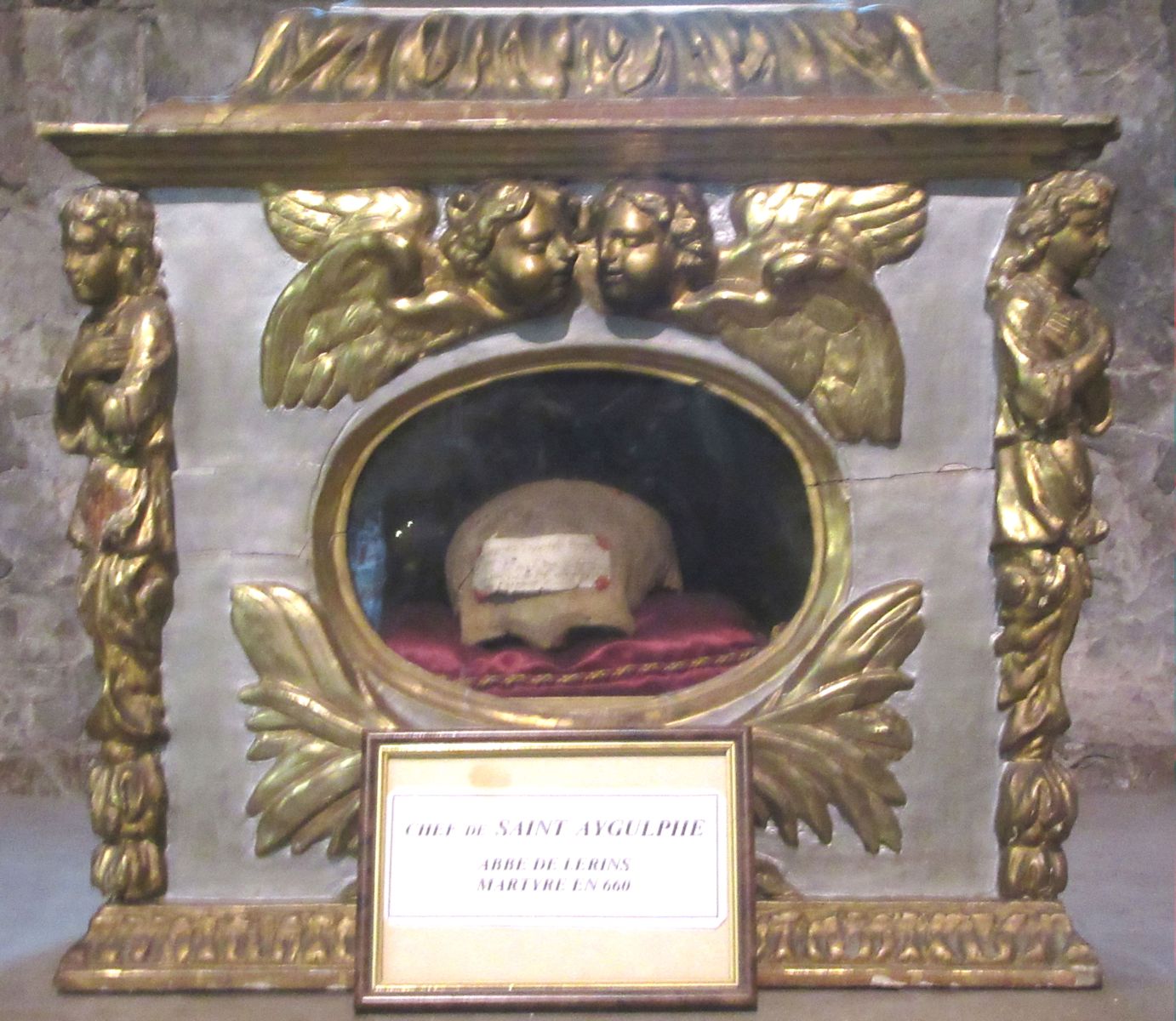
His remains were returned by Abbot Rigomir to the Monastery at Lérins. Relics were also brought to Provins and rediscovered there by Archbishop Seguin in the 10th Century. Part of the head Relic was brought to the Cathedra in Grasse, see below.

Posted in CHILDREN / YOUTH, EYES - Diseases, of the BLIND, Of FISHERMEN, FISHMONGERS, Of HOSPITALS, NURSES, NURSING ASSOCIATIONS, PATRONAGE - HOUSEWIVES, SAILORS, MARINERS, NAVIGATORS, SAINT of the DAY, SERVANTS, MAIDS, BUTLERS, CHAMBERMAIDS

Saint of the Day – 1 September – St Verena (c260-c320) Virgin

Saint of the Day – 1 September – St Verena (c260-c320) Virgin, Recluse, Ascetic, Apostle of the sick, gifted with the charism of curing illness and by her prayers, healing the sick, Miracle-worker. Born in Egypt in c260 and died in Tenedo, today (Bad) Zurzach, in Switzerland. Also known as – Verena of Zurzach, Verena of Thebes. Patronage – against eye ailments, children, fishermen, for male offspring, housewives, especially those serving in a presbitory, mariners, sailors, millers, nurses, poor people, ship captains, – in Switzerland: Basel, Diocese of Zurich.

The Roman Martyrology reads today: “In Baden, in the Diocese of Constance, St Verena, virgin.

Verena was born to wealthy parents and Baptised in her hometown by Bishop Chaeremon of Nilopolis. She fell in love with a young Christian who was a member of the Theban Legion of St Maurice who was her cousin. When the Legion was ordered to Gaul by Emperor Maximilian around 300, Verena joined the entourage which travelled with the soldiers as far as Milan . There she lived in the house of the holy man St Maximus and fed and buried fellow Christian. When she heard of the beheading of St Maurice and his followers in Agaunum, she went there to bury them.

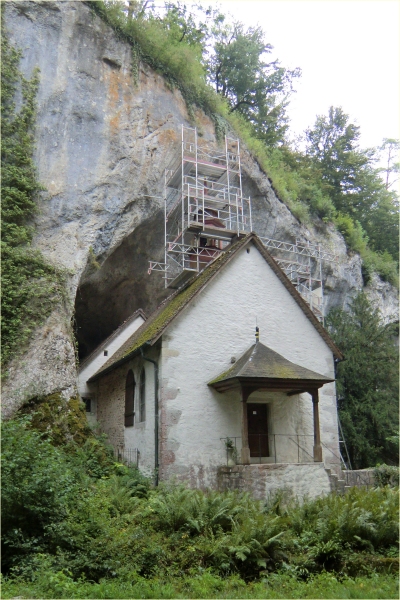
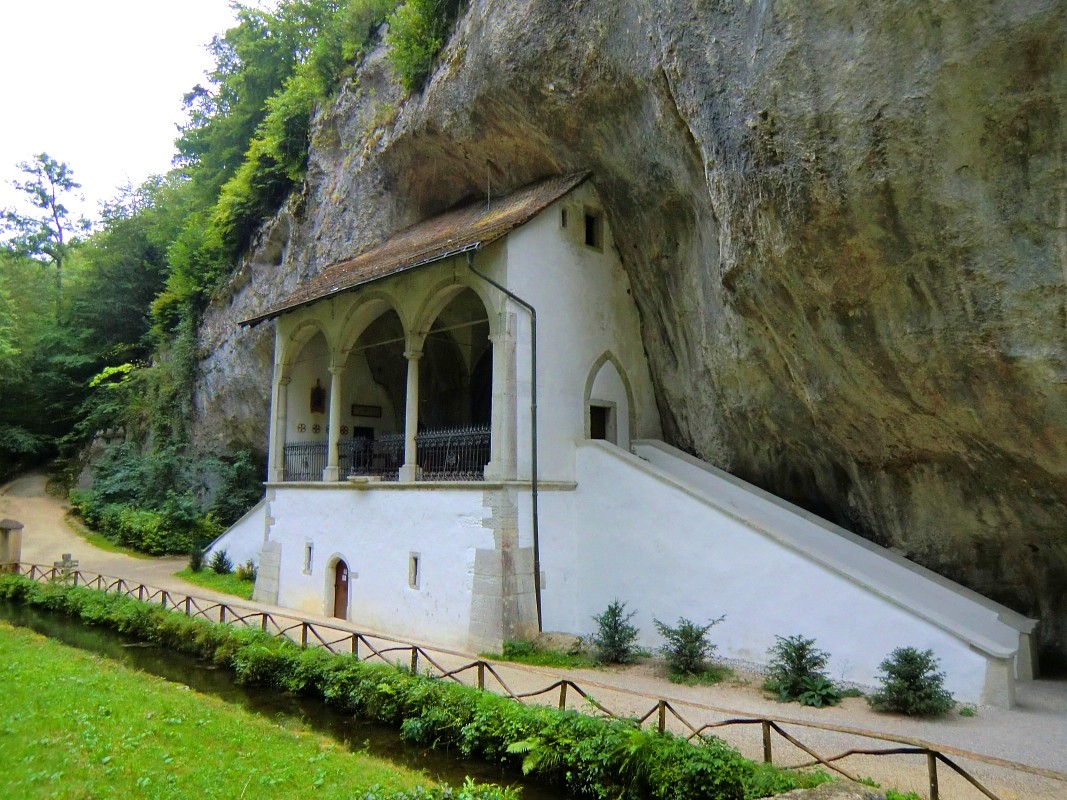
Then she travelled on to Solothurn, where Victor – according to some versions of the legend, her fiancé – and Ursus had also been Martyred. She settled there in a hermitage, a cave in the Verena Gorge near Solothurn which was later named after her and lived there as an ascetic.

Martins Chapel, behind it the cave in which Verena is said to have lived, at the Hermitage
in the St Verena Gorge near Solothurn

Verena often sought out lepers outside the gates of the City of Solothurn to wash them. Because of her healing powers, Verena was considered a Saint by the people; the sick sought her assistance and prayers in her hermitage through her miracles. Soon many young women joined her and formed a community. Verena supported herself and the these young women by selling handicrafts and converted many Alemanni to the Faith in Christ but was eventually imprisoned by the anti-Christian City Commander, Hirtacus. In prison, St Maurice appeared to her , radiant with heavenly light and strengthened her faith. When Hirtacus fell ill and was healed by Verena, he released her but expelled her from the City.

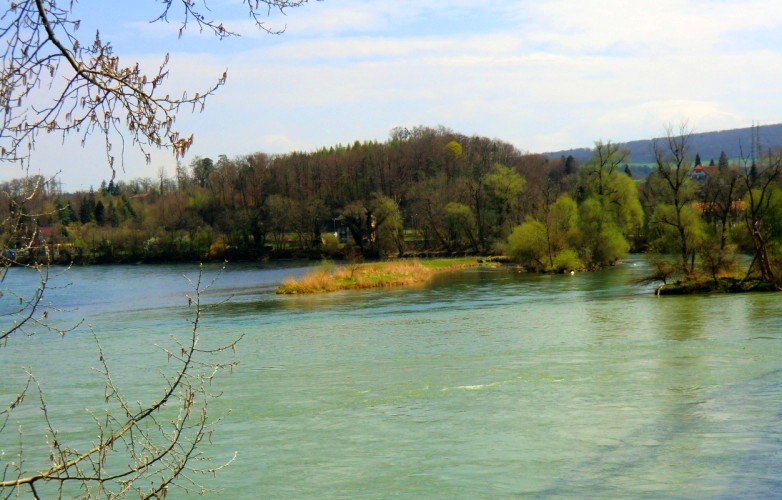
Verena is said to have then floated down the Aare River on a flat stone—or a millstone. In Koblenz, then a small Roman settlement, she made a long stop on an island in the Rhine, freed it of snakes and once again devoted herself to nursing the ill.

Island near Koblenz at the mouth of the Aare (right) into the Rhine (left)

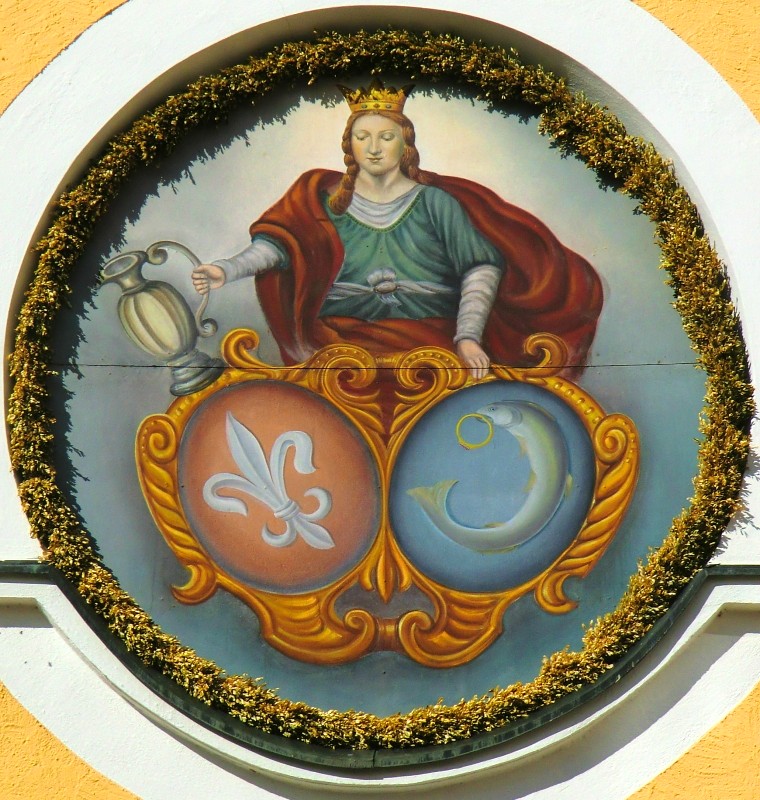
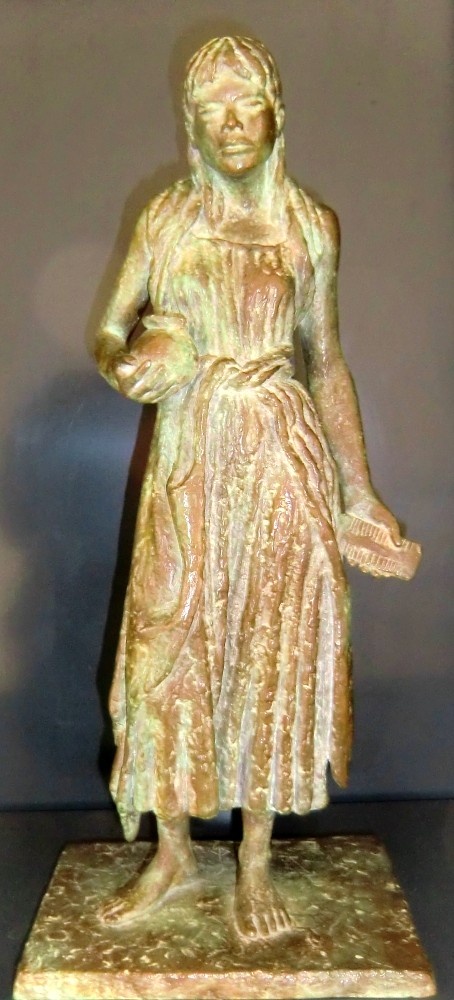
Then she came to the nearby Roman Fort of Tenedo – present-day Zurzach (Bad) – where she became the Priest’s domestic servant. Everyday, carrying a jug and comb, she went outside the City walls to wash the lepers. When she was accused of unlawfully carrying wine and bread to the poor, the wine turned into water. The Priest’s ring, which he refused to wear during Lent, was given to her for safekeeping. A servant, fearing discovery, stole it and threw it into the Rhine. A fisherman brought a large fish as a gift, and Verena cut it up and found the ring.

The Priest then had a cell built for her in Zurzach where, until her death, she washed the heads of the sick with the healing waters of a spring, combed their hair, healed them and anointed them. In her hour of death, Our Lady Mary appeared to Verena with many holy women who guided her to Heaven.

St Verena Chapel at the Hermitage in the St. Verena Gorge near Solothurn

Probably in the 5th Century – proven by archaeological finds – a Church was built over Verena’s grave which lay in a burial ground near an old Roman Fort on the Roman road – on the site of the Cathedral in Bad Zurzach which is now named after St Verena In around 745, a Benedictine Monastery was opened there. This Monastery was converted into a Canonry in the 13th Century and dissolved in 1876.

The first biography was written in 888 in Reichenau Monastery by the Benedictine Abbot Hatto, later Archbishop of Mainz; a further Vita with additions about her work in Koblenz and Zurzach was probably written in the Zurzach Monastery in the 10th Century and a collection of her miracles followed around 1000. Although heavily interspersed with legendary elements, they probably contain a historical core. The gravestone of her Sarcophagus was erected in 1613.

St Verena depicted at the Monastery Church in Rot an der Rot

The St Verena Minster in Bad Zurzach houses the arm Relic a valuable piece of gold from the 14th Century. Relics are also kept in the Minster in Radolfzell . The Church of the Monastery in Rot an der Rot, is dedicated to her. The small Church of St Verena in Rotholz near Lengstein/Longostagno – a district of Ritten near Bolzano – first mentioned in documents in 1256, is also named after her.

Gold figure at the Fountain in the Cathedral in Bad Zurzach
Posted in CHRIST the WORD and WISDOM, EUCHARISTIC ADORATION and Nocturnal, FATHERS of the Church, GOD ALONE!, HOLY COMMUNION, I BELIEVE!, ONE Minute REFLECTION, QUOTES on ETERNAL LIFE, QUOTES on FAITH, QUOTES on HOPE, QUOTES on JOY, QUOTES on MYSTERIES of our FAITH, QUOTES on WATCHING, The FAITHFUL on PILGRIMAGE, The WORD

One Minute Reflection – 4 August – ‘ … Let us love Him above all and in all. … ‘

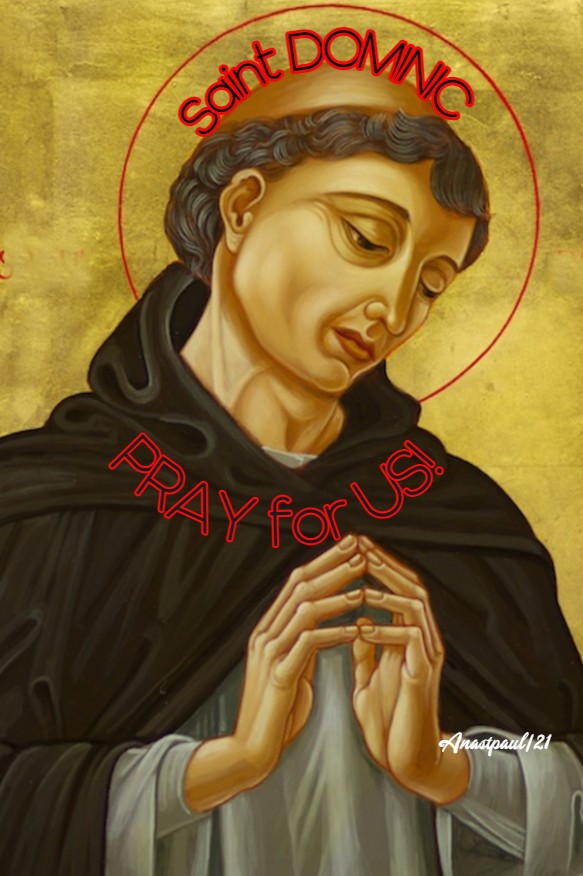
One Minute Reflection – 4 August – “The Month of the Immaculate Heart of Mary” – St Dominic de Guzman OP (1170-1221) Confessor, Founder – 2 Timothy 4:1-8 – Luke 12:35-40 – Scripture search here: https://www.drbo.org/

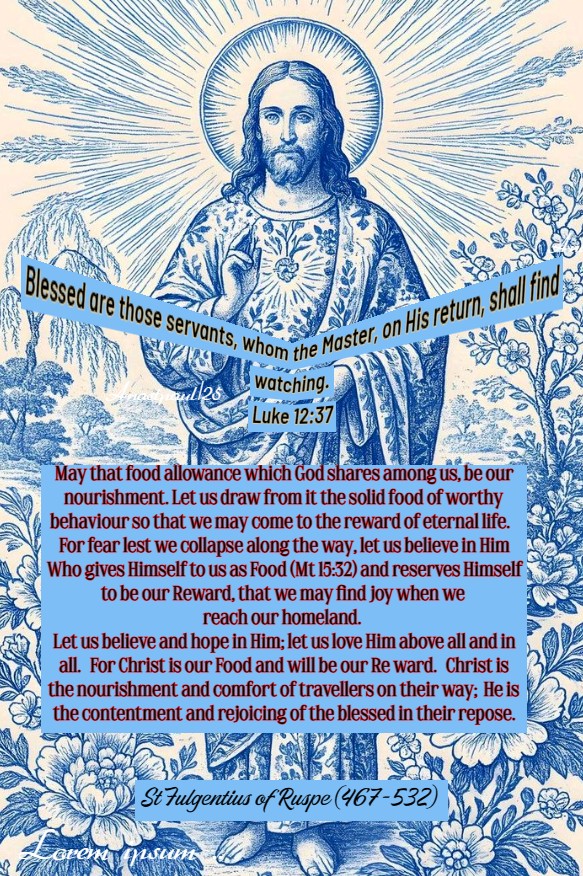
Blessed are those servants, whom the Master, on His return, shall find watching.” – Luke 12:37

REFLECTION – “In order to clarify the role of the servants,He set at the head of His people, the Lord spoke this word related in the Gospel: “Who, then is the faithful and prudent steward whom the Master will put in charge of His servants to distribute the food allowance at the proper time? Blessed is that servant whom his Master on arrival, finds doing so”… If we should be wondering in what that food allowance consists, Saint Paul gives us the answer; it is “the measure of faith which God has apportioned” (Rom 12:). That which Christ called, an allowance of food, Paul termed, a measure of faith, to teach us that there is no other spiritual food than the Mystery of Christian faith. We give you this allowance of food in the Lord’s Name every time we speak to you according to the rule of the true Faith, illumined by the spiritual gift of grace. As for that allowance, you receive it at the hands of the Lord’s stewards each time you hear the Word of Truth from the mouth of God’s servants.

May that food allowance which God shares among us, be our nourishment. Let us draw from it the solid food of worthy behaviour so that we may come to the reward of eternal life. For fear lest we collapse along the way, let us believe in Him Who gives Himself to us as Food (Mt 15:32) and reserves Himself to be our Reward, that we may find joy when we reach our homeland. Let us believe and hope in Him; let us love Him above all and in all. For Christ is our Food and will be our Reward. Christ is the nourishment and comfort of travellers on their way; He is the contentment and rejoicing of the blessed in their repose.” – St Fulgentius of Ruspe (467-532) Bishop Father (Sermon 1, 2-3).

PRAYER – O God, Who graciously enlightened Thy Church by the good works and teaching of St Dominic, Thy Confessor, grant by his intercession, that she may never be deprived of temporal helps and may ever advance in spiritual growth. Through the same Jesus Christ, Thy Son our Lord, Who lives and reigns with Thee, in the unity of the Holy Ghost, God, world without end. Amen (Collect).

Posted in "Follow Me", ArchAngels and Angels, CATHOLIC-PRAYERS OF THE CHURCH, CHRIST, the WAY,TRUTH,LIFE, CREEDS, DOCTORS of the Church, FATHERS of the Church, GOD ALONE!, In the PRESENCE of GOD, Of and for VOCATIONS, PRAYERS of the CHURCH, PRAYERS of the SAINTS, QUOTES on PURITY, Quotes on SALVATION, QUOTES on SELF-DENIAL, The APOSTLES & EVANGELISTS, The HEART, The WILL of GOD

Quote/s of the Day – 15 July – The Division of The Apostles

Quote/s of the Day – 15 July – “The Month of the Most Precious Blood” – The Feast of the the “Divisio Apostolorum – The Division of the Apostles” also known as (‘Dispersion’)

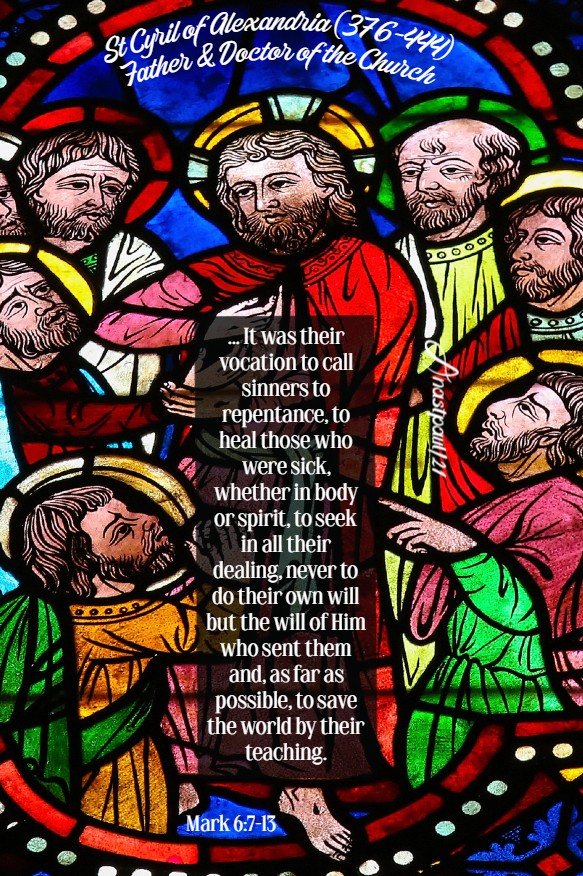
“… It was their vocation
to call sinners to repentance,
to heal those who were sick,
whether in body or spirit,
to seek in all their dealing,
never to do their own will
but the Will of Him who sent them and,
as far as possible, to save the world
by their teaching.”

St Cyril of Alexandria (376-444)
Bishop, Father & Doctor of the Church

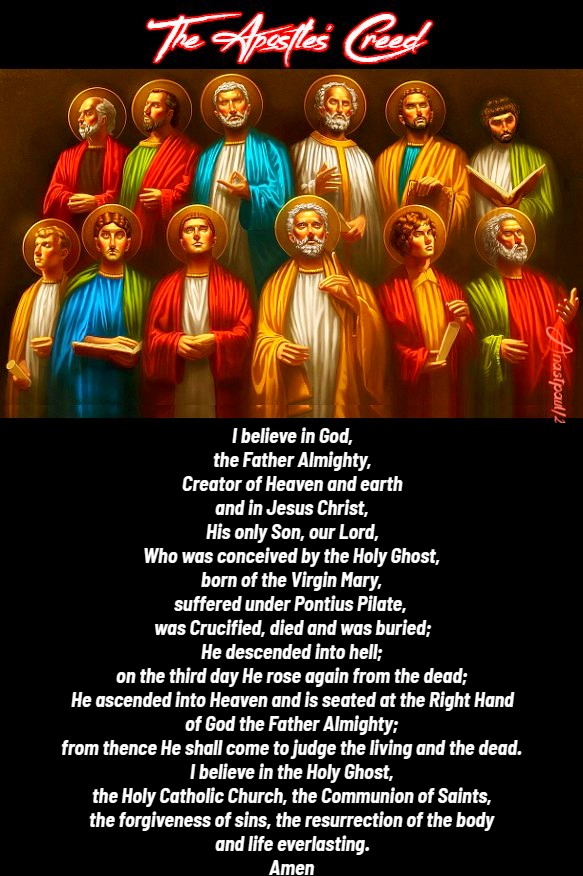
The Apostles’ Creed

I believe in God,
the Father Almighty,
Creator of Heaven and earth
and in Jesus Christ,
His only Son, our Lord,
Who was conceived by the Holy Ghost,
born of the Virgin Mary,
suffered under Pontius Pilate,
was crucified, died and was buried;
He descended into hell;
on the third day He rose again from the dead;
He ascended into Heaven
and is seated at the Right Hand
of God the Father Almighty;
from thence He shall come
to judge the living and the dead.
I believe in the Holy Ghost,
the Holy Catholic Church,
the Communion of Saints,
the forgiveness of sins,
the resurrection of the body
and life everlasting.
Amen

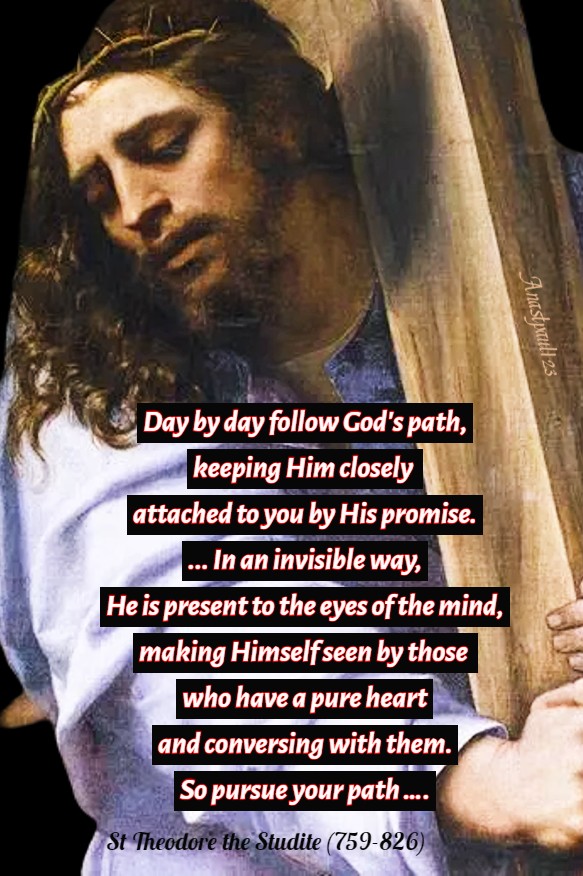
Day by day follow God’s path,
keeping Him closely attached to you by His promise.
In fact, He Himself said, through the mediation of His Apostles,
to all those who seek His will and His testimonies
that He would be with them
until the end of the world (Mt 28:20)
where paths and footsteps
will be unknown (cf Ps 76:20),
as the divine David said in his songs.
Yet, in an invisible way,
He is present to the eyes of the mind,
making Himself seen by those
who have a pure heart
and conversing with them.
So pursue your path 
…. ”

St Theodore the Studite (759-826)
Abbot, Confessor, Father of the Church

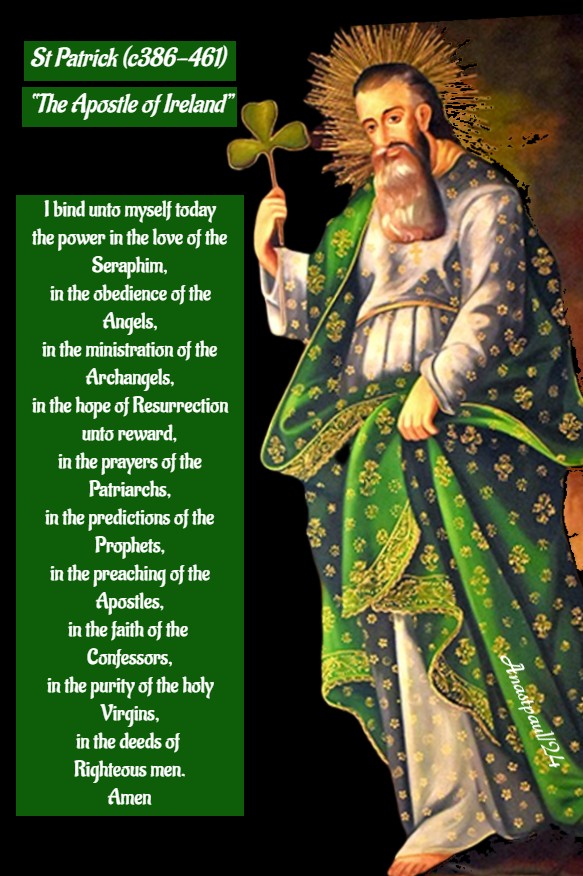
Prayer of St Patrick

I bind unto myself today
the power in the love of the Seraphim,
in the obedience of the Angels,
in the ministration of the Archangels,
in the hope of Resurrection unto reward,
in the prayers of the Patriarchs,
in the predictions of the Prophets,
in the preaching of the Apostles,
in the faith of the Confessors,
in the purity of the holy Virgins,
in the deeds of Righteous men.
Amen

St Patrick (c386-461)
“The Apostle of Ireland”

Posted in CHRIST the WORD and WISDOM, CHRIST, the BRIDEGROOM, CONFESSION/PENANCE, CONFESSORS, DIVINE Mercy, Goodness, Patience, ONE Minute REFLECTION, PATRONAGE, QUOTES on FORGIVENESS, QUOTES on MYSTERIES of our FAITH, QUOTES on THE MYSTICAL BODY, SACRED HEART ASPIRATIONS, St PAUL!, St PETER!, The APOSTLES & EVANGELISTS, The WORD

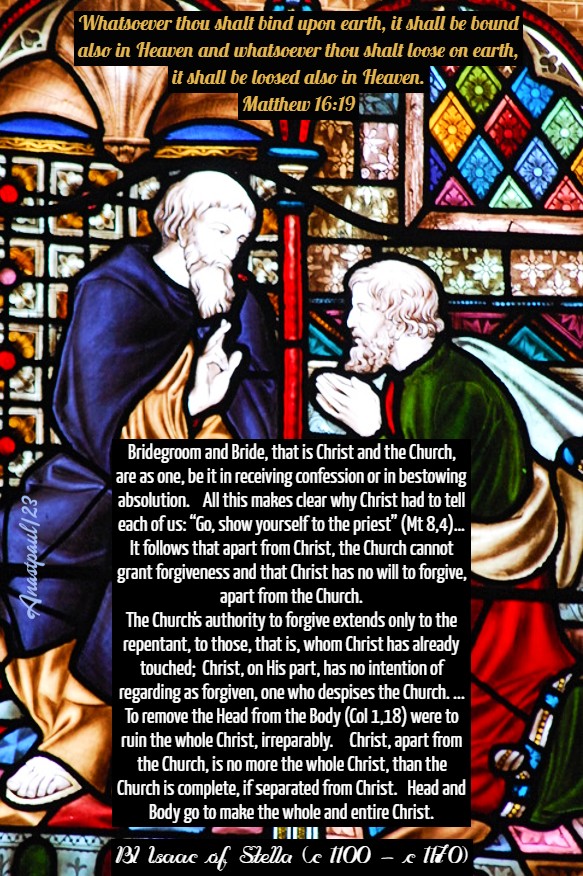
One Minute Reflection – 29 June –Whatsoever thou shalt bind upon earth … Matthew 16:19

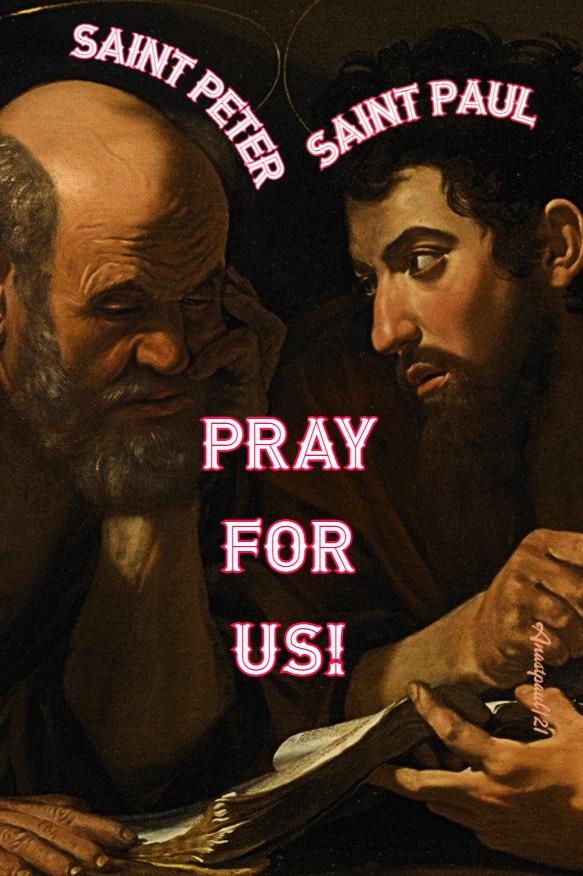
One Minute Reflection – 29 June – “The Month of the Most Sacred Heart of Jesus” – Saints Peter and Paul, Apostles – Within the Octave of the Sacred Heart – Pentecost III – Acts 12:1-11 – Matthew 16:13-19 – Scripture search here: https://www.drbo.org/

Whatsoever thou shalt bind upon earth, it shall be bound also in Heaven and whatsoever thou shalt loose on earth, it shall be loosed also in Heaven.” – Matthew 16:19

REFLECTION – “Bridegroom and Bride, that is Christ and the Church, are as one, be it in receiving confession or in bestowing absolution. All this makes clear why Christ had to tell each of us: “Go, show yourself to the priest” (Mt 8,4)… It follows that apart from Christ, the Church cannot grant forgiveness and that Christ has no will to forgive, apart from the Church. The Church’s authority to forgive extends only to the repentant, to those, that is, whom Christ has already touched; Christ, on His part, has no intention of regarding as forgiven, one who despises the Church.

Doubtless, Christ need accept no restraints to His power of Baptising, Consecrating the Eucharist, Ordaining Priests, forgiving sins and the like but, the humble and faithful Bridegroom, prefers to confer such blessings, with the co-operation of His Bride. “What God,” then, “has joined, let no man put asunder” (Mt 19,6). “I say this is a great mystery and refers to Christ and the Church” (Eph 5,32)… To remove the Head from the Body (Col 1,18) were to ruin the whole Christ, irreparably. Christ, apart from the Church, is no more the whole Christ, than the Church is complete, if separated from Christ. Head and Body go to make the whole and entire Christ.” – Bl Isaac of Stella (c 1100 – c 1170) Cistercian Monk, Abbot, Theologian, Philosopher (Sermon 11, §11-814).

PRAYER – O God, Who made this day holy by the Martyrdom of Thy Apostles Peter and Paul, grant Thy Church to follow in all things the teaching of those from whom she first received the faith. Through Jesus Christ, Thy Son our Lord, Who lives and reigns with Thee, in the unity of the Holy Ghost, God, world without end. Amen (Collect).

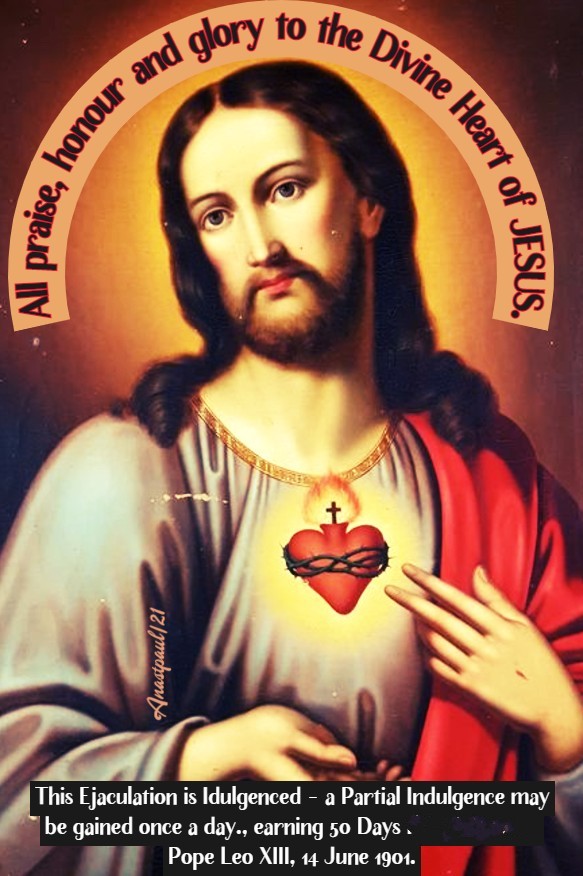
ALL PRAISE, honour and glory to the Divine Heart of JESUS. Indulgenced– 50 Days, once a day. 168 Pope Leo XIII, 14 June 1901.

Posted in DOCTORS of the Church, DOMINICAN OP, EUCHARISTIC Adoration, EUCHARISTIC ADORATION and Nocturnal, ONE Minute REFLECTION, QUOTES on ETERNAL LIFE, Quotes on SALVATION, QUOTES on the CROSS of CHRIST, SACRED HEART ASPIRATIONS, SAINT of the DAY, The HOLY CROSS, The WORD

One Minute Reflection – 6 June – Could anything be of more intrinsic value? St Thomas Aquinas

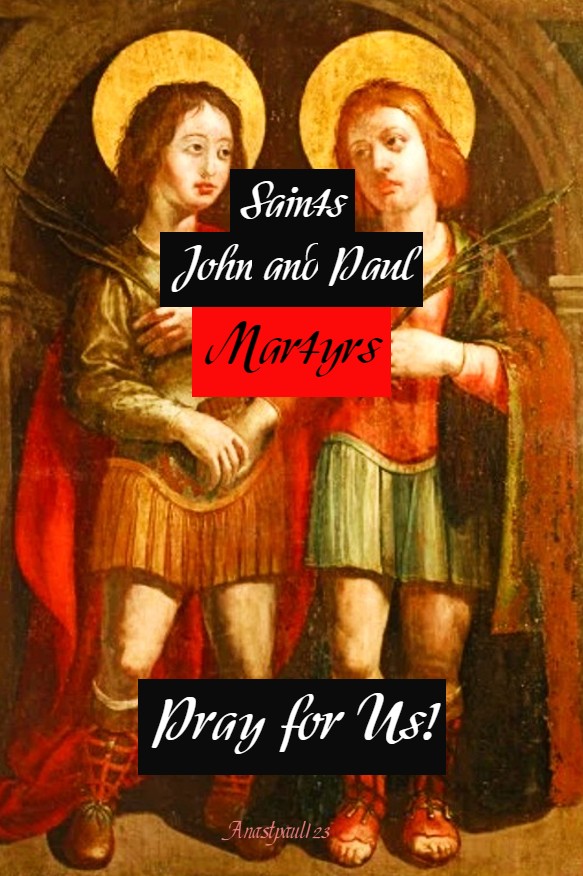
One Minute Reflection – 26 June – “The Month of the Most Sacred Heart of Jesus” – Saint John and Saint Paul of Rome (Died c362) Martyrs – The Octave Day of Corpus Christi – 1 Corinthians 23-29 – John 6:56-59 – Scripture search here: https://www.drbo.org/
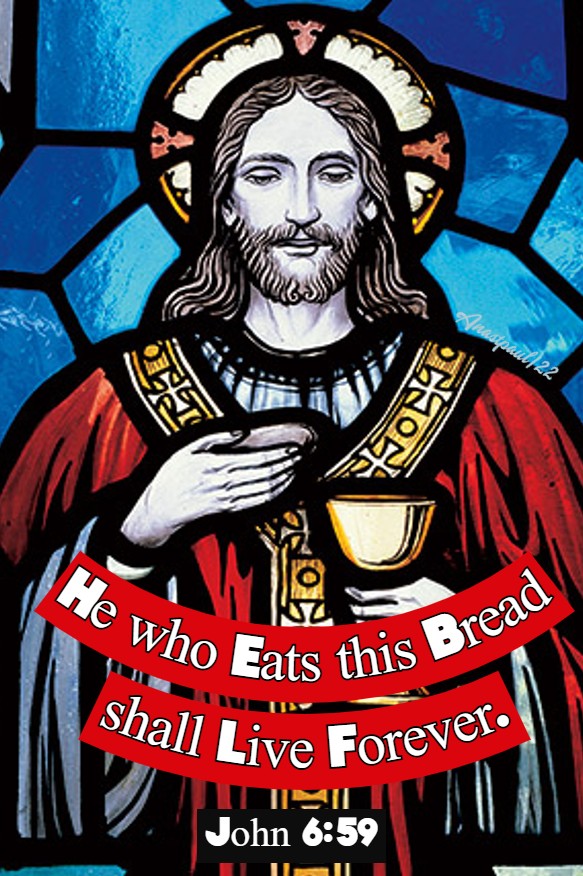
He who eats this Bread shall live forever.” – John 6:59

REFLECTION – “Since it was the Will of God’s Only-Begotten Son that men should share in His Divinity, He assumed our nature in order that, by becoming Man. He might make men gods . Moreover, when He took our flesh. He dedicated the whole of its substance to our salvation. He offered His Body to God the Father, on the Altar of the Cross, as a sacrifice for our reconciliation. He shed His Blood for our ransom and purification, so that we might be redeemed, from our wretched state of bondage and cleansed from all sin. But to ensure that the memory of so great a gift would abide with us forever, He left His Body as food and His Blood as drink, for the faithful to consume in the form of bread and wine.

O precious and wonderful banquet which brings us salvation and contains all sweetness! Could anything be of more intrinsic value? Under the old law, it was the flesh of calves and goats, which was offered but here, Christ Himself, the True God, is set before us as our food! What could be more wonderful than this? No other Sacrament has greater healing power; through it, sins are purged away, virtues are increased and the soul is enriched with an abundance of every spiritual gift. It is offered in the Church for the living and the dead, so that what was instituted for the salvation of all, may be for the benefit of all. Yet, in the end, no-one can fully express the sweetness of this Sacrament, in which spiritual delight is tasted at its very source, and in which, we renew the memory, of that surpassing love for us, which Christ revealed in His Passion.

It was to impress the vastness of this Love, more firmly upon the hearts of the faithful, that our Lord instituted this Sacrament at the Last Supper. As He was on the point of leaving the world to go to the Father, after celebrating the Passover with His disciples, He left it as a perpetual memorial of His Passion. It was the fulfilment of ancient figures and the greatest of all His Miracles, while, for those who were to experience the sorrow of His departure, it was destined to be a unique and abiding consolation.” – St Thomas Aquinas (1225-1274) Dominican Priest and Theologian, Doctor of the Church (An excerpt from On the Feast of the Body of Christ).

PRAYER – We beseech Thee, Almighty God that on this feast-day, we may have the double joy of celebrating blessed John and Paul, true brothers ,who obtained eternal glory through one Faith and one Martyrdom. Through Jesus Christ, Thy Son our Lord, Who lives and reigns with Thee, in the unity of the Holy Ghost, God, world without end. Amen (Collect).

O HEART of love, I place all my trust in Thee; for though I fear all things from my weakness, I hope all things from Thy mercies. – Ejaculation of Saint Margaret Mary – Indulgence 300 Days, Everytime – Raccolta 180 St Pius X, 3 June 1908.

Posted in DOCTORS of the Church, FATHERS of the Church, Of a Holy DEATH & AGAINST A SUDDEN DEATH, of the DYING, FINAL PERSEVERANCE, DEATH of CHILDREN, DEATH of PARENTS, ON the SAINTS, QUOTES on CHASTITY, QUOTES on DEATH, REDEMPTORISTS CSSR, St Francis de Sales, St JOSEPH

Quote/s of the Day – 31 March – St Joseph!

Quote/s of the Day – 31 March – Goodbye to “The Month of Saint Joseph”

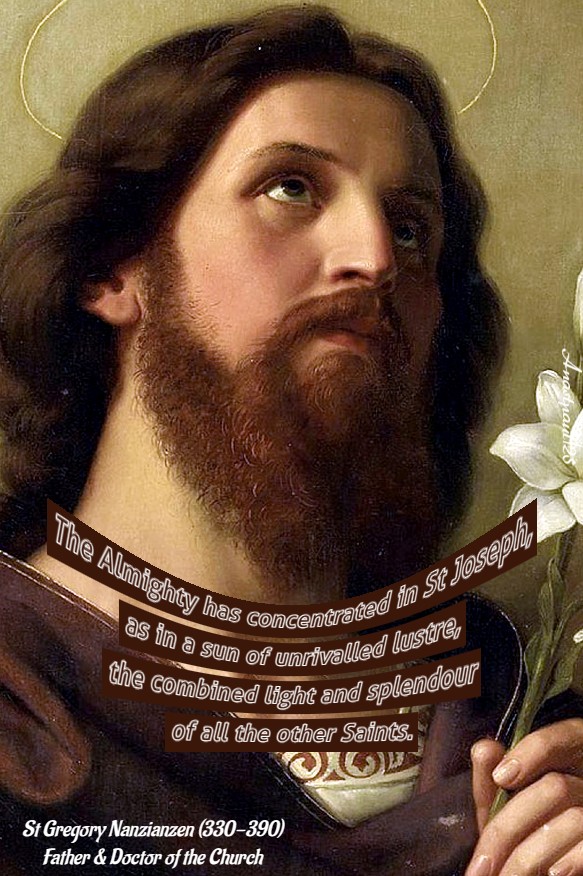
The Almighty has concentrated in St Joseph,
as in a sun of unrivalled lustre,
the combined light and splendour
of all the other Saints.

St Gregory Nanzianzen (330-390)
Father & Doctor of the Church

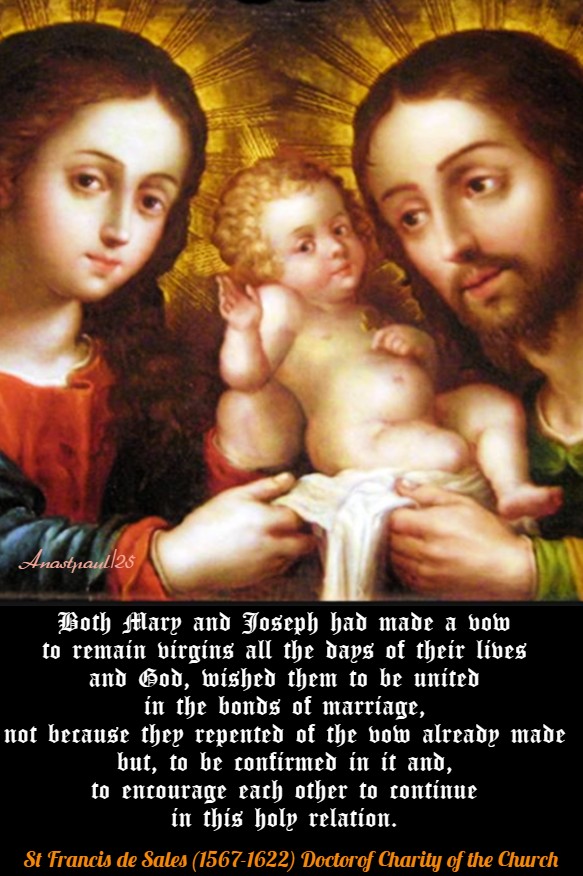
Both Mary and Joseph had made a vow
to remain virgins all the days of their lives
and God, wished them to be united
in the bonds of marriage,
not because they repented of the vow already made
but, to be confirmed in it and,
to encourage each other to continue
in this holy relation.

St Francis de Sales (1567-1622)
Doctorof Charity of the Church

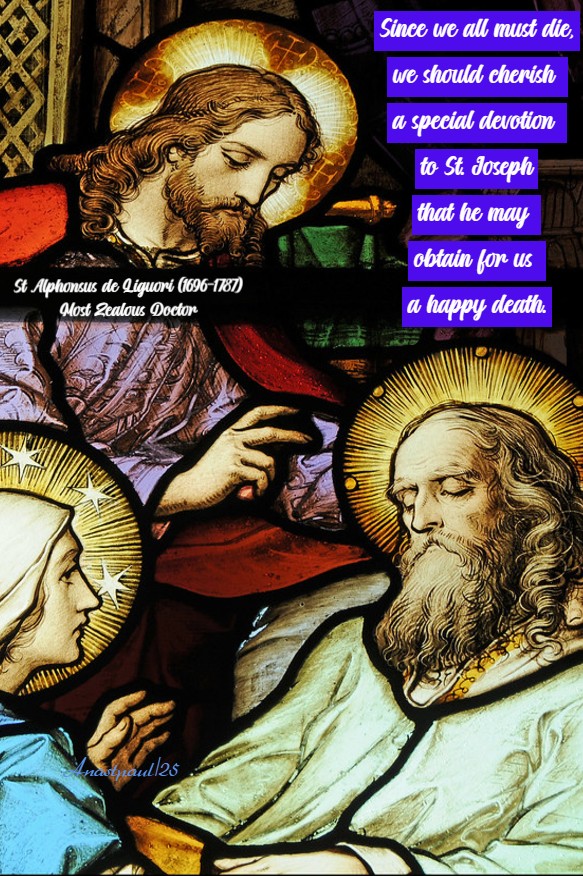
Since we all must die,
we should cherish a special devotion to St. Joseph
that he may obtain for us a happy death.

St Alphonsus Maria de Liguori (1696-1787)
Most Zealous Doctor

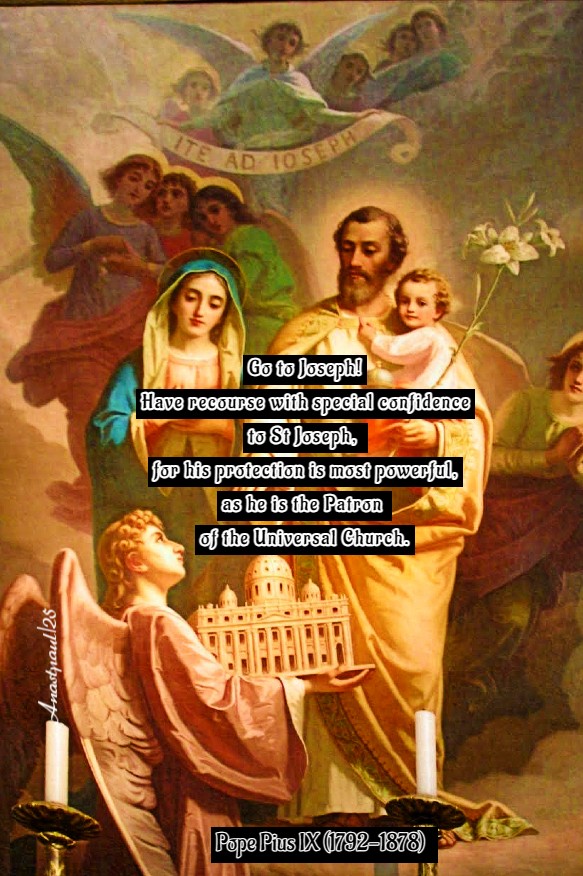
Go to Joseph!
Have recourse with special confidence to St Joseph,
for his protection is most powerful,
as he is the Patron of the Universal Church.

Pope Pius IX (1792-1878)

Posted in SAINT of the DAY, WIDOWS and WIDOWERS

Saint of the Day – 22 March – Saint Lea (Died 384) Widow

Saint of the Day – 22 March – Saint Lea (Died 384) Widow of Rome, a disciple of St Jerome, Nun, Prioress, Died in 384 of natural causes in Ostia, Rome. Patronage – of widows.

The Roman Martyrology reads today: “At Rome, St Lea, a widow, whose virtues and happy death are related by St Jerome.”

A letter which St Jerome wrote to St Marcella, the noblewoman and leader of a female community of a monastic type, who had gathered in her residence on the Aventine Way, provides the only information we have of St Lea.

Lea, herself of a noble and rich family, was a widow, who upon the death of her husband, she instead of re-marrying as had been arranged for her, entered St Marcella’s community, where they studied the Scriptures and fasted and prayed, living in chastity and poverty. Lea ultimately became the Superior.

St Jerome’s correspondence, written after Lea’s death, concentrated on Lea’s final fate in comparison with that of a Consul who had recently died. St Jerome’s words:

Who will praise the blessed Lea as she deserves? She renounced painting her face and adorning her head with shining pearls. She exchanged her rich attire for sackcloth and ceased to command others, in order to obey all. She dwelt in a corner with a few bits of furniture; she spent her nights in prayer and instructed her companions through her exampl, rather than through protests and speeches. And she looked forward to her arrival in Heaven in order to receive her recompense for the virtues which she practiced on earth.

So it is that thenceforth, she enjoyed perfect happiness. From Abraham’s bosom, where she resides with Lazarus, she sees our consul who was once decked out in purple, now vested in a shameful robe, vainly begging for a drop of water to quench his thirst. Although he went up to the capital, to the plaudits of the people and his death occasioned widespread grief, it is futile for the wife to assert, he has gone to Heaven and possesses a great mansion there. The fact is, he is plunged into the darkness outside, whereas Lea, who was willing to be considered a fool on earth, has been received into the House of the Father,, at the Wedding Feast of the Lamb.
Hence, I tearfully beg you to refrain from seeking the favors of the world and to renounce all that is carnal. It is impossible to follow both the world and Jesus.
Let us live a life of renunciation, for our bodies will soon be dust and nothing else will last any longer
.”

Posted in Against SORE THROATS, COUGHS, WHOOPING COUGH,, SAINT of the DAY

Saint of the Day – 1 March – Saint Swidbert (Died 713) Bishop, The Apostle of Friesland,

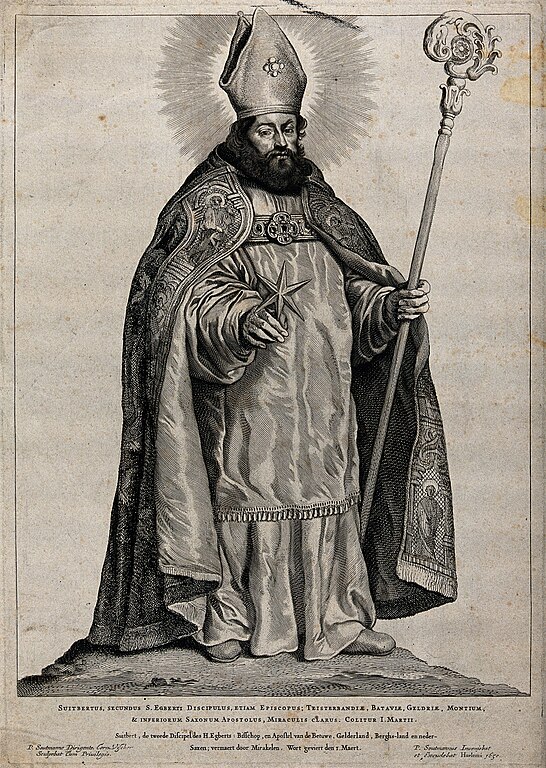
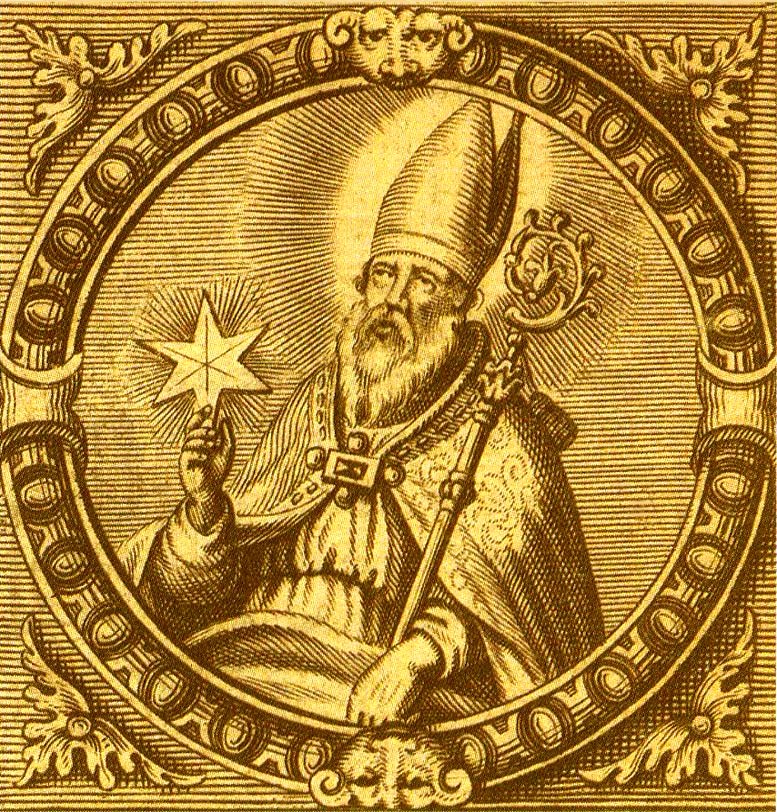
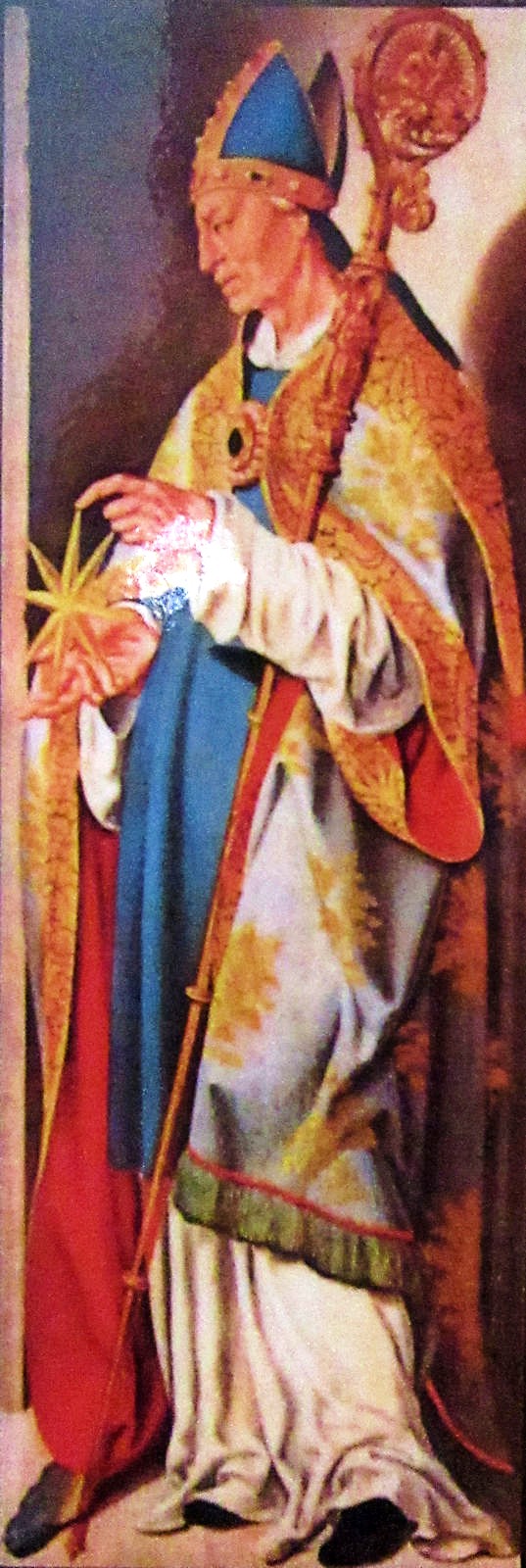
Saint of the Day – 1 March – Saint Swidbert (Died 713) Bishop, Missionary, Founder and Abbot of Kaiserswerth Monastery. Born in Northumbria, England and died on 1 March 713 in today’s Kaiserswerth near Düsseldorf in North Rhine-Westphalia. Patronages – of Germany, against sore throats, of Drevenack, Germany, of Friesland, Netherland, of Ripon, England. Also known as – … the Elder, Suitbert, Suidbert, Suitbertus, Swithbert, Apostle of Friesland, Apostle of the Bructeri. The Name from old High German means: “the strong shining one.

The Roman Martyrology reads today: “At Kaiserswerth, the Bishop, St Swidbert, who, in the time of Pope Sergius, preached the Gospel to the inhabitants of Friesland, Holland and to other Germanic peoples.

The tale of Swidbert’s birth which arose around 1500, tells how a star, sending out two rays, fell on his mother’s bed before his birth. Bishop St Aidan of Lindisfarne, interpreted her dream – the boy who was born would be called to work in two countries – Gaul and Germania.
Some traditions call Swidbert the son of Count Sigebert of Nottingham but he was most likely a Monk in the Monastery in Ripon under St Wilfrid of York. When St Wilfrid travelled to Rome in 678, Swidbert accompanied him and remained behind in Friesland on their return journey, as a missionary.

Another tradition reports that Swidbert left Ripon in 678 after Wilfrid’s departure and went to St Egbert in Rathmelsighe – today’s Mellifont – from wher, in 690, he was sent to southern Friesland together with twelve companions – including St Willibrord – as a Missionaries. In 692/693 his companions elected him as the Bishop, whereafter Swidbert returned to his homeland and was Ordained as a Missionary Bishop by St Wilfrid of York.

After another stay in Friesland, however, he then turned – as our wonderful Church Historian, the Venerable St Bede tells us – to missionary work in the area settled by the Bructeri on the Ruhr and Lippe. Swidbert’s work was unsuccessful – also because the invading Saxons destroyed his facilities. He now moved his activities to Frankish territory and in 695 founded the Benedictine Monastery of Swidbertswerth which was later named after him and later still, called Kaiserswerth and which, he headed as Abbot, on the Rhine island which had been given to him by the Mayor of the Merovingians, Pippin the Middle and his wife, Plektrudis

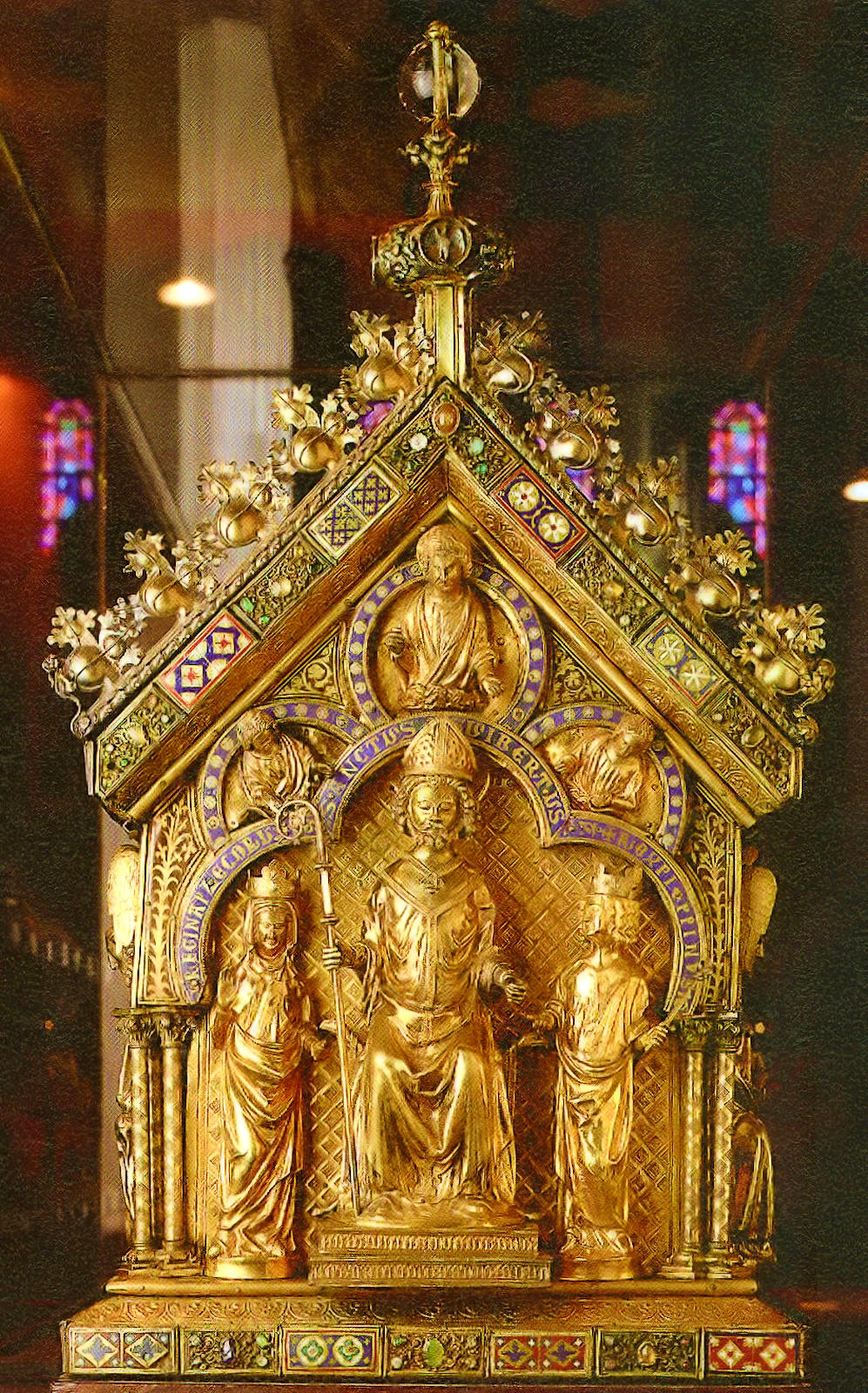
After his death, Swidbert was soon venerated as a Saint. In 877, the Church of his Monastery was dedicated, not only to Peter, as it had been from the beginning ,ut also to Swidbert. In 904, Swidbert was named as its sole Patron. His bones lie in a precious Shrine made between 1193 and 1332, in the collegiate Church in Kaiserswerth, where they were transferred in 1264, together with those of Abbot Wileich . Other Relics are kept in the Church of Peter and Paul in Duisburg-Süd.

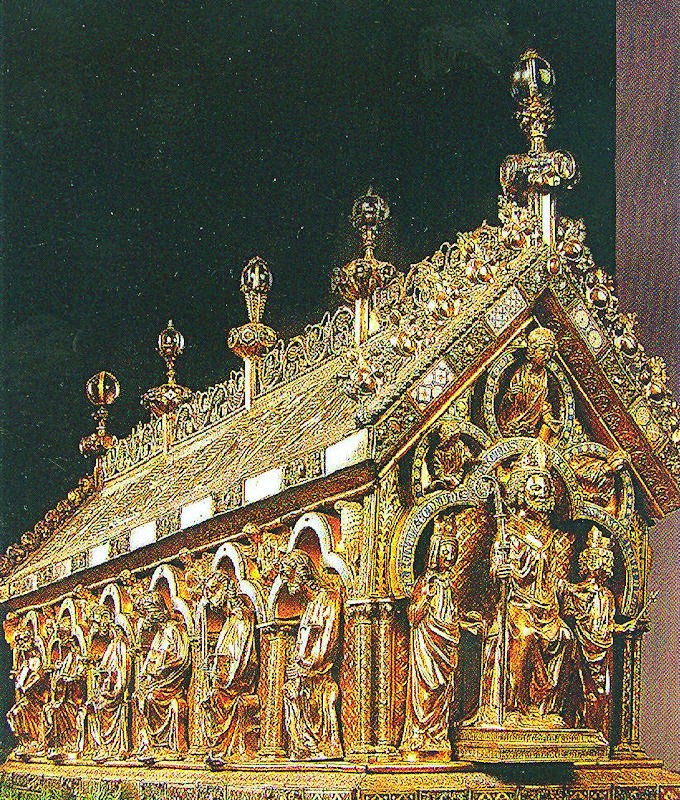
The precious Shrine in the Church in Kaiserswerth,

Swidbert’s Benedictine Monastery was apparently destroyed during the Saxon invasions at the end of the 8th Century, but was soon rebuilt. In the 12th Century, the Rhine Island previously named after Swidbert, was given its new name Kaiserswerth because of the importance of the imperial palace built in 1045. After secularisation, the Church became a Parish Church.

The Rear gable wall of the Swidbertus Shrine with Swidbert (centre), Plektrudis (Pippin’s wife)(left) and Pippin the Middle (right), 1264, in the Collegiate Church in Kaiserswerth
Posted in Of the Holy Souls in PURGATORY, PURGATORY, QUOTES on PATIENCE, The GREAT TRUTHS, VENIAL SIN

Thought for the Day – 19 February – The Punishment of Venial Sin

Thought for the Day – 19 February – Meditations with Fr Richard Frederick Clarke SJ (1839-1900)

Meditations on “The Great Truths”
From “The Devout Year
By Fr Richard Frederick Clarke SJ (1839-1900)

19th Day – The Punishment of Venial Sin

Thou shalt not go out from thence
until thou repay the last farthing.

(St Matthew v:26)

Venial Sin is the great evil in the world next to mortal sin and, therefore, it deserves a punishment greater than all the miseries of earth.
God has taught us what sort of an evil it is, by one or two instances of the way in which He visits it in this life.

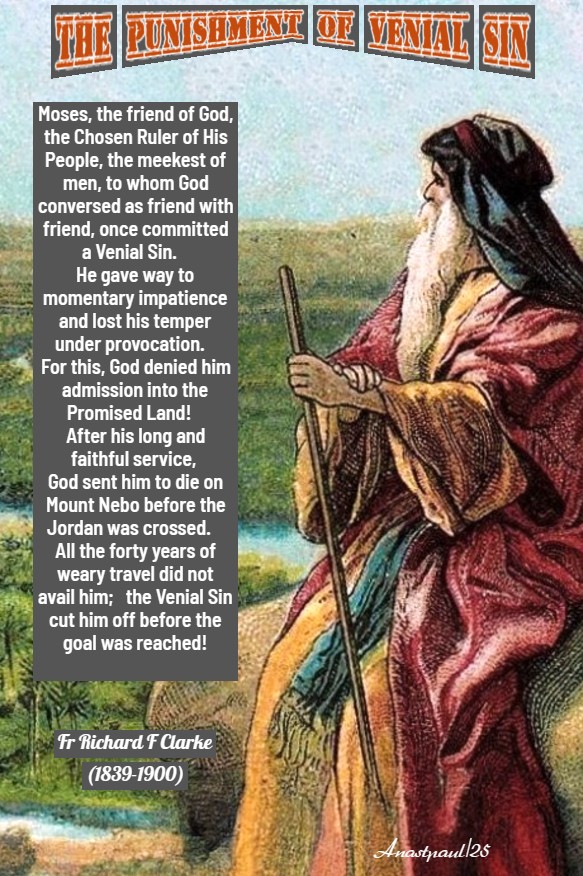
+1. Moses, the friend of God, the Chosen Ruler of His People, the meekest of men, to whom God conversed as friend with friend, once committed a Venial Sin. He gave way to momentary impatience and lost his temper under provocation. For this, God denied him admission into the Promised Land! After his long and faithful service, God sent him to die on Mount Nebo before the Jordan was crossed. All the forty years of weary travel did not avail him; the Venial Sin cut him off before the goal was reached!

+2. David , the man after God’s Own Heart, in a moment of vanity, determined to number the people, boastfully priding himself on the strength of his fighting men.
In punishment of this, God sent a pestilence which, in less than three days, destroyed seventy thousand Israelites.
Jerusalem itself, would have been decimated, had not David entreated God to avert His destroying Hand.
How God must hate Venial Sin!

+3. After death, there will remain for most, a debt still to be paid for Venial Sin.
It is in Purgatory where we shall see its true character.
No earthly agony even approaches the agony of the Purgatorial Fire. The souls God loves, must be tormented there until they have paid the last farthing.
Alas! what do I still owe?
Am I doing my best to pay the debt and avoid adding to it?
Beg for an intense dread of Venial Sin .

Posted in CONFESSORS, DOCTORS of the Church, FATHERS of the Church, I BELIEVE!, LENT- 2025, QUOTES on CHARITY, QUOTES on CONVERSION, QUOTES on FAITH, QUOTES on HOPE, QUOTES on PATIENCE, QUOTES on PERSEVERANCE, QUOTES on REPENTANCE

Quote/s of the Day – 16 February – Septuagesima Sunday

Quote/s of the Day – 16 February – Septuagesima Sunday

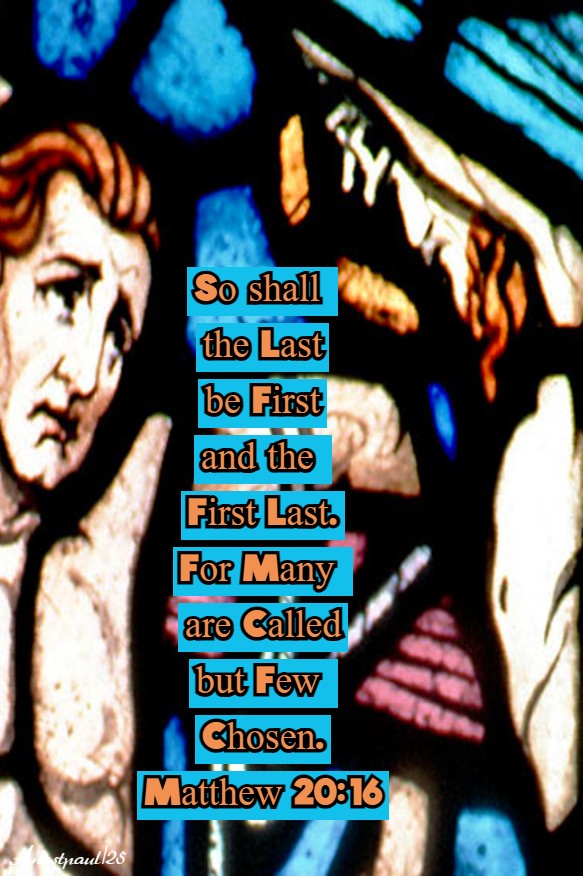
So shall the last be first
and the first last.
For many are called
but few chosen.

Matthew 20:16

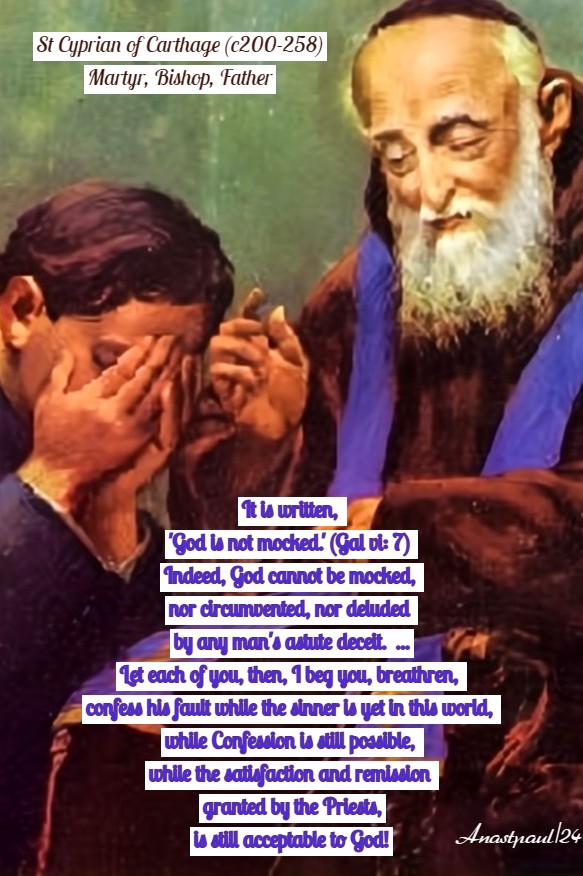
It is written, ‘God is not mocked.’ (Gal 6: 7)
Indeed, God cannot be mocked,
nor circumvented, nor deluded
by any man’s astute deceit. …
Let each of you, then, I beg you, brethren,
confess his fault while the sinner is yet in this world,
while Confession is still possible,
while the satisfaction and remission
granted by the Priests,
is still acceptable to God
!”

St Cyprian of Carthage (c200-258)
Martyr, Bishop of Carthage,
Father of the Church

Let us then, my brethren, endure in hope.
Let us devote ourselves, side-by-side with our hoping,
so that the God of all the universe,
as He beholds our intention,
may cleanse us from all sins,
fill us with high hopes from what we have in hand
and grant us the change of heart which saves.
God has called you and you have your calling
!”

St Cyril of Jerusalem (315-387)
Father and Doctor of the Church

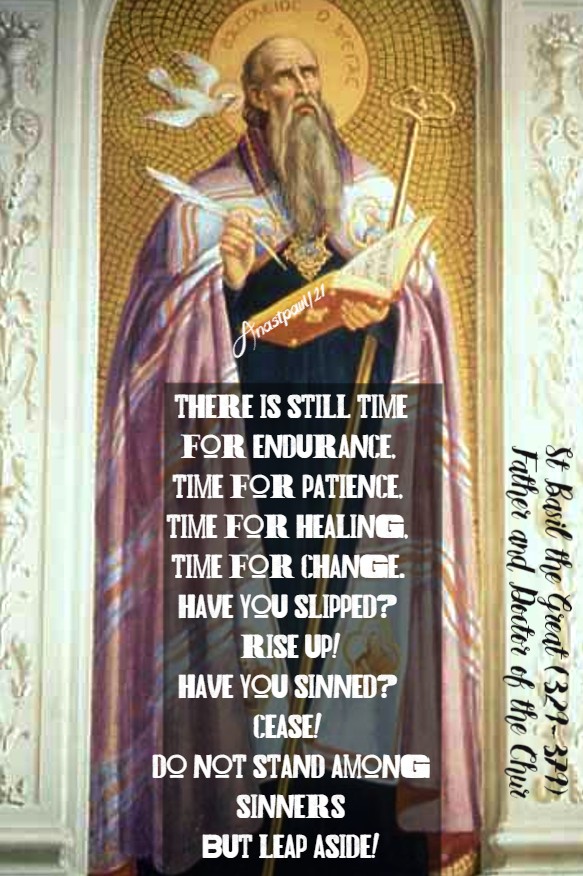
There is still time for endurance,
time for patience,
time for healing,
time for change.
Have you slipped?
Rise up!
Have you sinned?
Cease!
Do not stand among sinners
but leap aside
!”

St Basil the Great (329-379)
Father and Doctor of the Church

Listen to the Lord’s appeal:
‘Come, then, return to Me
and learn to know Me as your Father,
Who repays good for evil,
love for injury
and boundless charity
for piercing wounds
!”

St Peter Chrysologus (c400-450)
“Golden Words”
Father & Doctor of the Church

Posted in Against Unexplained FEVER or HIGH Temperatures, HORSES - and sick horses, JOCKEYS, all HORSE-related workers, Of GARDENERS, Horticulturists, Farmers, SAINT of the DAY

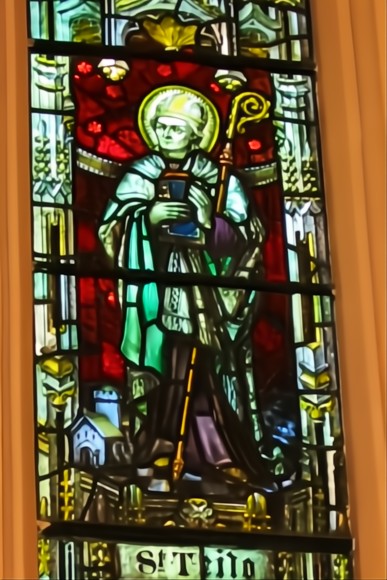
Saint of the Day – 9 February – Saint Teilo (6th Century) Bishop

Saint of the Day – 9 February – Saint Teilo (6th Century) Bishop of Llandaff, Wales. Welsh born in Penally, Wales and died at his See of Llandaff. Most Welsh sources confirm that Teilo was a close relative of St David, spiritual student of St Dyfrid and St Paulinus of Wales. Patronages – against fever, of horses, of apple orchards, farms and farmers, the City and Diocese of Cardiff (Capital of Wales), the Town of Saint-Thélo in Brittany, France . Also known as – Teilio, Teilus, Thelian, Teilan, Teilou, Teliou, Elidius, Eliud, Dillo, Dillon. The festival in honour of Saint Teilo is observed at different times of the year at different locations. In Wales and at Saint-Thélo, on 9 February; at Dol, on 29 November and on 25 November in the rest of the Churches in Brittany. Following 1752, however, his fair at Llandeilo in Wales, was not observed on the 9th but eleven days later on the 20th February or on the Sunday following that date.

St Teilo was probably born at Penally, near Tenby in Pembrokeshire, Wales, around the year 500. Although there are conflicting reports about his early life, he was thought to be a cousin of the national Patron of Wales, St David.

He received his education at institutions directed by Saints, one being St Dyfrid, who he succeeded as the Bishop of Llandaff, founding the very first Church in Llandaff, where the Cathedral stands today. He was also educated by St Paulinus of Wales at a place thought to be Whitland in Carmarthenshire. Here he is thought to have made contact with his cousin and became a close companion St David.

He travelled extensively, including Brittany, Rome and Jerusalem and to St David’s in north Pembrokeshire, where David founded his Monastery. Teilo too founded a Monasteries in Llandeilo (the name of the Town literally means ‘Church of St Teilo’), the place with which he is most associated and at Penally. Penally Abbey was located on the pilgrims’ trail to St David’s.

Legend has it that Teilo went on pilgrimage to Jerusalem with Saints David and St Padarn around the year 518. Three seats, one decorated ornately in gold, one of bronze and one of cedar, were erected in their honour in readiness for their Ordination as Bishops by the Bishop of Jerusalem. The legend has it that the humble Teilo chose the simple wooden seat.

A plague of Yellow Fever devastated parts of Wales in the year 547. Teilo and his followers fled, firstly to Cornwall and then to Brittany, where they were welcomed by St Samson of Dol. It is thought that Teilo and Samson planted a grove of apple-bearing trees between Dol and Cai, where the apple groves are still known as the groves of Teilo and Samson and still bear fruit today.

At Landaul in Brittany, Teilo is considered the Patron Saint of apple trees and the town of Saint-Thélo in Brittany which bears his name. At St. Teilo’s Church, one of the stained glass windows, shows an apple tree in honour of St Teilo.

Teilo returned from Brittany to Llandaff. He died on 9 February, most likely in the year 560. After his death he became one of the most venerated Saints in Wales. Several sites in Wales claim to house his remains. A tomb of St Teilo is located in Llandaff Cathedral while a part of his skull is kept in the South Chapel.

At least 25 Churches and schools in Wales, Brittany, Cornwall and Devon are dedicated to him.

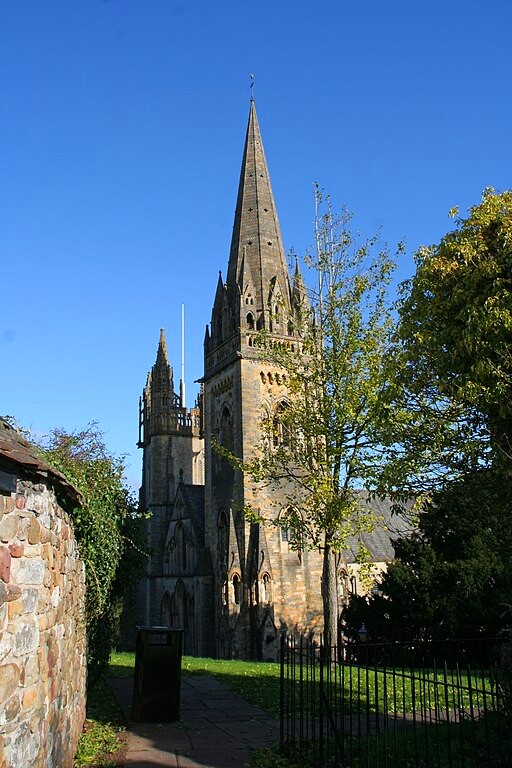
Llandaff Cathedral, Wales
Posted in FIRST THURSDAY DEVOTION, PRAYERS for PRIESTS, PRIESTS, all CLERGY, QUOTES on PRIESTS, the PRIESTHOOD and CONSECRATED LIFE

Quote/s of the Day – 6 February – First Thursday Devotion – PRAY for PRIESTS

Quote/s of the Day – 6 February – First Thursday Devotion – PRAY for PRIESTS

The Votive Mass of Our Lord Jesus Christ, Supreme and Eternal Priest, is often celebrated on First Thursdays of each month.
By Decree of 24 December 1935, all Priests may offer this Votive Mass on said First Thursday.
Those of us familiar with Catholic tradition will naturally realise that this is to commemorate the Institution of the Sacred Priesthood at the Last Supper.

O Holy Mother of God
A Prayer for our Priests
to the Most Blessed Virgin

By St Charles Borromeo (1538-1584)

O Holy Mother of God,
pray for the Priests
thy Son has chosen to serve His Church.
Help them by thy intercession,
to be holy,
zealous and chaste.
Make them models of virtue,
in the service of God’s people.
Help them to be prayerful in meditations,
effective in preaching
and enthusiastic in the daily offering
of the Holy Sacrifice of the Mass.
Help them to administer
the Sacraments with joy,
O Holy Mother of God.
Amen

Saint Charles Borromeo (1538-1584) He is known as the “Father of the Clergy” – Some of his Patronages: Bishops, Priests, Seminarians • Catechists • Catechumens • Spiritual Directors • Spiritual leaders

Posted in Holy Family PRAYERS, JANUARY month of THE MOST HOLY NAME of JESUS, MARCH the month of ST JOSEPH, MARIAN PRAYERS, Of FATHERS, GRANDfathers, GRANDparents, Of PARENTS & FAMILIES of LARGE Families, Our MORNING Offering, PRAYERS & NOVENA to St Joseph, PRAYERS for VARIOUS NEEDS, QUOTES on CHILDREN, QUOTES on the FAMILY, QUOTES/PRAYERS on THE FAMILY, The HOLY FAMILY

Our Morning Offering – 5 February – A Parent’s Prayer to St Joseph

Our Morning Offering – 5 February – “The Month of the Blessed Trinity” – On Wedmesdays, Catholics make a special devotion to St Joseph by going to Mass on the 1st Wednesdays of 9 consecutive months and offering their Communions in his honour and for the salvation of the dying.

A Parent’s Prayer to St Joseph

O holy Joseph,
thou faithful Spouse
of the Blessed Mother,
thou who didst protect her
and her Divine Child with such care
and didst devote thy whole life to them;
I beseech thee to be also my
and my children’s protector
and advocate, with Jesus,
thy adopted Son.
Obtain for me the grace
to fulfil my duties to my children,
as thou and Mary have done to Jesus.

St Joseph Pray for all our Fathers
and for our spiritual Fathers
of Holy Mother Church
Amen.

Posted in PREACHERS, PRIESTS, all CLERGY, SAINT of the DAY

Saint of the Day – 2 February – St Flosculus (5th-6th Century) the 11th Bishop of Orléans

Saint of the Day – 2 February – St Flosculus (5th-6th Century) the 11th Bishop of Orléans, in France, a beloved and zealous shepherd of the French Diocese of Orléans, a renowned and highly effective Preacher and a active and committed Apostle of charity and of the poor and needy. Patronages – of the City and Diocese of Orléans , of all Preachers and Priests. Also known as – Floscolo, Flosculus. Flou, Fulcolus, Furcolus, Fuscolus.

The Roman Martyrology simply states: “At Orléans, the holy Bishop Flosculus.

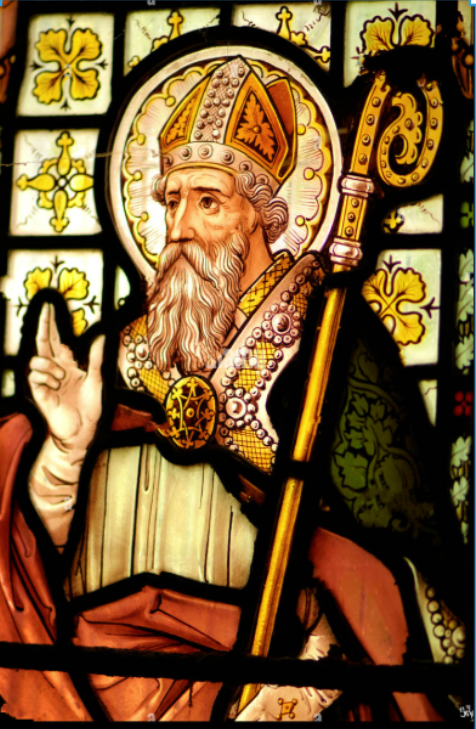
This Stained glass image is actually of an unknown Bishop

Very little is known about Flosculus but, it is certain that, he was a Bishop much loved by his people. His life is recorded by only one document, the Martyrology of St Jerome which reports his death on 2 February, unknown year.

The list of Bishops of Orléans, places him in eleventh place. From this latter record, we deduce that Flosculus was a very active Bishop in his Diocese. He was an eloquent preacher and a tireless worker for the spread of the Gospel. He also devoted himself to the poor and needy and was a great example of charity and compassion.
His fame for sanctity, spread rapidly and he was soon venerated as a Saint by the people of Orléans. His cult was confirmed by Pope Pius IX in 1871.

In addition to the Martyrology of St Jerome, there are also some legends transmitted regarding Saint Flosculus. One of these relates that one day, while the saint was preaching in a square in Orléans, a man who had fallen from grace accused him of being an impostor. Flosculus, without batting an eye, looked him in the eye and said: “If what I say is false, may heaven strike me down!” At that moment, lightning struck the man, killing him instantly. This legend can also be seen as a metaphor for the strength of Saint Flosculus’ faith. His words, were so powerful, being the Word of his Master, that they could defeat evil!

On this date, St Flosculus’ Feast, 2 February, Holy Masses and Processions in his honour are held in many Churches in Orléans. The Saint is the Patron of the City and Diocese of Orléans and of all Preachers and Priests.

In Lombardy, Saint Flosculus is especially venerated in the Province of Mantua, Italy. In Castiglione delle Stiviere, in Mantua, there is a Church dedicated to the Saint. In this Church, on 2 February, a Procession and festivities are held in his honour.

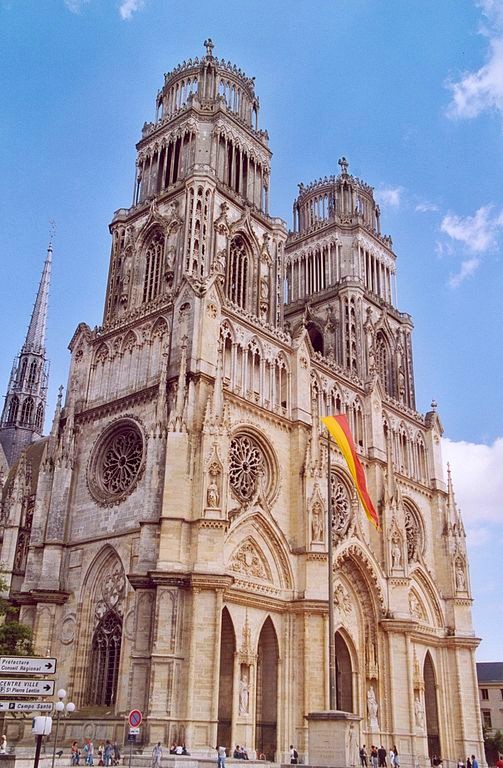
Orléans Cathedral

Posted in DOMESTIC ANIMALS, Of ANIMALS / ANIMAL WELFARE, Of the SICK, the INFIRM, All ILLNESS, PATRONAGE, SAINT of the DAY

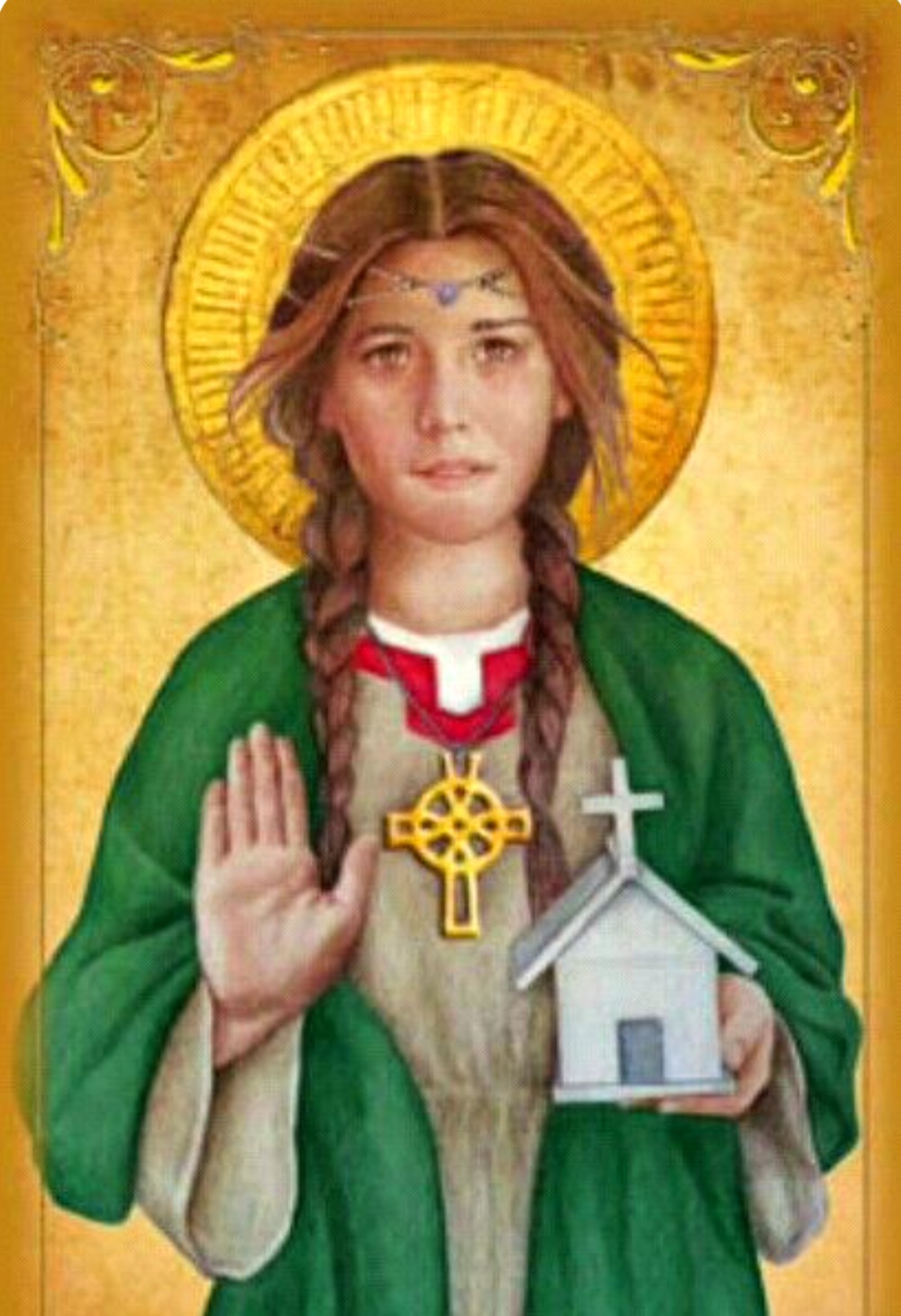
Saint of the Day – 25 January – St Dwynwen (Died c460) Virgin

Saint of the Day – 25 January – St Dwynwen (Died c460) Virgin, Princess, Nun. Patronages – lovers (especially in Wales where her Feast today is celebrated in a similar as that of St Valentine’s Feast on 14 February), of the sick and of animals in danger. Also known as – Donwen, Donwenna, Dunwen, Dwyn – this last is the ‘pet’ name of our Saint and the most often used.

Dwynwen lived in the 5th Century, the daughter of Saint Brychan of Brecknock (6 April), a prolific Welsh King who fathered 24 sons and daughters, all venerated as Saints and very famous especially in the Celtic world. Dwynwen, another daughter of the august parent King was then naturally a Princess. She was a beautiful and virtuous girl and fell madly in love with a Welsh Prince, Maelon Dafodrill,but the idea of ​​marriage faded naturally from her heart.

Several legends have attempted to find an explanation for this loss of the romantic fervour – one of them could be that King Brychan had already promised his daughter to another Prince. The Saint, however, understood that her calling was to dedicate her existence to God by undertaking a religious life. She then tried to separate from Maelon but he reacted by drastically changing towards her and becoming unbearable.

Dwynwen took refuge in the woods, raising fervent prayers to God to help her and put an end to her miseries. She fell asleep and when she awoke she had been given a sweet drink which immediately deprived her of Maelon’s attentions and the sadness of her heart. The same drink was given to Maelon but in him, it had the effect of transforming him into an ice statue. Dwynwen then prayed again for three of her requests to be granted – that Maelon be freed from the ice, that she might never wqish to marry again and finally, that all lovers, with the help of God, find happiness through the fulfillment of their love or be healed of their passions.

God granted all her prayers and she did not hesitate to devote her entire existence to Him. She then founded a Convent on the Island of Llanddwyn, just opposite the Island of Anglesey (Yns Mon). She died there around the year 460.

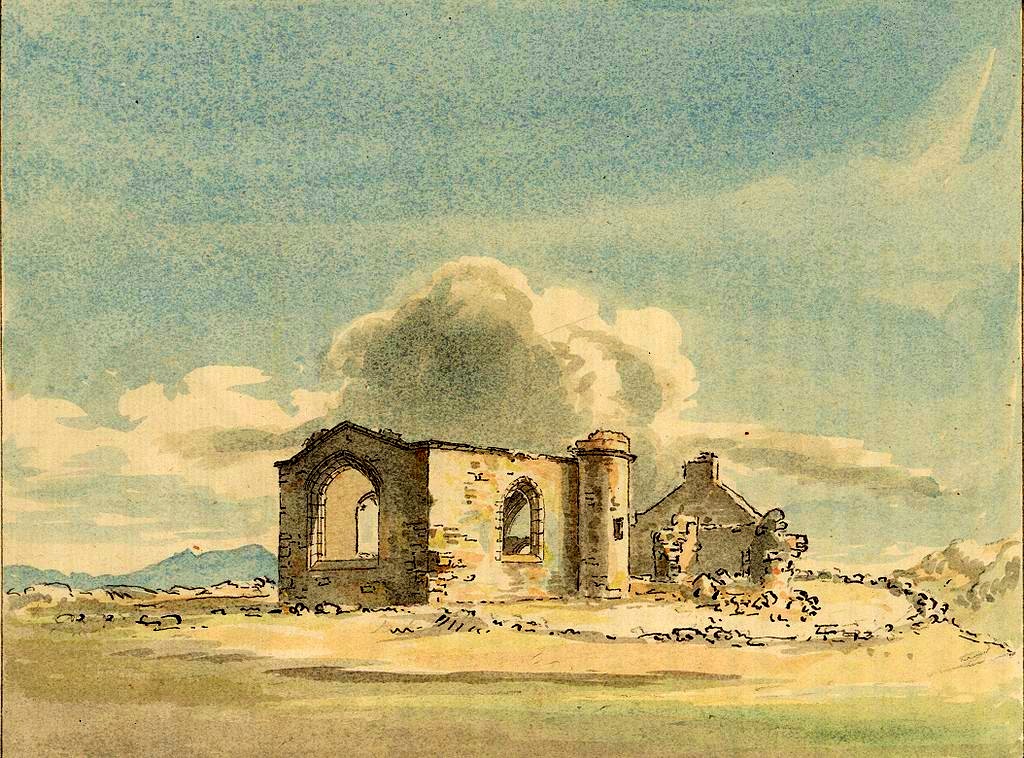
St Dwynwen’s Church, Llanddwyn c1778

Here a fountain of fresh water called Ffynnon Dwynwen was considered a holy spring and soon became a place of pilgrimage. Over time the Saint was also invoked for the healing of the sick and animals in danger, a tradition which has survived to the present day.

The ruins of Llanddwyn Chapel, a 16th Century Tudor Church built on the site of an ancient priory, can still be seen today. St Dwynwen’s name is also invoked in the Town of Porthddwyn and a Church remains dedicated to her in the British peninsula of Cornwall.

St Dwynwen is celebrated especially throughout Wales and by lovers, on 25 January. One of the Dwynwen’s favourite maxims was: “Nothing wins hearts like joy.

St Dwynwen’s Church, Llanddwyn
Posted in Against SNAKE BITES / POISON, Against STORMS, EARTHQUAKES, THUNDER & LIGHTENING, FIRES, DROUGHT / NATURAL DISASTERS, Against Unexplained FEVER or HIGH Temperatures, PATRONAGE - TOOTHACHE and Diseases of the TEETH,, of DENTISTS, SAINT of the DAY

Saint of the Day – 22 January – Saint Dominic of Sora (951-1031) Abbot

Saint of the Day – 22 January – Saint Dominic of Sora (951-1031) Abbot, Priest, Founder of many Monasteries, Miracle-worker. Born in 951 at Foligno, Etruria (Tuscany district of modern Italy) and died on 22 January 1031 in his Monastery in Sora, Campania, Italy of natural causes. Patronage – against fever, against toothache, against poisonous snakes and snake bites, against rabid dogs, protection from storms and hail, of the Italian Towns of Sora and Cocullo. Also known as – Dominico.

The Roman Martyrology reads today: “At Sora, the holy Abbot Dominic, renowned for miracles.

The Monk Giovanni, who was Dominic’s companion on all his travels, wrote his ‘Life’ which is, therefore, very accurate and truthful.

Domenic was born in Foligno in 951. He was entrusted as a child by his parents, to the Monks of St Silvester of Foligno, to carry out the necessary studies. When he became a young man, Dominic left everyone and went to the Monastery of St Maria di Pietrademone, where he was Ordained a Priest and vowed his profession as a Monk.
But Dominic desired a Hermit’s life, so he began to alternate solitude with the community life – he retired to a mountain in the Province of Rieti. But he was immediately followed by disciples from the surrounding area, for them he founded the Monastery of St Salvatore, becoming its Abbot.

Since his fame of sanctity attracted many people, to hide he moved towards L’Aquila, where he founded the Monastery of St Pietro del Lago, in the same way he founded the Monastery of St Pietro di Avellana in the Sangro region. During his journeys he arrived in Campania, where he remained unknown, for three years, until the population recognised him through some hunters, surrounded him with devotion and there was a rush of sick people. The reports of his miracles consisted above all, in curing the illness and death caused by snake bites, hence his Patronage.

In Trisulti he founded the Monastery of St Bartolomew which achieved much fame, it was richly endowed by the inhabitants of the nearby municipalities which Domenic then visited, urging them to a life woven with charity, penance and good works.

Dominic met with Pope John XVIII, from whom he asked for Papal protection for his foundations. Thanks to a donation of land, made by Count Pietro Rainerio, the Lord of Sora, he was able to build another Monastery, which remained, due to its importance, linked to his name, permanently.

Dominic fell ill while undertaking yet another journey to Tusculum but he returned back to Sora and died there on 22 January 1031 and was buried in the Monastery Church, where he is still preserved.

Dominic of Sora, like other great Founders of that era, remains a reformer of the life of the medieval Church, all intent on expanding monastic life with its great flowering, also a precursor of the great Orders which, a few centuries later, would appear in the Church, starting with his great namesake St Dominic of Guzman.

In Sora, as in the whole Liri Valley, he is invoked against the bites of poisonous snakes and rabid dogs, from storms and hail but also against fever and toothache.

His Feast is celebrated with solemnity, both in Sora, of which he is the Patron and where there is a Sanctuary containing his body and in Arpino and nearby Towns but above all, for his particularity in Cocullo, where his Statue is carried in procession covered in real live snakes! Once, after the Mass, the snakes were killed or sold to tourists, today with a different environmentalist culture, they are set free. The ‘snake catchers’ are very careful to capture the harmless snakes, while they leave the poisonous vipers alone, the population participating in the celebrations has an almost sacred respect for reptiles, a legacy of a pagan cult of pre-Christian times which the Church had to make its own and this union, between pagan use and Christian celebration, in this case occurred through St Domenic of Sora, the great miracle- worker, who from the Middle Ages until today, attracts a multitude of imploring faithful ever venerating and imploring his aid in all their needs.

A Processional Statue of St Dominic I believe the one used in Cocullo and covered with live snakes
Posted in CHILDREN / YOUTH, Of ANIMALS / ANIMAL WELFARE, SAINT of the DAY

Saint of the Day – 18 January – St Deicolus (c530-625) Abbot

Saint of the Day – 18 January – St Deicolus of Lure (c530-625) Abbot, Founder of the Monastery at Lure, Companion and Disciple of St Columban, some believe Deicolus to be the older brother of St. Gall (c550-c645) who was also one of St Columban’s original 12 companions, Missionary. Born in Leinster, Ireland and died in 625 at Vosges, France of natural causes. Patronages curing of children’s illnesses, protector of livestock. Also known as – Deel, Deicolo, Deicola, Deille, Delle, Desle, Dichul, Diey, Deicuil, Dicuil.

The Roman Martyrology reads today: “In Brittany, St Deicola, Abbot, disciple of St Columban.

The Life of St Deicolus

Born in Leinster, Deicolus and his brother, Gall, studied at Bangor Abbey in County Down. He was selected to be one of the twelve disciples to accompany St Columbanuon his missionary journey.

In 576 he journeyed to France and laboured with Columban in Austrasia and Burgundy. Deicolus is believed to have resided with Columban at the Monastery of Luxeuil from c590.

In 610, when Columban was expelled by King Theuderic II, Deicolus, then eighty years of age, determined to follow his master,but was forced, to abandon the journey due to the inadeguacies of his age and remained behind alone.

Diecolus establishing a hermitage at a nearby Church dedicated to Saint Martin in a place called Lure, in the Diocese of Besançon.

Until his death, he became the apostle of this district, where he was given a Church and a tract of land by Berthelde, widow of Weifar, the lord of Lure. Soon a noble Abbey was erected for his many disciples and the Rule of St Columban was adopted.

Numerous miracles are recorded of Deicolus, including the suspension of his cloak on a sunbeam and the taming of wild beasts.

Clothaire II, the King of Burgundy, recognised the virtues of Deicolus and considerably enriched the Abbey of Lure, also granting Deicolus the manor, woods, fisheries, of the Town which had grown around the Monastery.

St Deicolus and the bear

Feeling his end approaching, Deicolus conceded the government of his Abbey to Columban, one of his young Monks and retreated to a little Oratory he had built a in honour of the Holy Trinity, where he died on 18 January c625.

His Feast is observed on this day, his birthday into Heaven. So revered was his memory that his name Diacolus, under the shortened French form of Del or Deel and Deela, (being corrupted from Del de Lure) is still borne by many of the children of the Lure district and too, is often found there as a surname. St Diacolus’ cultus is strong in the area of Lure where a Spring associated with St Diacolus has miraculous properties and, in particular, to cure children’s ailments if their garments were washed in this water.

St Del Chapel the destination of the Pilgrimage

Saint Deicolus is considered a Saint who heals illnesses in young children but also a regarded as a protector of livestock. There are mirackes associated with a wild bear which I have been unable to trace. A pilgrimage takes place today 18 January, to the Chapel of Gerbamont where he died.

His memory is also perpetuated in several other Lorraine Villages. His Vita and Acts were written by a Monk of his own Monastery in the 10th Century.

Relics of St Deicolus and St Columban at the Church of St Martin in Lure
Posted in ASPIRATIONS and EJACULATIONS, CATECHESIS, CHRIST the WORD and WISDOM, DOCTORS of the Church, FATHERS of the Church, JANUARY month of THE MOST HOLY NAME of JESUS, MARCH the month of ST JOSEPH, MARIAN QUOTES, Of a Holy DEATH & AGAINST A SUDDEN DEATH, of the DYING, FINAL PERSEVERANCE, DEATH of CHILDREN, DEATH of PARENTS, PARTIAL Indulgence, QUOTES on MARRIAGE, MARRIED LOVE, St Francis de Sales, St JOSEPH, The HOLY FAMILY, THE HOLY FAMILY - FAMILIAE SANCTAE

Quote/s of the Day – 7 January – The Holy Family

Quote/s of the Day – 7 January – “The Month of the Holy Name of Jesus and the Holy Family”and the Feast of the Holy Family

Indulgenced Holy Family Aspiration

Jesus, Mary and Joseph,
I give Thee my heart and my soul;
Jesus, Mary and Joseph,
assist me in my last agony;
Jesus, Mary and Joseph,
may I breathe forth my soul in peace with Thee.

(Indulgence of 300 days, Each Time.
Pope Pius VII, 26 August 1814)

When husband and wife
are united in marriage
they no longer seem like something earthly
but rather, like the image of God Himself!

St John Chrysostom (347-407)
Father & Doctor of the Church

The One Who is the Wisdom of the Father,
put His arms around her neck,
the One Who is the strength,
that gives movement to everything,
sat in her arms. He Who is the rest of souls, (Mt 11:29)
rested on her motherly breast.
… Filled with the Holy Spirit,
she held Him close to her heart …
She never had enough of seeing Him
or of hearing Him,
,,, Thus Mary grew evermore in love and her mind
was unceasingly attached to Divine contemplation.

St Amadeus of Lausanne (1108-1159)

Since God could choose for the Guardian of His Son,
the man in the world, the most accomplished
in all sorts of perfections,
according to the dignity
and excellence of his Charge,
Who was His most Glorious Son,
the universal Prince of Heaven and earth,
how could it be that being able,
He did not will it and did not do it?
There is, then, NO DOUBT that St Joseph
was endowed with all the graces
and all the gifts that were required
for the care which the Eternal Father
willed to give him,
of the temporal and domestic economy
of our Lord and of the guidance of his family …

St Francis de Sales (1567-1622)
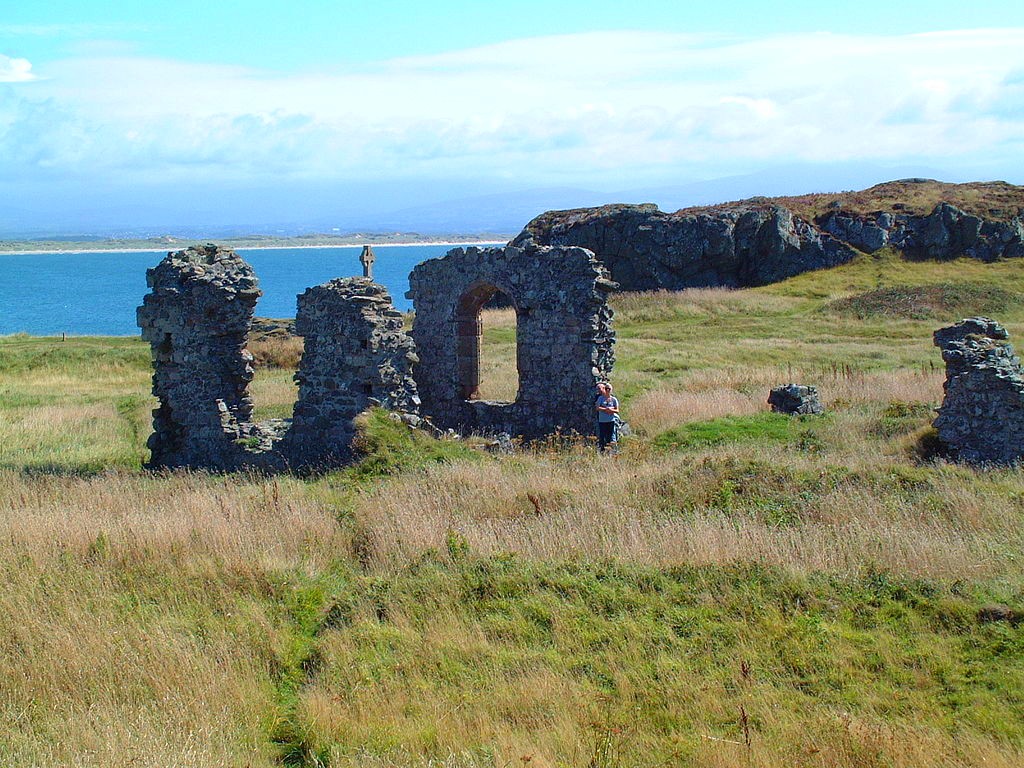
Doctor Caritas

MORE:
https://anastpaul.com/2024/01/07/quote-s-of-the-day-7-january-the-holy-family/