Quote/s of the Day – 6 February – First Thursday Devotion – PRAY for PRIESTS
The Votive Mass of Our Lord Jesus Christ, Supreme and Eternal Priest, is often celebrated on First Thursdays of each month. By Decree of 24 December 1935, all Priests may offer this Votive Mass on said First Thursday. Those of us familiar with Catholic tradition will naturally realise that this is to commemorate the Institution of the Sacred Priesthood at the Last Supper.
O Holy Mother of God A Prayer for our Priests to the Most Blessed Virgin By St Charles Borromeo (1538-1584)
O Holy Mother of God, pray for the Priests thy Son has chosen to serve His Church. Help them by thy intercession, to be holy, zealous and chaste. Make them models of virtue, in the service of God’s people. Help them to be prayerful in meditations, effective in preaching and enthusiastic in the daily offering of the Holy Sacrifice of the Mass. Help them to administer the Sacraments with joy, O Holy Mother of God. Amen
Saint Charles Borromeo (1538-1584) He is known as the “Father of the Clergy” – Some of hisPatronages: Bishops, Priests, Seminarians • Catechists • Catechumens • Spiritual Directors • Spiritual leaders
Our Morning Offering – 5 February – “The Month of the Blessed Trinity” – On Wedmesdays, Catholics make a special devotion to St Joseph by going to Mass on the 1st Wednesdays of 9 consecutive months and offering their Communions in his honour and for the salvation of the dying.
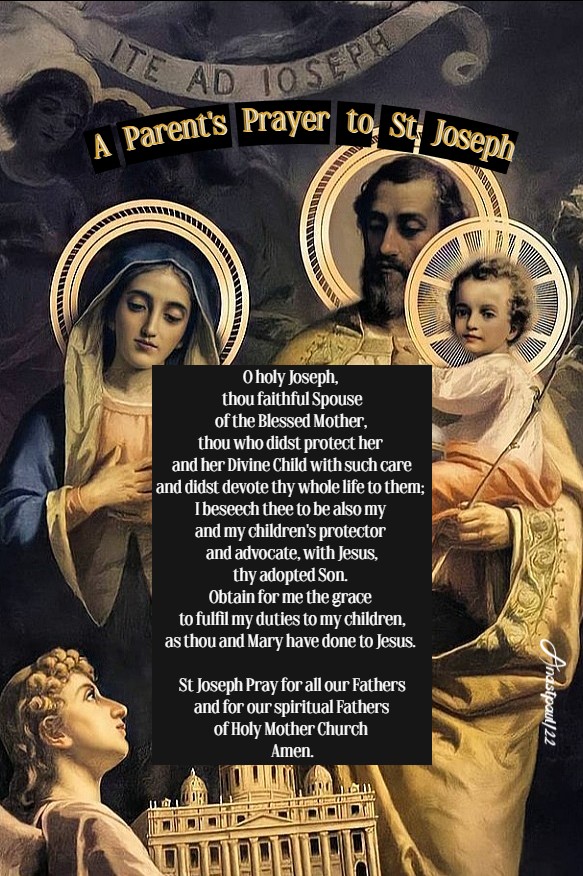
A Parent’s Prayer to St Joseph
O holy Joseph, thou faithful Spouse of the Blessed Mother, thou who didst protect her and her Divine Child with such care and didst devote thy whole life to them; I beseech thee to be also my and my children’s protector and advocate, with Jesus, thy adopted Son. Obtain for me the grace to fulfil my duties to my children, as thou and Mary have done to Jesus.
St Joseph Pray for all our Fathers and for our spiritual Fathers of Holy Mother Church Amen.
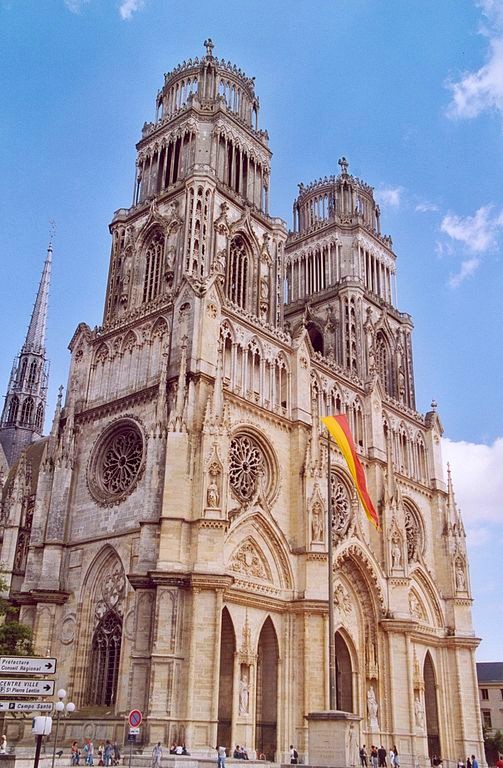
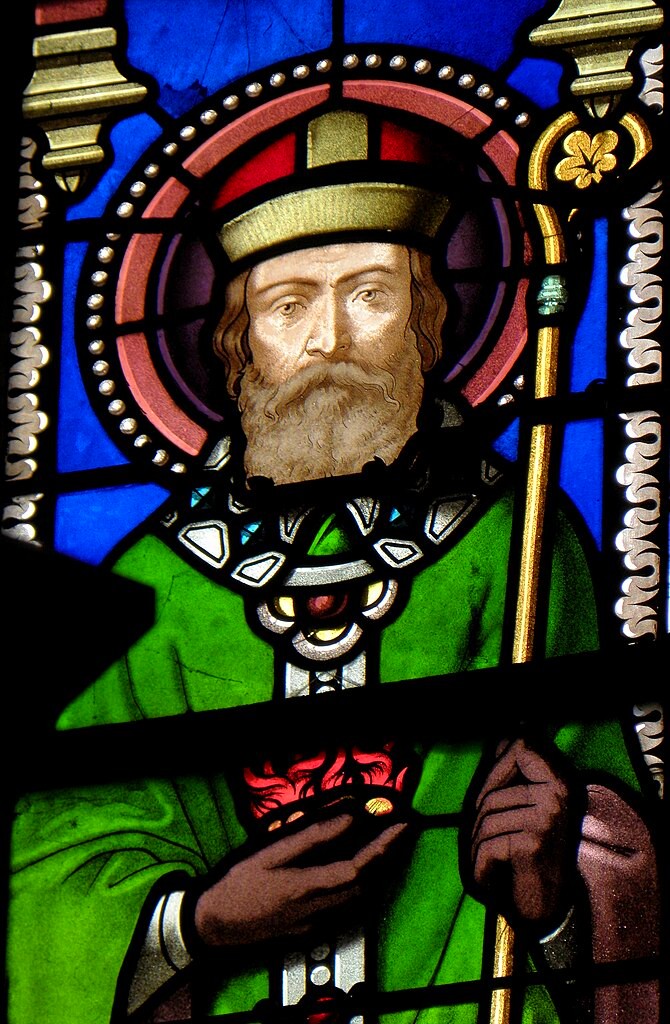
Saint of the Day – 2 February – St Flosculus (5th-6th Century) the 11th Bishop of Orléans, in France, a beloved and zealous shepherd of the French Diocese of Orléans, a renowned and highly effective Preacher and a active and committed Apostle of charity and of the poor and needy. Patronages – of the City and Diocese of Orléans , of all Preachers and Priests. Also known as – Floscolo, Flosculus. Flou, Fulcolus, Furcolus, Fuscolus.
The Roman Martyrology simply states: “At Orléans, the holy Bishop Flosculus.”
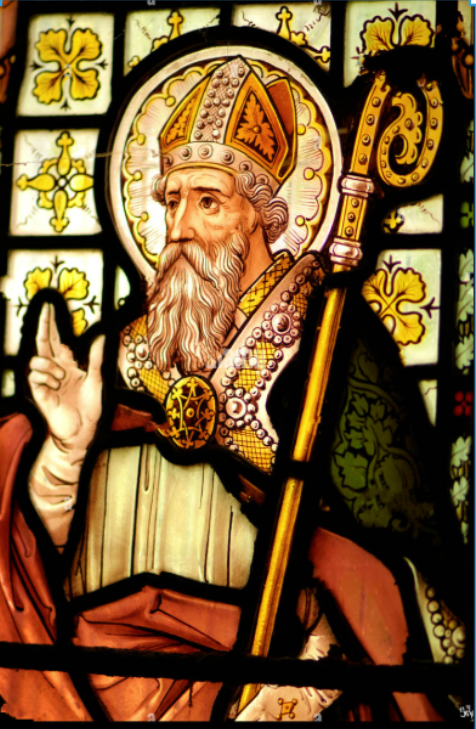
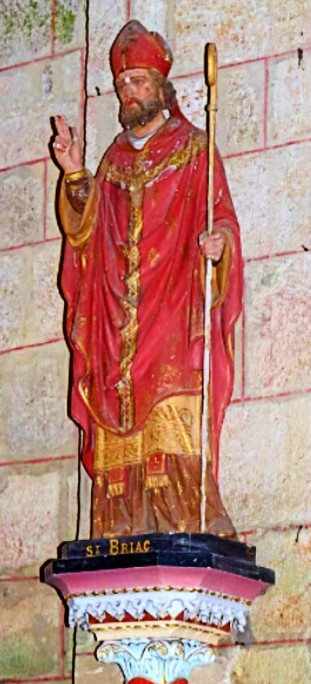
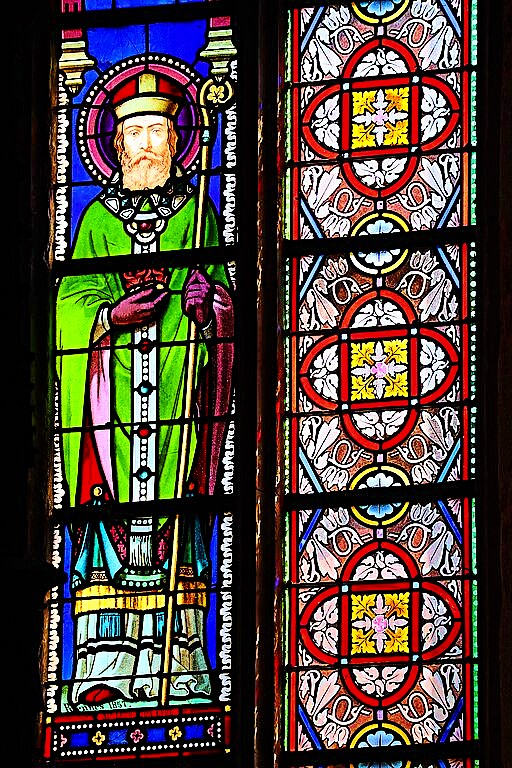
This Stained glass image is actually of an unknown Bishop
Very little is known about Flosculus but, it is certain that, he was a Bishop much loved by his people. His life is recorded by only one document, the Martyrology of St Jerome which reports his death on 2 February, unknown year.
The list of Bishops of Orléans, places him in eleventh place. From this latter record, we deduce that Flosculus was a very active Bishop in his Diocese. He was an eloquent preacher and a tireless worker for the spread of the Gospel. He also devoted himself to the poor and needy and was a great example of charity and compassion. His fame for sanctity, spread rapidly and he was soon venerated as a Saint by the people of Orléans. His cult was confirmed by Pope Pius IX in 1871.
In addition to the Martyrology of St Jerome, there are also some legends transmitted regarding Saint Flosculus. One of these relates that one day, while the saint was preaching in a square in Orléans, a man who had fallen from grace accused him of being an impostor. Flosculus, without batting an eye, looked him in the eye and said: “If what I say is false, may heaven strike me down!” At that moment, lightning struck the man, killing him instantly. This legend can also be seen as a metaphor for the strength of Saint Flosculus’ faith. His words, were so powerful, being the Word of his Master, that they could defeat evil!
On this date, St Flosculus’ Feast, 2 February, Holy Masses and Processions in his honour are held in many Churches in Orléans. The Saint is the Patron of the City and Diocese of Orléans and of all Preachers and Priests.
In Lombardy, Saint Flosculus is especially venerated in the Province of Mantua, Italy. In Castiglione delle Stiviere, in Mantua, there is a Church dedicated to the Saint. In this Church, on 2 February, a Procession and festivities are held in his honour.
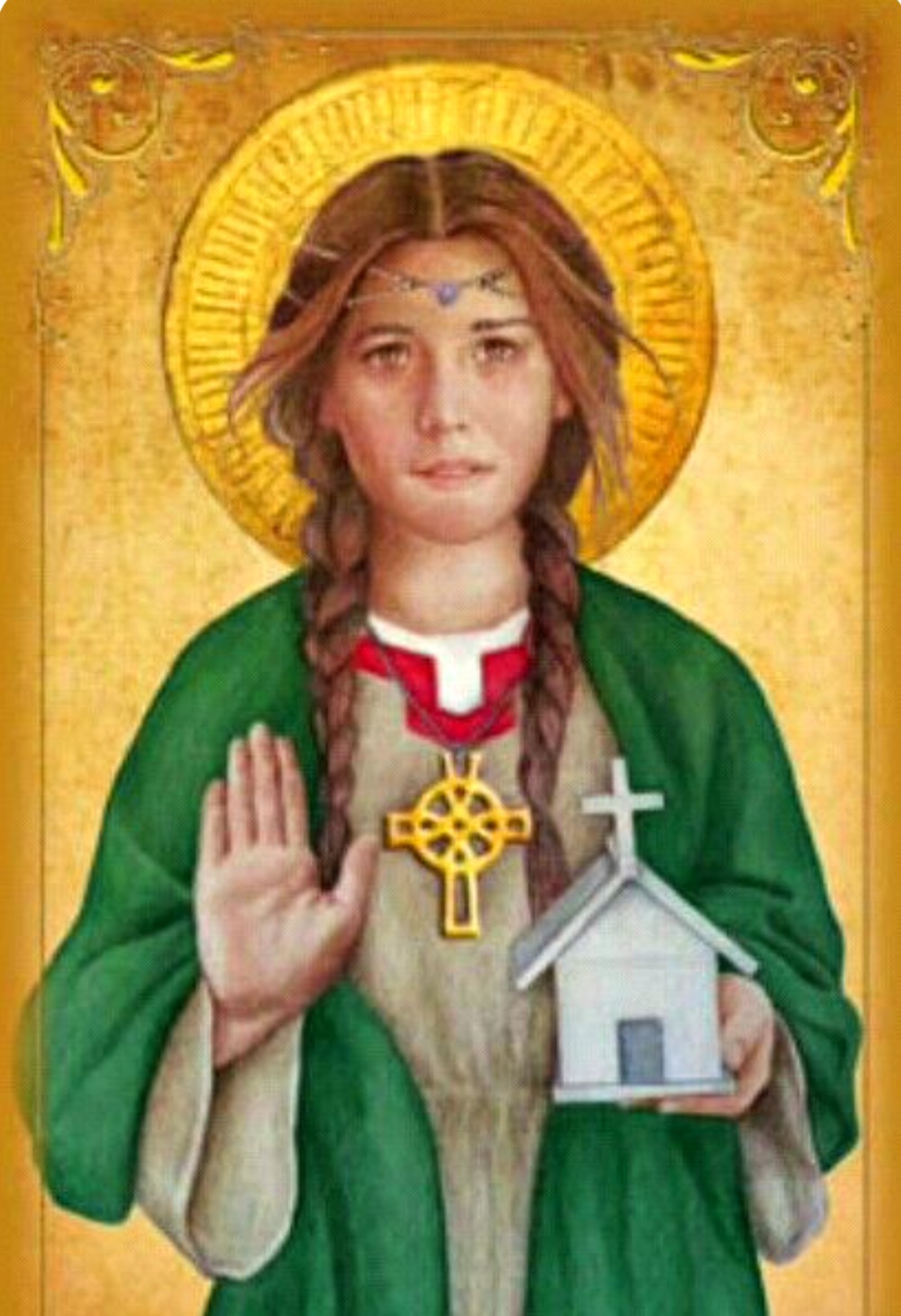
Saint of the Day – 25 January – St Dwynwen (Died c460) Virgin, Princess, Nun. Patronages – lovers (especially in Wales where her Feast today is celebrated in a similar as that of St Valentine’s Feast on 14 February), of the sick and of animals in danger. Also known as – Donwen, Donwenna, Dunwen, Dwyn – this last is the ‘pet’ name of our Saint and the most often used.
Dwynwen lived in the 5th Century, the daughter of Saint Brychan of Brecknock (6 April), a prolific Welsh King who fathered 24 sons and daughters, all venerated as Saints and very famous especially in the Celtic world. Dwynwen, another daughter of the august parent King was then naturally a Princess. She was a beautiful and virtuous girl and fell madly in love with a Welsh Prince, Maelon Dafodrill,but the idea of marriage faded naturally from her heart.
Several legends have attempted to find an explanation for this loss of the romantic fervour – one of them could be that King Brychan had already promised his daughter to another Prince. The Saint, however, understood that her calling was to dedicate her existence to God by undertaking a religious life. She then tried to separate from Maelon but he reacted by drastically changing towards her and becoming unbearable.
Dwynwen took refuge in the woods, raising fervent prayers to God to help her and put an end to her miseries. She fell asleep and when she awoke she had been given a sweet drink which immediately deprived her of Maelon’s attentions and the sadness of her heart. The same drink was given to Maelon but in him, it had the effect of transforming him into an ice statue. Dwynwen then prayed again for three of her requests to be granted – that Maelon be freed from the ice, that she might never wqish to marry again and finally, that all lovers, with the help of God, find happiness through the fulfillment of their love or be healed of their passions.
God granted all her prayers and she did not hesitate to devote her entire existence to Him. She then founded a Convent on the Island of Llanddwyn, just opposite the Island of Anglesey (Yns Mon). She died there around the year 460.
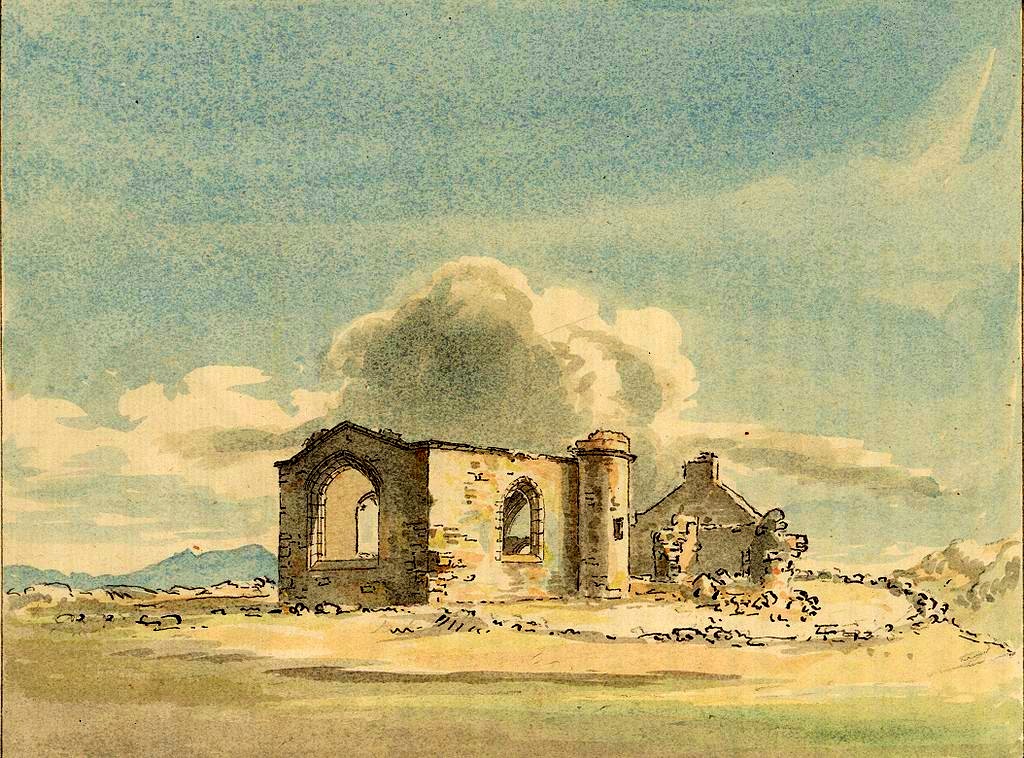
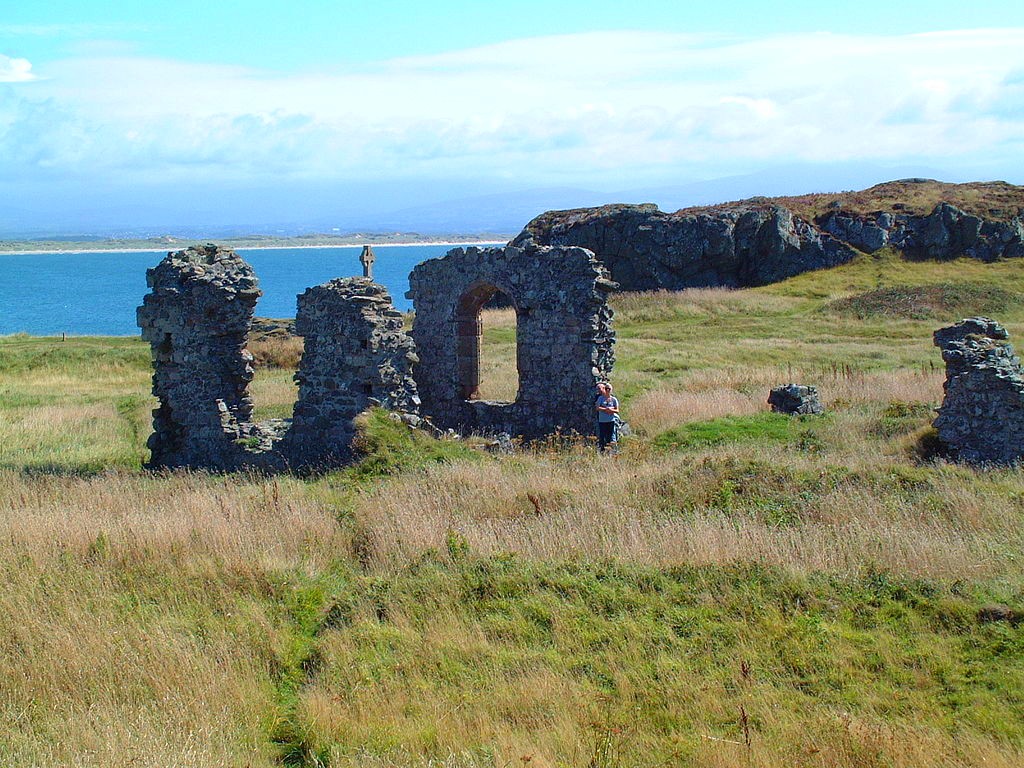
St Dwynwen’s Church, Llanddwyn c1778
Here a fountain of fresh water called Ffynnon Dwynwen was considered a holy spring and soon became a place of pilgrimage. Over time the Saint was also invoked for the healing of the sick and animals in danger, a tradition which has survived to the present day.
The ruins of Llanddwyn Chapel, a 16th Century Tudor Church built on the site of an ancient priory, can still be seen today. St Dwynwen’s name is also invoked in the Town of Porthddwyn and a Church remains dedicated to her in the British peninsula of Cornwall.
St Dwynwen is celebrated especially throughout Wales and by lovers, on 25 January. One of the Dwynwen’s favourite maxims was: “Nothing wins hearts like joy.”
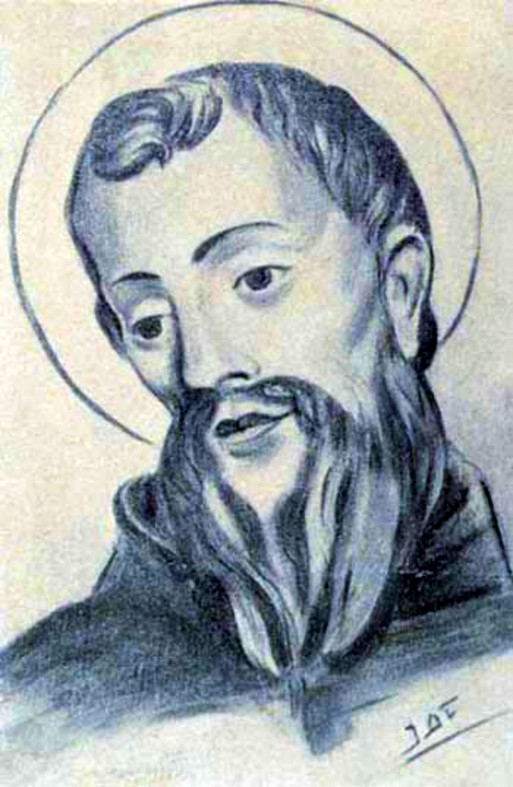
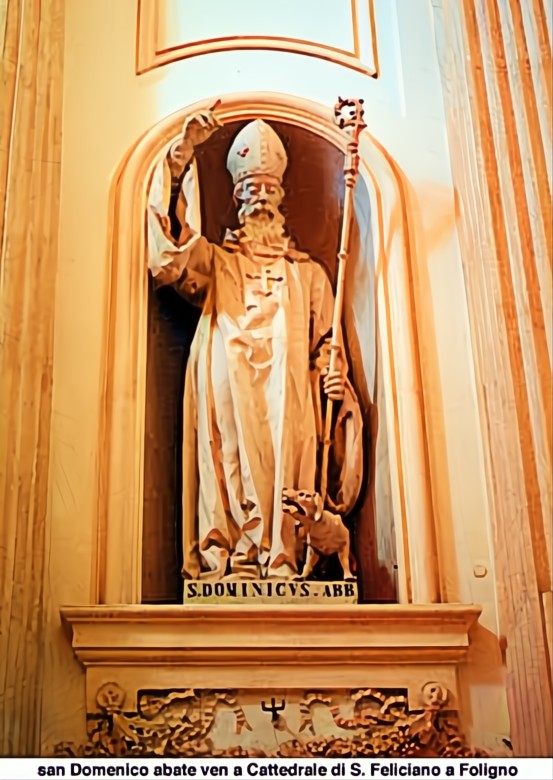
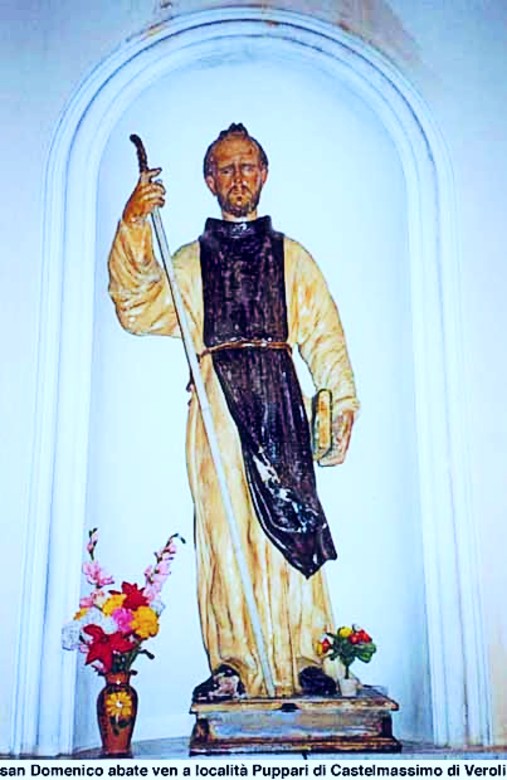
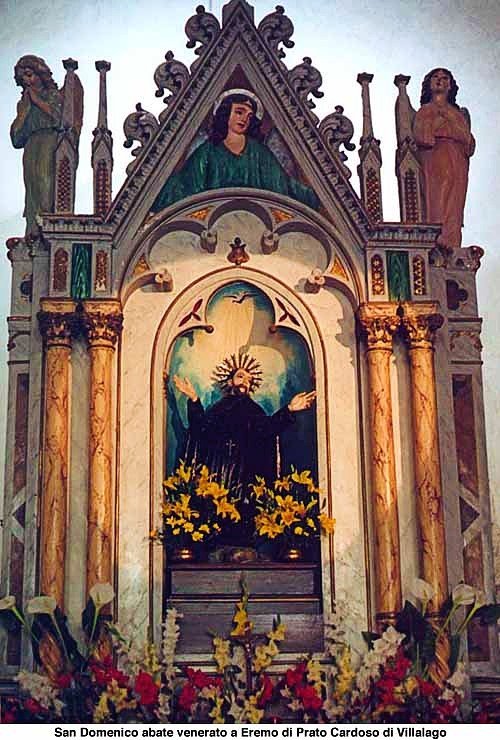
Saint of the Day – 22 January – Saint Dominic of Sora (951-1031) Abbot, Priest, Founder of many Monasteries, Miracle-worker. Born in 951 at Foligno, Etruria (Tuscany district of modern Italy) and died on 22 January 1031 in his Monastery in Sora, Campania, Italy of natural causes. Patronage – against fever, against toothache, against poisonous snakes and snake bites, against rabid dogs, protection from storms and hail, of the Italian Towns of Sora and Cocullo. Also known as – Dominico.
The Roman Martyrology reads today: “At Sora, the holy Abbot Dominic, renowned for miracles.”
The Monk Giovanni, who was Dominic’s companion on all his travels, wrote his ‘Life’ which is, therefore, very accurate and truthful.
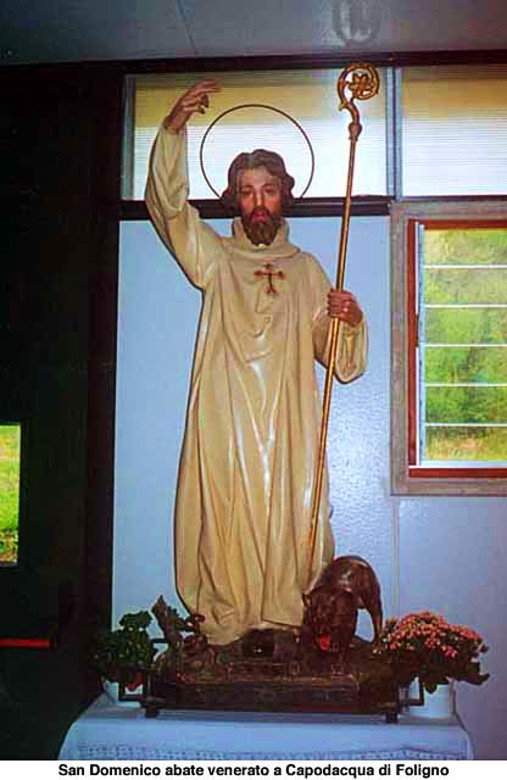
Domenic was born in Foligno in 951. He was entrusted as a child by his parents, to the Monks of St Silvester of Foligno, to carry out the necessary studies. When he became a young man, Dominic left everyone and went to the Monastery of St Maria di Pietrademone, where he was Ordained a Priest and vowed his profession as a Monk. But Dominic desired a Hermit’s life, so he began to alternate solitude with the community life – he retired to a mountain in the Province of Rieti. But he was immediately followed by disciples from the surrounding area, for them he founded the Monastery of St Salvatore, becoming its Abbot.
Since his fame of sanctity attracted many people, to hide he moved towards L’Aquila, where he founded the Monastery of St Pietro del Lago, in the same way he founded the Monastery of St Pietro di Avellana in the Sangro region. During his journeys he arrived in Campania, where he remained unknown, for three years, until the population recognised him through some hunters, surrounded him with devotion and there was a rush of sick people. The reports of his miracles consisted above all, in curing the illness and death caused by snake bites, hence his Patronage.
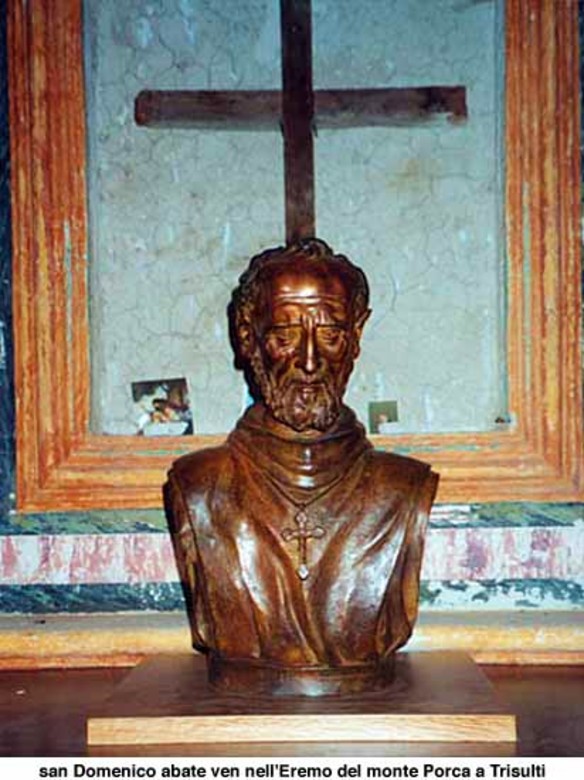
In Trisulti he founded the Monastery of St Bartolomew which achieved much fame, it was richly endowed by the inhabitants of the nearby municipalities which Domenic then visited, urging them to a life woven with charity, penance and good works.
Dominic met with Pope John XVIII, from whom he asked for Papal protection for his foundations. Thanks to a donation of land, made by Count Pietro Rainerio, the Lord of Sora, he was able to build another Monastery, which remained, due to its importance, linked to his name, permanently.
Dominic fell ill while undertaking yet another journey to Tusculum but he returned back to Sora and died there on 22 January 1031 and was buried in the Monastery Church, where he is still preserved.
Dominic of Sora, like other great Founders of that era, remains a reformer of the life of the medieval Church, all intent on expanding monastic life with its great flowering, also a precursor of the great Orders which, a few centuries later, would appear in the Church, starting with his great namesake St Dominic of Guzman.
In Sora, as in the whole Liri Valley, he is invoked against the bites of poisonous snakes and rabid dogs, from storms and hail but also against fever and toothache.
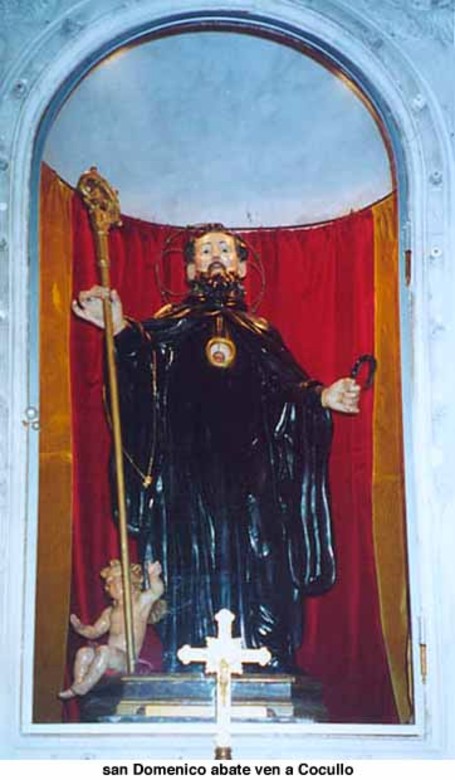
His Feast is celebrated with solemnity, both in Sora, of which he is the Patron and where there is a Sanctuary containing his body and in Arpino and nearby Towns but above all, for his particularity in Cocullo, where his Statue is carried in procession covered in real live snakes! Once, after the Mass, the snakes were killed or sold to tourists, today with a different environmentalist culture, they are set free. The ‘snake catchers’ are very careful to capture the harmless snakes, while they leave the poisonous vipers alone, the population participating in the celebrations has an almost sacred respect for reptiles, a legacy of a pagan cult of pre-Christian times which the Church had to make its own and this union, between pagan use and Christian celebration, in this case occurred through St Domenic of Sora, the great miracle- worker, who from the Middle Ages until today, attracts a multitude of imploring faithful ever venerating and imploring his aid in all their needs.
A Processional Statue of St Dominic I believe the one used in Cocullo and covered with live snakes
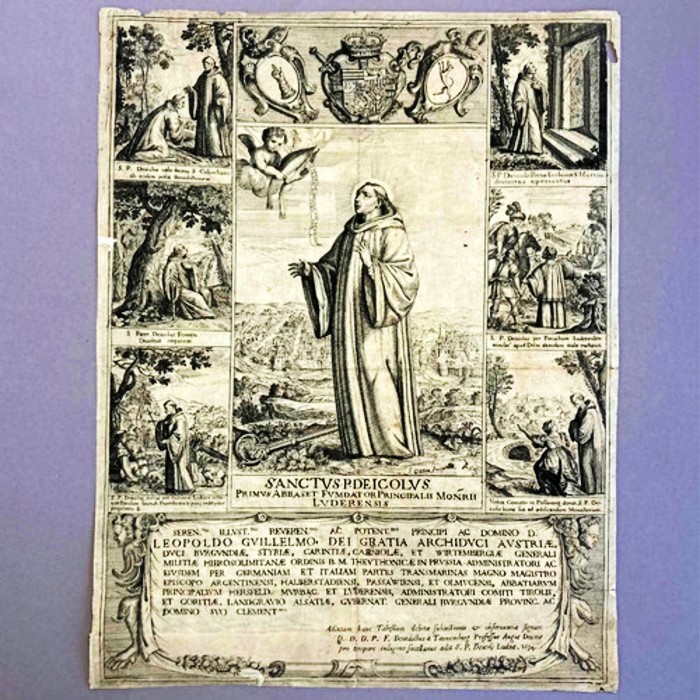
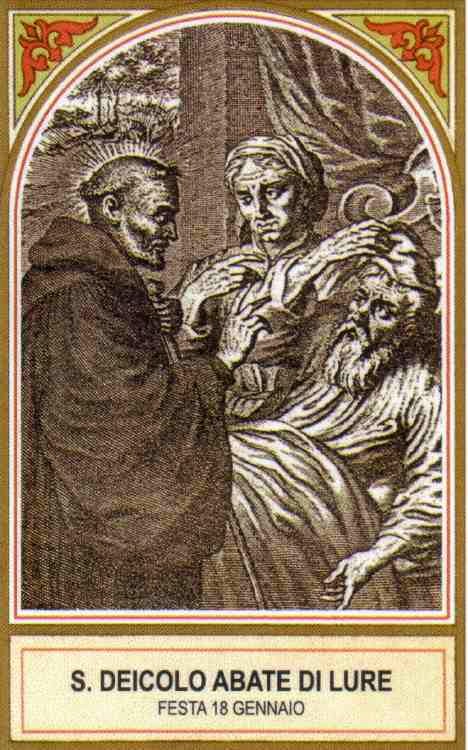
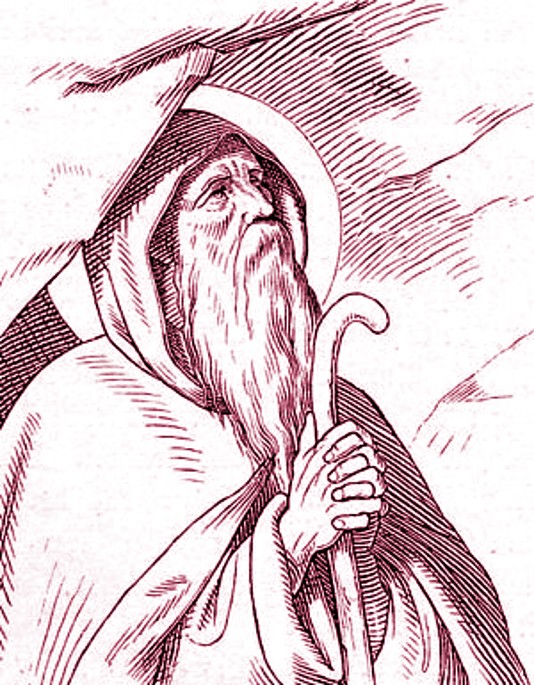
Saint of the Day – 18 January – St Deicolus of Lure (c530-625) Abbot, Founder of the Monastery at Lure, Companion and Disciple of St Columban, some believe Deicolus to be the older brother of St. Gall (c550-c645) who was also one of St Columban’s original 12 companions, Missionary. Born in Leinster, Ireland and died in 625 at Vosges, France of natural causes. Patronages – curing of children’s illnesses, protector of livestock. Also known as – Deel, Deicolo, Deicola, Deille, Delle, Desle, Dichul, Diey, Deicuil, Dicuil.
The Roman Martyrology reads today: “In Brittany, St Deicola, Abbot, disciple of St Columban.”
The Life of St Deicolus
Born in Leinster, Deicolus and his brother, Gall, studied at Bangor Abbey in County Down. He was selected to be one of the twelve disciples to accompany St Columbanuon his missionary journey.
In 576 he journeyed to France and laboured with Columban in Austrasia and Burgundy. Deicolus is believed to have resided with Columban at the Monastery of Luxeuil from c590.
In 610, when Columban was expelled by King Theuderic II, Deicolus, then eighty years of age, determined to follow his master,but was forced, to abandon the journey due to the inadeguacies of his age and remained behind alone.
Diecolus establishing a hermitage at a nearby Church dedicated to Saint Martin in a place called Lure, in the Diocese of Besançon.
Until his death, he became the apostle of this district, where he was given a Church and a tract of land by Berthelde, widow of Weifar, the lord of Lure. Soon a noble Abbey was erected for his many disciples and the Rule of St Columban was adopted.
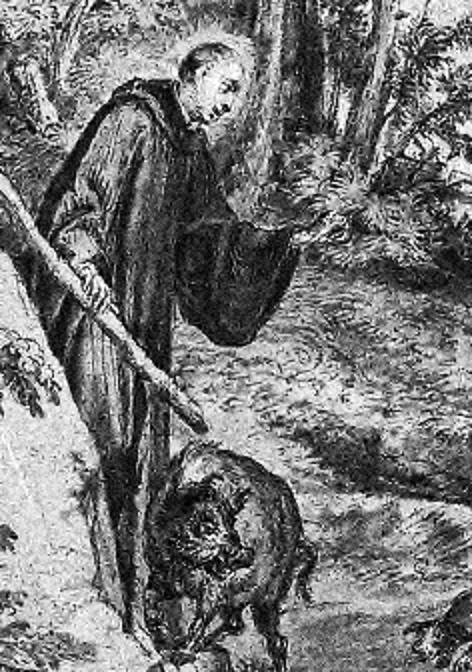
Numerous miracles are recorded of Deicolus, including the suspension of his cloak on a sunbeam and the taming of wild beasts.
Clothaire II, the King of Burgundy, recognised the virtues of Deicolus and considerably enriched the Abbey of Lure, also granting Deicolus the manor, woods, fisheries, of the Town which had grown around the Monastery.
St Deicolus and the bear
Feeling his end approaching, Deicolus conceded the government of his Abbey to Columban, one of his young Monks and retreated to a little Oratory he had built a in honour of the Holy Trinity, where he died on 18 January c625.
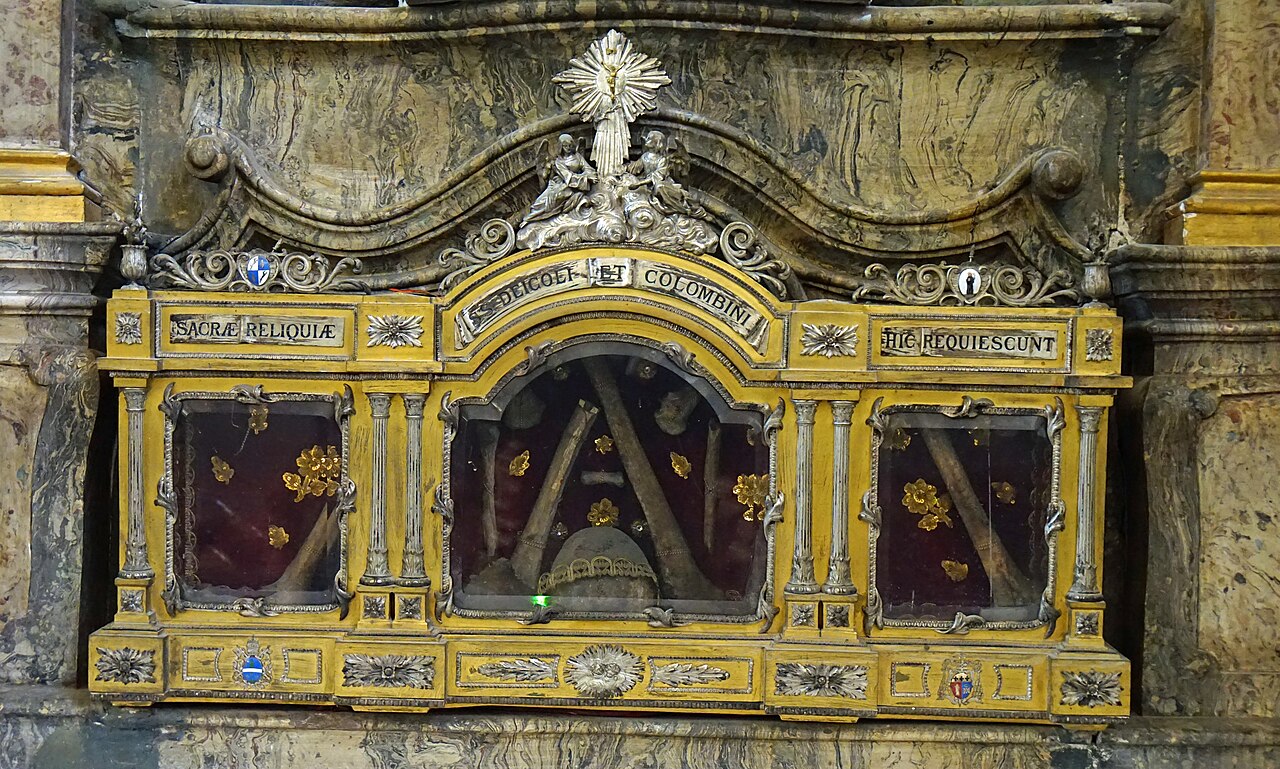
His Feast is observed on this day, his birthday into Heaven. So revered was his memory that his name Diacolus, under the shortened French form of Del or Deel and Deela, (being corrupted from Del de Lure) is still borne by many of the children of the Lure district and too, is often found there as a surname. St Diacolus’ cultus is strong in the area of Lure where a Spring associated with St Diacolus has miraculous properties and, in particular, to cure children’s ailments if their garments were washed in this water.
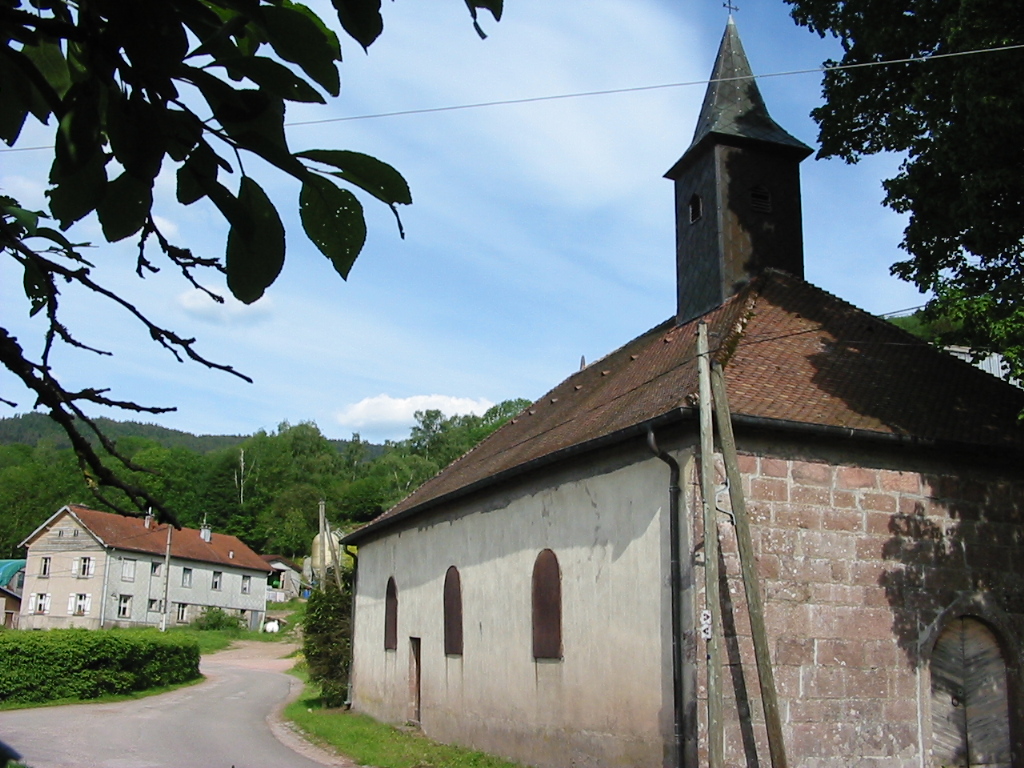
St Del Chapel the destination of the Pilgrimage
Saint Deicolus is considered a Saint who heals illnesses in young children but also a regarded as a protector of livestock. There are mirackes associated with a wild bear which I have been unable to trace. A pilgrimage takes place today 18 January, to the Chapel of Gerbamont where he died.
His memory is also perpetuated in several other Lorraine Villages. His Vita and Acts were written by a Monk of his own Monastery in the 10th Century.
Relics of St Deicolus and St Columban at the Church of St Martin in Lure
Quote/s of the Day – 7 January – “The Month of the Holy Name of Jesus and the Holy Family”and the Feast of the Holy Family
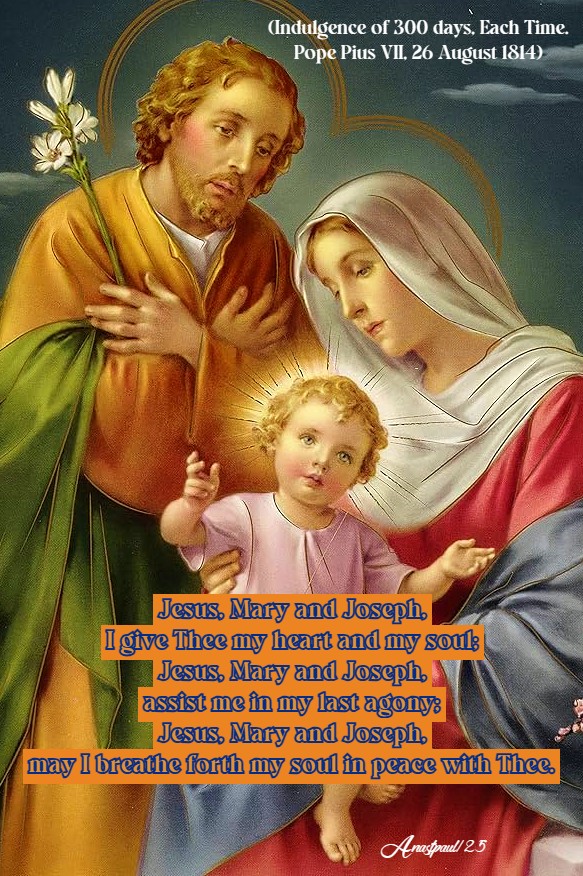
Indulgenced Holy Family Aspiration
“Jesus, Mary and Joseph, I give Thee my heart and my soul; Jesus, Mary and Joseph, assist me in my last agony; Jesus, Mary and Joseph, may I breathe forth my soul in peace with Thee.”
(Indulgence of 300 days, Each Time. Pope Pius VII, 26 August 1814)
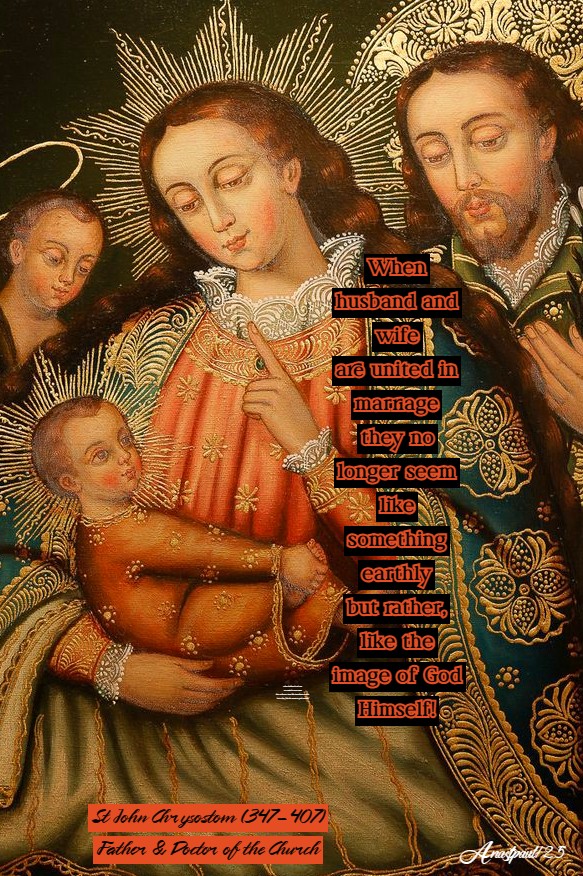
“When husband and wife are united in marriage they no longer seem like something earthly but rather, like the image of God Himself!”
St John Chrysostom (347-407) Father & Doctor of the Church
“The One Who is the Wisdom of the Father, put His arms around her neck, the One Who is the strength, that gives movement to everything, sat in her arms. He Who is the rest of souls, (Mt 11:29) rested on her motherly breast. … Filled with the Holy Spirit, she held Him close to her heart … She never had enough of seeing Him or of hearing Him, ,,, Thus Mary grew evermore in love and her mind was unceasingly attached to Divine contemplation.”
St Amadeus of Lausanne (1108-1159)
“Since God could choose for the Guardian of His Son, the man in the world, the most accomplished in all sorts of perfections, according to the dignity and excellence of his Charge, Who was His most Glorious Son, the universal Prince of Heaven and earth, how could it be that being able, He did not will it and did not do it? There is, then, NO DOUBT that St Joseph was endowed with all the graces and all the gifts that were required for the care which the Eternal Father willed to give him, of the temporal and domestic economy of our Lord and of the guidance of his family … ”
Thought for the Day – 28 December – Meditations with Fr Richard Frederick Clarke SJ (1839-1900)
Meditations for Advent From “The Devout Year” By Fr Richard Frederick Clarke SJ (1839-1900)
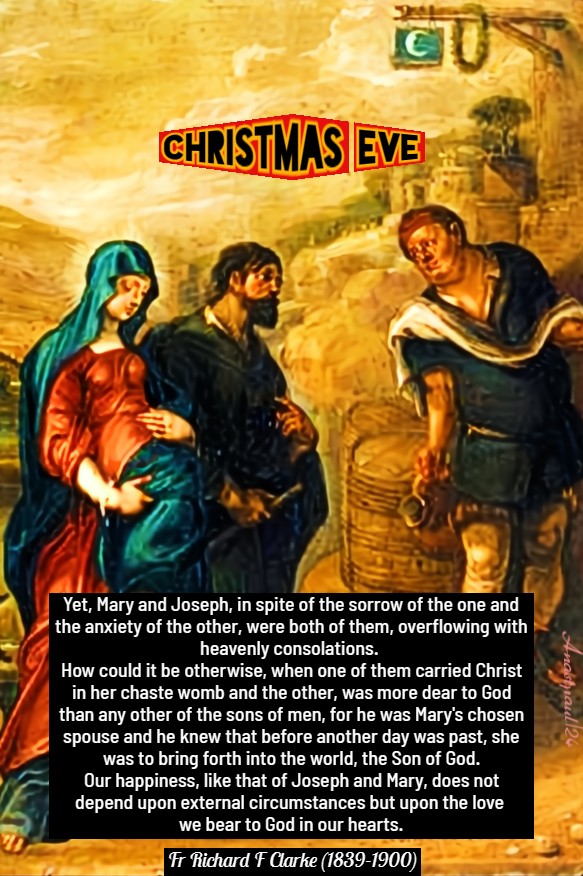
Christmas Eve
+1. How did Mary and Joseph spend the first Christmas Eve St Joseph spent it in a fruitless attempt to find a lodging for his holy spouse Vainly he sought for a place in the caravanserais or inn, where travellers were received. Vainly he went from house to house in Bethlehem. Everywhere he was disappointed. Thus it is how God prepares His Saints and chosen ones for some unique blessing. We must not be cast down by the fruitlessness of our efforts. It is a sign that some great grace is close at hand!
+2. Mary meantime, was patiently waiting. She was simply praying that God’s will might be done, whatever suffering it might bring to her. She was offering herself to God , to be used by Him as He should see fit. She was making acts of perfect conformity to the Will of God in all things. Blessed are those who wait patiently in such a spirit. God will soon fulfil all the desires of their heart.
+3. Yet, Mary and Joseph, in spite of the sorrow of the one and the anxiety of the other, were both of them, overflowing with heavenly consolations. How could it be otherwise, when one of them carried Christ in her chaste womb and the other, was more dear to God than any other of the sons of men, for he was Mary’s chosen spouse and he knew that before another day was past, she was to bring forth into the world, the Son of God. Our happiness, like that of Joseph and Mary, does not depend upon external circumstances but upon the love we bear to God in our hearts.
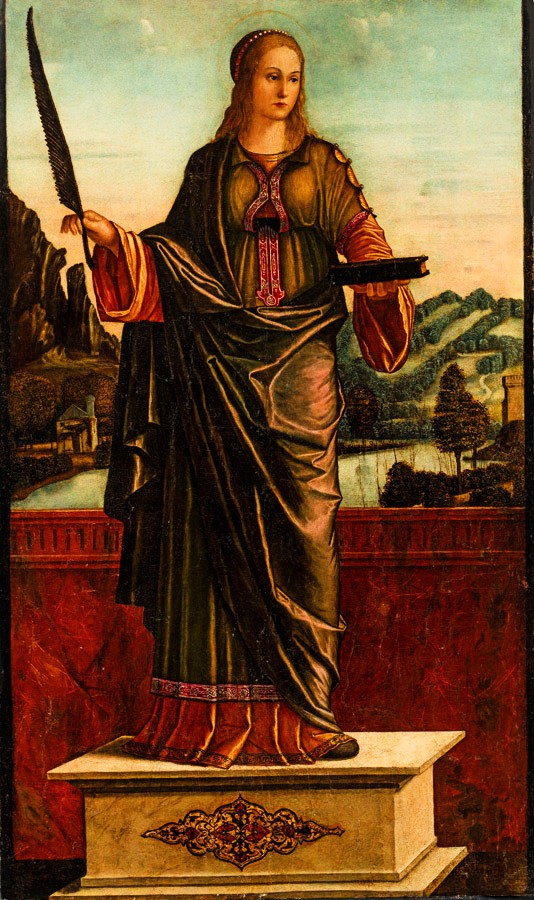
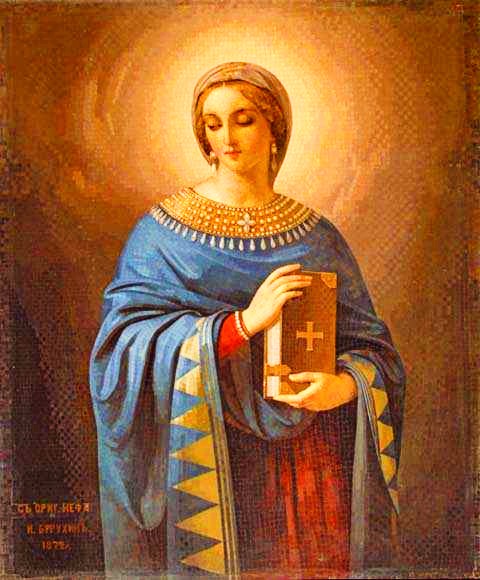
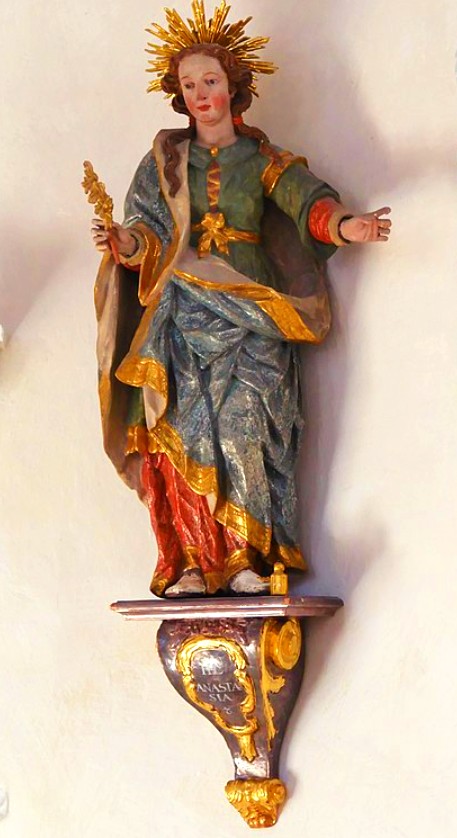
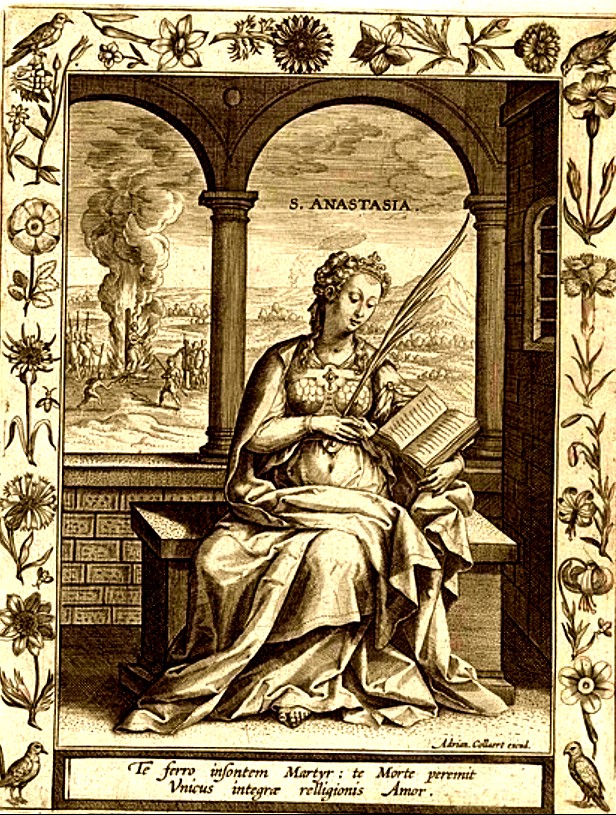
Saint of the Day – 25 December – Saint Anastasia of Sirmium (Died 304) Widow, Martyr. Patronages – of martyrs, weavers, widows, Borgorose, Italy, Burana in Kyrgyzstan. She is one of seven women who, along with Blessed Virgin Mary, are commemorated by name in the Roman Canon of the Mass.
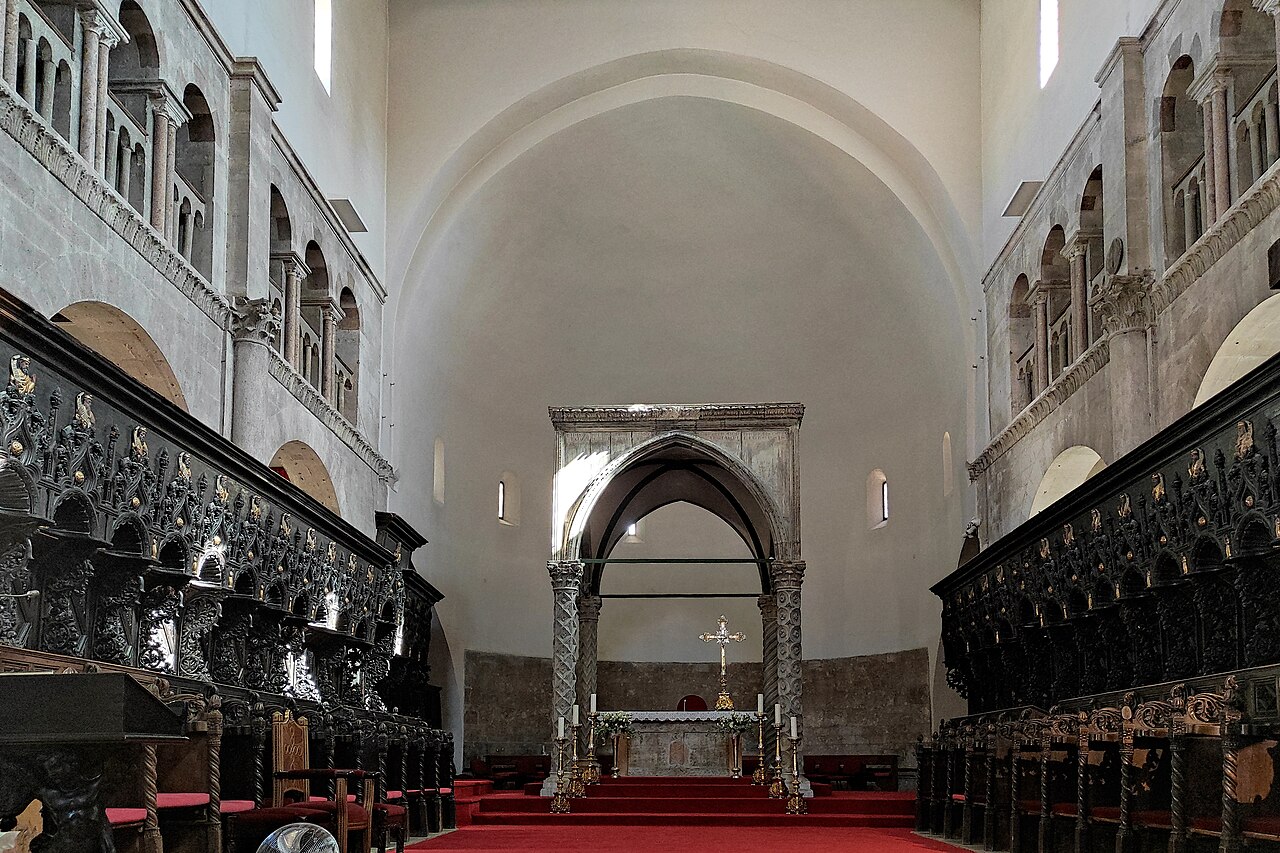
From a Triptych in Zadar Cathedral
Before the liturgical reforms of the 20th Century, this Martyr enjoyed the distinction, unique in the Roman Liturgy, of having a special commemoration in the second Mass on Christmas Day. Since the time of St Gregory the Great (Papacy 590-604) and celebrated by the Pope himself, her name was also inserted into the Roman Canon.
The Roman Martyrology reads today: “The birthday of St Anastasia, who, in the time of Diocletian, first suffered a severed and harsh imprisonment on the part of her her husband, Publius, in which, however, she was much consoled and encouraged by the Confessor of Christ, St Chrysogonus. Afterwards, she was thrown into prison again by order of Florus, Prefect of Illyria and, finally having her hands and feet stretched out, she was tied to stakes with a fire kindled about her in the midst of which, she ended her Martyrdom on the Island of Palmarola, whither she had been conveyed with two hundred men and seventy women, who have made Martyrdom a glorious thing by the various kinds of death they so courageously endured. ”
Anastasia, daughter of Pretestato a noble Roman, was a native of Sirmium, Pannonia, a Roman City in what is now Yugoslavia. She was the wife of Publius, a pagan, nevertheless, she was entirely devoted to assisting the Christians of Rome, who were forbidden, by an unjust law, to carry out any profession. Her husband, who was very much against her good works, cruelly punished her every disobedience but she was comforted by the advice of St Chrysogonus, who was also persecuted and imprisoned.
After her husband’s death, she was able to exercise her Christian charity more freely. Her spiritual advisor St Chrysogonus, had been arrested and sent to the Imperial Court in Aquileia, Anastasia accompanied him on the journey from Rome and witnessed the interrogation and then his beheading, the body was abandoned at the home of the three Christian sisters Agape, Chionia, Irene, who with the help of the holy priest Zoilus, gave him burial and for this they were all arrested.
Then Diocletian left for Macedonia taking with him all the imprisoned Christians and with them Anastasia; from Macedonia he moved towards Sirmium in Illyria, here the matron Theodota and her three sons were reported to him as fugitive Christians and he had them imprisoned.
The interest which Anastasia had in the fate of the four, aroused the suspicion of the pagans who reported her to the prefect Probus; these, after interrogations and vain attempts to make her renounce Christ, kept her in chains for a month and then put her on a pierced ship, together with other Christians and criminals and sent it out to sea to a certain death. But they miraculously escaped the stormy seas and landed at Palmaria, where they were again captured and offered freedom in exchange for honouring the gods. After their consistent refusal they were all massacred, while Anastasia was burned alive. Her ashes were collected by a woman named Apollonia who placed them in a small Church in her garden.
Although this ‘passio’ is probably partly enhanced and imagined, it is certain that the cult of a Martyr St Anastasia in Sirmium, is very ancient and then spread to Constantinople and Rome. In Sirmium, her Relics were venerated until about 460, when then, the Bishop Gennadius had them transferred to Constantinople to the Church that later took her name. In Rome, since the 4th Century, there was a Titular Church, already dedicated to her, right in the centre of pagan memories (Circus Maximus, on the Palatine).
She is depicted without particular attributes among the virgins in procession in the Church of St Apollinare Nuovo, also present on the bronze door of St Mark in Venice, in the Cathedral of Zadar in Sirmium (Yugoslavia) and others. In ancient times various Churches were dedicated to her, including that of Verona and the other very ancient and important for its historical and archaeological aspect, in Rome, already mentioned which, in the 7th Century, was already listed as the third most important Church after the Lateran and St Mary Major. The Cathedral of Zadar (Sirmium) is also dedicated to her.
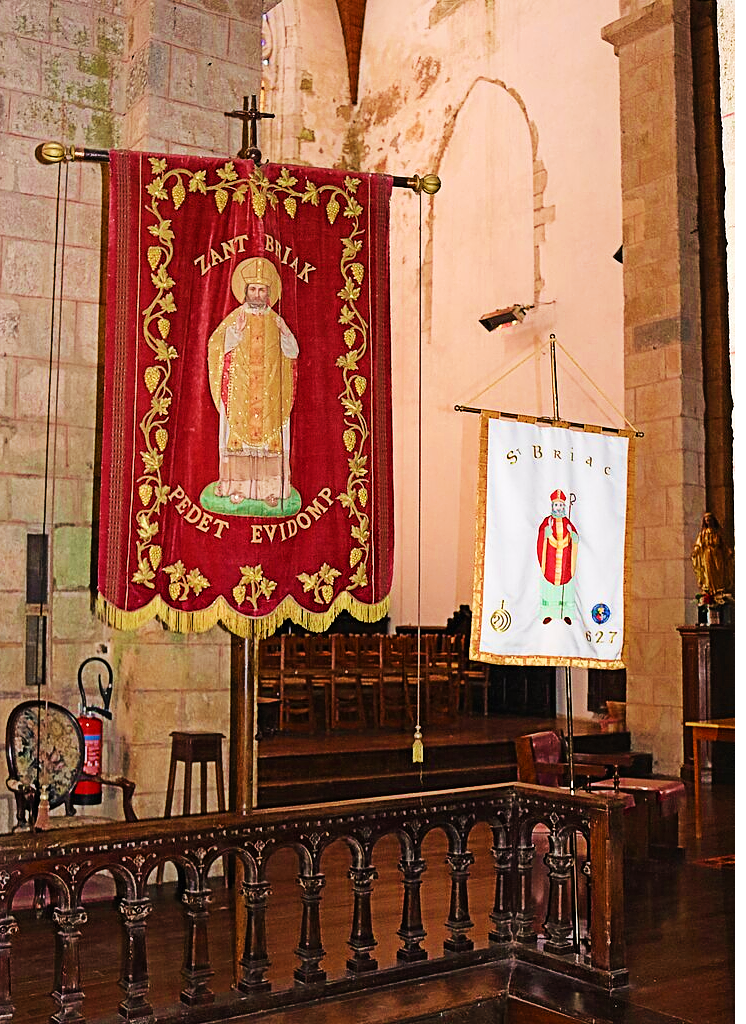
Saint of the Day – 17 December – St Briarch (Died 627) Abbot, Priest, Missionary, Founder of the Monastery of Bourbriac from which a village grew (Briarch Village), Hermit Born in Ireland and died in 627 in Bourbiac, France of natural causes. Patronages – against epilepsy, against mental illness, against headaches. Also known as – Briarch of Brittany, Briach…Briac…Briachus…Briag…Briagenn…Briarch of Bourbriac.
In the 6th Century, the Benedictines spread throughout Europe, Monks who lived according to the Rule of Saint Benedict, based on prayer and work. Even in Ireland, the ideas of the Italian Monk captured the interest of many young men.
This is the case of the Saint celebrated today – the nobleman Briarch. He abandoned luxury, wealth and a brilliant career and left his native Island home, to go to Wales. Here, his monastic life began under the guidance and direction of St Tual (Died c560) The young nobleman, who had become a Priest, decided to cross the sea once again and reached Brittany in North-west France, which at that time was called Armorica.
Briaco was not alone; he was accompanied by seventy fellow Monks. In this area, the Priest built a Monastery around which a village was born, the current French City of Bourbriac (Briarch Village).
In the Monastery, the Monks prayed, cultivated the land, copied the Sacred Scriptures and other Latin and Greek spiritual works by hand and welcomed the many in need of food, care and protection. The Monks also taught the locals how to cultivate the fields and how to read and write. Monasteries thus become places of peace and work for many desperate people fleeing from invasions.
After some time, Briarch wished to embrace solitude in order to grow in sanctity and to unite himself to God. He took refuge in the forest and lived as a Hermit. He prayed, fasted and immersed himself in mediationon. His isolation did not mean, however, running away from people, towards whom Briarch was always kind.
Celebrating St Briarch today on his Feast
In fact, during his stay in the forest, many miracles occurred due to his intercession. He made a sick person wear his habit and immediately a miraculous cure occurred. Another individual, suffering from obsessive thoughts which caused him to suffer great anxiety, was healed by the prayers of the Irish Hermit. On another occasion, a man, bitten by a poisonous snake, was immediately saved from death by the intervention of Briarch.
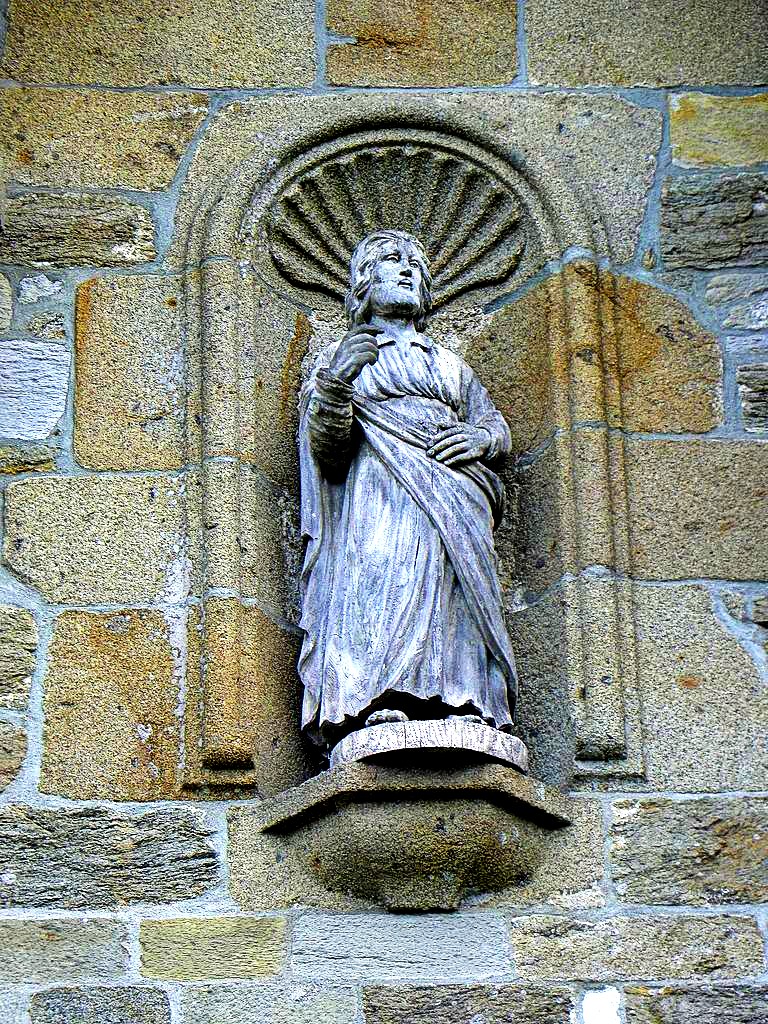
On the facade of the St Briac Church at Saint-Briac-sur-Mer
Briarch then undertook another journey, this time as a Pilgrim to Rome to meet Pope Pelagius II and to visit the holy places. On his return however in 627, he stopped in the South of France, in Arles, some sources say he died here and others that he did reach his beloved Monastery in Brittany, where he died.
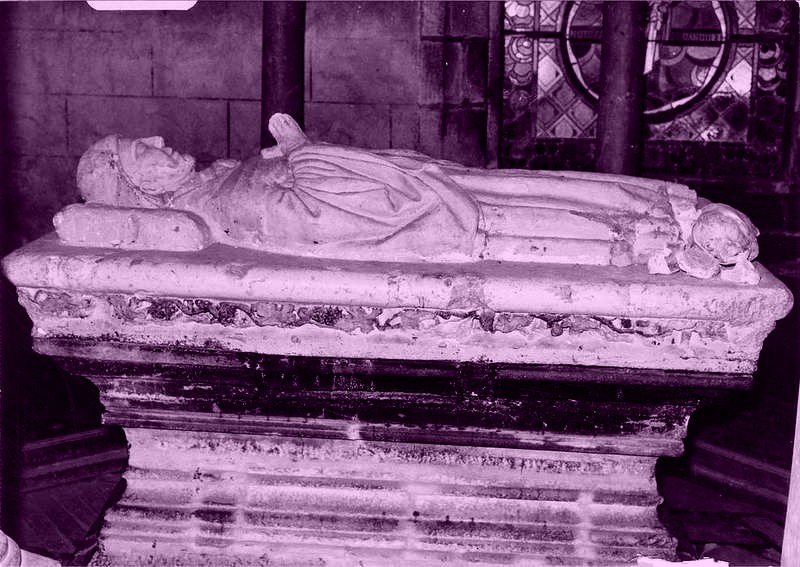
Briarch is buried in the Church of Bourbriac. There is still a Sarcophagus from the Merovingian period, probably the stone coffin in which he was laid to rest. Under the Church is the Crypt from the 11th Century, probably built as Briarcc’s final resting place, where believers could venerate him without disturbing the service in the Church above. A spring can still be seen near the Church.
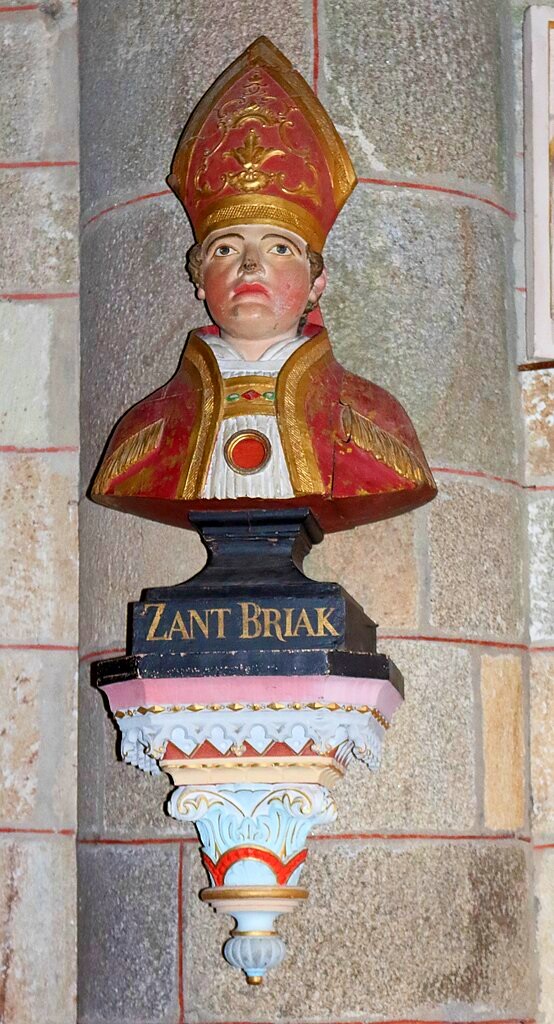
A pardon (penitential procession) is held on Ascension Day. On that occasion, the Reliquary of St Briarch, in the form of a bust is carried around the former Monastery grounds. There are numerous Churches, Towns, Villaes, regions named after St Briarch in France.
The Reliquary of St Briarch used in the Pardon Procession
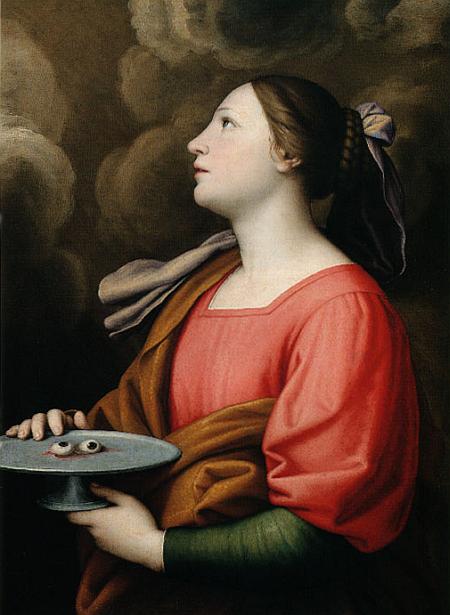
Quote/s of the Day – 13 December – St Lucy (of Syracuse) – St Lucy/Lucia of Syracuse (c283-304) Virgin and Martyr Patron of the blind, eye disorders, martyrs – The Feast Day of St Lucy AND St Odilia of Alsace (c660-720) Virgin Abbess, born blind, but was miraculously granted her sight, miracle-worker. The Life of St Odilia, another Patron against eye diseases and partial sightedness, also ear ailments. https://anastpaul.com/2021/12/13/saint-of-the-day-13-december-saint-odilia-of-alsace-c-660-720/
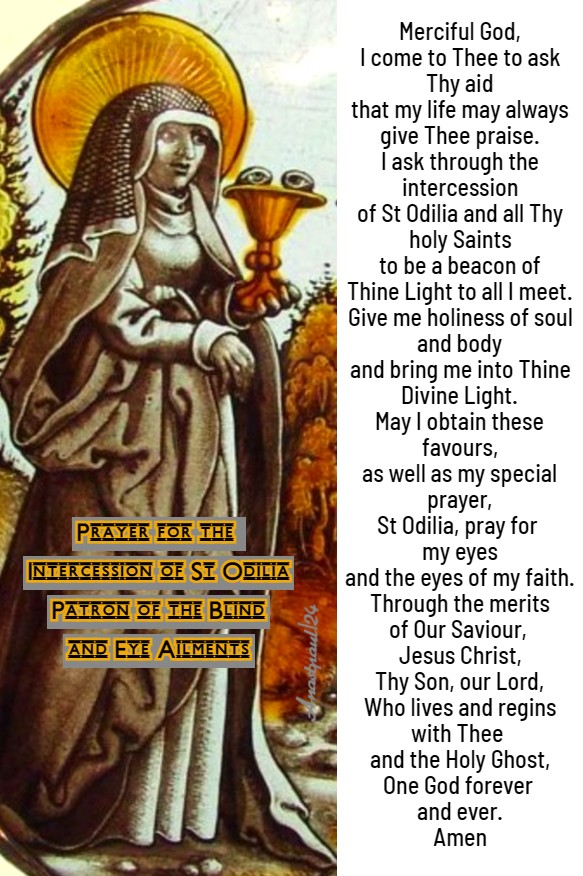
Prayer for the Intercession of St Odilia
Merciful God, I come to Thee to ask Thy aid that my life may always give Thee praise. I ask through the intercession of St Odilia and all Thy holy Saints to be a beacon of Thine Light to all I meet. Give me holiness of soul and body and bring me into Thine Divine Light. May I obtain these favours, as well as my special prayer, St Odilia, pray for my eyes and the eyes of my faith. Through the merits of Our Saviour, Jesus Christ, Thy Son, our Lord, Who lives and regins with Thee and the Holy Ghost, One God forever and ever. Amen
And another prayer to St Lucy
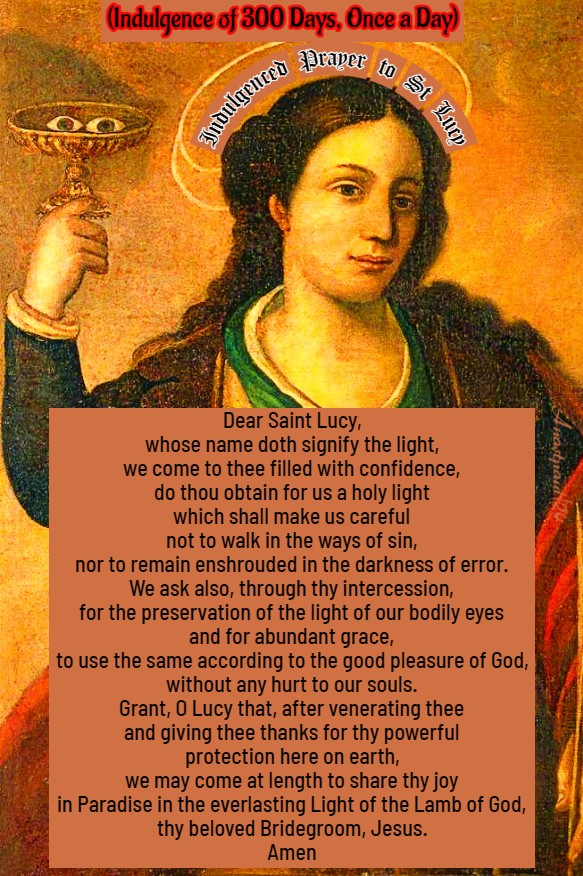
Indulgenced Prayer to St Lucy (Indulgence of 300 Days, Once a Day)
Dear Saint Lucy, whose name doth signify the light, we come to thee filled with confidence, do thou obtain for us a holy light which shall make us careful not to walk in the ways of sin, nor to remain enshrouded in the darkness of error. We ask also, through thy intercession, for the preservation of the light of our bodily eyes and for abundant grace, to use the same according to the good pleasure of God, without any hurt to our souls. Grant, O Lucy that, after venerating thee and giving thee thanks for thy powerful protection here on earth, we may come at length to share thy joy in Paradise in the everlasting Light of the Lamb of God, thy beloved Bridegroom, Jesus. Amen
Our Morning Offering – 13 December – The Feast of St Lucy, Virgin Martyr, Patron Against Eye Diseases and Blindness
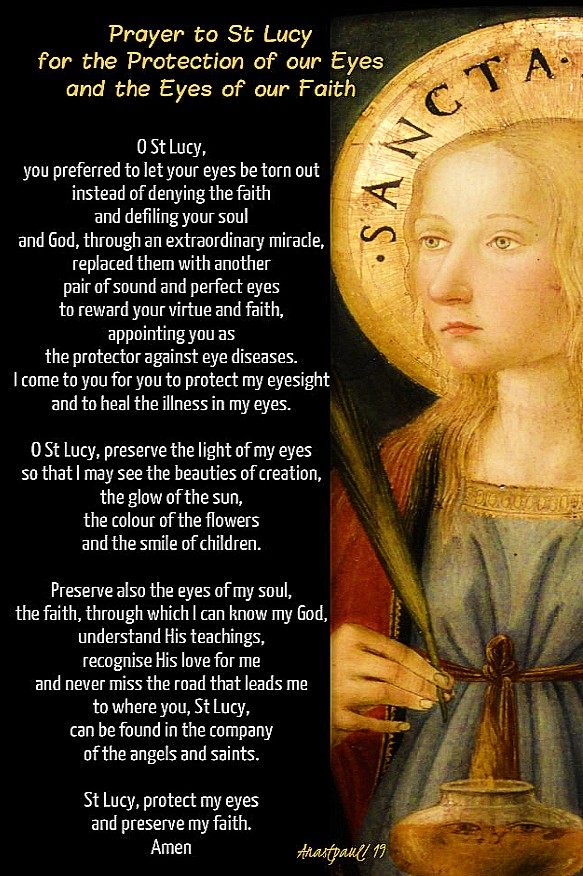
Prayer to St Lucy [Prayer to St Lucy for the Protection of our Eys and the Eys of our Faith]
O St Lucy, you preferred to let your eyes be torn out instead of denying the faith and defiling your soul and God, through an extraordinary miracle, replaced them with another pair of sound and perfect eyes to reward your virtue and faith, appointing you as the protector against eye diseases. I come to you for you to protect my eyesight and to heal the illness in my eyes.
O St Lucy, preserve the light of my eyes so that I may see the beauties of creation, the glow of the sun, the colour of the flowers and the smile of children.
Preserve also the eyes of my soul, the faith, through which, I can know my God, understand His teachings, recognise His love for me and never miss the road that leads me to where you, St Lucy, can be found in the company of the angels and saints. St Lucy, protect my eyes and preserve my faith.
St Lucy, “Bringer of Light” Pray for those with eye ailments, Pray for us all!
Saint of the Day – 13 December – Saint Aubertus of Cambrai-Arras (c600-c669) Bishop and Confessor, Monk and Hermit, Apostle of the poor, Founder of several Churches and Monateries in the region of what is now Belgium. Born in France in c600 and died there in c669 of natural causes. Patronages – of bakers and confectioners, merchants, Cambrai, France, Ghent, Belgium, Hainault, Belgium. Also known as – Aubert of Cambrai, Aubert of Cambrai-Arras, Aubert of Avranches , Albert…Audebertus…Authbert…Autbertus…Obrecht…
The Roman Martyrology reads today: “At Cambrai, in France, St Aubertus, Bishop and Confessor.”
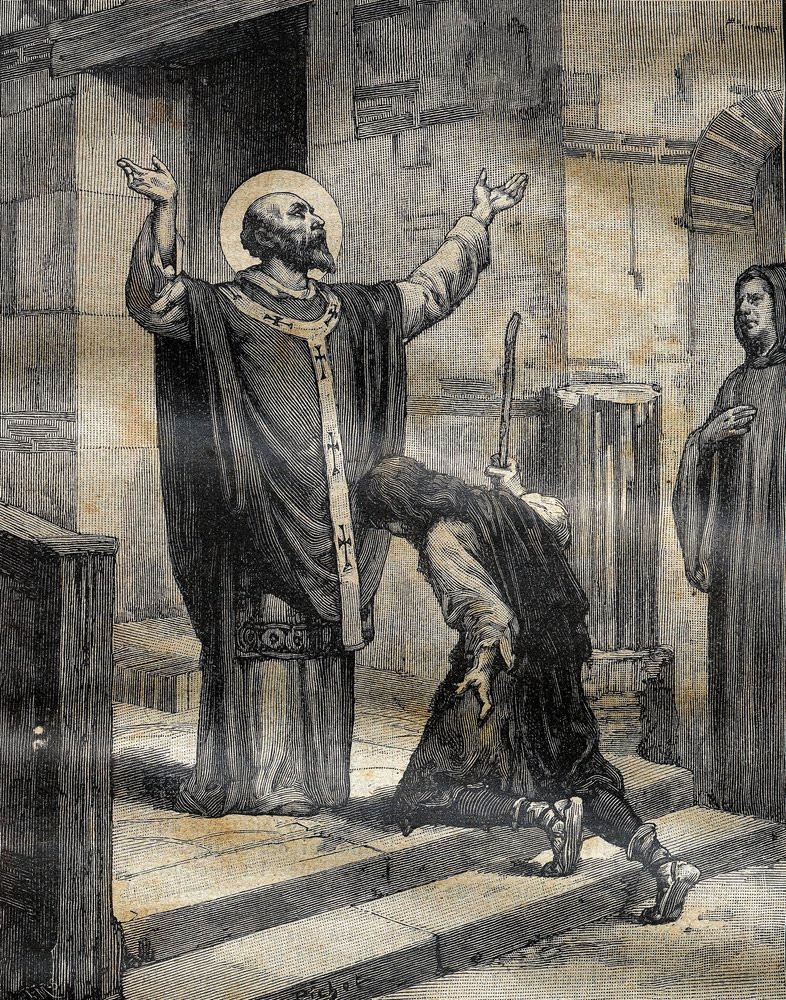
Saint Aubertus, the Bishop of Cambrai-Arras, welcomed his disciple and prodigal godson, St Landelin and forgives him his three years of error. Engraving in Le Pelerin.
Aubertus was the 8th Bishop of Cambrai, in France who lived around the middle of the 7th Century.
He was born around 600 in Haucourt en Cambrésis, belonging to the family of the Merovingian King Dagobert I. He became a Monk in the Abbey founded by Saint Columban in 590 in Luxeuil, during the years in which Saint Eustasius was the Abbot.
After this first experience, tradition tells us that he became a Hermit and chose to live in solitude in the mountains. In his solitude he made bread which he then, with the help of his donkey, went to sell and donate the proceeds to the poor.
Around 652, Autbertus became the Bishop of Cambrai, after Saint Adalbert. Serving as the Bishop for 36 years, Bishop Aubertus promoted religion and the study of holy texts in Hainaut and Flanders. Through his influence, many nobles were converted and King Dagobert became a major supporter of the Christian Church. St Landelin was entrusted to his care and was educated in learning and piety by Aubertus. The Bishop of Cambrai gave his benediction to St Ghislain and blessed his hermitage (now Saint-Ghislain). Aubertus bestowed the religious habit upon the Count of Hainaut, Vincent Madelgarius, his wife, Saint Waltrude and her sister, St Aldegundis, who was admitted to the vows of a Nun by our St Aubertus of Cambrai and St Amandus of Maestricht, before becoming the first Abbess of Maubeuge Abbey.
In c655, Aubertus alongside St Eligius, arrived 30 days after St Fursey’s death to exhume his body for his Canonisation. In 666, he solemnly performed the translation of the Relics of St Vedast at Arras.
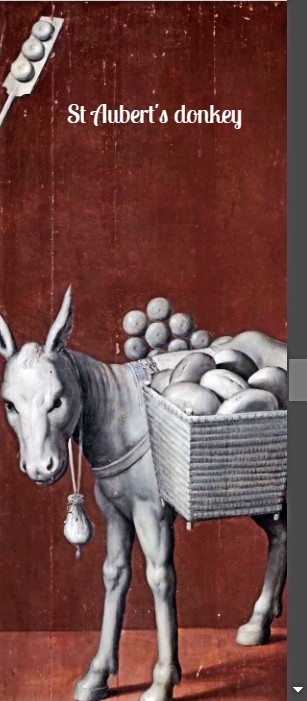
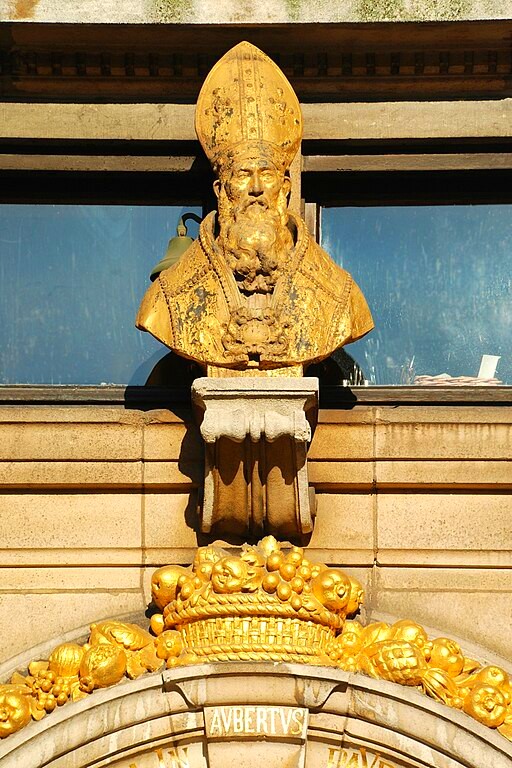
He governed the Diocese until 669, the year of his death. Among his disciples we also find Saint Vindician, his successor. Autbertus is the Patron Saint of bakers and in Belgium he is represented, with a donkey loaded with two baskets full of bread and carrying a bag around his neck.
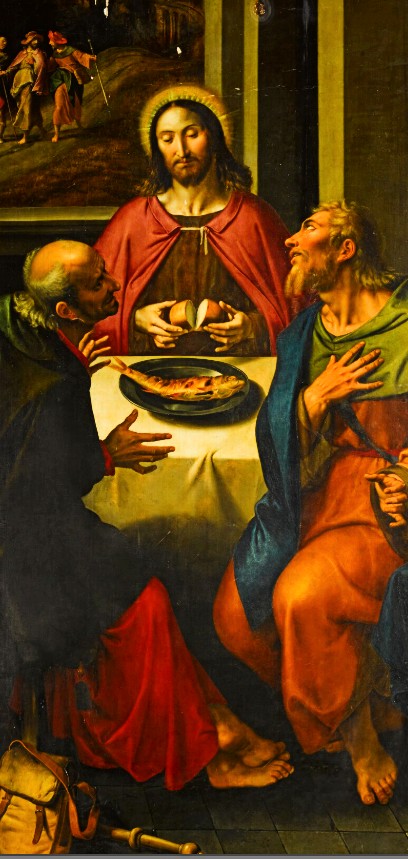
Bishop Aubertus died around 669 in Cambrai, Francia. He was buried in St Peter Church and is celebrated today, 13 December. His Shrine is kept in a Cambrai Abbey of Canons Regular, established in 1066. This beautiful image below features our Saint Aubertus. Itis a double-sided Altarpiece wing depicts The Supper at Emmaus and Saint Aubert, Bishop of Cambrai-Arras on the right(?). The Artist was Ambrosius Francken the Elder (Herentals 1544/45–1618 Antwerp).
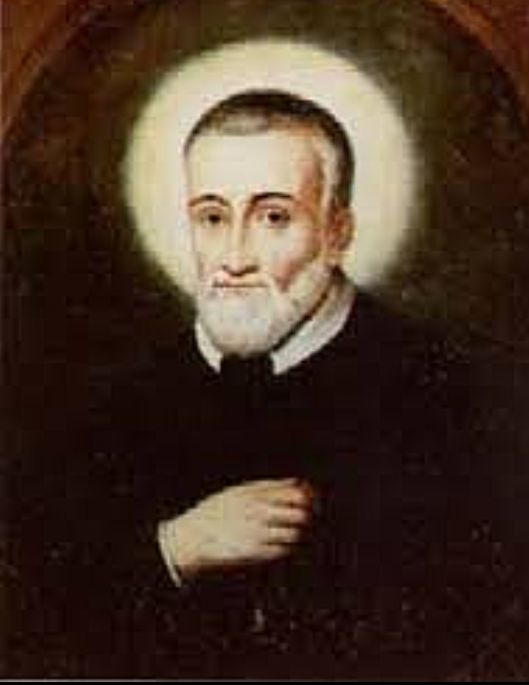
Blessed Antonio Grassi Cong. Orat. (1592 – 1671) Priest of the Oratorians of St Philip Neri, Confessor, Tertiary of the Order of St Francis, Spiritual advisor, Counsellor, Mediator, Miracle Worker, Apostle of the poor and the sick. He was Beatified on 30 September 1900 by Pope Leo XIII. Blessed Antonio’s biography: https://anastpaul.com/2018/12/13/saint-of-the-day-13-december-blessed-antonio-grassi-cong-orat-1592-1671/
St Aristone St Arsenius of Latro St Aubertus of Cambrai (c600-c669) Bishop and Confessor Bl Bartholomew of Tuscany St Edburgh of Lyminge St Einhildis of Hohenburg Bl Elizabeth Rose St Jodocus
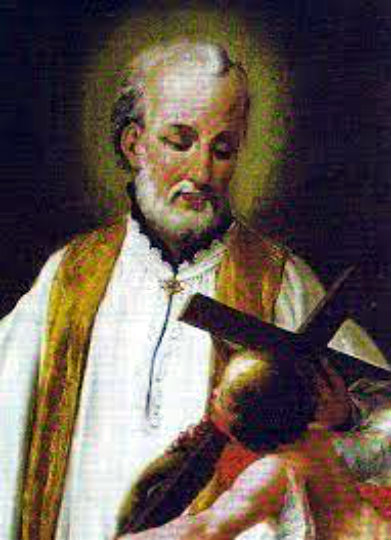
Blessed Giovanni Marinoni CR (1490-1562) Priest of the Theatines of St Cajetan (1480-1547) (The Congregation of the Clerics Regular of the Divine Providence), renowned Preacher and spiritual director. Patron of Preachers. He was Beatified on 5 December 1764, by a Bull of Pope Clement XIII, who also granted an Office in his honour, to his Order, to be celebrated on 13 December. Biography: https://anastpaul.com/2019/12/13/saint-of-the-day-blessed-giovanni-marinoni-cr-1490-1562/
St Martino de Pomar St Roswinda St Tassio of Bavaria
Blessed Mercedarian Knights – 7 Beati: A group of Mercedarian Knights who fought the enemies of the Catholic faith in the first Century of the Order. Blessed Bernardo de Podio Blessed Giacomo de Copons Blessed Giovanni de Bruquera Blessed Guglielmo de Sa Blessed Pietro Boguer Blessed Pietro Ricart Blessed Raimondo de Frexa
Martyrs of Sebaste – 5 Saints: A group of Christians Martyred together in the persecutions of Diocletian. We know little more than their names – Auxentius, Eustratius, Eugene, Mardarius and Orestes. They were martyred in c 302 at Sebaste, Armenia (in modern Turkey) and their relics are enshrined at the church of Saint Apollinaris in Rome, Italy.
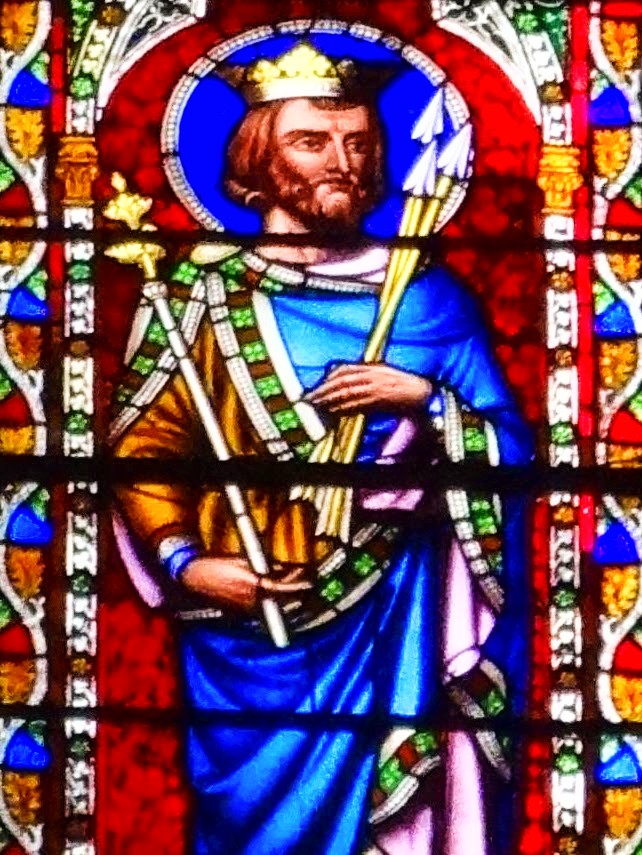
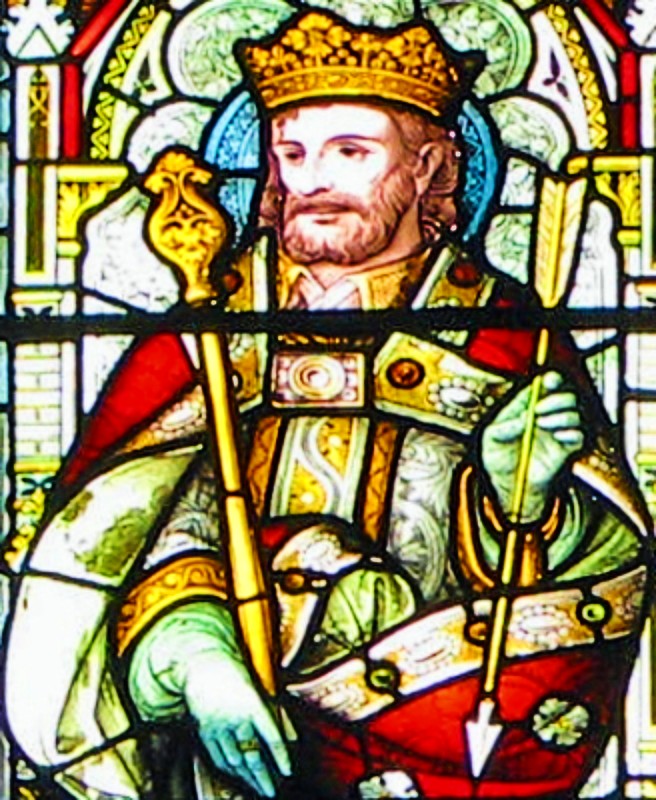
Saint of the Day – 20 November – St Edmund (c841-870) King and Martyr. Born in c841 probably in Nuremburg, Germany and died by being beaten, whipped, pierced with arrows “until he bristled with them like a hedgehog” and then beheaded at Hoxne, Suffolk, England on 20 November 870. Patronages – Co-Patron of England, against the Plague/Epidemics, of Kings, of torture victims, wolves, of the County and Diocese of East Anglia. Also known as – Edmund the Martyr, … of East Anglia. Additional Memorials – 29 April (translation of Relics), 2 November and 25 December on some local calendars.
The Roman Martyrology reads today: “In England, St Edmund, King and Martyr.”
On Christmas Day in the year 855, a remarkable event unfolded as a 14-year-old boy named Edmund was hailed as the rightful King of Norfolk by the influential figures of the County, including ruling men and Clergy. This acclaim was soon followed by a similar declaration from the leaders of Suffolk the following year.
For the next 15 years, Edmund would rule over the East Angles, a region in England, with a reputation for Christian dignity and justice which was universally acknowledged. He appeared to draw inspiration from the piety of King David of the Old Testament, notably excelling in the public recitation of the Psalms during worship.
However, Edmund’s reign was not without its challenges. Starting in 866, his Kingdom faced escalating threats from Danish invasions. For four years, the East Angles managed to maintain an unstable and often broken peace, with the invaders. Nevertheless, the situation took a dire turn, when the Danes set fire to Thetford, prompting King Edmund’s army to confront them. Unfortunately, they were unable to defeat the marauding Danish forces.
As the invaders reached East Anglia, they presented Edmund with an offer of peace but, it came with a condition which Edmund found impossible to accept. The condition required him to rule as a vassal under Danish authority and, most notably, to forbid the practice of the Christian Faith. Edmund unwaveringly refused this ultimatum, choosing to stand firm in defence of Christ.
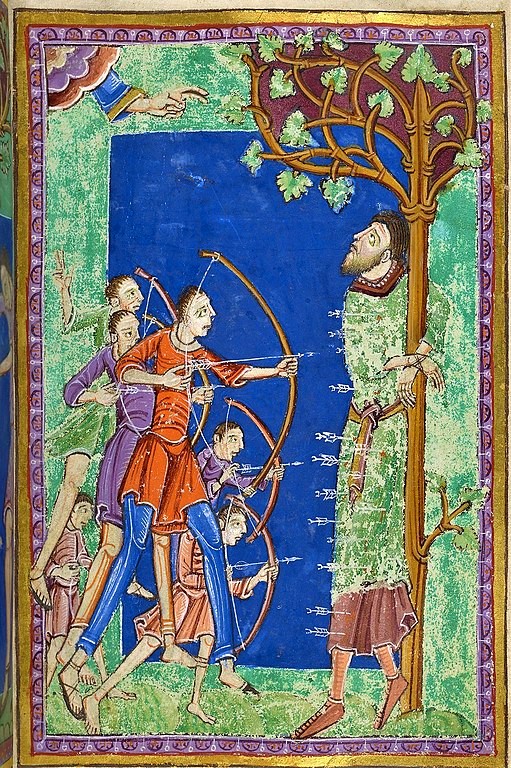
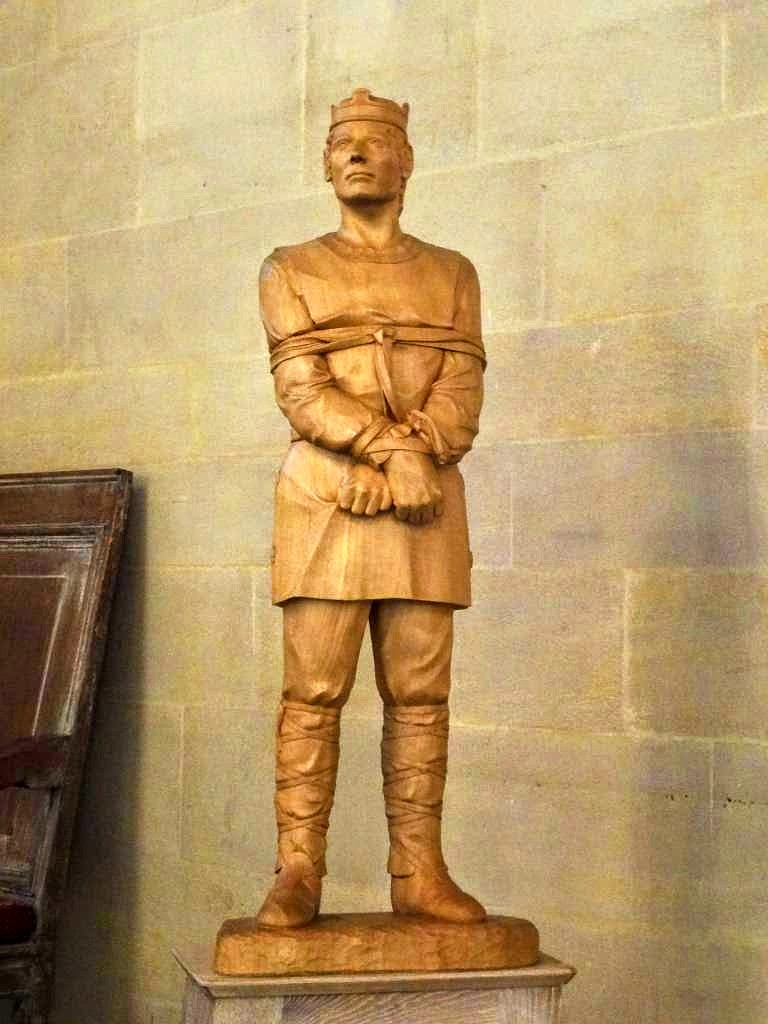
In response to his refusal, Edmund was subjected to a gruesome and torturous fate. He was bound to a tree and made the target of Danish archers, who rained down a hail of arrows upon him. Throughout this agonising ordeal, Edmund displayed remarkable bravery, repeatedly invoking the Name of Jesus. Eventually, he was decapitated, sealing his fate as a Martyr for Christ and His Church.
The Martyrdom of St Edmund, from the 12th Century Passio Sancto Eadmundi
Edmund’s final resting place is the City of Bury St Edmunds, where his memory is cherished to this day. The tree at Hoxne which tradition claimed was the site of his Martyrdom, stood as a symbol of his sacrifice until 1849 when it fell. During the tree’s dismantling, an arrowhead was discovered embedded in its trunk, serving as a poignant reminder and Relic of his Martyrdom.
St Edmund holds a unique place in history as the only English sovereign to die for both his religious beliefs and the defence of his throne, until the time of King Charles I. His Martyrdom quickly earned him reverence and his cultus spread widely throughout the Middle Ages. Together with Saint George, Saint Edmund is celebrated as one of the Patron Saints of England.
‘There was a great wonder, that he was as whole as if he were alive, with an intact body and his neck was healed which had previously been cut; it was as if there were a red silken thread about his neck, to show men how he had been killed. And the wounds which the cruel heathen had made in his body, with many shots, were healed by Heaven’s God and he lies thus incorrupt until this present day, awaiting the resurrection and eternal glory.’
This modern Statue of St Edmund in the Cathedral of Bury St Edmund
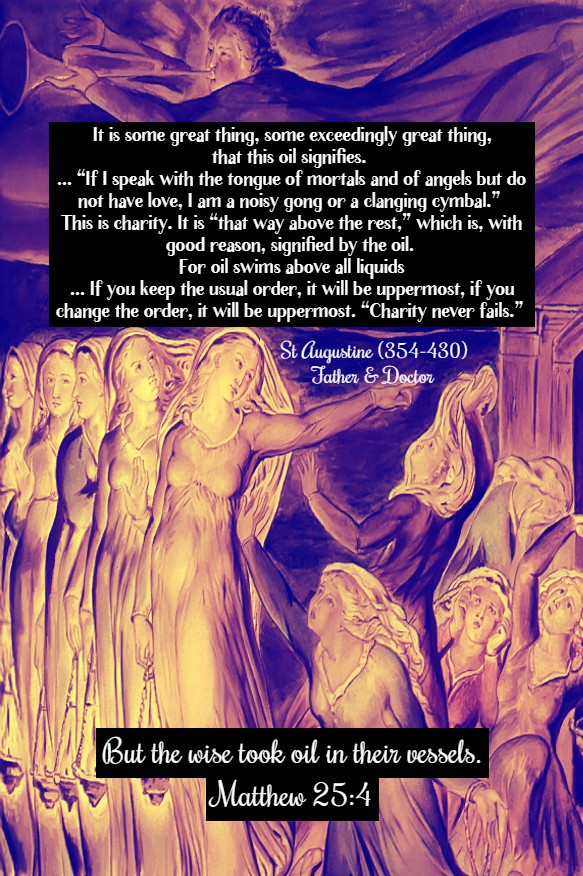
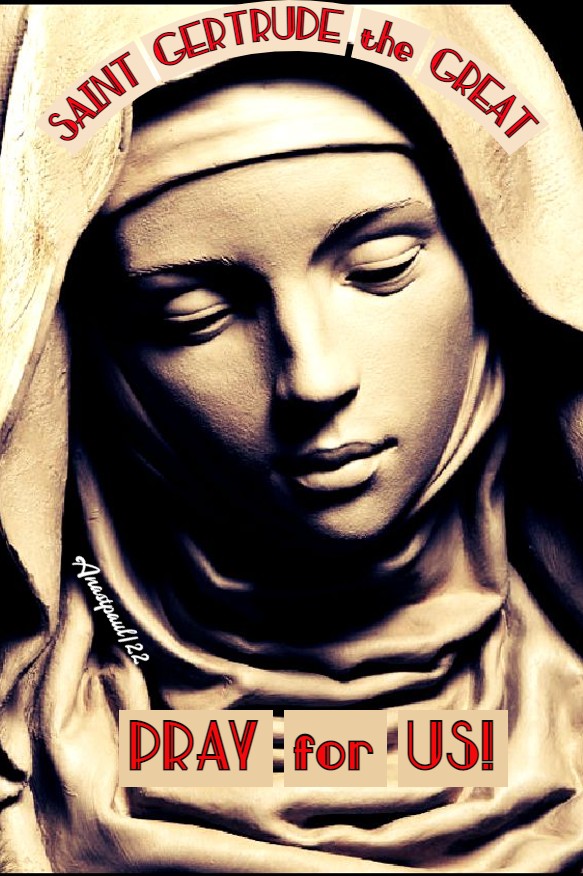
One Minute Reflection – 16 November – “The Month of the Holy Souls in Purgatory” – St Gertrude the Great (1256-1302) Virgin – 2 Corinthians 10:17-18; 11:1-2: Matthew 25:1-13 – Scripture search here: https://www.drbo.org/
“But the wise took oil in their vessels” – Matthew 25:4
REFLECTION – “It is some great thing, some exceedingly great thing, that this oil signifies. Do you think it might be charity? If we try out this hypothesis, we hazard no precipitate judgement. I will tell you why charity seems to be signified by the oil. The Apostle says, “I will show you a still more excellent way.” “If I speak with the tongue of mortals and of angels but do not have love, I am a noisy gong or a clanging cymbal.” This is charity. It is “that way above the rest,” which is, with good reason, signified by the oil. For oil swims above all liquids. Pour in water and pour in oil upon it, the oil will swim above. If you keep the usual order, it will be uppermost, if you change the order, it will be uppermost. “Charity never fails!” … St Augustine (354-430) Father & Doctor (Sermon 93).
PRAYER – O God, Who prepared a pleasing dwelling place for Thyself in the heart of blessed Gertrude the Virgin, by her merits and intercession, mercifully wipe away all sinful stain from our heart and grant that we may enjoy her companionship. Through Jesus Christ, Thy Son our Lord, Who lives and reigns with Thee, in the unity of the Holy Ghost, God, world without end. Amen (Collect).
Saint of the Day – 13 November – Saint Brice of Tours (c370-444) Bishop, disciple of St Martin of Tours, Penitent, Miracle-worker. Born in Gaul, modern France and died in Tours, France of natural causes. Patronages – against colic, against stomach diseases, of Tours, of Calimera and Samperone in Italy. Also known as – Briccius, Brictius, Britius, Brixius, Brizio, Brizo.
The Roman Martyrology reads today: “At Tours, St Brice, Bishop, disciple of the blessed Bishop Martin.”
St Martin, whose Feast we kept two days ago, was succeeded in the See of Tours, as he had predicted, by a Monk named Brice, a singularly unpromising candidate to succeed such a holy Bishop.
Martin had spent as much time as his Episcopal duties permitted among a monastic community at Marmoutier near Tours, into which he himself had taken the orphaned Brice. St Gregory of Tours describes Brice as “proud and vain” and St Martin’s Biographer, St Sulpicius Severus, tells the story in his Dialogues (3.15) of Brice being led by devils to “vomit up a thousand reproaches against Martin” even daring to assert that he, himself, was much holier for being raised from childhood in a Monastery, while Martin was raised in a military camp. Although Brice repented of this (as St Sulpicius believed, due to Martin’s prayers) and asked for the Saint’s forgiveness, he continued to be a very difficult character. Martin refused to remove him from the Priesthood, lest he would be judged to do so, as an act of vengeance but, expressed his tolerance in less than-complimentary terms: “If Christ could put up with Judas, why should I not put up with Brice?”
St Brice and St Martin
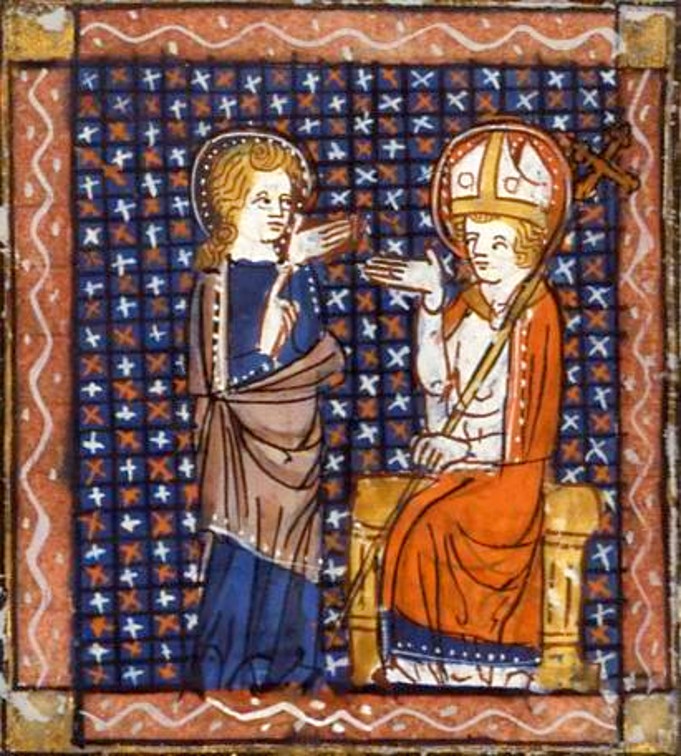
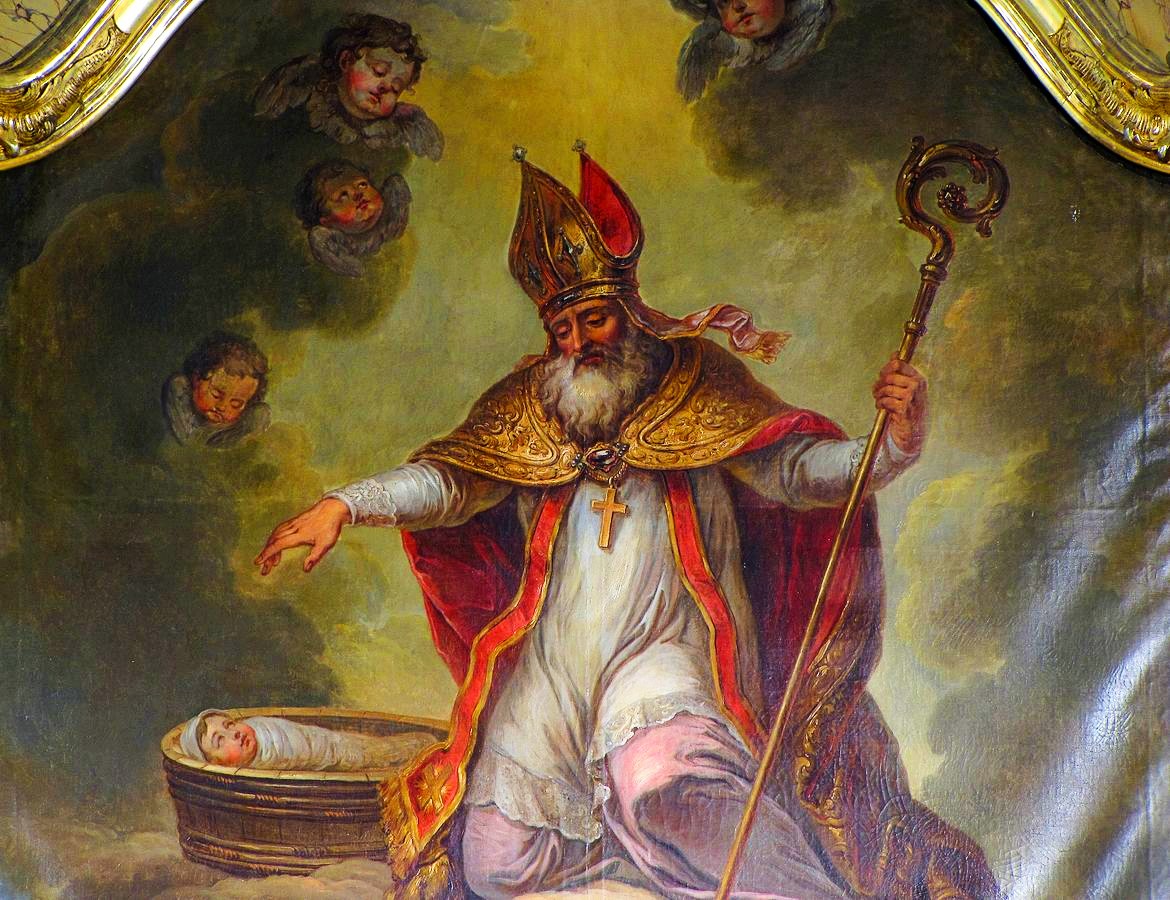
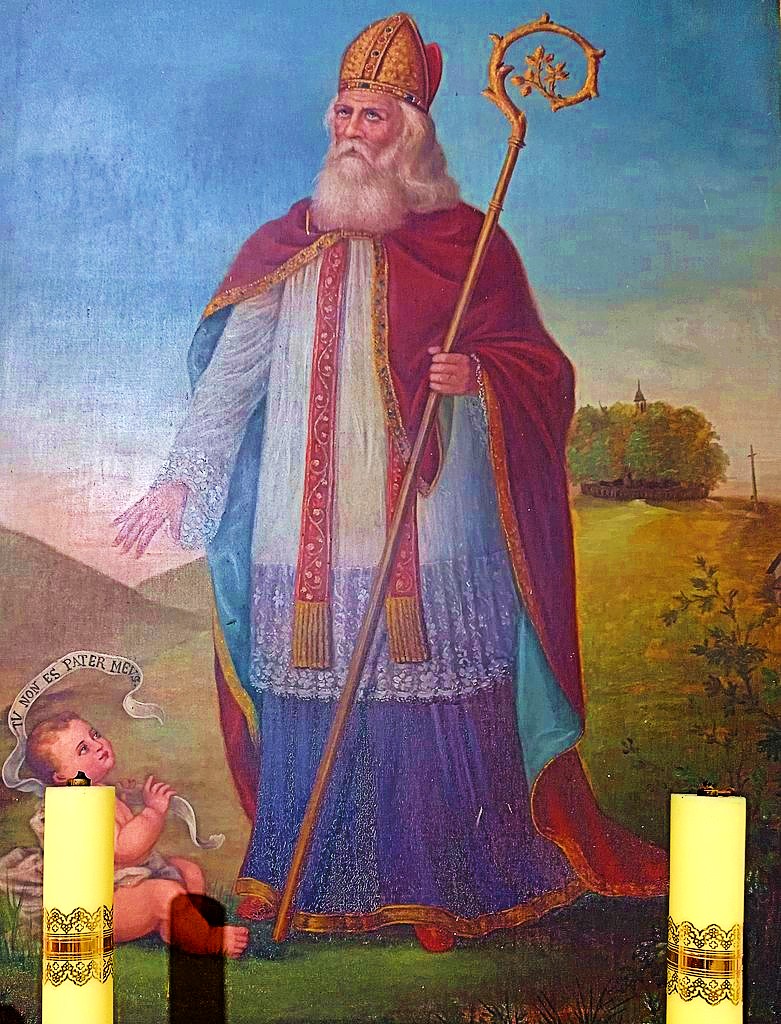
St Martin had predicted, not only that Brice would succeed him as the Bishop, but, that he would suffer much in the Episcopacy, words which Brice dismissed as “ravings.” Both predictions were fulfilled in the following manner. Although Brice was vain and proud, he was “chaste in body” and yet, he was accused of fathering a child. The revised Butler’s Lives of the Saints says, with characteristic reticence that he vindicated himself by “a very astonishing miracle” without saying what the miracle was. St Gregory of Tours tells us that Brice called together the faithful and before them ordered the month-old infant to say whether or not he was the father, at which the child did indeed say, “You are not my father!” The people ask Brice to make the infant say who its father was but Brice replied, “That is not my job. I have taken care of the part of this business which pertains to me; if you can, ask for yourselves.”
St Brice with the Infant, from the Church of St Médard in Boersch in Eastern France.
This miraculous event was attributed, perhaps understandably, to the use of magic, rather than holiness and so Brice attempted to vindicate himself by carrying hot coals in his cloak to the Tomb of St Martin; when he arrived his cloak was not burnt. But this sign was also not accepted and so he was driven from his See, “that the words of the Saint might be fulfilled, ‘Know that, in the Episcopate, you will suffer many adversities.’ …
Then Brice sought out the Pope of Rome, weeping and mourning and saying ‘Rightly do I suffer these things because I sinned against God’s Saint and often called him crazy and deluded and, seeing his virtues, I did not believe.’ ” After staying in Rome for seven years and purging his sins by the celebration of many Masses, he was restored to his See which he governed for a further seven years as a man “of magnificent sanctity,” according to St Gregory, very much changed for the better by the experience.
I believe, a Polish image of St Brice with the Infant
His popularity in the medieval period was very great and his Feast is found on most calendars, although not that of Rome. This is due in part to his association with St Martin but perhaps more, as an example of something which the medievals understood very well and loved to dwell upon – it is never too late for God’s grace to bring us away from sin to sanctity and even to Sainthood. And so we ask St Brice to assist us by his intercession, in our repentance and our growth in holiness. (Adapted from Gregory DiPippo’s articleon NLM).
Our Morning Offering – 7 November – “The Month of the Holy Souls in Purgatory” – On Thursday we devote our hearts and souls to the most holy Eucharist. The Eucharist is the greatest Gift of God to mankind, as it is nothing less than Jesus Himself. Therefore today too, we pray for our Priests AND as today is the Feast Day of All the Saints of the Order of Preachers or the Dominicans, we pray a prayer by one of their greatest sons.
Lauda Sion Salvatorem Sion, Lift Up thy Voice and Sing (Excerpt) By St Thomas Aquinas OP (1225-1274) Doctor Angelicus / Doctor Communis
Sion, lift thy voice and sing, Praise thy Saviour and thy King, Praise with hymns thy Shepherd true, Dare thy most to praise Him well, For He doth all praise excel, None can ever reach His due.
Special theme of praise is Thine, That true living Bread divine, That life-giving flesh adored, Which the brethren twelve received, As most faithfully believed, At the Supper of the Lord.
Let the chant be loud and high, Sweet and tranquil be the joy Felt to-day in every breast; On this festival divine Which recounts the origin Of the glorious Eucharist.
St Thomas Aquinas wrote the Liturgy for Corpus Christi when Pope Urban IV added the Solemnity to the universal Church’s Liturgical calendar in 1264. He provided a great sequence, one of the great poems chanted or recited before the proclamation of the Gospel. Lauda Sion is one of only four medieval sequences which were preserved in the Roman Missal published in 1570 following the Council of Trent (1545–1563)—the others being Victimae Paschali Laudes (Easter), Veni Sancte Spiritus (Pentecost) and Dies irae (requiem masses). (A fifth, Stabat Mater, would later be added in 1727.) Before Trent, many feasts had their own sequences. The existing versions were unified in the Roman Missal promulgated in 1570. The Lauda Sion is still sung today as solemn Eucharistic hymn, though its use is optional in the post-Vatican II Ordinary form. As with St Thomas’s other three Eucharistic Hymns, the last few stanzas of the Lauda Sion are often used alone, in this case, to form the “Ecce Panis Angelorum”.
Thought for the Day – 4 November – Meditations with Saint Alphonsus Maria de Liguori (1696-1787) Bishop, Confessor, Most Zealous Doctor of the Church
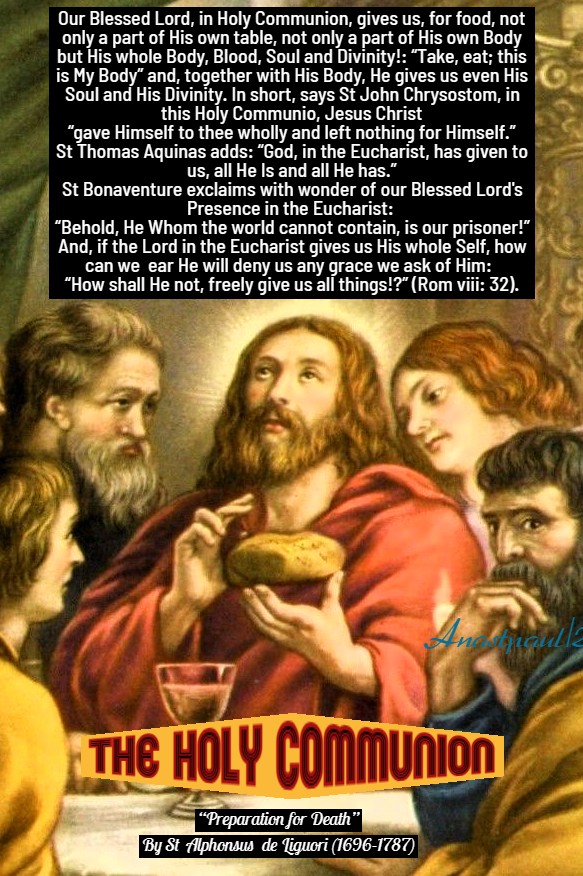
“Preparation for Death” By St Alphonsus Maria de Liguori (1696-1787)
CONSIDERATION XXXIII
The Holy Communion “Take, eat; This is My Body.” (Matt xxvi: 26)
FIRST POINT: LET us observe how great a gift is this Holy Sacrament; how great is the Love which Jesus has shown to us in this gift and, how great is His desire, of our reception of this, His GREAT GIFT.
Let us consider, in the first place, the great Gift, Jesus Christ procured for us, in giving Himself to be wholly Food in the Holy Communion. St Augustine says that our Blessed Lord: “although He is omnipotent, was not able to give us more than this.” St Bernardine of Sienna asks: “What greater treasure can the heart of man possess, than the most holy Body of Christ?” … If our Redeemer had not given us this gift, whoever would have been able to ask for it, who would ever have dared to say to Him, Lord, if Thou desiredst to make us know Thy Love, conceal Thyself under the form of Bread and permit us to feed on Thee!? It would have been esteemed madness! even to think of this. St Augustine asks: “Would it not seem madness to say, Eat My Flesh and drink My Blood!?”
When our Blessed Lord revealed to His disciples this gift of the Holy Sacrament which He wished to leave them, many of them could not attain to the belief of it and they parted from Him, saying: “How can this Man give us His Flesh to eat? …. This is a hard saying; who can hear it? (John vi: 52,60). But what men were not able, at any time to conceive, the great Love of our Lord Jesus Christ, both intended and wrought. St Bernardine says that our Blessed Lord left us “this Sacrament to be a memorial of His Love” and the record which St Luke has left of our Lord’s words, agrees with this statement: “Do this in remembrance of Me.” (Luke xxii: 19). St Bernardine adds, the love of our Lord was not satisfied with sacrificing His Life for us: “In that excess of fervour, when He was ready to die for us, He was impelled, by this ocean of love, to do a greater work than ever had been wrought, to give to us His Body for food.” Abbot Guerric says, in this Sacrament, Jesus “poured out upon His friends, the last strength of His Love” and the same sentiment is expressed more forcibly, when it was said of old that, in the Eucharist, our Blessed Lord, “as it were, poured out upon men, the riches of His Love.”
… Our Blessed Lord, in Holy Communion, gives us, for food, not only a part of His own table, not only a part of His own Body but His whole Body, Blood, Soul and Divinity!: “Take, eat; this is My Body” and, together with His Body, He gives us even His Soul and His Divinity. In short, says St John Chrysostom, in this Holy Communio, Jesus Christ “gave Himself to thee wholly and left nothing for Himself.” St Thomas Aquinas adds: “God, in the Eucharist, has given to us, all He Is and all He has.” St Bonaventure exclaims with wonder of our Blessed Lord’s Presence in the Eucharist: “Behold, He Whom the world cannot contain, is our prisoner!”
And, if the Lord in the Eucharist gives us His whole Self, how can we ear He will deny us any grace we ask of Him: “How shall He not, freely give us all things!?” (Rom viii: 32).
Affections and Prayers
O my Jesus! What has ever led Thee to give Thy whole Self for our food? And what remains, after Thou hast given us this gift, to compel us to love Thee? Oh ! Lord, give usThine Light and make us to understand, how excessive is the love which caused Thee to reduce Thyself to food, to unite Thyself to ourselves, poor sinners! But if Thou givest Thyself wholly to us, it is a reason why we also should give ourselves wholly to Thee.
O my Redeemer, how have I been able to offend Thee, Who hast so loved me and Who hast had nothing more Thou couldst do to gain my love? Thou hadst become Man for me; Thou didst die for m ; Thou hast made Thyself my food; tell me what more it remains for Thee to do?
I love Thee, O Infinite Goodness; I love Thee, O Infinite Love! Lord, come often into my soul: inflame me wholly with Thy holy Love and cause me to forget all else, that I may neither think of, nor love any other than Thee.
Our Morning Offering – 4 November – Saint Charles Borromeo (1538-1584) He is known as the “Father of the Clergy” – Some of his Patronages: Bishops, Priests, Seminarians • Catechists • Catechumens • Spiritual Directors • Spiritual leaders
O Holy Mother of God A Prayer for our Priests to the Most Blessed Virgin By St Charles Borromeo (1538-1584)
O Holy Mother of God, pray for the Priests thy Son has chosen to serve His Church. Help them by thy intercession, to be holy, zealous and chaste. Make them models of virtue, in the service of God’s people. Help them to be prayerful in meditations, effective in preaching and enthusiastic in the daily offering of the Holy Sacrifice of the Mass. Help them to administer the Sacraments with joy, O Holy Mother of God. Amen
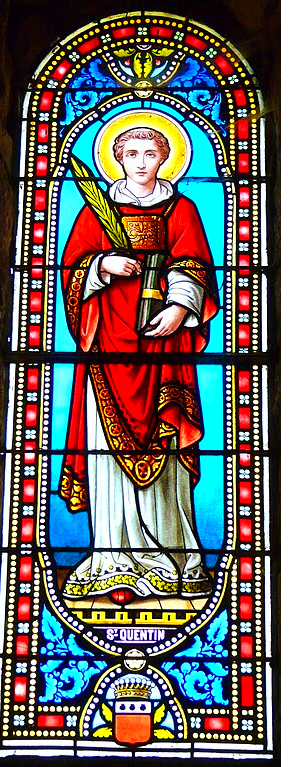
Saint of the Day – 31 October – Saint Quentin (Died c287) Martyr, Roman Senator, Missionary. Died in c287 after horrible torments he was finally beheaded. Patronages – against coughs, whooping courgh, colds, against dropsy, against sneezing, of bombardiers, of Chaplains, locksmiths, porters, surgeons, tailors, of Amiens in France, of Monticelli Terme in Italy. Also known as – Quentin of Vermand, Quentin of Amiens, Quinten… Quintin…Quintino… Quintinus… Additional Memorials – 24 June on some calendars, 3 January (discovery of his body), 25 October (translation of the body). In art Quentin is often depicted as a Deacon.
The Roman Martyrology reads today: “At Saint Quentin, in France, St Quintinus, a Roman citizen and Senator, who endured Martyrdom under the Emperor Maximian. By the revelation of an Angel, his body was found incorrupt after the lapse of 55 years.”
Quentin belonged to a Roman senatorial family and came to Gaul under the Emperor Maximian to work with St Lucian who was later also Martyred near Beauvais in c290, as a missionary of faith in the area around Amiens.
The Life os St Quentin Unknown Dutch Master
He was arrested in Vermand and finally beheaded near what is now St-Quentin. According to later tradition, he was pricked with nails, doused with hot pitch and his body thrown into the River Somme. Around 55 years later, the blind Roman noblewoman, Matron Eusebia had the body recovered from the Somme following a vision and buried in a Chapel she had built.
The Martyrdom of St Quentin – Unknown artist
According to St Gregory of Tours, Quentin was already being venerated in the 6th Century. Around 641, St Eligius of Noyon found the Relics and made a richly decorated Tomb (St Eligius being a renowned craftsman and goldsmith) – the first recorded story of the Passion of St Quentin dates from that time.
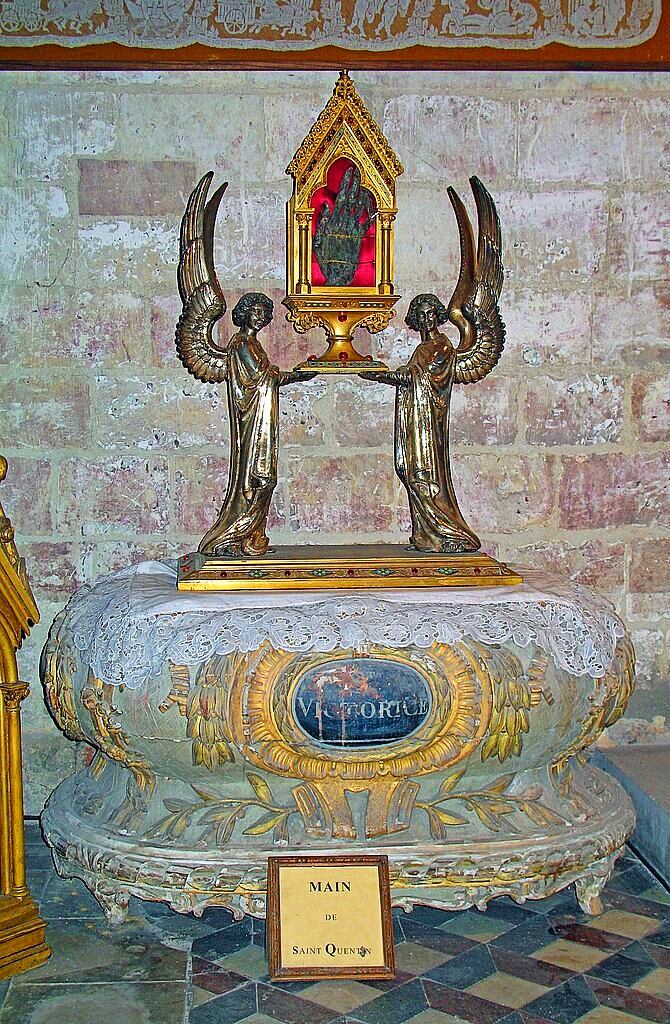
Due to the large stream of pilgrims to the Church dedicated to the Martyr , the Town of St-Quentin developed on this site. The Church, which was renovated between 813 and 826 and again in the 13th Century, contains Quentin’s Tomb and today is a very large Basilica and is still a place of pilgrimage and miracles, so much so, that a new Church, the current Basilica, had to be erected to accommodate the faithful. The Processional Bust and Reliquary below might be that crafted by St Eligius (?).
St Quentin’s Relics in the Basilica at St Quentin
In 881, because of the Norman invasions, the Relics were taken to Laon. In Parma, the Church of San Quintino is dedicated to our Saint which dates to an old Oratory which was built outside the City walls.
the processional Religuary of St Quentin kept in the Basilica
The Martyrs Sts Victoricus and Fuscian were St Quentin’s followers.
Saint of the Day – 24 October – St Senoch (536-576) Abbot, Priest, Ascetic, Apostle of the needy, the poor, of slaves, Founder of a Monastery , Miracle-worker granted the charism of curing the sick, especially the blind, those sick in soul and body. Born in 536 in Tiffauges, Poitou, Gaul (in modern France) and died in 576 aged 40, Touraine, France from a fever. Patronages – against eye diseases, of the blind, Saint-Senoch, France, Sassenay, France. Also known as – Xenochus, Sassena, Sassenay, Seno, Sénoch, Senoco, Senócus. Additional Memorial – 25 October in the Diocese of Tours to avoid conflict with St Raphael on 24 October.
Senoch retired to Touraine to live as a Hermit. He exercised his gift of healing espeically of the blind, the mute and the paralysed. He used this great grace granted to him by the Almighty also to adsminister to and to free the slaves.
He established a Monastery near Tours, whose Bishop St Eufronius had revived the spiritual ardour of his See, Senoch found ruins in which he set up an Oratory. The Bishop of Tours Consecrated the Altar, placed Relics therein and conferred the Diaconate upon Senoch.
A few years later,, Senoch was Ordained a Priest. But in his pride, Senoch decided to returned to Tiffauges to see his parents and cure his fellow townsmen of their illnessed. However, in this he failed, he could not work any miracles in his hometown and they chased him away with stones.
Upon his return to Tours, Senoch asked forgiveness for his sin of vanity and chose to atone for his sins by leading a life of mortification and humility in his Monastery. He died there in 576 after suffering a fever.
In the 9th Century, the remains of the Saint were transported to Sassenay, a village in Burgundy located on the outskirts of Chalon-sur-Saône, so that they could escape the Norman invaders.
Indeed, in the 9th Century, faced with the threat of invasion, the Monks, who no longer felt safe in the region, began an exodus, with the Relics of their holy founder. After various stops, the small community finally settled in the heart of Morvan, then in Beaune (Côte-d’Or). According to tradition, it was at the time of the construction of the Parish Church of Sassenay in the 11th-12th centuries when the translation of the Relics of Saint Senoch took place, a gift from the Bishop of Dijon to the Bishop of Autun.
It was the starting point of a very popular pilgrimage for the cure of sick children, the blind and the suffering.
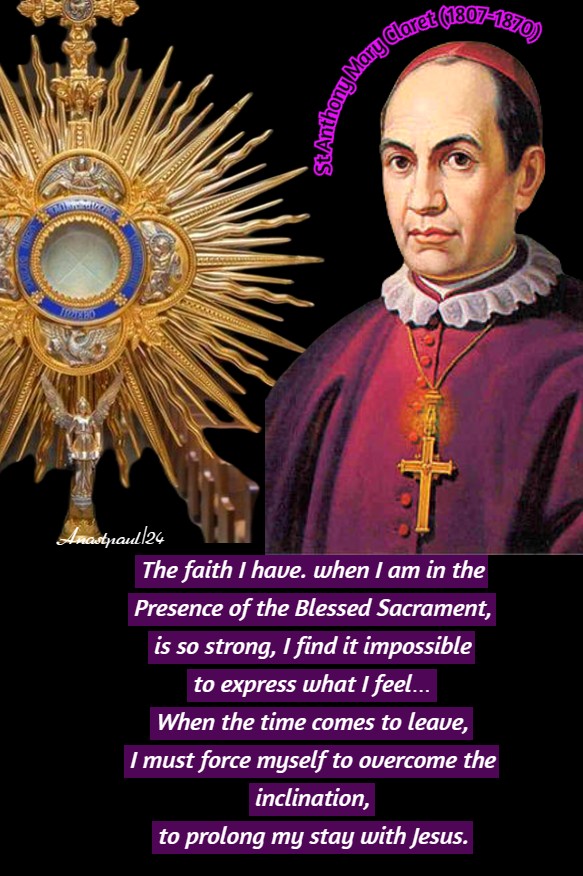
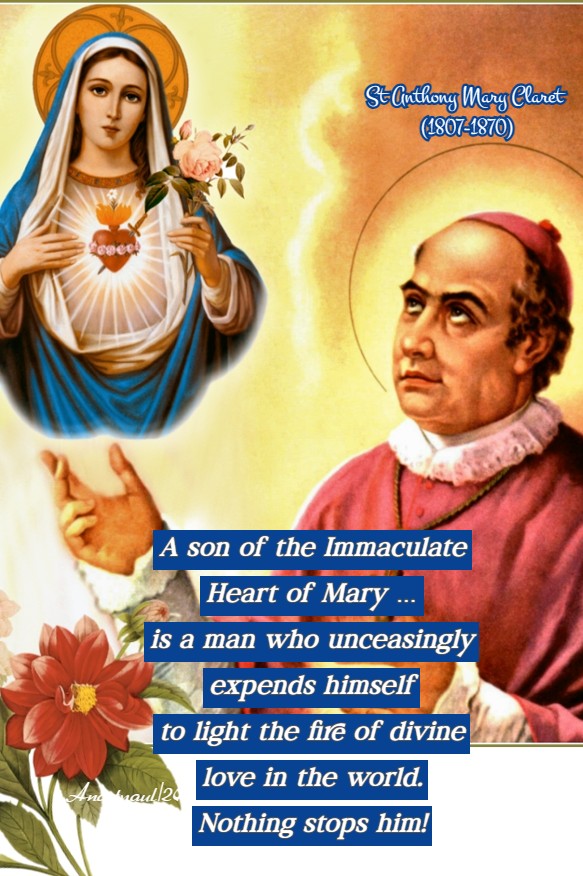
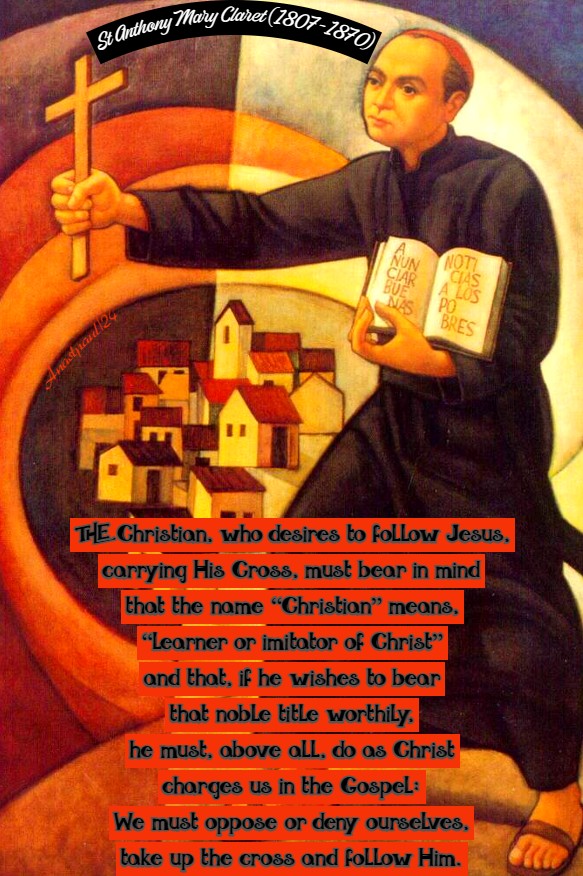
Quote/s of the Day – 23 October – St Anthony Mary Claret CMF (1807-1870) Archbishop and Founder of the Claretians
“The faith I have, when I am in the Presence of the Blessed Sacrament, is so strong, I find it impossible to express what I feel… When the time comes to leave, I must force myself to overcome, the inclination to prolong my stay with Jesus.”
“A son of the Immaculate Heart of Mary … is a man who unceasingly expends himself to light the fire of divine love in the world. Nothing stops him!”
“The Christian, who desires to follow Jesus, carrying His Cross, must bear in mind that the name “Christian” means, “learner or imitator of Christ” and that, if he wishes to bear that noble title worthily, he must, above all, do as Christ charges us in the Gospel: We must oppose or deny ourselves, take up the cross and follow Him.”
Our Morning Offering – 22 September – “The Month of The Seven Sorrows of the Blessed Virgin Mary and The Holy Cross” – Pentecost XVIII
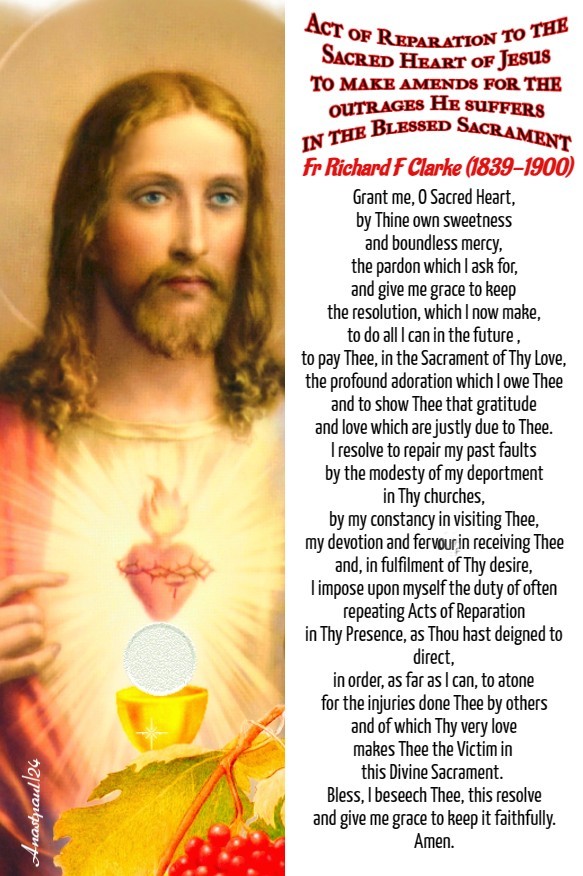
Act of Reparation to the Sacred Heart of Jesus to make amends for the outrages He suffers in the Blessed Sacrament By Fr Richard Frederick Clarke SJ (1839-1900)
Grant me, O Sacred Heart, by Thine own sweetness and boundless mercy, the pardon which I ask for, and give me grace to keep the resolution, which I now make, to do all I can in the future , to pay Thee, in the Sacrament of Thy Love, the profound adoration which I owe Thee and to show Thee that gratitude and love which are justly due to Thee. I resolve to repair my past faults by the modesty of my deportment in Thy churches, by my constancy in visiting Thee, my devotion and fervo.r in receiving Thee and, in fulfilment of Thy desire, I impose upon myself the duty of often repeating Acts of Reparation in Thy Presence, as Thou hast deigned to direct, in order, as far as I can, to atone for the injuries done Thee by others and of which Thy very love makes Thee the Victim in this Divine Sacrament.
Bless, I beseech Thee, this resolve and give me grace to keep it faithfully. Amen
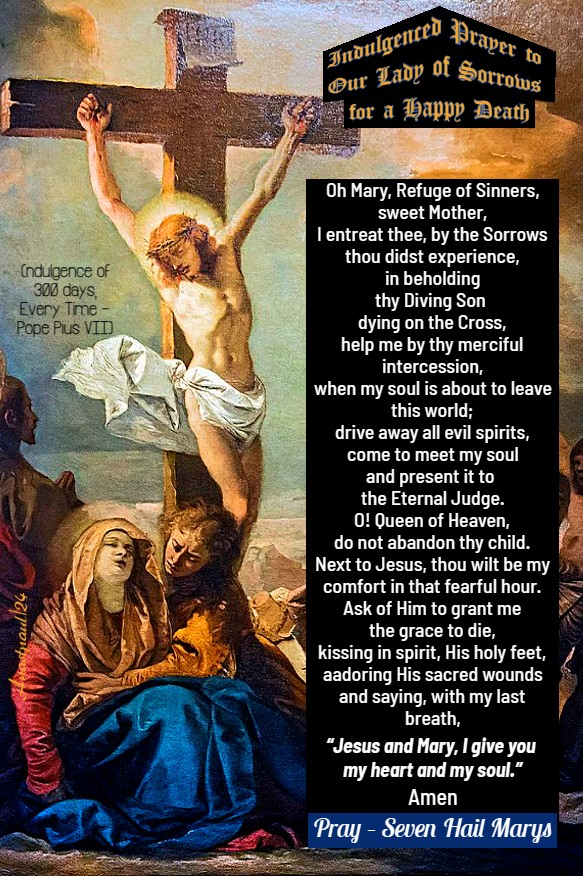
Indulgenced Prayer to Our Lady of Sorrows for a Happy Death (Pope Pius VII granted an Indulgence of 300 days, Every Time)
Oh Mary, Refuge of Sinners, sweet Mother, I entreat thee, by the Sorrows thou didst experience, in beholding thy Diving Son dying on the Cross, help me by thy merciful intercession, when my soul is about to leave this world; drive away all evil spirits, come to meet my soul and present it to the Eternal Judge. O! Queen of Heaven, do not abandon thy child. Next to Jesus, thou wilt be my comfort in that fearful hour. Ask of Him to grant me the grace to die, kissing in spirit, His holy feet, aadoring His sacred wounds and saying, with my last breath, “Jesus and Mary, I give you my heart and my soul.” Amen
Quote/s of the Day – 16 September – “The Month of The Seven Sorrows of the Blessed Virgin Mary and The Holy Cross” – The Feast of Saint Corneliu, Pope & Martyr and Saint Cyprian, Bishop & Martyr
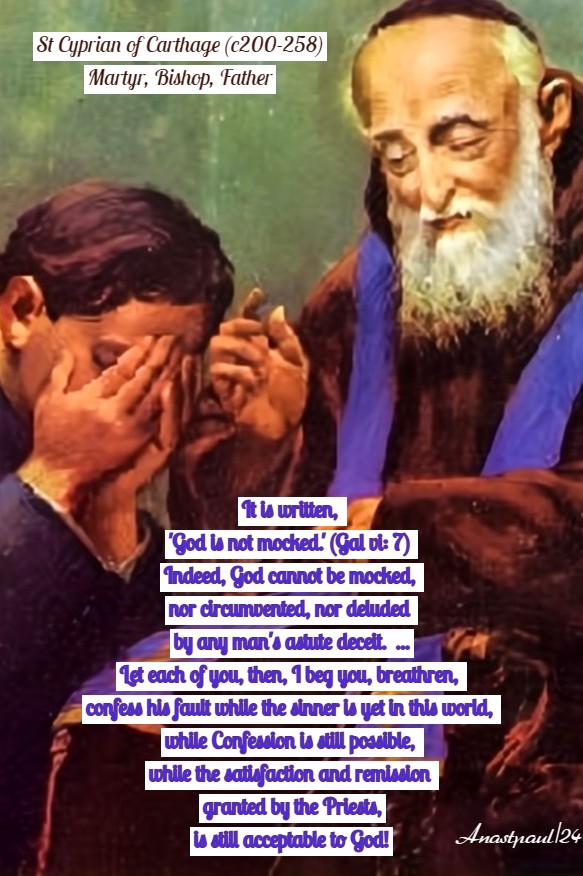
“It is written, ‘God is not mocked.’ (Gal vi: 7) Indeed, God cannot be mocked, nor circumvented, nor deluded by any man’s astute deceit. … Let each of you, then, I beg you, brethren, confess his fault while the sinner is yet in this world, while Confession is still possible, while the satisfaction and remission granted by the Priests, is still acceptable to God!”
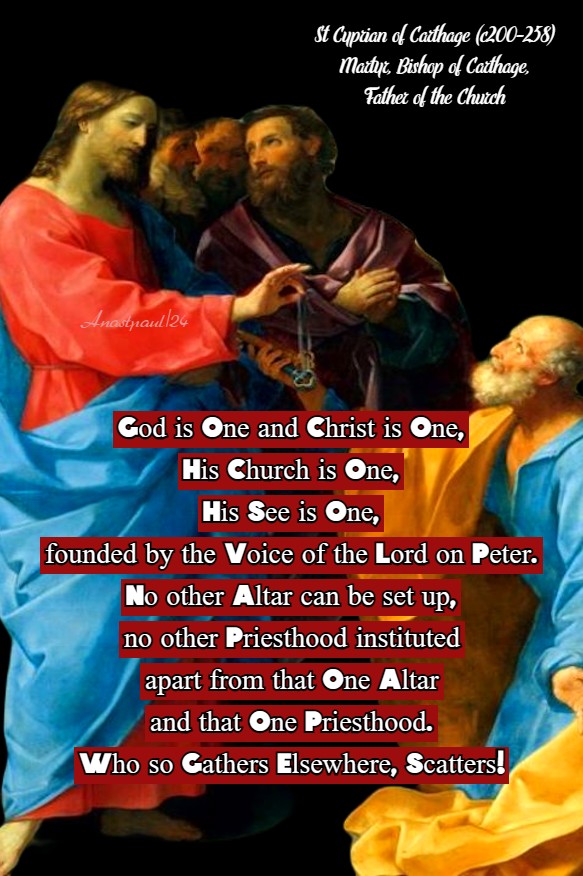
“God is One and Christ is One, His Church is One, His See is One, founded by the Voice of the Lord on Peter. No other Altar can be set up, no other Priesthood instituted apart from that One Altar and that One Priesthood. Who so gathers elsewhere, scatters!”
“She did not leave the temple, serving with fastings and prayers, night and day.” Luke 2:37
“If, in holy Scripture, Christ is the true Sun and the true Day, there is no hour when Christians should not adore God frequently and constantly, so that we, who are in Christ, that is, in the true Sun and true Day, should be persevering, throughout the whole day, in our petitions and prayer. And when, in the course of time, the revolving night returns, there can be no harm from the nocturnal shades, for those who pray because, to the sons of Light (1 Thes 5:5), even in the night, there is day! For when is he without light who has Light in his heart? Or when does he not have sun and day to whom Christ is Sun and Day?”
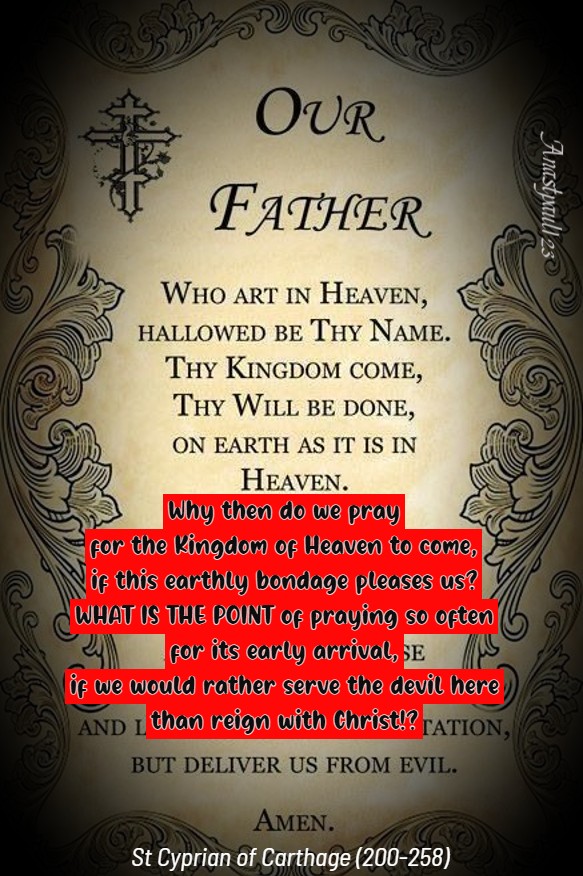
“Why then do we pray for the Kingdom of Heaven to come, if this earthly bondage pleases us? WHAT IS THE POINT of praying so often for its early arrival, if we would rather serve the devil here than reign with Christ!?”
Quote/s of the Day – 10 September – Saint Nicholas of Tolentino OSA (1245-1305) Confessor, “The Patron of Holy Souls” Priest, Augustinian Friar Monk, Mystic, Preacher, Miralce-worker and Apostle of the poor, the sick, the needy.
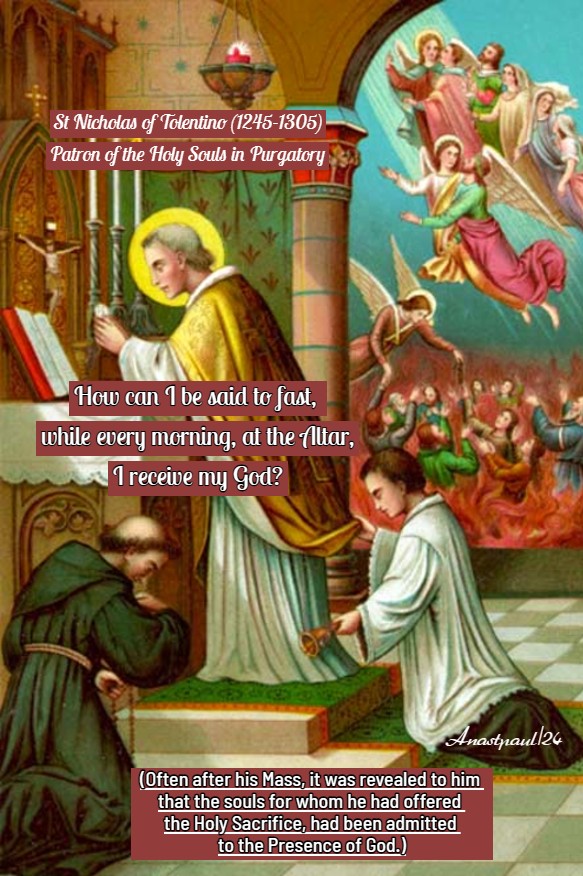
“How can I be said to fast, while every morning, at the Altar, I receive my God?”
(Often after his Mass, it was revealed to him that the souls for whom he had offered the Holy Sacrifice, had been admitted to the Presence of God.)
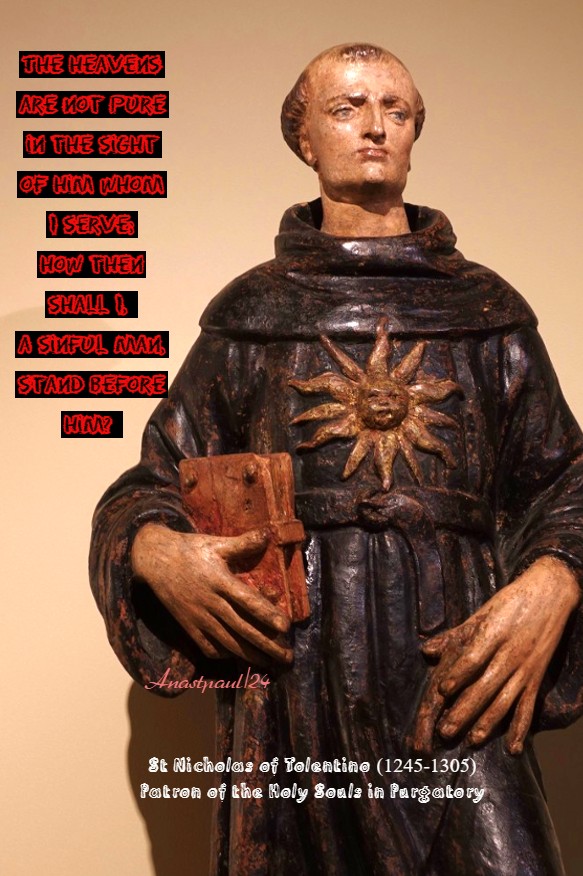
“The heavens are not pure in the sight of Him Whom I serve; how then shall I, a sinful man, stand before Him? ”
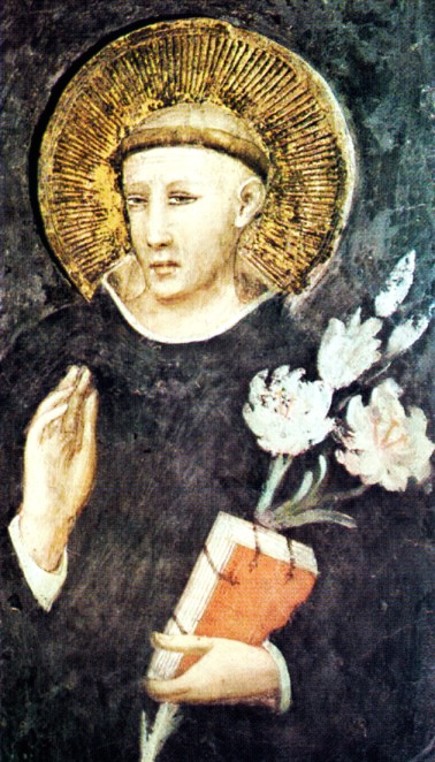
Saint of the Day – 10 September – Saint Nicholas of Tolentino OSA (1245-1305) Confessor, “The Patron of Holy Souls” Priest, Augustinian Friar Monk, Mystic, Preacher, Miralce-worker and Apostle of the poor, the sick, the needy. Patronages – animals, babies (reported to have raised more than 100 children from the dead), sailors, dying people, sick animals, the Holy Souls in Purgatory, 4 Cities, 3 Diocese. The Name Nicholas from the Greek means means: “the victor over the people.”
The Roman Martyrology reads today: “At Tolentino, in the March of Ancona, the departure from this life of St Nicholas, Confessor of the Order of Augustinians.”
Nicholas was born in the angelic town of Sant’ Angelo in Pontano, Italy. An angel had advised his previously childless parents, to make a pilgrimage to the Tomb of St Nicholas of Myra and out of gratitude, they gave their son the name of the Saint.
Nicholas was admitted into the Augustinian Hermits’ Order in 1255 , was Ordained a Priest in 1270 and initially, worked as a Preacher and Confessor. In 1275 he was sent to Tolentino , where he experienced miraculous confirmations from Angels whom he saw standing around the Altar.
14th Century, painting now in the Basilica named after St Nicholas in Tolentino
Nicholas became a very popular Preacher and Shepherd of the sick and led a life of strict asceticism and active charity. He worked tirelessly as a pastor of the common people and cared for the poor and sick. It is said that miracles occurred through his intercession during his lifetime; his prayers had a healing effect, he overcame the devil who broke the lamp on the Altar and tried to harm others. Even when he was seriously ill, he refused to eat two roasted birds because of the mortification he had vowed but when he obediently obeyed the Prior’s command to take a bite, the partridges – alive – flew away.
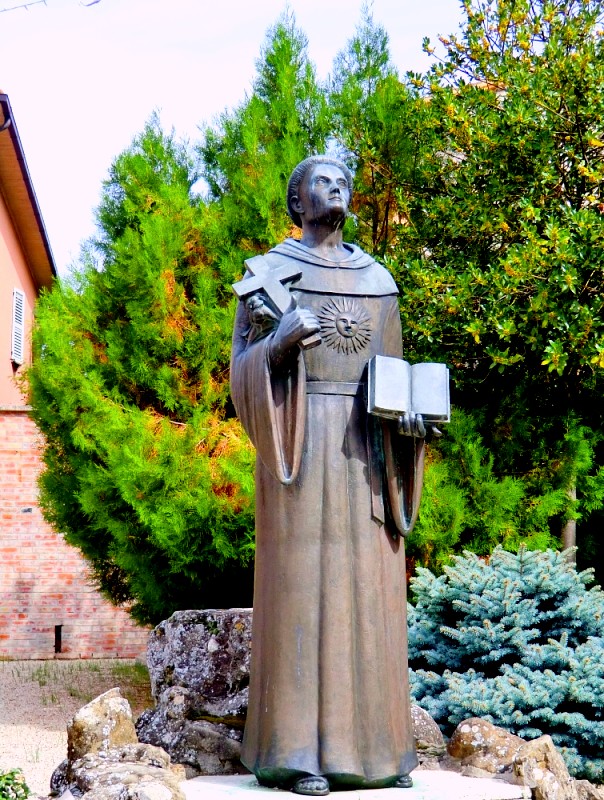
Statue at the site of Nicholas’ birthplace in Sant’ Angelo in Pontano, erected by the Municipality and population, on the 650th Anniversary of his death – 10 September 1955.
Nicholas’ Grave is in the Basilica in Tolentino which was built above it and named after him. He was not buried in the coffin originally intended for him which is in the large Chapel built for his veneration but under the floor, after his arms were taken as Relics. Numerous miracles occurred there and more than 300 were officially confirmed in the twenty years after his death alone. In 1926, his bones were rediscovered during excavations and were placed in a glass shrine and brought to the newly equipped Crypt. His Grave remains an important place of pilgrimage to this day.
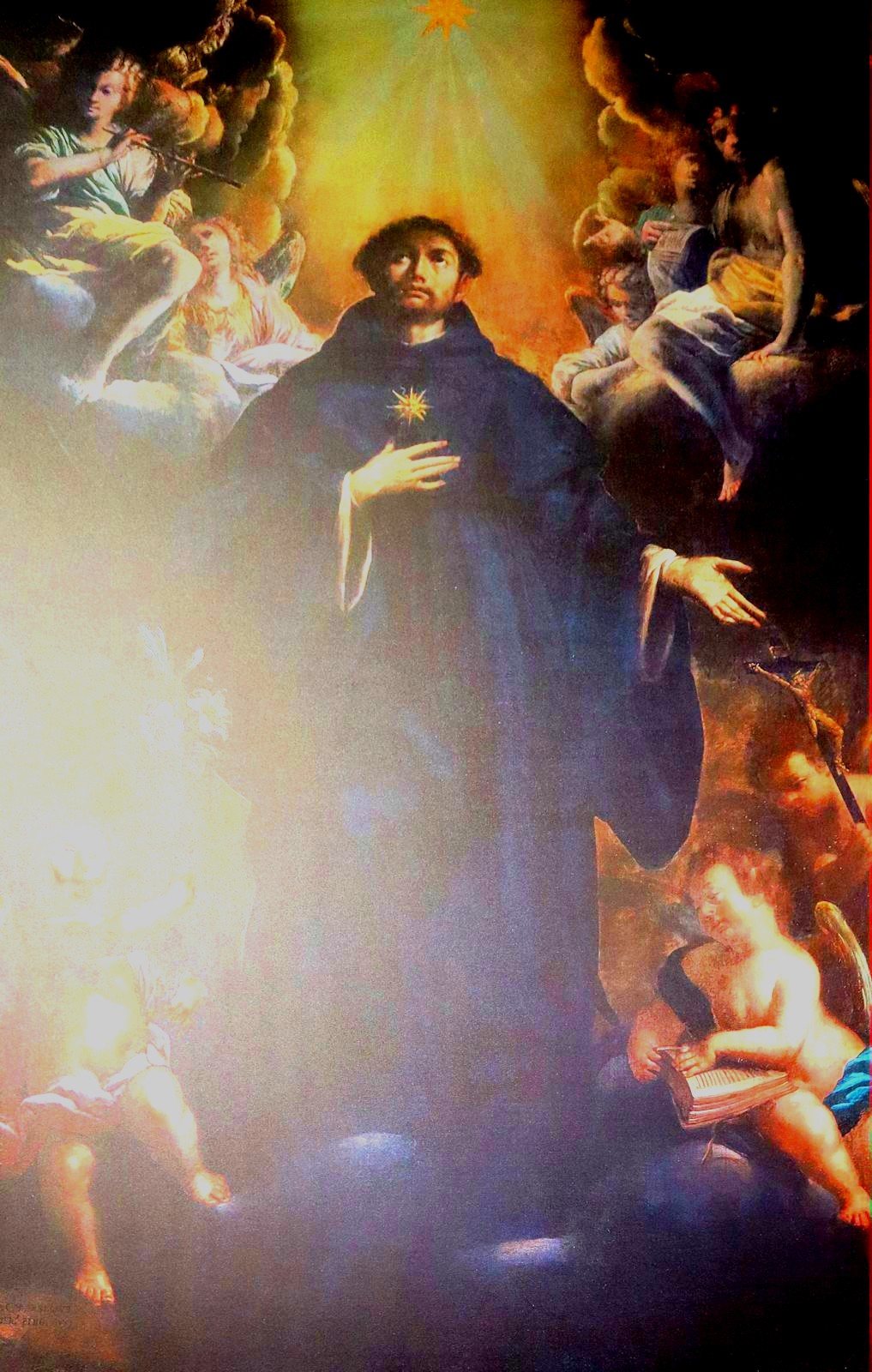
Gian Giacomo Barbelli: “Glorification of St Nicholas” 1653, in the Church of Sant’Andrea in Bergamo
From the 16th to the 18th Centuries, Nicholas was one of the most venerated Saints in Europe. In many Countries he is considered a helper in times of need. In Cordoba he became the Patron Saint of the City because his intercession ended a plague epidemic. In Venice the Church of San Nicola da Tolentino was dedicated to him for the same reason and there too, he became the Patron of the City. On his Feast Day, according to old custom, bread is blessed which is said to help against gout or is thrown into the flames of fires to contain them – the background is the story of how Nicholas was cured of a fever after asking an old woman for bread at the behest of the Blessed Virgin Mary.
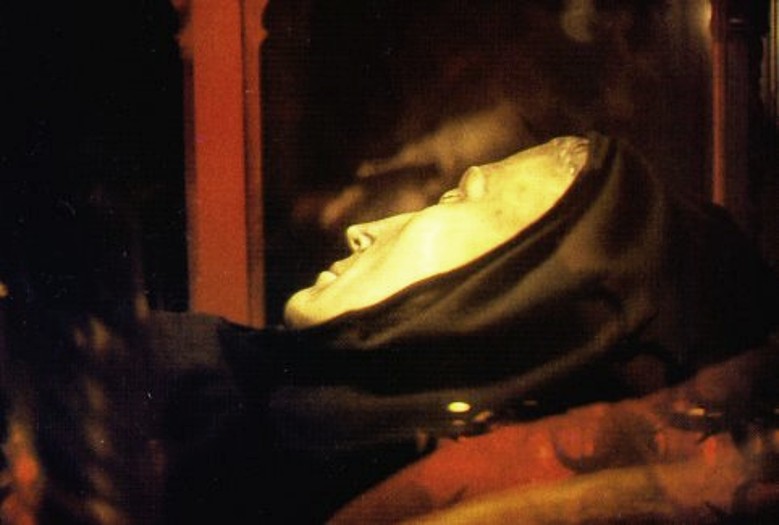
St Nicholas in a glass coffin in the Basilica di San Nicola in Tolentino
Saint of the Day – 4 September – Saint Candida of Naples (Died c78) Virgin. Co-Patronage – of Naples. She was Baptised by St Peter. Also known as – Candida la Vecchia, Candida the Elder.
The Roman Martyrology reads today: “At Naples, In Campagna, the Birthday of St Candida, who was the first to meet St Peter when he came to that City and being Baptised by him, afterwards ended her holy life in peace.”
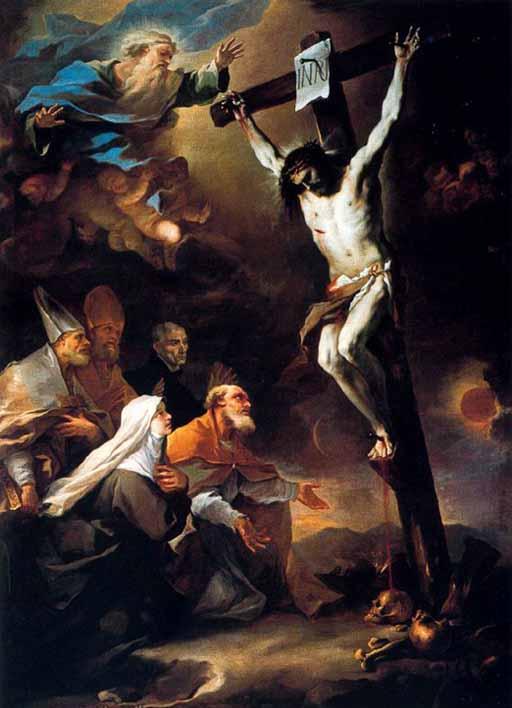
The Patron Saints of Naples [Saints Baculus, Euphebius, Francis Borgia, Aspren, and Candida the Elder (kneeling)] adoring the Crucifix, 17th Century. Palazzo Reale, Naples by Luca Giordano. Since the time of this Painting there are many more Co-Patrons of Naples.
Candida was an elderly woman who hospitably welcomed St Peter the Apostle, when he was passing through Naples on his way to Rome. She was cured of an illness by St Peter and converted to Christianity, being Baptised by St Peter.
Candida later converted St Aspren, who became the first Bishop of Naples.
Our Morning Offering – 3 September – “The Month of The Seven Sorrows of the Blessed Virgin Mary and The Holy Cross” – St Pius X (1835-1914) Pope, Confessor and today, Wednesday, being St Joseph’s day. St Joseph continues his fatherly guardianship of Christ’s Body, the Holy Catholic Church. He is a very powerful intercessor for all of us. [Sorry friends, I got the days confused, thinking today was Wednesday – but no time to change this prayer and anyway we should pray it every day 😬😉]
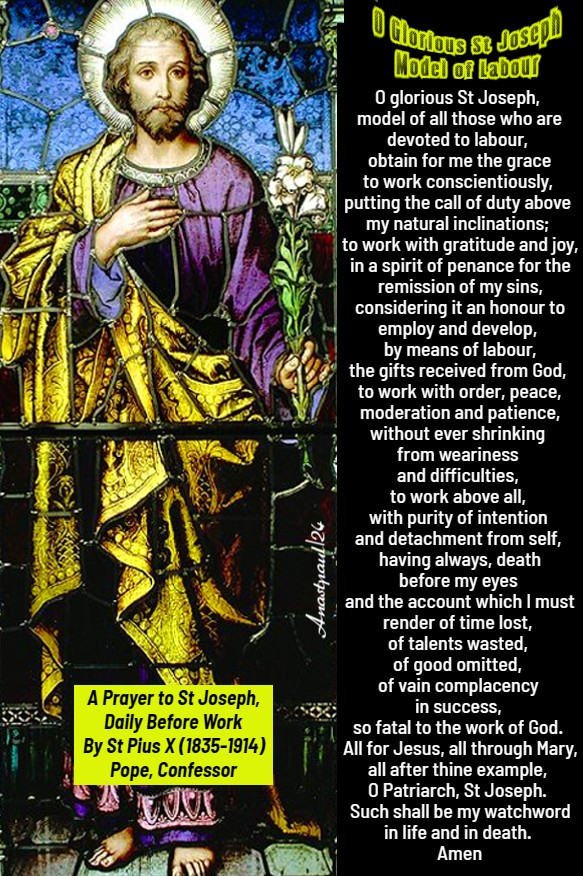
O Glorious St Joseph, Model of Labour A Prayer to St Joseph, Daily Before Work By St Pius X (1835-1914) Pope, Confessor
O glorious St. Joseph, model of all those who are devoted to labour, obtain for me the grace to work conscientiously, putting the call of duty above my natural inclinations; to work with gratitude and joy, in a spirit of penance for the remission of my sins, considering it an honour to employ and develop, by means of labour, the gifts received from God, to work with order, peace, moderation and patience, without ever shrinking from weariness and difficulties, to work above all, with purity of intention and detachment from self, having always, death before my eyes and the account which I must render of time lost, of talents wasted, of good omitted, of vain complacency in success, so fatal to the work of God. All for Jesus, all through Mary, all after thine example, O Patriarch, St Joseph. Such shall be my watchword in life and in death. Amen























You must be logged in to post a comment.