Posted in Against APOPLEXY or STROKES, BREWERS, EPILEPSY, EYES - Diseases, of the BLIND, GOUT, KNEE PROBLEMS, ARTHRITIS, etc, Of PHARMACISTS / CHEMISTS, PATRONAGE - VINTNERS, WINE-FARMERS, SAINT of the DAY, SKIN DISEASES, RASHES

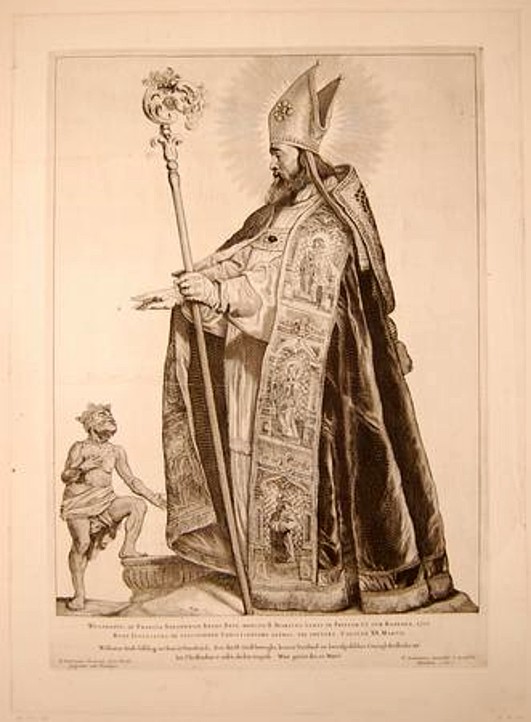
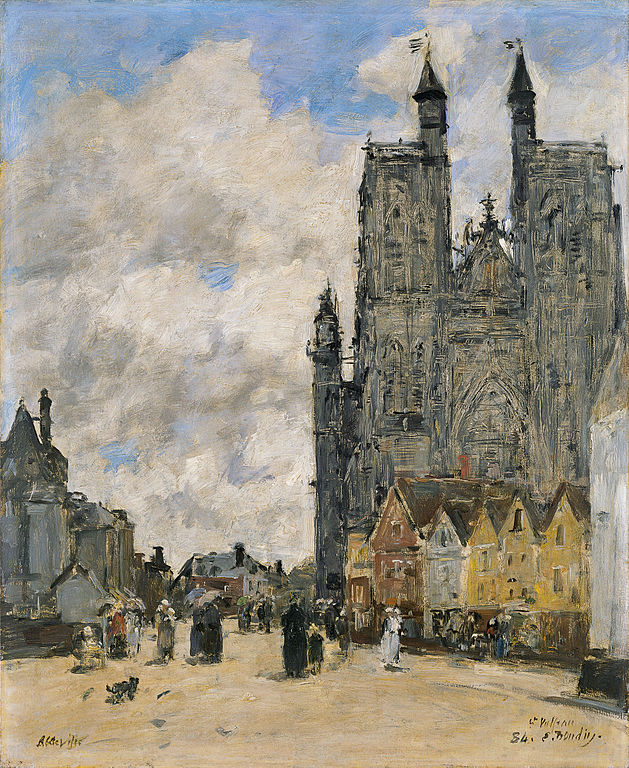
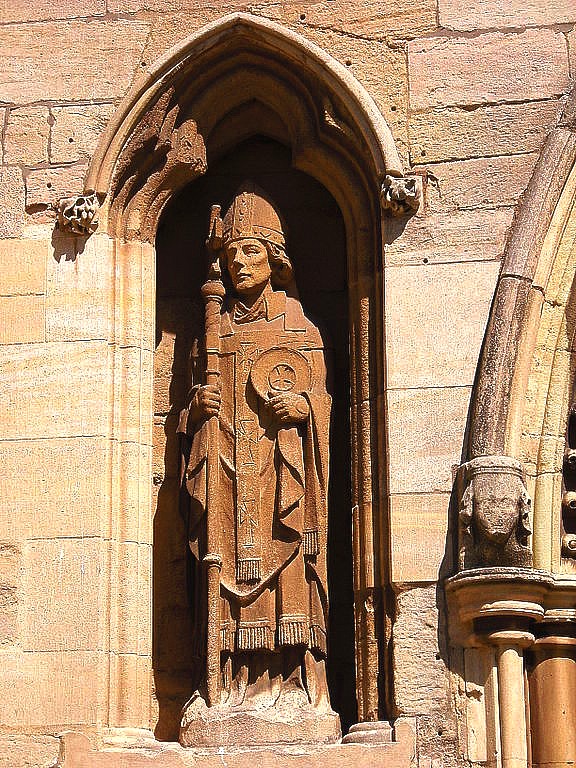
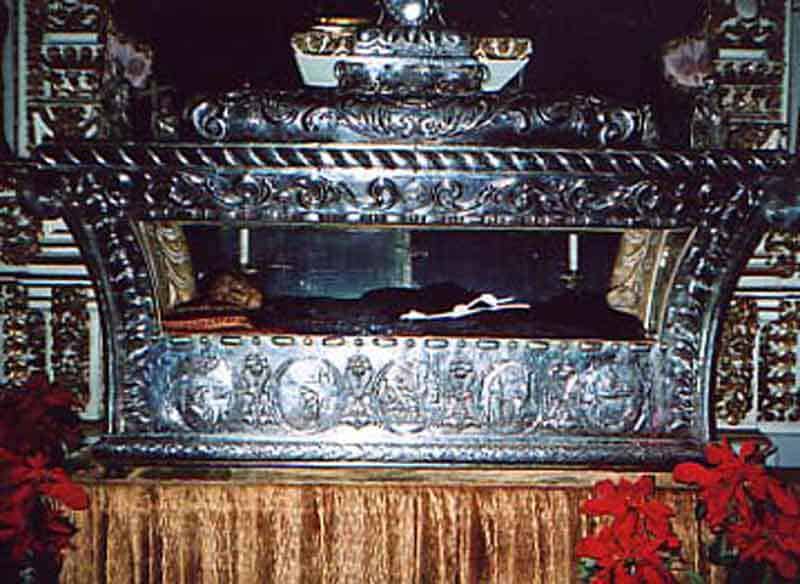
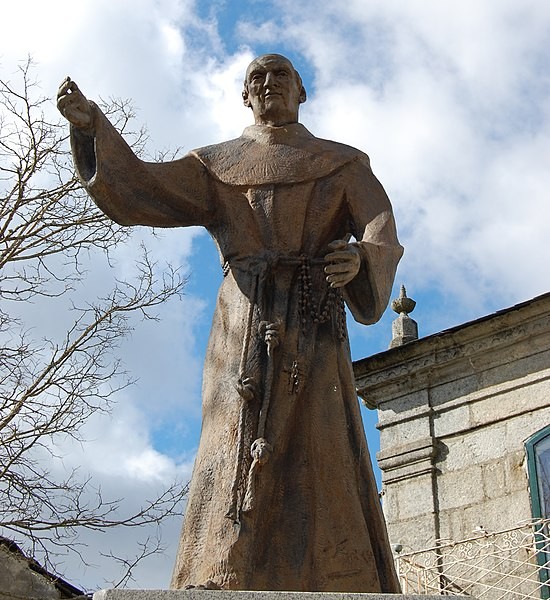
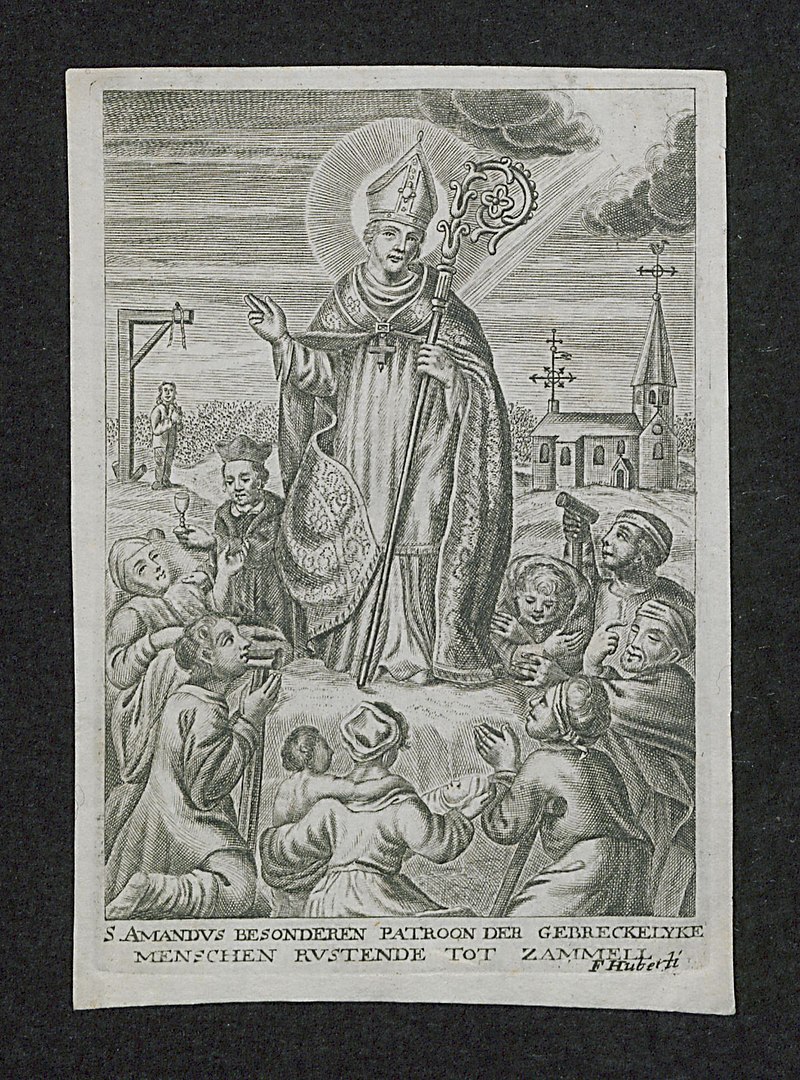
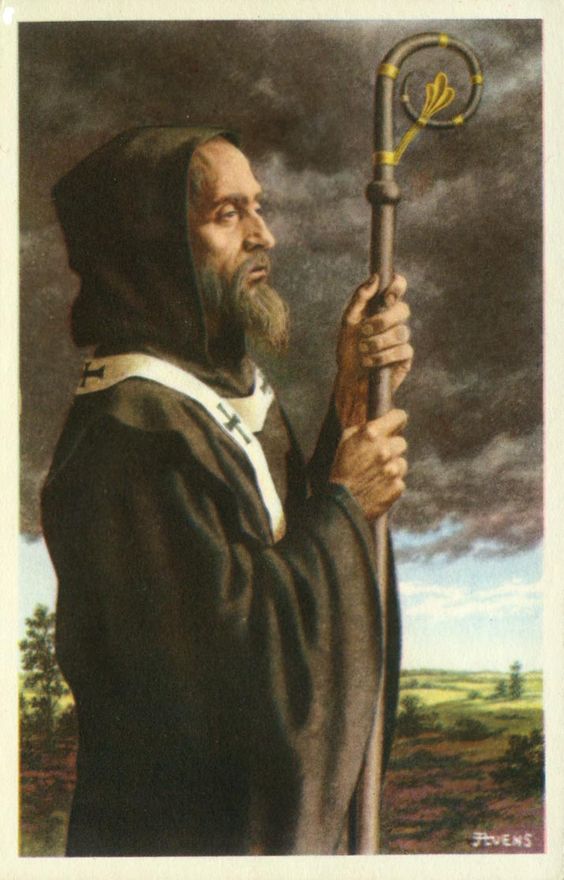
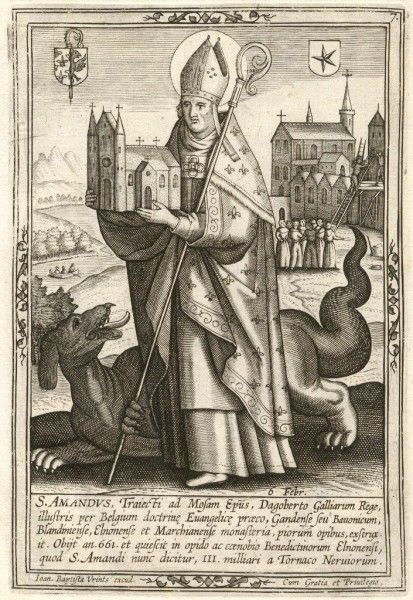
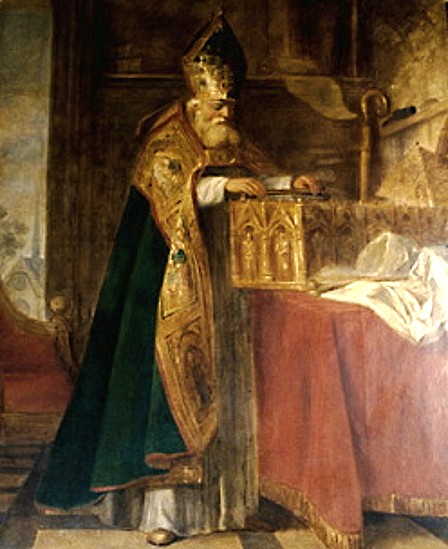
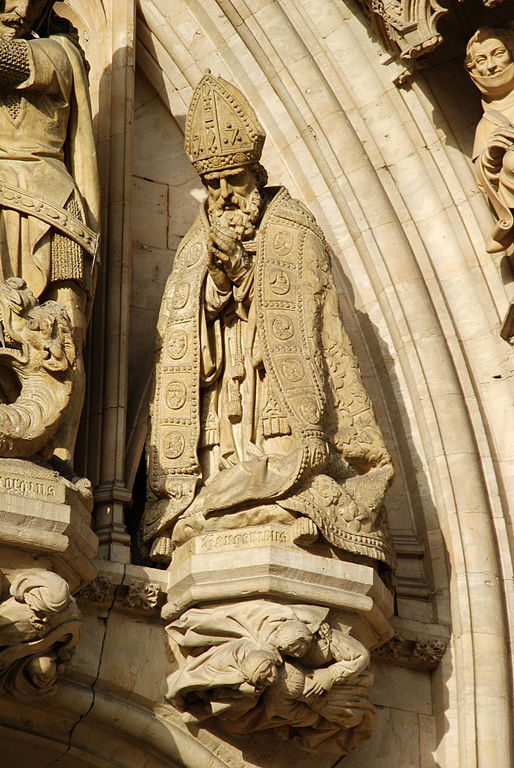
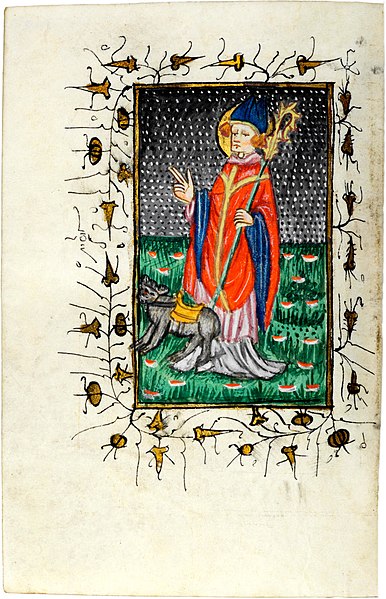
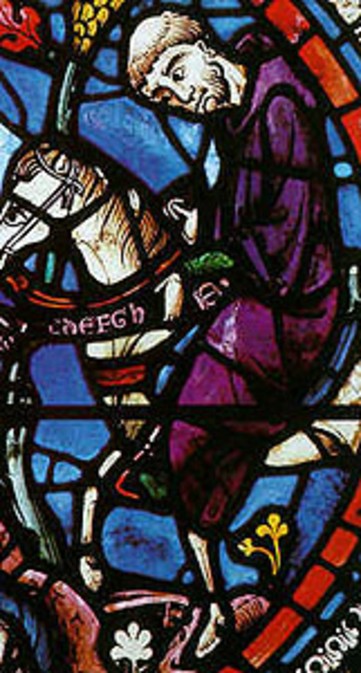
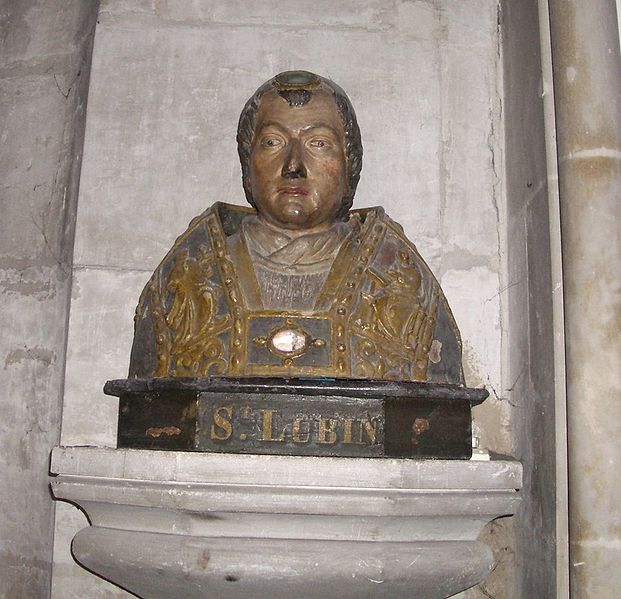
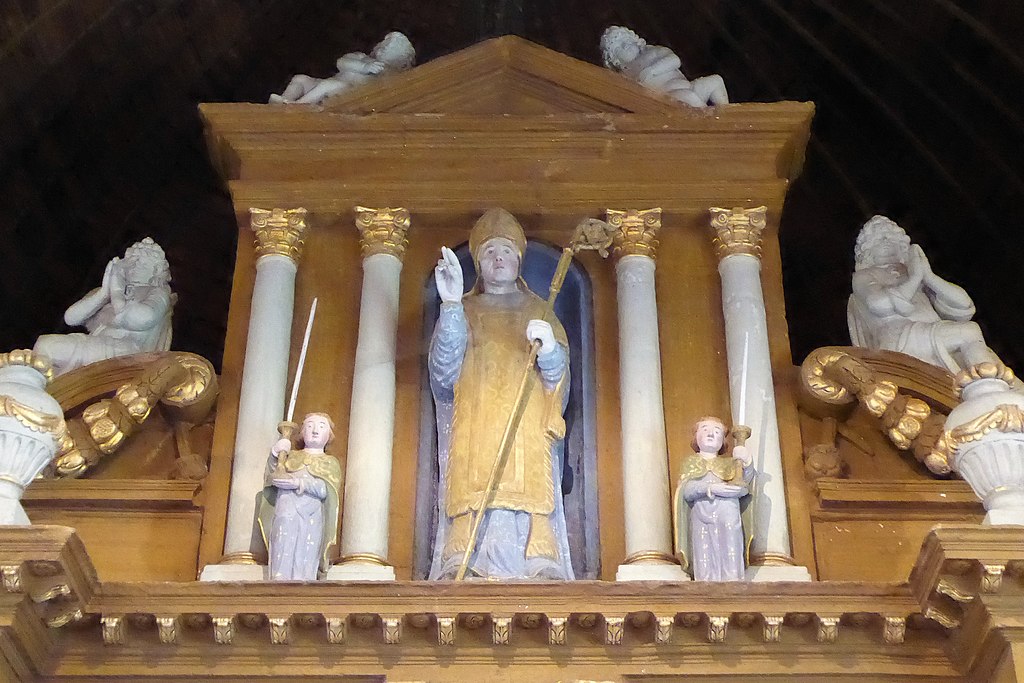
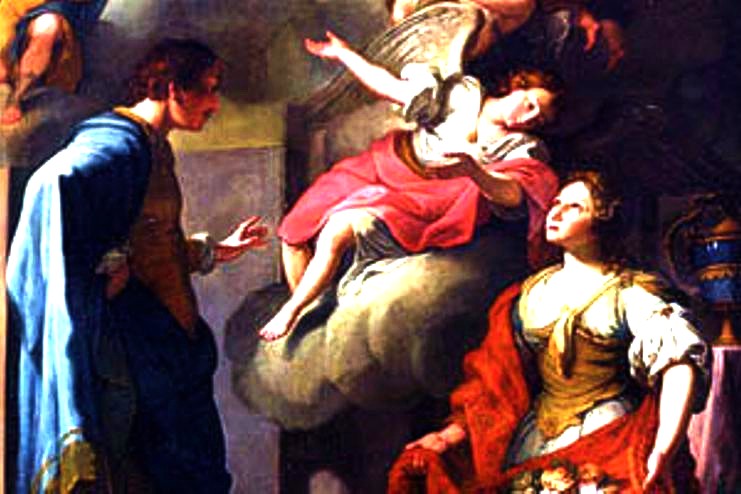
Saint of the Day – 6 February – Saint Amand of Maastricht (c584-c679) Bishop, the Apostle of Belgium

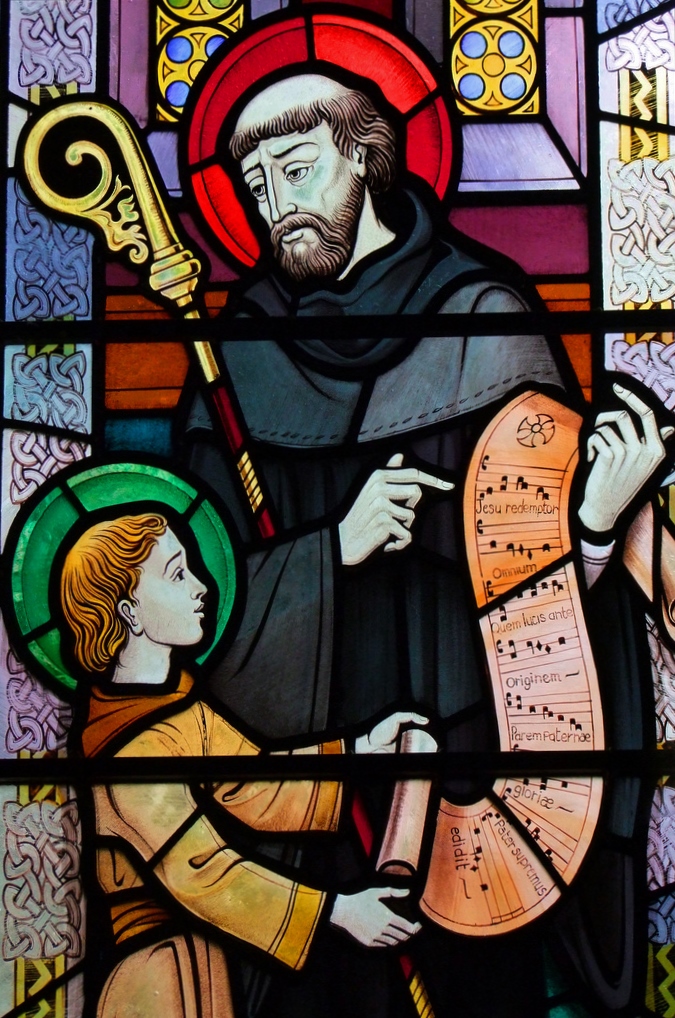
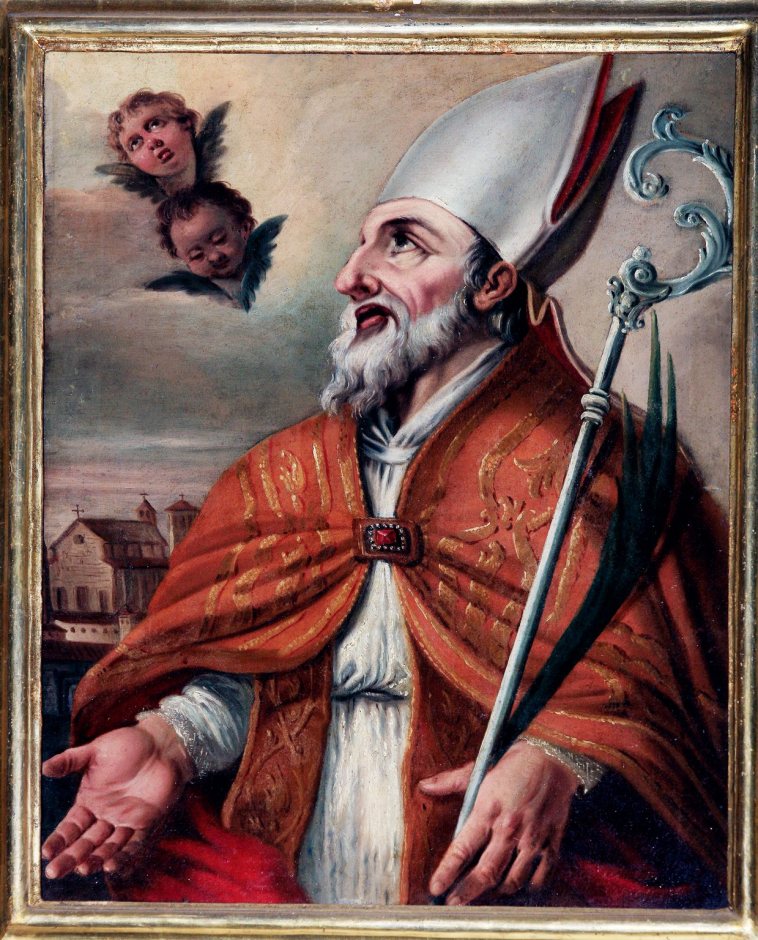
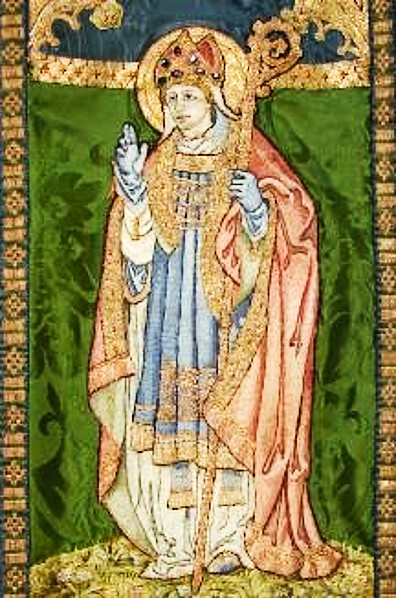
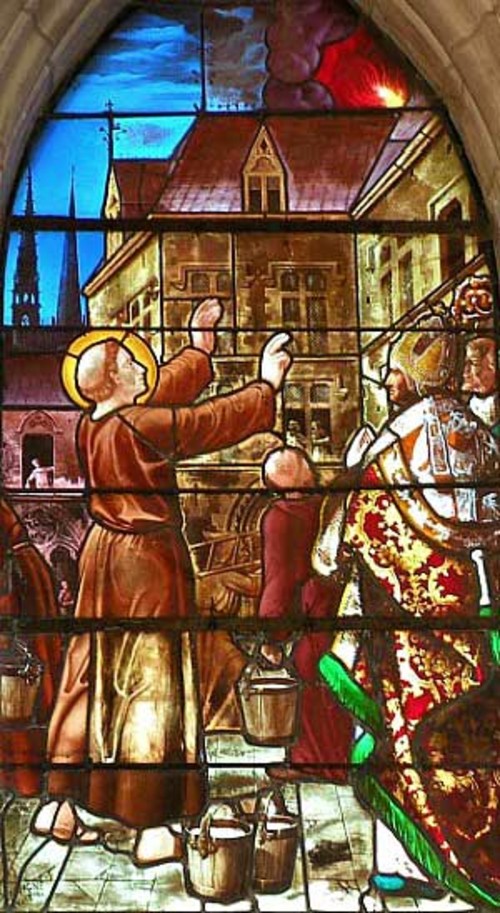
Saint of the Day – 6 February – Saint Amand of Maastricht (c584-c679) Bishop of Tongeren-Maastricht and one of the great Missionaries of Flanders (Belgium), Monk, Abbot, Papal Missionary, Advisor, Miracle-worker, Founder of numerous Monasteries which became known for their hospitality to pilgrims. Born c584 at Poitou, France and died in c679 in the Monastery at Elnone-en-Pevele (modern Saint-Amand-les-Eaux), France. Patronages – against diseases of cattle, against fever, against paralysis, against rheumatism, against seizures against skin diseases, against vision problems, Boy Scouts, bar staff, barkeepers, bartenders, brewers, grocers, hotel keepers, innkeepers, merchants, pharmacists, druggists, vinegar makers, vine growers, vintners, wine merchants, 4 Cities. Also known as the Apostle of Belgium, Apostle of Flanders, Amand of Elnone, Amand of France, Amandus, Amantius, Amatius.

The chief source of details of his life is the Vita Sancti Amandi, an eighth-century text attributed to Beaudemond. The vita was expanded by Philippe, Abbot of Aumône. According to this biography, Amand was born in Lower Poitou. He was of noble birth but at the age of twenty, he became a monk, against the wishes of his family. His father threatened to disinherit him if he did not return home but our Saint chose rather to ensure his riches in the heavenly kingdom. From there Amandus went to Bourges and became a pupil of Bishop Austregisilus. There he lived in solitude in a cell for fifteen years, living on no more than bread and water.

Amand’s fervent disciple, St Humbert of Maroilles (died c 682), was of a noble family and trained as a Monk in Laon. However, upon the death of his parents, he returned to his estates to settle some inheritance issues and found fine food, servants and various conveniences, sufficiently distracting, that he gave up any thought of the monastic life, until one day Amand took him on a pilgrimage to Rome. Humbert became his disciple and companion.

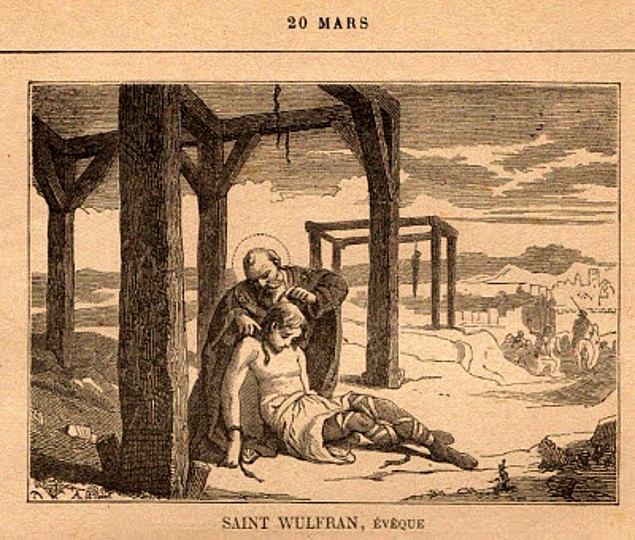
After the pilgrimage to Rome, Amand was made a Missionary Bishop in France in 628, without a fixed Diocese. At the request of Clotaire II, he evangelised the pagan inhabitants of Ghent, later extending his field of operations to all of Flanders. Initially, he had little success, suffering persecution and undergoing great hardships. However, after performing a miracle (bringing back to life a hanged criminal), the attitude of the people changed and he made many converts. He founded a Monastery at Elnon where he served as Abbot for four years. He returned to France in 630.

Amand was a close friend of St Adalbard of Ostrevent (died c 652), whom he advised on the founding Marchiennes Abbey. Amand angered Dagobert I by attempting to have the King amend his life. In spite of the intervention of Saint Acarius, Amand was expelled from the kingdom and went to Gascony.

Later Dagobert asked him to return and tutor the heir to the throne. Amand however declined. In 633, Amand founded two Monasteries in Ghent; one at Blandinberg and the other named for St Bavo, who gave his estate for its foundation. His next missionary task was among the Slavic people of the Danube valley in present-day Slovakia but this was unsuccessful. Amand went to Rome and reported to the Pope. While returning to France, Amand calmed a storm at sea. In 639, he built an Abbey near Tournay.

From 647 till 650, Amand briefly served as Bishop of Maastricht. The Pope gave him some advice on how to deal with disobedient clerics and warned him about the Monothelite heresy, at that time prevalent in the East. Amand was commissioned by the Pope to organise Church Councils, in Neustria and Austrasia, in order to pass on the various decrees from Rome. The Bishops asked Amand to report and transmit the proceedings of the Church Councils to the Pope. He resigned the See of Maastricht to St Remaclus, to resume his missionary work.

Around this time, Amand established contact with the family of Pepin of Landen and helped St Gertrude of Nivelles OSB (died 659) and her mother, St Itta (died 652), establish the famous Monastery of Nivelles. Amand was now 70 years old but at this time, the inhabitants of the Basque country asked him to return to their country to evangelise, although 30 years earlier he had preached there in vain. Returning home, he founded several more Monasteries in present-day Belgium, with the help of King Dagobert.

Amand died in Elnone Abbey (later Saint-Amand Abbey, in Saint-Amand-les-Eaux, near Tournai) at the age of ninety. The Vita of St Aldegonde recounts, that on the day of his death, St Aldegonde was shown a vision of the great Missionary Saint, ascending to heaven. This account did much to further the cult of Amand.

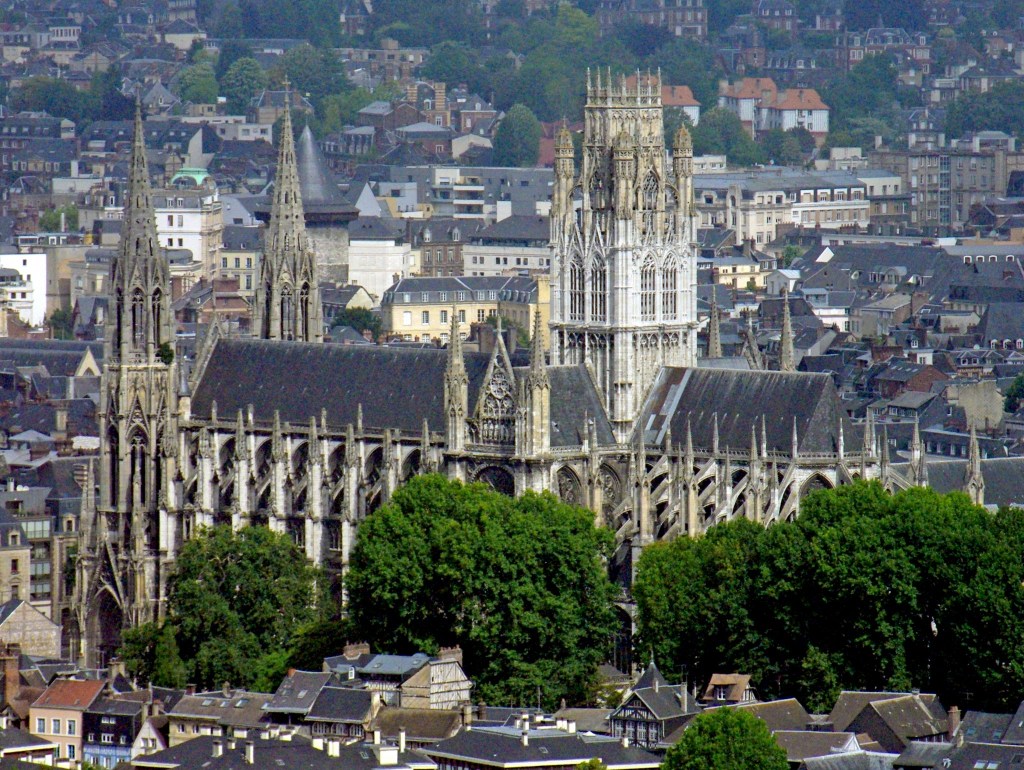
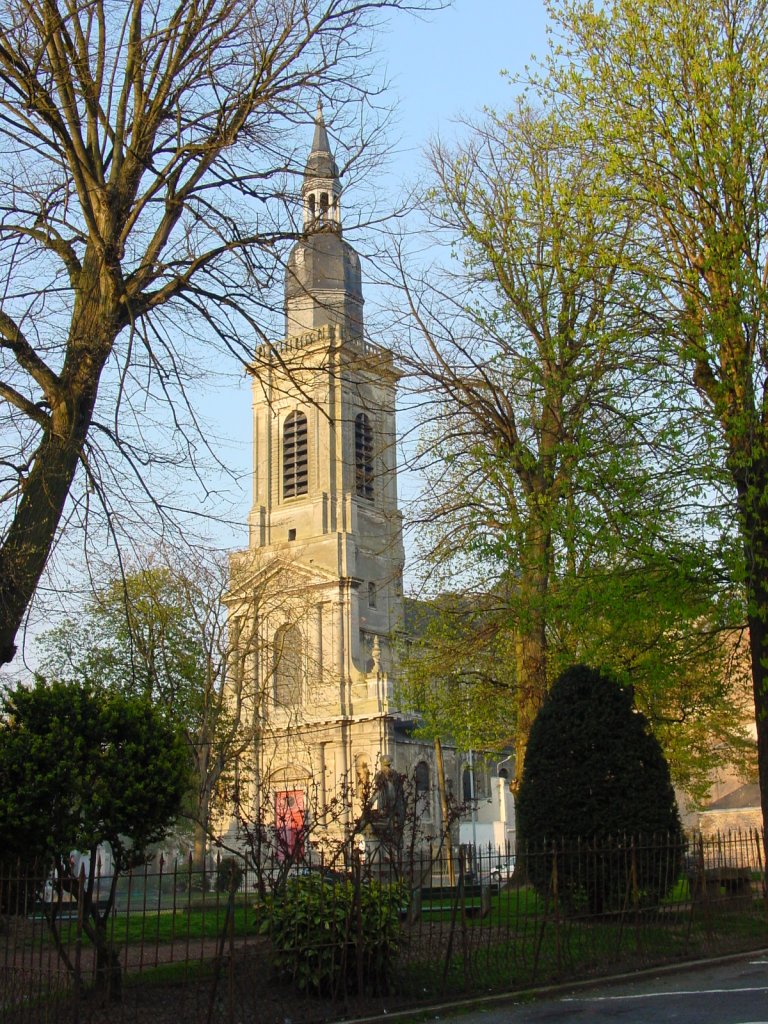
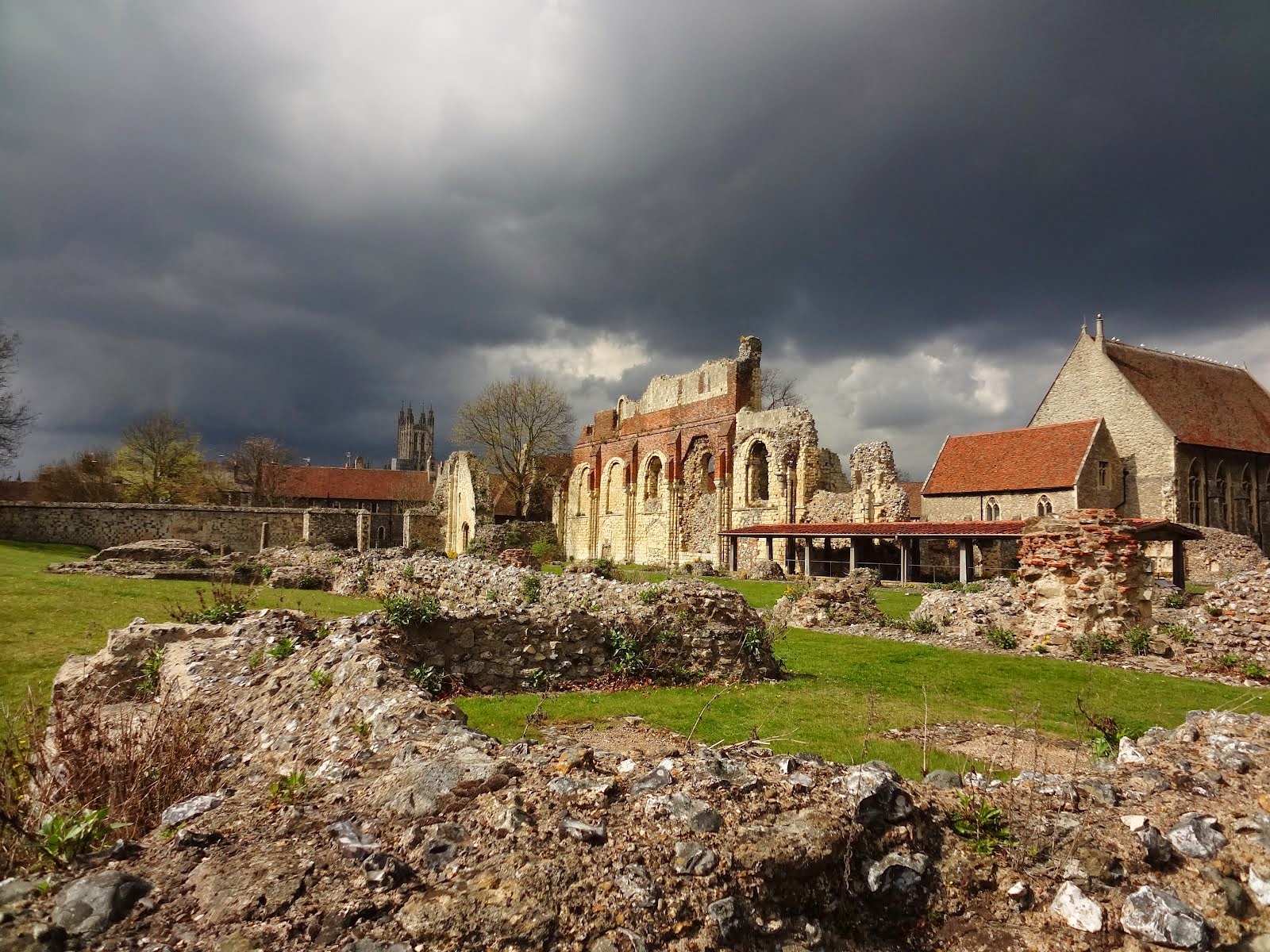
Elnone Abbey (later Saint-Amand Abbey)

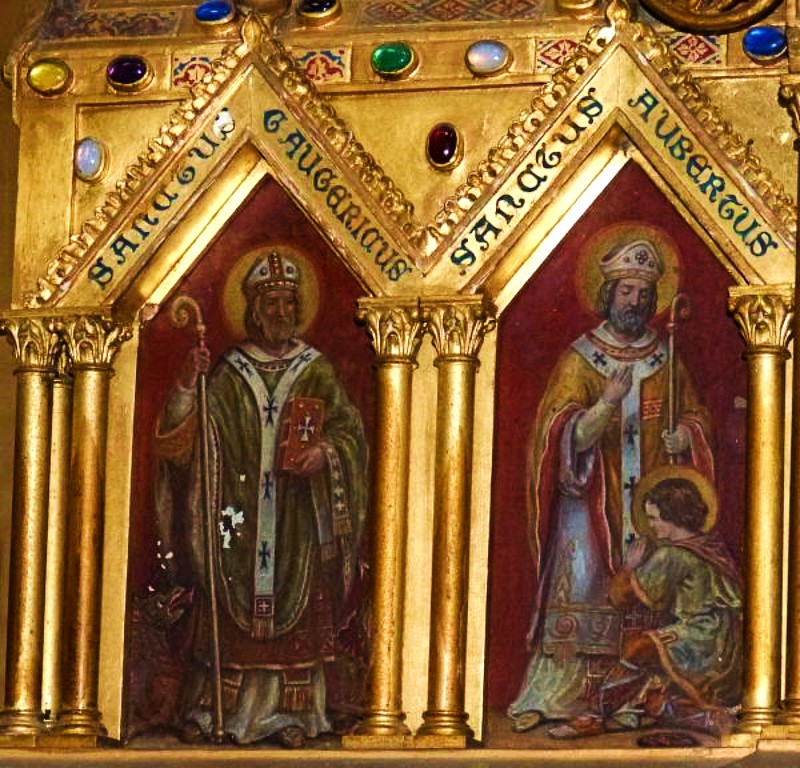
St Amand was known for his hospitality and is, therefore, the Patron Saint of all who produce beer, brewers, innkeepers and bartenders. He is also the Patron of vine growers, vintners and merchants. St Amand is greatly venerated in Belgium, in particular.

Posted in Against DEMONIC POSSESSION, franciscan OFM, SAINT of the DAY

Saint of the Day – 1 February – Blessed Andrew of Segni OFM (1240-1302)

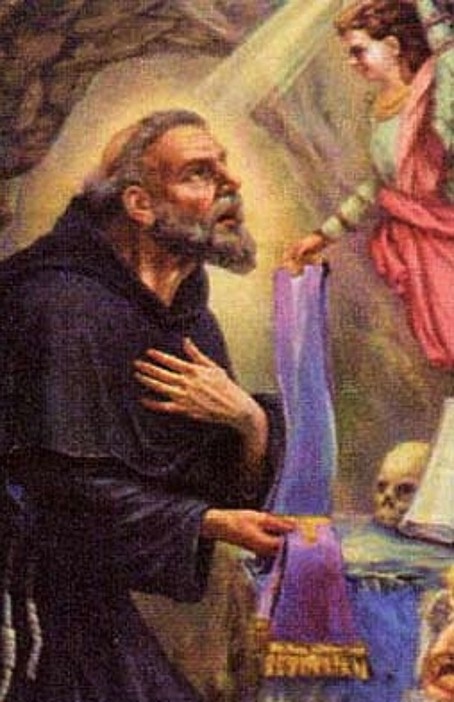
Saint of the Day – 1 February – Blessed Andrew of Segni OFM (1240-1302) Priest, Friar of the the Order of Friars Minor, Hermit, spiritual teacher, mystic, miracle-worker and exorcist. Andrew is best known for his humble life of solitude in which he was subjected to demonic visions and attacks, though his faith in God saw him emerge time and time again, as the victor. He lived his life in a small grotto in the Apennines. Born as Andrea De Comitibus dei Conti in 1240 in Anagni, Italy and died on 1 February 1302 at his Mount Scalambra Hermitage near Piglio, Italy of natural causes, aged 62. Additional Memorial – 3 February in the Diocese of Anagni and by the Franciscans. Patronage – against demonic possession, Diocese of Anagni.

Andrea De Comitibus of the Counts of Segni, was born in Anagni around 1240. He was a close relative of popes Innocent III, Gregory IX, Alexander IV and Boniface VIII, of the last two he was respectively Nephew and Uncle.

The road to high honour had opened its portals to him too but even as a young man, he recognised the vanity of the world and renounced it entirely. He left his father’s castle, worldly honour and riches and sought another home in the newly founded Franciscan convent of St Lawrence in the Apennines. There, he found a solitary grotto, where, with the permission of the superiors, he made his abode. The cavern was so narrow and low that, because of his tall stature, Andrew was obliged either to kneel or to bend over considerably when he was inside. But here he remained for the rest of his life and he became the perfect model of Franciscan humility and mortification, of modesty and piety. The cave in which he spent most of his day in prayer and in the most severe poverty and penance is still visible today.

In spite of this inconvenience he spent almost his entire life there in the contemplation of heavenly things, practicing great austerities and struggling almost continually against the evil spirits, over which, with the grace of God, he always emerged the victor. He was diligent also in pursuing the study of the sacred sciences and was the author of a treatise on the veneration of the Blessed Virgin, which was treasured by his contemporaries but which has, unfortunately, not survived to our day.

In the year 1295 his uncle, Pope Alexander IV, visited Blessed Andrew Segni with the purpose of presenting him with the Cardinal’s hat. But neither Alexander, nor later Boniface VIII, succeeded in inducing the saint to accept the dignity. This humility made such an impression on Boniface VIII, that he expressed the wish to outlive Andrew so that he might have the privilege of Canonising him. In 1295, his nephew, Pope Boniface VIII wanted again to appoint him Cardinal but he refused this dignity, preferring to serve the Church in his solitude.

In the last years of his life Andrew was favoured with the gift of miracles and of prophecy. On one occasion he was far too ill to eat and so a friend bought him a plate of roasted birds to assuage his illness. Andrew was too distressed to see the slain birds that he made the Sign of the Cross over them and – it has been said – bought them back to life.

On 1 February 1302, the humble servant of God went forth to receive heavenly honours. His body reposes with the Friars Minor Conventual at St Lawrence and he is still signally honoured by the people and invoked by them, as special protector against the attacks of evil spirits. His cult was recognised and approved by Pope Innocent XIII, a scion of the same noble family, on 11 December 1724. During the last World War, his tomb received damage from the allied bombing of 12 May 1944 and to repair it, a survey of the relics was carried out on 8 February 1945.

An ancient image of the Blessed dated to the 14th century can be seen in a fresco by Taddeo Gaddi in the Basilica of St Croce in Florence.

Blessed Andrew’s liturgical celebration is on 1 February in Piglio (Frosinone) and in the Diocese of Anagni, and in Franciscan Churches, on 3 February.

Posted in Of the SICK, the INFIRM, All ILLNESS, PATRONAGE - ORPHANS,ABANDONED CHILDREN, SAINT of the DAY, WIDOWS and WIDOWERS

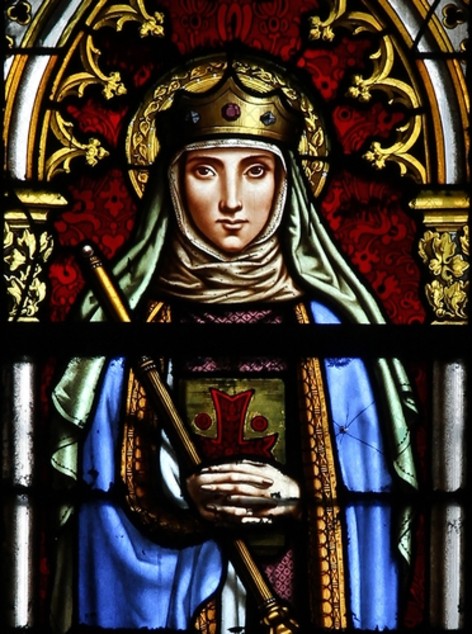
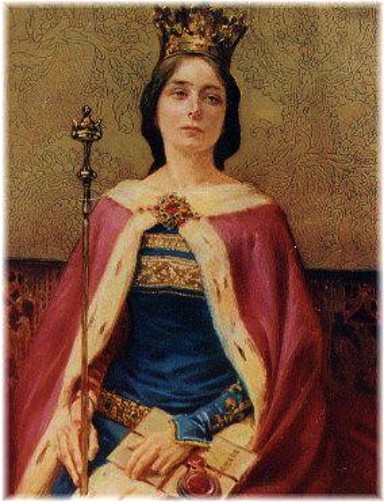
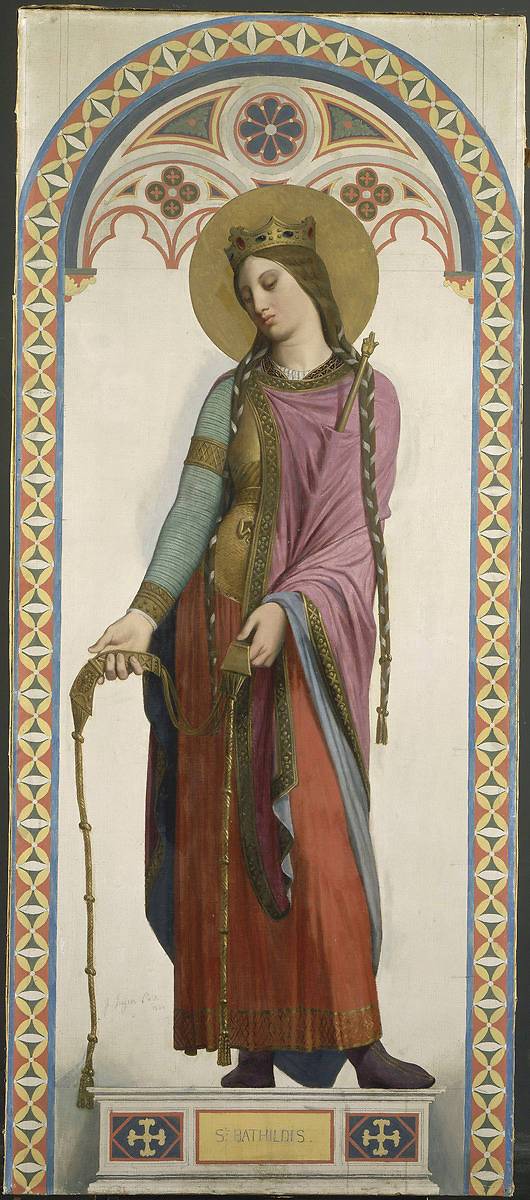
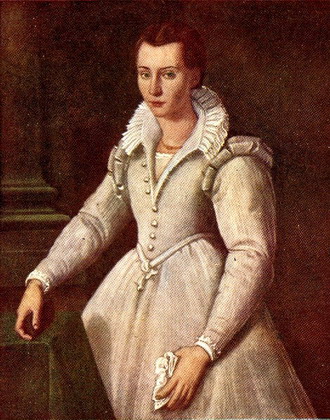
Saint of the Day – 30 January – Saint Bathilde (c 626–680)

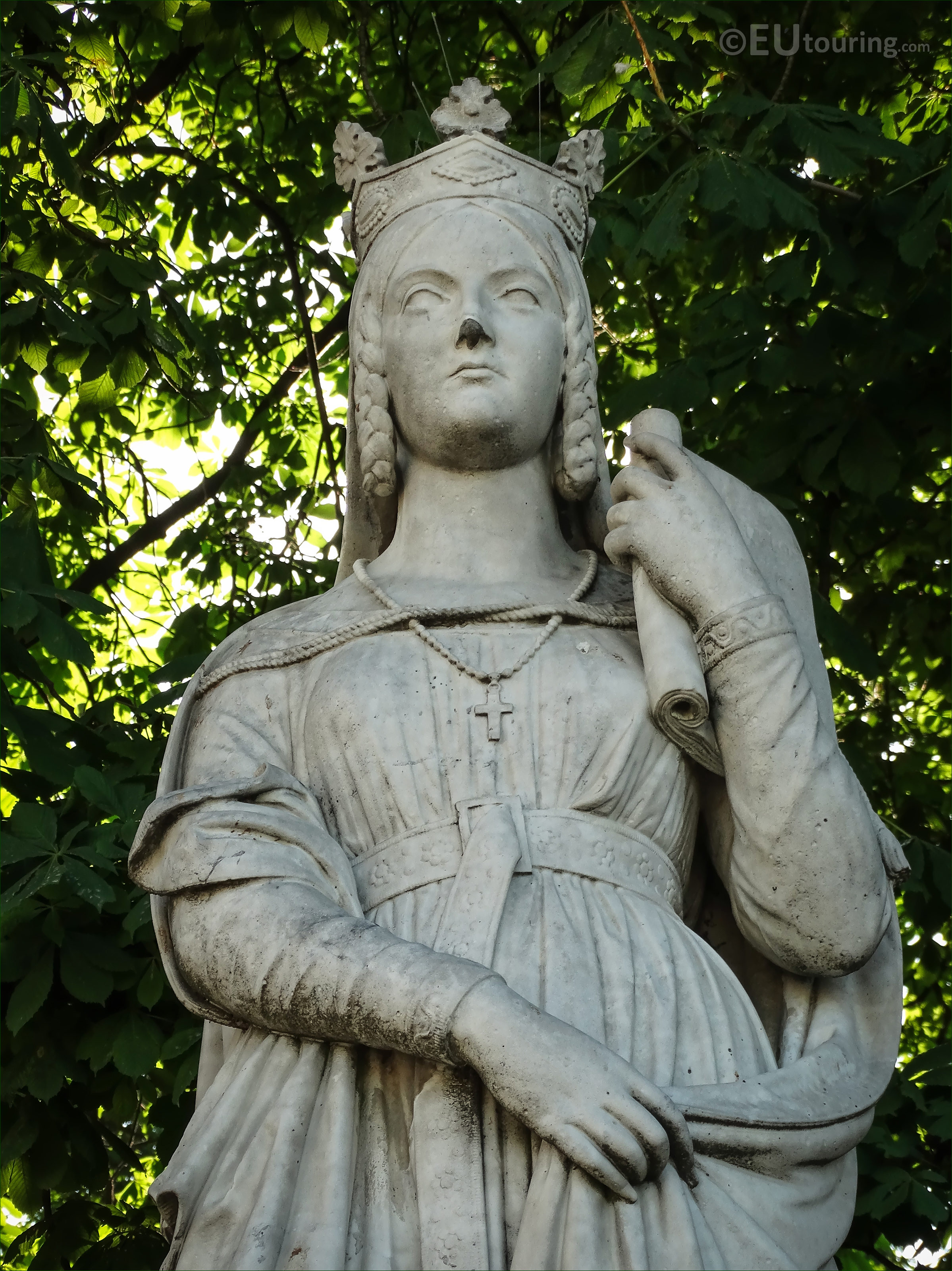
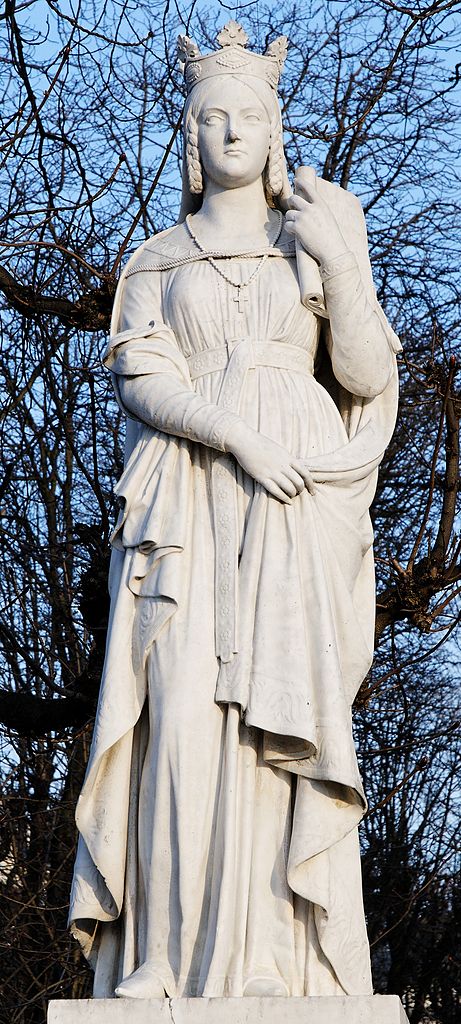
Saint of the Day – 30 January – Saint Bathilde (c 626–680) Queen, Regent, Widow and Mother, Religious, Apostle of the poor and of slaves, Social Reformer, pioneer in the abolition of Slavery, founder of Monasteries. Born in c 630 in England and died on 30 January 680 of natural causes. Other forms of her name are Bathilidis, Bathild, Batilda, Bathchilde and Bauteur. Patronage – children, the sick, all bodily illness, widows

An Anglo-Saxon by birth, Bathilde was captured in 641 by Danish raiders and sold to Erchinoald, the Chief Officer of the Palace of Clovis II, King of the Franks. She quickly gained favour, for she had charm, beauty and a graceful and gentle nature. She also won the affection of her fellow-servants, for she would do them many kindnesses such as cleaning their shoes and mending their clothes and her bright and attractive disposition endeared her to them all.

The Officer, impressed by her fine qualities, wished to make her his wife but Bathilde, alarmed at the prospect, both by reason of her modesty and of her humble status, disguised herself in old and ragged clothes and hid herself away among the lower servants of the palace and he, not finding her in her usual place and thinking she had fled, married another woman.

Her next suitor, however, was none other than the King himself, for when she had discarded her old clothes and appeared again in her place, he noticed her grace and beauty and declared his love for her. Thus in 649, the 19-year-old slave girl Bathilde became Queen of France, amidst the applause of the Court and the Kingdom. She bore Clovis three sons – Clotaire III, Childeric II and Theodoric III–all of whom became Kings. On the death of Clovis (c 655-657), she was appointed Regent in the name of her eldest son, who was only five and ruled capably for eight years with Saint Eligius (feast day 1 December) as her Advisor.

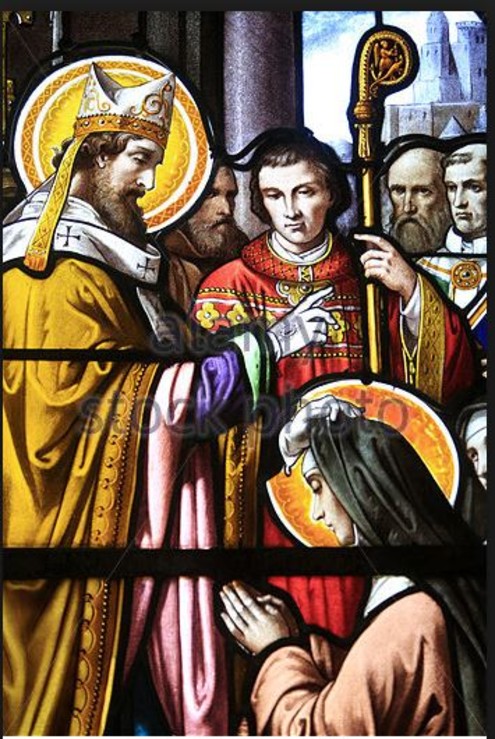
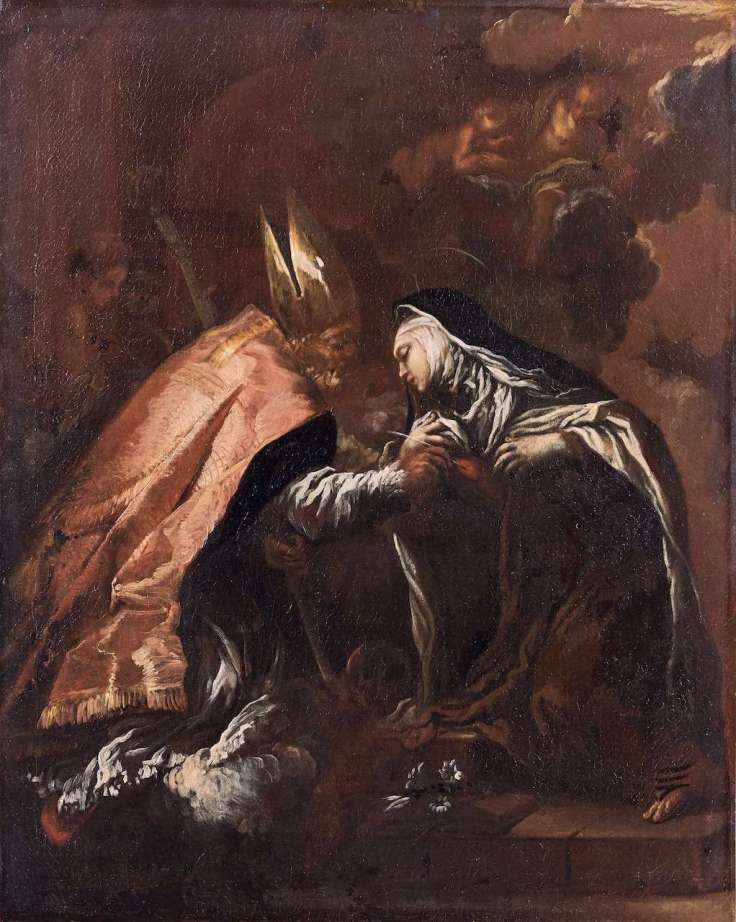
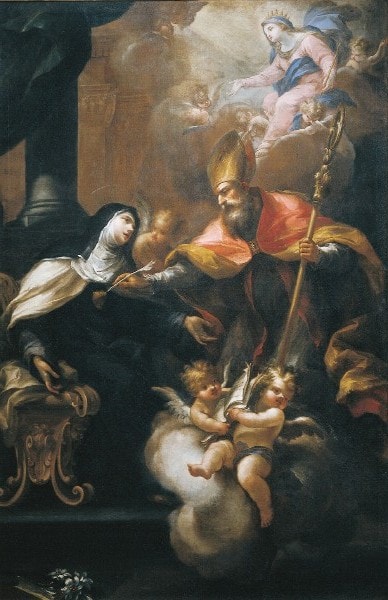
St Eligius blessing St Bathilde

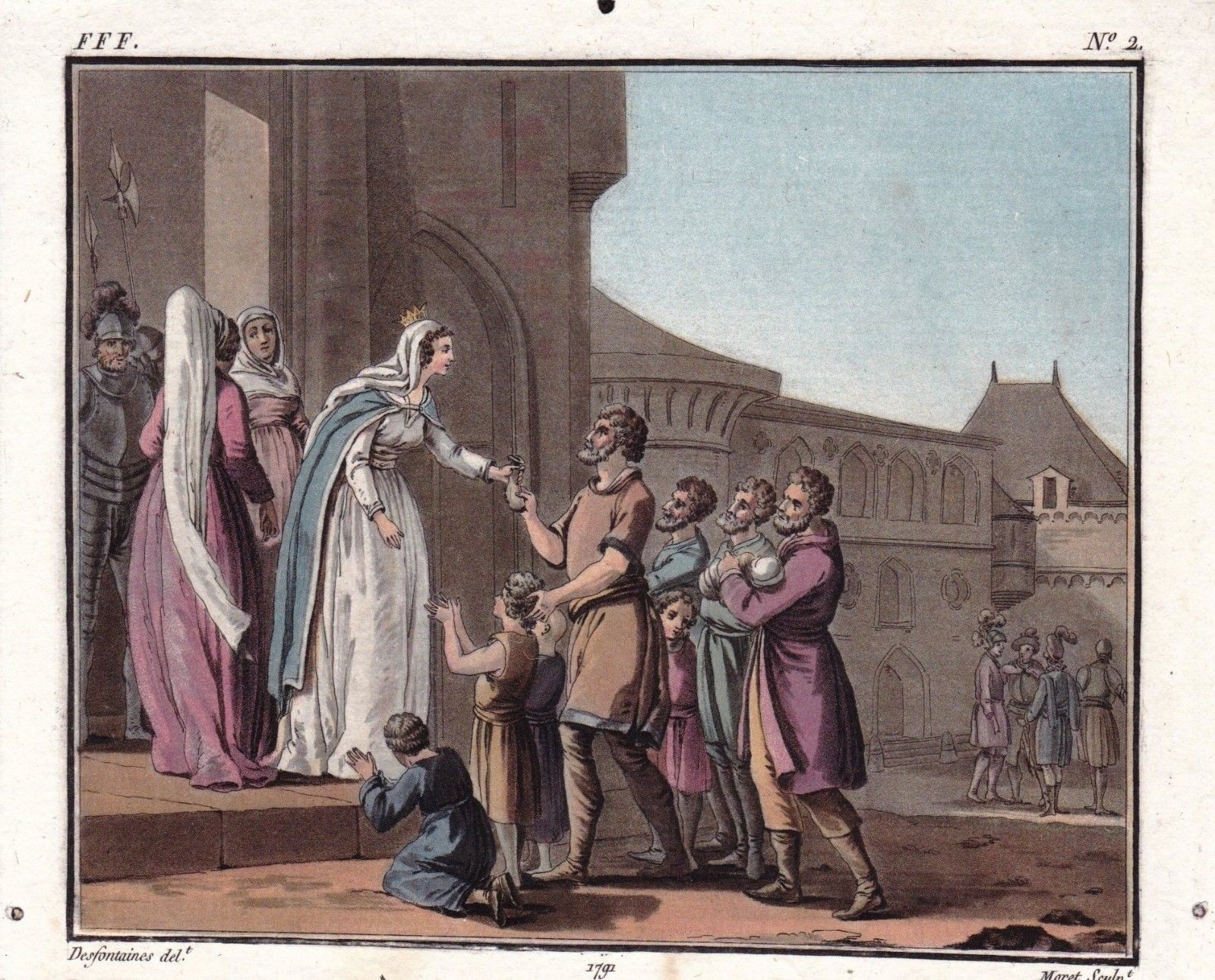
She made a wonderful Queen and ruled wisely. Unlike many who rise suddenly to high place and fortune, she never forgot that she had been a slave and did all within her power to relieve those in captivity. We are told that “Queen Bathilde was the holiest and most devout of women; her pious munificence knew no bounds; remembering her own bondage, she set apart vast sums for the redemption of captives.” She helped promote Christianity by supporting the zeal of Saint Owen (feast day, 24 August), Saint Leodegar (feast day 2 October 2) and many other Bishops.

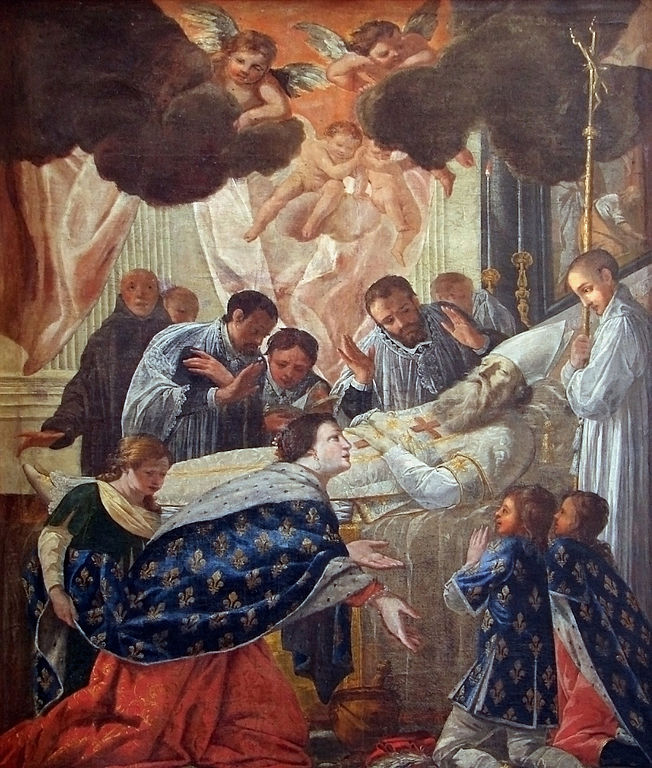
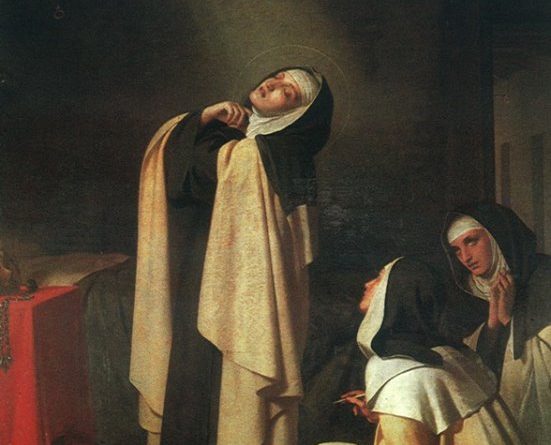
St Bathilde at the deathbed of St Eligius

At that time, the poorer inhabitants of France, were often obliged to sell their children as slaves, to meet the crushing taxes imposed upon them. Bathilde reduced this taxation, forbade the purchase of Christian slaves and the sale of French subjects and declared, that any slave who set foot in France, would from that moment be free. Thus, this enlightened women earned the love of her people and was a pioneer in the abolition of slavery.

She also founded many Abbeys, such as Corbie, Saint-Denis and Chelles, which became civilised settlements in wild and remote areas, inhabited only by prowling wolves and other wild beasts. Under her guidance forests and waste land were reclaimed, cornland and pasture took their place and agriculture flourished. She built hospitals and sold her jewellery to supply the needy.

After her children were well established in their respective territories, Childeric IV in Austrasia and Thierry in Burgundy, she returned to her wish for a secluded life and retired to her own Royal Abbey of Chelles, near Paris, where she served the other nuns with humility and obeyed the Abbess like the least of the sisters. On entering the Abbey she laid down the insignia of royalty and desired to be the lowest in rank among the sisters. It was her pleasure to take her position after the novices and to serve the poor and infirm with her own hands. Prayer and manual toil occupied her time, nor did she wish any allusion made to the grandeur of her past position. In this manner she passed fifteen years of retirement. At the beginning of the year 680 she had a presentiment of the approach of death and made religious preparation for it.

She died at the Abbey of Chelles, near Paris, before she had reached her 50th birthday. Death touched her with a gentle hand; as she died, she said she saw a ladder reaching from the Altar to heaven and up this she climbed, in the company of angels.

Bathilde was buried in the Abbey of Chelles and was Canonised by Pope Nicholas I (820-867) Papacy 858-867.

Posted in SAINT of the DAY, WIDOWS and WIDOWERS

Saint of the Day – 26 January – Saint Paula of Rome (347-404)

Saint of the Day – 26 January – Saint Paula of Rome (347-404) Widow, Foundress- early Desert Mother, Foundress of the Order of St Jerome (the Hieronymites), life-long friend and associate of St Jerome. Born on 5 May 347 at Rome, Italy and died in 404 at Bethlehem, of natural causes. Also known as Paula the Widow, Paulina, Pauline. Patronages – widows and Co-Patron with St Jerome of the Order of Saint Jerome.

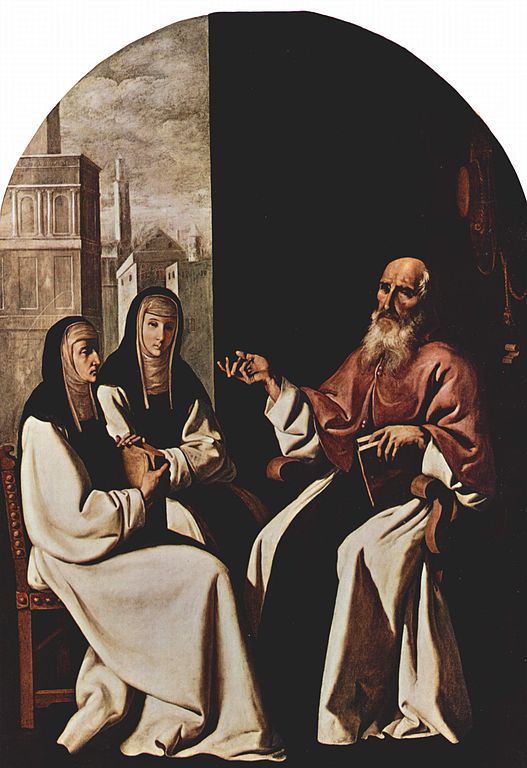
sts Paula, Eustochium and Jerome

Paula was a member of one of the richest senatorial families which claimed descent from Agamemnon. Paula was the daughter of Blesilla and Rogatus, from the great clan of the Furii Camilli.At the age of 16, Paula was married to the nobleman Toxotius, with whom she had four daughters, Blaesilla, Paulina, Eustochium, and Rufina and a son who was named after his father.

Paula was very virtuous as a married woman and with her husband, they became icons of Rome by their example. However, Paula had her flaws, particularly that of a certain love of worldly life, which was difficult to avoid due to her high social position. Information about Paula’s early life is recorded by Saint Jerome. In his Letter 108, he states that she had led a luxurious life and held a great status. She dressed in silks and had been carried about the city by her eunuch slaves. At first, Paula did not realise this secret tendency of her heart but the death of her husband, which occurred when she was 33 years old, opened her eyes. Through the influence of Saint Marcella and her group, Paula became an enthusiastic member of this semi-monastic group of women. In 382, she met Saint Jerome, who had come to Rome with Saint Epiphanius and Bishop St Paulinus of Antioch.

Blesila, the eldest daughter of Paula, died suddenly, which caused the pious widow immense suffering. Saint Jerome, who had just returned from Bethlehem, wrote her a letter of consolation, but, nevertheless, he rebuked her therein, for the excessive grief she manifested without thinking that her daughter had gone to receive the heavenly prize. Paulina, her second daughter, was married to Pamaquio and died seven years before her mother. Saint Eustochium , her third daughter, was her inseparable companion. Rufina died while still young. Toxotius, at first not a Christian but baptised in 385, married Laeta, daughter of the pagan priest Albinus. Of this marriage was born Paula the Younger, who in eventually joined Eustochium in the Holy Land and in 420 closed the eyes of St Jerome. These are the names which recur frequently in the letters of St Jerome, where they are inseparable from that of Paula.

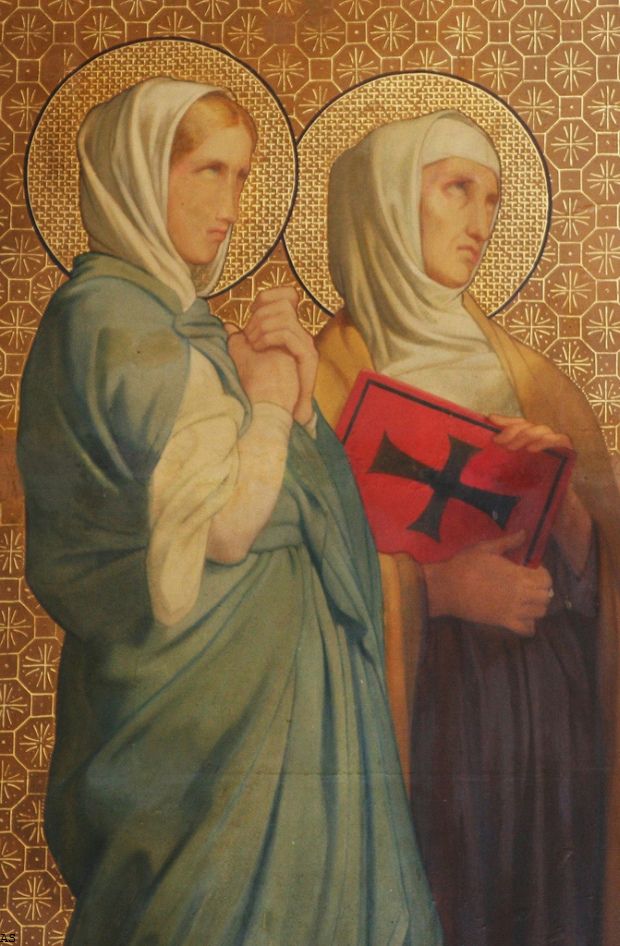
Sts Eustochum and Paula

A year after the death of her husband, Paula pursued a pilgrimage to tour all of the holy sites, travelling with large entourages of both men and women including her daughter Eustochium and Jerome himself. Paula could undertake this voyage, due to her widow status, which left her a significant fortune allowing her exemption from remarriage. Additionally, having had a male heir and two married daughters provided supplementary financial insurance. Her travels are documented by Jerome in his later writing addressed to Eustochium which discusses how Paula participated in the environments they toured. He discusses that Paula exemplified an intimate and emotional connection with the sights, experiencing visual vividness of biblical events at each locale. Concluding her journey, Paula decided to remain in Bethlehem to develop a Monastery and spiritual retreat with Jerome.

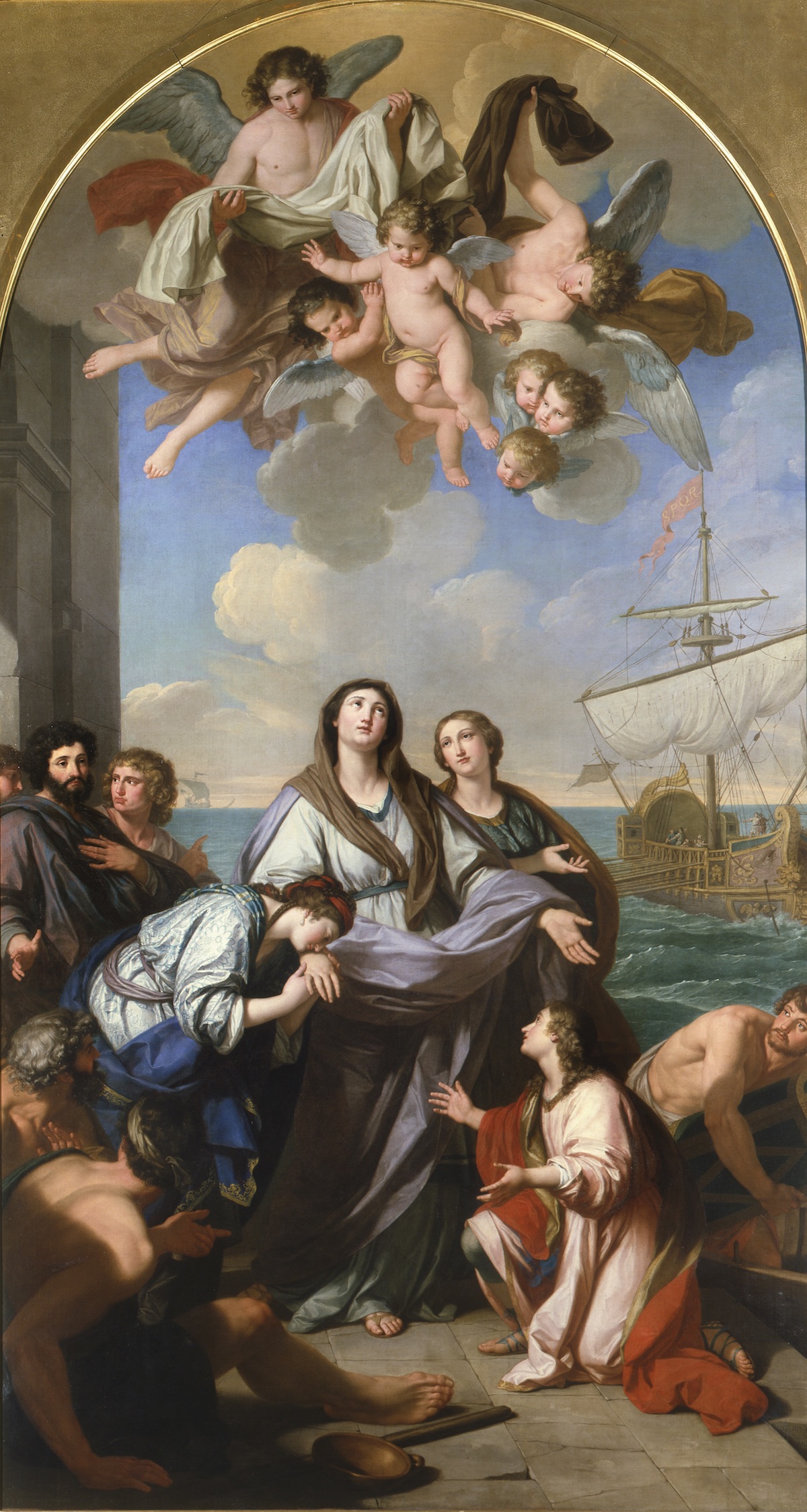
Sts Paula and Eustachium depart for the Holy Land
Artist – Giuseppe Bottani

Once settled in Bethlehem, Paula and Jerome built a double Monastery including one for Paula and her Nuns and another for Jerome and his Monks. The addition of a roadside hostel was also constructed to serve as an economic source to fund the Monasteries. This development took three years to complete and was primarily sourced by Paula who, during this time of construction, lived at another double Monastery called Mount Olives.

It is in Jerome’s writing’s, in a letter to Eustochium, that provide the most insight on Paula’s life during her years of service at the Monastery. She is noted as maintaining her ascetic devotion through intensive studies of the Old and New Testaments, often under the guidance of Jerome. With this, she also practiced a strict fasting regimen, abstinence and pursued a penitent lifestyle “to preserve a singular attachment to God” as stated by Jerome. While practising this life of isolation, Paula still continued to interact with local clergy and Bishops and maintained devout attention to teaching the nuns under her care. Jerome’s letter from 404, moreover, indicates Saint Paula’s first-hand connection with relics from Christ’s passion, “she was shown the pillar of the church which supports the colonnade and which was stained with the Lord’s blood. He is said to have been tied to it when he was scourged.”

Jerome made explicit in his letter how Paula, through these practices, became a recognised figure in the Christian community. At one point, while travelling to Nitria, she was earnestly received by renowned Monks from Egypt and once her death arrived on 26 January 404, her funeral was noted as having a significant portion of the Palestine population arrive in her honour. A year after her passing, Paula was recognised by the Church as a Saint, with feast day on 26 January.

St Jerome grieved over her death but knowing how innocently she had lived, he was sure she was already in Paradise. “O dear Saint Paula,” he prayed, “help me now by your prayers and do not forget me, who taught you to live for God and Heaven. Your faith and your piety, have already placed you in the bosom of God and I know, He cannot now refuse to hear you. Oh, then, my child, pray, pray for me.”

Paula helped Jerome in his translation of the Bible from Hebrew and Greek into Latin. The work was done at her suggestion and she provided the reference works necessary for the undertaking. Being versed in Hebrew, she edited Jerome’s manuscripts. She and her daughter Eustochium copied the work for circulation.

An anecdote told of Jerome, of twelfth-century origin, tells that Roman clergy hostile to Jerome planned to have him expelled from the city by planting a woman’s robe next to his bed. When Jerome awoke in the middle of the night to attend the service of matins, he absentmindedly put on the female robes. He was thus accused of having had a woman in his bed. This story acknowledges, while at the same time discrediting as a malicious slander, Jerome’s relationship with women, such as he is presumed to have had with Paula.

Palladius, a contemporary of Jerome, believed that Paula was hindered by Jerome: “For though she was able to surpass all, having great abilities, he hindered her by his jealousy, having induced her to serve his own plan.”

When Jerome died in early 420, he was buried beneath the north aisle of the Church of the Nativity, near the graves of Paula and Eustochium and tradition tells us that St Paula the Younger attended him in his last hours and when he lost his speech, she made the Sign of the Cross on his lips.

Posted in EPILEPSY, GOUT, KNEE PROBLEMS, ARTHRITIS, etc, SAINT of the DAY

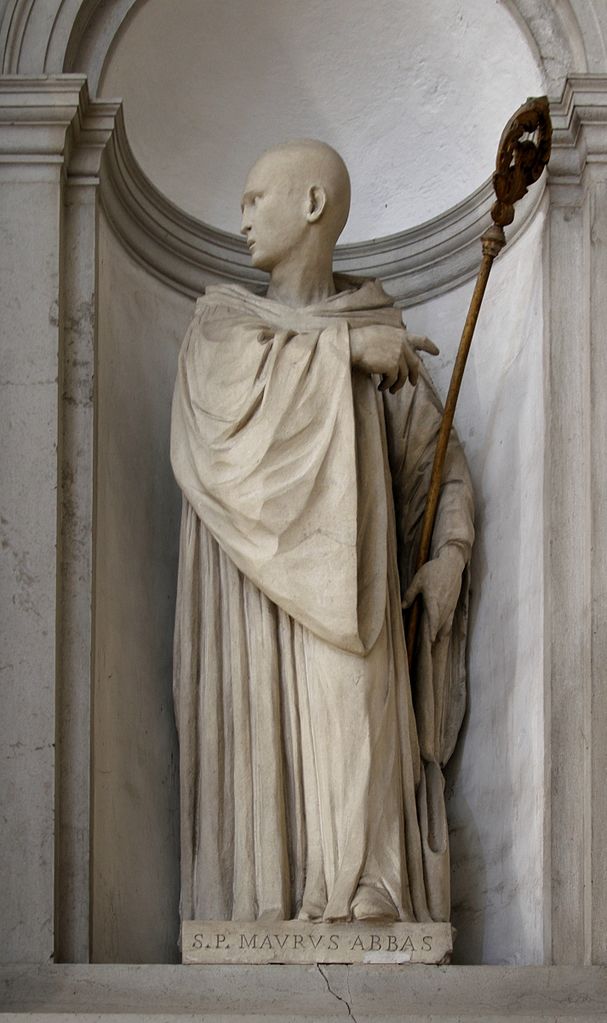
Saint of the Day – 15 January – Saint Maurus OSB (c 512-584)

Saint of the Day – 15 January – Saint Maurus OSB (c 512-584) Benedictine Abbot and Deacon, miracle-worker. Maurus was the first disciple of Saint Benedict of Nursia (512–584). He is mentioned in Saint Gregory the Great’s biography of the latter as the first oblate, offered to the Monastery by his noble Roman parents as a young boy, to be brought up in the monastic life. Born in c 512 in Rome, Italy and died on 15 January 584 of natural causes. Patronages – Benedictine Novices and Oblates (co-patron with St Placidus), disabled/cripples, invoked against rheumatism, epilepsy, gout, hoarseness, cold, charcoal burners, cobblers, coppersmiths, shoemakers, porters, tinkers, tailors, lantern and candle makers, of the Azores, Badajoz, Spain, Casoria, Italy, Saint-Bonnet-de-Vieille-Vigne, France.

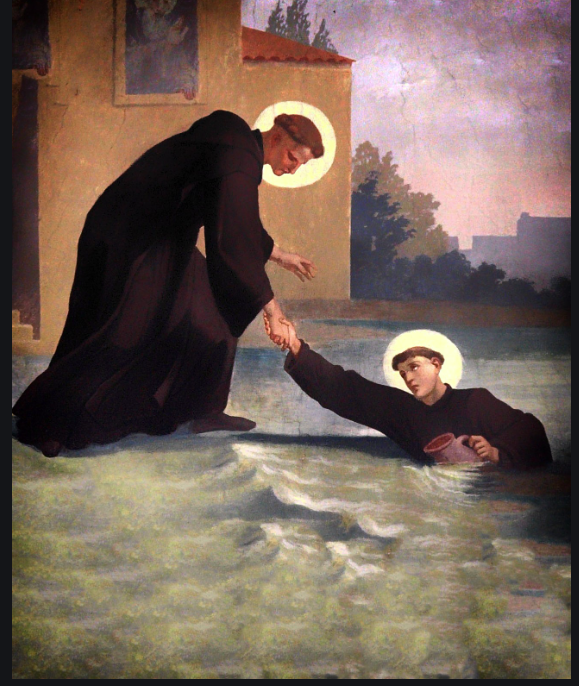
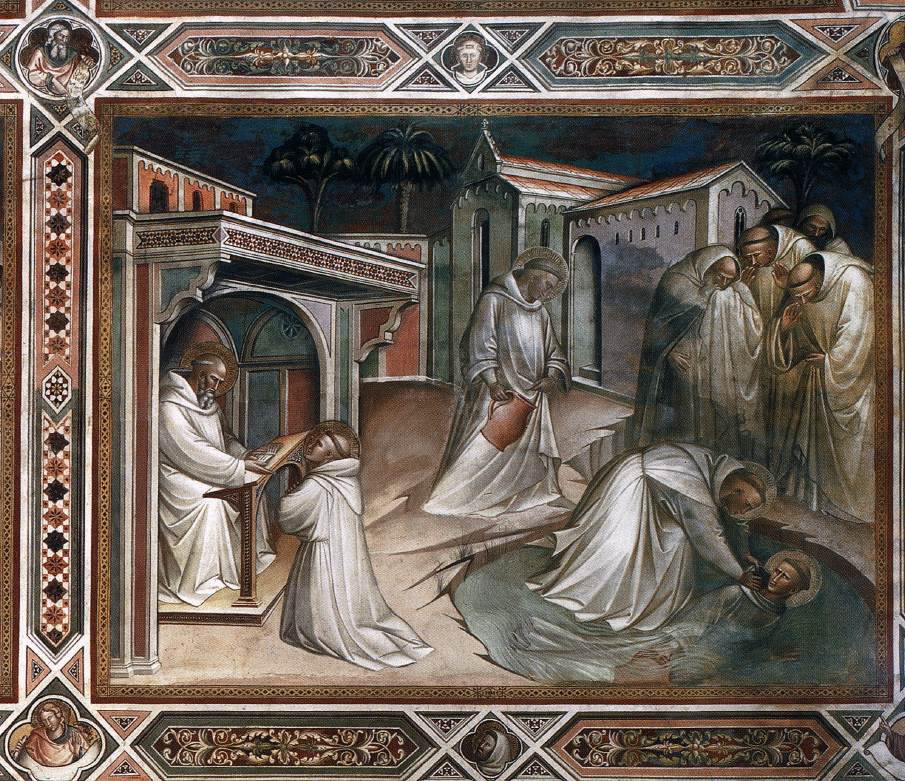
Four stories involving Maurus recounted by St Gregory formed a pattern for the ideal formation of a Benedictine Monk. The most famous of these involved Saint Maurus’s rescue of Saint Placidus, a younger boy offered to Saint Benedict at the same time as Saint Maurus. The incident has been reproduced in many medieval and Renaissance paintings.

“Saint Maurus—one of the greatest masters of the Cenobitical Life and the most illustrious of the Disciples of St Benedict, the Patriarch of the Monks of the West—shares with the First Hermit, St Paul, the honours of this fifteenth day of January.” (From the Benedictine Liturgy). The Benedictines today, liturgically honour the first companions of Saint Benedict, Saint Maurus and Saint Placidus. They are the Patron saints of Benedictine Novices and Oblates.

St Maurus, Abbot and Deacon, son of Equitius, a nobleman of Rome, was born about the year 510 and died in 584. When he was about twelve years old, his father placed him under the care of St Benedict at Subiaco, to be educated in piety and learning. When he had grown up, St Benedict chose him as his co-adjutor in the government of the Monastery. He was a model of perfection to all his brethren but especially in the virtue of obedience.

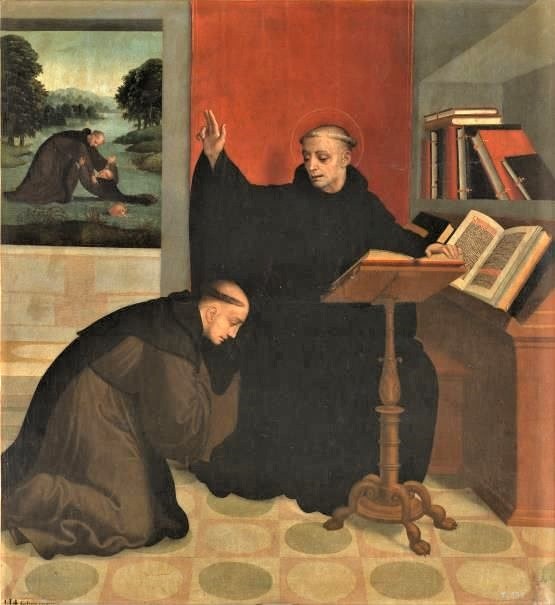
St Placidus, one of his fellow disciples, the son of the Senator Tertullus, going one day to draw water, fell into the lake and was at once carried away by the current. St Benedict saw this in spirit in his cell and bade Maurus run and draw him out. Having asked and received the holy Father’s blessing, Maurus hastened down to the lake, walked upon the waters, thinking he was on dry land and dragged Placid out by the hair, without sinking in the least himself. He attributed the miracle to the command and prayers of St Benedict but the holy Abbot, to the obedience of the disciple.

St Benedict sends St Maurus to rescue St Placidus – not the picture in the background – see below

St Maurus was sent to France in 543 to propagate the order of St Benedict in that country. He founded the famous Abbey of Glanfeuil, over which he ruled as Abbot for thirty-eight years. In 581 he resigned the Abbacy, built for himself a small cell near the Church of St Martin, so that, in solitude and prayer, he might prepare himself for his passage into eternity. After two years he fell sick of a fever, he received the Sacraments of the Church, lying on sackcloth before the Altar of St Martin and in that posture expired on 15 January 584.

Maurus was originally buried in the Abbey Church at Glanfeuil. When, in 868, Odo and the monks of Glanfeuil were obliged to flee to Paris in the face of Vikings marauding along the Loire, the remains of St Maurus were translated to the Abbey of Saint-Pierre-des-Fossés, later renamed Saint-Maur-des-Fossés.
In 1750 the relics were relocated to Saint-Germain-des-Prés, where they remained until dispersed by a Parisian mob during the French Revolution. Saint Maurus is still venerated by Benedictine congregations today, many Monks adopting his name and dedicating Monasteries to his patronage.

The cult of Saint Maurus slowly spread to Monasteries throughout France and by the 11th century had been adopted by Monte Cassino in Italy, along with a revived cult of Saint Placidus. By the late Middle Ages, the cult of Saint Maurus, often associated with that of Saint Placidus, had spread to all Benedictine Monasteries. Saint Maurus is venerated even as far as in India, where he is highly honoured in certain areas of the southern state of Kerala.

St Maurus was favoured by God with the gift of miracles. To show in what high degree the Saint possessed the gift of miracles, it will be sufficient to cite a few examples of how he miraculously cured the sick and restored to health those who were stricken with a grievous affliction. It has already been stated, according to the testimony of St Pope Gregory the Great, in the Second Book of his Dialogues, how when a youth, St Maurus rescued St Placidus from drowning.

A few more examples of miracles wrought by the Saint, as related by the Monk St Faustus (Bollandists, Vol. 2), who accompanied St Maurus to France and later wrote his life, will be given here. They were invariably wrought by means of the Sign of the Cross and the relic of the true Cross, which he had taken along to France.

When St Maurus, at that time Prior of the Abbey of Monte Cassino, was returning with the brethren from gathering the harvest in the fields, he met a boy who was mute and crippled, accompanied by his parents. When the father and mother of the boy cast themselves at the feet of the Saint and implored him to cure their child of his maladies, St Maurus, having for some time given himself to prayer, imposed upon the head of the boy his levitical stole, for he was a Deacon and made the sign of the Cross over him, saying to him: “In the name of the most holy and undivided Trinity and supported by the merits of the-most holy Father Benedict, I bid you to rise, stand upon your feet and be cured.” And forthwith the boy arose, walked about and with a loud voice praised and glorified God.

St Benedict with St Maurus and St Placidus

A certain Vicar, Ardenard, had been sent by Innocent, the Bishop of Mans, to Monte Cassino, in order to petition St Benedict to send some Monks to France. Arriving at a place called Vercella, the Vicar fell down headlong from a high stairway in the place where he was lodging. His body was so crushed by the fall that his life was despaired of. His right shoulder, arm and hand had so swelled with inflammation, that amputation of the arm was deemed necessary. Recourse was then had to their companion, St Maurus, who was engaged in prayer in the oratory. Moved by the earnest supplications of his brethren and the misery of the sick man, the Saint cast himself prostrate at the foot of the Altar, pouring forth his soul in fervent prayer. Having finished praying, he took from the Altar the case of relics which had been sent him by his master, St Benedict and went to the bedside of the sick man. Having exposed the relic of the Cross, he made the Sign of the Cross over every part of the arm from the shoulder to the fingers, saying:

“O God, the Creator of all things,
You ordained that Your only Son
should take flesh of the Virgin Mary
by the power of the Holy Spirit,
for the restoration of your people
and You deigned to heal the wounds
and infirmities of our souls,
by the redemption accomplished
upon the sacred and glorious wood
of the life-giving Cross,
do You also vouchsafe
through this powerful Sign,
to restore health to Your servant.”

His prayer being ended, all the poisoned blood, by which the Vicar’s arm had beer inflamed, began to flow off from three different places in his arm and his arm was cured.

While continuing their journey and reaching the Alps, one of the servants, Sergius, riding on horseback, fell from his horse and struck his leg against a huge rock and so crushed it, that it was but one bruised mass. Whereupon St Maurus went up to the unfortunate man, seized his crushed leg with his left hand and with his right made the sign of the Cross over it, saying: “In the name of almighty God, arise and be cured” and immediately, to the joy of all, his crushed leg became whole and sound.

When St Maurus and his little band came to the Church of the Holy Martyrs Sts Maurice and his companions, they entered it to pray. At the entrance of the Church sat a certain man who was born blind, begging alms from those who entered and left the holy building. He had learned that Maurus, the disciple of the holy man Benedict, had arrived, the fame of his sanctity having already preceded him. When Maurus and his companions had finished their prayers and left the Church, they found the blind man lying prostrate on the ground, begging and imploring the Saint to obtain for him by his prayers the light of his eyes. Maurus commanded him to rise and pressing the fingers of his right hand upon his eyes, he imprinted on them the sign of our redemption. Thereupon, the blind man instantly obtained his eyesight.

Blessing of St Maurus
Since St Maurus miraculously freed many persons from their bodily afflictions through the Sign of the Cross and the relic of the true Cross of Christ, in many Monasteries of the Order of St Benedict from time immemorial, after the example of this miracle-worker, the custom of blessing the sick with the relic of the true Cross, has prevailed, in order to restore their health. But until recent years, there was no uniform and approved formula of blessing of the Church. There existed a number of old and new formulas, which were essentially the same but differed from each other in many details. Some formulas were exceedingly lengthy. In the face of these facts, Dom Maurus Wolter OSB, President of the Beuronese Congregation, petitioned Rome for an approved and authentic formula. A carefully prepared and much abbreviated formula was therefore presented to the Sacred Congregation of Rites for its approval.

The formula and prayer of St Maurus, was approved by the Sacred Congregation for all Priests and Deacons, secular as well as regular clerics, to impart the blessing, provided the formula approved by the Sacred Congregation is used.

In art, St Maurus is depicted as a young man in the garb of a monk, usually holding an Abbot’s cross or sometimes with a spade (an allusion to the monastery of Saint-Maur-des-Fossés, literally “Saint Maurus of the Ditches”). Another of Saint Maurus’ attributes, is a crutch, in reference to his patronage of cripples. He was invoked especially against fever, and also against rheumatism, epilepsy and gout. He is also sometimes depicted with a scale, a reference to the implement used to measure a Monk’s daily ration of bread, given to him by Benedict when he left Monte Cassino, for France. The Monks of Fossés near Paris (whence the community of Glanfeuil had fled from the Vikings in 868) exhibited this implement throughout the Middle Ages.

Posted in ARTISTS, PAINTERS, Of MUSICIANS, Choristors, PATRONAGE - LIBRARIES/LIBRARIANS/ARCHIVISTS, SAINT of the DAY

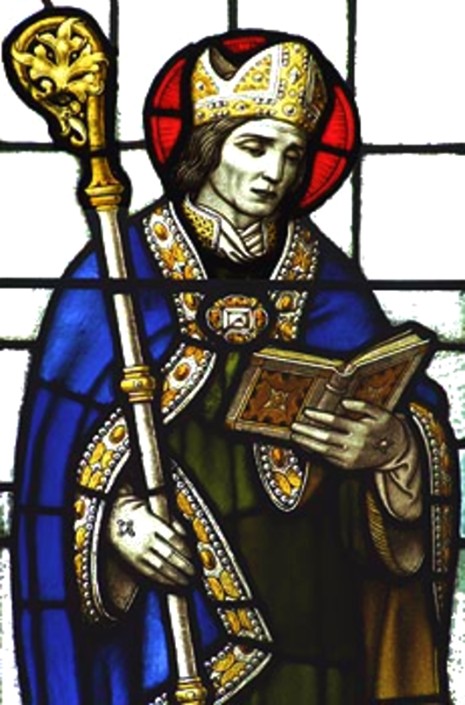
Saint of the Day – 12 January – St Benedict Biscop OSB (c 628-690)

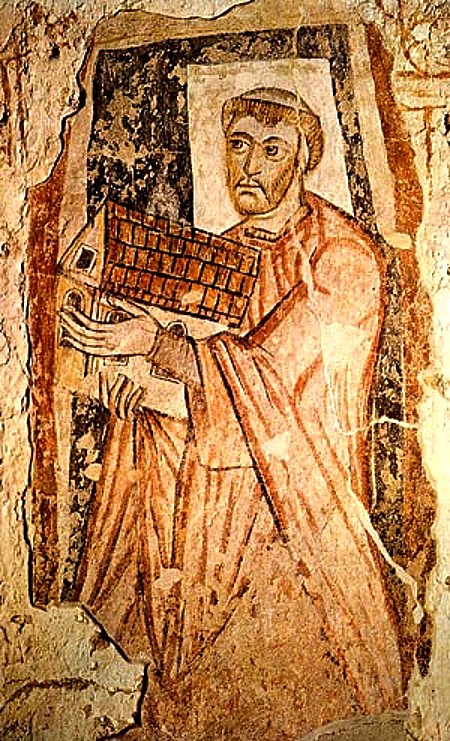
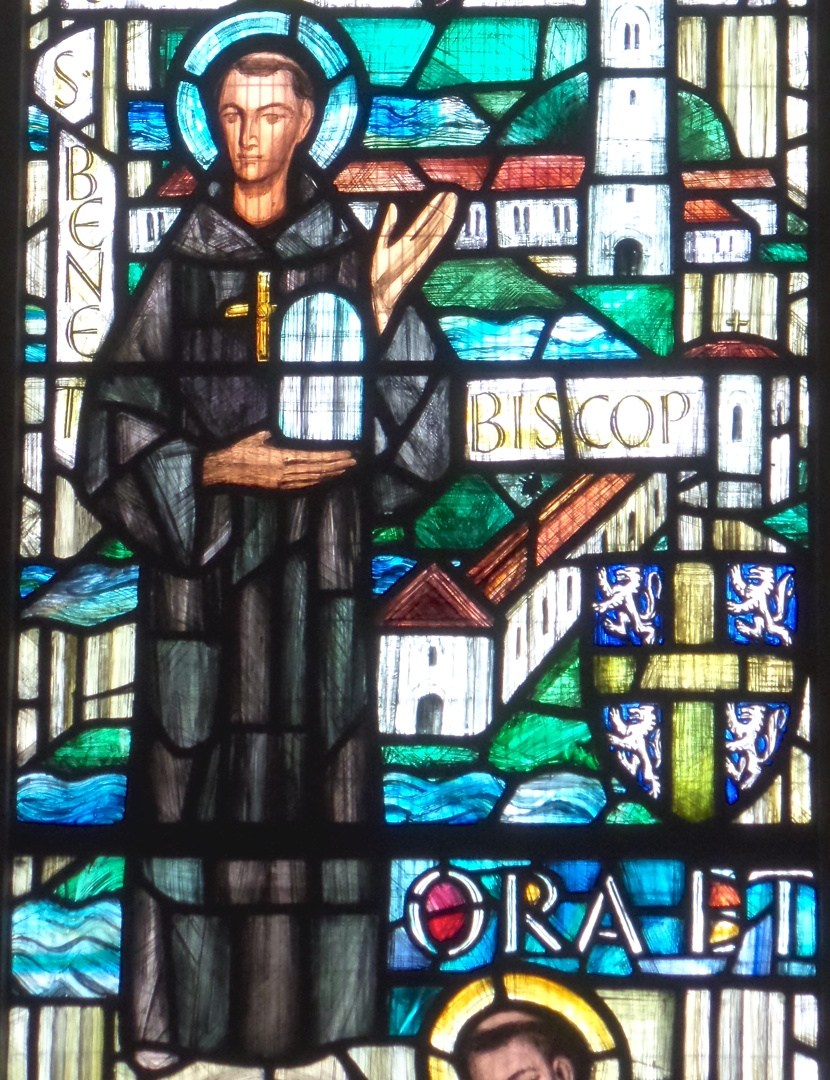
Saint of the Day – 12 January – St Benedict Biscop OSB (c 628-690) (pronounced “bishop”) – Bishop and Abbot of Wearmouth, who introduced Stained Glass windows to England and raised the Venerable Saint Bede, Founder of Monkwearmouth-Jarrow Priory (where he also founded the famous library) – he was known as a Bibliophile, Confessor, a man of great piety and learning. Born in c 628 in Northumbria, England as Benet Biscop and died on 12 January 690 of natural causes at Wearmouth, England. Patronages – English Benedictines, musicians, painters, Church libraries and librarians, Sunderland, England, St Benet Biscop Catholic Academy in Northumberland, England.

Benedict’s idea was to build a model Monastery for England, sharing his knowledge of the experience of the Church in Europe. It was the first Ecclesiastical building in Britain to be built in stone and the use of glass was a novelty for many in 7th-century England. It eventually possessed, what was a very large library for the time – several hundred volumes – and it was here, that Benedict’s student St Bede wrote his famous works. The library became world-famous and manuscripts that had been copied there became prized possessions throughout Europe, including especially the Codex Amiatinus, the earliest surviving manuscript of the complete Bible in the Latin Vulgate version.

Benet was born of the highest Anglo-Saxon nobility. He held office in the household of King Oswy (Oswiu) of Northumbria. But, after a journey to Rome, the first of his five such trips, when his was 25 (653) in the company of Saint Wilfrid, the saint renounced his inheritance and dedicated himself to God. He then spent his time in studying the Scriptures and prayer. Following a second visit to Rome with Oswy’s son Aldfrith in 666, he became a Monk in the Monastery of Saint-Honorat in Lerins near Cannes, France, taking the name Benedict. He remained there for two years strictly observing the rule.

His third pilgrimage to Rome in 669, coincided with the visit of Archbishop-elect Wighard of Canterbury, who died there, prior to his consecration. Saint Theodore was finally selected to replace Wighard as Archbishop of Canterbury and Pope Saint Vitalian, ordered Benedict to accompany Theodore and Saint Adrian to England, as a Missionary, which he did in obedience. Theodore appointed Benedict Abbot of Sts Peter and Paul (now St Augustine’s) Monastery in Canterbury, where he remained for two years before returning to Northumbria. (He was succeeded as Abbot by Saint Adrian, whose feast day was yesterday and who held this position for 39 years.)

Thereafter, Saint Benedict travelled to and fro between Britain and Rome (beginning in 671), returning always with books and relics and bringing back with him craftsmen to build and enrich the Churches of Britain. This fourth journey was made, with the view of perfecting himself in the rules and practice of a monastic life, so he stayed a while in Rome and visited other Monasteries.

In 674, he was granted 70 hides of land by Oswy’s son, Egfrid, at the mouth of the river Wear (Wearmouth), where he built a great stone Church and Monastery dedicated to Saint Peter. He was the first to introduce glass into England, which he brought from France along with stone and other materials. His foreign masons, glaziers and carpenters taught their skill to the Anglo-Saxons. He spared no trouble or effort in seeking far and wide for all that would richly embellish his Romanesque church.

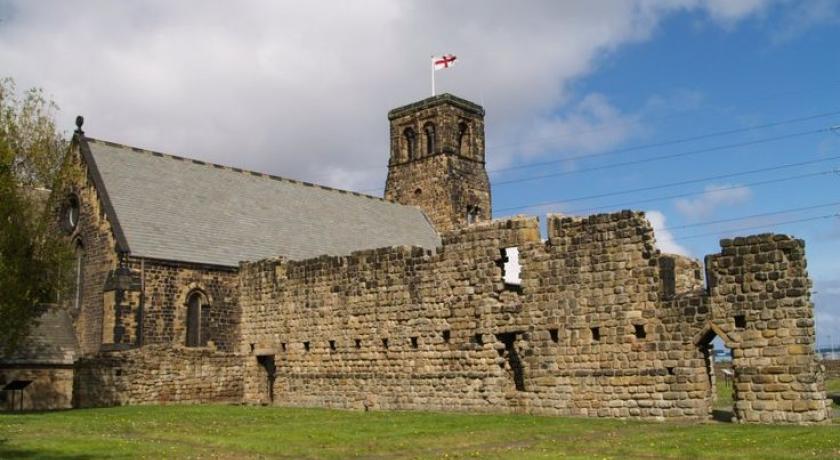
Partly in ruins, St Peter’s Monastery and Church

From his trip to Rome in 679, Benedict brought back Abbot John of Saint Martin’s, the precentor (Archcantor) from Saint Peter’s. This was a result of Benedict persuading Pope Saint Agatho that Abbot John would be able to instruct the English monks, so that the music and ceremonies at Wearmouth might follow exactly the Roman pattern. Upon his return to England, he held training classes in the use and practice of church music, liturgy and chants. (John also taught the English monks uncial script and wrote instructions on the Roman liturgy for them.)

But, chiefly, he brought books, for he was a passionate collector. His ambition was to establish a great library in his Wearmouth Monastery. He also imported pictures from Rome and Vienne, beautiful paintings and musical scores. Among these treasures imported from Rome were a series of paintings of Gospels scenes, of Our Lady and the Apostles and of incidents described in the Book of Revelation, to be set up in the church.

Benedict also devised his rule based on that of Saint Benedict and those of the 17 Monasteries he had visited. He doubtlessly organised the scriptorium in which was written the manuscript of the Bible which, his successor as Prior at Wearmouth, Saint Ceolfrid, took with him in 716 as a present to Pope Saint Gregory II – the very book was identified in the Biblioteca Laurentiana at Florence in 1887, the famous Codex Amiatinus. All this immeasurably enriched the early English Church.

Because his Monastery and Church at Wearmouth was so edifying, in 682 Egfrid gave him a further gift of forty hides of land, this time at Jarrow on the Tyne River. Here he established a second Monastery, six miles from St. Peter’s and dedicated it to Saint Paul (now called Jarrow) in 685, which became famous as a great centre of learning in the West and the home of Saint Bede. our Saint’s charge and spiritual son. Among its inmates were many Saxon thanes turned Monks, who ploughed and winnowed and worked at the forge, like the rest and at night, slept in the common dormitory, for rank and class had no place among them.

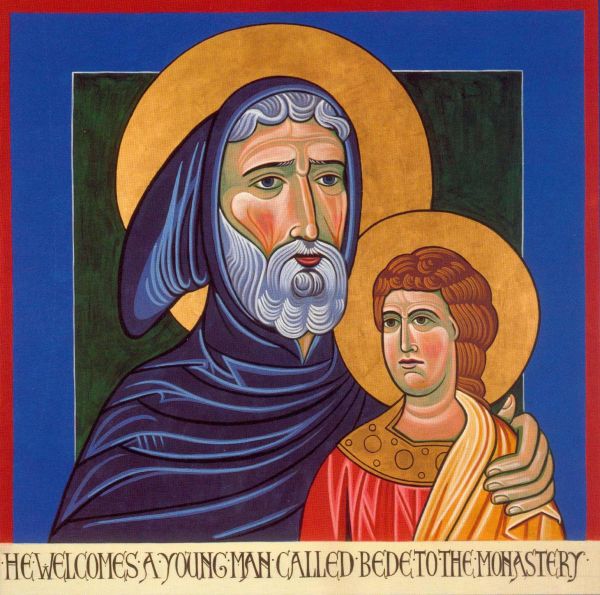
St Benedict Biscop with St Bede

And because Benedict was busier than ever with all his enterprises and still governed both Abbeys, he handed over some of his authority. Benedict first took to help him at Wearmouth, his nephew, Saint Eosterwin, a noble like himself and then Saint Sigfrid. In Jarrow, he placed Saint Ceolfrid in charge. While Benedict still ruled the Abbeys as their Founder, he made these men the Abbots under his direction of the two foundations, so that the Monasteries would not be without leadership during his absences.

Benedict made his last voyage to Rome in 685, returning with even more books and sacred images and some fine silk cloaks of exceptional workmanship, which he exchanged with the King for three hides of land.

It was due to Benedict Biscop that so much material lay to hand for Bede and other scholars and that, a solid foundation was laid for the later glories of the English Church. After his death, the school at Jarrow alone, comprised 600 scholars, apart from the flow of constant visitors. It was also in large part due to him, that the Church of Northumbria turned from the old Celtic forms, to those of Rome. Out of his labours and travels came a rich and abundant harvest.

At the end of his life, Benedict suffered from a painful paralysis in his lower limbs. (It is interesting to note that Sigfrid was afflicted with the same paralysis about the same time.) Throughout his three-year confinement, he asked the Monks to come into his room to sing Psalms and he joined them when he could. His last exhortations to his Monks, before he died at age 62, were to continue his work, to preserve his great library, to follow the monastic Rule of Saint Benedict and, to elect an Abbot, based on his holiness and ability rather than his lineage. He said, he would rather the Monasteries be turned into wildernesses than to have his brother succeed him as Abbot.

Benedict’s biography was written by Saint Bede, who had been entrusted to his care at age seven and whose learning was made possible by the library Benedict collected at Jarrow. Bede, the historian, says that the civilisation and learning of the 8th century rested in the Monastery founded by Benedict.

Proof of a very early public cultus of Benedict Biscop comes from a sermon of Bede on him (Homily 17) for his feast but the cultus became more widespread only after the translation of his relics under Saint Ethelwold about 980. Saint Benedict’s relics are thought to rest at Thorney Abbey, although Glastonbury also claims some of them.

Below is a link to St Bede’s Life of Benedict Biscop from his Lives of the Abbots of Wearmouth and Jarrow written c. 716:
http://www.fordham.edu/halsall/basis/bede-jarrow.html

And a link to an explanation of:
The Codex Amiatinus:

http://www.knight.org/advent/cathen/04081a.htm

SAMSUNG CAMERA PICTURE

Posted in Against EPIDEMICS, DOMESTIC ANIMALS, SAINT of the DAY

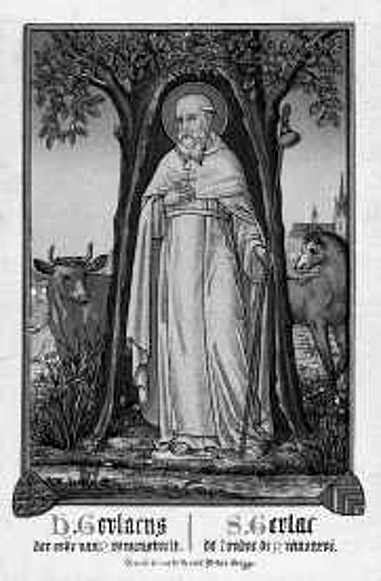
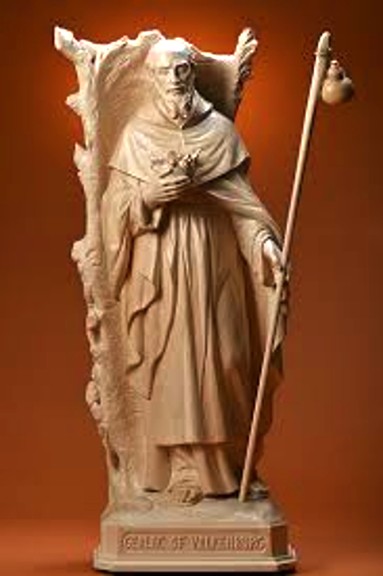
Saint of the Day – 5 January – Saint Gerlach (c 1100-c 1170)

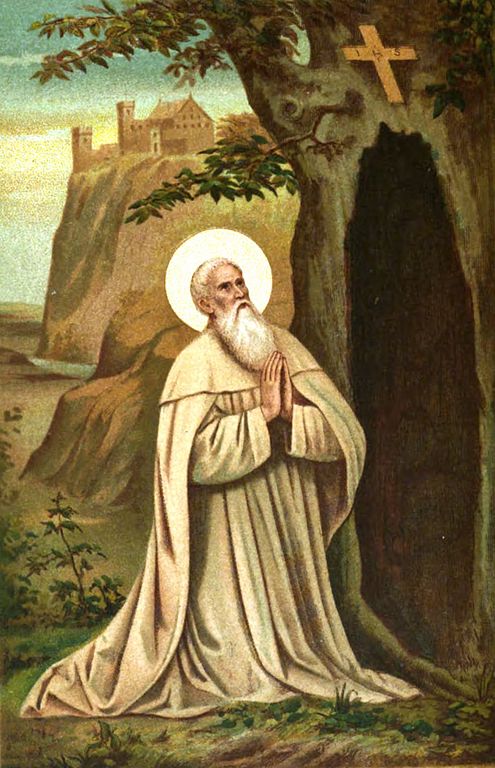
Saint of the Day – 5 January – Saint Gerlach (c 1100-c 1170) Hermit – born in c 1100 at Valkenburg, Netherlands and died in 1172 – 1177 at Houthem,  in the Province of Limburg in the Kingdom of the Netherlands of natural causes. Also known as Gerlac von Houthem, Gerlac of Maastricht, Gerlac of Valkenberg, Gerlach, Gerlache, Gerlacus, Gerlachus, Gerlak. Patronages – against cattle disease, against plague/epidemics, of domestic animals.

The Vita Beati Gerlaci Eremytae, written around 1227, describes his legend and life. Originally a licentious soldier and brigand, Gerlach became a pious Christian upon the death of his wife and went on pilgrimage to Rome and Jerusalem. At Rome, he performed rites of penance for the sins of his youth, made a general confession of his sins to Pope Eugene III and then proceeded to Jerusalem where the latter had sent him. There he tended the sick, which he did for seven years.

Upon returning to the Netherlands, he gave up all of his possessions to the poor and took up residence in a hollow oak on his former Estate near Houthem. He ate bread mixed with ash and travelled by foot, each day on pilgrimage to Maastricht, to the Basilica of Saint Servatius.

Neighbouring Monks wished to see him enter their Monastery, especially since they were convinced that Gerlach was very rich and hid his treasure in the hollow of the tree where he lived. The local Bishop, therefore, intervened and ordered that the oak be felled. When he saw that there was no hidden treasure, he ordered that the tree be made into boards and be used to build a new hermitage for Gerlach.

The people of the neighbourhood already considered him a saint and he also enjoyed the protection of great figures, such as Hildegard of Bingen .

Legend states that when Gerlach had done enough penance, water from the local well transformed itself into wine three times, as a sign that his sins had been forgiven. He died shortly after, barely fifty and legend has it that the last rites were administered to him by the Saint Servatius himself.

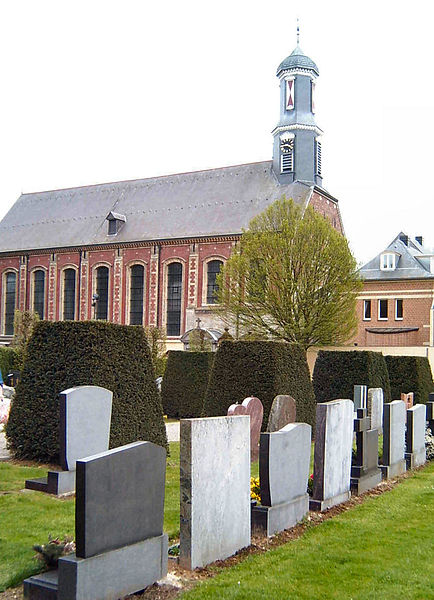
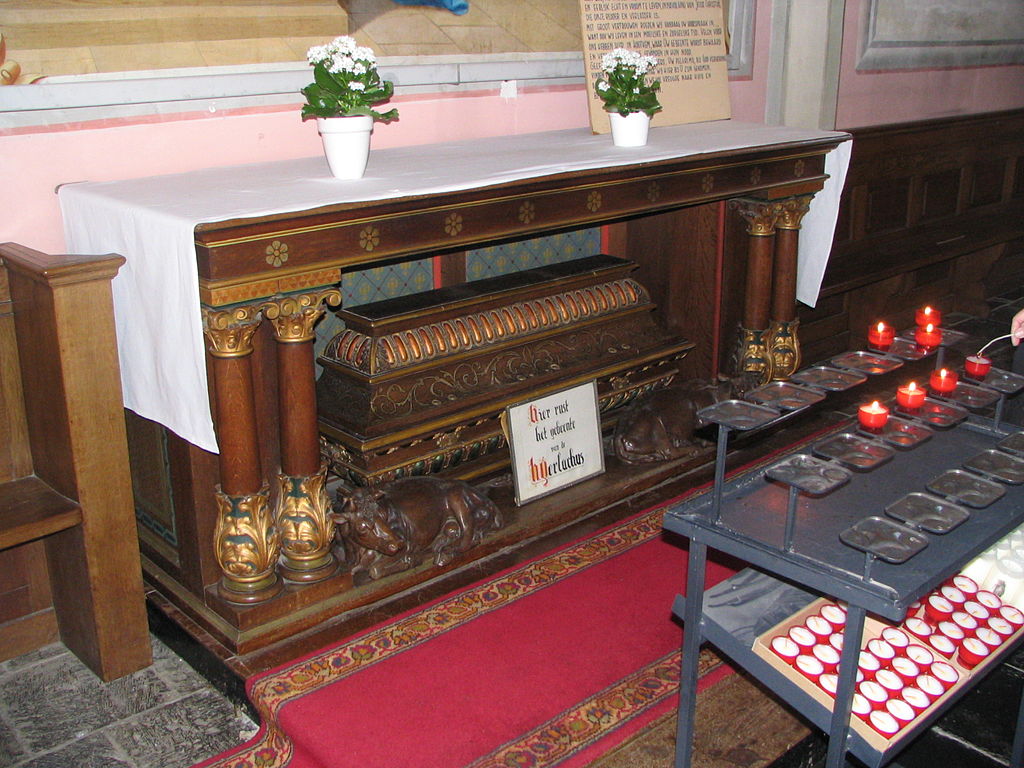
The Order of Premontre (Norbertines) claims his as one of theirs, due to his “rough white habit” and has him on its liturgical calendar as a “Blessed.” Below is the Church of St Gerlac in Houthem where his relics now rest. The Abbey of St Gerlac, which was named after him, is now a hotel.

Posted in Against EPIDEMICS, Of GARDENERS, Horticulturists, Farmers, Of the SICK, the INFIRM, All ILLNESS, SAINT of the DAY

Saint of the Day – 2 January – Saint Adelard of Corbie (c 751 – 827)

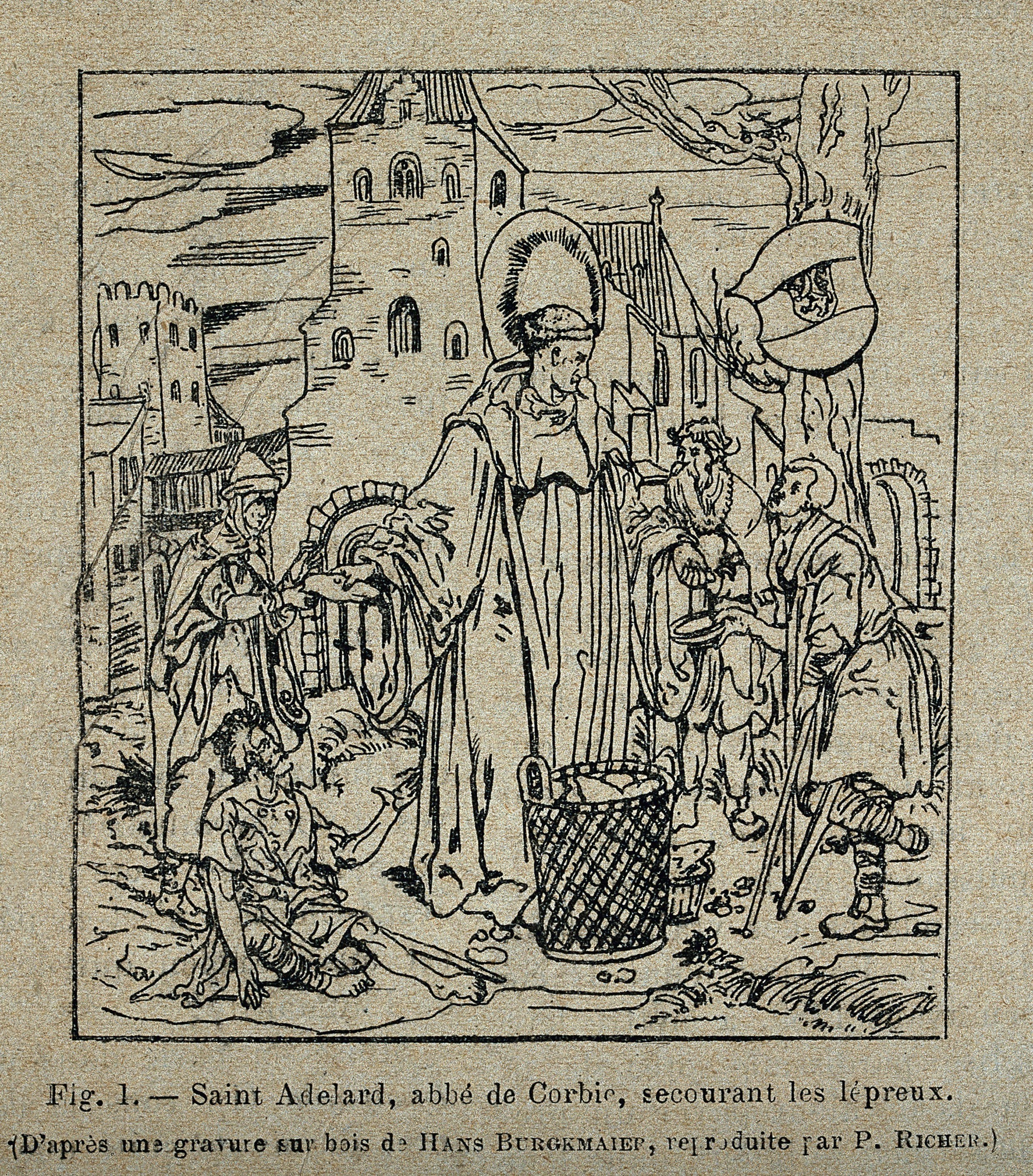
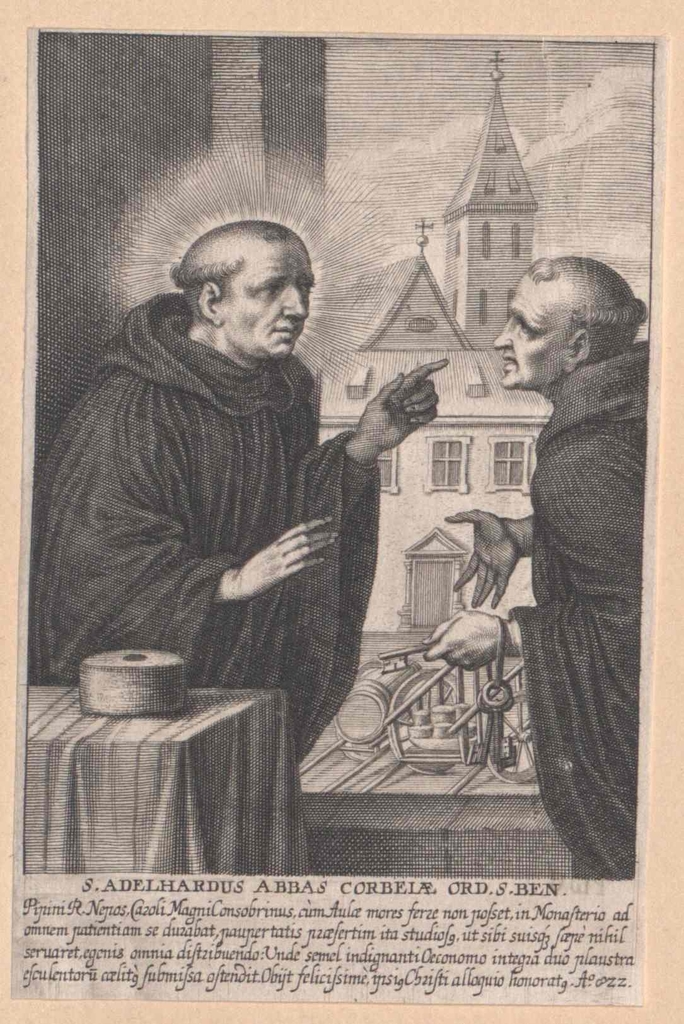
Saint of the Day – 2 January – Saint Adelard of Corbie (c 751 – 827) Monk, Abbot, Apostle of the poor and needy, Court administrator, Counsellor to Charlemagne – born in c 751 and died on 2 January 827 at Corbie Abbey, Picardy, France following a brief illness. Also known as Adalard, Adalhard, Adelhard, Adalardus, Adelardus, Alard, Alardus, Adalardo. Patronages – against fever/illness, against typhoid/epidemics, of gardeners, of many Churches and Towns in France and along the lower Rhine.

Adelard (752-827) was the grandson of Charles Martel, nephew of King Pepin and first cousin to Charlemagne. Adalard received a good education in the Palatine School at the Court of Charlemagne in Aachen and while still very young was made Count of the Palace. He became a Monk, at the age of 20, at Corbie in Picardy in 773. He attempted to embrace a more eremitical life at Monte Cassino but was ordered back to Corbie by Charlemagne. Eventually, he was chosen Abbot and became Charlemagne’s counsellor.

He was forced by the King to leave the Monastery and work for him as chief minister for his son Pepin. At his death in Milan in 810, King Pepin appointed Adelard tutor to his son Bernard of Italy, then but twelve years of age.

He was accused of supporting a rival power (Bernard) against Emperor Louis the Debonair and was banished to a Monastery on the island of Heri. Five years later he was recalled to the King’s court (821). Several hospitals were erected by him. In 822 Adalard and his brother Wala founded Corvey Abbey (“New Corbie”) in Westphalia, Germany.

He later retired to the Abbey at Corbie and died on 2 January after an illness, thought today to have been typhoid.

Miracles were reported after his death. When Adelard first became Monk at Corby in Picardy (in 773), his first assignment was gardener of the Monastery. He did his job humbly and piously, praying throughout the day. His great virtues eventually helped him become Abbot but also, forced him into secular posts at the order of the King.

Saint Adelard was Canonised by Pope John XIX in 1026.

With the above description in mind, it will not be much of a surprise that Adelard became the patron saint of gardeners. In addition, he became known as the patron of sufferers of fevers and typhoid.

Posted in Against EPIDEMICS, Against SNAKE BITES / POISON, Against STORMS, EARTHQUAKES, THUNDER & LIGHTENING, FIRES, DROUGHT / NATURAL DISASTERS, All THEOLOGIANS, Moral Theologians, CATECHESIS, CHRISTMASTIDE!, FEASTS and SOLEMNITIES, GOUT, KNEE PROBLEMS, ARTHRITIS, etc, Of Catholic Education, Students, Schools, Colleges etc, PATRONAGE - VINTNERS, WINE-FARMERS, PATRONAGE - WRITERS, PRINTERS, PUBLISHERS, EDITORS, etc, QUOTES for CHRIST, QUOTES of the SAINTS, QUOTES on CHASTITY, SAINT of the DAY, The APOSTLES & EVANGELISTS, The BLESSED VIRGIN MARY

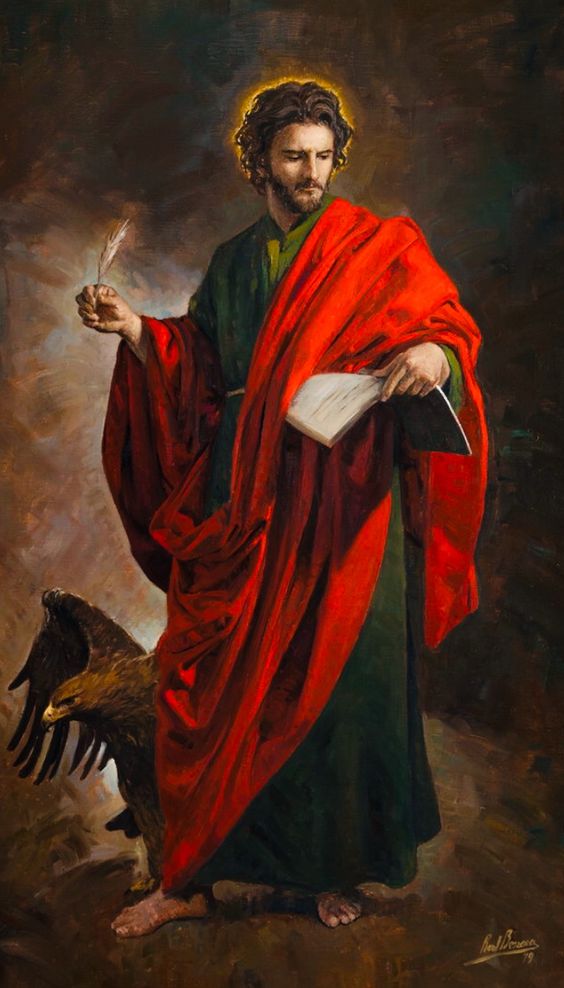
Saint of the Day – 27 December – The Disciple Whom Jesus Loved, the Eagle by Dom Prosper Guéranger

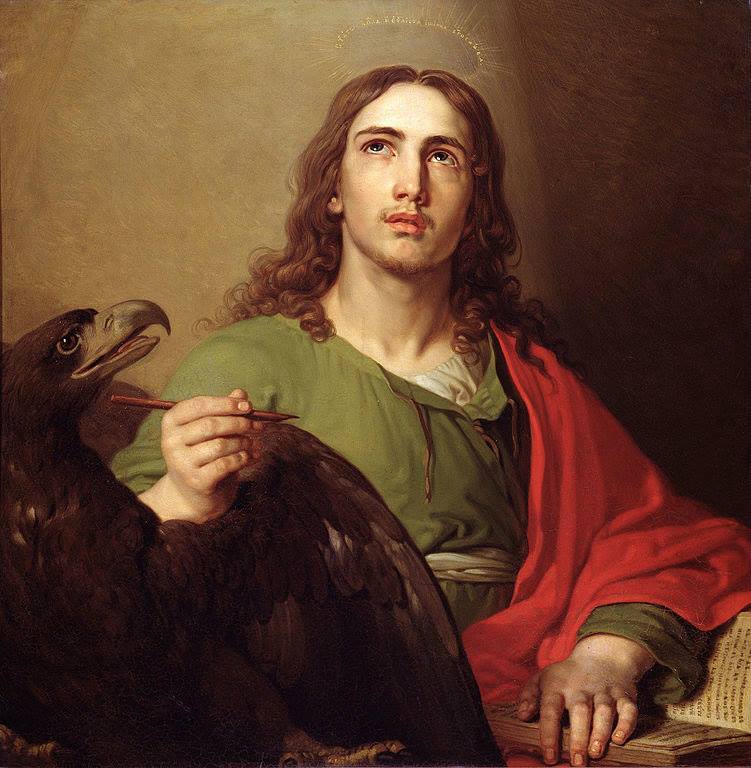
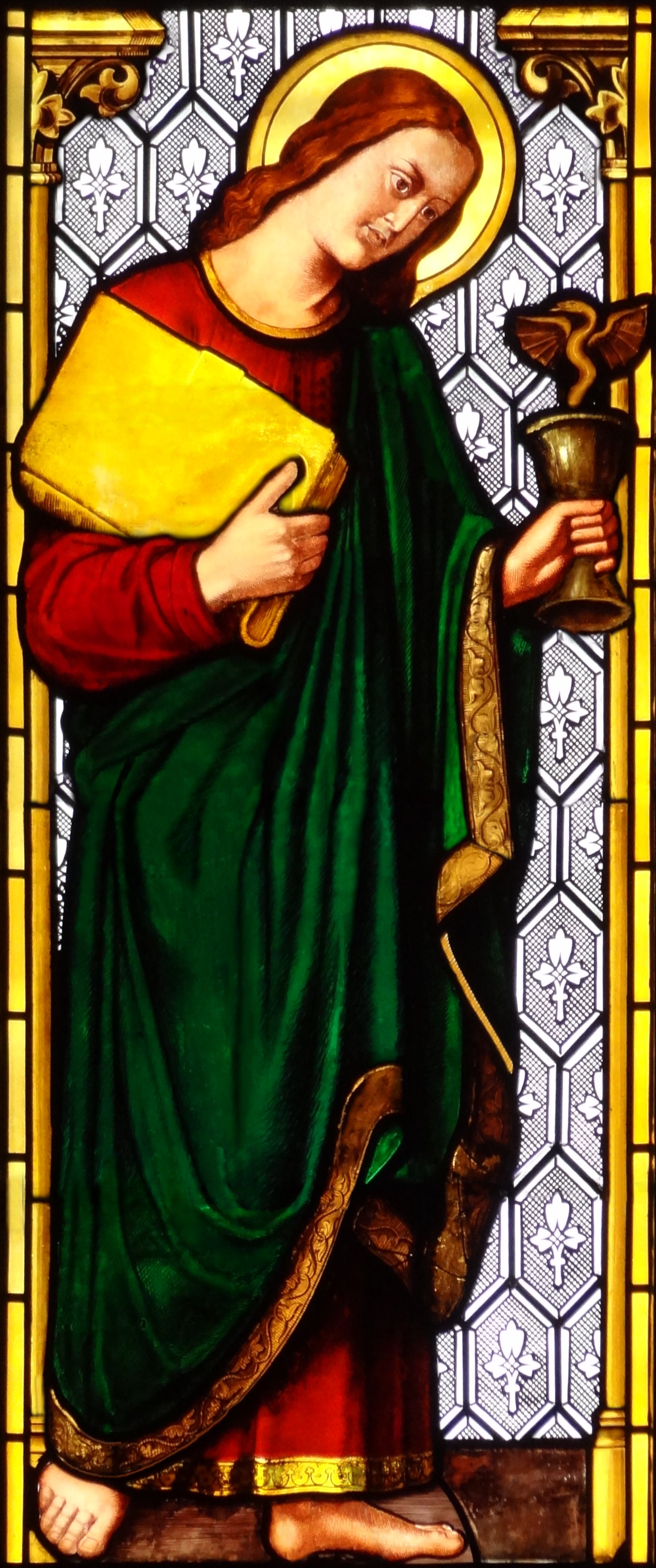
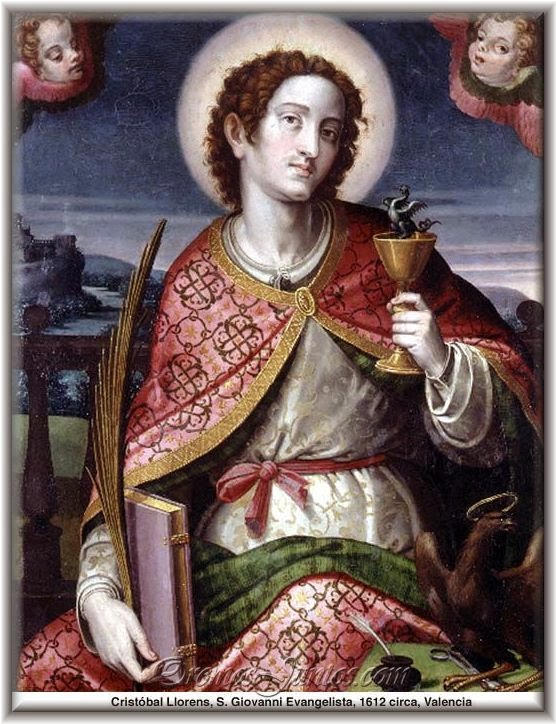
Saint of the Day – 27 December – St John the Apostle and Evangelist.  Patronages – • against burns; burn victims• against epilepsy• against foot problems• against hailstorms• against poisoning• art dealers• authors, writers• basket makers• bookbinders• booksellers• butchers• compositors• editors• engravers• friendships• glaziers• government officials• harvests• lithographers• notaries• painters• papermakers• publishers• saddle makers• scholars• sculptors• tanners• theologians• typesetters• vintners• Asia Minor (proclaimed on 26 October 1914 by Pope Benedict XV)• 6 Diocese• 7 Cities.

The days following Christmas are full of symbolic meaning, as on 26 December we honour the first Martyr, St Stephen, who shed his blood for Jesus. 27 December, honours St John the Evangelist, the Disciple of Jesus who wrote the Gospel of John and the book of Revelation. Interestingly enough, he is the only Gospel writer to omit a narrative of Jesus’ birth. Based on this fact alone, it seems strange to include him during the Octave of Christmas. What is the Church’s reason behind this choice? Servant of God, Dom Prosper Guéranger in his Liturgical Year, points to St John’s pure chastity and his focus on the Divinity of Christ, as the reasons why he is honoured now at the Crib of Christ.

Dom Prosper Guéranger OSB (1805-1875)

The Disciple Whom Jesus Loved, the Eagle

“Nearest to Jesus’ Crib, after Stephen, stands John, the Apostle and Evangelist. It was only right, that the first place should be assigned to him, who so loved his God, that he shed his blood in his service; for, as this God Himself declares, greater love than this hath no man, that he lay down his life for his friends [1 John, 15:13] and Martyrdom has ever been counted, by the Church, as the greatest act of love and as having, consequently, the power of remitting sins, like a second Baptism. But, next to the sacrifice of Blood, the noblest, the bravest and, which most wins the heart of Him, who is the Spouse of souls, is the sacrifice of Virginity. Now, just as St Stephen is looked upon as the type of Martyrs, St John is honoured as the Prince of Virgins. Martyrdom won for Stephen the Crown and palm; Virginity merited for John most singular prerogatives, which, while they show how dear to God, is holy Chastity, put this Disciple among those, who, by their dignity and influence, are above the rest of men.

St. John was of the family of David, as was our Blessed Lady. He was, consequently, a relation of Jesus. This same honour belonged to St James the Greater, his Brother; as also to St James the Less and St Jude, both Sons of Alpheus. When our Saint was in the prime of his youth, he left, not only his boat and nets, not only has lather Zebedee but, even his betrothed, when everything was prepared for the marriage. He followed Jesus and never once looked back. Hence, the special love which our Lord bore him. Others were Disciples or Apostles, John was the Friend, of Jesus. The cause of this our Lord’s partiality, was, as the Church tells us in the Liturgy, that John had offered his Virginity to the Man-God. Let us, on this his Feast, enumerate the graces and privileges that came to St John from his being The Disciple whom Jesus loved.

This very expression of the Gospel, which the Evangelist repeats several times — The Disciple whom Jesus loved [John, 13:23, 19:26, 21:7, 21:20] — says more than any commentary could do. St Peter, it is true, was chosen by our Divine Lord, to be the Head of the Apostolic College and the Rock whereon the Church was to be built – he, then, was honoured most but St John was loved most. Peter was bid to love more than the rest loved and he was able to say, in answer to Jesus’ thrice repeated question, that he did love Him in this highest way and yet, notwithstanding, John was more loved by Jesus than was Peter himself, because his Virginity deserved this special mark of honour.

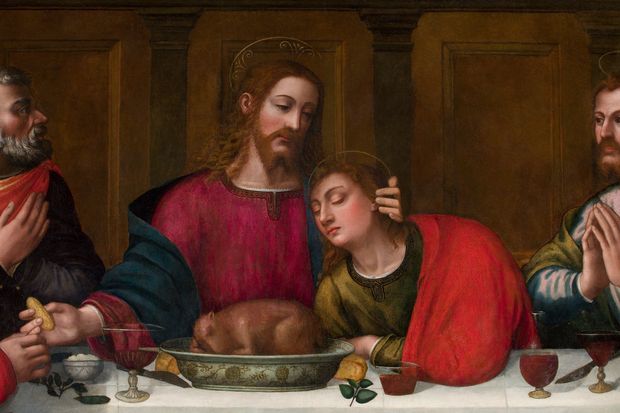
Chastity of soul and body brings him, who possesses i,t into a sacred nearness and intimacy with God. Hence it was, that at the Last Supper – that Supper, which was to be renewed on our Altars, to the end of the world, in order to cure our spiritual infirmities and give life to our souls – John was placed near to Jesus, nay, was permitted, as the tenderly loved Disciple, to lean his head upon the Breast of the Man-God. Then it was, that he was filled and from their very Fountain, with Light and Love, it was both a recompense and a favour and became the source of two signal graces, which make St John an object of special reverence to the whole Church.

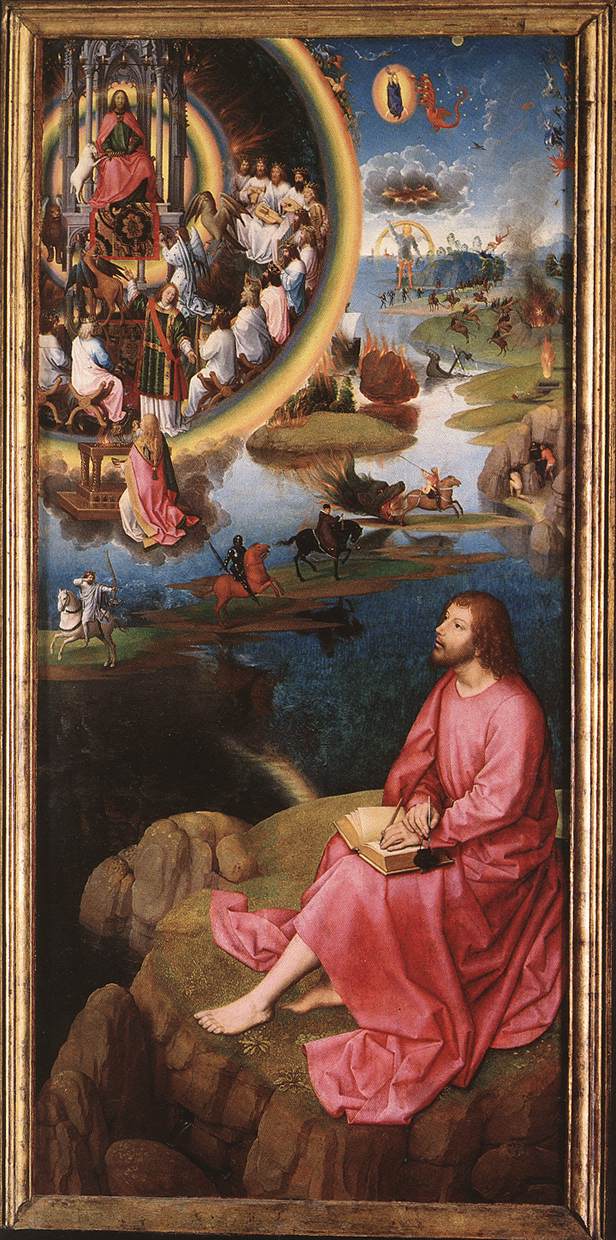
Divine wisdom, wishing to make known to the world, the Mystery of the Word and commit to Scripture, those profound secrets, which, so far, no pen of mortal had been permitted to write — the task was put upon John. Peter had been crucified, Paul had been beheaded and the rest of the Apostles had laid down their lives in testimony of the Truths they had been sent to preach to the world; John was the only one left in the Church. Heresy had already begun its blasphemies against the Apostolic Teachings; it refused to admit the Incarnate Word as the Son of God, Consubstantial to the Father. John was asked by the Churches to speak and he did so in language heavenly above measure. His Divine Master had reserved to this, his Virgin-Disciple, the honour of writing those sublime Mysteries, which the other Apostles had been commissioned only to teach — THE WORD WAS GOD, and this WORD WAS MADE FLESH for the salvation of mankind.

Thus did our Evangelist soar, like the Eagle, up to the Divine Sun and gaze upon Him with undazzled eye, because his heart and senses were pure and, therefore, fitted for such vision of the uncreated Light. If Moses, after having conversed with God in the cloud, came from the divine interview with rays of miraculous light encircling his head – how radiant must have been the face of St John, which had rested on the very Heart of Jesus, in whom are hid all the treasures of wisdom and knowledge! [Col. 2:3] how sublime his writings! how divine his teaching! Hence, the symbol of the Eagle, shown to the Prophet Ezechiel, [Ezechiel 1:10, 10:14] and to St John himself in his Revelations, [Apoc. 4:7] has been assigned to him by the Church and, to this title of The Eagle has been added, by universal tradition, the other beautiful name of Theologian. This was the first recompense given by Jesus to his Beloved John, a profound penetration into divine Mysteries. The second was the imparting to him a most ardent charity, which was equally a grace consequent upon his angelic purity, for purity unburdens the soul from grovelling egotistic affections and raises it to a chaste and generous love. John had treasured up in his heart the Discourses of his Master, he made them known to the Church and, especially, that divine one of the Last Supper, wherein Jesus had poured forth His whole Soul to His own, whom he had always tenderly loved but most so, at the end [John, 13:1]. He wrote his Epistles and Charity is his subject – God is Charity — he that loveth not, knoweth not God — perfect Charity casteth out fear — and so on throughout, always on Love. During the rest of his life, even when so enfeebled by old age as not to be able to walk, he was forever insisting upon all men loving each other, after the example of God, who had loved them and so loved them! Thus, he that had announced more clearly than the rest of the Apostles the divinity of the Incarnate Word, was by excellence, the Apostle of that divine Charity, which Jesus came to enkindle upon the earth.

But, our Lord had a further gift to bestow and it was sweetly appropriate to the Virgin-Disciple. When dying on His cross, Jesus left Mary upon this earth. Joseph had been dead now some years. Who, then, shall watch over His Mother? who is there worthy of the charge? Will Jesus send His Angels to protect and console her? — for, surely, what man could ever merit to be to her as a second Joseph? Looking down, he sees the Virgin-Disciple standing at the foot of the Cross – we know the rest, John is to be Mary’s Son — Mary is to be John’s Mother. Oh! wonderful Chastity, that wins from Jesus such an inheritance as this! Peter, says St Peter Damian, shall have left to him the Church, the Mother of men; but John, shall receive Mary, the Mother of God, whom he will love as his own dearest Treasure and to whom, he will stand in Jesus’ stead; whilst Mary will tenderly love John, her Jesus’ Friend, as her Son.

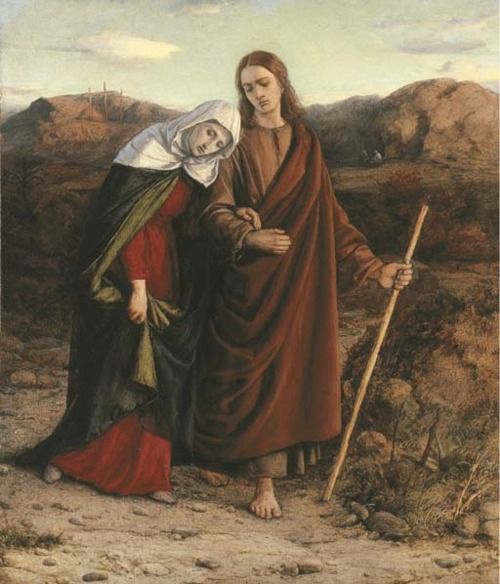
The Blessed Virgin in the House of St John by Dante Gabriel Rossetti, 1859

Can we be surprised after this, that St John is looked upon by the Church as one of her greatest glories? He is a Relative of Jesus in the flesh; he is an Apostle, a Virgin, the Friend of the Divine Spouse, the Eagle, the Theologian, the Son of Mary; he is an Evangelist, by the history he has given of the Life of his Divine Master and Friend; he is a Sacred Writer, by the three Epistles he wrote under the inspiration of the Holy Ghost; he is a Prophet, by his mysterious Apocalypse, wherein are treasured the secrets of time and eternity. But, is he a Martyr? Yes, for if he did not complete his sacrifice, he drank the Chalice of Jesus [Matt. 20:22], when, after being cruelly scourged, he was thrown into a caldron of boiling oil, before the Latin Gate, at Rome. He was, therefore, a Martyr in desire and intention, though not in fact. If our Lord, wishing to prolong a life so dear to the Church, as well as to show how he loves and honours Virginity, — miraculously stayed the effects of the frightful punishment, St John had, on his part, unreservedly accepted Martyrdom.

Such is the companion of Stephen at the Crib, wherein lies our Infant Jesus. If the Protomartyr dazzles us with the robes he wears of the bright scarlet of his own blood — is not the virginal whiteness of John’s vestment fairer than the untrod snow? The spotless beauty of the Lilies of Mary’s adopted Son and the bright vermilion of Stephen’s Roses — what is there more lovely than their union? Glory, then, be to our New-Born King, whose court is tapestried with such heaven-made colours as these! Yes, Bethlehem’s Stable is a very heaven on earth and we have seen its transformation. First, we saw Mary and Joseph alone there — they were adoring Jesus in his Crib; then, immediately, there descended a heavenly host of Angels singing the wonderful Hymn; the Shepherds soon followed, the humble simple-hearted Shepherds; after these, entered Stephen the Crowned and John the Beloved Disciple; and, even before there enters the pageant of the devout Magi, we shall have others coming in and there will be, each day, grander glory in the Cave and gladder joy in our hearts. Oh! this Birth of our Jesus! Humble as it seems, yet, how divine! What King or Emperor ever received, in his gilded cradle, honours like these shown to the Babe of Bethlehem? Let us unite our homage with that given him by these the favoured inmates of his court. Yesterday, the sight of the Palm in Stephen’s hand animated us and we offered to our Jesus the promise of a stronger Faith: to-day, the Wreath, that decks the brow of the Beloved Disciple, breathes upon the Church the heavenly fragrance of Virginity — an intenser love of Purity must be our resolution and our tribute to the Lamb.

Posted in franciscan OFM, MISSIONS, MISSIONARIES, PATRONAGE - PENITENTS, SAINT of the DAY

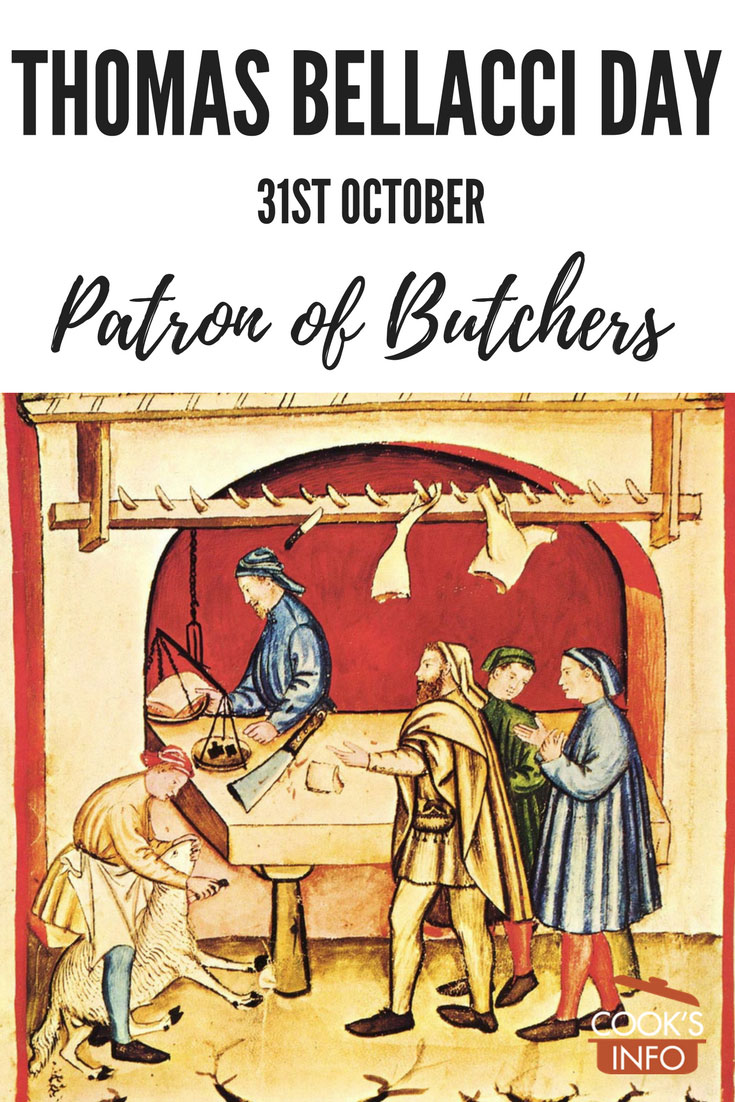
Saint of the Day – 31 October – Blessed Thomas Bellacci TOSF (1370-1447)

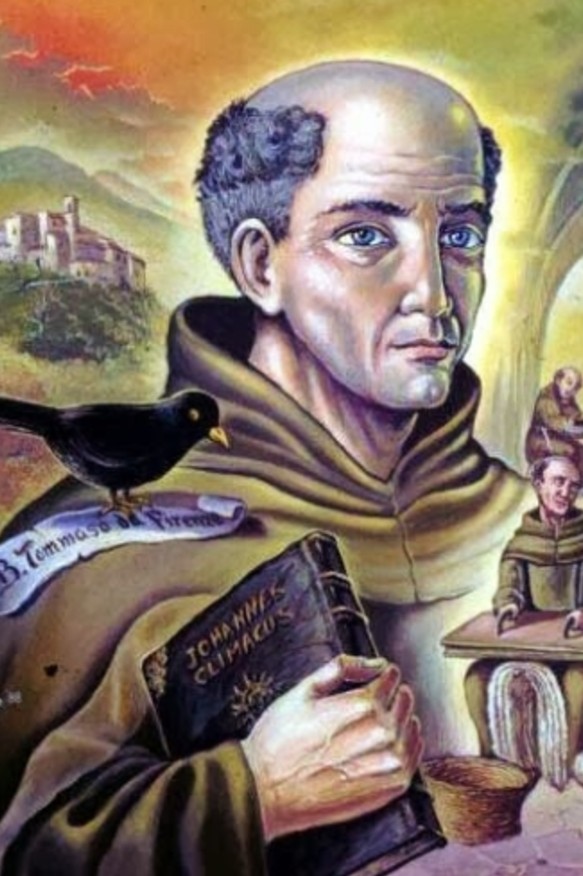
Saint of the Day – 31 October – Blessed Thomas Bellacci TOSF (1370-1447) Lay Friar of the Third Order of St Francis, Penitent, Confessor, renowned Missionary Preacher, Papal legate – born as Tommaso in 1370 at Florence, Italy and died on 31 October 1447 in Rieti, Italy of natural causes. Patronages – butchers, penitents, missionaries. He is also known as Thomas of Florence, Tommaso Bellacci. Blessed Thomas is venerated by the Franciscans on 25 October.

Bellacci was a butcher and became a religious after turning his life around from one of sin to one of penance and servitude to God. He travelled across the Middle East and the Italian peninsula to preach the Gospel and against heresies. He drew many young men to follow in his path of penitence.

Tommaso Bellacci was born in Florence in 1370 in the neighbourhood of the Ponte alle Grazie. His parents came from Castello di Linari in Val d’Elsa. His father was a butcher. He got into a good deal of trouble on various occasions during his youth and led such a wild and dissolute life as an adolescent, that parents warned their sons to keep their distance from him. Persuaded by a friend to change his ways, he tried to enter some religious order but found strong resistance to being accepted. He became a butcher like his father.

Bellacci was accused of having committed a serious crime in 1400, which, in fact he had not committed and so, he wandered the streets of Florence in great turmoil and fear, until he met a Priest who listened to his story, took him in and helped clear his name. The incident shocked him so much – coupled with his great gratitude to the Priest – that he shed his life of sin and decided to live a life of total penance and service to God. He joined the Third Order of Saint Francis in Fiesole under the spiritual guidance of Friar Giovanni da Stronconio. He entered as a lay brother Friar and became noted for keeping vigils and fasting. He was known for his diet of water and vegetables.

So great was Thomas’ adherence to the literal interpretation and implementation of the Franciscan Rule, that he was made the Novice Master, despite the fact that he was not a Priest. In this role, he led by example. He became part of the Observant reform and in 1414 accompanied another Friar to Naples to introduce the Observant practice in the Franciscan houses there. He remained in Naples for six years, preaching and helping to spread the reform.

After his sojourn and work in Naples, Thomas founded Monasteries in Corscia. Pope Martin V called him to preach in the northern cities against the “Fraticelli” who were a group of heretical Franciscans and was also made Vicar General at the Pope’s behest. In 1438, he and Albert Berdini of Sarteano were sent to the Middle East to cities such as Damascus and Cairo in order to promote the reunification of the Eastern and Western Churches when he was over 70. Alberto had to return home due to his ill health which left Bellacci to continue the mission alone.

He attempted to travel to Ethiopia but the Turks captured him three times. The Florentine merchants helped to secure his release twice. The third time he was again captured and suffered enslavement and persecution for several years, by now, he was perhaps in his eighties. Pope Eugene IV helped secure his release. He returned home in 1444 and spent his time in a Convent in Abruzzo until he died in 1446.

Nevertheless, Thomas still wished to return to the Orient but he died in Rieti while on a visit to Rome to request the Pope’s permission to return there.

Thomas was Beatified by Pope Clement XIV in 1771.

Posted in franciscan OFM, Of BANKERS, SAINT of the DAY

Saint of the Day – 28 September – Blessed Bernardine of Feltre OFM (1439-1494

Saint of the Day – 28 September – Blessed Bernardine of Feltre OFM (1439-1494) Priest, Franciscan Friar, Missionary Preacher, Poet, peace-maker, Civil protestor against the practice of usury, defender of the poor. He was a true ‘child prodigy’ – by the time he was 12 he was fluent in Latin and at the age of 15 he composed a poem and read it in the Town Square to celebrate a local peace treaty. He is remembered most especially, in connection with the “Monti di Pietà” “Mount of Piety” of which he was the reorganiser and, in a certain sense, the Founder, together with the Blesseds Francisco Piani and Michele Carcano. Born as Martin Tomitani in 1439 at Feltre, Italy and died on 28 September 1494 of natural causes. Patronages – bankers, pawnbrokers. He is also sometimes known as Bernardino of Feltre or Martin Tomitani.

A “Mount of Piety” is an institutional pawnbroker run as a charity in Europe from Renaissance times until today. Similar institutions were established in the colonies of Catholic countries; the Mexican Nacional Monte de Piedad is still in operation. It gave poor people access to loans with reasonable interest rates. It used funds from charitable donors as capital and made loans to the poor so they could avoid going to exploitative lenders. Borrowers offered valuables as collateral, making the Mount of Piety more like a pawn shop than a bank. The Monte di Pietà was developed on the principle of charity. It was designed to aid less fortunate people by providing an alternative to the socially unaccepted Jewish money lending system.

Obligation of the Monte di Pietà della Citta di Firenze, issued 21 October 1719

Martin Tomitani was born to the noble family of Tomitano and was the eldest of nine children. He achieved acclaim in his studies and to please his father he proceeded to study law. In 1456, while a law student in Padua, he heard St James of the Marches preach the Lenten course and was inspired to enter the Franciscan order. St James of the Marches himself, gave him the name Bernardine, after St Bernardine of Siena.

In May that year he joined the “Observantine” Franciscans, an austere branch of the Franciscan friars. He completed successfully his studies at Mantua and was Ordained Priest in 1463. He was small, shy and stammered but his superiors assigned him to preach home-missions. Cured of an impediment in his speech, Bernardine began his apostolate up and down the Italian peninsula. Every city of note and every province from Lombardy in the north to Sardinia and the provinces of the south became successively the scene of his missionary labours.

He was an extremely popular preacher because he spoke simply and powerfully against the vanity, ambition and greed rife at the time. The crowds that flocked to hear him were too large for the local churches, so he addressed them in the city squares and the fields. Like many other missionaries of his century, he had made a vast outdoor bonfire called “burning the Devil’s stronghold.” The crowds were asked to throw into the fire all objects of vanity and sin such as playing cards, dice, pornographic books and pictures, jewelry, wigs, superstitious charms, cosmetics and so forth.

Bernardine was able to reconcile warring communities. He also sought civic legislation to correct public injustices such as usury, the charging of excessive interest for loans, which was especially onerous on the poor.

In 1484, Bernardine established the charitable credit organisation, “Monti di Pietà” “Mount of Piety,” run by a joint committee of clergy and laymen. The institution was founded as an alternative to the high interest loans of the money lenders and Lombard travelling bankers of the Middle Ages.

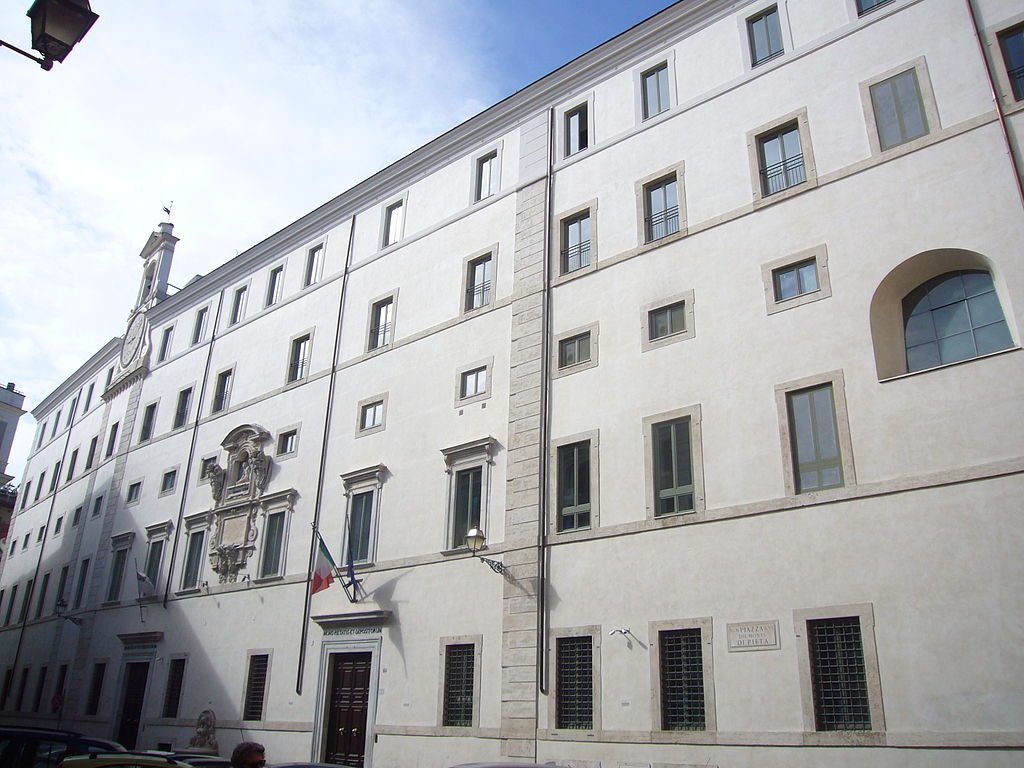
Monte di Pietà Offices in Rome

His fund raising drives were generally preceded with a procession featuring an image of either the Man of Sorrows or Pietà to encourage charitable donations. His insistence on charging a low interest to protect the institution’s permanency raised a controversy among the theologians who thought it promoted the continuance of usury. (In 1515, Pope Leo X declared the institution meritorious and it spread rapidly throughout France, Italy and Spain.)

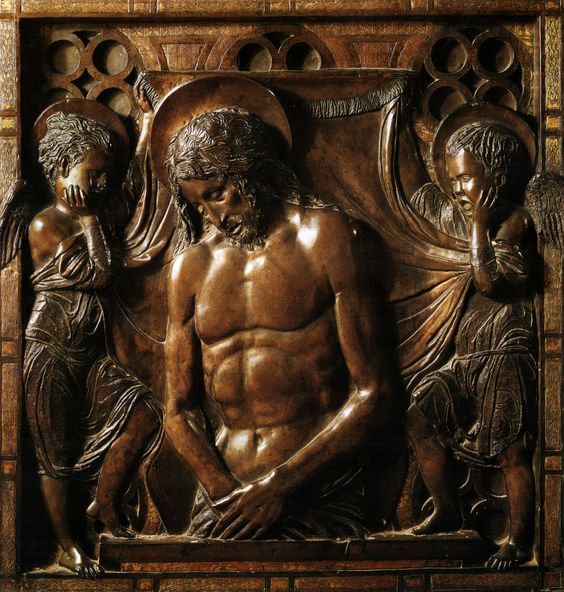
Donatello (Italian, 1386–1466), “The Dead Christ Supported by Angels,” 1446–50. Bronze relief, 58 × 56 cm. Basilica di Sant’Antonio, Padua, Italy. Carved for the high altar. Includes two wings, not shown. https://www.pinterest.com/pin/467248530063361702/

In 1491, Bernardine was expelled from Milan by Ludovico Sforza for contesting with the Duke’s astrologer.

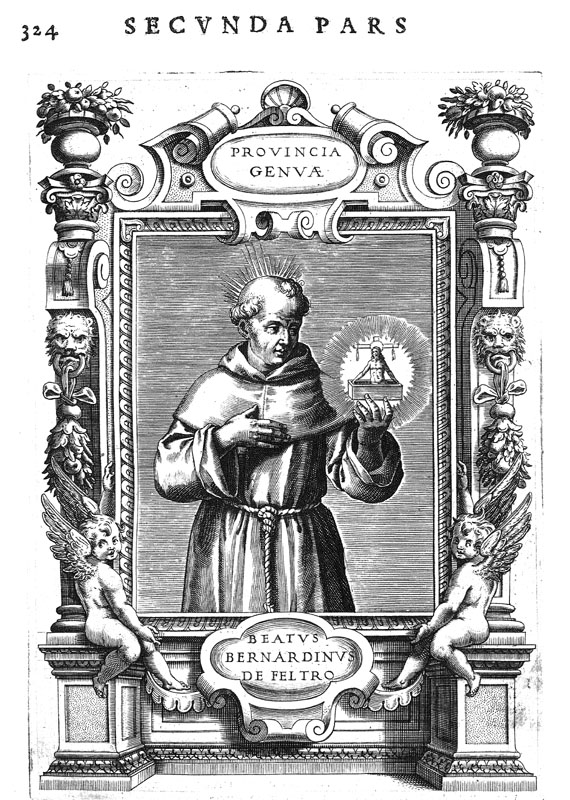
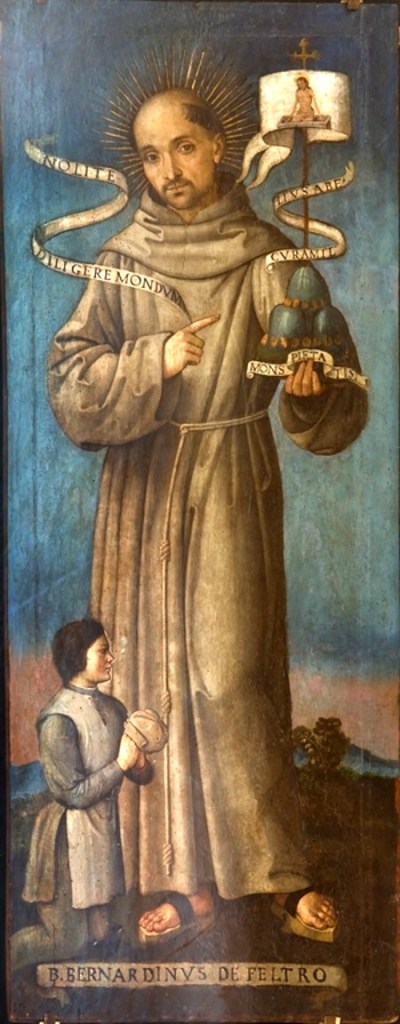
Bernardine is generally represented in iconography as carrying in his hand a Monti di Pietà, that is, a little green hill composed of three mounds and on the top either a cross or a standard with the inscription Curam illius habe ‘Take care of’ (a snippet from the Vulgate translation of the Gospel of Luke’s Parable of the Good Samaritan).

The authorship of the well-known Anima Christi has as often as not been ascribed to Bernardine of Feltre. The fact, however, that the Anima Christi was composed sometime before 1439 disproves any claim that he might have of being its author, though much like St Ignatius of Loyola, Bernardine made frequent use of it and recommended it to his brethren.

On  13 April 1654, Pope Innocent X confirmed the culktus of Blessed Bernardine and he was formally Beatified in 1728 by Pope Benedict XIII.

Posted in Against SCRUPELOSITY, for Scrupulous people, DIVINE Mercy, Goodness, Patience, GOD is LOVE, GOD the FATHER, JULY - The MOST PRECIOUS BLOOD, MEDITATIONS - ANTONIO CARD BACCI, QUOTES on FEAR, QUOTES on FORGIVENESS, QUOTES on TRUST and complete CONFIDENCE in GOD, The MOST PRECIOUS BLOOD

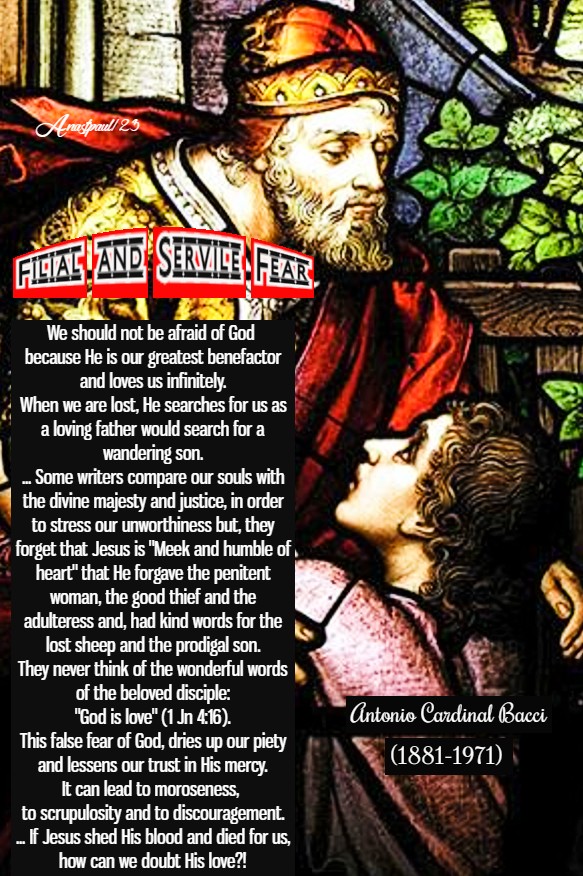
Thought for the Day – 18 September – Filial and Servile Fear

Thought for the Day – 18 September – Meditations with Antonio Cardinal Bacci (1881-1971)

Filial and Servile Fear

We should not be afraid of God because He is our greatest benefactor and loves us infinitely.
When we are lost, He searches for us as a loving father would search for a wandering son.

Because they think only of the majesty and justice of God, some people keep themselves at a distance from Him, as Adam did, after he had sinned.
They forget that the Lord told Adam, the sinner, of the coming of the pardoning Redeemer (Gen 3:9).
Bossuet truly observes, that “after the curse which came upon men through sin, there has always remained, in their hearts, a certain dread of the supernatural, which prevents them from approaching God with confidence.”
Jansenism increased this fear, emphasising the justice and majesty of God, rather, than the infinite love of Jesus and the beauty of His teaching.

Some writers compare our souls with the divine majesty and justice, in order to stress our unworthiness but, they forget, that Jesus is “Meek and humble of heart,” that He forgave the penitent woman, the good thief and the adulteress and, had kind words for the lost sheep and the prodigal son.
They never think of the wonderful words of the beloved disciple: “God is love” (1 Jn 4:16).

This false fear of God, dries up our piety and lessens our trust in His mercy.
It can lead to moroseness, to scrupulosity and to discouragement.

We should avoid this excessive fear which separates us from God.
Even though we are sinful and unworthy, we should remember, that God is our loving Father, Who is always ready to help us and to grant us forgiveness.
We should recall, moreover, that out of love for us, He did not spare His own Son, (Cf Rom 8:32) but gave Him to us for our redemption.
If Jesus shed His blood and died for us, how can we doubt His love?!

Antonio Cardinal Bacci

Posted in BRIDES and GROOMS, INCORRUPTIBLES, MYSTICS, PATRONAGE - SPOUSAL ABUSE / DIFFICULT MARRIAGES / VICTIMS OF ABUSE, PATRONAGE-INFERTILITY & SAFE CHILDBIRTH

Saint of the Day – 15 September – St Catherine of Genoa (1447-1510)

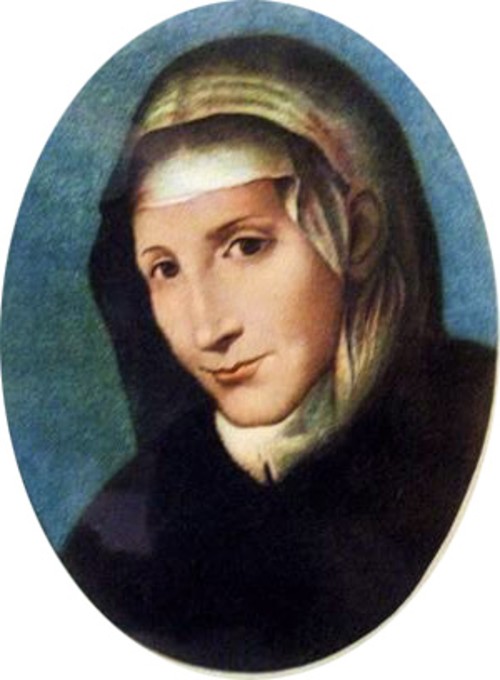
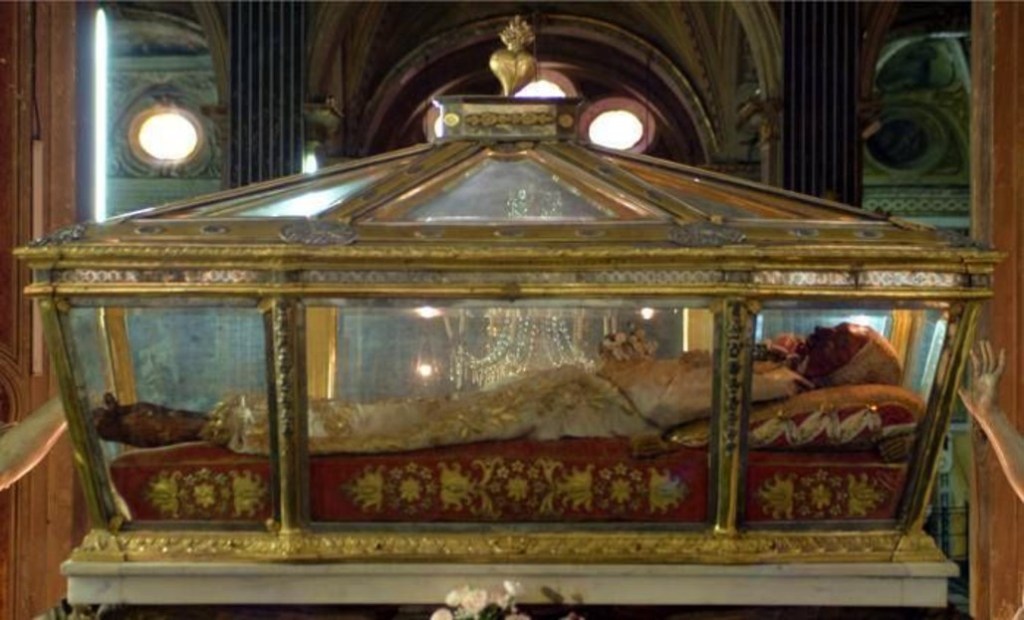
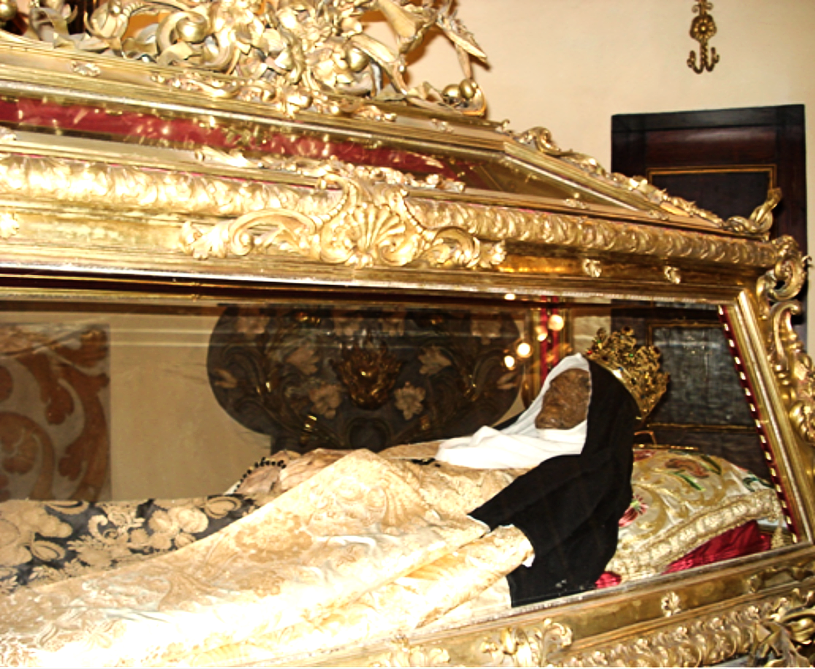
Saint of the Day – 15 September – St Catherine of Genoa (1447-1510) Married laywoman, Mystic, Apostle of the sick, the poor and the needy, Writer – born in 1447 at Genoa, Italy as Caterina Fieschi Adorno and died on 15 September 1510 at Genoa, Italy of natural causes. Patronages – Brides, Childless Couples, Difficult Marriages, People Ridiculed For Their Piety, Temptations, Victims Of Adultery, Victims Of Infidelity. Her body is incorrupt and rests in a glass reliquary at the Capuchin Church in Genoa.

Catherine was born in Genoa in 1447. She was the youngest of five. Her father, Giacomo Fieschi, died when she was very young. Her mother, Francesca di Negro provided such an effective Christian education that the elder of her two daughters became a religious. When Catherine was 16, she was given in marriage to Giuliano Adorno, a man who after various trading and military experiences in the Middle East had returned to Genoa in order to marry.

Married life was far from easy for Catherine, partly because of the character of her husband who was given to gambling. Catherine herself, was at first induced to lead a worldly sort of life in which, however, she failed to find serenity. After 10 years, her heart was heavy with a deep sense of emptiness and bitterness. A unique experience on 20 March 1473 sparked her conversion. She had gone to the Church of San Benedetto in the monastery of Nostra Signora delle Grazie [Our Lady of Grace], to make her confession and, kneeling before the Priest, “received,” as she herself wrote, “a wound in my heart from God’s immense love.” It came with such a clear vision of her own wretchedness and shortcomings and at the same time of God’s goodness, that she almost fainted.

Her heart was moved by this knowledge of herself — knowledge of the empty life she was leading and of the goodness of God. This experience prompted the decision that gave direction to her whole life. She expressed it in the words: “no longer the world, no longer sin” (cf. Vita Mirabile, 3rv). Catherine did not stay to make her Confession.
On arriving home she entered the remotest room and spent a long time weeping. At that moment she received an inner instruction on prayer and became aware of God’s immense love for her, a sinner. It was a spiritual experience she had no words to describe ( cf. Vita Mirabile, 4r).

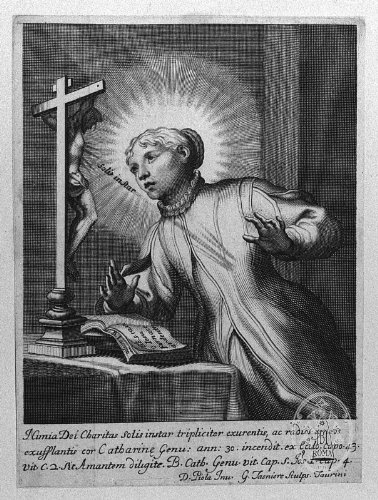
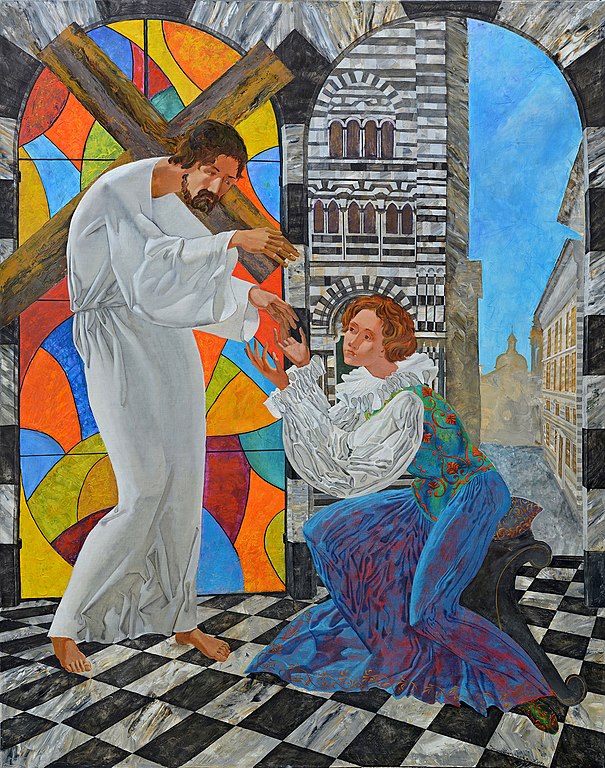
It was on this occasion that the suffering Jesus appeared to her, bent beneath the Cross, as he is often portrayed in the Saint’s iconography. A few days later she returned to the Priest to make a good Confession at last. It was here, that began the “life of purification” which for many years caused her to feel constant sorrow for the sins she had committed and which spurred her to impose forms of penance and sacrifice upon herself, in order to show her love to God.

St Catherine of Genoa painted by artist Denys Savchenko. It resides in the St Catherine Church, Genoa, Italy.

On this journey Catherine became ever closer to the Lord until she attained what is called “unitive life,” namely, a relationship of profound union with God. In her Vita it is written, that her soul was guided and instructed from within, solely by the sweet love of God, which gave her all she needed. Catherine surrendered herself so totally into the hands of the Lord that she lived, for about 25 years, as she wrote, “without the assistance of any creature, taught and governed by God alone” (Vita, 117r-118r), nourished above all by constant prayer and by Holy Communion which she received every day, an unusual practice in her time. Only many years later did the Lord give her a Priest who cared for her soul.

Catherine was always reluctant to confide and reveal her experience of mystical communion with God, especially because of the deep humility she felt before the Lord’s graces. The prospect of glorifying Him and of being able to contribute to the spiritual journey of others, alone spurred her, to recount what had taken place within her, from the moment of her conversion, which is her original and fundamental experience.

The place of her ascent to mystical peaks was Pammatone Hospital, the largest hospital complex in Genoa, of which she was director and animator. Hence Catherine lived a totally active existence despite the depth of her inner life. In Pammatone a group of followers, disciples and collaborators formed around her, fascinated by her life of faith and her charity. Indeed her husband, Giuliano Adorno, was so so won over, that he gave up his dissipated life, became a Third Order Franciscan and moved into the hospital to help his wife.

Catherine’s dedication to caring for the sick continued until the end of her earthly life on 15 September 1510. From her conversion until her death there were no extraordinary events but two elements characterise her entire life – on the one hand her mystical experience, that is, the profound union with God, which she felt as spousal union and on the other, assistance to the sick, the organisation of the hospital and service to her neighbour, especially the neediest and the most forsaken. These two poles, God and neighbour, totally filled her life, virtually all of which she spent within the hospital walls.

Dear friends, we must never forget that the more we love God and the more constantly we pray, the better we will succeed in truly loving those who surround us, who are close to us, so that we can see in every person the Face of the Lord whose love knows no bounds and makes no distinctions. The mystic does not create distance from others or, an abstract life but, rather approaches other people, so that they may begin to see and act with God’s eyes and heart.

Catherine’s thought on purgatory, for which she is particularly well known, is summed up in the last two parts of the book mentioned above – The Treatise on Purgatory and the Dialogues between the body and the soul. The first original passage concerns the “place” of the purification of souls. In her day, it was depicted mainly using images linked to space – a certain space was conceived of, in which purgatory was supposed to be located. Catherine, however, did not see purgatory as a scene in the bowels of the earth – for her it is not an exterior but rather an interior fire. This is purgatory – an inner fire. The Saint speaks of the Soul’s journey of purification on the way to full communion with God, starting from her own experience of profound sorrow for the sins committed, in comparison with God’s infinite love (cf. Vita Mirabile, 171v).

We heard of the moment of conversion when Catherine suddenly became aware of God’s goodness, of the infinite distance of her own life from this goodness and of a burning fire within her. And this is the fire that purifies, the interior fire of purgatory. Here too, is an original feature in comparison with the thought of her time. In fact, she does not start with the afterlife in order to recount the torments of purgatory — as was the custom in her time and perhaps still is today — and then to point out the way to purification or conversion. Rather our Saint begins with the inner experience of her own life on the way to Eternity.

“The soul,” Catherine says, “presents itself to God, still bound to the desires and suffering that derive from sin and this makes it impossible for it to enjoy the beatific vision of God.” Catherine asserts that God is so pure and holy, that a soul stained by sin, cannot be in the presence of the Divine Majesty (cf. Vita Mirabile, 177r).

We too feel how distant we are, how full we are of so many things that we cannot see God. The soul is aware of the immense love and perfect justice of God and consequently, suffers for having failed to respond in a correct and perfect way to this love and, love for God itself, becomes a flame, love itself cleanses it from the residue of sin.

In Catherine we can make out the presence of theological and mystical sources on which it was normal to draw in her time. In particular, we find an image typical of Dionysius the Areopagite – the thread of gold that links the human heart to God Himself. When God purified man, he bound him with the finest golden thread, that is, His love and draws him toward Himself with such strong affection, that man i,s as it were “overcome and won over and completely beside himself.” Thus man’s heart is pervaded by God’s love that becomes the one guide, the one driving force of his life (cf. Vita Mirabile, 246rv). This situation of being uplifted towards God and of surrender to His will, expressed in the image of the thread, is used by Catherine to express the action of divine light on the souls in purgatory, a light that purifies and raises them to the splendour of the shining radiance of God (cf. Vita Mirabile, 179r).

With her life, St Catherine teaches us that the more we love God and enter into intimacy with Him in prayer the more He makes Himself known to us, setting our hearts on fire with His love. In writing about purgatory, the Saint reminds us of a fundamental truth of faith that becomes for us an invitation to pray for the deceased, so that they may attain the beatific vision of God in the Communion of Saints.

Moreover, the humble, faithful and generous service in Pammatone Hospital that the Saint rendered throughout her life, is a shining example of charity for all and an encouragement, especially for women who, with their precious work enriched by their sensitivity and attention to the poorest and neediest, make a fundamental contribution to society and to the Church.

Catherine’s writings were examined by the Holy Office and declared to contain doctrine that would alone be enough to prove her sanctity and she was accordingly Beatified in 1675 by Pope Clement X and Canonised in 1737 by Pope Clement XII. Her writings also, became sources of inspiration for other religious leaders such as Robert Bellarmine and Francis de Sales and Cardinal Henry Edward Manning. Pope Pius XII declared her Patroness of the hospitals in Italy.

When she died, her body was placed in a coffin in the Chapel of the hospital where she had served so selflessly. The wooden coffin unfortunately suffered water damage, yet after it was removed, a year later, the body itself was found to be incorrupt. Her body was later transferred to the Capuchin Convent Annunziata di Portoria, near the centre of Genoa and can be viewed by the public, in the Church attached to the Convent.

Posted in BREWERS, DOCTORS of the Church, EYES - Diseases, of the BLIND, FATHERS of the Church, SAINT of the DAY

The Memorial of Saint Augustine ‘Servant of God’ – 28 August

Today, 28 August, we celebrate the Memorial of Saint Augustine, one of the great founders of Monasticism in the Western Church, Bishop, Theologian, Preacher, Writer and Doctor of the Church. None of these titles, though accurate, would please him, however, as much as the simple one he used to describe himself: ‘Servant of God.’ For, whatever we achieve in life, whatever gifts and talents we have been given, are of little value unless they lead us, as they did Augustine, to know, love and serve God ever more deeply.

The Triumph of Saint Augustine painted by Claudio Coello, circa 1664

“Augustine, numbered among the four great Doctors of the Western Church, possessed one of the most penetrating minds of ancient Christendom. He was the most important Platonist of patristic times, the Church’s most influential theologian, especially with regard to clarifying the dogmas of the Trinity, grace and the Church. He was a great speaker, a prolific writer, a saint with an inexhaustible spirituality.

His Confessions, a book appreciated in every age, describes a notable portion of his life (until 400), his errors, his battles, his profound religious observations. Famous too is his work The City of God, a worthy memorial to his genius, a philosophy of history. Most edifying are his homilies, especially those on the psalms and on the Gospel of St John.

Augustine’s Episcopal life was filled with mighty battles against heretics, over all of whom he triumphed. His most illustrious victory was that over Pelagius, who denied the necessity of grace; from this encounter he earned the surname “Doctor of grace.”

As an emblem Christian art accords him a burning heart to symbolise the ardent love of God which permeates all his writings. He is the founder of canonical life in common, therefore, Augustinian Monks and the Hermits of St Augustine honour him as their spiritual father.” … Excerpted from The Church’s Year of Grace, Pius Parsch

St Jerome wrote to Augustine in 418:
“You are known throughout the world;
Catholics honour and esteem you
as the one who has established anew the ancient Faith.”

If I wanted to please men, I would not be a servant of Christ

Saint Augustine

An excerpt from his Sermon 47, De ovibus (On Sheep)

“This is our glory – the witness of our conscience.
There are men who rashly judge, who slander, whisper and murmur, who are eager to suspect what they do not see and eager to spread abroad things they have not even a suspicion of. Against men of this sort, what defence is there, save the witness of our own conscience?

My brothers, we do not seek, nor should we seek, our own glory even among those whose approval we desire. What we should seek is their salvation, so that if we walk as we should, they will not go astray in following us. They should imitate us if we are imitators of Christ and, if we are not, they should still imitate Him. He cares for His flock and He alone is to be found with those, who care for their flocks, because they are all in Him.

And so we seek no advantage for ourselves when we aim to please men. We want to take our joy in men—and we rejoice when they take pleasure in what is good, not because this exalts us but because it benefits them.

It is clear who is intended by the apostle Paul – If I wanted to please men, I would not be a servant of Christ. And similarly when he says – Be pleasing to all men in all things, even as I in all things please all men. Yet his words are as clear as water, limpid, undisturbed, unclouded. And so you should, as sheep, feed on and drink of his message; do not trample on it or stir it up.

You have listened to our Lord Jesus Christ as He taught His apostles – Let your actions shine before men so that they may see your good deeds and give glory to your Father who is in heaven, for it is the Father who made you thus. We are the people of His pasture, the sheep of His hands. If then you are good, praise is due to Him who made you so, it is no credit to you, for if you were left to yourself, you could only be wicked. Why then do you try to pervert the truth, in wishing to be praised when you do good and blaming God when you do evil? For though He said – Let your works shine before men, in the same Sermon on the Moun,t He also said: Do not parade your good deeds before men. So if you think there are contradictions in Saint Paul, you will find the same in the Gospels but if you refrain from troubling the waters of your heart, you will recognise here, the peace of the Scriptures and with it you will have peace.

And so, my brothers, our concern should be not only to live as we ought but also, to do so in the sight of men; not only to have a good conscience but also, so far as we can in our weakness, so far as we can govern our frailty, to do nothing which might lead our weak brother into thinking evil of us. Otherwise, as we feed on the good pasture and drink the pure water, we may trample on God’s meadow and weaker sheep will have to feed on trampled grass and drink from troubled waters.”

Posted in Of the DEAF, against DEAFNESS, SAINT of the DAY

Saint of the Day – 24 August – Saint Audoin/Ouen of Rouen (c 605-684) Bishop

Saint of the Day – 24 August – Saint Audoin/Ouen of Rouen (c 605-684) Bishop, Confessor, Evangeliser and Missionary, French official and adviser, writer, peace-makers and diplomat. Audoin was both Lord Chancellor of France and Officer of the Palace or Administrator. St Audoin was known for his personal austerities and support of many charities, he founded several Monasteries in his Diocese and sent Missionaries to the pagans in his see. Born in c 605 at Sancy, Soissons, France and died on 24 August 684 at Clichy, France of natural causes. Patronages – deaf people, invoked against deafness. Also known as Aldwin, Audaenus, Audeon, Audoeno, Audoen, Audoenus, Dado, Dadon, Owen.

Audoin came from a wealthy aristocratic Frankish family who held lands in the upper Seine and Oise valleys. His father was Saint Authaire (Audecharius). Audoin was a first cousin of Agilbert, Bishop of the West Saxons. He spent his childhood at Ussy-sur-Marne and was then sent to be educated at the Abbey of Saint-Médard de Soissons. From there, he went to the Court of Chlothar II (d.629), where training both military and literary was given to young noblemen. He served Dagobert I as one of his administrators.

He was part of a group of young Courtiers like Saint Wandrille and Saint Didier of Cahors and was a close friend of Saint Eligius, whose vita he wrote. He and Eligius served as royal envoys to persuade Amadus to baptise Dagobert’s son. According to Ian Wood, “…Audoin and Eligius were arguably the most influential churchmen in Francia during the seventh century.”

In 634 Audoin was Ordained a Priest by Dieudonne, Bishop of Mâcon. The following year, he and his brother, Ado and Rado founded Rebais Abbey, on land donated by King Dagobert. Audoin appointed his relative, Agilus, as first Abbot. He also took part in the founding of Saint-Wandrille Monastery in Rouen and a Nunnery at Fécamp. Fredegar reports that even as Court Administrator, Audoin had a reputation of being a religious man. He spent some time as a Missionary in Spain, during which a drought was ended through his prayers.

In 641 he succeeded Romanus as Bishop of Rouen. Through his influence, Erchinoald donated to Wandregisel the land for Fontenelle Abbey in Normandy. He developed theological studies and participated in the fusion of the rule of Saint Colomban and that of Saint Benedict.

During the regency of Queen Bathilde, Audoin became one of the first Counsellors of the queen. He was an adviser of Theuderic III and upheld the policy of Ebroin, the mayor of the palace. The Bishop’s position was strengthened, when Theuuderic confirmed to him the right to elect and approve the Count of Rouen.

Around 675 Audoin made a pilgrimage to Rome. There, he visited the sanctuaries, distributed alms to the poor of Rome and collected relics to bring back to Rouen. After Ebroin’s death in 681, he went to Cologne and succeeded in restoring peace between Neustria and Austrasia but died shortly thereafter, at the royal villa at Clichy on 24 August 684. He was buried in the Church of Saint Peter which he himself, had built. The former Abbot of Fontenelle, Ansbert, succeeded Audoin as Bishop and had his predecessor reburied behind the high altar, the equivalent of a Canonisation in those days. The Church in later rebuildings was named after St Audion/Ouen and is now one of the great artifacts of Architecture and is regarded as little less than the Notre Dame de Paris.

Audoin wrote a vita of his friend, St Eloi. This biography, which is one of the most authentic historical monuments of the seventh century, contains a store of valuable information regarding the moral and religious education of that time.

A poem on Audoin’s life was written in the 10th century by Frithegod but it is now sadly lost. The author of the Liber Historiae Francorum, thoroughly hostile to the memory of Ebroin, invariably referred to Audoin as “blessed” or “sainted” and in describing his death said, he “migravit ad Dominum” (migrated to the Lord), a phrase he otherwise reserved in the original part of his history, for the death of the “glorious lord of good memory, Childebert III, the just king.”

Statue of St Audoin (left) and St Waninge (right), in Fécamp, France.
Posted in Of the SICK, the INFIRM, All ILLNESS, PATRONAGE - PRISONERS, SAINT of the DAY

Saint of the Day – 11 August – St Géry of Cambrai (c 550 – 626) Bishop

Saint of the Day – 11 August – St Géry of Cambrai (c 550 – 626) Bishop of Cambrai, Founder of Monateries, Churches and of St Géry Island off  Belgium, Géry devoted himself to the fight against paganism, Miracle-worker – born at Trier, Germany and died in 626 of natural cause in Cambrai, Belgium.   Also known as Gaugericus, Gaugerico, Gorik, Djèri, Gau.   Additional Memorials – 18 November for the exhumation of his relics and 24 September for the translation of his relics.   Patronages – prisoners, the healing of lepers and skin diseases, against diseases of cattle, consumption and deformities of the legs, Cambrai and the Archdiocese – in France, Brussels, Braine-le-Comte – in Belgium.   From his gift of delivering captives, there is attached, his power to deliver the victims of the demon and the influences of ill-intentioned people. He is also the Patron Saint of many Churches in the regions of Cambrai, Bierne, Valenciennes and Arras, as well as in Belgium.514px-ST GERY BETTER PIC Hôtel_de_ville_de_Bruxelles_-_Tympan_04

Géry was born to Roman parents, Gaudentius and Austadiola, at Eposium (present Carignan).

Tradition states that Bishop Magnerich, successor of Saint Nicetas as Bishop of Trie, was so impressed with the piety of the young man that he Ordained him as a Deacon but not before Géry had memorised the entire psalter.   Magnerich entrusted Géry with the pastoral care of the city of Cambrai.   Géry founded Churches and Abbeys, including a Monastery dedicated to St Medard, to host relics, which contributed powerfully to giving Cambrai both the appearance and functions of a city.

Around the year 580, Géry built a Chapel on the largest island in the Senne near Brussels.   Saint-Géry Island is named after him.

When the see of Cambrai-Arras fell vacant around 585, Géry was elected Bishop with the consent of Childebert II.   He was consecrated by Egidius, Bishop of Reims.   Bishop Géry devoted himself to fighting paganism, ransoming captives and visiting rural districts and villages. He paid his respects to King Chlothar II, the new lord of Cambrai after the death of Childebert.   Bishop Géry made a pilgrimage to the tomb of Saint Martin in Tours and assisted at the Council of Paris in 614.386px-ST GERY Getijdenboek_Van_Reynegom_(verluchting),_KBS-FRB_39

Géry also built a Church dedicated to Saint Martin, where he had relics of this Saint deposited.   The steeple of this church was to become, much later, the belfry of the city.   Having obtained pieces of the Holy Cross, Géry had a Church built to house them.   Finally, he had an Episcopal palace built near his Cathedral.   He transferred, between 584 and 590, the Episcopal see from Arras to Cambrai.   Géry erected a Chapel (in Saint Michel , later Saints-Michel-et-Gudule Cathedral), which soon became a Church and gave birth to the city of Brussels.

After serving as Bishop for thirty-nine years, he died on 11 August 626 and was buried in the Church of Saint Médard, which he had founded at Cambrai.   Veneration commenced immediately after his death.   His reliquary is still on display in the south transept of the Saint Géry church in Cambrai.

St Géry is credited with many miracles, the healing of a leper, of a blind man and, during his travels through his Diocese, he freed many prisoners, criminals, children taken into slavery.   It is said that he delivered his Diocese from a dragon.

When the Church of Saint Medard was demolished by the Emperor Charles V for the building of the citadel, the canons were removed and took with them, the relics of the Saint, to the old church of Saint Vedast, which from that time, has borne the name of Saint Gery.   The Church of Saint Géry is one of the oldest in Cambrai and a listed historical monument since 1919.Eglise_St-Géry_Cambraichurch st gery with statues

st gaugericus statue church of st gery france
You can see this Statue of St Géry on the front facade of the Church in his honour, above.

His feast day is mentioned in the Martyrology of Blessed Rabanus Maurus for today, 11 August.

st gaugericus gery and st aubertus
St Géry, left and St Aubertus, right

Posted in EPILEPSY, SAINT of the DAY

Saint of the Day – 7 August – Saint Donatus of Arezzo (Died 362) Bishop and Martyr

Saint of the Day – 7 August – Saint Donatus of Arezzo (Died 362) Bishop and Martyr, Confessor, Miracle-worker – born in Nicomedia (part of modern Turkey) and died on 7 August in 362.   Patronages – Arezzo, Italy, Diocese of Arezzo, Italy, Diocese of Arezzo-Cortona-Sansepolcro, Italy, Cavriglia, Italy, epileptic, bakers, Contursi Terme, Acerno, Anzi, Castel di Ieri, Castel del Monte, Fossacesia, Guardiagrele, Pinerolo, Ranzo, San Donato di Lecce, Montesano Salentino, San Donato di Ninea, San Donato Milanese, San Donato Val di Comino, Soveria Simeri, Val della Torre, Villa Martelli, Monteforte Cilento (Salerno) all in Italy.4_yuag_leonardo_exhibit_a_miracle_of_saint_donatus_detail_da_vinci_0

A Passio of Donatus’ life was written by a Bishop of Arezzo, Severinus. He calls Donatus a Martyr, although Donatus is described as a Bishop and Confessor of the faith in ancient sources and not as a Martyr.    An early hagiography of Donatus was already known to Gregory the Great.

According to Severinus’ account, as a child Donatus came to Rome with his family from Nicomedia.   According to  Severinus’ account, Donatus was educated by a Priest named Pymenius.    His friend and companion in these religious studies, was a boy named Julian –who would later become Emperor Julian the Apostate.   Julian rose to the position of sub-deacon;   Donatus became a lector.   Saint Peter Damian would later write in his Sermones that “in the field of the Lord two sprigs, Donatus and Julian, grow together but one will become a cedar of Paradise, the other coal for the eternal flames of Hell.”img-Saint-Donatus-of-Arezzo1

On 4 February 362, Julian promulgated an edict to guarantee freedom of religion.   This edict proclaimed that all the religions were equal before the law and that the Roman Empire had to return to its original religious eclecticism, according to which the Roman State did not impose any religion on its provinces.   Christian chroniclers considered that it had as it’s purpose, the restoration of paganism at the expense of Christianity.

Catholic tradition states that Julian also persecuted individual Christians and that Donatus’ parents, as well as his teacher Pymenius, would die during these persecutions.   Donatus escaped to Arezzo and would work with a Monk named Hilarian, to preach the Christian faith, as well as perform penances and miracles.    Severinus’ Passio states that Donatus brought back to life a woman named Euphrosina;  fought and slew a dragon who had poisoned the local well;  gave sight back to a blind woman named Syriana and, exorcised a demon that had been tormenting Asterius, the son of the Roman prefect of Arezzo.576px-St_Donatus_of_Arezzo

Donatus was Ordained a Deacon and then Priest by Saint Satyrus of Arezzo, Bishop of that city and continued to preach in the city and in the surrounding region.    At the death of Satyrus, Donatus was appointed Bishop by Pope Julius I.   A man named Anthimus was Donatus’ deacon.

During a celebration of Mass, at the moment of the giving of Communion, in which a glass chalice was being administered, some pagans entered the church and shattered the chalice in question. Donatus, after intense prayer, collected all of the fragments and joined them together.   There was a piece missing from the bottom of the cup, miraculously, however, nothing spilled from the cup.   Astounded, seventy-nine pagans converted to Christianity.

Jose_de_Ribera_-The_Miracle_of_Saint_Donatus header
St Donatus and the Miracle of the Chalice by Jose de Ribera

A month after this episode, the prefect of Arezzo, Quadratian, arrested Hilarian the Monk and Donatus.    Hilarian was Martyred on 16 July 362 and Donatus was beheaded on 7 August at Arezzo.st donato footer

In 1125, some of Donatus’ relics (and those of the alleged dragon said to have been killed by the saint) were brought to the Church of Santa Maria and San Donato on the island of Murano, near Venice.

1280px-MuranoSantaMariaeSanDonato20031230
Church of Santa Maria and San Donato on the island of Murano, near Venice.

A large silver reliquary bust of Donatus from the 13th century is now found in the National Museum at Naples.San-Donato-1-e1505122656201

The Patron Saints of Guardiagrele are Donatus of Arezzo and Saint Emidius.   Annually between 6 and 8 August, there is a festival celebrating these saints in which the effigy of Donatus is paraded around the streets of Guardiagrele.

In the Cathedral dedicated to St Donatus and where some of his relics lie together with a Shrine to him, there is a magnificent “Arch” depicting his life and miracles.

This slideshow requires JavaScript.

Posted in Against STORMS, EARTHQUAKES, THUNDER & LIGHTENING, FIRES, DROUGHT / NATURAL DISASTERS, DYING / LAST WORDS, franciscan OFM, SAINT of the DAY

Saint of the Day – 14 July – Saint Francisco Solano OFM (1549 – 1610) “The Wonder Worker of the New World,”

Saint of the Day – 14 July – Saint Francisco Solano OFM (1549 – 1610) “The Wonder Worker of the New World,” Priest, Friar of the Order of Friars Minor, Missionary, Musician, Preacher, Miracle worker, Apostle of the Blessed Sacrament, the Holy Virgin Mother and of Prayer, Polyglot – born on 10 March 1549 at Montilla, Diocese of Cordova, Andalusia, Spain and died on 14 July 1610 at Lima, Peru of natural causes.   He is also known as Francis Solanus.   Patronages – Argentina, Bolivia, Chile, Paraguay, Peru, against earthquakes, Diocese of Añatuya, Argentina.KRACKER_Johann_Lucas_St_Francis_Of_Solano_Baptizing_Indians header

Frncisco was born on 10 March 1549 in Montilla, the third child of Mateo Sánchez Solano and Ana Jiménez.  When she was pregnant with the future saint, Ana consecrated him to Saint Francis of Assisi, after whom he was named.   Francisco Solano’s parents gave him an entirely Catholic formation, which he finished at the Jesuit school in his city.   He was a splendid conversationalist and possessed a good bearing, beautiful voice and rare musical sense.   At the age of twenty, he joined the Order of Friars Minor at Montilla, entering the novitiate at St Lawrence Friary, which was located in a place of great natural beauty.   The community there belonged to the Reformed observance within the Order, following a very strict routine of prayer, silence and fasting.   Francisco followed this regimen rigorously, always going barefoot, abstaining from meat, and wearing a hairshirt throughout that entire year.   As a result, however, his health was permanently affected, leaving him sick and fatigued.

Francisco was solemnly professed in 1569.   He was then sent to the Friary of Our Lady of Loreto in Seville for his seminary studies.   There he learned not only philosophy and theology but developed his musical talents.   He was Ordained in 1576, a ceremony his mother was unable to attend due to her poor health.    st francisco solanus old imageShortly after his Ordination he was named Master of Ceremonies for the community.   Still a lover of simplicity, Francis made a small cell for himself adjacent to the Chapel of the Friary, made of clay and reeds.

After completing his final theological studies, Fr Francisco was assigned as an itinerant preacher to the surrounding villages of the region.   He was eventually given a licence as a confessor.   During this period, he requested that he might be allowed to go to North Africa, with the hope of achieving Martyrdom for preaching the Catholic faith. He was denied this request.

After the death of his father, he returned to his hometown of Montilla to care for his mother.   During that time, he gained the reputation of a Wonder worker, as a number of people were cured of their afflictions through his intercession.   In 1583, A pestilence having broken out at Granada, he tended the sick and dying.San_Francisco_Solano_(1549_-1610)

Fr Francisco always had a remarkable joy when he was in the presence of the Blessed Sacrament or an image of Our Lady holding the Child Jesus.   He would become so ecstatic at seeing the Child Jesus cared for in the arms of Our Lady, that sometimes, he would call all the priests in the Monastery together and say:  “Father come look, does this not make you happy?   Look at how well treated the Child Jesus is in the arms of Our Lady.   That is how He lived on earth!   Let’s be happy!”  He would play the violin, sing and dance before the statue, or even before the Blessed Sacrament.st francisco solanus

King Philip II requested the Franciscans to send Missionaries to preach the Gospel in the Americas.   In 1589 Fr Francisco sailed from Spain to the New World and having landed at Panama, crossed the isthmus and embarked on a vessel that was to convey him to Peru.    During the journey, a storm at sea crashed his ship against the rocks not far from Peru.   The crew and the passengers abandoned the ship but Francis stayed with the slaves that were on board.   After three days, they were rescued.

For twenty years Fr Francisco worked at evangelising the vast regions of Tucuman (present day northwestern Argentina) and Paraguay.   He had a skill for languages and succeeded at learning many of the regions’ native tongues in a fairly short period.   It is believed that he could also address tribes of different tongues in one language yet be understood by them all.   Being a musician as well, Solano also played the violin frequently for the natives.   He is often depicted playing this instrument.   Francisco exuded joy wherever he carried out his apostolate.   He was always happy and enthusiastic, whether fighting spiritual battles, suffering or contemplating.   This wonderful joy was infectious, the local tribes all grew to love him and through him, the Lord of our life whom he brought to them.

san-francisco-solano-santo-del-dia-18-de-abril-2-757x1024

At this time, Fr Francisco was appointment as Guardian of the Franciscan Friary in Lima, Peru and at the same time, he filled the same Office for the Friaries of his Order in Tucuman and Paraguay.

Around 1601 he was called to Lima, Peru, where he worked hard to recall the Spanish colonists to their Baptismal integrity.    Francisco predicted the devastating 1619 earthquake of Trujillo, Peru.   He died at Lima.

Solanus was Beatified by Pope Clement X in 1675 and Canonised by Pope Benedict XIII in 1726.   His feast is kept throughout the Franciscan Order on 24 July and in the Universal Calendar until post-Vatican II when it was altered to 14 July.st francisco solano drk

Still today, most wondrously, in Humahuaca, everyday at precisely 12 noon, on the City Hall bell-tower, heavy copper doors slowly open and a life-sized animated wooden, dramatic-looking Statue of St Francisco Solano appears for about two minutes and gives his Benediction to the silent crowd amassed on the village plaza.st Francis Solano header

The whole life of Saint Francis Solano was Martyrdom and crucifixion; still, during his last two months on earth he was given the opportunity of winning God’s promised reward for suffering patiently as a Christian.   Very severe pains and a raging fever forced him to take to his bed for good.   But no illness could keep him from praying and during his last days the gift of contemplation was at work in him, to such an extent, that he seemed to be living all the time in the company of the angels.

He was so forgetful of his bodily wants that his ability to go on living seemed to be a miracle, even in the opinion of eminent doctors.   He kept on repeating with great feeling his favourite aspiration:  “God be glorified,” or some similar one.   Sometimes he asked that the Psalms “Bless the Lord, my soul” and “My soul, give thanks to the Lord” should be recited and these caused his heart to melt.   He even wanted to read Saint John’s Gospel for himself, beginning at the passage “It was before the festival of the Passover.”   The story of the Crucifixion especially affected him deeply and he would begin to speak of the suffering of Christ, giving Him thanks and praising the goodness and mercy shown to a sinner like him at such great cost.   Hymns in honour of Our Lady often helped him to feel better and he was filled with happiness and joy at the thought of her.   On one occasion he said to his confessor: “Father, help me to speak the praises of God,” immediately adding, “0 God, my Creator, my King and my Father, You are all my delight, you are everything to me.”   At this, the flame of divine love burned so fiercely that his soul was turned to inward things and was wholly occupied with spiritual joys, leaving him immobile, his senses numbed, his body like marble.

Five days before he died he said to the infirmarian, Brother John Gomez:  “Brother, have you noticed God’s great mercy to me in giving me the strength to overcome the enemy?”   Two days later he turned to the friar who looked after him and exclaimed with tears and sighs:  “How is it, my Lord Jesus, that You were Crucified while I have Your servants to care for me;   You were naked while I am clothed;  You were struck with blows and crowned with thorns, while I have everything I need to satisfy my wants and give me consolation?”   On the following day in the presence of many of the friars he cried out:   “God of my life, may You be glorified!   What honour You heap on me.   I rejoice, my Lord, that You are God, the source of all my joy!”

The night before he passed away he was rapt in ecstasy so that everyone thought he had died.   But he came to himself again and exclaimed:  “I rejoiced when I heard them say:  ‘Let us go to God’s house.”’   From then until the end, his face was suffused with an expression of overflowing joy, eagerness and beauty.   His soul exulted at the thought of the good things promised him and so broke out in these signs of joy.   A friar said to him:  “Father, after God has taken you to heaven, be mindful of me when you reach the eternal kingdom,” and Saint Francisco replied:  “It is true that I am going to Heaven but on the strength of Christ’s Passion and Death;  for myself, I am the greatest of sinners.   But I will be a good friend to you when I reach my home in Heaven.” … Acta Sanctorum July V Paris 1860 pages 884-6 – God of my life, Source of all joy:  glory to You.

Prayer

Father,
through Saint Francisco Solano
you led many inhabitants of South America
into the community of the Church.
By his merits and prayers
join our hearts to You in love
and lead non-believers to know and reverence Your name.
We ask this through our Lord Jesus Christ, Your Son,
who lives and reigns with You and the Holy Spirit,
one God, forever and ever.   AmenSt. Francis Solano

Posted in EYES - Diseases, of the BLIND, Of MUSICIANS, Choristors, SAINT of the DAY

Saint of the Day – 17 June – St Hervé (c 521–c 556) Patron of the Blind and of Eye Diseases and Musicians

Saint of the Day – 17 June – St Hervé (c 521–c 556) Hermit, Abbot, Musician and singer, miracle-worker, blind from birth – also known as Erveo, Harvey, Herveus, Hervues, Hervé, Houarniaule, Huva – born in Guimiliau, Brittany, France or unknown location in Wales (sources vary) and died in c 556 to c 575 (sources vary) of natural causes. Patronages – the blind, bards, musician, invoked against eye problems and disease, invoked to cure sick horses.   St Hervé, along with Saint Ives, is one of the most venerated of the Breton Saints and was considered a Saint during his lifetime and ever since.st herve header

Hervé was the son of a bard (a professional singer and story-teller) at the Court of one of Clovis’ successors, King Childebert 1.   He would have been also the nephew of the Bourg-Blanc’s hermit Saint Urfold or, according to other sources, of Saint Rivoaré, the Patron Saint of Lanrivoaré.    His father died while Hervé was still an infant.449px-Locmélar_(29)_Église_Saint-Mélar_Retable_de_Saint-Hervé_03

His mother entrusted him to the care of his uncle, Urzel, a Monk, who had opened a school in Plouvein.   Saint Hervé, like his uncle, would have lived in poverty and humility all his life.   In time, Hervé was made superior of the school and small Monastery.   He later moved the Monastery to Lanhorneau.   St Hervé’s Hermitage itself, consisted of three elements – the ruins of a Chapel, a sacred fountain and a stone hut which would have been the cell of the saint, see below.

This slideshow requires JavaScript.

Hervé died around 556 and was celebrated for his holiness, powerful preaching and love of music.   He is honoured as one of the Patron Saints of the blind.518px-st herve Guimiliau10

St Hervé is said to have had a special power over animals.   It is related that he had a domesticated wolf as a pet.   The dog guiding him having been devoured by a wolf, the hermit ordered the wild animal to take the role of his dog.   One day Hervé’s wolf attacked and killed the ox that the Monks relied on to pull the plough in the fields.   Hervé preached a powerful sermon and the wolf was so contrite it asked to be allowed to serve in place of the ox.   For this reason, Hervé is often depicted with a wolf wearing a yoke.st herve icon

He was joined by disciples and refused any Ordination or earthly honour, accepting only to be consecrated as an Exorcist.   He died in 556 and was buried at Lanhouarneau, Brittany, France.   Today there is a town in honour of him.st herve franceob_0e5068_saint-herve-et-son-loup-en-bretagne

Posted in CHEFS and/or BAKERS, CONFECTIONERS, INCORRUPTIBLES, NAPLES, SAINT of the DAY

Saint of the Day – 4 June – Saint Francis Caracciolo CRM (1563-1608)

Saint of the Day – 4 June – Saint Francis Caracciolo CRM (1563-1608) Priest, co-Founder of the Congregation of the Clerics Regular Minor with Venerable John Augustine (1551-1587) the “Adorno Fathers,” Confessor, Apostle of the Eucharistic Adoration – born as Ascanio Pisquizio on 13 October 1563 at his family’s castle at Villa Santa Maria, Abruzzi, Italy and died on 4 June 1608 at Agnone, Italy of a fever, aged 44.   Patronages – Association of Italian Cooks (chosen in 1996), Naples, Italy (chosen in 1838).BEAUTIFUL STATUE FACE - ST FRANCIS CARACCOIOLO

Francis Caracciolo was born of a noble family on 13 October 1563 in Villa Santa Maria (Abruzzo Region).   His parents, Ferrante Caracciolo and Isabella Baratucci Baptised him as Ascanio.   He received an excellent educational formation and Catholic education and these showed from his virtues, evident from his early childhood.

When he was 22 years old, he was inflicted by a terrible disease which almost led him to death.   In this trial he heard the Lord’s call and was ready to dedicate his life completely in the service of God and neighbour, if he would recover.

After his miraculous cure, Ascanio, faithful to his promise, renounced all his properties and noble titles.   He left his home and went to Naples to prepare himself for the Priesthood.    He was Ordained a Priest and joined the Confraternity of the White Servants of Justice (I Bianchi), a confraternity that looked after the spiritual welfare of prisoners and those condemned to death.   It was located close to the Hospital of Incurables.st francis-caracciolo-2-750

His real work was revealed to him, however, in 1587, when he mistakenly received a letter addressed to a relative of the same name, Father Fabrizio Caracciolo, the Abbot of St Mary Major in Naples.   He learned from it that the writer, Father Augustine Adorno of Genoa, was planning to found a religious Order of Priests whose work would combine both active and contemplative life.   The project appealed to Ascanio and he soon joined forces with Augustine Adorno and Fabrizio Caracciolo.

It was the period after the Council of Trent and Ascanio felt strongly the ideals of the Catholic Reform and saw this opportunity, as a providential sign from God.   He immediately made himself available to the initiatives of Augustine and Fabrizio.snip st francis caracciolo

The three fathers retreated to the Camaldolese hermitage in Naples to write the first Constitutions of the Order.   In addition to the three evangelical counsels of chastity, poverty and obedience, they contemplated a fourth vow – the renunciation of any ecclesiastical dignity.   A particular dedication to the divine worship centred on the Eucharistic Devotions nourished by the Circular Prayer and an austere life expressed in the Circular Penitence were indicated as the main qualities of the spirituality of the new religious Order.st francis-caracciolo--750

After their stay in the hermitage, Ascanio and Augustine went on foot to Rome to ask for the Papal approval.   Sixtus V granted their petition and on 1 July 1588, the new Religious Order was approved under the name of Clerics Regular Minor.

Augustine Adorno and Ascanio Caracciolo made their Religious Profession in the Chapel of the White Servants of Justice (I Bianchi) in Naples on 9 April 1589.   Ascanio took the name Francis in honour of his devotion to St Francis of Assisi.   They chose the motto: Ad Maiorem Resurgentis Gloriam  – For the greater glory of the Risen Christ.statue st franci caracciolo

The first community of the Clerics Regular Minor lived and carried out their apostolate at the Church of Mercy in Naples.   A few days later, they went on a journey to Spain with the intent of establishing the Order there.   They were unsuccessful in establishing the Congregation but, they made contacts with other religious orders and leaders.   They came back to Naples after a very tiring trip which caused Francis enormous suffering.

In 1591, while Francis took possession of the Church of St Mary Major in Naples, Augustine Adorno went to Rome for the ratification of the approval of the Order by Pope Gregory XIV.   The Pope graciously granted the new Order all the same privileges that other religious institutes have.

In September of the same year, Augustine died prematurely at the age of 40.   Most of the responsibilities and concerns of the new religious family fell upon Francis, who became the first Superior General during the First General Chapter in 1593.   He accepted out of obedience the office for three years.7750S_st francis caracciolo

Francis was convinced of the necessity of expansion of the Order in Spain.   He left for another time with Father Giuseppe Imparato and Brother Lorenzo D’ponte on 10 April 1594.   He did his works of apostolate at the Hospital of the Italians in Madrid.   The hard work and faith which Francis dedicated to the mission bore its first fruits on 25 July 1595, when he obtained the permission to open a religious house dedicated to St Joseph in Madrid.   His success through his zealous priestly works provoked hostility of some people against the Order.   Francis, solid in his faith, overcame all the difficult moments and left Spain for Italy in June 1596.

The first religious house in Rome was founded at the Church of St Leonard.   He sent the first group of clerics to reside in this house.

In November 1596, Francis returned to Naples, where, after lots of hesitation, accepted to share the charge as Superior General for another year.   This was the 23 May 1597.st francis-caracciolo-4 -750

After he obtained for the Order the Church of St Agnes in Piazza Navona and after his resignation as Superior General, Francis left for his third journey to Spain (September 1598).   During his stay, he opened the religious houses in Valladolid and Alcala de Hanares.  When returned to Rome, he was elected Vicar General for Italy and Superior of St Mary Major in Naples.   In his humility, he asked the Pope Paul V to be spared from this position but in vain.   The Order obtained from the same Pontiff the Roman Basilica of San Lorenzo in Lucina.

st francis caracciolo black and white
St Francis at San Lorenzo in Lucina

san lorenzo in lucina rome guida reni crucifizion madonna della sanita
San Lorenzo in Lucina

Francis’ health became weaker because of his austere life.   Despite all limitations, he did not hesitate from undertaking his last journey with his brother, Father Antonio of the Theatine Fathers, which led them to Loreto, Villa Santa Maria and Agnone (Molise Region) to accommodate the request of opening a new religious house there.

Sanctuary of Our Lady of Loreto in Loreto, Italy detail of the plaque showing the saints who visited the shrine
Plague in the Sanctuary of Our Lady of Loreto at the Loreto Shrine showing the names of all the saints, through the centuries, who have visited there.

Upon his arrival to Agnone, Francis was physically tired and fell ill.  On 4 June 1608, he died uttering the words:  “Let’s go, let’s go to heaven.”

His body was given enough preparation for a long journey to Naples. Truly, God has left His own sign on him.   When the body was lanced, the blood spouted a red and scented fluid and his vital organs were incorrupt.   Around his heart were printed the words of the Psalm: “The zeal of your house consumes me” (Ps 69:10).st francis caracciolo body face

st francis caracciolo body

St Francis Caracciolo was Beatified by Pope Clement XIV on 4 June 1769 and Canonised by Pope Pius VII on 24 May 1807.   In 1838 he was chosen as a Patron Saint of Naples, where his body lies.   At first, he was buried in Basilica of St Mary Major but his remains were afterwards translated to the church of Santa Maria di Monteverginella, which was given in exchange to the Clerics Regular Minor (1823) after their suppression at the time of the French Revolution.

O Saint Francis Caracciolo,
for that most ardent love which You brought to this earth
and now in heaven you bring to Jesus Christ,
our most loving Redeemer
and to His ever Virgin Mother Mary Most Holy
and for that tender charity with which You consoled
and comforted the afflicted and troubled.
Oh! obtain the deliverance of our present affliction
and tribulation to this soul,
which full of trust,
has recourse to your loving and mighty patronage
and at the same time,
that humbly resigns itself to the supreme will of God,
whose eternal honour and glory be given forever.
AMEN
(Clerics Regular Minor – Adorno Fathers)amazing statue st francis caraccioloBEAUTIFUL STATUE - ST FRANCIS CARACCOIOLO

St Francesco Caracciolo-FounderSaint
Founder’s Statue in the Vatican in the Right Tribune

amazing statue with eucharist st francis caracciolo
Statue at the Motherhouse

Posted in CARMELITES, INCORRUPTIBLES, MYSTICS, NAPLES, Of the SICK, the INFIRM, All ILLNESS, SAINT of the DAY

Saint of the Day – 25 May – Saint Maria Magdalena de’ Pazzi O.Carm (1566-1607)

Saint of the Day – 25 May – Saint Maria Magdalena de’ Pazzi O.Carm (1566-1607) Carmelite Nun and Mystic, Ecstatic, she bi-located and was the intercessor of many miracles, Stigmatist – born as Caterina de’ Pazzi (but in the family was called Lucrezia) in 1566 at Florence, Italy and died on 25 May 1607 of natural causes.   Patronages – against bodily ills, against sexual temptation, against sickness, sick people, Naples (co-patron).st maria magdalena de pazzi

The second of four children, Caterina was born in Florence on 2 April 1566, to Camilo de’ Pazzi and Maria Buondelmonti.    In the comfortable setting of a noble family, that began to call her Lucrezia, after her paternal grandmother, the young girl grew up peacefully and with a certain sensitivity to the aesthetic side of her social condition.   Her heart was open to God and to the promptings of the Holy Spirit, in great simplicity, which is something we can see in the way she might share her lunch pack with a needy person, out of compassion, or the way she would help the children of the poor by gently offering them the first truths of faith.   Her mother’s deep piety and the visits to her home by the Jesuit Fathers, that her parents invited regularly, helped to stamp on Caterina’s soul that sense of Church, “sensus ecclesiae,” that in later life would appeal so much to her conscience.

st Maria_Maddalena_de'_Pazzi
St Maria Magdalena de’ Pazzi at age 16 by Santi di Tito (1583)

At eight years of age, she was sent as a pupil to the nuns at San Giovannino.   The nuns, who noticed the contemplative nature of the child, prepared her for First Holy Communion and not many weeks later, Caterina was sufficiently mature to offer her virginity to God.   She was ten years old and now she didn’t need anymore to get the scent of Jesus, by standing near her mother when she had received Holy Communion, now, she began to meditate on the humanity of Jesus.   As she was learning to read, she came across the Athanasian Creed and she was very inspired by it.   In the same way, she grew to be totally enamoured by the meditations of St Augustine and the Lord’s Passion by Loarte, which she read on the advice of Fr Andrea Rossi, who was her Spiritual Director.   The artworks below are of St Augustine writing on her heart.mary-magdalene-de-pazzi_st-augustine-writing-on-the-heart-of-mmdp_lievo-mehusst maria magdalena de pazzi vision

She had not yet reached the age of seventeen, when she showed her desire to be consecrated to God in religious life.   Having overcome the initial opposition of her family, she entered the monastery in Borgo San Frediano, to join the Carmelite community of Santa Maria degli Angeli who were very happy to have her.   They allowed her to begin as a Postulant on 8 December 1582.   This community, that was well known to and highly regarded by the Bishop of Florence, was attractive to the young girl, principally because of the possibility of receiving Holy Communon everyday.

Two months after entering, on 30 January 1853, Caterina received the Carmelite habit, and with it, the name, Sr Maria Magdalena.   At the end of the novitiate year, it was decided, that she would put her profession back until there were other Novices ready to join her.   Maria Magdalena , however, got very sick in the following months, to the point of almost dying.   With little hope of recovery – even the best doctors in the city had failed to diagnose what today we would call pneuomonia – the Prioress decided to have her make her profession in danger of death, in articulo mortis.

About one hour after her profession, something happened to Magdalena.   It was an experience of rapture in God.   The sisters tell us that when they went to visit her in the infirmary, they came upon the young eighteen year old patient, transfigured and looking very beautiful.   From that day onwards, it was 27 May 1584, the feast of the Most Holy Trinity, the Lord visited her every morning, for forty days and revealed the depth of his love to her.   These frequent episodes gave rise to many misgivings in the young girl whose only desire was to live in the hiddenness of her life in Carmel but, it was obvious, that this kind of grace had to be recognised and preserved.   For that reason, the sisters began very soon to take notes, writing down what Magdalena. would say while in ecstasy and what she would say, out of obedience, to the Prioress and Mistress.st maria magdalena ecstasy

Towards the end of that same year, a new period of divine favour began for her.   This time, Jesus, the divine Word, held her in intense conversation (reported in I Colloqui) that revealed increasingly, the bridal relationship that Christ had formed with her.   It was in one of those ecstasies that Christ brought her into His passion and death.   It was Holy Week in 1585 –  her experiences included the Stigmata impresssed on her soul, the Crown of Thorns, the Crucifixion and every scene from the Gospel was displayed, as if it was happening live in that slender tormented body.   Then, on the Sunday after Easter, she received from her divine Bridegroom the ring of her mystical marriage.481px-Pedro_de_Moya_-_Vision_of_St_Maria_Magdalena_di_Pazzi_-_WGA16308st maria magdalena de pazzi receiving the crown of thorns

The manuscript titled, Revelazioni e Intelligenze, gives a faithful account of the communication of God’s grace, that in the days between the vigil of Pentecost and the Sunday of the Blessed Trinity, gave Magdalena, an entry into the revelation, of the inner dimensions of her Trinitarian life.   What was communicated to her, was what goes on between the divine person, and how the human person can fulfil a supernatural vocation, by allowing this mystery dwelling within, to do its work.

The central element in this understanding, is the saving mission of the Word, Love, made flesh in the most pure womb of the Virgin Mary and the intuition of “dead love” as the highest expression of the ultimate gift of self.

On the last day of this intense octave of Pentecost, Magdalena began to see, with some clarity, that the moment had arrived when God, as He had made known to her already on a few occasions, was about to take away from her, the enjoyment of His presence. That was the beginning of five very difficulty years of torment and temptation, to the point where she felt as if she had been thrown into the “lions’ den” and reduced to “nothing.”   In these interior trials, described in the Probazione, Jesus continued to support her but without lessening the radical purification that striped her bare, made her more simple and extremely receptive to His visits.   In the heart of the crucible, however, Magdalena also received understanding from God concerning the condition of the Church of her time – so slow to implement the renewal sought by the Council of Trent – and she felt that she was being drawn by the Truth, to be involved in a practical way, in calling to order prelates, cardinals and even the Pope, Sixtus V.   The twelve letters that she dictated in ecstasy, in the Summer of 1586 are collected in the volume titled, Rinnovamento della Chiesa.   The five years of trial restored to us a Magdalena. transformed  . The Lord had brought her through a divinising process, through which, today, she could well be considered a master and guide.05-29 st maria-magdalena-pazzi

After Pentecost 1590, she returned to the normality of ordinary life, something she had always wanted.   Apart from just a few and important, moments of ecstasy (reported in the second part of the Probazione) her days passed quietly as she went about the jobs she had to do (on account of her spiritual maturity she was put in charge of the young sisters in formation) and all the other forms of humble service that she tended to seek.   Then the experience of “naked suffering” took hold of her and this would unite her once and for all to the Crucified Bridegroom.

Sr Magdalena could read the thoughts of others and predict future events.   For instance, during one ecstatic event she predicted the future elevation to the Papacy of Cardinal Alessandro de’ Medici (as Pope Leo XI).   During her lifetime, she appeared to several persons in distant places and cured many sick people.mary-magdelene-de-pazzi holy card

The symptoms of tuberculosis began to appear in 1603.   As her strength declined, she suffered the added pain of not being able to feel anything of the Lord’s presence.   Just her presence in the community, in the eyes of the sisters, had become a vision of God’s work of art about to be completed.   On 25 May 1607, at 3 p.m. in the afternoon, Sr Maria Magdalena, at the age of forty-one gave up her spirit.

She was buried in the choir of the Monastery chapel.   She was Beatified in 1626 by Pope Urban VIII.   At her Canonisation in 1668, her body was declared miraculously incorrupt. Her body is located in the Monastery of Maria Maddalena de’ Pazzi in Careggi.st maria magdalena body

Posted in Against CANCER, Of Cancer Patients, INCORRUPTIBLES, PRAYERS for VARIOUS NEEDS, PRAYERS to the SAINTS

Saint of the Day – 1 May – Saint Peregrine Laziosi OSM (1260-1345) the “Angel of Good Counsel.” Today is the 675th anniversary of his death.

Saint of the Day – 1 May – Saint Peregrine Laziosi OSM (1260-1345) known as the “Angel of Good Counsel,” Priest of the Servite Order (The Order of Servants of Mary ), Apostle of the poor and the sick, Miracle-worker, Spiritual Advisor – born in 1260 at Forli, Italy and died on 1 May 1345 at Forli, Italy of natural causes, aged 85.  Today is the 675th anniversary of his death.   Patronages – against cancer, against breast cancer, against open sores, against skin diseases, AIDS patients, sick people, Diocese of Forli-Bertinoro, Italy, City of Forli, Italy.   St Peregrine’s body is Incorrupt. st peregrine-1- header 675 years anniversary of death 1345-2020

Peregrine Laziosi was born in Forli, Italy, the only son of well-to-do parents.   In his teens he joined the enemies of the Pope in his hometown and soon became a ringleader of rebels.

Pope Martin IV had placed Forli under a spiritual interdict which closed churches in the city, hoping to bring its citizens to their senses.   That failing, he sent St Philip Benizi, of the Order of Servites (Servants of Mary), as his personal Ambassador to try to bring peace to the angry rebels.

No welcome mat was spread for the Papal Delegate.   While addressing crowds of malcontents one day, he was dragged off the rostrum, beaten with clubs and pelted with rocks.   Peregrine knocked him down with a vicious blow to the face.   Moments after, stricken with remorse, the youth cast himself at the feet of the bruised and bleeding Priest and asked for his forgiveness, which was granted with a smile.st peregrine holy card

Peregrine became a staunch champion of Philip Benizi.   He heeded Philip’s suggestion and often prayed in Our Lady’s chapel in the Cathedral.   While kneeling there, he had a vision of the Blessed Mother holding in her hands a black habit like the one the Servites wore.   “Go to Siena,” Mary told the astonished Peregrine. “There you will find devout men who call themselves my servants.   Attach yourself to them.”

The Servites gave him a warm welcome  . He was clothed ceremoniously in the religious habit by Philip Benizi himself.

Daily he sought to become a more fervent religious man.   To atone for past misdeeds he treated himself harshly and worked hard for the poor and afflicted.   One of the special penances he imposed on himself was to stand whenever it was not necessary to sit. When tired he would support himself on a choir stall.ST PEREGRINE ICON SML

After being Ordained a Priest, he was sent back to Forlì, where he founded a new Servite house there and became well known for his preaching and holiness as well as his devotion to the sick and poor.   He miraculously multiplied grain and wine during a severe shortage in his area.   People took to calling him the “Angel of Good Counsel,” so grateful were they for his wise advice so freely given.

At the age of 60, he developed an infection in his right leg.   It was so painful that he finally agreed with the surgeon who wanted to amputate.   The night before the scheduled surgery, Peregrine spent hours in prayer before a fresco of the Crucifixion in the chapter room.   Then he fell into a deep trance-like sleep and seemed to see Christ descend from the Cross and touch his leg.   The thrill of it woke him up.   In the dim moonlight he saw that his leg, carefully bandaged a few hours earlier, was completely healed.St-Peregrine-XXX

The following day, the doctor arrived to perform the amputation and finding no sign of the cancer, news spread of the miraculous cure throughout the town.   This only increased the regard Forlineses’ for Peregrine.   When they were sick they appealed to his prayers.   Some were cured when he whispered “Jesus” into their ears.   The Church has since appointed him Patron of persons with cancer, or any incurable disease.ST PEREGRINE FRAMED

Peregrine died on 1 May 1345 of a fever, aged 85.   An extraordinary number of people from the town and countryside honoured his death.   Some of the sick who came to his funeral, were healed immediately, through his intercession.

His body rests in the Servite church of Forlì, the Basilica of Saint Pellegrino Laziosi.   Pope Paul V declared him Blessed in 1609 and Pope Benedict XIII Canonised him in 1726.Findlay window St Peregrine

The lesson of Peregrine’s life is not that God worked a miracle but that a faithful servant placed himself, unconditionally, in the hands of God.   Peregrine’s trust in God, therefore, serves as a model for those dealing with sickness.   Thousands of clients especially those who have been cured by his intercession, pay him special honour today, his Feast, each year.

Prayer to St Peregrine
for his Intercession

St Peregrine, we come to you confidently
to implore your aid with God in our necessity.
You were converted instantly from a worldly life
by the good example of one holy person.
You were cured instantaneously of cancer by God’s grace
and your unceasing prayer.
In your gracious kindness,
please ask the Lord to heal us also in body, mind and soul.
May we then imitate you in doing His work
with renewed vigour and strength.
Amenprayer to st peregrine for his intercession 1 may 2020

saint-peregrine-shrine-grotto-portland-oregon-80771912

Posted in GOUT, KNEE PROBLEMS, ARTHRITIS, etc, SAINT of the DAY

Saint of the Day – 24 April – Saint Mellitus of Canterbury (Died 624)

Saint of the Day – 24 April – Saint Mellitus of Canterbury (Died 624) Bishop of London and the Third Archbishop of Canterbury, Missionary – of noble birth it is believed he was born in Italy and died on 24 April 624 of natural causes. Patronage – against gout (he suffered from it and pilgrims to Canterbury who had it were directed to his tomb).st Mellitus HEADER

Mellitus arrived in England in 601, as part of the second wave of missionaries sent by Pope Gregory to support St Augustine (died c 604), the first Archbishop of Canterbury in his attempt to convert the Anglo-Saxons.   With him came St Justus and St Paulinus. Mellitus seems to have been the most senior of the party, since he is the addressee of the famous papal letter in which Gregory told the missionaries not to destroy the Anglo-Saxons’ pagan temples, customs and sacrifices but to replace them.

Thanks to Bede, we have a detailed account of Mellitus’ activities once he arrived in Kent and of the many trials and tribulations of the new church.

“In the year of our Lord 604, Augustine, Archbishop of Britain, consecrated two bishops, Mellitus and Justus.   Mellitus was appointed to preach in the province of the East Saxons, which is separated from Kent by the river Thames and bounded on the east by the sea.   Its capital is the city of London, which stands on the banks of the Thames and is a trading centre for many nations who visit it by land and sea.   At this time Sabert, Ethelbert’s nephew through his sister Ricula, ruled the province under the suzerainty of Ethelbert, who, as already stated, governed all the English peoples as far north as the Humber.   When this province too had received the faith through the preaching of Mellitus, King Ethelbert built a church dedicated to the holy Apostle Paul in the city of London, which he appointed as the episcopal see of Mellitus and his successors.”st mellitus sml

So far, so good for the new church, with Augustine established in Canterbury, Mellitus in London and Justus in Rochester.   The church founded for Mellitus has since been rebuilt many times over, of course but it still bears the name by which its first bishop knew it: St Paul’s.   St Augustine died in 604 and was buried at what is now St Augustine’s Abbey in Canterbury.

St Augustine's
The ruins of St Augustine’s today

“… The death of the Christian King Sabert of the East Saxons aggravated the upheaval; for when he departed for the heavenly kingdom he left three sons, all pagans, to inherit his earthly kingdom.   These were quick to profess idolatry, which they had pretended to abandon during the lifetime of their father and encouraged the people to return to the old gods.   It is told that when they saw Bishop Mellitus offering solemn Mass in church, they said with barbarous presumption:  “Why do you not offer us the white bread which you used to give to our father Saba (for so they used to call him), while you continue to give it to the people in church?”   The Bishop answered, “If you will be washed in the waters of salvation as your father was, you may share in the consecrated bread, as he did but, so long as you reject the water of life, you are quite unfit to receive the Bread of Life.”   They retorted, “We refuse to enter that font and see no need for it but we want to be strengthened with this bread.”   The bishop then carefully and repeatedly explained that this was forbidden and that no-one was admitted to receive the most holy communion without the most holy cleansing of baptism.   At last, they grew very angry, and said, “If you will not oblige us by granting such an easy request, you shall no longer remain in our kingdom.”   And they drove him into exile and ordered all his followers to leave their borders.

After his expulsion, Mellitus came to Kent to consult with his fellow-Bishops Laurence and Justus on the best course of action and, they decided, it would be better for all of them to return to their own country and serve God in freedom, rather than to remain impotently among heathens who had rejected the faith   Mellitus and Justus left first and settled in Gaul to await the outcome of events.   But the kings who had driven out the herald of truth did not remain long unpunished for their worship of demons, for they and their army fell in battle against the West Saxons.   Nevertheless, the fate of the instigators did not cause their people to abandon their evil practices, or to return to the simple faith and love to be found in Christ alone.”San_Mellito_di_Canterbury

This was a tipping-point for the new church and could have been the end of Augustine’s mission – but for a miraculous dream:

“On the very night before Laurence too was to follow Mellitus and Justus from Britain, he ordered his bed to be placed in the church of the blessed Apostles, Peter and Paul, of which we have spoken several times.   Here, after long and fervent prayers for the sadly afflicted church, he lay down and fell asleep.   At dead of night, blessed Peter, Prince of the Apostles, appeared to him and set about him for a long time with a heavy scourge, demanding with apostolic sternness why he was abandoning the flock entrusted to his care and to which of the shepherds, he would commit Christ’s sheep left among the wolves when he fled.   “Have you forgotten my example?” asked Peter. “For the sake of the little ones whom Christ entrusted to me as proof of his love, I suffered chains, blows, imprisonment and pain.   Finally, I endured death, the death of crucifixion, at the hands of unbelievers and enemies of Christ, so that at last I might be crowned with him.”   Deeply moved by the words and scourging of blessed Peter, Christ’s servant Laurence sought audience with the king [Eadbald] early next morning and removing his garment, showed him the marks of the lash.   The king was astounded and enquired who had dared to scourge so eminent a man and when he learned that it was for his own salvation that the Archbishop had suffered so severely, at the hands of Christ’s own Apostle, he was greatly alarmed.   He renounced idolatry, gave up his unlawful wife, accepted the Christian faith, and was baptised, henceforward promoting the welfare of the church with every means at his disposal.”
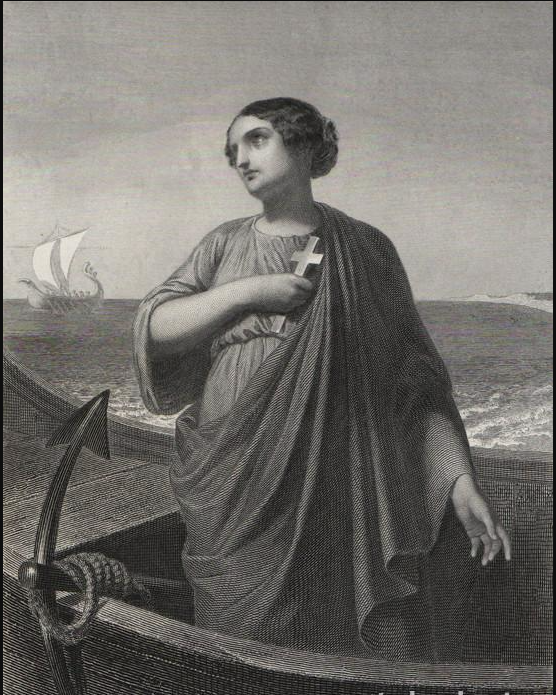
The king also sent to Gaul and recalled Mellitus and Justus, giving them free permission to return and set their churches in order, so, the year after they left, they returned. Justus came back to his own city of Rochester but the people of London preferred their own idolatrous priests and refused to accept Mellitus as Bishop.   And since the king’s authority in the realm was not so effective as that of his father, he was powerless to restore the Bishop to his see against the refusal and resistance of the pagans.
Bede makes it clear that the new church could do nothing without the support of the king and that where the king’s authority stopped, there was nothing the Bishops could do. Laurence died in 619 and was buried near Augustine and Mellitus, unable to return to London, succeeded him as Archbishop of Canterbury.  Bede tells us:

“Although Mellitus became crippled with the gout, his sound and ardent mind overcame his troublesome infirmity, ever reaching above earthly things to those that are heavenly in love and devotion.   Noble by birth, he was even nobler in mind.

I record one among many instances of his virtue.   One day the city of Canterbury was set on fire through carelessness and the spreading flames threatened to destroy it.   Water failed to extinguish the fir, and already a considerable area of the city was destroyed.   As the raging flames were sweeping rapidly towards his residence, the Bishop, trusting in the help of God where man’s help had failed, ordered himself to be carried into the path of its leaping and darting advance.   In the place where the flames were pressing most fiercel,y stood the church of the Four Crowned Martyrs.   Hither, the Bishop was borne by his attendants and here by his prayers this infirm man averted the danger which all the efforts of strong men had been powerless to check.   For the southerly wind, which had been spreading the flames throughout the city, suddenly veered to the north, thus saving the places that lay in their path, then it dropped altogether, so that the fires burned out and died.   Thus Mellitus, the man of God, afire with love for Him, because it had been his practice by constant prayers and teaching, to fend off storms of spiritual evil from himself and his people, was deservedly empowered to save them from material winds and flames.”st mellitus-icon

St Bede concludes:
“Having ruled the church for five years, Mellitus likewise departed to the heavenly kingdom in the reign of King Eadbald and was laid to rest with his predecessors in the same monastery church of the holy Apostle Peter on the twenty-fourth day of April, in the year of our Lord 624.”Archbishops tombs St Augustine'sDSC03472 Mellitus

That is, he was buried at what later became known as St Augustine’s Abbey, where his two predecessors and King Ethelbert were also buried.

These brick foundations above (protected by a modern canopy) are believed to be the only visible remains of Augustine’s original church.   This was where the tombs of Augustine, Laurence, Mellitus and Justus stood until the end of the eleventh century, when the Norman rebuilding of the monastery meant that their bodies had to be moved. By this time, all were regarded as the abbey’s saints (along with St Mildred of Thanet) and the translation of their bodies into the new Norman church in September 1091 was a splendid occasion, it was commemorated by a series of Lives of the early Archbishops, composed by Goscelin, which were recorded in several beautiful manuscripts.

Posted in INCORRUPTIBLES, Of BACHELORS, Of BUILDERS, CONSTRUCTION WORKERS, SAINT of the DAY

Saint of the Day – 14 April – St Benezet the Bridge Builder (c 1163-1184)

Saint of the Day – 14 April – St Benezet the Bridge Builder (c 1163-1184) Shepherd, Mystic, miracle-worker, Founder of the Fratres Pontifices – the Bridge-Building Brotherhood.   St Benezet is also known as Benezet of Hermillon, Benedict, Bennet, Benet, Benoit, Little Benedict the Bridge Builder.   Born in c 1163 at Hermillon, Savoy, France and died in 1184. Patronages – Avignon, bachelors, bridge-builders and construction workers.   His body is incorrupt.st beneset header

St Benezet, also known as Little Benedict the Bridge Builder, was born somewhere in the countryside of eastern or northeastern France.   As he grew up he tended his mother’s sheep.   Though uneducated and unskilled, gentle Benedict was a quiet, devout youth, thoughtful of others.

One day in 1177, while the sun was in eclipse, Benezet heard a voice, he believed was Jesus, commanding him three times to go to Avignon, where the Rhone current was especially swift and to build a bridge there.   He was also told that angels would watch over his flocks in his absence.  st-benezet holy card

He obeyed the Divine order, without delay and reported immediately to the Bishop of Avignon.   Naturally, the Bishop was hesitant about accepting the word of the frail teenager.   But little Benezet lifted a massive stone to begin the work and announced that it would be the start of the foundation.   This would become the Pont Saint-Bénézet.   Thus he succeeded in convincing the Bishop that the construction of the bridge would be an act of true Christian charity.   Permission was granted and the youth set about his task.   According to the legend, there were shouts of “Miracle! Miracle!” when Bénézet had lifted and laid that first huge stone.   Eighteen miracles occurred in total during the project – the blind had their vision restored, the deaf could hear again, cripples could walk and hunchbacks had their backs straightened.512px-Saint_Bénézet,_Notre_Dame_des_Doms,_Avignon

For the next seven years Benedict worked hard on the project and around 1181 he won support for his project from wealthy sponsors who formed themselves into a Bridge Brotherhood to fund its construction.   This was a religious association active during the 12th and 13th centuries and begun in Avignon but by it’s inspiration, it spread across Europe and whose purpose was building bridges, especially to assist pilgrims.   It was customary for a bishop to grant indulgences to those who, by money or labour, contributed to the construction of a bridge.   They also maintained and/or built hospices at the chief fords of the principal rivers, besides building bridges and looking after ferries.   The Brotherhood consisted of three branches– knights, clergy and artisans, where the knights usually had contributed most of the funds and were sometimes called donati, the clergy were usually monks who represented the church and the artisans were the workers who actually built the bridges.   Sisters are sometimes mentioned as belonging to the same association.   In addition to the construction of bridges, the brotherhood often attended to the lodging and care of pilgrims and travellers and the collection of alms, in this area, the sisters were most active.st benezet sml glass

In 1184, sadly, young Benezet died, some four years before the great stone bridge at Avignon was completed.   The wonders that occurred during the bridge’s erection and the miracles wrought at the Bridge Builder’s tomb convinced the people of Avignon that the young man was a Saint and he was referred to as such as early at 1237.   They, therefore, built a Chapel on the “Bridge of St Benezet” to enshrine his relics  . There the body was venerated until 1669, when floodwaters carried away a large segment of the bridge.   His remains were rescued from the flood and on examination, were found to be incorrupt.   Now they repose in the local church of St Didier.st benezet and relics

Understandably, bridge builders adopted little Benedict as their Patron Saint.   The remains of the bridge still remain a pilgrimage site.  Below are artworks and images showing the bride through the ages.   The last shows it as it is today, only about half is left and that half if filled with pilgrims.

This slideshow requires JavaScript.

St Benezet’s bridge has another claim to fame – it achieved worldwide fame through its commemoration by the song “Sur le Pont d’Avignon” (“On the Bridge of Avignon”).

One can build in a figurative as well as a literal sense.   Bishops, the pope in particular, are often called “pontiffs”, a title derived from the Latin word for “builder of bridges”. Building bridges between God and mankind is their special calling.   Our Lord Himself was a “pontiff” in the sense that He made his Cross a bridge, on which souls could enter heaven.   The beatitude “Blessed are the peacemakers” promises heaven to those who work for reconciliation, that is, “build bridges”.

Some persons labour to raise walls, or “iron curtains” to divide mankind.   Others labour to tear down the walls that divide, straighten the paths that connect, bridge the crevices that separate people.   Surely they come close to fulfilling the great commandment to love our neighbour as oneself.   St Benezet was one such.   He promoted the unity of God’s children.    Little St Benezet, Pray for us!st BENEZET bY becker

st benezet the bridge builder

Posted in DOMINICAN OP, INCORRUPTIBLES, Of a Holy DEATH & AGAINST A SUDDEN DEATH, of the DYING, FINAL PERSEVERANCE, DEATH of CHILDREN, DEATH of PARENTS, SAINT of the DAY, SERVANTS, MAIDS, BUTLERS, CHAMBERMAIDS

Saint of the Day – 19 March – Blessed Sibyllina Biscossi OP (1287-1367)

Saint of the Day – 19 March – Blessed Sibyllina Biscossi (1287-1367) OP Blind Dominican Virgin and Recluse, Penitent, Miracle-worker – also known as Sibyllina of Pavia, Sybil – Additional Memorials – 20 March (Pavia, Italy) and 23 March (Order of Preachers). Patronages – Children whose parents are not married, illegitimacy, loss of parents, housemaids.   Her body is incorrupt. bl sybellina maybe

The Roman Martyrology says of her – In Pavia, in Lombardy, Blessed Sibyllina Biscossi, Virgin, who became blind at the age of twelve, spent sixty-five years imprisoned alongside the Church of the Order of Preachers, shining with its interior light many who flocked to it.

“All things work for the good of those who love the Lord and are called according to His purpose” (Romans 8:28).   How many of us would have the faith to trust in God’s providence as did this holy woman?   As Mother Angelica has witnessed, true faith is knowing that when the Lord asks you to walk into the void, He will place a rock beneath your feet.   True faith is to be able to praise God in all things, to say with Job, “The Lord gives and the Lord takes away.   Blessed be the name of the Lord” (Job 1:21).

Sybillina’s parents died when she was tiny and as soon as she was old enough to be of use to anyone, the neighbours, who had taken her in at the time she was orphaned, put her out to work.   She must have been very young when she started to work, because at the age of 12, when she became blind and could not work any more, she already had several years of work behind her.

The cause of her blindness is unknown but the child was left doubly destitute with the loss of her sight.   The local chapter of the Dominican tertiary sisters took compassion on the child and brought her home to live with them.   After a little while of experiencing their kind help, she wanted to join them.   They accepted her, young though she was, more out of pity than in any hope of her being able to carry on their busy and varied apostolate.

They were soon agreeably surprised to find out how much she could do.   She learned to chant the Office quickly and sweetly and to absorb their teaching about mental prayer as though she had been born for it.   She imposed great obligations of prayer on herself, since she could not help them in other ways.   Her greatest devotion was to Saint Dominic and it was to him she addressed herself when she finally became convinced that she simply must have her sight back so that she could help the sisters with their work.dominican nuns for bl sybellina

Praying earnestly for this intention, Sybillina waited for his feast day.   Then, she was certain, he would cure her.   Matins came and went with no miracle, little hours, Vespers– and she was still blind.   With a sinking heart, Sybillina knelt before Saint Dominic’s statue and begged him to help her.   Kneeling there, she was rapt in ecstasy and she saw him come out of the darkness and take her by the hand.

He took her to a dark tunnel entrance and she went into the blackness at his word. Terrified but still clinging to his hand, she advanced past invisible horrors, still guided and protected by his presence.   Dawn came gradually and then light, then a blaze of glory.   “In eternity, dear child,” he said. “Here, you must suffer darkness so that you may one day behold eternal light.”

Sybillina, the eager child, was replaced by a mature and thoughtful Sybillina who knew that there would be no cure for her, that she must work her way to heaven through the darkness.   She decided to become a anchorite and obtained the necessary permission.   In 1302, at the age of 15, she was sealed into a tiny cell next to the Dominican church at Pavia.   At first she had a companion but her fellow recluse soon gave up the life. Sybillina remained, now alone, as well as blind.

The first seven years were the worst, she later admitted.   The cold was intense and she never permitted herself a fire.   The church, of course, was not heated and she wore the same clothes winter and summer.   In the winter there was only one way to keep from freezing–keep moving–so she genuflected and gave herself the discipline.   She slept on a board and ate practically nothing.   To the tiny window, that was her only communication with the outside world, came the troubled and the sinful and the sick, all begging for her help.   She prayed for all of them and worked many miracles in the lives of the people of Pavia.

One of the more amusing requests came from a woman who was terrified of the dark. Sybillina was praying for her when she saw her in a vision and observed that the woman–who thought she was hearing things–put on a fur hood to shut out the noise. The next day the woman came to see her and Sybillina laughed gaily. “You were really scared last night, weren’t you?” she asked. “I laughed when I saw you pull that hood over your ears.”   The legend reports that the woman was never frightened again.
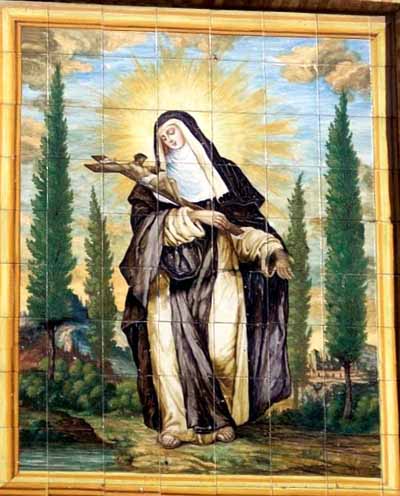
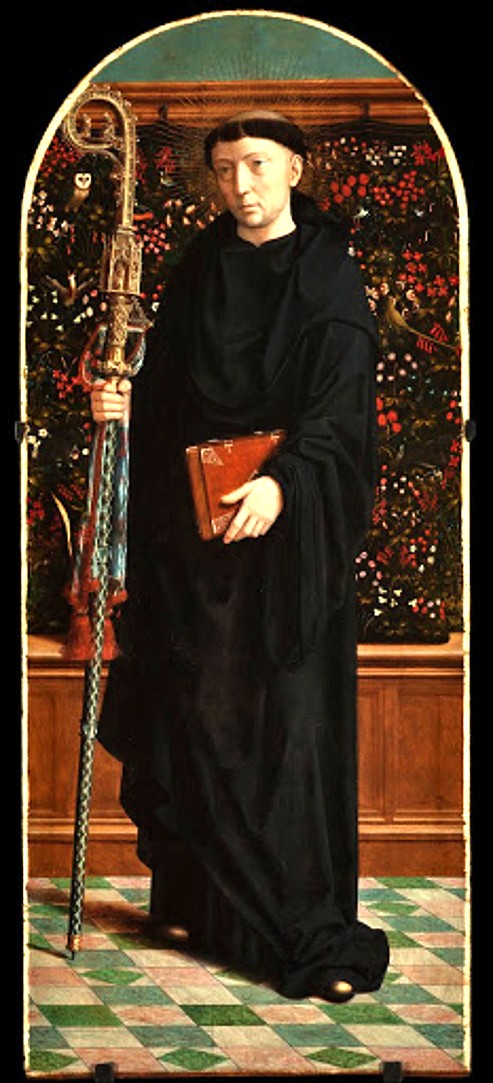
Sybillina had a lively sense of the Real Presence and a deep devotion to the Blessed Sacrament.   One day a priest was going past her window with Viaticum for the sick, she knew that the host was not consecrated and told him so.   He investigated and found he had indeed taken a host from the wrong container.

Sybillina lived as a recluse for 65 years.   She followed all the Masses and Offices in the church, spending what few spare minutes she had working with her hands to earn a few alms for the poor.

She is buried in the Dominican church in Pavia

Her cultus was confirmed in 1853 by Pope Pius IX and she was Beatified by him on 17 August 1854.

From the General Calendar of the Order of Preachers on her Feast Day:

Let us Pray:
O God, who wast pleased to enlighten the soul of Blessed Sibyllina, Thy Virgin , with admirable splendour, though she was deprived of bodily sight, grant, through her intercession, that, enlightened with light from above, we may despise earthly things and earnestly strive after those that are eternal.   Through Christ our Lord. Amen.

O Lord, enkindle our hearts with the fire of the Spirit, who wonderfully renewed Blessed Sibyllina.   Filled with that heavenly light may we come to know Jesus Christ crucified and always grow in Your love.   We ask this through our Lord Jesus Christ, Your Son, who lives and reigns with You and the Holy Ghost, one God, forever and ever.all dominican saints pray for us 7 nov 2019

Posted in GOUT, KNEE PROBLEMS, ARTHRITIS, etc, PATRONAGE - OEDEMA/DROPSY, PATRONAGE - VINTNERS, WINE-FARMERS, SAINT of the DAY

Saint of the Day – 14 March – Saint Leobinus of Chartres (Died c 558)

Saint of the Day – 14 March – Saint Leobinus of Chartres (Died c 558) Bishop of Chartres, Abbot, Hermit, Miracle worker – he had the gift of healing, especially of dropsy or edema – born as Lubin at Poitiers, France and died on 14 March 558 of natural causes.   Patronages – against dropsy/oedema, against rheumatism, of innkeepers and wine merchants.st leobinus of chartres

Leobinus’s parents were peasants from the region of Poitiers in France.   As a young boy, Leobinus had an aptitude for learning and applied to a monastery where he was employed in menial tasks.

His work occupied him the entire day and he was obliged to do most of his studying at night, screening his candle as best he could.   The monks complained that the light disturbed their slumbers but by much humility and perseverance Lubin advanced in knowledge.572px-Chartres_-_Vitrail_de_la_Vie_de_saint_Lubin- leobinus1

He eventually joined the monastery and, probably at the suggestion of St Carilef, for a time lived as a hermit under the guidance of St Avitus.   Later, he settled in an abbey near Lyons, remaining for five years.Mar+14+Leobinus+of+Chartres+1

In a war between the Franks and the Burgundians this monastery was raided and all the monks fled with the exception of Leobinus and an old monk.   The enemy, unable to extort from Leobinus the location of the monastery’s “treasure”, tortured him by first strangling him with a rope and then by tying his feet and dipping him, head first, into the river.   Left for dead, he recovered and was received in the monastery of Le Perche.st leobanus

After Avitus died, Leobinus continued living as a hermit until he was ordained by Bishop. Aetherius of Chartres, who appointed him Abbot of Brou.   He served until apparently deciding he did not like administrative duties.   So he left to become a monk at Lérins.
He remained there until St Caesarius, the Bishop of Arles and a former monk at Lérins convinced him to return to Brou, rather than to leave his people “like sheep without a shepherd.”

Leobinus participated in the Fifth Council of Orleans and in the Second Council of Paris and died on March 14, about the year 558, after a long illness.   He was buried at the Church named for him in Chassant, Eure-et-Loir, France.621px-Buste_saint_lubin leobinas1024px-Saint_Leobinus _église_Saint-Lubin_Chassant_Eure-et-Loir_France
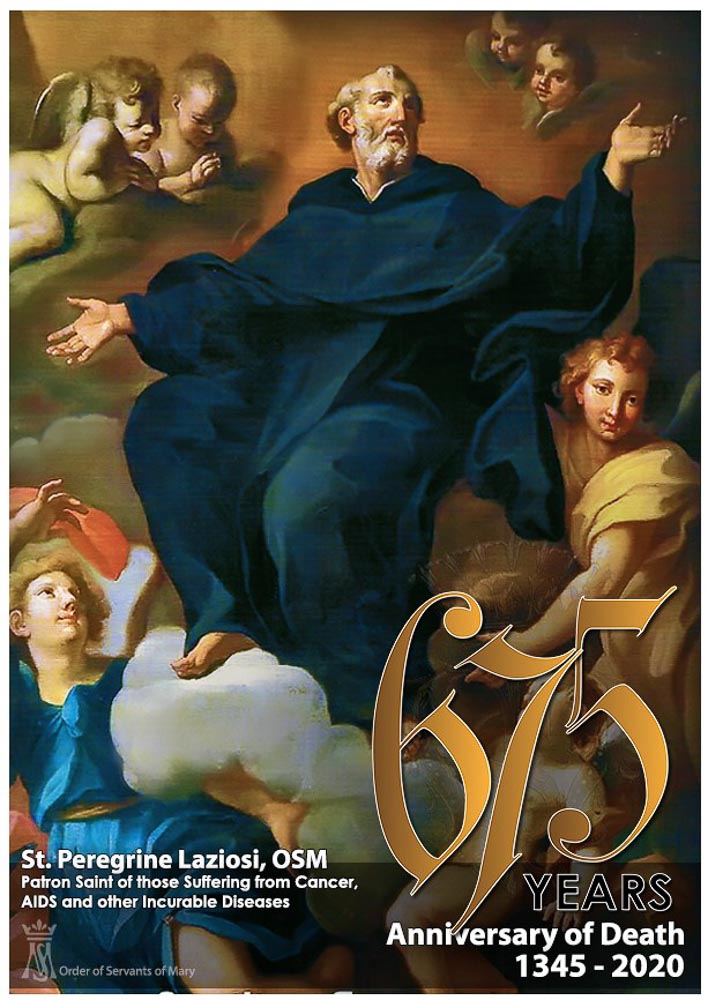
Posted in franciscan OFM, PATRONAGE - HAPPY MARRIAGES, of MARRIED COUPLES, PATRONAGE - SPOUSAL ABUSE / DIFFICULT MARRIAGES / VICTIMS OF ABUSE, SAINT of the DAY, WIDOWS and WIDOWERS

Saint of the Day – 24 January – Blessed Paola Gambara Costa TOSF (1463-1515)

Saint of the Day – 24 January – Blessed Paola Gambara Costa TOSF (1463-1515) a Countess and member of the Third Order of St Francis, Laywoman, mother, widow, apostle of the poor and sick – born on 3 March 1463 in Verola Alghise (modern Verolanuova), Brescia, Duchy of Milan (in modern Lombardy, Italy) and died on 24 January 1515 in Binaco, Duchy of Milan (in modern Lombardy, Italy) of a fever.   Patronages – Widows, Married couples, Franciscan tertiaries, difficult marriages, victims of adultery.   Additional memorial – 23 January in Brescia.bl paola vision
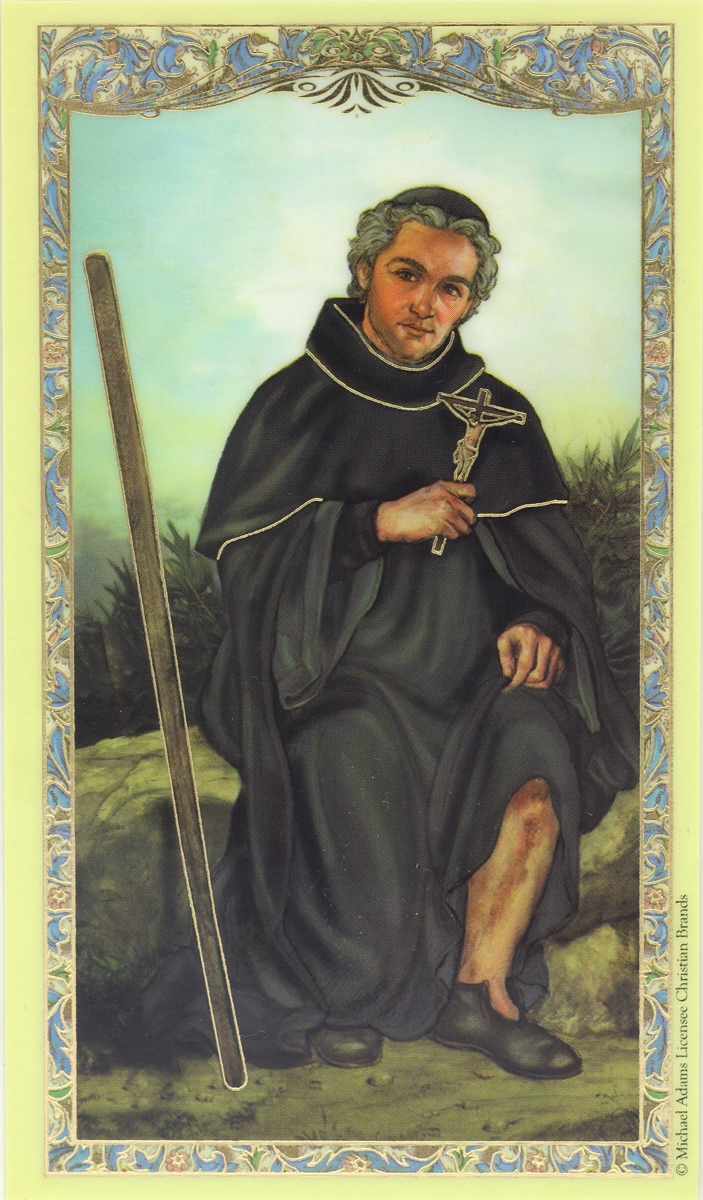
Paola Gambara Costa was born on 3 March 1463 in Brescia as the first of seven children to the nobles Giampaolo Gambara and Taddea Caterina Martinengo.

In her childhood she delighted in spiritual reading and reflection on the Gospel and harboured an ardent desire to become a nun later in life.   But this dream was cut short when her parents decided to arrange her marriage to Count Lodovico Antonio Costa – the Lord of Benasco – and she saw this as the will of God manifesting itself and so complied with the wishes of her parents.   The marriage came about after Count Bongiovanni Costa visited her parents and was struck with her virtue and so wanted her as his nephew Lodovico Antonio’s wife.   Her decision to become a nun worried the count who sent her to Blessed Angelo Carletti – a Franciscan priest – who persuaded her that marriage was a call from God to embrace a different kind of life still in accordance with Christian values.

The pair married in autumn 1485 and the pair travelled to the small Benasco province for the ensuring celebrations.   She endured her new husband’s expensive tastes, seeing it as her role to be faithful to him, even if she did not live the excessively luxurious life herself.bl paola costs

Her confessor around this time was Father Crescenzio Morra from Bene though she later reconnected with Carletti who became her friend and spiritual advisor as well as a confessor.   Carletti kept her on the path of virtue and advised her to enrol in the Third Order of Saint Francis, while learning to appreciate the poor and to detest the lavishness of the secular world.   She joined in 1491 with the permission of her husband.   Gambara often deprived herself of food in order to bring it to the sick and on one occasion took off her shoes and gave it to an old woman who was struggling barefoot through the snow.

In 1488 she gave birth to her sole child Giovanni Francesco and named him in honour of Saint Francis of Assisi.   To mark this occasion, she managed to persuade her husband to distribute large amounts of food to the poor of their area.bl paola costs almsgiving

But her excessive charitable works and almsgiving soon vexed her husband, who reproached her for her conduct and ridiculed her in front of their servants and the servants followed their master’s example and joined in ridiculing their mistress.

Costa soon acquired a mistress – the daughter of the Podestà of Carrù – and he allowed her to live in the castle in 1494 even though Paola resided there.   In 1495 her son left for Chieri for his education and Father Carletti died on 11 April 1495.   She attended his funeral in Cuneo – he had died at the convent of Sant’Antonio where he had fallen ill.

In 1500 she reunited with her parents and siblings when she returned to her hometown on a brief visit.   In 1504 her late husband’s mistress fell ill with abdominal pains and it was Paola who comforted her and forgave her as she died.   Also in 1504 her son – now a page – returned to his home.

Her husband later repented and approved her good works and also consented to her wearing the habit of her order in public.   Costa became ill in 1504 and she began to tend to him.   The two travelled to Cuneo to ask for the intercession of her former confessor Carletti and when her husband was healed, attributed the healing to him – Costa celebrated a banquet in commemoration of this and undertook a pilgrimage to the priest’s grave in thanksgiving with his wife at his side.   This conversion was short-lived however, for her husband died not long after in 1504.bl paola costs and mary

On 14 January 1515 she was struck with an extreme fever that caused her great pain and she died on 24 January 1515 in the town of Binasco in Milan after having confessed and received the Eucharist for the final time.

Blessed Paola was buried in a church outside the walls of convent of Rocchetta that she had helped re-build.  When the church was destroyed in 1536 during a war between Francis I and Charles V, Paola’s body was re-interred in the nearby castle and later enshrined in a chapel built by the Counts of Costa in the Franciscan monastery of Bene Vagienna.bl paola body

Her Beatification received formal ratification on 14 August 1845 once Pope Gregory XVI issued a decree that recognised that there existed an enduring and longstanding local ‘cultus’.

Posted in Against STORMS, EARTHQUAKES, THUNDER & LIGHTENING, FIRES, DROUGHT / NATURAL DISASTERS, Of the SICK, the INFIRM, All ILLNESS, SAINT of the DAY

Saint of the Day – 3 January – Saint Genevieve (c 419-c 502)

Saint of the Day – 3 January – Saint Genevieve (c 419-c 502) Virgin, apostle of prayer and of the poor and sick – Patronages – against plague, against natural disasters, against fever, French security forces (chosen in 1962), Paris, France, Women’s Army Corps.   In 451 she led a “prayer novena” that was said to have saved Paris by diverting Attila’s Huns away from the city.   When the Germanic king Childeric I besieged the city in 464, she acted as an intermediary between the city and its besiegers, collecting food and convincing Childeric to release his prisoners.   Her following and her status as patron saint of Paris were promoted by Clotilde – Princess and Saint (c 474-545), who may have commissioned the writing of her vita. st genevieve 1.jpg

On his way to combat heresy in Britain, St Germanus of Auxerre (c 378-c 448) made an overnight stop at Nanterre, France.   In the crowd that gathered to hear him speak, Germanus spotted Genevieve, a beautiful 7-year-old girl and he foresaw her future holiness.   When he asked little St Genevieve if she wanted to dedicate her life to God, she enthusiastically said yes.   So he laid hands on her with a blessing, thus launching the spiritual career of one of France’s most admired saints.

St Genevieve.jpg
Saint Genevieve, seventeenth-century painting, Musée Carnavalet, Paris

St Genevieve was born around the year 420 in the small French village of Nanterre.  After both of her parents died, she went to live with her godmother in Paris.   She was admired for her piety and works of charity and she practised corporal austerities which included abstaining completely from meat and breaking her fast only twice in the week. Many of her neighbours, filled with jealousy and envy, accused Genevieve of being an impostor and a hypocrite.

At 15, Genevieve formally consecrated herself as a virgin but continued to live as a laywoman.   Because of her generous giving to the poor, she became widely known in the vicinity around Paris.   At first, however, Genevieve met great hostility.   But St Germanus defused it by authorising her with public signs of his support.st genevieve 2.jpg

Once when the Franks were besieging Paris, Genevieve rescued the city from starvation by leading a convoy of ships up the Seine to Troyes to obtain food.   In this selection from her biography, we learn that she had to work a miracle to bring it home safely:

During the return voyage, however, the ships were so buffeted by the wind . . . that the high holds fore and aft in which they had stored the grain tipped over on their sides.   And the ships filled with water.   Quickly Genovefa, her hands stretched toward heaven, begged Christ for assistance.   Immediately the ships were righted.   Thu,s through her, our God . . . saved eleven grain-laden ships. . . .st genevieve 4.jpg

When she returned to Paris, her sole concern was to distribute the grain to all according to their needs  . She made it her first priority to provide a whole loaf to those whose strength had been sapped by hunger.   Thus, when her servant girls went to the ovens they would often find only part of the bread they had baked. . . .  But it was soon clear who had taken the bread from the ovens for they noticed the needy carrying loaves throughout the city and heard them magnifying and blessing the name of Genevieve.  For she put her hopes not in what is seen but in what is not seen.   For she knew the Prophet spoke truly who said: “Whoever is kind to the poor is lending to God” (Proverbs 19:17).   For through a revelation of the Holy Spirit she had once been shown that land, where those who lend their treasure to the poor expect to find it again.   And for this reason, she was accustomed to weep and pray incessantly, for she knew that as long as she was in the flesh she was exiled from the Lord.

From that time Genevieve enjoyed a heroine’s status and used her influence and wonders on the city’s behalf.   For example, she persuaded Childeric, who had conquered Paris, to release many captives.   And in 451, when Attila the Hun was advancing on the city, she got the populace to pray and fast for their safety.   The invader changed his course and Paris was spared.   She also became a trusted adviser to Clovis, the king of the Franks.st genevieve icon.jpg

St Genevieve had a particular devotion to St Denis (died 3rd century) and wished to erect a chapel in his honour to house his relics.   Around the year 475 Genevieve purchased some land at the site of the saint’s burial where a shrine was built.   This small chapel became a famous place of pilgrimage during the fifth and sixth centuries.

When Genevieve died around 500, she was buried in the church of Sts Peter and Paul at Paris.   So many miracles occurred through her intercession there that it became a pilgrimage spot and came to be called St Genevieve.

496px-Châsse_shrine_Ste_Geneviève_Saint_Etienne_du_Mont.jpg
St Genevieve’s Tomb

The King, Clovis, founded an abbey for St Genevieve, where she was later re-interred. Under the care of the Benedictines, who established a monastery there, the church witnessed numerous miracles wrought at her tomb.   In the year 1129, the city was saved from an epidemic, the relics of St Genevieve were carried in a public procession.

About 1619 Louis XIII named Cardinal François de La Rochefoucauld abbot of Saint Genevieve’s.   The canons had been lax and the cardinal selected Charles Faure to reform them.   This holy man was born in 1594 and entered the canons regular at Senlis.   He was remarkable for his piety and, when ordained, succeeded after a hard struggle in reforming the abbey.   Many of the houses of the canons regular adopted his reform.   In 1634, he and a dozen companions took charge of Saint-Geneviève-du-Mont of Paris.   This became the mother-house of a new congregation, the Canons Regular of St Genevieve, which spread widely over France.624px-Sainte_Genevieve_façade_Saint-Etienne-du-Mont.jpg

Posted in Against STORMS, EARTHQUAKES, THUNDER & LIGHTENING, FIRES, DROUGHT / NATURAL DISASTERS, BREWERS, Of a Holy DEATH & AGAINST A SUDDEN DEATH, of the DYING, FINAL PERSEVERANCE, DEATH of CHILDREN, DEATH of PARENTS, SAILORS, MARINERS, NAVIGATORS, SAINT of the DAY

Saint of the Day – 4 December – Saint Barbara (3rd Century) Martyr

Saint of the Day – 4 December – Saint Barbara (3rd Century) Martyr – died by being beheaded by her father c 235 at Nicomedia during the persecution of Maximinus of Thrace.   Patronages – against death by artillery, against explosions, against fire,  against impenitence, against lightning, against storms ,against vermin, ammunition workers, architects, armourers, artillerymen, boatmen, bomb technicians. brass workers, brewers, builders, carpenters, construction workers, dying people, fire prevention, firefighters, fireworks manufacturers, fortifications, foundry workers, geologists, gravediggers, gunners, hatmakers, mariners, martyrs, masons, mathematicians, miners, ordnance workers, prisoners, saltpetre workers, smelters, stonecutters, Syria, tilers, warehouses, 8 Cities.   Saint Barbara is one of the Fourteen Holy Helpers. Her association with the lightning, which killed her father has caused her to be invoked against lightning and fire.   By association with explosions, she is also the patron of artillery and mining.

Wilhelm_Kalteysen_-_Saint_Barbara_Altarpiece_-_Google_Art_Project.jpg
St Barbara with her attributes – three-windowed tower, central panel of St Barbara Altarpiece (1447), National Museum in Warsaw

Because of doubts about the historicity of her legend, she was removed from the General Roman Calendar in the 1969 revision, though not from the Catholic Church’s list of saints.

Saint Barbara is often portrayed with miniature chains and a tower.   As one of the Fourteen Holy Helpers, Barbara continues to be a popular saint in modern times.   A 15th-century French version of her story credits her with thirteen miracles, many rest upon the security she offered, that her devotees would not die before getting to make confession and receiving extreme unction.st barbara art.jpg

According to the hagiographies, Barbara, the daughter of a rich pagan named Dioscorus, was carefully guarded by her father who kept her locked up in a tower in order to preserve her from the outside world.   Having secretly become a Christian, she rejected an offer of marriage that she received through her father.

Before going on a journey, her father commanded that a private bath-house be erected for her use near her dwelling and during his absence, Barbara had three windows put in it, as a symbol of the Holy Trinity, instead of the two originally intended.   When her father returned, she acknowledged herself to be a Christian, whereupon he drew his sword to kill her but her prayers created an opening in the tower wall and she was miraculously transported to a mountain gorge, where two shepherds watched their flocks.   Dioscorus, in pursuit of his daughter, was rebuffed by the first shepherd but the second betrayed her.   For doing this, he was turned to stone and his flock was changed to locusts.GHIRLANDAIO_Domenico_St_Barbara.jpg

Dragged before the prefect of the province, Martinianus, who had her cruelly tortured, Barbara remained faithful to her Christian faith.   During the night, the dark prison was bathed in light and new miracles occurred.   Every morning, her wounds were healed. Torches that would be used to burn her, were extinquished as they approached her.  Finally, she was condemned to death by beheading.   Her father himself carried out the death-sentence.   However, as punishment, he was struck by lightning on the way home and his body was consumed by flame.   Barbara was buried by a Christian, Valentinus and her tomb became the site of miracles.   This summary omits picturesque details, supplemented from Old French accounts.Master_of_the_Embroidered_Foliage_-_Saint_Barbara.jpg

According to the Golden Legend, her martyrdom took place on 4 December “in the reign of emperor Maximianus and Prefect Marcien” (r. 286–305);  the year was given as 267 in the French version.

This slideshow requires JavaScript.

Posted in Against SORE THROATS, COUGHS, WHOOPING COUGH,, FEASTS and SOLEMNITIES, Of FISHERMEN, FISHMONGERS, Of MUSICIANS, Choristors, Of the SICK, the INFIRM, All ILLNESS, PREGNANCY, SAINT of the DAY, The APOSTLES & EVANGELISTS

Feast of St Andrew, Apostle of Christ, Martyr – 30 November

Feast of St Andrew, Apostle of Christ, Martyr – 30 November

Saint Andrew was the brother of the Apostle Peter and like his brother was born in Bethsaida of Galilee (where the Apostle Philip was also born).   While his brother would eventually overshadow him as the first among the apostles, it was Saint Andrew, a fisherman like Peter, who (according to the Gospel of John) introduced Saint Peter to Christ.saint-andrew-the-apostle-nicolas-tournier (1).jpg

St Andrew was a fisherman who lived in Galilee during the time of Jesus.   He followed John the Baptist and listened to his teachings.   One day, John saw Jesus walking along the road.   John said to his followers, “Behold the Lamb of God.”   He told his followers to go and talk to Jesus.   He wanted them to know that Jesus was the One for whom they had been waiting.   Andrew and another disciple followed Jesus and spent an afternoon with him.   Early the next day Andrew found Simon Peter, his brother and told him, “We have found the Messiah.”

Both men gave up their work as fishermen to become apostles of Jesus.   Andrew was one of the first to be called.   He seemed to take delight in bringing others to Jesus. Saint-Andrew-Anthony-van-Dyck-Oil-Painting.jpg

Andrew was the one who told Jesus about the little boy who had the loaves of bread and the fish, the beginning of a meal that fed more than five thousand people.

It was Andrew and Philip whom the Greeks approached when they wanted to see Jesus. These events indicate that Andrew was a man who was easy to approach, a man you could trust.599px-Artus_Wolffort_-_St_Andrew_-_WGA25857.jpg

Like the other apostles, Andrew became a missionary.   He preached about Jesus in the area around the Black Sea.   Tradition tells us he preached in northern Greece, Turkey and Scythia (now the southern part of Russia).

Tradition places Saint Andrew’s martyrdom on 30 November of the year 60 (during the persecution of Nero) in the Greek city of Patras.   A medieval traditional also holds that, like his brother Peter, he did not regard himself as worthy of being crucified in the same manner as Christ and so he was placed on an X-shaped cross, now known (especially in heraldry and flags) as a Saint Andrew’s Cross.   The Roman governor ordered him bound to the cross rather than nailed, to make the crucifixion and thus Andrew’s agony, last longer.576px-The_Crucifixion_of_Saint_Andrew-Caravaggio_(1607)

Because of his patronage of Constantinople, Saint Andrew’s relics were transferred there around the year 357.   Tradition holds that some relics of Saint Andrew were taken to Scotland in the eighth century, to the place where the town of S. Andrews stands today.  In the wake of the Sack of Constantinople during the Fourth Crusade, the remaining relics were brought to the Cathedral of Saint Andrew in Amalfi, Italy.  In 1964, in an attempt to strengthen relations with the Ecumenical Patriarch in Constantinople, Pope Paul VI returned all relics of Saint Andrew that were then in Rome to the Greek Orthodox Church.

Every year since then, the Pope has sent delegates to Constantinople for the feast of Saint Andrew (and, in November 2007, Pope Benedict himself went), just as the Ecumenical Patriarch sends representatives to Rome for the 29 June feast of Saints Peter and Paul (and, in 2008, went himself).   Thus, like his brother Saint Peter, Saint Andrew is in a way a symbol of the striving for Christian unity.st andrew apostle interesting

St Andrew’s Feast takes pride of place in the Liturgical Calendar, for in the Roman Catholic calendar, the liturgical year begins with Advent and the First Sunday of Advent is always the Sunday closest to the Feast of Saint Andrew.  Though Advent can begin as late as 3 December, Saint Andrew’s feast, today is traditionally listed as the first Saint’s day of the liturgical year, even when the First Sunday of Advent falls after it—an honour commensurate with Saint Andrew’s place among the apostles   The tradition of praying the Saint Andrew Christmas Novena 15 times each day from the Feast of Saint Andrew until Christmas flows from this arrangement of the calendar.

This slideshow requires JavaScript.

The name “Andrew” is a Greek name meaning “courageous” or “manly.”   St Andrew lived up to his name.

St Andrew, pray that we live up to the name “Christian”!

St Andrew’s Patronages are here:
https://anastpaul.com/2018/11/30/saint-of-the-day-30-november-st-andrew-apostle-of-christ-martyr/St-Andrew vatican statuest andrew apostle statue snip