Posted in CATHOLIC-PRAYERS OF THE CHURCH, CHRIST, the WAY,TRUTH,LIFE, GOD ALONE!, LENT, MORNING Prayers, POETRY, PRAYERS of the CHURCH, QUOTES for CHRIST, QUOTES on LOVE of GOD, The WORD, Thomas a Kempis

Lenten Reflection – 26 February 2018 – Monday of the Second Week of Lent

26 February 2018 – Monday of the Second Week of Lent
Daniel 9:4-10, Psalms 79:8-9, 11, 13, Luke 6:36-38

Daniel 9:4-5 – “I prayed to the Lord my God and made confession, saying, “O Lord, the great and terrible God, who keepest covenant and steadfast love with those who love him and keep his commandments, we have sinned and done wrong and acted wickedly and rebelled, turning aside from thy commandments and ordinances…”

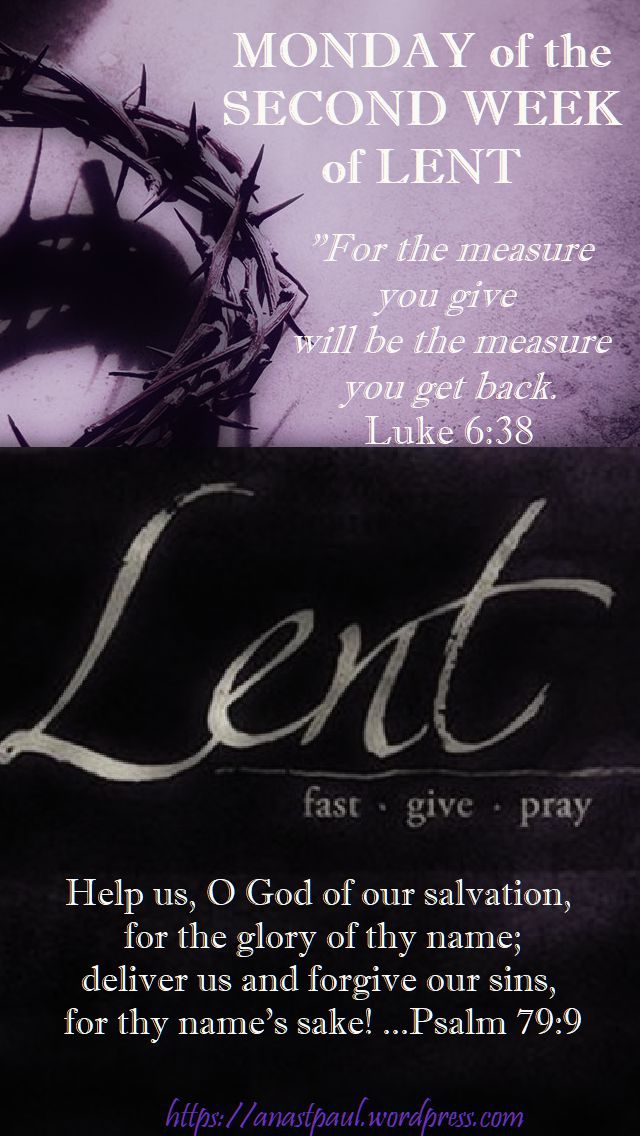
Luke 6:36-38 – Be merciful, even as your Father is merciful. “Judge not, and you will not be judged; condemn not and you will not be condemned; forgive and you will be forgiven; give and it will be given to you; good measure, pressed down, shaken together, running over, will be put into your lap. For the measure you give will be the measure you get back.”monday of the second week - 26 feb 2018

Daniel confesses that his people’s sufferings in exile are due to their own lack of fodelity to God. This sort of confession is a frank admission that evil has consequences. It is similar to Jesus’ teaching – “one who takes up the sword will perish by the sword.”

The argument may be turned round – good deeds have beneficial consequences. “The measure you give will be the measure you get back” whether it be mercy, forgiveness or sympathetic understanding.

If we keep giving out good things consistently, the blessings we will receive will be beyond measure. Every giving enriches the giver, whether gift be in the form of material assistance, psychologival affirmation or spiritual admonition, giving up an argument, settling a quarrel or going out of our way to help someone who deserves it least!

Be not afraid then to give, for you will receive beyond anything you could ever expect.

Am I generous with my time, material gifts, with my love?
Am I patient and willing to be forgiving, even when I was not in error?
Am I aware that as part of the Body of Christ, my good and my bad, affect all?
Archbishop Thomas Menamparampil SDB – God’sWord

“Desire not the praises of men, seeing they are vain.   Be not fearful of their reproach, for instead of doing harm to your soul, humiliations cleanses it and renders it more meet to receive a brighter crown in heaven and none are worthy to be glorified in heaven who are unable to bear reproach on earth for the love of God.”Thomas a Kempis

Help us, O God of our salvation, for the glory of thy name;
deliver us and forgive our sins, for thy name’s sake! …Psalm 79:9

For ah! the Master is so fair,
His smile so sweet to banished men
That they who meet it unaware
Can never rest on earth again.

And they who see Him risen afar
At God’s right hand to welcome them
Forgetful stand of home and land,
Desiring fair Jerusalem.

Praise God! the Master is so sweet;
Praise God! the country is so fair,
We would not hold them from His feet.
We would but haste to meet them there.

English Missal 1936for ah, the master is so fair - lenten prayer - missal 1936 - monday of the 2nd week - 26 feb 2018

Posted in LENT, MORNING Prayers, POETRY, QUOTES of the SAINTS, QUOTES on CONVERSION, QUOTES on FAITH, QUOTES on LOVE, QUOTES on OBEDIENCE, QUOTES on PERSECUTION, QUOTES on REPENTANCE, QUOTES on SANCTITY, QUOTES on SUFFERING, The HOLY CROSS, The TRANSFIGURATION, The WORD

25 February 2018 – Lenten Reflection – The Second Sunday in Lent, Year B THE GLORY OF THE CRUCIFIED CHRIS

25 February 2018 – Lenten Reflection – The Second Sunday in Lent, Year B
THE GLORY OF THE CRUCIFIED CHRIST

Genesis 22:1-2, 9-13, 15-18, Psalms 116:10, 15-19, Romans 8:31-34, Mark 9:2-10

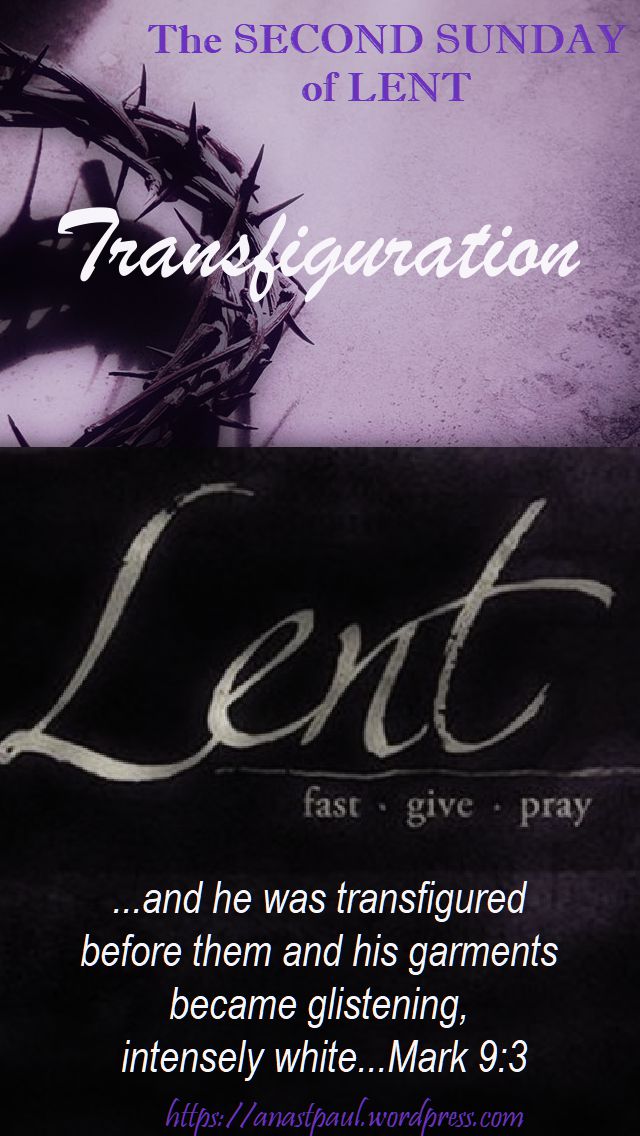
Mark 9:2-3 – And after six days Jesus took with him Peter and James and John and led them up a high mountain apart by themselves;  and he was transfigured before them and his garments became glistening, intensely white, as no fuller on earth could bleach them.second sunday lenten reflection - mark 9 3

On the second Sunday in Lent we always read the Gospel of the Transfiguration of our Lord.   We do so in order that our focus may be directed towards the glory of Easter and our Lord’s victory over sin and death by His glorious Resurrection.   Our Lenten penance is not an end in itself but a means to an end;  that cleansed of our faults and sanctified in both body and mind we might more fully appreciate and participate in God’s own glory. The word that Sacred Scripture most commonly uses to describe the nature of God is glory.   We associate glory with power, majesty, radiance, awe and wonder.   Yet all the Gospels, especially the Gospel of John, speak of God’s humiliation as His exaltation, His glory.   By faith, we are seized by the beauty and glory of the Crucified Christ.   In this mystery of the Transfiguration a twofold glory is revealed:  the glory which our Lord possesses as the eternal Son of the Father and the glory that is manifested in His sacred Passion;  the glory that is manifested from the unsurpassable torture of Holy Week.   God Himself is “whipped to blood, crowned with thorns, mocked, spat upon, ridiculed, nailed, pierced…   In this consummate ugliness, this unspeakable outrage, shines a picture of divine beauty, of divine glory.   The Gospel of the Transfiguration presents us with a vision of the glory of God on its way to the Passion”… (Cardinal Hans Urs Von Balthasar 1905-1988).

The glory revealed to Peter, James and John is a glimpse of the glory of the Resurrection, a glory that we too are destined to share;  however, it is the Passion that “leads to the glory of the Resurrection” (Preface for the Second Sunday in Lent, The Roman Missal). Consequently, we are ever mindful that “we preach Christ crucified … Christ the power of God and the wisdom of God” (1 Cor 1:23-24).   Our Lord Jesus Christ “is the radiant light of God’s glory and the perfect copy of His nature” (Heb 1:3).   Those who gaze on the Crucified Christ in faith are able to perceive that His hour of highest spiritual beauty—and glory—is a moment of utmost bodily degradation.   In the humiliation of the Cross the Saviour brings near and makes visible the divine glory for we see in Him the ineffable love of God for sinners.   This is a love, a beauty and a glory that can only be perceived by a prayerful, contemplative gaze  . It is only by means of prayer and penance that we can come to some understanding of why our Lord brought about our salvation in such weakness, diminishment and pain.

No human life is exempt from diminishment and pain.   If we are given the grace to grow older, the weight of years alone brings about diminishment.   Why must it be so?   Perhaps our own diminishment is meant to conform us to the self-emptying of the Son of God on the Cross.   This may very well be the grace of old age.   That our redemption has taken place through suffering of the flesh and spilling of blood may mean that it could take place in no other way.   It is for this reason that above all things we must seek simply to be with Jesus and to learn from Him what He alone can teach us in the silence of prayer.   On the Cross we have the ultimate and only adequate answer to the problem of evil, the only solution to the mystery of sin.   The world’s redemption could only be brought about “in the mystery of a love that by suffering understands all the insults inflicted upon it” (Hans Urs Von Balthasar).   Our profession of faith, if taken seriously, is journey into the depth of this Mystery.

What do we discover as we come to know more of this mystery?   Quite simply, that the essence of Christian discipleship is to be with Jesus and to learn from Him who accompanies us on life’s journey and who is never distant from us by means of His grace. We must endeavour to abandon ourselves to the will of the Father as He did and in this is our peace:  not only our peace but also our way to holiness, to glory.   Christians are not immune from suffering.   Indeed, our long history teaches us that often we suffer more precisely because of our Christian faith but as St Paul asks, “who will separate us from the love of Christ? Will hardship, or distress or persecution, or famine, or nakedness, or peril or sword? No, in all these things we are more than conquerors, through him who loved us” (Rom 8:35-37).   These words are more than ever relevant as we witness the persecution of Christians in the Middle East, Africa and elsewhere.   Our faith enables us not only to overcome the trials we suffer but also to be sanctified by them and through them.   We understand these as our means to holiness; a state to which we are called.

“The entire virtue of what we call holiness lies in faithfulness to what God ordains” (Jean Pierre de Caussade, The Joy of Full Surrender, [Paraclete Press], p.17).   Surely, this is what we learn when we contemplate the life and Passion of our Lord.   Fidelity to duty, discipline of life, moral rectitude;  these are the ways in which we are faithful to what God ordains.   They are no less the means by which our lives are so transformed and so transfigured that we come to “live for the praise of his glory” (Eph 1:12).   Anything that contradicts these principles is a path to misery and destruction and a betrayal of the Cross of Christ.

After His glorious resurrection our Lord asked the disciples on the road to Emmaus, “Was it not necessary that the Christ should suffer these things and enter into his glory?” (Lk 24:26).   And so it is with us; we must be willing to recognise what is best for us in what God ordains for us.   Like the disciples on the mountain, the revelation of God’s will for us, whether it be in the suffering that He asks of us or permits us to endure, or simply in the challenges that we face in living; these may confound us and might even cause us to be very much afraid.   Like Peter, James and John, however, we too are privileged to perceive the glory of the Lord;  a glory however that is veiled in the poverty, humility, and vulnerability of the Crucifix that hangs before us and in the Sacrament of the Cross, the Eucharist.   These reveal a love so powerful that neither hate nor death could conquer it.   Because we receive and worship this Sacrament, this same love is at work in the hearts of all who believe.   By its power great deeds of love are done and great evils are faced and overcome.   The Passion of our Lord gives a human face to the love of God for a fallen humanity.   Our own sufferings, mysterious as they may be in both their origin and purpose, place us in the very heart of the Paschal Mystery.   Suffering is not meaningless nor is it without purpose and neither is our life.   “Nothing short of suffering, except in rare cases, makes us what we should be;  gentle instead of harsh, meek instead of violent, conceding instead of arrogant, lowly instead of proud, pure-hearted instead of sensual”   (Bl. John Henry Newman (1801-1890), “The Sweet Yoke of Christ,” 1839).

Transfiguration
By Blessed John Henry Newman (1801-1890)

They were talking to Him about resurrection,
about law, about the suffering ahead.
They were talking as if to remind Him who He was and
who they were. He was not

Like his three friends watching a little way off,
not like the crowd At the foot of the hill.
A grey-green thunderhead massed
from the sea

And God spoke from it and said He was His.
They were talking about how the body, broken or
burned,
could live again, remade.

Only the fiery text of the thunderhead could explain it.
And they were talking
About pain and the need for judgement
and how He would make Himself

A law of pain, both its spirit and its letter in His own
flesh,
and then break it,
That is, transcend it.
His clothes flared like magnesiumtransfiguration by bl john henry newman - 2nd sun lent 25 feb 2018

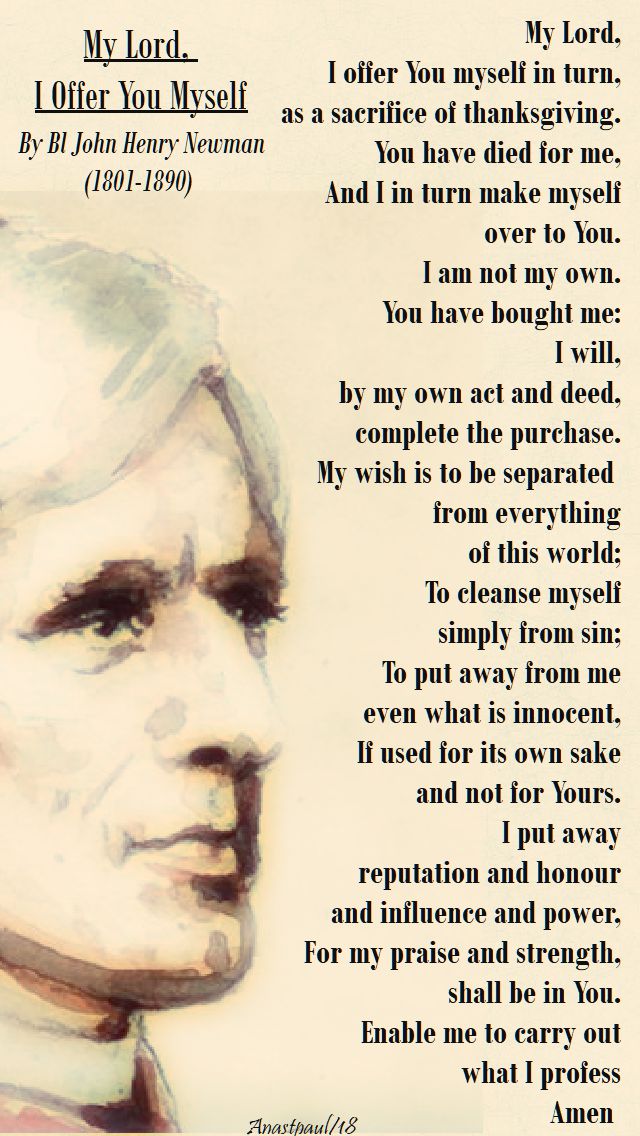
My Lord, I Offer You Myself
Blessed John Henry Newman (1801-1890)

My Lord,
I offer You myself in turn,
as a sacrifice of thanksgiving.
You have died for me,
And I in turn make myself over to You.
I am not my own.
You have bought me:
I will, by my own act and deed,
complete the purchase.
My wish is to be separated
from everything of this world;
To cleanse myself simply from sin;
To put away from me even what is innocent,
If used for its own sake
and not for Yours.
I put away reputation and honour
and influence and power,
For my praise and strength,
shall be in You.
Enable me to carry out what I profess
Amenmy lord i offer you myself - bl john henry newman - lenten prayer - 25 feb 2018 - 2nd sun lent

Posted in MORNING Prayers, ON the SAINTS, POETRY, QUOTES - J R R Tolkien and MORE, SAINT of the DAY

Thought for the Day – 23 January – The Memorial of St Marianne Cope (1838-1918)

Thought for the Day – 23 January – The Memorial of St Marianne Cope (1838-1918)

“The life of Marianne Cope is a wonderful work of divine grace.   She demonstrated the beauty of the life of a true Franciscan.   The encounter of Mother Marianne with those suffering from leprosy took place when she was far along on her journey to Christ.   For 20 years she had been a member of the Congregation of the Sisters of the Third Order of St Francis of Syracuse in New York.   She was already a woman of vast experience and was spiritually mature.   But suddenly God called her to a more radical giving, to a more difficult missionary service.

Blessed Marianne, who was Provincial Superior at the time, heard the voice of Christ in the invitation of the Bishop of Honolulu.   He was looking for Sisters to assist those suffering from leprosy on the Island of Molokai.   Like Isaiah, she did not hesitate to answer:  “Here I am. Send me!” (Is 6: 8).   She left everything and abandoned herself completely to the will of God, to the call of the Church and to the demands of her new brothers and sisters.   She put her own health and life at risk.”….Homily of Cardinal Jose Saraiva Martins on the Beatification of St Marianne Cope 14 May 2005

Awarded the Royal Order of Kapiolani by the Hawaiian government and celebrated in a poem by Robert Louis Stevenson, Mother Marianne continued her work faithfully.   Her sisters have attracted vocations among the Hawaiian people and still work on Molokai.

Robert Louis Stevenson’s Poem
for St Marianne Cope –
Missionary to Leprosy Patients

To the Reverend Sister Marianne, Missionary to Leprosy Patients
Matron of the Bishop Home, Kalaupapa.

To see the infinite pity of this place,
The mangled limb, the devastated face,
The innocent sufferers smiling at the rod,
A fool were tempted to deny his God.
He sees and shrinks; but if he look again,
Lo, beauty springing from the breasts of pain!
He marks the sisters on the painful shores,
And even a fool is silent and adores.robert louis stevenson's poem for st marianne cope no 2 - 23 jan 2018

“Rivers of living water will gush forth from the heart” of the one who believes in Christ. The signs of his presence are summarised in the Letter to the Galatians:   They are: “love, joy, peace, patient endurance, kindness, generosity, faith, mildness and chastity” (5: 22).

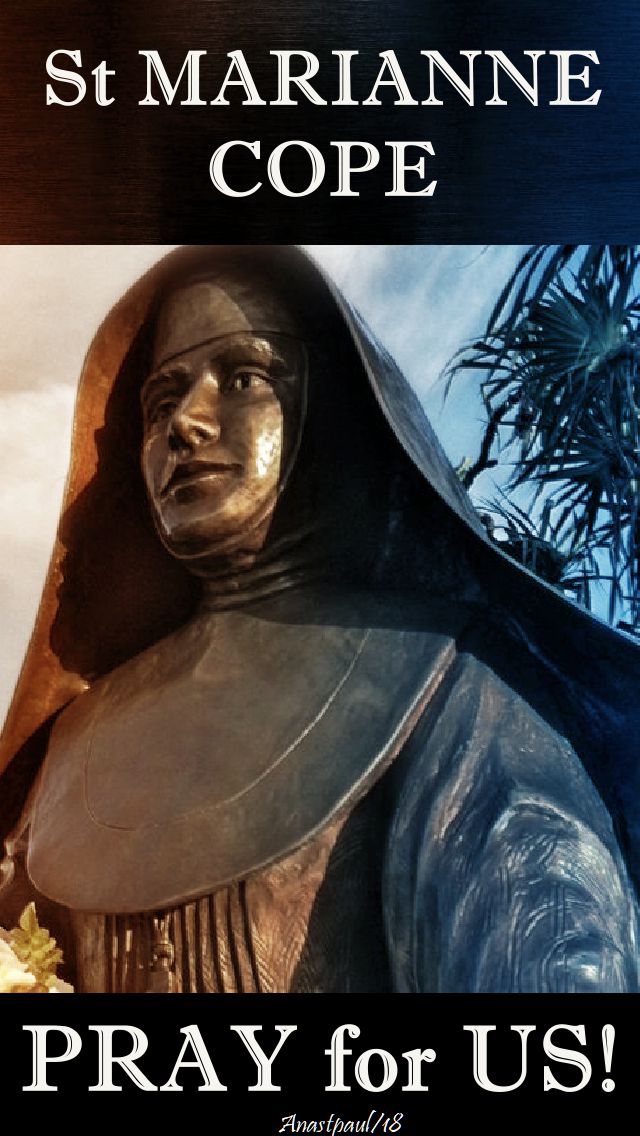
St Marianne Cope Pray for us!st marianne cope - pray for us - 23 jan 2018

Posted in MORNING Prayers, POETRY, PRAYERS of the SAINTS

Our Morning Offering – 9 January

Our Morning Offering – 9 January

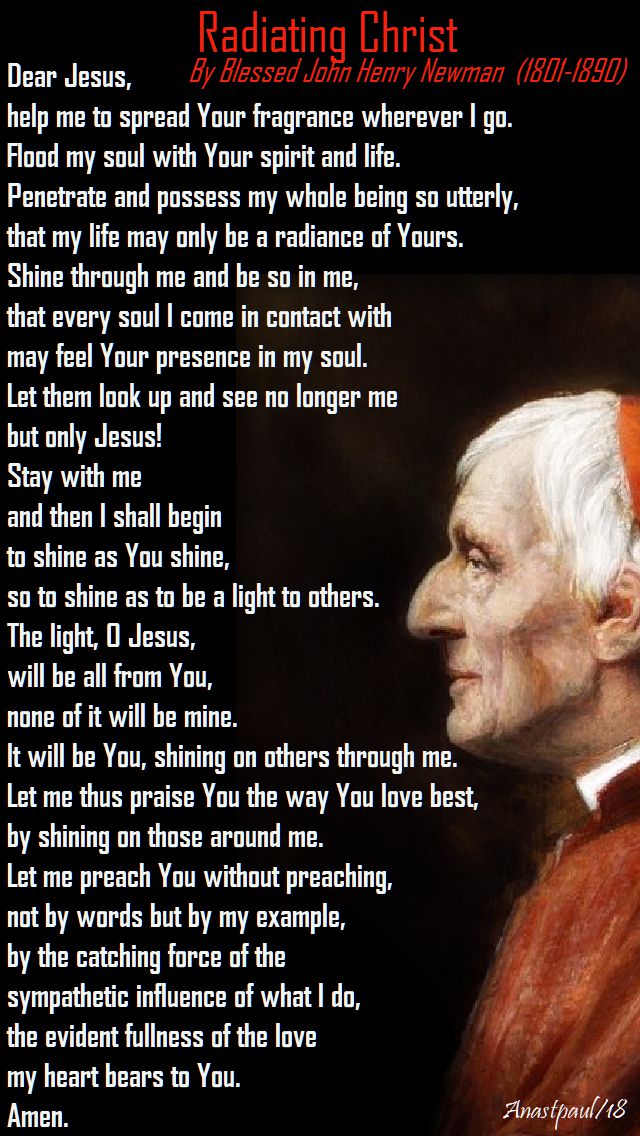
Radiating Christ
By Blessed John Henry Newman (1801-1890)

Dear Jesus,
help me to spread Your fragrance wherever I go.
Flood my soul with Your spirit and life.
Penetrate and possess my whole being so utterly,
that my life may only be a radiance of Yours.
Shine through me and be so in me,
that every soul I come in contact with
may feel Your presence in my soul.
Let them look up and see no longer me
but only Jesus!
Stay with me
and then I shall begin to shine as You shine,
so to shine as to be a light to others.
The light, O Jesus, will be all from You,
none of it will be mine.
It will be You, shining on others through me.
Let me thus praise You the way You love best,
by shining on those around me.
Let me preach You without preaching,
not by words but by my example,
by the catching force of the sympathetic influence of what I do,
the evident fullness of the love my heart bears to You.
Amen.

Note:  the Prayer above has become known as the prayer of St Mother Teresa but it was written by Blessed John Henry and adopted by St Mother Teresa and her Sisters of Charity and is recited daily by them.   It is sometimes called the “Fragrance” Prayer.radiating christ - bl john henry newman - 9 jan 2018

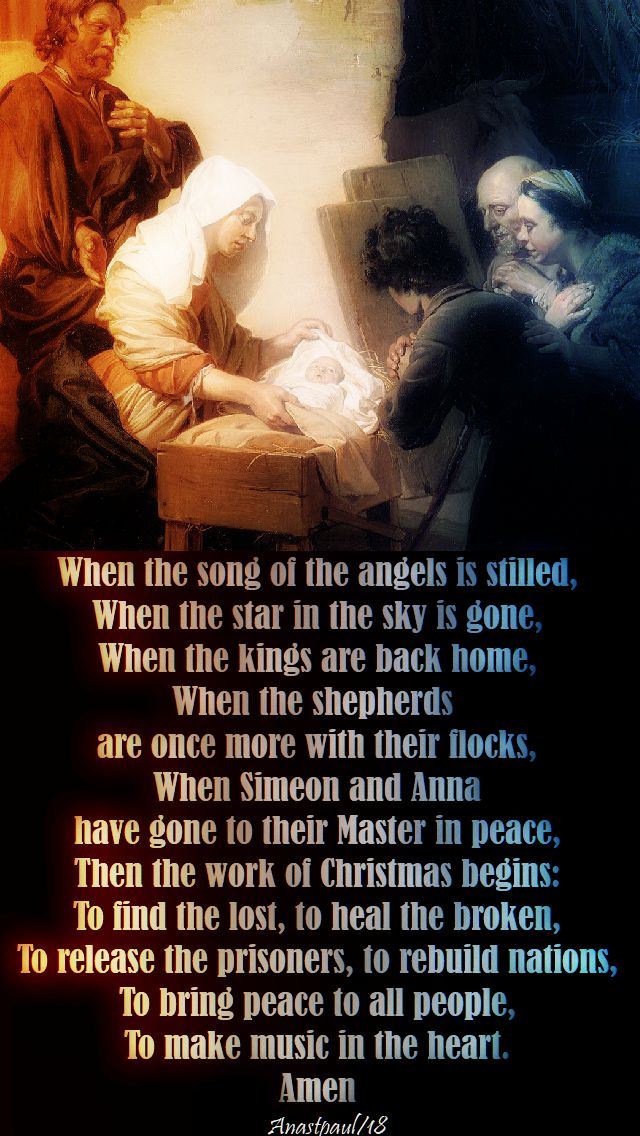
And today, as Christmastide has gone and we race onward to “radiate Christ” let us pray too, to this beautiful Poem, “When the Song of the Angels is Stilled.”

When the Song of the Angels Is Stilled
Poem by Howard Thurman (1899-1981)

When the song of the angels is stilled,
When the star in the sky is gone,
When the kings and the princes are home,
When the shepherds are back with their flocks,
The work of Christmas begins:
To find the lost,
To heal the broken,
To feed the hungry,
To release the prisoner,
To rebuild the nations,
To bring peace among people,
To make music in the heart.when the song of the angels is stilled - 8 jan 2018

Posted in CHRISTMASTIDE!, FEASTS and SOLEMNITIES, MORNING Prayers, POETRY, QUOTES - J R R Tolkien and MORE, SAINT of the DAY, THE EPIPHANY of the LORD

The Solemnity of Epiphany – 7 January 2018 – T S Eliot’s “The Journey of the Magi”

The Solemnity of Epiphany – 7 January 2018 – T S Eliot’s “The Journey of the Magi”

The Journey of the Magi

A cold coming we had of it,
Just the worst time of the year
For a journey and such a long journey:
The ways deep and the weather sharp,
The very dead of winter.’
And the camels galled, sorefooted, refractory,
Lying down in the melting snow.
There were times we regretted
The summer palaces on slopes, the terraces,
And the silken girls bringing sherbet.
Then the camel men cursing and grumbling
and running away and wanting their liquor and women,
And the night-fires going out and the lack of shelters,
And the cities hostile and the towns unfriendly
And the villages dirty and charging high prices:
A hard time we had of it.
At the end we preferred to travel all night,
Sleeping in snatches,
With the voices singing in our ears, saying
That this was all folly.
Then at dawn we came down to a temperate valley,
Wet, below the snow line, smelling of vegetation;
With a running stream and a water-mill beating the darkness,
And three trees on the low sky,
And an old white horse galloped away in the meadow.
Then we came to a tavern with vine-leaves over the lintel,
Six hands at an open door dicing for pieces of silver,
And feet kicking the empty wine-skins.
But there was no information and so we continued
And arriving at evening, not a moment too soon
Finding the place; it was (you might say) satisfactory.

All this was a long time ago, I remember,
And I would do it again, but set down
This set down
This:  were we led all that way for
Birth or Death?   There was a Birth, certainly
We had evidence and no doubt. I had seen birth and death,
But had thought they were different;  this Birth was
Hard and bitter agony for us, like Death, our death.
We returned to our places, these Kingdoms,
But no longer at ease here, in the old dispensation,
With an alien people clutching their gods.
I should be glad of another death.

t s eliot
excerpt from t s eliot's journey of the magi
Posted in CHRISTMASTIDE!, MORNING Prayers, POETRY

Christmas is………….

One of the great blessings we have as Catholics is that Christmas is not just one day and the Liturgical Calendar shows us that the Season of Christmas continues until the Baptism of the Lord (inclusive) – roughly 15-20 days after 25 December.

Christmas is………….

… a gift of love wrapped in human flesh and
tied securely with the strong promises of God.
… angelic music in the form of a carol
and oratorio with a celestial descant.
… “glory to God,” “good will to man,”
and “joy to the world.”
… “peace on earth” for those who accept it
and live in unity with God’s will.
… a man on duty tending sheep, or machine,
who senses the upward call and stops to worship.
… a tall green tree which serves as festive altar
for any household which discovers the true meaning behind it all.
… a ringing bell calling a distraught humanity
to gladness and hope.
… a glowing hearth gently placed
in the winter of man’s loneliness.
… an altar to which man can bring his heartache for comfort,
his lostness for guidance and his sin for forgiveness.
… the sparkle of anticipation and the steady light of faith
in the eyes of a little child as he hears the old, old story.
… the shining star of hope in the sky of all mankind.
… more than words can tell,
for it is a matter for the heart to receive, believe and understand

Author UnknownCHRISTMAS IS - 2017 - no 2

Posted in CHRISTMASTIDE!, MORNING Prayers, POETRY, The CHRIST CHILD

Our Morning Offering – 26 December – The Memorial of St Stephen the First Martyr and the Second Day in the Octave of Christmas

Our Morning Offering – 26 December – The Memorial of St Stephen the First Martyr and the Second Day in the Octave of Christmas

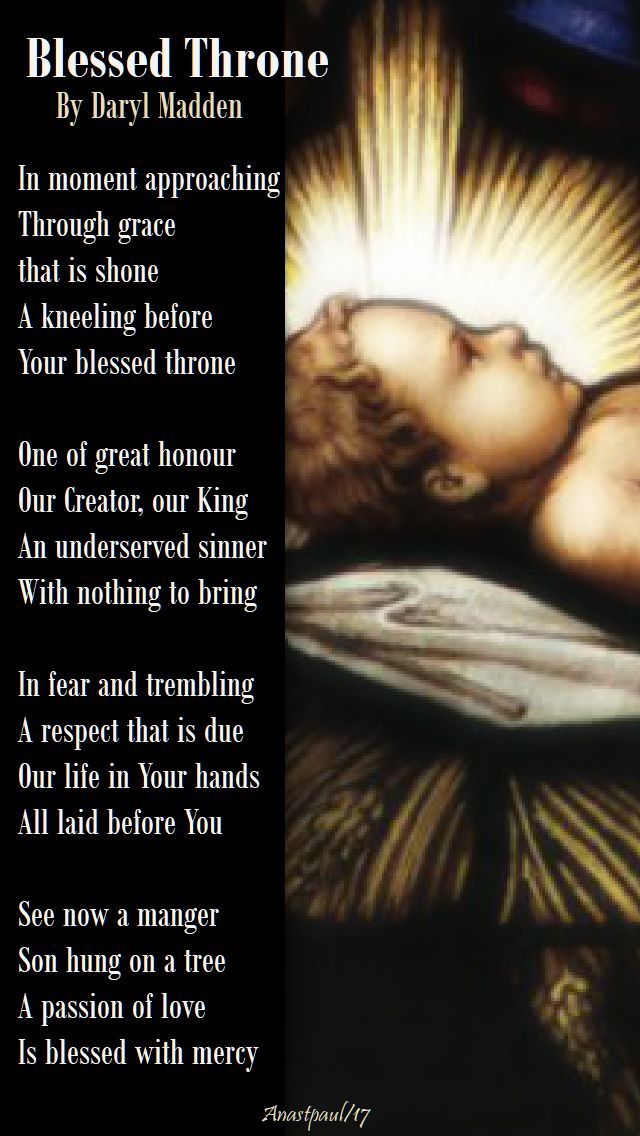
Blessed Throne
Poem/Prayer by Daryl Madden

In moment approaching
Through grace that is shone
A kneeling before
Your blessed throne

One of great honour
Our Creator, our King
An underserved sinner
With nothing to bring

In fear and trembling
A respect that is due
Our life in Your hands
All laid before You

See now a manger
Son hung on a tree
A passion of love
Is blessed with mercy

Poem/Prayer by Daryl Madden
From On a Bench of Wood
Find him here: https://darylmadden.wordpress.com/about/blessed throne - 26 dec 2017

Posted in ADVENT, CATHOLIC-PRAYERS OF THE CHURCH, MORNING Prayers, POETRY, PRAYERS of the CHURCH, The CHRIST CHILD

Our Morning Offering – 19 December – Tuesday of Gaudete Week

Our Morning Offering – 19 December – Tuesday of Gaudete Week

Hail, Heavenly Beam
9th Century Catholic Advent Prayer
By Cynewulf tr Israel Gollanz

Hail, heavenly beam,
brightest of angels Thou,
sent unto men upon this middle-earth.
Thou art the true refulgence of the sun,
radiant above the stars
and from Thyself illuminest
forever, all the tides of time.
And as Thou, God indeed,
begotten of God,
Thou Son of the true Father,
wast from aye,
without beginning, in the heaven’s glory,
so now Thy handiwork in its sore need
prayeth Thee boldy, that Thou send to us
the radiant sun
and that Thou come Thyself
to enlighten those who for so long a time
went wrapt around with darkness
and here in gloom
have sat the livelong night,
shrouded in sin.hail heavenly beam - cynewulf - 19 dec 2017

Posted in ADVENT, CHRISTMASTIDE!, HYMNS, MORNING Prayers, POETRY, PRAYERS of the CHURCH

Our Morning Offering – 16 December – Saturday of the Second Week of Advent

Our Morning Offering – 16 December – Saturday of the Second Week of Advent

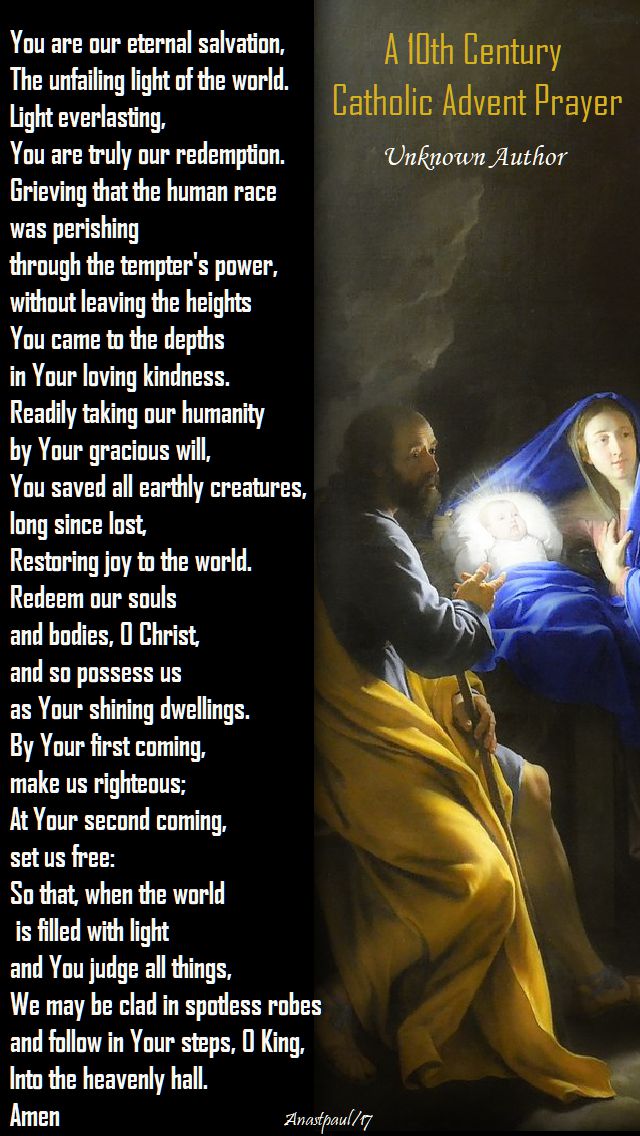
A 10th Century Catholic Advent Prayer

Unknown Author

You are our eternal salvation,
The unfailing light of the world.
Light everlasting,
You are truly our redemption.
Grieving that the human race was perishing
through the tempter’s power,
without leaving the heights
You came to the depths
in Your loving kindness.
Readily taking our humanity
by Your gracious will,
You saved all earthly creatures,
long since lost,
Restoring joy to the world.
Redeem our souls and bodies, O Christ,
and so possess us as Your shining dwellings.
By Your first coming, make us righteous;
At Your second coming, set us free:
So that, when the world is filled with light
and You judge all things,
We may be clad in spotless robes
and follow in Your steps, O King,
Into the heavenly hall.   Amen10th cent advent prayer - you are our eternal salvation - 16 dec 2017


Posted in ADVENT, DOCTORS of the Church, FATHERS of the Church, HYMNS, MORNING Prayers, POETRY, PRAYERS of the SAINTS, The CHRIST CHILD

Our Morning Offering – 15 December – Friday of the Second Week of Advent

Our Morning Offering – 15 December – Friday of the Second Week of Advent

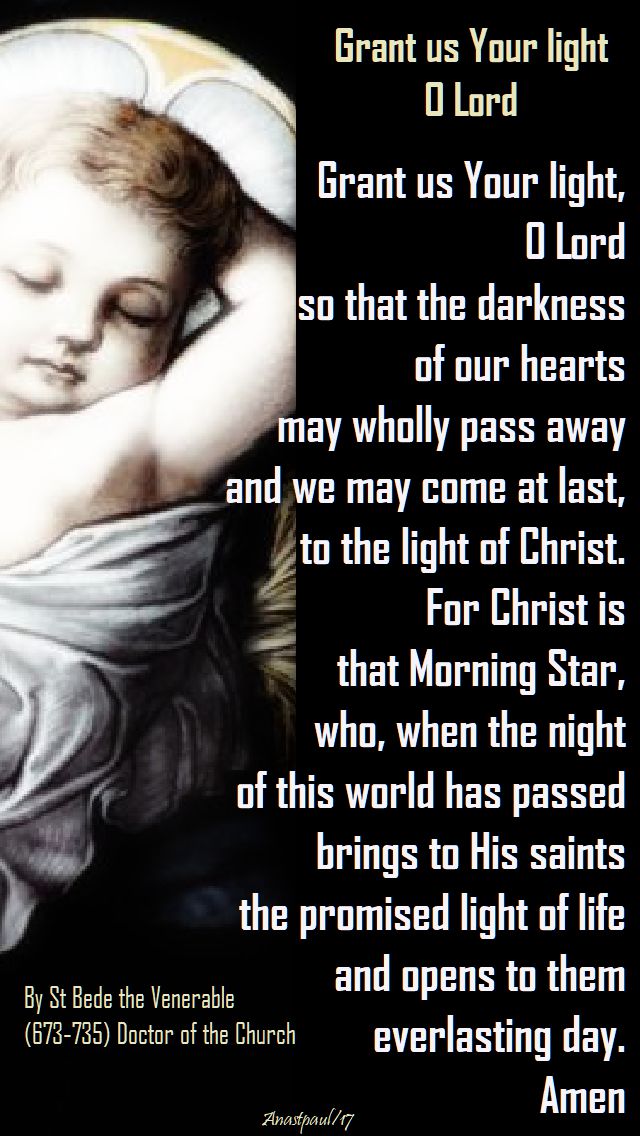
Grant us Your light O Lord
By St Bede the Venerable (673-735) Doctor of the Church

Grant us Your light O Lord
so that the darkness of our hearts
may wholly pass away
and we may come at last,
to the light of Christ.
For Christ is that Morning Star,
who, when the night
of this world has passed
brings to His saints
the promised light of life
and opens to them everlasting day.
Amen

grant us your light o lord - st bede - 15 dec 2017

Posted in ADVENT, CARMELITES, DOCTORS of the Church, MORNING Prayers, POETRY, PRAYERS of the SAINTS, SAINT of the DAY

‘Song of the soul that is glad to know God by faith’

‘Song of the soul that is glad to know God by faith’

14 December – The Memorial of St John of the Cross (1542-1591) Doctor of the Church

There have been a number of translations into English of the works of St John of the Cross.   One of the translations which has been considered one of the best is that by the Anglo-South African convert poet Roy Campbell (2 October 1901 – 22 April 1957).

In October 2009, Roger Scruton wrote about Roy Campbell in his article “A Dark Horse” published in The American Spectator. He was hated by the English “left establishment” especially because of his position on The Spanish Civil War.

The Wikipedia entry says of Roy Campbell that he “was considered by T. S. Eliot, Edith Sitwell and Dylan Thomas to have been one of the best poets of the period between the First and Second World wars but he is seldom found in anthologies today.”

Campbell’s translations of the poetry by St John of the Cross were lavishly praised by Argentine writer Jorge Luis Borges

For more about Campbell`s work, R J Dent has published an essay on Roy Campbell and his work entitled: Violence and exquisite beauty – the aesthetics of Roy Campbell.

Here is a poem of St John of the Cross with the translations by the late Roy Campbell.

‘Song of the soul that is glad to know God by faith’

How well I know that fountain’s rushing flow
Although by night

Its deathless spring is hidden. Even so
Full well I guess from whence its source flow
Though it be night.

Its origin (since it has none) none knows:
But that all origin from it arose
Although by night.

I know there is no other thing so fair
And earth and heaven drink refreshment there
Although by night.

Full well I know the depth no man can sound
And that no ford to cross it can be found
Though it be night

Its clarity unclouded still shall be:
Out of it comes the light by which we see
Though it be night.

Flush with its banks the stream so proudly swells;
I know it waters nations, heavens, and hells
Though it be night.

The current that is nourished by this source
I know to be omnipotent in force
Although by night.song of the soul that is glad to know god by faith - st j of the cross - 14 dec 2017

After the beatification of St John of the Cross on 25 January 1675, the Carmelite convent of Nuestra Señora de los Remedios near Seville commissioned this life-sized statue from the young Sevillian sculptor, Francisco Antonio Gijón, then only 21.
The figure of the saint holds a quill pen in his right hand and, in the left, a book with a model of a mountain surmounted by a cross, which refers to his mystic commentary, “The Ascent of Mount Carmel.”

Francisco Antonio Gijón (1653–c. 1721) and unknown painter (possibly Domingo Mejías)
Saint John of the Cross
c 1675
Painted and gilded wood
168 cm (66 1/8 in.)


Posted in ADVENT, CATHOLIC-PRAYERS OF THE CHURCH, HYMNS, MORNING Prayers, POETRY, PRAYERS of the CHURCH, The CHRIST CHILD

Our Morning Offering – 11 December – Monday of the Second Week of Adve

Our Morning Offering – 11 December – Monday of the Second Week of Advent

Come, Sun and Saviour
8th Century Catholic Advent Prayer/Hymn

Come, Sun and Saviour,
to embrace Our gloomy world,
its weary race,
As groom to bride, as bride to groom:
The wedding chamber, Mary’s womb.
At your great Name, O Jesus, now
All knees must bend, all hearts must bow;
All things on earth with one accord,
Like those in heaven, shall call you Lord.
Come in Your holy might, we pray,
Redeem us for eternal day;
Defend us while we dwell below,
From all assaults of our dread foe.come sun and saviour - 8th cent advent hymn - 11 dec 2017

Posted in ADVENT, BREVIARY Prayers, CATHOLIC-PRAYERS OF THE CHURCH, CHRISTMASTIDE!, DOCTORS of the Church, HYMNS, MARIAN PRAYERS, MARIAN TITLES, MORNING Prayers, POETRY, PRAYERS of the CHURCH, QUOTES - J R R Tolkien and MORE, SAINT of the DAY, The BLESSED VIRGIN MARY

Our Morning Offering – 10 December – The Second Sunday of Advent and the Memorial of Our Lady and the Holy House of Loreto

Our Morning Offering – 10 December – The Second Sunday of Advent and the Memorial of Our Lady and the Holy House of Loreto

Maiden yet a Mother
By Dante Alighieri (1265-1321)
Tr Msgr Ronald A Knox (1888-1957)

Maiden yet a mother,
daughter of thy Son,
high beyond all other,
lowlier is none;
thou the consummation
planned by God’s decree,
when our lost creation
nobler rose in thee!

Thus His place prepared,
he who all things made
‘mid his creatures tarried,
in thy bosom laid;
there His love He nourished,
warmth that gave increase
to the root whence flourished
our eternal peace.

Nor alone thou hearest
When thy name we hail;
Often thou art nearest
When our voices fail;
Mirrored in thy fashion
All creation’s gird,
Mercy, might compassion
Grace thy womanhood.

Lady, let our vision
Striving heavenward, fail,
Still let thy petition
With thy Son prevail,
Unto whom all merit,
prayer and majesty,
With the Holy Spirit
And the Father be.

Maiden Yet A Mother is a translation of a poem by Durante (Dante) degli Alighieri (c 1265–1321).    It is based upon the opening verses of Canto 33 of the Paradiso from his Divine Comedy in which St Bernard of Clairvaux (1090–1153) praises and prays to the Virgin Mother on behalf of Dante.   It was translated from the original Italian into English by the Catholic convert, Monsignior Ronald A Knox (1888-1957).maiden yet a mother - dante - 10 dec 2017

Posted in DOCTORS of the Church, HYMNS, POETRY, PRAYERS of the SAINTS

Our Morning Offering – 12 November

Our Morning Offering – 12 November

Jesus, Joy of Loving Hearts
St Bernard of Clairvaux (1090-1153) Doctor of the Church

Jesus, Joy of loving hearts,
You Fount of life, You Light of men,
from the best bliss that earth imparts,
we turn unfilled to You again.
We taste You, O You living Bread,
and long to feast upon You still;
we drink of You, the Fountain-head,
and thirst our souls from You to fill.
O Jesus, ever with us stay;
make all our moments calm and bright!
chase the dark night of sin away,
shed o’er the world Your holy light.jesus, joy of loving hearts - 12 nov 2017

Posted in JESUIT SJ, POETRY

THE HOUND OF HEAVEN – By Francis Thompson, (1859-1907)

“The Hound of Heaven” is a 182-line poem written by English Catholic poet Francis Thompson (1859–1907).   The poem became famous and was the source of much of Thompson’s posthumous reputation.   The poem was first published in Thompson’s first volume of poems in 1893.   It was included in the Oxford Book of English Mystical Verse (1917).   Thompson’s work was praised by G K Chesterton and it was also an influence on J R R Tolkien, who presented a paper on Thompson in 1914.

This Christian poem has been described as follows:

“The name is strange.   It startles one at first.   It is so bold, so new, so fearless.   It does not attract, rather the reverse.   But when one reads the poem this strangeness disappears.   The meaning is understood.   As the hound follows the hare, never ceasing in its running, ever drawing nearer in the chase, with unhurrying and imperturbed pace, so does God follow the fleeing soul by His Divine grace.   And though in sin or in human love, away from God it seeks to hide itself, Divine grace follows after, unwearyingly follows ever after, till the soul feels its pressure forcing it to turn to Him alone in that never ending pursuit.”    Fr JFX. O’Conor, S.Jthe hound of heaven - francis thompson - 23 oct 2017
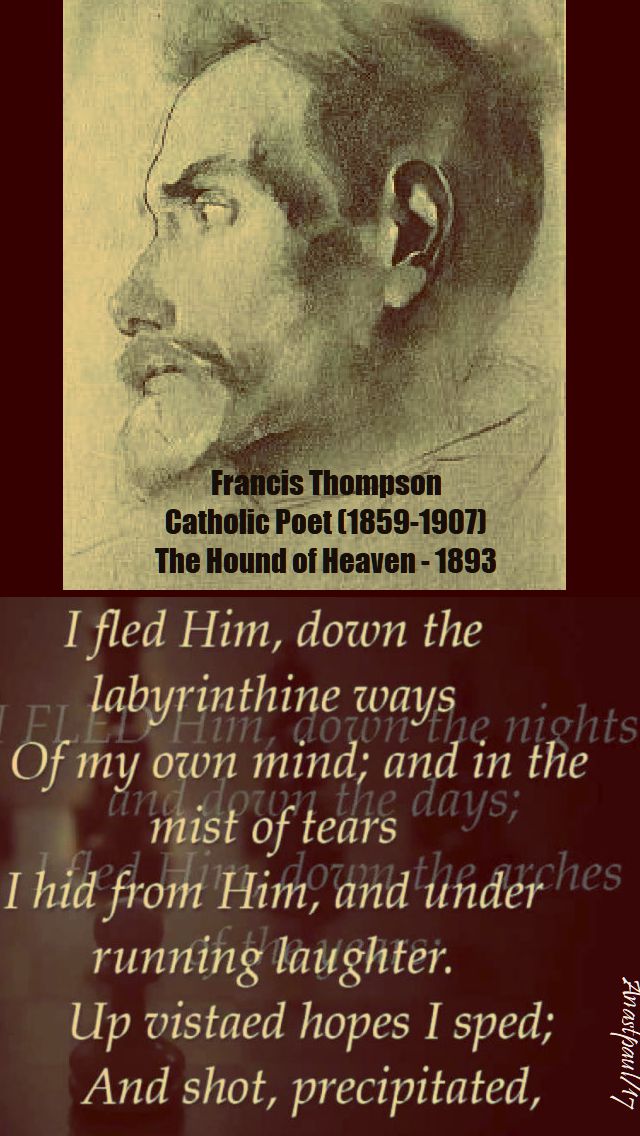
THE HOUND OF HEAVEN (1893)  – By Francis Thompson (16 December 1859 – 13 November 1907)

https://youtu.be/gToj6SLWz8Q (Richard Burton – a beautiful version)

I fled Him, down the nights and down the days;
I fled Him, down the arches of the years;
I fled Him, down the labyrinthine ways
Of my own mind; and in the midst of tears
I hid from Him, and under running laughter.
Up vistaed hopes I sped;
And shot, precipitated,
Adown Titanic glooms of chasmed fears,
From those strong Feet that followed, followed after.
But with unhurrying chase,
And unperturbèd pace,
Deliberate speed, majestic instancy,
They beat—and a Voice beat
More instant than the Feet—
‘All things betray thee, who betrayest Me’.

I pleaded, outlaw-wise,
By many a hearted casement, curtained red,
Trellised with intertwining charities;
(For, though I knew His love Who followed,
Yet was I sore a dread
Lest, having Him, I must have naught beside.)
But, if one little casement parted wide,
The gust of His approach would clash it to:
Fear wist not to evade, as Love wist to pursue.
Across the margent of the world I fled,
And troubled the gold gateway of the stars,
Smiting for shelter on their clanged bars;
Fretted to dulcet jars
And silvern chatter the pale ports o’ the moon.
I said to Dawn: Be sudden—to Eve: Be soon;
With thy young skiey blossom heap me over
From this tremendous Lover—
Float thy vague veil about me, lest He see!
I tempted all His servitors, but to find
My own betrayal in their constancy,
In faith to Him their fickleness to me,
Their traitorous trueness, and their loyal deceit.
To all swift things for swiftness did I sue;
Clung to the whistling mane of every wind.
But whether they swept, smoothly fleet,
The long savannahs of the blue;
Or, whether, Thunder-driven,
They clanged his chariot ‘thwart a heaven,
Plashy with flying lightnings round the spurn o’ their feet:—
Fear wist not to evade as Love wist to pursue.
Still with unhurrying chase,
And unperturbed pace,
Deliberate speed, majestic instancy,
Came on the following Feet,
And a Voice above their beat—
‘Naught shelters thee, who wilt not shelter Me.’

I sought no more after that which I strayed
In face of man or maid;
But still within the little children’s eyes
Seems something, something that replies,
They at least are for me, surely for me!
I turned me to them very wistfully;
But just as their young eyes grew sudden fair
With dawning answers there,
Their angel plucked them from me by the hair.
Come then, ye other children, Nature’s—share
With me’ (said I) ‘your delicate fellowship;
Let me greet you lip to lip,
Let me twine with you caresses,
Wantoning
With our Lady-Mother’s vagrant tresses,
Banqueting
With her in her wind-walled palace,
Underneath her azured dais,
Quaffing, as your taintless way is,
From a chalice
Lucent-weeping out of the dayspring.’
So it was done:
I in their delicate fellowship was one—
Drew the bolt of Nature’s secrecies.
          I knew all the swift importings
On the wilful face of skies;
I knew how the clouds arise
Spumèd of the wild sea-snortings;
All that’s born or dies
Rose and drooped with; made them shapers
Of mine own moods, or wailful divine;
With them joyed and was bereaven.
I was heavy with the even,
When she lit her glimmering tapers
Round the day’s dead sanctities.
I laughed in the morning’s eyes.
I triumphed and I saddened with all weather,
Heaven and I wept together,
And its sweet tears were salt with mortal mine:
Against the red throb of its sunset-heart
I laid my own to beat, And share commingling heat;
But not by that, by that, was eased my human smart.
In vain my tears were wet on Heaven’s grey cheek.
For ah! we know not what each other says,
These things and I; in sound I speak—
Their sound is but their stir, they speak by silences.
Nature, poor stepdame, cannot slake my drouth;
Let her, if she would owe me,
Drop yon blue bosom-veil of sky, and show me
The breasts o’ her tenderness:
Never did any milk of hers once bless
My thirsting mouth.
Nigh and nigh draws the chase,
With unperturbed pace,
Deliberate speed, majestic instancy;
And past those noisèd Feet
A voice comes yet more fleet—
‘Lo! naught contents thee, who content’st not Me.’

Naked I wait Thy love’s uplifted stroke!
My harness piece by piece Thou has hewn from me,
And smitten me to my knee;
I am defenceless utterly.
I slept, methinks, and woke,
And, slowly gazing, find me stripped in sleep.
In the rash lustihead of my young powers,
I shook the pillaring hours
And pulled my life upon me; grimed with smears,
I stand amidst the dust o’ the mounded years—
My mangled youth lies dead beneath the heap.
My days have crackled and gone up in smoke,
Have puffed and burst as sun-starts on a stream.
Yea, faileth now even dream
The dreamer, and the lute the lutanist;
Even the linked fantasies, in whose blossomy twist
I swung the earth a trinket at my wrist,
Are yielding; cords of all too weak account
For earth with heavy griefs so overplussed.
Ah! is Thy love indeed
A weed, albeit an amarinthine weed,
Suffering no flowers except its own to mount?
Ah! must—
Designer infinite!—
Ah! must Thou char the wood ere Thou canst limn with it?
My freshness spent its wavering shower i’ the dust;
And now my heart is as a broken fount,
Wherein tear-drippings stagnate, spilt down ever
From the dank thoughts that shiver
Upon the sighful branches of my mind.
Such is; what is to be?
The pulp so bitter, how shall taste the rind?
I dimly guess what Time in mists confounds;
Yet ever and anon a trumpet sounds
From the hid battlements of Eternity;
Those shaken mists a space unsettle, then
Round the half-glimpsed turrets slowly wash again.
But not ere him who summoneth
I first have seen, unwound
With glooming robes purpureal, cypress-crowned;
His name I know and what his trumpet saith.
Whether man’s heart or life it be which yields
Thee harvest, must Thy harvest-fields
Be dunged with rotten death?

Now of that long pursuit
Comes on at hand the bruit;
That Voice is round me like a bursting sea:
‘And is thy earth so marred,
Shattered in shard on shard?
Lo, all things fly thee, for thou fliest Me!

‘Strange, piteous, futile thing!
Wherefore should any set thee love apart?
Seeing none but I makes much of naught’ (He said),
‘And human love needs human meriting:
How hast thou merited—
Of all man’s clotted clay the dingiest clot?
Alack, thou knowest not
How little worthy of any love thou art!
Whom wilt thou find to love ignoble thee,
Save Me, save only Me?
All which I took from thee I did but take,
Not for thy harms,
But just that thou might’st seek it in My arms.
All which thy child’s mistake
Fancies as lost, I have stored for thee at home:
Rise, clasp My hand, and come!’

Halts by me that footfall:
Is my gloom, after all,
Shade of His hand, outstretched caressingly?
‘Ah, fondest, blindest, weakest,
I am He Whom thou seekest!
Thou dravest love from thee, who dravest Me.’
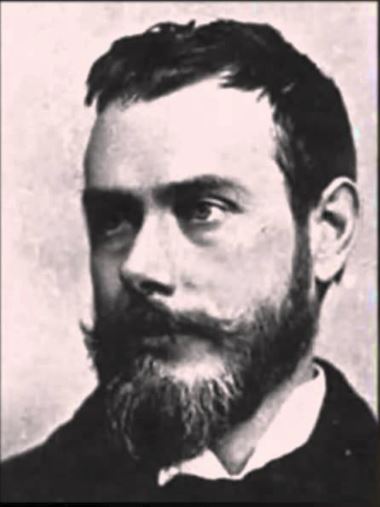

FRANCIS THOMPSON - MY SNIP

Posted in ArchAngels and Angels, BREVIARY Prayers, CATHOLIC-PRAYERS OF THE CHURCH, HYMNS, MORNING Prayers, POETRY, SAINT of the DAY

Morning Hymn/Prayer from the Divine Office – 2 October – The Memorial of the Holy Guardian Angels

Morning Hymn/Prayer from the Divine Office – 2 October – The Memorial of the Holy Guardian Angels

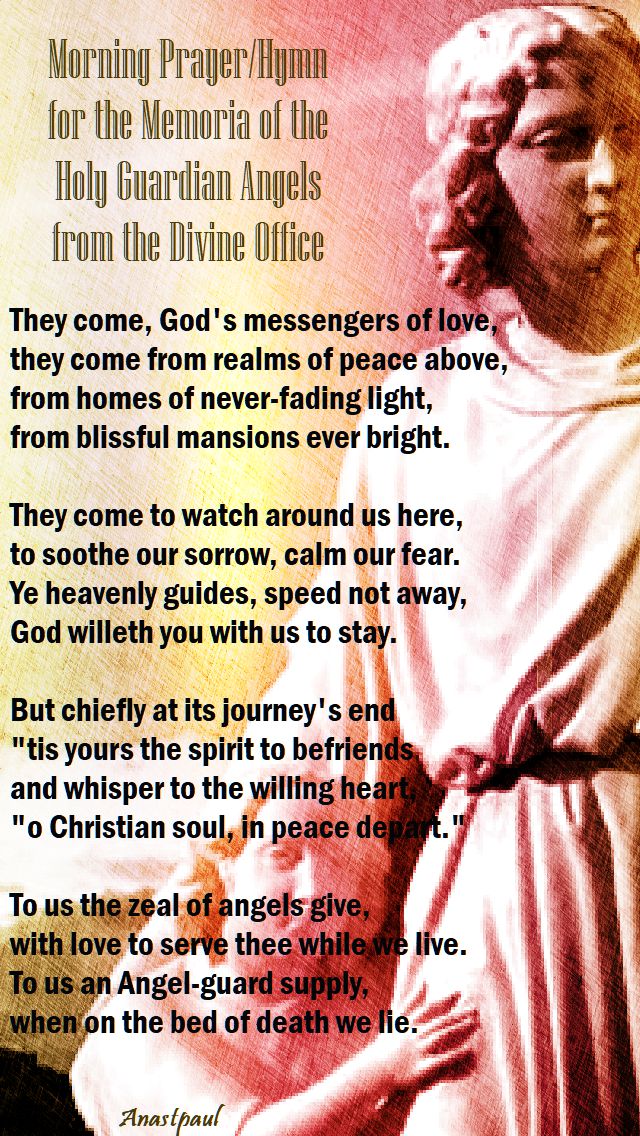
They come, God’s messengers of love,
they come from realms of peace above,
from homes of never-fading light,
from blissful mansions ever bright.

They come to watch around us here,
to soothe our sorrow, calm our fear.
Ye heavenly guides, speed not away,
God willeth you with us to stay.

But chiefly at its journey’s end
“tis yours the spirit to befriends
and whisper to the willing heart,
“o Christian soul, in peace depart.”

To us the zeal of angels give,
with love to serve thee while we live.
To us an Angel-guard supply,
when on the bed of death we lie.

breviary morning prayer - guardian angels 2 oct

Posted in DOCTORS of the Church, MORNING Prayers, POETRY, QUOTES of the SAINTS, SAINT of the DAY, The BLESSED VIRGIN MARY

Thought for the Day – 22 August – The Queenship of Mary

Thought for the Day – 22 August – The Queenship of Mary

As St. Paul suggests in Romans 8:28–30, God has predestined human beings from all eternity to share the image of his Son.   All the more was Mary predestined to be the mother of Jesus. As Jesus was to be king of all creation, Mary, in dependence on Jesus, was to be queen.   All other titles to queenship derive from this eternal intention of God. As Jesus exercised his kingship on earth by serving his Father and his fellow human beings, so did Mary exercise her queenship.   As the glorified Jesus remains with us as our king till the end of time (Matthew 28:20), so does Mary, who was assumed into heaven and crowned queen of heaven and earth.
In the fourth century St Ephrem called Mary “Lady” and “Queen.”   Later Church fathers and doctors continued to use the title.   Hymns of the 11th to 13th centuries address Mary as queen: “Hail, Holy Queen,” “Hail, Queen of Heaven,” “Queen of Heaven.”   The Dominican rosary and the Franciscan crown as well as numerous invocations in Mary’s litany celebrate her queenship.
The feast is a logical follow-up to the Assumption and is now celebrated on the octave day of that feast.   In his 1954 encyclical To the Queen of Heaven, Pius XII points out that Mary deserves the title because she is Mother of God because she is closely associated as the New Eve with Jesus’ redemptive work because of her preeminent perfection and because of her intercessory power. (Fr Don Miller OFM)
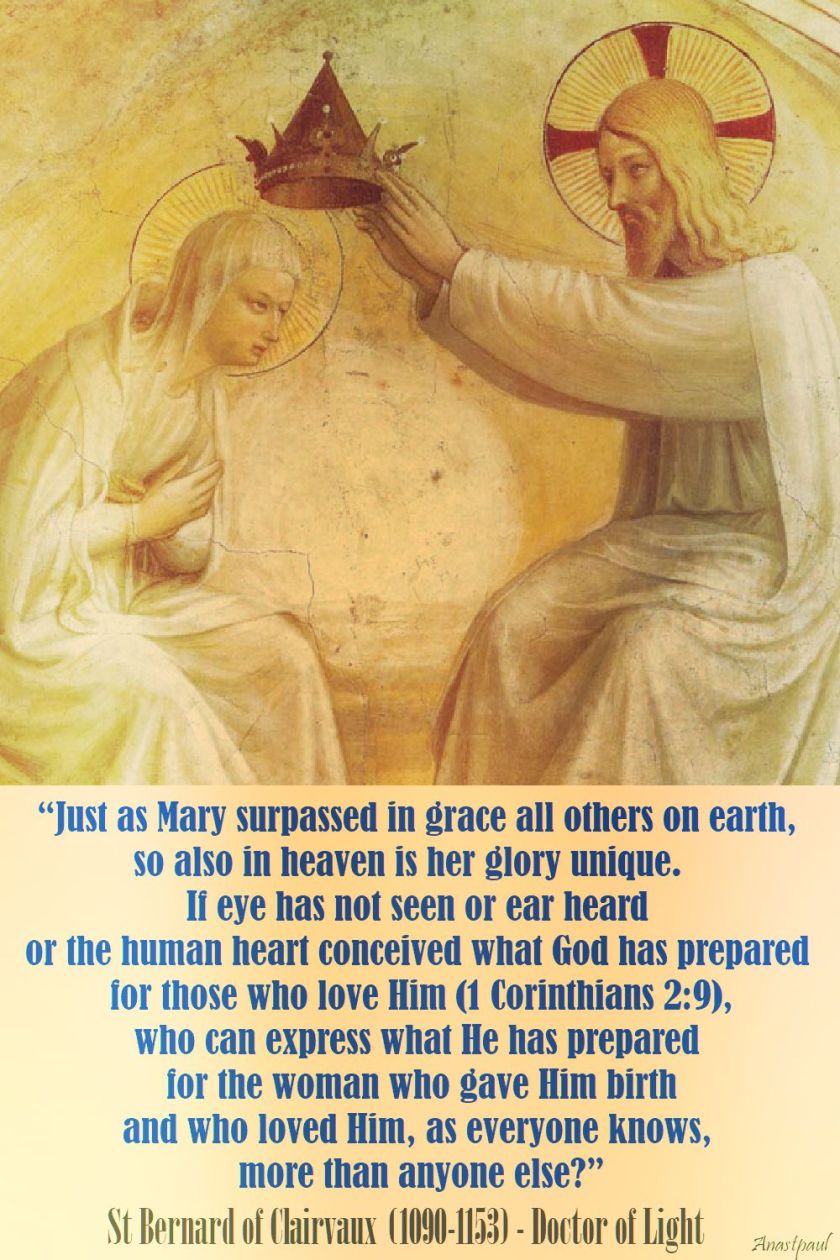
“Just as Mary surpassed in grace all others on earth, so also in heaven is her glory unique.   If eye has not seen or ear heard or the human heart conceived what God has prepared for those who love Him (1 Corinthians 2:9), who can express what He has prepared for the woman who gave Him birth and who loved Him, as everyone knows, more than anyone else?” (St Bernard of Clairvaux (1090-1153) – Doctor of Light – Mellifluous Doctor)

just as mary surpassed in grace - st bernard
Mary Queen of Heaven and Earth Pray for your children!

mary our queen our mother pray for us

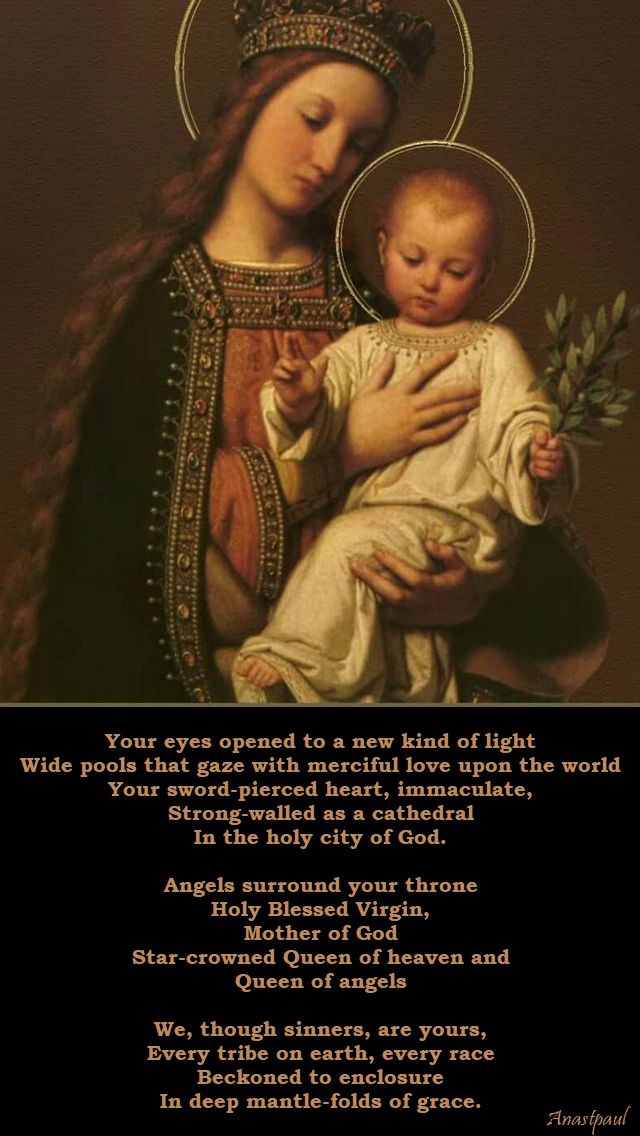
Your eyes opened to a new kind of light
Wide pools that gaze with merciful love upon the world
Your sword-pierced heart, immaculate,
Strong-walled as a cathedral
In the holy city of God.

Angels surround your throne
Holy Blessed Virgin,
Mother of God
Star-crowned Queen of heaven and
Queen of angels

We, though sinners, are yours,
Every tribe on earth, every race
Beckoned to enclosure
In deep mantle-folds of grace.

your eyes opened to a new kind of light - queenship of mary - poem

Posted in CARMELITES, MORNING Prayers, POETRY, QUOTES of the SAINTS, SAINT of the DAY

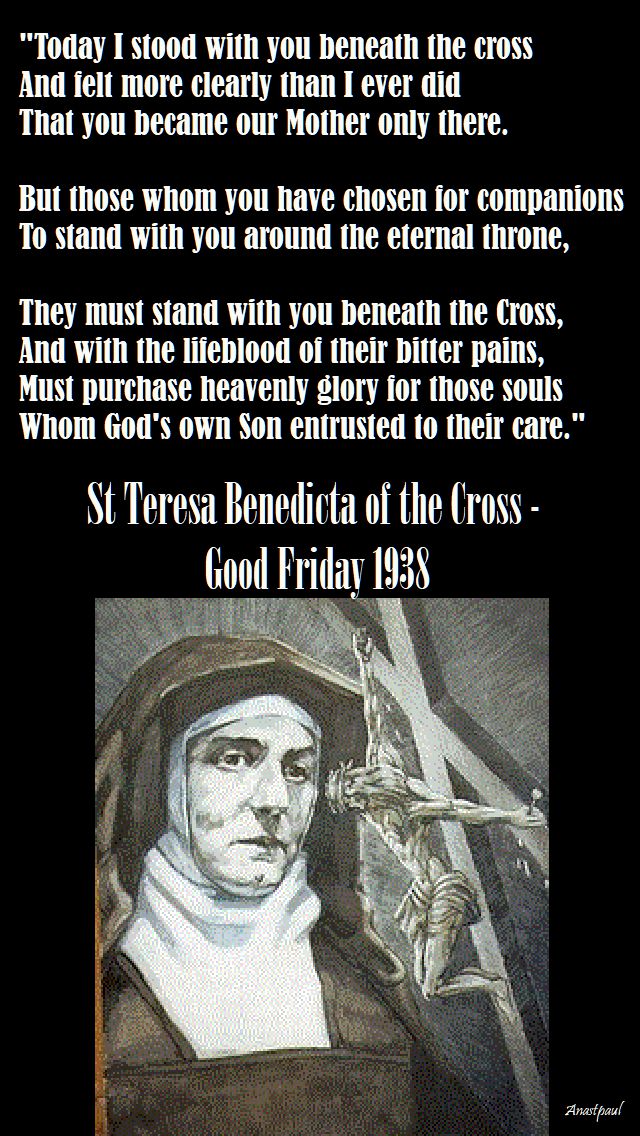
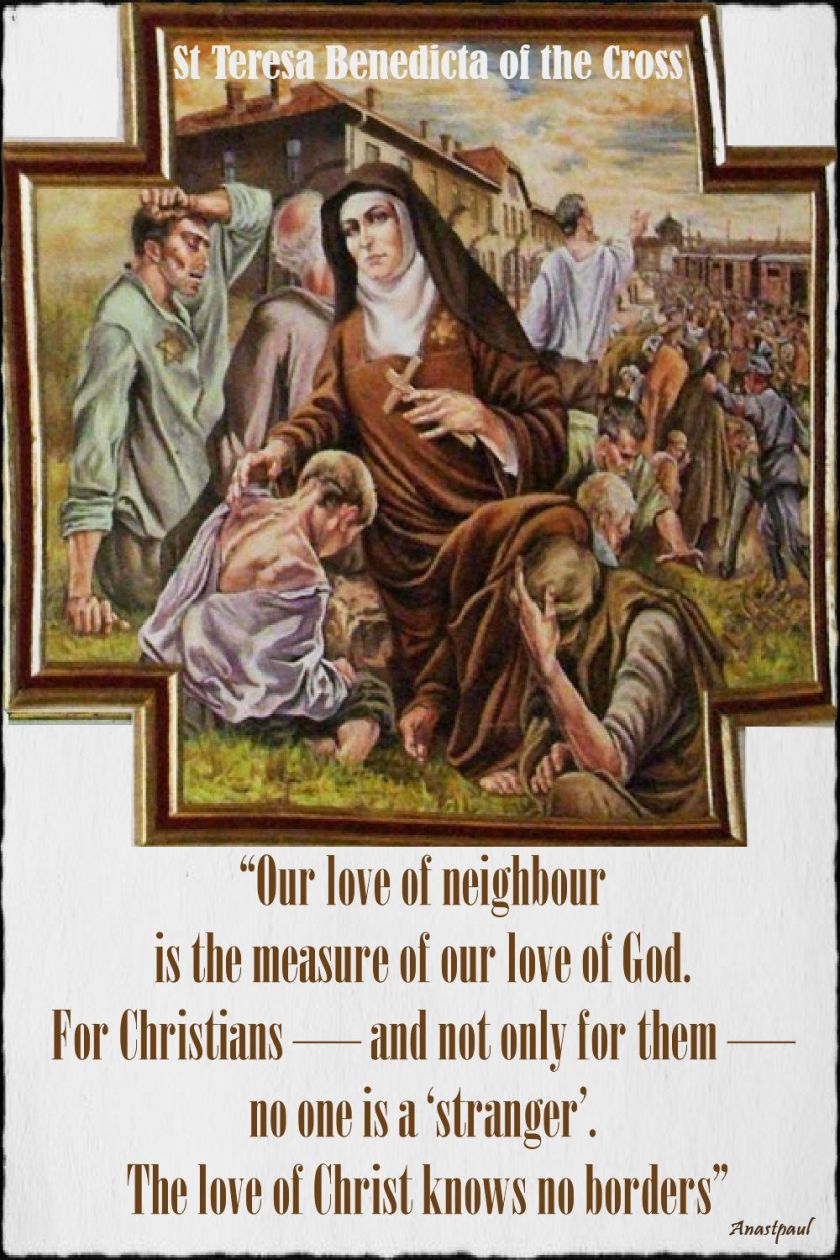
Quote/s of the Day – 9 August – The Memorial of St Teresa Benedicta of the Cross

Quote/s of the Day – 9 August – The Memorial of St Teresa Benedicta of the Cross

“Today I stood with you beneath the cross
And felt more clearly than I ever did
That you became our Mother only there.

But those whom you have chosen for companions
To stand with you around the eternal throne,

They must stand with you beneath the Cross,
And with the lifeblood of their bitter pains,
Must purchase heavenly glory for those souls
Whom God’s own Son entrusted to their care.”

St Teresa Benedicta of the Cross – Good Friday 1938

today i stood with you beneath the cross - st teresa benedicta

“Our love of neighbour is the measure of our love of God.
For Christians — and not only for them —
no one is a ‘stranger’.
The love of Christ knows no borders”

St Teresa Benedicta of the Cross

our love of neighbour is the measure of our love of god - st teresa benedicta

Posted in JESUIT SJ, MORNING Prayers, POETRY, SAINT of the DAY

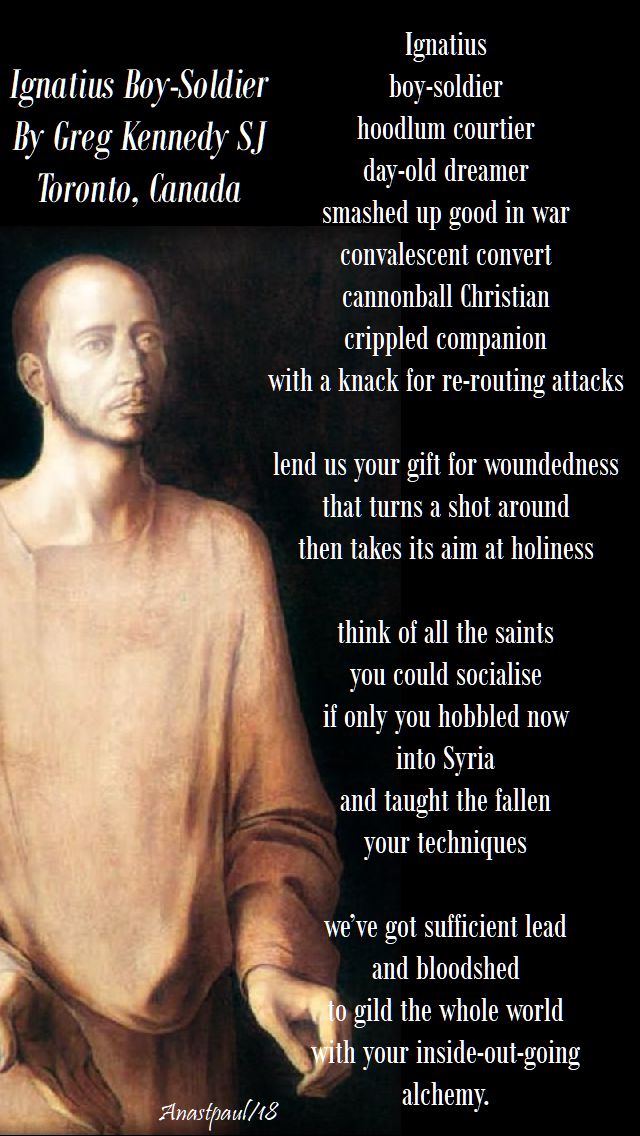
ON THE FEAST OF ST IGNATIUS LOYOLA

Here is a delightful poem for your prayerful contemplation as you remember and celebrate the life of Iñigo López de Loyola.

beautiful iggy!ST IGNATIUS - BEST PIC EVER - MY SNIP

Ignatius
boy-soldier
hoodlum courtier
day-old dreamer
smashed up good in war
convalescent convert
cannonball Christian
crippled companion
with a knack for re-routing attacks

lend us your gift for woundedness
that turns a shot around
then takes its aim at holiness

think of all the saints
you could socialise
if only you hobbled now into Syria
and taught the fallen your techniques

we’ve got sufficient lead and bloodshed
to gild the whole world
with your inside-out-going
alchemy.

Greg Kennedy, SJ, is a Jesuit scholastic, in his third year of Theological Studies at Regis College, Toronto. 

Image | Ignatius at Manresa by Montserrat Gudiol (1991). The painting is at Manresa.ignatius boy soldier posted 31 july 2018


Posted in MORNING Prayers, POETRY, QUOTES of the SAINTS, SAINT of the DAY

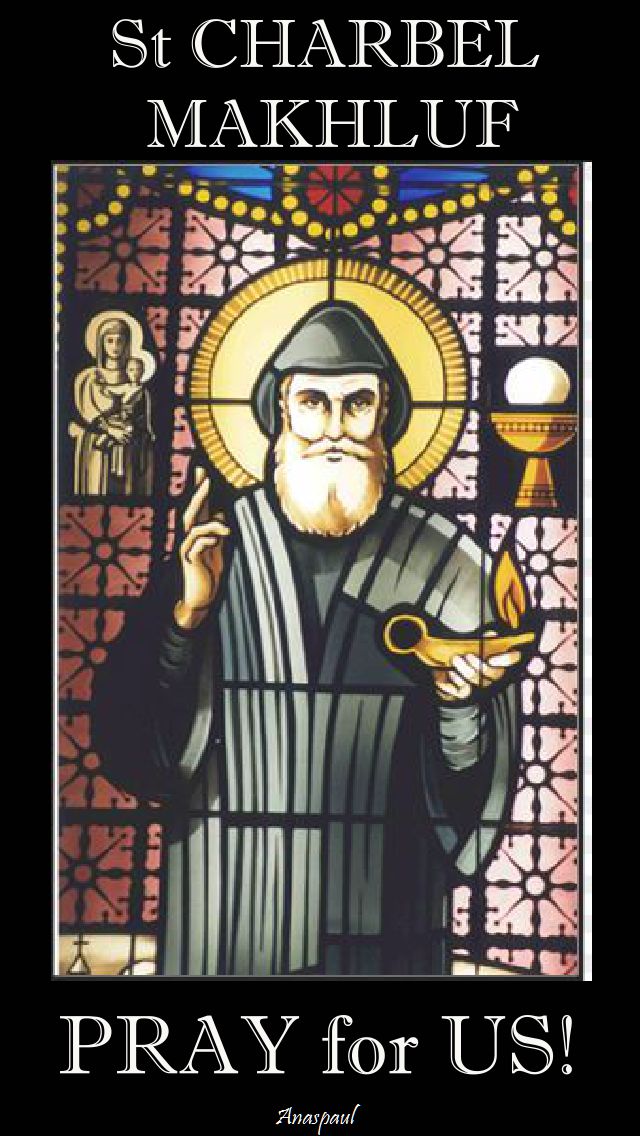
Thought for the Day – 24 July – The Memorial of St Charbel of Makhluf

Thought for the Day – 24 July – The Memorial of St Charbel of Makhluf

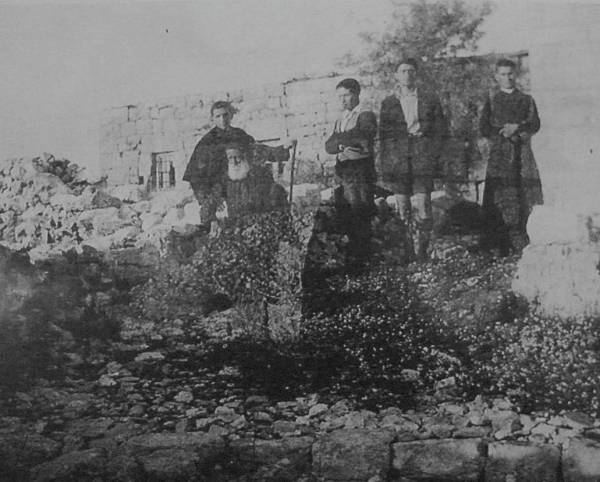
In 1950, Father George Webby, a Maronite priest from Scranton, visited Lebanon, took a photo of monks outside the wall of the monastery in which St. Charbel had lived and upon development of the picture saw that St. Charbel miraculously appeared with the monks, according to information provided by St. Anthony’s Church.

StShar02

Art work for holy pictures of this saint is now taken from this photo.   Can you see him? (Hint: smack dab in the middle) click on the picture and then zoom in….

St. Charbel is listed among The Incorruptibles, saints whose bodies were found intact years after burial. His body kept pouring oil and blood until the year before his canonization in 1977.

“…a hermit of the Lebanese mountain is inscribed in the number of the blessed, a new eminent member of monastic sanctity is enriching, by his example and his intercession, the entire Christian people.   May he make us understand, in a world largely fascinated by wealth and comfort, the paramount value of poverty, penance and asceticism, to liberate the soul in its ascent to God…” ……….Pope Paul VI, October 9, 1977

St Charbel Makhluf, Pray for us!

st charbel - pray for us.2.

Watch – “The Saint Charble Song” …it’s special…

https://www.youtube.com/watch?v=uaSKjhK1yxA#action=share

A beautiful ode to Saint Charbel, written by J. Michael Thompson- (a Catholic Composer, professor of ecclesiastical chant):

The mountain heights of Lebanon
Resound with songs of joy;
The cedars of that ancient land
Stand tall as we employ
Our hymns of praise and thankfulness
For Sharbel’s saintly ways,
Lived out in strict humility
That guided all his days.

True monk and hermit of the hills,
Saint Maron’s modest son
Scorned wealth and comfort in his life
That heaven’s crown be won.
Of Mary, heaven’s Queen and Gate,
Devoted son was he,
Who cherished all the ancient rites
With great humility.

Fierce lover of the lowly life,
True father of the poor,
As you have done, so help us all
To struggle and endure,
That Christ be praised in ev’ry life,
That riches not ensnare
Or rule us in our daily walk;
That strong may be our prayer!

O Father, Son, and Spirit blest,
One God in persons three,
Receive this hymn we offer now,
And keep your Church e’er free
To follow, as Saint Sharbel did,
Enflamed with love so bright
That we, with eyes fixed firm on Christ,
May vanquish sin’s dark night.

Posted in CARMELITES, CATHOLIC DEVOTIONS of the Month, CATHOLIC-PRAYERS OF THE CHURCH, HYMNS, MORNING Prayers, POETRY, QUOTES of the SAINTS, SAINT of the DAY

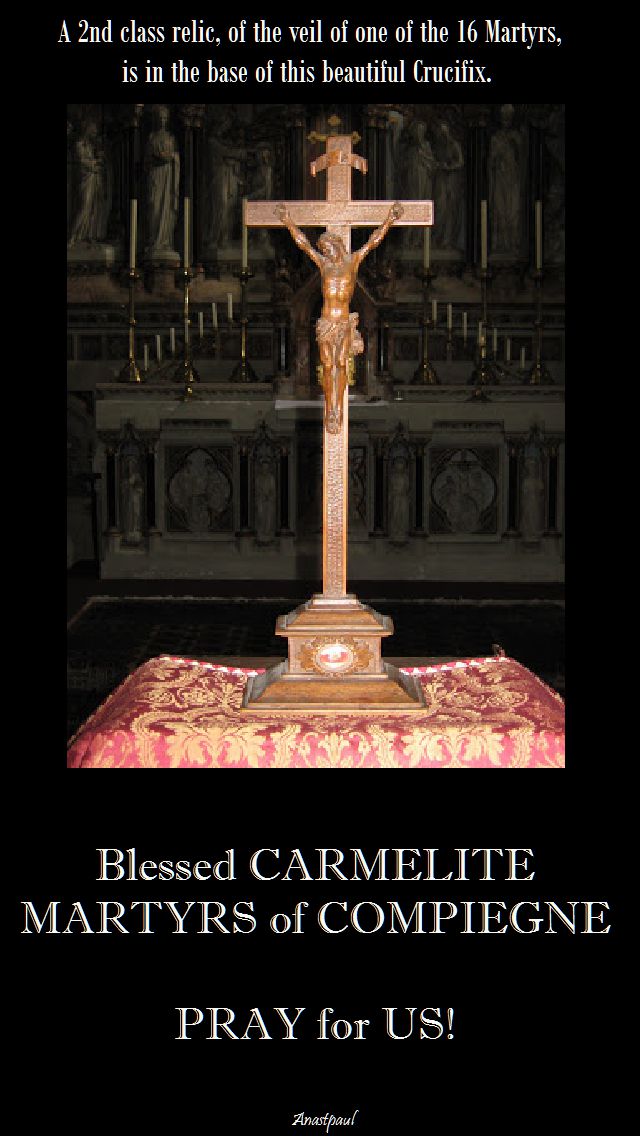
Thought for the day – 17 July – THE SIXTEEN CARMELITE MARTYRS OF COMPIEGNE

Thought for the day – THE SIXTEEN CARMELITE MARTYRS OF  COMPIEGNE

The French Revolution reveals the titanic struggle between good and evil.   During the terror, over 40,000 Frenchmen were executed just for holding fast to the Catholic Faith and objecting to the worst excesses of the Committee of Public Safety.   The blood lost in the years of 1792-1794 staggers the imagination even in the retelling and the campaign against the Church was as diabolical as it was cruel.

Contemplative religious communities had been among the first targets of the fury of the French Revolution against the Catholic Church.   Less than a year from May 1789 when the Revolution began with the meeting of the Estates-General, these communities had been required by law to disband.   But many of them continued in being, in hiding. Among these were the community of the Carmelite nuns of Compiegne, in northeastern France not far from Paris – the fifty-third convent in France of the Carmelite sisters who followed the reform of  St. Teresa of Avila, founded in 1641, noted throughout its history for fidelity and fervour.   Their convent was raided in August 1790, all the property of the sisters was seized by the government and they were forced to discard their habits and leave their house.   They divided into four groups which found lodging in four different houses all near the same church in Compiegne and for several years they were to a large extent able to continue their religious life in secret.   But the intensified surveillance and searches of the “Great Terror” revealed their secret and in June 1794 most of them were arrested and imprisoned.

They had expected this; indeed, they had prayed for it.   At some time during the summer of 1792, very likely just after the events of August 10 of that year that marked the descent into the true deeps of the Revolution, their prioress, Madeleine Lidoine, whose name in religion was Teresa in honour of the founder of their order, by all accounts a charming  perceptive and highly intelligent woman, had foreseen much of what was to come.   At Easter of 1792, she told her community that, while looking through the archives she had found the account of a dream a Carmelite had in 1693.   In that dream, the Sister saw the whole Community, with the exception of 2 or 3 Sisters, in glory and called to follow the Lamb. In the mind of the Prioress, this mean martyrdom and might well be a prophetic announcement of their fate.

Mother Teresa had said to her sisters: “Having meditated much on this subject, I have thought of making an act of consecration by which the Community would offer itself as a sacrifice to appease the anger of God, so that the divine peace of His Dear Son would be brought into the world, returned to the Church and the state.”   The sisters discussed her proposal and all agreed to it but the two oldest, who were hesitant.   But when the news of the September massacres came, mingling glorious martyrdom with apostasy, these two sisters made their choice, joining their commitment to that of the rest of the community.   All made their offering; it was to be accepted.

After their lodgings were invaded again in June, their devotional objects shattered and their tabernacle trampled underfoot by a Revolutionary who told them that their place of worship should be transformed into a dog kennel, the Carmelite sisters were taken to the Conciergerie prison, where so many of the leading victims of the guillotine had been held during their last days on earth.   There they composed a canticle for their martyrdom, to be sung to the familiar tune of the Marseillaise.   The original still exists, written in pencil and given to one of their fellow prisoners, a lay woman who survived.

On July 17 the sixteen sisters were brought before Fouquier-Tinville.   All cases were now being disposed of within twenty-four hours as Robespierre had wished;  theirs was no exception.   They were charged with having received arms for the émigrés; their prioress, Sister Teresa, answered by holding up a crucifix. “Here are the only arms that we have ever had in our house.”   They were charged with possessing an altar-cloth with designs honouring the old monarchy (perhaps the fleur-de-lis) and were asked  to deny any attachment to the royal family.   Sister Teresa responded: “If that is a crime, we are all guilty of it; you can never tear out of our hearts the attachment for Louis XVI and his family. Your laws cannot prohibit feeling; they cannot extend their empire to the affections of the soul; God alone has the right to judge them.”   They were charged with corresponding with priests forced to leave the country because they would not take the constitutional oath; they freely admitted this.   Finally they were charged with the catch–all indictment by which any serious Catholic in France could be guillotined during the Terror: “fanaticism.”   Sister Henriette, who had been Gabrielle de Croissy, challenged Fouguier-Tinvile to his face:  “Citizen, it is your duty to respond to the request of one condemned;  I call upon you to answer us and to tell us just what you mean by the word ‘fanatic.”   “I mean,” snapped the Public Prosecutor of the Terror, “your attachment to your childish beliefs and your silly religious practices.”   “Let us rejoice, my dear Mother and Sisters, in the joy of the Lord,” said Sister Henriette, “that we shall die for our holy religion, our faith, our confidence in the Holy Roman Catholic Church.”

Give over our hearts to joy, the day of glory has arrived.
Far from us all weakness, seeing the standard come;
We prepare for the victory, we all march to the true conquest,
Under the flag of the dying God we run, we all seek the glory;
Rekindle our ardour, our bodies are the Lord’s,
We climb, we climb the scaffold and give ourselves back to the Victor.

O happiness ever desired for Catholics of France,
To follow the wondrous road
Already marked out so often by the martyrs toward their suffering,
After Jesus with the King, we show our faith to Christians,
We adore a God of justice; as the fervent priest, the constant faithful,
Seal, seal with all their blood faith in the dying God….

Holy Virgin, our model, August queen of martyrs, deign to strengthen our zeal
And purify our desires, protect France even yet, help; us mount to Heaven,
make us feel even in these places, the effects of your power. Sustain your children,
Submissive, obedient, dying, dying with Jesus and in our King believing.

While in prison, they asked and were granted permission to wash their clothes.   As they had only one set of lay clothes, they put on their religious habit and set to the task. Providentially, the revolutionaries picked that “wash day” for their transfer to Paris.   As their clothes were soaking wet, the Carmelites left for Paris wearing their “outlawed” religious habit.   They celebrated the feast of Our Lady of Mount Carmel in prison, wondering whether they would die that day.

It was only the next day they went to the guillotine.   The journey in the carts took more than an hour.   All the way the Carmelite sisters sang: the “Miserere,” “Salve Regina,” and “Te Deum.”   Beholding them, a total silence fell on the raucous, brutal crowd, most of them cheapened and hardened by day after day of the spectacle of public slaughter.   At the foot of the towering killing machine, their eyes raised to Heaven, the sisters sang “Veni Creator Spiritus.”   One by one, they renewed their religious vows.   They pardoned their executioners.   One observer cried out: “Look at them and see if they do not have the air of angels!   By my faith, if these women did not all go straight to Paradise, then no one is there!

Sister Teresa, their prioress, requested and obtained permission to go last under the knife.   The youngest, Sister Constance, went first.   She climbed the steps of the guillotine With the air of a queen going to receive her crown,” singing Laudate Dominum omnes gentes, all peoples praise the Lord.”   She placed her head in the position for death without allowing the executioner to touch her.   Each sister followed her example, those remaining singing likewise with each, until only the prioress was left, holding in her hand a small figure of the Blessed Virgin Mary.   The killing of each martyr required about two minutes.   It was about eight o’clock in the evening, still bright at midsummer. During the whole time the profound silence of the crowd about the guillotine endured unbroken.

Two years before when the horror began, the Carmelite community at Compiegne had offered itself as a holocaust, that peace might be restored to France and the Church.   The return of full peace was still twenty-one years in the future.   But the Reign of Terror had only ten days left to run.   Years of war, oppression and persecution were yet to come but the mass official killing in the public squares of Paris was about to end.

The Cross had vanquished the guillotine.

These sixteen holy Carmelite nuns have all been beatified by our Holy Father, the Pope, (Pope St. Pius X, 27 May 1906) which is the last step before canonisation.    Blessed Carmelites of Compiegne, pray for us!

relic of the 16 martyrs of compiegne - pray for us!

Posted in CATHOLIC DEVOTIONS of the Month, DEVOTIO, MORNING Prayers, POETRY, QUOTES of the SAINTS, SAINT of the DAY, The HOLY EUCHARIST / The HOLY MASS

Thought for the Day – 12 July

Thought for the Day – 12 July

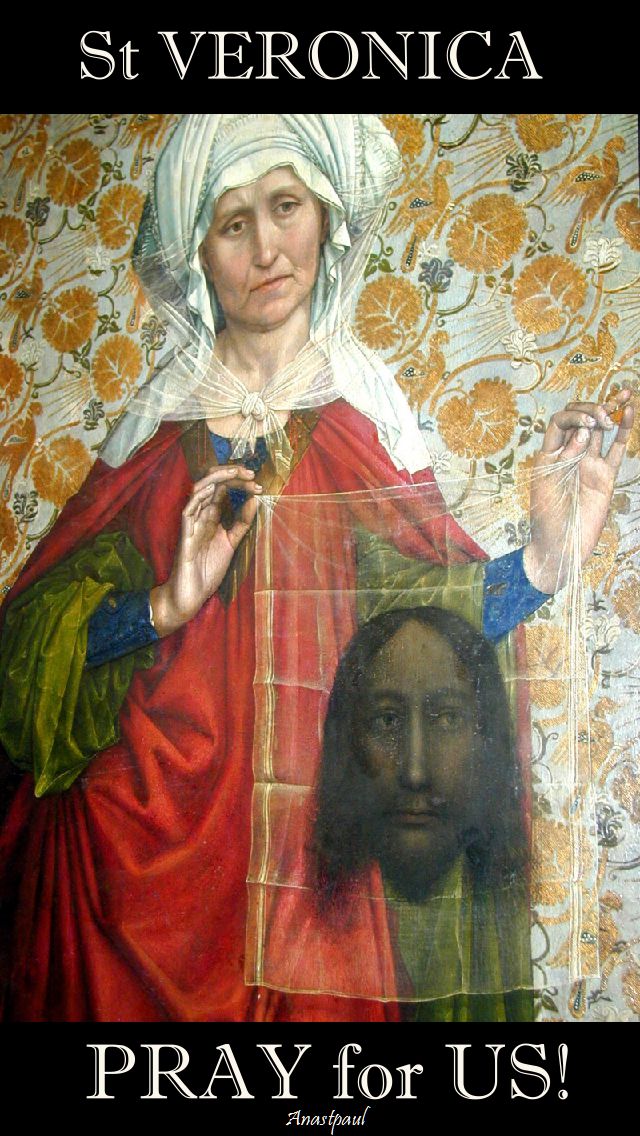
“Veronica?”

“Bernice Veronica” – both names referring to the Woman who wiped the Face of Jesus, commonly depicted in every Catholic church, at the Sixth Station of the Cross.
Did she exist?   And what does it mean to be “a Veronica?”   The Catholic Church tells us that a veil bearing a miraculous image of the Face of Jesus has existed since the earliest centuries, recorded in history and in art.   About the time this miraculous veil first appeared in Rome, in the Middle Ages, the name “Veronica” referred to the veil itself–“Veronica” meaning “vera” or true, and “icon” meaning image, or even more precisely, “to be present.”   Those who gazed upon the veil bearing the true Face of Jesus stood in God’s presence.   They were turned toward His Face.
Legends sprang up sometime later about a woman named “Veronica,” who was sometimes associated with the woman “Berenice” or “Bernice,” the bleeding woman who touches the hem of Jesus’s garment in the Gospel.
“These pious traditions cannot be documented, but there is no reason why the belief that such an act of compassion did occur should not find expression in the veneration paid to one called Veronica.” —The Catholic Encyclopedia.
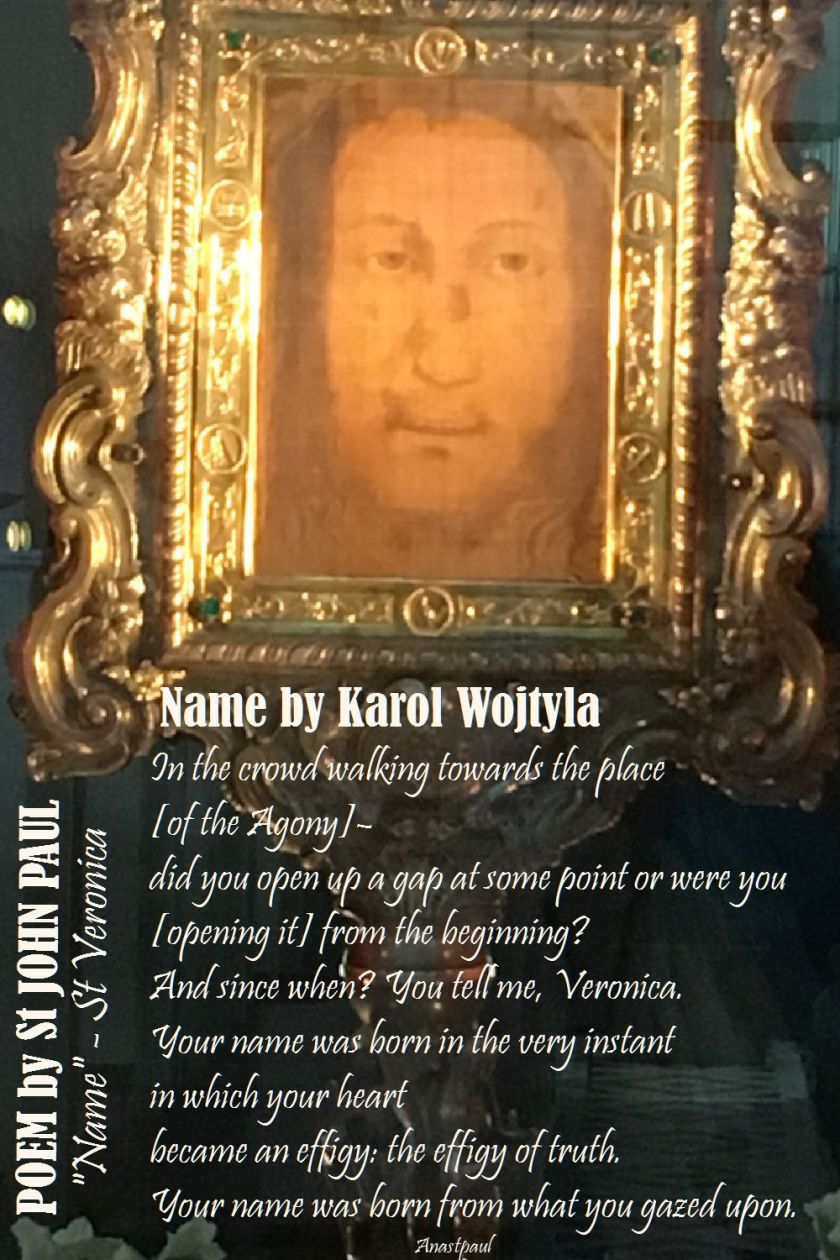
Pope St. John Paul II expressed the answer to the question of Veronica most beautifully in his poem,

“Name”

In the crowd walking towards the place

[of the Agony]–

did you open up a gap at some point or were you

[opening it] from the beginning?

And since when? You tell me, Veronica.

Your name was born in the very instant

in which your heart

became an effigy: the effigy of truth.

Your name was born from what you gazed upon.

–Karol Wojtyla

name by karol wojtyla-st john paul

When a soul performs an “act of compassion,” Jesus leaves His image on the “veil” of the soul.   In other words, while contemplating the Face of Jesus in an image, in the Word of God in the Scriptures, in a person made in the image and likeness of God, or above all, in the Eucharist, the soul places itself in the Presence of God.   When we are turned completely toward the Face of God, through a daily face-to-face encounter in prayer–by the power of the Holy Spirit–God gradually transforms the soul into the “True Image” of His Son, Jesus Christ.   As Pope St. John Paul II says, our hearts must become an “effigy of truth,” a “true icon.”   Then our name too will be born from what we gaze upon. It will be “Veronica.”

St Veronica pray for us!

st veronica pray for us.2

Posted in HYMNS, MORNING Prayers, POETRY, PRAYERS of the SAINTS

Our Morning Offering – 9 July

Our Morning Offering – 9 July

“It Is I: Be Not Afraid”
Blessed John Henry Newman (1801–1890)

WHEN I sink down in gloom or fear,
Hope blighted or delayed,
Thy whisper, Lord, my heart shall cheer,
“’Tis I: be not afraid!”

Or, startled at some sudden blow,
If fretful thoughts I feel,
“Fear not, it is but I!” shall flow,
As balm my wound to heal.

Nor will I quit Thy way, though foes
Some onward pass defend;
From each rough voice the watchword goes,
“Be not afraid!… a friend!”

And O! when judgment’s trumpet clear
Awakes me from the grave,
Still in its echo may I hear,
“’Tis Christ! He comes to save.”

it is I - be not afraid - bl john henry newman

Posted in CATHOLIC DEVOTIONS of the Month, CATHOLIC-PRAYERS OF THE CHURCH, DOCTORS of the Church, EUCHARISTIC Adoration, FEASTS and SOLEMNITIES, HYMNS, JESUIT SJ, MORNING Prayers, POETRY, PRAYERS of the CHURCH, PRAYERS of the SAINTS

Our Morning Offering – 18 June 2017 – The Feast of Copus Christi

Our Morning Offering – 18 June 2017 – The Feast of Copus Christi

ADORO te DEVOTE – HIDDEN GOD
St Thomas Aquinas (1225-1274) Doctor
and its most famous English translation
by Gerard Manley Hopkins SJ (1844-1889)

Hidden God, devoutly I adore Thee,
Truly present underneath these veils:
All my heart subdues itself before Thee,
Since it all before Thee faints and fails.

Not to sight, or taste, or touch be credit,
Hearing only do we trust secure;
I believe, for God the Son hath said it–
Word of Truth that ever shall endure.

On the Cross was veiled Thy Godhead’s splendour,
Here Thy manhood lieth hidden too;
Unto both alike my faith I render,
And, as sued the contrite thief, I sue.

Though I look not on Thy wounds with Thomas,
Thee, my Lord, and Thee, my God, I call:
Make me more and more believe Thy promise,
Hope in Thee, and love Thee over all.

O Memorial of my Saviour dying,
Living Bread that givest life to man;
May my soul, its life from Thee supplying,
Taste Thy sweetness, as on earth it can.

Deign, O Jesus, pelican* of heaven,
Me, a sinner, in Thy Blood to lave,
To a single drop of which is given
All the world from all its sin to save.

Contemplating Lord, Thy hidden presence,
Grant me what I thirst for and implore,
In the revelation of Thine essence
To behold Thy glory evermore.

ADORO te DEVOTE - ST THOMAS AQUINAS TRANSLATE G M HOPKINS SJ

Posted in JESUIT SJ, MORNING Prayers, POETRY

Celebrating GERARD MANLEY HOPKINS SJ – 8 June

Celebrating GERARD MANLEY HOPKINS SJ – 8 June

Gerard Manley Hopkins SJ, one of the leading poets of the nineteenth century, died on this day in Dublin in 1889,   His poetry is strikingly innovative, notable for its vivid imagery and new verse forms at a time when verse mainly followed traditional lines.   He struggled with depression and ill health throughout his short life but his last words at age 44 were “I am so happy, I am so happy.   I loved my life.”

Much of Gerard’s poetry was concerned with the divine presence in the material world, like this, probably one of the most renowned – “God’s Grandeur”

The world is charged with the grandeur of God.
It will flame out, like shining from shook foil;
It gathers to a greatness, like the ooze of oil
Crushed. Why do men then now not reck his rod?
Generations have trod, have trod, have trod;
And all is seared with trade; bleared, smeared with toil;
And wears man’s smudge and shares man’s smell: the soil
Is bare now, nor can foot feel, being shod.

And for all this nature, is never spent;
There lives the dearest freshness deep down things;
And though the last lights off the black West went
Oh, morning, at the brown brink eastward, springs—
Because the Holy Ghost over the bent
World broods with warm breast and with ah! bright wings.

god's grandeur-gerard manley hopkins sj