Our Morning Offering – 23 June – “The Month of the Sacred Heart of Jesus” and the Octave Day of the Sacred Heart
Auctor Beate Sæculi Jesu, Creator of the World! Unknown Author
Jesu, Creator of the world! Of all mankind Redeemer blest! True God of God in whom we see The Father’s Image clear expressed!
Thee Saviour, love alone constrained To make our mortal flesh Thine own; And as a second Adam come, For the first Adam to atone.
That selfsame Love that made the sky, Which made the sea and stars and earth, Took pity on our misery, And broke the bondage of our birth.
O Jesu! in Thy Heart Divine May that same Love forever flow, Forever mercy to mankind From that exhaustless Fountain flow.
For this Thy Sacred Heart was pierced, And both with blood and water ran; To cleanse us from the stains of guilt, And be the hope and strength of man.
Jesu! to Thee be glory giv’n, Who from the Heart dost grace outpour, With Father and with Holy Ghost, Through endless ages evermore.
Trans. The Benedictines of Saint Cecilia’s Abbey, Ryde, UK slightly adapted from Fr Edward Caswell CO (1814-1878) original translation Music: PUER NOBIS, LM; adapted by Michael Praetorius, (1571-1621). This particular Vespers Hymn is taken from the Feast of the Sacred Heart. In a Seminary or Monastery, this hymn would be sung. It has a very compelling melody, which adds to the beauty of a Hymn which extolls the mercy of Our Lord Jesus Christ. The theme of the entire piece is Our Lord’s Sacred Heart and how It is the Fount of Mercy for all who come to Him. It tells how we should value the Infinite Redemption He wrought for us.
Quote/s of the Day – 11 June – “The Month of the Sacred Heart of Jesus” – The Solemnity of Corpus Christi – 1 John 3:13-18, Luke 14:16-24. – Scripture search here: https://www.drbo.org/
“… This Body which He took from us, He gave wholly for our salvation. For, He offered His own Body to God the Father, upon the Altar of the Cross, as a Victim for our reconciliation and, He shed, His own Blood, both to redeem and cleanse us that we, being bought back from a wretched slavery, might be washed from all our sins. And then, that the memory of such a great benefit might abide in us, He left His Body to be our food and His Blood to be our drink that the faithful might receive them under the species of Bread and Wine.”
St Thomas Aquinas (1225-1274) Doctor Angelicus/Doctor Communis
“I adore Thee at every moment, O Living Bread of Heaven, great Sacrament! Jesus, heart of Mary, I pray Thee, bless my soul. Holiest Jesus, my Saviour, I give Thee my heart.”
(Indulgence of Two Hundred Days; Pope Pius VII, 1915)
The Divine Praises
Blessed be God. Blessed be His Holy Name. Blessed be Jesus Christ, true God and true Man. Blessed be the Name of Jesus. Blessed be His Most Sacred Heart. Blessed be Jesus in the Most Holy Sacrament of the Altar. Blessed be the Holy Spirit, the Paraclete. Blessed be the great Mother of God, Mary most holy. Blessed be her holy and Immaculate Conception. Blessed be her glorious Assumption. Blessed be the name of Mary, Virgin and Mother. Blessed be Saint Joseph, her most chaste spouse. Blessed be God in His Angels and in His Saints.
May the Heart of Jesus, in the Most Blessed Sacrament, be praised, adored and loved with grateful affection, at every moment, in all the Tabernacles of the world, even to the end of time. Amen.
Our Morning Offering – 11 June – “The Month of the Sacred Heart of Jesus” – The Solemnity of Corpus Christi, The Most Holy Body and Blood of Our Lord Jesus Christ and Sunday within the Octave – The Second Sunday after Pentecost
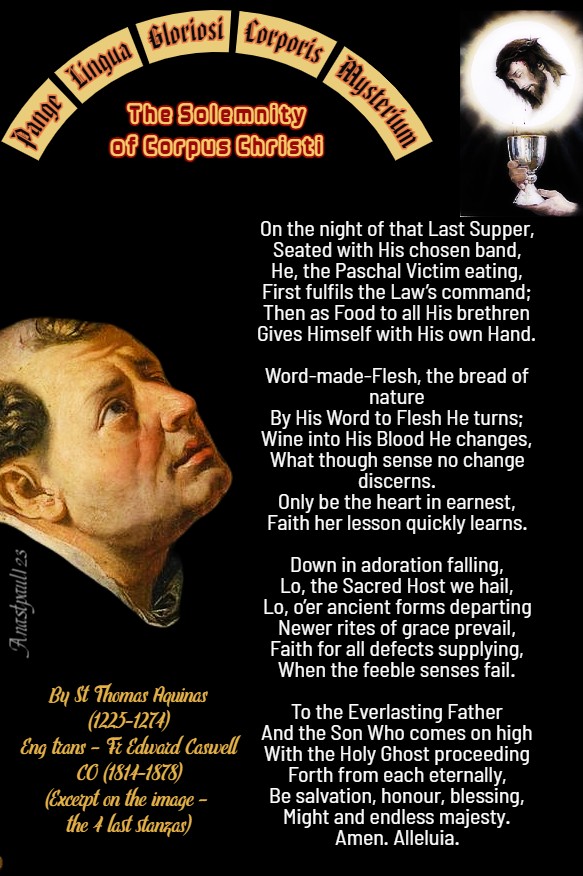
Pange Lingua Gloriosi Corporis Mysterium Sing, My Tongue By St Thomas Aquinas (1225-1274) Eng trans – Fr Edward Caswell CO (1814-1878) (Excerpt on the image – the 4 last stanzas)
Sing, my tongue, the Saviour’s glory, Of His Flesh, the Mystery sing; Of the Blood, all price exceeding, Shed by our Immortal King, Destined, for the world’s redemption, From a noble Womb to spring.
Of a pure and spotless Virgin Born for us on earth below, He, as Man, with man conversing, Stayed, the seeds of truth to sow; Then He closed in solemn order Wondrously His Life of woe.
On the night of that Last Supper, Seated with His chosen band, He, the Paschal Victim eating, First fulfils the Law’s command; Then as Food to all His brethren Gives Himself with His own Hand.
Word-made-Flesh, the bread of nature By His Word to Flesh He turns; Wine into His Blood He changes, What though sense no change discerns. Only be the heart in earnest, Faith her lesson quickly learns.
Down in adoration falling, Lo, the Sacred Host we hail, Lo, o’er ancient forms departing Newer rites of grace prevail, Faith for all defects supplying, When the feeble senses fail.
To the Everlasting Father And the Son Who comes on high With the Holy Ghost proceeding Forth from each eternally, Be salvation, honour, blessing, Might and endless majesty. Amen. Alleluia.
Written by St Thomas Aquinas (1225-1274) the Angelic and Common Doctor of the Church, for the very first Solemnity of Corpus Christi, this Hymn is considered the most beautiful of Aquinas’ Hymns and one of the seven great Hymns of the Church.
The last two stanzas make up the Tantum Ergo (Down in Adoration Falling) which is used at Benediction of the Blessed Sacrament. The Hymn is also used on Maundy Thursday during the procession from the Sanctuary to the Altar of Repose, where the Blessed Sacrament is kept until Good Friday.
PANGE, Lingua, Gloriosi Corporis Mysterium
Corporis mysterium, Sanguinisque pretiosi, quem in mundi pretium fructus ventris generosi Rex effudit Gentium.
Nobis datus, nobis natus ex intacta Virgine, et in mundo conversatus, sparso verbi semine, sui moras incolatus miro clausit ordine.
In supremae nocte cenae recumbens cum fratribus observata lege plene cibis in legalibus, cibum turbae duodenae se dat suis manibus.
Verbum caro, panem verum verbo carnem efficit: fitque sanguis Christi merum, et si sensus deficit, ad firmandum cor sincerum sola fides sufficit.
Tantum ergo Sacramentum veneremur cernui: et antiquum documentum novo cedat ritui: praestet fides supplementum sensuum defectui.
Genitori, Genitoque laus et iubilatio, salus, honor, virtus quoque sit et benedictio: procedenti ab utroque compar sit laudatio. Amen. Alleluia.
One Minute Reflection –28 May – Pentecost Sunday – Acts 2:1-11. John 14:23-31. – Scripture search here: https://www.drbo.org/
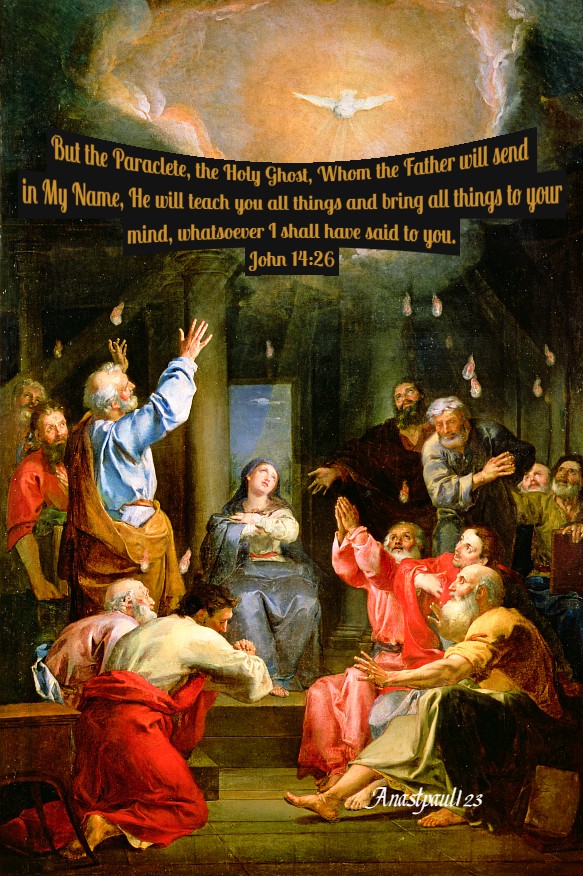
“But the Paraclete, the Holy Ghost, Whom the Father will send in My Name, He will teach you all things and bring all things to your mind, whatsoever I shall have said to you.” – John 14:26
REFLECTION – “The Apostles were sitting there in the Cenacle, the Upper Room, waiting for the Holy Ghost’s coming. Like torches, they were present there, ready and waiting to be set alight by the Holy Ghost so as to illumine the whole creation with their teaching… They were there like farm hands carrying seed in their coat pocket, waiting for the order to go out and sow. They were there like sailors whose boat is tied up in the harbour of the Son’s commandment and who are waiting for the gentle wind of the Spirit. They were there like shepherds who have just received their staff from the Chief Shepherd of the fold and who are waiting for the flock to be divided among them.
“And they began to speak in different tongues as the Spirit enabled them to proclaim.” O Cenacle, kneading trough into which has been thrown the leaven, leavening the whole world! O Cenacle, mother of all the Churches, who have witnessed the miracle of the burning bush (Ex 3). O Cenacle, amazing Jerusalem with a wonder far greater than that of the burning furnace which astonished the inhabitants of Babylon (Dn 3). The fire of the furnace burned all those around it but protected those in its midst – the flames of the Cenacle gather together those outside who wish to see them, while bringing comfort to those who receive them. O fire, whose coming is word, whose silence is light! O fire, establishing hearts in thankfulness!…
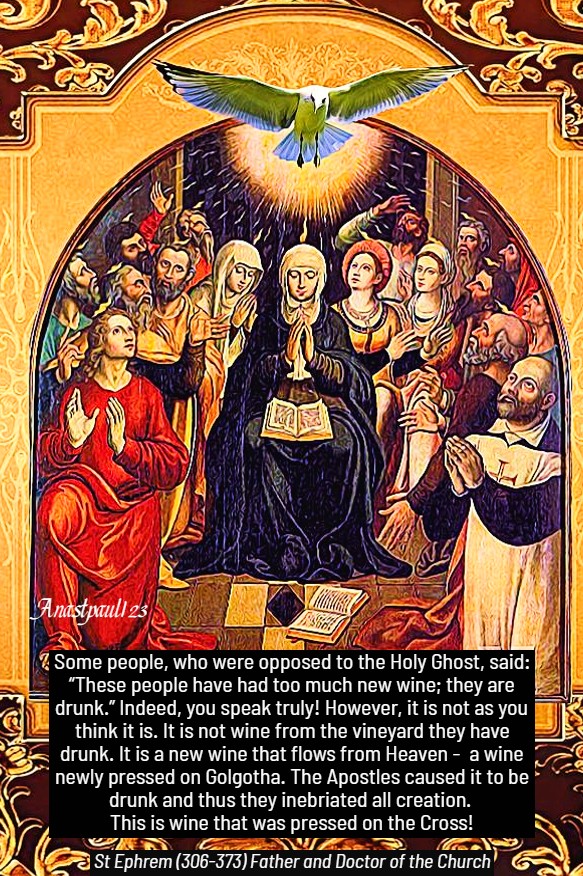
Some people, who were opposed to the Holy Ghost, said: “These people have had too much new wine; they are drunk.” Indeed, you speak truly! However, it is not as you think it is. It is not wine from the vineyard they have drunk. It is a new wine that flows from Heaven – a wine newly pressed on Golgotha. The Apostles caused it to be drunk and thus they inebriated all creation. This is wine that was pressed on the Cross!” – St Ephrem (306-373) Deacon in Syria, Father and Doctor of the Church [Added by Pope Benedict XV in 1920] – (On the outpouring of the Holy Ghost).
PRAYER – O God, Thou Who on this day have taught the hearts of the faithful by the Light of the Holy Spirit, grant us by that Holy Spirit Himself, to know what is right and ever to rejoice in His consolation. Through Jesus Christ, Thy Son our Lord, Who lives and reigns with Thee, in the unity of the Holy Ghost, God, world without end. Amen (Collect).
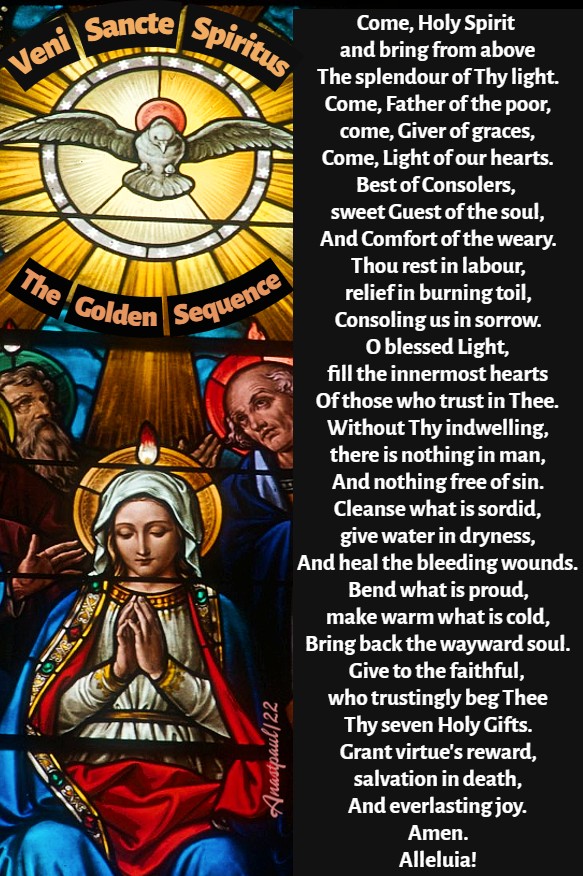
Veni Sancte Spiritus The Golden Sequence
Come, Holy Spirit and bring from above The splendour of Thy light. Come, Father of the poor, come, Giver of graces, Come, Light of our hearts. Best of Consolers, sweet Guest of the soul, And Comfort of the weary. Thou rest in labour, relief in burning toil, Consoling us in sorrow. O blessed Light, fill the innermost hearts Of those who trust in Thee. Without Thy indwelling, there is nothing in man, And nothing free of sin. Cleanse what is sordid, give water in dryness, And heal the bleeding wounds. Bend what is proud, make warm what is cold, Bring back the wayward soul. Give to the faithful, who trustingly beg Thee Thy seven Holy Gifts. Grant virtue’s reward, salvation in death, And everlasting joy. Amen. Alleluia!
“Veni Sancte Spiritus,” the “Golden Sequence”, is a sequence prescribed in the Roman Liturgy for the Masses of Pentecost and its Octave, exclusive of the following Trinity Sunday. It is usually attributed to either the Thirteenth-Century Pope Innocent III (c1160 – 1216) or to the Archbishop of Canterbury, Cardinal Stephen Langton (c1150 – 1228).
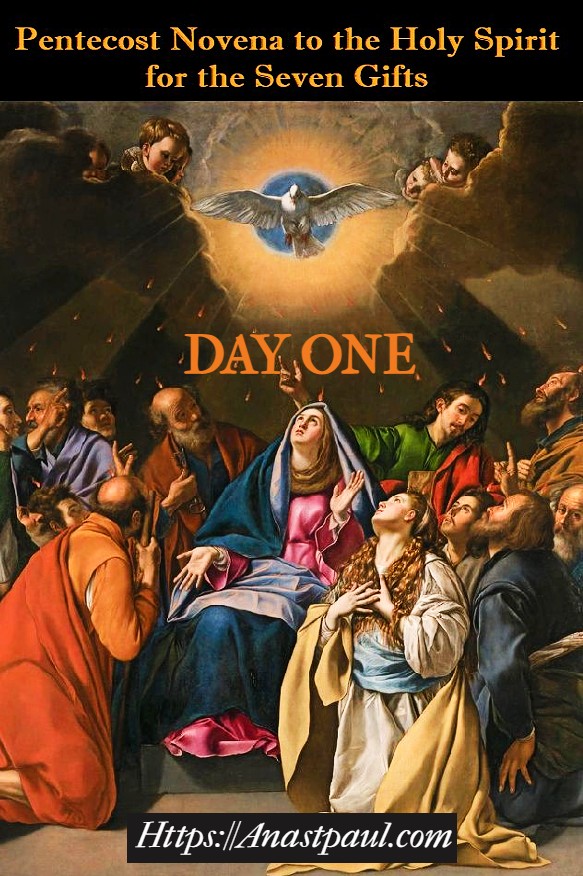
Pentecost Novena to the Holy Spirit for the Seven Gifts
Foreword
The Novena in honour of the Holy Ghost is the oldest of all Novenas, since it was first made at the direction of Our Lord Himself, when He sent His Apostles back to Jerusalem to await the coming of the Holy Ghost on the first Pentecost. Addressed to the Third Person of the Blessed Trinity, it is a powerful plea for the light and strength and love, so sorely needed by every Catholic today. To encourage devotion to the Holy Spirit, the Church has granted the following indulgences:
“The faithful who devoutly assist at the public Novena in honour of the Holy Spirit, immediately preceding the Solemn Feast of Pentecost, may gain a Partial Indulgence for themselves or, as an offering for the intentions of the faithful departed.”
An Indulgence of 10 years on any (and every) day of the Novena.
A Plenary Indulgence, if they take part in at least five of the exercises and go to Confession, receive Holy Communion and pray for the Holy Father’s intentions.
“Those who make a private Novena in honour of the Holy Spirit, either before the Solemn Feast of Pentecost or at any other time in the year, may also gain a Partial Indulgence for themselves or, as an offering for the intentions of the faithful departed.”
An Indulgence of 7 years on any (and every) day of the Novena.
A Plenary Indulgence under the usual conditions but, if a public Novena is held, this Indulgence is available only to those who are lawfully hindered from being part of the same.
FIRST DAY (Friday after Ascension)
Holy Spirit! Lord of Light! From Your clear celestial height, Your pure beaming radiance give!
The Holy Spirit
Only one thing is important — eternal salvation. Only one thing, therefore, is to be feared–sin. Sin is the result of ignorance, weakness and indifference. The Holy Spirit is the Spirit of Light, of Strength and of Love. With His sevenfold gifts He enlightens the mind, strengthens the will and inflames the heart with love of God. To ensure our salvation we ought to invoke the Divine Spirit daily, for “The Spirit helpeth our infirmity. We know not what we should pray for as we ought. But the Spirit Himself asketh for us.”
Prayer
Almighty and eternal God, Who hast vouchsafed to regenerate us by water and the Holy Spirit and hast given us forgiveness of all sins, vouchsafe to send forth upon us from Heaven, Your sevenfold Spirit, the Spirit of Wisdom and Understanding, the Spirit of Counsel and Fortitude, the Spirit of Knowledge and Piety and fill us with the Spirit of Holy Fear. Amen.
Our Father and Hail Mary – ONCE. Glory be to the Father – SEVEN TIMES.
ACT OF CONSECRATION TO THE HOLY SPIRIT To be recited daily during the Novena
On my knees, I, before the great multitude of heavenly witnesses, offer myself, soul and body to You, Eternal Spirit of God. I adore the brightness of Your purity, the unerring keenness of Your justice and the might of Your love. You are the Strength and Light of my soul. In You I live and move and am. I desire never to grieve You by unfaithfulness to grace and I pray with all my heart to be kept from the smallest sin against You. Mercifully guard my every thought and grant that I may always watch for Your light, listen to Your Voice and follow Your gracious inspirations. I cling to You and give myself to You and ask You, by Your compassion, to watch over me in my weakness. Holding the pierced Feet of Jesus, looking at His Five Wounds and trusting in His Precious Blood and adoring His opened Side and stricken Heart, I implore You, Adorable Spirit, Helper of my infirmity, t o keep me in Your grace, that I may never sin against You. Give me grace O Holy Spirit, Spirit of the Father and the Son, to say to You always and everywhere, “Speak Lord for Your servant hears.” Amen.
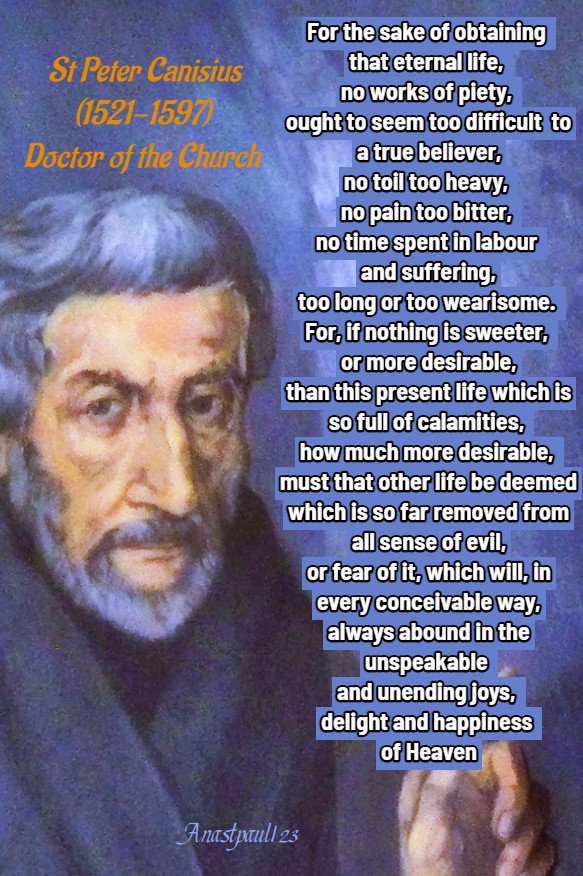
Quote/s of the Day – 27 April – St Peter Canisius (1521-1597) Confessor, Doctor of the Church
This 16th Century Saint, known as the second Apostle of Germany, followed in the giant footsteps of St Boniface, who evangelised Germany a thousand years earlier. He was also active at the Council of Trent and wrote much on the Blessed Virgin Mary.
The first half of the Hail Mary, of course, comes from Scripture. What many Catholics do not know, is that the second half of this Catholic prayer is due to the intervention of St Peter Canisius at the Council of Trent. St Peter began adding onto the scriptural part of the Hail Mary the second half of this familiar prayer: “Holy Mary Mother of God, pray for us sinners, now, and at the hour of our death.” It was the Fathers of Trent who officially accepted this addition and included it in their famous Catechism of the Council of Trent in 1566.
“For the sake of obtaining that eternal life, no works of piety, ought to seem too difficult to a true believer, no toil too heavy, no pain too bitter, no time spent in labour and suffering, too long or too wearisome. For, if nothing is sweeter, or more desirable, than this present life which is so full of calamities, how much more desirable, must that other life be deemed which is so far removed from all sense of evil, or fear of it, which will, in every conceivable way, always abound in the unspeakable and unending joys, delight and happiness of Heaven.”
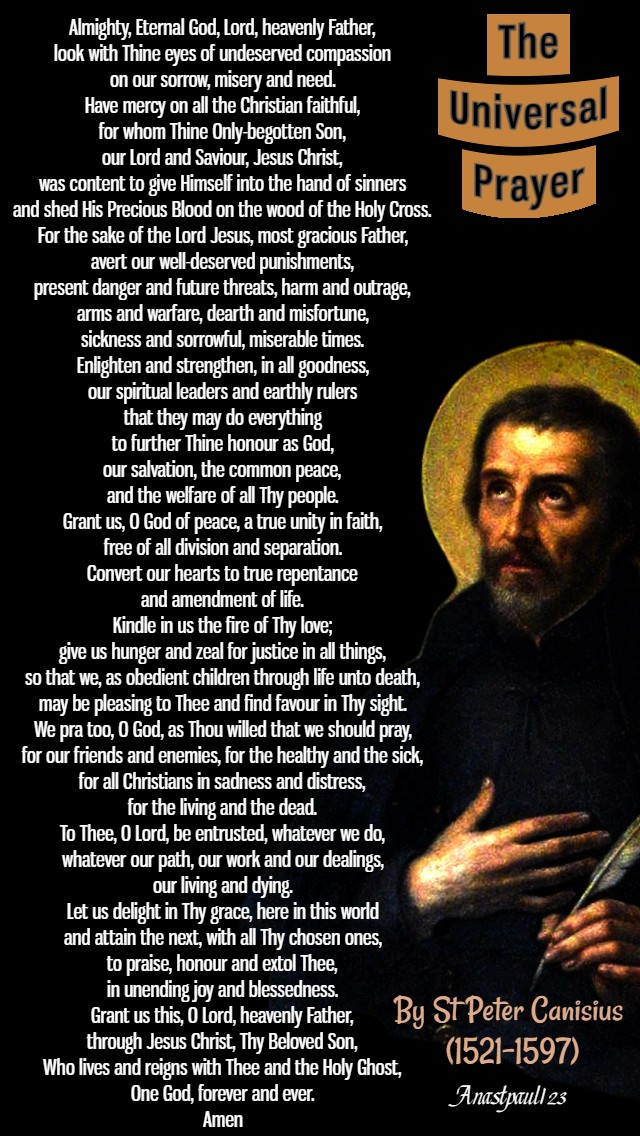
Our Morning Offering – 27 April – St Peter Canisius (1521-1597) – Confessor, Doctor of the Church, Dutch Priest of the Society of Jesus, Reformer, Teacher, Writer, Apostle of Charity.
The Universal Prayer By St Peter Canisius (1521-1597) Doctor of the Church
Almighty, Eternal God, Lord, heavenly Father, look with Thine eyes of undeserved compassion on our sorrow, misery and need. Have mercy on all the Christian faithful, for whom Thine Only-begotten Son, our Lord and Saviour, Jesus Christ, was content to give Himself into the hand of sinners and shed His Precious Blood on the wood of the Holy Cross. For the sake of the Lord Jesus, most gracious Father, avert our well-deserved punishments, present danger and future threats, harm and outrage, arms and warfare, dearth and misfortune, sickness and sorrowful, miserable times. Enlighten and strengthen, in all goodness, our spiritual leaders and earthly rulers that they may do everything to further Thine honour as God, our salvation, the common peace, and the welfare of all Thy people. Grant us, O God of peace, a true unity in faith, free of all division and separation. Convert our hearts to true repentance and amendment of life. Kindle in us the fire of Thy love; give us hunger and zeal for justice in all things, so that we, as obedient children through life unto death, may be pleasing to Thee and find favour in Thy sight. We pray too, O God, as Thou willed that we should pray, for our friends and enemies, for the healthy and the sick, for all Christians in sadness and distress, for the living and the dead. To Thee, O Lord, be entrusted, whatever we do, whatever our path, our work and our dealings, our living and dying. Let us delight in Thy grace, here in this world and attain the next, with all Thy chosen ones, to praise, honour and extol Thee, in unending joy and blessedness. Grant us this, O Lord, heavenly Father, through Jesus Christ, Thy Beloved Son, Who lives and reigns with Thee and the Holy Ghost, One God, forever and ever. Amen
The abrove prayer, with spaces for responses after each petition, was a sixteenth Century form of the Prayer of the Faithful within the classic Latin Roman rite, (with Priestly orations and litanies in Latin), popular for 450 years in the French, English, Irish and German-speaking Church.
One Minute Reflection – 11 April – “The Month of the Resurrection” – Easter Tuesday – Acts 13:16; 13:26-33; Luke 24:36-47 – Scripture search here: https://www.drbo.org/
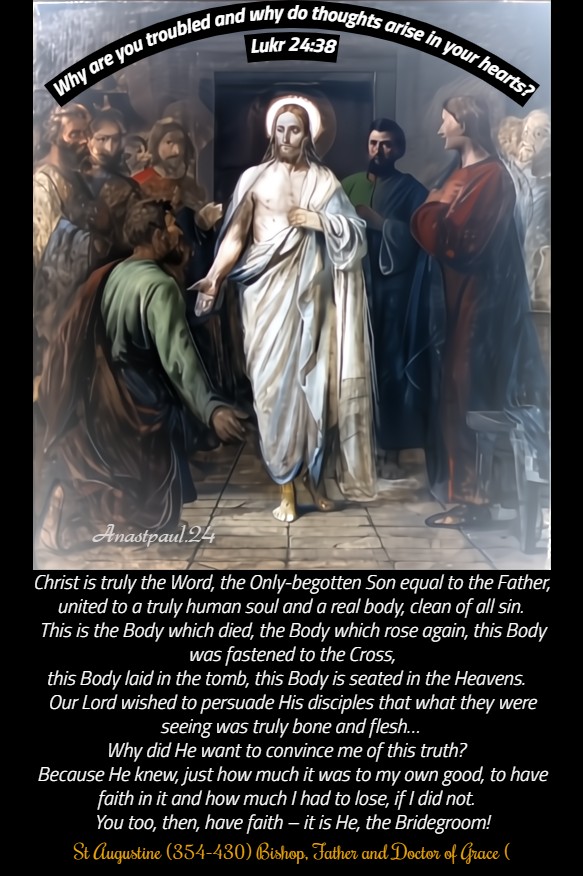
“And He said to them: Why are you troubled and why do thoughts arise in your hearts?” – Luke 24:38
REFLECTION –
“This Gospel passage… shows us in truth, Who the Messiah is and who the Church … that we might understand well which Bride it is that this Divine Bridegroom has chosen and Who the Bridegroom of this holy Bride is … On this page we can read their deed of espousal …
You have learned that Christ is the Word, God’s Utterance, united to a human soul and human body … Here, the disciples thought they were seeing a ghost; they did not believe that the Lord had a real body. But since the Lord understood the danger of such thoughts, He made haste to snatch them out of their hearts … “Why do questions arise in your hearts? Look at My Hands and My Feet; touch Me and see because, a ghost does not have flesh and bone, as you can see I have.” Yet you, with these same questioning thoughts, strongly oppose the rule of faith you have received …
Christ is truly the Word, the Only-begotten Son equal to the Father, united to a truly human soul and a real body, clean of all sin. This is the Body which died, the Body which rose again, this Body was fastened to the Cross, this Body laid in the tomb, this Body is seated in the Heavens. Our Lord wished to persuade His disciples that what they were seeing was truly bone and flesh… Why did He want to convince me of this truth? Because He knew, just how much it was to my own good, to have faith in it and how much I had to lose, if I did not. You too, then, have faith – it is He, the Bridegroom!
Now listen to what was said about the Bride… “The Messiah had to suffer and rise from the dead on the third day and repentance, for the forgiveness of sins, is to be preached in His Name to all the nations, beginning from Jerusalem.” This is the Bride… the Church is spread all over the earth and has taken all peoples to her heart … The Apostles saw Christ and believed in what they did not see, the Church. We, on our part, see the Church; so let us believe in Jesus Christ, Whom we do not see and so, by holding onto what we see, we shall come to Him Whom, as yet, we do not see.” – St Augustine (354-430) Bishop, Father and Doctor of Grace (Sermon 238).
PRAYER – O God, Who art ever multiplying the children of Thy Church, grant unto the same, Thy servants that they may lead the rest of their lives, according to this beginning, wherein Thou hast given them faith to receive the Sacrament of the New Birth. Through Jesus Christ, Thy Son our Lord, Who lives and reigns with Thee, in the unity of the Holy Ghost, God, world without end. Amen (Collect).
Our Morning Offering – 10 April – Easter Monday – “The Month of the Resurrection”
REMINDER: To exchange your Angelus prayer for the Regina Coeli as from Compline on Holy Saturday for the next 50 days of Eastertide, until the None (Afternoon) Prayer on the Saturday following Pentecost, inclusively. St Gregory the Great (540-604) heard Angels chanting the first three lines one Easter morning in Rome, while following barefoot in a great religious procession of the Icon of the Virgin painted by St Luke the Evangelist. He was, thereupon, inspired to add the fourth line.
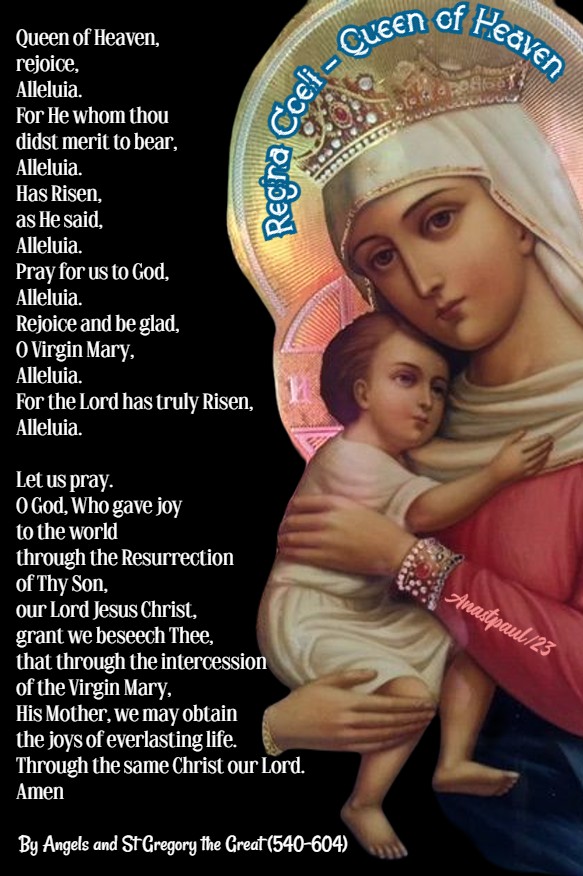
Regina Coeli Queen of Heaven By Angels and St Gregory the Great (540-604)
Queen of Heaven, rejoice, Alleluia. For He whom thou didst merit to bear, Alleluia. Has Risen, as He said, Alleluia. Pray for us to God, Alleluia. Rejoice and be glad, O Virgin Mary, Alleluia. For the Lord has truly Risen, Alleluia.
Let us pray. O God, Who gave joy to the world through the Resurrection of Thy Son, our Lord Jesus Christ, grant we beseech Thee, that through the intercession of the Virgin Mary, His Mother, we may obtain the joys of everlasting life. Through the same Christ our Lord. Amen
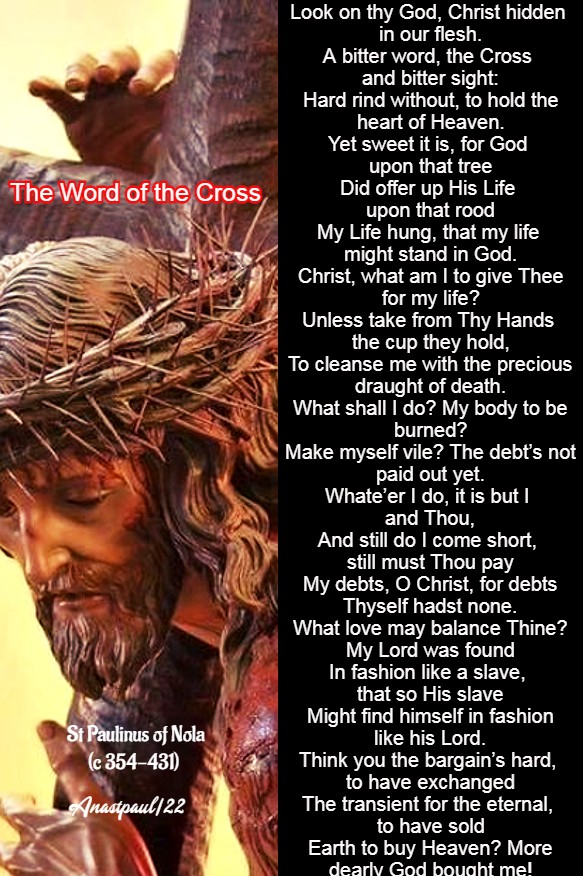
Look on thy God, Christ hidden in our flesh. A bitter word, the Cross and bitter sight: Hard rind without, to hold the heart of Heaven. Yet sweet it is, for God upon that tree Did offer up His Life upon that rood My Life hung, that my Life might stand in God. Christ, what am I to give Thee for my life? Unless take from Thy Hands the cup they hold, To cleanse me with the precious draught of death. What shall I do? My body to be burned? Make myself vile? The debt’s not paid out yet. Whate’er I do, it is but I and Thou, And still do I come short, still must Thou pay My debts, O Christ, for debts Thyself hadst none. What love may balance Thine? My Lord was found In fashion like a slave, that so His slave Might find himself in fashion like his Lord. Think you the bargain’s hard, to have exchanged The transient for the eternal, to have sold Earth to buy Heaven? More dearly God bought me!
St Paulinus of Nola (c 354-431) Father of the Church
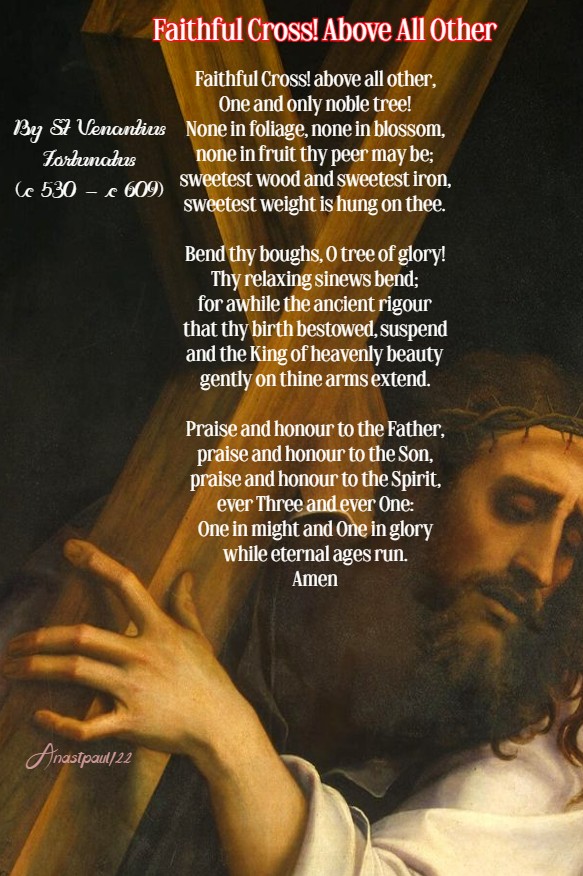
Faithful Cross! Above All Other By St Venantius Fortunatus (c 530 – c 609)
Faithful Cross! above all other, one and only noble tree! None in foliage, none in blossom, none in fruit thy peer may be; sweetest wood and sweetest iron, sweetest weight is hung on thee.
Bend thy boughs, O tree of glory! Thy relaxing sinews bend; for awhile the ancient rigour that thy birth bestowed, suspend and the King of heavenly beauty gently on thine arms extend.
Praise and honour to the Father, praise and honour to the Son, praise and honour to the Spirit, ever Three and ever One: One in might and One in glory while eternal ages run.
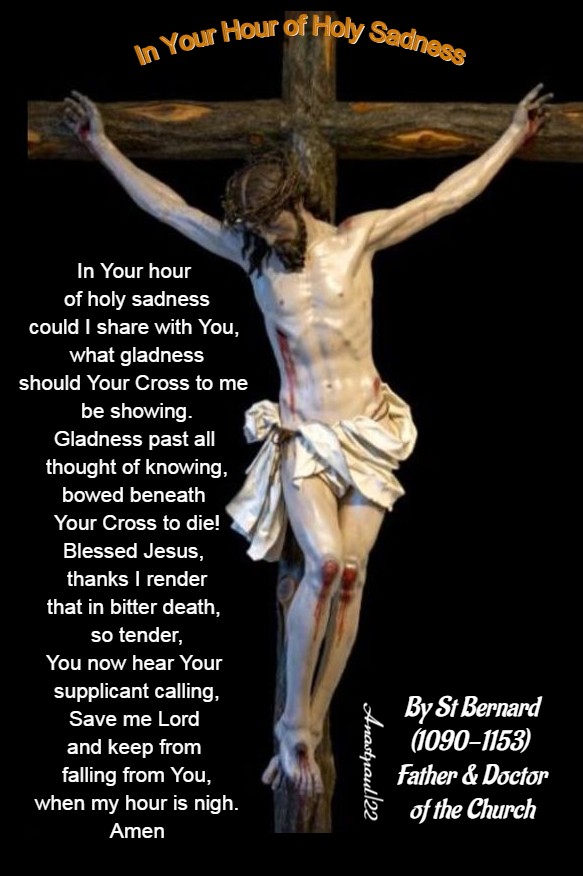
In Your Hour of Holy Sadness By St Bernard (1090-1153) Father & Doctor of the Church
In Your hour of holy sadness could I share with You, what gladness should Your Cross to me be showing. Gladness past all thought of knowing, bowed beneath Your Cross to die! Blessed Jesus, thanks I render that in bitter death, so tender, You now hear Your supplicant calling, Save me Lord and keep from falling from You, when my hour is nigh. Amen.
“When you are alone in your room, take your Crucifix, kiss Its Five Wounds reverently, tell It to preach you a little sermon and then listen to the words of eternal life that It speaks to your heart. Listen to the pleading of the Thorns, the Nails, the Precious Blood. Oh, what an eloquent sermon!”
One Minute Reflection – 7 April – Good Friday – The Passion of Our Lord Jesus Christ according to St John 18:1-40.19:1-42 – Scripture search here: https://www.drbo.org/
“And bearing His own Cross, He went forth to the place which is called Calvary but in Hebrew Golgotha.” – John 19:17
REFLECTION – “The people who sit in darkness have seen a great light; upon those who dwell in the land of gloom, a Light has shone” (Is 9:1), the Light of Redemption. When they saw that the tyrant, death, was wounded to death, this people came out from darkness to Light; from death they passed to Life.
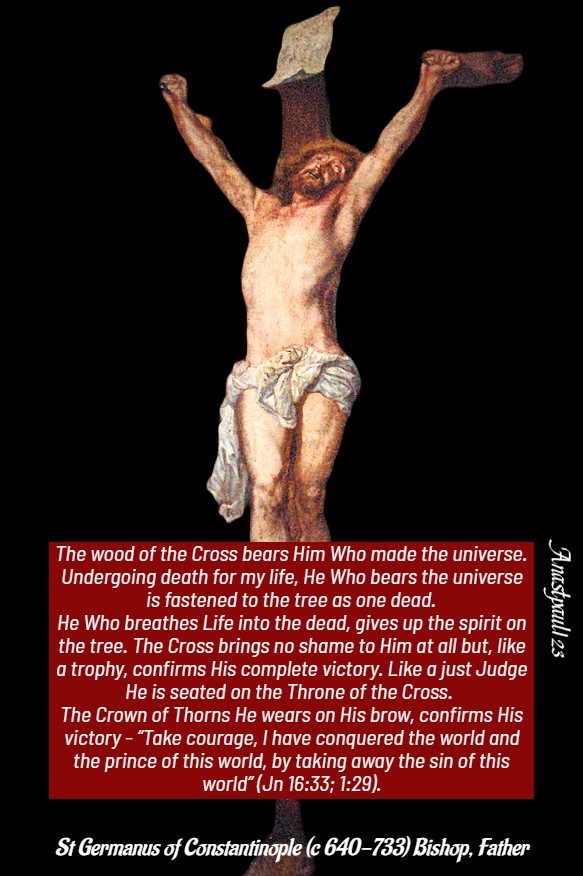
The wood of the Cross bears Him Who made the universe. Undergoing death for my life, He Who bears the universe is fastened to the tree as one dead. He Who breathes Life into the dead, gives up the spirit on the tree. The Cross brings no shame to Him at all but, like a trophy, confirms His complete victory. Like a just Judge He is seated on the Throne of the Cross. The Crown of Thorns He wears on His brow, confirms His victory – “Take courage, I have conquered the world and the prince of this world, by taking away the sin of this world” (Jn 16:33; 1:29).
That the Cross stands for victory, the stones themselves cry out (cf Lk 19:40), those stones of Calvary where Adam, our forefather, was buried, according to an old tradition held by our fathers. “Adam, where are you?” (Gn 3:9), Christ cries out again from the Cross. “I am seeking for you there and, that I might find you, I stretched out my Hands on the Cross. I turn my outstretched Hands to the Father in thanksgiving for having found you, then I turn them also to you to welcome you. I have not come to judge your sin but to save you out of My Love for humankind (cf Jn 3,17). I have not come to curse you for your disobedience but to bless you, by My obedience. I will shelter you with My Wings, you will find refuge in My shade; My Faithfulness will cover you with the shield of the Cross and you will no more fear the terror of the night (cf Ps 90:1-5) because you will know day without setting (Wsd 7:10). I will seek out your life, concealed in darkness and the shadow of death (Lk 1:79). I will take no rest until, humbled and having descended even to hell to search for you, I have led you back to Heaven.” – St Germanus of Constantinople (c 640-733) Bishop, Father (In Domini corporis supulturam ; PG 98, 251-260).
PRAYER – Deliver us, we beseech Thee, O Lord, from all evils, past, present and to come and by the intercession of the blessed and glorious ever Virgin Mary, Mother of God and of the Holy Apostles, Peter and Paul and of all the Saints, mercifully grant peace in our days, that through the assistance of Thy mercy we may be always free from sin and secure from all disturbance. Through Jesus Christ, Thy Son our Lord, Who lives and reigns with Thee, in the unity of the Holy Ghost, God, world without end. Amen. Faithful Cross! above all other, One and only noble Tree! None in foliage, none in blossom, None in fruit thy peer may be. Sweetest wood and sweetest iron, Sweetest weight is hung on thee. (Antiphons).
Saint of the Day – 3 March – Blessed Benedetto Sinigardi da Arezzo OFM (c1190-1282) Friar of the Order of Friars Minor, one of the first companions of St Francis and who received the Habit directly from his handi, Provincial of the Marches in Italy and later of the Holy Land, Missionary. Born in c1190 in Arezzo, Italy and died in 1282 in the Franciscan Convent of Poggio del Sole in Arezzo, Italy of natural causes. Although rarely mentioned, Blessed Benedetto is the Author of the Angelus! Additional Memorial – 13 August on some calendars. Also known as – Benedetto Sinigardi du Arezzo, Benedict of Arezzo.
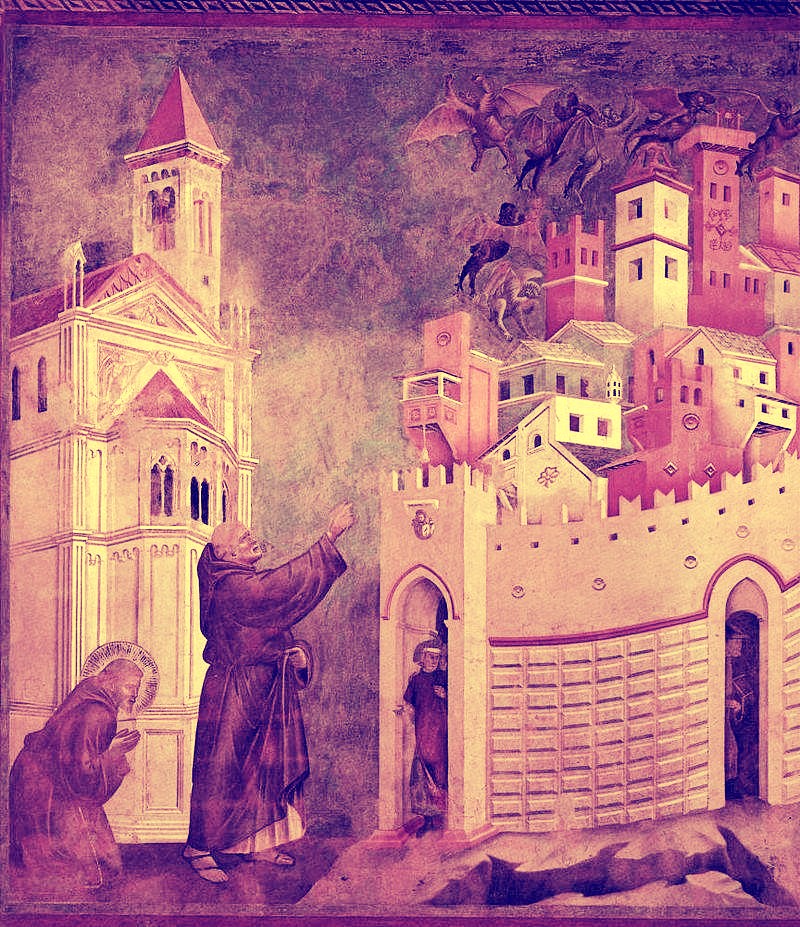
The call of the Lord to Benedetto Sinigardi occurred during a sermon which St Francis of Assisi gave in 1211 in Arezzo. The poor man’s fame attracted huge crowds everywhere and that day Piazza Grande was packed to capacity. Among the listeners there was also the twenty-year-old Benedetto, son of Tommaso Sinigardo de’ Sinigardi and Countess Elisabetta Tarlati di Pietramala. He was, therefore, a member of two of the most important families in the City but Francis’ words penetrated his heart, to such an extent that, moved, he decided to change his life.
He had received a good education and was a good Christian, he attended Sacred worship and devotions, fasting three times a week. His soul wa,s therefore, ready to accept the words of the Seraphic Father and his choice was radical, as he left the comforts and riches to joyfully embrace Sister Poverty. He received the Habit directly from the hands of St Francis himself.
Good-natured, he had excellent qualities which immediately made him loved and esteemed by his brothers and by the people. At the age of only 27, he was appointed Provincial Minister of the Marches, a region that had such importance for the Franciscan Order.
The ardour to pronounce the Gospel made him ask later, to go as a Missionary to distant lands, even among the infidels and at the risk of his life. He went to Greece, to Romania and Turkey and experienced first-hand the realities caused by the schism between the Church of the East and that of the West. The final stage of his mission was the places where the Son of God was Incarnated and lived. He was elected Provincial Minister for the Holy Land and, in the sixteen years of his stay in those lands, he built the first Franciscan Convent in Constantinople, having cordial relations also with the Emperor.
According to tradition, John of Brienne, Emperor of Constantinople, following the example of St Louis of the French and St Elizabeth of Hungary, wanted to receive the Franciscan Habit from Benedetto’s hands.
After this intense apostolic activity, now an old man, he was called back to his native City. In Arezzo, in the Convent of the Friars Minor Benedetto died at a very old age, surrounded by a reputation for holiness. Miracles were immediately attributed to him and he was proclaimed Blessed by the people before the Ecclesiastical authority.
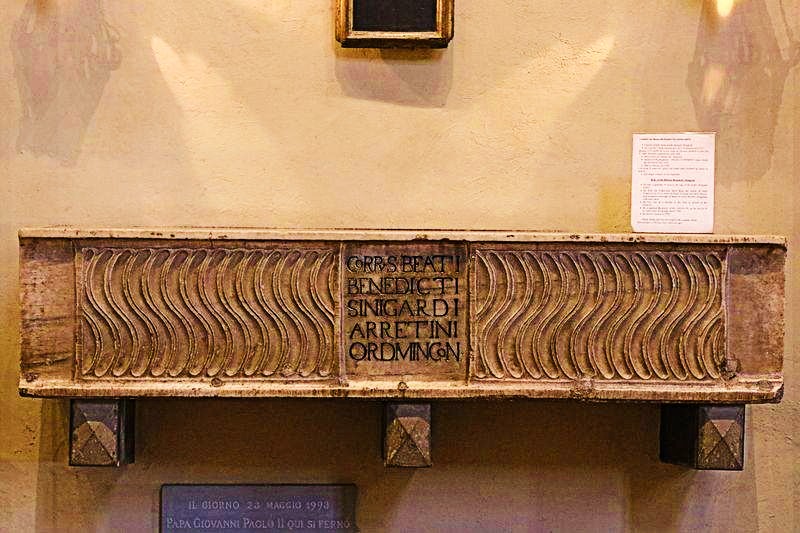
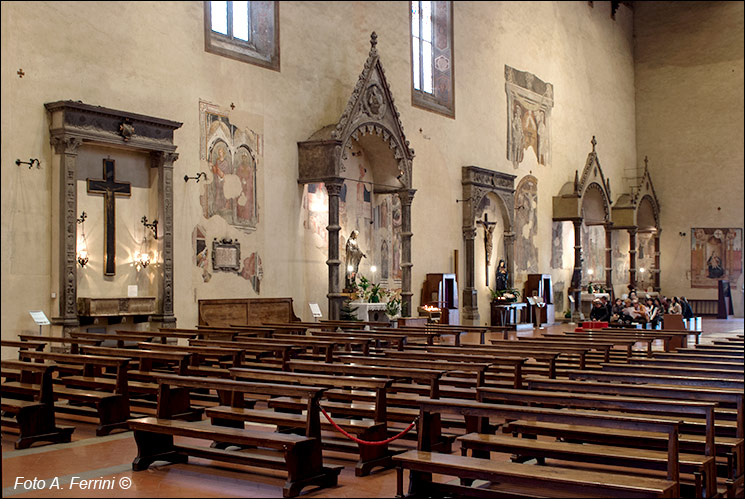
None of his writings have survived but we have two testimonies of his deep piety and devotion to the Passion of Jesus and to he Holy Virgin. In the last years of his life, he commissioned the Crucifix called “Of Beato Benedetto” which today stands on the High Altar of the Basilica of St Francis in the centre of Arezzo, where his body was also transported after the demolition of the Convent in which he died and was laid. Below is a glimpse of the right wall of the Church of San Francesco with a view of five Chapels which alternate between the classical and Gothic styles. The first of these, on the left in the classical style, is the Gozzari Chapel. Here is the Sarcophagus containing the remains of Blessed Benedetto Sinigardi.
It was he who indicated to the painter, the so-called Master of St Francis, all the details with which it had to be created. In the same Basilica, in the main Chapel, there is also the cycle of frescoes of the Legend of the Cross, painted by Piero della Francesca two centuries later.
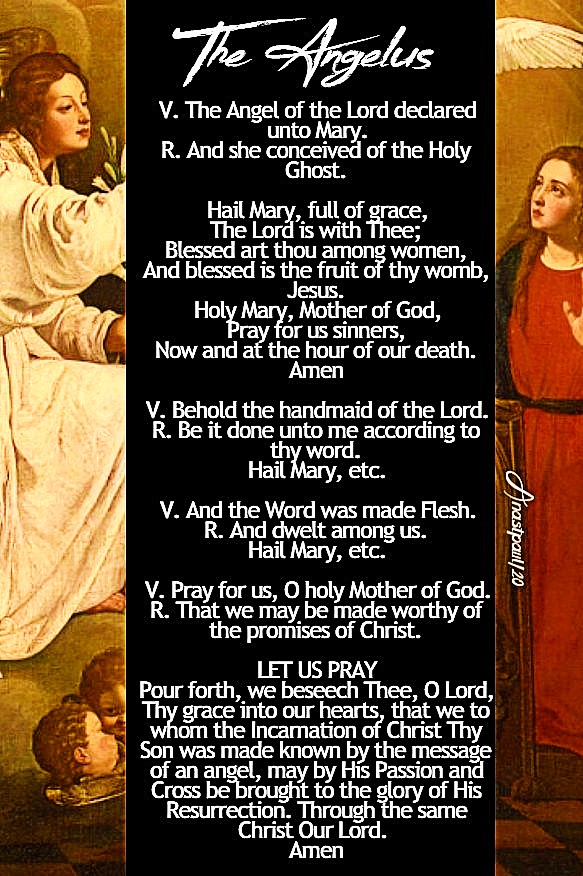
Furthermore, the beautiful custom of reciting the Marian Antiphon “The Angelus Domini” is attributed to Blessed Benedetto, meditating on the saving Mystery of the Incarnation of the Son of God in Mary’s virginal womb. The Angelus Domini became a pious practice firstly to the entire Franciscan Order, then to the whole Church, as it still is today.
In his visit to the City of Arezzo on 23 May 1993, after having stopped in prayer before the Tomb of Blessed Benedetto, John Paul II said in his speech: “We stop in the middle of the day for a moment of Marian prayer. It is so today in a singular way because we find ourselves in the place where, … the custom of reciting the Angelus Domini was born.”
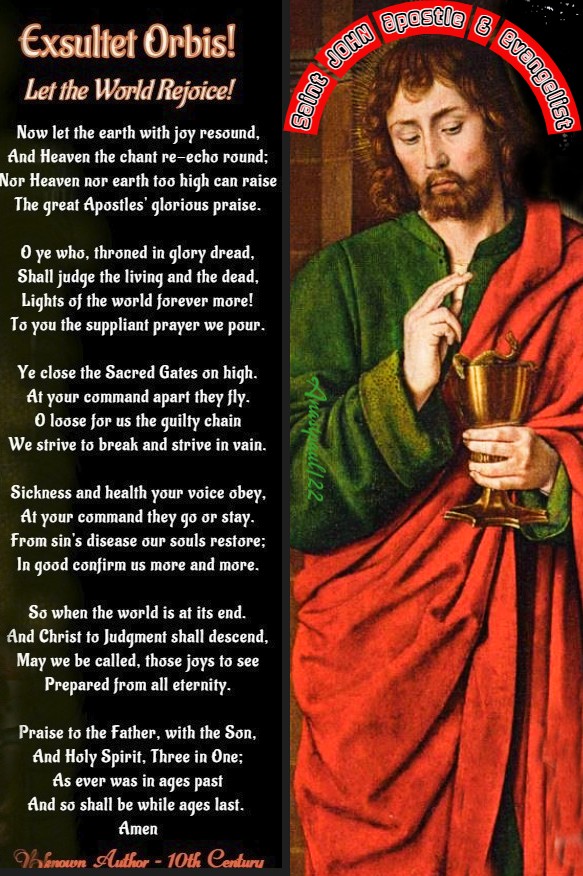
Our Morning Offering – 27 December – St John the Apostle and Evangelist, the Beloved – “The Month of the Divine Infant and the Immaculate Conception”
Exsultet Orbis! Let the World Rejoice! Unknown Author
Now let the earth with joy resound, And Heaven the chant re-echo round; Nor Heaven nor earth too high can raise The great Apostles’ glorious praise.
O ye who, throned in glory dread, Shall judge the living and the dead, Lights of the world forever more! To you the suppliant prayer we pour.
Ye close the Sacred Gates on high. At your command apart they fly. O loose for us the guilty chain We strive to break and strive in vain.
Sickness and health your voice obey, At your command they go or stay. From sin’s disease our souls restore; In good confirm us more and more.
So when the world is at its end. And Christ to Judgment shall descend, May we be called, those joys to see Prepared from all eternity.
Praise to the Father, with the Son, And Holy Spirit, Three in One; As ever was in ages past And so shall be while ages last. Amen
(Roman Breviary for the Common of Apostles) An Office Hymn that was traditionally prescribed for Vespers and Lauds on the Feasts of Apostles and Evangelists outside Easter time. The Hymn is found as early as the tenth century in a hymnal of Moissac Abbey.
Our Morning Offering – 24 December – The Vigil of the Nativity of Our Lord – “The Month of the Divine Infant and the Immaculate Conception”
O Come, O come, Emmanuel
O Come, O come, Emmanuel And ransom captive Israel, That mourns in lonely exile here Until the Son of God appear. Refrain: Rejoice! Rejoice! Emmanuel Shall come to thee, O Israel!
O come, Thou Wisdom, from on high And order all things far and nigh, To us the path of knowledge show And teach us in her ways to go. Refrain
O come, o come, Thou Lord of might, Who to Thy tribes on Sinai’s height In ancient times did give the law, In cloud and majesty and awe. Refrain
O come, Thou Rod of Jesse’s stem, From ev’ry foe deliver them That trust Thy mighty power to save And give them vict’ry o’er the grave. Refrain
O come, Thou Key of David, come And open wide our heav’nly home, Make safe the way that leads on high, That we no more have cause to sigh. Refrain
O come, Thou Dayspring from on high And cheer us by Thy drawing nigh. Disperse the gloomy clouds of night And death’s dark shadow put to flight. Refrain
O come, Desire of nations, bind In one the hearts of all mankind. Bid every strife and quarrel cease And fill the world with heaven’s peace. Refrain
The favourite O Come, O Come Emmanuel carol was originally written in Latin text in the 12th Century. The author of the words and composer to the music of O Come, O Come Emmanuel is unknown. It is, however, believed that the melody was of French origin and added to the text a hundred years later. The Latin was translated into English by John Mason Neale in 1851.
Our Morning Offering – 21 December – St Thomas Apostle
Exsultet Orbis! Let the World Rejoice! Unknown Author
Now let the earth with joy resound, And Heaven the chant re-echo round; Nor Heaven nor earth too high can raise The great Apostles’ glorious praise.
O ye who, throned in glory dread, Shall judge the living and the dead, Lights of the world forever more! To you the suppliant prayer we pour.
Ye close the Sacred Gates on high. At your command apart they fly. O loose for us the guilty chain We strive to break and strive in vain.
Sickness and health your voice obey, At your command they go or stay. From sin’s disease our souls restore; In good confirm us more and more.
So when the world is at its end. And Christ to Judgment shall descend, May we be called, those joys to see Prepared from all eternity.
Praise to the Father, with the Son, And Holy Spirit, Three in One; As ever was in ages past And so shall be while ages last. Amen
(Roman Breviary for the Common of Apostles) An Office Hymn that was traditionally prescribed for Vespers and Lauds on the Feasts of Apostles and Evangelists outside Easter time. The Hymn is found as early as the tenth century in a hymnal of Moissac Abbey.
Our Morning Offering – 30 November – Feast of St Andrew Apostle and Martyr
Exsultet Orbis! Let the World Rejoice! Unknown Author
Now let the earth with joy resound, And Heaven the chant re-echo round; Nor Heaven nor earth too high can raise The great Apostles’ glorious praise.
O ye who, throned in glory dread, Shall judge the living and the dead, Lights of the world forever more! To you the suppliant prayer we pour.
Ye close the Sacred Gates on high. At your command apart they fly. O loose for us the guilty chain We strive to break and strive in vain.
Sickness and health your voice obey, At your command they go or stay. From sin’s disease our souls restore; In good confirm us more and more.
So when the world is at its end. And Christ to Judgment shall descend, May we be called, those joys to see Prepared from all eternity.
Praise to the Father, with the Son, And Holy Spirit, Three in One; As ever was in ages past And so shall be while ages last. Amen
(Roman Breviary for the Common of Apostles) An Office Hymn that was traditionally prescribed for Vespers and Lauds on the Feasts of Apostles and Evangelists outside Easter time. The Hymn is found as early as the tenth century in a hymnal of Moissac Abbey.
Our Morning Offering – 5 November – Within the Octave of All Saints and the Feast of the Holy Relics
Sanctorum Meritis Inclita Gaudia Sing, O Sons of the Church Unknown Author 8th Century But Attributed to St Rabanus Maurus (c 776-856) Vespers Hymn in the Common of Martyrs
Sing, O Sons of the Church sounding the Martyrs’ praise! God’s true soldiers applaud, who, in their weary days, Won bright trophies of good, glad be the voice ye raise, While these heroes of Christ ye sing!
They, while yet in the world, were by the world abhorred; Felt how fading the joys, fleeting the wealth it stored; Spurned all pleasure for Thee, and at Thy call, O Lord, Came forth strong in Thy Name, as King.
Lord, how bravely they bore fury and pain for Thee! Scourge, rod, sword, and the rack strongly endured; but free Sang out, bold in Thy love, longing on high to be; Earth’s might never their souls could bend.
While they, shedding their blood, victims for Jesus fell, No sound out of their lips came of their throes to tell; Bowed low, patient and meek, loving the Lord so well, Turned they still to the Christ, their Friend.
What joys, bright with the blood shed for Thy love they share, Those brave Martyrs of Thine crowned, with Thy laurels rare; Man’s tongue never can tell, never can half declare, How pure now is their bliss above!
Yet we, Father on high, God of eternal might, Lift weak voices in prayer, asking for peace and light; Cleanse Thou out of our heart,s every stain and blight, So our songs may be songs of love. Amen
There are thirteen translations of this Hymn and five in Liturgical usage. This one by Daniel Joseph Donahoe (1853-1930), an Irish American of Connecticut. A Judge, Poet, Writer and Latin Translator. This from his Early Christian Hymns Vol I or II.
Our Morning Offering – 2 November – All Souls Day – “The Month of the Holy Souls in Purgatory”
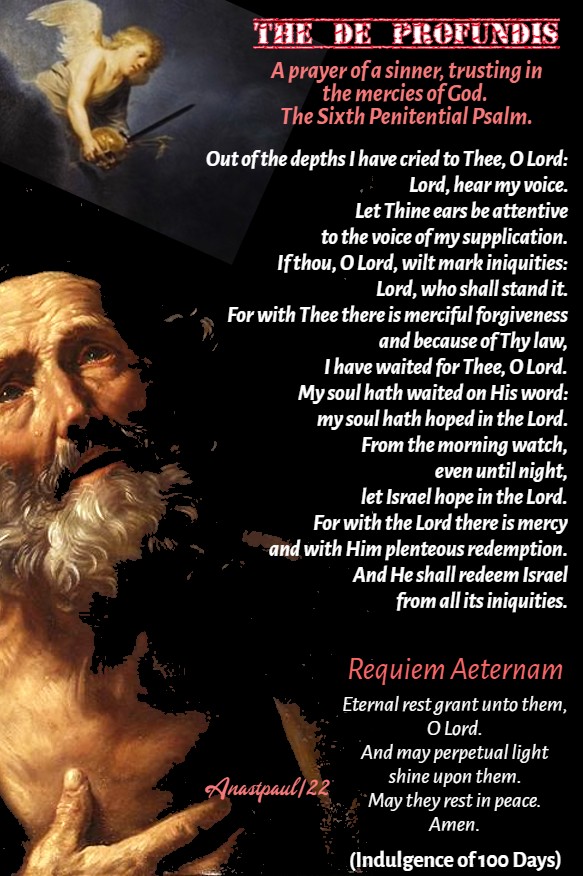
The De Profundis Psalm 129
A prayer of a sinner, trusting in the mercies of God. The Sixth Penitential Psalm.
Out of the depths I have cried to Thee, O Lord: Lord, hear my voice. Let Thine ears be attentive to the voice of my supplication. If thou, O Lord, wilt mark iniquities: Lord, who shall stand it. For with Thee there is merciful forgiveness and because of Thy law, I have waited for Thee, O Lord. My soul hath waited on His word: my soul hath hoped in the Lord. From the morning watch, even until night, let Israel hope in the Lord. For with the Lord there is mercy and with Him plenteous redemption. And He shall redeem Israel from all its iniquities.
(Eternal rest or “Requiem aeternam”) Eternal rest grant unto them, O Lord. And may perpetual light shine upon them. May they rest in peace. Amen.
(Indulgence of 100 Days)
*Psalm 129 in Douay Rheims
Pope Clement XII. was the first who, in order to move the piety of Christians to pray for the souls in Purgatory, granted, by a Brief of 4 August 1736, Coelestes Ecclesiae thesauros – i. The Indulgence of 100 days to all the faithful, everytime that, at the sound of the bell, at the first hour after the evening Ave Maria, they say devoutly, on their knees the psalm De profundis, with a Requiem aAternamat the end of, it. (The evening Ave Maria in Rome varies with the season; it is commonly taken as 6 o’clock.) ii. A Plenary Indulgence to those who perform this pious exercise, for a year, at the hour appointed, once in the year, on any one day, after Confession and Communion. Those who do not know by heart the De Profundis, may gain these Indulgences by saying, in the way already mentioned for the De profundis, one Pater Noster and one Ave Maria, with the Requiem Aeternam. Observe also, that the aforesaid Clement XII. declared, on 12 December 1736, that these Indulgences might be gained by saying the De Profundis etc, as above, although, according to the custom of a particular Church or place, the “signal for the dead,” as it is called, be given by the sound of the bell either before, or after one hour after the evening Ave Maria. Pope Pius VI., by a Rescript of 18 March 1781, granted the above-named Indulgences to all the faithful, who should chance to dwell in any place where no bell for the dead is sounded and who, shall say the De Profundis or Pater Noster, as aforesaid, about the time specified above.
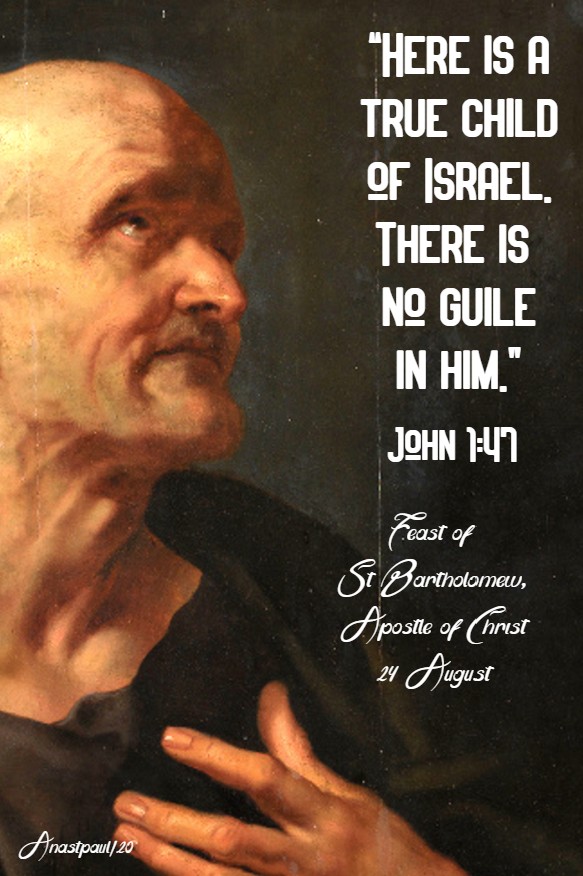
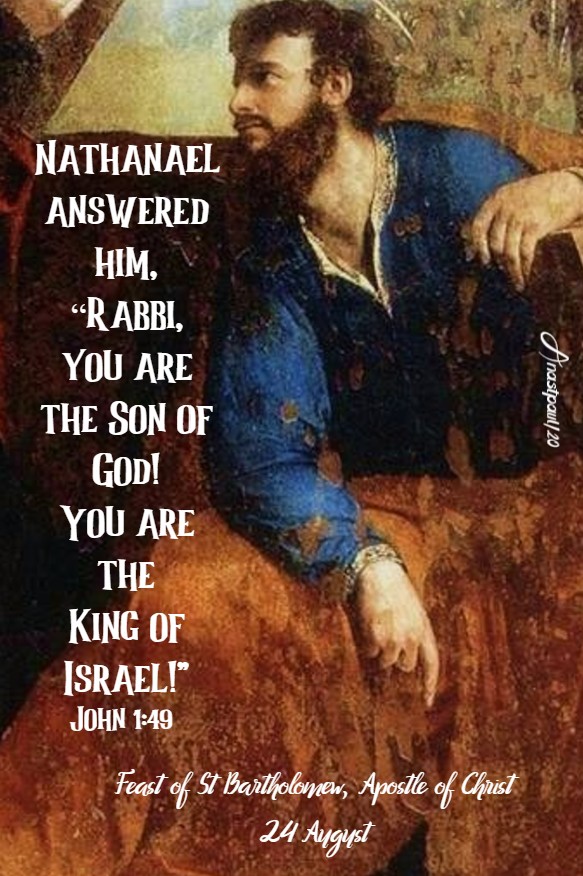
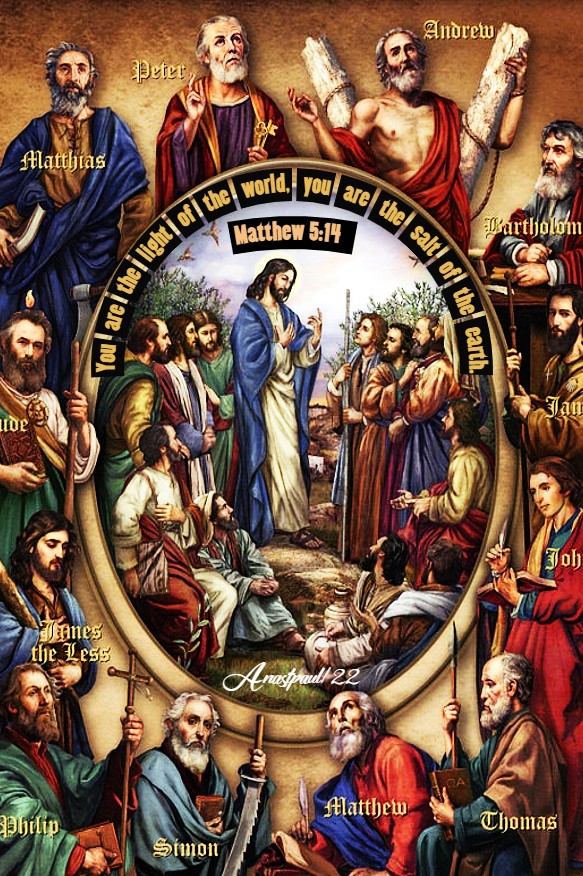
Quote/s of the Day – 24 August – St Bartholomew the Apostle and Martyr
“Here is a true child of Israel. There is no guile in him.”
John 1:47
Nathanael answered him, “Rabbi, you are the Son of God! You are the King of Israel!”
John 1:49
“You are the light of the world, you are the salt of the earth.”
Matthew 5:14
“Like peaceful conquerors, without any human weapons but backed by by the power of God, they divided the world amongst themselves, so that they might win it for Christ! The Roman Empire was small to them. They travelled, moreover, to the distant shores of Ethiopia and India, where the Eagle of Rome had never found its way! Surely, this is the most extraordinary Miracle of history?!
The Holy Spirit accomplished that, which human armies had never been able to do, save in part, or for a limited period of time. In this achievement, He used the weakest possible human means, namely, twelve poor fishermen! The earthly Empire of Rome, passed away but the Spiritual domain of Christ still remains, with its centre at Rome, as the only true Light, the only unfailing hope and the only pledge of salvation for individuals and nations.”
Antonio Cardinal Bacci (1881-1971)
O Fathers of Our Ancient Faith
O Fathers of our ancient faith, With all the heav’n, we sing your fame Whose sound went forth in all the earth To tell of Christ and bless His Name.
You took the Gospel to the poor, The Word of God alight in you, Which in our day is told again, That timeless Word, forever new.
You told of God, Who died for us And out of death triumphant rose, Who gave the Truth which made us free and changeless through the ages goes.
Praise Father, Son and Holy Spirit, Whose gift is faith that never dies, A light in darkness now, until The Day-Star in our hearts arise.
O Fathers of Our Ancient Faith is written by the Benedictine Nuns of Stanbrook Abbey. In the Divine Office it is sung at Morning Prayer in the Common of Apostles. It is set to the anonymous tune associated with the 7th century Latin hymn, Creator Alme Siderum.
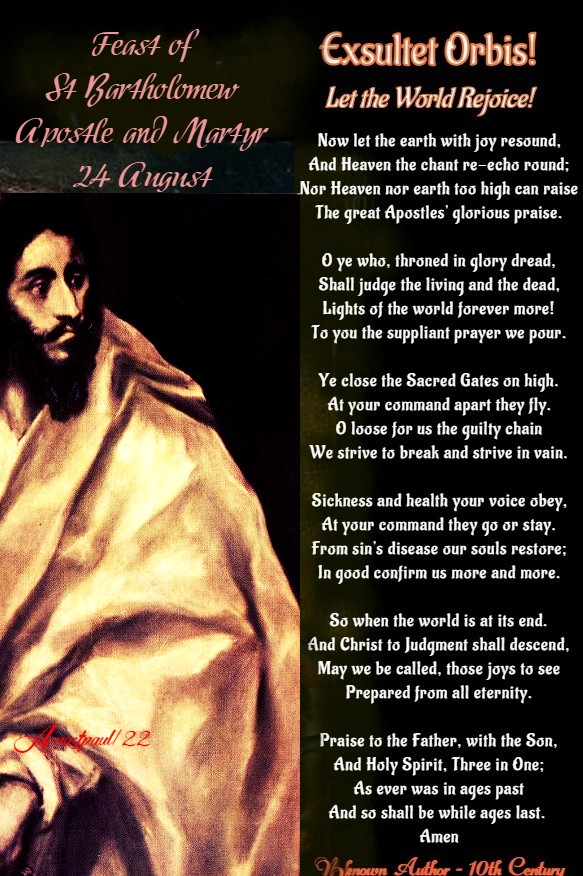
Our Morning Offering – 24 August – St Bartholomew the Apostle and Martyr
Exsultet Orbis! Let the World Rejoice! Unknown Author
Now let the earth with joy resound, And Heaven the chant re-echo round; Nor Heaven nor earth too high can raise The great Apostles’ glorious praise.
O ye who, throned in glory dread, Shall judge the living and the dead, Lights of the world forever more! To you the suppliant prayer we pour.
Ye close the Sacred Gates on high. At your command apart they fly. O loose for us the guilty chain We strive to break and strive in vain.
Sickness and health your voice obey, At your command they go or stay. From sin’s disease our souls restore; In good confirm us more and more.
So when the world is at its end. And Christ to Judgment shall descend, May we be called, those joys to see Prepared from all eternity.
Praise to the Father, with the Son, And Holy Spirit, Three in One; As ever was in ages past And so shall be while ages last. Amen
(Roman Breviary for the Common of Apostles) An Office Hymn that was traditionally prescribed for Vespers and Lauds on the Feasts of Apostles and Evangelists outside Easter time. The Hymn is found as early as the tenth century in a hymnal of Moissac Abbey.
Our Morning Offering – 13 August – “The Month of the Immaculate Heart of Mary” – –
The Memorare By St Bernard (1090-1153) Mellifluous Doctor
REMEMBER, O most gracious Virgin Mary, that never was it known, that anyone who fled to thy protection, implored thy help, or sought thy intercession was left unaided. Inspired by this confidence, I fly unto thee, O Virgin of virgins, my Mother, to thee do I come, before thee I stand, sinful and sorrowful. O Mother of the Word Incarnate, despise not my petitions but in thy mercy hear and answer me. Amen
(The Express Novena you will recall, is 9 times the Memorare within one day).
Our Morning Offering – 10 August – St Lawrence (Died 258) Martyr “Keeper of the Treasures of he Church,”
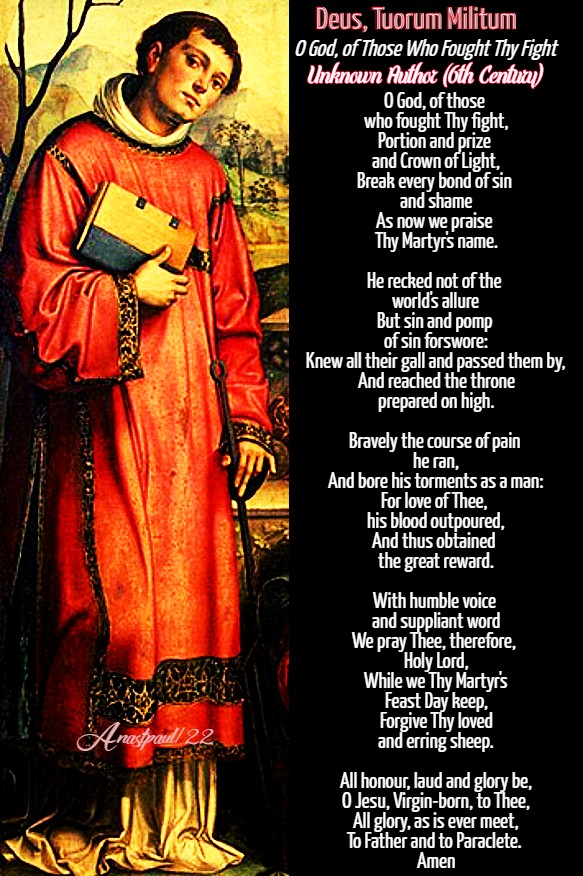
Deus, Tuorum Militum O God, of Those Who Fought Thy Fight Unknown Author (6th Century)
O God, of those who fought Thy fight, Portion and prize and Crown of Light, Break every bond of sin and shame As now we praise Thy Martyr’s name.
He recked not of the world’s allure But sin and pomp of sin forswore: Knew all their gall and passed them by, And reached the throne prepared on high.
Bravely the course of pain he ran, And bore his torments as a man: For love of Thee, his blood outpoured, And thus obtained the great reward.
With humble voice and suppliant word We pray Thee, therefore, Holy Lord, While we Thy Martyr’s Feast Day keep, Forgive Thy loved and erring sheep.
All honour, laud and glory be, O Jesu, Virgin-born, to Thee, All glory, as is ever meet, To Father and to Paraclete. Amen
An Ambrosian Hymn traditionally assigned for Matins and Vespers for the common feast of a Martyr in the Roman Breviary. It dates probably from the sSxth Century and is attributed to the unknown author of Rex Gloriose Martyrum and jesu, Redemptor Omnium. The Hymn exists in a longer versJon of eight strophes and a shorter one of four or five, which is probably earlier. The Vatican Antiphonary provided two different melodies for use in the Paschal Season and during the Octave of the Nativity, during which the Feast of Saint Stephen the Protomartyr occurs. The Hymn is a prayer asking God to forgive the sins of His servants on the day of the Martyr’s triumph over the pleasures of the world and the torture of persecution.
Our Morning Offering – 6 August – The Transfiguration of Our Lord
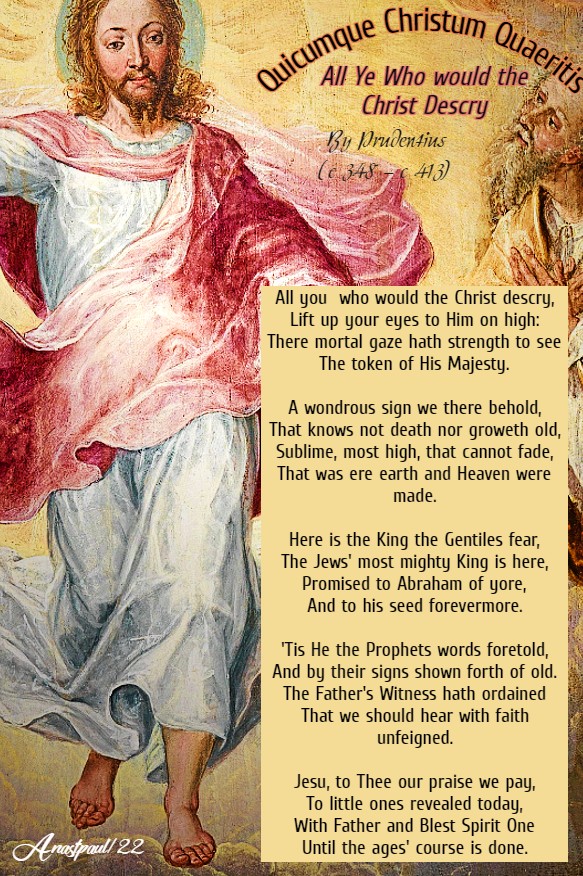
Quicumque Christum Quaeritis All Ye Who would the Christ Descry By Prudentius (c 348 – c 413) (Aurelius Prudentius Clemens) The Renowned Poet
All you who would the Christ descry, Lift up your eyes to Him on high: There mortal gaze hath strength to see The token of His Majesty.
A wondrous sign we there behold, That knows not death nor groweth old, Sublime, most high, that cannot fade, That was ere earth and Heaven were made.
Here is the King the Gentiles fear, The Jews’ most mighty King is here, Promised to Abraham of yore, And to his seed forevermore.
‘Tis He the Prophets words foretold, And by their signs shown forth of old. The Father’s Witness hath ordained That we should hear with faith unfeigned.
Jesu, to Thee our praise we pay, To little ones revealed today, With Father and Blest Spirit One Until the ages’ course is done.
The Hymn Quicumque Christum quaeritis is the twelfth and last poem in the Cathemerino of Prudentius, originally written in honour of the Epiphany. Its 208 lines has furnished four hymns to the Roman Breviary, Latin below the image. On the Feast of the Transfiguration the verses are above are used. There is a short biography of Prudentius here: https://anastpaul.com/2020/01/08/quote-s-of-the-day-8-january-take-courage-it-is-i-and-bl-titus-zeman/
Quicumque Christum quaeritis, Uculos in altum tollite: Illic licebit visere Signum perennis glorias.
Illustre quiddam cernimus, Quod nesciat finem pati, Sublime, celsum, interminum, Antiquius ccelo et chao.
Hic ille Rex est Gentium, Populique Rex Judaici, Promissus Abraha patri, Ejusque in aevum semini.
Hunc et Prophetis testibus, Iisdemque signatoribus Testator et Pater jubet Audire nos, et credere.
Jesu, tibi sit gloria, Qui te revelas parvulis, Cum Patre et almo Spiritu In sempiterna saecula.
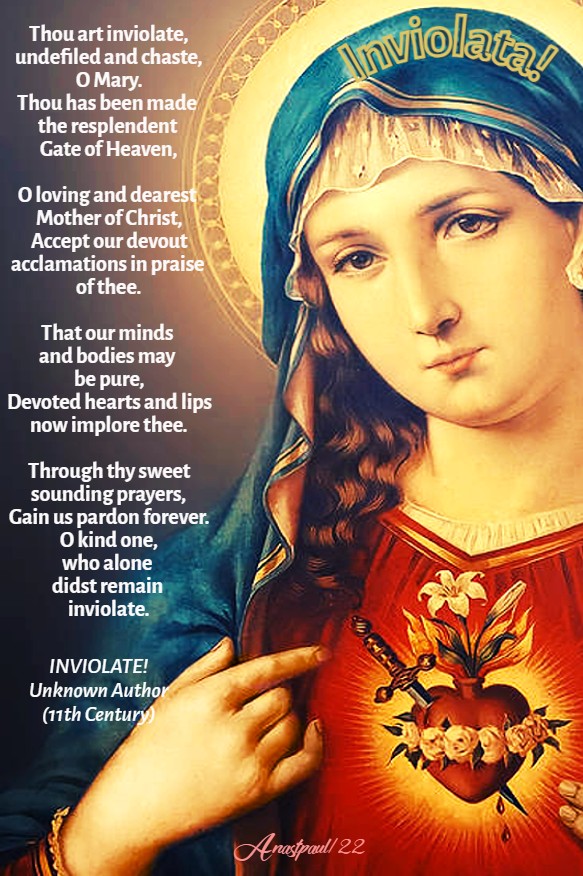
Thou art inviolate, undefiled and chaste, O Mary. Thou has been made the resplendent Gate of Heaven,
O loving and dearest Mother of Christ, Accept our devout acclamations in praise of thee.
That our minds and bodies may be pure, Devoted hearts and lips now implore thee.
Through thy sweet sounding prayers, Gain us pardon forever. O kind one, who alone didst remain inviolate.
The Hymn Inviolata has been claimed by the Carmelite Order, as a Traditional Hymn originating within their ranks. The Hymn is also used by Dominican Friars in the chanting of Compline. Its origins trace to the 11th century. It appears in Hymnals from 1860 to 1920.
Inviolata, integra, et casta es Maria, quae es effecta fulgida caeli porta.
O Mater alma Christi carissima, suscipe pia laudum praeconia.
Te nunc flagitant devota corda et ora, nostra ut pura pectora sint et corpora.
Tua per precata dulcisona, nobis concedas veniam per saecula.
O benigna! O Regina! O Maria, quae sola inviolata permansisti.
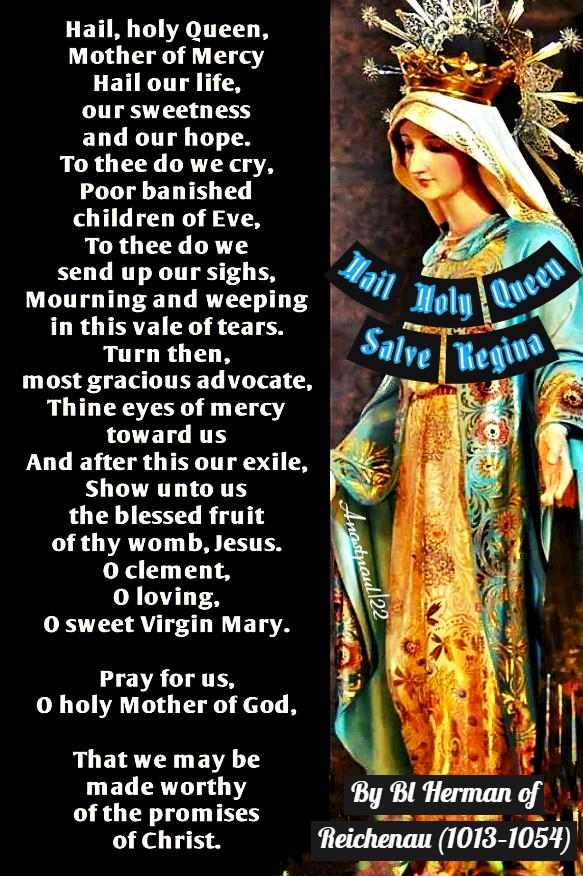
Salve Regina Hail Holy Queen By Blessed Herman of Reichenau (1013–1054)
Hail, holy Queen, Mother of Mercy, Hail our life, our sweetness and our hope. To thee do we cry, Poor banished children of Eve; To thee do we send up our sighs, Mourning and weeping in this valley of tears. Turn then, most gracious advocate, Thine eyes of mercy toward us; And after this our exile, Show unto us the blessed fruit of thy womb, Jesus.
This line, below, by St Bernard of Clairvaux (1090-1153) Doctor of the Church
O clement, O loving, O sweet Virgin Mary.
℣ Pray for us, O holy Mother of God, ℟ that we may be made worthy of the promises of Christ.
Quote/s of the Day – 11 July – The Memorial of St Pius I, Pope (Died c 154) Martyr – 1 Peter 5:1-4; 5:10-11, Matthew 16:13-19
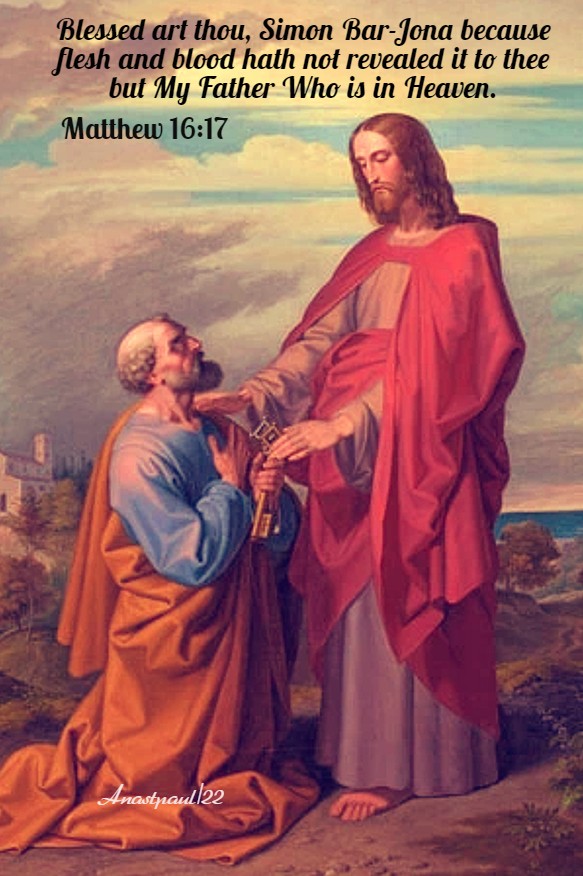
“Blessed art thou, Simon Bar-Jona because flesh and blood hath not revealed it to thee but My Father Who is in Heaven.”
Matthew 16:17
“Faith gives rise to prayer and this prayer obtains an increase of faith.”
St Augustine (354-430) Father and Doctor of Grace
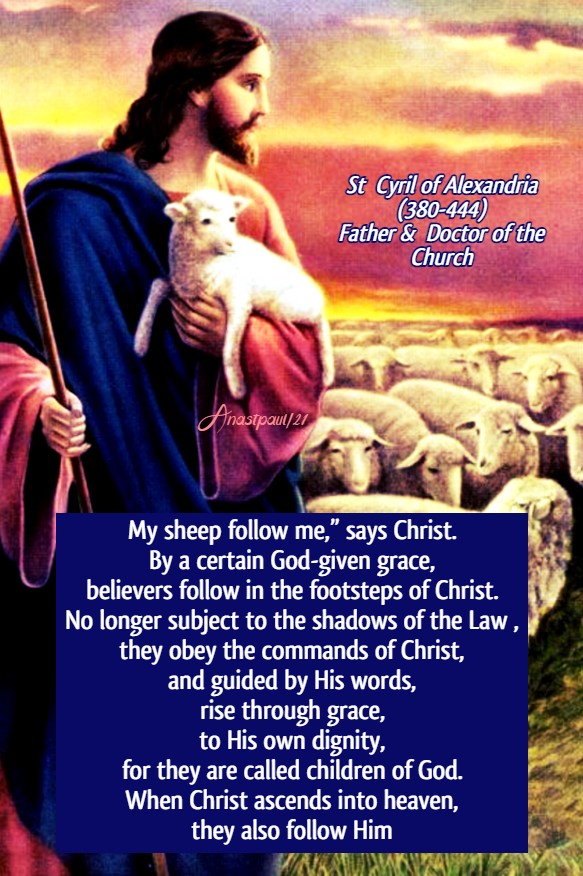
“My sheep follow me,” says Christ. By a certain God-given grace, believers follow in the footsteps of Christ. No longer subject to the shadows of the Law , they obey the commands of Christ, and guided by His words, rise through grace, to His own dignity, for they are called children of God. When Christ ascends into heaven, they also follow Him.”
St Cyril of Alexandria (376-444) Father & Doctor of the Church
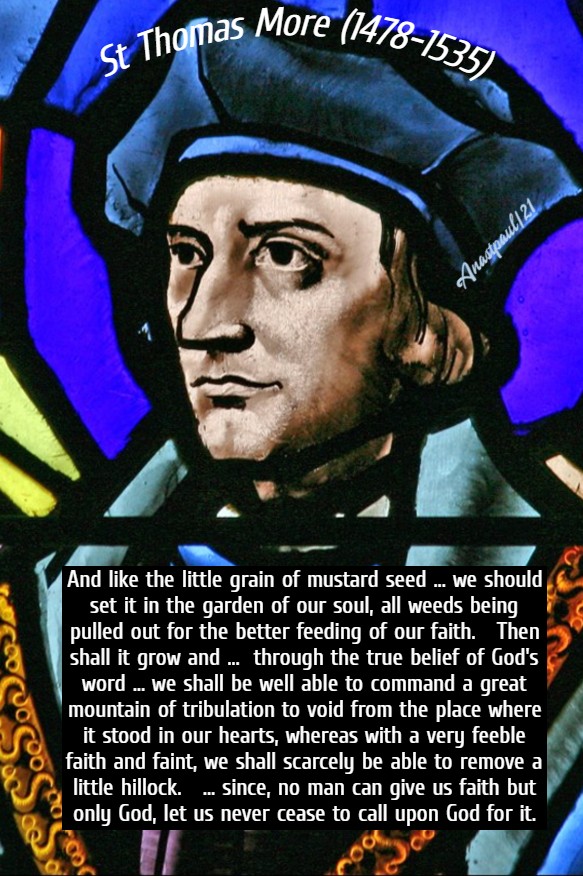
“And like the little grain of mustard seed … we should set it in the garden of our soul, all weeds being pulled out for the better feeding of our faith. Then shall it grow and … through the true belief of God’s word … we shall be well able to command a great mountain of tribulation to void from the place where it stood in our hearts, whereas with a very feeble faith and faint, we shall scarcely be able to remove a little hillock.”
St Thomas More (1478-1535)
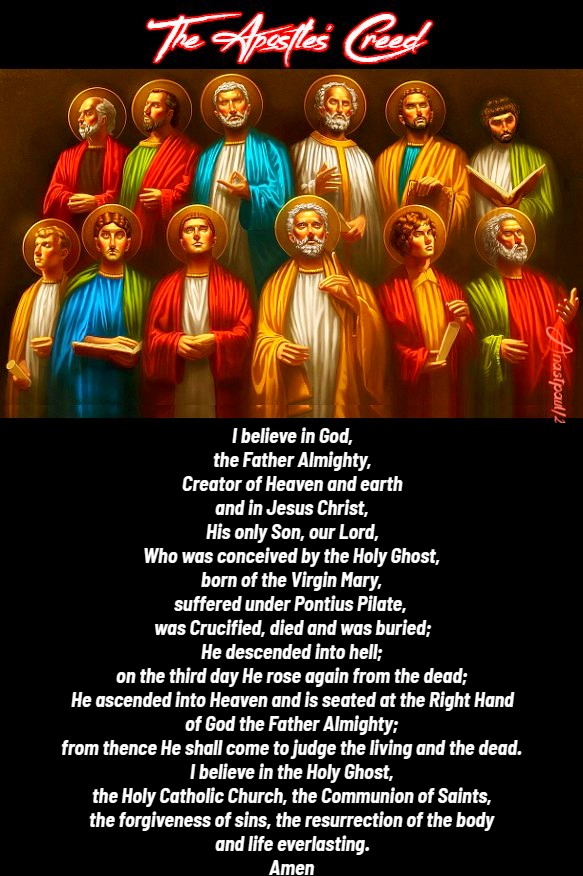
The Apostles’ Creed
I believe in God, the Father Almighty, Creator of Heaven and earth and in Jesus Christ, His only Son, our Lord, Who was conceived by the Holy Ghost, born of the Virgin Mary, suffered under Pontius Pilate, was Crucified, died and was buried; He descended into hell; on the third day He rose again from the dead; He ascended into Heaven and is seated at the Right Hand of God the Father Almighty; from thence He shall come to judge the living and the dead. I believe in the Holy Ghost, the Holy Catholic Church, the communion of Saints, the forgiveness of sins, the resurrection of the body and life everlasting. Amen
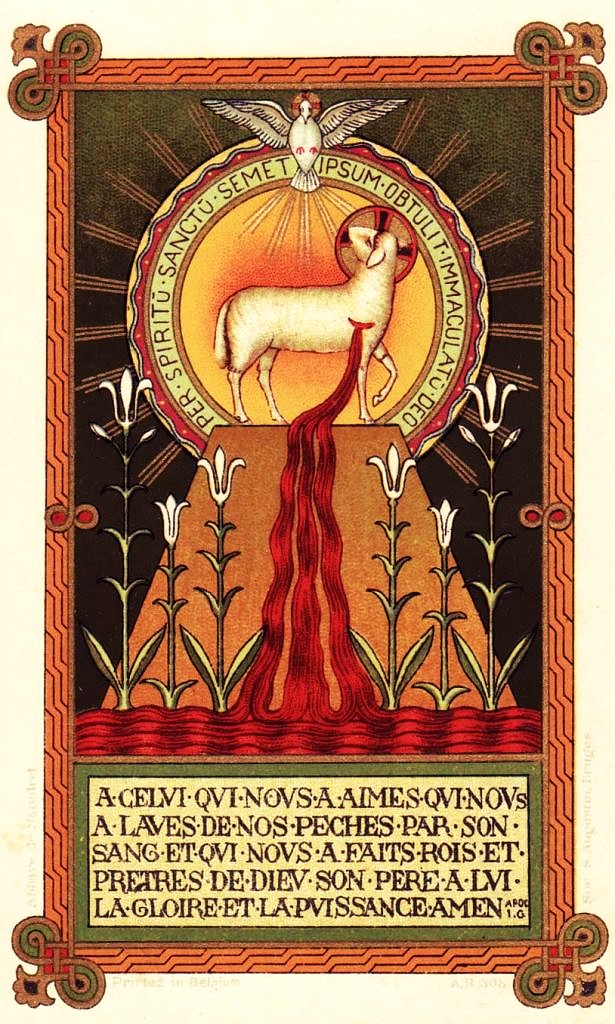
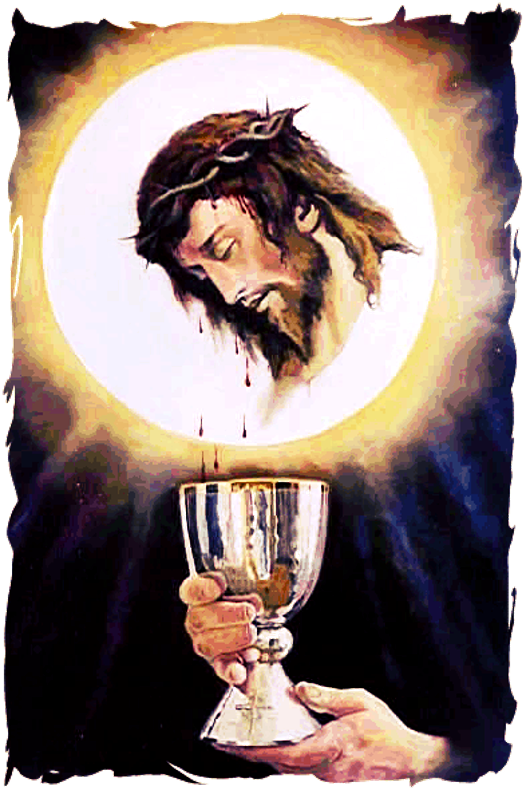
The Solemnity of the Most Precious Blood of of Our Lord Jesus Christ
By Servant of God Abbot Prosper Guéranger OSB (1805-1875)
John the Baptist has pointed out the Lamb, Peter has firmly fixed His throne, Paul has prepared the Bride; this their joint work, admirable in its unity, at once suggests the reason for their feasts occurring almost simultaneously on the cycle. The alliance being now secured, all three fall into shade; whilst the Bride herself, raised up by them to such lofty heights, appears alone before us, holding in her hands the sacred cup of the nuptial-feast.
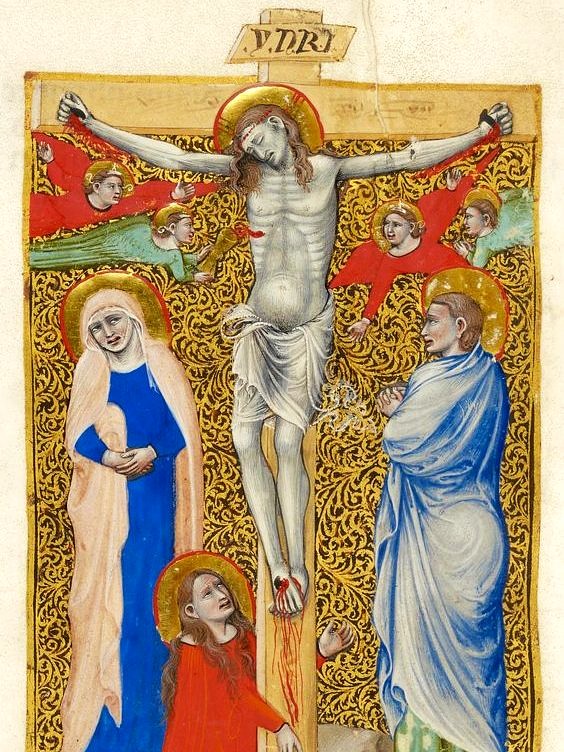
This gives the key of today’s Solemnity; revealing how its illumining the heavens of the holy Liturgy, at this particular season, is replete with Mystery. The Church, it is true, has already made known to the sons of the New Covenant, and in a much more solemn manner, the price of the Blood that redeemed them, its nutritive strength and the adoring homage which is its due. Yes, on Good Friday, earth and Heaven beheld all sin drowned in the saving stream, whose eternal flood-gates, at last gave way, beneath the combined effort of man’s violence and of the love of the Divine Heart.
The festival of Corpus Christi witnessed our prostrate worship before the aAtars whereon is perpetuated the Sacrifice of Calvary and where, the outpouring of the Precious Blood affords drink to the humblest little ones, as well as to the mightiest potentates of earth, lowly bowed in adoration before it. How is it, then, that Holy Church is now inviting all Christians to hail, in a particular manner, the stream of life ever gushing from the Sacred Fount? What else can this mean but, that the preceding Solemnities have, by no means exhausted the Mystery? The peace which the Blood has made to reign in the high places, as well as in the low, the impetus of its wave-bearing back, the sons of Adam, from the yawning gulf, purified, renewed and dazzling white in the radiance of their heavenly apparel; the Sacred Table outspread before them, on the waters’ brink and the Chalice, brimful of inebriation; all this preparation and display would be objectless, all these splendours would be incomprehensible, if man were not brought to see therein, the wooings of a love which could never endure its advances to be outdone, by the pretensions of any other. Therefore, the Blood of Jesus is set before our eyes, at this moment, as the Blood of the Testament; the pledge of the alliance proposed to us by God (Exod. xxiv. 8; Heb. ix. 20); the dower stipulated upon by Eternal Wisdom for this Divine union to which He is inviting all men and whereof, the consummation in our soul is being urged forward with such vehemence, by the Holy Ghost.
“Having therefore, Brethren, a confidence in the entering into the Holies by the Blood of Christ,” says the Apostle, “a new and living way which He hath dedicated for us through the veil, that is to say, His flesh, let us draw near with a pure heart in fullness of faith, having our hearts sprinkled from an evil conscience and our bodies washed with clean water, let us hold fast the confession of our hope without wavering, for He is faithful that hath promised. Let us consider one another to provoke unto charity and to good works (Heb. x. 19-24). And may the God of peace, Who brought again from the dead the great Shepherd of the sheep, Our Lord Jesus Christ, in the Blood of the everlasting Testament, fit you in all goodness, that you may do His will: doing in you, that which is well-pleasing in His sight, through Jesus Christ, to whom is glory forever and ever. Amen!” (Ibid. xiii. 20, 21)
Nor must we omit to mention here, that this Feast is a monument of one of the most brilliant victories of Holy Church, in our own age. Pius IX. had been driven from Rome in 1848, by the triumphant revolution but, the following year, just about this very season, his power was re-established. Under the aegis of the Apostles on 28 June and the two following days, the eldest daughter of the Church, faithful to her past glories, swept the ramparts of the Eternal City; and on 2 July, Mary’s festival, the victory was completed. Not long after this, a twofold decree notified to the City and to the world, the Pontiff’s gratitude and the way in which he intended to perpetuate, in the Sacred Liturgy, the memory of these events. On 10 August, from Gaeta itself, the place of his exile in the evil day, Pius IX, before returning to re-assume the government of his States, addressing himself to the invisible Head of the Church, confined her in a special manner to His Divine care, by the institution of this day’s Festival; reminding Him that it was for His Church that He vouchsafed to shed all His Precious Blood.
Then, when the Pontiff re-entered his Capital, turning to Mary, just as Pius V and Pius VII. had done under other circumstances, he, the Vicar of Christ, solemnly attributed the honour of the recent victory to Her who is ever the “Help of Christians,” for, on the Feast of Her Visitation it had been gained and he now decreed that this said Feast of 2 July should be raised from the rite of double-major to that of second class throughout the whole world. This was but a prelude to the definition of the Dogma of the Immaculate Conception, which the immortal Pontiff had already in project, whereby the crushing of the serpent’s head would be completed.
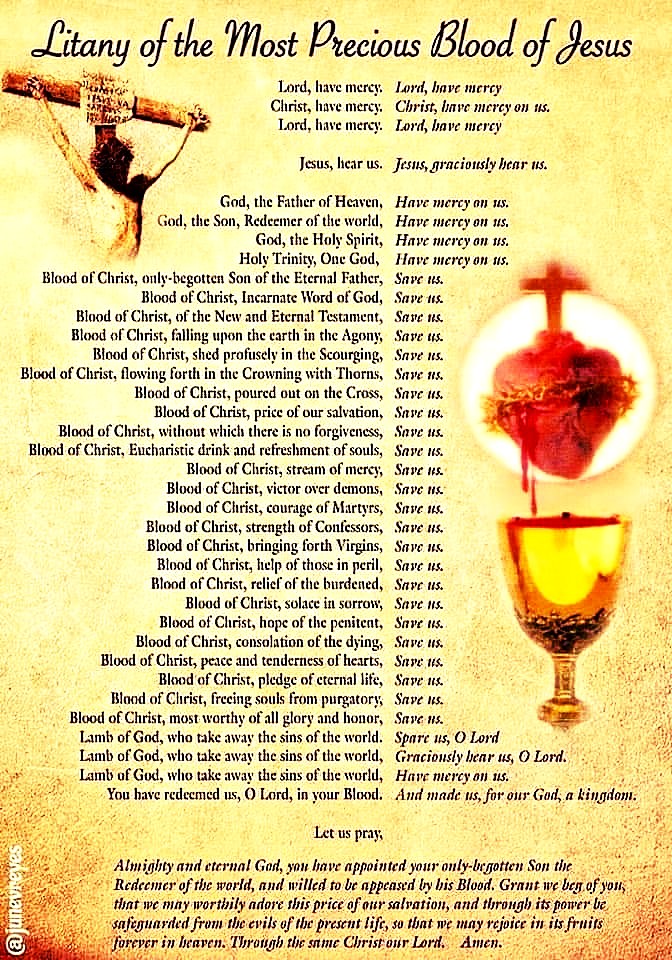
Litany of the Most Precious Blood of of Our Lord Jesus Christ
Lord, have mercy
Lord, have mercy
Christ, have mercy
Christ, have mercy
Lord, have mercy
Lord, have mercy
God our Father in heaven
have mercy on us
God the Son, Redeemer of the world
have mercy on us
God the Holy Spirit
have mercy on us
Holy Trinity, one God
have mercy on us
Blood of Christ, only Son of the Father
be our salvation
Blood of Christ, incarnate Word
be our salvation
Blood of Christ, of the new and eternal covenant
be our salvation
Blood of Christ, that spilled to the ground
be our salvation
Blood of Christ, that flowed at the scourging
be our salvation
Blood of Christ, dripping from the thorns
be our salvation
Blood of Christ, shed on the cross
be our salvation
Blood of Christ, the price of our redemption
be our salvation
Blood of Christ, our only claim to pardon
be our salvation
Blood of Christ, our blessing cup
be our salvation
Blood of Christ, in which we are washed
be our salvation
Blood of Christ, torrent of mercy
be our salvation
Blood of Christ, that overcomes evil
be our salvation
Blood of Christ, strength of the martyrs
be our salvation
Blood of Christ, endurance of the saints
be our salvation
Blood of Christ, that makes the barren fruitful
be our salvation
Blood of Christ, protection of the threatened
be our salvation
Blood of Christ, comfort of the weary
be our salvation
Blood of Christ, solace of the mourner
be our salvation
Blood of Christ, hope of the repentant
be our salvation
Blood of Christ, consolation of the dying
be our salvation
Blood of Christ, our peace and refreshment
be our salvation
Blood of Christ, our pledge of life
be our salvation
Blood of Christ, by which we pass to glory
be our salvation
Blood of Christ, most worthy of honor
be our salvation
Lamb of God, you take away the sins of the world
have mercy on us
Lamb of God, you take away the sins of the world
have mercy on us
Lamb of God, you take away the sins of the world
have mercy on us
Lord, you redeemed us by your blood.
You have made us a kingdom to serve our God.
Let us pray.
Almighty and Eternal God, Thou hast appointed Thine Only Begotten Son, the Redeemer of the world and willed to be appeased by His Blood. Grant, we beseech Thee, that we may worthily adore this Price of our Salvation,and through its power be safeguarded from the evils of this present life, so that we may rejoice in its fruits forever in Heaven. Through the same Christ Our Lord. R/. Amen.
Our Morning Offering – 5 June – Pentecost Sunday, Alleluia!
Veni Sancte Spiritus The Golden Sequence
Come, Holy Spirit and bring from above The splendour of Thy light. Come, Father of the poor, come, Giver of graces, Come, Light of our hearts. Best of Consolers, sweet Guest of the soul, And Comfort of the weary. Thou rest in labour, relief in burning toil, Consoling us in sorrow. O blessed Light, fill the innermost hearts Of those who trust in Thee. Without Thy indwelling, there is nothing in man, And nothing free of sin. Cleanse what is sordid, give water in dryness, And heal the bleeding wounds. Bend what is proud, make warm what is cold, Bring back the wayward soul. Give to the faithful, who trustingly beg Thee Thy seven Holy Gifts. Grant virtue’s reward, salvation in death, And everlasting joy. Amen. Alleluia!
“Veni Sancte Spiritus,” the “Golden Sequence”, is a sequence prescribed in the Roman Liturgy for the Masses of Pentecost and its octave, exclusive of the following Trinity Sunday. It is usually attributed to either the thirteenth-century Pope Innocent III (c 1160 – 1216) or to the Archbishop of Canterbury, Cardinal Stephen Langton (c 1150 – 1228).
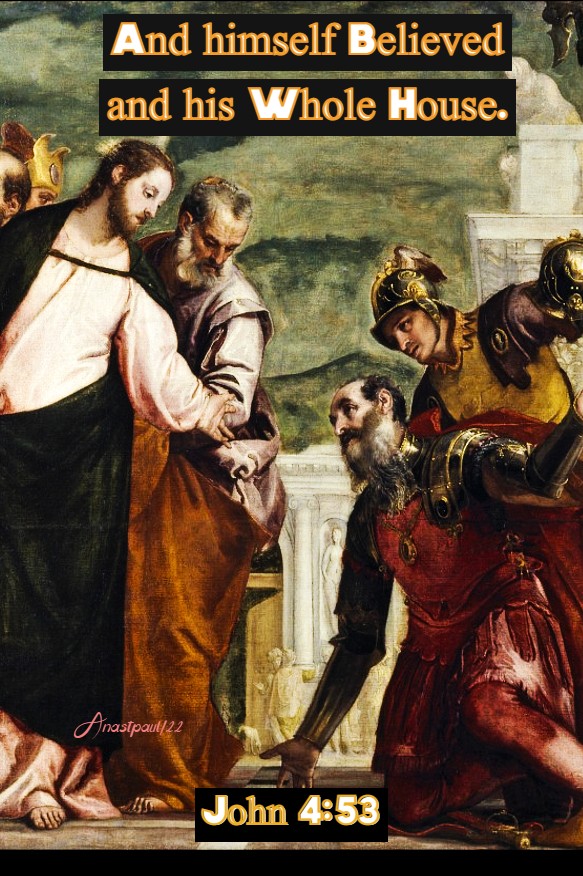
Quote/s of the Day – 12 May – Wisdom 5:1-5, John 4:46-53.
“And himself believed and his whole house.”
John 4:53
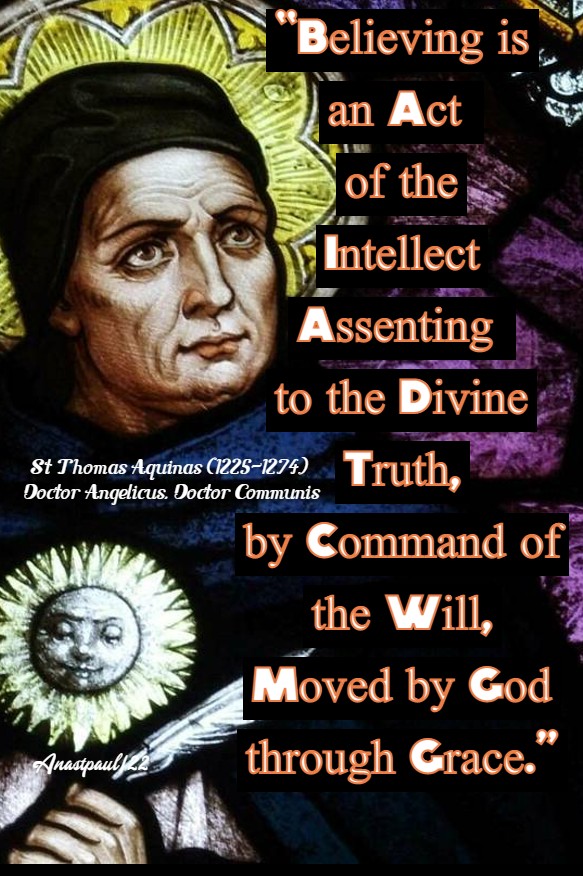
“Believing is: an act of the intellect assenting to the divine truth, by command of the will, moved by God through grace.”
St Thomas Aquinas (1225-1274) Doctor Angelicus. Doctor Communis
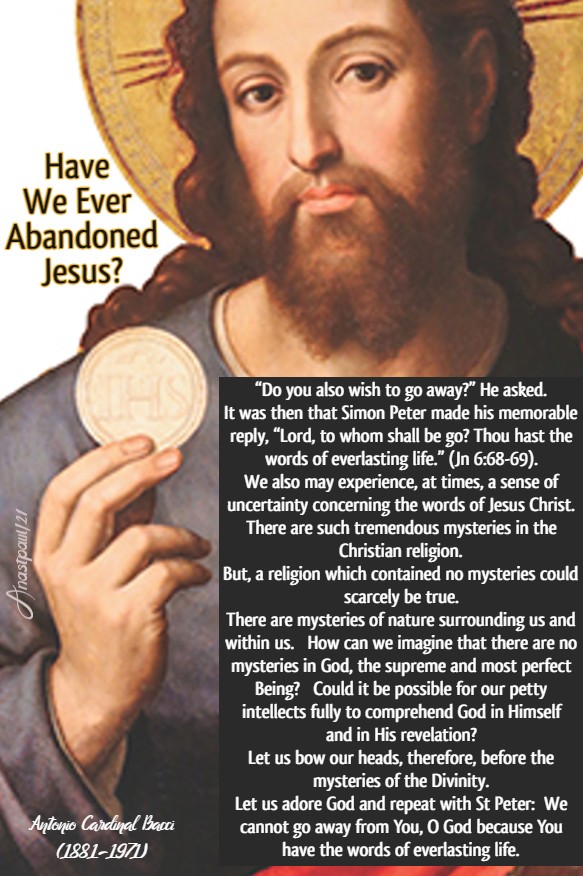
“Do you also wish to go away?” He asked. It was then that Simon Peter made his memorable reply, “Lord, to whom shall be go? Thou hast the words of everlasting life.” (Jn 6:68-69). We also may experience, at times, a sense of uncertainty concerning the words of Jesus Christ. There are such tremendous mysteries in the Christian religion. But, a religion which contained no mysteries could scarcely be true. There are mysteries of nature surrounding us and within us. How can we imagine that there are no mysteries in God, the supreme and most perfect Being? Could it be possible for our petty intellects fully to comprehend God in Himself and in His revelation? Let us bow our heads, therefore, before the mysteries of the Divinity. Let us adore God and repeat with St Peter: We cannot go away from You, O God because You have the words of everlasting life.”
Antonio Cardinal Bacci (1881-1971)
The Apostles’ Creed
I believe in God, the Father Almighty, Creator of heaven and earth and in Jesus Christ, His only Son, our Lord, who was conceived by the Holy Spirit, born of the Virgin Mary, suffered under Pontius Pilate, was crucified, died and was buried; He descended into hell; on the third day He rose again from the dead; He ascended into heaven and is seated at the right hand of God the Father Almighty; from thence He shall come to judge the living and the dead. I believe in the Holy Spirit, the Holy Catholic Church, the communion of Saints, the forgiveness of sins, the resurrection of the body and life everlasting. Amen

























 AnaStpaul
You must be logged in to post a comment.