Posted in INCORRUPTIBLES

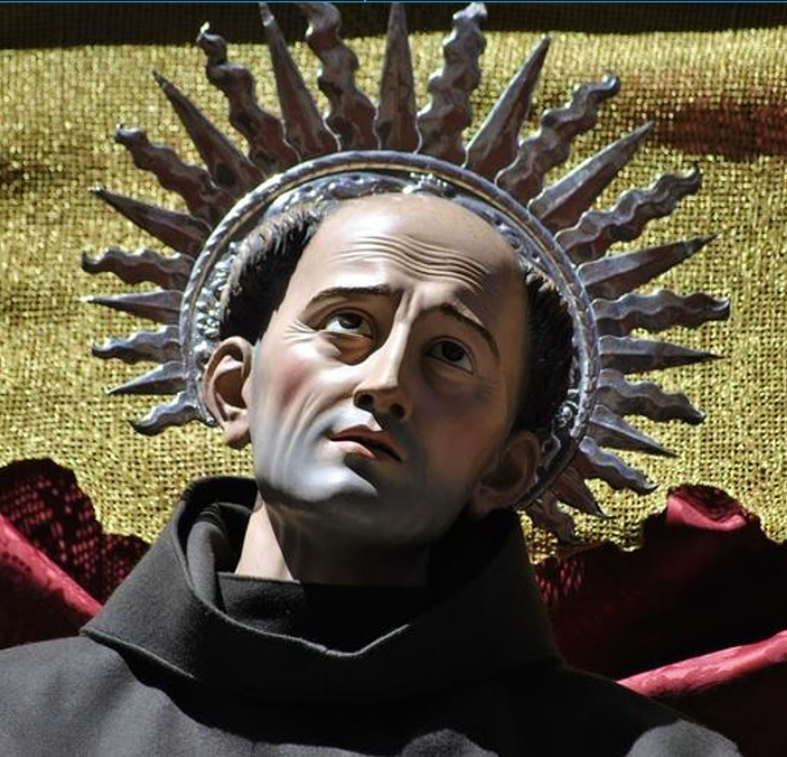
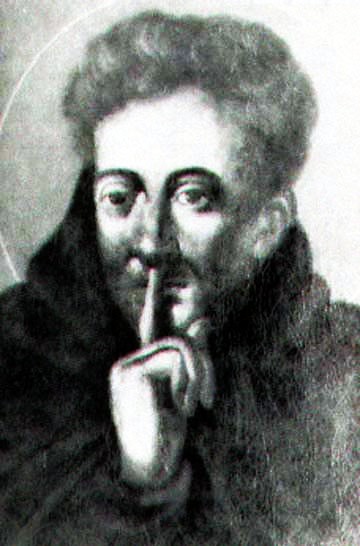
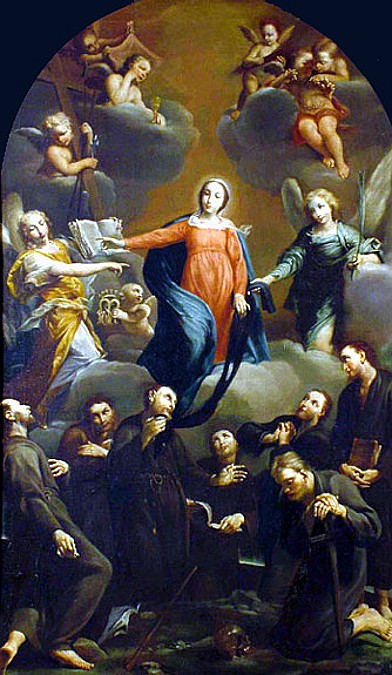
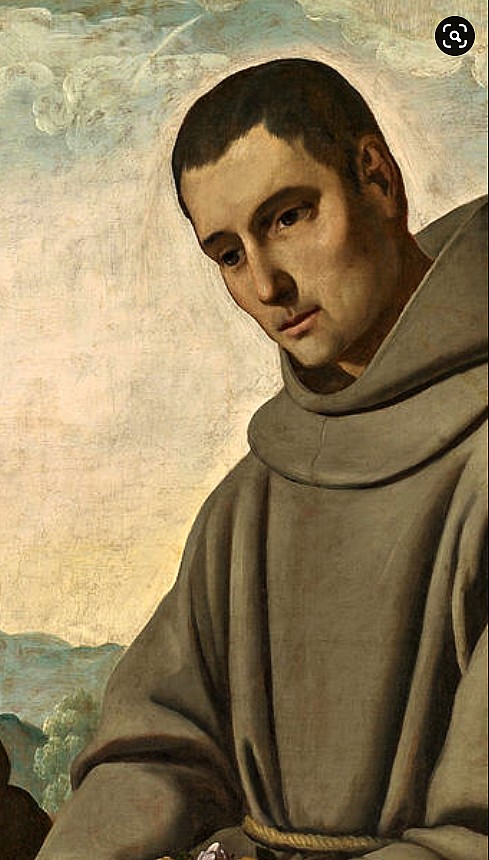
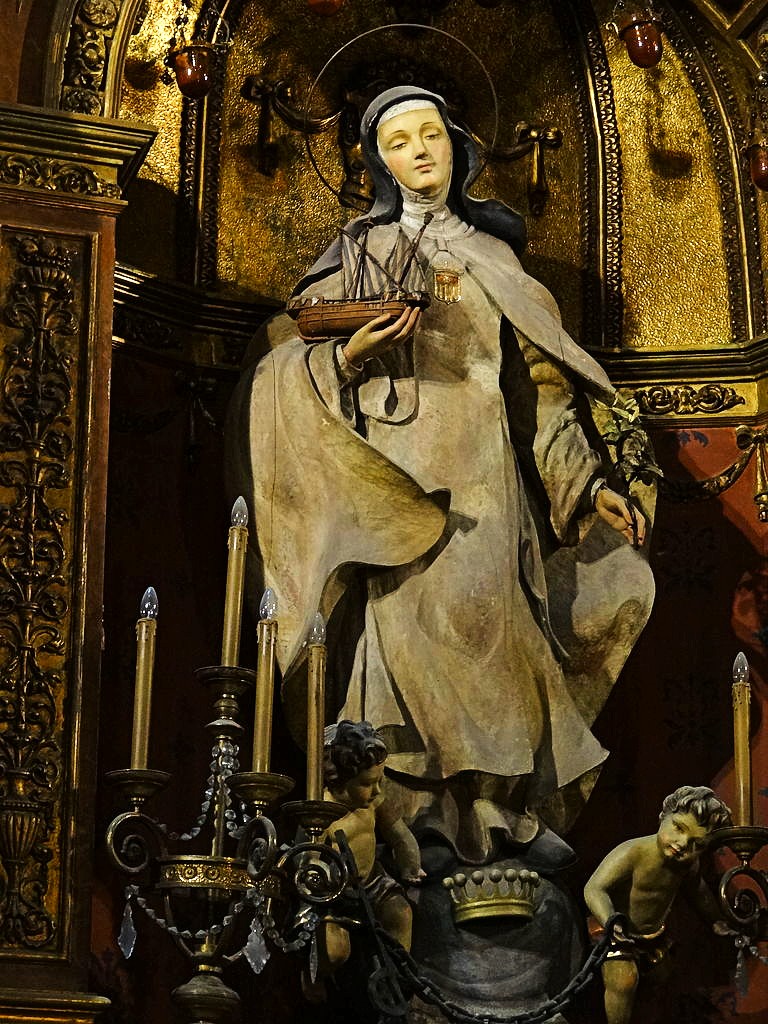
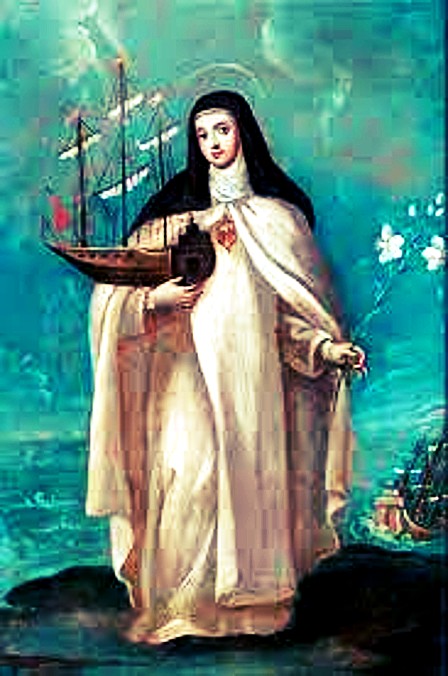
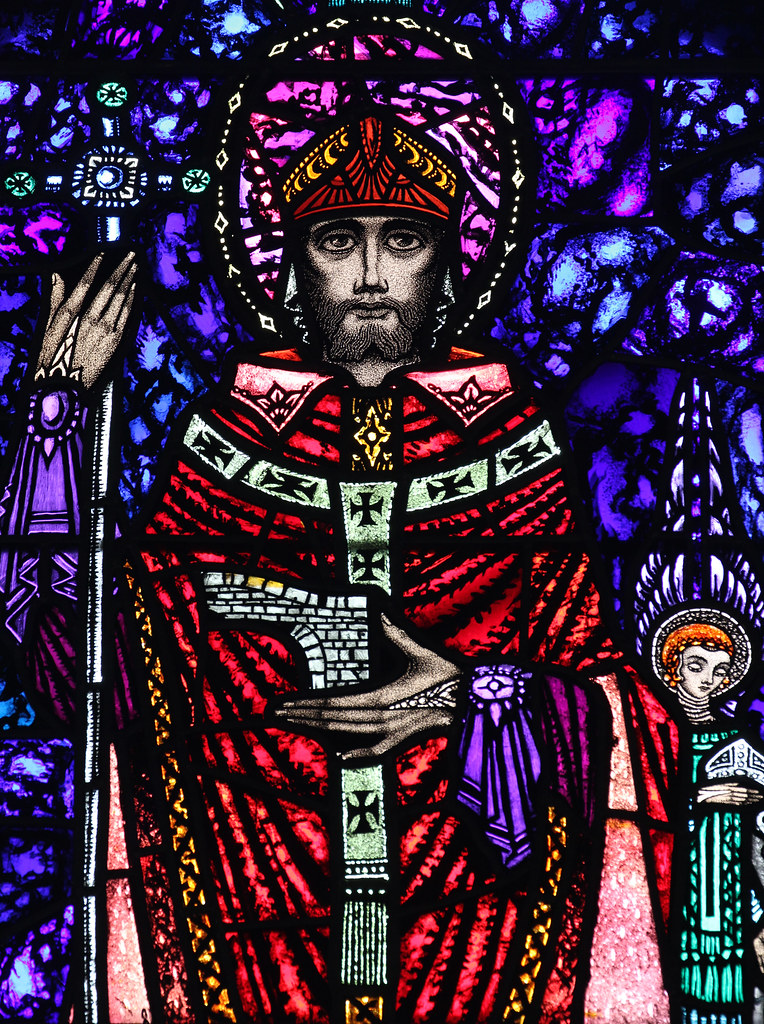
Saint of the Day – 27 April – Saint Peter Armengol OdeM (c 1238-1304) “The Martyr who Wasn’t”

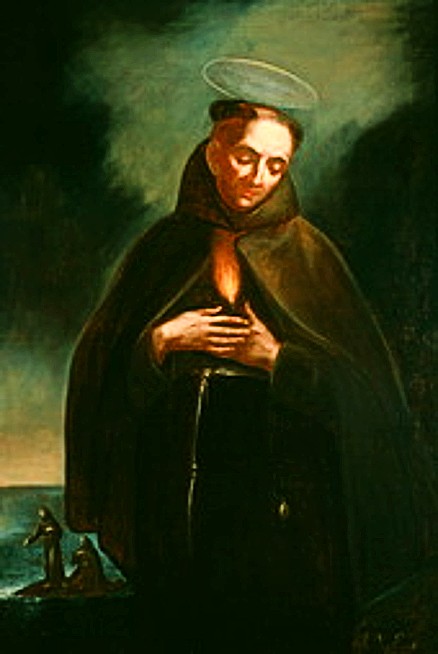
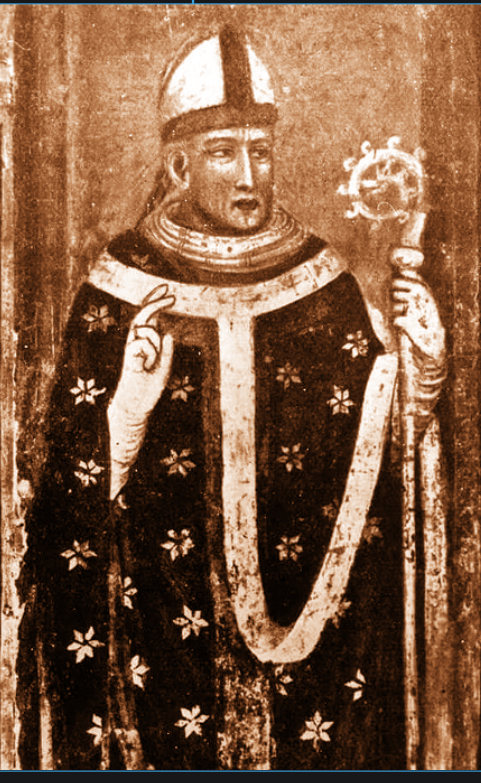
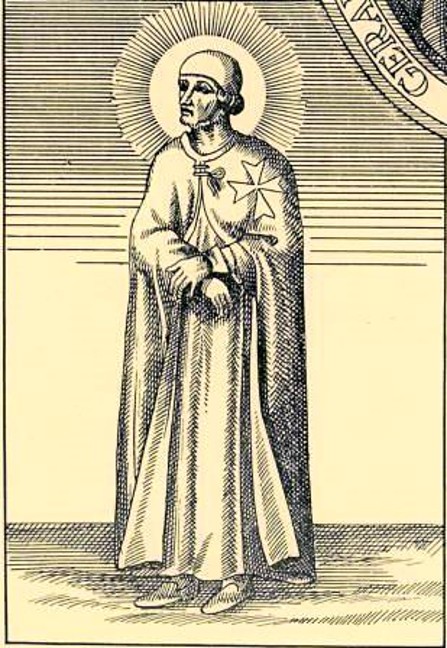
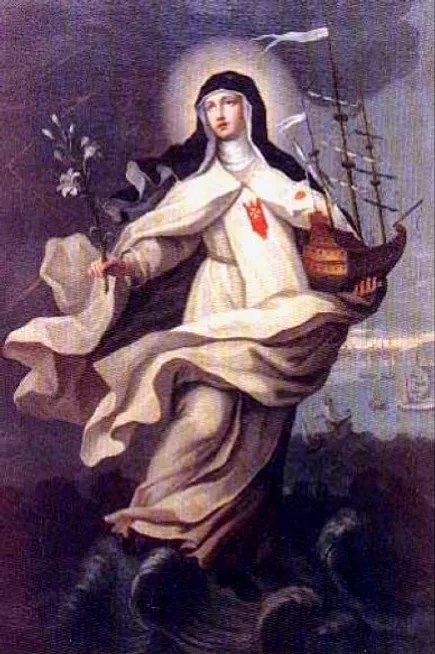
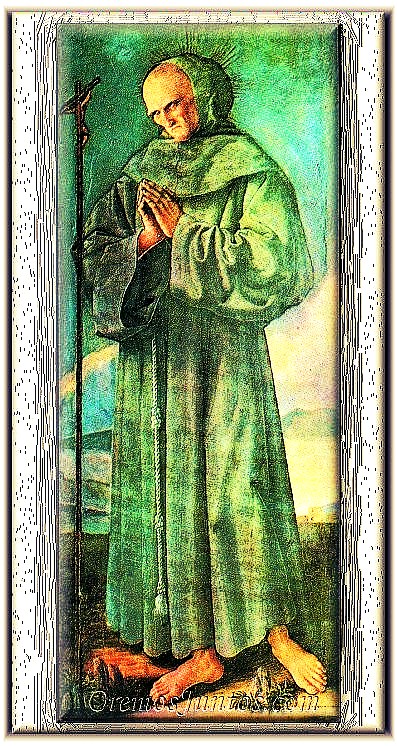
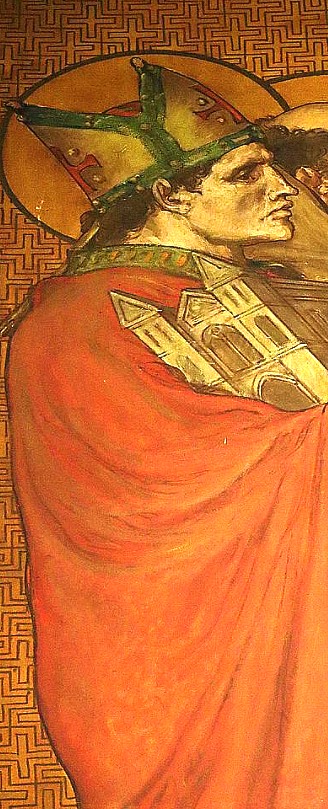
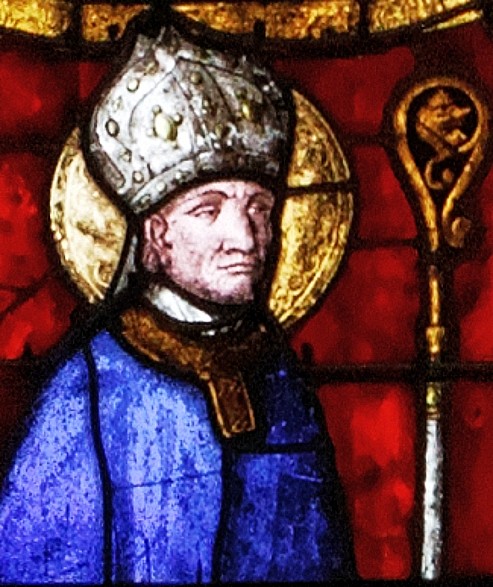
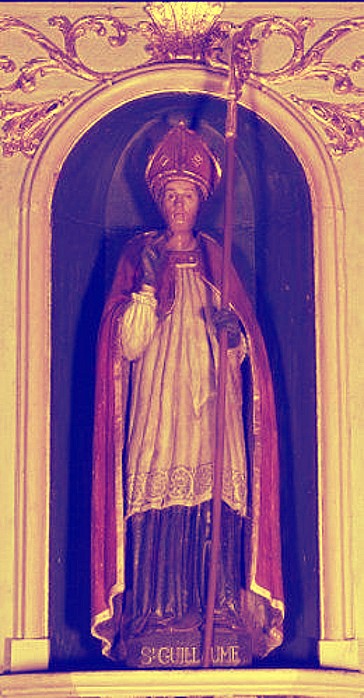
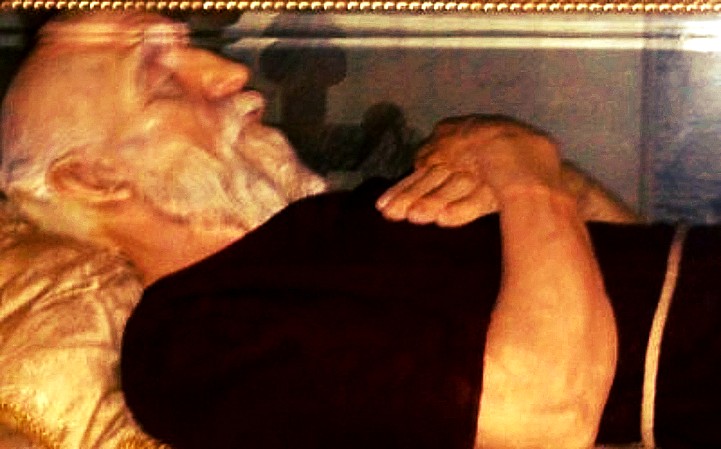
Saint of the Day – 27 April – Saint Peter Armengol OdeM (c 1238-1304) “The Martyr who Wasn’t,” Spanish Priest of the Mercedarian Friars, Penitent, Mystic, Born as Pedro Armengol Rocafort in c 1238 at Tarragona, Urgell region, eastern Spanish Pyrenees and died on 27 April 1304 at Tarragona, Urgell region, eastern Spanish Pyrenees of natural causes. Patronages – Persecuted Catholics, Conversion of the youth. Also known as – “The Martyr who Wasn’t,” “The Unconquerable Martyr of Jesus Christ,” “The Gangster Saint,” Pere Ermengol, Pedro Armengaudius, Peter Ermengol, Pietro Armengaudio. Beatified on 28 March 1686, by Pope Innocent XI and Canonised on 8 April 1687, by the same Pope. His body was incorrupt until it was destroyed during the horrors of the Spanish Civil War.

The Roman Martyrology states of him today: “At Tarragona, the blessed Peter Armengaudius, of the Order of Blessed Mary of Merry for the Redemption of Captives, who endured many tribulations in Africa in ransoming the faithful and finally closed his career peacefully, in the Convent of St Mary of the Meadows.

From Gangster to Convert
Pedro Armengol Rocafort was born in Tarragona in c 1238 to the nobleman Arnau Armengol Rocafort, descendants of the Counts of Urgel, whose ancestors were directly linked to the Counts of Barcelona and the Monarchs of Aragon and Castile.

Despite the great care taken by his parents regarding his education, young Peter gave himself over to a life of total dissipation, vice and caprice. “Abyssus abyssum invocat” (Deep calleth on deep), say the Scriptures. Thus Peter joined a gang of criminals who, pursued by Justice, led the life of bandits in the mountains. Soon, young Armengol became the leader of that gang.

Penance for His Misdeeds
Filled with shame, the repentant youth retired to a Mercedarian Monastery in Barcelona. With an ardent desire to repair the injuries done to God, he became a Monk in that religious order founded by Saint Peter Nolasco to ransom Catholics captured by the Mohammedans. He requested the habit with such insistence and gave such conclusive proofs of his vocation, that he was received into the Mercedarian Order by the Venerable William de Bas, the French-born successor of the holy Founder.

The disorderly passions were now conquered by Peter Armengol in religious life. He understood how to subdue them with such promptitude, through penance, mortification of the senses and continual prayer, that even before he reached the end of his novitiate, he had managed to subject them to the dominion of his will and reason.

During the eight years of his profession, he was entrusted with the important task of dealing directly with the ransom of captives. He carried out this function in the Provinces of Spain, which were still in the power of the Saracens. Nonetheless, his greatest desire was to go to Africa and become a captive himself, for the ransom of Christians.

On an expedition to that continent, he arrived in Bugia in the company of Friar William Florentino. There, they ransomed 119 captives without any incident. However, before departing, Friar Armengol learned of a prison where18 children were incarcerated, who, impelled by the threats of punishments, remained in danger of denying the Faith. The religious happily offered himself as hostage for the ransom of the innocent captives.

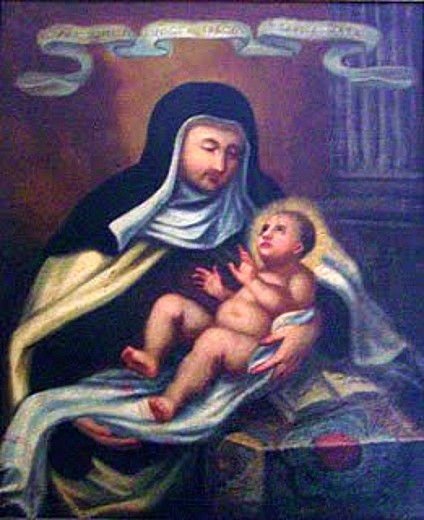
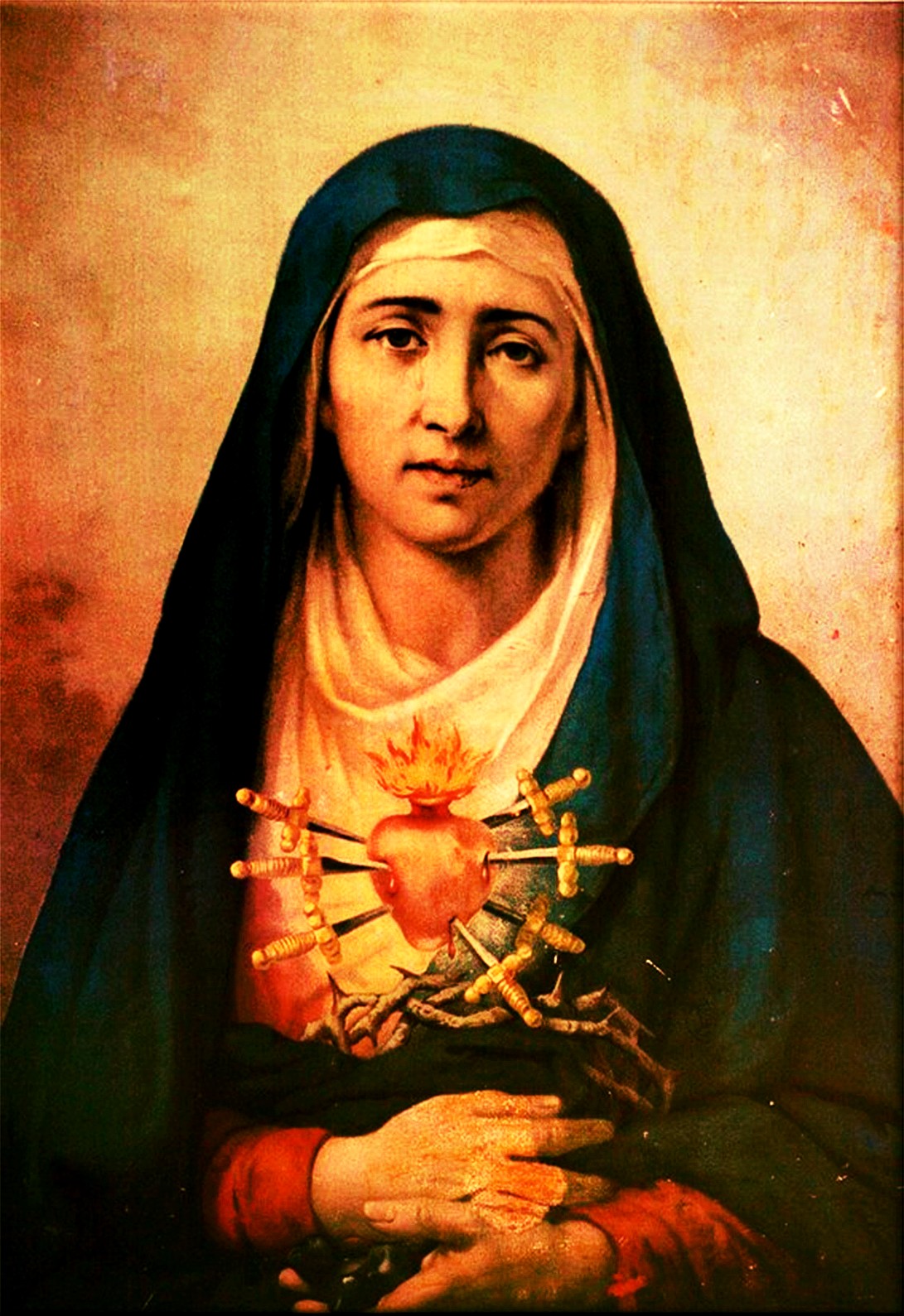
His release was promised in exchange for a stipulated sum. But, if the payment did not arrive within the set time, he would suffer harsh punishments. Divine Providence had disposed that this man of God would thus give proof of his special confidence in the omnipotent mediation of the Blessed Virgin, to whom he was deeply devoted.

Flaming Torch of Confidence
In captivity, Friar Armengol worked prodigies of charity among the infidels, converting many by the efficacy of his preaching. The time prescribed for the delivery of the money came and passed without the payment being made. The infidels threw him in prison and even denied the food necessary for his sustenance but Our Lord, by means of His angels, miraculously provided for his survival.

Tired of tormenting him, the Moors conspired to take his life. They accused him of blaspheming Mohammed and of being a spy sent by the Christian kings, thus raising the ire of the Saracen Judge who condemned Friar Peter to death by hanging. When everything seemed lost, Friar Armengol prayed to Our Lady and confided in her.

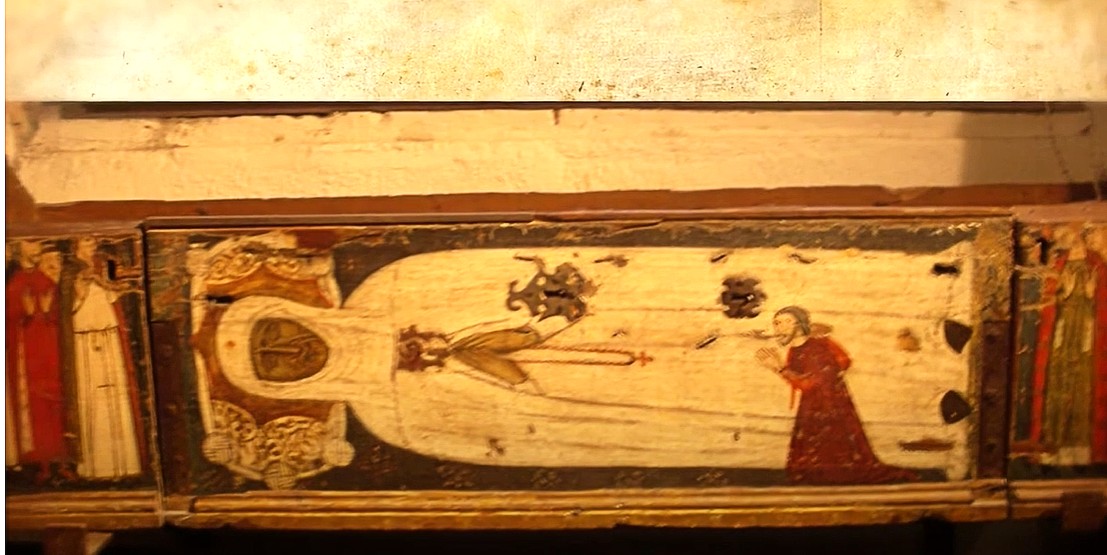
The unjust execution was carried out and Peter’s body was left hanging from the gallows. The Moors wanted his corpse to feed birds of prey. Thus, the holy man’s body remained suspended. Six days had elapsed when Friar William arrived with the ransom money. Learning what had happened, he went with great sorrow, in the company of some captives, to see the lamentable sight. Reaching the site of the execution, he noticed that the body did not emit a bad odour but rather exhaled a heavenly fragrance. To their astonishment, Friar Armengol spoke, telling them that the Blessed Mother saved his life. Astounded by the stupendous miracle, some pagans converted to the Catholic religion on the spot.

Learning of the portentous miracle, Barcelona impatiently awaited the return of the unconquerable Martyr of Jesus Christ. In the City, they received him with great joy, escorting him from the port to his Monastery, giving thanks to Our Lord for His marvels. The religious wanted to hear from Friar Peter’s mouth what had happened but despite their earnest pleas, he would not speak. Finally, the Superior ordered him to tell all that had occurred. Obedient, the man of God spoke:

The Virgin Mary, Mother of God and our own Mother, asked her Most Holy Son, to conserve my life. Having obtained this favour, this same sovereign Queen, sustained me with her most holy hands, so that the weight of my body, would not hang upon the rope by which I was suspended!

For the rest of his life, Friar Armengol had a twisted neck and a pale complexion, authentic signs of what had taken place. He retired to the Monastery of Our Lady de los Prados, where he practised heroic virtue and spent his days in familiar conversation with the Queen of Angels, whom he loved so dearly with filial devotion.

Recalling the miracle of his hanging, he frequently told the religious of the Monastery of this marvel:

Believe me, my dear brothers, that I do not believe myself to have lived, except for those few but most happy days when, hanging from the gallows, I was held to be dead.

He rendered his soul to God on 27 April 1304. Our Lord deigned to give proofs of the glorification of His servant with seven miracles, the cures of three men and four women, even before his death. On 28 March 1686 Pope Innocent the XI approved the public cult to the Saint and formalised his Canonisation tbghhe following year at St Peter’s in Rome. On 14 October 1688, Pope Benedict XIV inscribed Saint Peter Armengol in the Roman Martyrology.

The Tomb of the Saint
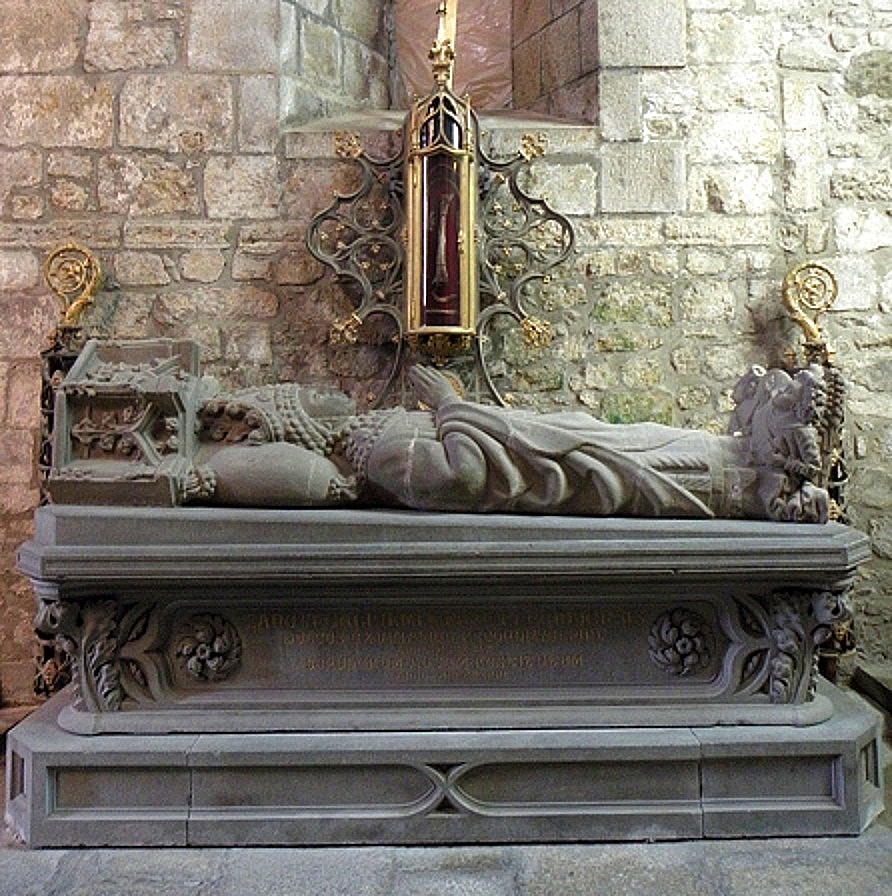
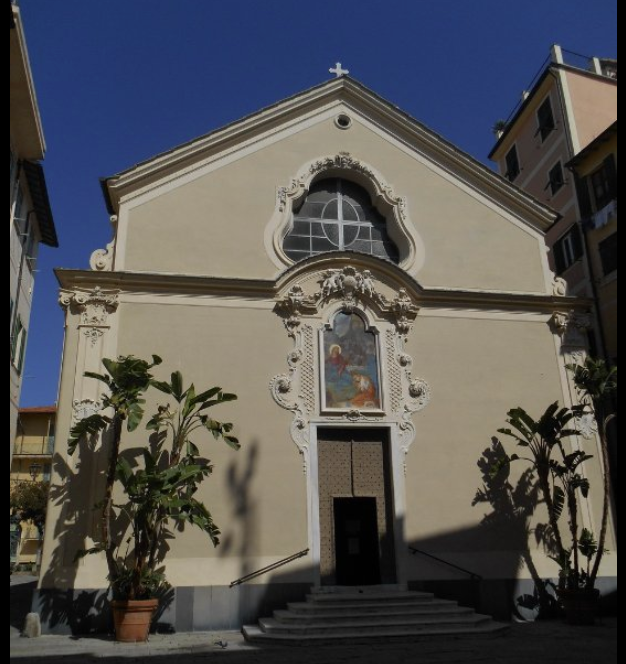
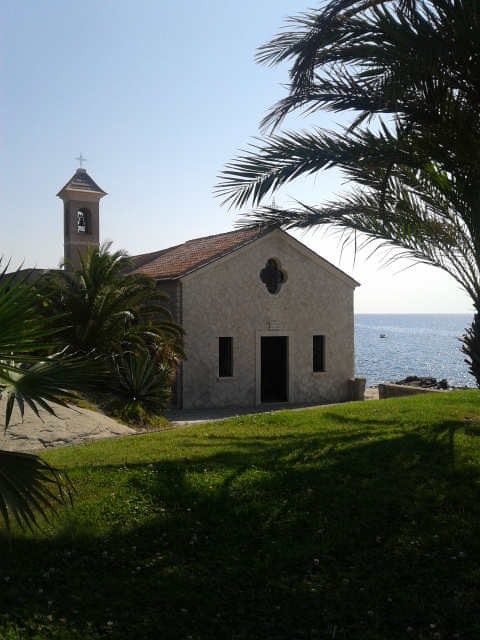
Today the remains of Saint Armengol can be found in Guardia dels Prats. The small village still preserves much of its medieval character: tortuous, narrow stone-studded streets, buildings that recall old palaces or noble residences and a charming Romanesque–style Church.

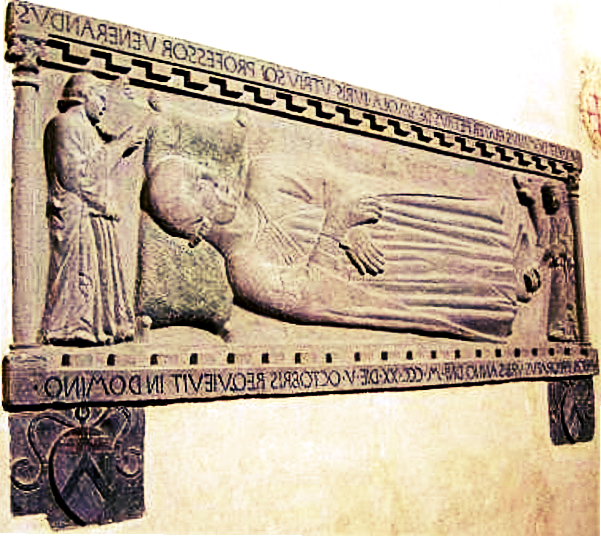
The body of Saint Peter Armengol was preserved incorrupt until 1936. During the Spanish Civil War, however, communist marauders invaded and sacked the Church, carrying off his venerable body to the public square where they burned it. Some children gathered up what they could of these ashes and took the precious remains to their homes, where their mothers kept them with great care.

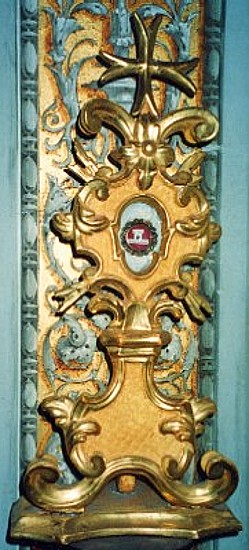
Later, after the communists were vanquished, the precious relics were returned to the Church, where they are kept in a reliquary over the main Altar – largely forgotten by “progressive” Catholics – in silent testimony of the sanctity of the Catholic Church. However, there remain some true faithful who, each year, pocess with a statue of this wonderful to honour his memory.

In our times of profound moral crisis, let us ask Saint Armengol to obtain for us before the throne of God, graces of unbending fidelity, unwavering hope and heroic confidence in the powerful intercession of Our Lady.

Source: Cf. Abbe Rohrbacher, Histoire Universelle de l’Eglise Catholique, vol. 20, Gaume Freres Libraires, Paris, 1845, pp. 40-43.

Posted in INCORRUPTIBLES, MARIAN TITLES, SAINT of the DAY

Spy Wednesday, Santa Maria dei Voti / Our Lady of Mantua, Italy (1640) and Memorials of the Saints – 13 April

Spy Wednesday in Holy Week +2022
According to the Calendar of Church, Spy Wednesday marks the last full day of Lent and Holy Week. The Sacred Triduum begins on the evening of the following day, Maundy Thursday.

The Office of Tenebrae begins this evening.

Santa Maria dei Voti / Our Lady of Mantua, Italy (1640) – 13 April:
HERE:

https://anastpaul.com/2021/04/13/santa-maria-dei-voti-our-lady-of-mantua-1640-and-memorials-of-the-saints-13-april/

St Pope Martin I (598-655) Martyr, The 74th Bishop of Rome. (Memorial)
Biography:

https://anastpaul.wordpress.com/2017/04/13/saint-of-the-day-13-april-st-pope-martin-i/

St Agathonica of Pergamus
St Agathodorus of Pergamus
Blessed Albertinus of Fonte Avellana OSB (Died 1294) Monk

St Caradoc of Wales (Died 1124) Priest, Monk, Hermit, Miracle-worker, Musician.
About St Caradoc:

https://anastpaul.com/2021/04/13/saint-of-the-day-13-april-saint-caradoc-of-wales-died-1124/

St Carpus of Pergamus
Bl Edward Catherick
Bl Francis Dickenson
St Guinoc
St Hermengild
St Ida of Boulogne
Bl Ida of Louvain
Bl Isabel Calduch Rovira
Bl James of Certaldo
Bl John Lockwood

Blessed Margaret of Castello OP (1287-1320) Italian professed member from the Third Order of the Order of Preachers of St Dominic. Margaret was disabled and became known for her deep faith and holiness. Her body is incorrupt.
About Blessed Margaret:

https://anastpaul.wordpress.com/2018/04/13/saint-of-the-day-13-april-blessed-margaret-of-castello-o-p-1287-1320/

St Martius of Auvergne
Bl Miles Gerard
St Papylus of Pergamus
St Proculus of Terni

St Jose Sabás Reyes Salazar (1883-1927) Priest and Martyr of the Cristero War, Teacher, Catechist, Protector of children and the youth of Mexico.
His Life and Death:

https://anastpaul.com/2020/04/13/saint-of-the-day-13-april-st-jose-sabas-reyes-salazar-1883-1927-priest-and-martyr/

Blessed Scubilion Rousseau FSC (1797-1867) the “Catechist of Slaves” – a professed Religious Brother of the Institute of the Brothers of the Christian Schools or the De La Salle Brothers, Teacher, Catechist, social Reformer, Anti-slave activist, Apostle of the poor.
His life:

https://anastpaul.com/2019/04/13/saint-of-the-day-13-april-blessed-scubilion-rousseau-fsc-1797-1867-the-catechist-of-slaves/

St Ursus of Ravenna

Martyrs of Dorostorum – 3 Saints: A lector and two students Martyred together in the persecutions of Diocletian – Dadas, Maximus and Quinctillianus. Beheaded c303 in Dorostorum, Lower Mysia (modern Sillistria, Bulgaria.

Posted in franciscan OFM, INCORRUPTIBLES, SAINT of the DAY

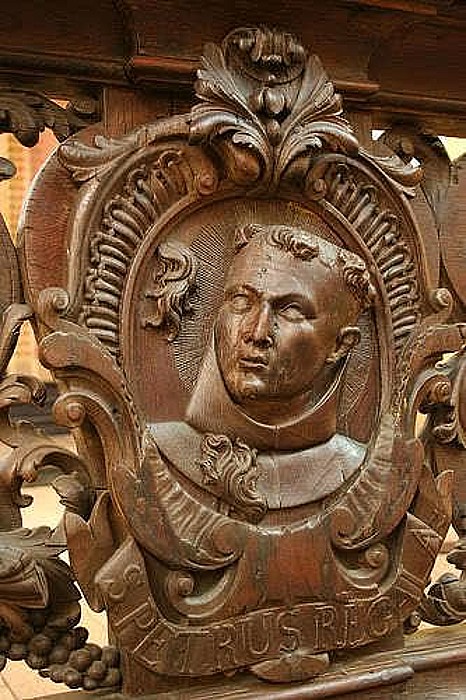
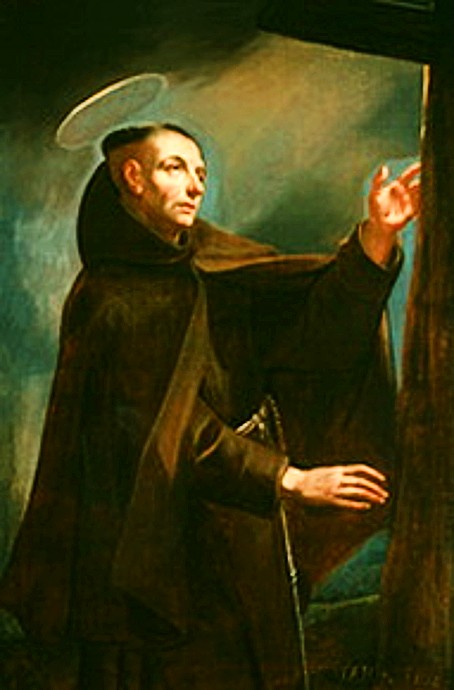
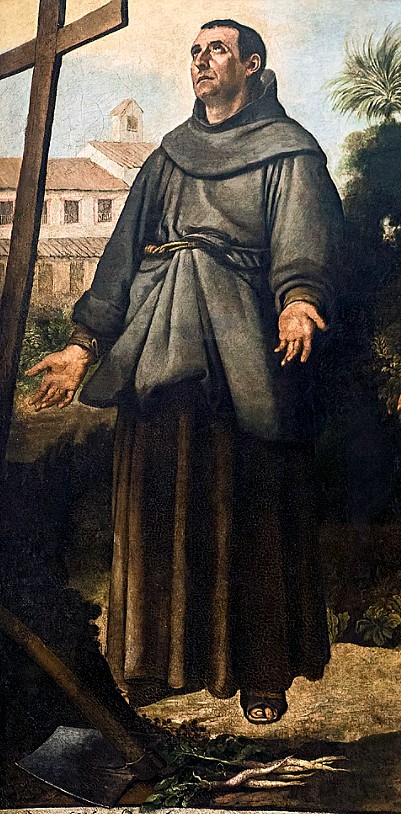
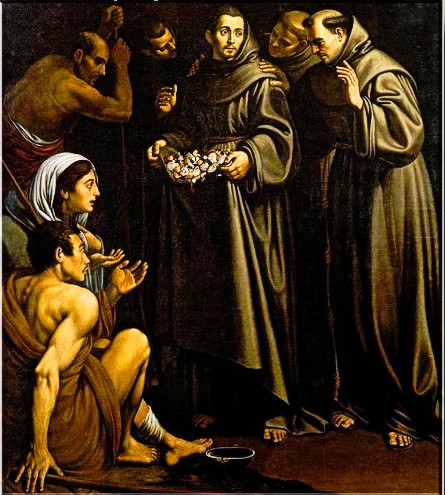
Saint of the Day – 30 March – Saint Peter Regalatus OFM (1320-1456)

Saint of the Day – 30 March – Saint Peter Regalatus OFM (1320-1456) Priest, Friar of the Friars Minor, Superior, gifted with bi-location, prophecy and miracle working. Born in 1390 at Valladolid, Spain and died on 30 March 1456 at Aguilera, Spain of natural causes. Patronage – Valladolid, Spain. Also known as – Pedro de Regalado, Pedro Regalado, Peter Regalati, Peter Regulatus. Additional Memorial – 13 May – translation of his relics. His body is incorrupt.

The Roman Martyrology reads: “In Aguilera in Castile in Spain, Saint Peter Regalado of Valladolid, Priest of the Order of Minors, who was distinguished for humility and rigour of penance and built two cells, in which only twelve Friars could live in solitude.

Peter was born in 1390 in Valladolid in Spain to a noble family of Jewish descent. He soon lost his father. At the age of ten years, Peter begged to be admitted into the Conventual Franciscans, which favour was granted him three years later and at the age of thirteen, his mother granting her permission to enter the Franciscan Monastery in his hometown. He had no other ambition than to lead a life of prayer and penance, considering his mother’s visits nothing more than a useless distraction.

Peter was conquered by the ideals of Peter da Villacreces, committed to re-establishing in the Iberian peninsula the original observance of the Franciscan Rule and from 1404 he followed him to he newly founded convent at Aguilera, where he found the solitude, poverty and the climate of prayer, he had so longed for. The young Lope de Salinas y Salazar also joined them. Lope was then called to hold the office of Vicar in Castile, with jurisdiction over the Convents of Burgos and founded another sixteen hermitages before his death.

In 1414 Peter da Villacreces had to participate in the Council of Constance, where he obtained the approval of the reform he had undertaken and left our saint in charge of .Aguilera, Both Peters, then in 1422, took part in the Provincial Chapter but here Peter da Villacreces died and Peter Regalatus was definitively entrusted with the guidance of the Monastery of Aguilera,

In 1426 he went to Burgos in order to recommend to his old friend Lope, not to abandon the reforming work undertaken by their common master. In the way traced by the latter, Peter had found his desire for holiness satisfied. He was in fact neither a founder nor a reformer but a simple ascetic and contemplative. He lived in conditions of penance and extreme poverty but his care for his brothers in need and his love for the sick became proverbial. With the gift of tears, his affectionate nature was manifested and likewise his burning love for God was proven. He performed several miracles on the banks of the Duero and, with irony it is said, that his work did not consist in much more.

In 1427 at Medina del Campo Peter attended the Concordia, a meeting of the followers of Peter Villacreces, the Reformer, where it was decided to remain united with the Conventual Friars. From 1442 he became Vicar of the Villacrecians and, therefore, the third successor of the Founder.. Finally, in 1456, hearing his death approaching, he decided to leave for Burgos to ask Lope, in vain, to accept the Vicariate of the Villacrecians. He died in Aguilera on 30 March 1456.

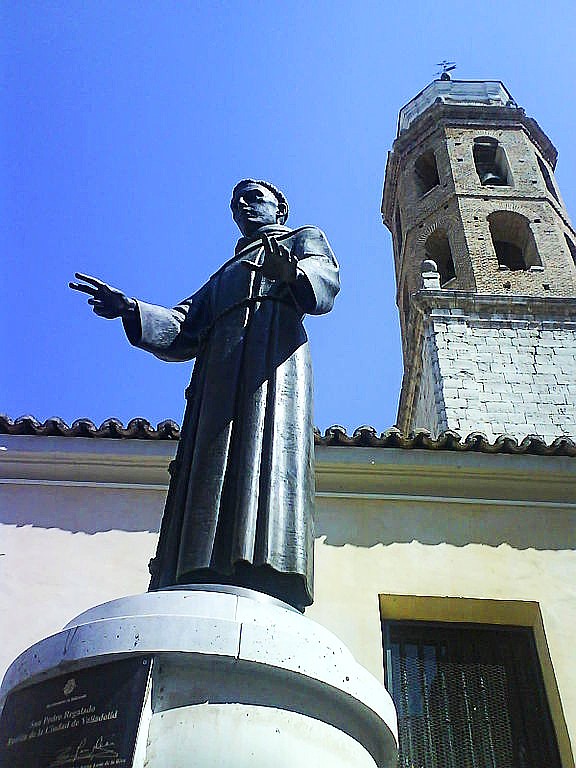
Statue at Valladolid

It was not long before numerous miracles occurred at his tomb and thirty-six years later, when he was exhumed to transfer his remains to the Church, his body was found incorrupt. He was Beatified on 11 March 1684 by Pope Innocent XI and on 29 June in 1746, Pope Benedict XIV Canonised PeterRegalatus of Valladolid by enrolling him in the register of Saints. Italian and Spanish iconography usually portrays the saint in the act of distributing bread to the poor, calling their gaze to the Crucifix.

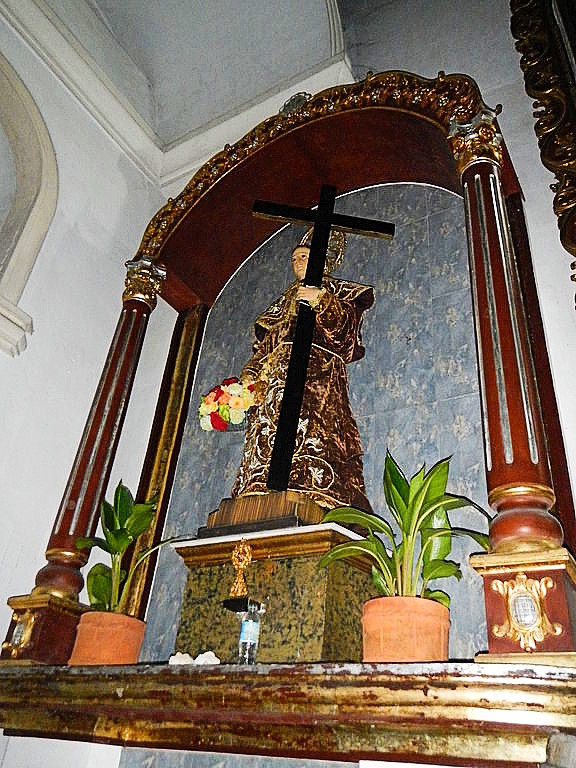
Statue in the Church of Santa Maria del Pi.
Posted in Against EPIDEMICS, INCORRUPTIBLES, SAILORS, MARINERS, NAVIGATORS, SAINT of the DAY

Saint of the Day – 20 March – Saint Cuthbert of Lindisfarne (c 634-687) “The Wonder-Worker of England”

Saint of the Day – 20 March – Saint Cuthbert of Lindisfarne (c 634-687) “The Wonder-Worker of England,” Bishop of Lindisfarne, Monk, Hermit, Miracle-worker, Born in c 634 possibly in Northumbria, England and died on 20 March 687 at Lindisfarne, England of natural causes. Patronages – against plague and epidemics, of boatmen, mariners, sailors, shepherds, England, the Diocese of Hexham and Newcastle, England, Diocese of Lancaster, England, of Durham, England, Northumbria, England. Both during his life and after his death he became a popular medieval Saint of Northern England, with a cult centred on his tomb at Durham Cathedral. I am always saddened by the almost total lack of veneration at this Tomb, although there are still a few organised Catholic pilgrimages per year. The Church is now no longer ours (Anglican) and for the most part, the only visitors to the Tomb are camera-flashing tourists.

The Roman Martyrology reads today: “In England, St Cuthbert, Bishop of Lindisfarne, who, from his childhood until his death, was renowned for good works and miracles.

Cuthbert was born in North Northumbria in about the year 634 – the same year in which St Aidan founded the Monastery at Lindisfarne. He came from a notable and wea\lthy English family and like most boys of that class, he was placed with foster-parents for part of his childhood and taught the arts of war. We know nothing of his foster-father but he was very fond of his foster-mother, Kenswith.

It seems, from stories about his childhood, that he was brought up as a Christian. He was credited, for instance, with having saved, by his prayers, some Monks who were being swept out to sea on a raft. There is some evidence that, in his mid-teens, he was involved in at least one battle, which would have been quite normal for a boy of his social background.

St Cuthbert discovers a piece of timber to save drowning Monks, from a 12th-century manuscript of St Bede’s ‘Life of St Cuthbert.’

His life changed when he was about 17 years old. He was looking after some neighbour’s sheep on the hills. (As he was certainly not a shepherd boy it is possible that he was mounting a military guard – a suitable occupation for a young warrior!) Gazing into the night sky he saw a light descend to earth and then return, escorting, he believed, a human soul to Heaven. The date was 31 August 651- the night that St Aidan died! Perhaps Cuthbert had already been considering a possible monastic calling but that was his moment of decision.

He went to the Monastery at Melrose, also founded by St Aidan and asked to be admitted as a Novice. For the next 13 years he was with the Melrose Monks. When Melrose was given land to found a new Monastery at Ripon, North Yorkshire, Cuthbert went with the founding party and was made Administrator. In his late 20s he returned to Melrose and found that his former teacher and friend, the Prior Boisil, was dying of the plague. Cuthbert became Prior (second to the Abbot) at Melrose.

In 664 the Synod of Whitby decided that Northumbria should cease to look to Ireland for its spiritual leadership and turn instead to the continent. The Irish Monks of Lindisfarne, with others, went back to Iona. The Abbot of Melrose subsequently became also Abbot of Lindisfarne and Cuthbert its Prior.

Cuthbert seems to have moved to Lindisfarne at about the age of 30 and lived there for the next 10 years. He ran the Monastery; – he was an active missionary; he was much in demand as a spiritual guide and he was graced with the charism of miraculous curing of the ill. He was an outgoing, cheerful, compassionate person and no doubt became popular. But when he was 40 years old he believed that he was being called to be a hermit and to do the hermit’s job of fighting the spiritual forces of evil in a life of solitude.

After a short trial period on the tiny islet adjoining Lindisfarne, he moved to the more remote and larger island known as ‘Inner Farne’ and built a hermitage where he lived for 10 years. Of course, people did not leave him alone – they went out in their little boats to consult him or ask for healing. However, on many days of the year the seas around the islands are simply too rough to make the crossing and Cuthbert was left in peace.

Cuthbert’s fame for piety, diligence, and obedience quickly grew.and at the age of about 50 he was asked by both Church and King to leave his hermitage and become a Bishop. He reluctantly agreed. For two years he was an active, travelling Bishop as St Aidan had been. He seems to have journeyed extensively. On one occasion he was visiting the Queen in Carlisle (on the other side of the country from Lindisfarne) when he knew by miraculous understanding that her husband, the King, had been slain by the Picts in battle in Scotland.

Feeling the approach of death, he retired back to the hermitage on the Inner Farne where, in the company of Lindisfarne Monks, he died on 20 March 687.

His body was brought back and buried at Lindisfarne. People immediately came to pray at the grave and many miracles occured. To the Monks of Lindisfarne this was a clear sign that Cuthbert was a Saint in Heaven and they, desired to declare to the world the great power of intercession, of their St Cuthbert.
 
They decided to allow 11 years for his body to become a skeleton and then ‘elevate’ his remains on the anniversary of this death (20 March 698). We believe that during these years, the beautiful manuscript known as ‘The Lindisfarne Gospels‘ was made, to be used for the first time at the great ceremony of the Translation of St Cuthbert. The declaration of Cuthbert’s sainthood was to be a day of joy and thanksgiving. It turned out to be also a day of surprise, even shock, for when they opened the coffin ,they found no skeleton but a complete and undecayed body. That was a sign of very great sainthood indeed.
 
So the cult of St Cuthbert began. Pilgrims began to flock to the Shrine. The ordinary life of the Monastery continued for almost another century until, on 8 June 793, the Vikings came. The Monks were totally unprepared; some were killed; some younger ones and boys were taken away to be sold as slaves; gold and silver was taken and the monastery partly burned down. After that, the Monastery lived under threat and it seems that in the 9th century there was a gradual movement of goods and buildings to the nearby mainland. The traditional date for the final abandonment of Lindisfarne is 875.

The body of St.Cuthbert, together with other relics and treasures which had survived the Viking attack, were carried by the Monks and villagers onto the mainland.
 
For over 100 years the community settled at the old Roman Town of Chester-le-Street. It was said that fear of further attack took them inland to Ripon but not for long and on their journey back from there they finally settled at Durham.

After the Norman Conquest (1066) a Benedictine community began to build the great Cathedral at Durham. They proposed to honour the body of St.Cuthbert with a new Shrine immediately east of the new High Altar and in 1104, all was ready for the translation. The Durham Monks opened up the coffin and found, that the St Cuthbert’s body was indeed still incorrupt. Throughout the Middle Ages the coffin was placed in a beautiful Shrine and visited by great numbers of pilgrims. But at the reformation, when the Monastery was dissolved, the Shrine was dismantled and the coffin opened – the body was still complete. It was buried in a plain grave behind the High Altar and the Sacred items buried with St Cuthbert were removed. Below is St Cuthbert’s Gospel of St John, recovered from his coffin; the original tooled red goatskin binding is the earliest surviving Western binding. 

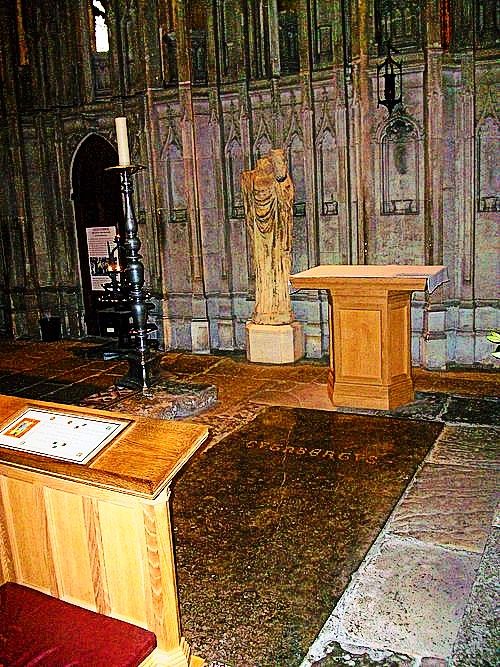
The human remains were then re-interred in the same place and marked by a plain gravestone with the name Cuthbertus. The Site, remaibs the focus of many pilgrimages today, including myself and family who have venerated St Cuthbert, a few times, in the Cathedral built to house his Shrine – of course, this is now a protestant church.

The 8th-century historian St Bede, wrote both a verse and a prose life of St Cuthbert around 720. He has been described as the most popular Saint in England prior to the death of Thomas Becket in 1170.
In particular, Alfred the Great, King of Wessex, was inspired and encouraged in his struggle against the Danes by a vision or dream he had of St Cuthbert. Thereafter, the royal house of Wessex, who became the Kings of England, made a point of great devotion to St Cuthbert.

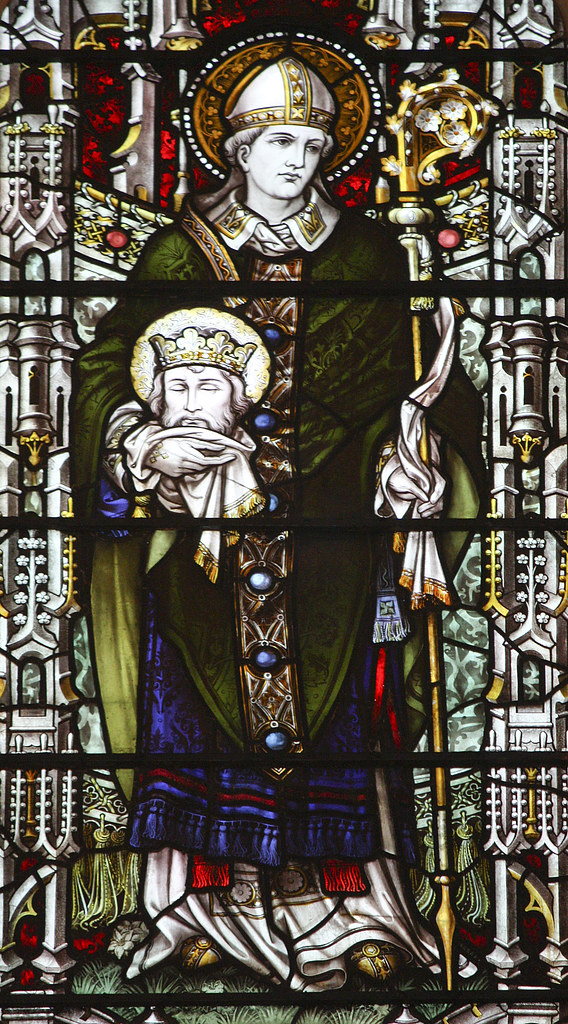
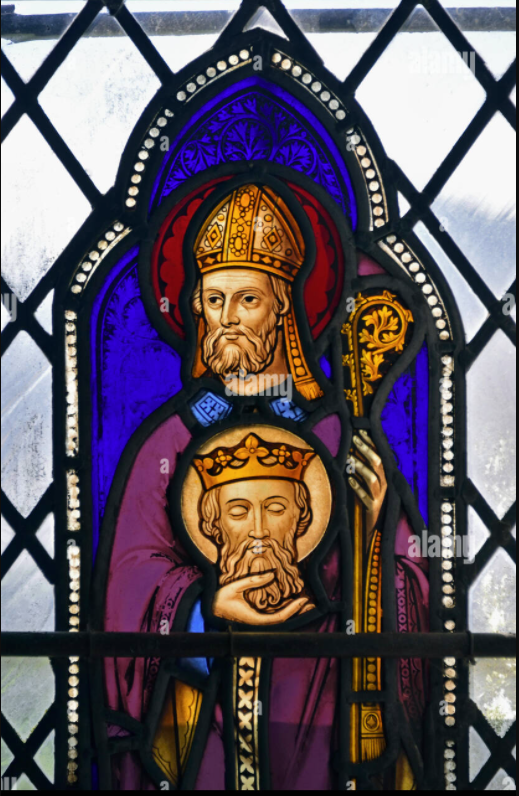
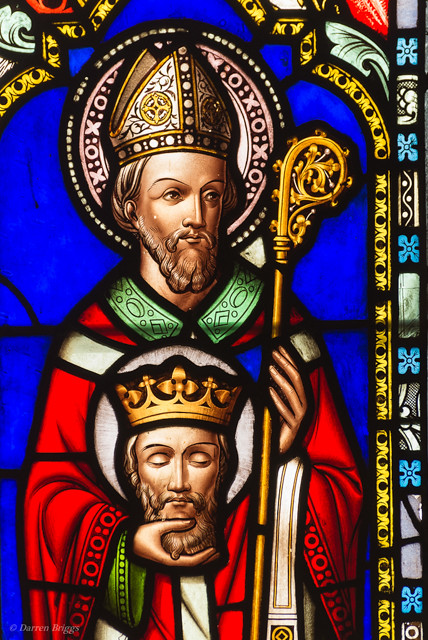
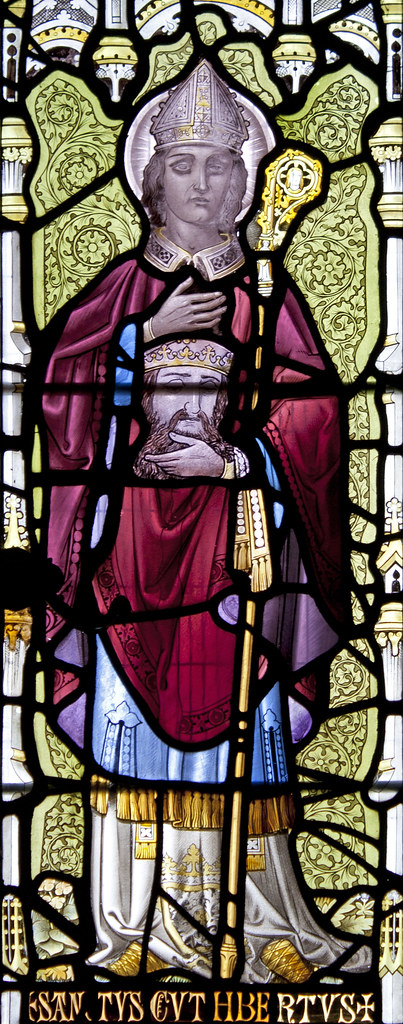
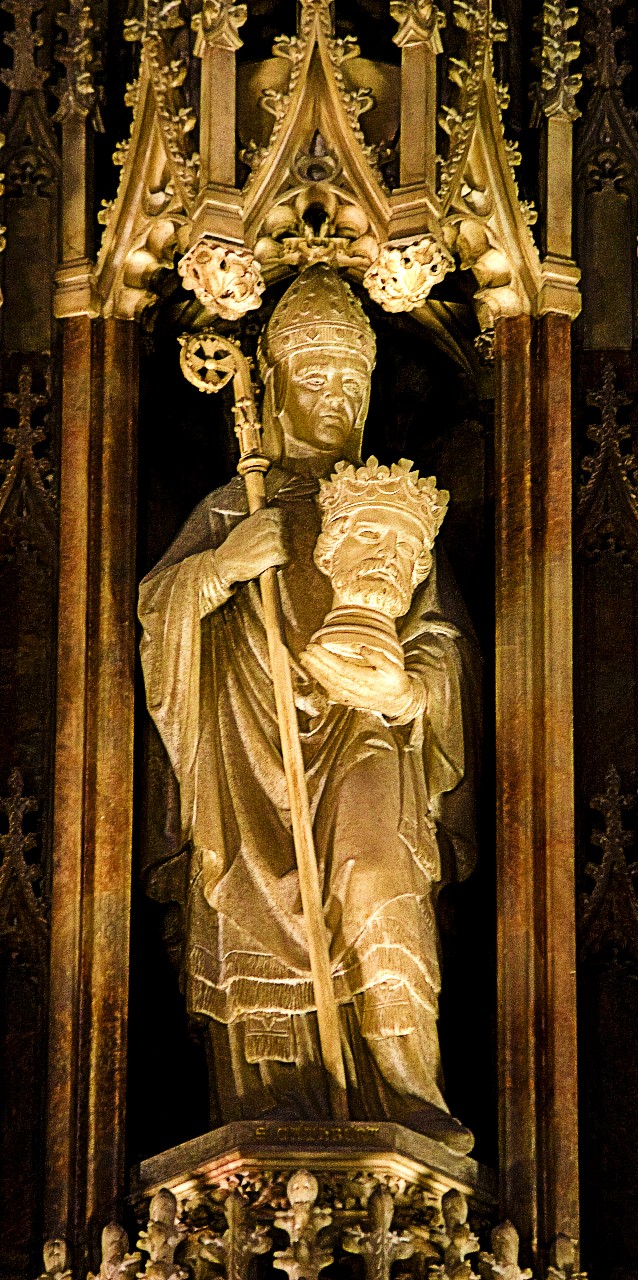
Why is St Cuthbert depicted holding St Oswald’s Head (c 605-642) King of Northumbia and why is it entombed with St Cuthbert?

St Bede tells us that Oswald was born around 605, the son of the King of Northumbria. After his father’s death, Oswald and his brothers were exiled to western Scotland, possibly to Iona, where they were inspired by St Columba’s Monks and were Baptised. In 634 Oswald returned to Northumbria where Cadwalla was massacring the people having killed King Edwin. After setting up a Cross as his standard and leading his men in prayer on the night before battle, Oswald defeated Cadwalla’s much larger army at Heavenfield and reclaimed the throne. The Intercession of St Columba,who died some 35 years earlier, assisted Oswald and his men, for Columba,appeared to Oswald in a vision and promised Heavenly assistance.

Oswald asked the Monks at Iona to send Missionaries to convert and guide his people. The first Monk they sent went back and reported that he could make no progress, due to the ungovernability, obstinacy and barbarous temperament of Oswald’s people, so they sent St Aidan instead. Oswald let Aidan choose where to base his Monastery and his mission. Aidan chose Lindisfarne and Oswald then worked closely with Aidan, travelling the countryside, acting as Aidan’s translator. In St Bede’s words, “while the Bishop, who was not fluent in the English language, preached the gospel, it was most delightful to see the King himself, interpreting the word of God to his ealdormen and thegns; for he, himself, had obtained perfect command of the Irish tongue during his long exile.”

Oswald was killed at Oswestry on 5 August 642, fighting the Mercians led by King Penda. His head was rescued from the battlefield and is buried in the Durham Cathedral, in St Cuthbert’s tomb, which is why you sometimes see pictures or statues of Cuthbert holding Oswald’s head. Soon miracles occurred at the place of his death, as they had at the place where he knelt to pray before battle and he was effectively canonised by the loving devotion of his people.

Posted in franciscan OFM, INCORRUPTIBLES, MYSTICS

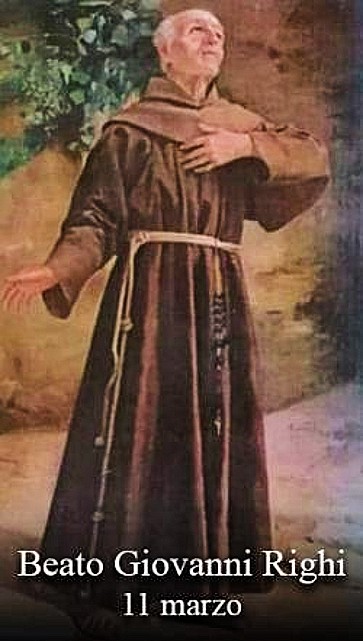
Saint of the Day – 11 March – Blessed John Baptist Righi of Fabriano OFM (1469–1539)

Saint of the Day – 11 March – Blessed John Baptist Righi of Fabriano OFM (1469–1539) Priest, Confessor, Friar of the Friars Minor, Ascetic, Ecstatic, renowned Preacher, Peace-maker, Hermit. Born as Giovanni Battista Righi in 1469 at Fabriano, Ancona, Italy and died on 11 March 1539 of natural causes. Also known as – Giovanni Battista da Fabriano, Giovanni da Fabriano, Giovanni Righi, Joannes de Fabriano, Johannes Baptista Righi, John Baptist of Fabriano. His body is incorrupt.

John was born in Fabriano of the Righi family. From an early age, he was very obedient to the teachings he received in his family. Reading the life of St Francis of Assisi, he decided to become a Franciscan Friar. And so, in the prime of his youth, our Blessed wore the Franciscan habit in the Convent of Forano, near Rieti. After his profession, he devoted several years to the study of philosophy and theology before being Ordained a Priest. For many years he was a very obedient and humble Friar. It is assumed that the young professed went from Forano to the solitary Convent of La Romita, a former Monastery of the Camaldolese.

Giovanni spent practically the rest of his life, about fifty years, up there in Romita, sometimes dedicated to the apostolate and more often, to silence and prayer, penance, reading the works of the Holy Fathers of the Church. In the solitude of La Romita, our blessed found what his heart desired. In the Church, there was a venerable image of Jesus Crucified, which belonged to St John of the Marches – John made it the object of frequent visits, ardent prayers, profound meditations and even,, by permission of the Lord, not rare ecstasies.

Emulating his seraphic Father, he ardently wanted to unite himself to the sufferings of Jesus, to transform himself into the Crucified Love, so little loved by much of the world. He found another object that touched his heart and fueled his filial piety: a terracotta image, which represented the Blessed Virgin contemplating the Child Jesus lying on her lap and which was flanked by the figures of the Apostle St James the Greater and St Francis of Assisi. And so, the solitary devotee spent long hours at the foot of the new and captivating image of the Mother of the Lord, exchanging affections and feelings. In the evening, after the Matins prayer, when his brothers retired to rest, he remained in the choir to continue his prayers which often ended in ecstasy. exchanging affections and feelings. In the evening, after the Matins prayer, when his brothers retired to rest, he remained in the choir to continue his prayers which often ended in ecstasy. exchanging affections and feelings.

In the dense forest that surrounded the solitary Convent, there was and still is, a small cave, like a hermitage inside the hermitage, where John went to devote himself to prayer and penance . For our blessed, Heaven on earth was in his retreat and solitude. But charity and obedience required him, from time to time, to undertake long journeys.

At that time, the different lords and noble families of the region were in conflict. Society and the Church experienced the ups and downs of the progress of a rebirth in all orders. And in high society, as well as among soldiers and ordinary people, demoralisation and the decline of good manners was the norm. John was not an eloquent orator but with his simple and persuasive word he managed to touch hearts and lead them to conversion.

He embarked on long journeys with joy of spirit to pacify the belligerents or to exhort both warring parties to convert and change their lives. When he travelled, always accompanied by another friar as was obligatory, he brought with him nothing but his peaceful poverty and his firm trust in God. his word was always a warm exhortation to the fulfillment of the divine Commandments, to the frequency of the Sacraments, to love one’s neighbour, to free the world from slavery. And he spoke with such zeal and persuasion that many were converted to God, reconciled, confessed, they did penance for their sins. The fame of the simple Friar spread throughout the Marches of Ancona.

Great was the charity of John with all those who met him on his travels or with those who came to him for spiritual guidance and Confession.. But what he practiced with the Friars of his Convent was even greater. He was attentive to their wants and needs and his greatest joy was to serve the sick, giving them every care promptly and gently.

His love for Jesus Crucified, the constant object of his love and contemplation, led him to practice the austerities and penances typical of the ancient anchorites, whose writings he read with pleasure, in particular those of St John Climacus. He continually fasted on bread and water, eating only one meal a day and even less during Lent. As a true son of St Francis, he loved poverty and practiced it, contenting himself with the patched tunic and the Breviary for the liturgical praise of the Lord. His cell, later transformed into an oratory, was small and sober. Indeed, his reputation for holiness soon spread throughout the region and when our Friar travelled, sick people were brought to him even from distant regions, to bless them,and there were numerous votive offerings that were and still are displayed.

One day he was seized by a great malaise. The Friars came, gave him first aid and looked after him until it seemed to them that the danger had passed, then they withdrew . Soon after, left alone in his small cell, he fell asleep peacefully in the Lord. His body was buried in the cemetery of the Convent but, ten years later, it was unearthed, found incorrupt and placed in an urn under the Altar of the Holy Christ. And there, in the Church of San Giacomo della Romita, he is still preserved and venerated today. His cult was confirmed by Pope Leo XIII on 7 September 1903.

The Church where the Body of Blessed John Righi is enshrined
Posted in DOMINICAN OP, INCORRUPTIBLES, MYSTICS, SAINT of the DAY

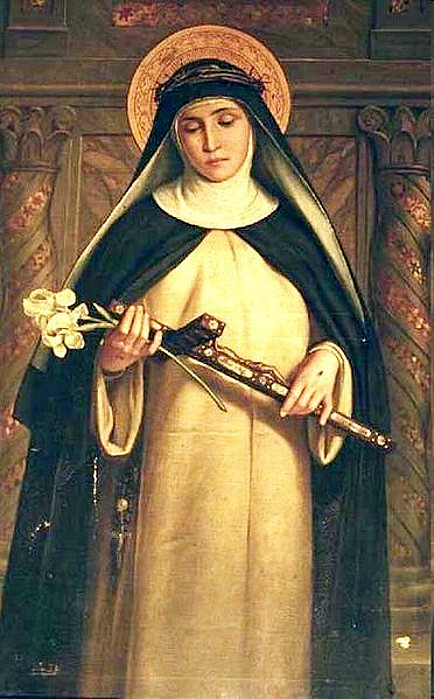
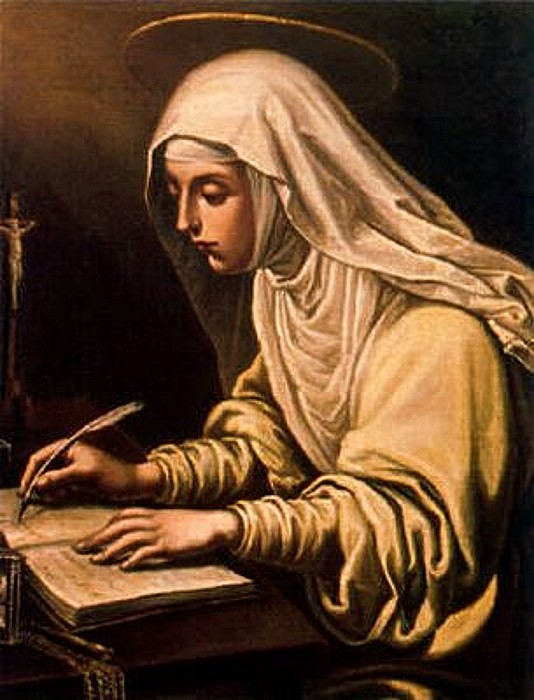
Saint of the Day – 13 February – Saint Catherine de Ricci OP (1522-1590)

Saint of the Day – 13 February – Saint Catherine de Ricci OP (1522-1590) Virgin, Tertiary of the Order of Preachers, Mystic, Stigmatist, Ecstatic, Counsellor to many in both secular and spiritual matters, a highly admired Administrator and Advisor,blessed with many mystical charism including visions of Christ, both as a Baby and Adult, bilocation and miracles. Born as Alessandra Lucrezia Romola de’ Ricci in Florence on 23 April 1522 and died on 2 February 1590 (aged 67) at Prato, Grand Duchy of Tuscany, of natural causes. Patronage – the sick. Her body is incorrupt.
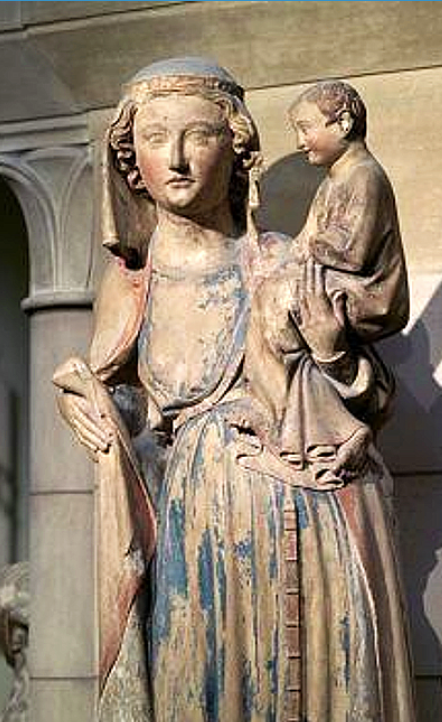
The Roman Martyrology states of her today: “At Prato, in Tuscany, St Catherine de Ricci, a Florentine Virgin of the Order of St Dominic, replenished with her heavenly gifts, whom Pope Benedict XIV inscribed on tbe catalogue of holy Virgins. She died in virtues and merits, on the 2nd of this month but her festival is celebrated on this day, 13th.”

The Ricci are an ancient family, which still subsists in a flourishing condition in Tuscany today. Alessandra was born in Florence to Pier Francesco de’ Ricci, of a patrician family and his wife, Caterina Bonza, who died soon after the birth of Alessandra. At age 6 or 7, her father enrolled her in a school run by a Monastery of Benedictine Nuns in the Monticelli quarter of the City, near their home and the City gates, where her Aunt, Luisa de’ Ricci, was the Abbess.

Catherine was a devout and pious child and it was here, in the Convent of her Aunt, that she developed a lifelong devotion to the Passion of Christ. After a short time back at home and after finally persuading her father,, at the age of 14, she entered the Convent of St Vincent in Prato, Tuscany, a cloistered community of religious sisters of the Third Order of St Dominic, disciples of the noted Dominican Friar Girolamo Savonarola, who followed the strict regimen of life she desired. In May 1535 she received the religious habit from her uncle, Timoteo de’ Ricci, who was Confessor to the Convent and the religious name of Catherine, after the Dominican tertiary, St Catherine of Siena.

Her novitiate was a time of trial. She would experience ecstasies during her routine, which caused her to seem asleep during community prayer , dropping plates and food, so much so, that the community began to question her competence, if not her sanity. Eventually, the other Sisters became aware of the spiritual basis for her behaviour. By the age of 30 she had risen to the post of Prioress.

After the recovery of her health, which seemed miraculous, she studied more perfectly to die to her senses and to advance in a penitential life and spirit, in which God had begun to conduct her, by practising the greatest austerities which were compatible with the obedience she had professed; – she fasted two or three days a week on bread and water alone and sometimes passed the whole day without taking any nourishment and chastised her body with disciplines and a sharp iron chain which she wore next her skin. Her obedience, humility and meekness were still more admirable than her spirit of penance. Much of penitential practice and oblation of her sufferings, were directed to the succour of the Souls in Purgatory.

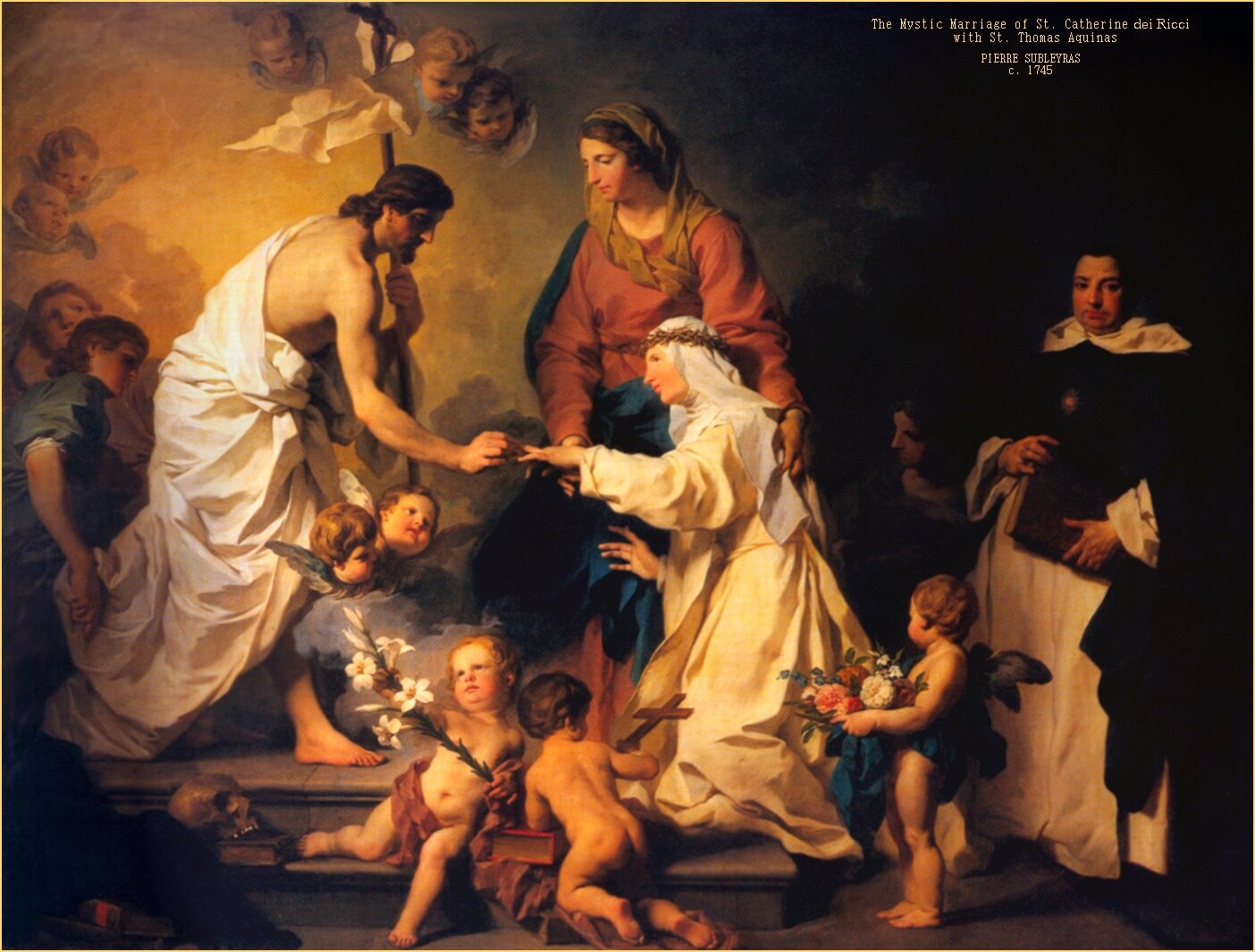
It was by profound humility and perfect interior self-denial that she learned to vanquish in her heart, the sentiments or life of the first Adam – that is, of corruption, sin and inordinate self-love. But this victory over herself,and purgation of her affections, was completed by a perfect spirit of prayer. By the union of her soul with God and the establishment of the absolute reign of His love in her heart, she was dead to and disengaged from, all earthly things. Her visions became most vivid allowing her to hold Baby Jesus dressed in swaddling clothes and to be mystically married and united with adult Jesus. Catherine’s meditations on the Passion of Christ were so deep, that she spontaneously bled, as if scourged. She also bore the Stigmata. During times of deep prayer, like Catherine of Siena, her Patron Saint, a coral ring representing her marriage to Christ, appeared on her finger.

Crowds gathered to witness her prayer and ecstasies and it began to distract from the life of the Convent. Catherine herself was embarrassed by all the attention. The community prayed that her wounds and experience would lessen in intensity so that they could go about the work of their common life together in peace and in 1554 the visions ceased.

As the Prioress, Catherine developed into an effective and greatly admired administrator. She was an advisor on various topics to Princes, Bishops and Cardinals. She corresponded with three figures who were destined to become Popes: Pope Marcellus II, Pope Clement VIII and Pope Leo XI. An expert on religion, management and administration, her advice was widely sought. She gave counsel both in person and through exchanging letters. It is reported that she was extremely effective in her work, managing her priorities with great zeal and efficiency.

One of the miracles that was documented for her Canonisation was her appearance many hundreds of miles away from where she was physically located, in a vision to St Philip Neri, a resident of Rome, with whom she had maintained a long-term correspondence. St Philip, who was otherwise very reluctant to discuss miraculous events, confirmed the event.

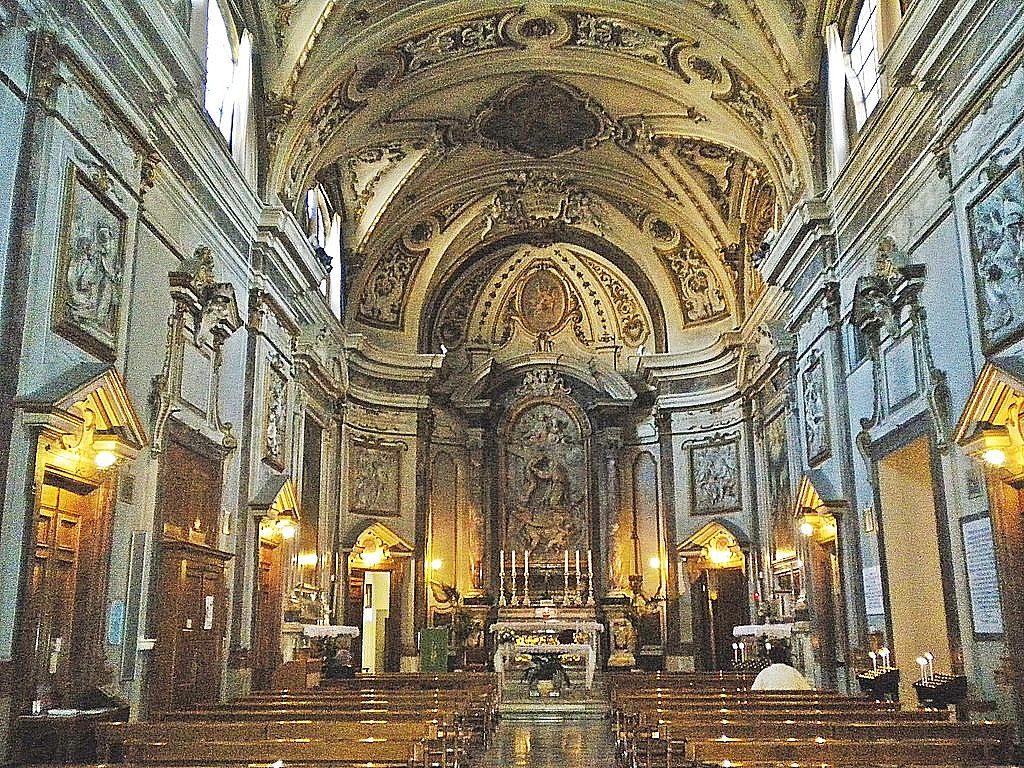
Catherine lived in the Convent until her death in 1590 after a prolonged illness. Her remains are visible under the Altar of the Minor Basilica of Santi Vicenzo e Caterina de’ Ricci, Prato, which is next to the Convent associated with her life..

The Minor Basilica of Santi Vicenzo e Caterina de’ Ricci, Prato, Italy

Catherine was Beatified by Pope Clement XII in 1732 and Canonised by Pope Benedict XIV in 1746 in a spectacular ceremony for which a magnificent ‘canopy’ was constructed. In celebration of the Saint’s Canonisation, Domenico Maria Sandrini wrote an authorative biography of the new Saint.

Posted in AUGUSTINIANS OSA, DOMINICAN OP, INCORRUPTIBLES, LENT, LENT 2022, MARIAN TITLES, MYSTICS, SAINT of the DAY

Septuagesima Sunday, Notre-Dame de Pellevoisin / Our Lady of Pellevoisin, France (1876) and Memorials of the Saints – 13 February

Septuagesima Sunday:
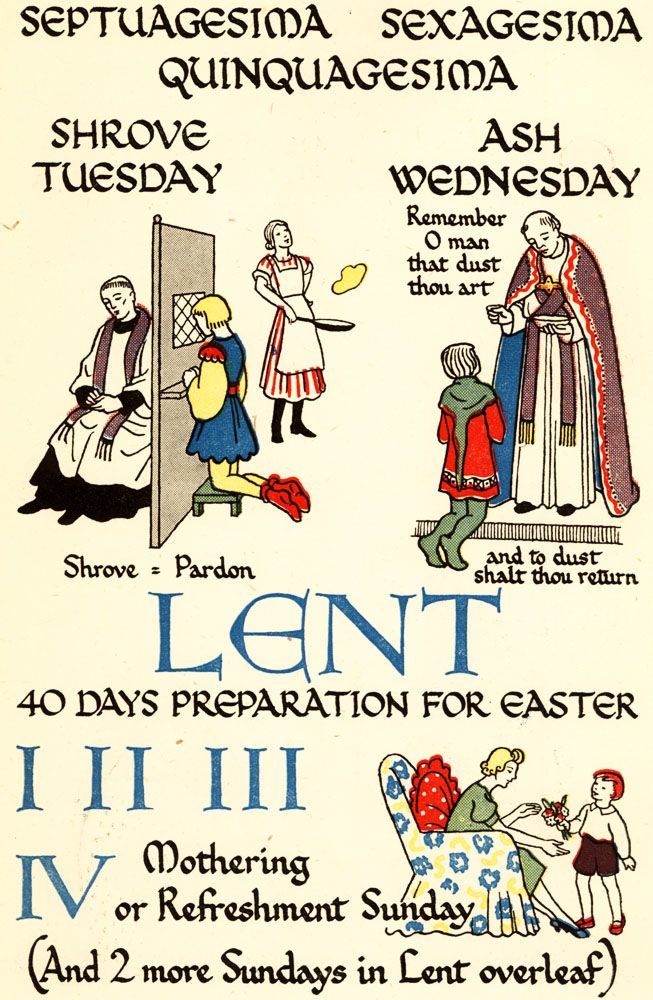
The word Septuagesima is Latin for “seventieth.” It is both the name of the liturgical season and the name of the Sunday. Septuagesima Sunday marks the beginning of the shortest Liturgical season. This season is seventeen (17) days long and includes the three Sundays before Ash Wednesday. The length of the season never changes but the start date is dependent on the movable date of Easter, which can fall between 22 March-25 April. Septuagesima Sunday can be as early as 18 January.
The Septuagesima season helps the faithful ease into Lent. It is a gradual preparation for the serious time of penance and sorrow; to remind the sinner of the grievousness of his errors and to exhort him to penance.
Liturgically it looks very much like Lent. The Gloria and Alleluia are omitted, the tone becomes penitential with the Priest wearing purple vestments. The main difference is that there are no fasting requirements.

Mother of Mercy, Notre-Dame de Pellevoisin / Our Lady of Pellevoisin, France (1876) – 13 February:
HERE:

https://anastpaul.com/2021/02/13/mother-of-mercy-our-lady-of-pellevoisin-france-1876-and-memorials-of-the-saints-13-february/

St Adolphus of Osnabruk
St Aimo of Meda

Blessed Archangela Girlani O Carm (1460-1494) Virgin, Carmelite Nun, Mystic with the gift of levitation.
Her Life:

https://anastpaul.com/2020/02/13/saint-of-the-day-13-february-blessed-archangela-girlani-o-carm-1460-1494/

Bl Beatrix of Ornacieux
St Benignus of Todi
Bl Berengar of Assisi
St Castor of Karden
St Catherine de Ricci OP (1522-1590) Virgin, Tertiary of the Order of Preachers, Mystic, Stimatist. Her body is incorrupt.

Blessed Christine of Spoleto OSA (1435-1458) Widow, mother, religious nun of the Order of Saint Augustine.
About Blessed Christine:

https://anastpaul.com/2019/02/13/saint-of-the-day-13-february-blessed-christine-of-spoleto-osa-1435-1458/

St Dyfnog
St Ermenilda of Ely
Bl Eustochium of Padua OSB (1444-1469) Virgin

St Fulcran of Lodève (Died 1006) Bishop of Lodève, Reformer, especially within the clergy and religious orders, builder of many Churches, Convents and Hospitals, apostle of the poor and needy, miracle-worker.
St Futeran’s Life:

https://anastpaul.com/2021/02/13/saint-of-the-day-13-february-saint-fulcran-of-lodeve-died-1006-bishop/

St Fusca of Ravenna
St Gilbert of Meaux
St Gosbert of Osnabruck
St Pope Gregory II
St Guimérra of Carcassone
St Huno

Blessed Jordan of Saxony OP (1190-1237) Religious Priest, Preacher, the Second Master-General of the Order of Preachers, after St Dominic.
Biography:

https://anastpaul.wordpress.com/2018/02/13/saint-of-the-day-13-february-blessed-jordan-of-saxony-o-p-1190-1237/

St Julian of Lyon
St Lucinus of Angers
St Marice
St Martinian the Hermit
St Maura of Ravenna
St Modomnoc
St Paulus Lio Hanzuo
St Peter I of Vercelli
St Phaolô Lê Van Loc
St Stephen of Lyons
St Stephen of Rieti

Posted in INCORRUPTIBLES, SAINT of the DAY

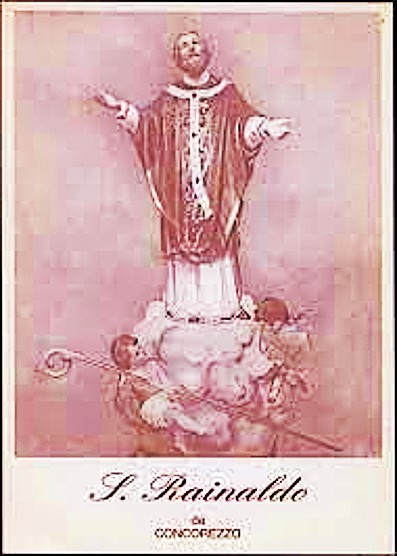
Saint of the Day – 9 February – Saint Raynald of Nocera (c 1150-1217)

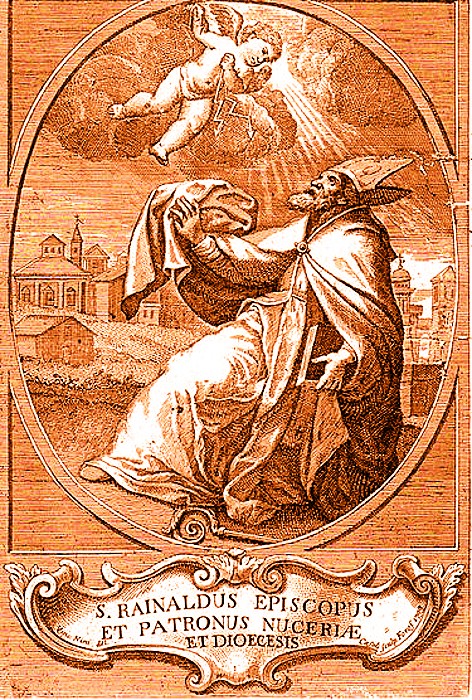
Saint of the Day – 9 February – Saint Raynald of Nocera (c 1150-1217) Bishop of Nocera, Umbria, Italy, Hermit, Monk, Abbot. Born in c 1150 smf died on 9 February 1217 in Nocera, Umbria, Italy of natural causes. Patronages – the Diocese of Assisi-Nocera Umbria-Gualdo Tadino, Italy. and City of Norcera. Also known as Rainaldus and Rainaldo. His body is incorrupt.

The Roman Martyrology reads: “In Nocera Umbra, St. Rainaldo, Bishop, formerly a Camaldolese Monk of Fonte Avellana, who, while carrying out the Episcopal office, firmly preserved the habits of monastic life.

Raynald was a rather singular figure of a Hermit Monk and Bishop, who broke away from the mentality of his time, to radically change his life, becoming an admirable example of piety and charity, faith and obedience, in a world characterised by wealth and power, compromises and collusions between secular and spiritual powers.

He was the eldest son of one of the local Lords who dominated Nocera nd Foligno, heir to the fief of Postignano and already destined for posts of political and military importance of the first degree, Raynald received a refined education as befitted his rank.

But at the age of twenty, he abandoned all his possessions to give himself to the hermitage on the mountain of Gualdo, the Serrasanta, famous for the presence of men dedicated to prayer and penance. Here he was able to live “a perfect eremitical life.” However, he soon felt, in his heart the need to submit to a superior, who could guide him in constantly following God’s will and he then became a Monk at the Camaldolese Monastery of Fonte Avellana, where “together with his brothers, he served God perfectly and devoutly” and was also elected Abbot.

Raynald was associated in the Episcopate with Bishop Ugo,who was engaged in high juridical positions in the Roman Curia. In 1213, on the death of Ugo, the holy hermit became the Bishop of the Diocese.

The Episcopate of Raynald was distinguished by his unusual choice – to remain a Monk even as a Bishop and he did so with the typical obstinacy of Saints, always entirely dedicated to God and to his brothers, as the Minor Legend narrates: “he kept his life perfect, as when he was in the Monastery with fasts, vigils and prayers, dedicating himself to God and busy in the Bishop’s care as a celebrant of divine worship and a helper of the poorest and most needy people .”

To give a living example of Christian love, he adopted a child from Nocera, an orphan, keeping him in the Bishop’s palace and honouring him every day at the table, as if it had been Christ Himself Who was asking for help.

The presence of the holy Bishop was important at the promulgation of the Indulgence of the Portiuncula in August 1216, commissioned by St Francis of Assisi.

Raynald died on 9 February 1217 near Nocera Umbra and his body was immediately honoured. With a trial on miracles, promoted by his successor Bishop Pelagius, after a few months, he was raised on the main Altar of the Cathedral and, therefore, proclaimed a Saint according to the customs of the time.

The troubled political events soon dispersed, attributed to the intercession of the Saint. In 1248 Nocera, a Guelph City, was destroyed by the army of Frederick II who encamped in the aforementioned Cathedral. An extraordinary event was the discovery of the body of St Raynald, intact. St Raynald was then proclaimed Patron of Nocera and his tomb was transferred to the Church of Santa Maria dell’Arengo, now dedicated to St John the Baptist. The destroyed City was rebuilt and the devotion to the Saint persisted over the centuries.

When in 1448 the reconstruction of the Cathedral resumed again, the memory of St Raynald was added to the official title of the Church, which, for seven centuries had been dedicated to the Virgin of the Assumption. His body was solemnly transported to the new Cathedral in 1456 and for centuries it was the centre of the cult that made St Raynald the protector of the City and of the Diocese of Nocera.

The Saint did not fail to help his faithful with protective intercession in the tragic moments of wars, destruction and calamitous events such as frequent earthquakes. Today, after the painful events of the 1997 earthquake, the Patron’s still incorrupt body was venerated in the Church of St Felicissimus.
On the anniversary of his death, St Raynald is commemorated by the Camaldolese Monastery.

Posted in INCORRUPTIBLES, MARIAN TITLES, SAINT of the DAY

Notre-Dame d’Avesniéres, Laval / Our Lady of Avesnières, Laval, France (11th Century), Nostra Signora delle Grazie / Our Lady of Grace, or Our Lady of the Bowed Head, Rome (1610) and Memorials of the Saints – 7 February

Notre-Dame d’Avesniéres, Laval / Our Lady of Avesnières, Laval, France (11th Century) – 7 February:

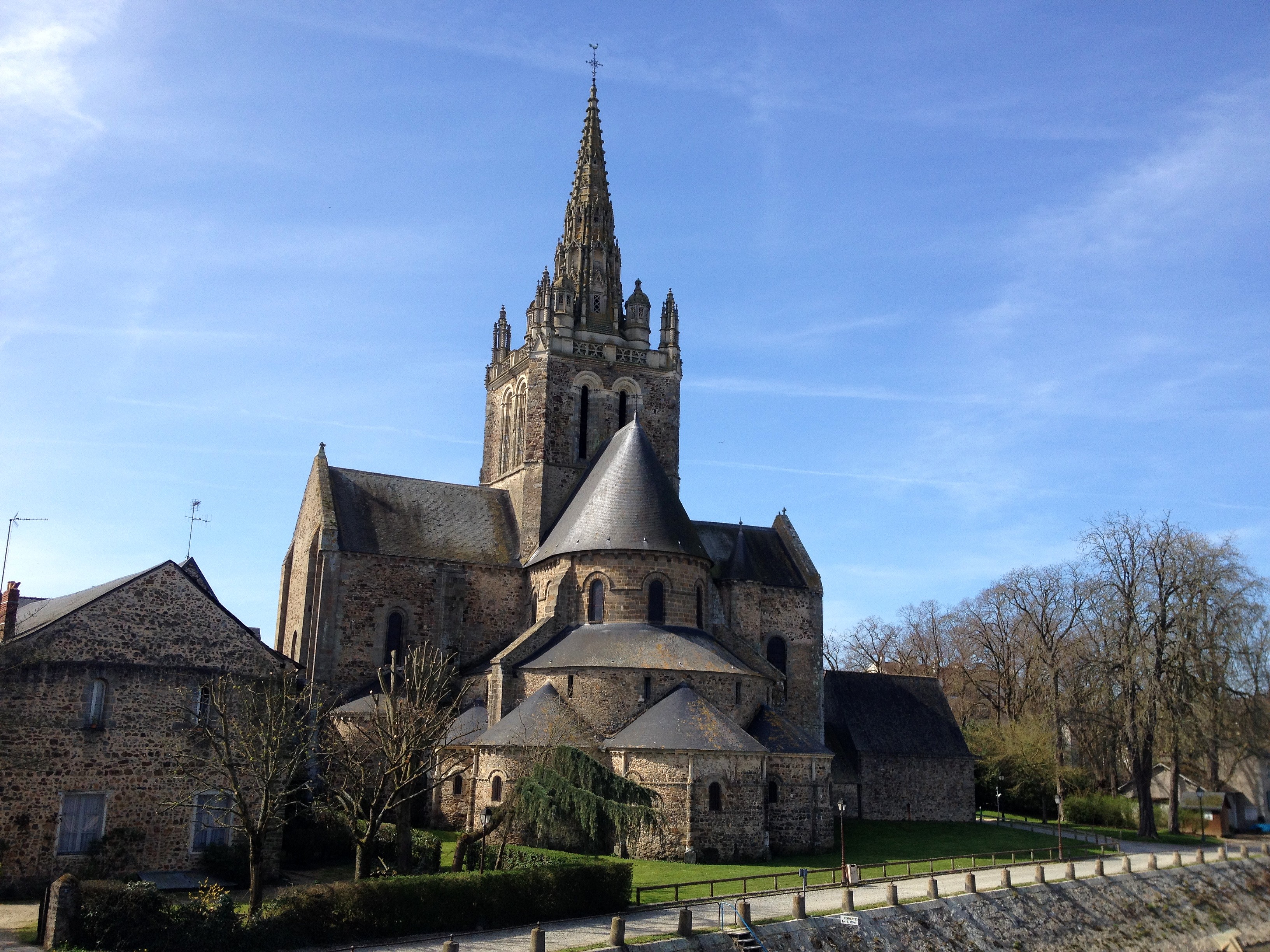
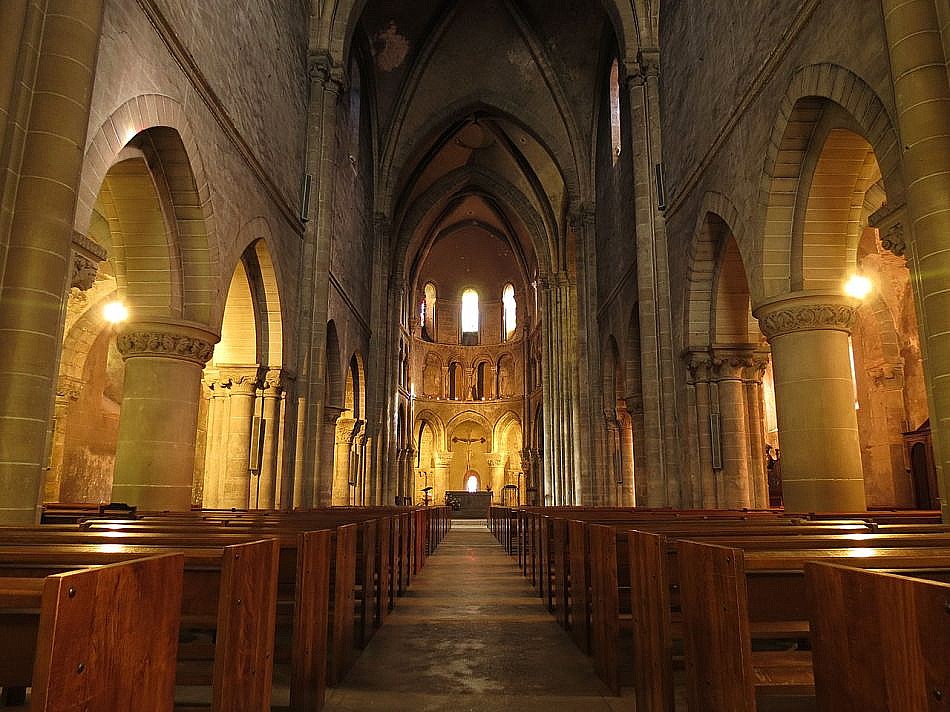
The Basilica of Notre-Dame Avesnières is located in Laval, in the region of Pays de la Loire. It is located in the district of Avesnières, on the right bank of the Mayenne river and south of the City centre. The Church has existed at least since the 11th Century but it got its present appearance in the 12th Century, when the Benedictines set up a Priory here. The nuns left Avesnières during the Hundred Years’ War and the Church then became a simple Parish Church. It was raised to the rank of minor Basilica in 1898, by Pope Leo XIII.

The Church was founded by Guy, Lord of Laval, who, falling into the river wanting to cross it, was miraculously saved from drowning, by the Blessed Virgin and transported safely to the river bank.
The spot was chosen, in remembrance of this miraculous rescue, to host a Sanctuary dedicated to the Notre-Dame.
In 1871, Monsignor Casimir Wicart, first Bishop of Laval, in the face of the anxiety provoked by the advance of the Prussian troops, decided to organise a large prayer vigil in Avesnières. At this ceremony, the faithful assembled and took an oath to rebuild the Church if the Blessed Mother saved the City from foreign occupation. The next day, the Prussians were stopped in their tracks in Saint-Melaine, at the gates of Laval, when the Virgin appeared before them. Where is our faith today?!

Nostra Signora delle Grazie, o Nostra Signora del Capo chino / Our Lady of Grace, or Our Lady of the Bowed Head, Rome (1610) – 7 February:
HERE:

https://anastpaul.com/2021/02/07/sexagesima-sunday-our-lady-of-grace-or-our-lady-of-the-bowed-head-rome-1610-and-memorials-of-the-saints-7-february/

St Romuald (c 951-1027) Monk, Abbot, Ascetic, Founder of the Camaldolese Order and a major figure in the Eleventh-Century “Renaissance of eremitical asceticism.”
His Feast Day is today and was thus from 1595. It was changed to 19 June in 1969.
St Romuald’s Life:
https://anastpaul.com/2018/06/19/saint-of-the-day-19-june-st-romuald-c-951-1027/

Bl Adalbert Nierychlewski

Blessed Alfredo Cremonesi PIME (1902-1953) Priest and Martyr, Missionary of the Pontifical Institute for Foreign Missions (PIME), Writer, Poet.
His Life and Death:

https://anastpaul.com/2020/02/07/saint-of-the-day-7-february-blessed-alfredo-cremonesi-pime-1902-1953-priest-and-martyr/

St Adaucus of Phrygia
St Amulwinus of Lobbes
St Anatolius of Cahors
Bl Anna Maria Adorni Botti
Bl Anselmo Polanco
Bl Anthony of Stroncone
St Augulus
St Chrysolius of Armenia
St Fidelis of Merida
Bl Felipe Ripoll Morata

St Giles Mary of Saint Joseph OFM (1729-1812) known as the “Consoler of Naples” and the “Saint of the Little Way.” Although his desire was to become a priest, his lack of education meant that he was unable to fulfil this desire and served instead as a professed religious Friar in the Order of Friars Minor in Naples.
St Giles Life:

https://anastpaul.com/2019/02/07/saint-of-the-day-7-february-st-giles-mary-of-st-joseph-ofm-1729-1812/

Bl Jacques Sales
St John of Triora
St Juliana of Bologna
Bl Klara Szczesna
St Lorenzo Maiorano
St Luke the Younger

Blessed Mary of Providence/Eugénie Smet HHS (1825-1871) Nun and Founder of the Society of the Helpers of the Holy Souls. Her apostolate has spread throughout the world – now in 24 countries and continues to minister to the Souls in the Body of Christ — both those on earth and those who have departed this world.
Biography:

https://anastpaul.com/2021/02/07/saint-of-the-day-7-february-blessed-mary-of-providence-hhs-1825-1871/

St Maximus of Nola
St Meldon of Péronne
St Moses the Hermit
St Parthenius of Lampsacus
Bl Peter Verhun

Blessed Pope Pius IX (1792-1878) Bishop of Rome from 16 June 1846 to the day of his death. He is the longest-reigning Pope in the history of the Church, serving for over 31 years. During his Pontificate, Pius IX convened the First Vatican Council (1869–70), which decreed Papal Infallibility and promulgated the Dogma of the Immaculate Conception. Pope Pius IX named three new Doctors of the Church:  
St Hilary of Poitiers (1851), 
St Alphonsus Liguori (1871)
St Francis de Sales (19 July 1877).   
His body is incorrupt.
All about Blessed Pope Pius IX:

https://anastpaul.wordpress.com/2018/02/07/saint-of-the-day-blessed-pope-pius-ix-1792-1878/

St Richard the King Pilgrim (Died c 722) Layman
Bl Rizziero of Muccia
Bl Rosalie Rendu (1786-1856)
St Theodore Stratelates

Bl essed Thomas Sherwood (1551–1578) Layman, Martyr of the English Persecution under Elizabeth I (c. 1552–1579).
His Life and Death:

https://anastpaul.wordpress.com/2017/02/07/saint-of-the-day-7-february-bl-thomas-sherwood/

St Tressan of Mareuil
Bl William Saultemouche

Posted in DOMINICAN OP, franciscan OFM, INCORRUPTIBLES, MARIAN TITLES, SAINT of the DAY

Espousal of the Blessed Virgin Mary, approved by Pope Paul III (1546) and Memorials of the Saints – 23 January

The Third Sunday after the Epiphany

Espousal of the Blessed Virgin Mary, approved by Pope Paul III (1546) – 23 January:
HERE:

https://anastpaul.com/2021/01/23/feast-of-the-espousal-of-the-blessed-virgin-mary-and-memorials-of-the-saints/

St Raymond of Peñafort OP (1175-1275) “Father of Canon Law” Dominican Priest, Doctor of Canon Law, the Third Master of the Order of Preachers, Founder of the Mercedarian friars, Writer, Teacher, Miracle-Worker.
St Raymond of Peñafort’s Feast day was inserted in the General Roman Calendar in 1671 for celebration on 23 January. In 1969 it was moved to 7 January, the day after that of his death. He is the Patron Saint of canon lawyers, specifically and lawyers, in general.
Biography:
https://anastpaul.com/?s=st+raymond+penafort

St Marianne Cope TOSF (1838-1918) Virgin, Third Order of the Friars Minor, Missionary to lepers.
Biography:

https://anastpaul.wordpress.com/2017/01/23/saint-of-the-day-23-january-st-marianne-cope/

St Abel the Patriarch
St Agathangelus
St Amasius of Teano
St Andreas Chong Hwa-Gyong
St Aquila the Martyr
St Asclas of Antinoe

Blessed Benedetta Bianchi Porro (1936-1964) Laywoman.
Her Life:

https://anastpaul.com/2020/01/23/saint-of-the-day-23-january-blessed-benedetta-bianchi-porro-1936-1964/

St Clement of Ancyra
St Colman of Lismore
St Dositheus of Gaza
St Emerentiana (Died c 301) Virgin, Martyr
St Eusebius of Mount Coryphe

Blessed Henry Suso OP (1295-1366) German Dominican Priest and Friar, Poet, Mystic and the most popular vernacular writer of the fourteenth century. His body is incorrupt.
Blessed Henry’s Life:

https://anastpaul.com/2019/01/23/saint-of-the-day-blessed-henry-suso-op-1295-1366/

St Ildephonsus (506-667) Archbishop of Toledo. Theologian, Scholar, Marian devotee, Writer, Evangeliser. Abbot Dom Guéranger calls him the Doctor of the Virginity of Mary. Saint Ildephonsus established the feast of the Expectation of the Blessed Virgin Mary, which is still kept in some places on 18 December.
Biography:

https://anastpaul.wordpress.com/2018/01/23/saint-of-the-day-23-january-st-ildephonsus-607-667/

Bl Joan Font Taulat

St John the Almoner (Died c 620) Bishop of Alexandria, Widower, Confessor, Apostle of the poor, Reformer – both within the Church and within the civic structures.
About St John:

https://anastpaul.com/2021/01/23/saint-of-the-day-23-january-st-john-the-almoner-died-c-620/

Bl Juan Infante
St Jurmin
St Lufthild
St Maimbod
Bl Margaret of Ravenna
Martyrius of Valeria
St Messalina of Foligno
St Ormond of Mairé
St Parmenas the Deacon
St Severian the Martyr

Posted in INCORRUPTIBLES, MARIAN TITLES, SAINT of the DAY

Virgen de la Altagracia / Our Lady of Altagracia, Dominican Republic (c 1502) and Memorials of the Saints – 21 January

Virgen de la Altagracia / Our Lady of Altagracia, Dominican Republic (c 1502) – 21 January:
HERE:

https://anastpaul.com/2021/01/21/our-lady-of-altagracia-and-memorials-of-the-saints-21-january

St Agnes (c 291- c 304) Virgin and Martyr (Memorial)
Detailed biography of St Agnes:

https://anastpaul.wordpress.com/2018/01/21/saint-of-the-day-21-january-st-agnes-c-291-c-304/
AND St Ambrose Reflection:
https://anastpaul.com/2019/01/21/saint-of-the-day-21-january-st-agnes-c-291-c-304-virgin-and-martyr/

St Agnes of Aislinger
St Alban Bartholomew Roe
St Anastasius of Constantinople
St Aquila of Trebizond
St Brigid of Kilbride
St Candidus of Trebizond
Bl Edward Stransham
St Epiphanius of Pavia (c 439–496) Bishop
St Eugenius of Trebizond
Bl Franciscus Bang
St Gunthildis of Biblisheim

Blessed Josefa María Inés de Benigánim OAD (1625–1696) Nun of the Discalced Augustinian Nuns with the religious name of “Josefa María of Saint Agnes,” Virgin, Mystic, gifted with the charism of prophecy and counsel. She became known for her profound spiritual and theological insight as well as for her severe austerities she practised during her life. Her body is incorrupt.
Biography:

https://anastpaul.com/2020/01/21/saint-of-the-day-21-january-blessed-josefa-maria-ines-de-beniganim-oad-1625-1696/

St John Yi Yun-on
St Lawdog
St Maccallin of Waulsort

St Meinrad of Einsiedeln OSB (c 797–861) “Martyr of Hospitality,” Martyr, Priest, Monk, Hermit.
About St Meinrad:

https://anastpaul.com/2021/01/21/saint-of-the-day-21-january-saint-meinrad-of-einsiedeln-osb-c-797-861-martyr/

St Nicholas Woodfen
St Patroclus of Troyes
St Publius of Malta
Bl Thomas Reynolds
St Valerian of Trebizond
St Vimin of Holywood
St Zacharias the Angelic

Blessed Martyrs of Laval – 19 Beati: Fifteen men and four women who were martyred in Laval, France by anti-Catholic French Revolutionaries.
• Blessed André Duliou
• Blessed Augustin-Emmanuel Philippot
• Blessed François Duchesne
• Blessed François Migoret-Lamberdière
• Blessed Françoise Mézière
• Blessed Françoise Tréhet
• Blessed Jacques André
• Blessed Jacques Burin
• Blessed Jean-Baptiste Triquerie
• Blessed Jean-Marie Gallot
• Blessed Jeanne Veron
• Blessed John Baptist Turpin du Cormier
• Blessed Joseph Pellé
• Blessed Julien Moulé
• Blessed Julien-François Morin
• Blessed Louis Gastineau
• Blessed Marie Lhuilier
• Blessed Pierre Thomas
• Blessed René-Louis Ambroise
The were born in France and they were martyred on several dates in 1794 in Laval, Mayenne, France. They were Beatified on 19 June 1955 by Pope Pius XII at Rome, Italy.

Martyrs of Rome – 30 Saints: Thirty Christian soldiers executed together in the persecutions of Diocletian. They were martyred in 304 in Rome, Italy.

Martyrs of Tarragona: Augurius, Eulogius, Fructuosus.

Posted in INCORRUPTIBLES

Saint of the Day – 11 December – Blessed Jerome Ranuzzi OSM (c 1410-c 1468) “The Angel of Good Counsel,”

Saint of the Day – 11 December – Blessed Jerome Ranuzzi OSM (c 1410-c 1468) “The Angel of Good Counsel,” “The Blessed Bachelor,” Priest and Friar of the Order of the Servants of Mary, the Servites, Theologian, Adviser both spiritual and secular, renowned for his learning and scholarship, Penitent and Hermit with a great love of solitude and silence. Born as Girolamo Ranuzzi in c 1410 at Sant’Angelo, Vado, Pesaro-Urbino, Italy and died in c 1468 of natural causes. Also known as – Jerome Ranucci, Girolamo and “The Angel of Good Counsel,” “The Blessed Bachelor.” Additional Memorials, 10 and 12 December on local calendars. Patronage – Sant’Angelo, Vado. His body is incorrupt and is still available for veneration in St Mary of the Servites.

The Roman Martyrology states: “In Sant’Angelo in Vado always in the Marches, Blessed Girolamo, Priest of the Order of the Servants of Mary, who in solitude and silence reached the wisdom of holiness.

“Becoming holy is the vocation of every man and woman who comes into this world. The Servants of Mary lived this noble toil within the Church of Christ. The results of this journey are as colourful as ever, precisely because the Holy Spirit renews everything without ever repeating Himself. The saints are alike but none are the same.” (The journey of the Servants of Mary, Servitium editrice, 2001).

Jerome, who was born around 1410 in Sant’Angelo in Vado, of the wealthy Ranuzzi family (or Ranucci, according to the spelling of contemporary documents). The family
became regarded as part of nobles. In 1404, his father Antonio, became the municipal guardian for the Parish of St Eusebius, two kilometers away from his home.

Jerome, while still a teenager, entered the Convent of the Servants of Mary of St Angelo in Vado, from where he went to Bologna to study. There he applied himself to philosophy and theology, obtaining the degree of bachelor and after being Ordained a Priest, returned to his hometown Convent.

The first documented report of Jerome’s presence in St Angelo among the Servants of Mary, dates to 1449. Jerome was at this time, the Vicar of the Provincial Superior Michael Ambrosi, who called a General Chapter at his Convent in St Angelo. Another document certifying his presence in the said Convent is his signing of a contract dated 20 November 1454.

Jerome was undoubtedly a man of doctrine, in fact, several of his famous contemporaries mention him in their historical works as the “bachelor,” from the title obtained for his studies in the ecclesiastical universities of the time.

The famous Duke Federick of Montefeltro of Urbino, used his advice for the most important affairs and then always venerated his memory, when, as shown by subsequent documents of 1471 and 1478, the Duke Federick visited Jerome’s Convent to pay homage at the Tomb of the Blessed.

His contemporaries and fellow Friars, narrated his fame as an ascetic, a rigorous penitent, a persuasive adviser, who was very much alive in St Angelo in Vado. A local tradition indicates a cave where our Blessed Jerome lived his periods of solitude located along the road that leads to Montata, right where the Shrine of the Virgin called “Madonnina di Pagnignò” stands.

In 1462 the “Blessed Bachelor” began the foundation of the female Monastery of St Mary of Gracenear, nearby the male Monastery.

The date of his death is around 1468 and from then on, a crowd of people went to his Tomb to recommend themselves to his intercession. Shortly after his death, when the fame of miracles grew, Friar Jerome was acclaimed a saint by the voice of the people. His incorrupt body is preserved under the main Altar of the Church of St Mary of the Servites, where it is still venerated by the faithful today.

After a long process, his cult was confirmed on 1 April 1775 by Pope Pius VI with the title of Blessed. The Roman Martyrology celebrates his feast today, the 11th December.

The Seven Holy Founders of the Servites
Posted in CARMELITES, INCORRUPTIBLES, SAINT of the DAY

Memorials of the Saints – 11 December

St Pope Damasus I (c 305-384) (Optional Memorial) Priest and Bishop of Rome. During his Pontificate, Christianity was declared the official religion of the Roman state, and Latin became the principal liturgical language as part of the Pope’s reforms. 
Biography:

https://anastpaul.wordpress.com/2017/12/11/saint-of-the-day-11-december-st-pope-damasus-i-c-305-384/

St Aithalas of Arbela
St Apseus of Arbela
Bl Arthur Bell
Barsabas of Persia
St Cian

St Daniel the Stylite of Constantinople (c 409–493) Priest, Hermit, Monk, Abbot, miracle-worker.
His Life:

https://anastpaul.com/2020/12/11/saint-of-the-day-11-december-saint-daniel-the-stylite-of-constantinople-c-409-493/

Bl David of Himmerod
Bl Dominic Yanez
St Eutychius the Martyr
St Fidweten

Blessed Francesco Lippi O.Carm (1211-1291) Carmelite Friar, Hermit, Mystic, Penitent, graced with the gift of prophesy.
Biography:

https://anastpaul.com/2019/12/11/saint-of-the-day-11-december-blessed-francesco-lippi-o-carm-1211-1291/

Bl Hugolinus Magalotti
Bl Jean Laurens
Blessed Jerome Ranuzzi OSM (c 1410-c 1468) “The Angel of Good Counsel,” “The Blessed Bachelor,” Priest and Friar of the Order of the Servants of Mary, the Servites
Bl Kazimierz Tomasz Sykulski

St María Maravillas de Jesús OCD (1891-1974) Discalced Carmelite Prioress, founder of several houses for her order.
St Maria’s Story:

https://anastpaul.com/2018/12/11/saint-of-the-day-11-december-st-maria-maravillas-de-jesus-ocd-1891-1974/

Bl Martín Lumbreras Peralta
Bl Martino de Melgar
Bl Melchor Sánchez PérezPens
Bl Pilar Villalonga Villalba
Bl Severin Ott
Martyrs of Saint Aux-Bois – (3 saints): Two Christian missionaries and one of their local defenders who faith in the persecutions of governor Rictiovarus – Fuscian, Gentian and Victoricus. They were beheaded in 287 in Saint Aux-Bois, Gaul (in modern France).

Martyrs of Rome – (3 saints): Three Christians murdered in the persecutions of Diocletian for giving aid to Christian prisoners – Pontian, Practextatus and Trason. They were imperial Roman citizens. They were martyred in c 303 in Rome, Italy.

Posted in CHRIST the KING, Gerard MANLEY HOPKINS SJ, GOD is LOVE, INCORRUPTIBLES, JESUIT SJ, Our MORNING Offering, POETRY, PRAYERS of the SAINTS, QUOTES on LOVE of GOD, SAINT of the DAY, The PASSION

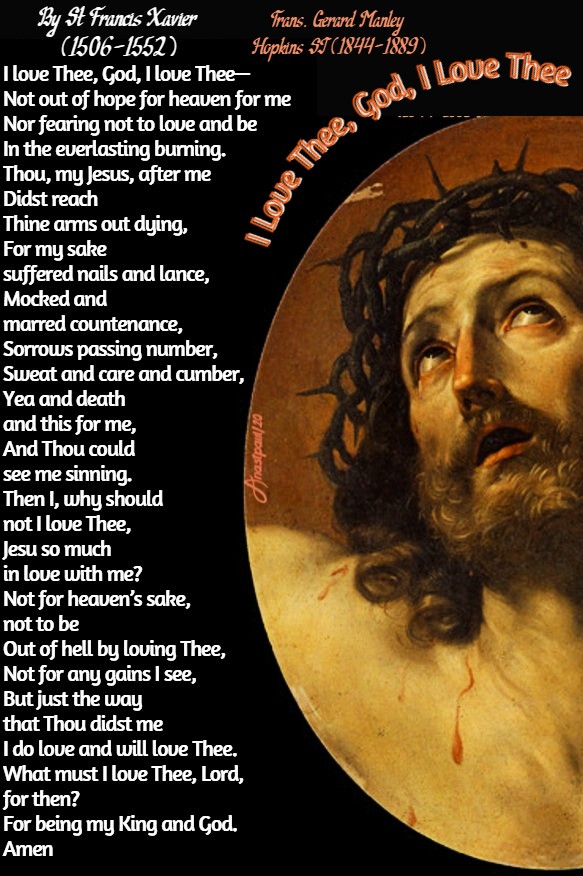
Our Morning Offering – 3 December – I Love Thee, God, I Love TheeBy St Francis Xavier

Our Morning Offering – 3 December – Friday of the First week of Advent and The Memorial of St Francis Xavier SJ (1506-1552)

I Love Thee, God, I Love Thee
By St Francis Xavier (1506-1552)

Translated by Gerard Manley Hopkins SJ (1844-1889)

I love Thee, God, I love Thee—
Not out of hope for heaven for me
Nor fearing not to love and be
in the everlasting burning.
Thou, my Jesus, after me
Didst reach Thine arms out dying,
For my sake suffered nails and lance,
Mocked and marred countenance,
Sorrows passing number,
Sweat and care and cumber,
Yea and death and this for me,
And Thou could see me sinning.
Then I, why should not I love Thee,
Jesu so much in love with me?
Not for heaven’s sake, not to be
Out of hell by loving Thee,
Not for any gains I see,
But just the way that Thou didst me
I do love and will love Thee.
What must I love Thee, Lord, for then?
For being my King and God.
Amen

Posted in INCORRUPTIBLES, MYSTICS, SAINT of the DAY

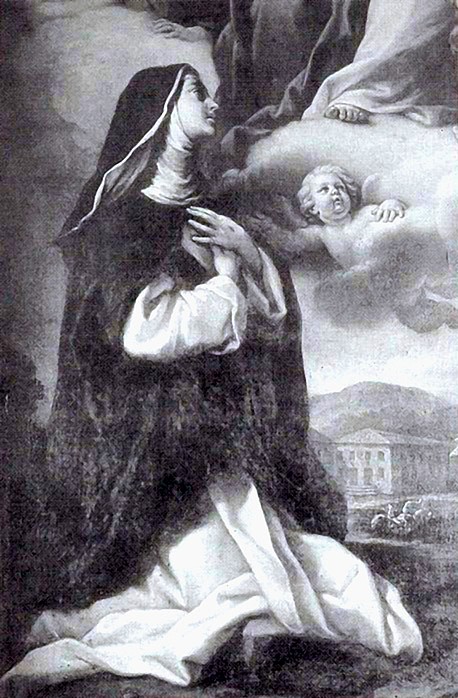
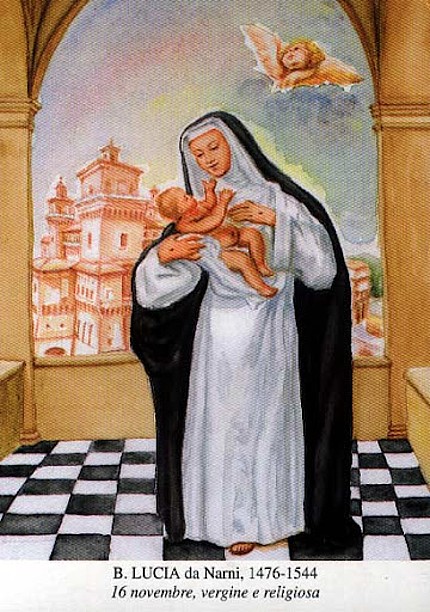
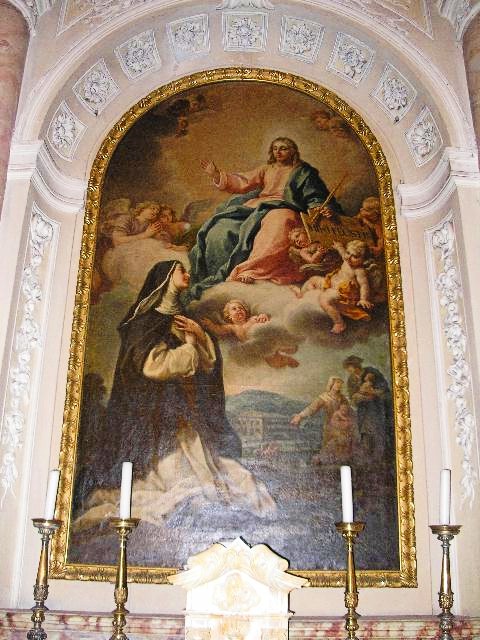
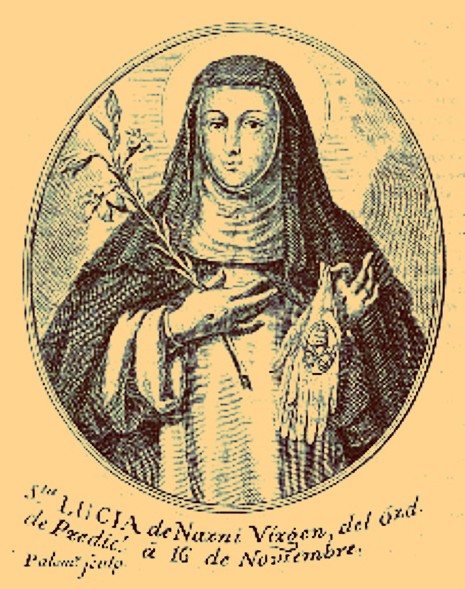
Saint of the Day – 15 November – Blessed Lucia of Narni OP (1476-1544)

Saint of the Day – 15 November – Blessed Lucia of Narni OP (1476-1544) Virgin, Tertiary of the Order of Preachers, Mystic, Stigmatist, Ecstatic, Married but remained chaste and fulfilled her vow of Virginity before she left her marital home and entered a Convent. Born on 13 December 1476 in Narni, Umbria, Italy as Lucia Brocadelli and died on 15 November 1544 at the Saint Catherine of Siena Convent in Ferrara, Italy of natural causes. Patronage – of Narni, Italy. Also known as – Lucy Brocadelli, Lucy de Alessio, Lucia Broccadelli. Her body is incorrupt.

Already very early it became evident to her pious Italian family that this child was set for something unusual in life. Lucia was born in 13 December 1476 on the feast day of Saint Lucia of Syracuse, the eldest of eleven children of Bartolomeo Brocadelli and Gentilina Cassio, in the Town of Narni (then called Narnia) and in the region of Umbria.

When Lucia was five years old, she had a vision of the Child Jesus with Our Lady. Two years later, Our Lady appeared with Child Jesus, Saint Catherine of Siena and Saint Dominic. Jesus gave her a ring and Saint Dominic gave her the scapular. At age 12, she made a private vow of total consecration, determined, even at this early age, to become a Dominican. However, family affairs were to make this difficult. During the following year Lucia’s father died, leaving her in the care of an uncle. And this uncle felt that the best way to dispose of a pretty niece was to marry her off, as soon as possible.

The efforts of her uncle to get Lucia successfully married form a colorful chapter in the life of the Blessed Lucia. Eventually the uncle approached the matter with more tact, arranging a marriage with Count Pietro of Milan, who was not a stranger to the family. Lucia was, in fact, very fond of him but she had resolved to live as a religious. The strain of the situation made her seriously ill. During her illness, Our Lady appeared to her again, accompanied by Saint Dominic and Saint Catherine and told her to go ahead with the marriage as a legal contract but to explain to Pietro that she was bound to her vow of virginity and must keep it. When Lucia recovered, the matter was explained to Pietro and in 1491 the marriage was solemnised.

Lucia’s life now became that of the mistress of a large and busy household. She took great care to instruct the servants in their religion and soon became known for her benefactions to the poor. Pietro, to do him justice, never seems to have objected when his young wife gave away clothes and food, nor when she performed great penances. He knew that she wore a hair-shirt under her rich clothing and that she spent most of the night in prayer and working for the poor.

But when, after having disappeared for the entire night, Countess Lucia returned home early in the morning in the company of two men and claimed that they were Saints Dominic and John the Baptist, Pietro’s patience finally gave out. He had his young wife locked up. Here she remained for the season of Lent; sympathetic servants brought her food until Easter. Being allowed to go to the Church, Lucia never returned. She went to her mother’s house and on the Feast of the Ascension, 1494, 8 May she put on the habit of a Dominican tertiary.

Count Pietro was furious, burned down the Dominican Priory and even tried to kill her spiritual director who had given her the habit. Rich and influential, he continued to try to bring her back. The following year, Lucia went to Rome and entered the Monastery of the Dominican tertiaries near Pantheon. Her sanctity impressed everyone so much that by the end of the year, with five other Sisters, she was sent by the Master General of the Dominicans, to start a new Monastery in Viterbo.

On Friday, 25 February 1496, Lucia received the Stigmata, the Sacred Wounds. She tried very hard to hide her spiritual favours because they complicated her life wherever she went. She had the stigmata visibly and she was usually in ecstasy, which meant a steady stream of curious people who wanted to question her, investigate her, or just stare at her. Even the Sisters were nervous about her methods of prayer. Once they called in the Bishop, and he watched Lucia with the sisters for 12 hours, while she went through the drama of the Passion.

The Bishop hesitated to pass judgement and called for special commissions; the second one was presided by a famous Inquisitor of Bologna. All declared that her Stigmata were authentic. Here the hard-pressed Pietro had his final appearance in Lucia’s life. He made a last effort to persuade hery to come back to him. After seeing her, he returned to Narni, sold everything he had and became a Franciscan. In later years, he was a famous preacher.

The Duke of Ferrara was planning to build a Monastery and, hearing of the fame of the mystic of Viterbo, asked Sister Lucia to be its Prioress. Lucia had been praying for some time that a means would be found to build a new Convent of strict observance and she agreed to go to Ferrara. This led to a two-year battle between the Towns. Viterbo had the Mystic and did not want to lose her; the Duke of Ferrara sent first his messengers and then his troops to bring her. Much money and time was lost before she finally escaped from Viterbo and was solemnly received in Ferrara on 7 May 1499.

Various problems arose in the Convent due to the Duke bringing all sorts of unsuitable people to view ‘his’ Convent and Stigmatist. the Sisters petitioned the Bishop and, by the order of the Pope, he sent ten nuns from the Second Order to reform the community. Lucia’s foundation was of the Third Order; of women who remained part of the laity even after their vows. The Second Order “real” nuns, according to the chronicle, “brought in the very folds of their veils the seed of war.” Nnuns of the Second Order wore black veils, a privilege not allowed to tertiaries.

The uneasy episode ended when one of these ten nuns was made Prioress and when the Duke died on 24 January 1505. Lucia was placed on penance. The nature of her fault is not mentioned, nor was there any explanation of the fact that, until her death, 39 years later, she was never allowed to speak to anyone but her Confessor, who was chosen by the Prioress. Only now, 500 years later, the situation is slowly beginning to clear.

The Dominican Provincial, probably nervous for the prestige of the Order, would not let any member of the Order go to see her. Her Stigmata disappeared, too late to do her any good and vindictive companions said: “See, she was a fraud all the time.” When she died in 1544, people thought she had been dead for many years. It is hard to understand how anyone, not a saint, could have so long endured such a life. Lucia’s only friends during her 39 years of exile were heavenly ones – the Dominican Catherine of Racconigi, sometimes visited her – evidently by bi-location – and her other heavenly friends often also came to brighten her lonely cell.

Immediately after her death everything suddenly changed. When her body was laid out for burial so many people wanted to pay their last respects that her funeral had to be delayed by three days. Her Tomb in the Monastery Church was opened four years later and her perfectly preserved body was transferred to a glass case. When Napoleon suppressed her Monastery in 1797, her body was transferred to the Cathedral of Ferrara and on 26 May 1935 to the Cathedral of Narni.

So many miracles occurred at her Shrine that Lucia was finally Beatified on 1 March 1710 by Pope Clement XI.

It is thought that Lucia was the inspiration for th little girl Lucy, who could see many things that no-one else could, in C S Lewis’ The Chronicles of Narnia.

St. Francis Assisi Church, Sacramento CA

Posted in franciscan OFM, INCORRUPTIBLES, SAINT of the DAY

Saint of the Day – 13 November – Saint Didacus OFM (c 1400-1463)

Saint of the Day – 13 November – Saint Didacus (de Alcalá de Henares) OFM (c 1400-1463) Lay Brother of the Order of Friars Minor, Hermit, Mystic, Confessor, Born in c 1400 at Seville, Spain and died on 12 November 1463 at Alcala, Castile, Spain of natural causes. Also known as – St Didacus of St Nicholas, Diego, Diaz, Didacus de Alcalá de Henares, Didacus of Alcala. Patronages – Franciscan laity, Franciscan lay brothers, Diocese of San Diego, California.

The Roman Martyrology states of him today: “At Alcala in Spain, St Didacus, Confessor of the Order of Minorites, who was renowned for his humility. Incribed on the catalogue of the Saints by Pope Sixtus V, with a Feast Day of 13 November.

Didacus was born about 1400 at San Nicolas in Andalusia, of poor and God-fearing parents. He entered the Third Order of St Francis when he had scarcely reached young manhood and under the direction of a devout Tertiary Priest, he served God for a long time as a Hermit. Consumed with the desire for still greater perfection, he later entered the Franciscan Convent at Arizafa in Castile and was there admitted to solemn vows as a lay brother.

His rapid progress in virtue made him a model to all his companions. His soul was continually occupied with God in prayer and meditation. From this source, he gathered such supernatural insight concerning God and the Mysteries of Faith, that learned theologians listened with astonishment to the inspiring conversations of this uneducated lay brother. Since Brother Didacus manifested great zeal for souls and willingness for sacrifice, his superiors sent him with other brethren to the Canary Islands, which at that time, were still inhabited by wild infidels. Didacus was eager for martyrdom and in this spirit, bore with dauntless patience, the many hardships that came his way. Both by word and example, he helped in converting many infidels.

In 1445, he was appointed Guardian of the chief Friary on the islands at Fortaventura. Recalled to Spain, he went to Rome in 1450 at the command of the Observant Vicar General, St John Capistrano, to attend the great Jubilee and the Canonisation ceremonies of St Bernardine of Siena. On this occasion, an epidemic broke out among the many Friars assembled in the large Convent of Aracoeli. Didacus attended the sick with great charity and trust in God. And God did not fail him. Despite the lack of supplies in the City at the time, Didacus always had ample provisions for his patients. He miraculously restored many of them to health by merely making the Sign of the Cross over them.

Leaving Rome, he returned to Spain, where, as in the former days, he was a source of great edification to the Friars of every Convent in which he lived.

When he felt that the end of his life was drawing near, he asked for an old and worn-out habit, so that he might die in it as a true son of the poor St Francis. He died on 12 November 1463, at the Franciscan Monastery in Alcalá, pressing a Crucifix to his heart and repeating the words of the Good Friday chant: “Dulce lignum, dulce ferrum, dulce pondus sustinet” – Precious the wood, precious the nails, precious the weight they bear.

Months passed before it was possible to bury Brother Didacus, so great was the number of people who came to venerate his remains. Not only did his body remain incorrupt but it diffused a pleasant odour. After it was laid to rest in the Franciscan Church at Alcalá de Henares, astounding miracles continued to occur at his tomb. Pope Sixtus V, himself a Franciscan, Canonised Brother Didacus in 1588.

The Church pays to Didacus today, the very same honours as we have seen her pay to Bernardine and John Capistrano. What is this but asserting, that before God, heroic acts of hidden virtue, are not inferior to the noble deeds that dazzle the world, if, proceeding from the same ardent love, they produce in the soul, the same increase of divine charity.

Posted in franciscan OFM, INCORRUPTIBLES, MYSTICS, QUOTES "CARPE DIEM" - Seize the Day

Saint of the Day – 9 November – Blessed Gabriel Ferretti OFM (1385-1456)

Saint of the Day – 9 November – Blessed Gabriel Ferretti OFM (1385-1456) Priest, Friar of the Order of Friars Minor,, Provincial Superior, Mystic. renowned missionary Preacher. He was zealous in the restoration and establishment of new Convents. Born in 1385 at Ancona, Italy and died on 12 November 1456 in Ancona, Piceno, Italy of natural causes. He was an ancestor to both Cardinal Gabriele Ferretti and Blessed Pope Pius IX, having been descended from a long noble lineage. Patronage – Ancona. His body is incorrupt.

Gabriel was born in 1385 and belonged to the ancient ducal family of the Ferretti. His devout parents raised him in the fear of God and in his eighteenth year he entered the Franciscan Order. His efforts at acquiring virtue won for him so great a degree of the respect and confidence of his brethren that, shortly after his Ordination to the Priesthood, when he was only twenty-five years old, he was appointed to preach missions in the March of Ancona. For fifteen years he devoted himself to this important task with blessed success.

He was then assigned to the office of Guardian of the Convent of Ancona and later he was elected Provincial of the Province of the March. In both offices he was careful to guide his subjects well. He shirked no labour and he could be very severe if it was necessary to correct an evil. He achieved the greatest results, however, by his own bright example of virtue, which induced weak and lax characters to exert themselves manfully in observing the rule.

His reputation for preaching to the masses was noted to the point, where Giacomo della Marca – who was preaching in Bosnia – asked for his help in that task. But the Ancona council in their deliberations on 22 February 1438 passed a resolution asking Pope Eugene IV to ensure the Friar remained in Ancona, due to all his good works. The Pope accepted this request, which meant that Gabriel could not go to Bosnia to aid his friend.

The following incident is proof of his great humility and piety. Once while he was journeying to Assisi, he went into the Franciscan Church at Foligno to pray. The Sacristan, who took him for a Brother, bade him serve the Mass of a Priest who had just gone to the Altar. The humble Provincial obeyed but when the guardian of the Convent recognised the venerable Superior of the Province of the March, in the server, he severely reproached the Sacristan. Father Gabriel defended the Sacristan, saying:

To serve Mass is a great privilege. The Angels would consider themselves honoured. So do not blame the Brother for conferring that honour on me!

Gabriel’s zeal to promote the interests of the Order was as great as his humility. At San Severino he restored a Convent that had fallen into ruin. At Osimo he built a new Convent. The Convent at Ancona he enlarged, in order to accommodate the great number of novices attracted to it by the fame of his sanctity.

Blessed Gabriel Ferretti possessed an ardent love of God and the Blessed Virgin Mary and he unwittingly gave expression to it, in all his sermons. Frequently he was favoured with visions of Our Lord and of the Blessed Virgin.

Rich in virtue and merits, Blessed Gabriel Ferretti died on 12 November 1456, in the Convent at Ancona, assisted in his last hour by the servant of God Gregory of Alba, and St James of the March. The latter delivered his funeral oration. To this day his body is incorrupt and the many miracles wrought through his intercession have increased the devotion of the faithful to him. On 19 September 1753 Pope Benedict XIV solemnly confirmed his veneration.

Posted in INCORRUPTIBLES, SAINT of the DAY

Saint of the Day – 5 October – Blessed Pietro of Imola (c1250-1320)

Saint of the Day – 5 October – Blessed Pietro of Imola (c1250-1320) Knight of the Order of St John of Jerusalem and Grand Prior , Lawyer, Jurist, Mediator, Peace-maker. Born in mid-13th century in Italy as Pietro Pattarini and died on 5 October 1320 in Campo Corbellini, Florence, Tuscany, Italy of natural causes . Also known as – Peter of Imola, Peter Pattarini, Pietro Pattarini de Imola.

The Roman Martyrology states: “In Florence, blessed Pietro da Imola, who, a Knight of the Order of St John of Jerusalem, took care of the sick with pious charity.”

Very little is known of the details of the life of Blessed Pietro of Imola whose memorial we celebrate today. He was born in the mid 1200s at Imola, in Italy, into the noble Pattarini family who had been the Lords of Linasio for over 100 years and part of the Ghibelline faction. Pietro was an excellent scholar and become a well-known lawyer and jurist. The respect held for his legal opinion is evident ,by the fact that his name is found on many important documents which are still preserved in Imola, giving his interpretation of the laws of his time. In 1289 he became a Court Magistrate and eight years later was to use all his skills and experience to negotiate a peace between the rival Guelph and Ghibelline factions in Romagna. The Guelphs were predominately from wealthy mercantile families who supported the Pope while the Ghibellines tended to come from families with wealthy agricultural estates who supported the Emperor. It was no easy task and took several years but, at last, Pietro was able to persuade the Ghibellines to leave Romagna.

After successfully mediating this conflict and crowning, what had been a successful secular career, Pietro sought a new vocation dedicated to charitable works, in helping the poor and the sick. He began working in one of the Order of St John’s hospitals in Florence and was invested as a Knight in 1310. His administrative skills were welcome and appreciated and put to good use as he assumed greater responsibilities in his work in the hospital. His talents were not unnoticed and after some years he was chosen Grand Prior of the Order in Rome. He again returned to Florence to the Commandery of St James in Campo Corbellini.

We do not know for certain if he became the Commander of St James or assumed other duties. Nevertheless, he continued performing great charitable works serving the sick who were either home-bound or in the hospital. Blessed Pietro died in Florence on 5 October 1320 and his loss was felt by everyone who knew him. He was buried in the Church of St James in Campo Corbellini which still belongs to the Order of the Knights.

One of the most remarkable stories about Blessed Pietro occurred after his death. One day in preparation for the feast of St James, the Church was being decorated by the brothers and a Priest had placed a ladder against the tomb of Blessed Pietro and was standing on it and working up high against the wall, hanging some decorations. The Priest lost his balance and the ladder began to fall. Suddenly, Bless Pietro’s tomb opened slightly and his hand reached out and steadied the ladder, no doubt saving the life of the Priest. This miracle was authenticated by several witnesses. Blessed Pietro’s relics were later translated to under the main Altar of the Church in a reliquary that Commander Fra Augustine Mego had made for it, and the miracle-working arm was kept in a separate little box. After the flooding of the Arno river in 1557, the documents and reliquary were submerged and greatly damaged. However ,the box containing his arm survived and is still venerated in the Imola Cathedral. The main relics of Blessed Pietro reside at St Lawrence’s Church in Florence on 10 June 2016 and further relics are contained in the Reliquary at the Chapel in the Grand Magistry of the Order of Malta in Rome. The skin and nails of the arm and hand remain intact, all these centuries later.

The tomb of Blessed Peter at the Church of St James in Campo Corbolini, Florence/Italy
Reliquary at the Chapel in the Grand Magistry of the Order of Malta in Rome
The main relics of Blessed Pietro are in St Lawrence’s Church in Florence/Italy since 10 June 2016
Posted in Against SHIPWRECKS, STORMS at SEA, INCORRUPTIBLES, PATRONAGE - ORPHANS,ABANDONED CHILDREN, SAINT of the DAY

Saint of the Day – 19 September – St Maria de Cervellón OdeM (1230– 1290)

Saint of the Day – 19 September – St Maria de Cervellón OdeM (1230– 1290) Virgin, Catalan Superior of the Second Order of Mercedarians in her region, known as “Maria of Help,” Mystic, graced with the gift of bilocation, Apostle of the poor, the abandoned, the needy. She was the first woman to wear the Habit of the ‘ Order of the Blessed Virgin Mary of Ransom. She is considered the Founder of the Mercedary Nuns. Born in 1230 at Barcelona, Spain and died on 19 September 1290 at Barcelona, of natural causes. Patronages – Mercedarian Nuns and Sisters, Navigators, against shipwreck, Spanish sailors., of the abandoned. Also known as – Maria di Cervellon, Maria dell’Aiuto, Maria de Socos., Mary of Cerevellone. Her body is incorrupt.

Her entry in the Roman Martyrology states: “At Barcelona in Spain, blessed Maria de Cervellione, Virgin of the Order of Our Lady of Ransom. She is commonly called Maria of Help on account of the prompt assistance she renders to those who invoke her.

María de Cervellón was born in Barcelona on 1 December 1230. At that time, the Mercedarian Friars had been redeeming captives from the power of the Saracens for several years,and in that seaport and commercial City, there was talk about the great work of charity and of the growing needs of the Friars in financing redemptions and the upkeep of the Hospital of St. Eulalia, where the ransomed were kept once they returned.

As with every young woman in her time, her family had made other plans for her future. They had tried several times to marry her off to various and prominent men so as to strategically improve their familial alliances and strengthen their position. However, Maria’s heart belonged to Another and she refused each offer her family made on her behalf. She had become the bride of Christ the Redeemer and would spend her life in service to her Spouse in the guise of the captive, the wounded, the sick and the needy. With the assistance of Fr. Bernardo de Corbera, she consecrated herself to God in the Order of Mercy on 25 May 1265, together with other young women from Barcelona.

Maria was not the first, for there is written evidence that the female branch of the Order of Mercy began earlier but she is the first one whose self-offering we know about. From then on, her life would be spent between her house and the Hospital of Saint Eulalia, on the sea, on the shore of Villanova, where it was built thanks to a donation by Raimundo de Plagamans. The Sisters were not originally formed as a contemplative family, but their life was centred on prayer. They were not founded as cloistered Nuns, but gathered in fellowship to be able to live out the Lord’s command – “There is no greater love than to lay down one’s life for one’s friends.” Maria took this call to heart and was able to convince others to follow the path that she had set out on. They formed a community of Sisters who were ready to share in the work of redemption, even to the end.

It is reported that Maria had the gift of bilocation. In Spanish, she was known by the surname de Socós or de Socorro (meaning helper), because she was seen coming to the aid of the ransom ships, walking in the midst of the waves of stormy and rough seas, in order to guide the sailors and their precious cargo to safety.

She died on 19 September 1290, and her remains are preserved in the Basilica of La Merced in Barcelona.

On 13 February1692, Pope Innocent XII gave a favourable judgement and confirmed her immemorial cult;and she was introduced into the Roman Martyrology as a Saint on 8 November 1729. Today, the Nuns and Sisters of the Order proclaim her as a strong woman who followed Jesus Christ, taking flesh in the realities of captivity, so as to be redeemers with Christ through prayer and various apostolates according to their respective constitutions.

Posted in INCORRUPTIBLES, PATRONAGE - HEADACHES, SAINT of the DAY

Saint of the Day – 1 September – Blessed Giuliana of Collalto (1186-1262)

Saint of the Day – 1 September – Blessed Giuliana of Collalto (1186-1262) Benedictine Nun, Abbess, Thaumaturgist, Apostle of the poor. Born in 1186 in Collalto, Susegana, Treviso, Italy and died on 1 September 1262 at Venice, Italy of natural causes. Also known as – Juliana. Patronages against headaches, against migraines; of migraine sufferers. Her body is incorrupt.

The Roman Martyrology states of her today: “In Venice, Blessed Giuliana da Collalto, Abbess of the Order of Saint Benedict.”

Giuliana was born in Collalto (today a fraction of the Municipality of Susegana in the Province of Treviso, Italy) in 1186. Her parents were Count Rambaldo VI and Countess Giovanna di Sant’Angelo di Mantova.

She was educated in a Christian manner and very young, at the age of twelve, she wore the Benedictine habit in St Margherita di Salarola, on the Euganean Hills. Here she lived the first years of religious life in an exemplary way. In 1220 the Blessed Beatrice I d’Este entered the same Monastery and a deep friendship was born between the two chosen souls.

In the powerful and rich Venetian Republic, Monasteries also had their importance because young people from the most important and noble families were welcomed within their walls.

On the island of Spinalonga (now Giudecca) stood the ruined Church of St Cataldo. Giuliana, whose illustrious name in terms of wealth was by now also known for her excellent virtues, was entrusted with the foundation, next door, of a Monastery. Thus was born, in that abandoned place, a cloistered community that for centuries devoted itself to prayer. The Church was also dedicated to St Biagio. Giuliana, nominated Abbess, in addition to respecting the Rule for her own sanctification and that of her Sisters, always had particular regard for the poor. Her charity was known throughout the City and she performed many wonders while still alive. Following the laws of suppression of religious orders at the end of the eighteenth century, the building was then transformed into the Villa Albarea, being located right along the Riviera del Brenta.

During the last years of her life the blessed suffered from severe headaches, which earned her the Patronage of those who suffer from the same ailment. She died on 1 September 1262, at the age of seventy-six, of which sixty-four had been dedicated to the Lord. She was buried in the Church cemetery. Her memory remained alive and above all her fame as a thaumaturgist against migraines. Her biographers were several.

Around 1290 the body, found incorrupt, was placed in an artistic wooden sarcophagus. In 1733 the relics were placed in an Altar of the Church while exactly twenty years later (on 30 May) Pope Benedict XI confirmed the cult “ab immemorabili,” with her Memorial y on 1 September . In 1810 the body was moved to the Church of the Redentore and twelve years later to the parish of St Eufemia where it is still venerated in the Chapel of St Anna. In the Church of her birthplace there is a relic of the phalanx, a crown on which she rested her head, a pillow and part of the dress worn at the time of death. The ancient wooden sarcophagus is now kept at the Correr Museum in Venice. Her paintings are an ancient example of how Venetian painting was influenced, at that time, by the Byzantine style.

St Eufemia Church in Venice where the incorrupt body of Blessed Giuliana is enshrined
Posted in franciscan OFM, INCORRUPTIBLES, SAINT of the DAY

Saint of the Day – 7 August – Blessed Vincent de L’Aquila OFM (c 1435-1504)

Saint of the Day – 7 August – Blessed Vincent de L’Aquila OFM (c 1435-1504) Lay Brother Friar of the Order of the Friars Minor of St Francis, gifted with the charism of prophecy, Mystic, known to levitate whilst in prayer, miracle-worker. He was sought out by nobility, future saints and ordinary people for spiritual advice and prophecy. Born in c 1435 in L’Aquilaand died on the evening of 7 August 1504 in his hut in the forest outside the convent of San Giualiano near L’Aquila, Italy of natural causes. His body is incorrupt. Patronage – L’Aquila, Italy. Also known as Vicente.

The Roman Martyrology states of him today: “In L’Aquila, in the Vestina region (today Abruzzo), Italy, Blessed Vincent, a religious of the Order of Friars Minor, famous for his humility and his prophetic spirit”

Vincent was born in L’Aquila, in Abruzzo, a City that at that time was part of the kingdom of Naples..

At the age of 14 he entered the Order of Friars Minor in the Convent of San Julián, founded by Blessed Antonio de Stroncone, near the City gates. After the profession of perpetual vows, he spent the first years of his conventual life retired in a hut in the forest of the Convent, which he only left to fulfill the offices assigned to him. He preferred humble jobs, he helped the brothers with their domestic chores and fixed their sandals because, to be more useful, he had learned the trade of shoemaker. Other times he would dedicate himself to the work of the fields and, in the rest periods, he would retire to the roughness of the rocky ground, about a hundred paces from the Convent, to devote himself to prayer.

Although educated at home with great care, Vincent wanted, out of humility, to remain a lay brother.  One of the characteristics of his holiness was the spirit of mortification.  So much was his austerity, that he did not even wear the sandals permitted but always remained barefoot.  His brown habit, which can still be seen today, was the heaviest and coarsest of all;  He did not take it off day or night.  In addition, he wore sackcloth and inflicted frequent and prcticed floggings.  His food was reduced to bread and water with some raw herbs, and if he was sometimes obliged, by obedience, to eat like the community, he nevertheless found a means of mortifying himself, taking only a part of his portion and adding dust or bitter substances to it.

His application to prayer was so great that Fray Marcos de Lisboa wrote about him: “Vicente remained abstracted and elevated in the air and his body was as deprived of the senses as if he were dead.” The superiors, seeing him as exemplary, to keep him away from excessive mortification, dedicated him to begging in which Vincent undoubtedly found many sacrificial occasions, given his fondness for solitude and the hidden life.  His main concern, in the daily walks, was always the good of souls. Among the people who were inspired by his holiness we must remember the young girl Mattia Ciccarelli, who later became an Augustinian nun in L’Aquila, with the name of Blessed Sister Cristina Ciccarelli and today she is venerated on Altars with the title of Blessed.

Vincent was sent to the Penne Convent, then for 10 years, to that of Sulmona; from there here turned to San Julián del Aquila. The Prince of Capua, Queen Juana, second wife of Ferdinand I and sister of Ferdinand the Catholic, King of Spain, became acquainted with him for advice. He predicted the royal crown to the Duke of Calabria, the eldest son of Ferdinand I of Aragon.

An illness which had afflicted Vincent for a long time was getting worse and worse, until it prevented him from leaving his poor cell. He endured everything with great resignation and with the serenity of the Saints. On the afternoon of 7 August 1504, he expired serenely in the Lord, lovingly assisted by his confreres. Blessed Cristina Ciccarelli, from her window, saw the Convent of San Julián illuminate with great splendour and the soul of her spiritual director fly to heaven accompanied by a crowd of Angels.

In life, Vincent performed several miracles.  In L´Aquila he returned speech to a mute.  In another City, he cured a child who, due to his misshapen legs, could not walk and in Sant’Angelo three people owed him the cure of a similar disease.  But the most admirable prodigy attributed to the power of his prayers was the resurrection of the Bishop of Sulmona, Bartolomé della Scala, of the Order of Preachers.  This latter miracle had a great impact in Abruzzo and visits flowed to the Convent of San Nicolás de Sulmona, the residence of the miracle-worker at that time. They brought him sick to pray for them and they were cured.

He was 69 years old. He was buried in the Church of San Julián next to the Convent. His incorrupt body is preserved in  in a walnut and glass chest.. Since then it began to shine with miracles attested by donations and votive inscriptions. After more than a century, in 1634, the preservation of the body was still evident. A new inscription was added: “In this tomb rests the body of Blessed Vincent de L’Aquila, who passed away on 7 August 1504.” Pope Pius VI approved his cult by Beatification on 19 September 1787.

Posted in INCORRUPTIBLES, SAINT of the DAY

Saint of the Day – 29 July – St William Pinchon of Saint Brieuc (1180-1234)

Saint of the Day – 29 July – St William Pinchon of Saint Brieuc (1180-1234) Bishop of Saint Brieuc, Confessor Born as Guillaume Pinchon on 11 October 1180 in Saint-Alban, San-Brieuc, Brittany (in France) and died on 29 July 1234 of natural causes. William was a champion for the poor and defended the rights and privileges of the Church against secular intervention. This was a cause of his exile from his Diocese but he returned not long after his exile and set himself on the construction of a new Cathedral which was still in construction at the time of his death. Patronage – Diocese of Saint-Brieuc, France. Also known as – William Pinchon, William of San Brieuc, Guillaume Pinchon. His body is incorrupt.

William was born in 1175 in Saint-Alban to the peasants Oliver Pinchon and Jane Fortin. He was, from a young age,, by the innocence of his manners, his admirable meekness, humility, chastity, mortification, charity and devotion, an accomplished model of all virtues. He received the tonsure and some years later, the Holy Orders of Deacon and Priest, at the hands of Josselin, Bishop of Saint-Brieuc.

He served that Church and Diocese, under his two predecessors, Bishops Peter and Sylvester and succeeded the latter in the episcopal dignity about the year 1220.

The poor were his treasurers and not content to exhaust on them whatever he possessed, he often borrowed great stores of corn and other necessary provisions for their relief. The bare boards were usually his bed – for his domestic servants discovered that he never made use of the soft bed which they prepared for him. In 1225 he sold all his possessions in a famine to aid the poor and homeless.

The Duke Peter I forced him into a brief exile in 1228 and he spent that time living for a while in Poitiers before he returned to his Diocese in 1230 after the Duke reconciled with Pope Gregory IX. It was during his exile in Poitiers that he assisted the ill Bishop there and helped him in his ecclesial duties.

He died in 1234 and his body was deposited in his Cathedral and taken up incorrupt in 1284 . Pope Innocent IV Canonised Pinchon on 24 March 1247 a mere 13 years after his death.

Saint Guillaume Pinchon and Saint Maurice Duault – Saints of the Diocèse of Saint-Brieuc
by Pierre de Rennes
Posted in CARMELITES, INCORRUPTIBLES, SAINT of the DAY

Saint of the Day – 9 July – Blessed Giovanna Scopelli O.Carm (1428 – 1491)

Saint of the Day – 9 July – Blessed Giovanna Scopelli O.Carm (1428 – 1491) Virgin, Mystic, Italian Religious of the Carmelites and established her own Convent as its first Prioress. She was known, during her lifetime as a miracle-worker with many coming to her to ask for her assistance and prayers. Born in 1428 at Reggio d’ Emilia, Italy and died in 1491 of natural causes, aged 63. Also known as – Jane Scopelli, Joan Scopelli, Giovanna of of Reggio Her body is incorrupt.

Giovanna Scopelli was born in 1428 in Reggio Emilia to Simone and Caterina Scopelli. From her childhood she felt a strong attraction to the religious life though her parents disapproved of this vocation and forbade her to pursue it. Scopelli submitted to this and so led her austere and pious life at home until the death of her parents around 1480, when she then decided to form the Carmelite Convent of Santa Maria del Popolo while in the process of her Novitiate.

Giovanna took on the task of looking for a suitable place, when a widow offered herself, two daughters and her home. They lived together from 1480 until 1484, meanwhile Giovanna was looking for a place twhich could serve as a Monastery. Giovanna set her eyes on the Church of St Bernard, which belonged to the Humiliati Friars. With the support of the Bishop, Philip Zoboli, she obtained it from the Friars’ General on his way through Reggio. The beginnings of the new Monastery dates from 1485, with the name changed from that of St Bernard to that of St Mary of the People (afterwards called of the White Sisters). The inevitable financial difficulties at the beginning were surmounted through the help of a certain Christopher Zoboli. Under Joan’s direction more than twenty religious made up the new community, which was entrusted to the care of the Mantuan Congregation of Carmelites and, for which, in 1487, the Carmelites provided a Confessor.

She refused all endowments and gifts – and urged her fellow religious to do the same thing – unless such gifts were given as alms with no conditions attached to them. In 1487 a Priest was assigned to them as their Confessor. The nuns became known as “The White Nuns.”

God gifted Giovanna with extraordinary charisms. She herself fostered a deep Marian piety (she venerated the Blessed Virgin with a special devotion of her own, called the Tunic of Our Lady – mainly a frequent repetition of Hail Marys and was animated by an intense spirit of penance.

She died on 9 July1491;. Her cult began the following year, with the exhumation of her incorrupt body. In 1500 a public judgement was passed on her life, her virtues and her miracles. During the years 1767-70 the Diocesan process for the recognition of the cult was held, which met with the approval of Pope Clement XIV on 24 August 1771. After the suppression of the Monastery by the secular powers and of the Church of the Carmelite nuns in 1797, the body of the Blessed was transferred to the Cathedral in the year 1803.

Posted in FEASTS and SOLEMNITIES, INCORRUPTIBLES, JESUIT SJ, MARIAN TITLES, SAINT of the DAY, The APOSTLES & EVANGELISTS

Solemnity of Saints Peter and Paul , Nuestra Señora del Refugio / Our Lady of Refuge, Matamoros, Tamaulipas, Mexico (1720) and Memorials of the Saints – 4 July

Solemnity of Saints Peter and Paul (29 June) +2021

Nuestra Señora del Refugio / Our Lady of Refuge, Matamoros, Tamaulipas, Mexico (1720) – 4 July:

Jesuit Missionary Father Juan José Güica brought a painting of Our Lady, Refuge of Sinners from Italy to Mexico in 1720. In a dream, the Virgin told Padre Güica to ask the Franciscans of Zacatecas to use and promote the image; – they distributed over 150 copies, making this one of the most widespread Marian devotions in Mexico.

In 1793 Franciscan Friars came to the new settlement which would become Matamoros, renaming the area “Nuestra Señora del Refugio de los Esteros Hermosos” (Our Lady of the Refuge of the Lovely Marshes).

The Cathedral of Our Lady of Refuge, built in 1832, displays an 1886 painting of her. Her fiesta, celebrated in many Mexican Towns, commemorates the coronation of the original “Refugium Peccatori” in the Jesuit Church of Frascati, Italy, on 4 July 1717.

St Elizabeth of Portugal TOSF (1271-1336) (Optional Memorial) Queen Consort, Franciscan Tertiary, Apostle of Charity and Peace, political negotiator and mediator.
Biography:

https://anastpaul.com/2018/07/04/saint-of-the-day-4-july-st-elizabeth-of-portugal-t-o-s-f-1271-1336/

Bl Agatha Yun Jeom-Hye
St Albert Quadrelli
St Andrew of Crete
St Anthony Daniel
St Aurelian of Lyons
St Bertha of Blangy
St Carileffo of Anille
Bl Catherine Jarrige
St Cesidio Giacomantonio
Bl Damiano Grassi of Rivoli
St Donatus of Libya
St Edward Fulthrop
St Elias of Jerusalem
St Finbar of Wexford
St Fiorenzo of Cahors
St Flavian of Antioch
St Giocondiano
Bl Giovanni of Vespignano
St Haggai the Prophet
Bl Hatto of Ottobeuren
Bl Henry Abbot
St Henry of Albano
St Hosea the Prophet
St Innocent of Sirmium
Bl John Carey
Blessed John Cornelius SJ (1557– 1594) Martyr, English Priest of the Society of Jesus, Missionary.
Bl Jozef Kowalski
St Jucundian
St Laurian of Seville
St Lauriano of Vistin
Bl Maria Crocifissa Curcio
St Namphanion the Archmartyr
Bl Natalia of Toulouse
St Odo the Good
Bl Odolric of Lyon
Bl Patrick Salmon
Bl Pedro Romero Espejo

Blessed Petrus Kasui Kibe SJ (c 1587-1639) Priest of the Society of Jesus and Martyr
The first of the 188 Japanese Martyrs
His Life and Death:

https://anastpaul.com/2020/07/04/saint-of-the-day-4-july-blessed-petrus-kasui-kibe-sj-c-1587-1639-priest-and-martyr-a-christian-walking-through-the-world/

Blessed Pier Giorgio Frassati TOSF (1901-1925) Aged 24 – Incorrupt – “The Man of the Eight Beatitudes.”, Franciscan Tertiary, Apostle of Charity and Love, layman, Apostle of the Holy Eucharist and Eucharist Adoration.
About dear Blessed Pier Giorgio:

https://anastpaul.wordpress.com/2017/07/04/saint-of-the-day-4-july-blessed-pier-georgio-frassati-t-o-s-d-the-man-of-the-eight-beatitudes/

St Sebastia of Sirmium
St Theodore of Cyrene
St Theodotus of Libya
Bl Thomas Bosgrave
Bl Thomas Warcop

St Ulric of Augsburg (c 890–973) Bishop of Augsburg, Germany, miracle-worker.
His Life:
https://anastpaul.com/2019/07/04/saint-of-the-day-4-july-saint-ulric-of-augsburg-c-890-973/

St Ulric of Ratzeburg
St Valentine of Langres
St Valentine of Paris
Bl William Andleby
Bl William of Hirsau

Posted in INCORRUPTIBLES, MARIAN TITLES, SAINT of the DAY

Our Lady of the Taper of Cardigan (1100s) and Memorials of the Saints – 15 June:

Our Lady of the Taper of Cardigan (1100s)– 15 June:

During the middle ages there was a notable pilgrimage in honour of Our Lady in Cardigan. A beautiful legend describes how a Statue of Mary was found by the side of the river Teifi, “and her sonne upon her lappe and the taper bernynge in her hande.” It was taken to the Parish Church but would not remain there, returning three or four times to “the place where now is buyIded the Church of our Lady,” the present St.Mary’s Church. A chantry Priest sang Mass daily in honour of Our Lady for pilgrims who came to pray and leave gifts. They lodged with the Knights Hospitallers of S. John, where the Angel Hotel now stands.

St Mary’s dates from 1158, built to hold the Statue. It resembles an earlier Shrine in the city of Arras, which was then in Flanders. Did Flemish merchants, who settled in Cardigan and traded in Welsh wool out of the port, bring the Statue back with them?

Devotion to Mary was once universal in Wales. Many places are called Llanfair or Capel Mair (Mary’s Church, Chapel) and dozens of flowers and plants bear her name. No girl was given the name Mair (Mary), as it was reserved for Our Lady.

We do not know how the devotion transferred to Barcelona and Cagliari. In the 1320’s and 1330’s Catalonian sailors had thronged British waters. Did they come to Cardigan, see the Shrine and copy it? In 1904 Breton Monks, in exile near Cardigan, revived the devotion, giving the title Our Lady of Cardigan to their Abbey Church and also to the little Church they opened in Town in 1912. They left in 1916 and another generation passed before the name was heard again.

In 1952 Martin Gillett, who later was to found the Ecumenical Society of the Blessed Virgin Mary, told Bishop Petit that Cardigan had once possessed a famous Shrine. The Bishop instantly decided to restore it. In 1956 a new Statue was blessed by Cardinal Griffin in Westminster Cathedral and then taken to every Parish in the Diocese of Menevia before arriving in Cardigan. On 27 May 1956, a great concourse from all parts of Britain bore it to the little Church of Our Lady of Sorrows. On 23 July 1970 Bishops Petit and Fox consecrated the new church of Our Lady of the Taper, named after the Shrine. Three days later pilgrims transferred the Statue there.

The original Statue was taken to London and destroyed at Chelsea in 1538 along with other Marian images on the orders of Thomas Cromwell, 1st Earl of Essex, Chief Minister of King Henry VIII. Mother Concordia, OSB, was asked to make another in bronze. Designated as a Welsh National Shrine of Our Lady, it was blessed in Cardiff Metropolitan Cathedral and brought all over Wales before, on Pentecost Sunday, 18 May 1986, it was solemnly installed in the presence of 4,500 pilgrims. Its beauty catches the imagination and arouses devotion. Pope John Paul II wrote a special message for the occasion, and a taper he blessed in Rome was placed in the hand of the statue and lit.

Its symbolism is that Mary presents her Son to us, as she did to the Wise Men, to be adored. The taper testifies that He is Light of the World. Pilgrims come to pray individually and in groups. May they learn to treasure the word of God in their hearts, as Mary did, and live by the light of her Son, who is her Saviour and ours.

St Abraham of Saint-Cyriacus
St Achaicus of Corinth
St Barbara Cui Lianshi
St Benildis of Córdoba

St Bernard of Montjoux/Menthon CRSA (c 1020-1081) “Apostle of the Alps” Priest, Founder of a patrol that cleared robbers from the mountains and he established hospices for travellers and pilgrims. The large dogs, trained to search for lost victims in the mountains, are named for him. Patronages – Alpinists, Alps (proclaimed by Pope Pius XI on 20 August 1923), Campiglia Cervo, Italy, mountain climbers (proclaimed by Pope Pius XI on 20 August 1923), mountaineers, skiers, travellers in the mountains (proclaimed by Pope Pius XI on 20 August 1923).
Biography:

https://anastpaul.com/2018/06/15/saint-of-the-day-15-june-st-bernard-of-menthon-c-r-s-a-c-1020-1081-apostle-of-the-alps/

St Constantine of Beauvais
St Domitian of Lobbes
St Edburgh of Winchester
St Eigil
St Eutropia of Palmyra
St Fortunatus of Corinth

St Germaine Cousin (1579–1601) Incorrupt- Laywoman, Penitent, Apostle of Charity, miracle-worker. Patronages – abandoned people, abuse victims, child abuse victims, against poverty, disabled and handicapped, people, girls from rural areas, illness, impoverishment, loss of parents, shepherdesses, people disfigured by disease, physical therapists.
Her Holy Life:

https://anastpaul.com/2020/06/15/saint-of-the-day-15-june-saint-germaine-cousin-1579-1601/
https://youtu.be/NGY4xQp1FeE?list=PL5_ax08Z6UX_IS_p0gFisSs5wlM63KKL2

St Hadelinus of Lobbes
St Hesychius of Durostorum
St Hilarion of Espalion
Bl Juan Rodriguez
St Julius of Durostorum
St Landelin of Crespin
St Leonides of Palmyra
St Libya of Palmyra
St Lotharius of Séez
St Melan of Viviers
St Orsisius
Bl Pedro da Teruel
Bl Peter Snow
St Pierre de Cervis
Blessed Pietro Nolasco Perra OdeM (1574-1606)
Bl Ralph Grimston
St Tatian of Cilicia
Bl Thomas Scryven
St Trillo of Wales
St Vaughen of Ireland

St Vitus (c 290-c 303) – Martyr, One of the Seven Holy Helpers. Died aged 12-13 years of age. Patronages – against animal attacks, against dog bites, against epilepsy; epileptics, against lightning, against over-sleeping, against rheumatic chorea or Saint Vitus Dance, against snake bites, against storms, against wild beasts, of actors, comedians, dancers, dogs, Bohemia, Czech Republic, Serbia, 17 cities.
His very short life:

https://anastpaul.com/2017/06/15/saint-of-the-day-15-june-st-vitus/

St Vitus Cathedral, Prague, Czech Republic:
https://anastpaul.com/2017/06/15/celebrating-st-vitus-memorial-and-the-cathedral-in-his-honour-in-prague-czech-republic-the-country-for-which-he-is-a-patron-art-dei-series-2/

St Vouga of Lesneven

Martyr of Lucania – 11 saints: Eleven Christians martyred together. We known nothing else about them but the names – Anteon, Candidus, Cantianilla, Cantianus, Chrysogonus, Jocundus, Nivitus, Protus, Quintianus, Silvius, Theodolus in Lucania (modern Basilicata), Italy, date unknown.

Posted in INCORRUPTIBLES, SAINT of the DAY

Saint of the Day – 8 June – Saint William of York (Died 1154)

Saint of the Day – 8 June – Saint William of York (Died 1154) Archbishop of York, Monk. Also known as William FitzHerbert, William FitzHerbert of York, William of Thwayt.

Born William FitzHerbert in York, William was the son of Herbert of Winchester, Chancellor and Treasurer of King Henry I. Thus born into a powerful family in 12th-century England, William seemed destined for great things. His uncle was next in line for the English throne—though a nasty dynastic struggle complicated things. William himself faced an internal Church feud.

He was elected as the Archbishop of York in 1140. His selection was challenged by reformers, especially a group of Cistercians and William was accused of simony, sexual misconduct and being unduly influenced by his connections to the Royal Court.

The Vatican investigated and Pope Innocent cleared him of all charges,and confirmed him as Archbishop on 26 September 1143, 3 years of his election. However, the charges resurfaced a few years later under Pope Eugene III, a Cistercian; Eugene suspended William from his See and in 1147 removed him as Archbishop, replacing him with the Cistercian Henry Murdac, Abbot of Fountains’ Abbey. Some of William’s supporters took to the streets to defend him and during a riot, they attacked and burned a section of the Monastery of Fountains’ Abbey. William, however, retired to Winchester and became a Monk, noted for his austerities and active prayer life.

In 1154, in the reign of Pope Anastasius IV, William was called from his seclusion and again became the Archbishop of York. When he entered the City that Spring after years of exile, he received an enthusiastic welcome. Within two months, however, he was dead, probably from poisoning believed to be in the sacramental wine. One of William’s Clerks accused Osbert de Bayeux, an Archdeacon of York and Osbert was summoned before the King to be tried at the Royal Court. But the King died before the trial could take place ad it seems to have never occurred.

William was buried at York Cathedral. A few months of his death, miracles were attributed to his intervention and a sweet smell came from his tomb when it was damaged during a fire. Nor was the body decayed or burnt in the fire. Pope Honorius III then ordered an investigation into the miracles. In 1226, he was Canonised in Rome by Pope Honorius III on 18 March 1226, just 73 years after his death.

Posted in franciscan OFM, INCORRUPTIBLES, MARIAN TITLES, SAINT of the DAY

Virgen María Sembradora / Virgin Mary the Planter, Hurlingham, Buenos Aires, Argentina and Memorials of the Saints – 4 June

Virgen María Sembradora / Virgin Mary the Planter, Hurlingham, Buenos Aires, Argentina – 4 June :

She is a great sower in the world of the best Seed, that of her Son.
She was chosen to be the door of that great Seed that has changed the colour and flavour of all things and peoples of this world, Jesus Christ, the Son of God.
A planter of the Gospel as a woman in her home, in that family of Nazareth where Jesus grew in wisdom and truth.
She sowed silence around her Son, a silence of listening, of following, of accepting God’s will.
But she also sowed commitment to the need of Elizabeth her relative and at that wedding in Cana.
She again put seeds of the Kingdom at the foot of the Cross, welcoming that disconsolate disciple, becoming a Mother to him and to us all.
Her seeds of unity, affection and advice in the midst of the community bore fruit … Today she continues to plant all this in our hearts to love her Son Jesus and God our Father who chose her as His Masterpiece.

The image of Virgen Maria Sembradora / Virgin Mary the Planter is housed in the Parish “San Carlos Borromeo” in Hurlingham, Buenos Aires, Argentina. The Virgin carries in her right hand the Seed of the Word, planting it in the hearts of the faithful.

A Novena is begun on 25 May and on 4 June every year, the Statue is carried out in procession.

St Aldegrin of Baume
St Alexander of Verona
St Alonio
Bl Antoni Zawistowski
St Aretius of Rome
Bl Boniface of Villers
St Breaca of Cornwall
St Buriana of Cornwall
St Christa of Sicily
St Clateus of Brescia
St Cornelius McConchailleach
St Croidan
St Cyrinus of Aquileia
St Dacian of Rome
St Degan
St Edfrith of Lindisfarne
St Elsiar of Lavedan
St Ernin of Cluain

St Filippo Smaldone (1848-1923) Priest and Founder of the Salesian Sisters of the Sacred Hearts, Preacher, Catechist, Apostle of Eucharistic Adoration and Our Lady, Apostle of Charity and especially of orphans, the blind and the deaf.
Biography:

https://anastpaul.com/2018/06/04/saint-of-the-day-4-june-st-filippo-smaldone-1848-1923/

Bl Francesco Pianzola

St Francis Caracciolo CRM (1563-1608) Priest, Co-Founder of the Congregation of the Clerics Regular Minor with Venerable John Augustine (1551-1587) the “Adorno Fathers,” Confessor, Apostle of the Eucharistic Adoration.
His body was given enough preparation for a long journey to Naples. Truly, God has left His own sign on him. When the body was lanced, the blood spouted a red and scented fluid and his vital organs were uncorrupted. Around his heart were printed the words of the Psalm: “The zeal of your house consumes me” (Ps 69:10).
Wow!:

https://anastpaul.com/2020/06/04/saint-of-the-day-4-june-saint-francis-caracciolo-crm-1563-1608/

Bl Francis Ronci
Bl Margaret of Vau-le-Duc
St Medan
Bl Menda Isategui
St Metrophanes of Byzantium
St Nennoc
St Nicolo of Sardinia
St Optatus of Milevis
Blessed Pacificus of Cerano OFM (c 1424-1482) Priest of the Order of the Friars Minor of St Francis
St Petroc of Cornwall
St Quirinus of Croatia
St Quirinus of Tivoli
St Rutilus of Sabaria
Saturnina of Arras
Bl Stanislaw Kostka Starowieyski
St Trano of Sardinia
St St Walter of Fontenelle
Walter of Serviliano

Martyrs of Cilicia – 13 saints: A group of 13 Christians who were martyred together. The only details about them that have survived are their names –
• Cama• Christa• Crescentia• Eiagonus• Expergentus• Fortunus• Italius
• Jucundian• Julia• Momna• Philip• Rustulus• Saturnin
They were martyred in in Cilicia, Asia Minor (in modern Turkey), date unknown

Martyrs of Nyon – 41 saints: A group of 41 Christians martyred together for refusing to sacrifice to imperial Roman idols. We know the names of some but no other details.
• Amatus• Attalus• Camasus• Cirinus• Dinocus• Ebustus• Euticus• Eutychius
• Fortunius• Galdunus• Julia• Quirinus• Rusticus• Saturnina• Saturninus
• Silvius• Uinnita• Zoticus
Martyred by being beheaded in Noviodunum (modern Nyon, Switzerland).

Posted in INCORRUPTIBLES, SAINT of the DAY

Saint of the Day – 22 May – Saint Humility of Faenza (c 1226–1310)

Saint of the Day – 22 May – Saint Humility of Faenza (c 1226–1310) Wife, Mother, Nun – a founder of Vallumbrosan convents and is considered the Founder of the Vallumbrosan Nuns, Wife, Mother Widow, Recluse, spiritual adviser, spiritual writer. Born in 1226 at Faenza, Italy as Rosanna Negusanti and died on 22 May 1310 at Florence, Italy of natural causes. Also known as – Rosanna, Humilitas, Umiltà. Patronage- Faenza. Her body is incorrupt.

The Roman Martyrolog states pf her todzy: “In Florence, blessed Umiltà (Rosanna), who, with her husband’s consent, lived for twelve years as a recluse. Aat the request of the Bishop, she then built a Monastery of which she became Abbess and which she associated with the Order of Vallombrosa.”

An Altarpiece as a hagiographic Polyptych icon of St Humility painted between 1335-1340

Her ‘Life’ was written by the contemporary Monk Biagio in c 1330, is contained in the cod. 271 of the Riccardiana Library of Florence; also there is a second ‘Life’ in the cod. 1563 of the same Library. But many other texts of the following centuries, up to the Acts of the Congregation of Rites of 1720, report news concerning her, both as a person, for the writings, for the apostolic processes and for the foundations of ,onasteries connected to her.

Rosanna Negusanti, daughter of the nobles Elimonte and Richelda, was born in Faenza in 1226, the year of the death of the Seraphic Francis of Assisi, 1226.

In 1241 at the age of 15, she lost her father and the following year at 16 she married the nobleman named Ugoletto dei Caccianemici (died 1256). They had two children, but their happiness was very brief for both children
died as soon as they were Baptise. At this time too, her mother, Richelda also died.

But the young woman, she was 24, without becoming discouraged and giving in to despair or distracting herself with the joys of the world, together with her husband Ugoletto decided to retire to religious life, both entering the cloisters of the rectory of St Perpetua. ; Iit was not uncommon in the Middle Ages to witness choices of this kind between two Christian spouses.
And on this occasion Rosanna Negusanti changes her name to Humility; after having miraculously recovered from a serious illness.

In 1254 she left the cloister of the Convent and retired to a cloistered cell built for her at the Vallombrosan Monastery of St Apollinare, founded between 1012 and 1015 by St John Gualberto. (His life here: https://anastpaul.com/2019/07/12/saint-of-the-day-12-july-st-john-gualbert-c-985-1073-the-merciful-knight/)

Here she lived for twelve years, purifying and elevating her spirit with prayers and fasting, alternating them with advice that she gave to those who turned to her for help. Her example attracted some young women from Faenza who asked to build cells near hers and to live under her guidance.

And so in 1266 on the advice of Bishop Petrella, Humility agreed to become the spiritual guide of the new nuns, gathered in the old Monastery of Malta in Vallombrosa, which from then on would be called St Maria Novella.
Humility was now 40 years old, she returned to being a mother full of goodness, wisdom and energy, becoming the guide for the new daughters, directing them on the path of holiness.

Fifteen years passed, putting into practice all the virtues of the Rule of St Benedict and the Vallombrosan Constitutions of St John Gualberto. When she was 55, in 1281, Mother Humilitybegan to build a new spiritual home for the young Florentine girls, whose life was shaken by the struggles between Whites and Blacks, the warring factions in the region. A Cchurch was erected in Florence, in honour of St John the Apostle Evangelist, had as Architect Giovanni Pisano and as Decorator the famous Buffalmacco. It was Consecrated in 1297 by the Bishop Francesco Monaldeschi.

Mother Humility with her spiritual daughters

Despite being very sick and elderly, Sister Humilty kept personal contacts with Faenza and Rome to give continuity to the two Monasteries, until after six months of suffering, at the age of 84, she ceased to live in Florence and on 22 May 1310 she entered life.

After a year on 6 June 1311, her body was exhumed and although it was buried in the bare earth, under the floor of the Church, it was incorrupt. She was dressed in precious clothes and from then on, she had an uninterrupted cult. Her body was later transferred to the Monasteries of St Caterina, of St Antonio (1529), of San Salvi (1534), in the 19th century to that of the Spirito Santo of Varlungo near Florence. Finally, in 1972, in the Monastery of the Holy Spirit in Bagno a Ripoli, near Florence, where it is still preserved as perfect as it was in 1310.

The incorrupt body of St Humility

The spirituality of St Humility can be seen from the few writings that have come down to us, they are a living expression of profound humility and fervent love for God and neighbour. Her cult is very ancient, perhaps it even dates back to the solemn ‘elevation’ of the relics in 1311, in which a Mass of its own was granted. In 1317, the Bishops gathered in Avignon, granted particular indulgences to her cult.

On 27 January 1720, the Congregation of Rites with Pope Benedict XIII confirmed the ancient cult, having their own Mass celebrated on 22 May and she was formally Canonised on 27 January 1720 by Pope Clement XI. She was declared Co-Patroness of Faenza in 1942. Altars were dedicated to her in the two Monasteries she founded of the Vallombrosana Congregation .

Posted in INCORRUPTIBLES, SAINT of the DAY

Saint of the Day – 14 May – Saint Ampelio (Died c 428)

Saint of the Day – 14 May – Saint Ampelio (Died c 428) Hermit, miracle-worker. Born in the 4th century in Upper Egypt and died on 5 October c 428 in Bordighera, Italy of natural causes. His Feast day refers to the translation of his body to the Church of Saint Stephen in Genoa, Italy on 14 May 1258. Patronages – blacksmiths, Bordighera, Italy. His body is incorrupt and is the only image we have of him.

Nothing is known about the early life of Saint Ampelio. We know that he was a blacksmith who left his work to become a Recluse in Egypt. His faith was tested in the form of a woman (devil) but Ampelio heated an iron bar until it glowed and chased the demon away.

Ampelio emigrated to Italy, where he planted the first date palms, having brought the seeds from Egypt, lived in a cave, was known as a miracle worker and served as a model for prayer for the Christian life.

He died on 5 October 428 in Bordighera, Italy of natural causes. His body was moved to the Convent of Saint Stephen in Genoa, Italy on 14 May 1258. On 16 August 1047, his body was brought back to Bordighera. He was taken in procession through the crowd to the Church of Magdalene, where he now lies. The Patron celebrations take place on 14th May, in memory of the transfer of the body from Sanremo to Genoa in 1258.

The Church of St Mary Magdalene

There is a little Church dedicated to St Ampelio in Bordighera in Liguria, Italy. The crypt, with two apses and small, inclined loop-holes, holds a squared-off block of stone from La Turbie (the rock which dominates the Principality of Monaco). This stone was the poor and very uncomfortable “bed of the saint,” where Ampelio died the 5th October 428.

Posted in DOGMA, INCORRUPTIBLES, MARIAN TITLES, SAINT of the DAY, St Louis-Marie Grignion de MONTFORT

Nuestra Señora del / Our Lady of Quito, Ecuador (1534) and Memorials of the Saints – 28 April

Wednesday of the Fourth Week of Easter +2021

Nuestra Señora del / Our Lady of Quito, Ecuador (1534) – 28 April:

This miraculous image of Our Lady of Quito currently in the Capital City of Ecuador ,is said to date from the first Spanish settlement there in the year 1534. At the very least, it has certainly been venerated there for a long time and is popularly called ,by the people of Quito, Our Lady of the Earthquake. The painting represents the Sorrowful Mother and in the early years of the twentieth century, devotion to Mary under the title of Our Lady of Quito was introduced into England ,by the Servite Friars in London. Saint Pius X accorded them an indulgence for those who should pray before her picture, and the devotion was greatly promoted in England by the Sisters of the Holy Child Jesus, Mother Cornelia Connelly’s congregation. The original image at Quito was solemnly crowned in 1918.
On 20 April 1906, thirty-six boys attending the boarding school of the Jesuit Fathers at Quito, Ecuador, together with Father Andrew Roesch, witnessed a miracle of this famous picture of Our Lady. While in the refectory they all saw the Blessed Mother slowly open and shut her eyes. The same miracle occurred no less than seven times after that, in favour of the boys at the school but this time, in the Chapel to which the picture had been taken.

Ecclesiastical authorities soon investigated these incidents and finally concluded by ordering the picture to be transferred, in procession from the college to the Church of the Jesuit Fathers. Once at the Church, the miracle was repeated several times before large crowds and many, many conversions took place because of these miracles. At one time, the wonder continued for three consecutive days. At Riobamba, before a faithful reproduction of Our Lady of Quito, the same wonder was seen by more than 20 persons, including the president of the City. In Quito this picture is known as the Dolorosa del Colegio.

A Conceptionist Sister, named Mother Mariana de Jesús Torres received Marian apparitions under this title from 2 February 1594 to 2 February 1634. In 1611, the local Bishop gave his approval to the apparitions.

Mother Mariana de Jesús Torres

Our Lady appeared to Mother Mariana and predicted many things about our own times. This following, is part of what she told her. We can see for ourselves how it relates directly to our own time.
“…. I make it known to you, that from the end of the 19th century and shortly after the middle of the 20th century…. the passions will erupt and there will be a total corruption of customs (morals)….
“They will focus principally on the children, in order to sustain this general corruption. Woe to the children of these times! It will be difficult to receive the Sacrament of Baptism and also, that of Confirmation…
“As for the Sacrament of Matrimony… it will be attacked and deeply profaned… The Catholic spirit will rapidly decay; the precious light of the Faith will gradually be extinguished… Added to this, will be the effects of secular education, which will be one reason for the dearth of priestly and religious vocations.
“The Sacrament of Holy Orders will be ridiculed, oppressed and despised… The Devil will try to persecute the ministers of the Lord in every possible way; he will labour with cruel and subtle astuteness, to deviate them from the spirit of their vocation and will corrupt many of them. These depraved priests, who will scandalise the Christian people, will make the hatred of bad Catholics and the enemies of the Roman Catholic and Apostolic Church ,fall upon all priests…
“Further, in these unhappy times, there will be unbridled luxury, which will ensnare the rest ,into sin and conquer innumerable frivolous souls, who will be lost. Innocence will almost no longer be found in children, nor modesty in women. In this supreme moment of need of the Church, the one who should speak will fall silent.”
In a subsequent apparition, Our Lady told Mother Mariana that these apparitions were not to become generally known until the twentieth century.

On 8 December 1634, the apparition predicted that Papal Infallibility “will be declared a Dogma of the Faith by the same Pope chosen to proclaim the Dogma of the Mystery of My Immaculate Conception.” In 1854, Blessed Pope Pius IX defined the Dogma of the Immaculate Conception and in 1870, he declared the Dogma of Papal Infallibility as defined by the First Vatican Council.

Mother Mariana died on 16 January 1635, shortly after the last apparition. When her tomb was reopened in 1906, her body was found to be perfectly incorrupt, after nearly 300 years in an ordinary, unprotected, wooden coffin. The Archdiocese of Quito opened her cause for Canonisation in 1986 and finished the Diocesan stage of the process ,in 1997.

St Louis Marie Grignion de Montfort (1673-1716) (Optional Memorial)
The Wondrous St Louis!:

https://anastpaul.wordpress.com/2018/04/28/saint-of-the-day-28-april-st-louis-marie-grignion-de-montfort-1673-1716/

St Peter Chanel SM (1803-1841) Priest of the Society of Mary (Marists), Missionary, Martyred aged 37 Protomartyr of Oceania (Optional Memorial)
Biography:

https://anastpaul.wordpress.com/2017/04/28/saint-of-the-day-28-april-st-peter-chanel/

St Adalbero of Augsburg
St Agapio of Cirtha
St Artemius of Sens

Blessed Itala Mela ObSB (1904–1957)
Her life:

https://anastpaul.com/2019/04/28/saint-of-the-day-28-april-blessed-itala-mela-obsb-1904-1957/

St Benedict of the Bridge
St Cronan of Roscrea
St Cyril of Turov
Bl Gerard of Bourgogne
St Gianna Beretta Molla (1922-1962)

Bl Hanna Helena Chrzanowska OSB (1902-1973)
Bl Józef Cebula
Bl Luchesius

Blessed María Felicia of Jesus in the Blessed Sacrament / Guggiari Echeverría OCD (1925-1959)
Her Life:

https://anastpaul.com/2020/04/28/saint-of-the-day-28-april-blessed-maria-felicia-of-jesus-in-the-blessed-sacrament-ocd-1925-1959-the-lily-of-paraguay/

St Mark of Galilee
St Pamphilus of Sulmona
St Prudentius of Tarazona
St Vitalis of Ravenna (Died c 171) Martyr, Layman


Martyrs of Alexandia:
Didymus
Theodora

Martyrs of Durostorum:
Dada
Maximus
Quintilian

Martyrs of Languedoc:
Agapius
Aphrodisius
Caralippus
Eusebius

Martyrs of Laon:
Germaine
Probe

Martyrs of Larino:
Alexander
Firmianus
Primianus
Tellurius

Martyrs of Nicomedia:
Caralampo
Eusebius

Martyrs of Prusa:
Acacius
Menander
Patritius
Polyenus

Martyrs of Ravenna:
St Ursicinus
St Valeria
St Vitalis (see above)

Martyrs of Vietnam:
Gioan Baotixta Ðinh Van Thành
Phaolô Pham Khac Khoan
Phêrô Nguyen Van Hien

Pilgrims of Gallinaro:
Arduin
Bernhard
Gerard
Hugh