One Minute Reflection – 24 July – Friday of the Sixteenth week in Ordinary Time, Year A, Readings: Jeremiah 3:14-17, Responsorial psalm Jeremiah 31:10-13, Matthew 13:18-23 and the Memorial of St Charbel Makhluf (1828-1898)
“As for what was sown on good soil, this is he who hears the word and understands it; he indeed bears fruit and yields, in one case a hundredfold, in another sixty and in another thirty.”...Matthew 13:23
REFLECTION – “And yet, if both the land be good and the Sower one and the seed the same, wherefore did one bear a hundred, one sixty, one thirty?
Here again the difference is from the nature of the ground, for even where the ground is good, great even therein, is the difference.
Understand that not the Sower is to be blamed, nor the seed but the land that receives it? not for its nature but, for its disposition.
And herein too, great is His mercy to man, that He does not require one measure of virtue.
… And these things He says, lest they that followed Him should suppose that hearing is sufficient for salvation.
… Yes, both vainglory and all the rest belong to this world and to the deceitfulness of riches, such as pleasure and gluttony and envy and vainglory and all the like.
But He added also the “way” and the “rock,” signifying that it is not enough to be freed from riches only, but we must cultivate also the other parts of virtue.
But what if you are free indeed from riches, yet are soft and unmanly? and what if you are not indeed unmanly but are remiss and careless about the hearing of the word?
No one part is sufficient for our salvation but there is required first, a careful hearing and a continual recollection, then fortitude, then contempt of riches and deliverance from all worldly things.” … St John Chrysostom (347-407) Father and Doctor
PRAYER – A pure heart create for me O God, put a steadfast spirit within me! (Ps 50[51]) Lord God, bestow a full measure of Your grace to us. Keep us within in the path of Your commandments, help us to work on the earth of our souls, rooting out the weeds and casting forth the stones of malice. Grant that by the prayers of St Charbel Makhluf, who by Your grace triumphed in all virtues, we may succeed in attaining sanctity. Through Christ, our Lord, in union with the Holy Spirit, one God, forever, amen.
One Minute Reflection – 11 July – “Month of the Precious Blood” – Saturday of the Fourteenth week in Ordinary Time, Year A, Readings: Isaiah 6:1-8, Psalm 93:1-2, 5, Matthew 10:24-33 and the Memorial of St Benedict of Nursia OSB (c 480-547) Patron of Europe and Founder of Western Monasticism and St Olga Queen of Kiev (c 890-969)
“Are not two sparrows sold for a small coin? Yet not one of them falls to the ground without your Father’s knowledge. Even all the hairs of your head are counted.” … Matthew 10:29-30
REFLECTION – “If God shows such a solicitous care even for things of modest value (grass and flowers, for example), how can He forget you, that you are the most excellent of His creatures? Why then did He create such beautiful things? To manifest His wisdom and the greatness of His power, so that we might know all His glory.
Not only the heavens narrate the glory of God (Ps 18,2) but also the earth, as David points out, when he sang: Praise the Lord, fruit trees and all cedars (Ps 148,9). In fact, some creatures praise the Creator with their fruits, others with their greatness, still others with their beauty.
Another demonstration of the great wisdom and power of God resides in the fact that He adorns even the most vile objects of such beauty (what is, in fact, more vile than what exists today but tomorrow will no longer be?) If, then, God has also given hay to what was not necessary at all (what good is it, in fact, it’s beauty? To feed the fire?) how can He not give you what you need? If the Lord has generously decorated the most vile thing of all and not for some purpose but only for beauty, much more He will honour you, the most precious of His creatures, in those things that are necessary to you. ” … St John Chrysostom (347-407) Father and Doctor of the Church – Commentary on the Gospel of St Matthew, 22.1
PRAYER – Loving Father, grant me to have a true fervour in Your service. Let me never tire of following Your Son’s example and avoiding evil. Teach me to reside in total peace in Your wisdom and power and thus to trust You above all. Grant that by the intercession of St Benedict and St Olga, we may grow in holiness and attain our eternal home with You. We ask this through our Lord, Jesus Christ and the Holy Spirit, God forever, amen.
Saint of the Day – 11 July – Saint Olga Queen of Kiev (c 890-969) Queen of the Ukraine – born c 890 at Pskov, Russia and died on 11 July 969 in Kiev, Ukraine of natural causes. Also known as Olga Prekrasa, Olga the Beauty, Helena, Helga, Olha. Patronage – Kiev, converts, widows. Her body was incorrupt, though it was lost in the early 18th century.
While Olga’s birthdate is unknown, it could be as early as 890 and as late as 925 but she was born and lived in Pskov. Little is known about her life before her marriage to Prince Igor I of Kiev and the birth of their son, Svyatoslav. Igor was the son and heir of Rurik, founder of Rurik dynasty. After his father’s death Igor was under guardianship of Oleg, who had consolidated power in the region, conquering neighbouring tribes and establishing a capital in Kiev. This loose tribal federation became known as Kievan Rus’, a territory covering what are now parts of Russia, Ukraine, and Belarus.
The Drevlians were a neighbouring tribe with which the growing Kievan Rus’ empire had a complex relationship. The Drevlians had joined Kievan Rus’ in military campaigns against the Byzantine Empire and paid tribute to Igor’s predecessors. They stopped paying tribute upon Oleg’s death and instead gave money to a local warlord. In 945, Igor set out to the Drevlian capital, Iskorosten (today known as Korosten in northern Ukraine), to force the tribe to pay tribute to Kievan Rus.’ Confronted by Igor’s larger army, the Drevlians backed down and paid him. As Igor and his army rode home, however, he decided the payment was not enough and returned, with only a small envoy, seeking more tribute. Upon his arrival in their territory, the Drevlians murdered Igor. According to the Byzantine chronicler Leo the Deacon, Igor’s death was caused by a gruesome act of torture in which he was “captured by them, tied to tree trunks and torn in two.”
When Igor was murdered in 945, Princess Olga assumed the regency for her son, Svyatoslav. Olga served as regent until her son was of age in 964. She was known as a ruthless and effective ruler. She resisted marrying Prince Mal of the Drevlians, who had been the killers of Igor, killing their emissaries and burning their city in revenge for her husband’s death. She resisted other offers of marriage and defended Kiev from attacks.
During her son’s prolonged military campaigns, she remained in charge of Kiev, residing in the castle of Vyshgorod with her grandsons.
In the 950s, Olga travelled to Constantinople, the capital of the Byzantine Empire, to visit Emperor Constantine VII. Once in Constantinople, Olga converted to Christianity with the assistance of the Emperor and the Bishop. While the Primary Chronicle does not divulge Olga’s motivation for her visit or conversion, it does go into great detail on the conversion process, in which she was baptised and instructed in the ways of Christianity
“When Olga was enlightened, she rejoiced in soul and body. The Bishop, who instructed her in the faith, said to her, ‘Blessed art thou among the women of Rus’, for thou hast loved the light and quit the darkness. The sons of Rus’ shall bless thee to the last generation of thy descendants.’ He taught her the doctrine of the Church, and instructed her in prayer and fasting, in almsgiving and in the maintenance of chastity. She bowed her head and like a sponge absorbing water, she eagerly drank in his teachings. The Princess bowed before the Bishop, saying, ‘Through thy prayers, Holy Father, may I be preserved from the crafts and assaults of the devil!’ At her Baptism she was named Helena, after the ancient Empress, mother of Constantine the Great. The Bishop then blessed her and dismissed her.”
By her example, she influenced her grandson, Vladimir I. He was the third son of Svyatoslav and brought Kiev (Rus) into the official Christian fold.
Olga died from illness in 969. When Svyatoslav announced plans to move his throne to the Danube region, the ailing Olga convinced him to stay with her during her final days. Only three days later, she passed away and her family and all of Kievan Rus’ wept.
At the time of her death, it seemed that Olga’s attempt to make Kievan Rus’ a Christian territory had been a failure. Nonetheless, Olga’s Christianising mission would be brought to fruition by her grandson, Vladimir, who officially adopted Christianity in 988. The Primary Chronicle highlights Olga’s holiness in contrast to the pagans around her during her life as well as the significance of her decision to convert to Christianity:
“Olga was the precursor of the Christian land, even as the day-spring precedes the sun and as the dawn precedes the day. For she shone like the moon by night and she was radiant among the infidels like a pearl in the mire, since the people were soiled and not yet purified of their sin by holy baptism. But she herself was cleansed by this sacred purification…. She was the first from Rus’ to enter the kingdom of God and the son of Rus’ thus praise her as their leader, for since her death she has interceded with God in their behalf.”
Her relics were found to be incorrupt and translated to the Church of the Tithes in Kiev, the first time relics were displayed in Rus-Ukraine, however, her relics were lost forever in the early 18th century.
Saint of the Day – 8 July – Blessed Giulio of Montevergine (Died 1601) Hermit, Scholar,Penitent, Apostle of Prayer and Charity. Born in the 16th century Nardò, Lecce, Italy and died on 8 July 1601 at the Abbey of Montevergine of natural causes. His body is incorrupt.
For centuries, people referred to Friar Giulio as “Blessed”, although the Church has never officially Beatified this Servant of God.
The renowned Sanctuary of the Madonna di Montevergine, a famous Benedictine Abbey, founded by Saint William of Vercelli in the Twelfth Century, has been a noted Pilgrimage Site, for centuries. Apart from the Effigy of Our Lady of Montevergine, the Shrine also houses the incorrupt remains of Blessed Giulio.
Giulio was born in the Sixteenth Century in Nardò, Lecce, to a wealthy family and studied Letters, Science and Music, in which he distinguished himself through his impeccable talent.
At an early age, he distributed all his material possessions to the poor and lived as a Hermit, dressed in a Pilgrim’s Habit, together with another saintly Hermit, by the name of Giovanni.
The Carafa Nobles, noting their keen life of mortification and contemplation, built for them a Hermitage and a Church, dedicated to the Crowned Virgin Mary, known among the locals to these days as L’Incoronata.
Pope Gregory XIII (1502 – 1585), understanding the fact that several Pilgrims visited the Hermitage for prayer, sent the Benedictine Camaldolese Monks, to establish a Community there.
But, by now, the “Blessed” Giulio had become too well known and moreover the possibility of becoming Superior was proposed. He chose rather to return to hiding and remain unknown to all. He left the Hermitage and went knocking at the Abbey of Montevergine – images below, not so far away and was welcomed with joy by the Monks. Here he passed his remaining years under the shade of the Virgin Mary, serving as the Monastery Organist for 24 years.
Again through his profound humility, he never wanted to be Ordained to the Priesthood and asked his Superiors to bury him under the pavement of Our Lady’s Chapel, so that Pilgrims would pass over his Vault, as if he was a great sinner, trampled on by everyone.
His wish was granted when he died on 8 July 1601. Twenty years later, in 1621, when the pavements where undergoing restorations, his body was found remarkably preserved and, even today, over over four centuries later, his remains, preserved in an glass cask, are still visibly incorrupt.
“Take my yoke upon you and learn from me, for I am meek and humble of heart and you will find rest for your souls…” … Matthew 11:29
REFLECTION – “You are to “take my yoke upon you and learn from me.” You are not learning from me how to refashion the fabric of the world, nor to create all things visible and invisible, nor to work miracles and raise the dead. Rather, you are simply learning of me: “that I am meek and lowly in heart.” If you wish to reach high, then begin at the lowest level. If you are trying to construct some mighty edifice in height, you will begin with the lowest foundation. This is humility. However great the mass of the building you may wish to design or erect, the taller the building is to be, the deeper you will dig the foundation. The building in the course of its erection, rises up high but he who digs its foundation, must first go down very low. So then, you see even a building is low before it is high and the tower is raised, only after humiliation.”… St Augustine (354-430) Fater & Doctor (Sermon 69)
PRAYER – Holy God, our Father, we turn to You in confidence as children and pray, give us meekness of heart, make us “poor in spirit” that we may recognise that we are not self-sufficient, that we are unable to build our lives on our own but need You, we need to encounter You, to listen to You, to speak to You. Help us to understand that we need Your gift, Your wisdom, which is Jesus Himself, in order to do the Your will in our lives and thus to find rest in the hardships of our journey. May the prayers of Saint Anthony Zaccaria help us to learn the true humility of Your divine Son. Grant this, we pray, through our Lord Jesus Christ who lives and reigns with You and the Holy Spirit, one God, forever and ever, amen.
St Agatho of Sicily
St Athanasius the Athonite
St Athanasius of Jerusalem
St Cast
St Cyprille of Libya
St Cyrilla of Cyrene
St Domèce
St Domitius of Phrygia
St Edana of West Ireland
Bl Edward Cheevers
Bl Elias of Bourdeilles
St Erfyl
St Fragan
Bl George Nichols
St Grace of Cornwall
St Gwen
Bl Humphrey Pritchard Blessed Joseph Boissel OMI (1909-1969) Priest and Martyr
St Marinus of Tomi
St Mars of Nantes
St Marthe
Bl Matthew Lambert
St Modwenna
St Numerian of Treves
Bl Patrick Cavanagh
St Philomena of San Severino
St Probus of Cornwall
Bl Richard Yaxley
Bl Robert Meyler
St Rosa Chen Aijieh
St Sedolpha of Tomi
St Stephen of Reggio
St Teresia Chen Qingjieh
St Theodotus of Tomi
Bl Thomas Belson
St Thomas of Terreti
St Triphina of Brittany
St Triphina of Sicily
St Zoe of Rome
Quote/s of the Day – 4 July – The Memorial of Blessed Petrus Kasui Kibe SJ (c 1587-1639) Priest and Martyr“A Christian Walking Through the World” and Blessed Pier Giorgio Frassati TOSF (1901-1925) “Man of the Beatitudes”
“Let us hoist our sails trusting in the wind of God’s grace.”
Blessed Petrus Kasui Kibe (c 1587-1639)
Priest and Martyr
“A Christian Walking Through the World”
“All around the sick and all around the poor, I see a special light which we do not have.”
“In prayer, the soul rises above life’s sadnesses.”
“The faith given to me in Baptism suggests to me surely – by yourself you will do nothing but, if you have God as the centre of all your action, then you will reach the goal.”
“The times we are going through are difficult because cruel persecution of the Church is raging. But you, bold and good young people, should not be afraid of this small thing, remember, that the Church is a divine institution and cannot come to an end. She will last till the end of the world. Not even the gates of hell can prevail against her.”
“To live without faith, without a heritage to defend, without battling constantly for truth, is not to live but to ‘get along,’ we must never just ‘get along’.”
Blessed Pier Giorgio Frassati (1901-1925)
“Man of the Beatitudes”
One Minute Reflection – 4 July – “Month of the Precious Blood” – Saturday of the Thirteenth Week of Ordinary Time, Year A, Readings: Amos 9:11-15, Psalm 85:11-14, Matthew 9:14-17 and the Memorial of Blessed Petrus Kasui Kibe SJ (c 1587-1639) Prist and Martyr and Bl Pier Giorgio Frassati TOSF (1901-1925)
And Jesus said to them, “Can the wedding guests mourn as long as the bridegroom is with them? The days will come, when the bridegroom is taken away from them and then they will fast.” … Matthew 9:15
REFLECTION – “However, our mourning is right if we burn with desire to see Him. How happy they were who were able to enjoy His presence before His Passion, to question Him as they wished and listen to Him as necessary… As for us, we see the fulfilment of what He said: “The days are coming when you will long to see one of the days of the Son of Man, and you will not see it” (Lk 17:22)… “A little while and you will no longer see me and again a little while and you will see me” (Jn 16:19).
But now this is the hour of which He said: “You will weep and mourn but the world will rejoice… But, He added, I will see you again and your hearts will rejoice and no-one will take your joy away from you” (v.22). The hope thus given us by Him, who is faithful in His promises, never now leaves us, without a certain joy — until that overwhelming joy comes on the day when we will be like Him because we will see Him as he is (1Jn 3:2)… “When a woman is in labour, she has pain because her hour has come,” says the Lord, “but when her child is born, she no longer remembers the anguish because of the joy of having brought a human being into the world” (Jn 16:21). This is the joy no-one can take away from us and with which we will be satisfied when we pass to eternal light from our present conception in faith. So let us fast and pray since we are still on the threshold of birth.“…St Augustine (354-430) Father and Doctor
PRAYER – Father almighty, as we wait and work and pray and fast in joyful hope of our eternal life with You, grant we pray that we may always remain steadfast in Your love. Blessed Petrus Kasui Kibe, you of intrepid perseverance and faith and Pier Giorgio Frassati, you whose faith could move mountains, pray for us, that we will fully utilise the many gifts our Almighty God has bestowed on us as we journey home. We make our prayer through Jesus Christ our Lord, in union with You and the Holy Spirit, one God forever, amen.
4 July – Our Lady of Refuge, Nuestra Señora del Refugio, is Patroness of California and parts of Mexico.
This painting is from the hands of the artist, Joseph de Paez, 1750, Mexico.
The Franciscan missionary Francisco Diego Garcia y Moreno was the first Bishop of Baja, California. He proclaimed Nuestra Señora del Refugio, as Patron on 4 January 1843, at Mission Santa Clara in Alta California.
His proclamation included the following:
The entire text of Bishop Garcia Diego’s declaration is recorded in Mission Santa Clara’s Libro de Patentes. After citing the early Fathers of the Church on the practice and spiritual benefits of naming patron Saints, the first Bishop of the Californias stated: “We make known to you that we hereby name the great Mother of God in her most precious title, ‘del Refugio, ‘ the principal patroness of our Diocese . . . With so great a patroness and protectress, what can we not promise ourselves? What can be wanting and whom need we fear?”
The Liturgical Feast:
In 1981 the California Catholic Conference of Bishops petitioned the Vatican Congregation for the Sacraments and Divine Worship for authorisation to observe the Feast of Our Lady of Refuge on 5 July as an obligatory memorial. This was approved by official document dated 15 January 1982 and signed by Archbishop Giuseppe Casoria.
The Diocese of Baja California celebrate this Patronal Feast on 4 July.
Paintings of Our Lady of Refuge are, with few exceptions, quite similar in design and execution. The heads of the Infant Jesus and his Mother Mary lean together with no background between them. Both figures wear a crown. Mary’s eyes are turned toward the observer, while the gaze of the child seems to turn left of the viewer.
In the Santa Clara Mission church the painting of Our Lady of Refuge is found above the larger picture of Our Lady of Guadalupe in one of the side altar niches on the left as one nears the sanctuary. Another painting by Eulalio, a local Native American, is on display in Santa Clara University’s De Saisset Museum near the mission church.
The above image is darker than the Eulalio painting, which has a wood-tone background. The flower motif is almost the same, the two figures are almost identical in both images.
Bl Agatha Yun Jeom-Hye
St Albert Quadrelli
St Andrew of Crete
St Anthony Daniel
St Aurelian of Lyons
St Bertha of Blangy
St Carileffo of Anille
Bl Catherine Jarrige
St Cesidio Giacomantonio
Bl Damiano Grassi of Rivoli
St Donatus of Libya
St Edward Fulthrop
St Elias of Jerusalem
St Finbar of Wexford
St Fiorenzo of Cahors
St Flavian of Antioch
St Giocondiano
Bl Giovanni of Vespignano
St Haggai the Prophet
Bl Hatto of Ottobeuren
Bl Henry Abbot
St Henry of Albano
St Hosea the Prophet
St Innocent of Sirmium
Bl John Carey
Bl John Cornelius
Bl Jozef Kowalski
St Jucundian
St Laurian of Seville
St Lauriano of Vistin
Bl Maria Crocifissa Curcio
St Namphanion the Archmartyr
Bl Natalia of Toulouse
St Odo the Good
Bl Odolric of Lyon
Bl Patrick Salmon
Bl Pedro Romero Espejo Blessed Petrus Kasui Kibe SJ (c 1587-1639) Priest and Martyr The first of the 188 Japanese Martyrs
One Minute Reflection – 15 June – “Month of the Sacred Heart” – Monday of the Eleventh Week of Ordinary Time, Year A, Readings: 1 Kings 21:1-16, Psalm 5:2-3, 4-7, Matthew5:38-42 and the Memorial of St Germaine Cousin (1579–1601)
“Should anyone press you into service for one mile, go with him for two miles.” … Matthew 5:41
REFLECTION – “Do you grasp the excellence of a Christian disposition? After you give your coat and your cloak, even if your enemy should wish to subject your naked body to hardships and labours, not even then, Jesus says, must you forbid him. For He would have us possess all things in common, both our bodies and our goods, as with them that are in need, so with them that insult us. For the latter response comes from a courageous spirit, the former from mercy. Because of this, Jesus said, “If any one shall compel you to go one mile, go with him two.” Again He leads you to higher ground and commands you to manifest the same type of aspiration. For if the lesser things He spoke of at the beginning receive such great blessings, consider what sort of reward awaits those who duly perform these and what they become even before we hear of receiving rewards. You are winning full freedom from unworthy passions in a human and passible body.” … St John Chrysostom (347-407) Bishop, Father & Doctor (The Gospel of Matthew: Homily 18)
PRAYER – King of heaven and earth, Lord God, rule over or hearts and bodies this day. Sanctify us and guide our every thought, word and deed according to the commandments of Your law, so that now and forever, Your grace may free and save us. Teach us Lord to walk in the ways of the Cross of Your Son, our Saviour, as St Germaine Cousin so lovingly and willingly inspires us to do. Through Christ our Lord, with the Holy Spirit, God, forever, amen
St Constantine of Beauvais
St Domitian of Lobbes
St Edburgh of Winchester
St Eigil
St Eutropia of Palmyra
St Fortunatus of Corinth St Germaine Cousin (1579–1601) Incorrupt
St Hadelinus of Lobbes
St Hesychius of Durostorum
St Hilarion of Espalion
Bl Juan Rodriguez
St Julius of Durostorum
St Landelin of Crespin
St Leonides of Palmyra
St Libya of Palmyra
St Lotharius of Séez
St Melan of Viviers
St Orsisius
Bl Pedro da Teruel
Bl Peter Snow
St Pierre de Cervis
Bl Ralph Grimston
St Tatian of Cilicia
Bl Thomas Scryven
St Trillo of Wales
St Vaughen of Ireland St Vitus (c 290-c 303) – Martyr, One of the Seven Holy Helpers His very short life: https://anastpaul.com/2017/06/15/saint-of-the-day-15-june-st-vitus/
Saint of the Day – 4 June – Saint Francis Caracciolo CRM (1563-1608) Priest, co-Founder of the Congregation of the Clerics Regular Minor with Venerable John Augustine (1551-1587) the “Adorno Fathers,” Confessor, Apostle of the Eucharistic Adoration – born as Ascanio Pisquizio on 13 October 1563 at his family’s castle at Villa Santa Maria, Abruzzi, Italy and died on 4 June 1608 at Agnone, Italy of a fever, aged 44. Patronages – Association of Italian Cooks (chosen in 1996), Naples, Italy (chosen in 1838).
Francis Caracciolo was born of a noble family on 13 October 1563 in Villa Santa Maria (Abruzzo Region). His parents, Ferrante Caracciolo and Isabella Baratucci Baptised him as Ascanio. He received an excellent educational formation and Catholic education and these showed from his virtues, evident from his early childhood.
When he was 22 years old, he was inflicted by a terrible disease which almost led him to death. In this trial he heard the Lord’s call and was ready to dedicate his life completely in the service of God and neighbour, if he would recover.
After his miraculous cure, Ascanio, faithful to his promise, renounced all his properties and noble titles. He left his home and went to Naples to prepare himself for the Priesthood. He was Ordained a Priest and joined the Confraternity of the White Servants of Justice (I Bianchi), a confraternity that looked after the spiritual welfare of prisoners and those condemned to death. It was located close to the Hospital of Incurables.
His real work was revealed to him, however, in 1587, when he mistakenly received a letter addressed to a relative of the same name, Father Fabrizio Caracciolo, the Abbot of St Mary Major in Naples. He learned from it that the writer, Father Augustine Adorno of Genoa, was planning to found a religious Order of Priests whose work would combine both active and contemplative life. The project appealed to Ascanio and he soon joined forces with Augustine Adorno and Fabrizio Caracciolo.
It was the period after the Council of Trent and Ascanio felt strongly the ideals of the Catholic Reform and saw this opportunity, as a providential sign from God. He immediately made himself available to the initiatives of Augustine and Fabrizio.
The three fathers retreated to the Camaldolese hermitage in Naples to write the first Constitutions of the Order. In addition to the three evangelical counsels of chastity, poverty and obedience, they contemplated a fourth vow – the renunciation of any ecclesiastical dignity. A particular dedication to the divine worship centred on the Eucharistic Devotions nourished by the Circular Prayer and an austere life expressed in the Circular Penitence were indicated as the main qualities of the spirituality of the new religious Order.
After their stay in the hermitage, Ascanio and Augustine went on foot to Rome to ask for the Papal approval. Sixtus V granted their petition and on 1 July 1588, the new Religious Order was approved under the name of Clerics Regular Minor.
Augustine Adorno and Ascanio Caracciolo made their Religious Profession in the Chapel of the White Servants of Justice (I Bianchi) in Naples on 9 April 1589. Ascanio took the name Francis in honour of his devotion to St Francis of Assisi. They chose the motto: Ad Maiorem Resurgentis Gloriam – For the greater glory of the Risen Christ.
The first community of the Clerics Regular Minor lived and carried out their apostolate at the Church of Mercy in Naples. A few days later, they went on a journey to Spain with the intent of establishing the Order there. They were unsuccessful in establishing the Congregation but, they made contacts with other religious orders and leaders. They came back to Naples after a very tiring trip which caused Francis enormous suffering.
In 1591, while Francis took possession of the Church of St Mary Major in Naples, Augustine Adorno went to Rome for the ratification of the approval of the Order by Pope Gregory XIV. The Pope graciously granted the new Order all the same privileges that other religious institutes have.
In September of the same year, Augustine died prematurely at the age of 40. Most of the responsibilities and concerns of the new religious family fell upon Francis, who became the first Superior General during the First General Chapter in 1593. He accepted out of obedience the office for three years.
Francis was convinced of the necessity of expansion of the Order in Spain. He left for another time with Father Giuseppe Imparato and Brother Lorenzo D’ponte on 10 April 1594. He did his works of apostolate at the Hospital of the Italians in Madrid. The hard work and faith which Francis dedicated to the mission bore its first fruits on 25 July 1595, when he obtained the permission to open a religious house dedicated to St Joseph in Madrid. His success through his zealous priestly works provoked hostility of some people against the Order. Francis, solid in his faith, overcame all the difficult moments and left Spain for Italy in June 1596.
The first religious house in Rome was founded at the Church of St Leonard. He sent the first group of clerics to reside in this house.
In November 1596, Francis returned to Naples, where, after lots of hesitation, accepted to share the charge as Superior General for another year. This was the 23 May 1597.
After he obtained for the Order the Church of St Agnes in Piazza Navona and after his resignation as Superior General, Francis left for his third journey to Spain (September 1598). During his stay, he opened the religious houses in Valladolid and Alcala de Hanares. When returned to Rome, he was elected Vicar General for Italy and Superior of St Mary Major in Naples. In his humility, he asked the Pope Paul V to be spared from this position but in vain. The Order obtained from the same Pontiff the Roman Basilica of San Lorenzo in Lucina.
St Francis at San Lorenzo in LucinaSan Lorenzo in Lucina
Francis’ health became weaker because of his austere life. Despite all limitations, he did not hesitate from undertaking his last journey with his brother, Father Antonio of the Theatine Fathers, which led them to Loreto, Villa Santa Maria and Agnone (Molise Region) to accommodate the request of opening a new religious house there.
Plague in the Sanctuary of Our Lady of Loreto at the Loreto Shrine showing the names of all the saints, through the centuries, who have visited there.
Upon his arrival to Agnone, Francis was physically tired and fell ill. On 4 June 1608, he died uttering the words: “Let’s go, let’s go to heaven.”
His body was given enough preparation for a long journey to Naples. Truly, God has left His own sign on him. When the body was lanced, the blood spouted a red and scented fluid and his vital organs were incorrupt. Around his heart were printed the words of the Psalm: “The zeal of your house consumes me” (Ps 69:10).
St Francis Caracciolo was Beatified by Pope Clement XIV on 4 June 1769 and Canonised by Pope Pius VII on 24 May 1807. In 1838 he was chosen as a Patron Saint of Naples, where his body lies. At first, he was buried in Basilica of St Mary Major but his remains were afterwards translated to the church of Santa Maria di Monteverginella, which was given in exchange to the Clerics Regular Minor (1823) after their suppression at the time of the French Revolution.
O Saint Francis Caracciolo, for that most ardent love which You brought to this earth and now in heaven you bring to Jesus Christ, our most loving Redeemer and to His ever Virgin Mother Mary Most Holy and for that tender charity with which You consoled and comforted the afflicted and troubled. Oh! obtain the deliverance of our present affliction and tribulation to this soul, which full of trust, has recourse to your loving and mighty patronage and at the same time, that humbly resigns itself to the supreme will of God, whose eternal honour and glory be given forever. AMEN (Clerics Regular Minor – Adorno Fathers)
Founder’s Statue in the Vatican in the Right TribuneStatue at the Motherhouse
Saint of the Day – 30 May – St Ferdinand III of Castile (1199-1252) King of Castile and Toledo, Knight, a man of great virtue and goodness who sought sanctity in all things, a man of great justice who sought to elevate even those he conquered, a man who was a great father, bringing his children up in the fear and love of God alone, a diplomatic genius because of his great goodness, a unifier of all, he had a great devotion to Our Lady – born in 1198 near Salamanca, Spain and died on 30 May 1252 at Seville, Spain of natural causes. Patronages – authorities, governors, rulers, engineers, large families, magistrates, parenthood, paupers, poor people, prisoners, Spanish monarchy, tertiaries, Seville, Spain, Ilagan, Philippines, diocese of, Lucena, Philippines, diocese of, San Fernando, Philippines, diocese of, Aranjuez, Maspalomas, Pivijay, and of several other localities, Spanish Army’s Corps of Engineers. The body of St Ferdinand is incorrupt.
Saint Ferdinand’s father was King Alfonso IX of Leon and his mother the saintly Lady Bereguera. As his parent’s marriage was annulled by Pope Innocent III, St Fernando was actually raised by his grandfather, King Alfonso VIII of Castile and his mother. King Alfonso VIII was a great warrior and knight, to whom Christian chivalry was more than just a code of conduct or a set of rules to which he adhere, it was a pursuit of virtue meant to guide him in all of his thoughts and actions. In striving for the ideal of knighthood, he attained a true nobility of character. Living a life of honour, King Alfonso was a magnificent warrior who courageously defended the Church and his kingdom of Castile. He was also an excellent role model for young Fernando, who wanted nothing more than to be a knight of Christ.
Saint Ferdinand was still a young man when he became King of Castile. His kingdom was in tatters, as there had been numerous raids by both Christian and Moor into Castile, as well as internal rebellions. Saint Ferdinand worked tirelessly to restore his realm to prosperity and administer justice throughout his land, though he continued always to train as a warrior.
On the day Saint Ferdinand became a King and Knight, he prayed:
“Christ, my Lord, I am in Thy hands, the same way this sword is in mine. Show me, my King, what Thou wantest of this Thy knight.”
In the silence and stillness of the night, St Ferdinand heard Christ answer him:
“I want to make your whole life like a representation and marvellous parable so that the coming centuries may contemplate the war that I, Eternal King and Universal Lord, wage against the powers of darkness, to conquer the entire earth for my Father. Fernando, you will be the noble and considerate king who leads his vassals in this great enterprise, the courageous and mortified King who, above all others, charges ahead in the midst of danger and endures the strain of hard work and the fatigue of battle. You will be the generous and magnanimous King who in victory does not worry about his treasure, but distributes the spoils among his faithful knights.”
God granted to Saint Ferdinand to see the stark outline of the life that was to be his, a life full of struggles and hardships and warfare. Yet his soul did not quake at the prospect, for he knew that he would be doing God’s will and that God would be with him as long as he remained true. He was prepared to do whatever was required of him now and all the days of his life.
St Ferdinand’s Flag
King Saint Ferdinand became one of history’s most gifted and formidable warriors, while being at the same time one of the greatest monarchs who ever ruled. He, like so many men of his time, did not seek to enjoy a long life so much as he sought to live a good life. Thus, he spent his entire life in the service of God, rather than wasting his time in service to himself.
King St Ferdinand was a man of clear and deep faith, who realised that everything depends on God and that it is He Who grants the victory. He knew, nonetheless, that the Lord never wants to help those who are lazy but to assist with grace those who do everything that is in their power. This effort becomes a prayer of action, when combined with trust in Him.
As a consequence of his holy intentions, all of Saint Ferdinand’s ventures met with success. He was absolutely invincible, personally as well as while directing his armies, conquering hearts and minds as completely as he did cities and strongholds. He knew that there is no holier enterprise than to do one’s duty before God and that his first obligation was to rescue his own country.
This great Catholic monarch truly lived his faith and by his chivalry, loyalty and generosity of character was worthy of the high regard and friendship of those who had once fought against him. By the kindness and gratitude he showed toward those who rendered service to him and by his great generosity, he captured the affection and won the willing obedience of his nobility. He always and everywhere applied himself whole heartedly to his duties as king, zealously seeking after justice and prosperity for his people. He was a model of righteousness and proper conduct for his sons and by his example earned the respect and love of all his children. He was to them the most tender and caring of fathers, leaving them an incomparable heritage the like of which few Christian monarchs could boast.
The legacy of King Saint Ferdinand III is far-reaching and eternal. It was he who had permanently combined the Kingdoms of Leon and Castile and with that might he conquered more Islamic territory than any other Christian, expelled the Muslims from most of Andalusia and turned their remaining kings into his obedient vassals. King Ferdinand ’s achievements clearly outstrip those of King Sancho II and King Jaime I, not to mention those of king’s Saint Louis IX, Frederick II and Edward I. At a time, when the crusading efforts of all the rest of Christendom, hardly sufficed to maintain a foothold on the coast of the Holy Land, Ferdinand inflicted on medieval Islam its greatest defeat up until that time.
King Saint Ferdinand had been known as “the Saint” during his lifetime, so it should come as no surprise, that immediately after his death, his subjects unanimously awarded him a place in celestial glory. St Ferdinand soon became the object of public veneration and many miracles were recorded and that same year Pope Innocent IV declared that King Saint Fernando of Castile enjoyed the reputation of “having always followed the path of obedience to the Divine precepts, and that he greatly contributed to the spreading of the worship of the Holy Name of Jesus.”
By the time of his death in 1252, Ferdinand III had delivered to his son and heir, Alfonso X, a massively expanded kingdom. The boundaries of the new Castilian state established by Ferdinand III would remain nearly unchanged until the late 15th century. His biographer, Sister María del Carmen Fernández de Castro Cabeza, A.C.J., asserts that, on his death bed, Ferdinand said to his son “you will be rich in land and in many good vassals, more than any other king in Christendom.” Ferdinand was buried in the Cathedral of Seville by his son, Alfonso X. His tomb is inscribed in four languages: Arabic, Hebrew, Latin and an early version of Castilian.
The body of St Ferdinand is incorrupt and he can still be seen in the Cathedral of Seville, for he rests now enclosed in a marvellous gold and crystal casket worthy of the Castilian king. King Saint Ferdinand is the only king whose earthly crown has never been taken away, for his golden crown still encircles his head as he reclines beneath the statue of the Virgin of the Kings, awaiting the day of resurrection.
St Ferdinand was Beatified on 31 May 1655 by Pope Alexander VII and Canonised in 1671 by Pope Clement X.
Saint of the Day – 26 May – Saint Mariana de Jesus de Paredes OFS (1618-1645) “The Lily of Quito,”Third Order Franciscan, Hermit, Penitent, Mystic, Ecstatic, miracle-worker. She was endowed with the charism of prophecy. Born as María Ana de Jesús de Paredes y Flores on 31 October 1618 at Quito, Ecuador and died on 26 May 1645 at Quito, Ecuador, aged 26. St Mariana is first Canonised Saint of Ecuador and she has been declared a National Herione. Patronages – Ecuador, Americas, bodily ills, loss of parents, people rejected by religious orders, sick people, sickness. Her Incorrupt body is enshrined in the Cathedral of La Iglesia de la Compañía de Jesús.
Mariana de Jesus de Paredes was born in the city of Quito, in the New Kingdom of Granada (modern-day Ecuador). She was born of aristocratic parents on both sides of her family, her father was Don Girolamo Flores Zenel de Paredes, a nobleman of Toledo, Spain and her mother was Doña Mariana Cranobles de Xaramilo, a descendant of one of the best Spanish families. Mariana was the youngest of eight children and it is claimed her birth was accompanied by most unusual phenomena in the heavens, clearly connected with the child and juridically attested at the time of the process of her Beatification.
She was orphaned at a very young age and, thereafter, she was raised by her older sister, Jerónima de Paredes and the latter’s husband, Cosme de Caso. Mariana was drawn to a spiritual life, her sister and brother-in-law allowed her to live in seclusion in their house, living “the life of an uncloistered beata,” similar to Rose of Lima to whom she is often compared. She was refused entry into a convent, despite supplication by her brother-in-law and surrogate father, Cosme de Caso. She subjected herself to bodily mortification, with the aid of her Indian servant. She did not live in total seclusion but rather focused her spiritual life on the nearby Jesuit church, where she participated in a number of apostolates.
Her spiritual life was closely connected to the Jesuits and her religious name “de Jesús” was no doubt intentional. Following her death in 1645, her funeral and burial were in the Jesuit church. The funeral sermon that the priest Fr Alonso de Rojas preached emphasised her bodily mortification and renunciation of the flesh and put her forward as a model for females in Quito to emulate. “Learn girls of Quito, from your fellow countrywoman, [to prefer] holiness over beauty, virtues over ostentation.” The sermon became a key document in the long process to establish her saintliness, Beatification (1853) and final Canonisation (1950).
The Franciscans claimed de Paredes as a holy person. She did wear the Franciscan scapulary and sash but her seventeenth-century Jesuit hagiographer, Jacinto Morán de Butrón, confirmed that the Jesuits nurtured her spiritual life. Soon after Mariana’s 1645 death, the Franciscan province of Peru, based in Lima, included a biography of Mariana in the history of the province citing the Jesuit funeral sermon as a source. She received the habit of the Third Order from the Franciscans in her native town of Quito. ccording to her Jesuit hagiographer, Mariana did not go to the Franciscan church to receive the garments but sent someone else.
It is reported that the fast which she kept was so strict that she took scarcely an ounce of dry bread every eight or ten days. The food which miraculously sustained her life, as in the case of Catherine of Siena and Rose of Lima, was, according to the sworn testimony of many witnesses, the Eucharist alone, which she received every morning in Holy Communion.
Mariana possessed an ecstatic gift of prayer and is said to have been able to predict the future, see distant events as if they were passing before her, read the secrets of hearts, cure diseases by a mere sign of the Cross or by sprinkling the sufferer with holy water and at least once restored a dead person to life. During the 1645 earthquakes and subsequent epidemics in Quito, she publicly offered herself as a victim for the city and died shortly thereafter.
It is also reported that, on the day she died, her sanctity was revealed in a wonderful manner – immediately after her death, a pure white lily sprang up from her blood, blossomed and bloomed, a miracle which has given her the title of “The Lily of Quito.” The Republic of Ecuador has declared her a national heroine.
St Mariana was Beatified on 10 November 1853, Rome by Pope Pius IX and
was Canonised on 9 July 1950 Rome, by Pope Pius XII.
St Mariana’s incorrupt body is exposed and venerated at her shrine at the Cathedral of La Iglesia de la Compañía de Jesús, known colloquially as La Compañía, is a Jesuit Cathedral in Quito, Ecuador.
Saint of the Day – 25 May – Saint Maria Magdalena de’ Pazzi O.Carm (1566-1607) Carmelite Nun and Mystic, Ecstatic, she bi-located and was the intercessor of many miracles, Stigmatist – born as Caterina de’ Pazzi (but in the family was called Lucrezia) in 1566 at Florence, Italy and died on 25 May 1607 of natural causes. Patronages – against bodily ills, against sexual temptation, against sickness, sick people, Naples (co-patron).
The second of four children, Caterina was born in Florence on 2 April 1566, to Camilo de’ Pazzi and Maria Buondelmonti. In the comfortable setting of a noble family, that began to call her Lucrezia, after her paternal grandmother, the young girl grew up peacefully and with a certain sensitivity to the aesthetic side of her social condition. Her heart was open to God and to the promptings of the Holy Spirit, in great simplicity, which is something we can see in the way she might share her lunch pack with a needy person, out of compassion, or the way she would help the children of the poor by gently offering them the first truths of faith. Her mother’s deep piety and the visits to her home by the Jesuit Fathers, that her parents invited regularly, helped to stamp on Caterina’s soul that sense of Church, “sensus ecclesiae,” that in later life would appeal so much to her conscience.
St Maria Magdalena de’ Pazzi at age 16 by Santi di Tito (1583)
At eight years of age, she was sent as a pupil to the nuns at San Giovannino. The nuns, who noticed the contemplative nature of the child, prepared her for First Holy Communion and not many weeks later, Caterina was sufficiently mature to offer her virginity to God. She was ten years old and now she didn’t need anymore to get the scent of Jesus, by standing near her mother when she had received Holy Communion, now, she began to meditate on the humanity of Jesus. As she was learning to read, she came across the Athanasian Creed and she was very inspired by it. In the same way, she grew to be totally enamoured by the meditations of St Augustine and the Lord’s Passion by Loarte, which she read on the advice of Fr Andrea Rossi, who was her Spiritual Director. The artworks below are of St Augustine writing on her heart.
She had not yet reached the age of seventeen, when she showed her desire to be consecrated to God in religious life. Having overcome the initial opposition of her family, she entered the monastery in Borgo San Frediano, to join the Carmelite community of Santa Maria degli Angeli who were very happy to have her. They allowed her to begin as a Postulant on 8 December 1582. This community, that was well known to and highly regarded by the Bishop of Florence, was attractive to the young girl, principally because of the possibility of receiving Holy Communon everyday.
Two months after entering, on 30 January 1853, Caterina received the Carmelite habit, and with it, the name, Sr Maria Magdalena. At the end of the novitiate year, it was decided, that she would put her profession back until there were other Novices ready to join her. Maria Magdalena , however, got very sick in the following months, to the point of almost dying. With little hope of recovery – even the best doctors in the city had failed to diagnose what today we would call pneuomonia – the Prioress decided to have her make her profession in danger of death, in articulo mortis.
About one hour after her profession, something happened to Magdalena. It was an experience of rapture in God. The sisters tell us that when they went to visit her in the infirmary, they came upon the young eighteen year old patient, transfigured and looking very beautiful. From that day onwards, it was 27 May 1584, the feast of the Most Holy Trinity, the Lord visited her every morning, for forty days and revealed the depth of his love to her. These frequent episodes gave rise to many misgivings in the young girl whose only desire was to live in the hiddenness of her life in Carmel but, it was obvious, that this kind of grace had to be recognised and preserved. For that reason, the sisters began very soon to take notes, writing down what Magdalena. would say while in ecstasy and what she would say, out of obedience, to the Prioress and Mistress.
Towards the end of that same year, a new period of divine favour began for her. This time, Jesus, the divine Word, held her in intense conversation (reported in I Colloqui) that revealed increasingly, the bridal relationship that Christ had formed with her. It was in one of those ecstasies that Christ brought her into His passion and death. It was Holy Week in 1585 – her experiences included the Stigmata impresssed on her soul, the Crown of Thorns, the Crucifixion and every scene from the Gospel was displayed, as if it was happening live in that slender tormented body. Then, on the Sunday after Easter, she received from her divine Bridegroom the ring of her mystical marriage.
The manuscript titled, Revelazioni e Intelligenze, gives a faithful account of the communication of God’s grace, that in the days between the vigil of Pentecost and the Sunday of the Blessed Trinity, gave Magdalena, an entry into the revelation, of the inner dimensions of her Trinitarian life. What was communicated to her, was what goes on between the divine person, and how the human person can fulfil a supernatural vocation, by allowing this mystery dwelling within, to do its work.
The central element in this understanding, is the saving mission of the Word, Love, made flesh in the most pure womb of the Virgin Mary and the intuition of “dead love” as the highest expression of the ultimate gift of self.
On the last day of this intense octave of Pentecost, Magdalena began to see, with some clarity, that the moment had arrived when God, as He had made known to her already on a few occasions, was about to take away from her, the enjoyment of His presence. That was the beginning of five very difficulty years of torment and temptation, to the point where she felt as if she had been thrown into the “lions’ den” and reduced to “nothing.” In these interior trials, described in the Probazione, Jesus continued to support her but without lessening the radical purification that striped her bare, made her more simple and extremely receptive to His visits. In the heart of the crucible, however, Magdalena also received understanding from God concerning the condition of the Church of her time – so slow to implement the renewal sought by the Council of Trent – and she felt that she was being drawn by the Truth, to be involved in a practical way, in calling to order prelates, cardinals and even the Pope, Sixtus V. The twelve letters that she dictated in ecstasy, in the Summer of 1586 are collected in the volume titled, Rinnovamento della Chiesa. The five years of trial restored to us a Magdalena. transformed . The Lord had brought her through a divinising process, through which, today, she could well be considered a master and guide.
After Pentecost 1590, she returned to the normality of ordinary life, something she had always wanted. Apart from just a few and important, moments of ecstasy (reported in the second part of the Probazione) her days passed quietly as she went about the jobs she had to do (on account of her spiritual maturity she was put in charge of the young sisters in formation) and all the other forms of humble service that she tended to seek. Then the experience of “naked suffering” took hold of her and this would unite her once and for all to the Crucified Bridegroom.
Sr Magdalena could read the thoughts of others and predict future events. For instance, during one ecstatic event she predicted the future elevation to the Papacy of Cardinal Alessandro de’ Medici (as Pope Leo XI). During her lifetime, she appeared to several persons in distant places and cured many sick people.
The symptoms of tuberculosis began to appear in 1603. As her strength declined, she suffered the added pain of not being able to feel anything of the Lord’s presence. Just her presence in the community, in the eyes of the sisters, had become a vision of God’s work of art about to be completed. On 25 May 1607, at 3 p.m. in the afternoon, Sr Maria Magdalena, at the age of forty-one gave up her spirit.
She was buried in the choir of the Monastery chapel. She was Beatified in 1626 by Pope Urban VIII. At her Canonisation in 1668, her body was declared miraculously incorrupt. Her body is located in the Monastery of Maria Maddalena de’ Pazzi in Careggi.
Saint of the Day – 1 May – Saint Peregrine Laziosi OSM (1260-1345) known as the “Angel of Good Counsel,” Priest of the Servite Order (The Order of Servants of Mary ), Apostle of the poor and the sick, Miracle-worker, Spiritual Advisor – born in 1260 at Forli, Italy and died on 1 May 1345 at Forli, Italy of natural causes, aged 85. Today is the 675th anniversary of his death. Patronages – against cancer, against breast cancer, against open sores, against skin diseases, AIDS patients, sick people, Diocese of Forli-Bertinoro, Italy, City of Forli, Italy. St Peregrine’s body is Incorrupt.
Peregrine Laziosi was born in Forli, Italy, the only son of well-to-do parents. In his teens he joined the enemies of the Pope in his hometown and soon became a ringleader of rebels.
Pope Martin IV had placed Forli under a spiritual interdict which closed churches in the city, hoping to bring its citizens to their senses. That failing, he sent St Philip Benizi, of the Order of Servites (Servants of Mary), as his personal Ambassador to try to bring peace to the angry rebels.
No welcome mat was spread for the Papal Delegate. While addressing crowds of malcontents one day, he was dragged off the rostrum, beaten with clubs and pelted with rocks. Peregrine knocked him down with a vicious blow to the face. Moments after, stricken with remorse, the youth cast himself at the feet of the bruised and bleeding Priest and asked for his forgiveness, which was granted with a smile.
Peregrine became a staunch champion of Philip Benizi. He heeded Philip’s suggestion and often prayed in Our Lady’s chapel in the Cathedral. While kneeling there, he had a vision of the Blessed Mother holding in her hands a black habit like the one the Servites wore. “Go to Siena,” Mary told the astonished Peregrine. “There you will find devout men who call themselves my servants. Attach yourself to them.”
The Servites gave him a warm welcome . He was clothed ceremoniously in the religious habit by Philip Benizi himself.
Daily he sought to become a more fervent religious man. To atone for past misdeeds he treated himself harshly and worked hard for the poor and afflicted. One of the special penances he imposed on himself was to stand whenever it was not necessary to sit. When tired he would support himself on a choir stall.
After being Ordained a Priest, he was sent back to Forlì, where he founded a new Servite house there and became well known for his preaching and holiness as well as his devotion to the sick and poor. He miraculously multiplied grain and wine during a severe shortage in his area. People took to calling him the “Angel of Good Counsel,” so grateful were they for his wise advice so freely given.
At the age of 60, he developed an infection in his right leg. It was so painful that he finally agreed with the surgeon who wanted to amputate. The night before the scheduled surgery, Peregrine spent hours in prayer before a fresco of the Crucifixion in the chapter room. Then he fell into a deep trance-like sleep and seemed to see Christ descend from the Cross and touch his leg. The thrill of it woke him up. In the dim moonlight he saw that his leg, carefully bandaged a few hours earlier, was completely healed.
The following day, the doctor arrived to perform the amputation and finding no sign of the cancer, news spread of the miraculous cure throughout the town. This only increased the regard Forlineses’ for Peregrine. When they were sick they appealed to his prayers. Some were cured when he whispered “Jesus” into their ears. The Church has since appointed him Patron of persons with cancer, or any incurable disease.
Peregrine died on 1 May 1345 of a fever, aged 85. An extraordinary number of people from the town and countryside honoured his death. Some of the sick who came to his funeral, were healed immediately, through his intercession.
His body rests in the Servite church of Forlì, the Basilica of Saint Pellegrino Laziosi. Pope Paul V declared him Blessed in 1609 and Pope Benedict XIII Canonised him in 1726.
The lesson of Peregrine’s life is not that God worked a miracle but that a faithful servant placed himself, unconditionally, in the hands of God. Peregrine’s trust in God, therefore, serves as a model for those dealing with sickness. Thousands of clients especially those who have been cured by his intercession, pay him special honour today, his Feast, each year.
Prayer to St Peregrine for his Intercession
St Peregrine, we come to you confidently
to implore your aid with God in our necessity.
You were converted instantly from a worldly life
by the good example of one holy person.
You were cured instantaneously of cancer by God’s grace
and your unceasing prayer.
In your gracious kindness,
please ask the Lord to heal us also in body, mind and soul.
May we then imitate you in doing His work
with renewed vigour and strength.
Amen
Saint of the Day – 14 April – St Benezet the Bridge Builder (c 1163-1184) Shepherd, Mystic, miracle-worker, Founder of the Fratres Pontifices – the Bridge-Building Brotherhood. St Benezet is also known as Benezet of Hermillon, Benedict, Bennet, Benet, Benoit, Little Benedict the Bridge Builder. Born in c 1163 at Hermillon, Savoy, France and died in 1184. Patronages – Avignon, bachelors, bridge-builders and construction workers. His body is incorrupt.
St Benezet, also known as Little Benedict the Bridge Builder, was born somewhere in the countryside of eastern or northeastern France. As he grew up he tended his mother’s sheep. Though uneducated and unskilled, gentle Benedict was a quiet, devout youth, thoughtful of others.
One day in 1177, while the sun was in eclipse, Benezet heard a voice, he believed was Jesus, commanding him three times to go to Avignon, where the Rhone current was especially swift and to build a bridge there. He was also told that angels would watch over his flocks in his absence.
He obeyed the Divine order, without delay and reported immediately to the Bishop of Avignon. Naturally, the Bishop was hesitant about accepting the word of the frail teenager. But little Benezet lifted a massive stone to begin the work and announced that it would be the start of the foundation. This would become the Pont Saint-Bénézet. Thus he succeeded in convincing the Bishop that the construction of the bridge would be an act of true Christian charity. Permission was granted and the youth set about his task. According to the legend, there were shouts of “Miracle! Miracle!” when Bénézet had lifted and laid that first huge stone. Eighteen miracles occurred in total during the project – the blind had their vision restored, the deaf could hear again, cripples could walk and hunchbacks had their backs straightened.
For the next seven years Benedict worked hard on the project and around 1181 he won support for his project from wealthy sponsors who formed themselves into a Bridge Brotherhood to fund its construction. This was a religious association active during the 12th and 13th centuries and begun in Avignon but by it’s inspiration, it spread across Europe and whose purpose was building bridges, especially to assist pilgrims. It was customary for a bishop to grant indulgences to those who, by money or labour, contributed to the construction of a bridge. They also maintained and/or built hospices at the chief fords of the principal rivers, besides building bridges and looking after ferries. The Brotherhood consisted of three branches– knights, clergy and artisans, where the knights usually had contributed most of the funds and were sometimes called donati, the clergy were usually monks who represented the church and the artisans were the workers who actually built the bridges. Sisters are sometimes mentioned as belonging to the same association. In addition to the construction of bridges, the brotherhood often attended to the lodging and care of pilgrims and travellers and the collection of alms, in this area, the sisters were most active.
In 1184, sadly, young Benezet died, some four years before the great stone bridge at Avignon was completed. The wonders that occurred during the bridge’s erection and the miracles wrought at the Bridge Builder’s tomb convinced the people of Avignon that the young man was a Saint and he was referred to as such as early at 1237. They, therefore, built a Chapel on the “Bridge of St Benezet” to enshrine his relics . There the body was venerated until 1669, when floodwaters carried away a large segment of the bridge. His remains were rescued from the flood and on examination, were found to be incorrupt. Now they repose in the local church of St Didier.
Understandably, bridge builders adopted little Benedict as their Patron Saint. The remains of the bridge still remain a pilgrimage site. Below are artworks and images showing the bride through the ages. The last shows it as it is today, only about half is left and that half if filled with pilgrims.
This slideshow requires JavaScript.
St Benezet’s bridge has another claim to fame – it achieved worldwide fame through its commemoration by the song “Sur le Pont d’Avignon” (“On the Bridge of Avignon”).
One can build in a figurative as well as a literal sense. Bishops, the pope in particular, are often called “pontiffs”, a title derived from the Latin word for “builder of bridges”. Building bridges between God and mankind is their special calling. Our Lord Himself was a “pontiff” in the sense that He made his Cross a bridge, on which souls could enter heaven. The beatitude “Blessed are the peacemakers” promises heaven to those who work for reconciliation, that is, “build bridges”.
Some persons labour to raise walls, or “iron curtains” to divide mankind. Others labour to tear down the walls that divide, straighten the paths that connect, bridge the crevices that separate people. Surely they come close to fulfilling the great commandment to love our neighbour as oneself. St Benezet was one such. He promoted the unity of God’s children. Little St Benezet, Pray for us!
Saint of the Day – 19 March – Blessed Sibyllina Biscossi (1287-1367) OP Blind Dominican Virgin and Recluse, Penitent, Miracle-worker – also known as Sibyllina of Pavia, Sybil – Additional Memorials – 20 March (Pavia, Italy) and 23 March (Order of Preachers). Patronages – Children whose parents are not married, illegitimacy, loss of parents, housemaids. Her body is incorrupt.
The Roman Martyrology says of her – In Pavia, in Lombardy, Blessed Sibyllina Biscossi, Virgin, who became blind at the age of twelve, spent sixty-five years imprisoned alongside the Church of the Order of Preachers, shining with its interior light many who flocked to it.
“All things work for the good of those who love the Lord and are called according to His purpose” (Romans 8:28). How many of us would have the faith to trust in God’s providence as did this holy woman? As Mother Angelica has witnessed, true faith is knowing that when the Lord asks you to walk into the void, He will place a rock beneath your feet. True faith is to be able to praise God in all things, to say with Job, “The Lord gives and the Lord takes away. Blessed be the name of the Lord” (Job 1:21).
Sybillina’s parents died when she was tiny and as soon as she was old enough to be of use to anyone, the neighbours, who had taken her in at the time she was orphaned, put her out to work. She must have been very young when she started to work, because at the age of 12, when she became blind and could not work any more, she already had several years of work behind her.
The cause of her blindness is unknown but the child was left doubly destitute with the loss of her sight. The local chapter of the Dominican tertiary sisters took compassion on the child and brought her home to live with them. After a little while of experiencing their kind help, she wanted to join them. They accepted her, young though she was, more out of pity than in any hope of her being able to carry on their busy and varied apostolate.
They were soon agreeably surprised to find out how much she could do. She learned to chant the Office quickly and sweetly and to absorb their teaching about mental prayer as though she had been born for it. She imposed great obligations of prayer on herself, since she could not help them in other ways. Her greatest devotion was to Saint Dominic and it was to him she addressed herself when she finally became convinced that she simply must have her sight back so that she could help the sisters with their work.
Praying earnestly for this intention, Sybillina waited for his feast day. Then, she was certain, he would cure her. Matins came and went with no miracle, little hours, Vespers– and she was still blind. With a sinking heart, Sybillina knelt before Saint Dominic’s statue and begged him to help her. Kneeling there, she was rapt in ecstasy and she saw him come out of the darkness and take her by the hand.
He took her to a dark tunnel entrance and she went into the blackness at his word. Terrified but still clinging to his hand, she advanced past invisible horrors, still guided and protected by his presence. Dawn came gradually and then light, then a blaze of glory. “In eternity, dear child,” he said. “Here, you must suffer darkness so that you may one day behold eternal light.”
Sybillina, the eager child, was replaced by a mature and thoughtful Sybillina who knew that there would be no cure for her, that she must work her way to heaven through the darkness. She decided to become a anchorite and obtained the necessary permission. In 1302, at the age of 15, she was sealed into a tiny cell next to the Dominican church at Pavia. At first she had a companion but her fellow recluse soon gave up the life. Sybillina remained, now alone, as well as blind.
The first seven years were the worst, she later admitted. The cold was intense and she never permitted herself a fire. The church, of course, was not heated and she wore the same clothes winter and summer. In the winter there was only one way to keep from freezing–keep moving–so she genuflected and gave herself the discipline. She slept on a board and ate practically nothing. To the tiny window, that was her only communication with the outside world, came the troubled and the sinful and the sick, all begging for her help. She prayed for all of them and worked many miracles in the lives of the people of Pavia.
One of the more amusing requests came from a woman who was terrified of the dark. Sybillina was praying for her when she saw her in a vision and observed that the woman–who thought she was hearing things–put on a fur hood to shut out the noise. The next day the woman came to see her and Sybillina laughed gaily. “You were really scared last night, weren’t you?” she asked. “I laughed when I saw you pull that hood over your ears.” The legend reports that the woman was never frightened again.
Sybillina had a lively sense of the Real Presence and a deep devotion to the Blessed Sacrament. One day a priest was going past her window with Viaticum for the sick, she knew that the host was not consecrated and told him so. He investigated and found he had indeed taken a host from the wrong container.
Sybillina lived as a recluse for 65 years. She followed all the Masses and Offices in the church, spending what few spare minutes she had working with her hands to earn a few alms for the poor.
She is buried in the Dominican church in Pavia
Her cultus was confirmed in 1853 by Pope Pius IX and she was Beatified by him on 17 August 1854.
From the General Calendar of the Order of Preachers on her Feast Day:
Let us Pray: O God, who wast pleased to enlighten the soul of Blessed Sibyllina, Thy Virgin , with admirable splendour, though she was deprived of bodily sight, grant, through her intercession, that, enlightened with light from above, we may despise earthly things and earnestly strive after those that are eternal. Through Christ our Lord. Amen.
O Lord, enkindle our hearts with the fire of the Spirit, who wonderfully renewed Blessed Sibyllina. Filled with that heavenly light may we come to know Jesus Christ crucified and always grow in Your love. We ask this through our Lord Jesus Christ, Your Son, who lives and reigns with You and the Holy Ghost, one God, forever and ever.
Saint of the Day – 17 March – Saint Jan Sarkander (1576-1620) Priest and Martyr of the seal of confession, Confessor – born on 20 December 1576 at Skotschau (Skoczow), Austrian Silesia (in modern Poland) and died by being covered in flammable material and set on fire on 17 March 1620 at Olomouc, Moravia (in the modern Czech Republic). Patronages – the Seal of Confession, Confessors, Moravia, Persecuted Christians. St Jan Sarkander was married for a short period of time before he became widowed and pursued a path to the Priesthood where he became active in the defense of the faith during a period of anti-Catholic sentiment and conflict. He himself was arrested on false accusations as a means of silencing him and he refused to give in to his tormentors who tortured him for around a month before he died. His body is incorrupt.
Jan Sarkander was born on 20 December 1576 in Poland into a Silesian household as the son of Georg Mathias Sarkander and Helene Górecka. He had one sister and three other brothers – Nicholas (a priest himself), Paul and Wenceslas. His father died in 1589 and so he moved alongside his mother and siblings to Příbor. His mother remarried and he ended up having a half-brother Matthew as a result. Sarkander believed he was going to become a Priest but dropped the idea and instead married and settled in Brno. The marriage was short lived for his wife died not too long after (in 1607) the couple married, they were childless. He then decided to resume his studies for the Priesthood.
He studied at the Olomouc college from 1597 until 1600, when due to the plague, he was forced to transfer to the Charles University in Prague where he graduated with a master’s in philosophical studies. He obtained further education from the Jesuits in Prague and received his doctorate in philosophical studies in 1603. He continued theological studies in Austria from 1604. He later underwent theological studies at the Graz University and passed his examinations on 21 December 1607. He was made a sub-deacon on 20 December 1608 and elevated into the diaconate on 16 March 1609.
On 22 December 1607 he received the minor orders from Cardinal Franz von Dietrichstein. The Bishop of Olomouc, Jan Křtitel Civalli ordained him to the Priesthood on 22 March 1609 in Grozin and he was assigned to work as a parish priest in Olmütz (Olomouc) and later he was sent to Holešov. Baron von Lobkowitz from Moravia supported Sarkander’s efforts to re-Christianise the region but the rich anti-Catholic landowner, Bitowsky von Bistritz opposed him to the extent, where he wanted Sarkander killed.
The Thirty Years War began in 1618 and it saw a bitter conflict between the Protestants and Christians and this forced him to flee to Poland on 17 May 1619 for a brief period of time when the Protestants occupied Hollenschau. He returned that November. Polish forces moved into the area in 1620 and battle seemed imminent. He visited the field commander with the Eucharist in a monstrance as a shield – the forces saw him come and this prevented battle from taking place. The Jesuits also helped him to reconcile 200 non-Christians to the faith but the non-Christians were severely angered by this.
In 1620 – during the ongoing Bohemian Revolt – Protestant Moravian Estates (under von Bistritz) accused Sarkander of being a traitor and instigator and so he was tortured in the Olomouc prison. He was taken to Olmütz where he was tortured for a confession (as well as for revenge) and to also provide them with information on Sarkander’s friend Lobkowitz. One reason for him being tortured was due to his refusal to divulge what was said under the seal of confession.
Sarkander was covered in flammable material and was set on fire. He did not die outright but it took a month until he died of the injuries he sustained. Lighted candles as well as feathers soaked in oil and sulfur placed on him and ignited. The rack was used on him on 13 February and again on the 17 and 18th; it would last two to three hours. In 1720 his remains were exhumed and were deemed to be incorrupt.
The “Saint Jan Sarkander chapel” stands on the place of his torture at the top of Michael’s Hill. The original torturing rack and Sarkander’s gravestone are preserved here as well.
St Jan Sarkander’s Relics at the Cathedral of Olmütz.Painting of saint John on the city hall tower in Skoczów
St Jan’s remains reside at the Cathedral of Jan Sarkander at Olomouc (in modern Czech Republic). The people immediately began to venerate John Sarkander and to ask for his Beatification. He was Beatified on 6 May 1860, at Saint Peter’s Basilica by Pope Pius IX and Canonised on 21 May 1995 at Olomouc, Czech Republic by St Pope John Paul II.
Saint of the Day – 12 March – Blessed Giustina Francucci Bezzoli (c 1257-1319) Virgin of the Order of St Benedict, Hermitess and Anchoress, Mystic – born in c 1257 in Arezzo, Tuscany, Italy and died on 12 March 1319 in Arezzo, Tuscany, Italy of natural causes while praying. A white lily grew out of the stone of her tomb. Her body is incorrupt. Patronages – eye and sight diseases and problems, demonics.
In Florence, in the Benedictine monastery of St Maria del Fiore in Lapo, the incorrupt body of Blessed Giustina Bezzoli Francucci is kept and venerated, moved here from the Monastery of the Holy Spirit of Arezzo in 1968, when the two cloistered communities met. The large church of the monastery, in the centre of the village north of Florence, on Via Faentina, has also been a parish since 1938 and so, in admirable harmony, the two communities live and pray side by side, enriching each other with different gifts of the Spirit. The nuns’ choir is the extension of the church and in the centre there is the tabernacle. The community was founded by the wealthy Lapo da Fiesole who in 1350 hosted the first nuns here. On 13 October of that year, Bishop S. Andrea Corsini consecrated the monastery with the rule of St Augustine and with the title of St Maria del Fiore which is older here than the Florentine cathedral . The Augustinians remained until 1808, when they had to leave because of the laws for the suppression of religious orders, the Benedictines took over in 1817. The tomb with the body of the Blessed is placed in a wall that unites the two communities and is visible from both sides – her face looks towards the cloister and seems to invite the lay faithful to dedicate time to prayer.
Blessed Giustina was a descendant of a very noble family, the Bezzoli Francucci and was born in Arezzo between 1257 and 1260. With a lovable and humble character, she quickly gained a certain maturity. In the rich paternal home, between ease and comfort, she assimilated with daily prayer, the most genuine religious sentiments. She often deprived herself of food and loved to retire to her room to pray, thus the decision to consecrate herself to God matured at a very young age. Her parents refused her permission and denied her any argument. A single, beloved daughter, heir of conspicuous wealth, she had a very enviable future ahead of her – marriage to a man worthy of her family. We know, however, that the ways of the Lord are not the ways of men – she first convinced her father with many tears and pleadings, then it was the turn of her paternal uncle, who was also determined not to deprive himself of his only
niece. A serious illness of the father made everyone reflect on the transience of things and Giustina obtained the desired approval. She was only twelve years old and this decision is incomprehensible to us but, at that time, important choices were sometimes made at that age.
Giustina was welcomed into the monastery of St Marco (which no longer exists today), bringing only an image of the Crucifix with her. A dove landed on her head upon entry, an eloquent sign that the Holy Spirit was already assisting the humble daughter of the Holy Father Benedict. She left everything to devote herself to meditating on the Word of God – the rough habit took the place of opulent silks and satin clothes. Giustina was an exemplary novice, in the simplest tasks she responded with obedience to the needs of the community. Giustina stayed in the monastery for about four years, until she was forced to leave with her sisters because of the wars that devastated the city. With her Crucifix she moved to the Monastery of All Saints but even here the stay was not long.
One day she heard that in a cave, at the Castle of Civitella, a virgin named Lucia voluntarily lived. To join this Lucis, it to share the most austere practice of Christian virtues became her greatest desire. With the permission of Bishop Guglielmo Umbertini she moved to the hermitage where Lucia, very happily, welcomed her. In extreme poverty they received a visit from Giustina’s father who, we can imagine with how much anguish, he tried in vain to bring her home.
The coexistence of the two anchorites lasted only a few years, until Lucia became seriously ill and the young companion assisted her with love until the moment of her death. Left alone, Giustina continued to live devoted only to prayer and penance, visibly comforted by the Celestial Bridegroom who, through an angel, defended her several times from the attacks of wolves. Such and many deprivations could not fail to undermine her health and at only thirty-five she began to have serious vision problems. She was forced to return to the monastery amidst the jubilation of the sisters who
now saw in her a heavenly soul. However, the monastery was subject to soldiers’ raids
and the bishop Ildebrando Guidi had to transfer it to a safe place. It was the year 1315 and Giustina changed residence again.
The Blessed had a singular devotion to the Passion of Christ and, although sick, she practised many mortifications. She spent the last twenty years of her life, completely blind, falling into ecstasy several times, even in the presence of her sisters. She lived in conditions of great misery but always confident in Providence and those who asked for a word of comfort did not fail to help them as much as she could. She died praying, surrounded by her companions, on 12 March 1319. On her body were evident, the sores caused by an iron chain, that for years had encased her fragile body.
The graces obtained through her intercession were immediately numerous. A white lily grew spontaneously on her grave and with this attribute, Giotto painted it for the Florentine Church of Mercy. The body, ten years after her death, was surprisingly flexible and the Bishop of Arezzo, Buono degli Uberti, confirmed the spontaneous cult that had been born in the people. Two centuries later her body was enclosed in an iron chest until 1709, when it it was again exhumed and confirmed to be incorrupt. An ancient war flag was found in the coffin left by a captain as an ex voto around 1384. Some fragments of the banner were distributed to the faithful as relics.
Blessed Giustina is invoked especially for eye and sight problems but some demoniacs have also been exorcised in front of her Shrine.
Blessed Giustina was Beatified on 14 January 1891 by Pope Leo XIII (cultus confirmation).
Saint of the Day – 21 January – Blessed Josefa María Inés de Benigánim OAD (1625–1696) born as Josefa María Albiñana Gomar on 9 February 1625 at Benigánim, Valencia, Spain and died on 21 January 1696 at Benigánim, Valencia, Spain of natural causes. She was a Spanish professed religious of the Discalced Augustinian Nuns with the religious name of “Josefa María of Saint Agnes,” Virgin, Mystic, gifted with the charism of prophecy and counsel. She became known for her profound spiritual and theological insight as well as for her severe austerities she practised during her life. Her body is incorrupt.
Josefa María was born to the poor Lluís Albiñana and Vicenta Gomar in Spain in 1625. Her father died during her childhood. The town mayor – her uncle Bartomeu Tudela – aided the family following the death of her father; she also suffered from epilepsy during her childhood. She received her Confirmation at the age of eight.
At the age of 13-14, she went out to the river to wash clothes and had a vision of Jesus Christ who called her to embrace Him and seek the religious life. She refused a marriage offer to do this – though the enraged suitor killed himself.
She entered the Discalced Augustinian convent in her hometown on 25 October 1643 and assumed her religious name – that of “Josefa María of Saint Agnes” – upon the profession of her vows and vesting in the habit on 26 June 1644; she made her solemn profession on 27 August 1645. Blessed Josefa began to practice severe austerities that characterised her life and her time amongst her fellow religious.
She became known for prophetic gifts, which prompted people to consult her for her spiritual insights. Though her formal education was minimal, her gifts of counsel and theological understanding were very evident, to the extent that she was admitted among the choir sisters in 1663 and was consulted for spiritual guidance and clarification on theological issues.
All of Josefa’s religious life was marked by the workings of grace. While her demeanour was simple and humble and her efforts dedicated to the service of the community, she possessed a remarkable spirit of contemplation.
Blessed Josefa died in 1696 – on the feast of Saint Agnes – after having received the sacraments for the last time. Her remains are incorrupt and in the Spanish Civil War her tomb was desecrated though later restored.
After the investigations and approval of two miracles, Blessed Josefa was Beatified on 26 February 1888, at Saint Peter’s Basilica by Pope Leo XIII.
Saint of the Day – 20 January – St Eustochia Smeraldo Calafato OSC (1434-1485) Nun of the Second Franciscan Order of the Poor Clares, Reformer, Founder of a reformed Monastery, Abbess, Ascetic born of her devotion to the Passion of Christ and the Holy Eucharist – born on 25 March (Good Friday) 1434 at Annunziata, Messina, Italy as Smerelda Colonna and died on 20 January 1491 at Messina, Sicily, Italy. Patronage – Messina, Italy. Additional commemoration – 22 August in Messina.
In Messina, in the ancient monumental Church of the Monastery of Montevergine, lies the body of Santa Eustochia Smeralda. Her body has remained incorrupt by a miracle of the Lord, for five centuries, burnished by time, with her right hand with her fingers contracted in perpetual blessing, she watches over the city and the flourishing monastery you founded.
Saint Eustochia was born with the name “Smeralda” (or ‘Esmeralda’ which means ‘emerald’) on 25 March 1434 in Messina, Italy. She was the fourth of six children. Smeralda’s mother was a fervent Christian and enthusiastic admirer of the Franciscan religious order, particularly of the reformers who insisted on following closely the life of St Francis, especially by embracing poverty.
The reform’s first monastery was established in Messina by Blessed Matthew of Agrigento. He inspired a renewal of faith in the people of Messina by his ardent preaching and way of life. Smeralda’s mother had attended one of Blessed Matthew’s sermon’s as an eighteen-year-old bride and devoted her life to prayer, penance and helping those in need. Thus, Smeralda was raised from childhood to exercise Christian piety and virtue, eventually exceeding her mother’s greatest hopes and expectations for her daughter.
Smeralda was beautiful both inside and out, she is thought to be the model for the painting The Virgin of the Annunciation by Antonello da Messina (seen here on the below). When she was fourteen years old, Smeralda wanted to become a Poor Clare nun but her father arranged marriage for her to an older, wealthy widower. Smeralda kept her hope in religious life and the widower died before the wedding. Her father again arranged a marriage for his daughter but that man also died, followed by Smeralda’s father himself. When she entered the convent of Santa Maria di Basico, her brothers threatened to burn it down if she did not return home, which she did. But seeing her great desire, they experienced a change of heart. She finally entered and took her vows, with the name Eustochia, at fifteen-and-a-half years old.
Unfortunately, Eustochia came to discover that the convent had drifted away from the poverty lived by their foundress, St Clare of Assisi. For more than a decade, Eustochia struggled to be an authentic Franciscan in the materialistic atmosphere. She received papal permission to establish a new convent but found resistance to her reforms. Some friars refused to say Mass at the convent, believing that the sisters’ lifestyle was too strict. Eustochia appealed directly to Church authorities in Rome, who approved of Mother Eustochia’s renewal of Franciscan asceticism and poverty. The friars who had refused to assist at the convent were threatened with excommunication should they continue to resist.
Eustochia’s holiness drew many women to her community – so many that they soon outgrew the building and moved to Montevergine, near Messina, where their convent still stands. The local people considered Eustochia their patron and protector and the cloister to be a place of refuge—especially during the earthquakes that rocked the area.
Eustochia was a spiritual mother to her daughters, instructing, educating and training them in the Franciscan life, encouraging them to meditate on the Passion of Christ. She often led them in two-hour Scripture study sessions. Eustochia conveyed to her nuns the fruits of asceticism and lovingly infused into their hearts the virtues which she herself practised with admirable constancy and heroism. She taught them to permeate their whole lives with a simple and generous Franciscan spirituality, focusing on their Beloved Suffering Christ, to devote themselves to the Eucharist and to draw all necessary strength and nourishment for daily meditation from an intense, liturgical life.
Eustochia’s love of Jesus in poverty and penance was outstanding. She wrote a treatise on the Passion, which, unfortunately, is now lost. Though she never visited the Holy Land, Eustochia had a devotion to the holy places that is reminiscent of Saint Bridget of Sweden . In fact, she had one of the first sets of the Stations of the Cross (as we know them today) constructed within her convent.
As she lay on her deathbed, Eustochia spoke to her daughters, who had gathered around her, about the Passion of Christ. She spoke for an hour before passing to her final rest on 20 January 1485.
A few days after her burial, Eustochia’s tomb and body manifested extraordinary phenomena and many people received powerful graces through her intercession. The sisters wrote a biography of their revered mother and founder. She was Beatified on 22 June 1987 and Canonised on 11 June 1988 by St Pope John Paul II.
Her incorrupt body rests in the Sanctuary of Montevergine in Messina, the monastery which she established and can be visited twice a week.
In his homily, John Paul II said of St Eustochia:
“Learning assiduously in the school of Christ Crucified, she grew in knowledge of Him and, meditating on the splendid mysteries of grace, she conceived a faithful love for Him. For our saint, the cloistered life was not a mere flight from the world in order to take refuge in God. Through the severe penance which she imposed upon herself, she certainly wanted to be united to Christ, gradually eliminating whatever in her, as in every human person, was fallen, at the same time, she felt united to all. From her cell in the monastery of Montevergine she extended her prayer and the value of her penances to the whole world. In such a way she wanted to be near to each brother and sister, alleviate every suffering, ask pardon for the sins of all.”
The Body of the Holy Founder is venerated by crowds of devotees, who rely on her intercession to obtain the graces they dream of, while the valid protection of the Saint for the city, especially during public calamities, is officially recognised. The highest city authorities, still today, in fact, meet in the Church of Montevergine on the occasion of the festivities of 22 August of each year, in fulfilment of an ancient vote of the Senate of Messina, to attend the Divine Sacrifice, pay homage to the illustrious Eustachia.
One of the miracles in the history of the Saint is linked to this particular protection. It was the year 1615 and the city was struck, night and day, by appalling earthquakes, so much so that the authorities and the people implored the intercession of the Saint in Montevergine, inviting the nuns to pray for this purpose. The Poor Clares removed the Body from the oratory, where they keep it and placed it in the choir, in its old stall.
As the evening prayers were about to begin, the body which has been incorrupt for almost two centuries suddenly parted its lips, intoning the first line of a psalm from the Office, which the nuns, terrified and moved, continued crying, especially when the body intoned the “Gloria Patri.” From that moment the earthquakes ended.
To the constant protection of the city, is added her uninterrupted presence among her spiritual Daughters, who receive clear and unequivocal signs, with which the Saint manifests her will, warns them about what is about to happen. So it can be said that, even after her death, she continues to be the abbess of the monastery.
Saint of the Day – 21 December – Blessed Dominic Spadafora OP (1450-1521) Dominican Priest, renowned Preacher and Evangelist. He was a noted evangelist and attracted countless to the Dominican fold while also converting the hearts of others who led dissolute lives. His body is incorrupt.
Dominic was born in Sicily, of an old and noble family. His father was Baron of Miletto, and members of the family were connected with the nobility of Venice and Palermo. As a child, Dominic attended school in the Convent of St Rita in Palerno, which had been founded some years before by Blessed Peter Geremia. He studied in Perugia after moving there in 1477 and was later sent to Padua where he earned his Bachelor’s degree on 23 June 1479 and shortly thereafter, was ordained to the Priesthood. In Venice on 7 June 1487 he was granted his Master’s degree in theological studies after a public dissertation alongside eleven other candidates. He joined the Order of Preachers at the convent of Santa Zita in Palermo after returning there, where, for some time he lived quietly conducting classes for the brethren and the secular clergy.
He participated at the General Chapter of the order in Venice in 1487. He was supposed to be assigned to a convent in Messina in 1487 but the Father General of the order, Gioacchino Torriani, decided to have him as his collaborator in Rome. Also in 1487 he participated in the General Chapter in Le Mans in the Kingdom of France.
Blessed Dominic became a noted preacher and evangelist and won the hearts of converts that had led dissolute lives – such an example of holiness also prompted countless others to join the Dominican fold as religious themselves. He was known for his intense devotion to the passion of Jesus Christ. Amidst this activity he also taught theological studies in the Sicilian area.
He founded the convent of Madonna delle Grazie – that housed a miraculous image of the Madonna – in 1491 in Monte Cerignone and served for the remainder of his life as its first superior. This came about when the faithful of the area wanted to enhance the small chapel and thus the Master General of the Dominicans sent for Spadaforo to oversee its renovation. The priest arrived there in the town on 15 September 1491 and set off on foot to Rome in 1492 to receive papal approval for this work. At this point Pope Innocent VII died and Pope Alexander VI was elected in a chain of events that postponed their meeting until 22 February 1493 when papal permission was granted. He returned with the decree of approval in 1493 and began construction of the church in 1494. The work concluded in 1498. The Bishop Marco Vigerio della Rovere consecrated the new church on 16 July 1498.
What we have considered to be the usual virtues of a Dominican friar were practised faithfully by Dominic Spadafora. He spent most of his Dominican life in the Convent of Our Lady of Grace, directing societies and confraternities, zealous for regular observance and scrupulously exact in his own behaviour.
Dominic Spadafora died in 1521 aged 71, after the celebration of Mass. He had revealed earlier to the community that he knew he was about to die. He attended all religious exercises up to the hour of his death and he died as every Dominican hopes he will – the community was around him, singing the “Salve Regina.”
Blessed Dominic’s remains were exhumed in 1545 and were deemed to be incorrupt. His remains were relocated on 3 October 1677. His remains were relocated once more on 4 April 2005 to the Chiesa della Santissima Trinità. He was Beatified by Pope Benedict XV in 1921 after the pontiff confirmed the late priest’s ‘cultus’.
Saint of the Day – 2 September – Blessed Antonio Franco (1585-1626) aged 41 – Monsignor, Priest, penitent, ascetic – born 26 September 1585 in Naples, Italy and died 2 September 1626 in Santa Lucia del Mela, Messina, Italy. Patronage – Santa Lucia del Mela. His body is incorrupt.
Bl Antonio was born in 1585 in Naples to a noble family of French origins. He was born as the third of six children to Orlando Franco and Francesca Pisana di Antonio. He studied theology and obtained a doctorate in civil and canon law on 23 September 1602 and he later pursued further studies at the behest of his father in Rome. He then moved to Madrid to serve at the royal court at the insistence of his parents.
He was ordained to the priesthood in 1610 and he was requested by King Philip III to be a member of his court. On 14 January 1611 he was named a royal chaplain and Bl Antonio was later appointed as the major chaplain of the Kingdom of Sicily in 1616. With that appointment came the Prelature of Santa Lucia del Mela. His appointment was confirmed by Pope Paul V. He was formally installed in 1617.
Franco was regarded as a man of extreme holiness who deprived himself of the pleasures in life. He didn’t eat much and he slept on the floor. He wore two chains all the time. He died at the age of 41 due to his penances and his remains are incorrupt. He is buried in the Basilica of Santa Lucia del Mela.
The cause of Beatification for Franco commenced on 11 April 1984 under St Pope John Paul II with the declaration of “nihil obstat” – this stated there were no objections to the commencement of the cause. That meant he could be made a Servant of God. Pope Benedict XVI declared him to have lived a life of heroic virtue and proclaimed him to be Venerable on 14 January 2011. He later approved a decree ratifying the existence of a miracle on 20 December 2012 leading to his Beatification.
He was Beatified on 2 September 2013 by Pope Francis. Beatification recognition celebrated in the Co-Cathedral of Santa Maria Assunta, Santa Lucia del Mela, Messina, Italy, presided over by Cardinal Angelo Amato.
The body of the Blessed Antonio Franco coming back to Saint Lucia del Mela on 15 September 2013, after the beatification ceremony that took place in the Cathedral of Messina
Saint of the Day – 31 August – Blessed Pere (Peter) Tarrés i Claret (1905-1950) aged 45 Priest, Medical Doctor, apostle of Eucharistic Adoration and of Mary, the Blessed Virgin, apostle of the sick and poor. Co-Founder, with Dr Gerrado Manresa, of a clinic dedicated to the Blessed Mother for the ill but in particular for those who suffered from tuberculosis, he also ensured that the clinic would be able to cater to those people who could not afford adequate medical treatment.
Pere (Peter) Tarrés i Claret was born on 30 May 1905 in Manresa, province of Barcelona, Spain, to Francesc Tarrés Puigdellívol and Carme Claret Masats. His parents were deeply religious, which was a positive influence for himself and his two sisters, Francesca and Maria, who both entered the convent.
Pere had a very joyful and open spirit and loved nature and helping others. As a boy, he assisted at the local pharmacy and the shop owner, Josep Balaguer, encouraged him to continue his studies in medicine. In 1921 Pere transferred to Barcelona to study, he made the decision to follow his dream and one day become a doctor to help others.
During these years of study, Pere received spiritual direction from Fr Jaume Serra, a priest who encouraged him to enter the “Federation of Young Christians of Catalonia”. This organisation, which met regularly at the Oratory of St Philip Neri, worked for a renewal of the Christian spirit within society. Pere was appointed President of the Federation and with his openness and enthusiasm, he knew how to give extraordinary “vigour” to the group. He was a beacon of good example for others and his zeal motivated him to travel the roads of Catalonia in his little automobile (which he called his “instrument of work”) as a lay missionary. He spoke openly of God, the Church and Christian living to the youth and those who were gathered along the streets, he also assisted in the formation of new Federation groups. Pere maintained a written correspondence with many members of the Federation (of whose federal council he was later appointed vice-president) and wrote articles that were published in the Federation’s weekly paper.
In addition to his work within this group, the young man was also involved in Catholic Action. In 1935 he was appointed vice-secretary of the new diocesan committee, he later became secretary of the archdiocesan committee, having received the recommendation of the Cardinal, Francesc Vidal y Barraquer of Tarragona.
A year later, having earned his degree in medicine, Pere began his residency in Barcelona. Here, together with Dr Gerardo Manresa, he founded a medical clinic for all those who needed assistance but could not afford it.
As a doctor, Pere was exemplary in his charity and life of piety. He never lost his habitual joy and was always available to help and speak to those who needed him. During the Spanish Civil War (July 1936-April 1939), Pere lived as a “refugee” in Barcelona because the persecution of Christians forced many into hiding, during this time he prayed, read and studied.
In May 1938 he was forced to enter the Republican army to provide medical assistance; these were eight long months of suffering for Pere and living through the horrors of war probed deep into his soul. Day after day he wrote about his life on the battle front in his “War Diary”. The war experience and assistance given to the wounded and dying made Pere understand the necessity for “spiritual assistance” and he felt that God was calling him to be a “doctor of souls” by entering the priesthood. As a result, he entered the Seminary of Barcelona on 29 September 1939 and was ordained a priest on 30 May 1942.
Fr Pere began by serving as a parochial vicar at the Parish of St Stephen Sesrovile and a year later he was sent to the Pontifical University of Salamanca to study theology. After he earned his degree in 1944, Fr Pere returned to Barcelona where he dedicated much of his time to Catholic Action, as well as providing spiritual assistance to religious congregations and material and spiritual help to the sick, especially the poorest of the poor. He also served as the diocesan delegate for the Protection of Women and as spiritual director of the “Magdalen Hospital” for female prostitutes.
Fr Pere lived his days to the full and had little time for res,; nonetheless, he carried out all his activity in peaceful recollection and a prayerful spirit. Everyone who came into contact with him was left with the impression that he was a very holy priest who truly cared, sacrificing himself for the spiritual and physical well-being of all, particularly the most desolate.
At the beginning of 1950, Fr Pere noticed that his health was deteriorating. Shortly thereafter, he was diagnosed with lymphatic cancer. He accepted his illness and offered it up for the sanctification of priests, resolved to die “as a good priest”.
Fr Pere said that it was a “joy to have the possibility to be a priest and to die in a continual act of love and suffering… worthy of the Heavenly Father”.
His “secret” in the spiritual life was Eucharistic devotion and filial love towards the Mother of God.
Fr Pere died on 31 August 1950 in the clinic that he founded. He was 45 years old. … Vatican.va
Monument in Barcelona Cathedral
His remains were re-located to the parish church of San Vicente de Sarria on 6 November 1975 where his Shrine now resides, see below.
Blessed Pere’s Shrine
In 1985 the Archbishop of Barcelona, Narcís Arnau, founded the Foundation Blessed Pere Tarrés in honour of the late priest, a nonprofit devoted to charitable works (above)
Saint of the Day – 30 August – Blessed Alfredo Ildefonso Schuster OSB (1880-1954) aged 74 Cardinal, Archbishop of Milan, Benedictine Monk and Abbot, Writer, Liturgical scholar – born Alfredo Ludovico Luigi Schuster on 18 January 1880 at Rome, Italy and died on 30 August 1954 at Venegono, Italy of natural causes. Patronage – Archdiocese of Milan. His body is incorupt.
Alfredo Ludovico Schuster was born on 18 January 1880 in Rome, Italy, the son of Giovanni (Johann) Schuster, a Bavarian tailor and double widower and Maria Anna Tutzer. Schuster’s sister, Giulia, entered the Daughters of Charity of Saint Vincent de Paul. Schuster also had three half-siblings from his father’s second marriage. As a young child, Schuster was briefly kidnapped. He served as an altar boy at the church of the German Cemetery, next to St. Peter’s Basilica.
Schuster completed his secondary-level studies at the Basilica of Saint Paul Outside the Walls in November 1891. On 13 November 1898, he joined the Order of St Benedict at the novitiate of the monastery community of Saint Paul Outside the Walls, when he took the name Ildefonso and later professed monastic vows on 13 November 1900. He graduated as a Doctor of Philosophy on 14 June 1903 and later received a doctorate in theology from the Pontifical Atheneum of St Anselm in Rome.
He was ordained on 19 March 1904 at the patriarchal Lateran Basilica in Rome by Cardinal Pietro Respighi, its archpriest and Vicar general of Rome. He returned to the Basilica of Saint Paul Outside the Walls in 1904 and became Master of novices in 1908, prior in 1916 and was elected abbot-ordinary of the abbey on 6 April 1918.
On 26 June 1029 he was elected Archbishop of Milan. On the following 13 July, he took the oath of loyalty to the Italian state in front of King Victor Emmanuel III of Italy, the first Italian bishop to do so, as required by the Lateran Treaty.
He was created Cardinal priest by Pope Pius XI on 15 July 1929, receiving the titular church of Santi Silvestro e Martino ai Monti on 18 July 1929. He was consecrated on 21 July 1929 in the Sistine Chapel by Pope Pius personally. Cardinal Schuster served as a papal legate on several occasions. On 15 August 1932, he was appointed legate to the celebration of Our Lady of Caravaggio; on 21 March 1934, to the millennial anniversary of Einsiedeln Abbey in Switzerland; on 15 September 1937, to the inauguration of the new facade of the cathedral of Desio; and on 2 August 1951, to the National Eucharistic Conference in Assisi. Bl Alfredo participated in the papal conclave of 1939, which elected Pope Pius XII on the eve of World War II.
There were claims during the process for Schuster’s beatification that he was sympathetic to Italian Fascism. While there is evidence of some support for Italy’s military ambitions, there is also evidence that he denounced the anti-Christian element of Fascist philosophy. He reportedly refused to participate in ceremonies involving Mussolini and condemned racist legislation during the Fascist period.
Schuster was an enthusiastic supporter of the Italian invasion of Ethiopia in 1935, comparing it to the Crusades and viewing it as a potential source of converts. On 28 October 1935, while celebrating Mass in the Cathedral of Milan, he asked God to protect the Italian troops as “they open the door of Ethiopia to the Catholic faith and Roman civilisation”and blessed the banners of the departing troops. In 1938, Bl Alfredo’s views changed sharply, after the annexation of Austria by Nazi Germany and the introduction of German racial doctrines into Italy with the Italian Racial Laws. During World War II the Cardinal was attacked by the Fascist and Nazi press without suffering any loss of esteem among his people. In the postwar years, Cardinal Schuster frequently emphasised the danger of totalitarianism inspired either by Fascism or Communism.
Although the cardinal sought Mussolini out on 25 April 1945 and urged him to make his peace with God and his fellow man, Mussolini spurned the admonition and was assassinated within a week.
Bl Alredo died on 30 August 1954 in the Archiepiscopal Seminary Pio XI near Milan. Cardinal Angelo Giuseppe Roncalli (the future St Pope John XXIII) celebrated his funeral. He was buried on 2 September 1954 in the metropolitan cathedral of Milan, next to his two immediate predecessors. He was honoured with the Order of the Holy Sepulchre.
The diocesan process of his cause for sainthood was opened on 30 August 1957 by Archbishop Giovanni Battista Montini (the future St Pope Paul VI) and concluded on 31 October 1963. After his tomb was opened on 28 January 1985, his body was found to be intact. Schuster was declared Venerable on 26 March 1994 by St Pope John Paul II and Beatified on 12 May 1996, after acceptance of a miracle involving the curing of an eye disease.
As a Liturgical scholar. his mosst famous work Liber Sacramentorum, known in its English translation as The Sacramentary, was written while he was still a Benedictine monk of the Roman Rite and although dated in some respects, remains an invaluable reference point for liturgical scholarship. When he was appointed Archbishop of Milan by Pope Pius XI, (who was himself Milanese and had held that office for six months before his Papal election), he embraced the Ambrosian liturgy wholeheartedly, and as the ex-officio head of the Congregation for the Ambrosian Rite, strongly defended and promoted the authentic uses of that tradition. He also oversaw important new editions of the Ambrosian musical books, which are still used in both the Ordinary and Extraordinary Form of the Rite to this day. He wrote:
“The Church’s Liturgy may…be considered as a sacred poem, in the framing of which both heaven and earth have taken part and by which our humanity, redeemed in the blood of the Lamb without spot, rises on the wings of the Spirit even unto the throne of God Himself. This is more than a mere aspiration, for the Sacred Liturgy not only shows forth and expresses the ineffable and the divine but also, by means of the sacraments and of its forms of prayer, develops and fulfils the supernatural in the souls of the faithful, to whom it communicates the grace of redemption. It may even be said, that the very source of holiness of the Church is fully contained in her Liturgy; for, without the holy sacraments, the Passion of our Lord, in the existing dispensation instituted by almighty God, we would have no efficacy in us, since there would be no channels capable of conveying its treasure to our souls.” Ildefonso Schuster, The Sacramentary, vol. I
Almighty God, through Your grace,
Blessed Alfredo Ildefonso Schuster,
by his exemplary virtue, built up the flock entrusted to him.
Grant that we, under the guidance of the Gospel,
may follow his teaching and walk in sureness of life,
until we come to see You face-to-face in Your eternal kingdom.
We ask this through our Lord Jesus Christ,
Your son, who lives and reigns with You
and the Holy Spirit, one God, forever and ever.
Amen
Saint of the Day – 17 August – Saint Clare of the Cross of Montefalco (c 1269-1308) Augustinian Nun and Abbess, before becoming a nun, St Clare was a member of the Third Order of St Francis (Secular), Mystic, Penitent, Spiritual adviser – born in c 1268 at Montefalco, diocese of Spoleto, Italy and died on 18 August 1308 at Montefalco, diocese of Spoleto, Italy. Patronage – Montefalco.
Clare was born in Montefalco, Italy, in 1268, the second daughter of Damiano and Iacopo Vengente, a well-to-do couple. From a very early age she lived an eremitical life with her older sister Giovanna and another young woman in a small dwelling which Damiano, their father, had built for them. Clare was a lively and intelligent young girl but equally prayerful and penitential. The small community of hermits grew and in 1290 was established as a formal convent of nuns under the Rule of Saint Augustine.
Upon the death of Giovanna, Clare at 23 years of age was elected abbess and became mother, teacher and spiritual director of the convent. A young woman of deep spiritual perception, though with almost no formal education, she was much sought after for advice and counsel from people of all walks of life and from within the walls of the cloister became a director of many souls.
1294 was a decisive year in Clare’s spiritual life. During the celebration of the Epiphany, after making a general confession in front of all her fellow nuns, she fell into ecstasy and remained in that state for several weeks. Since she was unable even to eat during this period, the other nuns sustained Clare’s life by feeding her sugar water. During this time, Clare reported having a vision in which she saw herself being judged in front of God.
Clare also reported having a vision of Jesus dressed as a poor traveller. She described His countenance as being overwhelmed by the weight of the cross and His body as showing signs of fatigue. During the vision, Clare knelt in front of Him and whilst trying to stop Him, she asked, “My Lord, where art Thou going?” Jesus answered her: “I have looked all over the world for a strong place where to plant this Cross firmly, and I have not found any.” After she reached for the cross, making known her desire to help Him carry it, He said to her: “Clare, I have found a place for My cross here. I have finally found someone to whom I can trust Mine cross,” and He implanted it in her heart. Clare took her belief in this vision seriously. The rest of her years were spent in pain and suffering, yet she continued to joyfully serve as abbess, teacher, mother and spiritual directress of her nuns.
For many years she received no consolation in her interior life except that of her own fidelity to prayer and acts of penance.
In 1303, Clare was able to build a church in Montefalco which would not only serve as a chapel for the nuns but also as a church for the town. The first stone was blessed by the Bishop of Spoleto on 24 June and that day the church was dedicated to the Holy Cross (Santa Croce in Italian), it is now renamed of St Clare ‘the Church of St Chiara of the Holy Cross.’ Below is the painting of the Exaltation of the Holy Cross in the Church.
During her final illness she repeated to her sisters that she bore the cross of Christ in her heart. By August 1308, she had become so ill that she was bedridden. On 15 August she asked to receive Extreme Unction and on the next day she sent for her brother to come to the monastery. Clare made her last confession on 17 August and died at about 40 years of age in the convent on 18 August.
Immediately following Clare’s death her heart was removed from her body and upon inspection it was reported that symbols of Christ’s passion, a crucifix and a scourge, were found within her heart. Upon hearing the news of these signs, the vicar of the Bishop of Spoleto travelled to Montefalco “burning with indignation” suspecting that the nuns of the convent had planted the symbols. A commission consisting of physicians, jurists and theologians was assembled to conduct an investigation, which subsequently “ruled out the possibility of fabrication or artifice.” However, doubts as to the veracity of the findings persisted even at the Canonisation proceedings, which were fraught with conflicts including a challenge from the Franciscans that Clare should not be Canonised as a saint of the Order of Saint Augustine because she had been a Franciscan tertiary.
The crucifix reportedly found within Clare’s heart is about the size of a thumb. Christ’s head leans slightly towards the right arm of the crucifix and his body is white, except for the “tiny aperture in the right side which is a livid reddish color. The scourge and crown of thorns are apparently formed by whitish nerve fibers and the three nails are formed of a dark fibrous tissue.
The body of Saint Clare is now reduced to bones. A statue of her body is on display to pilgrims in the crypt of the Basilica of St Clare in Montefalco in a glass sarcophagus, the bones are on display in the rear of the sarcophagus but can only be seen by nuns who have access to the rear of the crypt. Her heart is displayed for veneration at the same church.
The Canonisation process was initiated in 1328 but it was not until 13 April 1737, that Clare was Beatified by Pope Clement XII. On 8 December 1881, the feast of the Immaculate Conception, Pope Leo XIII Canonised Clare as Saint Clare of the Cross of Montefalco at Saint Peter’s Basilica in Rome. She was recognised as an Augustinian rather than a Franciscan.
Saint of the Day – 5 July – St Anthony Mary Zaccaria CRSP (1502-1539) Confessor, Founder of the Barnabites, The Clerics Regular of Saint Paul – The First Order Named after St Paul Apostle. He was an early leader of the Counter Reformation and a promoter of the devotion to the Passion of Christ, the Holy Eucharist, Eucharistic Adoration and the renewal of the religious life among the lay people. Patron of The Clerics Regular of St Paul (the Barnabites) and the Angelic Sisters of St Paul., and of Doctors/Physicians. His body is incorrupt.
He also founded a congregation of nuns which now no longer exists. He was a great admirer of St Paul and was himself imbued with the teaching of the great Apostle, whom he gave to his followers as a model and a patron. He was a zealous and untiring preacher and completely wore himself out at this work – he died at the age of thirty six on 5 July 1539.
Anthony Mary Zaccaria was born of a noble family at Cremona in Lombardy and even in childhood gave signs of his future sanctity. Very early he was distinguished for his virtues, piety towards God, devotion to the Blessed Virgin and especially mercy towards the poor, who he more than once gave his own rich clothing for their relief. He studied the humanities at home and then went to Pavia for philosophy and Padua for medicine and easily surpassed his contemporaries both in purity of life and in mental ability. After gaining his degree in medicine, he returned home, where he understood that God had called him to the healing rather of souls than of bodies. He immediately gave himself to sacred studies. Meanwhile, he never ceased to visit the sick, instruct children in Christian doctrine and exhort the young to piety and the elders to reformation of their lives.
While saying his first Mass after his ordination, he is said to have been seen by the amazed congregation in a blaze of heavenly light and surrounded by angels. He then made it his chief care to labour for the salvation of souls and the reformation of manners. He received strangers, the poor and afflicted, with paternal charity and consoled them with holy words and material assistance, so that his house was known as the refuge of the afflicted and he himself was called by his fellow-citizens an angel and the father of his country.
Thinking that he would be able to do more for the Christian religion if he had fellow labourers in the Lord’s vineyard, he communicated his thoughts to two noble and saintly men, Bartholomew Ferrari and James Morigia and together with them founded at Milan a society of Clerks Regular, which from his great love for the apostle of the Gentiles, he called after St Paul. It was approved by Clement VII, confirmed by Paul III and soon spread through many lands. He was also the founder and father of the Angelic Sisters. But he thought so humbly of himself that he would never be Superior of his own Order. So great was his patience that he endured with steadfastness the most terrible opposition to his religious.
Such was his charity that he never ceased to exhort religious men to love God and priests to live after the manner of the apostles and he organised many confraternities of married men. He often carried the cross through the streets and public squares, together with his religious and by his fervent prayers and exhortations brought wicked men back to the way of salvation.
It is noteworthy that out of love for Jesus crucified he would have the mystery of the cross brought to the mind of all by the ringing of a bell on Friday afternoons about vesper time. The holy name of Christ was ever on his lips and in his writings and as a true disciple of St Paul, he ever bore the mortification of Christ in his body. He had a singular devotion to the Holy Eucharist, restored the custom of frequent communions and introduced that of the public adoration of Forty Hours.
Such was his love of purity that it seemed to restore life even to his lifeless body. He was also enriched with the heavenly gifts of ecstasy, tears, knowledge of future things and the secrets of hearts and power over the enemy of mankind.
At length, after many labours, he fell grievously sick at Guastalla, whither he had been summoned as arbitrator in the cause of peace. He was taken to Cremona and died there amid the tears of his religious and in the embrace of his pious mother, whose approaching death he foretold. At the hour of his death he was consoled by a vision of the apostles and prophesied the future growth of his Society. The people began immediately to show their devotion to this saint on account of his great holiness and of his numerous miracles. The cult was approved by Leo XIII, who solemnly Canonised him on Ascension Day, 1897.
Excerpted from The Liturgical Year, Abbot Gueranger OSB
Saint of the Day – 27 April – Blessed Jakov Varingez OFM (c 1400–1496) aged 96, was a Croatian professed religious of the Order of Friars Minor, Apostle of charity, Mystic with a great devotion to the Cross of Christ, Marian devotee, he was noted as a miracle worker and levitated. He assumed the name of “Giacomo of Bitetto” after his profession into that order. Patronage – Bitetto. He is honoured in the Franciscan Order on 20 April. His body is incorrupt.
Blessed Jakov in the Church in Bitetto
Jakov Varingez was born in Zadar around 1400 to Leonardo and Beatrice.
In 1420 he entered the Order of Friars Minor as a brother assistant after having relocated to Bari, in the Kingdom of Naples, to flee Turkish invaders and joined the order in neighbouring Bitetto at Saint Peter’s convent.
In 1438 his superior requested him to participate in the General Chapter for the order, in Bari as his aide. The friar decided to remain in Bari and lived in various monasteries until 1450 where he served as a cook, sacristan, gardener, porter and alms-beggar, before settling in Bitetto.
The friar remained in Bitetto until 1463 before moving to Bari where he remained until moving to Cassano delle Murge in 1469 at the Santa Maria degli Angeli convent. He returned to Bitetto from 1480-1483 before moving to the Santa Maria dell’Isola convent in Conversano until 1485 when he moved for the final time back to Bitetto.
He had a deep devotion to the Passion and to the Blessed Mother and was known to have fallen into ecstasies. He cared for patients infected with the plague during an epidemic in 1482 when he was already in his eighties.
He died in Bitetto in 1496 and his remains were interred in a chapel built for him. Public honour in his name is reported since 1505. Pilgrims have continued to visit his Shrine and pray for his intercession and a miracle attributed to him is currently under investigation.
He was Beatified on 29 December 1700 after Pope Clement XI confirmed his cultus and was a decree of heroic virtues was proclaimed on 19 December 2009 by Pope Benedict XVI. The cause for his Canonisation continues.


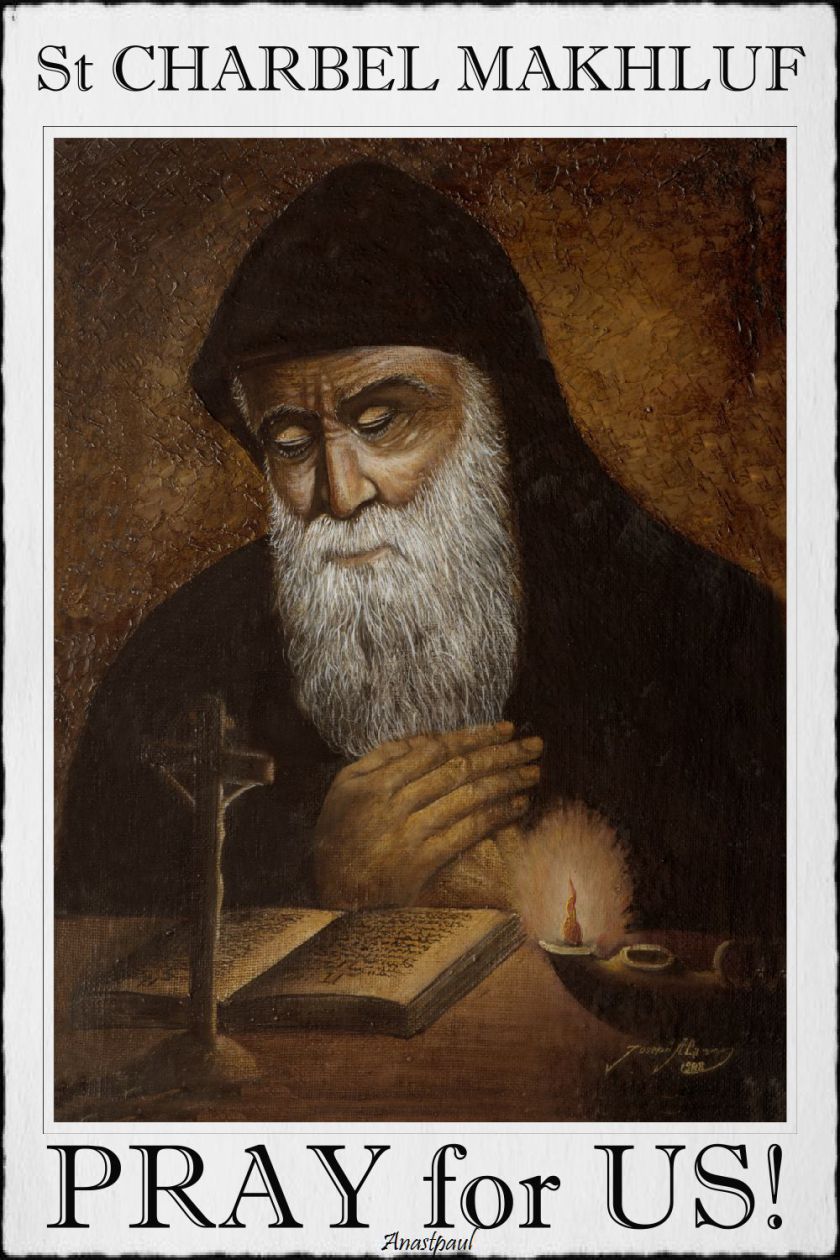


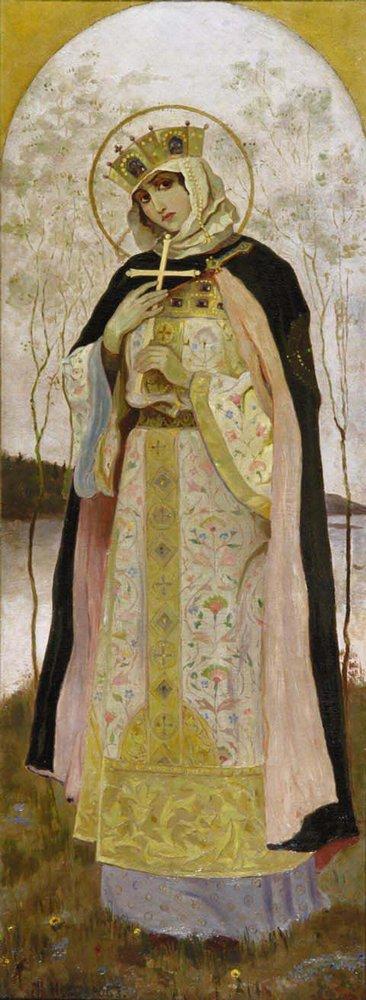

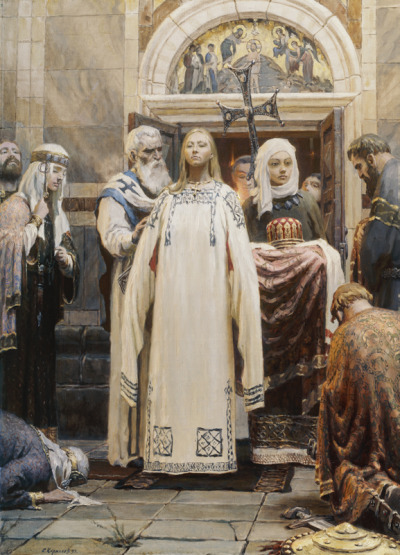

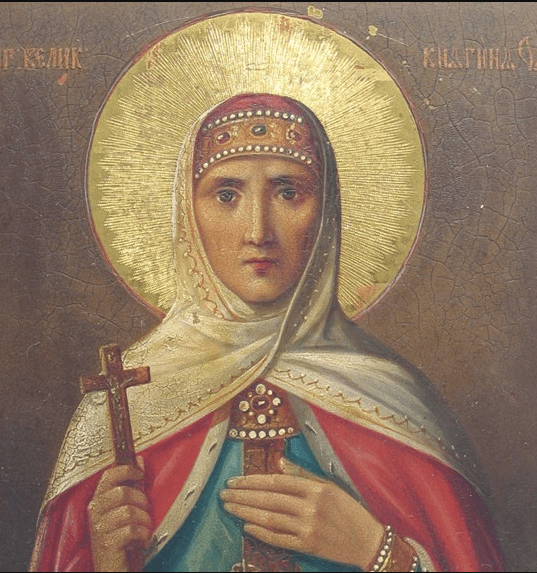


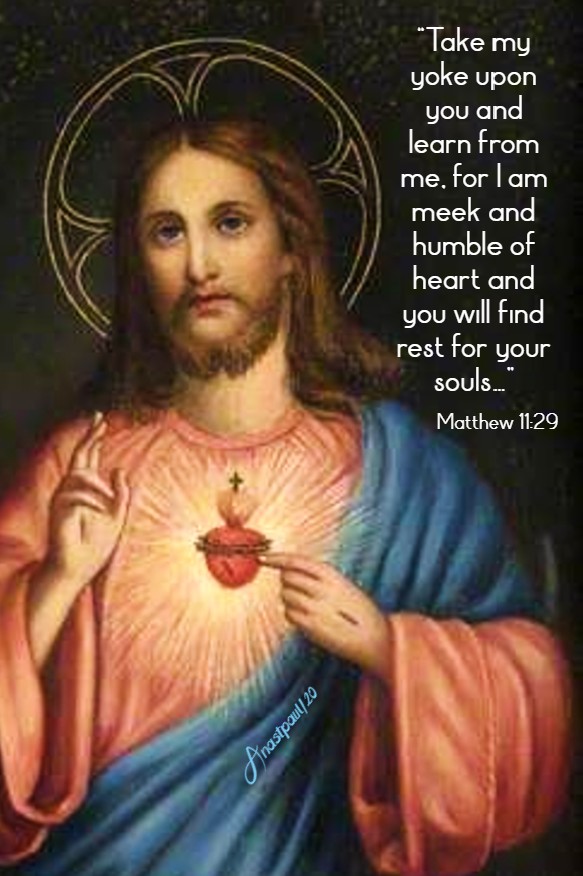
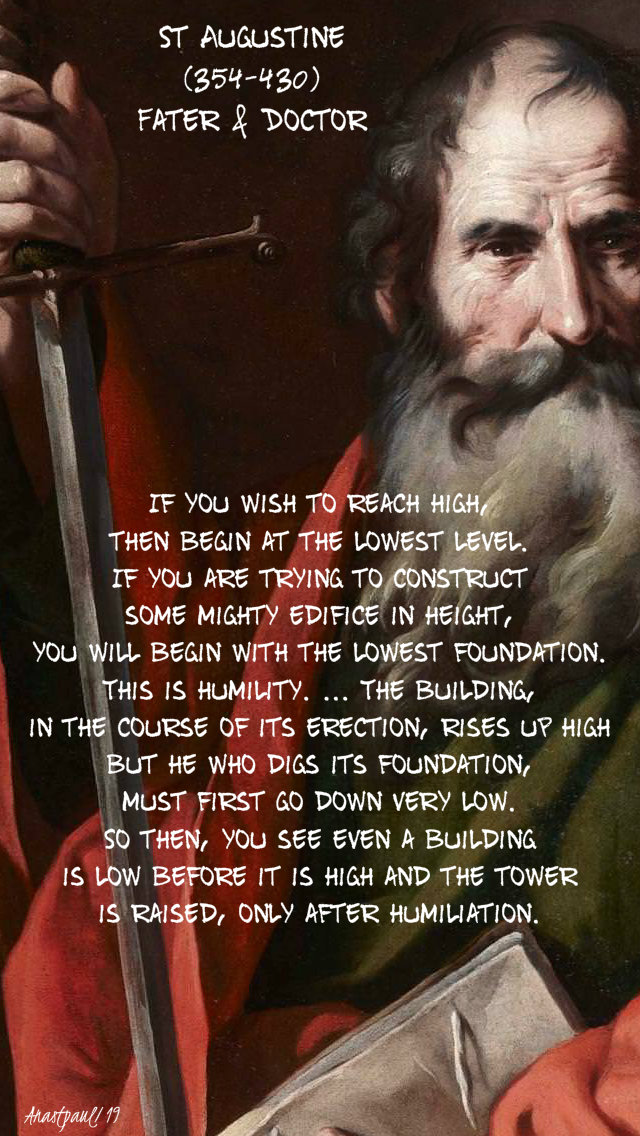


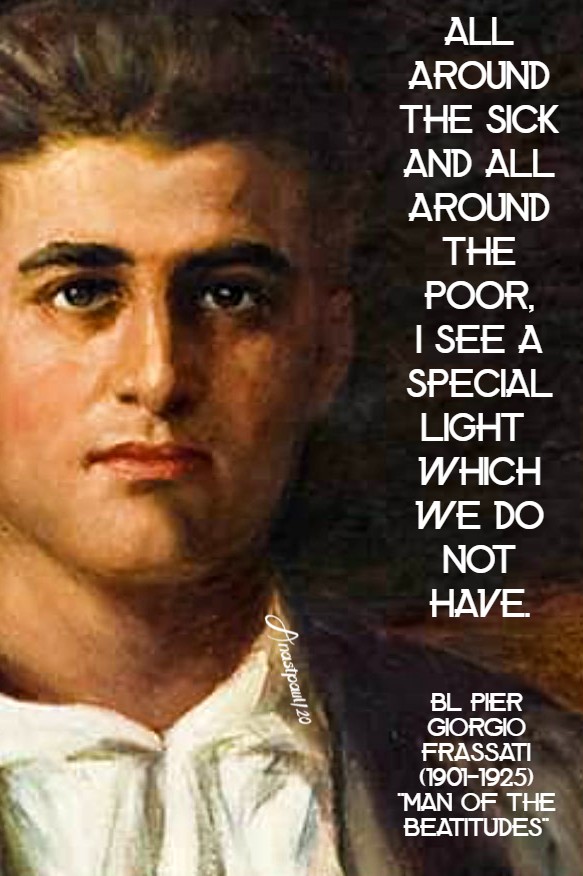


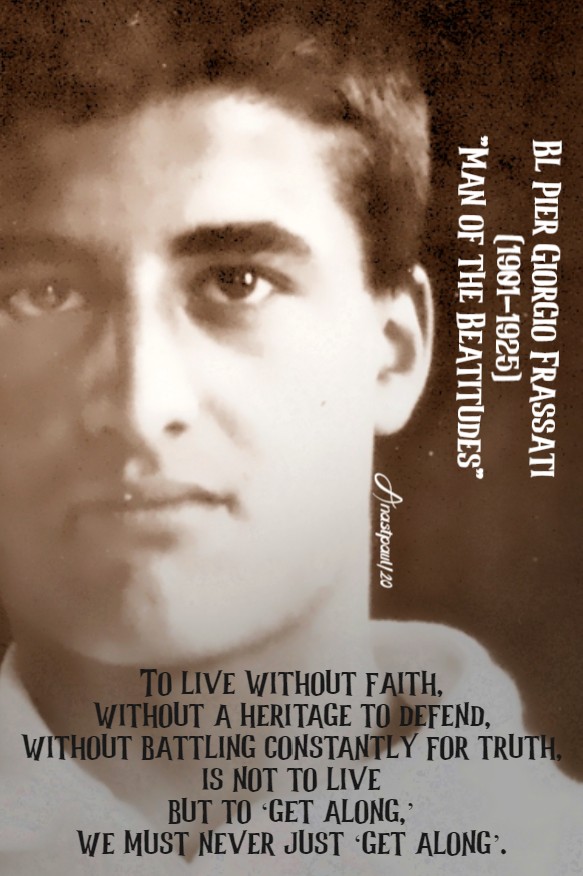


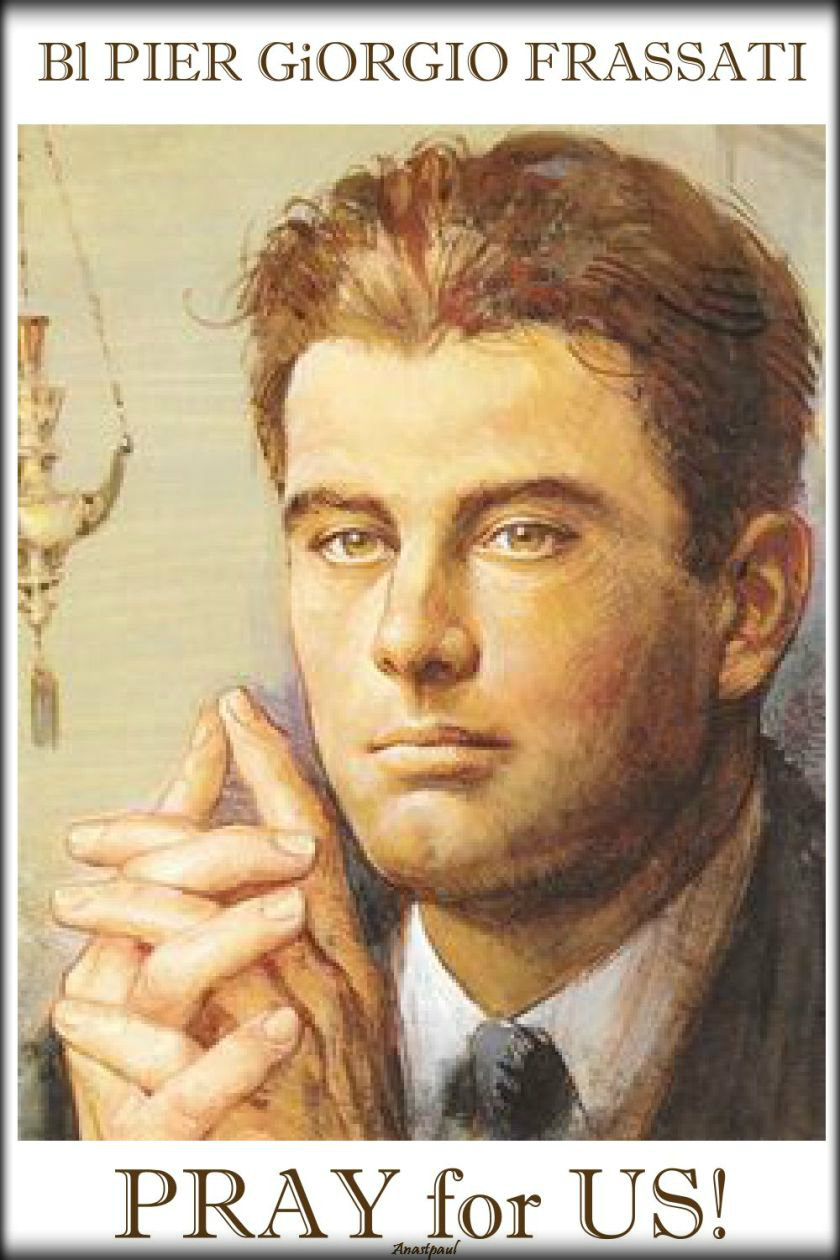
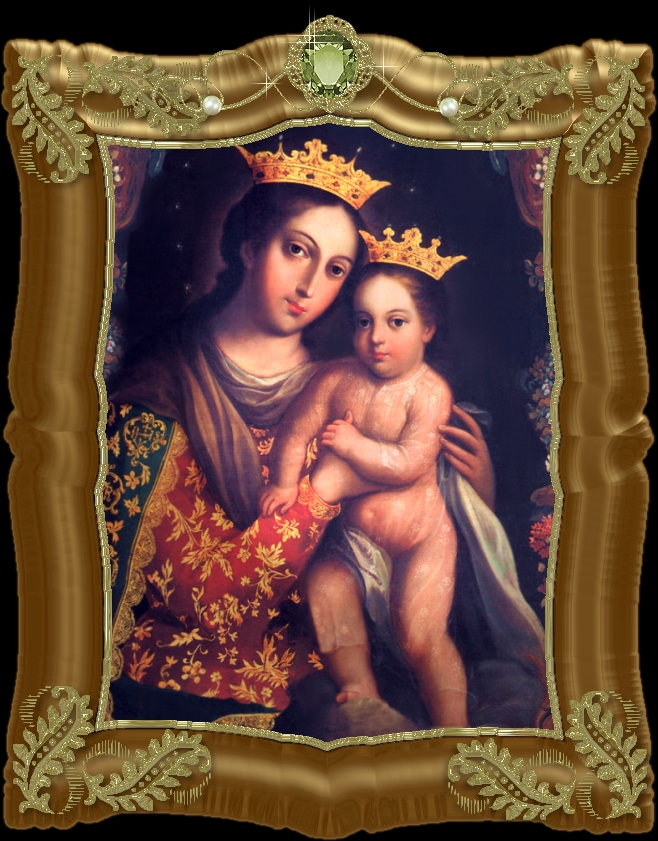

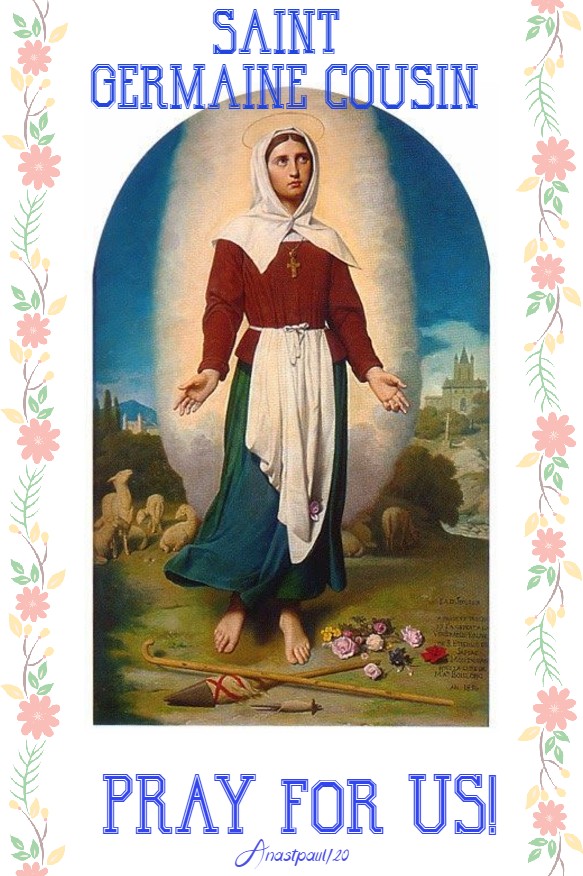
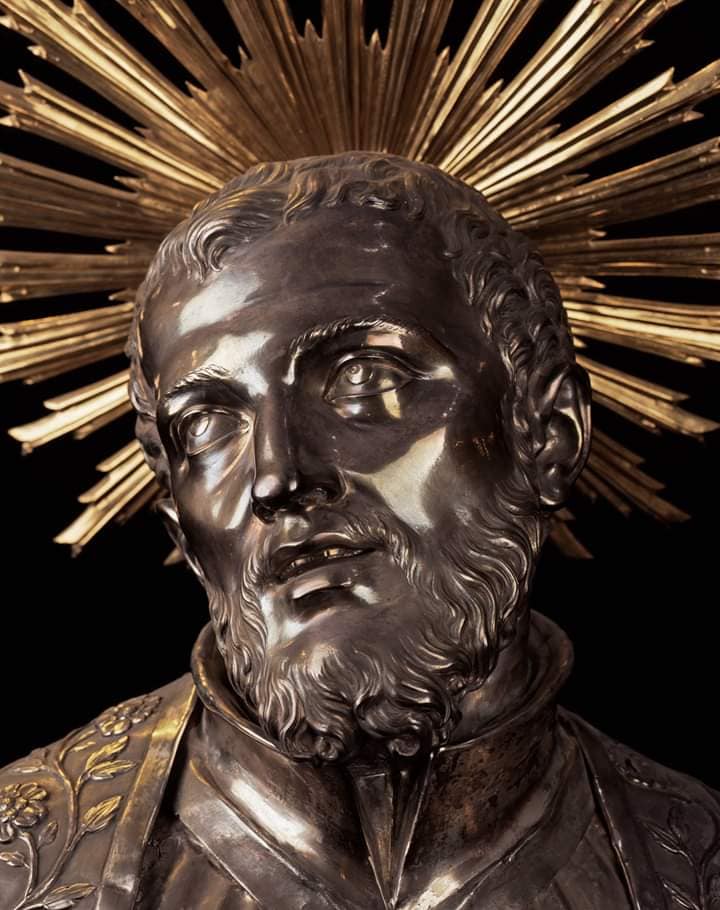
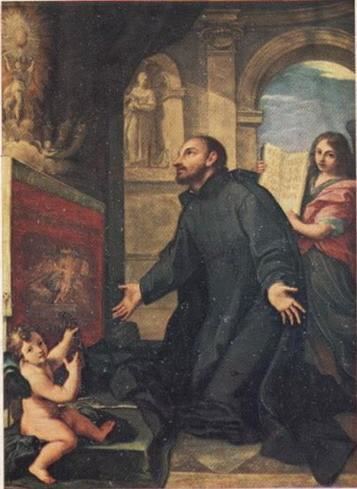
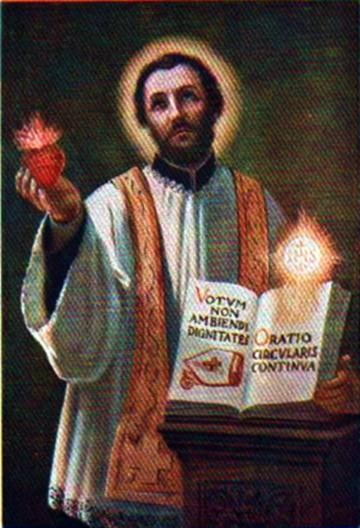
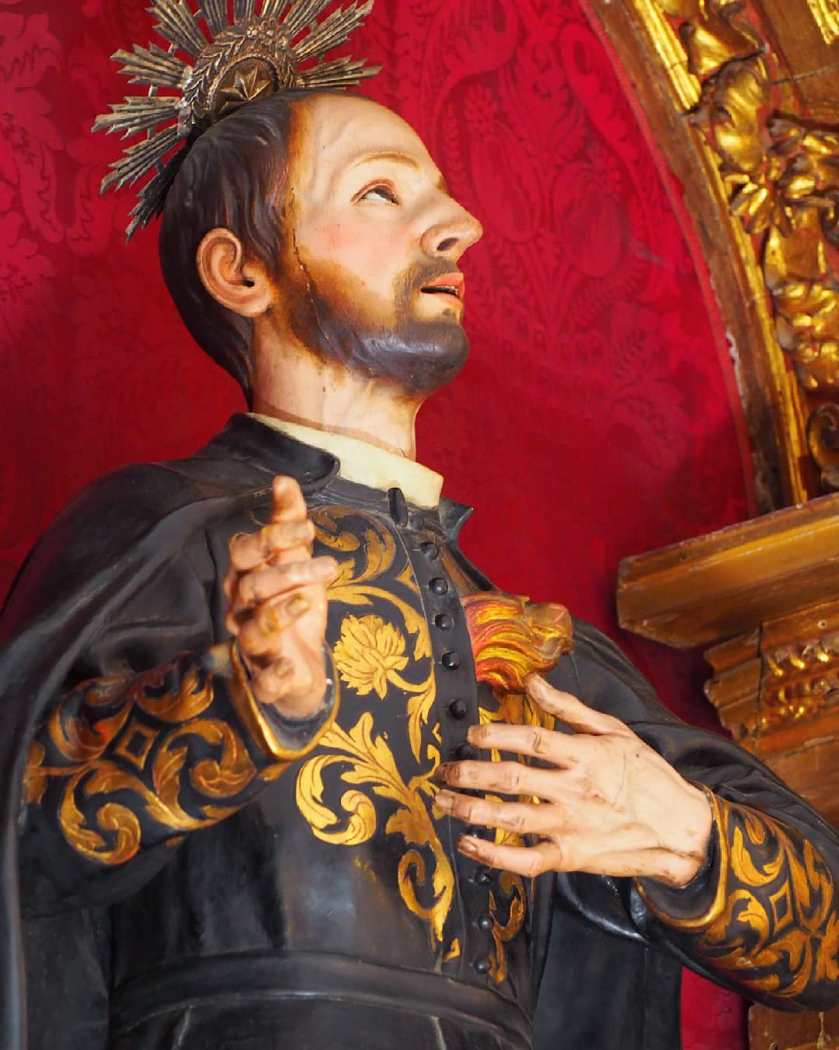
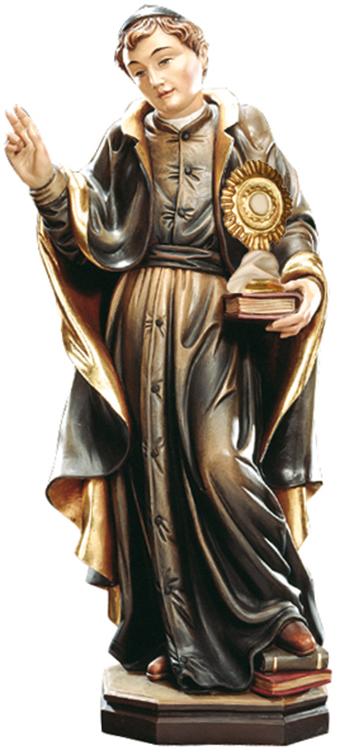
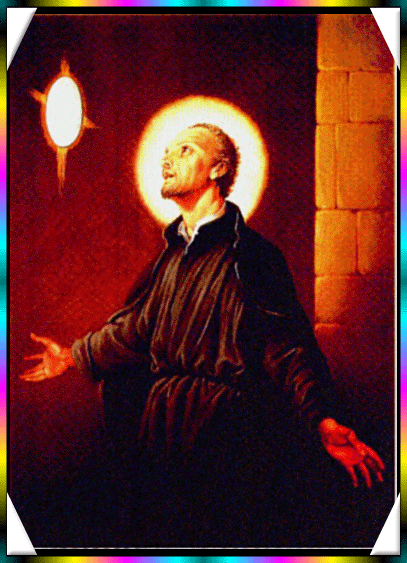
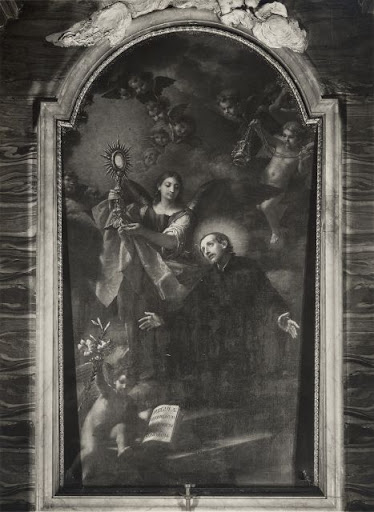

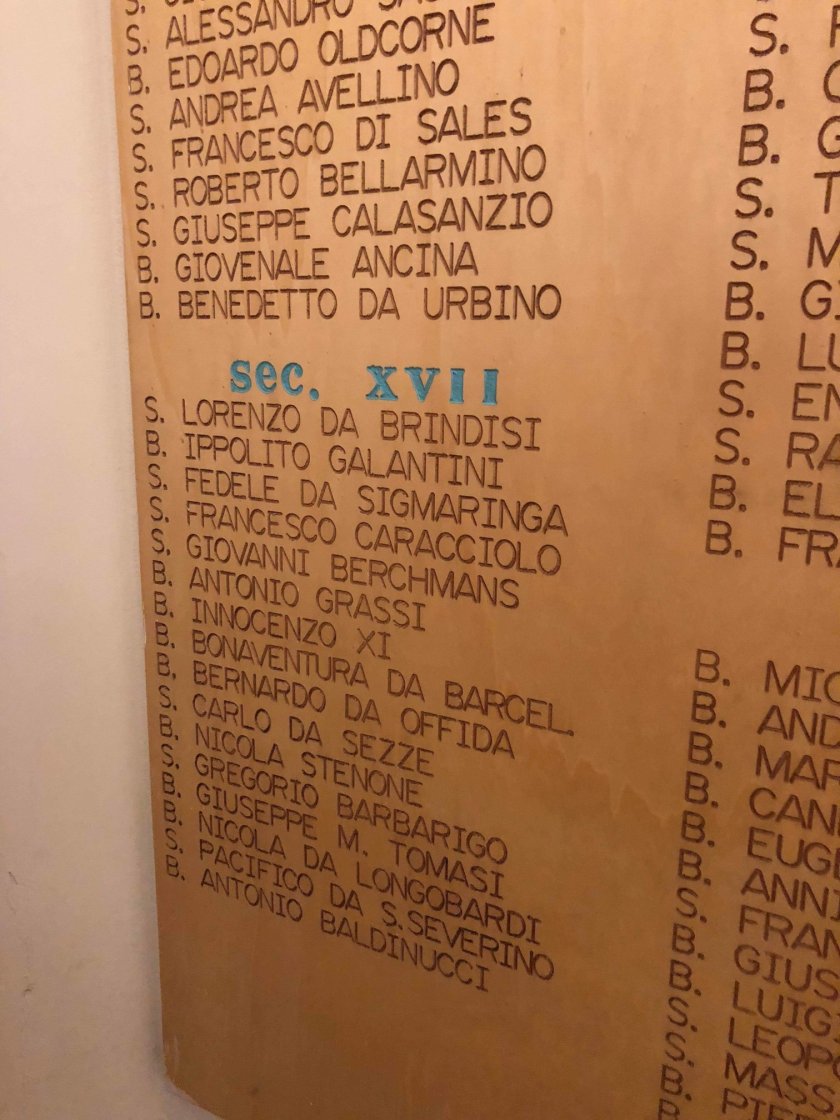
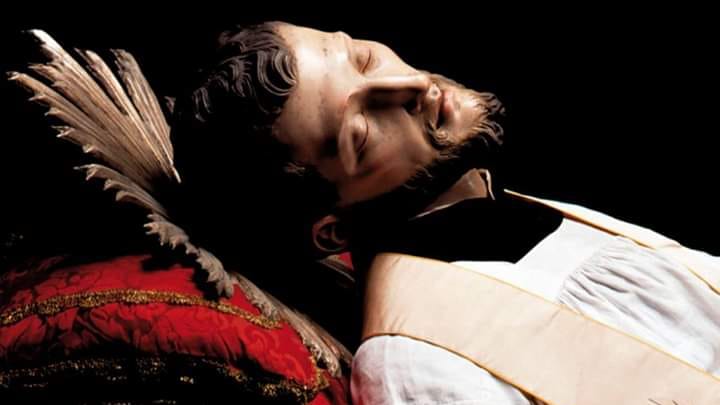

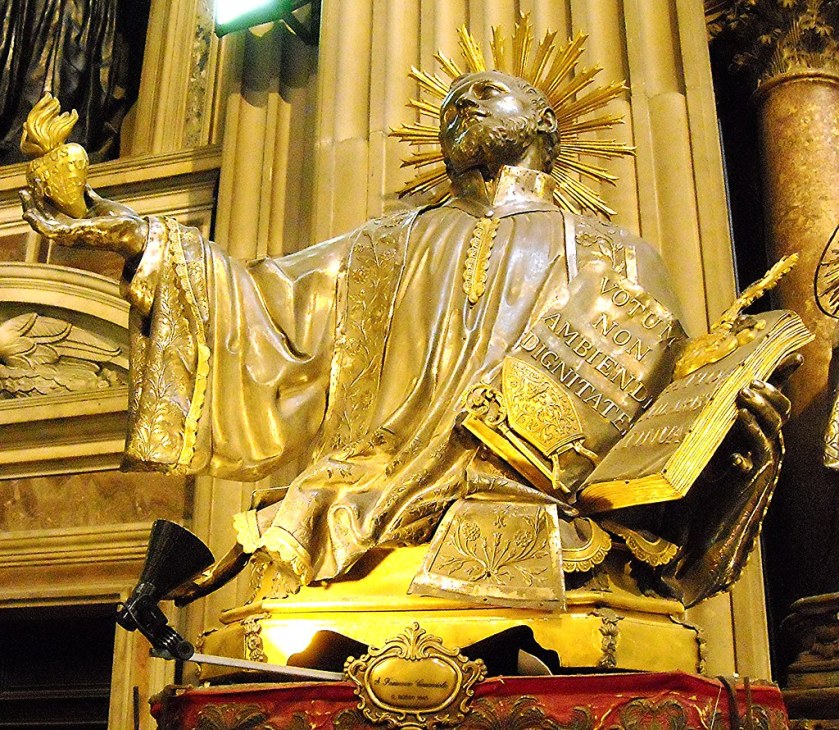
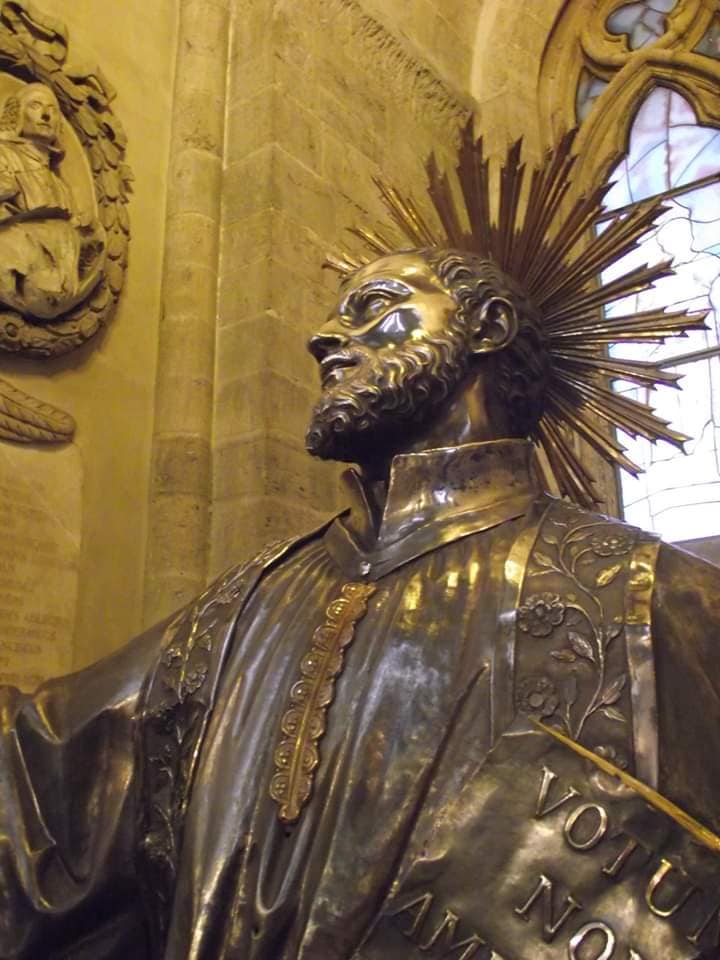
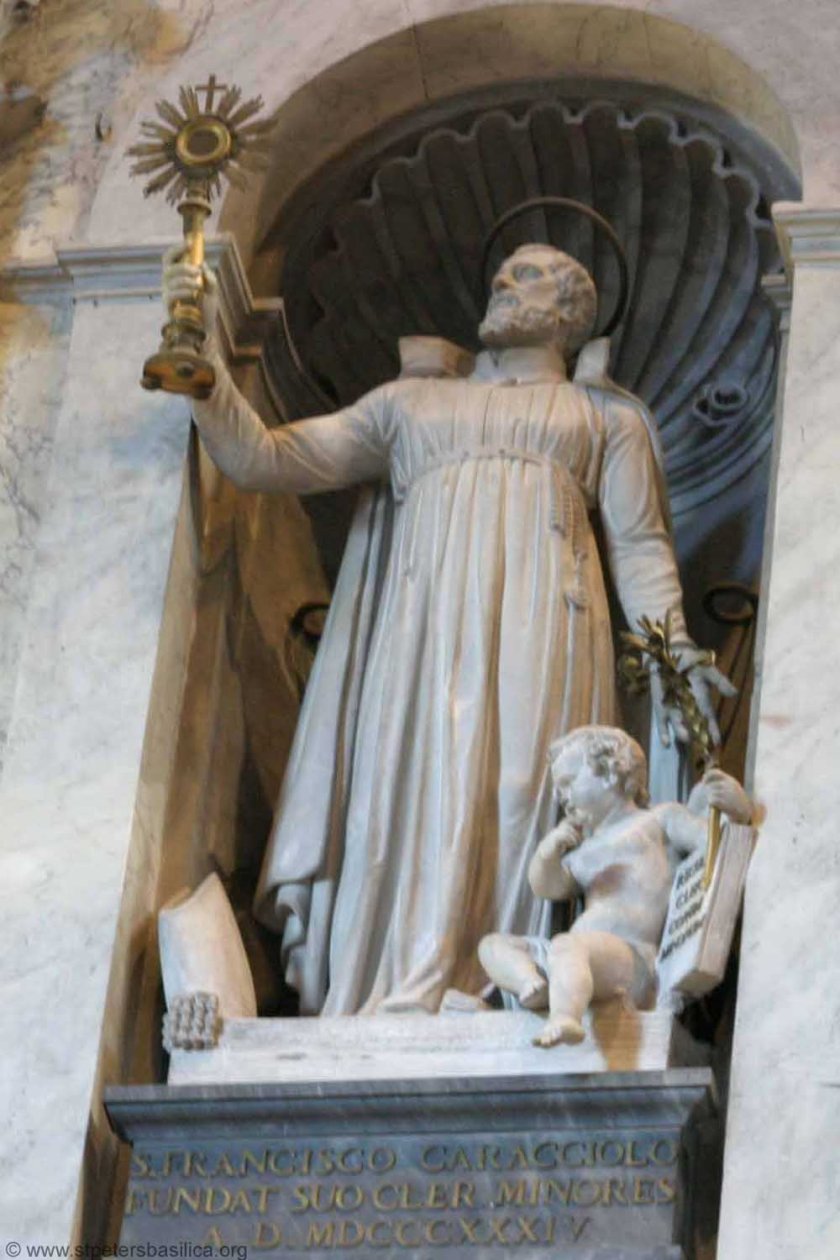
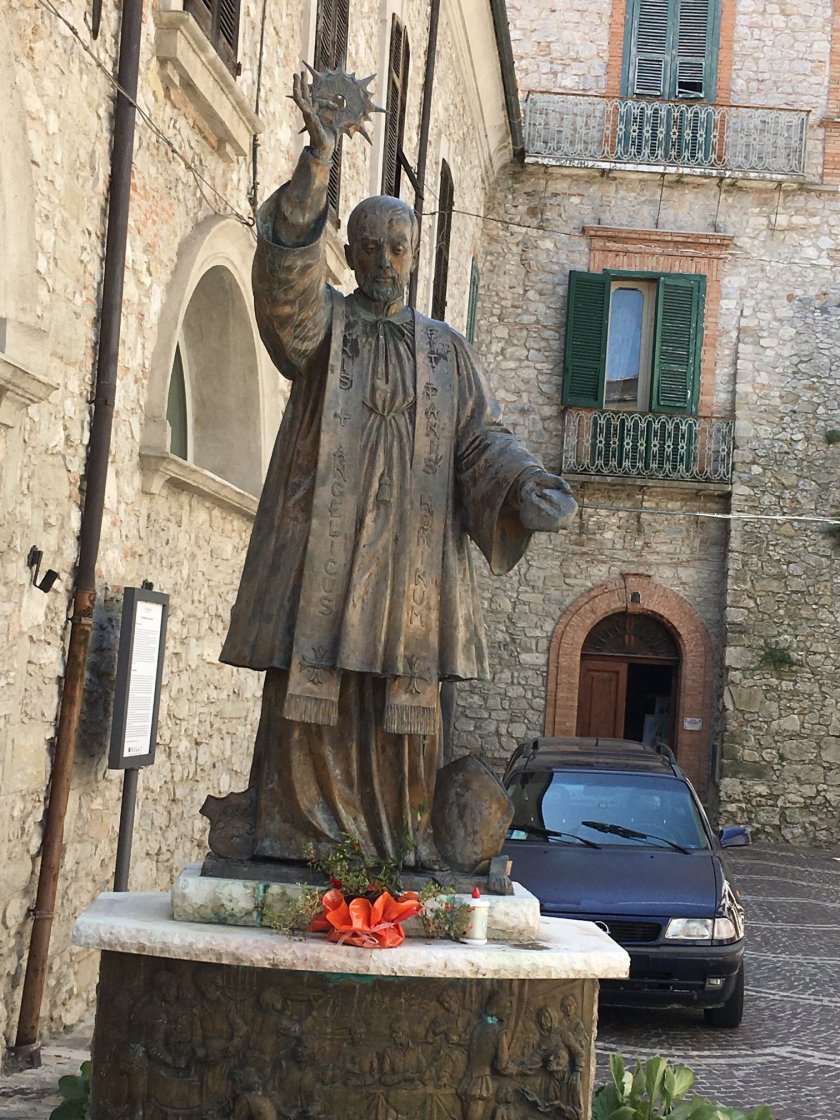
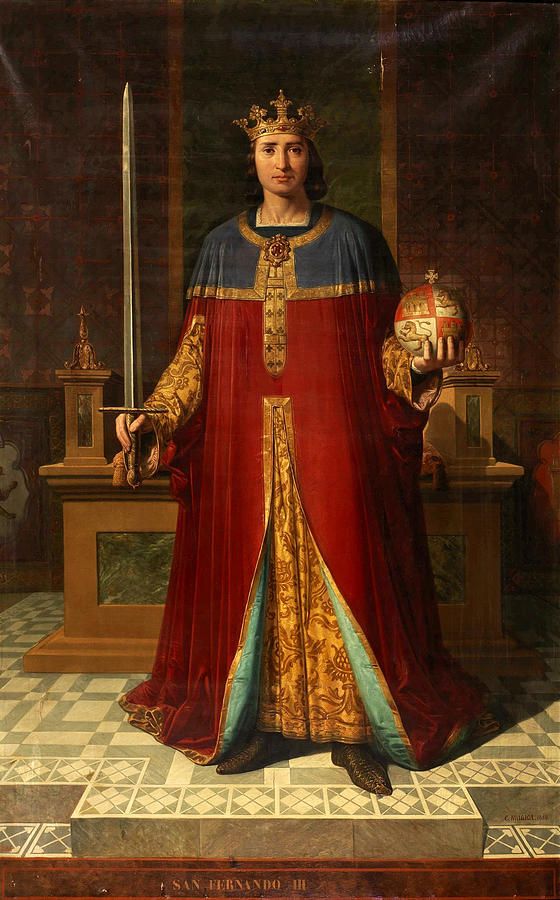
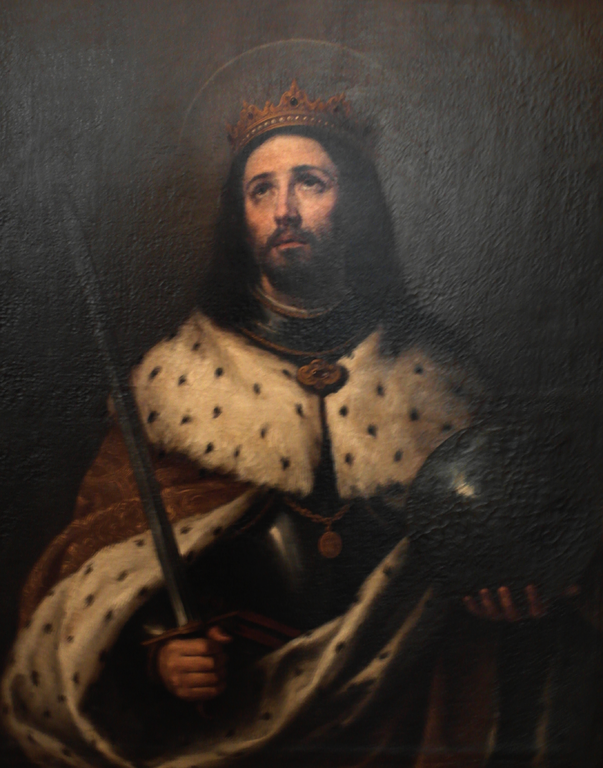
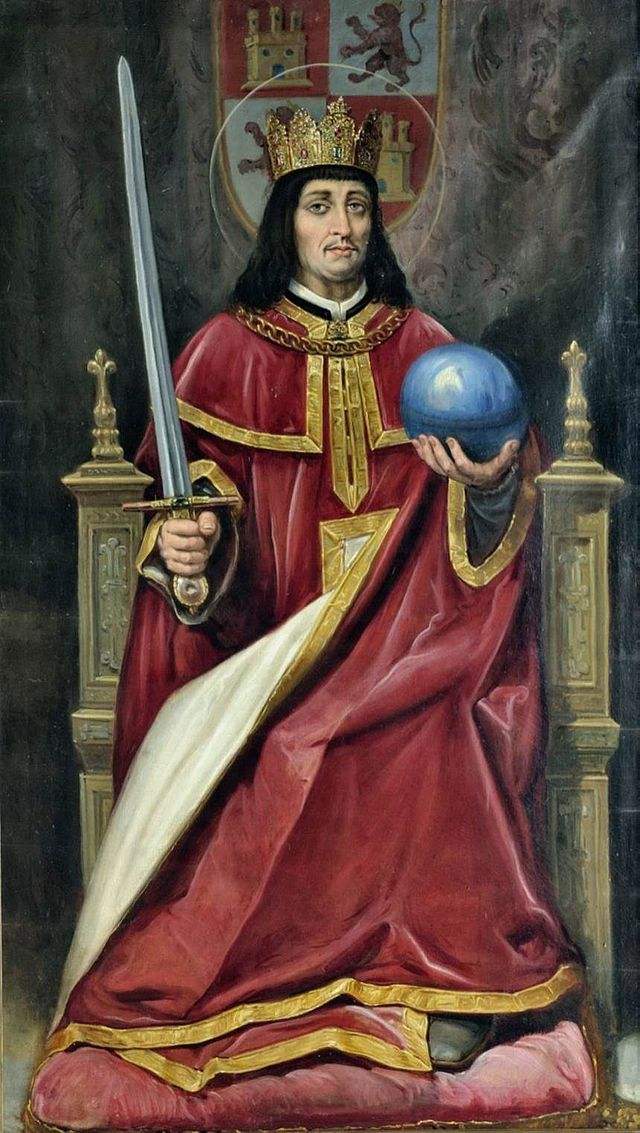
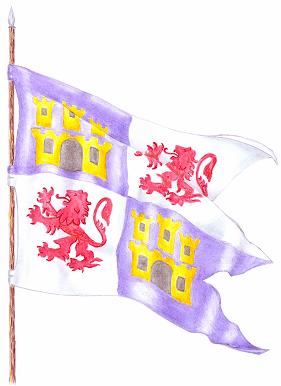
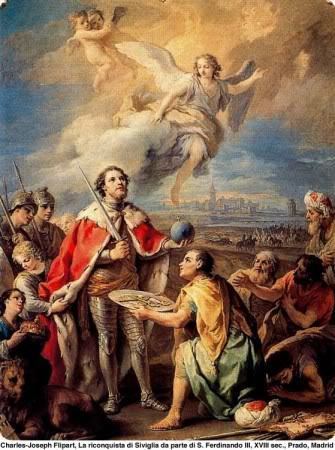
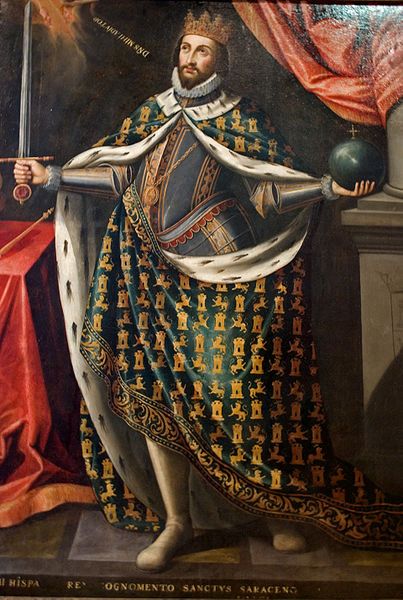
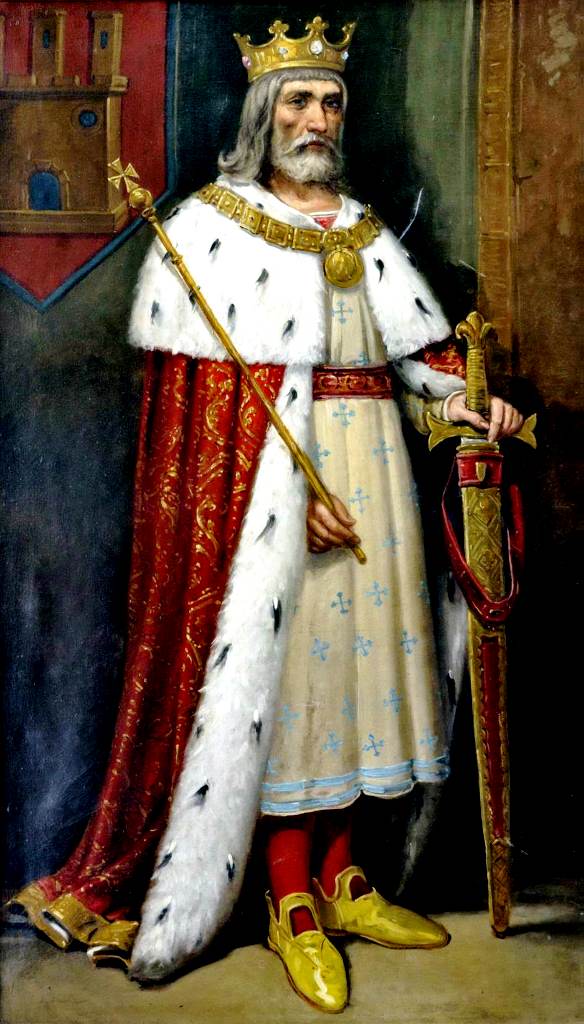
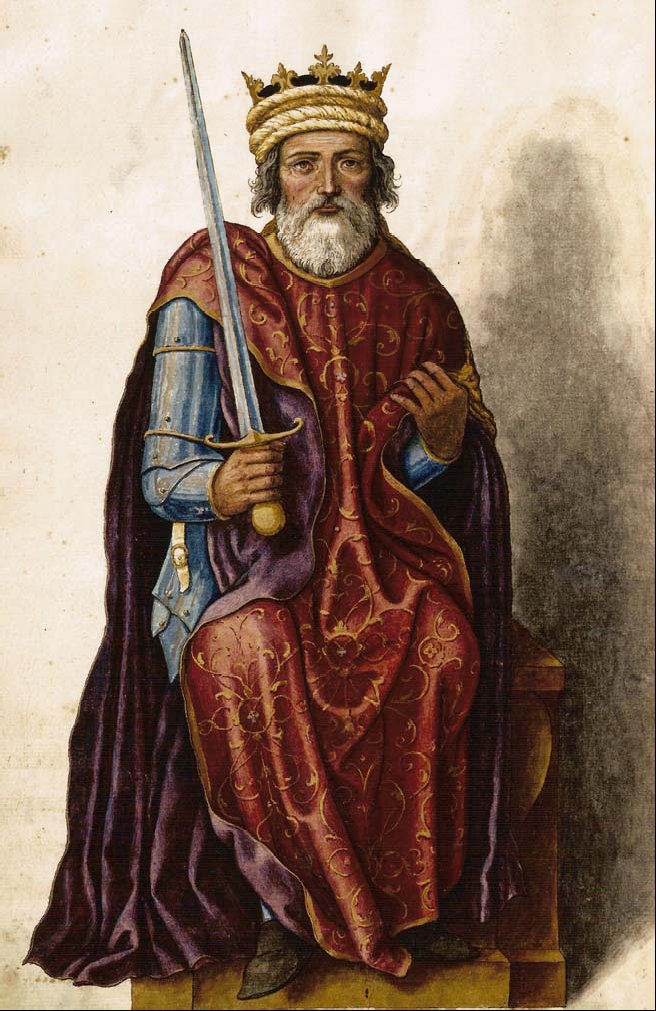
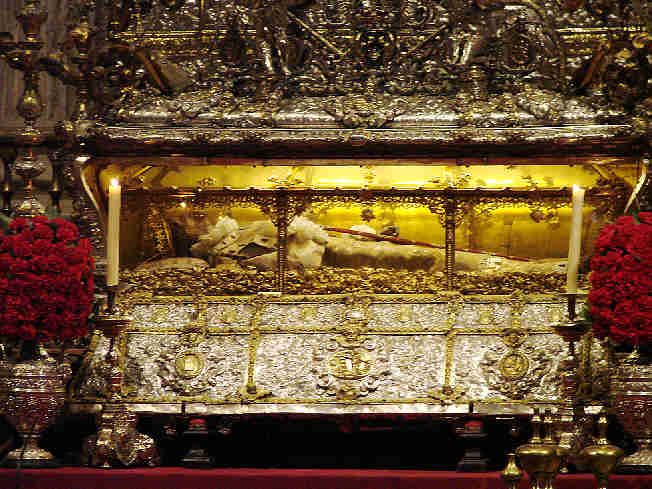
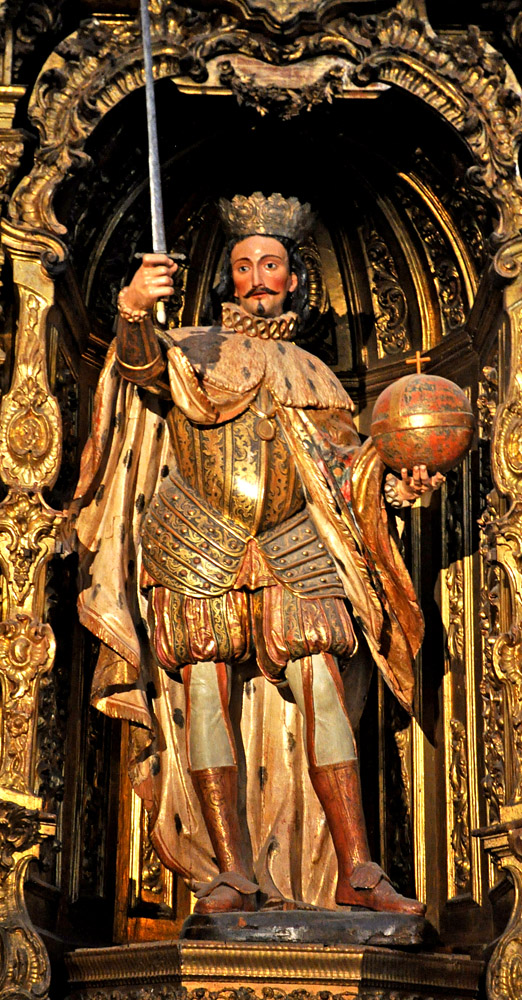


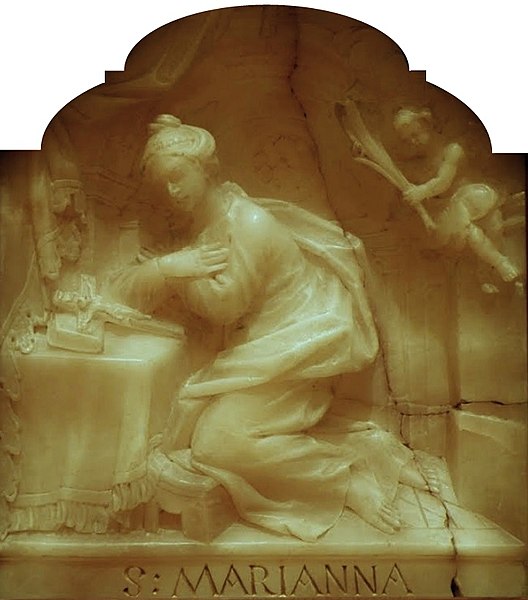
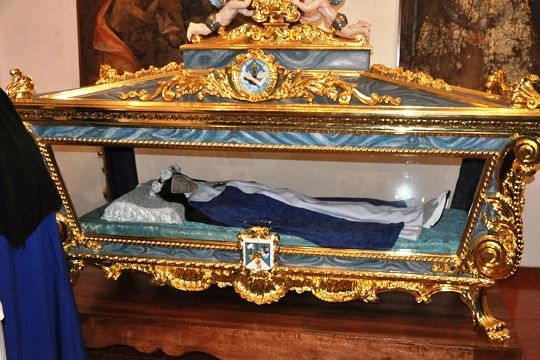


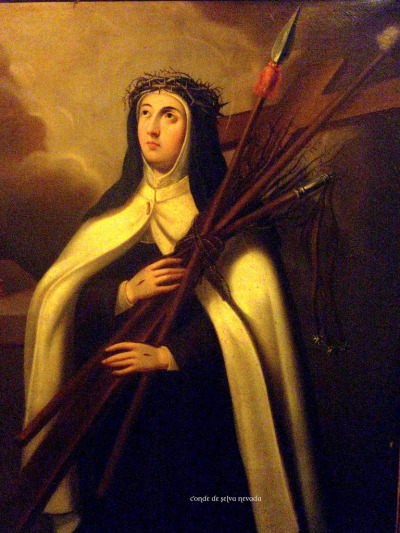
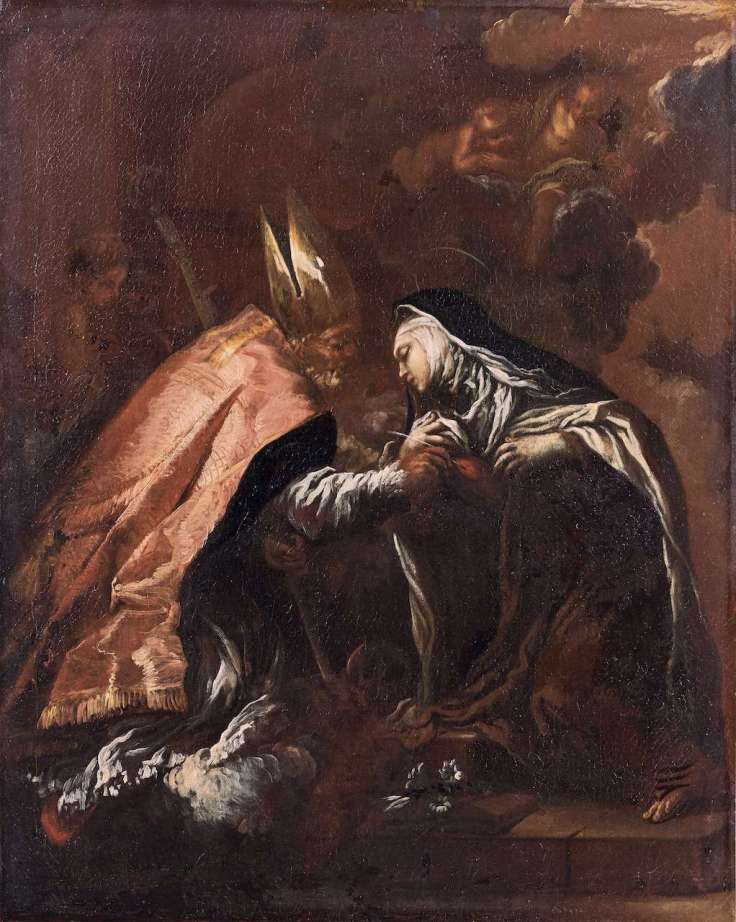

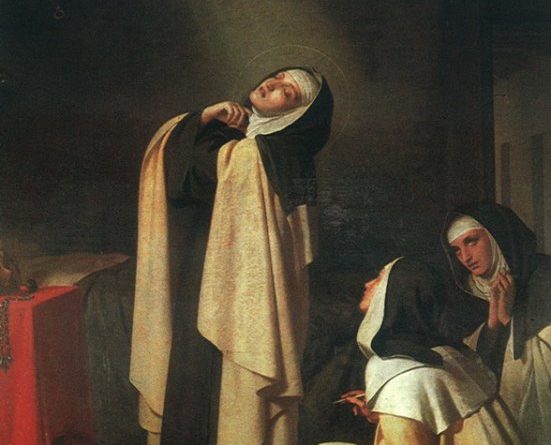
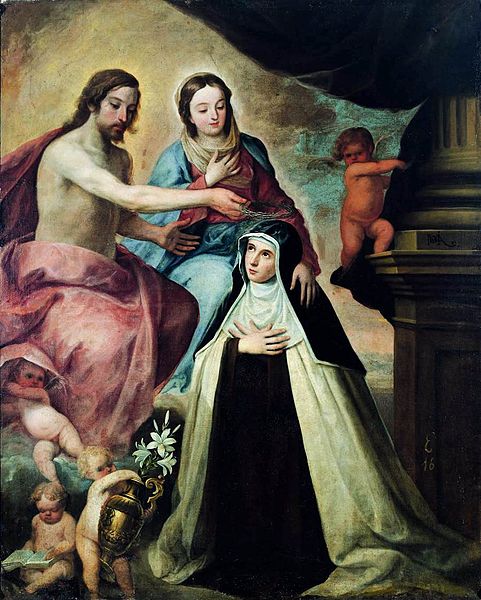
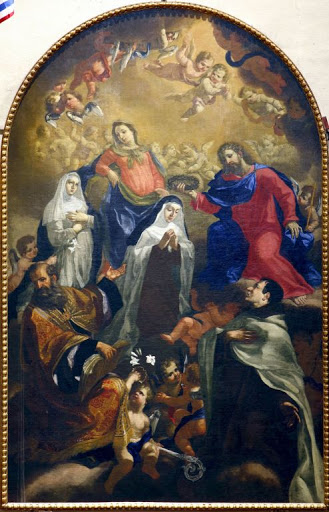
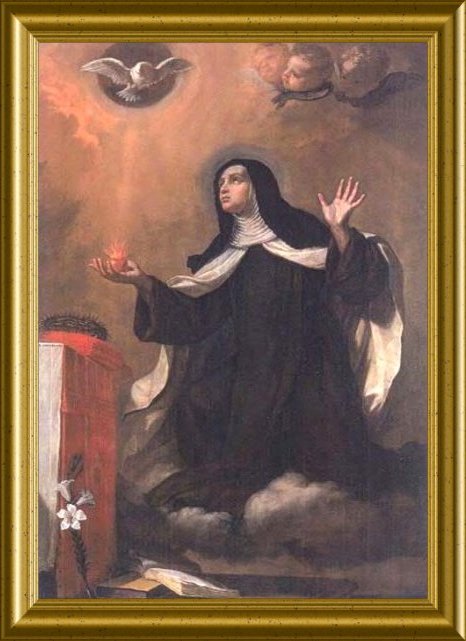
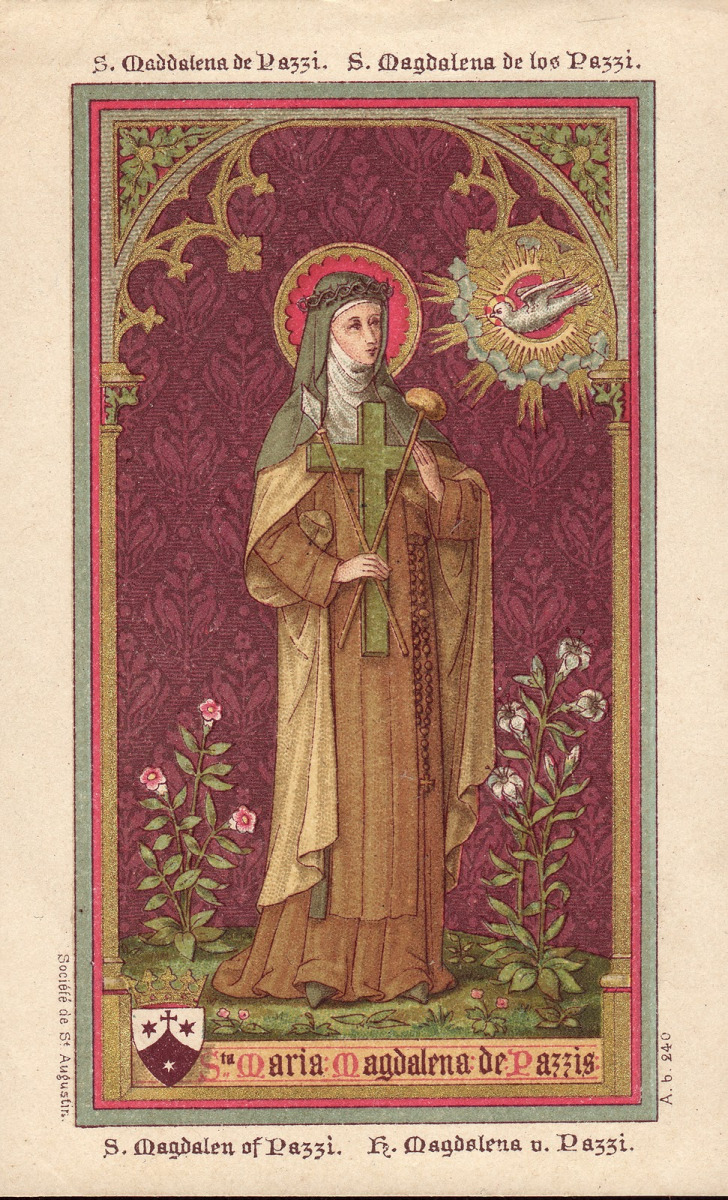

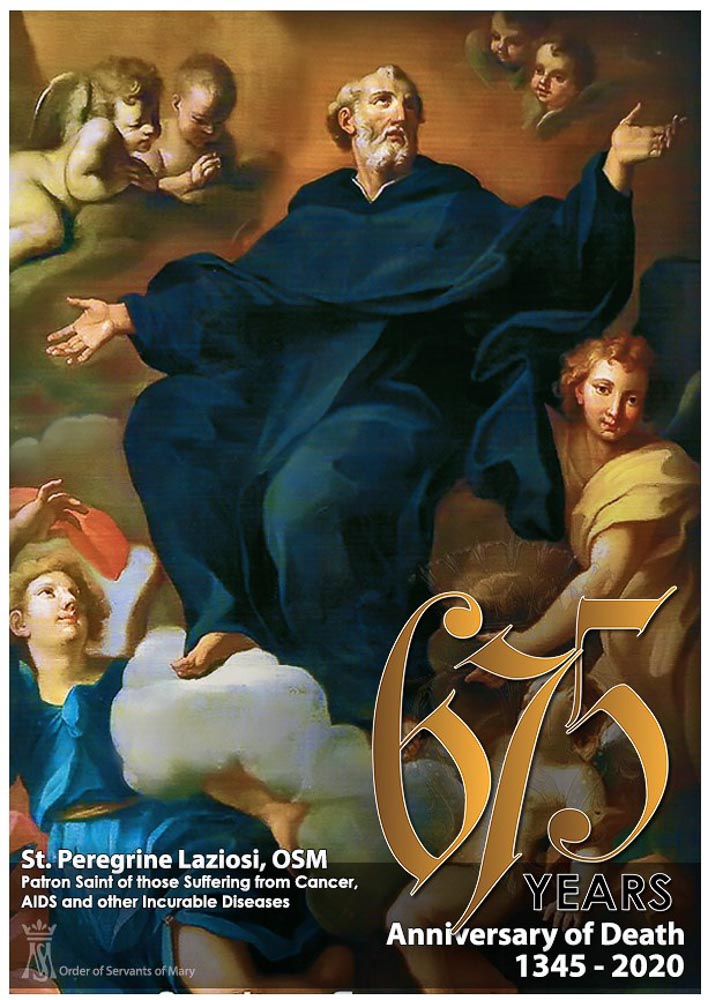


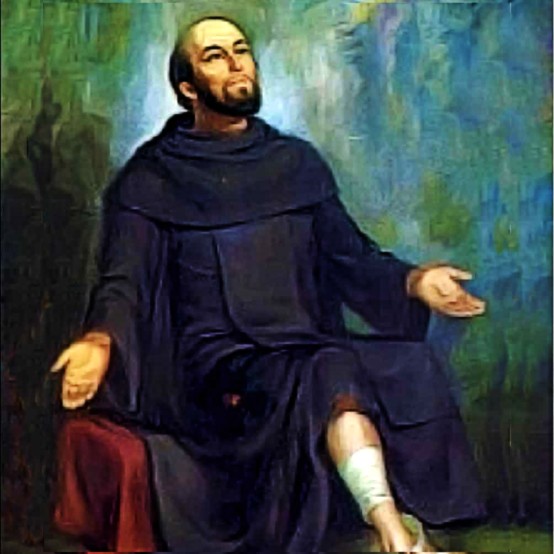


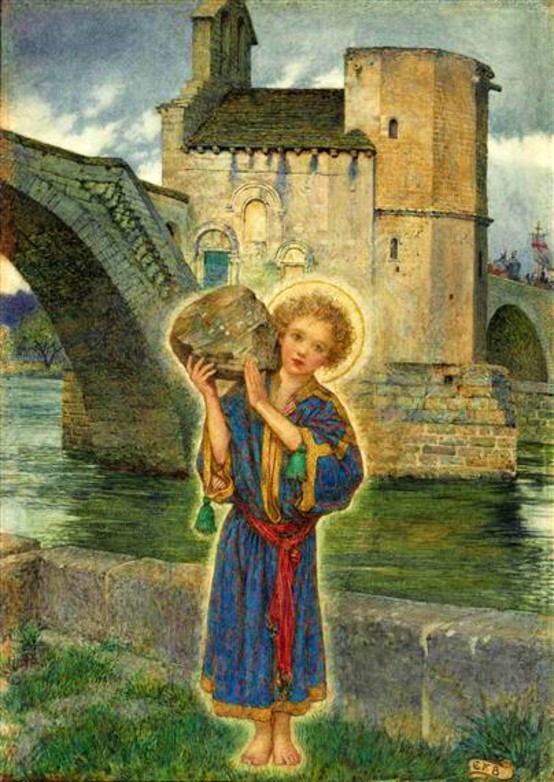
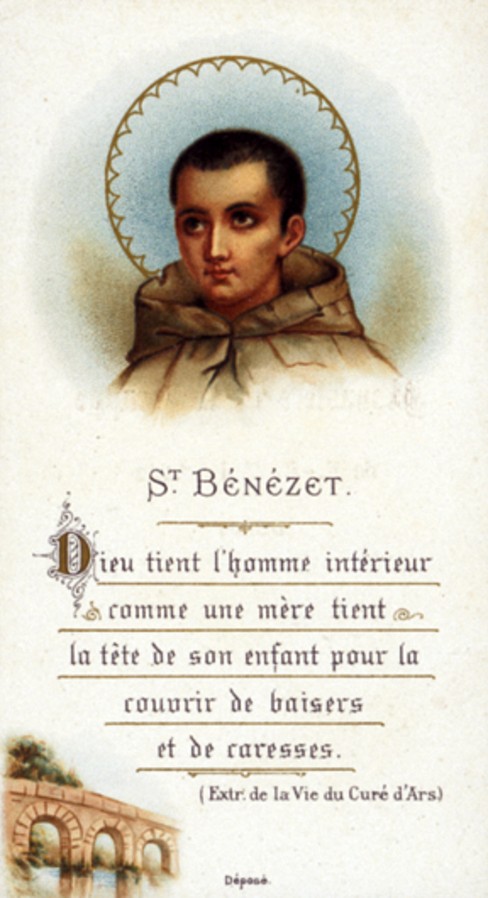
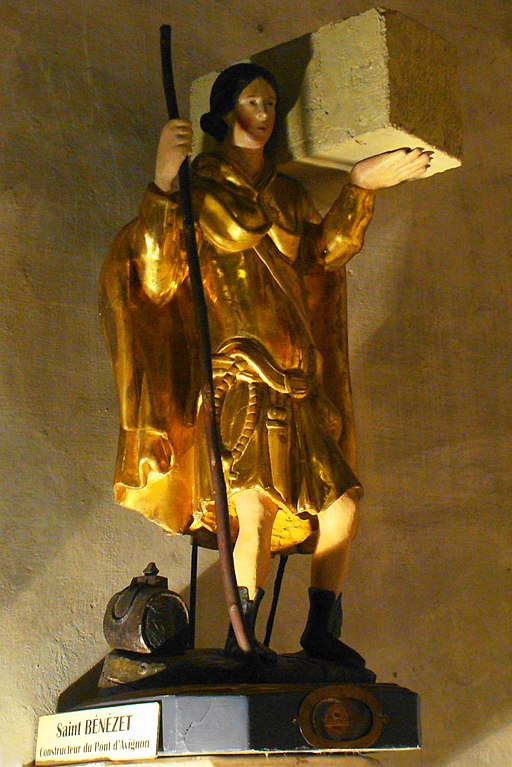
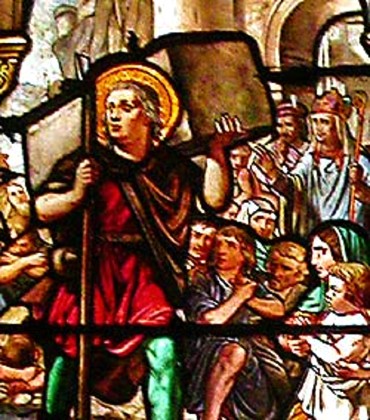
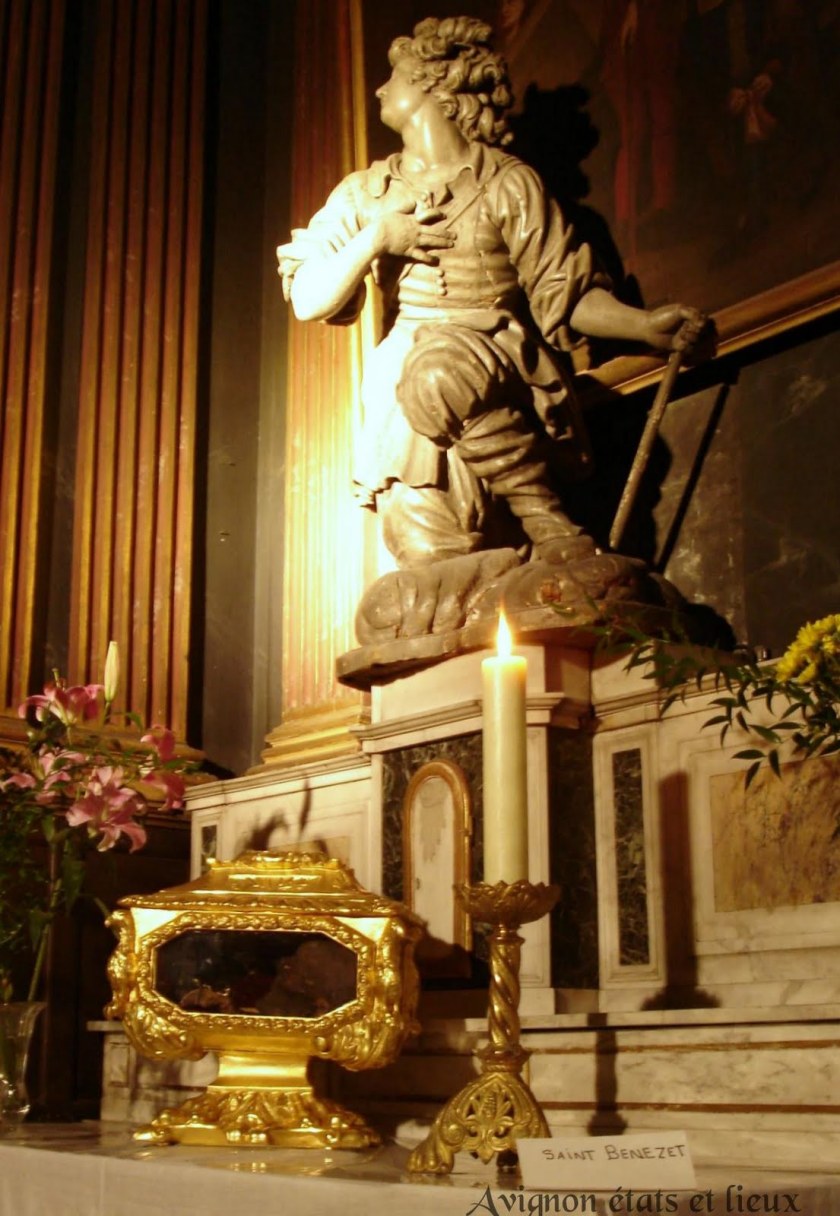
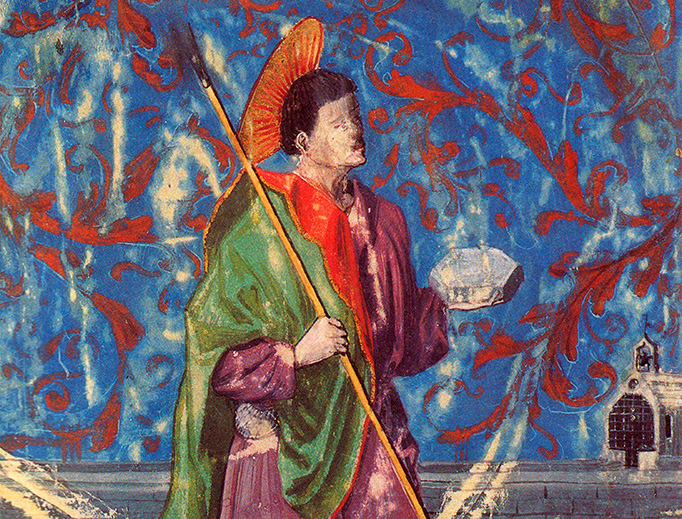
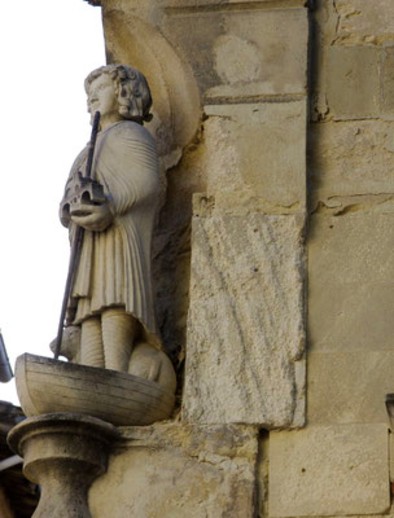


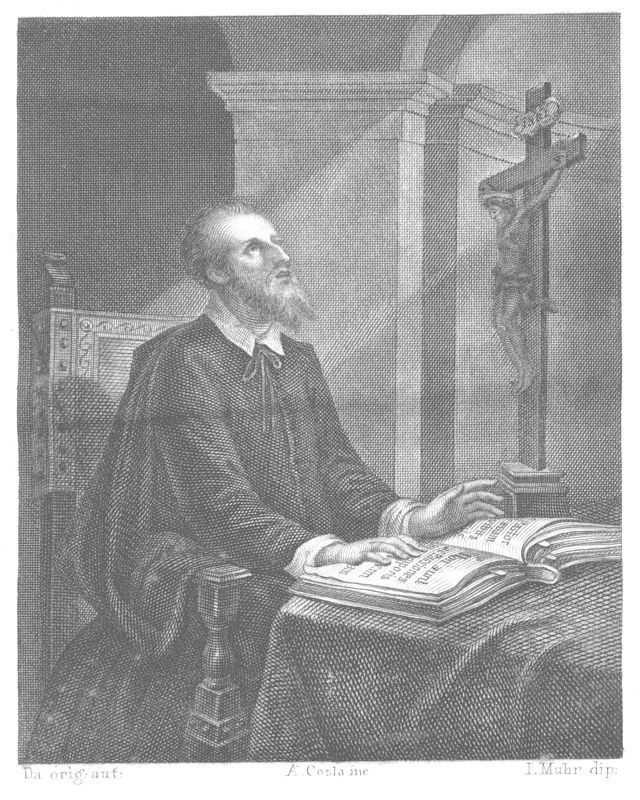

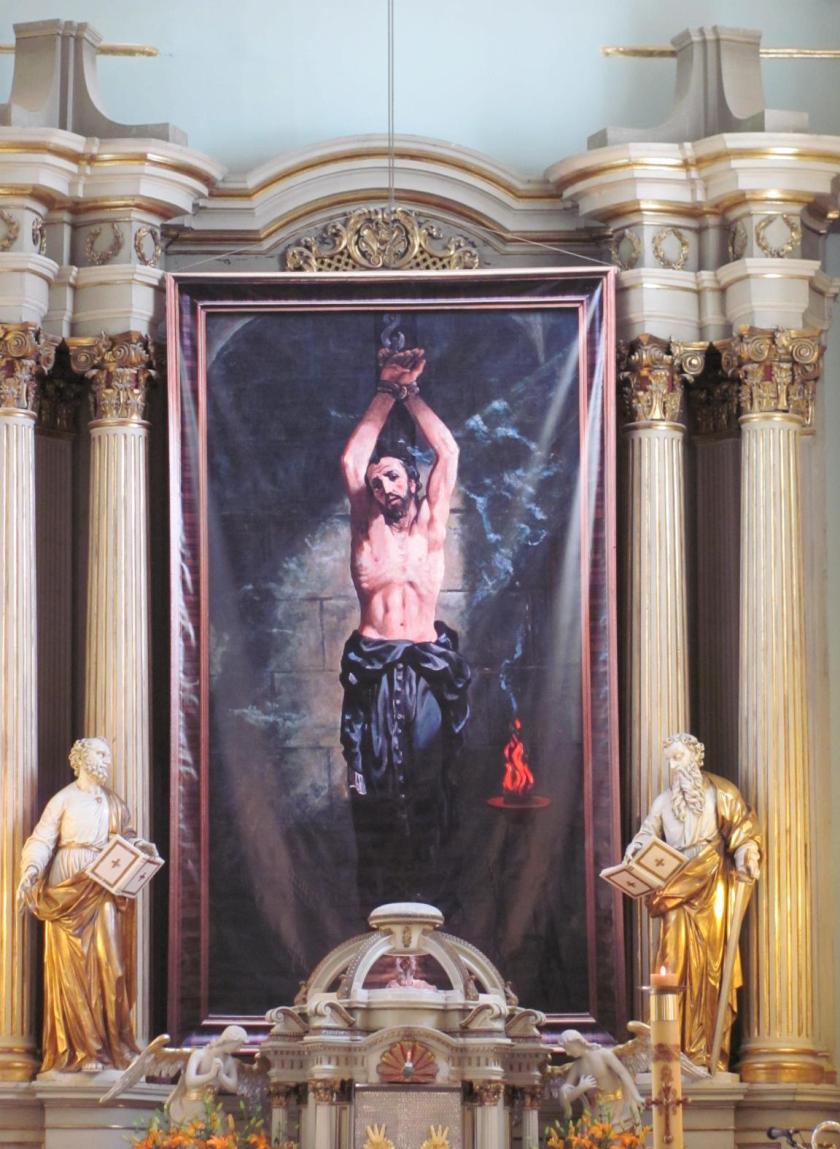
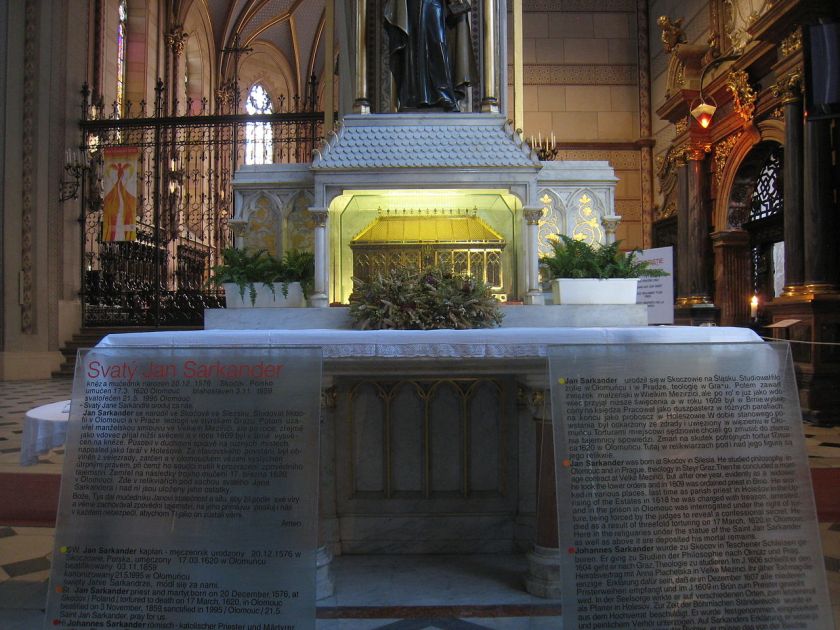
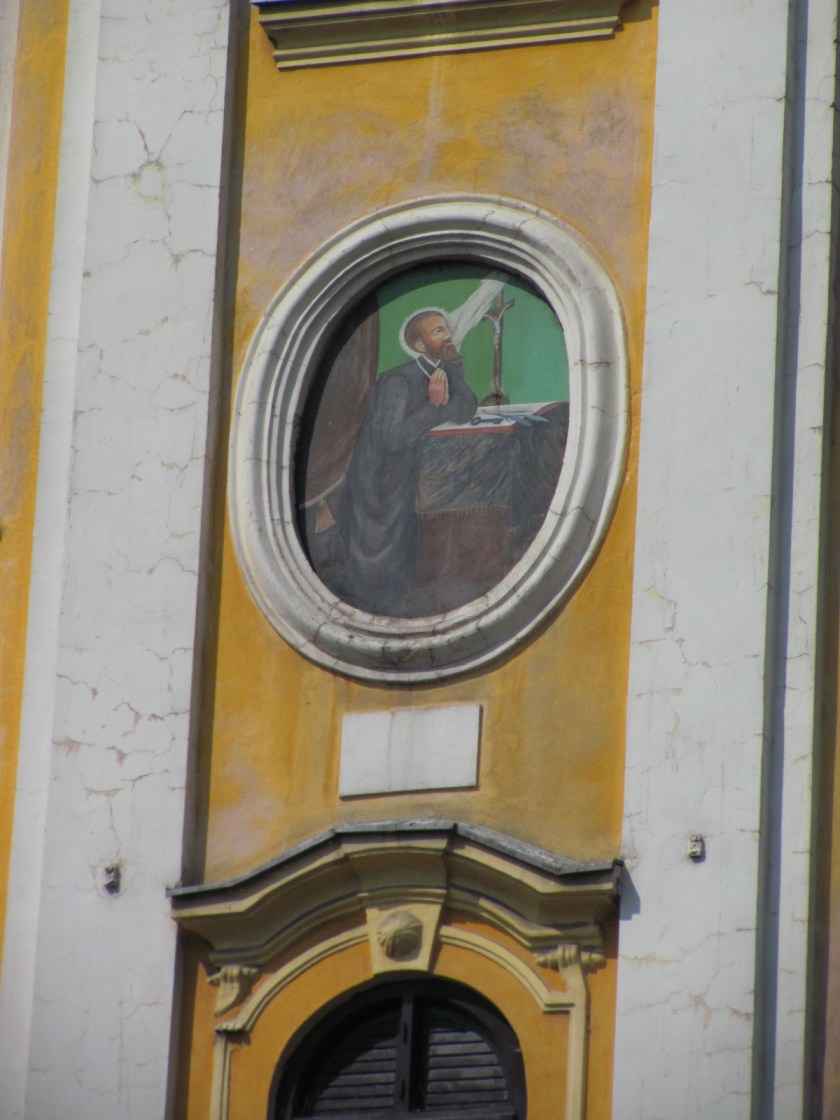

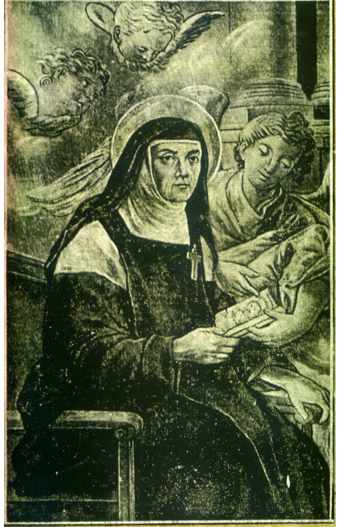

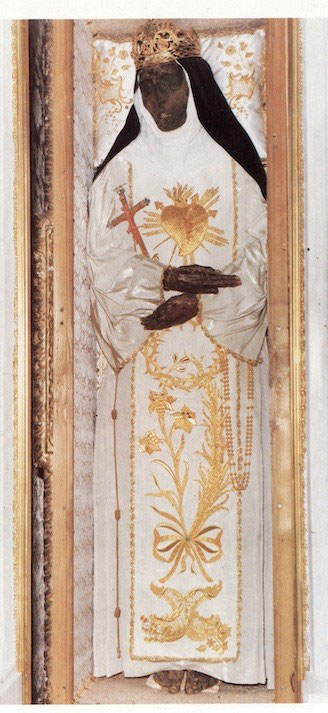
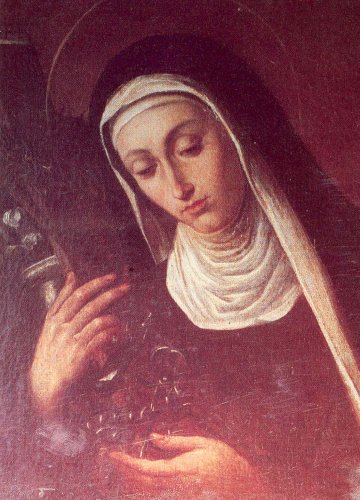

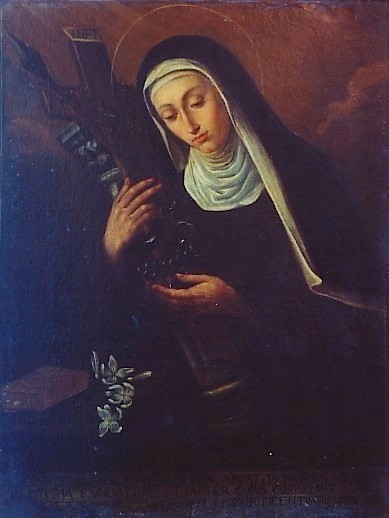

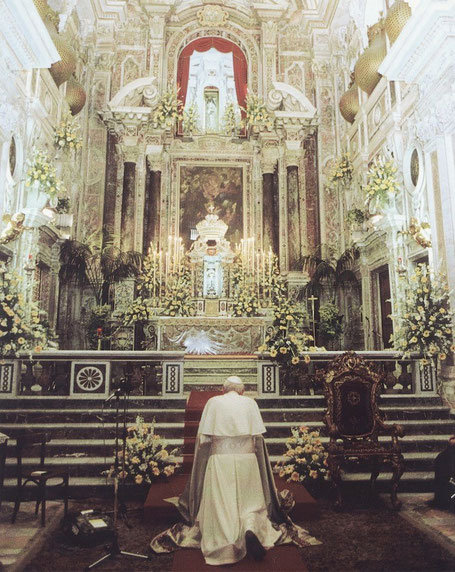
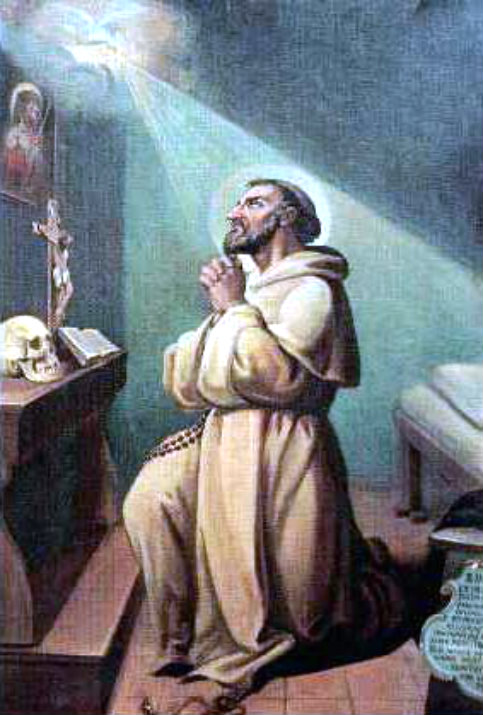

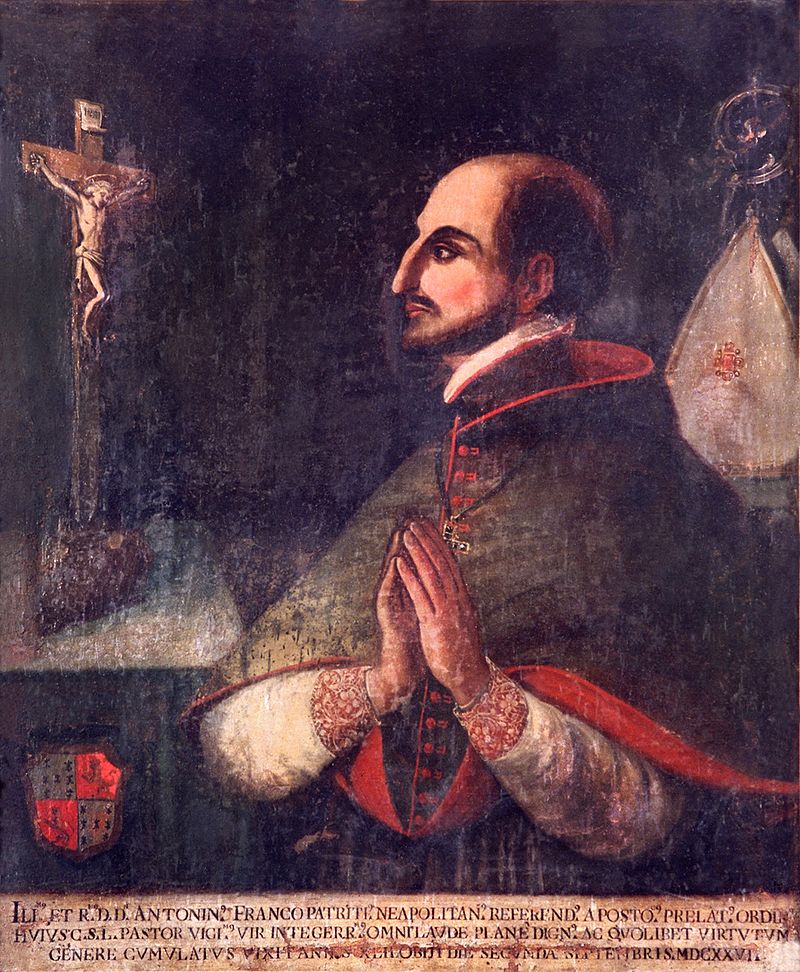
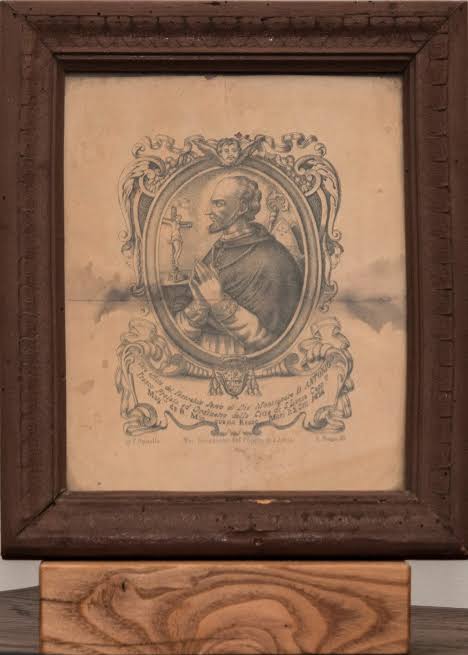
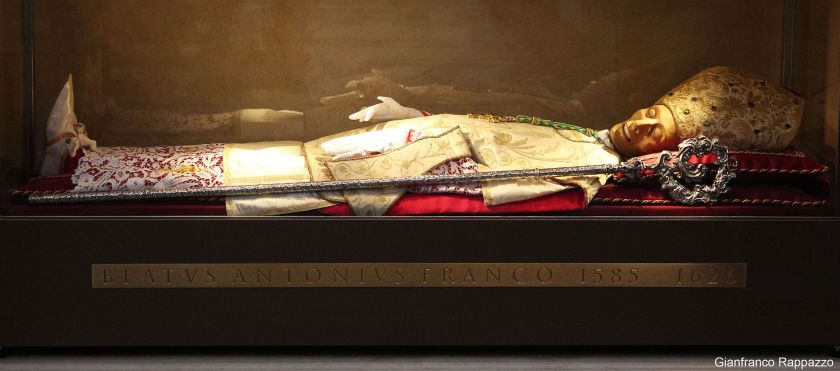
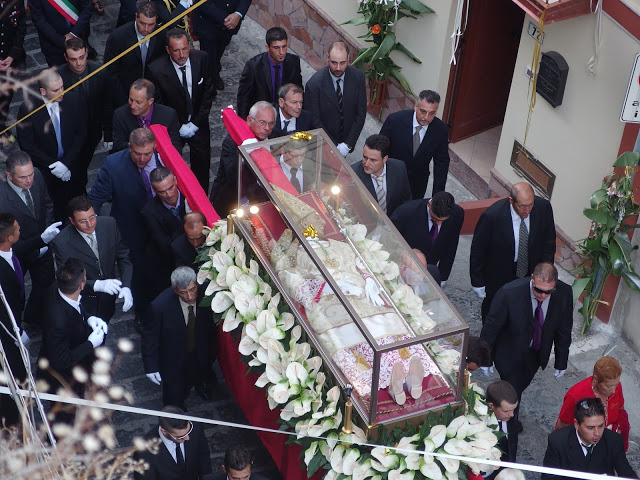
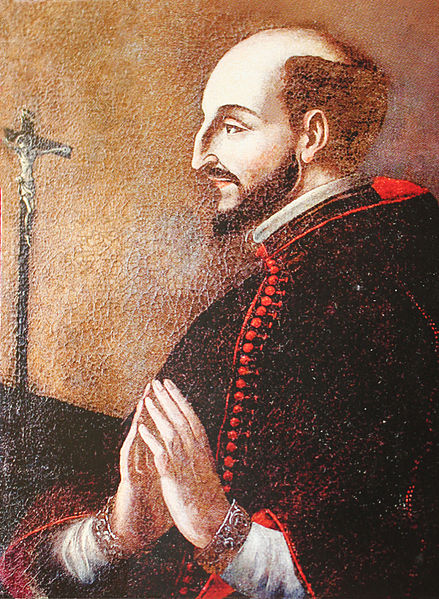
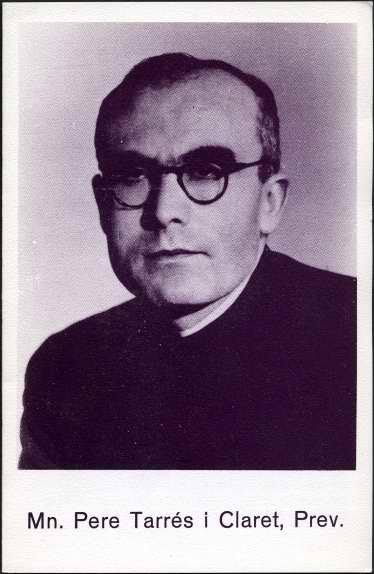
 He was a beacon of good example for others and his zeal motivated him to travel the roads of Catalonia in his little automobile (which he called his “instrument of work”) as a lay missionary. He spoke openly of God, the Church and Christian living to the youth and those who were gathered along the streets, he also assisted in the formation of new Federation groups. Pere maintained a written correspondence with many members of the Federation (of whose federal council he was later appointed vice-president) and wrote articles that were published in the Federation’s weekly paper.

 founded the Foundation Blessed Pere Tarrés in honour of the late priest, a nonprofit devoted to charitable works (above)




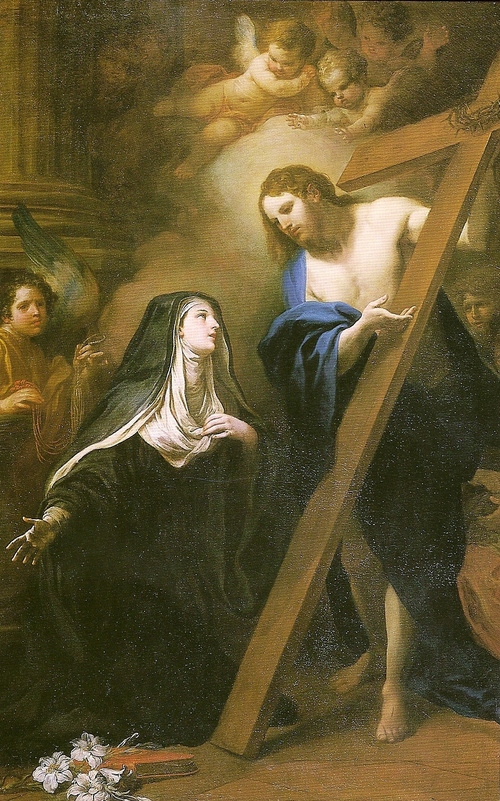

![St Clare of Montefalco, circa 1670, from the Iglesia del Convento de Nuestra Señora del Pópulo de Agustinos Descalzos. Sevilla, [Public Domain] via Creative Commons](https://anastpaul.com/wp-content/uploads/2019/08/st-clare-of-montefalco-circa-1670-from-the-iglesia-del-convento-de-nuestra-sec3b1ora-del-pc3b3pulo-de-agustinos-descalzos.-sevilla-public-domain-via-creative-commons.jpg?w=840)
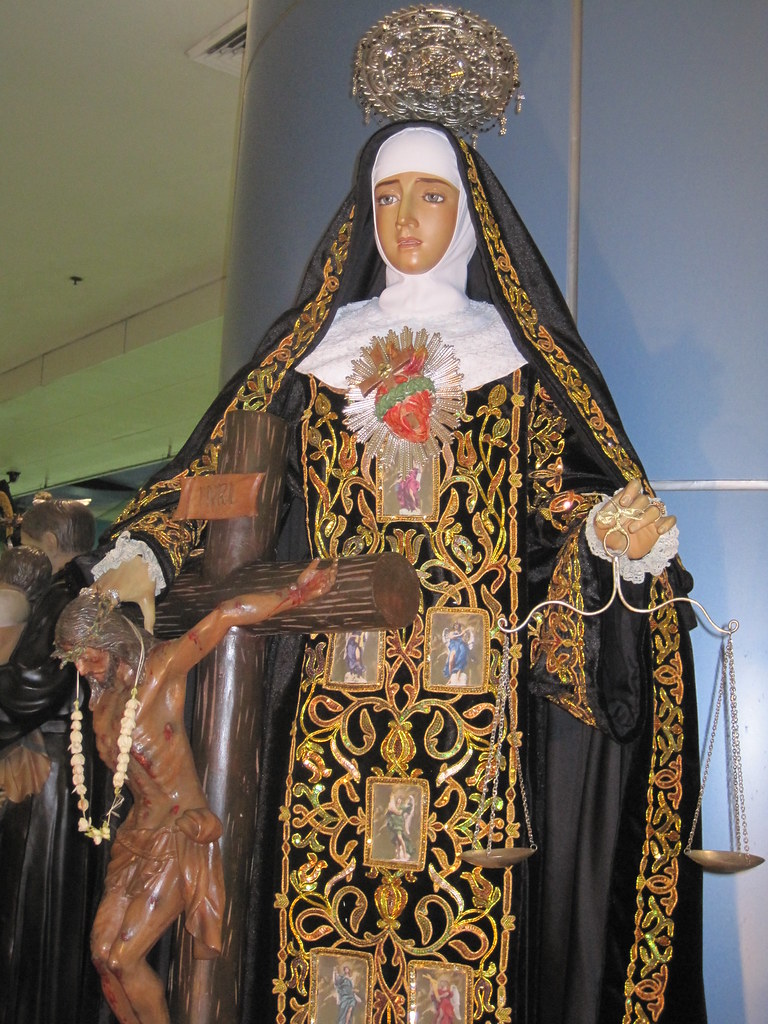


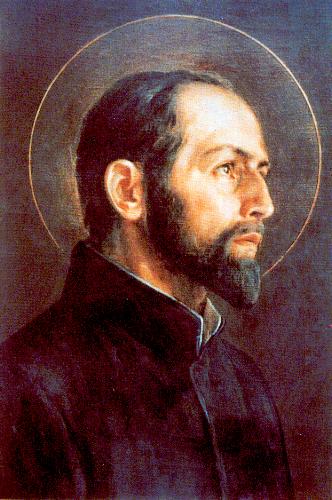 After gaining his degree in medicine, he returned home, where he understood that God had called him to the healing rather of souls than of bodies. He immediately gave himself to sacred studies. Meanwhile, he never ceased to visit the sick, instruct children in Christian doctrine and exhort the young to piety and the elders to reformation of their lives.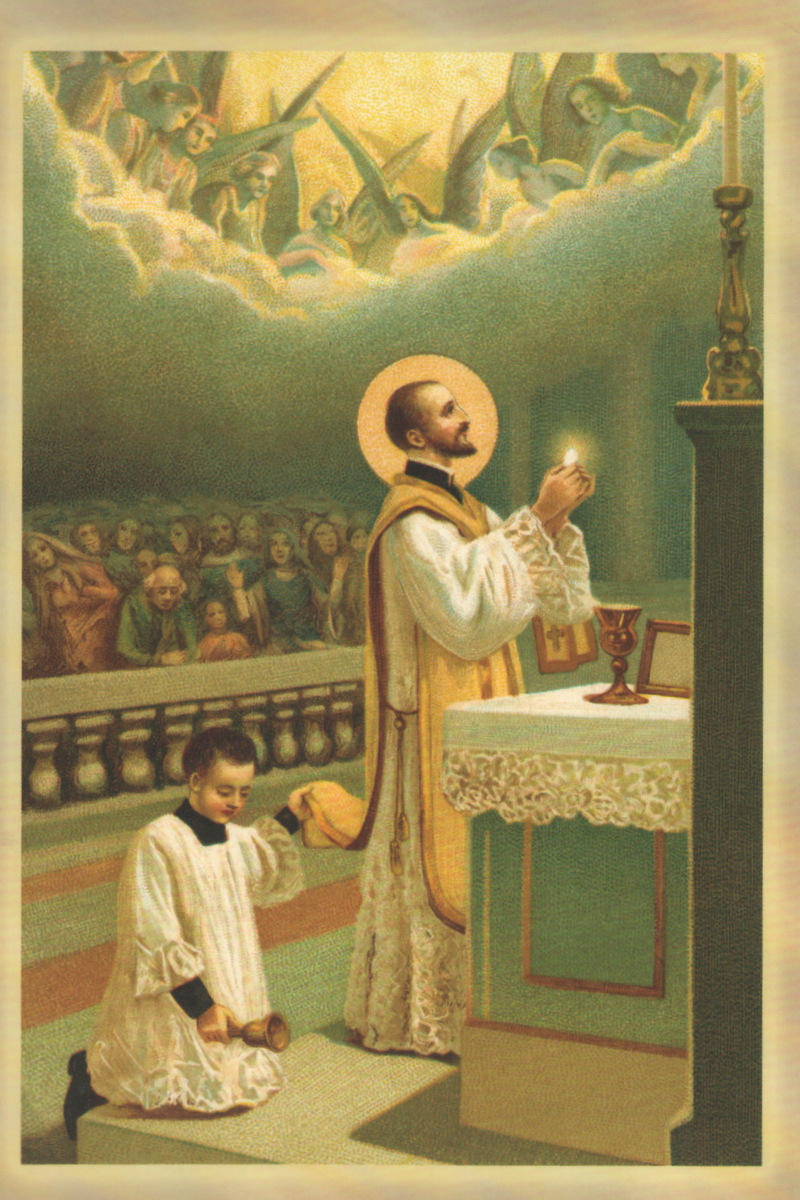
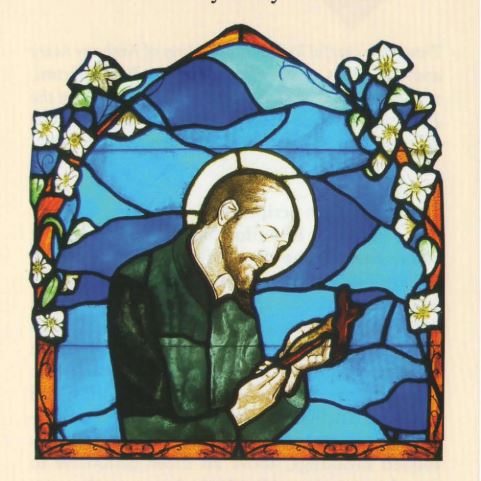
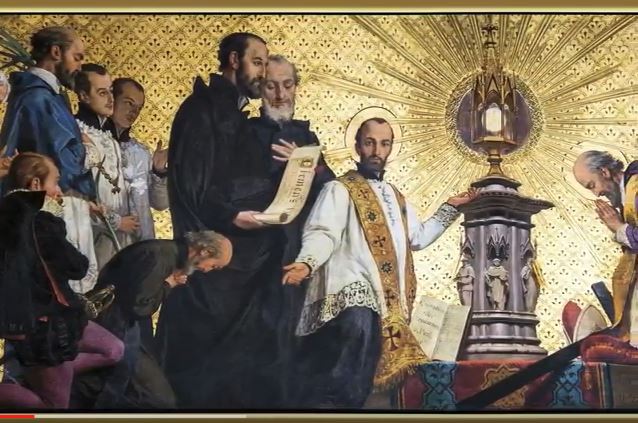
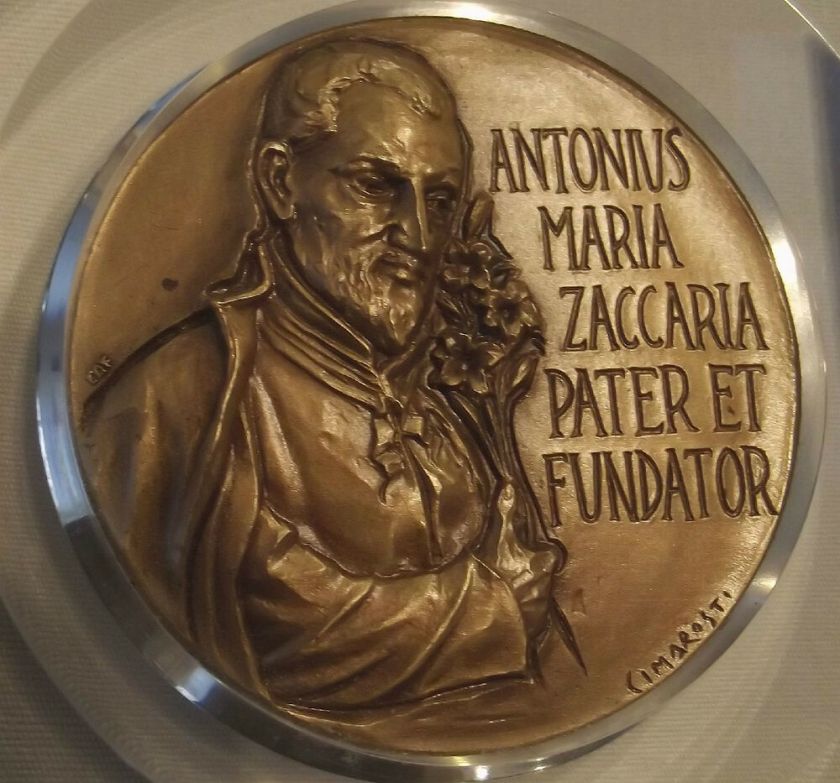


 AnaStpaul
You must be logged in to post a comment.