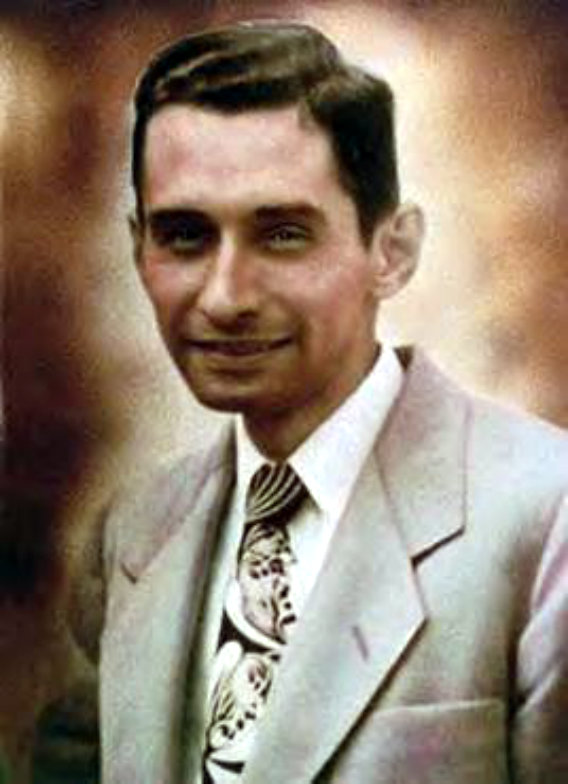
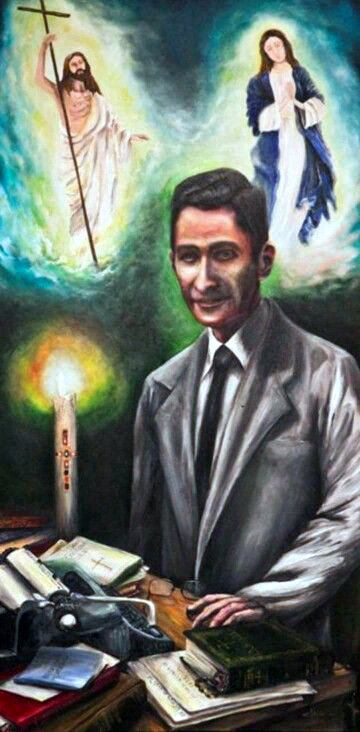
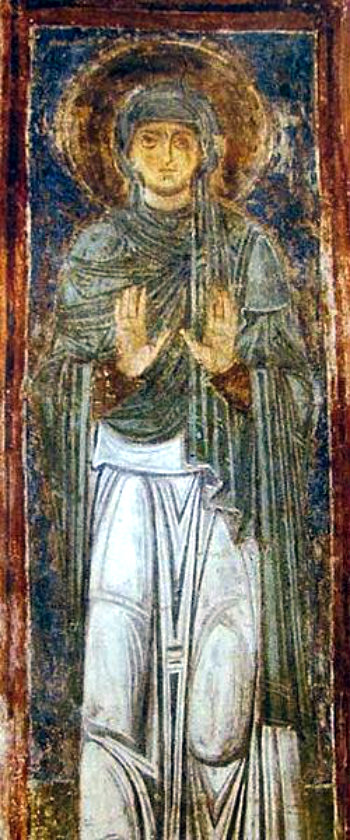
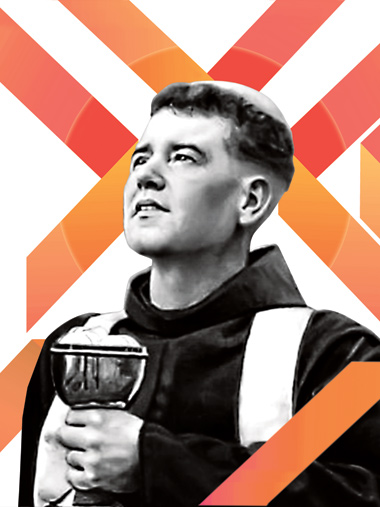
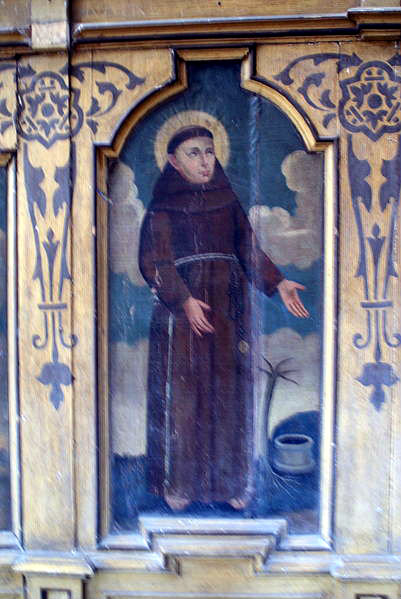
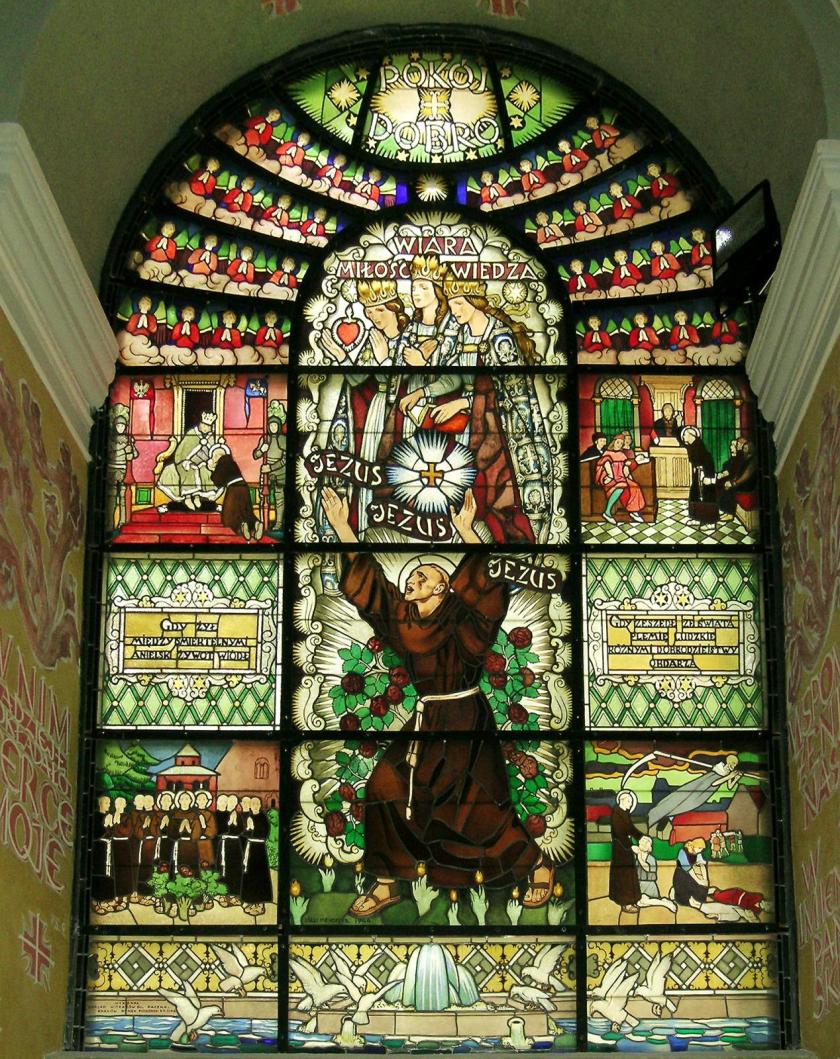
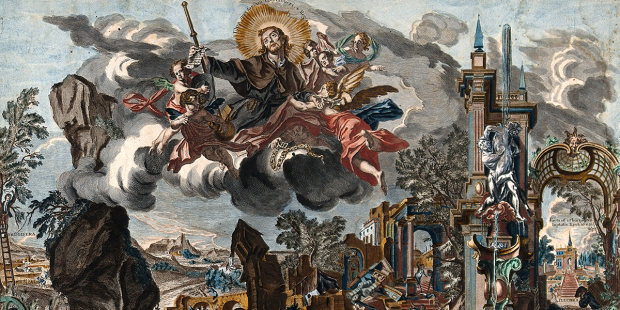
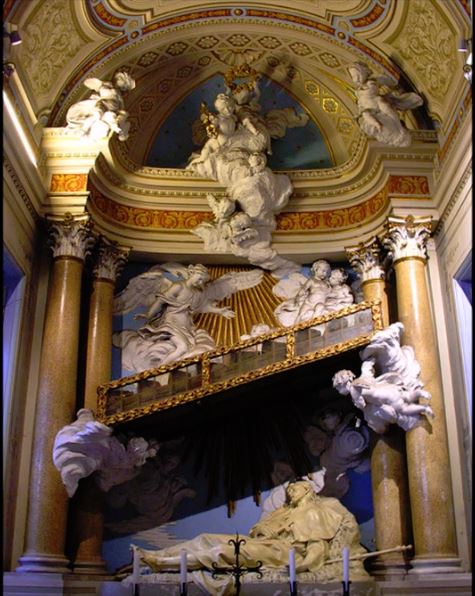
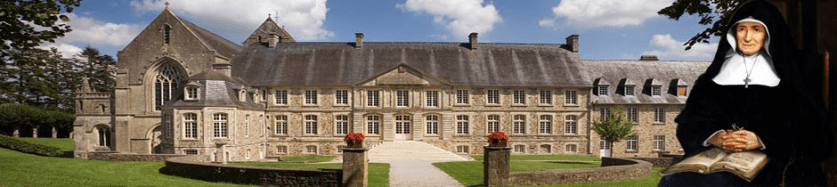
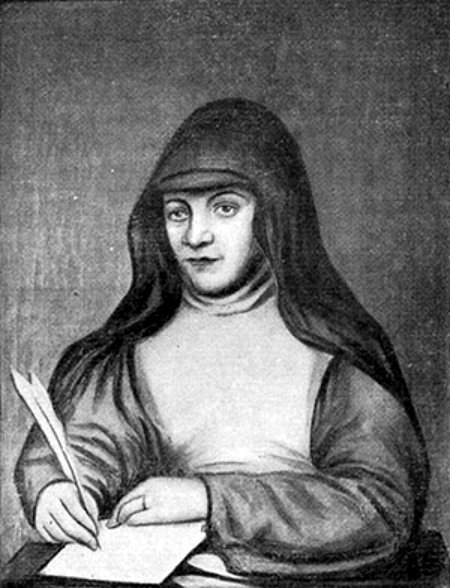
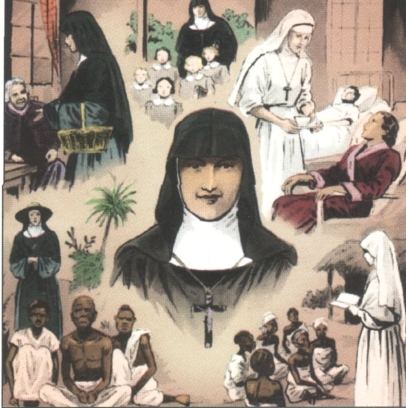
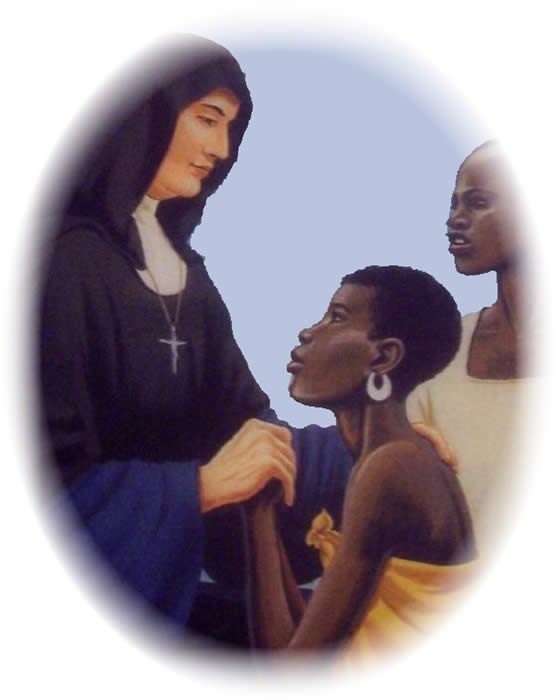
Saint of the Day – 28 June – St Vincenza Gerosa SCCG (1784–1847) – was an Italian professed religious and the co-foundress of the Sisters of Charity of Lovere that she founded alongside Saint Bartolomea Capitanio (1807–1833). Gerosa met Capitanio in 1824 and the two consecrated themselves to God in the name of educating children and tending to the poor of the Bergamo area. Patronage – Sisters of Charity of Lovere.
Saint Vincenza was born Caterina Gerosa in Lovere, Bergamo, Italy in 1784. She was orphaned as a youth. She was eventually adopted by a wealthy family of shopkeepers. Despite her family’s wealth, Caterina grew up shy and reserved. She was ever focused on aiding those in need, specifically the poor and abandoned. She dressed modestly and spent her time when not helping at the family shop, in prayer and at daily Mass.
Vincenza was sent by her parents to be educated by the Benedictine Sisters of Gandino. However, she soon fell ill and her poor health prevented her from continuing her studies. She returned to Lovere, where her adopted mother, father and dear sister died in rapid succession. She was left alone again and had to manage the family business, suffering the losses of her family by offering them to Christ. She prayed constantly to accept the will of the Lord in her life and used her family’s money to provide charitable works in the community. She became involved in her Church parish, organising a women’s oratory with meetings and retreats. She founded a practical school to teach the poor girls of the community domestic work so as to improve their station in life.
Vincenza met the schoolteacher, Bartolomea Capitanio and together they embarked on a new mission – to found a hospital to care for those who could not afford medical care. This they did and extended their mission to establishing a special religious institute with the objectives of providing assistance to the sick, free education for girls, Christian orphanages and programs designed to promote youth welfare. To accomplish this mission, together they founded the Sisters of Charity in 1824. At that time, Catherine took the name Vincenza and made her profession in the parish of San Giorgio before Father Rusticiano Barboglio and the Servant of God Angelo Bosio. Together they wrote ‘the Foundation Document” which forms the basis of the Rule of Life for the Order – “The Institute which will be founded in Lovere is be totally founded on charity and this must be its principle aim…should have as its aim the education of poor young girls…devote itself to the relief of the sick..”
Only nine short years later, Bartolomea died. Vincenza was tempted to return to her previous life at Lovere but agreed to continue the work the two started after her spiritual director encouraged her to do so. She continued on her own to manage and expand the order. The Order of the Sisters of Charity was approved by Pope Gregory XVI in 1840 and quickly spread throughout Italy and later to India and other countries. Vincenza continued overseeing the order until her death in 1847. Her body is venerated at the Chapel of the Sisters of Charity in Lovere.
Christ crowned, Vincentia (right) and Bartholomäa Capitano, apse mosaic, around 1937, in the Sanctuary of the Sisters of Charity in Lovere.
Saint Vincenza Gerosa was Beatified on 7 May 1933 by Pope Pius XI. She was Canonised on 18 May 1950 by Pope Pius XII.
Solemnity of The Most Sacred Heart of Jesus *2019 World Day of Prayer for the Sanctification of Priests *2019 Excerpt from ENCYCLICAL of Pope Pius XII
HAURIETIS AQUAS – on DEVOTION TO The SACRED HEART
15 May 1956
Bl Almus of Balmerino
St Argymirus of Córdoba
St Attilio of Trino
St Austell of Cornwall
St Benignus of Utrecht
St Crummine
Bl Damian of Campania
St Egilo
St Heimrad
St Lupercio
St Papias the Martyr
St Pope Paul I
St Theodichildis St Vincenza Gerosa (1784–1847)
—
Martyrs of Africa – 27 saints: 27 Christians martyred together. The only details about them to survive are the names – Afesius, Alexander, Amfamon, Apollonius, Arion, Capitolinus, Capitulinus, Crescens, Dionusius, Dioscorus, Elafa, Eunuchus, Fabian, Felix, Fisocius, Gurdinus, Hinus, Meleus, Nica, Nisia, Pannus, Panubrius, Plebrius, Pleosus, Theoma, Tubonus and Venustus. Unknown location in Africa, date unknown.
Martyrs of Alexandria – 8 saints: A group of spiritual students of Origen who were martyred together in the persecutions of emperor Septimius Severus – Heraclides, Heron, Marcella, Plutarch, Potamiaena the Elder, Rhais, Serenus and Serenus. They were burned to death c.206 in Alexandria, Egypt.
Thought for the Day – 27 June – Thursday of the Twelfth week in Ordinary Time, Year C and The Memorial of St Cyril of Alexandria (376-444) Father and Doctor
Defender of the divine Motherhood of the Virgin Mary
Saint Cyril of Alexandria (376-444)
Bishop, Father and Doctor
An excerpt from his Letter 1
That anyone could doubt the right of the holy Virgin to be called the mother of God fills me with astonishment. Surely she must be the Mother of God if our Lord Jesus Christ is God and she gave birth to him! Our Lord’s disciples may not have used those exact words but they delivered to us the belief those words enshrine and this has also been taught us, by the holy fathers.
In the third book of his work on the holy and consubstantial Trinity, our father Athanasius, of glorious memory, several times refers to the holy Virgin as “Mother of God.” I cannot resist quoting his own words: “As I have often told you, the distinctive mark of holy Scripture is that it was written to make a twofold declaration concerning our Saviour – namely, that He is and has always been God, since He is the Word, Radiance and Wisdom of the Fatherand that for our sake,, in these latter days, He took flesh from the Virgin Mary, Mother of God and became man.”
Again further on he says: “There have been many holy men, free from all sin. Jeremiah was sanctified in his mother’s womb and John while still in the womb leaped for joy at the voice of Mary, the Mother of God.” Athanasius is a man we can trust, one who deserves our complete confidence, for he taught nothing contrary to the sacred books.
The divinely inspired Scriptures affirm that the Word of God was made flesh, that is to say, He was united to a human body endowed with a rational soul. He undertook to help the descendants of Abraham, fashioning a body for Himself from a woman and sharing our flesh and blood, to enable us to see in Him not only God but also, by reason of this union, a man like ourselves.
It is held, therefore, that there are in Emmanuel two entities, divinity and humanity. Yet our Lord Jesus Christ is nonetheless one, the one true Son, both God and man, not a deified man on the same footing as those who share the divine nature by grace but true God, who for our sake, appeared in human form. We are assured of this by Saint Paul’s declaration: When the fullness of time came, God sent his Son, born of a woman, born under the law, to redeem those who were under the law and to enable us to be adopted as sons.
Hail, O Mary, Mother of God By St Cyril of Alexandria (376-444) Father & Doctor of the Church
Hail, Mother and Virgin,
eternal Temple of the Godhead,
Venerable Treasure of Creation,
crown of virginity,
support of the true faith,
on which the Church is founded, throughout the world.
Mother of God,
who contained the infinite God
under your heart,
whom no space can contain.
Through you, the most Holy Trinity, is revealed,
adored and glorified,
demons are vanquished,
Satan cast down from heaven into hell
and our fallen nature again assumed into heaven.
Through you, the human race,
held captive in the bonds of idolatry,
arrives at the knowledge of Truth.
What more shall I say of you?
Hail, through whom kings rule,
through whom the Only-Begotten Son of God
has become the Star of Light
to those sitting in darkness
and in the shadow of death.
Amen
Quote/s of the Day – 27 June – Thursday of the Twelfth week in Ordinary Time, Year C and The Memorial of St Cyril of Alexandria (376-444) Father and Doctor
“He who receives Communion is made holy and divinised in soul and body in the same way that water, set over a fire, becomes boiling… Communion works like yeast that has been mixed into dough so that it leavens the whole mass; …Just as by melting two candles together, you get one piece of wax, so, I think, one who receives the Flesh and Blood of Jesus is fused together with Him by this Communion and the soul finds that he is in Christ and Christ is in him.”
“We have passed over the waves of this present life like a sea, with its commotion and insane bustle. We have eaten spiritual manna, the bread that came down from heaven giving life to the world.”
“If the touch alone of His sacred flesh, restores life to a corrupting body, what profit shall we not discover, in His life-giving Eucharist, when we make of it our food? It will wholly transform into its own property, which is immortality, those who participate in it.”
“Our Saviour went to the wedding feast to make holy the origins of human life.”
“From Christ and in Christ, we have been reborn through the Spirit, in order to bear the fruit of life, not the fruit of our old, sinful life but the fruit of a new life founded upon our faith in Him and our love for Him. Like branches growing from a vine, we now draw our life from Christ and we cling to His holy commandment, in order to preserve this life.”
“That anyone could doubt, the right of the holy Virgin to be called the Mother of God, fills me with astonishment. Surely, she must be the Mother of God, if our Lord Jesus Christ is God and she gave birth to Him!”
St Cyril of Alexandria (376-444) Father and Doctor
One Minute Reflection – 27 June – Thursday of the Twelfth week in Ordinary Time, Year C, Gospel: Matthew 7:21–29 and the Feast of Our Lady of Perpetual Succour
“Every one then who hears these words of mine and does them will be like a wise man who built his house upon the rock and the rain fell and the floods came and the winds blew and beat upon that house but it did not fall, because it had been founded on the rock.”…Matthew 7:24-25
REFLECTION – “The Lord speaks to us of our foundation… our Christian life and He tells us that this foundation is the rock”. We must, therefore, “build the house”, namely, our life, on the rock that is Christ. When St Paul speaks of the rock in the desert, He is referring to Christ, the only rock “that can give us security”. …there is always a temptation to live our Christianity away from the rock that is Christ, the only One who gives us the freedom to say “Father” to God. This temptation has given life to various categories of Christians without Christ. ..The “light Christian”, who, instead of loving the rock, love beautiful words and turns towards a god of spray, a personal god, with superficiality and flimsiness. This temptation still exists: superficial Christians who indeed believe in God but not in Jesus Christ. They are modern Gnostics!
The second category includes those who believe that Christian life must be taken so seriously that they end by confusing solidity and firmness with rigidity. These rigid Christians, think that to be Christian it is necessary to wear mourning and always to take everything seriously, paying attention to formalities, just as the scribes and Pharisees did. Tthese are Christians for whom everything is serious. They are today’s Pelagians who believe in the firmness of faith and are convinced that salvation is the way I do things. I must do them seriously, without any joy. They are very numerous. They are not Christians. They disguise themselves as Christians.
In short, these two categories of believers do not know Jesus, do not know who the Lord is, do not know what the rock is, they have none of the freedom of Christians. Consequently, they have neither joy nor freedom. In their life there is no room for the Holy Spirit. Therefore, the Lord’s teaching for today, is an invitation to build our Christian life on the rock that gives us freedom”….Pope Francis – ‘Santa Marta’ – Thursday, 27 June 2013
PRAYER – God our Father, You open the gates of the kingdom of heaven to those who are born again of water and the Holy Spirit. Increase the grace You have given, so that the people who have been purified from all sin, may not forfeit the promised blessing of Your love. Grant that we may ever keep Your Son, the Lord Jesus Christ, before our eyes and do all in Him and through Him and for Him and may the prayers of our Mother of Perpetual Succour may ever guide and bear us in her care. We make our pray through Christ, our Lord, in union with You and the Holy Spirit, one God forever, amen
Saint of the Day – St Ladislaus I – (c 1040-1095) King of Hungary, Apostle of Charity, defender of the Faith. Born in c 1040 in Hungary and died on 1095 in Neutra, Hungary (in modern Slovakia) of natural causes. His relics are at Varadin (in modern Serbia). Patronage – Szekszard, Hungary.
Ladislaus the First, son of Bela, King of Hungary, was born in 1041. By the pertinacious importunity of the people he was compelled, much against his own inclination, to ascend the throne, in 1080.
He restored the good laws and discipline which St Stephen had established and which seem to have been obliterated by the confusion of the times. Chastity, meekness, gravity, charity and piety were from his infancy the distinguishing parts of his character, avarice and ambition were his sovereign aversion, so perfectly had the maxims of the Gospel extinguished in him all propensity to those base passions.
His life in the palace was most austere; he was frugal and abstemious but most liberal to the Church and the poor. Vanity, pleasure, or idle amusements had no share in his actions or time, because all his moments were consecrated to the exercises of religion and the duties of his station, in which he had only the divine will in view and sought only God’s greater honour.
He watched over a strict and impartial administration of justice, was generous and merciful to his enemies and vigorous in the defence of his country and the Church. He drove the Huns out of his territories and vanquished the Poles, Russians and Tartars.
He was preparing to command, as general-in-chief, the great expedition of the Christians against the Saracens for the recovery of the Holy Land, for Ladislaus believed that he was called to die for Christ, when God called him to Himself, on 30 July, 1095.
Legend says that Géza, Ladisluas’s brother, decided to build a church dedicated to the Holy Virgin in Vác after Ladislaus explained the significance of the wondrous appearance of a red deer at the place where the church would be erected:
As [King Géza and Duke Ladislaus] were standing at a spot near [Vác], where is now the church of the blessed apostle Peter, a stag appeared to them with many candles burning upon his horns and it began to run swifly before them towards the wood and at the spot where is now the monastery, it halted and stood still. When the soldiers shot their arrows at it, it leapt into the Danube and they saw it no more. At this sight the blessed Ladislaus said: “Truly that was no stag but an angel from God.” And King [Géza] said: “Tell me, beloved brother, what may all the candles signify which we saw burning on the stag’s horns.” The blessed Ladislaus answered: “They are not horns but wings, they are not burning candles but shining feathers. It has shown to us that we are to build the church of the Blessed Virgin on the place where it planted its feet and not elsewhere.” — The Hungarian Illuminated Chronicle
Ladislaus was Canonised on 27 June 1192 by Pope Celestine III. Legends depict him as a pious knight-king, “the incarnation of the late-medieval Hungarian ideal of chivalry.” He is a popular saint in Hungary and neighbouring nations, where many churches are dedicated to him.
St Cyril of Alexandria (376-444) Father and Doctor of the Church (Optional Memorial) Biography: https://anastpaul.com/2018/06/27/saint-of-the-day-27-june-st-cyril-of-alexandria-376-444-father-and-doctor-of-the-church/ and
St Adeodato of Naples
St Aedh McLugack
St Anectus of Caesarea
St Arialdus of Milan
St Arianell of Wales
Bl Benvenutus of Gubbio
St Brogan
St Crescens of Galatia
St Crescentius of Mainz
Bl Daniel of Schönau
Bl Davanzato of Poggibonsi
St Desideratus of Gourdon
St Dimman
St Felix of Rome
St Ferdinand of Aragon
St Gudene of Carthage
St Joanna the Myrrhbearer
St John of Chinon St Ladislaus I – (c 1040-1095)
St Sampson of Constantinople
St Spinella of Rome
St Tôma Toán
St Zoilus of Cordoba
—
Martyrs Killed Under Communist Regimes in Eastern Europe: Among the thousands of Christians murdered by various Communist regimes in their hatred of the faith, there were 25 members of the Ukrainian Greek Catholic Church and Russian Byzantine Catholic Church, priests, bishops, sisters and lay people, whose stories are sufficiently well documented that we know they were murdered specifically for their faith in eastern Europe and whose Causes for Canonization were opened. Their Causes were combined and they were beatified together. They have separate memorials but are remembered together today. They are –
• Andrii Ischak • Hryhorii Khomyshyn • Hryhorii Lakota • Ivan Sleziuk • Ivan Ziatyk • Klymentii Sheptytskyi • Leonid Feodorov • Levkadia Harasymiv • Mykola Konrad • Mykola Tsehelskyi • Mykolai Charnetskyi • Mykyta Budka • Oleksa Zarytskyi • Ol’Ha Bida • Ol’Ha Matskiv • Petro Verhun • Roman Lysko • Stepan Baranyk • Symeon Lukach • Vasyl Vsevolod Velychkovskyi • Volodomyr Bairak • Volodymyr Ivanovych Pryima • Yakym Senkivsky • Yosafat Kotsylovskyi • Zenon Kovalyk
Beatified – 27 June 2001 by Pope John Paul II in Ukraine
Thought for the Day – 26 June – Wednesday of the Twelfth week in Ordinary Time and the Memorial of Blessed Jacques Ghazir Haddad OFM Cap (1875-1954) “The Apostle of Lebanon” “The Apostle of the Cross”
Lebanon’s Apostle of the Cross
Brother Jacque’s long-cherished dream of erecting a large Cross in Lebanon was a concrete expression of his commitment to his Christian faith and to his native country. He wanted to make it not only a meeting place for Franciscan Tertiaries but above all, a place of prayer for all those fallen in war and for the Lebanese who had emigrated in search of work. With the help of collected money he completed this project which also included a church dedicated to Our Lady of the Sea and, later, hospital, orphanage and rest home for retired priests in 1923.
Brother James’s love for the Cross of Christ was so legendary that people christened him ‘the Apostle of the Cross’. He himself prayed the Stations of the Cross everyday and he encouraged others to frequently pray this prayer. Among his publications is a booklet of mediations for the Way of the Cross and the congregation of Tertiary Sisters he founded to run his corporal works of mercy projects is called the ‘Congregation of Franciscan Sisters of the Cross of Lebanon’. Among his frequently quoted maxims are the following: “I myself have the Cross as a destiny”.,“One ounce of a Cross is much better than a ton of books of prayer.”, and “O Cross of the Lord, so dear to the heart”.And as he left this world he held his well-worn Crucifix in his hands.
Besides his love of the Cross, Brother James also had a deep devotion to the Eucharist and to Our Blessed Lady. He prayed the fifteen decades of the rosary every day. He viewed our Lady as the perfect guide who leads people to Christ. “Honouring Mary, no matter how sacred, is only the door leading to Jesus. Mary is the means, Jesus is the end. Mary is the road, Jesus is the destination”. It was in adoration before the Blessed Sacrament that Brother James reached this destination while here on earth. Sometimes, as he adored the the Lord in the tabernacle, he would pray, “How I would prefer to take you in procession throughout the streets rather than closing up on you in the tabernacle”.
Apostle of Lebanon
But inevitable old-age and illness impacted this energetic Capuchin Brother’s own strength of also. He was already known throughout Lebanon as Abouna Yaaqoub(أبونا يعقوب) meaning Father Jacques, Father James or Abba Jacob.
At dawn on Saturday 26 June 1954 he said, “Today is my last day!” and he died at 3 o’ clock in the afternoon . The radio, the press, his friends and church bells in the villages announced his death. Thousands flocked to the Friary of the Cross to weep, pray and receive a final blessing. His body was laid to rest in a tomb of the new Calvary Chapel. This chapel soon became a site that is visited by an ever-growing throngs of pilgrims. Tens of thousands of Lebanese turned out to celebrate his beatification in Beirut’s Martyrs Square. That bloodstained square which witnessed so many tragedies of wartorn Lebanon’s recent history resound with cheers of joy as the painting of the Brother Jacques of Ghazir was unveiled above it after the Pope’s representative, Cardinal Martens, proclaimed the faithful son of Lebanon, Khalil Haddad, the Capuchin Order’s ‘Abuna Yaaqub’ a Blessed. His beatification a moment of hope for unity in a country ripped apart by factional warfare and international conflict.
Blessed Jacques Ghazir Haddad (1875-1954)
“The Apostle of Lebanon”
“The Apostle of the Cross”
Pray for Us!
Quote/s of the Day – 26 June – Wednesday of the Twelfth week in Ordinary Time and the Memorial of Blessed Jacques Ghazir Haddad OFM Cap (1875-1954) “The Apostle of Lebanon” “The Apostle of the Cross”
“How I would prefer to take You in procession throughout the streets, rather than closing You up n the tabernacle!”
“One ounce of a Cross is much better than a ton of books of prayer.”
“Anyone who seeks heaven but without suffering, is like someone who wants to buy goods, without paying.”
“Prayer without trust, is like a letter in one’s pocket. It never reaches its destination!”
“Honouring Mary, no matter how sacred, is only the door leading to Jesus. Mary is the means, Jesus is the end. Mary is the road, Jesus is the destination.”
One Minute Reflection – 26 June – Wednesday of the Twelfth week in Ordinary Time, Gospel: Matthew 7:15–20
“Every good tree bears good fruit”...Matthew 7:17
REFLECTION – “In a culture paradoxically suffering from anonymity and at the same time obsessed with the details of other people’s lives, shamelessly given over to morbid curiosity, the Church must look more closely and sympathetically at others whenever necessary. In our world, ordained ministers and other pastoral workers can make present the fragrance of Christ’s closeness and His personal gaze. The Church will have to initiate everyone – priests, religious and laity – into this “art of accompaniment” which teaches us to remove our sandals before the sacred ground of the other (cf. Ex 3:5). The pace of this accompaniment must be steady and reassuring, reflecting our closeness and our compassionate gaze which also heals, liberates and encourages growth in the Christian life…
Today more than ever we need men and women who, on the basis of their experieevangeliigaudium169-171,nce of accompanying others, are familiar with processes which call for prudence, understanding, patience and docility to the Spirit, so that they can protect the sheep from wolves who would scatter the flock. We need to practice the art of listening, which is more than simply hearing. Listening, in communication, is an openness of heart which makes possible that closeness without which genuine spiritual encounter cannot occur. Listening helps us to find the right gesture and word which shows that we are more than simply bystanders. Only through such respectful and compassionate listening, can we enter on the paths of true growth and awaken a yearning for the Christian ideal – the desire to respond fully to God’s love and to bring to fruition what He has sown in our lives.”…Pope Francis – Apostolic Exhortation « Evangelii Gaudium / The Joy of the gospel #169-171
PRAYER – Enable me loving Father, to live a life of purity that will make me live in You. Let me be so united with You that whatever I might ask will be in total accord with Your will for me. Bl Jacques Ghazir Haddad, your tireless work and preaching for the glory of the Kingdom show us the way to sanctification, please intercede for us all. May Mary our Mother of Compassion, be our constant companion. We make our prayer through Christ our Lord, with the Holy Spirit, one God for all eternity, amen.
Saint of the Day – 26 June – Blessed Jacques Ghazir Haddad OFM Cap (1875-1954) aged 79 – Priest, Religious of the Order of Friars Minor as a Capuchin Friar, Founder of the Franciscan Sisters of the Holy Cross of which he is the Patron, noted Preacher and founder of many orphanages and schools across Lebanon, Apostle of Charity. Called the “St Vincent de Paul of Lebanon,” “the Apostle of the Cross” and “the Apostle of Lebanon.”
Fr Jacques Ghazir Haddad was born on 1 February 1875, in Ghazir, Lebanon, the third of five children. He attended school in Ghazir and then the College de la Sageese in Beirut, where he studied Arabic, French and Syriac.
In 1892 he went to Alexandria, Egypt, to teach Arabic at the Christian Brothers’ College, and there he felt the call to the priesthood. He entered the Capuchin Convent in Khashbau the next year. He was ordained a priest on 1 November 1901 in Beirut, Lebanon.
As an itinerant preacher from 1903 to 1914 he walked all over Lebanon proclaiming the Word of God and was given the name “the Apostle of Lebanon”. He was also seen preaching in Syria, Palestine, Iraq and Turkey.
In 1919 he bought a piece of land on the hill of Jall-Eddib, north of Beirut, where he built a chapel dedicated to Our Lady of the Sea. Nearby he erected a great Cross.
Fr Jacques was tireless, he would help anyone in need following in the footsteps of St Francis of Assisi. In 1920, to assist him in this mission to help the sick and the poor, he founded the Franciscan Sisters of the Holy Cross of Lebanon. Sister Marie Zougheib was his first collaborator and aided him in setting up his new congregation. He set out in the rule of his order with the insistence, above all else, that the works of mercy never be neglected in the pursuit of the order’s work. He had been titled as the “Vincent de Paul of Lebanon”.
The modest work of Fr Jacques aroused the people’s admiration, many poor and sick people began to go to the “Cross” and Fr Jacques would welcome them all. In 1950 the “Cross” became exclusively a psychiatric hospital, one of the most modern in the Near East. The movement of charity began to spread throughout Lebanon and Fr Jacques and his Sisters multiplied their works of social assistance.
In 1933 he opened the House of the Sacred Heart in Deir el-Kamar, a girls’ orphanage, which later became an asylum for the chronically ill. In 1948 he opened the Hospital of Our Lady for the aged, the chronically ill and the paralysed. In 1949 St Joseph’s Hospital became one of the most important medical centres of the capital. It was followed in 1950 by St Anthony’s House in Beirut for beggars and vagabonds whom the police found on the streets and Providence House for homeless girls.
Even though Fr Jacques was very busy with the hospital mission, he and his Sisters carried on the important work of education and opened several schools as well as an orphanage for 200 girls.
Fr Jacques was worn out by vigils, fatigue and travel. Although he suffered from numerous illnesses, became almost completely blind and was stricken with leukemia, he did not stop blessing God and working. He was lucid to the end, at dawn on the day of his death, he said “Today is my last day!” His last hours were an uninterrupted series of prayers invoking the Cross and the Virgin Mary until he died on 26 June 1954 in Lebanon.
His cause for Beatification was introduced in February 1979, on 24 February 1979, His Holiness St Pope John Paul II signed the Decree of Introduction of the Cause for Beatification. On Sunday, 22 June 2008, he was Beatified during a special Mass in Beirut by Cardinal José Saraiva Martins, C.M.F., Prefect of Congregation for the Causes of Saints.
Since Blessed Haddad’s death, additional hospitals have opened to assist those injured during the war and to assist the Kabr-Chemoun region where medical services were scarce…Vatican.va
Father al-Haddād received from President Émile Eddé the Palm Medal of Lebanese Merit on 5 January 1938 while President Bechara El Khoury awarded him the Golden Medal of Lebanese Merit on 2 June 1949 and then the Officer Degree of the Lebanese Cedars Medal on 26 November 1951.
Blessed Virgin of Potente del Trompone:
Visionary: Domenica di Miglianotto on 26 June 1562
Title: Blessed Virgin of Potente del Trompone
2nd Visionary: Visionary: St Peter of Alcantara (1499-1562) – seen below: Our Lady of Longing:Matka Boża Tęskniąca / Longing Mother of God, Warsaw, Poland – One of the oldest churches in the Archdiocese of Warsaw is St Elizabeth Powsin Located on the main altar is a painting of Our Lady of Longing – artist unknown – from the first half of the seventeenth century. At either side, the image is surrounded by statues of Saints Adalbert and Stanislaus – Polish bishops and martyrs . The testimony of miracles and graces relating to the Our Lady of Longing icon have been collected at least since the mid-seventeenth century. On 28 June 1998, the image became the fourth image of Mary in the Archdiocese of Warsaw to be canonically crowned.
St Acteie of Rome
St Albinus of Rome
Bl Andrea Giacinto Longhin
Bl Andrii Ischak
St Anthelm of Belley
St Babolenus of Stavelot-Malmédy
St Barbolenus of Fossés
Bl Bartholomew of Vir
St Corbican
St David of Thessalonica
St Deodatus of Nola
St Dionysius of Bulgaria
St Edburga of Gloucester
St Hermogius of Tuy
St Iosephus Ma Taishun
St John of Rome
St John of the Goths
St José Maria Robles Hurtado St Josemaria Escriva (1902-1975) Biography: https://anastpaul.com/2018/06/26/saint-of-the-day-26-june-st-josemaria-escriva-de-balaguer-y-albas-1902-1975-the-saint-of-ordinary-life/
Bl Jacques Ghazir Haddad OFM Cap (1875-1954)
St Maxentius of Poitou
St Medico of Otricoli
Bl Mykola Konrad
St Paul of Rome
St Pelagius of Oviedo
St Perseveranda of Poitiers
Bl Raymond Petiniaud de Jourgnac
St Salvius
Bl Sebastian de Burgherre
St Soadbair
St Superius
St Terence of Rome
St Vigilius of Trent
Bl Volodymyr Ivanovych Pryima
—
Martyrs of Africa – 4 saints: Four Christians who were martyred together – Agapitus, Emerita, Felix and Gaudentius at an unknown location in Africa, date unknown.
Martyrs of Alexandria – 3 saints: Three Christians who were martyred together, but we really know little more that the names – Agatho, Diogenes and Luceja. They were martyred in Alexandria, Egypt, date unknown.
Martyrs of Cambrai – 4 beati: Four Daughters of Charity of Saint Vincent de Paul nuns at Arras, France. Imprisoned together in 1792 and executed together two years later in the anti-Catholic excesses of the French Revolution. They were:
• Jeanne Gerard
• Marie-Françoise Lanel
• Marie-Madeleine Fontaine
• Thérèse-Madeleine Fantou
They were guillotined on 26 June 1794 at Cambrai, Nord, France and Beatified in June 1920 by Pope Benedict XV.
Our Morning Offering – 25 June – Tuesday of the Twelfth week in Ordinary Time, Year C – June the Month of the Sacred Heart
Be my Strength, O Sacred Heart! By St Margaret Mary Alacoque (1647-1690)
O Sacred Heart of Jesus,
I fly to You,
I unite myself with You,
I enclose myself in You!
Receive my call for help,
O my Saviour,
as a sign of my horror
of all within me
contrary to Your holy love.
Let me die rather a thousand times,
than consent to sin against You!
Be my strength, O God –
defend me,
protect me.
I am Yours
and desire forever to be Yours!
Amen
Saint of the Day – 25 June – Saint Prosper of Reggio (Died c 466) Bishop. Patronage – Reggio.
Tradition and documents attest that he was indeed the bishop of Reggio for 22 years in the fifth century. He is remembered for his strong sense of charity and to this day – his Feast Day is celebrated in Reggio, Italy with large festivals and celebrations.
This fresco is in a Church in Germany
His strongest following was up until the fourteenth century, before devotion to him has slowed down. He has 31 churches and chapels that are dedicated to him today in Parma, Bologna, Lucca and other cities surrounding Reggio, Italy – most being built in the Middle Ages. He personally built a church in San Prospero and it is dedicated to Saint Apollinaris. To this day in Reggio, they celebrate his feast locally on 24 November but 25 June is his feast day on general liturgical calendars. Giovanni Soncini did a painting of St Prosper and St Bernard, see below.
In the tenth century, Reggio being vunerable to attacks from the sea, Bishop Ermenaldo transported Prosper’s relics to the Cathedral of Santa Maria in the centre of the city while the church dedicated to Prosper was being built. This was completed by his successor Tenzone. Pope Gregory V, consecrated the church in 997. In the 16th century the church was rebuilt and Prosper’s body lies under the great altar. And fittingly enough he is the principal Patron of the city.
Saint Prosper was a very humble and charitable bishop and the people of Reggio celebrate his life, seeking his intercession and having festivals on his Feast Day. St Prosper took Jesus litterally when Jesus said, “Sell all that you own and distribute the money to the poor and you will have treasure in heaven; then come follow me”. Tradition holds that Prosper, a true follower of Jesus, took His command seriously. He distributed his goods to the poor.
St Prosper is a saint that shows us by his life and love for the church, that only by clearing ourselves of material things in this world, can we become Disciples of Christ. He sold his belongings and distributed it to the poor. His overwhelming gift of Charity was so prominent, that 17 centuries later – the faithful celebrate his Feast Day with festivals and celebrations! We too, as faithful, can impact those around us by our Charity of time, talent and treasures – as our means permit.
St Adalbert of Egmond
St Amand of Coly
Bl Burchard of Mallersdorf
St Cyneburga of Gloucester
St Domingo Henares de Zafra Cubero
Bl Dorothy of Montau
St Eurosia of Jaca
St Febronia of Nisibis
Bl Fulgentius de Lara
St Gallicanus of Embrun
St Gallicanus of Ostia
St Gohard of Nantes
Bl Guy Maramaldi
Bl Henry Zdick
Bl John the Spaniard
St Luceias and Companions
St Maximus of Turin (? – c 420)
Biography: https://anastpaul.com/2018/06/25/saint-of-the-day-25-june-st-maximus-of-turin-c-420-father-of-the-church/
Thought for the Day- 24 June – The Solemnity of the Birth of Saint John the Baptist Year C, Gospel: Luke 1:57–66
The Voice of One Crying in the Wilderness
Saint Augustine (354-430)
Bishop and Great Western Father and Doctor of the Church
An excerpt from his Sermon 293
The Church observes the birth of John as a hallowed event. We have no such commemoration for any other fathers but it is significant, that we celebrate the birthdays of John and of Jesus. This day cannot be passed by. And even if my explanation does not match the dignity of the feast, you may still meditate on it with great depth and profit.
John is born of a woman too old for childbirth, Christ was born of a youthful virgin. The news of John’s birth was met with incredulity and his father was struck dumb. Christ’s birth was believed and He was conceived through faith.
Such is the topic, as I have presented it, for our inquiry and discussion. But as I said before, if I lack either the time or the ability to study the implications of so profound a mystery, He who speaks within you, even when I am not here, will teach you better, it is He whom you contemplate with devotion, whom you have welcomed into your hearts, whose temples you have become.
John, then, appears as the boundary between the two testaments, the old and the new. That he is a sort of boundary the Lord himself bears witness, when He speaks of the law and the prophets up until John the Baptist. Thus He represents times past and is the herald of the new era to come. As a representative of the past, he is born of aged parents, as herald of the new, he is declared to be a prophet while still in his mother’s womb. For when yet unborn, he leapt in his mother’s womb at the arrival of blessed Mary. In that womb, he had already been designated a prophet, even before he was born, it was revealed that he was to be Christ’s precursor, before they ever saw one another. These are divine happenings, going beyond the limits of our human frailty. Eventually he is born, he receives his name, his father’s tongue is loosened. See how these events reflect reality.
Zechariah is silent and loses his voice until John, the precursor of the Lord, is born and restores his voice. The silence of Zechariah is nothing but the age of prophecy lying hidden, obscured, as it were and concealed before the preaching of Christ. At John’s arrival, it becomes clear, when the one who was being prophesied is about to come. The release of Zechariah’s voice at the birth of John is a parallel to the rending of the veil at Christ’s crucifixion. If John were announcing his own coming, Zechariah’s lips would not have been opened. The tongue is loosened because a voice is born. For when John was preaching the Lord’s coming he was asked – Who are you? And he replied – I am the voice of one crying in the wilderness.The voice is John but the Lord in the beginning was the Word. John was a voice that lasted only for a time, Christ, the Word in the beginning, is eternal.
Quote/s of the Day- 24 June – The Solemnity of the Birth of Saint John the Baptist Year C, Gospel: Luke 1:57–66 and the Memorial of St Maria Guadalupe García Zavala (1878-1963) “Mother Lupuita”
“The true secret of love consists in this: we must forget self like St John the Baptist and exalt and glorify the Lord Jesus.”
St Peter Julian Eymard (1811-1868)
“Look today to John the Baptist, an enduring model of fidelity to God and His Law. John prepared the way for Christ, by the testimony of his word and his life. Imitate him with docile and trusting generosity.”
St Pope John Paul (1920-2005)
(24 June 2001)
“With deep faith, unlimited hope and great love for Christ, Mother “Lupita” sought her own sanctification, beginning with love for the Heart of Christ and fidelity to the Church. In this way she lived the motto which she left to her daughters: “Charity to the point of sacrifice and perseverance until death”.
St Pope John Paul II (1920-2005)
On the Beatification of St Maria Guadalupe García Zavala (1878-1963) “Mother Lupuita”
One Minute Reflection – 24 June – The Solemnity of the Birth of Saint John the Baptist, Year C, Gospel: Luke 1:57–66
“And immediately his mouth was opened and his tongue loosed and he spoke, blessing God.”…Luke 1:64
REFLECTION – “The Benedictus, is prayed every morning in the Breviary and so, the Church remembers this “forerunner of Jesus” at the beginning of every day. The opening words of this Canticle are the source of its Latin title, “Blessed be the Lord, the God of Israel”.
What does it mean for Catholics, that we sing this song about John the Baptists at the start of every new day? After having been “silenced” by sleep throughout the night, God opens our mouths and one of the first things we do, is to sing this blessing of God, whose dawn breaks forth to shine on us and guide our way to peace.
In the Benedictus, we join ourselves to the mission of St John the Baptist, who came to prepare a way for the Lord by being a witness of God’s salvation, living a simple and penitential life and calling others to do the same. Our work each day, then, is to use our voice – like Zechariah and his son – and the witness of our lives, to make God’s presence known wherever we go and to whom whomever we encounter.”
PRAYER –
The Benedictus – Canticle of Zechariah
Luke 1:68-79
The Messiah and His forerunner
Blessed be the Lord, the God of Israel;
He has visited His people and redeemed them.
He has raised up for us a mighty saviour,
in the house of David, His servant,
as He promised by the lips of holy men,
those who were His prophets of old.
A Saviour who would free us from our foes,
from the hands of all who us.
So His love for our fathers is fulfilled
and His holy covenant remembered.
He swore to Abraham, our father, to grant us,
that free from fear and saved from the hands of our foes.
we might worship Him in justice and holiness
all the days of our lives, in His Presence.
As for you, little child,
you shall be called the prophet of God, the Most High.
You shall go ahead of the Lord
to prepare His ways before Him,
to make known to His people their salvation,
through forgiveness of all their sins,
the loving kindness of the heart of our God,
who visits us like the dawn from on high.
He will give light to those in darkness,
those who dwell in the shadow of death
and to guide us into the way of peace.
Glory to the Father and to the Son,
and to the Holy Spirit:
as it was in the beginning, is now,
and will be for ever.
Amen
Saint of the Day – St Maria Guadalupe García Zavala (1878-1963) – born Anastasia Guadalupe García Zavala on 27 April 1878 in Zapopan, Jalisco, Mexico and died on 24 June 1963 in Guadalajara, Jalisco, Mexico of natural causes – Virgin and co-foundress of the Handmaids of Santa Margherita and the Poor. She is also known as “Mother Lupita”. Patronages – Nurses, Handmaids of Santa Margherita Maria and the Poor.
María Guadalupe García Zavala was born on 27 April 1878 in Zapopan, Jalisco, Mexico, to Fortino García and Refugio Zavala de García. As a child she was known for her piety and made frequent visits to the Basilica of Our Lady of Zapopan, which was located next to the religious goods shop run by her father . Her love for God was particularly demonstrated in her love for the poor.
“No’ to matrimony, “yes’ to Jesus:
With uncommon transparency and simplicity, María treated everyone with equal love and respect. Although as a young woman she planned to marry Gustavo Arreola, she suddenly broke off her engagement when she was 23 years old. The reason: María “understood” that Jesus was calling her to love Him with an undivided heart as part of the religious life and she fully believed, that she was called to do this, by giving assistance to the poor and sick.
Foundress of the “Servants’:
When María confided to her spiritual director, Fr Cipriano Iñiguez, her “sudden change of heart”, he told her that for some time he had the inspiration to found a religious congregation that would provide assistance to the hospitalised. He invited María to join him in this foundation.
The new Congregation, which officially began on 13 October 1901, was known as the “Handmaids of St Margaret Mary (Alacoque) and the Poor”.
“Poor with the poor’:
María worked as a nurse, giving assistance to the first patients that were welcomed into “their hospital”. Regardless of the poverty and lack of material goods of the patients, compassion and care for the physical and spiritual well-being of the sick were the primary concerns and María gave of herself wholeheartedly to carry out this task of love.
Sr María was named Superior General of the quickly-growing Congregation and taught the Sisters entrusted to her, mostly by means of her example, the importance of living a genuine and joyful exterior and interior poverty. She was convinced that it was only through loving and living poverty that one could be truly “poor with the poor”.
Indeed, Mother María was known for her simplicity, humility and willingness to accept all that came from the hand of God.
In times of “dire straits”, Mother María asked her spiritual director for permission to go begging in order to collect money for the hospital. Together with other Sisters, she would seek offerings until the needs of the hospital and patients were me, and would ask no more than was necessary. The Sisters also worked in parishes to assist the priests and to teach catechism.
Risking life to help those hiding:
From 1911 until 1936, the political-religious situation in Mexico became uneasy and the Catholic Church underwent persecution. Mother María put her own life at risk to help the priests and the Archbishop of Guadalajara to “go into hiding” in the hospital.
She did not limit her charity simply to helping the “righteous” but also gave food and care to the persecutors who lived near the hospital, it was not long before they, too, began defending the sick in the hospital run by the Sisters.
The last two years of Mother María’s life were lived in extreme suffering because of a grave illness and on 24 June 1963, she died at the age of 85.
During the lifetime of the foundress, 11 foundations were established in the Republic of Mexico.
Today, the Congregation has 22 foundations and is present in five different Nations: Mexico, Peru, Iceland, Greece and Italy.
Her Beatification cause began in mid-1984 and her formal Beatification was celebrated on 25 April 2004. Pope Francis later Canonised her as a saint on 12 May 2013 in Saint Peter’s Square.
The Nativity of Saint John the Baptist (Solemnity) Biography: https://anastpaul.com/2018/06/24/the-solemnity-of-the-nativity-of-st-john-the-baptist-24-june/
St Aglibert of Créteil
St Agoard of Créteil
St Alena of Brussels
St Amphibalus of Verulam
St Bartholomew of Farne
Bl Christopher de Albarran
St Erembert I of Kremsmünster
St Faustus of Rome and Companions
St Festus of Rome
St Germoc
St Gohardus of Nantes
Bl Henry of Auxerre/the Hagiographer
St Ivan of Bohemia
St John of Rome
St John of Tuy
St Joseph Yuan Zaide
Bl Maksymilian Binkiewicz St Maria Guadalupe García Zavala (1878-1963)
St Rumold
St Simplicio of Autun
Bl Theodgar of Vestervig
St Theodulphus of Lobbes
—
Martyrs of Satala: Seven Christian brothers who were soldiers in the imperial Roman army. They were kicked out of the military, exiled and eventually martyred in the persecutions of Maximian. We know little more about them than their names – Cyriacus, Firminus, Firmus, Longinus, Pharnacius, Heros and Orentius. The martyrdoms occurred in c 311 at assorted locations around the Black Sea.
Saint of the Day – 23 June – St Etheldreda (c 636-679) Abbess and widow, an East Anglian princess, a Fenland and Northumbrian queen and Abbess of Ely – born in c 636 probably n Exning, near Newmarket in Suffolk, England. She died on 23 June 679 of natural causes. When her body was re-interred in 694 it was found to be incorrupt and again in 1106 when her relics were transferred to Ely Cathedral where her shrine now remains, her body was incorrupt. Patronage – throat ailments, widows, neck ailments, th University of Cambridge.
She was one of the four saintly daughters of Anna of East Anglia, including Wendreda and Seaxburh of Ely, all of whom eventually retired from secular life and founded abbeys.
Born and brought up in the fear of God-her mother and three sisters are numbered among the Saints – Etheldreda had but one aim in life, to devote herself to His service in the religious state. Her parents, however, had other views for her and, in spite of her tears and prayers, she was compelled to become the wife of Tonbercht, a tributary of the Mercian king. She lived with him as a virgin for three years and at his death retired to the Isle of Ely, that she might apply herself wholly to heavenly things.
This happiness was but short-live,; for Egfrid, the powerful King of Northumbria, pressed his suit upon her with such eagerness that she was forced into a second marriage. Her life at his court was that of an ascetic rather than a queen – she lived with him not as a wife but as a sister and, observing a scrupulous regularity of discipline, devoted her time to works of mercy and love.
After twelve years, she retired with her husband’s consent to Coldingham Abbey, which was then under the rule of St Ebba, and received the veil from the hands of St Wilfrid. As soon as Etheldreda had left the court of her husband, he repented of having consented to her departure and followed her, meaning to bring her back by force. She took refuge on a headland on the coast near Coldingham and here a miracle took place, for the waters forced themselves a passage round the hill, barring the further advance of Egfrid.
The Saint remained on this island refuge for seven days, till the king, recognising the divine will, agreed to leave her in peace. God, who by a miracle confirmed the Saint’s vocation, will not fail us if, with a single heart, we elect for him.
In 672 she returned to Ely, and founded there a double monastery. The nunnery she governed herself and was by her example a living rule of perfection to her sisters.
This slideshow requires JavaScript.
St Bede the Venerable records many miracles worked by her relics at her Shrine. Below is her Statue and resting place in Ely Cathedral.
St Agrippina of Rome
St Bilio of Vannes St Etheldreda (c 636-679)
Bl Félix of Cîteaux
St Felix of Sutri
Bl Frances Martel
Bl Francis O’Sullivan
St Hidulphus of Hainault
St James of Toul
St John of Rome St Joseph Cafasso (1811-1860) St Joseph Cafasso’s Biography: https://anastpaul.com/2018/06/23/saint-of-the-day-23-june-st-joseph-cafasso-1811-1860-priest-of-the-gallows/
Bl Lanfranco Beccari
St Lietbert
Bl Lupo de Paredes
Bl Mary of Oignies
St Moeliai of Nendrum
Bl Peter of Juilly
Bl Thomas Corsini of Orvieto
St Thomas Garnet
Bl Walhere of Dinant
St Zenas of Philadelphia
St Zeno of Philadelphia
—
Martyrs of Ancyra: A family of converts who were arrested, tortured and sent in chains to Ancyra, Galatia (modern Ankara, Turkey) where he was tortured more by order of governor Agrippinus during the persecutions of Diocletian. Martyr. They were – Eustochius, Gaius, Lollia, Probus, Urban. They were roasted over a fire and finally beheaded c 300 in Ancyra, Galatia (modern Ankara, Turkey).
Martyrs of Nicomedia: During the persecutions of Diocletian, many Christians fled their homes to live in caves in the area of Nicomedia. In 303 troops descended on the area, systematically hunted them down and murdered all they could find.
Thought for the Day – 22 June – The Memorial of St Thomas More (1478-1535) Martyr
His belief that no lay ruler has jurisdiction over the Church of Christ cost Thomas More his life.
Beheaded on Tower Hill, London, on 6 July 1535, More steadfastly refused to approve King Henry VIII’s divorce and remarriage and establishment of the Church of England.
Described as “a man for all seasons,” which title is drawn from what Robert Whittington, an English man of letters, in 1520 wrote of More:
“More is a man of an angel’s wit and singular learning. I know not his fellow. For where is the man of that gentleness, lowliness and affability? And, as time requires, a man of marvellous mirth and pastimes and sometime of as sad gravity. A man for all seasons.”
More was a literary scholar, eminent lawyer, gentleman, father of four children and chancellor of England. An intensely spiritual man, he would not support the king’s divorce from Catherine of Aragon in order to marry Anne Boleyn. Nor would he acknowledge Henry as supreme head of the Church in England, breaking with Rome, and denying the pope as head.
More was committed to the Tower of London to await trial for treason, not swearing to the Act of Succession and the Oath of Supremacy. Upon conviction, More declared he had all the councils of Christendom and not just the council of one realm to support him in the decision of his conscience.
Four hundred years later in 1935, Thomas More was Canonised a saint of God. Few saints are more relevant to our time. In the year 2000, in fact, St Pope John Paul II named him patron of political leaders. The supreme diplomat and counsellor, he did not compromise his own moral values in order to please the king, knowing that true allegiance to authority is not blind acceptance of everything that authority wants. King Henry himself realised this and tried desperately to win his chancellor to his side because he knew More was a man whose approval counted, a man whose personal integrity no one questioned. But when Thomas More resigned as chancellor, unable to approve the two matters that meant most to Henry, the king had to get rid of him. Before being executed he said, “I die the king’s faithful servant, but God’s first.” The question is, would we too?
Quote/s of the Day – 22 June – Saturday of the Eleventh week in Ordinary Time, Year C and The Memorial of St Paulinus of Nola (c 354-431) and St Thomas More (1478-1535) Martyr
“To my mind the only art, is the faith and Christ is my poetry.”
St Paulinus of Nola (c 354-431)
“We cannot go to Heaven in featherbeds.”
“One of the greatest problems of our time, is that many are schooled but few are educated.”
One Minute Reflection – 22 June – Saturday of the Eleventh week in Ordinary Time, Year C, Gospel: Matthew 6:24–34 and the Memorial of St Thomas More (1478-1535) Martyr
Look at the birds in the sky,they do not sow or reap, they gather nothing into barns, yet your heavenly Father feeds them. Are not you more important than they? ..Matthew 6:26
REFLECTION – “I will not mistrust Him, Meg, though I shall feel myself weakening and on the verge of being overcome with fear. I shall remember, how Saint Peter at a blast of wind, began to sink because of his lack of faith and I shall do as he did, call upon Christ and pray to Him for help. And then I trust He shall place His holy hand on me and in the stormy seas, hold me up from drowning.”…St Thomas More (1478-1535)
“In the face of the situations of so many people, near and far, who live in wretchedness, Jesus’ discourse might appear hardly realistic, if not evasive . In fact, the Lord wants to make people understand clearly, that it is impossible to serve two masters – God and mammon [riches]. Whoever believes in God, the Father, full of love for His children, puts first the search for His Kingdom and His will. And this is precisely the opposite of fatalism or ingenuous irenics. Faith in Providence does not, in fact, dispense us from the difficult struggle, for a dignified life but frees us, from the yearning for things and from fear of the future.
It is clear that although Jesus’ teaching remains ever true and applicable for all it is practised in different ways according to the different vocations – a Franciscan friar will be able to follow it more radically, while a father of a family must bear in mind his proper duties to his wife and children. In every case, however, Christians are distinguished by their absolute trust in the heavenly Father, as was Jesus. It was precisely Christ’s relationship with God the Father that gave meaning to the whole of His life, to His words, to His acts of salvation until His Passion, death and Resurrection. Jesus showed us what it means to live with our feet firmly planted on the ground, attentive to the concrete situations of our neighbour, yet, at the same time keeping our heart in Heaven, immersed in God’s mercy.” … Pope Benedict XVI (Sunday, 27 February 2011).
PRAYER – Heavenly Father, we trust in You and abide in You. Grant us we pray, that by the prayers of our heavenly Mother, our Mother of divine Providence and St Thomas More, who said “I will trust Him”, that we too may ever know that You are with us and guide, help and feed us everyday. Through Christ our Lord with the Holy Spirit, one God forever, amen.
Saint of the Day – 22 June – St Thomas More (1478-1535) Martyr an English lawyer, Social Philosopher, Author, Statesman and noted Renaissance Humanist. He was born on 7 February 1478 at London, England and was beheaded on 6 July 1535 on Tower Hill, London, England. Patronages – adopted children, civil servants, court clerks, difficult marriages, large families, lawyers, statesmen and politicians, stepparents, widowers, Ateneo de Manila Law School, Diocese of Arlington, Diocese of Pensacola-Tallahassee; Kerala Catholic Youth Movement, University of Malta, University of Santo Tomas Faculty of Arts and Letters.
He was also a councillor to Henry VIII and Lord High Chancellor of England from October 1529 to 16 May 1532. He wrote Utopia, published in 1516, about the political system of an imaginary, ideal island nation.
St Thomas opposed the Protestant Reformation, in particular the theology of Martin Luther, Henry VIII, John Calvin and William Tyndale. He also opposed the king’s separation from the Catholic Church, refusing to acknowledge Henry as Supreme Head of the Church of England and the annulment of his marriage to Catherine of Aragon. After refusing to take the Oath of Supremacy, he was convicted of treason and executed. Of his execution, he was said: “I die the King’s good servant but God’s first”.
Pope Pius XI Canonised More in 1935 as a martyr. St Pope John Paul II in 2000 declared him the patron saint “of Statesmen and Politicians”.
St Pope John Paul II Excerpt from the Apostolic letter issued Motu Proprio proclaiming Saint Thomas More Patron of Statesmen and Politicians 31 October 2000
“The life and martyrdom of Saint Thomas More have been the source of a message which spans the centuries and which speaks to people everywhere of the inalienable dignity of the human conscience, which (…) is “the most intimate centre and sanctuary of a person, in which he or she is alone with God, whose voice echoes within them” (Gaudium et Spes, 16). Whenever men or women heed the call of truth, their conscience then guides their actions reliably towards good. Precisely because of the witness which he bore, even at the price of his life, to the primacy of truth over power, Saint Thomas More is venerated as an imperishable example of moral integrity. And even outside the Church, particularly among those with responsibility for the destinies of peoples, he is acknowledged as a source of inspiration for a political system which has as its supreme goal the service of the human person.
(…) Thomas More had a remarkable political career in his native land. Born in London in 1478 of a respectable family, as a young boy he was placed in the service of the Archbishop of Canterbury, John Morton, Lord Chancellor of the Realm. He then studied law at Oxford and London, while broadening his interests in the spheres of culture, theology and classical literature. He mastered Greek and enjoyed the company and friendship of important figures of Renaissance culture, including Desiderius Erasmus of Rotterdam.
His sincere religious sentiment led him to pursue virtue through the assiduous practice of asceticism – he cultivated friendly relations with the Observant Franciscans of the Friary at Greenwich and for a time he lived at the London Charterhouse, these being two of the main centres of religious fervour in the Kingdom. Feeling himself called to marriage, family life and dedication as a layman, in 1505 he married Jane Colt, who bore him four children. Jane died in 1511 and Thomas then married Alice Middleton, a widow with one daughter. Throughout his life he was an affectionate and faithful husband and father, deeply involved in his children’s religious, moral and intellectual education. His house offered a welcome to his children’s spouses and his grandchildren, and was always open to his many young friends in search of the truth or of their own calling in life. Family life also gave him ample opportunity for prayer in common and lectio divina, as well as for happy and wholesome relaxation. Thomas attended daily Mass in the parish church but the austere penances which he practised were known only to his immediate family.
St Thomas More and his family by Hans Holbein
He was elected to Parliament for the first time in 1504 under King Henry VII. The latter’s successor Henry VIII renewed his mandate in 1510 and even made him the Crown’s representative in the capital. This launched him on a prominent career in public administration. During the following decade the King sent him on several diplomatic and commercial missions to Flanders and the territory of present-day France. Having been made a member of the King’s Council, presiding judge of an important tribunal, deputy treasurer and a knight, in 1523 he became Speaker of the House of Commons.
St Thomas More in Hans Holbein’s Studio
Highly esteemed by everyone for his unfailing moral integrity, sharpness of mind, his open and humorous character and his extraordinary learning, in 1529 at a time of political and economic crisis in the country he was appointed by the King to the post of Lord Chancellor. The first layman to occupy this position, Thomas faced an extremely difficult period, as he sought to serve King and country. In fidelity to his principles, he concentrated on promoting justice and restraining the harmful influence of those who advanced their own interests at the expense of the weak . In 1532, not wishing to support Henry VIII’s intention to take control of the Church in England, he resigned. He withdrew from public life, resigning himself to suffering poverty with his family and being deserted by many people who, in the moment of trial, proved to be false friends.
Given his inflexible firmness in rejecting any compromise with his own conscience, in 1534 the King had him imprisoned in the Tower of London, where he was subjected to various kinds of psychological pressure. Thomas More did not allow himself to waver, and he refused to take the oath requested of him, since this would have involved accepting a political and ecclesiastical arrangement that prepared the way for uncontrolled despotism. At his trial, he made an impassioned defence of his own convictions on the indissolubility of marriage, the respect due to the juridical patrimony of Christian civilisation and the freedom of the Church in her relations with the State. Condemned by the Court, he was beheaded.
St Thomas More’s Farewell to Meg, his daughter
Hans Holbein St Thomas More’s Farewell
(…) Thomas More, together with 53 other martyrs, including Bishop John Fisher, was beatified by Pope Leo XIII in 1886. And with John Fisher, he was Canonised by Pius XI in 1935, on the fourth centenary of his martyrdom.
(…) The life of Saint Thomas More clearly illustrates a fundamental truth of political ethics. The defence of the Church’s freedom from unwarranted interference by the State is at the same time a defence, in the name of the primacy of conscience, of the individual’s freedom vis-à-vis political power. Here we find the basic principle of every civil order consonant with human nature.
(…) Therefore, after due consideration and willingly acceding to the petitions addressed to me, I establish and declare Saint Thomas More the heavenly Patron of Statesmen and Politicians and I decree, that he be ascribed all the liturgical honours and privileges which, according to law, belong to the Patrons of categories of people.”
Our Morning Offering – 22 June – Saturday of the Eleventh week in Ordinary Time, Year C and the Memorial of St Thomas More (1478-1535) Martyr
Father in heaven Be with Us Today By St Thomas More (1478-1535)
Father in heaven,
You have given us a mind to know You,
a will to serve You
and a heart to love You.
Be with us today in all that we do,
so that Your light may shine out in our lives.
We pray that we may be today,
what You created us to be
and may praise Your name in all that we do.
We pray for Your Church,
may it be a true light to all nations.
May the Spirit of Your Son Jesus,
guide the words and actions of all Christians today.
We pray for all who are searching for truth,
bring them Your light and Your love.
“Give us, Lord,
a humble, quiet, peaceable,
patient, tender and charitable mind
and in all our thoughts,
words and deeds
a taste of the Holy Spirit.
Give us, Lord,
a lively faith,
a firm hope,
a fervent charity,
a love of You.
Take from us all lukewarmness in meditation,
dullness in prayer.
Give us fervour and delight in thinking of You
and Your grace, Your tender compassion towards us.
The things that we pray for, good Lord,
give us grace to labour for,
through Jesus Christ our Lord.
Amen
St Paulinus of Nola (c 354-431) (Optional Memorial) About St Paulinus: https://anastpaul.com/2018/06/22/saint-of-the-day-22-june-st-paulinus-of-nola-c-354-431/
St John Fisher (1469-1535) Martyr (Optional Memorial)
St Thomas More (1478-1535) Martyr (Optional Memorial
St Aaron of Brettany
St Aaron of Pais-de-Laon
St Alban of Britain
Bl Altrude of Rome
St Consortia
St Cronan of Ferns
St Eberhard of Salzburg
St Eusebius of Samosata
St Exuperantius of Como
St Flavius Clemens
St Gregory of Agrigento
St Heraclius the Soldier
St Hespérius of Metz
Bl Pope Innocent V
St John IV of Naples
St Julius of Pais-de-Laon
Bl Kristina Hamm
Bl Marie Lhuilier
St Nicetas of Remesiana
St Precia of Epinal
St Rotrudis of Saint-Omer
St Rufinus of Alexandria
—
Martyrs of Samaria – 1480 saints: 1480 Christians massacred in and near Samaria during the war between the Greek Emperor Heraclius and the pagan Chosroas of Persia. c 614 in the vicinity of Samaria, Palestine.
Thought for the Day – 21 June – The Memorial of St Aloysius de Gonzaga SJ (1568-1591)
Excerpt from Ven Servant of God John A Hardon’s SJ (1914-2000)
‘Life of St Aloysius’
“To the one virtue which the Church has chosen and on account of which has chosen him ‘the universal patron of youth,’ was his chastity. All the evidence we have, indicates that he had very strong sexual passions. We know that from his own writing, we know that from people who knew him and we know that from what is called penance from one view-point, what is really, you might say, ‘preventive austerity’ from another. He simply believed that unless he mortified his body and I didn’t tell you one tenth of what he did, he just would not get that passion under control.
The lesson for us in a sex-mad world is obvious. You do not control that passion without mortification, you just don’t. As a result, the Church has held him up as a model of what even the most passionate personality can achieve, always with God’s grace. We may not be able to, given our temperament of the circumstances in which we are living, be able to cope with temptation–we need grace. Very well, how do you get the grace? –through prayer and mortification. And Christ’s words about a certain demon not being able to be driven out except through penance. Well, it’s a non-title to give the devil but, he is the demon of lust, though being without a body himself, he knows how, by stirring this passion, he can lead people into any kind of sin. That’s the first and towering lesson of the life of St Aloysius.
As we look at the short life of Aloysius, depending on the person’s view point, it may seem oppressive. It shouldn’t be but, in modern jargon, it has so much (pardon the expression) of the negative, you know, penance, mortification, sin–and a world that has gone mad, drunk with sin, doesn’t realise, that already this side of eternity, we are to be what Aloysius was literally, we are to be, if it is God’s will, ecstatically happy of that. We are not to be sad. We are not, God forbid, to be unhappy.
The secret and what an open secret it is in the life of Aloysius, is to find the happiness in the right place. That’s all, yes but that’s everything.
In other words, as a closing observation, Aloysius showed that’s why the Church Canonised him, that when Christ gave us the eight Beatitudes, which are eight promises of happiness, He meant it.
The condition for being happy, well, that’s part of the Covenant, that’s what we do but if we do our part, God comes through.
St Robert Bellarmine who knew him well, observed he was sure that Aloysius had never committed a mortal sin.
Saint Aloysius, pray for us.
In the name of the Father and of the Son and of the Holy Spirit. Amen.”
You must be logged in to post a comment.