
Quote of the Day – 29 August – The Beheading of St John the Baptist
‘Behold, the Lamb of God.’..John 1:36
Quote of the Day – 29 August – The Beheading of St John the Baptist
‘Behold, the Lamb of God.’..John 1:36
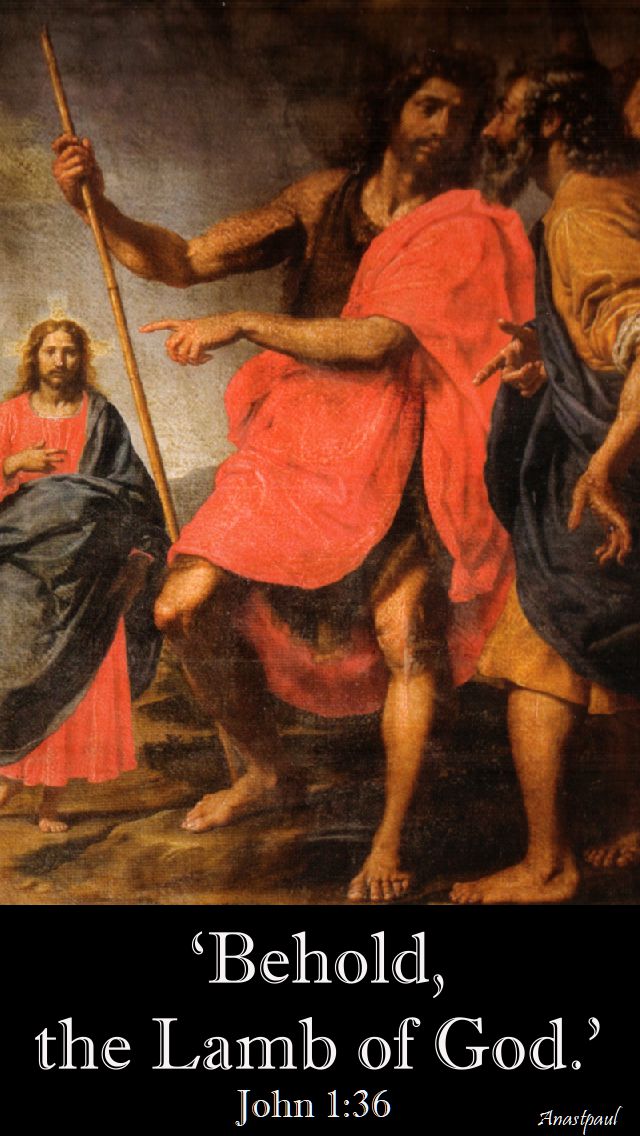
One Minute Reflection – 29 August – The Beheading of St John the Baptist
She went out and said to her mother, “What shall I ask for?” She replied, “The head of John the Baptist.”…Mark 6:24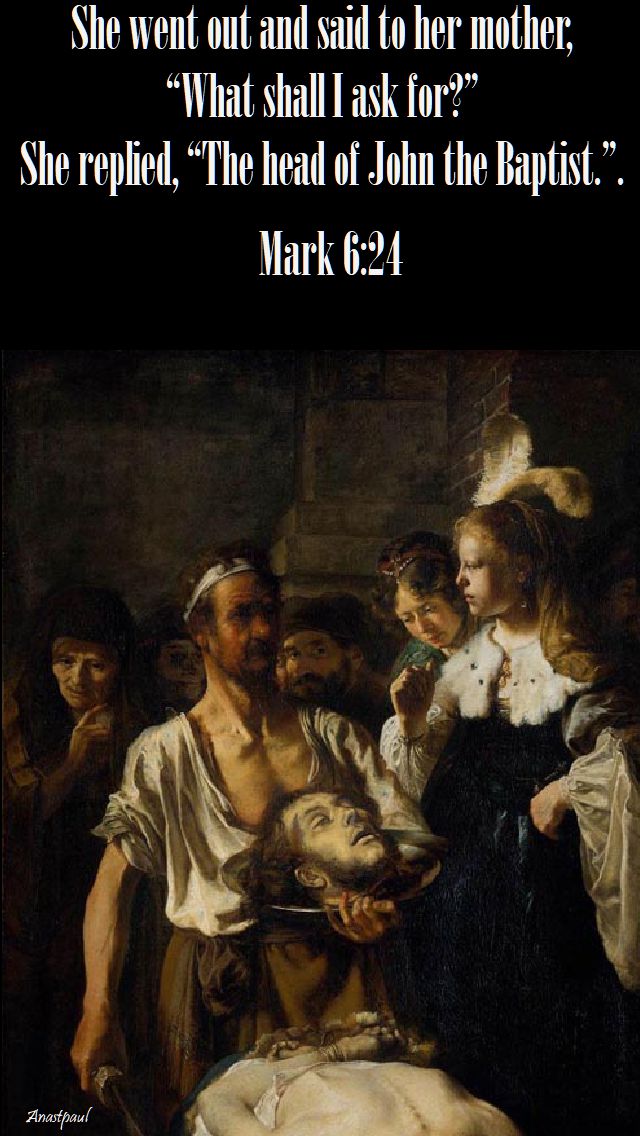
REFLECTION – “O great and admirable mystery! He must increase, but I must decrease, said John, said the voice which personified all the voices that had gone before announcing the Father’s Word Incarnate in His Christ…. But He is said to grow in us, when we grow in Him. To him, then, who draws near to Christ, to him who makes progress in the contemplation of wisdom, words are of little use; of necessity they tend to fail altogether. Thus the ministry of the voice falls short in proportion as the soul progresses towards the Word; it is thus that Christ must increase and John decrease. The same is indicated by the beheading of John and the exaltation of Christ upon the Cross; as it had already been shown by their birthdays: for, from the birth of John the days begin to shorten and from the birth of Our Lord they begin to grow longer.”….St Augustine (354-420)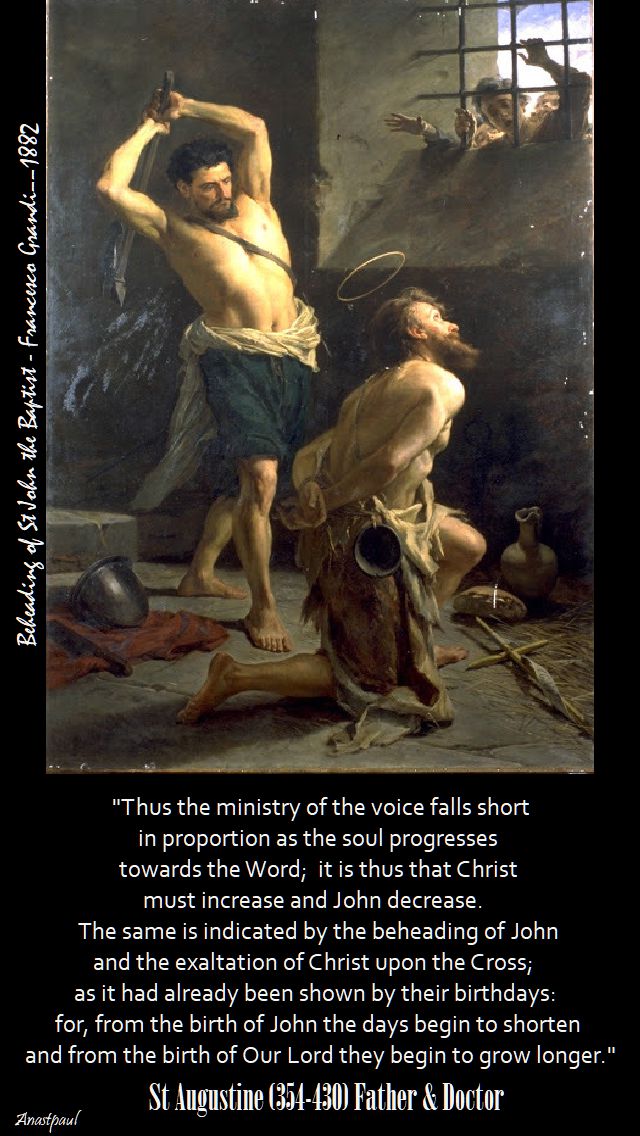
PRAYER – God our Father, You appointed St John The Baptist to be the herald of the birth and death of Christ Your Son. Grant that as he died a martyr for justice and truth, so we may also courageously bear witness to Your Word. St John the Baptist, pray for us, amen.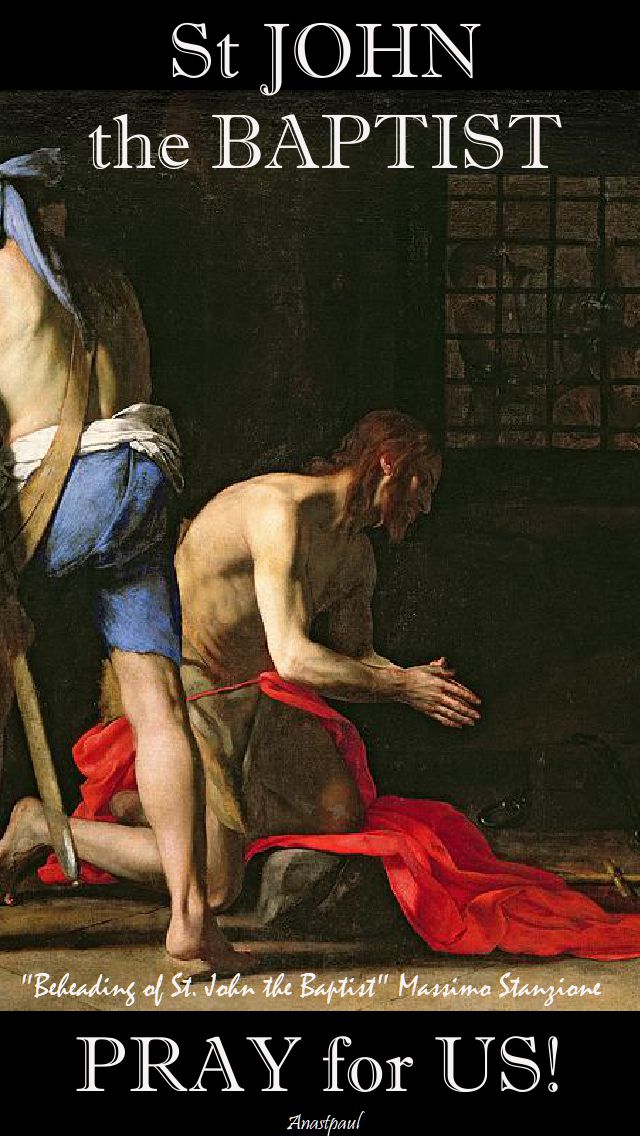
Saint of the Day – The Beheading of St John the Baptist – 29 August (beheaded c 30 at Machaerus) His was buried at Sebaste, Samaria, though the grave was vandalised. The remaining relics in Saint Sylvester’s church, Rome, Italy, and at Amiens, France. The Patronages of St John the Baptist are – against convulsions or spasms, epileptics and against epilepsy, against hail and hailstorms, baptism, bird dealers, converts, convulsive children, cutters, farriers, French Canadians, innkeepers, lambs, monastic life, motorways, printers, tailors, Jordan, Puerto Rico, Knights Hospitaller, Knights of Malta, 13 dioceses, 69 cities. Attributes – cross in hand, lamb, severed head on a platter, skin of an animal, slender cross, tall, thin cross.
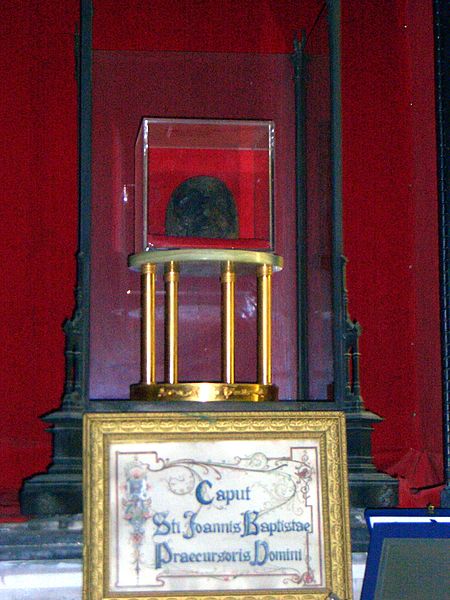
In addition to the feast of the nativity of St. John the Baptist (June 24), the Church, since the fourth century, commemorates the martyrdom of Christ’s precursor. According to the Roman Martyrology, this day marks “the second finding of his most venerable head.” The body of the saint was buried in Samaria. In the year 362 pagans desecrated the grave and burned his remains. Only a small portion of his relics were able to be saved by monks and sent to St Athanasius at Alexandria. The head of the saint is venerated at various places. That in the Church of St Sylvester in Rome belongs to a martyr priest John. Also in the Dominican church at Breslau the Baptist’s head is honoured.
“There is no doubt that blessed John suffered imprisonment and chains as a witness to our Redeemer, whose forerunner he was and gave his life for him. His persecutor had demanded not that he should deny Christ but only that he should keep silent about the truth. Nevertheless, he died for Christ. Does Christ not say: “I am the truth”? Therefore, because John shed his blood for the truth, he surely died for Christ.
Through his birth, preaching and baptising, he bore witness to the coming birth, preaching and baptism of Christ and by his own suffering he showed that Christ also would suffer.
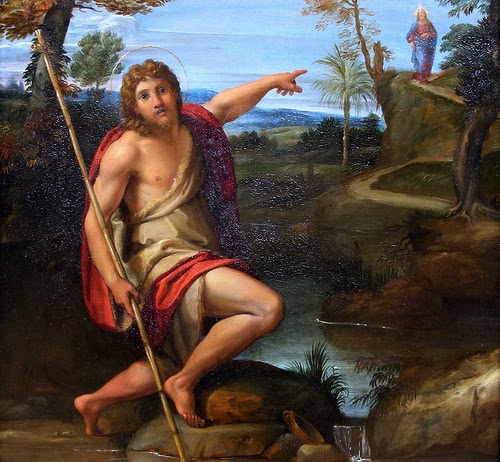
Such was the quality and strength of the man who accepted the end of this present life by shedding his blood after the long imprisonment. He preached the freedom of heavenly peace, yet was thrown into irons by ungodly men. He was locked away in the darkness of prison, though he came bearing witness to the Light of life and deserved to be called a bright and shining lamp by that Light itself, which is Christ.
To endure temporal agonies for the sake of the truth was not a heavy burden for such men as John; rather it was easily borne and even desirable, for he knew eternal joy would be his reward.
Since death was ever near at hand, such men considered it a blessing to embrace it and thus gain the reward of eternal life by acknowledging Christ’s name. Hence the apostle Paul rightly says: “You have been granted the privilege not only to believe in Christ but also to suffer for his sake.” He tells us why it is Christ’s gift that his chosen ones should suffer for him: “The sufferings of this present time are not worthy to be compared with the glory that is to be revealed in us.” (Saint Bede the Venerable)


The Beheading/Passion of John the Baptist (Memorial)
—
Our Lady of Tears: On March 8th, 1930, the Virgin appeared to a religious from the Institute of the Missionary Sisters of Jesus Crucified, Amalia Aguirre of the Savior Scourged: “I was in the chapel when I suddenly felt that I was lifting up. I saw a lady of indescribable beauty approach me.”
She was dressed in a purple dress, a blue cloak and a white veil that covered even the chest. The Most Holy Virgin, would display a rosary with her tears, for converting sinners. Devotion to this Rosary, was approved by Bishop Francisco Campos Barreto, Bishop of Campinas, who not only allowed the recognition of the events, but he did his utmost to spread everywhere the commemorative medal of Our Lady of Tears, the source of many conversions and graces.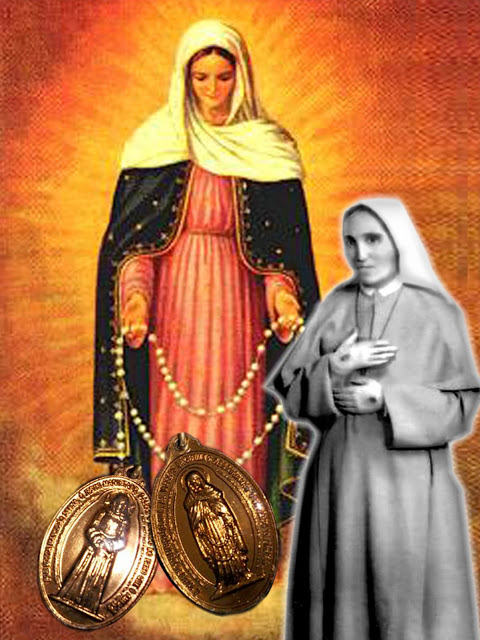
Our Lady of the Guard: In 1214 maître (master) Pierre, a priest of Marseille, was inspired to build a chapel dedicated to the Virgin Mary on the hill known as La Garde, which belonged to the abbey of Saint-Victor. The abbot granted him permission to plant vines, cultivate a garden and build a chapel. The chapel, completed four years later, appears in an 18 June 1218 papal bull by Pope Honorius III listing the possessions of the abbey. After maître Pierre died in 1256, Notre-Dame de la Garde became a priory. The prior of the sanctuary was also one of four claustral priors of Saint-Victor.
From the time the chapel was founded, surviving wills show bequests in its favour. Also, sailors who survived shipwrecks gave thanks and deposited ex-votos at Notre-Dame of the Sea in the church of Notre-Dame-du-Mont. Towards the end of the 16th century they began going to Notre-Dame de la Garde instead.
The first chapel was replaced at the beginning of the 15th century by a larger building with a richly equipped chapel dedicated to Saint Gabriel. (https://www.youtube.com/watch?v=Y1c7Lsbtm-4)
—
St Adelphus
St Adausia of Rome
St Alberic of Bagno de Romagna
St Basilia of Sirmium
St Candida of Rome
Bl Dominik Jedrzejewski
Bl Edmund Rice
St Edwold the Hermit
St Eufrasia of the Sacred Heart of Jesus Eluvathingal
St Euthymius of Perugia
Bl Filippa Guidoni
St Jeanne Jugan
Bl John of Perugia
St Louis-Wulphy Huppy
St Maximian of Vercelli
St Medericus
St Nicaeus of Antioch
St Paul of Antioch
Bl Peter of Sassoferrato
St Repositus of Velleianum
Bl Richard Herst
St Sabina of Rome
St Sabina of Troyes
Bl Sancja Szymkowiak
St Sator of Velleianum
St Sebbe of Essex
Bl Teresa Bracco
St Velleicus
St Victor of La Chambon
St Vitalis of Velleianum
—
Martyred in the Spanish Civil War:
Bl Constantino Fernández Álvarez
Bl José Almunia López-Teruel
Bl Josep Maria Tarín Curto
Bl Pedro Asúa Mendía
Thought for the Day – 28 August – The Memorial of St Augustine (354-430) Father & Doctor of Grace
A Christian at 33, a priest at 36, a bishop at 41: Many people are familiar with the biographical sketch of Augustine of Hippo, sinner turned saint. But really to get to know the man is a rewarding experience.
There quickly surfaces the intensity with which he lived his life, whether his path led away from or toward God. The tears of his mother, the instructions of Ambrose and, most of all, God himself speaking to him in the Scriptures, redirected Augustine’s love of life to a life of love.
Having been so deeply immersed in creature-pride of life in his early days and having drunk deeply of its bitter dregs, it is not surprising that Augustine should have turned, with a holy fierceness, against the many demon-thrusts rampant in his day. His times were truly decadent: politically, socially, morally. He was both feared and loved, like the Master. The perennial criticism leveled against him: a fundamental rigorism.
In his day, Augustine providentially fulfilled the office of prophet. Like Jeremiah and other greats, he was hard-pressed but could not keep quiet. “I say to myself, I will not mention him,/I will speak in his name no more./But then it becomes like fire burning in my heart,/imprisoned in my bones;/I grow weary holding it in,/I cannot endure it” (Jeremiah 20:9).
Augustine is still acclaimed (and condemned) in our day. He is a prophet for today, trumpeting the need to scrap escapisms and stand face-to-face with personal responsibility and dignity. (Fr Don Miller OFM – Saint of the Day)
St Augustine, our Father in Faith, pray for us now and at the hour of our death!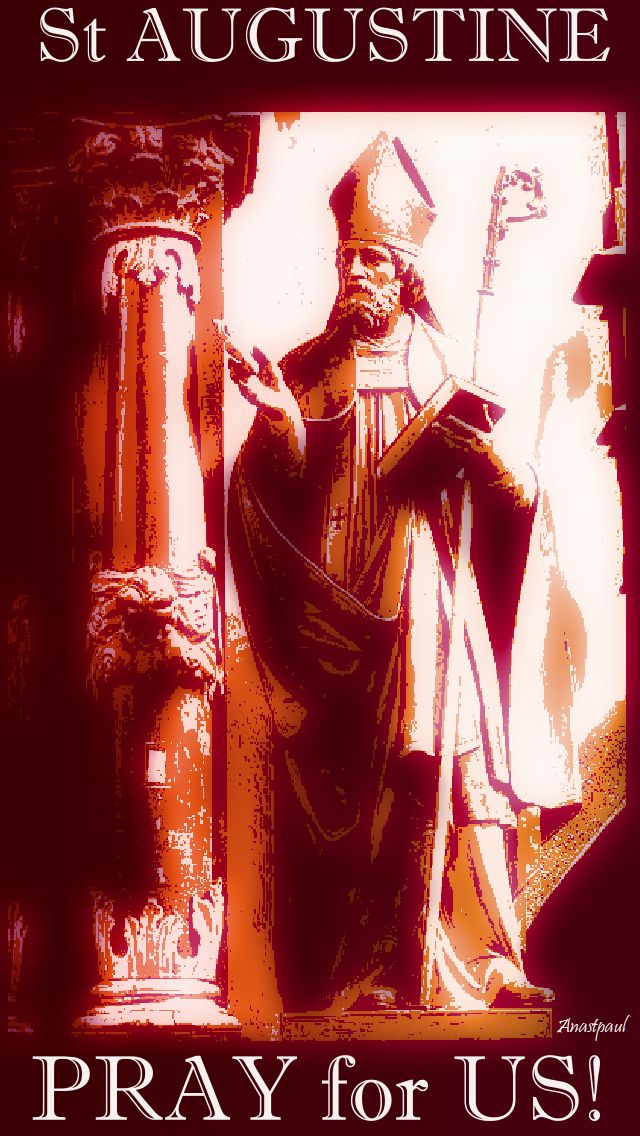
Today, 28 August – the Memorial of St Augustine, I am reposting this legend of St Augustine, the Holy Trinity, the Child and the Seashell.
St Augustine, the Holy Trinity, the Child and the SeaShell
Today, 11 June 2017, on the Solemnity of the Holy Trinity, we remember the legend of St Augustine and the Seashell.
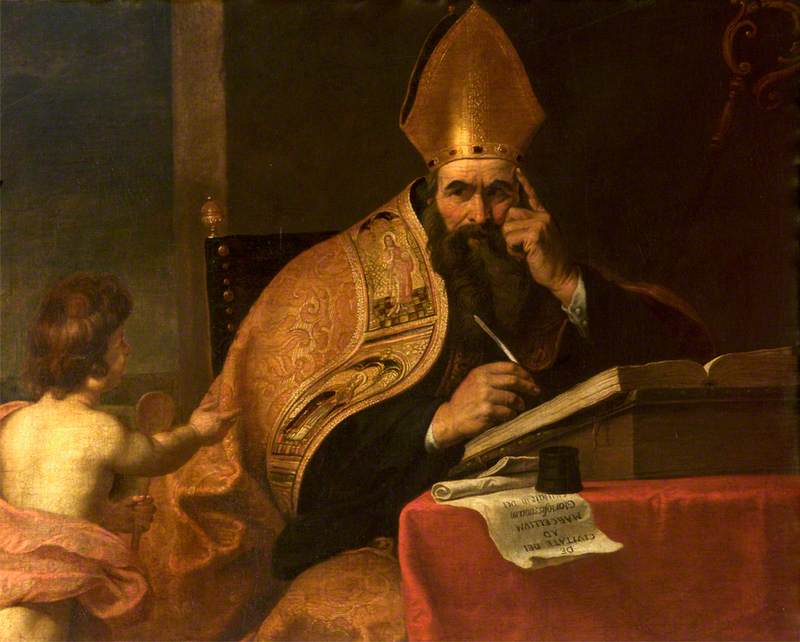
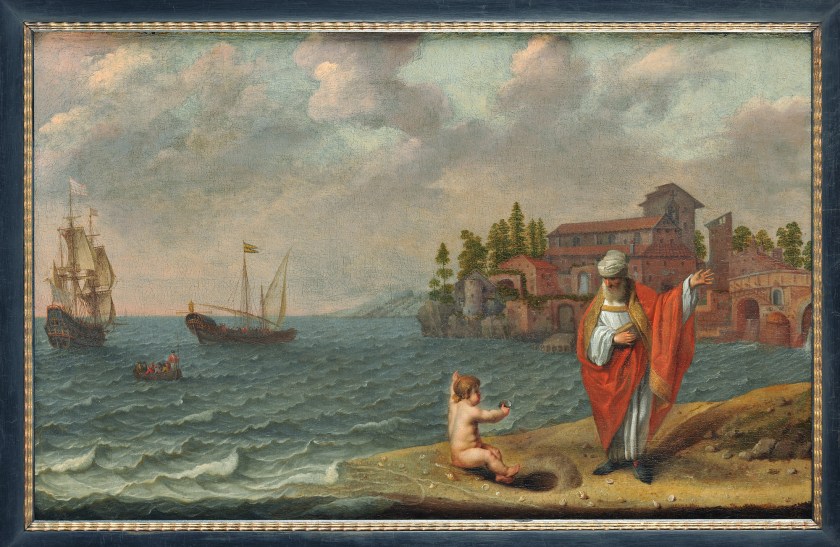 Abraham Willaerts – St Augustine and the Child
The great Doctor of the Church St. Augustine of Hippo spent over 30 years working on his treatise De Trinitate [about the Holy Trinity], endeavouring to conceive an intelligible explanation for the mystery of the Trinity.
He was walking by the seashore one day contemplating and trying to understand the mystery of the Holy Trinity when he saw a small boy running back and forth from the water to a spot on the seashore. The boy was using a sea shell to carry the water from the ocean and place it into a small hole in the sand.
The Bishop of Hippo approached him and asked, “My boy, what are…
View original post 163 more words
Quote/s of the Day – 28 August – The Memorial of St Augustine
“To fall in love with God is the greatest romance;
to seek Him the greatest adventure;
to find Him the greatest human achievement.”

“You ask what you might offer to God?
Offer yourself!
What does God expect from you, except yourself?”
“One of the holiest works,
one of the best exercises of piety
which we can practice in this world,
is to offer sacrifices, alms and prayer for the dead.”
“Conquer yourself and the world lies at your feet.”
“God has no need of your money
but the poor have.
You give it to the poor and God receives it.”
“Our life and our death are with our neighbour.”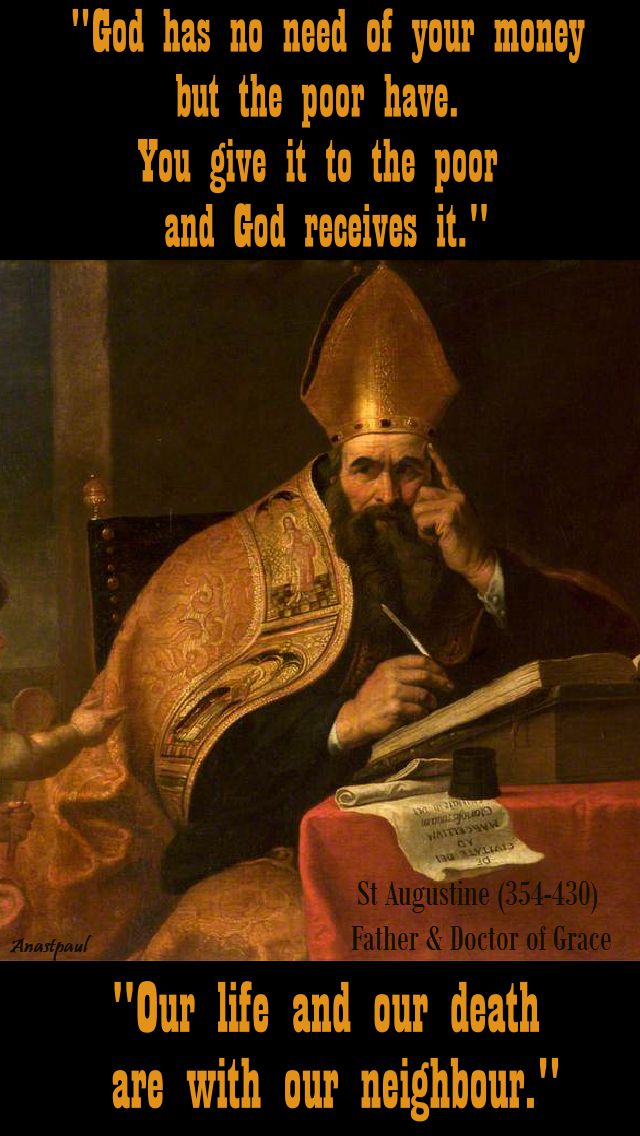
“Do you wish to RISE?
Begin by DESCENDING.
You plan a tower that will pierce the CLOUDS?
Lay first the foundation of HUMILITY”
“I will suggest a means whereby
you can praise God all day long, if you wish.
Whatever you do, do it well and you have praised God.”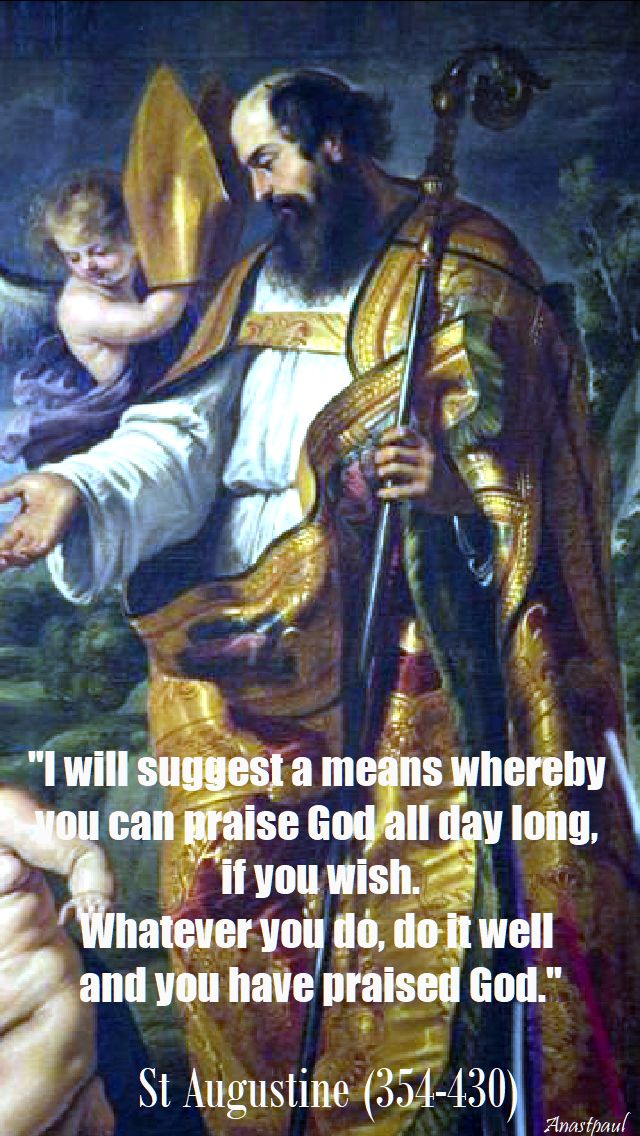
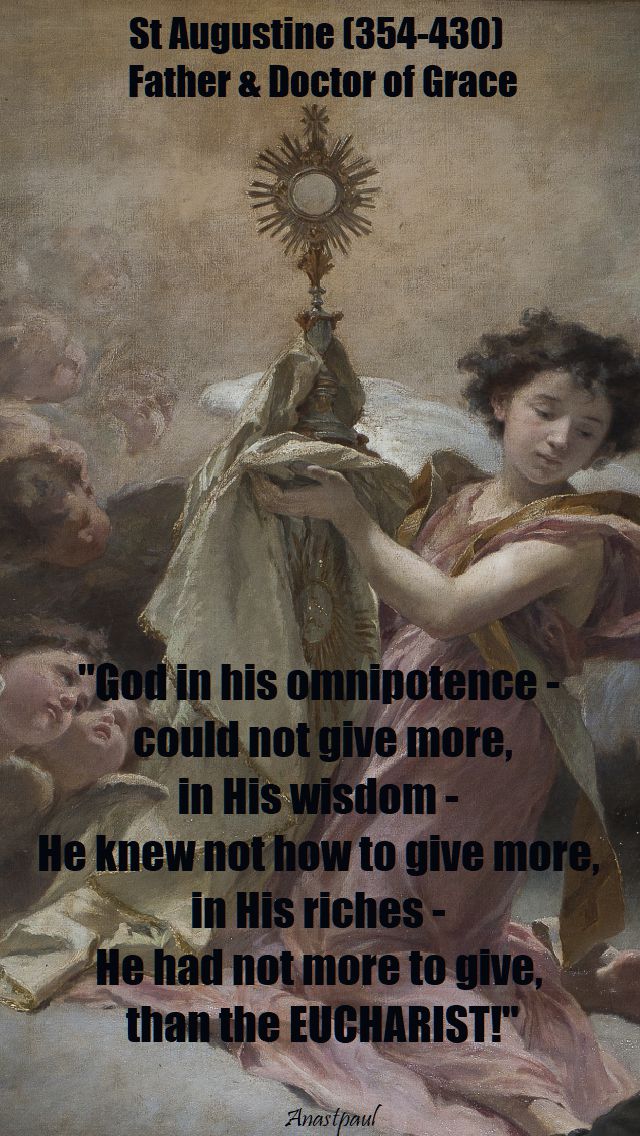
“God in his omnipotence could not give more,
in His wisdom: He knew not how to give more,
in His riches: He had not more to give,
than the EUCHARIST!”
“God does not command impossibilities
but by commanding, admonishes you do what you can
and to PRAY for what you cannot
and AIDS you that you may be able.”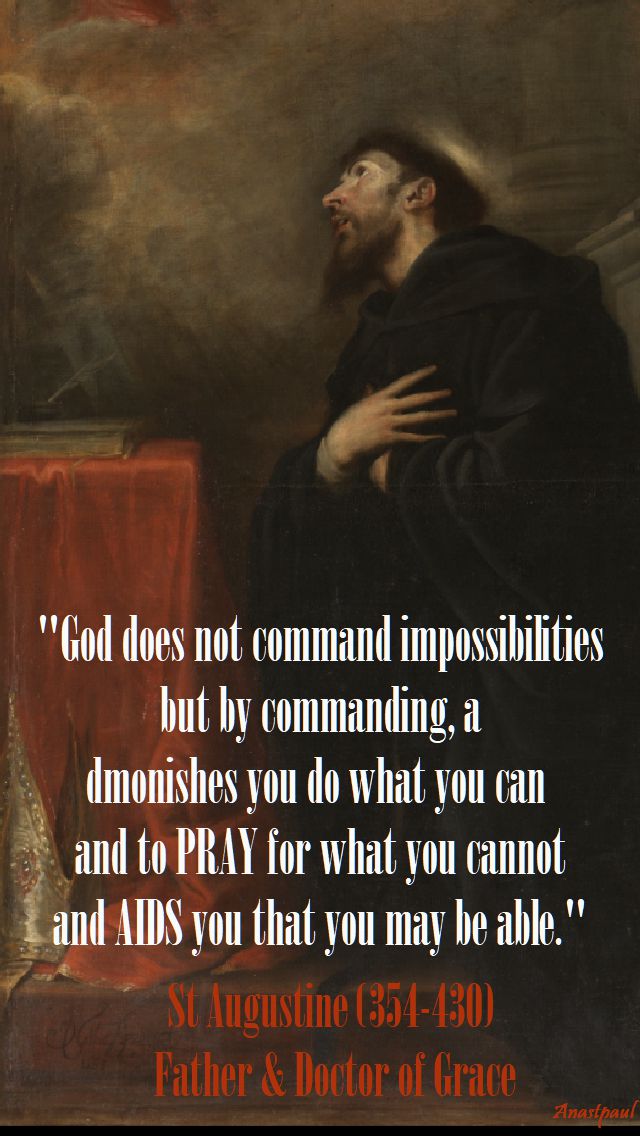
Our Morning Offering – August 28 – The Memorial of St Augustine (354-430) – Doctor of Grace
Only You!
By ST AUGUSTINE
Lord Jesus, let me know myself and know You
and desire nothing save only You.
Let me hate myself and love You.
Let me do everything for the sake of You.
Let me humble myself and exalt You.
Let me think of nothing except You.
Let me die to myself and live in You.
Let me accept whatever happens as from You.
Let me banish self and follow You
and ever desire to follow You.
Let me fly from myself and take refuge in You,
That I may deserve to be defended by You.
Let me fear for myself.
Let me fear You
and let me be among those who are chosen by You.
Let me distrust myself and put my trust in You.
Let me be willing to obey for the sake of You.
Let me cling to nothing save only to You,
And let me be poor because of You.
Look upon me, that I may love You.
Call me that I may see You and for ever enjoy You.
Amen
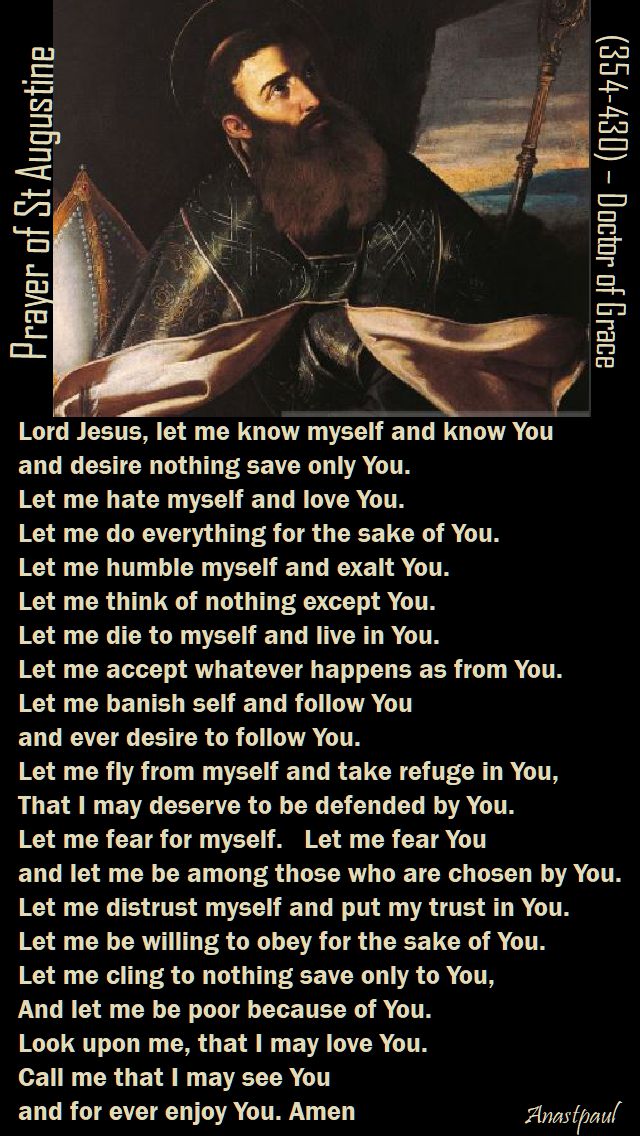
Saint of the Day – 28 August – St Augustine (354-430) born Augustinus Aurelius (13 November 354 at Tagaste, Numidia, North Africa (Souk-Ahras, Algeria) – 28 August 430 at Hippo, North Africa) – Doctor of Grace and one of the original Four Fathers & Doctors of the Latin Church – Bishop, Theologian, Philosopher, Rhetorician, Writer, Preacher, Teacher, Advisor, Reformer, Confessor, Apologist, Apostle of Charity. PATRONAGES – of theologians, brewers, printers, 7 Diocese, 7 Cities, against sore eyes, eye diseases, against vermin. Attributes – Child; dove; pen; shell, pierced heart, holding book with a small church, bishop’s staff, mitre, flaming heart, an allusion to a passage in his Confessions.
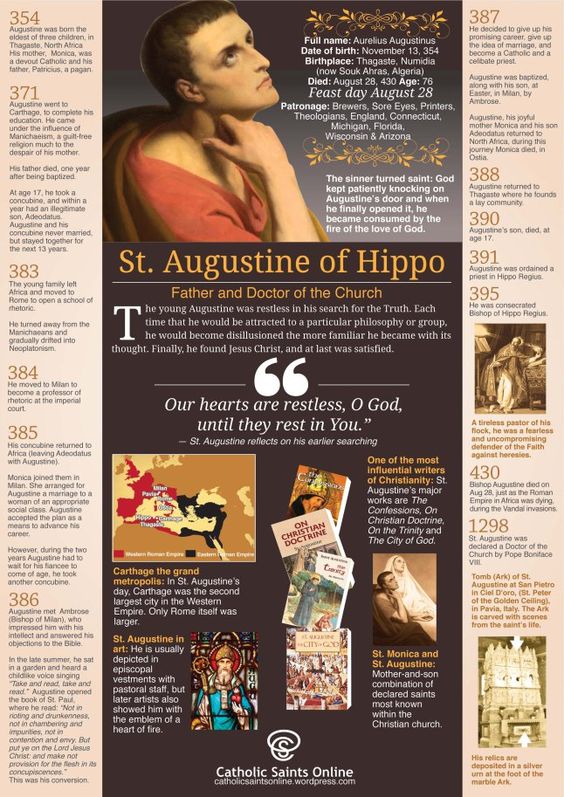
Augustine was born in the year on 13 November in 354 AD in the municipium of Thagaste (now Souk Ahras, Algeria) in Roman Africa. His mother, Monica, was a devout Christian; his father Patricius was a Pagan who converted to Christianity on his deathbed. Scholars generally agree that Augustine and his family were Berbers, an ethnic group indigenous to North Africa but that they were heavily Romanized, speaking only Latin at home as a matter of pride and dignity. In his writings, Augustine leaves some information as to the consciousness of his African heritage. For example, he refers to Apuleius as “the most notorious of us Africans,” to Ponticianus as “a country man of ours, insofar as being African”and to Faustus of Mileve as “an African Gentleman.”
Augustine’s family name, Aurelius, suggests that his father’s ancestors were freedmen of the gens Aurelia given full Roman citizenship by the Edict of Caracalla in 212. Augustine’s family had been Roman, from a legal standpoint, for at least a century when he was born. It is assumed that his mother, Monica, was of Berber origin, on the basis of her name but as his family were an upper class of citizens known as honorable men, Augustine’s first language is likely to have been Latin.
Augustine Aurelius still unbaptised and burning for knowledge, he came under the influence of the Manicheans, which caused his mother intense sorrow. He left Africa for Rome, deceiving his mother, who was ever anxious to be near him. She prayed and wept. A bishop consoled her by observing that a son of so many tears would never be lost. Yet the evil spirit drove him constantly deeper into moral degeneracy, capitalising on his leaning toward pride and stubbornness. Grace was playing a waiting game; there still was time and the greater the depths into which the evil spirit plunged its fledgling, the stronger would be the reaction.
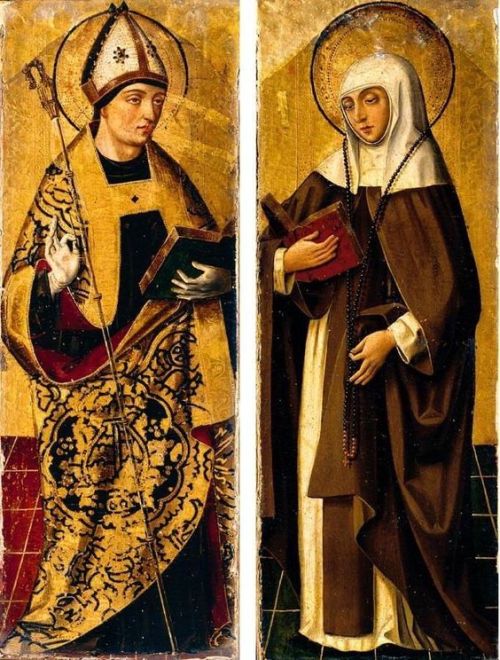
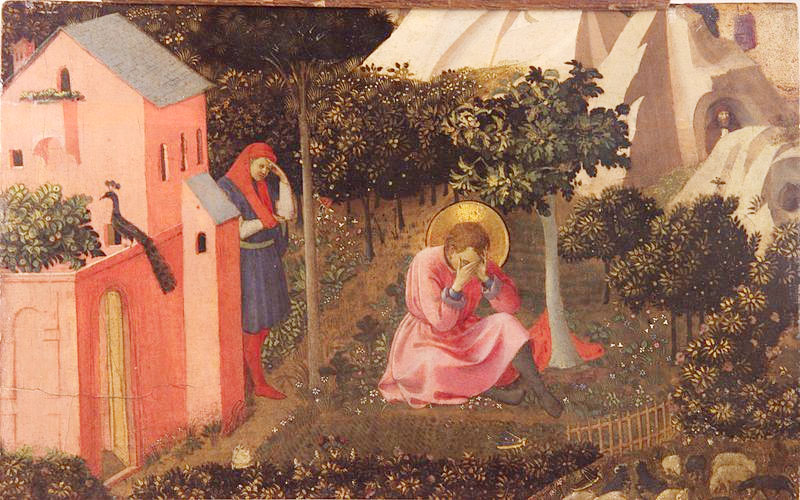
Augustine recognised this vacuum; he saw how the human heart is created with a great abyss; the earthly satisfactions that can be thrown into it are no more than a handful of stones that hardly cover the bottom. And in that moment grace was able to break through: Restless is the heart until it rests in God. The tears of his mother, the sanctity of Milan’s Bishop Ambrose, the book of St Anthony the hermit and the sacred Scriptures wrought his conversion, which was sealed by baptism on Easter night 387. Augustine’s mother went to Milan with joy and witnessed her son’s baptism. It was what it should have been, the greatest event of his life, his conversion — metanoia. Grace had conquered. Augustine accompanied his mother to Ostia, where she died. She was eager to die, for now she had given birth to her son for the second time.
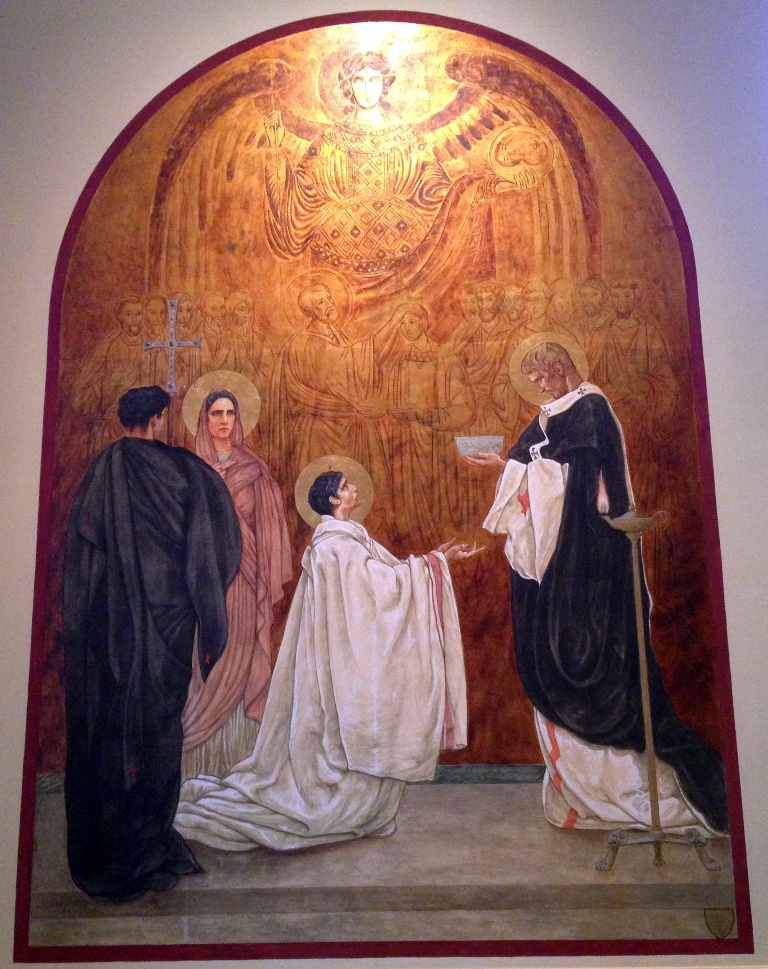
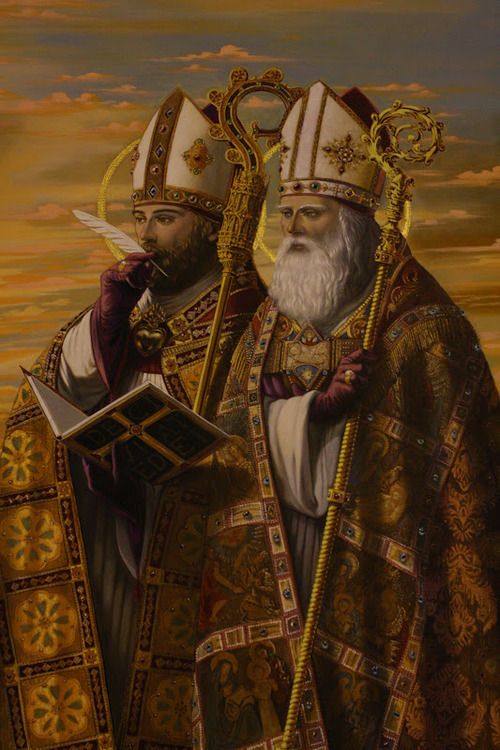
In 388 he returned to Tagaste, where he lived a common life of prayer and solitude with his friends. In 391 he was ordained priest at Hippo, in 394 made coadjutor to bishop Valerius and then from 396 to 430 bishop of Hippo.
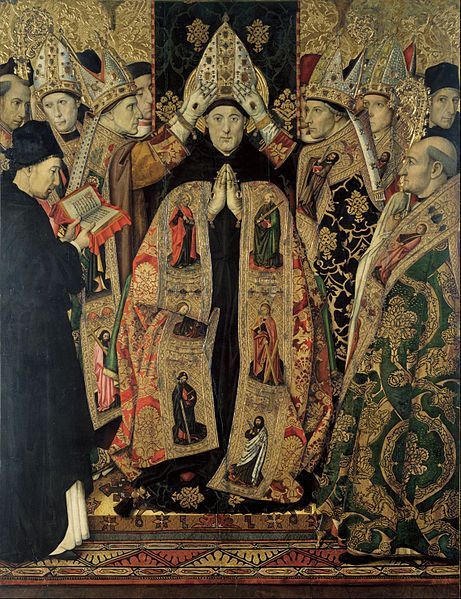
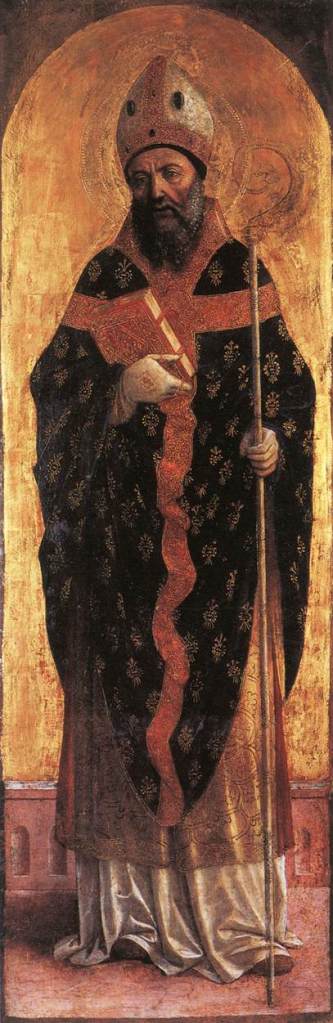
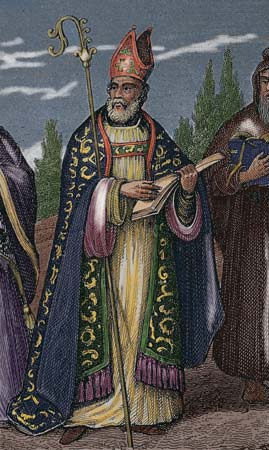
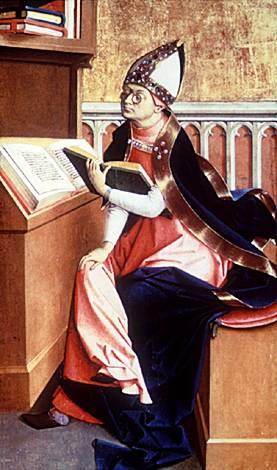
Augustine, numbered among the four great Doctors of the Western Church, possessed one of the most penetrating minds of ancient Christendom. He was the most important Platonist of patristic times, the Church’s most influential theologian, especially with regard to clarifying the dogmas of the Trinity, grace and the Church. He was a great speaker, a prolific writer, a saint with an inexhaustible spirituality. His Confessions, a book appreciated in every age, describes a notable portion of his life (until 400), his errors, his battles, his profound religious observations. Famous too is his work The City of God, a worthy memorial to his genius, a philosophy of history. Most edifying are his homilies, especially those on the psalms and on the Gospel of St. John.
Augustine’s episcopal life was filled with mighty battles against heretics, over all of whom he triumphed. His most illustrious victory was that over Pelagius, who denied the necessity of grace; from this encounter he earned the surname “Doctor of grace.” As an emblem Christian art accords him a burning heart to symbolise the ardent love of God which permeates all his writings. He is the founder of canonical life in common; therefore Augustinian monks and the Hermits of St. Augustine honour him as their spiritual father.
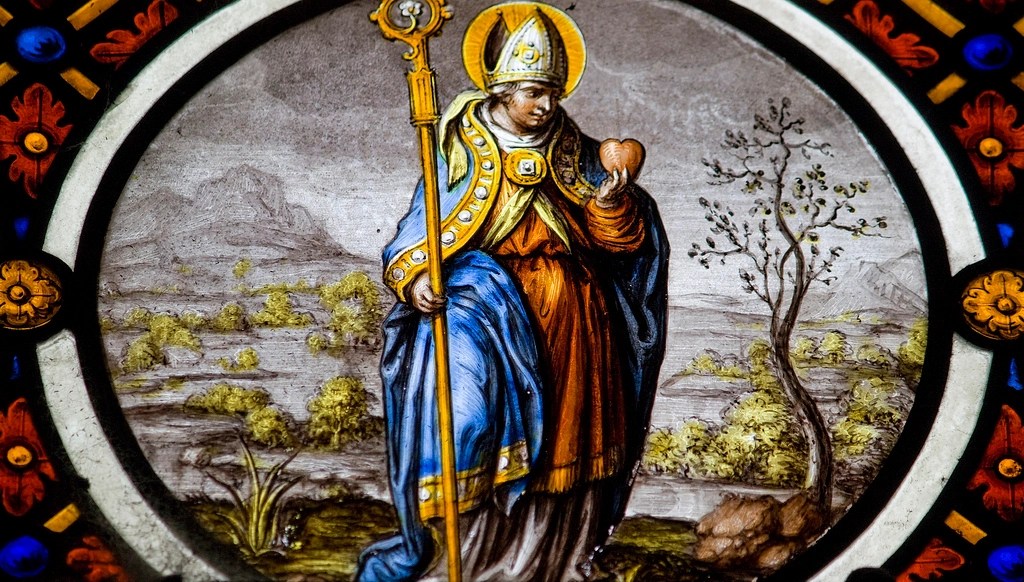
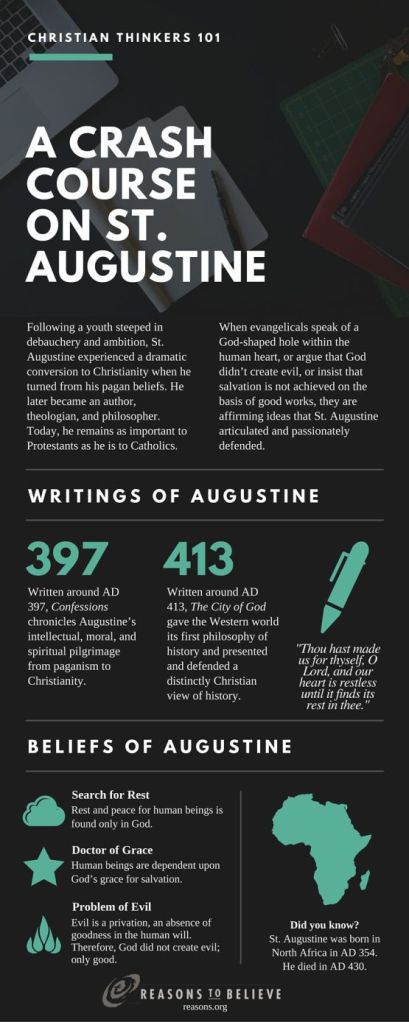
As bishop, Augustine worked tirelessly for his people. He fought false religious teachings, protected the people from corrupt officials and invaders and cared for the sick, the poor and those in prison. His many sermons, letters and books reflect the ever-deepening love he felt for God. He wisely observed: “You have made us, O God, for yourself, and our hearts shall find no rest until they rest in you.”
He wrote and advised bishops, popes and councils. His influence on the Church and his fight against heresy were exceptional. He was loved by many, for he had struggled much and could help others who were struggling.
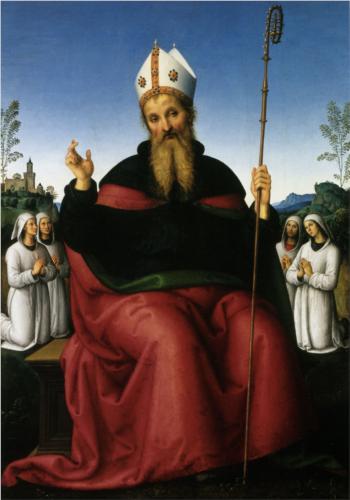
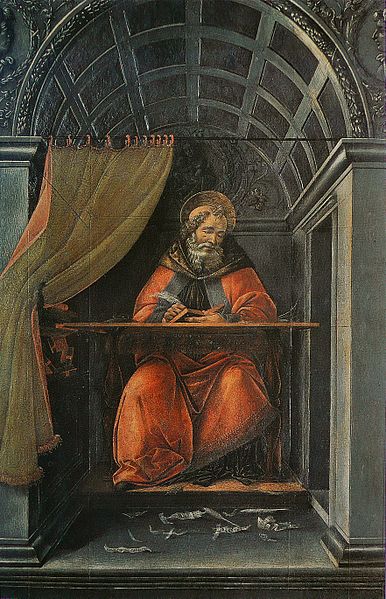
In 430 Vandals invaded the province. For three months Augustine inspired Christian hope in his people. According to Possidius, Augustine spent his final days in prayer and repentance, requesting that the penitential Psalms of David be hung on his walls so that he could read them. vv He directed that the library of the church in Hippo and all the books therein should be carefully preserved. He died on 28 August 430. Shortly after his death, the Vandals lifted the siege of Hippo but they returned not long thereafter and burned the city. They destroyed all of it but Augustine’s cathedral and library, which they left untouched.
St Bede’s True Martyrology, recounts that Augustine’s body was later translated or moved to Cagliari, Sardinia, by the Catholic bishops expelled from North Africa by Huneric. Around 720, his remains were transported again by Peter, bishop of Pavia and uncle of the Lombard king Liutprand, to the church of San Pietro in Ciel d’Oro in Pavia, in order to save them from frequent coastal raids by Muslims. In January 1327, Pope John XXII issued the papal bull Veneranda Santorum Patrum, in which he appointed the Augustinians guardians of the tomb of Augustine (called Arca), which was remade in 1362 and elaborately carved with bas-reliefs of scenes from Augustine’s life.
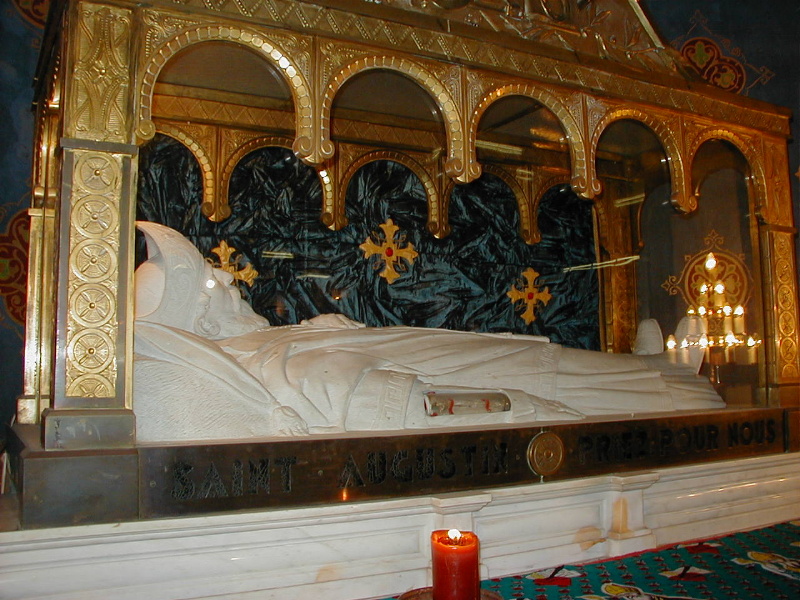
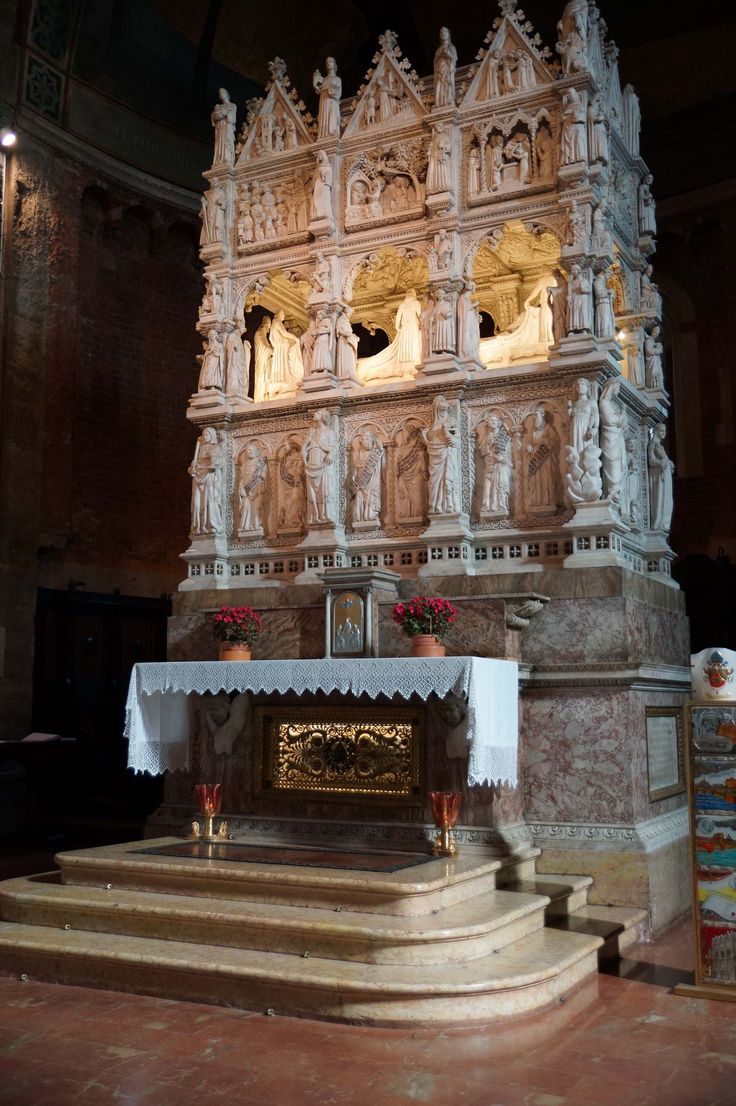
St Augustine of Hippo (Memorial) – https://www.youtube.com/watch?v=yAWJFbUYT_w
—
Bl Adelindis of Buchau
St Agnes of Cologne
St Alexander of Constantinople
Bl Alfons Maria Mazurek
St Ambrose of Saintes
Bl Angelo da Pesche d’Isernia
St Anthes of Salerno
Bl Charles-Arnold Hanus
St Edmund Arrowsmith
St Facundinus of Taino
St Felix of Venosa
St Fortunatus of Salerno
St Gaius of Salerno
St Gorman of Schleswig
Bl Henry Webley
St Hermes of Rome
Bl Hugh More
Bl James Claxton
St Januarius of Venosa
St Joaquina Vedruna de Mas
St Julian of Auvergne
St Junipero Serra
St Moses the Black
St Pelagius of Istria
St Restitutus of Carthage
St Rumwold the Prince
St Septiminus of Venosa
St Vivian of Saintes
Bl William Dean
—
Martyred in the Spanish Civil War:
Martyrs of Griñon – 10 beati
Martyrs of Tarragona – 6 beati
• Blessed Agustín Bermejo Miranda
• Blessed Alejandro Iñiguez De Heredia Alzola
• Blessed Andrés Merino Báscones
• Blessed Antonio Solá Garriga
• Blessed Arturo Ros Montalt
• Blessed Aurelio da Vinalesa
• Blessed Celestino Ruiz Alegre
• Blessed Cesáreo España Ortiz
• Blessed Eladi Peres Bori
• Blessed Evencio Castellanos López
• Blessed Francisco López Navarette
• Blessed Germán Arribas y Arribas
• Blessed Graciliano Ortega Narganes
• Blessed Isidre Fábregas Gils
• Blessed Jaume Tarragó Iglesias
• Blessed Javier Pradas Vidal
• Blessed Joan Tomás Gibert
• Blessed Joaquim Oliveras Puljarás
• Blessed José Gorastazu Labayen
• Blessed Josep Camprubí Corrubí
• Blessed Juan Bautista Faubel Cano
• Blessed Lázaro Ruiz Peral
• Blessed Manoel José Sousa de Sousa
• Blessed Modest Godo Buscato
• Blessed Modest Pamplona Falguera
• Blessed Nicolás Rueda Barriocanal
• Blessed Serviliano Solá Jiménez
• Blessed Teodoro Pérez Gómez
On St Monica’s Memorial, let us pray for her intercession that the Lord may grant us patience, fortitude and trust – 27 August :
Prayer for the intercession of St Monica
Dear St. Monica,
troubled wife and mother,
many sorrows pierced your heart
during your lifetime.
Yet, you never despaired or lost faith.
With confidence, persistence
and profound faith,
you prayed daily for the conversion
of your husband
and your beloved son, Augustine;
your prayers were answered.
Grant me that same fortitude, patience,
and trust in the Lord.
Intercede for me, dear St. Monica,
that God may favorably hear my plea for
……………………………
(Mention your intention here)
and grant me the grace
to accept His Will in all things,
through Jesus Christ, our Lord,
in the unity of the Holy Spirit,
one God, forever and ever.
Amen
St Monica, pray for us!
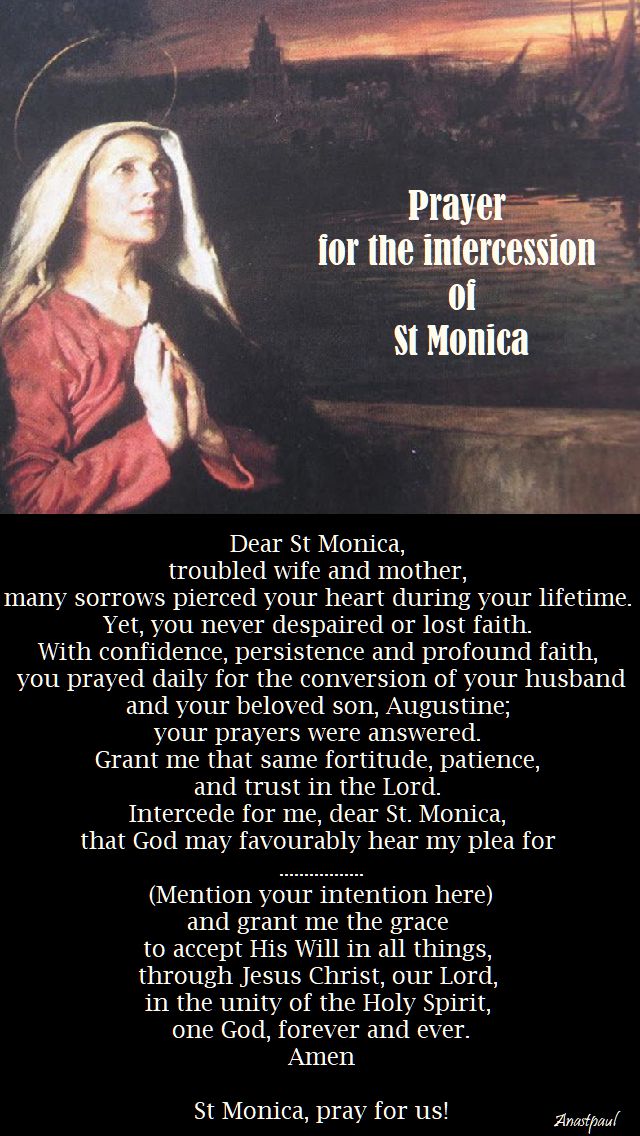
Thought for the day – 27 August – The Memorial of St Monica
Today we celebrate the memorial of St Monica, the mother of St Augustine, whose memorial we will celebrate tomorrow.
We celebrate this memorial not simply because St Monica was the mother of a great saint.
The opening prayer for Mass goes like this and it is worthwhile to take note: ‘God of mercy, comfort of those in sorrow, the tears of St Monica moved you to convert her son, St Augustine to the faith of Christ.’
All in all, she prayed for something like 30 years before she finally had the joy of seeing St Augustine baptised.
St Monica enfleshed the words which we hear in the 1st reading: ‘May our Lord Jesus Christ and God our Father, who has given us His love and through His grace, such inexhaustible comfort and such sure hope, comfort you and strengthen you.’
The consolation, experienced by St Monica and her total abandonment to God can also be ours today when we persevere in patience and in trust – this is Monica’s lesson – keep on praying good folk, for God hears you!
St Monica, pray for us!
“The day was now approaching when my mother Monica would depart from this life; You know that day, Lord, though we did not. She and I happened to be standing by ourselves at a window that overlooked the garden in the courtyard of the house. At the time we were in Ostia on the Tiber. And so the two of us, all alone, were enjoying a very pleasant conversation, “forgetting the past and pushing on to what is ahead..” We were asking one another in the presence of the Truth – for You are the Truth – what it would be like to share the eternal life enjoyed by the saints, which “eye has not seen, nor ear heard, which has not even entered into the heart of man.” We desired with all our hearts to drink from the streams of your heavenly fountain, the fountain of life. That was the substance of our talk, though not the exact words. But You know, O Lord, that in the course of our conversation that day, the world and its pleasures lost all their attraction for us. My mother said, “Son, as far as I am concerned, nothing in this life now gives me any pleasure. I do not know why I am still here, since I have no further hopes in this world. I did have one reason for wanting to live a little longer: to see you become a Catholic Christian before I died. God has lavished His gifts on me in that respect, for I know that you have even renounced earthly happiness to be his servant. So what am I doing here?” I do not really remember how I answered her. Shortly, within five days or thereabouts, she fell sick with a fever. Then one day during the course of her illness she became unconscious and for a while she was unaware of her surroundings. My brother and I rushed to her side but she regained consciousness quickly. She looked at us as we stood there and asked in a puzzled voice: “Where was I?” We were overwhelmed with grief, but she held her gave steadily upon us, and spoke further: “Here you shall bury your mother.” I remained silent as I held back my tears. However, my brother haltingly expressed his hope that she might not die in a strange country but in her own land, since her end would be happier there. When she heard this, her face was filled with anxiety and she reproached him with a glance because he had entertained such earthly thoughts. Then she looked at me and spoke: “Look what he is saying.” Thereupon she said to both of us, “Bury my body wherever you will; let not care of it cause you any concern. One thing only I ask you, that you remember me at the altar of the Lord wherever you may be.” Once our mother had expressed this desire as best she could, she fell silent as the pain of her illness increased.” – from the Confessions of Saint Augustine
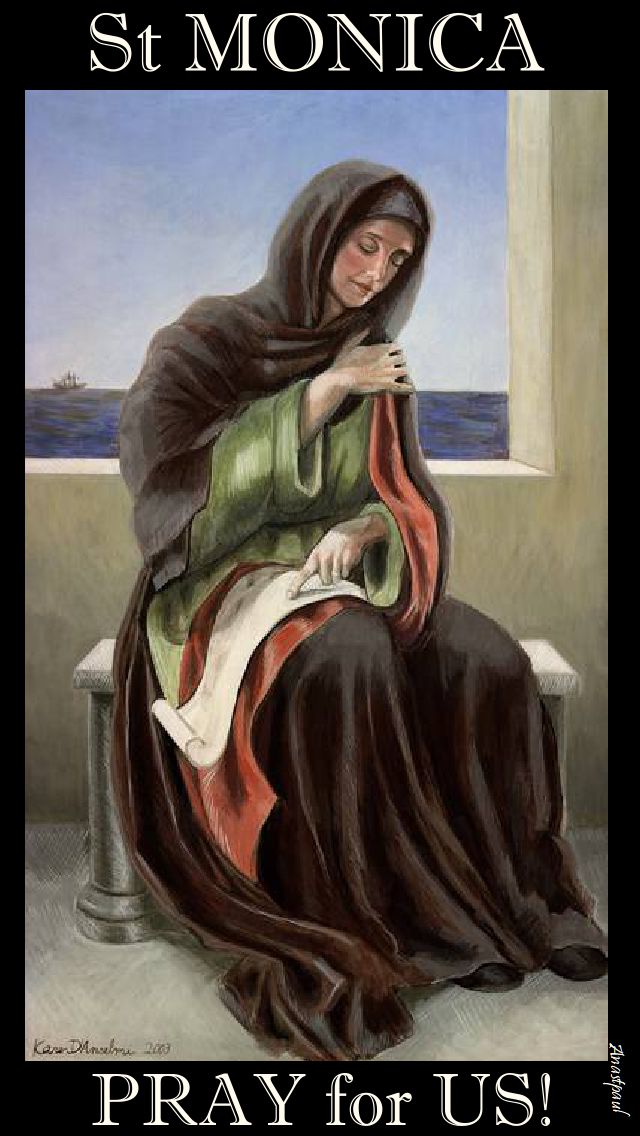
Quote of the Day – 27 August – The Memorial of St Monica
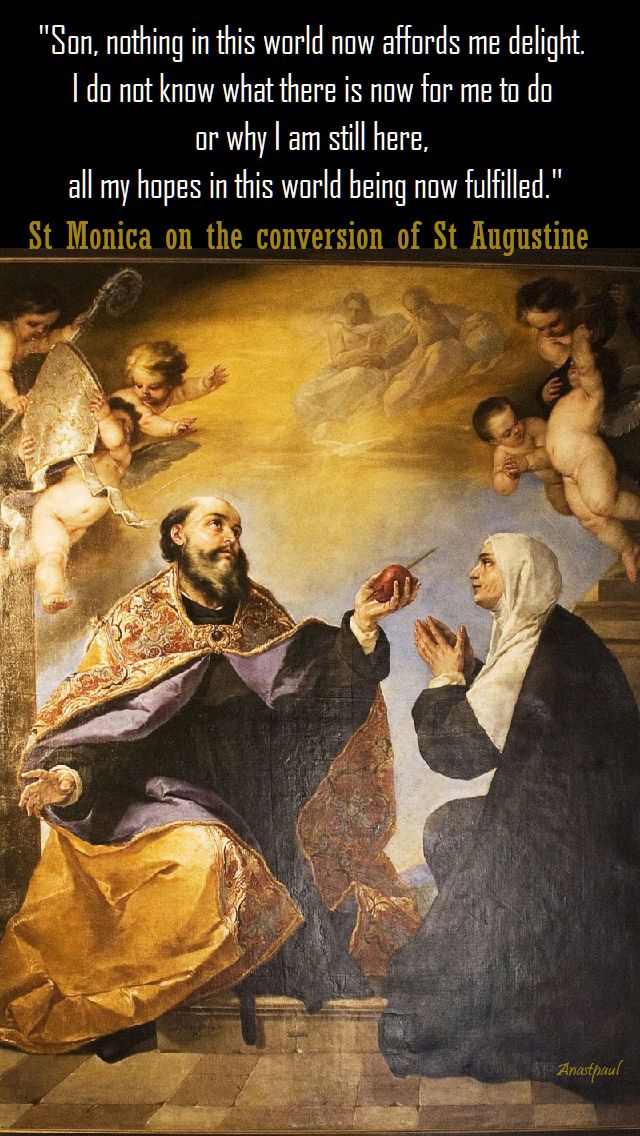
“Son, nothing in this world now affords me delight.
I do not know what there is now for me to do
or why I am still here,
all my hopes in this world being now fulfilled.”
One Minute Reflection – 27 August – The Memorial of St Monica
My human life … is a life of faith in the Son of God,
who loved me and gave himself for me….Galatians 2:20
REFLECTION – “How many difficulties there are also today in family relationships
and how many mothers are anguished because their children choose mistaken ways!
Monica, a wise and solid woman in the faith, invites us not to be discouraged
but to persevere in our mission of wives and mothers,
maintaining firm our confidence in God and clinging with perseverance to prayer.”
… Pope Benedict XVI (27 August 2006)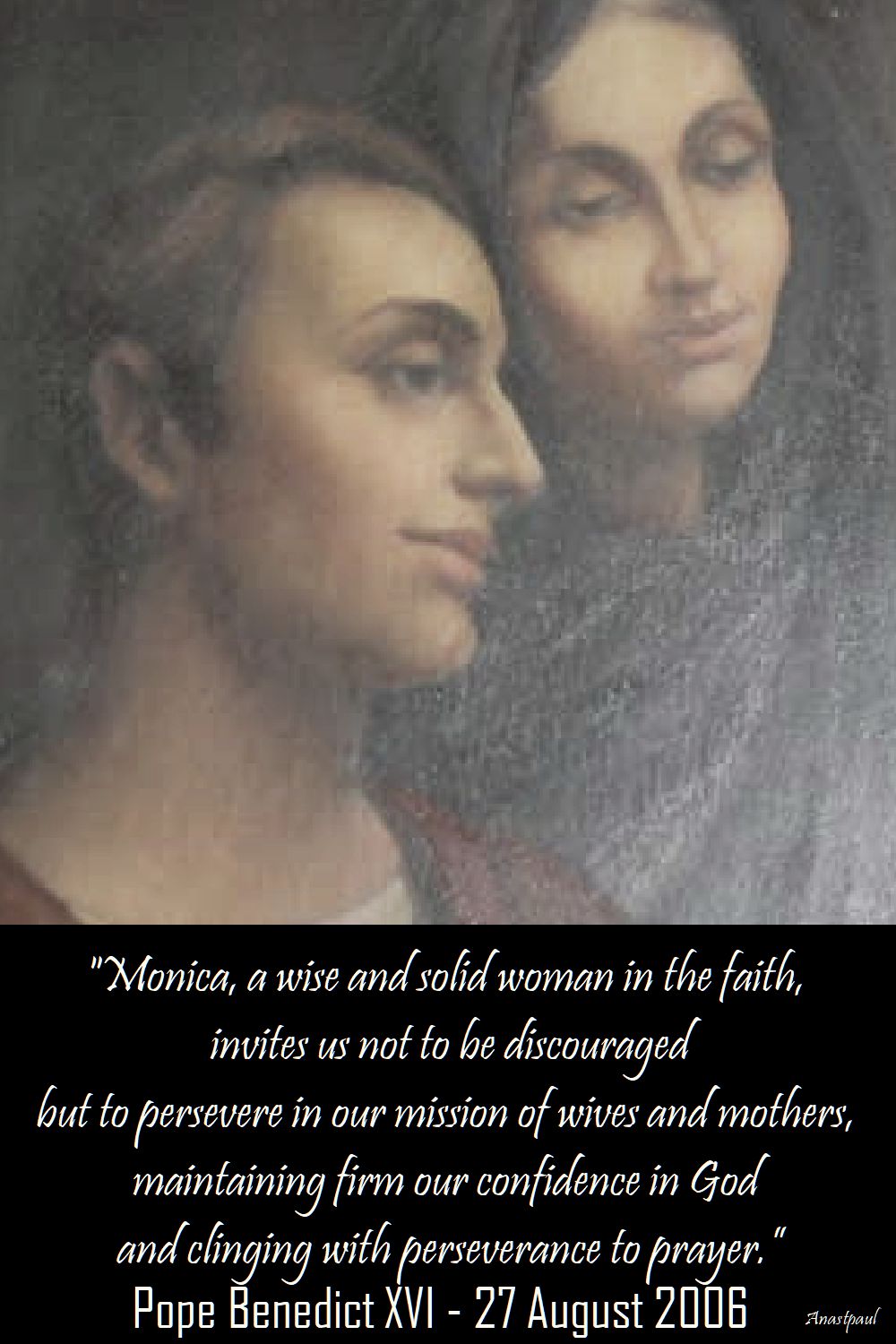
PRAYER – God our Father, comforter of the sorrowful,
You accepted St Monica’s offering of tears for the
conversion of her son, Augustine.
Help us too, by their intercession to be truly contrite
for our sins and to live in a life of faith in Your Son,
who loved us and gave Himself for us. St Monica,
pray for us amen.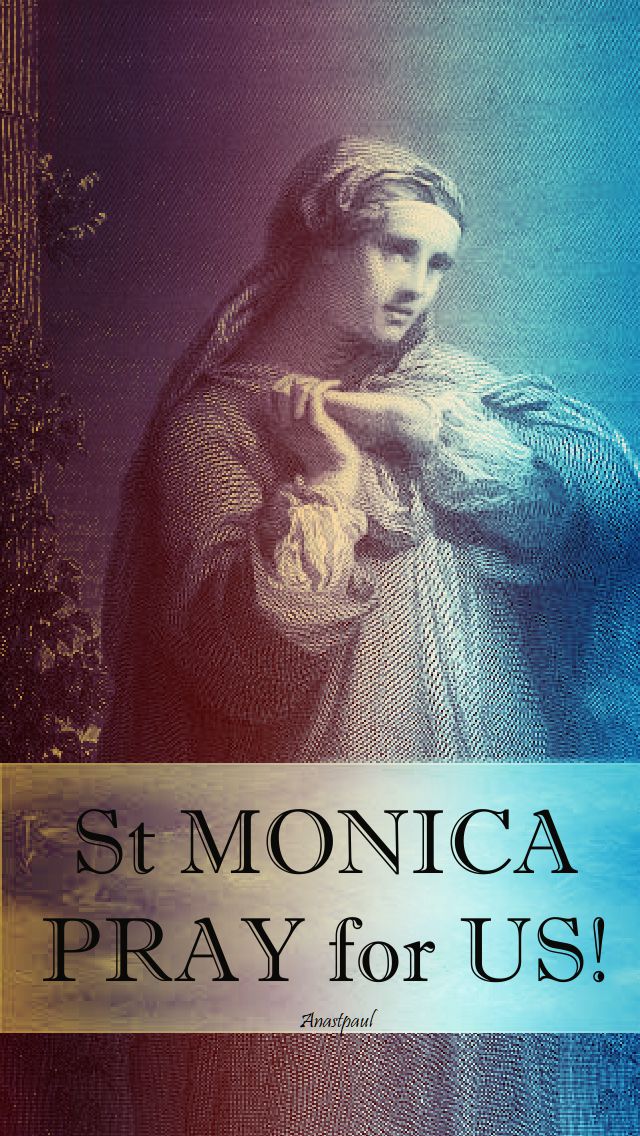
Our Morning Offering – 27 August – The Memorial of St Monica
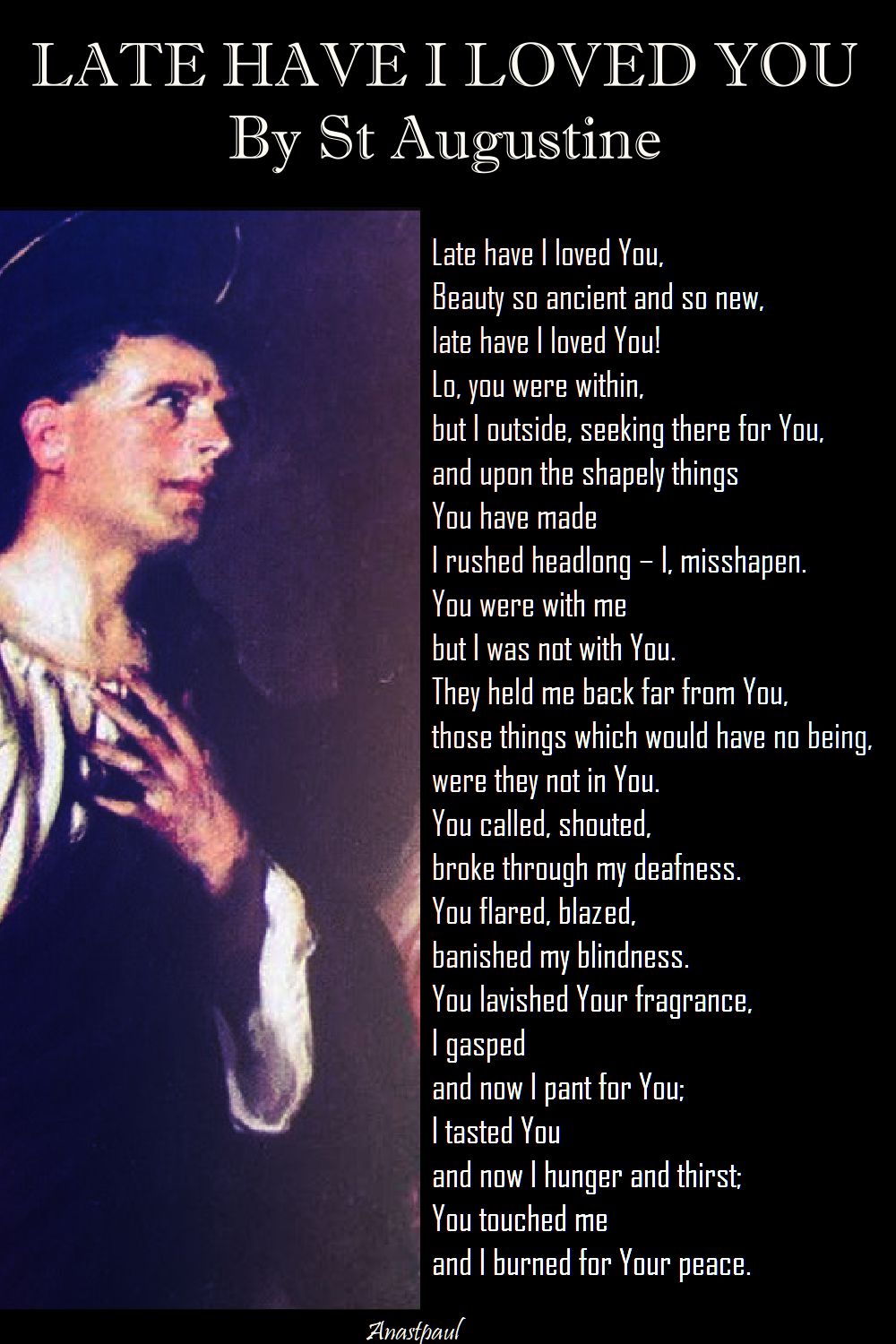
LATE HAVE I LOVED YOU
By St Augustine
Late have I loved You,
Beauty so ancient and so new,
late have I loved You!
Lo, you were within,
but I outside, seeking there for You,
and upon the shapely things You have made
I rushed headlong – I, misshapen.
You were with me but I was not with You.
They held me back far from You,
those things which would have no being,
were they not in You.
You called, shouted, broke through my deafness.
You flared, blazed, banished my blindness.
You lavished Your fragrance, I gasped
and now I pant for You;
I tasted You and now I hunger and thirst;
You touched me and I burned for Your peace.
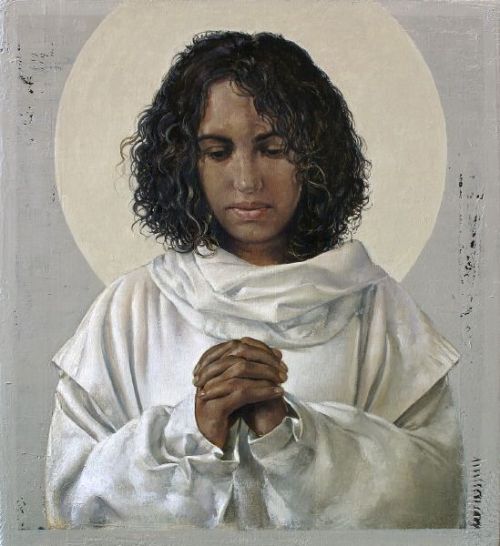
Saint of the Day – 27 August – St Monica (322-387) – Mother of St Augustine (354-430) Great Father and Doctor of the Churcg,, Widow, Religious Lay Woman – born in 322 at Tagaste,Souk Ahrus), Roman North Africa (modern Algeria) and died in 387 at Ostia, Italy). Patronages – conversion of relatives, alcoholics, alcoholism, difficult marriages, disappointing children, homemakers, housewives, married women, wives, mothers, victims of adultery or unfaithfulness, victims of verbal abuse, widows, Archconfraternity of Christian Mothers, Bevilacqua, Italy, Mabini, Bohol, Philippines, various cities across the world. Attributes – cincture, girdle, tears, religious habit, in prayer.
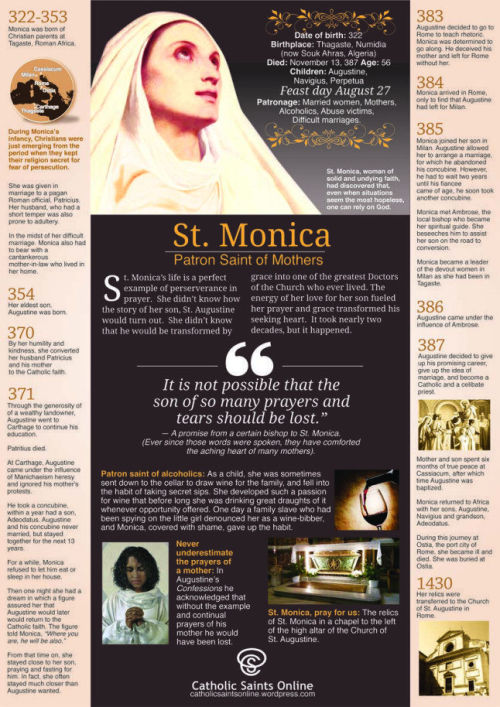
Because of her name and place of birth, Monica is assumed to have been born in Thagaste (present-day Souk Ahras, Algeria). She is believed to have been a Berber on the basis of her name. She was married early in life to Patricius, a Roman pagan, who held an official position in Tagaste. Patricius had a violent temper and appears to have been of dissolute habits; apparently his mother was the same way. Monica’s alms, deeds and prayer habits annoyed Patricius but it is said that he always held her in respect.
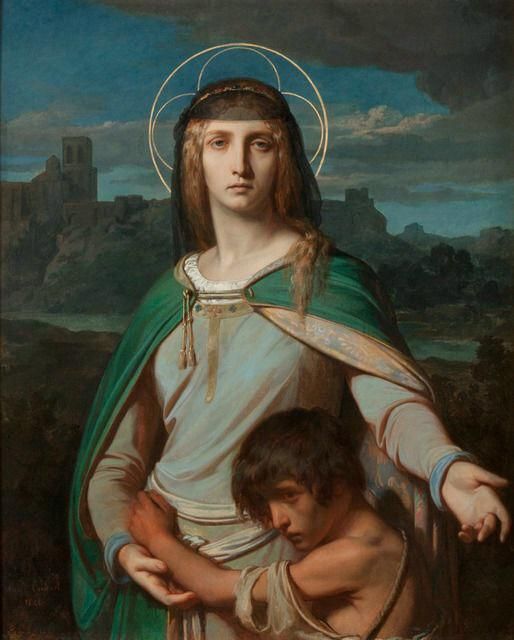
Monica had three children who survived infancy: sons Augustine and Navigius and daughter Perpetua. Unable to secure baptism for them, she grieved heavily when Augustine fell ill. In her distress she asked Patricius to allow Augustine to be baptised; he agreed, then withdrew this consent when the boy recovered. But Monica’s joy and relief at Augustine’s recovery turned to anxiety as he misspent his renewed life being wayward and, as he himself tells us, lazy. He was finally sent to school at Madauros. He was 17 and studying rhetoric in Carthage when Patricius died.
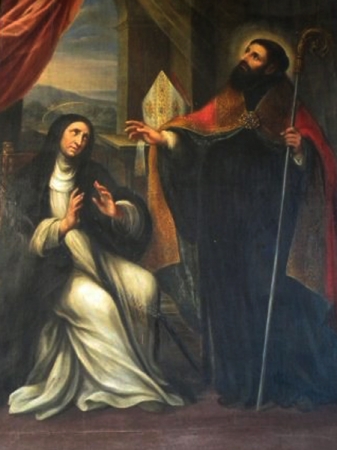
Augustine had become a Manichaean at Carthage; when upon his return home he shared his views regarding Manichaeism, Monica drove him away from her table. However, she is said to have experienced a vision that convinced her to reconcile with him. At this time she visited a certain (unnamed) holy bishop who consoled her with the now famous words, “the child of those tears shall never perish.” Monica followed her wayward son to Rome, where he had gone secretly; when she arrived he had already gone to Milan but she followed him. Here she found Ambrose and through him she ultimately had the joy of seeing Augustine convert to Christianity after 17 years of resistance.
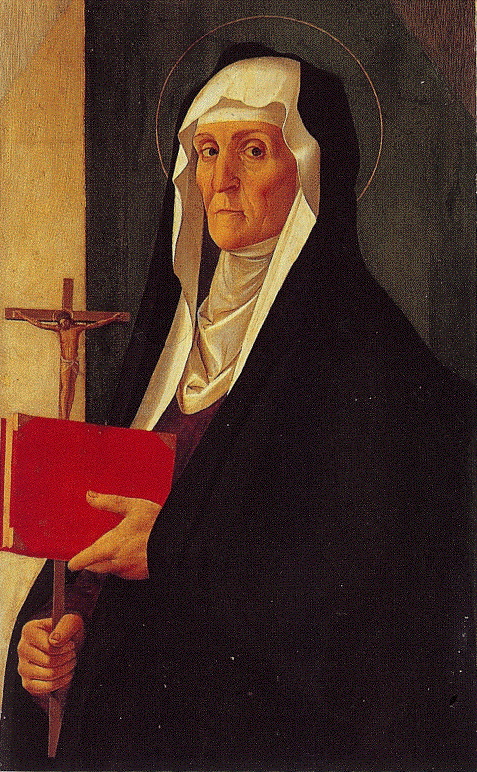
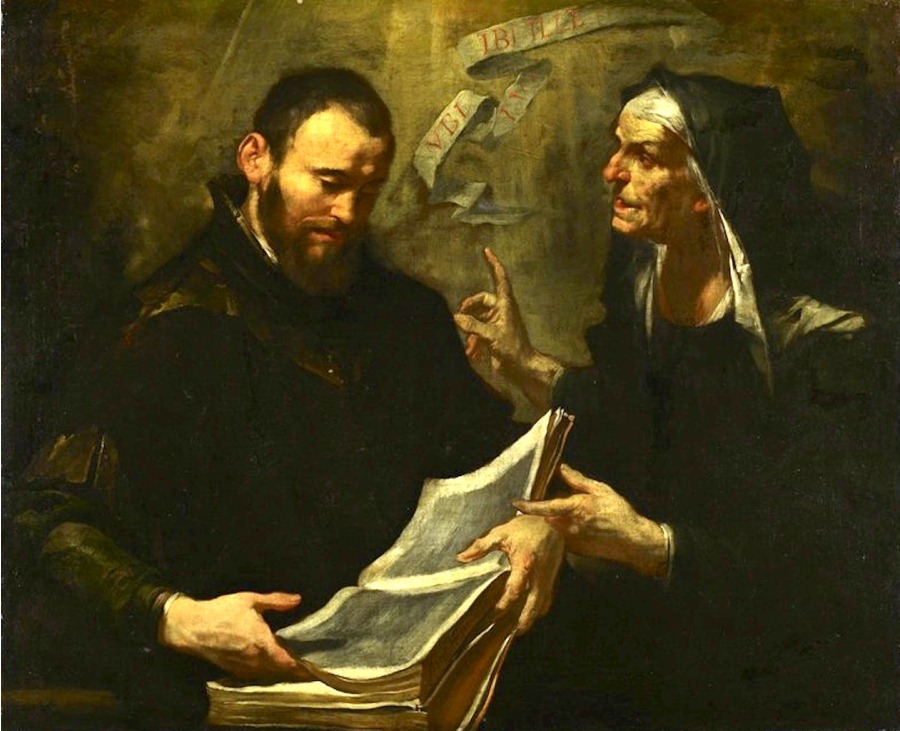
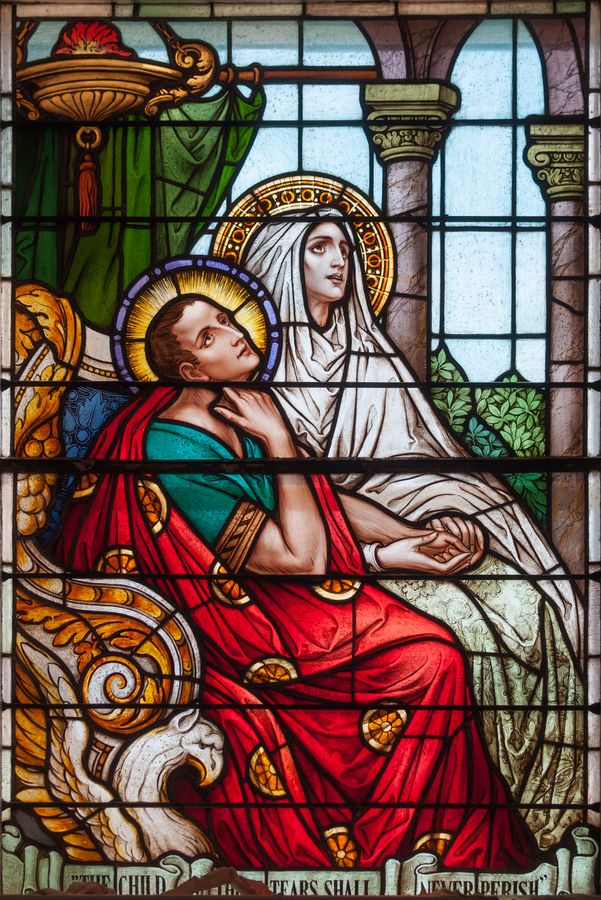
In his book Confessions, Augustine wrote of a peculiar practice of his mother in which she “brought to certain oratories, erected in the memory of the saints, offerings of porridge, bread, water and wine.” When she moved to Milan, the bishop Ambrose forbade her to use the offering of wine, since “it might be an occasion of gluttony for those who were already given to drink”. So, Augustine wrote of her:
“In place of a basket filled with fruits of the earth, she had learned to bring to the oratories of the martyrs a heart full of purer petitions and to give all that she could to the poor–so that the communion of the Lord’s body might be rightly celebrated in those places where, after the example of His passion, the martyrs had been sacrificed and crowned.” — Confessions 6.2.2
Mother and son spent 6 months of true peace at Rus Cassiciacum (present-day Cassago Brianza) after which Augustine was baptised in the church of St John the Baptist at Milan.

Africa claimed them, however, and Augustine and the members of his family now set out for their return to Tagaste. At the port of Ostia, Monica fell ill. She knew that her work had been accomplished and that life would soon be over. Her exaltation of spirit was such that her sons were unaware of the approach of death. As Monica’s strength failed, she said to Augustine: “I do not know what there is left for me to do or why I am still here, all my hopes in this world being now fulfilled. All I wished for was that I might see you a Catholic and a child of Heaven. God granted me even more than this in making you despise earthly felicity and consecrate yourself to His service.” Shortly afterwards they asked her if she did not fear to die so far from home, for she had earlier expressed a desire to be buried beside her husband in Tagaste. Now, with beautiful simplicity, she replied, “Nothing is far from God” and indicated that she was content to be buried where she died. Monica’s death plunged her children into the deepest grief and Augustine, “the son of so many tears,” in the Confessions implores his readers’ prayers for his parents. It is the prayers of Monica herself that have been invoked by generations of the faithful who honour her as a special patroness of married women and as an example for Christian motherhood. Her relics are alleged to have been transferred from Ostia to Rome, to rest in the church of San Agostino.
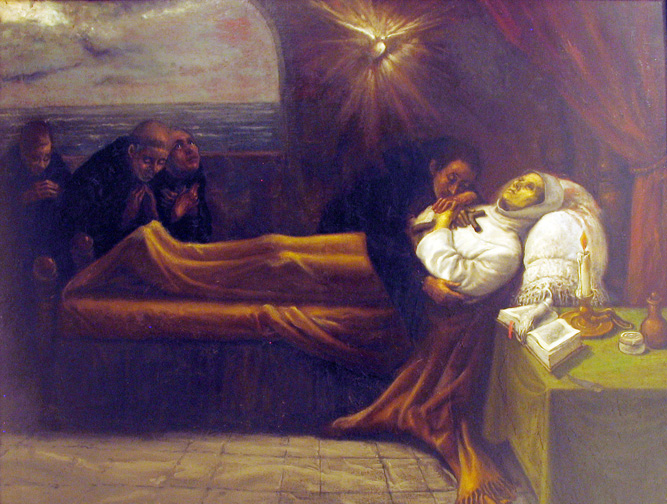
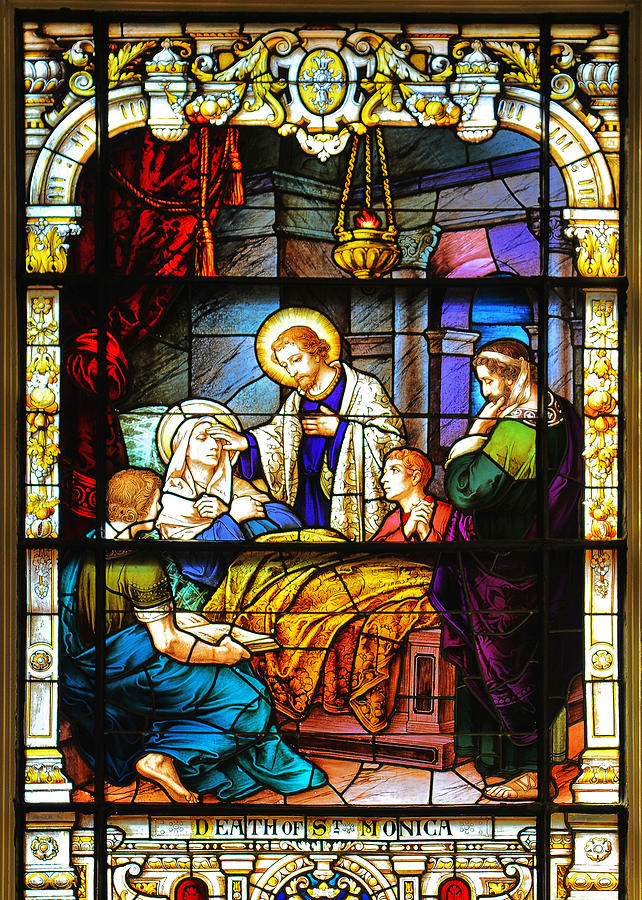
St Monica’s death and Augustine’s grief inspired the finest pages of his Confessions.

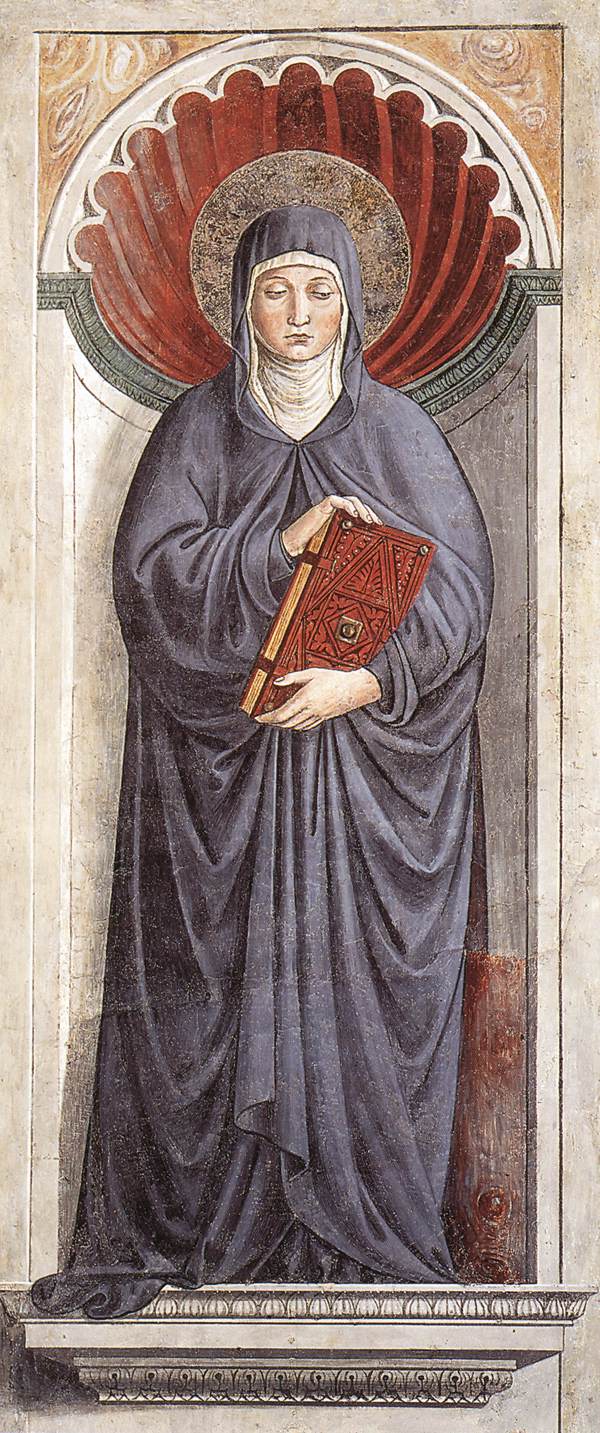
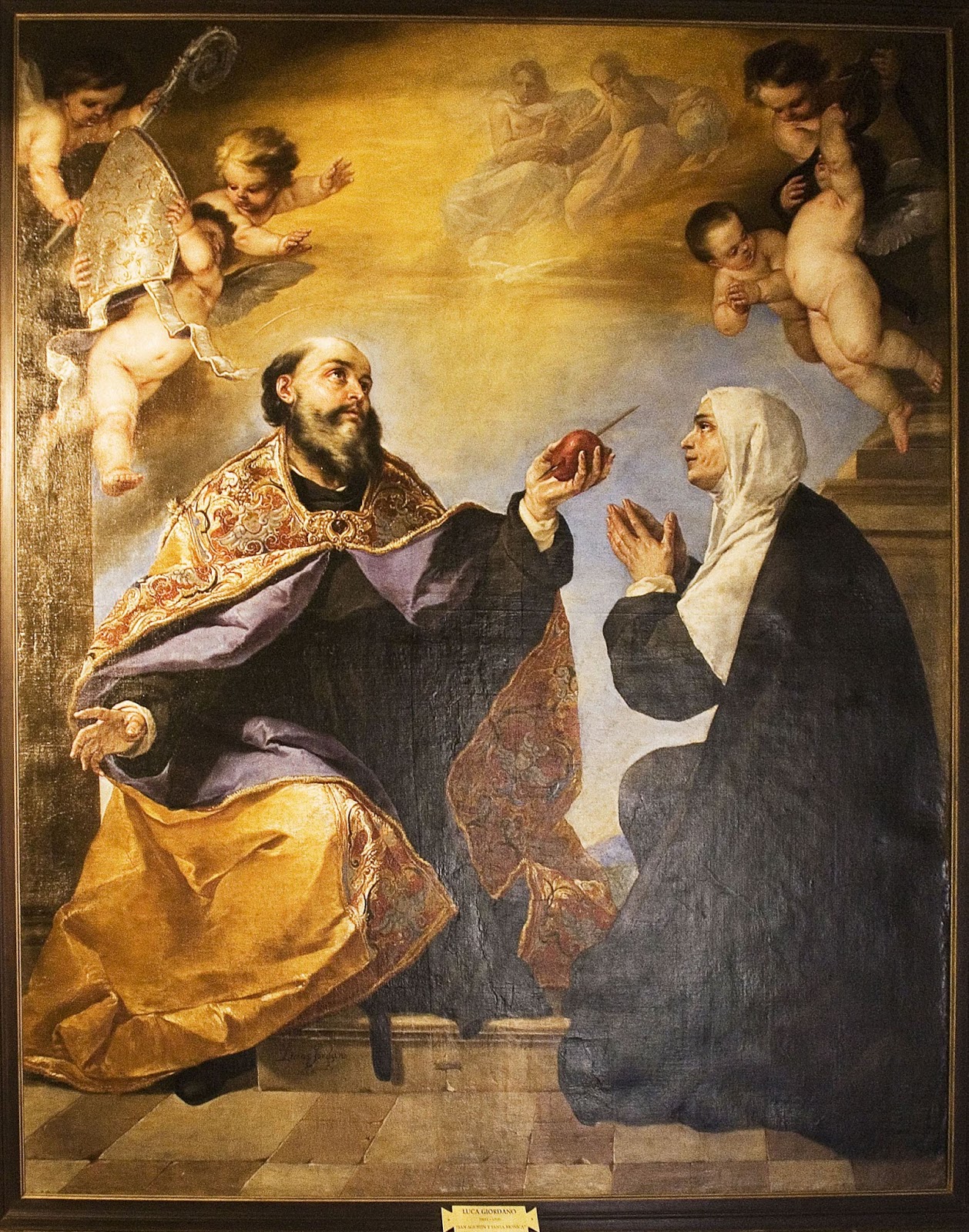
St Monica (Memorial) – https://www.youtube.com/watch?v=XPwl42gpAns
—
Transverberation of the Heart of Teresa of Avila
—
St Agilo of Sithin
Bl Angelus of Foligno
St Anthusa the Younger
St Arontius of Potenza
St Baculus of Sorrento
St Caesarius of Arles
St Carpophorus
St David Lewis
St Decuman
Bl Dominic Barberi
St Ebbo of Sens
St Etherius of Lyons
St Euthalia of Leontini
St Fortunatus of Potenza
Bl Gabriel Mary
St Gebhard of Constance
St Giovanni of Pavia
St Honoratus of Potenza
Bl Jean Baptiste Guillaume
Bl Jean-Baptiste Souzy
St John of Pavia
St Licerius of Couserans
St Malrubius of Merns
Bl Maria del Pilar Izquierdo Albero
St Narnus of Bergamo
St Phanurius
St Poemen
Bl Roger Cadwallador
St Rufus of Capua
St Sabinian of Potenza
St Syagrius of Autun
—
Martyrs of Tomi – 5 saints: A group of 17 Christians imprisoned and excuted for their faith during the persecutions of Diocletian. They miraculously were unburned by fire and untouched by wild animals. We know the names and a few details on five of them – John, Mannea, Marcellinus, Peter and Serapion. They were tied to stakes and burned alive; they emerged unharmed – thrown to wild animals in the amphitheatre; the animals ignored them; they were beheaded in 304 in Tomi, Mesia (modern Costanza, Romania).
Martyred in the Spanish Civil War:
• Blessed Buenaventura Gabika-Etxebarria Gerrikabeitia
• Blessed Esteban Barrenechea Arriaga
• Blessed Fernando González Añon
• Blessed Francisco Euba Gorroño
• Blessed Hermenegildo Iza Aregita
• Blessed José María López Carrillo
• Blessed Juan Antonio Salútregui Iribarren
• Blessed Pedro Ibáñez Alonso
• Blessed Pelayo José Granado Prieto
• Blessed Plácido Camino Fernández
• Blessed Quirino Díez del Blanco
• Blessed Ramón Martí Soriano
Quote of the Day – 26 August
“Let Mary never be far from your lips
and from your heart.
Following her, you will never lose your way.
Praying to her, you will never sink into despair.
Contemplating her, you will never go wrong.”

Our Morning Offering – 26 August
Prayer to Our Lady of Czestochowa
Our Lady of Czestochowa,
Queen of Poland, pray for us.
Holy Mother of Czestochowa,
you are full of grace, goodness and mercy.
I consecrated to you all my thoughts,
words and actions – my soul and body.
I beseech your blessings
and especially prayers for my salvation.
Today I consecrate myself to you, good Mother, totally –
with body and soul amid joy and sufferings,
to obtain for myself and others,
your blessings on this earth
and eternal life in heaven. Amen

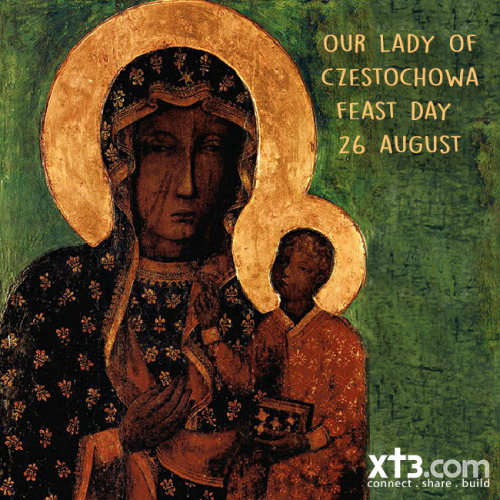
Blessed Feast of Our Lady of Czestochowa, Queen of Poland – 26 August – Also known as – The Black Madonna of Czestochowa, Czarna Madonna, Hodegetria, Imago thaumaturga Beatae Virginis Mariae Immaculatae Conceptae, Matka Boska Czestochowska, One Who Shows the Way. Our Lady of Czestochowa is a revered icon of the Virgin Mary housed at the Jasna Góra Monastery in Częstochowa, Poland. Several Pontiffs have recognised the venerated icon, beginning with Pope Clement XI who issued a Canonical Coronation to the image on 8 September 1717 via the Vatican Chapter. Patron of Poland.


According to tradition, the icon of Jasna Góra (Bright Mountain) was painted by Luke the Evangelist on a tabletop built by Jesus Himself and the icon was discovered by St Helen, mother of Emperor Constantine and collector of Christian relics in the Holy Land. The icon was then enshrined in the imperial city of Constantinople, where it remained for the next 500 years.

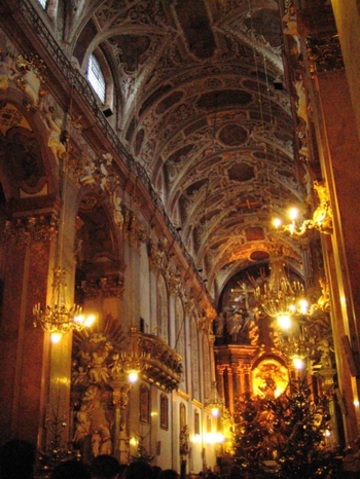
In 803, the painting is said to have been given as a wedding gift from the Byzantine emperor to a Greek princess, who married a Ruthenian nobleman. The image was then placed in the royal palace at Belz, where it remained for nearly 600 years.
History first combines with tradition upon the icon’s arrival in Poland in 1382 with a Polish army fleeing the Tartars, who had struck it with an arrow.
Legend has it that during the looting of Belz, a mysterious cloud enveloped the chapel containing the image. A monastery was founded in Częstochowa to enshrine the icon in 1386 and soon King Jagiello built a cathedral around the chapel containing the icon.
However, the image soon came under attack once again. In 1430, Hussites (pre-Reformation reformers) attacked the monastery, slashed the Virgin’s face with a sword, and left it desecrated in a puddle of blood and mud.
It is said that when the monks pulled the icon from the mud, a miraculous fountain appeared, which they used to clean the painting. The icon was repainted in Krakow, but both the arrow mark and the gashes from the sword were left and remain clearly visible today.
The miracle for which the Black Madonna of Częstochowa is most famous occurred in 1655, when Swedish troops were about to invade Częstochowa. A group of Polish soldiers prayed fervently before the icon for deliverance and the enemy retreated. In 1656, King John Casimir declared Our Lady of Częstochowa “Queen of Poland” and made the city the spiritual capital of the nation.
The Virgin again came to the aid of her people in 1920, when the Soviet Russian Red Army gathered on the banks of the Vistula River, preparing to attack Warsaw. The citizens and soldiers fervently prayed to Our Lady of Częstochowa and on September 15, the Feast of Our Lady of Sorrows, she appeared in the clouds above Warsaw. The Russians were defeated in a series of battles later dubbed the “Miracle at the Vistula.”
During Nazi occupation, Hitler prohibited pilgrimages to Jasna Góra but many still secretly made the journey. In 1945, after Poland was liberated, half a million pilgrims journeyed to Czestochowa to express their gratitude. On September 8, 1946, 1.5 million people gathered at the shrine to rededicate the entire nation to the Immaculate Heart of Mary. During the Cold War, Jasna Góra was a centre of anti-Communist resistance. Czestochowa is regarded as the most popular shrine in Poland, with many Polish Catholics making a pilgrimage there every year. A pilgrimage has left Warsaw every August 6 since 1711 for the nine-day, 140-mile trek. Elderly pilgrims recall stealing through the dark countryside at great personal risk during the German Nazi occupation. Pope John Paul II secretly visited as a student pilgrim during World War II. He was a fervent devotee of the Virgin Mary and of her icon at Czestochowa. As pope, he made pilgrimages to pray before the Black Madonna in 1979, 1983, 1991 and 1997. In 1991, he held his Sixth World Youth Day at Czestochowa, which was attended by 350,000 young people from across Europe.
The four-foot-high painting displays a traditional composition well known in the icons of Eastern Christians. The Virgin Mary is shown as the “Hodegetria” (“One Who Shows the Way”). In it the Virgin directs attention away from herself, gesturing with her right hand toward Jesus as the source of salvation. In turn, the child extends his right hand toward the viewer in blessing while holding a book of gospels in his left hand. The icon shows the Madonna in fleur-de-lis robes.

Our Lady of Czestochowa – https://www.youtube.com/watch?v=eHTPPBxowQY
—
St Abundius the Martyr
St Alexander of Bergamo
St Anastasius the Fuller
St Bregwin of Canterbury
St Elias of Syracuse
St Eleutherius of Auxerre
St Felix of Pistoia
Bl Herluin
Bl Ioachim Watanabe Jirozaemon
St Irenaeus of Rome
Bl Jacques Retouret
St Jeanne Elizabeth des Bichier des Anges
Bl Jean Bassano
Bl Jean of Caramola
Bl Juan Urgel
Bl Levkadia Herasymiv
Bl Margaret of Faenza
St Mary of Jesus Crucified
St Maximilian of Rome
St Melchizedek the Patriarch
St Orontius of Lecce
St Pandwyna
St Rufinus of Capua
St Secundus the Theban
Bl Stanislaus Han Jeong-Heum
St Teresa de Gesu, Jornet y Ibars
St Victor of Caesarea
St Victor the Martyr
St Vyevain of York
—
Martyrs of Celano – 3 saints: Three Christians, Constantius, Simplicius and Victorinus, martyred in the same area at roughly the same time. That’s really all we know, though it didn’t stop writers in later centuries from inventing colourful histories, making them a father and sons, adding saintly family members, earthquakes, close escapes, etc.
They were martyred in c 159 in the Marsica region of Italy. At some point their relics were interred under the main altar of the San Giovanni Vecchio church in the Collegiata di Celano and were authenticated in 1057 by Pope Stephen IX. The city was depopulated in 1222; when it was re-built, the relics were re-enshrined in the church of San Vittorino on 10 June 1406. Patronage – Celano, Italy.
Martyred in the Spanish Civil War:
• Blessed Emilio Serrano Lizarralde
• Blessed Francesc Casademunt Ribas
• Blessed Josep Maria Tolaguera Oliva
• Blessed Luis Valls Matamales
• Blessed María de Los Ángeles Ginard Martí
• Blessed Pere Sisterna Torrent
Thought for the Day – 25 August – The Memorial of St Louis IX – King of France
The long reign of St Louis IX (1226-1270) is the period of a cultural explosion in France and Europe, at the height f the ‘Thirteenth, the Greatest of Centuries, he age of remarkable saints and remarkable leaders – St Francis of Assisi, St Thomas Aquinas, St Dominic, Pope Innocent III, St Albert the Great and Emperor Frederick II. St Louis was at the heart of this development and has been looked upon as the model for Christian leadership.
As husband, father, king, he showed himself, not only an exemplary Christian but also, an amazing human being, who never lost the personal touch and who sat on the seat of power with such rare humility, love and faith. He was known for his horror of offending God – keeping always in mind the words of his mother – “I love you, my dear son, as much as a mother can love her child; but I would rather see you dead at my feet, than that you should ever commit a mortal sin.” and for his honest and upright dealings with all. He never looked upon his position as the opportunity to take unfair advantage of others but as one of complete service! He maintained and grew, throughout his life, whether upon the throne at home or in battle on foreign soils, his life of prayer, penance and love for all.
Does power necessarily corrupt or is it possible, proved by St Louis, to use power for the glory of the Kingdom of God!
St Louis, pray for us – most especially for France and for the whole Church of Christ, which you loved so much!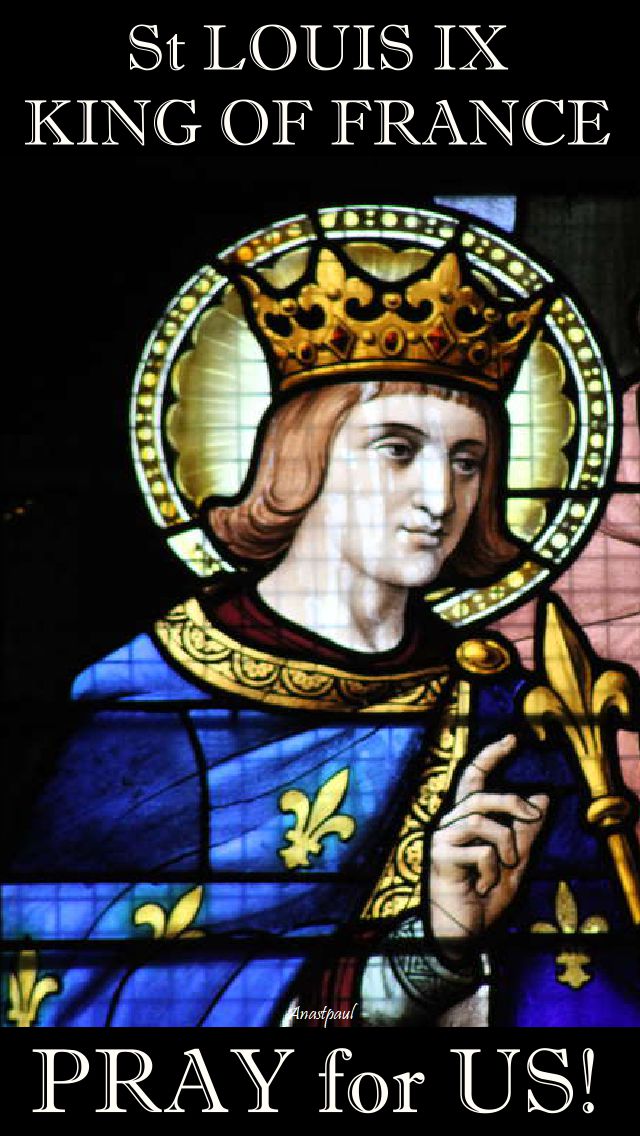
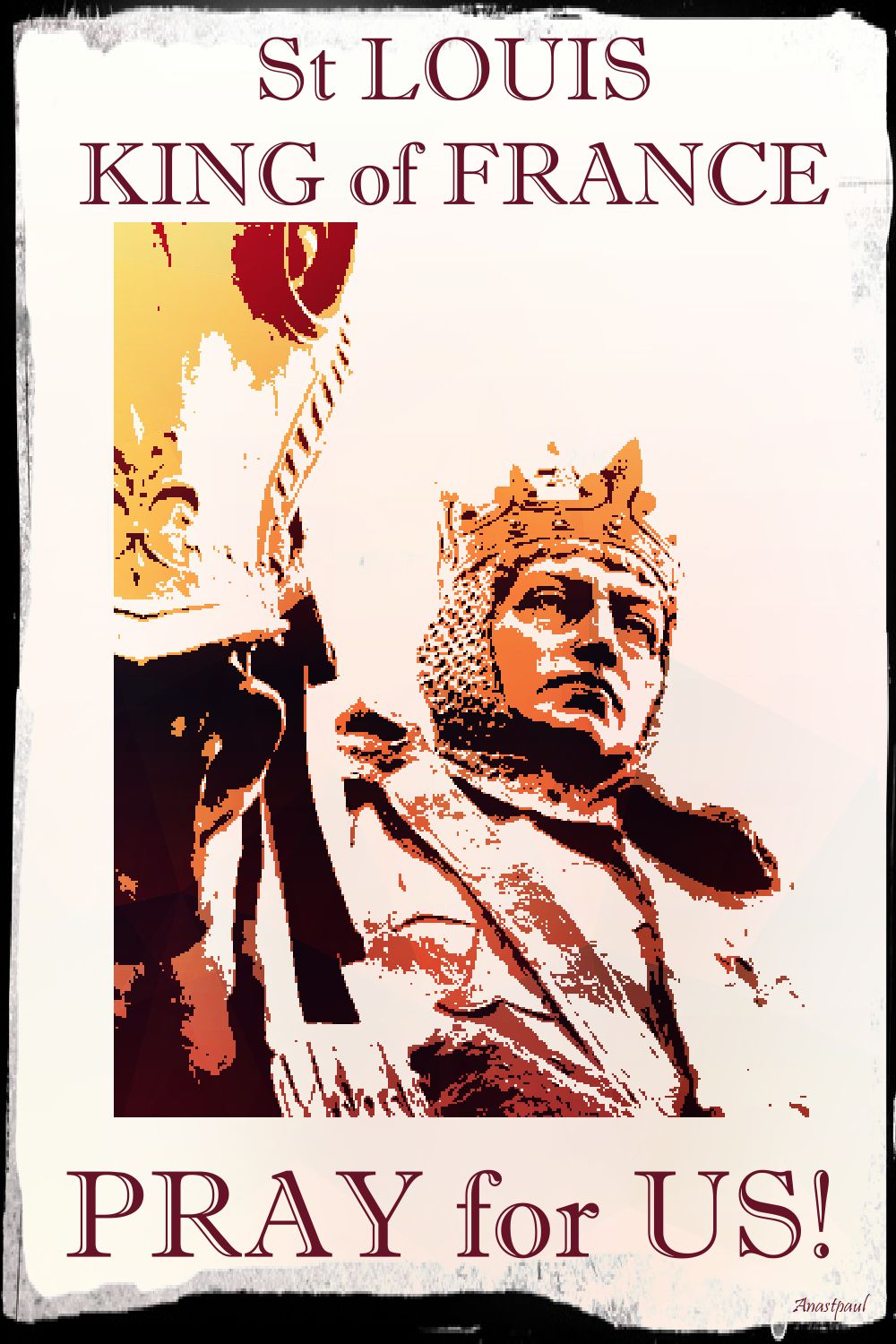
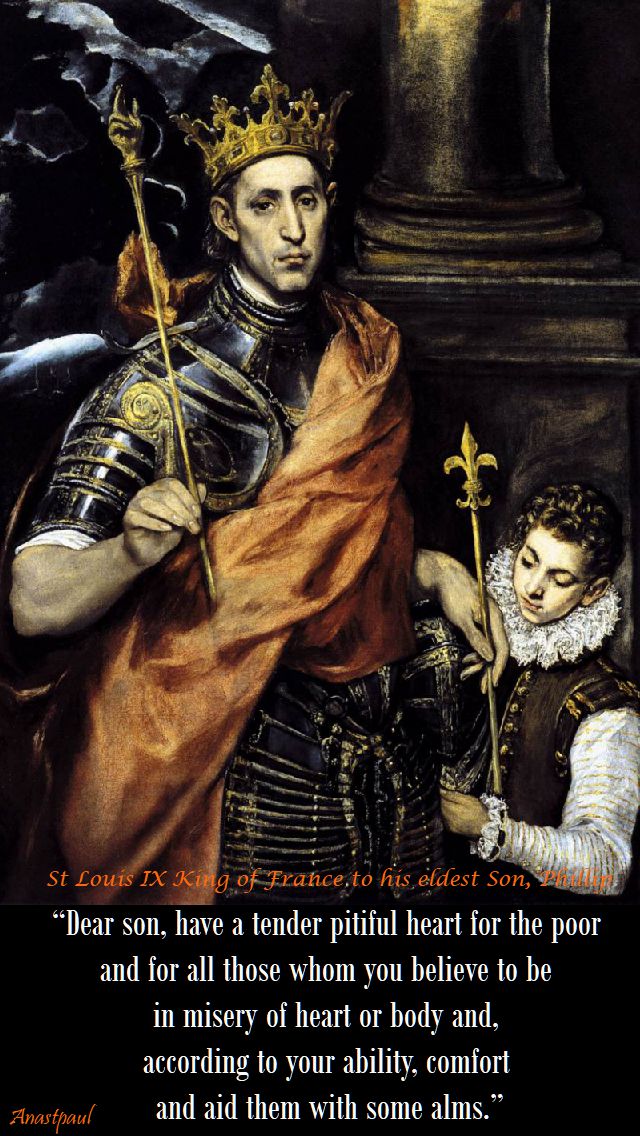
Quote of the Day – 25 August – The Memorial of St Louis IX – King of France
“Dear son, have a tender pitiful heart for the poor
and for all those whom you believe to be
in misery of heart or body and,
according to your ability, comfort
and aid them with some alms.”
One Minute Reflection – August 25 – The Memorial of St Louis IX – King of France
The servant of the Lord…..must be an apt teacher, patiently and gently correcting those who contradict him….2 Tim 2:24-25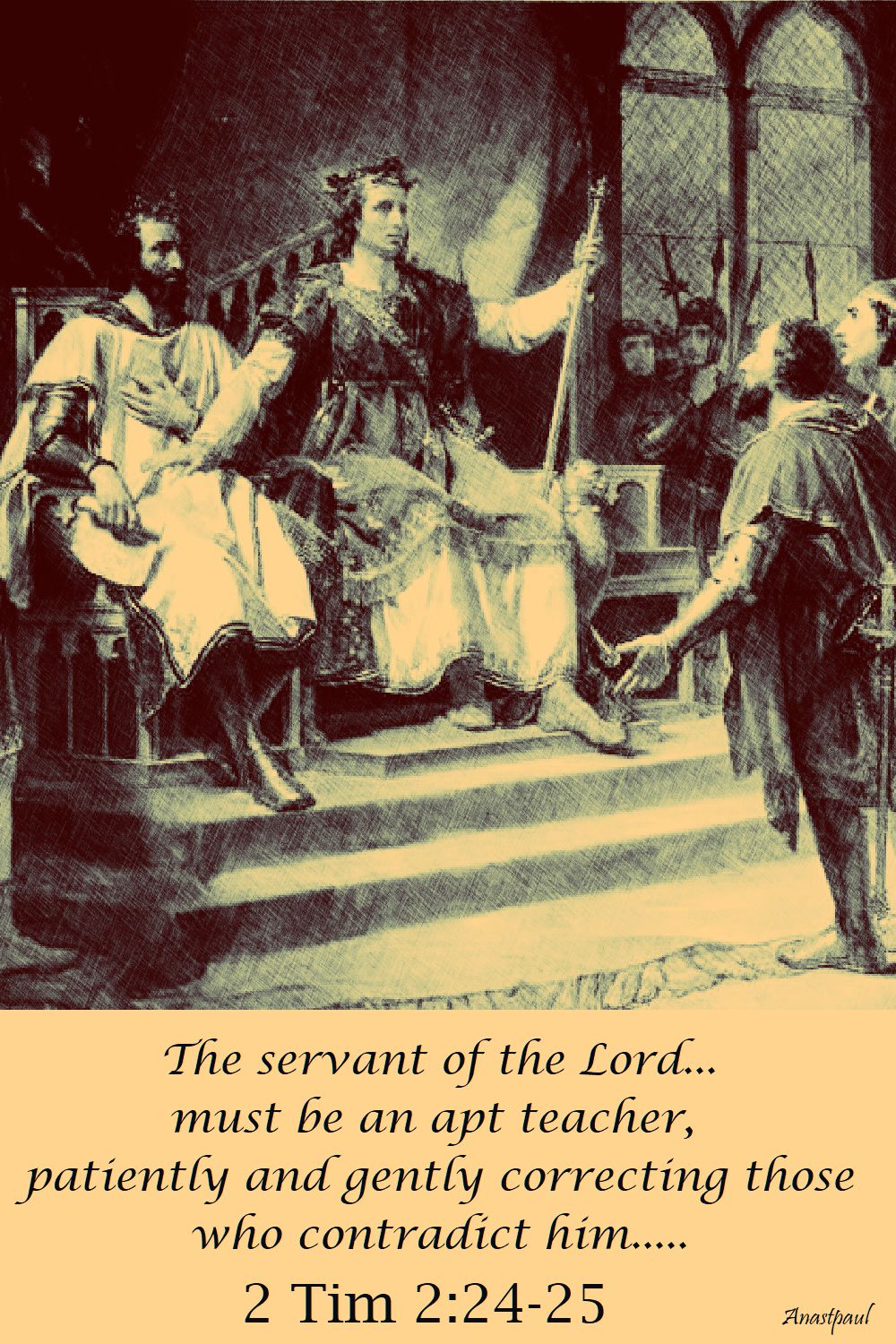
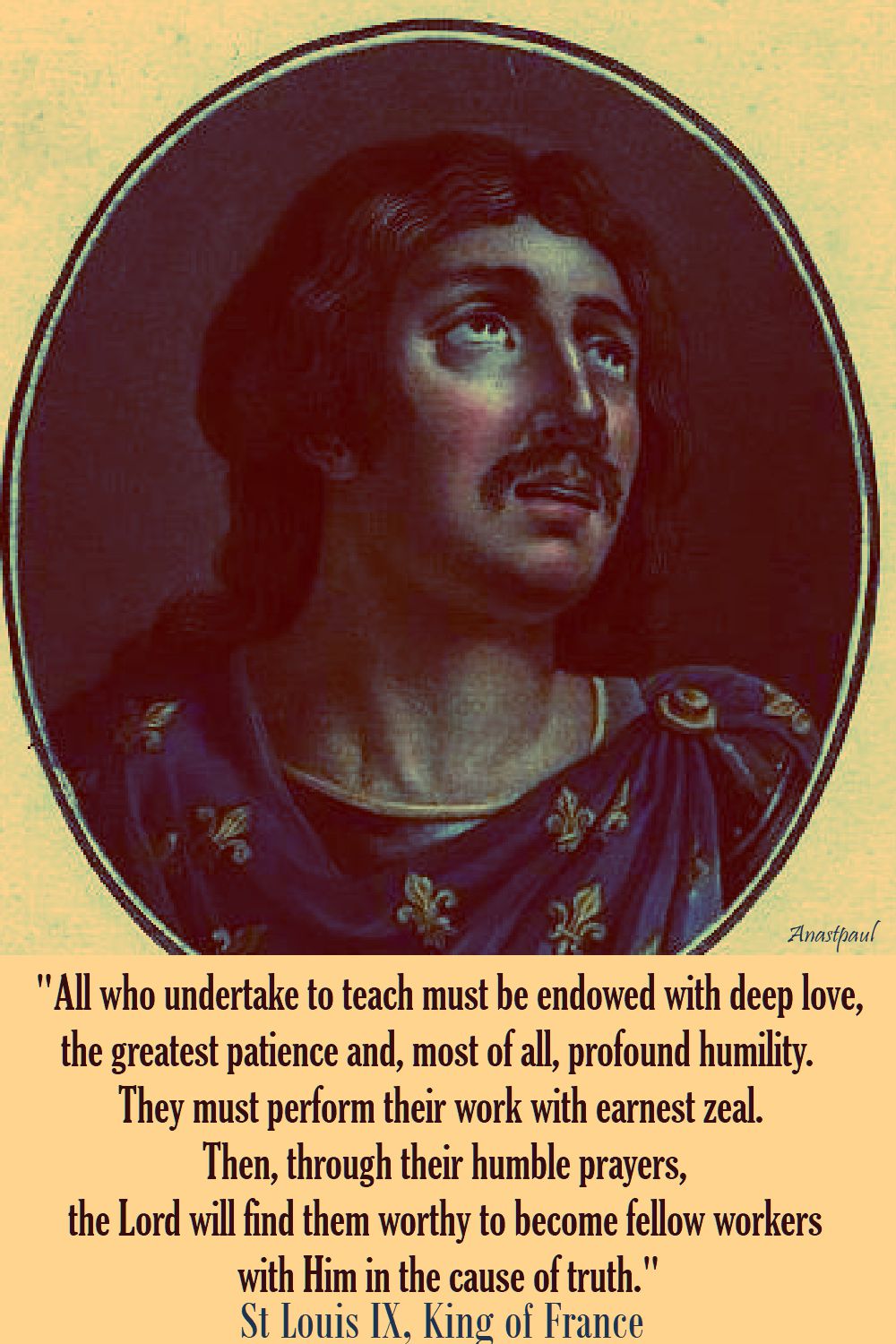
REFLECTION – “All who undertake to teach must be endowed with deep love, the greatest patience and, most of all, profound humility. They must perform their work with earnest zeal. Then, through their humble prayers, the Lord will find them worthy to become fellow workers with Him in the cause of truth.”…St Louis IX King of France
PRAYER – Dear Lord, help me to teach others about You by my example as well as my words. Grant that I may spread Your truth and Your light wherever I go. St Louis, this is exactly what you sought to do, constantly serving God in penitence and prayer, ever mindful of His people. You lived the greatest commandment and strove always to be an example to your people through your great love for our Lord and for His Church. St Louis, please pray for us! Amen

Our Morning Offering – 25 August – The Memorial of St Louis IX – King of France
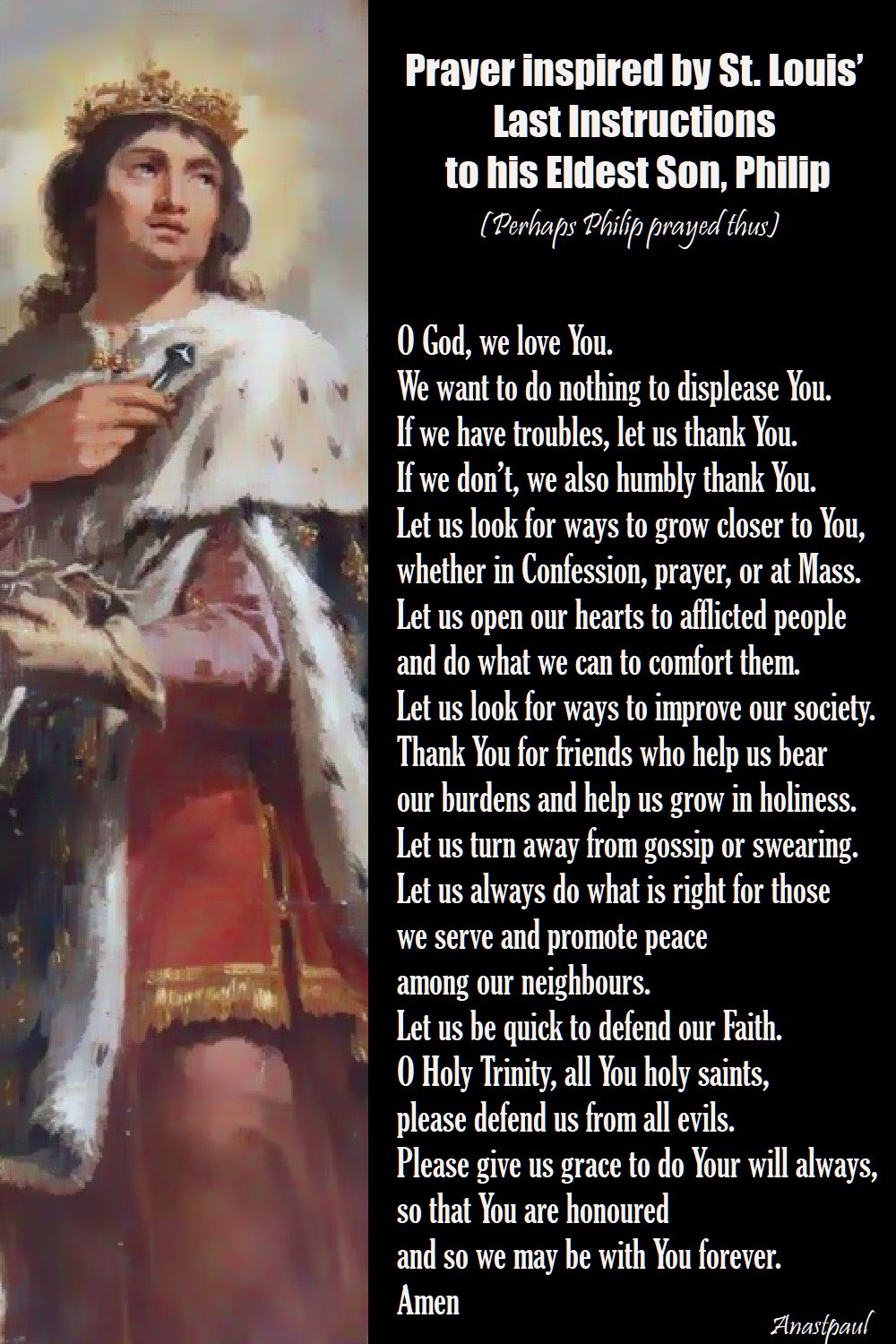
O God, we love You.
We want to do nothing to displease You.
If we have troubles, let us thank You.
If we don’t, we also humbly thank You.
Let us look for ways to grow closer to You,
whether in Confession, prayer, or at Mass.
Let us open our hearts to afflicted people
and do what we can to comfort them.
Let us look for ways to improve our society.
Thank You for friends who help us bear
our burdens and help us grow in holiness.
Let us turn away from gossip or swearing.
Let us always do what is right for those
we serve and promote peace among our neighbours.
Let us be quick to defend our Faith.
O Holy Trinity, all You holy saints,
please defend us from all evils.
Please give us grace to do Your will always,
so that You are honoured
and so we may be with You forever.
Amen
Saint of the Day – 25 August – St Louis IX, King of France (1214-1270) Confessor, King, Reformer, Apostle of Charity, a Third Order Franciscan. Born on 25 April 1214 at Poissy, France and died on 25 August 1270 at Tunis (in modern Tunisia) of natural causes). His relics in the Basilica of Saint Denis, Paris, France but they were destroyed in 1793 during the French Revolution. He was Canonised in 1297 by Pope Boniface VIII. Attributes: crown, crown of thorns, king holding a cross, king holding a crown of thorns, nails, cross and Crucifix. Patronages – against the death of children, barbers, bridegrooms, builders, button makers, construction workers, Crusaders, difficult marriages, distillers, embroiderers, French monarchs, grooms, haberdashers, hairdressers, hair stylists, kings, masons, needle workers, parenthood, parents of large families, passementiers, prisoners, sculptors, sick people, soldiers, stone masons, stonecutters, trimming makers, Québec, Québec, archdiocese of, Saint Louis, Missouri, Archdiocese of, Versailles, France, Diocese of, many cities in France and other parts of the world, Franciscan Tertiaries and the Congregation of the Sisters of Saint Louis.
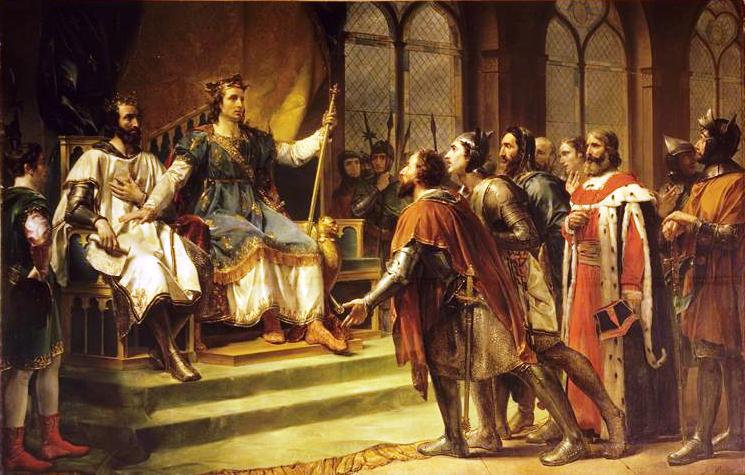
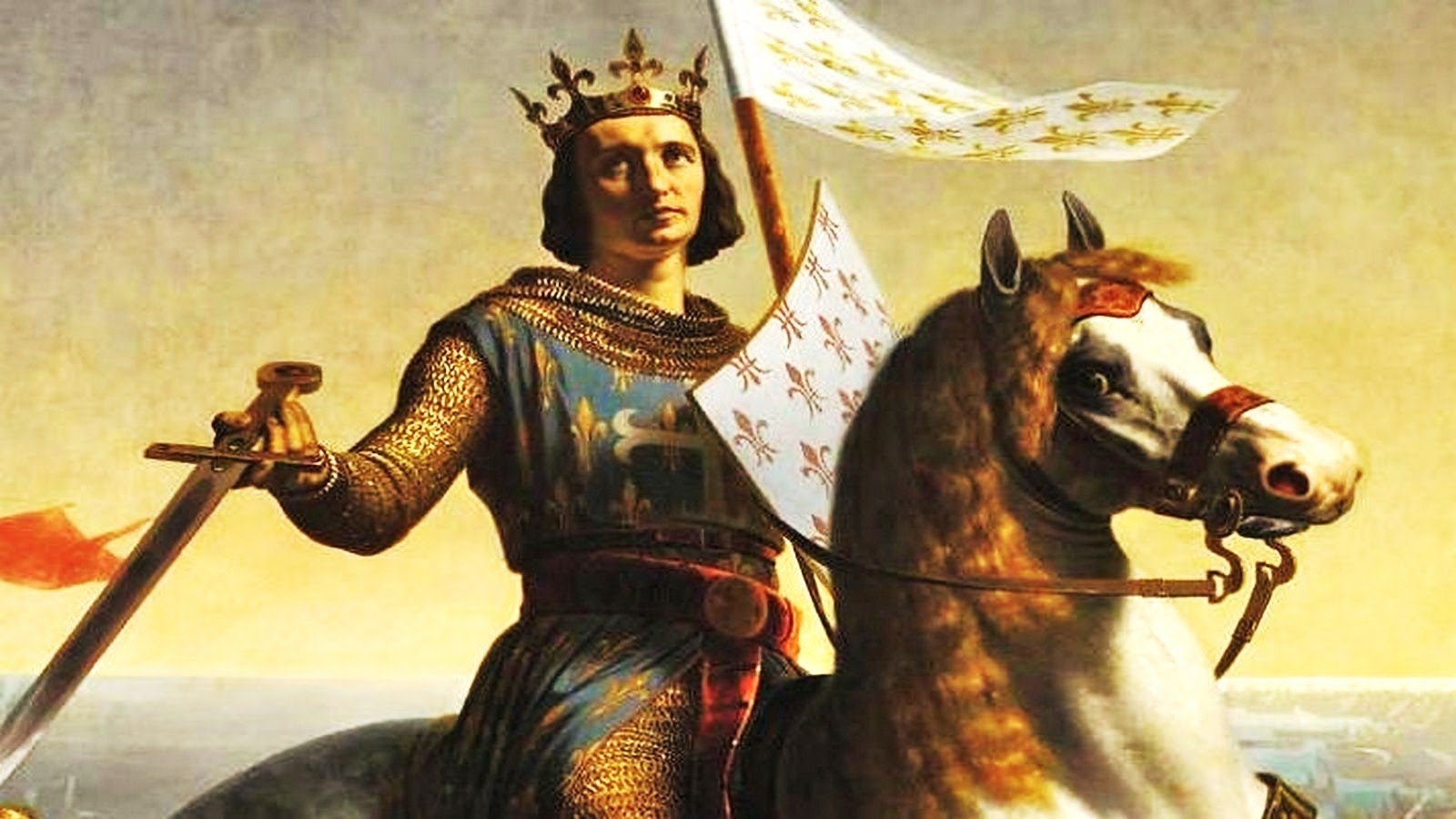
Louis IX was a reformer and developed French royal justice, in which the king is the supreme judge to whom anyone is able to appeal to seek the amendment of a judgment. He banned trials by ordeal, tried to prevent the private wars that were plaguing the country and introduced the presumption of innocence in criminal procedure. To enforce the correct application of this new legal system, Louis IX created provosts and bailiffs.
According to his vow made after a serious illness, and confirmed after a miraculous cure, Louis IX took an active part in the Seventh and Eighth Crusade in which he died from dysentery. He was succeeded by his son Philip III.
Louis’s actions were inspired by Christian values and Catholic devotion. He decided to punish blasphemy, gambling, interest-bearing loans and prostitution and bought presumed relics of Christ for which he built the Sainte-Chapelle. He also expanded the scope of the Inquisition and ordered the burning of Talmuds. He is the only canonised king of France and there are consequently many places named after him.


Louis was born on 25 April 1214 at Poissy, near Paris, the son of Prince Louis the Lion and Princess Blanche, and baptised in La Collégiale Notre-Dame church. His grandfather on his father’s side was Philip II, king of France; while his grandfather on his mother’s side was Alfonso VIII, king of Castile. Tutors of Blanche’s choosing taught him most of what a king must know—Latin, public speaking, writing, military arts and government. He was 9 years old when his grandfather Philip II died and his father ascended as Louis VIII. A member of the House of Capet, Louis was twelve years old when his father died on 8 November 1226. He was crowned king within the month at Reims cathedral. Because of Louis’s youth, his mother ruled France as regent during his minority. The night before he was crowned, he fasted and prayed. He asked God to make him a good servant, to make him a good and holy king for his people.
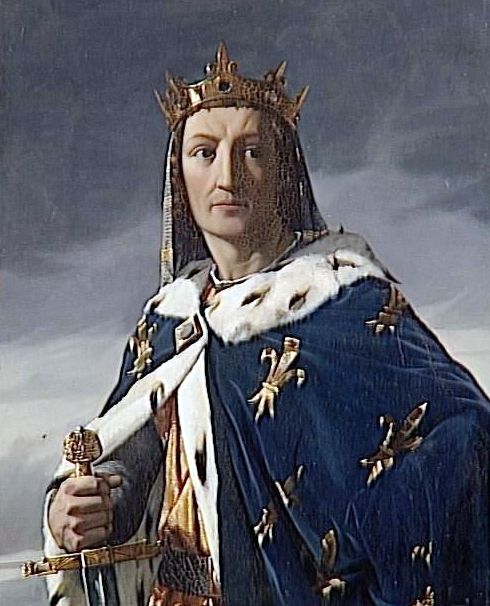
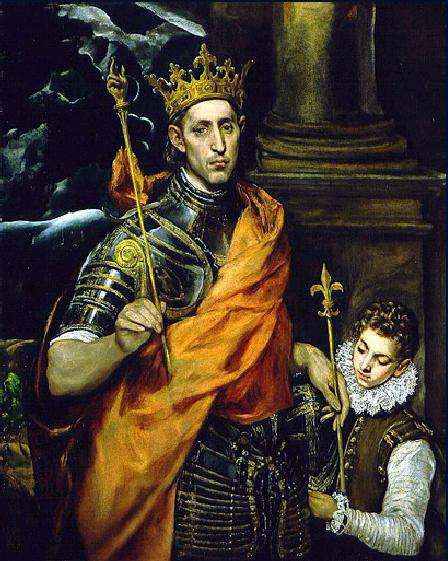
Louis’ mother trained him to be a great leader and a good Christian. She used to say:
I love you, my dear son, as much as a mother can love her child; but I would rather see you dead at my feet than that you should ever commit a mortal sin.
No date is given for the beginning of Louis’s personal rule. His contemporaries viewed his reign as co-rule between the king and his mother, though historians generally view the year 1234 as the year in which Louis began ruling personally, with his mother assuming a more advisory role. She continued to have a strong influence on the king until her death in 1252. On 27 May 1234, Louis married Margaret of Provence (1221 – 21 December 1295), whose sister Eleanor later became the wife of Henry III of England. The new queen’s religious devotion made her a well suited partner for the king. He enjoyed her company and was pleased to show her the many public works he was making in Paris, both for its defense and for its health. They enjoyed riding together, reading, and listening to music. This attention raised a certain amount of jealousy in his mother, who tried to keep them apart as much as she could.
After the morning Mass, King Louis IX would ride his horse out into the country to see how he could work to make life better for his people. He would often stop in villages to listen to what the people had to say. He checked that wealthy, powerful nobles were not abusing people. When he heard that the nobles unjustly took from people who had less, he forced the nobles to give back what they had taken. He listened to people’s ideas for how to improve their country and he passed laws to protect those who were vulnerable. Louis was devoted to his people, founding hospitals, visiting the sick and like his patron Saint Francis, caring even for people with leprosy. He is one of the patrons of the Secular Franciscan Order. Louis united France—lords and townsfolk, peasants and priests and knights—by the force of his personality and holiness. For many years the nation was at peace. Every day, Louis had 13 special guests from among the poor to eat with him and a large number of poor were served meals near his palace. During Advent and Lent, all who presented themselves were given a meal and Louis often served them in person. He kept lists of needy people, whom he regularly relieved, in every province of his dominion.
The king ordered churches and hospitals built throughout France. In his travels, the king himself would often visit and care for those who were sick. He listened to the needs of others. As a man given the power to guide his country, he could do great good for his people. He worked for peace in the world and when he did fight, he was merciful to those he captured.


In 1244, King Louis led a Crusade into the Holy Land. As king, Louis could have taken special privileges and comforts. Instead, he chose to share the hardships of his soldiers. Once, the king was captured. While in prison, he prayed the Liturgy of the Hours every day. Disturbed by new Muslim advances in Syria, he led another crusade in 1267, at the age of 41. His crusade was diverted to Tunis for his brother’s sake. The army was decimated by disease within a month and Louis himself died on foreign soil at the age of 44. He was canonised 27 years later.


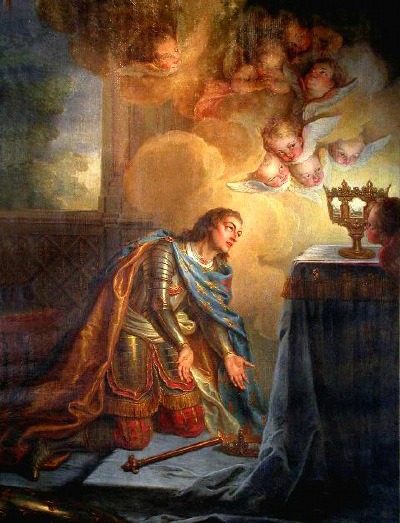
Louis’ patronage of the arts drove much innovation in Gothic art and architecture and the style of his court radiated throughout Europe by both the purchase of art objects from Parisian masters for export and by the marriage of the king’s daughters and female relatives to foreign husbands and their subsequent introduction of Parisian models elsewhere. Louis’ personal chapel, the Sainte-Chapelle in Paris, was copied more than once by his descendants elsewhere. Louis ordered the production of the Morgan Bible, a masterpiece of medieval painting. In his private chapel, Saint Louis would genuflect during the Nicene Creed to show reverence to the incarnation of Christ at the words, and was incarnate by the Holy Spirit from the Virgin Mary; and was made man. During the crusades, the king’s practice became widespread and eventually was established as part of the rubrics of Holy Mass. The painting of St Louis and St John the Baptist below, is from the Flemish school and was a detail for an altar of the Parliament of Paris. In the background is the Louvre palace from the 13th century.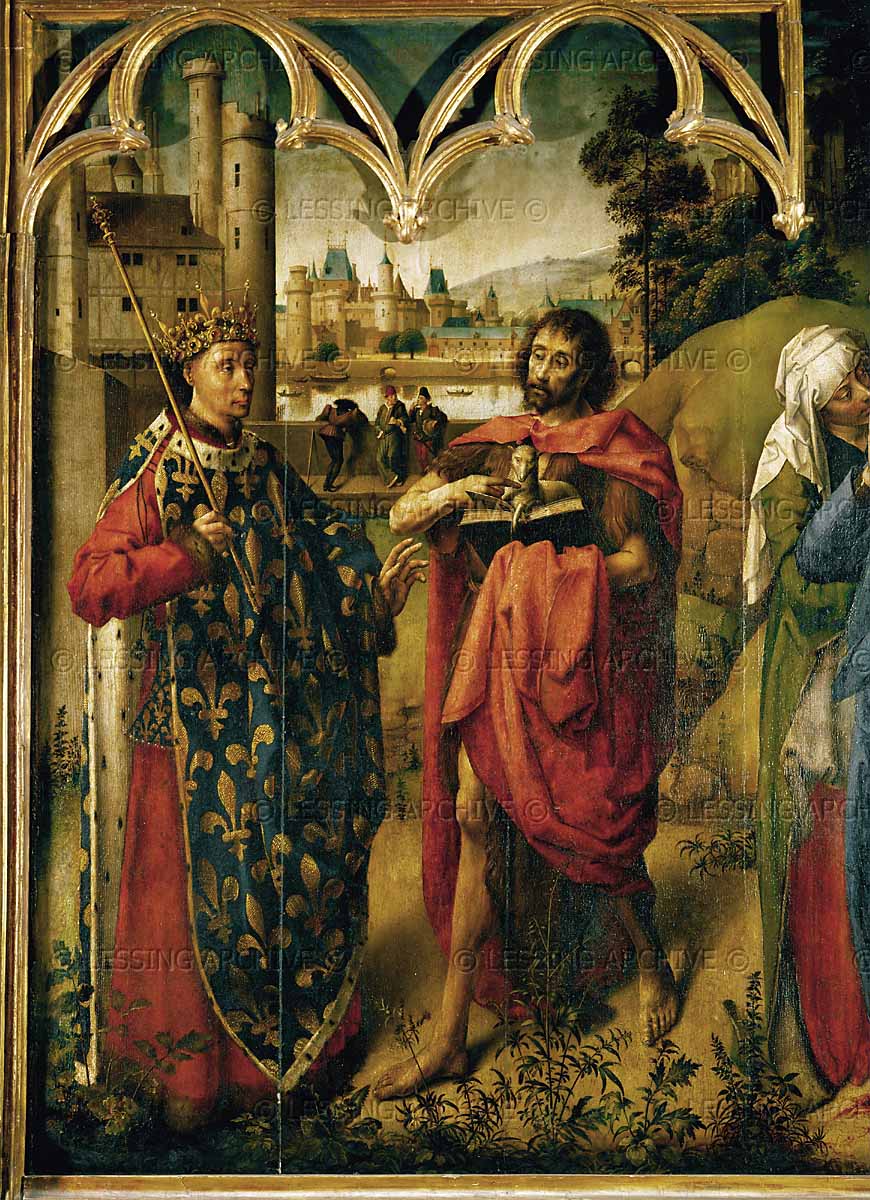
During the so-called “golden century of Saint Louis”, the kingdom of France was at its height in Europe, both politically and economically. Saint Louis was regarded as “primus inter pares”, first among equals, among the kings and rulers of the continent. He commanded the largest army and ruled the largest and wealthiest kingdom, the European centre of arts and intellectual thought at the time. The foundations for the famous college of theology later known as the Sorbonne were laid in Paris about the year 1257. The prestige and respect felt in Europe for King Louis IX were due more to the attraction that his benevolent personality created rather than to military domination. For his contemporaries, he was the quintessential example of the Christian prince and embodied the whole of Christendom in his person. His reputation for saintliness and fairness was already well established while he was alive and on many occasions he was chosen as an arbiter in quarrels among the rulers of Europe.
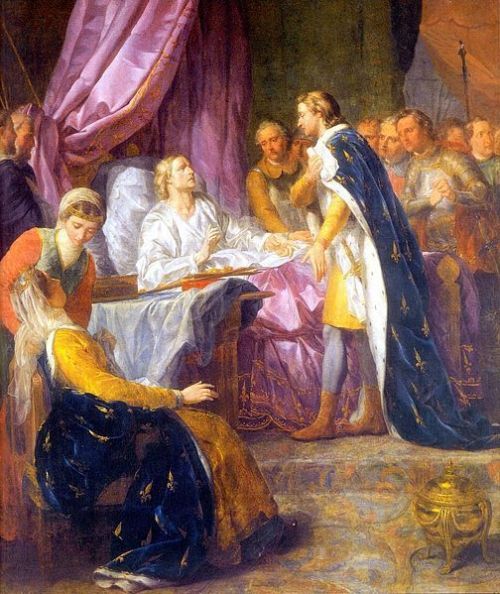
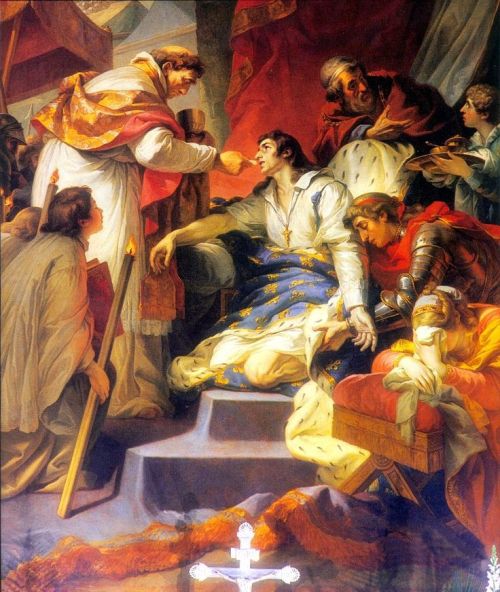
When Louis was dying, he prayed “Lord, I will enter into your house. I will worship in your holy temple and will give glory to your name.” Through his prayer, his support of the Church and his Christlike service to all, Louis made his whole life an act of worship.
Thought for the Day – 24 August The Feast of St Bartholomew, Apostle
“…Philip told this Nathanael that he had found “him of whom Moses in the law and also the prophets wrote, Jesus of Nazareth, the son of Joseph” (Jn 1: 45). As we know, Nathanael’s retort was rather strongly prejudiced: “Can anything good come out of Nazareth?” (Jn 1: 46). In its own way, this form of protestation is important for us. Indeed, it makes us see that according to Judaic expectations the Messiah could not come from such an obscure village as, precisely, Nazareth (see also Jn 7: 42).
But at the same time Nathanael’s protest highlights God’s freedom, which baffles our expectations by causing Him to be found in the very place where we least expect Him. Moreover, we actually know that Jesus was not exclusively “from Nazareth” but was born in Bethlehem (cf. Mt 2: 1; Lk 2: 4) and came ultimately from Heaven, from the Father who is in Heaven.
Nathanael’s reaction suggests another thought to us: in our relationship with Jesus we must not be satisfied with words alone. In his answer, Philip offers Nathanael a meaningful invitation: “Come and see!” (Jn 1: 46). Our knowledge of Jesus needs above all a first-hand experience: someone else’s testimony is of course important, for normally the whole of our Christian life begins with the proclamation handed down to us by one or more witnesses.
However, we ourselves must then be personally involved in a close and deep relationship with Jesus; in a similar way, when the Samaritans had heard the testimony of their fellow citizen whom Jesus had met at Jacob’s well, they wanted to talk to Him directly and after this conversation they told the woman: “It is no longer because of your words that we believe, for we have heard for ourselves and we know that this is indeed the Saviour of the world” (Jn 4: 42).
…To conclude, we can say that despite the scarcity of information about him, St Bartholomew stands before us to tell us that attachment to Jesus can also be lived and witnessed to without performing sensational deeds. Jesus Himself, to whom each one of us is called to dedicate his or her own life and death, is and remains extraordinary.”
Note: the name “Nathanael” means “God has given”.
Pope Benedict XVI – General Audience 4 October 2006
St Bartholomew Pray for us!
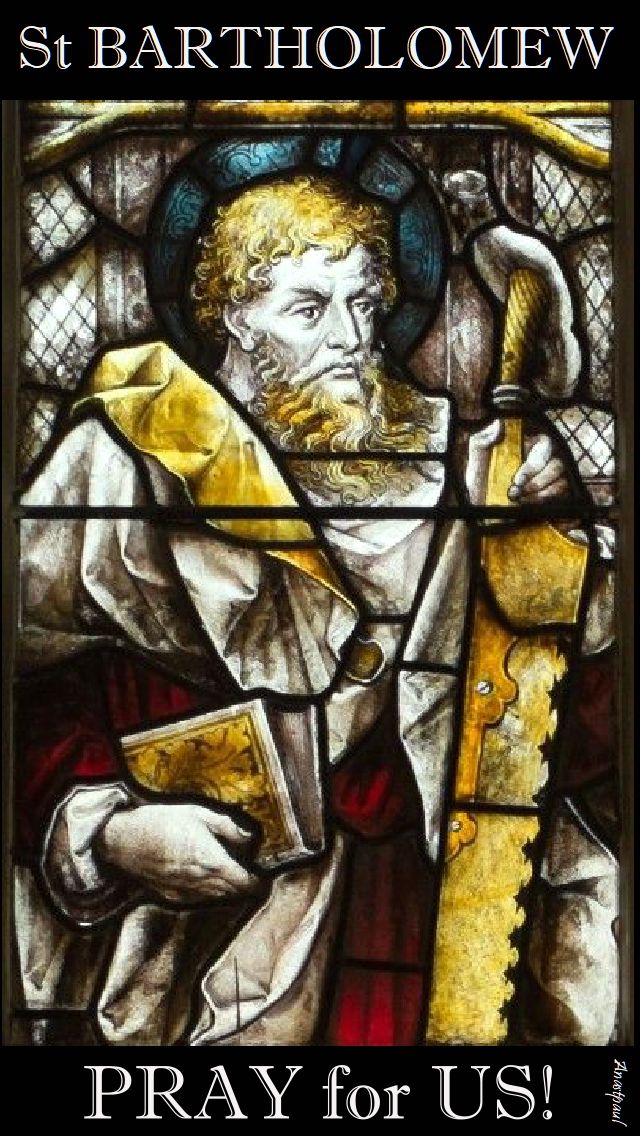
Quote of the Day – 24 August – The Feast of St Bartholomew, Apostle
“Here is a true child of Israel. There is no guile in him.”
Bartholomew/Nathanael answered him :
“Rabbi, you are the Son of God; you are the King of Israel.”

One Minute Reflection – August 24 – The Feast of St Bartholomew
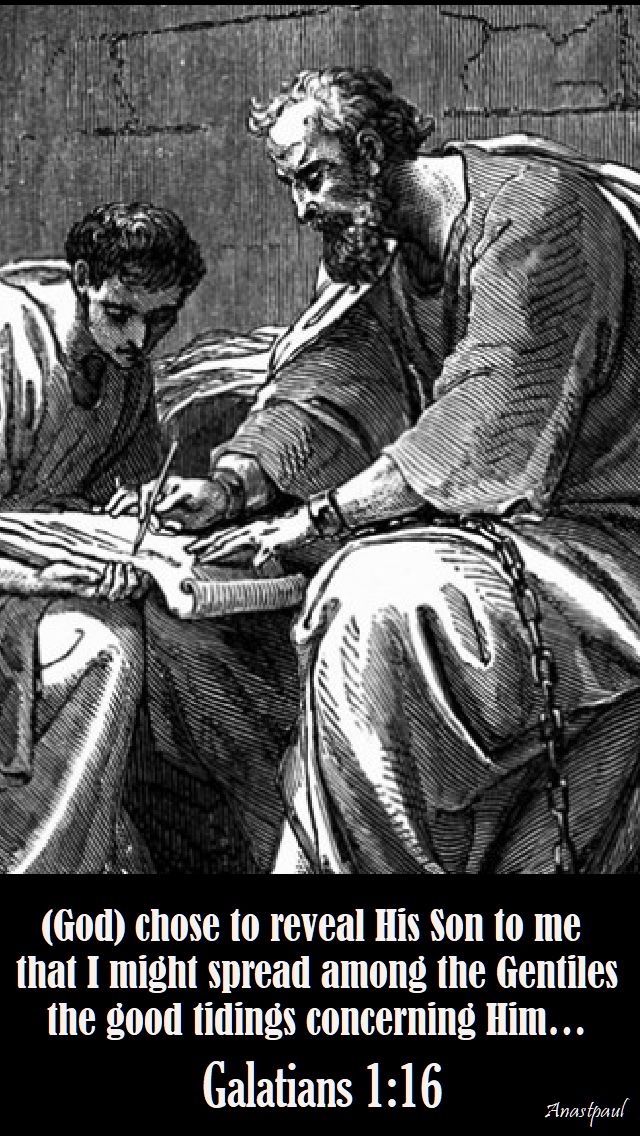
(God) chose to reveal His Son to me
that I might spread among the Gentiles
the good tidings concerning Him…………Galatians 1:16
REFLECTION – “No matter where you may be or where you may be working, make sure the world will be renewed upon contact with you.
Make the Lord more present to human beings and the Gospel more known and loved by them.”… Bl Pope Paul VI
PRAYER – Heavenly Father, teach me to imitate Your divine Son in my life. Grant that by my presence as well as by my deeds, I may bring Christ and His message to everyone I meet. Let me follow Your Apostles and manifest the love and zeal of St Bartholomew. May all the Apostles Pray for us. Amen
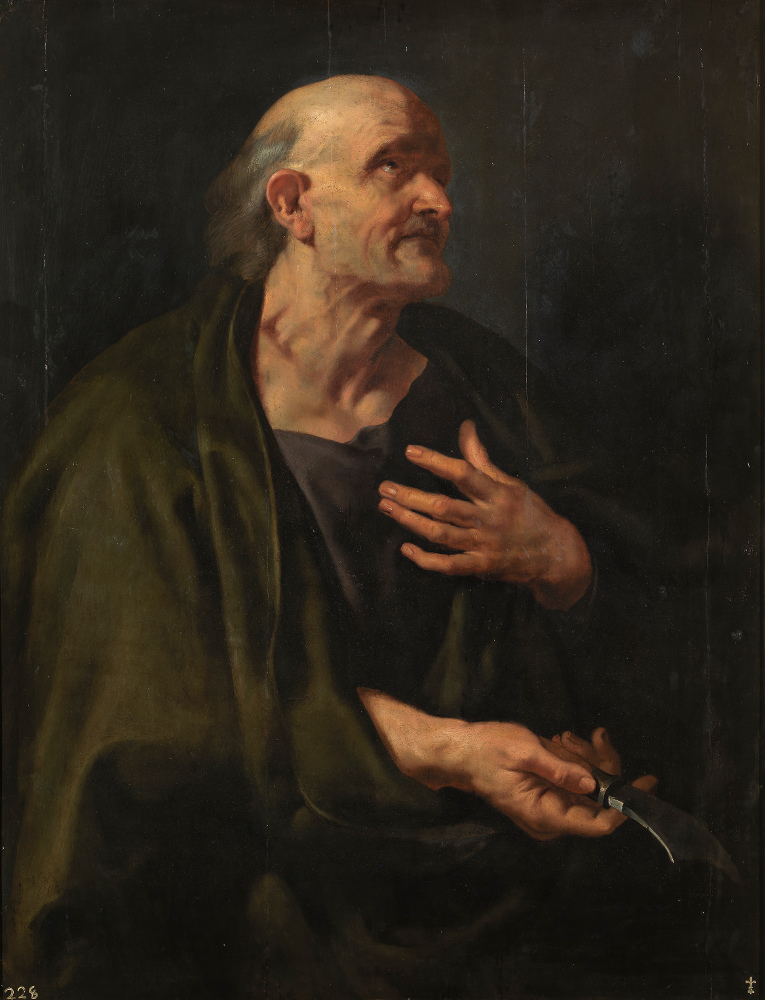
Saint of the Day – 24 August – St Bartholomew Apostle of Christ – Martyr – Patronages – Armenia; bookbinders/publishers; butchers; Florentine cheese and salt merchants; Gambatesa, Italy; Catbalogan, Samar; Għargħur, Malta; leather workers; neurological diseases; plasterers/construction workers; shoemakers; tanners; trappers; skin diseases/rashes, against involuntary shaking disorders; Los Cerricos (Spain), 16 further cities all over the world. Attributes – cross, elderly man holding a tanner’s knife and a human skin, tanner’s knife, bright red (skinless) man holding his own skin.
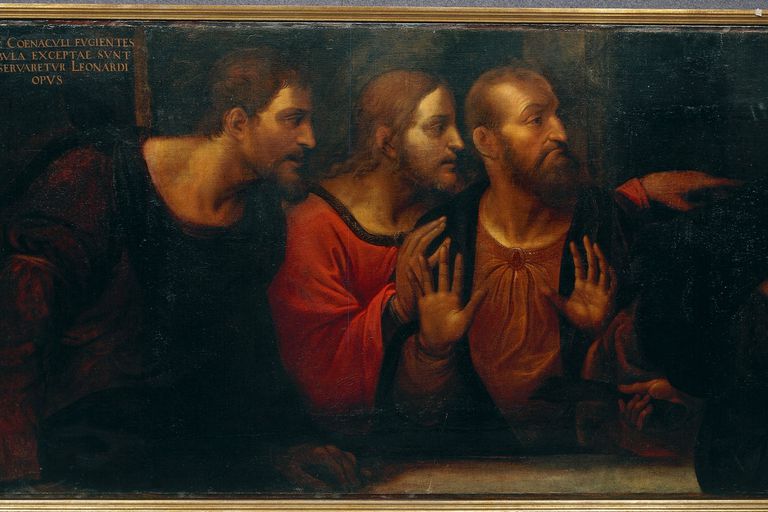


Saint Bartholomew is one of the Twelve Apostles, mentioned sixth in the three Gospel lists (Matthew 10:3; Mark 3:18; Luke 6:14) and seventh in the list of Acts (1:13). The name (Bartholomaios) means “son of Talmai” which was an ancient Hebrew name.
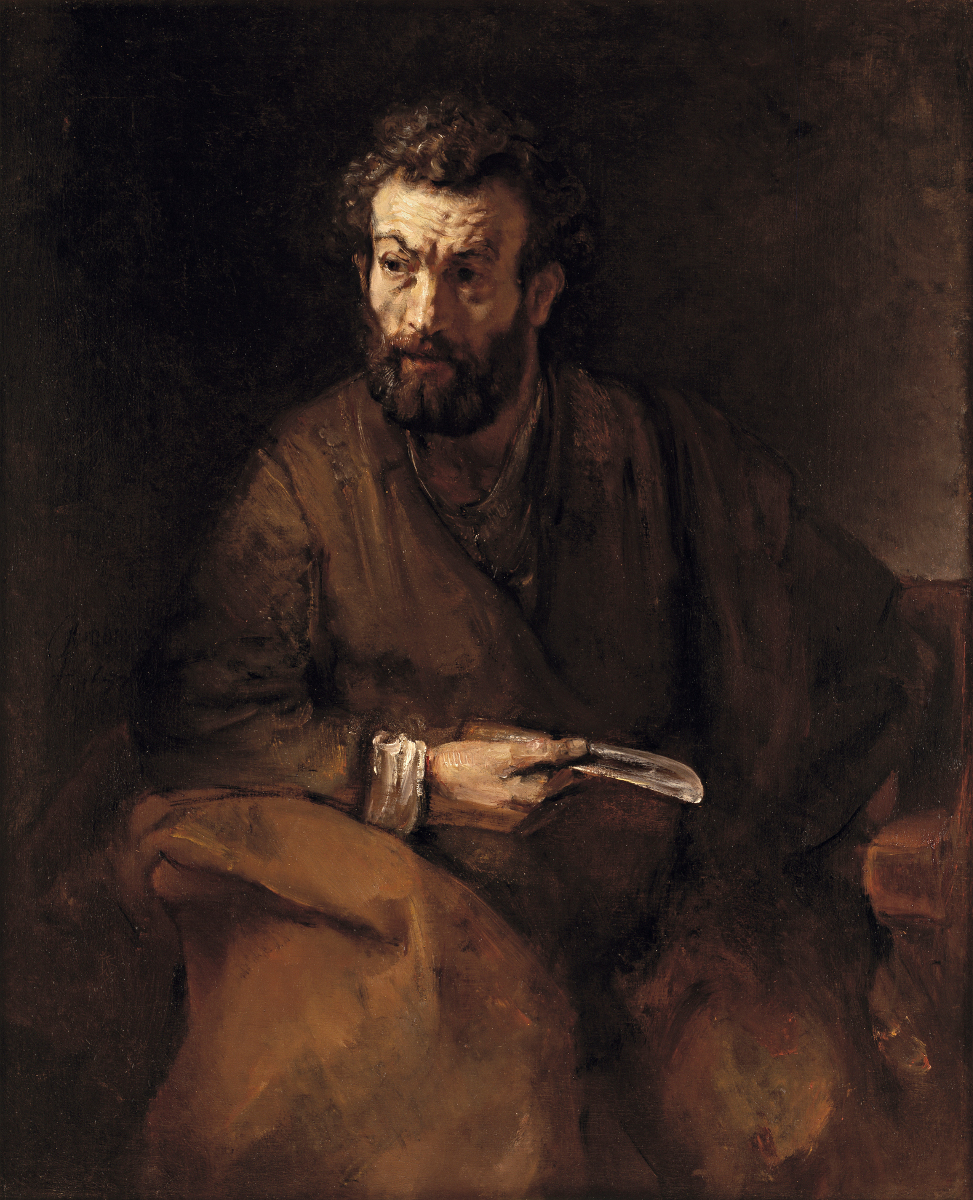
Besides being listed as an Apostle, he is not otherwise mentioned in the New Testament, at least not under the name Bartholomew: many ancient writers and Catholic tradition have identified Bartholomew as Nathaniel in the Gospel of John (John 1:45-51, and 21:2).
The Gospel passage read at Mass on the feast of Saint Bartholomew is precisely this passage from John (1:45-51) where Nathaniel is introduced to Jesus by his friend Phillip, and Jesus says of him “Here is a true child of Israel. There is no duplicity in him (1:47).”
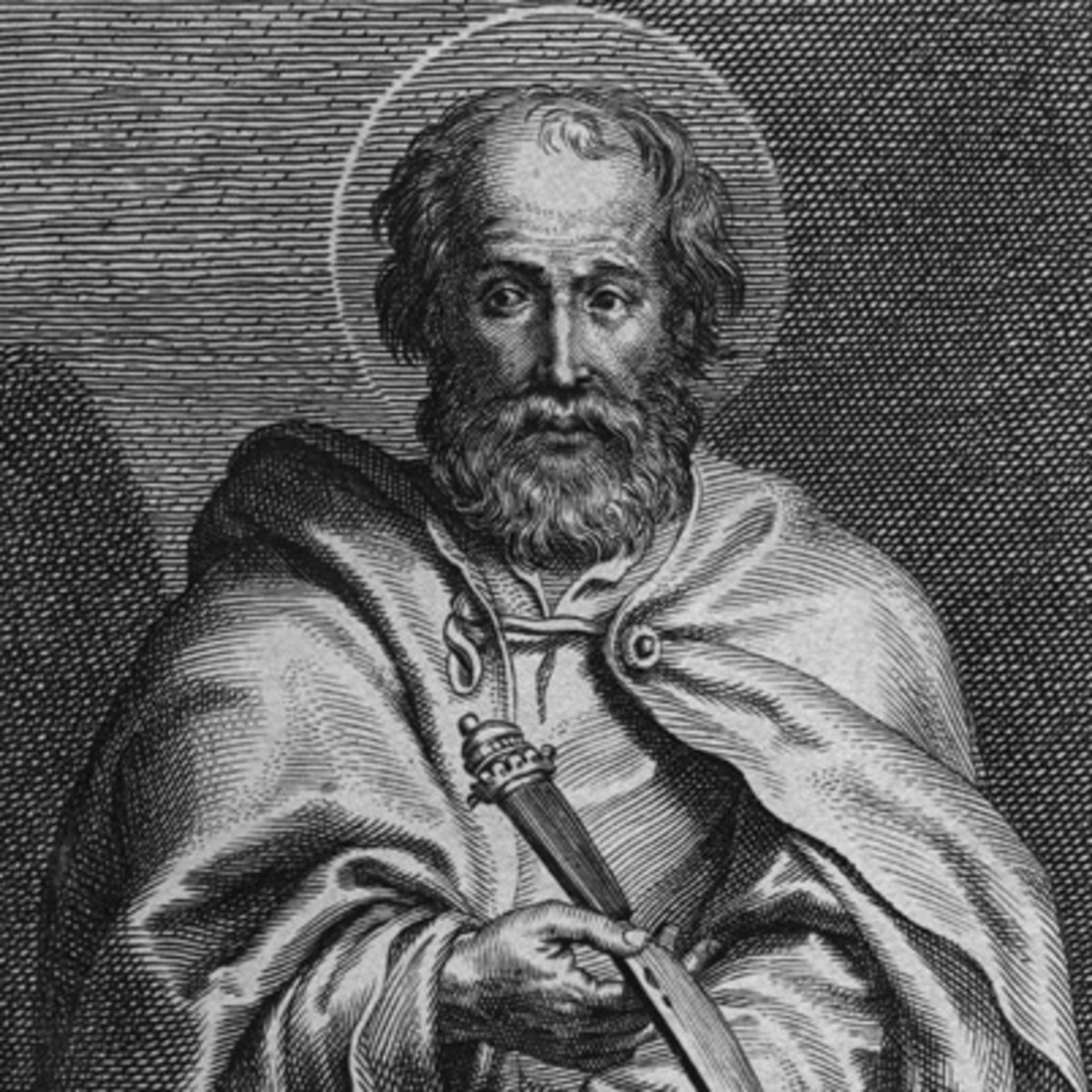
We are presented with the Apostle’s character in this brief and beautiful dialogue with the Lord Jesus. He is a good Jew, honest and innocent, a just man, who devotes much time to quiet reflection and prayer – “under the fig tree (1:48)” – and has been awaiting the Messiah, the Holy One of God.
At Jesus’ mention that “Before Philip called you, when you were under the fig tree, I saw you (1:48),” Nathaniel responded “Rabbi, you are the Son of God! You are the King of Israel (1:49)!”
Being “a true child of Israel,” Nathaniel was a man well-read in the Scriptures and knew what they said of the Messiah and where he would come from. This is why he is skeptical of Phillip’s claim that Jesus is the Messiah, “Can anything good come out of Nazareth (1:46)?”
But Nathaniel was lacking “duplicity” – that is, his heart was undivided, his intentions pure – his openness to reality was always ready to recognise and surrender to the truth when he encountered it. He remained open to his friend Phillip’s invitation to “Come and see (1:46).” In encountering Jesus and hearing His words, he found himself face to face with the Truth Himself, and, like John the Baptist’s leap in his mother’s womb at the Lord’s presence, Nathaniel’s words leapt out of his own heart in a clear and simple confession of faith, “Rabbi, you are the Son of God! You are the King of Israel!”
Jesus, in Matthew 5:8, says, “Blessed are the pure of heart, for they shall see God.” In Nathaniel we have an example of the pure man who sees – recognises – God when confronted with Him and on seeing Him believes in Him and upon believing in Him, follows Him.
Nothing is known for sure about the life of Nathaniel/Bartholomew after the Ascension of Jesus but tradition holds that he preached in the East and died a martyr’s death in Armenia, being flayed alive for having won converts to the Lord Jesus.


You must be logged in to post a comment.