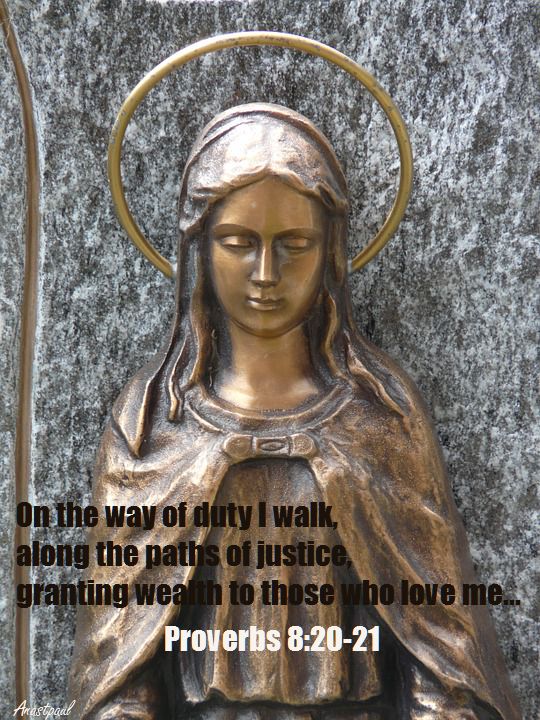
On the way of duty I walk, along the paths of justice, granting wealth to those who love me…………Prv 8:20-21
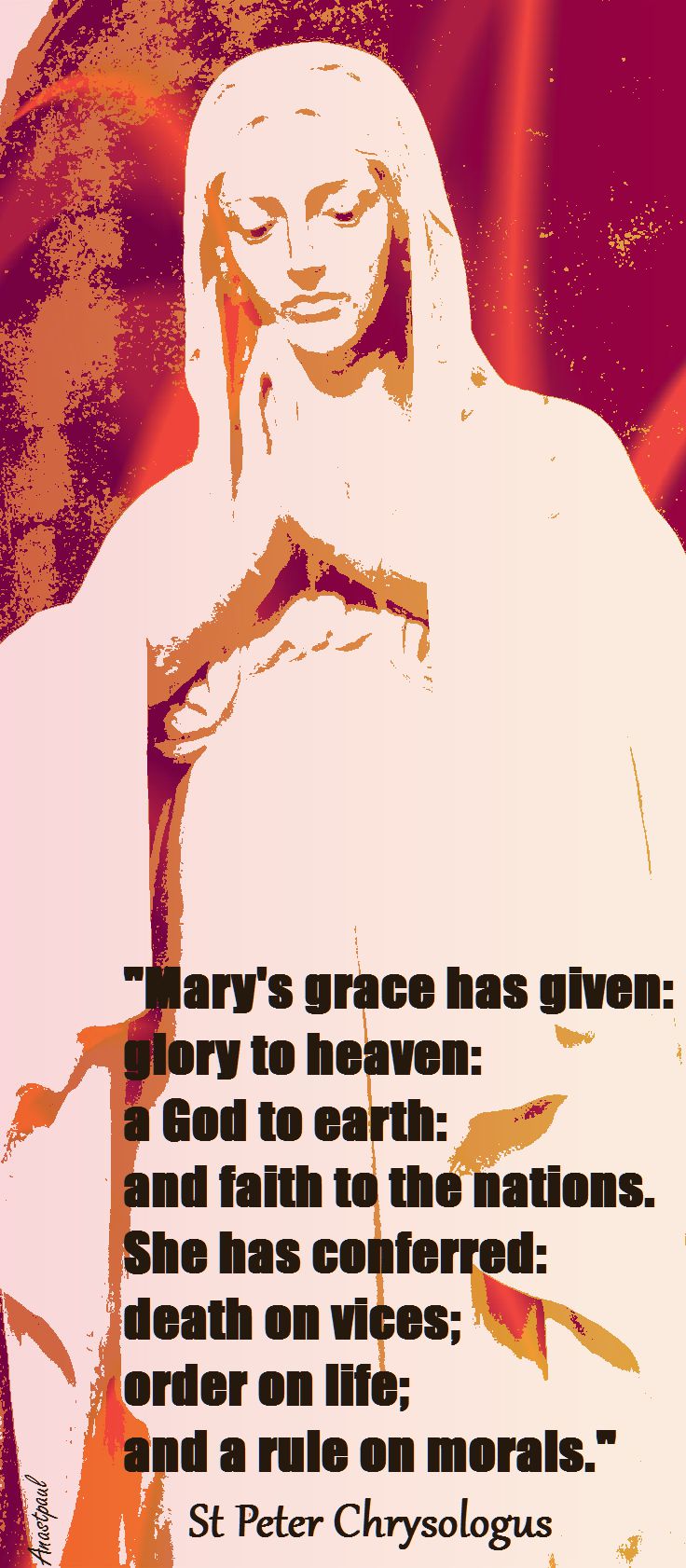
REFLECTION – “Mary’s grace has given glory to heaven: a God to earth: and faith to the nations. She has conferred death on vices, order on life and a rule on morals.”………St Peter Chrysologus
PRAYER – Heavenly Father, grant me the grace to have Mary as my constant intercessor. In all difficulties, let me call on her aid, for she is Your beloved Daughter and our Blessed Mother. Holy Mother of Banneux, Pray for us, amen!
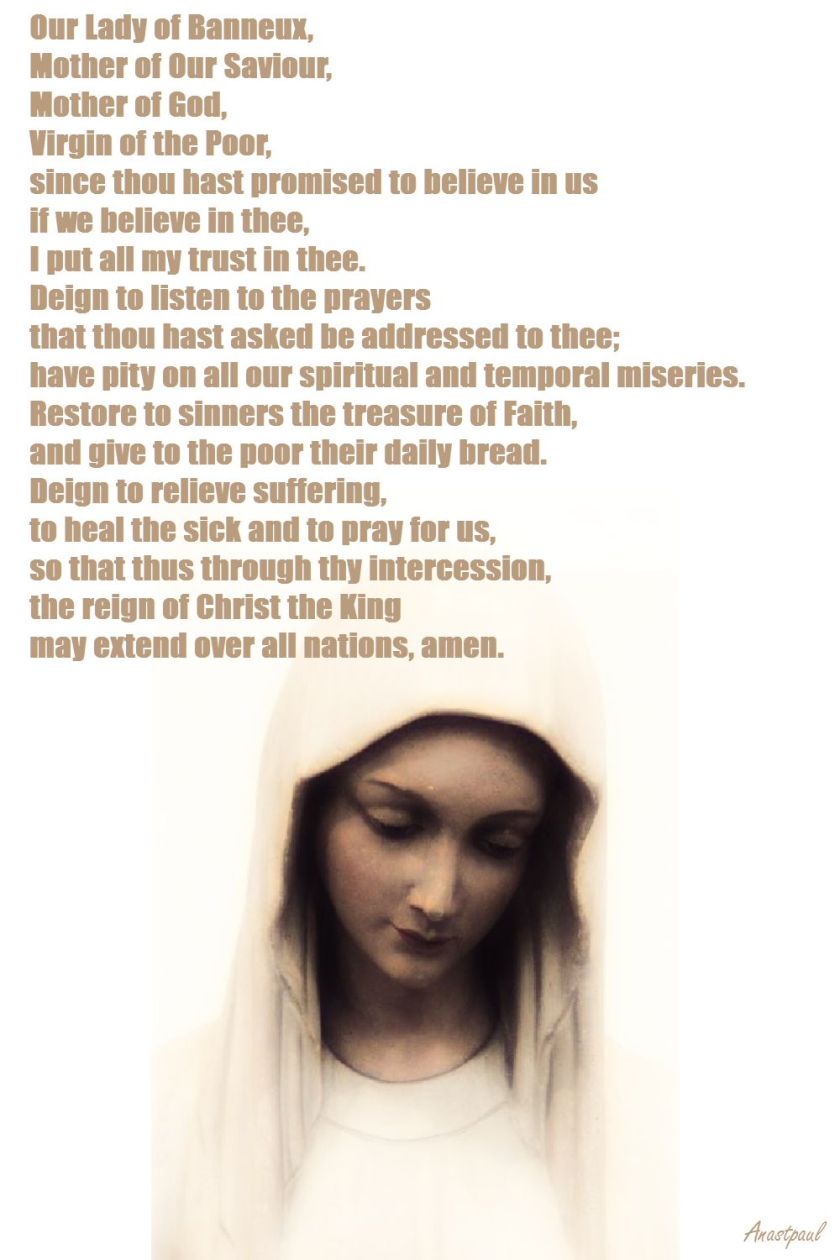
Our Lady of Banneux,
Mother of Our Saviour,
Mother of God,
Virgin of the Poor,
since thou hast promised to believe in us
if we believe in thee,
I put all my trust in thee.
Deign to listen to the prayers
that thou hast asked be addressed to thee;
have pity on all our spiritual and temporal miseries.
Restore to sinners the treasure of Faith,
and give to the poor their daily bread.
Deign to relieve suffering,
to heal the sick and to pray for us,
so that thus through thy intercession,
the reign of Christ the King
may extend over all nations, amen.
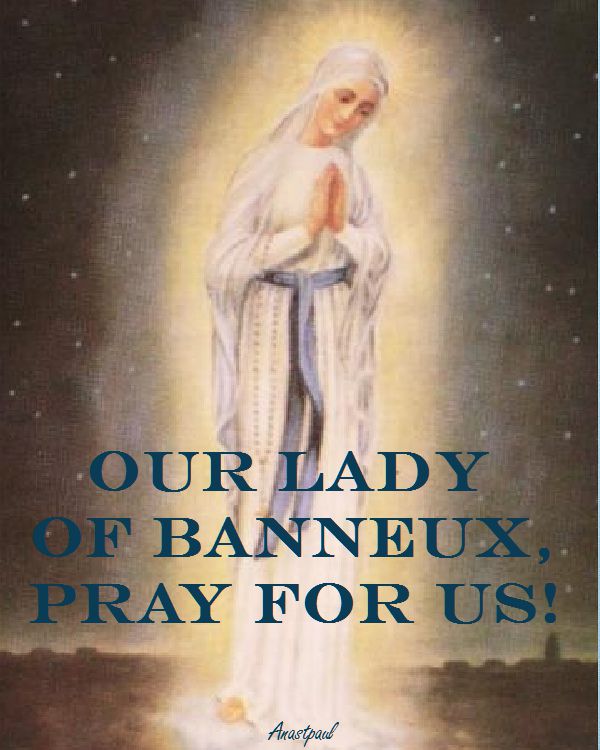
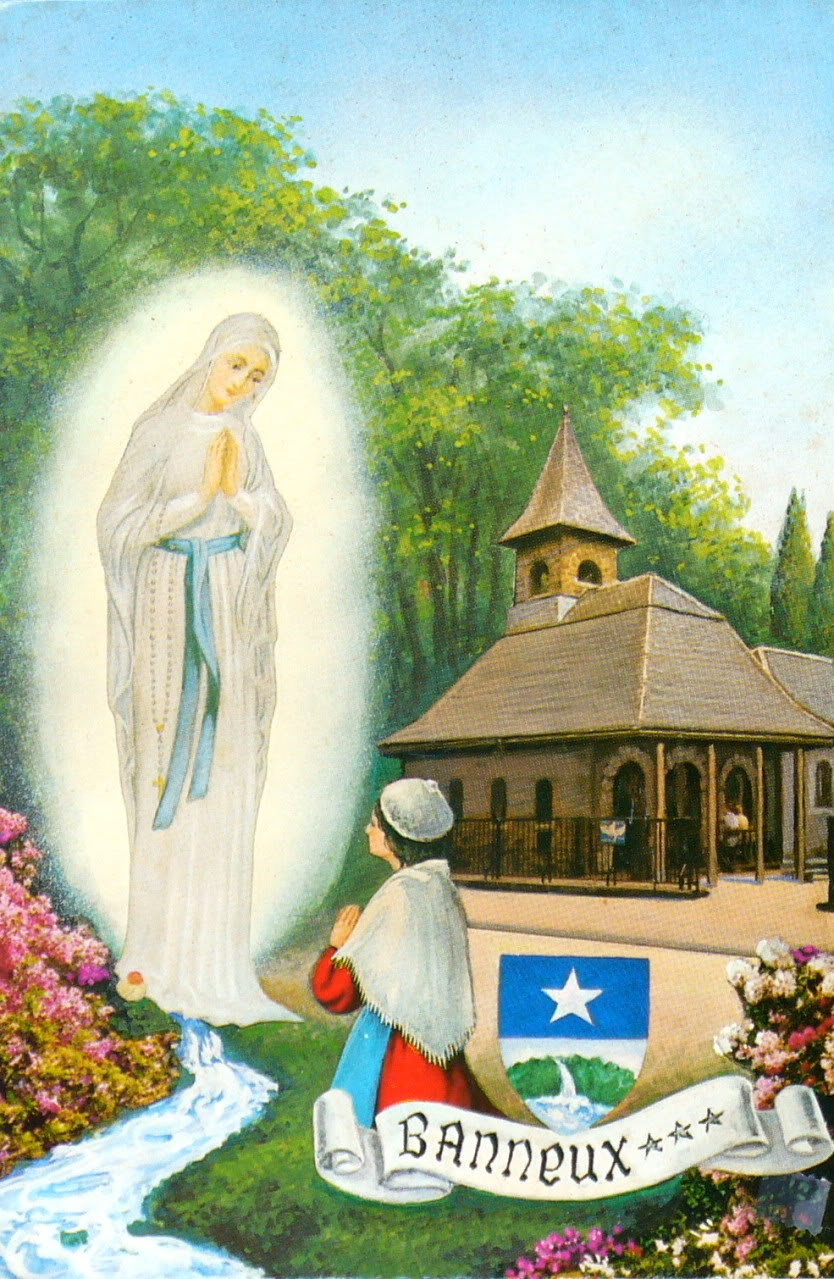
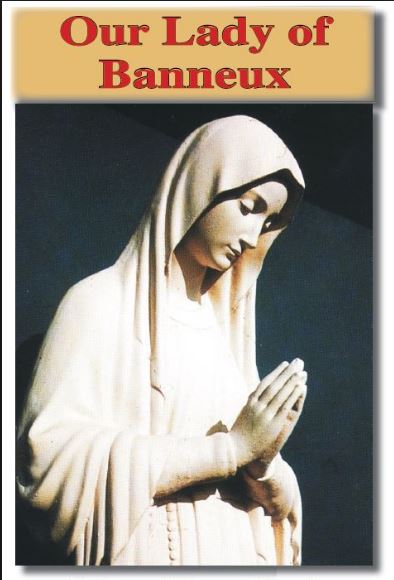
Memorial of the Day – 15 January – Our Lady of Banneux, or Our Lady of the Poor, is the sobriquet given to the apparition of the Virgin Mary to Mariette Beco, an adolescent girl living in Banneux, province of Liège (Belgium). Between January 15 and March 2, 1933, Beco told her family and parish priest of seeing a Lady in white who declared herself to be the “Virgin of the Poor”, saying I come to relieve suffering and believe in me and I will believe in you. As Our Lady of Banneux she has two titles: Our Lady of the Poor and Queen of Nations
Mariette Beco was twelve years old when she reported Marian apparitions in 1933 in Banneux, Belgium, a hamlet about 15 kilometres (10 mi) southeast of the city of Liège. In this case, the Lady in White reportedly declared she was the Virgin of the Poor and said: “Believe in me and I will believe in you.”
According to Mariette, she first saw the Blessed Virgin on the evening of Sunday, January 15, 1933, as she was looking out the kitchen window. A woman in white stood in the garden and called to her to come out, but her mother would not let her. She is described as a young lady in the yard smiling at her. The woman was bent slightly forward and wearing a long white gown with a blue sash, and a transparent white veil. Three days later the woman in white reappeared and told Mariette she was “Our Lady of the Poor”. The lady appeared eight times in all, the last on March 2, 1933.
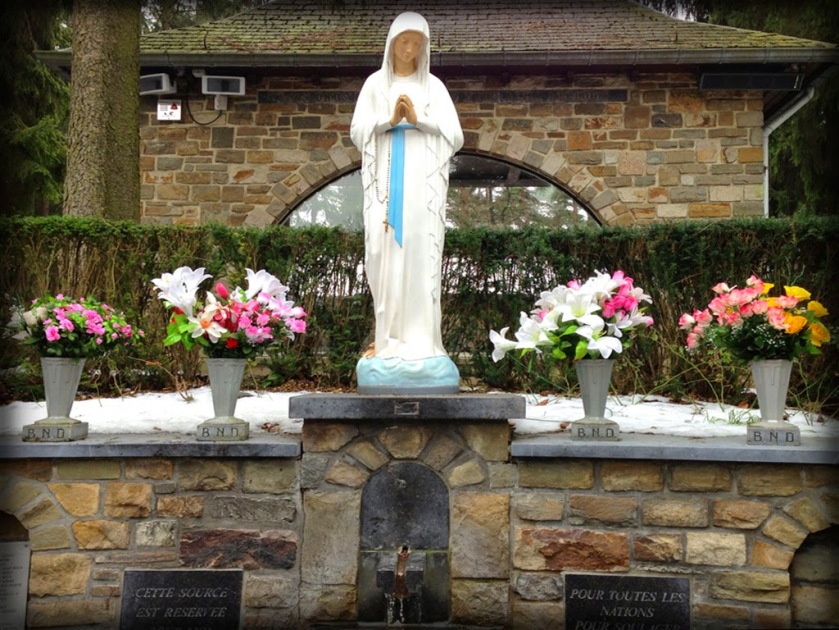
In one of these visions, Mariette said the Lady asked her to plunge (push) her hands into a small spring [poussez vos mains dans l’eau], telling her the spring was for healing and “for all nations”. Over time the site drew pilgrims. Today, the small spring yields about 2,000 gallons of water a day with many reports of miraculous healings.
Mariette, meanwhile, became the object of local derision, with even grandmother and aunt making fun of her. Boys followed her around, calling her “Bernadette”, kneeling and asking for her blessing. Her claims were subject to an official investigation from 1935 to 1937 by an episcopal commission. The evidence collected was submitted to Rome for further analysis. Meanwhile, a hospital was built in 1938.
In May 1942, Bishop Kerkhofs of the Roman Catholic Diocese of Liège (Belgium) approved the veneration of Mary under the title of Our Lady of the Poor. Then, in 1947, approval for the apparitions came from the Holy See. It was declared definite in 1949.
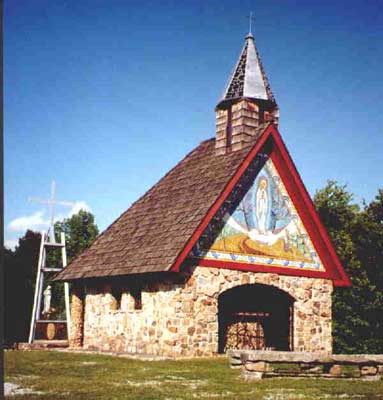
After the apparitions, Mariette decided to remain a private person, married and led a quiet family life. A small chapel stands where the Virgin of the Poor is said to have requested it to be built.
The Chapel of Banneux
Mariette died on December 2, 2011, at the age of 90. In 2008 she made a final statement about her role in the apparitions: “I was no more than a postman who delivers the mail. Once this has been done, the postman is of no importance any more”.
2nd Sunday in Ordinary Time (2017)
Our Lady of Banneux, Belgium (under 2 Titles Our Lady of the Poor and Queen of Nations)
—
St Alexander of Goma
Bl Angelus of Gualdo Tadini
St Arnold Janssen
St Blaithmaic of Iona
St Bonitus of Clermont
St Britta
St Ceolwulf of Northumbria
St Emebert of Cambrai
St Ephysius of Sardinia
St Eugyppius
St Francis Ferdinand de Capillas
Bl Geoffrey of Peronne
Bl Giacomo Villa
St Gwrnerth
St Habakkuk the Prophet
St Isidore of Scété
St Isidore the Egyptian
St Ita of Killeedy
St John Calabytes
St Liewellyn
St Lleudadd of Bardsey
St Macarius of Egypt
St Malard of Chartres
St Maura
St Maurus
St Maximus of Nola
St Pansofius of Alexandria
Bl Peter of Castelnau
St Placid
St Probus of Rieti
St Romedio of Nonsberg
St Sawl
St Secondina of Anagni
St Secundina of Rome
St Tarsicia of Rodez
St Teath
—
Martyrs of Suances – 5 beati
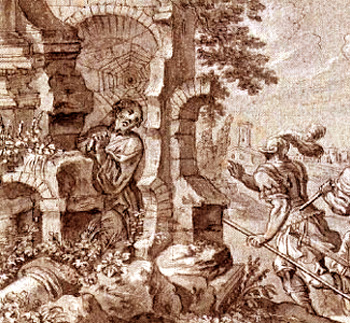
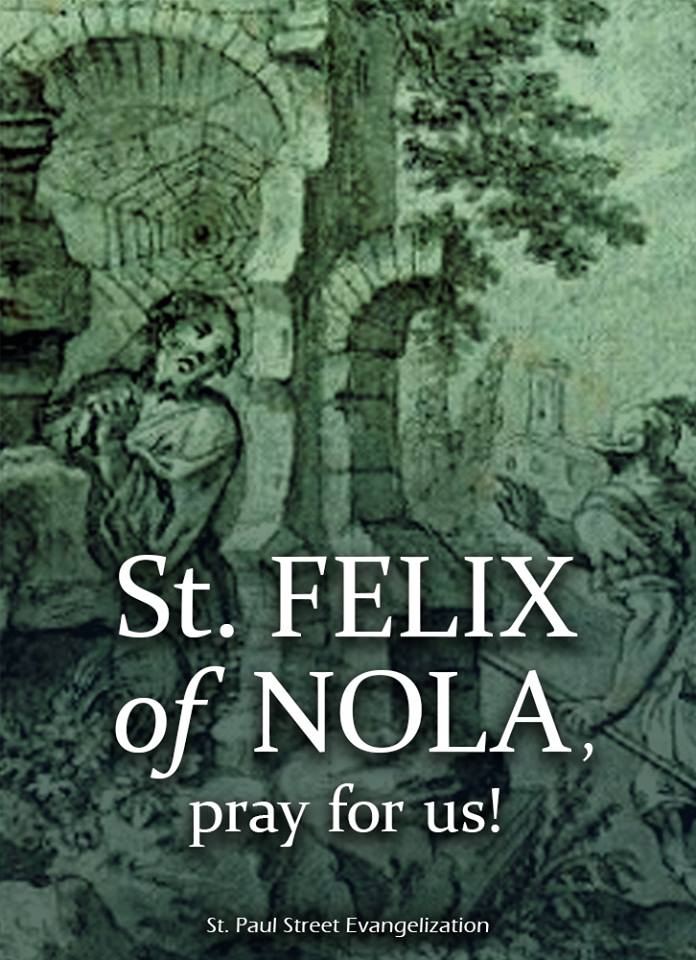
This is the beautiful story of how St Felix of Nola hid from his enemies, during persecution. They were close on his tracks when he hid in the wall of a ruined house. He entered through a narrow opening and immediately afterward, a spider spun a web over the passage to mislead the persecutors. They saw the web and figured that no one could have passed through that opening for some days. So they went on, leaving the saint safe.
A spider web conceals St. Felix from his Roman pursuers
A man protected from terrible persecutors by a spider is extremely charming and poetic. It is a very beautiful episode. Soldiers of the Roman legion, all armed, are searching every inch of the ruined house. I nside one wall is St. Felix, hearing everything. He hears their conversation as they draw near his hiding place. When they stop close to the narrow opening, he thinks: “Now, I am lost.” Then, he hears the commander say: “Let’s not waste time searching here because there are spider webs. No one has been through this opening for some time.”
Again, even if the spider did not exist – and I am not at all sure that it didn’t – it portrays a difficult situation through which St. Felix had to pass that reflects what he had to suffer for the Church, that is, a high moral profile.
Whether these facts are true or not, they tell us that St. Felix was a great saint who left a deep mark on his time. Otherwise the people would not have preserved and passed on the memory of his life. Legend gives us a marvelous image of his life. It is a charming perspective that already has something of Heaven.
Let us pray to St. Felix, asking him to give us dedication in the service of the Church, the courage to face persecution and the desire for Heaven and to know and believe that marvels occur now, each moment of each day, through God who works extraordinary deeds if we believe! (by Prof. Plinio Corrêa de Oliveira)
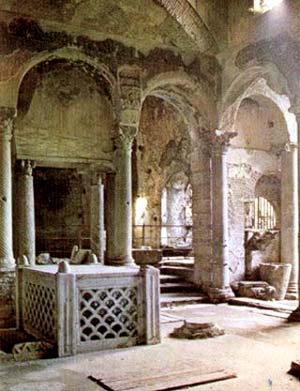
The tomb of St. Felix in the Basilica di San Felix in Cimitile, built in the 3rd century
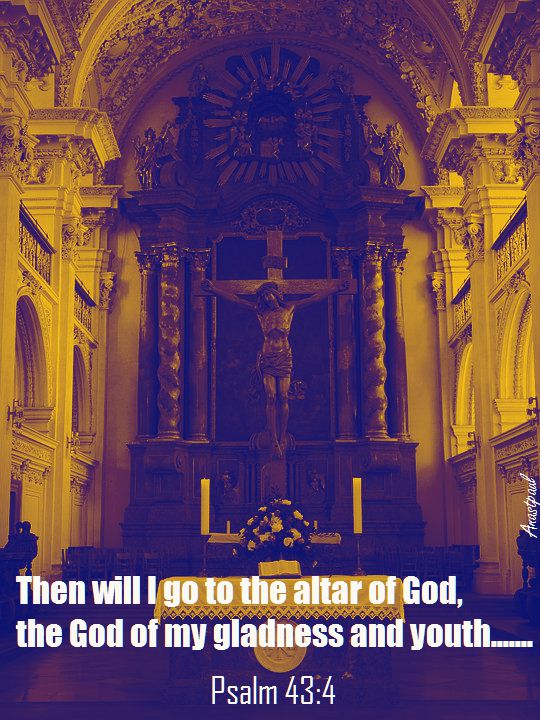
Then will I go to the altar of God, the God of my gladness and youth……….Ps 43:4
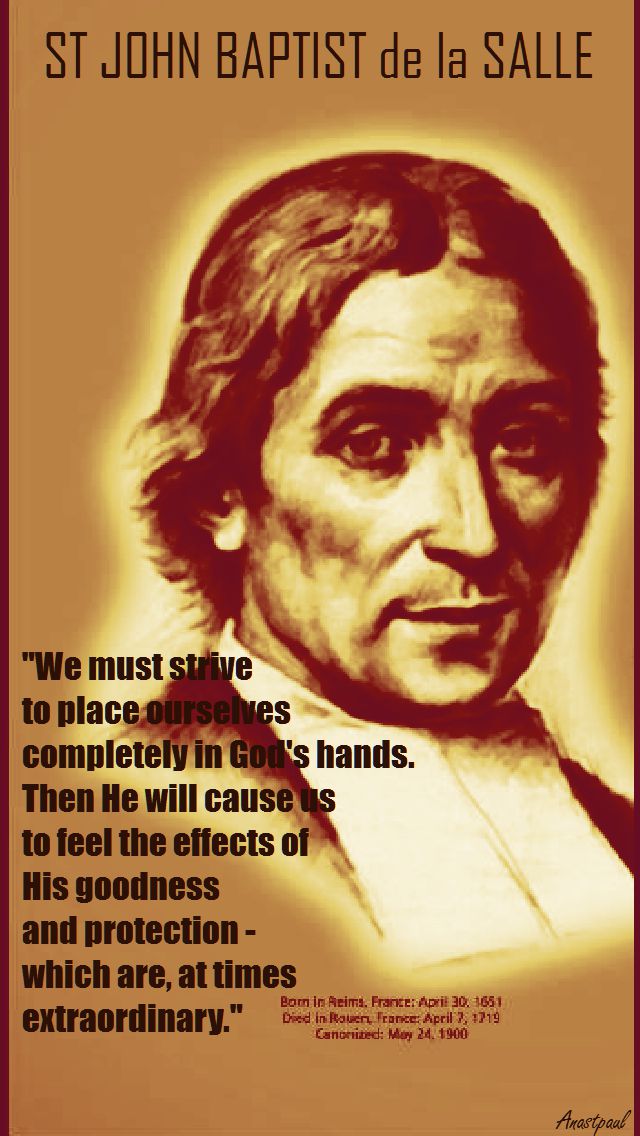
REFLECTION – “We must strive to place ourselves completely in God’s hands. Then He will cause us to feel the effects of His goodness and protection – which are, at times extraordinary.”………St John Baptist de la Salle
PRAYER – Holy Lord God, let me live constantly in Your presence. Grant that I may possess a spirit of joy and gladness because of the firm knowledge that You are always with me and in You and through You and with You, the extraordinary is commonplace! St Felix of Nola, you did no immense deed but in 1800 years we have not forgotten your extraordinary love. Please pray for us, amen.
Saint of the Day – 14 January – St Felix of Nola (c early 3rd century-c 260) Priest and Confessor
A 100 years after St. Felix’s death, St. Paulinus of Nola told his story, adding without discernment appealing legends that had accumulated over the years. But we can trust the unadorned factual outline of Felix’s life.
After Felix divested himself of all his possessions, St. Maximus, the bishop of Nola, a town near Naples Italy, ordained him a priest and made him his right-hand man. In 250, when Emperor Decius decreed a ferocious persecution, Maximus installed himself in a desert hiding place from which he safely governed the church. Because soldiers could not find Maximus at Nola, they tortured and jailed Felix in his place. However, just as St. Peter had had a miraculous escape from prison, an angel is said to have released Felix. Then the angel guided Felix to rescue Maximus, who was near death.
The persecution subsided in 251. Upon the death of Maximus the people wanted to name Felix as bishop but he declined. Instead he retired to a small farm, where for the rest of his life he raised crops to feed himself and provide alms for the poor. St. Felix died around 260.
Every year Paulinus wrote a poem to celebrate Felix’s feast day. In one he said that while Felix did not die a martyr he was willing to offer his life as a sacrifice to God. Paulinus thus provided one of the earliest definitions of a “confessor”:
“This festive day celebrates Felix’s birthday, the day on which he died physically on earth and was born for Christ in heaven, winning his heavenly crown as a martyr who did not shed his blood. For he died as confessor, though he did not avoid execution by choice, since God accepted his inner faith in place of blood. God looks into the silence of hearts and equates those ready to suffer with those who have already done so, for he considers this inward test as sufficient, and dispenses with physical execution in case of true devotion. Martyrdom without bloodshed is enough for him if mind and faith are ready to suffer and are fervent towards God.”
Paulinus adopted Felix as his patron saint, a custom that had its roots in the early church. But for Paulinus, a patron was more than a namesake. Felix not only interceded for him in heaven. He also accompanied him spiritually as an encourager, guide, and protector, as Paulinus explained in the following passage:
“Father and lord, best of patrons to servants however unworthy, at last our prayer is answered to celebrate your birthday within your threshold. . . .You know what toils on land and sea have . . . kept me far from your abode in a distant world because I have always and everywhere had you near me and have called on you in the grim moments of travel and in the uncertainties of life.. . . I never sailed without you, for I felt your protection in Christ the Lord when I overcame rough seas. On land and water my journeying is always made safe through you. Felix, I beg you, address a prayer on behalf of your own to that Embodiment of the calm of eternal love and peace, to Him on whose great name you depend.”
Bl Alfonsa Clerici
Bl Amadeus of Clermont
St Barbasymas
St Caldeoldus of Vienne
St Datius of Milan
Bl Devasahayam Pillai
St Engelmaro
St Eufrasio of Clermont
St Euphrasius the Martyr
St Felix of Nola
St Felix of Rome
St Fermin of Mende
St Glycerius of Antioch
Bl Godfrey of Cappenberg
St Isaias the Martyr
St Jesaja of Sinai
St Macrina the Elder
St Nino of Georgia
Bl Odoric of Pordenone
St Odo of Novara
Bl Pablo Merillas Fernández
St Paul of Africa
Bl Petrus Donders
St Potitus
Bl Rainer of Arnsberg
St Sabas of Sinai
St Sava of Serbia
St Successus of Africa
St Theodolus of Sinai
Bl William de Sanjulia
—
Martyrs of Mount Sinai
Martyrs of Raithu – 43 saints
It was in reading the Bible that St Hilary discovered the greatness of God and the sublimity of the Church and Christian teachings. The Bible is not just a revered book to be placed on our shelves in a place of honour it is a book to be read, to be studied and reflected upon. It leads not only to faith and holiness of life but also to the Kingdom of God itself. So we lear that Christ said His coming would bring not peace but a sword (see Matthew 10:34). The Gospels offer no support for us if we fantasise about a sunlit holiness that knows no problems. Christ did not escape at the last moment, though He did live happily ever after—after a life of controversy, problems, pain and frustration. Hilary, like all saints, simply had more of the same.
Trust in the Lord with all your heart, on your own intelligence rely not….Prv 3:5
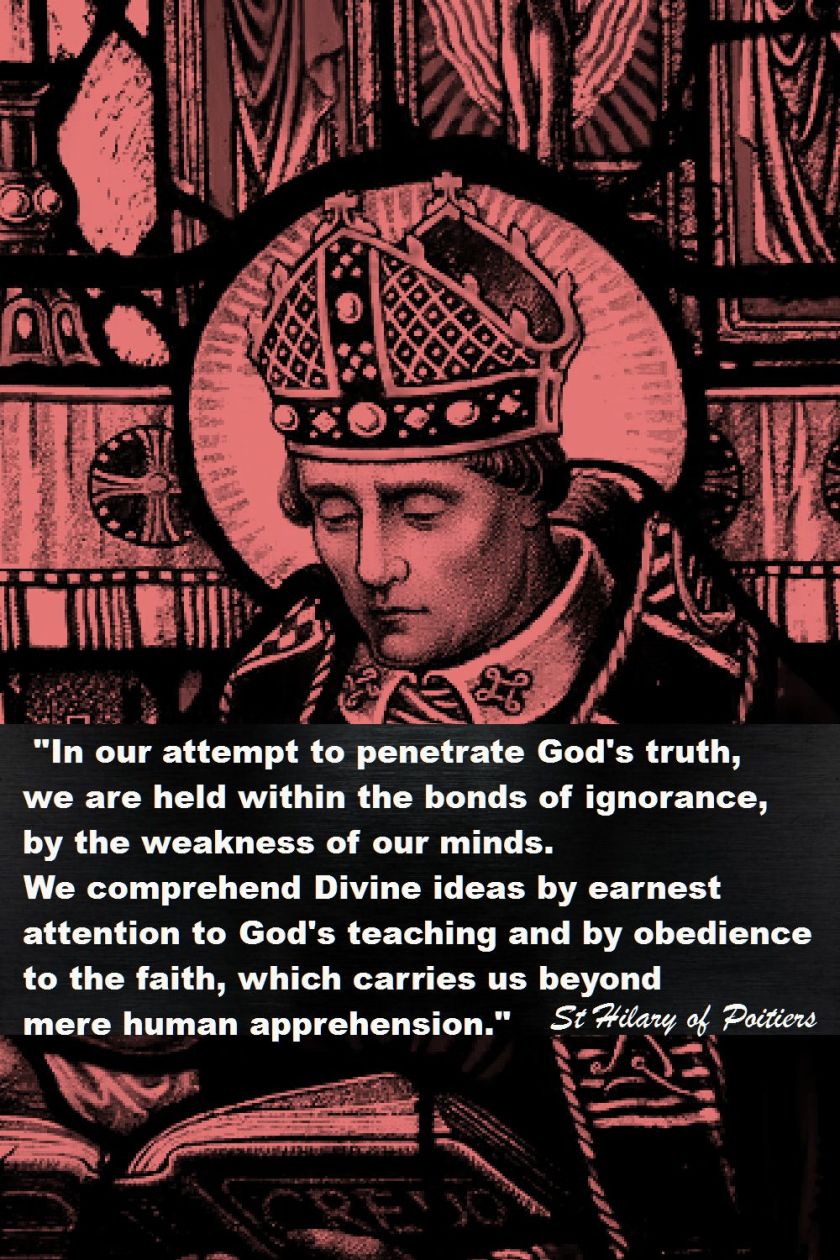
REFLECTION – “In our attempt to penetrate God’s truth, we are held within the bonds of ignorance, by the weakness of our minds.
We comprehend Divine ideas by earnest attention to God’s teaching and by obedience to the faith, which carries us beyond mere human apprehension.”……St Hilary of Poitiers (Saint of the Day)
PRAYER – All-knowing God, grant me the grace to come to a better understanding of Your truths. Let me not only believe them but also carry them out daily in my life. St Hilary of Poitiers, Pray for us, amen!
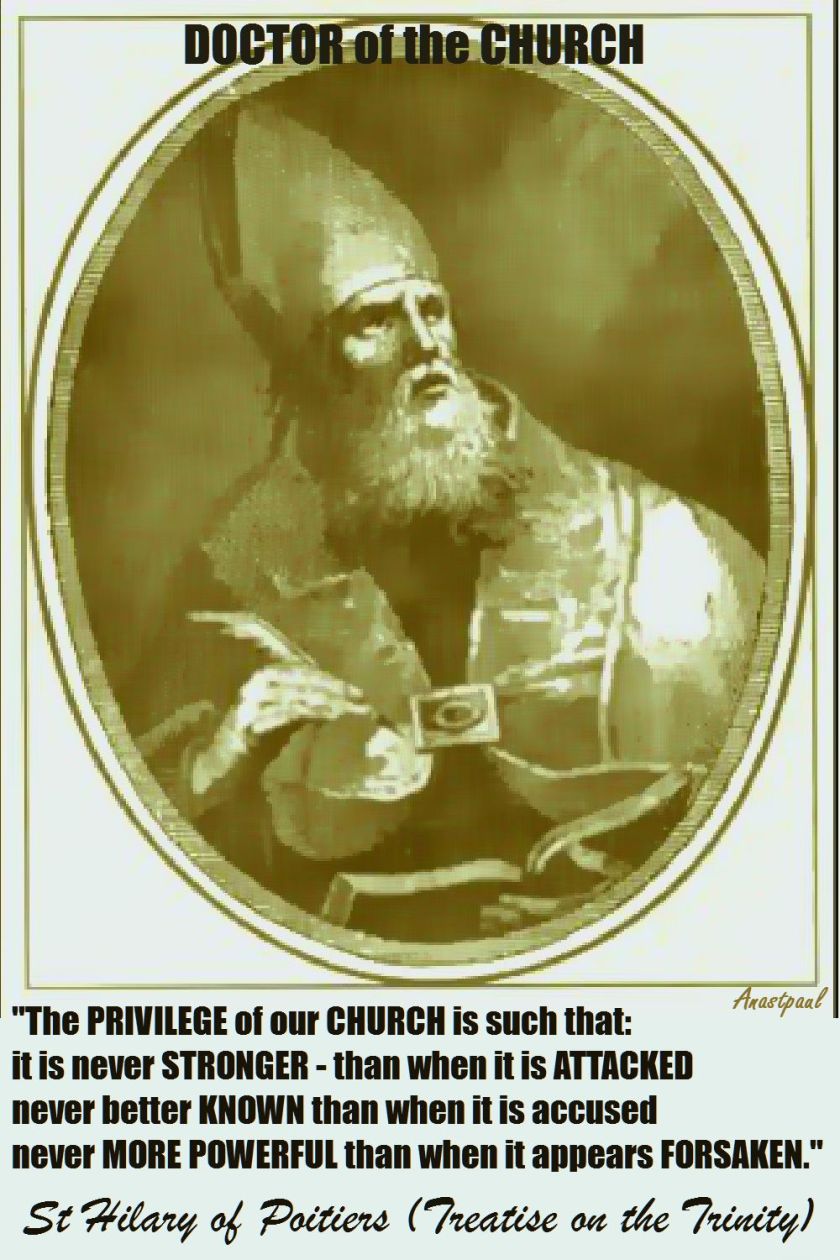
“The privilege of our Church is such that
it is never stronger than when it is attacked,
never better known than when it is accused,
never more powerful than when it appears forsaken.” (Treatise on the Trinity)
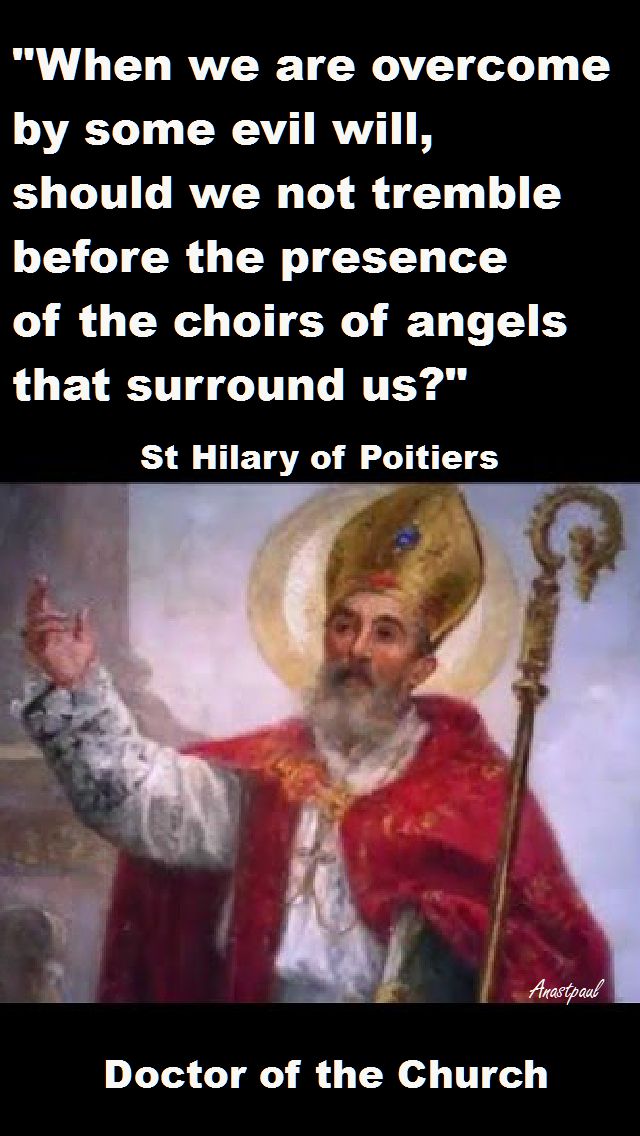
“When we are overcome by some evil will,
should we not tremble before the presence
of the choirs of angels that surround us?”
“The perfection of learning is to know God
in such a way that, though you realise
He is knowable, yet you know Him as indescribable.”
“No matter how sinful one may have been,
if he has devotion to Mary,
it is impossible that he be lost.”
PRAYER OF ST. HILARY OF POITIERS For Perseverance In Faith
Father, keep us from vain strife of words.
Grant to us constant profession of the Truth!
Preserve us in a true and undefiled faith
so that we may hold fast to that
which we professed when we were baptised
in the Name of the Father, Son and Holy Spirit,
that we may have Thee for our Father,
that we may abide in Thy Son
and in the fellowship of the Holy Spirit.
Through Jesus Christ, Our Lord, amen.
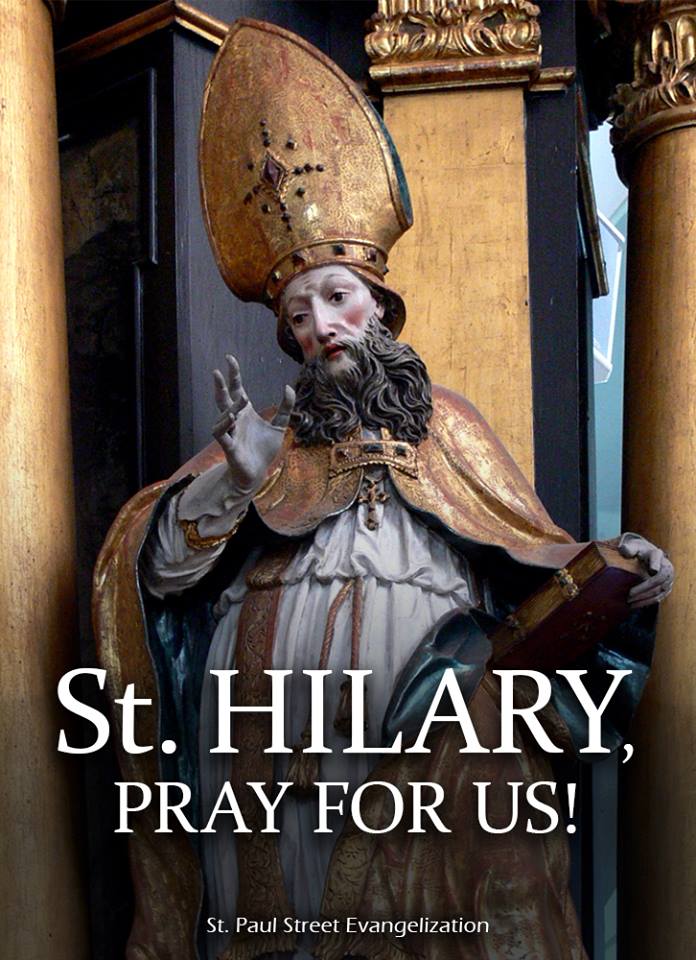
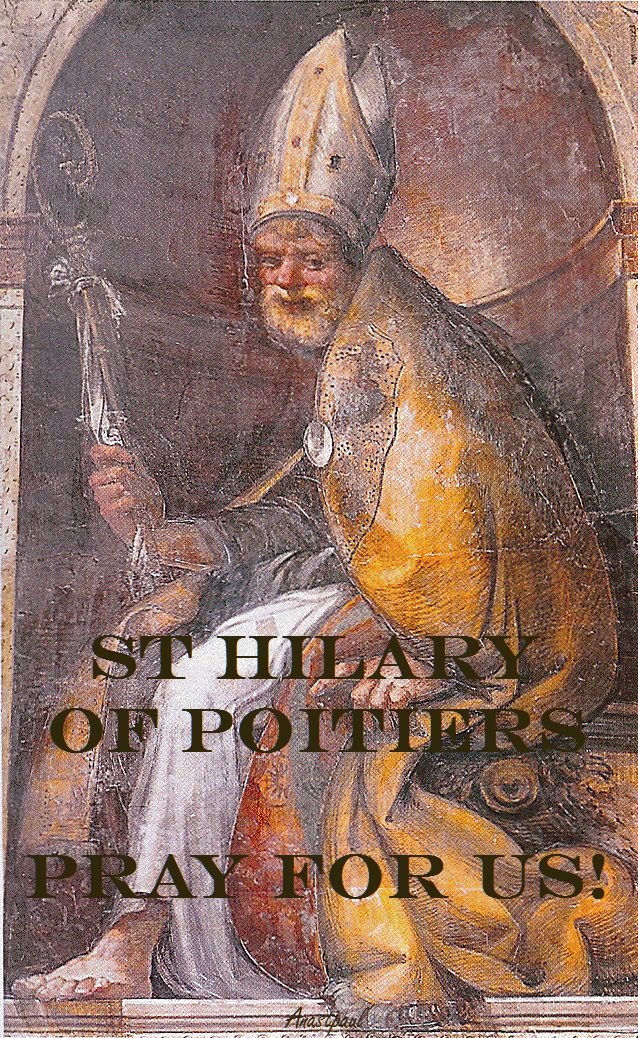
Saint of the Day – 13 January – St Hilary of Poitiers (c315-c368) Bishop/Confessor “”Hammer of the Arians” and “Athanasius of the West” – DOCTOR of the CHURCH. His name “Hilary” His name comes from the Latin word for happy or cheerful. His optional memorial in the General Roman Calendar is 13 January. In the past, when this date was occupied by the Octave of the Epiphany, his feast day was moved to 14 January.
Hilary was born to pagan parents of Poitiers, France, in 315. After training in the classics and philosophy, Hilary married. He and his wife had one daughter, Afra. All who knew Hilary said he was a friendly, charitable, gentle man. Hilary’s studies led him to read Scripture. He became convinced that there was only one God, whose Son became man and died and rose to save all people. This led him to be baptised along with his wife and daughter.
This gentle and courteous man, became a staunch defender of the divinity of Christ. He was devoted to writing some of the greatest theology on the Trinity and was, like his Master, in being labeled a “disturber of the peace.” In a very troubled period in the Church, his holiness was lived out in both scholarship and controversy.
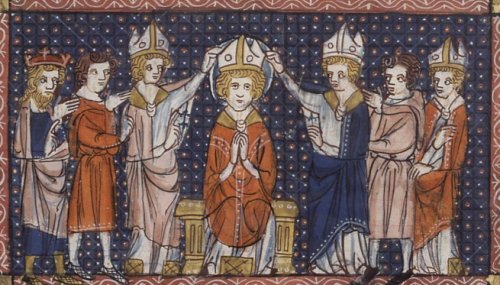
The people of Poitiers chose Hilary to be their bishop in 353. As Bishop, he was soon taken up with battling what became the scourge of the fourth century, Arianism, which denied the divinity of Christ.
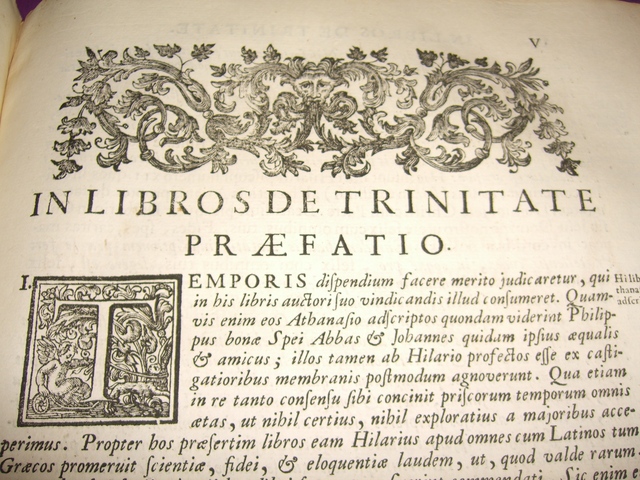
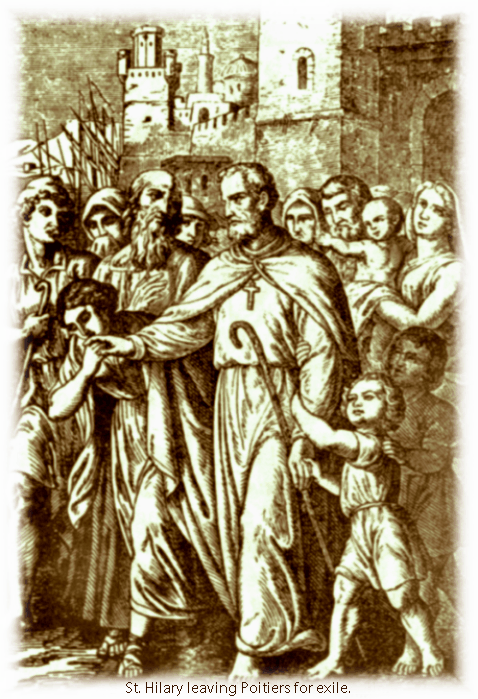
The heresy spread rapidly. Saint Jerome said “The world groaned and marveled to find that it was Arian.” When Emperor Constantius ordered all the bishops of the West to sign a condemnation of Athanasius, the great defender of the faith in the East, Hilary refused and was banished from France to far off Phrygia. There, too, his pastoral solicitude led him to work tirelessly for the re-establishment of the Church’s unity, based on the correct faith, as formulated by the Council of Nicea. To this end, he began writing his most important and most famous dogmatic work: “De Trinitatae” (On the Trinity). Eventually he was called the “Athanasius of the West” and the “Hammer of the Arians.”
During the years of his exile, Hilary also wrote the “Book of the Synod,” in which, for his brother bishops of Gaul, he reproduces and comments on the confessions of faith and other documents of the synods which met in the East around the middle of the 4th century. Always firm in his opposition to radical Arians, St. Hilary showed a conciliatory spirit with those who accepted that the Son was similar to the Father in essence, naturally trying to lead them toward the fullness of faith, which says that there is not only a similarity but a true equality of the Father and the Son in their divinity.
This also seems characteristic: His conciliatory spirit tries to understand those who still have not yet arrived to the fullness of the truth and helps them, with great theological intelligence to reach the fullness of faith in the true divinity of the Lord Jesus Christ.
In 360 or 361, Hilary was finally able to return from exile to his homeland and immediately resumed the pastoral work in his Church but the influence of his teaching extended, in fact, well beyond its borders. A synod celebrated in Paris in 360 or 361 took up again the language used by the Council of Nicea. Some ancient authors think that this anti-Arian development of the bishops of Gaul was due, in large part, to the strength and meekness of the bishop of Poitiers.
During the last years of his life, he wrote “Treatises on the Psalms,” a commentary on 58 psalms, interpreted according to the principle highlighted in the introduction to the work: “There is no doubt that all the things said in the Psalms must be understood according to the Gospel proclamation, so that, independently of the voice with which the prophetic spirit has spoken, everything refers to the knowledge of the coming of our Lord Jesus Christ, incarnation, passion and kingdom, and the glory and power of our resurrection” (“Instructio Psalmorum,” 5).
In all of the Psalms, he sees this transparency of Christ’s mystery and of his body, which is the Church. On various occasions, Hilary met with St. Martin, the future bishop of Tours founded a monastery near Poitiers, which still exists today. Hilary died in 367. His feast day is celebrated on Jan. 13. In 1851, Blessed Pius IX proclaimed him a doctor of the Church.
St Hilary confers minor Orders on St Martin of Tours
St Hilary of Poitiers (Optional Memorial)
—
St Agrecius of Trier
St Andrew of Trier
St Berno of Cluny
St Ðaminh Pham Trong Kham
St Designatus of Maastricht
St Elian of Brittany
St Emil Szramek
St Enogatus of Aleth
St Erbin of Cornwall
St Francesco Maria Greco
Bl Francisca Inés Valverde González
St Giuse Pham Trong Ta
St Glaphyra
St Gumesindus of Córdoba
St Hermylus
Bl Hildemar of Arrouaise
Bl Ida of Argensolles
Bl Ivetta of Huy
St Kentigern of Glasgow
St Leontius of Caesarea
St Luca Pham Trong Thìn
Bl María Francisca Espejo y Martos
Bl Matteo de Lana
St Peter of Capitolíade
St Servusdei of Córdoba
St Stephen of Liège
St Stratonicus
Bl Veronica of Milan
St Viventius
St Vivenzio of Blera
—
Forty Martyred Soldiers at Rome
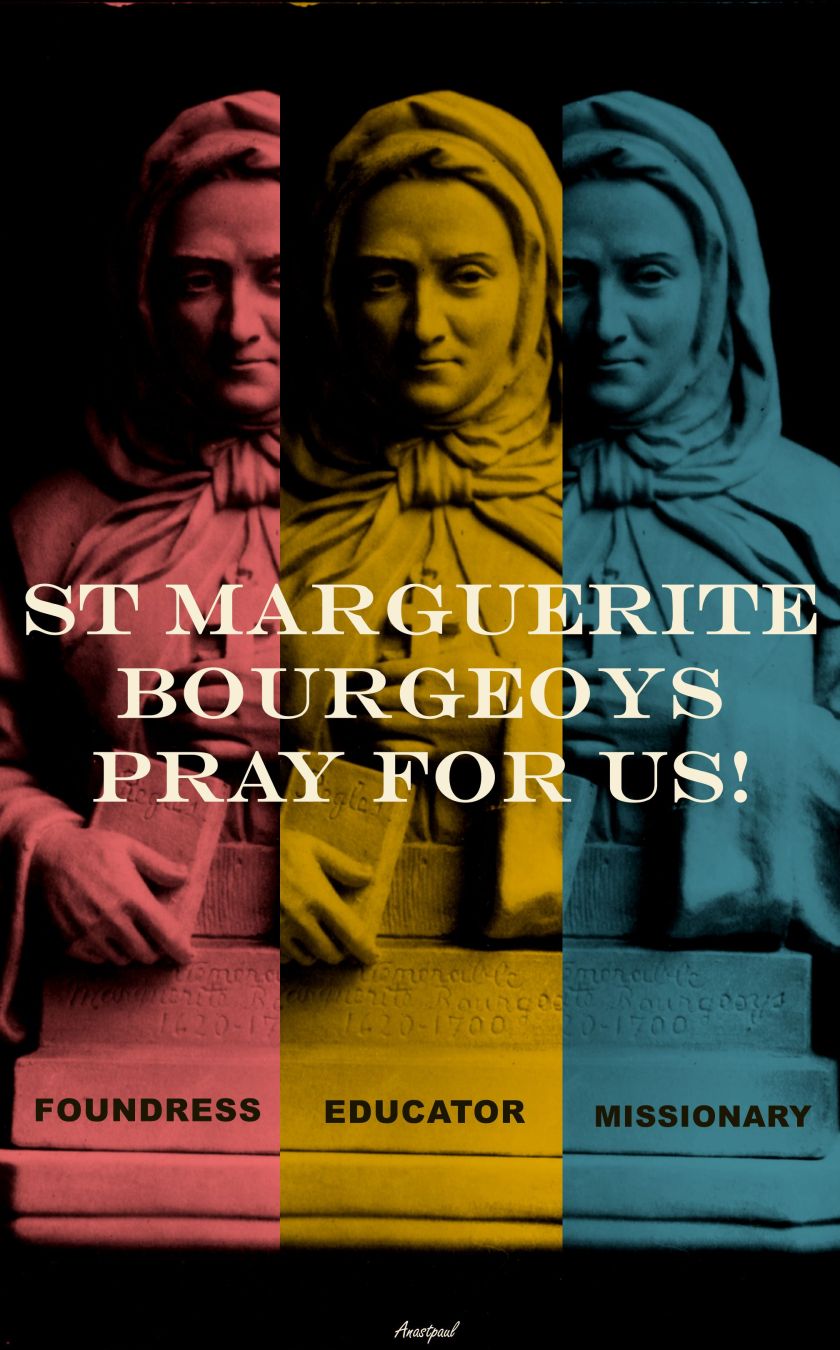
It is easy to become discouraged when plans that we think that God MUST endorse are frustrated. Marguerite was called not to be a cloistered nun but to be a foundress and an educator.
God had not ignored her after all – nor is he ignoring YOU!
May the Lord ….make you overflow with love for one another and for all……..1 Thes 3:12
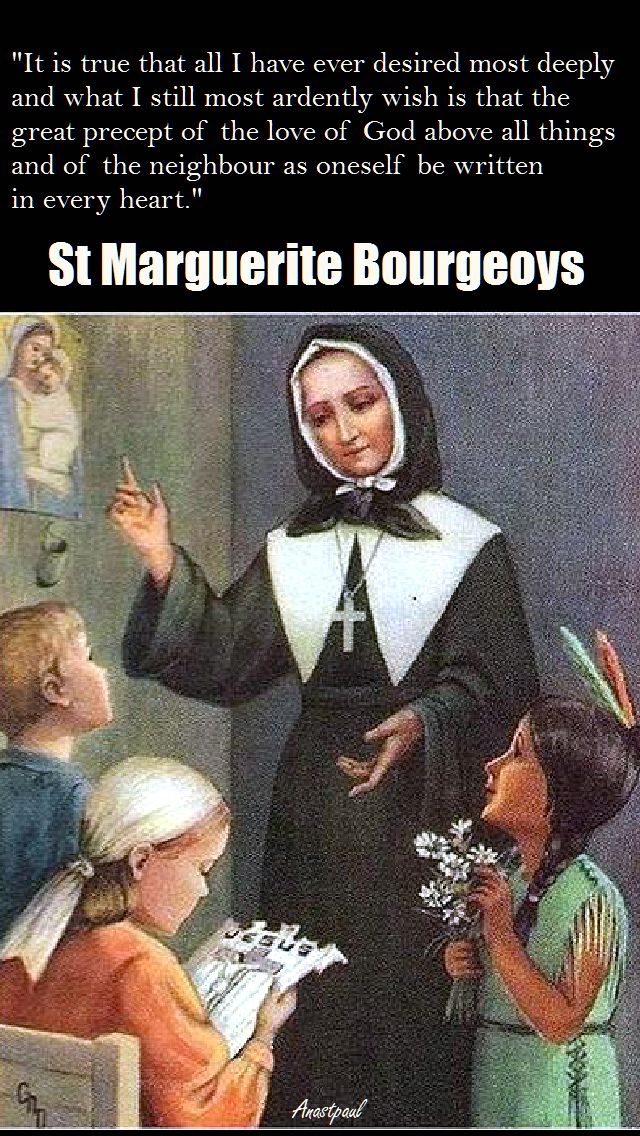
REFLECTION – “It seems to me that we do not pay enough attention to prayer, for unless it arises from the heart which ought to be its centre, it is no more than a fruitless dream. Prayer ought to carry over into our thoughts, our words and our actions…..It is true that all I have ever desired most deeply and what I still most ardently wish is that the great precept of the love of God above all things and of the neighbour as oneself be written in every heart.”……..St Marguerite Bourgeoys (Saint of the Day)
PRAYER – Loving Father, grant me the grace to strive after perfect love. Help me to bring forth frequent acts of love for my neighbour and in this, to grow each day in love for You.St Marguerite Bourgeoys Pray for us, amen.
Saint of the Day – 12 January – St Marguerite Bourgeoys C.N.D.- 1620-1700 (aged 79) – Founder of the Congregation of Notre Dame/Teacher/Missionary/Apostle of Charity – Patron against poverty; loss of parents; people rejected by religious orders (Video – Apostleship of Prayer – https://www.youtube.com/watch?v=-QJesJSHibw)
Born the sixth of 12 children in Troyes, France, Marguerite at the age of 20 believed that she was called to religious life. Her applications to the Carmelites and Poor Clares were unsuccessful. A priest friend suggested that perhaps God had other plans for her.
In 1654, the governor of the French settlement in Canada visited his sister, an Augustinian canoness in Troyes. Marguerite belonged to a sodality connected to that convent. The governor invited her to come to Canada and start a school in Ville-Marie (eventually the city of Montreal). She sailed on June 20, 1653, and arrived in Canada in mid-November. When she arrived, the colony numbered 200 people with a hospital and a Jesuit mission chapel.
Marguerite began the construction of a chapel in 1657. It was to honour Our Lady of Good Help. In 1658, she opened her first school. Marguerite realized the need to recruit more teachers. She returned to France in 1659 and returned with four companions. In 1670, she went to France again and brought back six companions. These brave women became the first sisters of the Congregation of Notre Dame.
St. Marguerite and her sisters helped people in the colony survive when food was scarce. They opened a vocational school and taught young people how to run a home and farm. St. Marguerite’s congregation was growing. By 1681 there were eighteen sisters. Seven were Canadian. They opened more missions and two sisters taught at the Indian mission. St. Marguerite herself received the first two Indian women into the congregation.In 1693, Mother Marguerite handed over her congregation to her successor. The new superior was Marie Barbier, the first Canadian to join the order. St. Marguerite’s religious rule was approved by the Church in 1698. Marguerite spent her last few years praying and writing an autobiography. On the last day of 1699, a young sister lay dying. Mother Marguerite asked the Lord to take her life in exchange. By the morning of January 1, 1700, the sister was completely well. Mother Marguerite had a raging fever. She suffered for twelve days and died on January 12, 1700. She was declared a saint by Pope John Paul II on April 2, 1982.
St Aelred of Rievaulx
Bl Antoine Fournier
St Antony Mary Pucci
St Arcadius of Mauretania
Bl Bartholomew Alvarez
Bl Bernardo de Plano
St Biccianus
St Benedict Biscop
St Bernard of Corleone
St Caesaria of Arles
St Caroticus
Bl Emmanuel d’Abreu
St Eutropius
St Ferreolus of Grenoble
Bl John Gaspard Cratz
St John of Ravenna
Bl Lucia of Valcaldara
St Marguerite Bourgeous
St Martinian of Belozersk
St Martin of León
Bl Nicholas Bunkerd Kitbamrung
St Peter of Abessala
Bl Pierre-François Jamet
St Probus of Verona
St Quinctus the Soldier
St Satyrus
St Tatiana of Rome
St Tigrius
St Victorian of Asana
Bl Vincent da Cunha
—
Martyrs of Africa – 44 saints
Martyrs of Ephesus – 42 saints
Martyrs of Iona – 38 saints
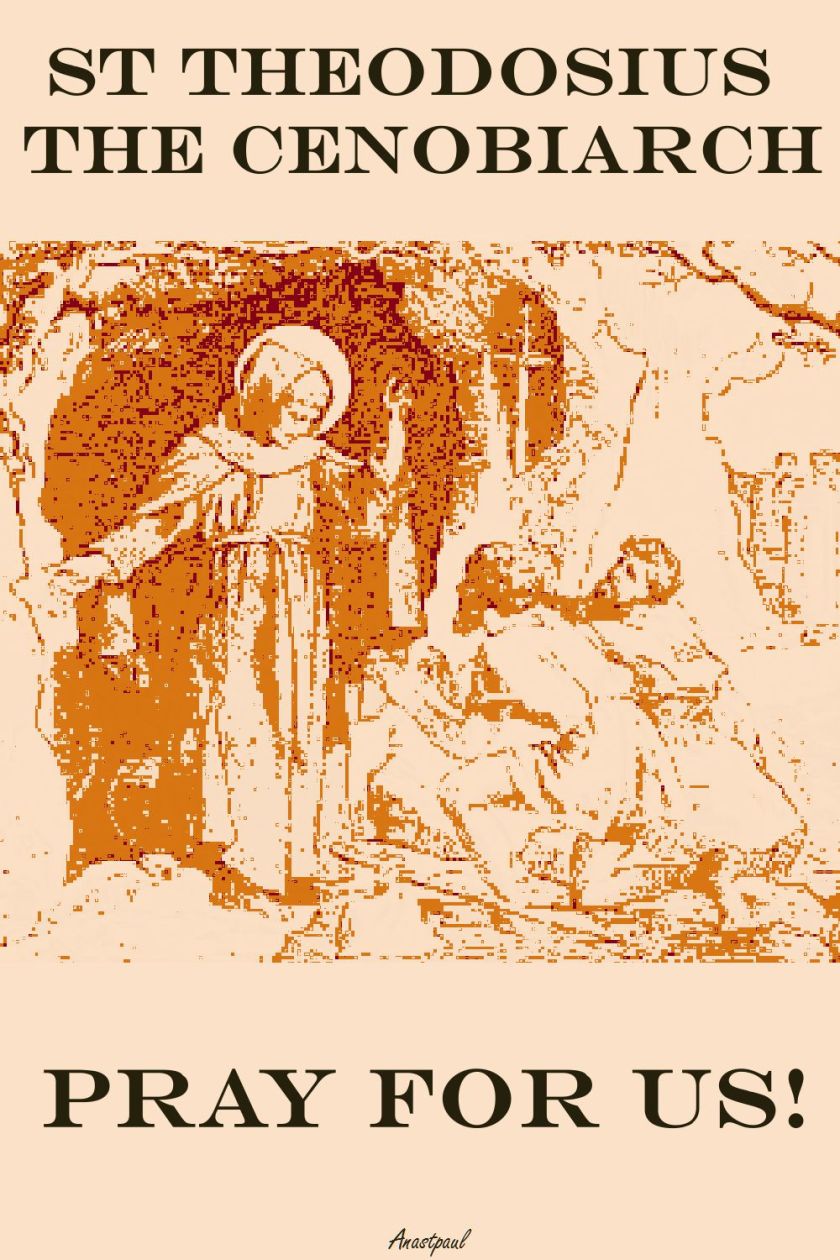
It has always been recognised that love of neighbour is part of the love of God and the great saints have lived this, helping the sick, the poor and the needy without expecting any return. Monasteries were the first hospitals where the sick were cared for, free of charge and where the goodness of God was shown in countless ways. St Theodosius the Cenobiarch was a leader in his time and in ours – we can do no less than he did!
If you lavish your food on the hungry and satisfy the afflicted; then your light shall rise in the darkness and your gloom shall become like midday; then the LORD will guide you always and satisfy your thirst in parched places, HE will give strength to your bones and you shall be like a watered garden, like a flowing spring whose waters never fail…….Isaiah 58:10-11
REFLECTION – “Love is the bond of life, the mother of the poor and the teacher of the rich.
It is the nurse of orphans, the attendant of the elderly, the treasure of the indigent and the common port of all the afflicted.”……..St Gregory of Nyssa.
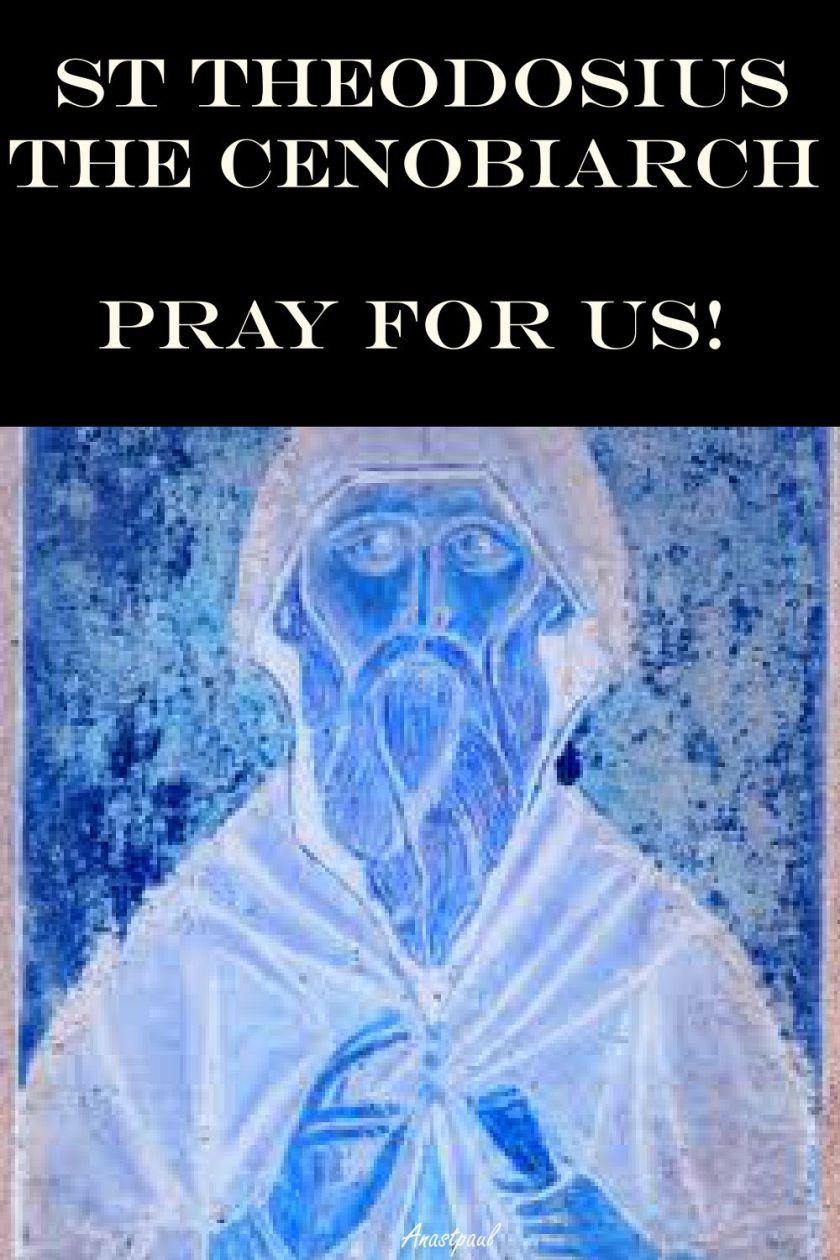
PRAYER – O God, whose blessed Son became poor that we through His poverty might be rich, deliver us from an inordinate love of this world, that we, inspired, by the devotion of Your servant St Theodosius the Cenobiarch, may serve You with singleness of heart and attain to the riches of the age to come; through Jesus Christ our Lord, who lives and reigns with You and the Holy Spirit, one God, now and for ever. St Theodosius the Cenobiarch. Pray for us! Amen
Saint of the Day – 11 January – St Theodosius the Cenobiarch (423-529) died aged 106), Hermit/ AbboT/Founder of the Cenobitical Communities. Roughly translated, cenobitical means “people who have a life in common,” and refers to the monks who joined Saint Theodosius’ community. These monks, of many nationalities, devoted themselves to the Lord, but did not remain in seclusion. Rather, they socialized and interacted with the outside world, which was a new approach to monasticism at that time!
Theodosius was born to pious parents in Mogarissos, Cappadocia (modern Turkey). Attracted to the academic life, he began his studies at an early age, impressing all with his intellect and mind and became a lector while still young. Even as a child, he felt a desire to imitate Abraham by leaving his parents, friends, relatives and everything else for the love of God. Acting upon his calling, Theodosius left home and set out for Jerusalem at the time of the Holy Fourth Ecumenical Council of Chalcedon held in 451. After visiting the holy places, he decided to lead a life of prayer. He asked the guidance of a holy man named Abbot Longinus. Soon people realized how holy Theodosius himself was. Many men asked to join him. To escape the steady stream of pilgrims, Theodosius withdrew further into the wilderness, settling on a mountaintop, residing in a cave that tradition tells us is the same cave that the three Magi spent the night in following their paying homage to Jesus.
Theodosius built a large monastery at Cathismus, near Bethlehem. Before long, it was filled with monks from Greece, Armenia, Arabia, Persia and the Slavic countries. Eventually, it grew into a “little city.” One building was for sick people, one for the elderly and one for the poor and homeless.
Theodosius was always generous. He fed an endless stream of poor people. Sometimes it seemed like there would not be enough food for the monks. But Theodosius had great trust in God. He never turned travelers away, even when food was scarce. The monastery was a very peaceful place. The monks lived in silence and prayer. It was going so well that the patriarch of Jerusalem appointed Theodosius head of all the monks in the east.
Theodosius died in 529 at the age of 106. The patriarch of Jerusalem and many people attended his funeral. Theodosius was buried where he had first lived as a monk.
St Alexander of Fermo
St Anastasius of Suppentonia
Bl Anna Maria Janer Anglarill
St Boadin of Ireland
St Breandan of Ireland
St Eithne
St Fedelemia
Bl Francis Rogaczewski
St Francisca Salesia Aviat
St Honorata of Pavia
St Hyginus, Pope
St Leucius of Alexandria
St Leucius of Brindisi
St Liberata of Pavia
St Lucius the Soldier
St Luminosa of Pavia
St Mark the Soldier
St Michael of Klopsk
St Palaemon
St Paldo
St Peter Balsam
St Peter of Alexandria
St Peter of Anea
St Peter the Soldier
St Salvius of Amiens
St Severus of Alexandria
St Speciosa of Pavia
St Taso
St Theodosius the Soldier
St Theodosius of Antioch
St Theodosius the Cenobiarch
St Tipasio of Tigava
St Tommaso da Cori
St Vitalis of Gaza
Bl William Carter
Like St. Thomas More, St. Peter Orseolo took his success very lightly and had a secret hunger in his heart for closeness to God. He was somehow touched by the wonder of God, as are all great solitaries and that wonder drove him into the wilderness where he could be alone with God. His example said a great deal to the people of his age and very much to this current time, pointing the way to the reality of God and the magnitude of eternal life and the complete worthlessness of worldly achievements.
Saint of the Day -10 January: St Peter Orseolo – Pietro I Orseolo, O.S.B. Cam. (Peter Urseolus) (928–987) Doge and Monk – was the Doge of Venice from 976 until 978. He abdicated his office and left in the middle of the night to become a monk. He later entered the Camaldolese Order.
Peter Orseolo’s life reads like a novel of adventure and intrigue, ending in the solitary wilds of the Pyrenees. He was a Venetian nobleman and at the age of twenty became the commander of the Venetian fleet, conducting successful campaigns against the pirates who preyed on ships in the Adriatic. He was married at eighteen and had one son. In 976, there was a popular uprising in Venice; the doge (or chief magistrate), Peter Candiani IV, was murdered and a large part of the city was destroyed by fire. St. Peter Orseolo was chosen to replace the murdered doge and showed himself a remarkable statesman, one of the greatest to ever rule Venice.
He not only restored the city but began reconstruction of the cathedral of St. Mark, promoted peace, built hospitals and created social programs to help widows, orphans and pilgrims. He built a new palace for the doge and settled accounts with the murdered doge’s widow, whose suit against the city threatened to destroy it financially.
With these tasks completed, on the night of September 1, 978, he secretly left Venice and took refuge in the Benedictine monastery of Cuxa, on the borders of France and Spain. For a long time, not even his wife and son knew his whereabouts. He cut himself off entirely from his former life and placed himself under the direction of the abbot of the monastery. Later, at the suggestion of St. Romuald, founder of the Camaldoli monks, whom he had met at Cuxa, he retired into even greater solitude, after providing for and with the permission of his family. For all his brilliant success, Peter seems to have thought about the move for over ten years and he spent the rest of his life in total solitude with God.
His break with the world was the sensation of the age and was the talk of Venice for decades. He died in 987 and his tomb became a place of pilgrimage
St Aldo of Carbonari
St Agatho, Pope
Bl Anna of the Angels Monteagudo
St Arcontius of Viviers
Bl Benincasa of Cava
St Dermot of Inis Clothrann
St Domitian of Melitene
Bl Giles of Lorenzana
St Marcian of Constantinople
Bl Maria Dolores Rodríguez Sopeña y Ortega
St Maurilius of Cahors
St Nicanor of Cyprus
St Paul the Hermit
St Peter Orseolo
St Petronius of Die
Bl Raymond de Fosso
St Saethryth of Faremoutier
St Thecla of Lentini
St Thomian of Armagh
St Valerius of Limoges
St William of Bourges
The same Spirit, that descended on the water of the River Jordan wafted over the waters during the first creation (Gen 1:2). Therefore, the Baptism in the Jordan presents yet another truth: that Jesus has started a new creation. He is the second man (1 Cor 15:47) or the last Adam (1 Cor 15:45), that comes to repair the first Adam’s guilt. He does this as the Lamb of God that takes away our sins.
‘Looking at the events in light of the Cross and Resurrection, the Christian people realised what happened: Jesus loaded the burden of all mankind’s guilt upon His shoulders; He bore it down into the depths of the Jordan. He inaugurated His public activity by stepping into the place of sinners’ (Joseph Ratzinger, Jesus of Nazareth, Bloomsbury 2007, p 18).
Feast of the Day – 9 January – The Baptism of the Lord
Today the Church celebrates the Solemnity of the Baptism of Our Lord. This brings to an end the season of Christmas. The Church recalls Our Lord’s second manifestation or epiphany which occurred on the occasion of His baptism in the Jordan. Jesus descended into the River to sanctify its waters and to give them the power to beget sons of God. The event takes on the importance of a second creation in which the entire Trinity intervenes.
Many of the incidents which accompanied Christ’s baptism are symbolical of what happened at our Baptism. At Christ’s baptism the Holy Spirit descended upon Him; at our Baptism the Trinity took its abode in our soul. At His baptism Christ was proclaimed the “Beloved Son” of the Father; at our Baptism we become the adopted sons of God. At Christ’s baptism the heavens were opened; at our Baptism heaven was opened to us. At His baptism Jesus prayed; after our Baptism we must pray to avoid actual sin. ( Excerpted from Msgr. Rudolph G. Bandas)
At first glance, the Baptism of the Lord might seem an odd feast. Since the Catholic Church teaches that the Sacrament of Baptism is necessary for the remission of sins, particularly Original Sin, why was Christ baptised? After all, He was born without Original Sin, and He lived His entire life without sinning. Therefore, He had no need of the sacrament, as we do. In submitting Himself humbly to the baptism of St. John the Baptist, however, Christ provided the example for the rest of us. If even He should be baptised, though He had no need of it, how much more should the rest of us be thankful for this sacrament, which frees us from the darkness of sin and incorporates us into the Church, the life of Christ on earth! His Baptism, therefore, was necessary–not for Him, but for us. Many of the Fathers of the Church, as well as the medieval Scholastics, saw Christ’s Baptism as the institution of the sacrament.
The Baptism in the Jordan returns to the great Christmas theme of ‘Christification,’ Jesus of Nazareth’s spiritual anointing, His presentation as the Anointed One par excellence, the Messiah or the One sent by the Father for the salvation of mankind. The Spirit that descended on Jesus shows and seals in an incontrovertible way the ‘Christification’ of Jesus’ humanity that the Word had already fulfilled from the first moment of His miraculous conception by Mary. Jesus, from the very beginning, was always the Lord’s Christ, He was always God. Yet, His one, true humanity, that which is perfect in every way, as the Gospel records, constantly grew in natural and supernatural perfection. ‘And Jesus increased in wisdom, in stature, and in favour with God and with men’ (Lk2:52). In Israel at 30 years of age, one reached full maturity and therefore could become a master. Jesus came of age and the Spirit, descending and remaining on Him, definitively consecrated His whole being as the Christ. (Excerpted from the Congregation for the Clergy)
Baptism of the Lord (Feast)
Black Nazarene
—
St Adrian of Canterbury
Bl Alix le Clerc
St Agatha Yi
Bl Antony Fatati
St Brithwald of Canterbury
St Eustratius of Olympus
Bl Franciscus Yi Bo-Hyeon
St Honorius of Buzancais
Bl Józef Pawlowski
Bl Kazimierz Grelewski
St Marcellinus of Ancona
St Marciana
Bl Martinus In Eon-min
St Maurontius
St Nearchus
St Paschasia of Dijon
St Peter of Sebaste
St Philip Berruyer
St Polyeucte
St Teresa Kim
St Waningus of Fécamp
—
Martyrs of Africa – 21 saints
Martyrs of Antioch – 6 saints
Martyrs of Smyrna
Today the Church celebrates the Solemnity of the Epiphany. “The Lord and ruler is coming; kingship is his, and government and power.” With these words the Church proclaims that today’s feast brings to a perfect fulfillment all the purposes of Advent. Epiphany, therefore, marks the liturgical zenith of the Advent-Christmas season. — Pius Parsch
The Solemnity of the Epiphany is celebrated either on January 6 or, according to the decision of the episcopal conference, on the Sunday between January 2 and January 8. The young Messiah is revealed as the light of the nations. Yet, as the antiphon for the Magnificat at Second Vespers reminds us, three mysteries are encompassed in this solemnity: the adoration of the Christ Child by the Magi, the Baptism of Christ and the wedding feast at Cana. Extra candles and/or lamps may be placed around the sanctuary and in other parts of the church to honor Christ revealed as the Light of the Gentiles (Ceremonial of Bishops). It is customary to replace the images of the shepherds at the crib with the three Magi and their gifts. — Ceremonies of the Liturgical Year, Msgr. Peter J. Elliott, Ignatius Press.
The feast of the Epiphany, which was kept in the East and in certain Western Churches before being observed in Rome, seems to have been originally a feast of the nativity; January 6, for those churches where it was kept, was the equivalent of Christmas (December 25) in the Roman Church. The feast was introduced at Rome in the second half of the sixth century and became the complement and, so to say, the crown of the Christmas festival.
Epiphany means manifestation. What the Church celebrates today is the manifestation of our Lord to the whole world; after being made known to the shepherds of Bethlehem He is revealed to the Magi who have come from the East to adore Him. Christian tradition has ever seen in the Magi the first fruits of the Gentiles; they lead in their wake all the peoples of the earth and thus the Epiphany is an affirmation of universal salvation. St. Leo brings out this point admirably in a sermon, read at Matins, in which he shows in the adoration of the Magi the beginnings of Christian faith, the time when the great mass of the heathen sets off to follow the star which summons it to seek its Saviour.
Traditions for the Solemnity of the Lord’s Epiphany
Many traditions and genuine manifestations of popular piety have been developed in relation to the Solemnity of the Lord’s Epiphany, which is of ancient origin and rich in spiritual content. Among such forms of popular piety, mention may be made of:
the solemn proclamation of Easter and the principal dominical feasts; its revival in many places would be opportune since it served to make the connection between the Epiphany and Easter, and orientate all feasts towards the greatest Christian solemnity;
the exchange of “Epiphany gifts”, which derives from the gifts offered to Jesus by the three kings (cf. Mt 2,11) and more radically from the gift made to mankind by God in the birth of Emmanuel amongst us (cf. Is 7, 14; 9, 16; Mt 1, 23). It is important, however, to ensure that the exchange of gifts on the solemnity of the Epiphany retain a Christian character, indicating that its meaning is evangelical: hence the gifts offered should be a genuine expression of popular piety and free from extravagance, luxury, and waste, all of which are extraneous to the Christian origins of this practice;
the blessing of homes, on whose lintels are inscribed the Cross of salvation, together with the indication of the year and the initials of the three wise men (C+M+B), which can also be interpreted to mean Christus Mansionem Benedicat, written in blessed chalk; this custom, often accompanied by processions of children accompanied by their parents, expresses the blessing of Christ through the intercession of the three wise men and is an occasion for gathering offerings for charitable and missionary purposes;
initiatives in solidarity with those who come from afar; whether Christian or not, popular piety has encouraged a sense of solidarity and openness;
assistance to the work of evangelisation; the strong missionary character of the Epiphany has been well understood by popular piety and many initiatives in support of the missions flourish on 6 January, especially the “Missionary work of the Holy Child”, promoted by the Apostolic See;
the assignation of Patrons; in many religious communities and confraternities, patron saints are assigned to the members for the coming year.
— Directory on Popular Piety and the Liturgy
SOLEMNITY of the Epiphany of the Lord
—
St Abo of Tblisi
St Albert of Cashel
St Apollinaris the Apologist
St Athelm of Canterbury
St Atticus of Constantinople
St Carterius of Caesarea
Bl Edward Waterson
St Ergnad of Ulster
St Erhard of Regensburg
St Eugenian of Autun
Bl Eurosia Fabris
St Garibaldus of Regensburg
St Gudule of Brussels
St Helladius
St Julian of Beauvais
St Lawrence Giustiniani
St Lucian of Beauvais
St Maximian of Beauvais
St Maximus of Pavia
Bl Nathalan of Aberdeen
St Patiens of Metz
St Pega of Peakirk
St Severinus of Noricum
St Theophilus the Martyr
St Thorfinn
St Wulsin of Sherborne
—
Martyrs of Greece – 9 saints
Martyrs of Terni – 4 saints











You must be logged in to post a comment.