Quote/s of the Day – 18 August – Tuesday of the Twentieth week in Ordinary Time, Readings: Ezekiel 28: 1-10, Responsorial Psalm Deuteronomy 32:26-27ab, 27cd-28, 30, 35cd-36ab, Matthew 19:23-30
“I am the Way, the Truth and the Life”
John 14:6
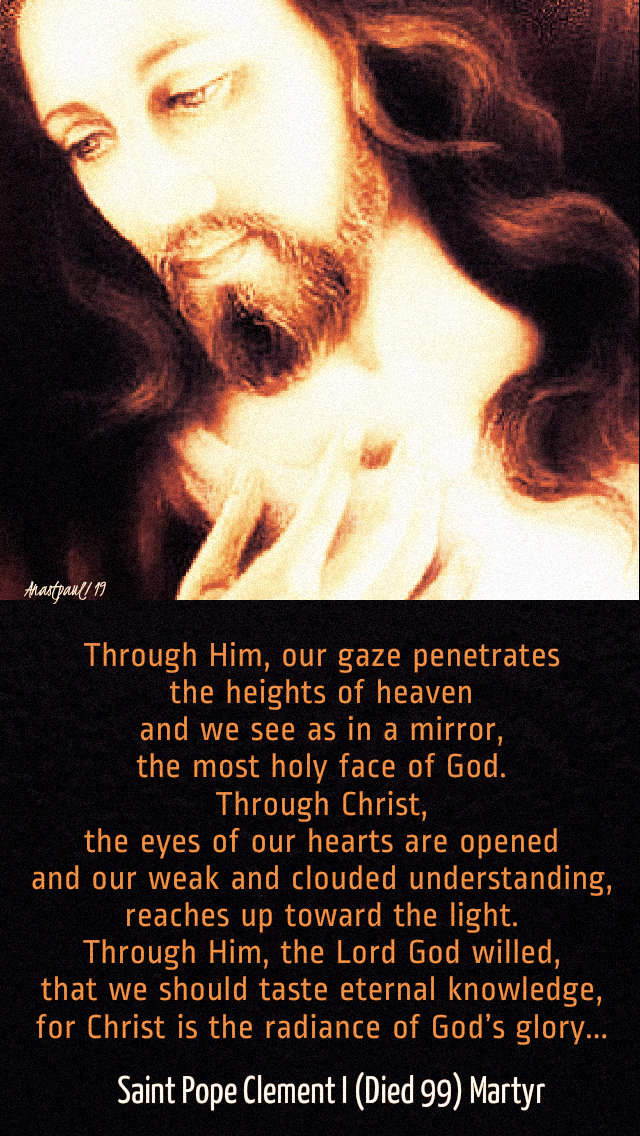
“Through Him, our gaze penetrates the heights of heaven and we see, as in a mirror, the most holy face of God. Through Christ, the eyes of our hearts are opened and our weak and clouded understanding, reaches up toward the light.”
Saint Pope Clement I (c 35-99)
Apostolic Father, Bishop of Rome and Martyr
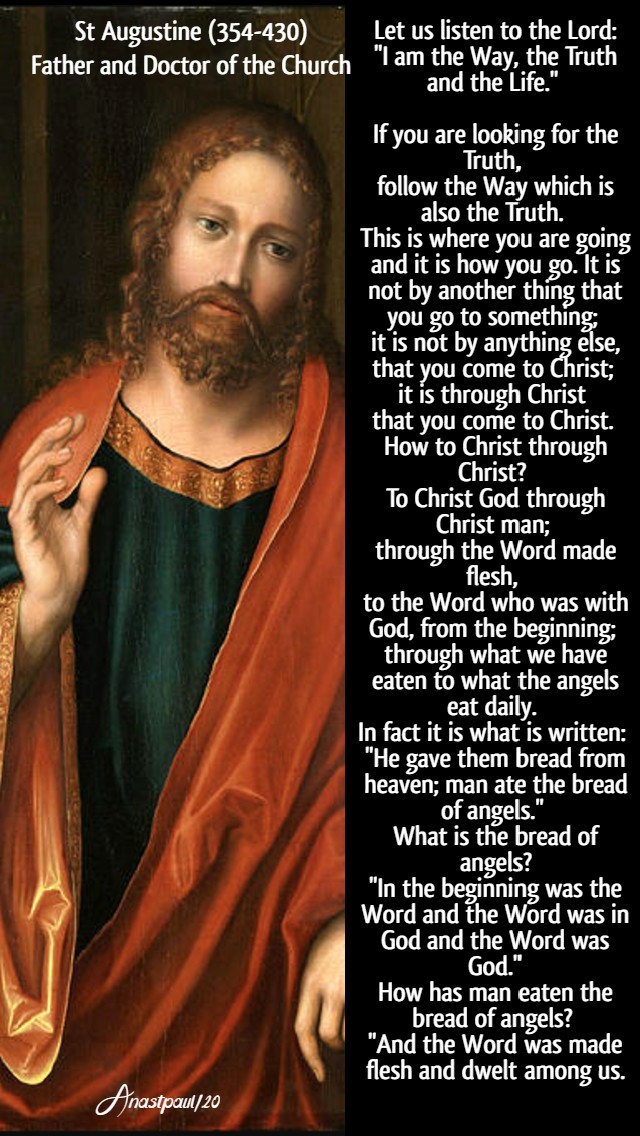
“Let us listen to the Lord: “I am the Way, the Truth and the Life” (Jn 14:6). If you are looking for the Truth, follow the Way which is also the Truth. This is where you are going and it is how you go. It is not by another thing that you go to something; it is not by anything else that you come to Christ; it is through Christ that you come to Christ. How to Christ through Christ? To Christ God through Christ man; through the Word made flesh, to the Word who was with God, from the beginning; through what we have eaten to what the angels eat daily. In fact it is what is written: “He gave them bread from heaven; man ate the bread of angels” (Ps 77[78]:24-25). What is the bread of angels? “In the beginning was the Word and the Word was in God and the Word was God” (Jn 1:1-3). How has man eaten the bread of angels? “And the Word was made flesh and dwelt among us.”
Saint Augustine (354-430)
Father and Doctor of Grace
“The love of Jesus is noble and generous, it spurs us onto do great things and excites us to desire always, that which is most perfect. Love will tend upwards and is not to be detained by things beneath. Love will be at liberty and free from all worldly affections… for love proceeds from God and cannot rest but in God above all things created. The lover flies, runs and rejoices, he is free and not held. He gives all for all and has all in all, because he rests in one sovereign Good above all, from Whom all good flows and proceeds”
Thomas à Kempis,
The Imitation of Christ,
Book III, Chapter V, 3-4
“Do everything out of love for God, for God, with God, to get to God.”
Blessed Maria Rosa Flesch (1826-1906)
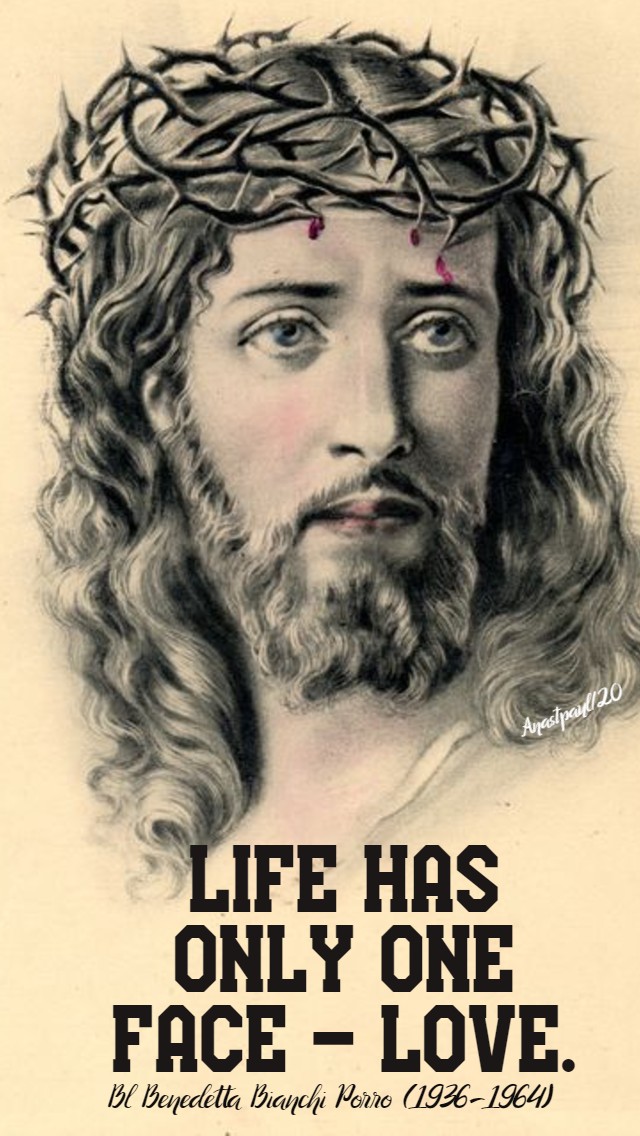
“Life has only one face – LOVE.”
Blessed Benedetta Bianchi Porro (1936-1964)
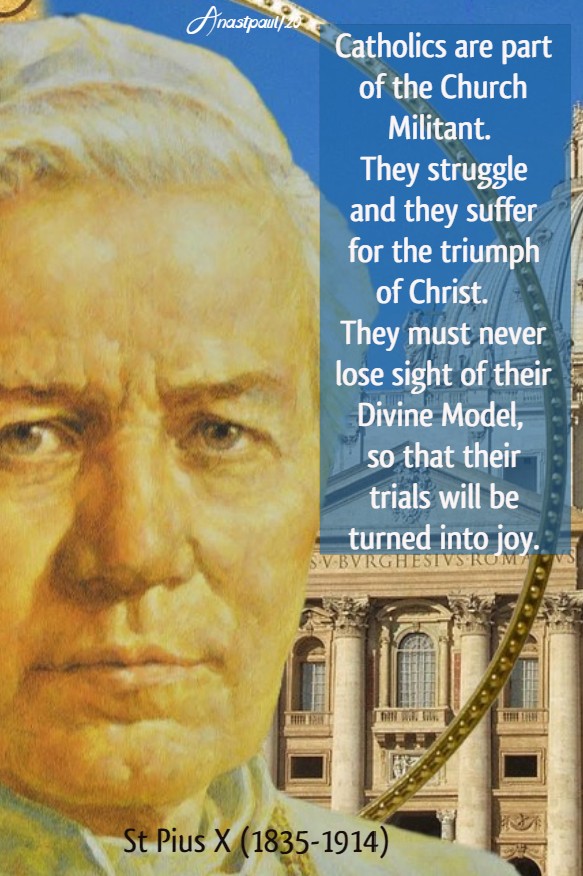
“Catholics are part of the Church Militant. They struggle and they suffer for the triumph of Christ. They must never lose sight of their Divine Model, so that their trials will be turned into joy.”
Saint Pius X (1835-1914)
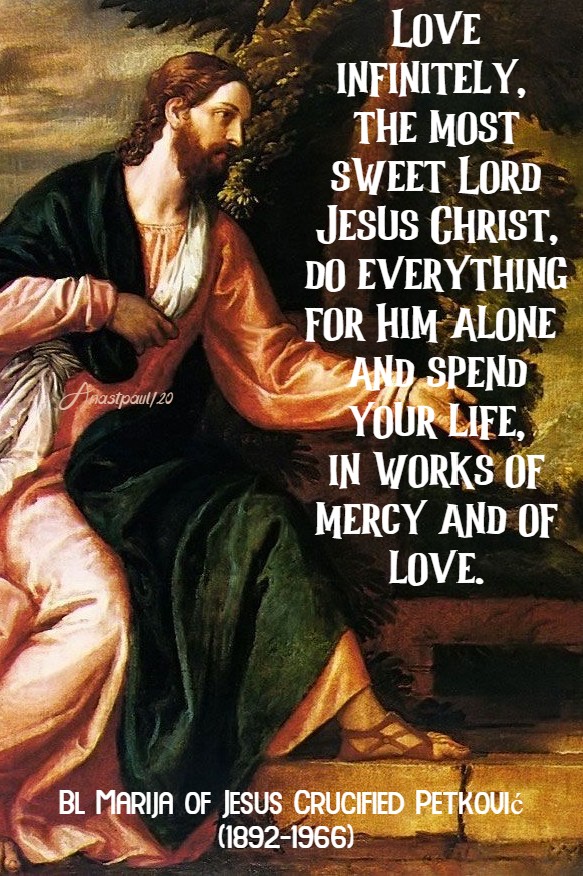
“Love infinitely, the most sweet Lord Jesus Christ, do everything for Him alone and spend your life, in works of mercy and of love.”
Blessed Marija of Jesus Crucified Petković (1892-1966)
“Since the death of Christ, almost every century has seen the persecution of Christians, there have always been heroes and martyrs who gave their lives – often in horrible ways – for Christ and their faith. If we hope to reach our goal some day, then we, too, must become heroes of the faith.”
Blessed Franz Jägerstätter (1907-1943)
Martyr of Conscientious Objection
“If a boat is running with the stream, it has little need of the pull of the oars, nor of the guidance of the helm. It’s passage is smooth and peaceful. The same applies to those who place absolute confidence in God in their journey through life. … Why should I worry, when I know that whatever God has in store for me, is for my own good? … There is no need to be disturbed. Everything must be accomplished for God, with God and in God and, with complete abandonment to His will.”
Quote/s of the Day – 8 August – Saturday of the Eighteenth week in Ordinary Time, Readings: Habakkuk 112-2, 4, Psalm 9:8-13, Matthew 17:14-20
“If you have faith” – Matthew 17:20
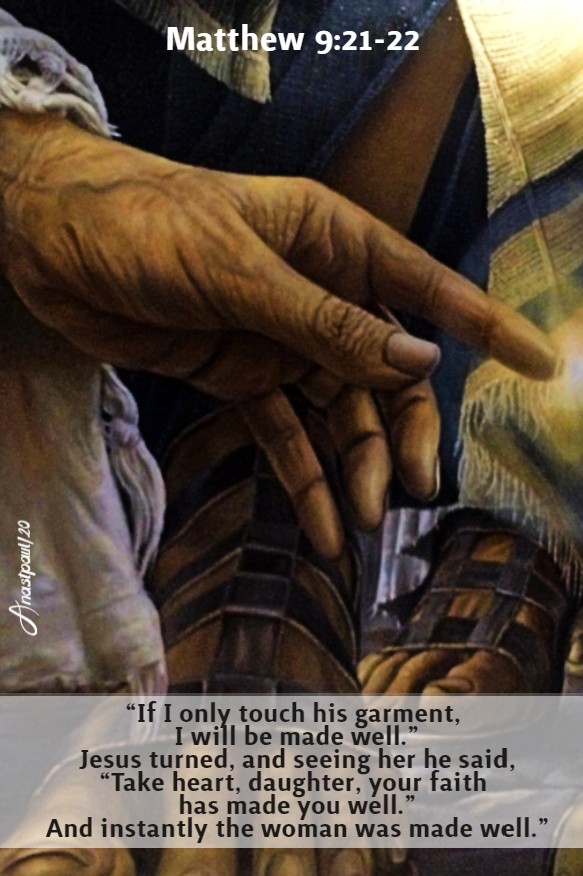
“If I only touch his garment, I will be made well.” Jesus turned, and seeing her he said, “Take heart, daughter, your faith has made you well.” And instantly the woman was made well.”
Matthew 9:21-22
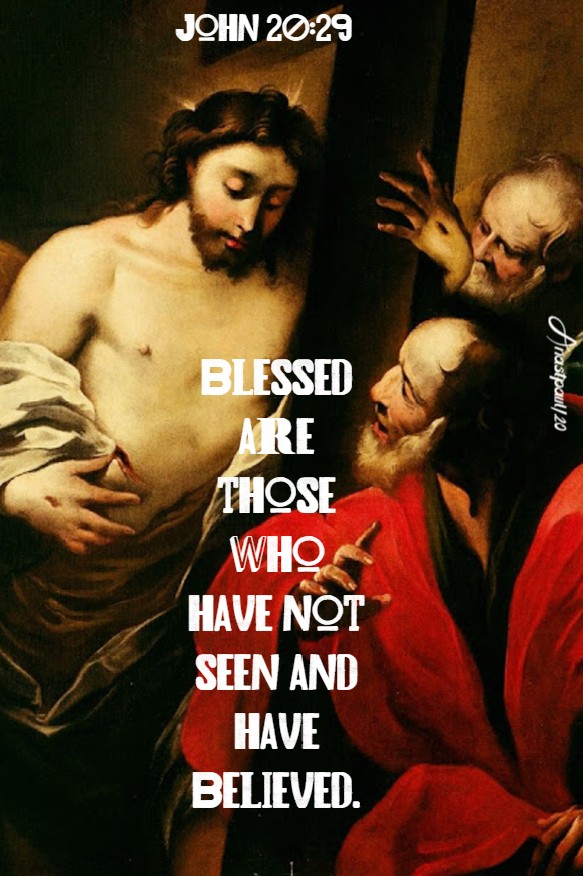
Jesus said to him, “Have you come to believe because you have seen me? Blessed are those who have not seen and have believed.”
John 20:28-29
“Elizabeth says: ‘Blessed are you because you have believed.’ You also are blessed, because you have heard and believed. A soul that believes, both conceives and brings forth the Word of God and acknowledges His works.”
St Ambrose of Milan (340-397)
Great Latin Father and Doctor of the Church
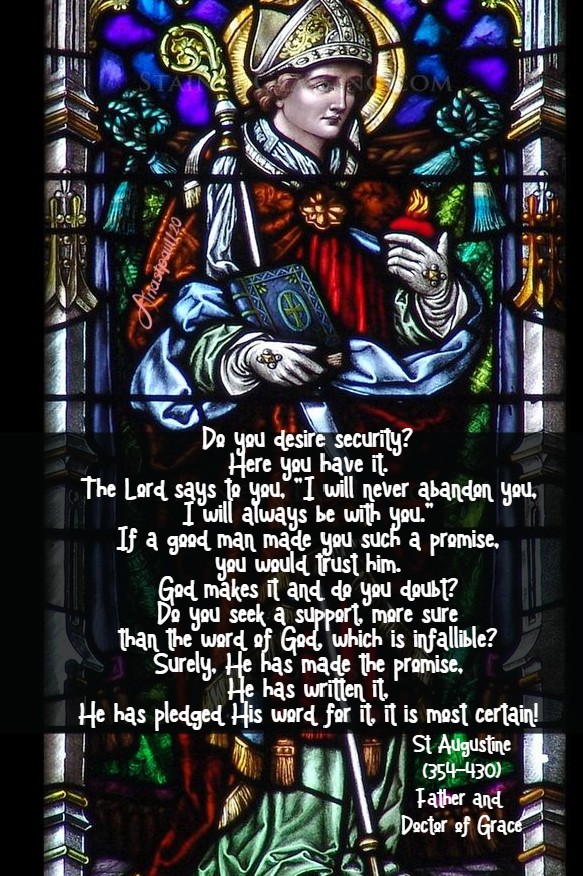
“Do you desire security? Here you have it. The Lord says to you, “I will never abandon you, I will always be with you.” If a good man made you such a promise, you would trust him. God makes it and do you doubt? Do you seek a support, more sure than the word of God, which is infallible? Surely, He has made the promise, He has written it, He has pledged His word for it, it is most certain!”
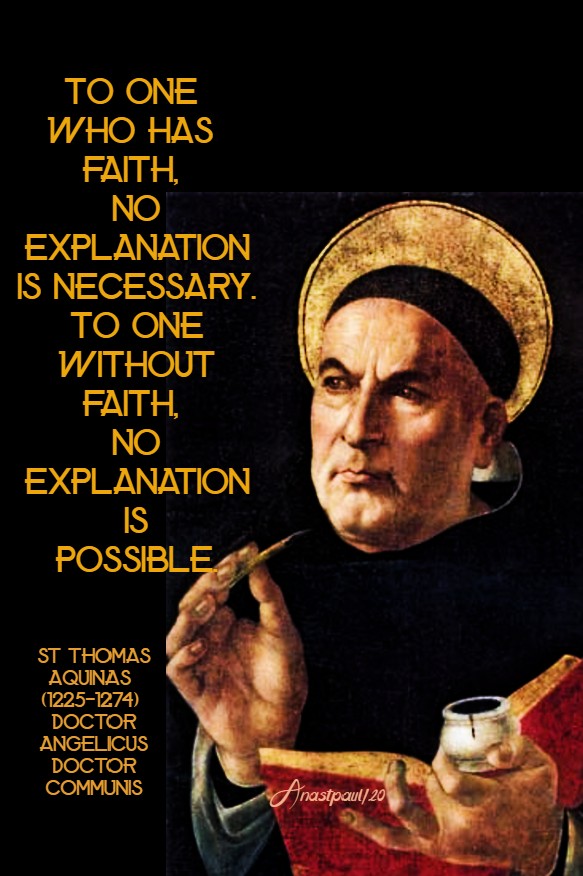
“To one who has faith, no explanation is necessary. To one without faith, no explanation is possible.”
St Thomas Aquinas (1225-1274)
Doctor Angelicus, Doctor Communis
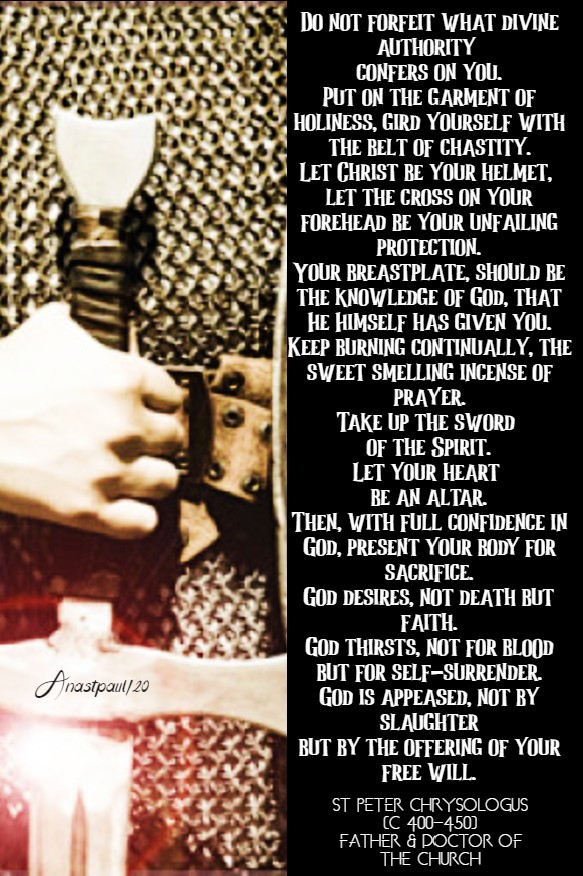
“Paul says: I appeal to you by the mercy of God, to present your bodies as a sacrifice, living and holy. The prophet said the same thing: Sacrifice and offering you did not desire but you have prepared a body for me. Each of us is called to be both a sacrifice to God and His priest. Do not forfeit what divine authority confers on you. Put on the garment of holiness, gird yourself with the belt of chastity. Let Christ be your helmet, let the cross on your forehead be your unfailing protection. Your breastplate, should be the knowledge of God, that He Himself has given you. Keep burning continually, the sweet smelling incense of prayer. Take up the sword of the Spirit. Let your heart be an altar. Then, with full confidence in God, present your body for sacrifice. God desires, not death but faith. God thirsts, not for blood but for self-surrender. God is appeased, not by slaughter but by the offering of your free will.”
St Peter Chrysologus (c 400-450)
Bishop, Father & Doctor of the Church
“Doctor of Homilies”
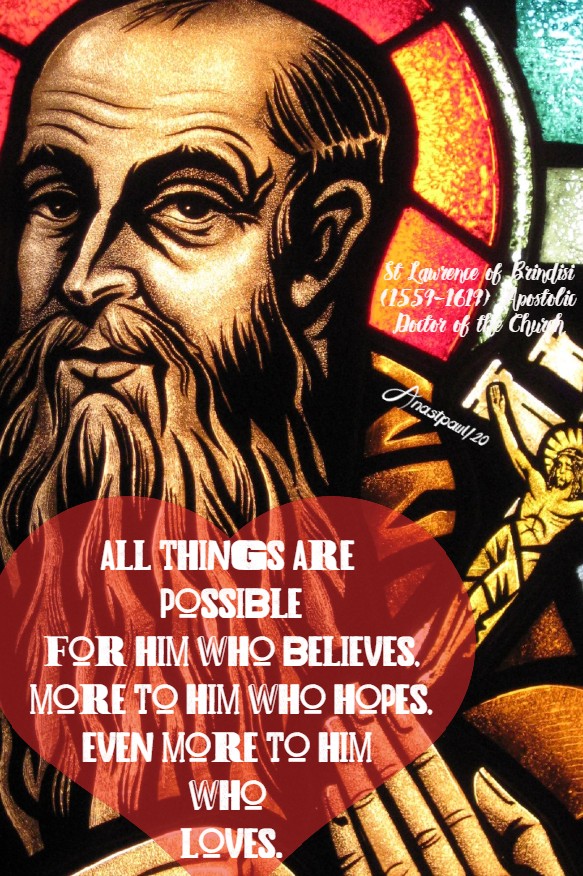
“All things are possible for him who believes, more to him who hopes, even more to him who loves.”
St Lawrence of Brindisi(1559-1619)
Apostolic Doctor of the Church
“Faith is like a bright ray of sunlight. It enables us to see God in all things, as well as, all things in God.”
St Francis de Sales (1567-1622)
Doctor of Charity
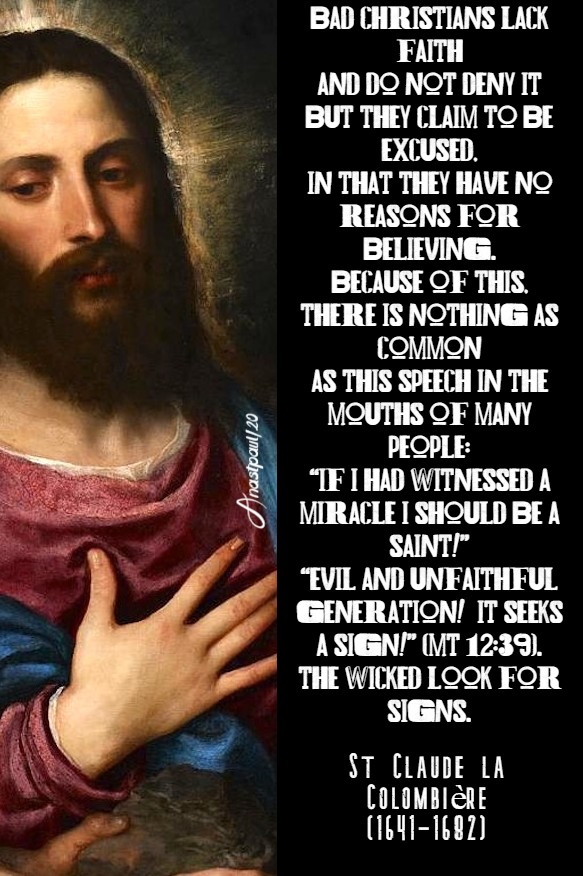
“Bad Christians lack faith and do not deny it but they claim to be excused, in that they have no reasons for believing. Because of this, there is nothing as common as this speech in the mouths of many people: “If I had witnessed a miracle I should be a saint!” “Evil and unfaithful generation! It seeks a sign!” (Mt 12:39). The wicked look for signs.”
St Claude la Colombière SJ (1641-1682)
Apostle of the Sacred Heart of Jesus
Quote/s of the Day – 24 July – Friday of the Sixteenth week in Ordinary Time, Year A, Readings: Jeremiah 3:14-17, Responsorial psalm Jeremiah 31:10-13, Matthew 13:18-23
“Good Soil”
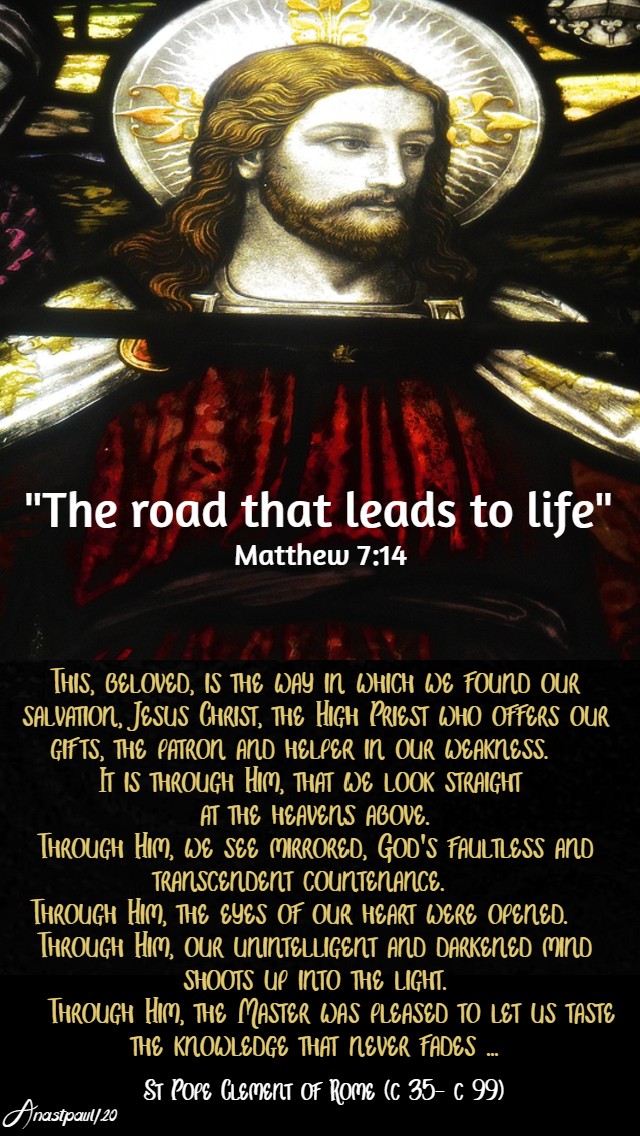
“This, beloved, is the way in which we found our salvation, Jesus Christ, the High Priest who offers our gifts, the patron and helper in our weakness (Heb 10:20; 7:27; 4:15). It is through Him, that we look straight at the heavens above. Through Him, we see mirrored, God’s faultless and transcendent countenance. Through Him, the eyes of our heart were opened. Through Him, our unintelligent and darkened mind shoots up into the light. Through Him, the Master was pleased to let us taste the knowledge that never fades, He who is “the radiance of His splendour, who towers as much above the angels, as the title He has inherited, is superior to theirs.”
St Pope Clement I (c 35 – c 99)
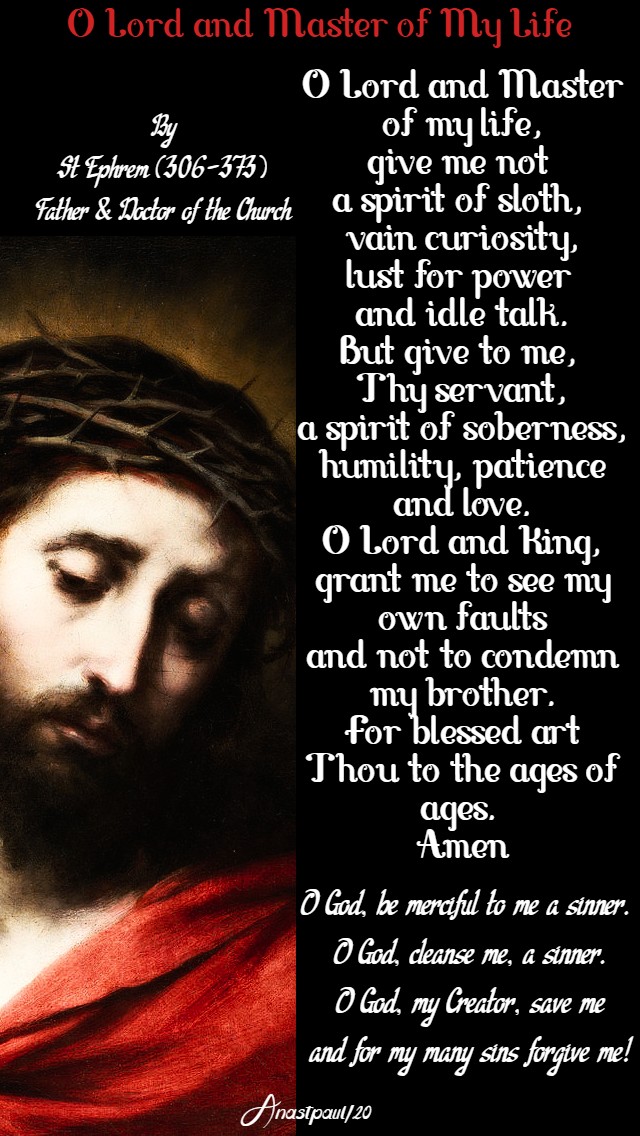
O Lord and Master of My Life Prayer of Saint Ephrem the Syrian (306-373) Father & Doctor of the Church
O Lord and Master of my life, give me not a spirit of sloth, vain curiosity, lust for power and idle talk. But give to me, Thy servant, a spirit of soberness, humility, patience and love. O Lord and King, grant me to see my own faults and not to condemn my brother. For blessed art Thou to the ages of ages. Amen O God, be merciful to me a sinner. O God, cleanse me, a sinner. O God, my Creator, save me and for my many sins forgive me!
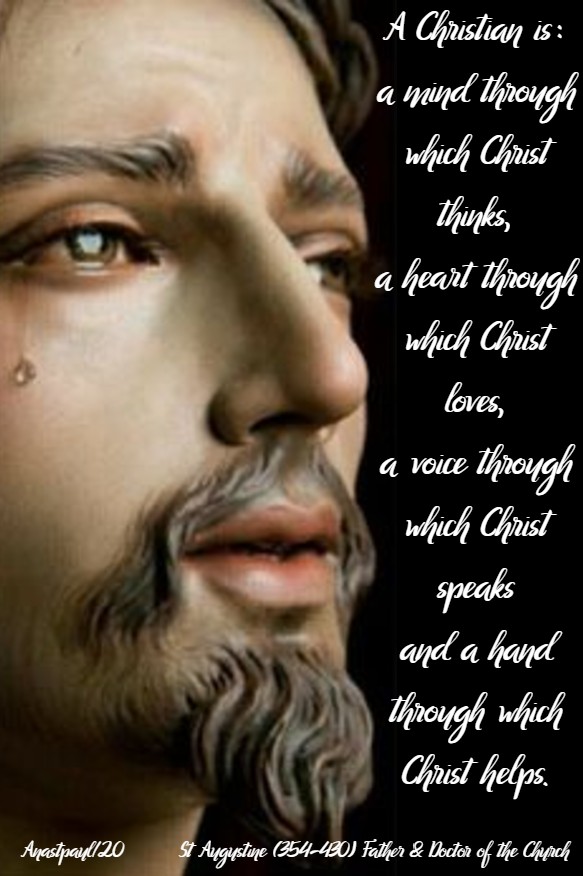
“A Christian is: a mind through which Christ thinks, a heart through which Christ loves, a voice through which Christ speaks and a hand through which Christ helps.”
St Augustine (354-430)
Father & Doctor of the Church
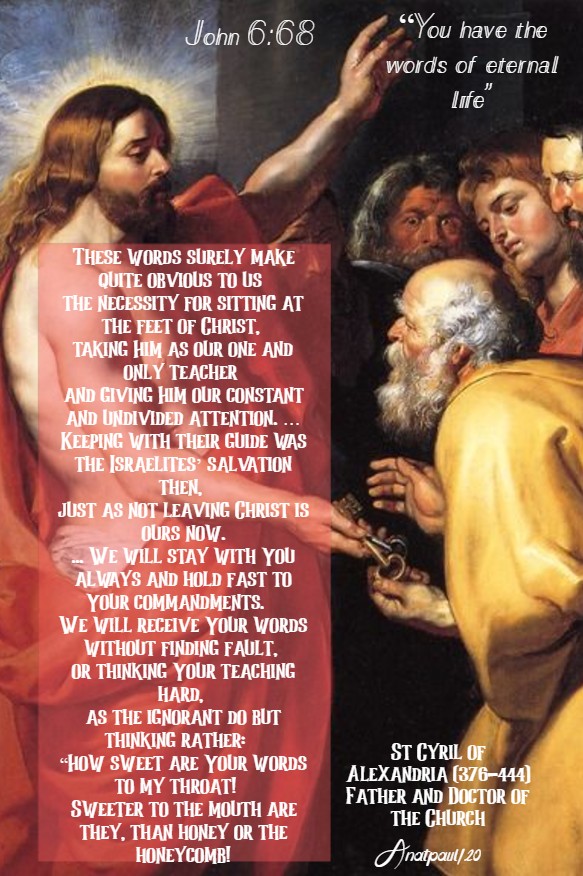
“You have the words of eternal life”
John 6:68
“These words surely make quite obvious to us the necessity for sitting at the feet of Christ, taking Him as our one and only teacher and giving Him our constant and undivided attention. … Keeping with their guide was the Israelites’ salvation then, just as not leaving Christ is ours now. … We will stay with You always and hold fast to Your commandments. We will receive Your words without finding fault, or thinking Your teaching hard, as the ignorant do but thinking rather: “How sweet are Your words to my throat! Sweeter to the mouth are they, than honey or the honeycomb!”
St Cyril of Alexandria (376-444)
Father and Doctor of the Church
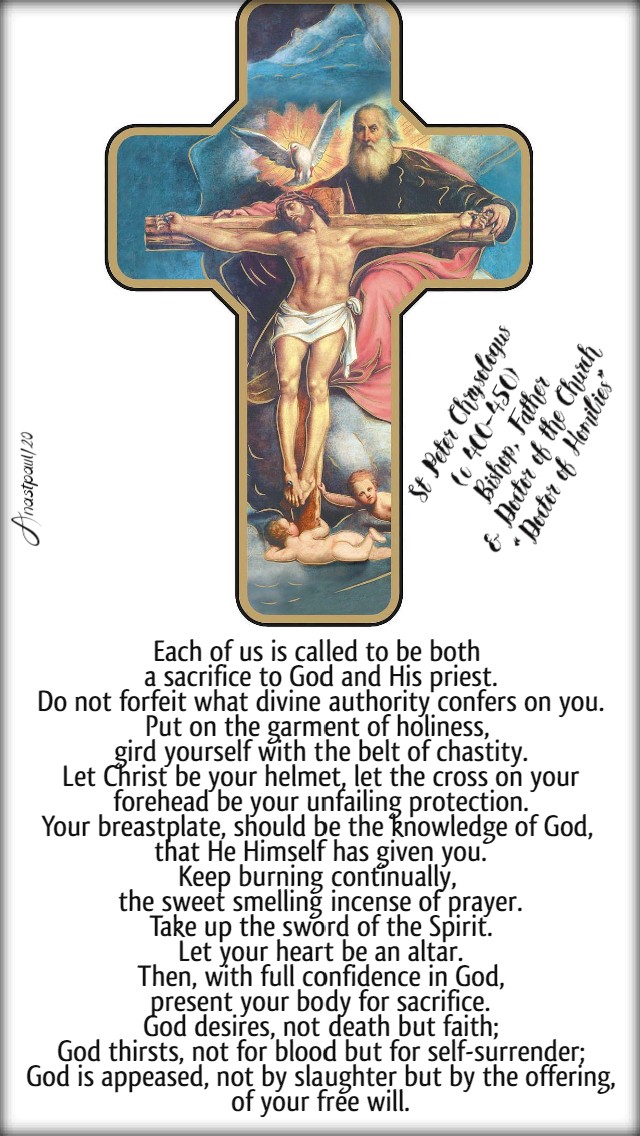
“Paul says: I appeal to you by the mercy of God, to present your bodies as a sacrifice, living and holy. The prophet said the same thing: Sacrifice and offering you did not desire but you have prepared a body for me. Each of us is called to be both a sacrifice to God and His priest. Do not forfeit what divine authority confers on you. Put on the garment of holiness, gird yourself with the belt of chastity. Let Christ be your helmet, let the cross on your forehead be your unfailing protection. Your breastplate, should be the knowledge of God, that He Himself has given you. Keep burning continually, the sweet smelling incense of prayer. Take up the sword of the Spirit. Let your heart be an altar. Then, with full confidence in God, present your body for sacrifice. God desires, not death but faith; God thirsts, not for blood but for self-surrender; God is appeased, not by slaughter but by the offering, of your free will.”
St Peter Chrysologus (c 400-450)
Bishop, Father & Doctor of the Church
“Doctor of Homilies”
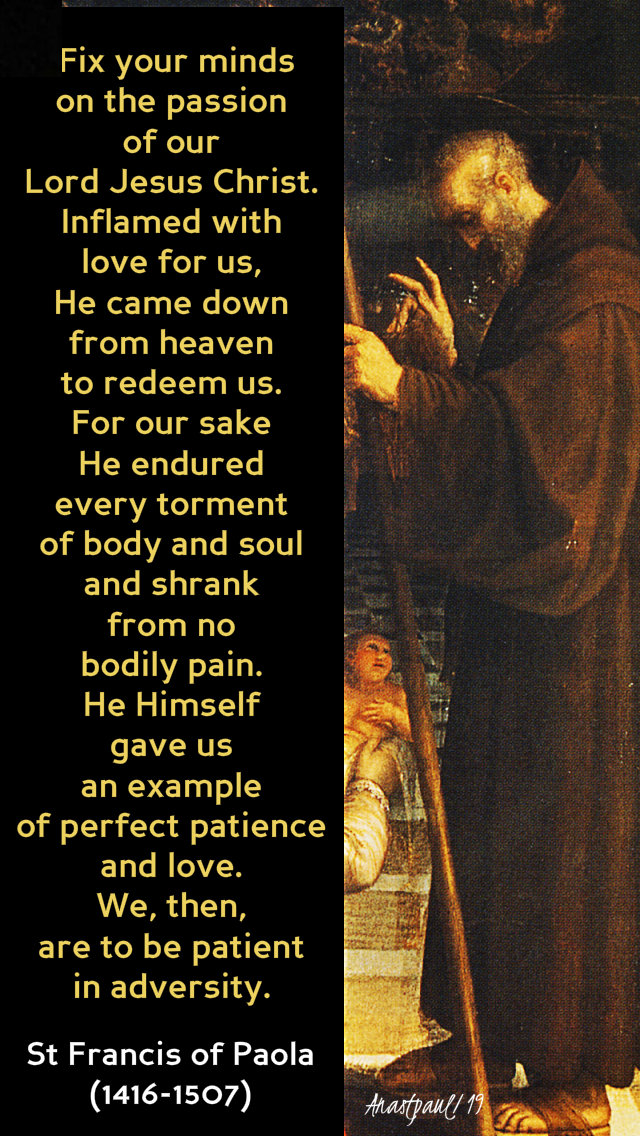
“Fix your minds on the passion of our Lord Jesus Christ. Inflamed with love for us, He came down from heaven to redeem us. For our sake He endured every torment of body and soul and shrank from no bodily pain. He Himself gave us an example of perfect patience and love. We, then, are to be patient in adversity.”
St Francis of Paola OM (1416-1507)
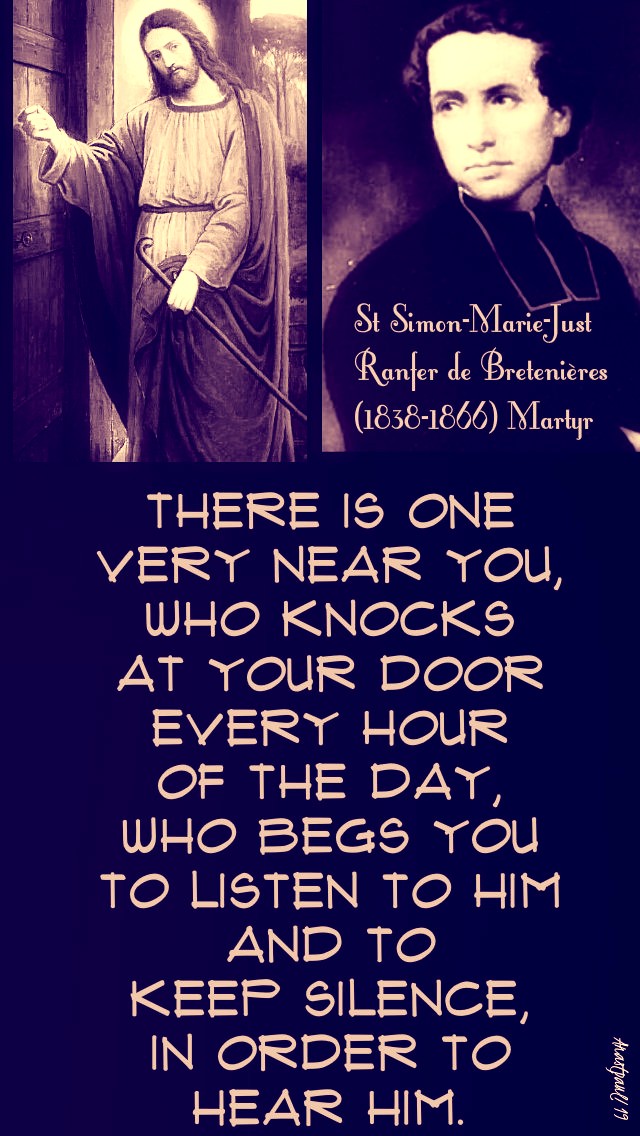
“There is One very near you Who knocks at your door every hour of the day, Who begs you to listen to Him and to keep silence in order to hear Him.”
St Simon-Marie-Just Ranfer de Bretenières (1838-1866)
Martyr
Quote/s of the Day – 13 July – “Month of the Precious Blood” – Monday of the Fifteenth Week in Ordinary Time, Year A, Readings: Isaiah 1:10-17, Psalm 50:8-9, 16-17, 21, 23, Matthew 10:34–11:1
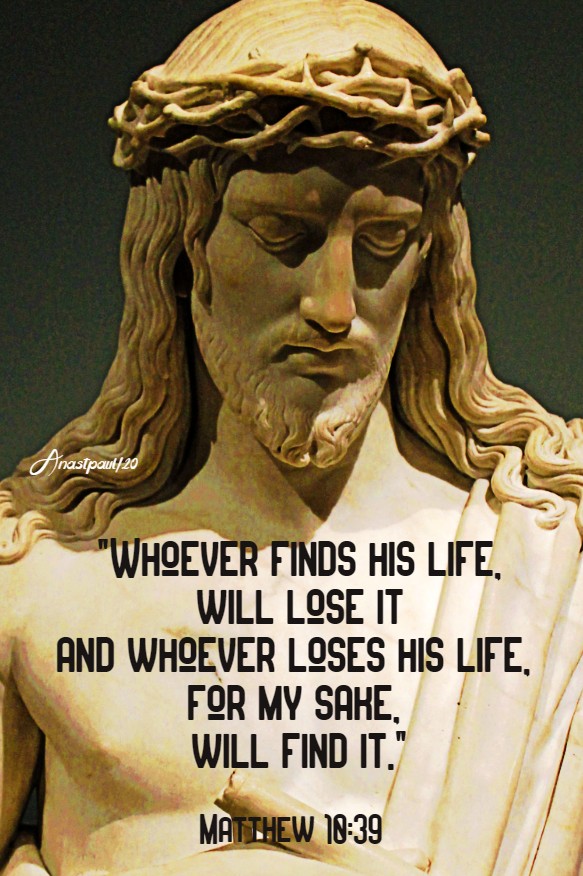
“Whoever finds his life, will lose it and whoever loses his life, for my sake, will find it.”
Matthew 10:39
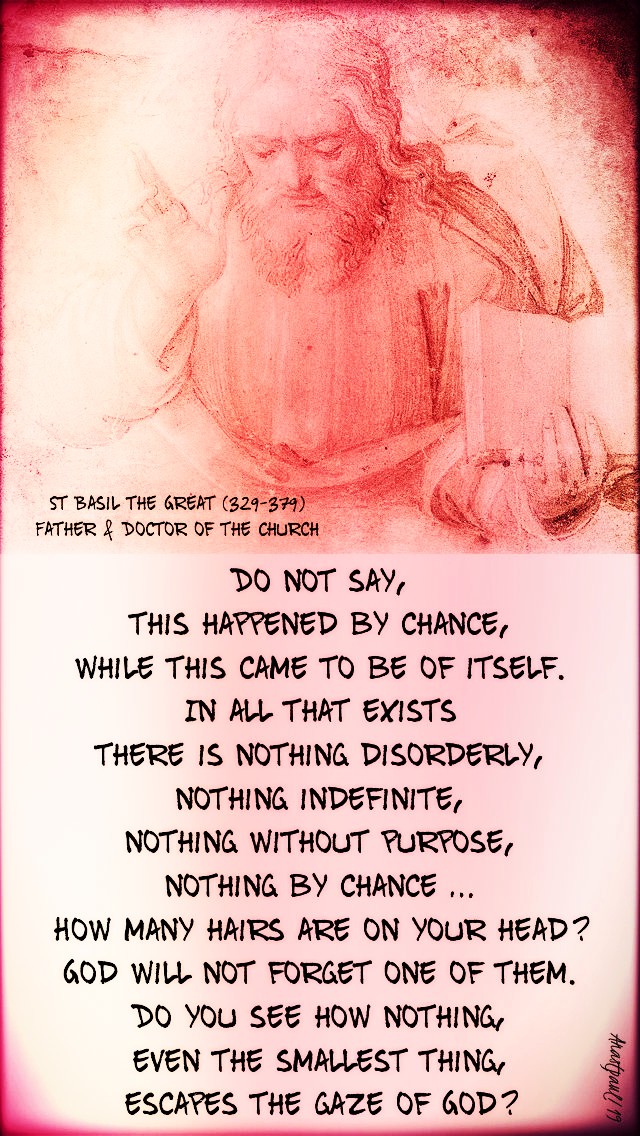
“Do not say, this happened by chance, while this came to be of itself.” In all that exists’ there is nothing disorderly, nothing indefinite, nothing without purpose, nothing by chance … How many hairs are on your head? God will not forget one of them. Do you see how nothing, even the smallest thing, escapes the gaze of God?”
St Basil the Great (329-379)
Father & Doctor of the Church
“The Lord is near, do not be anxious about anything!”
St Augustine (354-430)
Great Western Father and Doctor of Grace
An excerpt from his Sermon 171
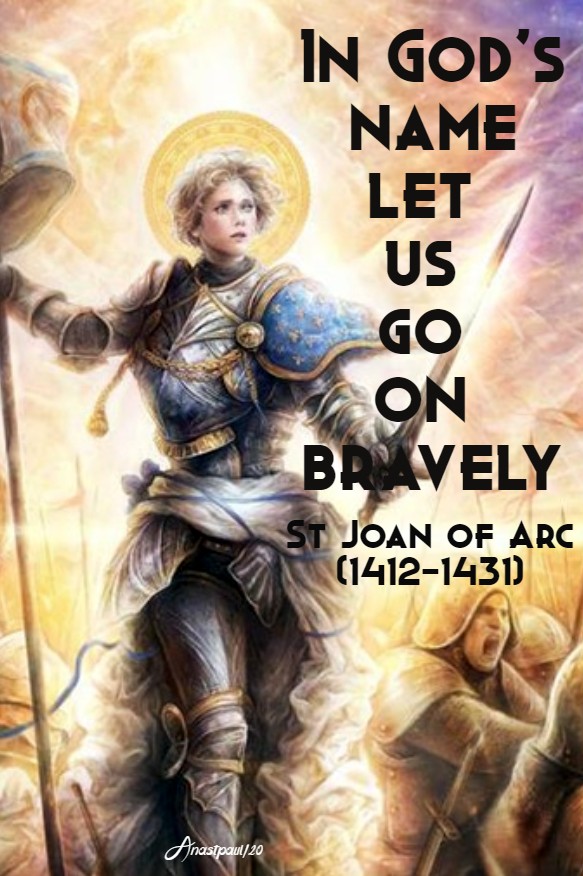
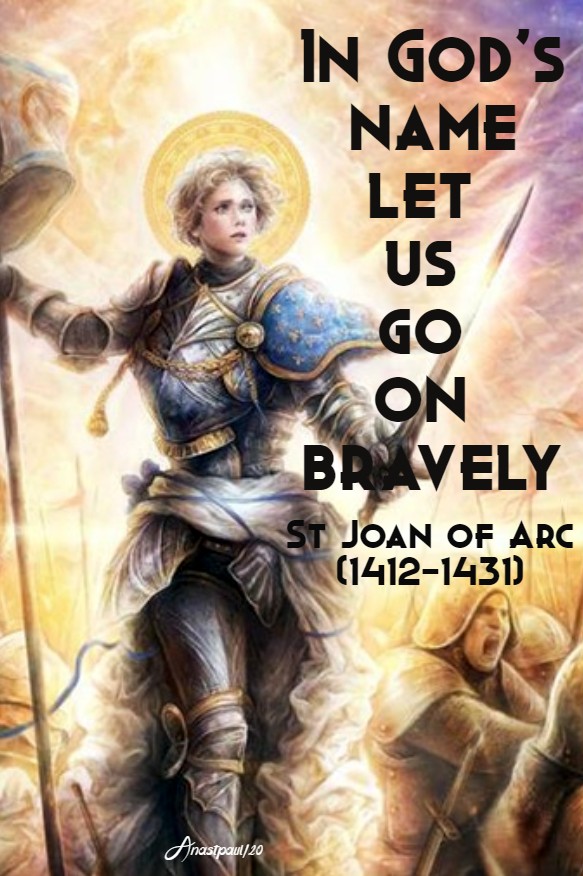
“In God’s name let us go on bravely.”
St Joan of Arc (1412-1431)
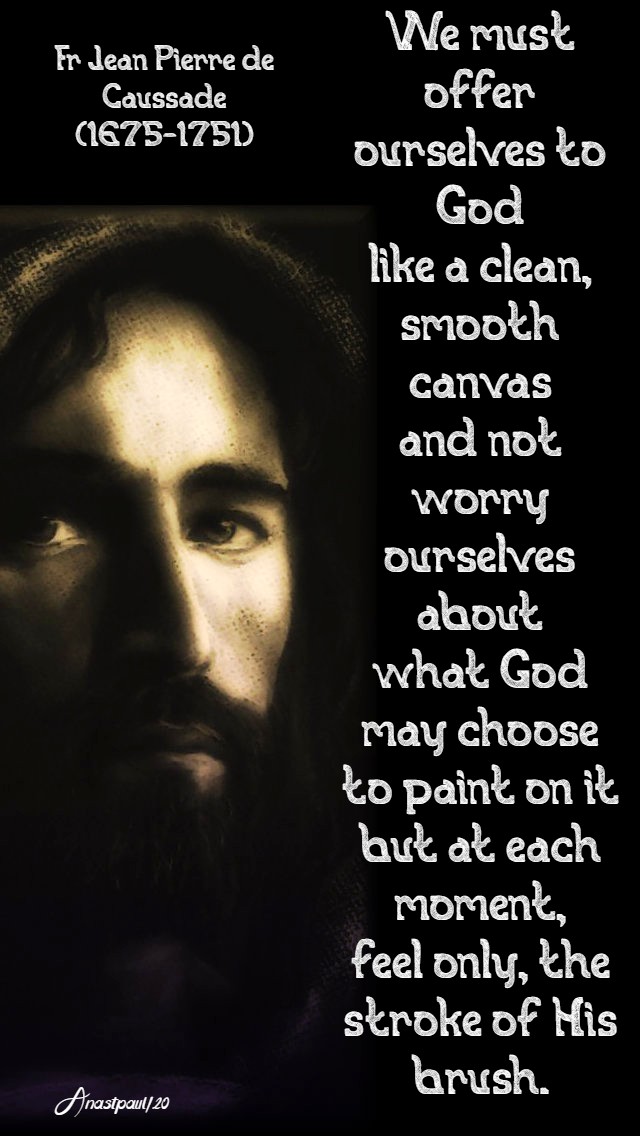
“We must offer ourselves to God, like a clean, smooth canvas and not worry ourselves, about what God may choose to paint on it but at each moment, feel only the stroke of His brush.”
Father Jean-Pierre de Caussade (1675-1751)
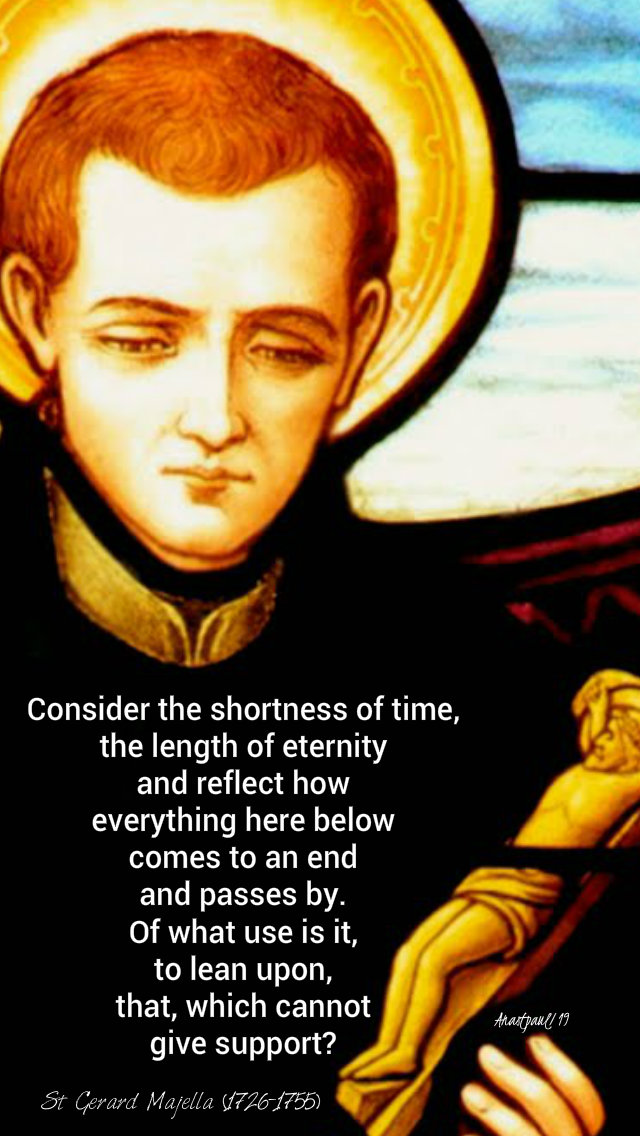
“Consider the shortness of time, the length of eternity and reflect how everything here below comes to an end and passes by. Of what use is it, to lean upon, that which cannot give support?”
St Gerard Majella (1726-1755)
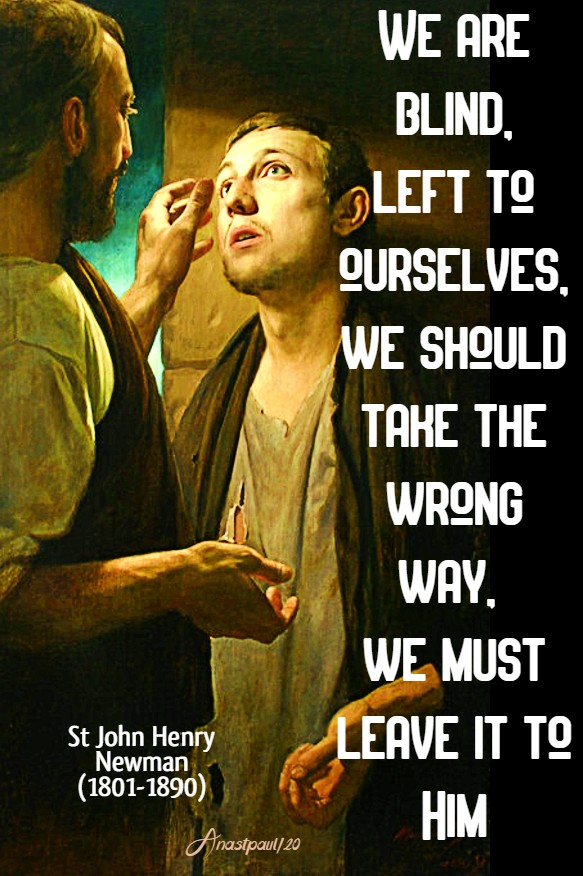
“We are blind, left to ourselves, we should take the wrong way, we must leave it to Him.”
St John Henry Newman (1801-1890)
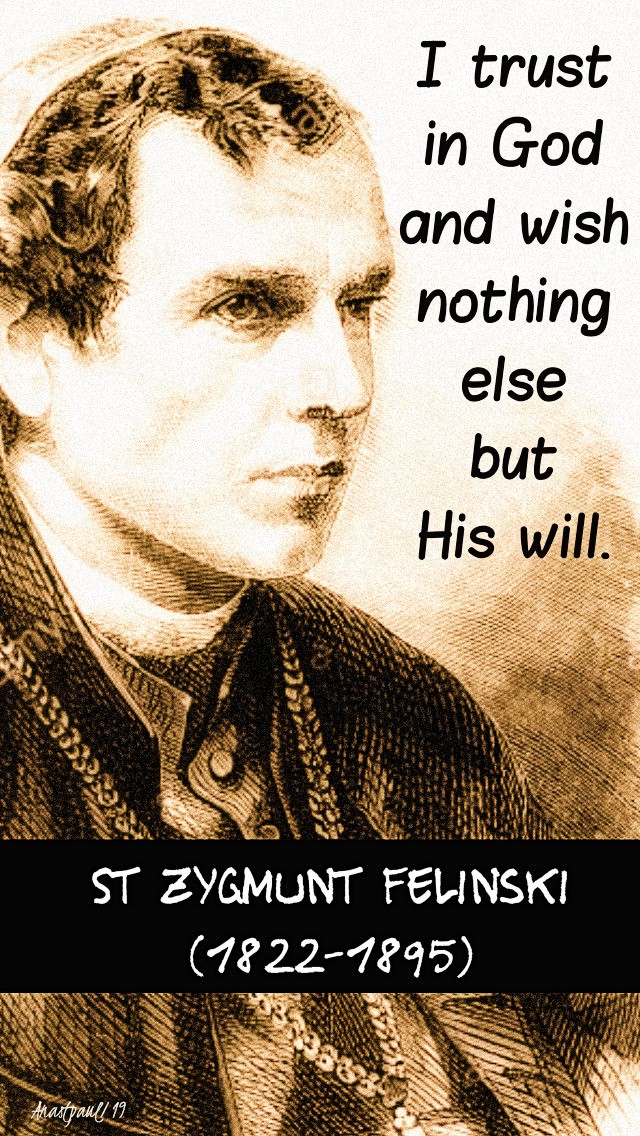
“I trust in God and wish nothing else but His will.”
St Zygmunt Szcesny Felinski (1822-1895)
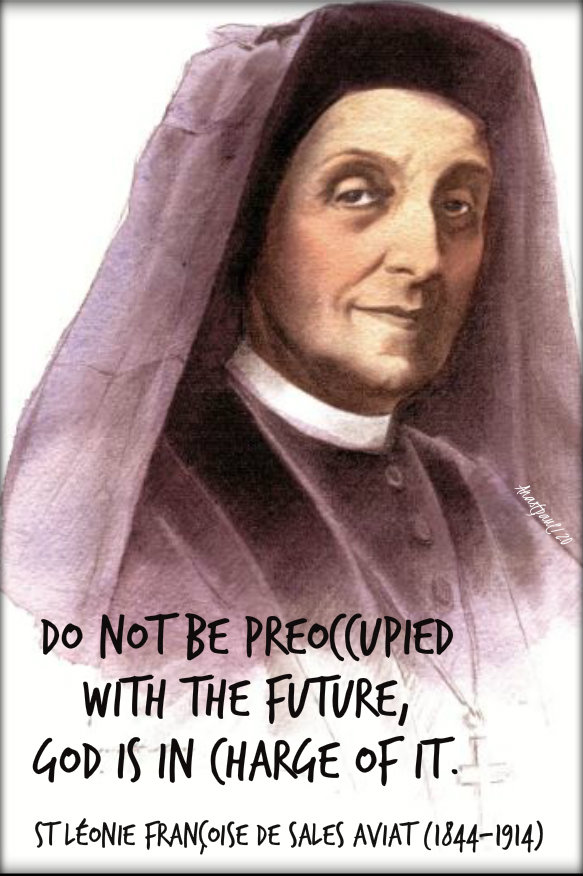
“Do not be preoccupied with the future, God is in charge of it.”
St Léonie Françoise De Sales Aviat (1844-1914)
“The glance of God is like a fortifying dew, a luminous ray, which fertilises and expands – let us work without noise and without rest, let us work before God’s eyes, before God alone!”
Bl Luigi Orione (1872-1940)
“My past, O Lord, to Your mercy, my present, to Your love, my future, to Your Providence.”
Quote/s of the Day – 10 July – “Month of the Precious Blood” – Friday of the Fourteenth week in Ordinary Time, Year A, Readings: Hosea 14:2-10, Psalm 51:3-4, 8-9, 12-14, 17, Matthew 10:16-23
“Sheep Amidst the Wolves”
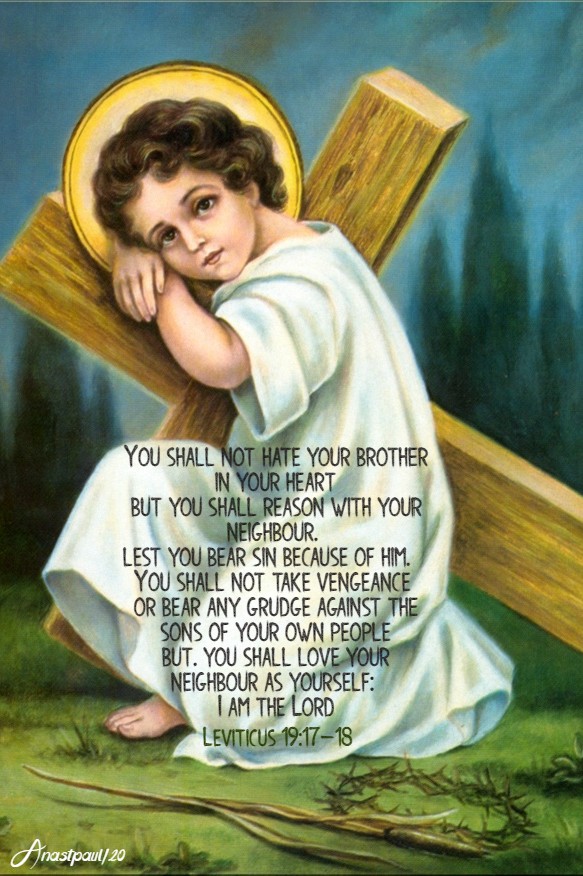
“You shall not hate your brother in your heart but you shall reason with your neighbour, lest you bear sin because of him. You shall not take vengeance or bear any grudge against the sons of your own people but, you shall love your neighbour as yourself: I am the Lord”
Leviticus 19:17-18
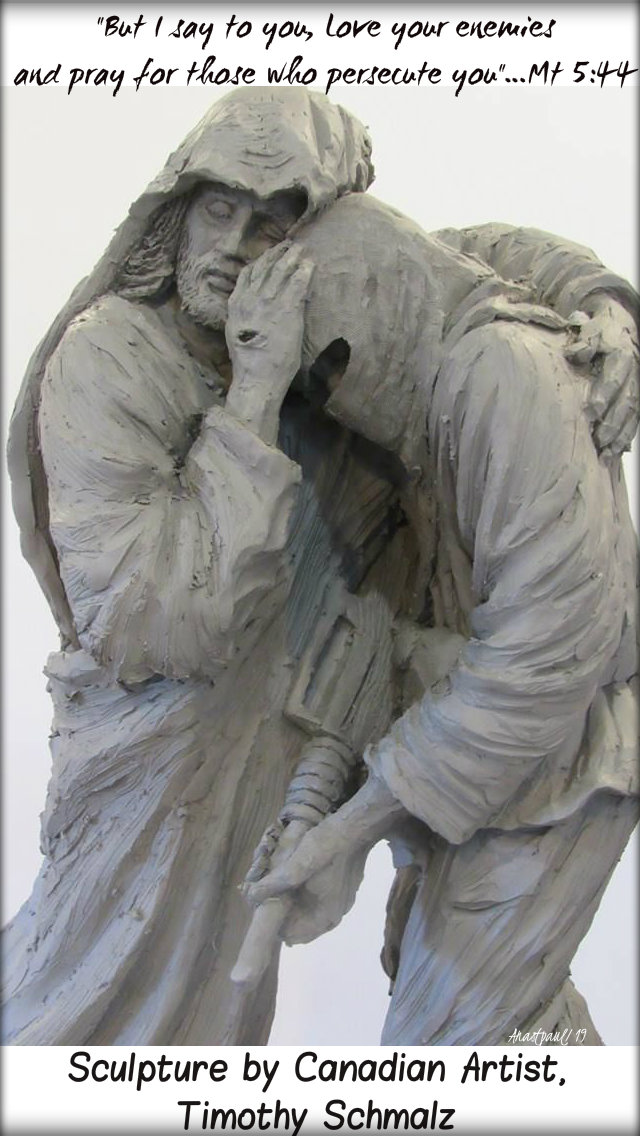
“But I say to you, love your enemies and pray for those who persecute you…”
Matthew 5:44
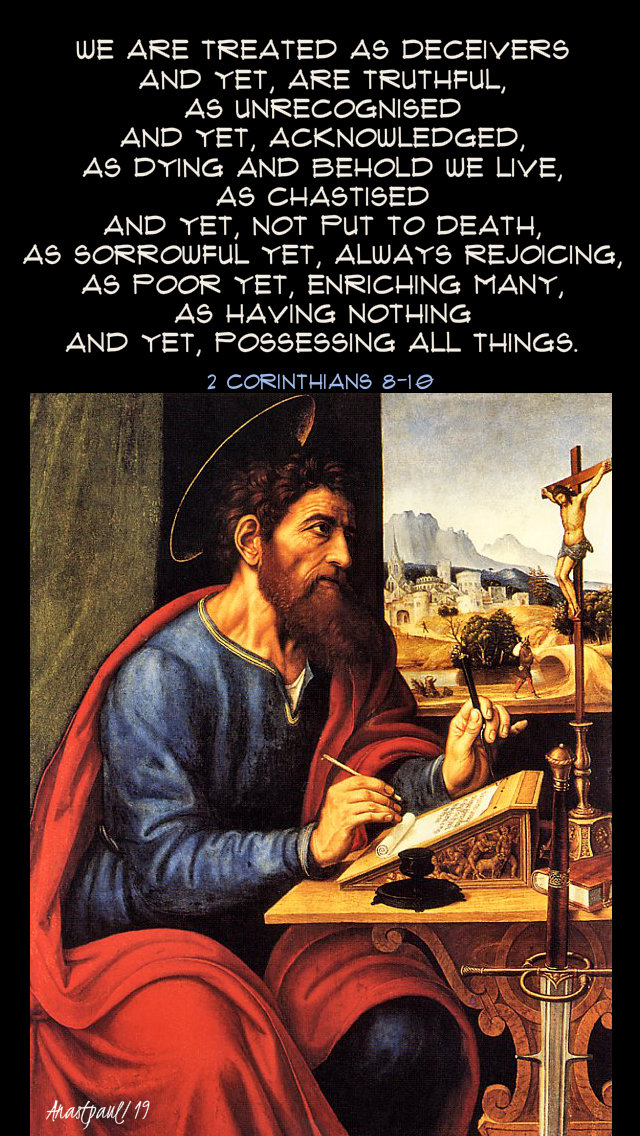
“We are treated as deceivers and yet, are truthful, as unrecognised and yet, acknowledged, as dying and behold we live, as chastised and yet, not put to death, as sorrowful yet, always rejoicing, as poor yet, enriching many, as having nothing and yet, possessing all things.”
2 Corinthians 8-10
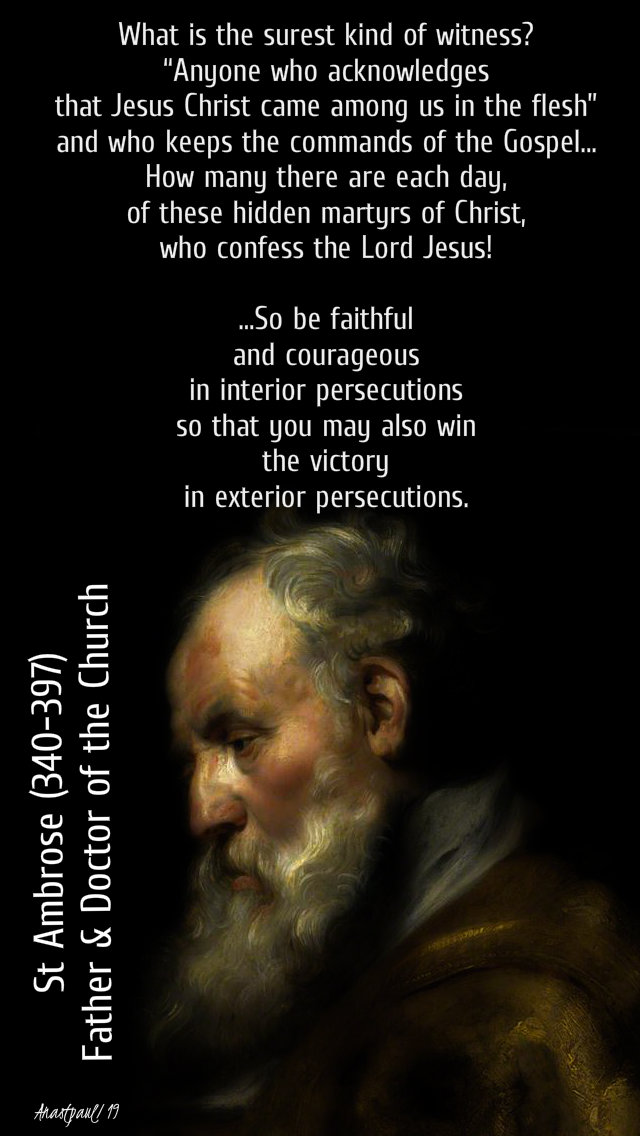
“What is the surest kind of witness? “Anyone who acknowledges that Jesus Christ came among us in the flesh” (cf. 1Jn 4,2) and who keeps the commands of the Gospel… How many there are each day of these hidden martyrs of Christ who confess the Lord Jesus! … So be faithful and courageous in interior persecutions so that you may also win the victory in exterior persecutions.”
St Ambrose (340-397)
Father & Doctor of the Church
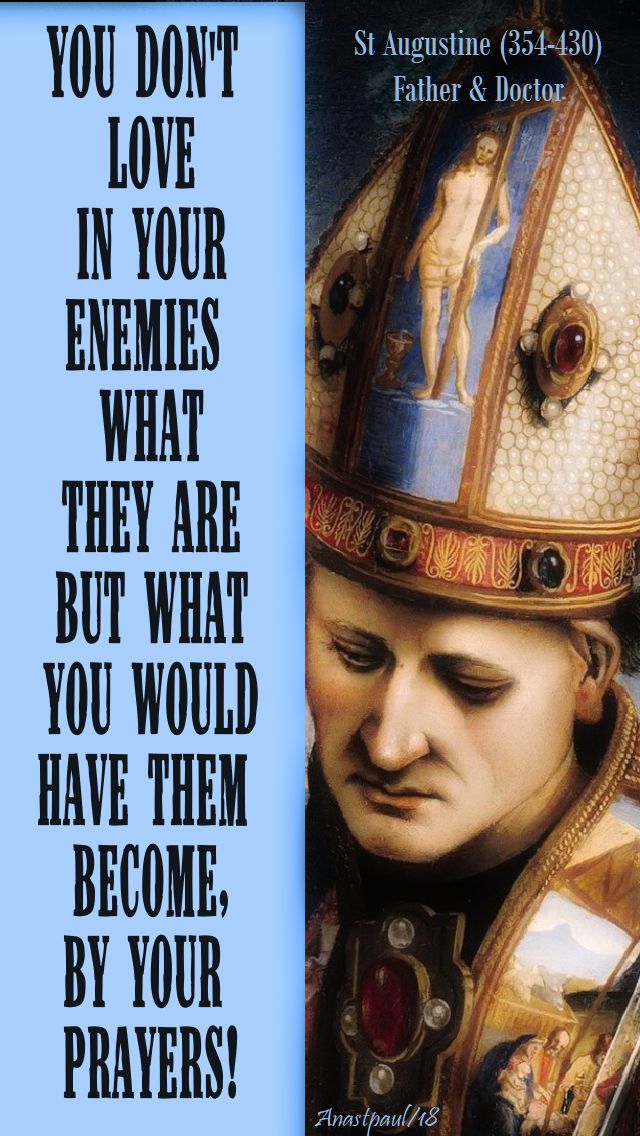
“You don’t love in your enemies what they are but what you would have them become, by your prayers!”
St Augustine (354-430) Father & Doctor
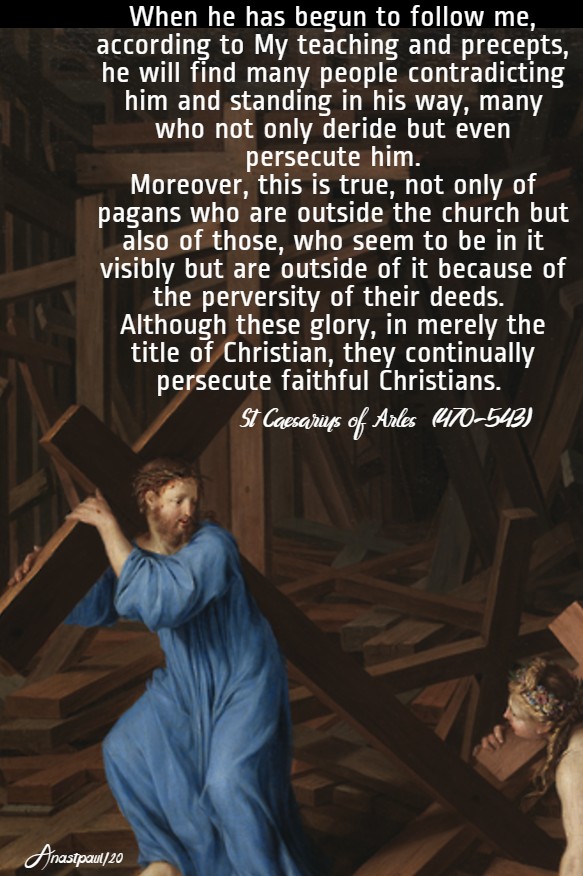
“When he has begun to follow me, according to My teaching and precepts, he will find many people contradicting him and standing in his way, many who not only deride but even persecute him. Moreover, this is true, not only of pagans who are outside the church but also of those, who seem to be in it visibly but are outside of it because of the perversity of their deeds. Although these glory, in merely the title of Christian, they continually persecute faithful Christians.”
St Caesarius of Arles (470-543)
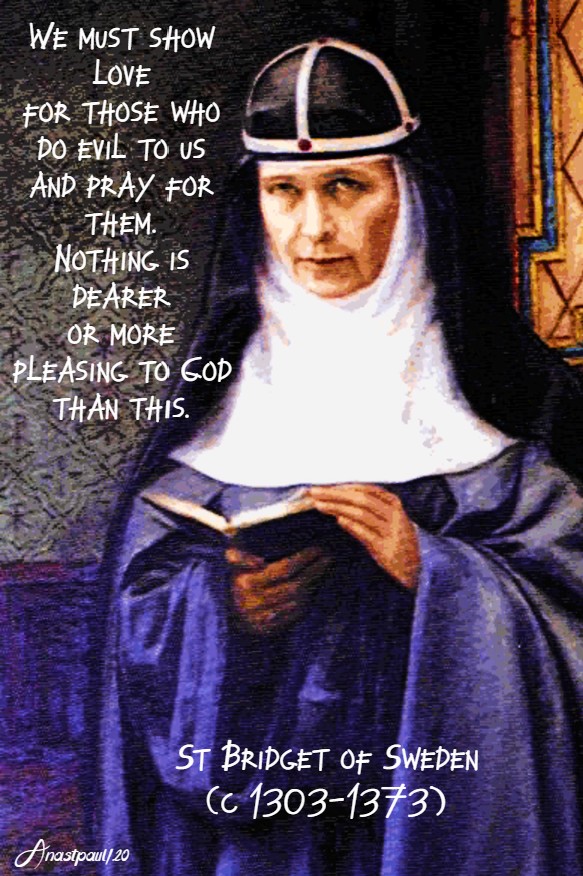
“We must show love for those who do evil to us and pray for them. Nothing is dearer or more pleasing to God than this.”
St Bridget of Sweden (c 1303-1373)
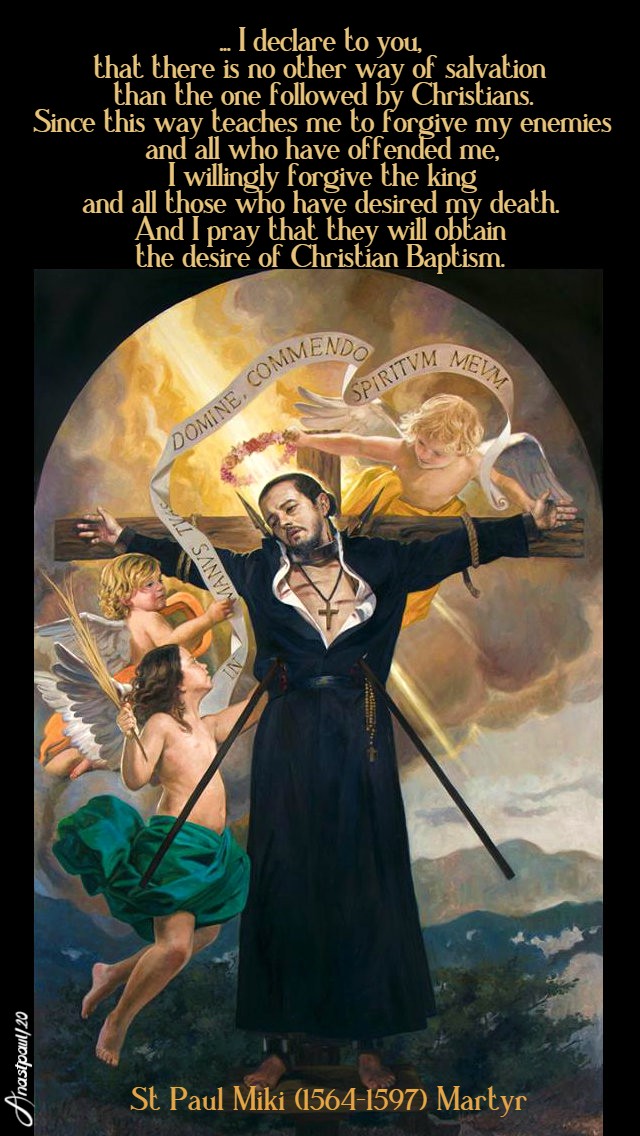
“… I declare to you, that there is no other way of salvation than the one followed by Christians. Since this way teaches me to forgive my enemies and all who have offended me, I willingly forgive the king and all those who have desired my death. And I pray that they will obtain the desire of Christian Baptism.”
St Paul Miki SJ (1564-1597) Martyr
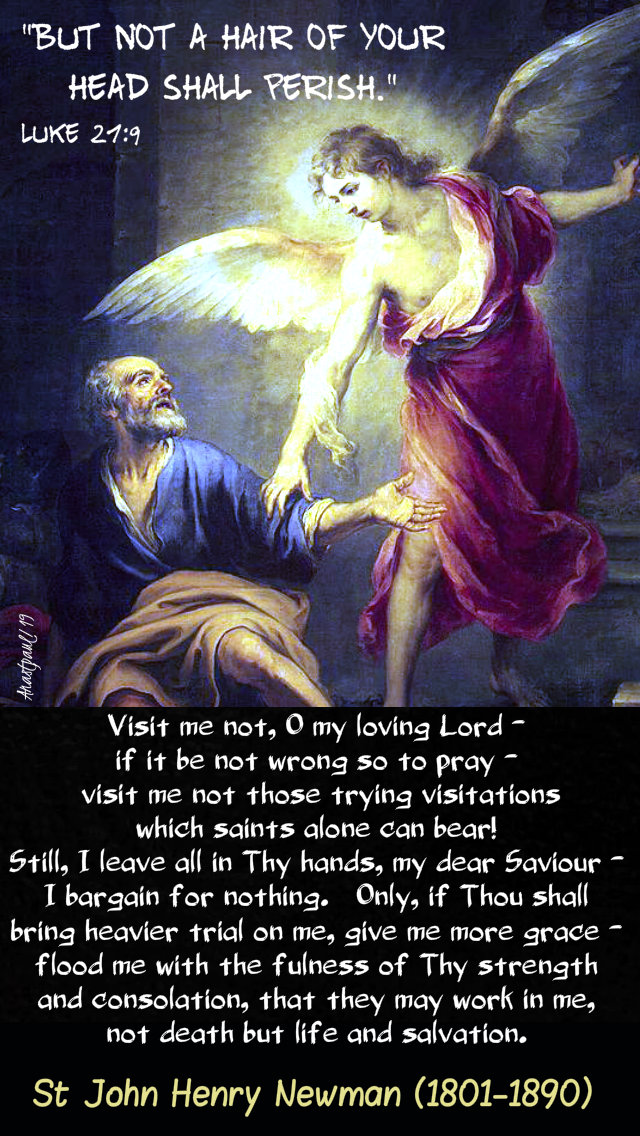
“Visit me not, O my loving Lord – if it be not wrong so to pray – visit me not those trying visitations which saints alone can bear! Still, I leave all in Thy hands, my dear Saviour – I bargain for nothing. Only, if Thou shall bring heavier trial on me, give me more grace – flood me with the fullness of Thy strength and consolation, that they may work in me, not death but life and salvation.”
St John Henry Newman (1801-1890)
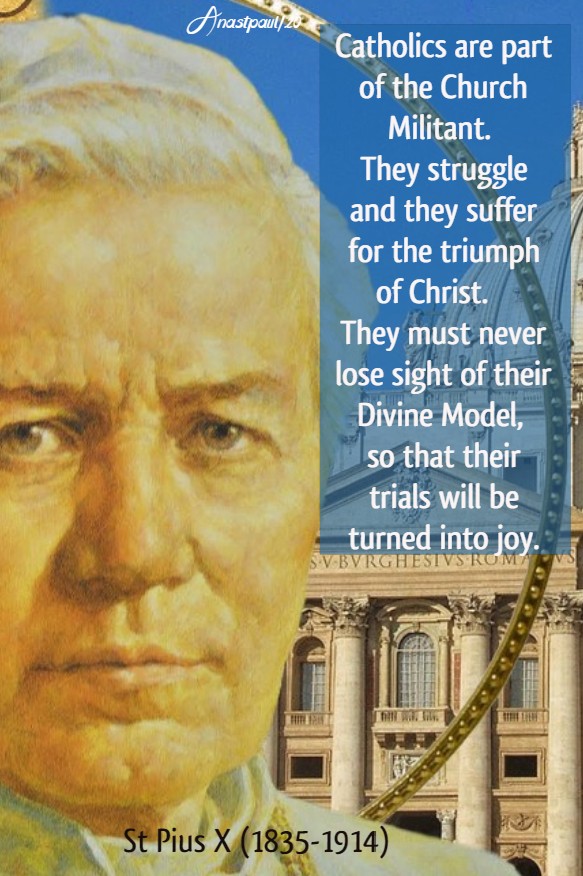
“Catholics are part of the Church Militant. They struggle and they suffer for the triumph of Christ. They must never lose sight of their Divine Model, so that their trials will be turned into joy.”
St Pius X (1835-1914)
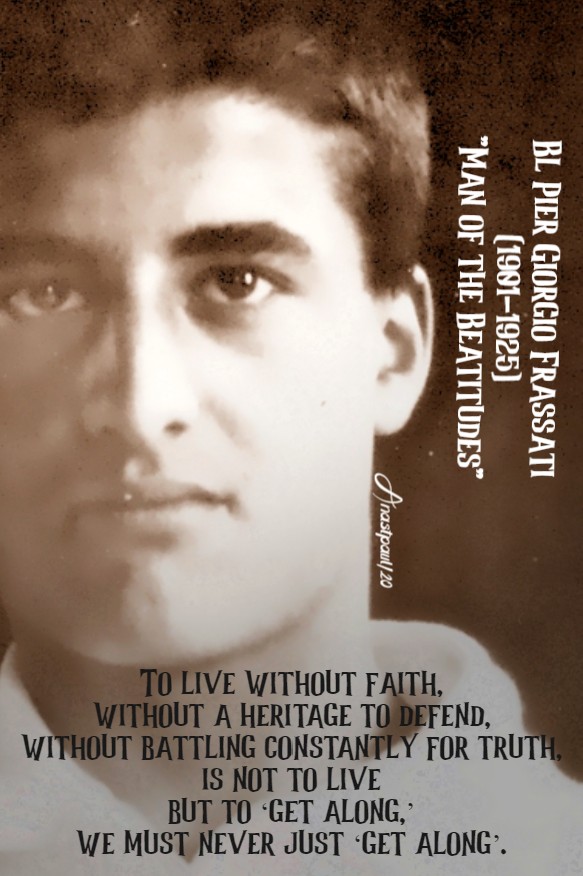
“To live without faith, without a heritage to defend, without battling constantly for truth, is not to live but to ‘get along,’ we must never just ‘get along’.”
Bl Pier Giorgio Frassati (1901-1925)
“Man of the Beatitudes”
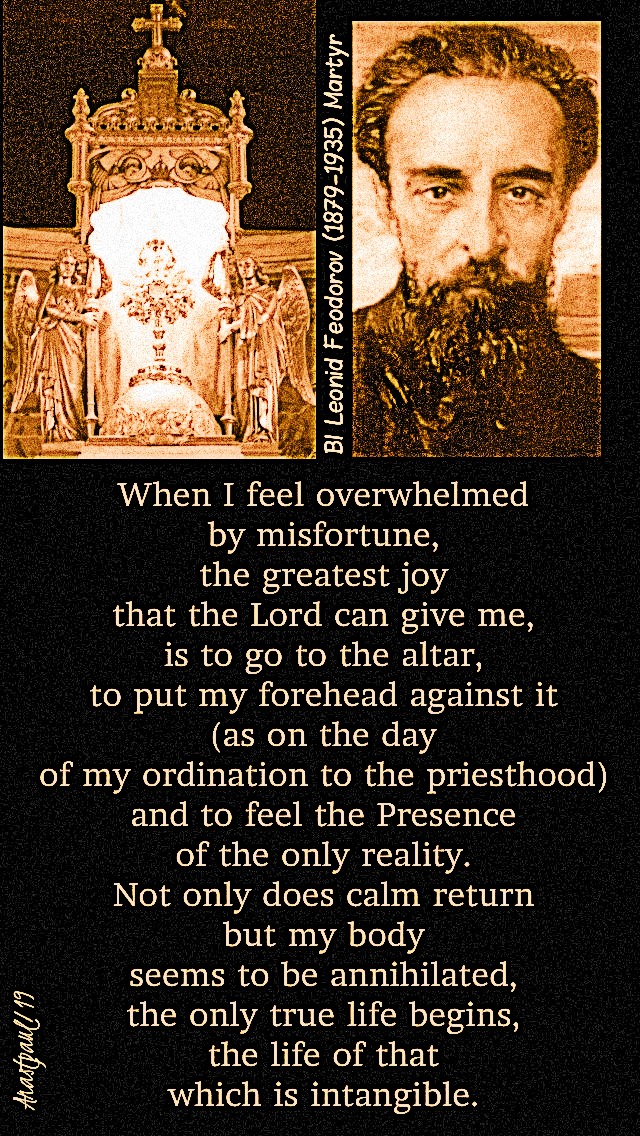
“When I feel overwhelmed by misfortune, the greatest joy that the Lord can give me, is to go to the altar, to put my forehead against it (as on the day of my ordination to the priesthood) and to feel the presence of the only reality. Not only does calm return but my body seems to be annihilated, the only true life begins, the life of that which is intangible.”
Bl Leonid Feodorov (1879-1935) Martyr
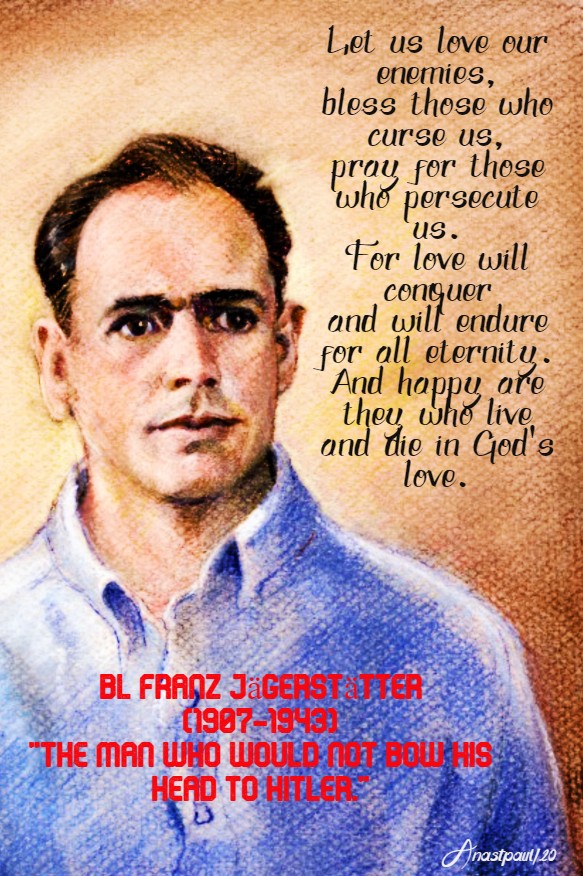
“Let us love our enemies, bless those who curse us, pray for Those who persecute us. For love will conquer and will endure for all eternity. And happy are they who live and die in God’s love.”
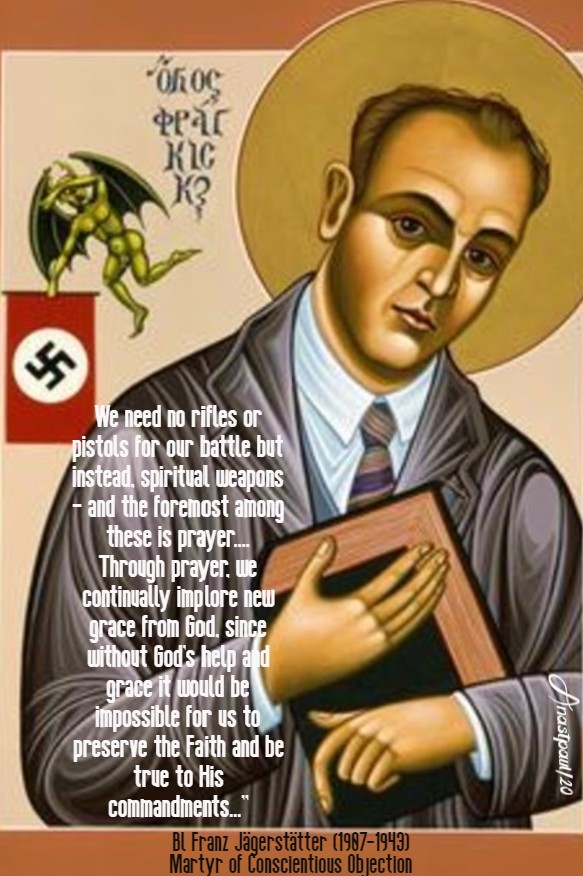
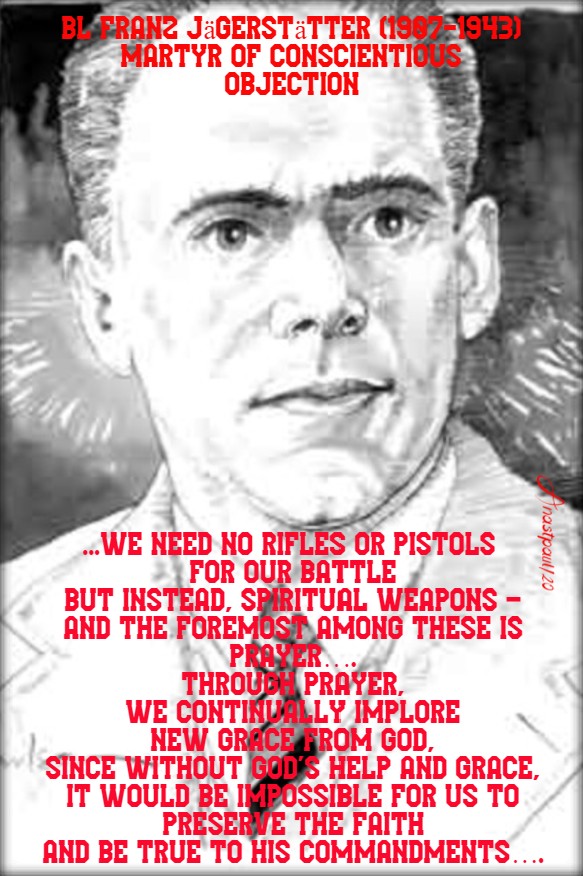
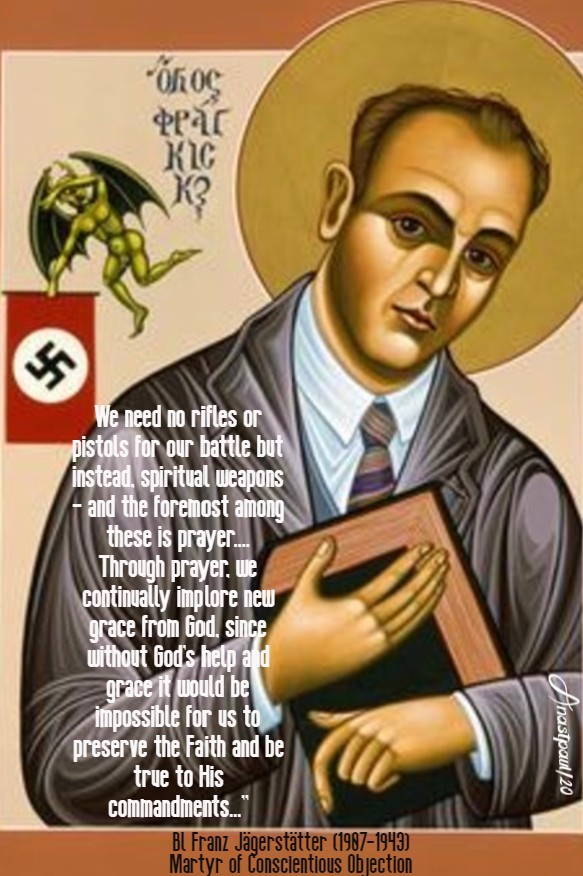
” …We need no rifles or pistols for our battle but instead, spiritual weapons – and the foremost among these is prayer…. Through prayer, we continually implore new grace from God, since without God’s help and grace, it would be impossible for us to preserve the Faith and be true to His commandments….”
“Since the death of Christ, almost every century has seen the persecution of Christians, there have always been heroes and martyrs who gave their lives – often in horrible ways – for Christ and their faith. If we hope to reach our goal some day, then we, too, must become heroes of the faith.”
Blessed Franz Jägerstätter (1907-1943)
Martyr of Conscientious Objection
Quote/s of the Day – 30 May – The Memorial of St Joan of Arc (1412-1431)
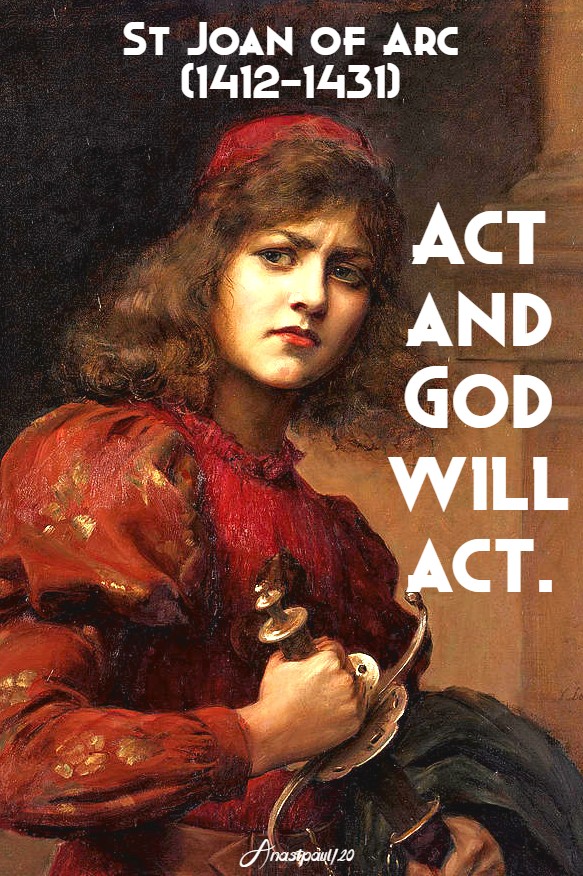
“Act and God will act.”
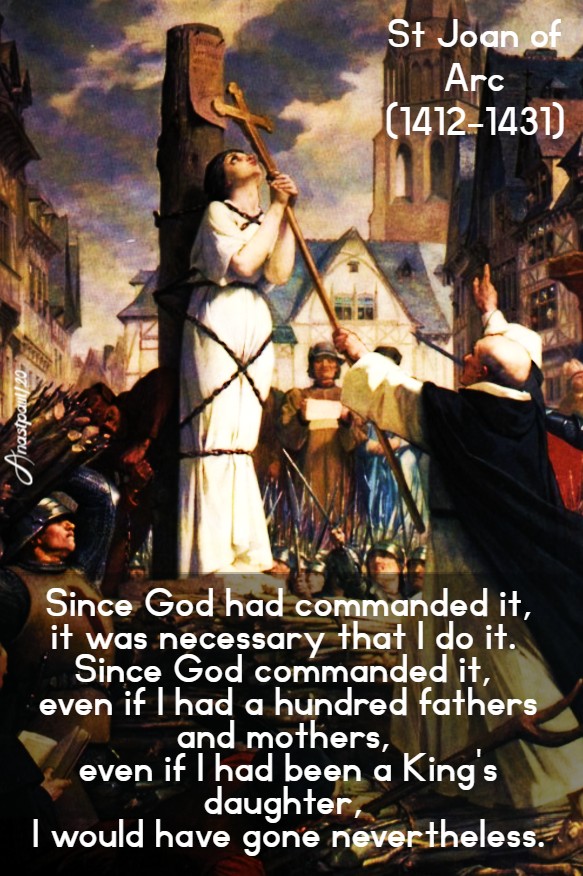
“Since God had commanded it, it was necessary that I do it. Since God commanded it, even if I had a hundred fathers and mothers, even if I had been a King’s daughter, I would have gone nevertheless.”
One Minute Reflection – 25 May – “Mary’s Month” – Monday of the Seventh week of Easter, Readings: Acts 19:1-8, Psalm 68:2-7, John 16:29-33 and the Memorial of St Maria Magdalena de’ Pazzi O.Carm (1566-1607)
“In the world you will have tribulation. But take heart, I have conquered the world.” ... John 16:33
REFLECTION – “Let nothing intervene to hinder the progress of any who travel alongside each other, in this evangelical life but let us walk with agile step though the road be rough and hard, let us show a brave and manly spirit, overcome obstacles, pass along from pathway to pathway, from hill to hill, until we climb onto the mountain of the Lord and make a home for ourselves in the holy place of His impassibility.
Now, companions assist each other on the way; so then, my brothers, as the apostle says: “Bear one another’s burdens” (Gal 6:2) and make up for whatever is lacking to others (cf. 2 Cor 8:14 ; Phil 2:30). To the negligence that perhaps holds sway today, noble courage will succeed tomorrow, now one is in gloom and then suddenly one rises to the surface and discovers joy again, at one moment our passions rise up but soon God comes to help us, they are broken and calm returns. For you will only be seen like this yesterday and the day before but, dear friend, you will not always remain the same but the grace of God will draw near you, the Lord will fight for you and perhaps, like the great Antony, you will say: “Where were you just now?” and he will answer: “I wanted to see your combat.”
For now, let us persevere, children, dear children, let us be patient for a little, brothers, dear brothers.… Who will be crowned without having fought? Who will go to rest if he is not tired (cf. 2 Tim 2:5-6)? Who will gather the fruits of life without having planted virtues in his soul? Cultivate them, prepare the earth with the greatest care, take trouble over it, sweat over it, children, God’s workers, imitators of the angels, competitors with incorporeal beings, lights for those who are in the world (cf. Phil 2:15)!” … St Theodore the Studite (759-826) Monk – Catechesis 28
PRAYER – Lord God, as You brought joy to the world, through the resurrection of Lord Jesus Christ, Your Son, grant that through His Virgin Mother, we may constantly seek and recognise our Lord and Saviour and turn to Him in complete trust and love. May we ever live in confidence and share our joy with our neighbour. St Maria Magdalena de’ Pazzi, pray that we may know the courage of our Saviour. Through Jesus Christ our Lord, with You and the Holy Spirit, one God forever, amen.
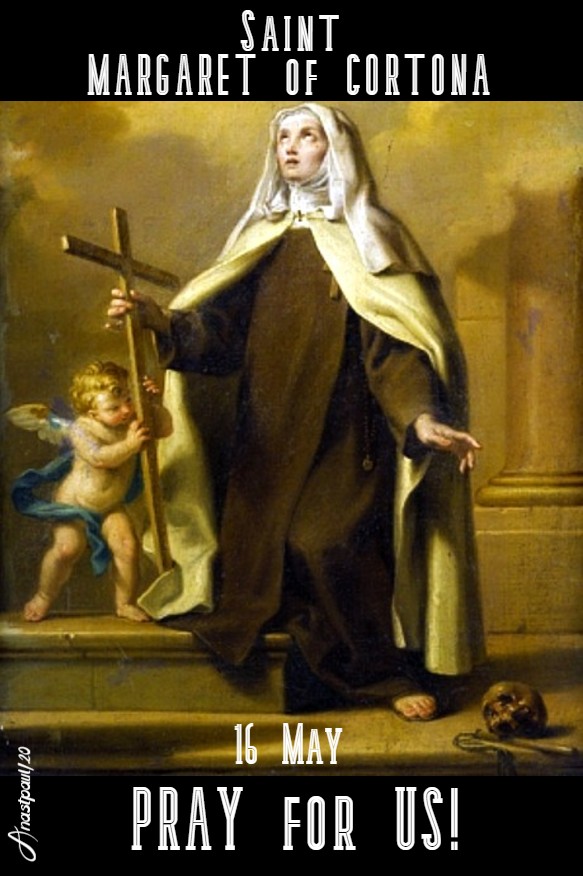
One Minute Reflection – 16 May – “Mary’s Month” – Saturday of the Fifth Week of Easter, Readings: Acts 16:1-10, Psalm 100:1-3, 5, John 15:18-21 and the Memorial of St Margaret of Cortona TOSF (1247-1297)
“If the world hates you, know that it has hated me first. If you were of the world, the world would love you as its own but because you are not of the world but I chose you out of the world, therefore, the world hates you.” … John 15:18-19
REFLECTION – “Our Lord’s will is that we should rejoice and leap for joy when we are persecuted (Mt 5:12) because, when persecutions come, it is then, that crowns are given for faith (cf. Jas 1:12), it is then, that Christ’s soldiers prove themselves, then that the heavens open to their witness.
We aren’t employed in God’s force only to think of quiet, running away from service when the Teacher of humility, patience and suffering has Himself provided the same service before us. What He taught, He first of all, carried out and, if He exhorts us to stand firm, it is because He Himself suffered before us and on our behalf.
If we are to take part in competitions in the stadium, we exercise and train ourselves and think ourselves highly honoured if, before the eyes of the crowd, we have the happiness of receiving the prize.
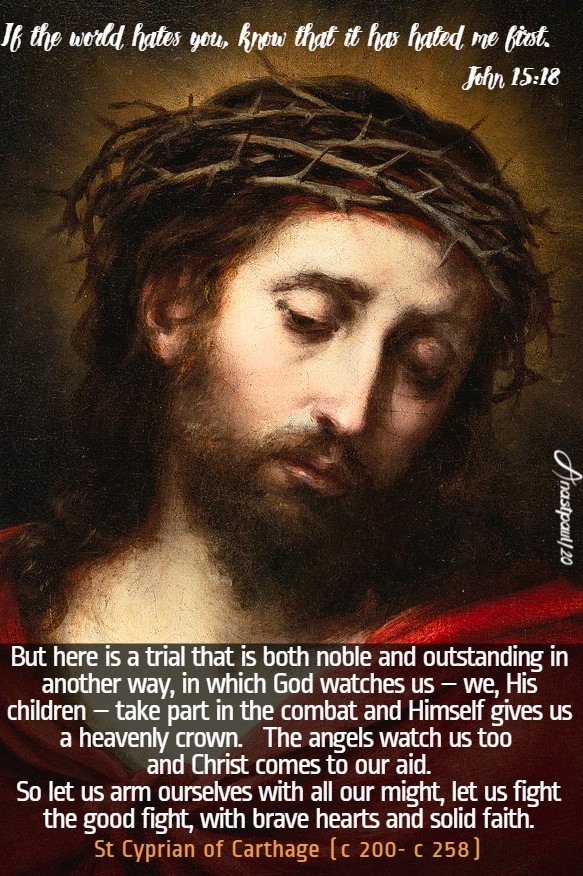
But here is a trial that is both noble and outstanding in another way, in which God watches us – we, His children – take part in the combat and Himself gives us a heavenly crown ( 1Cor 9:25). The angels watch us too and Christ comes to our aid.
So let us arm ourselves with all our might, let us fight the good fight, with brave hearts and solid faith.” … St Cyprian of Carthage (c 200- c 258) Bishop and Martyr, Father of the Church
PRAYER – Almighty God, grant that Your faithful, who rejoice in the protection of the Blessed Virgin Mary, may be delivered from every evil here on earth, put on the armour of Your Son and fight the good faith bearing His standard. Through her prayer and the prayers of Your Saints and St Margaret of Cortona, may we come to the enduring joys of heaven. We make our prayer through her Son, our Lord Jesus Christ, one God with You, in the union of the Holy Spirit, forever amen.
Quote/s of the Day – 5 May – Tuesday of the Fourth Week of Easter, Readings: Acts11:19-26, Psalm 87:1-7, John 10:22-30
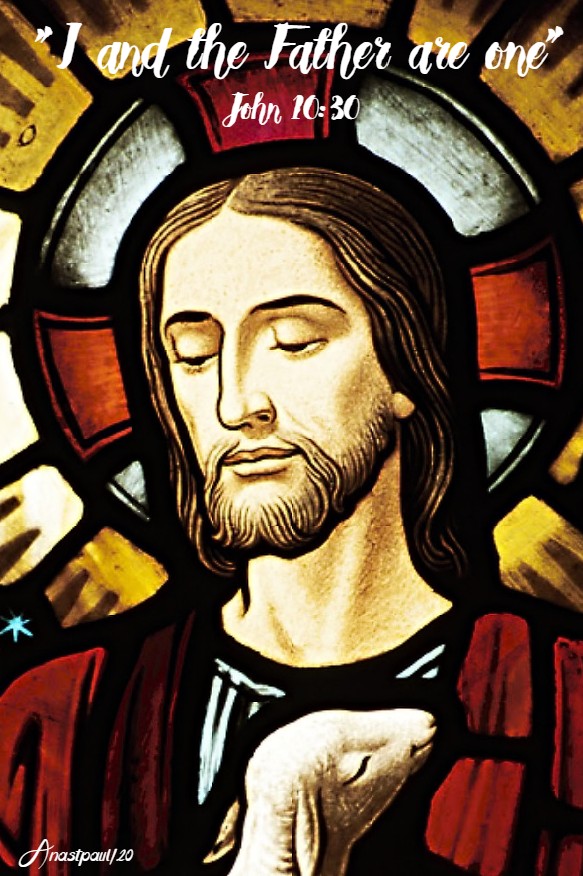
“I and the Father are one.”
John 10:30
Christians are baptised “in the name of the Father and of the Son and of the Holy Spirit” (Mt 28:30). Before receiving the sacrament, they respond to a three-part question when asked to confess the Father, the Son and the Spirit: “I do.” “The faith of all Christians rests on the Trinity”( St Caesarius of Arles). Christians are baptised “in the name” of the Father and of the Son and of the Holy Spirit – not “in their names,, for there is only one God, the almighty Father, His only Son and the Holy Spirit – the Most Holy Trinity.
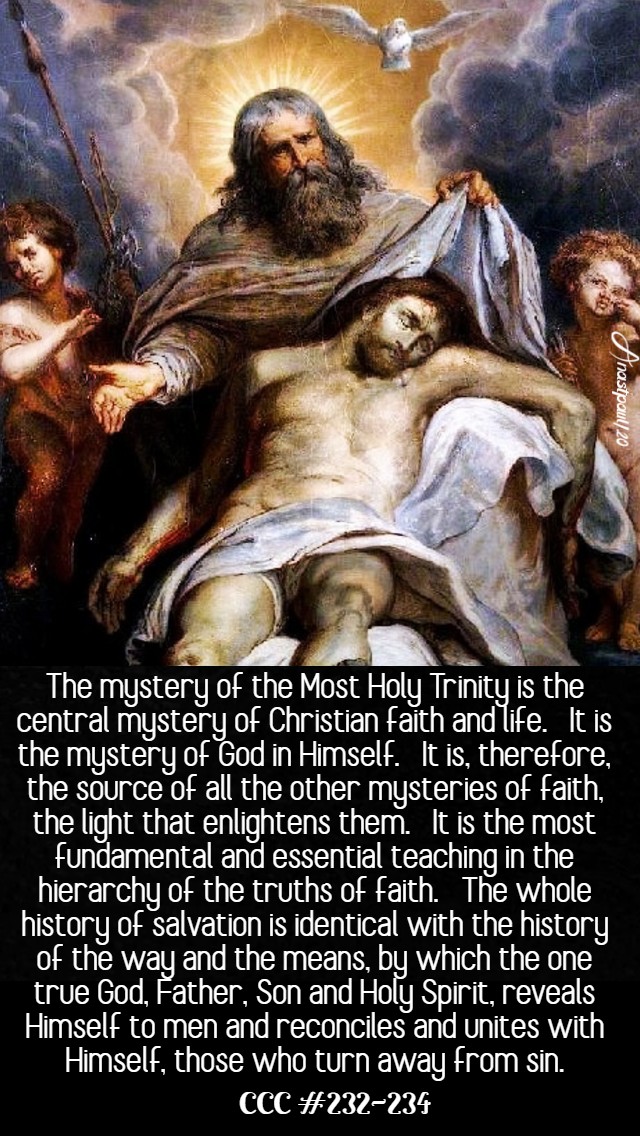
The mystery of the Most Holy Trinity is the central mystery of Christian faith and life. It is the mystery of God in Himself. It is, therefore, the source of all the other mysteries of faith, the light that enlightens them. It is the most fundamental and essential teaching in the hierarchy of the truths of faith. The whole history of salvation is identical with the history of the way and the means, by which the one true God, Father, Son and Holy Spirit, reveals Himself to men and reconciles and unites with Himself, those who turn away from sin. …
The Trinity is a mystery of faith in the strict sense, one of the mysteries that are hidden in God, which can never be known unless they are revealed by God. To be sure, God has left traces of His Trinitarian Being in His work of creation and in His Revelation throughout the Old Testament. But His inmost Being, as Holy Trinity, is a mystery that is inaccessible to reason alone, or even to Israel’s faith before the Incarnation of God’s Son and the sending of the Holy Spirit.
CCC – Catechism of the Catholic Church
# 232-234, 237
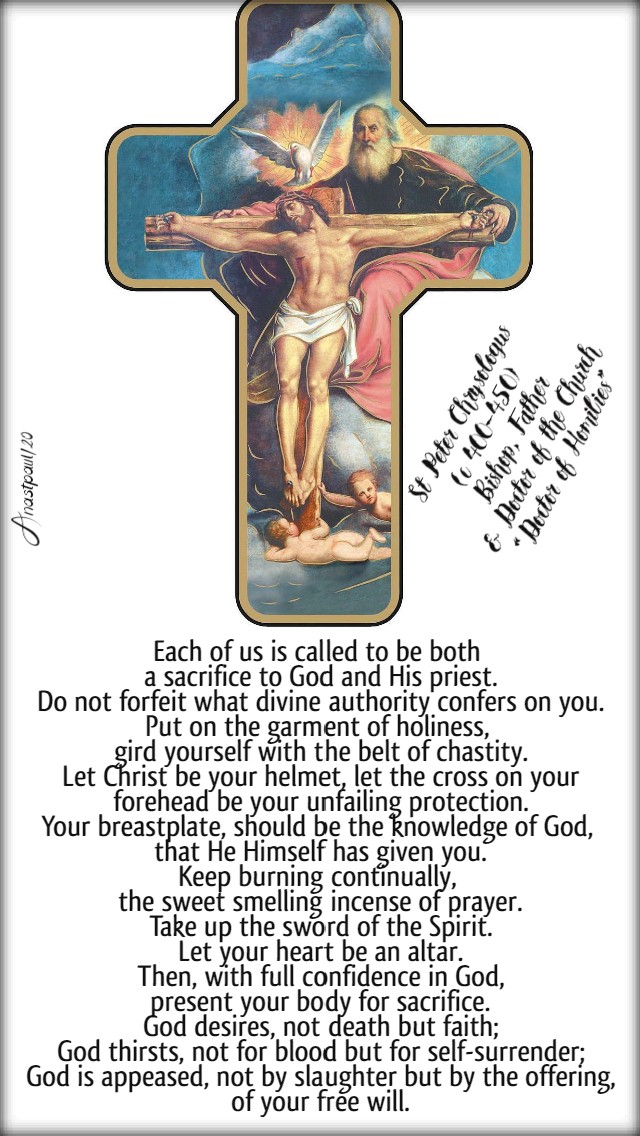
“Paul says: I appeal to you by the mercy of God, to present your bodies as a sacrifice, living and holy. The prophet said the same thing: Sacrifice and offering you did not desire but you have prepared a body for me. Each of us is called to be both a sacrifice to God and His priest. Do not forfeit what divine authority confers on you. Put on the garment of holiness, gird yourself with the belt of chastity. Let Christ be your helmet, let the cross on your forehead be your unfailing protection. Your breastplate, should be the knowledge of God, that He Himself has given you. Keep burning continually, the sweet smelling incense of prayer. Take up the sword of the Spirit. Let your heart be an altar. Then, with full confidence in God, present your body for sacrifice. God desires, not death but faith; God thirsts, not for blood but for self-surrender; God is appeased, not by slaughter but by the offering, of your free will.”
St Peter Chrysologus (c 400-450)
Bishop, Father & Doctor of the Church
“Doctor of Homilies”
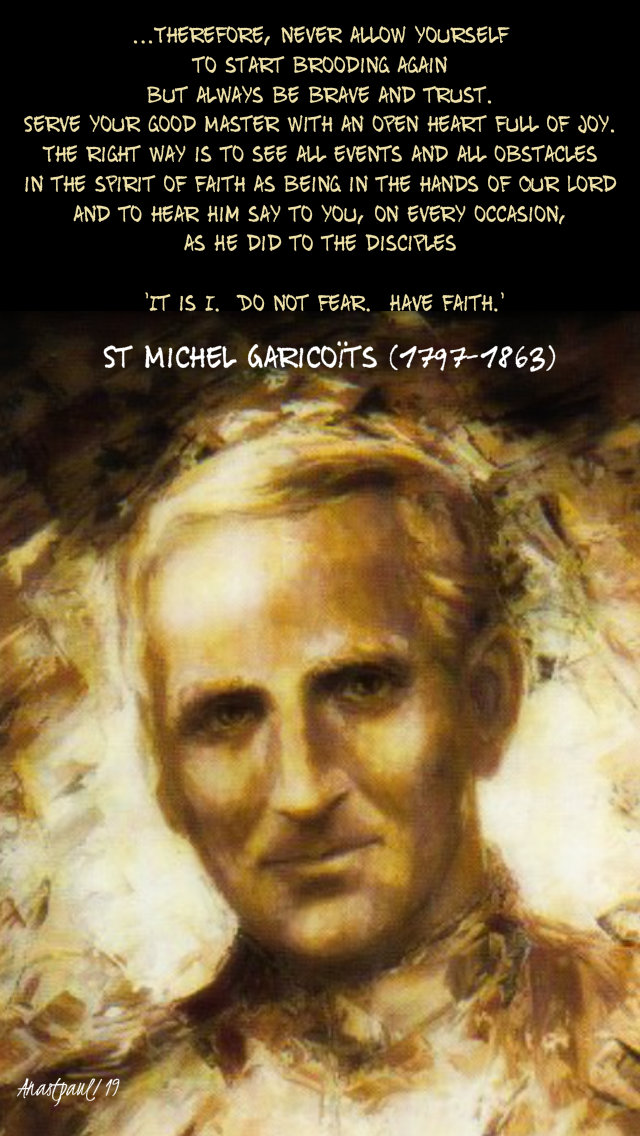
“…Therefore, never allow yourself to start brooding again but always be brave and trust. Serve your good Master with an open heart full of joy. The right way is to see all events and all obstacles in the spirit of faith as being in the hands of Our Lord and to hear Him say to you, on every occasion, as He did to the disciples ‘It is I. Do not fear. Have faith.’”
Thought for the Day – 29 April – Meditations with Antonio Cardinal Bacci (1881-1971)
The Dignity and Responsibility of Being a Christian
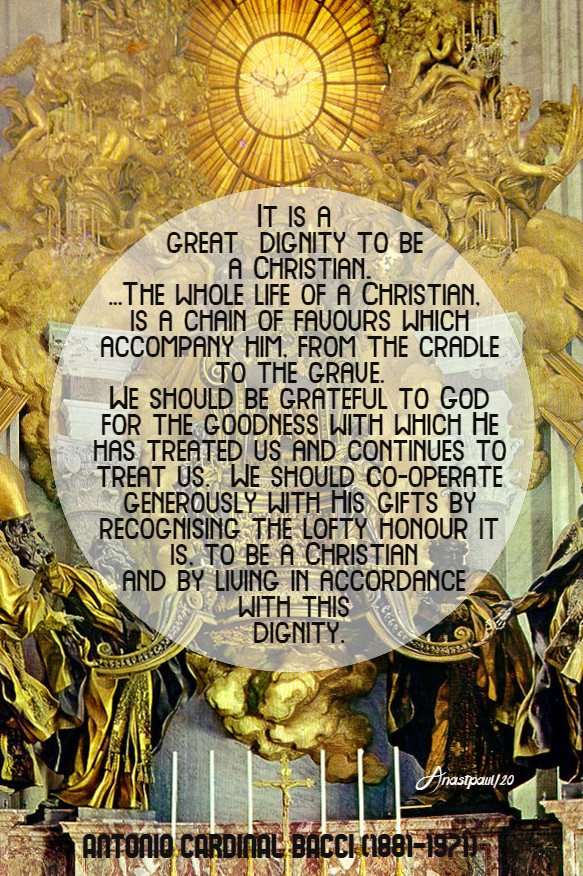
“It is a great dignity to be a Christian.
By Baptism, we become sons of God, heirs to Heaven, temples of the Holy Spirit and members of the Mystical Body of Jesus, which is the Church.
God’s grace raises us to the supernatural order and makes us, as St Paul expresses it, sharers in the divine nature.
By the Sacrament of Confirmation, the Holy Spirit fortifies our faith and gives us the strength to resist the temptations of the devil and to fight like loyal soldiers, for the triumph in ourselves and in others, of the Kingdom of Jesus Christ.
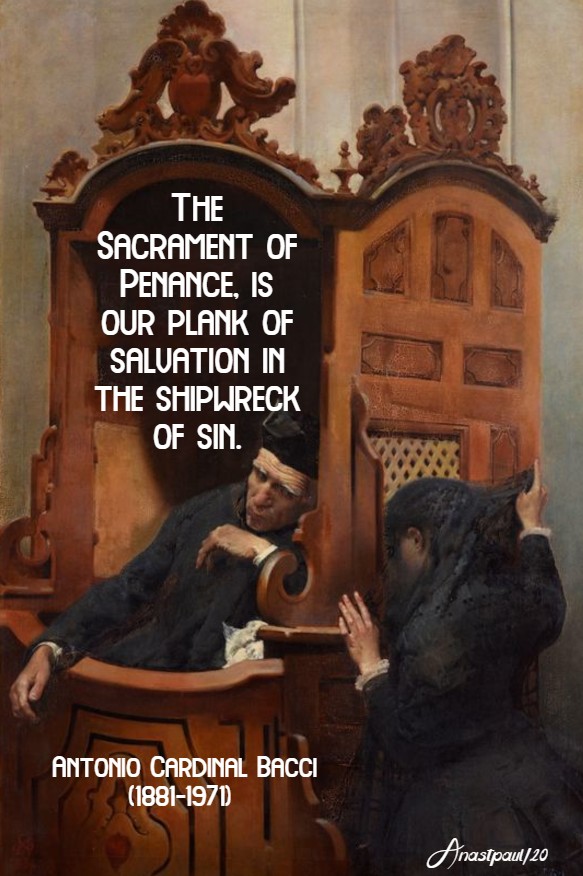
The Sacrament of Penance, is our plank of salvation in the shipwreck of sin.
Although, we are all wretched sinners, by this give of the divine mercy, we can recover our lost innocence and return to the grace and friendship of God.
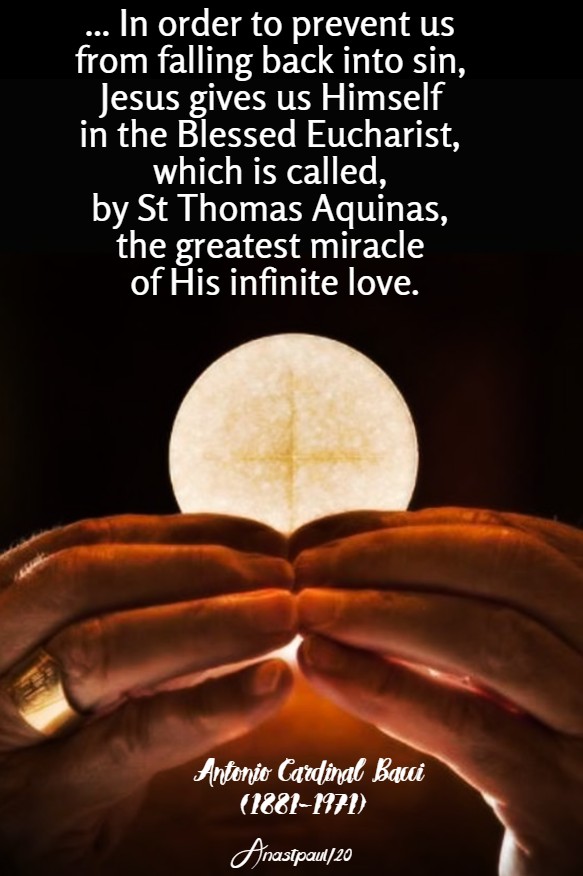
Moreover, in order to prevent us from falling back into sin, Jesus give us Himself in the Blessed Eucharist, which is called, by St Thomas Aquinas, the greatest miracle of His infinite love (Opusculum 56, Officium de festo Corporis Christi, lectures 1-4).
But this is not all.
If it is our vocation for form a family, God consecrates our union at the altar and gives us the graces necessary, to sanctify it, so that it may produce a good Christian family.
If God has called us, on the other hand, to become spiritual fathers of the souls redeemed by His Precious Blood, He raises us to this high dignity, by the Sacrament of Holy Orders.
Finally, when we shall have come to the end of our mortal lives, the Priest will be still by our side, to wash away, by the Sacrament of Extreme Unction, the last traces of sin and to comfort us in our passage to eternity.
The whole life of a Christian, is a chain of favours which accompany him, from the cradle to the grave.
We should be grateful to God for the goodness with which He has treated us and continues to treat us.
We should co-operate generously with His gifts by recognising the lofty honour it is, to be a Christian and by living in accordance with this dignity.”
Thought for the Day – 26 April – Meditations with Antonio Cardinal Bacci (1881-1971)
The Only Remedy for All Our Ills
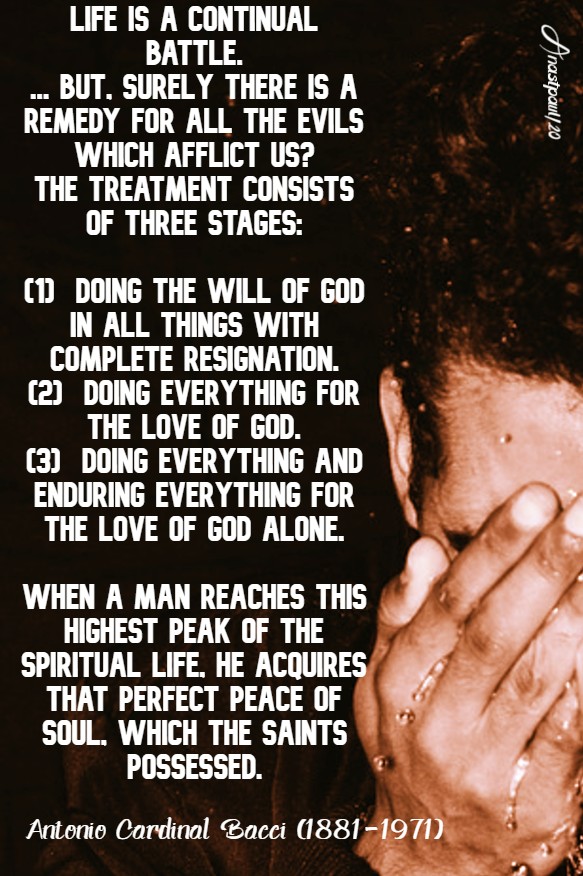
“Life is a continual battle. “Is not man’s life on earth a drudgery?” (Job 7:1).
If we consider, only the material aspect of this battle, we are all among the vanquished.
Admittedly, there is some joy and some victory.
But, our pleasures are as short-lived as the flowers of the field, they are soon “withered and dried up like grass” (Cf Ps 101:5).
Our conquests are also very insignificant; they can inflate us for a while but they do not last long and cannot satisfy us.
After death, only our triumphs in virtue will persist.
Moreover, whereas the joys of this life are few and fleeting, the physical and moral sufferings, are innumerable.
Sometimes, they are so heavy and overwhelming, that they cause us to despair.
But, surely there is a remedy for all the evils which afflict us?
God is infinitely good and He has permitted suffering.
Will He not give us the means of enduring it and the medicine to cure it?
In fact, Our Lord, has given us a remedy for all our ills, even for the most distressing.
It is a bitter medicine but, it will heal anyone who has the courage to swallow it and, it will give him perfect peace of soul.
The treatment consists of three stages:
(1) Doing the will of God in all things with complete resignation.
(2) Doing everything for the love of God.
(3) Doing everything and enduring everything for the love of God alone.
When a man reaches this highest peak of the spiritual life, he acquires that perfect peace of soul, which the Saints possessed.”
Quote/s of the Day – 17 April – Easter Friday, Readings: Acts 4:1-12, Psalm 118:1-2, 4, 22-27, John 21:1-14
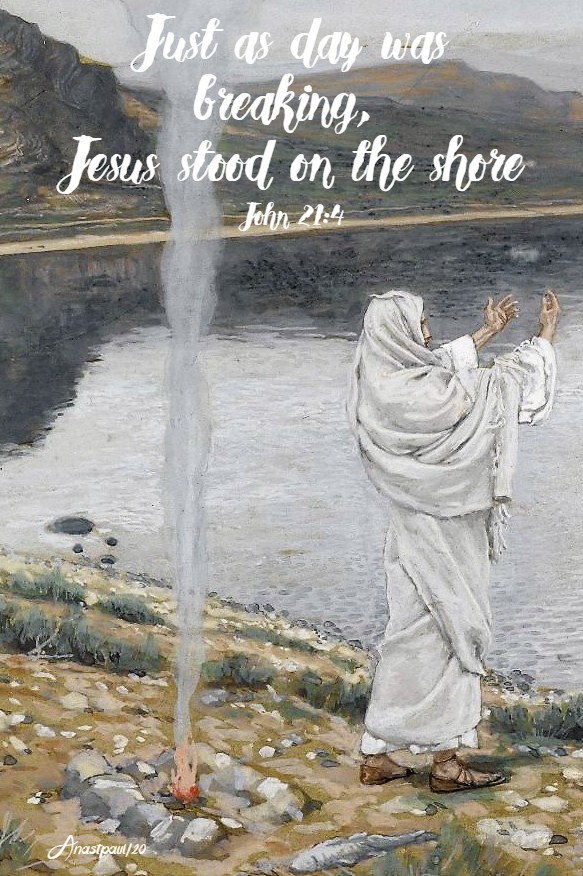
Just as day was breaking, Jesus stood on the shore ..
John 21:4
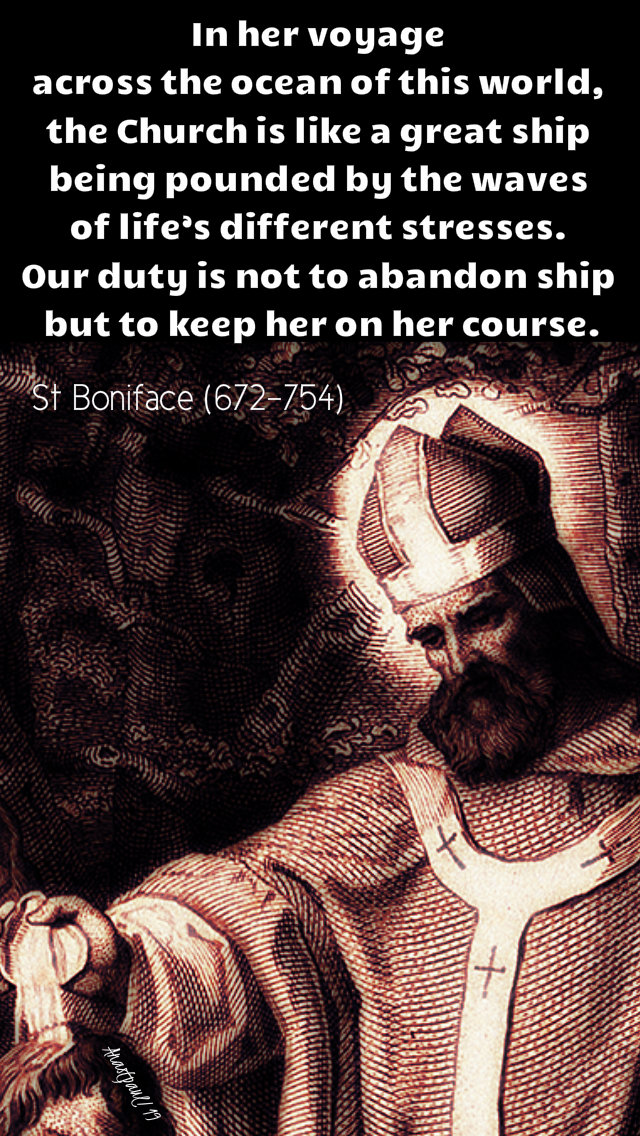
“In her voyage across the ocean of this world, the Church is like a great ship being pounded by the waves of life’s different stresses. Our duty is not to abandon ship but to keep her on her course.”
St Boniface (672-754)
“Jesus is with me. I have nothing to fear.”
Bl Pier Giorgio Frassati (1901-1925)
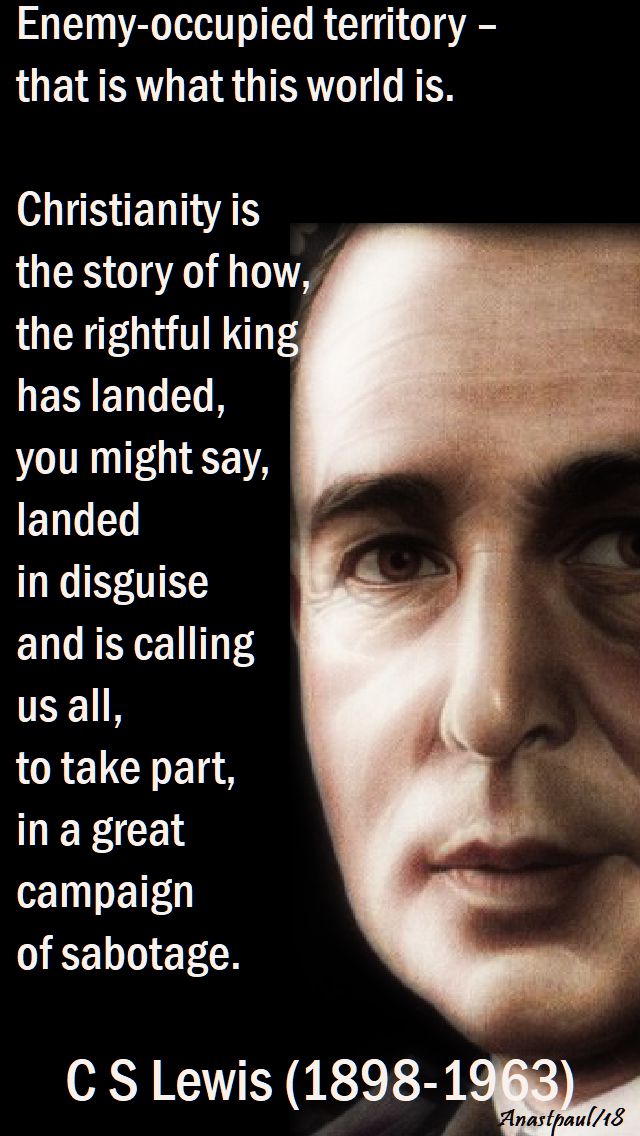
“Enemy-occupied territory – that is what this world is. Christianity is the story of how the rightful king has landed, you might say landed in disguise and is calling us all, to take part in a great campaign of sabotage.”
C S Lewis (1898-1963)
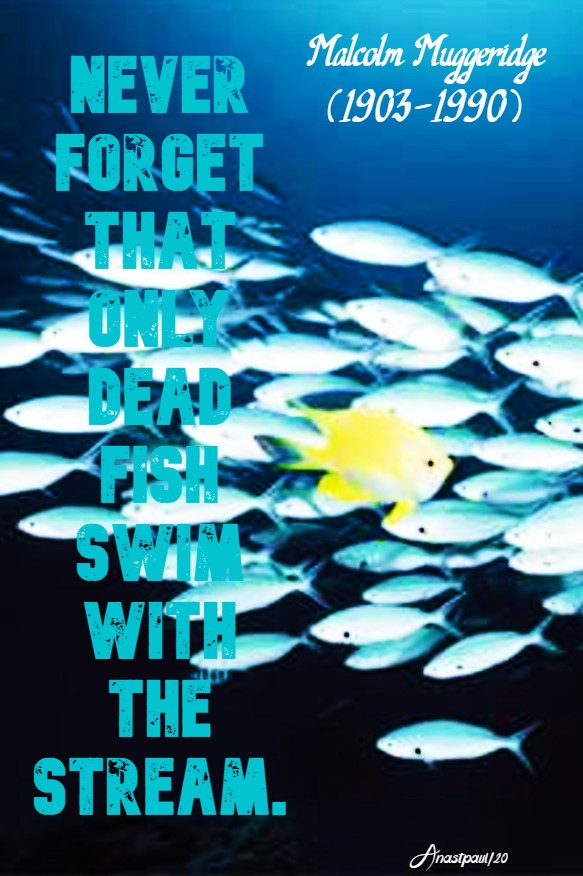
Never forget that only dead fish swim with the stream.
Malcolm Muggeridge (1903-1990)
Thomas Malcolm Muggeridge (24 March 1903 – 14 November 1990) was an English journalist and satirist. His father was a prominent socialist politician and one of the early Labour Party Members of Parliament. In his twenties, Muggeridge was attracted to communism but after living in the Soviet Union in the 1930s, he became a forceful anti-communist. In 1982, aged 79, Muggeridge was received into the Catholic Church along with his wife, Kitty. This was largely under the influence of Mother Teresa, about whom he had written a book, ‘Something Beautiful for God,’ setting out and interpreting her life.
Thought for the Day – 17 January – Meditations with Antonio Cardinal Bacci (1881-1971) – Friday of the First week in Ordinary Time, Year A
“The Vicissitudes of Life”
“There are times, when life is like a stream which flows peacefully between two flower-strewn grassbanks.
The sun shines brightly overhead and the whole world seems to smile.
The days pass pleasantly and the future is full of fair promise.
Virtue itself, seems to flower effortlessly, in our hearts.
But God grants these intervals of rest during our earthly voyage, so that we may renew our energy.
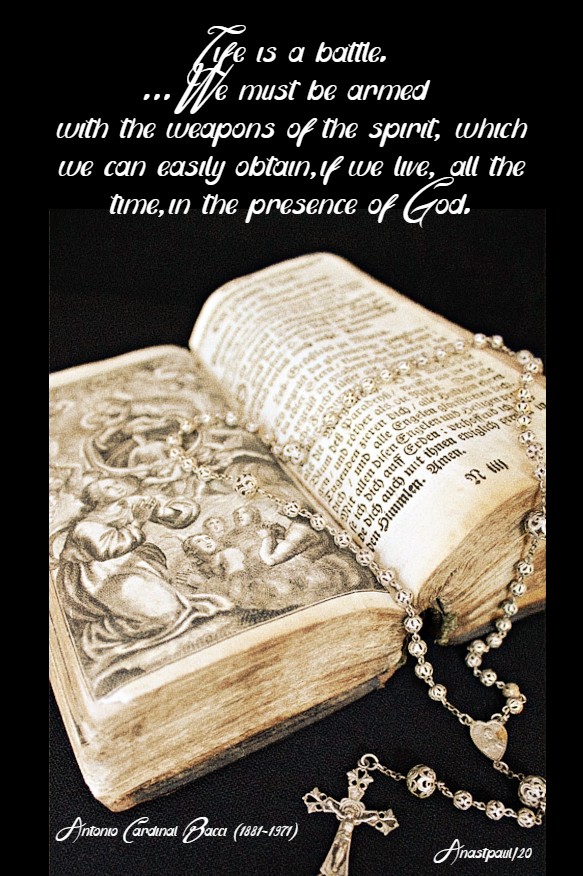
Life is a battle.
Therefore, we have to be armed and ready and always on the alert (Job 7:1) “Wait here and watch” (Mt 26:38).
We must resolve to be prepared, from the earliest hour of the morning, to face the difficulties and temptations which can arise at any moment.
We must be armed with the weapons of the spirit, which we can easily obtain, if we live all the time, in the presence of God.
If we fail to acquire this habit of spiritual watchfulness, the trials and temptations of the day, will catch us off our guard and there is a danger that we may yield.’
Quote/s of the Day – 14 January – Tuesday of the First week in Ordinary Time, Year A
Speaking of: The devil
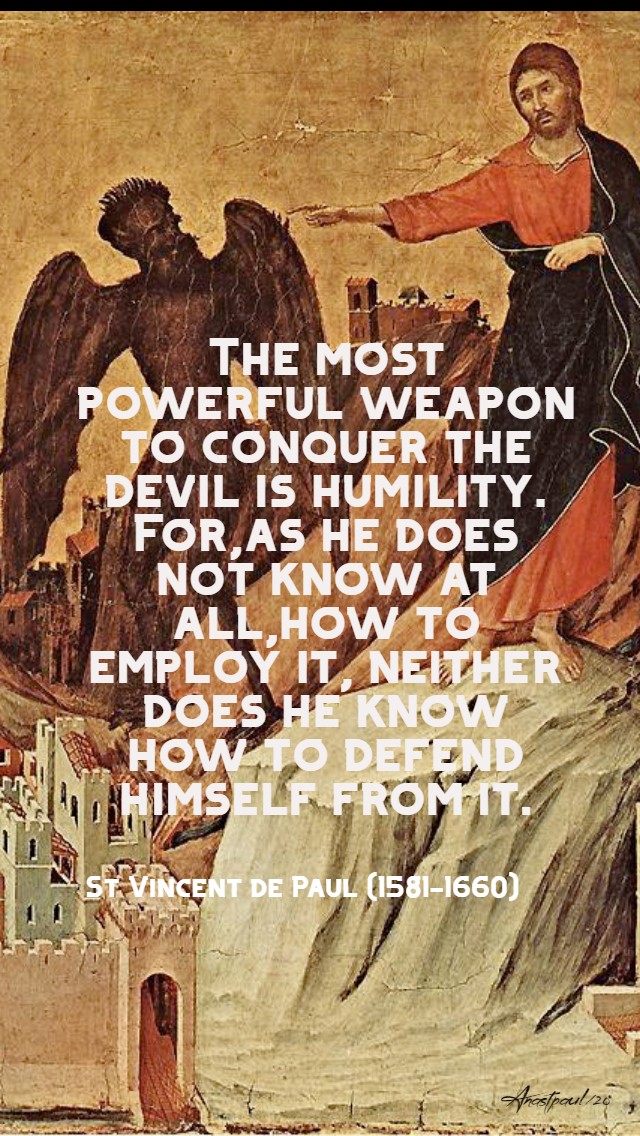
“The most powerful weapon to conquer the devil is humility. For, as he does not know at all, how to employ it, neither does he know how to defend himself from it.”
St Vincent de Paul (1581-1660)
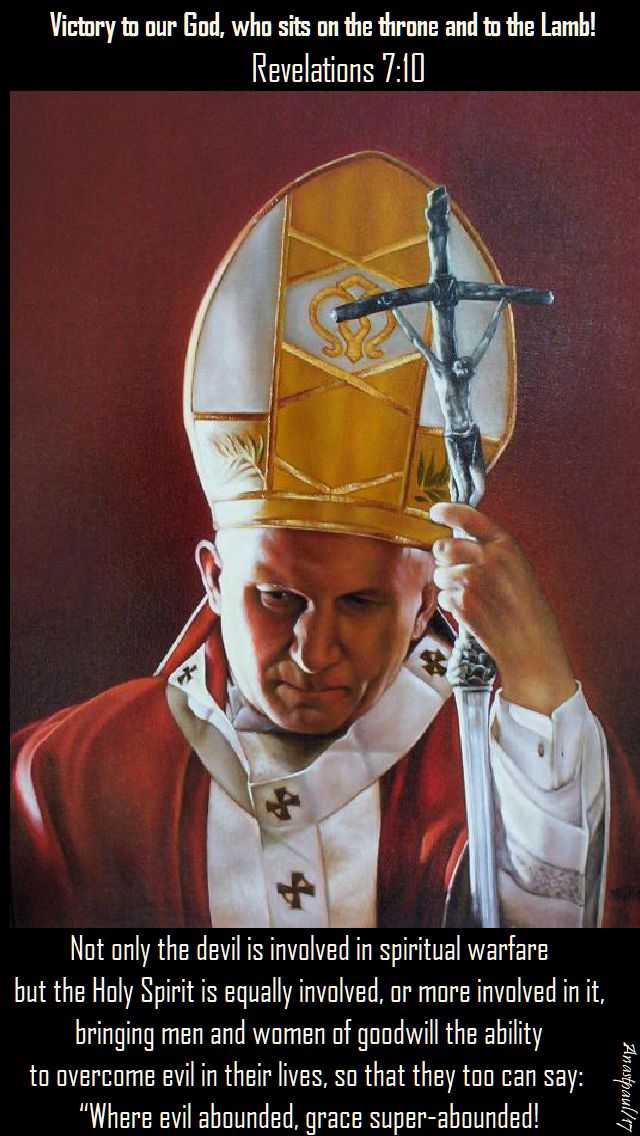
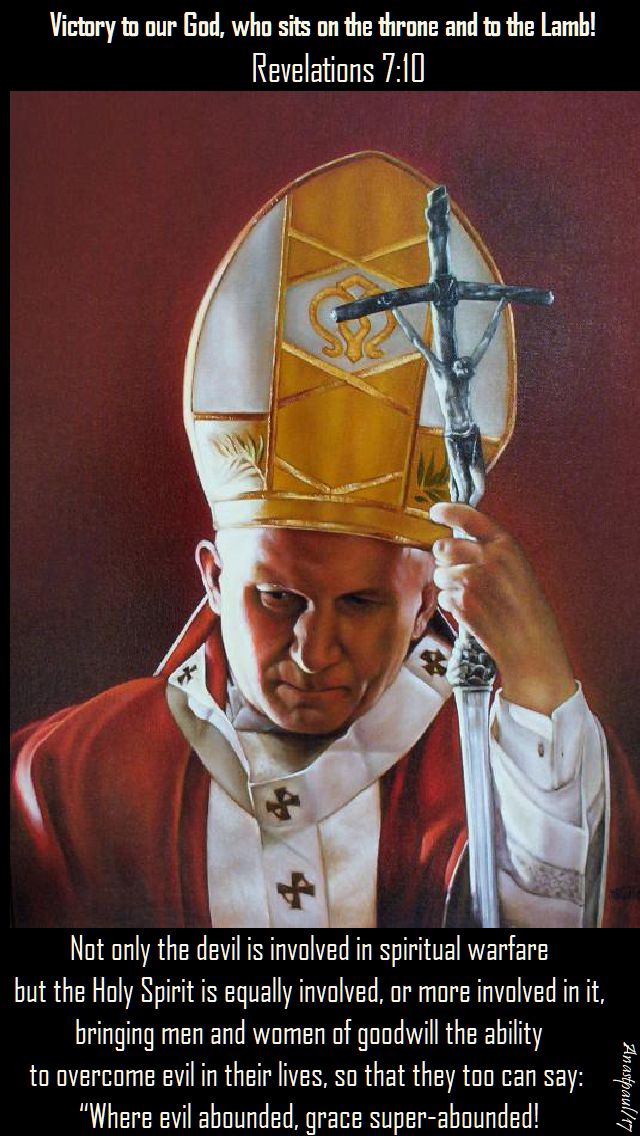
“Not only the devil is involved in spiritual warfare but the Holy Spirit is equally involved, or more involved in it, bringing men and women of goodwill, the ability to overcome evil in their lives, so that they too can say: “Where evil abounded, grace super-abounded!” (Rom 5:20).”
St John Paul II
(The Holy Spirit (Dominum Et Vivificantem – 1986)
“It is not enough for a Christian to condemn evil, cowardice, lies and use of force, hatred and oppression. He must at all times be a witness to and defender of justice, goodness, truth, freedom and love. He must never tire of claiming these values as a right both for himself and others.”
Thought for the Day – 26 November – Tuesday of the Thirty Fourth week in Ordinary Time, Year C, Gospel: Luke 21:5–11
“When you hear of wars and insurrections, do not be terrified” … Luke 21:9
Saint John Chrysostom (c 345-407) Father & Doctor
The nearer the king approaches, the more we should pray. The nearer the moment arrives for bestowing the trophy on the combatant, the harder we should struggle. This is what they do at the race – as the end of the course nears and they are reaching the goal, they stir up the horses’ enthusiasm even more. In the same way Saint Paul says: “Now is salvation nearer to us than when first we believed. The night is far gone, the day is at hand” (Rm 13:11-12).
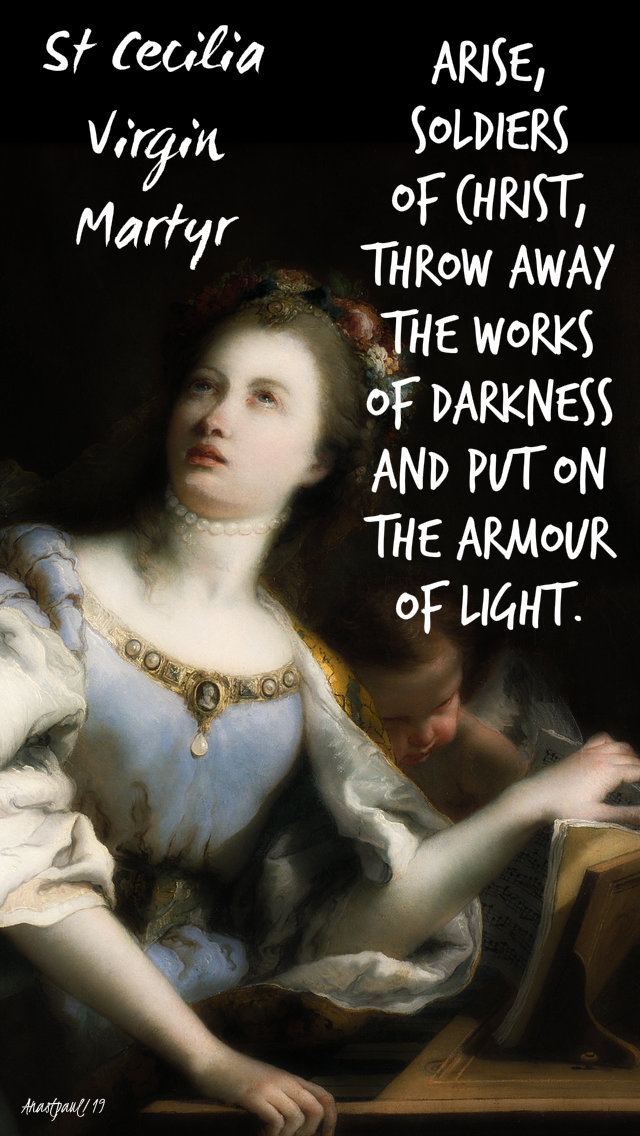
Since night is disappearing and day is coming to view, let us carry out the works of day and leave behind the works of darkness. This is what we do in the course of life – when we see night giving way to dawn and hear the swallows singing, then we rouse one another even though it is still dark… We hurry to our daily tasks; we get dressed after being snatched from sleep so that the sun will find us ready. What we do then, let us do now. Let us shake off our dreams, rouse ourselves from thoughts of this present life, leave our heavy slumber and put on the garment of virtue. This is what the apostle clearly says to us: “Cast off the works of darkness and put on the armour of light” (v.12). For day is calling us to the battle, to the fight.
But don’t be afraid when you hear these words about fighting and combat! For if it is uncomfortable to put on heavy material armour, it is pleasant, on the other hand, to put on spiritual armour, for this is an armour of light. In this way you will shine more brightly than the sun and, even as you sparkle brightly, you will be safe because these are weapons… weapons of light. So then? Are we excused from fighting? Not at all! We are to fight but without being overcome by fatigue and without pain. For it is not so much a war to which we are being summoned, as a feast and celebration.
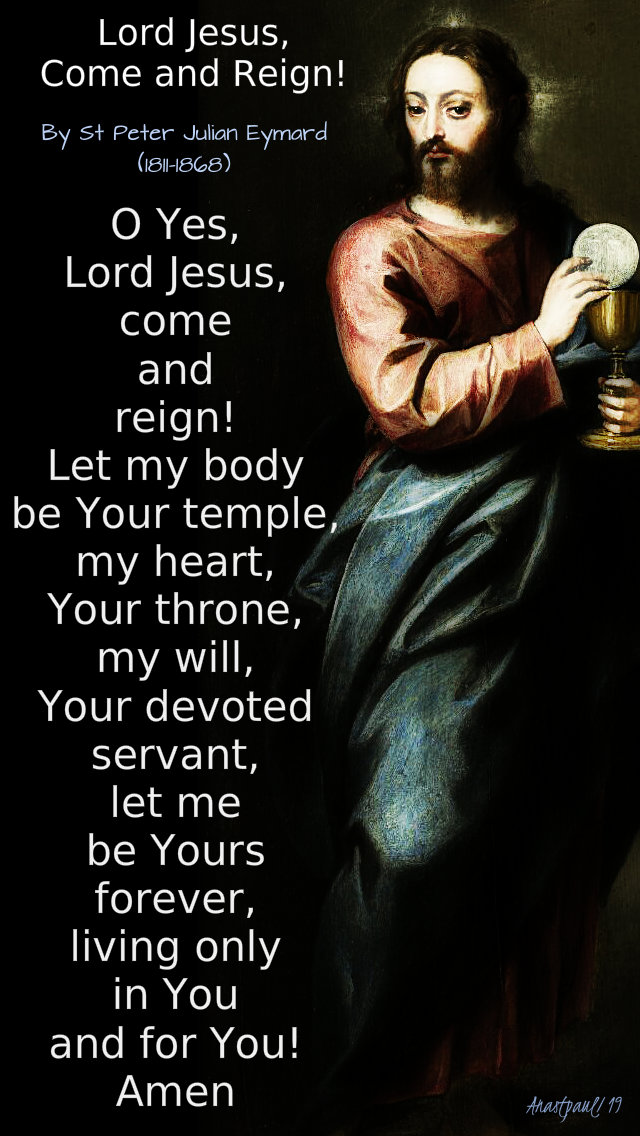
O Yes, Lord Jesus, come and reign! Let my body be Your temple, my heart, Your throne, my will, Your devoted servant, let me be Yours forever, living only in You and for You! Amen
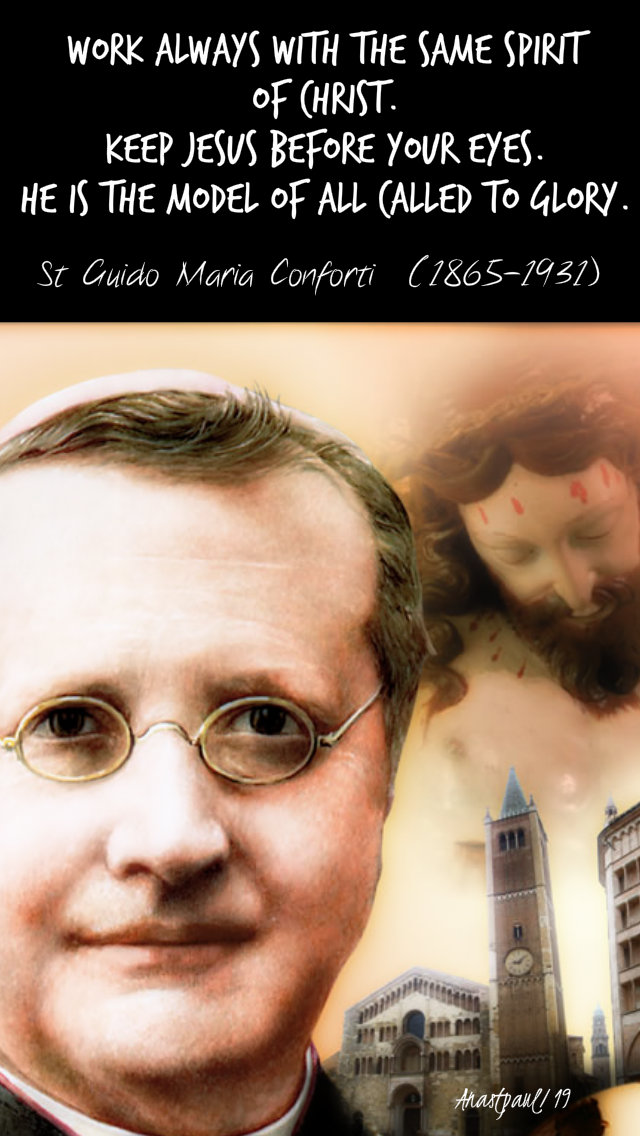
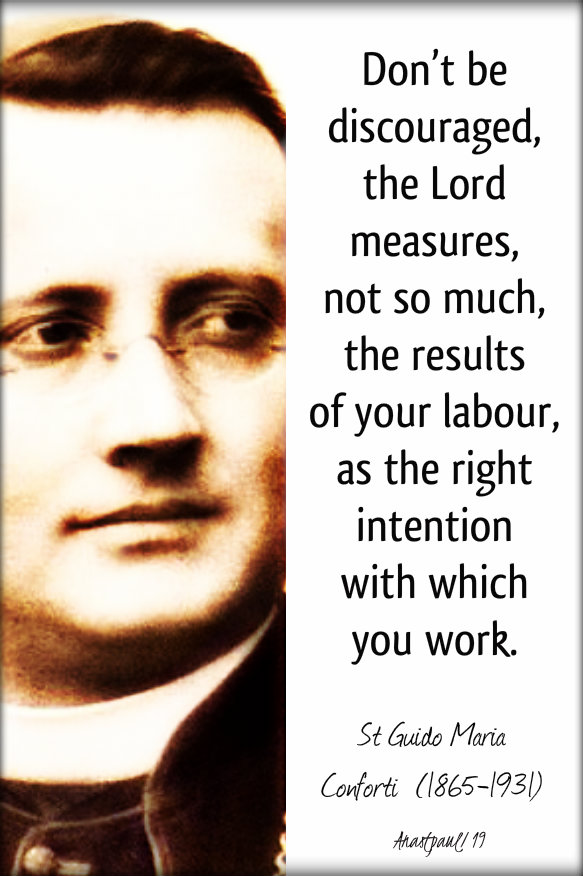
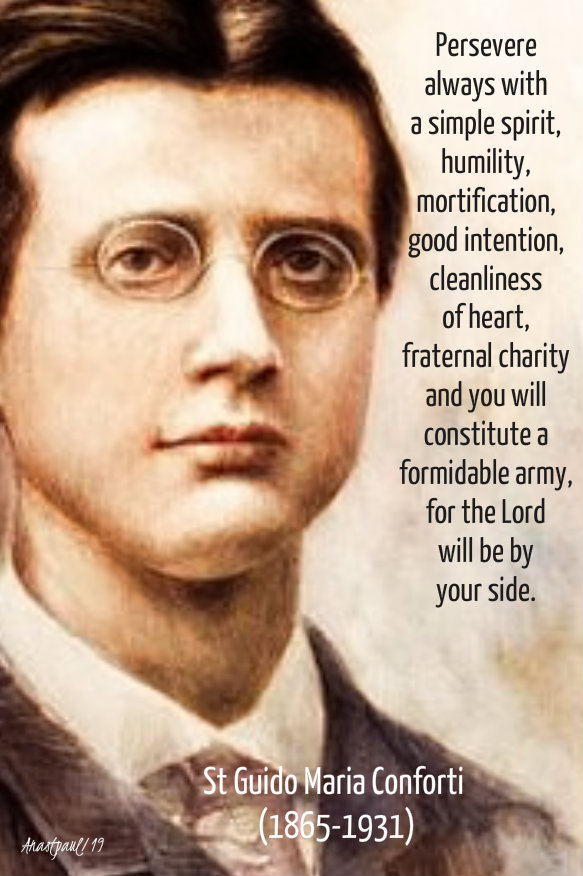
Quote/s of the Day – 5 November – The Memorial of St Guido Maria Conforti (1865-1931)
“Work always with the same spirit of Christ. Keep Jesus before your eyes. He is the model of all called to glory.”
The First Circular Letter
“Don’t be discouraged, the Lord measures, not so much the results of your labour, as the right intention with which you work.”
“Persevere always with a simple spirit, humility, mortification, good intention, cleanliness of heart, fraternal charity and you will constitute a formidable army, for the Lord will be by your side.”
The Second Circular Letter
“On the last day, we will not be asked if we accomplished great deeds, or been acclaimed by men, rather we will be asked if we followed His will, in the state and condition, to which we were called.”
One Minute Reflection – 25 October – Friday of the Twenty Ninth week in Ordinary Time, Year C, Gospel: Luke 12:54-59 and the Memorial of Bl Thaddeus McCarthy (c 1455–1492)
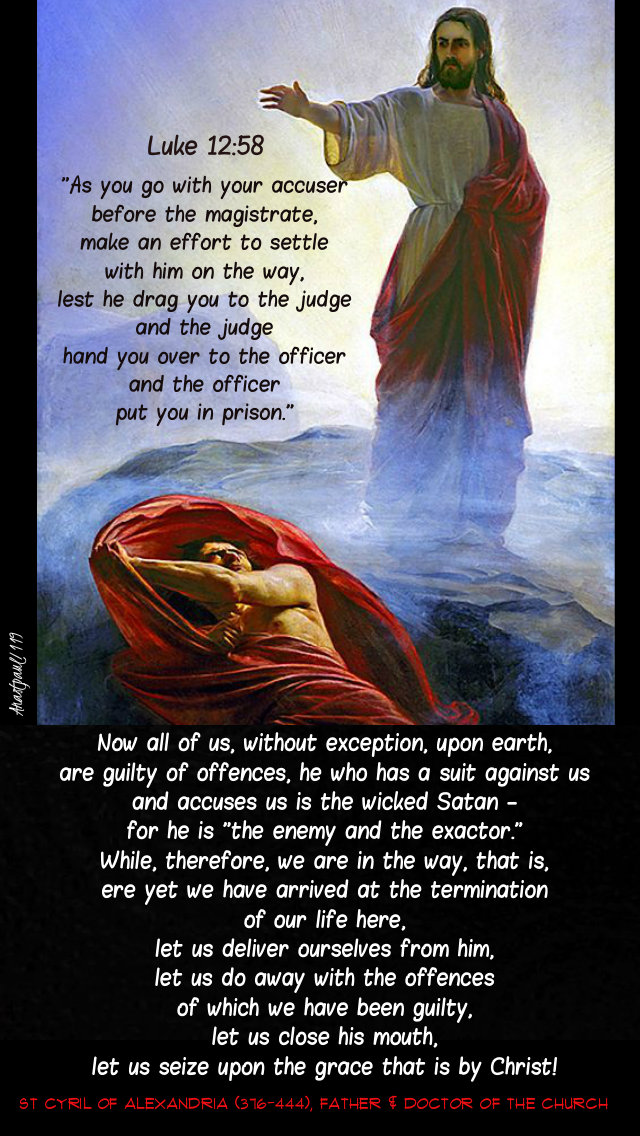
“As you go with your accuser before the magistrate, make an effort to settle with him on the way, lest he drag you to the judge and the judge hand you over to the officer and the officer put you in prison.” … Luke 12:58
REFLECTION – “Now all of us, without exception, upon earth are guilty of offences, he who has a suit against us and accuses us, is the wicked Satan – for he is “the enemy and the exactor.” While, therefore, we are in the way, that is, ere yet we have arrived at the termination of our life here, let us deliver ourselves from him, let us do away with the offences of which we have been guilty, let us close his mouth, let us seize upon the grace that is by Christ, which frees us from all debt and penalty and delivers us from fear and torment, lest, if our impurity be not cleansed away, we be carried before the judge and given over to the exactors, that is, the tormentors, from whose cruelty no man can escape, yea, rather, who will exact vengeance for every fault, whether it be great or small.
Far removed from this danger are those who search for the time of Christ’s corning and are not ignorant of His mystery but well know that the Word, though He be God, has shone forth upon the inhabitants of earth in likeness as one of us, that freeing them from all blame, He may bless with exceeding happiness those who believe in Him and acknowledge Him as God and the Son of God, by Whom and with Whom to God the Father be praise and dominion, with the Holy Spirit, forever and ever, Amen” … St Cyril of Alexandria (376-444), Father & Doctor of the Church – Commentary on Luke (1859) Sermons 89-98.
PRAYER – Lord God, You fill us with Your grace and teach us true faith. Strengthen in our hearts that faith that no trials may quench the fire, that we may seek Your face in every moment and accept AND LIVE all of Your will. Send us Your Spirit to keep the fire blazing. May the humble love and intercession of Mary Mother of our faith, be our succour and may Blessed Thaddeus McCarthy intercede for us on our pilgrim way. Through Jesus Christ, Your Son our Lord, with the Holy Spirit, God forever, amen.
Quote/s of the Day – 22 October – The Memorial of St Pope John Paul II (1920-2005)
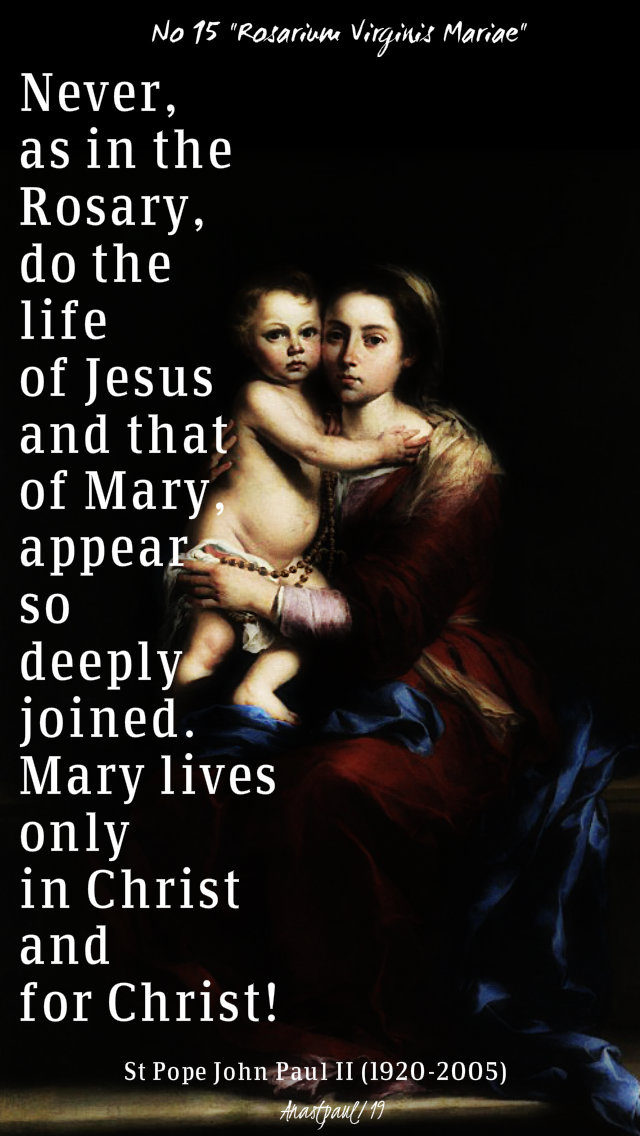
“Never, as in the Rosary, do the life of Jesus and that of Mary, appear so deeply joined. Mary lives only in Christ and for Christ!”
“Not only the devil is involved in spiritual warfare but the Holy Spirit is equally involved, or more involved in it, bringing men and women of goodwill, the ability to overcome evil in their lives, so that they too can say: “Where evil abounded, grace super-abounded!” (Rom 5:20).”
St John Paul II (The Holy Spirit (Dominum Et Vivificantem – 1986)
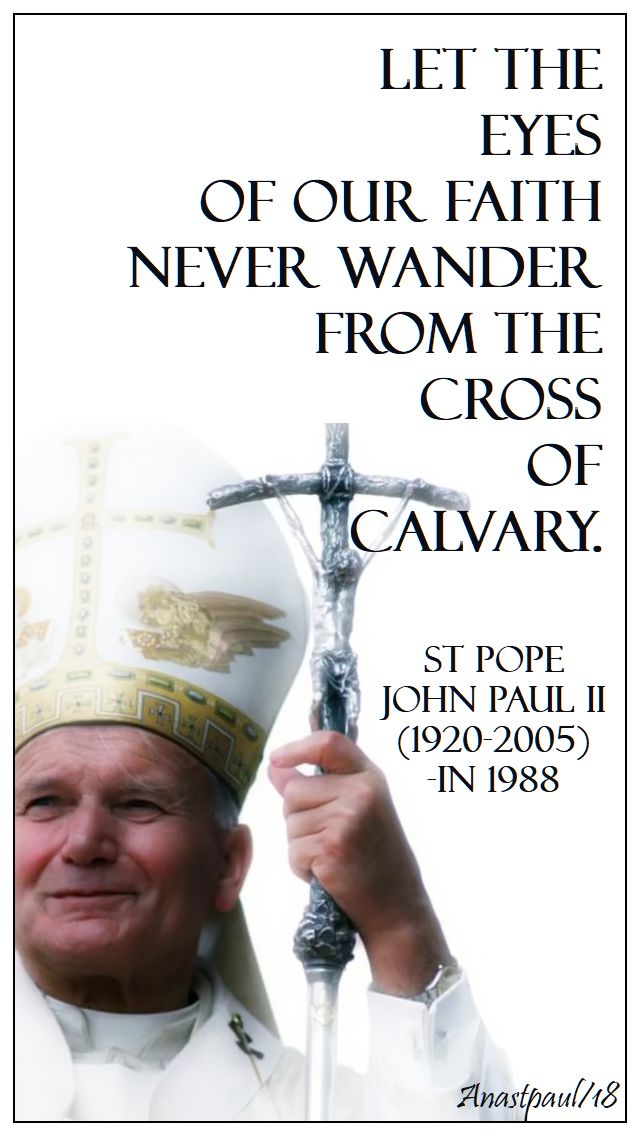
“Let the eyes of our faith
never wander from the Cross of Calvary.”
“Do not abandon yourselves to despair. We are the Easter people and hallelujah is our song.”
Quote/s of the Day – 16 September – The Memorial of Sts Cornelius & Cyprian
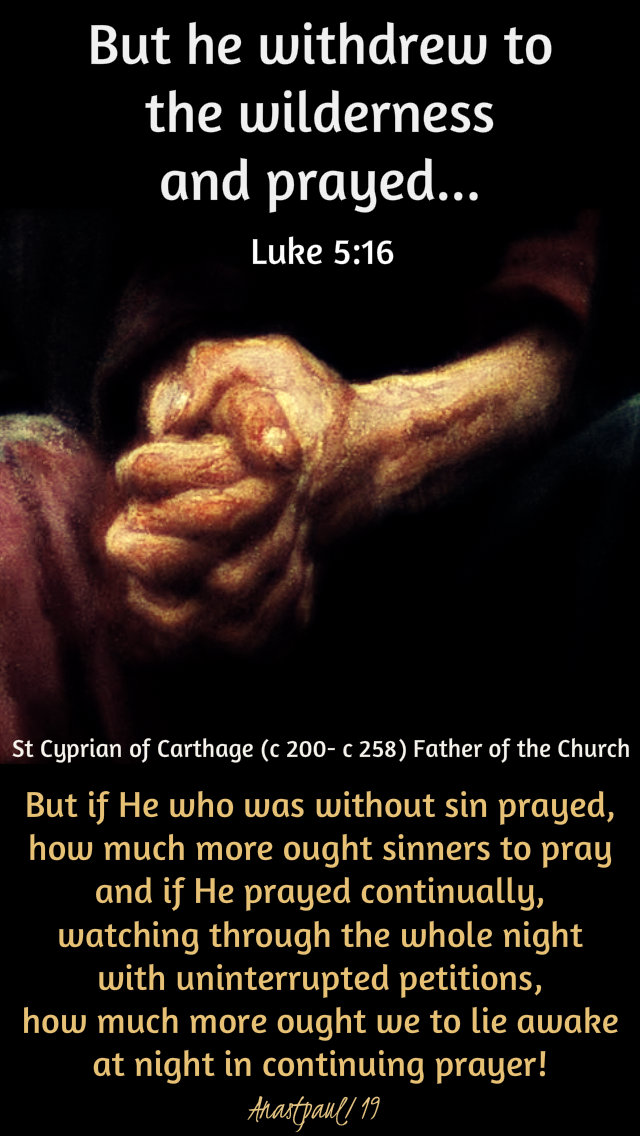
“Not by words alone but also by deeds, has God taught us to pray. He Himself prayed frequently and demonstrated what we ought to do, by the testimony of His own example. As it is written: “But he himself was in retirement in the desert and in prayer” and again, “He went out into the mountain to pray and continued all night in prayer to God.” But if He who was without sin prayed, how much more ought sinners to pray and if He prayed continually, watching through the whole night with uninterrupted petitions, how much more ought we to lie awake at night in continuing prayer!”
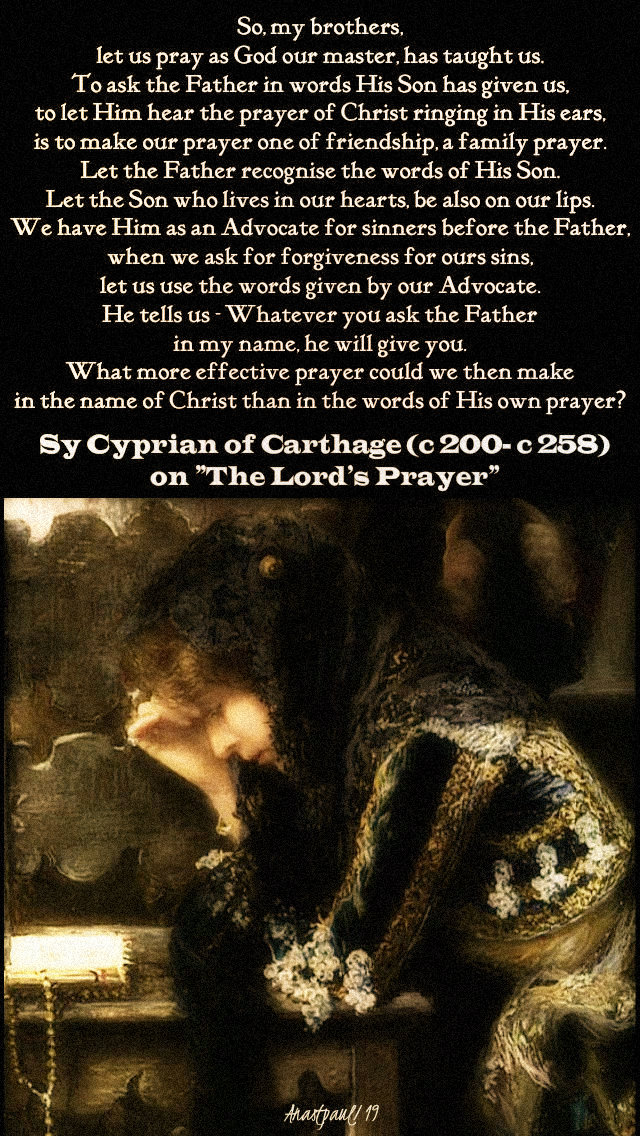
“So, my brothers, let us pray as God our master has taught us. To ask the Father in words His Son has given us, to let Him hear the prayer of Christ ringing in His ears, is to make our prayer one of friendship, a family prayer. Let the Father recognise the words of His Son. Let the Son who lives in our hearts, be also on our lips. We have Him as an Advocate for sinners, before the Father, when we ask for forgiveness for ours sins, let us use the words given by our Advocate. He tells us – Whatever you ask the Father in my name, He will give you. What more effective prayer could we then make, in the name of Christ, than in the words of His own prayer?”
An excerpt from his “On the Lord’s Prayer”
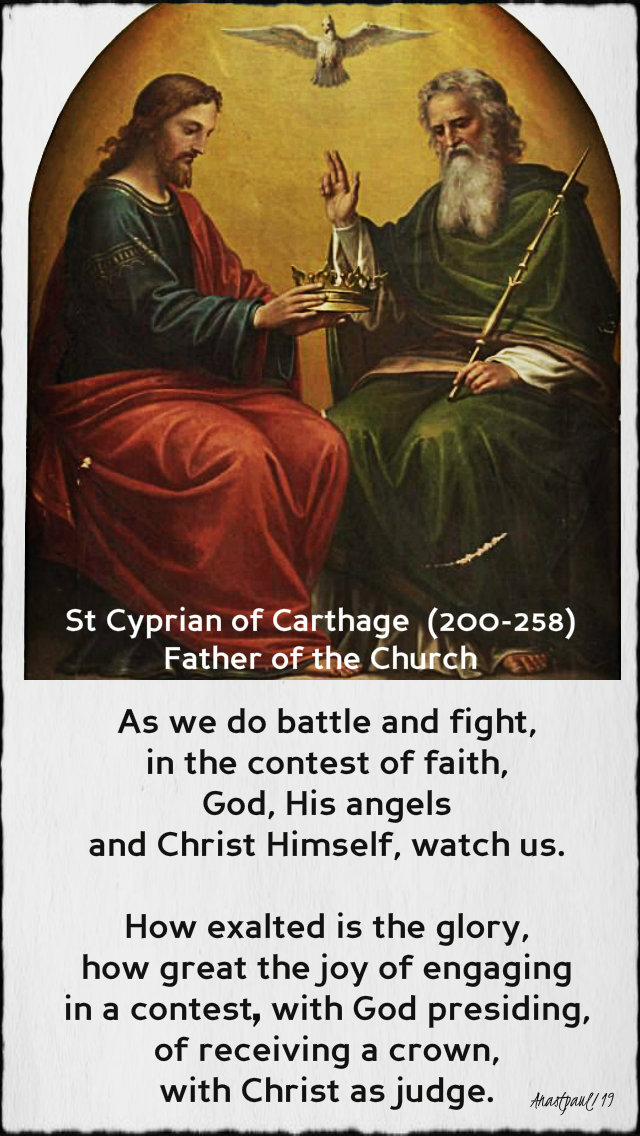
“As we do battle and fight, in the contest of faith, God, His angels and Christ Himself, watch us. How exalted is the glory, how great the joy of engaging in a contest with God presiding, of receiving a crown, with Christ as judge.” An excerpt from his Letter 58
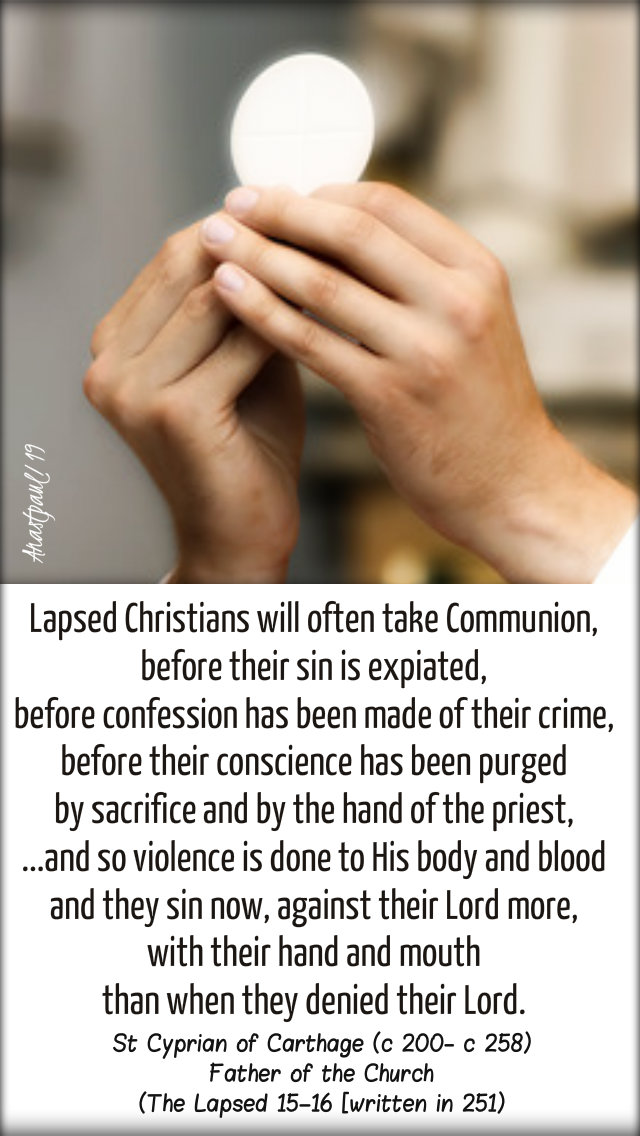
“{Lapsed Christians} will often take Communion before their sin is expiated, before confession has been made of their crime, before their conscience has been purged by sacrifice and by the hand of the priest, before the offence of an angry and threatening Lord has been appeased, [and so] violence is done to His body and blood and they sin now, against their Lord, more with their hand and mouth than when they denied their Lord.” (The Lapsed 15–16 [written in 251])
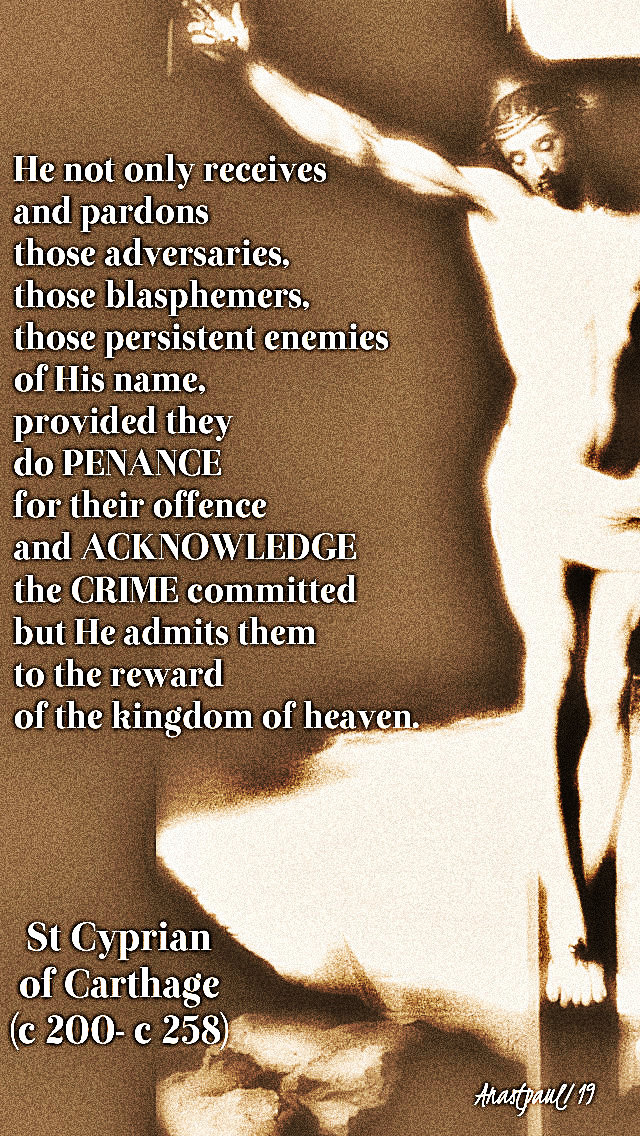
“He not only receives and pardons those adversaries, those blasphemers, those persistent enemies of His name, provided they do penance for their offence and acknowledge the crime committed but He admits them to the reward of the kingdom of heaven.”
“Whatever a man prefers to God, that, he makes, a god to himself.”
St Cyprian of Carthage (c 200-258)
Bishop and Martyr, Father of the Church
Thought for the Day – 8 September – Twenty-third Sunday in Ordinary Time, Year C, Luke 14:25–33
“If anyone comes to me without hating his father and mother, wife and children, brothers and sisters and even his own life, he cannot be my disciple.”… Luke 14:26
Saint Augustine comments on this verse from the Gospel proclaimed during today’s Mass:
“The Lord gives the signal for us to stand guard in camp and to build the tower from which we may recognise and ward off the enemy of our eternal life. The heavenly trumpet of Christ urges the soldier to battle and his mother holds him back.
What does she say or what argument does she give? Perhaps is it those ten months when you lay in her womb and the pangs of birth and the burden of rearing you? You must kill this with the sword of salvation. You must destroy this in your mother that you may find her in life eternal. Remember, you must hate this in her if you love her, if you are a recruit of Christ and have laid the foundations of the tower. Passers-by may not say, “This man began to build and was not able to finish.” That is earthly affection. It still has the ring of the “old man.” Christian warfare invites us to destroy this earthly affection both in ourselves and in our relatives. Of course, no one should be ungrateful to his parents or mock the list of their services to him, since by them he was brought into this life, cherished and fed. A man should always pay his family duty but let these things keep their place where higher duties do not call.
Mother church is also the mother of your mother. She conceived you both, in Christ. Know that, her Spouse took human flesh, that you might not be attached to fleshly things. Know that, all the things for which your mother scolds you were undertaken by the eternal Word, that you might not be subject to the weakness of flesh. Ponder his humiliations, scourging and death, even the death of the cross.” (Letter 243)
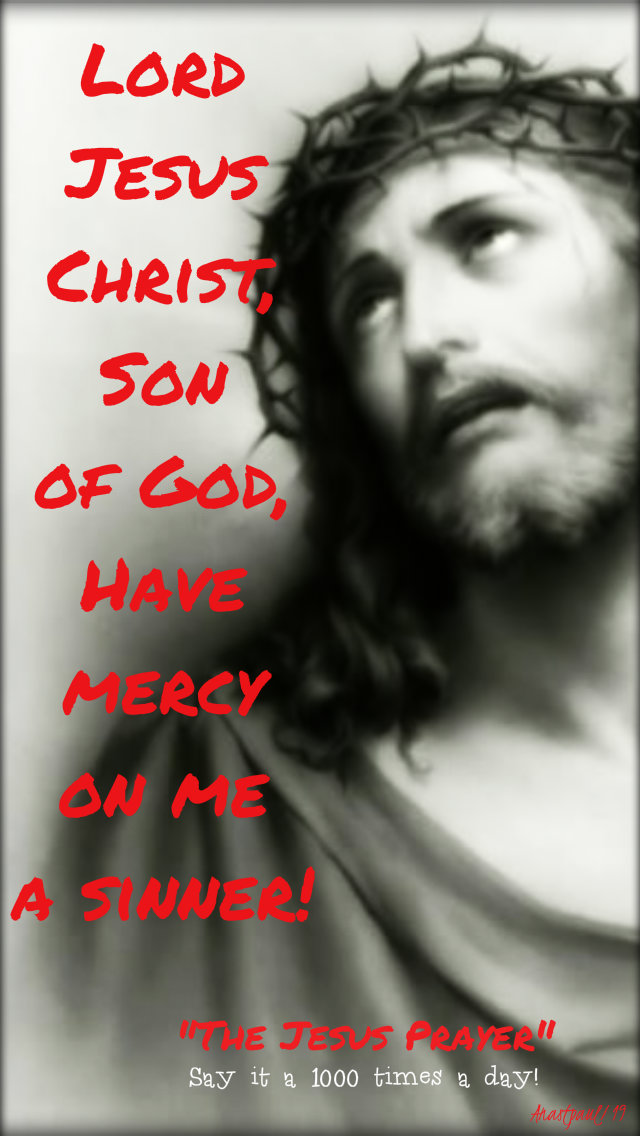
Lord Jesus Christ, Son of God, Have mercy on me a sinner!
Thought for the Day – 6 May – Monday of the Third week of Easter, Gospel: John 6:22–29 and the Memorial of St Francois Laval (1623-1708)
The Contest of Faith
Saint Cyprian of Carthage (200-258)
Bishop, Martyr, Father of the Church and Martyr
An excerpt from his Letter 58
Dear brothers, the commands of the Gospel are nothing else than God’s lessons, the foundations on which to build up hope, the supports for strengthening faith, the food that nourishes the heart. They are the rudder for keeping us on the right course, the protection that keeps our salvation secure. As they instruct the receptive minds of believers on earth, they lead safely to the kingdom of heaven.
As we do battle and fight, in the contest of faith, God, His angels and Christ Himself, watch us. How exalted is the glory, how great the joy of engaging in a contest with God presiding, of receiving a crown, with Christ as judge.
Dear brethren, let us arm ourselves with all our might, let us prepare ourselves for the struggle with uncorrupted minds, with a whole faith and with devoted courage.
The blessed Apostle teaches us how to arm and prepare ourselves – Put round you the belt of truth, put on the breastplate of righteousness, for shoes wear zeal for the Gospel of peace, take up the shield of faith to extinguish all the burning arrows of the evil one, take the helmet of salvation and the sword of the spirit, which is the word of God.
Let us take this armour and defend ourselves with these spiritual defences from heaven, so that when the evil day comes we may be able to resist the threats of the devil and fight back against him.
Let us put on the breastplate of righteousness so that our breasts may be protected and kept safe from the arrows of the enemy. Let our feet be shod in the teaching of the Gospel and armoured so that when we begin to trample on the serpent and crush it, it will not be able to bite us or trip us up.
Let us with fortitude bear the shield of faith to protect us by extinguishing all the burning arrows that the enemy may launch against us.
Let us wear on our head the helmet of the Spirit, to defend our ears against the proclamations of death, to defend our eyes against the sight of accursed idols, to defend our foreheads so that God’s sign may be kept intact and to defend our mouths, so that our tongues may proclaim victoriously the name of Christ their Lord.
Let us arm our right hand with the sword of the Spirit so that it may courageously refuse the daily sacrifices and let the hand—mindful of the Eucharist—that took hold of the body of the Lord, embrace the Lord Himself and so gain from the Lord the future prize of a heavenly crown.
Dear brethren, have all this firmly fixed in your hearts. If the day of persecution finds us thinking on these things and meditating upon them, the soldier of Christ, trained by Christ’s commands and instructions, will not tremble at the thought of battle but will be ready to receive the crown of victory. Amen!
St Francois Laval, who have received the Crown, please pray for us!
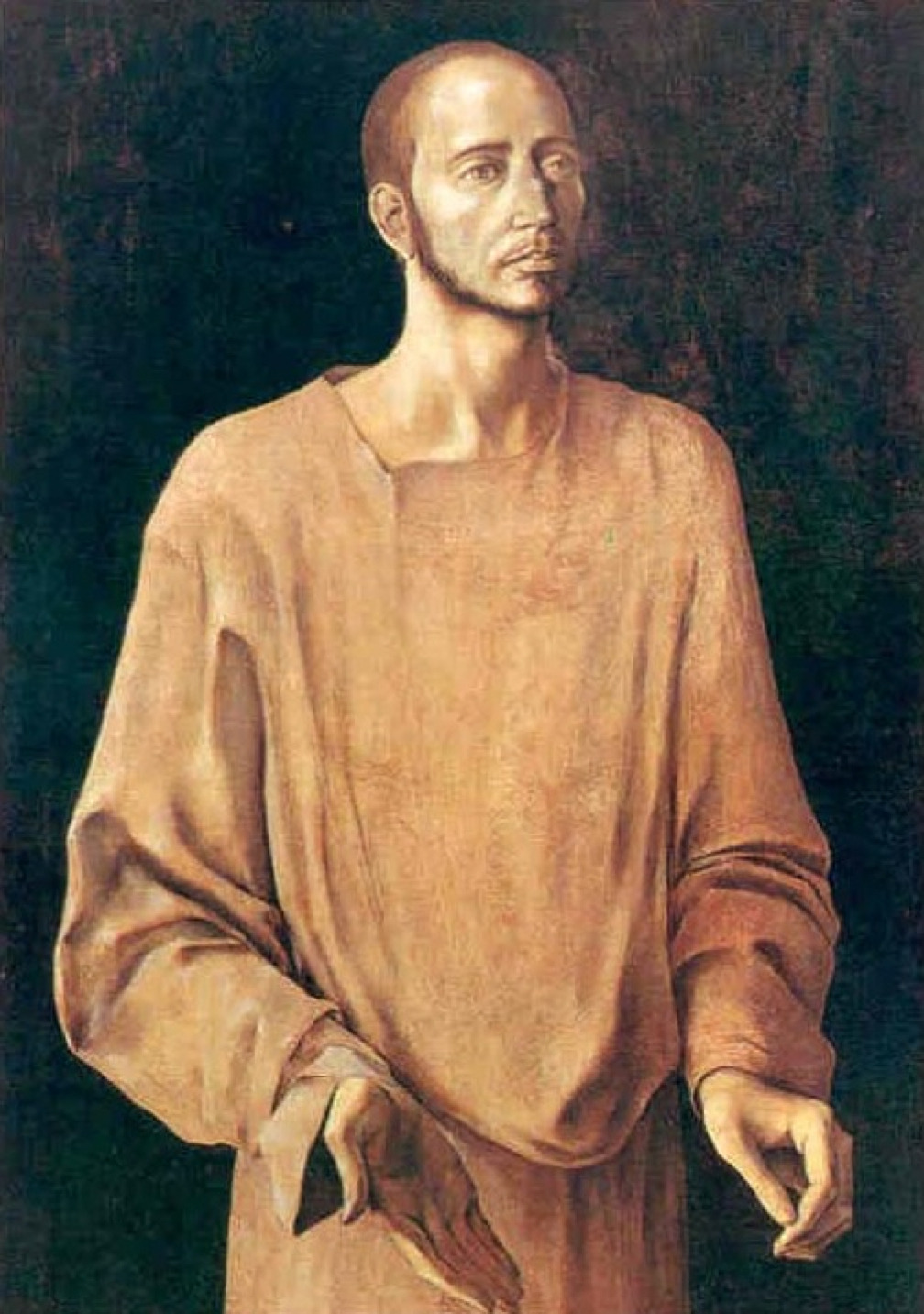
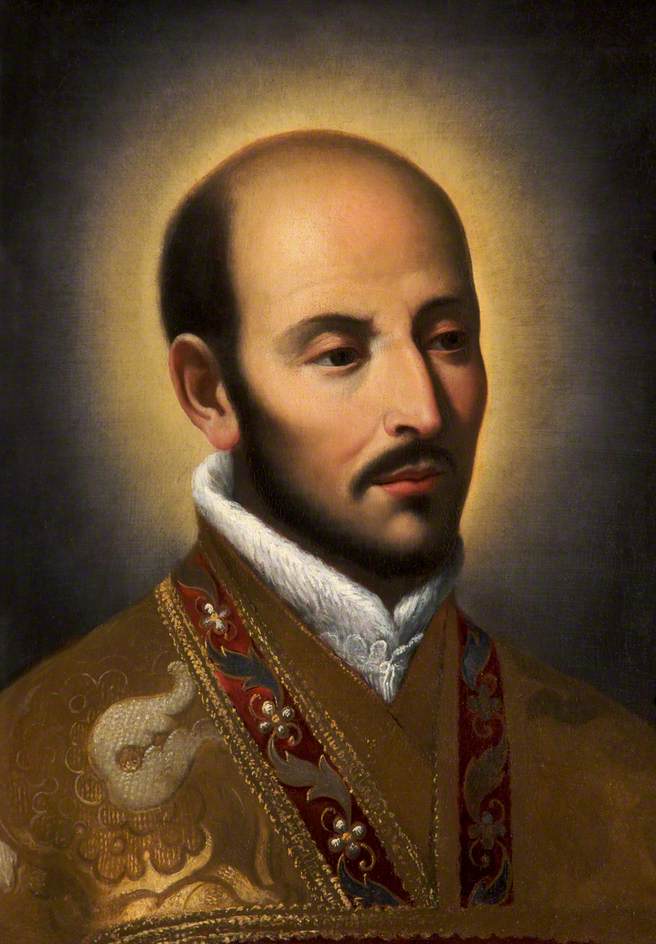
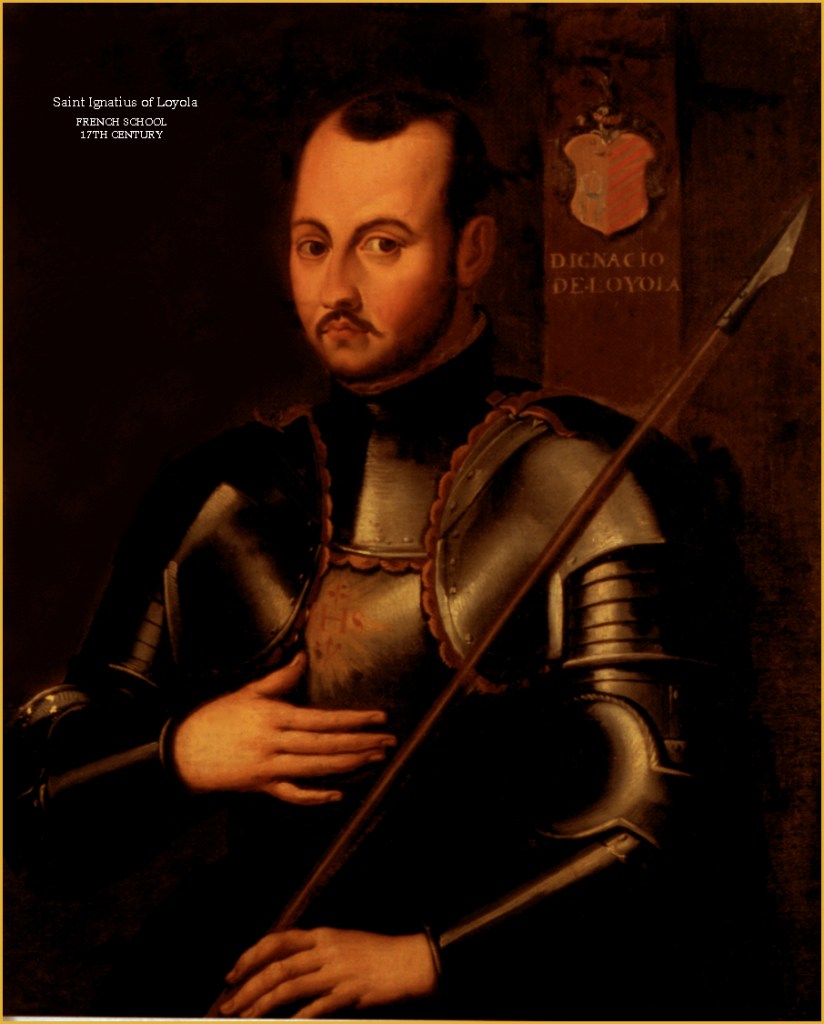
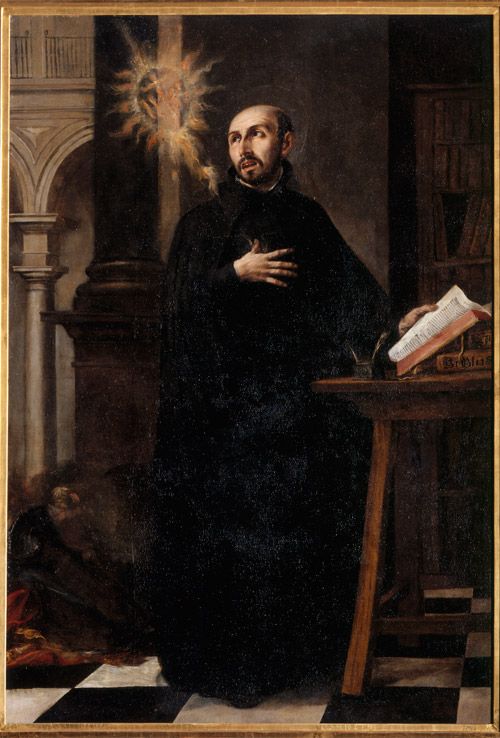
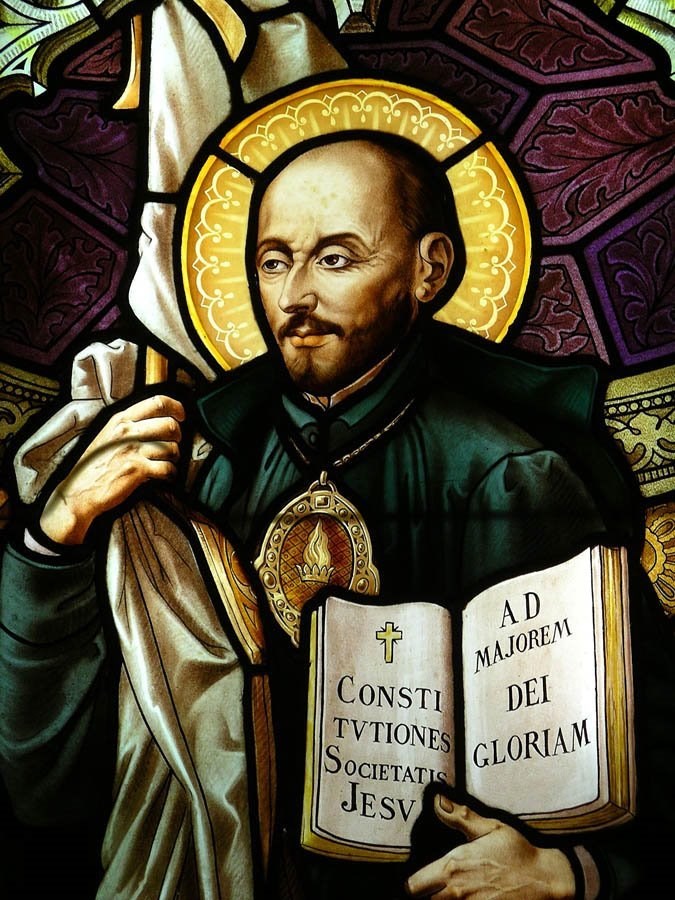
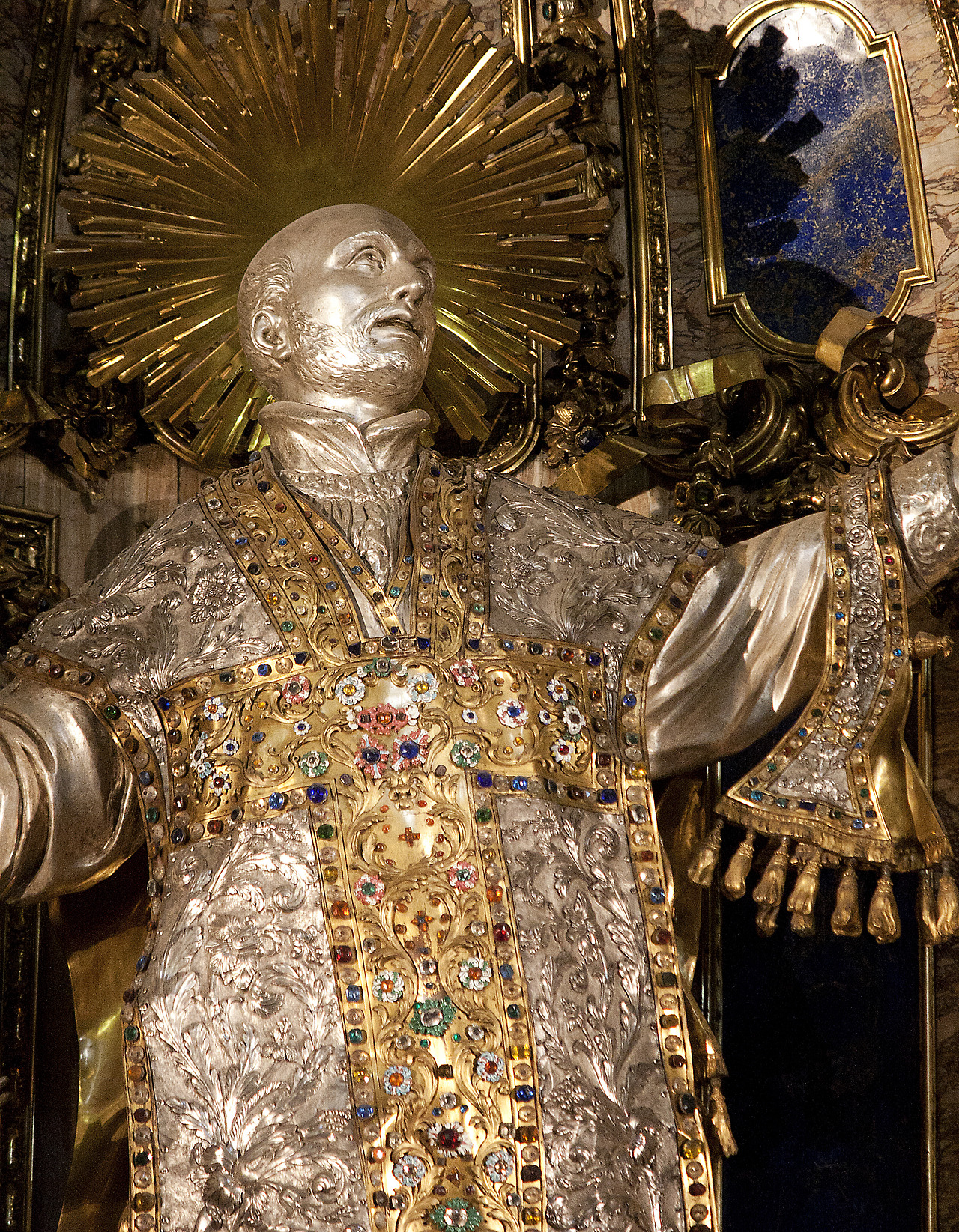
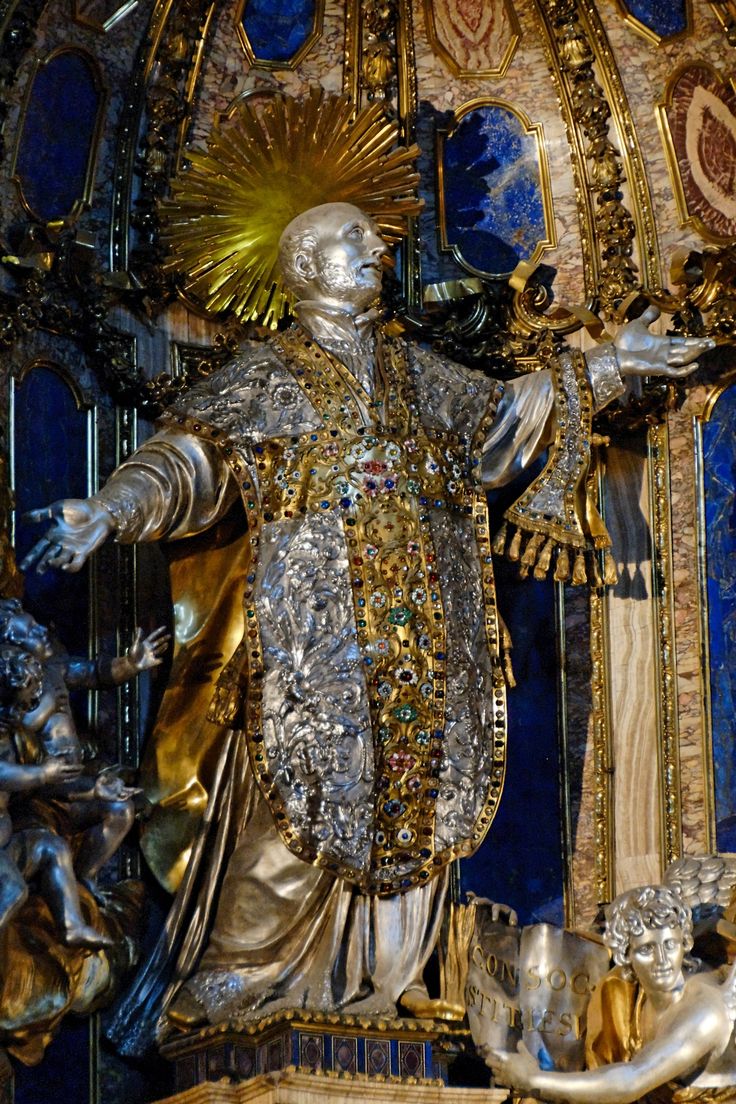
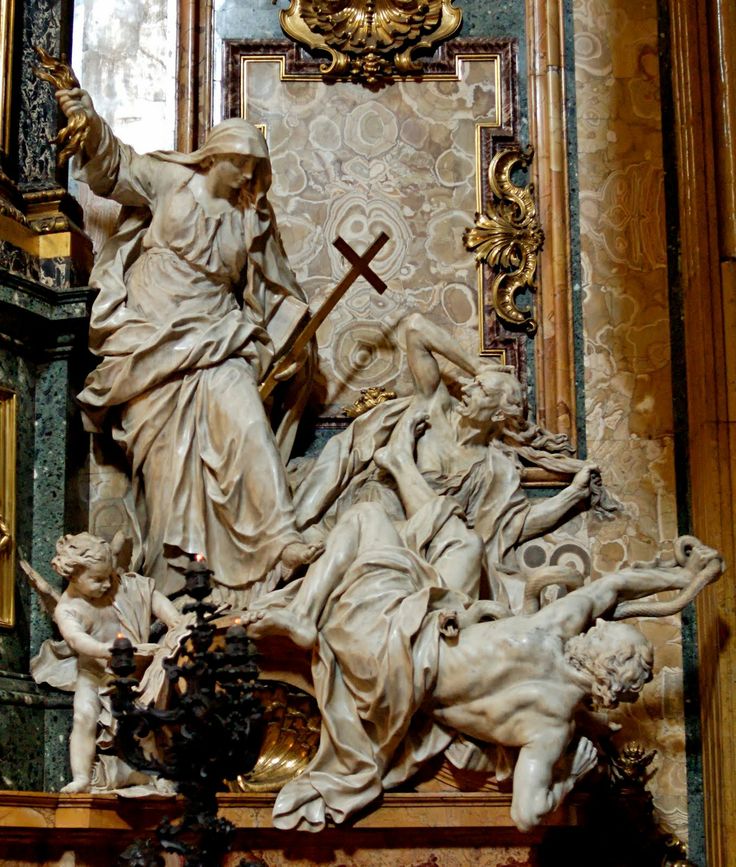
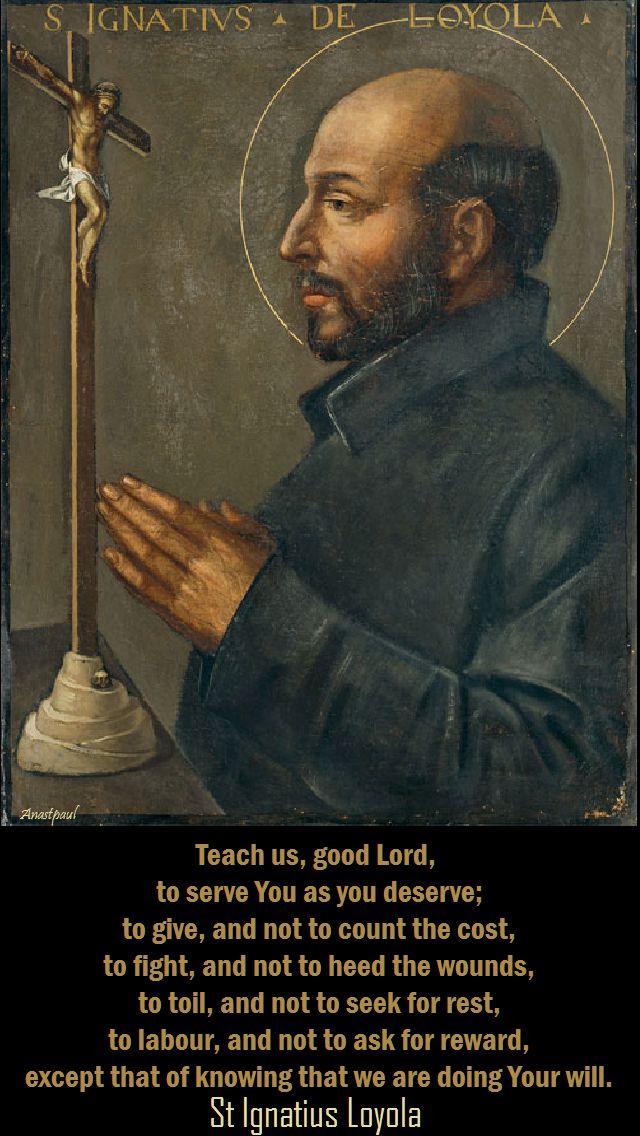
Saint of the Day – 31 July – St Ignatius Loyola sj (1491-1556) Spanish: Ignacio de Loyola; c 23 October 1491 at Loyola, Guipuzcoa, Spain as Inigo Lopez de Loyola – 31 July 1556 at Rome, Italy of fever) was a Spanish Basque Priest, Mystic Founder and Theologian, who founded the religious order called the Society of Jesus (Jesuits) and became its first Superior General. Ignatius was beatified in 1609 and Canonised on 12 March 1622 by Pope Gregory XV. Patronages – soldiers,The Society of Jesus, Retreats (proclaimed on 25 July 1922 by Pope Pius XI), Spiritual Exercises (by Pope Pius XI), Basque country, Diocese of Bilbao, Spain, military ordinariate of the Philippines, álava, Spain, Bizkaia, Spain, Gipuzkoa, Spain, Guipuscoa, Spain, Guipúzcoa, Spain, Vizcaya, Spain. Attributes – apparition of Our Lord, book, chasuble, Holy Communion.
The Early Years
Iñigo Lopez de Oñaz y Loyola, whom we know as St. Ignatius, was born in the Castle Loyola, in the Basque country of northeastern Spain, in 1491, during the reign of King Ferdinand and Queen Isabella. Iñigo was the youngest of 13 children, raised in a family culture of high Catholic piety but lax morals. He experienced the contradictions between the ideals of church and crown and the realities of his own family. His father had several children by another woman and his grandfather’s lawless behaviour led to the top two floors of the Loyola castle being demolished by order of the crown. Iñigo hardly knew his mother, Marina Saenz de Licona y Balda Maria; she died when he was a child. His father, Don Beltrán Yañez de Oñaz y Loyola, died when he was 16. One of his brothers went on the second voyage of Columbus and another died in battle also far away. Iñigo was raised to be a courtier and diplomat in service to the crown, having received a chivalric yet academically sparse education typical of his class. He spent some time as a page at court. Winning personal glory was his passion. He was a fancy dresser, an expert dancer, a womanizer, sensitive to insult and a rough punkish swordsman who used his privileged status to escape prosecution for violent crimes committed with his priest brother at carnival time.
The Soldier
In the spring of 1521, a very large French army attacked the fortress town of Pamplona. A tiny band of Spanish soldiers trying to defend the town were ready to surrender; all of them except Iñigo de Loyola. He would hold off the French single-handedly. But a French cannonball shattered his leg and put an end to his stand. The French admired the courage of the man. They carried him on a litter back home to his castle of Loyola. His leg was not the only thing that had been shattered. His image of himself as a handsome, dashing courtier – everything that he had ever lived for – was shattered, too. The broken leg was not properly set. The bone protruded in a way that would show through the tight hose that a courtier wore, “so much as to be something ugly.” Iñigo insisted on having the leg re-broken and re-set; there was, of course, no anesthetic. In the end one leg was still shorter than the other; Iñigo limped the rest of his life. To pass the time while he recovered, he asked for the kind of books he enjoyed reading: romances of chivalry. But the only reading available in the house was an illustrated Life of Christ and a book of saints’ legends. He spent hours dreaming. He dreamed of the exploits he would do in service to his king and in honour of the royal lady he was in love with. But he would also dream about the exploits he could do to imitate St. Francis of Assisi and St Dominic in fidelity to his heavenly Lord. Gradually, he began to reflect on these experiences; he noticed what was going on within. Both kinds of daydreams engaged him completely but after the romantic chivalry dreaming was over, he felt empty and dissatisfied, whereas after the spiritual dreaming ended, he still felt a deep peace, a quiet happiness. “[H]e did not consider nor did he stop to examine this difference until one day his eyes were partially opened and he began to wonder at this difference and to reflect upon it. From experience he knew that some thoughts left him sad while others made him happy and little by little he came to perceive the different spirits that were moving him…” Here we see the beginning of his powers of discernment, of decision making. He realised God was leading him by his feelings, drawing him toward an entirely new way of life.
The Pilgrim
As soon as Iñigo had healed enough to walk, he began a journey to Jerusalem so that he could “kiss the earth where our Lord had walked.” He traveled through the town of Montserrat, Spain where he gave away his fine clothes to a poor man. Then, in an all-night vigil before the Black Madonna in the church of the Benedictine abbey there, he hung up his sword and dagger. Effectively, his old life was over and his new life had begun. Barcelona was the port from which to embark on a passage to Rome and then to the Holy Land. Not wanting to see his old friends, who might be in conflict with his new values, he went instead to the nearby town of Manresa with the intention of staying there a few days. But those “few days” turned into ten months.
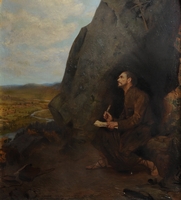
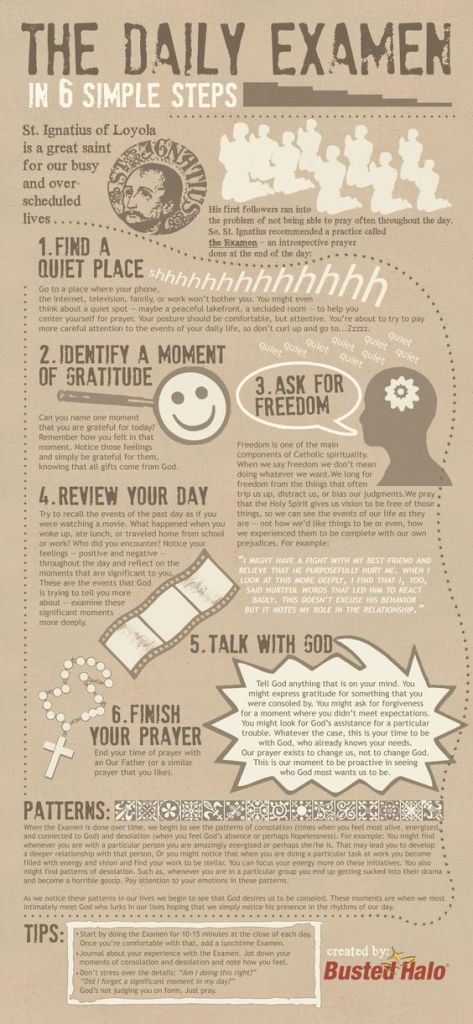
The “Pilgrim,” as he referred to himself in his autobiography, asked for lodging at a hospital for the poor located outside the town’s walls. In exchange for his bed, he did chores around the hospital; and he begged for his food in the town. As we see him here, he spent much of his time in a cave, in prayer with God-praying as much as seven hours a day. He was blessed with powerful insights into himself and about who God was for him. Still, for extended periods, he experienced doubts, anxieties, scruples, severe depression; he even contemplated suicide to end his psychic pain. He recorded his experiences in a notebook and would soon find his jottings helpful in guiding others. These notes which he continued to revise and expand over time as he listened to people became his Spiritual Exercises. Eventually, they were published and then reprinted again and again and translated into many languages as they spread around the world. An example of a spiritual exercise might be to reflect on the ways you have been loved, or on what your personal gifts are and how you use them and for whom, or to imagine yourself present in one of the gospel scenes-for example, Jesus’ feeding of the 5,000. Today, nearly 500 years later, Jesuits and other priests and sisters and brothers, and an ever larger number of professional men and women use these Spiritual Exercises to guide others toward spiritual transformation, to a deeper relationship with God.
Visiting the Holy Land
The Pilgrim did manage to beg passage on a ship to the Holy Land. But instead of being able to fulfill his great dream to remain there for the rest of his life, trying to convert the so-called “infidel,” he was told by church authorities to return to Europe after only a few weeks. They had enough trouble there without him and his conversion scheme. Another dream of Iñigo shattered. When it came time for him to set sail and head back to the western Mediterranean, he ran back to the Mount of Olives to see which way the “footprint of Jesus” was facing. Pious legend had it that the mark in a certain rock there was left by Jesus as he ascended into heaven. Now what may interest us here is not the historical credibility of the legend but rather what this action of the Pilgrim tells us about his own inner life, his imaginative life. He was in the habit of entering imaginatively into all the various gospel stories and scenes, and, in this way, he made them very concrete and real and immediate to himself. He wanted to be in an intimate relationship with Jesus and every detail about Jesus was precious to him.
A Non-traditional Student
Although Iñigo was unable to preach and serve God in the Holy Land as he had hoped, he was still determined to meet this goal in some fashion. He decided that he needed to get an education in order to “help souls.” He returned to Barcelona and attended a free public grammar school to prepare himself for entrance into a university. This meant that beginning at the age of 33 and for two years, he was studying Latin grammar and other basics with classmates who were 8 to 14 years old. He may have felt some discomfort at the age difference but it was at this time that he had the “most beloved” teacher in his entire academic career-Master Jeronimo Ardevol.
Ignatius in Prison
After this initial schooling in Barcelona, Iñigo moved to Spanish university towns-first Alcala, near Madrid and then Salamanca in the north. In both places, he spent nearly as much time engaging people in conversation about spiritual matters as he did studying and attending lectures. Such conversations got him into trouble with the Spanish Inquisition and he was put in prison three times for interrogation. The charge was always the same: that he dared to speak of theological matters when he did not have a theology degree. Further, he was not ordained. In the end, he was always exonerated, but he decided to avoid further harassment by the Inquisition. He left his homeland and headed north to the premier university of sixteenth-century Europe.
Higher Education in Paris
At the age of 38, the Pilgrim attended the College Ste. Barbe of the University of Paris, considered the heart of the French Renaissance. He knew little French and he was not very fluent or correct in Latin. Still he made progress, little by little. In those days, students rose at 4:00 a.m.; classes-lectures-began at 5:00 am. There were also classes for several hours in the later afternoon. The university curriculum-in the Parisian style-was much more orderly than he was used to in Spain. There was progression; there were prerequisites. As a result, he started all over again with grammar, language and the humanities and only then moved on to the sciences, philosophy and theology. The present-day notion of levels or classes–freshman, sophomore, junior, senior– is a Jesuit legacy to education based on the experience with this Parisian style of learning. Eventually, he earned a master’s degree. The name on his diploma was not Iñigo, but “Ignatius,” which he adopted in Paris and used for the rest of his life. (It is speculated that he named himself after a saint he admired – Ignatius of Antioch.) When he applied for doctoral studies, he was turned down as too old; he was 44, and too ill, from stomach ailments that he attributed to the extreme penances he practiced during his time in Manresa.
The First Companions
While at the University of Paris, Ignatius roomed with Peter Faber, a young man from Savoy in the south of France, and Francis Xavier, a nobleman from the eastern end of the Basque country.
Gradually a whole circle of “Friends in the Lord,” as they called themselves, formed around Ignatius. What bonded them closely together was the fact that one after another they were led through the Spiritual Exercises. Most were guided by Ignatius himself. In a deep sense, they all became “companions of Jesus” and companions of one another. Ignatius also shared with them his dream of going on mission to the Holy Land; yet this time he was a bit wiser and more practical. If the Holy Land dream fell through, they would go to Rome and put themselves at the disposition of the pope. The pope, as universal pastor, should know where the greatest needs were. They waited in Venice a whole year for a ship to take them to the Holy Land. As Providence would have it, just that one year because of war between Venice and the Turks, no ship sailed. So they went to Rome, and there they entered into an extended period of communal discernmen. They were about to be sent all over Europe and all over the world. Spread out like that, how would they secure the bond among them? Their decision was to form themselves into a religious order. They called it the Company (meaning the companionship) or Society of Jesus. Outsiders disparagingly nicknamed them the “Jesuits” but the name caught-on and eventually was used by all alike. “On the morning of the 15th of August, 1534, in the chapel of church of Saint Peter, at Montmartre, Loyola and his six companions, of whom only one was a priest, met and took upon themselves the solemn vows of their lifelong work.” Later, they were joined by Saint Francis Borgia, a member of the House of Borgia, who was the main aide of Emperor Charles V, and other nobles. Ignatius obtained a master’s degree from the University of Paris at the age of forty-three. In later life he was often called “Master Ignatius” because of this.
The Founder
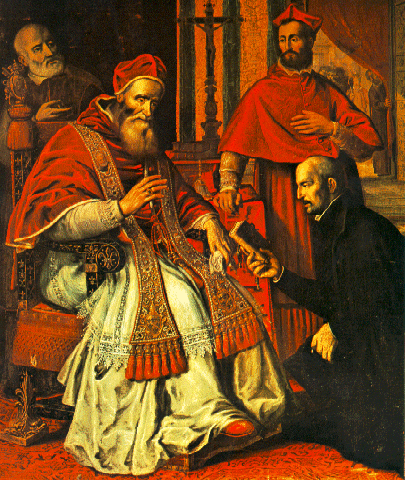
The Society of Jesus was approved by Pope Paul III in 1540 and thus became an official Catholic religious order. Ignatius was elected their first leader. He declined after the first vote. He felt unworthy for the position because of the vanity and licentiousness of his earlier life and because he felt that others were more theologically knowledgeable. After much discernment, he accepted the position and served until his death sixteen years later.
As the Superior General, he sent companions all over Europe and around the world. He called them to “hurry to any part of the world where…the needs of the neighbor should summon them.” And he counseled them to serve “without hard words or contempt for people’s errors.” In addition to writing the Constitutions of the fledgling order, with the help of his assistant Juan Polanco, he wrote nearly 7,000 letters. He wrote to high and low in church and state and to women as well as men. But most of these letters were to his Jesuit companions, thus forming a vast communication network of friendship, love, and care. When companions were sent on various missions by the pope, Ignatius remained in Rome, consolidating the new venture but still finding time to found homes for orphans, catechumens, and penitents. He founded the Roman College, intended to be the model of all other colleges of the Society.
Ignatius was a true mystic. He centered his spiritual life on the essential foundations of Christianity—the Trinity, Christ, the Eucharist. His spirituality is expressed in the Jesuit motto, Ad majorem Dei gloriam—“for the greater glory of God.” In his concept, obedience was to be the prominent virtue, to assure the effectiveness and mobility of his men. All activity was to be guided by a true love of the Church and unconditional obedience to the Holy Father, for which reason all professed members took a fourth vow to go wherever the pope should send them for the salvation of souls.
At the time of his death, there were 1,000 Jesuits, a good number of them involved in the 35 schools that had been founded. Twenty-five years later the number of schools rose to 144, and another 35 years after that, it approached 400. In contrast to the ambitions of his early days, the fundamental philosophy of the mature Ignatius was that we ought to desire and choose only that which is more conducive to the end for which we are created – to praise, reverence, and serve God through serving other human beings.
He prayed:
Teach us, good Lord, to serve You as you deserve; to give, and not to count the cost, to fight, and not to heed the wounds, to toil, and not to seek for rest, to labour, and not to ask for reward, except that of knowing that we are doing Your will.




















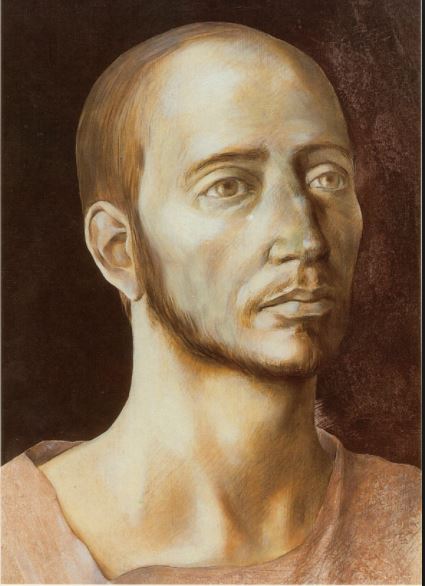
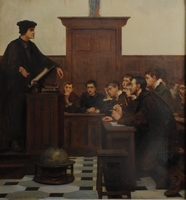
 At the age of 38, the Pilgrim attended the College Ste. Barbe of the University of Paris, considered the heart of the French Renaissance. He knew little French and he was not very fluent or correct in Latin. Still he made progress, little by little. In those days, students rose at 4:00 a.m.; classes-lectures-began at 5:00 am. There were also classes for several hours in the later afternoon. The university curriculum-in the Parisian style-was much more orderly than he was used to in Spain. There was progression; there were prerequisites. As a result, he started all over again with grammar, language and the humanities and only then moved on to the sciences, philosophy and theology. The present-day notion of levels or classes–freshman, sophomore, junior, senior– is a Jesuit legacy to education based on the experience with this Parisian style of learning.
 Gradually a whole circle of “Friends in the Lord,” as they called themselves, formed around Ignatius. What bonded them closely together was the fact that one after another they were led through the Spiritual Exercises. Most were guided by Ignatius himself. In a deep sense, they all became “companions of Jesus” and companions of one another.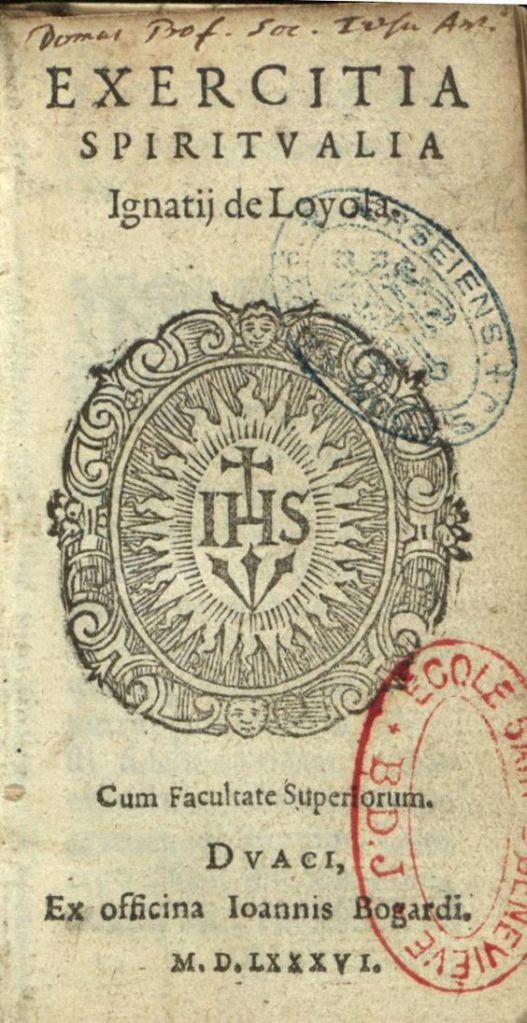

 AnaStpaul
You must be logged in to post a comment.