Thought for the Day – 28 December – Meditations with Antonio Cardinal Bacci (1881-1971)
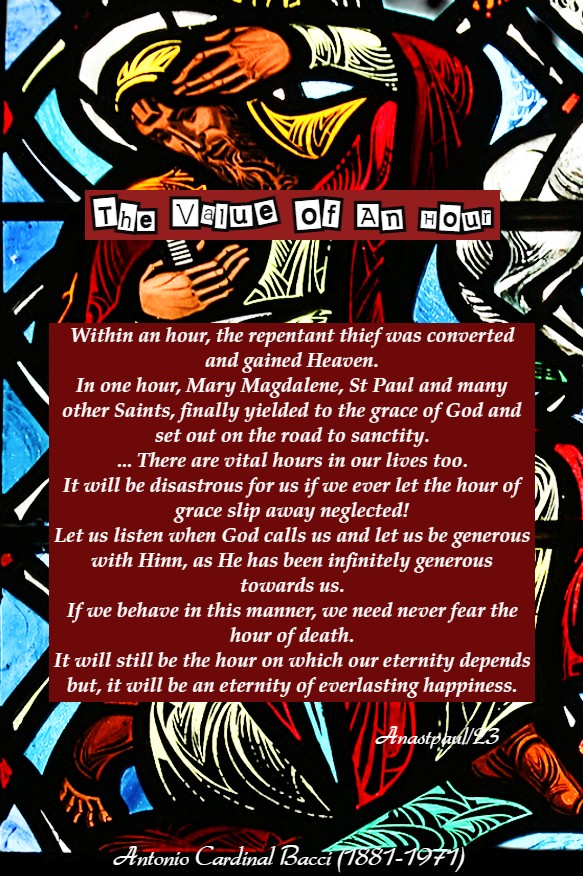
The Value of An Hour
“Let us now contemplate the fact that our eternity can and may depend on a single hour! Within an hour, the repentant thief was converted and gained Heaven. In one hour, Mary Magdalene, St Paul and many other Saints, finally yielded to the grace of God and set out on the road to sanctity.
There are vital hours in our lives too. It will be disastrous for us if we ever let the hour of grace slip away neglected! Let us listen when God calls us and let us be generous with Hinn, as He has been infinitely generous towards us. If we behave in this manner, we need never fear the hour of death. It will still be the hour on which our eternity depends but, it will be an eternity of everlasting happiness.”
Quote/s of the Day – 17 December – “The Month of the Divine Infancy and the Immaculate Conception of the Blessed Virgin Mary” – Gaudete Sunday, The Third Sunday of Advent – Philippians 4:4-7; John 1:19-28 – Scripture search here: https://www.drbo.org/
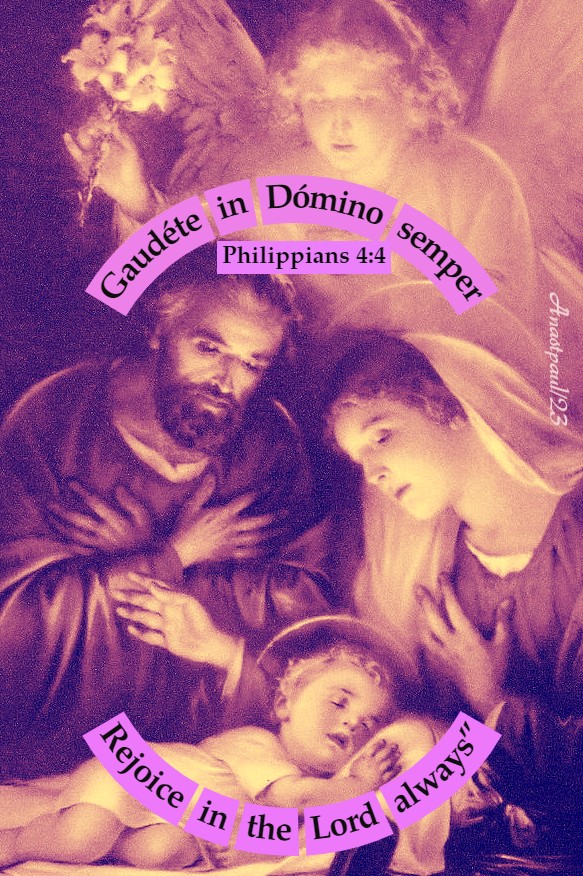
“Gaudéte in Dómino semper”
“Rejoice in the Lord always”
Philippians 4:4
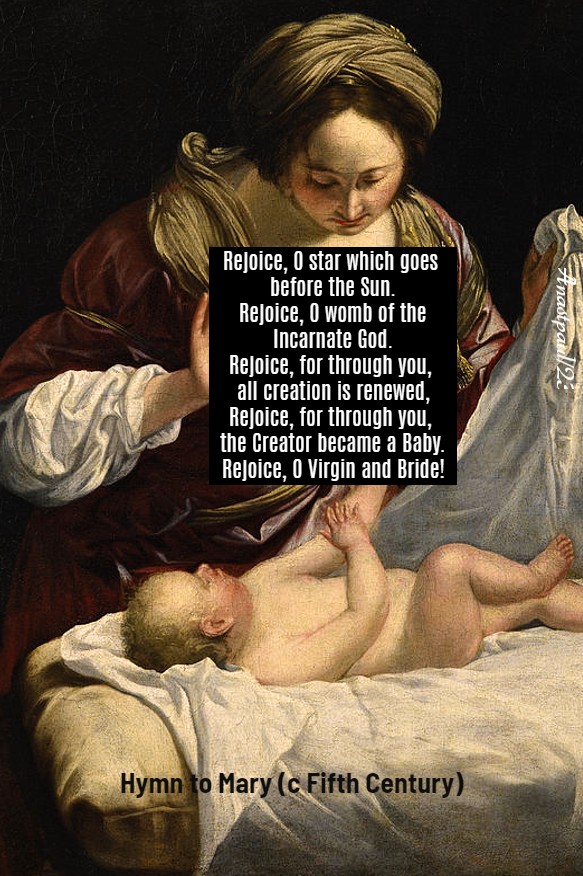
“ Rejoice, O star which goes before the Sun. Rejoice, O womb of the Incarnate God. Rejoice, for through you, all creation is renewed, Rejoice, for through you, the Creator became a Baby. Rejoice, O Virgin and Bride!”
Hymn to Mary (c Fifth Century)
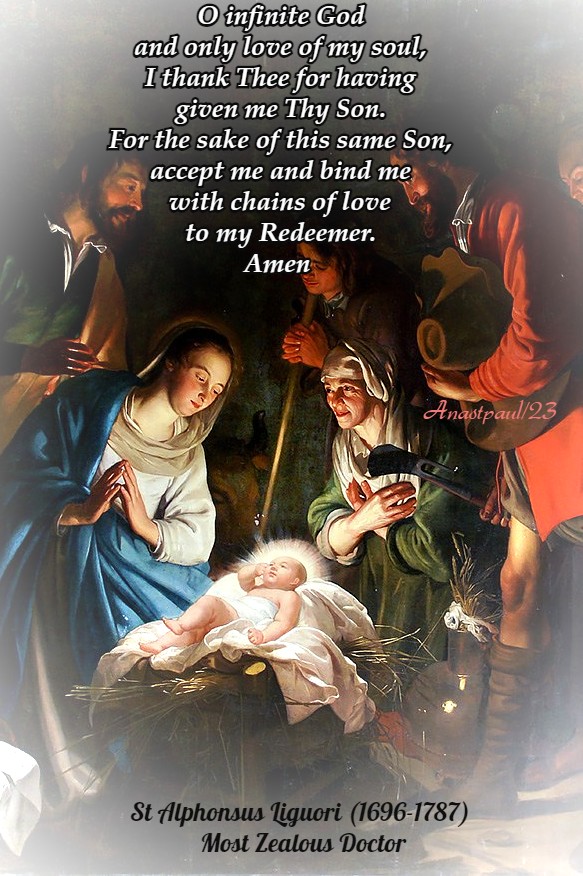
“O infinite God and only love of my soul, I thank Thee for having given me Thy Son. For the sake of this same Son, accept me and bind me with chains of love to my Redeemer. Amen ”
St Alphonsus Liguori (1696-1787) Most Zealous Doctor
Quote/s of the Day – 2 December – St Bibiana (Died c 361) Virgin Martyr – Sirach 51:13-17; Matthew 13:44-52 – Scripture search here: https://www.drbo.org/
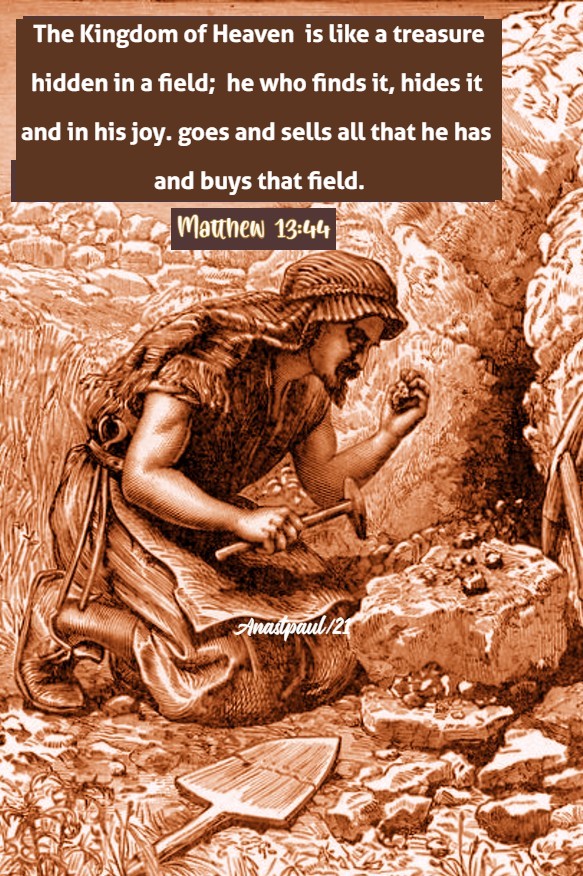
“The Kingdom of Heaven is like unto a treasure, hidden in a field.”
Matthew 13:44
“I press on, hoping that I may lay hold of that, for which Christ Jesus, has laid hold of me.”
Philippians 3:12
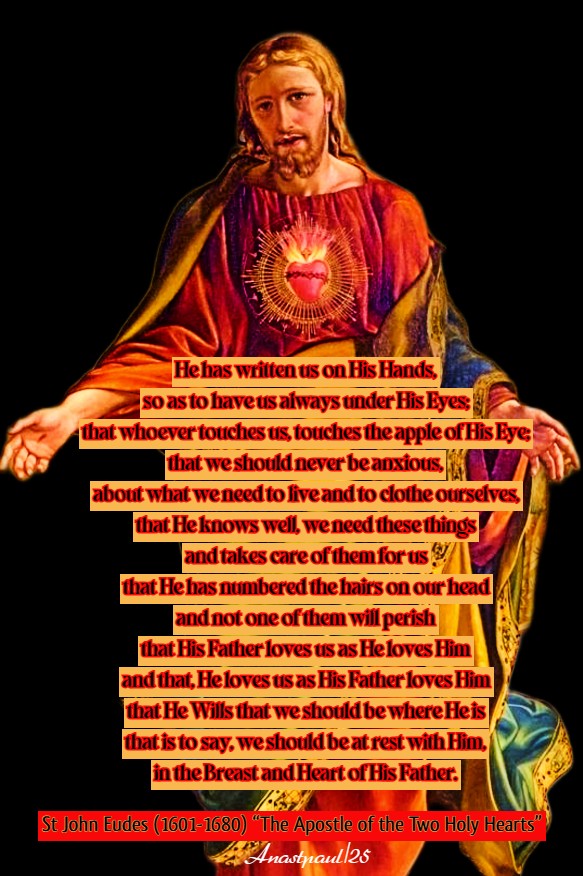
“He has written us on His Hands, so as to have us always under His Eyes; that whoever touches us, touches the apple of His Eye; that we should never be anxious, about what we need to live and to clothe ourselves, that He knows well, we need these things and takes care of them for us that He has numbered the hairs on our head and not one of them will perish that His Father loves us as He loves Him and that, He loves us as His Father loves Him that He Wills that we should be where He is that is to say, we should be at rest with Him, in the Breast and Heart of His Father.”
St John Eudes (1601-1680) The Apostle of the Two Holy Hearts
“Where is the heart which loves? On the thing it loves. Therefore, where our love is, there our heart is held captive. It cannot leave it; it cannot be lifted higher, it cannot go either to the right or the left; see, it is fixed. Where the miser’s treasure is, there is his heart and where our heart is, there is our treasure. And what is so deplorable is that the things which hold us in servitude, are, for the most part, such unworthy things!”
Saint of the Day – 28 November – St Sosthenes (1st Century) the first Bishop of Colophon, Asia Minor, probably a Martyr, Jewish Ruler in Corinth, converted by St Paul and became his disciple, who is mentioned by him in his First Epistle to the Corinthians (1 Corinthians 1:1–2) and by St Luke in Acts 18:12–17. Also known as – Sosthenes of Corinth, Sosthenes of Colophon, Sostene…
The Roman Martyrology reads: “At Corinth, the birthday of St Sosthenes, fisciple of the blessed Apostle Paul, who is mentioned by that Apostle in his first Epistle to the Corinthians. He was chief of the synagogue when converted to Christ and, as a glorious beginning, consecrated the first fruits of his faith by being scourged in the presence of the Proconsul, Gallio.”
St Paul
During the long stay of the Apostle St Paul in Corinth, an event occurred which was not only sensational but, at least for us, difficult to explain, although reported with the usual clarity by St Luke, the Chronicler of the Acts of the Apostles:
“Gallio, being then Proconsul of Achaia (i.e. of the region in which Corinth was located) – we read – “the Jews, all in agreement, rose up against Paul and took him to the Tribunal, saying: ‘This man persuades the people to give God a cult, contrary to the law.’ And as Paul was there ready to speak, Gallio said to the Jews: ‘If it were a question of some crime, of some serious misdeed, I, Jews, would listen to you as reason dictates but, since it is a question of questions of words and names and they belong to your law, think about it – I do not want to be judge of these things!’ And he sent them away from the court. They all then took Sosthenes, the Ruler of the Synagogue and beat him before the tribunal and Gallio did not care at all. ”
St Sosthenes
The first part of the episode is quite clear – the Roman Proconsul, in a City which, after all, was in Greece and not in Palestine, cleverly refuses to be the judge of a doctrinal question which interests and concerns, only a minority of his subjects.
It is, again, the tactic of washing one’s hands, adopted by Pilate towards Jesus, with the difference that Corinth was not Jerusalem and, therefore, the “abstaining, so to speak, of the Roman Governor, saves Paul from accusations and threats of his enemies, without the Apostle even opening his mouth.
Except, here’s the unexpected fact – instead of Paul, his accusers, in that same Court, take and beat our Saint Sosthenes, who had nothing to do with Paul and who was, indeed, the Ruler of the local Synagogue. Why did this happen? Why was Sosthenes beaten instead of Paul? Scholars have failed to give a convincing answer to this question. Probably, the head of the Synagogue was the one who had incited his fellow Jews to demonstrate against Pau, and the Jews released their fury upon him when they saw that their entire design to attach St Paul had been destroyed by the Governor.
According to some, however, the resentment of the Jews related to the fact that Sosthenes’ converssion by St Paul had alreay taken place and was known by his fellow Jews.
But the Acts do not mention the conversion of Sosthenes, Ruler of the Synagogue of Corinth. Shortly afterwards, however, his name appears again in the address of the letter twhich St Paul wrote from Ephesus to the restless Christians of Corinth and, of which, Sosthenes seems to have been the bearer.
“Paul, called to be an Apostle of Jesus Christ by the will of God and Sosthenes, a brother, To the Church of God which is at Corinth, to them that are sanctified in Christ Jesus, called to be saints, with all that invoke the name of our Lord Jesus Christ, in every place of theirs and ours.” – 1 Corinthians 1:1-2
It was so natural to think that the ancient leader of the Synagogue, beaten by his fellow believers, was actually converted by Saint Paul, becoming his disciple, responsible for maintaining contacts between the Apostle and the community of Corinth, where he was well known and respected.
This hypothesis, is probable but not certain, was accepted by the compilers of the Martyrologies, who today remember Sosthenes among the Saints, as a disciple of Saint Paul and former Ruler of the Synagogue of Corinth. With the beatings before the tribunal, he would have “consecrated the first fruits of his faith with a glorious beginning”, and then matured that faith as Bishop of Colophonia, in Asia Minor. But this is traditional understanding which no historical testimony is completely able to confirm.
Saints of the Day – 22 November – Saint Philemon + (1st Century) Lay Martyr, Disciple of St Paul, his wife, Saint Appia (also known as Apphias, Affia, Apphia) and their son, Archippus. Many scholars believe that Pilemon was a Bishop or the Archbishop of Colossae.
The Roman Martyrology reads: “At Colossae, in Phrygia, during the reign of Nero, Saints Philemon and Apphias, disciples of St Paul. When the Christians ran to the Church for protection on a pagan feast, they were arrested and, by the command of the Governor, Artocles, were scourged, let down into a pit up to their waists and overwhelmed with stones.”
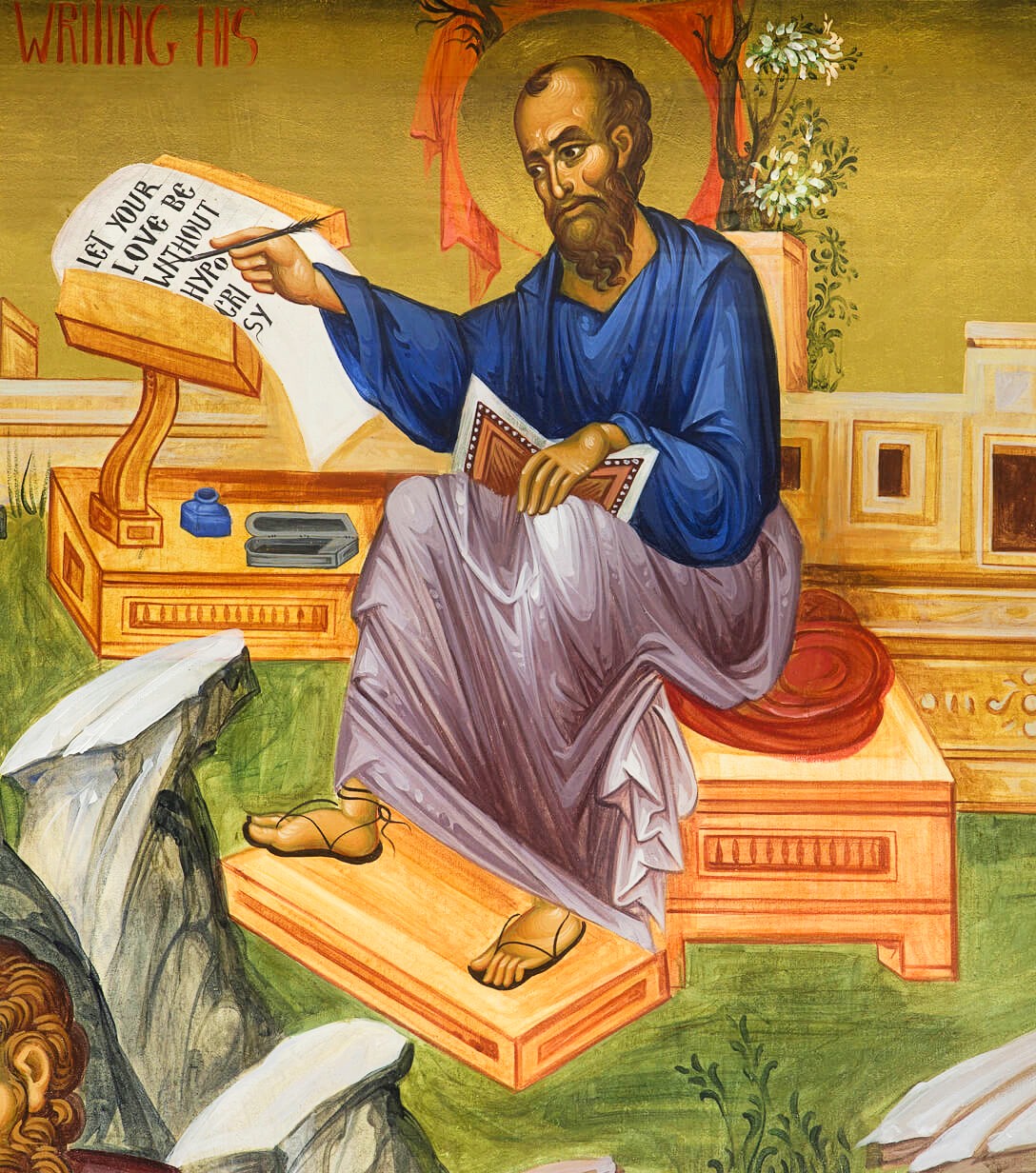
St Paul writing to St Philemon with St Timothy
Philemon of Colossae in Phrygia, was a disciple of St Paul. To him, the Apostle wrote the shortest of his Epistles, one of the four which he sent from Roman captivity (Eph, Phil, Col, Philem).
He was a wealthy Colossian, owner of buildings and slaves. Since St Paul had not been to Colossae, Philemon must have met him in Ephesus (cf Acts 19, 10-11), or during a tour through the interior of the Province of Asia (Acts 19, 26; I Cor. 16, 19). Philemon was converted and Baptised by St Paul together with his followers, probably during his long Ephesian labours between 54 and 57. (Philem. 19: “thou owe thyself to me too”).
Appia, from the beginning of the St Paul’s letter, is placed by him alongside Philemon “beloved brother” and greeted as “sister beloved”as found in the Vulgate or “dearest” in translation to English. St John Chrysostom, Theodoret and others following them, held, with good reason, that Apphia was the wife of Philemon. She certainly belonged, to his family, as did Archippus, named last among the three recipients of the letter (ibid. 1-2) who formed a family group very dear to Paul. Archippus must have been the son of Philemon and Appia. Their friendly house was at the Apostle’s disposal (ibid. 22). The three, together with their converted slave, Onesimus, who is the object, and (with Tychicus), bearer of the Epistle to Philemon, are commemorated in the Latin Martyrologies, on 22 November. All four wouldhave bene Martyred together at Colossae.
St Apphia
Epistle of St Paul to Philemon
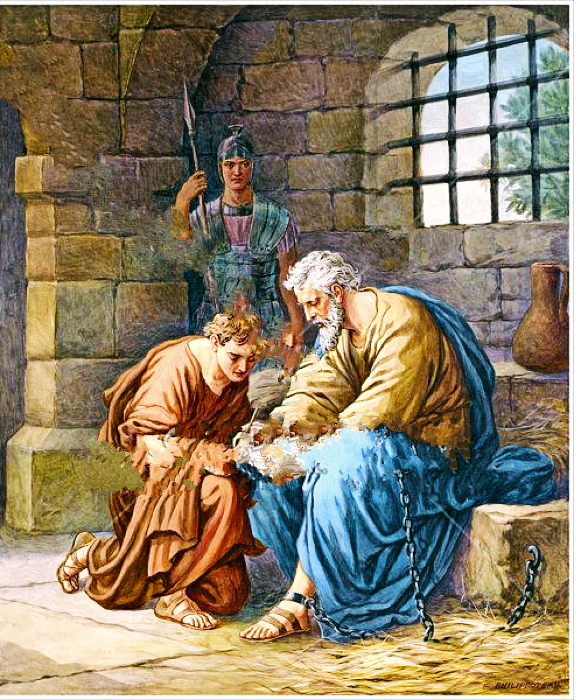
He commends the faith and charity of Philemon and sends back to him, his fugitive servant, whom he had converted in prison.
“1 Paul, a prisoner of Christ Jesus and Timothy, a brother, to Philemon, our beloved and fellow labourer. 2 And to Appia, our dearest sister and to Archippus, our fellow soldier and to the church which is in thy house, 3 grace to thee and peace from God our Father and from the Lord Jesus Christ. 4 I give thanks to my God, always making a remembrance of thee in my prayers. 5 Hearing of thy charity and faith, which thou hast in the Lord Jesus and towards all the saints 6 That the communication of thy faith may be made evident, in the acknowledgment of every good work that is, in thee in Christ Jesus.
7 For I have had great joy and consolation in thy charity because the bowels of the saints have been refreshed by thee, brother. 8 Wherefore, though I have much confidence in Christ Jesus, to command thee that which is to the purpose, 9 for charity’s sake I rather beseech, whereas thou art such a one, as Paul, an old man and now a prisoner also of Jesus Christ. 10 I beseech thee for my son, whom I have begotten in my bands, Onesimus, 11 Who hath been, heretofore, unprofitable to thee but now, is profitable, both to me and thee, 12 whom I have sent back to thee. And do thou receive him as my own bowels. 13 Whom I would have retained with me that, in thy stead, he might have ministered to me, in the bands of the gospel 14 But, without thy counsel, I would do nothing that thy good deed, might not be, as it were of necessity but voluntary. 15 For perhaps he, therefore, departed for a season from thee that thou, mightest receive him again forever, 16 Not now as a servant but, instead of a servant, a most dear brother, especially to me but how much more to thee, both in the flesh and in the Lord?
17 If, therefore, thou count me a partner, receive him as myself. 18 And if he hath wronged thee in anything, or is in thy debt, put that to my account. 19 I Paul,have written it with my own hand, I will repay it, not to say to thee that thou owest me thy own self also. 20 Yea, brother. May I enjoy thee in the Lord. Refresh my bowels in the Lord.
21 Trusting in thy obedience, I have w,ritten to thee, knowing that thou wilt also do more than I say. 22 But withal, prepare me also a lodging. For I hope that through thy prayers, I shall be given unto thee. 23 There, salute thee Epaphras, my fellow prisoner in Christ Jesu,; 24 Mark, Aristarchus, Demas and Luke, my fellow labourers. 25 The grace of our Lord Jesus Christ be with thy spirit. Amen.”
Tradition tells us that all St Paul’s wishes in regard to St Onesius were joyfully carried out by our Saint Philemon.
Quote/s of the Day – 5 October – “The Month of the Most Holy Rosary and of the Angels” – Hebrews 10:32-38, Luke 12:1-8 – Scripture search here: https://www.drbo.org/
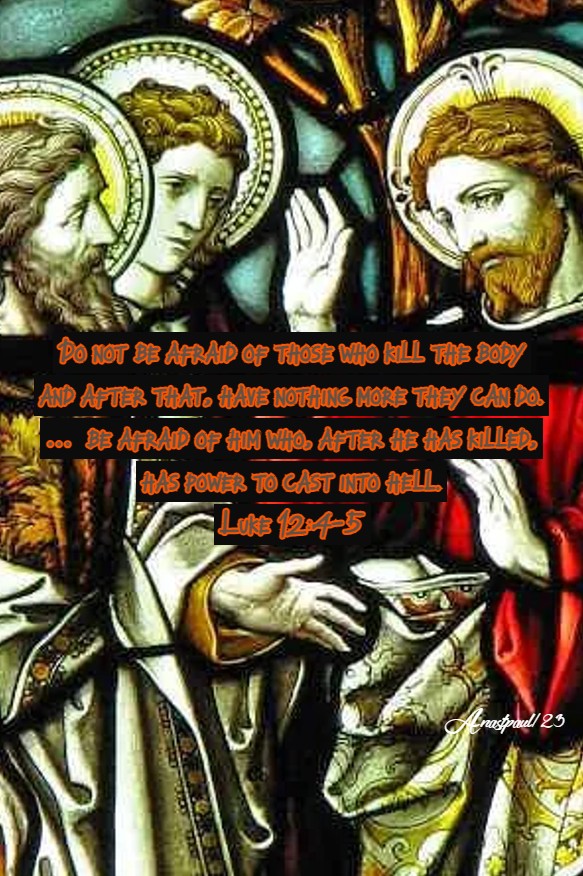
“Do not be afraid of those who kill the body and after that have nothing more they can do. … be afraid of him who, after he has killed, has power to cast into hell. ”
Luke 12:4-5
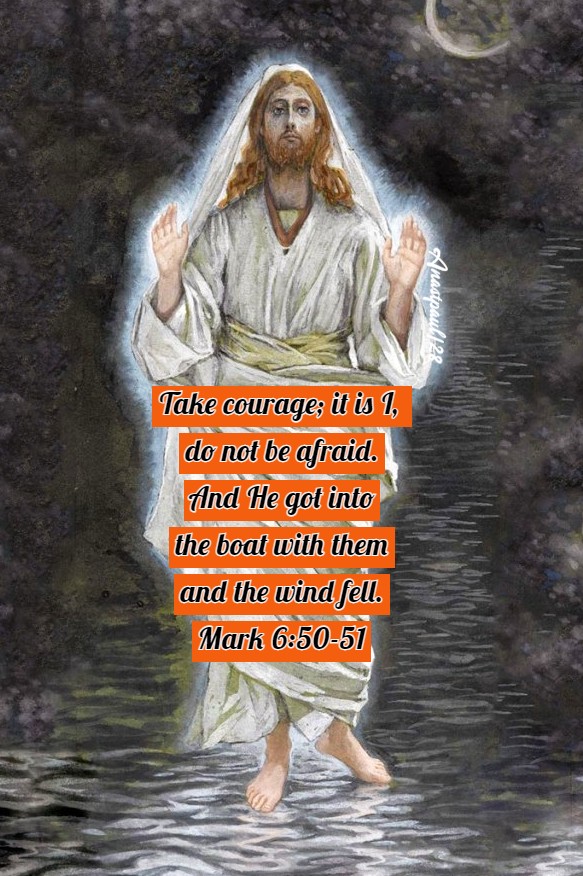
“Take courage: It is I, do not be afraid. And He got into the boat with them and the wind fell”
Mark 6:50-51
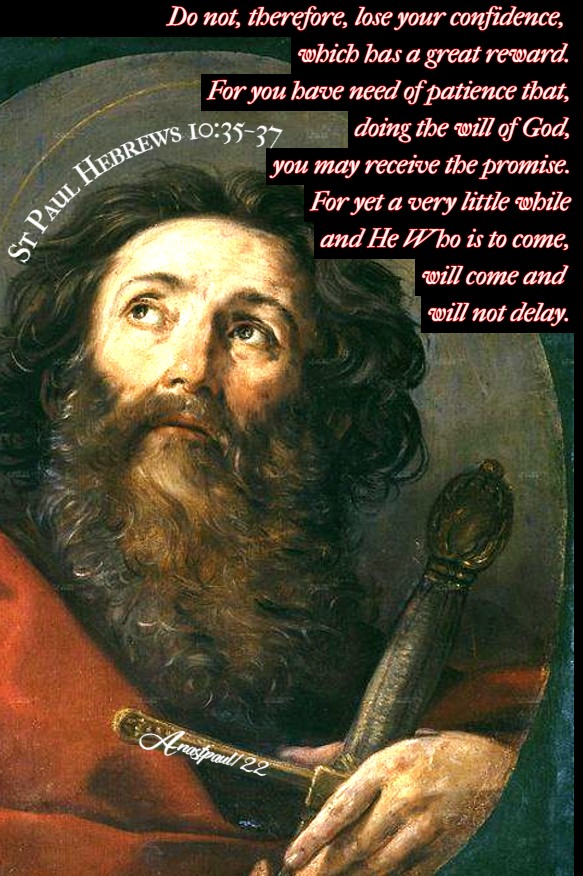
“Do not, therefore, lose your confidence, which has a great reward. For you have need of patience that, doing the will of God, you may receive the promise. For yet a very little while and He Who is to come, will come and will not delay.”
Hebrews 10:35-37
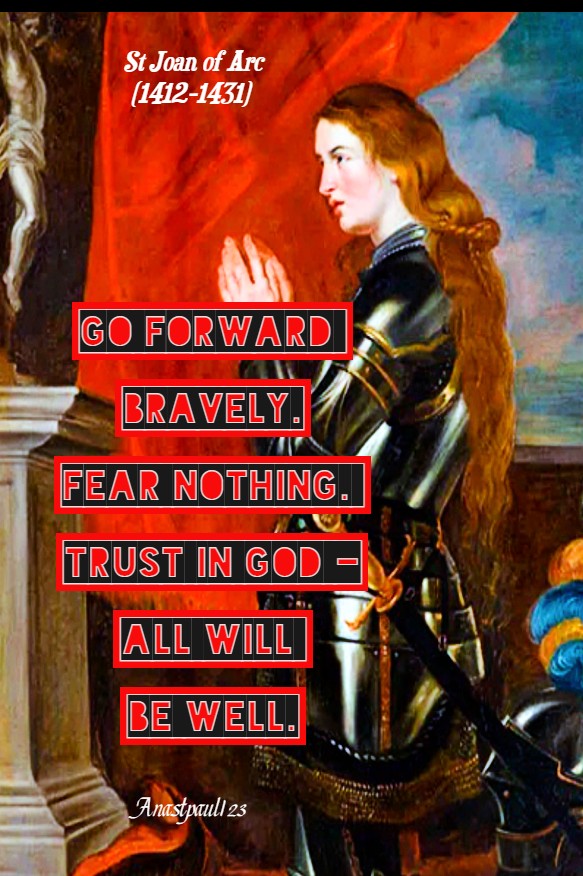
“Go forward bravely. Fear nothing. Trust in God – all will be well.”
St Joan of Arc (1412-1431)
“ Now it is that we are to show an invincible courage towards our Saviour, serving Him purely for the love of His will, not only without pleasure but amid this deluge of sorrows, horrors, distresses and assaults, as did his glorious Mother and St John, upon the day of His Passion. Amongst so many blasphemies, sorrows and deadly distresses, they remained constant in love …”
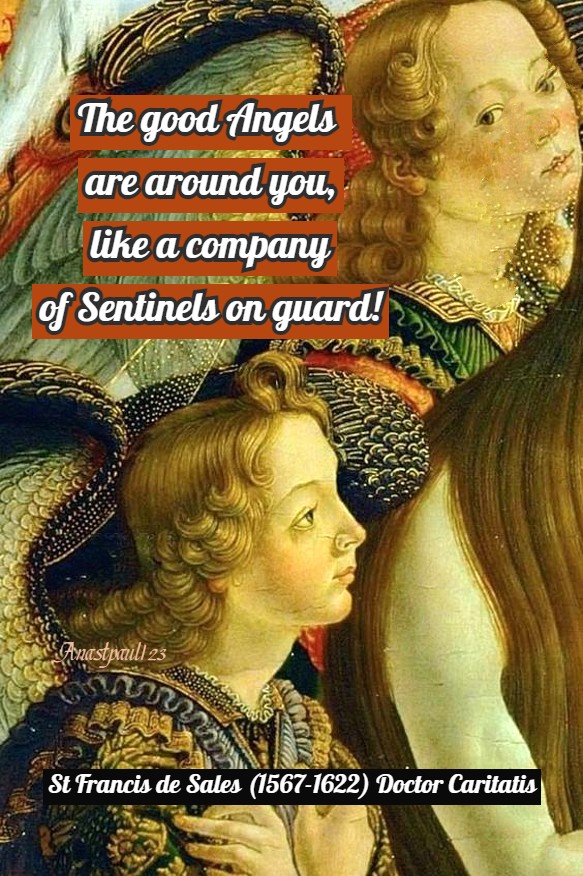
“The good Angels are around you, like a company of Sentinels on guard!”
St Francis de Sales (1567-1622) Doctor Caritatis
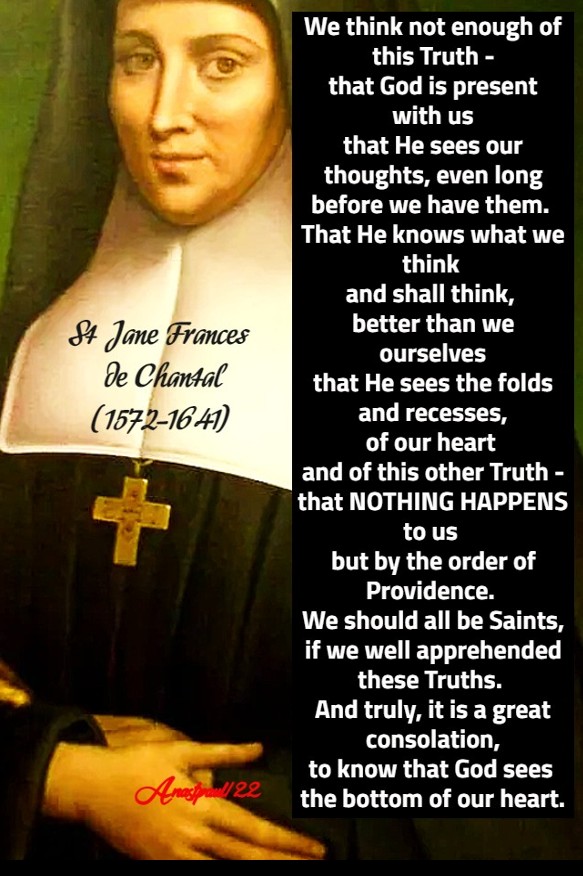
“We think not enough of this Truth – that God is present with us that He sees our thoughts, even long before we have them. That He knows what we think and shall think, better than we ourselves that He sees the folds and recesses, of our heart and of this other Truth – that NOTHING HAPPENS to us but by the order of Providence. We should all be Saints, if we well apprehended these Truths. And truly, it is a great consolation, to know that God sees the bottom of our heart.”
St Jane Frances de Chantal (1572-1641) Disciple and Collaborator with St Francis de Sales in Founding the Sisters of the Visitation
One Minute Reflection – 18 September – “Month of The Seven Sorrows of the Blessed Virgin Mary and The Holy Cross” – St Joseph of Cupertino OFM Conv. (1603-1663) Confessor – 1 Corinthians 13:1-8, Matthew 22:1-14 – Scripture search here: https://www.drbo.org/
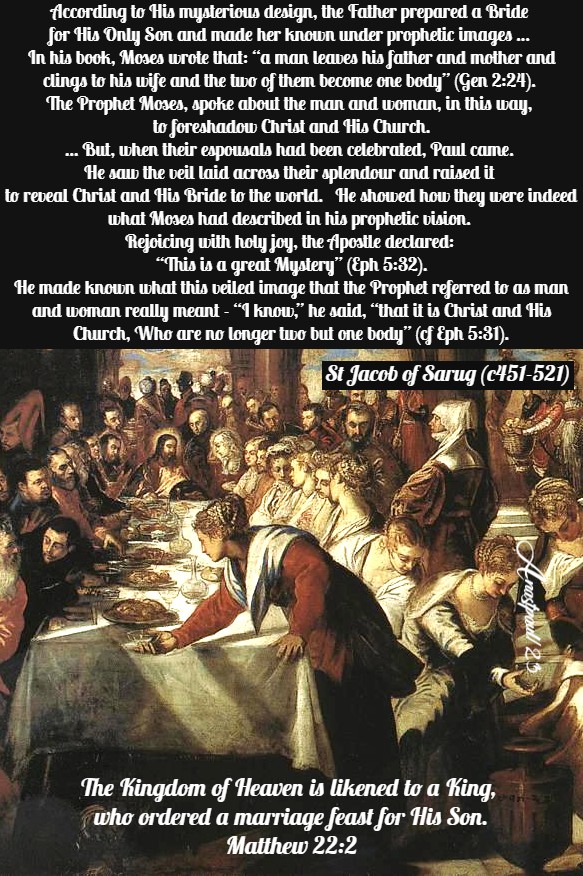
“The Kingdom of Heaven is likened to a King, who ordered a marriage feast for his son.” – Matthew 22:2
REFLECTION – “According to His mysterious design, the Father prepared a Bride for His Only Son and made her known under prophetic images … In his book, Moses wrote that: “a man leaves his father and mother and clings to his wife and the two of them become one body” (Gen 2:24). The Prophet Moses, spoke about the man and woman, in this way, to foreshadow Christ and His Church.
With the Prophet’s piercing eye, he beheld Christ becoming One with the Church, thanks to the Mystery of the water – he envisioned Christ drawing the Church to Himself, from the virginal womb and the Church drawing Christ to herself, in the waters of Baptism. Thus, were the Bridegroom and Bride wholly united, in a mystical way. That is why Moses, with veiled face, (Ex 34:33) beheld – Christ and the Church – one he called “man” and the other “woman” so as to avoid revealing the reality to the Hebrew people, in all its clarity …. For a time, the veil would conceal this Mystery – none would know the meaning of this great image and would be ignorant of what it represented.
But, when their espousals had been celebrated, Paul came. He saw the veil laid across their splendour and raised it to reveal Christ and His Bride to the world. He showed how they were indeed what Moses had described in his prophetic vision. Rejoicing with holy joy, the Apostle declared: “This is a great Mystery” (Eph 5:32). He made known what this veiled image that the Prophet referred to as man and woman really meant – “I know,” he said, “that it is Christ and His Church, Who are no longer two but one body” (cf Eph 5:31).” – St Jacob of Sarug (c451-521) Bishop, Father (Sermon on Moses’ veil).
PRAYER – O God, Who willed that all things be drawn unto Thy Son, when He was raised above the earth, mercifully grant, by the merits and example of Thy seraphic Confessor Joseph that, having been raised above all earthly desires, we may be found worthy to come unto Him. Through the same Jesus Christ, Thy Son our Lord, Who lives and reigns with Thee, in the unity of the Holy Ghost, God, world without end. Amen (Collect).
Quote/s of the Day – 1 September – Ecclesiasticus Sirach 31:8-11, Luke 12:35-40 – cripture search here: https://www.drbo.org/
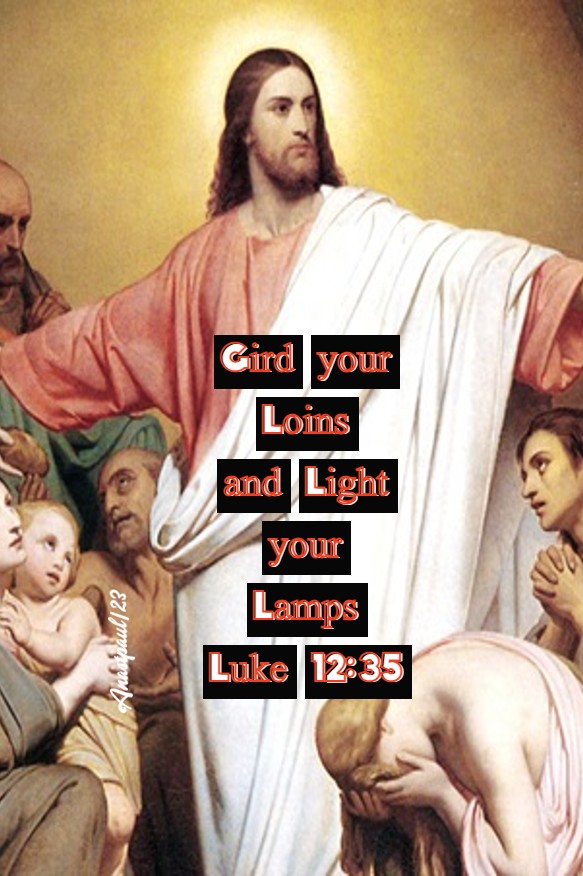
“Let your loins be girt about and your lamps burning …”
Luke 12:35
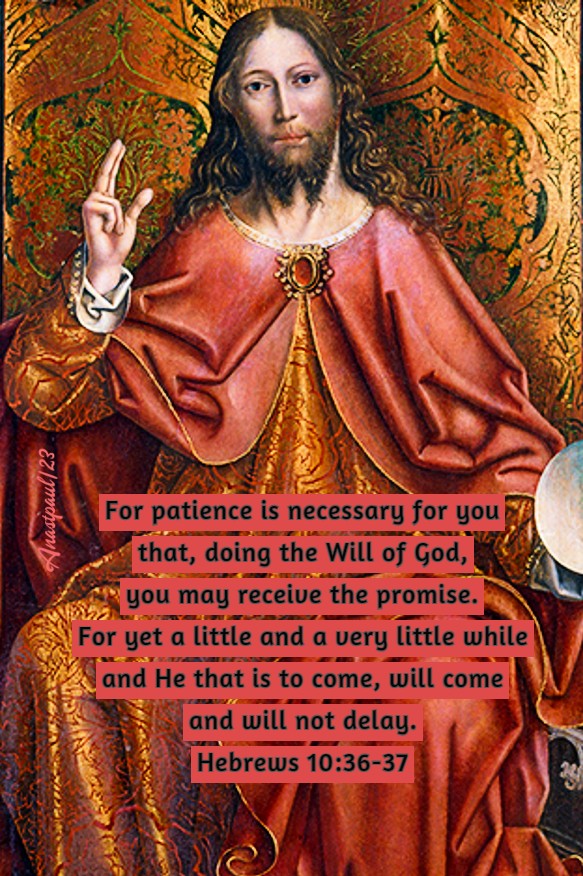
“For patience is necessary for you that, doing the Will of God, you may receive the promise. For yet a little and a very little while and He that is to come, will come and will not delay.”
Hebrews 10:36-37
“Let us listen to the holy Voice of God which summons us from on high, from the holy mountain top. There, we must hasten – I make bold to say – like Jesus, Who is our leader and has gone before us into Heaven. There, with Him, may the eyes of our mind shine with His light and the features of our soul be made new; may we be transfigured with Him and moulded to His image, ever becoming divine, being transformed in an ever greater degree of glory.”
St Anastasius Sinaita (Died 6th Century) Priest and Abbot of St Catherine’s Monastery on Mount Sinai
Thought for the Day – 16 August – Meditations with Antonio Cardinal Bacci (1881-1971)
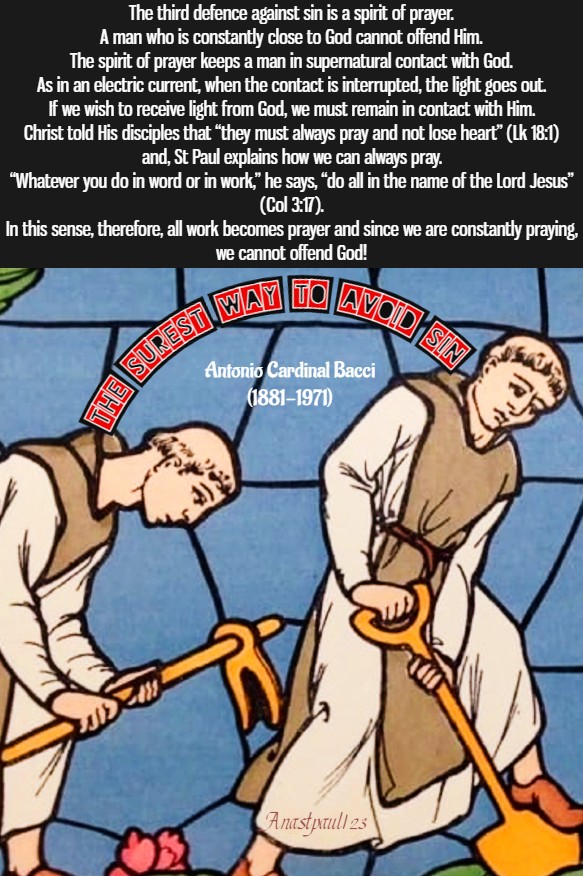
The Surest Way to Avoid Sin
“The third defence against sin is a spirit of prayer. A man who is constantly close to God cannot offend Him. The spirit of prayer keeps a man in supernatural contact with God. As in an electric current, when the contact is interrupted, the light goes out. If we wish to receive light from God, we must remain in contact with Him.
Christ told His disciples that “they must always pray and not lose heart” (Lk 18:1) and, St Paul explains how we can always pray. “Whatever you do in word or in work,” he says, “do all in the name of the Lord Jesus” (Col 3:17). In this sense, therefore, all work becomes prayer and since we are constantly praying, we cannot offend God!”
Quote/s of the Day – 11 August – Tiburtius (Died c286) Martyr, Layman, St Susanna of Rome (Died c 295) Virgin Martyr, St Philomena (Died 304) Virgin Martyr – Hebrews 11:33-39, Luke 21:9-19 – Scripture search here: https://www.drbo.org/
“And you shall be hated by all men, for My Name’s sake.”
Luke 21:17
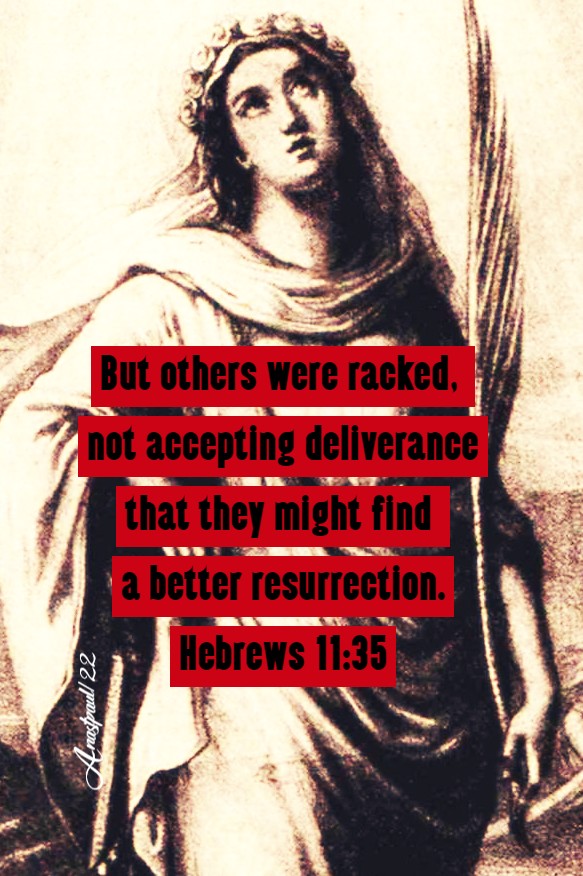
“But others were racked, not accepting deliverance that they might find a better resurrection.”
Hebrews 11:35
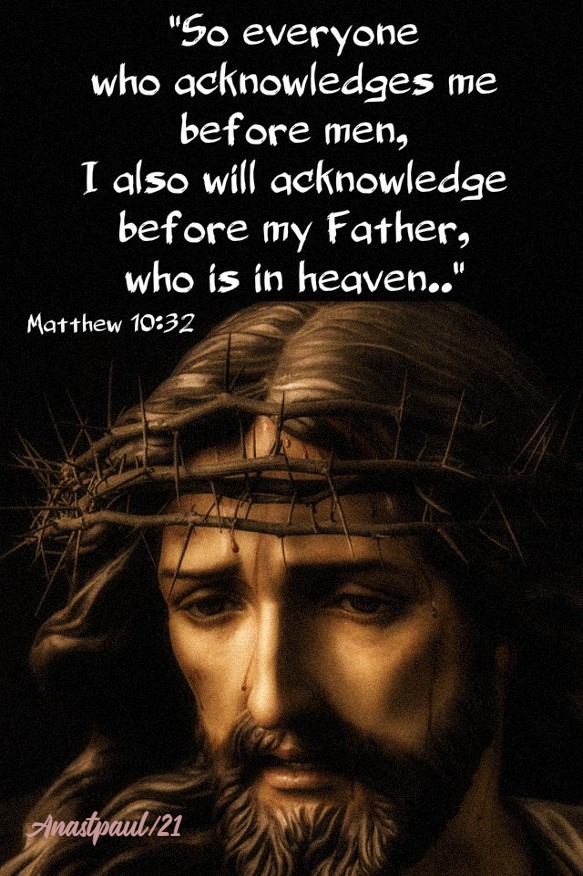
“So everyone who acknowledges me before men, I also will acknowledge before my Father, who is in Heaven…”
Matthew 10:32
“Rejoice and be happy! Persevere to the end and prefer to die rather than abandon the post, to which God has called you!”
St Catherine of Siena (1347-1380) Doctor of the Church
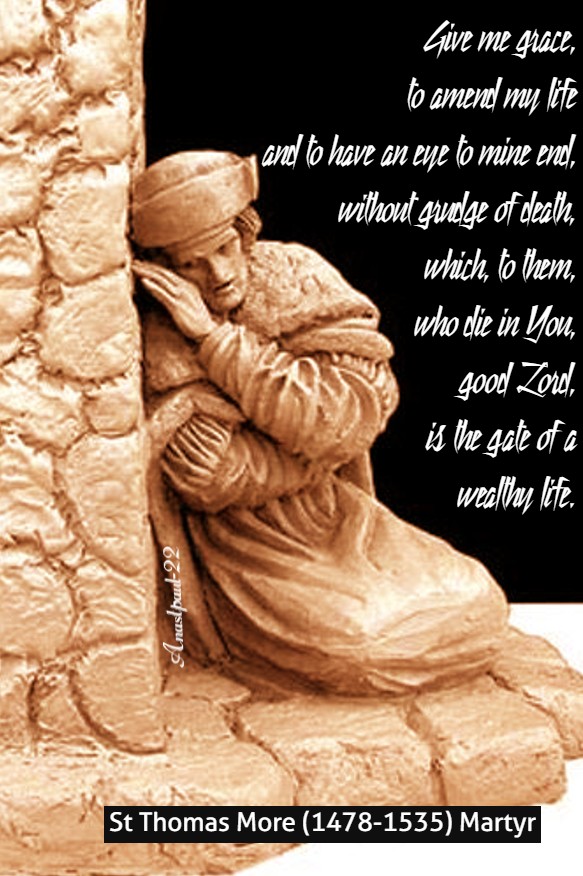
“Give me grace, to amend my life and to have an eye to mine end, without grudge of death, which, to them, who die in You, good Lord, is the gate of a wealthy life.”
St Thomas More (1478-1535) Martyr
“You must choose – is it better that there should be thorns in your garden, in order to have roses, or that there should be no roses in your garden, in order to have no thorns?”
St Francis de Sales (1567-1622) Doctor Caritatis
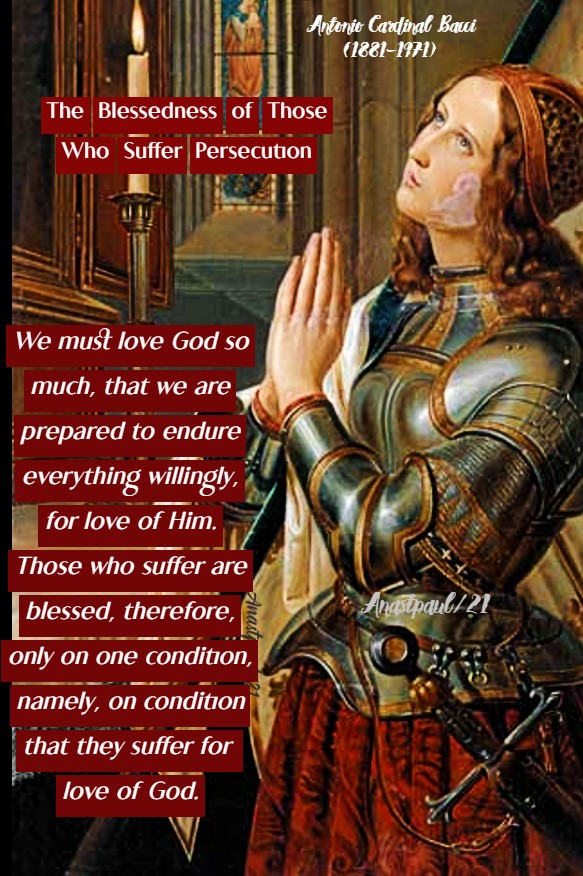
“We must love God so much, that we are prepared to endure everything willingly, for love of Him. Those who suffer are blessed, therefore, only on one condition, namely, on condition that they suffer for love of God.”
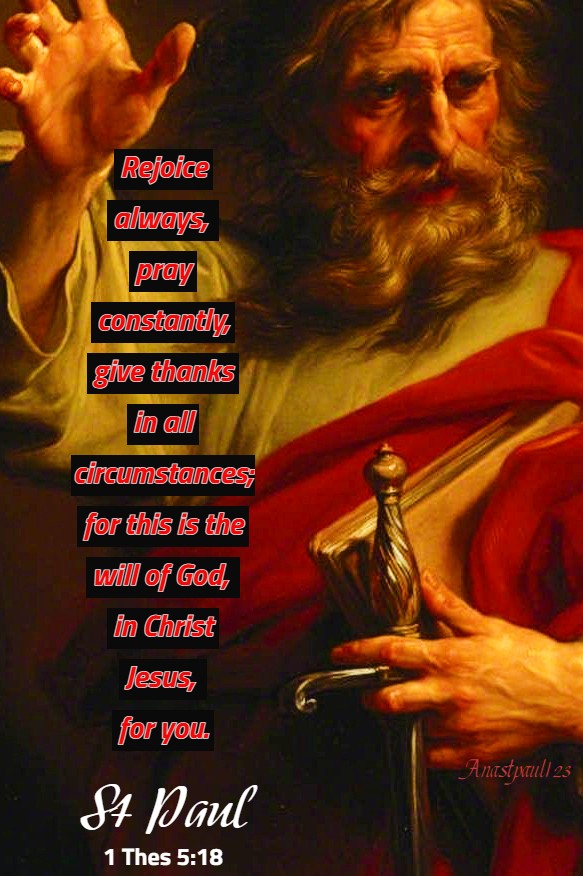
“… give thanks in all circumstances; for this is the will of God in Christ Jesus for you.” 1 Thes 5:18
I thank those Priest who celebrated Holy Mass on the great Feast of St James the Greater, offering the greatest of all prayers for the success of the operation I was undergoing. I was and am, so well protected by all your glorious intercessions that I was cushioned, protected, comforted and so very confident!
I am nearly back online – just awaiting a final Post-op Examination to confirm the status of my eye and whether it can handle the PC light. I might have to ease into the time I usually spend here, slowly increasing the hours.
I continue to pray in thanksgiving and joy, for you all. 🙏💖
“Rejoice always, pray constantly, give thanks in all circumstances; for this is the will of God, in Christ Jesus, for you” (1 Thes 5:18).
Saint of the Day – 19 July – St Epaphras of Colossae (1st Century) Bishop, Martyr, pagan Convert and Disciple of St Paul. Also known as – Epafra, Epagaphras.
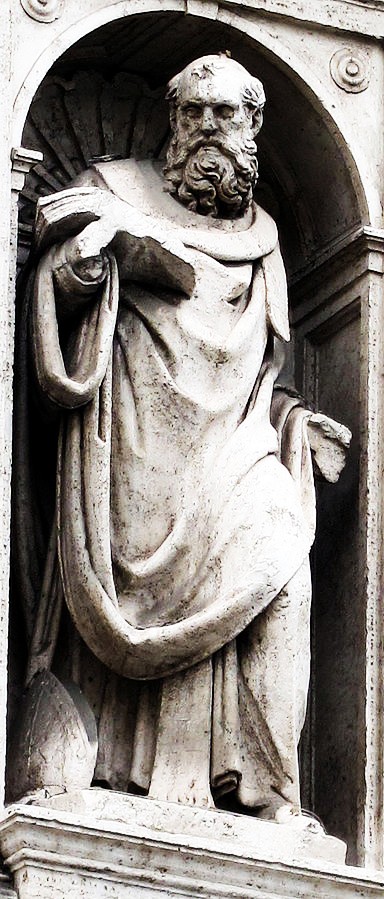
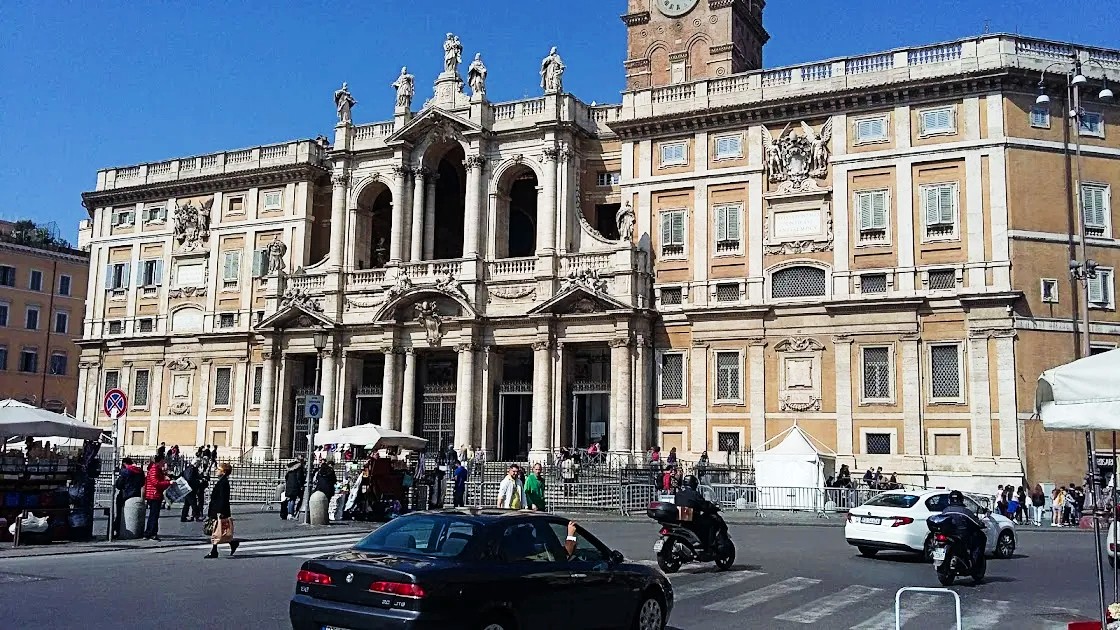
The Roman Martyrology reads today: “The birthday of St Epaphras, whom the Apostle St Paul calls his fellow-prisoner. By the same Apostles, he was Consecrated Bishop of Colossae, where, becoming renowned for his virtues, he received the Palm of Martyrdom, for courageously defending the flock commited to his charges. His body now lies at the Basilica of St Mary Major in Rome.”
St Epaphras Statue at St Mary Major in Rome
In St Paul’s letters to the Colossians and the letter to Philemon, he conveyed greetings from Epaphras:
“Epaphras saluteth you, who is one of you, a servant of Christ Jesus, who is always solicitous for you in prayers, that you may stand perfect, and full in all the will of God. For I bear his testimony that he hath laboured much for you,and for those who are at Laodicea, and those at Hierapolis.” Colossians 4:12–13
Originally from Colossae (in modern Turkey) and a pagan. Epaphras was converted by St Paul during the three years of apostolate in Ephesus. He is the founder and head of the Church of Colossae. The Apostle praises it twice: in Colossians 1:7 – the Colossians were evangelised by Epaphras “our beloved companion in the ministry, faithful minister of Christ, all devoted to your good.”
Finally, in the Epistle to Philemon, St Paul calls him “my fellow prisoner in Christ Jesus.” Epaphras, in fact, was in Rome with him, having come there from Colossae to visit and comfort him, with the assurance of the warm affection of all his faithful flock and disciples.
In the fervour of his apostolic zeal, Epaphras also made present to St Paul that heresy was trying to penetrate those Churches and to preserve them from danger, he had the Apostle write to them.
According to some critics, since the name Epaphras is a contraction of Epaphroditus, our Epaphras and the Epaphroditus mentioned by St Paul in the Epistle to the Philippians (3:25-28; 4:18) would be one and the same person. This identification, which rests only on the possible identity of the name, has nothing else on which to base itself and we agree to exclude it.
The tradition formed on this holy disciple of St Paul, was collected by Adonis: “On the birthday of the blessed Epaphras, who was Ordained Bishop of Colossae by the blessed Paul, famous for his virtues, received the Palm of Martyrdom for the sheep commended to him by a courageous struggle. He was buried in the same City but later his body was moved to St Mary Major in Rome.”
Thought for the Day – 12 July – Meditations with Antonio Cardinal Bacci (1881-1971)
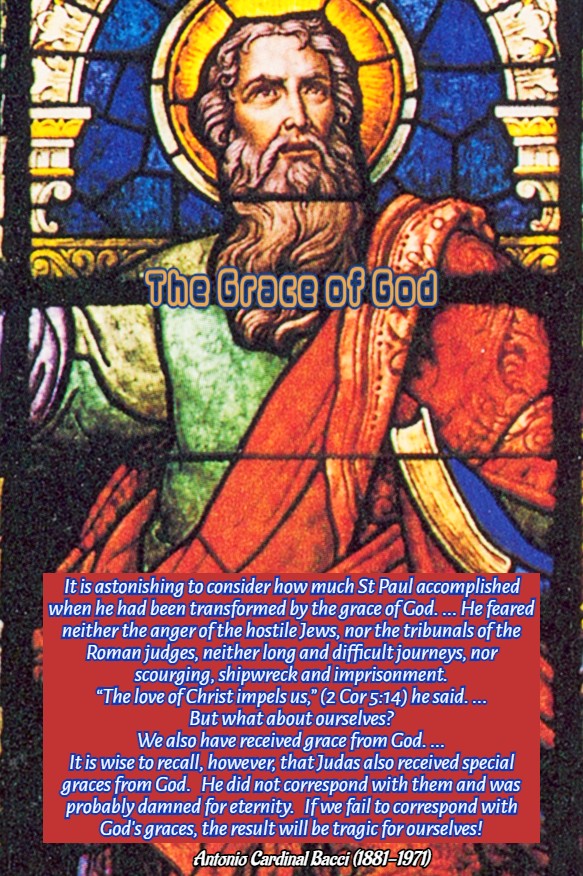
The Grace of God
“It is astonishing to consider how much St Paul accomplished when he had been transformed by the grace of God. Formerly, a persecutor of Christians, he became the Apostle of the Gentiles. Enlightened by faith and inspired by charity, he travelled the globe, spreading everywhere, the religion of Jesus Christ.
He feared neither the anger of the hostile Jews, nor the tribunals of the Roman judges, neither long and difficult journeys, nor scourging, shipwreck and imprisonment. “The love of Christ impels us,” (2 Cor 5:14) he said. It was the love of God which drove him on and on, until he met his martyrdom. But what about ourselves? We also have received grace from God. Often we hear His voice appealing to us to abandon our sinful ways, to practise virtue, to love Him more ardently and to prove our love, by deeds. If we co-operate, we shall be able to say with St Paul: “by the grace of God, I am what I am and his grace in me has not been fruitless,” (1 Cor 15:10) and “I have laboured … yet, not I but the grace of God with me” (ibid).
It is wise to recall, however, that Judas also received special graces from God. He did not correspond with them and was probably damned for eternity. If we fail to correspond with God’s graces, the result will be tragic for ourselves.”
Thought for the Day – 9 July – Meditations with Antonio Cardinal Bacci (1881-1971)
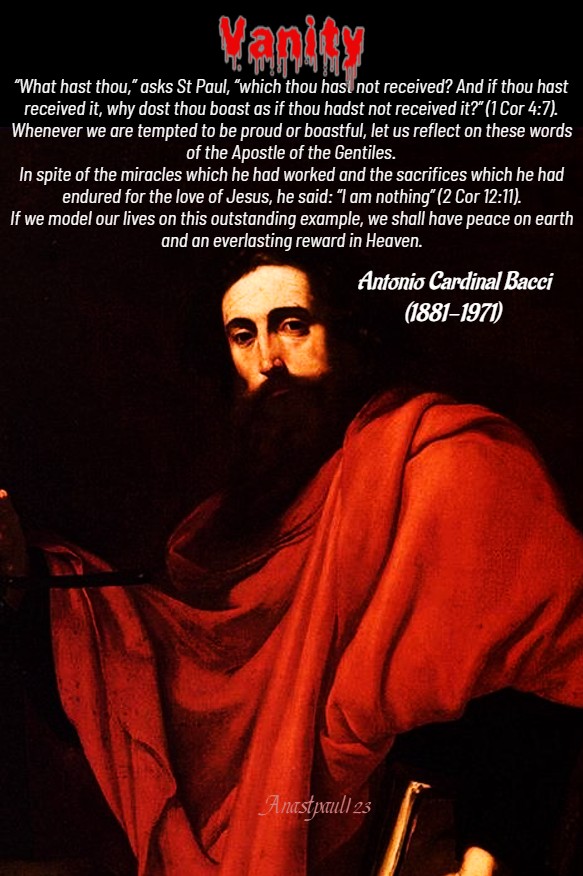
Vanity
“What hast thou,” asks St Paul, “which thou hast not received? And if thou hast received it, why dost thou boast as if thou hadst not received it?” (1 Cor 4:7). Whenever we are tempted to be proud or boastful, let us reflect on these words of the Apostle of the Gentiles. In spite of the miracles which he had worked and the sacrifices which he had endured for the love of Jesus, he said: “I am nothing” (2 Cor 12:11).
If we model our lives on this outstanding example, we shall have peace on earth and an everlasting reward in Heaven.”
Quote/s of the Day – 6 July – “The Month of the Most Precious Blood of Jesus” – The Octave Day of Sts Peter and Paul
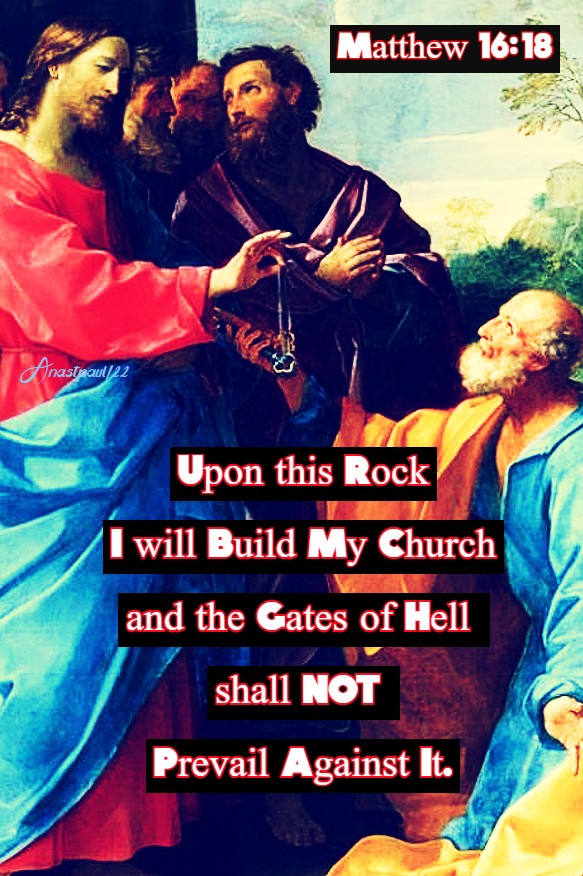
“Upon this rock I will build My Church and the gates of hell shall not prevail against it. I will give you the keys of the Kingdom of Heaven and whatever you bind on earth shall be bound in Heaven and, whatever you loose on earth, shall be loosed in Heaven.”
Matthew 16:18-19
“Nothing escaped the Wisdom and Power of Christ, the elements of nature lay at His service, spirits obeyed Him, Angels served Him. … And yet, out of all the world, Peter alone was chosen to stand at the head, for the calling of all the peoples and the oversight of all the Apostles and Fathers of the Church.”
St Pope Leo the Great (400-461) Father and Doctor
“Do not, therefore, lose your confidence, which has a great reward. For you have need of patience that, doing the will of God, you may receive the promise. For yet a very little while and He Who is to come, will come and will not delay.”
Hebrews 10:35-37
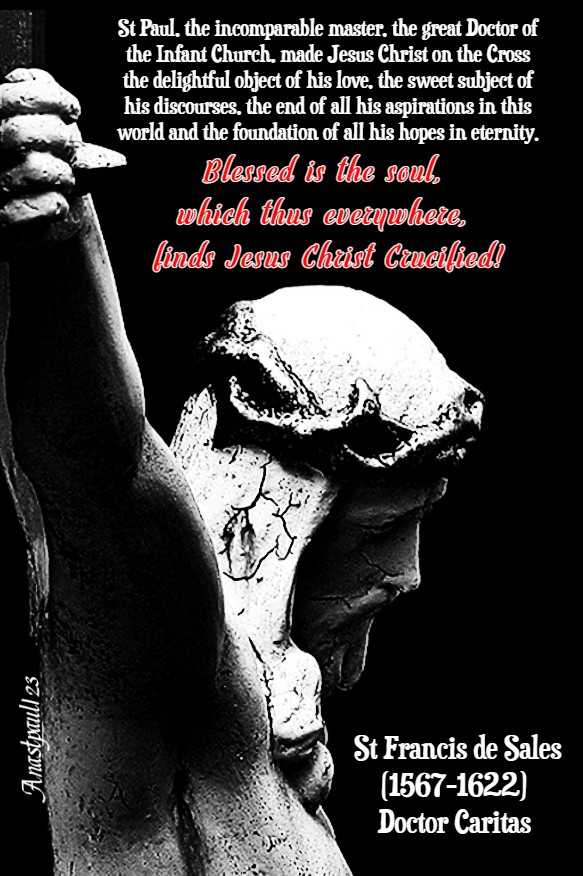
“St Paul, the incomparable master, the great Doctor of the Infant Church, made Jesus Christ on the Cross the delightful object of his love, the sweet subject of his discourses, the end of all his aspirations in this world and the foundation of all his hopes in eternity Blessed is the soul, which thus everywhere, finds Jesus Christ Crucified!”
One Minute Reflection – 6 July – “The Month of the Most Precious Blood of Jesus” – The Octave Day of Sts Peter and Paul – Sirach 44:10-15, Matthew 14:22-33 – Scripture search here: https://www.drbo.org/
“O man of little faith, why did you doubt?” – Matthew 14:31
REFLECTION – “Once again the disciples are a plaything of the waves and a storm, similar to the first one (Mt 8:4) hurls itself against them. The first time, however, they had Jesus with them, whereas this time they are alone and left to themselves. … I think this was because our Saviour wanted to stir their sleeping hearts and, by throwing them into a panic, He inspired in them a strong desire for His presence and kept the remembrance of Him constantly in their minds. Hence, He did not come to their help at once but “during the fourth watch of the night He came towards them, walking on the sea …”
Peter, ever volatile, always getting in before the other disciples, said: “Lord, if it is Thee, command me to come to Thee on the water” … He didn’t say, “Command me to walk on the water” but “come to thee,” for, there was none who loved Jesus as much as he. He did the same thing after the Resurrection – unable to bear moving as slowly as the others in the boat, he jumped into the water to get there before them and satisfy his love for Christ. … Getting out of the boat, then, Peter went towards Jesus, more delighted to be going towards Him, than to be walking on the water. But after confronting the greatest danger, that of the sea, he was to give in to a lesser, that of the wind. Such is human nature! Often, having overcome serious dangers we are conquered by lesser ones … Peter had not yet been set free from all his fear … in spite of Christ’s presence beside him. For it is of no use to be beside Christ if one is not close to Him by faith. This is what emphasises the distance separating Master from the disciple …
“O man of little faith, why did you doubt?” So if Peter’s faith had not faltered, he would have resisted the wind without difficulty. And the proof of this, is that Jesus grasped Peter ,while leaving the wind to continue blowing … Just as the mother bird supports the fledgling which has prematurely left the nest, with her wings, as it is about to fall and draws it back into the nest, so does Christ, with regard to Peter.” … St John Chrysostom (345-407) Bishop of Constantinople, Father and Doctor of the Church – (Homilies on Saint Matthew’s Gospel no 50, 1-2).
PRAYER – O God, Who made this day holy by the Martyrdom of Your Apostles Peter and Paul, grant Thy Church to follow in all things, the teaching of those, from whom she first received the faith. Through Jesus Christ, Thy Son our Lord, Who lives and reigns with Thee, in the unity of the Holy Ghost, God, world without end. Amen (Collect).
Our Morning Offering – 2 July – The Solemnity of Saints Peter and Paul, Apostles and Martyrs
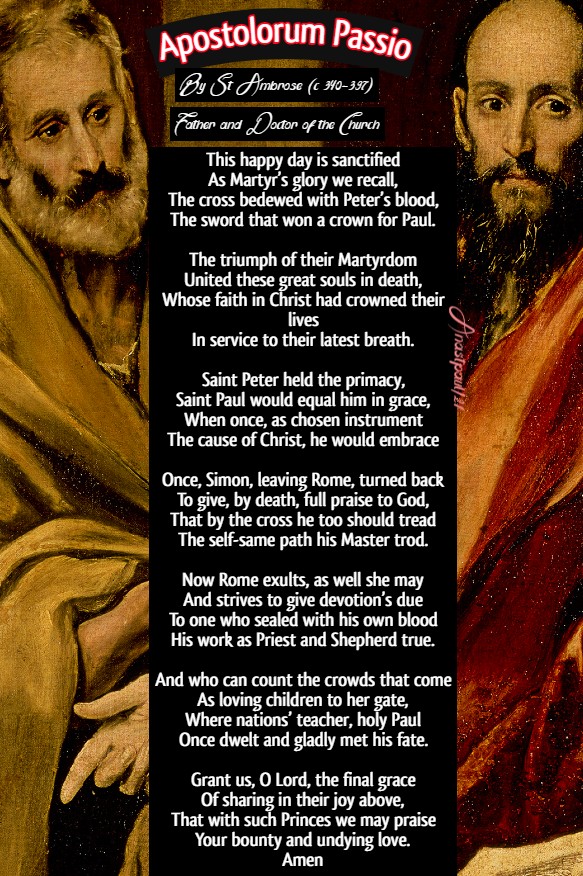
Apostolorum Passio By St Ambrose (c 340-397) Father and Doctor of the Church
This happy day is sanctified As Martyr’s glory we recall, The cross bedewed with Peter’s blood, The sword that won a crown for Paul.
The triumph of their Martyrdom United these great souls in death, Whose faith in Christ had crowned their lives In service to their latest breath.
Saint Peter held the primacy, Saint Paul would equal him in grace, When once, as chosen instrument The cause of Christ, he would embrace
Once, Simon, leaving Rome, turned back To give, by death, full praise to God, That by the cross he too should tread The self-same path his Master trod.
Now Rome exults, as well she may And strives to give devotion’s due To one who sealed with his own blood His work as Priest and Shepherd true.
And who can count the crowds that come As loving children to her gate, Where nations’ teacher, holy Paul Once dwelt and gladly met his fate.
Grant us, O Lord, the final grace Of sharing in their joy above, That with such Princes we may praise Your bounty and undying love. Amen
Trans: The Benedictines of St Cecilia’s Abbey, Ryde, UK
Quote of the Day – 30 June – The Commemoration of St Paul, Apostle and Martyr
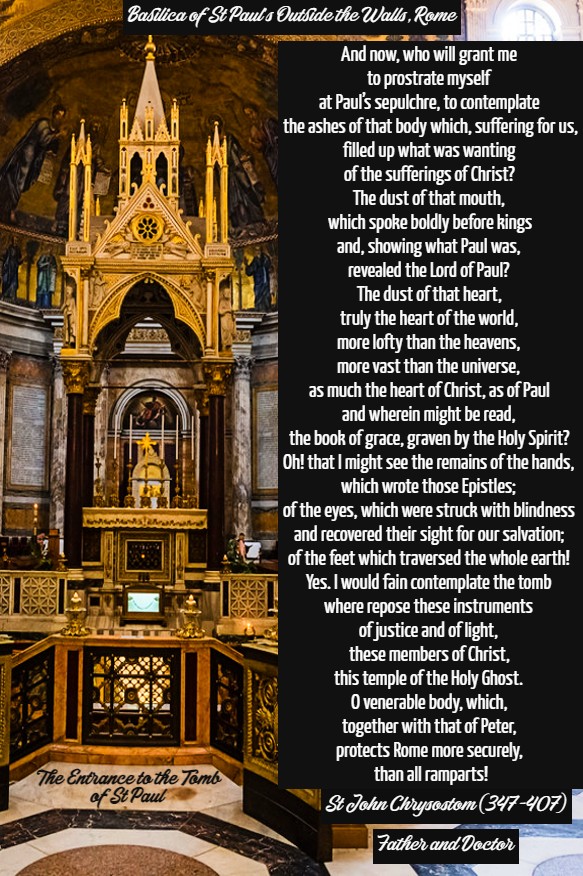
“And now, who will grant me to prostrate myself at Paul’s sepulchre, to contemplate the ashes of that body which, suffering for us, filled up what was wanting of the sufferings of Christ? The dust of that mouth, which spoke boldly before kings and, showing what Paul was, revealed the Lord of Paul? The dust of that heart, truly the heart of the world, more lofty than the heavens, more vast than the universe, as much the heart of Christ, as of Paul and wherein might be read, the book of grace, graven by the Holy Spirit? Oh! that I might see the remains of the hands, which wrote those Epistles; of the eyes, which were struck with blindness and recovered their sight for our salvation; of the feet which traversed the whole earth! Yes. I would fain contemplate the tomb where repose these instruments of justice and of light, these members of Christ, this temple of the Holy Ghost. O venerable body, which, together with that of Peter, protects Rome more securely, than all ramparts!”
One Minute Reflection – 30 June – “The Month of the Sacred Heart of Jesus” – The Commemoration of St Paul, Apostle and Martyr – Galatians 1:11-20, Matthew 10:16-22 – Scripture search here: https://www.drbo.org/
“Behold, I send you as sheep in the midst of wolves, therefore, wise as serpents and simple as doves.” – Matthew 10:16
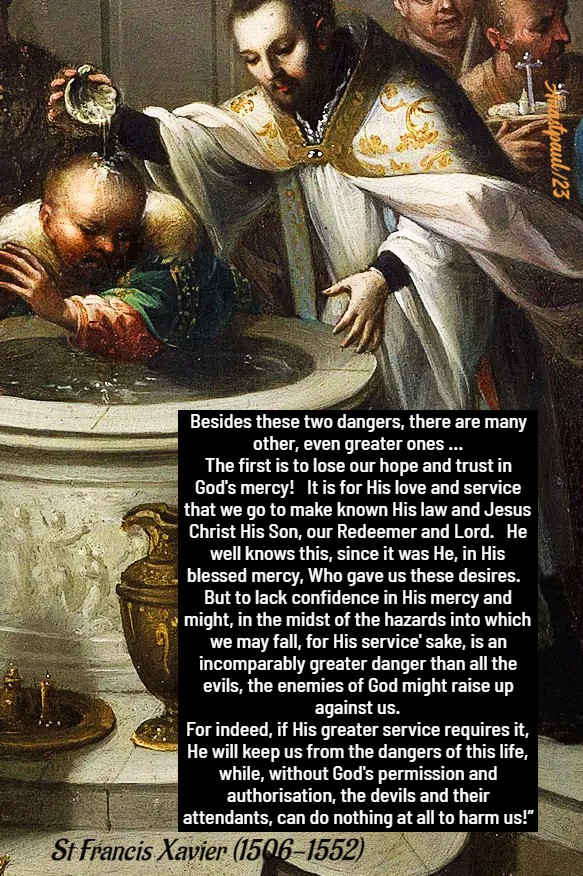
REFLECTION – “According to the people here,, we run two dangers. The first is that, after taking our money, our guide may leave us on some deserted island or throw us into the sea, so as to escape the Governor of Canton. The second is that, supposing he leads us to Canton and we come into the Governor’s presence, the latter will treat us badly or throw us into prison. For our proceeding is unheard of. Numerous decrees prevent anyone at all from gaining access to China and, it is strictly forbidden, for foreigners to make their way in, without the King’s authorisation. Besides these two dangers, there are many other, even greater ones – that the locals know nothing about. It would take a good deal of time to describe them all, however, I will not pass by without citing some of them.
The first is to lose our hope and trust in God’s mercy! It is for His love and service that we go to make known His law and Jesus Christ His Son, our Redeemer and Lord. He well knows this, since it was He, in His blessed mercy, Who gave us these desires. But to lack confidence in His mercy and might, in the midst of the hazards into which we may fall, for His service’ sake, is an incomparably greater danger than all the evils, the enemies of God might raise up against us. For indeed, if His greater service requires it, He will keep us from the dangers of this life, while, without God’s permission and authorisation, the devils and their attendants, can do nothing at all to harm us!” – St Francis Xavier (1506-1552) Jesuit Missionary (Letter 131:22 October 1552).
PRAYER – O God, Who taught vast numbers of the Gentiles by the preaching of the blessed Apostle Paul, grant we beseech Thee that, by honouring his memory, we may enjoy the benefit of his patronal intercession. Through Jesus Christ, Thy Son our Lord, Who lives and reigns with Thee, in the unity of the Holy Ghost, God, world without end. Amen (Collect).
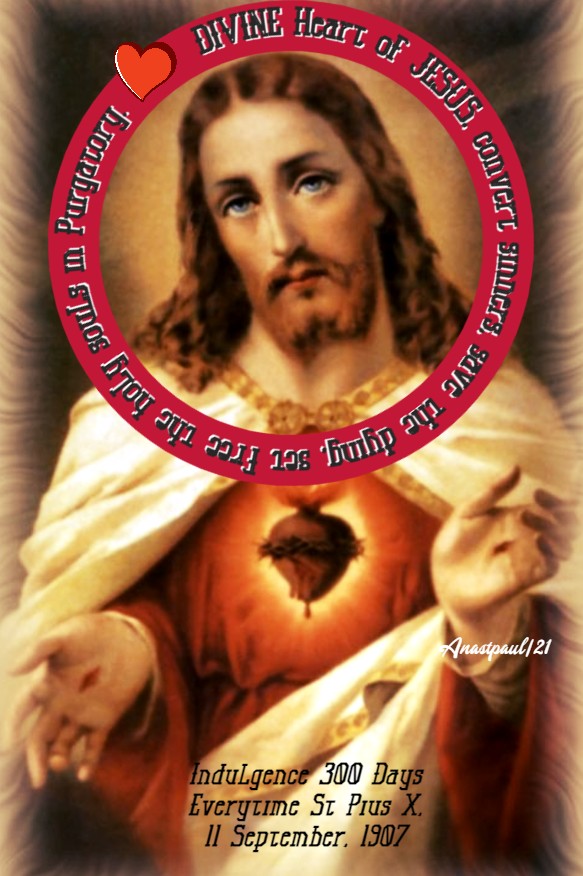
DIVINE Heart of JESUS, convert sinners, save the dying, set free the holy souls in Purgatory. Indulgence 300 Days Everytime – St Pius X, 11 September, 1907.
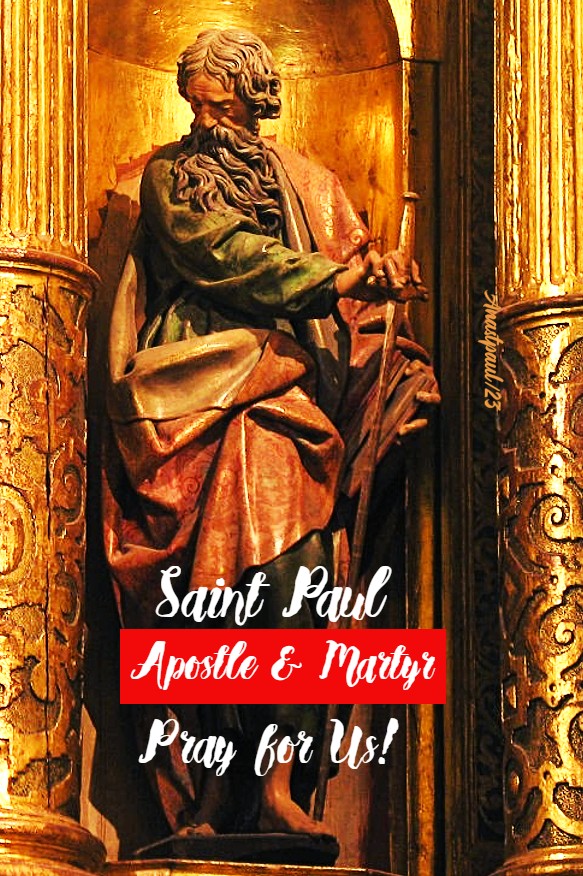
Saint of the Day – 30 June – The Commemoration of St Paul. Apostle and Martyr.
The joint commemoration of the Apostles, Peter and Paul, is one of the most ancient customs of the Roman Church, attested already in the oldest surviving Roman Liturgical Calendar, the Depositio Martyrum, written in 336. A verse of the Hymn, Apostolorum Passio, an authentic work of St Ambrose († 397) and still used in the Ambrosian liturgy, says that “the thick crowds make their way through the circuit of so great a city; the feast of the sacred Martyrs is celebrated on three streets.” These “three streets” are the via Cornelia, the main street running up to and over the Vatican hill; the via Ostiensis, where the burial and Church of St Paul are and the via Appia, on which resides the Cemetery “in Catacumbas.”
This last is the ancient Christian Cemetery now called the Catacomb of St Sebastian, The word “catacomb” was in fact originally the name of the site of this ‘Cemetery’ specifically and only later came to be used as a generic term for ancient subterranean Christian burial grounds. The Basilica over the Cemetery, now also entitled to St Sebastian, was originally known as the “Basilica Apostolorum” in memory of a tradition that the bones of Peter and Paul were kept there for a time, probably to save them from destruction in the era of persecutions. This is referred to in various ancient sources, including the Depositio Martyrum and confirmed by modern archeological research. The celebration of the feast “on three streets” would refer then to a procession to visit the site of St Peter’s burial at the Vatican that of St Paul, on the via Ostiensis and the Cemetery where their remains were once kept.
The building of which this wall is a part was constructed over the Catacomb of St Sebastian about 250 and is covered with dozens of devotional graffiti like the one seen here. “Paule ed (et) Petre, petite pro Victore – Paul and Peter, pray (lit. ‘ask’) for Victor.”
The poet Prudentius, writing in the very early 5h Century, calls the day “bifestum – a double Feast” and attests that on that day, the Pope would say a Mass at the Basilica of St Peter and then hasten to say another at St Paul’s. …
It should not be surprising, then, that at a certain point, the double Feast was divided and kept in a more manageable way as two separate Feasts. In the Gelasian Sacramentary, we find three Masses of Sts Peter and Paul assigned to 29 June – the oldest copy of the Gelasianum dates to roughly 750 but much of the material is considerably older, some of it reaching even to the days of St Leo the Great 300 years earlier. In some manuscripts, however, one of the three, “the proper Mass of St Paul” has already been assigned to 30 June. In the Gregorian Sacramentary, written roughly a Century later, we find the Feast of St Peter on 29 June and that of St Paul on the 30th – each Mass containing references to the other Apostle but they are, nevertheless, clearly distinct. Thus, by the time of Charlemagne, the “bifestum” of Prudentius had already been separated into a two day Feast.
At the traditional Mass of 29 June, the majority of the texts refer either to St Peter alone (Introit, Epistle, Alleluia, Gospel, Communion) or to Apostles generically, as in the Gradual “Thou shalt make them princes over all the earth.” The sole reference to St Paul is in the Collect, “O God, who hast consecrated this day by the martyrdom of Thy Apostles Peter and Paul, grant Thy Church to follow in all things the teaching of those through whom she first received the faith.” The Office is likewise dedicated almost entirely to St Peter.
The following day, therefore, the whole of the Liturgy is dedicated to St Paul and is not called a day within the Octave of the Apostles but rather “the Commemoration of St Paul.” The variable texts of the Mass all refer to him but a commemoration of St Peter is added to the Feast, in accordance with the tradition that the two, are never entirely separated, in the veneration paid them, by the Church. (The same is done on the Feast of St Paul’s Conversion and commemorations of Paul, are added to the Feasts of St Peter’s Chairs and Chains.) The Office is likewise dedicated entirely to St Paul; both the Mass and Office, however, make use of St Paul’s own testimony in Galatians, to the mission of the two Apostles: “For He who worked in Peter for the apostleship of the circumcision, worked in me too, among the gentiles and they knew the grace of God that was given to me.”
he Apostles Paul and Barnabas at Lystra (Acts 14, 5-18), by Jacob Jordaens, 1645
In the 1130s, a Canon of St Peter’s Basilica named Benedict, writes that it was still the custom in his time, for the Pope to keep the Feast of St Peter at the Vatican but then celebrate Vespers at the Tomb of St Paul in the great Basilica on the Ostian Way, “with all the choirs” of the City! Amen. (Liturgical Notes on the Commemoration of St Paul – GREGORY DIPIPPO).
The Preaching of St Paul at Ephesus – Eustache Le Sueur, 1649
St Adolphus of Osnabrück St Alpinian of Limoges St Alrick the Hermit Bl Ambrose de Feis Bl Anthony de Tremoulières Bl Arnulf of Villers St Austriclinian of Limoges St Basilides of Alexandria St Bertrand of Le Mans St Clotsindis of Marchiennes
Bl Elisabeth Heimburg St Emiliana of Rome St Erentrude St Eurgain St Gaius Bl Jacob Clou St Leo the Deacon St Lucina of Rome St Lucina of the Callistus Catacombs St Marcian of Pampeluna St Martial of Limoges St Ostianus St Otto of Bamberg St Peter of Asti St Petrus Li Quanhui
Blessed Raymond Lull TOSF (c 1232 – c 1315) Martyr – known as “Doctor Illuminatus,” Raymond was a Philosopher, Logician, Writer, Poet, Pioneer in computation theory, Franciscan tertiary. Within the Franciscan Order he is honoured as a Martyr. He was Beatified on 25 February 1750 by Pope Benedict XIV (cultus confirmed) and reaffirmed in 1847 by Pope Pius IX. His Life: https://anastpaul.com/2018/06/30/saint-of-the-day-30-june-blessed-raymond-lull-t-o-s-f-c-1232-c1315-martyr/
St Vihn Son Ðo Yen
Martyrs of Africa – 7 Saints: Seven Christians Martyred together. No detail about them have surived but the names – Cursicus, Gelatus, Italica, Leo, Timotheus, Zoilus, and Zoticus. Date and precise location in Africa unknown.
Thought for the Day – 29 June – Meditations with Antonio Cardinal Bacci (1881-1971)
St Peter, Prince of the Apostles St Paul, the Apostle to the Gentiles
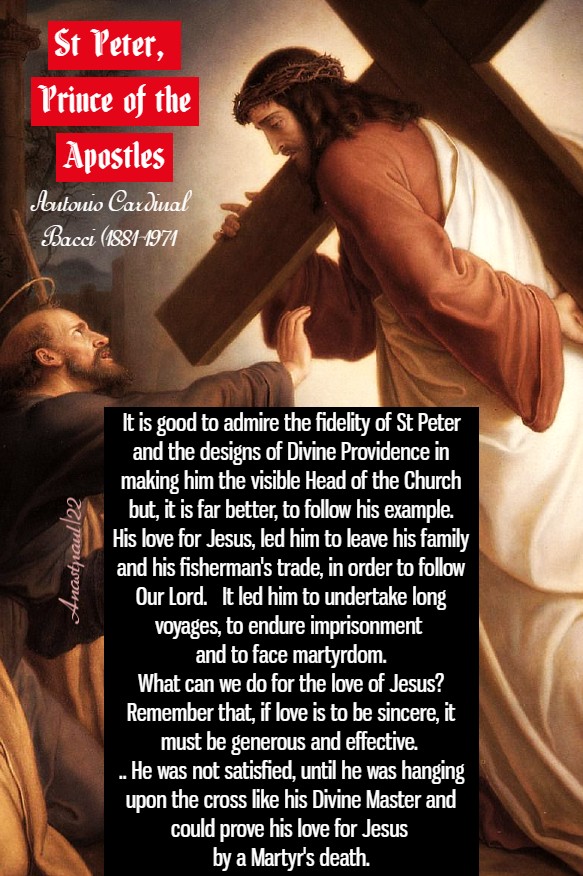
“It is good to admire the fidelity of St Peter and the designs of Divine Providence in making him the visible Head of the Church but, it is far better, to follow his example. His love for Jesus, led him to leave his family and his fisherman’s trade, in order to follow Our Lord. It led him to undertake long voyages, to endure imprisonment and to face martyrdom. What can we do for the love of Jesus? Remember that, if love is to be sincere, it must be generous and effective.
Secondly let us meditate on and imitate, the ardent and fearless faith of St Peter. He was not afraid to preach the teaching of Christ before the Sanhedrin. He was not afraid of Herod, who cast him into prison.
He was not afraid of the Roman Emperor, who caused him to be crucified. Our faith should be steadfast and lively, like his!
Finally, let us imitate Peter in his repentance. Although he loved Jesus very much and had such great faith in Him, in a moment of weakness and of imprudence, he denied Him three times. All his life, however, be wept bitterly for this sin. Whenever he heard a cock crowing, it was as if an arrow had pierced his heart. He was not satisfied, until he was hanging upon the cross like his Divine Master and could prove his love for Jesus by a Martyr’s death.”
St Paul, the Apostle to the Gentiles
We can learn many other virtues from St Paul, besides his zealous love for God and for his fellowmen. We can also learn from him, the virtues of humility and of apostolic fervour. The Apostle of the Gentiles reached such heights of sanctity, as to feel himself transformed into Christ Himself and to deserve to be taken up into the third Heaven, where he enjoyed a foretaste of eternal happiness. Nevertheless, he considered himself unworthy to be called an Apostle and he realised, that all his gifts came to him from God. “Not that we are sufficient of ourselves, to think anything as from ourselves but our sufficiency, is from God” (2 Cor 3:5). Whenever we succeed in any project, we should think on the same lines because, it is only when we are humble and depend on the grace of God, that the success of our actions will redound to the glory of our Creator. If the cancer of ambition or of self-love, should corrupt our purity of intention, our work would not be blessed by God and would not make us worthy of everlasting life. Let us repeat often: “All for You, with You and in You, my God.”
Quote/s of the Day – 29 June – Saints Peter and Paul, Apostles
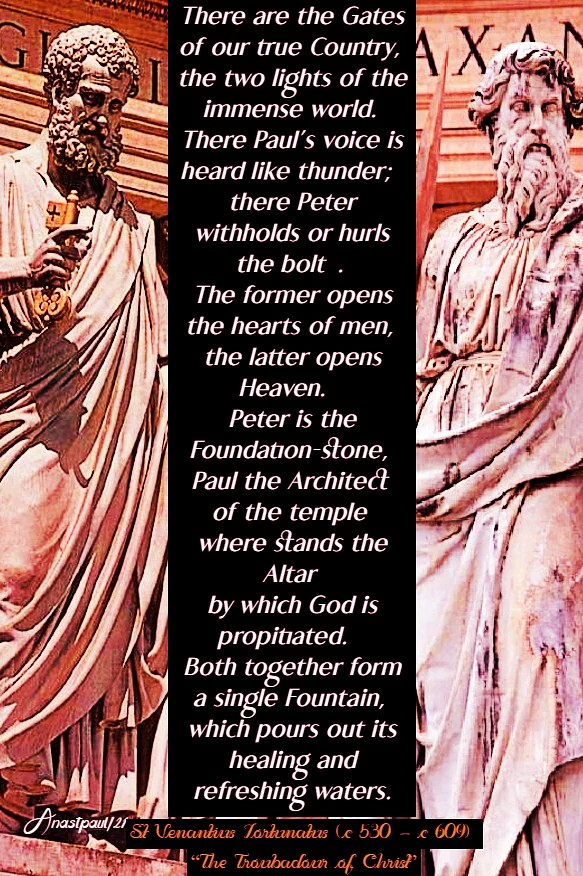
“There are the gates of our true country, the two lights of the immense world. There Paul’s voice is heard like thunder; there Peter withholds or hurls the bolt . The former opens the hearts of men, the latter opens Heaven. Peter is the Foundation-stone, Paul the Architect of the temple where stands the Altar by which God is propitiated. Both together form a single Fountain, which pours out its healing and refreshing waters.”
St Venantius Fortunatus (c 530 – c 609) “The Troubadour of Christ”
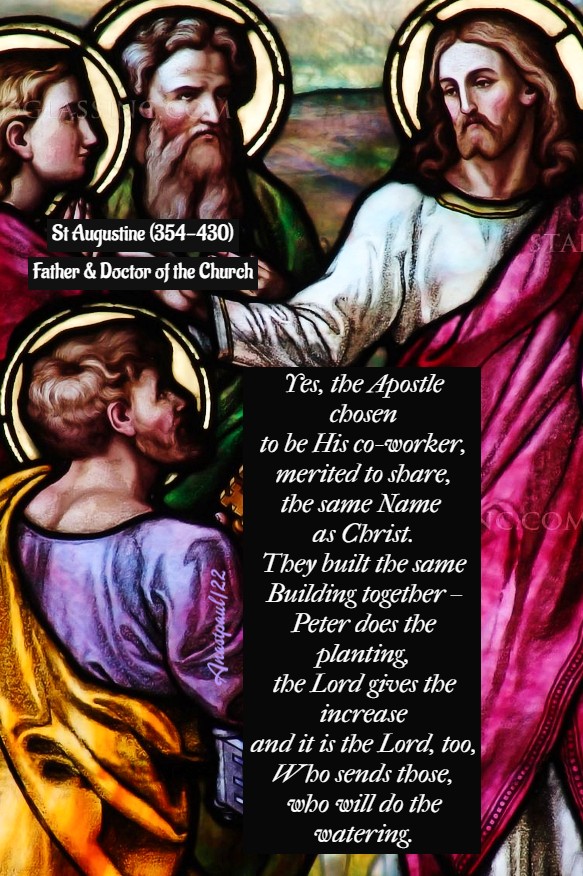
“Yes, the Apostle chosen to be His co-worker, merited to share, the same Name as Christ. They built the same Building together – Peter does the planting, the Lord gives the increase and it is the Lord, too, Who sends those, who will do the watering (cf 1 Cor 3:6f).”
St Augustine (354-430) Father & Doctor of the Church
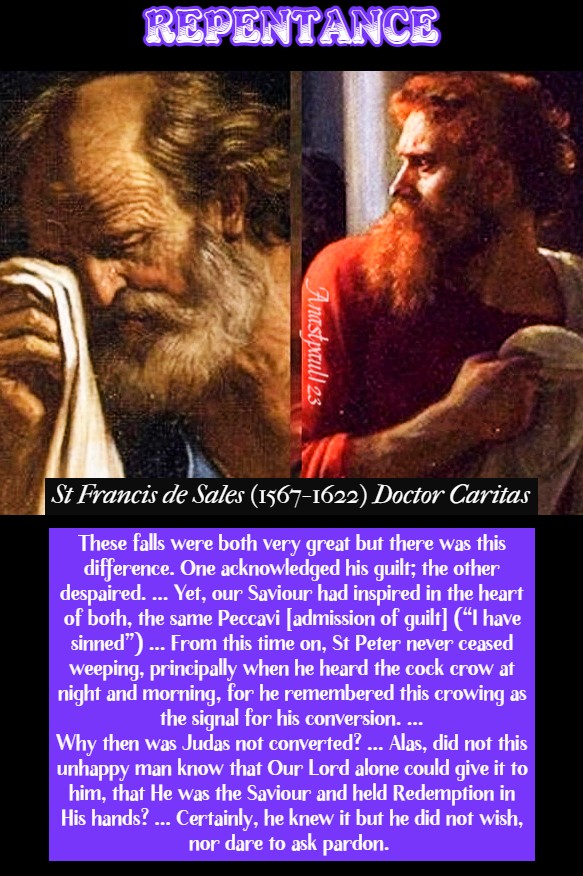
“These falls were both very great but there was this difference. One acknowledged his guilt; the other despaired. Yet, our Saviour had inspired in the heart of both, the same Peccavi [admission of guilt] (“I have sinned”) … From this time on, St Peter never ceased weeping, principally when he heard the cock crow at night and morning, for he remembered this crowing as the signal for his conversion. … Why then was Judas not converted? … Alas, did not this unhappy man know that Our Lord alone could give it to him, that He was the Saviour and held Redemption in His hands? … Certainly, he knew it but he did not wish, nor dare to ask pardon. ”
St Francis de Sales (1567-1622) Doctor Caritas
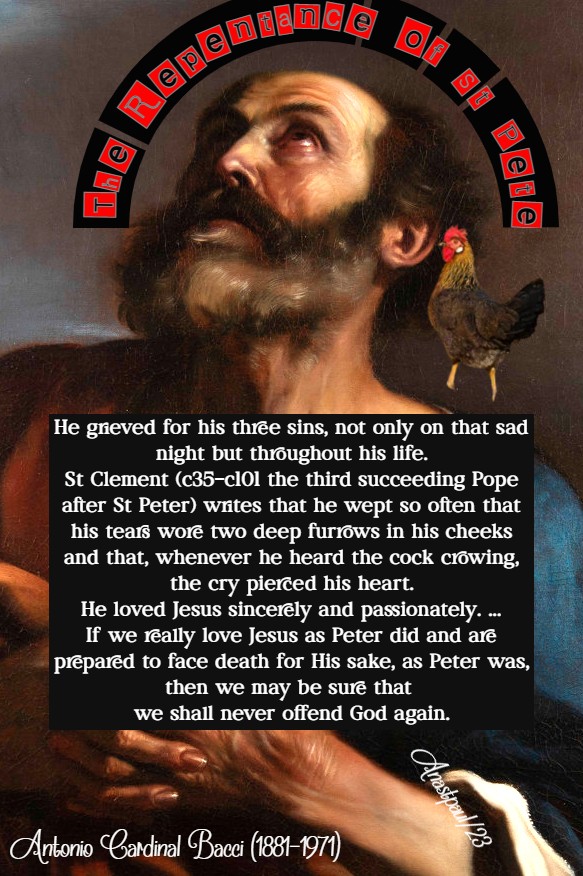
“He grieved for his three sins, not only on that sad night but throughout his life. St Clement (c35-c101 the third succeeding Pope after St Peter) writes that he wept so often that his tears wore two deep furrows in his cheeks and that, whenever he heard the cock crowing, the cry pierced his heart. He loved Jesus sincerely and passionately. If we really love Jesus as Peter did and are prepared to face death for His sake, as Peter was, then we may be sure that we shall never offend God again.”
Antonio Cardinal Bacci (1881-1971)
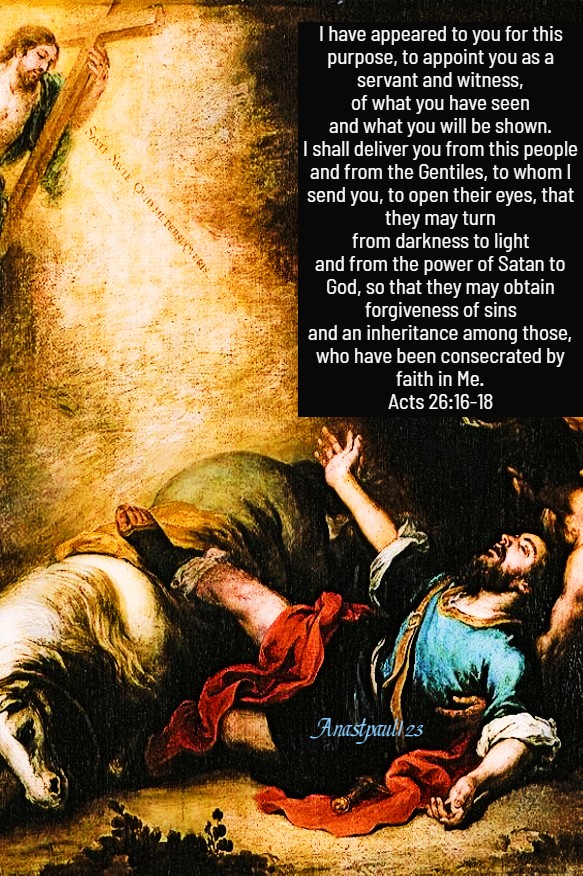
“I have appeared to you for this purpose, to appoint you as a servant and witness, of what you have seen and what you will be shown. I shall deliver you from this people and from the Gentiles, to whom I send you, to open their eyes, that they may turn from darkness to light and from the power of Satan to God, so that they may obtain forgiveness of sins and an inheritance among those, who have been consecrated by faith in Me.”
Acts 26:16-18
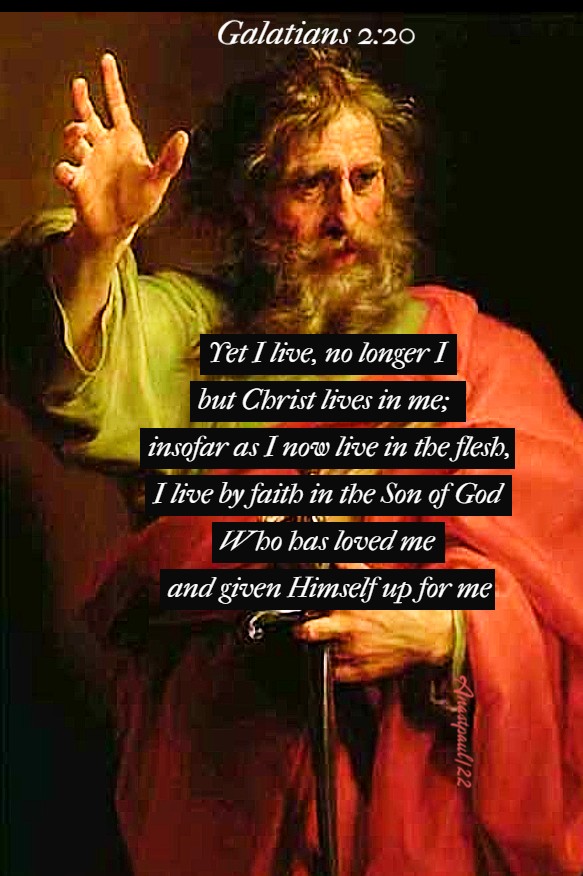
“Yet I live, no longer I but Christ lives in me; insofar as I now live in the flesh, I live by faith in the Son of God, Who has loved me and given himself up for me.”
Our Morning Offering – 29 June – Saints Peter and Paul, Apostles
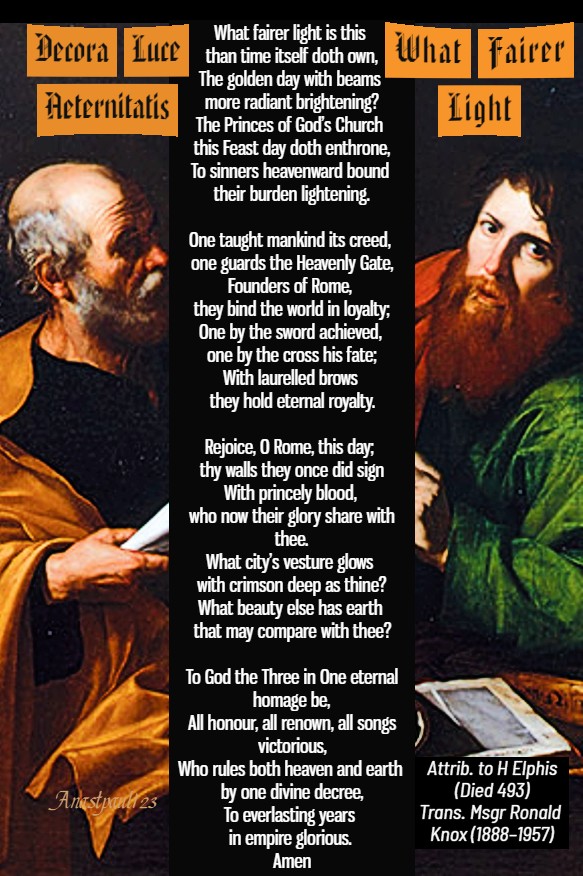
Decora Luce Aeternitatis What Fairer Light Attrib. to H Elphis (Died 493) Wife of Boethius c 477– 524) Trans. Msgr Ronald Knox (1888–1957)
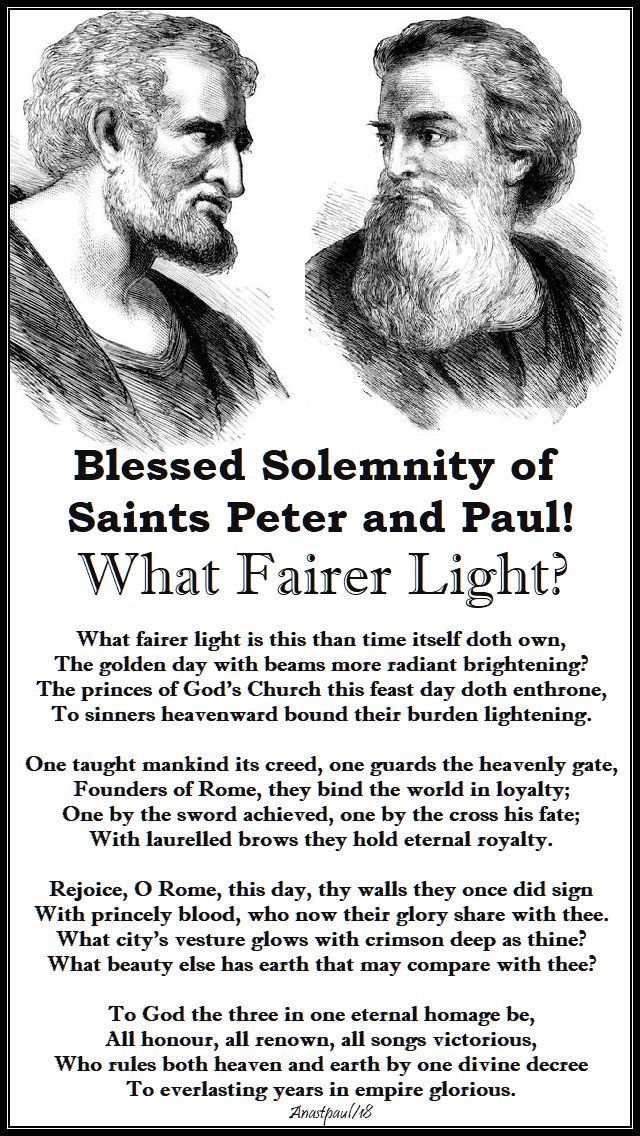
What fairer light is this than time itself doth own, The golden day with beams more radiant brightening? The Princes of God’s Church this Feast day doth enthrone, To sinners heavenward bound their burden lightening.
One taught mankind its creed, one guards the Heavenly Gate, Founders of Rome, they bind the world in loyalty; One by the sword achieved, one by the cross his fate; With laurelled brows they hold eternal royalty.
Rejoice, O Rome, this day; thy walls they once did sign With princely blood, who now their glory share with thee. What city’s vesture glows with crimson deep as thine? What beauty else has earth that may compare with thee?
To God the Three in One eternal homage be, All honour, all renown, all songs victorious, Who rules both heaven and earth by one divine decree, To everlasting years in empire glorious. Amen
5th century Latin Hymn “Aurea Luce” attributed to H Elphis (Died 493), first wife of the Roman philosopher-poet Boethius (c475–c525). He would eventually be Martyred for his defence of the Faith against the Arian ruler: Theodoric. Msgr Knox, a convert from Anglicanism, was a noted Scholar, Author, Hymnist and Translator, becoming the Secretary to St Pius X. Under direction of his religious superiors, he re-translated the Latin Vulgate Bible into English from Hebrew and Greek sources. What Fairer Light is set to the tune, Decora Lux by the English Catholic Composer, Samuel Webbe (1740–1816).
In 1632, in accord with changes called for by the Council of Trent, Pope Urban VIII (1568-1644) revised the original text of Aurea Luce and divided it into two new Hymns for Lauds and Vespers: Decora Lux and Beate Pastor Petre. In the Liturgy of the Hours, What Fairer Light is used on 29 June, the Solemnity of Sts Peter and Paul, Apostles. The above is the Older version.
St Anastasius of Bourges St Benedicta of Sens St Cassius (Died 558) Bishop of Narni, Italy St Ciwg ap Arawn St Cocha St Ilud Ferch Brychan St Judith of Niederaltaich St Marcellus of Bourges St Mary, the Mother of John Mark St Salome of Niederaltaich St Syrus of Genoa Bl William of Sann
Quote/s of the Day – 27 June – Feast of Our Mother of Perpetual Succour (Help)
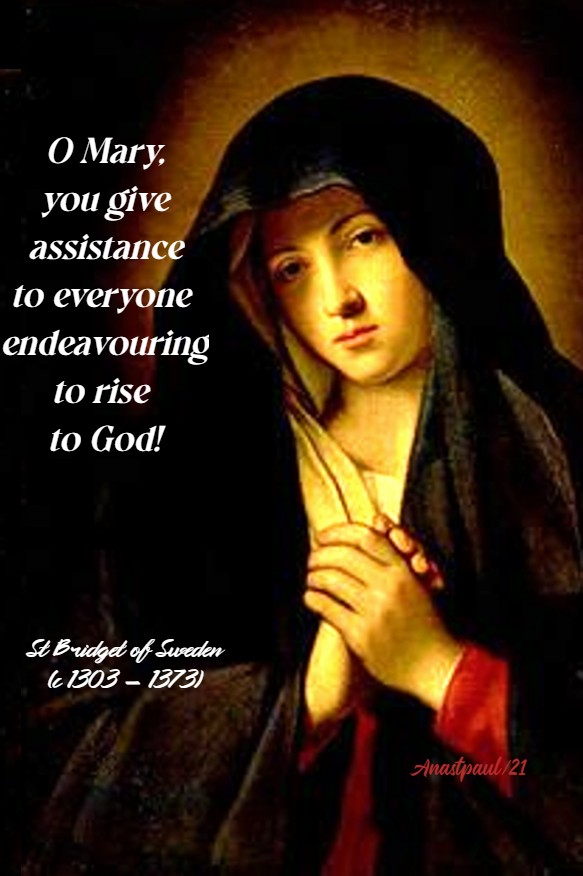
“O Mary, you give assistance to everyone endeavouring to rise to God!”
St Bridget of Sweden (c 1303 – 1373)
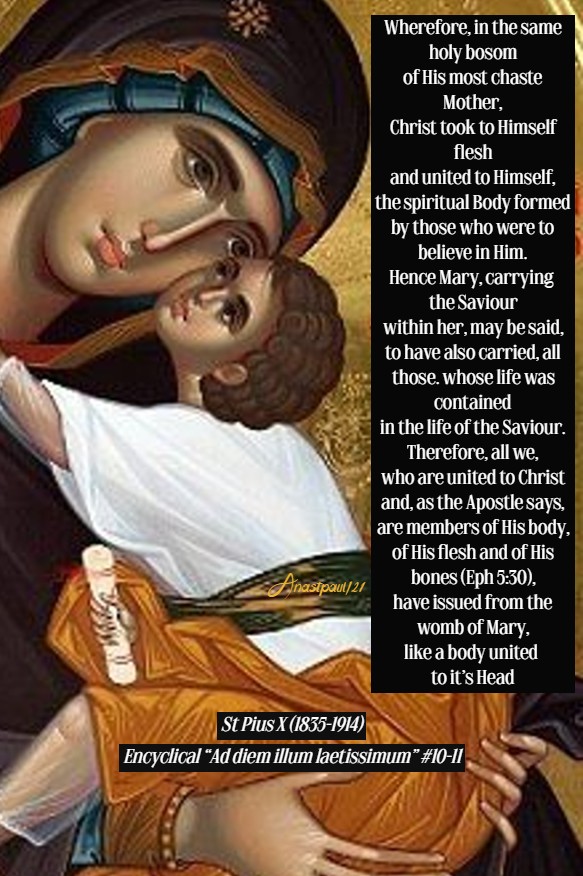
“Wherefore, in the same holy bosom of His most chaste Mother, Christ took to Himself flesh and united to Himself, the spiritual Body formed by those who were to believe in Him. Hence Mary, carrying the Saviour within her, may be said, to have also carried, all those. whose life was contained in the life of the Saviour. Therefore, all we, who are united to Christ and, as the Apostle says, are members of His body, of His flesh and of His bones (Eph 5:30), have issued from the womb of Mary, like a body united to it’s Head.”
St Pius X (1835-1914) Pope from 1903 to 1914 Encyclical “Ad diem illum laetissimum” #10-11
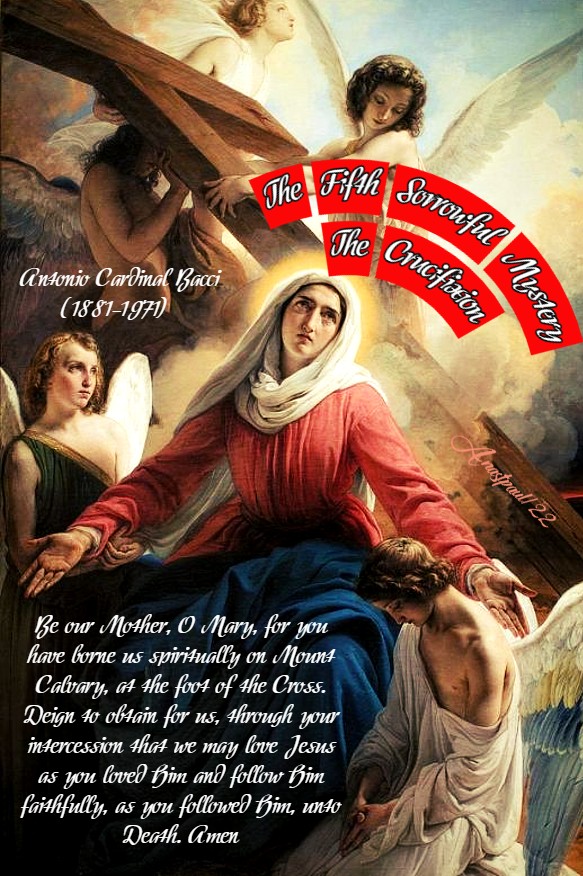
“Be our Mother, O Mary, for you have borne us spiritually on Mount Calvary, at the foot of the Cross. Deign to obtain for us, through your intercession that we may love Jesus as you loved Him and follow Him faithfully, as you followed Him, unto Death. Amen.”
Antonio Cardinal Bacci (1881-1971)
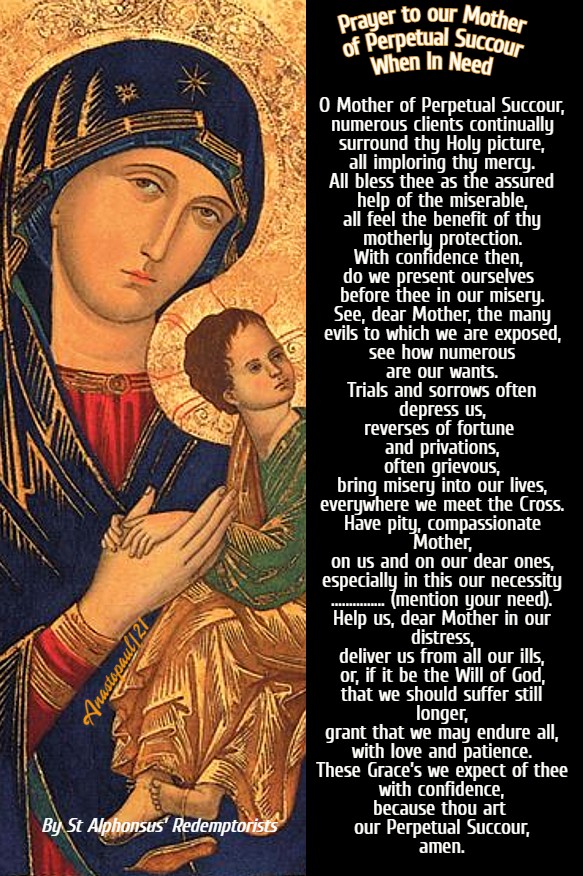
Prayer to Our Mother of Perpetual Succour, When In Urgent Need By St Alphonsus’ Redemptorists
O Mother of Perpetual Succour, numerous clients continually surround thy Holy picture, all imploring thy mercy. All bless thee as the assured help of the miserable, all feel the benefit of thy motherly protection. With confidence then, do we present ourselves before thee in our misery. See, dear Mother, the many evils to which we are exposed, see how numerous are our wants. Trials and sorrows often depress us, reverses of fortune and privations, often grievous, bring misery into our lives, everywhere we meet the Cross. Have pity, compassionate Mother, on us and on our dear ones, especially in this our necessity …………… (mention your need). Help us, dear Mother in our distress, deliver us from all our ills, or, if it be the Will of God, that we should suffer still longer, grant that we may endure all, with love and patience. These Grace’s we expect of thee with confidence, because thou art our Perpetual Succour, amen.
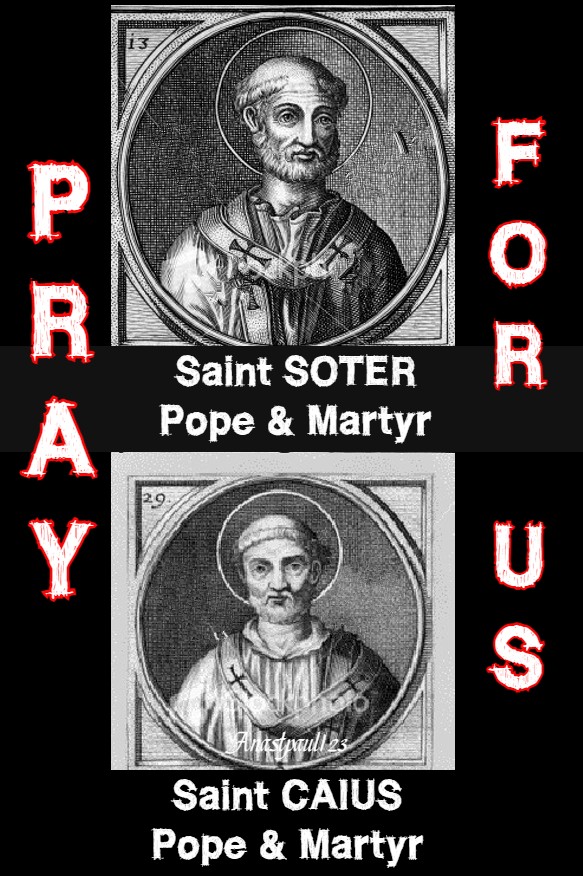
One Minute Reflection – 22 April – St Pope Soter (Died c174) Martyr and St Pope Caius I (Died 296) Martyr – 1 Peter 5:1-4; 5:10-11, Matthew 16:13-19 – Scripture search here: https://www.drbo.org/
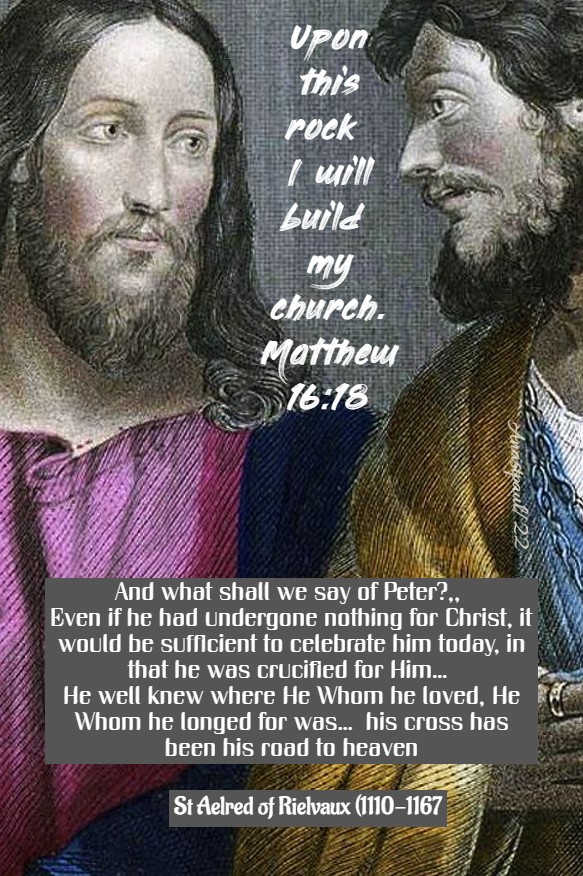
“Upon this rock I will build my church” – Matthew 16:18
REFLECTION – “Though the earth and all who dwell in it quake, I have set firm its pillars” (Ps 74:40). All the Apostles are pillars of the earth but, at their head, the two whose feast we are celebrating. They are the two pillars who support the Church with their teaching, their prayer and the example of their steadfastness. The Lord himself strengthened these pillars. For at first they were weak, completely incapable of supporting either themselves or others. And in this the Lord’s great design appears – if they had always been strong, people could have thought their strength came from themselves. That is why the Lord wanted to show ,what they were capable of before strengthening them, so that all might know their strength came from God… Peter was thrown to the ground by the voice of a mere servant… and the other pillar was very weak too: “I was once a blasphemer and persecutor and an arrogant man” (1Tm 1:13)…
Hence, we ought to praise these Saints with all our heart – our fathers who bore such trials for the Lord’s sake and who persevered with such determination. It is nothing to persevere in joy, happiness and peace. But this is what is great: to be stoned, scourged, struck for Christ (2Cor 11:25) and in all this, to persevere with Christ. With Paul, it is a great thing to be cursed and to bless, to be persecuted and to endure, to be slandered and to console, to be like the world’s rubbish and to draw glory from it (1Cor 4:12-13)…, And what shall we say of Peter?,, Even if he had undergone nothing for Christ, it would be sufficient to celebrate him today, in that he was crucified for Him… He well knew where He Whom he loved, He Whom he longed for was… his cross has been his road to heaven.” – St Aelred of Rielvaux (1110-1167) Cistercian Monk (Sermon 18, for the Feast of Saints Peter and Paul PL 195, 298).
PRAYER – Look forgivingly on Thy flock, Eternal Shepherd and keep it in thy constant protection, by the intercession of blessed Soter and Caius, Thy Martyrs and Sovereign Pontiffs, whom Thou didst constitute Shepherds of the whole Church. ThroughJesus Christ, Thy Son our Lord, Who lives and reigns with Thee, in the unity of the Holy Ghost, God, world without end. Amen (Collect).
Our Lenten Journey with St Francis de Sales – 31 March – – Friday in Passion Week, The Seven Sorrows of the Blessed Virgin
“Blessed is the soul, which thus everywhere, finds Jesus Christ Crucified!” St Francis de Sales
FRIDAY IN PASSION WEEK The Seven Sorrows of the Blessed Virgin St Francis de Sales (1567-1622) Doctor Caritas
“St Paul, the incomparable master, the great Doctor of the Infant Church, made Jesus Christ on the Cross the delightful object of his love, the sweet subject of his discourses, the end of all his aspirations in this world and the foundation of all his hopes in eternity. “I have judged myself,” he says, “to know nothing but my Jesus Crucified; God forbid that I should ever glory in any other thing. than in the Cross of my Jesus and think not that I have any other life, than that of the Cross; for I assure you, that I so feel and behold everywhere, the Cross of my Saviour, that by His grace I am altogether crucified to the world and the world is entirely crucified to me.” Blessed is the soul, which thus everywhere, finds Jesus Christ Crucified!” – (Consoling Thoughts of St Francis de Sales).
Quote/s of the Day – 28 March – Tuesday in Passion Week and the Memorial of St John of Capistrano OFM (1386-1456) Confessor – Wisdom 10:10-14, Luke 9:1-6 – Scripture search here: https://www.drbo.org/
“Take nothing for your journey, neither staff, nor bag, nor bread, nor money; neither have two tunics.”
Luke 9:3
“Pursue justice, godliness, faith, charity, patience, mildness. Fight the good fight of the faith, lay hold on the life eternal, to which you have been called …”
1 Timothy 6:11-12
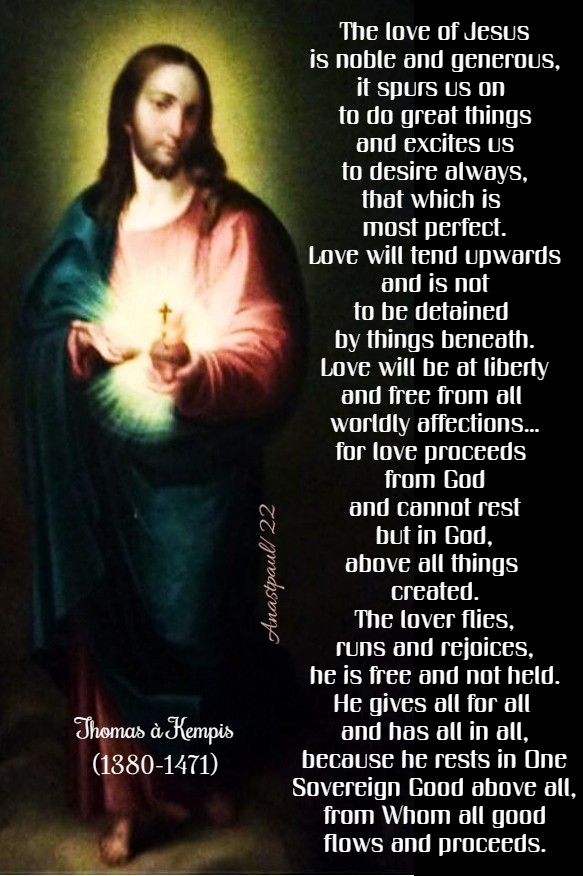
“The love of Jesus is noble and generous, it spurs us on to do great things and excites us to desire always, that which is most perfect. Love will tend upwards and is not to be detained by things beneath. Love will be at liberty and free from all worldly affections… for love proceeds from God and cannot rest but in God, above all things created. The lover flies, runs and rejoices, he is free and not held. He gives all for all and has all in all, because he rests in One Sovereign Good above all, from Whom all good flows and proceeds.”
Thomas à Kempis CRSA (1380-1471) (Book III, Chapter V, 3-4)
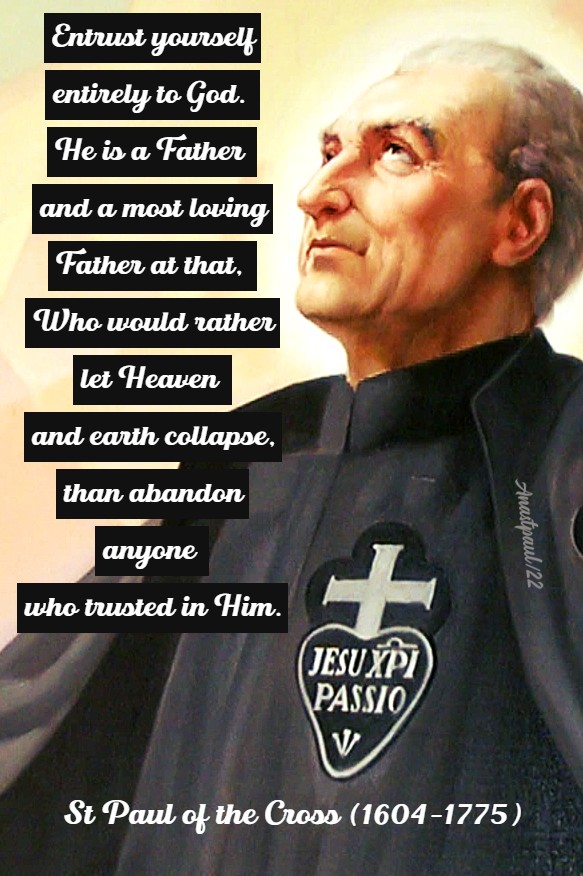
“Entrust yourself entirely to God. He is a Father and a most loving Father at that, Who would rather let Heaven and earth collapse, than abandon anyone who trusted in Him.”
St Paul of the Cross (1604-1775)
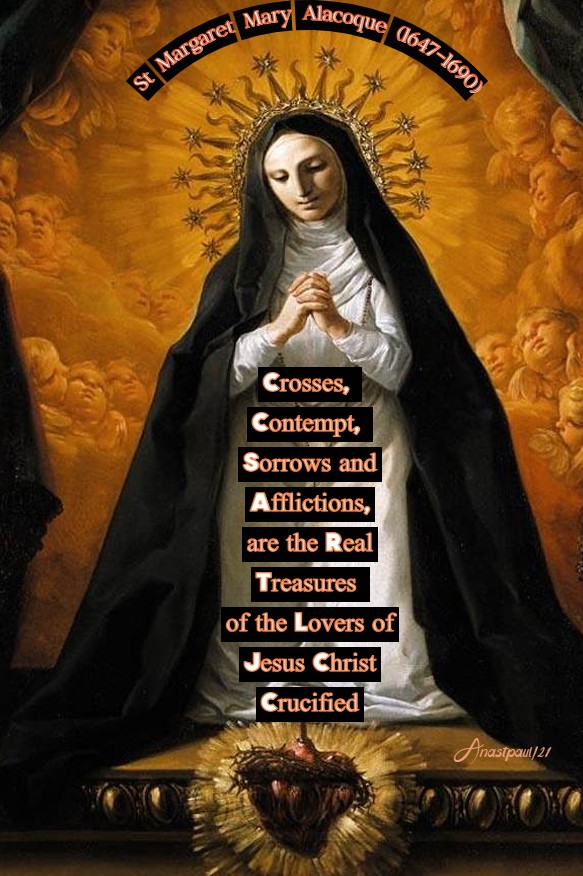
“Crosses, contempt, sorrows and afflictions, are the real treasures of the lovers of Jesus Christ Crucified.”
Quote/s of the Day – 26 February – The First Sunday of Lent – 2 Corinthians 6:1-10, Matthew 4:1-11
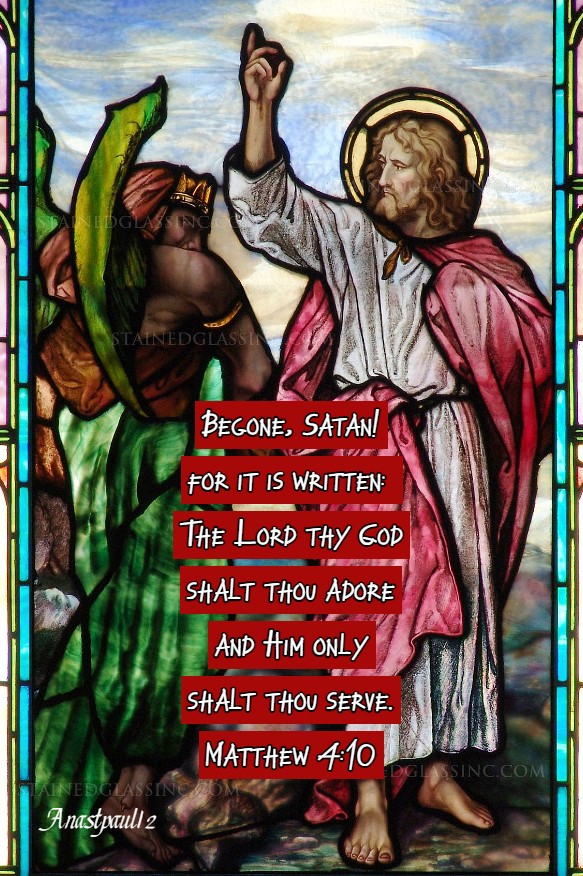
“Begone, Satan! for it is written: The Lord thy God shalt thou adore and Him only shalt thou serve.”
Matthew 4:10
“Do not, therefore, lose your confidence, which has a great reward. For you have need of patience that, doing the will of God, you may receive the promise. For yet a very little while and He Who is to come, will come and will not delay.”
Hebrews 10:35-37
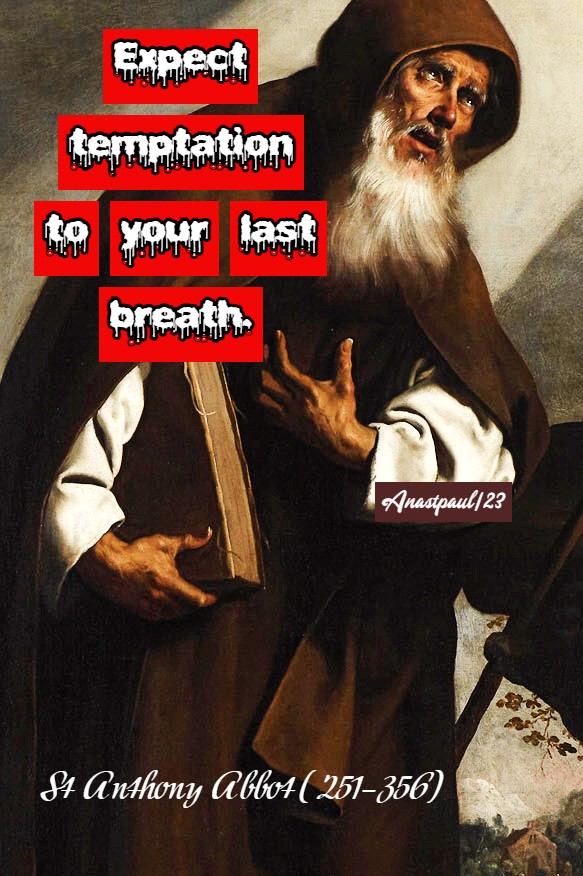
“Expect temptation to your last breath.”
St Anthony Abbot (251-356)
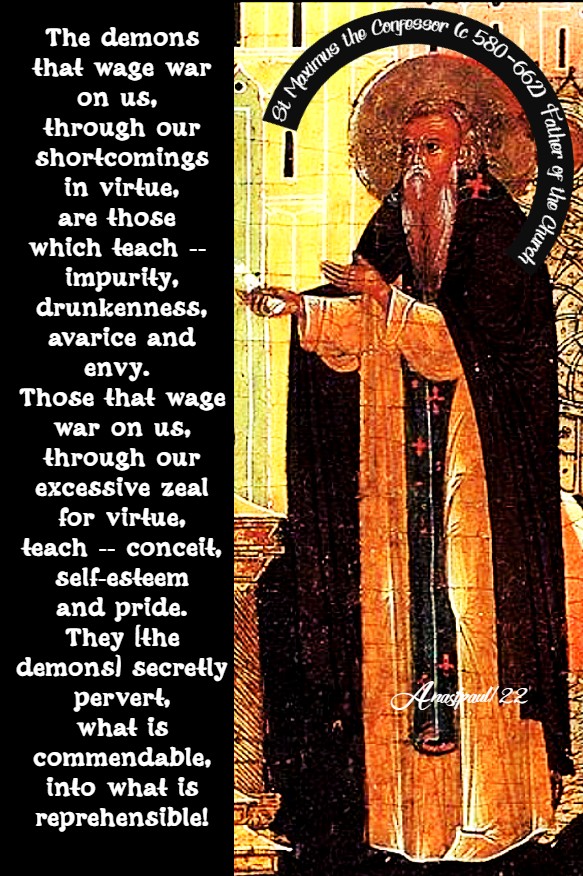
“The demons that wage war on us, through our shortcomings in virtue, are those which teach — impurity, drunkenness, avarice and envy. Those that wage war on us, through our excessive zeal for virtue, teach — conceit, self-esteem and pride. They [the demons] secretly pervert, what is commendable, into what is reprehensible!”
St Maximus the Confessor (c 580-662) Father of the Church
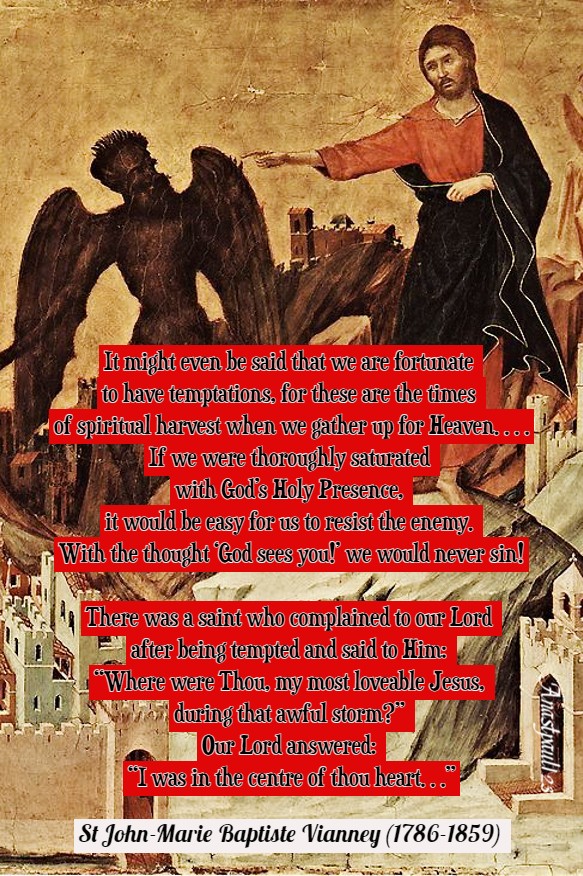
“It might even be said that we are fortunate to have temptations, for these are the times of spiritual harvest when we gather up for Heaven. … If we were thoroughly saturated with God’s Holy Presence, it would be easy for us to resist the enemy. With the thought ‘God sees you!’ we would never sin!
There was a saint who complained to our Lord after being tempted and said to Him: “Where were Thou, my most loveable Jesus, during that awful storm?” Our Lord answered: “I was in the centre of thou heart…”
St John-Marie Baptiste Vianney (1786-1859) The Curé of Ars
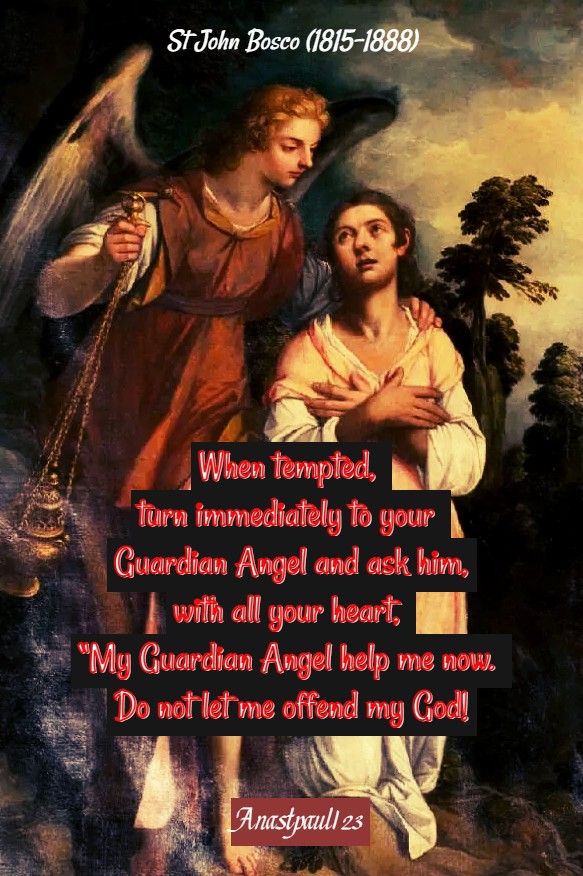
“When tempted, turn immediately to your Guardian Angel and ask him, with all your heart, “My Guardian Angel help me now. Do not let me offend my God!”
St John Bosco (1815-1888)
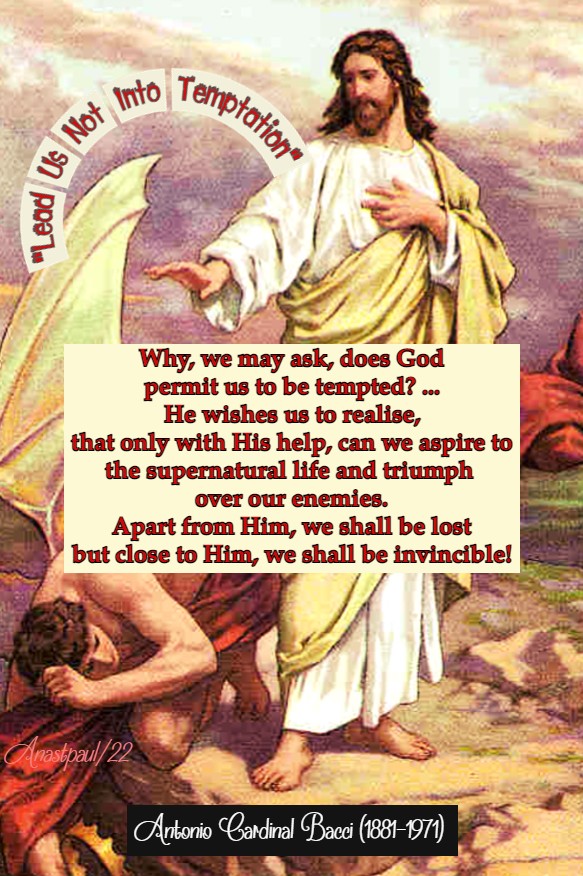
“Why, we may ask, does God permit us to be tempted? He wishes us to realise, that only with His help, can we aspire to the supernatural life and triumph over our enemies. Apart from Him, we shall be lost but close to Him, we shall be invincible!”





























 AnaStpaul
You must be logged in to post a comment.