Posted in CONFESSION/PENANCE, DOCTORS of the Church, FATHERS of the Church, MORNING Prayers, QUOTES of the SAINTS, SUNDAY REFLECTIONS, The HOLY EUCHARIST / The HOLY MASS, Uncategorized

Sunday Reflection – 3 February – “May we be Worthy” – St Cyprian of Carthage

Sunday Reflection – 3 February – Fourth Sunday in Ordinary Time, Year C

“May we be Worthy”

“He [Paul] threatens, moreover, the stubborn and forward and denounces them, saying, ‘Whosoever eats the bread or drinks the cup of the Lord unworthily, is guilty of the body and blood of the Lord’ [1 Cor. 11:27].

All these warnings being scorned and contemned—[lapsed Christians will often take Communion] before their sin is expiated, before confession has been made of their crime, before their conscience has been purged by sacrifice and by the hand of the priest, before the offence of an angry and threatening Lord has been appeased, [and so] violence is done to His body and blood and they sin now, against their Lord, more with their hand and mouth than when they denied their Lord”

St Cyprian of Carthage (c 200- c 258) Bishop and Martyr, Father of the Church
(The Lapsed 15–16 [written in 251])lapsed christians - st cyprian of carthage - 3 feb 2019 sun reflec.jpg

Posted in MORNING Prayers, SUNDAY REFLECTIONS, The HOLY EUCHARIST / The HOLY MASS

Thought for the Day – 27 January – The Third Sunday in Ordinary Time, Year C- Christ is present to His Church

Thought for the Day – 27 January – The Third Sunday in Ordinary Time, Year C – Gospel: Luke 4:14–21

Christ is present to His Church

Second Vatican Council

An excerpt from Sacrosanctum Concilium, 7-8.

Christ is always present to His Church, especially in the actions of the liturgy.   He is present in the sacrifice of the Mass, in the person of the minister (it is the same Christ who formerly offered Himself on the cross that now offers by the ministry of priests) and most of all under the eucharistic species.   He is present in the sacraments by His power, in such a way, that when someone baptises, Christ Himself baptises.   He is present in His word, for it is He Himself who speaks, when the holy Scriptures are read in the Church. Finally, He is present when the Church prays and sings, for He Himself promised:  Where two or three are gathered in my name, I am there in their midst.

Indeed, in this great work which gives perfect glory to God and brings holiness to men, Christ is always joining in partnership with Himself, His beloved Bride, the Church, which calls upon its Lord and through Him gives worship to the eternal Father.

It is, therefore, right to see the liturgy as an exercise of the priestly office of Jesus Christ, in which through signs addressed to the senses, man’s sanctification is signified and, in a way proper to each of these signs, made effective and in which public worship is celebrated in its fullness, by the mystical body of Jesus Christ, that is, by the head and by His members.

Accordingly, every liturgical celebration, as an activity of Christ the priest and of His body, which is the Church, is a sacred action of a pre-eminent kind.   No other action of the Church equals its title, to power or its degree, of effectiveness.

In the liturgy on earth we are given a foretaste and share in the liturgy of heaven, celebrated in the holy city of Jerusalem, the goal of our pilgrimage, where Christ is seated at the right hand of God, as minister of the sanctuary and of the true tabernacle.   With the whole company of heaven we sing a hymn of praise to the Lord, as we reverence the memory of the saints, we hope to have some part with them and to share in their fellowship, we wait for the Saviour, our Lord Jesus Christ, until He, who is our life, appears and we appear with Him in glory.

By an apostolic tradition taking its origin from the very day of Christ’s resurrection, the Church celebrates the paschal mystery every eighth day, the day that is rightly called the Lord’s day.   On Sunday, the Christian faithful ought to gather together, so that by listening to the word of God and sharing in the Eucharist they may recall the passion, death and resurrection of the Lord Jesus and give thanks to God who has given them a new birth with a lively hope, through the resurrection of Jesus Christ from the dead.

The Lord’s day is therefore the first and greatest festival, one to be set before the loving devotion of the faithful and impressed upon it, so that it may be also, a day of joy and of freedom from work.   Other celebrations must not take precedence over it, unless they are truly of the greatest importance, since it is the foundation and the kernel of the whole liturgical year.the lord's day - sacrosanctum concilium 7-8 vat II.jpg
Posted in EUCHARISTIC Adoration, MORNING Prayers, QUOTES of the SAINTS, SUNDAY REFLECTIONS, The HOLY EUCHARIST / The HOLY MASS

Sunday Reflection – 27 January – Honour Jesus Truth, Way and Life at Mass

Sunday Reflection – 27 January – The Third Sunday in Ordinary Time, Year C – First Reading: Nehemiah 8:8–10

“Go your way, eat the fat and drink sweet wine…” Nehemiah 8:10

“For it is a holy day of the Lord for us when we take pains to hear and carry out His words.   On this day it is proper that, however much outwardly we have endured the obstacles of tribulations, we should be “rejoicing in hope,” in keeping with the apostle’s saying:  “As if sorrowful, yet always rejoicing.”   On this day we are also commanded to eat fat food and drink sweet drink, that is, to rejoice over the abundance of good action bestowed on us by God and over the very sweetness of hearing God’s Word” ., St Bede the Venerable (673-735) Father & Doctor (On Ezra and Nehemiah, 3.)

By Blessed James Alberione (1884-1971) (Founder of the Pauline Family)

Honour Jesus Truth, Way and Life at Mass

The Eucharistic Celebration is the centre and principal act of worship….
There are many methods for participating in the Mass.
A suggestion:
a) From the beginning to the Gospel,
honour Jesus Truth
by meditating and applying the sacred doctrine, especially the Epistle and the Gospel.
b) From the Gospel to the “Our Father,”
honour Jesus, Way to the Father, especially in the Passion and prayer.
c) From the “Our Father” to the end,
honour Jesus, Life of the soul,
by receiving Communion and its sanctifying and healing grace.

Then Live a Eucharistic Day

It is a good practice to make the Host the day’s foundation.
This means making the day Eucharistic.
Spend the morning [after Mass] in thanksgiving,
displaying the fruits of a holy joy,
working “through Him, with Him and in Him,”
to the glory of the most Blessed Trinity.
From midday to the following morning
start your preparation by offering, sanctifying and carrying out your various duties
with your heart in tune with the Dweller in the tabernacle.live a eucharistic day 27 jan 2019 - bl james alberione.jpg

Posted in CONFESSION/PENANCE, FATHERS of the Church, MORNING Prayers, QUOTES of the SAINTS, QUOTES on CONSCIENCE, SUNDAY REFLECTIONS, The HOLY EUCHARIST / The HOLY MASS, The WORD

Sunday Reflection – 20 January – “…Let him first strive to cleanse his conscience”

Sunday Reflection – 20 January – Second Sunday in Ordinary Time, Year C

“…Let him first strive to cleanse his conscience”

St Caesarius of Arles (470-542) Bishop of Arles, Father of the Church

And so, dearly beloved brethren, let us each examine his conscience and when he sees that he has been wounded by some sin, let him first strive to cleanse his conscience by prayer, fasting, almsgiving and so dare to approach the Eucharist.   If he recognises his guilt and is reluctant to approach the holy altar, he will be quickly pardoned by the Divine Mercy, “for whoever exalts himself will be humbled and whoever humbles himself will be exalted” (Mt 23:12).   If then, as I have said, a man conscious of his sins, humbly decides to stay away from the altar until he reforms his life, he will not be afraid of being completely excluded from the eternal banquet of heaven.

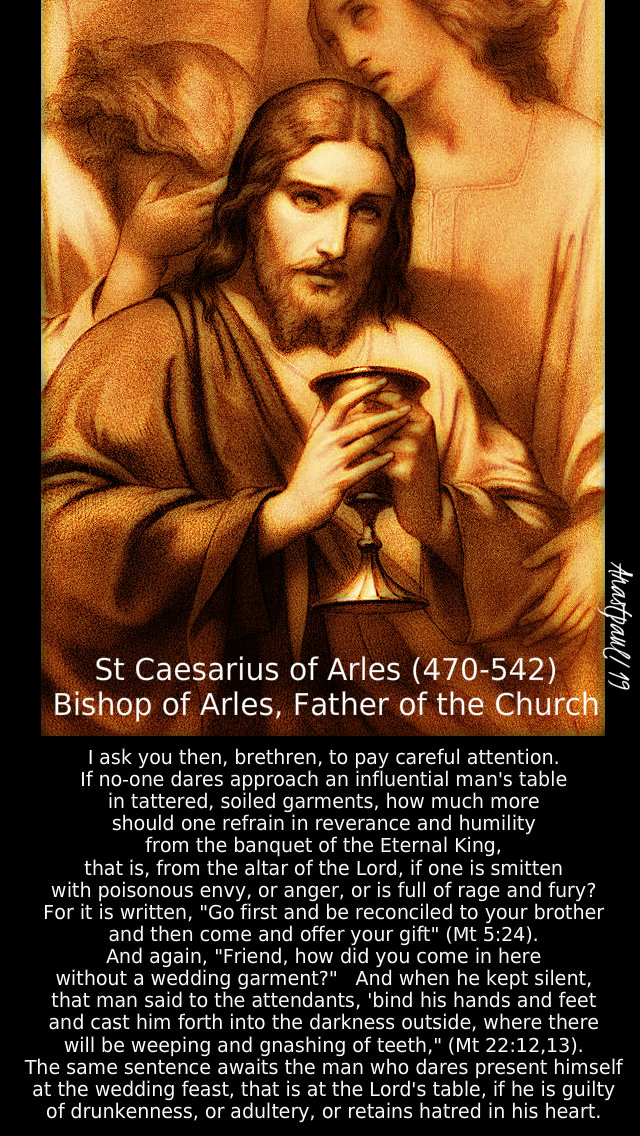
I ask you then, brethren, to pay careful attention.   If no-one dares approach an influential man’s table in tattered, soiled garments, how much more should one refrain in reverance and humility from the banquet of the Eternal King, that is, from the altar of the Lord, if one is smitten with poisonous envy, or anger, or is full of rage and fury?   For it is written, “Go first and be reconciled to your brother and then come and offer your gift” (Mt 5:24).   And again, “Friend, how did you come in here without a wedding garment?” And when he kept silent, that man said to the attendants, ‘bind his hands and feet and cast him forth into the darkness outside, where there will be weeping and gnashing of teeth,” (Mt 22:12,13).   The same sentence awaits the man who dares present himself at the wedding feast, that is at the Lord’s table, if he is guilty of drunkenness, or adultery, or retains hatred in his heart.

St Caesarius of Arles (470-542) Bishop of Arles, was the foremost ecclesiastic of his generation in Merovingian Gaul. Caesarius is considered to be of the last generation of church leaders of Gaul that worked to promote large-scale ascetic elements into the Western Christian tradition.   Caesarius was a “popular preacher of great fervour and enduring influence”.   Among those who exercised the greatest influence on Caesarius were Augustine of Hippo, Julianus Pomerius and John Cassian.i ask you then brethren to pay careful attention - st caesarius bishop and father 20 jan 2019

Posted in EUCHARISTIC Adoration, MORNING Prayers, QUOTES of the SAINTS, SUNDAY REFLECTIONS, The HOLY EUCHARIST / The HOLY MASS

Sunday Reflection – 13 January – Above all, let us pray Him to draw us to Him and to give us faith.

Sunday Reflection – 13 January – Feast of the Baptism of the Lord

Above all, let us pray Him to draw us to Him and to give us faith.

Blessed John Henry Newman (1801-1890)
(Parochial & Plain Sermons, Vol. VI, no. 11)

“Above all, let us pray Him to draw us to Him and to give us faith.   When we feel that His mysteries are too severe for us and occasion us to doubt, let us earnestly wait on Him for the gift of humility and love.   Those who love and who are humble will apprehend them, carnal minds do not seek the and proud minds are offended at them but while love desires them, humility sustains them.

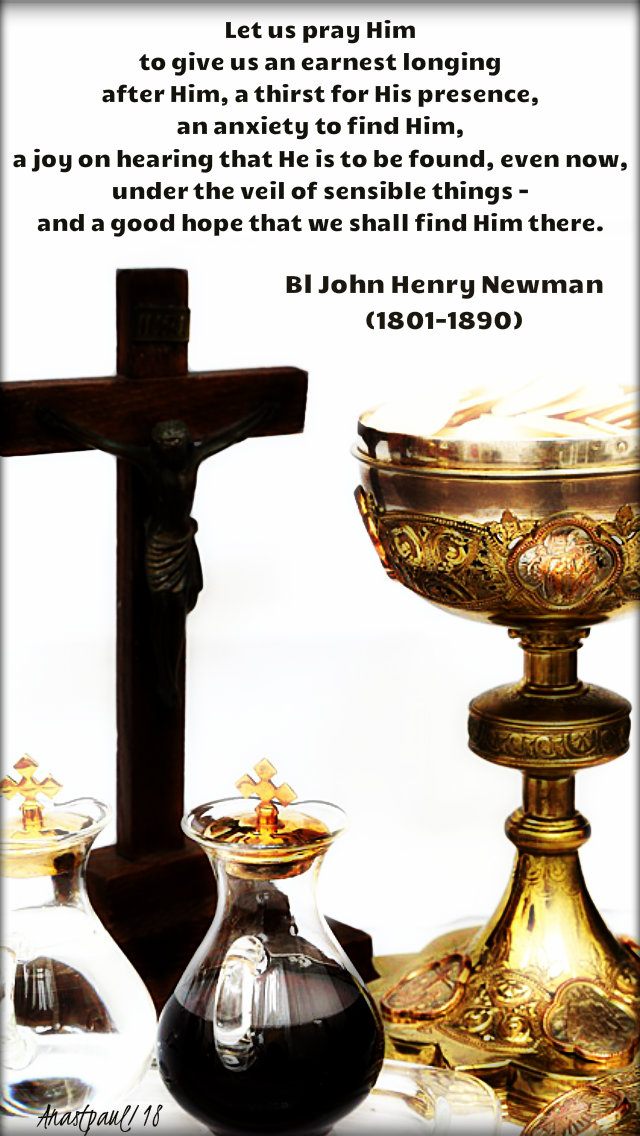
Let us pray Him to give us an earnest longing after Him – a thirst for His presence – an anxiety to find Him – a joy on hearing that He is to be found, even now, under the veil of sensible things – and a good hope that we shall find Him there.

Blessed indeed are they who have not seen and yet have believed.   They have their reward in believing, they enjoy the contemplation of a mysterious blessing, which does not even enter into the thoughts of other men and while they are more blessed than others, in the gift vouchsafed to them, they have the additional privilege of knowing that they are vouchsafed it.”let us pray him to give us - bl john henry newman 13 jan 2019.jpg

Posted in MORNING Prayers, PRACTISING CATHOLIC, QUOTES of the SAINTS, SUNDAY REFLECTIONS, THE EPIPHANY of the LORD, The HOLY EUCHARIST / The HOLY MASS, Thomas a Kempis

Sunday Reflection – 6 January – The Solemnity of the Epiphany of the Lord

Sunday Reflection – 6 January – The Solemnity of the Epiphany of the Lord

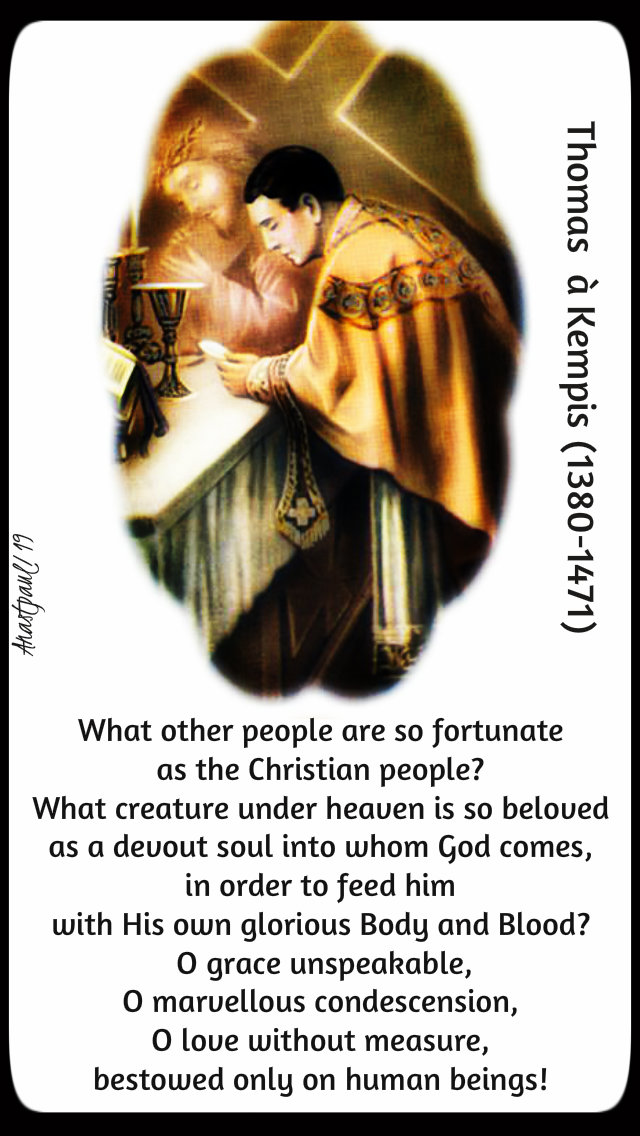
“What other people are so fortunate as the Christian people?   What creature under heaven is so beloved as a devout soul into whom God comes, in order to feed him with His own glorious Body and Blood?   O grace unspeakable, O marvellous condescension, O love without measure, bestowed only on human beings!

There is nothing I can give to the Lord for this grace – this supreme love;  nothing acceptable I can offer Him but my heart entirely given to God and closely united to Him. Then, all that is within me will be filled with joy, when my soul is perfectly one with God.

Then He will say to me:  “If you will be with Me, I will be with you.”  And I will answer Him and say: “Stay with me, Lord, I implore You, for my desire is to be with You.”

This is my whole desire – that my heart be united to You.”

Thomas à Kempis (1380-1471)

Book 4-Chapter 13 #3
Blessed Sacramentwhat other people are so fortunate - thomas a kempis - sun reflec 6 jan 2019.jpg

Posted in MORNING Prayers, QUOTES of the SAINTS, QUOTES on the FAMILY, SUNDAY REFLECTIONS, The HOLY EUCHARIST / The HOLY MASS

Sunday Reflection – 30 December – The family is called to become a daily offertory

Sunday Reflection – 30 December – Feast of the Holy Family of Jesus, Mary and Joseph

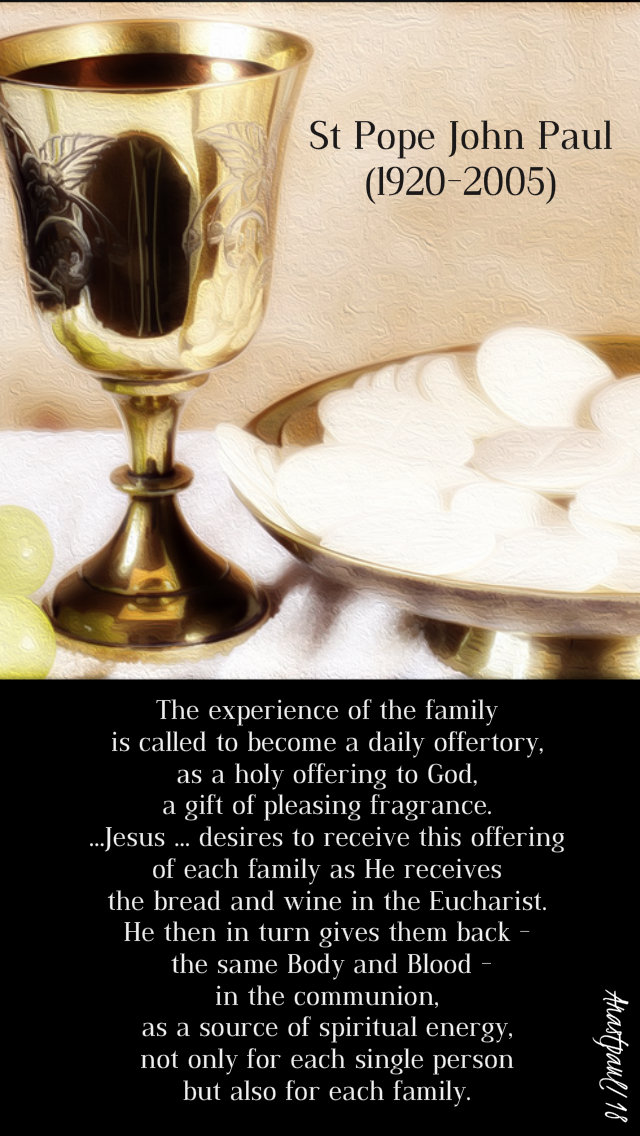
“Actually, the experience of the family is called to become a daily offertory, as a holy offering to God, a gift of pleasing fragrance.
The Gospel of the Presentation of Jesus at the Temple, suggests us this same idea.
Jesus, the light of the world but also “a sign that will be contradicted” (Lk 2:32.34), desires to receive this offering of each family as He receives the bread and wine in the Eucharist.
He wants to join to the bread and wine destined to transubstantiation,
these human hopes and joys but also the inevitable sufferings and preoccupations of each family,
by incorporating them to the mystery of His Body and his Blood.
He then in turn gives them back – the same Body and Blood – in the communion,
as a source of spiritual energy,
not only for each single person but also for each family.”

St Pope John Paul (1920-2005)the experience of the family - st pope john paul 30 dec 2018

Posted in EUCHARISTIC Adoration, MORNING Prayers, QUOTES - J R R Tolkien and MORE, SUNDAY REFLECTIONS, The HOLY EUCHARIST / The HOLY MASS, The INCARNATION

Sunday Reflection – 23 December – The Eucharistic Humility of God (Excerpt)

Sunday Reflection – 23 December – The Fourth Sunday of Advent – The Eucharistic Humility of God (Excerpt)

Because humility belongs to God alone
who made it His own in the mystery of the Incarnation,
and who continues to make it His own
so often as the mystic words are uttered by a priest
over a little bread and a little wine mixed with water:
“This is My Body. This is the chalice of My Blood.”
Here is the Mysterium Fidei:
the Eucharistic Humility of God.
Eat the Body of Christ and digest the Divine Humility.
Drink the Blood of Christ;
it is the elixir of those who would hide themselves with Christ in God.
Since the event of the Incarnation
–the descent of God into the Virgin’s womb,
in view of His descent into death’s dark tomb–
and so often as Holy Mass is celebrated
–the descent of God into the frail appearance of Bread
and into the taste and fragrance and wetness
of a few drops of wine–
humility can be found nowhere else.
The very least and last of the guests
has become The Host,
and The Host
has made Himself the very least and last of the guests.
Tremble, then, to adore Him,
and having adored Him, receive Him,
that your soul may become the throne of the Humble Hidden God
and His humility your most cherished treasure.
“Learn from Me,” He says,
“for I am meek and humble of heart” (Matthew 11:29),
and again,
“Everyone that exalts himself shall be humbled,
and he that humbles himself shall be exalted” (Luke 14:11).

Fr ‘Dom’ Marktremble then to adore him - fr dom mark vultus christi 23 dec 2018 sun reflection

Posted in ADVENT, BREVIARY Prayers, CATHOLIC-PRAYERS OF THE CHURCH, PRACTISING CATHOLIC, PRAYERS of the CHURCH, SUNDAY REFLECTIONS, The WORD

Sunday Reflections – Gaudete Sunday

Sunday Reflections – Gaudete Sunday – The Third Sunday of Advent – 16 December 2018gaudete-sunday

What is special about the Third Sunday of Advent?   For much of the Church’s history, this Sunday had a special name:  “Gaudete” Sunday.   The traditions surrounding this Sunday go back as far as the fourth or fifth century, as does the season of Advent itself. Advent, our preparation for Christmas, was originally a forty-day penitential season like Lent.   In fact, since it used to begin on 12 November (just after the Memorial of St. Martin of Tours), it was called “St Martin’s Lent.”   “Gaudete Sunday” was the Advent counterpart to “Laetare Sunday,” which marks the mid-point in Lent.

On Gaudete Sunday, the season of Advent shifts its focus.   For the first two weeks of Advent, the focus can be summed up in the phrase, “The Lord is coming.”   But beginning with Gaudete Sunday, the summary might be, “The Lord is near.”   This shift is marked by a lighter mood and a heightened sense of joyous anticipation.

Liturgically, the colours lighten as well.   The priest usually wears rose-coloured vestments, a hue seen only on Gaudete Sunday and Laetare Sunday.   On this day, we light the third candle of the Advent wreath, which is also rose-coloured, or if you prefer, pink.
The word “Gaudete” is Latin for “Rejoice.”   This celebration is a reminder that God who loves us is still in charge and that we await His coming not with fear but with  tremendous joy.   Today’s Second Reading, from the Letter of St Paul to the Ephesians, reflects this joy:  “Rejoice in the Lord always; again I will say, Rejoice.  Let all men know your forbearance. The Lord is at hand.  Have no anxiety about anything but in everything by prayer and supplication with thanksgiving let your requests be made known to God.  And the peace of God, which passes all understanding, will keep your hearts and your minds in Christ Jesus.”

THE “O ANTIPHONS” OF ADVENT

The one exception to the audio barrage of so-called ‘Christmas Hymns’ we hear during Advent, is the simple chant “O Come, O Come Emmanuel.”   This song, with its longing for the coming of the Saviour, genuinely belongs to Advent and not to Christmas.
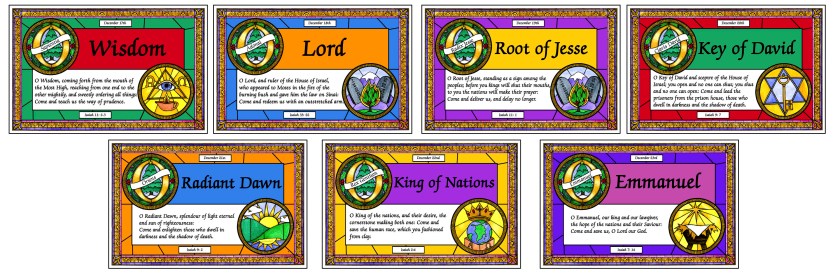
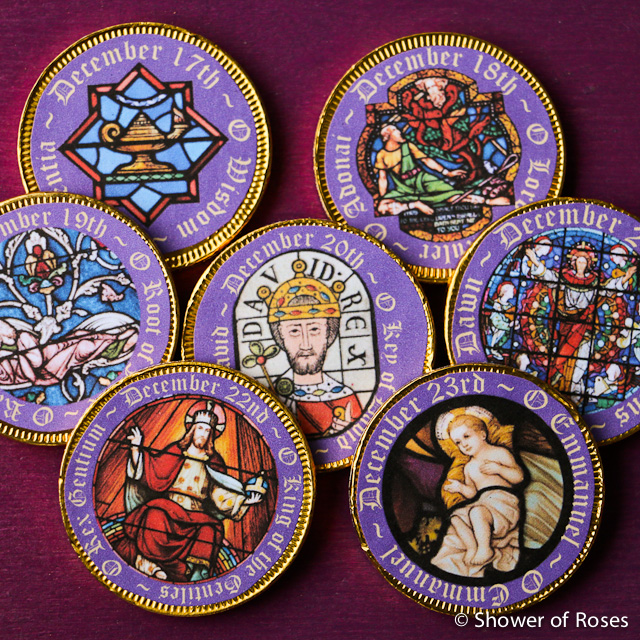
Its melody is based on Gregorian chant and its verses are all taken from the Church’s “O antiphons.” These antiphons introduce the Magnificat, or Canticle of Mary, in the Evening Prayer of the Liturgy of the Hours from 17 December through 23 December.
Each antiphon begins with a traditional title for Christ.

They are: “O Wisdom,” “O Leader of the House of Israel
[Adonai],” “O Root of Jesse’s Stem,” “O Key of David,” “O Radiant Dawn,” “O King of all the nations,” and finally, “O Emmanuel” which means “God with us.”    Each of these traditional titles for the Messiah connects the coming of Christ with the prophetic writings of the Old Testament.stained_glass_o_antiphons.jpg

On the last days of Advent, you may wish to add these “O Antiphons” to your
evening prayer, your prayer at table, or your bedtime prayer.

17 DECEMBER
O Wisdom of our God Most High,
guiding creation with power and love:
come to teach us the path of knowledge!
18 DECEMBER
O Leader of the House of Israel,
giver of the Law to Moses on Sinai:
come to rescue us with your mighty power!
19 DECEMBER
O Root of Jesse’s stem,
sign of God’s love for all his people:
come to save us without delay!
20 DECEMBER
O Key of David,
opening the gates of God’s eternal Kingdom:
come and free the prisoners of darkness!
21 DECEMBER
O Radiant Dawn,
splendour of eternal light, sun of justice:
come and shine on those who dwell in darkness and in the shadow of death.
22 DECEMBER
O King of all nations and keystone of the Church:
come and save man, whom you formed from the dust!
23 DECEMBER
O Emmanuel, our King and Giver of Law:
come to save us, Lord our God!

the o antiphons

Posted in papal ENCYCLICALS, PAPAL ENCYLICALS, QUOTES of the SAINTS, SUNDAY REFLECTIONS, The HOLY EUCHARIST / The HOLY MASS

Sunday Reflection – 9 December – The Second Sunday of Advent

Sunday Reflection – 9 December – The Second Sunday of Advent

Pope Pius XII and Mediator Dei

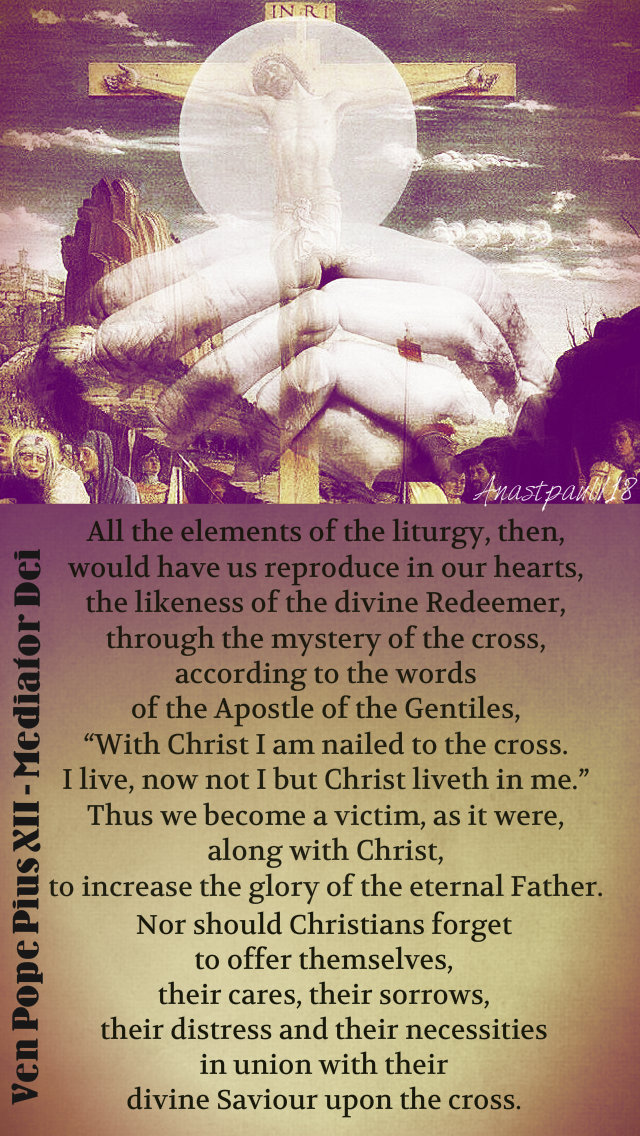
The question remains, then, of just how one participates actively “in the most holy mysteries and in the public and solemn prayer of the Church”.   Pope Pius XII situates active participation in a personal and corporate adhesion to the sacrifice of Christ who, in every Holy Mass, exercises His priesthood and offers Himself as a spotless victim to the Father.

One comes to Holy Mass, then, not after the manner of a consumer looking seeking spiritual gratification but, rather, as an offerer bearing to the altar the oblation of his own life, as a royal priest set over all created things in order to raise them heavenward in the Great Thanksgiving (Eucharist) and as a victim, a sacrificial lamb ready to be made over to God in Christ.  In Christ and in the members of His Mystical Body are the prophetic words of Abraham to Isaac wondrously fulfilled:  “God Himself will provide the lamb” (Genesis 22:8). Pope Pius XII writes:

“All the elements of the liturgy, then, would have us reproduce in our hearts the likeness of the divine Redeemer through the mystery of the cross, according to the words of the Apostle of the Gentiles, “With Christ I am nailed to the cross. I live, now not I, but Christ liveth in me.”   Thus we become a victim, as it were, along with Christ to increase the glory of the eternal Father.

Let the faithful, therefore, consider to what a high dignity they are raised by the sacrament of baptism.   They should not think it enough to participate in the eucharistic sacrifice with that general intention which befits members of Christ and children of the Church but let them further, in keeping with the spirit of the sacred liturgy, be most closely united with the High Priest and His earthly minister, at the time the consecration of the divine Victim is enacted and, at that time, especially when those solemn words are pronounced:

“By Him and with Him and in Him is to Thee, God the Father almighty, in the unity of the Holy Ghost, all honour and glory forever and ever”;   to these words in fact the people answer, “Amen.”

Nor should Christians forget to offer themselves, their cares, their sorrows, their distress and their necessities in union with their divine Saviour upon the cross.”

ven pope pius XII mediator dei - sunreflection 9 dec 2018

Posted in EUCHARISTIC Adoration, MORNING Prayers, SUNDAY REFLECTIONS, The HOLY EUCHARIST / The HOLY MASS, The WORD

Sunday Reflection – 2 December – “The Eucharistic Face of Christ”

Sunday Reflection – 2 December – First Sunday of Advent

The Eucharistic Face of Christ

In the Cenacle, together with Our Blessed Lady and the Apostles, one contemplates the Eucharistic Face of Christ.   The commandment of the Lord on the night before He suffered, “Do this in commemoration of me” (Lk 22:19), was certainly obeyed by the Apostles during the days that separated the Ascension of the Lord from Pentecost. The Mother of the Eucharist was there.   The very Face that disappeared into the heavens over the Mount of Olives on the day of the Ascension re-appears in every Holy Mass, hidden and yet shining, through the sacramental veils.

The Priestly Prayer of Christ to the Father, first uttered in the Cenacle on the night before He suffered, is wondrously actualised in the Holy Sacrifice of the Mass.   It is Christ, the Eternal High Priest, who stands at the altar with His Face turned toward the Father and His pierced Heart open for all eternity, that out of it we may receive the life-giving torrent that is the Gift of the Holy Spirit.   In some way, the final chapters of Saint John’s Gospel are a sustained contemplation of the Face of Jesus turned toward us and lifted to the Father.
Contemplate the Face of Jesus, portrayed in the Fourth Gospel, the Holy Spirit will surely draw you into His filial and priestly prayer to the Father. One who receives the Body and Blood of Christ, receives the very prayer of Christ into his soul.   The grace of every Holy Communion is that of Christ praying to His Father in us and for us.

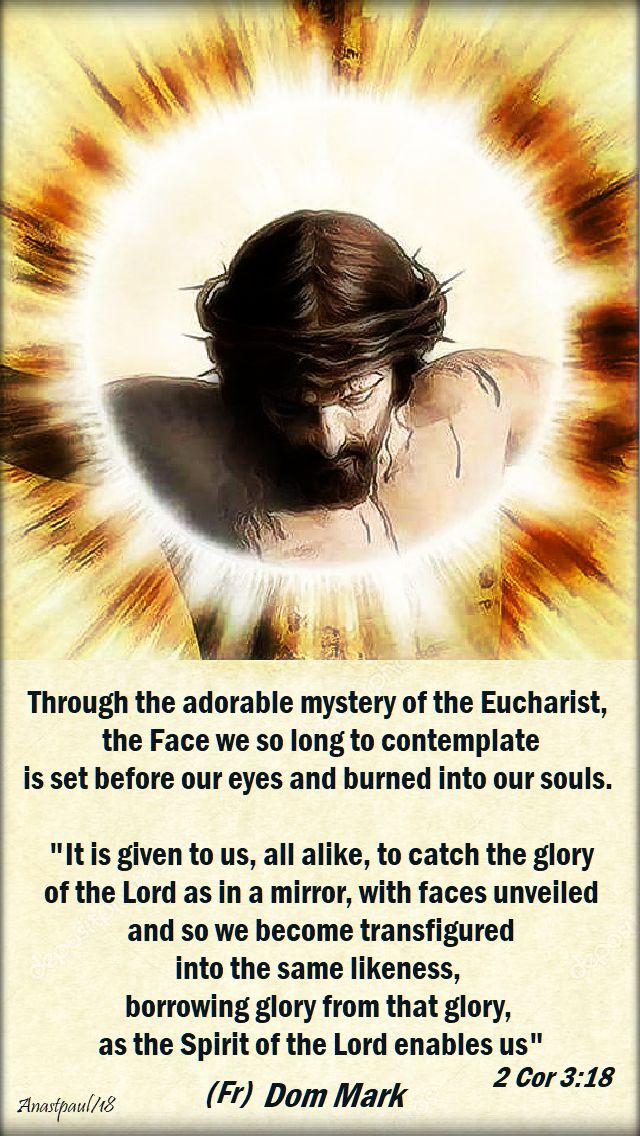
Through the adorable mystery of the Eucharist, the Face we so long to contemplate, is set before our eyes and burned into our souls.   “It is given to us, all alike, to catch the glory of the Lord as in a mirror, with faces unveiled;  and so we become transfigured into the same likeness, borrowing glory from that glory, as the Spirit of the Lord enables us” (2 Cor 3:18). – (Fr) Dom Mark (vultusstblogs)through the adorable mystery of the eucharist - dom mark vultus christi - sun reflection 2 dec 2018

Posted in EUCHARISTIC Adoration, MORNING Prayers, PRACTISING CATHOLIC, QUOTES of the SAINTS, SUNDAY REFLECTIONS, The HOLY EUCHARIST / The HOLY MASS, Thomas a Kempis

Sunday Reflection – 25 November – The Solemnity of Christ the King

Sunday Reflection – 25 November – The Solemnity of Christ the King

Thomas à Kempis (1380-1471)

On the Blessed Sacrament, Book 4, Chapter 1:9-13

Many people travel far to honour the relics of the saints, marvelling at their wonderful deeds and at the building of magnificent shrines.   They gaze upon and kiss the sacred relics encased in silk and gold and behold, You are here present before me on the altar, my God, Saint of saints, Creator of men, and Lord of angels!
Often in looking at such things, men are moved by curiosity, by the novelty of the unseen and they bear away little fruit for the amendment of their lives, especially when they go from place to place lightly and without true contrition.   But here, in the Sacrament of the  altar, You are wholly present, my God, the man Christ Jesus, whence is obtained the full realisation of eternal salvation, as often as You are worthily and devoutly received.  To this, indeed, we are not drawn by levity, or curiosity, or sensuality but by firm faith,  devout hope, and sincere love.
O God, hidden Creator of the world, how wonderfully You deal with us!   How sweetly and graciously You dispose of things with Your elect to whom You offer Yourself to be received in this Sacrament!   This, indeed, surpasses all understanding.   This in a special manner attracts the hearts of the devout and inflames their love.   Your truly faithful servants, who give their whole life to amendment, often receive in Holy Communion the great grace of devotion and love of virtue.
Oh, the wonderful and hidden grace of this Sacrament which only the faithful of Christ
understand, which unbelievers and slaves of sin cannot experience!   In it spiritual grace is conferred, lost virtue restored and the beauty, marred by sin, repaired.   At times, indeed, its grace is so great that, from the fullness of the devotion, not only the mind but also the frail body feels filled with greater strength.
Nevertheless, our neglect and coldness is much to be deplored and pitied, when we are not moved to receive with greater fervour Christ in Whom is the hope and merit of all who will be saved.   He is our sanctification and redemption.   He is our consolation in this life and the eternal joy of the blessed in heaven.   This being true, it is lamentable that many pay so little heed to the salutary Mystery which fills the heavens with joy and maintains the whole universe in being.
Oh, the blindness and the hardness of the heart of man that does not show more regard for so wonderful a gift but rather falls into carelessness from its daily use!   If this most holy Sacrament were celebrated in only one place and consecrated by only one priest in the whole world, with what great desire, do you think, would men be attracted to that place, to that priest of God, in order to witness the celebration of the divine Mysteries! But now there are many priests and Mass is offered in many places, that God’s grace and love for men may appear the more clearly as the Sacred Communion is spread more widely through the world.

Thanks be to You, Jesus, everlasting Good Shepherd, Who have seen fit to feed us poor
exiled people with Your precious Body and Blood and to invite us with words from Your
own lips to partake of these sacred Mysteries:   

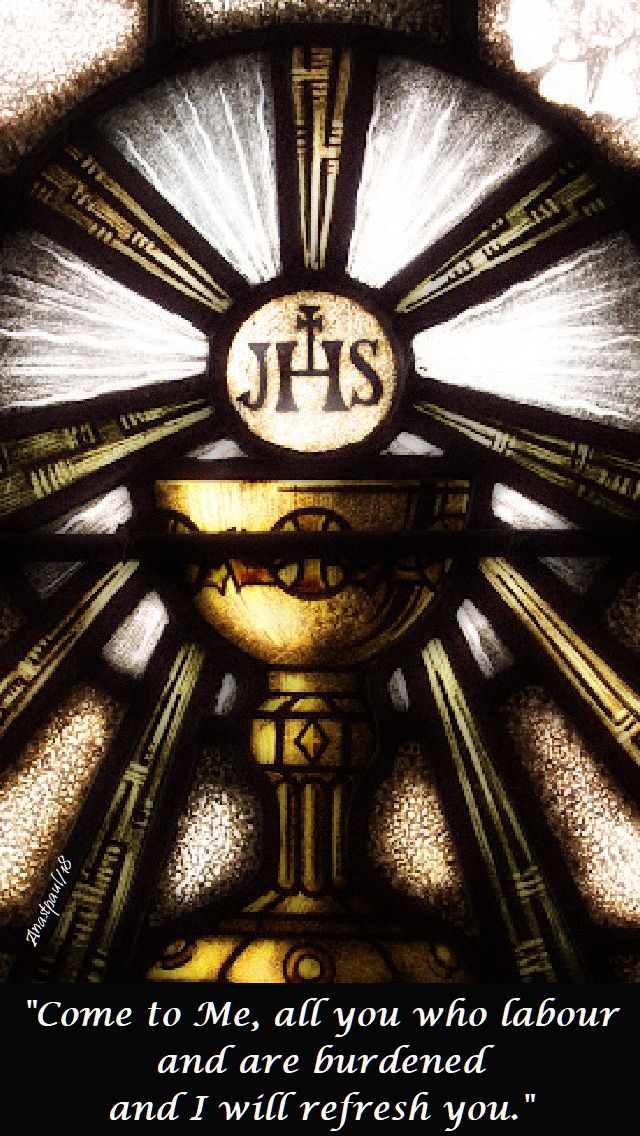
“Come to Me, all you who labour and are burdened and I will refresh you.”come to me, all you who labour - jesus in the blessed sacrament, holy mass - sun reflection 24 nov 2018 thomas a kempis bk 4 ch1

Posted in DOCTORS of the Church, EUCHARISTIC Adoration, MORNING Prayers, QUOTES of the SAINTS, REDEMPTORISTS CSSR, SACRED and IMMACULATE HEARTS, SUNDAY REFLECTIONS, The HOLY EUCHARIST / The HOLY MASS

Sunday Reflection – 18 November – Reparation for outrages against the Most Blessed Sacrament – St Alphonsus Liguori

Sunday Reflection – 18 November

Reparation for outrages against the Most Blessed Sacrament

 St Alphonsus Liguori (1696-1787) Doctor of the Church

Meditate the following text written by Saint Alphonsus Maria and translated by Norman J. Muckermann, CSsR.    It is astonishingly relevant to the need for reparation, when one considers the current proliferation of so many outrages against the Most Blessed Sacrament.

The Sorrowful Heart of Jesus
It is impossible for us to appreciate how greatly afflicted the Heart of Jesus was for love of us and at the same time not be filled with pity for Him. . . . The principal sorrow affecting the Heart of Jesus was not so much knowing the torments and insults His enemies were preparing for Him.   Rather, it was seeing how ready we would be to reject His immense love.

Desecrations of the Sacred Host
Jesus distinctly saw all the sins which we would commit even after His sufferings, even after His bitter and ignominious death on the cross.   He foresaw, too, the insults which sinners would offer His Sacred Heart which He would leave on earth in the Most Holy Sacrament as proof of His love.   These insults are almost too horrible to mention:  people trampling the sacred hosts underfoot, throwing them into gutters or piles of refuse and even using them to worship the devil himself!

The Pledge of His Love
Even the knowledge that these and other defamations would happen did not prevent Jesus from giving us this great pledge of His love, the Holy Eucharist.   Jesus has an infinite hatred for sin, yet it seems that His great love for us even overcomes this bitterness.   Because of His love, He allows these sacrileges to happen in order not to deprive us of this Divine Food.   Should not this alone suffice to make us love a Heart that has loved us so much?

Jesus Forsaken on the Altar
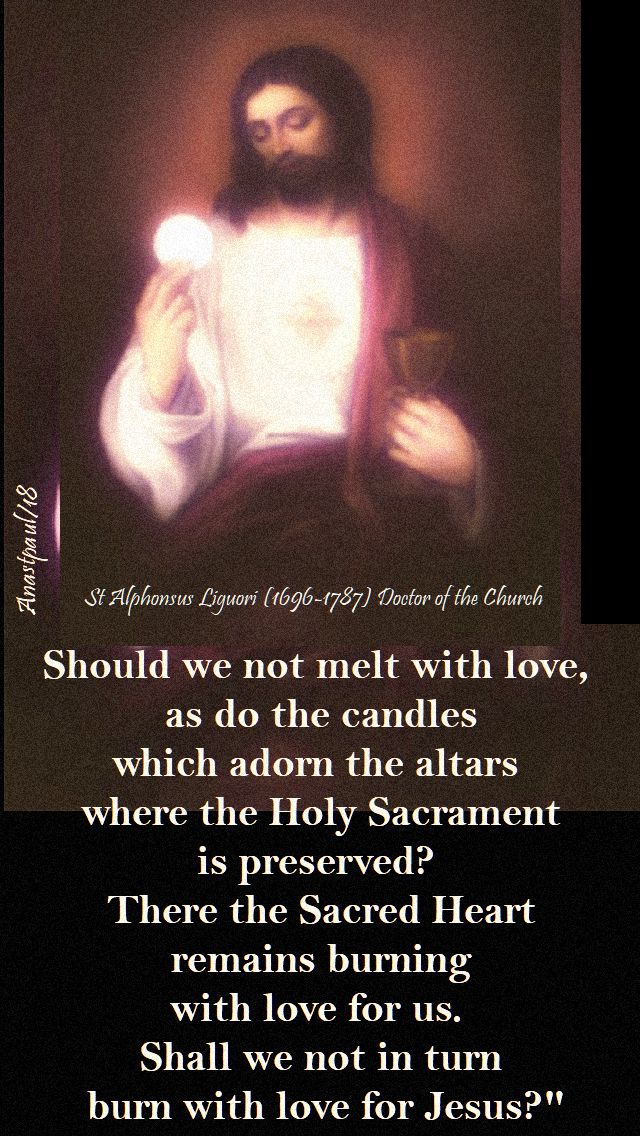
What more could Jesus do to deserve our love?   Is our ingratitude so great that we will still leave Jesus forsaken on the altar, as so many are wont to do?   Rather, should we not unite ourselves to those few who gather to praise Him and acknowledge His divine presence?   Should we not melt with love, as do the candles which adorn the altars where the Holy Sacrament is preserved?   There the Sacred Heart remains burning with love for us.   Shall we not in turn burn with love for Jesus?”should we not melt with love - st alphonsus -18 nov 2018 sunday reflection

Posted in CATHOLIC Quotes, MORNING Prayers, PRACTISING CATHOLIC, QUOTES on UNITY/with GOD, SUNDAY REFLECTIONS, The HOLY EUCHARIST / The HOLY MASS

Sunday Reflection – 11 November – “Standing before the Lord” – Pope Benedict XVI

Sunday Reflection – 11 November

“Standing before the Lord” (Excerpt)

Pope Benedict XVI

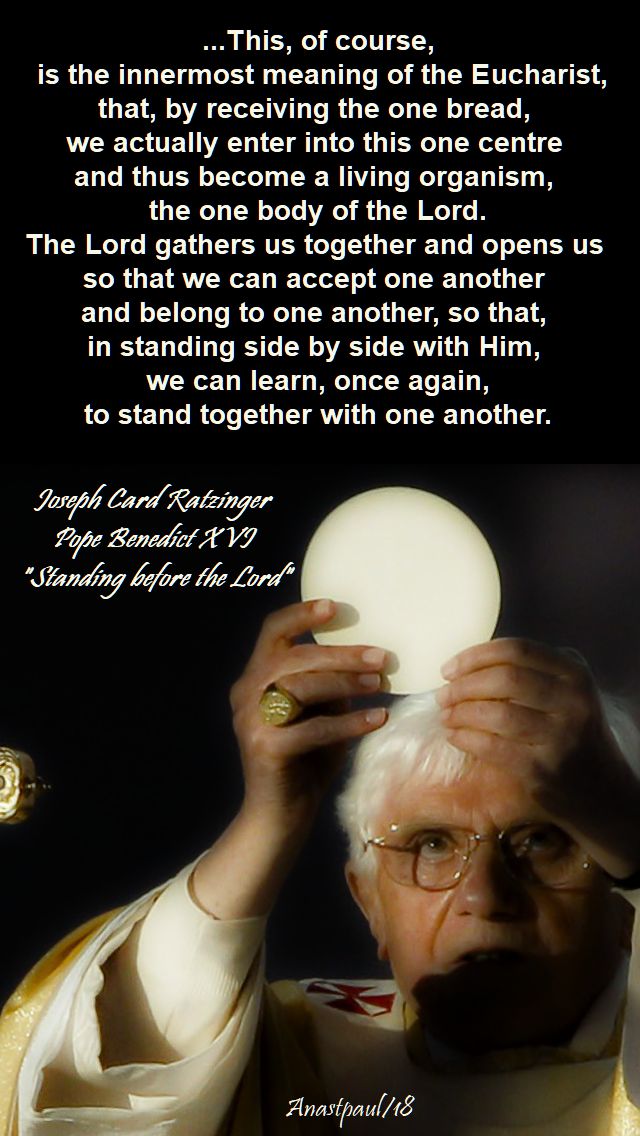
In the Church of former times, the word for this was statio. …From the very beginning, when Christianity spread throughout the world, its heralds laid the greatest importance on there being only one bishop and only one altar in every town.   This was meant to express the unity of the one Lord, who unites us all in His embrace from the Cross, an embrace that goes beyond the frontiers drawn by earthly life and forms us into one body. And this, of course, is the innermost meaning of the Eucharist, that, by receiving the one bread, we actually enter into this one centre and thus become a living organism, the one body of the Lord.
The Eucharist is not a private matter among friends, taking place in a club of like-minded people where congenial spirits meet together.   On the contrary, just as the Lord allowed Himself to be crucified publicly outside the city walls, stretching out His hands to all, the Eucharist is the public worship celebrated by all, whom the Lord calls….
It was fundamental to the Eucharist in the Mediterranean world, which first saw the growth of Christianity, that the aristocrat who had found his way to Christianity should sit down with the Corinthian dock-worker, the miserable slave who, according to Roman law, was not even held to be a human being and was dealt with as chattel.   It is of the very nature of the Eucharist, that the philosopher should sit beside the illiterate man, the converted prostitute and the converted tax-collector beside the ascetic who has found his way to Jesus Christ.
In Rome, for instance, even during the era of persecution, the titular churches came into being as predecessors of the later parishes…..the Eucharist continued to unite people who would otherwise not mix.   Consequently, the statio was introduced – here, particularly during Lent, the Pope, as the single Bishop of Rome, goes among the individual titular churches and celebrates the liturgy for the whole city of Rome.
Christians gather together and go to church together, thus, in the individual churches, the whole Church is visible and is manifest at the individual level.
The Lord gathers us together and opens us so that we can accept one another and belong to one another, so that, in standing side by side with Him, we can learn once again to stand together with one another. ….What binds us together is not the private interest of this or that group but the interest which God takes in us.   And we can calmly and confidently, entrust all our interests to Him.   We commit ourselves to the Lord.   And the more we commit ourselves to the Lord and stand before Him, the more we stand together with one another and the more power we discover to understand each other, to recognise each other as human beings, as brothers and sisters.   In this way, in this fellowship with one another, we are building the foundations for humanity and making it possible.

Joseph Card Ratzinger/Pope Benedict XVI “Seek that Which is Above”this of course is the innermost meaning of the eucharist - sun reflection - 11 nov 2018

Posted in MORNING Prayers, QUOTES of the SAINTS, SUNDAY REFLECTIONS, The HOLY EUCHARIST / The HOLY MASS

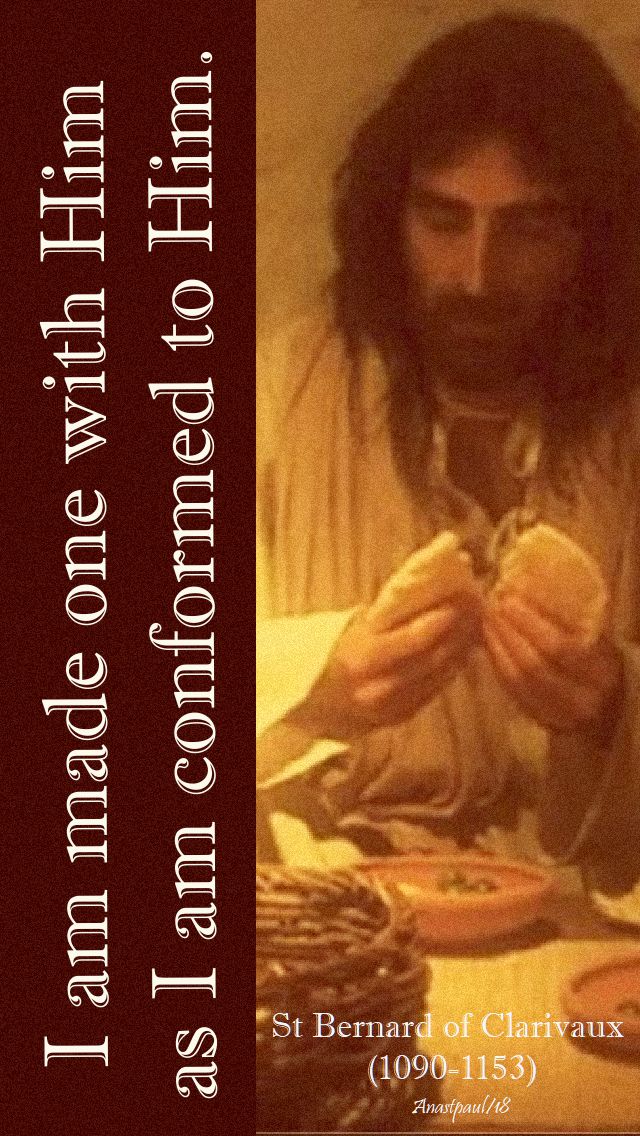
Sunday Reflection – 4 November – “I am made one with Him, as I am conformed to Him.” – St Bernard

Sunday Reflection – 4 November – Thirty First Sunday in Ordinary Time, Year B

 “I am made one with Him, as I am conformed to Him.”  St Bernard of Clairvaux (1090-1153) Doctor of the Church

Saint Bernard teaches, that it is not enough for us to take and eat the Bread from Heaven. We must also offer ourselves to be eaten.   Holy Communion is a wondrous exchange in which we become the bread of Christ.   Listen to Saint Bernard:

“My penitence, my salvation are His food.
I myself am His food.
I am chewed as I am reproved by Him;
I am swallowed by Him as I am taught;
I am digested by Him as I am changed;
I am assimilated as I am transformed;
I am made one with Him, as I am conformed to Him.
He feeds upon us and is fed by us
that we may be the more loosely bound to Him.”

Saint Bernard, ever the poet, uses images of eating and assimilation to describe how Christ unites us to Himself.   Our Lord becomes our food that we might become His.   We need the language of poets and preachers in our approach to the Eucharist.i am made one with him as i am conformed to him - st bernard - 4 nov 2018 sun reflection

Posted in DOCTORS of the Church, FATHERS of the Church, PAPAL SERMONS, QUOTES of the SAINTS, SUNDAY REFLECTIONS, The HOLY EUCHARIST / The HOLY MASS

Sunday Reflection – 28 October – Thirtieth Sunday in Ordinary Time, Year B

Sunday Reflection – 28 October – Thirtieth Sunday in Ordinary Time, Year B

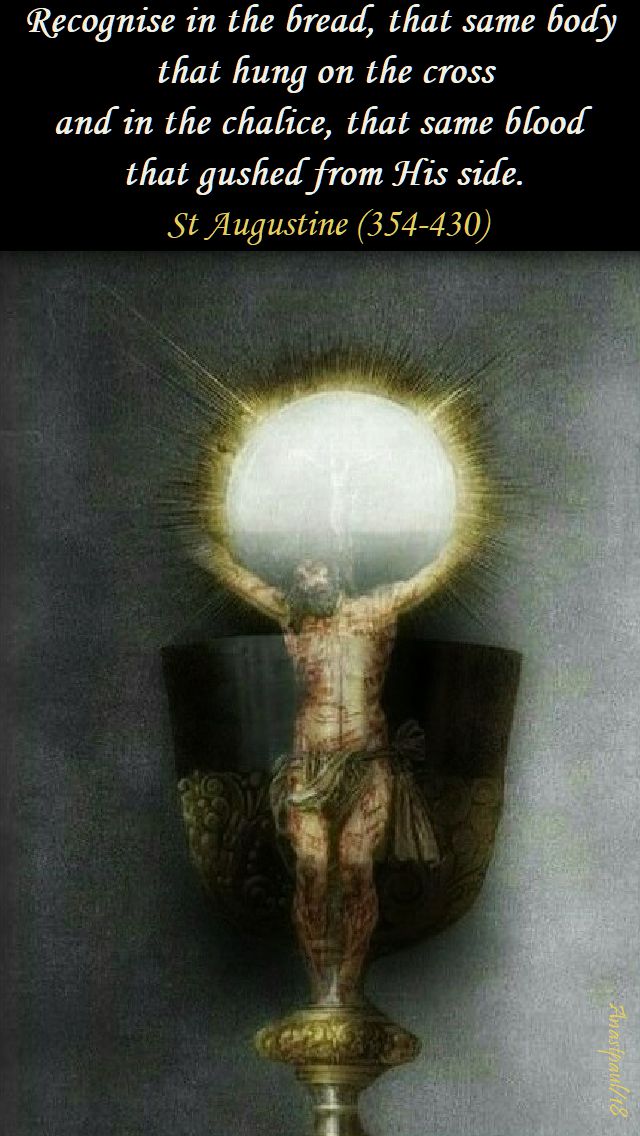
Recognise in the bread, that same body that hung on the cross 
and in the chalice, that same blood that gushed from His side.

Saint Augustine (354-430)

Transubstantiation
In the offering that Jesus makes of Himself we find all the novelty of Christian worship. In ancient times men offered in sacrifice to the divinity the animals or first fruits of the earth.   Jesus, instead, offers Himself, His body and His whole existence – He Himself, in person, becomes the sacrifice that the liturgy offers in the Holy Mass.
In fact, with the consecration of the bread and wine they become His true body and blood.
Saint Augustine invited his faithful, not to pause on what appeared to their sight but to go beyond:  “Recognise in the bread — he said — that same body that hung on the cross and in the chalice that same blood that gushed from His side” (Disc. 228 B, 2).
To explain this transformation, theology has coined the word “transubstantiation,” a word that resounded for the first time in this Basilica during the IV Lateran Council, of which in five years will be the 8th centenary.   On that occasion the following expressions were inserted in the profession of faith:  “his body and his blood are truly contained in the sacrament of the altar, under the species of bread and wine, because the bread is transubstantiated into the body and the wine into the blood by divine power” (DS, 802).
Therefore, it is essential to stress, in the itineraries of education of children in the faith, of adolescents and of young people, as well as in “centres of listening” to the Word of God, that in the sacrament of the Eucharist, Christ is truly, really and substantially present.recognise in the bread - st augustine - 28 oct 2018

Sunday
And let us also keep present that the Eucharist, joined to the cross and resurrection of the Lord, has dictated a new structure to our time.

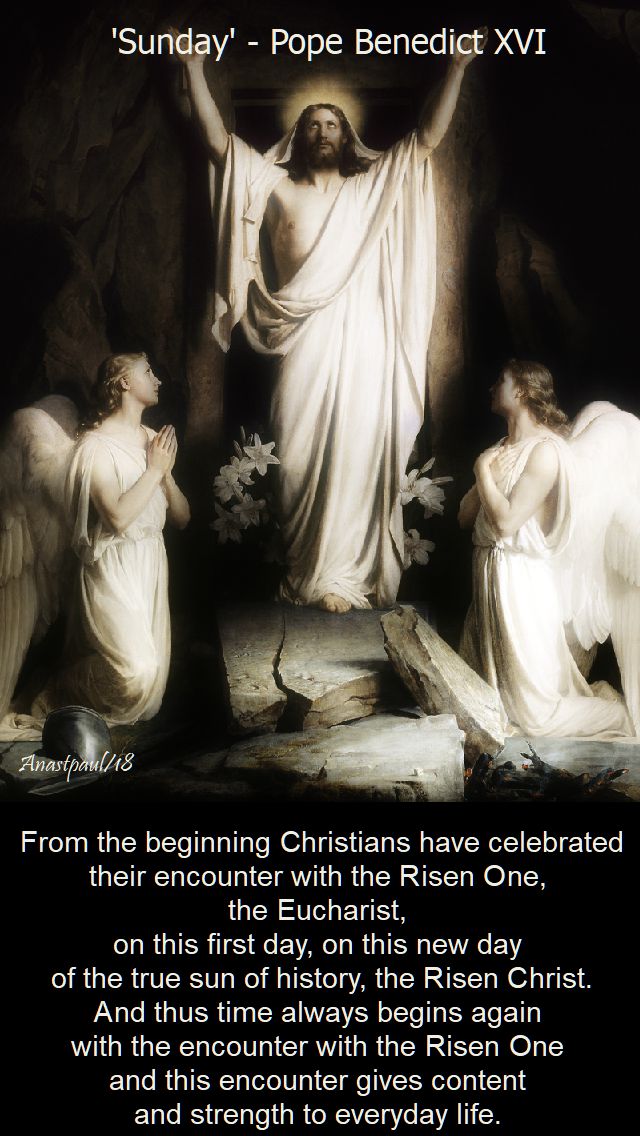
The Risen One was manifested the day after Saturday, the first day of the week, day of the sun and of creation.   From the beginning, Christians have celebrated their encounter with the Risen One, the Eucharist, on this first day, on this new day of the true sun of history, the Risen Christ.

And thus time always begins again with the encounter with the Risen One and this encounter gives content and strength to everyday life.   Because of this, it is very important for us Christians, to follow this new rhythm of time, to meet with the Risen One on Sunday and thus “to take” with us His presence, which transforms us and transforms our time.

Pope Benedict XVI – 17 June 2010from the beginning, Christians have celebrated - pope benedict - 28 oct 2018

Posted in EUCHARISTIC Adoration, MORNING Prayers, QUOTES of the SAINTS, SUNDAY REFLECTIONS, The HOLY EUCHARIST / The HOLY MASS

Sunday Reflection – 14 October – Twenty-eighth Sunday in Ordinary Time, Year B

Sunday Reflection – 14 October – Twenty-eighth Sunday in Ordinary Time, Year B

“And it happened that, while he was with them at table,
he took bread, said the blessing, broke it and gave it to them.
With that their eyes were opened and they recognised him… but he vanished from their sight.”…Luke 24:30-31

“Before Communion you hear about Jesus Christ and you know Him – you are told of His Cross, of His suffering; doubtless you are affected, are even touched with compassion.

But let these same truths be presented to you after Communion.   Oh, how much more deeply your soul is moved!   It cannot hear enough, it understands much more perfectly. Before Communion, you contemplate Jesus outside you, now you contemplate Him within you, with His own eyes!

It is the mystery of Emmaus re-enacted.   When Jesus taught the two disciples along the way, explaining the Scriptures to them, their faith still wavered, though they felt inwardly some mysterious emotion.   But participating in the Fraction of the bread, immediately their eyes were opened and their hearts were like to burst with joy.

The voice of Jesus had not sufficed to reveal His presence to them, they had to feel His Heart, had to be fed with the Bread of understanding!”

St Peter Julian Eymard (1811-1868)

Apostle of the Eucharistluke 24 30-31 - and while he was with them he took the bread - the voice of Jesus had not sufficed - st peter j eymard - 14 oct 2018 sun reflection

Posted in EUCHARISTIC Adoration, MORNING Prayers, PAPAL SERMONS, PRACTISING CATHOLIC, SUNDAY REFLECTIONS, The HOLY EUCHARIST / The HOLY MASS

Sunday Reflection – 7 October – Twenty-seventh Sunday in Ordinary Time, Year B

Sunday Reflection – 7 October – Twenty-seventh Sunday in Ordinary Time, Year B

The Beating Heart of the Church –

the Eucharistic Heart of Christ.

This is what Pope Benedict XVI said on 10 June 2007:

“Today’s solemnity of Corpus Christi, which was celebrated last Thursday in the Vatican and in other countries, invites us to contemplate the supreme Mystery of our faith – the Most Holy Eucharist, the Real Presence of our Lord Jesus Christ in the Sacrament of the altar.   Every time that the priest renews the Eucharistic Sacrifice, in the prayer of consecration he repeats:  ‘This is my Body…this is my Blood.’   He lends his voice, his hands and his heart to Christ, who wanted to remain with us in order to be the beating Heart of the Church.
But even after the Celebration of the Divine Mysteries the Lord Jesus remains present in the tabernacle.   For this reason, praise is rendered to Him especially through Eucharistic Adoration, as I sought to remind everyone in the recent Apostolic Exhortation Sacramentum Caritatis (see nos. 66-69) following the Synod on this topic.   In fact, there is an intrinsic connection between celebration and adoration.   The Holy Mass is in itself already the greatest act of adoration on the part of the Church.   ‘No one eats this flesh,’ St Augustine wrote, ‘unless he has first adored it’ (Com. on Psalms 98,9; CCL XXXIX, 1385).  Adoration, apart from the Holy Mas, prolongs and intensifies what has taken place in the liturgical celebration and makes it possible, to receive Christ in a real and profound way.”adoration, apart from the holy mass - pope benedict - 7 oct 2018

Posted in EUCHARISTIC Adoration, MORNING Prayers, QUOTES of the SAINTS, SUNDAY REFLECTIONS, The HOLY EUCHARIST / The HOLY MASS, Uncategorized

Sunday Reflection – 30 September – Twenty sixth Sunday in Ordinary Time, Year B

Sunday Reflection – 30 September – Twenty sixth Sunday in Ordinary Time, Year B

It is remarkable how it was the reservation of the Blessed Sacrament in Catholic churches that more than anything else impressed and moved Blessed John Henry Newman, even more than the Mass itself.

And so it was that the feature of his new religious life as a Catholic that most struck him came as a complete surprise – namely, the reservation of the Blessed Sacrament in Catholic churches.   He wrote in a letter to a close friend, herself about to become a Catholic a few months later:

“We went over not realising those privileges which we have found by going.   I never allowed my mind to dwell on what I might gain of blessedness – but certainly, if I had thought much upon it, I could not have fancied the extreme, ineffable comfort of being in the same house with Him who cured the sick and taught His disciples …

When I have been in Churches abroad, I have religiously abstained from acts of worship, though it was a most soothing comfort to go into them – nor did I know what was going on;  I neither understood nor tried to understand the Mass service – and I did not know, or did not observe, the tabernacle Lamp – but now after tasting of the awful delight of worshipping God in His Temple, how unspeakably cold is the idea of a Temple without that Divine Presence! One is tempted to say what is the meaning, what is the use of it?”

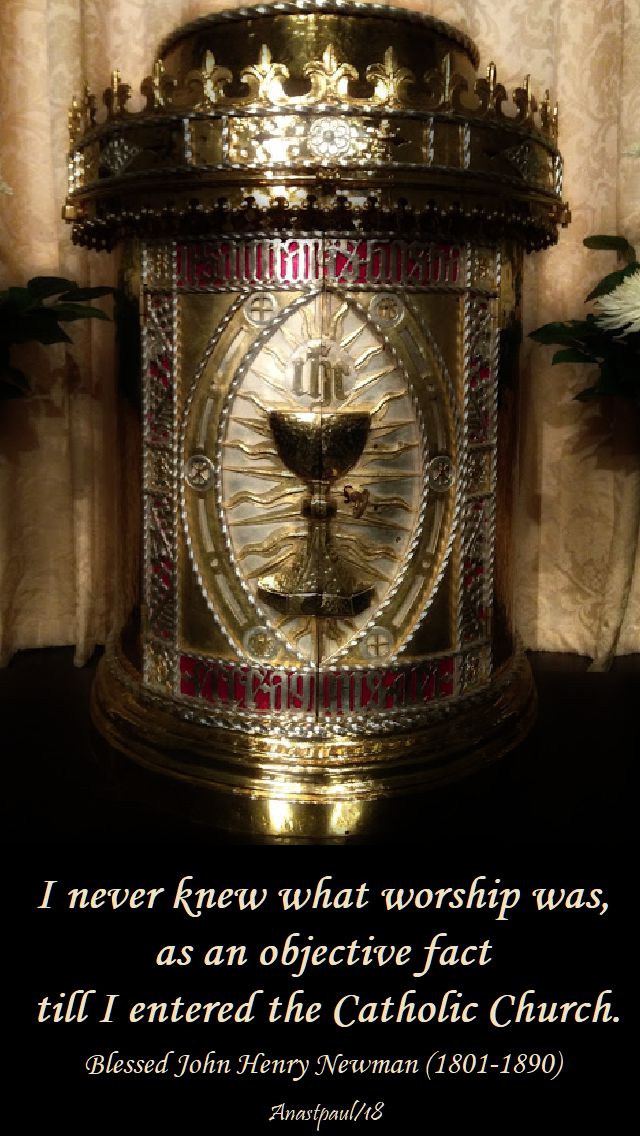
“It is really most wonderful to see this Divine Presence looking out almost into the open streets from the various Churches … I never knew what worship was, as an objective fact, till I entered the Catholic Church.”

“It is such an incomprehensible blessing to have Christ in bodily presence in one’s house, within one’s walls, as swallows up all other privileges …”

i never knew what worship was - bl jh newman - 30 sept 2018 - sunday reflection

Posted in franciscan OFM, MORNING Prayers, QUOTES of the SAINTS, SAINT of the DAY, SUNDAY REFLECTIONS, The HOLY EUCHARIST / The HOLY MASS

Sunday Reflection – 23 September – Twenty-fifth Sunday in Ordinary Time, Year B and the Memorial of St Padre Pio (1887-1968)

Sunday Reflection – 23 September – Twenty-fifth Sunday in Ordinary Time, Year B and the Memorial of St Padre Pio (1887-1968)

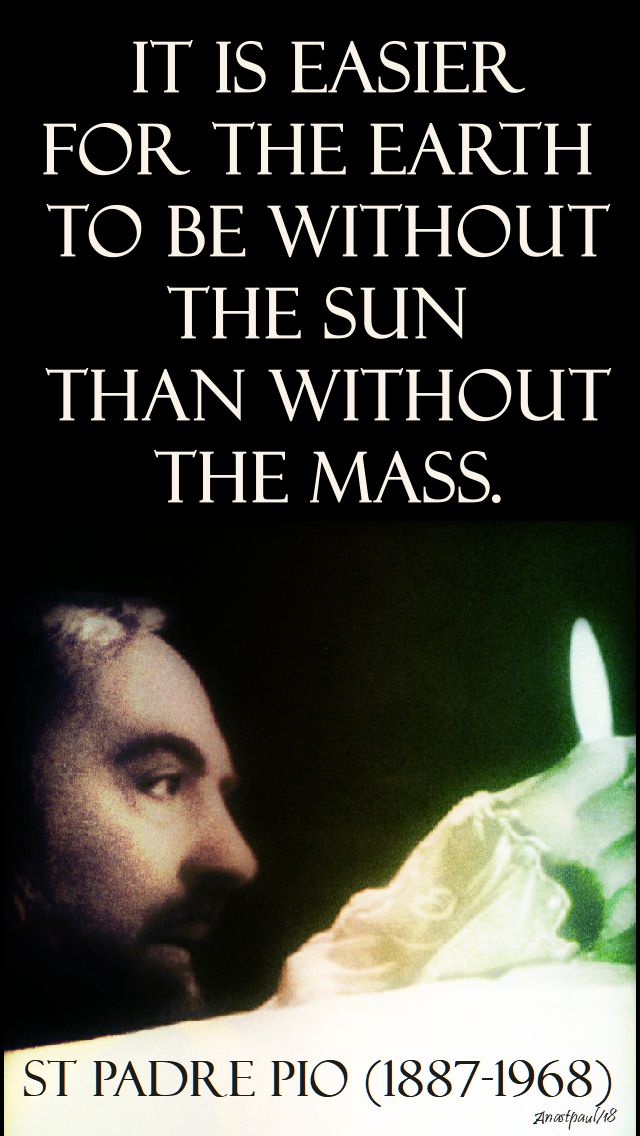
“It is easier for the earth to be without the sun than without the Mass.”

it is easier for the earth - st padre pio - 23 sept 2018

From a letter to Annita Rodote on 25 July 1915 on how to attend Mass:

“The Divine Master calls the church the house of prayer.   In order to avoid irreverence and imperfections I exhort you in the Lord to:

Enter the church in silence and with great respect.   Take the holy water and make the sign of the cross carefully and slowly.

Before God in the Blessed Sacrament genuflect devoutly.   At your pace, kneel down and render to Jesus the tribute of you presence.

Confide to Him all your needs and those of others.   Speak to Him with filial abandonment.   Be very composed when standing up, kneeling down and sitting.

Carry out every religious act with the greatest devotion.   Be modest in your glance.   Don’t turn you head here and there to see who enters and leaves.

Don’t laugh.   Don’t speak to anybody, except when requested for charity or other strict necessity.

Say the words distinctly, observe the pauses and never hurry.   Behave in such a way that all those present are edified by you.

Don’t leave without asking Jesus for His blessing and forgiveness for your shortcomings. Leave the church recollected and calm.”

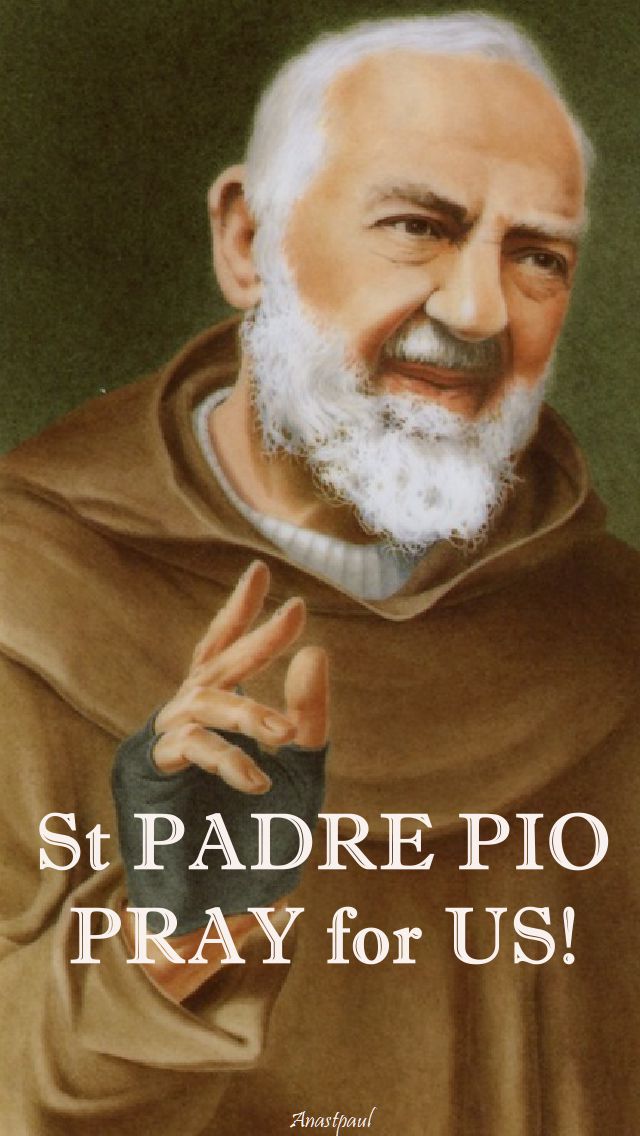
St Padre Pio, Pray for Us!ST PADRE PIO - PRAY FOR US 23 sept 2017

Posted in DOCTORS of the Church, EUCHARISTIC Adoration, FATHERS of the Church, MORNING Prayers, PAPAL MESSAGES, QUOTES of the SAINTS, QUOTES on PRAYER, SUNDAY REFLECTIONS, The HOLY EUCHARIST / The HOLY MASS

Sunday Reflection – 16 September – Twenty-fourth Sunday in Ordinary Time, Year B

Sunday Reflection – 16 September – Twenty-fourth Sunday in Ordinary Time, Year B

Excerpt from a Letter of His Holiness Pope Benedict XVI,
given on the Occasion of the 16th Centenary
of the Death of St John Chrysostom “Doctor of the Eucharist”

For Chrysostom, the ecclesial unity that is brought about in Christ is attested to in a quite special way in the Eucharist. “Called “Doctor of the Eucharist’ because of the vastness and depth of his teaching on the Most Holy Sacrament”, he taught that the sacramental unity of the Eucharist constitutes the basis of ecclesial unity in and for Christ.   “Of course, there are many things to keep us united. A table is prepared before all… all are offered the same drink, or, rather, not only the same drink but also the same cup. Our Father, desiring to lead us to tender affection, has also disposed this – that we drink from one cup, something that is befitting to an intense love”.   Reflecting on the words of St Paul’s First Letter to the Corinthians, “The bread which we break, is it not a participation in the body of Christ?”, John commented,for the Apostle, therefore, “just as that body is united to Christ, so we are united to Him through this bread”.   And even more clearly, in the light of the Apostle’s subsequent words:  “Because there is one bread, we who are many are one body”, John argued:  “What is bread?   The Body of Christ  . And what does it become when we eat it?   The Body of Christ – not many bodies but one body.   Just as bread becomes one loaf although it is made of numerous grains of wheat…, so we too are united both with one another and with Christ…. Now, if we are nourished by the same loaf and all become the same thing, why do we not also show the same love, so as to become one in this dimension, too?”.

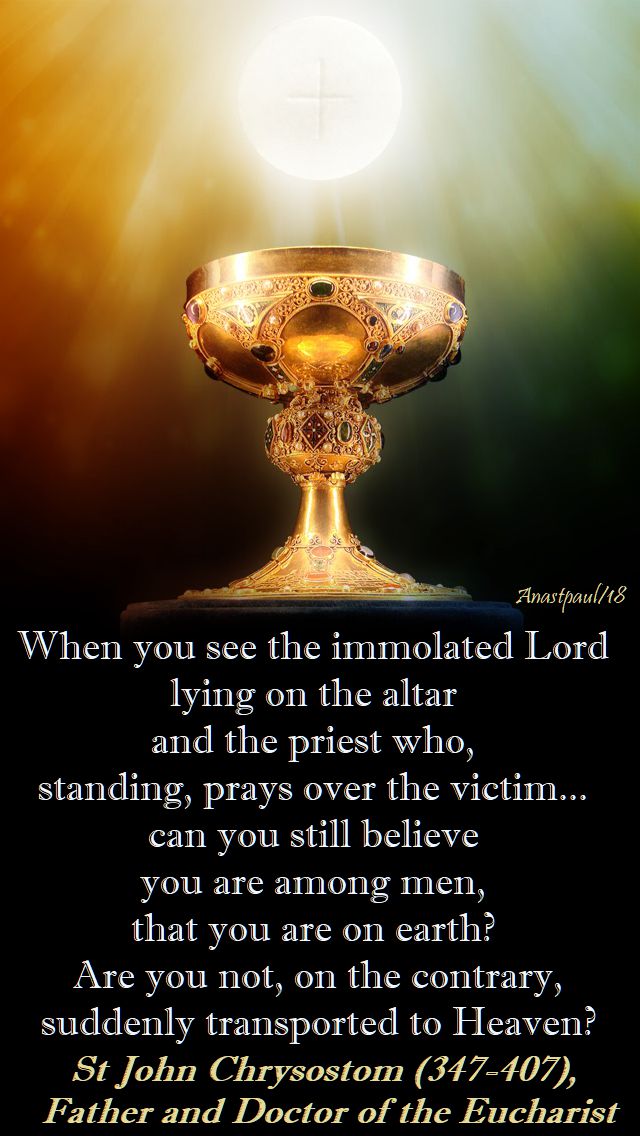
Chrysostom’s faith in the mystery of love that binds believers to Christ and to one another led him to experience profound veneration for the Eucharist, a veneration which he nourished in particular in the celebration of the Divine Liturgy.   Indeed, one of the richest forms of the Eastern Liturgy bears his name:  “The Divine Liturgy of St John Chrysostom”.   John understood that the Divine Liturgy places the believer spiritually between earthly life and the heavenly realities that have been promised by the Lord.   He told Basil the Great of the reverential awe he felt in celebrating the sacred mysteries with these words:   “When you see the immolated Lord lying on the altar and the priest who, standing, prays over the victim… can you still believe you are among men, that you are on earth? Are you not, on the contrary, suddenly transported to Heaven?”   The sacred rites, John said, “are not only marvellous to see but extraordinary because of the reverential awe they inspire. The priest who brings down the Holy Spirit stands there… he prays at length that the grace which descends on the sacrifice may illuminate the minds of all in that place and make them brighter than silver purified in the crucible. Who can spurn this venerable mystery?”.when you see the immolated lord - st john chrysostom - sunday reflection - 16 sept 2018 24th ord time year b

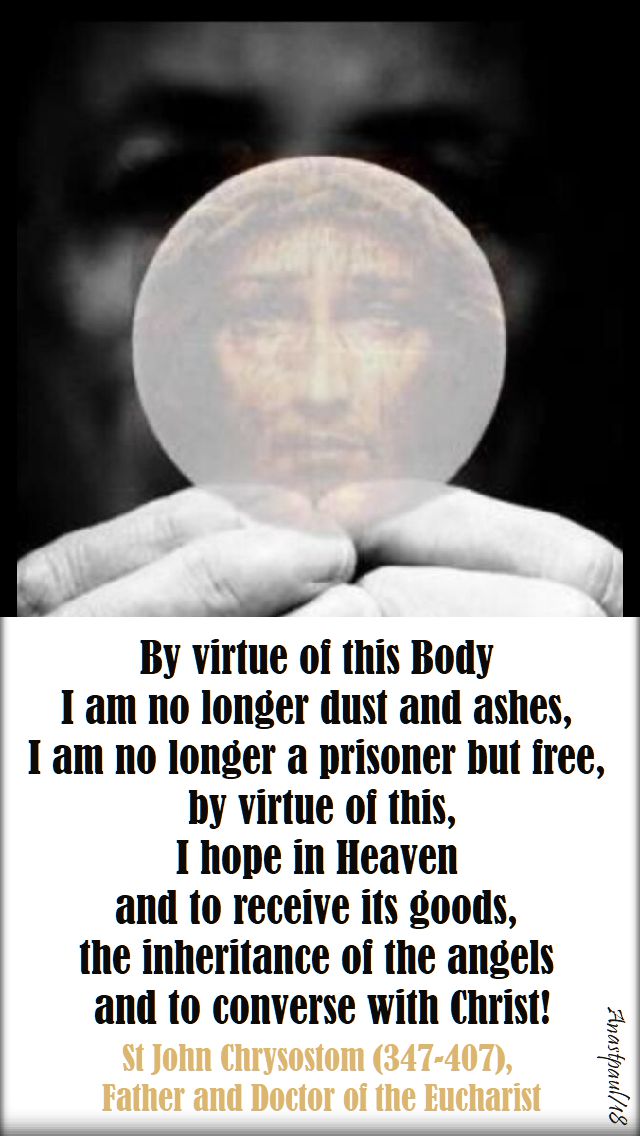
With great depth, Chrysostom developed his reflection on the effect of sacramental Communion in believers:  “The Blood of Christ renews in us the image of our King, it produces an indescribable beauty and does not allow the nobility of our souls to be destroyed but ceaselessly waters and nourishes them”.   For this reason, John often and insistently urged the faithful to approach the Lord’s altar in a dignified manner, “not with levity… not by habit or with formality”, but with “sincerity and purity of spirit”.   He tirelessly repeated that preparation for Holy Communion must include repentance for sins and gratitude for Christ’s sacrifice made for our salvation.   He therefore urged the faithful to participate fully and devoutly in the rites of the Divine Liturgy and to receive Holy Communion with these same dispositions:  “Do not permit us, we implore you, to be killed by your irreverence but approach Him with devotion and purity and, when you see Him placed before you, say to yourselves:  “By virtue of this Body I am no longer dust and ashes, I am no longer a prisoner but free, by virtue of this, I hope in Heaven and to receive its goods, the inheritance of the angels and to converse with Christ'”.by virtue of this body - st john chrysostom - 16 sept 2018

Of course, he also drew from contemplation of the Mystery the moral consequences in which he involved his listeners: he reminded them that communion with the Body and Blood of Christ obliged them to offer material help to the poor and the hungry who lived among them.   The Lord’s table is the place where believers recognise and welcome the poor and needy whom they may have previously ignored.   He urged the faithful of all times to look beyond the altar where the Eucharistic Sacrifice is offered and see Christ in the person of the poor, recalling that thanks to their assistance to the needy, they will be able to offer on Christ’s altar a sacrifice pleasing to God.”...Pope Benedict

He said:
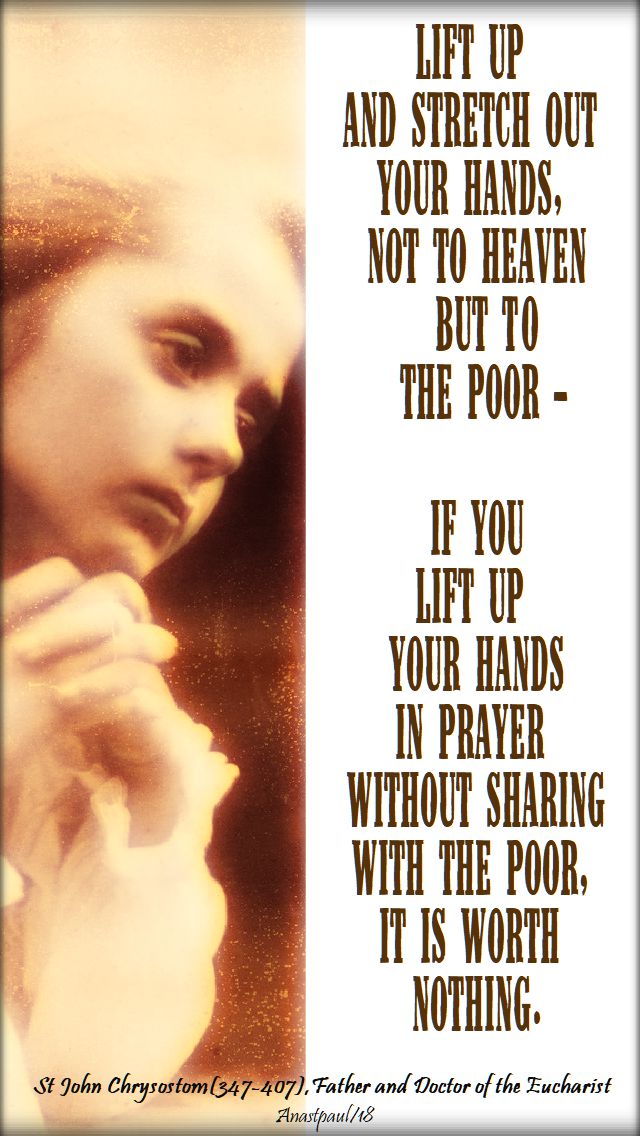
“Lift up and stretch out your hands,
not to heaven but to the poor…
if you lift up your hands in prayer
without sharing with the poor,
it is worth nothing.”lift up and stretch out your hands, not to heaven but to the poor - st john chrysostom - 16 sept 2018

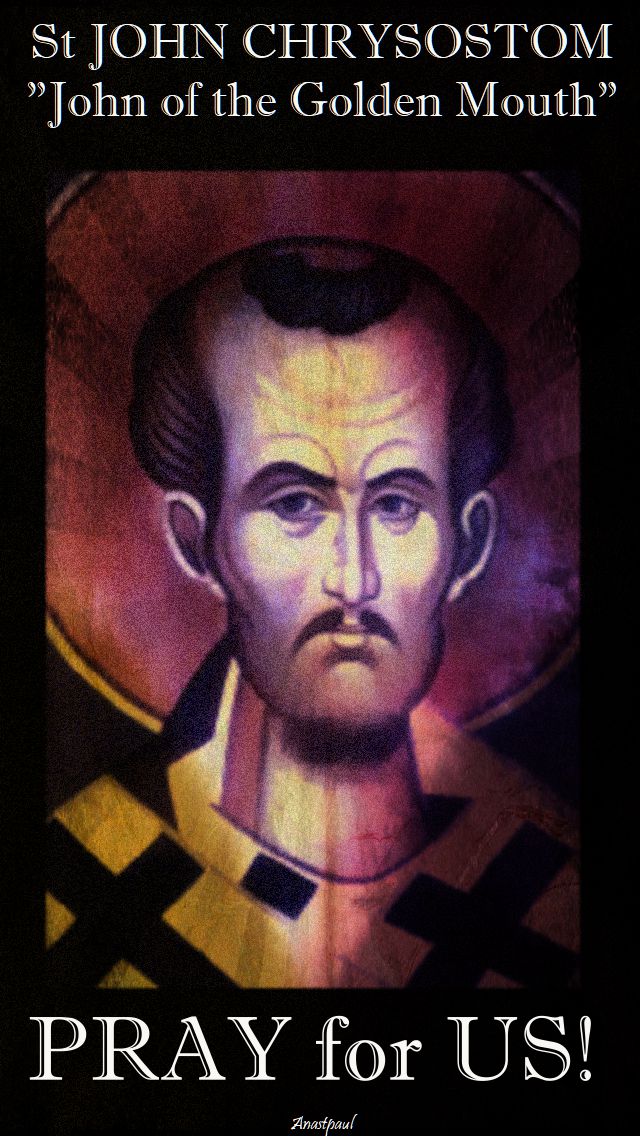
St John Chrysostom (347-407), Father and Doctor of the Eucharist, Pray for us!st john chrysostom pray for us.2

Posted in MORNING Prayers, PAPAL MESSAGES, PRAYERS for PRIESTS, PRAYERS of the SAINTS, QUOTES of the SAINTS, SUNDAY REFLECTIONS, The HOLY EUCHARIST / The HOLY MASS

Sunday Reflection – 2 September

Sunday Reflection – 2 September – Today’s Gospel:  Mark 7:1–23 – Twenty-second Sunday in Ordinary Time, Year B

John Paul and Jean-Marie

When the Curé of Ars spoke of the Sacrament of the Altar, he glowed!   He communicated to his hearers the Eucharistic fire that burned in his own heart.   Thirty-two years ago, St Pope John Paul II (1920-2005) devoted his Holy Thursday Letter to Priests, to Saint Jean-Marie Vianney.   I think that today we can read that letter as one saint talking about another.   This is what Pope John Paul II said:

“The Eucharist was at the very centre of Saint Jean Vianney’s spiritual life and pastoral work.
He said:  “All good works put together are not equivalent to the Sacrifice of the Mass, because they are the works of men and the Holy Mass is the work of God.”
It is in the Mass that the sacrifice of Calvary is made present for the Redemption of the world.   Clearly, the priest must unite the daily gift of himself to the offering of the Mass:
“How well a priest does, therefore, to offer himself to God in sacrifice every morning!” “Holy Communion and the Holy Sacrifice of the Mass are the two most efficacious actions for obtaining the conversion of hearts.”

Recollection and Adoration
Thus the Mass was for John Mary Vianney the great joy and comfort of his priestly life. He took great care, despite the crowds of penitents, to spend more than a quarter of an hour in silent preparation.   He celebrated with recollection, clearly expressing his adoration at the consecration and communion.   He accurately remarked:

“The cause of priestly laxity is not paying attention to the Mass!”

Let us always, daily, pray for all our Priests!

St John Vianney (1786-1859) Patron of Priests
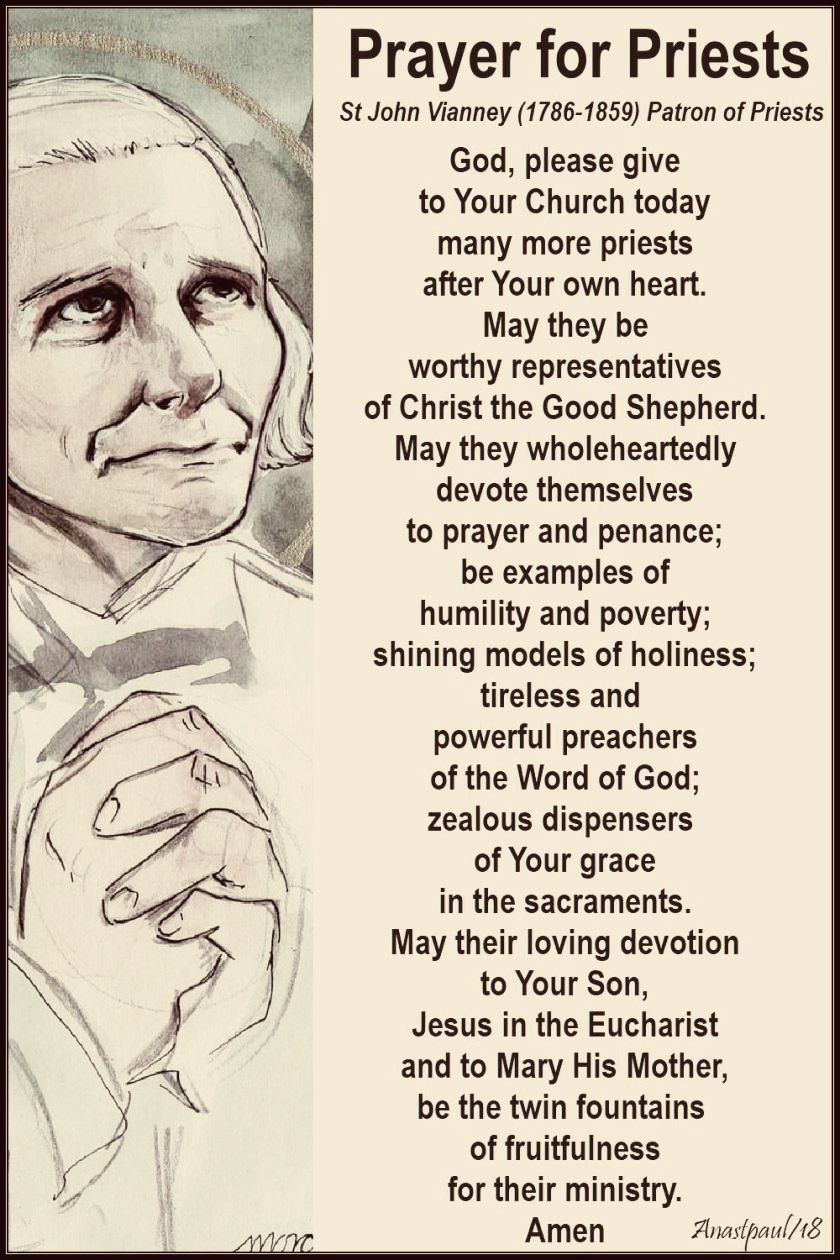
Prayer for Priests
By St John Vianney

God, please give to Your Church today
many more priests after Your own heart.
May they be worthy representatives
of Christ the Good Shepherd.
May they wholeheartedly devote themselves
to prayer and penance;
be examples of humility and poverty;
shining models of holiness;
tireless and powerful preachers
of the Word of God;
zealous dispensers of Your grace
in the sacraments.
May their loving devotion to Your Son,
Jesus in the Eucharist
and to Mary His Mother,
be the twin fountains of fruitfulness
for their ministry.
Amenprayer-for-priests-by-st-john-vianney-no-3-18-july-2018-no 2. recoloured 2 sept 2018

Posted in EUCHARISTIC Adoration, MORNING Prayers, PAPAL SERMONS, SUNDAY REFLECTIONS, The HOLY EUCHARIST / The HOLY MASS

Sunday Reflection – 13 August

Sunday Reflection – 13 August – 21st Sunday of the Year in Ordinary Time, Year B – Today’s Gospel: John 6:60–69

Eucharistic Meditation by Pope Benedict XVI (Excerpt)
Lourdes, 14 September 2008

Do Not Refuse His Love
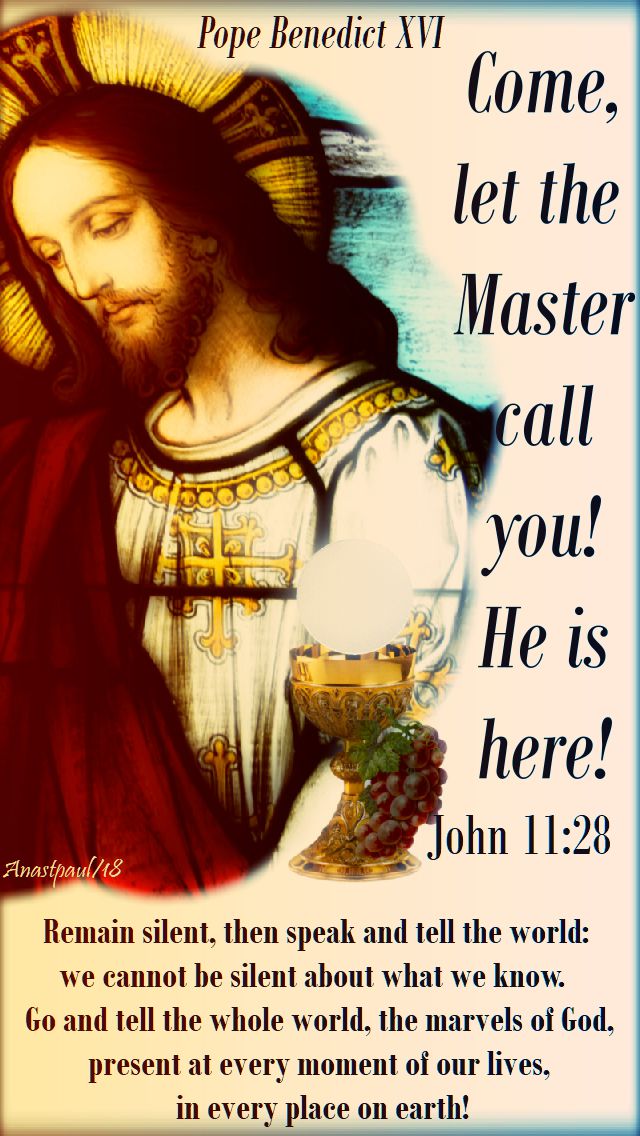
This evening, we do not see them but we hear them saying to us, to every man and to every woman among us:  “Come, let the Master call you! He is here!   He is calling you” (cf. Jn 11:28)!   He wants to take your life and join it to His.   Let yourself be embraced by Him!   Gaze no longer upon your own wounds, gaze upon His.   Do not look upon what still separates you from Him and from others;  look upon the infinite distance that He has abolished by taking your flesh, by mounting the Cross which men had prepared for Him and by letting Himself be put to death so as to show you His love.   In His wounds, He takes hold of you;   in His wounds, He hides you.   Do not refuse His Love!”

Contemplate the Wounds of Christ
The immense crowd of witnesses who have allowed themselves to be embraced by His Love, is the crowd of saints in heaven who never cease to intercede for us.   They were sinners and they knew it but they willingly ceased to gaze upon their own wounds and to gaze only upon the wounds of their Lord, so as to discover there the glory of the Cross, to discover there the victory of Life over death.   Saint Pierre-Julien Eymard (1811-1868) tells us everything when he cries out:  “The holy Eucharist is Jesus Christ, past, present and future” (Sermons and Parochial Instructions After 1856, 4-2.1, “On Meditation”).

Jesus Christ Past
Jesus Christ, past, in the historical truth of the evening in the Upper Room, to which every celebration of holy Mass leads us back.

Jesus Christ Present
Jesus Christ, present, because He said to us:  “Take and eat of this, all of you, this is my Body, this is my Blood.”   “This is”, in the present, here and now, as in every here and now throughout human history.   The Real Presence, the Presence which surpasses our poor lips, our poor hearts, our poor thoughts.   The Presence offered for us to contemplate as we do here, this evening, close to the grotto where Mary revealed herself as the Immaculate Conception.

Jesus Christ Coming
The Eucharist is also Jesus Christ, future, Jesus Christ to come.   When we contemplate the Sacred Host, His glorious transfigured and risen Body, we contemplate what we shall contemplate in eternity, where we shall discover that the whole world has been carried by its Creator during every second of its history.   Each time we consume Him but also each time we contemplate Him, we proclaim Him until he comes again, “donec veniat”. That is why we receive Him with infinite respect.

Remain Silent, Then Speak
Beloved brothers and sisters, day pilgrims and inhabitants of these valleys, brother Bishops, priests, deacons, men and women religious, all of you who see before you the infinite abasement of the Son of God and the infinite glory of the Resurrection, remain in silent adoration of your Lord, our Master and Lord Jesus Christ.   Remain silent, then speak and tell the world:  we cannot be silent about what we know.   Go and tell the whole world the marvels of God, present at every moment of our lives, in every place on earth.   May God bless us and keep us, may He lead us on the path of eternal life, He who is Life, forever and ever. Amen.come, let the master call you - remain silent - pope benedict - 26 aug 2018 sunday reflection

Posted in MORNING Prayers, QUOTES of the SAINTS, SUNDAY REFLECTIONS, The HOLY EUCHARIST / The HOLY MASS, The WORD

Sunday Reflection- 19 August – John 6:51-58

Sunday Reflection – 19 August – John 6:51-58

“My flesh is true food, and my blood is true drink”

The sacramental representation of Christ’s sacrifice, crowned by the resurrection, in the Mass involves a most special presence which – in the words of Paul VI – “is called ‘real’ not as a way of excluding all other types of presence as if they were ‘not real’, but because it is a presence in the fullest sense: a substantial presence whereby Christ, the God-Man, is wholly and entirely present”.   This sets forth once more, the perennially valid teaching, of the Council of Trent, “the consecration of the bread and wine effects the change of the whole substance of the bread into the substance of the body of Christ our Lord, and of the whole substance of the wine into the substance of his blood.   And the holy Catholic Church has fittingly and properly called this change transubstantiation”.

Truly the Eucharist is a mysterium fidei, a mystery which surpasses our understanding and can only be received in faith, as is often brought out in the catechesis of the Church Fathers regarding this divine sacrament:  “Do not see – Saint Cyril of Jerusalem exhorts – in the bread and wine merely natural elements, because the Lord has expressly said that they are his body and his blood: faith assures you of this, though your senses suggest otherwise”.

Before this mystery of love, human reason fully experiences its limitations. One understands how, down the centuries, this truth has stimulated theology to strive to understand it ever more deeply.   These are praiseworthy efforts, which are all the more helpful and insightful to the extent that they are able to join critical thinking to the “living faith” of the Church…   There remains the boundary indicated by Paul VI: “Every theological explanation… must firmly maintain that in objective reality, independently of our mind, the bread and wine have ceased to exist after the consecration, so that the adorable body and blood of the Lord Jesus from that moment on are really before us under the sacramental species of bread and wine”.

St Pope John Paul (1920-2005)every theological explanation must firmly maintain - bl pope paul VI - 19 aug 2018.jpg

Posted in MORNING Prayers, QUOTES of the SAINTS, SUNDAY REFLECTIONS, The HOLY CROSS, The HOLY EUCHARIST / The HOLY MASS

Sunday Reflection – 12 August – Nineteenth Sunday in Ordinary Time, Year B

Sunday Reflection – 12 August – Nineteenth Sunday in Ordinary Time, Year B

Jesus, our Daily Sacrifice

“Our Lord not only offered Himself as a Sacrifice on the Cross but He makes Himself a perpetual, a daily Sacrifice, to the end of time.

In the Holy Mass, that One Sacrifice on the Cross once offered is renewed, continued, applied to our benefit.
He seems to say, ‘My Cross was raised up 1800 years ago – and only for a few hours and very few of my servants were present there – but I intend to bring millions into my Church.   For their sakes then, I will perpetuate My Sacrifice, that each of them may be as though they had severally been present on Calvary.   I will offer Myself up, day by day to the Father, that everyone of my followers, may have the opportunity to offer his petitions to Him, sanctified and recommended by the all-meritorious virtue of My Passion.   Thus, I will be a Priest forever, after the order of Melchisedech – My priests shall stand at the Altar – but not they but I rather, will offer.   I will not let them offer mere bread and wine but I Myself, will be present upon the Altar instead and I will offer up Myself invisibly, while they perform the outward rite.’

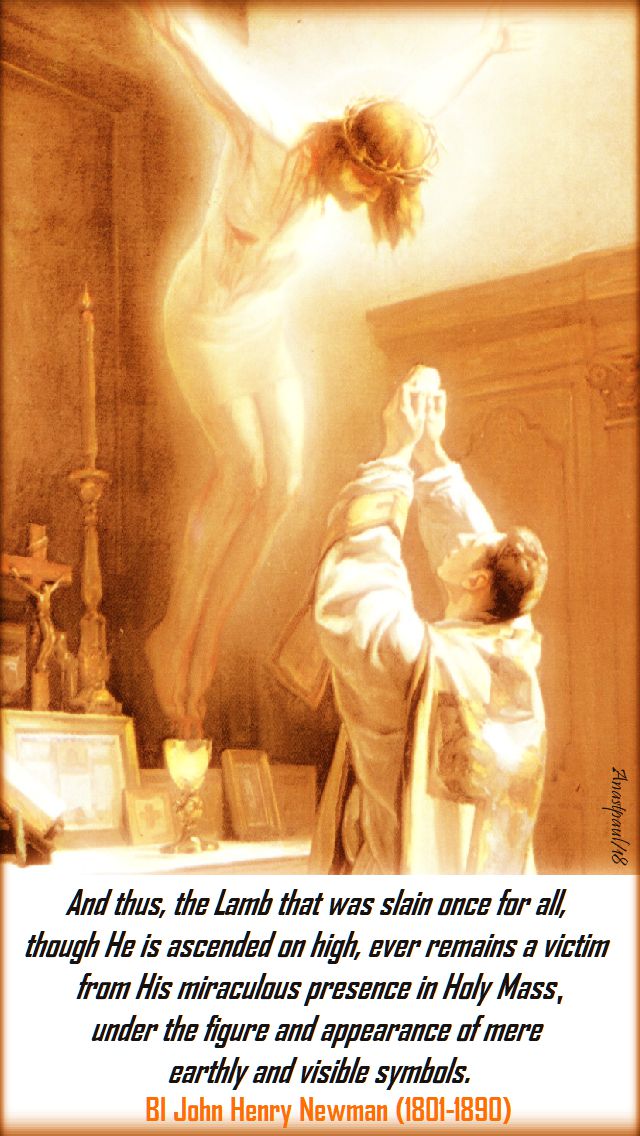
And thus, the Lamb that was slain once for all, though He is ascended on high, ever remains a victim from His miraculous presence in Holy Mass under the figure and appearance of mere earthly and visible symbols.”

Blessed John Henry Newman (1801-1890)
Jesus, our Daily Sacrifice, Prayers, Verses and Devotionsand thus, the lambe that was slain - bl j h newman - 12 aug 2018 - sunday reflection

Posted in DOCTORS of the Church, FATHERS of the Church, MORNING Prayers, QUOTES of the SAINTS, SUNDAY REFLECTIONS, The HOLY EUCHARIST / The HOLY MASS, Uncategorized

Sunday Reflection – 5 August – Today’s Gospel: John 6:24-35

Sunday Reflection – 5 August – Eighteenth Sunday in Ordinary Time, Year B – Today’s Gospel: John 6:24-35

“Bread is not made from one grain but from many. It’s as though you, who were many were ground.   When you were baptised it’s as though you were mixed into dough.   When you received the fire of the Holy Spirit, it’s as though you were baked.
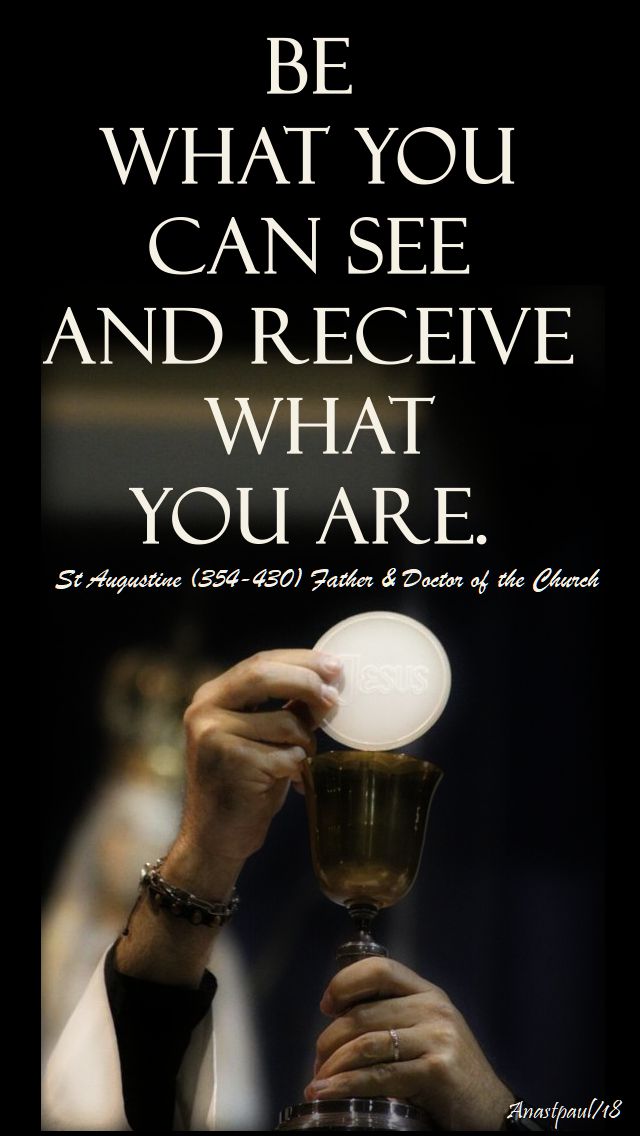
Be what you can see and receive what you are.

After all, just as many grains are mixed into one loaf in order to produce the visible appearance of bread, as though what holy scripture says about the faithful were happening:  They had one soul and one heart in God (Acts 4:32);   so too with the wine. Brothers and sisters, just remind yourselves what wine is made from;  many grapes hang in the bunch but the juice of the grapes is poured together in one vessel.”

St Augustine (354-430) Father & Doctor of the Churchbe what you can see and receive what you are - st augustine - 5 aug 2018

Posted in DOCTORS of the Church, EUCHARISTIC Adoration, MORNING Prayers, QUOTES of the SAINTS, SUNDAY REFLECTIONS, The HOLY EUCHARIST / The HOLY MASS

Sunday Reflection – 29 July – Become the bread of Christ – St Bernard (1090-1153) Doctor of the Church

Sunday Reflection – 29 July

Become the bread of Christ

St Bernard (1090-1153) Doctor of the Church

Saint Bernard teaches that it is not enough for us to take and eat the Bread from Heaven.
We must also offer ourselves to be eaten.
Holy Communion is a wondrous exchange in which we become the bread of Christ.
Listen to Saint Bernard:

“My penitence, my salvation are His food.
I myself am His food.
I am chewed. as I am reproved by Him;
I am swallowed by Him. as I am taught;
I am digested by Him. as I am changed;
I am assimilated. as I am transformed;
I am made one with Him, as I am conformed to Him.
He feeds upon us and is fed by us
that we may be the more loosely bound to Him.”

Saint Bernard, ever the poet, uses images of eating and assimilation to describe how Christ unites us to Himself.
Our Lord becomes our food that we might become His.
We need the language of poets and preachers in our approach to the Eucharist.

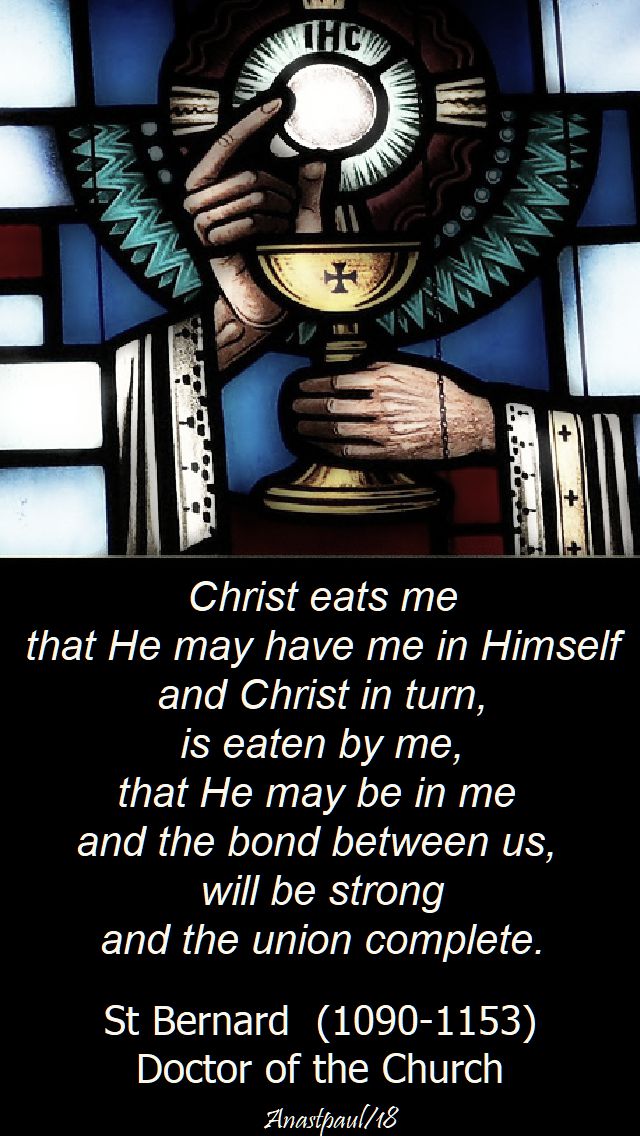
Saint Bernard says, “Christ eats me that He may have me in Himself and Christ in turn is eaten by me that He may be in me and the bond between us, will be strong and the union complete.”   

What awaits you in Holy Communion exceeds all that you can desire.   Eat, then and offer yourself to be eaten.   Receive the Bread of God and become the bread of God.christ eats me - st bernard - 29 july 2018

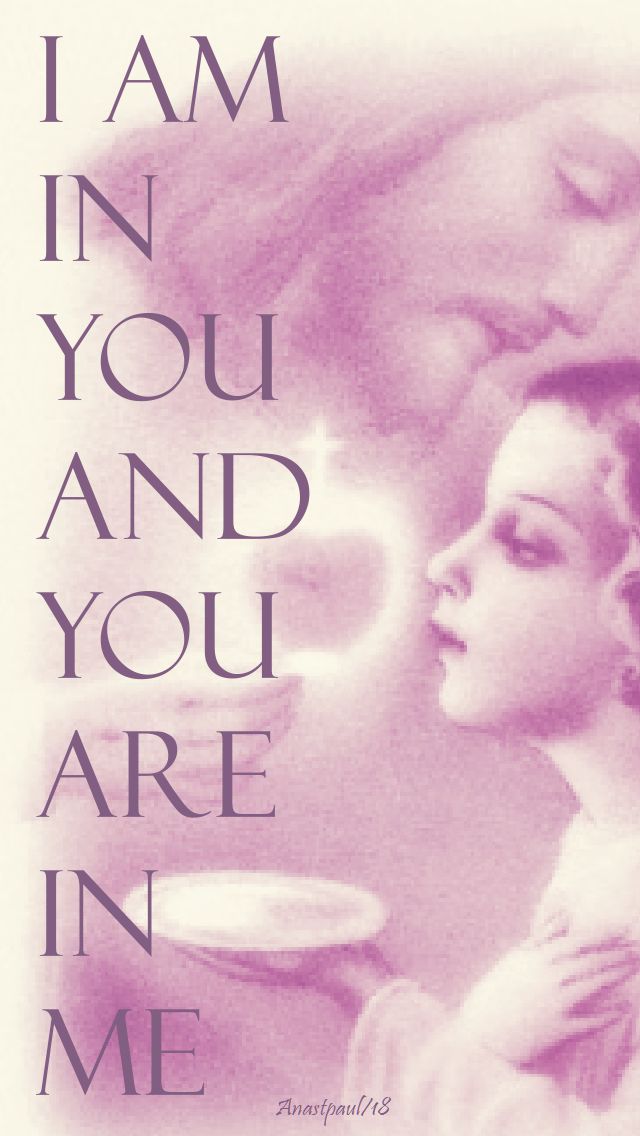
“I am in you and you are in me!”

i am in you and you are in me - 29 july 2018

Posted in MORNING Prayers, SUNDAY REFLECTIONS, The HOLY EUCHARIST / The HOLY MASS

Sunday Reflection – 22 July – Sixteenth Sunday in Ordinary Time, Year B

Sunday Reflection – 22 July – Sixteenth Sunday in Ordinary Time, Year B

Sit laus plena, sit sonora

Remember, Mother Church, the holy and venerable hands,
the hands that, taking bread, broke and gave it,
the hands that have strengthened the bolts of your gates,
the hands that blessed your children within you (cf. Ps 147:12).
Remember the voice of Him whose word runs swiftly,
blessing and saying, “Take and eat, this is my Body”;
“This chalice is the new testament in my Blood” (cf. 1 Cor 11:24-25).
Remember the Crucified, the Risen One, the Lord of glory
whose Face alone plants peace in your borders,
whose Heart would save your souls from death,
and feed you in time of famine (cf. Ps 32:19).
Remember His hands, His Face and His Heart,
remember His words on the night before He suffered,
and out of your remembering, let praise come to flower on your lips.
Praise to fill that Upper Room,
praise to fill the Church,
praise to fall like a balm on every heart that has forgotten
the language of the Great Thanksgiving.

Remember the chalice of blessing
and adore the Blood of Christ.
Remember the bread that we break
and adore the Body of Christ.
Remember the one Bread by which we,
though many, are made one (cf. 1 Cor 10:16-17).
Remember the chalice of the Blood
in which every tear of yours dissolves into joy.
Remember the broken Bread
by which every brokenness of yours is made whole.
Remember the chalice offered to those who have nothing to offer.
Remember the Bread given to those who have nothing to give.
Remember and into your remembering,
welcome the immensity of a silence that seeks only to adore.remember the chalic of blessing - sunday reflection - 22 july 2018 - from vultus christi

(Excerpt By Dom Mark, Vultus Christi)

Posted in EUCHARISTIC Adoration, MORNING Prayers, QUOTES of the SAINTS, SUNDAY REFLECTIONS, The HOLY EUCHARIST / The HOLY MASS

Sunday Reflection – 15 July – Fifteenth Sunday of the Year

Sunday Reflection – 15 July – Fifteenth Sunday of the Year

“….in the Blessed Sacrament Our Lord Himself is the light which manifests Him as our model and reveals His beauties to us.   He is Himself His light, His means of being known, just as the sun is itself its own proof.   To make Himself known, He has only to show Himself.   Recognition of Him need not come from its being reasoned out.

A child does not have to discourse with himself to recognise his parents.   Our Lord reveals Himself through His presence, just as parents do.   But as we grow to know His voice better and as our hearts become more sympathetic to Him in emptying themselves of what is not Him, our Lord manifests Himself in a clearer and more intimate manner, which only those know, who love Him.   He gives the soul a divine conviction which overshadows the light of human reason.

Look at Magdalene:  one word from Jesus and she recognises Him.   He acts in the same way in the Blessed Sacrament:   He says one word only but it rings in our very hearts:  “It is I!….”   We sense His Presence, we believe in it more firmly than if we were to see Him with bodily eyes.”

St Peter Julian Eymard (1811-1868)it is I - st peter julian eymard - 15 july 2018

Posted in MORNING Prayers, QUOTES of the SAINTS, SUNDAY REFLECTIONS, The HOLY EUCHARIST / The HOLY MASS

Sunday Reflection – 8 July – Fourteenth Sunday in Ordinary Time, Year B

Sunday Reflection – 8 July – Fourteenth Sunday in Ordinary Time, Year B

“What does Jesus Christ do in the Eucharist?   

It is God who, as our Saviour, offers Himself each day for us to His Father’s justice.   

If you are in difficulties and sorrows, He will comfort and relieve you.   

If you are sick, He will either cure you or give you strength to suffer so as to merit Heaven.   

If the devil, the world and the flesh are making war upon you, He will give you the weapons with which to fight, to resist and to win victory.

If you are poor, He will enrich you with all sorts of riches for time and eternity.   

Let us open the door of His sacred and adorable Heart and be wrapped about for an instant by the flames of His love and we shall see what a God who loves us can do.   

O my God, who shall be able to comprehend?”

St John Vianney (1786-1859)

what does jesus christ do in the eucharist - sun reflection - 8 july 2018 -no 2 LARGER st john vianney