One Minute Reflection – 24 August – The Feast of St Bartholomew, Apostle of Christ – Today’s Gospel: John 1:45–51
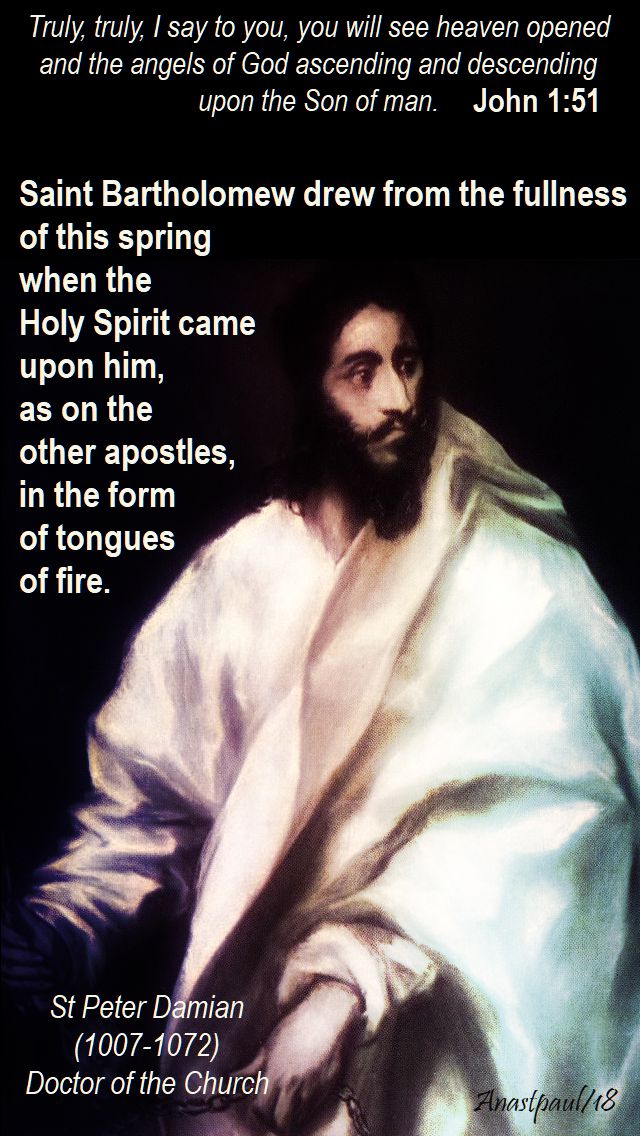
“Truly, truly, I say to you, you will see heaven opened and the angels of God ascending and descending upon the Son of man.”…John 1:51
REFLECTION – “The apostles’ glory is so indistinguishable and so bonded together by the cement of so many graces that in celebrating the feast of one of them the common greatness of all is called to our interior attention. For they share together the same authority of supreme judge, the same honourable rank and they hold the same power to bind and loose (Mt 19:28; 18:18). They are those precious pearls that Saint John tells us he beheld in the Book of Revelation out of which are constructed the gates of the heavenly Jerusalem (Rv 21:21.14)… And indeed, whenever the apostles beam divine light through their signs or miracles, they open up the heavenly glory of Jerusalem to all those peoples who have been converted to the christian faith…
Of them, too, the prophet says: “Who are these who fly along like clouds?” (Is 60:8)… God raises the minds of His preachers to contemplation of truths on high… so that they can abundantly pour down the rain of God’s word into our hearts. Thus they drink water from the spring so as to give drink to us too. Saint Bartholomew drew from the fullness of this spring when the Holy Spirit came upon him, as on the other apostles, in the form of tongues of fire (Acts 2:3).”… St Peter Damian (1007-1072) – Bishop, Doctor of the Church (Sermon 42, 2nd for Saint Bartholomew, PL 144, 726)
PRAYER – Almighty Lord and Father, strengthen in us that faith with which St Bartholomew gave himself wholeheartedly to Christ Your Son. Grant, at his intercession, that Your Church may become the Sacrament of salvation, for all the nations of the earth. We make our prayer through Jesus, our Lord and Christ, in the unity of the Holy Spirit, one God, forever, amen.
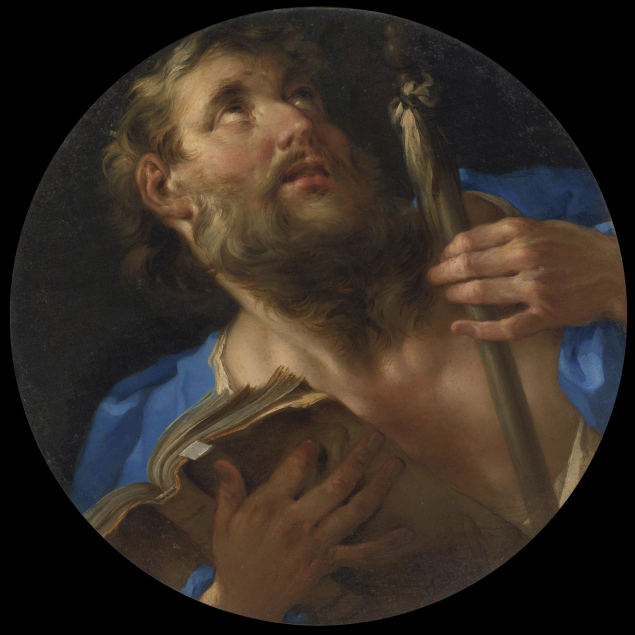
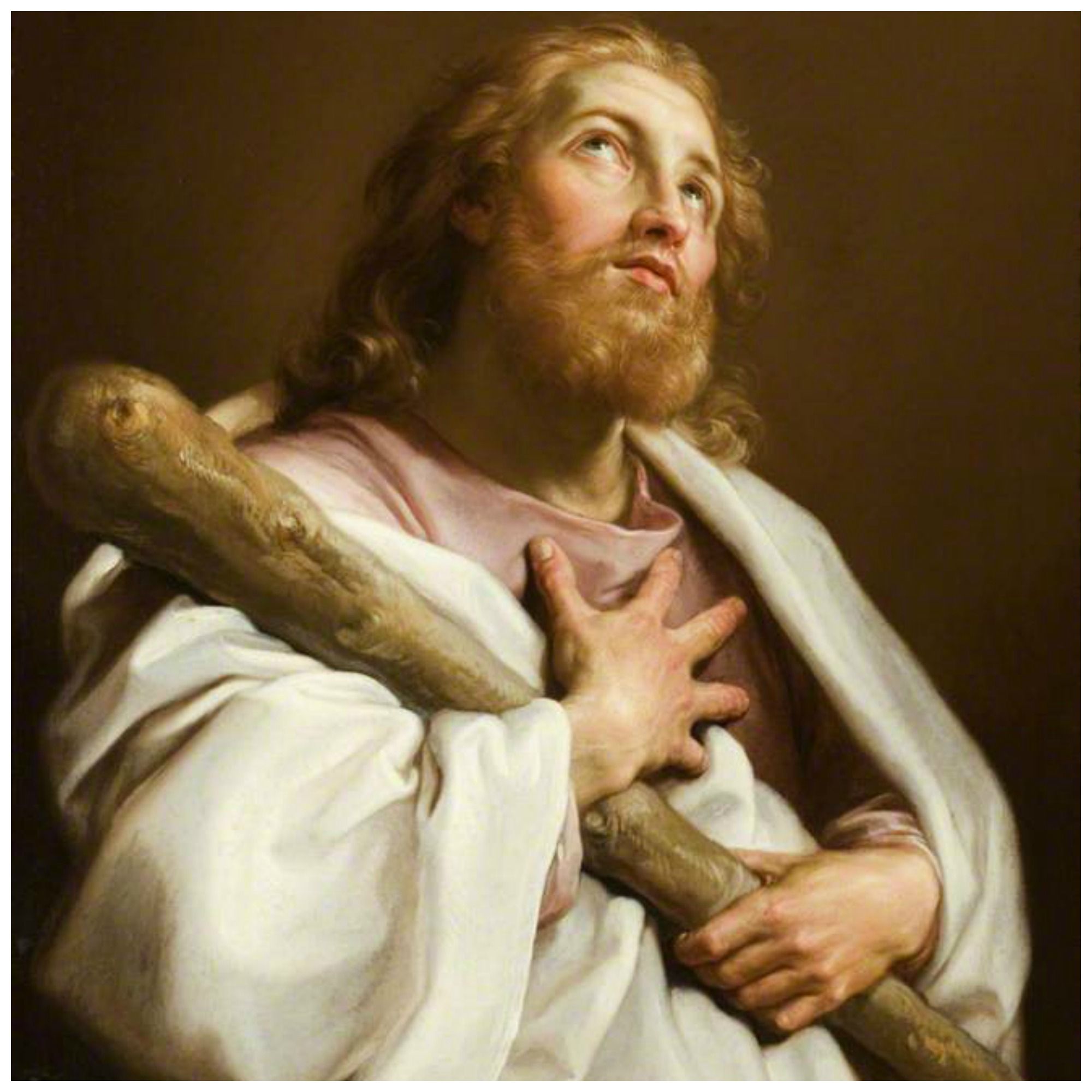
One Minute Reflection – 25 July – The Memorial of St James the Greater, Apostle of Christ – Today’s Gospel: Matthew 20:20–28
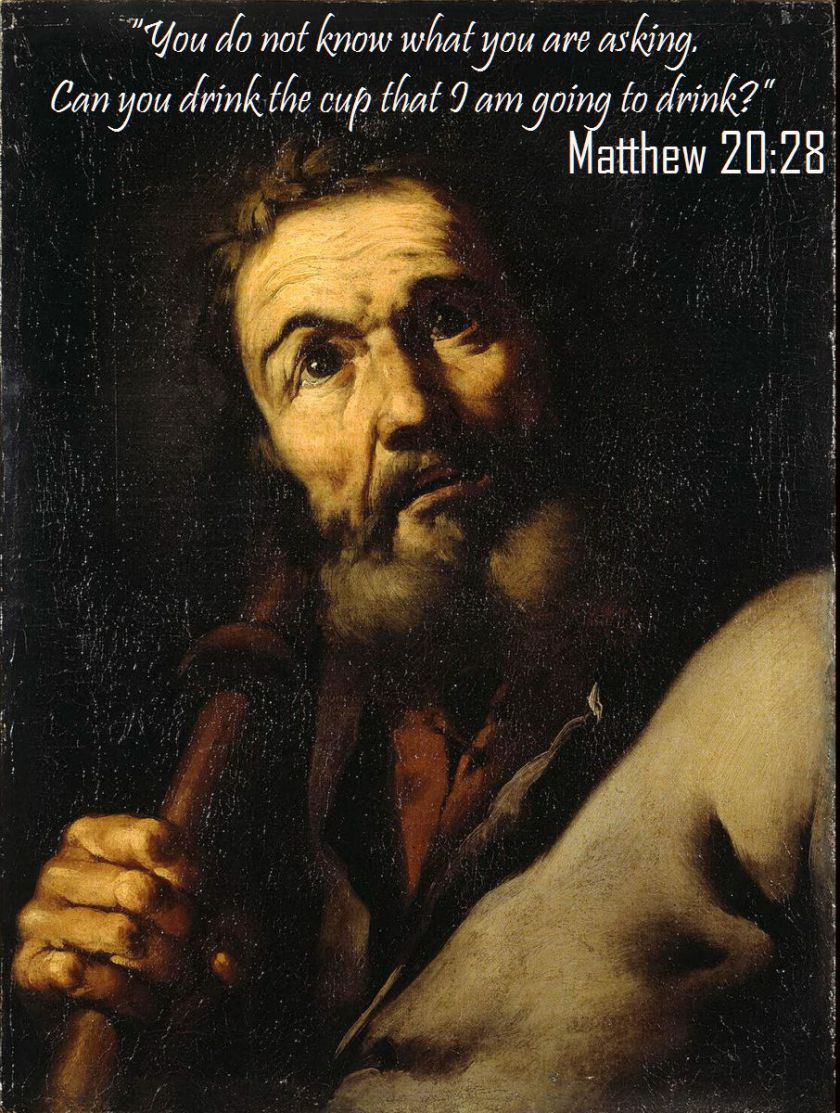
Jesus said in reply, “You do not know what you are asking. Can you drink the cup that I am going to drink?” They said to him, “We can.”……Matthew 20:28
REFLECTION – “Through their mother’s mediation, the sons of Zebedee press Christ as follows in the presence of their fellow apostles: “Command that we may sit, one at your right side and one at your left” (cf. Mk 10:35f.)… Christ hastens to free them from their illusions, telling them they must be prepared to suffer insults, persecutions, even death. “You do not know what you are asking. Are you able to drink the cup that I shall drink?” Let no one be surprised to see the apostles displaying such imperfect dispositions. Wait until the mystery of the cross has been fulfilled and the strength of the Holy Spirit given to them. If you want to see the strength of their souls, take a look at them later on and you will see them to be above all human weakness. Christ does not conceal their pettiness so you will be able to see what they become later on by the power of the grace that will transform them…”… St John Chrysostom (c 345-407) Father & Doctor of the Church
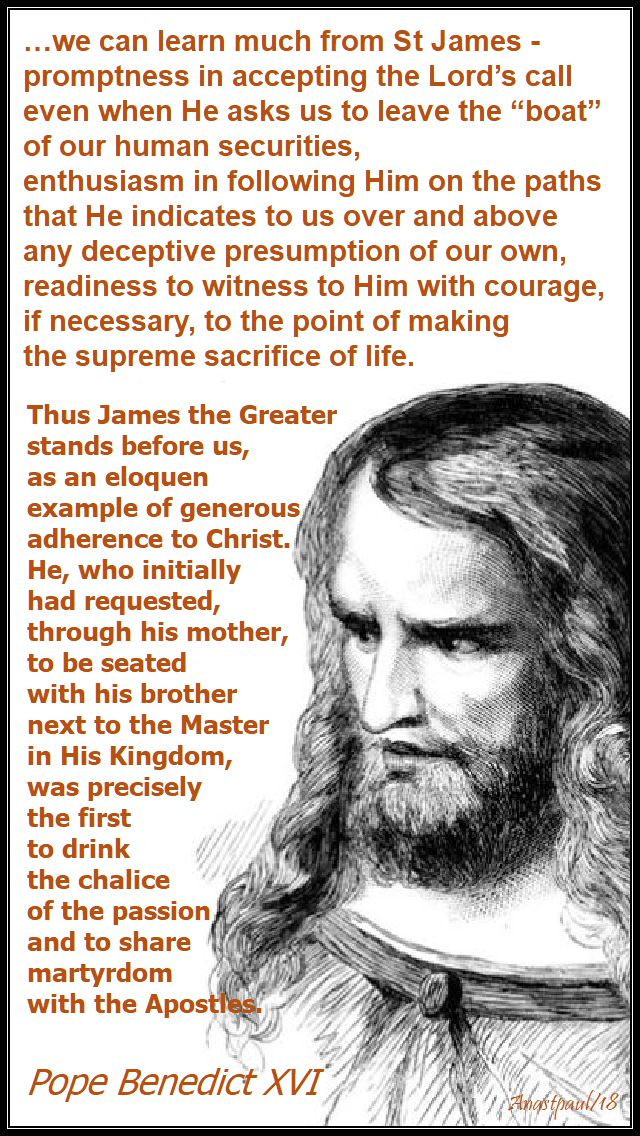
“…we can learn much from St James: promptness in accepting the Lord’s call even when He asks us to leave the “boat” of our human securities, enthusiasm in following Him on the paths that He indicates to us over and above any deceptive presumption of our own, readiness to witness to Him with courage, if necessary to the point of making the supreme sacrifice of life. Thus James the Greater stands before us, as an eloquent example of generous adherence to Christ. He, who initially had requested, through his mother, to be seated with his brother next to the Master in His Kingdom, was precisely the first to drink the chalice of the passion and to share martyrdom with the Apostles.”…Pope Benedict XVI – General Audience, 21 June 2006
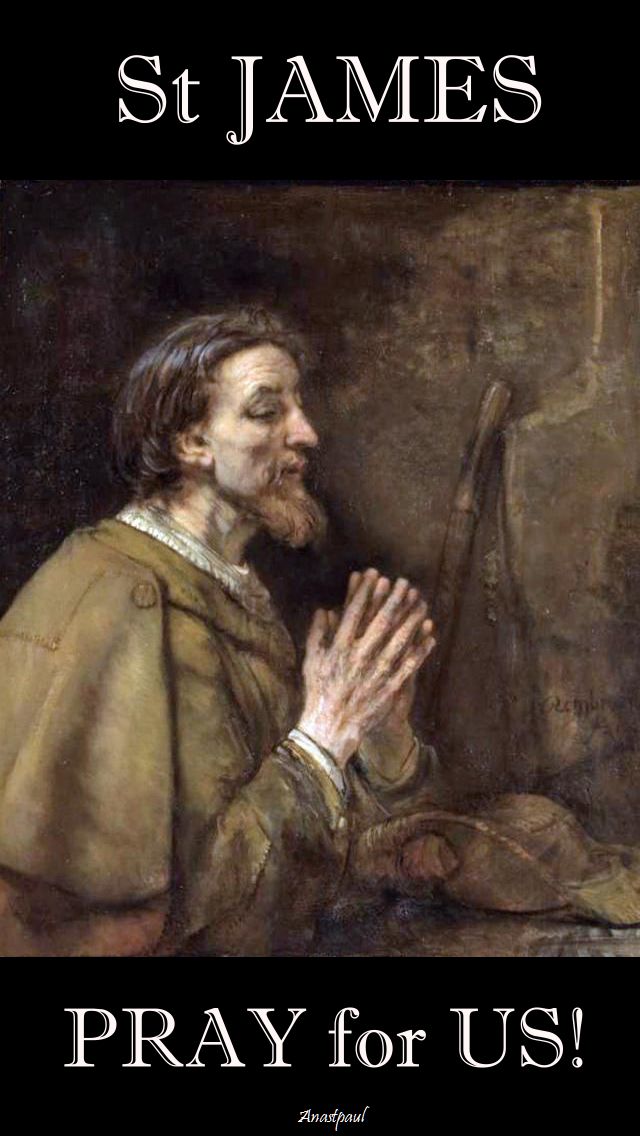
PRAYER – Lord our God, You accepted the sacrifice of St James, the first of Your Apostles to give his life for Your sake. May Your Church find strength in his martyrdom and support in his constant prayer. Through our Lord Jesus Christ, your Son, who lives and reigns with you in the unity of the Holy Spirit, one God, for ever and ever. St James the Greater, Apostle of Christ, Pray for us! Amen
St James the Greater (Feast) – Son of Zebedee and Salome, brother of Saint John the Apostle. He is called “the Greater” simply because he became an Apostle before Saint James the Lesser.
All about him here: https://anastpaul.wordpress.com/2017/07/25/saint-of-the-day-25-july-feast-of-st-james-the-greater-apostle-of-christ/
Bl Alexius Worstius
Bl Antonio Lucci O.F.M.Conv. (1682-1752) Bishop of Bovino
Bl Antonio of Olmedo
St Bantu of Trier
St Beatus of Trier
St Christopher
St Cugat del Valles
Bl Darío Acosta Zurita
St Ebrulfus
St Euphrasia
St Fagildo of Santiago
St Felix of Furcona
St Florentius of Furcona
St Glodesind of Metz
St Magnericus of Trier
Bl Michel-Louis Brulard
Bl Mieczyslawa Kowalska
St Mordeyren
St Nissen of Wexford
St Olympiad of Constantinople
St Paul of Palestine
Bl Pietro Corradini of Mogliano
St Theodemir of Cordoba
—
Martyrs of Caesarea – 3 saints: Three Christians martyred together in the pesecutions of emperor Maximilian and governor Firmilian – Paul, Tea and Valentina. 309 in Caesarea, Palestine.
Martyrs of Cuncolim – 20 saints: On 15 July 1583 the group met at the church of Orlim, and hiked to Cuncolim to erect a cross and choose land for a new church. Local anti-Christian pagans, seeing the unarmed Christians, gathered their weapons and marched on them. One of the parishioners, a Portuguese emigre named Gonçalo Rodrigues, carried a firearm, but Father Alphonsus Pacheco stopped him from using it. The pagans then fell upon them, and killed them all without mercy. They were –
• Alphonsus Pacheco
• Alphonsus the altar boy
• Anthony Francis
• Dominic of Cuncolim
• Francis Aranha
• Francis Rodrigues
• Gonçalo Rodrigues
• Paul da Costa
• Peter Berno
• Rudolph Acquaviva
• ten other native Christian converts whose names have not come down to us
They were martyred on Monday 25 July 1583 at the village of Cuncolim, district of Salcete, territory of Goa, India. Beatified on 30 April 1893 by Pope Leo XIII.
Martyrs of Furci:
Martyrs of Motril – 5 beati: Four priests and a brother, all members of the Augustinian Recollects, who were martyred together in the Spanish Civil War:
• Deogracias Palacios del Río
• José Rada Royo
• José Ricardo Díez Rodríguez
• Julián Benigno Moreno y Moreno
• León Inchausti Minteguía
They were shot on 25 July 1936 in Motril, Granada, Spain and Beatified on 7 March 1999 by Pope John Paul II.
Martyrs of Toledo – 4 beati: Four brothers and a priest, all members of the Hospitallers of Saint John of God, and all martyred together in the Spanish Civil War.
• Carlos Rubio álvarez
• Eloy Francisco Felipe Delgado Pastor
• Jerónimo Ochoa Urdangarín
• Primo Martínez De San Vicente Castillo
25 July 1936 in Talavera de la Reina, Toledo, Spain. They were Beatified on 25 October 1992 by Pope John Paul II.
Martyrs of Urda – 3 beati: Three members of the Passionists who were martyred together in the Spanish Civil War.
• Benito Solana Ruiz
• Felix Ugalde Irurzun
• Pedro Largo Redondo
They were shot on 25 July 1936 in Urdá, Toledo, Spain and Beatified on 1 October 1989 by Pope John Paul II.
Martyred in the Spanish Civil War:
Antonio Varona Ortega
Bl Dionisio Pamplona-Polo
Enric Morante Chic
Higinio Roldán Iriberri
Jaume Balcells Grau
Jesús Eduard Massanet Flaquer
Jesús Juan Otero
José López Tascón
José Luis Palacio Muñiz
Josep Bardolet Compte
Josep Más Pujolrás
Juan Crespo Calleja
Bl Miquel Peiro Victori
Ricard Farré Masip
Santos López Martinez
Vicente Fernández Castrillo
Thought for the Day – 3 July – Feast of St Thomas Apostle
The weakness of Thomas’s faith
is a source of our Lord’s great blessing for the Church
We must not suppose that St Thomas differed greatly from the other apostles. They all, more or less, mistrusted Christ’s promises when they saw Him led away to be crucified. When He was buried, their hopes were buried with Him and when the news was brought them, that He was risen again, they all disbelieved it. On His appearing to them, He “upbraided them with their unbelief and hardness of heart.” (Mark 16:14)… Thomas was convinced latest, because He saw Christ latest. On the other hand, it is certain that, though he disbelieved the good news of Christ’s resurrection at first, he was no cold-hearted follower of his Lord, as appears from his conduct on a previous occasion, when he expressed a desire to share danger and to suffer with Him…: “Let us also go, that we may die with him.” (Jn 11:16)… It was at the instance of Thomas that they hazarded their lives with their Lord.
St Thomas then loved his Master, as became an apostle and was devoted to His service; but when he saw him crucified, his faith failed for a season with that of the rest… and more than the rest. His standing out alone, not against one witness only but against his ten fellow disciples, besides Mary Magdalene and the other women is evidence of this… He seems to have required some sensible insight into the unseen state, some infallible sign from heaven, a ladder of angels like Jacob’s (Gn 28:12), which would remove anxiety by showing him the end of the journey at the time he set out. Some such secret craving after certainty beset him. And a like desire arose within him on the news of Christ’s resurrection.
While our Saviour allowed Thomas his wish and satisfied his senses that He was really alive, He accompanied the permission with a rebuke: “Because thou hast seen me, thou hast believed: blessed are they that have not seen and yet have believed.”… All His disciples minister to Him even in their weaknesses, that so He may convert them into instruction and comfort for His Church….Blessed John Henry Newman (1801-1890)PPS II, Sermon 2. “Faith without Sight”
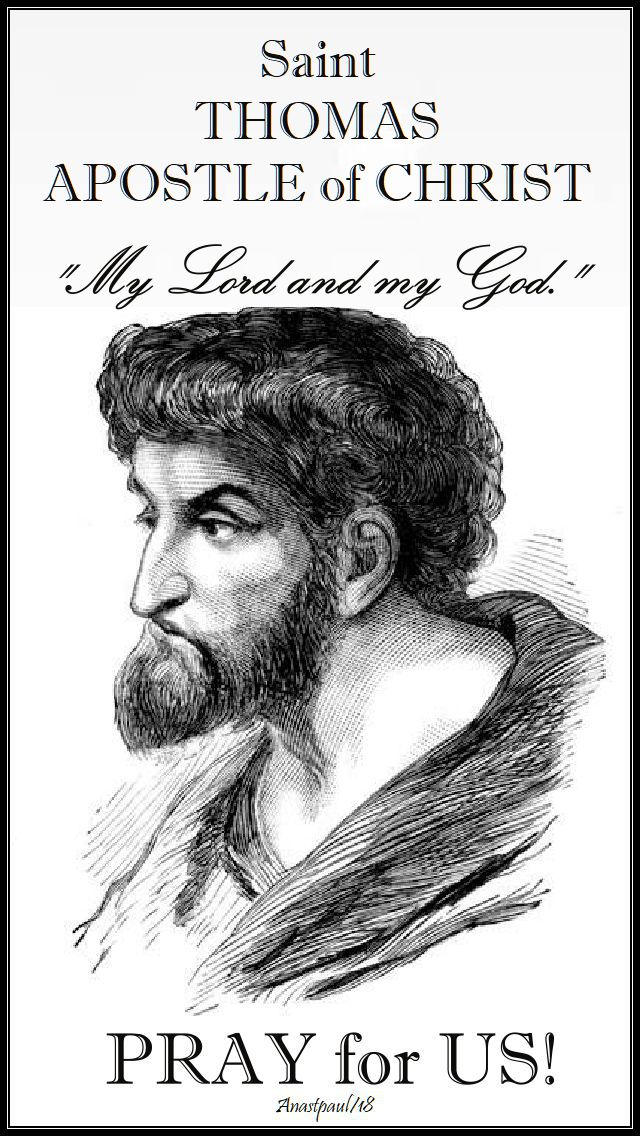
“My Lord and my God!”
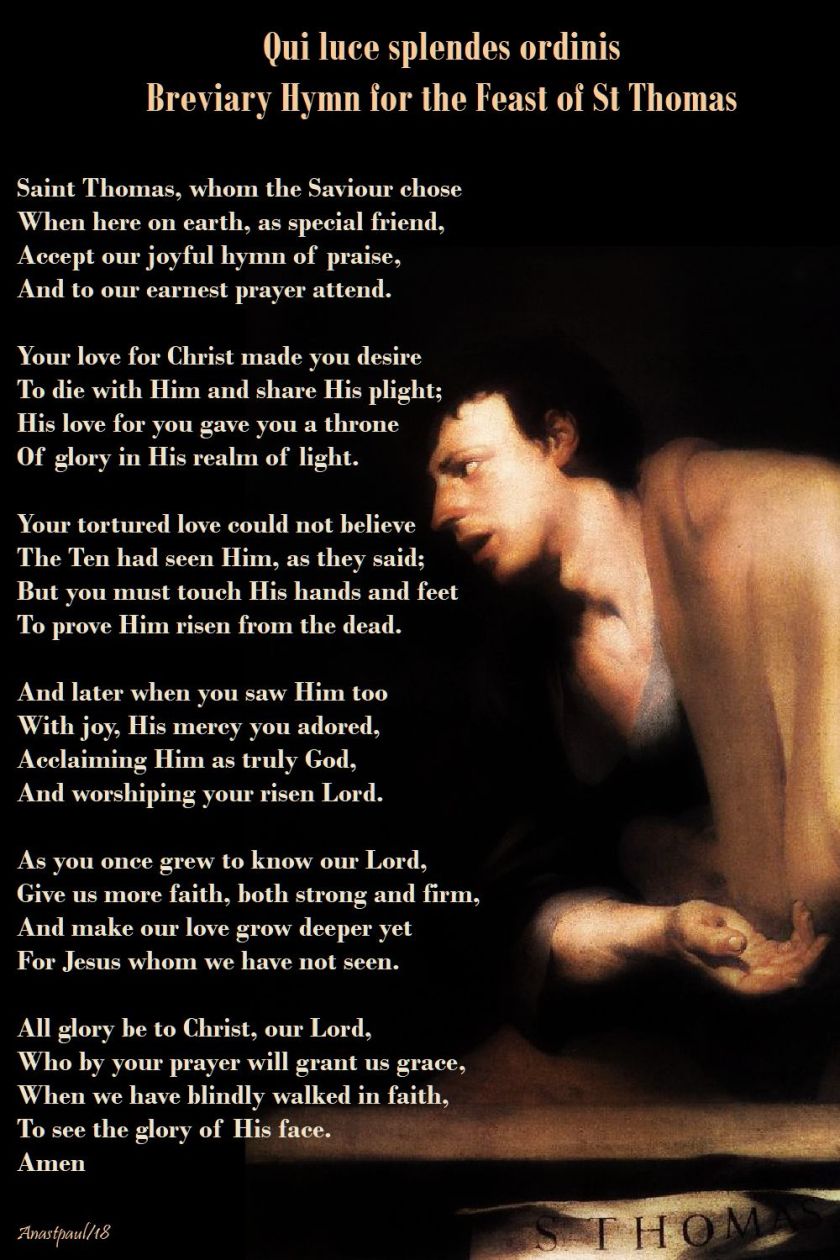
St Thomas, Pray for us that we too may so love our Lord and our God and “follow Him” to the end of time!
Quote of the Day – 3 July – Feast of St Thomas Apostle
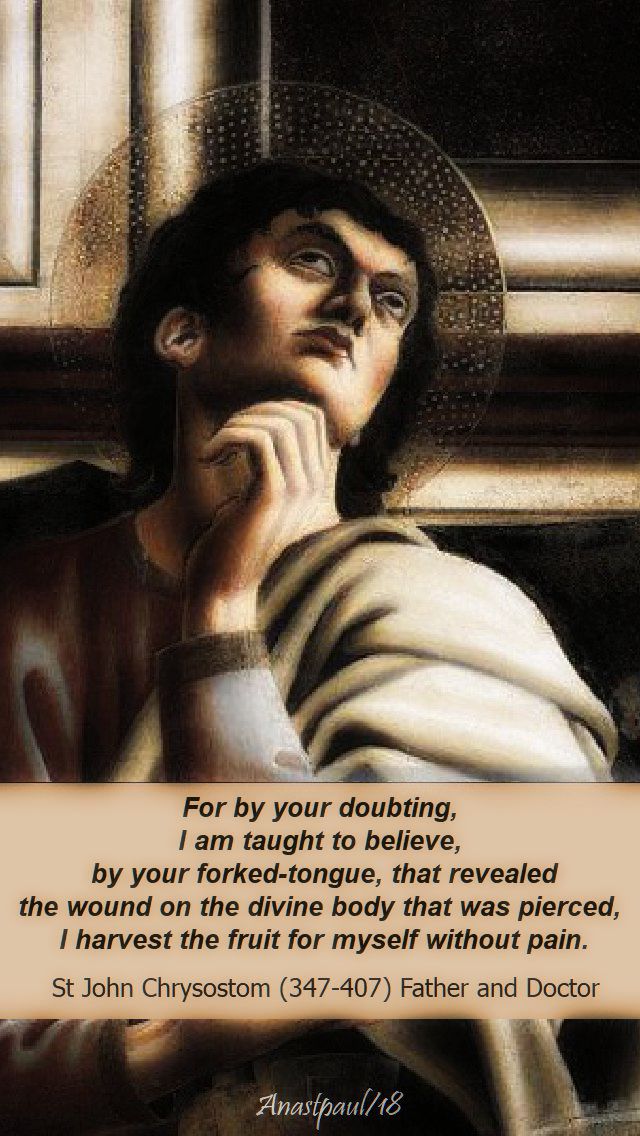
“For by your doubting, I am taught to believe, by your forked-tongue, that revealed the wound on the divine body that was pierced, I harvest the fruit for myself without pain.”
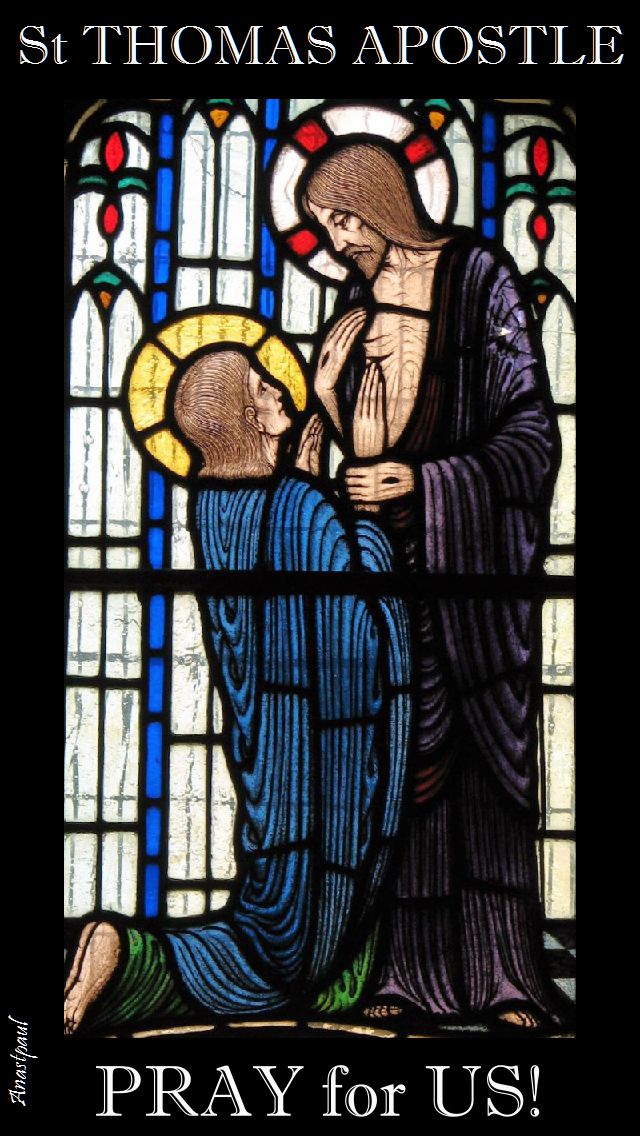
One Minute Reflection – 3 July – Feast of St Thomas Apostle – Today’s Gospel: John 20:24-29.
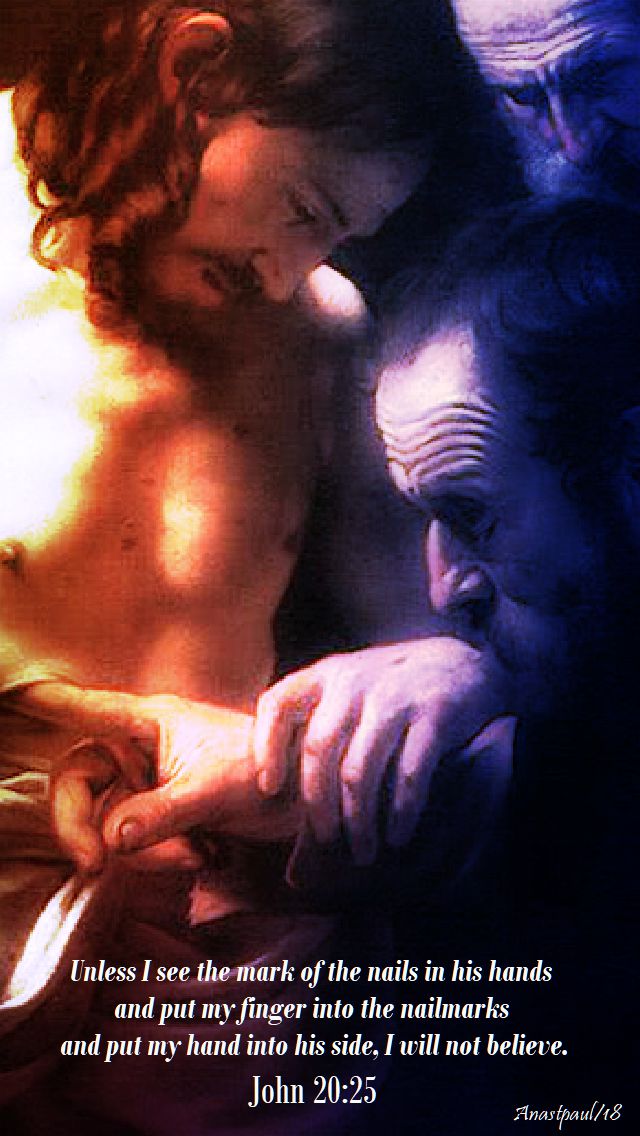
Thomas, called Didymus, one of the Twelve, was not with them when Jesus came. So the other disciples said to him, “We have seen the Lord.” But he said to them, “Unless I see the mark of the nails in his hands and put my finger into the nailmarks and put my hand into his side, I will not believe.”...John 20:24-25
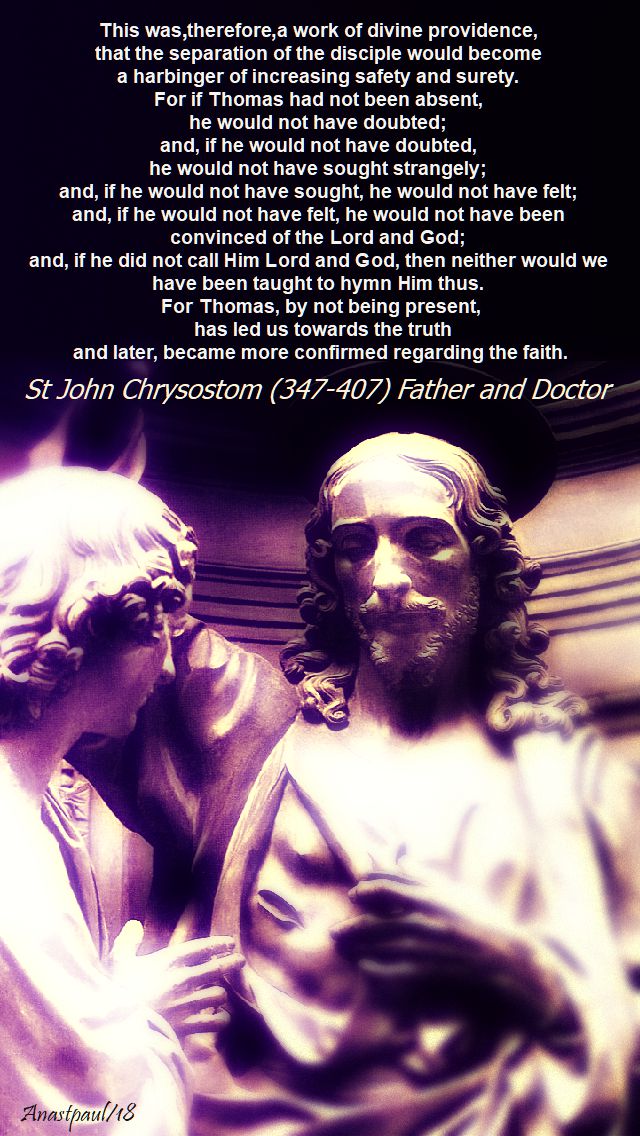
REFLECTION – “This was, therefore, a work of divine providence, that the separation of the disciple, would become a harbinger of increasing safety and surety. For if Thomas had not been absent, he would not have doubted; and, if he would not have doubted, he would not have sought strangely; and, if he would not have sought, he would not have felt; and, if he would not have felt, he would not have been convinced of the Lord and God; and, if he did not call Him Lord and God, then neither would we have been taught to hymn Him thus. For Thomas, by not being present, has led us towards the truth and later, became more confirmed regarding the faith.”… St John Chrysostom (347-407) Father and Doctor
PRAYER – Father, let our celebration on the feast of Saint Thomas the Apostle, be the source of his unfailing help and protection. Fill us with Your life-giving grace through our faith in Your Son, Jesus the Christ, whom Thomas acknowledged to be his Lord and his God. We make our prayer, through our Lord Jesus in union with the Holy Spirit, one God with You, forever and ever, amen.
Saint of the Day – 3 JULY _ Feast of St Thomas, Apostle of Christ
Thomas the twin By Pope Benedict XVI – General Audience, 27 September 2006
Dear Brothers and Sisters,
Continuing our encounters with the Twelve Apostles chosen directly by Jesus, today we will focus our attention on Thomas. Ever present in the four lists compiled by the New Testament, in the first three Gospels he is placed next to Matthew (cf. Mt 10: 3; Mk 3: 18; Lk 6: 15), whereas in Acts, he is found after Philip (cf. Acts 1: 13).
His name derives from a Hebrew root, ta’am, which means “paired, twin”. In fact, John’s Gospel several times calls him “Dydimus” (cf. Jn 11: 16; 20: 24; 21: 2), a Greek nickname for, precisely, “twin”. The reason for this nickname is unclear.
It is above all the Fourth Gospel that gives us information that outlines some important traits of his personality. The first concerns his exhortation to the other Apostles when Jesus, at a critical moment in His life, decided to go to Bethany to raise Lazarus, thus coming dangerously close to Jerusalem (Mk 10: 32).
On that occasion Thomas said to his fellow disciples: “Let us also go, that we may die with him” (Jn 11: 16). His determination to follow his Master is truly exemplary and offers us a valuable lesson: it reveals his total readiness to stand by Jesus, to the point of identifying his own destiny with that of Jesus and of desiring to share with Him the supreme trial of death.
In fact, the most important thing is never to distance oneself from Jesus. Moreover, when the Gospels use the verb “to follow”, it means that where He goes, his disciple must also go.
Thus, Christian life is defined as a life with Jesus Christ, a life to spend together with Him. St Paul writes something similar when he assures the Christians of Corinth: “You are in our hearts, to die together and to live together” (II Cor 7: 3). What takes place between the Apostle and his Christians must obviously apply first of all to the relationship between Christians and Jesus himself: dying together, living together, being in his Heart as He is in ours.
A second intervention by Thomas is recorded at the Last Supper. On that occasion, predicting his own imminent departure, Jesus announced that He was going to prepare a place for His disciples so that they could be where He is found and He explains to them: “Where [I] am going you know the way” (Jn 14: 4). It is then that Thomas intervenes, saying: “Lord, we do not know where you are going; how can we know the way?” (Jn 14: 5).
In fact, with this remark he places himself at a rather low level of understanding but his words provide Jesus with the opportunity to pronounce His famous definition: “I am the Way and the Truth and the Life” (Jn 14: 6). Thus, it is primarily to Thomas that He makes this revelation but it is valid for all of us and for every age. Every time we hear or read these words, we can stand beside Thomas in spirit and imagine that the Lord is also speaking to us, just as He spoke to him. At the same time, his question also confers upon us the right, so to speak, to ask Jesus for explanations. We often do not understand Him. Let us be brave enough to say: “I do not understand you, Lord, listen to me, help me to understand”. In such a way, with this frankness which is the true way of praying, of speaking to Jesus, we express our meagre capacity to understand and at the same time place ourselves in the trusting attitude of someone who expects light and strength from the One able to provide them.
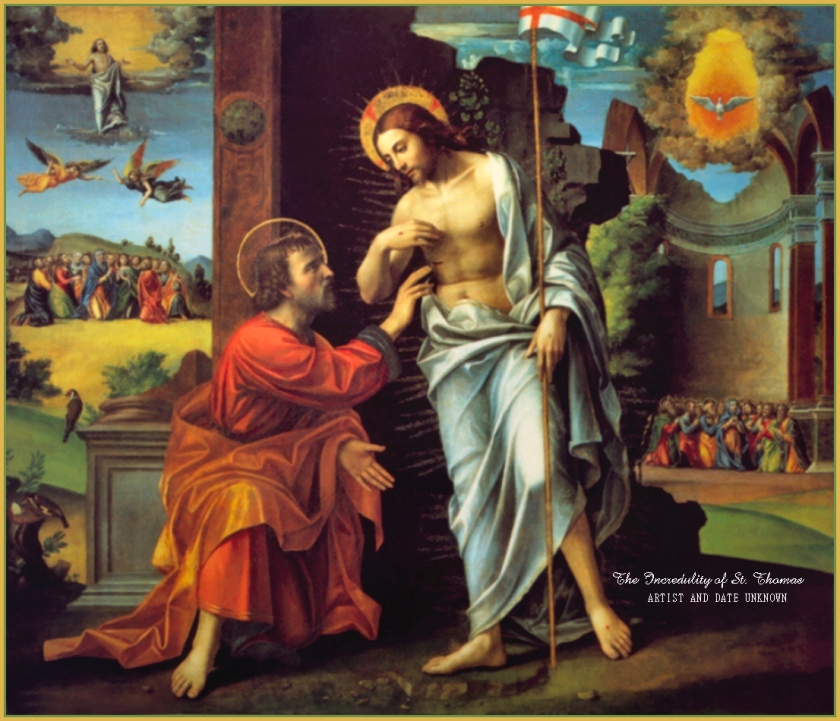
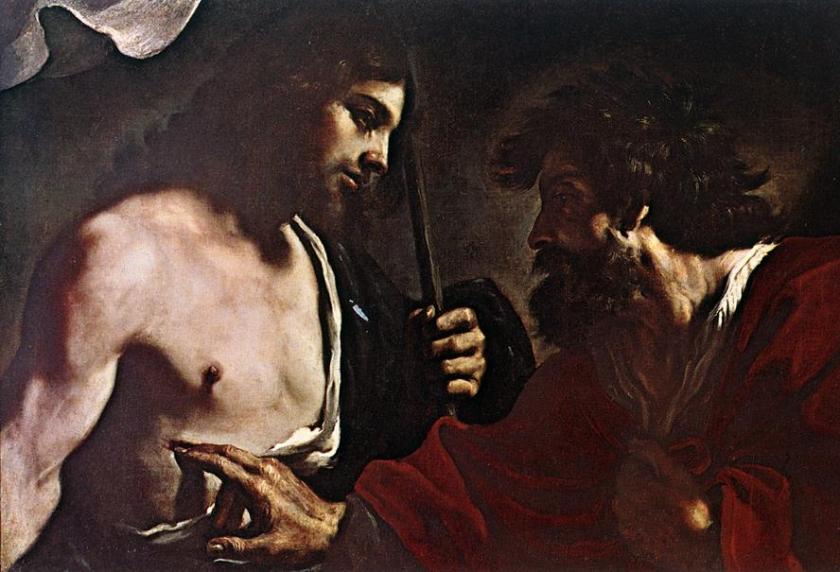
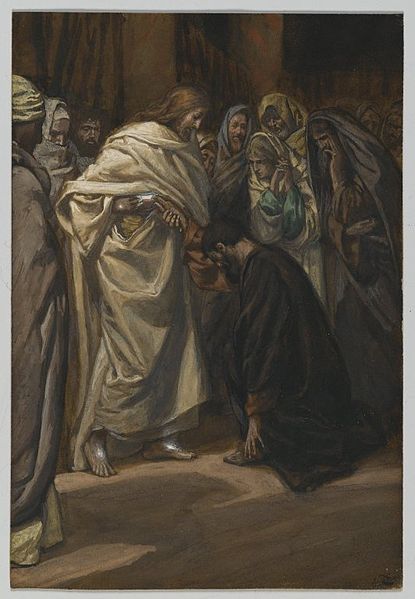
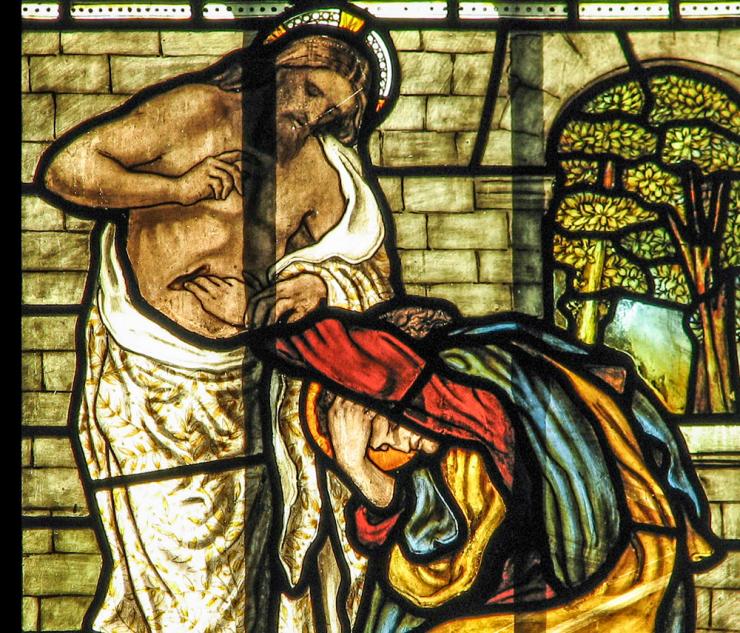
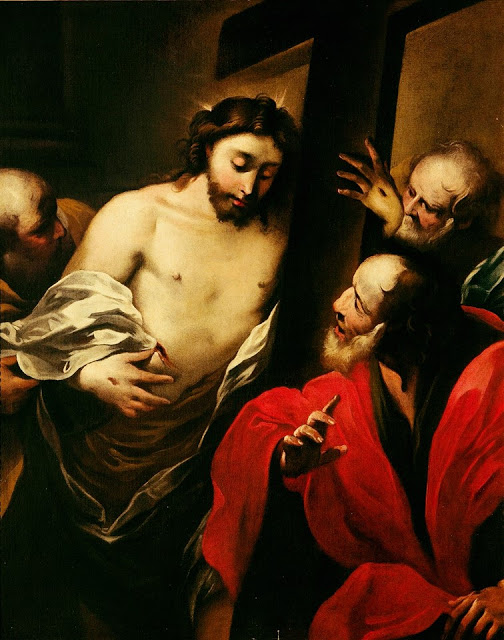
Then, the proverbial scene of the doubting Thomas that occurred eight days after Easter is very well known. At first he did not believe that Jesus had appeared in his absence and said: “Unless I see in his hands the print of the nails, and place my finger in the mark of the nails, and place my hand in his side, I will not believe” (Jn 20: 25).
Basically, from these words emerges the conviction that Jesus can now be recognised by His wounds rather than by His face. Thomas holds that the signs that confirm Jesus’ identity are now above all His wounds, in which He reveals to us how much He loved us. In this the Apostle is not mistaken.
As we know, Jesus reappeared among his disciples eight days later and this time Thomas was present. Jesus summons him: “Put your finger here, and see my hands; and put out your hand, and place it in my side; do not be faithless, but believing” (Jn 20: 27). Thomas reacts with the most splendid profession of faith in the whole of the New Testament: “My Lord and my God!” (Jn 20: 28). St Augustine comments on this: Thomas “saw and touched the man and acknowledged the God whom he neither saw nor touched but by the means of what he saw and touched, he now put far away from him every doubt and believed the other” (In ev. Jo. 121, 5).
The Evangelist continues with Jesus’ last words to Thomas: “Have you believed because you have seen me? Blessed are those who have not seen and yet believe” (Jn 20: 29). This sentence can also be put into the present: “Blessed are those who do not see and yet believe”.
In any case, here Jesus spells out a fundamental principle for Christians who will come after Thomas, hence, for all of us.
It is interesting to note that another Thomas, the great Medieval theologian of Aquinas, juxtaposed this formula of blessedness with the apparently opposite one recorded by Luke: “Blessed are the eyes which see what you see!” (Lk 10: 23). However, Aquinas comments: “Those who believe without seeing are more meritorious than those who, seeing, believe” (In Johann. XX lectio VI 2566).
In fact, the Letter to the Hebrews, recalling the whole series of the ancient biblical Patriarchs who believed in God without seeing the fulfilment of His promises, defines faith as “the assurance of things hoped for, the conviction of things not seen” (Heb 11: 1).
The Apostle Thomas’ case is important to us for at least three reasons: first, because it comforts us in our insecurity; second, because it shows us that every doubt can lead to an outcome brighter than any uncertainty and, lastly, because, the words that Jesus addressed to him remind us of the true meaning of mature faith and encourage us to persevere, despite the difficulty, along our journey of adhesion to Him.
A final point concerning Thomas is preserved for us in the Fourth Gospel, which presents him as a witness of the Risen One in the subsequent event of the miraculous catch in the Sea of Tiberias (cf. Jn 21: 2ff.).
On that occasion, Thomas is even mentioned immediately after Simon Peter: an evident sign of the considerable importance that he enjoyed in the context of the early Christian communities.
Indeed, the Acts and the Gospel of Thomas, both apocryphal works but in any case important for the study of Christian origins, were written in his name.
Lastly, let us remember that an ancient tradition claims that Thomas first evangelised Syria and Persia (mentioned by Origen, according to Eusebius of Caesarea, Ecclesiastical History 3, 1) then went on to Western India (cf. Acts of Thomas 1-2 and 17ff.), from where also he finally reached Southern India.
Let us end our reflection in this missionary perspective, expressing the hope that Thomas’ example will never fail to strengthen our faith in Jesus Christ, Our Lord and Our God. Amen…Pope Benedict, vatican.va
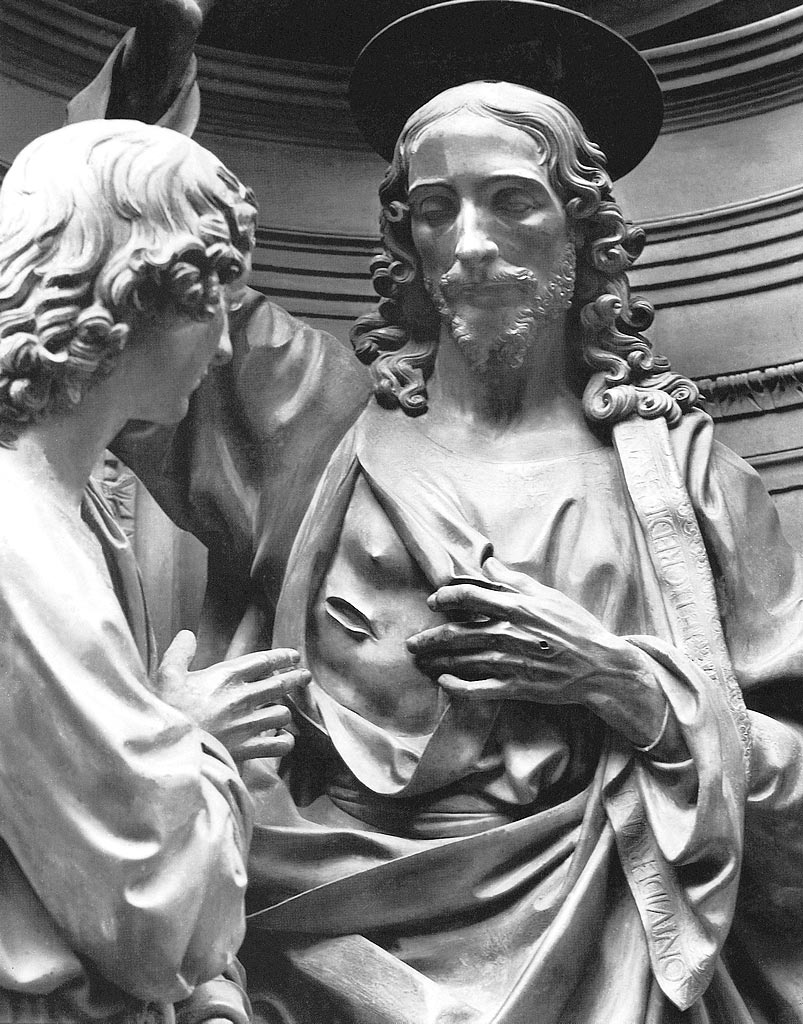
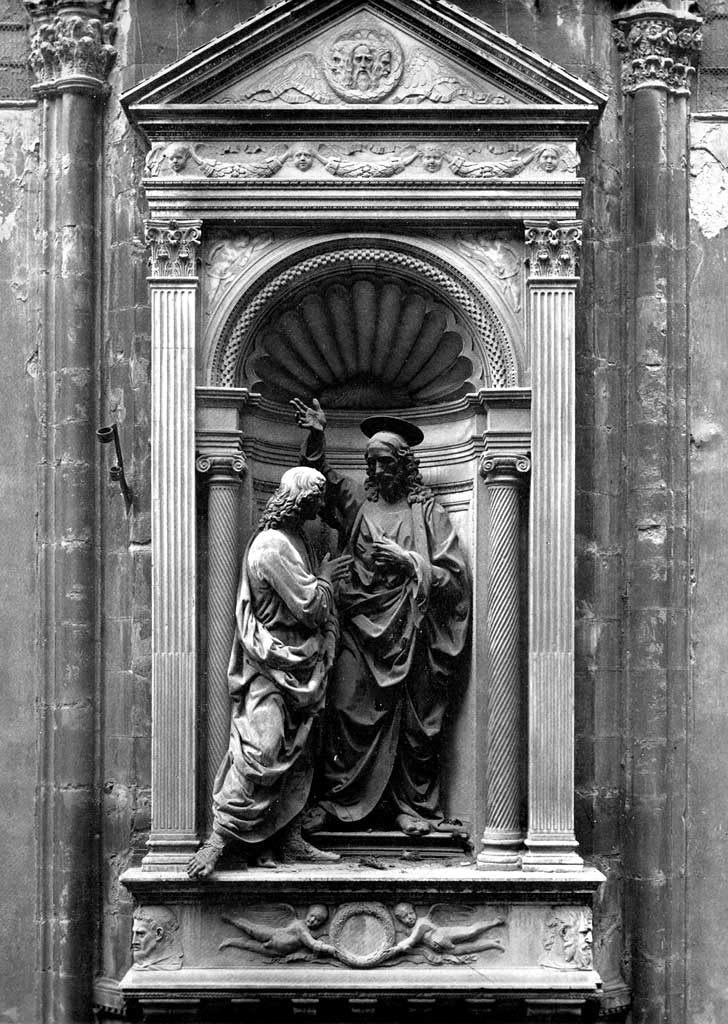
Christ and St Thomas – San Michele, Florence by Andrea del Verrocchio 1465-1483
There is a large population of native Christians who call themselves ‘the Christians of St Thomas’. They have an ancient oral tradition that he landed at Cranganoreon, the west coast and established seven churches in Malabar though his landing on the west coast is disputed today, the rest is not. He then passed eastward to the Coromandel Coast, where he was Martyred, by spearing, on the ‘Big Hill’, eight miles from Madras and was buried at Mylapore, now a suburb of that city. There are several medieval references to the tomb of St Thomas in India, some of which name Mylapore and in 1522 the Portuguese discovered the tomb there, with certain small relics now preserved in the cathedral of St Thomas at Mylapore. But the bulk of his relics were certainly at Edessa in the fourth century, as the Acta Thomae relate. They were later translated from Edessa to the island of Khios in the Aegean and from thence to Ortona in the Abruzzi, where they are still venerated.
When St Francis Xavier came to India, the signs of blood were still to be seen on the cross where the murderous deed of the martyrdom of St Thomas was committed and more than once drops of blood appeared on this cross during the celebration of Mass, when crowds of people were present. St Xavier, shortly after his arrival in India, went to the tomb of St Thomas, and passed many days and nights there in prayer. He begged God fervently to bestow upon him the Spirit and zeal of this holy Apostle, that he might be able to restore the Christian faith which St Thomas had preached there but which had gradually been entirely exterminated. Before undertaking any important work, he went, if possible, to the tomb of St Thomas and when this was impossible, he invoked the holy Apostle’s intercessio, and endeavoured to follow his example in all things.
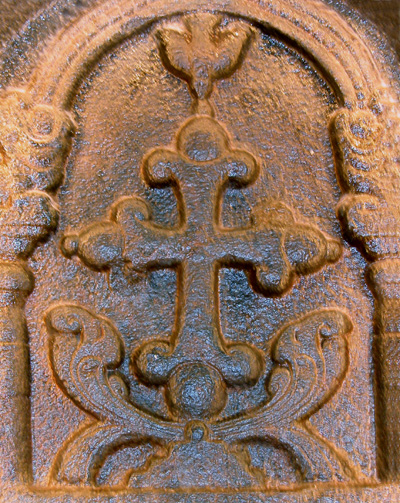
The Bleeding Cross
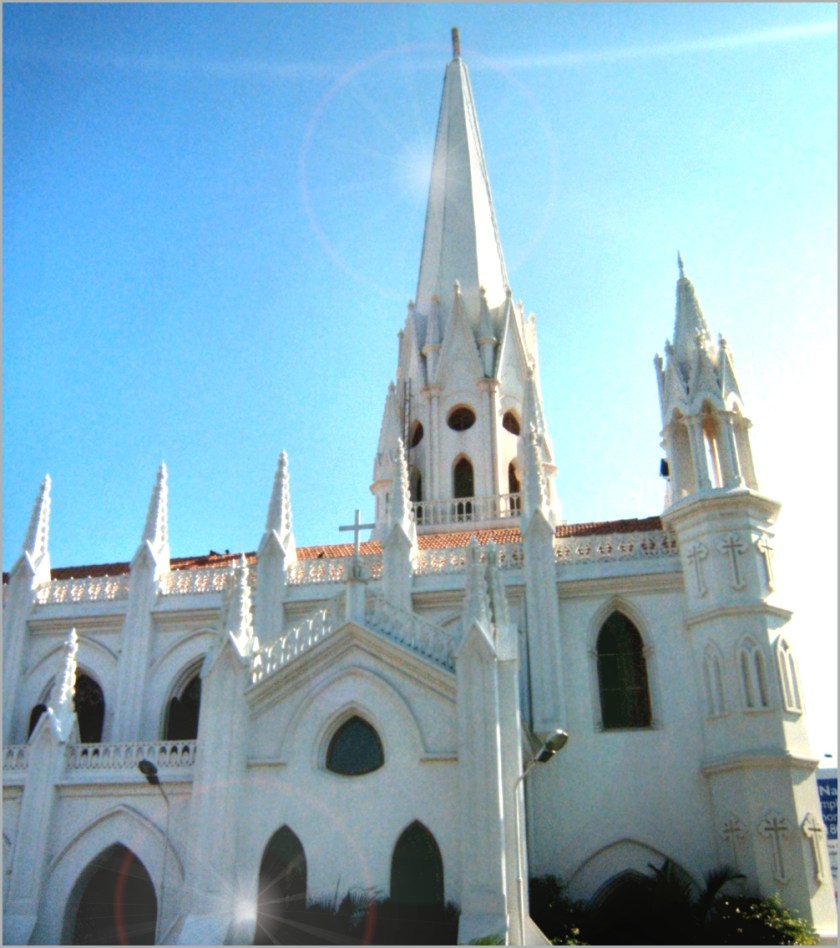
Saint Thomas was declared the “Apostle of India” by Pope Paul VI in 1972. Below is the St Thomas Cathedral in Madras, India.
More info with patronages etc and many pics here: https://anastpaul.wordpress.com/2017/07/03/saint-of-the-day-3-july-st-thomas-the-apostle-of-christ/
St Anatolius of Alexandria
St Anatolius of Constantinople
Bl Andreas Ebersbach
Bl Barbara Jeong Sun-mae
St Bladus
St Byblig
St Cillene
St Dathus of Ravenna
St Eusebius of Laodicea
St Firminus
St Firmus
Bl Gelduin
St Germanus of Man
St Giuse Nguyen Ðình Uyen
St Gunthiern
St Guthagon
St Heliodorus of Altinum
St Hyacinth of Caesarea
St Ioannes Baptista Zhao Mingxi
St Irenaeus of Chiusi
St Pope Leo II
St Maelmuire O’Gorman
St Mark of Mesia
St Mennone the Centurian
St Mucian of Mesia
St Paul of Mesia
St Petrus Zhao Mingzhen
St Philiphê Phan Van Minh
St Raymond of Toulouse
—
Martyrs of Alexandria – 13 saints: Thirteen Christian companions marytred together. No details about them have survived but the names – Apricus, Cyrion (2 of), Eulogius, Hemerion, Julian, Julius, Justus, Menelaus, Orestes, Porfyrios and Tryphon (2 of). They martyred in Alexandria, Egypt, date unknown.
Martyrs of Constantinople – 24 saints: A group of 24 Christians martyred in the persecutions of Arian emperor Valens. We know little more than their names – Acacios, Amedinos, Ammonius, Ammus, Cerealis, Cionia, Cionius, Cyrianus, Demetrius, Eulogius (2), Euphemia, Heliodoros, Heraclios, Horestes, Jocundus, Julian, Martyrios, Menelaeus, Sestratus, Strategos, Thomas, Timotheos and Tryphon. They were martyred in c367 in Constantintinople.
Theodotus and Companions – 6 saints: Six Christians who were imprisoned, tortured and martyred together in the persecutions of Trajan. Saint Hyacinth ministered to them in prison. We know nothing else about them but their names – Asclepiodotus, Diomedes, Eulampius, Golinduchus, Theodota and Theodotus. They were beheaded in c110, location
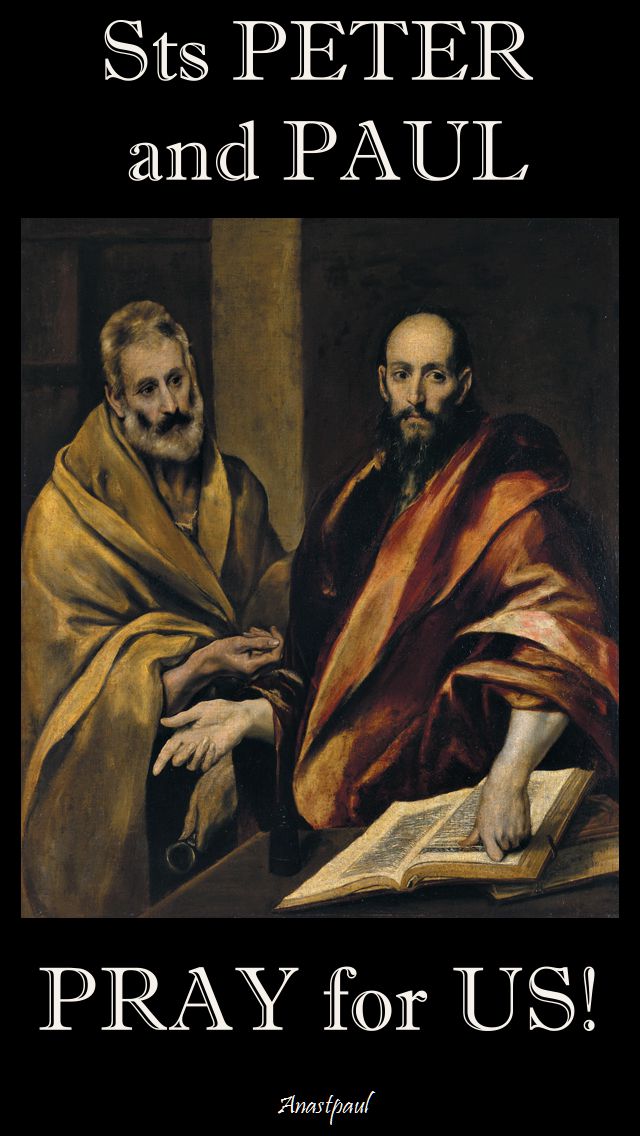
Quote/s of the Day – 29 June – The Solemnity of Saints Peter and Paul
“Their sound has gone out into all the earth and their words to the ends of the world”
Psalm 19
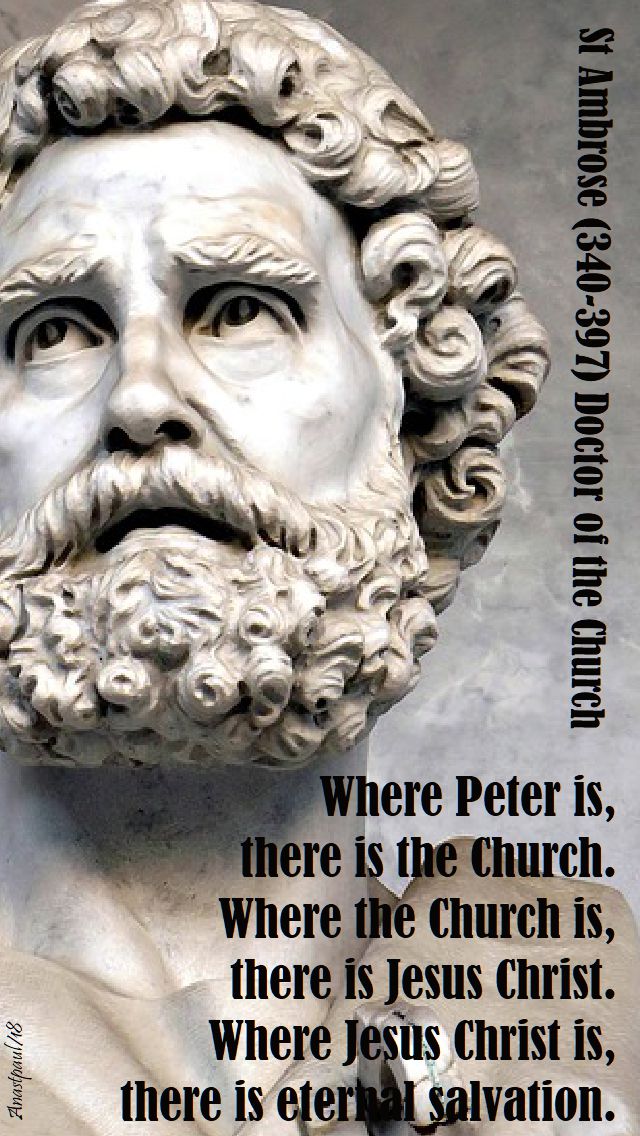
“Where Peter is, there is the Church. Where the Church is, there is Jesus Christ. Where Jesus Christ is, there is eternal salvation.”
St Ambrose (340-397)
One of the original four Doctors of the Church
“There is one day for the passion of two apostles. But these two also were as one; although they suffered on different days, they were as one. Peter went first, Paul followed. We are celebrating a feast day, consecrated for us by the blood of the apostles. Let us love their faith, their lives, their labours, their sufferings, their confession of faith, their preaching.”
St Augustine (354-430) Father & Doctor of the Church
“There must be general rejoicing, dearly beloved, over this holy company whom God has appointed for our example in patience and for our confirmation in faith. But we must glory even more in the excellence of their fathers, Peter and Paul, whom the grace of God has raised to such a height among all the members of the Church that He has set them like twin lights of eyes in that Body whose head is Christ.”
St Pope Leo the Great (400-461) Father & Doctor of the Church
Today the Lord repeats to me, to you…: Follow Me! Waste no time in questioning or in useless chattering; do not dwell on secondary things but look to what is essential and follow Me. Follow Me without regard for the difficulties. Follow Me in preaching the Gospel. Follow Me by the witness of a life shaped by the grace you received in baptism….. and holy orders. Follow Me by speaking of Me, to those with whom you live, day after day, in your work, your conversations and among your friends. Follow Me by proclaiming the Gospel to all, especially to the least among us, so that no one will fail to hear the word of life, which sets us free from every fear and enables us to trust in the faithfulness of God. Follow Me!
One Minute Reflection – 29 June – The Solemnity of Saints Peter and Paul – Today’s Gospel: Matthew 16:13–19
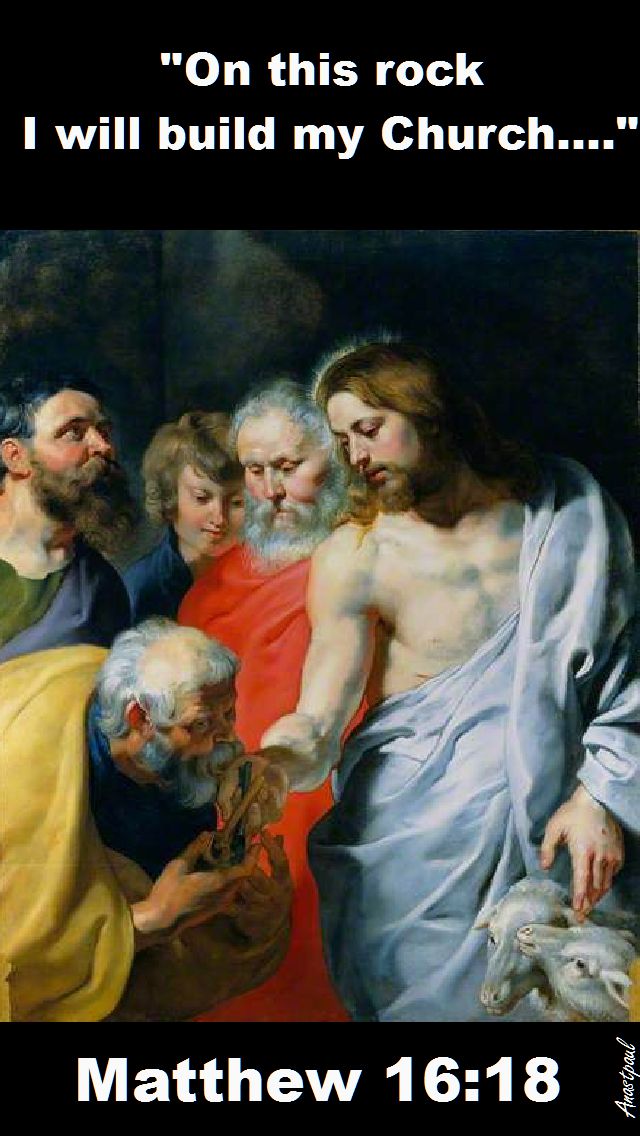
And I tell you, you are Peter and on this rock I will build my church and the powers of death shall not prevail against it. I will give you the keys of the kingdom of heaven and whatever you bind on earth shall be bound in heaven, and whatever you loose on earth shall be loosed in heaven.” …Matthew 16:18-19
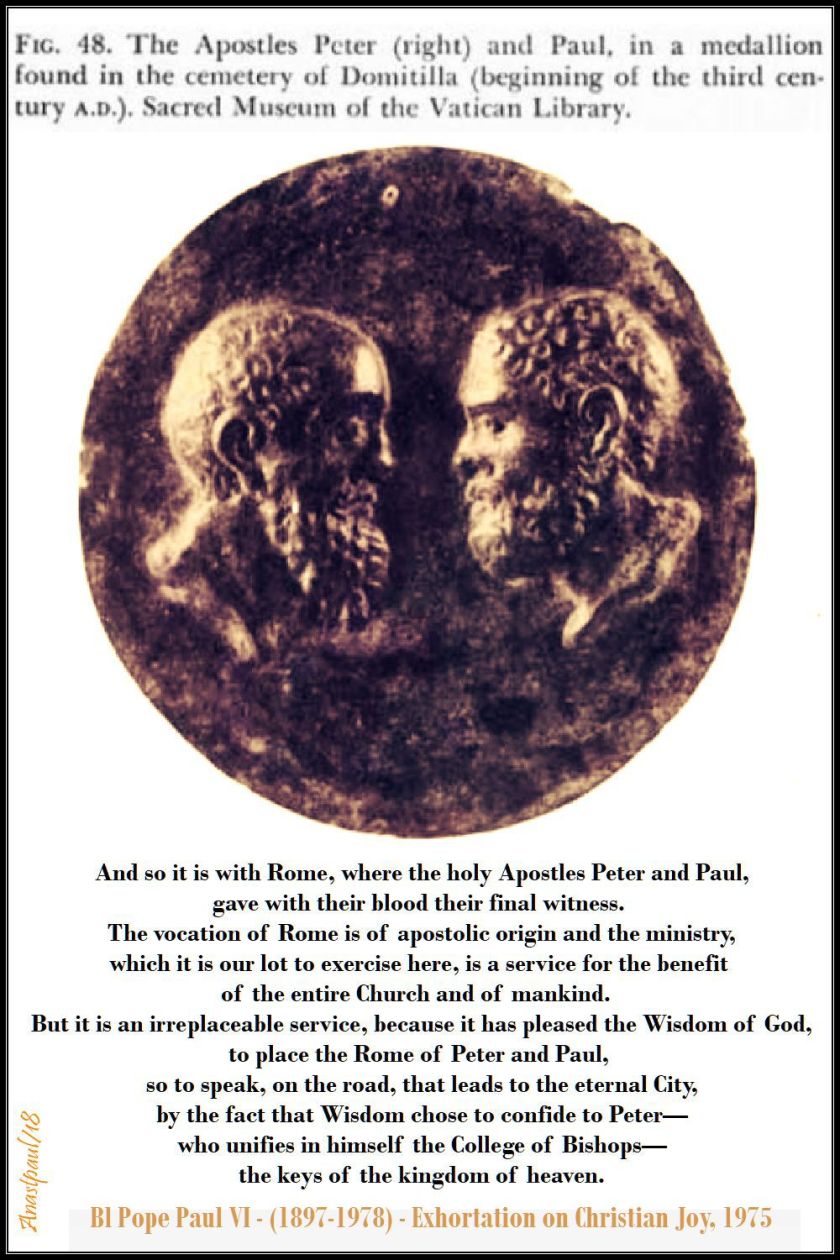
REFLECTION – “And so it is with Rome, where the holy Apostles Peter and Paul, gave with their blood their final witness. The vocation of Rome is of apostolic origin and the ministry which it is our lot to exercise here, is a service for the benefit of the entire Church and of mankind. But it is an irreplaceable service, because it has pleased the Wisdom of God to place the Rome of Peter and Paul, so to speak, on the road that leads to the eternal City, by the fact that Wisdom chose to confide to Peter—who unifies in himself the College of Bishops—the keys of the kingdom of heaven. What remains here, not through the effect of man’s will but through the free and merciful benevolence of the Father and the son and the Holy Spirit, is the soliditas Petri, such as our predecessor Saint Leo the Great extolled in unforgettable terms: “Saint Peter does not cease to preside over his See and preserves an endless sharing, with the Sovereign Priest. The firmness that he received from the Rock which is Christ, he himself, having become the Rock, transmits it equally to his successors.”…Blessed Pope Paul VI (1897-1978) – Exhortation on Christian Joy, 1975
PRAYER – Lord our God, You give us the great joy of devoting this day to the honour of the apostles Peter and Paul. Provide us, by their intercession, with help for our eternal salvation. Grant that Your Church may follow their teaching to the full, because these are the men who first taught us to worship You in Christ, Your Son, who lives and reigns with You and the Holy Spirit, one God forever, amen.
Our Morning Offering – 29 June – The Solemnity of Saints Peter and Paul
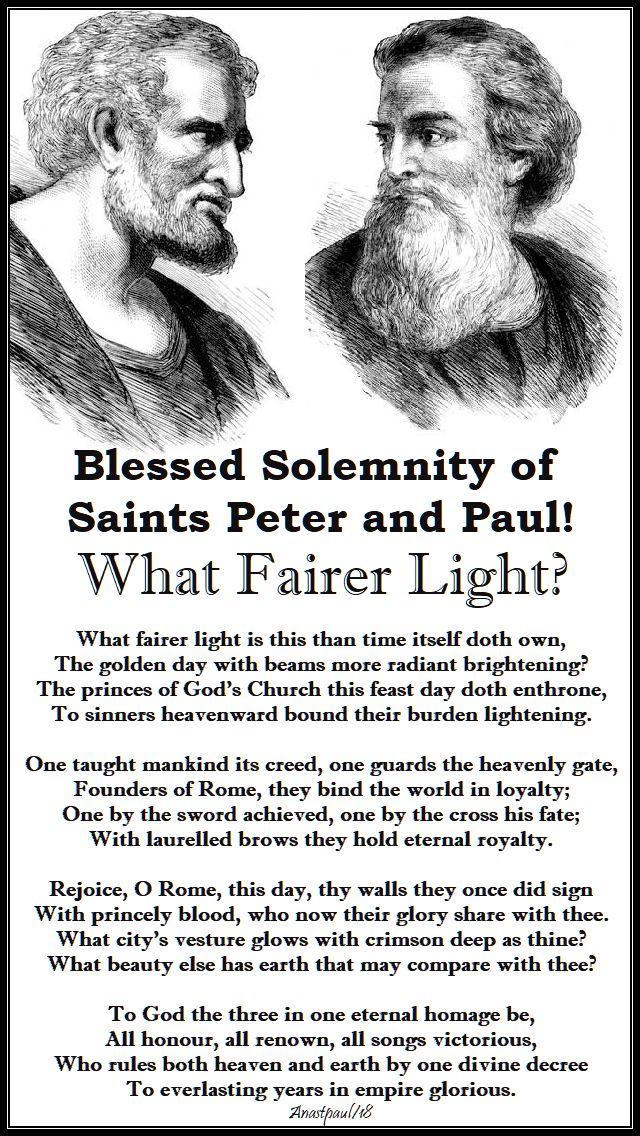
What Fairer Light?
Hymn for the Solemnity of Sts Peter and Paul Elphis, c 493, wife of Boethius c 477– 524 Translation: R A Knox, 1888-1957
What fairer light is this than time itself doth own,
The golden day with beams more radiant brightening?
The princes of God’s Church this feast day doth enthrone,
To sinners heavenward bound their burden lightening.
One taught mankind its creed, one guards the heavenly gate,
Founders of Rome, they bind the world in loyalty;
One by the sword achieved, one by the cross his fate;
With laurelled brows they hold eternal royalty.
Rejoice, O Rome, this day, thy walls they once did sign
With princely blood, who now their glory share with thee.
What city’s vesture glows with crimson deep as thine?
What beauty else has earth that may compare with thee?
To God the three in one eternal homage be,
All honour, all renown, all songs victorious,
Who rules both heaven and earth by one divine decree
To everlasting years in empire glorious.
Wishing you all a Holy and Blessed Solemnity of Saints Peter and Paul
The Solemnity of Saints Peter and Paul
St Augustine (354-430)
This day has been consecrated for us by the Martyrdom of the blessed apostles Peter and Paul. It is not some obscure martyrs we are talking about. “Their sound has gone out into all the earth and their words to the ends of the world” (Psalm 19). These martyrs had seen what they proclaimed, they pursued justice by confessing the truth, by dying for the truth.
The blessed Peter, the first of the Apostles, the ardent lover of Christ, who was found worthy to hear, “And I say to you, that you are Peter” (Matthew 16:13-20). He himself, you see, had just said, “You are the Christ, the Son of the living God.” Christ said to him, “And I say to you that you are Peter, and upon this rock I will build my Church.” Upon this rock I will build the faith you have just confessed. Upon your words, “You are the Christ, the Son of the living God,” I will build My Church, because you are Peter. Peter comes from petra, meaning a rock. Peter, “Rocky”, from “rock” not “rock” from “Rocky”. Peter comes from the word for a rock in exactly the same way as the name Christian comes from Christ.
Before His passion the Lord Jesus, as you know, chose those disciples of His whom He called apostles. Among these it was only Peter who almost everywhere, was given the privilege of representing the whole Church. It was in the person of the whole Church, which he alone represented, that he was privileged to hear, “To you will I give the keys of the kingdom of heaven.” After all, it is not just one man that received these keys but the Church in its unity. So this is the reason for Peter’s acknowledged pre-eminence, that he stood for the Church’s universality and unity, when he was told, “To you I am entrusting,” what has in fact been entrusted to all. To show you that it is the Church which has received the keys of the kingdom of heaven, listen to what the Lord says in another place to all His apostles: “Receive the Holy Spirit” and immediately afterwards, “Whose sins you forgive, they will be forgiven them; whose sins you retain, they will be retained” (John 20:22-23).
Quite rightly, too, did the Lord after His resurrection entrust His sheep to Peter to be fed (Jn. 21: 15-19). It is not, you see, that he alone among the disciples was fit to feed the Lord’s sheep but when Christ speaks to one man, unity is being commended to us. And He first speaks to Peter, because Peter is the first among the apostles. Do not be sad, Apostle. Answer once, answer again, answer a third time. Let confession conquer three times with love, because self-assurance was conquered three times by fear. What you had bound three times must be loosed three times. Loose through love what you had bound through fear. And for all that, the Lord once and again, and a third time, entrusted His sheep to Peter.
There is one day for the passion of two apostles. But these two also were as one; although they suffered on different days, they were as one. Peter went first, Paul followed.
We are celebrating a feast day, consecrated for us by the blood of the apostles. Let us love their faith, their lives, their labours, their sufferings, their confession of faith, their preaching.
O God, who on the Solemnity of the Apostles Peter and Paul
give us the noble and holy joy of this day,
grant, we pray, that Your Church
may in all things follow the teaching
of those through whom she received
the beginnings of right religion.
Through our Lord Jesus Christ, Your Son,
who lives and reigns with You in the unity of the Holy Spirit,
one God, forever and ever.
Amen
Thought for the Day – 11 June – Memorial of St Barnabas, Apostle
Barnabas, a Jew of Cyprus, comes as close as anyone outside the Twelve to being a full-fledged apostle. He was closely associated with Saint Paul—he introduced Paul to Peter and the other apostles—and served as a kind of mediator between the former persecutor and the still suspicious Jewish Christians.
When a Christian community developed at Antioch, Barnabas was sent as the official representative of the church of Jerusalem to incorporate them into the fold. He and Paul instructed in Antioch for a year, after which they took relief contributions to Jerusalem.
Later Paul and Barnabas, now clearly seen as charismatic leaders, were sent by Antioch officials to preach to the gentiles. Enormous success crowned their efforts. After a miracle at Lystra, the people wanted to offer sacrifice to them as gods—Barnabas being Zeus, and Paul, Hermes—but the two said, “We are of the same nature as you, human beings. We proclaim to you good news that you should turn from these idols to the living God” (see Acts 14:8-18).
But all was not peaceful. They were expelled from one town, they had to go to Jerusalem to clear up the ever-recurring controversy about circumcision and even the best of friends can have differences. When Paul wanted to revisit the places they had evangelised, Barnabas wanted to take along his cousin John Mark, author of the Gospel but Paul insisted that since Mark had deserted them once, he was not fit to take along now. The disagreement that followed was so sharp, that Barnabas and Paul separated: Barnabas taking Mark to Cyprus, Paul taking Silas to Syria. Later they were reconciled—Paul, Barnabas and Mark.
When Paul stood up to Peter for not eating with gentiles for fear of his Jewish friends, we learn that “even Barnabas was carried away by their hypocrisy” (see Galatians 2:1-13)
Barnabas is spoken of simply as one who dedicated his life to the Lord. He was a man “filled with the Holy Spirit and faith. Thereby, large numbers were added to the Lord.” Even when he and Paul were expelled from Antioch in Pisidia—modern-day Turkey—they were “filled with joy and the Holy Spirit.”
Come O Holy Spirit, come, fill the hearts of Your faithful!
One Minute Reflection – 11 June – Memorial of St Barnabas, Apostle – Today’s First Reading Acts of the Apostles 11:21b-26.13:1-3.
News of this came to the ears of the church in Jerusalem and they sent Barnabas to Antioch. When he came and saw the grace of God, he was glad and he exhorted them all, to remain faithful to the Lord, with steadfast purpose; for he was a good man, full of the Holy Spirit and of faith. And a large company was added to the Lord...Acts 11:22-24
REFLECTION – “While we cannot see God, there is something we can do, to open a way, for the eye of our understanding to come to Him. It is certain that we can see now in His servants, one whom we can in no way see in Himself. When we see them doing astonishing things, we can be sure that God dwells in their hearts… None of us can look directly at the rising sun by gazing at its orb. Our eyes are repelled as they strain to see its rays. But we look at mountains bathed in sunlight and see that it has risen. Because we cannot see the Sun of righteousness (Mal 3,20) Himself, let us see the mountains bathed in His brightness, I mean the holy apostles. They shine with virtues and gleam with miracles… The power of His divinity, is in itself, like the sun in the sky; in human beings it is like the sun shining on earth…”…St Pope Gregory the Great (c 540-604), Father & Doctor of the Church (Homilies on the Gospel, no 30)
PRAYER – O God, who decreed that Saint Barnabas, a man filled with faith and the Holy Spirit, should be set apart to convert the nations, grant that the Gospel of Christ, which he strenuously preached, may be faithfully proclaimed by word and by deed. We pray you Lord, that by the intercession of St Barnabas, we too may grow in faith and love and live to glorify Your kingdom. Through our Lord Jesus Christ, Your Son, who lives and reigns with you in the unity of the Holy Spirit, one God, forever and ever. Amen.
Saint of the Day – 11 June – St Barnabas, Apostle – Prophet, Disciple, Apostle to Antioch and Cyprus, Missionary and Martyr – born in Cyprus as Joseph – martyred in c 61 at Salamis. At his Baptism, when he sold all his goods and gave the money to the apostles in Jerusalem, they gave him a new name, “Barnabas”, which means “Son of Encouragement; Son of Consolation.” Patronages – Cyprus, Antioch, against hailstorms, invoked as peacemaker.
St Barnabas, was designated by the Holy Spirit to share the charge and mission of the twelve Apostles, is venerated by the Church as one of them. He played an important part in the first extension of Christianity outside the Jewish world. It was Barnabas who presented St Paul to the other Apostles when, after his long retreat in Arabia, he came to Jerusalem for the first time after his conversion, to submit for Peter’s approval, the mission to the Gentiles entrusted to him, by the Master Himself. Barnabas was Paul’s companion and helper on his first missionary journey and returned with him to Jerusalem but left him, when he set out on his second journey and went to Cyprus. The name of St Barnabas is mentioned in the Canon of the Mass.
We know nothing about St Barnabas except what Scripture tells us. St Luke says he was “a good man, filled with the Holy Spirit and faith” (Acts 11:24). No one could ask for a better recommendation! The saint was born at Cyprus, a Jew of the tribe of Levi. His given name was Joseph, but the apostles called him Barnabas, which meant “son of encouragement” (Acts 4:36). That nickname suited him to a tee, for everywhere he went he seems to have played a major supportive role in establishing the Christian community. For example, he sold his property and donated the money to the apostles for the poor.
Later the apostles sent him to care for the fledgling church at Antioch (Acts 11:20–22). He brought Paul from Tarsus to help him and the community flourished under their leadership (Acts 11:25–26). Twice Barnabas and Paul travelled to Jerusalem on behalf of the church at Antioch (Acts 11:27–30; 15:2). He also accompanied Paul on his first missionary journey that began in Cyprus and circuited through Asia Minor (Acts 13:1–2, 7).
Before the next missionary journey, however, Paul and Barnabas quarreled over some personal and pastoral matters and decided to separate. Barnabas returned to Cyprus and evangelised the island. Paul’s later references to Barnabas in his letters indicate that the two apostles were ultimately reconciled (see 1 Corinthians 9:6; Colossians 4:10).
Early Christians attributed an epistle to Barnabas but modern scholars say he probably did not write it. Tertullian and other Western writers regard Barnabas as the author of the Letter to the Hebrews. This may have been the Roman tradition—which Tertullian usually follows—and in Rome the epistle may have had its first readers. Modern biblical scholarship disagree.
It is believed that he was Martyred at Salamis in 61.
There are two ways of doctrine and authority, one of light and the other of darkness. But these two ways differ greatly. For over one are stationed the light-bringing angels of God but the angels of Satan are over the other. This, then, is the way of light: Love God who created you. Glorify God who redeemed you from death. Be simple in heart, and rich in spirit. Hate doing anything unpleasing to God. Do not exalt yourself but be of a lowly mind. Do not forsake the commandments of the Lord. Love your neighbour more than your own soul. Do not slay the child by procuring an abortion, nor destroy it after it is born. Receive your trials as good things. Do not hesitate to give without complaint. Confess your sins. This is the way of light. But the way of darkness is crooked and cursed, for it is the way of eternal death with punishment. In this way are the things that destroy the soul: idolatry, overconfidence, the arrogance of power, hypocrisy, double-heartedness, adultery, rape, haughtiness, transgressions, deceit, malice, avarice and absence of any fear of God. Also in this way are those who persecute the good, those who hate truth, those who do not attend to the widow and orphan, those who do not pity the needy, those who murder children, those who oppress the afflicted and are in every respect transgressors.
The Epistle of Barnabas
The Catholic religious order officially known as “Regular Clerics of St Paul” (Clerici Regulares Sancti Pauli – C.R.S.P.), founded in the 16th Century, was in 1538 given the grand old Monastery of Saint Barnabas by the city wall of Milan. This becoming their main seat, the Order was thenceforth known by the popular name of the Barnabites.
More about St Barnabas here: https://anastpaul.wordpress.com/2017/06/11/saint-of-the-day-st-barnabas-the-apostle-11-june/
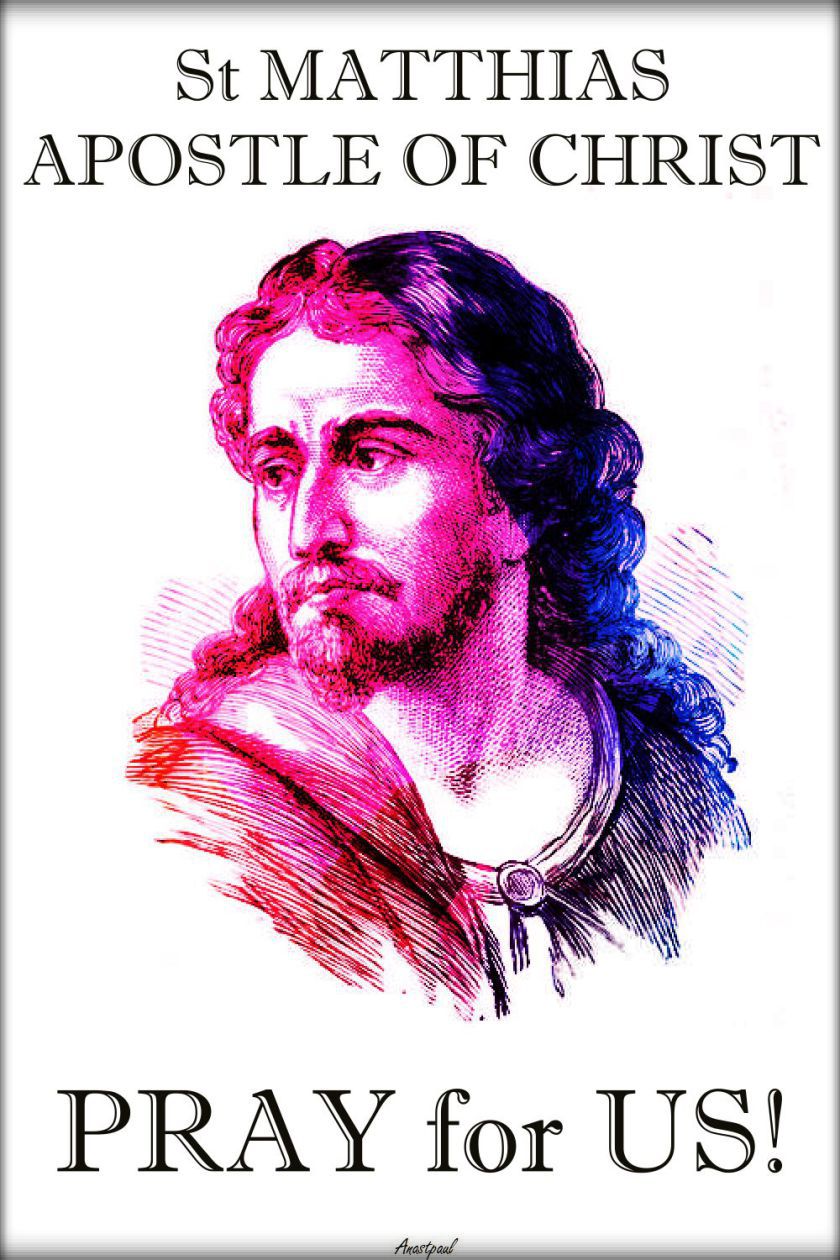
Thought for the Day – 14 May – Monday of the Seventh Week of Eastertide – Feast of St Matthias, Apostle – Today’s Readings: Acts of the Apostles 1:15-17.20-26, Holy Gospel of Jesus Christ according to Saint John 15:9-17
“One of these men, then […] must become a witness with us to his resurrection” (Acts 1:20-22).
These were the words of Peter… My brothers and sisters, you need to become witnesses… to the resurrection of Jesus. In effect, if you do not become His witnesses in your daily lives, who will do so in your place? Christians are, in the Church and with the Church, missionaries of Christ sent into the world. This is the indispensable mission of every ecclesial community, to receive from God the Father and to offer to the world the Risen Christ, so that every situation of weakness and of death may be transformed, through the Holy Spirit, into an opportunity for growth and life.
We impose nothing, yet we propose ceaselessly, as Peter recommends in one of his Letters: “In your hearts, reverence Christ as Lord. Always be prepared to make a defence to anyone who calls you to account for the hope that is in you” (1 Pet 3:15). And everyone, in the end, asks this of us, even those who seem not to. From personal and communal experience, we know well that it is Jesus whom everyone awaits. In fact, the most profound expectations of the world and the great certainties of the Gospel meet in the ineluctable mission which is ours, for “without God man neither knows which way to go, nor even understands who he is.” In the face of the enormous problems surrounding the development of peoples, which almost make us yield to discouragement, we find solace in the sayings of our Lord Jesus Christ, who teaches us: ‘Apart from me you can do nothing’ (Jn 15:5) and who encourages us: ‘I am with you always, to the close of the age’ (Mt 28:20)” (cf.Caritas in Veritate, 78)…
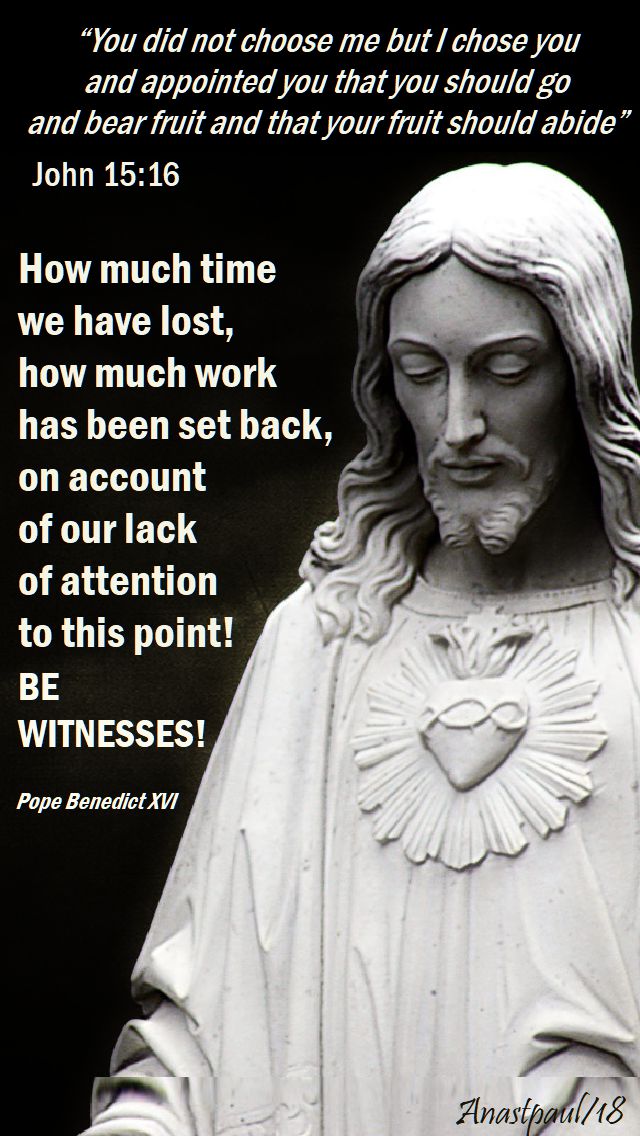
Yes! We are called to serve the humanity of our own time, trusting in Jesus alone, letting ourselves be enlightened by His word: “You did not choose me but I chose you and appointed you that you should go and bear fruit and that your fruit should abide” (Jn 15:16). How much time we have lost, how much work has been set back, on account of our lack of attention to this point! Everything is to be defined starting with Christ, as far as the origins and effectiveness of mission is concerned, we receive mission always from Christ, who has made known to us what He has heard from His Father and we are appointed to mission, through the Spirit, in the Church. Like the Church herself, which is the work of Christ and His Spirit, it is a question of renewing the face of the earth, starting from God, God always and alone!
So we say, St Matthias, today we call on you for your intercession!
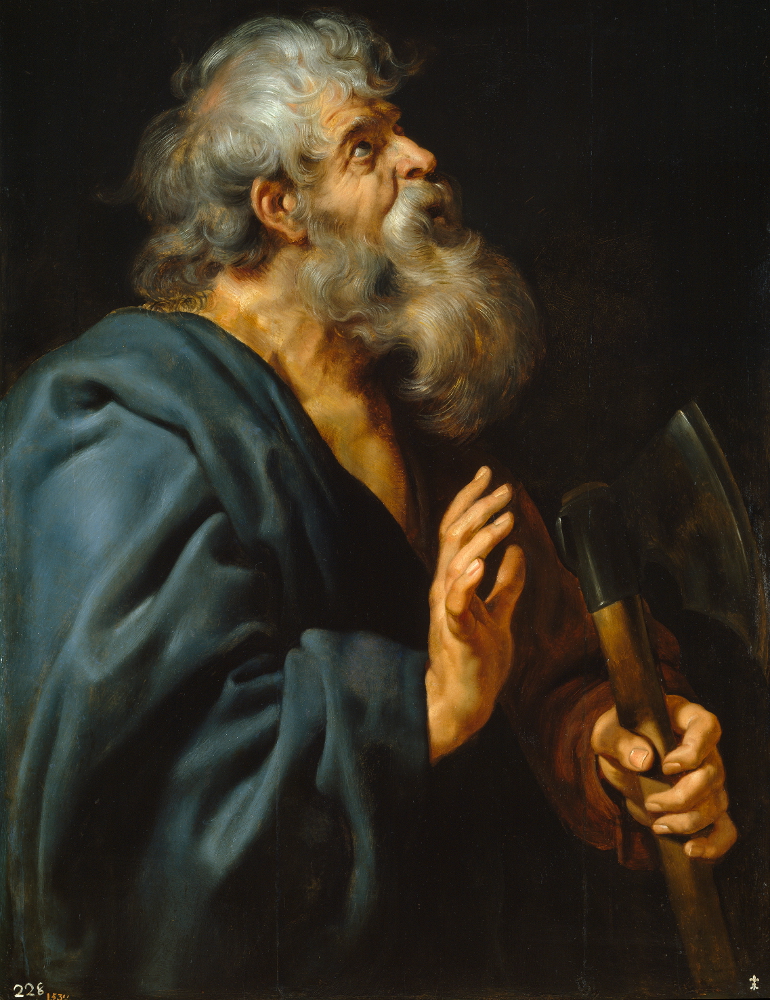
Saint of the Day – 14 May – Feast of St Matthias Apostle – Patron of alcoholics, carpenters, against smallpox, tailors, hope, perseverance, various Diocese and Cities. Attributes – lance, spear.
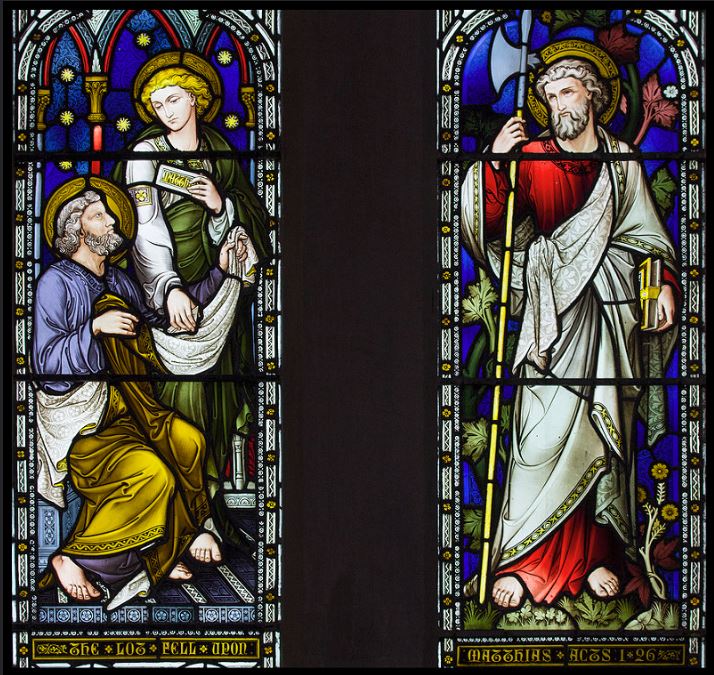
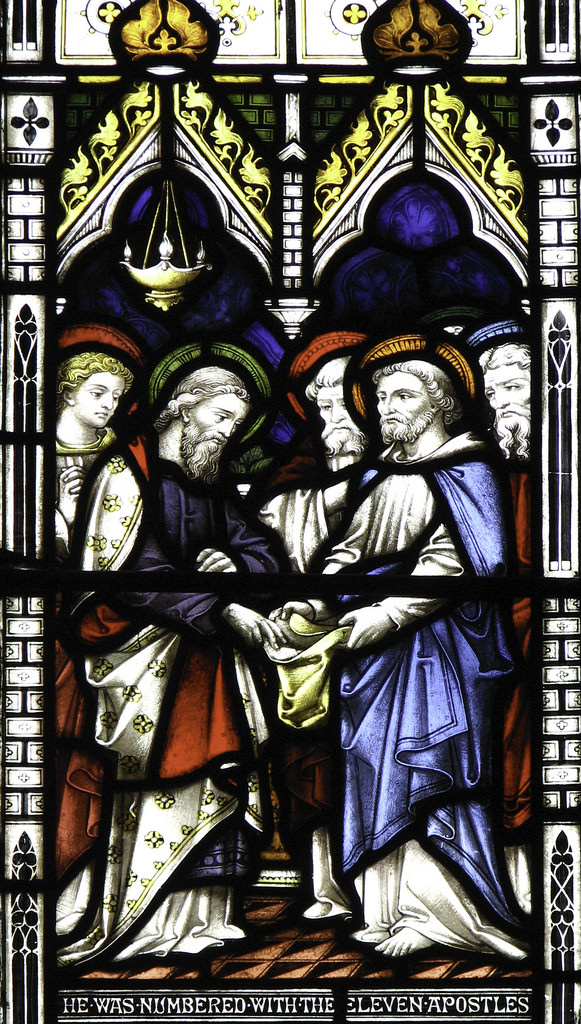
St Matthias was one of the first to follow our Saviour and he was an eye-witness of all His divine actions up to the very day of the Ascension. He was one of the seventy-two disciples but our Lord had not conferred upon him the dignity of an apostle. And yet, he was to have this great glory, for it was of him that David spoke, when he prophesied that another should take the bishopric, left vacant by the apostasy of Judas the traitor. In the interval between Jesus’ Ascension and the descent of the Holy Ghost, the apostolic college had to complete the mystic number fixed by our Lord Himself, so that there might be the twelve on that solemn day, when the Church, filled with the Holy Ghost, was to manifest herself to the Synagogue. The lot fell on Mathias, he shared with his brother-apostles the persecution in Jerusalem and, when the time came for the ambassadors of Christ to separate, he set out for the countries allotted to him. Tradition tells us that these were Cappadocia and the provinces bordering on the Caspian Sea.
The Election of St MatthiasThe Election of St Matthias
The virtues, labour and sufferings of St Mathias have not been handed down to us. This explains the lack of proper lessons on his life, such as we have for the feasts of the rest of the apostles. St Clement of Alexandria (150-215), records in his writings several sayings of our holy apostle. One of these is so very appropriate to the spirit of the present season, that we consider it a duty to quote it. ‘It behooves us to combat the flesh and make use of it, without pampering it by unlawful gratifications. As to the soul, we must develop her power by faith and knowledge.’ How profound is the teaching contained in these few words! Sin has deranged the order which the Creator had established. It gave the outward man, such a tendency to grovel in things which degrade him, that the only means left us, for the restoration of the image and likeness of God, unto which we were created, is the forcible subjection of the body to the spirit. But the spirit itself, that is, the soul, was also impaired by original sin and her inclinations were made prone to evil, what is to be her protection? Faith and knowledge. Faith humbles her and then exalts and rewards her and the reward is knowledge.
— Excerpted from The Liturgical Year, Abbot Gueranger O.S.B.
St Ampelio
St Boniface of Ferentino
St Boniface of Tarsus
St Carthage the Younger
St Corona the Martyr
St Costanzo of Capri
St Costanzo of Vercelli
Bl Diego of Narbonne
St Dyfan
St Engelmer
St Erembert of Toulouse
St Felice of Aquileia
St Fortunatus of Aquileia
St Gal of Clermont-Ferrand
Bl Giles of Santarem
St Henedina of Sardinia
St Justa of Sardinia
St Justina of Sardinia
St Maria Domenica Mazzarello
St Maximus
St Michael Garicoïts
St Pons of Pradleves
St Pontius of Cimiez
St Tuto of Regensburg
St Victor the Martyr
—
Martyrs of Seoul – 5 Beata: A group of lay people martyred together in the apostolic vicariate of Korea.
• Petrus Choe Pil-je
• Lucia Yun Un-hye
• Candida Jeong Bok-hye
• Thaddeus Jeong In-hyeok
• Carolus Jeong Cheol-sang
14 May 1801 at the Small West Gate, Seoul, South Korea – Beatified: 15 August 2014 by Pope Francis
Thought for the Day – 3 May – Thursday of the Fifth Week of Eastertide and the Feast of Sts Philip and James Apostles and Martyrs
As in the case of the other apostles, we see in James and Philip human men who became foundation stones of the Church and we are reminded again that holiness and its consequent apostolate are entirely the gift of God, not a matter of human achieving. All power is God’s power, even the power of human freedom to accept His gifts. “You will be clothed with power from on high,” Jesus told Philip and the others. Their first commission had been to expel unclean spirits, heal diseases, announce the kingdom. They learned, gradually, that these externals were sacraments of an even greater miracle inside their persons—the divine power to love like God.
3 May – Feast of Sts Philip and James – Apostles and Martyrs
Philip was one of the first chosen Disciples of Christ. On the way from Judea to Galilee Our Lord found Philip and said, “Follow Me.” Philip straightway obeyed and then in his zeal and charity sought to win Nathaniel also, saying, “We have found Him of Whom Moses and the prophets did write, Jesus of Nazareth” and when Nathaniel in wonder asked, “Can any good come out of Nazareth?” Philip simply answered, “Come and see” and brought him to Jesus. Another characteristic saying of this apostle is preserved for us by St John. Christ in His last discourse had spoken of His Father and Philip exclaimed, in the fervour of his thirst for God, “Lord, show us the Father and it is enough.” According to the anonymous Acts of Philip, through a miraculous healing and his preaching, Philip converted the wife of the proconsul of the city of Phyrgia. This enraged the proconsul, and he had Philip, Bartholomew tortured. Philip and Bartholomew were then crucified upside down and Philip preached from his cross. As a result of Philip’s preaching the crowd released Bartholomew from his cross but Philip insisted that they not release him, and Philip died on the cross. Another account is that he was martyred by beheading in the city of Hierapolis.
St James the Less, the author of an inspired epistle, was also one of the Twelve. St Paul tells us that he was favoured by a special apparition of Christ after the Resurrection. On the dispersion of the apostles among the nations, St James was left as Bishop of Jerusalem and even the Jews held in such high veneration his purity, mortification and prayer, that they named him the Just. The earliest of Church historians has handed down many traditions of St James’s sanctity. He was always a virgin, says Hegesippus, and consecrated to God. He drank no wine, wore no sandals on his feet and but a single garment on his body. He prostrated himself so much in prayer that the skin of his knees was hardened like a camel’s hoof. The Jews, it is said, used out of respect to touch the hem of his garment. He was indeed a living proof of his own words, “The wisdom that is from above first indeed is chaste, then peaceable, modest, full of mercy and good fruits.” He sat beside St Peter and St Paul at the Council of Jerusalem and when St Paul at a later time escaped the fury of the Jews by appealing to Caesar, the people took vengeance on James and crying, “The just one hath erred,” stoned him to death.
Why do we celebrate the feasts of St Philip and St James the Less on the same day? We celebrate them on the same day because their relics were brought to Rome together on the same day in early May. They rest there still, in the Basilica of the Holy Apostles. The reception of the Bodies of Sts Philip and James, which were brought from the East, somewhere about the 6th Century, gave rise to the institution of to-day’s Feast and this led gradually, to the insertion into the Calendar, of the special Feasts for the other Apostles and Evangelists.
St James the Lesser Apostle (Feast)
St Philip the Apostle (Feast)
—
St Adalsindis of Bèze
Bl Adam of Cantalupo in Sabina
St Ahmed the Calligrapher
St Aldwine of Peartney
St Pope Alexander I
St Alexander of Constantinople
Bl Alexander of Foigny
St Alexander of Rome
Bl Alexander Vincioli
St Ansfrid of Utrecht
St Antonina of Constantinople
St Diodorus the Deacon
Bl Edoardo Giuseppe Rosaz
St Ethelwin of Lindsey
St Eventius of Rome
St Fumac
St Gabriel Gowdel
St Juvenal of Narni
Bl Maria Leonia Paradis
St Maura of Antinoe
St Peter of Argos
St Philip of Zell
Bl Ramon Oromí Sullà
St Rhodopianus the Deacon
St Scannal of Cell-Coleraine
Bl Sostenaeus
St Stanislas Kazimierczyk
St Theodolus of Rome
St Timothy of Antinoe
Bl Tommaso Acerbis
Bl Uguccio
Bl Zechariah
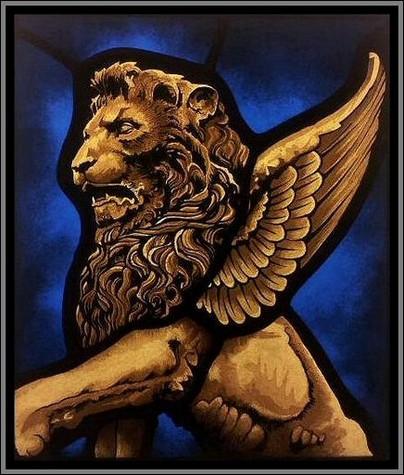
Saint of the Day – 25 April – St Mark the Evangelist – also known as John Mark (Born 1st century – Martyred 25 April 68 at Alexandria, Egypt) – The Winged Lion – Evangelist, Martyr, Missionary, Preacher, Teacher, friend and assistant to St Peter, St Paul, cousin of St Barnabas.
John Mark, later known simply as Mark, was a Jew by birth. He was the son of that Mary who was proprietress of the Cenacle or “upper room” which served as the meeting place for the first Christians in Jerusalem (Acts 12:12). He was still a youth at the time of the Saviour’s death. We cannot be certain whether he knew Jesus personally. Some scholars feel that the evangelist is speaking of himself (so he then did know Jesus) when describing the arrest of Jesus in Gethsemane: “Now a young man followed him wearing nothing but a linen cloth about his body. They seized him, but he left the cloth behind and ran off naked” (Mark 14:51-52).
During the years that followed, the rapidly maturing youth witnessed the growth of the infant Church in his mother’s Upper Room and became acquainted with its traditions. This knowledge he put to excellent use when compiling his Gospel. Later, we find Mark acting as a companion to his cousin Barnabas and Saul on their return journey to Antioch and on their first missionary journey. But Mark was too immature for the hardships of this type of work and therefore left them at Perge in Pamphylia to return home.
As the two apostles were preparing for their second missionary journey, Barnabas wanted to take his cousin with him. Paul, however, objected. Thereupon the two cousins undertook a missionary journey to Cyprus. Time healed the strained relations between Paul and Mark and during the former’s first Roman captivity (61-63), Mark rendered Paul valuable service (Col. 4:10; Philem. 24) and the Apostle learned to appreciate him. When in chains the second time Paul requested Mark’s presence (2 Tim. 4:11).
Opnamedatum: 2010-11-30
An intimate friendship existed between Mark and Peter; he played the role of Peter’s companion, disciple and interpreter. According to the common patristic opinion, Mark was present at Peter’s preaching in Rome and wrote his Gospel under the influence of the prince of the apostles. This explains why incidents which involve Peter are described with telling detail (e.g., the great day at Capharnaum, 1:14f)). Little is known of Mark’s later life. It is certain that he died a Martyr’s death as bishop of Alexandria in Egypt. His relics were transferred from Alexandria to Venice, where a worthy tomb was erected in St Mark’s Cathedral.
St Mark’s Tomb inside the Altar at St Mark’s, Venice
St Mark’s Venice
The Gospel of St Mark, the shortest of the four, is, above all, a Roman Gospel. It originated in Rome and is addressed to Roman, or shall we say, to Western Christianity. Another high merit is its chronological presentation of the life of Christ. For we should be deeply interested in the historical sequence of the events in our blessed Saviour’s life.
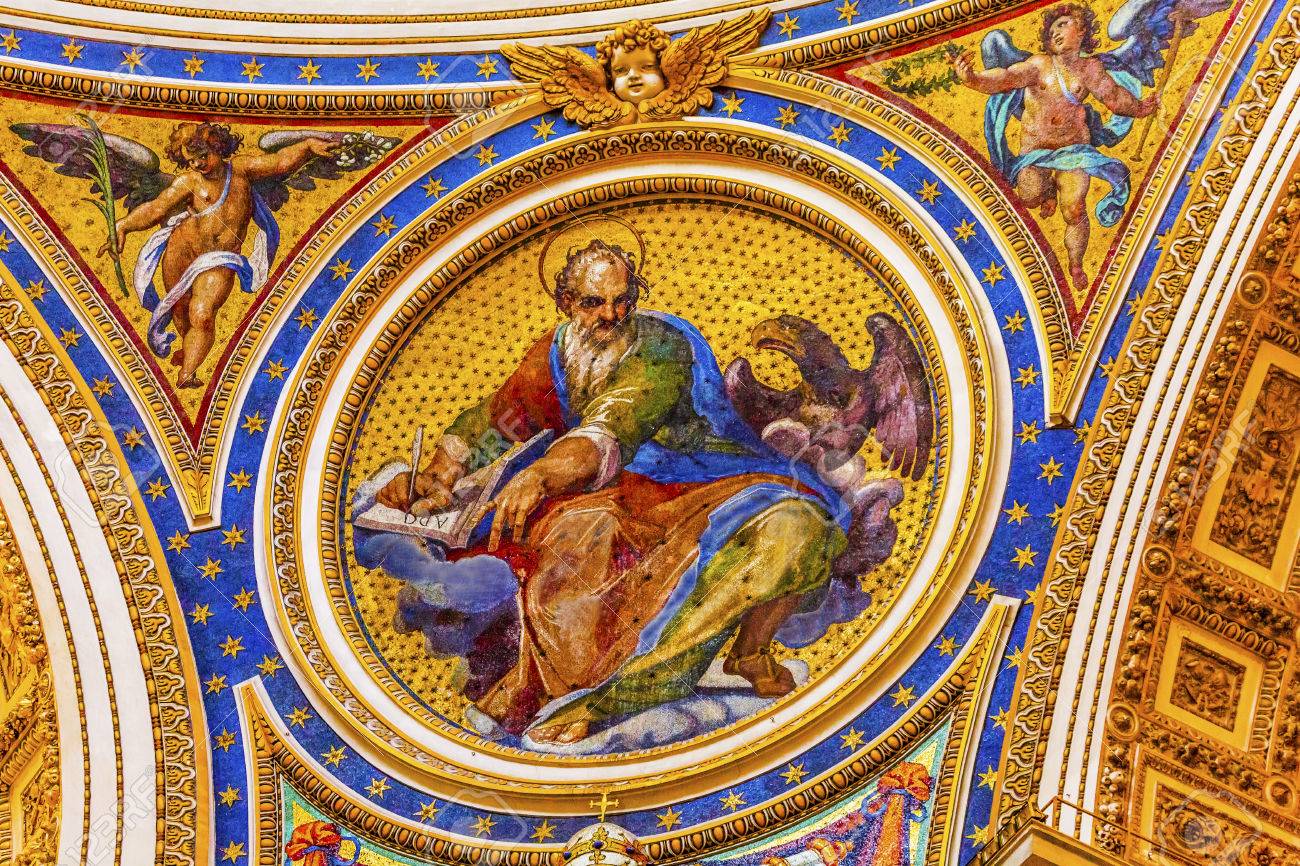
Ceilings in the Vatican depicting St Mark
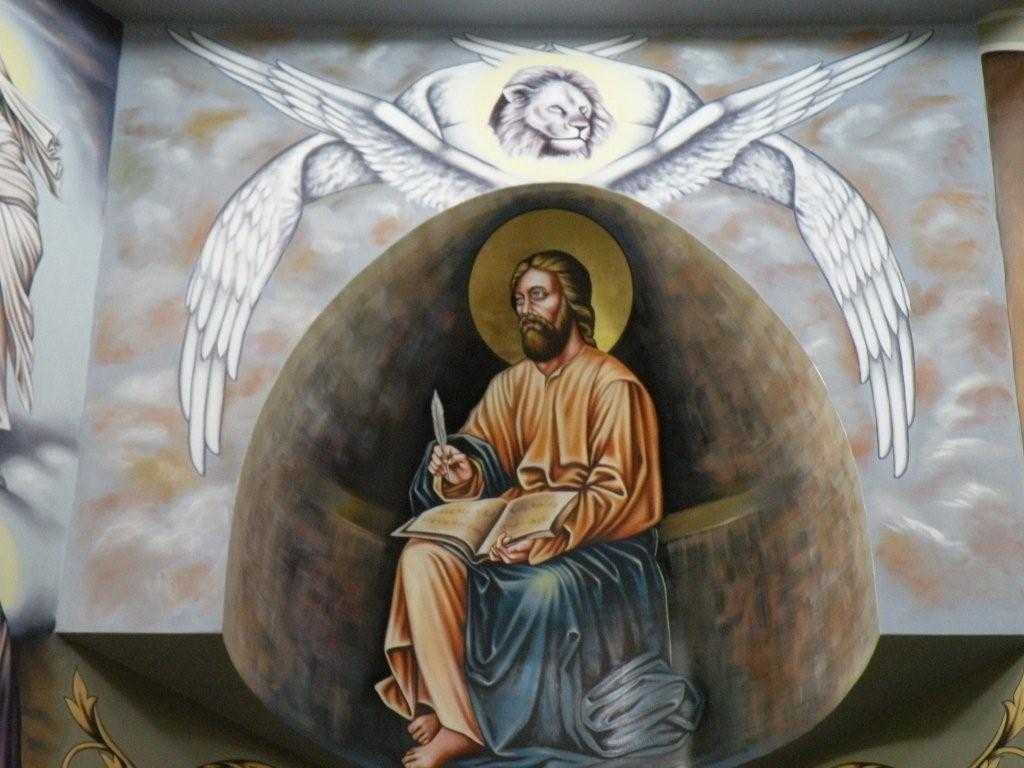
Furthermore, Mark was a skilled painter of word pictures. With one stroke he frequently enhances a familiar scene, shedding upon it new light. His Gospel is the “Gospel of Peter,” for he wrote it under the direction and with the aid of the prince of the apostles. “The Evangelist Mark is represented as a lion because he begins his Gospel in the wilderness, ‘The voice of one crying in the desert: Make ready the way of the Lord,’ or because he presents the Lord as the unconquered King.”…Excerpted from The Church’s Year of Grace, Pius Parsch
St Mark the Evangelist (Feast) Also known as John Mark (Born 1st century – martyred 25 April 68 at Alexandria, Egypt) – The Winged Lion
—
St Agathopodes of Antioch
Bl Andrés Solá Molist
St Anianus of Alexandria
Bl Antonio Pérez Lários
St Callista of Syracuse
St Clarentius of Vienne
St Ermin of Lobbes
St Evodius of Syracuse
St Franca Visalta
St Giovanni Piamarta
St Heribaldus of Auxerre
St Hermogenes of Syracuse
Bl José Trinidad Rangel y Montaño
St Kebius
St Macaille
St Macedonius
St Mario Borzaga
St Pasicrate of Mesia
St Paul Thoj Xyooj
Pedro de San Jose Betancur
Phaebadius of Agen
Philo of Antioch
Robert of Syracuse
Bl Robert Anderton
Stefano of Antioch
St Valenzio of Mesia
Bl William Marsden
—
Martyrs of Yeoju – 3 saints: Three Christian laymen martyred together in the apostolic vicariate of Korea. 25 April 1801 in Yeoju, Gyeonggi-do, South Korea
They were Beatified15 August 2014 by Pope Francis
• Ioannes Won Gyeong-do
• Marcellinus Choe Chang-ju
• Martinus Yi Jung-bae
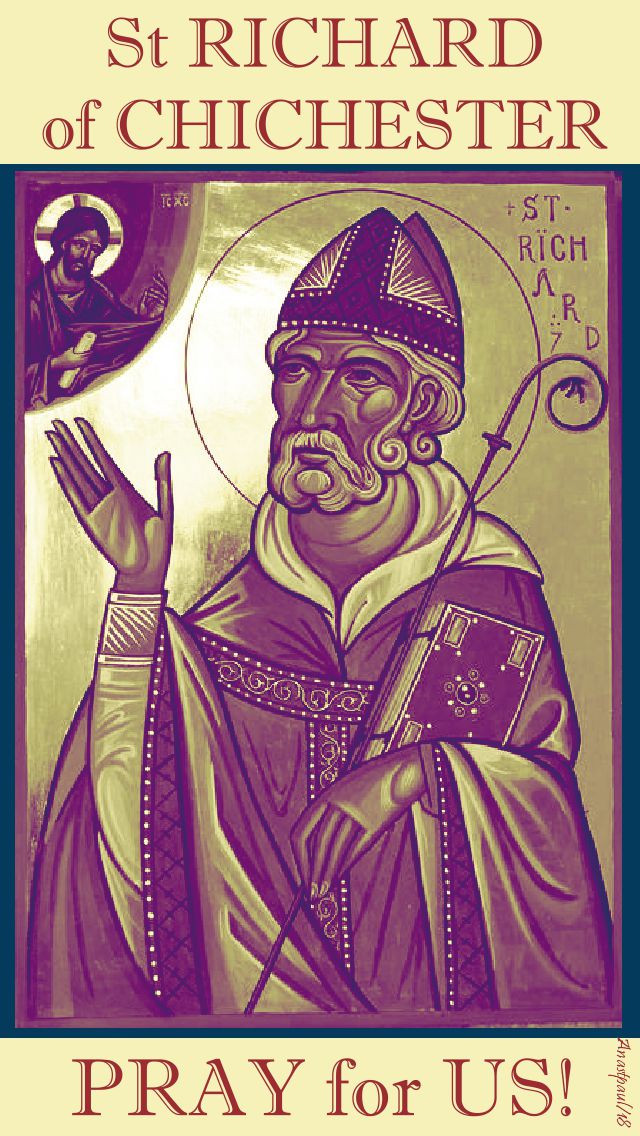
One Minute Reflection – 3 April – Easter Tuesday and The Memorial of St Richard of Chichester (1197-1253)
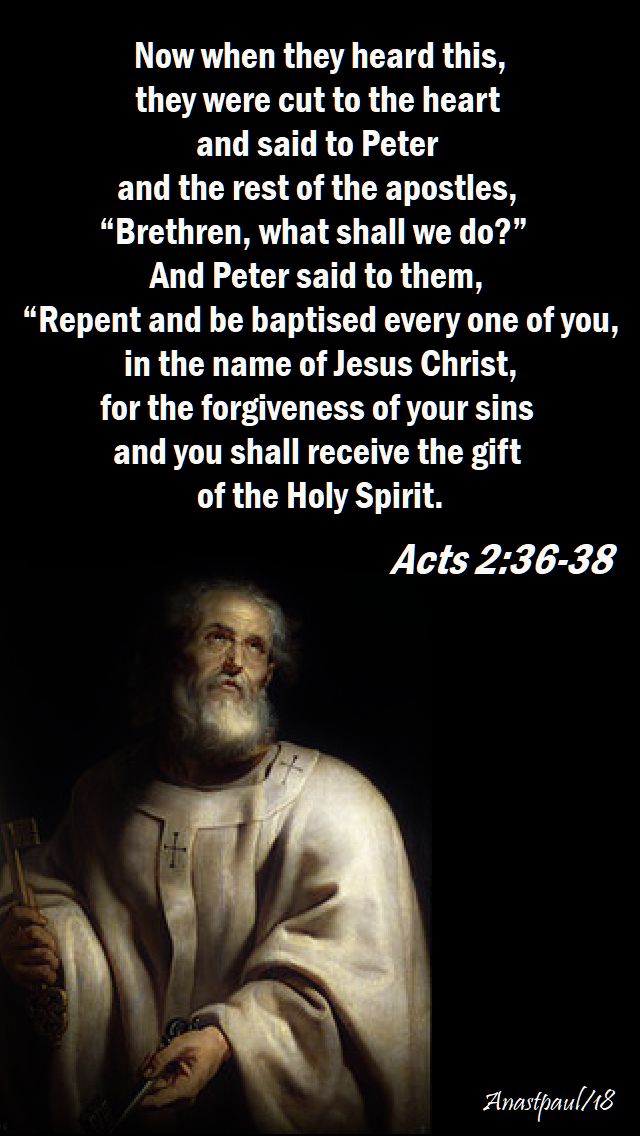
Now when they heard this, they were cut to the heart and said to Peter and the rest of the apostles, “Brethren, what shall we do?” And Peter said to them, “Repent and be baptised every one of you, in the name of Jesus Christ, for the forgiveness of your sins and you shall receive the gift of the Holy Spirit...Acts 2:36-38
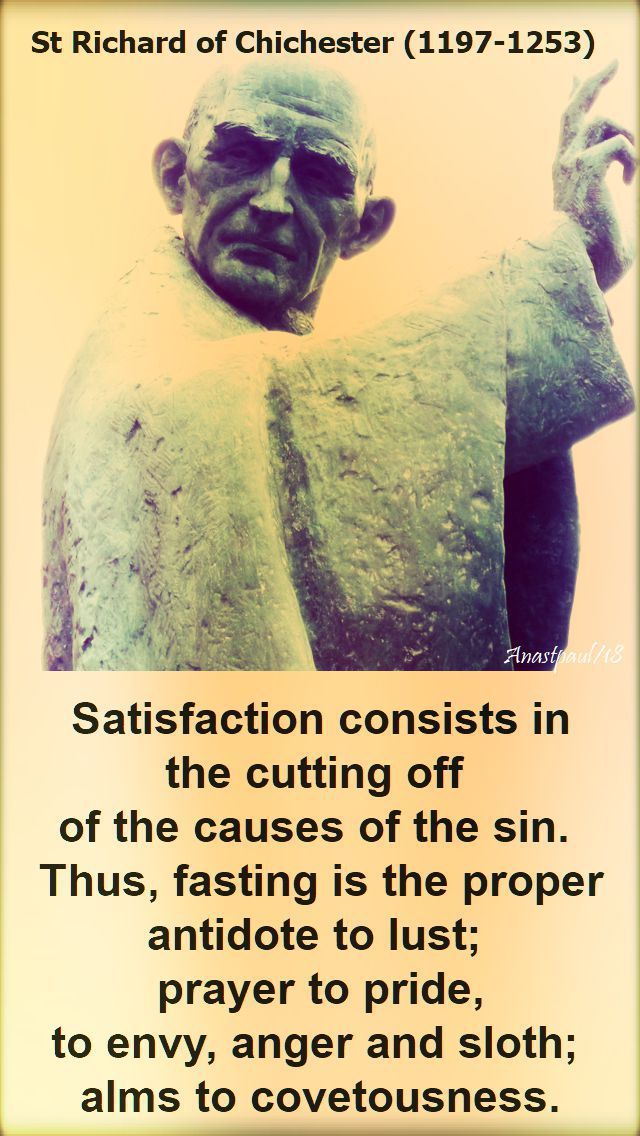
REFLECTION – “Satisfaction consists in the cutting off of the causes of the sin. Thus, fasting is the proper antidote to lust; prayer to pride, to envy, anger and sloth; alms to covetousness.”…St Richard of Chichester
PRAYER – Grant us O God, our Father, Your grace, that we may constantly work to repair the damage caused by our sin that we may seek forgiveness and then go forth to sin no more, always amending what earthly damage we have caused. St Richard of Chichester, may your prayers, assist us on our journey to our heavenly home. We make our prayer through our Lord Jesus Christ, in unity with the Holy Spirit, one God forever and ever, amen.
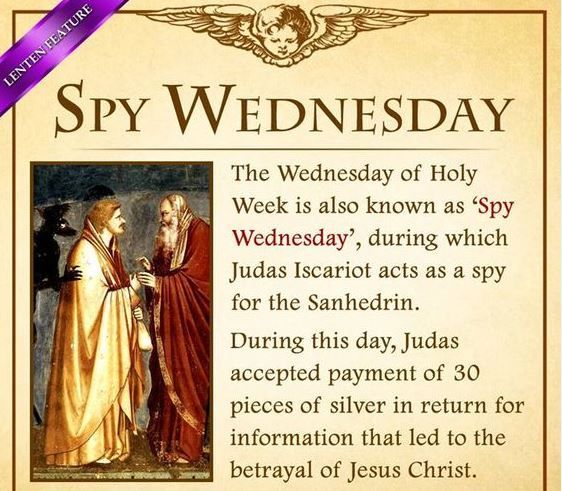
Thought for the Day – 28 March – Wednesday of Holy Week 2018 Judas
Commentaries on Holy Week | Wednesday
Wednesday of Holy Week recalls the sad story of one who was an apostle of Christ, Judas. As St Matthew tells us in his gospel: Then one of the twelve, who was called Judas Iscariot, went to the chief priests and said, “What will you give me if I deliver him to you?” And they paid him thirty pieces of silver. And from that moment he sought an opportunity to betray Him.
So that we realise that we all might behave as Judas did. So that we ask our Lord that, on our part, there be no treachery, nor distancing, nor abandonment. Not only because of the great harm this could bring to our personal lives but because we could drag along others who need the help of our good example, of our support, of our friendship.
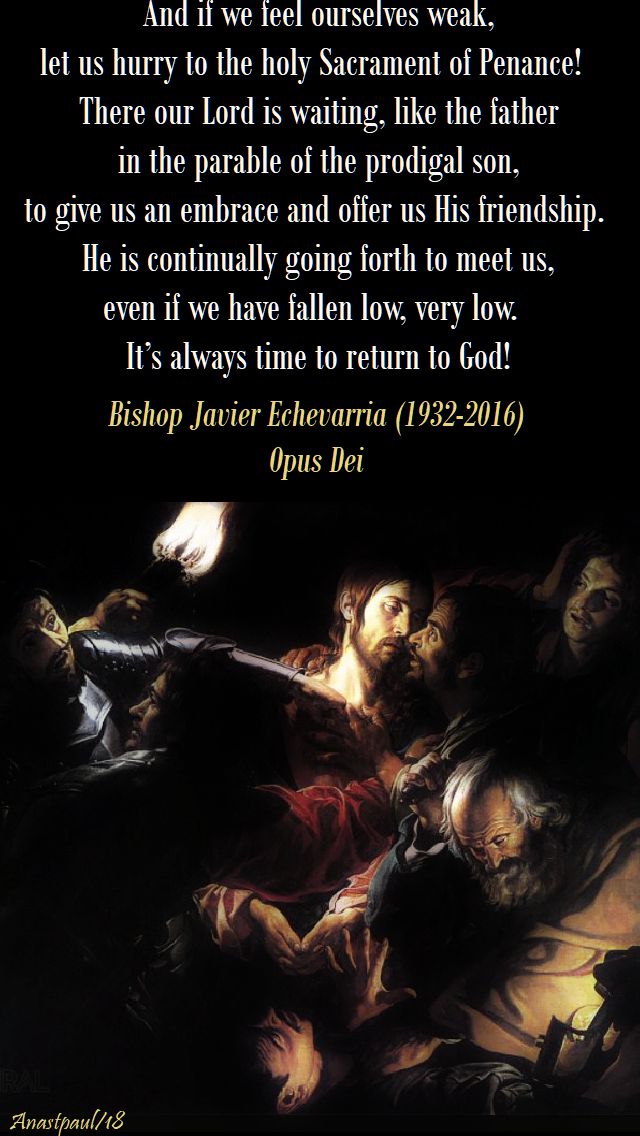
JUDAS’ KISS
In some places in Latin America, the images of Christ crucified show a deep bruise on our Lord’s left cheek. People say this represents Judas’ kiss. So great is the pain that our sins cause Jesus. Let us tell Him that we want to be faithful, that we don’t want to sell Him, as Judas did, for thirty coins, for a trifle, for that’s what our sins are: pride, envy, impurity, hatred, resentment… When a temptation threatens to overwhelm us, let’s remember that it is not worthwhile to exchange the happiness of God’s children, which is what we are, for a pleasure that ends right away, leaving the bitter aftertaste of defeat and infidelity.
We have to feel on our shoulders the weight of the Church and of all humanity. Isn’t it marvellous to know that each of us can influence the whole world. In that place where we are, doing our work well, caring for our family, serving our friends, we can help make so many people happy. As St Josemaria wrote, through the fulfilment of our duties, we Christians have to be like the stone fallen into the lake. With your word and your example you produce a first circle… and it another… and another, and another…Until you reach the furthest sites.
Let us ask our Lord that there be no more betrayals; that we learn, with His grace, how to reject the temptations that the devil presents us with, trying to trick us. We have to say no, firmly, to all that would separate us from God. Thus the sad story of Judas will not be repeated in our own lives.
SACRAMENT OF DIVINE MERCY
And if we feel ourselves weak, let us hurry to the holy Sacrament of Penance! There our Lord is waiting, like the father in the parable of the prodigal son, to give us an embrace and offer us His friendship. He is continually going forth to meet us, even if we have fallen low, very low. It’s always time to return to God! We should never react with discouragement or pessimism. Don’t think: What can I do, if I’m just a pile of wretchedness? God’s mercy is even greater. What can I do, if I fall again and again through my weakness? God’s power to lift us from our falls is even greater.
The sins of Judas and of Peter were great. Both of them betrayed the Master: one by handing Him over to His persecutors, the other by denying Him three times. And nevertheless, how differently each reacted. Our Lord longed to show mercy towards both. Peter repented; he wept over his sin, he asked for forgiveness and Christ strengthened him in his faith and love. In time, he came to give his life for our Lord. But Judas failed to trust in Christ’s mercy. Up till the last moment, God held the doors of forgiveness open for him, but he didn’t want to enter them through penance.
MOMENT OF CONVERSION AND FORGIVENESS
In his first encyclical, John Paul II spoke of Christ’s “right to meet each one of us in that key moment in the soul’s life constituted by the moment of conversion and forgiveness” (Redemptor Hominis, 20). Let’s not deprive Jesus of that right! Let’s not take away from God the Father the joy of giving us a welcoming embrace! Let’s not sadden the Holy Spirit, who wants to give supernatural life back to souls!
Let’s ask Blessed Mary, the Hope of Christians, to prevent us from becoming discouraged on seeing our mistakes and sins, perhaps repeated ones. May she win for us from her Son the grace of conversion, an efficacious desire to go humbly and contritely to Confession, the sacrament of divine mercy, beginning and beginning again as often as necessary.
Bishop Javier Echevarria (1932-2016)
Fr Javier Echevarria (born 1932) was the second successor of St Josemaria Escriva as head of Opus Dei from 1994-2016. He worked closely with St. Josemaria Escriva as his personal secretary from 1953 until St Josemaria’s death in 1975. Bishop Echevarria was ordained as a priest on 7 August 1955. He was elected and appointed by John Paul II as prelate of Opus Dei on 20 April 1994. The Pope ordained him as a bishop on 6 January 1995. Bishop Echevarria died in Rome on 12 December 2016.
One Minute Reflection – 28 March – Wednesday of Holy Week 2018 & The Memorial of St Stephen Harding (1050-1134)
Then one of the twelve, who was called Judas Iscariot, went to the chief priests and said, “What will you give me if I deliver him to you?” And they paid him thirty pieces of silver. And from that moment he sought an opportunity to betray him…Matthew 26:14-16
REFLECTION – “Judas is neither a master of evil nor the figure of a demoniacal power of darkness but rather a sycophant who bows before the anonymous power of changing moods and current fashions. But it is precisely this anonymous power that crucified Jesus, for it was anonymous voices that cried ‘away with him! Crucify him!'”…Pope Benedict XVI
PRAYER – Father of mercy, hear the prayers of Your repentant children, who call on You in love. Englighten our minds, sanctify our hearts, grant us right judgement and lead us away from the idols of the world. St Stephen Harding, as you abandoned the world and helped many to follow you, intercede for us. Through Jesus Christ our Saviour, in union with the Holy Spirit, one God forever and ever, amen.
One Minute Reflection – 27 March – Tuesday of Holy Week 2018
Peter said to him, “Lord, why cannot I follow you now? I will lay down my life for you.” Jesus answered, “Will you lay down your life for me? Truly, truly, I say to you, the cock will not crow, till you have denied me three times…John 13:37-38
REFLECTION – “We too often forget that maxim of the Saints which warns us to consider ourselves as each day recommencing our progress towards perfection. If we consider it frequently we shall not be surprised at the poverty of our spirit, nor how much we have to refuse ourselves. The work is never finished, we have continually to begin again and that courageously. What we have done so far is good but what we are going to commence will be better and when we have finished that, we shall begin something else that will be better still and then another – until we leave this world to begin a new life that will have no end because it is the best that can happen to us.
It is not then a case for tears that we have so much work to do for our souls, for we need great courage to go ever onwards (since we must never stop) and much resolution to restrain our desires. Observe carefully this precept that all the Saints have given to those who would emulate them: to speak little, or not at all, of yourself and your own interests.”…St Francis de Sales (1567-1622) Doctor of the Church
PRAYER – All-powerful, everliving God, may our sacramental celebration of the Lord’s passion bring us Your forgiveness, Your love and Your help. Grant that through the prayers of Blessed Louis-Edouard Cestac, Your servant, we may constantly grow in sanctity, zeal and fortitude. T hrough our Lord Jesus Christ, in union with the Holy Spirit, one God forever, amen.
One Minute Reflection – 22 February – The Feast of the Chair of Saint Peter
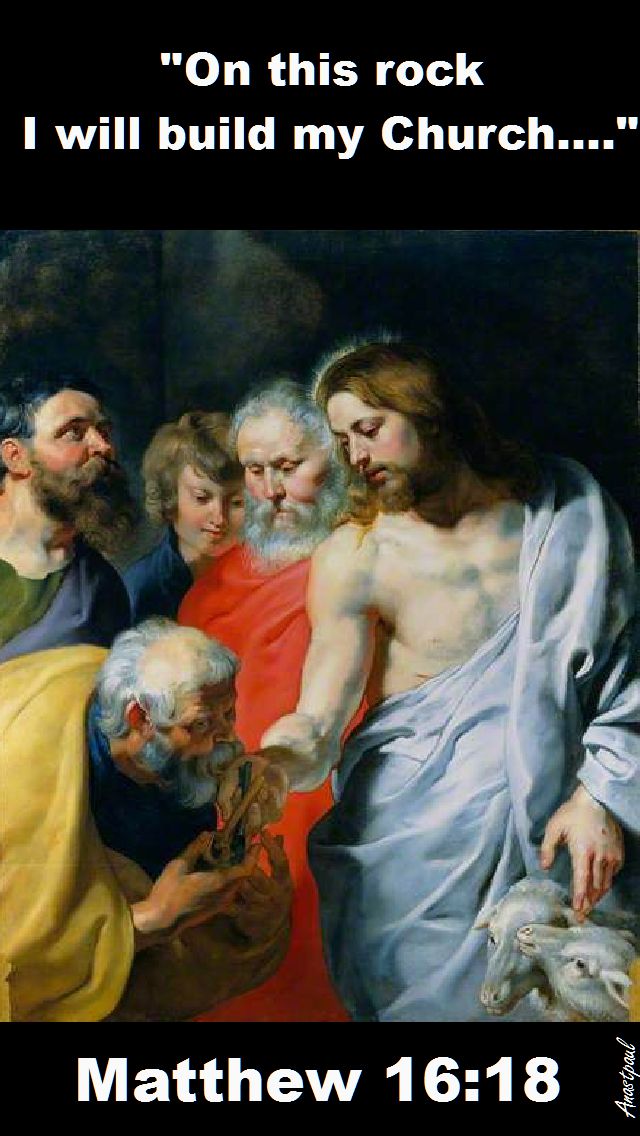
“On this rock I will build my Church”…Matthew 16:18
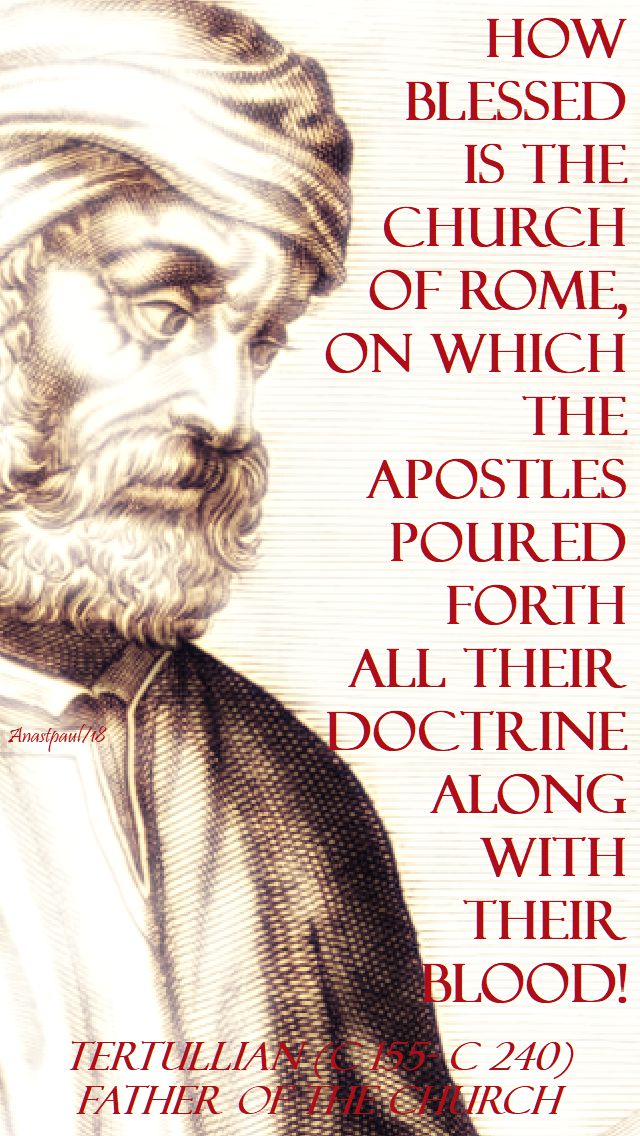
REFLECTION – “How blessed is the Church of Rome, on which the Apostles poured forth all their doctrine along with their blood!” (De Praescriptione Hereticorum, 36)…….Tertullian
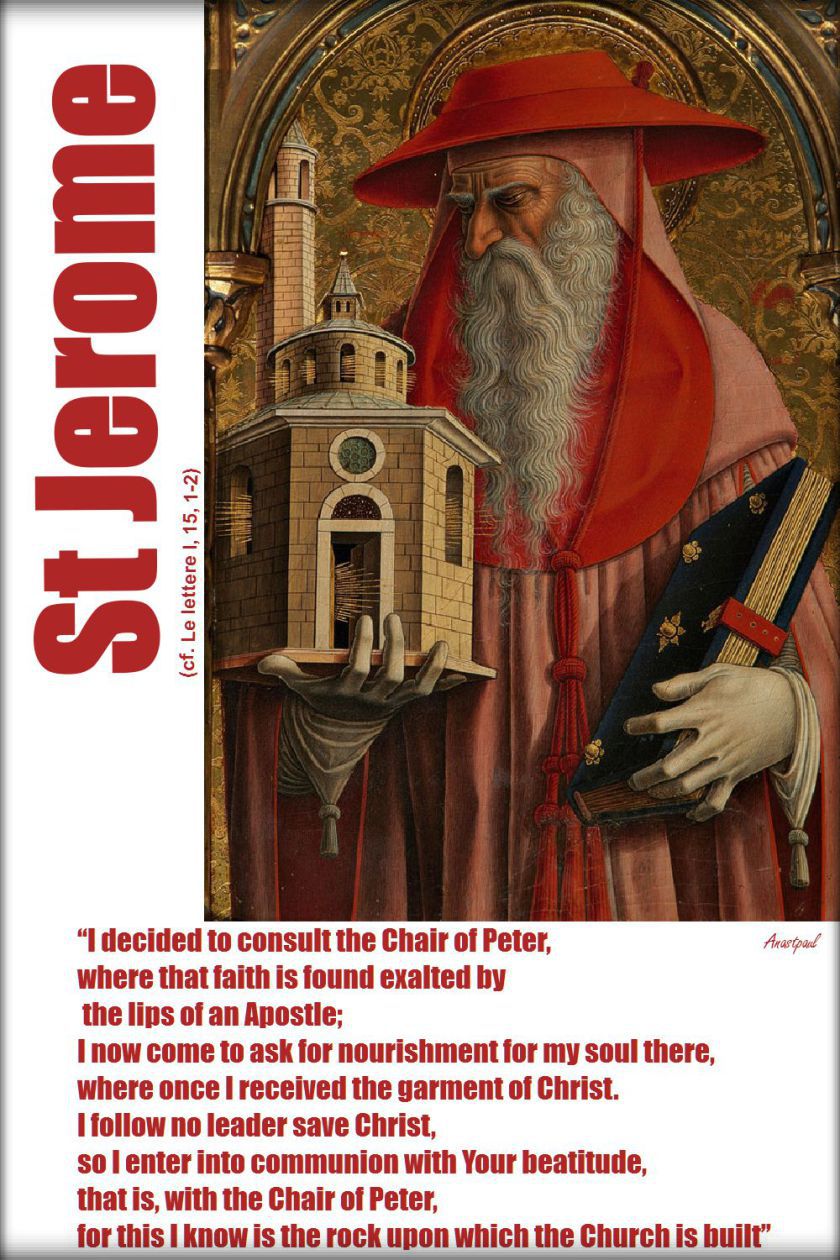
“I decided to consult the Chair of Peter, where that faith is found exalted by the lips of an Apostle; I now come to ask for nourishment for my soul there, where once I received the garment of Christ. I follow no leader save Christ, so I enter into communion with Your beatitude, that is, with the Chair of Peter, for this I know is the rock upon which the Church is built.” (cf. Le lettere I, 15, 1-2)…………..St Jerome (343-420) Father & Doctor
PRAYER – Holy Father, send Your Divine Enlightener into the hearts of all Your faithful, filling us with the strength to fulfil our mission as the followers of the Chair of St Peter. And most of all, we pray Lord Holy God to inspire and light the way of our Holy Father, Francis. Sustain and guide him, keep him in health and strength, to lead Your people by the Light of the Way and the Truth. Holy Father, have mercy on us, Holy Spirit guide and lead us, Lord Jesus Christ be our intercessor and teacher, amen.
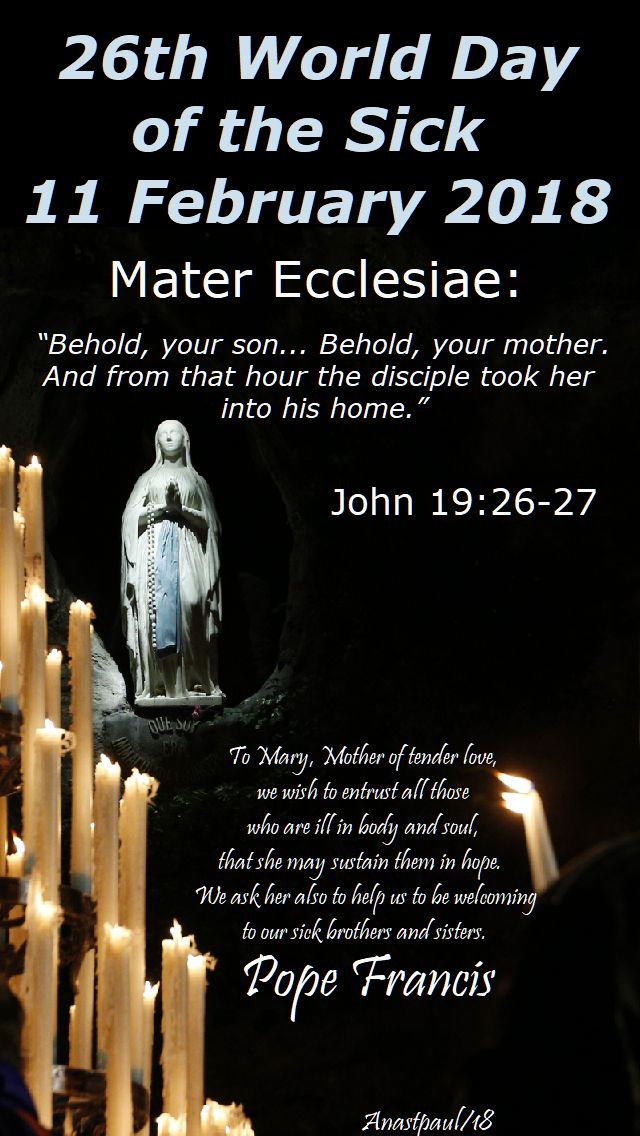
Mater Ecclesiae: “Behold, your son… Behold, your mother.
And from that hour the disciple took her into his home.”
(John 19:26-27)
Dear Brothers and Sisters,
The Church’s service to the sick and those who care for them must continue with renewed vigour, in fidelity to the Lord’s command (cf. Lk 9:2-6; Mt 10:1-8; Mk 6:7-13) and following the eloquent example of her Founder and Master.
The theme for this year’s Day of the Sick is provided by the words that Jesus spoke from the Cross to Mary, His Mother, and to John: “Woman, behold your son … Behold your mother. And from that hour the disciple took her into his home” (Jn 19:26-27).
1. The Lord’s words brilliantly illuminate the mystery of the Cross, which does not represent a hopeless tragedy, but rather the place where Jesus manifests his glory and shows his love to the end. That love in turn was to become the basis and rule for the Christian community and the life of each disciple.
Before all else, Jesus’ words are the source of Mary’s maternal vocation for all humanity. Mary was to be, in particular, the Mother of her Son’s disciples, caring for them and their journey through life. As we know, a mother’s care for her son or daughter includes both the material and spiritual dimensions of their upbringing.
The unspeakable pain of the Cross pierces Mary’s soul (cf. Lk 2:35) but does not paralyse her. Quite the opposite. As the Lord’s Mother, a new path of self-giving opens up before her. On the Cross, Jesus showed His concern for the Church and all humanity and Mary is called to share in that same concern. In describing the outpouring of the Holy Spirit at Pentecost, the Acts of the Apostles show that Mary began to carry out this role in the earliest community of the Church. A role that never ceases.
2. John, the beloved disciple, is a figure of the Church, the messianic people. He must acknowledge Mary as his Mother. In doing so, he is called to take her into his home, to see in her the model of all discipleship and to contemplate the maternal vocation that Jesus entrusted to her, with all that it entails: a loving Mother who gives birth to children capable of loving as Jesus commands. That is why Mary’s maternal vocation to care for her children is entrusted to John and to the Church as a whole. The entire community of disciples is included in Mary’s maternal vocation.
3. John, as a disciple who shared everything with Jesus, knows that the Master wants to lead all people to an encounter with the Father. He can testify to the fact that Jesus met many people suffering from spiritual sickness due to pride (cf. Jn 8:31-39) and from physical ailments (cf. Jn 5:6). He bestowed mercy and forgiveness upon all, and healed the sick as a sign of the abundant life of the Kingdom, where every tear will be wiped away. Like Mary, the disciples are called to care for one another, but not only that. They know that Jesus’ heart is open to all and excludes no one. The Gospel of the Kingdom must be proclaimed to all, and the charity of Christians must be directed to all, simply because they are persons, children of God.
4. The Church’s maternal vocation to the needy and to the sick has found concrete expression throughout the two thousand years of her history in an impressive series of initiatives on behalf of the sick. This history of dedication must not be forgotten. It continues to the present day throughout the world. In countries where adequate public health care systems exist, the work of Catholic religious congregations and dioceses and their hospitals is aimed not only at providing quality medical care but also at putting the human person at the centre of the healing process, while carrying out scientific research with full respect for life and for Christian moral values. In countries where health care systems are inadequate or non-existent, the Church seeks to do what she can to improve health, eliminate infant mortality and combat widespread disease. Everywhere she tries to provide care, even when she is not in a position to offer a cure. The image of the Church as a “field hospital” that welcomes all those wounded by life is a very concrete reality, for in some parts of the world, missionary and diocesan hospitals are the only institutions providing necessary care to the population.
5. The memory of this long history of service to the sick is cause for rejoicing on the part of the Christian community and especially those presently engaged in this ministry. Yet we must look to the past above all to let it enrich us. We should learn the lesson it teaches us about the self-sacrificing generosity of many founders of institutes in the service of the infirm, the creativity, prompted by charity, of many initiatives undertaken over the centuries, and the commitment to scientific research as a means of offering innovative and reliable treatments to the sick. This legacy of the past helps us to build a better future, for example, by shielding Catholic hospitals from the business mentality that is seeking worldwide to turn health care into a profit-making enterprise, which ends up discarding the poor. Wise organisation and charity demand that the sick person be respected in his or her dignity and constantly kept at the centre of the therapeutic process. This should likewise be the approach of Christians who work in public structures; through their service, they too are called to bear convincing witness to the Gospel.
6. Jesus bestowed upon the Church his healing power: “These signs will accompany those who believe… they will lay hands on the sick, and they will recover (Mk 16:17-18). In the Acts of the Apostles, we read accounts of the healings worked by Peter (cf. Acts 3:4-8) and Paul (cf. Acts 14:8-11). The Church’s mission is a response to Jesus’ gift, for she knows that she must bring to the sick the Lord’s own gaze, full of tenderness and compassion. Health care ministry will always be a necessary and fundamental task, to be carried out with renewed enthusiasm by all, from parish communities to the most largest healthcare institutions. We cannot forget the tender love and perseverance of many families in caring for their chronically sick or severely disabled children, parents and relatives. The care given within families is an extraordinary witness of love for the human person, it needs to be fittingly acknowledged and supported by suitable policies. Doctors and nurses, priests, consecrated men and women, volunteers, families and all those who care for the sick, take part in this ecclesial mission. It is a shared responsibility that enriches the value of the daily service given by each.
7. To Mary, Mother of tender love, we wish to entrust all those who are ill in body and soul, that she may sustain them in hope. We ask her also to help us to be welcoming to our sick brothers and sisters. The Church knows that she requires a special grace to live up to her evangelical task of serving the sick. May our prayers to the Mother of God see us united in an incessant plea that every member of the Church may live with love the vocation to serve life and health. May the Virgin Mary intercede for this Twenty-sixth World Day of the Sick; may she help the sick to experience their suffering in communion with the Lord Jesus and may she support all those who care for them. To all, the sick, to healthcare workers and to volunteers, I cordially impart my Apostolic Blessing.
From the Vatican, 26 November 2017
Solemnity of Our Lord Jesus Christ, King of the Universe
















You must be logged in to post a comment.