Posted in MORNING Prayers, SAINT of the DAY, The APOSTLES & EVANGELISTS

Thought for the Day – 3 July

Thought for the Day – 3 July

“Poor Thomas! He made one remark and has been branded as “Doubting Thomas” ever since.   But if he doubted, he also believed.   He made what is certainly the most explicit statement of faith in the New Testament:  “My Lord and My God!” and, in so expressing his faith, gave Christians a prayer that will be said till the end of time.   He also occasioned a compliment from Jesus to all later Christians:  “Have you come to believe because you have seen me? Blessed are those who have not seen and have believed” (John 20:29).

Thomas should be equally well-known for his courage.   Perhaps what he said was impetuous—since he ran, like the rest, at the showdown—but he can scarcely have been insincere when he expressed his willingness to die with Jesus.   The occasion was when Jesus proposed to go to Bethany after Lazarus had died.   Since Bethany was near Jerusalem, this meant walking into the very midst of his enemies and to almost certain death.   Realising this, Thomas said to the other apostles,  “Let us also go to die with him” (John 11:16b).

Thomas shares the lot of Peter the impetuous, James and John, the “sons of thunder,” Philip and his foolish request to see the Father—indeed all the apostles in their weakness and lack of understanding.   We must not exaggerate these facts, however, for Christ did not pick worthless men.   But their human weakness again points up the fact that holiness is a gift of God, not a human creation – it is given to ordinary men and women with weaknesses, it is God who gradually transforms the weaknesses into the image of Christ, the courageous, trusting and loving one.” Fr. Don Miller, OFM

Saint John Chrysostom said about Thomas:  “Thomas, being once weaker in faith than the other apostles, toiled through the grace of God more bravely, more zealously and tirelessly than them all, so that he went preaching over nearly all the earth, not fearing to proclaim the Word of God to savage nations.”   If Thomas can be transformed, so, too, can we.  When our faith is shaken, we think of Thomas’ doubt… but we also must think of his courage.   What will we accomplish when our faith overflows within us, pouring forth in the courageous acclamation, “My Lord and My God!”?

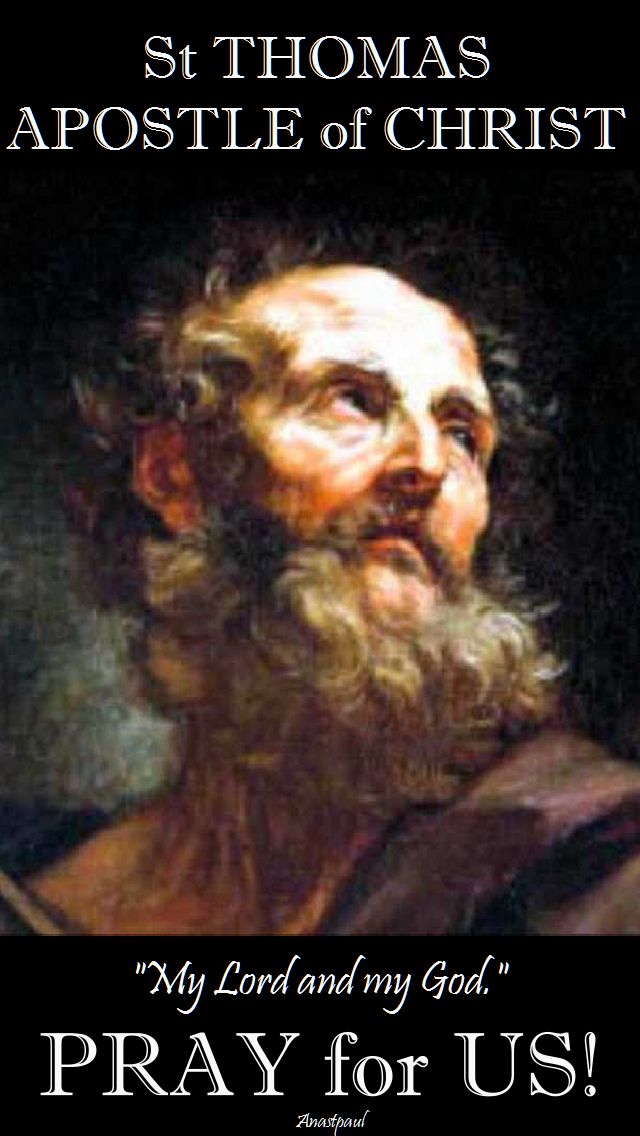
St Thomas, Apostle of Christ, Pray for us!

st thomas pray for us 2

Posted in MORNING Prayers, SAINT of the DAY, The APOSTLES & EVANGELISTS

One Minute Reflection – 3 July

One Minute Reflection – 3 July

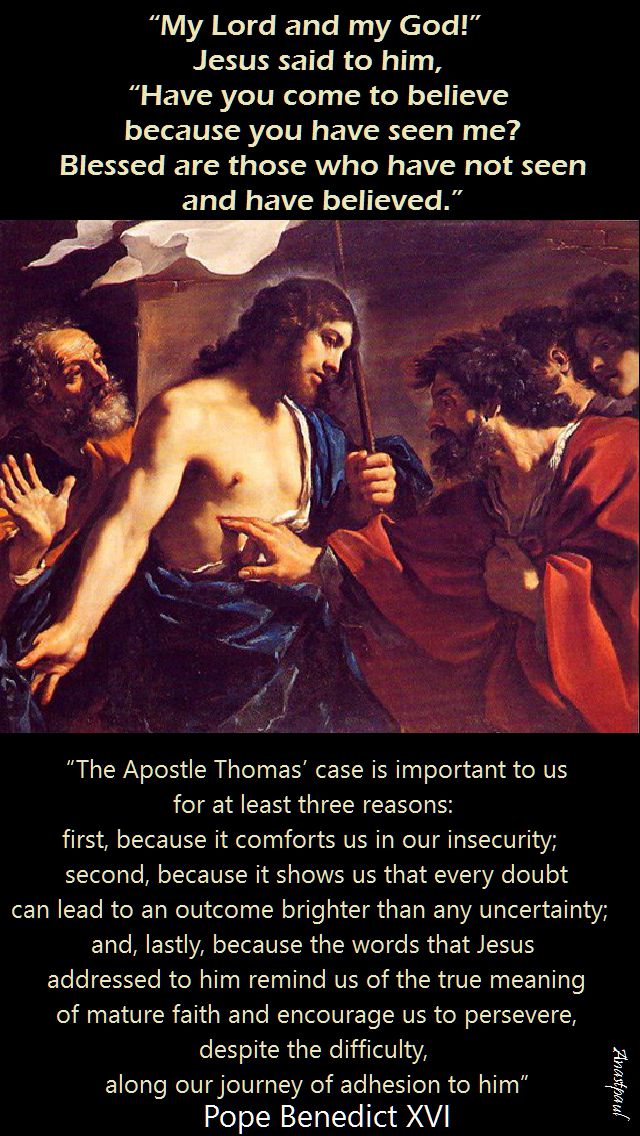
“My Lord and my God!” Jesus said to him, “Have you come to believe because you have seen me?
Blessed are those who have not seen and have believed.”…John 20:28-29

REFLECTION – “the Apostle Thomas’ case is important to us for at least three reasons: first, because it comforts us in our insecurity; second, because it shows us that every doubt can lead to an outcome brighter than any uncertainty; and, lastly, because the words that Jesus addressed to him remind us of the true meaning of mature faith and encourage us to persevere, despite the difficulty, along our journey of adhesion to him”………….Pope Benedict XVI, 27 September 2006.

pope benedict - the apostle Thomas case

PRAYER – Father, let our celebration of the Feast of St Thomas the Apostle, be the source of his unfailing help and protection. Fill us with Your life-giving grace through faith in Your Son, whom St Thomas acknowledged to be his Lord and God. St Thomas continue to intercede for us that we may grow strong in faith and trust. Through our Lord Jesus Christ, in union with the Holy Spirit, one God forever and ever Amen.

st thomas pray for us

Posted in Against DOUBT, those in DOUBT, EYES - Diseases, of the BLIND, Of BUILDERS, CONSTRUCTION WORKERS, SAINT of the DAY, The APOSTLES & EVANGELISTS

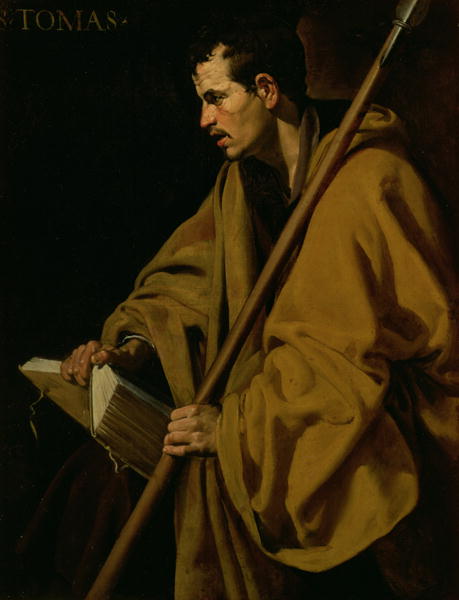
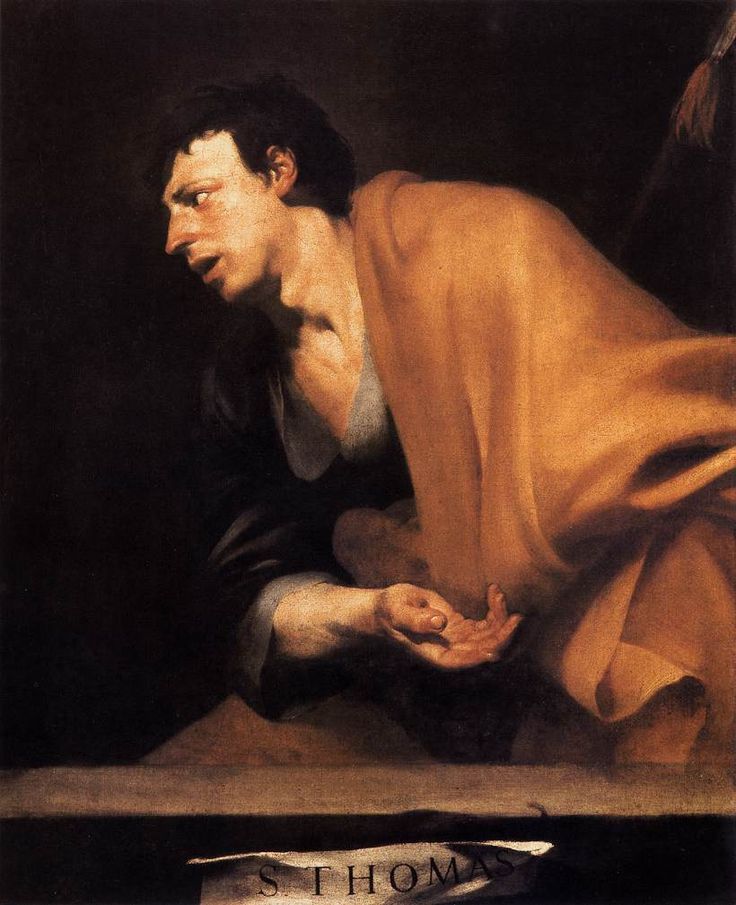
Saint of the Day – 3 July – St Thomas the Apostle of Christ

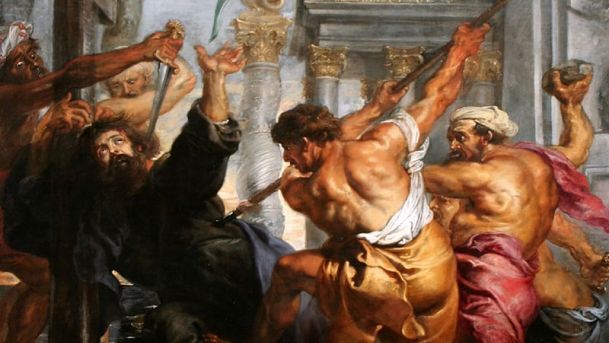
Saint of the Day – 3 July – St Thomas the Apostle of Christ – Apostle, Martyr, Preacher, Evangelist (called Didymus which means “the twin” was one of the Twelve Apostles of Jesus Christ.   He is informally called ‘Doubting Thomas’ because he doubted Jesus’ Resurrection when first told (in the Gospel of John account only), followed later by his confession of faith, “My Lord and my God,”, on seeing Jesus’ wounded Body.   He was ready to die with Jesus when Christ went to Jerusalem but is best remembered for doubting the Resurrection until allowed to touch Christ’s wounds.   An old tradition says that Thomas Baptised the three Magi.   He was Martyred by being stabbed with a spear in c 72 while in prayer on a hill in Mylapur, India and is buried near the site of his death.   His relics later moved to Edessa, Mesopotamia and finally to Tortona, Italy in the 13th Century.   His Patronages are:people in doubt; against doubt• architects• blind people and against blindnessbuilders• construction workers• geometricians• stone masons and stone cutters• surveyors• theologians• Ceylon• East Indies• India• Indonesia• Malaysia • Pakistan• Singapore• Sri Lanka• Diocese of Bathery, India• Castelfranco di Sopra, Italy• Certaldo, Italy• Ortona, Italy.

st thomas.8

We feel great kinship for the Apostle Thomas because, like him, most of us curiously combine faith and doubt.   We sometimes share the enthusiasm St Thomas expressed when upon Lazarus’s death Jesus decided to go to Bethany.   “Let’s go too,” Thomas said to the other disciples,“that we may die with him” (see John 11:16).   But also like him we sometimes wonder where Jesus is headed and where He is taking us (see John 14:5).

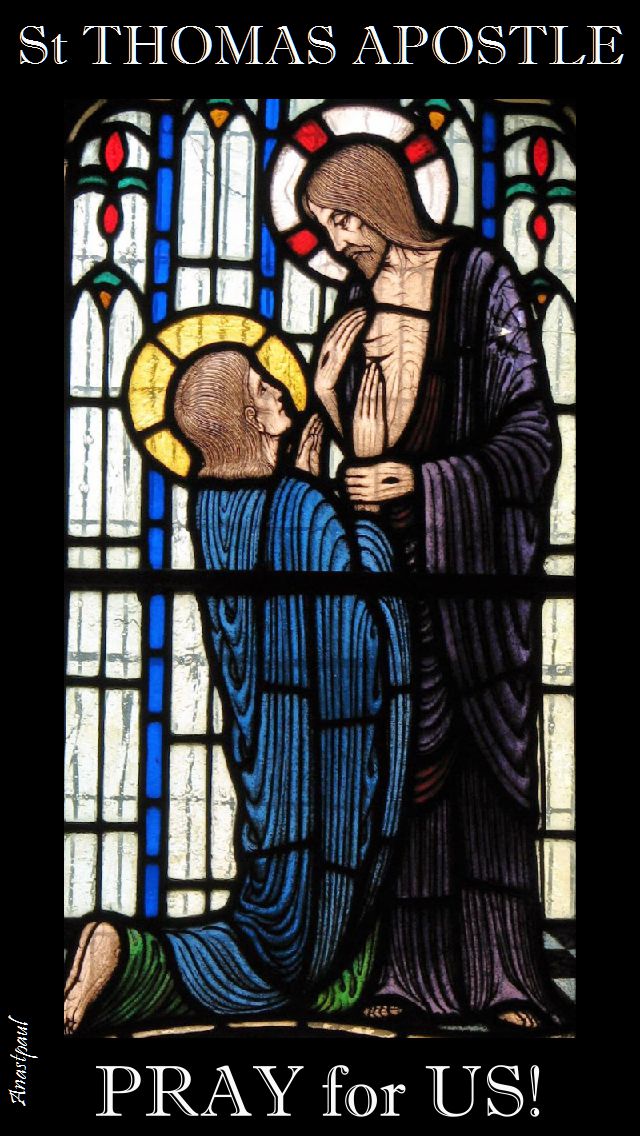
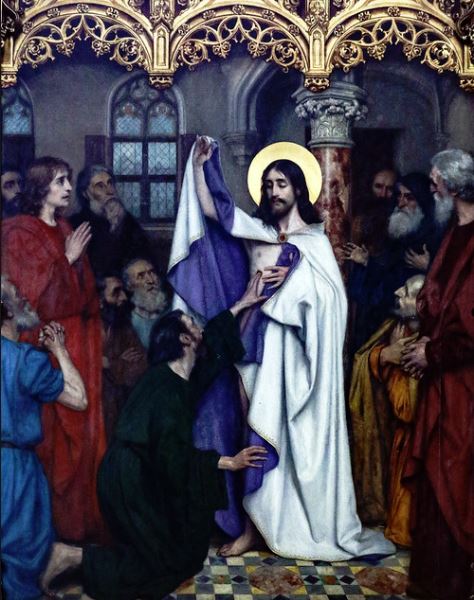
However, we are most like Thomas because doubts occasionally rattle our brains and cloud our souls.   So we all relate to the story of doubting Thomas (see John 20:25–29). Thomas was absent the first time Jesus appeared after his resurrection.  The apostle swore he would not believe, “Unless I see in his hands the print of the nails, and place my finger in the mark of the nails and place my hand in his side”.   Eight days later Jesus appeared again and told Thomas to touch his wounds. “My Lord, and my God,” Thomas exclaimed, recovering his faith.st thomas apostle kneeling before christ glass

Some early Christian writers criticised Thomas’s faithless behaviour.  But others praised him for helping us cure our doubts, as Gregory the Great does in this homily:

“. . . For the faithlessness of Thomas aids us in our belief more than does the faith of the disciples who believed. . . . When he is brought to believe by feeling with his own hand, every doubt having been removed, our own mind is confirmed in faith. . . .The divinity cannot be seen by any mortal man.   So Thomas saw man and confessed him to be God, saying, “My Lord, and my God.”
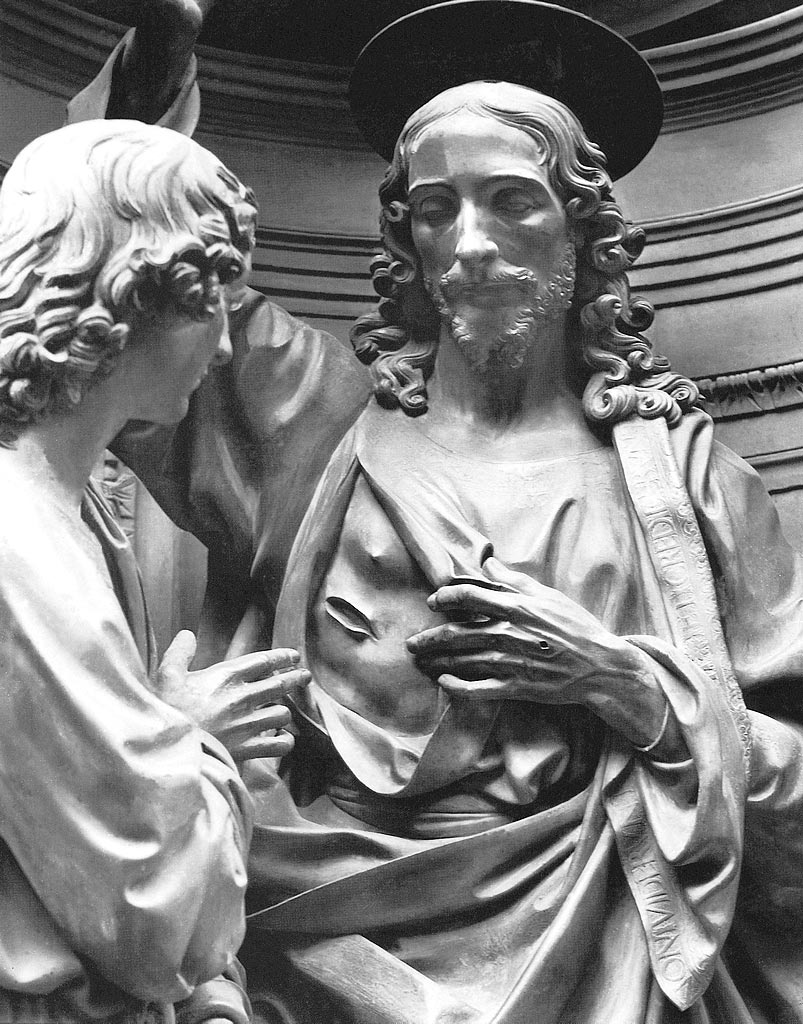
On seeing, then, he believed, and proclaimed him to be God whom he could not see.THOMAS - verrocch_ph96_pl124_050404

Then Jesus spoke these words that give us much joy:  “Blessed are they who have not seen and yet have believed” (see John 20:29).   This sentence undoubtedly signifies to us who hold in our minds Him whom we have not seen in the flesh.   But we are signified only if we follow up our faith by works.   For he really believes, who carries out in deed what he believes.

We do not know for sure where Thomas conducted his missionary activity after Pentecost.    Some claim that he evangelised among the Parthians.   But a stronger tradition says he carried the gospel to India.  He is supposed to have recruited the Christians of Malabar and died a martyr by the spear at Mylapore, near Madras.   An ancient stone cross there marks the place where his remains lay buried until they were removed to Edessa in 394 and then later to Italy.

Thomas the Apostle is murdered in India

St Thomas, Apostle of Christ pray for our unbelief!

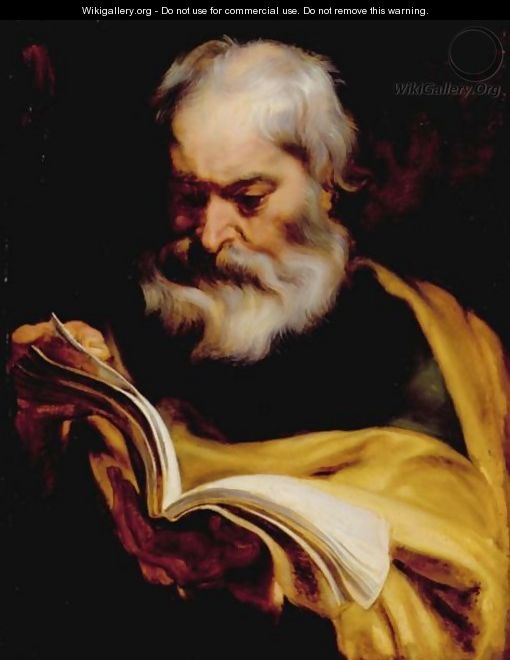
Bust Of The Apostle Thomas - Sir Anthony Van Dyck

st thomas.3.

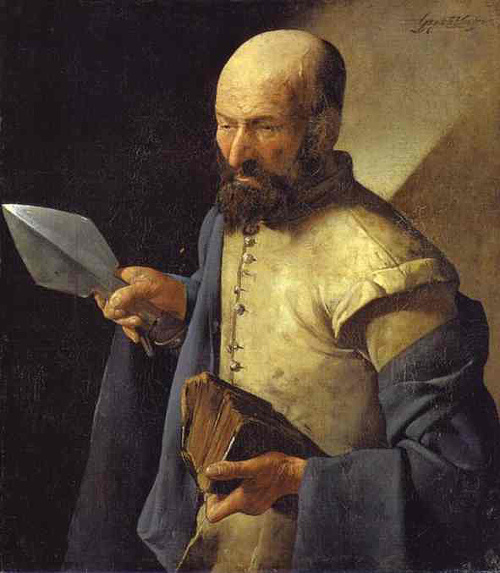
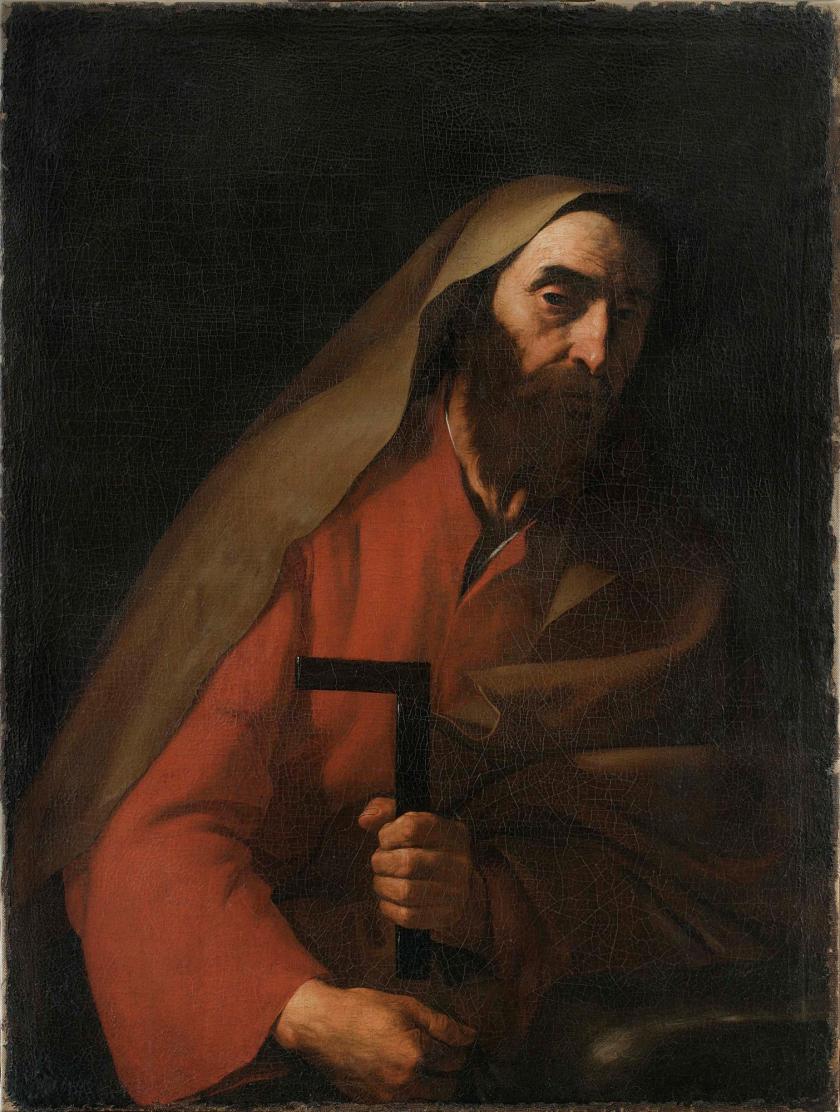
LaTour, St Thomas with pike c1632

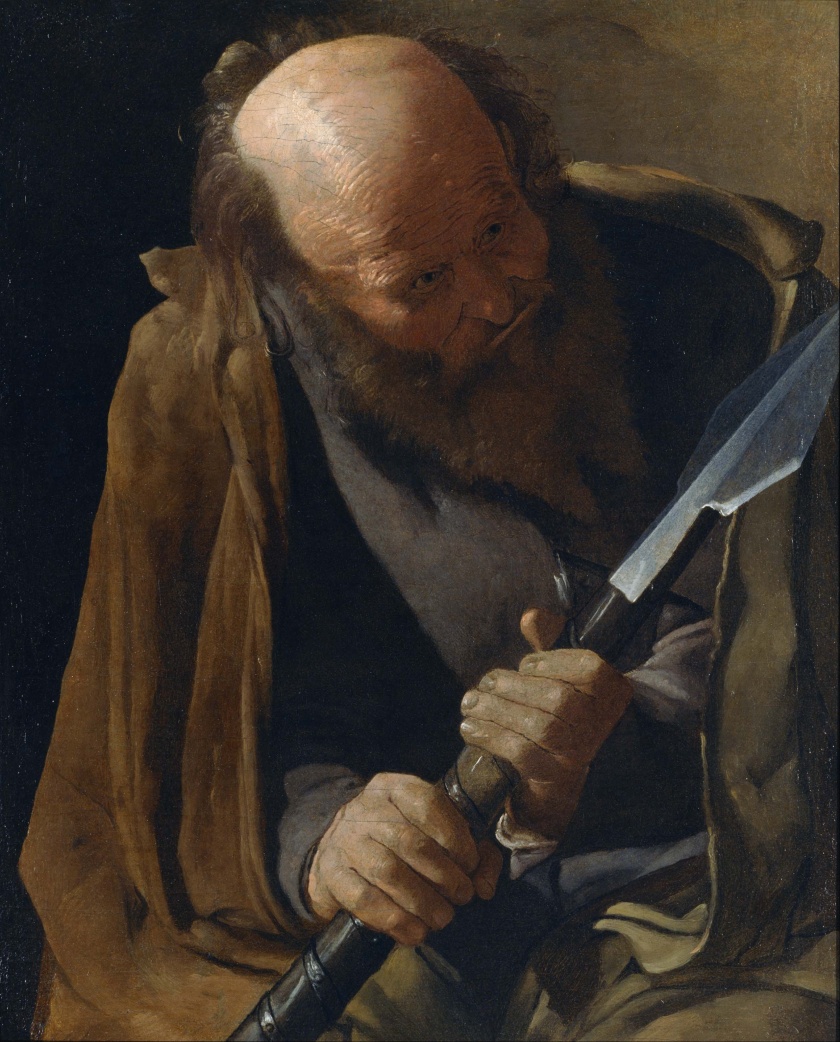
Georges_de_La_Tour_-_St._Thomas_-_Google_Art_Projectst thomas.10

Posted in FATHERS of the Church, MORNING Prayers, SAINT of the DAY, The APOSTLES & EVANGELISTS

Thought for the Day – 29 June

Thought for the Day – 29 June

By their lives and labours, Peter and Paul established the faith and by their deaths they bore witness to is power and truth.   They are part of the Church’s own confession of faith – they were the architects of that faith and they have left their mark indelibly upon Christian history and belief.   After Christ, these two are the cornerstones of the Church and as such they are enshrined in the Church’s memory.   They embody in themselves everything a Christian admires in being a follower of Christ, they are Apostles, Martyrs, Witnesses, Evangelists, Teachers, Prophets and Founders of Churches wherever they went in the footsteps of our Lord.   The two great basilicas in Rome are dedicated to them – St Peter’s is the largest Church in Christendom and St Paul’s Outside the Walls, carries the history of all our Popes and is the site of the Martyrdom of St Paul.
We owe our faith to these two great Fathers and hold them in hallowed love and memory.
Like Jesus Himself, their deaths are our lives!

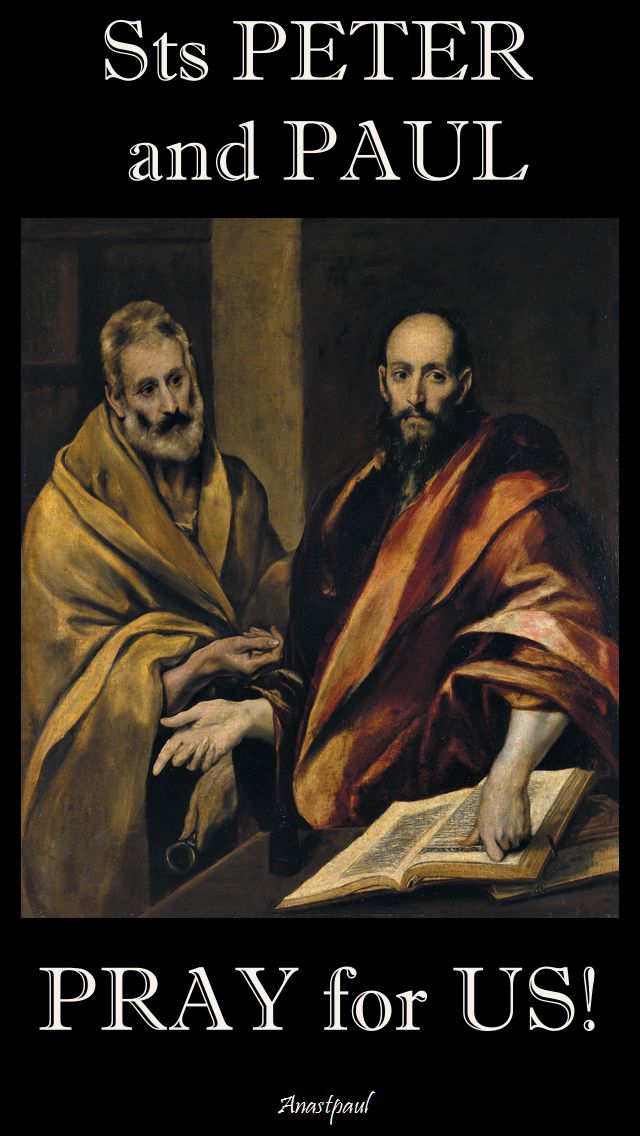
Sts Peter and Paul, pray for us and for the entire universal Church, protect us by your prayers.

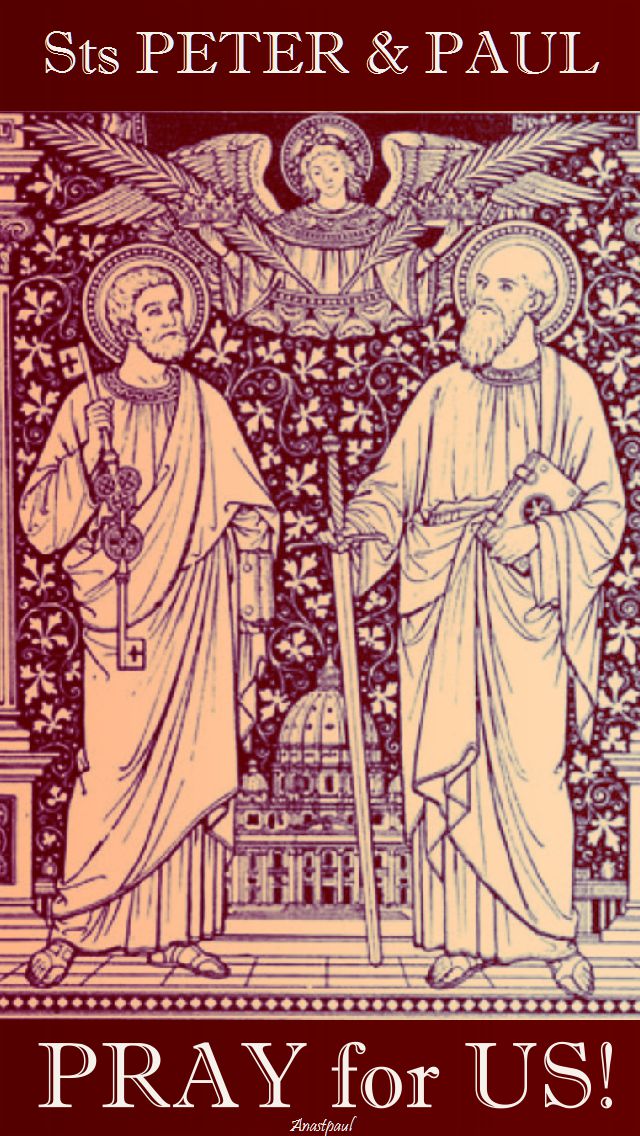
sts peter and paul - pray for us.2

Posted in DOCTORS of the Church, FATHERS of the Church, FEASTS and SOLEMNITIES, MORNING Prayers, QUOTES of the SAINTS, SAINT of the DAY, The APOSTLES & EVANGELISTS

Quote/s of the Day – 29 June

Quote/s of the Day – 29 June

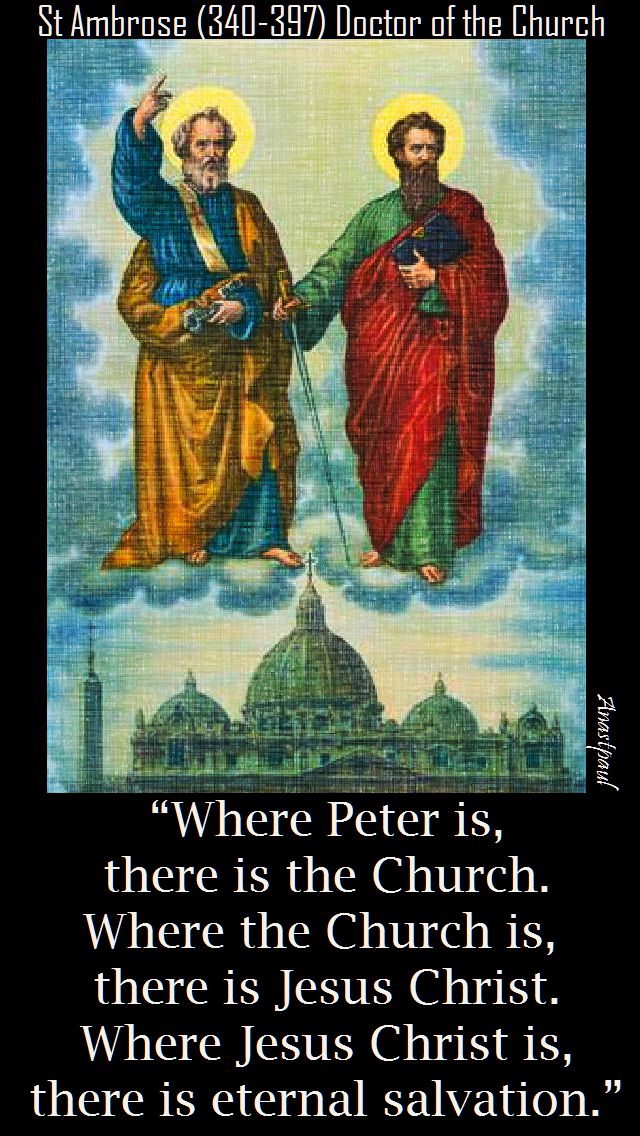
“Where Peter is,
there is the Church.
Where the Church is,
there is Jesus Christ.
Where Jesus Christ is,
there is eternal salvation.”

St Ambrose (340-397)
One of the original four Doctors of the Church

where peter is 2

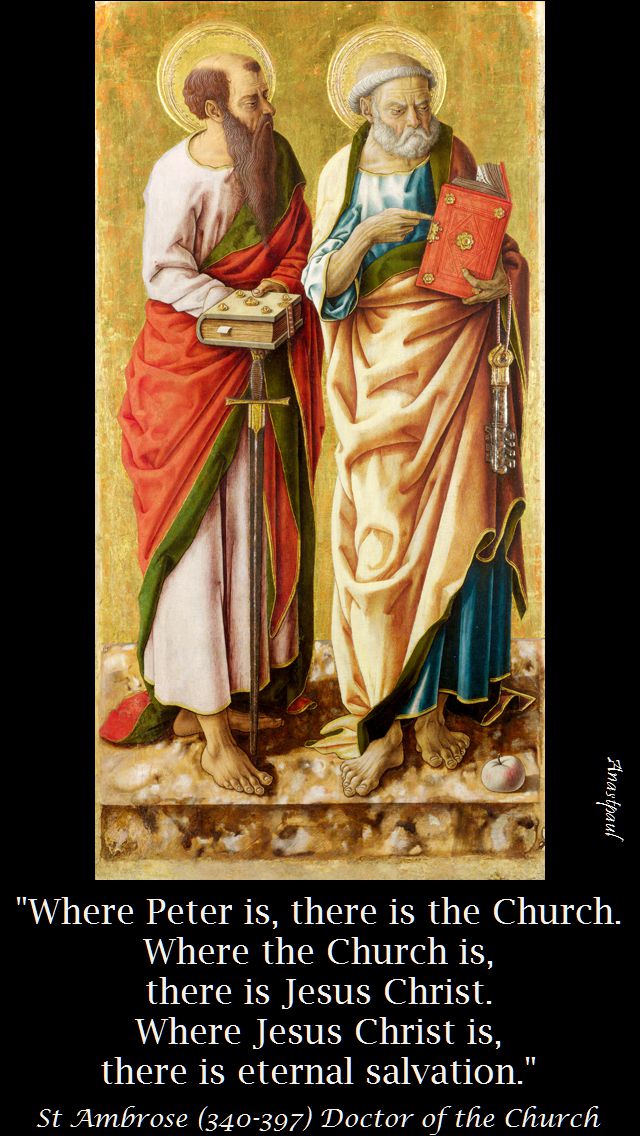
where peter is, there is the church - st ambrose

“There must be general rejoicing, dearly beloved,
over this holy company whom God has appointed
for our example in patience and for our confirmation in faith.
But we must glory even more in the excellence of their fathers,
Peter and Paul, whom the grace of God has raised
to such a height among all the members of the Church
that He has set them like twin lights
of eyes in that Body whose head is Christ.”

St Pope Leo the Great (400-461) Doctor of the Church’s Unity

he has set them like twinlight - st pope leo the great


Posted in FATHERS of the Church, FEASTS and SOLEMNITIES, MORNING Prayers, QUOTES of the SAINTS, SAINT of the DAY, The APOSTLES & EVANGELISTS, The WORD

One Minute Reflection – 29 June

One Minute Reflection – 29 June

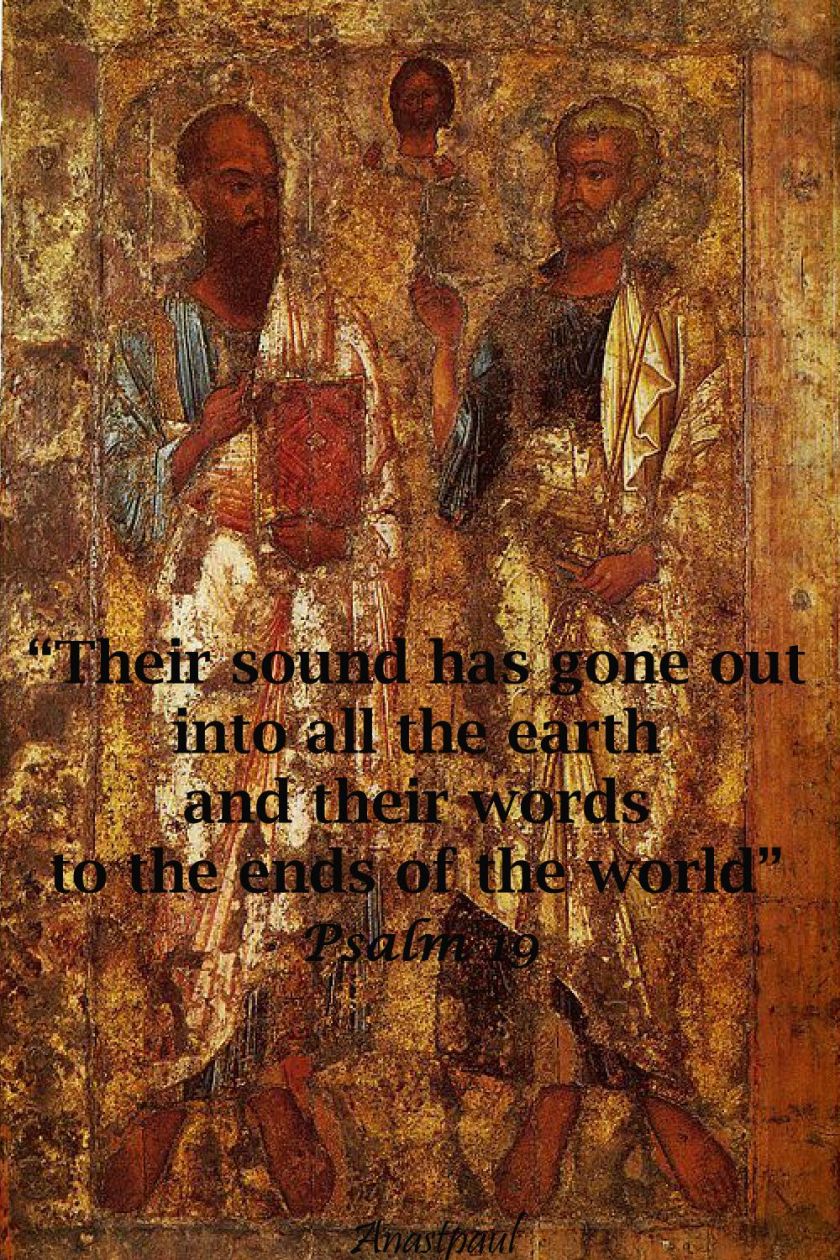
“Their sound has gone out into all the earth and their words to the ends of the world” ……….Psalm 19

psalm 19 - sts peter and paul

REFLECTION – “There is one day for the passion of two apostles. But these two also were as one; although they suffered on different days, they were as one. Peter went first, Paul followed. We are celebrating a feast day, consecrated for us by the blood of the apostles. Let us love their faith, their lives, their labours, their sufferings, their confession of faith, their preaching.”………St Augustine

these two also were as one-staugustine

PRAYER – Almighty God, whose blessed Apostles Peter and Paul glorified you by their martyrdom: grant that your Church, instructed by their teaching and example and knit together in unity by your Spirit, may ever stand firm upon the one foundation, which is Jesus Christ our Lord;  who lives and reigns with you, in the unity of the Holy Spirit, one God, for ever and ever. Sts Peter and Paul, pray for us and for the universal Church, amen.

sts peter and paul - pray for us

Posted in FEASTS and SOLEMNITIES, SAINT of the DAY, The APOSTLES & EVANGELISTS, The WORD

Blessed and Holy Solemnity of Sts Peter and Paul – 29 June

Blessed and Holy Solemnity of Sts Peter and Paul – 29 June – Today we celebrate St Peter and Paul as co-founders of the Church.   St Peter is also celebrated on 22 February (feast of the Chair of Peter, emblematic of the world unity of the Church), 1 August (Saint Peter in Chains) and 18 November (feast of the dedication of the Basilicas of Peter and Paul). St Paul is also celebrated on 25 January – his conversion and 16 February (Saint Paul Shipwrecked).

St Peter Patronages:  Universal Church, against fever, against foot problems, against frenzy, bakers, bridge builders, butchers, clock makers, cobblers, shoe makers, fishermen, harvesters, locksmiths, longevity, net makers, papacy, popes, ship builders, shipwrights, stone masons, watch makers, Isle of Guernsey, Exeter College, Oxford, England, 17 dioceses, 46 cities, 3 abbeys

St Paul Patronages:  against hailstorms, against snake bites, against snakes, Catholic Action, Cursillo movement, lay people, authors, writers, evangelists, journalists, reporters, missionary bishops, musicians, newspaper editorial staff, public relations personnel and work, publishers, rope braiders and makers, saddle makers; saddlers, tent makers, Malta, Bath Abbey, England, 16 dioceses, 28 cities,

peter and paul HEADER 3Peter-and-Paul-Stroman_school_circa_1620_saints_peter_and_paul.jpg - header

SOLEMNITY OF STS PETER AND PAUL

(Excerpt) HOMILY OF HIS HOLINESS BENEDICT XVI

St Peter’s Basilica
Wednesday, 29 June 2005

Dear Brothers and Sisters,

The Feast of the Holy Apostles Peter and Paul is at the same time a grateful memorial of the great witnesses of Jesus Christ and a solemn confession for the Church: one, holy, catholic and apostolic. It is first and foremost a feast of catholicity. The sign of Pentecost – the new community that speaks all languages and unites all peoples into one people, in one family of God -, this sign has become a reality. Our liturgical assembly, at which Bishops are gathered from all parts of the world, people of many cultures and nations, is an image of the family of the Church distributed throughout the earth.

Strangers have become friends; crossing every border, we recognize one another as brothers and sisters. This brings to fulfilment the mission of St Paul, who knew that he was the “minister of Christ Jesus among the Gentiles, with the priestly duty of preaching the Gospel of God so that the Gentiles [might] be offered up as a pleasing sacrifice, consecrated by the Holy Spirit” (Rom 15: 16).
The purpose of the mission is that humanity itself becomes a living glorification of God, the true worship that God expects: this is the deepest meaning of catholicity – catholicity that has already been given to us, towards which we must constantly start out again. Catholicity does not only express a horizontal dimension, the gathering of many people in unity, but also a vertical dimension: it is only by raising our eyes to God, by opening ourselves to him, that we can truly become one.

Like Paul, Peter also came to Rome, to the city that was a centre where all the nations converged and, for this very reason, could become, before any other, the expression of the universal outreach of the Gospel. As he started out on his journey from Jerusalem to Rome, he must certainly have felt guided by the voices of the prophets, by faith and by the prayer of Israel.magnificent glass sts peter and paul

The mission to the whole world is also part of the proclamation of the Old Covenant: the people of Israel were destined to be a light for the Gentiles. The great Psalm of the Passion, Psalm 22[21], whose first verse Jesus cried out on the Cross: “My God, my God, why have you forsaken me?”, ends with the vision: “All the ends of the earth shall remember and turn to the Lord; all the families of the nations shall bow down before him” (Ps 22[21]: 28). When Peter and Paul came to Rome, the Lord on the Cross who had uttered the first line of that Psalm was risen; God’s victory now had to be proclaimed to all the nations, thereby fulfilling the promise with which the Psalm concludes.

Catholicity means universality – a multiplicity that becomes unity; a unity that nevertheless remains multiplicity. From Paul’s words on the Church’s universality we have already seen that the ability of nations to get the better of themselves in order to look towards the one God, is part of this unity. In the second century, the founder of Catholic theology, St Irenaeus of Lyons, described very beautifully this bond between catholicity and unity and I quote him. He says: “The Church spread across the world diligently safeguards this doctrine and this faith, forming as it were one family: the same faith, with one mind and one heart, the same preaching, teaching and tradition as if she had but one mouth. Languages abound according to the region but the power of our tradition is one and the same. The Churches in Germany do not differ in faith or tradition, neither do those in Spain, Gaul, Egypt, Libya, the Orient, the centre of the earth; just as the sun, God’s creature, is one alone and identical throughout the world, so the light of true preaching shines everywhere and illuminates all who desire to attain knowledge of the truth” (Adv. Haer. I 10, 2). The unity of men and women in their multiplicity has become possible because God, this one God of heaven and earth, has shown himself to us; because the essential truth about our lives, our “where from?” and “where to?” became visible when he revealed himself to us and enabled us to see his face, himself, in Jesus Christ. This truth about the essence of our being, living and dying, a truth that God made visible, unites us and makes us brothers and sisters. Catholicity and unity go hand in hand. And unity has a content: the faith that the Apostles passed on to us in Christ’s name.

… We have said that the catholicity of the Church and the unity of the Church go together. The fact that both dimensions become visible to us in the figures of the holy Apostles already shows us the consequent characteristic of the Church: she is apostolic. What does this mean?sts peter and paul - snip

The Lord established Twelve Apostles just as the sons of Jacob were 12. By so doing he was presenting them as leaders of the People of God which, henceforth universal, from that time has included all the peoples. St Mark tells us that Jesus called the Apostles so “to be with him, and to be sent out” (Mk 3: 14). This seems almost a contradiction in terms. We would say: “Either they stayed with him or they were sent forth and set out on their travels”. Pope St Gregory the Great says a word about angels that helps us resolve this contradiction. He says that angels are always sent out and at the same time are always in God’s presence, and continues, “Wherever they are sent, wherever they go, they always journey on in God’s heart” (Homily, 34, 13). The Book of Revelation described Bishops as “angels” in their Church, so we can state: the Apostles and their successors must always be with the Lord and precisely in this way – wherever they may go – they must always be in communion with him and live by this communion.

… Today’s Gospel tells of the profession of faith of St Peter, on whom the Church was founded: “You are the Messiah… the Son of the living God” (Mt 16: 16). Having spoken today of the Church as one, catholic and apostolic but not yet of the Church as holy, let us now recall another profession of Peter, his response on behalf of the Twelve at the moment when so many abandoned Christ: “We have come to believe; we are convinced that you are God’s holy one” (Jn 6: 69). …

Let us pray to the Lord that the truth of these words may be deeply impressed in our hearts, together with his joy and with his responsibility; let us pray that shining out from the Eucharistic Celebration it will become increasingly the force that shapes our lives.B.Vivarini, Apostel Petrus und Paulus - The Apostles Peter and Paul / Vivarini -


Posted in Against STORMS, EARTHQUAKES, THUNDER & LIGHTENING, FIRES, DROUGHT / NATURAL DISASTERS, MORNING Prayers, Of and For PEACE, SAINT of the DAY, The APOSTLES & EVANGELISTS

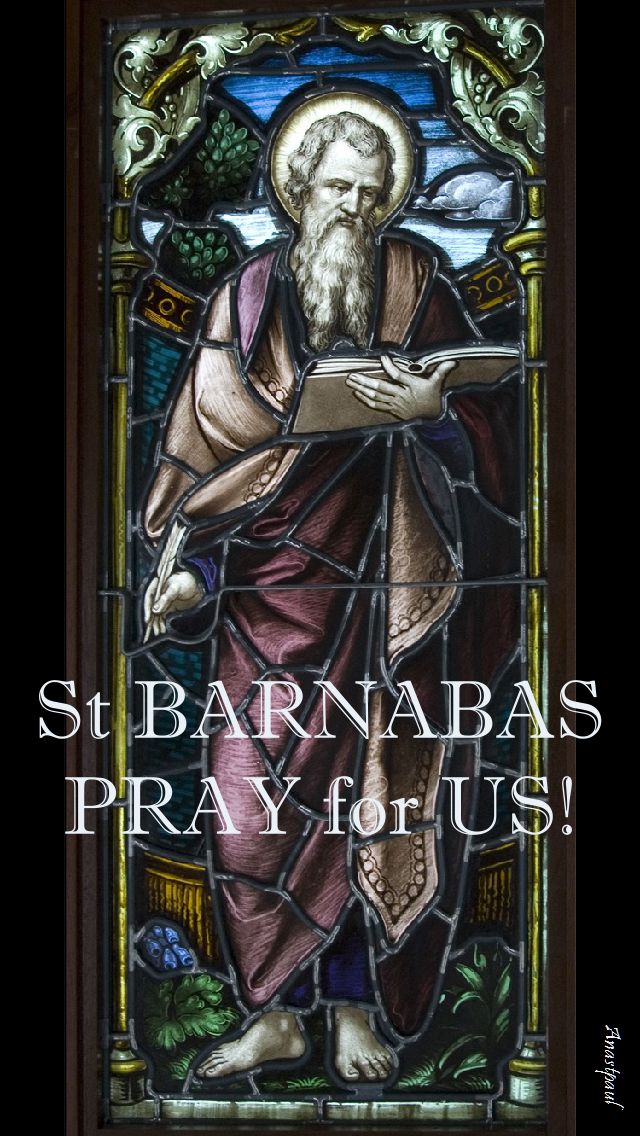
Saint of the Day – St Barnabas the Apostle, Son of Encouragement – 11 June

Saint of the Day – 11 June –  St Barnabas the Apostle – his name means  “Son of Encouragement.”   Patronages – Cyprus, Antioch, against hailstorms, invoked as peacemaker.

Say the word “Apostles” and most people will respond, “the twelve.”   By which, they mean the twelve-become-eleven-and-then-twelve-again:  Simon Peter, Andrew, James (son of Zebedee) John, Philip, Bartholomew, Thomas, Matthew, James (Son of Alphaeus), Jude (Thaddeus), Simon the Zealot, Judas and Matthias, who replaced Judas.   How, then, can the Church celebrate the Feast of St. Barnabas the Apostle every 11 June?

There are more than twelve apostles. The list includes Paul, Luke, John Mark, Lazarus and, today’s saint, Barnabas, who, like Paul, his travelling and preaching companion, was probably converted after Christ’ death, resurrection and ascension. We first hear of Barnabas in Acts 4:36-37:
“There was a Levite, a native of Cyprus, Joseph, to whom the apostles gave the name Barnabas (which means “son of encouragement”).   He sold a field of that belonged to him, then bought the money and laid it at the apostles’ feet.”
The story of Barnabas is told just before the story of Ananias and Sapphira, who kept back part of the proceeds from land they, like Barnabas, had sold and then, unlike Barnabas, lied to Peter about it.   Ananias and Sapphira wanted to be thought of as faithful without doing the work of faithfulness.   It’s instructive that Luke links their stories.
1128

From the day of his conversion Barnabas was faithful.   He was generous and open to all who came seeking Christ.   When the elders of the Jerusalem Church doubted Paul’s conversion, Barnabas vouched for him.   Born, like Paul, a Jew, Barnabas welcomed gentile converts and did not insist that their conversion be two-fold, first to Judaism and only then to Christianity.   With Paul, he spent a year in Antioch preaching Christ crucified to the gentiles.   From Antioch, Barnabas and Paul went to Cyprus and Asia Minor.   They had only one message: Jesus of Nazareth was crucified, died and was buried.   On the third day he rose again and appeared to the ones who have been sent out to tell this good news to all the world.

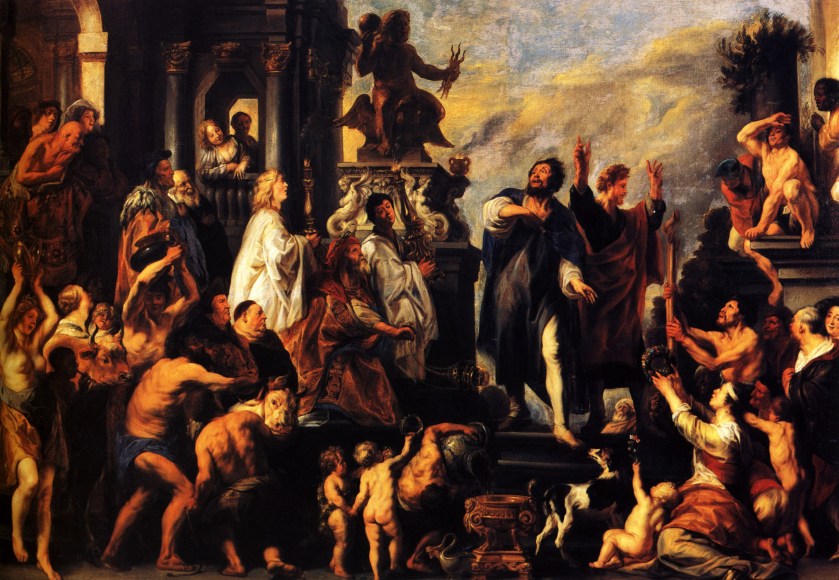
the-apostles-st-paul-and-st-barnabas-at-lystra-1645
← → The Apostles, St. Paul And St. Barnabas At Lystra Jacob Jordaens – 1645

Barnabas and Paul finally separated in their ministries, while remaining apostles of the one Catholic Church, over Paul’s insistence that Mark not travel with them again.

In death, however, the “Apostles to the Gentiles” were reunited. Mark is said to have buried Barnabas after he was killed by a mob in Cyprus around the year 62.   St Paul and St Mark were, in turn, reconciled before St. Paul’s martyrdom five years later.

He is said to have been stoned to death in Salamis in the year 61.

Paul writes of him in first letter to the church at Corinth, where he makes clear that both he and Barnabas have to work for a living.   So we know he was preaching and teaching as late as 56 or 57 A.D.   Some sources say he was the first Bishop of Milan.   In Acts 11:24, St. Luke called him “a good man, full of the Holy Spirit and of faith.”   Luke writes as a result of Barnabas’ preaching in Antioch, “a great many people were brought to the Lord.”

Sometimes the stories of martyrdoms are so dramatic and so compelling that we focus on the death of the saint rather than the life.   Barnabas calls us to consider the way we live, and then through this way, preparing for our deaths.

St Barnabas, pray for us!

st barnabas pray for us

Posted in MORNING Prayers, SAINT of the DAY, The APOSTLES & EVANGELISTS

Thought for the Day – 14 May

Thought for the Day – 14 May

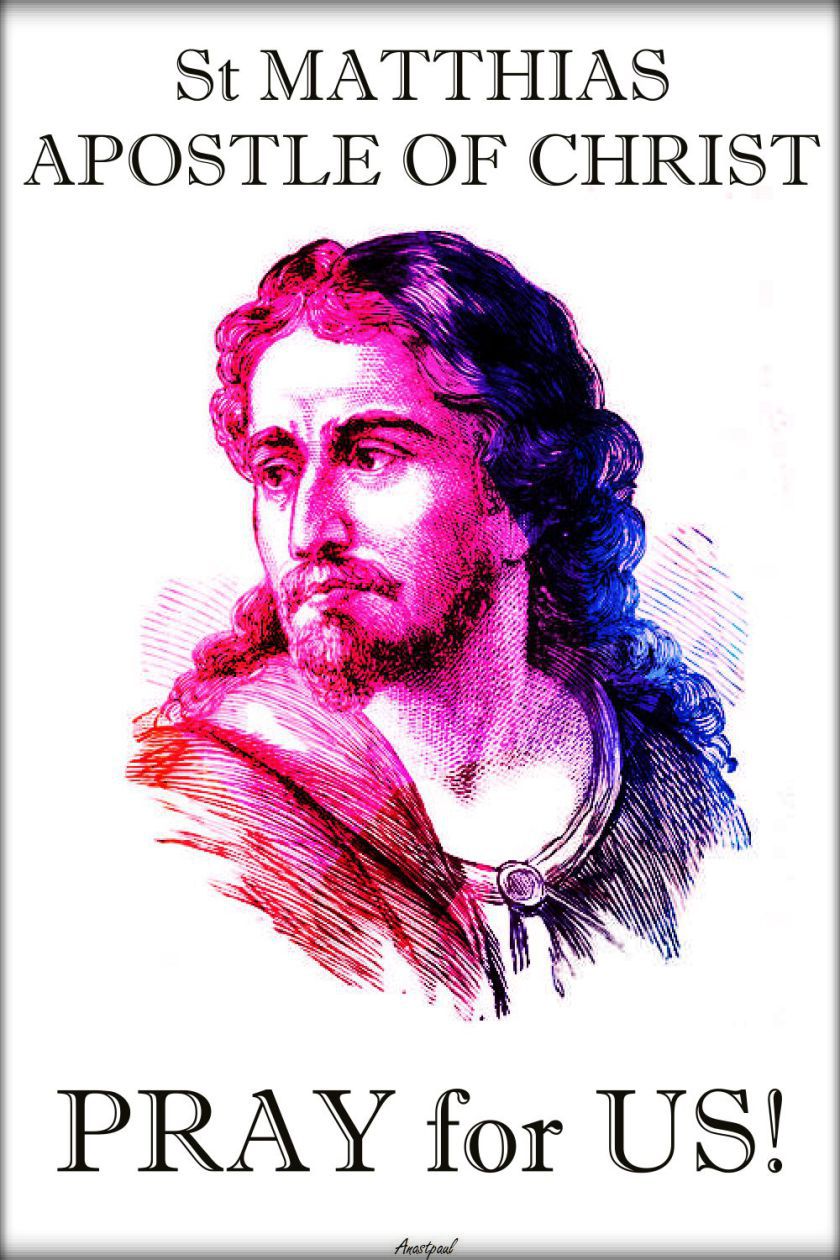
What was the holiness of Matthias? Obviously, he was suited for apostleship by the experience of being with Jesus from His baptism to His ascension.   He must also have been suited personally, or he would not have been nominated for so great a responsibility.   Must we not remind ourselves that the fundamental holiness of Matthias was his receiving gladly the relationship with the Father offered him by Jesus and completed by the Holy Spirit?   The Apostles were given the mission to bring the Good News of Jesus Christ to the world, bearing witness to His Resurrection and establishing the Kingdom of God upon the earth.   For that, they left all things and gave themselves totally.   All of us share in this mission and we all have to be apostles wherever we are.   By our very Baptism, we are sent to share the Gospel, just as St Matthias did.    If the apostles are the foundations of our faith by their witness, they must also be reminders, that holiness is entirely a matter of God’s giving but it is offered to all, in the everyday circumstances of life. We receive, we must accept and now we must give!

St Matthias, Apostle of Christ, Pray for us!

st-matthias-pray-for-us-14 may 2018-2

Posted in FEASTS and SOLEMNITIES, MORNING Prayers, SAINT of the DAY, The APOSTLES & EVANGELISTS

Quote of the Day – 14 May

Quote of the Day – 14 May

“We know nothing else about him (St Matthias), if not that he had been a witness to all Jesus’ earthly events (cf. Acts 1: 21-22), remaining faithful to Him to the end.    To the greatness of his fidelity was later added the divine call to take the place of Judas, almost compensating for his betrayal.

We draw from this a final lesson:  while there is no lack of unworthy and traitorous Christians in the Church, it is up to each of us to counterbalance the evil done by them with our clear witness to Jesus Christ, our Lord and Saviour.” – Pope Benedict GENERAL AUDIENCE, Saint Peter’s Square, Wednesday, 18 October 2006

ST MATTHIAS - POPE BENEDICT

Posted in SAINT of the DAY, The APOSTLES & EVANGELISTS

Saint and Feast of the Day – 14 May – St Matthias, Apostle of Christ

Saint and Feast of the Day – 14 May – St Matthias, Apostle of Christ, Martyr (1st Century- c80) – Patron of alcoholics; carpenters; smallpox; tailors; hope; perseverance, diocese of Gary, Indiana, diocese of Great Falls-Billings, Montana.   Attributes – lance, spear.

ST MATTHIAS 4

St Matthias is according to the Acts of the Apostles, the apostle chosen by lot to replace Judas Iscariot following Judas’ betrayal of Jesus and his subsequent suicide (as in the Gospel According to Matthew).   His calling as an apostle is unique, in that his appointment was not made personally by Jesus, who had already ascended into heaven and it was also made before the descent of the Holy Spirit upon the early Church.

There is no mention of a Matthias among the lists of disciples or followers of Jesus in the three synoptic gospels but according to Acts, he had been with Jesus from his baptism by John until his Ascension.    In the days following, Peter proposed that the assembled disciples, who numbered about one hundred and twenty, nominate two men to replace Judas.    They chose Joseph called Barsabas (whose surname was Justus) and Matthias. Then they prayed, “Thou, Lord, which knowest the hearts of all [men], shew whether of these two thou hast chosen, That he may take part of this ministry and apostleship, from which Judas by transgression fell, that he might go to his own place.”[Acts 1:24–25]    Then they cast lots and the lot fell to Matthias; so he was numbered with the eleven apostles.   Matthias was present with the other apostles at Pentecost.

No further information about Matthias is to be found in the canonical New Testament. Even his name is variable: the Syriac version of Eusebius calls him throughout not Matthias but “Tolmai”, not to be confused with Bartholomew (which means Son of Tolmai), who was one of the twelve original Apostles.

The tradition of the Greeks says that St. Matthias planted the faith about Cappadocia and on the coasts of the Caspian Sea, residing chiefly near the port Issus.    Clement of Alexandria observed (Stromateis vi.13.):

“Not that they became apostles through being chosen for some distinguished peculiarity of nature, since also Judas was chosen along with them.    But they were capable of becoming apostles on being chosen by Him who foresees even ultimate issues.    Matthias, accordingly, who was not chosen along with them, on showing himself worthy of becoming an apostle, is substituted for Judas.”

The feast of Saint Matthias was included in the Roman Calendar in the 11th century and celebrated on the sixth day to the Calends of March (February 24 usually but February 25 in leap years).   In the revision of the General Roman Calendar in 1969, his feast was transferred to May 14, so as not to celebrate it in Lent but instead in Eastertide close to the Solemnity of the Ascension, the event after which the Acts of the Apostles recounts that Matthias was selected to be ranked with the Twelve Apostles.

St Matthias stoned to death at Colchis in 80.    It is claimed that St Matthias the Apostle’s remains are interred in the Abbey of St. Matthias, Trier, Germany, brought there through Empress Helena of Constantinople, mother of Emperor Constantine I (the Great) and St Mary Major Rome.


Posted in FEASTS and SOLEMNITIES, MORNING Prayers, SAINT of the DAY, The APOSTLES & EVANGELISTS

Thought for the Day – 3 May

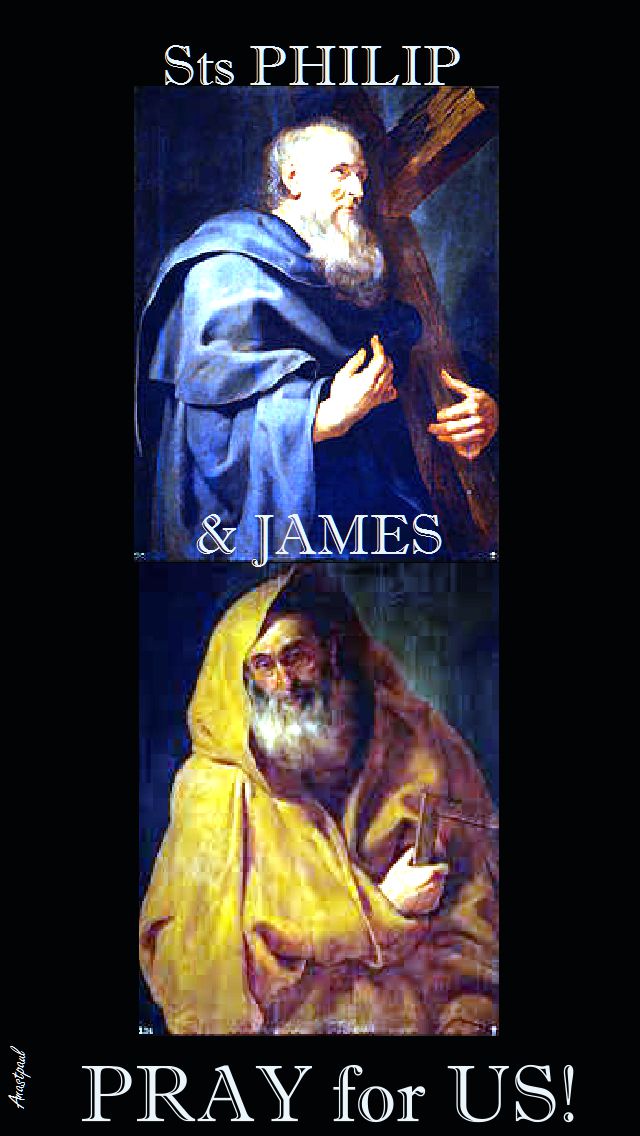
Sts Philip and James left all to follow Jesus, to become His heralds to the whole world.   They faced only difficulties, opposition and – finally – death by violence.   We cannot avoid the difficulties that come with professing our faith and we are all called to be apostles.   Let us pray for the courage to face our task with the same courage with which the Apostles faced theirs.   As in the case of the other apostles, we see in James and Philip human men who became foundation stones of the Church and we are reminded again that holiness and its consequent apostolate are entirely the gift of God, not a matter of human achieving.    All power is God’s power, even the power of human freedom to accept his gifts. “You will be clothed with power from on high,” Jesus told Philip and the others.   Their first commission had been to expel unclean spirits, heal diseases, announce the kingdom.    They learned, gradually, that these externals were sacraments of an even greater miracle inside their persons—the divine power to love like God.

Sts Philip and James, Pray for us!

STS PHILIP AND JAMES PRAY FOR US 2

Posted in FEASTS and SOLEMNITIES, MORNING Prayers, QUOTES of the SAINTS, SAINT of the DAY, The APOSTLES & EVANGELISTS

One Minute Reflection – 3 May

One Minute Reflection – 3 May

What was from the beginning, what we have heard,
what we have seen with our eyes, what we looked upon
and touched with our hands concerns the Word of life
for the life was made visible;  we have seen it and testify to it……….1 John 1:1-2

REFLECTION – “Two of the favoured witnesses of our beloved Jesus’ Resurrection come before us today.    Sts. Philip and James are here, bearing testimony to us that their Master is truly risen from the dead, that they have seen Him, that they have touched Him, that they have conversed with Him during these forty days.   And, that we may have no doubt as to the truth of their testimony, they hold in their hands the instruments of the martyrdom they underwent for asserting that Jesus, after having suffered death, came to life again and rose from the grave.”………………..Abbot/Dom Prosper Guéranger

TWO OF THE FAVOURED - Dom Prosper Guéranger

PRAYER – O God, who gladden us each year with the feast day of the Apostles Philip and James, grant us, through their prayers, a share in the Passion and Resurrection of your Only Begotten Son, so that we may merit to behold You for eternity. Through our Lord Jesus Christ, your Son, who lives and reigns with You in the unity of the Holy Spirit, one God, for ever and ever.

STS PHILIP AND JAMES PRAY FOR US

Posted in FEASTS and SOLEMNITIES, SAINT of the DAY, The APOSTLES & EVANGELISTS

Blessed Feast Day of Sts Philip and James, Apostles of Jesus Christ

Blessed Feast Day of Sts Philip and James, Apostles of Jesus Christ

ST PHILIPphilip-670

The Apostle Philip was one of Christ’s first disciples, called soon after his Master’s baptism in the Jordan.    The fourth Gospel gives the following detail:  “The next day Jesus was about to leave for Galilee and He found Philip.    And Jesus said to him:  Follow Me. Now Philip was from Bethsaida, the town of Andrew and Peter.    Philip found Nathanael, and said to him:   We have found Him of whom Moses in the Law and the Prophets wrote, Jesus the Son of Joseph of Nazareth.    And Nathanael said to him:  Can anything good come out of Nazareth?    Philip said to him: Come and see” (John 1:43ff). — The Church’s Year of Grace, Pius Parsch

Patronages:  Hatters; Luxembourg; pastry chefs; Uruguay, 37 cities.   Attributes:  basket; basket and Tau cross or letter Tau; two or three loaves and a cross; patriarchal cross and spear; knotted cross; broken idols; inverted cross; tall column; dragon; carpenter’s square and cross; long staff and spear; tall cross and book.

On Wednesday, 27 July 2011, the Turkish news agency Anadolu reported that archaeologists had unearthed a tomb that the project leader claims to be the Tomb of Saint Philip during excavations in Hierapolis close to the Turkish city Denizli.   The Italian archaeologist, Professor Francesco D’Andria stated that scientists had discovered the tomb within a newly revealed church.    He stated that the design of the Tomb and writings on its walls, definitively prove it belonged to the martyred Apostle of Jesus.

ST JAMES THE LESSER

Also known as:  Jacobus Minor, James the Just, James the Less, James the Younger, James, son of Alphaeus.   James, Son of Alphaeus:  We know nothing of this man except his name and, of course, the fact that Jesus chose him to be one of the 12 pillars of the New Israel, His Church.   He is not the James of Acts, son of Clopas, “brother” of Jesus and later bishop of Jerusalem and the traditional author of the Letter of James.   James, son of Alphaeus, is also known as James the Lesser to avoid confusing him with James the son of Zebedee, also an apostle and known as James the Greater.
Patronage:   dying people, apothecaries, druggists, pharmacists, fullers, hatmakers, hatters, milliners, Uruguay, 8 cities in Italy.   Attributes:   fuller’s club, man holding a book, square rule

Today’s Mass tells us that the example of the Apostles is the most certain and direct path to heaven.    They suffered and were persecuted but they placed their confidence in God and now they rejoice in heaven.   We too must have confidence in God and not be troubled in our adversities.    In our Father’s house there are many mansions and if we follow the way indicated by Him, Christ will come at the end of our life and take us to Himself.

Posted in FEASTS and SOLEMNITIES, SAINT of the DAY, The APOSTLES & EVANGELISTS

24 August – The Saints

Saints for today