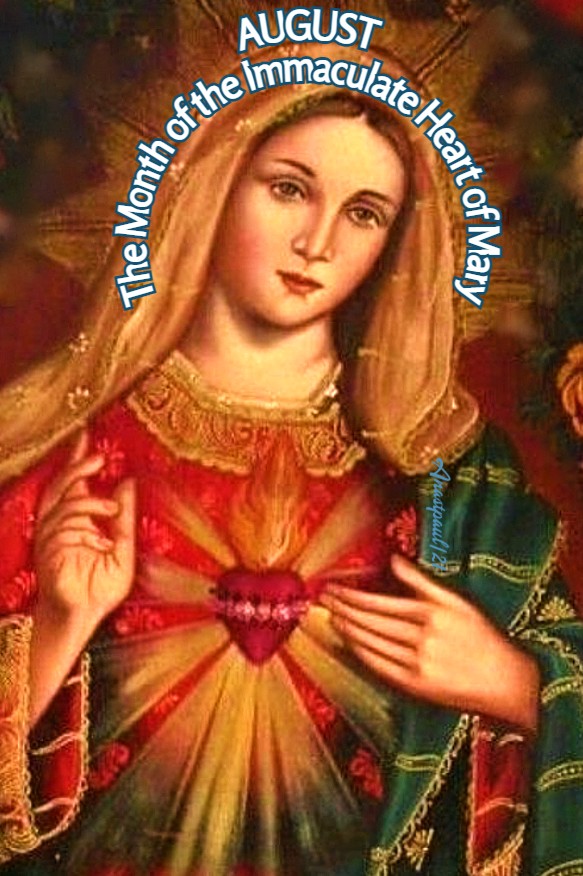
August – The Month of the Immaculate Heart of Mary
Devotion to the Heart of Mary
Devotion to the Heart of Mary is but the consequence of the devotion due to the Heart of Jesus. It is a consequence of that boundless love of Jesus for His Most Holy Mother, which leads Him, to share with her ,all the riches and honours, as far as they can be communicated to a creature.
The Church never disassociates the Mother from her Divine Son, in the festivals which she celebrates in His honour. If she celebrates the Mysteries of the Saviour, from His Incarnation to His Ascension, she celebrates, likewise, all the Mysteries of Mary, from her Conceptions to her Assumption. The Feast of the Sacred Heart of Mary (Immaculate Heart of Mary) is, therefore, but the natural consequence of the Feast of the Sacred Heart of Jesus.
Let us love and honour these Two Hearts, so intimately united; let us go to the Father through the Heart of Jesus; let us go to the Saviour through the Heart of Mary. Let us render to God the Father, through the Heart of Jesus, what we owe to His infinite justice and goodness and let us render to God, the Son, through the Heart of Mary what we owe to His Mercy and all His benefits to us. We shall obtain everything from the Father and the Holy Ghost through the Heart of Jesus and we shall obtain everything, through the Heart of Mary.
It is customary with many pious persons, to dedicate the Five First Saturdays of the month to the particular honour of the Immaculate Heart of Mary, as the Nine First Friday are devoted to the Sacred Heart of Jesus.
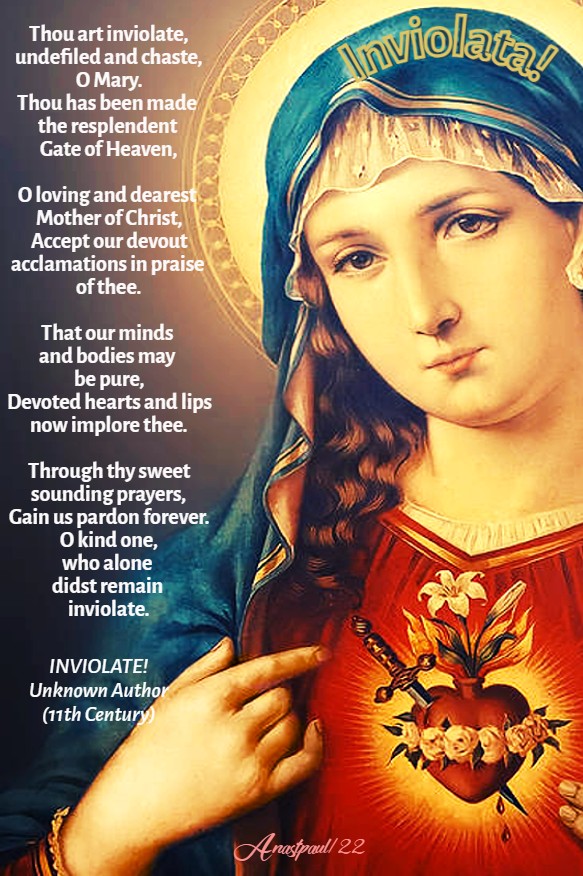
Thou art inviolate, undefiled and chaste, O Mary. Thou has been made the resplendent Gate of Heaven,
O loving and dearest Mother of Christ, Accept our devout acclamations in praise of thee.
That our minds and bodies may be pure, Devoted hearts and lips now implore thee.
Through thy sweet sounding prayers, Gain us pardon forever. O kind one, who alone didst remain inviolate.
The Hymn Inviolata has been claimed by the Carmelite Order, as a Traditional Hymn originating within their ranks. The Hymn is also used by Dominican Friars in the chanting of Compline. Its origins trace to the 11th century. It appears in Hymnals from 1860 to 1920.
Inviolata, integra, et casta es Maria, quae es effecta fulgida caeli porta.
O Mater alma Christi carissima, suscipe pia laudum praeconia.
Te nunc flagitant devota corda et ora, nostra ut pura pectora sint et corpora.
Tua per precata dulcisona, nobis concedas veniam per saecula.
O benigna! O Regina! O Maria, quae sola inviolata permansisti.
Our Morning Offering – 24 July – “Month of the Most Precious Blood”
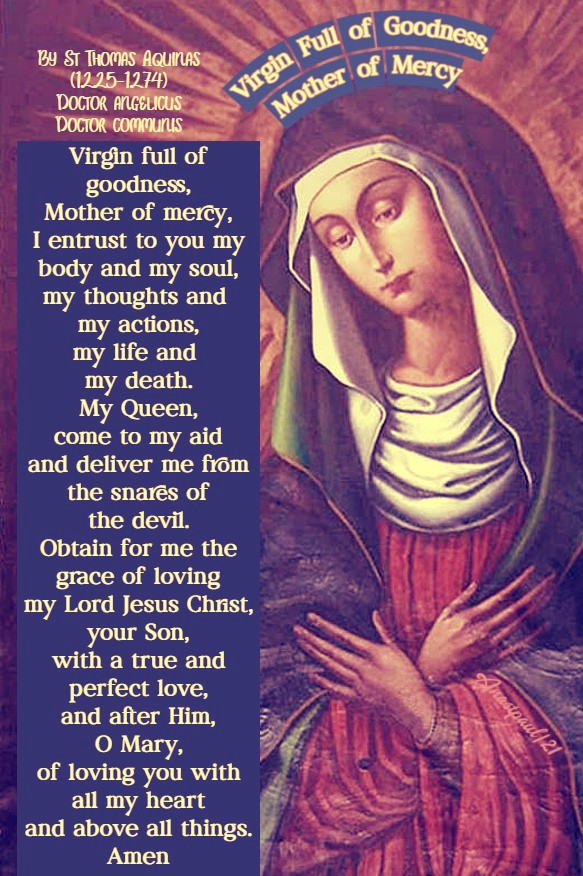
Virgin Full of Goodness, Mother of Mercy By St Thomas Aquinas (1225-1274) Doctor angelicus Doctor communis
Virgin full of goodness, Mother of mercy, I entrust to you my body and my soul, my thoughts and my actions, my life and my death. My Queen, come to my aid and deliver me from the snares of the devil. Obtain for me the grace of loving my Lord Jesus Christ, your Son, with a true and perfect love, and after Him, O Mary, of loving you with all my heart and above all things. Amen.
Thought for the Day – 17 July – Meditations with Antonio Cardinal Bacci (1881-1971)
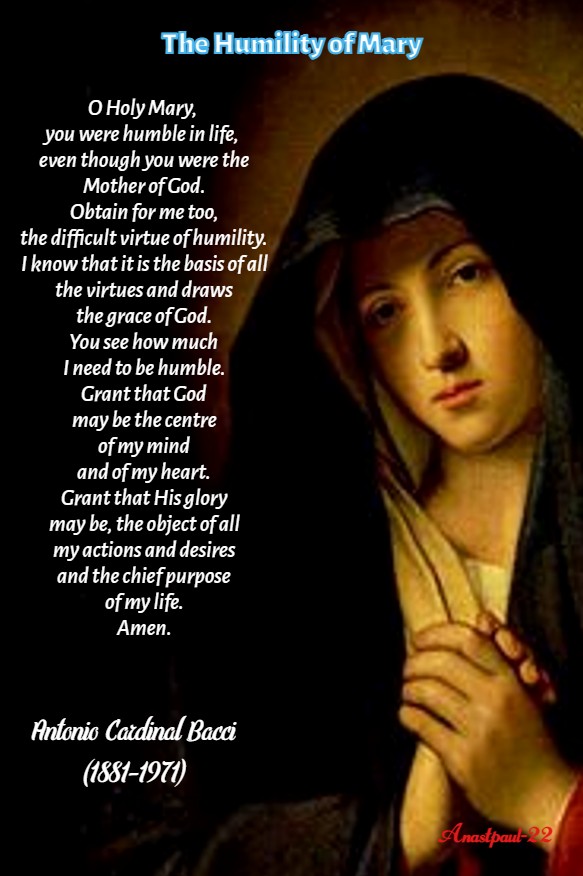
The Humility of Mary
“O Holy Mary, you were humble in life, even though you were the Mother of God. Obtain for me too, the difficult virtue of humility. I know that it is the basis of all the virtues and draws the grace of God. You see how much I need to be humble. Grant that God may be the centre of my mind and of my heart. Grant that His glory may be, the object of all my actions and desires and the chief purpose of my life. Amen.”
Quote/s of the Day – 17 July – The Sixth Sunday after Pentecost – The Humility of Mary
“True humility scarcely ever utters words of humility.”
“Humility, makes our lives acceptable to God, meekness, makes us acceptable to men.”
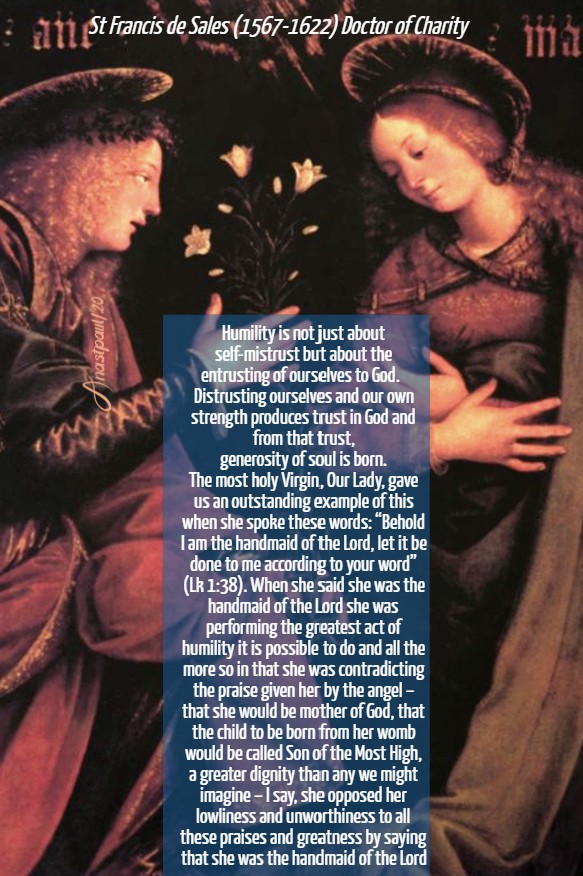
“Humility is not just about self-mistrust but about the entrusting of ourselves to God. Distrusting ourselves and our own strength produces trust in God and from that trust, generosity of soul is born.”
The most holy Virgin, Our Lady, gave us an outstanding example of this when she spoke these words: “Behold I am the handmaid of the Lord, let it be done to me according to your word” (Lk 1:38). When she said she was the handmaid of the Lord, she was performing the greatest act of humility it is possible to do and, all the more so, in that she was contradicting the praise given her by the angel – that she would be mother of God, t hat the child to be born from her womb would be called Son of the Most High, a greater dignity than any we might imagine – I say, she opposed her lowliness and unworthiness to all these praises and greatness, by saying t hat she was the handmaid of the Lord.”
By St Alphonsus Maria de Liguori (1696-1787) Most Zealous Doctor of the Church The Humility of Mary Excerpt from: “The Glories of Mary”
“Humility” says St. Bernard, “is the foundation and guardian of virtues” and with reason, for without it, no other virtue can exist in a soul. Should she possess all virtues, all will depart when humility is gone. But, on the other hand, as St Francis de Sales wrote to St Jane Frances de Chantal, “God so loves humility, that whenever He sees it, He is immediately drawn there.” This beautiful and so necessary virtue, was unknown in the world but the Son of God Himself came upon the earth, to teach it by His Own example and willed that in that virtue, in particular, we should endeavour to imitate Him – “Learn of Me, for I am meek and humble of heart.”
Mary, being the first and most perfect disciple of Jesus Christ, in the practice of all virtues, was the first also in that of humility and by it, merited to be exalted above all creatures. It was revealed to St. Matilda that the first virtue in which the Blessed Mother particularly exercised herself, from her very childhood, was that of humility.
The first effect of humility of heart is a lowly opinion of ourselves: – “Mary had always so humble an opinion of herself, that,” as it was revealed to the same St Matilda, “although she saw herself enriched with greater graces, than all other creatures, she never preferred herself to anyone.” The Abbot Rupert, explaining the passage of the Sacred Canticles, Thou hast wounded my heart, my sister, my spouse, …with one hair of thy neck, [Cant. 4:9] says, that the humble opinion, which Mary had of herself, was precisely that hair of the Spouse’s neck, with which she wounded the heart of God.” Not indeed that Mary considered herself a sinner: for humility is truth, as St Teresa remarks and Mary knew that she had never offended God: nor was it that she did not acknowledge that she had received greater graces from God, than all other creatures; for a humble heart always acknowledges the special favours of the Lord, to humble herself the more but the Divine Mother, by the greater light wherewith she knew the infinite greatness and goodness of God, also knew, her own nothingness and, therefore, more than all others, humbled herself, saying with the Sacred Spouse – Do not consider that I am brown, because the sun hath altered my colour. [Cant. 1:5] That is, as St Bernard explains it, “When I approach Him, I find myself black.” “
Yes,” says St Bernardine, for “the Blessed Virgin had always the majesty of God and her own nothingness, present to her mind.” As a beggar, when clothed with a rich garment, which has been bestowed upon her, does not pride herself on it, in the presence of the giver but is rather humbled, being reminded thereby, of her own poverty, so also, the more Mary saw herself enriched, the more did she humble herself, remembering that all was God’s gift; whence she herself told St Elizabeth of Hungary, that “she might rest assured that she looked upon herself, as most vile and unworthy of God’s grace.” Therefore, St Bernardine says, that “after the Son of God, no creature in the world was so exalted as Mary because, no creature in the world ever humbled itself, as much as she did.”
Moreover, it is an act of humility to conceal heavenly gifts. Mary wished to conceal from St Joseph, the great favour whereby she had become the Mother of God, although it seemed necessary to make it known to him, if only to remove from the mind of her poor spouse, any suspicions as to her virtue, which he might have entertained on seeing her pregnant: or, at least the perplexity, in which it indeed threw him: for St. Joseph,, on the one hand, unwilling to doubt Mary’s chastity and on the other, ignorant of the Mystery, was minded to put her away privately. [Matt. 1:19] This he would have done, had not the Angel revealed to him that his Spouse was pregnant by the operation of the Holy Ghost.
Again, a soul that is truly humble refuses her own praise and should praises be bestowed on her, she refers them all to God. Behold, Mary is disturbed at hearing herself praised by St Gabriel and when St Elizabeth said, Blessed art thou among women … and whence is this to me, that the Mother of my Lord should come to me? … blessed art thou that hast believed, [ Luke 1:42] Mary referred all to God, and answered in that humble Canticle, My soul doth magnify the Lord, [Ibid., 46-47] as if she had said: “Thou dost praise me, Elizabeth but I praise the Lord, to Whom alone honour is due, thou wonders that I should come to thee and I wonder at the Divine Goodness in which alone my spirit exults” and my spirit hath rejoiced in God my Saviour.Thou praisest me because I have believed; I praise my God because He hath been pleased to exalt my nothingness: because He hath regarded the humility of His handmaid. Hence Mary said to St Bridget: “I humbled myself so much and thereby, merited so great a grace because I though, and knew, that of myself I possessed nothing. For this same reason I did not desire to be praised, I only desired that praises should be given to the Creator and Giver of all.” Wherefore, an ancient author, speaking of the humility of Mary, says: “O truly blessed humility, which hath given God to men, opened Heaven and delivered souls from Hell.“
It is also a part of humility to serve others. Mary did not refuse to go and serve Elizabeth for three months. Hence St Bernard says, “Elizabeth wondered that Mary should have come to visit her but that which is still more admirable, is that she came, not to be ministered to but to minister.”
Those who are humble are retiring and choose the last places and, therefore, Mary, remarks St Bernard, when her Son was preaching in a house, as it is related by St Matthew, [12:46], wishing to speak to Him, would not, of her own accord, enter but “remained outside and did not avail herself of her maternal authority to interrupt Him.” For the same reason, when she was with the Apostles awaiting the coming of the Holy Ghost, she took the lowest place, as St Luke relates, All these were persevering with one mind in prayer, with the women, and Mary, the Mother of Jesus. [Acts 1:14] Not that St Luke was ignorant of the Divine Mother’s merits, on account of which, he should have named her in the first place but because she had taken the last place amongst the Apostles and women and, therefore, he described them all, as an author remarks, in the order in which they were. Hence St. Bernard says, “Justly has the last become the first, who being the first of all became the last.”
In fine, those who are humble, love to be contemned, therefore, we do not read that Mary showed herself in Jerusalem on Palm Sunday, when her Son was received by the people with so much honour but, on the other hand, at the Death of her Son, she did not shrink from appearing on Calvary, through fear of the dishonour which would accrue to her, when it was known that she was the Mother of Him Who was condemned to die an infamous death, as a criminal. Therefore, she said to St Bridget, “What is more humbling than to be called a fool, to be in want of all things and to believe one’s self, the most unworthy of all? Such, O daughter, was my humility, this was my joy, this was all my desire, with which I thought how to please my Son alone.”
The Venerable Sister Paula of Foligno was given to understand, in an ecstasy, how great was the humility of our Blessed Lady and giving an account of it to her Confessor, she was so filled with astonishment at its greatness that she could only exclaim, “O, the humility of the Blessed Virgin! O, Father, the humility of the Blessed Virgin, how great was the humility of the Blessed Virgin! In the world there is no such thing as humility, not even in its lowest degree, when you see the humility of Mary.” On another occasion our Lord showed St Bridget two ladies. The one was all pomp and vanity. “She,” He said, “is Pride but the other one, whom you see with her head bent down, courteous towards all, having God alone in her mind and considering herself as no -ne, is Humility: her name is Mary.” Hereby God was pleased to make known to us that the humility of His Blessed Mother, was such that she was humility itself.
Then, O my Queen, I can never be really thy child, unless I am humble but dost thou not see that my sins, after having rendered me ungrateful to my Lord, have also made me proud? O my Mother, do thou supply a remedy. By the merit of thy humilit, obtain that I may be truly humble and thus become thy child, Amen.
Quote/s of the Day – 16 July – Our Lady of Mount Carmel – Ecclesiasticu, Sirach 24:23-31, Luke 11:27-28
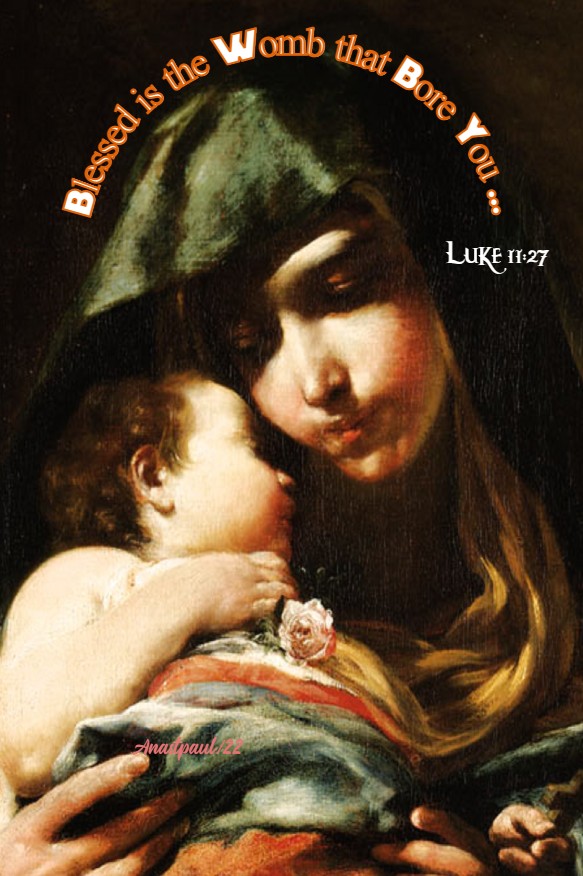
“Blessed is the womb that bore You …”
Luke 11:27
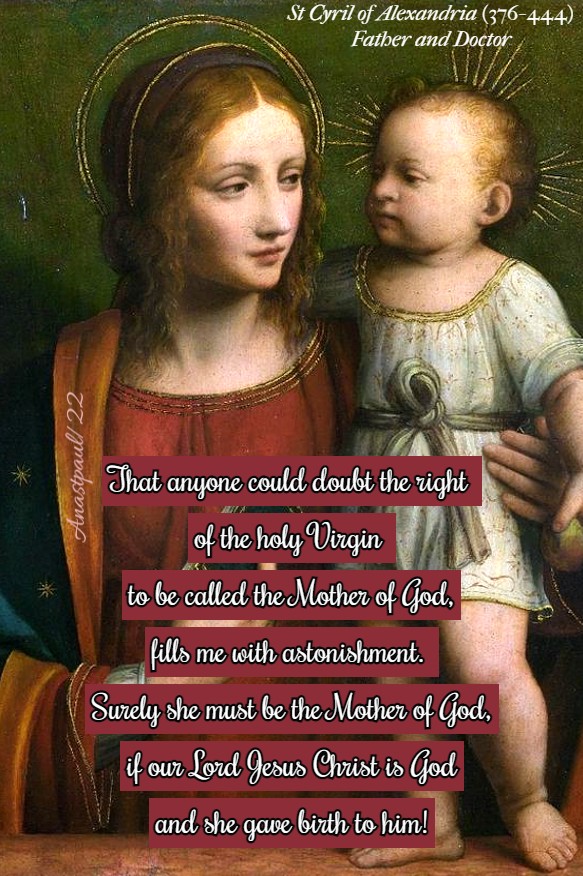
“That anyone could doubt the right of the holy Virgin to be called the Mother of God, fills me with astonishment. Surely she must be the Mother of God, if our Lord Jesus Christ is God and she gave birth to Him!?”
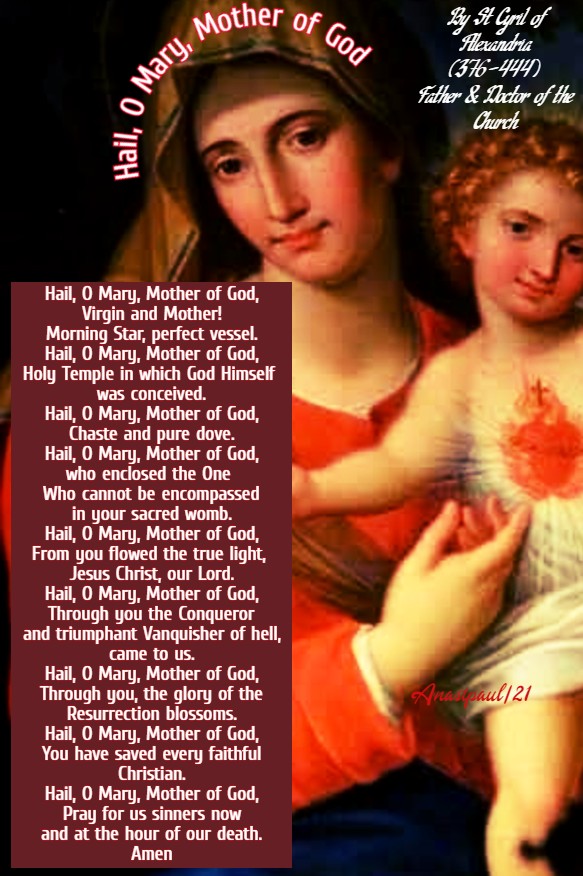
Hail, O Mary, Mother of God By St Cyril of Alexandria (376-444) Father & Doctor of the Church
Hail, O Mary, Mother of God, Virgin and Mother! Morning Star, perfect vessel. Hail, O Mary, Mother of God, Holy Temple in which God Himself was conceived. Hail, O Mary, Mother of God, Chaste and pure dove. Hail, O Mary, Mother of God, who enclosed the One Who cannot be encompassed in your sacred womb. Hail, O Mary, Mother of God, From you flowed the true light, Jesus Christ, our Lord. Hail, O Mary, Mother of God, Through you the Conqueror and triumphant Vanquisher of hell, came to us. Hail, O Mary, Mother of God, Through you, the glory of the Resurrection blossoms. Hail, O Mary, Mother of God, You have saved every faithful Christian. Hail, O Mary, Mother of God, Pray for us sinners now and at the hour of our death. Amen
St Cyril of Alexandria (376-444)
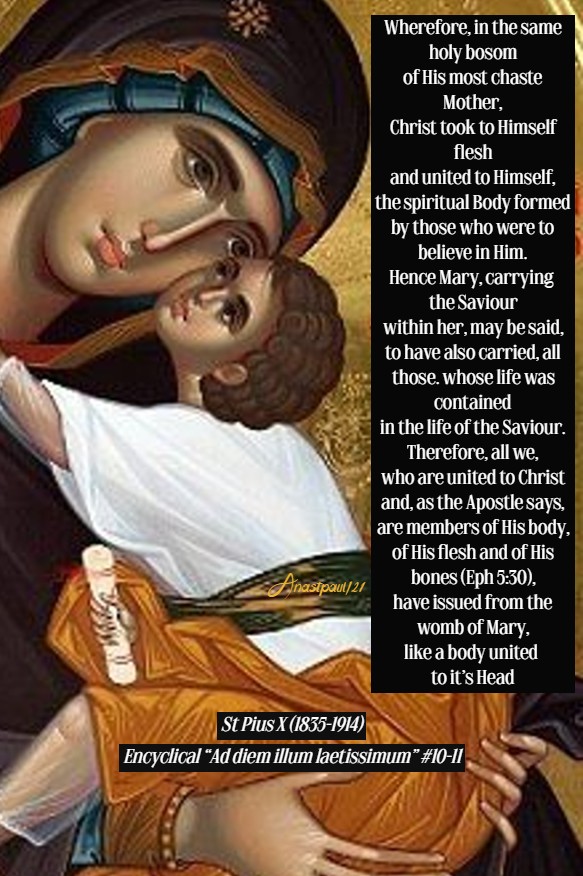
“Wherefore, in the same holy bosom of His most chaste Mother, Christ took to Himself flesh and united to Himself, the spiritual Body formed by those who were to believe in Him. Hence Mary, carrying the Saviour within her, may be said, to have also carried, all those. whose life was contained in the life of the Saviour. Therefore, all we who are united to Christ and, as the Apostle says, are members of His body, of His flesh and of His bones (Eph 5:30), have issued from the womb of Mary, like a body united to it’s head.”
Quote/s of the Day – 18 June – the Memorial of St Ephrem of Syria (306-373) Confessor, Father and Doctor of the Church
“Our Lord chose Matthew, the tax collector, to encourage his fellows to join him. He looked on sinners, called them and brought them to sit beside Him. What a wonderful sight! Angels stand trembling, while publicans, seated, rejoice!”
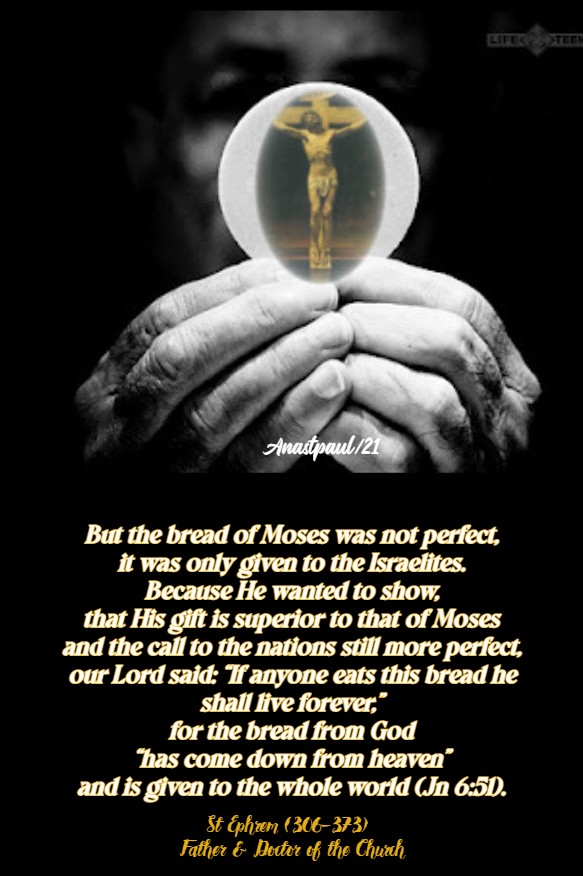
“But the bread of Moses was not perfect, it was only given to the Israelites. Because He wanted to show, that His gift is superior to that of Moses and the call to the nations still more perfect, our Lord said: “If anyone eats this bread he shall live forever,” for the bread from God “has come down from heaven” and is given to the whole world (Jn 6:51).”
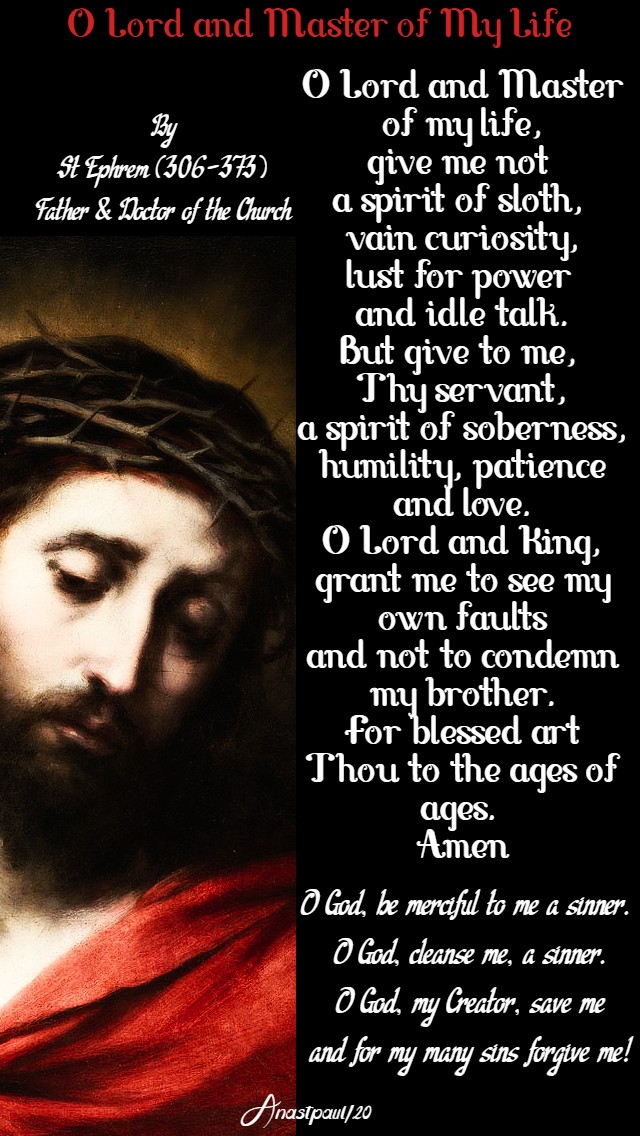
O Lord and Master of My Life By Saint Ephrem (306-373) Father & Doctor of the Church
O Lord and Master of my life, give me not a spirit of sloth, vain curiosity, lust for power and idle talk. But give to me, Thy servant, a spirit of soberness, humility, patience and love. O Lord and King, grant me to see my own faults and not to condemn my brother. For blessed art Thou to the ages of ages. Amen O God, be merciful to me a sinner. O God, cleanse me, a sinner. O God, my Creator, save me and for my many sins forgive me!
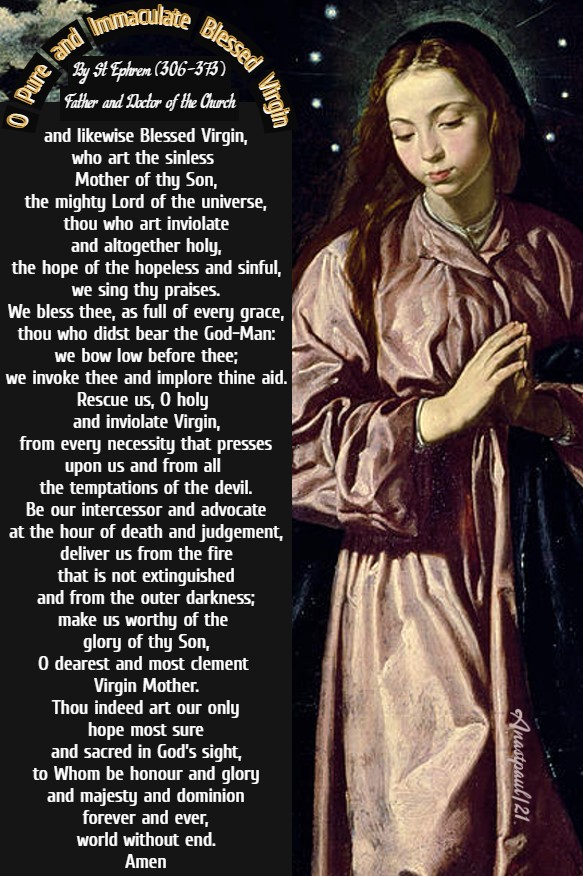
O Pure and Immaculate Blessed Virgin By St Ephrem (306-373) Father and Doctor of the Church
O Pure and Immaculate and likewise Blessed Virgin, who art the sinless Mother of thy Son, the mighty Lord of the universe, thou who art inviolate and altogether holy, the hope of the hopeless and sinful, we sing thy praises. We bless thee, as full of every grace, thou who didst bear the God-Man: we bow low before thee; we invoke thee and implore thine aid. Rescue us, O holy and inviolate Virgin, from every necessity that presses upon us and from all the temptations of the devil. Be our intercessor and advocate at the hour of death and judgement, deliver us from the fire that is not extinguished and from the outer darkness; make us worthy of the glory of thy Son, O dearest and most clement Virgin Mother. Thou indeed art our only hope most sure and sacred in God’s sight, to Whom be honour and glory and majesty and dominion forever and ever, world without end. Amen
Our Morning Offering – 18 June – The Memorial of St Ephrem of Syria (306-373) Father and Doctor of the Church
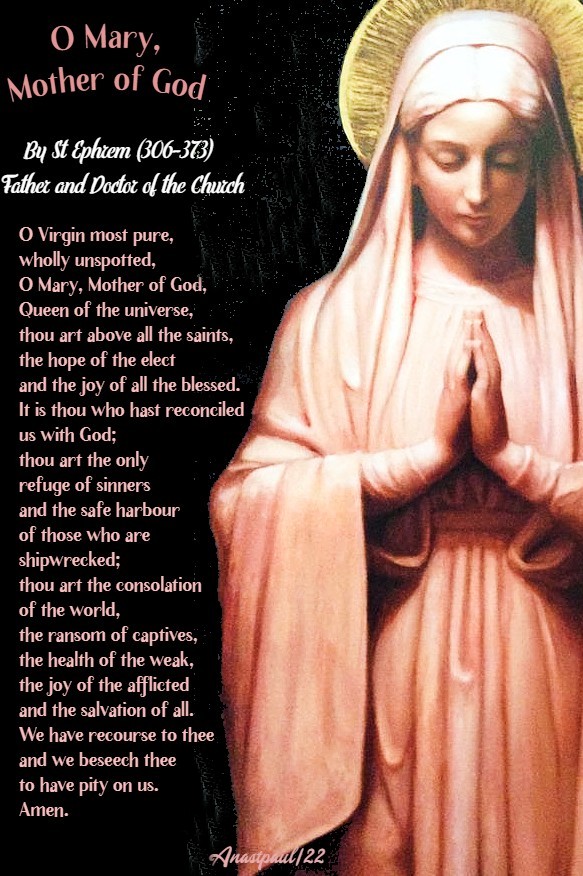
O Mary, Mother of God By St Ephrem of Syria (306-373) Father and Doctor of the Church
O Virgin most pure, wholly unspotted, O Mary, Mother of God, Queen of the universe, thou art above all the saints, the hope of the elect and the joy of all the blessed. It is thou who hast reconciled us with God; thou art the only refuge of sinners and the safe harbour of those who are shipwrecked; thou art the consolation of the world, the ransom of captives, the health of the weak, the joy of the afflicted and the salvation of all. We have recourse to thee and we beseech thee to have pity on us. Amen.
Thought for the Day – 31 May – Meditations with Antonio Cardinal Bacci (1881-1971)
Pray for Us … at the Hour of Our Death
“Our divine Redeemer, although He was God and did not except Himself from the law of death. It was appropriate, therefore, that His divine Mother should have been no exception either. But Mary had shared in the torments of her Son’s death upon Calvary and so obtained from Him, the privilege of a death so sweet and gentle, as hardly to justify the name at all. Her soul was separated from her body as if in an ecstasy of love and was united even more indissolubly with God. She did not die of a natural disease but, out of love for God. She had always loved God with all the ardour of the noblest of creatures and her life ended in a final outpouring of love. It was the climax of a continuous ascent towards God.
Death should be like this for us too. It can be like this if we follow her example, especially in the boundlessness of her love for God.”
Quote/s of the Day – 31 May – The Queenship of Mary
“If the Son is a King, the Mother who begot him is rightly and truly considered a Queen and Sovereign.”
St Athanasius (297-373) Father and Doctor of the Church
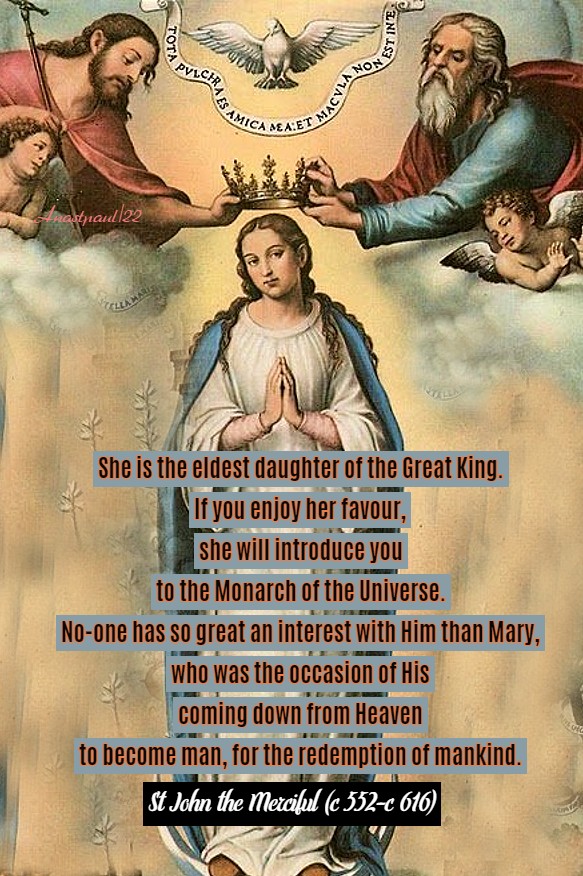
“She is the eldest daughter of the Great King. If you enjoy her favour, she will introduce you to the Monarch of the Universe. No-one has so great an interest with Him than Mary, who was the occasion of His coming down from Heaven to become man, for the redemption of mankind.”
St John the Merciful (c 552-c 616)
“And as Queen, she possesses, by right, the whole Kingdom of her Son.”
Rupert of Deutz OSB (c 1075- c 1130) Benedictine Abbot
“So Mary is a Queen. And, for our consolation, we ought to remember that she is a most tender and kind Queen, eager to help us in our miseries. So much so, that the Church wants us to call her in this prayer, a Queen of Mercy. Hail, Holy Queen, Mother of Mercy!”
St Alphonsus Liguori (1696-1787) Most Zealous Doctor
One Minute Reflection – 31 May – The Queenship of Mary – Eccli 24:5; 14:7; 14:9-11; 24:30-31, Luke 1:26-33
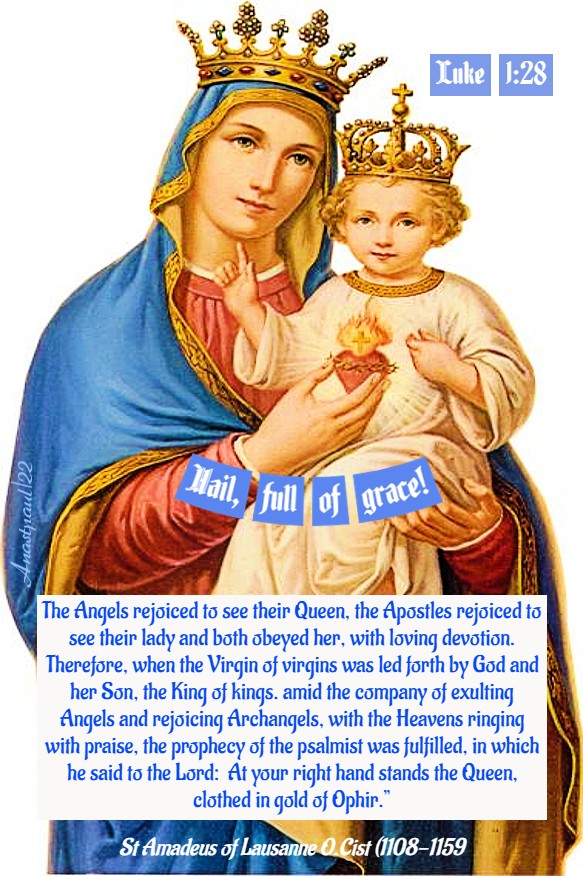
“Hail, full of grace!”– Luke 1:28
REFLECTION – “Observe how fitting it was that even before her Assumption, the name of Mary shone forth wondrously throughout the world. Her fame spread everywhere, even before she was raised above the heavens in her magnificence. Because of the honour due her Son, it was indeed fitting, for the Virgin Mother, to have first ruled upon earth and then be raised up to Heaven in glory. It was fitting that her fame be spread in this world below, so that she might enter the heights of Heaven on overwhelming blessedness. Just as she was borne from virtue to virtue, by the Spirit of the Lord, she was transported from earthly renown, to Heavenly brightness.
So it was, that she began to taste the fruits of her future reign, while still in the flesh. At one moment she withdrew to God in ecstasy; at the next she would bend down to her neighbours with indescribable love. In Heaven Angels served her, while here on earth, she was venerated by the service of men. Gabriel and the Angels waited upon her in Heaven. The virgin John, rejoicing that the Virgin Mother was entrusted to him at the Cross, cared for her with the other Apostles here below. The Angels rejoiced to see their Queen, the Apostles rejoiced to see their lady and both obeyed her, with loving devotion.
… Therefore, when the Virgin of virgins was led forth by God and her Son, the King of kings. amid the company of exulting Angels and rejoicing Archangels, with the Heavens ringing with praise, the prophecy of the psalmist was fulfilled, in which he said to the Lord: At your right hand stands the Queen, clothed in gold of Ophir.” – St Amadeus of Lausanne O.Cist (1108-1159) Bishop (Excerpt from a Sermon on Mary)
PRAYER – Grant we beseech Thee, O Lord, that we who keep the Feast of the Blessed Virgin Mary, Our Queen, safe under her protection, may be worthy to have peace now and glory, in the future. Through Jesus Christ, Thy Son our Lord, Who lives and reigns with Thee, in the unity of the Holy Ghost, God, world without end. Amen (Collect).
Our Morning Offering – 31 May – The Queenship of Mary
Queen on Whose Starry Brow Doth Rest By St Venantius Fortunatus (c 530-c 609) Translation by Monsignor Ronald A Knox (1888 – 1957)
Queen, on whose starry brow doth rest The crown of perfect maidenhood, The God who made thee, from thy brest Drew, for our sakes, His earthly food.
The grace that sinful Eve denied, With thy Child-bearing, re-appears; Heaven’s lingering door, set open wide, Welcomes the children of her tears.
Fate, for such royal progress meet, Beacon, whose rays such light can give, Look, how the ransomed nations greet The virgin-womb that bade them live!
O Jesus, whom the Virgin bore, Be praise and glory unto Thee. Praise to the Father evermore And His life-giving Spirit be. Amen!
Saint Venantius Fortunatus (c 530 – c 609) Bishop, Poet, Hymnist, Writer – born c 530 at Rreviso, Italy and died c 609 at Poitiers, modern France of natural causes. St Venantius was unique, first a travelling lay poet, he later became a Priest and then a Bishop. But he always remained a professional author of poetry, a “Troubadour” of Christ. He is the attributed author of the Ave Maris Stella, amongst many others.
Mary is Queen by grace, divine relationship, right of conquest and singular election. Coming as a crowning event in the beautiful month of May, the Queenship of Mary, we welcome this Feast with spiritual affection and experience a sense of deep interior peace, as we gather in her presence, to rededicate ourselves to our loving Mother and Queen. The Introit of the Mass for the day tells us: “Let us all rejoice in the Lord as we celebrate the feast in honour of our Queen, the Blessed Virgin Mary, on whose solemnity the Angels rejoice and join in praising the Son of God. Alleluia, alleluia.”
The Queenship of Mary is not an empty title or an honourary distinction, showing forth her excellence of virtue, of grandeur, sanctity or glory. Mary is truly a Queen as can be seen in the Gospel of the Mass – the Angel Gabriel greeted Mary with the most startling words ever addressed to a child of Adam: “Hail thou who art full of grace, the Lord is with thee, blessed art thou among women.” Then he continues, “Do not be afraid; thou hast found favour in the sight of God. And thou shalt bear a son and call Him Jesus. He shall be great and men will know Him for the Son of God, the Most High; the Lord will give Him the throne of his father David and He shall reign over the house of Jacob eternally; His kingdom shall never end.” Here is the foundation of our belief in the Queenship of Mary – her Divine Motherhood; – she conceived a King, the King!
Mary is “Queen by grace” because she was immaculately conceived, preserved from the slightest taint of sin, while her soul was literally inundated with divine grace. “Hail, thou art full of grace.”
She is “Queen by divine relationship” for she is related in the first degree of consanguinity in the direct line to Our Lord and Saviour, Jesus Christ, the Son of God. A Queen Mother is one, whose son later becomes king. Mary’s Child, however at the moment of His conception and then His birth, was already a King, the King of the world. Spiritual writers point out for our consolation, that Mary’s maternal relationship to Jesus was more exclusive than any other mother, since He had no human father.
Our Lady is Queen also “by right of conquest;” Our Lord by His Passion and Death recaptured the human race from the slavery of Satan, conquering all as a King. Calvary was the scene of this conquest. Mary, at the foot of the Cross, shared intimately with Him in His Sacrifice and the fruits of the Redemption.
At first it may be somewhat difficult to picture Mary as a Queen, since we think in terms of royalty of the world; yet, when we think of the souls who preceded us in the household of the Faith and glance at Christian art, as it sings of her Queenship, it is not difficult at all.
Majestically, Christ said to Pilate, “My Kingdom is not of this world,” so, too, Our Lady acknowledges herself in humility as a Queen whom all generations call blessed but she, too, would add, “my kingdom is not of this world.” In the Litany of Our Lady, we address her as Queen of Angels, Patriarchs, Prophets, Martyrs, Confessors, Virgins; of Peace, of the Most Holy Rosary; conceived without original sin and, Queen assumed into Heaven. Catholic art represents her, crowned with a diadem holding a scepter, seated on a throne.
The purpose of this Feast, the Queenship of Mary, is to stir up renewed love and devotion to her, to gather before her throne in Heaven and humbly offer her our homage, unreserved, totally, prayerfully and with the simplicity of abandonment, which characterises a devoted child – “Reign over hearts and minds of men that they seek what is true; over their wills, to follow solely the good; over their hearts, to love nothing but what you love…that man may seek and know the truth and follow what is good, Oh Queen!”
St Crescentian of Sassari St Donatian of Cirta St Felice of Nicosia St Galla of Auvergne St Hermias of Comana Bl Jacob Chu Mun-mo Blessed James Salomoni OP (1231-1314) Priest of the Order of Preachers St Juan Moya Collado Bl Kasper Gerarz St Lupicinus of Verona St Mancus of Cornwall Bl Mariano of Roccacasale St Mechtildis of Edelstetten St Myrbad of Cornwall Bl Nicolas Barré Bl Nicholaus of Vangadizza Bl Nicholaus of Vaucelles St Nowa Mawaggali St Paschasius of Rome St Petronilla of Rome Bl Robert Thorpe St Silvio of Toulouse Bl Thomas Watkinson Bl Vitalis of Assisi St Winnow of Cornwall
Martyrs of Aquileia – 3 Saints: Three young members of the imperial Roman nobility and who were raised in a palace and had Saint Protus of Aquileia as tutor and catechist. To escape the persecutions of Diocletian, the family sold their property and moved to Aquileia, Italy. However, the authorities there quickly ordered them to sacrifice to idols; they refused. Martyrs all – Cantianilla, Cantian and Cantius. They were beheaded in 304 at Aquae-Gradatae (modern San-Cantiano) just outside Aquileia, Italy.
Martyrs of Gerona – 29 Saints: A group of Christians Martyred together in Gerona, Catalonia, Spain, date unknown. No details about them have survived but the names – • Agapia• Amelia• Castula• Cicilia• Donatus• Firmus• Fortunata• Gaullenus• Germanus• Honorius• Istialus• Justus• Lautica• Lupus • Maxima• Paulica• Rogate• Rogatus• Silvanus• Tecla• Teleforus• Tertula• Tertus• Victoria• Victurinus• Victurus
Martyrs of the Via Aurelia – 4 Saints: Four Christians Martyred together. No information about them has survived except their names – Justa, Lupus, Tertulla and Thecla. The martyrdom occurred in 69 on the Via Aurelia near Rome, Italy.
Our Morning Offering – 23 May – “The Month of the Blessed Virgin Mary”
Hail, O Mary, Mother of God By St Cyril of Alexandria (376-444) Father & Doctor of the Church
Hail, O Mary, Mother of God, Virgin and Mother! Morning Star, perfect vessel. Hail, O Mary, Mother of God, Holy Temple in which God Himself was conceived. Hail, O Mary, Mother of God, Chaste and pure dove. Hail, O Mary, Mother of God, who enclosed the One, Who cannot be encompassed in your sacred womb. Hail, O Mary, Mother of God, From you flowed the true Light, Jesus Christ, our Lord. Hail, O Mary, Mother of God, Through you the Conqueror and triumphant Vanquisher of hell, came to us. Hail, O Mary, Mother of God, Through you, the glory of the Resurrection blossoms. Hail, O Mary, Mother of God, You have saved every faithful Christian. Hail, O Mary, Mother of God, Pray for us sinners now and at the hour of our death. Amen
Quote/s of the Day – 21 May – “The Month of the Blessed Virgin Mary” and Sanctae Mariae Sabbato, Mary’s Saturday
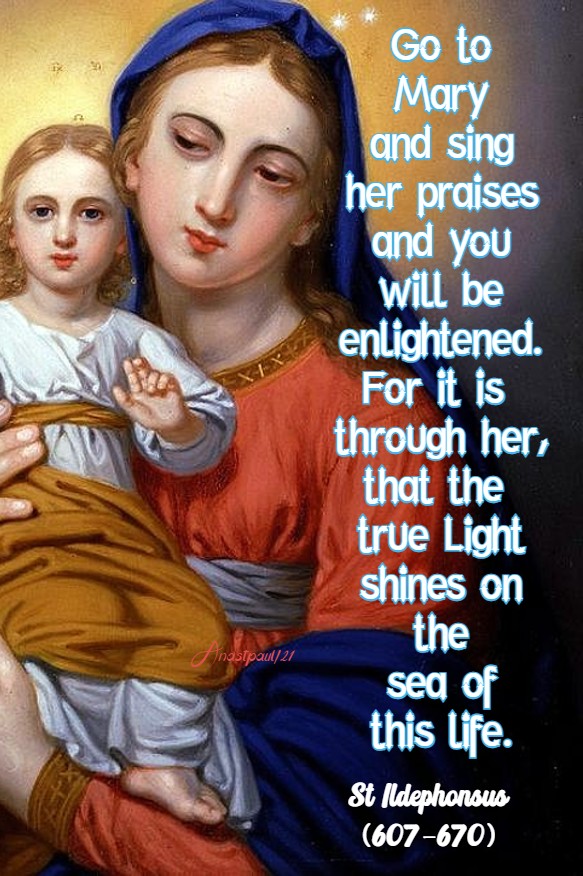
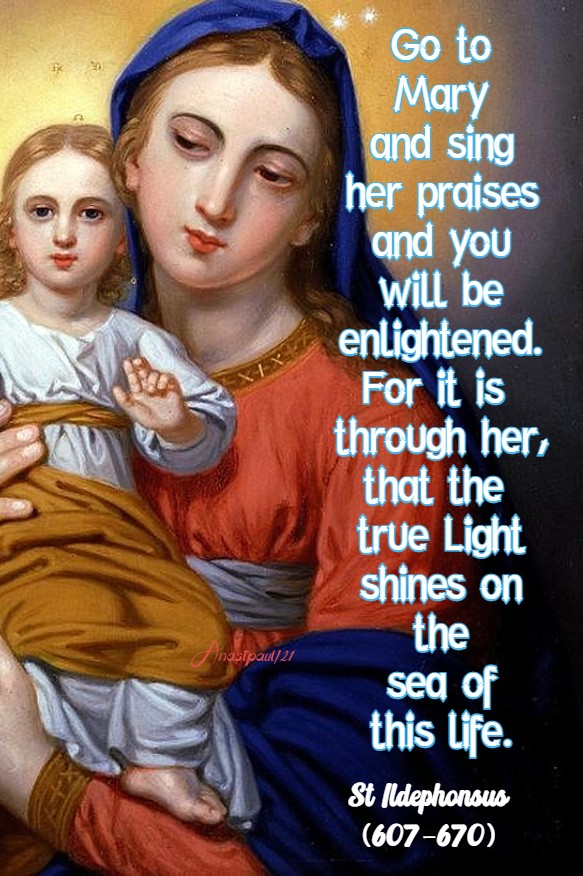
“Go to Mary and sing her praises and you will be enlightened. For it is through her, that the true Light shines on the sea of this life.”
St Ildephonsus (607-670)
“As breathing is not only a sign but even, a cause of life, so the name of Mary, which is constantly found on the lips of God’s servants, both proves that they are truly alive and, at the same time, causes and preserves their life and gives them, every succour . . . may Your name, O Mother of God, be the last sound that escapes my lips!”
St Germanus of Constantinople (c 640-733)
“We may seek graces but shall never find them without the intercession of Mary.”
St Cajetan (1480-1547)
“Do you not know, that not only is Jesus, resting and dwelling continually in the Heart of Mary but that He is, Himself the Heart of Mary … “
St John Eudes CO (1601-1680) Apostle of the Two Holy Hearts
Our Morning Offering – 18 May – “The Month of the Blessed Virgin Mary”
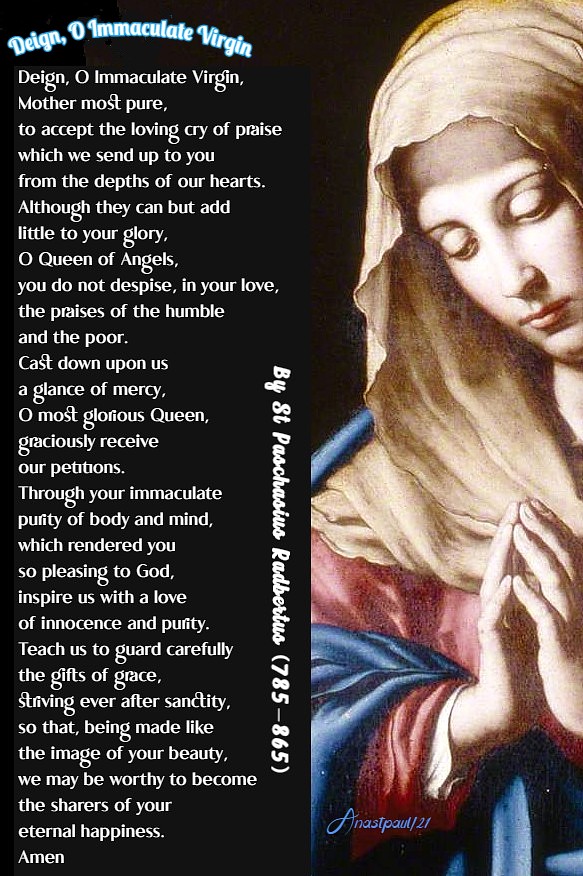
Deign, O Immaculate Virgin By St Paschasius Radbertus (785–865)
Deign, O Immaculate Virgin, Mother most pure, to accept the loving cry of praise which we send up to you from the depths of our hearts. Though they can but add little to your glory, O Queen of Angels, you do not despise, in your love, the praises of the humble and the poor. Cast down upon us a glance of mercy, O most glorious Queen, graciously receive our petitions. Through your immaculate purity of body and mind, which rendered you so pleasing to God, inspire us with a love of innocence and purity. Teach us to guard carefully the gifts of grace, striving ever after sanctity, so that, being made like the image of your beauty, we may be worthy to become the sharers of your eternal happiness. Amen
Our Morning Offering – 17 May – “The Month of the Blessed Virgin Mary”
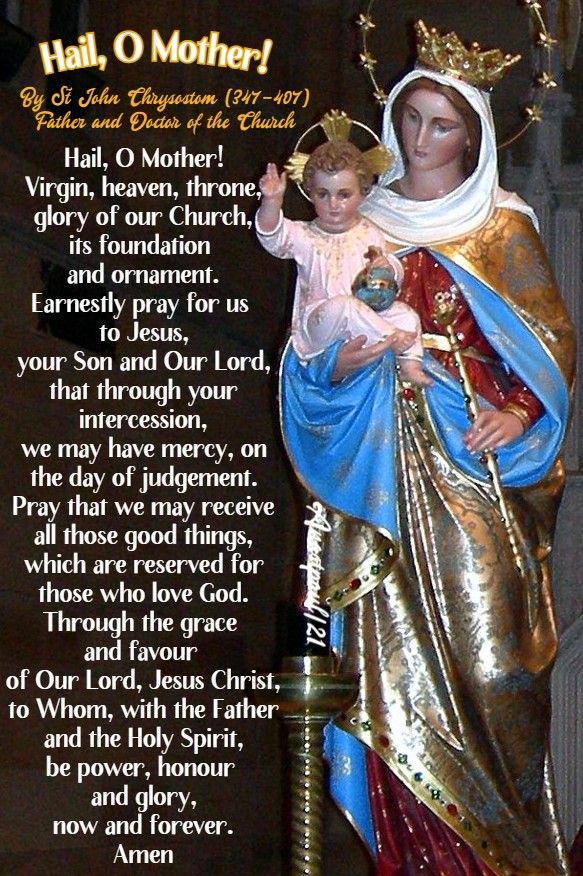
Hail, O Mother! By St John Chrysostom (347-407) Father and Doctor of the Church
Hail, O Mother! Virgin, Heaven, throne, glory of our Church, it’s foundation and ornament. Earnestly pray for us to Jesus, your Son and Our Lord, that through your intercession, we may have mercy on the day of judgement. Pray that we may receive, all those good things which are reserved for those who love God. Through the grace and favour of Our Lord, Jesus Christ, to Whom, with the Father and the Holy Spirit, be power, honour and glory, now and forever. Amen
Our Morning Offering – 16 May – “The Month of the Blessed Virgin Mary”
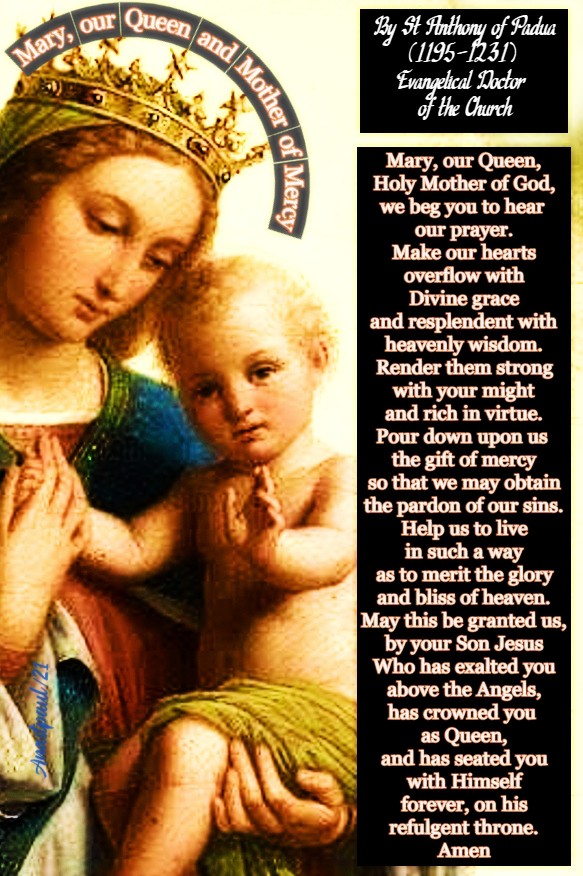
Mary, our Queen and Mother of Mercy By St Anthony of Padua (1195-1231) Evangelical Doctor of the Church
Mary, our Queen, Holy Mother of God, we beg you to hear our prayer. Make our hearts overflow with Divine grace and resplendent with heavenly wisdom. Render them strong with your might and rich in virtue. Pour down upon us the gift of mercy so that we may obtain the pardon of our sins. Help us to live in such a way as to merit the glory and bliss of Heaven. May this be granted us, by your Son Jesus Who has exalted you above the Angels, has crowned you as Queen, and has seated you with Himself forever, on his refulgent throne. Amen.
Quote/s of the Day – 14 April – “The Month of the Blessed Virgin Mary” and Mary’s Day – Sirach 24:14 -16, John 19:25-27
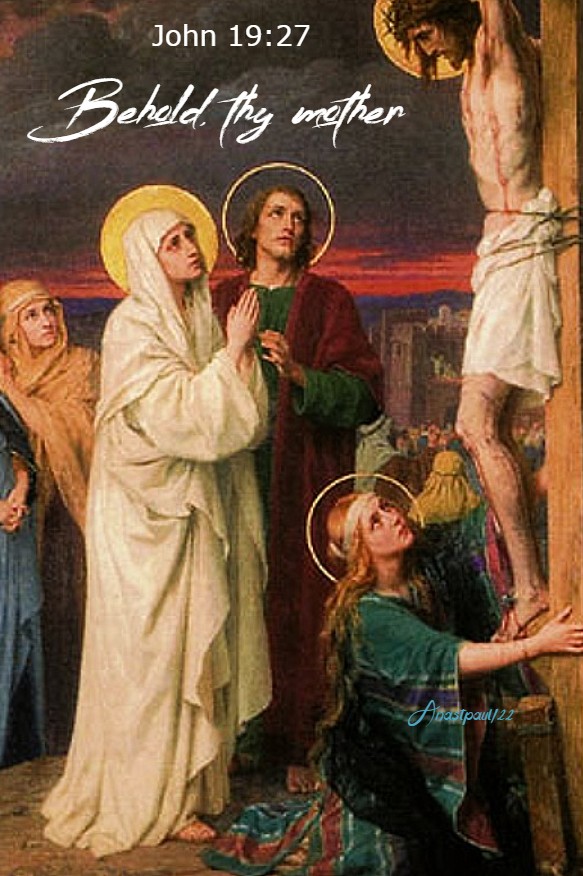
“Behold, thy mother”
John 19:27
“Go to Mary and sing her praises and you will be enlightened. For it is through her, that the true Light shines on the sea of this life.”
St Ildephonsus (607-670)
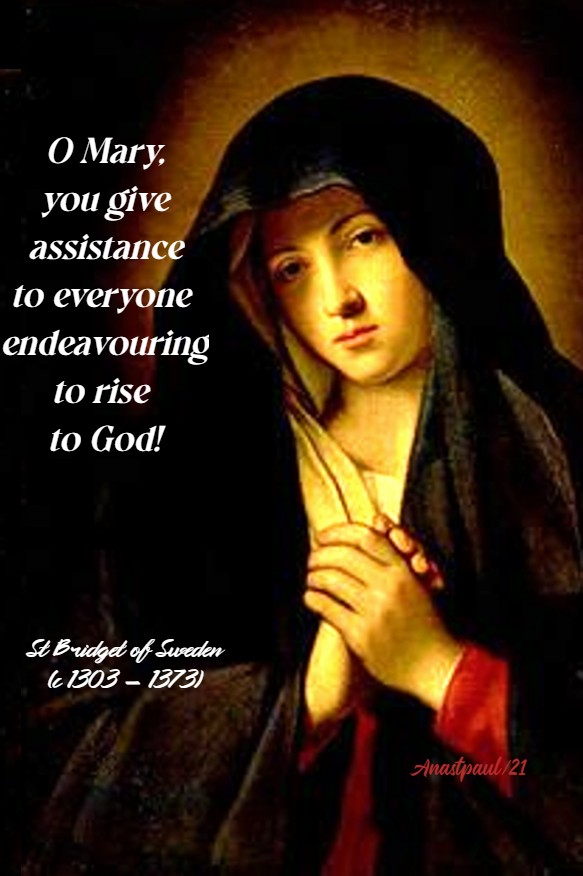
“O Mary, you give assistance to everyone endeavouring to rise to God!”
St Bridget of Sweden (c 1303 – 1373)
“Wherefore, in the same holy bosom of His most chaste Mother, Christ took to Himself flesh and united to Himself, the spiritual Body formed by those who were to believe in Him. Hence Mary, carrying the Saviour within her, may be said, to have also carried, all those. whose life was contained in the life of the Saviour. Therefore, all we, who are united to Christ and, as the Apostle says, are members of His body, of His flesh and of His bones (Eph 5:30), have issued from the womb of Mary, like a body united to it’s Head.”
One Minute Reflection – 14 April – “The Month of the Blessed Virgin Mary” and Mary’s Day – Sirach 24:14 -16, John 19:25-27
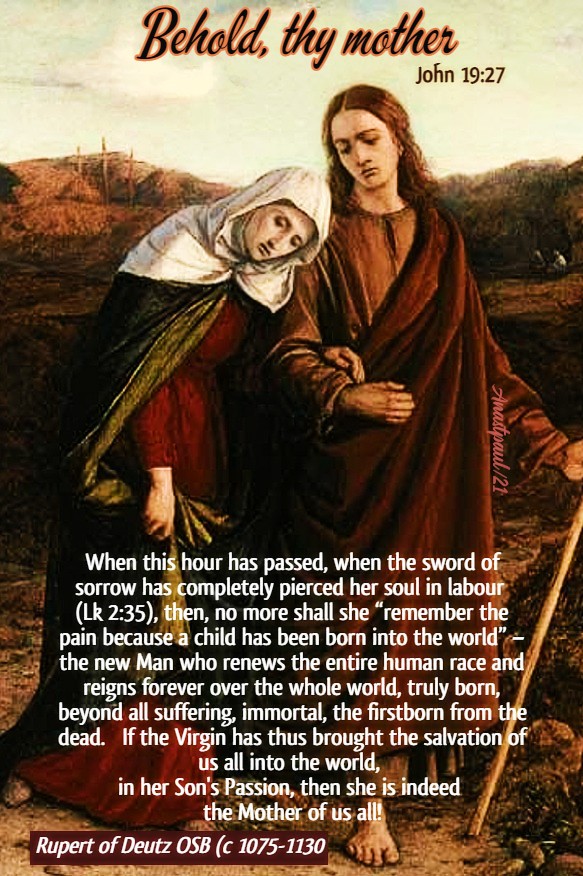
“Behold, thy mother” – John 19:27
REFLECTION – “Woman, this is your son. This is your mother.” By what right is the disciple whom Jesus loved, the son of the Lord’s mother? By what right is she his mother? By the fact that, without pain, she brought into the world the salvation of us all, when she gave birth in the flesh to the God-man. But now she is in labour with great pain as she stands at the foot of the Cross.
At the hour of His Passion, the Lord Himself rightly compared the Apostles to a woman in childbirth, when He said: “When a woman is in labour she is in anguish because a child is born into the world” (cf. Jn 16:21). How much more, then, might such a Son compare such a Mother, the Mother standing at the foot of His Cross, to a woman in labour? What am I saying? “Compare?” She is indeed truly a woman and truly a mother and, at this hour, she is truly experiencing the pains of childbirth. When her Son was born she did not experience the anguish of giving birth in pain as other women do; it is now that she is suffering, that she is crucified, that she experiences sorrow like a woman in labour because her hour has come ( Jn 16:21; cf.13:1; 17:1). …
When this hour has passed, when the sword of sorrow has completely pierced her soul in labour (Lk 2:35), then, no more shall she “remember the pain because a child has been born into the world” – the new Man who renews the entire human race and reigns forever over the whole world, truly born, beyond all suffering, immortal, the firstborn from the dead. If the Virgin has thus brought the salvation of us all into the world, in her Son’s Passion, then she is indeed the Mother of us all!” – Rupert of Deutz (c 1075-1130) Benedictine Monk, Theologian, Exegete and Writer – Commentary on Saint Johns Gospel, 13 ; PL 169, 789.
PRAYER – Grant, we beseech Thee, O Lord God, unto all Thy servants, that they may remain continually in the enjoyment of soundness, both of mind and body and, by the glorious intercession of the Blessed Mary, always a Virgin, may be delivered from present sadness, and enter into the joy of Thine eternal gladness. Through Jesus Christ, Thy Son our Lord, Who lives and reigns with Thee, in the unity of the Holy Ghost, God, world without end. Amen (Collect).
Our Morning Offering – 13 May – “The Month of the Blessed Virgin Mary” and the Memorial of St Robert Bellarmine SJ (1542-1621) Bishop, Confessor, Doctor of the Church.
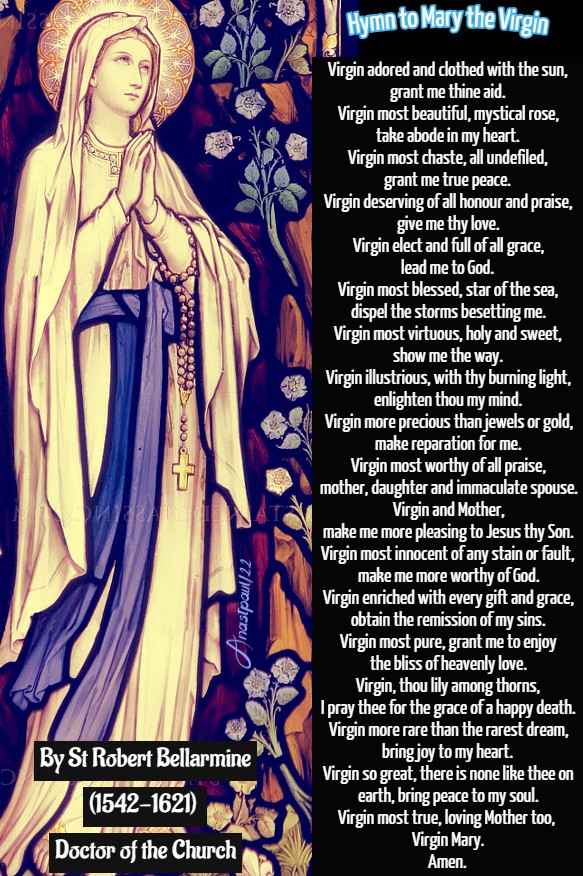
St Robert Bellarmine’s Hymn to Mary the Virgin: Among St Robert’s extant writing, there is a short poem of twenty stanzas which he composed in the nature of a Litany to the Blessed Virgin. The text was first published in Italian some fifty years ago and to the best of the writer’s knowledge, has never been translated into English. Each verse-line begins with the name “Virgin,” joined to a title and petition to Our Lady, starting with the letter “A” and going down the Italian alphabet to “V.” Thus the first seven verses begin with the invocation: “Vergine adorna … Vergine Bella …Vergine casta … Vergine degna … Vergine eletta … Vergine felice … Vergine gradita …”
A translation to this tribute to the Virgin Mother reads as follows: – Servant of God Fr John A Hardon SJ (1914-2000).
Hymn to Mary the Virgin By St Robert Bellarmine (1542-1621) Doctor of the Church.
Virgin adored and clothed with the sun, grant me thine aid. Virgin most beautiful, mystical rose, take abode in my heart. Virgin most chaste, all undefiled, grant me true peace. Virgin deserving of all honour and praise, give me thy love. Virgin elect and full of all grace, lead me to God. Virgin most blessed, star of the sea, dispel the storms besetting me. Virgin most virtuous, holy and sweet, show me the way. Virgin illustrious, with thy burning light, enlighten thou my mind. Virgin more precious than jewels or gold, make reparation for me. Virgin most worthy of all praise, mother, daughter and immaculate spouse. Virgin and Mother, make me more pleasing to Jesus thy Son. Virgin most innocent of any stain or fault, make me more worthy of God. Virgin enriched with every gift and grace, obtain the remission of my sins. Virgin most pure, grant me to enjoy the bliss of heavenly love. Virgin, thou lily among thorns, I pray thee for the grace of a happy death. Virgin more rare than the rarest dream, bring joy to my heart. Virgin so great, there is none like thee on earth, bring peace to my soul. Virgin most true, loving Mother too, Virgin Mary. Amen.
Our Morning Offering – 11 May – “The Month of the Blessed Virgin Mary”
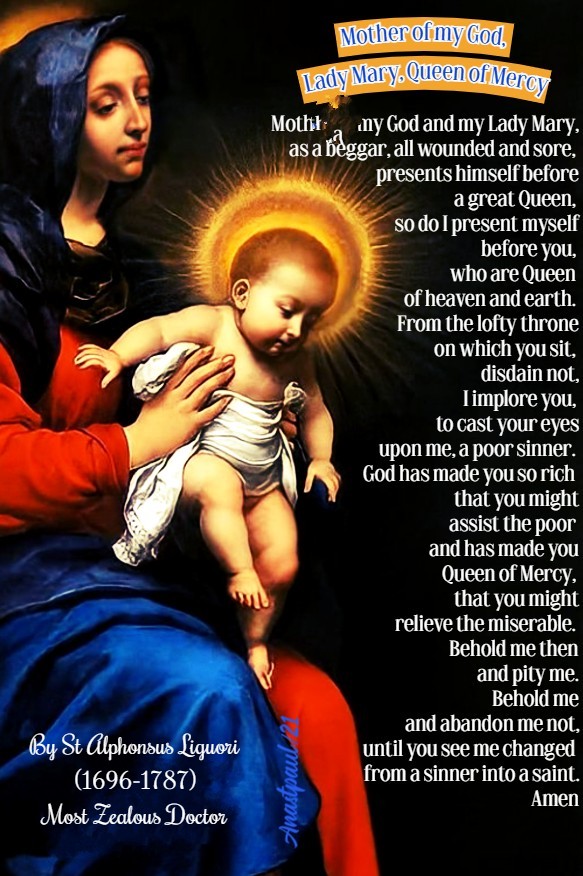
Mother of my God, Lady Mary, Queen of Mercy By St Alphonsus Liguori (1696-1787) Most Zealous Doctor
Mother of my God and my Lady Mary, as a beggar, all wounded and sore, presents himself before a great Queen, so do I present myself before you, who are Queen of heaven and earth. From the lofty throne on which you sit, disdain not, I implore you, to cast your eyes on me, a poor sinner. God has made you so rich that you might assist the poor and has made you Queen of Mercy, that you might relieve the miserable. Behold me then and pity me. Behold me and abandon me not, until you see me changed from a sinner into a saint. Amen
Thought for the Day – 10 May – Meditations with Antonio Cardinal Bacci (1881-1971)
Mary’s Patience
“Holy Mary, Mother of Sorrows, obtain for me the spirit of loving patience which made you the Queen of Martyrs. Help me to carry with resignation the cross which God has given me. Help me to walk like you in the footsteps of Jesus, until I reach my Calvary, so that I may join Him and you, in the glory of Heaven. Amen,”
Quote/s of the Day – 9 May – The Memorial of St Gregory Nazianzen (330-390) Bishop, Confessor, Father and Doctor of the Church
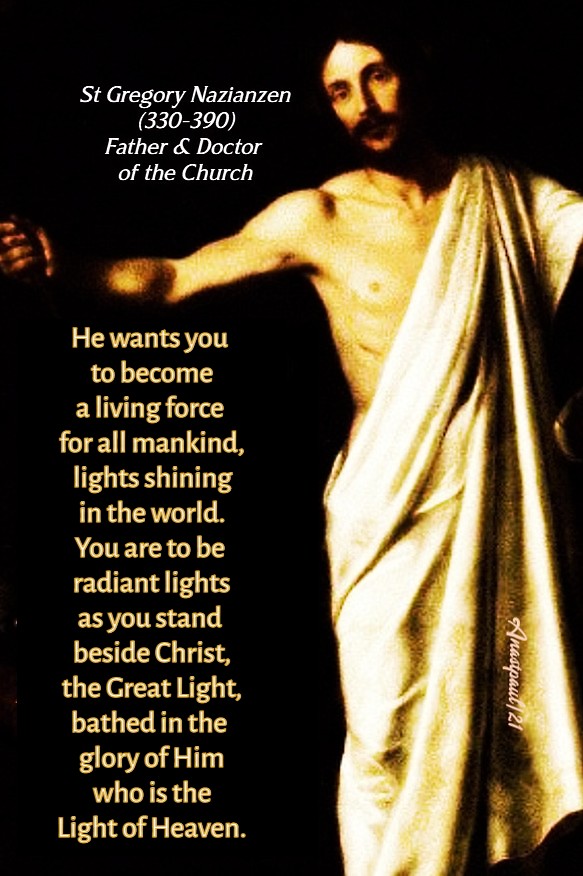
“He wants you to become a living force for all mankind, lights shining in the world. You are to be radiant lights as you stand beside Christ, the Great Light, bathed in the glory of Him who is the Light of Heaven.”
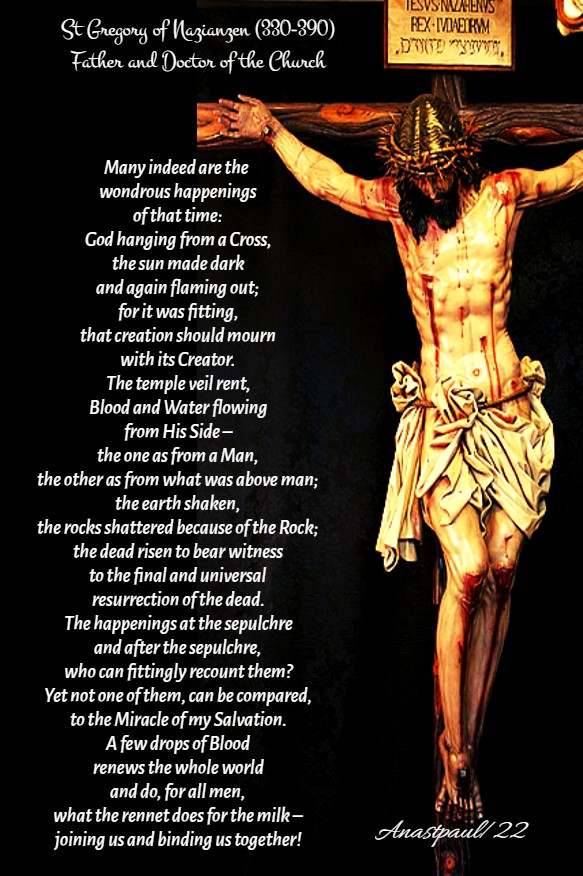
“Many indeed are the wondrous happenings of that time: God hanging from a Cross, the sun made dark and again flaming out; for it was fitting, that creation should mourn with its Creator. The temple veil rent, blood and water flowing from His side – the one as from a Man, the other as from what was above man; the earth shaken, the rocks shattered because of the Rock; the dead risen to bear witness to the final and universal resurrection of the dead. The happenings at the sepulchre and after the sepulchre, who can fittingly recount them? Yet not one of them, can be compared, to the Miracle of my Salvation. A few drops of Blood renews the whole world and do, for all men, what the rennet does for the milk – joining us and binding us together!”
“God accepts our desires as though they were of great value. He longs ardently for us to desire to and love Him. He accepts our petitions for benefits, as though we were doing Him a favour. His joy in giving, is greater than ours in receiving. So let us not be apathetic in our asking, nor set too narrow bounds to our requests; nor ask for frivolous things unworthy of God’s greatness.”
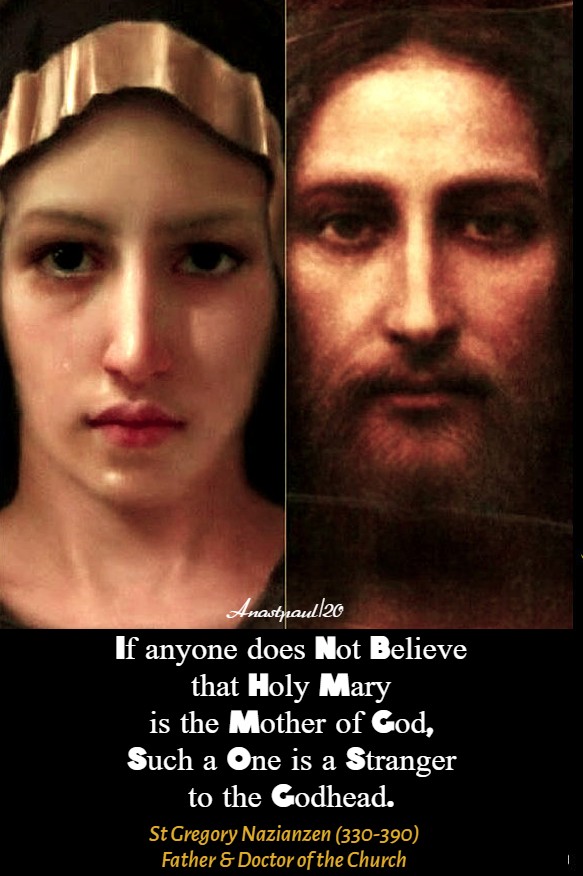
“If anyone does not believe that Holy Mary is the Mother of God, such a one is a stranger to the Godhead.”
St Gregory Nazianzen (330-390) Father & Doctor of the Church
Our Morning Offering – 9 May – “The Month of the Blessed Virgin Mary”
Let Me Love Your Jesus By St Ildephonsus (c 607-670)
Virgin Mary, hear my prayer, through the Holy Spirit, you became the Mother of Jesus, from the Holy Spirit, may I too have Jesus. Through the Holy Spirit, your flesh conceived Jesus, through the same Spirit, may my soul receive Jesus. Through the Holy Spirit, you were able to know Jesus, to possess Jesus and to bring Him into the world. Through the Holy Spirit, may I too come to know your Jesus. Imbued with the Spirit, Mary, you could say “I am the handmaid of the Lord, be it done unto me according to your word,” in the Holy Spirit, lowly as I am, let me proclaim the great truths about Jesus. In the Spirit, you now adore Jesus as Lord and look on Him as Son, in the same Spirit, Mary, let me love your Jesus. Amen
Our Morning Offering – 7 May – “The Month of the Blessed Virgin Mary”
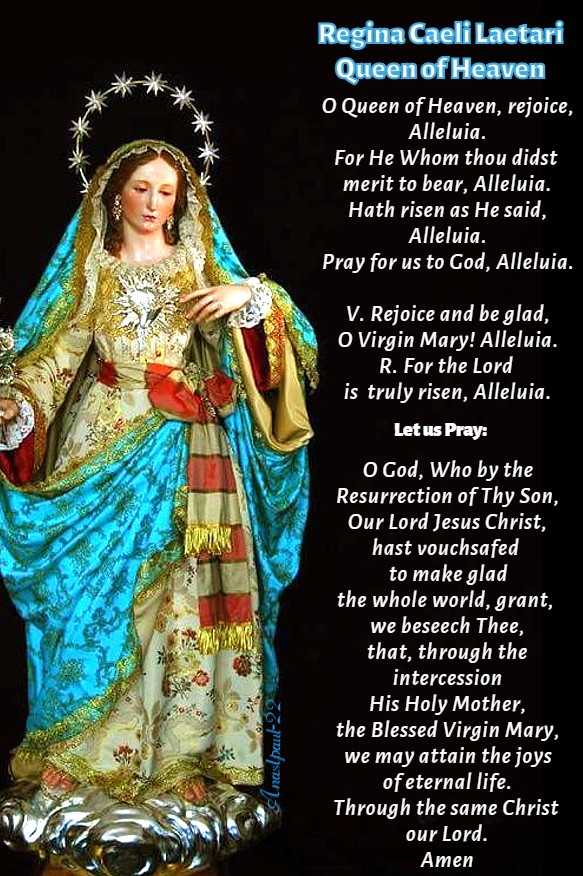
Regina Caeli Laetari Eastertide from Holy Saturday until Trinity Sunday (in case you forgot to replace the praying of the Angelus).
Anthem to the Blessed Virgin
Regina Caeli Laetari Queen of heaven
O Queen of Heaven, rejoice, Alleluia. For He Whom thou didst merit to bear, Alleluia. Hath risen as He said, Alleluia. Pray for us to God, Alleluia.
V. Rejoice and be glad, O Virgin Mary! Alleluia. R. For the Lord is truly risen, Alleluia.
Let us pray
O God, Who by the Resurrection of Thy Son, Our Lord Jesus Christ, hast vouchsafed to make glad the whole world, grant, we beseech Thee, that, through the intercession HIs Holy Mother, the Blessed Virgin Mary, we may attain the joys of eternal life. Through the same Christ our Lord. Amen
There is a venerable tradition connected with this joyous Anthem. It is related that a fearful pestilence raged in Rome, during one of the Easters of the Pontificate of St. Gregory the Great. In order to propitiate the anger of God, the holy Pope prescribed a public procession of both people and clergy, in which was to be carried the portrait of our Blessed Lady painted by St Luke.
The procession was advancing in the direction of Saint Peter’s and as the holy Picture, followed by the Pontiff, (it is said that he processed with bare feet), was carried along, the atmosphere became pure and free from pestilence. Having reached the bridge which joins the City with the Vatican, a choir of Angels was heard singing above the Picture and saying: “Rejoice, O Queen of heaven, alleluia! for He whom thou deservedst to bear, alleluia! hath risen, as He said, alleluia!” As soon as the heavenly music ceased, the saintly Pontiff took courage, and added these words to those of the Angels: “Pray to God for us, alleluia!”
Thus was composed the Paschal Anthem to our Lady. Raising his eyes to heaven, Gregory saw the destroying Angel standing on the top of the Mole of Hadrian and sheathing his sword.
In memory of this apparition, the Mole was called the Castle of Saint Angela and on the dome was placed an immense statue representing an Angel holding his sword in the scabbard.
( “The Sovereign Pontiff Benedict XIII, by a brief, Injuntae nobis, 14 September1724, amended by the Sacred Penitentiary Apostolic, 20 February 1933, granted a Plenary Indulgence, once a month, to all the faithful who, everyday, in the morning (6.00), at noon and in the evening at sunset (6.00), shall say, devoutly, the Angelus Dominie, with the Hail Mary, three times, or at Eastertide the Regina Caeli, on any day when, being truly penitent, after Confession and Communion, they shall pray for peace and union among Christian Princes, for the extirpation of heresy and for the triumph of Holy Mother Church. Also an indulgence of ten years, on all the other days in the year, ever time that they shall devoutly say these prayers.”)
Regina caeli, laetare, Alleluia.
Qua quem meruisti portare, Alleluia. Resurrexit, sicut dixit, Alleluia. Ora pro nobis Deum, Alleluia.
V. Gaude et laetare, Virgo Maria, Alleluia. R. Qua surrexit Dominus vere, Alleluia.
Oremus
Deus, qui per resurrectionem Filii tui, Domini nostri, Jesu Christi, mundum laetificare dignatus es, praesta, quaesumus, ut per ejus Genitricem Virginem Mariam perpetuae capiamus gaudia vitae: per eumdem Christum, Dominum nostrum. Amen
Thought for the Day – 5 May – Meditations with Antonio Cardinal Bacci (1881-1971)
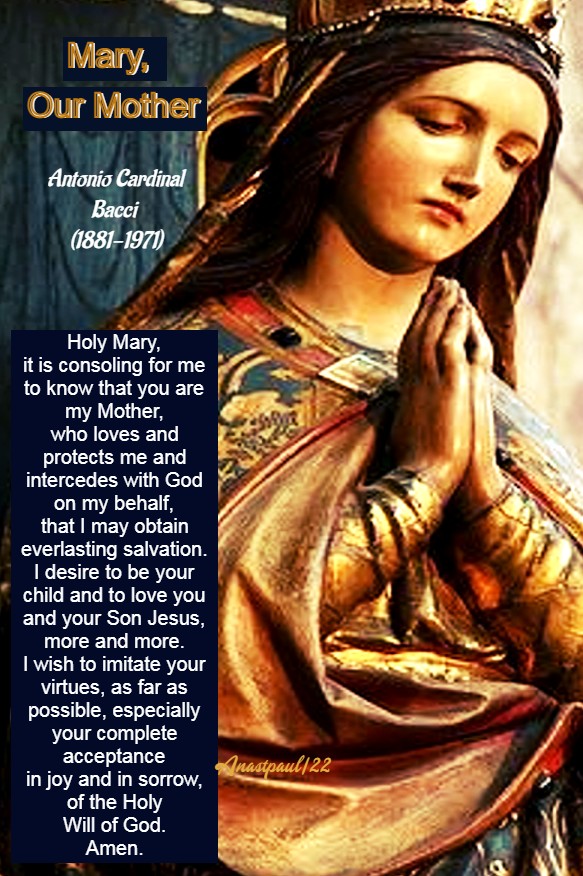
Mary, Our Mother
“Holy Mary, it is consoling for me to know that you are my Mother, who loves and protects me and intercedes with God on my behalf, that I may obtain everlasting salvation. I desire to be your child and to love you and your Son Jesus, more and more. I wish to imitate your virtues, as far as possible, especially your complete acceptance in joy and in sorrow, of the Holy Will of God. Amen.”
Thought for the Day – 4 May – Meditations with Antonio Cardinal Bacci (1881-1971)
Mary, the Mother of God
“Most Holy Mary, not only were you raised to the dignity of Mother of God but, you carried out His holy Will, heroically on all occasions. Obtain for me, from your divine Son, Jesus, the grace to co-operate always and at all costs, with His designs for me, both in life and in death, amen.”
Our Morning Offering – 3 May – “The Month of the Blessed Virgin Mary”
Hail, O Mary, Mother of God By St Cyril of Alexandria (376-444) Father & Doctor of the Church
Hail, O Mary, Mother of God, Virgin and Mother! Morning Star, perfect vessel. Hail, O Mary, Mother of God, Holy Temple in which god Himself was conceived. Hail, O Mary, Mother of God, Chaste and pure dove. Hail, O Mary, Mother of God, Who enclosed the One who cannot be encompassed in your sacred womb. Hail, O Mary, Mother of God, From you flowed the true light, Jesus Christ, our Lord. Hail, O Mary, Mother of God, Through you the Conqueror and triumphant Vanquisher of hell came to us. Hail, O Mary, Mother of God, Through you, the glory of the Resurrection blossoms. Hail, O Mary, Mother of God, You have saved every faithful Christian. Hail, O Mary, Mother of God, Pray for us sinners now and at the hour of our death. Amen



























 AnaStpaul
You must be logged in to post a comment.