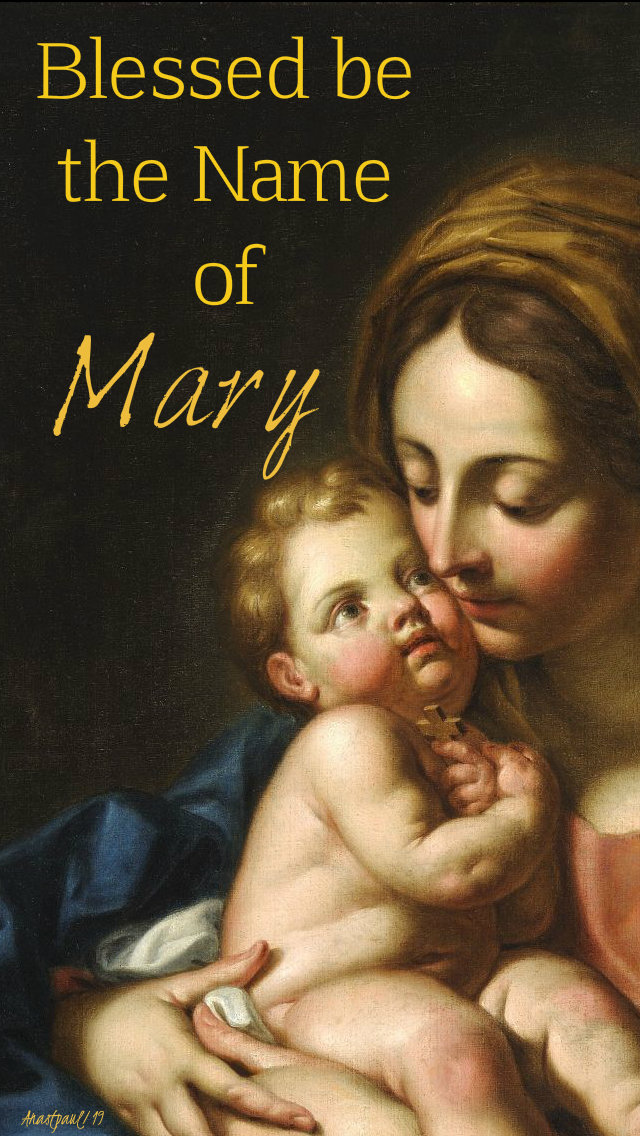
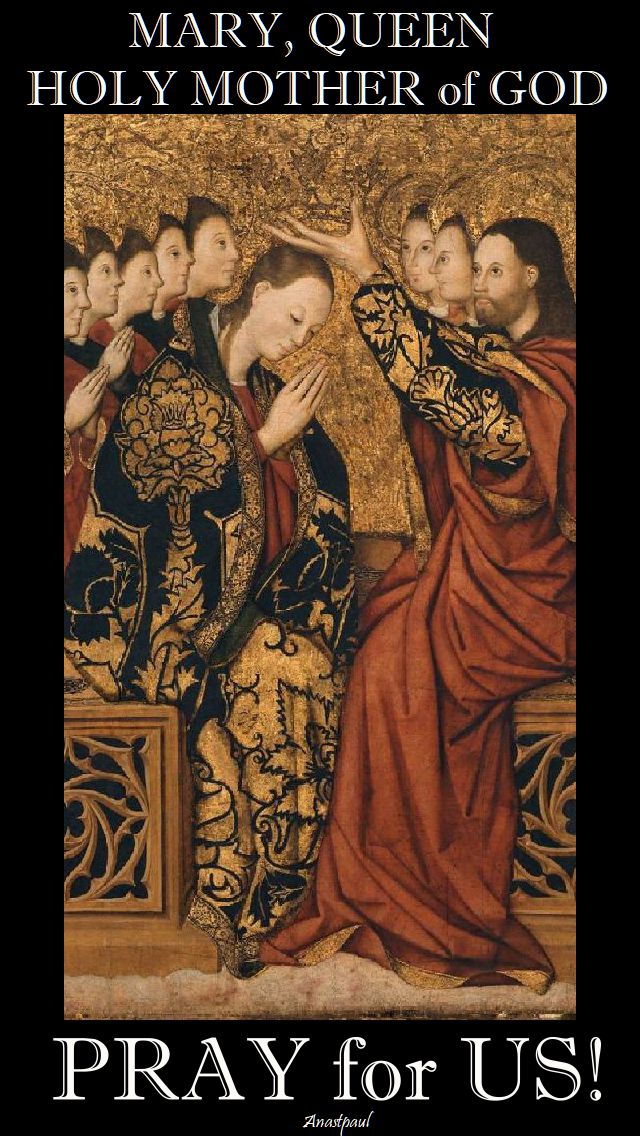
Thought for the Day – 12 September – Feast of the Most Holy Name of Mary
Mary, you are the vessel and tabernacle containing all mysteries. You know what the Patriarchs never knew, you have experienced what was never revealed to the Angels, you have heard what the Prophets never heard. In a word, all that was hidden from preceding generations was made known to you, even more, most of these wonders depended on you.
St Gregory Thaumarturgus (c 213–270)
Whenever I say Hail Mary Blessed Alan de la Roche (1428-1475)
Whenever I say Hail Mary
The court of heaven rejoices
And the earth is lost in wonderment
And I despise the world
And my heart is brim full
Of the love of God.
When I say Hail Mary,
All my fears wilt and die
And my passions are quelled.
If I say Hail Mary,
Devotion grows within me
And sorrow for sin awakens.
When I say Hail Mary
Hope is made strong in my breast
And the dew of consolation
Falls on my soul
more and more,
Because I say Hail Mary.
And my spirit rejoices
And sorrow fades away
When I say
Hail Mary.
Quote/s of the Day – 12 September – Feast of the Most Holy Name of Mary
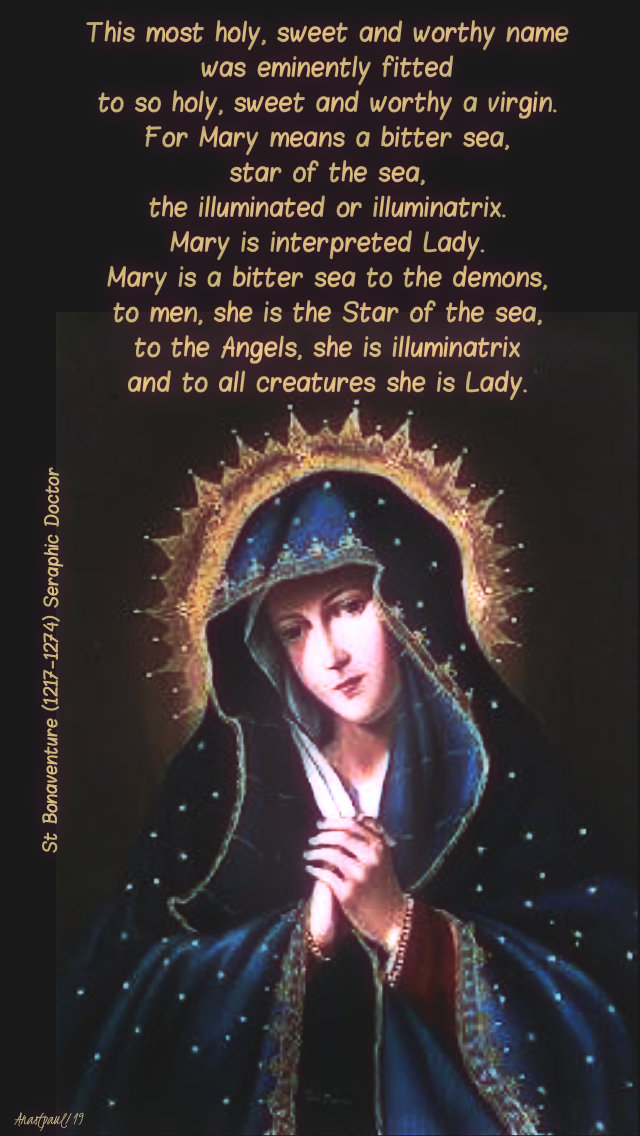
“This most holy, sweet and worthy name was eminently fitted to so holy, sweet and worthy a virgin. For Mary means a bitter sea, star of the sea, the illuminated or illuminatrix. Mary is interpreted Lady. Mary is a bitter sea to the demons, to men, she is the Star of the sea, to the Angels, she is illuminatrix and to all creatures she is Lady.”
St Bonaventure (1217-1274) Seraphic Doctor
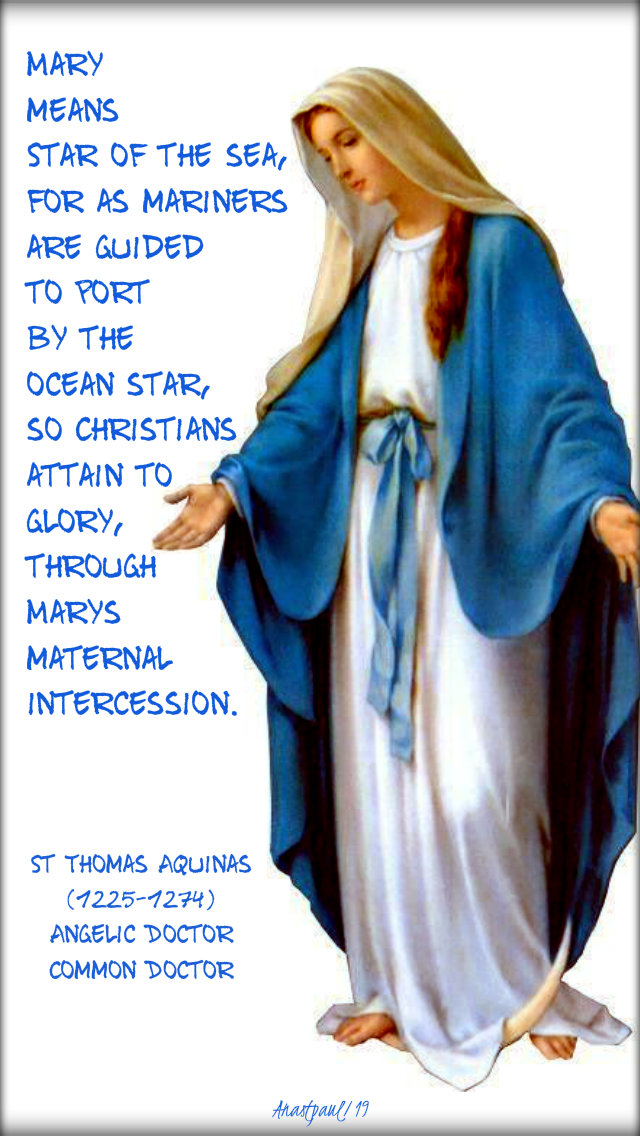
“Mary means Star of the sea, for as mariners are guided to port by the ocean star, so Christians attain to glory, through Mary’s maternal intercession.”
St Thomas Aquinas (1225-1274)
Angelic Doctor
Common Doctor
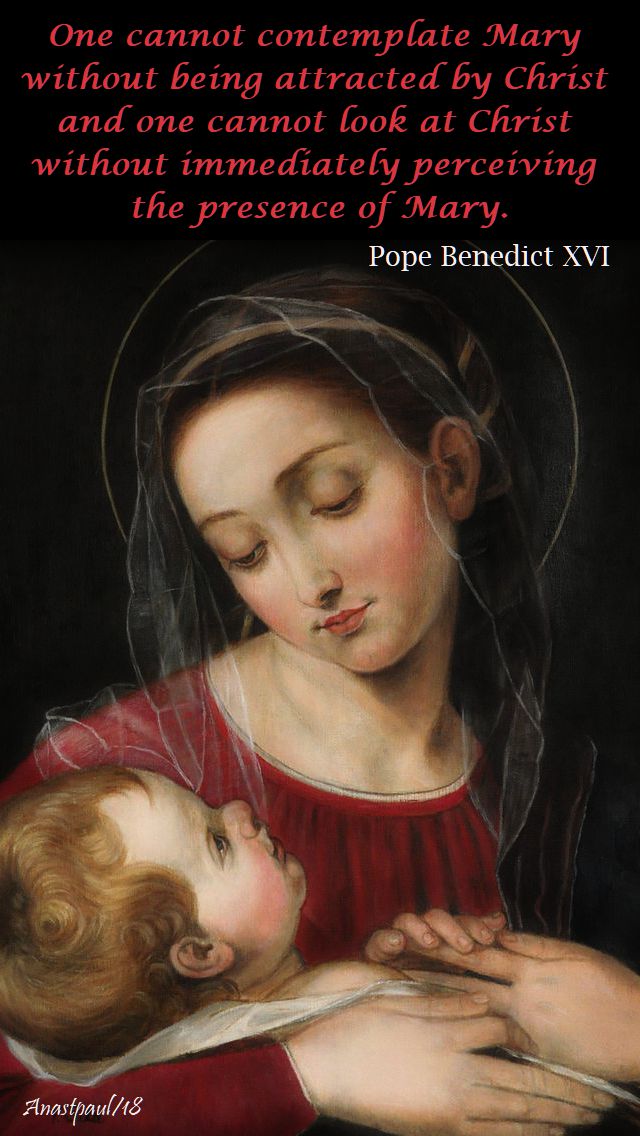
“One cannot contemplate Mary without being attracted by Christ and one cannot look at Christ without immediately perceiving the presence of Mary.”
Pope Benedict XVI
Mary’s Name
Rare perfume is a rough and reeking place, A bell-like music breaking through the blare Of strident streets, a dear remembered face Appearing through the mind’s pondrous despair.
A foam of summer flowers fringing the drear Immobile desert sea, a cherished voice Calling in some long night of pain and fear To make the heavy, heaving heart rejoice. Such is the mystic wonder of her name That is a shudder down Hell’s shaken halls, And joy where angel-wings flit like white flames, Where height to echoing height its glory calls.
One Minute Reflection – 12 February – Thursday of the Twenty third week in Ordinary Time, Year C, Gospel: Luke 6:27–38 and the Memorial of the Most Holy Name of Mary
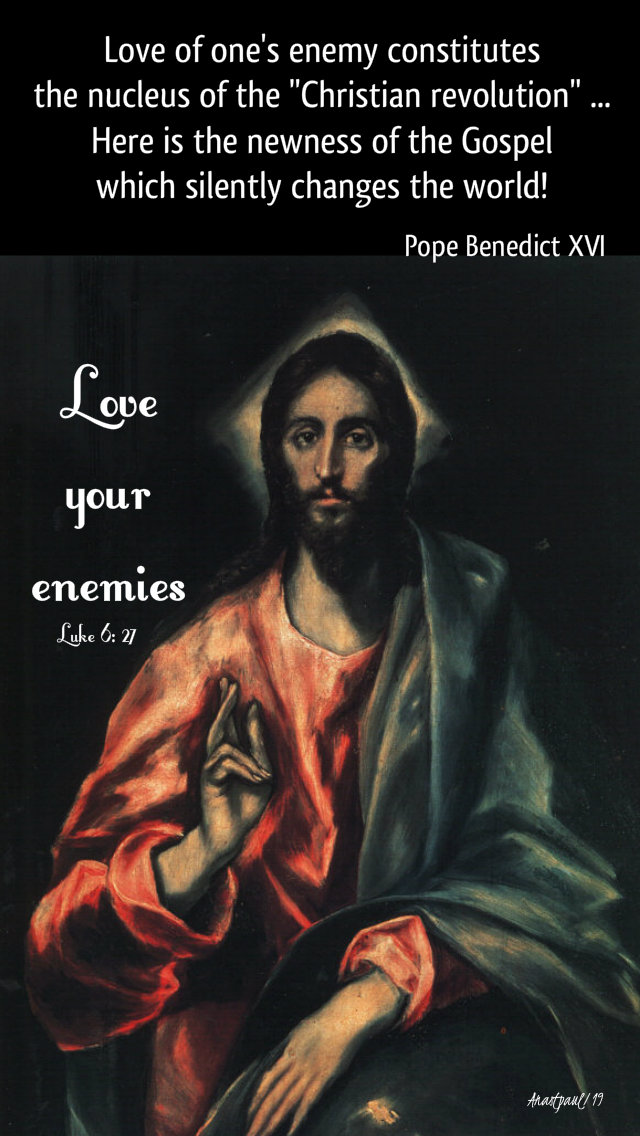
“Love your enemies” … Luke 6: 27
REFLECTION – “This Gospel passage is rightly considered the magna carta of Christian non-violence. It does not consist in succumbing to evil, as a false interpretation of “turning the other cheek” (cf. Lk 6: 29) claims but in responding to evil with good (cf. Rom 12: 17-21) and thereby breaking the chain of injustice.
One then understands that for Christians, non-violence is not merely tactical behaviour but a person’s way of being, the attitude of one who is so convinced of God’s love and power that he is not afraid to tackle evil, with the weapons of love and truth alone.
Love of one’s enemy constitutes the nucleus of the “Christian revolution”, a revolution not based on strategies of economic, political or media power – the revolution of love, a love that does not rely ultimately on human resources but is a gift of God which is obtained by trusting solely and unreservedly in His merciful goodness. Here is the newness of the Gospel which silently changes the world! Here is the heroism of the “lowly” who believe in God’s love and spread it, even at the cost of their lives.” … Pope Benedict XVI 18 February 2007
PRAYER – God of love and might, teach us Your ways! You sent us Your only-begotten Son out of love for sinful man. May we follow Him in all that we think, do and say. May His humble heart be our hearts, may His gentle way be our way. And may the sweet love of Mary His Mother and ours, aid us on our pilgrimage. With great affection and confidence, we honour the Holy Hearts and invoke the Holy Names of Jesus and Mary, to be our constant source of pure assistance and succour. Blessed Virgin, Most Holy Mother, pray for us. We make our prayer through Christ, our Lord, with the Holy Spirit, one God for all eternity, amen.
Our Morning Offering – 12 September – Feast of the Most Holy Name of Mary
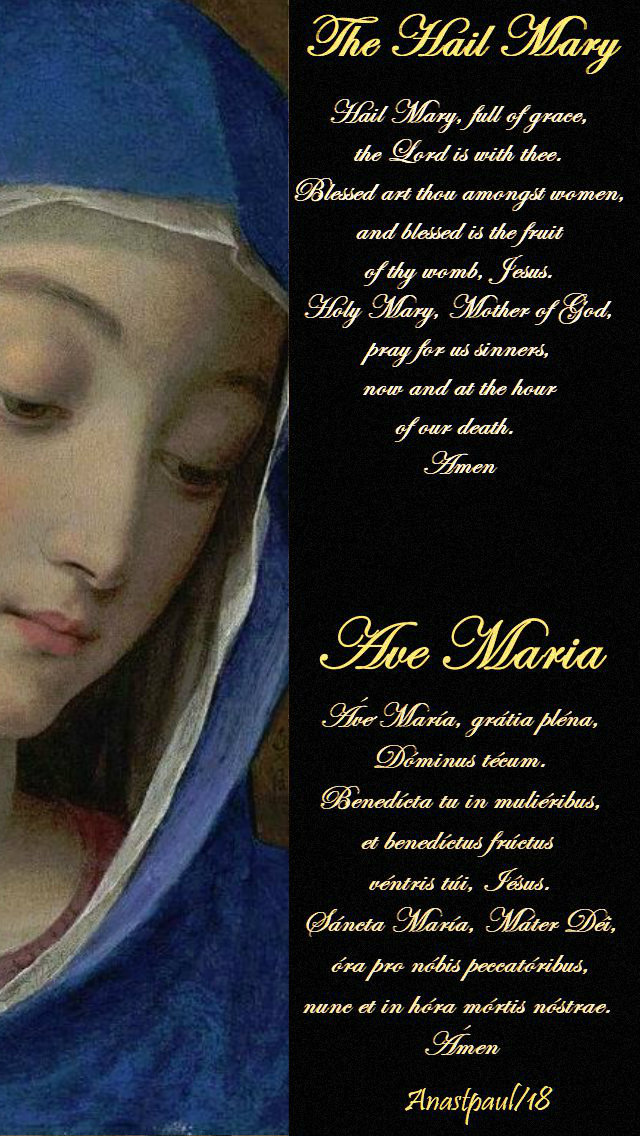
Hail Mary, the Angelic Salutation
The Hail Mary/Ave Maria
Hail Mary, full of grace,
the Lord is with thee.
Blessed art thou amongst women,
and blessed is the fruit of thy womb, Jesus.
Holy Mary, Mother of God,
pray for us sinners,
now and at the hour of our death.
Amen.
Áve María, grátia pléna,
Dóminus técum.
Benedícta tū in muliéribus,
et benedíctus frúctus véntris túi, Iésus.
Sáncta María, Máter Déi,
óra pro nóbis peccatóribus,
nunc et in hóra mórtis nóstrae.
Ámen.
One Minute Reflection – 8 September – Twenty-third Sunday in Ordinary Time, Year C, Gospel: Luke 14:25–33 and the Feast of Our Lady of Charity of El Cobre
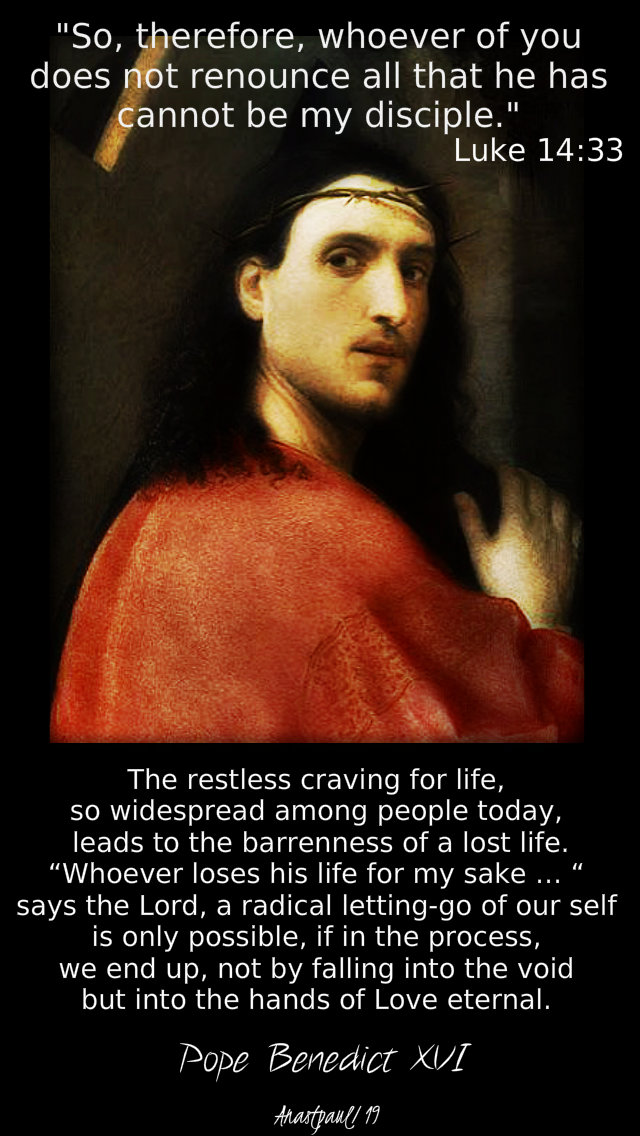
“So, therefore, whoever of you does not renounce all that he has cannot be my disciple.” … Luke 14:33
REFLECTION – “…We realise that the Lord is not speaking merely of a few individuals and their specific task, the essence of what He says applies to everyone. The heart of the matter He expresses elsewhere in these words: “For whoever would save his life will lose it and whoever loses his life for my sake, he will save it. For what does it profit a man if he gains the whole world and loses or forfeits himself?” (Lk 9:24f.). Whoever wants to keep his life just for himself will lose it. Only by giving ourselves do we receive our life. In other words, only the one who love, discovers life. And love always demands going out of oneself, it always demands leaving oneself. Anyone who looks just to himself, who wants the other, only for himself, will lose both himself and the other. Without this profound losing of oneself, there is no life.
The restless craving for life, so widespread among people today, leads to the barrenness of a lost life. “Whoever loses his life for my sake … “ says the Lord, a radical letting-go of our self is only possible, if in the process, we end up, not by falling into the void but into the hands of Love eternal.
Only the love of God, who loses Himself for us and gives Himself to us, makes it possible for us also to become free, to let go and so truly to find life. This is the heart of what the Lord wants to say to us in the seemingly hard words of this Sunday’s Gospel. With his teaching He gives u, the certainty, that we can build on His love, the love of the incarnate God. Recognition of this is the wisdom of which today’s reading speaks to us. Once again, we find that all the world’s learning profits us nothing unless we learn to live, unless we discover what truly matters in life.” … Pope Benedict XVI – Saint Stephen’s Cathedral, Vienna, Sunday, 9 September 2007 – on the occasion of the 850th Anniversary of the Foundation of the Shrine of Our Lady of Mariazell (Feast day today!)
PRAYER – Since it is from You, God our Father, that redemption comes to us, Your adopted children, look with favour on the family You love, give true freedom to us and to all who believe in Christ, Your Son and our Saviour and bring us all alike, to our eternal heritage. May we, in turn, give ourselves in true love to You and may the prayers of our glorious and merciful Mother, Our Lady of Charity, lead us to our heavenly home. We make our prayer through Christ our Lord in the unity of the Holy Spirit, God forever, amen.
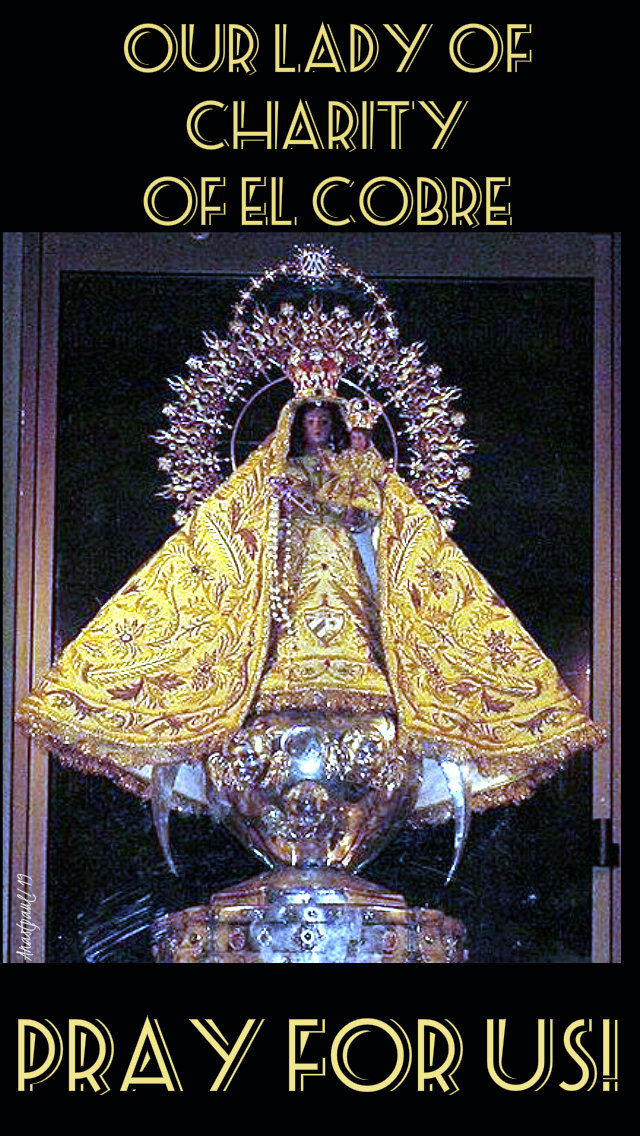
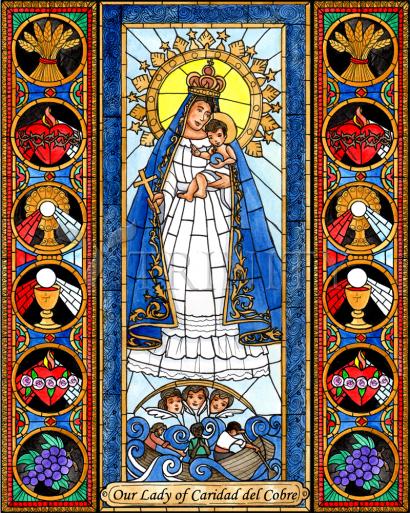
Nuestra Senora de la Virgen de la Caridad / Our Lady of Charity of El Cobre, Cuba (1612) – 8 September – – Queen, Mother and Patroness of the Cuban Peoples. Patronages – Cuba, Cuban peoples, salt and copper miners. Our Lady of Charity also known as Our Lady of El Cobre or Nuestra Senora de la Caridad del Cobre or “la Virgen de la Caridad” is a popular Marian title of the Blessed Virgin Mary known in many Catholic countries.
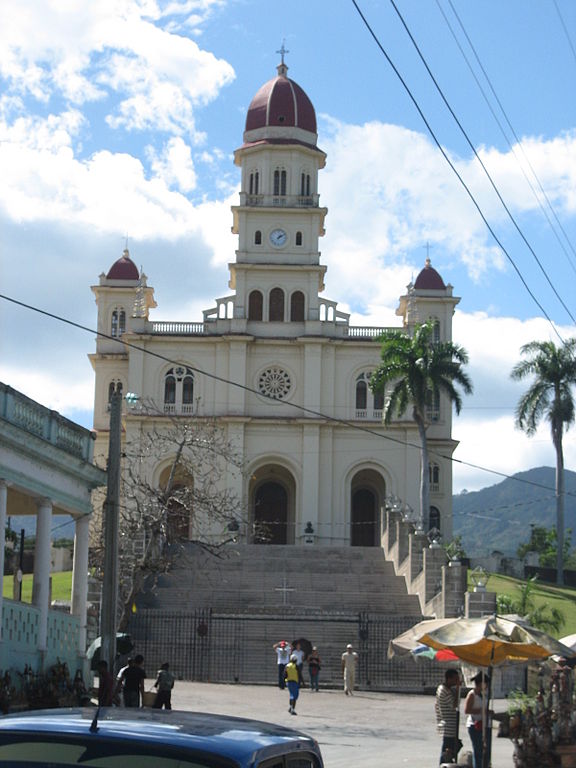
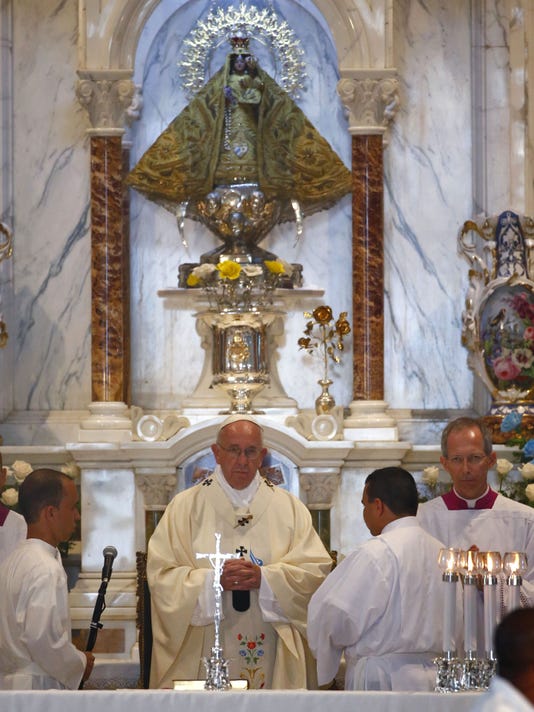
Several known Marian images with the same title exist around the world while a particular Hispanic image is pontifically designated by Pope Benedict XV as the Patroness of Cuba. The present image is enshrined in the National Shrine Basilica of Our Lady of Charity of El Cobre, built in 1926 and situated in the village El Cobre, near Santiago de Cuba. Pope Pius XI granted a Canonical Coronation for the image on 20 December 1936. The feast day of Our Lady of Charity is today, the solemn Nativity of the Blessed Virgin Mary.
Various similar Marian images predating the Cuban image have a similar title as well as having been granted a canonical coronation by the Popes and can be found in the Spanish cities of Cartagena, Villarrobledo, Illescas, Loja, La Garrovilla and Toledo, Spain along with its replicated copies in Basilica Minore of Our Lady of Charity in Agoo and the image of Bantay Church in Ilocos Sur, Philippines.
The history of the La Virgen de la Caridad del Cobre, began around 1612. The image is thought to have been brought by Spaniard colonists from the town of Illescas, a province in Toledo, Spain where a similar statue of the Virgin Mary of Charity was already well-venerated.
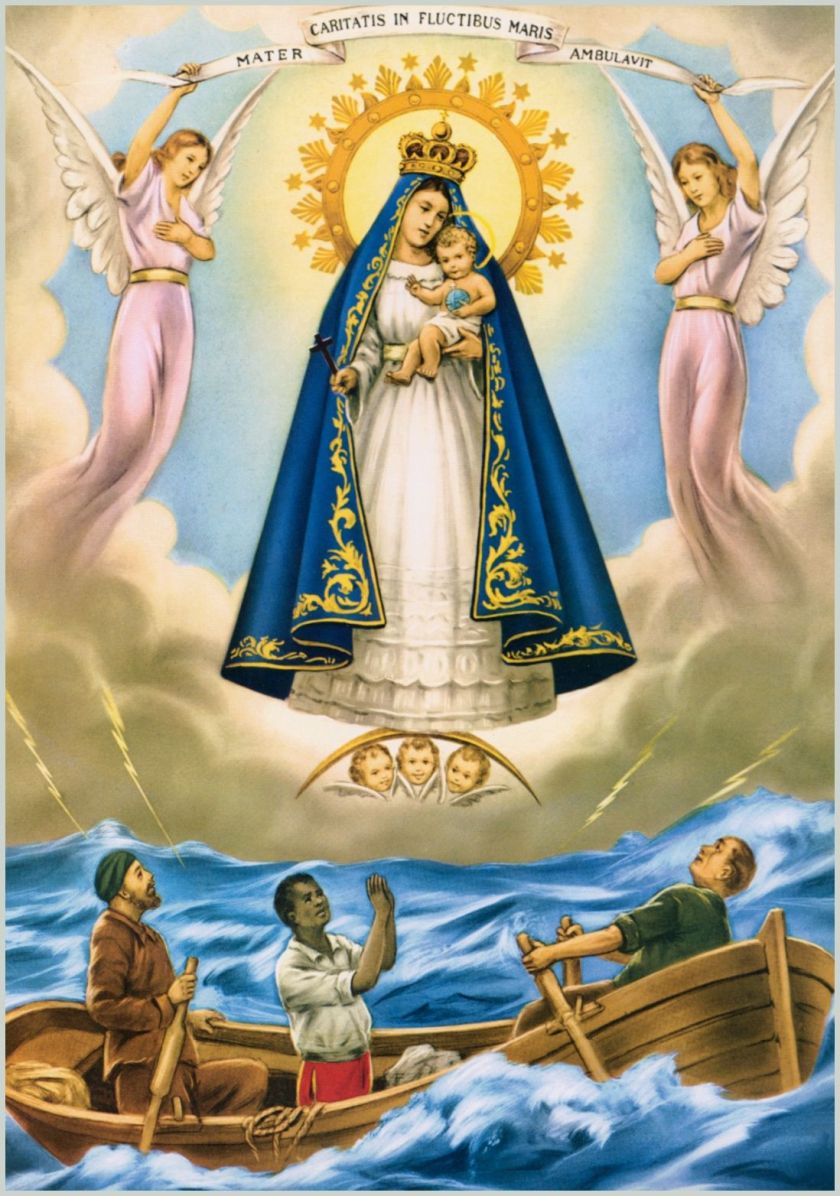
Local legend recalls the Spanish captains who bring with them religious Marian images to guide and protect them from English pirates at sea. Two Native American or Indian brothers, Rodrigo and Juan de Hoyosand an African slave child, Juan Moreno, set out to the Bay of Nipe for salt. They are traditionally given the moniker the “three Juans”. They needed the salt for the preservation of the meat at the Barajagua slaughter house, which supplied the workers and inhabitants of Santiago del Prado, now known as El Cobre. While out in the bay, a storm arose, rocking their tiny boat violently with incoming waves. Juan, the child, was wearing a medal with the image of the Virgin Mary. The three men began to pray for her protection. Suddenly, the skies cleared and the storm was gone. In the distance, they saw a strange object floating in the water. They rowed towards it as the waves carried it to them. At first they mistook it for a bird but quickly saw that it was what seemed to be a statue of a girl. At last they were able to determine that it was a statue of the Virgin Mary holding the child Jesus on her left arm and a gold cross in her right hand. The statue was fastened to a board with an inscription saying “Yo Soy la Virgen de la Caridad” or “I am the Virgin of Charity.” Much to their surprise, the statue remained completely dry while afloat in the water.
Overjoyed by what they had discovered, they hurried back to Barajagua. They showed the statue to a government official, Don Francisco Sánchez de Moya, who then ordered a small chapel to be built in her honour. One night, Rodrigo went to visit the statue but discovered that the image was gone. He organised a search party but had no success in finding Our Lady of Charity. Then, the next morning, she was back on the altar, as if nothing had happened. This was inconceivable as the chapel had been locked. This event happened three times. The people of Barajagua came to the conclusion that she wanted to be in a different spot, so they took her to El Cobre. She was received with much joy in El Cobre and the church there had its bells ring on her arrival. It was at this point that she became known as “Our Lady of Charity of El Cobre.” Much to the dismay of people in El Cobre, the disappearance of the statue continued to happen.
One day, a young girl named Jabbawas playing outside, pursuing butterflies and picking flowers. She went towards the mountains of the Sierra Maestra, where she came across the statue on top of a small hill. There were those who did and those who did not believe the little girl’s testimony but in the end, the Virgin was taken to the spot of her discovery, where a church was erected for her.
The Minor Basilica of Our Lady of Charity of El Cobre, built in 1926.
Before the famous image on 19 May 1801, a royal edict from king Charles IV of Spain decreed that Cuban slaves were to be freed from the El Cobre copper mines. The story circulated around the island quickly. Many felt that the Virgin purposely chose to have her sanctuary in El Cobre because it is located in Oriente Province. Later folk legends associated the taking of copper materials to their homes after having it blessed near the Virgin’s sanctified image as a form of souvenir and miraculous healing.
Description
The Cuban statue venerated measures about 16 inches tall. The head is made of baked clay covered with a polished coat of fine white powder. Her feet rest on a brilliant moon, while angels spread their golden wings on a silver cloud. The child Jesus raises his right hand as in a blessing, and in his left hand he holds a golden globe. A popular image of Our Lady of Charity includes a banner above her head with the Latin phrase “Mater Caritatis Fluctibus Maris Ambulavit” – Mother of Charity who walked on the road of stormy seas. Originally, the robes on the image were white in colour. Newer robes are embroidered with gold and silver, which includes the national shield of Cuba. Among Cuban religious devotees, the image is given the familiar title of La Cachita.
On 24 September 1915 the Cuban revolutionaries wrote a letter petitioning the Pope Benedict XV to honour her as Patroness of their country.
Pope Benedict XV declared Our Lady of Charity of El Cobre Patroness of Cuba on 10 May 1916 at the written request of the soldier veterans of the Cuban War of Independence.
Pope Pius XI granted a Canonical Coronation for the image during the Eucharistic Congress at Santiago de Cuba on 20 December 1936 by Monsignor Valentin Zubizarreta y Unamunsaga.
St Pope Paul VI, in his Papal bull Quanto Christifideles then raised her sanctuary to the category of Minor Basilica on 22 December 1977 through the appointed Papal legate Cardinal Bernardin Gantin.
St Pope John Paul II solemnly crowned her again during his apostolic visit on 24 January 1998.
Pope Benedict XVI awarded a Golden Rose in honour of the image and her shrine on 27 March 2012.
Pope Francis enshrined a brass statue given to Pope Benedict XVI by Cuban bishops (in May 2008) within the Gardens of Vatican City in August 2014, then enshrined it in 2016.
The Virgin is one of the island’s most treasured figures, representing hope and salvation in the face of misfortune. Over time, La Cachita “has become a quintessential symbol of Cuban identity.” She unites both those at home and abroad, across lines of race and class. Wherever Cuban immigrants settled, they brought with them their devotion to la Caridad. Emilio Cueto points out the Christian themes suggested by La Cachita: “She came to Cuba bearing the greatest of gifts—her own child—and appeared not to a priest or bishop but to common men. She spoke not just to the aboriginal people but also to the Spaniards, Creoles and African slaves.”
On his visit to Cuba in 2015, Pope Francis said:
“She has accompanied the history of the Cuban people, sustaining the hope which preserves people’s dignity in the most difficult situations and championing the promotion of all that gives dignity to the human person. The growing devotion to the Virgin is a visible testimony of her presence in the soul of the Cuban people …. I will have occasion to go to El Cobre, as a son and pilgrim.”
In 1954, American author Ernest Hemingway donated his Nobel Prize in Literature medal for The Old Man and the Sea to the people of Cuba at the shrine of Caridad del Cobre in Cuba. The medal was stolen in 1986 but was recovered days later upon the threat of Raul Castro that it be returned or the thieves suffer the consequences. After its return, it was, for some time, hidden from view. The medal is very rarely present in the image and only worn during solemn and Papal occasions.
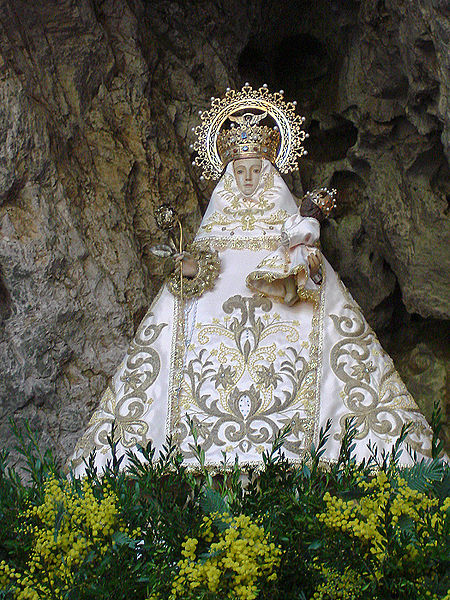
Our Lady of Covadonga: is a title of the Blessed Virgin Mary and the name of a Marian shrine devoted to her at Covadonga, Asturias. The shrine in northwestern Spain rose to prominence following the Battle of Covadonga in about 720, which was the first defeat of the Moors during their invasion of Spain. A statue of the Virgin Mary, secretly hidden in one of the caves, was believed to have miraculously aided the Christian victory.
Our Lady of Covadonga is the patron of Asturias, and a basilica was built to house the current statue. St Pope John Paul II visited the shrine to honour Our Lady of Covadonga to honour, whose feast day is 8 September.
Our Lady of Health of Vailankanni: This is the title given to the Blessed Virgin Mary by people as she twice appeared in the town of Velankanni, Tamil Nadu, India, in the 16th to 17th centuries. The Feast of the Nativity of Mary, is also commemorated as the feast of Our Lady of Good Health. The celebration starts on 29 August and ends on the day of the feast. The feast day prayers are said in Tamil, Marathi, East Indian, Malayalam, Telugu, Kannada, Konkani, Hindi and English.
Our Lady of Meritxell: This is an Andorran Roman statue depicting an apparition of the Virgin Mary. Our Lady of Meritxell is the patron saint of Andorra. One 6 January in the late 12th century, villagers from Meritxell, Andorra were going to Mass in Canillo. Though it was winter, they found a wild rose in bloom by the roadside. At its base was a statue of the Virgin and Child. They placed the statue in a chapel in the church in Canillo. The next day the statue was found sitting under the wild rose again. Villagers from Encamp took the statue to their church but the next day the statue had returned to the rose bush. Though it was snowing, an area the size of a chapel was completely bare and the villagers of Meritxell took this to mean that they should build a chapel to house the statue and so they did. On 8-9 September 1972 the chapel burned down and the statue was destroyed, a copy now resides in the new Meritxell Chapel.
The feast day of Our Lady of Meritxell is 8 September and the Andorran National Day.
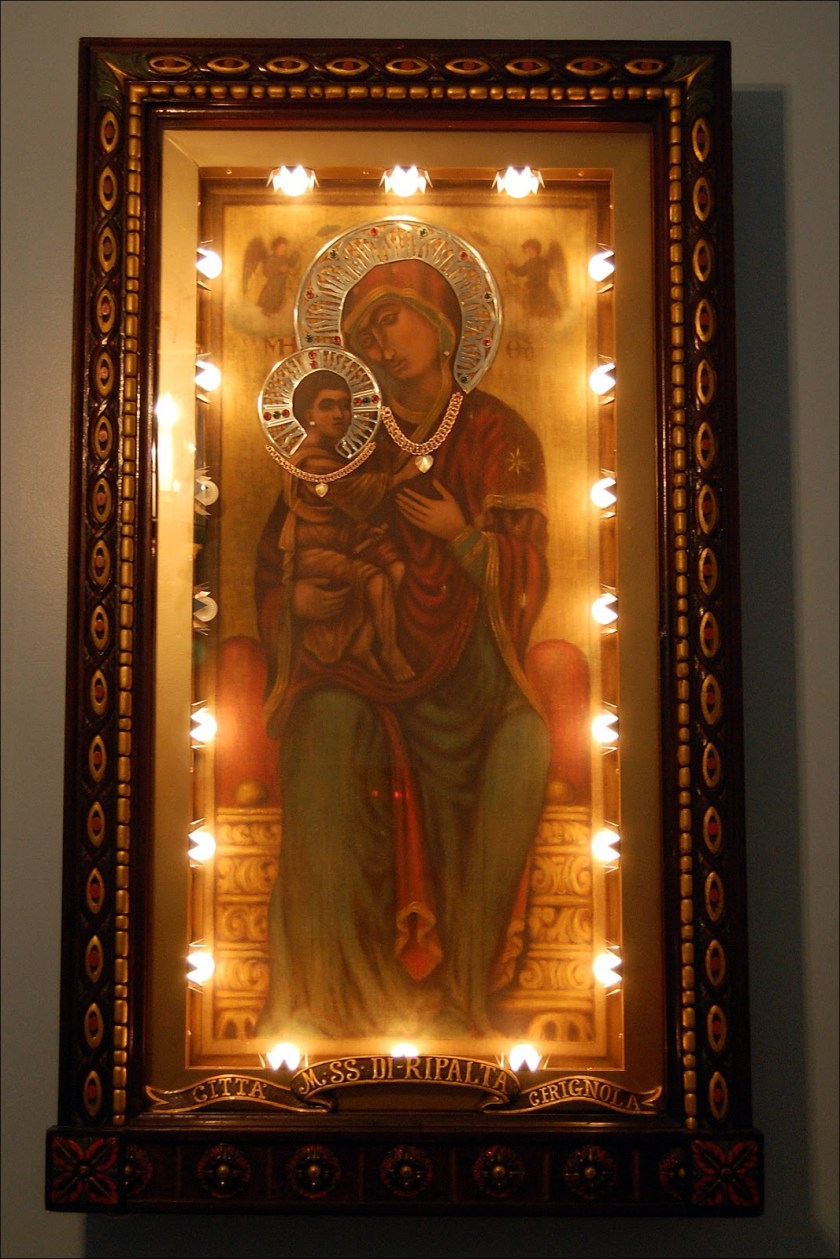
Our Lady of Ripalta: Patroness of Cerignola, Foggia in Puglia.
___
St Adam Bargielski
St Adela of Messines
Bl Alanus de Rupe
St Corbinian
St Disibod of Disenberg
St Ethelburgh of Kent
St Faustus of Antioch
St Isaac the Great
St István Pongrácz
St Kingsmark
St Peter of Chavanon
Bl Seraphina Sforza
St Pope Sergius I
St Timothy of Antioch
Bl Wladyslaw Bladzinski
—
Martyrs of Alexandria – (5 saints)
A group of Christians martyred together in the persecutions of Diocletian – Ammon, Dio, Faustus, Neoterius and Theophilus. Martyred in Alexandria, Egypt.
Martyrs of Japan – (21 beati):
A group of 21 missionaries and converts who were executed together for their faith.
• Antonio of Saint Bonaventure
• Antonio of Saint Dominic
• Dominicus Nihachi
• Dominicus of Saint Francis
• Dominicus Tomachi
• Francisco Castellet Vinale
• Franciscus Nihachi
• Ioannes Imamura
• Ioannes Tomachi
• Laurentius Yamada
• Leo Aibara
• Lucia Ludovica
• Ludovicus Nihachi
• Matthaeus Alvarez Anjin
• Michaël Tomachi
• Michaël Yamada Kasahashi
• Paulus Aibara Sandayu
• Paulus Tomachi
• Romanus Aibara
• Thomas of Saint Hyacinth
• Thomas Tomachi
Died on 8 September 1628 in Nagasaki, Japan
Beatified on 7 May 1867 by Pope Pius XI
Martyred in England:
Bl John Norton
Bl Thomas Palaser
Martyred in the Spanish Civil War:
• Blessed Adrián Saiz y Saiz
• Blessed Apolonia Lizárraga Ochoa de Zabalegui
• Blessed Bonifacio Rodríguez González
• Blessed Dolores Puig Bonany
• Blessed Eusebio Alonso Uyarra
• Blessed Ismael Escrihuela Esteve
• Blessed Josefa Ruano García
• Blessed Josep Padrell Navarro
• Blessed Mamerto Carchano y Carchano
• Blessed Marino Blanes Giner
• Blessed Miguel Beato Sánchez
• Blessed Pascual Fortuño Almela
• Blessed Segimon Sagalés Vilá
• Blessed Tomàs Capdevila Miquel
Thought for the Day – 7 September – – Saturday of the Twenty-second week in Ordinary Time, Year C and a Marian Saturday
The Heart of Mary Saturdays and the Saturday Rosary
By Sr M Jean Frisk SSM
In the message of Fatima, especially in the apparitions of 13 June 13 and 13 July 1917, Mary drew attention to the custom of devoting Saturdays to her and praying the Rosary in reparation. Lucia, the eldest of the three children heard the following on 13 June:
“My child, behold my heart surrounded with thorns which ungrateful men place therein at every moment by their blasphemies and ingratitude. You, at least, try to console me, and tell them that I promise to help, at the hour of death, with the graces needed for salvation, whoever, on the First Saturday of five consecutive months, shall confess and receive Holy Communion, recite five decades of the Rosary and keep me company for fifteen minutes while meditating on the fifteen Mysteries of the Rosary with the intention of making reparation to me.”
On 13 July, the children were again admonished to say the Rosary. At this time, the Blessed Mother asked for the consecration of the world to her Immaculate Heart and for communion of reparation on the first Saturday of each month. These messages were accompanied by an appeal and a promise – an appeal for prayer and reparation by the people for their transgressions against the divine law, a promise of peace and love in this life and eternal happiness in the next, on the twofold condition of prayer and amendment.
In 1925, Lucia vouched for this message, saying that Mary would assist us at the hour of death if the first Saturdays of five consecutive months were sanctified with confession, communion, praying the rosary and meditation.
This practice refreshed the custom known as the Rosary Saturdays, popular since the seventeenth century and continued to the present at places of pilgrimage. Both Pope Pius IX and Pope Leo XIII fostered this custom. St Louis Marie Grignion de Montfort (1673-1716), also fostered the rosary in connection with his missions, which often encompassed Saturdays.
Our Morning Offering – 2 September – Monday of the Twenty-second week in Ordinary Time, Year C ‘Month of Our Lady of Sorrows’
Prayer to our Lady of Sorrows By St Bonaventure (1217-1274) Doctor of the Church
O most holy Virgin,
Mother of our Lord Jesus Christ,
by the overwhelming grief you experienced
when you witnessed the martyrdom,
the crucifixion
and the death, of your divine Son,
look upon me with eyes of compassion
and awaken in my heart a tender
commiseration for those sufferings,
as well as a sincere detestation
of my sins, in order that,
being disengaged from all undue affection
for the passing joys of this earth,
I may sigh after the eternal Jerusalem
and that henceforward all my thoughts
and all my actions may be directed
towards this one most desirable object,
the honour, glory and love
to our divine Lord Jesus,
and to the you,
the Holy and Immaculate
Mother of God.
Amen
Christians of the twentieth century can truly identify with Our Lady’s experience of Sorrow. The message of the Stabat Mater focuses on the spiritual and emotional bond which unites Mary and all Christians to the death of her Son on the Cross. From this bond, each Christian can recognise the incredible compassion and holiness in Mary’s character. The Blessed Mother demonstrated her maternal compassion to all generations of Christians by her presence and participation with her Son Jesus in the Sacrifice of the Cross.
There is a mother-son bond that unites Mary with Christ Jesus during His experience of suffering and death. This empathetic bond indicates that Our Lady shared in her Son’s suffering. Mary is Our Lady of Sorrows precisely because her Son, Christ Jesus, bore the sins of the world during His passion and death. As the faithful disciple, Our Blessed Mother invites us to unite our personal suffering with her own. We can share in Jesus’ burden on the Cross, just as Mary did at Calvary.
As Our Lady of Sorrows, Mary also reminds us that Christians are called to expiate for his or her own sins and the sins of their neighbours, and the sins of the world. We can share in the bond between the Blessed Mother and Our Lord through fasting, prayer, and contrition for sin. Our Lady of Sorrows teaches us that the Crown of eternal life in Heaven can be reached when we each choose to share with Our Lord in His suffering and death on the Cross at Calvary.
The compassion of Mary is part of the mystery of the Church community’s sharing in, and offering, the Sacrifice of Jesus for the salvation of the world. Each member of the Church has a role to play in redeeming the world. Our Lady of Sorrows is a guide who inspires and teaches us how to be compassionate.
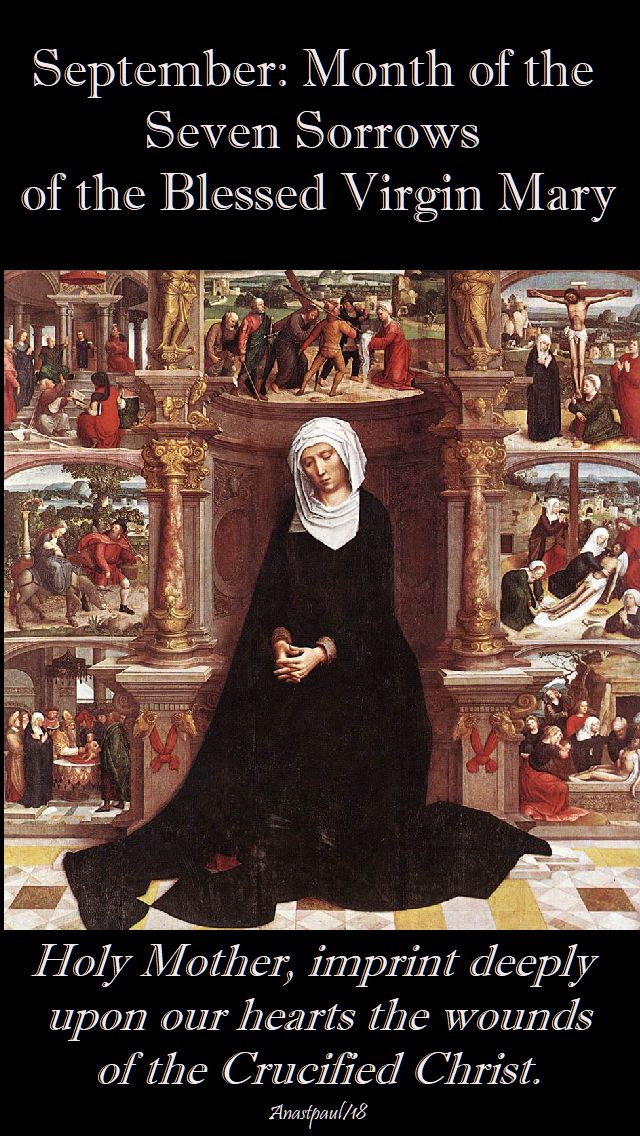
The Seven Sorrows of
the Blessed Virgin Mary
1. The prophecy of Simeon
2. The Flight to Egypt
3. Loss of Child Jesus for 3 days
4. Meeting Jesus carrying His Cross
5. The Crucifixion of Jesus
6. The Pieta – receiving Jesus’ Body
7. The Burial of Jesus
The name of Our Lady of Sorrows centres on the extraordinary and bittersweet suffering the Blessed Mother experienced during Christ’s Passion. As seen in the artwork below, her agony is composed of “The Seven Dolors,” that pierced the Heart of Mary.
During this month of September, we are drawn into the spiritual martyrdom that the Blessed Mother experienced during the physical martyrdom of Jesus. The evils of sin are manifest but conquered through intense suffering. The Blessed Mother’s tears of anguish reflect God’s washing away of sin. If you haven’t ever prayed the Seven Sorrows chaplet, you might want to consider exploring this devotion.
Our Morning Offering – 31 August – Saturday of the Twenty-first week in Ordinary Time, Year C and the last day of the Month of the Immaculate Heart of Mary
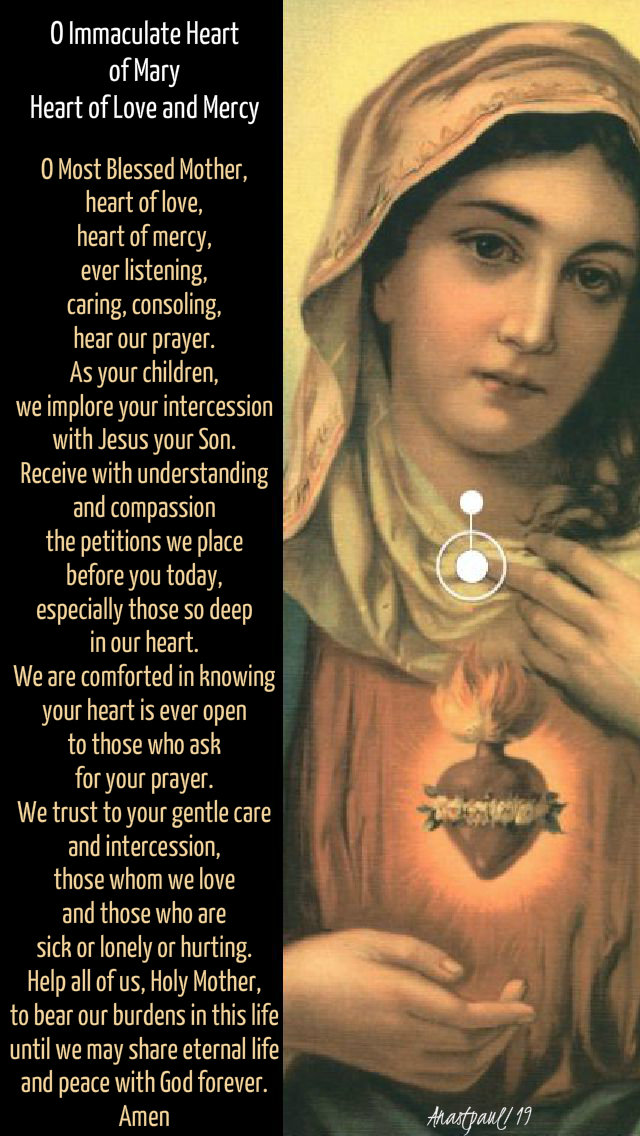
O Immaculate Heart of Mary Heart of Love and Mercy
O Most Blessed Mother,
heart of love,
heart of mercy,
ever listening, caring, consoling,
hear our prayer.
As your children,
we implore your intercession
with Jesus your Son.
Receive with understanding
and compassion
the petitions we place before you today,
especially those so deep in our heart.
We are comforted in knowing
your heart is ever open
to those who ask for your prayer.
We trust to your gentle care and intercession,
those whom we love
and those who are sick or lonely or hurting.
Help all of us, Holy Mother,
to bear our burdens in this life
until we may share eternal life
and peace with God forever.
Amen
Our Morning Offering – 24 August – Feast of Saint Bartholomew, Apostle and a Marian Saturday
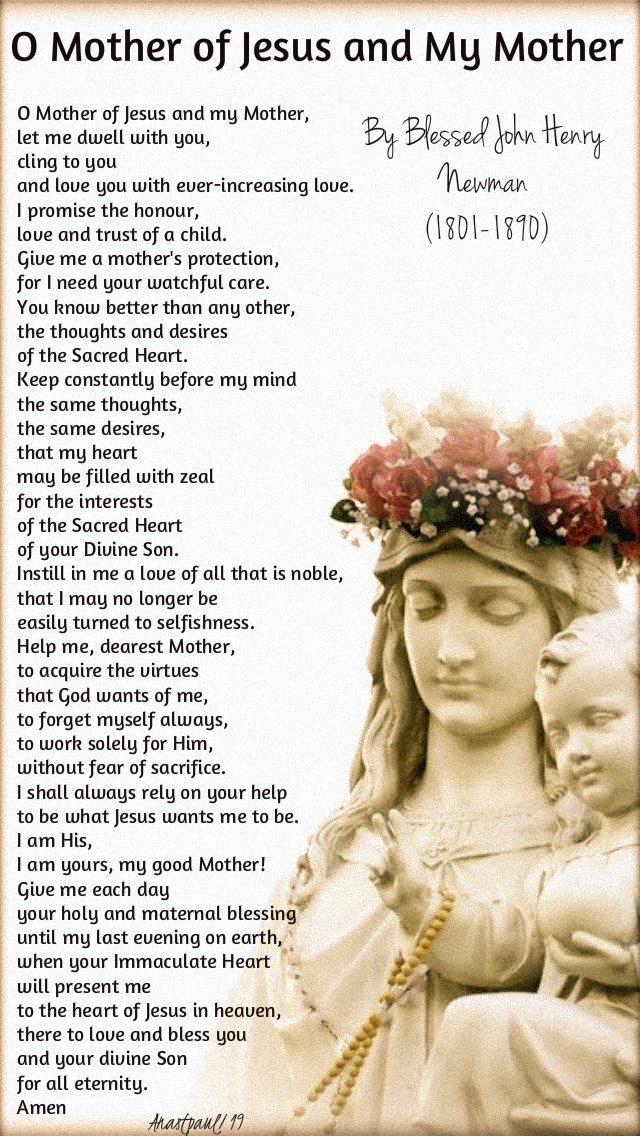
O Mother of Jesus and My Mother By Blessed John Henry Newman (1801-1890)
O Mother of Jesus and my Mother,
let me dwell with you, cling to you
and love you with ever-increasing love.
I promise the honour, love and trust of a child.
Give me a mother’s protection,
for I need your watchful care.
You know better than any other,
the thoughts and desires of the Sacred Heart.
Keep constantly before my mind
the same thoughts, the same desires,
that my heart may be filled with zeal
for the interests of the Sacred Heart of your Divine Son.
Instil in me a love of all that is noble,
that I may no longer be easily turned to selfishness.
Help me, dearest Mother,
to acquire the virtues that God wants of me,
to forget myself always,
to work solely for Him, without fear of sacrifice.
I shall always rely on your help
to be what Jesus wants me to be.
I am His, I am yours, my good Mother!
Give me each day your holy and maternal blessing
until my last evening on earth,
when your Immaculate Heart
will present me to the heart of Jesus in heaven,
there to love and bless you
and your divine Son for all eternity.
Amen
Thought for the Day – 22 August – Memorial of the Queenship of the Blessed Virgin Mary
Queen of the World and of Peace
Saint Amadeus of Lausanne (1108-1159)
Bishop
An excerpt from a Sermon
Observe how fitting it was that even before her assumption, the name of Mary shone forth wondrously throughout the world. Her fame spread everywhere even before she was raised above the heavens in her magnificence. Because of the honour due her Son, it was indeed fitting for the Virgin Mother to have first ruled upon earth and then be raised up to heaven in glory. It was fitting that her fame be spread in this world below, so that she might enter the heights of heaven on overwhelming blessedness. Just as she was borne from virtue to virtue by the Spirit of the Lord, she was transported from earthly renown to heavenly brightness.
So it was, that she began to taste the fruits of her future reign while still in the flesh. At one moment she withdrew to God in ecstasy, at the next, she would bend down to her neighbours with indescribable love. In heaven angels served her, while here on earth she was venerated by the service of men. Gabriel and the angels waited upon her in heaven. The virgin John, rejoicing that the Virgin Mother was entrusted to him at the cross, cared for her with the other apostles here below. The angels rejoiced to see their queen, the apostles rejoiced to see their lady and both obeyed her with loving devotion.
Dwelling in the loftiest citadel of virtue, like a sea of divine grace or an unfathomable source of love that has everywhere overflowed its banks, she poured forth her bountiful waters on trusting and thirsting souls. Able to preserve both flesh and spirit from death, she bestowed health-giving salve on bodies and souls. Has anyone ever come away from her troubled or saddened or ignorant of the heavenly mysteries? Who has not returned to everyday life gladdened and joyful because his request had been granted by the Mother of God?
She is a bride, so gentle and affectionate and the mother of the only true bridegroom. In her abundant goodness, she has channelled the spring of reason’s garden, the well of living and life-giving waters, that pour forth in a rushing stream from divine Lebanon and flow down from Mount Zion, until they surround the shores of every far-flung nation. With divine assistance, she has redirected these waters and made them into streams of peace and pools of grace. Therefore, when the Virgin of virgins was led forth by God and her Son, the King of kings. amid the company of exulting angels and rejoicing archangels, with the heavens ringing with praise, the prophecy of the psalmist was fulfilled, in which he said to the Lord:
At your right hand stands the queen, clothed in gold of Ophir.
Quote/s of the Day – 22 August – The Memorial of The Queenship of Mary, Holy Mother of God
“Let Heaven sustain me in its embrace, because I am honoured above it. For heaven was not thy mother but Thou hast made it thy throne. How much more honourable and venerable than the throne of a king is His mother.”
St Ephrem (306-373) Doctor of the Church
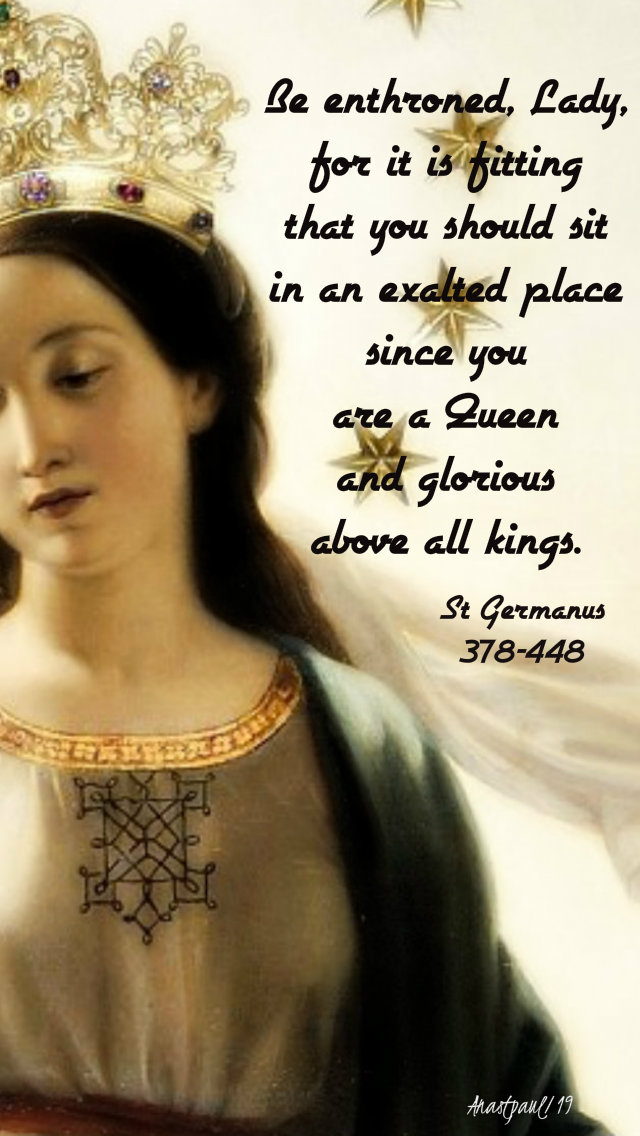
“Be enthroned, Lady, for it is fitting that you should sit in an exalted place since you are a Queen and glorious above all kings.”
St Germanus (378-448)
“O my Lady, my Sovereign, You who rule over me, Mother of my Lord . . . Lady among handmaids, Queen among sisters.”
St Ildephonsus (607-670)
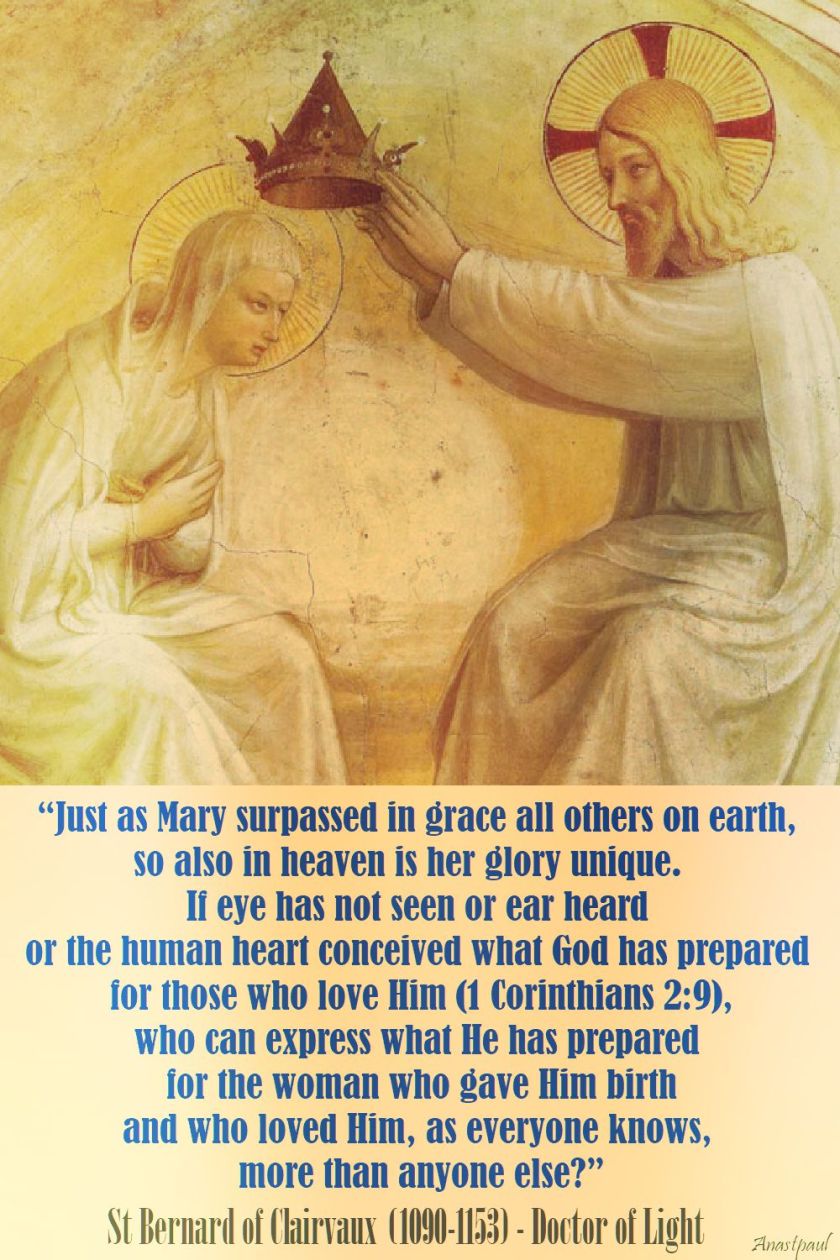
“Just as Mary surpassed in grace all others on earth, so also in heaven is her glory unique. If eye has not seen or ear heard or the human heart conceived what God has prepared for those who love Him (1 Corinthians 2:9), who can express what He has prepared for the woman who gave Him birth and who loved Him, as everyone knows, more than anyone else?”
St Bernard of Clairvaux (1090-1153) – Doctor of Light – Mellifluous Doctor
One Mi nute Reflection – 22 August – The Memorial of The Queenship of Mary, Holy Mother of God – Today’s Gospel: Luke 1:26–38
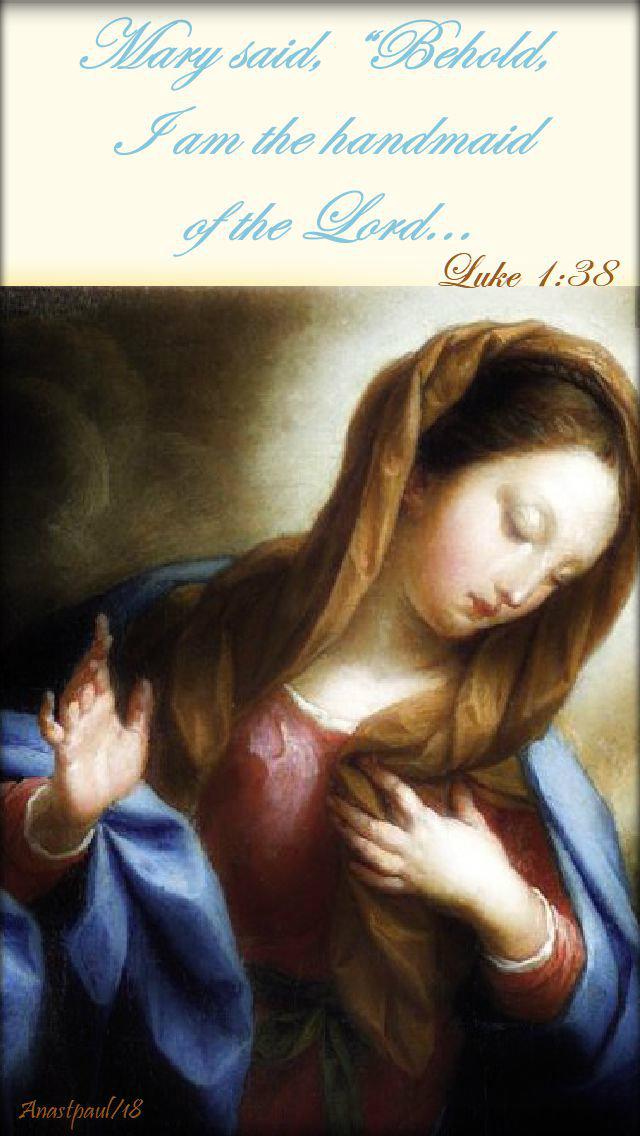
And Mary said, “Behold, I am the handmaid of the Lord, let it be to me, according to your word.” And the angel departed from her...Luke 1:38
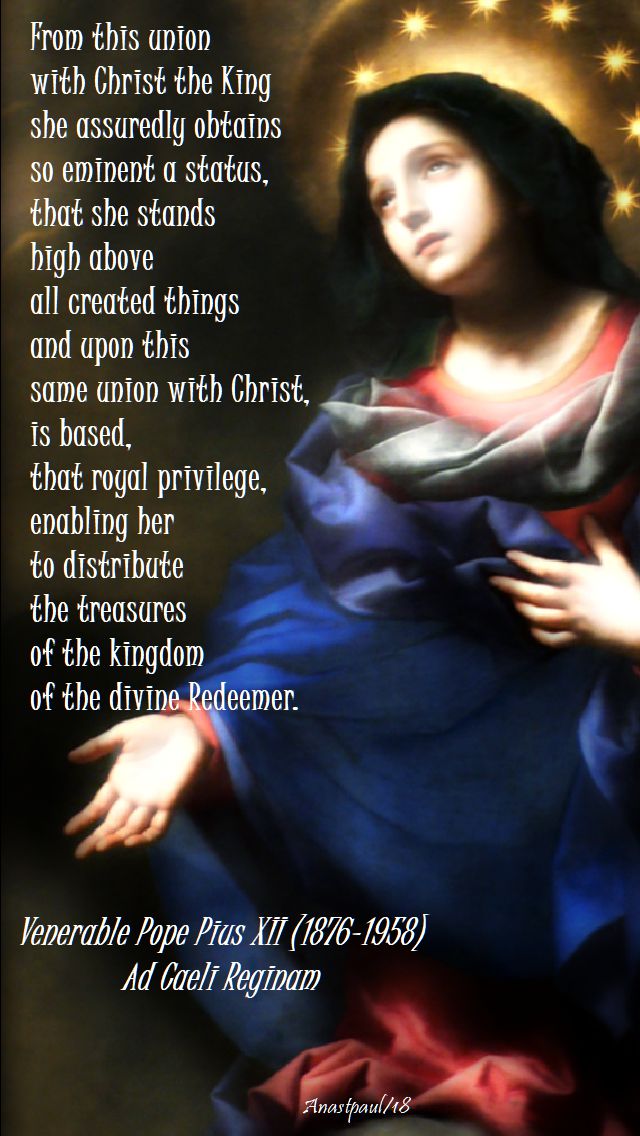
REFLECTION – “With the certainty of faith we know that Jesus Christ is king in the full, literal and absolute sense of the word; for He is true God and man. This does not, however, prevent Mary from sharing His royal prerogatives, though in a limited and analogous manner; for she was the Mother of Christ and Christ is God and she shared in the work of the divine Redeemer, in His struggles against enemies and in the triumph He won over them all. From this union with Christ the King she assuredly obtains so eminent a status that she stands high above all created things and upon this same union with Christ is based that royal privilege, enabling her to distribute the treasures of the kingdom of the divine Redeemer. And lastly, this same union with Christ is the fountain of the inexhaustible efficacy of her motherly intercession, in the presence of the Son and of the Father.
Without doubt, then, does our holy Virgin possess a dignity that far transcends all other creatures. In the eyes of her Son, she takes precedence over everyone else. In order to help us understand the pre-eminence that the Mother of God enjoy,s over all creation, it would help to remember that from the first moment of her conception, the holy Virgin was filled with such a plenitude of grace as to surpass the graces, enhancing all the saints. Recall what our predecessor Pius IX, of blessed memory, wrote in his Bull Ineflabilis Deus: “More than all the angels and all the saints has God ineffable freely endowed Mary with the fullness of the heavenly gifts that abound in the divine treasury and she, preserving herself ever immaculately clean, from the slightest taint of sin, attained a fullness of innocence and holiness, so great, as to be unthinkable apart from God Himself, a fullness that no one other than God will ever possess.”…Venerable Pope Pius XII (1876-1958) – Excerpted from Ad Caeli Reginam
PRAYER – Almighty God, our Father, You have given us Mary, the Mother of Your Son, to be our Mother and our Queen. Grant that, supported by her prayers, we may come to the kingdom of heaven and to the glory destined for Your children. We make our prayer through our Lord Jesus Christ, in the unity of the Holy Spirit, one God forever, amen.
Our Morning Offring – 22 August – Celebrating the Queenship of Mary
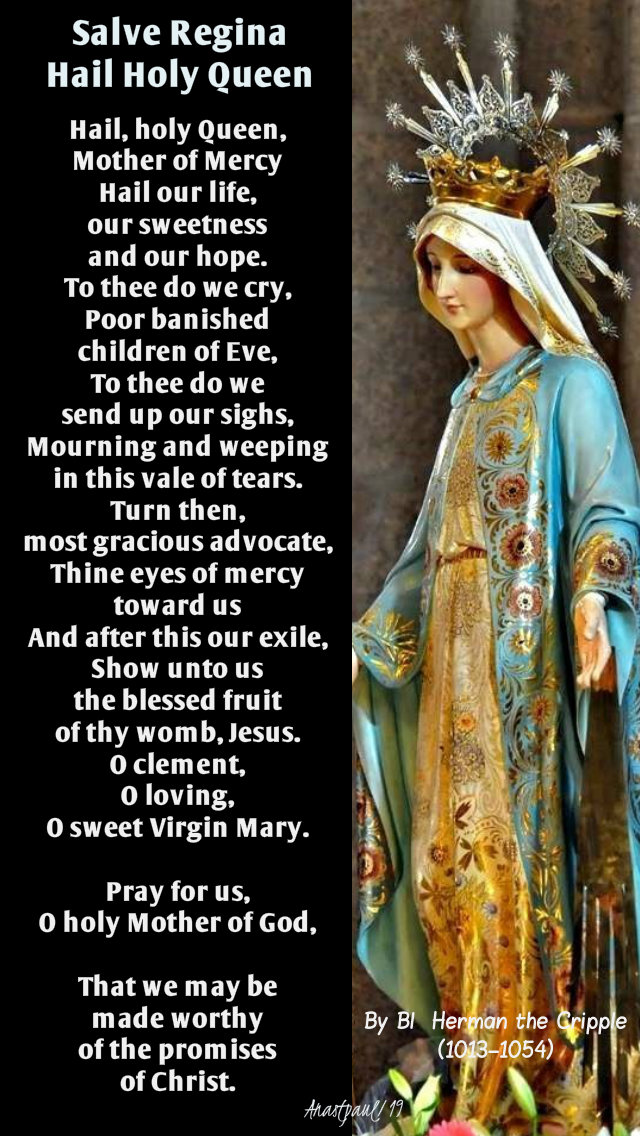
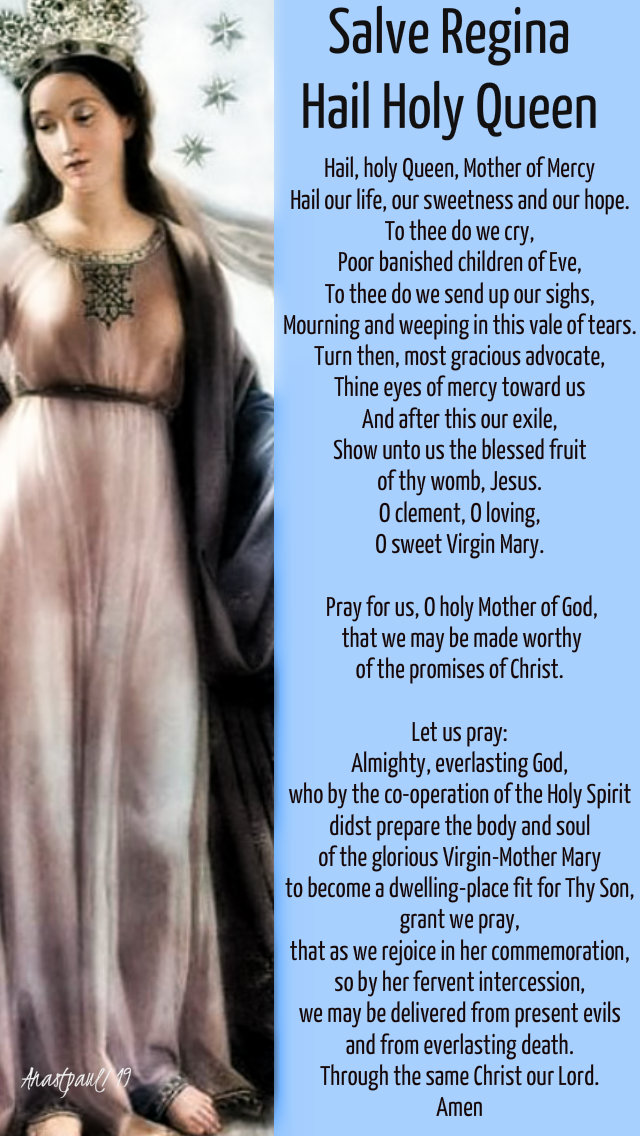
Salve Regina Hail Holy Queen
Hail, holy Queen, Mother of Mercy
Hail our life, our sweetness and our hope.
To thee do we cry,
Poor banished children of Eve,
To thee do we send up our sighs,
Mourning and weeping in this vale of tears.
Turn then, most gracious advocate,
Thine eyes of mercy toward us
And after this our exile,
Show unto us the blessed fruit of thy womb, Jesus.
O clement, O loving, O sweet Virgin Mary.
℣ Pray for us, O holy Mother of God,
℟ that we may be made worthy
of the promises of Christ.
Let us pray:
Almighty, everlasting God,
who by the co-operation of the Holy Spirit
didst prepare the body and soul
of the glorious Virgin-Mother Mary
to become a dwelling-place fit for Thy Son,
grant we pray,
that as we rejoice in her commemoration,
so by her fervent intercession,
we may be delivered from present evils
and from everlasting death.
Through the same Christ our Lord.
Amen
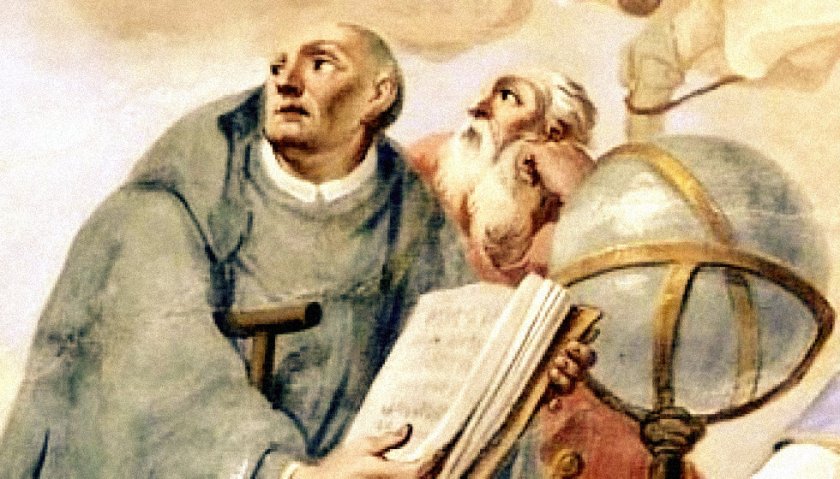
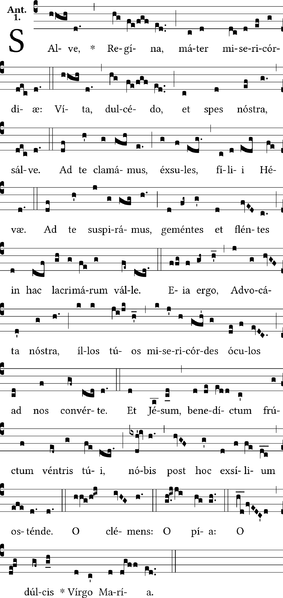
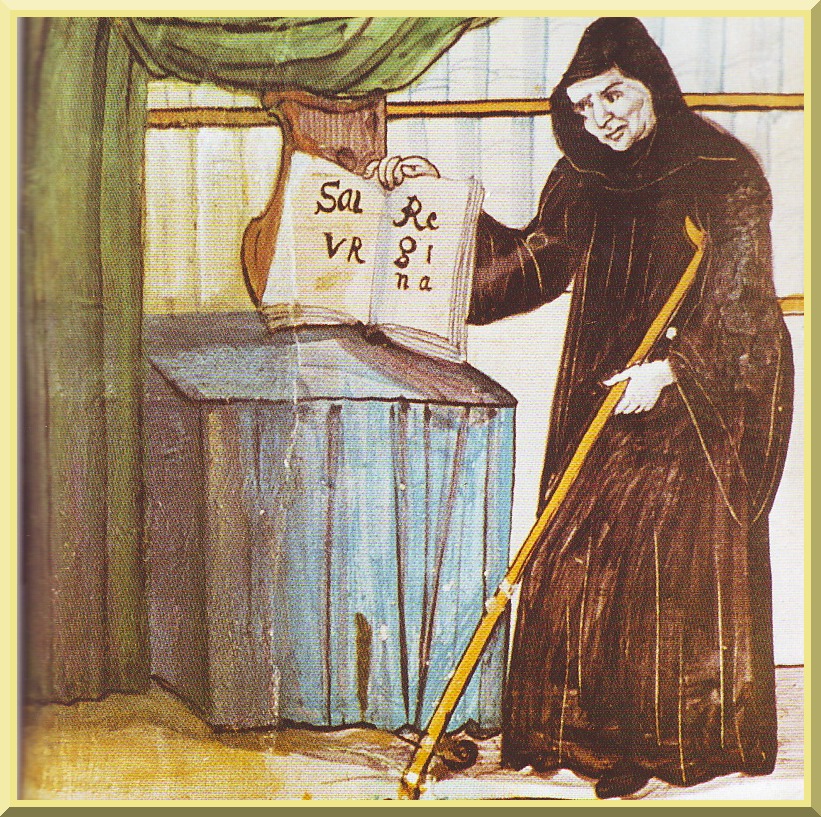
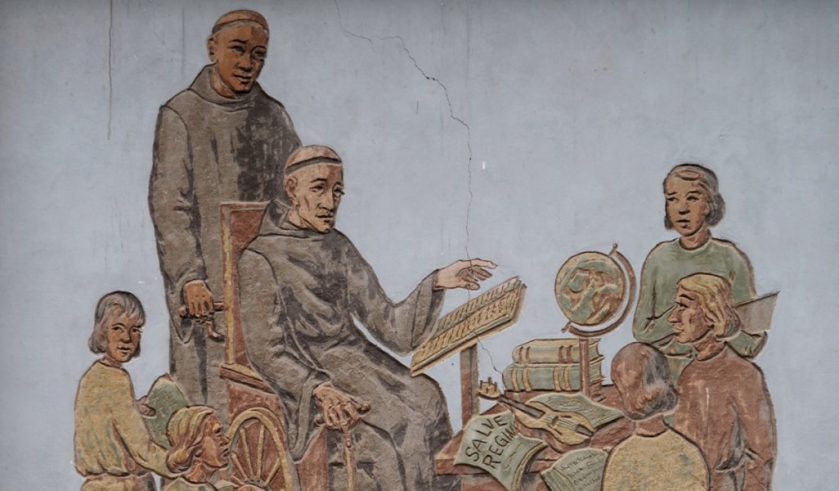
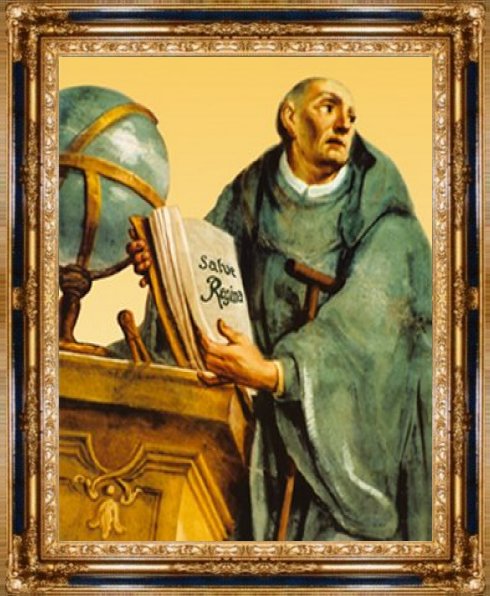
The Hail Holy Queen or Salve Regina is a choral anthem going back to the eleventh century. Since the thirteenth century it is the last evening chant in many religious communities. The authorship is not clearly defined. The Salve is first mentioned in a meditation by Anselm II, Bishop of Lucca, 1073-86 (PL 184, 1078-98) and (erroneously) to Hermannus Contractus (1013-54) of Reichenau.
The “Hail, Holy Queen” is a salutation deprecatonia, a greeting of petition and intercession. Mary is called mother of mercy because Christ her Son, is the incarnation of God’s love and mercy. Giving us Christ, she gave us, sinful humans, the life and hope we need (as baptised children of Eve) to survive in this vale of tears. This antiphon is not part of the rosary but represents the same spirit. It is part of the official prayer of the Church (Liturgy of the Hours: Vespers and/or Compline) and thus is even more precious than the rosary. Sung, it becomes a wonderful expression of our spiritual intimacy with Mary.
It is interesting that it was a Domenican (like today’s Saint Giacomo Bianconi), Blessed Jordan of Saxony OP (1190-1237) who initiated the custom of singing the Salve Regina in procession each night after Compline in the Dominican Order, to ask Our Lady’s protection of the brothers against temptations from the devil. This is a custom still practised by Dominicans throughout the world and by our community each night.
Queenship of Mary (Memorial): On 22 August, the Church celebrates a Feast in honour of the Queenship of Mary. The Queenship can be considered a prolongation of the celebration of the Assumption. The Memorial of the Queenship of Mary – 22 August – A Marian feast day decreed by Pope Pius XII on 11 October 1954, in his encyclical Ad caeli reginam to recognise and celebrate the Blessed Virgin Mary as Queen of the world, of the universe, of the Angels, of Heaven, Prophets, Apostles, Martyrs, Confessors, Virgins, all Saints,of Families, Queen conceived without original sin Queen assumed into Heaven, Queen of the Most Holy Rosary, Queen of Mercy, Queen of Peace. Amen, Holy Queen and Mother! Here too: https://anastpaul.wordpress.com/2017/08/22/the-memorial-of-the-queenship-of-mary-22-august/
St Andrew of Fiesole
St Anthusa of Seleucia
St Antoninus of Rome
St Arnulf of Eynesbury
St Athanasius of Tarsus
Bl Bernard Perani
St Dalmau Llebaría Torné
Bl Élie Leymarie de Laroche
St Epictetus of Ostia
St Ethelgitha of Northumbria
St Fabrician of Toledo
St Felix of Ostia Bl Giacomo/James Bianconi OP (1220–1301)
St Gunifort
St Joan Farriol Sabaté St John Kemble (1599 – 1679) Martyr Biography: https://anastpaul.com/2018/08/22/saint-of-the-day-22-august-st-john-kemble-1599-1679-martyr/
St John Wall
St Josep Roselló Sans
St Julio Melgar Salgado
St Maprilis of Ostia
St Martial of Ostia
St Maurus of Rheims
St Narciso de Esténaga y Echevarría
St Philibert of Toledo
Bl Richard Kirkman
St Saturninus of Ostia
Bl Simeon Lukach
St Sigfrid of Wearmouth
St Symphorian of Autun
St Thomas Percy
St Timothy of Rome
Bl William Lacey
_
Martyred in the Spanish Civil War:
• Blessed Dalmau Llebaría Torné
• Blessed Joan Farriol Sabaté
• Blessed Josep Roselló Sans
• Blessed Julio Melgar Salgado
• Blessed Narciso de Esténaga y Echevarría
Thought for the Day – 19 August – The Memorial of St John Eudes Orat. (1601-1680) “Apostle of Two Hearts”
St John Eudes captured the devotion to the Sacred Heart of Jesus and the Immaculate Heart of Mary by honouring them in the liturgy. Thanks to this saint, Holy Cross priests have as their patron Jesus’ Sacred Heart and Notre Dame has a Basilica dedicated to the Sacred Hearts of Jesus and Mary.
In fact, even though John was Canonised a saint after the Basilica was constructed, he is depicted there in a stained glass window leading people in devotion to the Immaculate Heart of Mary.
John’s spirituality focused on the love of Jesus and Mary, symbolised in their sacred hearts. He began a feast day for people to honour the heart of Mary and the Sacred Heart of Jesus, these feast days spread quickly and were taken up around the Church. While John was not the first to be devoted to the Sacred Hearts of Jesus and Mary, he was the first to capture this devotion in the liturgy, which gave the Church a way to participate and spread it.
He died after giving a parish mission in his old age that left him sick and weak—he preached outdoors, in the winter, every day for nine weeks and never recovered. He died on this date in 1680.
John Eudes is probably best known for the central theme of his writings – Jesus as the source of holiness and Mary as the model of the Christian life. His devotion to the Sacred Heart and to the Immaculate Heart led Pope Pius XI to declare him the father of the liturgical cult of the Hearts of Jesus and Mary.
He believed in the unity of the hearts of Jesus and Mary and wrote: ”You must never separate what God has so perfectly united. So closely are Jesus and Mary bound up with each other that whoever beholds Jesus, sees Mary, whoever loves Jesus, loves Mary, whoever has devotion to Jesus, has devotion to Mary.”
St John Eudes, you help us form our hearts in the shape of Jesus’ Sacred Heart and our lives in the obedience and love of the Immaculate Heart of His Mother — pray for us!
Our Morning Offering – 17 August – Saturday of the Nineteenth week in Ordinary Time, Year C and a Marian Saturday
The Praises of Mary “Assumption” Poem by Saint Anthony of Padua (1195-1231) Doctor of the Church
O how wondrous is the dignity of the glorious Virgin!
She merited to become the mother of Him
who is the strength and beauty of the angels
and the grandeur of all the saints.
Mary was the seat of our sanctification,
that is to say,
the dwelling place of the Son
who sacrificed Himself for us.
“And I shall glorify the place where my feet have stood.”
The feet of the Saviour signify His human nature.
The place where the feet of the Saviour stood
was the Blessed Mary,
who gave Him His human nature.
Today the Lord glorifies that place,
since He has exalted Mary
above the choirs of the angels.
That is to say,
the Blessed Virgin,
who was the dwelling of the Saviour,
has been assumed bodily into heaven.
Thought for the Day – 15 August – Solemnity of the Assumption of the Blessed Virgin Mary into Heaven
You have Borne for us the Clothing of Immortality
Saint John Damascene (675-749)
Priest and Father and Doctor of the Church
An excerpt from his Homily 9 – On the Dormition of the Blessed Virgin Mary
“Once indeed God ejected the mortals and first parents of the human race from the paradise of Eden, when they had drunk deeply, from the wine of disobedience and had become so affected by the hangover of sin, through the intoxication of that transgression, which led to the sleepiness of the mind’s eye. Now, however, shall not paradise receive her who repelled the onslaught of all sin, producing the seed of obedience to God and Father and bringing forth life, for all races of mortal men? How can death devour this truly blessed woman, who gave birth to the whole person of the Word of God through union with God? How can hell receive her? When Christ, who is the way and the truth, said Where I am, there will my servant be also, why would there not be a dwelling for His own mother with Him with an even greater justification? It is well said that precious in the sight of the Lord God of Hosts, is the death of His saints but even more precious, is the passing of the Mother of God from this life.
Then Adam and Eve, the founders of our race, exclaimed with a loud voice in great rejoicing: “Blessed are you, O daughter, who bore for us the penalties of the commands that had been broken. When you had gained a mortal body from us, you gave birth to a covering of immortality for us. You repaid us so that it might be well with us, since you received birth from our loins. From beyond the grave you have called us back to our ancient seat, we closed paradise for ourselves but you made open the way of the tree of life. Through our actions, sadness came forth from happiness, through you even more joyful things have returned from sorrow. In what possible way could you be acceptable to death, O Immaculate one? You are the bridge of life and the ladder to heaven, you are a boat over the sea of death reaching to immortality.”
But the woman herself, as she did not shrink from the truth, said: “Into Your hands, my Son, I commend my spirit. Receive this soul which is dear to You, which You have preserved free from any sin. I hand over my body, not to the earth but to You. Take me to Yourself, that where You are, You, the child of my womb, so there I also may be Your companion. I am hastening to You, who have often come to me on this side of that long distance.”
When she had said this, she heard in reply: “Come to my rest, my blessed Mother, arise, come, my beloved, most blessed among all women. Behold, the winter is ended. You are all fair, my beloved and there is no spot of stain found in you, the odour of your ointments are more precious than all other aromas.”
++++++++++
There is an invocation in a Litany to Our Lord in which we ask: ut ad celestia desideria erigas, te rogamus, audi nos – that our souls be raised to the desire for celestial things, we pray Thee, hear us. This invocation should be the conclusion of our meditation on the Assumption of Our Lady. We should ask, that we may love the celestial happiness of Our Lady, to give her glory and that we may one day be with her in Paradise. We should also love and meditate on her joys, as a way to accept with peace and resignation the sorrows and sufferings God sends us, so that we might prove our love for Him.
Quote of the Day – 15 August – Solemnity of the Assumption of the Blessed Virgin Mary into Heaven
“In the bodily and spiritual glory which she possesses in heaven, the Mother of Jesus, continues in this present world as the image and first flowering of the Church, as she is to be perfected in the world to come. Likewise, Mary shines forth on earth, until the day of the Lord shall come (cf 2 Peter 3:10), as a sign of certain hope and comfort for the pilgrim People of God.”
Lumen Gentium
Dogmatic Constitution on the Church #68.
“While she lived on this earth she could only be close to a few people. Being in God, who is close to us, actually, “within” all of us, Mary shares in this closeness of God. Being in God and with God, she is close to each one of us, knows our hearts, can hear our prayers, can help us with her motherly kindness and has been given to us, as the Lord said, precisely as a “mother” to whom we can turn at every moment.”
Pope Benedict XVI
“As soon as we apprehend by faith, the great fundamental truth, that Mary is the Mother of God, other wonderful truths follow in its train and one of these, is that, she was exempt from the ordinary lot of mortals, which is not only to die but to become earth to earth, ashes to ashes, dust to dust.”
One Minute Reflection – 15 August – Solemnity of the Assumption of the Blessed Virgin Mary into Heaven, Gospel: Luke 1:39–56
My soul glorifies the Lord ... Luke 1:46
REFLECTION – “We heard the Song of Mary, the Magnificat – it is the song of hope, it is the song of the People of God walking through history. It is the song many saints, men and women, some famous and very many others unknown to us but known to God, mums, dads, catechists, missionaries, priests, sisters, young people, even children and grandparents – these have faced the struggle of life while carrying in their heart the hope of the little and the humble. Mary says, “My souls glorifies the Lord” – today, the Church too sings this in every part of the world.” … Pope Francis (Holy Mass on the Solemnity of the Assumption of the Blessed Virgin Mary, 15 August 2013)
PRAYER – My soul glorifies the Lord,
my spirit rejoices in God my Saviour!
For He has blessed me lavishly
and makes me ready to respond.
He shatters my little world
and lets me be poor before Him.
He takes from me all my plans
and gives me more than I can hope for or ask.
He gives me opportunities
and the ability to become free
and to burst through my boundaries.
He gives the strength to be doing,
to build on Him alone,
for He shows Himself
as the ever greater One in my life.
He has made known to me this!
It is in my being servant that it becomes possible.
For God’s kingdom to break through
here and now.
Amen. A Magnificat Translated from the German by Olga Warnke of the Institute of the Blessed Virgin Mary
Our Morning Offering – 15 August – Solemnity of the Assumption of the Blessed Virgin Mary into Heaven
The Ark Which God Has Sanctified
The ark which God has sanctified,
Which He has filled with grace,
Within the temple of the Lord
Has found a resting-place.
More glorious than the seraphim,
This ark of love divine,
Corruption could not blemish her
Whom death could not confine.
God-bearing Mother, Virgin chaste,
Who shines in heaven’s sight;
She wears a royal crown of stars
Who is the door of Light.
To Father, Son and Spirit blest
may we give endless praise
With Mary, who is Queen of heaven,
Through everlasting days.
Amen.
The Ark Which God Has Sanctified is written by the Benedictine Nuns of Stanbrook Abbey. In the Divine Office (1974) it is sung with Morning Prayer on 15 August, the Solemnity of the Assumption of the Blessed Virgin Mary. It is set to the 1836 tune – St Peter (Reinagle) by Alexander Robert Reinagle (1799-1877).
Solemnity of the Assumption of the Blessed Virgin Mary (in the US, however, in most countries of Africa, the Solemnity will celebrated on the Sunday following the 15th). The feast celebrates the assumption of the body of the Blessed Virgin Mary into heaven upon her death. According to Pope Benedict XIV, it is a probable opinion, which it is impious to deny, though not an article of faith but has since in 1950 has been raised to a DOGMA of the Faith. The origin of the feast day is not known but it was celebrated in Palestine before the year 500. It is a holy day of obligation, its vigil being a fast day, in many English-speaking countries. Among the many masters who have painted the subject of the Assumption are Fra Angelico, Ghirlandajo, Rubens, Del Sarto and Titian.
Patronages: Acadians, Cajuns, Cistercian Order, Cistercians, fish dealers, fish-mongers, French air crews, harness makers, France, Guatemala, India, Jamaica, Malta, Paraguay, Slovakia, east Africa (region of east Africa which includes diverse countries, proclaimed on 15 March 1952 by Pope Pius XII) South Africa (this is not a region but a country) and the Assumption is, therefore, the Patronal Feast of the Country of South Africa – proclaimed on 15 March 1952 by Pope Pius XII), 24 dioceses, 38 cities.
St Alipius of Tagaste
Bl Alfred of Hildesheim
Bl Agustín Hurtado Soler
St Arduinus of Rimini
Bl Claudio Granzotto
Bl George Halley Bl Isidore Bakanja (c 1887-1909) Martyr
St Napoleon of Alexandria
Bl Pio Alberto del Corona St Simplician (c 320-c 401) Bishop and Successor of St Ambrose (340-397) Doctor of the Church in the Archdiocese of Milan. Details of the life of St Simplician here:https://anastpaul.wordpress.com/2017/08/15/saint-of-the-day-15-august-st-simplician-of-milan/ St Tarcisius (3rd century) Martyr About St Tarcisius:
Martyrs of Nicomedia – 3 saints: Three Christians martyred together. No details survive but the names – Eutychian, Philip and Straton. They were martyred in Nicomedia, Bithynia (in modern Turkey).
Martyred in the Mexican Revolution: 4 Saints –
St David Roldán Lara
St Luis Batiz Sainz
St Manuel Moralez
St Salvador Lara Puente
Martyred in the Spanish Civil War: Thousands of people were murdered in the anti-Catholic persecutions of the Spanish Civil War from 1934 to 1939.
• Blessed Agustì Ibarra Angüela
• Blessed Carmelo Sastre y Sastre
• Blessed Clemente Vea Balaguer
• Blessed Francisco Míguez Fernández
• Blessed Ildefonso Alberto Flos
• Blessed Jaume Bonet Nadal
• Blessed Joan Ceró Cedó
• Blessed Josep Santonja Pinsach
• Blessed Juan Francisco Barahona Martín
• Blessed Juan Mesonero Huerta
• Blessed Luis Ros Ezcurra
• Blessed Manuel Formigo Giráldez
• Blessed Miguel Alberto Flos
• Blessed Sebastià Balcells Tonijuan
• Blessed Severiano Montes Fernández
Thought for the Day – 14 August – Memorial of Saint Maximilian Mary Kolbe OFM Conv (1894 -1941) “Martyr of Charity”
Apostolic Zeal for the Salvation and Sanctification of Souls
An excerpt from the Letters of Saint Maximilian Kolbe
“The burning zeal for God’s glory that motivates you fills my heart with joy. It is sad for us to see in our own time that indifferentism in its many forms is spreading like an epidemic not only among the laity but also among religious. But God is worthy of glory beyond measure and, therefore, it is of absolute and supreme importance, to seek that glory with all the power of our feeble resources. Since we are mere creatures we can never return to Him all that is His due.
The most resplendent manifestation of God’s glory is the salvation of souls, whom Christ redeemed by shedding His blood. To work for the salvation and sanctification of as many souls as possible, therefore, is the preeminent purpose of the apostolic life. Let me, then, say a few words that may show the way toward achieving God’s glory and the sanctification of many souls.
God, who is all-knowing and all-wise, knows best what we should do to increase His glory. Through hHs representatives on earth, He continually reveals His will to us, thus it is obedience and obedience alone, that is the sure sign to us of the divine will. A superior may, it is true, make a mistake but it is impossible for us to be mistaken in obeying a superior’s command. The only exception to this rule is the case of a superior commanding something, that in even the slightest way, would contravene God’s law. Such a superior would not be conveying God’s will.
God alone is infinitely wise, holy, merciful, our Lord, Creator and Father; He is beginning and end, wisdom and power and love, He is all. Everything other than God, has value to the degree, that it is referred to Him, the maker of all and our own redeemer, the final end of all things. It is He who, declaring His adorable will to us through His representatives on earth, draws us to Himself and whose plan is, to draw others to Himself through us and to join us all to Himself in an ever-deepening love.
Look, then, at the high dignity that by God’s mercy belongs to our state in life. Obedience raises us beyond the limits of our littleness and puts us in harmony with God’s will. In boundless wisdom and care, His will guides us to act rightly. Holding fast to that will, which no creature can thwart, we are filled with unsurpassable strength.
Obedience is the one and the only way of wisdom and prudence, for us to offer glory to God . If there were another, Christ would certainly have shown it to us by word and example. Scripture, however, summed up His entire life at Nazareth in the words: He was subject to them, Scripture set obedience as the theme of the rest of His life, repeatedly declaring that He came into the world, to do His Father’s will.
Let us love our loving Father with all our hearts. Let our obedience increase that love, above all, when it requires us to surrender our own will. Jesus Christ crucified is our sublime guide toward growth in God’s love.
We will learn this lesson more quickly through the Immaculate Virgin, whom God has made the dispenser of His mercy. It is beyond all doubt, that Mary’s will represents to us, the will of God Himself. By dedicating ourselves to her, we become in her hands, instruments of God’s mercy even as she was such an instrument in God’s hands. We should let ourselves be guided and led by Mary and rest quiet and secure in her hands. She will watch out for us, provide for us, answer our needs of body and spirit, she will dissolve all our difficulties and worries.”
Quote/s of the Day – 14 August – The Memorial of St Maximillian Kolbe OFM Conv (1894 -1941) “Martyr of Charity”
“A man cannot rise any higher than this. The Immaculate is the highest degree of perfection and sanctity of a creature. No man will ever attain this celestial summit of grace, for the Mother of God is unique. However, he who gives himself without limits, to the Immaculate, will in a short time, attain a very high degree of perfection and procure for God, a very great glory.”
“We do not limit ourselves in love. We want to love the Lord Jesus, with her heart, or rather, that she would love the Lord, with our heart.”
“Let us not forget, that Jesus not only suffered but also rose in glory; so, too, we go to the glory of the Resurrection, by way of suffering and the Cross.”
“The most deadly poison of our times is indifference. And this happens, although the praise of God should know no limits. Let us strive, therefore, to praise Him to the greatest extent of our powers!”
“Be a Catholic! When you kneel before an altar, do it in such a way that others may be able to recognise that you know before Whom you kneel.”
Our Morning Offering – 14 August – The Memorial of St Maximillian Kolbe OFM Conv (1894 -1941) “Martyr of Charity”
Daily Consecration Renewal to the Immaculata By St Maximillian Kolbe
Immaculata,
Queen and Mother of the Church,
I renew my consecration to you for this day
and for always, so that you might use me
for the coming of the Kingdom of Jesus
in the whole world.
To this end, I offer you all my prayers,
actions and sacrifices of this day.
Amen
Our Morning Offering – 13 August – Tuesday of the Nineteenth week in Ordinary Time, Year C and the Memorial of St John Berchmans (1599-1621)
An Act of Consecration to the Blessed Virgin Mary By St John Berchmans (1599-1621)
Holy Mary,
Mother of God and Virgin,
I choose you this day
for my queen, patron and advocate
and firmly resolve and purpose
never to abandon you,
never to say or do anything against you,
nor to permit that aught be done
by others to dishonour you.
Receive me, then, I beg you,
as thy perpetual servant,
assist me in all my actions
and do not abandon me
at the hour of my death.
Amen
Saint of the Day – 13 August – Saint John Berchmans SJ (1599-1621) Jesuit Novice – born Jan Berchmans on 13 March 1599 at Driest, Brabant, Belgium and died on 13 August 1621 at Rome, Italy of natural causes. Patronages – Altar Servers, Jesuit novices and students. He had a special devotion to God’s Mother and to him is owed the Little Rosary of the Immaculate Conception.
Born in 1599 in Diest, a town of northern Belgium near Brussels and Louvain, this angelic young Saint was the oldest of five children. Two of his three brothers became priests and his father, after the death of John’s mother when he was eleven years old, entered religion and became a Canon of Saint Sulpice.
John was a brilliant student from his most tender years, manifesting also a piety which far exceeded the ordinary. Beginning at the age of seven, he studied for three years at the local communal school with an excellent professor. And then his father, wanting to protect the sacerdotal vocation already evident in his son, confided him to a Canon of Diest who lodged students aspiring to the ecclesiastical vocation. After three years in that residence, the family’s financial situation had declined owing to the long illness of the mother and John was told he would have to return and learn a trade. He pleaded to be allowed to continue his studies. And his aunts, who were nuns, found a solution through their chaplain, he proposed to take John into his service and lodge him.
Saint John was ordinarily first in his classes at the large school, a sort of minor seminary, even when he had to double his efforts in order to rejoin his fellow students, all of excellent talent, who sometimes had preceded him for a year or more in an assigned discipline. He often questioned his Superiors as to what was the most perfect thing to say or do in the various circumstances in which he found himself. Such was the humility which caused the young to advance without ceasing on the road to heaven. Later he continued his studies at Malines, also not distant from Diest, under the tutelage of another ecclesiastic, who assigned to him the supervision of three young boys of a noble family. In all that John did he sought perfection and he never encountered anything but the highest favour for his services, wherever he was placed.
He found his vocation through his acquaintance with the Jesuits of that city and manifested his determination to pursue his course, although his father and family opposed it for a time. It had been decided that he would continue his studies at the Jesuit novitiate of Malines, with about 70 other novices. With another young aspirant, he was waiting in the parlour to be introduced, when he saw in the garden a coadjutor Brother turning over the ground in the garden. He proposed to his companion to go and help him, saying: Could we begin our religious life better than with an act of humility and charity? And with no hesitation, both went to offer their assistance. How many young persons in that situation would have thought of such an offer? This incident reveals the profound charity and interior peace which characterised this young religious at all times.
As a novice he taught catechism to the children in the regions around Malines. He made his instructions so lively and interesting that the country folk preferred his lessons to the ordinary sermons. The children became attached to him and in a troop would conduct him back to the novitiate, where he distributed holy pictures, medals and rosaries to them. At the end of his novitiate in 1619 he was destined to go to Rome to begin serious application to philosophy but his superiors decided to send him home for a few days first. A shock awaited him at the train station of Malines, where he was expecting to meet his father, he had died a week earlier. John was given time to take the dispositions necessary to provide for the younger brothers and sister. When he departed, it was apparently with a premonition that he would perhaps never see them again, for he said in a letter to the Canon of Diest with whom he had dwelt, to tell the younger ones for him – “Increase in piety, in fear of God and in knowledge. Adieu.”
With a fellow novice he began the two months’ journey on foot to Rome, by way of Paris, Lyons and Loreto, where the two assisted at the Christmas Midnight Mass. Both of these two young Jesuits would die within three years’ time, his companion in a matter of several months. John had time during these three years to give unceasing proofs of his already perfected sanctity, nothing that he did was left to chance but entrusted to the intercession of his Heavenly Mother, to whom his devotion continued to increase day by day.
He made an extraordinary effort during an intense heat wave in the summer of 1621, participating splendidly in a debate, which took place at a certain distance from the Jesuit residence, despite the fact he did not feel well. Two days later he was felled by a fever, which continued implacably to mine his already slight resistance, and he died in August of that year, after one week of illness. The story of his last days is touching indeed, in a residence of several hundred priests and students, there was none who did not follow with anxiety and compassion the progress of his illness. When the infirmarian told his patient that he should probably receive Communion the next morning — an exception to the rule prescribing it for Sundays only, in those times — John said, In Viaticum? and received a sad affirmative answer. He himself was transported with joy and embraced the Brother, the latter broke into tears. A priest who knew John well went to him the next morning and asked him if there was anything troubling or saddening him and John replied, Absolutely nothing.
He asked that his mattress be placed on the floor and knelt to receive his Lord, when the Father Rector pronounced the words of the Ritual – Receive, Brother, in viaticum, the Body of Our Lord Jesus Christ, all in attendance wept. Their angelic, ever joyous and affectionate young novice was called to leave them, no clearer tribute than their tears could have been offered to the reality of his sanctity, his participation in the effusive goodness of the divine nature.
Devotion to his memory spread rapidly in Belgium, already in 1624 twelve engraving establishments of Anvers had published his portrait. He was Canonised in 1888 by Pope Leo XIII, at the same time as two other Jesuits who lived during the first century of that Society’s existence, so fruitful in sanctity — Peter Claver and Alphonsus Rodriguez. … (Saint Jean Berchmans, by Hippolyte Delehaye, SJ (J. Gabalda – Paris, 1922)
St John Berchman’s Heart
At the time of Berchmans’s death, his heart was returned to his homeland in Belgium where it is kept in a silver reliquary on a side altar in the church at Leuven (Louvain).
You must be logged in to post a comment.