Quote/s of the Day – 30 July – “Month of the Most Precious Blood”– The Memorial of St Peter Chrysologus (c 400-450) “Golden Words,” Father & Doctor of the Church
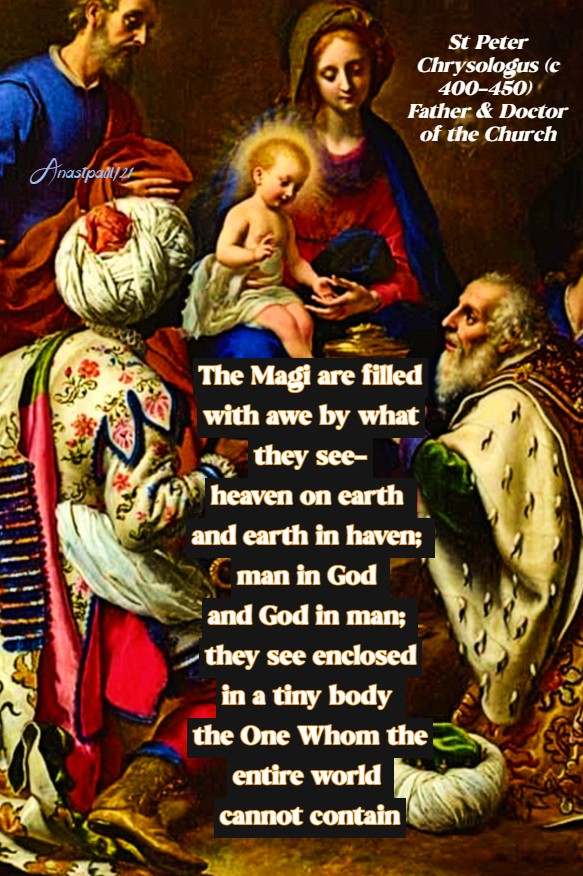
“The Magi are filled with awe by what they see – heaven on earth and earth in heaven; man in God and God in man; they see enclosed in a tiny body the One Whom the entire world cannot contain.”
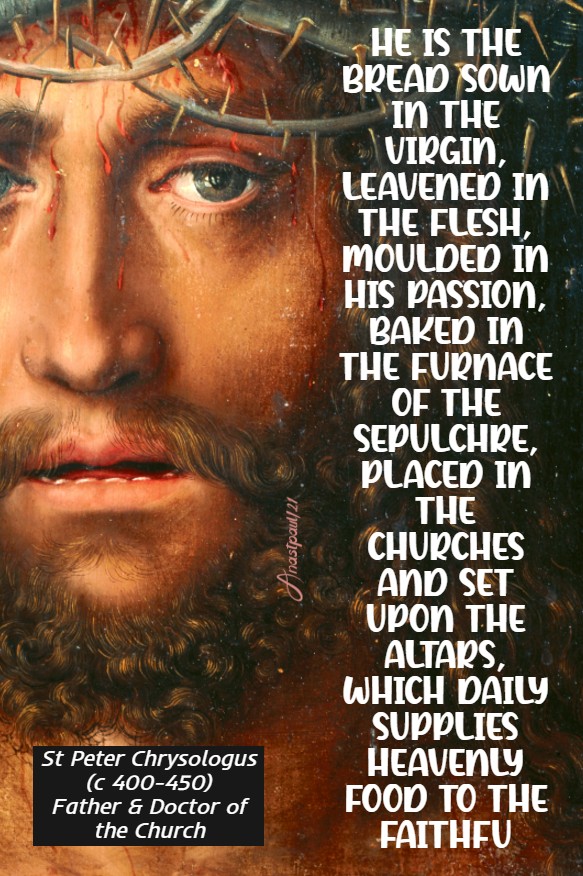
“He is The Bread sown in the virgin, leavened in the Flesh, moulded in His Passion, baked in the furnace of the Sepulchre, placed in the Churches and set upon the Altars, which daily supplies Heavenly Food to the faithful.”
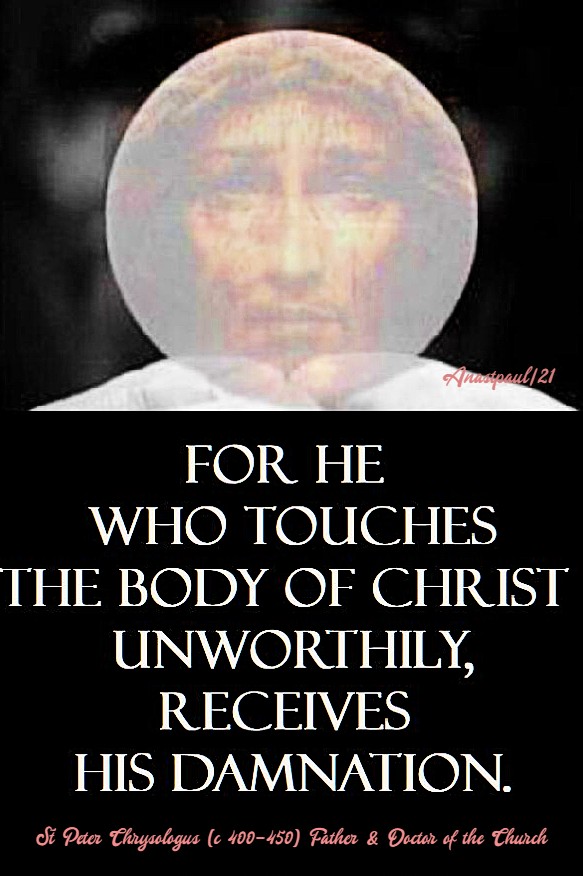
“For he who touches the Body of Christ unworthily, receives his damnation.”
“The poor stretch out the hand but God receives what is offered.”
St Peter Chrysologus (c 400-450) “Golden Words” Father & Doctor of the Church
Thought for the Day – 26 July – Meditations with Antonio Cardinal Bacci (1881-1971)
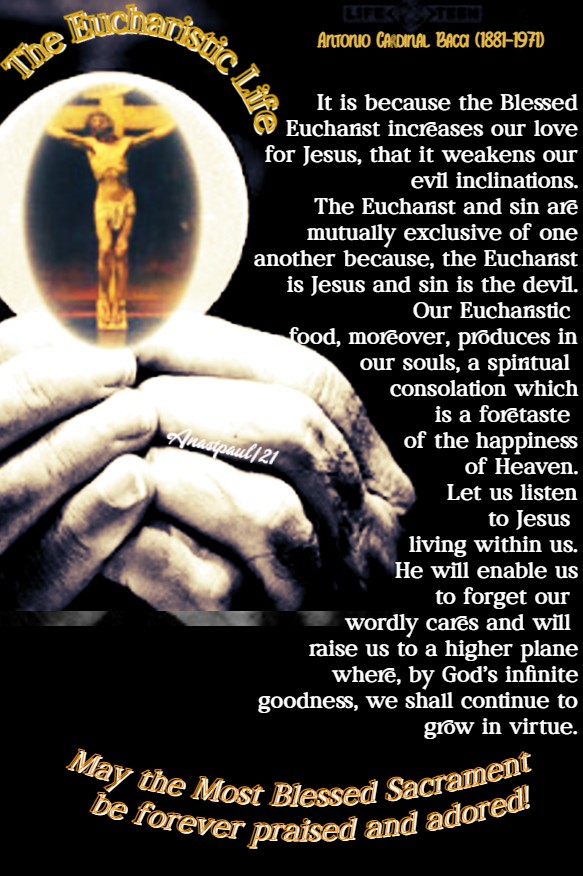
The Eucharistic Life
The Eucharistic life, which is the life of union with Jesus, especially by means of daily Communion, transforms us and makes us holy. It preserves and increases in us, the grace which is the supernatural life of the soul. The Eucharist, of itself, does not bestow grace because it is a Sacrament of the living. It is our food and food is not given to the dead but to the living. For this reason, we should receive Holy Communionb free from the stain of sin. The Eucharist, moreover, remits venial sins, strengthens us in our resolutions and increases our charity. Venial sin is a sickness of the soul. Just as natural food banishes listlessness and vulnerability to disease, our Eucharistic nourishment has the same effect on our spiritual life.
It is because the Blessed Eucharist increases our love for Jesus, that it weakens our evil inclinations. The Eucharist and sin are mutually exclusive of one another because, the Eucharist is Jesus and sin is the devil. Our Eucharistic food, moreover, produces in our souls, a spiritual consolation which is a foretaste of the happiness of Heaven.
Let us listen to Jesus living within us. He will enable us to forget our worldly cares and will raise us to a higher plane where, by God’s infinite goodness, we shall continue to grow in virtue.
May the Most Blessed Sacrament be forever praised and adored!
Quote/s of the Day – 26 July – “Month of the Most Precious Blood” – Readings: Exodus 32: 15-24, 30-34; Psalms 106: 19-20, 21-22, 23; Matthew 13: 31-3
The Leaven of Life
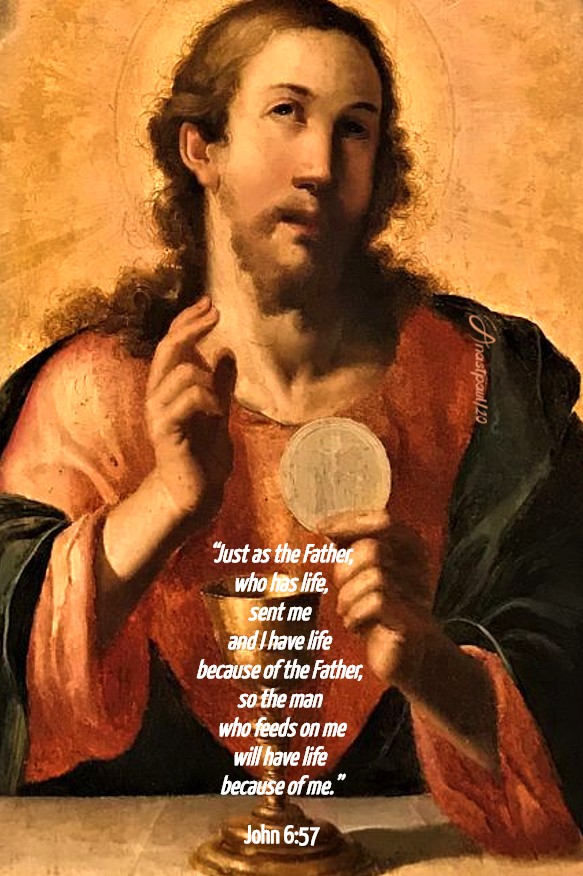
“Just as the Father who has life sent me and I have life because of the Father, so the man who feeds on me will have life because of me.”
John 6:57
“An inborn imperfection in our human dough was removed, thanks to the leaven that comes from His perfect body… To complete what was missing, in these human bodies of ours, He gave something of Himself, just as He gives Himself to be eaten …”
St Ephrem (306-373) Father and Doctor of the Church
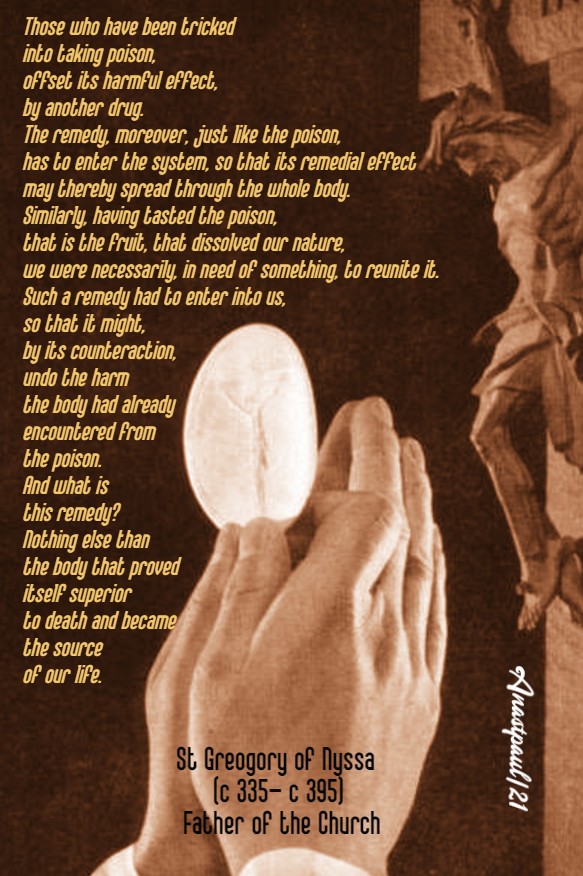
“Those who have been tricked into taking poison, offset its harmful effect, by another drug. The remedy, moreover, just like the poison, has to enter the system, so that its remedial effect may thereby spread through the whole body. Similarly, having tasted the poison, that is the fruit, that dissolved our nature, we were necessarily, in need of something, to reunite it. Such a remedy had to enter into us, so that it might, by its counteraction, undo the harm the body had already encountered from the poison. And what is this remedy? Nothing else than the body that proved itself superior to death and became the source of our life.”
St Greogory of Nyssa (c 335– c 395) Father of the Church
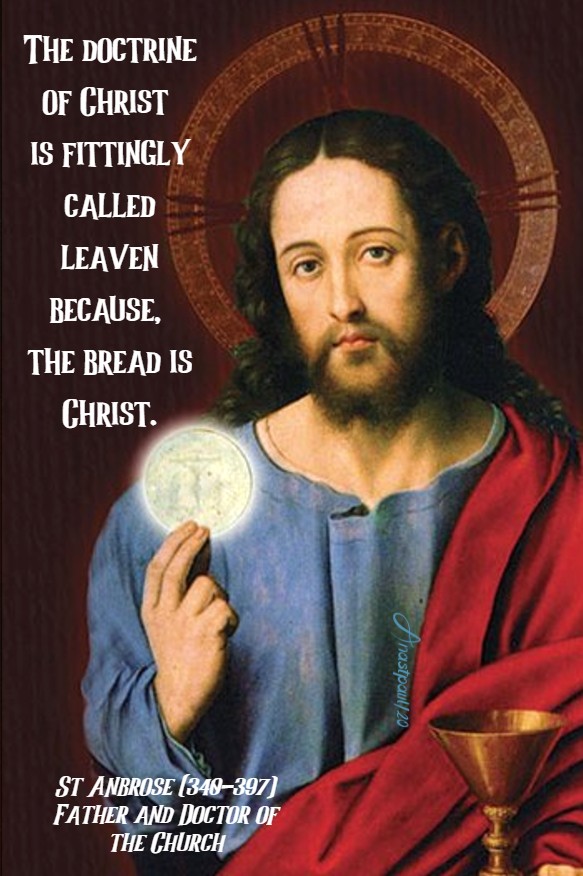
“The doctrine of Christ is fittingly called leaven because, the bread is Christ.”
St Anbrose (340-397) Father and Doctor of the Church
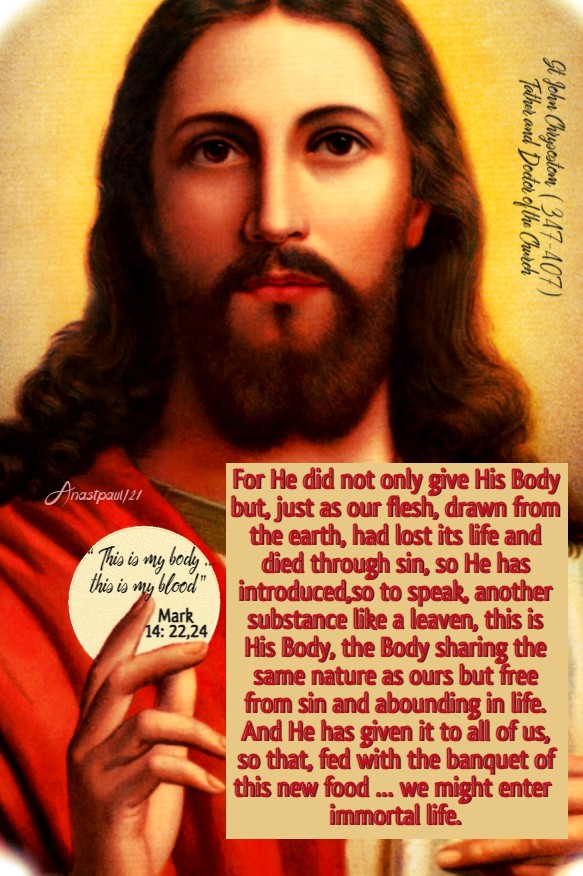
“ … For He did not only give His Body but, just as our flesh, drawn from the earth, had lost its life and died through sin, so He has introduced, so to speak, another substance like a leaven, this is His Body, the Body sharing the same nature as ours but free from sin and abounding in life. And He has given it to all of us, so that, fed with the banquet of this new food … we might enter immortal life.”
St John Chrysostom (347-407) Father ad Doctor of the Church
“Dust, so to speak, had forcibly entered humanity’s eye; earth had entered it, had injured the eye and it could not see the light. … That physician made a salve for you. And because He came, in such a way, that by His flesh, He might extinguish the faults of the flesh and by His death He might kill death … ”
St Augustine (354-430) Father and Doctor of the Church
Our Morning Offering – 18 July – “Month of the Most Precious Blood”
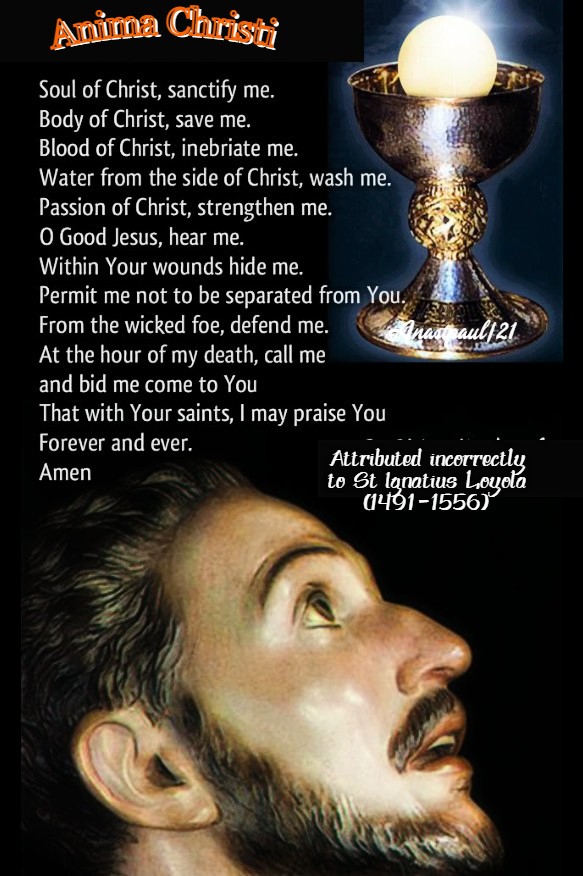
Anima Christi
Soul of Christ, sanctify me Body of Christ, save me Blood of Christ, inebriate me Water from the side of Christ, wash me Passion of Christ, strengthen me Good Jesus, hear me Within Your wounds, shelter me from turning away, keep me From the evil one, protect me At the hour of my death, call me Into Your presence lead me to praise You with all Your saints Forever and ever, Amen
For many years the Anima Christi was popularly believed to have been composed by Saint Ignatius Loyola (1491-1556) , as he puts it at the beginning of his Spiritual Exercises and often refers to it. In the first edition of the Spiritual Exercises Ignatius merely mentions it, evidently supposing that the reader would know it. In later editions, it was printed in full. It was by assuming that everything in the book was written by Ignatius that it came to be looked upon as his composition. On this account the prayer is sometimes referred to as the Aspirations of St. Ignatius Loyola and so my image shows St Ignatius at prayer.
However, the prayer actually dates to the early fourteenth century and was possibly written by Pope John XXII but its authorship remains uncertain. It has been found in a number of prayer books printed during the youth of Ignatius and is in manuscripts which were written a hundred years before his birth. The English hymnologist James Mearns found it in a manuscript of the British Museum which dates to about 1370. In the library of Avignon there is preserved a prayer book of Cardinal Pierre de Luxembourg (died 1387), which contains the prayer in practically the same form as we have it today. It has also been found inscribed on one of the gates of the Alcázar of Seville, which dates back to the time of Pedro the Cruel (1350–1369).
The invocations in the prayer have rich associations with Catholic concepts that relate to the Eucharist (Body and Blood of Christ), Baptism (water) and the Passion of Jesus (Precious Blood and Holy Wounds).
Thought for the Day – 15 July – Meditations with Antonio Cardinal Bacci (1881-1971)
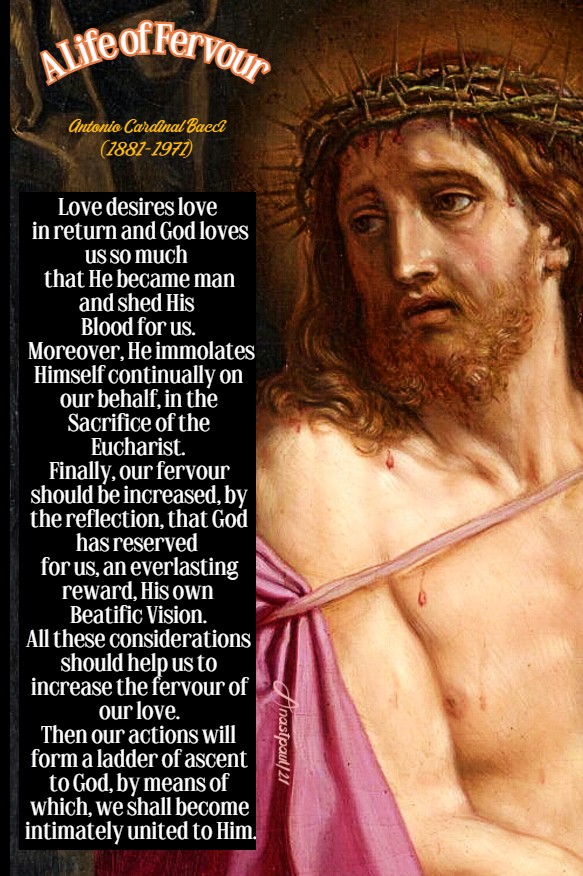
A Life of Fervour
“God is our Creator and absolute Master, Whom the Angels adore and irrational creatures obey. His greatness demands that we should offer all our activities to Him in a spirit of fervent and loving dedication. Since we have received everything from Him, we have many reasons for loving Him. By the work of redemption, God became our Friend and our Brother and the Victim of Expiation for our sins. How could we remain indifferent and ungrateful when we remember the favours which we have received . Love desires love in return and God loves us so much that He became man and shed His Blood for us. Moreover, He immolates Himself continually on our behalf, in the Sacrifice of the Eucharist. Finally, our fervour should be increased, by the reflection, that God has reserved for us, an everlasting reward, His own Beatific Vision.
All these considerations should help us to increase the fervour of our love. Then our actions will form a ladder of ascent to God, by means of which, we shall become intimately united to Him.
Our Morning Offering – 13 July – “Month of the Precious Blood”
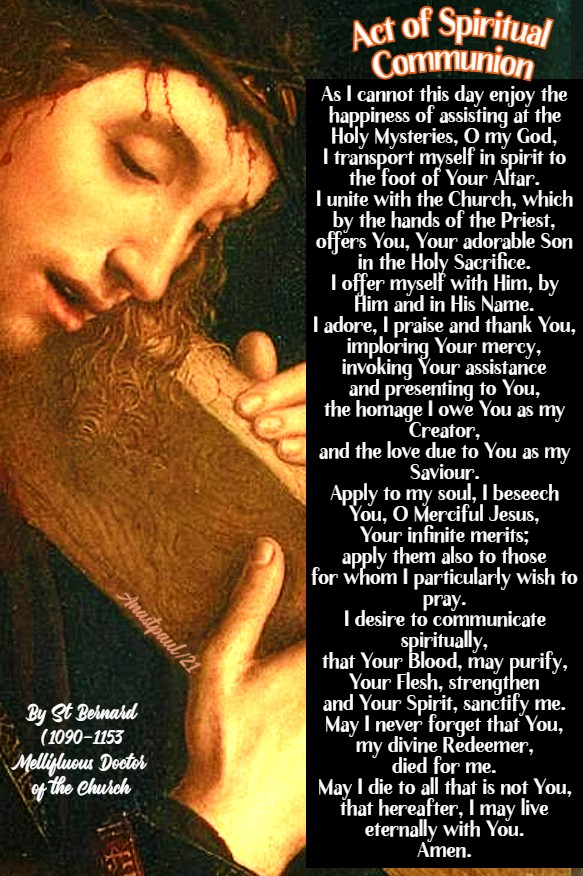
Act of Spiritual Communion By St Bernard (1090-1153 Mellifluous Doctor of the Church
As I cannot this day enjoy the happiness of assisting at the Holy Mysteries, O my God, I transport myself in spirit to the foot of Your Altar. I unite with the Church, which by the hands of the Priest, offers You, Your adorable Son in the Holy Sacrifice. I offer myself with Him, by Him and in His Name. I adore, I praise and thank You, imploring Your mercy, invoking Your assistance and presenting to You, the homage I owe You as my Creator and the love due to You as my Saviour.
Apply to my soul, I beseech You, O Merciful Jesus, Your infinite merits; apply them also to those for whom I particularly wish to pray. I desire to communicate spiritually, that Your Blood, may purify, Your Flesh, strengthen and Your Spirit, sanctify me. May I never forget that You, my divine Redeemer, died for me. May I die to all that is not You, that hereafter, I may live eternally with You. Amen.
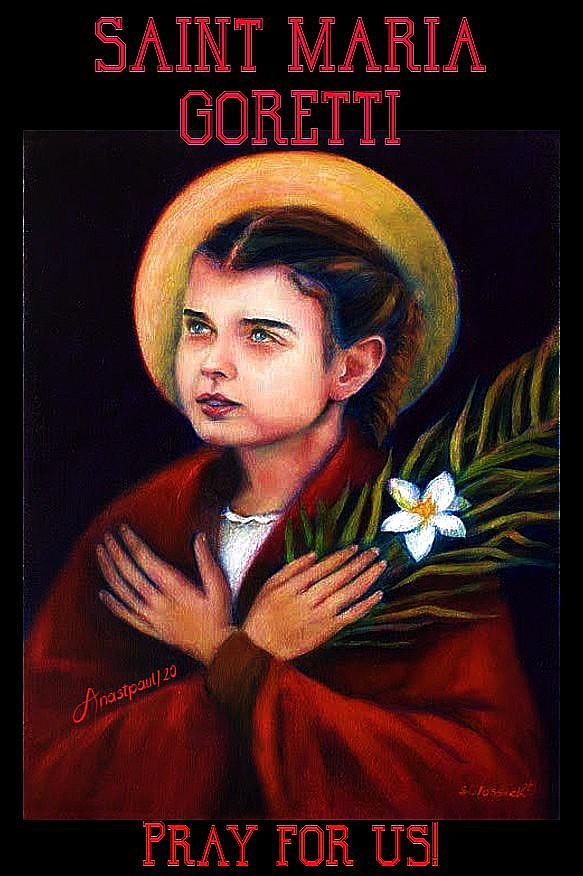
One Minute Reflection – 6 July – “Month of the Precious Blood” – Readings: Genesis 32: 23-33, Psalms 17: 1b, 2-3, 6-7ab, 8b and 15, Matthew 9: 32-38 and the Memorial of St Maria Goretti
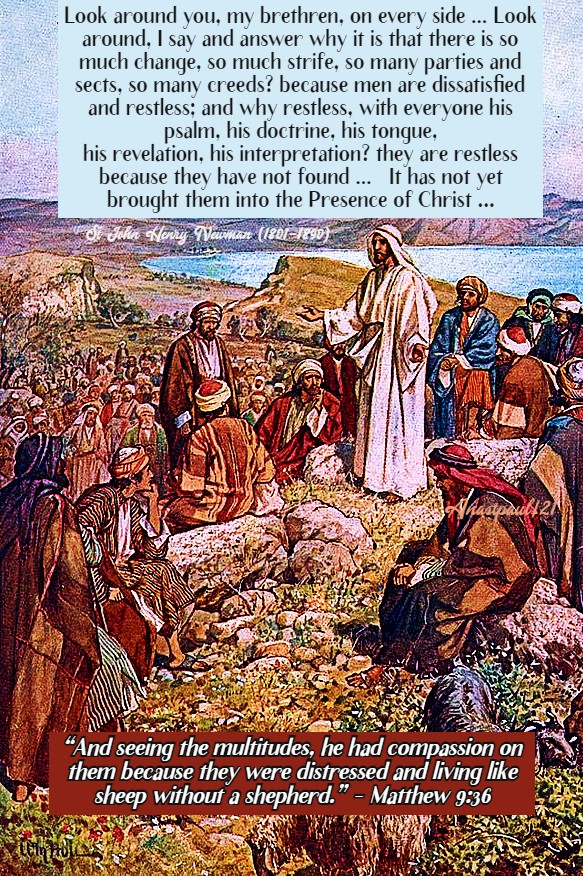
“And seeing the multitudes, he had compassion on them because they were distressed and living like sheep without a shepherd.” – Matthew 9:36
REFLECTION – “Look around you, my brethren, on every side … Look around, I say and answer why it is that there is so much change, so much strife, so many parties and sects, so many creeds? because men are dissatisfied and restless; and why restless, with everyone his psalm, his doctrine, his tongue, his revelation, his interpretation? they are restless because they have not found … It has not yet brought them into the Presence of Christ, in which “is fulness of joy” and “pleasure for evermore” (Ps 16[15]:11).
Had they been fed with the bread of life (Jn 6:35) and tasted of the honeycomb, their eyes, like Jonathan’s (1 Sam 14:27), had been enlightened, to acknowledge the Saviour of men but having no such real apprehension of things unseen, they have still to seek and are at the mercy of every rumour from without.
O sad and pitiable spectacle, when the people of Christ wander on the hills as “sheep which have no shepherd;” and instead of seeking Him in His ancient haunts and His appointed home, busy themselves in human schemes, follow strange guides, are taken captive by new opinions, become the sport of chance, or of the humour of the hour, or the victims of self-will, are full of anxiety and perplexity,and jealousy and alarm, “tossed to and fro, and carried about by every wind of doctrine, by the sleight of men, and cunning craftiness whereby they lie in wait to deceive;” (Eph 4:14) —and all because, they do not seek the “one body” and the “one Spirit,” and the “one hope of their calling,” the “one Lord, one faith, one baptism, one God and Father of all,” (Eph 4:5-6) and “find rest for their souls” (Mt 11:29)! – St John Henry Newman (1801-1890) Cardinal, Founder of the Oratory in England, Theologian, Writer, Poet, Hymnist – Sermon “Invisible Presence of Christ” Sermons on Subjects of the Day, no 21
PRAYER – True Light of the world, Lord Jesus Christ, as You enlighten all men for their salvation, give us grace, we pray, to herald Your coming, by preparing Your ways of justice and of peace. We lift our hearts and eyes in prayer and beg of You that we may always offer You the souls of those in need of You. And may the prayers of Bl At Maria Goretti, strengthen us on our journey. Who live and reign with the Father and the Holy Spirit, God forever, amen.
Our Morning Offering – 4 July – “Month of the Precious Blood”
For those unable to attend Holy Mass today and for all of us, everyday!
Act of Spiritual Communion By St Alphonsus Maria de Liguori (1696-1787) Most Zealous Doctor
I desire, good Jesus, to receive Thee in Holy Communion and since I cannot now receive Thee in the Blessed Sacrament, I beseech Thee to come to me spiritually and to refresh my soul with Thy sweetness. Come, my Lord, my God and my All! Come to me and never let me ever again be separated from Thee by sin. Teach me Thy blessed ways, help me with Thy grace to imitate Thy example, to practise meekness, humility, charity and all the virtues of Thy Sacred Heart. My divine Master, my one desire is to do Thy will and to love Thee, more and more. Help me, that I may be faithful to the end, in Thy service. Bless me in life and in death, that I may praise Thee, forever in heaven, Amen
Our Morning Offering – 27 June – “Month of the Sacred Heart” – Fifth Sunday after Pentecost
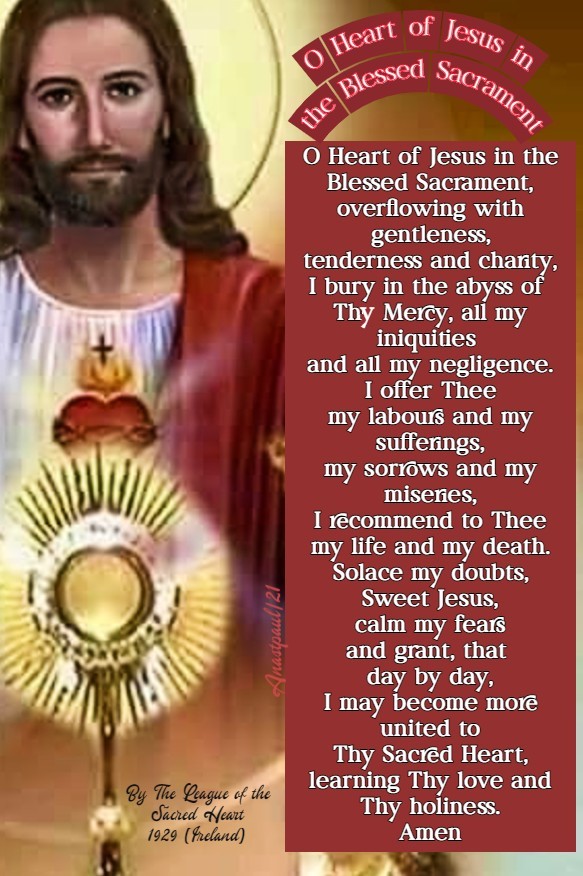
O Heart of Jesus in the Blessed Sacrament By The League of the Sacred Heart 1929 (Ireland)
O Heart of Jesus in the Blessed Sacrament, overflowing with gentleness, tenderness and charity, I bury in the abyss of Thy Mercy, all my iniquities and all my negligence. I offer Thee my labours and my sufferings, my sorrows and my miseries, I recommend to Thee my life and my death. Solace my doubts, Sweet Jesus, calm my fears and grant, that day by day, I may become more united to Thy Sacred Heart, learning Thy love and Thy holiness. Amen
Quote/s of the Day – 26 June – “Month of the Sacred Heart”- Readings: Genesis 18: 1-15, Luke 1: 46-47, 48-49, 50 and 53, 54-55, Matthew 8: 5-17
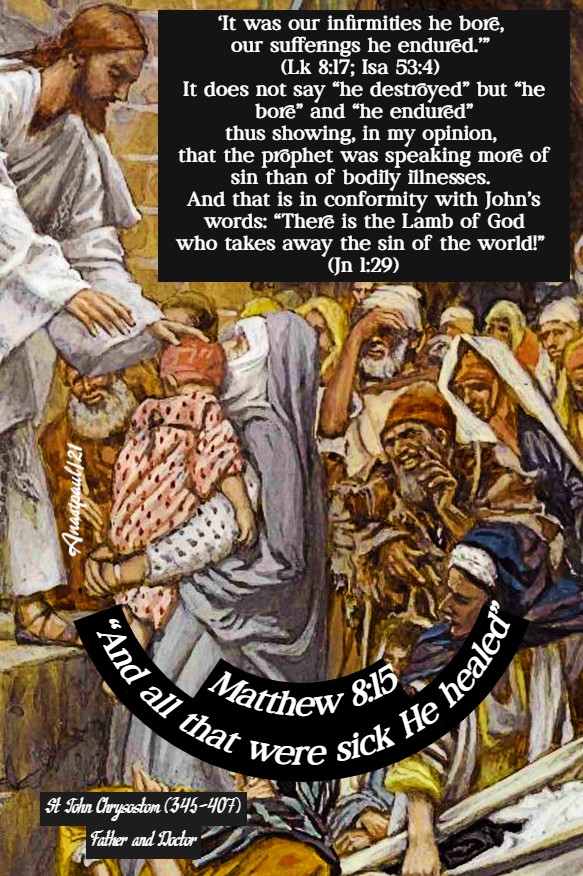
“And all that were sick He healed”
Matthew 8:15
“ Think of the many cures of which the evangelists do not speak. They do not tell us about all of them, one by one – rather, in a single sentence, they let us see an infinite ocean of miracles. … The gospel brings the testimony of the prophet, which is as extraordinary and as surprising as the deeds themselves: “ … thereby fulfilling what had been said through Isaiah the prophet: ‘It was our infirmities he bore, our sufferings he endured.’” (Lk 8:17; Isa 53:4) It does not say “he destroyed” but “he bore” and “he endured” thus showing, in my opinion, that the prophet was speaking more of sin than of bodily illnesses. And that is in conformity with John’s words: “There is the Lamb of God who takes away the sin of the world!” (Jn 1:29)
St John Chrysostom (345-407) Father and Doctor
Commentary on St Matthew’s Gospel, 27
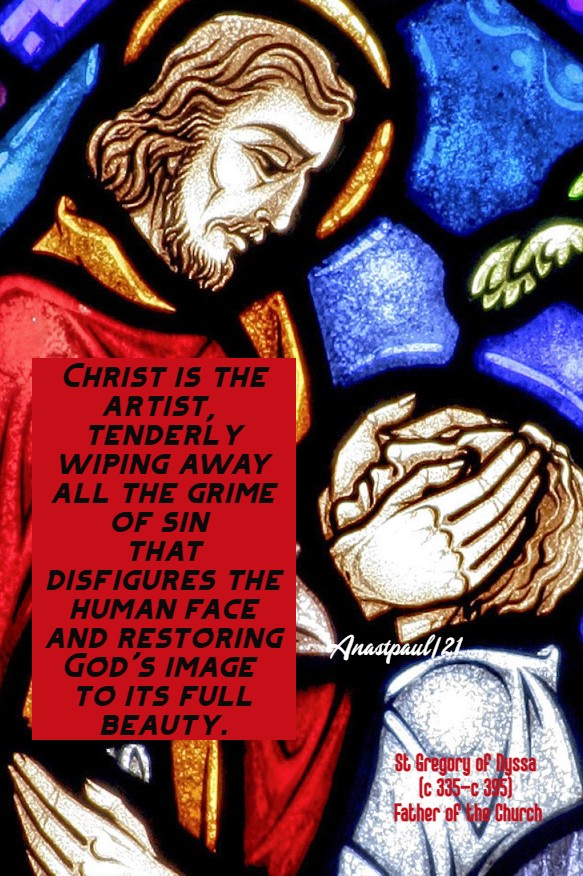
“Christ is the artist, tenderly wiping away all the grime of sin that disfigures the human face and restoring God’s image to its full beauty.”
St Gregory of Nyssa (c 335–C 395) Father of the Church
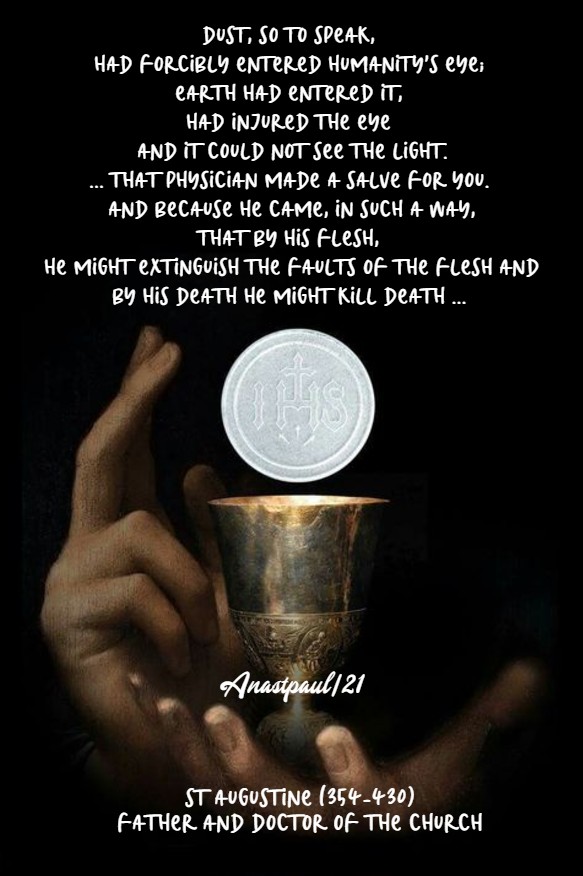
“Dust, so to speak, had forcibly entered humanity’s eye; earth had entered it, had injured the eye and it could not see the light. … That physician made a salve for you. And because He came, in such a way, that by His flesh, He might extinguish the faults of the flesh and by His death, He might kill death … ”
St Augustine (354-430) Father and Doctor of the Church
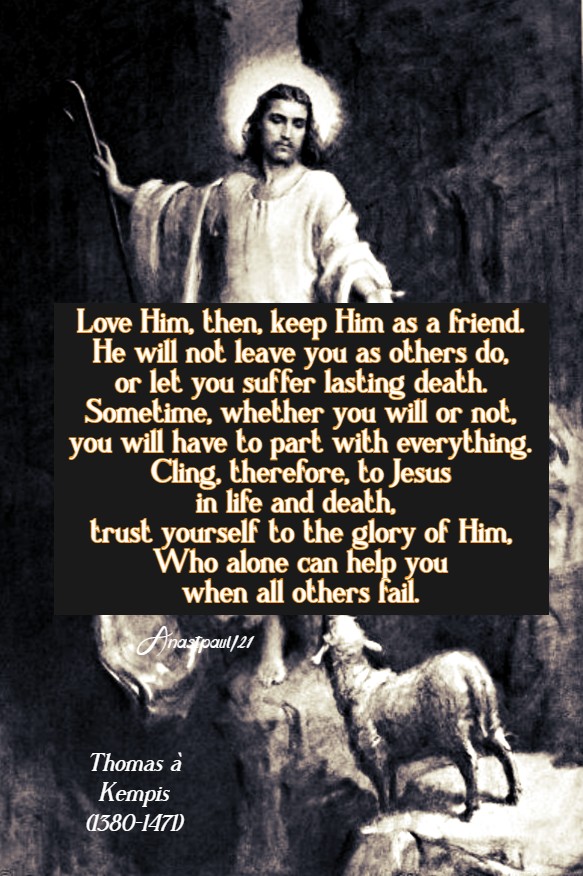
“Love Him, then, keep Him as a friend. He will not leave you as others do, or let you suffer lasting death. Sometime, whether you will or not, you will have to part with everything. Cling, therefore, to Jesus in life and death, trust yourself to the glory of Him, Who alone can help you when all others fail.“
Thomas à Kempis (1380-1471) (Book 2 Ch 7)
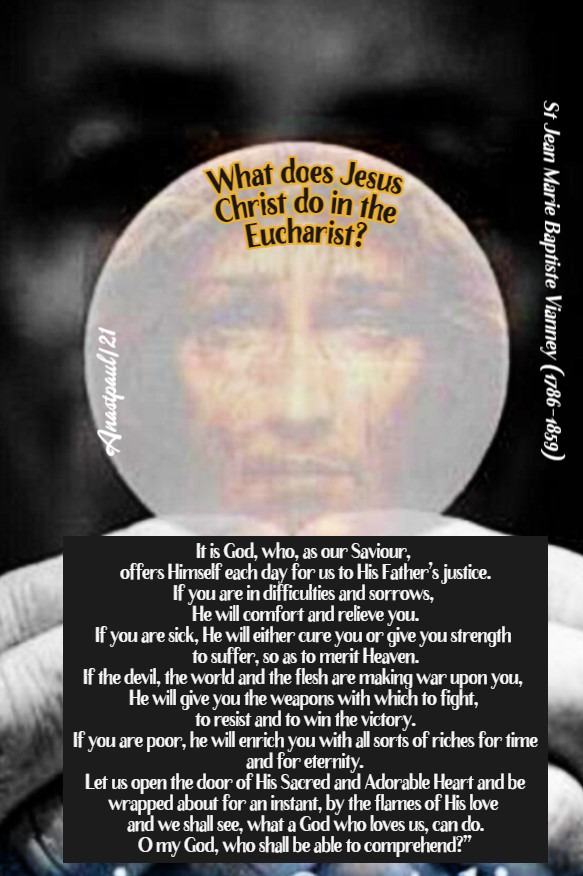
“What does Jesus Christ do in the Eucharist?
It is God, who, as our Saviour, offers Himself each day for us to His Father’s justice.
If you are in difficulties and sorrows, He will comfort and relieve you. If you are sick, He will either cure you or give you strength to suffer, so as to merit Heaven. If the devil, the world and the flesh are making war upon you, He will give you the weapons with which to fight, to resist and to win the victory. If you are poor, he will enrich you with all sorts of riches for time and for eternity. Let us open the door of His Sacred and Adorable Heart and be wrapped about for an instant, by the flames of His love and we shall see, what a God who loves us, can do. O my God, who shall be able to comprehend?”
Thought for the Day – 20 June – Meditations with Antonio Cardinal Bacci (1881-1971)
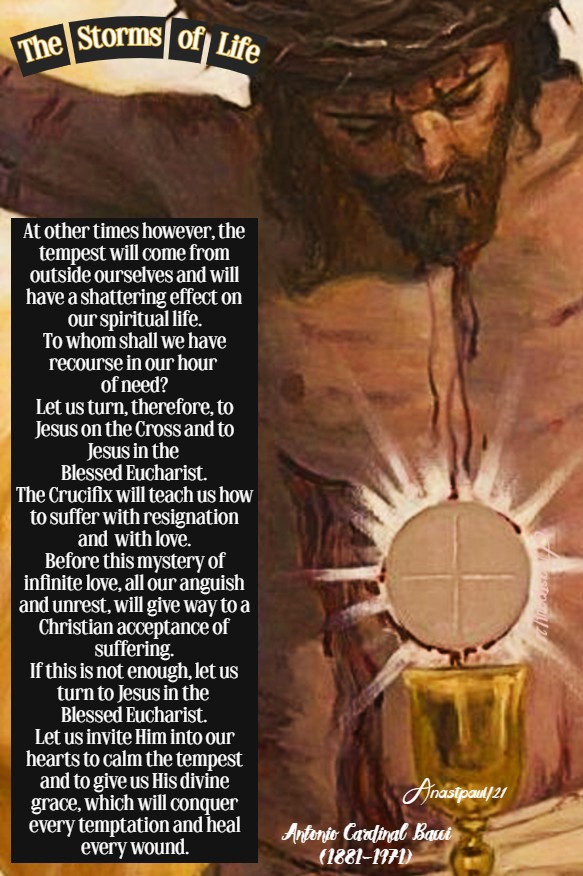
The Storms of Life
“At other times however, the tempest will come from outside ourselves and will have a shattering effect on our spiritual life. It may be some insult which has seriously wounded us. There may be somebody near to us who has grown quite insufferable. Or perhaps suffering will come to us in the guise of illness, disgrace or loss of our dear ones. We shall feel lonely and abandoned in the midst of the storm. To whom shall we have recourse in our hour of need? Shall we turn to our fellow-men? Perhaps there will be nobody able to understand us perfectly, or, if there is somebody who sympathises with us,he may be able to do nothing for us, save to utter a few kind words.
Let us turn, therefore, to Jesus on the Cross and to Jesus in the Blessed Eucharist. The Crucifix will teach us how to suffer with resignation and with love. Before this mystery of infinite love, all our anguish and unrest, will give way to a Christian acceptance of suffering.
If this is not enough, let us turn to Jesus in the Blessed Eucharist. Let us invite Him into our hearts to calm the tempest and to give us His divine grace, which will conquer every temptation and heal every wound.”
Our Morning Offering – 20June – “Month of the Sacred Heart”
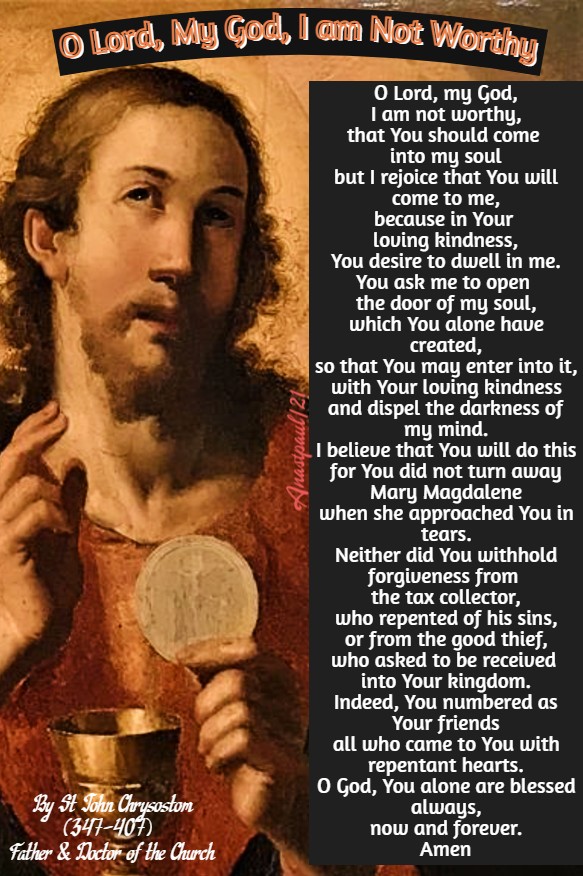
O Lord, My God, I am Not Worthy Prayer Before Holy Communion By St John Chrysostom (347-407) Father & Doctor of the Church
O Lord, my God, I am not worthy, that You should come into my soul but I rejoice that You will come to me, because in Your loving kindness, You desire to dwell in me. You ask me to open the door of my soul, which You alone have created, so that You may enter into it, with Your loving kindness and dispel the darkness of my mind. I believe that You will do this for You did not turn away Mary Magdalene when she approached You in tears. Neither did You withhold forgiveness from the tax collector, who repented of his sins, or from the good thief, who asked to be received into Your kingdom. Indeed, You numbered as Your friends all who came to You with repentant hearts. O God, You alone are blessed always, now and forever. Amen
Thought for the Day – 18 June – Meditations with Antonio Cardinal Bacci (1881-1971)
Belonging Entirely to God
“Let us reflect on the extent to which God is deserving of all our love. He is our Creator, our final end and our Redeemer. Jesus was not satisfied with giving us part of Himself but He gave us Himself completely. Although, as God He was infinite, He could not have given us more.
One drop of Hs Precious Blood or a solitary tear, would have sufficed to redeem us from our sins. But He shed His Blood to the last drop and gave His life for us. Better still, He willed to remain amongst us in the Sacrament of the Holy Eucharist as our constant spiritual nourishment. What more could He have done in order to merit our love?”
One Minute Reflection – 13 June – “Month of the Sacred Heart” – Sunday within the Octave, Readings: Ezekiel 17: 22-24, Psalms 92: 2-3, 13-14, 15-16, Second Corinthians 5: 6-10, Mark 4: 26-34
“It puts forth large branches, so that the birds of the sky can dwell in its shade” – Mark 4:32
REFLECTION – “The kingdom of heaven, says the gospel, is like a mustard seed … Christ is the kingdom of heaven. Sown like a mustard seed in the garden of the Virgin’s womb, He grew up into the tree of the Cross whose branches stretch across the world … Christ is the kingdom, because all the glory of His kingdom is within Him. Christ is a man because all humanity is restored in Him. Christ is a mustard seed because the infinitude of divine greatness, is accommodated to the littleness of flesh and blood.
Do we need further examples? Christ became all things in order to restore all of us in Himself. The man Christ, received the mustard seed which represents the kingdom of God … though as God, He had always possessed it He sowed it in His garden.
The Church is a garden extending over the whole world, tilled by the plough of the Gospel, fenced in by stakes of doctrine and discipline, cleared of every harmful weed by the labour of the Apostles, fragrant and lovely with perennial flowers – virgins’ lilies and martyrs’ roses, set amid the pleasant verdure of all, who bear witness to Christ and the tender plants of all, who have faith in Him.
Such then is the mustard seed which Christ sowed in His garden. When He promised a kingdom to the partriarchs, the seed took root in them, with the prophets it sprang up, with the Apostles it grew tall in the Church – it became a great tree putting forth innumerable branches laden with gifts. And now, you too must take the wings of the psalmist’s dove (Ps 68[67]:14) … and fly to rest forever among those sturdy, fruitful branches. No snares are set to trap you there (Ps 91[90]:3); fly off, then, with confidence and dwell securely in its shelter.” – St Peter Chrysologus (406-450) Bishop of Ravenna, Father and Doctor of the Church – Sermon 98.
PRAYER – Almighty Father, we bless You Lord of life, through whom all living things tend. You are the source of all, our first beginning and our end! Grant holy Father, that we may allow the Word to enter our hearts and grow by Your grace, so that we may always live for Your glory. May the intercession of the Blessed Virgi Mary, all Your Angels and Saints, grant us strength and zeal. Through Jesus Christ, our Lord with the Holy Spirit, God forever, amen. MAY the Heart of JESUS in the most Blessed Sacrament be praised, adored and loved with grateful affection, at every moment, in all the Tabernacles of the world, even to the end of time. Amen.Indulgence 100 Days, Once a day. Raccolta 161 Blessed Pius IX, 29 February 1868.
Our Morning Offering – 13 June – “Month of the Sacred Heart” – Sunday within the Octave
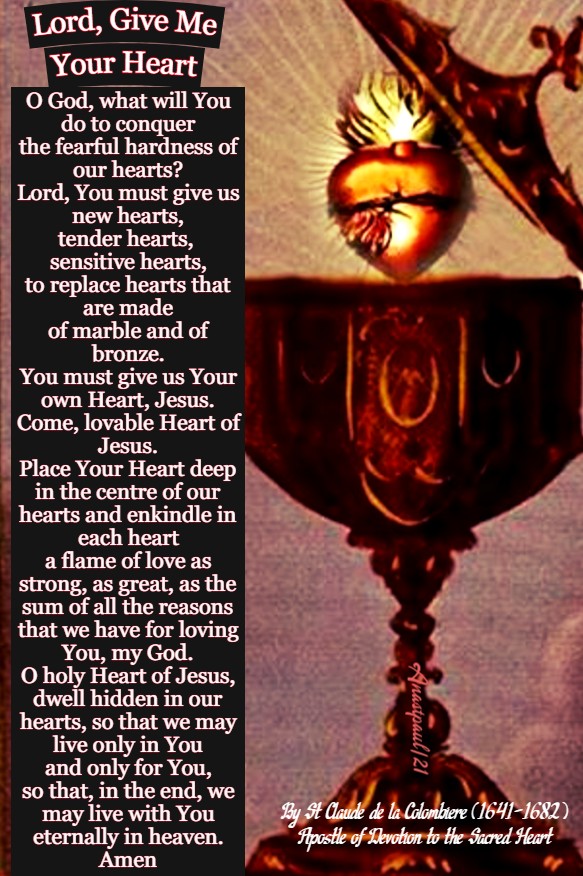
Lord, Give Me Your Heart By St Claude de la Colombiere SJ (1641-1682) Apostle of Devotion to the Sacred Heart and Spiritual Director to St Margaret Mary Alacoque
O God, what will You do to conquer the fearful hardness of our hearts? Lord, You must give us new hearts, tender hearts, sensitive hearts, to replace hearts that are made of marble and of bronze. You must give us Your own Heart, Jesus. Come, lovable Heart of Jesus. Place Your Heart deep in the centre of our hearts and enkindle in each heart a flame of love as strong, as great, as the sum of all the reasons that we have for loving You, my God. O holy Heart of Jesus, dwell hidden in our hearts, so that we may live only in You and only for You, so that, in the end, we may live with You eternally in heaven. Amen
Thought for the Day – 6 June – Meditations with Antonio Cardinal Bacci (1881-1971)
The Feast of Corpus Christi
“Human words cannot express the beauty ad depth of the passage from the Gospel which the liturgy of the Holy Mass offers for our meditation. It is the passage in which Jesus promises the institution of the Blessed Eucharist.
“ For my flesh is food indeed and my blood is drink indeed. He that eateth my flesh and drinketh my blood, abideth in me and I in him. As the living Father hath sent me and I live by the Father; so he that eateth me, the same also shall live by me. This is the bread that came down from heaven. Not as your fathers did eat manna and are dead. He that eateth this bread, shall live forever.” (Jn 6:56-59)
No human being could have visualised or uttered such words. Only the God-Man could have spoken them.
Even outside the Eucharist, God communicates with us, descending with His grace into our souls. We feel that He is present, we experience His supernatural influence and inspiration, His appeals to us to do good. But in the Eucharist, we have far more than this. We have the God-Man as the food of our souls, through which we live His own life, so that, like St Paul, it is no longer we who live but Christ Who lives in us.
This intimate and mysterious union has been compared with the unfathomable union in which the Son of God, lives the life of His heavenly Father because. by means of the Eucharist, we should live the supernatural life of Jesus. A a result of this transformation, there can be no further place in us for sin, nor for disordered affectations and desires but only for virtue and for God.”
Quote/s of the Day – 6 June – “Month of the Sacred Heart” – Corpus Christi, The Solemnity of The Most Holy Body and Blood of Christ
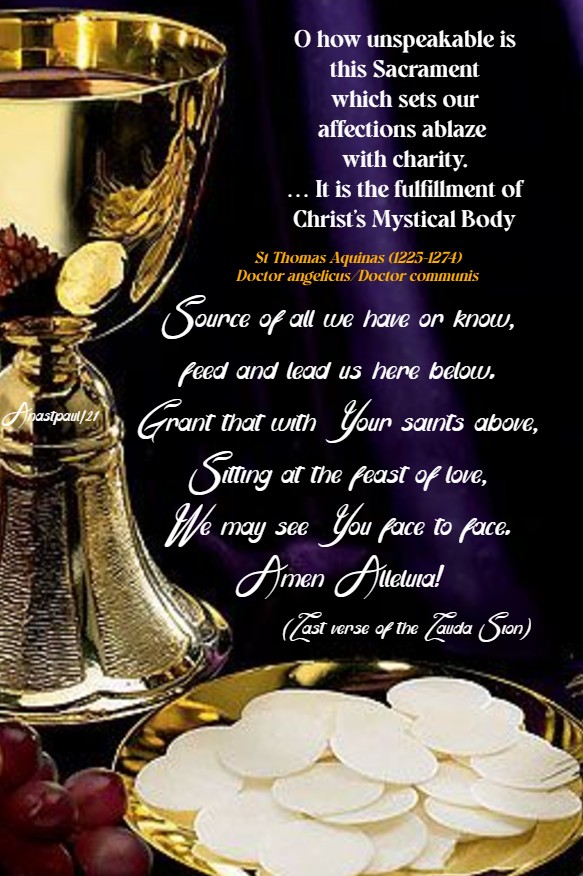
“O how unspeakable is this Sacrament which sets our affections ablaze with charity. … It is the fulfillment of Christ’s Mystical Body.”
“Source of all we have or know, feed and lead us here below. Grant that with Your saints above, Sitting at the feast of love, We may see You face to face.”
Amen Alleluia!
(Last verse of the Lauda Sion)
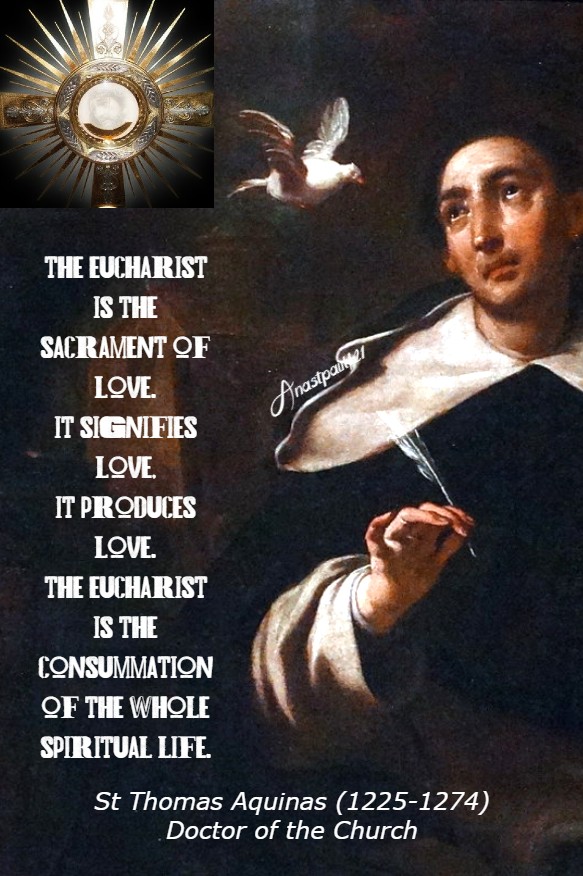
“The Eucharist is the Sacrament of Love. It signifies Love, It produces love. The Eucharist is the consummation of the whole spiritual life.”
St Thomas Aquinas (1225-1274) Doctor angelicus/Doctor communis
One Minute Reflection – 6 June – “Month of the Sacred Heart” – Corpus Christi, The Solemnity of The Most Holy Body and Blood of Christ, Readings: First: Exodus 24: 3-8, Psalm: Psalms 116: 12-13, 15-16, 17-18 (13), Second: Hebrews 9: 11-15, Gospel: Mark 14: 12-16, 22-26
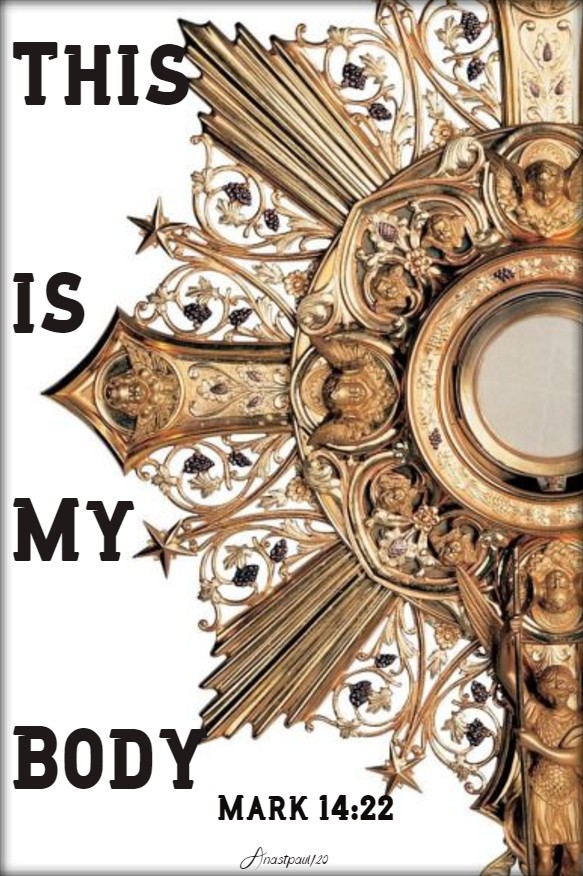
“ This is my body … this is my blood ” – Mark14: 22,24
REFLECTION – “The lovers of this world display their generosity by giving money, clothes and various gifts but not one of them gives his own blood. Christ gives His. In this way He demonstrates the tenderness He feels for us and His ardent love. Under the Old Law … God consented to receive the blood of sacrifices but this was just to prevent His people from offering it to false gods and, already, this was proof of a very great love. But Christ transformed this rite… there is no longer the same sacrificial victim – it is Himself He offers in sacrifice.
“The bread that we break, is it not a communion in the body of Christ?” (1 Cor 10:16) What is this bread? The Body of Christ. What becomes of those who communicate in it? The Body of Christ – not a large number of bodies but just one Body. Just as this bread, made up of so many wheat grains, makes only one loaf into which the grains disappear – for even though the grains remain in it, yet it is impossible to distinguish them in such a closely compacted mass – so all of us, together with Christ, make up a single whole … Now, if we all share in the same bread and are united to the same Christ, why don’t we show the same love to each other? Why don’t we become one in this case too?
This is what was seen at the beginning: “The community of believers was of one heart and mind” (Acts 4:32) … Christ came in search of you who were far away from Him to unite Himself to you but you do not wish to become one with your brother? … You violently separate yourself from him, after winning from the Lord so great a proof of His love – and life! For He did not only give His Body but, just as our flesh, drawn from the earth, had lost its life and died through sin, so He has introduced, so to speak, another substance like a leaven, this is His Body, the Body sharing the same nature as ours but free from sin and abounding in life. And He has given it to all of us, so that, fed with the banquet of this new food … we might enter immortal life.” – St John Chrysostom (347-407) Archbishop of Constantinople, Father ad Doctor of the Church – 24th homily on the 1st letter to the Corinthians 2
PRAYER – Lord Jesus Christ, You gave Your Church, an admirable Sacrament as the abiding memorial of Your Passion. Teach us to worship the sacred mystery of Your Body and Blood, that it’s redeeming power may sanctify us always. Who live and reign with the Father and the Holy Spirit, God, forever, amen.
Our Morning Offering – 6 June – “Month of the Sacred Heart” – The Solemnity of Corpus Christi – The Most Holy Body ad Blood of Our Lord Jesus Christ
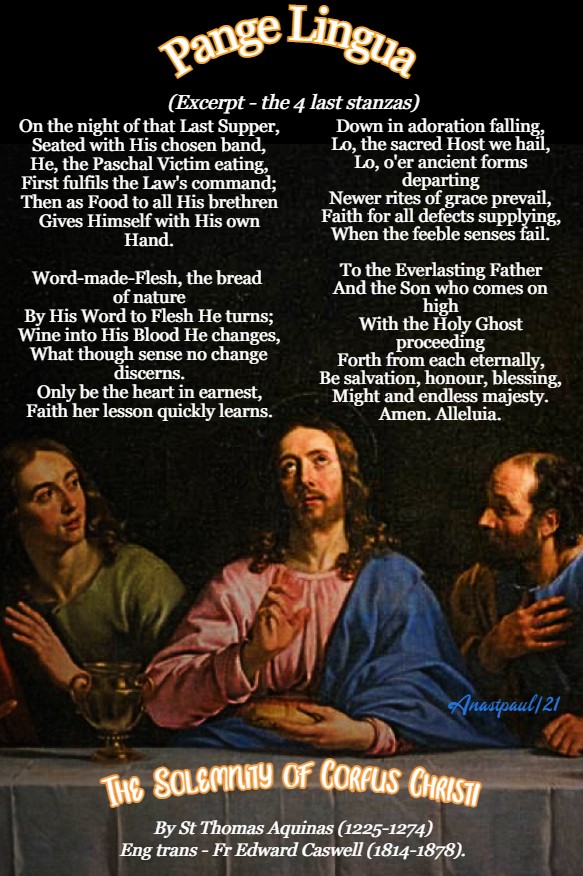
Pange Lingua Sing, My Tongue By St Thomas Aquinas (1225-1274) Eng trans – Fr Edward Caswell CO (1814-1878) (Excerpt on the image – the 4 last stanzas)
Sing, my tongue, the Saviour’s glory, Of His Flesh, the mystery sing; Of the Blood, all price exceeding, Shed by our Immortal King, Destined, for the world’s redemption, From a noble Womb to spring.
Of a pure and spotless Virgin Born for us on earth below, He, as Man, with man conversing, Stayed, the seeds of truth to sow; Then He closed in solemn order Wondrously His Life of woe.
On the night of that Last Supper, Seated with His chosen band, He, the Paschal Victim eating, First fulfils the Law’s command; Then as Food to all His brethren Gives Himself with His own Hand.
Word-made-Flesh, the bread of nature By His Word to Flesh He turns; Wine into His Blood He changes, What though sense no change discerns. Only be the heart in earnest, Faith her lesson quickly learns.
Down in adoration falling, Lo, the sacred Host we hail, Lo, o’er ancient forms departing Newer rites of grace prevail, Faith for all defects supplying, When the feeble senses fail.
To the Everlasting Father And the Son who comes on high With the Holy Ghost proceeding Forth from each eternally, Be salvation, honour, blessing, Might and endless majesty. Amen. Alleluia.
Written by St Thomas Aquinas (1225-1274) for the Solemnity of Corpus Christi, this Hymn is considered the most beautiful of Aquinas’ Hymns and one of the great seven Hymns of the Church. The Hymn is also used on Holy Thursday. The last two stanzas make up the Tantum Ergo (Down in Adoration Falling) that is used at Benediction of the Blessed Sacrament.
PANGE, lingua, gloriosi Corporis mysterium, Sanguinisque pretiosi, quem in mundi pretium fructus ventris generosi Rex effudit Gentium.
Nobis datus, nobis natus ex intacta Virgine, et in mundo conversatus, sparso verbi semine, sui moras incolatus miro clausit ordine.
In supremae nocte cenae recumbens cum fratribus observata lege plene cibis in legalibus, cibum turbae duodenae se dat suis manibus.
Verbum caro, panem verum verbo carnem efficit: fitque sanguis Christi merum, et si sensus deficit, ad firmandum cor sincerum sola fides sufficit.
Tantum ergo Sacramentum veneremur cernui: et antiquum documentum novo cedat ritui: praestet fides supplementum sensuum defectui.
Genitori, Genitoque laus et iubilatio, salus, honor, virtus quoque sit et benedictio: procedenti ab utroque compar sit laudatio. Amen. Alleluia.
Thought for the Day – 4 June – “Month of the Sacred Heart” – Meditations with Antonio Cardinal Bacci (1881-1971)
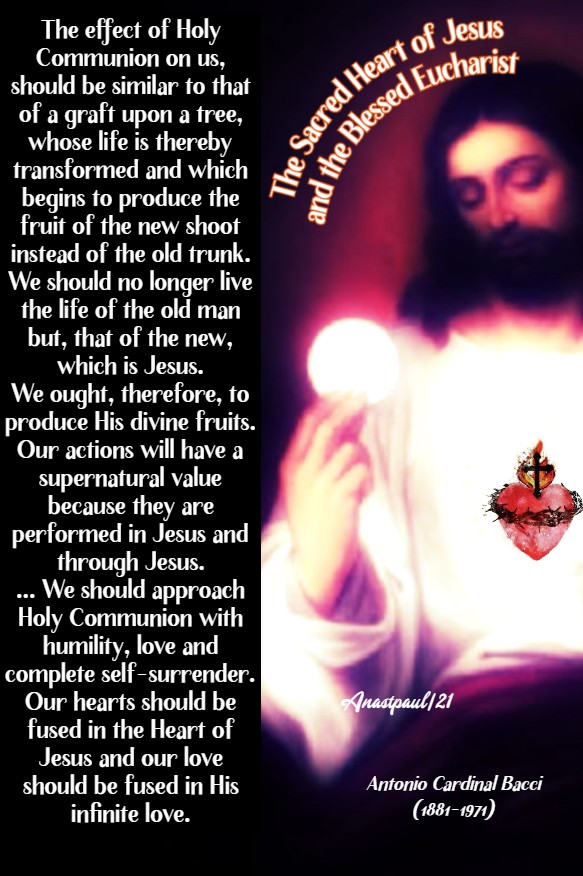
The Sacred Heart of Jesus and the Blessed Eucharist
“By means of this wonderful gift, we can live the life of Jesus Himself.
It is Our Lord Himself, Who says to us: “As the living Father has sent me and as I live because of the Father, so he who eats me, he also shall live because of me” (Jn 6:58). In other words, as He draws His divine and human life from the Father and lives by means of Him, to Whom as God, He is substantially united and equal, so anyone who partakes of the Eucharist, is united closely to Jesus, lives His life and is transformed by His supernatural grace. When Holy Communion is received, therefore, as it ought to be and as the Saints received it, it leads to the mysterious union of which St Paul speaks: “To me to live is Christ” (Phil 1:21). “It is now no longer I that live but Christ, lives in me” (Gal 2:20).
The effect of Holy Communion on us, should be similar to that of a graft upon a tree, whose life is thereby transformed and which begins to produce the fruit of the new shoot instead of the old trunk. We should no longer live the life of the old man but, that of the new, which is Jesus. We ought, therefore, to produce His divine fruits. Our actions will have a supernatural value because they are performed in Jesus and through Jesus. We should be very grateful to the Sacred Heart of Jesus for this gift of His infinite love and goodness. We should approach Holy Communion with humility, love and complete self-surrender. Our hearts should be fused in the Heart of Jesus and our love should be fused in His infinite love.”
Quote/s of the Day – 3 June – Solemnity of Corpus Christi, The Most Holy Body and Blood of our Lord Jesus Christ
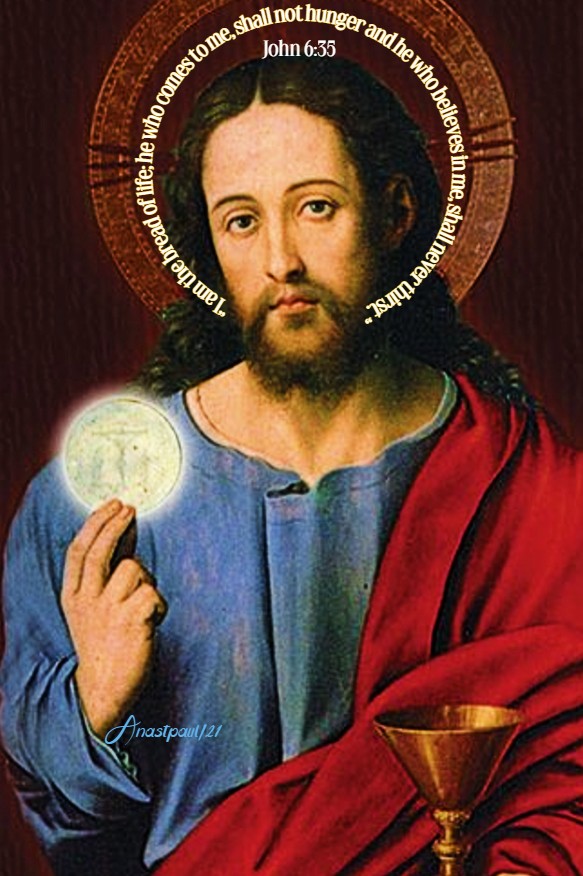
“I am the bread of life; he who comes to me, shall not hunger and he who believes in me, shall never thirst.”
John 6:35
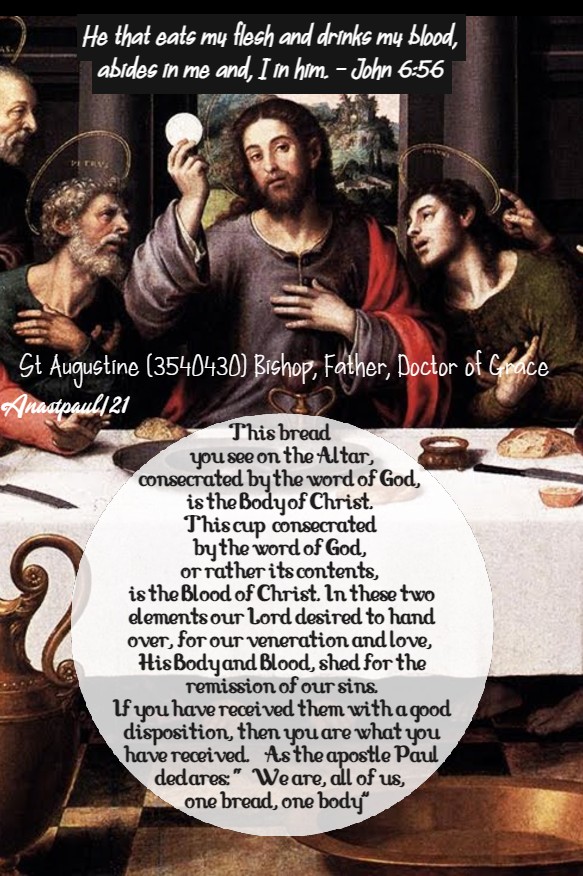
“This bread you see on the Altar, consecrated by the word of God, is the Body of Christ. This cup consecrated by the word of God, or rather its contents, is the Blood of Christ. In these two elements our Lord desired to hand over, for our veneration and love, His Body and Blood, shed for the remission of our sins. If you have received them with a good disposition, then you are what you have received. As the apostle Paul declares: “We are, all of us, one bread, one body” (1 Cor 10,17)…”
St Augustine (354-430) Bishop, Father, Doctor of Grace
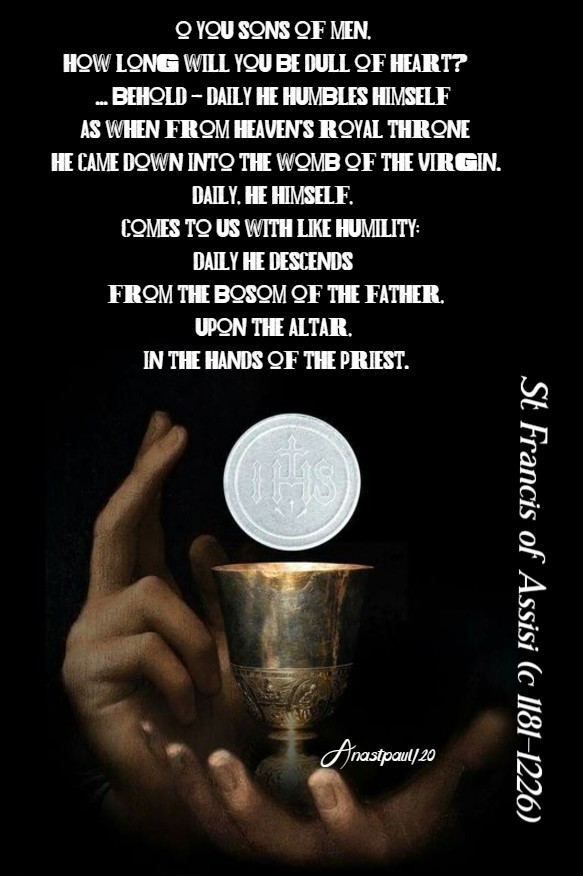
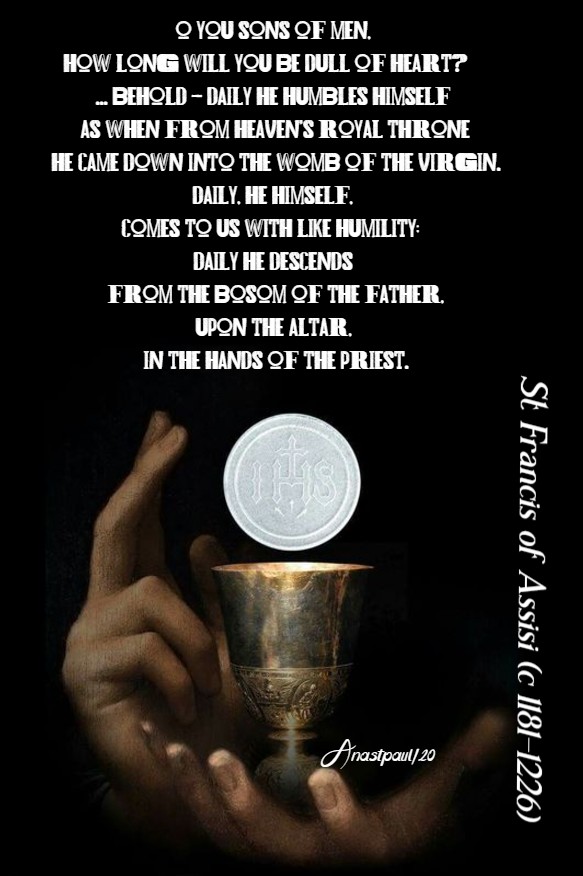
“O you sons of men, how long will you be dull of heart? … Behold – daily He humbles Himself as when from heaven’s royal throne He came down into the womb of the Virgin. Daily, He Himself, comes to us with like humility; daily He descends from the bosom of the Father, upon the Altar, in the hands of the Priest.”
St Francis of Assisi (c 1181–1226)
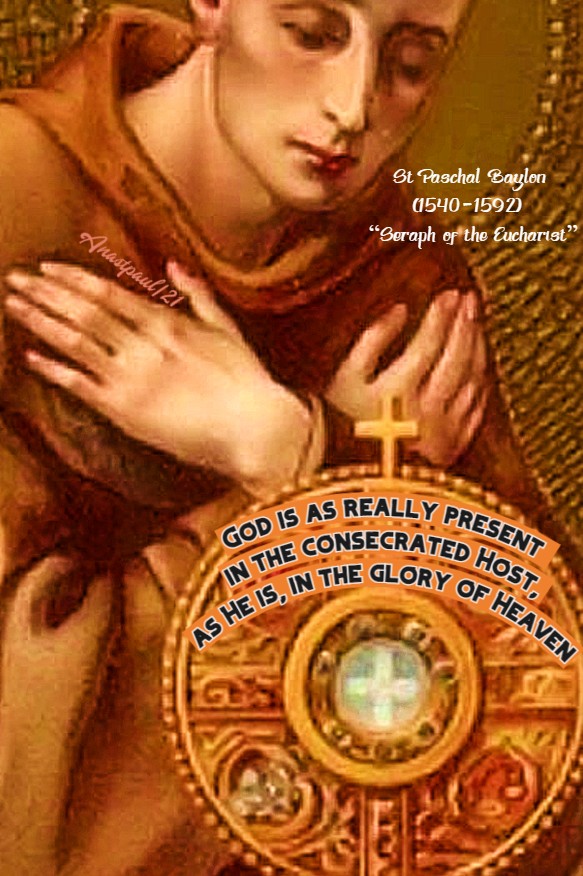
“God is as really present in the consecrated Host, as He is, in the glory of Heaven.”
St Paschal Baylon (1540-1592)
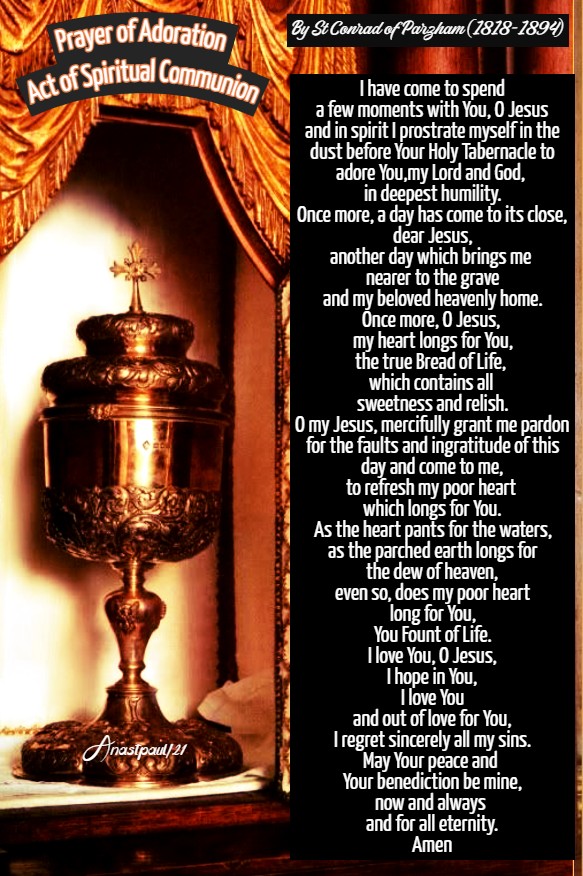
Prayer of Adoration Act of Spiritual Communion By St Conrad of Parzham (1818-1894)
I have come to spend a few moments with You, O Jesus and in spirit I prostrate myself in the dust before Your Holy Tabernacle to adore You, my Lord and God, in deepest humility. Once more, a day has come to its close, dear Jesus, another day which brings me nearer to the grave and my beloved heavenly home. Once more, O Jesus, my heart longs for You, the true Bread of Life, which contains all sweetness and relish. O my Jesus, mercifully grant me pardon for the faults and ingratitude of this day and come to me, to refresh my poor heart which longs for You. As the heart pants for the waters, as the parched earth longs for the dew of heaven, even so, does my poor heart long for You, You Fount of Life. I love You, O Jesus, I hope in You, I love You and out of love for You, I regret sincerely all my sins. May Your peace and Your benediction be mine, now and always and for all eternity. Amen
One Minute Reflection – 3 June – Solemnity of Corpus Christi, The Most Holy Body and Blood of our Lord Jesus Christ, Readings: First: Exodus 24: 3-8, Psalm: Psalms 116: 12-13, 15-16, 17-18 (13), Second: Hebrews 9: 11-15, Gospel: John 6:44-51
“The bread that I will give, is my flesh for the life of the world.” – John 6:51
REFLECTION – “They are wholly mistaken who reject God’s plan for His creation, deny the salvation of the flesh and scoff at the idea of its regeneration, asserting that it cannot put on an imperishable nature. If the flesh is not saved, then the Lord did not redeem us with His Blood, the Chalice of the Eucharist is not a share in His Blood and the Bread which we break is not a share in His Body (1Cor 10,16). For… the human substance, which the Word of God truly became, redeems us with His Blood…
Since we are His members (1Cor 6,15) and are nourished by His creation… He declared, that the Chalice of His creation is His own Blood, from which He augments our own blood and He affirmed, that the Bread of His creation is His own Body from which He gives growth to our being.
So, when the mixed chalice and the baked loaf receive the word of God and when the Eucharistic elements become the Body and Blood of Christ, which brings growth and sustenance to our bodily frame, how can it be maintained that our flesh is incapable of receiving God’s gift of eternal life?
For our flesh feeds on the Lord’s Body and Blood and is His member. So Saint Paul writes: “We are members of his body, of his flesh and of his bones” (Eph 5,30; Gn 2,23). He is not speaking about some spiritual and invisible man…: he is speaking of the anatomy of a real man, consisting of flesh, nerves and bones. It is this that is nourished by His Chalice, the Chalice of His Blood and gains growth from the Bread which is His Body… In the same way, our bodies are nourished by the after being buried in the earth and… rise again in due season, when the word of God confers resurrection upon them “for the glory of God the Father” (Phil 2,11).” – St Irenaeus of Lyons (130-202) Bishop, Theologian and Martyr
PRAYER – Lord Jesus Christ, You gave Your Church an admirable Sacrament, as the abiding memorial of Your Passion. Teach us so to worship the sacred mystery of Your Body and Blood, that ts redeeming power may sanctify us always. Who live and reign with the Father and the Holy Spirit, God forever and ever, amen.
Our Morning Offering – 3 June – Solemnty of Corpus Christ, The Most Holy Body and Blood of our Lord Jesus Christ
St Thomas Aquinas wrote the Liturgy for Corpus Christi when Pope Urban IV added the Solemnity to the universal Church’s Liturgical calendar in 1264. He provided a great sequence, one of the great poems chanted or recited before the proclamation of the Gospel. Lauda Sion is one of only four medieval sequences which were preserved in the Roman Missal published in 1570 following the Council of Trent (1545–1563)—the others being Victimae Paschali Laudes (Easter), Veni Sancte Spiritus (Pentecost) and Dies irae (requiem masses). (A fifth, Stabat Mater, would later be added in 1727.) Before Trent, many feasts had their own sequences. The existing versions were unified in the Roman Missal promulgated in 1570. The Lauda Sion is still sung today as solemn Eucharistic hymn, though its use is optional in the post-Vatican II Ordinary form. As with St Thomas’s other three Eucharistic Hymns, the last few stanzas of the Lauda Sion are often used alone, in this case, to form the “Ecce Panis Angelorum”.
Lauda Sion Salvatorem Sion, Lift Up thy Voice and Sing (Excerpt) By St Thomas Aquinas (1225-1274) Doctor Angelicus / Doctor Communis
Sion, lift thy voice and sing, Praise thy Saviour and thy King, Praise with hymns thy Shepherd true, Dare thy most to praise Him well, For He doth all praise excel, None can ever reach His due.
Special theme of praise is Thine, That true living Bread divine, That life-giving flesh adored, Which the brethren twelve received, As most faithfully believed, At the Supper of the Lord.
Let the chant be loud and high, Sweet and tranquil be the joy Felt to-day in every breast; On this festival divine Which recounts the origin Of the glorious Eucharist.
Quote/s of the Day – 1 June – “Month of the Most Sacred Heart of Jesus” – The Memorial of St Justin Martyr (c 100-165) Father of the Church
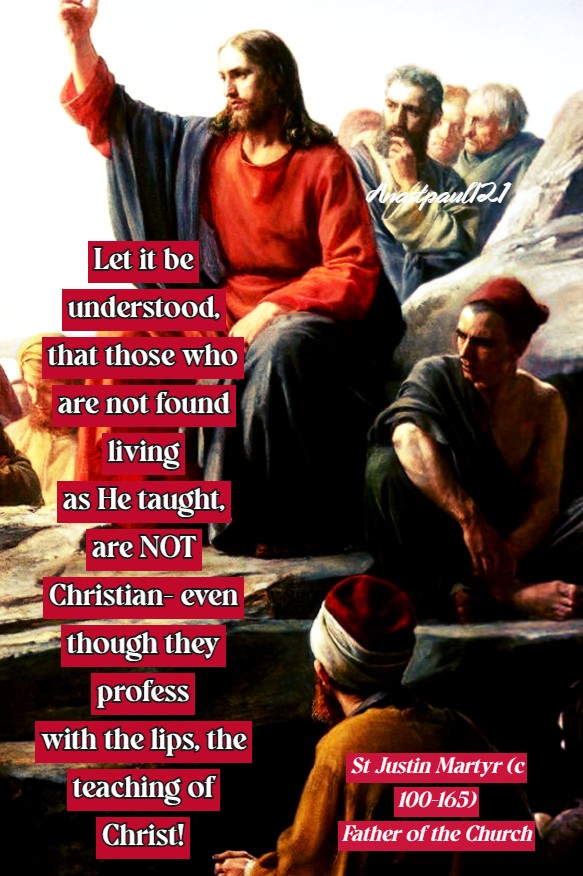
“Let it be understood, that those who are not found living as He taught, are NOT Christian- even though they profess with the lips, the teaching of Christ.”
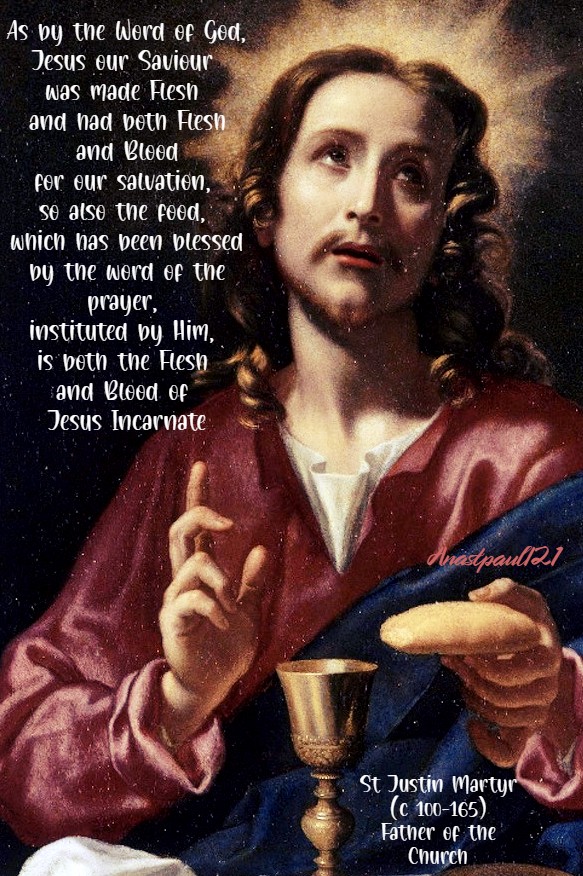
“As by the Word of God, Jesus our Saviour was made Flesh and had both Flesh and Blood for our salvation, so also the food, which has been blessed by the word of the prayer, instituted by Him, is both the Flesh and Blood of Jesus Incarnate.”
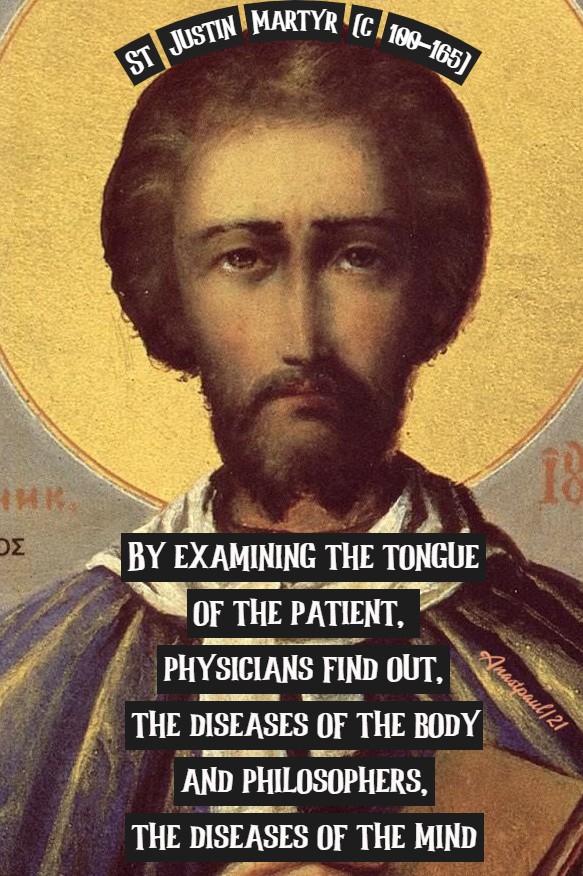
“By examining the tongue of the patient, physicians find out, the diseases of the body and philosophers, the diseases of the mind.”
“Love is like the air we breathe, it isn’t always seen but it is heard, felt and needed.”
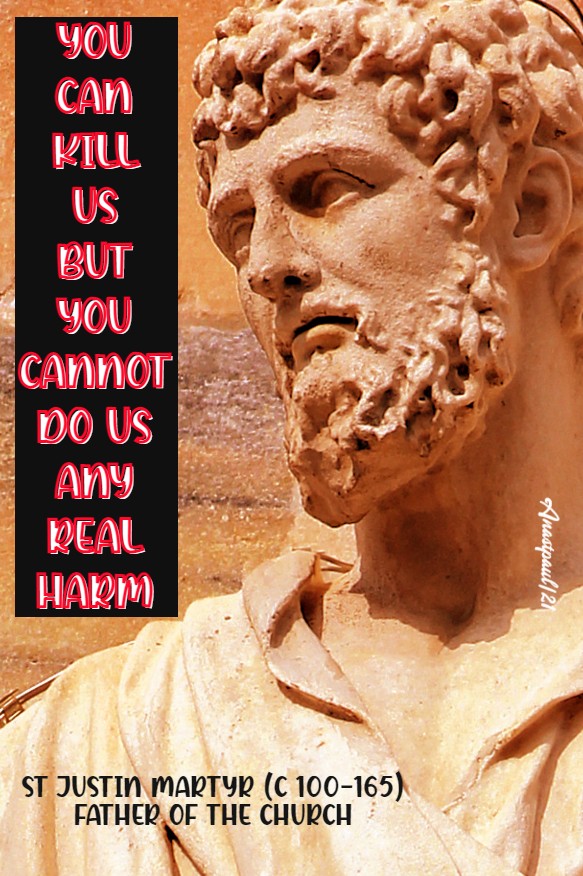
“You can kill us but you cannot do us any real harm.”
Quote/s of the Day – 17 May – The Memorial of St Paschal Baylon OFM (1540-1592) “Seraph of the Eucharist,” “Saint of the Blessed Sacrament,” “Servant of the Blessed Sacrament.”
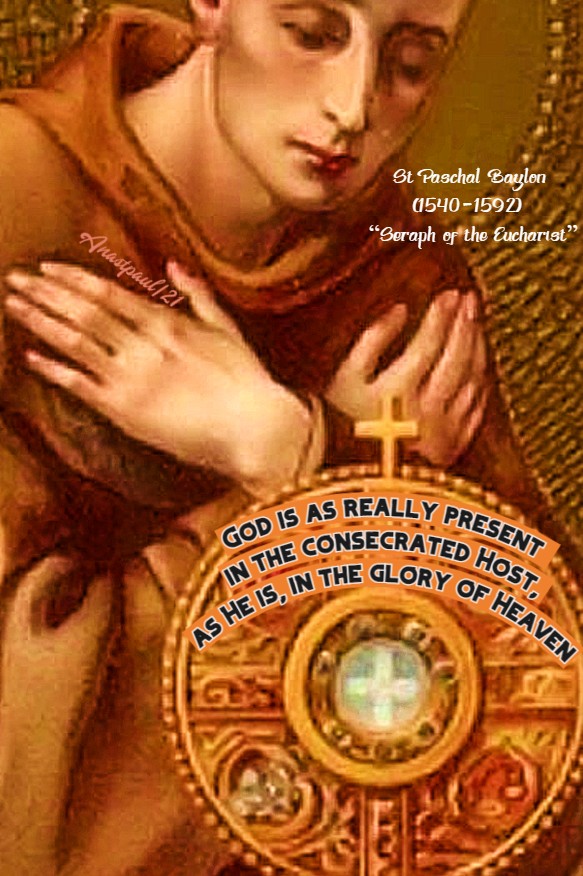
“God is as really present in the consecrated Host, as He is, in the glory of Heaven.”
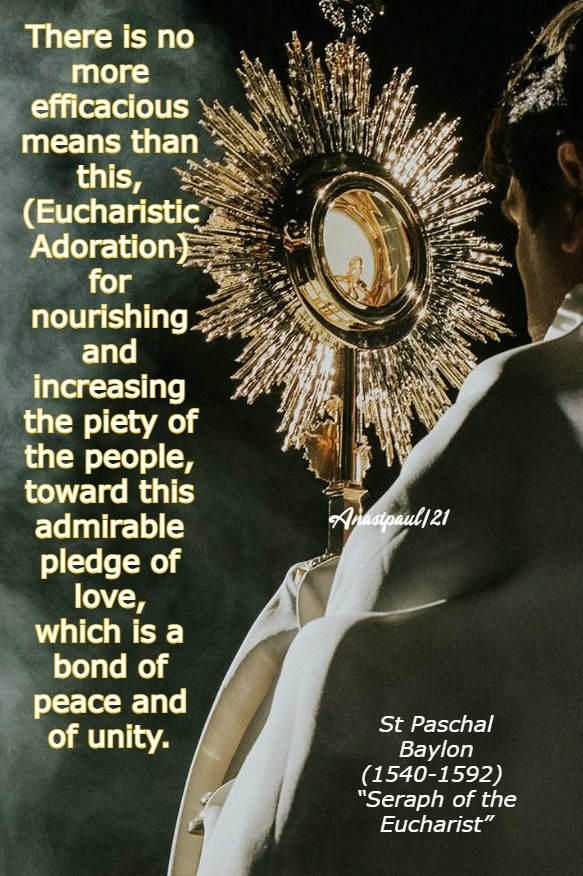
“There is no more efficacious means than this, (Eucharistic Adoration) for nourishing and increasing the piety of the people, toward this admirable pledge of love, which is a bond of peace and of unity.”
One Minute Reflection – 15 May – “Mary’s Month” – Readings: Acts 18: 23-28, Psalms 47: 2-3, 8-9, 10, John 16: 23-28
“In that day, you will ask in My Name” – John 16:26
REFLECTION – “At the end of our prayers we say: “Through Jesus Christ Thy Son, our Lord” and not “Through the Holy Spirit.” This practice of the Universal Church is not without reason. At its root lies the Mystery according to which, Jesus Christ is the Mediator between God and humanity (1 Tim 2:5), a Priest forever, according to the order of Melchizedek, He who, with His own Blood, entered into the Holy of Holies, not that which was only a copy but, into Heaven itself, where He is at the Right Hand of God and intercedes for us (Heb 6:20; 9:24).
It was in His consideration of Christ’s Priesthood, that the Apostle said: “Through Him let us continually offer God a sacrifice of praise, that is, the fruit of lips which confess His Name” (Heb 13:15). It is through Him that we offer the sacrifice of praise and prayer because it is His death that reconciled us while we were still enemies (Rom 5:10). He willed to offer Himself in sacrifice for our sakes and, since then, it is through Him, that our offerings can be acceptable in God’s sight. This is why Saint Peter warns us in these words: “Like living stones, let yourselves be built into a spiritual house to be a holy priesthood to offer spiritual sacrifices acceptable to God, through Jesus Christ” (1 Pt 2:5). This is the reason why we say to God the Father: “Through Jesus Christ Thy Son, our Lord.” – Saint Fulgentius of Ruspe (467-532) – Bishop in North Africa (Letter 14,36).
PRAYER – Since it is from You, God our Father, that redemption comes to us, Your adopted children, look with favour on the family You love, hear our prayer as we unite our voices in the name of Your Son, our Lord and Redeemer. May our faith, love and joy in Christ bring us all alike to our eternal heritage and may the prayer of His blessed Mother and ours lead us safely home. We make our prayer through Christ our Lord, in the unity of the Holy Spirit, God with You, loving Father, forever, amen.
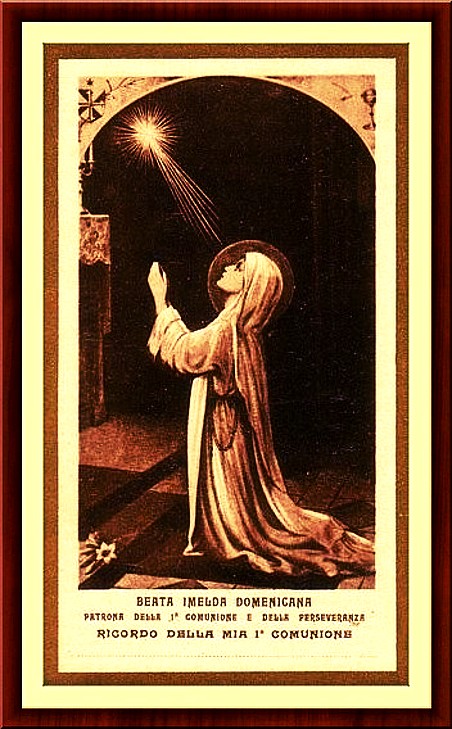
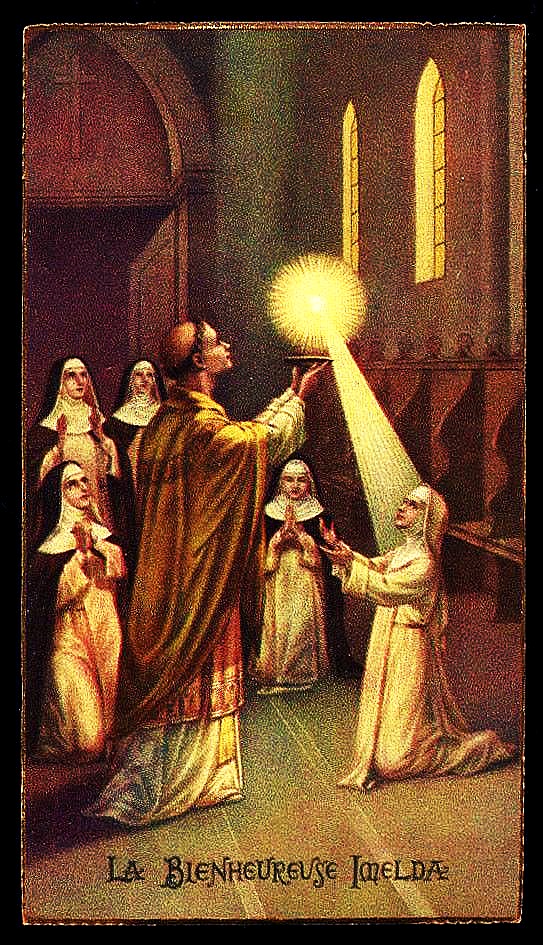
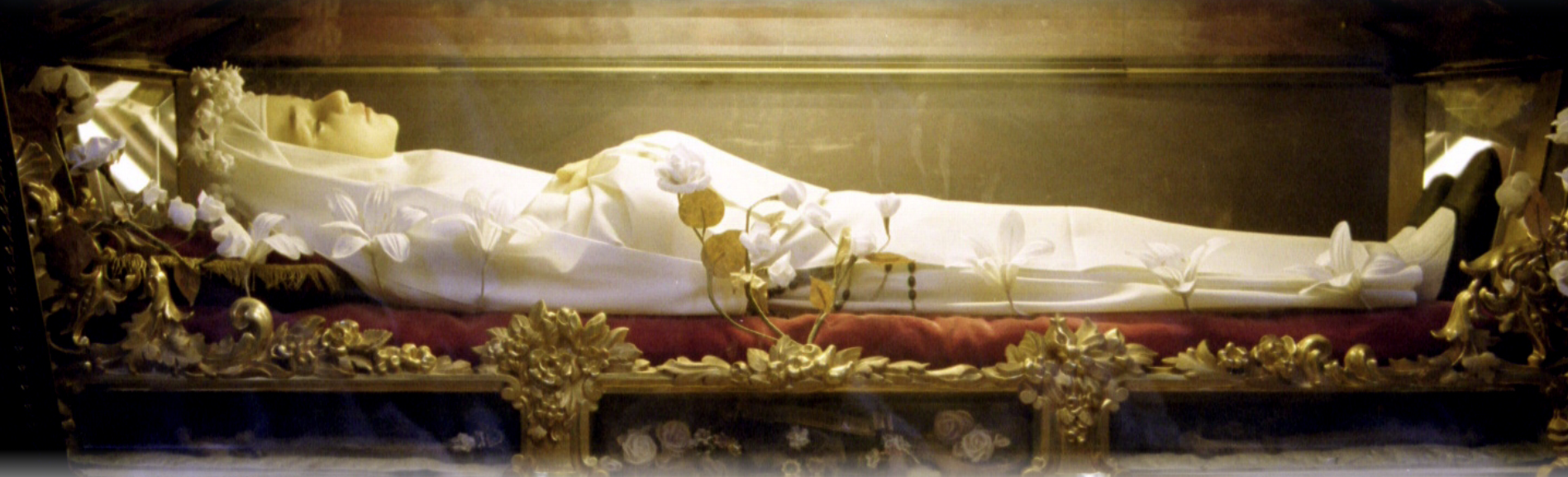
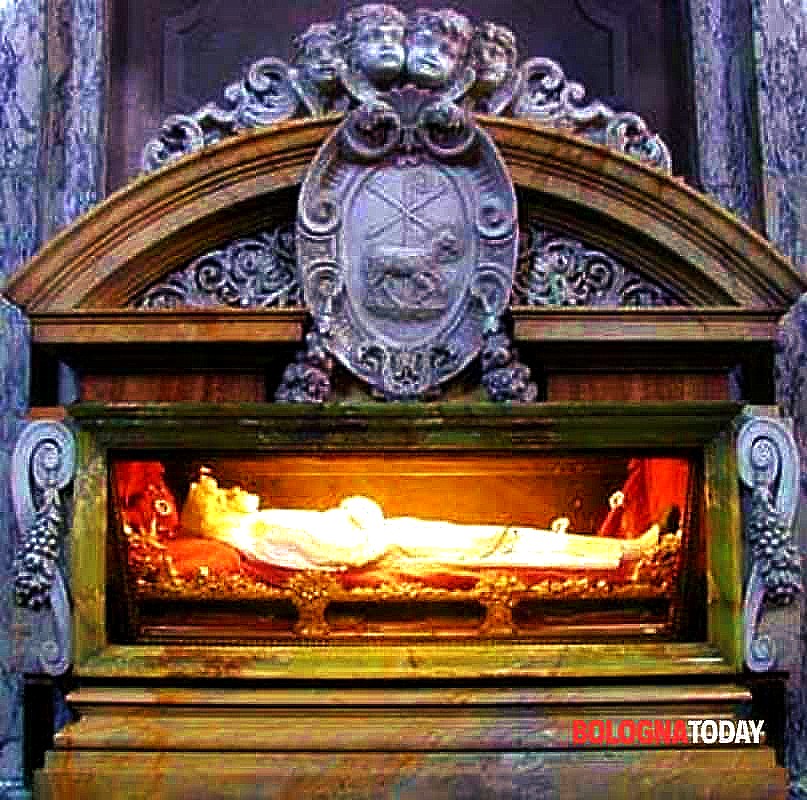
Saint of the Day – 13 May – Blessed Imelda Lambertini (1322-1333) Child Mystic, Virgin. Born in 1322 AS Imelda Dpmenica Lambertini at Bologna, Italy and died on the Feast of the Ascension, 12 May 1333 Bologna, Italy. Patronage – First Communicants (named by Pope Saint Pius X).
Imelda Lambertini was born of a noble family in Bologna, Italy in 1322. Her parents raised her to love her Catholic faith and through their influence she developed a love for prayer, especially for the Mass. Often she would attend Mass and Compline (Night Prayer of the Divine Office) at a nearby Dominican Church. Her mother also taught Imelda to cook and sew for the poor and cultivated in her child an eagerness to perform the corporal works of mercy. Even so, her mother and father, both of whom were getting on in years, were surprised when Imelda asked permission at the tender age of nine to go to live with the Dominican nuns at a neighbouring Monastery. As difficult a decision as this was, her parents evidently sensed the depth of their child’s desire and entrusted her spiritual formation to the Dominicans at Val di Pietra.
At this distance of centuries and culture it is not easy to determine precisely what little Imelda’s status was at the Convent. It seems she was well loved by the Sisters, who allowed her to wear the Dominican habit, to pray with them and to follow their way of life, to the extent that a little girl would be able to do, while still remaining a child. Imelda, we are told, longed (and intensely, it seems) to be allowed to receive Holy Communion with the nuns but in that day, such a thing would have been unheard of for a child her age. Her pleading was again and again gently refused, with the explanation that she would need to wait until she was older and more prepared.
For a time Imelda had to be content with this answer, meanwhile learning to chant Office from hearing the nuns in choir and developing her own interior prayer life in simple childlike ways. The saints, whose stories she had learned from her parents and from the nuns, became her “secret companions” and probably had a hand, in nurturing the longing she felt, to receive Jesus intimately in the Sacrament of the Eucharist. In her private conversations with Jesus, with whom she was developing a deep friendship, we can imagine that she often made known her desire to be allowed to receive Communion. There is no evidence that He put up any opposition to the proposal—but neither did the Sisters relent. And so, Imelda continued, with the intensity of a child, to get to know Jesus more deeply and to desire Him all the more.
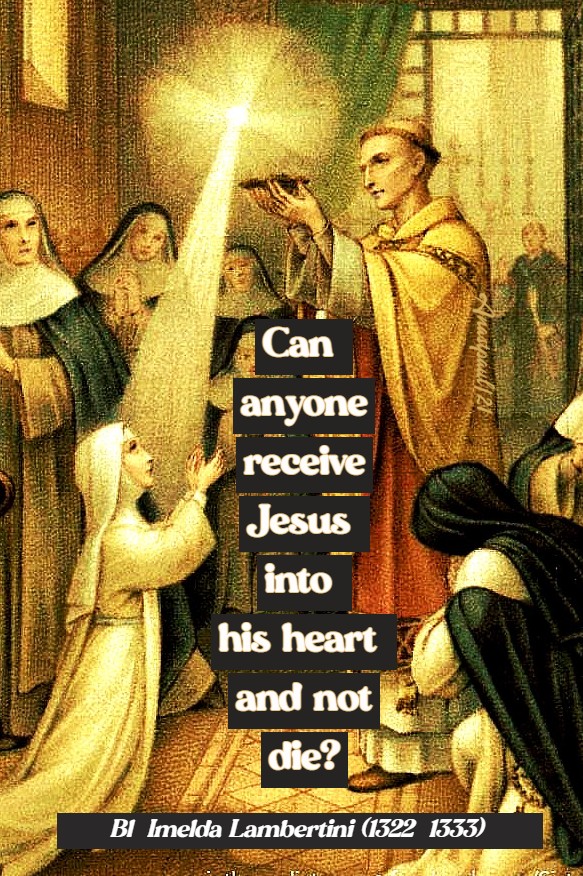
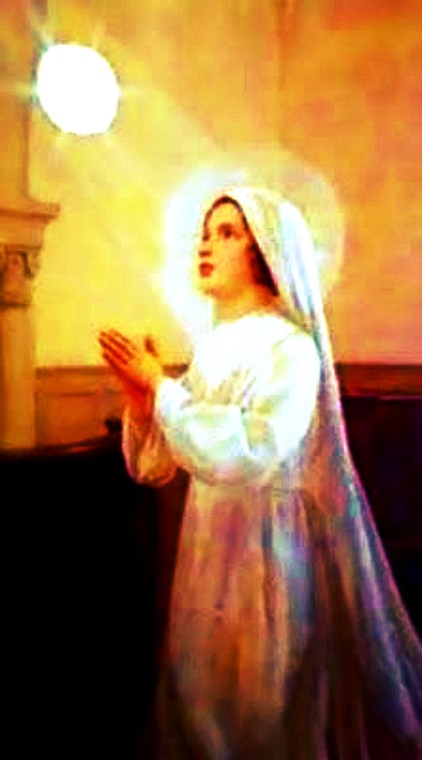
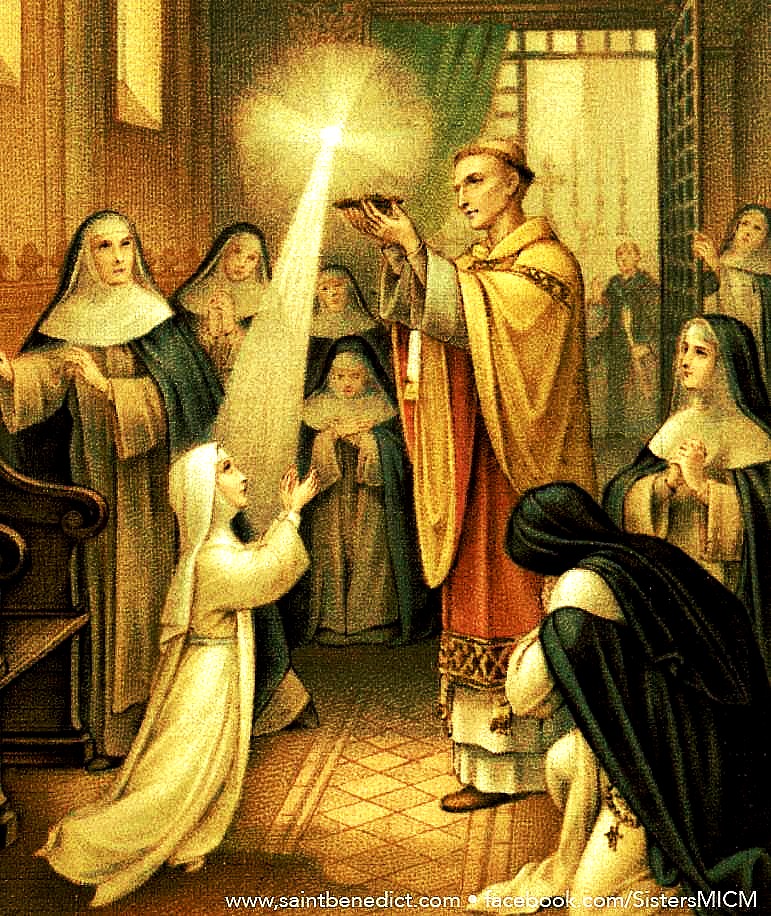
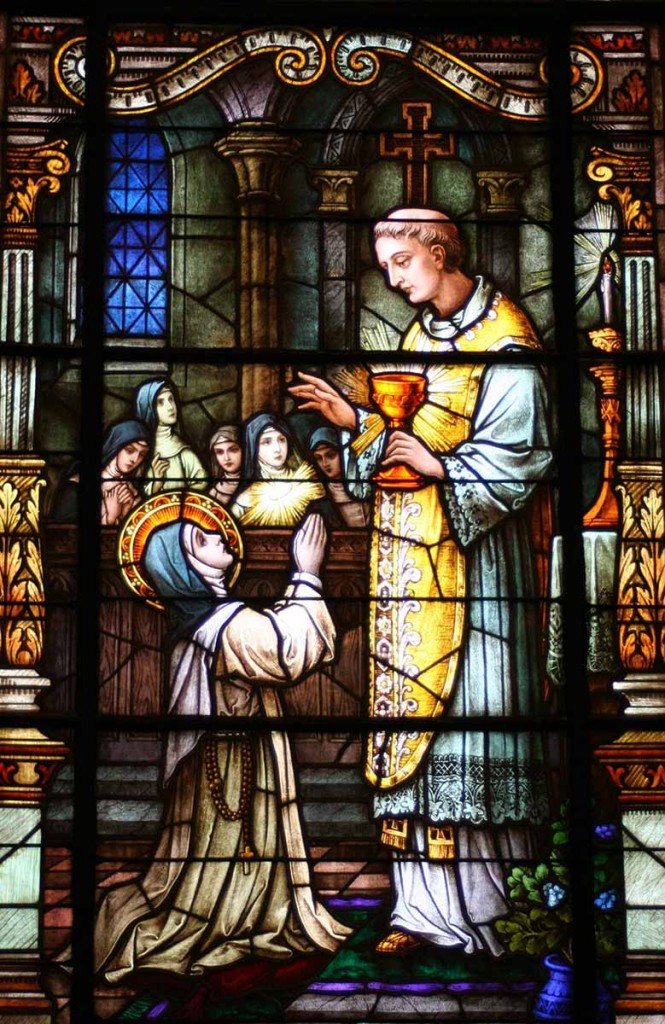
As spring approached, the sisters, who perhaps thought that they had succeeded in diverting Imelda’s “childish fancy” to go to Communion with the grown-ups, were a bit startled when she asked again, shortly before the Feast of the Ascension, to receive her First Holy Communion. (“Asked,” in fact, is not the word. She begged them insistently, it seems.) When the Chaplain was consulted, he agreed with the Sisters and responded with no hesitation that Imelda was much too young. On the Vigil of the Ascension Imelda was in her place in the Chapel, quietly praying as the Sisters received Communion. Then Jesus did a little “insisting” of His own. After Mass, as one of the nuns was clearing the Altar, she heard a noise and looked up to the choir to see Imelda, a glowing light shining above her head, with the Sacred Host suspended in the light.
The Chaplain was called at once and he understood that Jesus Himself was making his desire known. “Let the little children come to Me and do not stop them.” The Priest gave Imelda her First Holy Communion.
We can well imagine that the nuns were amazed and thrilled both at the great blessing to their little one and to their Convent. The Prioress allowed Imelda to remain for some time in thanksgiving and then sent for her to come and have her breakfast. Imelda was still kneeling as they had left her, a smile on her face. Yet when called for, Imelda’s body was still. She had died of pure joy. Her thanksgiving had been well completed and she had nothing left to desire.
Imelda’s story is so well entrenched in the collective memory of her Dominican Brothers and sisters, that it has remained firmly in the Order’s history. She continues to offer the witness of a child with mature desires,and a faith unspoiled in its intensity.
Imelda understood instinctively what many of us have forgotten – that it is the single-hearted who are blessed and that unless we become like children we cannot enter the Kingdom of Heaven.
Lord Jesus Christ, You received into heaven Blessed Imelda, who loved You in the Eucharistic banquet. By her prayers, may we learn to approach Your holy table with that same fervent love and so fulfill our longing to be with You, Who live and reign with the Holy Spirit, one God, forever and ever. Amen
General Calendar of the Order of Preachers
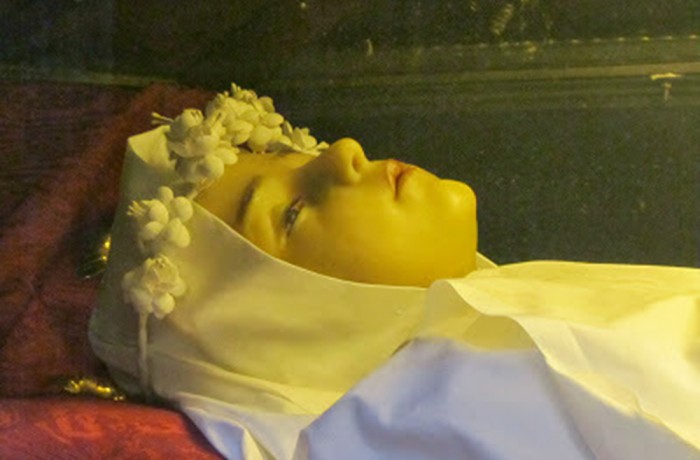
Her remains are kept in Bologna at the Church of San Sigismondo, beneath the wax effigy of her likeness. Blessed Imelda was Beatified on 20 December 1826 by Pope Leo XIII.
Our Morning Offering – 2 May – Fifth Sunday of Easter
Prayer to the Blessed Virgin Mary Before Holy Mass
O most blessed Virgin Mary, Mother of tenderness and mercy, I, a miserable and unworthy sinner, fly to you with all the affection of my heart and I beseech your motherly love, that, as you stood by your most dear Son, while He hung on the Cross, so, in your kindness, you may be pleased to stand by me, a poor sinner, and all Priests who today are offering the Sacrifice here and throughout the entire holy Church, so that with your gracious help we may offer a worthy and acceptable oblation in the sight of the most high and undivided Trinity. Amen.
(This prayer is adapted from the Priests’ Prayers Before each Mass)
Quote/s of the Day – 1 May – Saturday of the Fourth Week of Easter, Readings: Acts 13:44-52, Psalm 98:1-4, John 14:7-14
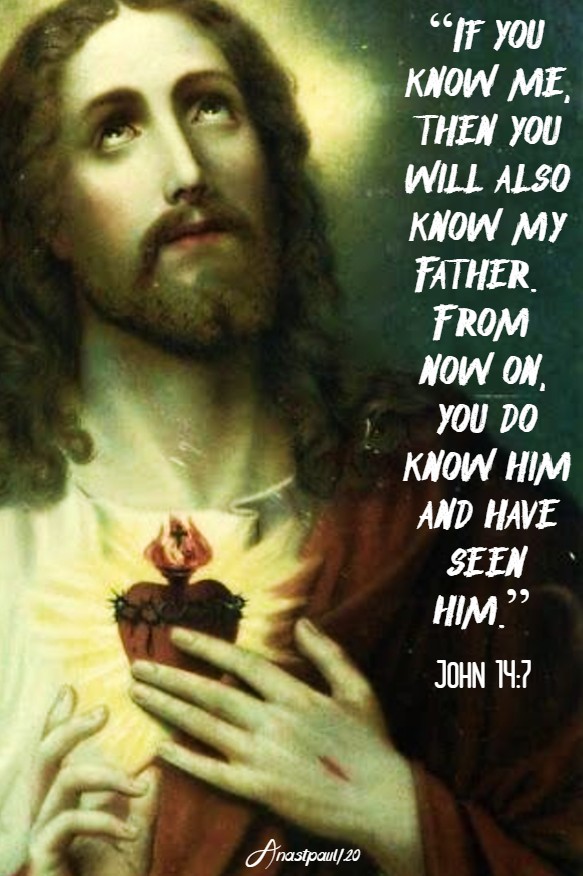
“If you know me, then you will also know my Father. From now on, you do know him and have seen him.”
John 14:7
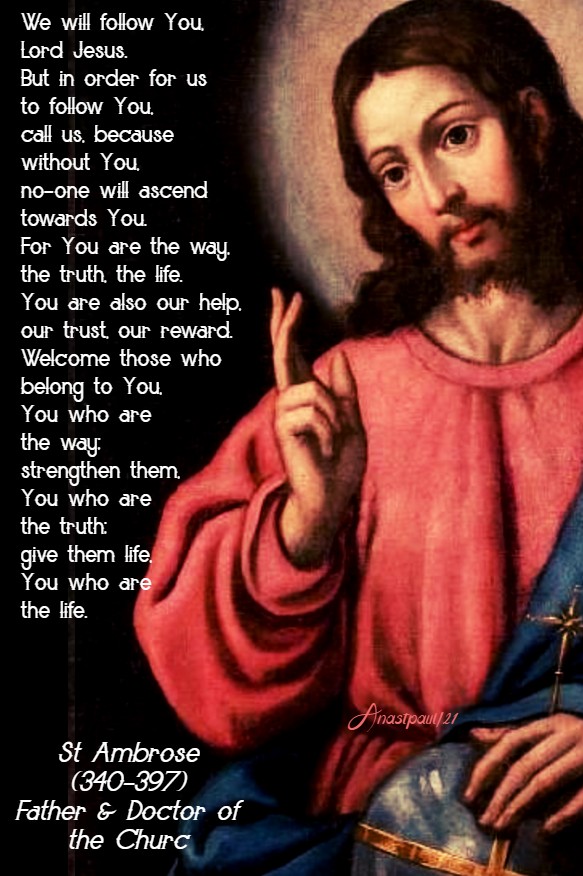
“We will follow You, Lord Jesus. But in order for us to follow You, call us,because without You, no-one will ascend towards You. For You are the way, the truth, the life. You are also our help, our trust, our reward. Welcome those who belong to You, You who are the way; strengthen them, You who are the truth; give them life, You who are the life.”
St Ambrose (340-397) Father & Doctor of the Church
“O you sons of men, how long will you be dull of heart? … Behold – daily He humbles Himself as when from heaven’s royal throne He came down into the womb of the Virgin. Daily, He Himself, comes to us with like humility; daily He descends from the bosom of the Father, upon the Altar, in the hands of the Priest.”




























You must be logged in to post a comment.