Thought for the Day – 14 April – Meditations with Antonio Cardinal Bacci (1881-1971)
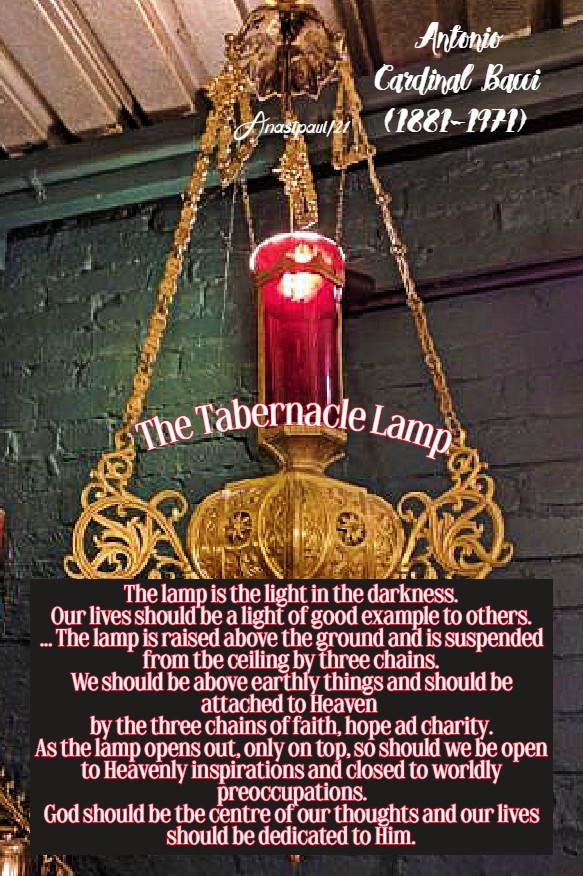
The Tabernacle Lamp
“Look up at the lamp quietly glowin before the Taberncle in honour of the Eucharistic Presence of Jesus, the Light of the world. We also, should be like living lamps of love.
The lamp burns night and day in the Presence of Jesus and burns itself out for Him. For what do we wear out our lives? In useless and unnecessary projects, perhaps for worldly reasons, for the satisfaction of our ego or of our passions? We shall certainly never find peace this way but only disillusionment and remorse.
The lamp is the light in the darkness. Our lives should be a light of good example to others.
The lamp has a flame which gives heat. We should burn with love for God, our one and only good and, for all men, whom we should regard as our brothers in Jesus Christ.
The lamp is raised above the ground and is suspended from tbe ceiling by three chains. We should be above earthly things and should be attached to Heaven by the three chains of faith, hope ad charity. As the lamp opens out, only on top, so should we be open to Heavenly inspirations and closed to worldly preoccupations. God should be tbe centre of our thoughts and our lives should be dedicated to Him. In this way, we shall find peace on earth and happiness hereafter.”
Quote/s of the Day – 13 April – Tuesday of the Second Week of Easter, Readings: First: Acts 4: 32-37, Psalm: Psalms 93: 1ab, 1cd-2, 5, Gospel: John 3: 7b-15
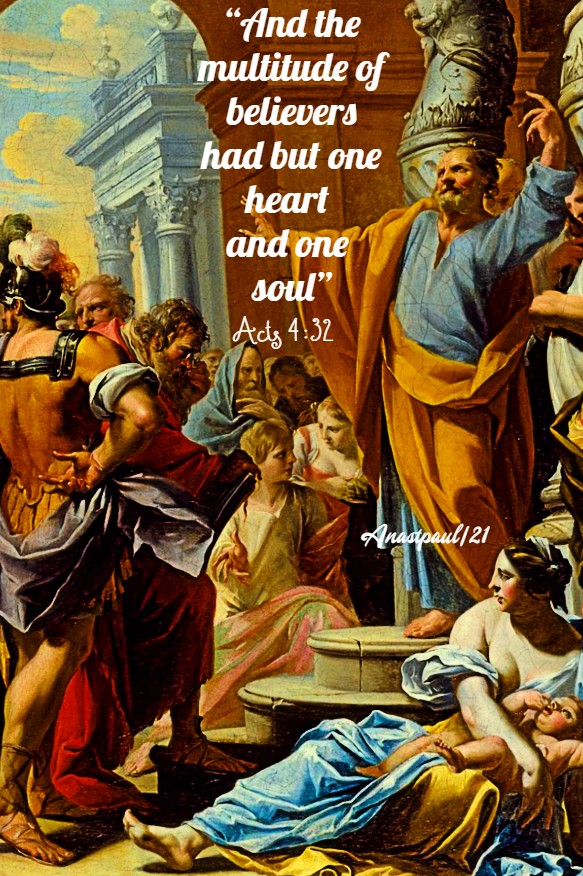
“And the multitude of believers had but one heart and one soul”
Acts 4:32
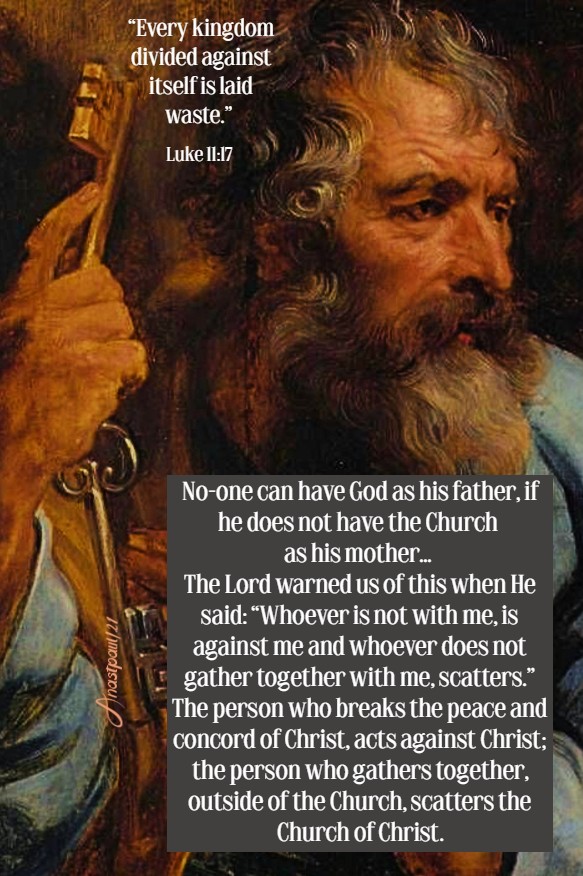
Every kingdom divided against itself is laid waste.”
Luke 11:17
“No-one can have God as his father, if he does not have the Church as his mother… The Lord warned us of this when He said: “Whoever is not with me, is against me and whoever does not gather together with me, scatters.” The person who breaks the peace and concord of Christ, acts against Christ; the person who gathers together, outside of the Church, scatters the Church of Christ.”
St Cyprian of Carthage (c 200- c 258) Bishop and Martyr, Father of the Church On the unity of the Church
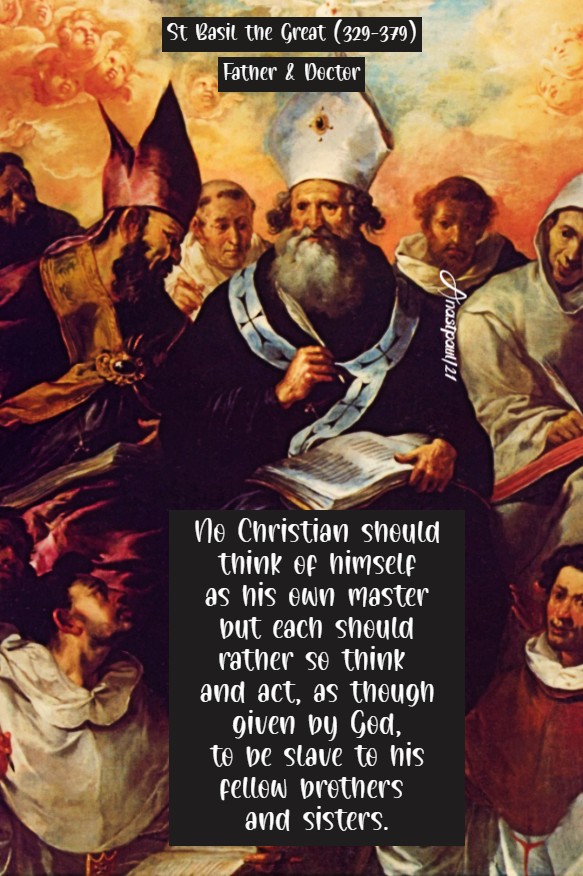
“No Christian should think of himself as his own master but each should rather so think and act, as though given by God, to be slave to his fellow brothers and sisters.”
St Basil the Great (329-379) Father & Doctor
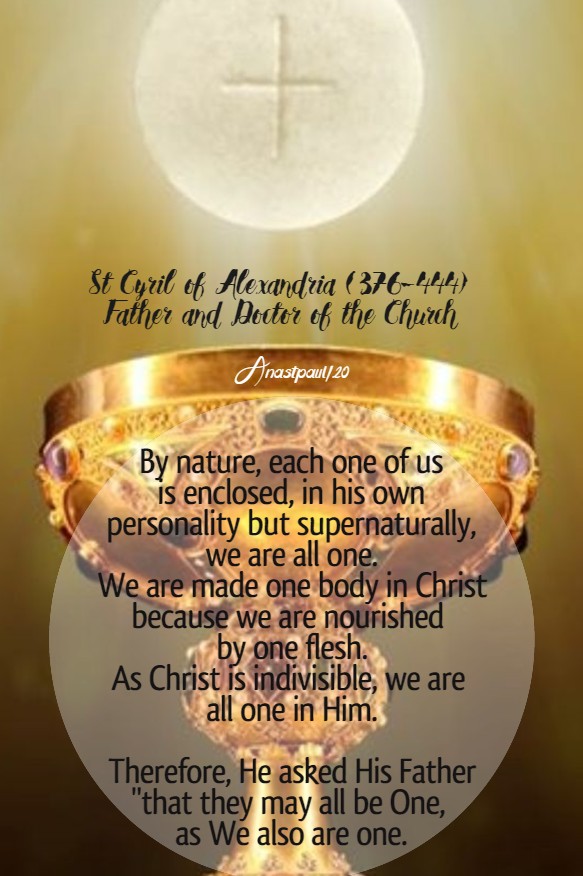
“By nature, each one of us is enclosed, in his own personality but supernaturally, we are all one. We are made one body in Christ because we are nourished by one flesh. As Christ is indivisible, we are all one in Him. Therefore, He asked His Father “that they may all be One, as We also are one.”
St Cyril of Alexandria (376-444) Father and Doctor of the Incarnation
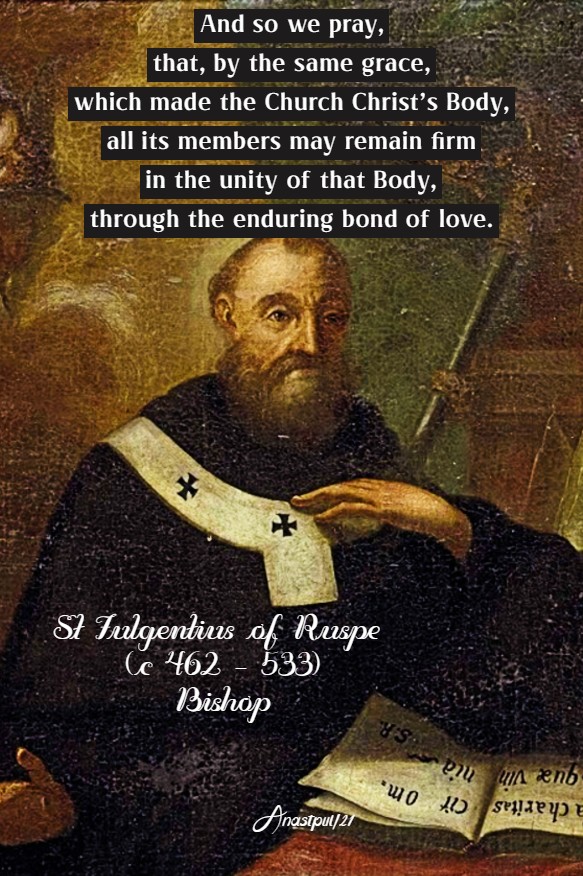
“And so we pray, that, by the same grace, which made the Church Christ’s Body, all its members may remain firm in the unity of that Body, through the enduring bond of love.”
St Fulgentius of Ruspe (c 462 – 533) Bishop, Father of the Church
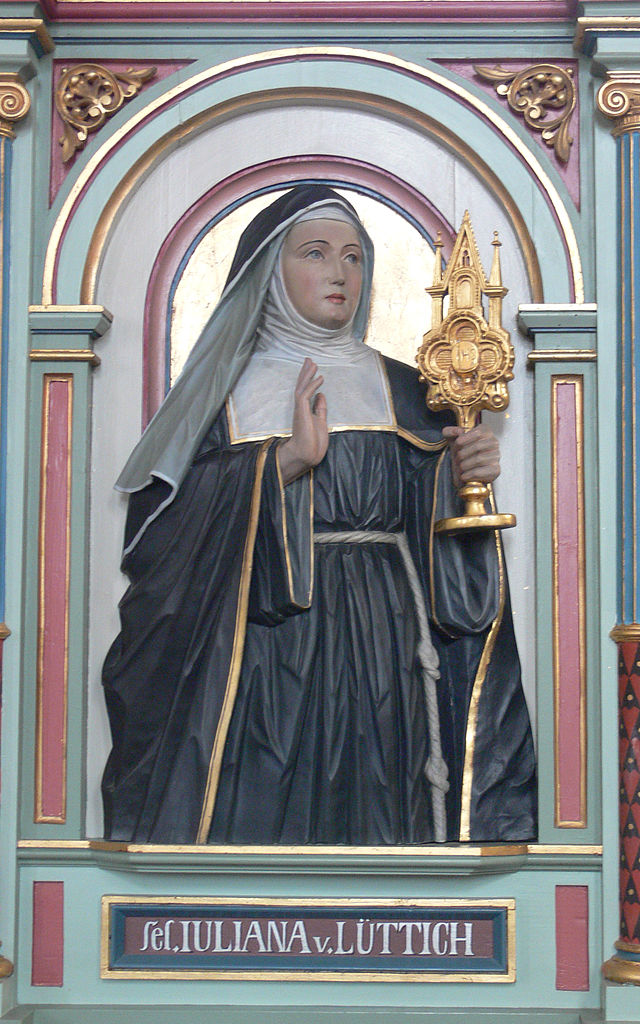
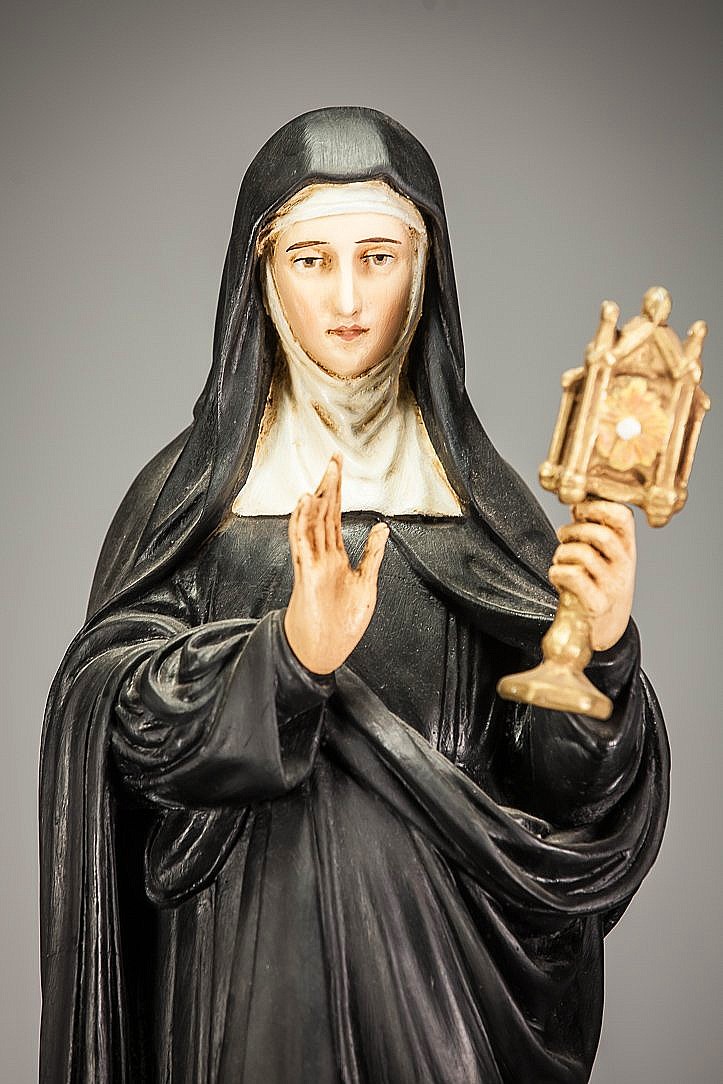
Saint of the Day – 6 April – Saint Juliana of Cornillon (c 1192-1258) Nun, Mystic “Apostle of the Blessed Sacrament.” Born in c 1192 or 1103 at Retinnes, Flanders, Belgium and died on 5 April 1258 of natural causes. Patronage– Devotion to the Blessed Sacrament. St Juliana is little known but the Church is deeply indebted to her, not only because of the holiness of her life but also because, with her great fervour, she contributed to the institution of one of the most important solemn Liturgies of the year, namely the Solemnity of Corpus Christi. She is also known as Juliana of Mount Cornillon, Julliana, Juliana of Liège.
We know several facts about her life, mainly from a Biography that was probably written by a contemporary cleric; it is a collection of various testimonies of people who were directly acquainted with the Saint.
Juliana was born near Liège, Belgium between 1191 and 1192. It is important to emphasise this place because at that time, the Diocese of Liège was, so to speak, a true “Eucharistic Upper Room.” Before Juliana, eminent theologians had illustrated the supreme value of the Sacrament of the Eucharist and, again in Liège, there were groups of women generously dedicated to Eucharistic worship and to fervent communion. Guided by exemplary Priests, they lived together, devoting themselves to prayer and to charitable works.
Orphaned at the age of five, Juliana, together with her sister Agnes, was entrusted to the care of the Augustinian nuns at the Convent and leprosarium of Mont-Cornillon. She was taught mainly by a Sister called “Sapienza” [wisdom], who was in charge of her spiritual development to the time Juliana received the religious habit and thus became an Augustinian Nun.
She became so learned that she could read the words of the Church Fathers, of St Augustine and St Bernard in particular, in Latin. In addition to a keen intelligence, Juliana showed a special propensity for contemplation from the outset. She had a profound sense of Christ’s presence, which she experienced by living the Sacrament of the Eucharist especially intensely and by pausing frequently to meditate upon Jesus’ words: “And lo, I am with you always, to the close of the age” (Mt 28:20).
When Juliana was 16 she had her first vision, which recurred subsequently several times during her Eucharistic adoration. Her vision presented the moon in its full splendour, crossed diametrically by a dark stripe. The Lord made her understand the meaning of what had appeared to her. The moon symbolized the life of the Church on earth, the opaque line, on the other hand, represented the absence of a liturgical feast for whose institution Juliana was asked to plead effectively, namely, a feast in which believers would be able to adore the Eucharist so as to increase in faith, to advance in the practice of the virtues and to make reparation for offences, to the Most Holy Sacrament.
The vision of St Juliana
Juliana, who in the meantime had become Prioress of the convent, kept this revelation that had filled her heart with joy a secret for about 20 years. She then confided it to two other fervent adorers of the Eucharist, Blessed Eva, who lived as a hermit, and Isabella, who had joined her at the Monastery of Mont-Cornillon. The three women established a sort of “spiritual alliance” for the purpose of glorifying the Most Holy Sacrament. They also chose to involve a highly regarded Priest, John of Lausanne, who was a Canon of the Church of St Martin in Liège. They asked him to consult theologians and clerics on what was important to them. Their affirmative response was encouraging.
What happened to Juliana of Cornillon occurs frequently in the lives of Saints. To have confirmation that an inspiration comes from God, it is always necessary to be immersed in prayer to wait patiently, to seek friendship and exchanges with other good souls and to submit all things to the judgement of the Shepherds of the Church. It was in fact Bishop Robert Torote, Liège who, after initial hesitation, accepted the proposal of Juliana and her companions and first introduced the Solemnity of Corpus Christi in his Diocese. Later other Bishops following his example and instituted this Feast in the territories entrusted to their pastoral care.
However, to increase their faith the Lord often asks Saints to sustain trials. This also happened to Juliana who had to bear the harsh opposition of certain members of the clergy and even of the Superior on whom her Monastery depended. Of her own free will, therefore, Juliana left the Convent of Mont-Cornillon with several companions. For 10 years — from 1248 to 1258 — she stayed as a guest at various Monasteries of Cistercian sisters. She edified all with her humility, she had no words of criticism or reproach for her adversaries and continued zealously to spread Eucharistic worship.
She died at Fosses-La-Ville, Belgium, in 1258. In the cell where she lay, the Blessed Sacrament was exposed and, according to her biographer’s account, Juliana died contemplating with a last effusion of love Jesus in the Eucharist, Whom she had always loved, honoured and adored.
Jacques Pantaléon of Troyes was also won over to the good cause of the Feast of Corpus Christi during his ministry as Archdeacon in Lièges. It was he, who, having become Pope with the name of Urban IV in 1264, instituted the Solemnity of Corpus Christi on the Thursday after Pentecost as a Feast of precept for the universal Church.
In the Bull of its institution, entitled Transiturus de hoc mundo, (11 Aug. 1264), Pope Urban even referred discreetly to Juliana’s mystical experiences, corroborating their authenticity. He wrote: “Although the Eucharist is celebrated solemnly everyday, we deem it fitting, that at least once a year. it be celebrated with greater honour and a solemn commemoration.
Indeed we grasp the other things we commemorate with our spirit and our mind but this does not mean, that we obtain their real presence. On the contrary, in this sacramental commemoration of Christ, even though in a different form, Jesus Christ is present with us in His own substance. While He was about to ascend into Heaven, He said ‘And lo, I am with you always, to the close of the age’ (Matthew 28:20)”.
The Pontiff made a point of setting an example by celebrating the solemnity of Corpus Christi in Orvieto, the town where he was then residing. Indeed, he ordered that the famous Corporal with the traces of the Eucharistic miracle which had occurred in Bolsena the previous year, 1263, be kept in Orvieto Cathedral — where it still is today.
While a Priest was consecrating the bread and the wine, he was overcome by strong doubts about the Real Presence of the Body and Blood of Christ in the Sacrament of the Eucharist. A few drops of blood began miraculously to ooze from the consecrated Host, thereby confirming what our faith professes.
Urban iv asked one of the greatest theologians of history, St Thomas Aquinas — who at that time was accompanying the Pope and was in Orvieto — to compose the texts of the Liturgical Office for this great Feast. They are masterpieces, still in use in the Church today, in which theology and poetry are fused into glorious prayers. These texts pluck at the heartstrings in an expression of praise and gratitude to the Most Holy Sacrament, while the mind, penetrating the mystery with wonder, recogniSes in the Eucharist, the Living and Real Presence of Jesus, of His Sacrifice of Love, that reconciles us with the Father and gives us salvation.
Although, after the death of Urban iv the celebration of the Feast of Corpus Christi was limited to certain regions of France, Germany, Hungary and Northern Italy, it was another Pontiff, John XXII who in 1317, re-established it for the universal Church. Since then, the Feast experienced a wonderful development and is still deeply appreciated by the Catholic faithful.
In remembering St Juliana of Cornillon, let us also renew our faith in the Real Presence of Christ in the Eucharist. As we are taught “Jesus Christ is present in the Eucharist in a unique and incomparable way. He is present in a true, real and substantial way, with His Body and His Blood, with His Soul and His Divinity. In the Eucharist, therefore, there is present in a sacramental way, that is, under the Eucharistic Species of bread and wine, Christ whole and entire, God and Man” (n. 282). (Excerpt – Pope Benedict XVI)
St Juliana was Canonised in 1869 by Blessed Pope Pius IX.
The Saints never failed to find strength, consolation and joy in the Eucharistic encounter. Let us repeat before the Lord present in the Most Blessed Sacrament ,the words of the Eucharistic hymn “Adoro te devote”: [Devoutly I adore Thee]: Make me believe ever more in you, “Draw me deeply into faith, / Into Your hope, into Your love.”
“The masterpiece of Jesus Christ’s love for humanity is the Eucharist. The Eucharist is within our reach. We can all get close to Christ the guest and talk with Him and perceive the warmth of His word. The word! How it inflames the spirits! How will the word of Christ inflame them! We can all get to the altar when He immolates Himself and shouts at us: Look how much I have loved and loved you! And we can all sit at His table and eat the bread and drink the intoxicating wine of charity. “
Blessed Marcelo Spínola y Maestre (1835-1906) Cardinal-Priest
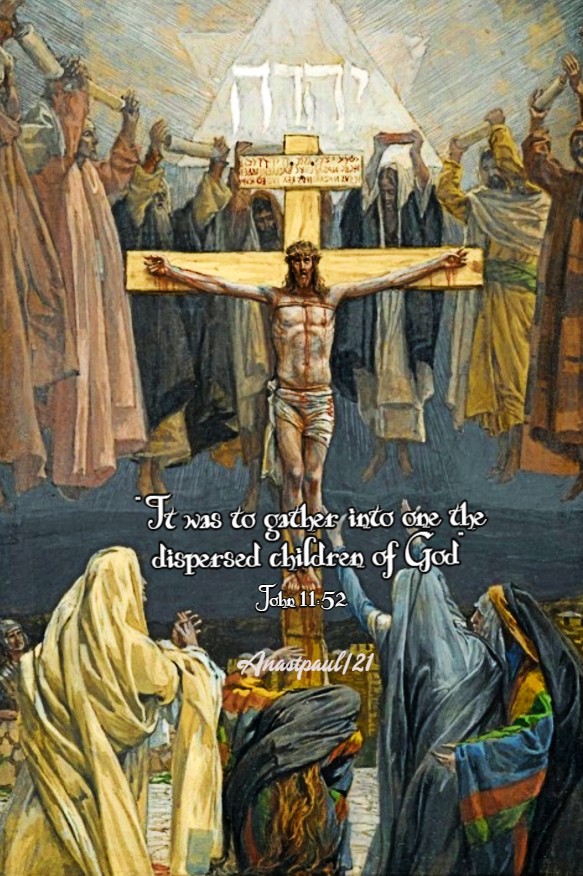
Quote/s of the Day – 27 March – Saturday of Passion Week or the Fifth Week of Lent, Readings: First Reading: Ezekiel 37: 21-28, Responsorial Psalm: Jeremiah 31: 10, 11-12abcd, 13, Verse Before the Gospel: Ezekiel 18: 31, Gospel: John 11: 45-56
“It was to gather into one the dispersed children of God”
John 11:52
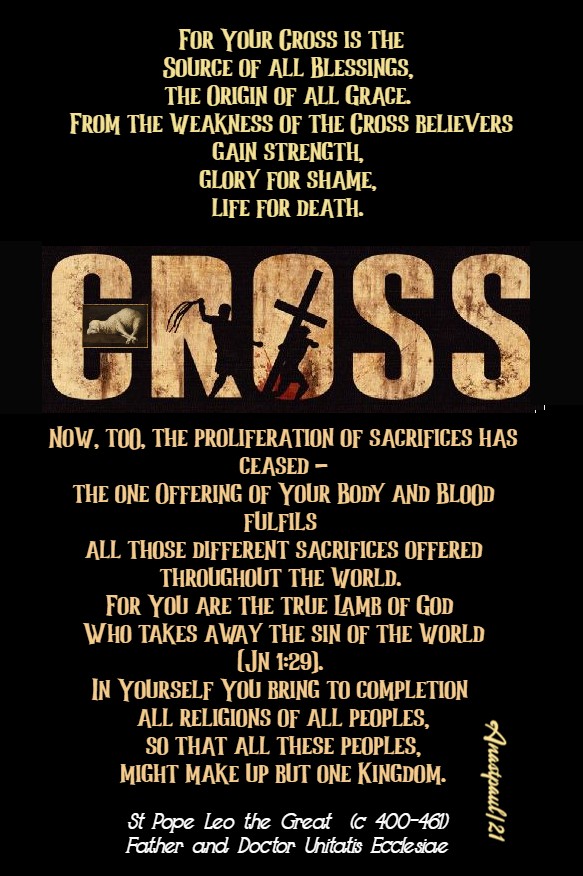
“For Your Cross is the Source of all Blessings, the Origin of all Grace. From the weakness of the Cross believers gain strength, glory for shame, life for death. Now, too, the proliferation of sacrifices has ceased – the one Offering of Your Body and Blood fulfills all those different sacrifices offered throughout the world. For You are the true Lamb of God Who takes away the sin of the world (Jn 1:29). In Yourself You bring to completion all religions of all peoples, so that all these peoples, might make up but one Kingdom.”
St Pope Leo the Great (c 400-461) Father and Doctor Unitatis Ecclesiae
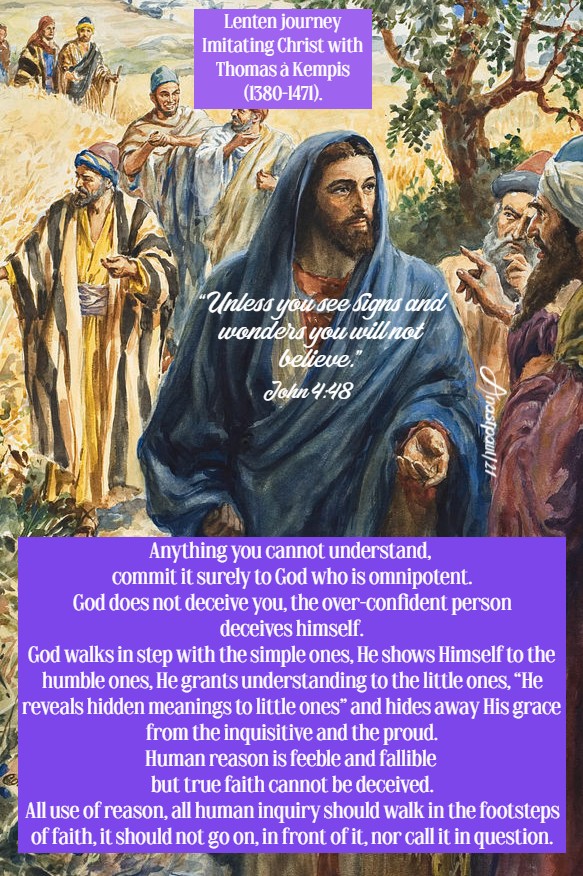
Day Twenty Seven of our Lenten Journey – 15 March – Monday of the Fourth week of Lent, Readings: Isaiah 65:17-21, Psalms 30:2 and 4, 5-6, 11-12 and 13, John 4:43-54
Imitating Christ with Thomas à Kempis (1380-1471)
In You is the source of life and in Your Light Lord, we see light Psalm 35(36)
“Unless you see signs and wonders you will not believe.” … John 4:48
“Whoever examines the majesty of God will be crushed by His glory” (Prv 25:27 Vg). God can do works that pass man’s understanding. … Faith is required of you and sincerity of life, not high intelligence, nor penetrating knowledge of the mysteries of God. If you do not understand nor grasp what is below you, how will you comprehend what is above you? Be subject to God, submit your feeling to the faith and the light of knowledge will be given to you, as much as you need and can use.
Some have grave temptations concerning faith in the Blessed Sacrament, which are not to be imputed to them but rather, to the enemy. Take no notice, do not argue with your thoughts, nor answer the doubts with which the devil attacks you, believe God’s word, believe His saints and prophets and the wicked enemy will be routed. It is often most profitable to God’s servant to endure such things. For the devil does not tempt the infidel or sinner, of whom he has already secure possession but, he uses various means to tempt and harass the devout faithful.
Go on then, with simple unquestioning faith and approach the Sacrament with reverent beseeching. Anything you cannot understand, commit it surely to God who is omnipotent. God does not deceive you, the over-confident person deceives himself. God walks in step with the simple ones, He shows Himself to the humble ones, He grants understanding to the little ones, “He reveals hidden meanings to little ones” and hides away His grace from the inquisitive and the proud. Human reason is feeble and fallible but true faith cannot be deceived. All use of reason, all human inquiry should walk in the footsteps of faith, it should not go on, in front of it, nor call it in question. (Book4 Ch 18)
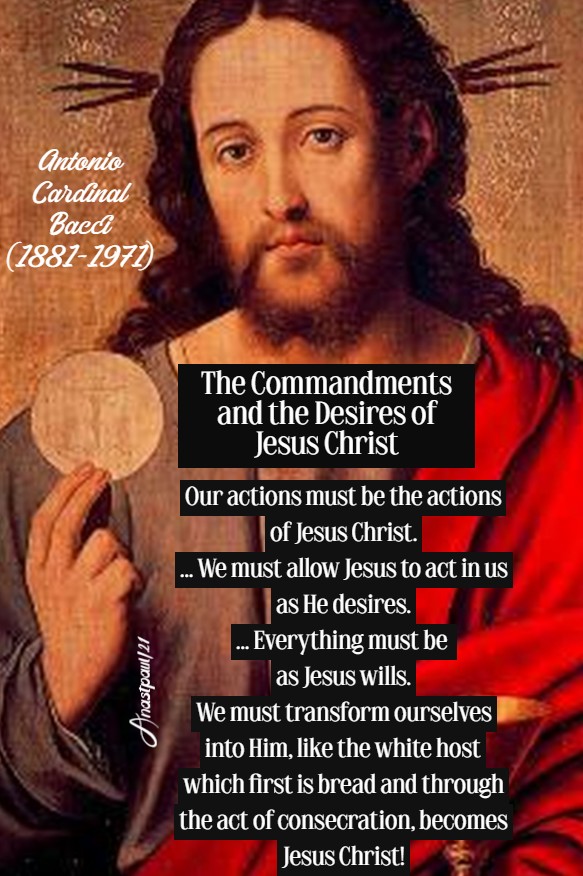
Thought for the Day – 1 March– Meditations with Antonio Cardinal Bacci (1881-1971)
The Commandments and the Desires of Jesus Christ
“Whoever has Jesus in his heart,” writes St Francis de Sales, “has Him also in his actions.” If God really lives in us, He cannot be inactive but will work with us for our sanctification. Our actions must be the actions of Jesus Christ. Remember that the Gospel says, that a good tree will produce good fruit, while a bad tree will produce bad fruit (Cf Mt 7:17). From the fruits which we produce, we can see clearly, if Jesus is working in us. Holiness consists in accepting the will of God, whatever it is, whether it be sacrifice, sorrow or humiliation. We must allow Jesus to act in us as He desires. Not only must we conform to His holy will but, we must do so, with enthusiasm. We must be obedient instruments of His grace, doing precisely what He wants us to do. If He wishes us to suffer, we must be prepared to do so for Him, knowing that we are participating and, co-operating, in the work of His Redemption. If He desires us to be happy, we should humbly accept happiness from His Hands. Everything must be as Jesus wills. We must transform ourselves into Him, like the white host which first is bread and through the act of consecration, becomes Jesus Christ!”
Our Morning Offering – 28 February – The Second Sunday of Lent
My Lord, I am Unworthy! Prayer before Holy Communion By St Bonaventure (1217-1274) Doctor of the Church
My Lord, Who are You and who am I, that I should dare to take You into my body and soul? A thousand years of penance and tears would not be sufficient to make me worthy to receive so royal a Sacrament even once! How much more am I unworthy of it, who fall into sin daily, I, the incorrigible, who approach You so often without due preparation! Nevertheless, Your mercy infinitely surpasses my unworthiness. Therefore, I make bold to receive this Sacrament, trusting in Your love. Amen
Quote/s of the Day – 26 February – Friday of the First Week of Lent, Readings: Ezekiel 18:21-28, Psalms 130:1-2, 3-4, 5-7, 7-8, Matthew 5:20-26
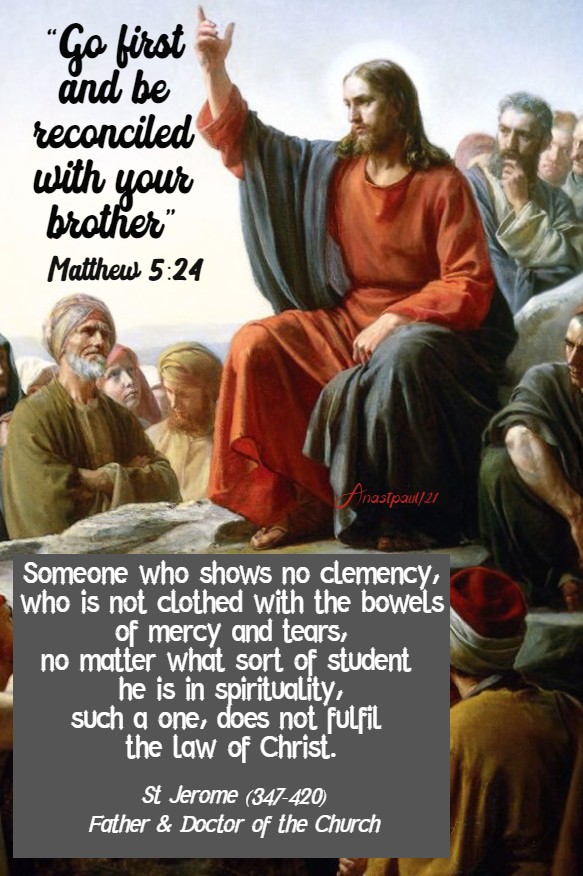
“Go first and be reconciled with your brother”
Matthew 5:24
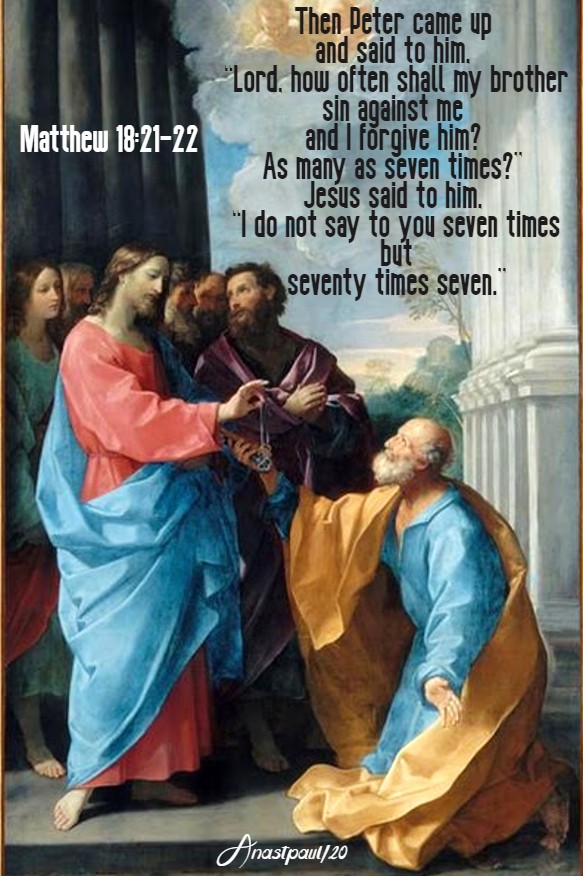
“Then Peter came up and said to him, “Lord, how often shall my brother sin against me and I forgive him? As many as seven times?” Jesus said to him, “I do not say to you seven times but seventy times seven.”
Matthew 18:21-22
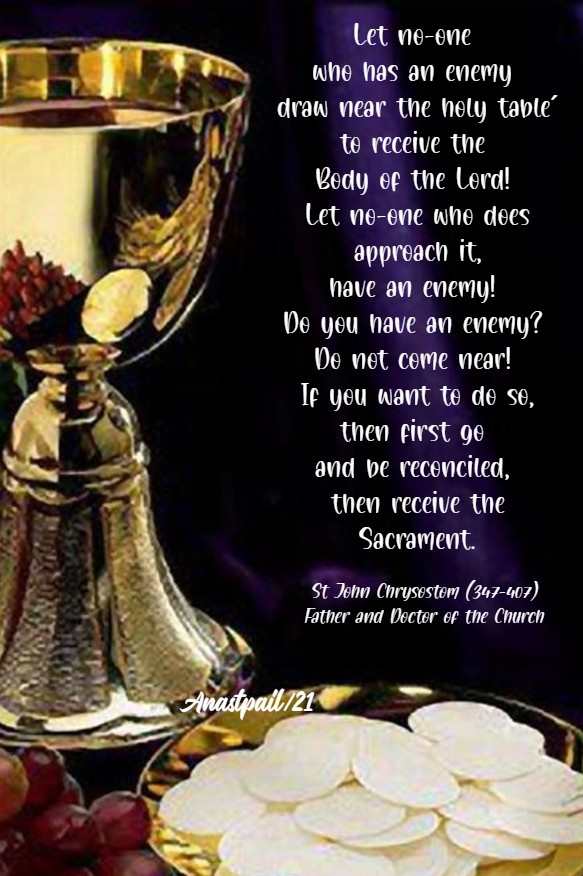
“This is what I proclaim, what I testify, what I cry out with a resounding voice: Let no-one who has an enemy, draw near the holy table, to receive the Body of the Lord! Let no-one who does approach it, have an enemy! Do you have an enemy? Do not come near! If you want to do so, then first go and be reconciled, then receive the Sacrament.”
St John Chrysostom (347-407) Father and Doctor of the Church
“Someone who shows no clemency, who is not clothed with the bowels of mercy and tears, no matter what sort of student he is in spirituality, such a one does not fulfil the law of Christ.”
St Jerome (347-420) Father & Doctor of the Church
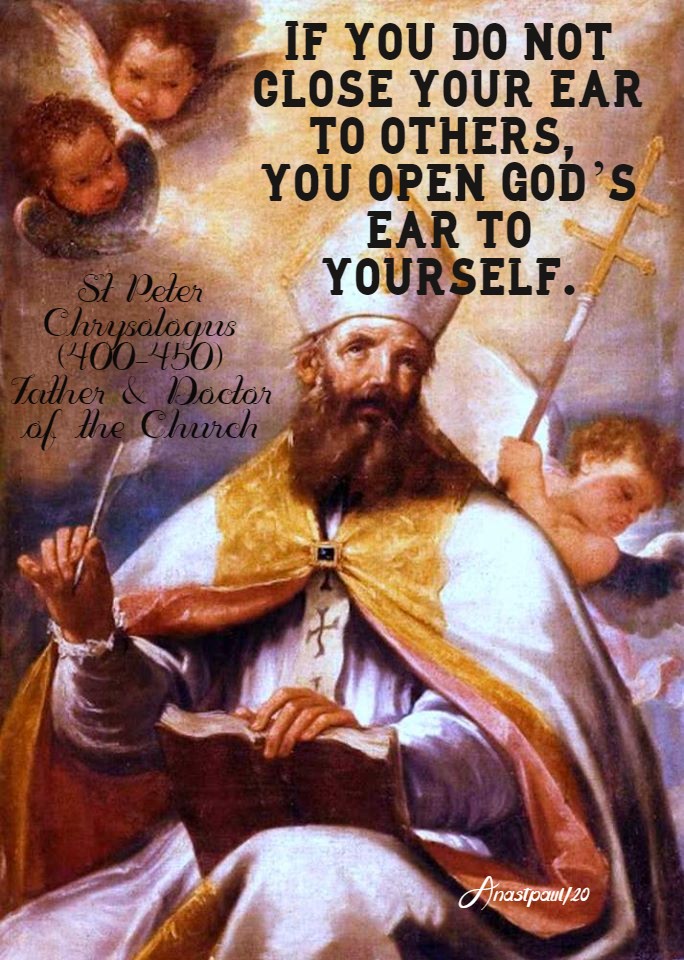
“If you do not close your ear to others, you open God’s ear to yourself.”
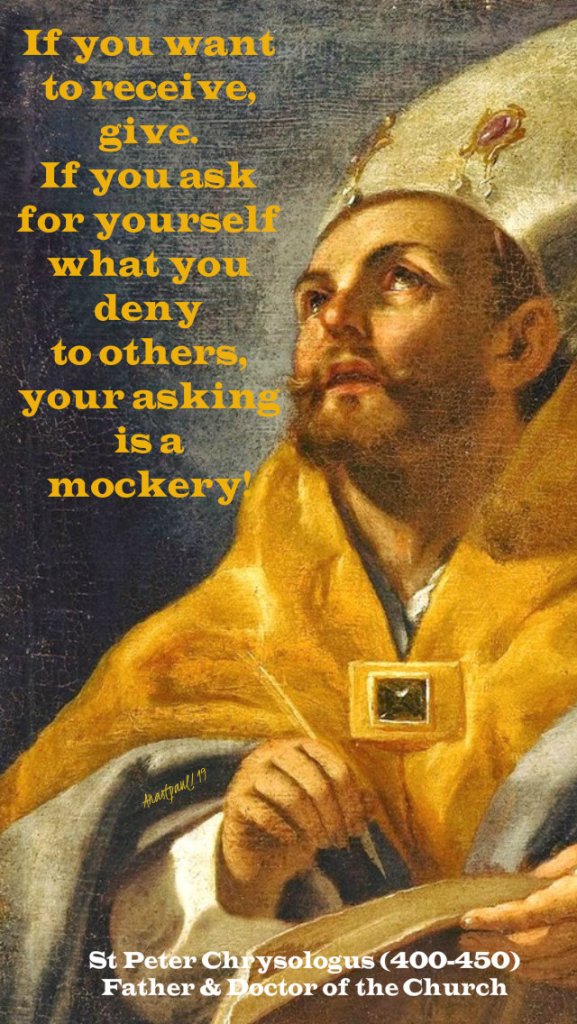
“If you want God to know that you are hungry, know that another is hungry. If you hope for mercy, show mercy. If you look for kindness, show kindness. If you want to receive, give. If you ask for yourself what you deny to others, your asking is a mockery.”
St Peter Chrysologus (400-450) Father & Doctor of the Church
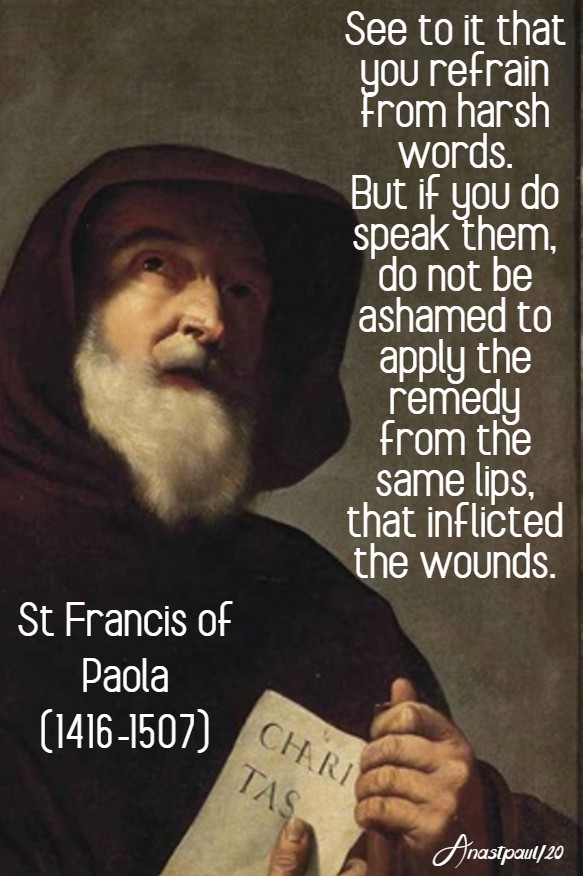
“See to it that you refrain from harsh words. But if you do speak them, do not be ashamed to apply the remedy from the same lips, that inflicted the wounds.”
St Francis of Paola OM (1416-1507)
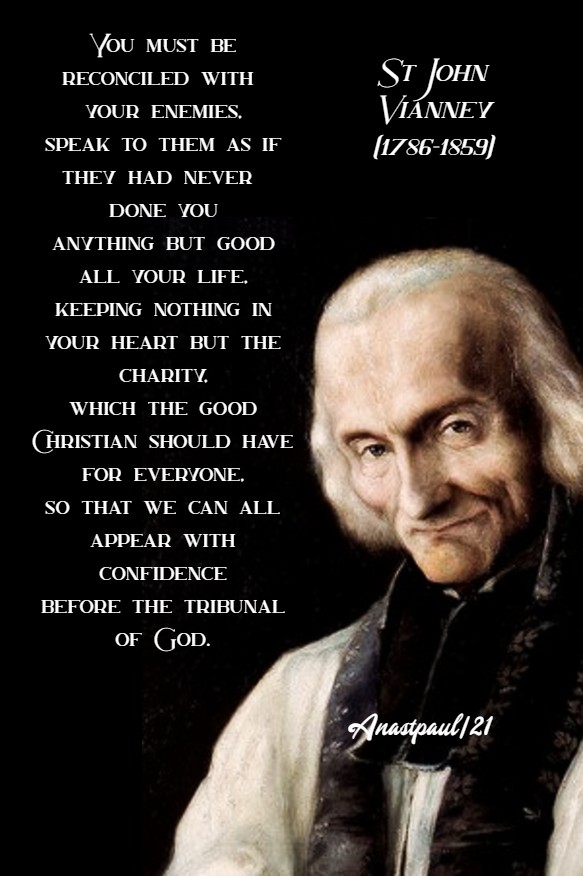
“You must be reconciled with your enemies, speak to them as if they had never done you anything but good all your life, keeping nothing in your heart but the charity, which the good Christian should have for everyone, so that we can all appear with confidence before the tribunal of God.”
Thought for the Day – 22 February – Meditations with Antonio Cardinal Bacci (1881-1971) – The Feast of the Chair of Saint Peter
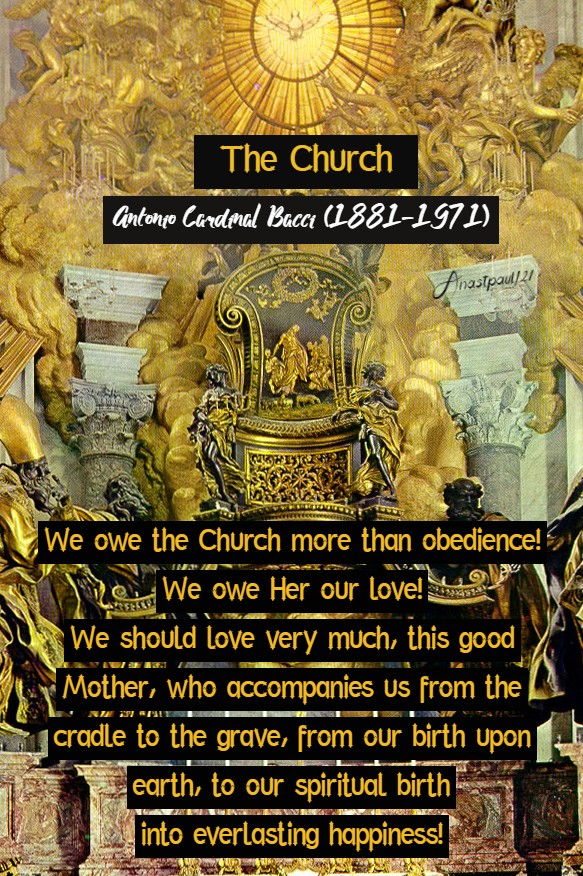
The Church
“Besides being our infallible teacher, the Church is also our affectionate Mother. Along with the inexhaustible treasury of His graces, it has inherited, from Jesus, His infinite love fo all mankind. Let us consider what the Church does and has done for us. As soon as we are born into this mortal life, She gives us, through the waters of Baptism, a second life, which is supernatural and everlasting. When we are a little older and exposed to the onslaughts of evil, She stengthens us in gace by means of another Sacrament and makes us soldiers of Christ. She raises us up. In the Sacament of Penance, She gives us God’s forgiveness and the spiritual strength to rise agin. Moeover, She gives us Jesus Christ Himself, in the Blessed Eucharist. By means of another Sacament, she elevates those who receive the power of Orders. In yet another, She blesses and consecrates matrimonial love and the pure marriage union. When we are dying, She comes, compassionately to our side again and, through the final Sacrament, gives us strength and purity of purpose, for the great journey into eternity. Nor is this enough. She is present with her prayers and blessings, even by our coffin nd by our graveside.
We owe the Church more than obedience! We owe Her our love! We should love very much, this good Mother, who accompanies us from the cradle to the grave, from our birth upon earth, to our spiritual birth into everlasting happiness!” Amen
Our Morning Offering – 21 February – First Sunday of Lent
Anima Christi
Soul of Christ, sanctify me Body of Christ, save me Blood of Christ, inebriate me Water from the side of Christ, wash me Passion of Christ, strengthen me Good Jesus, hear me Within Your wounds, shelter me from turning away, keep me From the evil one, protect me At the hour of my death, call me Into Your presence lead me to praise You with all Your saints Forever and ever, Amen
For many years the Anima Christi was popularly believed to have been composed by Saint Ignatius Loyola (1491-1556) , as he puts it at the beginning of his Spiritual Exercises and often refers to it. In the first edition of the Spiritual Exercises Ignatius merely mentions it, evidently supposing that the reader would know it. In later editions, it was printed in full. It was by assuming that everything in the book was written by Ignatius that it came to be looked upon as his composition. On this account the prayer is sometimes referred to as the Aspirations of St. Ignatius Loyola and so my image shows St Ignatius at prayer.
However, the prayer actually dates to the early fourteenth century and was possibly written by Pope John XXII but its authorship remains uncertain. It has been found in a number of prayer books printed during the youth of Ignatius and is in manuscripts which were written a hundred years before his birth. The English hymnologist James Mearns found it in a manuscript of the British Museum which dates back to about 1370. In the library of Avignon there is preserved a prayer book of Cardinal Pierre de Luxembourg (died 1387), which contains the prayer in practically the same form as we have it today. It has also been found inscribed on one of the gates of the Alcázar of Seville, which dates back to the time of Pedro the Cruel (1350–1369).
The invocations in the prayer have rich associations with Catholic concepts that relate to the Eucharist (Body and Blood of Christ), Baptism (water) and the Passion of Jesus (Holy Wounds).
Thought for the Day – 12 February – Meditations with Antonio Cardinal Bacci (1881-1971)
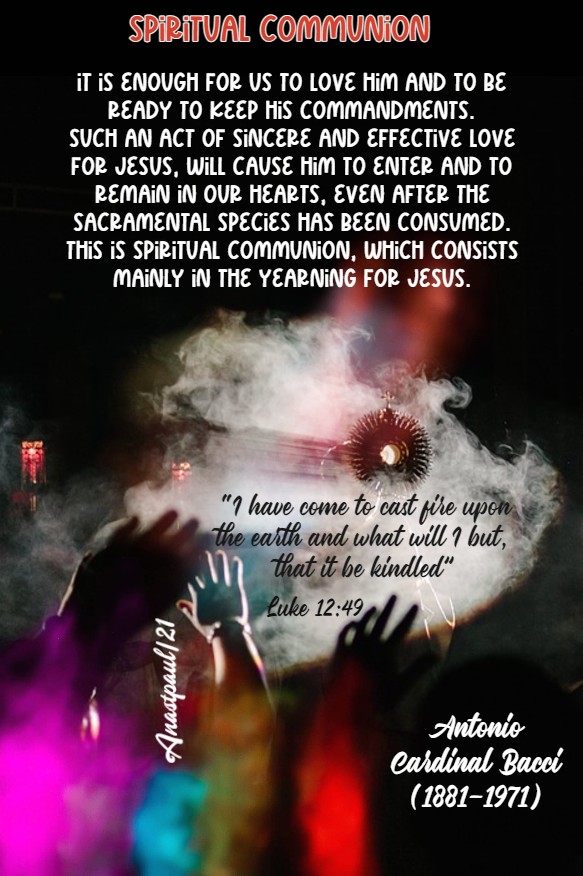
Spiritual Communion
“Jesus, not only desires to come to us but, He desires to remain continually present in us with His love and grace. “If anyone love me, he will keep my word,” He tells us “and, my Father will love him and we will come to him and make our abode with him” (Jn 14:23). It is enough for us to love Him and to be ready to keep His commandments. Such an act of sincere and effective love for Jesus, will cause Him to enter and to remain in our hearts, even after the sacramental species has been consumed. This is Spiritual Communion, which consists mainly in the yearning for Jesus. “I have come to cast fire upon the earth and what will I but, that it be kindled” (Lk 12:49).
Quote/s of the Day – – 12 February – Readings: Genesis 3:1-8, Psalms 32:1-2, 5, 6,7, Mark 7:31-37
The Divine Remedy
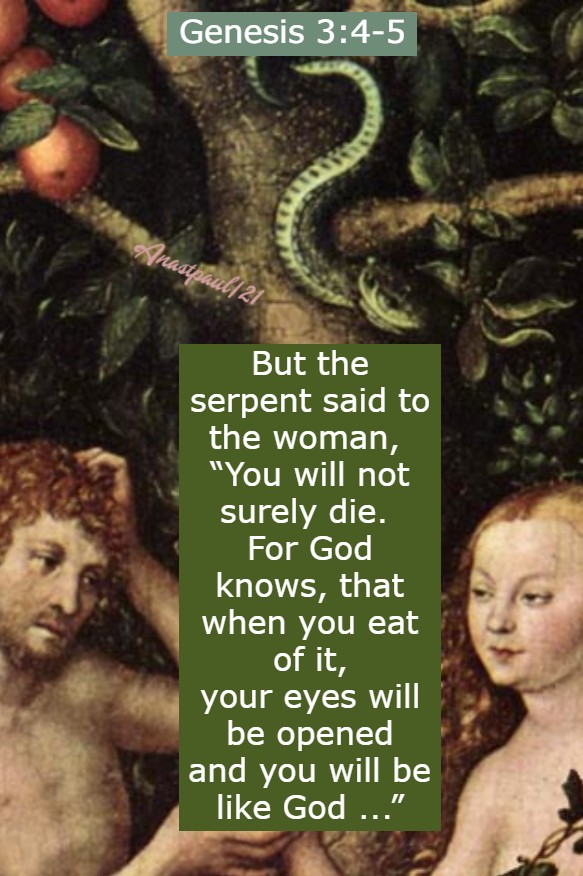
But the serpent said to the woman, “You will not surely die. For God knows, that when you eat of it, your eyes will be opened and you will be like God …”
Genesis 3:4-5
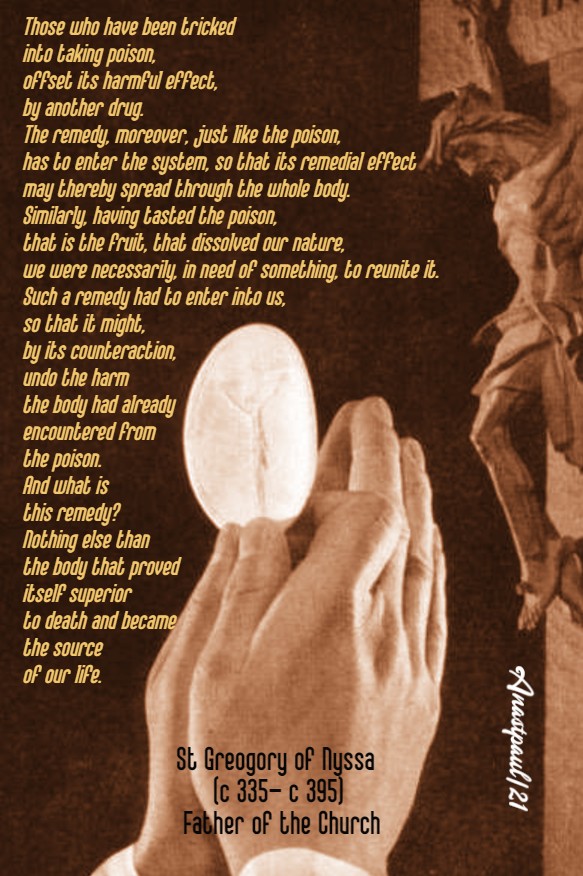
“Those who have been tricked into taking poison, offset its harmful effect, by another drug. The remedy, moreover, just like the poison, has to enter the system, so that its remedial effect may thereby spread through the whole body. Similarly, having tasted the poison, that is the fruit, that dissolved our nature, we were necessarily, in need of something, to reunite it. Such a remedy had to enter into us, so that it might, by its counteraction, undo the harm the body had already encountered from the poison. And what is this remedy? Nothing else than the body that proved itself superior to death and became the source of our life.”
St Greogory of Nyssa (c 335– c 395) Father of the Church
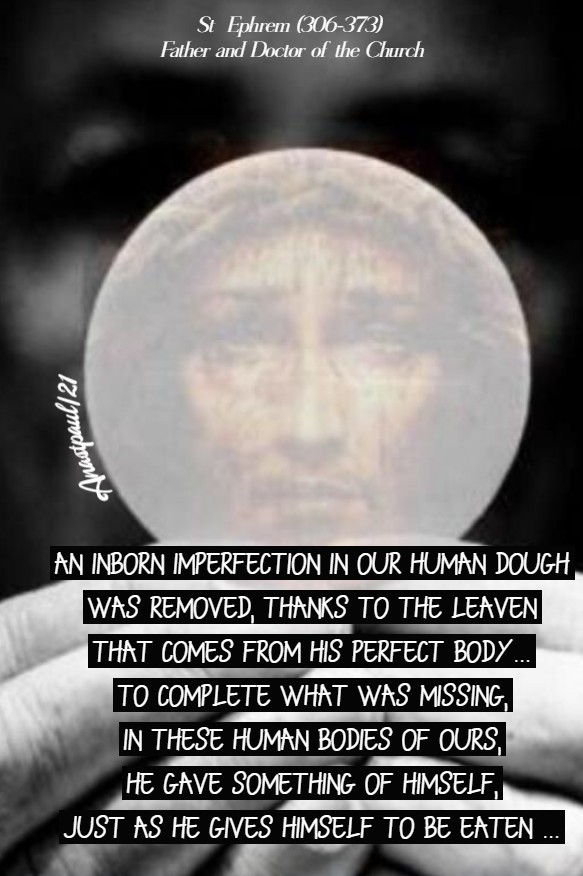
“An inborn imperfection in our human dough was removed, thanks to the leaven that comes from His perfect body… To complete what was missing, in these human bodies of ours, He gave something of Himself, just as He gives Himself to be eaten …”
St Ephrem (306-373) Father and Doctor of the Church
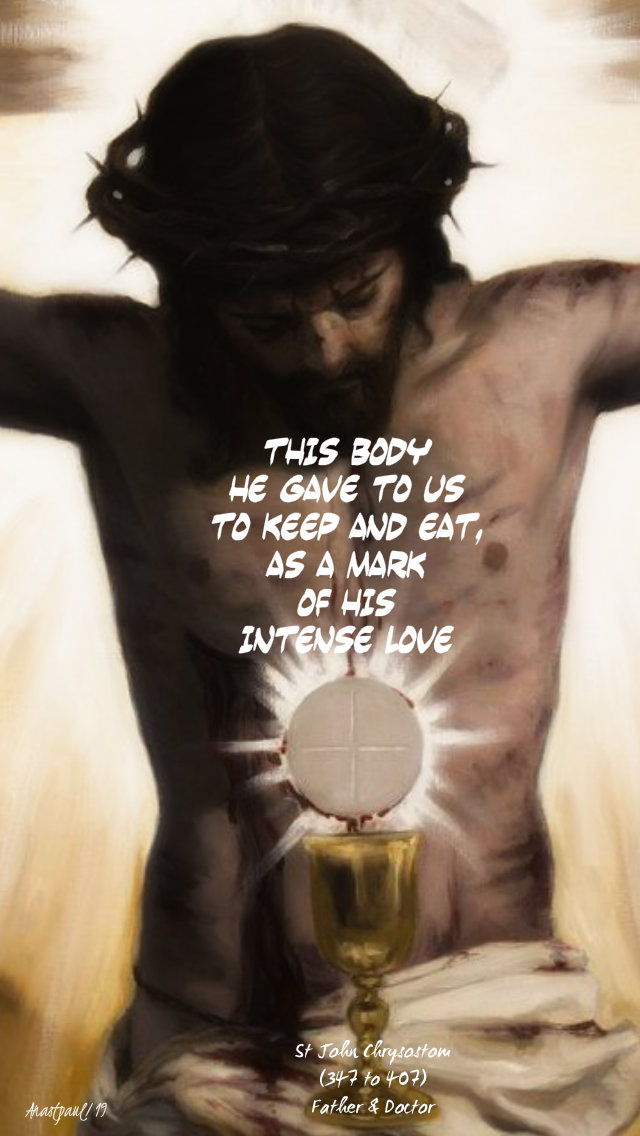
“This Body He gave to us to keep and eat, as a mark of His intense love’.”
St John Chrysostom (347 to 407) Father & Doctor of the Church
“Dust, so to speak, had forcibly entered humanity’s eye; earth had entered it, had injured the eye and it could not see the light. … That physician made a salve for you. And because He came, in such a way, that by His flesh, He might extinguish the faults of the flesh and by His death He might kill death … ”
St Augustine (354-430) Father and Doctor of the Church
Our Morning Offering – 7 February – Sexagesima Sunday
God, my God May I Always Abide in You By St John Damascene (675-749) Father and Doctor of the Church
God, my God, inextinguishable and invisible fire, You make Your angels flaming fire. Out of Your inexpressible love, You have given me Your divine Flesh as food and through this communion of Your immaculate Body and precious Blood, You receive me as a partaker of Your divinity. Permeate all my body and soul, all my bones and sinews. Consume my sins in fire. Enlighten my soul and illumine my mind. Sanctify my body and make Your abode in me, together with Your blessed Father and all-holy Spirit, that I may always abide in You, through the intercession of Your immaculate Mother and all Your saints. Amen
Thought for the Day – 28 January – Meditations with Antonio Cardinal Bacci (1881-1971)
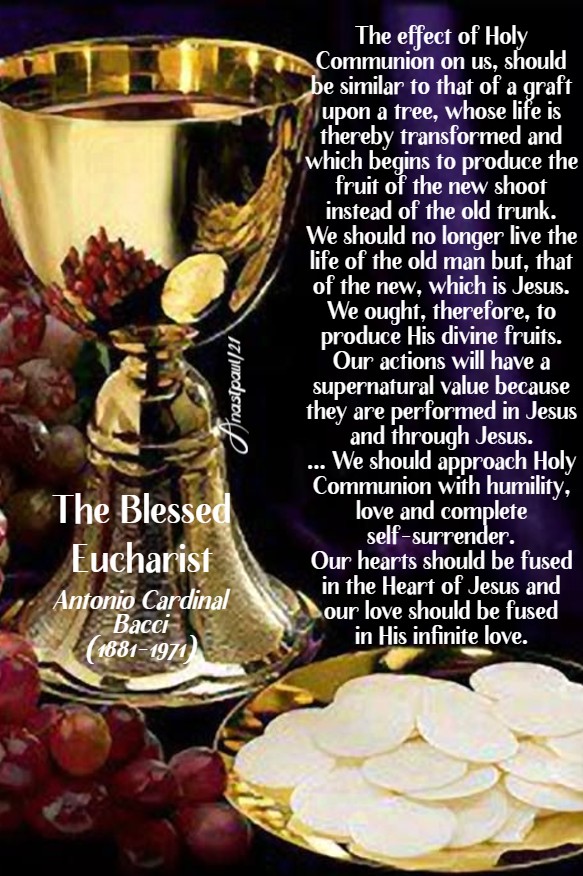
The Blessed Eucharist
“By means of this wonderful gift, we can live the life of Jesus Himself.
It is Our Lord Himself, Who says to us: “As the living Father has sent me and as I live because of the Father, so he who eats me, he also shall live because of me” (Jn 6:58). In other words, as He draws His divine and human life from the Father and lives by means of Him, to Whom as God, He is substantially united and equal, so anyone who partakes of the Eucharist, is united closely to Jesus, lives His life and is transformed by His supernatural grace. When Holy Communion is received, therefore, as it ought to be and as the Saints received it, it leads to the mysterious union of which St Paul speaks: “To me to live is Christ” (Phil 1:21). “It is now no longer I that live but Christ, lives in me” (Gal 2:20).
The effect of Holy Communion on us, should be similar to that of a graft upon a tree, whose life is thereby transformed and which begins to produce the fruit of the new shoot instead of the old trunk. We should no longer live the life of the old man but, that of the new, which is Jesus. We ought, therefore, to produce His divine fruits. Our actions will have a supernatural value because they are performed in Jesus and through Jesus. We should be very grateful to the Sacred Heart of Jesus for this gift of His infinite love and goodness. We should approach Holy Communion with humility, love and complete self-surrender. Our hearts should be fused in the Heart of Jesus and our love should be fused in His infinite love.”
Quote/s of the Day – 28 January – The Memorial of St Thomas Aquinas (1225-1274) Doctor of the Church
St Thomas speaks on the Holy Eucharist
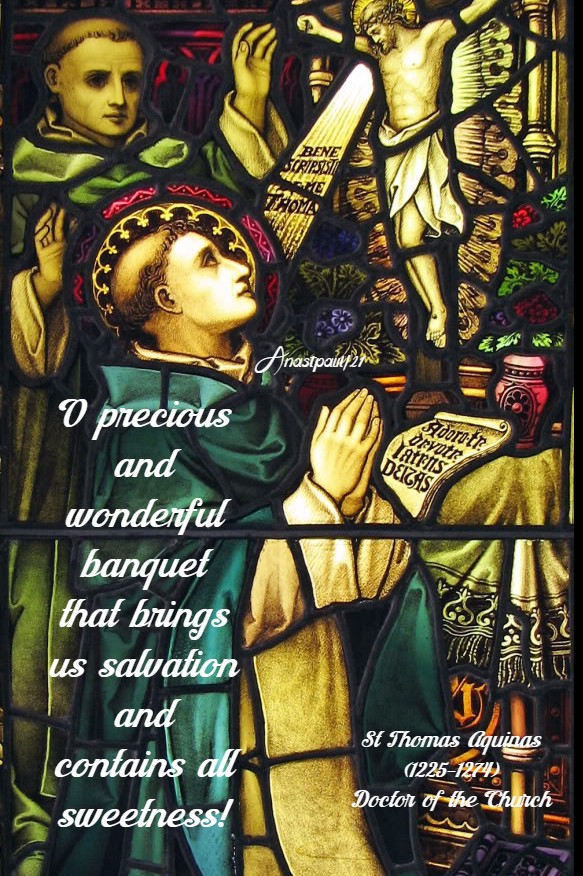
“O precious and wonderful banquet that brings us salvation and contains all sweetness!”
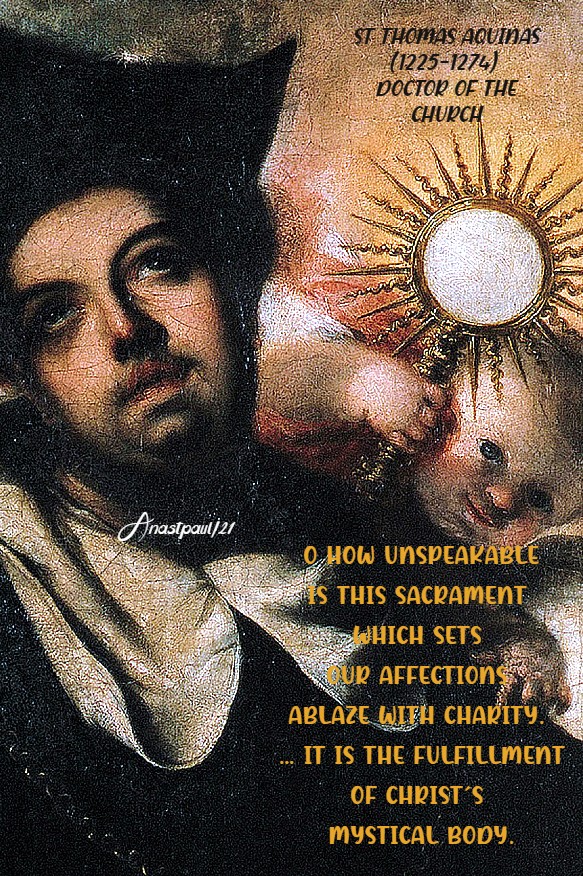
“O how unspeakable is this Sacrament which sets our affections ablaze with charity. … It is the fulfillment of Christ’s Mystical Body.”
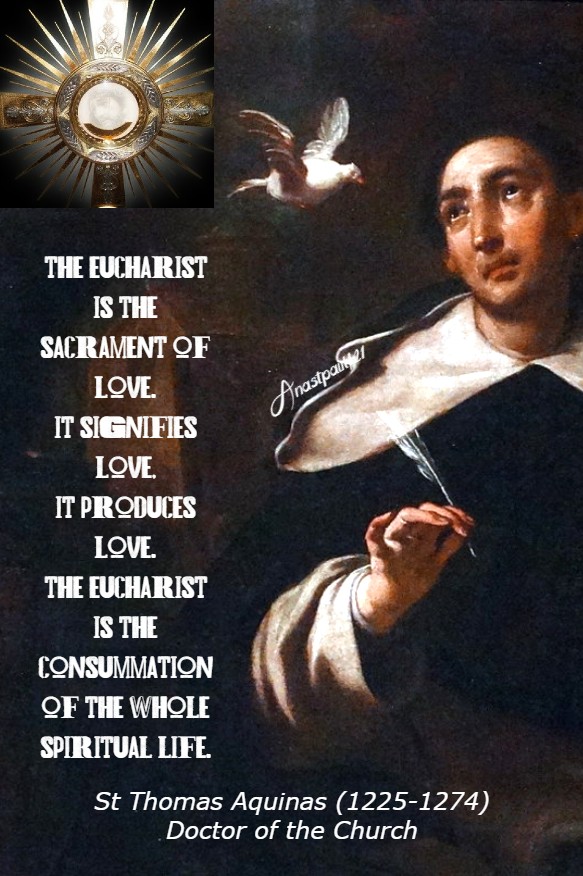
“The Eucharist is the Sacrament of Love. It signifies Love, It produces love. The Eucharist is the consummation of the whole spiritual life.”
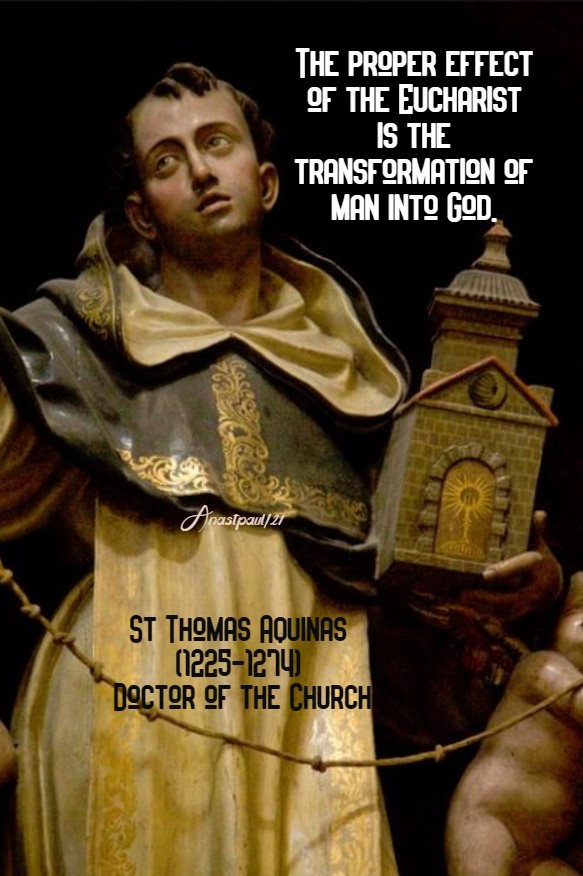
“The proper effect of the Eucharist is the transformation of man into God.”
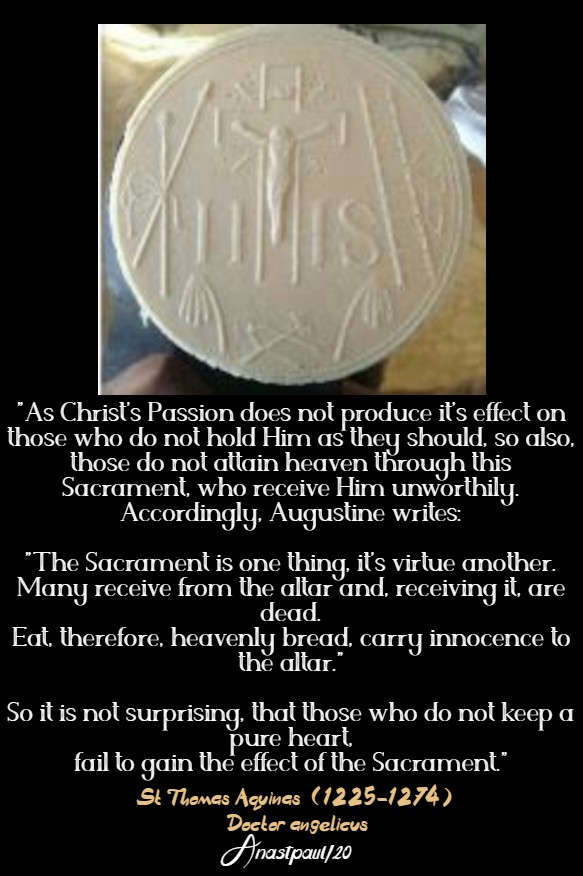
“As Christ’s Passion does not produce it’s effect on those who do not hold Him as they should, so also, those do not attain heaven through this Sacrament, who receive Him unworthily. Accordingly, Augustine writes: “The Sacrament is one thing, it’s virtue another. Many receive from the altar and, receiving it, are dead. Eat, therefore, heavenly bread, carry innocence to the altar.” So it is not surprising, that those who do not keep a pure heart, fail to gain the effect of the Sacrament.”
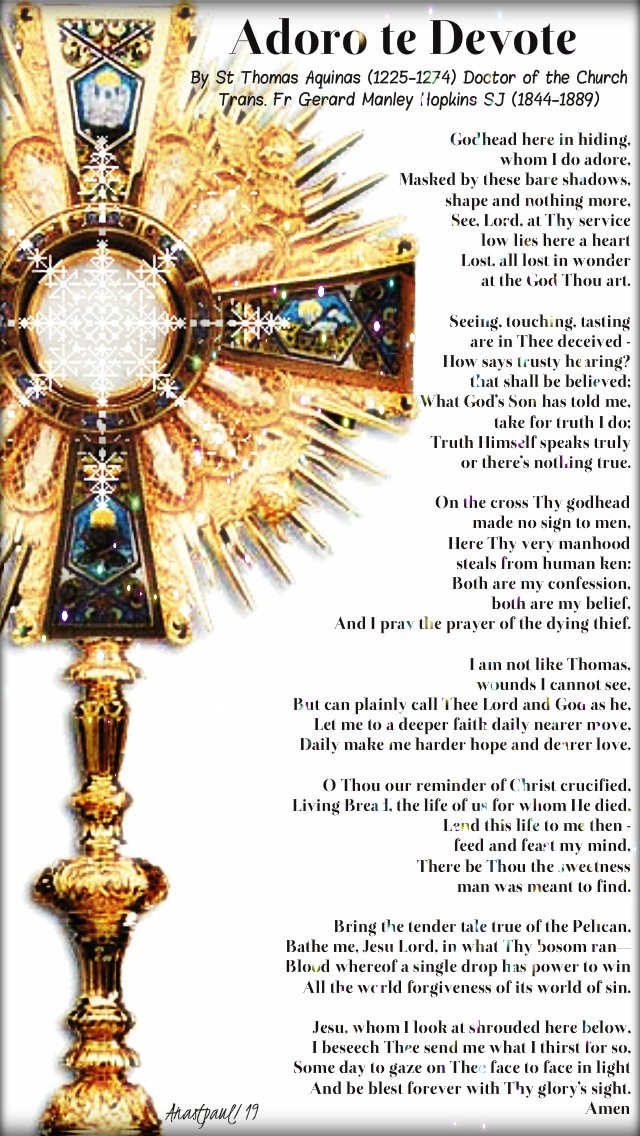
Adoro te Devote Trans. Fr Gerard Manley Hopkins SJ (1844-1889)
Godhead here in hiding, whom I do adore, Masked by these bare shadows, shape and nothing more, See, Lord, at Thy service low lies here a heart Lost, all lost in wonder at the God Thou art.
Seeing, touching, tasting are in Thee deceived – How says trusty hearing? that shall be believed, What God’s Son has told me, take for truth I do, Truth Himself speaks truly or there’s nothing true.
On the cross Thy godhead made no sign to men, Here Thy very manhood steals from human ken – Both are my confession, both are my belief, And I pray the prayer of the dying thief.
I am not like Thomas, wounds I cannot see, But can plainly call Thee Lord and God as he, Let me to a deeper faith daily nearer move, Daily make me harder hope and dearer love.
O Thou our reminder of Christ crucified, Living Bread, the life of us for whom He died, Lend this life to me then – feed and feast my mind, There be Thou the sweetness man was meant to find.
Bring the tender tale true of the Pelican, Bathe me, Jesu Lord, in what Thy bosom ran— Blood whereof a single drop has power to win All the world forgiveness of its world of sin.
Jesu, whom I look at shrouded here below, I beseech Thee send me what I thirst for so, Some day to gaze on Thee face to face in light And be blest forever with Thy glory’s sight. Amen
Thought for the Day – 25 January – Meditations with Antonio Cardinal Bacci (1881-1971)
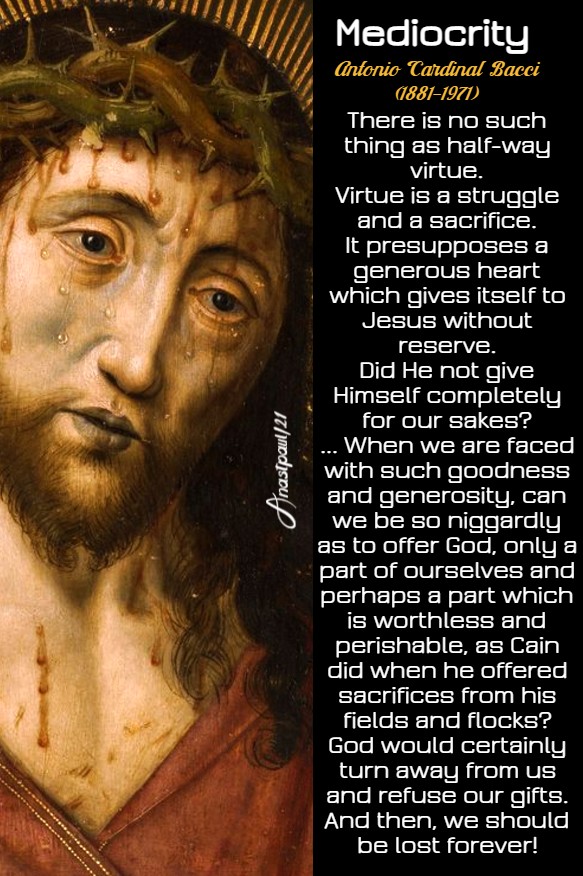
Mediocrity
“There is no such thing as half-way virtue.
Virtue is a struggle and a sacrifice. It presupposes a generous heart which gives itself to Jesus without reserve. Did He not give Himself completely for our sakes? Did He not die upon the Cross for our salvation and reopen Heaven, which had been closed to us by sin? Moreover, did He not remain hidden in our midst under the Eucharistic species in order to become our sustenance and our support?
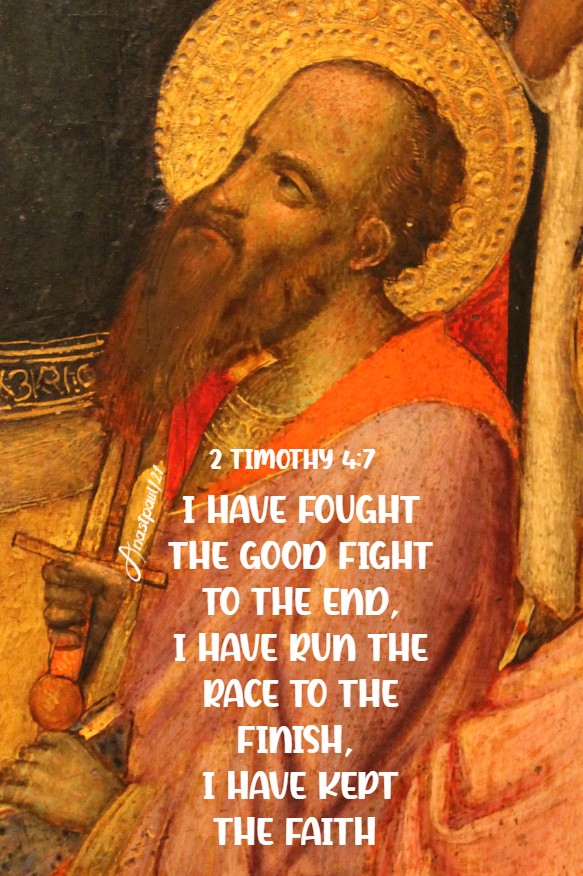
When we are faced with such goodness and generosity, can we be so niggardly as to offer God, only a part of ourselves and perhaps a part which is worthless and perishable, as Cain did when he offered sacrifices from his fields and flocks? God would certainly turn away from us and refuse our gifts. And then, we should be lost forever! Let us give ourselves completely and then be able to say with St Paul “I have fought the good fight to the end, I have run the race to the finish, I have kept the faith … ” (2 Tm 4:7)
“The time is sure to come, when people will not accept sound teaching but their ears will be itching for anything new and they will collect themselves a whole series of teachers according to their own tastes and then they will shut their ears to the truth and will turn to myths. But you must keep steady all the time; put up with suffering, do the work of preaching the gospel, fulfil the service asked of you. As for me, my life is already being poured away as a libation and the time has come for me to depart. I have fought the good fight to the end, I have run the race to the finish, I have kept the faith … ”(2 Tm 4:3-7)
Thought for the Day – 24 January – Meditations with Antonio Cardinal Bacci (1881-1971)
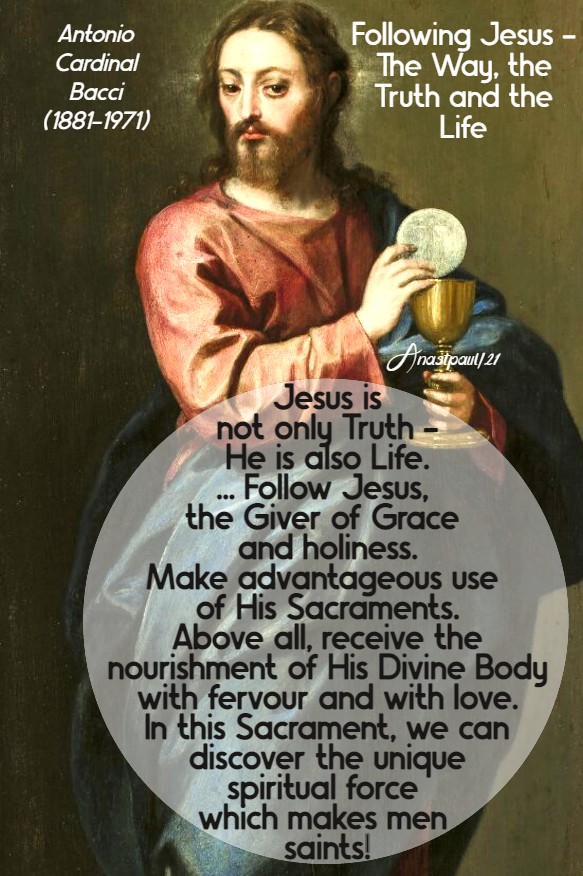
Following Jesus –
The Way, the Truth and the Life
“Jesus is not only Truth – He is also Life. He is not only our Teacher – He is our Saviour as well. He has given us something which human philosophers could never give. For He has given us more than doctrine; He has also given us the means of putting it into practice in our lives. He has given us Grace and the Sacraments. He has given us Himself inthe Blessed Eucharistic. It would be impossible for us to carry out His divine precepts, if He did not give us the necessary spiritual strength to do so. We should be grateful to Jesus for His goodness and mercy. We should cherish the gifts which He has given us for our sanctification.
Follow Jesus, the Giver of Grace and holiness. Make advantageous use of His Sacraments. Above all, receive the nourishment of His Divine Body with fervour and with love. In this Sacrament, we can discover the unique spiritual force which makes men saints!”
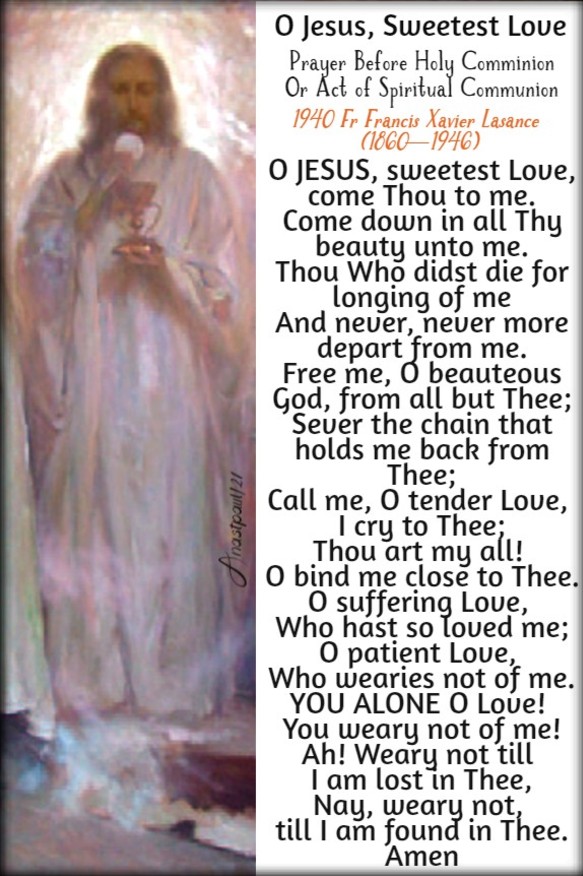
O Jesus, Sweetest Love Prayer Before Holy Comminion Or Act of Spiritual Communion 1940 Fr Francis Xavier Lasance (1860–1946)
O JESUS, sweetest Love, come Thou to me. Come down in all Thy beauty unto me. Thou Who didst die for longing of me And never, never more depart from me. Free me, O beauteous God, from all but Thee; Sever the chain that holds me back from Thee; Call me, O tender Love, I cry to Thee; Thou art my all! O bind me close to Thee. O suffering Love, Who hast so loved me; O patient Love, Who wearies not of me. YOU ALONE O Love! You weary not of me! Ah! Weary not till I am lost in Thee, Nay, weary not, till I am found in Thee. Amen
Our Morning Offering – 17 January – Sunday in Ordinary Time
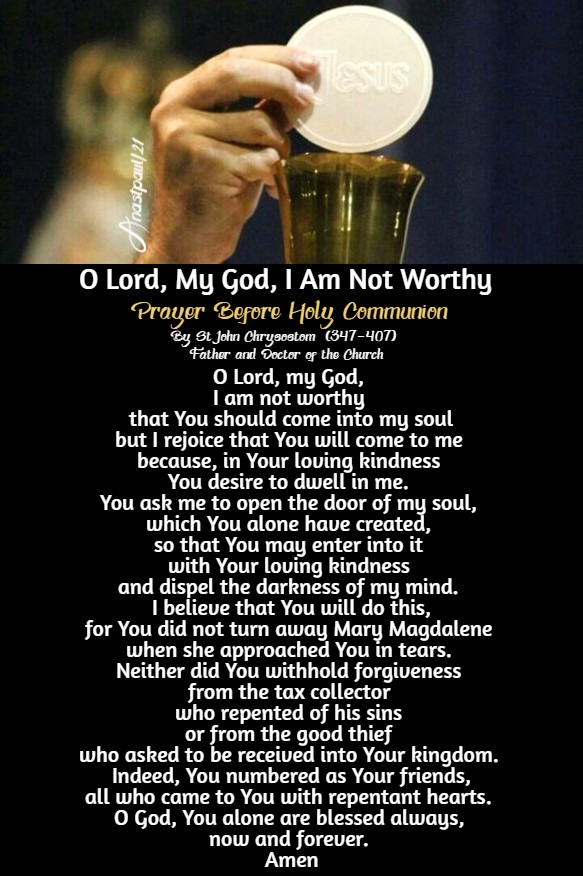
O Lord, My God, I Am Not Worthy Prayer Before Holy Communion By St John Chrysostom (347-407) Father and Doctor of the Church
O Lord, my God, I am not worthy that You should come into my soul but I rejoice that You have come to me because, in Your loving kindness You desire to dwell in me. You ask me to open the door of my soul, which You alone have created, so that You may enter into it with Your loving kindness and dispel the darkness of my mind. I believe that You will do this, for You did not turn away Mary Magdalene when she approached You in tears. Neither did You withhold forgiveness from the tax collector who repented of his sins or from the good thief who asked to be received into Your kingdom. Indeed, You numbered as Your friends, all who came to You with repentant hearts. O God, You alone are blessed always, now and forever. Amen
Our Morning Offering – 10 January – Feast of the Baptism of the Lord
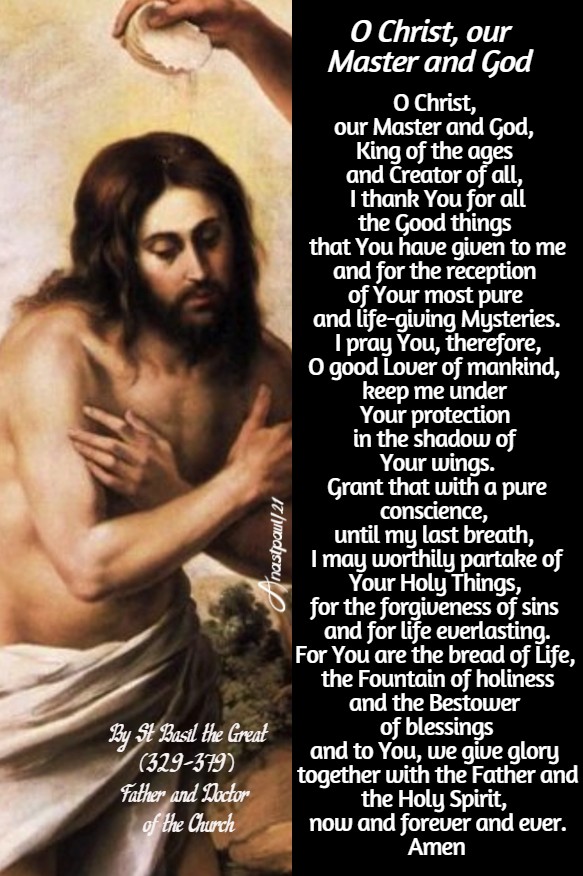
O Christ, our Master and God St Basil the Great (329-379) Father and Doctor of the Church
O Christ, our Master and God, King of the ages and Creator of all, I thank You for all the Good things that You have given to me and for the reception of Your most pure and life-giving Mysteries. I pray You, therefore, O good Lover of mankind, keep me under Your protection in the shadow of Your wings. Grant that with a pure conscience, until my last breath, I may worthily partake of Your Holy Things, for the forgiveness of sins and for life everlasting. For You are the bread of Life, the Fountain of holiness and the Bestower of blessings and to You, we give glory together with the Father and the Holy Spirit, now nad forever and ever. Amen
Quote/s of the Day – 24 December – The Nativity of the Lord, Mass at Midnight
… Let us keep the Feast, not after the manner of a heathen festival but after a godly sort; not after the way of the world but in a fashion above the world; not as our own but as belonging to Him who is ours, or rather as our Master’s; not as of weakness but as of healing; not as of creation but of re-creation.”
St Gregory of Nazianzen (330-390) Archbishop of Constantinople Father and Doctor of the Church
“Jesus Christ, the God-Man, was born in a manger and is spiritually reborn on the altar. He suffered on Calvary and continues to offer Himself on the altar. In His earthly life, He spread His teaching and worked miracles among the crowds. In the Eucharist, He spans the centuries and communicates Himself to all.”
St John Chrysostom (347-407) Father & Doctor of the Church
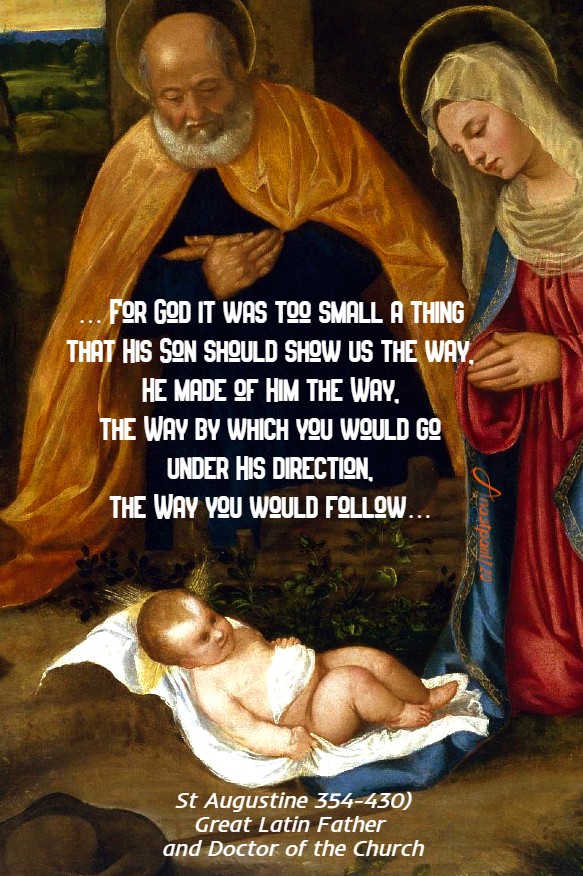
“… For God it was too small a thing that His Son should show us the way, He made of Him the Way (cf Jn 14:6), the Way by which you would go under His direction, the Way you would follow…”
“Awake, mankind! For your sake God has become man. Awake, you who sleep, rise up from the dead and Christ will enlighten you. I tell you again, for your sake, God became man.”
St Augustine 354-430) Great Latin Father and Doctor of the Church
Quote/s of the Day – 7 December – The Memorial of St Ambrose (c 340-397) – Father and Doctor of the Church
“And this Body, which we make present, is the Body born of the Virgin. Why do you expect to find in this case, that nature takes its ordinary course in regard to the Body of Christ, when the Lord Himself was born of the Virgin in a manner above and beyond the order of nature? This is indeed the true flesh of Christ, which was crucified and buried. This is then, in truth, the Sacrament of His Flesh.”
“Rise, you who were lying fast asleep… Rise and hurry to the Church: here is the Father, here is the Son, here is the Holy Spirit.”
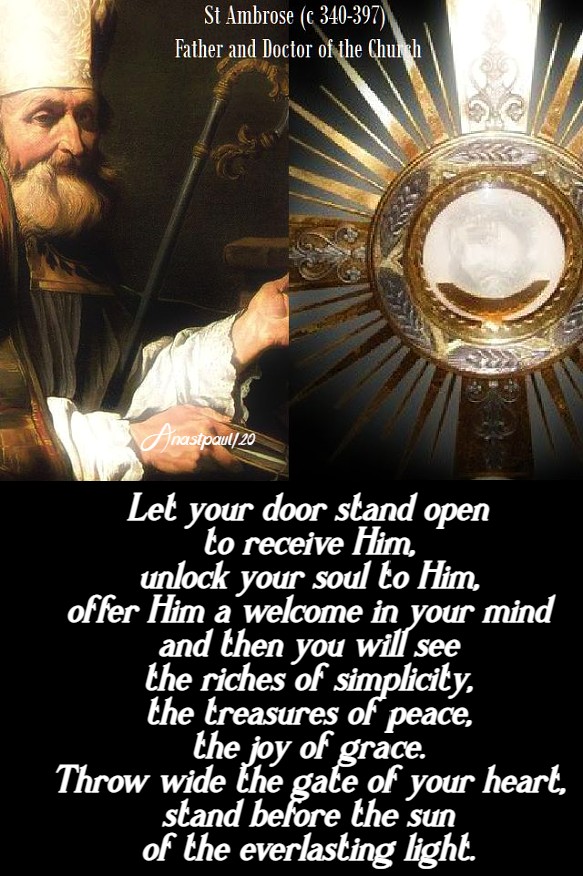
“Let your door stand open to receive Him, unlock your soul to Him, offer Him a welcome in your mind and then you will see the riches of simplicity, the treasures of peace, the joy of grace. Throw wide the gate of your heart, stand before the sun of the everlasting light.”
“Prayer is the wing, wherewith the soul flies to heaven and meditation, the eye, wherewith we see God.”
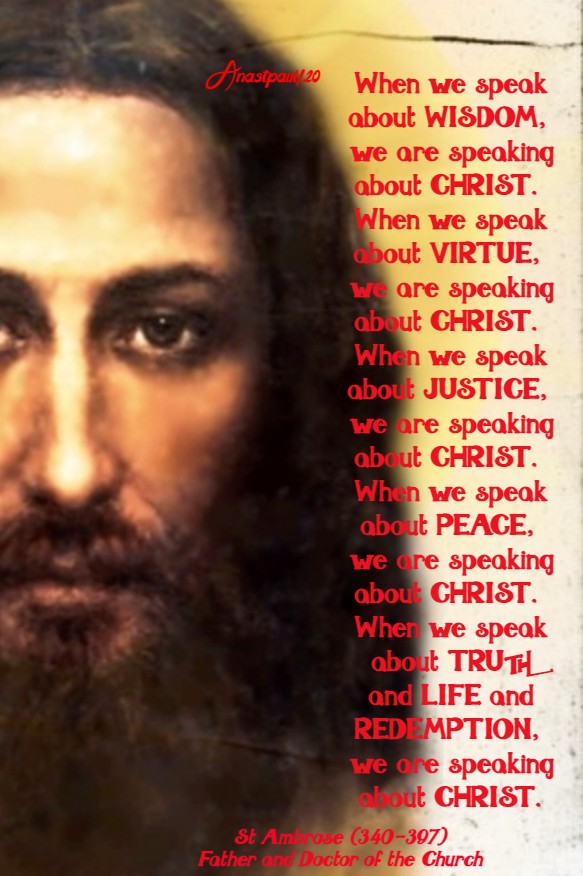
“When we speak about WISDOM, we are speaking about CHRIST. When we speak about VIRTUE, we are speaking about CHRIST. When we speak about JUSTICE, we are speaking about CHRIST. When we speak about PEACE, we are speaking about CHRIST. When we speak about TRUTH and LIFE and REDEMPTION, we are speaking about CHRIST.”
St Ambrose (340-397) Father and Doctor of the Church
Our Morning Offering – 4 December – Friday of the First Week of Advent and the Memorial of St John Damascene (675-749) Father and Doctor of the Church
God, my God, May I Always Abide in You By St John Damascene (675-749)
God, my God, unextinguishable and invisible fire, You make Your angels flaming fire. Out of Your inexpressible love, You have given me Your divine Flesh as food and through this communion of Your immaculate Body and precious Blood, You receive me as a partaker of Your divinity. Permeate all my body and soul, all my bones and sinews. Consume my sins in fire. Enlighten my soul and illumine my mind. Sanctify my body and make Your abode in me together with Your blessed Father and all-holy Spirit, that I may always abide in You, through the intercession of Your immaculate Mother and all Your saints. Amen
Advent Reflection – 2 December – Wednesday of the First Week of Advent, Readings: Isaiah 25:6-10,Psalms 23:1-3, 3-4, 5, 6, Matthew 15:29-37 and the Memorial of Bl Jan/John van Ruysbroec(k) (c 1293-1382)
Come to us and save us, Lord God Almighty Let Your face smile on us and we shall be safe.
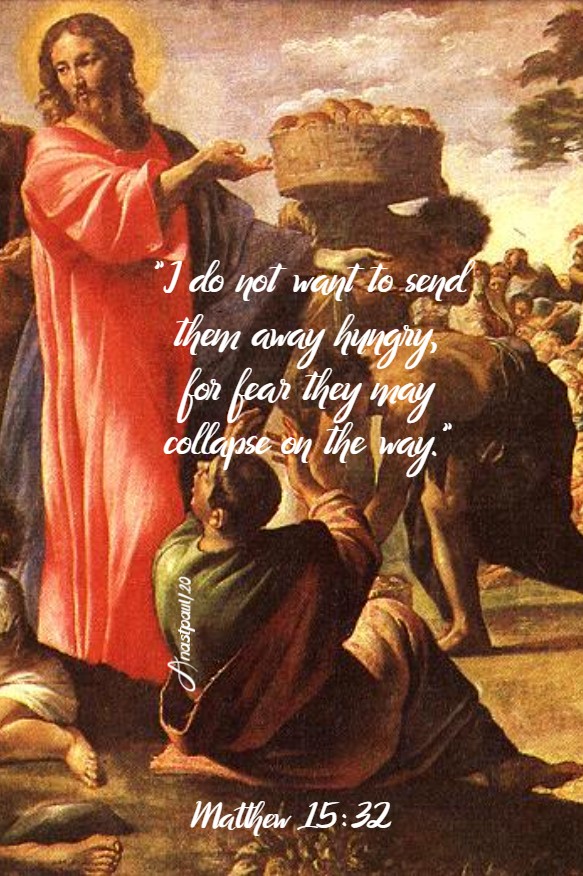
Jesus summoned his disciples and said, “My heart is moved with pity for the crowd, for they have been with me now for three days and have nothing to eat. I do not want to send them away hungry, for fear they may collapse on the way.” … Matthew 15:32
REFLECTION – “The second coming of Christ our Bridegroom takes place daily in good persons; indeed, it takes place frequently and repeatedly, with new gifts and graces, in all those who prepare themselves for it to the best of their ability. We do not intend to speak here of a person’s initial conversion or of the graces, which were first bestowed when he turned from sin to virtue. Rather, we wish to speak of a day-to-day increase in new gifts and new virtues and of a present, daily coming of Christ our Bridegroom into our soul. (…)
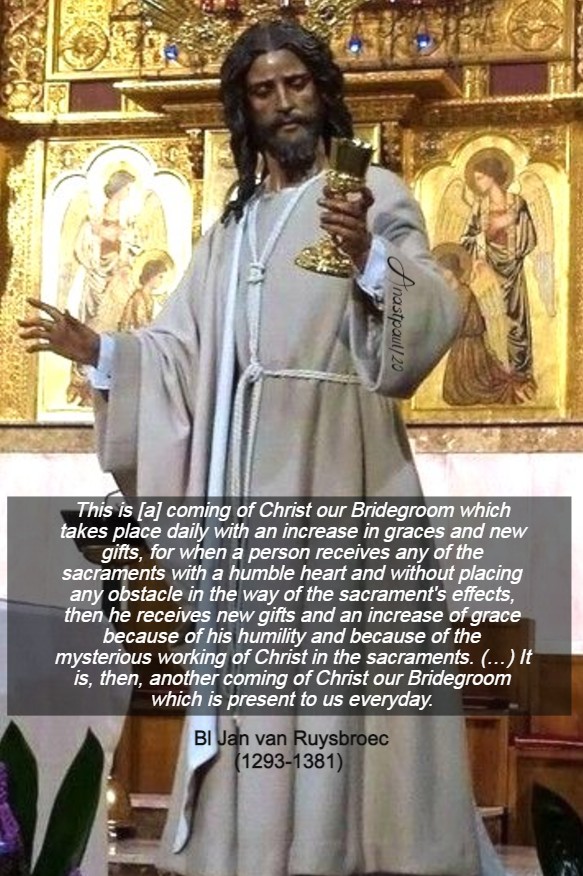
This is [a] coming of Christ our Bridegroom which takes place daily with an increase in graces and new gifts, for when a person receives any of the sacraments with a humble heart and without placing any obstacle in the way of the sacrament’s effects, then he receives new gifts and an increase of grace because of his humility and because of the mysterious working of Christ in the sacraments. (…) It is, then, another coming of Christ our Bridegroom which is present to us everyday. We should reflect on it with a heart full of desire so that it might take place in ourselves, for this coming is necessary, if we are to remain steadfast or go forward into eternal life.” … Bl Jan van Ruysbroec (1293-1381) Canon Regular – The Spiritual Espousals, Pt. 2
PRAYER – Prepare our hearts, Lord, by the power of Your grace. When Christ comes, may He find us worthy to receive from His hand, the Bread of Heaven at the feast of eternal life. Through our Lord Jesus Christ Your Son, with the Holy Spirit, God now and for all eternity, amen.
Quote/s of the Day – 13 October – Tuesday of the Twenty-eighth week in Ordinary Time, Readings: Ephesians 5:21-33,Psalms 128:1-2, 3,4-5, Luke 13:18-21
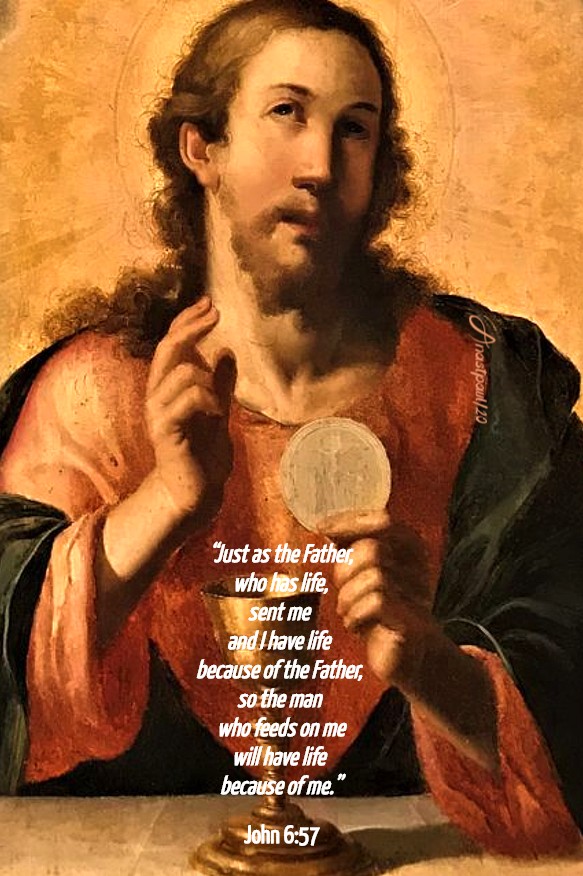
“Just as the Father who has life sent me and I have life because of the Father, so the man who feeds on me will have life because of me.”
John 6:57
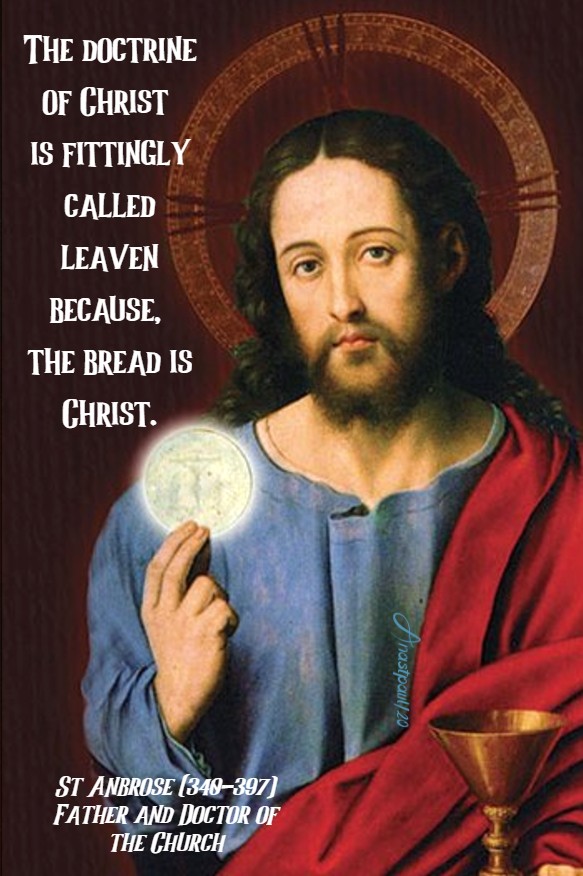
“The doctrine of Christ is fittingly called leaven because, the bread is Christ.”
St Anbrose (340-397) Father and Doctor of the Church
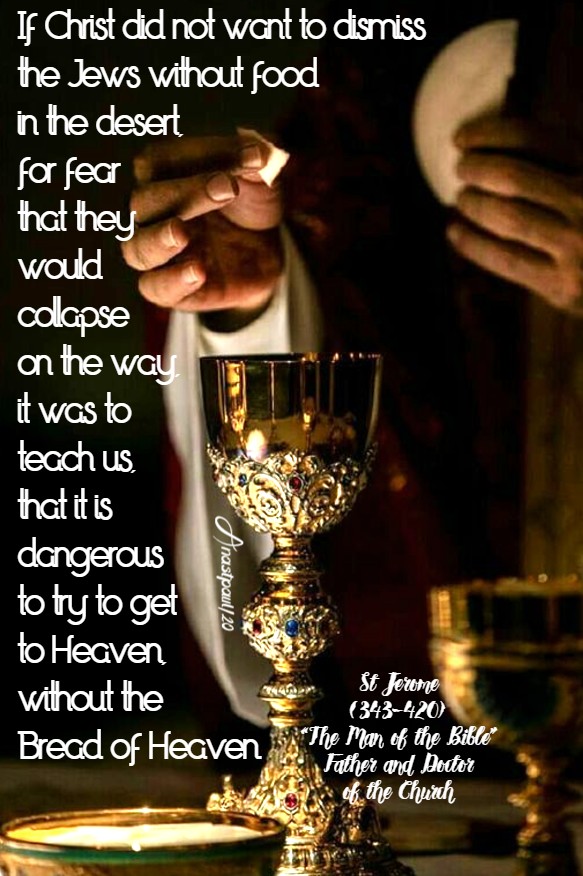
“If Christ did not want to dismiss the Jews without food in the desert, for fear that they would collapse on the way, it was to teach us, that it is dangerous to try to get to Heaven, without the Bread of Heaven.”
St Jerome (343-420) Father and Doctor of the Church
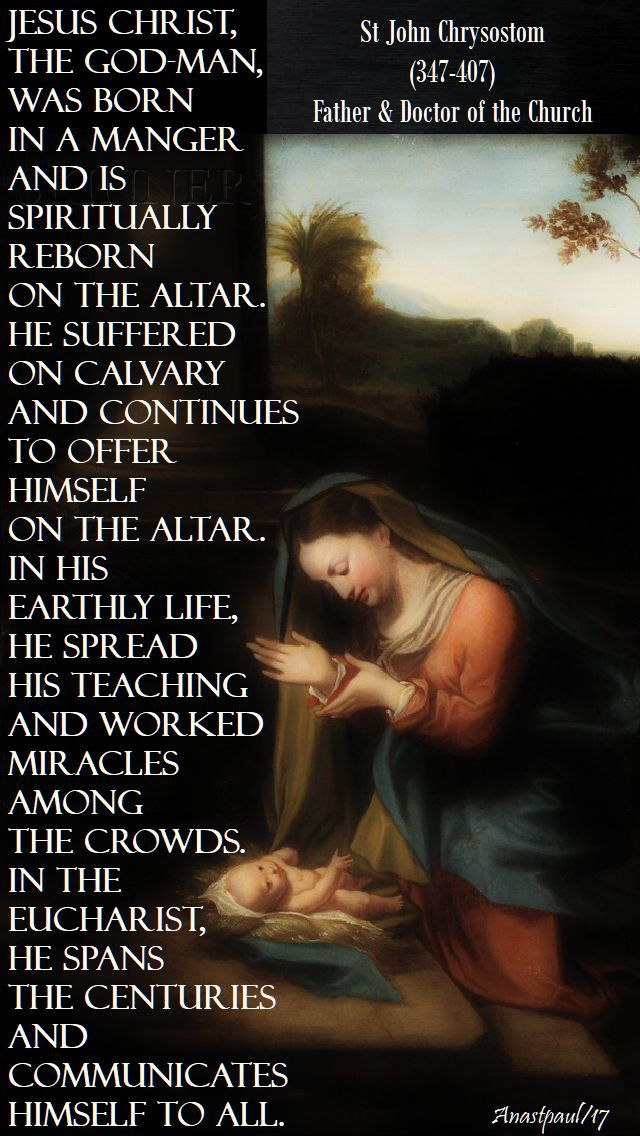
“Jesus Christ, the God-Man, was born in a manger and is spiritually reborn on the altar. He suffered on Calvary and continues to offer Himself on the altar. In His earthly life, He spread His teaching and worked miracles among the crowds. In the Eucharist, He spans the centuries and communicates Himself to all.”
St John Chrysostom (347-407) Father and Doctor
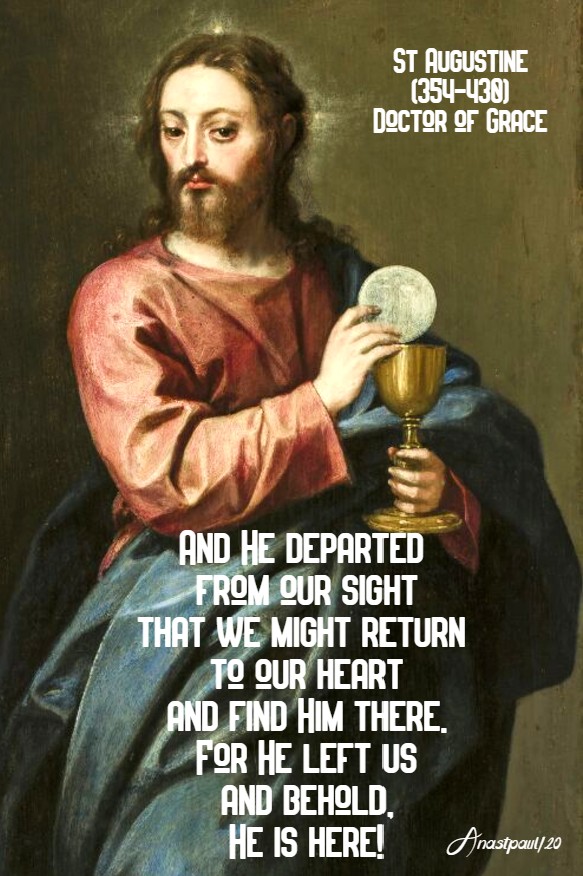
“And He departed from our sight that we might return to our heart and find Him there. For He left us and behold, He is here!”
St Augustine (354-430) Father and Doctor of Grace
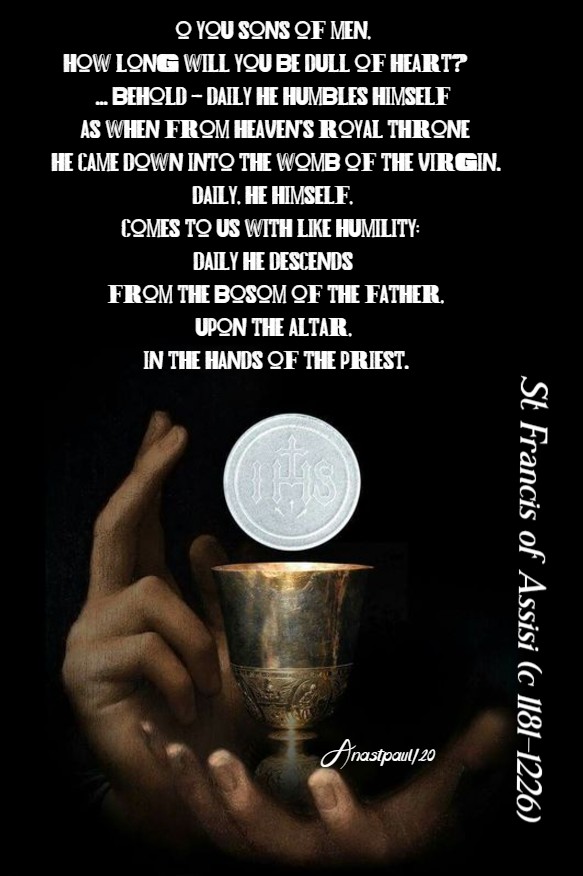
“O you sons of men, how long will you be dull of heart? … Behold – daily He humbles Himself as when from heaven’s royal throne He came down into the womb of the Virgin. Daily, He Himself, comes to us with like humility; daily He descends from the bosom of the Father, upon the altar, in the hands of the priest.”
St Francis of Assisi (c 1181–1226)
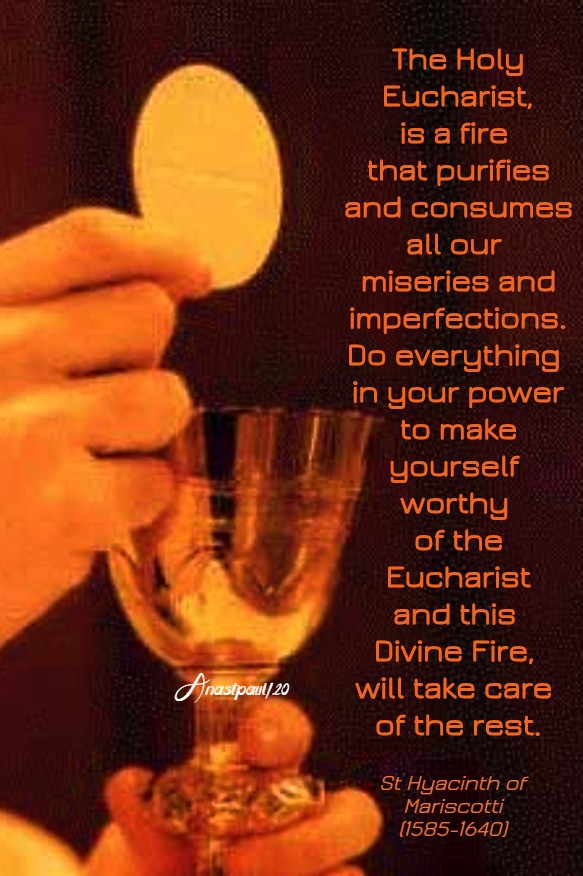
“The Holy Eucharist, is a fire that purifies and consumes all our miseries and imperfections. Do everything in your power to make yourself worthy of the Eucharist and this Divine Fire, will take care of the rest.”
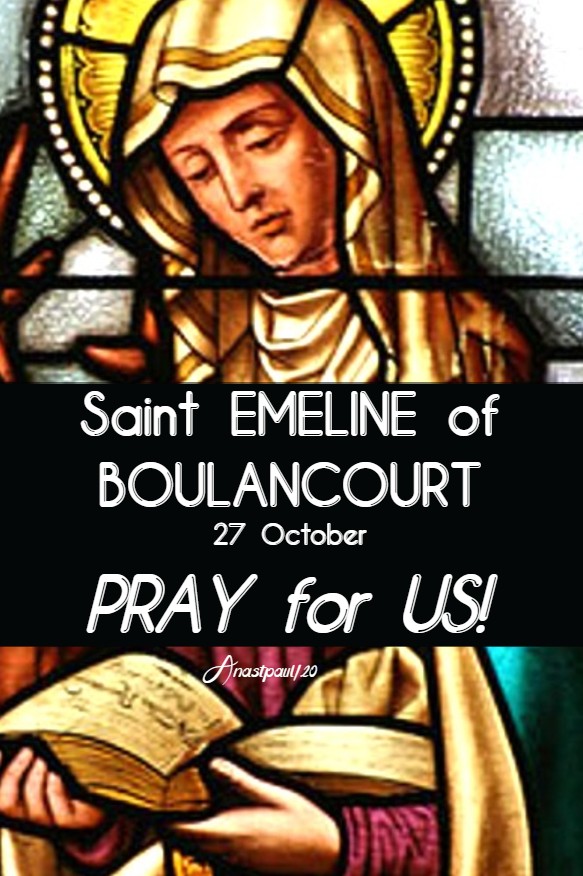
One Minute Reflection – 27 October – Tuesday of the Twenty-eighth week in Ordinary Time, Readings: Ephesians 5:21-33,Psalms 128:1-2, 3,4-5, Luke 13:18-21 and the Memorial of St Emeline of Boulancourt (c 1115-c 1178)
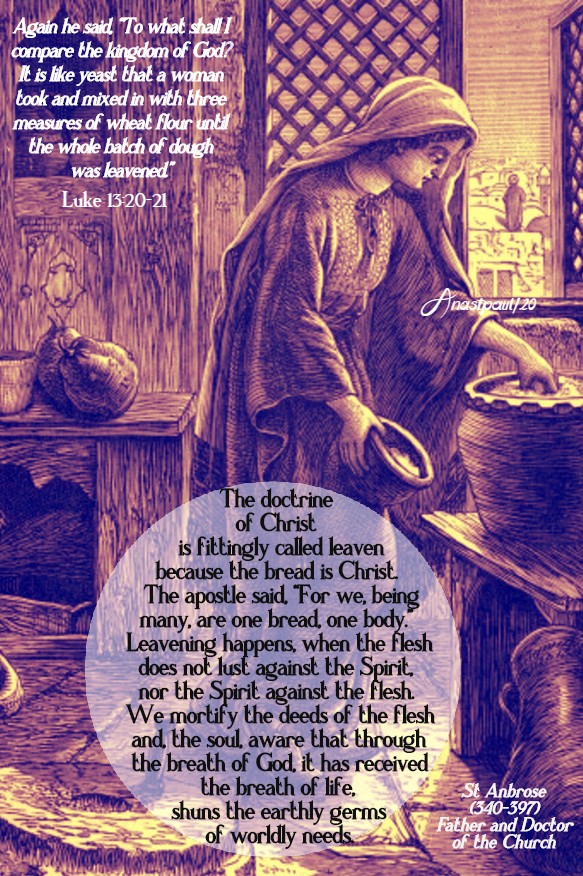
Again he said, “To what shall I compare the kingdom of God? It is like yeast that a woman took and mixed in with three measures of wheat flour until the whole batch of dough was leavened.” … Luke 13:20-21
REFLECTION – “There are three measures – of the flesh, of the soul and of the spirit. This is truer of the spirit in which we all live. The woman, who prefigures the church, mixes with them the virtue of spiritual doctrine, until the whole hidden inner person of the heart is leavened and the heavenly bread arises to grace.
The doctrine of Christ is fittingly called leaven because the bread is Christ. The apostle said, “For we, being many, are one bread, one body.” Leavening happens, when the flesh does not lust against the Spirit, nor the Spirit against the flesh. We mortify the deeds of the flesh and, the soul, aware that through the breath of God, it has received the breath of life, shuns the earthly germs of worldly needs.” – St Ambrose (340-397) (Exposition of the Gospel of Luke, 7)
PRAYER – True light of the world, Lord Jesus Christ, as You enlighten all men for their salvation, give us grace, we pray, to herald Your coming by preparing the ways of justice and of peace. Help us Lord, that we may sprout and bear fruit, fitting to grow and be a home of comfort to our neighbour. By the prayers of St Emeline of Boulancourt, may we too be beacons of Your Light and of the glory of Your Kingdom. Through Jesus our Lord, Who lives and reigns with the Father and the Holy Spirit, God forever, amen.
Quote/s of the Day – 23 October – Feast of the Most Holy Redeemer
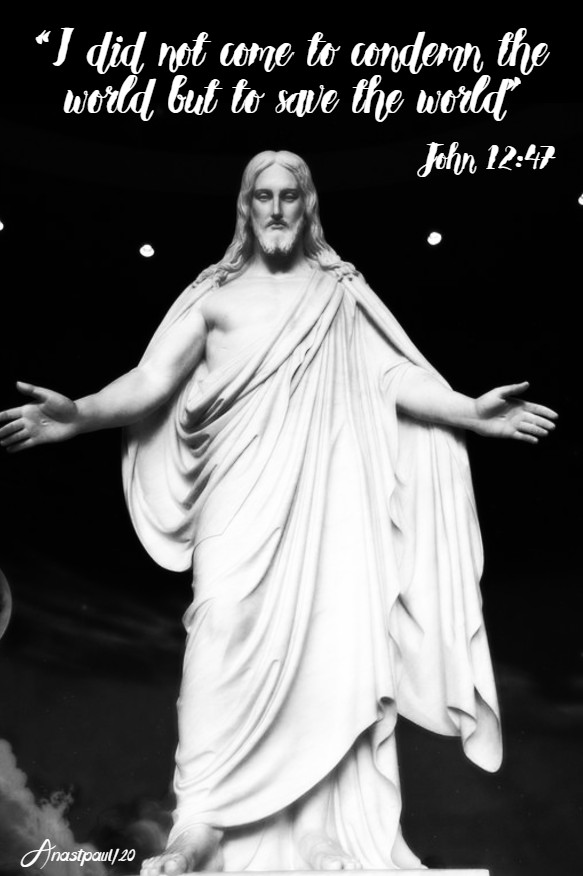
“I did not come to condemn the world but to save the world.”
John 12:47
“Come along then, every human family, full of sin as you are and receive the forgiveness of your sins. For I Myself, am your forgiveness, I am the Passover of salvation, the Lamb slain for your sakes, your redemption, life and resurrection; I am your Light, your Salvation and your King. It is I, who lead you to the heights of heaven, I, who will raise you up; it is I, who will bring you to see the Father who is from all eternity; it is I, who will raise you up by My all-powerful Hand.”
St Melito of Sardis (Died c 180) Bishop, Apologist
Paschal Homily
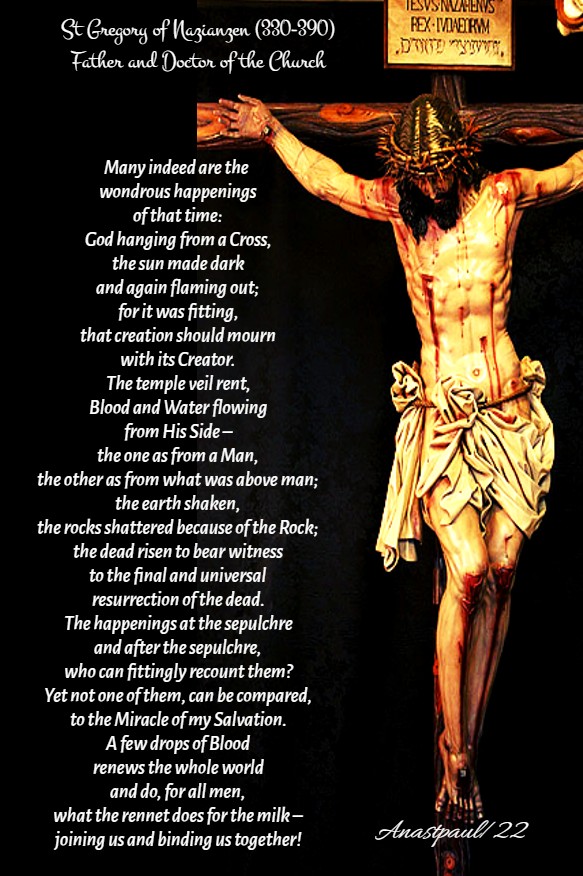
“Many indeed are the wondrous happenings of that time: God hanging from a Cross, the sun made dark and again flaming out; for it was fitting, that creation should mourn with its Creator. The temple veil rent, Blood and Water flowing from His Side – the one as from a Man, the other as from what was above man; the earth shaken, the rocks shattered because of the Rock; the dead risen to bear witness to the final and universal resurrection of the dead. The happenings at the sepulchre and after the sepulchre, who can fittingly recount them? Yet not one of them, can be compared, to the Miracle of my Salvation. A few drops of Blood renews the whole world and do, for all men, what the rennet does for the milk – joining us and binding us together!”
St Gregory of Nazianzen (330-390) Father and Doctor of the Church
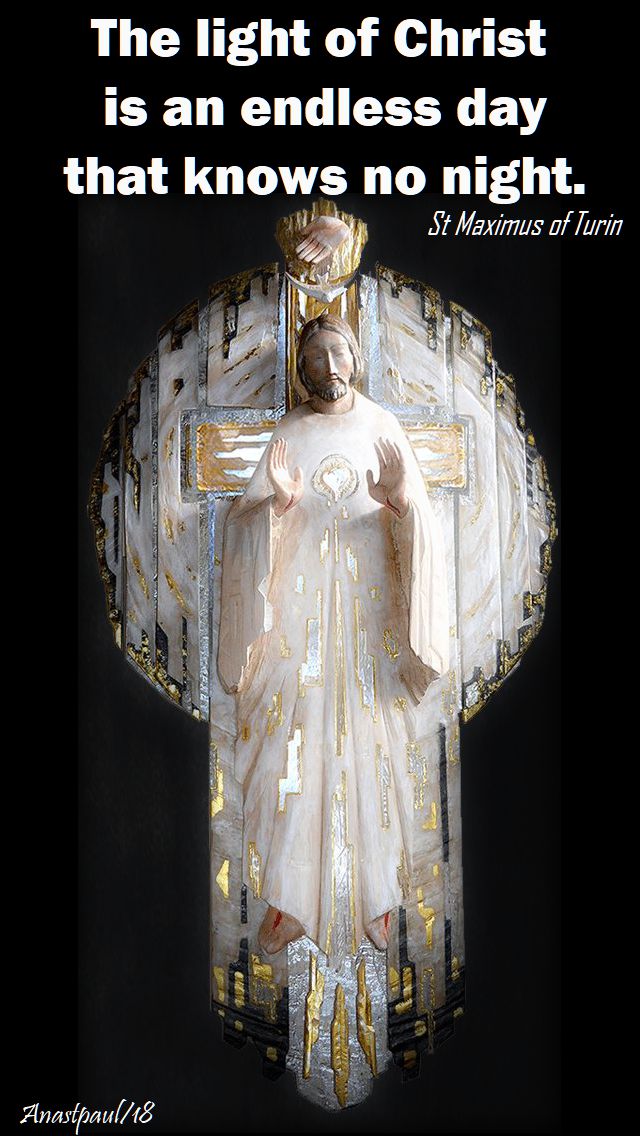
“The light of Christ is an endless day that knows no night.”
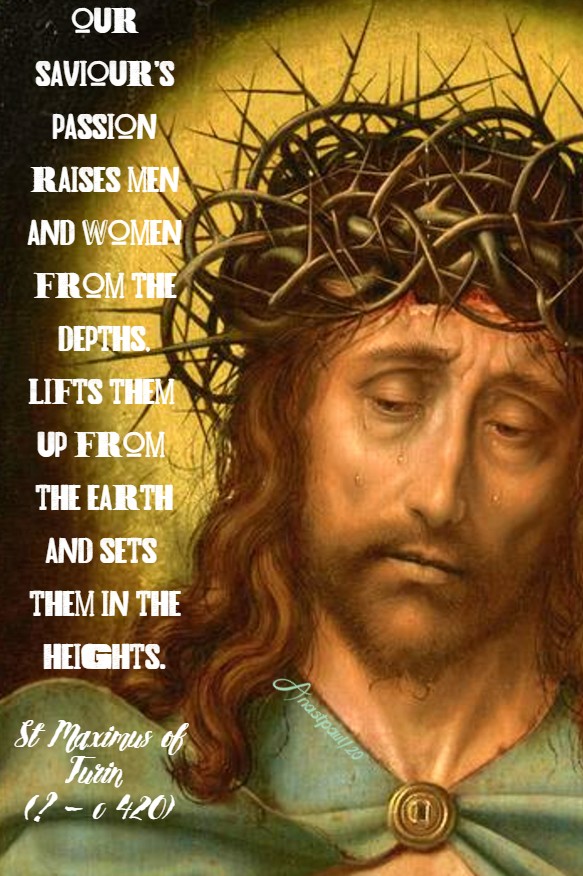
“Our Saviour’s passion raises men and women from the depths, lifts them up from the earth and sets them in the heights.”
St Maximus of Turin (? – c 420)
“As they were looking on, so we too gaze on His wounds as He hangs. We see His blood as He dies. We see the price offered by the Redeemer, touch the scars of His Resurrection. He bows His head, as if to kiss you. His heart is made bare open, as it were, in love to you. His arms are extended, that He may embrace you. His whole body is displayed for your redemption. Ponder how great these things are. Let all this be rightly weighed in your mind – as He was once fixed to the cross, in every part of His body for you, so He may now be fixed in every part of your soul.”
St Augustine (354-430) Father and Doctor of Grace
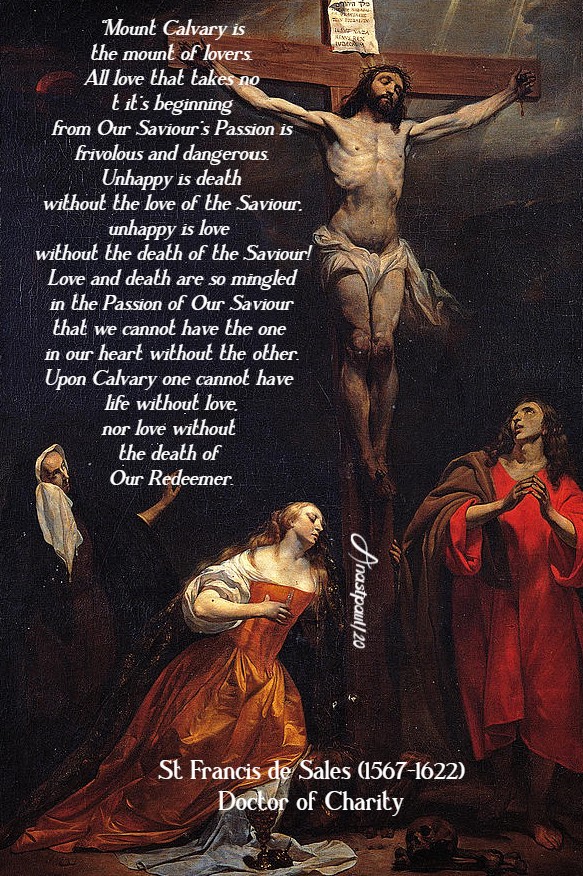
“Mount Calvary is the mount of lovers. All love that takes not it’s beginning from Our Saviour’s Passion is frivolous and dangerous. Unhappy is death without the love of the Saviour, unhappy is love without the death of the Saviour! Love and death are so mingled in the Passion of Our Saviour that we cannot have the one in our heart without the other. Upon Calvary one cannot have life without love, nor love without the death of Our Redeemer.”
St Francis de Sales (1567-1622) Doctor of Charity
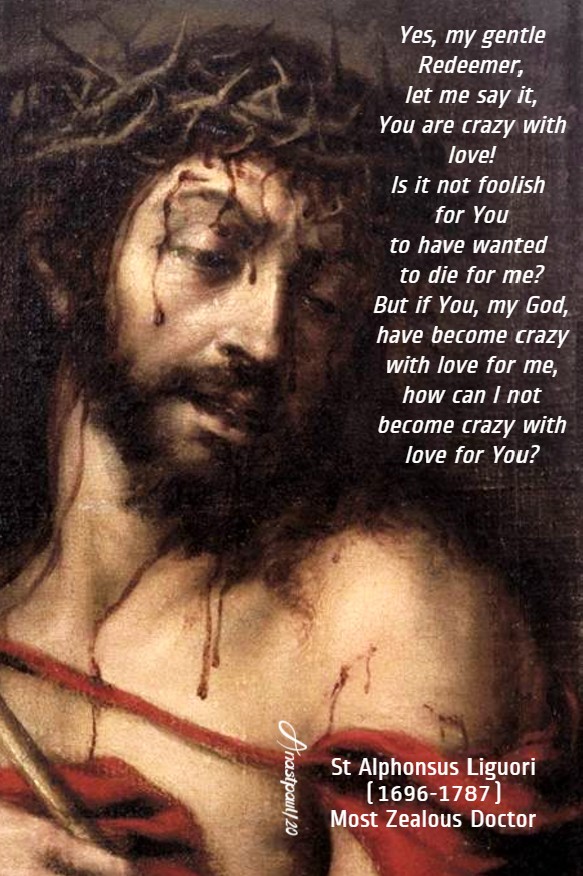
“Yes, my gentle Redeemer, let me say it, You are crazy with love! Is it not foolish for You to have wanted to die for me? But if You, my God, have become crazy with love for me, how can I not become crazy with love for You?”
St Alphonsus Liguori (1696-1787) Most Zealous Doctor
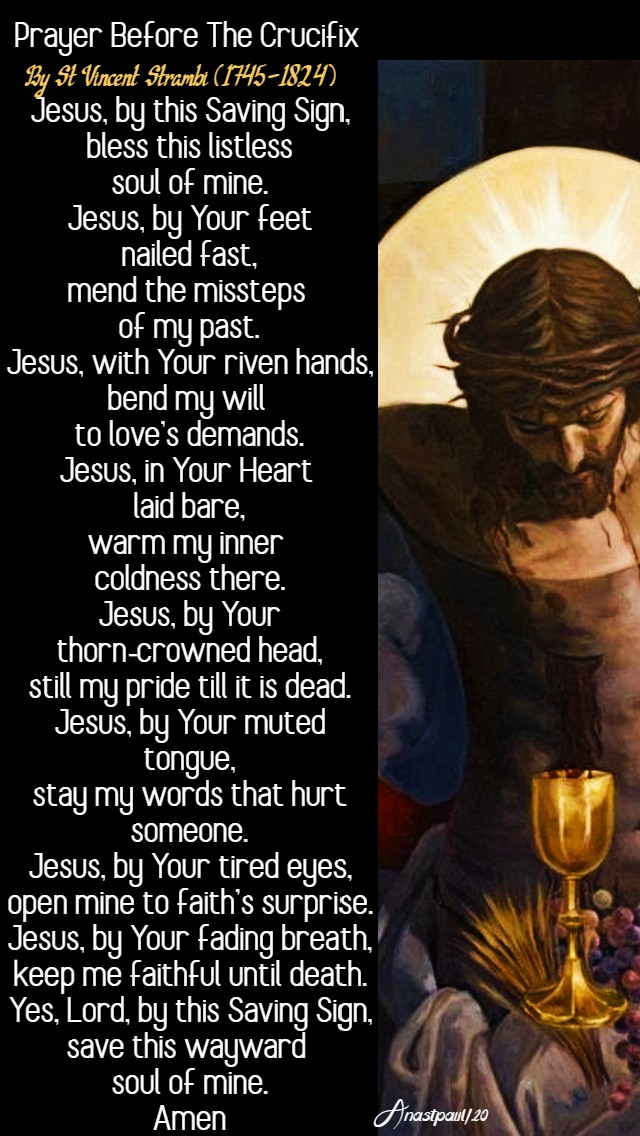
Prayer Before The Crucifix – The Holy Sacrifice of the Mass By St Vincent Strambi (1745-1824)
Jesus, by this Saving Sign, bless this listless soul of mine. Jesus, by Your feet nailed fast, mend the missteps of my past. Jesus, with Your riven hands, bend my will to love’s demands. Jesus, in Your Heart laid bare, warm my inner coldness there. Jesus, by Your thorn-crowned head, still my pride till it is dead. Jesus, by Your muted tongue, stay my words that hurt someone. Jesus, by Your tired eyes, open mine to faith’s surprise. Jesus, by Your fading breath, keep me faithful until death. Yes, Lord, by this Saving Sign, save this wayward soul of mine. Amen
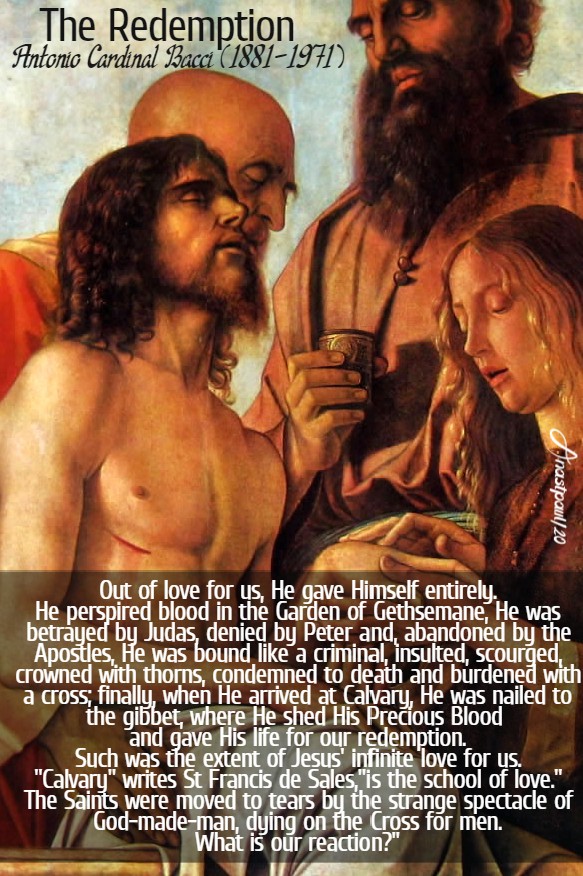
“He perspired blood in the Garden of Gethsemane, He was betrayed by Judas, denied by Peter and, abandoned by the Apostles, He was bound like a criminal, insulted, scourged, crowned with thorns, condemned to death and burdened with a cross; finally, when He arrived at Calvary, He was nailed to the gibbet, where He shed His Precious Blood and gave His life for our redemption. Such was the extent of Jesus’ infinite love for us. “Calvary” writes St Francis de Sales,“is the school of love.” The Saints were moved to tears by the strange spectacle of God-made-man, dying on the Cross for men. What is our reaction?”
Our Morning Offering – 23 October – Feast of the Most Holy Redeemer and Friday of the Twenty Ninth week in Ordinary Time
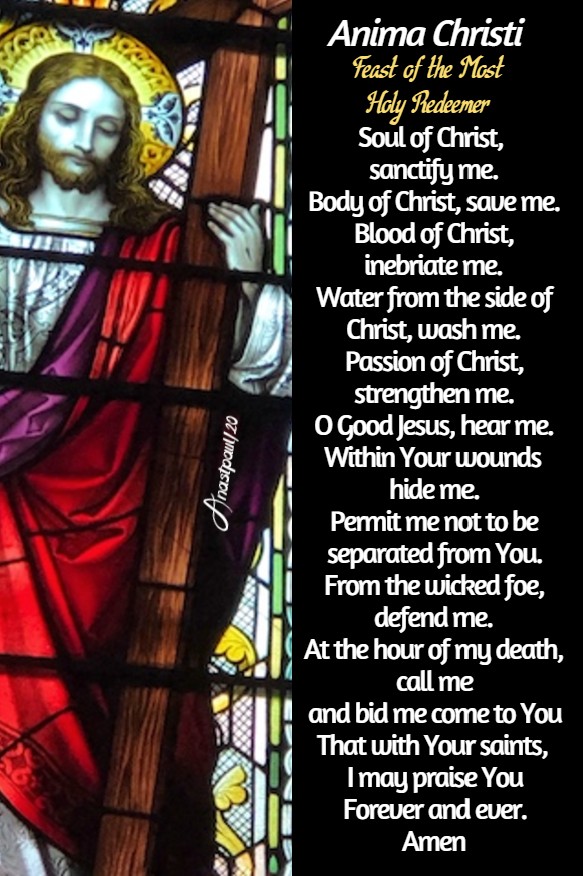
Anima Christi
Soul of Christ, sanctify me. Body of Christ, save me. Blood of Christ, inebriate me. Water from the side of Christ, wash me. Passion of Christ, strengthen me. O Good Jesus, hear me. Within Your wounds hide me. Permit me not to be separated from You. From the wicked foe, defend me. At the hour of my death, call me and bid me come to You That with Your saints, I may praise You Forever and ever. Amen
For many years the prayer was popularly believed to have been composed by Saint Ignatius Loyola, as he puts it at the beginning of his Spiritual Exercises and often refers to it. In the first edition of the Spiritual Exercises Ignatius merely mentions it, evidently supposing that the reader would know it. In later editions, it was printed in full. It was by assuming that everything in the book was written by Ignatius that it came to be looked upon as his composition. On this account the prayer is sometimes referred to as the Aspirations of St Ignatius Loyola.
However, the prayer actually dates to the early fourteenth century and was possibly written by Pope John XXII but its authorship remains uncertain. It has been found in a number of prayer books printed during the youth of Ignatius and is in manuscripts which were written a hundred years before his birth.
The English hymnologist James Mearns found it in a manuscript of the British Museum which dates back to about 1370. In the library of Avignon there is preserved a prayer book of Cardinal Pierre de Luxembourg (died 1387), which contains the prayer in practically the same form as we have it today. It has also been found inscribed on one of the gates of the Alcázar of Seville, which dates back to the time of Pedro the Cruel (1350–1369).
Our Morning Offering – 18 October – Twenty Ninth Sunday in Ordinary Time
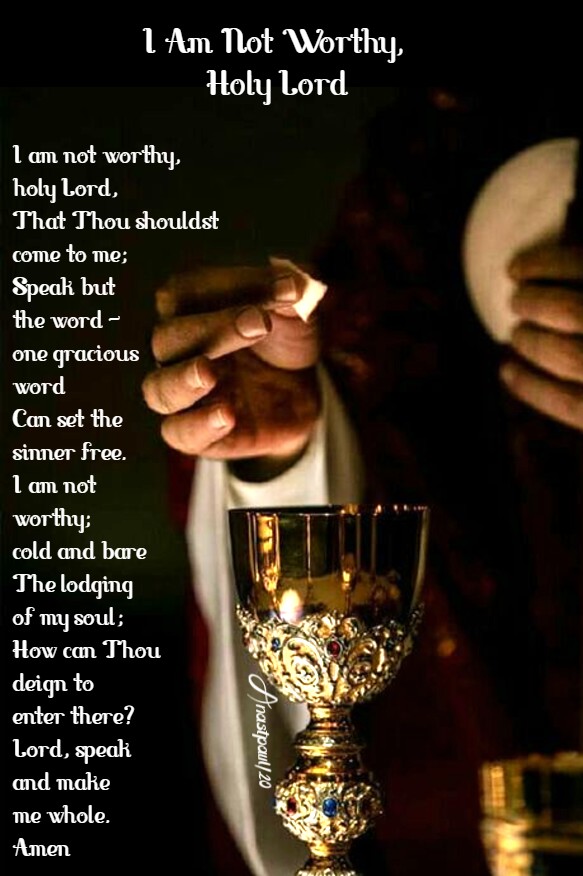
I Am Not Worthy, Holy Lord
I am not worthy, holy Lord, That Thou shouldst come to me; Speak but the word – one gracious word Can set the sinner free. I am not worthy; cold and bare The lodging of my soul; How canst Thou deign to enter there? Lord, speak and make me whole. Amen
Author – Rev H W Baker (1821–1877), was an English hymn writer.

















 AnaStpaul
You must be logged in to post a comment.