Our Morning Offering – 23 June – The Solemnity of The Most Holy Body and Blood of Christ 2019
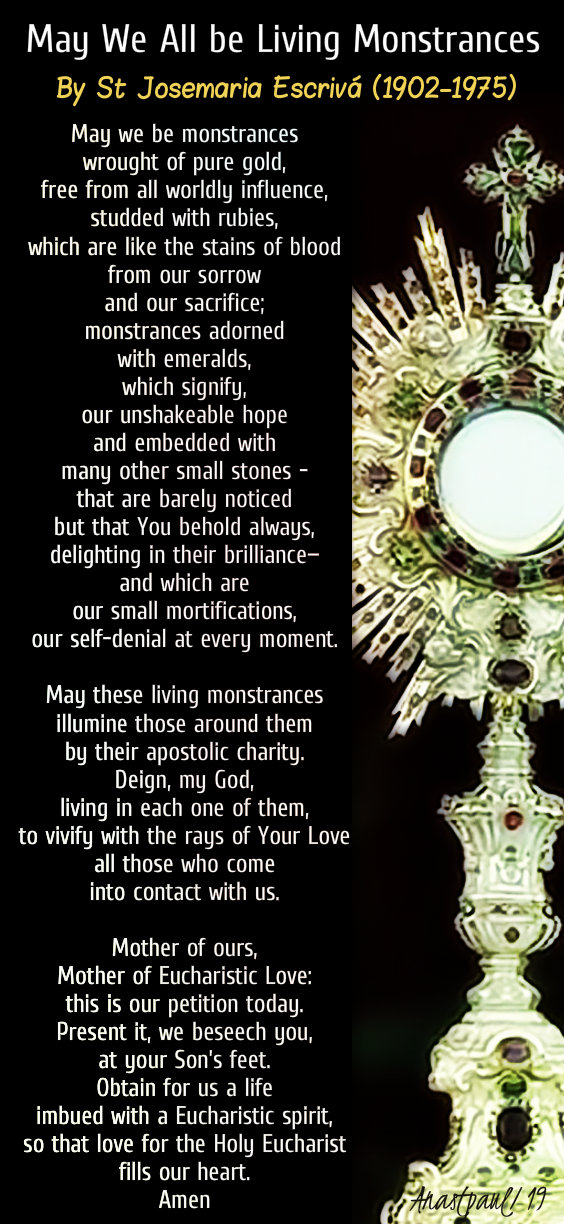
“MAY WE ALL BE LIVING MONSTRANCES.” By St Josemaria Escrivá (1902-1975)
May we be monstrances
wrought of pure gold,
free from all worldly influence,
studded with rubies,
which are like the stains of blood
from our sorrow and our sacrifice;
monstrances adorned with emeralds,
which signify,
our unshakeable hope
and embedded with
many other small stones –
that are barely noticed
but that You behold always,
delighting in their brilliance—
and which are our small mortifications,
our self-denial at every moment.
May these living monstrances
illumine those around them
by their apostolic charity.
Deign, my God,
living in each one of them,
to vivify with the rays of Your Love
all those who come
into contact with us.
Mother of ours,
Mother of Eucharistic Love:
this is our petition today.
Present it, we beseech you,
at your Son’s feet.
Obtain for us a life
imbued with a Eucharistic spirit,
so that love for the Holy Eucharist
fills our heart.
Amen
The Feast of Corpus Christi also known in Liturgical Latin as Dies Sanctissimi Corporis et Sanguinis Domini Iesu Christi – Latin for “Day of the Most Holy Body and Blood of Jesus Christ the Lord” and as Solemnity of the Corpus Christi “Body of Christ” is a Christian liturgical solemnity celebrating the Real Presence of the Body and Blood, Soul and Divinity of Jesus Christ in the elements of the Eucharist. Two months earlier, the institution of the Eucharist at the Last Supper is observed on Maundy Thursday in a sombre atmosphere leading to Good Friday. The liturgy on that day also commemorates Christ’s washing of the disciples’ feet, the institution of the priesthood.
The feast of Corpus Christi was proposed by St Thomas Aquinas (1225-1274) , Doctor of the Church to Pope Urban IV, in order to create a feast focused solely on the Holy Eucharist emphasising the joy of the Eucharist being the Body and Blood, Soul and Divinity of Jesus Christ. Recognised the authenticity of the Eucharistic Miracle of Bolsena on input of St Thomas, in 1264 the pontiff, established the feast of Corpus Christi as a Solemnity and extended it to the universal Catholic Church.
The feast is liturgically celebrated on the Thursday after Trinity Sunday or, “where the Solemnity of The Most Holy Body and Blood of Christ is not a holy day of obligation, it is assigned to the Sunday after the Most Holy Trinity as its proper day”, which is now the case in most countries. In the liturgical reforms of 1969, under Pope Paul VI, the bishops of each nation have the option to transfer it to the following Sunday.
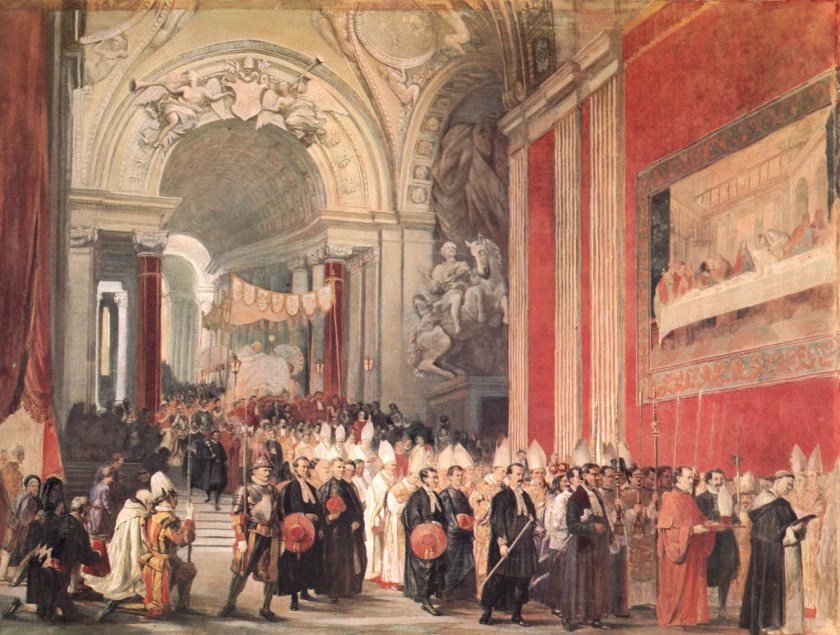
At the end of Holy Mass, there is a procession of the Blessed Sacrament, generally displayed in a monstrance. A notable Eucharistic procession is that presided over by the Pope each year in Rome, where it begins at the Archbasilica of St John Lateran and passes to the Basilica of Saint Mary Major, where it concludes with Benediction of the Blessed Sacrament.
The feast of Corpus Christi is one of five occasions in the year on which a diocesan bishop is not to be away from his diocese unless for a grave and urgent reason.
By tradition, Catholics hear Mass then go in procession through the streets of their parish church’s neighbourhood, all whilst praying and singing. The Eucharist, known as the Blessed Sacrament, is placed in a monstrance and is held aloft by a member of the clergy during the procession. Usually, there are anything from 3 – 5 stops, where altars have been erected and Benediction takes place. The final Benediction usually takes place back in the Church.
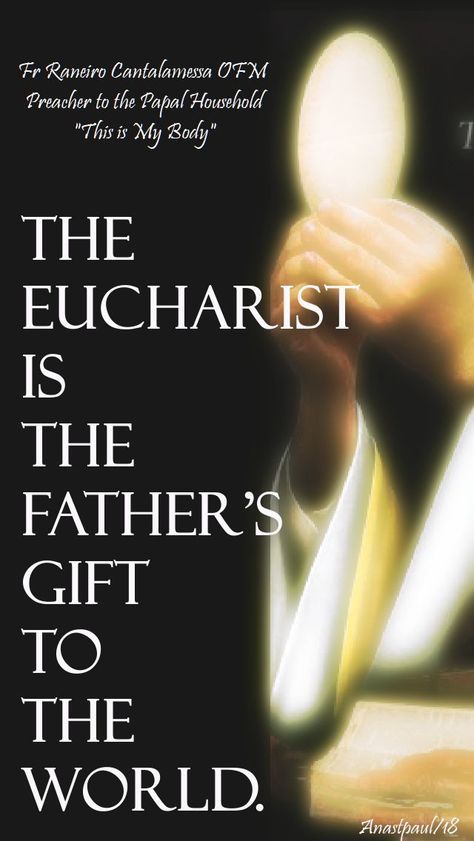
Let us be transported to the same climate of expectation and joyful hope as we feel in the Adoro Te Devote with these last words of the Lauda Sion, the Eucharistic hymn/sequence also written by St Thomas Aquinas. (Fr Raneiro Cantalamessa O.F.M. “This is My Body”)
Source of all we have or know, feed and lead us here below. Grant that with Your saints above, Sitting at the feast of love, We may see You face to face.
St Agrippina of Rome
St Bilio of Vannes St Etheldreda (c 636-679)
Bl Félix of Cîteaux
St Felix of Sutri
Bl Frances Martel
Bl Francis O’Sullivan
St Hidulphus of Hainault
St James of Toul
St John of Rome St Joseph Cafasso (1811-1860) St Joseph Cafasso’s Biography: https://anastpaul.com/2018/06/23/saint-of-the-day-23-june-st-joseph-cafasso-1811-1860-priest-of-the-gallows/
Bl Lanfranco Beccari
St Lietbert
Bl Lupo de Paredes
Bl Mary of Oignies
St Moeliai of Nendrum
Bl Peter of Juilly
Bl Thomas Corsini of Orvieto
St Thomas Garnet
Bl Walhere of Dinant
St Zenas of Philadelphia
St Zeno of Philadelphia
—
Martyrs of Ancyra: A family of converts who were arrested, tortured and sent in chains to Ancyra, Galatia (modern Ankara, Turkey) where he was tortured more by order of governor Agrippinus during the persecutions of Diocletian. Martyr. They were – Eustochius, Gaius, Lollia, Probus, Urban. They were roasted over a fire and finally beheaded c 300 in Ancyra, Galatia (modern Ankara, Turkey).
Martyrs of Nicomedia: During the persecutions of Diocletian, many Christians fled their homes to live in caves in the area of Nicomedia. In 303 troops descended on the area, systematically hunted them down and murdered all they could find.
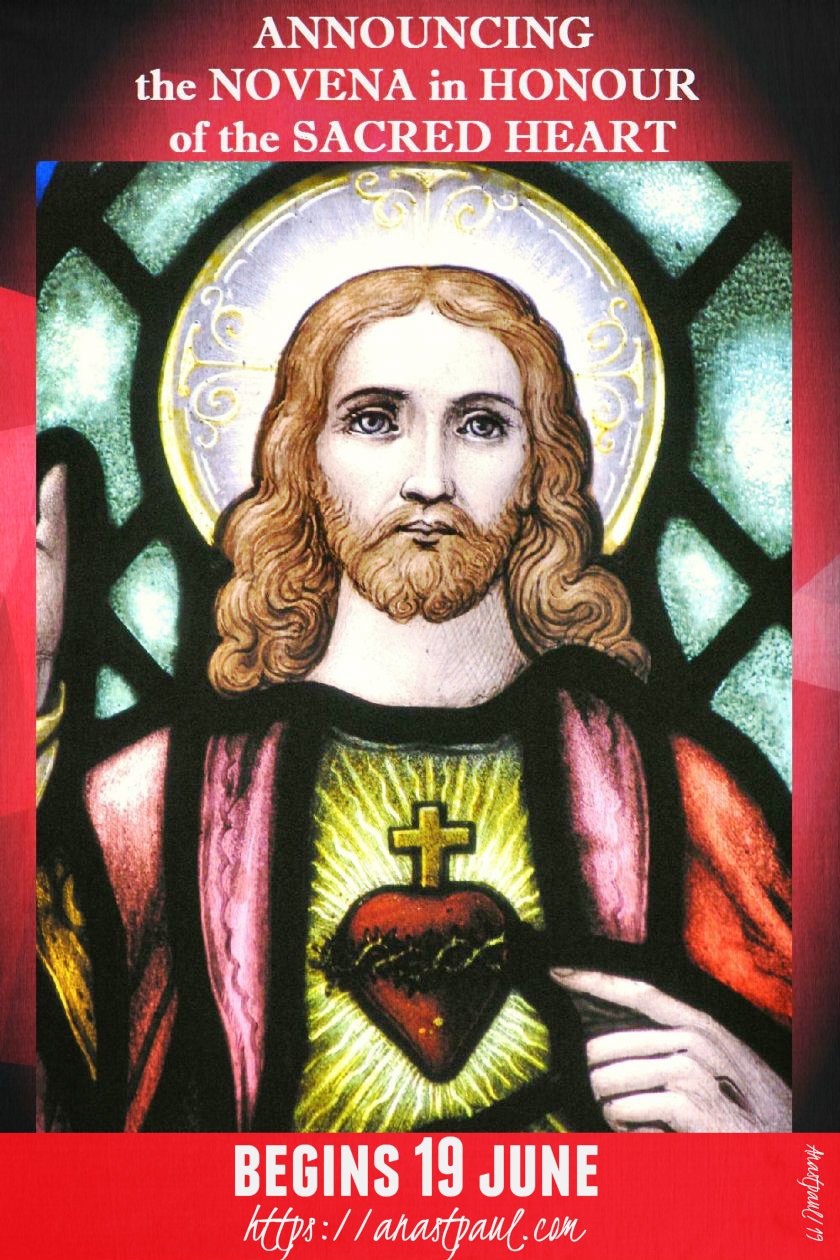
Announcing the NOVENA to the SACRED HEART BEGINS Wednesday, 19 June
Devotion to the Sacred Heart
By Ven Servant of God John A Hardon SJ (1914-2000)
Devotion to the Sacred Heart of Jesus is as old as Christianity. When the side of Christ was pierced on Calvary, there immediately flowed out blood and water. The Church has interpreted this to mean, the outpouring of grace through the Church, which began the moment that Christ expired on the Cross.
Over the centuries, the gratitude of the faithful for this manifestation of divine love has centred on the physical Heart of Jesus as the symbol of God’s love for man. We may, therefore, say, that devotion to the Sacred Heart is really devotion to the love of God as revealed in the person of Jesus Christ.
When God became man, it was God – who is love – who became man. In the languages of all nations, the heart is identified with love. Consequently, our devotion to the Heart of Jesus is directed to the love of Jesus in different ways. We love Him as our God, who has loved us from all eternity and out of selfless love brought us into existence and destined us to possess Him for all eternity. We love Him as our God Incarnate, who loved us so much that He assumed our human nature and by His bodily death redeemed us from the eternal death we deserved for our sins. We love Him as our Redeemer who rose from the dead and ascended into heaven where He is preparing a place for us. Where He is, our God united with His human body and soul, we hope to be in His blessed company. We love Him as our Eucharistic Lord who is on earth in His humanity, in the Blessed Sacrament. He offers Himself in the Mass through which He now communicates the graces He won for us on the Cross. By His Real Presence, He invites us to offer Him our adoring love and ask Him to work the miracles He performed during His visible stay in Palestine. To be emphasised is the unique character of devotion to the Sacred Heart. It is nothing less than a synthesis of Catholic Christianity in its loving response to the unspeakable love of God for the sons and daughters of the human family.
For the sake of convenience, we may divide the terms “Sacred Heart” and “Devotion” into two parts: Sacred Heart stands for the love of God, which means the love that is God, the love that God has shown for us from the dawn of creation until now and the love that God will continue to pour out on us into the endless reaches of eternity. Devotion stands for our grateful return of love for love, which is shown in loving sacrifice by the total surrender of our wills to the mysterious and demanding will of God, in loving imitation of Jesus Christ, whose virtues as man, are so many manifestations of His divine attributes as God, in loving worship of Mary’s Son, who is present with His living, pulsating human Heart in the Blessed Sacrament, in loving petition for the graces that we and others, need to serve Him faithfully, here on earth and enjoy Him in the life that will never end.
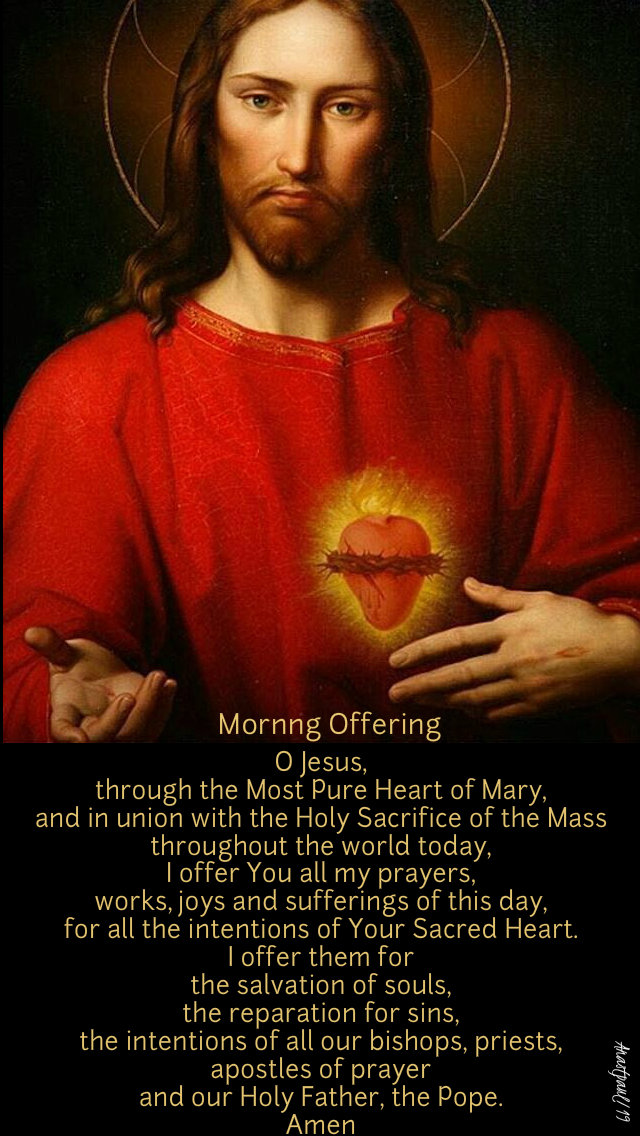
A simple but very effective way of growing in devotion to the Sacred Heart, is to recite daily the very old morning offering, used for centuries within the Catholic heart:
O Jesus, through the Most Pure Heart of Mary and in union with the Holy Sacrifice of the Mass throughout the world today, I offer You all my prayers, works, joys and sufferings of this day, for all the intentions of Your Sacred Heart, I offer them for the salvation of souls, the reparation of sins, the intentions of all our bishops, priests, apostles of prayer and our Holy Father, the Pope. Amen
Among the promises made by our Lord to St Margaret Mary, was the assurance that, “Those who shall promote this devotion shall have their names written in my Heart, never to be blotted out.”
Thought for the Day – 17 June – The Memorial of Blessed Joseph-Marie Cassant OCSO (1878-1903)
Fr Joseph-Marie always put his trust in God, in contemplation of the mystery of the Passion and in communion with Christ present in the Eucharist.
Thus, he was imbued with love for God and abandoned himself to Him, “the only true happiness on earth”, detaching himself from worldly goods in the silence of the Trappist monastery. In the midst of trials, his eyes fixed on Christ, he offered up his sufferings for the Lord and for the Church.
May our contemporaries, especially contemplatives and the sick, discover, following his example, the mystery of prayer, which raises the world to God and gives strength in trial!”…St John Paul II (1920-2005) Beatification Homily, Sunday, 3 October 2004
‘The Eucharist is the Saviour Himself, wholly giving Himself to men, His Heart is pierced on the Cross and then tenderly gathers in all those who trust in Him.’
Marian Thoughts – 24 May – ‘Mary’s Month’ – Friday of the Fifth Week of Easter, C
Mini Series – Pope Francis and the Holy Rosary
“Throughout her life, Mary did everything that the Church is asked to do in perennial memory of Christ. In her faith, we learn to open our hearts to obey God, in her self-denial, we see the importance of tending to the needs of others, in her tears, we find the strength to console those experiencing pain. In each of these moments, Mary expresses the wealth of divine mercy that reaches out to all in their daily needs.”
Pope Francis – 9 October 2016
The Fifth Luminous Mystery: The Institution of the Eucharist
“It is in the Lord, who gave His life for us on the cross, that we will always find that unconditional love which sees our lives as something good and always gives us the chance to start again.
In the Eucharist, Divine Mercy reveals itself in a special way. Celebrating the greatest mysteries of our faith, we touch the source of mercy.
The Eucharist is flavoured with Jesus’ words and deeds, the taste of His Passion, the fragrance of His Spirit. When we receive it, our hearts are overcome with the certainty of Jesus’ love. (18 June 2017)
Let us pray that frequent participation in the Holy Mass would expand our hearts, enrich our strength and enable us to give ourselves to our neighbours.”
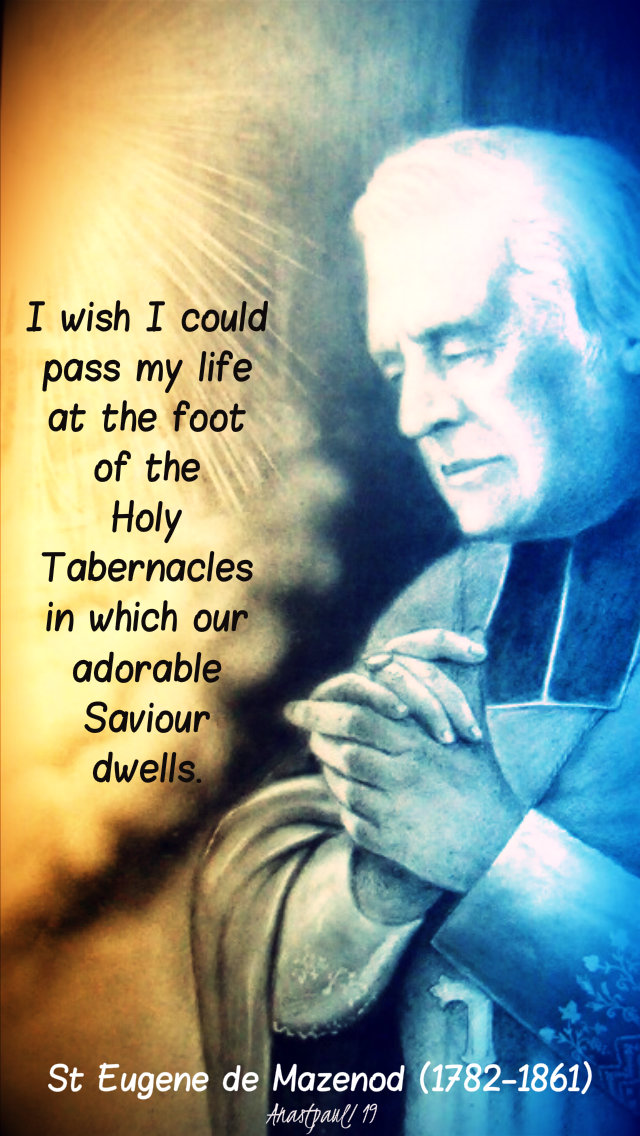
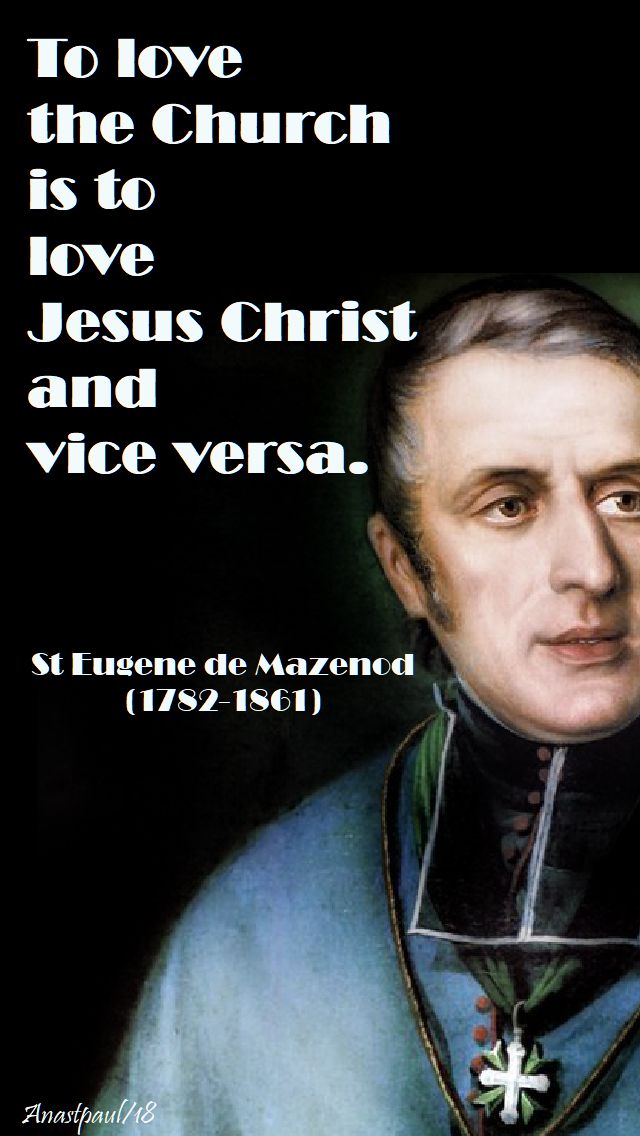
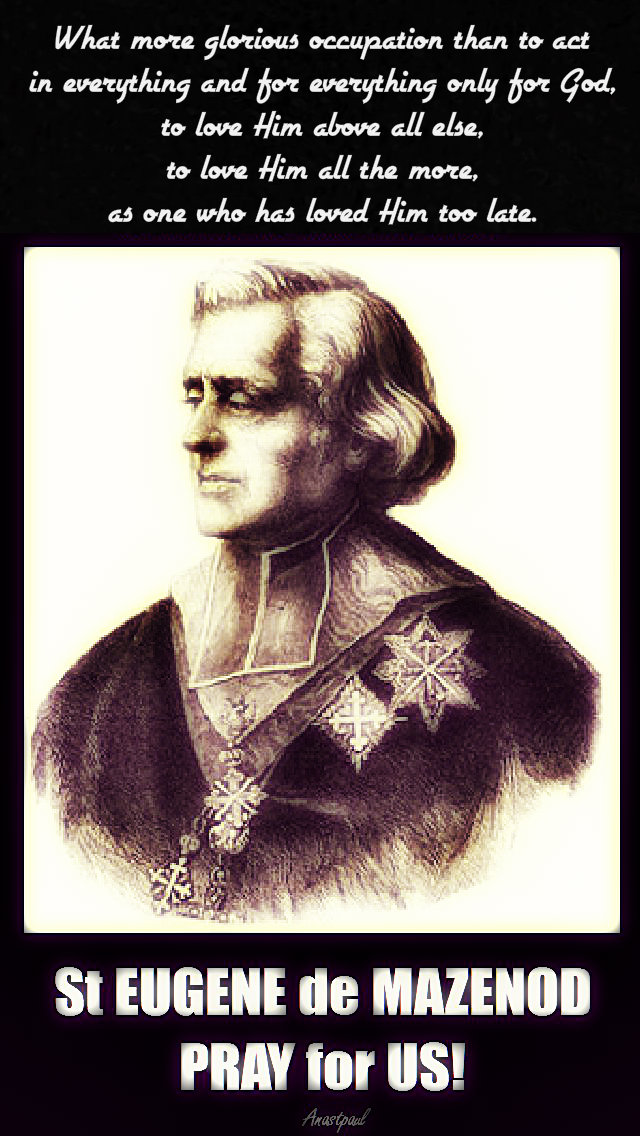
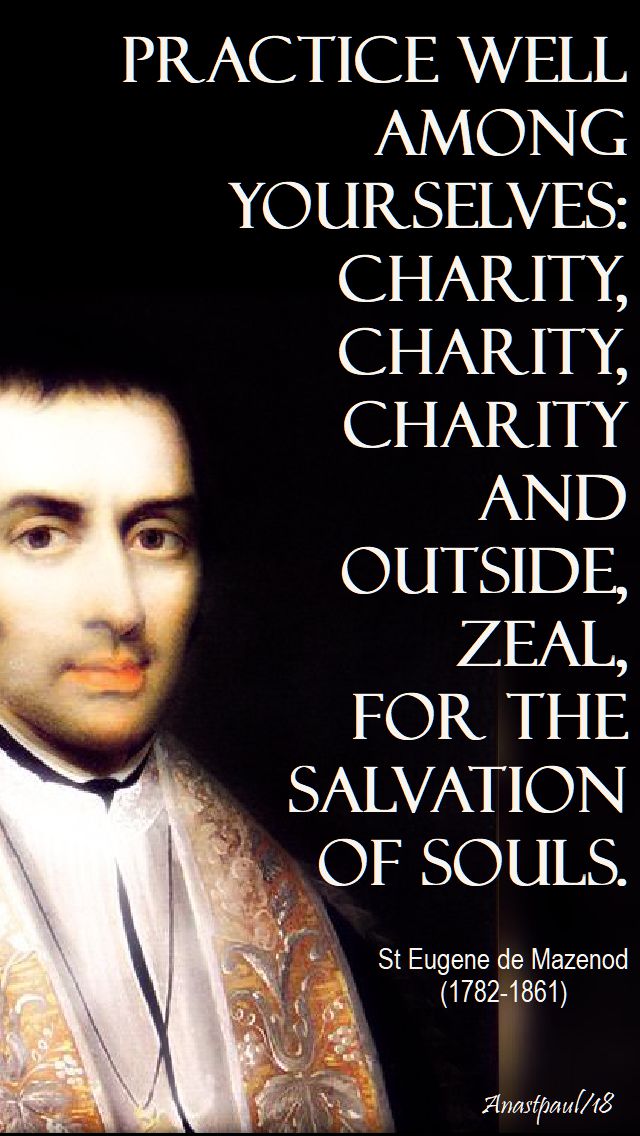
Quote/s of the Day – 21 May – Tuesday of the Fifth Week of Easter, C and The Memorial of St Eugene de Mazenod OMI (1782-1861)
“I wish I could pass my life at the foot of the Holy Tabernacles in which our adorable Saviour dwells.”
“To love the Church is to love Jesus Christ and vice versa.”
“What more glorious occupation than to act in everything and for everything only for God, to love Him above all else, to love Him all the more, as one who has loved Him too late.”
“Practice well among yourselves: charity, charity, charity and outside, zeal for the salvation of souls”
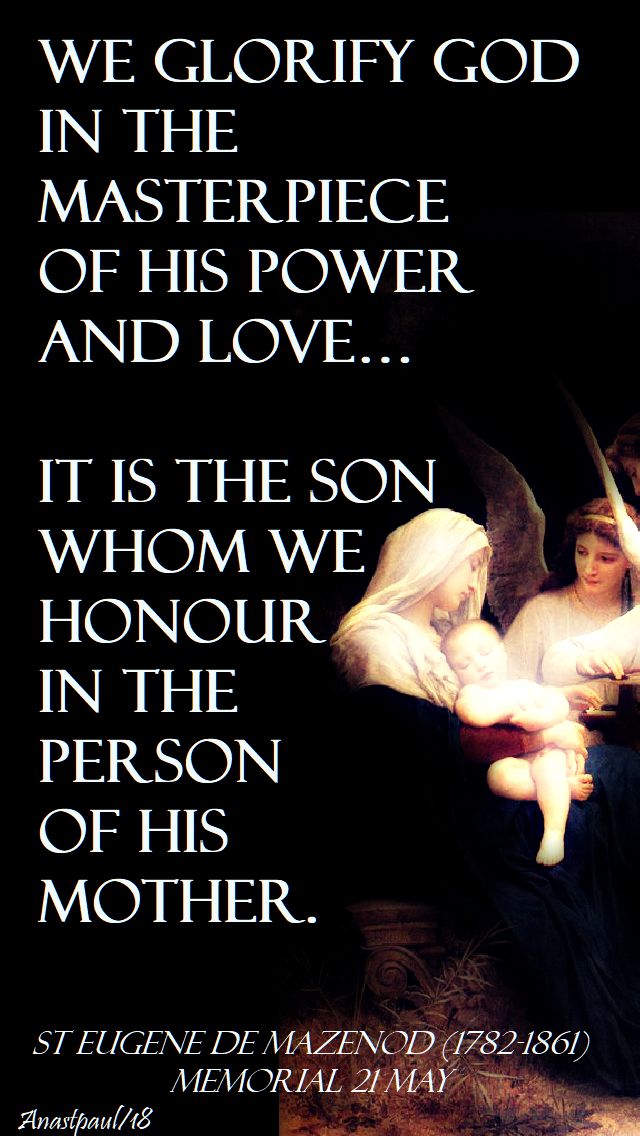
“We glorify God in the masterpiece of His power and love… it is the Son whom we honour in the person of His Mother.”
Quote/s of the Day – 20 May – Monday of the fifth Week of Easter, C and the Memorial of St Bernadine of Siena OFM (1380-1444)
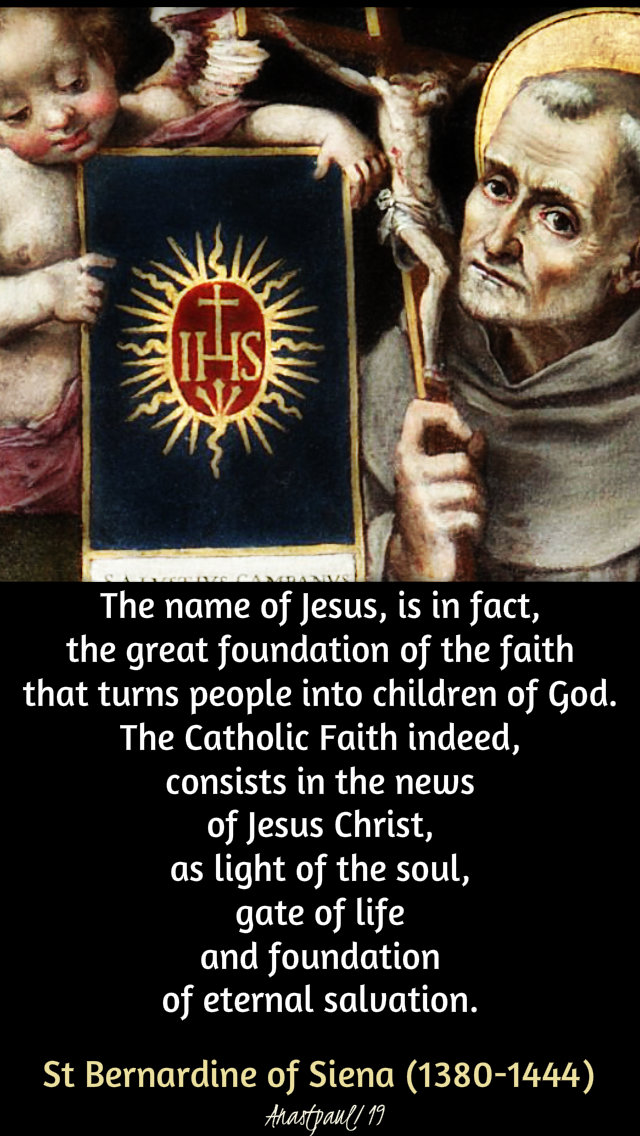
“The name of Jesus, is in fact, the great foundation of the faith that turns people into children of God. The Catholic Faith indeed, consists in the news of Jesus Christ, as light of the soul, gate of life and foundation of eternal salvation.”
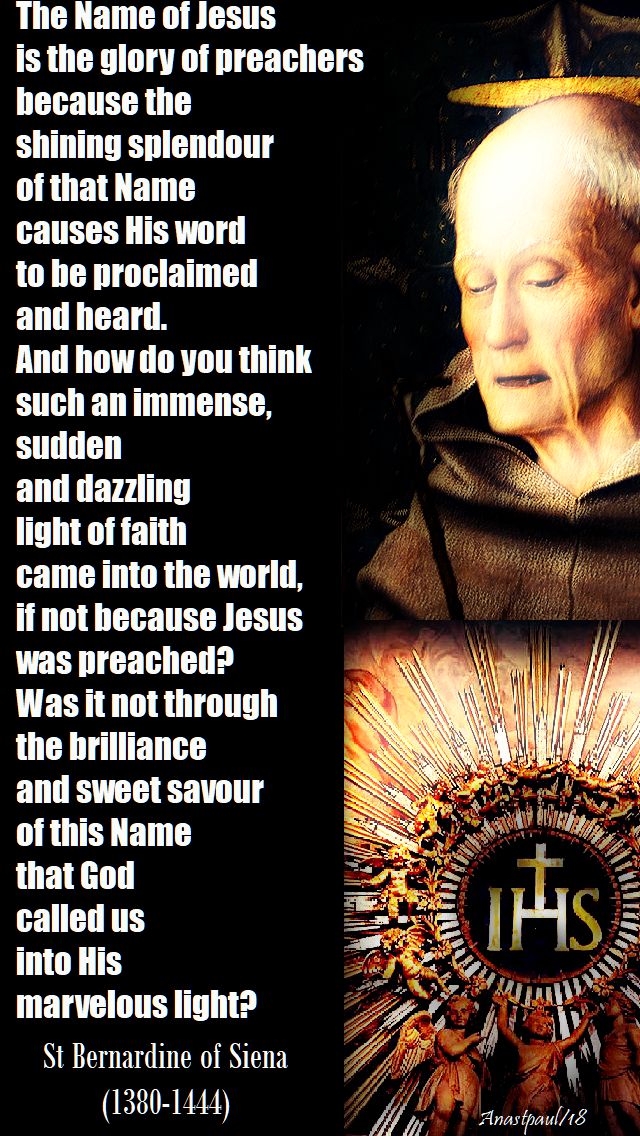
“The Name of Jesus is the glory of preachers because the shining splendour of that Name causes His word to be proclaimed and heard. And how do you think such an immense, sudden and dazzling light of faith came into the world, if not because Jesus was preached? Was it not through the brilliance and sweet savour of this Name that God called us into His marvellous light?”
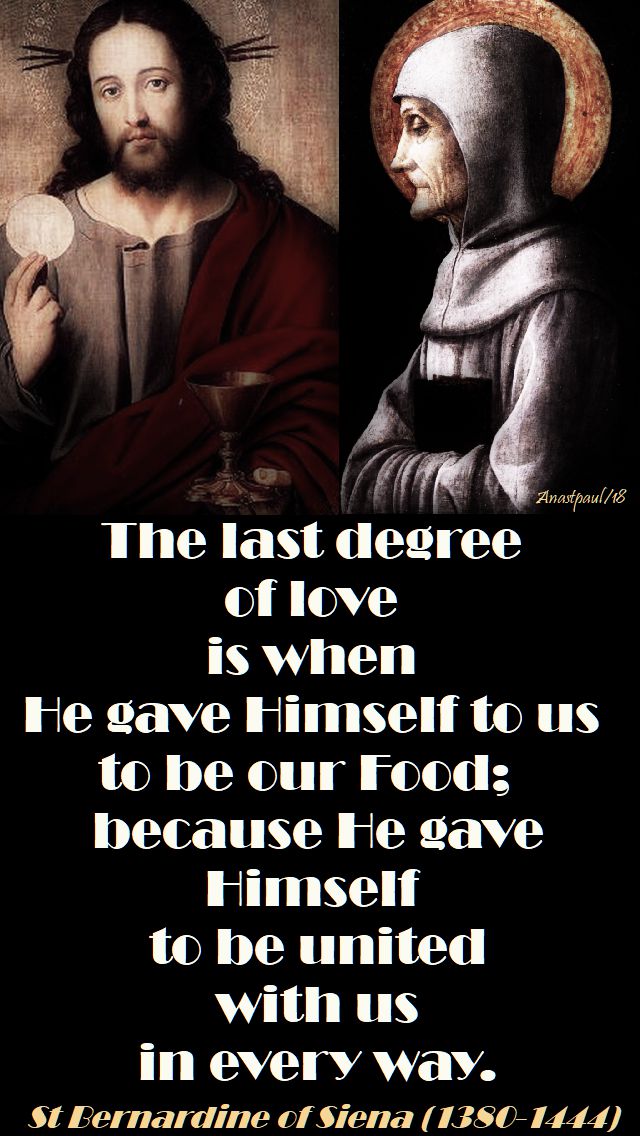
“The last degree of love is when He gave Himself to us to be our Food; because He gave Himself to be united with us in every way.”
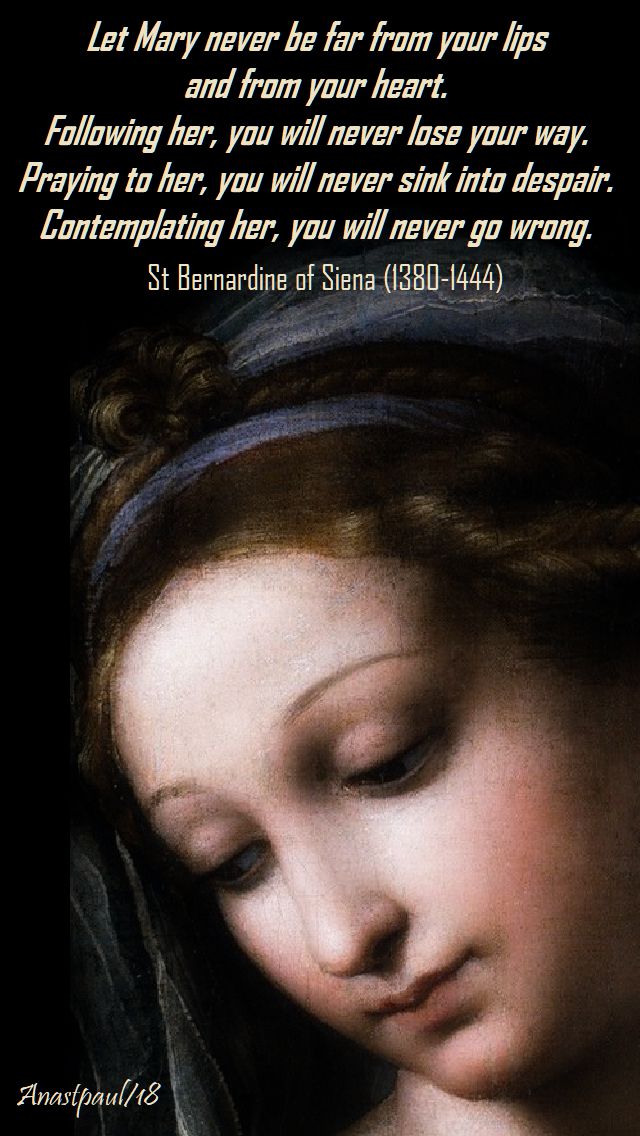
“Let Mary never be far from your lips and from your heart. Following her, you will never lose your way. Praying to her, you will never sink into despair. Contemplating her, you will never go wrong.”
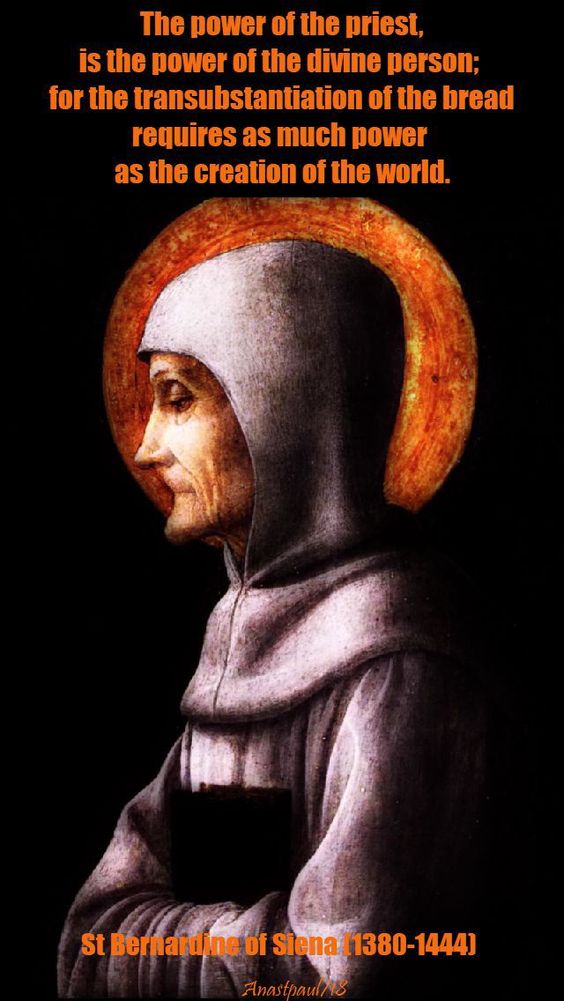
“The power of the priest, is the power of the divine person, for the transubstantiation of the bread, requires as much power, as the creation of the world.”
Sunday Reflection – 19 May – The Fifth Sunday of Easter, C
Holy Communion
Bl John Henry Newman (1801-1890)
O my God, holiness becomes Your House and yet You make Your abode in my breast. My Lord, my Saviour, to me You come, hidden under the semblance of earthly things, yet in that very flesh and blood which You took from Mary. You, who did first inhabit Mary’s breast, come to me.
My God, You see me; I cannot see myself. Were I ever so good a judge about myself, ever so unbiased and with ever so correct a rule of judging, still, from my very nature, I cannot look at myself and view myself truly and wholly. But You, as You come to me, contemplate me.
When I say, Domine, non sum dignus—”Lord, I am not worthy”—You whom I am addressing, alone understands in their fullness the words which I use. You see how unworthy so great a sinner is to receive the One Holy God, whom the Seraphim adore with trembling. You see, not only the stains and scars of past sins but the mutilations, the deep cavities, the chronic disorders which they have left in my soul. You see the innumerable living sins, though they be not mortal, living in their power and presence, their guilt and their penalties, which clothe me. You see all my bad habits, all my mean principles, all wayward lawless thoughts, my multitude of infirmities and miseries, yet You come. You see most perfectly how little I really feel what I am now saying, yet You come.
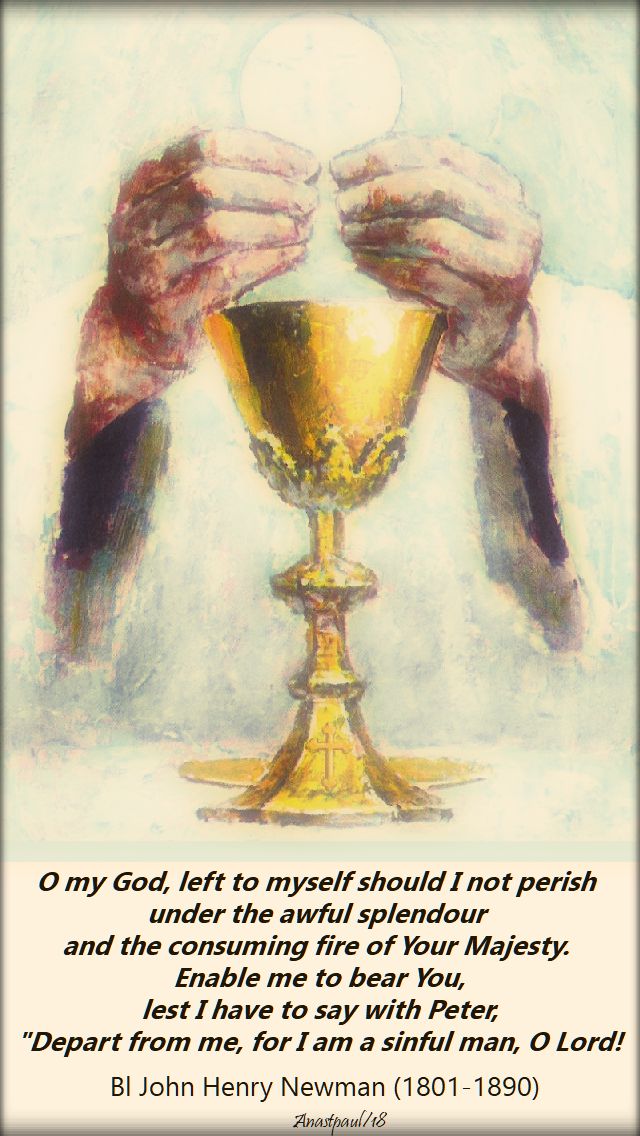
O my God, left to myself should I not perish under the awful splendour and the consuming fire of Your Majesty. Enable me to bear You, lest I have to say with Peter, “Depart from me, for I am a sinful man, O Lord!”
Our Morning Offering – 19 May “Mary’s Month” The Fifth Sunday of Easter, C
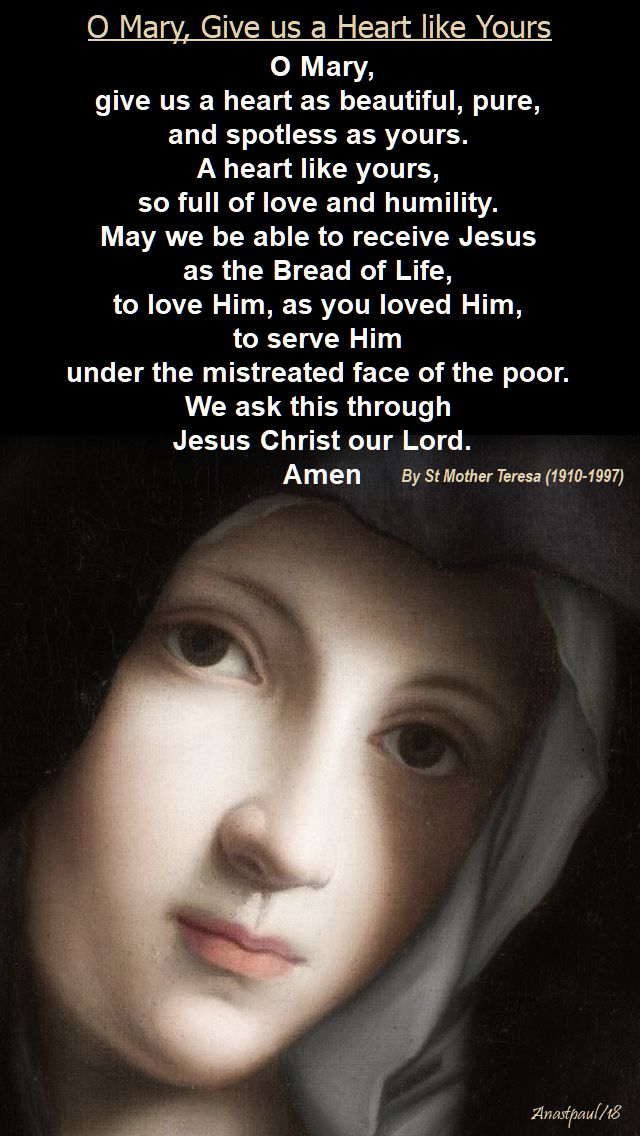
O Mary, Give us a Heart like Yours By St Mother Teresa (1910-1997)
O Mary, give us a heart
as beautiful, pure
and spotless as yours.
A heart like yours,
so full of love and humility.
May we be able to receive Jesus
as the Bread of Life,
to love Him
as you loved Him,
to serve Him
under the mistreated face of the poor.
We ask this through
Jesus Christ our Lord.
Amen
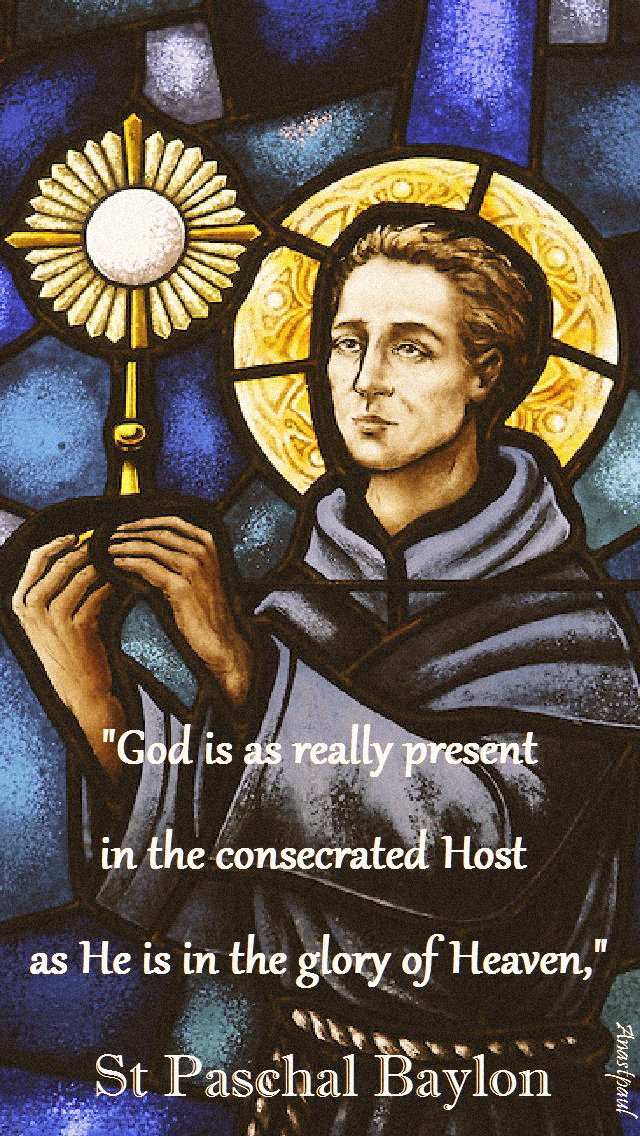
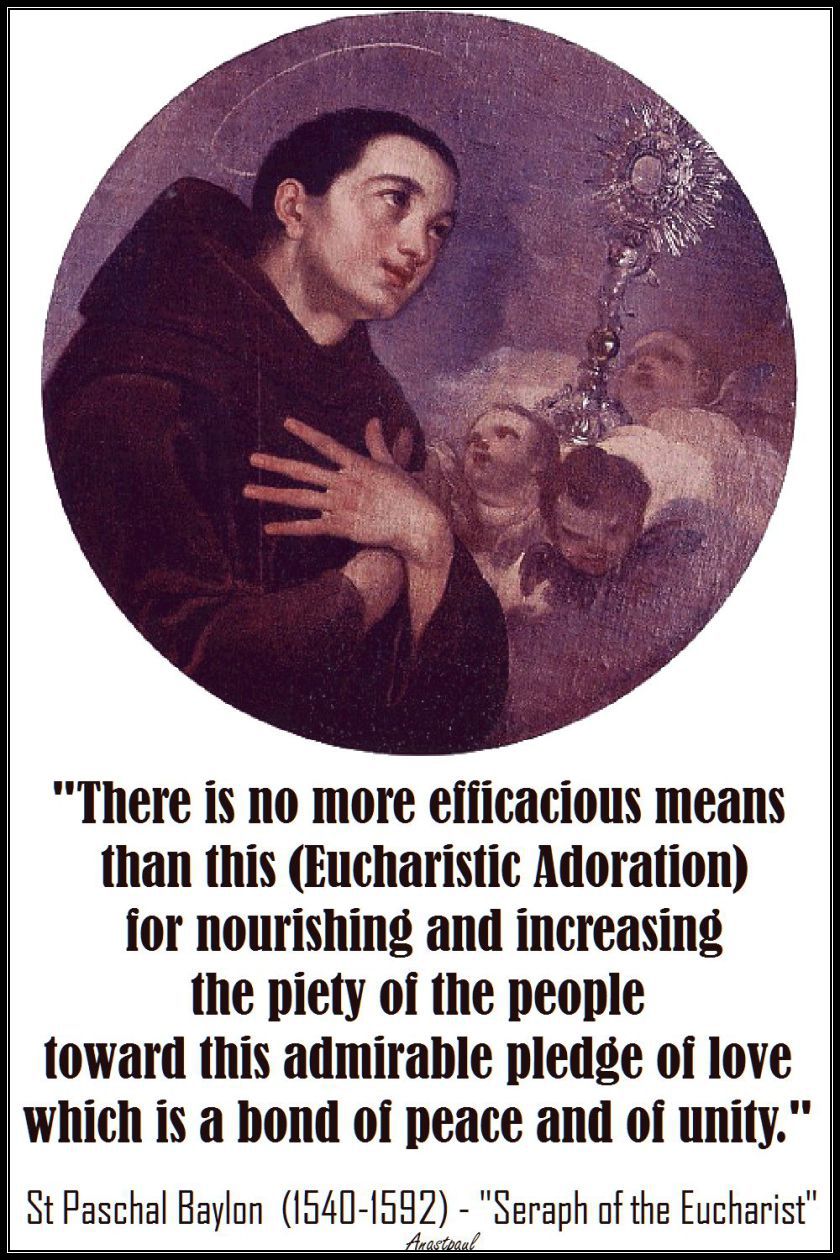
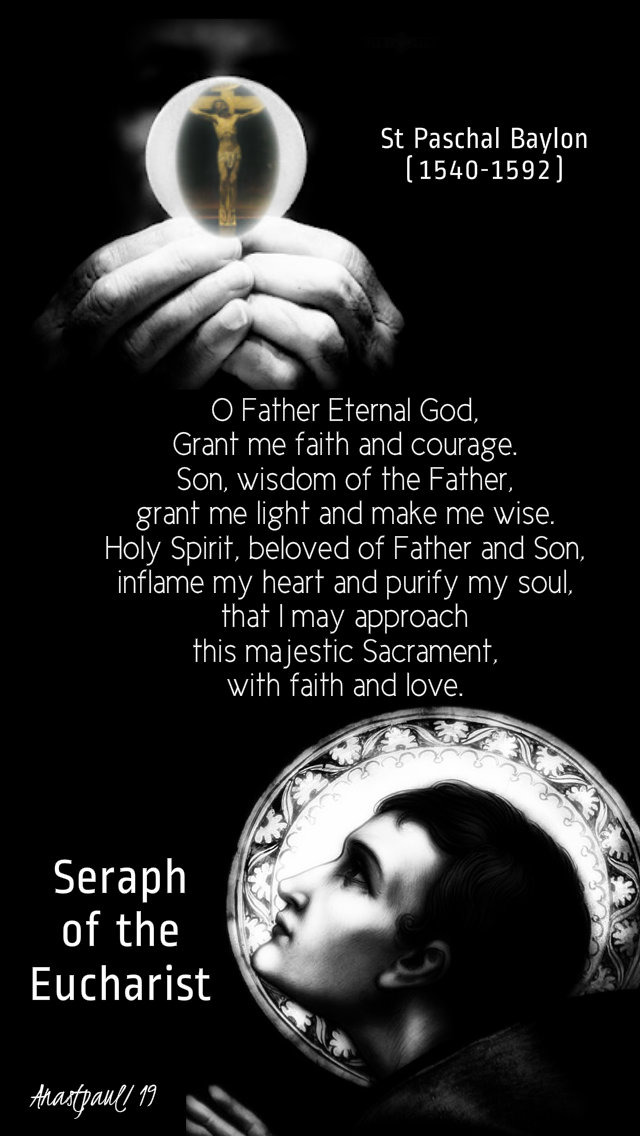
Quote/s of the Day – 17 May – Thursday of the Seventh Week of Easter, C and the Memorial of St Paschal Baylon OFM. (1540-1592) “Seraph of the Eucharist” – Patron of Eucharistic Congresses
“God is as really present in the consecrated Host as He is, in the glory of Heaven.”
“There is no more efficacious means than this (Eucharistic Adoration) for nourishing and increasing the piety of the people toward this admirable pledge of love which is a bond of peace and of unity.”
“O Father Eternal God, Grant me faith and courage. Son, wisdom of the Father, grant me light and make me wise. Holy Spirit, beloved of Father and Son, inflame my heart and purify my soul, that I may approach this majestic Sacrament, with faith and love.”
St Paschal Baylon (1540-1592)
“Seraph of the Eucharist”
Thought for the Day – 12 May – The Fourth Sunday of Easter, Year C
The Celebration of the Eucharist
Saint Justin Martyr (100-165)
Father of the Church, Apologist and Martyr
An excerpt from his First Apology in the Defence of Christians
No one may share the Eucharist with us, unless he believes that what we teach is true, unless he is washed in the regenerating waters of baptism for the remission of his sins, and unless he lives in accordance with the principles given us by Christ.
We do not consume the Eucharistic bread and wine as if it were ordinary food and drink, for we have been taught, that as Jesus Christ our Saviour became a man of flesh and blood by the power of the Word of God, so also the food, that our flesh and blood assimilates for its nourishment, becomes the flesh and blood of the incarnate Jesus, by the power of His own words, contained in the prayer of thanksgiving.
The apostles, in their recollections, which are called gospels, handed down to us what Jesus commanded them to do. They tell us that He took bread, gave thanks and said – Do this in memory of me. This is my body. In the same way He took the cup, He gave thanks and said – This is my blood. The Lord gave this command to them alone. Ever since then, we have constantly reminded one another of these things. The rich among us help the poor and we are always united. For all that we receive, we praise the Creator of the universe through His Son Jesus Christ and through the Holy Spirit.
On Sunday, we have a common assembly of all our members, whether they live in the city or the outlying districts. The recollections of the apostles or the writings of the prophets are read, as long as there is time. When the reader has finished, the president of the assembly speaks to us, he urges everyone to imitate the examples of virtue we have heard in the readings. Then we all stand up together and pray.
On the conclusion of our prayer, bread and wine and water are brought forward. The president offers prayers and gives thanks to the best of his ability and the people give assent by saying, “Amen.” The Eucharist is distributed, everyone present communicates and the deacons take it to those who are absent.
The wealthy, if they wish, may make a contribution and they themselves decide the amount. The collection is placed in the custody of the president, who uses it to help the orphans and widows and all who for any reason are in distress, whether because they are sick, in prison, or away from home. In a word, he takes care of all who are in need.
We hold our common assembly on Sunday because it is the first day of the week, the day on which God put darkness and chaos to flight and created the world and because on that same day, our savioUr Jesus Christ rose from the dead. For He was crucified on Friday and on Sunday He appeared to His apostles and disciples and taught them the things, that we have passed on for your consideration.
Sunday Reflection – 12 May – The Fourth Sunday of Easter, Year C
Saint Teresa of Avila (1515-1582)
Doctor of the Church
The Way of Perfection §34
As for ourselves, let us ask the Eternal Father, that we might merit to receive our heavenly bread in such a way, that the Lord may reveal Himself to the eyes of our soul and make Himself thereby known, since our bodily eyes cannot delight in beholding Him, because He is so hidden. Such a knowledge is another kind of satisfying and delightful sustenance that maintains life…
I know a person, to whom the Lord had given such living faith, that when she heard some persons saying, they would have liked to have lived at the time Christ our Good walked in the world, she used to laugh to herself. She wondered what more they wanted, since in the Blessed Sacrament, they had Him just as truly present as He was then… She considered she was at His feet and wept with the Magdalene, no more, nor less, than if she were seeing Him with her bodily eyes in the house of the Pharisee. And even though she didn’t feel devotion, faith told her that He was indeed there.
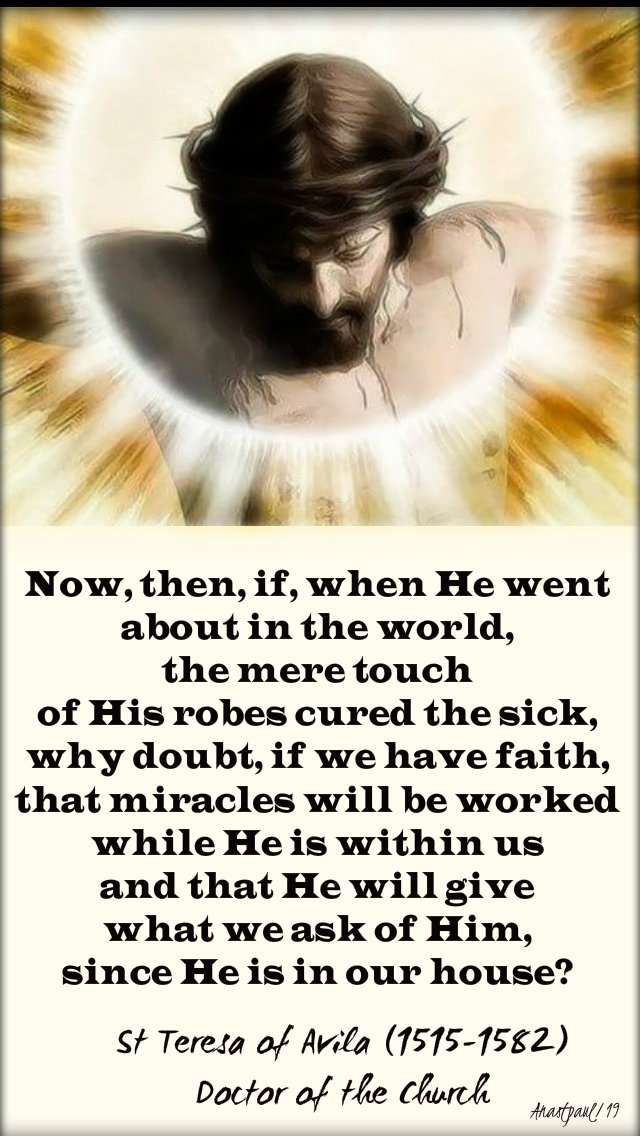
If we don’t want to be fools and blind the intellect, there’s no reason for doubt. Receiving communion is not like picturing with the imagination, as when we reflect upon the cross or in other episodes of the Passion, when we picture within ourselves how things happened to Him in the past. In communion, the event is happening now and it is entirely true. There’s no reason to go looking for Him in some other place farther away. Since we know that Jesus is with us, as long as the natural heat doesn’t consume the accidents of bread, we should approach Him. Now, then, if, when He went about in the world, the mere touch of His robes cured the sick, why doubt, if we have faith, that miracles will be worked while He is within us and that He will give what we ask of Him, since He is in our house?
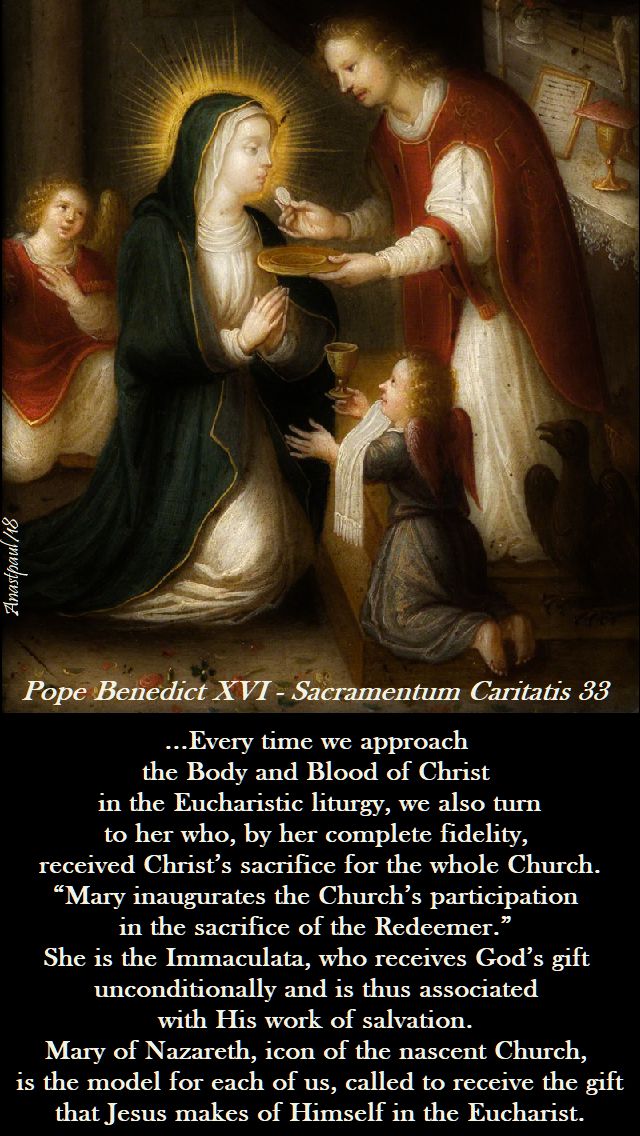
“Consequently, every time we approach the Body and Blood of Christ in the Eucharistic liturgy, we also turn to her who, by her complete fidelity, received Christ’s sacrifice for the whole Church. The Synod Fathers rightly declared that “Mary inaugurates the Church’s participation in the sacrifice of the Redeemer.” She is the Immaculata, who receives God’s gift unconditionally and is thus associated with His work of salvation. Mary of Nazareth, icon of the nascent Church, is the model for each of us, called to receive the gift that Jesus makes of Himself in the Eucharist.”
Thought for the Day – 9 May – Thursday Third Week of Easter, C
The Eucharist, Pledge of our Resurrection
Saint Irenaeus (130-202)
Bishop, Father of the Church and Martyr
An excerpt from a Against Heresies
If our flesh is not saved, then the Lord has not redeemed us with His blood, the Eucharistic chalice does not make us sharers in His blood and the bread we break, does not make us sharers in His body. There can be no blood without veins, flesh and the rest of the human substance and this the Word of God actually became – it was with His own blood that He redeemed us. As the Apostle says – In Him, through His blood, we have been redeemed, our sins have been forgiven.
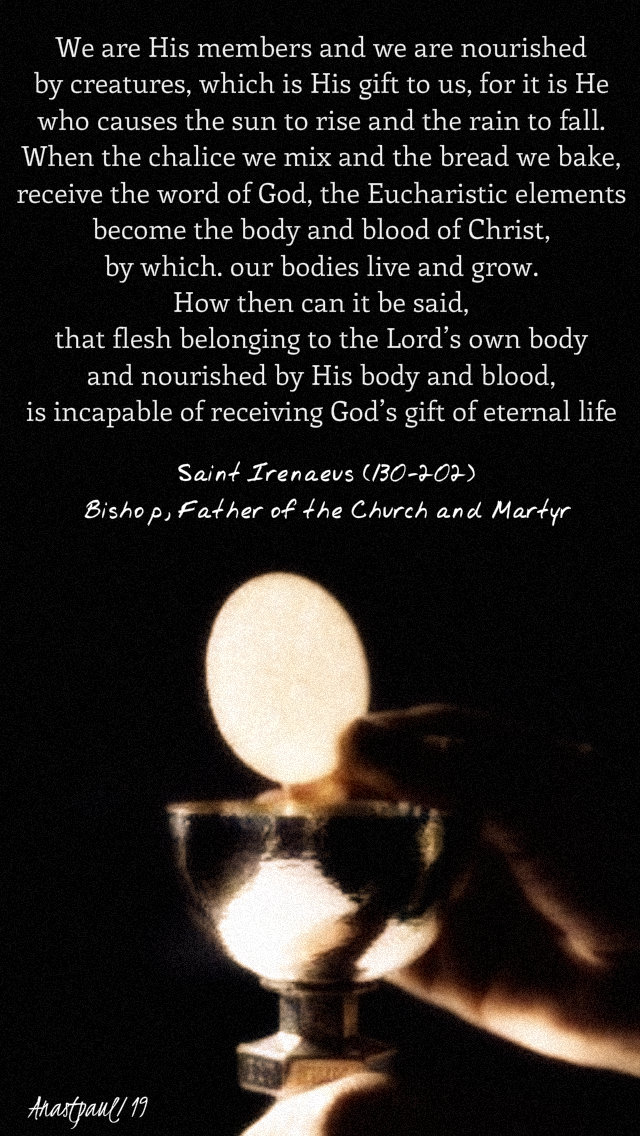
We are His members and we are nourished by creatures, which is His gift to us, for it is He who causes the sun to rise and the rain to fall. He declared that the chalice, which comes from His creation, was His blood and He makes it the nourishment of our blood. He affirmed that the bread, which comes from His creation, was His body and He makes it, the nourishment of our body. When the chalice we mix and the bread we bake, receive the Word of God, the Eucharistic elements become the body and blood of Christ, by which our bodies, live and grow. How then can it be said, that flesh belonging to the Lord’s own body and nourished by His body and blood, is incapable of receiving God’s gift of eternal life? Saint Paul says in his letter to the Ephesians that we are members of His body, of His flesh and bones. He is not speaking of some spiritual and incorporeal kind of man, for spirits do not have flesh and bones. He is speaking of a real human body composed of flesh, sinews and bones, nourished by the chalice of Christ’s blood and receiving growth from the bread which is His body.
The slip of a vine planted in the ground bears fruit at the proper time. The grain of wheat falls into the ground and decays only to be raised up again and multiplied by the Spirit of God who sustains all things. The Wisdom of God places these things at the service of man and when they receive God’s word, they become the Eucharist, which is the body and blood of Christ. In the same way our bodies, which have been nourished by the Eucharist, will be buried in the earth and will decay but they will rise again at the appointed time, for the Word of God will raise them up, to the glory of God the Father. Then the Father will clothe our mortal nature in immortality and freely endow our corruptible nature with incorruptibility, for God’s power is shown most perfectly in weakness.
Quote/s of the Day – 8 May – Wednesday 3rd Week of Easter, C, Gospel: John 6:35–40
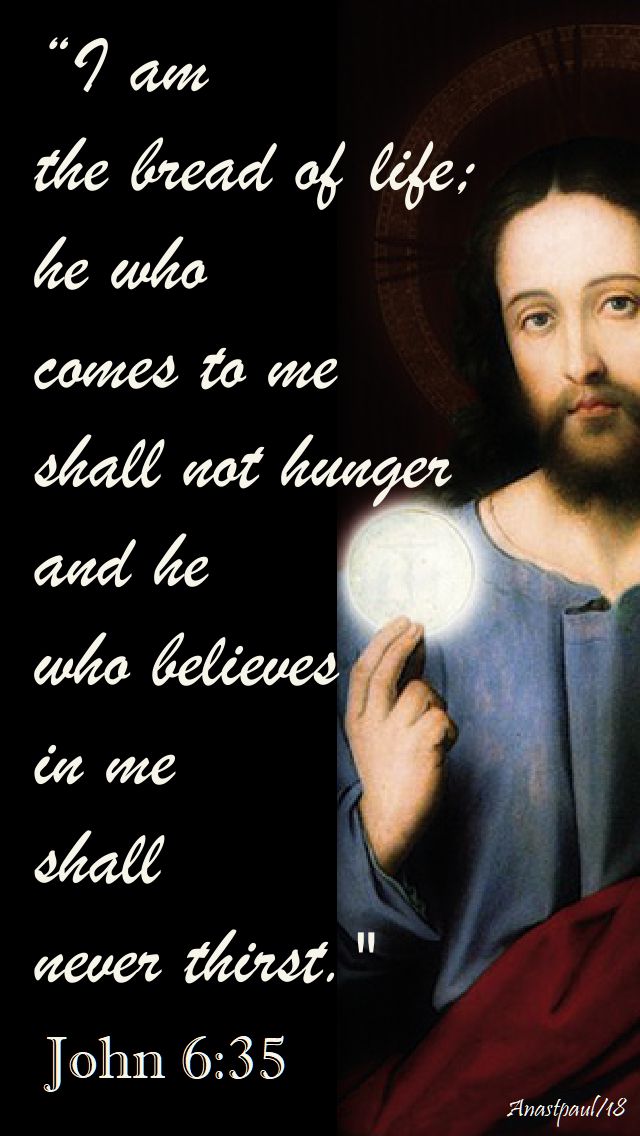
Jesus said to them, “I am the bread of life, he who comes to me shall not hunger and he who believes in me shall never thirst.”…John 6:35
“A celebration may be flawless on the exterior, very beautiful — but if it does not lead us to encounter Jesus Christ, it is unlikely to bear any kind of nourishment to our heart and our life. Through the Eucharist, however, Christ wishes to enter into our life and permeate it with His grace, so that in every Christian community there may be coherence between liturgy and life.”
Pope Benedict
General Audience, 12 February 2014
“Through the Eucharist we enter Christ’s paschal mystery, allowing us to pass from death to life with Him.”
Pope Francis
“The Eucharist is Jesus Himself who gives Himself entirely to us. Nourishing ourselves of that “Bread of Life” means entering into harmony with the heart of Christ, assimilating His choices, His thoughts, His behaviour. It means entering into a dynamism of love and becoming people of peace, people of forgiveness, of reconciliation, of sharing in solidarity. Heaven begins precisely in this communion with Jesus”
Quote/s of the Day – 7 May – Tuesday of the Third Week of Easter C, Gospel: John 6:30–35
“I am the bread of life…”John 6:35
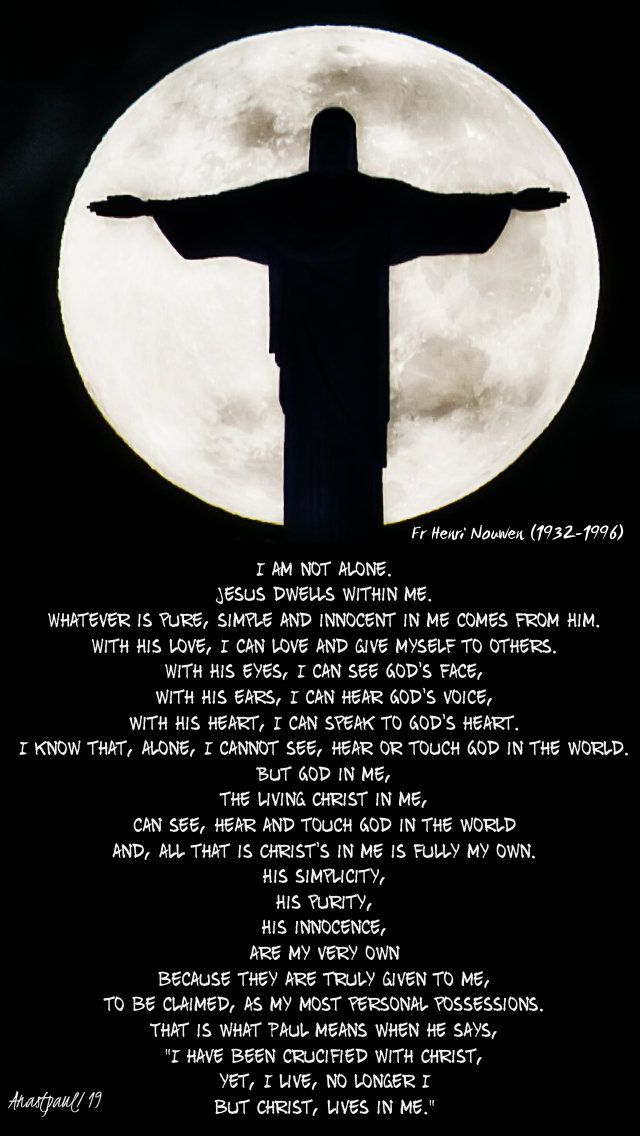
I am not alone. Jesus dwells within me. Whatever is pure, simple and innocent in me comes from Him. With His love, I can love and give myself to others. With His eyes, I can see God’s face, with His ears, I can hear God’s voice, with His heart, I can speak to God’s heart. I know that, alone, I cannot see, hear or touch God in the world. But God in me, the living Christ in me, can see, hear and touch God in the world and, all that is Christ’s in me is fully my own. His simplicity, His purity, His innocence, are my very own because they are truly given to me, to be claimed, as my most personal possessions. That is what Paul means when he says, “I have been crucified with Christ, yet, I live, no longer I but Christ, lives in me.”
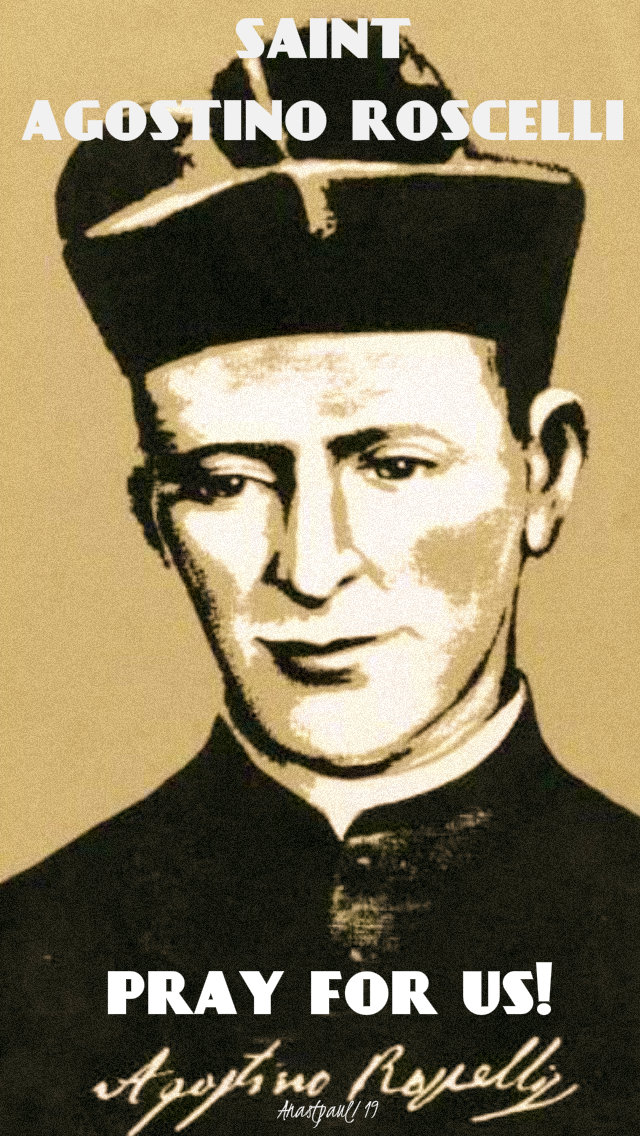
One Minute Reflection – 7 May – Tuesday of the Third Week of Easter, C, Gospel: John 6:30–35 and the Memorial of St Agostino Roscelli
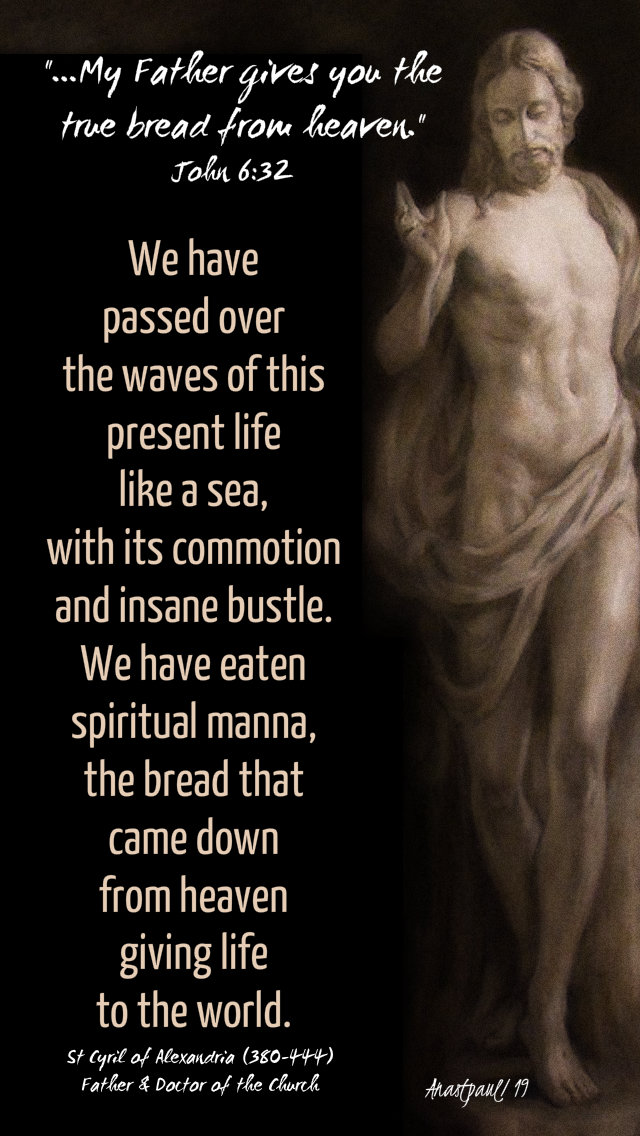
“…My Father gives you the true bread from heaven.”...John 6:32b
REFLECTION – ““Sing a new song to the Lord!” (Ps 96[95]:1). It is a new song to match a new situation. As Paul wrote: “Whoever is in Christ is a new creation: the old things have passed away; behold, new things have come” (2Cor 5:17). Those who were Israelites according to the flesh were set free from the tyranny of the Egyptians thanks to their mediator at that time, all-wise Moses, they were set free from their levy of brickmaking, the useless sweat of their earthly toil…, the cruelty of their overseers, the inhuman harshness of Pharaoh. They passed through the sea, ate manna in the wilderness, drank water that gushed forth from the rock, crossed dry-footed over the Jordan and entered into the Land of promise.
Now all of this has been renewed for our sakes and this new world is incomparably better than the old. We have been set free, not from an earthly slavery but from a spiritual one, we have no longer been delivered from this world’s tasks but from the stains of carnal pleasure. We have escaped, not from Egyptian foremen or an impious and pitiless tyrant, a man like ourselves but from cunning, immoral demons inciting us to sin and from Satan, the leader of their mob.
We have passed over the waves of this present life like a sea, with its commotion and insane bustle. We have eaten spiritual manna, the bread that came down from heaven giving life to the world. When we put our delight in the living waters of Christ, we drank from water that gushed from the rock. We have passed over Jordan thanks to the grace of the holy baptism we were deemed worthy to receive. We entered the Land promised to the saints and made ready for them, that land, which the Lord called to mind when he said: “Blessed the gentle for they shall inherit the earth” (Mt 5:4)….St Cyril of Alexandria (380-444) Father & Doctor of the Church
PRAYER – Almighty Father, to whom this world, with all it’s goodness and beauty belongs, give us grace joyfully to begin this day in Your name and to fill it with the active love for You and our neighbour. By the food You give us, to sustain us on this journey, we are brought to holiness in Your Son, our Lord Jesus the Christ, whom You gave to us as our food. May the Mother of Your Son and our mother, lead us to You and may the prayers of St Agostino Roscelli, be a succour on our way. Through Christ our Lord, with the Holy Spirit, God now and forever, amen.
Sunday Reflection – 5 May – Third Sunday of Easter, Year C
Pope Benedict XVI
” The Eucharist, the privileged place in which the Church recognises “the Author of life” (Acts 3: 15) is “the breaking of the bread”, as it is called in the Acts of the Apostles. In it, through faith, we enter into communion with Christ, who is “the priest, the altar and the lamb of sacrifice” (see Preface for Easter, 5) and is among us.
Let us gather round Him to cherish the memory of His words and of the events contained in Scripture, let us relive His Passion, death and Resurrection. In celebrating the Eucharist, we communicate with Christ, the victim of expiation and from Him we draw forgiveness and life.
What would our lives as Christians be without the Eucharist? The Eucharist is the perpetual, living inheritance which the Lord has bequeathed to us in the Sacrament of His Body and His Blood and which we must constantly rethink and deepen so that, as venerable Pope Paul VI said, it may “impress its inexhaustible effectiveness on all the days of our earthly life.” – (Insegnamenti, V [1967], p. 779)
Many Christians take their time and have leisure enough in their social life (no hurry here). They are leisurely, too, in their professional activities, at table and recreation (no hurry here either). But isn’t it strange, how those same Christians. find themselves in such a rush and want to hurry the priest, in their anxiety to shorten the time devoted to the most holy sacrifice of the altar?“
Our Morning Offering – 5 May – Third Sunday of Easter, Year C
Prayer to the Blessed Virgin Mary Before Holy Mass
O most blessed Virgin Mary,
Mother of tenderness and mercy,
I, a miserable and unworthy sinner,
fly to you with all the affection of my heart
and I beseech your motherly love,
that, as you stood by your most dear Son,
while he hung on the Cross,
so, in your kindness,
you may be pleased to stand by me, a poor sinner,
and all Priests who today are offering the Sacrifice
here and throughout the entire holy Church,
so that with your gracious help
we may offer a worthy and acceptable oblation
in the sight of the most high and undivided Trinity.
Amen.
(This prayer is adapted from the Priests’ Prayers Before each Mass)
Thought for the Day- 4 May – Saturday of the Second Week of Easter
God’s Plan of Salvation
Second Vatican Council
An excerpt from Sacrosanctum Concilium, #7-8
In His desire that all men should be saved and come to the knowledge of the truth, God spoke in former times to our forefathers through the prophets, on many occasions and in different ways. Then, in the fullness of time He sent His Son, the Word made man, anointed by the Holy Spirit, to bring good news to the poor, to heal the broken-hearted as the physician of body and spirit and the mediator between God and men. In the unity of the person of the Word, His human nature was the instrument of our salvation. Thus in Christ, there has come to be, the perfect atonement that reconciles us with God and we have been given the power to offer the fullness of divine worship.
This work of man’s redemption and God’s perfect glory was foreshadowed by God’s mighty deeds among the people of the Old Covenant. It was brought to fulfilment by Christ the Lord, especially through the paschal mystery of His blessed passion, resurrection from the dead and ascension in glory – by dying He destroyed our death, and by rising again He restored our life. From His side, as He lay asleep on the cross, was born that wonderful sacrament, which is the Church in its entirety.
As Christ was sent by the Father, so in His turn He sent the apostles, filled with the Holy Spirit. They were sent to preach the Gospel to every creature, proclaiming that we had been set free from the power of Satan and from death by the death and resurrection of God’s Son and brought into the kingdom of the Father. They were sent also to bring into effect, this saving work that they proclaimed, by means of the sacrifice and sacraments that are the pivot of the whole life of the liturgy.
So, by baptism men are brought within the paschal mystery. Dead with Christ, buried with Christ, risen with Christ, they receive the Spirit that makes them God’s adopted children, crying out – Abba, Father and so they become the true adorers that the Father seeks.
In the same way, whenever they eat the supper of the Lord they proclaim His death until He comes. So, on the very day of Pentecost, on which the Church was manifested to the world, those who received the word of Peter were baptised. They remained steadfast in the teaching of the apostles and in the communion of the breaking of bread, praising God and enjoying the favour of all the people.
From that time onward the Church has never failed to come together to celebrate the paschal mystery, by reading what was written about Him in every part of Scripture, by celebrating the Eucharist in which the victory and triumph of His death are shown forth, and also by giving thanks to God for the inexpressible gift He has given in Christ Jesus, to the praise of God’s glory.
Glory be to the Father and to the Son and to the Holy Spirit, as it was in the beginning, is now and ever shall be world without end. Amen
Sunday Reflection – 28 April – Low Sunday the Octave Day of Easter and Divine Mercy Sunday
Fr Benedict Groeschel CFR (1933-2014)
O Lord Jesus Christ, how am I to prepare myself to attend that holy sacrifice, which You began at Your Last Supper and which You consummated on Calvary?
That eternal Eucharist begun in sorrow and agony continues, not simply to the end of the world but throughout all eternity. It is, the eternal act of obedience and love that You, as the head of our whole human race, offered to the Trinity, even to Yourself, in Your divinity. These mysteries are completely beyond me. Yet I know, they are true because You revealed them.
Soon, in the person of a priest, a poor human being, Your divine words will be spoken and each of us, at this Mass, will be lifted beyond this place and be part of the heavenly choirs and the eternal divine liturgy. How dare we think that we, creatures of earth, could participate in such a thing! We believe it, because this liturgy began here on earth. From the very first moment of Your existence, as a human being, the altar was prepared, the linens were laid on the altar. Throughout Your earthly life, You laboured in the preaching of the Gospel and in calling the faithful to prayer. Then, at the supreme moment of Your earthly existence, You offered Yourself in total obedience and sacrifice to the Father, for all the world. Your glorious Resurrection and Ascension, point beyond the Cross and beyond the tomb and remind us that this Eucharist, is not only a memorial but an everlasting participation in Your divine and heavenly worship, as priest of the new covenant.
O Lord, give me Your Holy Spirit, that my heart may be lifted up in this Mass, that I may be in one of the choirs that join with You, that I may take my place prayerfully and in reverent attention, with the billions of saints, with the great choirs of angels, with the army of holy souls on their pilgrimage and with all the devout and struggling Christians in the world. Let this Mass be the beginning of a new moment in my life, one step closer to You. May I be encouraged by this sacred meal, to know that You will go with me in the wilderness of life, that You will sustain me so that I may, in fact, not only pray as one of those united to You but, that I may live and act, so that it may indeed be true, that I live, no longer I but You, who live in me. Amen, alleluia!
O Sacrament most holy O Sacrament divine, All praise and all thanks giving, Be very moment Thine.+
Jesus, I love You with all my heart. I wish to love You more every day. Thank You for being with me in this most Holy Sacrament.
Saint of the Day – 26 April – Saint Paschasius Radbertus (785–865) Monk, Abbot, Theologian – born 785 at Soissons, France and died in 865 of natural causes. St Paschasius was a Carolingian theologian and the abbot of Corbie, a monastery in Picardy founded in 657 or 660 by the queen regent Bathilde with a founding community of monks from Luxeuil Abbey. His most well-known and influential work is an exposition on the nature of the Eucharist written around 831, entitled De Corpore et Sanguine Domini.
Paschasius was an orphan left on the steps of the convent of Notre-Dame de Soissons. He was raised by the nuns there and became very fond of the abbess, Theodrara. Theodrara was sister of St Adalard of Corbie (C 751-827) and St Wala of Corbie (c 755–836), two monks (and both abbots prior to Paschasius) whom he admired greatly. At a fairly young age, Paschasius left the convent to serve as a monk under Abbot Adalard, at Corbie.
Through the abbotship of both Adalard and Wala, Paschasius focused on the monastic life, spending his time studying and teaching. When Adalard died in 826, Paschasius helped ensure Wala would become Abbot in his place. Wala’s death in 836 brought yet another abbot to Corbie, Ratramnus, who held opposing views to Paschasius on a number of ecclesiastical issues. Ratramnus wrote a refutation of Paschasius’ treatise on the Eucharist, De Corpore et Sanguine Domini, using the same title.
By 844, Paschasius himself became abbot, however he resigned his title ten years later to return to his studies . He left Corbie for the nearby monastery of St Riquier, where he lived in voluntary exile for some years. Why he resigned is unknown, however, it is likely that his actions were motivated by factional disputes within his monastic community, misunderstandings between himself and the younger monks were likely factors in his decision. He returned to Corbie late in life and resided in his old monastery until his death in 865.
St Paschasius’ body was first buried at the Church of St John in Corbie. After numerous reported miracles, the Pope ordered his remains to be removed and interred in the Church of St Peter, Corbie. He was Canonised in 1073 by Pope Gregory VII.
St Peter’s Corbie
St Paschasius has an extensive collection of works, including the “Vitae” or Lives of St Adalbert and St Wala and many exegeses on various books of the Bible. He wrote commentaries on the Gospel of Matthew, Lamentations, a commentary on Revelations and an exposition of Psalm 45, which he dedicated to the nuns at St Mary at Soissons. De Partu Virginis, written for his friend Emma, Abbess of St Mary at Soissons and daughter of Theodrara, describes the lifestyle of nuns. He also wrote a treatise, titled De Nativitae Sanctae Mariae, regarding the nature of the Virgin Mary and the birth of Jesus Christ. Paschasius probably wrote much more but none of it has survived through the centuries.
The most well-known and influential work of St Paschasius, ‘De Corpore et Sanguine Domini’ The Body and Blood of Christ (written between 831 and 833), is an exposition on the nature of the Eucharist. It was originally written as an instructional manual for the monks under his care at Corbie and is the first lengthy treatise on the Sacrament of the Eucharist in the Western world. In it, Paschasius agrees with St Ambrose (340-397) in affirming that the Eucharist contains the true, historical body of Jesus Christ.
According to Paschasius, God is truth itself and, therefore, His words and actions must be true. Christ’s proclamation at the Last Supper that the bread and wine were His body and blood must be taken literally, since God is truth. He believes that the transubstantiation of the bread and wine to be used at the Eucharist occurs literally. Only if the Eucharist is the actual body and blood of Christ can a Christian know it is salvific.
Paschasius believed that the presence of the historical blood and body of Christ allows the partaker a real union with Jesus in a direct, personal and physical union by joining a person’s flesh with Christ’s and Christ’s flesh with his. To Paschasius, the Eucharist’s transformation into the flesh and blood of Christ is possible because of the principle that God is truth, God is able to manipulate nature, as He created it.
The book was given to Charles the Bald, the Frankish king, as a present in 844, with the inclusion of a special introduction. The view Paschasius expressed in this work was met with some hostility. Ratramnus, who preceded Paschasius as Abbot of Corbie, wrote a rebuttal by the same name, by order of Charles the Bald, who did not agree with some of the views Paschasius held. Ratramnus believed that the Eucharist was strictly metaphorical, he focused more on the relationship between faith and the newly emerging science, while Paschasius believed in the miraculous.
Shortly thereafter, a third monk joined the debate, St Rabanus Maurus (c 780–856), which initiated the Carolingian Eucharist Controversy. Ultimately, however, the king accepted Paschasius’ assertion and the physical presence of Christ in the Eucharist, which had already been believed for centuries, was cemented by St Paschasius book and cleared the way for a precise understanding of Transubstantiation.
Quote/s of the Day – 24 April – Wednesday of Easter week and the Memorial of St Fidelis of Sigmaringen OFM.Cap. (1577-1622) and St Mary Euphrasia Pelletier (1796-1868)
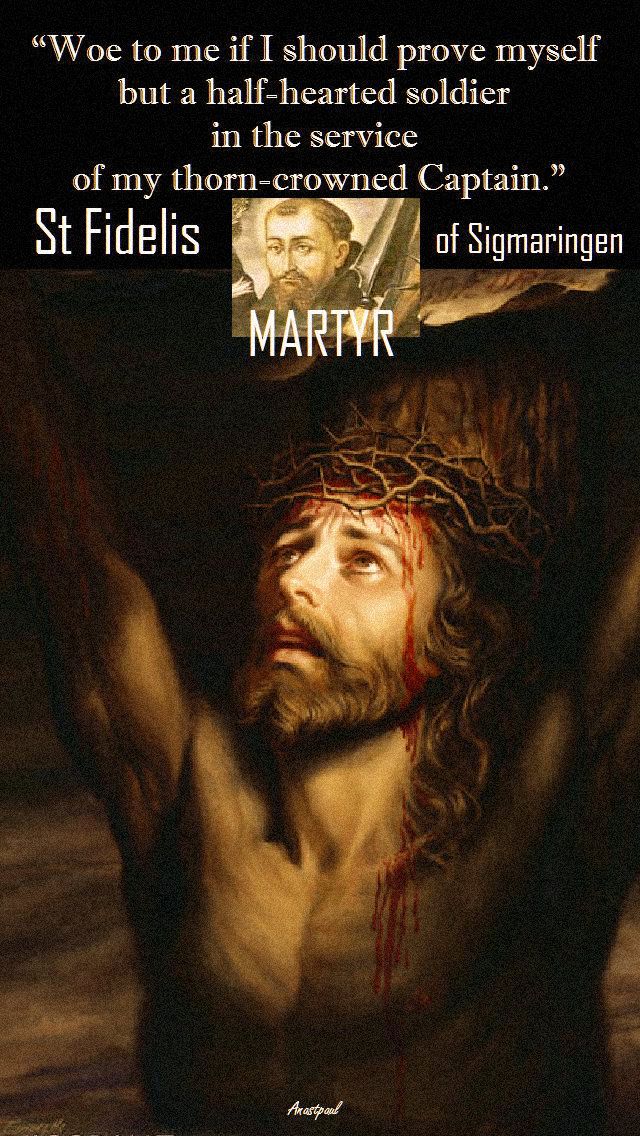
“Woe to me if I should prove myself but a half-hearted soldier in the service of my thorn-crowned Captain.”
“What made the holy apostles and martyrs endure fierce agony and bitter torments, except faith and especially faith in the resurrection? What is it that today makes true followers of Christ cast luxuries aside, leave pleasures behind and endure difficulties and pain? It is a living faith that expresses itself through love. It is this that makes us put aside the goods of the present in the hope of future goods. It is because of faith that we exchange the present for the future.”
St Fidelis of Sigmaringen (1577-1622)
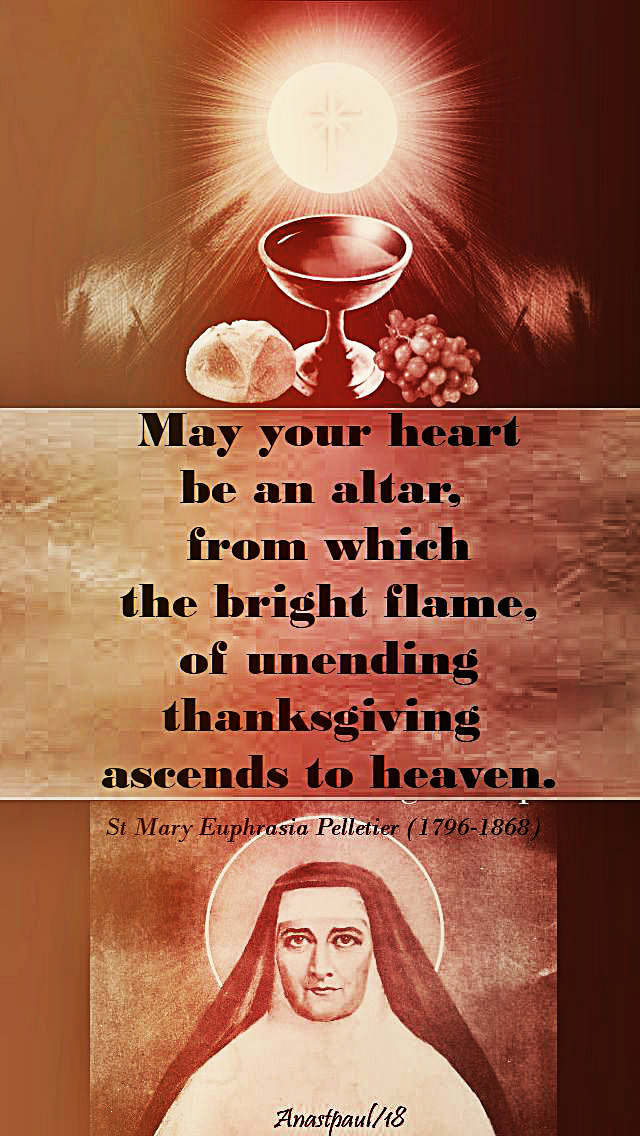
“May your heart be an altar, from which the bright flame, of unending thanksgiving ascends to heaven.”
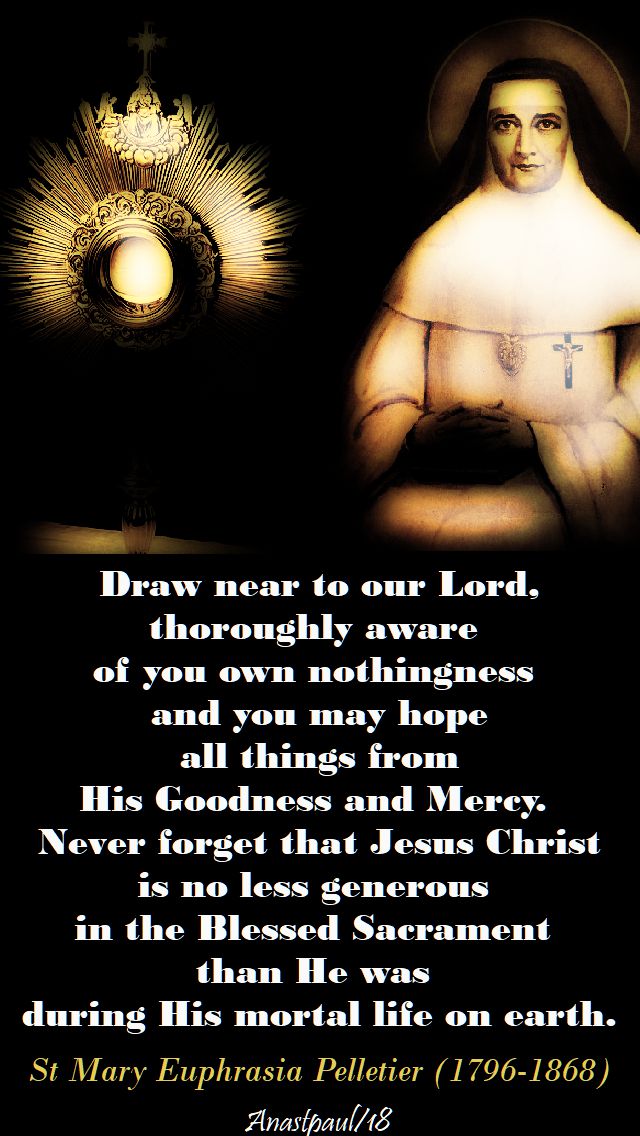
“Draw near to our Lord, thoroughly aware of you own nothingness and you may hope all things from His Goodness and Mercy. Never forget that Jesus Christ is no less generous in the Blessed Sacrament than He was during His mortal life on earth.”
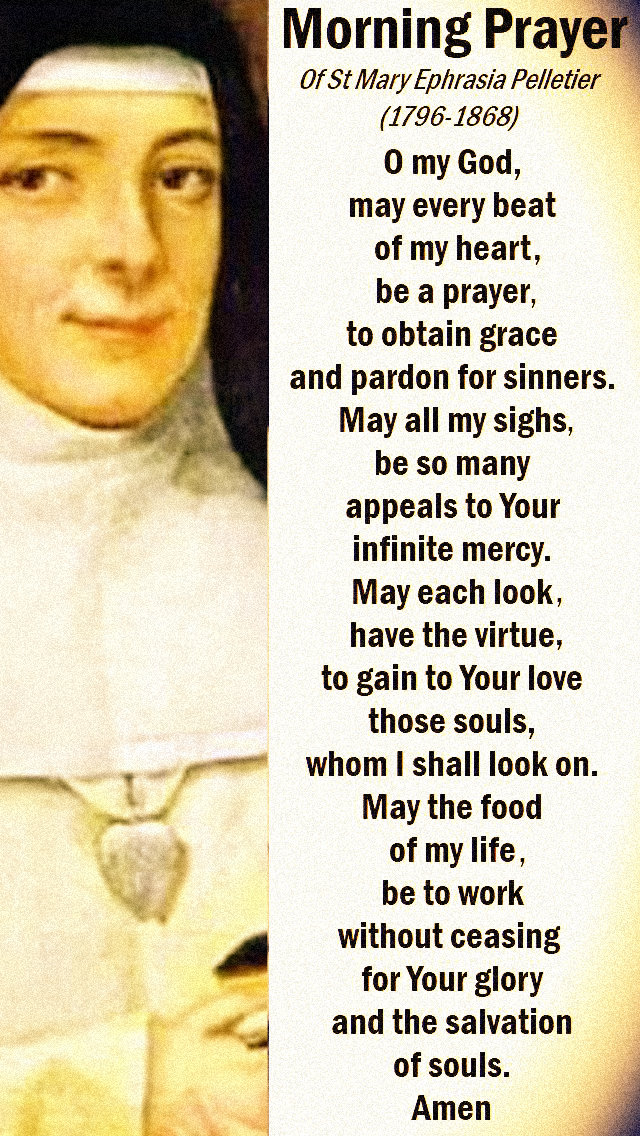
O my God, may every beat of my heart, be a prayer, to obtain grace and pardon for sinners. May all my sighs, be so many appeals to Your infinite mercy. May each look, have the virtue, to gain to Your love, those souls, whom I shall look on. May the food of my life, be to work without ceasing for Your glory and the salvation of souls. Amen
One Minute Reflection – 24 April – Wednesday of Easter week, Gospel: Luke 24:13–35 and the Memorial of St Benedict Menni (1841-1914)
“Stay with us, for it is toward evening and the day is now far spent.” So he went in to stay with them....Luke 24:29
REFLECTION – “When the disciples on the way to Emmaus asked Jesus to stay “with” them, He responded by giving them a much greater gift, through the Sacrament of the Eucharist He found a way to stay “in” them.
Receiving the Eucharist means entering into a profound communion with Jesus. “Abide in me, and I in you” (Jn 15:4). This relationship of profound and mutual “abiding” enables us to have a certain foretaste of heaven on earth. Is this not the greatest of human yearnings? Is this not what God had in mind when He brought about in history His plan of salvation? God has placed in human hearts a “hunger” for His word (cf. Am 8:11), a hunger which will be satisfied only by full union with Him. Eucharistic communion was given, so that we might be “sated” with God here on earth, in expectation of our complete fulfilment in heaven.
This special closeness which comes about in Eucharistic “communion” cannot be adequately understood or fully experienced apart from ecclesial communion… The Church is the Body of Christ – we walk “with Christ” to the extent that we are in relationship “with his body”. Christ provided for the creation and growth of this unity, by the outpouring of His Holy Spirit. And He Himself, constantly builds it up by His Eucharistic presence. It is the one Eucharistic bread which makes us one body. As the Apostle Paul states: “Because there is one bread, we who are many are one body, for we all partake of the one bread” (1Cor 10:17)…Saint John Paul II (1920-2005) – Apostolic Letter “ Mane nobiscum Domine ” §19-20
PRAYER – Stay with me, Lord, for it is necessary to have You present so that I do not forget You. You know how easily I abandon You.
Stay with me Lord, because I am weak and I need Your strength, so that I may not fall so often.
Stay with me Lord, for You are my life and without You, I am without fervour.
Stay with me Lord, for You are my light and without you, I am in darkness.
Stay with me Lord, to show me Your will.
Stay with me Lord, so that I hear Your voice and follow You…. St Padre Pio of Pietrelcina (1887-1968) (Excerpt)
And grant holy Father, that the prayers of St Benedict Menni, may assist us on our way. Through Christ, our Lord, with the Holy Spirit, one God with You, forever, amen.
Saint Augustine (354-430)
Bishop and Great Western Father and Doctor of the Church
An excerpt from his Treatise 84
Dear brethren, the Lord has marked out for us the fullness of love that we ought to have for each other. He tells us – No-one has greater love than the man who lays down his life for his friends. In these words, the Lord tells us what the perfect love we should have for one another involves. John, the evangelist who recorded them, draws the conclusion in one of his letters – As Christ laid down His life for us, so we too ought to lay down our lives for our brothers. We should indeed love one another as He loved us, He who laid down His life for us.
This is surely what we read in the Proverbs of Solomon: If you sit down to eat at the table of a ruler, observe carefully what is set before you, then stretch out your hand, knowing that you must provide the same kind of meal yourself. What is this ruler’s table, if not the one at which we receive the body and blood of Him who laid down His life for us? What does it mean to sit at this table if not to approach it with humility? What does it mean to observe carefully what is set before you, if not to meditate devoutly on so great a gift? What does it mean to stretch out one’s hand, knowing that one must provide the same kind of meal oneself, if not what I have just said: as Christ laid down His life for us, so we in our turn, ought to lay down our lives, for our brothers? This is what the Hpostle Paul said – Christ suffered for us, leaving us an example, that we might follow in his footsteps.
This is what is meant by providing “the same kind of meal.” This is what the blessed martyrs did, with such burning love. If we are to give true meaning, to our celebration of their memorials, to our approaching the Lord’s table, in the very banquet at which they were fed, we must, like them, provide “the same kind of meal.”
At this table of the Lord we do not commemorate the martyrs in the same way as we commemorate others who rest in peace. We do not pray for the martyrs as we pray for those others, rather, they pray for us, that we may follow in His footsteps. They practised the perfect love, of which the Lord said, there could be none greater. They provided “the same kind of meal” as they had themselves received at the Lord’s table.
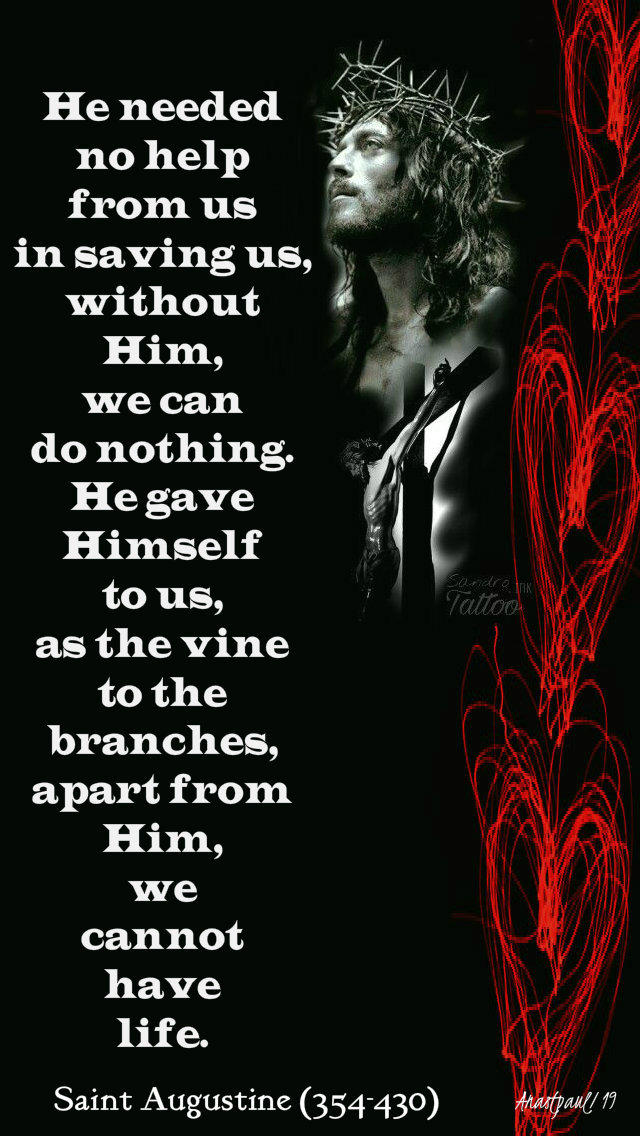
This must not be understood as saying, that we can be the Lord’s equals by bearing witness to Him, to the extent of shedding our blood. He had the power of laying down His life, we by contrast, cannot choose the length of our lives and we die, even if it is against our will. He, by dying, destroyed death in Himself; we are freed from death only in His death. His body did not see corruption, our body will see corruption and only then be clothed through Him, in incorruption, at the end of the world. He needed no help from us in saving us, without Him, we can do nothing. He gave Himself to us, as the vine to the branches, apart from Him, we cannot have life.
Finally, even if brothers die for brothers, yet no martyr by shedding his blood brings forgiveness for the sins of his brothers, as Christ brought forgiveness to us. In this, He gave us, not an example to imitate but a reason for rejoicing. Inasmuch, then, as they shed their blood for their brothers, the martyrs provided “the same kind of meal” as they had received at the Lord’s table. Let us then love one another as Christ also loved us and gave Himself up for us.
One Minute Reflection – 18 April – Holy Thursday, Gospel: John 13:1–15
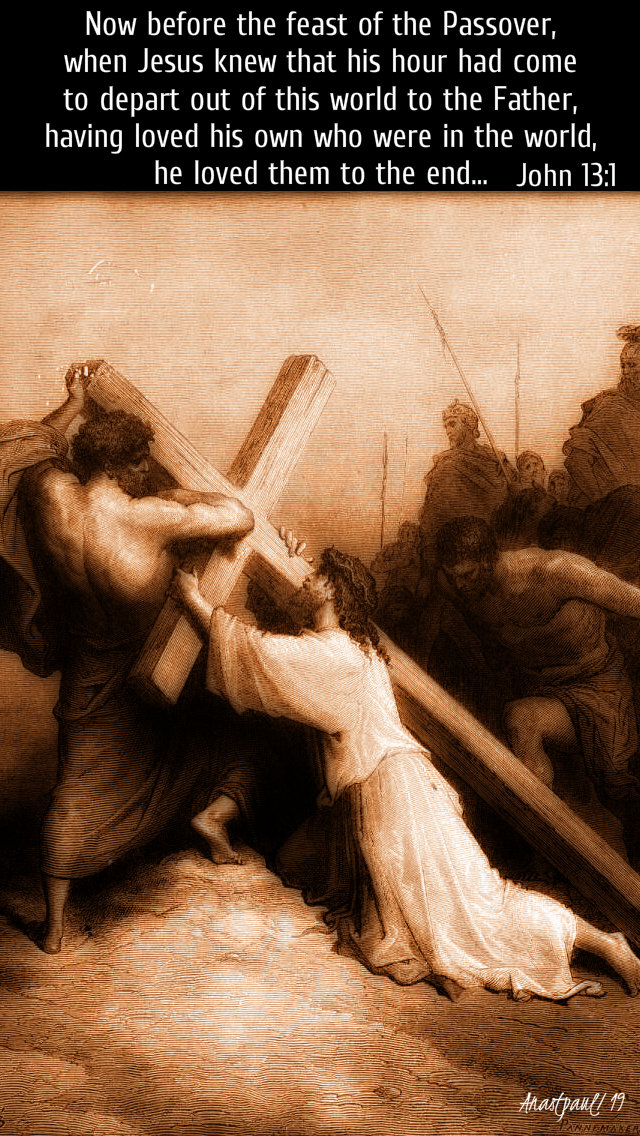
Now before the feast of the Passover, when Jesus knew that his hour had come to depart out of this world to the Father, having loved his own who were in the world, he loved them to the end...John 13:1
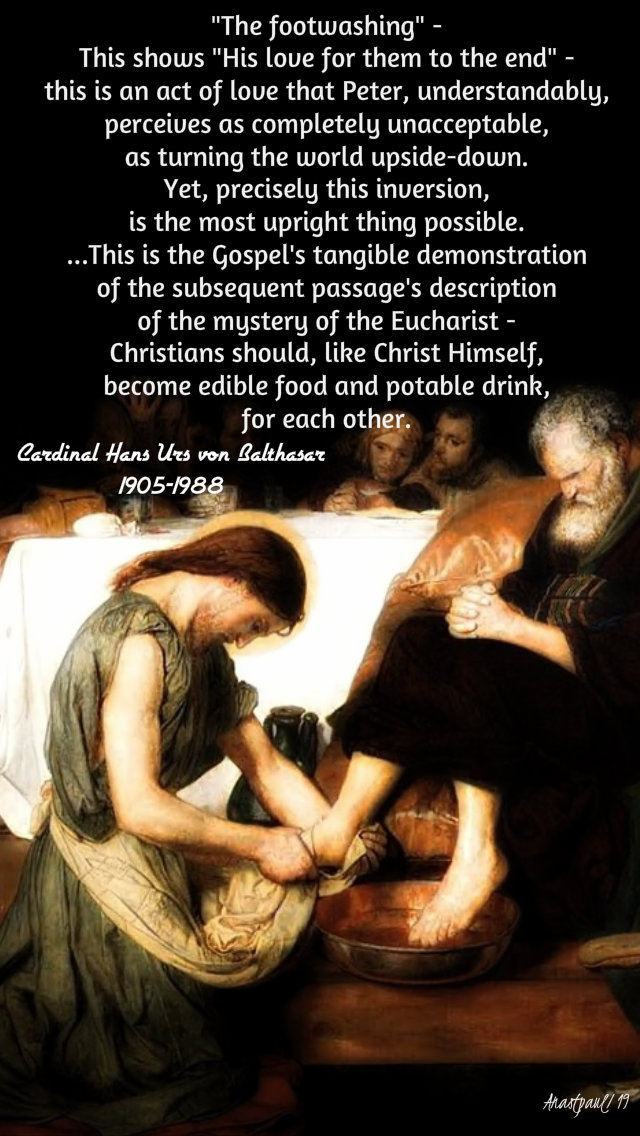
REFLECTION – “The footwashing” – This shows “His love for them to the end” – this is an act of love that Peter, understandably, perceives as completely unacceptable, as turning the world upside-down. Yet, precisely this inversion, is the most upright thing possible. One must first let it happen to himself, precisely as the Lord did it – in His incomparable love’s humbling – before he can take it as “an example” (13:14) for himself and practice this self-abasement with the brethren. This is the Gospel’s tangible demonstration of the subsequent passage’s description of the mystery of the Eucharist – Christians should, like Christ Himself, become edible food and potable drink, for each other.”…Cardinal Hans Urs von Balthasar (1905-1988)
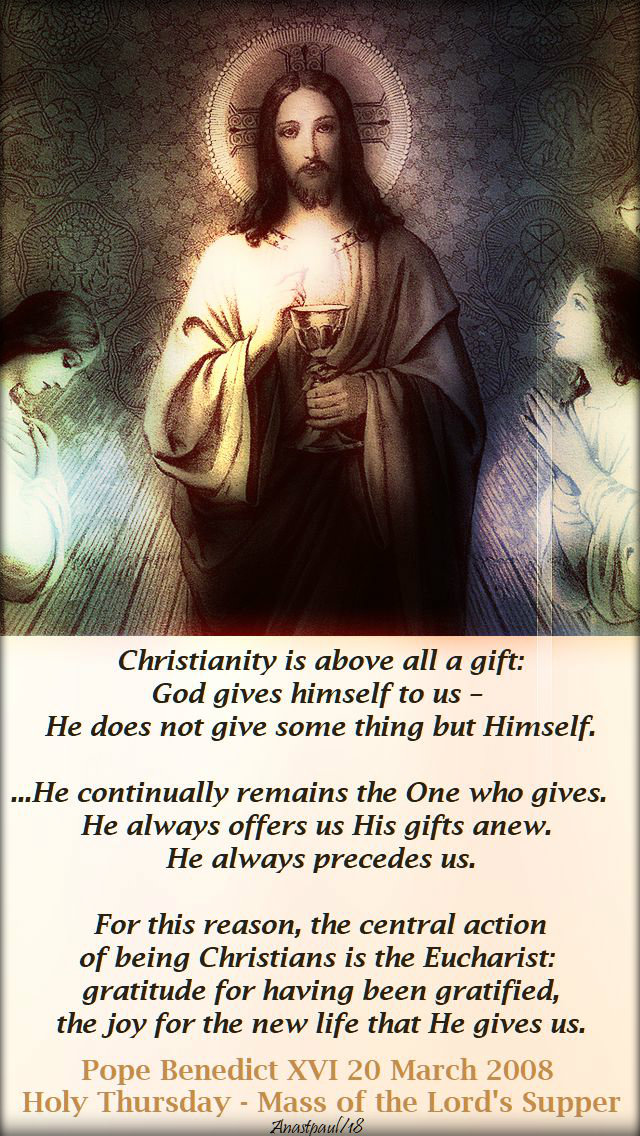
“Christianity is above all a gift: God gives himself to us – He does not give some thing but Himself. And this takes place not only at the beginning, at the moment of our conversion. He continually remains the One who gives. He always offers us His gifts anew. He always precedes us. For this reason, the central action of being Christians is the Eucharist: gratitude for having been gratified, the joy for the new life that He gives us.”...Pope Benedict XVI 20 March 2008 Holy Thursday – Mass of the Lord’s Supper
PRAYER – Love of You, with our whole heart, Lord God, is holiness. Increase then Your gifts of divine grace in us, so that, as in Your Son’s Death, You made us hope for what we believe, You may likewise, in His Resurrection, make us come to You, our final end. Listen we beg, to the prayers of Your holy ones and may the Blessed Mother walk along with us and keep our hand, ever in hers. Through Jesus Himself, in the unity of the Holy Spirit, God with You, forever and ever, amen.
Sunday Reflection – 14 April – Palm Sunday, Year C
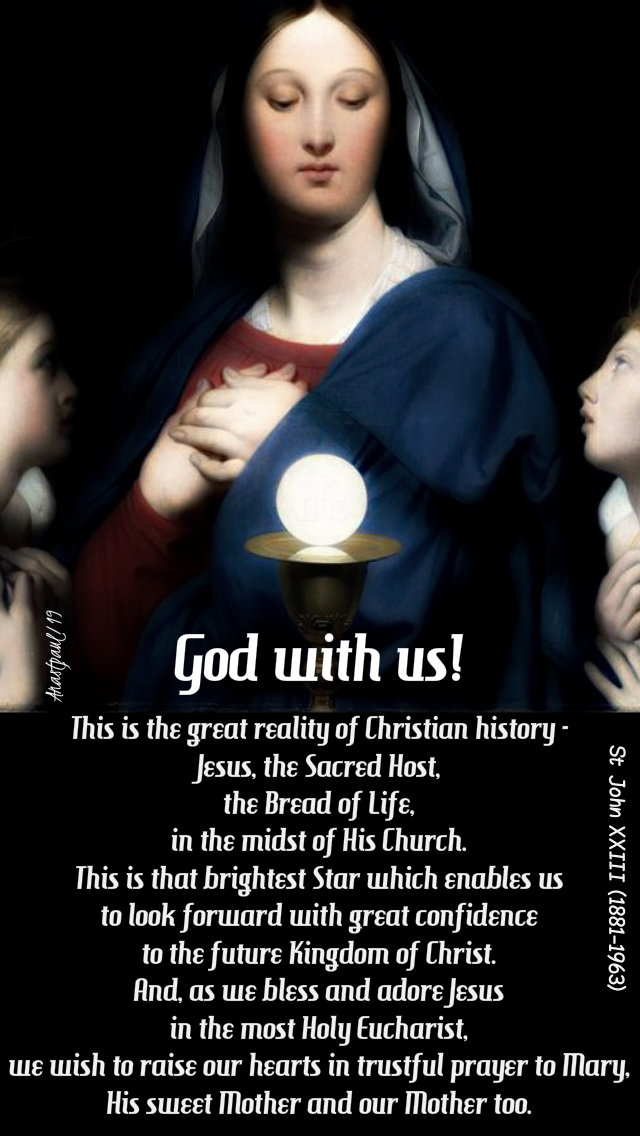
God with Us!
St John XXIII (1881-1963)
This is the great reality of Christian history – Jesus, the Sacred Host, the Bread of Life, in the midst of His Church.
This is that brightest Star which enables us to look forward with great confidence to the future Kingdom of Christ. And, as we bless and adore Jesus in the most Holy Eucharist, we wish to raise our hearts in trustful prayer to Mary, His sweet Mother and our Mother too.
So let us turn to her, as our own dear Mother. It is she, who bore and presented to the world, Jesus, our Redeemer and Saviour. It is she, who leads innocent souls and penitent souls, to Jesus. It was at her request at the wedding at Cana that our Saviour worked His first great miracle, to the joy and delight of all believers.
In her sanctuary of Lourdes and in so many other sanctuaries all over the world, she continues her motherly and pious task of leading to her Divine Son’s arms, all who pray to her, for the safety, peace and joy of the Holy Universal Church. Is this not the literal accomplishment of our fervent resole – “to Jesus through Mary?”
Let us then understand one another, beloved children, as we worship Jesus in the Holy Eucharist – God with us! God with us!
The Sacrament of Jesus, remains with us as our divine inheritance, for our salvation and for the joy of the Catholic and Apostolic Church.
When we pray before the Blessed Sacrament, may the Mother of Jesus, who is our Mother, continually be remembered, as our intercessor and protectress, the joy and gladness of our hearts. Amen.
Quote of the Day – 12 April – Friday of the Fifth Week, Year C and the Memorial of Saint Teresa de Jesús “de los Andes” OCD (1900-1920)
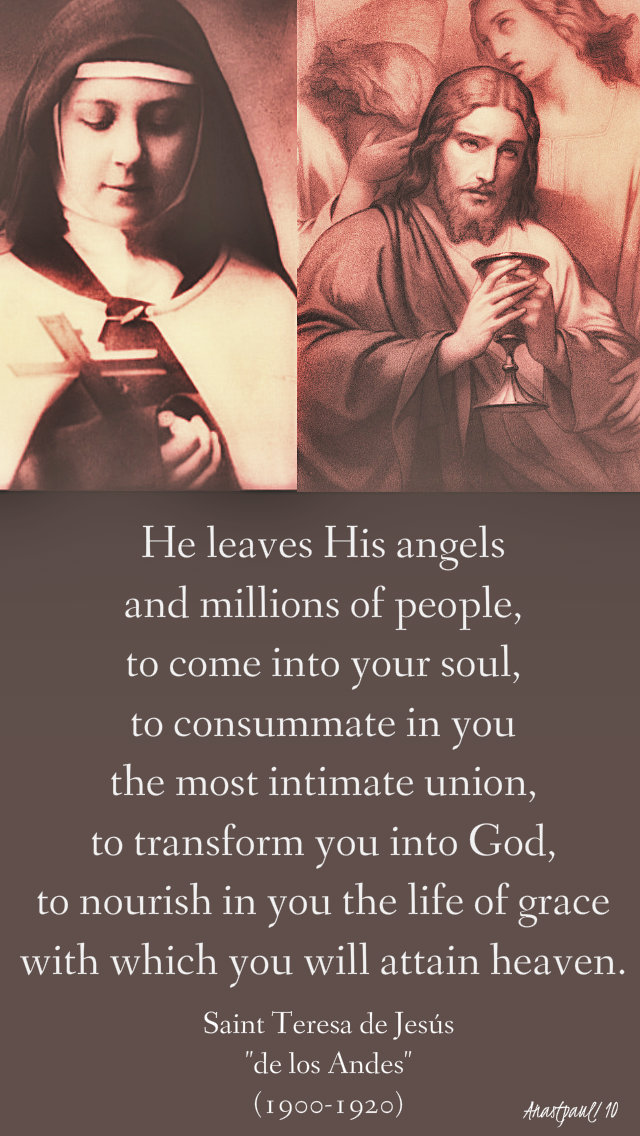
“How I would have loved, mother dear, to be by your side to console and weep with you. But our souls met by the tabernacle. He leaves His angels and millions of people, to come into your soul, to consummate in you the most intimate union, to transform you into God, to nourish in you the life of grace with which you will attain heaven.” … from the letters of Saint Terese de los Andes
Sunday Reflection – 7 April – The Fifth Sunday of Lent, Year C
Every moment of your life is a preparation for the Holy Sacrifice of the Mass, just as every moment of My life was a preparation for and a slow ascent to the Sacrifice of the Cross. Understand this and you will see that nothing in your life is foreign to My plan for you, that everything you have done and that every place you have ever been and that every person with whom you have been or are connected, is part of My design for your life.
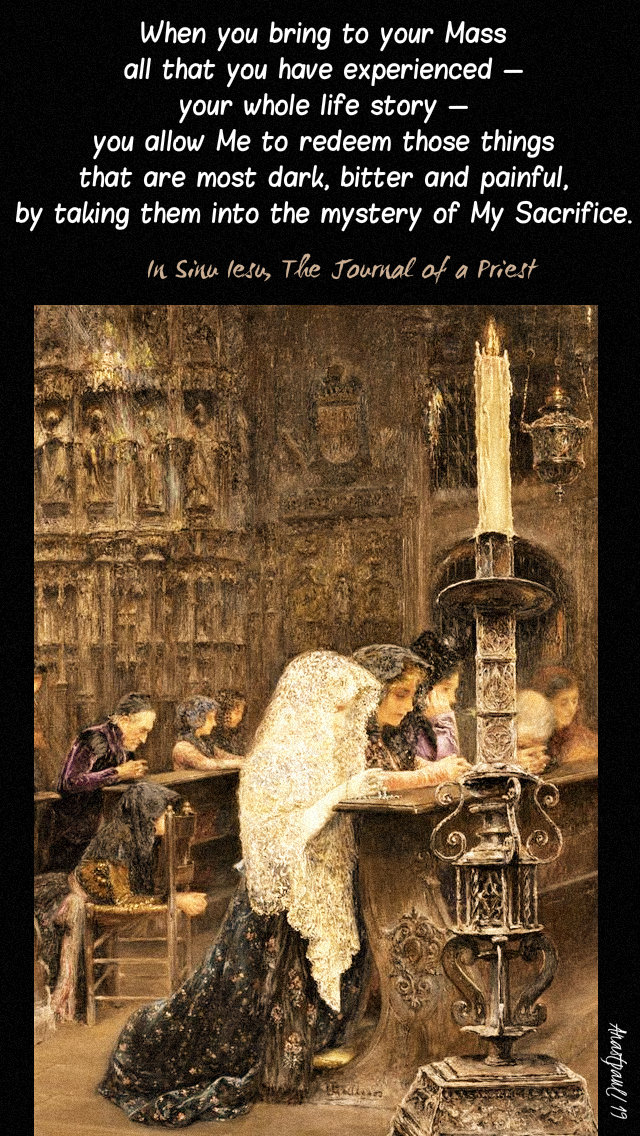
When you bring to your Mass all that you have experienced — your whole life story — you allow Me to redeem those things that are most dark, bitter and painful by taking them into the mystery of My Sacrifice.
Come to the altar with your wounds and scars. Give them to Me and I shall unite them to My own sufferings and so make them shine in My sight. Come to the altar with your sins, even with those of which you are most ashamed and I shall show you that I have already taken them upon Myself and expiated them in my Blood. Come to the altar with every troubled and broken relationship of your past, with every betrayal, every failure, and every falling away from holiness and I shall cast all these things into the ocean of My mercy, never again to be recovered, or named, or used by the Accuser against you.















 He also wrote a treatise, titled De Nativitae Sanctae Mariae, regarding the nature of the Virgin Mary and the birth of Jesus Christ. Paschasius probably wrote much more but none of it has survived through the centuries.




You must be logged in to post a comment.