Quote/s of the Day – 20 April – Friday of the Third Week of Eastertide – Today’s Gospel: John 6:52-59
“Speaking of: The Holy Eucharist”
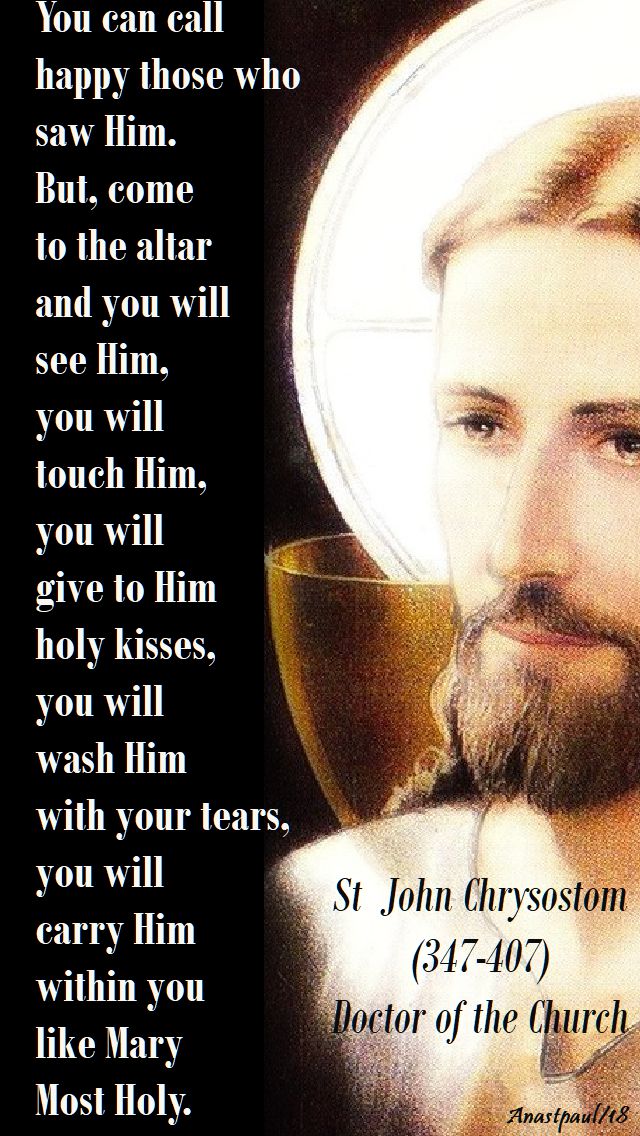
“You can call happy those who saw Him. But, come to the altar and you will see Him, you will touch Him, you will give to Him holy kisses, you will wash Him with your tears, you will carry Him within you like Mary Most Holy.”
St John Chrysostom (347-407) Doctor of the Church
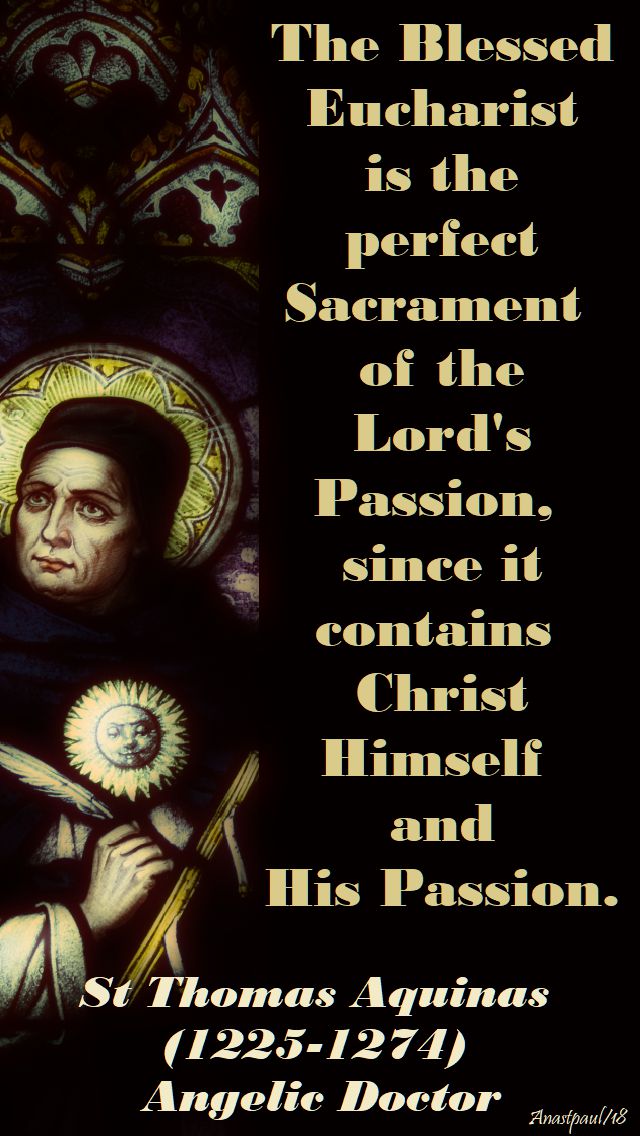
“The Blessed Eucharist is the perfect Sacrament of the Lord’s Passion, since It contains Christ Himself and his Passion.”
St Thomas Aquinas (1225-1274) Angelic Doctor
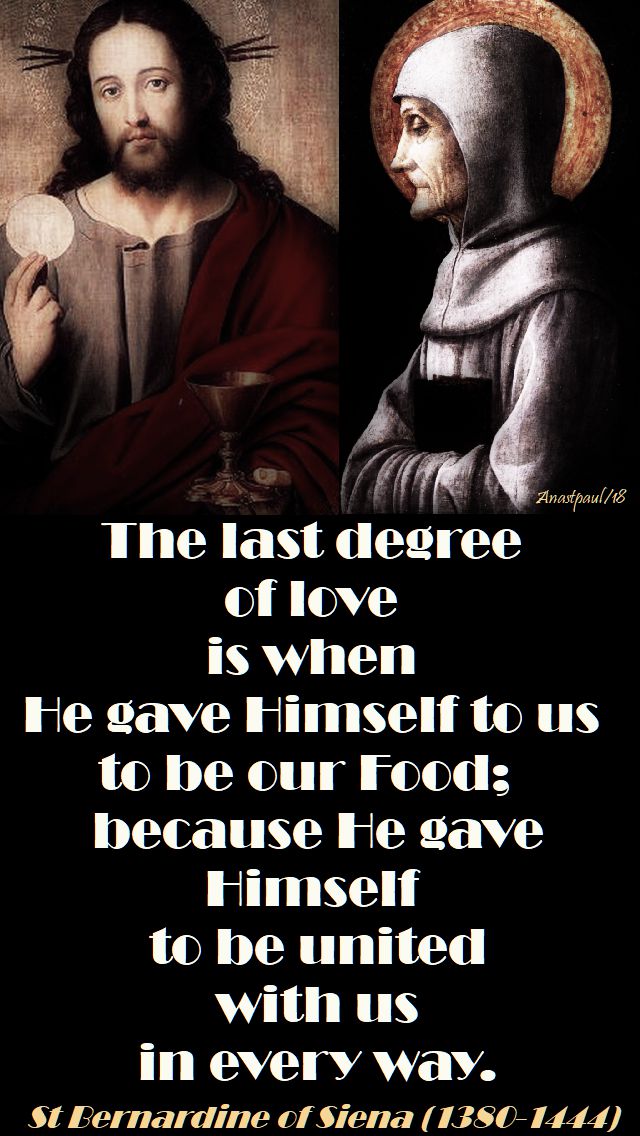
“The last degree of love is when He gave Himself to us to be our Food; because He gave Himself to be united with us in every way.”
St Bernardine of Siena (1380-1444)
“Of all devotions, that of adoring Jesus in the Blessed Sacrament is the greatest after the sacraments, the one dearest to God and the one most helpful to us.”
St Alphonsus Liguori (1696-1787) Most Zealous Doctor
“Upon receiving Holy Communion, the Adorable Blood of Jesus Christ really flows in our veins and His Flesh is really blended with ours.”
St John Vianney (1786-1859)
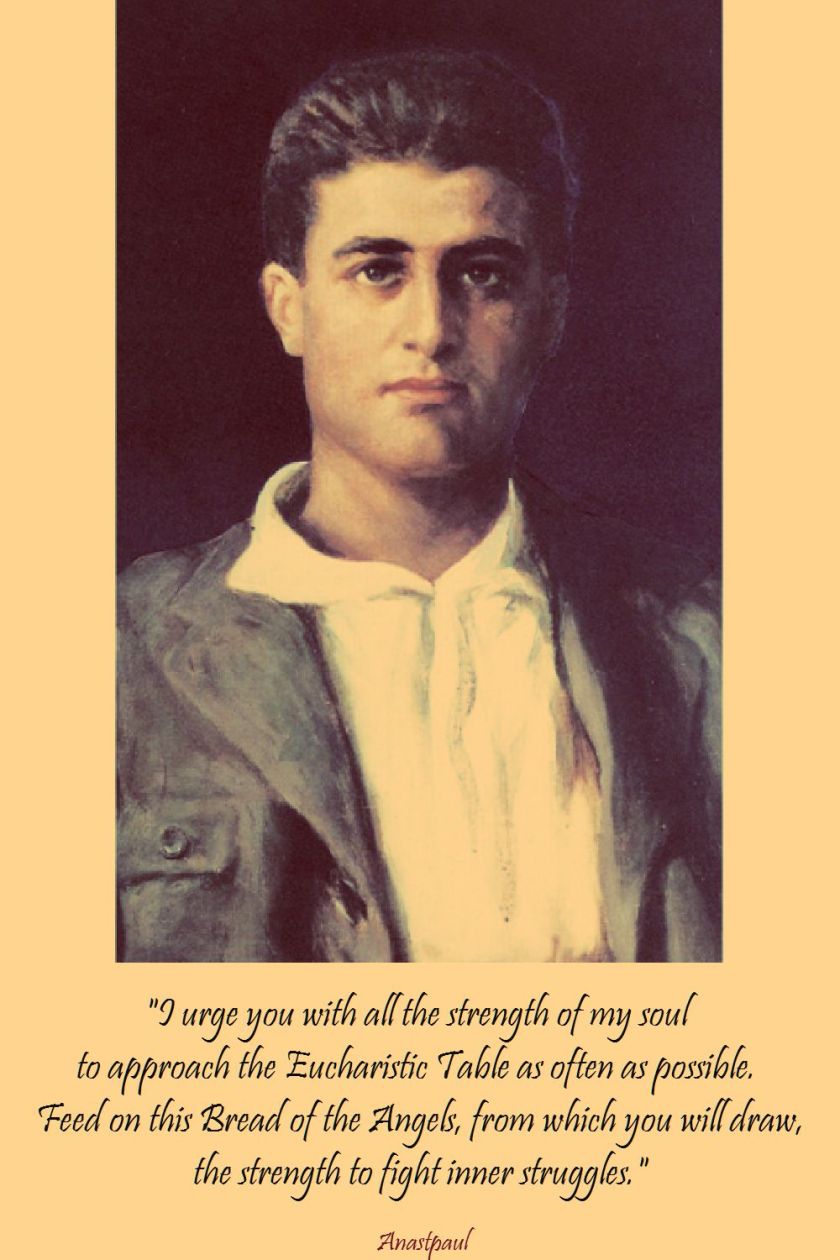
“I urge you with all the strength of my soul to approach the Eucharistic Table as often as possible. Feed on this Bread of the Angels from which you will draw the strength to fight inner struggles.”
Apologies, I mixed up the 17 and 18 April – the Saint of the Day I posted yesterday is actually celebrated today! So I am going to miss the Saint altogether today. Last year I posted the story of St Marie of the Incarnation O.S.U. (1599-1672) – Also known as Marie Guyard, Marie Guyart of the Incarnation,Marie Guyart, Marie de l’Incarnation, Marie of the Ursulines, Mother of New France, Teresa of the New World, for today. Here is the post: https://anastpaul.wordpress.com/2017/04/18/saint-of-the-day-18-april-st-marie-of-the-incarnation/
Quote/s of the Day – 13 April – Friday of the Second Week of Eastertide “Just Random”
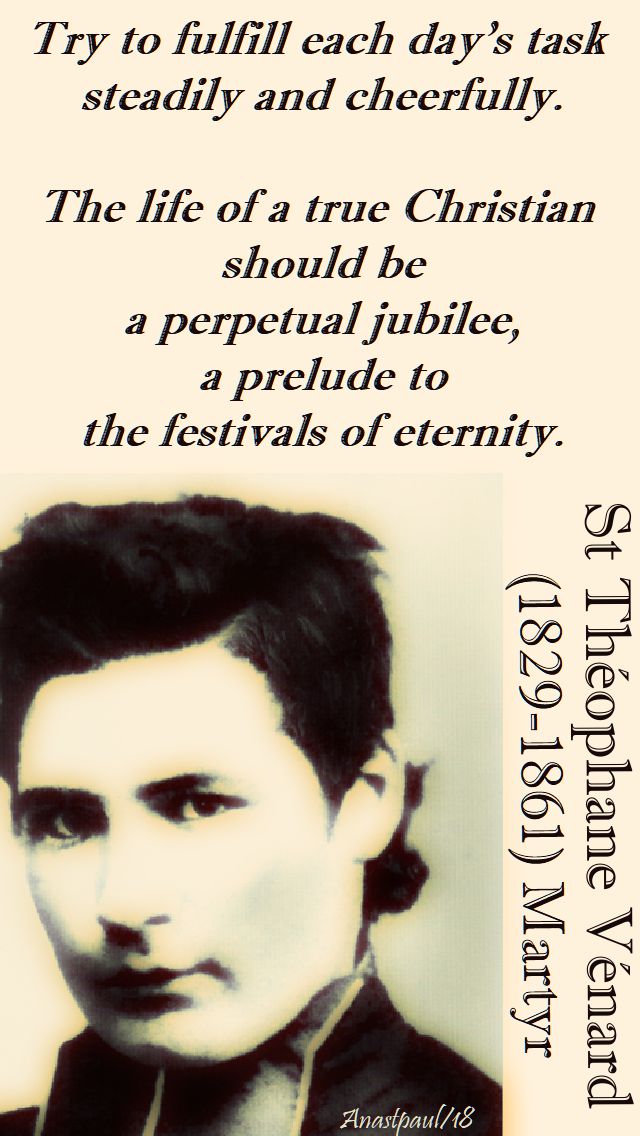
Try to fulfil each day’s task steadily and cheerfully. The life of a true Christian should be a perpetual jubilee, a prelude to the festivals of eternity.
St Théophane Vénard (1829-1861) Martyr
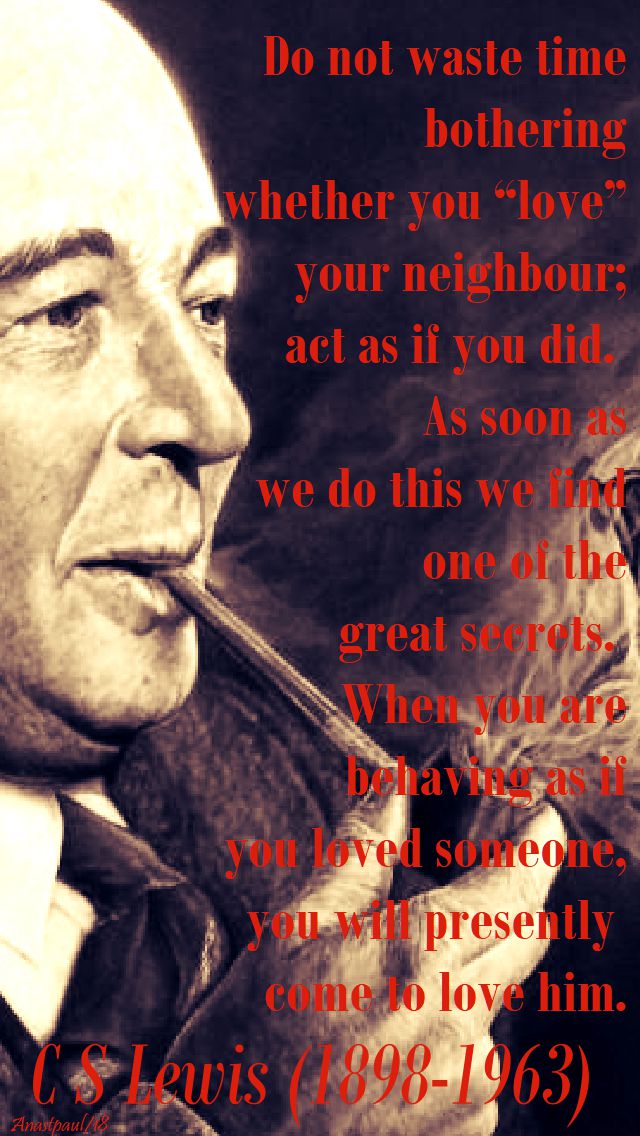
Do not waste time bothering whether you “love” your neighbour; act as if you did. As soon as we do this we find one of the great secrets. When you are behaving as if you loved someone, you will presently come to love him.
C S Lewis (1898-1963)
Our solid conviction is that Jesus is who He said He is and He can do what He says He can do. Not only that but if Jesus is, who He says He is, then you are, who He says you are. And if He is who He says He is, then you can do what He says you can do.
Quote of the Day – 12 April – Thursday of the Second Week of Eastertide & the Memorial of St Zeno of Verona (c 300 – 371)
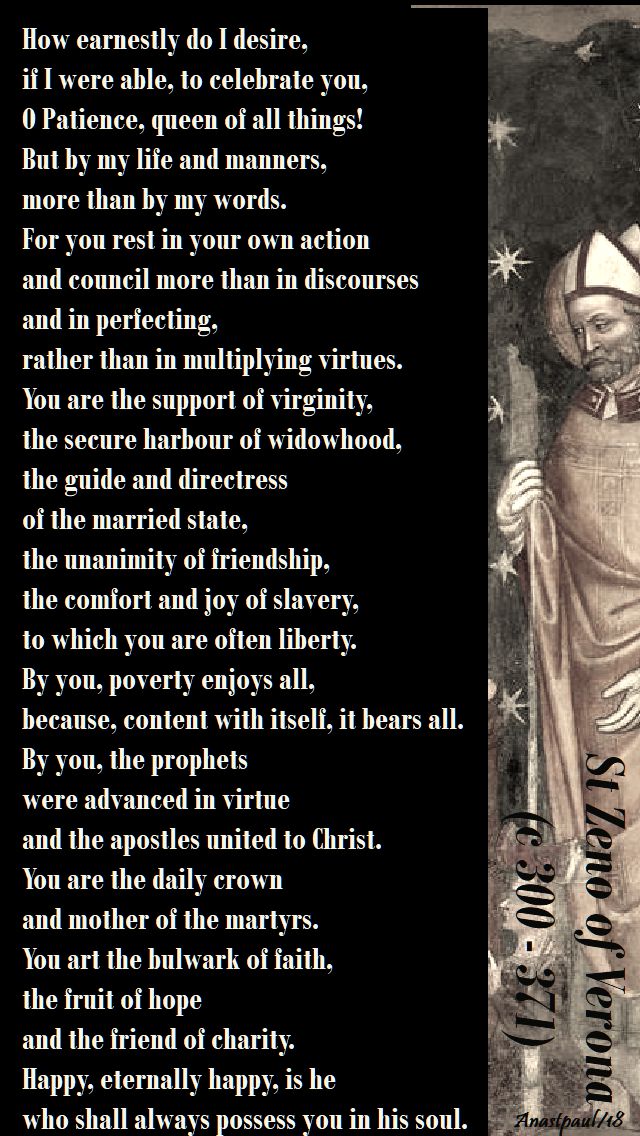
“How earnestly do I desire, if I were able, to celebrate you, O Patience, queen of all things! But by my life and manners, more than by my words. For you rest in your own action and council more than in discourses and in perfecting, rather than in multiplying virtues. You are the support of virginity, the secure harbour of widowhood, the guide and directress, of the married state, the unanimity of friendship, the comfort and joy of slavery, to which you are often liberty. By you, poverty enjoys all, because, content with itself, it bears all. By you, the prophets, were advanced in virtue and the apostles united to Christ. You are the daily crown and mother of the martyrs. You art the bulwark of faith, the fruit of hope and the friend of charity. Happy, eternally happy, is he who shall always possess you in his soul.”
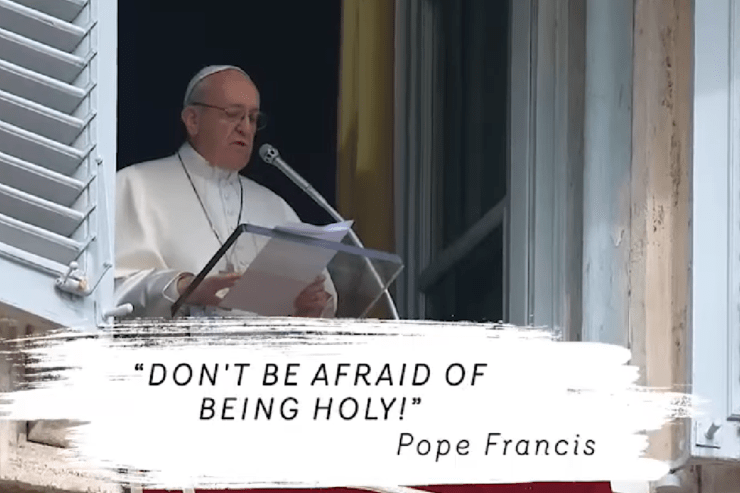
Pope’s 3rd Apostolic Exhortation on Holiness, Gives Practical Advice on How Not to Settle for Failure or Mediocrity
Jesus wants our happiness and wants us to be saints. He does not want us to settle for a bland and mediocre existence.
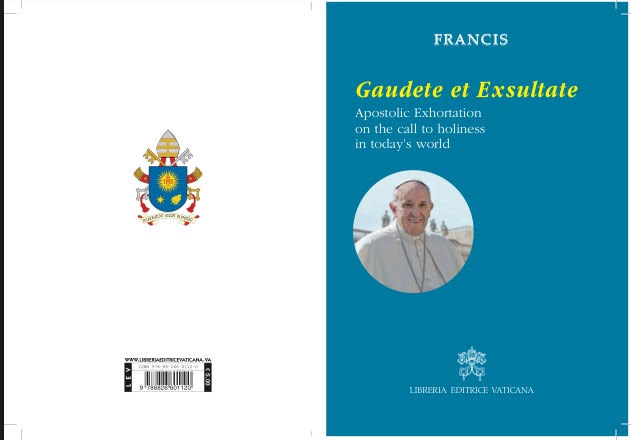
Gaudate et Exsultate: On the Call for Holiness in our Modern World was published today, marking Pope Francis’ 3rd Apostolic Exhortation after Evangelii Gaudium and Amoris Laetitia.
The five-chapter, 98-page document can be considered somewhat of a practical handbook on how to help us achieve holiness in the circumstances of our ordinary lives. The chapters include: 1) The Call to Holiness 2) Two Subtle Enemies of Holiness 3) In the Light of the Master 4) Signs of Holiness in Today’s World 5) Spiritual Combat, Vigilance and Discernment.
Reflecting on saints, the Pope speaks specifically of the saints ‘next door:’ “Nor need we think of those already beatified and canonised” but, he stressed, “I like to contemplate the holiness present in the patience of God’s people: n their daily perseverance, I see the holiness of the Church militant. A holiness found in our next-door neighbors, the middle class of holiness.”
The document which stresses the need for discernment acknowledges that the Christian life is a battle. It notes that the devil tries to “poison with the venom of hatred, desolation and vice.”
Our call to holiness, it also asserts, is a constant battle. If we do not realize this, it warns, we “will be prey to failure or mediocrity.” Yet, it suggests, we can count on “the powerful weapons” God has given us, including prayer, meditation, Mass, Confession, Eucharistic adoration, charitable acts and community outreach.
While recalling some of the saints’ great examples, including St Francis of Assisi, St John Paul II, and Edith Stein, the Pope provides advice on how we can be good Christians.
The answer is clear, he says: “We have to do, each in our own way, what Jesus told us in the Sermon on the Mount.”
The life of a Christian, the text also stresses, is a constant battle, noting we need strength and courage to reject the devil’s temptations–those “dangers and limitations that distract and debilitate”– and to proclaim the Gospel. Pope Francis also warns against that which impedes our call to holiness, such as hedonism and consumerism, noting they “can prove our downfall.”
Pope Francis concludes the work, stating: “It is my hope that these pages will prove helpful by enabling the whole Church to devote herself anew to promoting the desire for holiness.” (via Zenit)
***
Link to full text of Apostolic Exhortation: https://zenit.org/articles/gaudate-et-exsultate-on-the-call-to-holiness-in-todays-world-full-text/
Vatican Media has released a new video that focuses on the theme of the Apostolic Exhortation Gaudete et Exsultate: On the Call for Holiness in our Modern World. The two-and-a-half-minute video shows how the exhortation addressed the needs of people of all ages around the world.
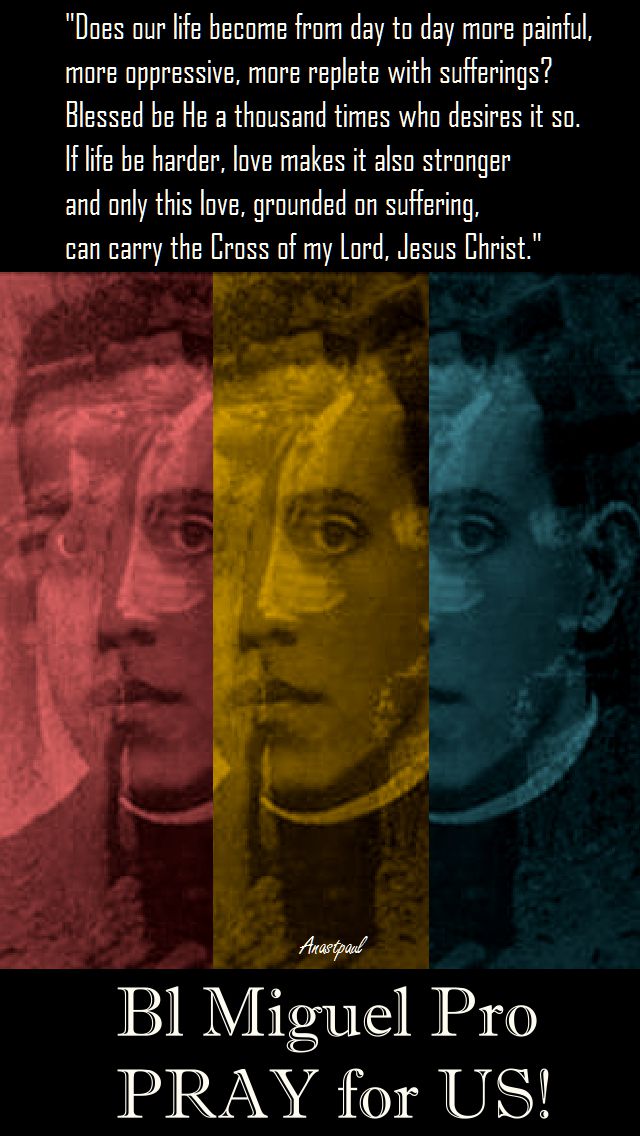
Quote of the Day – 28 February 2018 – Wednesday of the Second Week of Lent
“Does our life become from day to day more painful, more oppressive, more replete with sufferings? Blessed be He a thousand times who desires it so. If life be harder, love makes it also stronger and only this love, grounded on suffering, can carry the Cross of my Lord, Jesus Christ.”
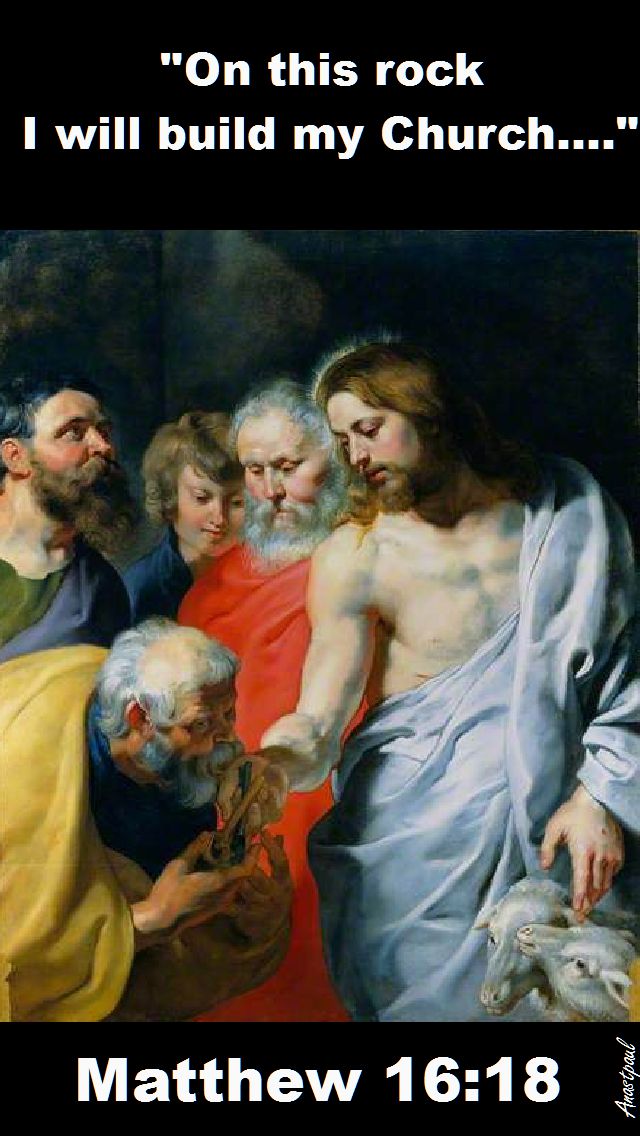
One Minute Reflection – 22 February – The Feast of the Chair of Saint Peter
“On this rock I will build my Church”…Matthew 16:18
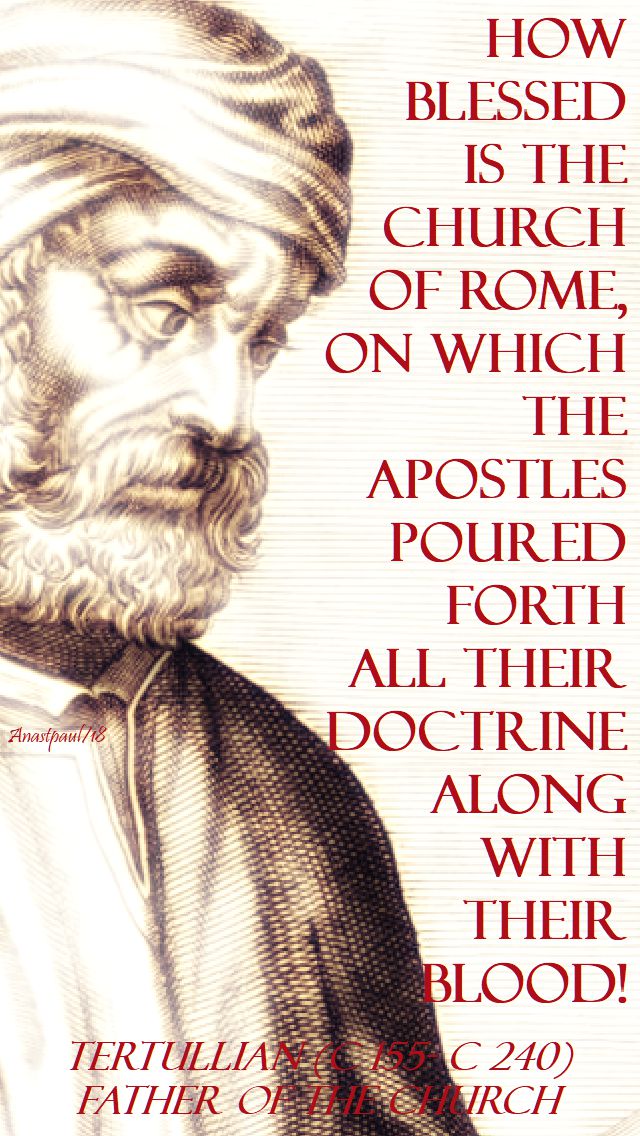
REFLECTION – “How blessed is the Church of Rome, on which the Apostles poured forth all their doctrine along with their blood!” (De Praescriptione Hereticorum, 36)…….Tertullian
“I decided to consult the Chair of Peter, where that faith is found exalted by the lips of an Apostle; I now come to ask for nourishment for my soul there, where once I received the garment of Christ. I follow no leader save Christ, so I enter into communion with Your beatitude, that is, with the Chair of Peter, for this I know is the rock upon which the Church is built.” (cf. Le lettere I, 15, 1-2)…………..St Jerome (343-420) Father & Doctor
PRAYER – Holy Father, send Your Divine Enlightener into the hearts of all Your faithful, filling us with the strength to fulfil our mission as the followers of the Chair of St Peter. And most of all, we pray Lord Holy God to inspire and light the way of our Holy Father, Francis. Sustain and guide him, keep him in health and strength, to lead Your people by the Light of the Way and the Truth. Holy Father, have mercy on us, Holy Spirit guide and lead us, Lord Jesus Christ be our intercessor and teacher, amen.
St Ailius of Alexandria
St Angelus Portasole
St Aristion of Salamis
St Athanasius of Nicomedia
St Baradates of Cyrrhus
Bl Diego Carvalho
St Elwin
Bl Émilie d’Oultremont d’Hoogvorst
Bl Isabella of France
St John the Saxon
St Limnaeus
St Margaret of Cortona
St Maximian of Ravenna
St Miguel Facerías Garcés
St Mohammed Abdalla
St Papias of Heirapolis
St Paschasius of Vienne
St Raynerius of Beaulieu
St Thalassius
—
Martyrs of Arabia – A memorial for all the unnamed Christians martyred in the desert and mountainous areas south of the Dead Sea during the persecutions of Emperor Valerius Maximianus Galerius.
Madonna del Pilerio: The term Pilerio probably derives from piliero (pillar), or it could be older and derive from the greek puleròs (guardian, guardian of the city gate). The cult of the Madonna del Pilerio as the patron saint of Cosenza, dates back to the end of the 16th century. It is said that in the year 1576, while the plague desolated different regions of Italy, a devotee, praying before the icon of the Madonna del Pilerio, noticed a stain similar to the pestiferous bubo (the marks of the plague), present on the face of the Image. The phenomenon was noted by the people and by the ecclesiastical authorities. The stain was considered a prodigy and a revealing sign of the protection of the Madonna for the City of Cosenza, saved by her from the plague. Since then the Virgin of Pilerio became the Protectress of the City.
The news of the prodigious sign did not take long to spread and from the neighbouring countries a growing rush of devotees began. The pilgrimages continued over time and grew in number, so much so that in 1603, the Archbishop Monsignor Giovan Battista Costanzo (1591-1617), to better serve the influx of pilgrims, removed the painting from the place where it was and placed it before on one of the pillars of the central nave of the Duomo, then on the main altar and finally in 1607 in the specially built chapel dedicated to the Virgin and where even today is venerated. On April 17, 1607, at the unanimous request of the inhabitants of Cosenza, the Archbishop Mgr. Costanzo crowned the Virgin of Pilerio Regina and Patrona della Città. In 1783 a violent earthquake struck down on Cosenza. On that occasion another sign was found on the face of the image of the Pilerio.
—
St Alexius of Kiev
St Ammonius of Alexandria
Bl Anthony of Saxony
St Anthony Kauleas
St Benedict of Aniane (747-821)
Bl Benedict Revelli
St Damian of Africa
St Damian of Rome
St Ethelwald of Lindisfarne
St Eulalia of Barcelona
St Gaudentius of Verona
St Goscelinus of Turin
Bl Gregory of Tragurio
Bl Humbeline of Jully
St Jak Bushati
St Julian of Alexandria
St Julian the Hospitaller
Bl Ladislaus of Hungary
Bl Ludan
St Meletius of Antioch
St Modestus of Alexandria
St Modestus of Carthage
St Modestus the Deacon
Bl Nicholas of Hungary
St Sedulius
Bl Thomas of Foligno
—
Martyrs of Albitina – 46 saints:
During the persecutions of Diocletian, troops were sent to the churches of Abitina, North Africa on a Sunday morning; they rounded up everyone who had arrived for Mass and took them all to Carthage for interrogation by pro-consul Anulinus. The 46 who proclaimed their Christianity were executed. We know some of their names and stories.
• Ampelius
• Cassiano
• Ceciliano
• Cecilia
• Danzio
• Deciano
• Emeritus
• Ercolina
• Eva
• Fausto
• Felice (2 by this name)
• Felix
• Gennara (2 by this name)
• Gennaro
• Giriale
• Hilarion
• Maggiore
• Margherita
• Martino
• Mary
• Massimiano
• Matrona (2 by this name)
• Onorata
• Pelusio
• Pomponia
• Prima
• Quinto
• Regiola
• Restituta
• Rogatian (3 by this name)
• Rogato (2 by this name)
• Saturninus the Elder
• Saturninus the Younger
• Seconda (2 by this name)
• Thelica
• Victoria
• Vincenzo
• Vittoriano
• Vittorino
They were tortured to death in 304 in prison at Albitina, North Africa.
Martyred in England:
Bl George Haydock
Bl James Fenn
Bl John Nutter
Bl John Munden
Bl Thomas Hemeford
Martyred in the Spanish Civil War:
Josep Gassol Montseny
Novena to Our Lady of Lourdes – DAY NINE– 10 February (we Pray the Novena for our own intentions and for the sick, the infirm within our own communities but also for all those throughout the world who suffer, especially those who have no-one to pray for them in preparation for the Wold Day of the Sick on 11 February.)
DAY NINE
O glorious Mother of God,
to you we raise our hearts and hands
to implore your powerful intercession
in obtaining from the benign Heart of Jesus
all the graces necessary
for our spiritual and temporal welfare,
particularly for the grace of a happy death.
O Mother of our Divine Lord,
as we conclude this novena for the special favour
we seek at this time.
……………………………(make your request)
Mary and Bernadette
We feel animated with confidence that your prayers in our behalf
will be graciously heard. O Mother of My Lord,
through the love you bear to Jesus Christ
and for the glory of His Name,
hear our prayers and obtain our petitions.
O Brilliant star of purity, Mary Immaculate, Our Lady of Lourdes,
glorious in your assumption,
triumphant in your coronation,
show unto us the mercy of the Mother of God,
Virgin Mary, Queen and Mother,
be our comfort, hope, strength, and consolation. Amen.
Novena to Our Lady of Lourdes – DAY SEVEN– 8 February (we Pray the Novena for our own intentions and for the sick, the infirm within our own communities but also for all those throughout the world who suffer, especially those who have no-one to pray for them in preparation for the Wold Day of the Sick on 11 February.)
DAY SEVEN
O Almighty God,
who by the Immaculate Conception of the Blessed Virgin Mary
did prepare a worthy dwelling place for Your Son,
we humbly beseech You,
that as we contemplate the apparition of Our Lady in the Grotto of Lourdes,
we may be blessed with health of mind and body.
O most gracious Mother Mary, beloved Mother of Our Lord and Redeemer,
look with favour upon us as you did that day on Bernadette
and intercede with Him for us
that the favour we now so earnestly seek may be granted to us.
………………………………(make your request)
O Brilliant star of purity, Mary Immaculate, Our Lady of Lourdes,
glorious in your assumption, triumphant in your coronation,
show unto us the mercy of the Mother of God, Virgin Mary, Queen and Mother,
be our comfort, hope, strength and consolation. Amen
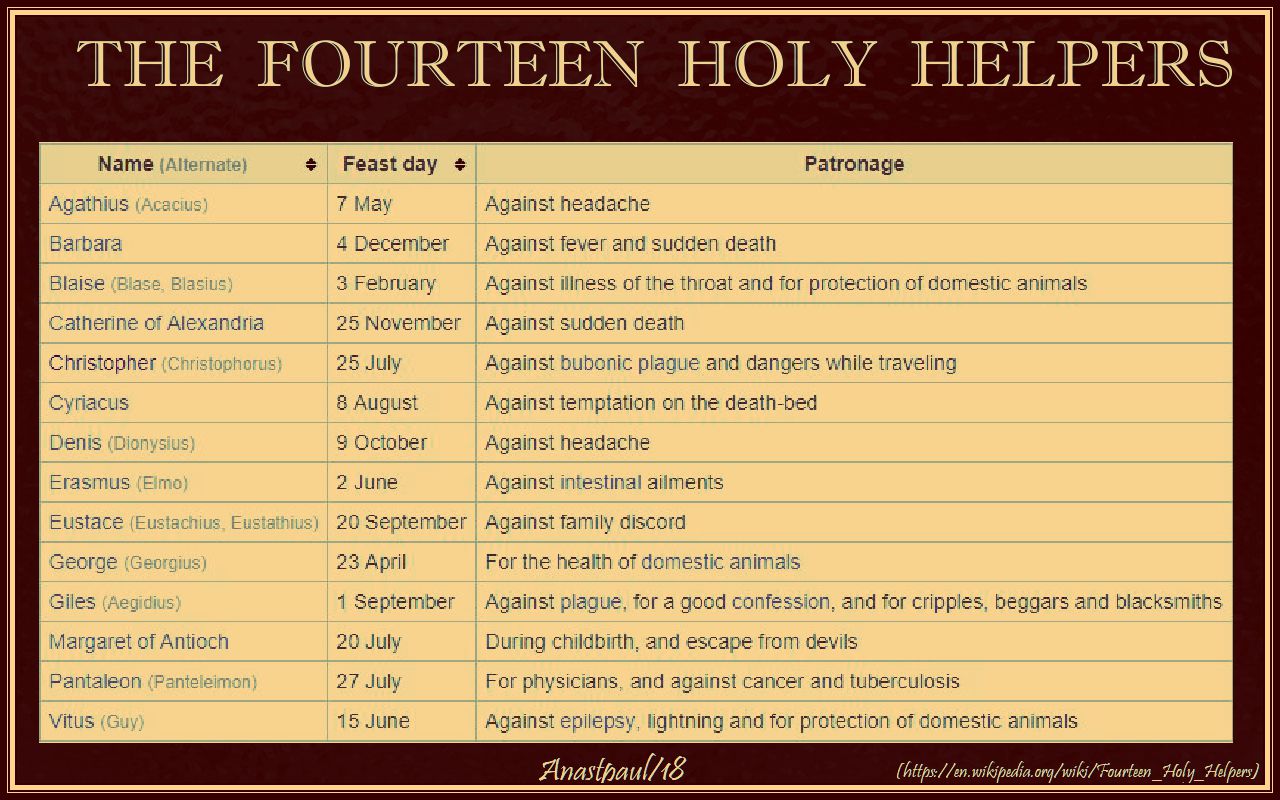
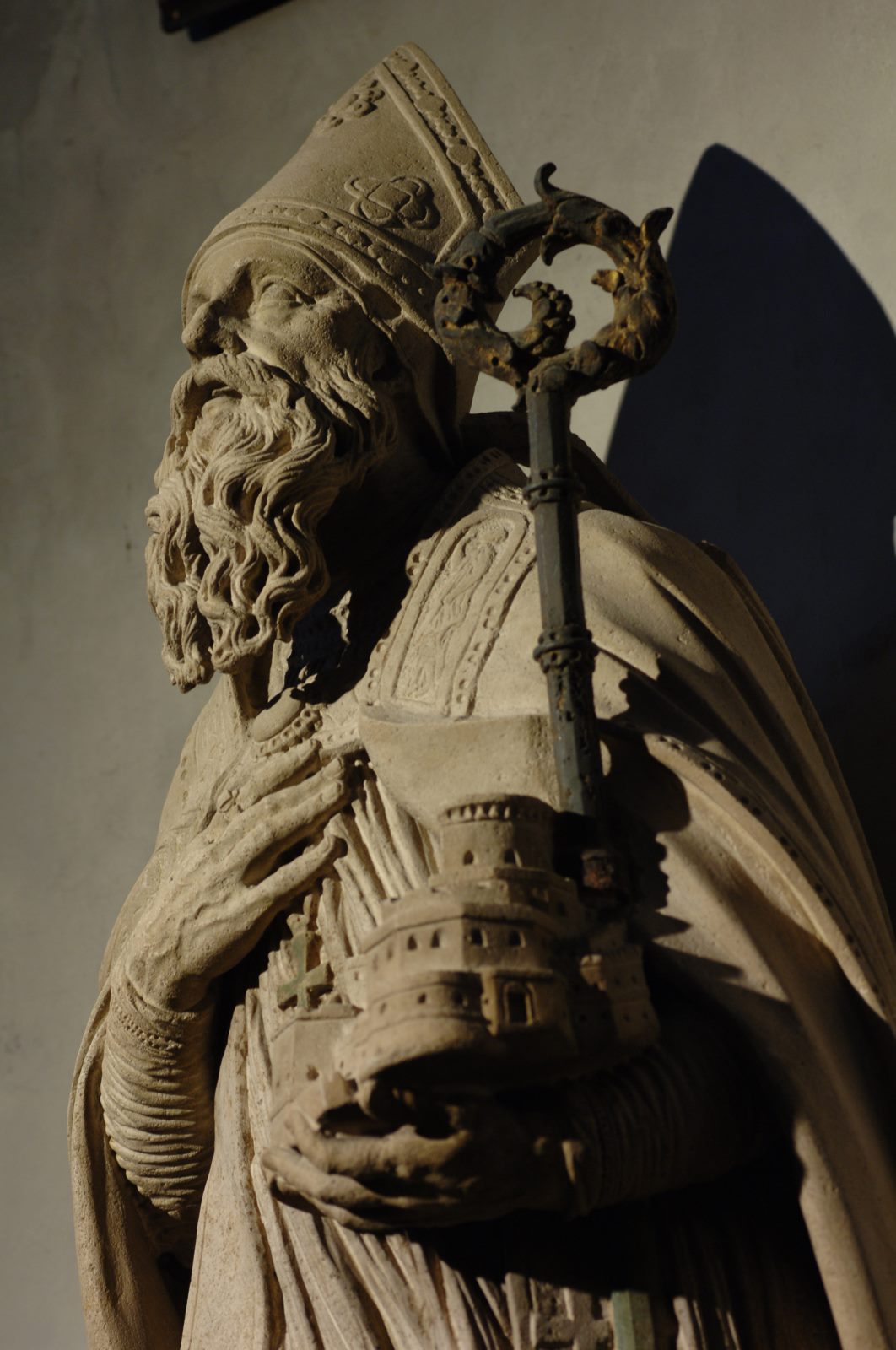
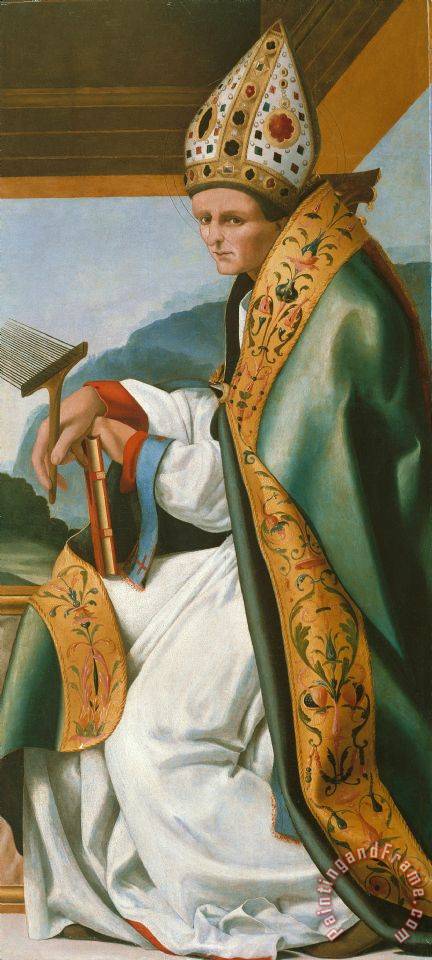
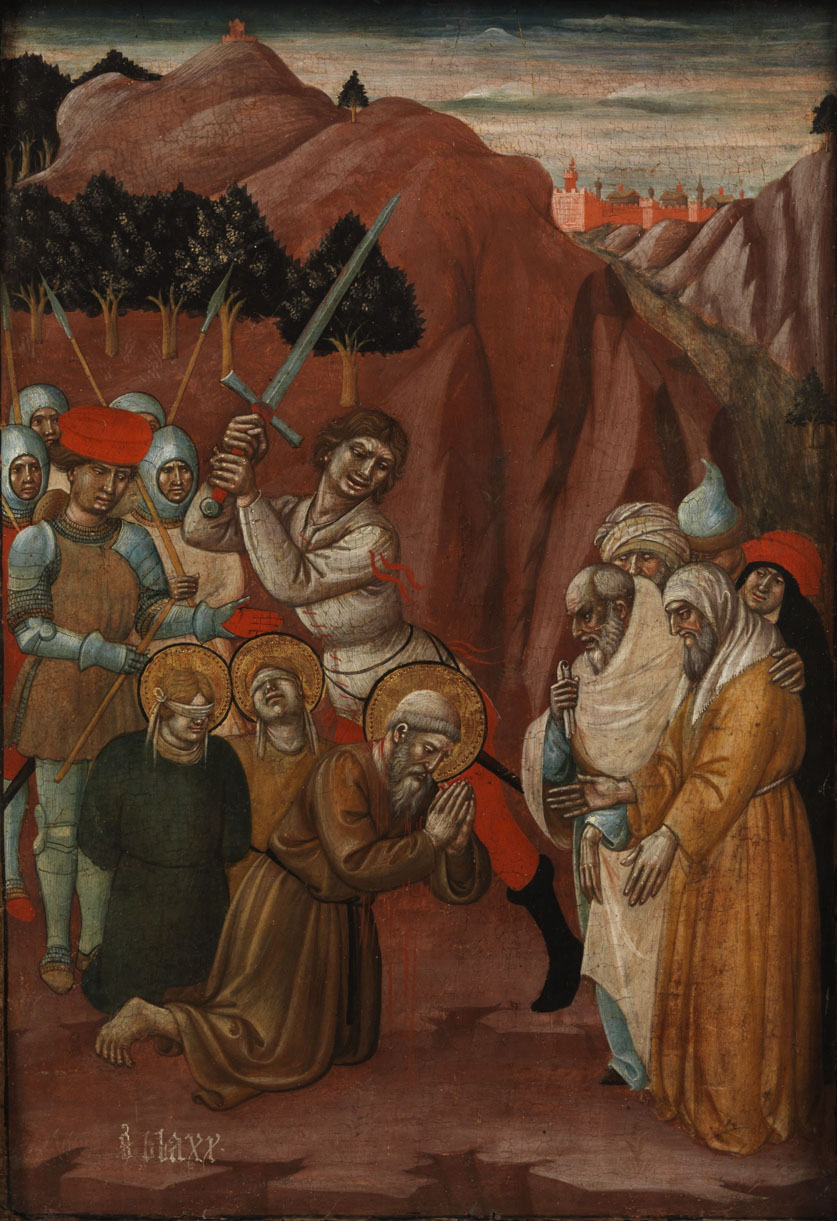
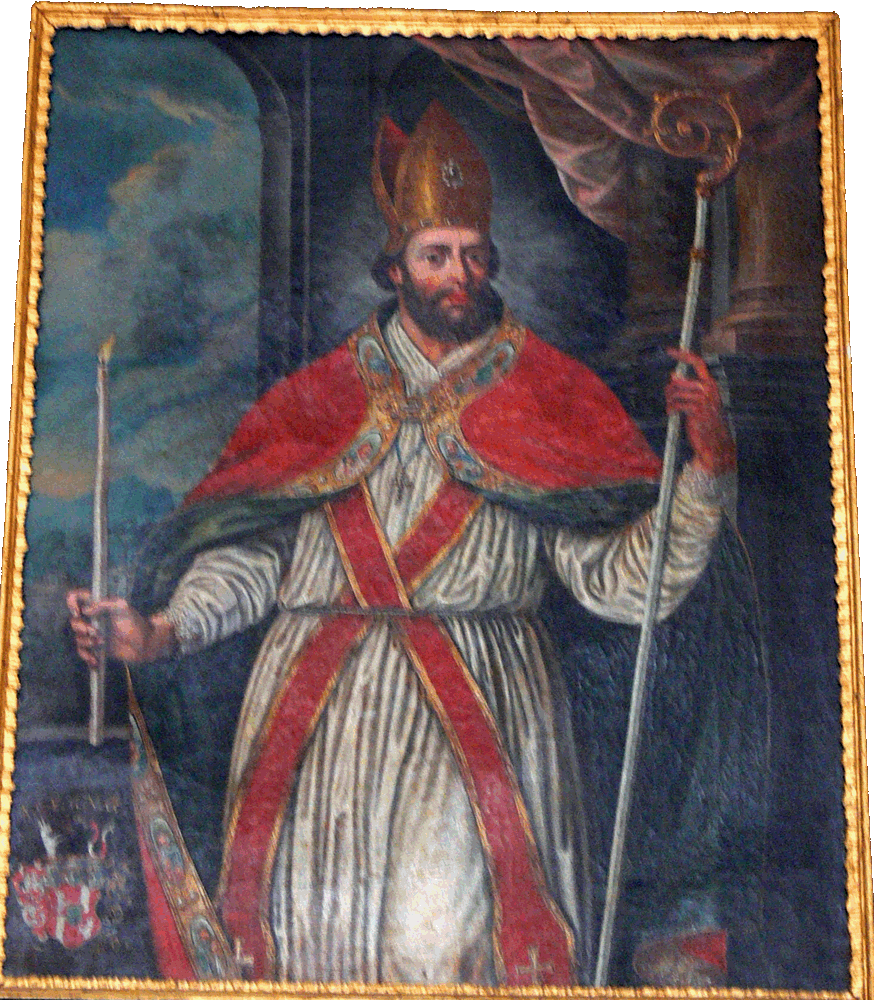
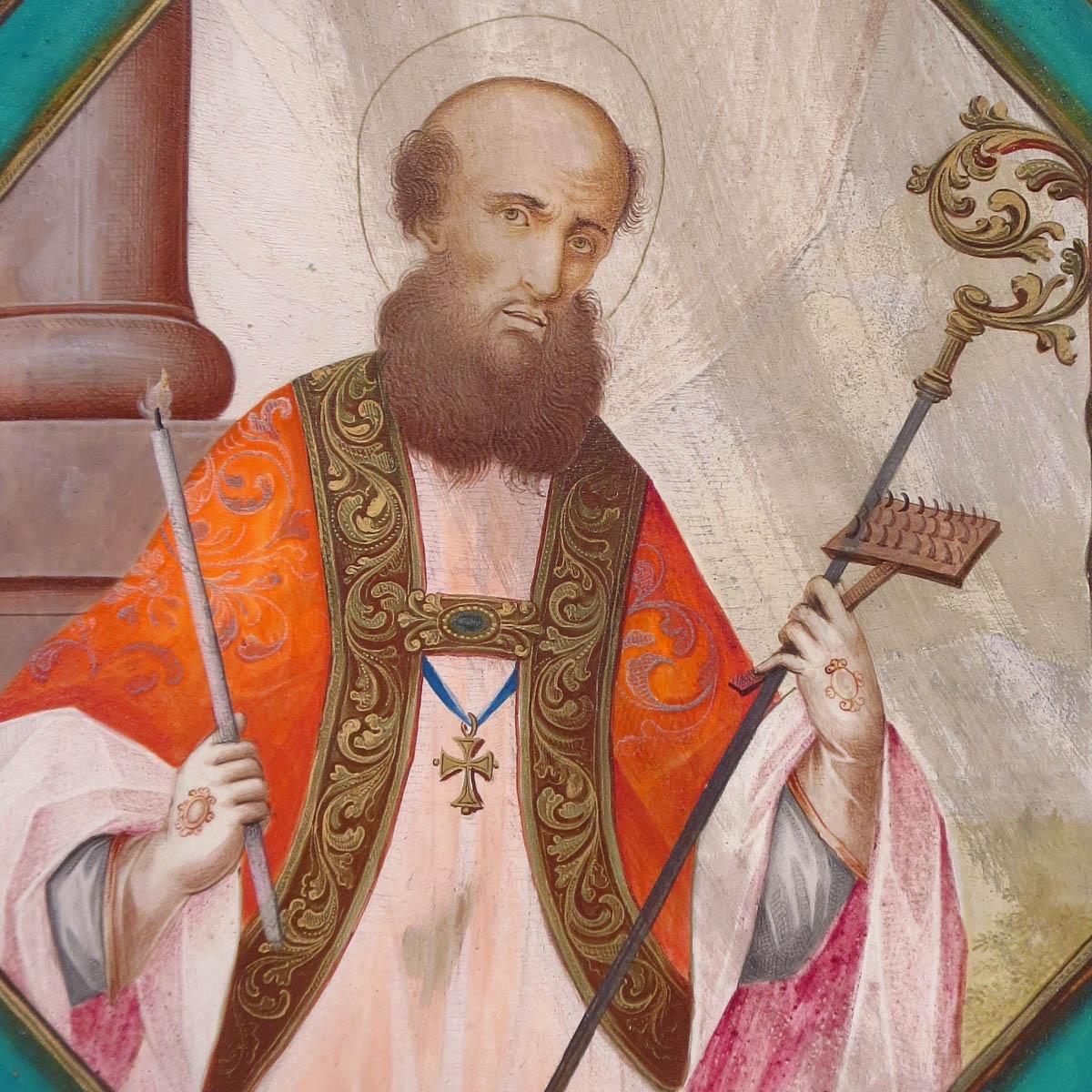
Saint of the Day – 3 February – St Blaise (Died c 316) – Martyr, Bishop of Sebaste, Armenia, Physician, Miracle-worker. Died in c 316 by his flesh being torn off his body by iron wool-combs, then beheaded. Patronages – against angina • against bladder diseases • against blisters • against coughs • against dermatitis • against dropsy • against eczema • against edema • against fever • against goitres • against headaches • against impetigo • against respiratory diseases • against skin diseases • against snake bites • against sore throats • against stomach pain • against storms • against teething pain • against throat diseases • against toothaches • against ulcers • against whooping cough • against wild beasts • angina sufferers of ; of children, animals, builders, drapers, against choking, veterinarians, infants, of 21 Cities, of stonecutters, carvers, wool workers. St Blaise is one of the Fourteen Holy Helpers – https://anastpaul.com/2018/07/25/thought-for-the-day-25-july-the-memorial-of-st-christopher-died-c-251-one-of-the-fourteen-holy-helpers/
Today the Church remembers the life and witness of Saint Blaise, a 3rd century Armenian bishop who endured terrifying torments and surrendered his life rather than repudiate his profession of Faith.
Much of the life of Saint Blaise is history that has passed into legend but even these legendary accounts offer spiritual insight.
Blaise was renowned as a wonderworker, effecting miraculous cures. T his would have been enough to attract attention but he was also not averse to calling out the Roman officials who ruled the region in which he lived, Cappadocia, for their tyranny and intolerance of Christian faith and practice. The combination of a reputation for supernatural power and the courage of his convictions was not welcomed by Rome and the governor ordered Bishop Blaise to be arrested. Blaise was able to elude capture and took refuge in the wilderness. It was there in the caves of Cappadocia that his ministry and his mission continued.
There is an account of Saint Blaise that identifies not only his pastoral care for the Christian faithful but also for the animals of the wilderness.
A woman had witnessed her piglet carried off by a wolf and spoke of her plight to the bishop. Saint Blaise called for the wolf, demanded her return the piglet to its rightful owner and reminded the wolf of the grave penalty that awaited a thief. The wolf complied and returned the piglet to its owner- a credit to the bishop’s power of persuasion. The woman would later return the favour to Saint Blaise when he was finally captured and imprisoned. She brought to him candles to illuminate his dank and dreary cell.
This legend hints at how the saints represent, in their holiness, the restoration of a paradise lost and regained in Christ. The ease and familiarity with which the Biblical character of Adam is believed to have communed with nature before the fall is recapitulated in Saint Blaise- he is a sign that anticipates the restoration of all things in Christ where the lion will rest with the lamb and in this case, the wolf will return stolen property to its rightful owner.
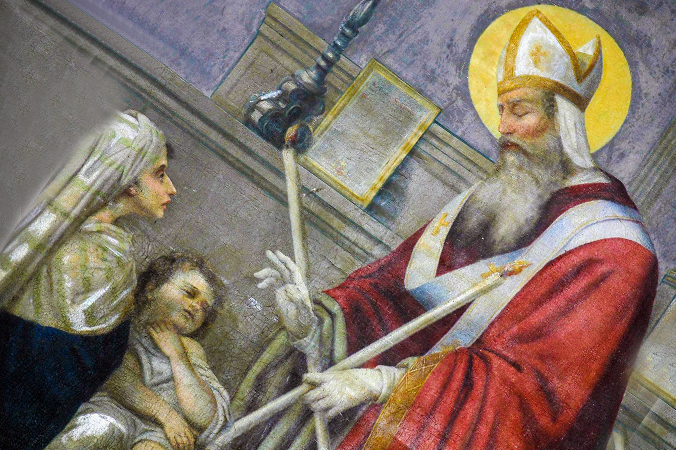
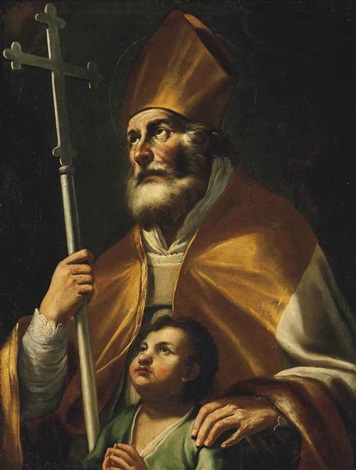
Saint Blaise has been invoked for centuries as a specialist in diseases of the throat. The origin of this practice might be in the story of a child brought to the saint who was either choking or suffering from some other malady of the throat. Saint Blaise blessed the boy and he was restored to health.
The practice of blessing throats on the Feast of Saint Blaise is a commemoration of this miracle, that crossed candles are often used to impart this blessing might also be a recollection of the kindness of the woman who gave candles to the saint as he languished in prison.
Saint Blaise was an extraordinarily popular saint during the Middle Ages in Europe. Presentations of his miraculous and mighty deeds were commonly represented in art and sculpture, and he was included in a listing of saints called the Fourteen Holy Helpers (or Auxiliary Saints), holy men and women who could be counted on as intercessors for all manner of maladies from madness to travelers in distress. During times in which a sore throat could be a signal of an impending epidemic or an early death, the faithful were all too happy to accept the help of a heavenly specialist in such matters like Saint Blaise.
The legends regarding Saint Blaise report that his sojourn in the wilderness did not protect him for very long. He was eventually arrested and brought to trial. The judge advised him that only a pinch of incense offered to the image of Caesar and the gods of Rome could win him his freedom. Blaise refused. He was cruelly tortured and beheaded.
The Church does not mourn Saint Blaise, for we know that in Christ this world is not all that there is. While tyrants like Caesar and his successors can threaten us with death, Christ promises us a life that like his own, is transformed through suffering and death, into resurrection.
The scriptures proclaim, “though they slay me I will trust in you.”
Saint Blaise did precisely this. He trusted that Christ would not abandon him to the power of death nor allow his suffering to be meaningless. Our lives might never be raised to the legendary status of Saint Blaise but we can trust in Christ as he did and live in hope that one day we will join him in communion with all the saints who have gone before us in faith and who, from their place in heaven, guide and protect us still. (Fr Steve Grunow)
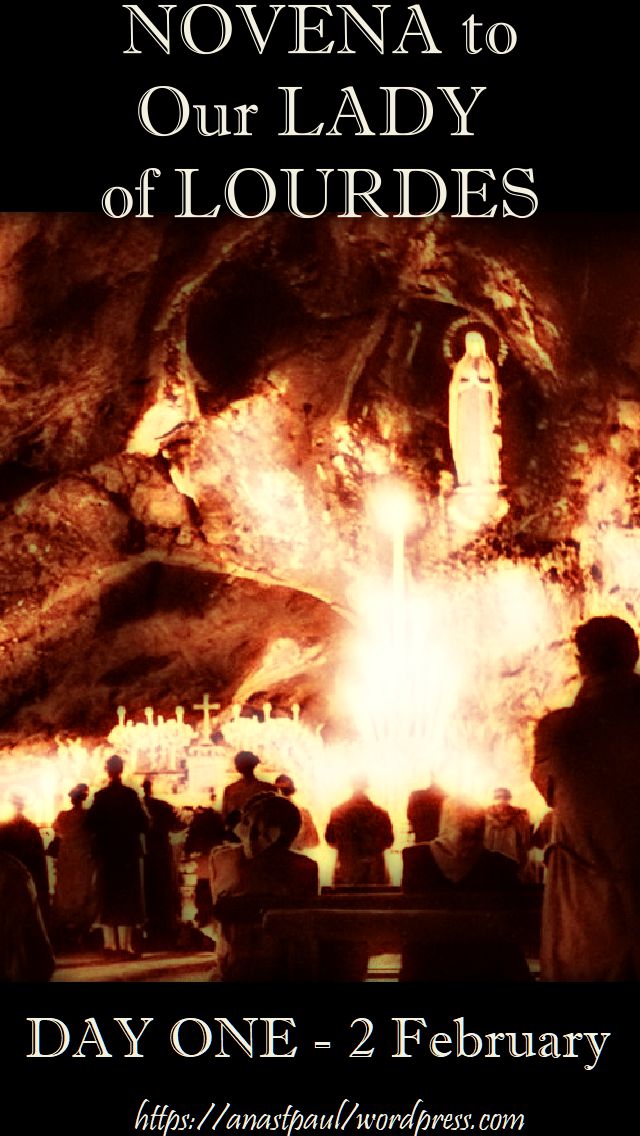
NOVENA to OUR LADY of LOURDES – DAY ONE – 2 FEBRUARY (we Pray the Novena for our own intentions and for the sick, the infirm within our own communities but also for all those throughout the world who suffer, especially those who have no-one to pray for them in preparation for the Wold Day of the Sick on 11 February.)
O Mary Immaculate,
Our Lady of Lourdes,
virgin and mother, queen of heaven,
chosen from all eternity to be the Mother of the Eternal Word
and in virtue of this title preserved from original sin,
we kneel before you as did little Bernadette at Lourdes
and pray with childlike trust in you
that as we contemplate your glorious appearance at Lourdes,
you will look with mercy on our present petition
and secure for us a favorable answer to the request
for which we are making this novena.
……………………………………(make your request)
O Brilliant star of purity,
Mary Immaculate, Our Lady of Lourdes,
glorious in your assumption,
triumphant in your coronation,
show unto us the mercy of the Mother of God,
Virgin Mary, Queen and Mother,
be our comfort, hope, strength and consolation. Amen.
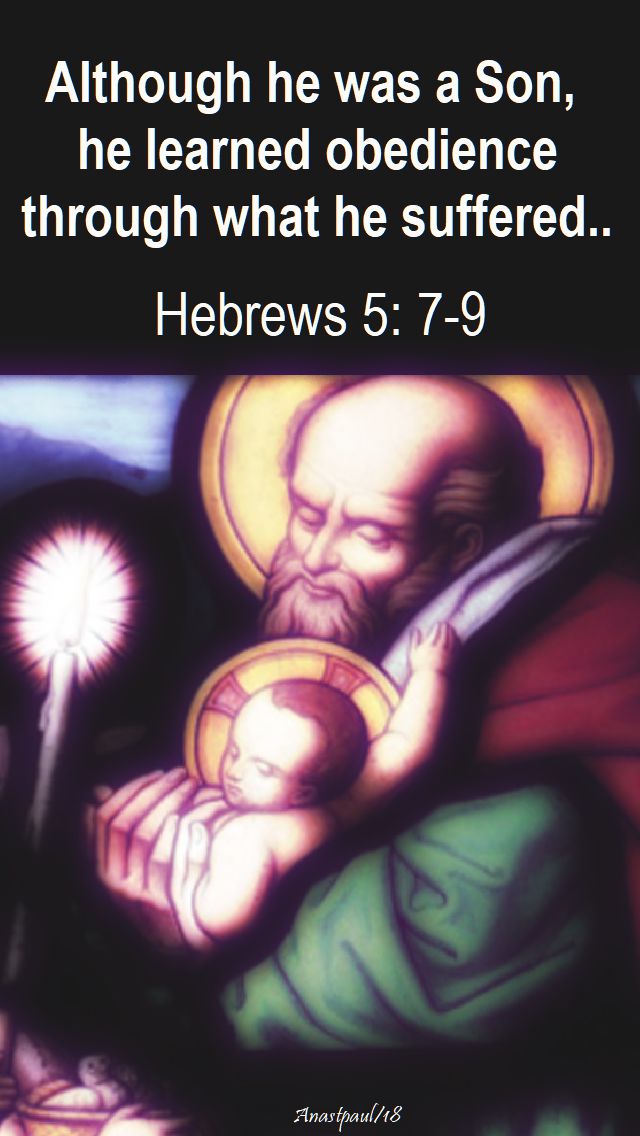
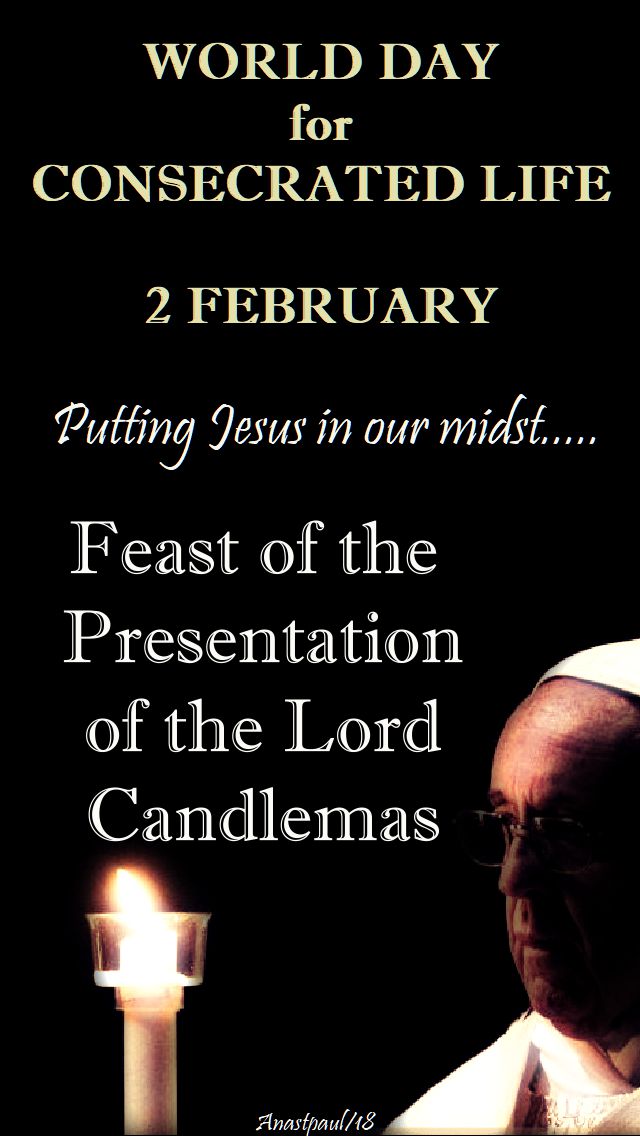
One Minute Reflection – 2 February – Feast of the Presentation of the Lord and the World Day of Prayer for Consecrated Life
Although he was a Son, he learned obedience through what he suffered...Hebrews 5: 7-9
REFLECTION – “When Mary let Simeon take the Son of the Promise into his arms, the old man began to sing of his dreams. Whenever she puts Jesus in the midst of His people, they encounter joy. For this alone will bring back our joy and hope, this alone will save us from living in a survival mentality. Only this will make our lives fruitful and keep our hearts alive: putting Jesus where He belongs, in the midst of His people…Hence, it is all the more important for consecrated men and women to be one with Jesus, in their lives and in the midst of these great changes (in the world)…Putting Jesus in the midst of His people means having a contemplative heart, one capable of discerning how God is walking through the streets of our cities, our towns and our neighbourhoods. Putting Jesus in the midst of His people means taking up and carrying the crosses of our brothers and sisters. It means wanting to touch the wounds of Jesus in the wounds of a world in pain, which longs and cries out for healing.”…Pope Francis on the Feast of the Presentation of the Lord and the World Day of Prayer for Consecrated Life – 2 February 2017
PRAYER – May the Lord renew in you and in all consecrated people each day the joyful response to His freely given and faithful love. Dear brothers and sisters, like lighted candles, always and everywhere shine with the love of Christ, Light of the world. May Mary Most Holy, the consecrated Woman, help you to live to the full, your special vocation and mission in the Church for the world’s salvation. And may we all follow our Lord in obedience. Amen!
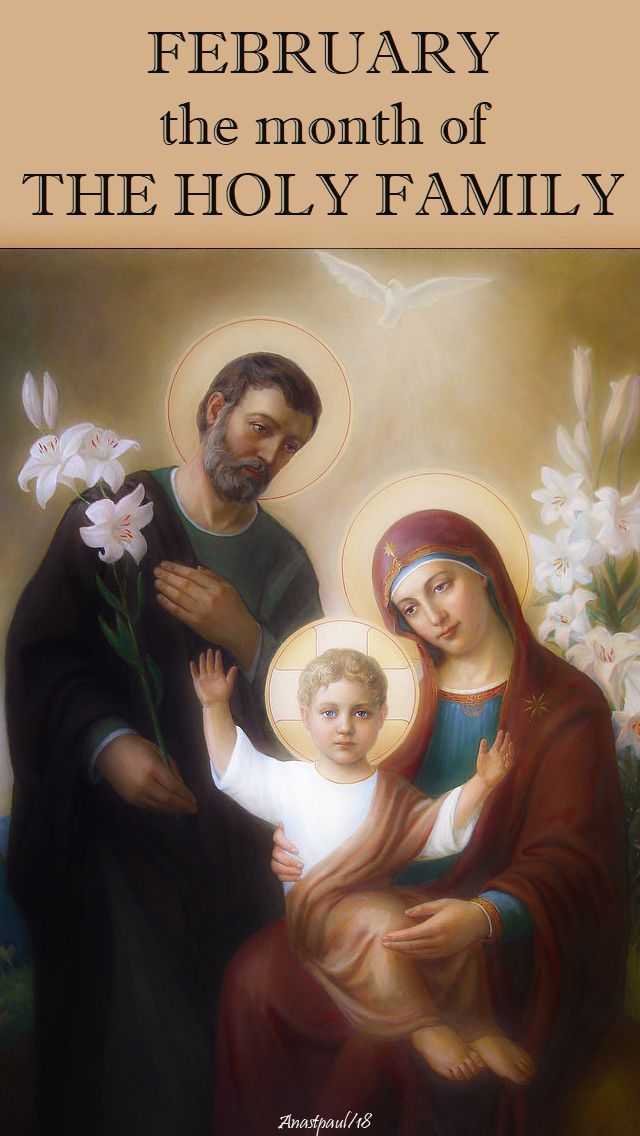
In January, the Catholic Church celebrated the Month of the Holy Name of Jesus and in February, we turn to the entire Holy Family—Jesus, Mary and Joseph.
In sending His Son to earth as a Baby, born into a family, God elevated the family beyond a mere natural institution. Our own family life reflects that lived by Christ, in obedience to His mother and foster father. Both as children and as parents, we can take comfort in the fact that we have the perfect model of the family before us in the Holy Family.
One commendable practice for the month of February is a Consecration to the Holy Family – I will post this pray during this month. If you have a prayer corner or a home altar, you can gather the entire family and recite the consecration prayer, which reminds us that we aren’t saved individually. We all work out our salvation in conjunction with others—first and foremost, together with the other members of our family.
There’s no need to wait until next February to repeat the consecration, it’s a good prayer for your family to pray every month.
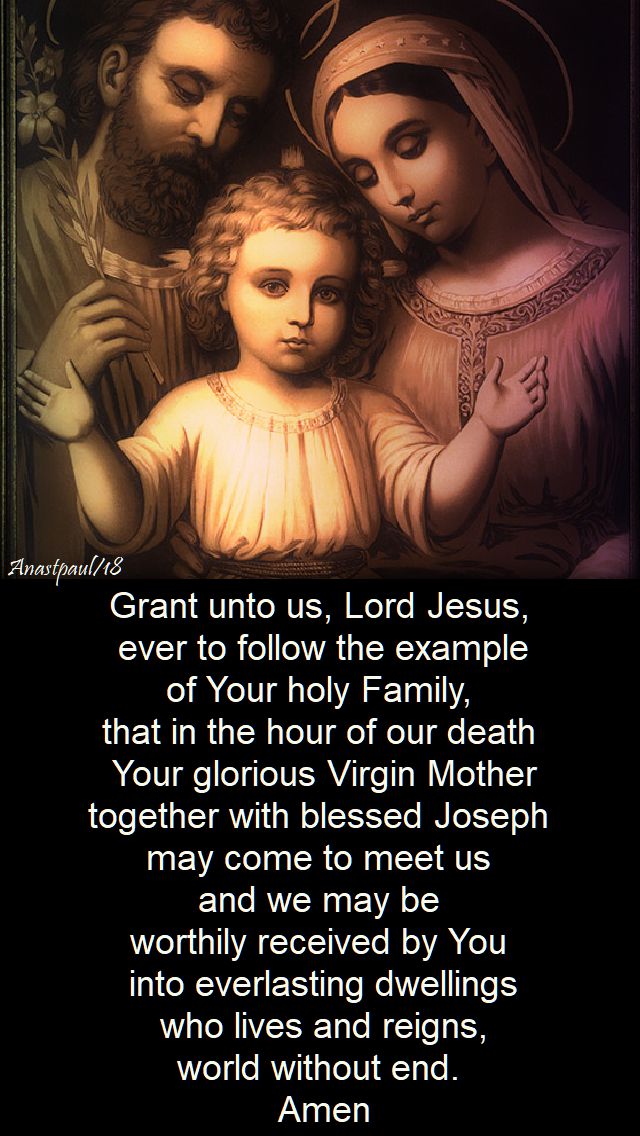
Grant unto us, Lord Jesus,
ever to follow the example of Your holy Family,
that in the hour of our death
Your glorious Virgin Mother
together with blessed Joseph
may come to meet us
and we may be worthily received by You
into everlasting dwellings
who lives and reigns, world without end.
Amen
Thought for the Day – 24 January – The Memorial of St Francis de Sales (1567-1622) Doctor of the Church: Doctor caritatis (Doctor of Charity)
St Alphonsus de Liguori (1696-1787) on St Francis de Sales (1567-1622)
When one Doctor of the Church talks about another, you know it’s going to be good:
“Great was the faith of St Francis de Sales. Such was his delight when he thought of the beauty and excellence of Faith, that he was heard to exclaim, “Oh my God, the beauty of our holy Faith appears to be so delightful that I could die for love for it and it seems to me that I ought to enclose this precious gift which God has bestowed upon me, in a heart full of the sweetest perfumes of devotion.” Hence he was never satisfied with giving God thanks for having blessed him with the favour of being born a child of the True Church: “O bountiful God,” said he, “great indeed are the favours by which Thou hast bound me to Thee’ but how shall I ever sufficiently thank Thee for having enlightened me with the true Faith?” And he declared that, although he constantly had so much to do with heretics, he had never once doubted in the least of the truth of his Faith. They who love God never doubt in matters of Faith, it is only those who do not live according to the dictates of their Faith who doubt of its Truths.”
[I think this is very true. And I have read a great many Saints who commented on the converse of this: Liguori himself, Aquinas and Jerome, all stated that public heresy is almost always driven by some sin, some lust or greed or pride that separates one from Grace – at least it’s fullness – and leads to souls developing a loathing for the Truth Christ has revealed through His Church. Thus, they apostatise in order to rationalise or justify, in their minds, their private (or even public) sin].
“Great also was the Hope of St Francis. He was always firmly convinced that God continually watches over our welfare and hence he was always calm and intrepid in the midst of the greatest dangers. In the very dangers which threatened his designs for the glory of God, he never lost confidence. And this he always endeavoured to instill into others. On one occasion he is related to have said to a timid soul: “Do you desire to belong entirely to God? Why, then, do you fear on account of your weakness? Do you hope in God? And shall he who hopes in God be ever confounded? Be not afraid of your fears.” He who loves God much, confides much in Him. Love always cuts off fear.
Holy Saint, since thou art now in Heaven loving Jesus face to Face, obtain for me the Grace to love Him, as thou didst love Him in thy lifetime.”
Quote/s of the Day – 24 January – The Memorial of St Francis de Sales (1567-1622) Doctor of the Church: Doctor caritatis (Doctor of Charity)
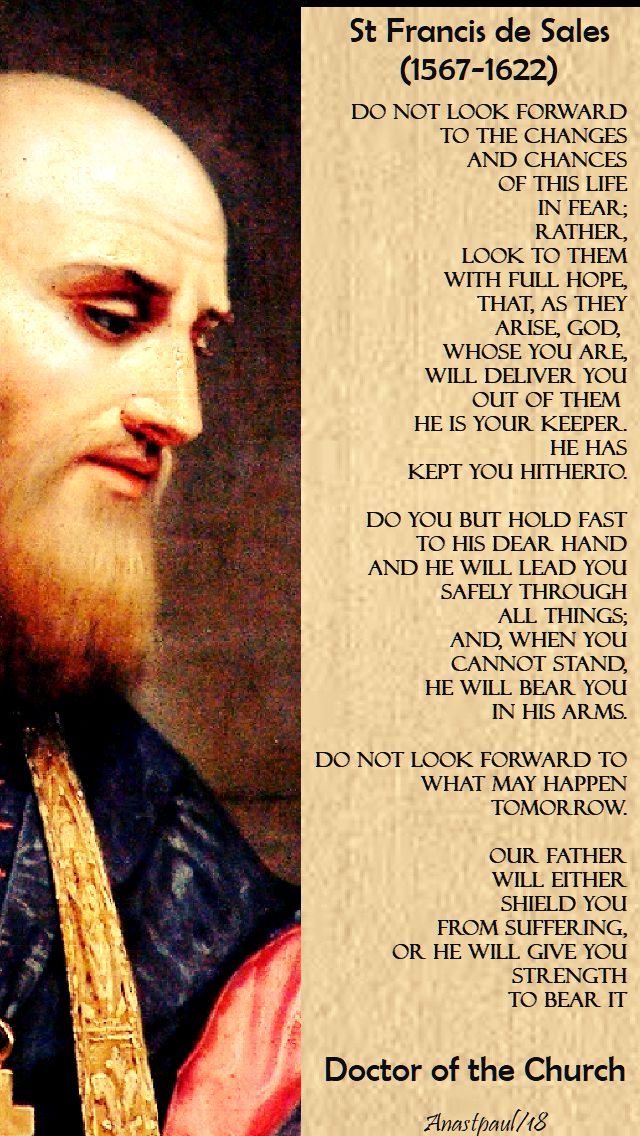
“Do not look forward to the changes and chances of this life in fear; rather look to them with full hope that, as they arise, God, whose you are, will deliver you out of them. He is your keeper. He has kept you hitherto. Do you but hold fast to His dear hand and He will lead you safely through all things; and, when you cannot stand, He will bear you in His arms. Do not look forward to what may happen tomorrow. Our Father will either shield you from suffering, or He will give you strength to bear it.”
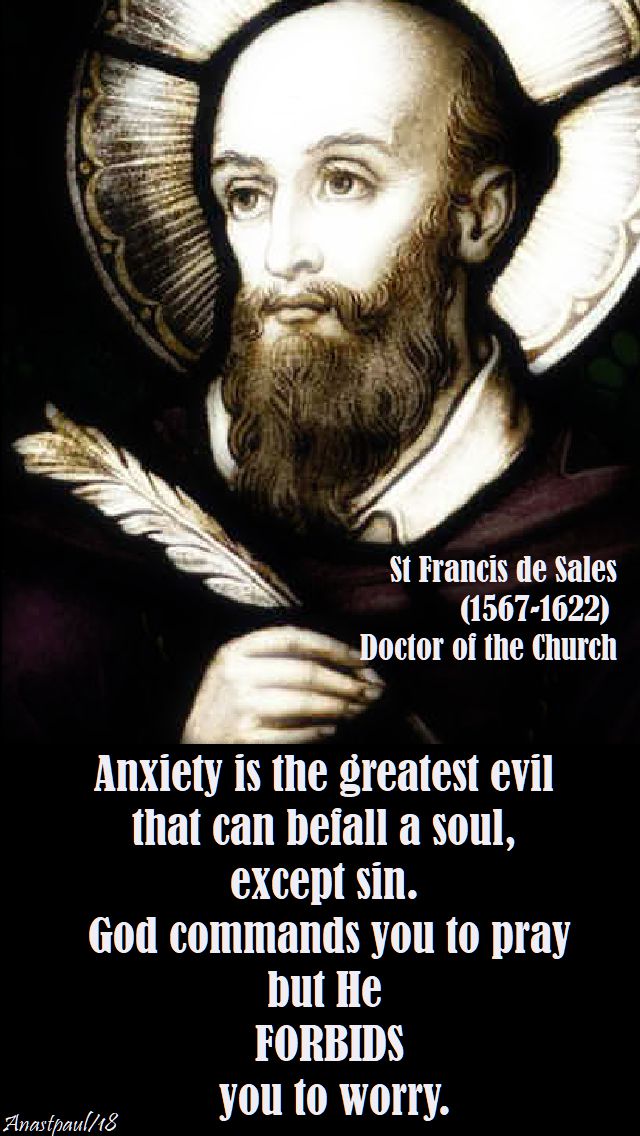
“Anxiety is the greatest evil that can befall a soul, except sin. God commands you to pray but He forbids you to worry.”
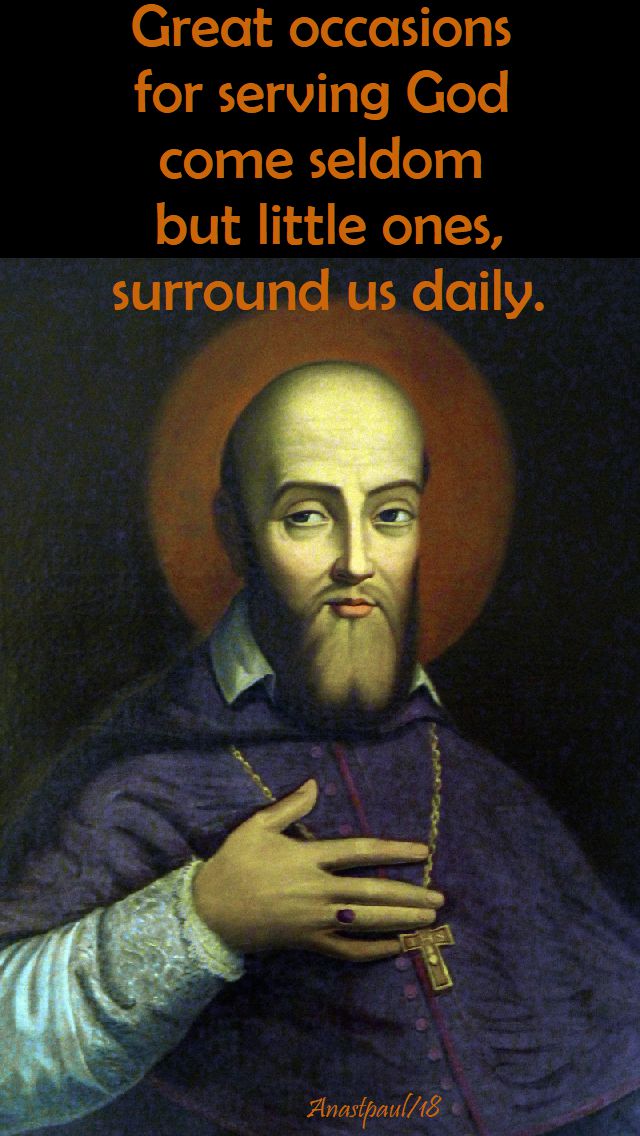
“Great occasions for serving God come seldom but little ones, surround us daily.”
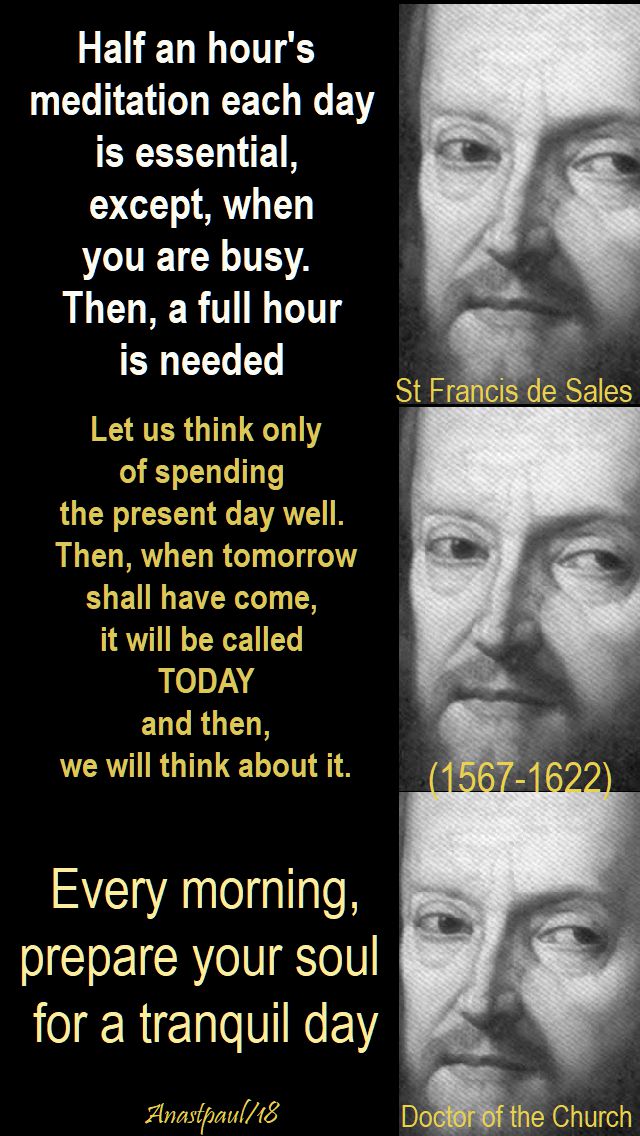
“Half an hour’s meditation each day is essential, except, when you are busy. Then a full hour is needed.”
“Let us think only of spending the present day well. Then, when tomorrow shall have come, it will be called TODAY and then, we will think about it.”
“Every morning, prepare your soul for a tranquil day.”
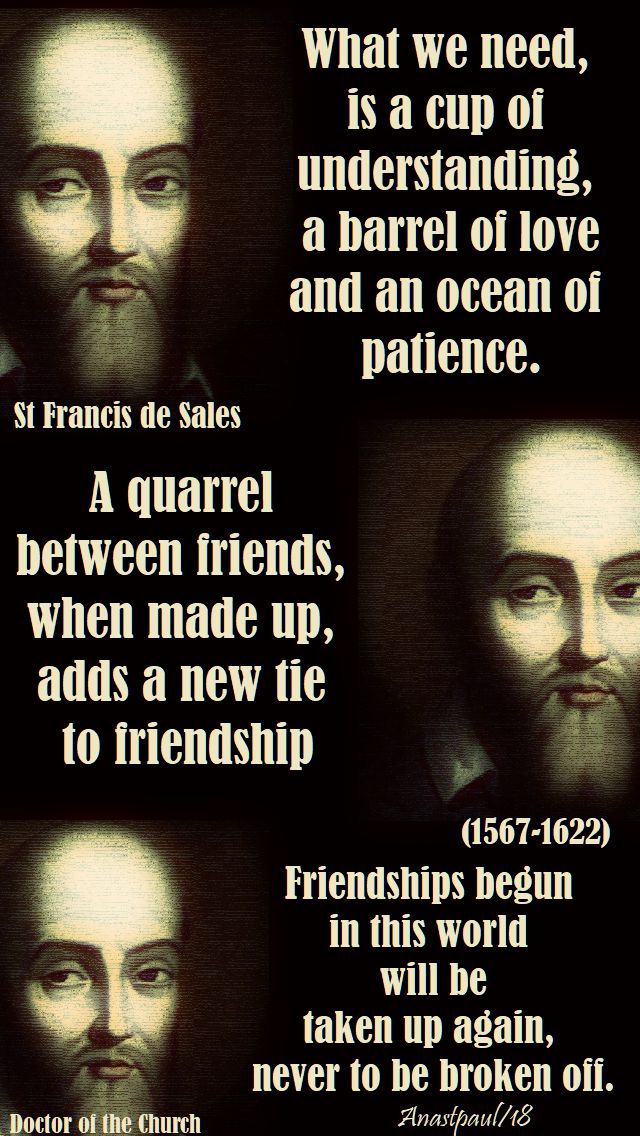
“What we need, is a cup of understanding, a barrel of love and an ocean of patience.”
“A quarrel between friends, when made up, adds a new tie to friendship.”
“Friendships begun in this world will be taken up again, never to be broken off. “
“Don’t get upset with your imperfections. It’s a great mistake because it leads nowhere – to get angry because you are angry, upset at being upset, depressed at being depressed, disappointed because you are disappointed. So don’t fool yourself. Simply surrender to the Power of God’s Love, which is always greater than our weakness.”
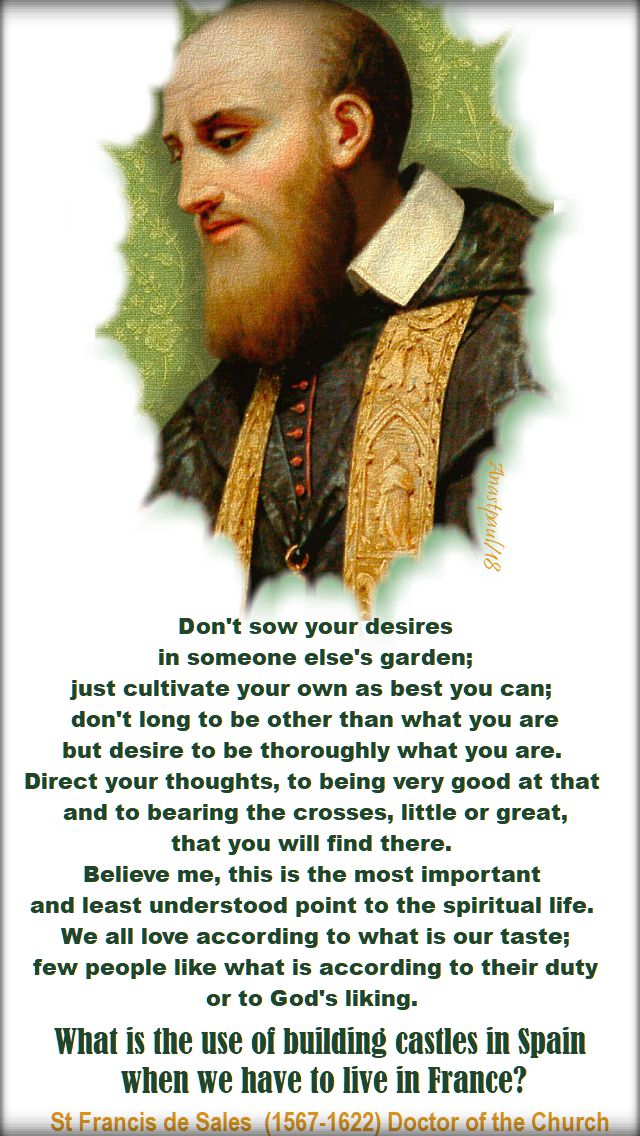
“Don’t sow your desires in someone else’s garden; just cultivate your own as best you can; don’t long to be other than what you are but desire to be thoroughly what you are. Direct your thoughts, to being very good at that and to bearing the crosses, little or great, that you will find there. Believe me, this is the most important and least understood point to the spiritual life. We all love according to what is our taste; few people like what is according to their duty or to God’s liking. What is the use of building castles in Spain when we have to live in France?”
St Francis de Sales (1567-1622) Doctor of the Church
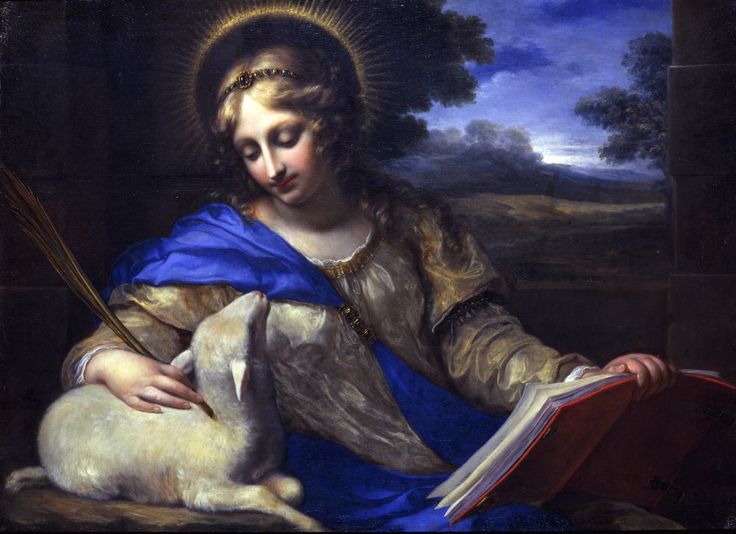
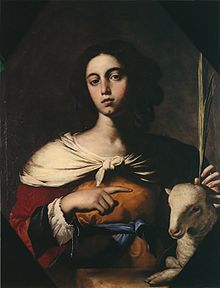
Saint of the Day – 21 January – St Agnes (c 291- c 304) Child Virgin Martyr – Patronages – Betrothed couples; chastity; Children of Mary; Colegio Capranica of Rome; crops; gardeners; Girl Guides; girls; rape victims; virgins; the Diocese of Rockville Centre, New York; the City of Fresno. She is one of seven women who, along with the Blessed Virgin, are commemorated by name in the Canon of the Mass. Agnes is depicted in art with a lamb, from the Latin word for “lamb”, agnus. However, the name “Agnes” is actually derived from the feminine Greek adjective hagnē meaning “chaste, pure, sacred”.
Saint Agnes of Rome was a member of the Roman nobility born in c 291 and raised in an holy Catholic family. She suffered Martyrdom at the age of twelve or thirteen during the reign of the Roman Emperor Diocletian, on 21 January 304. She was a beautiful young girl of wealthy family and, therefore, had many suitors of high rank. Legend holds that the young men, slighted by her resolute devotion to religious purity, submitted her name to the authorities as a follower of Christianity.
The Prefect Sempronius condemned Agnes to be dragged naked through the streets to a brothel. In one account, as she prayed, her hair grew and covered her body. It was also said that all of the men that attempted to rape her were immediately struck blind. The son of the prefect is struck dead but revived after she prayed for him, causing her release. There is then a trial from which Sempronius recuses himself and another figure presides, sentencing her to death. She was led out and bound to a stake but the bundle of wood would not burn, or the flames parted away from her, whereupon the officer in charge of the troops drew his sword and beheaded her, or, in some other texts, stabbed her in the throat. It is also said that her blood poured to the stadium floor where other Christians soaked it up with cloths.
Agnes was buried beside the Via Nomentana in Rome. A few days after her death, her foster-sister, Saint Emerentiana, was found praying by her tomb; she claimed to be the daughter of Agnes’ wet nurse, and was stoned to death after refusing to leave the place and reprimanding the pagans for killing her foster sister. Emerentiana was also later canonised. The daughter of Constantine I, Saint Constance, was said to have been cured of leprosy after praying at Agnes’ tomb. She and Emerentiana appear in the scenes from the life of Agnes on the 14th-century Royal Gold Cup in the British Museum.
An early account of Agnes’ death, stressing her young age, steadfastness and virginity, but not the legendary features of the tradition, is given by Saint Ambrose.
Agnes was venerated as a saint at least as early as the time of St Ambrose, based on an existing homily. She is commemorated in the Depositio Martyrum of Filocalus (354) and in the early Roman Sacramentaries.
Agnes’s bones are conserved beneath the high altar in the church of Sant’Agnese fuori le mura in Rome, built over the catacomb that housed her tomb. Her skull is preserved in a separate chapel in the church of Sant’Agnese in Agone in Rome’s Piazza Navona.
Because of the legend around her martyrdom, she is patron saint of those seeking chastity and purity. Agnes is also the patron saint of young girls. Folk custom called for them to practise rituals on Saint Agnes’ Eve (20–21 January) with a view to discovering their future husbands. This superstition has been immortalised in John Keats’s poem, The Eve of Saint Agnes.
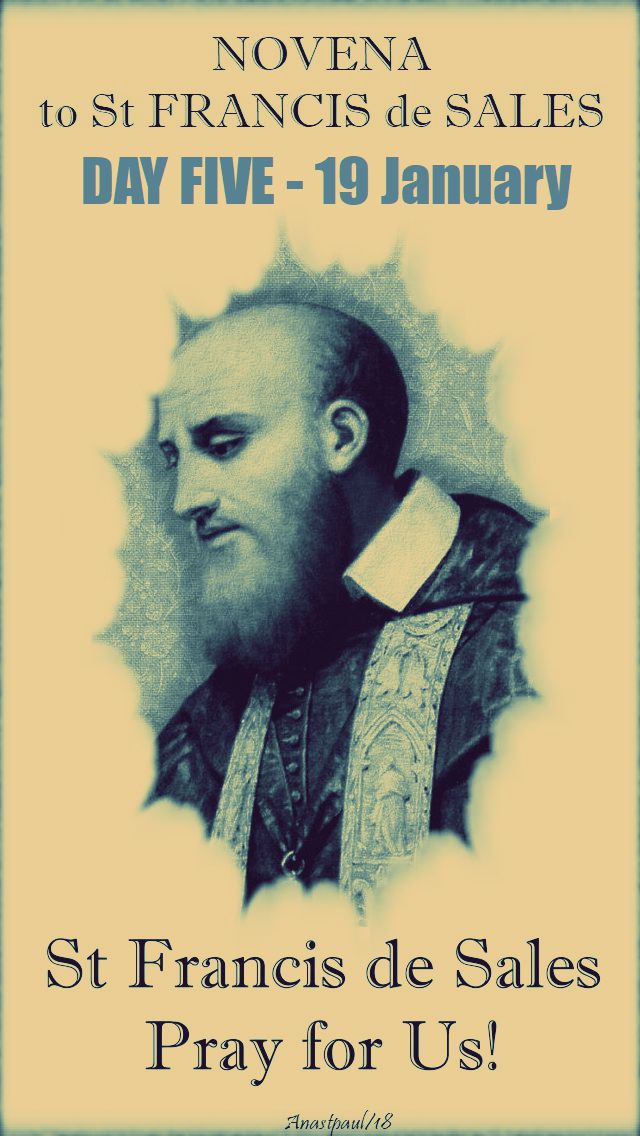
Novena to St Francis de Sales Day FIVE – 19 January
“This poor life is only a journey to the happy life to come. We must not be angry with one another on the way but rather we must march on as a band of brothers and sisters united in meekness, peace and love. I state absolutely and make no exception: do not be angry at all if that is possible. Do no accept any pretext whatever for opening your heart’s door to anger. Saint James tells us positively and without reservation,” … a man’s anger does not fulfil God’s justice.” [St Francis de Sales Jas 1:20] (INT. Part III, Ch. 8; O. III, p. 162)
O blessed Francis de Sales, who on earth did excel in a life of virtue,
especially in the love of God and neighbour,
I earnestly ask you to take me under your compassionate care and protection.
Obtain for me conversion of mind and heart.
Grant that all people, especially
…………………………..
(names of those whom you wish to include)
may experience the depth of God’s redeeming and healing love.
Teach me to fix my eyes on the things of heaven
even as I walk each day with my feet planted firmly on the earth.
Help me, through the practice of virtue and the pursuit of devotion,
to avoid anything that would otherwise
cause me to stumble in my attempt
to follow Christ and to be an instrument of the Holy Spirit.
Encouraged by your prayers and example,
help me to live fully my sacred dignity
with the hope of experiencing my sacred destiny:
eternal life with God.
Receive also this particular need or concern that I now lift up in prayer.
…………………………….
(mention your particular need).
O God, for the salvation of all,
You desired that St Francis de Sales—
preacher, missionary, confessor, bishop and founder—
should befriend many along the road to salvation.
Mercifully grant that we,
infused with the humility and gentleness of his charity,
guided by his wisdom and sharing in his spirit may experience eternal life.
O Eucharistic Heart of Jesus By Fr Vincent Martin Lucia
Eucharistic Heart of Jesus,
burning with love for me,
inflame my heart with love for You,
until, with You, I have one will,
that I may love the things You love
and do what You would do.
You have said:
“Anyone who does
the will of MY Father
is brother and sister
and mother to me.”
Centre my life in the depth
of Your love, Jesus,
that I may be free from
the seductions of the flesh
and the passing things of this world.
Set my heart on You alone,
so that I may find:
my joy in Your friendship,
my treasure in Your love,
my wealth in Your merits,
my riches in Your grace,
my happiness in my union with You
and my peace in the Father’s will.
Amen
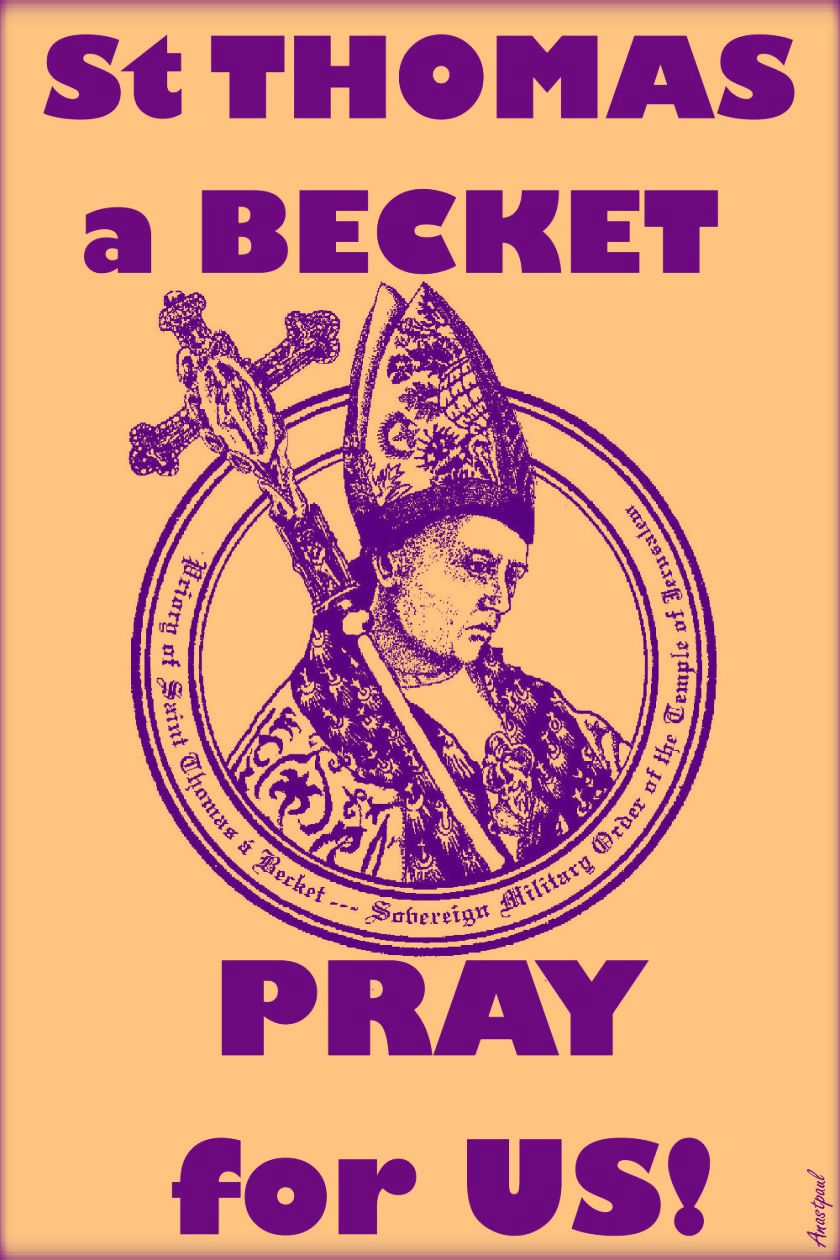
One Minute Reflection – 29 December – Fifth Day of the Octave and the Memorial of St Thomas a Becket
I have fought the good fight, I have finished the course, I have kept the faith. From now on a merited crown awaits me….2 Timothy 4:7
REFLECTION – “Remember then how our fathers worked out their salvation; remember the sufferings through which the Church has grown and the storms the ship of Peter has weathered because it has Christ on board. Remember how the crown was attained by those whose sufferings gave new radiance to their faith. The whole company of saints bears witness to the unfailing truth, that without real effort no-one wins the crown.”……….St Thomas a Becket (1118-1170)
PRAYER – Almighty God, you enable st Thomas a Becket to lay down his life with undaunted spirit for the rights of Your Church. May his prayer help us to deny ourselves for Christ in this life and so find our true life in heaven. Through our Lord Jesus Christ, in union with the Holy Spirit, one God forever and ever, amen.
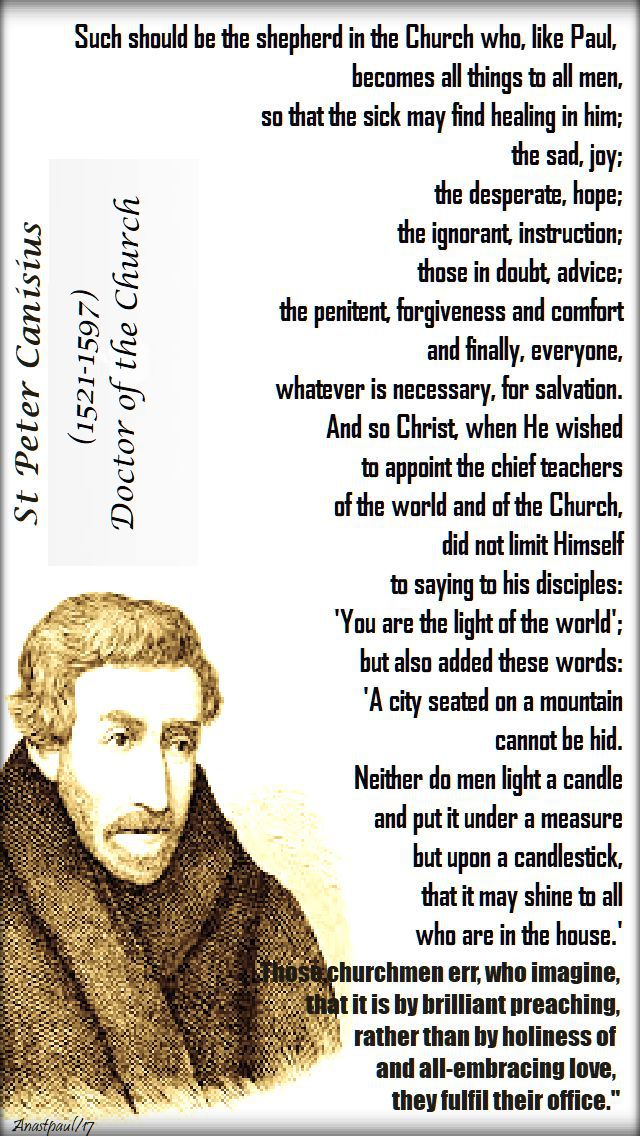
Quote/s of the Day – 21 December – The Memorial of St Peter Canisius (1521-1597) Doctor of the Church
“Such should be the shepherd
in the Church who, like Paul,
becomes all things to all men,
so that the sick may find healing in him;
the sad, joy;
the desperate, hope;
the ignorant, instruction;
those in doubt, advice;
the penitent, forgiveness and comfort
and finally, everyone,
whatever is necessary, for salvation.
And so Christ, when He wished
to appoint the chief teachers
of the world and of the Church,
did not limit Himself to saying to his disciples:
‘You are the light of the world’;
but also added these words:
‘A city seated on a mountain cannot be hid.
Neither do men light a candle
and put it under a measure but upon a candlestick,
that it may shine to all who are in the house.’
Those churchmen err, who imagine,
that it is by brilliant preaching,
rather than by holiness of and all-embracing love,
they fulfil their office.“
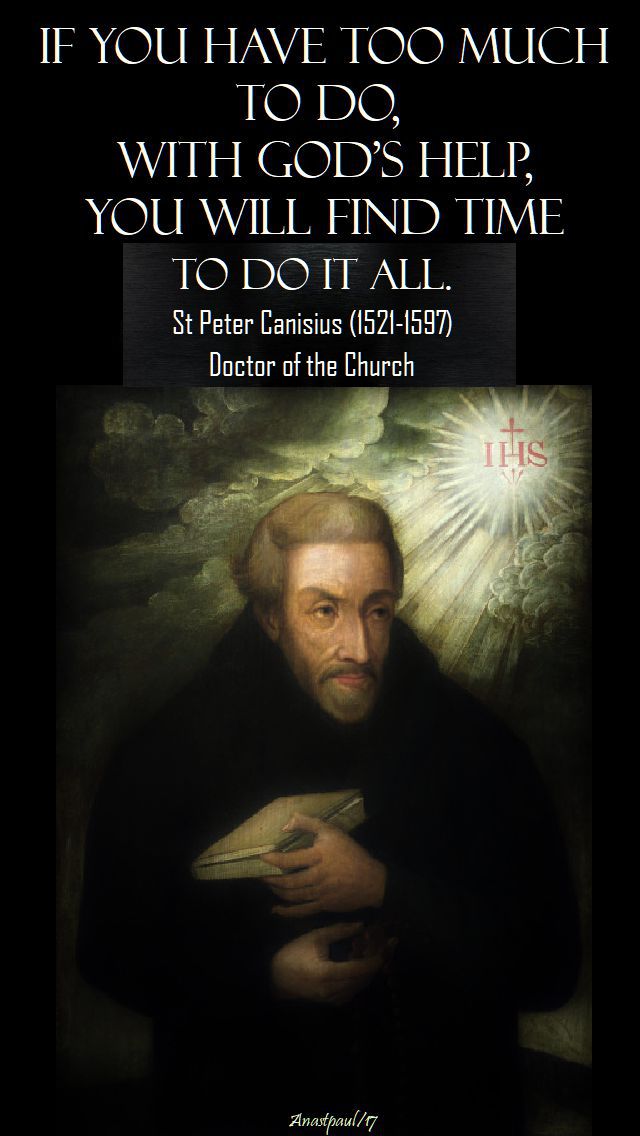
“If you have too much to do, with God’s help, you will find time to do it all.”
St Peter Canisius (1521-1597) Doctor of the Church
“Among the Jesuit saints, it is Peter Canisius that brought me into the Society of Jesus… as we go on, you will see, what influence St Peter has had on this sinner. “
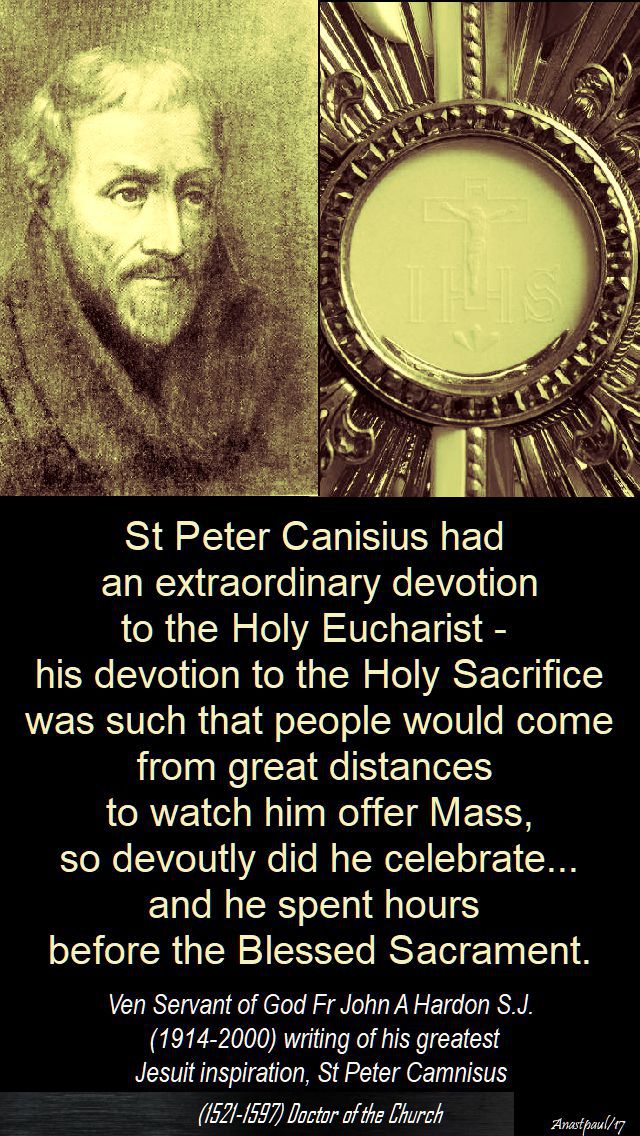
“(St Peter Canisius had) an extraordinary devotion to the Holy Eucharist – his devotion to the Holy Sacrifice were such that people would come from great distances to watch him offer Mass, so devoutly did he celebrate. He was one of the people that urged frequent Communion at the Council of Trent and was one of those who got the Council of Trent to pass a little known decree, little known because it took almost three hundred years for that decree to really come to life. The Council of Trent, mind you, sixteenth century, encouraged daily Communion – you would never guess it, would you? Peter Canisius was one of those who, under instructions from Ignatius, made sure that the Council passed that decree and he spent hours before the Blessed Sacrament.”
Ven Servant of God Fr John A Hardon S.J. (1914-2000)
One Minute Reflection – 16 December – Saturday of the Second Week of Advent
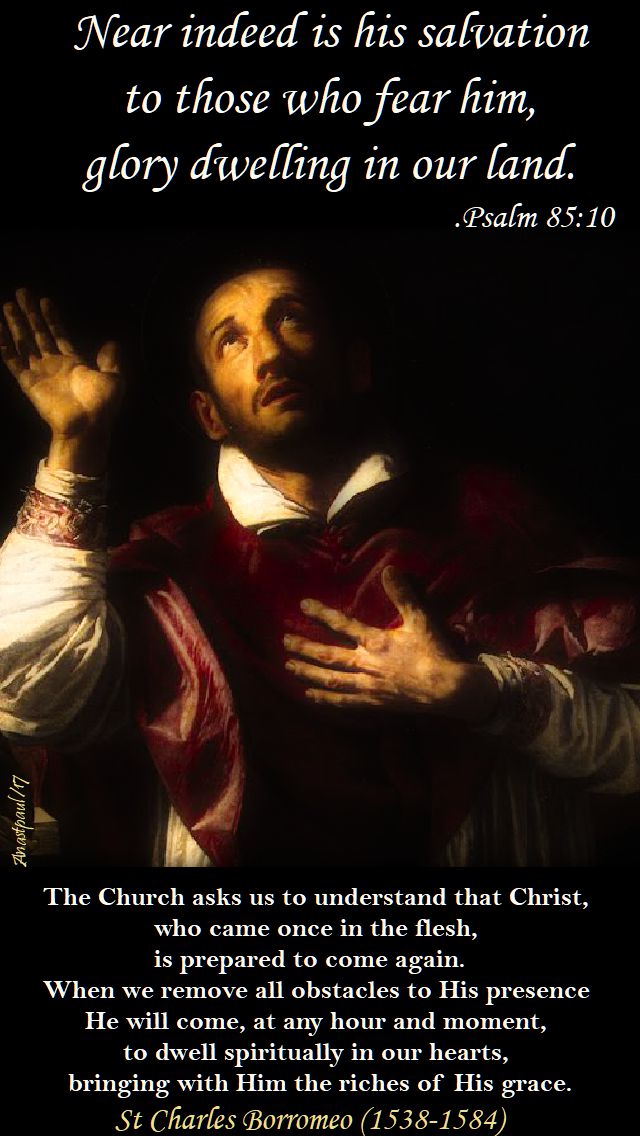
Near indeed is his salvation to those who fear him, glory dwelling in our land.…Psalm 85:10
REFLECTION – “The Church asks us to understand that Christ, who came once in the flesh, is prepared to come again. When we remove all obstacles to His presence He will come, at any hour and moment, to dwell spiritually in our hearts, bringing with Him the riches of His grace.”….St Charles Borromeo (1538-1584) (from a Pastoral letter to his Diocese),
PRAYER – Almighty God, let the splendour of Your glory dawn in our hearts. May the coming of Your only Son dispel all darkness and reveal that we are children of light. Through Jesus Christ our Lord, in union with the Holy Spirit, one God forever and ever, amen.
St Abercius
St Anastasius
St Aper of Sens
St Bartholomew Fanti of Mantua
St Basilissa of Øhren
St Bassus of Lucera
St Bassus of Nice
St Cawrdaf of Fferreg
St Christina of Markyate
St Consolata of Genoa
St Crispina
St Cyrinus of Salerno
St Dalmatius of Pavia
St Firminus of Verdun
St Gerald of Braga
St Gerbold
St Gratus
St Joaquín Jovaní Marín
St John Almond
Bl Giovanni/John Gradenigo
St Justinian
St Martiniano of Pecco
Bl Narcyz Putz
St Nicetius of Trier
Bl Niels Stenson
St Pelinus of Confinium
Bl Philip Rinaldi
St Sabbas of Mar Saba
St Vicente Jovaní Ávila
—
Martyrs of Thagura – (12 saints): A group of twelve African Christians who were martyred together in the persecutions of Diocletian. The only details about them that have survived are five of their names – Crispin, Felix, Gratus, Juliua and Potamia.
302 in Thagura, Numidia
Martyred in the Spanish Civil War:
• Blessed Joaquín Jovaní Marín
• Blessed Vicente Jovaní Ávila
Father, Teach us to love A Traditional Catholic Pray
Father, You love with an everlasting love
because You are love itself
Your love sustains the sun
and the other stars.
You are the loving life of all that is.
In love You call us into being,
You sustain us in our freedom,
even when we exercise that freedom
to turn our backs on You.
Teach us to love as You love,
to love without limit or reserve.
Teach us to love with love
that sets the loved one free.
To love with love
that seeks to give, not to take.
Teach us to love
not only those who love us
but also those who hate or are
indifferent to us.
Teach us to be patient
when our love is not returned
and teach us to love and trust You
even when we feel Your absence
and fear You are not there.
Amen
St Catherine of Alexandria (Optional Memorial): Apocryphal. Born to the nobility. Learned in science and oratory. Converted to Christianity after receiving a vision. When she was 18 years old, during the persecution of Maximinus, she offered to debate the pagan philosophers. Many were converted by her arguments, and immediately martyred. Maximinus had her scourged and imprisoned The empress and the leader of the army of Maximinus were amazed by the stories, went to see Catherine in prison. They converted and were martyred. Maximinus ordered her broken on the wheel but she touched it and the wheel was destroyed. She was beheaded and her body whisked away by angels.
Immensely popular during the Middle Ages, there were many chapels and churches devoted to her throughout western Europe and she was reported as one of the divine advisers to Saint Joan of Arc. Her reputation for learning and wisdom led to her patronage of libaries, librarians, teachers, archivists and anyone associated with wisdom or teaching. Her debating skill and persuasive language has led to her patronage of lawyers. And her torture on the wheel led to those who work with them asking for her intercession. She is one of the Fourteen Holy Helpers.
While there may well have been a noble, educated, virginal lady who swayed pagans with her rhetoric during the persecutions, the accretion of legend, romance and poetry has long since buried the real Catherine. She was beheaded c 305 in Alexandria, Egypt. Patronages:
• apologists
• craftsmen who work with a wheel
• archivists
• attornies, barristers, lawyers, jurists
• dying people
• educators, teachers
• girls
• knife grinders, knife sharpeners
• librarians
• libraries
• maidens, unmarried girls and women
• mechanics
• millers
• nurses
• old maids
• philosophers
• potters
• preachers
• scholars
• schoolchildren, students
• scribes
• secretaries
• spinners
• stenographers
• tanners
• theologians
• turners
• University of Heidelberg
• University of Paris
• wheelwrights
• Dumaguete, Philippines, diocese of
• Saint Catharines, Ontario, diocese of
• 12 cities Attributes: • spiked wheel • woman strapped to the spiked wheel on which she was martyred • woman arguing with pagan philosophers.
—
Bl Adalbert of Caramaico
St Alanus of Lavaur
St Audentius of Milan
St Bernold of Ottobeuren
Bl Conrad of Heisterbach
Bl Ekbert of Muensterschwarzach
Bl Elisabeth Achler
St Erasmus of Antioch
Bl Garcia of Arlanza
Bl Guido of Casauria
St Imma of Wurzburg
Bl Jacinto Serrano López
St Jucunda of Reggio Aemilia
Bl Maria Corsini Beltrame Quattrocchi
St Mercurius of Caesarea
St Moses of Rome
St Peter of Alexandria
Bl Santiago Meseguer Burillo
—
Martyrs of Africa – (13 saints): A group of 13 Christians murdered together for their faith in Africa, date unknown. The only details to have survived are their names – Claudian, Cyprian, Donatus, Felix, Januarius, Julian, Lucian, Marcian, Martialis, Peter, Quirianus, Victor and Vitalis.
Thought for the Day – 13 November – The Memorial of St Stanislaus Kostka SJ (1550-1568)
Although the life of St. Stanislaus was short in years, it contains a simple roadmap for us all.
The Three things all saints possess and these things will make us saints too – great devotion to the Blessed Sacrament, our Holy Mother and Prayer. Follow him in these points. Assist daily, if you can, at Holy Mass, attend Our Lord in the Tabernacle or at Eucharistic Adoration, as often as possible, even for just a few minutes and always prepare yourself carefully for holy Communion; honour the divine Mother and invoke her with filial trust. To ask her blessing, morning and night, after the example of St Stanislaus, is easily done and is, moreover, a sign of love and confidence.
And finally, especially during this month of the holy souls, remember to contemplate your own death each day and do not delay your penance until you are lying on your sick-bed. While you are in the possession of health, examine your conscience, in order to ascertain if there is nothing which might trouble you on your death-bed. Should you find anything, remove it without delay. “For it is difficult, it is very difficult,” says Hugo of St. Victor, “to do true penance at that time and to awaken, in a troubled conscience, earnest repentance.” Perhaps, at that moment, one does not even think of it, or knows, not what to do in the anxiety of his mind. “At the time of sickness, you can hardly think of anything but what you feel,” says St Jerome; and St Augustine writes: “It is in accordance with Divine Justice that he who forgets God during his life, forgets himself in the hour of death.”“Therefore, whoever wishes to die quietly and peacefully, let him do penance while he enjoys health,” says S. Bernard. While you are in the possession of health, you would daily employ a few minutes to examine your conscience, in order to ascertain if there is nothing which might trouble you on your death-bed. Should you find anything, remove it without delay!
A practice of worth for us all, is to beg St Stanislaus to be our patrons of a holy and peaceful death. Therefore, we pray:
Saint Stanislaus, patron most tender and most powerful, angel of purity and of love, I rejoice with you in your happy death, a death rejoiced in, by your longing to see Jesus and Mary. who was taken up bodily into heaven and consummated by a mighty impulse of love toward her. I give thanks unto Mary, who was pleased to hear and answer your prayers and I implore you, by the glory of your happy death, to be the advocate and patron of my death. Intercede with Mary our Mother for me that my death, if not so happy as yours, may at least be peaceful under the protection of Mary, my Advocate and of you my special patron of my inevitable.
Our Father, Hail Mary, Glory be.
Pray for us, O holy Stanislaus,
That we may be made worthy of the promises of Christ.
Let us pray:
O God, who amongst the other wonderful works of Your wisdom, has bestowed the grace of holiness on them of tender years: grant, we beseech You, that we, following in the footsteps of blessed St Stanislaus and redeeming the time by unremitting labour, may hasten without fear, to enter into our eternal rest. Through Christ our Lord, St Stanislaus, pray for us now and at the hour of our death, amen.
Thought for the Day – 11 November – The Memorial of St Martin of Tours (c 316-397)
Today, November 11, we celebrate the feast day of Saint Martin of Tours (also known as “Martin the Merciful” and the “Glory of Gaul,”), bishop, teacher, apostle of charity. Saint Martin saw himself as a member of the “Army of God,” not the army of man. Zealous in his love for the Lord, he served (sometimes reluctantly, but ever obediently) those in need and those who sought him out, for his eight-one years on the earth. Remembered for his great charity, Saint Martin inspires us still today to help those in need, as Christ would have helped them.
Martin’s worry about cooperation with evil reminds us that almost nothing is either all black or all white. The saints are not creatures of another world. They face the same perplexing decisions that we do. Any decision of conscience always involves some risk. If we choose to go north, we may never know what would have happened had we gone east, west, or south. A hyper-cautious withdrawal from all perplexing situations is not the virtue of prudence; it is in fact, a bad decision, for “not to decide is to decide.”
“The future is in your hearts
and in your hands.
God is entrusting to you the task,
at once difficult and uplifting,
of working with Him in the building
of the civilisation of love.”
















 AnaStpaul
You must be logged in to post a comment.