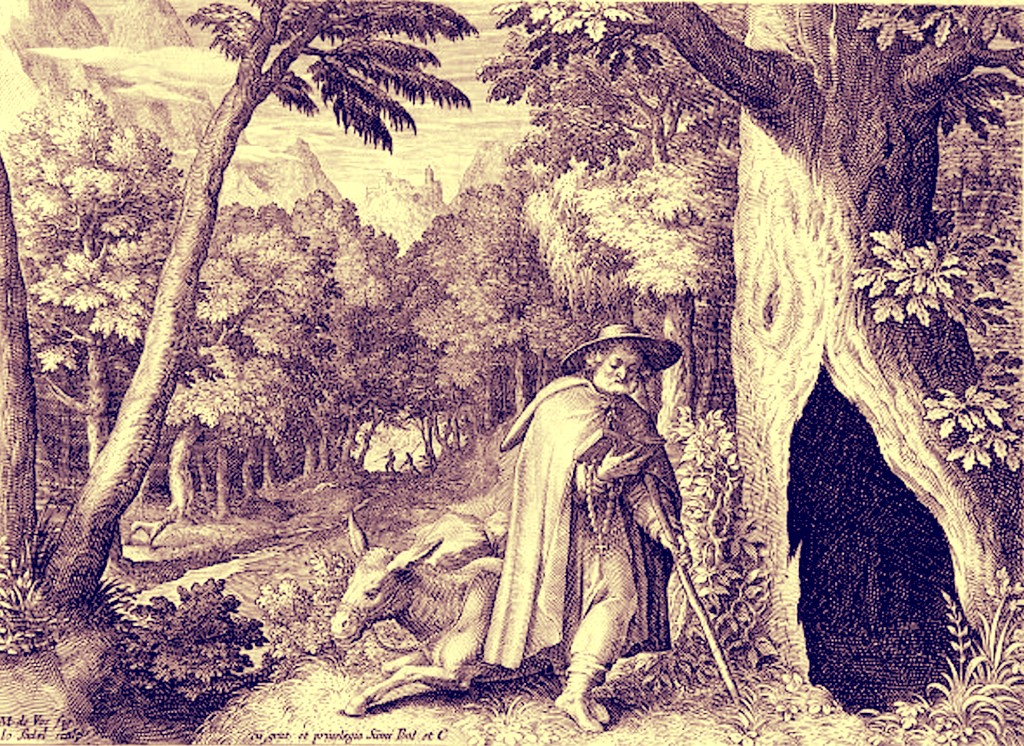
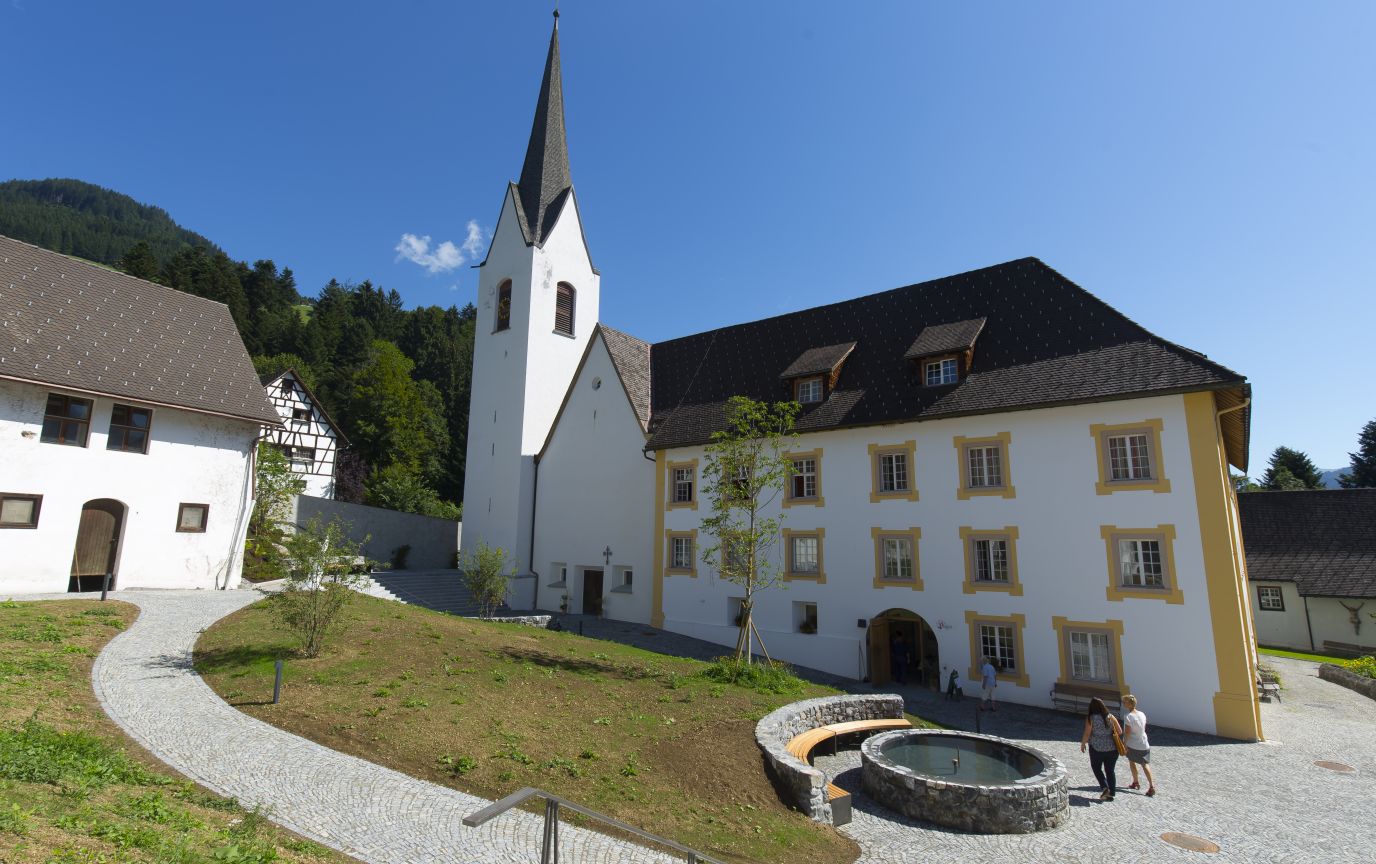
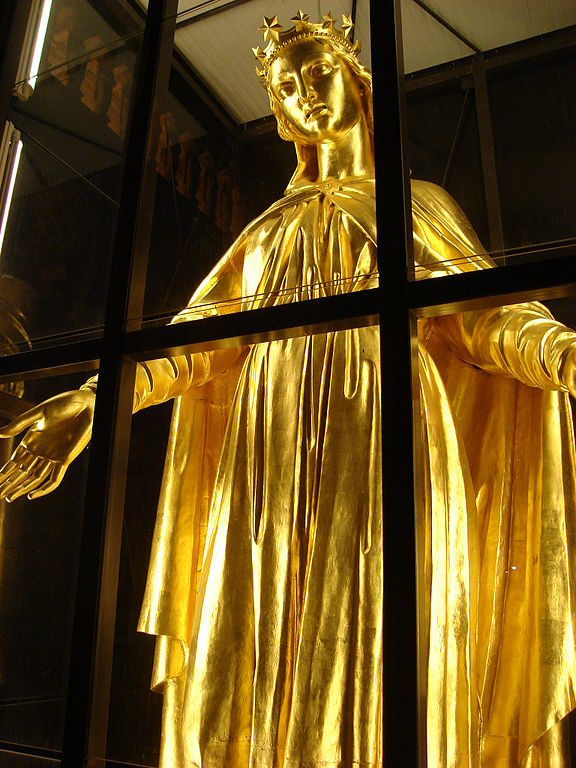
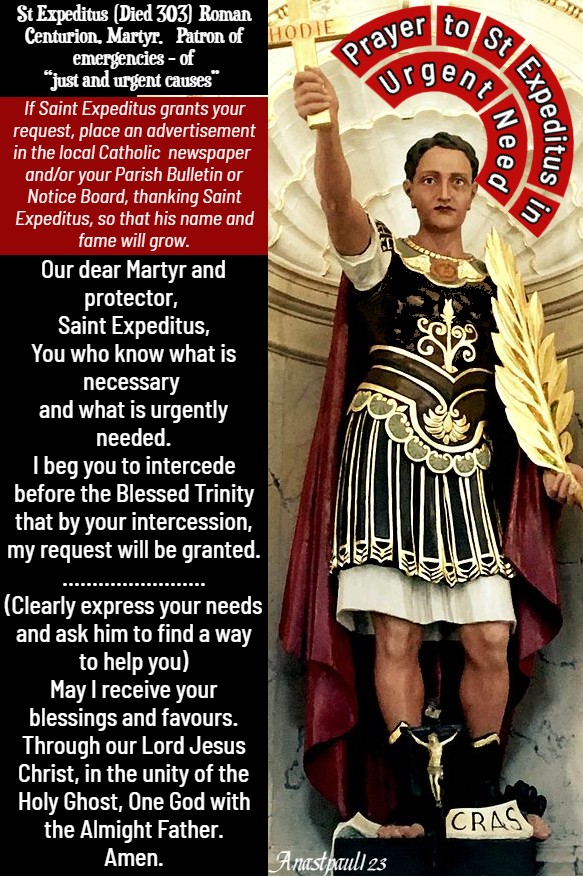
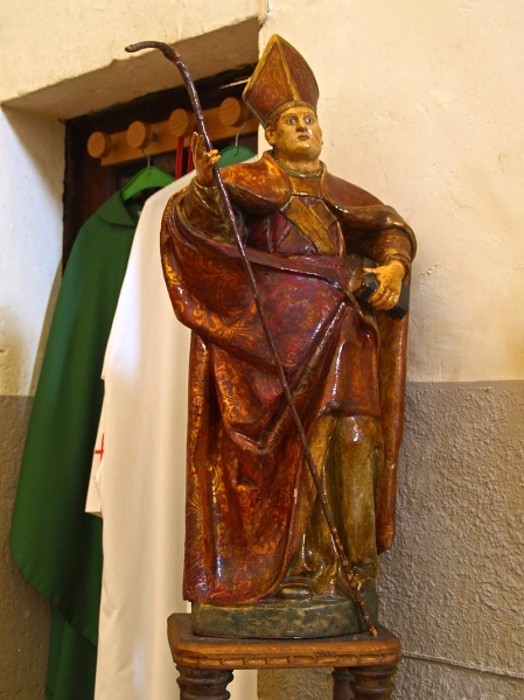
Quote/s of the Day – 19 October – St Peter of Alcantara OFM (1499-1562) Confessor
“The soul enjoys silence and peace, not by many reasonings but, by simply contemplating the Truth.”
“The trouble, is that everyone talks about reforming others and no-one thinks about reforming himself.”
“In prayer, the soul cleanses itself from sin, charity is nourished, faith is strengthened, hope made secure; the spirit rejoices, the soul grows tender and the heart is purified, truth discovers itself, temptation is overcome, sadness takes to flight, the senses are renewed, failing virtue is made strong, tepidity disappears, the rust of sin is rubbed away. In it are brought forth, lively flashes of heavenly desires and in these fires, burns the flame of Divine love. Great are the excellences of prayer, great its privileges. The heavens open before it and unveil therein, their secrets and to it, are theears of God ever attentive.”
One Minute Reflection – 19 October – “The Month of the Most Holy Rosary and of the Angels” St Peter of Alcantara OFM (1499-1562) Confessor – Philippians 3:7-12, Luke 12:32-34 – Scripture search here: https://www.drbo.org/
“I press on, hoping that I may lay hold of that, for which Christ Jesus, has laid hold of me.” – Philippians 3:12
REFLECTION – “Our beloved Saviour assures us, in many places, of His Holy Scriptures that He is constantly caring for and keeping watch over us that He carries and, will Himself, always carry us in His breast, His Heart, His inner being. Nor is He content to say just once, or twice, that He will carry us in this way but, He asserts and reasserts it, as many as five times, in the same place.
Furthermore, He assures us that even if a mother were to be found, who would go as far, as to forget the child she had borne in her womb, yet, He will never forget us that He has written us on His hands, so as to have us always under His eyes; that whoever touches us, touches the apple of His eye; that we should never be anxious, about what we need to live and to clothe ourselves, that He knows well, we need these things and takes care of them for us; that He has numbered the hairs on our head and not one of them will perish that His Father loves us as He loves Him and that, He loves us as His Father loves Him that He wills that we should be where He is that is to say, that we should be at rest with Him, in the breast and Heart of His Father.” – St John Eudes (1601-1680) Priest, Founder, Apostle of the Two Holy Hearts (The Kingdom of Jesus II:30).
PRAYER – O God, Who graciously made blessed Peter, Thy Confessor, glorious by the gift of remarkable penance and sublime contemplation, grant, we beseech Thee, that, by the merit of his prayers, we may the more easily understand the things of Heaven by curbing our passions. Through Jesus Christ, Thy Son our Lord, Who lives and reigns with Thee, in the unity of the Holy Ghost, God, world without end. Amen (Collect).
Our Morning Offering – 19 October – “The Month of the Most Holy Rosary and of the Angels” – St Peter of Alcantara OFM (1499-1562) Confessor
Hear Me, O Lord By St Peter of Alcantara (1499-1562)
Hear me, O Lord, my soul’s delight, joy of my heart, not because of my merits but because of Thy boundless goodness. Teach me, enlighten me, direct me, help me in all things that I may never say or do anything but that which I know to be pleasing in Thou sight. Guide me, O God, my Love, my Light and my Life! Amen.
Saint of the Day – 19 October – Saint Varus and Six Companions (Died c307) Martyrs, Soldier. Died in c307 by being tortured and then hanged from a tree on 19 October 307 in Kemet, Upper Egypt. Also known as – Uaros.
The Roman Martyrology reads: “In Egypt, St Varus, Solder under the Emperor Maximinus. He used to visit and comfort seven saintly Monks, detained in prison, when one of them happening to die, he wished to take his place and having suffered cruel afflictions, with them, he obtained the Palm of Martyrdom.”
At the time of Emperor Maximian Valerius (c250-c310), the soldier Varus took an interest in the fate of six Hermit Monkss in Egypt, who had been imprisoned due to the ongoing persecution of Christians.
It seems that initially, there were seven Hermits but one of them died upon arrest, or according to other sources, he died during harsh imprisonment. It is known, however, that Varus, who went to comfort them, declared himself a Christian and expressed the desire to replace the seventh deceased hermit. For this reason, he was immediately condemned to be flagellated and then torn to pieces with hooks, it was around 307.
The next day, it was the turn of the six Hermits, whose names are unknown. After having refused to make sacrifices to the gods, they were subjected to various torments, in particular, to a long and bloody flagellation which caused their death. Another source says that after the flagellation, they were led outside the City to be beheaded.
The cult of Saint Varus and the six Hermits remained unknown in the West and their names were absent in the various medieval Martyrologies. However, they were inserted on 19 October in the Roman Martyrology, compiled in the 16th Century.
The body of the Soldier Varus, was collected by a pious woman named Cleopatra, also a Saint, who buried him in a safe place at her home. Once the persecution passed, she left for her home country of Palestine, secretly taking the Relics of the Martyr with her, for which she had a Church built at Mount Thabor. In that same place, Cleopatra had her son, buried, who had died shortly after arriving in Palestine and arranged to be buried there herself.
St Altinus St Aquilinus of Evreux St Asterius of Ostia St Beronicus of Antioch St Desiderius of Longoret St Ednoth St Ethbin St Eusterius of Salerno St Frideswide St Laura of Cordoba St Lucius of Rome St Lupus of Soissons St Pelagia of Antioch
Thought for the Day – 18 October – Meditations with Antonio Cardinal Bacci (1881-1971)
“Month of the Holy Rosary” The Fifth Glorious Mystery The Crowning of the Blessed Virgin Mary as Queen of Heaven and Earth
“Mary is also styled, ‘Queen of the Patriarchs‘ because, it was through her, that they came to possess the object of their desires, the divine Redeemer, Who released them from Limbo and brought them to Heaven. She is ‘Queen of the Prophets‘ because, their prophecies were realised through her. She is ‘Queen of the Apostles‘ whom she assisted and encouraged after the departure of her divine Son. She is the ‘Queen of Martyrs‘ because, her maternal heart was pierced by a sword of sorrow. She is ‘Queen of the Confessors‘ because, nobody else was capable of so deep and lively a profession of the Faith. She is ‘Queen of Virgins‘ because, her virginal purity was crowned by the supreme dignity of Mother of God. She is ‘Queen, moreover, of all the Saints‘, for no other human creature could ever surpass, or even dream of the summit of holiness, to which she attained. Above all, however, she is our Mother and our most powerful Queen. She loves us because, we have been redeemed by the Blood of her Son, Jesus Christ and she desires to obtain God’s favours for us and to take us under her maternal protection.
We, the children of Eve, in exile in the vale of tears, should turn to Mary with confidence and trust in her power to save us.”
Quote/s of the Day – 18 October – The Feast of St Luke, the Evangelist – 2 Corinthians 8:16-24, Luke 10:1-9 – Scripture search here: https://www.drbo.org/
“St Luke, the historian of the meekness of Christ.”
Dante Alighieri (c1265-1321)
“When, after abandoning the darkness of error to bind himself to God’s love, Paul was joined to the number of the disciples, Luke went with him everywhere and became his travelling companion … ” (Acts 16:10)
“It was this Evangelist who related the mystery of Gabriel, the messenger sent to the Virgin to announce joy to the whole world. It was he, who told in full, the birth of Christ, showing us the newborn child lying in a manger and describing shepherds and Angels shouting for joy.”
“The harvest indeed is great but the labourers are few. Pray ye, therefore, the Lord of the harvest that He send labourers into His harvest.” Luke 10:2
“But in Luke, grace does not stop there. His speech is not limited to serving the Gospel alone. At the end of Christ’s miracles he also relates the Acts of the Apostles. … Luke was not just a spectator of all those things but really participated in them. And that is why he put so much care into teaching us about them.”
Anonymous Byzantine – Life of Saint Luke 11th Century
One Minute Reflection – 18 October – “The Month of the Most Holy Rosary and of the Angels” – The Feast of St Luke, the Evangelist – 2 Corinthians 8:16-24, Luke 10:1-9 – Scripture search here: https://www.drbo.org/
“The harvest indeed is great but the labourers are few.” – Luke 10:2
REFLECTION – “All the farmer’s work naturally leads towards the harvest. So how could Christ call a ‘harvest’ a work that was still in its initial stages? Idolatry reigned over all the earth .… Everywhere there was fornication, adultery, debauchery, greed, theft, wars . … The earth was filled with so many evils! No seed had yet been sown there. The thorns, thistles and weeds which covered the ground, had not yet been pulled up. The ground had not yet been ploughed, no furrow had yet been drawn.
So how could Jesus say, that the harvest was abundant? … The Apostles were probably distressed and frustrated: “How are we going to be able to say anything, to stand upright before so many people? How can we, the Eleven, correct all the inhabitants of the earth? Shall we, who are so ignorant, be able to approach scholars; shall we, who are so stripped of everything, be able to meet armed men; shall we, who are subordinates, be able to approach people in authority? We know only one language – shall we be able to argue with the barbarians, who speak foreign languages? Who will bear with us, if they do not even understand our language?”
Jesus did not want such reasoning to discourage them. So He called the Gospel a ‘harvest.‘ It is as if, He told them: “Everything is prepared, all the preparations have been made. I am sending you out to harvest the ripe grain. You shall be able to sow and reap, on the same day!” When the farmer leaves his home to go out and gather the harvest, he is brimming over with joy and shining with happiness. He thinks neither of the suffering, nor the difficulties he might encounter . … Christ says, lend Me your tongue and you shall see the ripe grain going into the King’s granaries. And so, He then sends them out, telling them: “I am with you always, until the end of the world.” (Mt 28:20).” – St John Chrysostom (347-407) Father and Doctor of the Church (Homily on the abundant harvest, 10, 2-3)
PRAYER – O Lord, we beseech Thee, that Luke, Thy holy Evangelist, who for the honour of Thy Name bore continuously in his body the suffering of the Cross, may intercede on our behalf. Through the same Jesus Christ, Thy Son our Lord, Who lives and reigns with Thee, in the unity of the Holy Ghost, God, world without end. Amen (Collect).
Our Morning Offering – 18 October – The Feast of St Luke, the Evangelist
Holy and Learned, Great Saint Luke Prayer/Hymn in Honour of St Luke “Plausibus Luca canimus” Trans the Benedictines of Saint Cecilia’s Abbey, Ryde, UK
Holy and learned, great Saint Luke, we praise you, Closely you followed in the steps of Jesus, As supreme witness to His life and teaching Shedding your life-blood.
Under the guidance of the Holy Spirit, You left in writing, for all time to study Stories unrivalled for their depth and beauty, Christ’s love revealing.
Yours are the records which we read with pleasure Of the beginning of the Church so fervent, Under the impulse of the true and living Spirit of Jesus.
Paul’s earnest helper, sharer in his travels, Zealous as he was, with a heart as loving, Make our souls also steadfast and devoted To the Lord Jesus.
Tender physician, use your gift of healing, Comfort our weakness with a faith unswerving, So that rejoicing, we may praise forever God the Almighty. Amen
Saint of the Day – 18 October – Saint Gwen of Talgarth (463-c492) Widow, mother, founder of a Church in Talgarth. Born in 463 and died in c492 murdered by pagan Saxons at Talgarth, Wales. Also known as – Wenna (Cornish), Gwen of Tagarth, Gwen of Teirbron, Wite, Blanche, Candida, Genuissa, Wenna, Wenn. The name ‘Gwen’ means ‘white, pure, holy’ hence the derivatives of her name most meaning ‘white.’ (The name stands alone, i.e. it is not necessarily a short form of Gwendolyne and other versions of this name.) Her story, however. is greatly confused with another Saint of the same name.
Gwen is said to have been one of the many daughters of the famous, semi-legendary Saint King Brychan of Brycheiniog (Brecknock) (5th Century), King of the Christian Kingdom of Brecknock in south Wales. She was thus the sister of Saint Cledwyn (Clydwyn) and a number of other Saints. She is on both the older and later lists of Brychan’s children.
In the Life of St Brychan, she is unmarried but other sources list her as the wife of Llyr Merini and mother of Caradog Freichfras. She founded the Church at Talgarth in Brecknockshire. She is said to have been the Queen of Elmet, a Kingdom centered in Loidis, nortbern England (Leeds) and was a widow when, according to the various recprds, she was “killed by the heathen Saxons” around the year 492 in Talgarth. She was buried at Talgarth. Her memorial day is 18 October.
Another Saint of the same name who also lived at the same time is celebrated on the same day, namely Saint Gwen of Cornwall, who was the sister of Saint Non of Wales and thus the aunt of Saint David , the Patron Saint of Wales. She was married to Saint Selyf, King of Cornwall and it is claimed that she was the mother of Saint Cybi of Holyhead and, according to one version, also Saint Cadfan. Clodfaith, an alleged daughter of Brychan, is also said to have been a Saint in Talgarth as well as in Emlyn. Browne Willis and others have a Gwendeline in Talgarth but the real dedication is to our St Gwen.
The medieval St Gwendoline’s Church, Talgarth, is said to occupy the site where St Gwen was buried.
St Asclepiades of Antioch St Athenodorus (Died c269) Bishop Martyr the brother of St Gregory Thaumaturgus. St Brothen Bl Burchard I St Cadwaladr of Brittany Bl Domenico of Perpignano St Eutychius of Pozzuoli St Gwen St Gwen of Talgarth (463-c492) Widow St Gwendoline
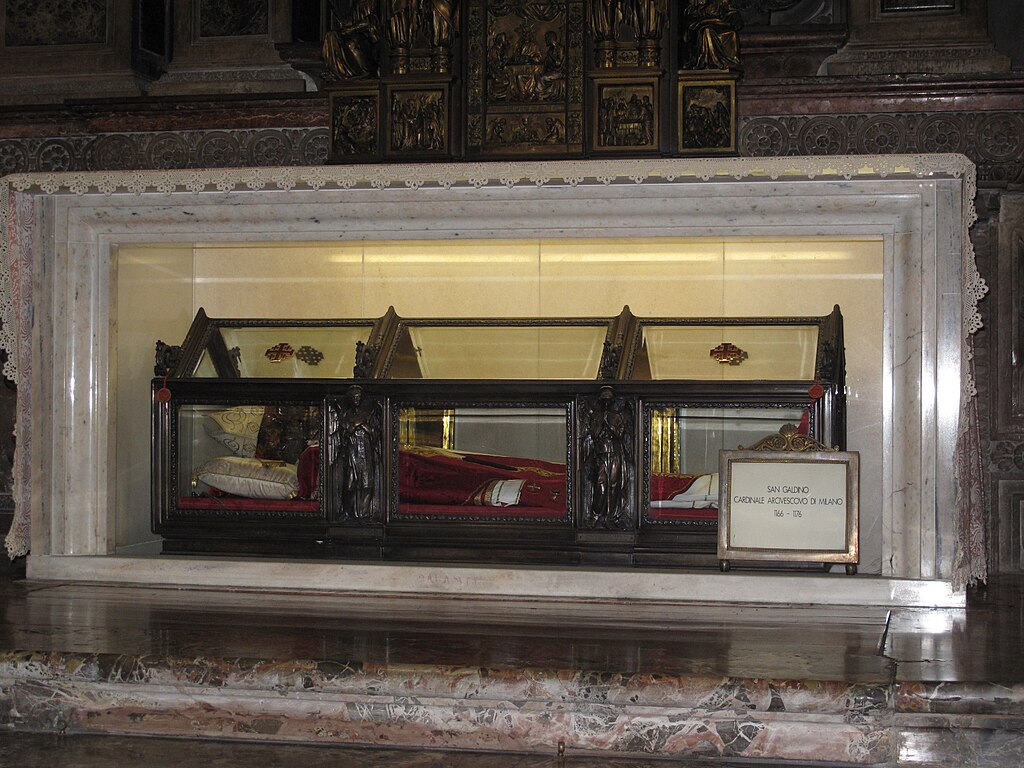
Bl Margherita Tornielli St Monon of Nassogne St Proculus of Pozzuoli Bl Theobald of Narbonna St Tryphonia of Rome
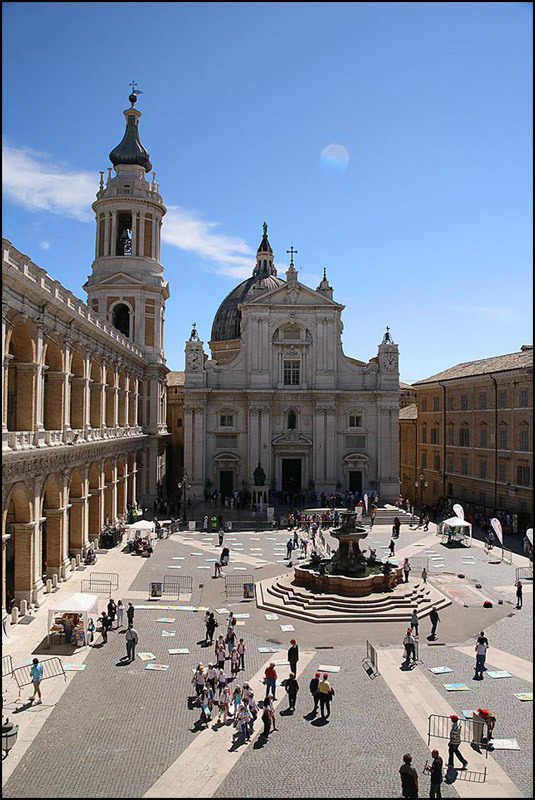
Martyrs of Africa – 9 Saints: A group of Christians Martryed together in Africa. The only details that have survived are the names – Beresus, Dasius, Faustinus, Leucius, Lucius, Martialis, Victoricus, Victrix and Viktor. They were Martyred in c300 in Africa.
Thought for the Day – 17 October – Meditations with Antonio Cardinal Bacci (1881-1971)
“Month of the Holy Rosary” The Fourth Glorious Mystery The Assumption of the Blessed Virgin into Heaven
“The fourth Book of Kings tells us, that the prophet Elias was brought up into Heaven in a fiery chariot without having first endured the pains and humiliations of death (Cf 4 Kings 2:11). Why did God not do likewise in the case of the Blessed Virgin, commanding His Angels to bear her to Heaven before death struck her innocent body? As St Paul says, it was sin which caused death to enter the world. From the moment of her conception, Mary was free from the slightest taint of sin, for she was immaculate and full of grace. Nevertheless, according to the most widely held tradition, Mary chose to die, even as her divine Son had willed to die. Jesus “was offered because it was his own will” (Isa 53:7). The same is true in Mary’s case, with only this difference. Jesus died a cruel death after the most hideous tortures in the midst of a blaspheming and hate-ridden mob. Nothing like this happened to Mary, although she is called the Queen of Martyrs because of the sword which pierced her soul at the sight of her divine Son, dying in such agony.
Jesus willed, however, that the immaculate body of His Mother would remain intact. It was only her great love and intense desire of being reunited with her Son, which gradually consumed her mortal life. Her ever-increasing love for God, broke the bonds of her mortal frame until she went to sleep at last, in the Lord.
Quote/s of the Day – 17 October – St Margaret Mary Alacoque (1647-1690) Virgin
“Let us begin, in earnest, to work out our salvation, for no-one will do it for us, since, even He Himself, Who made us, without ourselves, will not save us, without ourselves!”
“Keep your heart in peace and let nothing trouble you, not even your faults. You must humble yourself and amend them peacefully, without being discouraged or cast down, for God’s dwelling, is in peace.”
“Let every knee bend before Thee, O greatness of my God, so supremely humbled in the Sacred Host. May every heart love Thee, every spirit adore Thee and every will be subject to Thee!”
In Thy Divine Heart By St Margaret Mary Alacoque (1647-1690) Visionary of the Sacred Heart
Lord Jesus, let my heart never rest until it finds Thee, Who are its source, its love and its happiness. By the wound in Thy Heart pardon the sins I have committed, whether out of weakness, or out of evil desires. Place my weak heart in Thy own Divine Heart, continually under Thy protection and guidance, so that I may persevere in doing good and in fleeing evil, until my last breath. Amen
One Minute Reflection – 17 October – “The Month of the Most Holy Rosary and of the Angels” – St Margaret Mary Alacoque (1647-1690) Virgin – Ephesians 3:8-9, 14-19, Matthew 11:25-30 – Scripture search here: https://www.drbo.org/
“Thou hast hid these things from the wise and prudent and revealed them to the little ones.” – Matthew 11:25
REFLECTION – “When more obscure Mysteries are presented to your timid nature by your faith, Christian soul, take courage and say [like Mary], “How shall this be done …?” (Lk 1:34), not in a controversial spirit but with the love of a disciple. Let your questioning be your prayer, your love, your piety, your humble desire – not seeking to plumb the depths of God’s majesty but looking for salvation, in the healing acts of the God, Who saves us. …
No-one “knows a man’s thoughts, except the spirit of the man which is in him; so also, no-one comprehends the thoughts of God, except the Spirit of God” (1 Cor 2:11). Hasten then to be a sharer in the Holy Spirit. He is present when He is called upon; nor could He be called upon, if He were not present. When, on being called upon, He comes, it is with the abundance of the blessings of God. He is the flowing of “the river which gives joy to God’s city” (Ps 45:5). And if, when He comes, He finds you humble and still and respecting the Words of God, He will rest upon you (Lk 1:35) and He will reveal to you, what God the Father withdraws from the wise and prudent of this world and those things, will begin to dawn upon you which Wisdom (1 Cor 1:24) could say to the disciples when on this earth but which they were unable to bear, until the Spirit of Truth came, Who was to teach them all Truth (Jn 16:12-13).” – William of Saint-Thierry O.Cist. (c1075-c1148) Cistercian Monk, Mystic, Theologian, Writer (The Mirror of Faith 6).
PRAYER – O Lord Jesus Christ, Who wondrously revealed the unsearchable riches of Thy Heart to blessed Margaret Mary, the Virgin, grant us, by her merits and through imitating her, to love Thee, in all things and above all things, so that we may be found worthy to possess a lasting dwelling place in Thou Heart itself. Through the same Jesus Christ, Thy Son our Lord, Who lives and reigns with Thee, in the unity of the Holy Ghost, God, world without end. Amen (Collect).
Our Morning Offering – 17 October – St Margaret Mary Alacoque (1647-1690) Virgin
Be My Strength, O Sacred Heart! By St Margaret Mary Alacoque (1647-1690) Visionary of the Sacred Heart
O Sacred Heart of Jesus, I fly to Thee, I unite myself to Thee, I enclose myself in Thee! Receive my call for help, O my Saviour, as a sign of my horror, of all within me contrary to Thy holy love. Let me die rather a thousand times, than consent to sin against Thee! Be my strength, O God – defend me, protect me. I am Thine and desire forever to be Thine! Amen
Saint of the Day – 17 October – Saint Florentinus of Orange (Died c526) Bishop of Orange in in Vaucluse, France now in the Diocese of Avignon, between c527-524, Miracle-worker. Born on an unknown date in Tours, France and died in c526 in Orange, Provence, France of natural causes. Also known as – Florent, Florentius, Fiorenzo, Florence, Florencio. Patronages – Fiorenzuola d’Arda, in Italy and Orange.
The Roman Martyrology reads: “At Orange, in France, St Florentinus, Bishop, who died leaving a reputation for many virtues.”
Florentinus was born in the 5th Century and received monastic training. He was undoubtedly Abbot of the Clastre Monastery in a suburb of Orange (on the site of the current Convent of the Nativity).
He was elected Bishop of this City after the year 500. He continued the restoration of the Diocese, damaged by incessant barbarian invasions and the reconstruction of its Churches.
In 509 the City was taken by the Ostrogoths and its inhabitants deported with their Bishop to Fidentia near Piacenza in Italy. But this captivity was short-lived, thanks to the intervention of BishopSt Caesarius of Arles (470-542) with King Theodoric.
In 517, Florentinus was present at the Council of Epaone (Albon) against Arianism and at the Councils of Lyon and Arles of 524. He died before 527.
The people of Orange have always preserved the memory of his holiness and his pastoral zeal, his goodness, his self-sacrifice and his charity, as have the people of Fiorenzuola d’Arda, in Italy, who chose him as their Patron in recognition of his benefits. This relates to the miracle worked there during his pilgrimage to Rome, when he stopped in Fiorenzuola d’Arda, where he performed the extraordinary miracle of bringing a deceased child back to life
Florentinus’ Relics are shared between the Cathedral of Avignon and that of Puy and between the Churches of Fiorenzuola, Laussonne (Haute-Loire) and Saint-Florent d’Orange, where he is venerated as one of the protectors of the City and the former Diocese.
St Ethelbert of Eastry St Ethelred of Eastry St Florentinus of Orange (Died c526) Bishop Bl Gilbert the Theologian St Heron of Antioch Bl Jacques Burin St John the Short/Dwarf St Louthiern St Mamelta of Persia St Nothelm of Canterbury St Richard Gwyn St Rudolph of Gubbio St Rufus of Rome St Serafino of Montegranaro St Solina of Chartres St Victor of Capua St Zosimus of Rome
Martyrs of Nicomedia – 3 Saints: A group of Christians Martyred in the persecutions of Diocletian. The only details about them that have survived are their names – Alexander, Marianus and Victor. 303 in Nicomedia (in modern Turkey).
Martyrs of Valenciennes -5 Beati: A group of Ursuline nuns Martyred in the persecutions of the French Revolution. Hyacinthe-Augustine-Gabrielle Bourla Jeanne-Reine Prin Louise-Joseph Vanot Marie-Geneviève-Joseph Ducrez Marie-Madeleine-Joseph Déjardins
Martyrs of Volitani: A group of Martyrs who were praised by Saint Augustine of Hippo. In Volitani, proconsular Africa (in modern Tunisia).
Thought for the Day – 16 October – Meditations with Antonio Cardinal Bacci (1881-1971)
“Month of the Holy Rosary” The Third Glorious Mystery The Descent of the Holy Spirit
“The Apostles were completely transformed after the feast of Pentecost. They had ben ignorant rustics, timid and vacillating. They had hardly understood at all, the lofty teachings of Christ, for they were hoping still for an earthly kingdom in which they would occupy the highest posts.
When they received the Holy Spirit, however, their minds were flooded with supernatural light and they became heroic in their resolution. Ignorant, though they had been, they became masters of Truth, far superior to the sages of Athens or the philosophers of Rome. They were no longer timid and hesitating but, fearlessly encountered the power of the Sanhedrin, the whips of the soldiery, the dangers of long voyages and, Martyrdom itself.
We too have received the illumination and favours of the Holy Spirit. Many times, when we have invoked Him, He has inspired and consoled us. But we may not have responded with the same fervour and self-denial as the Apostles. Let us remember that, to neglect God’s gifts, is to risk our eternal salvation!”
Quote/s of the Day – 16 October – Feast of the Purity of the Blessed Virgin Mary
“Today humanity, in all the radiance of her Immaculate nobility, receives its ancient beauty. The shame of sin had darkened the splendour and attraction of human nature but when the Mother of the Fair One par excellence, is born, this nature again, regains in her person, its ancient privileges and is fashioned according to a perfect model, truly worthy of God…. The reform of our nature begins today and the aged world, subjected to a wholly divine transformation, receives the first fruits of the second creation.”
St Andrew of Crete (c 650-c 740) Bishop, Theologian, Hymnist
Tota Pulchra Es, Maria You Are All Beautiful, Mary Unknown Author – 4th Century
You are all beautiful, Mary, and the original stain is not in you. You are the glory of Jerusalem, you are the joy of Israel, you give honour to our people. You are an advocate of sinners. O Mary, O Mary, Virgin most intelligent, Mother most merciful. Pray for us, Plead for us, To the Lord Jesus Christ.
Tota pulchra es, Maria. Et macula originalis non est in Te. Tu gloria Ierusalem. Tu laetitia Israel. Tu honorificentia populi nostri. Tu advocata peccatorum. O Maria, O Maria, Virgo prudentissima. Mater clementissima. Ora pro nobis. Intercede pro nobis. Ad Dominum Iesum Christum.
This prayer used by the Church since the 4th Century for the Feast of the Immaculate Conception and the Purity of the Blessed Virgin. It takes some text from the book of Judith and other text from Song of Songs, specifically 4:7. Many composers have set this prayer to music over the centuries.
Prayer for Chastity and Purity of Body and Soul By St Thomas Aquinas (1225-1274)
Dear Jesus, I know that every perfect gift and especially that of chastity, depends on the power of Thy Providence. Without Thee, a mere creature can do nothing. Therefore, I beg Thee, to defend, by Thy grace the chastity and purity of my body and soul. And if I have ever sensed or imagined anything that could stain my chastity and purity, blot it out, Supreme Lord of my powers that I may advance with a pure heart in Thy love and service, offering myself on the most pure altar of Thy Divinity, all the days of my life. Amen
One Minute Reflection – 16 October – “The Month of the Most Holy Rosary and of the Angels” – Feast of the Purity of the Blessed Virgin Mary – Proverbs 31:10-31, Matthew 13:44-52 – Scripture search here: https://www.drbo.org/
“The Kingdom of Heaven is like unto a treasure, hidden in a field.” – Matthew 13:44
REFLECTION – “Some of the brethren think that they are excluded from the Holy Ghost’s gifts of grace. Because they neglect to practise the commandments, they do not know that he who has an unadulterated faith in Christ, has within himself, the sum total of all the Divine gifts. Since, through our laziness, we are far from having an active love for Him — a love which shows us the Divine Treasures within us — we naturally think that we are excluded from these gifts.
If, as St Paul says: “Christ dwells in our hearts through faith” (Eph 3:17) and, “all the treasures of wisdom and spiritual knowledge are hidden in Him” (Col 2:3), then, all the treasures of wisdom and spiritual knowledge are hidden in our hearts! They are revealed to the heart, in proportion to our purification by means of the commandments. This is the treasure, hidden in the field of your heart which you have not yet found because of your laziness. Had you found it, you would have sold everything and bought that field. But now, you have abandoned that field and give all your attention to the land nearby, where there is nothing but thorns and thistles! It is for this reason that the Saviour says: “Blessed are the pure in heart, for they shall see God” (Mt 5:8) for He is hidden in the hearts of those who believe in Him.They shall see Him and the riches that are in Him, when they have purified themselves, through love and self-control. And, the greater their purity, the more they will see!” – St Maximus the Confessor (c580-662) Abbot and Theologian (Centuries of love 4:69).
PRAYER – Grant, we beseech Thee, O Lord God, unto all Thy servants, that they may remain continually in the enjoyment of soundness, both of mind and body and by the glorious intercession of the Blessed Mary, always a Virgin, may be delivered from present sadness and enter into the joy of Thine eternal gladness. Through Jesus Christ, Thy Son our Lord, Who lives and reigns with Thee, in the unity of the Holy Ghost, God, world without end. Amen (Collect).
Our Morning Offering – 16 October – “The Month of the Most Holy Rosary and of the Angels” – Feast of the Purity of the Blessed Virgin Mary
Praeclara Custos Virginum! Blest Guardian of All Virgin Souls! By Anonymous Latin, 18th Century Trans. Fr Edward Caswall C.Orat. (1814–1878)
Blest Guardian of all virgin souls! Portal of bliss to man forgiven! Pure Mother of Almighty God! Thou hope of earth and joy of Heaven!
Fair Lily, found amid the thorns! Most beauteous Dove with wings of gold! Rod from whose tender root there sprang That healing Flow’r long since foretold!
Thou Tow’r, against the dragon proof! Thou Star, to storm-toss’d voyagers dear! Our course lies o’er a treacherous deep; Thine be the light by which we steer.
Scatter the mists that round us hang; Keep far the fatal shoals away And while through darkling waves we sweep, Open a path to life and day.
O Jesu, born of Virgin bright! Immortal glory be to Thee! Praise to the Father infinite And Holy Ghost eternally. Amen
This Hymn originated as the Hymn for Vespers in the Office of the Purity of the Blessed Virgin Mary. It is used for Matins on the Solemnity of the Immaculate Conception. Tune: “From High Heaven” Leipzig melody, 1539.
Saint of the Day – 16 October – Saint Bertrand of Comminges (c1050-1123) Bishop of Comminges, in the Archdiocese of Toulouse, France, Reformer – both religious and civil, Peace-maker, Miracle-worker. Born as Bertrand de l’Isle in c1050 in France and died on 16 October 1123 of natural causes. Patronage – of the Town named after him, Saint-Bertrand-de-Comminges, France. He was Canonised in 1222 by Pope Alexander III.
St Bertrand of Comminges, as depicted on panel above his tomb, in Saint-Bertrand-de-Comminges Cathedral, Haute-Garonne
Bertrand was born around 1050 at the Castle of L’Isle-Jourdain. Belonging to the high nobility, the young man initially devoted himself to the ideal of chivalry but, as an adult, he was Ordained a Priest and requested admission into the “Chapter of Canons” of Saint Stephen Cathedral.
In 1083, the Clergy and people of Comminges were looking for a new Bishop for thir City. They chose this young Canon who brought together the rare qualities of a respected southern Lord, capable of bringing back prosperity, since he was involved in the Reform of his time. To his gifts were added a gentle and kindly temperament and a quality of deep faith, whose richness the future would prove.
His effort focused on the reform of the Clergy by imposing community life upon the Canons – a life of poverty, prayer and study. He thus made the Chapter a radiant and exemplary home of evangelical life. He brought civil order to his Diocese, he administered justice but above all, he restored the Church.
He becomes a builder – to restore and rebuild this City which lived in poverty and great violence. With resolution, he enforced the peace of Christ throughout Comminges, as well as in the Hautes-Pyrénées, to ensure peace and security reigned there.
Many miracles are attributed to Bertrand who put himself at the service of liberating people, removing the handcuffs worn by everyone, liberating hearts as much as bodies. As well as the miraculous deliverance by Saint Bertrand, who was already in Heaven, of Sancho Parra, a minor Lord and a bandit, imprisoned in Barcelona.
Bertrand was very close to his faithful especially to the smallest and poor, constantly visiting them with attention and charity, both on a temporal and spiritual level. He set up land called “sauvétés” (which, having become villages and towns, took the name of “suveterre” or “salvetat”) to shelter the populations of the poor, the marginalised, the outlaws, fugitives so that they caouldfind refuge and security there.
The Cathedral and Village of Saint-Bertrand de Comminges
From his death on 16 October 1123, Bertrand was considered a saint throughout the Pyrenees region and since his Canonisation in 1222, the village took the name and Partronage – “Saint-Bertrand de Comminges.”
Shrine to the Blessed Virgin and St Bertrand, in the Village of “Saint-Bertrand de Comminges.”
St Amandus of Limoges St Ambrose of Cahors St Balderic St Baldwin St Bertrand of Comminges (c1050-1123) Bishop St Bolonia St Conogon of Quimper St Dulcidius of Agen St Eliphius of Toul St Eremberta of Wierre St Florentinus of Trèves (Died 4th Century) (Bishop
St Gerald of Clairvaux O.Cist (Died 1177) Abbot regarded as the first Cistercian Martyr St Junian St Lull St Magnobodus of Angers St Martinian of Mauretania St Mummolinus St Saturian of Mauretania St Silvanus of Ahun St Victor of Cologne St Vitalis of Noirmoutier
Martyrs in Africa – 220 Saints: A group of 220 Christians Martyrs about whom we know nothing but that they died for their faith.
Martyrs of North Africa – 365 Saints: A group of 365 Christians who were Martyred together in the persecutions of the Vandal king Genseric. The only details that have survived are the names of two of the Martyrs – Nereus and Saturninus. 450 in North Africa.
Thought for the Day – 15 October – Meditations with Antonio Cardinal Bacci (1881-1971)
“Month of the Holy Rosary” The Second Glorious Mystery The Ascension of Jesus into Heaven
“In the course of our ascent, we must never stop and decide that we have gone far enough! To stop would inevitably mean going backward. Jesus and Mary are inviting and encouraging us to go higher and higher.
Have we been purified of sin, the defiler of the soul and the destroyer of human dignity? Have we an intense horror, even of venial sin, which separates us from God and kills the life of grace? It is still not enough – we must go higher.
Are we generous and unselfish in the fight to achieve holiness, guarding ourselves against the evil suggestions of the world, the flesh and the devil? It is still not enough – we must continue to advance.
Do we carry the daily cross which God has entrusted to us and accept the burden with perfect resignation to His Holy Will? Very good but even this is not enough!”
Quote/s of the Day – 15 October – “The Month of the Most Holy Rosary and of the Angels” – St Teresa of Jesus of Avila OCD (1515-1582) Virgin and Doctor of the Church
“It is love alone which gives worth to all things.”
“Hope, O my soul, hope! You know neither the day, nor the hour. Watch carefully, for everything passes quickly, even though your impatience, makes doubtful, what is certain and turns a very short time, into a long one.”
“Accustom yourself, to make many acts of love, continually, for they enkindle and melt the soul.”
“God withholds Himself from no-one who perseveres.”
“The important thing, is not to think much but to love much.”
Thy Holy Will By St Teresa of Jesus of Avila (1515-1582) Doctor of the Church
Lord, grant that I may always allow myself to be guided by Thee, always follow Thy plans and perfectly accomplish Thy Holy Will. Grant that in all things, great and small, today and all the days of my life, I may do, whatever Thou may require of me. Help me to respond to the slightest prompting of Thy grace, so that I may be Thy trustworthy instrument, for Thy honour. May Thy Will be done in time and eternity – by me, in me and through me. Amen
One Minute Reflection – 15 October – “The Month of the Most Holy Rosary and of the Angels” – St Teresa of Jesus of Avila OCD (1515-1582) Virgin and Doctor of the Church – Ephesians 5:15-21, John 4:46-53 – Scripture search here: https://www.drbo.org/
“Jesus said to him: Go thy way, thy son lives.” – John 4:50
REFLECTION – “To this end Christ died and lived again that He might be Lord both of the dead and of the living” (Rm 14:9). But “God is not God of the dead but of the living” (Lk 20:38). Consequently, the dead over whom He Who lives has power, are no longer dead but alive. Life has power over them, so that they may live without any further fear of death, just as “Christ, being raised from the dead, will never die again” (Rm 6:9). Raised up and freed from corruption, they shall see death no more. They will share in the resurrection of Christ just as He shared in their death. For no other reason did He descend to earth, whose bars are barriers to eternity, except to “shatter the doors of bronze and cut in two, the bars of iron” (Ps 106:16). He came to lead our lives away from corruption to Himself and gave us freedom, in place of slavery.
If the work of this arrangement of Providence does not seem to be finished yet, for men still die and their bodies rot in the grave, this should in no way undermine our faith. In advance of all the good things already mentioned, we have even now received a pledge through Christ our First Fruits. Through Him, we attain the highest Heaven and take our places with Him, Who carried us up to the heights with Himself. That is what Saint Paul says: “He raised us up with Himself and made us sit with Him, in the heavenly places, in Christ Jesus” (Eph 2:6). –St Anastasius of Antioch (Died c599) Bishop of Antioch(Sermon 5, on the Resurrection of Christ, 6-9).
PRAYER – Graciously hear us, O God, our Saviour that as we rejoice on the feast-day of blessed Teresa, Thy Virgin, we may be so nourished by the food of her heavenly teaching, as to learn how to serve Thee. Through the same Jesus Christ, Thy Son our Lord, Who lives and reigns with Thee, in the unity of the Holy Ghost, God, world without end. Amen (Collect).
Our Morning Offering – 15 October – “The Month of the Most Holy Rosary and of the Angels” – St Teresa of Jesus of Avila OCD (1515-1582) Virgin, Doctor of the Church
O My God, Source of All Mercy! Prayer To Redeem Lost Time By St Teresa of Jesus of Avila (1515-1582) Doctor of the Church
O My God, Source of all mercy! I acknowledge Thine sovereign power. While recalling the wasted years which are past, I believe, that Thou, Lord, in an instant, canst turn this loss into gain. Miserable as I am, yet I firmly believe that Thou canst do all things. Please restore to me the time lost, giving me Thine grace, both now and in the future that I may appear before Thee, in the “wedding garment!” Amen
Saint of the Day – 15 October – Saint Antiochus of Lyons (Died c410) Archbishop of Lyons. Also known as – Antioch or Andéol,
The Roman Martyrology states: “At Lyons, St Antiochus, Bishop, who entered the heavenly kingdom after having courageously fulfilled, the duites of high station, to which he had been called.”
Antiochus was a Priest in Lyons, when his Bishop, St Justus of Lyons (Died c390), resigned his See after an incident which led him to believe that he was unworthy of the position of Shepherd of the faithful of Lyons and he resolved to devote the remainder of his life to penance. He travelled to the Desert in Egypt to pursue a life of solitude, penance and prayer. See the full story here:https://anastpaul.com/2023/09/02/saint-of-the-day-2-september-st-justus-of-lyons-died-c390-bishop-confessor/
The City faithful being eager to regain their Bishop, sent a delegation led by Antiochus, to find him and bring him back to his Diocese. Antiochus found but could not convince the saintly Hermit Bishop to return. Antiochus returned to Gaul and was later himself, appointed Bishop of Lyons.
As Bishop, Antiochus arranged to bring the Relics of Bishop Justus back to Lyons and solemnly buried them in the Basilica of the Maccabees, renmaed in honour of St Justus , where he himself would later too be interred.
Martyrs of Cologne: A group of 360 Christian soldiers Martyred together in the persecutions of Diocletian and Maximian. They were Martyred in 303 outside the City walls of Cologne, Germany.-
Thought for the Day – 14 October – Meditations with Antonio Cardinal Bacci (1881-1971)
“Month of the Holy Rosary” The First Glorious Mystery The Resurrection of Our Lord
“Do we wish to share also in the joy of the Resurrection of Jesus Christ? Let us imitate Mary. First of all, we must participate as she did in the sufferings of Christ. By meditating frequently on the Passion and Death of Christ, we can nourish in our hearts, an intense love for Him Who suffered so much for our salvation. Let us learn to carry our cross, as He carried His, with resignation and with conformity to God’s Will. Spiritual joy is always the fruit of renunciation and love.
We cannot be happy with Jesus triumphant ,if we have not first imitated Jesus suffering. We cannot rise gloriously into Heaven, if we have not first walked patiently with Mary along the Way of Calvary!”
You must be logged in to post a comment.